【Research Note】The Representation Problem in International Relations Event Modeling and Exploration of Theoretical Tools — An Event-Driven Research Path Based on Quantum Spiking Neural Networks
Citation: HUANG, W. (2026, January 12). Anarchy, Nonlinearity, and Emergence in International Relations: A Spiking Neural Network Framework Approach. https://doi.org/10.17605/OSF.IO/XEKDA
Note: This is a preliminary research note documenting a research idea still in the feasibility assessment stage. Its purpose is to systematically organize a research concept that remains under evaluation.
Abstract
This study proposes an international relations modeling approach based on Quantum Spiking Neural Networks (QSNNs), combining the representational structures of quantum computation with event-driven neural dynamics. While existing systems theory and dynamical systems approaches have made important progress in international relations research, they face fundamental challenges when handling the discrete event-driven evolution processes that dominate international politics. These methods often require external time discretization or additional mechanisms to introduce events into models, making it difficult to naturally represent and evolve events as intrinsic constitutive elements of the dynamics.
Biological spiking neural networks, as event-driven dynamical system models, treat events themselves as the basic units for state updates and computational triggers, thereby providing a more natural modeling foundation for event sequences in international relations. To further enhance event representation capabilities within this framework, this study introduces quantum extensions to classical spiking neural networks, constructing a quantum spiking neural network framework. In this framework, each international event is encoded as a quantum state on the Bloch sphere, with phase and amplitude distributions characterizing differences between events, thus achieving continuous representation of event qualities while maintaining geometric structure. This quantum event representation formally enables researchers to distinguish events under different contexts and intensities, introduces theoretical physics tools for analyzing relational structures between states, and provides expressive space for characterizing superposition properties and path-dependent phenomena that may exist in international politics. Combined with event-driven computational architecture, QSNNs maintain computational efficiency when processing sparse international event data and provide a possible technical path for introducing advanced theoretical physics analysis methods into international relations modeling.
Furthermore, from a computational architecture perspective, spiking neural networks and their quantum extensions possess natural asynchronicity and distributed characteristics. No global clock or central control unit exists in the system; different actors update their own states only when events occur through local interactions. This centerless, asynchronously evolving computational structure bears formal structural similarity to the “anarchic conditions” commonly discussed in international relations research. This framework provides a possible research path for characterizing event propagation, feedback, and structural evolution under centerless interaction conditions at the computational model level.
The anticipated research contributions of this work include: a quantum-theoretical international relations modeling framework centered on events, methods for discovering dynamical equations, formalized analysis of international relations entities and structures, and exploratory tools for decision-making.
Conceptual Framework Diagram Explanation
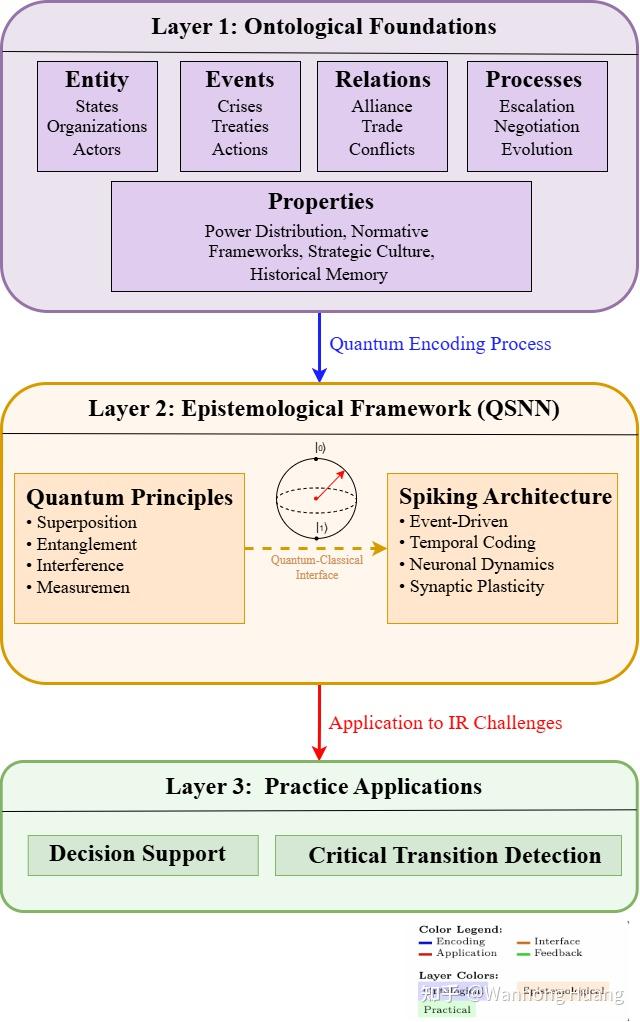
Figure 1: Conceptual framework of QSNN as an epistemological framework assisting international relations research: A three-layer architectural diagram illustrating (1) the ontological foundation of international relations phenomena, (2) the Quantum Spiking Neural Network (QSNN) framework explored in this paper, where events are formally encoded through quantum states on the Bloch sphere, and (3) potential application directions of this framework in decision support and policy analysis.
The QSNN international relations modeling framework proposed in this study adopts a three-layer architectural design, embodying a complete theoretical path from ontological foundation to epistemological method to practical application:
Layer 1: Ontological Foundation
This layer defines the basic objects and elements of international relations research. The conceptually related facts in international relations include (Li Shaojun, Introduction to International Politics, 5th Edition):
- Entities
- States
- Events
- Relations
- Processes
- Properties
These ontological elements constitute the basic building blocks of international relations phenomena and serve as the object foundation for subsequent theoretical modeling.
Layer 2: Epistemological Framework (QSNN)
This is the core layer of this research, demonstrating how the QSNN framework transforms ontological objects into computable and analyzable theoretical models. This layer contains three key components:
Left side: Quantum Principles
- Superposition
- Entanglement
- Interference
- Measurement
These fundamental principles of quantum computation provide new formalization tools for international relations phenomena, particularly capable of representing strategic ambiguity, coexistence of multiple interpretations, deep interdependence, and other phenomena difficult to capture with classical methods.
Center: Bloch Sphere Representation
The Bloch sphere depicted in the diagram is a geometric representation of quantum states. Each point on the sphere corresponds to a quantum state:
$$|\psi\rangle = \cos(\theta/2)|0\rangle + e^{i\phi}\sin(\theta/2)|1\rangle$$
where:
- $|0\rangle$ and $|1\rangle$ are the north and south poles of the sphere, representing two basis states
- $\theta$ is the polar angle, controlling amplitude distribution
- $\phi$ is the azimuthal angle, representing phase
Each international event is mapped to a point on the Bloch sphere (shown by the red arrow), completely described by $(\theta, \phi)$ coordinates. The characteristics of this representation include:
- Continuity: Infinitely many points on the sphere can represent infinite gradations and subtle differences of events
- Geometric structure: Similarity between events is naturally measured by angular distance on the sphere
- Topological properties: Geometric phases of closed paths can capture path-dependent effects
Right side: Spiking Architecture
- Event-Driven
- Temporal Coding
- Neuronal Dynamics
- Synaptic Plasticity
Due to the event-driven nature of spiking neural networks, discrete international events can drive network evolution.
Quantum-Classical Interface
The orange dashed arrow in the diagram represents the interface between quantum principles and spiking architecture, which is the technical key of the QSNN framework. This interface implements:
- Transmission of quantum states between neurons
- State collapse and spike emission caused by quantum measurement
- Implementation of quantum channels at the synaptic level
Layer 3: Practical Applications
This layer demonstrates the application value of the QSNN framework in actual international relations problems:
Decision Support
- Quantum Counterfactuals: Utilizing quantum superposition states to simulate multiple possibilities of policy options
- Strategic Ambiguity: Formalizing strategic ambiguity through quantum superposition states, optimizing degree of ambiguity
- Policy Simulation: Simulating policy effects in quantum state space
Critical Transitions
- Phase Detection: Identifying topological phase transitions in the international system
- Bifurcation Analysis: Analyzing bifurcation points in quantum dynamical systems
- Early Warning: Providing early warning through critical slowing down of quantum state evolution
Policy Analysis
- Alliance Entanglement: Quantifying entanglement structure of alliance networks
- Geometric Phases: Analyzing path dependence in escalation-de-escalation cycles
- Renormalization Methods: Multi-scale analysis of international relations patterns
Information Flow and Theoretical Relations
Arrows in the diagram show information flow and theoretical connections between framework layers:
- Blue solid arrow (downward): “Quantum encoding process” encodes international relations entities and phenomena from the ontological layer into quantum states and quantum dynamics of the epistemological layer. This is the mapping process from real world to theoretical model.
- Red solid arrow (downward): “Application to international relations challenges” applies theoretical insights generated by the epistemological framework to specific problems in the practical layer. This is the transformation process from theory to application.
Philosophical Implications of the Framework
This three-layer architecture embodies profound philosophical thinking:
The ontological layer represents the question of “what is” — the basic constitutive elements and phenomena of international relations themselves.
The epistemological layer represents the question of “how to know” — what theoretical tools and methodological frameworks to use to understand and analyze these phenomena. The introduction of the QSNN framework is a major innovation at the epistemological layer.
The practical application layer represents the question of “why to know” — the ultimate purpose of theoretical understanding is to guide practice and solve practical problems.
1. Research Background and Problem
1.1 Relation-Centered Definition of International Relations Research
Under a relation-centered definition of research objects, International Relations (IR) research focuses on relational structures that transcend state boundaries and phenomena emerging from these structures. Due to the high abstraction of concepts like relations and objects, social science research typically employs operationalization methods to transform international relations concepts into operable and analyzable symbolic structures. This process enables the application of natural science and engineering methods to international relations research.
1.2 Existing Systems Theory Methods
Systems theory methods constitute an important methodological toolkit in international relations research. Examples include:
- Agent-Based Modeling (ABM): Treats states and international organizations as autonomous units within the system, studying macro-level international phenomena through simulating their interactions.
- Network Analysis: Models inter-state relations such as trade, alliances, and conflicts as complex networks, revealing structural characteristics of the international system.
- Dynamical Systems Theory: Used to analyze stability, critical points, and phase transitions in international relations.
1.3 Fundamental Limitations of Existing Methods
Factual entities in international relations include: (1) states, (2) attributes, (3) relations, (4) processes, and (5) events. However, existing systems theory methods face fundamental limitations in temporal modeling and event representation for entities (1) through (4):
1.3.1 Temporal Representation Mismatch
Problem Description: International relations evolve through discrete events (diplomatic crises, treaty signings, military actions) that trigger continuous cascading effects. Traditional continuous-time dynamical systems assume smooth state evolution and cannot naturally represent discrete event occurrence; discrete agent-based models impose artificial time step discretization, missing the asynchronous nature of international politics.
Specific Manifestations:
- Continuous-time models cannot capture instantaneous shocks of突发 events
- Fixed time steps in discrete-time models mismatch the natural occurrence frequency of events
- Difficulty modeling multi-timescale effects after event occurrence (short-term reactions and long-term impacts coexisting)
1.3.2 Impoverished Event Representation
Problem Description: Existing methods represent events as scalar occurrences (binary event/no-event), categorical variables (event type labels), or low-dimensional feature vectors. This cannot capture the rich qualitative diversity of international events—their intensity, context, normative value, strategic ambiguity, and multidimensional meaning.
1.3.3 Inability to Model Superposition States and Interference
Problem Description: International political phenomena frequently exhibit superposition-like characteristics: actors simultaneously maintain cooperative and competitive stances, events simultaneously carry multiple interpretations, policies remain in ambiguous states before implementation “measurement.” Classical representations lack the mathematical structure to formalize such phenomena.
1.3.4 Limited Analytical Toolbox
Problem Description: Traditional dynamical systems limit analysis to phase space geometry and bifurcation theory. Rich mathematical structures from quantum field theory, geometric topology, and gauge theory cannot be accessed because classical event representations lack necessary mathematical properties (Hilbert space structure, unitarity, gauge invariance).
Missed Opportunities:
- Cannot apply topological methods to identify robust invariants of the system
- Cannot use geometric phase theory to analyze path-dependent effects
- Cannot leverage renormalization group methods for multi-scale analysis
- Cannot quantify deep interdependence through entanglement measures
2. Quantum Spiking Neural Network (QSNN) Framework
2.1 Core Idea
This research proposal attempts to model and analyze international relations using a Quantum Spiking Neural Network (QSNN) framework that combines quantum computing principles with event-based neural computation. Quantum extension through quantum state representation on the Bloch sphere provides transformative capabilities to classical spiking neural networks.
2.2 Quantum State Representation on the Bloch Sphere
In the QSNN framework, each international event is encoded as a quantum state $|\psi\rangle$ on the Bloch sphere, represented as:
$$|\psi\rangle = \cos(\theta/2)|0\rangle + e^{i\phi}\sin(\theta/2)|1\rangle$$
where $\theta$ and $\phi$ specify the state’s position on the sphere.
Key Property: Crucially, all event vectors have unit norm $\langle\psi|\psi\rangle = 1$, but differ in phase $\phi$ and amplitude distribution (controlled by $\theta$).
2.3 Six Expected Advantages of Quantum State Representation
2.3.1 Infinite Event Discrimination Capability
Core Principle: The continuous phase space $(\theta, \phi)$ allows encoding infinitely many different event types and intensities.
Comparison with Traditional Methods:
- Categorical encoding: Can only represent finite discrete types
- Classical vectors: Require arbitrary choice of dimensions, lack geometric principles
- Bloch sphere: Provides natural, geometrically principled continuous event space
Specific Application: Two events of the same “type” but different intensity or context are represented as neighboring points on the sphere; their angular separation $\Delta\Omega$ quantifies similarity:
$$\text{Similarity} = \cos(\Delta\Omega/2)$$
2.3.2 Geometric Phases and Berry Curvature
Theoretical Background: When events evolve through sequences (e.g., escalation cycles), their quantum states trace paths on the Bloch sphere. The geometric phase accumulated along closed paths can represent path-dependent effects in international relations.
Mathematical Expression: For a closed path $\mathcal{C}$, the Berry phase is:
$$\gamma = i\oint_{\mathcal{C}} \langle\psi(\lambda)|\nabla_\lambda|\psi(\lambda)\rangle d\lambda$$
where $\lambda$ is the path in parameter space.
International Relations Implications: This formalizes how “identical” event sequences can produce different outcomes depending on the trajectory taken.
Connection to Advanced Theory: This links international relations phenomena with gauge theory and differential geometry, potentially enabling the use of advanced theoretical physics tools for IR analysis.
2.3.3 Quantum Interference in Event Superposition
Quantum Superposition Representation: Multiple potential events or policy options can be represented as quantum superposition states:
$$|\Psi\rangle = \alpha|e_1\rangle + \beta|e_2\rangle$$
where $|\alpha|^2 + |\beta|^2 = 1$ ensures normalization.
Interference Effects: When events “collapse” (actualize), the actual probability is not simply $|\alpha|^2$, but includes interference terms:
$$P(e_1) = |\langle e_1|\Psi\rangle|^2 = |\alpha + \beta\langle e_1|e_2\rangle|^2$$
The interference term $\beta\langle e_1|e_2\rangle$ captures how combinations of potential actions produce effects beyond simple linear superposition.
International Relations Applications:
- Strategic Ambiguity: States intentionally maintain superposition states of multiple policy options; interference effects make it difficult for adversaries to predict actual actions
- Commitment Problems: Collapse of superposition states (through “measurement”—observing actual actions) alters the future possibility space
- Signaling: Partial measurement (obtaining incomplete information) leads to partial state collapse, formalizing information leakage in signaling
2.3.4 Entanglement of Relational Structures
Mathematical Formalization: Multi-actor states can be represented as entangled quantum states:
$$|\Psi_{AB}\rangle = \frac{1}{\sqrt{2}}(|0\rangle_A|1\rangle_B + |1\rangle_A|0\rangle_B)$$
where actors $A$ and $B$ cannot be independently described.
Entanglement Measure: Use entanglement entropy to quantify the degree of interdependence. For bipartite systems, the von Neumann entropy is:
$$S(\rho_A) = -\text{Tr}(\rho_A \log \rho_A)$$
where $\rho_A$ is the reduced density matrix of actor $A$.
Predictive Capability: Entanglement entropy can predict alliance cohesion under stress, potentially more accurately than traditional indicators.
2.3.5 Quantum Field Theory Analysis
Framework Extension: The QSNN framework enables application of Quantum Field Theory (QFT) methods to international relations.
Basic Idea:
- Relations as Fields: International relations can be modeled as quantum fields; each point in space corresponds to a potential bilateral relation
- Events as Excitations: International events correspond to excitations or quanta of the field
- Interactions as Couplings: Couplings between different relational fields describe interactions in the relationship network
Group Field Theory: Provides tools to analyze how relational structures emerge from fundamental interaction events. Relational networks are not pre-existing but “generated” from microscopic interactions.
Renormalization Group Methods:
- Study how international relations patterns exhibit different characteristics at different observation scales
- Bilateral-level conflicts may appear as power balances at regional level
- Regional-level alliances may appear as bloc confrontations at global level
- “Running coupling constants” describe how interaction strength changes with scale
Symmetry Breaking: Explains transitions of international systems from undifferentiated to differentiated states.
2.3.6 Topological and Geometric Methods
Topological Data Analysis: Quantum representation enables topological data analysis on international event spaces.
Persistent Homology:
- Identifies robust structural features in event sequences (e.g., periodic patterns, critical turning points)
- Topological features invariant under continuous deformation represent essential properties of the system
Quantum Geometric Tensor:
- Reveals intrinsic curvature of the event manifold
- High-curvature regions indicate small parameter changes produce disproportionately large effects (“butterfly effect” regions)
- Can identify fragile points and critical zones of the system
Topological Invariants:
- Winding Number: Characterizes topological type of closed paths
- Chern Number: Quantifies topological properties of band structures, applicable to “international relations phase diagrams”
- Topological Phase Transitions: Sudden changes in discrete invariants correspond to qualitative system transformations (e.g., end of Cold War)
Robustness: Topological quantum numbers are robust to continuous perturbations, providing reliable system descriptions under noise and uncertainty.
3. Event-Driven Quantum Computational Architecture
3.1 Natural Fit of Spiking Neural Networks
The inherently event-based computational architecture of Spiking Neural Networks (SNNs) naturally combines with quantum representation, perfectly matching the discrete event nature of international relations.
3.2 Properties of Quantum Spikes
Distinction from Classical Spikes:
- Classical spikes: Binary signals (present/absent), carrying only temporal information
- Quantum spikes: Carry complete quantum states $|\psi\rangle$, including phase and amplitude information
Information Capacity: Each quantum spike encodes multidimensional event features through Bloch sphere coordinates $(\theta, \phi)$, achieving high-density information transmission.
3.3 Neuronal Dynamics
Membrane Potential Evolution: The neuron’s membrane potential is no longer a scalar but a quantum state:
$$i\hbar\frac{d|\psi\rangle}{dt} = H(t)|\psi\rangle$$
where $H(t)$ is a Hamiltonian dependent on incoming quantum spikes.
Spike Emission Mechanism:
- Continuous quantum state evolution (unitary process)
- When measurement of an observable exceeds threshold, quantum measurement occurs
- State collapses to eigenstate, emitting quantum spike
- Post-measurement state becomes new initial state
Actor Modeling: Each international actor (state, organization) corresponds to a quantum neuron; its internal state evolution reflects that actor’s response to the international environment.
3.4 Synaptic Dynamics
Synapses as Quantum Channels: Relations between actors are implemented through synapses; synapses are essentially quantum channels (completely positive trace-preserving maps).
Types of Quantum Channels:
- Unitary channels: Conservative interactions not involving environment (e.g., treaty negotiations)
- Decoherence channels: Involve information loss (e.g., interactions under incomplete information)
- Amplitude damping: Represents decay in relationship strength
Synaptic Plasticity:
- Synaptic weights (quantum channel parameters) update based on spike timing and quantum state overlap
- Similar to Hebbian rule: “neurons that fire together, wire together,” but implemented in quantum state space
- Formalizes learning and adaptation in relationships
Entanglement Evolution:
- Repeated interactions gradually entangle quantum states between actors
- Degree of entanglement quantifies depth and stability of relationships
- Can be monitored through entanglement entropy $S(\rho_A)$
3.5 Efficiency of Event-Driven Computation
On-Demand Computation:
- Computation occurs only when quantum events occur
- System remains in resting state during event-free periods, consuming no computational resources
- Particularly suited to sparse event characteristics of international relations
Asynchronicity:
- Events of different actors occur asynchronously
- No need for global clock synchronization
- Truly reflects asynchronous nature of international politics
Scalability:
- Computational complexity of event-driven architecture scales linearly with number of events, not time steps
- Can efficiently process large-scale, long-timescale international relations data
4. Advantages of QSNN over Classical SNN
4.1 Structured Infinite-Dimensional Event Space
Limitations of Classical SNN: Require pre-defining finite discrete event types or arbitrarily choosing feature vector dimensions.
Advantages of QSNN: Bloch sphere geometry provides principled continuous event encoding without arbitrary dimensional choices. Each event naturally corresponds to a point on the sphere; the encoding space is both continuous and bounded.
4.2 Access to Quantum Theoretical Physics Tools
Available Methods:
- Geometric Phase Theory
- Gauge Theories
- Entanglement Measures
- Quantum Field Methods
- Topological Invariants
Theoretical Depth: These methods come from frontiers of theoretical physics, with rigorous mathematical foundations and profound physical intuition, capable of revealing deep structures in international relations.
4.3 Natural Representation of Uncertainty and Ambiguity
Strategic Uncertainty: Quantum superposition formalizes irreducible strategic uncertainty before “measurement” (action realization). This is not epistemic uncertainty (due to insufficient information) but ontological uncertainty (multiple possibilities genuinely coexisting).
Distinction from Probability Mixtures:
- Probability mixture: $\rho = p|e_1\rangle\langle e_1| + (1-p)|e_2\rangle\langle e_2|$ (classical uncertainty)
- Quantum superposition: $|\psi\rangle = \sqrt{p}|e_1\rangle + \sqrt{1-p}|e_2\rangle$ (quantum superposition)
- Superposition states contain interference terms, producing phenomena unexplainable by probability mixtures
4.4 Topological Robustness
Discrete Invariants: Topological quantum numbers (winding numbers, Chern numbers) provide discrete invariants characterizing qualitative international relations phenomena.
Noise Resistance:
- Robust to continuous perturbations (noise, measurement errors don’t change topological invariants)
- Only sufficiently large perturbations can induce topological phase transitions (qualitative changes)
- Provides reliable description in uncertain environments
Phase Transition Signals: Sudden changes in topological invariants are clear signals of system qualitative transformations, easier to identify and predict than gradual changes in traditional indicators.
5. Operator Discovery
Addressing the core question “how to determine appropriate quantum neuronal and synaptic evolution operators,” this research needs to explore the following methods:
5.1 Quantum Circuit Architecture Search
Variational Quantum Algorithms:
- Parameterized Quantum Circuits (PQCs)
- Components: Rotation gates (Rx, Ry, Rz), entangling gates (CNOT, CZ)
- Search space: Circuit depth, gate types, connectivity topology
Quantum Neural Architecture Search:
- Automatically discover optimal quantum circuit structures for neuronal evolution and synaptic updates
- Objective function: Minimize prediction error (given historical event sequence, predict quantum state of next event)
- Optimization methods: Gradient descent, reinforcement learning, evolutionary algorithms
Matching Historical Data:
- Training set: Historical international event sequences
- Validation set: Recent events reserved for validating generalization capability
- Evaluation metrics: Quantum state fidelity, event prediction accuracy
5.2 Quantum-Enhanced Symbolic Regression
Extension of Classical Symbolic Regression:
- Classical methods: Discover mathematical expressions explaining data (e.g., Eureqa, PySR)
- Quantum extension: Discover quantum Hamiltonian structures and Lindblad operators
Lindblad Master Equation: For open quantum systems (coupled with environment), dynamics described by Lindblad equation:
$$\frac{d\rho}{dt} = -\frac{i}{\hbar}[H,\rho] + \sum_k \left(L_k\rho L_k^\dagger - \frac{1}{2}{L_k^\dagger L_k,\rho}\right)$$
where $H$ is the Hamiltonian, $L_k$ are Lindblad operators.
Discovery Process:
- Hamiltonian library: Generate library of Pauli operators and their tensor products as Hamiltonian candidates
- Lindblad operator library: Similarly generate candidate dissipative operators
- Evolutionary search: Combine operators through genetic algorithms, select coefficients
- Fitness evaluation: Degree of match with observed quantum state trajectories
Exploiting Structure:
- Neuron-synapse decomposition naturally corresponds to additive decomposition of Hamiltonian
- Locality principle: Only synapses between adjacent actors have strong coupling terms
5.3 Geometric Optimization
Riemannian Geometry of Quantum State Manifolds:
- Quantum state space is not flat Euclidean space but a manifold with non-trivial geometry
- Quantum Fisher Information Metric defines distance on the manifold
Quantum Natural Gradient Methods:
- Traditional gradient descent is Euclidean gradient in parameter space
- Quantum natural gradient considers Riemannian geometry of quantum state space
- Performs geodesic descent on quantum state manifold, converging faster
Optimization Process:
$$\theta_{t+1} = \theta_t - \eta F^{-1}(\theta_t)\nabla_\theta \mathcal{L}(\theta_t)$$
where $F(\theta)$ is the quantum Fisher information matrix, $\mathcal{L}$ is the loss function.
5.4 Verification through Quantum Tomography
Quantum State Tomography:
- Goal: Reconstruct complete quantum state $\rho$ from measurement statistics
- Method: Perform measurements in different bases, infer density matrix from measurement results
- Application: Verify fidelity of learned event quantum state encoding
Quantum Process Tomography:
- Goal: Reconstruct complete description of quantum channel (synaptic dynamics)
- Method: Prepare different input states, measure output states, infer channel’s Kraus representation
- Application: Verify learned relational channels are consistent with observed relationship evolution
Counterfactual Simulation Verification:
- Use learned QSNN model for “what if” counterfactual reasoning
- Compare with expert assessments or historical cases
- Evaluate model’s predictive capability and causal inference ability
6. Research Objectives
The main objectives of this research include:
6.1 Infrastructure Development
Scalable Quantum-Classical Hybrid Platform:
- Support flexible customization of quantum neuronal and synaptic dynamics
- Modular design allowing plug-and-play of different quantum circuits and operators
- High-performance computing optimization supporting large-scale simulation
Software Components:
- Integration with quantum computing frameworks (Qiskit, Cirq)
- Interfaces to classical machine learning frameworks (PyTorch, TensorFlow)
- Data preprocessing and post-processing pipelines
- Visualization and analysis tools
Potential Hardware Deployment:
- Explore feasibility of neuromorphic quantum hardware
- Quantum-classical co-processing architecture
- Prepare for future quantum hardware
6.2 Case Studies and Validation
[This section would detail specific historical cases to be analyzed]
6.3 Application of Theoretical Physics Methods
Quantum Dynamical Systems Theory:
- Quantum bifurcation analysis: Identify stable and unstable points in international systems
- Entanglement dynamics: Track temporal evolution of alliance network entanglement
- Quantum chaos: Analyze predictability boundaries of international relations
Quantum Field Theory:
- Renormalization group analysis: Study emergent patterns of international relations at different scales (bilateral, regional, global)
- Symmetry breaking: Analyze transition mechanisms from symmetric to differentiated states in international systems
- Field excitations: View international events as quantum excitations of relational fields
Quantum Topology:
- Topological phase classification: Identify different topological phases of international systems (unipolar, bipolar, multipolar, etc.)
- Chern number calculation: Quantify topological properties of systems
- Topological phase transition detection: Predict critical points of system qualitative transformations
7. Expected Contributions
7.1 Methodological Innovation
Establishing Quantum Social Science Paradigm:
- Quantum event computation as a new paradigm for international relations systems modeling
- Provide quantum-theoretical time-relational framework, addressing representational limitations of classical methods
- Provide template for other social science fields (economics, sociology)
Making Advanced Physics Methods Available:
- Demonstrate applicability of advanced theoretical physics tools in social sciences
- Build interdisciplinary bridges, promoting collaboration between physicists and social scientists
- Open new research directions and problem spaces
7.2 Technical Outputs
Open-Source Software Infrastructure:
- Quantum-classical hybrid spiking neural network library
- Quantum circuit library for international relations applications
- Quantum event encoding schemes and pre-trained models
- Data processing pipelines (from raw event data to quantum states)
Lowering Application Barriers:
- Detailed documentation and tutorials for IR researchers without deep quantum computing background
- Interactive visualization tools intuitively displaying quantum states and evolution
- Benchmark datasets and pre-trained models for quick research startup
7.3 Theoretical Insights
Revealing Phenomena Invisible to Classical Methods:
- Topological phase transitions: Identify precise moments and mechanisms of international system qualitative transformations
- Entanglement structures: Quantify deep interdependencies in alliance networks, beyond surface treaty relationships
- Geometric phase effects: Explain path dependence and historical memory in escalation dynamics
- Quantum interference patterns: Formalize nonlinear effects and strategic ambiguity in policy superpositions
7.4 Application Value
Quantum-Enhanced Policy Simulation Tools:
- Strategic ambiguity optimization: Find optimal degree of ambiguity through quantum superposition states, balancing deterrence and flexibility
- Entanglement dependency analysis: Assess policy impacts on alliance network entanglement structures, predict chain reactions
- Counterfactual reasoning: Utilize quantum interference effects for “what if” scenario analysis
Early Warning Capabilities:
- Topological phase transition precursor detection: Identify early signals before system qualitative transformations
- Critical slowing down indicators: Prolonged quantum state recovery time indicates approaching instability points
- Entanglement decay monitoring: Early warning of declining alliance cohesion
Strategic Decision Support:
- Provide new capabilities for strategic analysis in uncertain international environments
- Beyond traditional scenario planning, incorporating quantum effects and topological robustness
- Assist policymakers in understanding nonlinear dynamics of complex systems
8. Discussion and Outlook
8.1 Theoretical Significance
Mathematization of Relational Ontology: This research advances relational ontology from the philosophical to the mathematical level. Quantum entanglement provides precise formalization of the irreducibility of relations—the whole is indeed greater than the sum of its parts.
Synthesis of Constructivism and Realism:
- Quantum superposition states formalize the “indeterminacy” of norms and identities emphasized by constructivism
- Quantum measurement and state collapse correspond to the “moment of action” emphasized by realism
- The QSNN framework formally unifies these two paradigms at the formal level
New Tools for Complexity Science: Quantum methods provide new tools for complex systems research beyond classical nonlinear dynamics, particularly topological and geometric methods.
8.2 Methodological Reflections
Quantum Analogy vs. Quantum Essence:
- This research uses quantum formalism but does not claim international relations are “essentially quantum”
- Quantum tools are powerful mathematical languages capable of capturing phenomena difficult to formalize with classical methods
- Utility lies in predictive and explanatory power, not ontological commitment
Interpretability Challenges:
- Complexity of quantum models may bring interpretability issues
- Need to develop visualization tools and intuitive interpretation frameworks
- Collaborate with domain experts to ensure model insights can translate to policy recommendations
Computational Feasibility:
- Current quantum simulation still limited to software emulation on classical computers
- Development of genuine quantum hardware will dramatically improve scale and speed
- Hybrid quantum-classical algorithms are practical approaches at this stage
8.3 Future Research Directions
Extension to Other Social Science Fields:
- Economics: Market dynamics, financial networks, macroeconomic fluctuations
- Sociology: Social networks, collective behavior, cultural evolution
- Political Science: Domestic politics, electoral dynamics, social movements
Integration with Artificial Intelligence:
- Deep integration of quantum machine learning methods
- Quantum reinforcement learning for policy optimization
- Quantum generative models for scenario generation
Deepening Empirical Validation:
- Systematic analysis of more historical cases
- Rigorous comparative experiments with traditional methods
- Predictive validation: Make predictions about current events, verify accuracy post-hoc
8.4 Ethical Considerations
Dual-Use Technology:
- QSNN tools can be used for peaceful purposes (conflict prevention, diplomatic optimization)
- Could also be used for manipulation or military advantage
- Need responsible research ethics and application guidance
Algorithmic Bias:
- Training data (historical events) may contain biases
- Quantum encoding learning may inherit and amplify these biases
- Need careful data auditing and fairness assessment
Transparency and Accountability:
- Algorithms used in policymaking should be transparent
- Decision-makers need to understand model capabilities and limitations
- Establish audit and accountability mechanisms
9. Conclusion
International relations research has long relied on systems theory, network analysis, and dynamical systems methods to characterize macrostructures and evolution mechanisms. These methods have achieved important progress in many respects. However, in the discrete event-driven evolution processes that dominate international politics, events often need to be embedded into continuous models through external time discretization or additional mechanisms, making it difficult to naturally represent and evolve events themselves as intrinsic constitutive elements of dynamics. The core problem this paper addresses is precisely the positional question of the “event-dynamics” relationship in formalized modeling.
Spiking neural networks, as event-driven dynamical system models, formally take events themselves as the basic units for computational triggering and state updating, providing a modeling approach with structural fit for characterizing event sequences in international relations. Furthermore, this paper attempts to explore a possible extension direction: without making any “quantum ontological” commitments about international relations, introduce quantum formalism as a representational tool to enhance event expressive capabilities within this framework. The motivation for this attempt is not to claim that international relations are “essentially quantum,” but to utilize the geometric, topological, and algebraic structures possessed by quantum state spaces to explore phenomena difficult to naturally formalize with classical methods.
On this basis, the quantum spiking neural network framework not only provides higher expressive power at the event representation level; its asynchronous, distributed, centerless control computational structure also bears formal structural similarity to the anarchic conditions commonly discussed in international relations research. Different actors in this framework update their own states only through local event triggering and mutual interaction in the absence of global clocks and central scheduling, thereby providing a possible formalization path for characterizing event propagation, feedback, and structural evolution under centerless interaction conditions at the computational model level.
This research proposal presents a preliminary research idea: utilizing the quantum spiking neural network framework to model and analyze international relations. Its expected innovations are mainly reflected in the following aspects: First, through quantum state representation on the Bloch sphere, alleviating limitations in expressive power and temporal modeling of traditional event representation methods; second, providing a possible technical interface for geometric phases, entanglement measures, quantum field theory, and topological analysis tools from theoretical physics to enter international relations research; third, utilizing event-driven computational architecture to make the model formally more aligned with the basic characteristics of international politics dominated by discrete events and asynchronous evolution; fourth, building an exploratory interdisciplinary connection between quantum information theory, computational neuroscience, and international relations theory.
It must be emphasized that the Quantum Spiking Neural Network (QSNN) framework, Bloch sphere event representation, entanglement and geometric phases, and other concepts involved in this paper should all be understood as research hypotheses and methodological explorations. Related technical details, computational feasibility, empirical effectiveness, and comparisons with existing methods all await verification through specific models, simulations, and empirical analysis in subsequent research.
This paper serves only to record research ideas still in the feasibility exploration stage. Its purpose is to clearly point out a representation problem that exists but is less systematically discussed in international relations systems modeling. On the other hand, it records several possible theoretical tools and analytical paths for gradual screening, revision, or negation in future research. It is hoped that these ideas can trigger methodological-level discussion or provide reference clues for interdisciplinary collaboration.
References
Main reference literature areas involved in this paper include:
- International relations systems theory and complexity research
- Quantum computing and quantum information theory
- Spiking neural networks and neuromorphic computing
- Quantum field theory, topology, and geometric methods
- International event databases and computational social science
(Complete reference list will be provided in the final version)