国立研究開発法人 科学技術振興機構(JST)

さくらサイエンスプログラム推進本部
専門員 応募面接


黄 万鴻 (コウ マンコウ)
huang-wanhong.com · 2026 / 06 / 06
PART I

Self-Introduction

· The state, attribute, and relation of the subject ·
The Ontology of Social Fact
実体 · 状態 · 過程 · 関係 · 事件 · 属性
Li, S. (2019). An Introduction to International Politics (5th ed.). China Renmin University Press.

自己紹介

名前 黃 万鴻 (コウ マンコウ)
出身 中国
在留資格 特定活動(未来創造人材)
研究分野 計算科学全般 / 言語理論 / 計量社会科学 /
公共政策(EBPM)/ 法学 / 倫理学 / 哲学
資格・語学 JLPT N1 / TOEIC 890 / 中国語ネイティブ
日本心理学検定 特1級
ソフトウェア設計師国家資格(中国、14歳取得)
経歴
2024 – 2025
国立精神・神経医療研究センター(NCNP)
脳波解析・てんかん予測アルゴリズム ・ 計算言語学に関する研究開発
2022 – 2024
東京大学大学院 情報理工学系研究科
情報理工学修士
2017 – 2021
大連理工大学 ソフトウェア工学部・文学部
工学学士 ・ 文学学士

Interest: Reading, Writing, and Knowledge Sharing

SDG 4: Quality Education SDG 17: Partnerships for the Goals
読む

Reading

  • Natural sciences, engineering, social science, humanities.
  • Lately: economics, public policy, and law.
Books
書く

Paper & Essay Writing

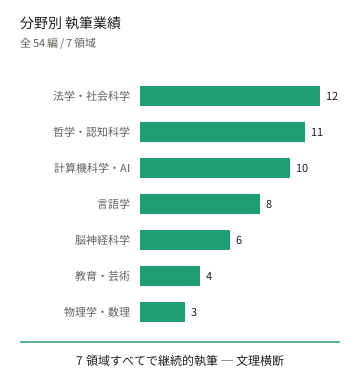
  • Over 50 preprints to date.
  • Regular essays on my research site.
Publications by discipline
分かち合う

Knowledge Sharing

  • On Zhihu (similar to Quora).
  • About 400,000 characters published.
Zhihu

Interest: Travel and Photography

A few photographs from journeys that have stayed with me.
PART II

Past, Present, and Future

· The Process of Subject: The temporal structure of the self ·
The Ontology of Social Fact
実体 · 状態 · 過程 · 関係 · 事件 · 属性
Li, S. (2019). An Introduction to International Politics (5th ed.). China Renmin University Press.

Past · 工学から社会科学へ

工学
2017 – 2024
大連理工大学 → 東京大学大学院
情報理工学
  • 幅広く勉強と研究
  • ソフトウェア工学・アルゴリズム
  • 機械学習・ロボット工学
  • 計算言語学・計算神経科学
  • 形式言語・最適化・抽象代数
→
医工学 × 計算科学 × 自然科学
2024 – 2025
国立精神・神経医療研究センター(NCNP)
  • 脳波データ解析
  • てんかん発作予測モデルの設計
  • 理論物理学の研究
  • 代数幾何の研究
→
社会科学(メイン)
2025.6 – 2026.3
自主研究・著作活動
  • 公共政策・法学・政治経済学
  • 社会学・哲学への集中
  • 定量社会科学の本体論・認識論・方法論および統合ソフトウェア応用フレームワーク
  • 法学への関心深化
  • 理論物理学・代数学の学習と研究
補助理論物理学・代数幾何・トポロジー・符号学
≫ 工学・医学の射程の外へ ── 人間の認識・規範の基盤、そして人間そのものへの理解を問う社会科学へ転向

Present · 法学・政策科学・国際関係論・経営理論へ

法学の自己研鑽

  • 中国国家統一法律職業資格試験 準備中
  • 法哲学・法学書籍の閲読、法学研究
  • 法的思考・論理分析能力の習得

EBPM・政策科学

  • エビデンスに基づく政策立案
  • 統計・AI・計算モデリングの応用
  • 社会課題解決への志向

国際関係論・経営理論

  • 将来的なNGO経営を志向
  • 国際機関での実務への理解
  • 国際開発課題への理解

Future · 研究者・教育者・哲学者として

Phase 1
現在

跨文化調整・マネジメント実務

  • Global リーダーシップ・社会分析力
  • 関係調整・対人マネジメント力
→
Phase 2
1 – 5年後
Route 1
Harvard JD-PhD Program
  • ハーバード大学 JD-PhD Dual Degree
  • 法学と社会科学の統合
Route 2
ETHZ–EPFL → Harvard JD
  • 学習科学 PhD → Harvard JD
  • 法学と社会科学の統合
→
Phase 3
長期

研究・教育・社会実装

  • 研究者・教育者・哲学者として活動
  • 多学問分野の発展への貢献
    • 理工学 · 社会科学 · 人文科学
  • 研究成果の社会実装
    • 医療 · 教育 · 福祉 · 法学
  • NGO起業・政策提言
  • 著作
学術研究・教育・社会実装、三本柱で歩む。
PART III

Research Introduction

· The events of the subject: the dynamical force for the evolution of the self ·
The Ontology of Social Fact
実体 · 状態 · 過程 · 関係 · 事件 · 属性
Li, S. (2019). An Introduction to International Politics (5th ed.). China Renmin University Press.

Emerging Computing · Processing-in-Memory

SDG 7 SDG 9
Data Movement, Energy Consumption & PIM Architecture
Traditional von Neumann Architecture
CPU
data movement
Memory
energy consumption from data movement can be significant
Processing-in-Memory Architecture
CPU
data movement
Memory PE PE PE
potentially lower energy consumption, as data movement decreases

(1) Data-intensive apps (e.g., AI, large-scale databases) move huge amounts of data.

(2) Moving data costs significant energy.

(3) Place small Processing Elements (PEs) inside Memory.

[1] 2024 Master's Thesis · University of Tokyo

An Energy-Saving Computer Architecture

  • Data-intensive AI workloads dominate compute.
  • Processor↔memory data movement is the energy bottleneck.
  • Processing-in-Memory: processors on the near-memory side.
  • Reduces energy-consuming data movement.
  • Toward energy-efficient, data-intensive computing.

Neuromorphic Computing · SNN Optimization

SDG 9 SDG 12
A pair of biological neurons
neuron
synapse
neuron
A spiking neural network distributed on a PIM device
Logically one network; neurons live in different chips.

(1) Real neurons communicate by short spikes.

(2) An SNN simulates this spiking in software.

(3) Neuromorphic devices typically use PIM architecture.

(4) The SNN runs on this device across many chips.

Optimizing SNN deployment on PIM
①
Sample neuron-interaction patterns from the SNN
→
spike
data
②
Train an Ising model on those patterns
spike
data
→
pairwise Ising model
③
Use J, H to co-locate similar-activity neurons
J, H
8 neurons (unassigned)
→
④
Partition-adaptive algorithms & engineering design
  • Lower partition entropy → more deterministic activity → adaptive engineering.
  • Partition-adaptive data buffer sizes.
[2] 2024 Optimization of Spiking Neural Networks

Brain-Inspired, Energy-Efficient AI

  • Bio-plausible spiking neurons promise energy-efficient computing.
  • Built on the PIM architecture.
  • Naive SNN deployment ignores neuron-pattern locality.
  • Sample neuron-interaction pattern data.
  • Train statistical-physics model on patterns.
  • Co-locate neurons with similar activity patterns.
  • Lower inner/intra-partition entropy
    → adaptive energy savings.
  • Lower inner/intra-partition entropy
    → shorter theoretical cross-partition communication coding length
    → reduced data movement amount
    → potential lower energy consumption.

UTokyo & Microsoft GX 社会実践

SDG 17
Figure placeholder · UTokyo × Microsoft GX
2024 UTokyo × Microsoft Japan · GX 社会実践

An Energy-Saving Vision for the AI Era

  • AI's energy demand rises sharply; GX is a social priority.
  • How should AI computing be aligned with a GX-oriented society?
  • Proposed a GX vision for AI computing.
  • High evaluation from reviewers; chosen as representative.
  • Special presentation before UTokyo's President.

EEG Syntax Analysis · for Seizure Detection and Prediction

SDG 3
①
EEG signal → discrete brain-state sequence
→
S₁ S₂ S₁ S₃ S₂ S₁ S₃
②
Induce a grammar over those states
S₁ S₂ S₃ S₁ …
→
Grammar
R → A B
A → S₁ S₂
B → S₃ | S₁ B
③
Syntax analysis → (signal + syntax tree) → ML model → prediction
Grammar
Sequence
→
Syntax
analysis
→
Syntax tree
Signal
→
ML
model
→
Output
Seizure?
Y / N

(1) Continuous EEG → discrete brain-state sequence.

(2) A grammar is induced over those states.

(3) Signal + syntax tree → ML → seizure prediction.

[3] 2024 – 2025 National Center of Neurology and Psychiatry (NCNP)

Reading Brain Signals as Language

  • Clinical need for seizure detection & prediction.
  • Brain states temporally exhibit unexploited syntactic structure.
  • Syntactic structure may improve seizure prediction / detection by exploiting generative information of EEG and non-local dependencies of its temporal structure.
  • EEG "grammar" is unknown.
  • Grammar & syntax analysis need a biologically plausible and physics-grounded approach.
  • Treat EEG as a sequence with syntactic structure.
  • Reconstruct brain state space with a physics-grounded method.
  • Induce grammar on the state space; extract syntactic features.
  • Apply natural language processing techniques.
  • Propose a computationally feasible, physics-grounded, and biologically plausible syntax analysis method for EEG.
  • Applied to seizure detection and prediction.
  • Bridges linguistics and clinical neuroscience.

Philosophy · The Crisis of the Symbolic & the Theory of Justice

SDG 16
①
Phenomenon · what we observe
  • Erosion of trust & shared meaning.
  • Lived relation ↔ symbolic representation diverge.
  • Subjectivity loses coherence & orientation.
②
Epistemological lenses · three converging readings
Three eras of the divine
transcendent → symbolic → relational
historical / philosophical
Modern physics
Group Field Theory; structure emerges from pure relational dynamics.
metaphysical / scientific
Lacanian psychoanalysis
Real · Symbolic · Imaginary; the subject as structural gap in signifiers.
psychoanalytic / linguistic
③
Essence · the irreducible Symbol ↛ Real gap
  • Symbols cannot reach the Real.
  • Modernity exposes the crisis.
  • Dual crises mutually arise: symbolic ⇄ subjective.
↓
Toward a relational ontology & generative presence
[4] 2025 Independent research & writing

The Turn Toward the Social Sciences

  • Late modernity's crisis of meaning, trust, and the structure of the subject.
  • What is the definition of the symbolic crisis?
  • What are the phenomena / appearance of the symbolic crisis?
  • What generates the symbolic crisis?
  • How should we tackle the symbolic crisis?
  • historical / philosophical Tripartite epochal analysis: transcendent → symbolic → relational divinity.
  • metaphysical / scientific Modern physics as inspirational source.
  • psychoanalytic / linguistic Lacanian psychoanalysis & post-structuralist analysis.
  • Defined the symbolic crisis: phenomenon and mechanism.
  • Provided a framework for studying the symbolic crisis.
  • Proposed turn toward relational ontology & generativity.

Foundation of Quantitative Social Science Research

SDG 1 SDG 2 SDG 3 SDG 4 SDG 5 SDG 6 SDG 7 SDG 8 SDG 9 SDG 10 SDG 11 SDG 12 SDG 13 SDG 14 SDG 15 SDG 16 SDG 17
Philosophical Foundations
Ontology
  • Entity
  • Relation
  • State
  • Attribute
  • Event
  • Process
Epistemology
  • Traditionalism
  • Evidentialism
  • Positivism
  • Virtue epistemology
  • Pragmatism
Practice
  • Algebraic tools
  • Systems theory
  • Domain models
  • AI methods
  • Statistical methods
  • Survey design
  • Data storage & mgmt
Ethics
  • Data-use ethics
  • Epistemic injustice
  • Research integrity
  • Privacy & consent
↓guide
Research Cycle
Question
→
Design
→
Collection
→
Processing
→
Analysis
→
Dissemination
→
Reflection ↻
support↑
Mathematical & Computational Tools
Type theory Category theory Algebraic topology Algebraic geometry
Developed software framework
LLM-integrated QSS research framework
[5] 2026 Methodological monograph (in preparation)

A Comprehensive Framework

  • QSS practice scattered across disciplines and traditions.
  • No unified ontological & methodological foundation for QSS.
  • Four philosophical pillars: Ontology · Epistemology · Praxeology · Ethics.
  • Full QSS cycle: Question → Design → Collection → Processing → Analysis → Dissemination → Reflection ↻.
  • Comparative analysis: traditionalism vs. positivism.
  • Math tools: Type theory · Category theory · Algebraic topology & geometry.
  • Developed LLM-integrated QSS framework.
  • Parallels UTokyo CSRDA(社会調査・データアーカイブ研究センター)'s direction.

GE-CSG · A Group-Theoretic Approach to Gene Analysis

SDG 3 SDG 9
①
Gene sequences carry rich symmetries
ℤ₂
Reverse
ATCG ⇄ GCTA
ℤ₃
Codon shift
ATC → TCA → CAT ↺
②
A long sub-sequence can be compressed into a single orbit symbol
DNA sub-sequence (literal palindrome, 12 bp · reads same backward)
A T C G A A A A G C T A
compressed by Dn (positional reflection + cycle) ▼
P₁
a single orbit symbol  ·  12 → 1
P₁ = { ATCGAAAAGCTA and all Dn-related positional rearrangements }
③
Syntactic parsing on the compressed sequence
Orbit sequence is shorter than the original.
Grammar is induced on the orbit sequence.
Induced orbit parsing rules + symmetry-breaking rules → induced DNA grammar.

(1) DNA symmetries are the primitive; the alphabet is derived.

(2) G compresses the codon sequence into a sequence of orbits.

(3) Parsing runs on the compressed sequence.

[6] 2026 Mathematical biology · working paper

Abstract Algebra Meets the Genome

  • Gene sequences carry rich symmetric structure (reverse, codon shift, …).
  • Syntax analysis is valuable for genetic analysis · capturing remote dependencies between substructures and their expressions.
  • Direct syntactic parsing on raw codons is computationally costly.
  • Model DNA symmetries via group theory.
  • Compress sequence via group orbits.
  • Run syntactic parsing on the orbit sequence.
  • Constant complexity: (avg orbit length)5.
  • Bridge between group theory & generative grammar.
  • Provides a pre-structural viewpoint for investigating genome structure.

Computational Economics × Theoretical Physics

SDG 8 SDG 10
①
Markets evolve as dynamical systems on a phase space
Allocations, prices, and welfare states live in a phase space.
The economy evolves as a flow on this manifold.
②
Equilibrium of market dynamics
Walrasian tâtonnement: \(\dot p_i = \alpha_i\, z_i(p)\).
Equilibrium p*: \(z(p^*) = 0\). Convergence requires gross substitutability.
③
Pareto optima form one orbit of a compound symmetry group  ·  symmetry breaking escapes the optimum
Pareto optima are connected by a compound symmetry group ─── all sit in one orbit.
Symmetry breaking moves the system off the orbit, away from optimum.

(1) Markets evolve as dynamical systems in phase space.

(2) Equilibria are fixed points of market dynamics.

(3) Pareto optima form one orbit; symmetry breaking escapes it.

[7] 2026 Interdisciplinary working paper

Borrowing Physics for Economic Reasoning

  • Economics and physics share deep mathematical structure.
  • Mainstream models struggle with inequality, disequilibrium, non-ergodic dynamics.
  • Read macro models through physics: dynamical systems, symmetry breaking, Legendre duality.
  • Markets as field-theoretic objects.
  • Unified treatment of inequality and disequilibrium.
  • Field-theoretic ↔ economic concept dictionary.

Group Field Theory · A Unified Theory for Structure Formation

SDG 9 SDG 17
Similar to Japan's 学術変革 A unified-theory initiative
GFT structure-generation philosophy  ·  four stages
①
Pre-structure
{ Gᵢ }
Groups as primitives.
No spacetime, no manifold yet.
→
②
Dynamics
S[ψ(G₁×G₂×···)]
Field ψ defined on a
composite group manifold.
→
③
Discrete spacetime
spin foam
Discrete spacetime atoms
generated by perturbation.
→
④
Continuous spacetime
⟨ψ⟩ = σ₀ ≠ 0
Continuous spacetime
emerges from the condensate.
①
Substrate: one action S on a group manifold G
Pure relations precede objects.
Generativity is background-independent.
②
Symmetry breaking spawns specific structures
\(S_L = P_{\text{sb}}(S_{\text{unv}})\)
Acquisition, dialects, social identity: one mechanism.
③
Discrete and continuous co-emerge from one S
Coherent condensate σ₀ smooths
spin-foam excitations into a semantic field.

(1) Pure relations are the primitive; substance is derived.

(2) One action generates language, cognition, society.

(3) Discrete syntax and continuous meaning emerge together.

  • Unified treatment across domains.
    • Music as spin-foam representation
    • Spectral MRI as field-theoretic model
    • Physics of language production
    • Biological signals under one framework
[8] 2026 Theoretical physics · interdisciplinary unification

A Unified Theory of Structure Formation

  • Language, cognition, society, and behavior can be engaged epistemologically and praxeologically, through structures and the generativity of structures.
  • Physics' field theory has emerged as a grand unified theory of world structures.
  • Traditional field theory is constrained by spacetime-background dependence; the meta-structure remains elusive.
  • Recent Group Field Theory explains how structures emerge from groups taken as the pre-structure.
  • GFT becomes a powerful tool for explaining various structures and their formation.
  • Existing frameworks presuppose structure; cannot explain emergence.
  • Group Field Theory framework: relational, pre-structural, background-independent, physically grounded.
  • Use GFT as a unified framework to reinterpret concepts across different domains.

Legal and Justice Research

SDG 16 SDG 17
①
AI-extensible products: a new legal object
Open-ended extension via natural-language prompts processed by a generative model.
Traceability and determinism, doctrine's two assumptions, both break.
Five analytical scenarios  ·  diagonal severity α → ε
①
Single-user scenarios: α intentional  ·  β negligent
②
γ · Multi-user mixed culpability  ·  central case
③
International: δ cross-jurisdictional  ·  ε six-actor multinational
The Dilemma Matrix  ·  5 scenarios × 7 doctrinal fields
!
Analytical dimension: how scenarios strain each doctrine
Comparative analysis  ·  six jurisdictions cluster into three regulatory paradigms
!
How the six jurisdictions cluster
Civil law as a partial category  ·  objects, morphisms, monad, time
①
Civil relations form a partial category R
Objects are legal subjects (natural / juridical persons); morphisms are civil-law relations. Composition is partial: the chain holds only when the legal order recognises the derived relation.
②
Creation · extinction · modification
Three primary operations receive three distinct categorical forms. Extinction breaks functoriality (a removed morphism may invalidate downstream compositions); civil-law dynamics partially escape pure category-theoretic templates.
③
Monad on R  ·  time as a pseudofunctor
Recurring layered structures (trust, agency, guarantee) carry monad shape. Civil law evolves as a pseudofunctor: each instant t indexes a category Rt, with transition functors linking them.

(1) Legal subjects = objects; civil relations = morphisms in a partial category.

(2) Creation, extinction, modification: three categorical operations.

(3) Civil law as a monad; time as a pseudofunctor to Cat.

[9] 2026 Justice theory · computational law · AI cases

AI Legal Dilemmas & Categorical Civil Law

  • AI-extensible products raise new legal challenges.
  • Computational law needs a formal tool for the ontology of legal social facts.
  • In which doctrinal areas, and under what scenarios, does the dilemma arise?
  • How do different jurisdictions' current laws and judicial practices address it?
  • How to formally, operationally, verifiably model the ontology of legal social facts in civil law as a foundation for computational law?
  • Constructed analytic case studies.
  • Comparative analysis across six jurisdictions.
  • Category theory applied to civil law.
  • Identified a new class of legal dilemmas arising in AI development.
  • Comprehensively defined the dilemma scenarios with cross-scenario · cross-doctrinal comparative analysis.
  • Initial category-theoretic method for the ontology of civil-law social facts.
PART IV

Looking Ahead

· The relation of the subject toward the world; building quiet bridges across borders ·
The Ontology of Social Fact
実体 · 状態 · 過程 · 関係 · 事件 · 属性
Li, S. (2019). An Introduction to International Politics (5th ed.). China Renmin University Press.

Motivation · なぜさくらサイエンスプログラム

Why JST
科学技術を支える × 学際的視野

分野横断の知に身を置く

  • 科学技術全般を横断する中核機関
  • 特定分野に閉じない、科学技術全般への関心
  • 多様な思考様式に触れ、学際的感性・思考を磨く場
Why Sakura
国際人材交流 × 国際関係性

アジアと日本の架け橋

  • 第一志望:LOTUS(インド)
  • 第一志望:Y-tec(日 ASEAN)も対象
  • アジア文化圏の国際関係・運営実務、社会科学・人文学の知見の還元、グローバル・リーダーシップの涵養
  • 言語・文化差の実務的調整経験
Why Me
学際性 × 哲学的思考と洞察力 × 国際関係性

分野横断の眼差し

  • 哲学的思考と洞察力
  • 理工学(専門性)・社会科学・人文科学の認識論・方法論
  • 異文化への認識力と運用力:哲学 × 国際関係論の基礎 × 多言語対応(中・日・英/学習中:フランス語)
  • 多分野の活動を取りまとめた素地

未来大きいな目標

  1. 『Relational Philosophy & Science』および『Foundation of Quantitative Social Science Research』の完成
  2. PhD ・ JD の取得
  3. NGO の設立・運営
  4. 国連メンバー、あるいは NGO 主体として国連と協働し、グローバルな発展に資する
  5. 新しい学問分野の創造: 場論記号学(Field-theoretic Semiotics)、前構造的創発社会科学(Pre-Structural Emergent Social Science)、共生生成経済学 · 関係性主体に基づく人本主義経済学
  6. 『Foundations for Relational Being: An Infrastructural Framework』の構築 · 関係性的存在を支える 7 基盤(理論/概念・存在論/共在/意思決定/共創/教育/倫理・ケア)の体系化
← / → · F: fullscreen · ESC: exit
1 / 9