Designing Generative Relational Academic Infrastructure - A Protocol Framework for Collaborative Knowledge Evolution and Propagation
Abstract
Scholarly communication transmits finished artefacts and discards the trajectory that produced them. This paper takes that discard as a design problem and specifies the requirements on an infrastructure that would retain the trajectory. The argument proceeds from one observation about the present condition: an artefact carried evidence of a producer’s capacity because producing it was costly in a way that discriminated between producers, and the collapse of production cost removes the discrimination while leaving the artefact in place. Attention then moves to the record of how an understanding changed, which raises a second problem, since a record is as cheaply fabricated as the artefact whose function it inherits. The credibility of a trajectory record therefore rests on its distribution across parties who did not coordinate, and that is a matter for a protocol in place of a platform. The paper states the historical precedent for the displaced layer, concedes the substantial prior art in open research platforms, provenance standards and rationale-capture systems, identifies capture cost as the documented cause of the failure of the last of these, and derives sixteen requirements on any protocol that would succeed where they did not. It closes with an overview of an architecture satisfying those requirements, layered over existing repositories and specified in a companion paper.
1. Introduction
This section states the condition the paper addresses, the historical precedent for that condition, the position of the paper within a series, the contribution claimed and the prior art conceded, and the structure of the argument that follows. Its method is expository: it fixes what the paper undertakes, and it establishes nothing, since every claim made here is established in a later section and is marked accordingly.
Scholarly communication transmits finished artefacts. A paper reports a question, a method, a result and a conclusion, and it reports them in an order arranged for a reader who was absent from the work. The sequence by which the understanding actually changed leaves few traces in it. Which assumption was abandoned, which objection forced the abandonment, which approach was tried for six months and set aside, which direction was chosen over which alternative and on what ground: these are known to the participants, recorded partially in private notes, and lost when the participants move on.
This discard has been treated as a cost of compression. A reader wants the result, the result is what the artefact carries, and the intermediate material is understood to be of interest to nobody. Two developments make the assumption worth revisiting.
The first concerns evidence. An artefact carried information beyond its content, because producing one was costly in a way that discriminated between producers. A person who could not do the work could not produce the object, so possession of the object was evidence of capacity, and the systems that allocate positions, funds and attention read that evidence off the artefact. Where the cost of producing a structured artefact falls for every producer at once, the discrimination is lost while the object remains in place. The evaluation system continues to read a signal that has stopped carrying what it was read for.
The second concerns reuse. The material an artefact omits is not uniformly worthless. An approach abandoned in one field because an assumption failed there may hold in another field where that assumption is unavailable in the first place, and the researcher who would benefit has no way of learning that the attempt was made. Duplicated failure is the ordinary consequence, and its scale is unmeasured precisely because the record that would measure it does not exist.
Taken together these suggest that the trajectory of an inquiry has become worth retaining, both as evidence of the capacity that produced a result and as material that transfers to problems its authors never considered.
The layer at issue is not a novelty proposed here. Seventeenth-century natural philosophy ran on correspondence. Mersenne in Paris and, later, Henry Oldenburg as secretary of the Royal Society received letters, circulated them, solicited responses, and held the resulting exchanges in a form others could consult. The Philosophical Transactions, founded in 1665, began as a periodic compression of what was arriving in Oldenburg’s post.
The journal therefore did not replace an absence. It compressed a network, and over the following centuries the compression displaced the thing compressed. What survives institutionally is the digest. The correspondence that fed it passed into private archives, and from there into loss. Laboratory notebooks, seminar exchanges and the working conversation of research groups have followed a similar course, retained by individuals and rarely by institutions.
Stating the history in this form fixes the paper’s ambition at a modest level. The proposal is the restoration, with means unavailable to Oldenburg, of a layer that scholarly communication once possessed and subsequently lost, together with an account of why its absence matters more now than it did when artefacts were expensive.
This paper is the first of a series and occupies the design and standardisation stage of the work it describes. It states the problem, concedes the prior art, derives the requirements that any adequate infrastructure must satisfy, and gives an overview of an architecture that satisfies them. It does not specify the protocol, which is the subject of a companion engineering paper and of a separate versioned specification document, and it does not report an implementation, since none has been built and evaluated.
Two consequences follow and are stated here so that they are not mistaken for evasions. Any claim about what the infrastructure would achieve in use is a claim this paper cannot establish, and such claims are marked as envisagement wherever they appear. And the adequacy of the requirements derived below is settled by practice, so the paper states in advance what practice would show them to be wrong.
The territory is occupied, and the concessions are made in full in the four survey sections that follow the statement of method. Open research platforms already preserve materials, register protocols in advance, decompose publications into typed linked units and support post-publication commentary. Provenance and contribution standards already describe agents, activities, derivation, contributor roles, typed citation relations, annotation and packaging. Systems for capturing deliberation and design rationale already represent issues, positions, arguments, claims and the relations among them, and have done so since 1970. Nothing in this paper is offered as the first attempt to record what a publication omits.
What the paper claims is a conjunction of five elements, each individually modest and jointly unclaimed.
grxStatement of the contribution
The unit of record is the transition between two states of an understanding, in place of a typed output or a described artefact. The trajectory is treated as the object whose credibility replaces the evidential function the artefact has lost, which makes fabrication the central design problem and distribution across parties the answer to it. Content absorbed from one line of work into another is attributed to its originator, which distinguishes a generative arrangement from an open competition. The authority of any position in the arrangement is bounded by the portability of the record. And restriction of disclosure is grounded in a stated reason, with the reason determining what may be withheld and what remains disclosable. All five are specified as an interaction protocol, where the existing standards are description languages.
grx
The distinction in the final sentence carries a good deal of weight and is stated plainly. A description language fixes how to record what a process produced. An interaction protocol fixes which acts are admissible, what each act does to a shared state, and what an implementation must do to conform. Nothing in the standards conceded above does the second, and the difference is where the word protocol in the title is meant literally.
Section 2 fixes the instruments and the terms, including the separation of levels that governs what may enter a protocol at all. The four survey sections state the prior art in four registers: the political economy of the incumbent model, the open platforms, the standards, and the rationale-capture systems whose documented failure supplies this paper’s central design constraint. The sections of Part II derive the requirements, beginning from the displacement of evidential value and proceeding through fabrication, the unit of record, divergence, positions and authority, entry, encounter, priority and the limits of what a record transmits. The requirements are collected and the architecture that satisfies them is outlined in the closing sections.
2. Method and Terms
This section fixes the instruments the paper uses and the terms it employs. Its role is to settle, before any argument is made, what kind of object is being designed, which level of a layered system each proposal belongs to, what modal status each part of the paper carries, and which words are used in a fixed sense. Its structure is six instruments followed by the terminology and a declaration of interest. Its method is stipulative: the instruments are adopted here and applied throughout, and each is stated with the cost of adopting it, so that a reader who rejects an instrument can locate what depends on it.
2.1 The Separation of Levels between Law, Operating Norms, Protocol, and Application
Proposals about scholarly infrastructure mix four kinds of thing, and the mixture is the ordinary cause of designs that cannot be implemented, cannot be adopted across borders, or become obsolete with the technology that inspired them. The paper therefore separates four levels and assigns every proposal to one of them.
grDefinitionThe four levels
Level 0 is external law: the statutory and regulatory environment, varying by jurisdiction and changing independently of any design. Level 1 is operating norms: the charters, codes of practice, retention periods, consent requirements and membership rules adopted by a community for itself. Level 2 is the protocol: the interoperable specification of admissible acts, their effect on a shared state, and the conditions of conformance. Level 3 is application: the tools, models, interfaces and analyses built on records the protocol defines.
gr
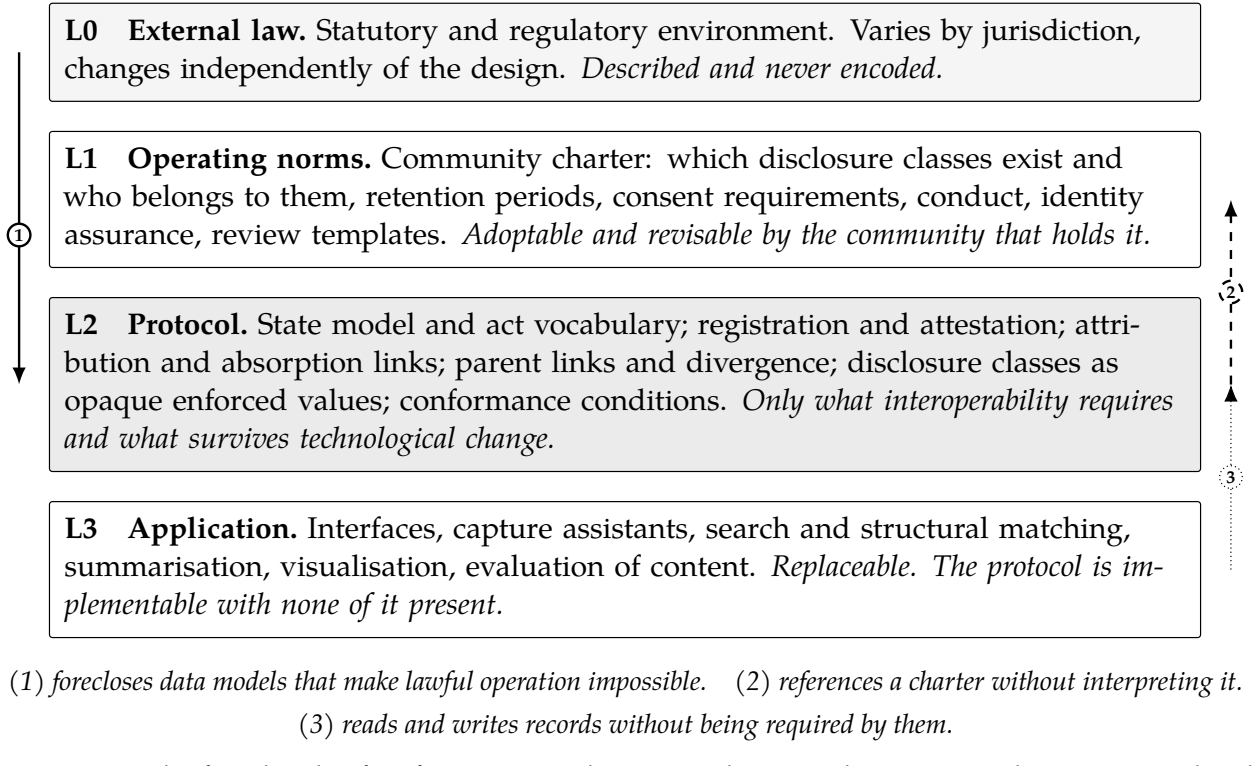
Figure 1. The four levels of Definition 2.1. The protocol carries the capacity; the normative level carries the content. Law reaches the protocol only through relation (1), as a constraint that rules designs out. Analytical capability of every kind sits at Level 3, so an implementation possessing none of it still conforms.
Table. The four levels, with the criterion of assignment and an illustration of each
Table 1 states the assignment. The criterion that decides difficult cases is stated as a requirement, since the paper appeals to it repeatedly.
grRequirementCapacity and content
An element belongs to Level 2 only where interoperability requires agreement on it and where it remains valid under change in the surrounding technology. The protocol carries the capacity; the normative level carries the content. A field whose values the protocol enforces without interpreting them belongs to Level 2, and the meaning assigned to those values belongs to Level 1.
gr
Two consequences of this instrument are worth stating in advance, since both cut against proposals that are otherwise attractive. Analytical capability of any kind, including model-assisted matching, summarisation and risk assessment, belongs to Level 3, and the protocol must be implementable where no such capability is available. And law enters Level 2 only negatively, as a constraint on design: a data model that cannot express redaction forecloses lawful operation in every jurisdiction with erasure rights, and no charter repairs it. The requirement that follows is a design property, and the paper adjudicates no legal question.
The cost of the instrument is that the paper cannot claim completeness for the arrangement it designs. A protocol that carries no content is inert without a normative level, and this paper specifies the hook by which a normative level attaches without supplying the norms.
2.2 The Distinction between a Protocol and a Plan
An infrastructure of the kind considered here cannot be designed in advance in the way a bridge can, since many of its constraints appear only in use, and its authors have no standing to determine what participants ought to do with it. This is a reason for care about the word design in the title, and it is answered by a distinction.
grDefinitionPlan and protocol
A plan specifies outcomes and the steps leading to them. A protocol specifies which acts are admissible, what each act does to a shared state, and what an implementation must do to conform, and leaves the trajectory of any participant undetermined.
gr
The relation is the one a grammar holds to its sentences. Fixing well-formedness determines nothing about what is said. A protocol paper that begins to prescribe what participants should record, conclude or value has drifted into a plan, and every such drift in this paper is an error to be corrected in place of a position to be defended.
2.3 The Modal Convention Governing Analysis, Design, and Envisagement
The paper performs three different acts, and a reader is entitled to know which is in force. Analysis states what is the case and supports it with evidence or argument. Design states what a specification requires and supports it by derivation from a requirement. Envisagement states what would follow in use, and supports itself by nothing available at present.
grConventionModal marking
Analysis governs the survey and requirement sections; design governs the architectural sections; envisagement governs the closing section on consequence. No sentence in envisagement mode appears in a design section, and every envisaged consequence is stated conditionally, with its conditions named and attached to a mechanism established under analysis.
gr
The convention is checkable during drafting, which is why it is adopted in place of a general commitment to caution.
2.4 The Discipline Governing Borrowed Analogies
The paper borrows from version control, from network protocols, from commons governance and from signalling theory. Each borrowing carries a boundary, stated where the borrowing is made, and no magnitude, mechanism or conclusion crosses that boundary without a separate argument. Two boundaries are fixed here because they are load-bearing.
From version control the paper takes an append-only history, content addressing, parent links and branching. It does not take merging, since two incompatible revisions of a concept admit no combination by rule and no test decides between them. From network protocols the paper takes layering, independence from implementation and conformance. It takes no guarantee of delivery, no formal verification and no packet semantics.
2.5 The Rule against Redefinition of Deployed Vocabularies
Several vocabularies this design requires already exist, are deployed and carry identifiers: provenance models for agents and derivation, contributor taxonomies for participation, citation typing for relations between works, annotation models for anchored commentary, packaging formats for research objects.
grRequirementNo redefinition
Where a deployed standard defines a vocabulary the design needs, the specification binds to it. New terms are defined only where nothing deployed covers the case.
gr
The rule shrinks the specification to the part that is genuinely new, lowers the cost of conformance for anyone already using those standards, and removes the most common ground on which a specification is dismissed. Its cost is a dependency on the continued maintenance of vocabularies this project does not control, which is recorded among the open issues.
2.6 The Exclusion of Scalar Measures
The paper’s diagnosis concerns a system in which quantities adopted for evaluation became the categories the system maintains. A design that answers such a system with new quantities reproduces the condition it was built to escape, and the failure is not hypothetical: a measure of contribution over participants would be optimised within a year, and a measure of activity over trajectories would be farmed.
grRequirementNo scalar
The protocol defines no scalar quantity over participants or over trajectories, and admits no total order over either. Acceptance conditions, which are local and admit two values, replace indicators throughout.
gr
The cost is stated openly and is substantial. Under this requirement the protocol cannot report that a project is going well, cannot rank contributors for a hiring committee, and cannot summarise a trajectory’s standing in a number. Any party wanting such a quantity may compute one at Level 3 and owns the consequences of doing so.
2.7 Terms Fixed for the Remainder of the Paper
The following terms are used in a fixed sense. Where a term also has a settled sense in an adjacent literature, the divergence is marked.
grDefinitionTrajectory
A trajectory is an ordered record of the transitions through which a shared understanding has passed, together with the acts that produced them and the parties to those acts. A trajectory is identified by the record, and its current state is derived from the record in place of being stored alongside it.
gr
grDefinitionTransition
A transition is a change from one identified state of an understanding to another, produced by an act of a stated type, referencing the prior state and registered by a party.
gr
grDefinitionAttestation
An attestation is the registration of a transition by a party distinct from the party proposing it, recorded with that party’s identifier and signature.
gr
grDefinitionDisclosure class and ground
A disclosure class is a value governing to whom a record may be disclosed, enforced by an implementation and interpreted at Level 1. A ground is the stated reason for restricting disclosure, which determines both the object restricted and what remains disclosable.
gr
grDefinitionPropagation
Propagation is the movement of transitions between trajectories and between independent implementations: an objection raised against one line of work entering another, absorbed content carrying its attribution across a divergence, and records exchanged between implementations sharing no platform. Dissemination of finished artefacts, which existing infrastructure performs, is excluded from the term.
gr
Two terminological decisions are recorded rather than argued. The word generativity is used in the sense fixed by the author’s prior work, and its philosophical grounding is not reargued here. And the epistemic unit is called a transition throughout, in place of a commit, since the protocol is layered over version-control systems whose commits appear in the same repositories and the collision would mislead every implementer.
2.8 Declaration of Interest
The author is the founder of a society that would host an implementation of the protocol specified in the companion paper and that is a candidate custodian of the specification itself. Two rules follow and are held throughout. The society’s activity is not evidence for any claim in this paper, and it appears only as an illustration of implementation where an illustration is needed. And the requirements imposed on a custodian in the architectural sections apply to that society without exception, including the requirement that the specification be forkable and the requirement that stewardship of the specification be separated from operation of any implementation.
2.9 Summary of Results
This section has fixed six instruments and the terminology. Proposals are assigned to one of four levels, with Level 2 confined to what interoperability requires and what survives technological change, and with law entering only as a negative constraint on design. The paper specifies a protocol in the sense distinguished from a plan. Three modes are separated and marked, with envisagement excluded from design sections. Borrowings carry stated boundaries, and merging and delivery guarantees are excluded explicitly. Deployed vocabularies are bound rather than redefined. No scalar over participants or trajectories is defined, at the stated cost. Trajectory, transition, attestation, disclosure class, ground and propagation are fixed in the senses given, and the interest of the author in an implementation and in custodianship is declared.
3. Encounter, Generativity, and the Conditions Motivating the Design
This section states the two conditions that motivate the design and fixes how strongly each is claimed. Its role is to separate what moves the work from what the work establishes, since a motivation that is presented as a finding damages the finding. Its structure treats the encounter condition, the evidence bearing on it, the generativity condition under falling artefact cost, and the evidence bearing on that. Its method is a reading of the relevant literatures with the strength of each claim marked, and it establishes nothing that later sections rely on as a premise.
3.1 The Encounter Condition
A substantial part of what changes an inquiry arrives from outside its plan. A question from someone in another field, an objection from a reader who was not the intended audience, a connection between literatures that nobody had reason to place side by side. merton2004travels traced the history of the word serendipity through the sciences, and merton1957priorities’s earlier formulation of the serendipity pattern named its structure: an unanticipated, anomalous and strategic datum that occasions a change in the theory the observer held.
The design’s motivation is the observation that the present arrangement makes such encounters improbable for structural reasons. A completed artefact reaches its intended audience through channels indexed by topic. A party working on a structurally similar difficulty in another field is not in that audience, is not reached by that index, and in any case receives the finished result at a moment when nothing can be altered by their response. The occasions on which working states are exchanged, seminars, correspondence, conversation after a talk, are unindexed and unretained, as Section 4 established.
grxClaim
The arrangement designed here is intended to lower the cost of preparation, in the sense that a state of an inquiry, recorded and made available, is preparation externalised so that another party’s preparation may meet it. The claim is about the cost of preparation and not about the frequency of encounter.
grx
The narrowing in the second sentence is required by the evidence, which is worth stating plainly against the paper’s own interest.
Studies of information encountering (erdelez1999information) and of serendipity in information behaviour (makri2012coming) establish that unplanned discovery has a describable structure and that environments differ in how well they support it. dunbar1997scientists established that laboratory meetings are a site where analogical reasoning produces conceptual change, which supports the claim that the occasions this design records are where transformation happens.
What the literature does not establish is that building an infrastructure increases productive unplanned encounters, and the best qualitative study points the other way. irving2020collaboration examined a building designed to produce collaboration through proximity and found that occupants developed strategies that minimised serendipitous encounters and avoided new collaborations. Work on spatial layout and tie formation (kabo2014spatial) finds associations without settling the direction of the effect, and the proximity literature has no consensus.
grRequirementMarking of the encounter motivation
The encounter condition motivates the design and supports no claim in it. Every statement about encounters produced by the arrangement is stated as envisagement under the convention of Section 2, and the counter-evidence above is cited wherever such a statement appears.
gr
The honest position is that infrastructure can make a class of encounters possible that is presently impossible, and that whether the possibility is taken up is a question about people, incentives and communities on which the evidence is discouraging.
3.2 The Generativity Condition
The second motivation concerns what has become scarce.
The term generativity is used here in the sense fixed by the author’s prior work, and is distinguished at the outset from two established senses: the psychosocial sense in developmental psychology, and the platform sense of zittrain2008future, under which a system is generative to the extent that it produces unanticipated change through unfiltered contributions from broad and varied audiences. The platform sense is close enough to require the distinction: Zittrain’s concern is the capacity of a technical system to admit contributions, and the concern here is the capacity of a relation to produce states that neither party held.
The condition motivating the design is that the artefact has become a poor indicator of this capacity, for the reason developed formally in Section 11. Where producing a structured artefact was costly in a discriminating way, its existence evidenced a capacity to produce it. Where the cost falls for producers of every kind, the artefact remains and the discrimination goes.
Three lines of evidence bear on whether this is occurring, and each is a single study rather than a settled finding.
Undisclosed machine-assisted text is present in the published literature across publishers and venues, and an analysis of a collected dataset of suspected cases reports that it appears more frequently in journals with higher citation metrics and higher article-processing charges (glynn2024suspected). Estimates of machine-modified text in conference peer reviews place the share between roughly six and seventeen per cent for several major computer-science venues (liang2024monitoring). And an analysis of redundant publications drawn from a single public dataset reports a large increase between 2022 and 2024 and attributes it to a failure of editorial checks under volume.
grxClaim
The evidence establishes that the volume and composition of scholarly artefacts are changing in ways the evaluation system was not designed for. It does not establish the magnitude of the change in the evidential value of an artefact, which no study measures directly, and the argument of Section 11 is accordingly conditional on an antecedent this paper does not verify.
grx
A parallel development outside scholarship supports the design’s direction while illustrating its difficulty. Content provenance infrastructure now attaches signed claims about origin and editing history to media objects (c2pa2025). Its documented limitations are instructive for this paper: such infrastructure certifies who asserted what and when, and not whether the assertion is true; and embedded credentials are commonly stripped when objects are redistributed, leaving no trace that provenance ever existed. Both limitations reappear here in Section 12 and Section 16 respectively, and the design’s answers to them, registration by a distinct party and portability of the record, are the two requirements those limitations force.
3.3 Summary of Results
This section has fixed the following. The encounter condition motivates the design, and the claim made on its behalf is a claim about lowering the cost of preparation rather than about the frequency of encounter, since the best available study reports occupants of a building designed for proximity avoiding collaboration. Requirement ? confines every statement about encounters produced by the arrangement to envisagement. The generativity condition is that the artefact has become a poor indicator of the capacity to generate, in the platform-independent sense fixed by the author’s prior work and distinguished here from the psychosocial and platform senses. Three single studies establish that the volume and composition of artefacts are changing, none measures the evidential value of an artefact directly, and the argument that follows is conditional accordingly. Content provenance infrastructure outside scholarship exhibits both of the limitations this design must answer.
4. Correspondence Networks and the Displacement of the Layer They Sustained
This section establishes that the layer this paper proposes to restore once existed in institutional form, that its displacement by the periodical was a compression with a documented history, and that certain functions the paper later assigns to a protocol were performed within that layer by other means. Its role is evidential: it supplies the precedent on which the paper’s ambition is scaled, and it supplies the boundary beyond which the precedent licenses nothing. Its structure is four subsections, treating the correspondence networks, the founding of the periodical, the private retention of process in the notebook, and the limits of the historical case. Its method is a reading of existing historiography of science, and it introduces no new archival material.
4.1 The Correspondence Networks of Early Modern Natural Philosophy
Before the periodical, the circulation of natural knowledge in Europe ran on letters. Marin Mersenne in Paris maintained a correspondence connecting mathematicians and natural philosophers across several countries in the first half of the seventeenth century, receiving results, forwarding them, posing problems on behalf of one correspondent to another, and holding a picture of who was working on what. Samuel Hartlib performed a comparable function in England. The historiography of the Republic of Letters, developed by goldgar1995impolite and others, describes an arrangement in which the letter carried the working state of an inquiry, including uncertainty, partial results and objections, to a small set of readers positioned to respond.
Three features of that arrangement bear on the present argument. The circulating unit was a state of an inquiry in place of a completed result, so a correspondent could be reached while the work was in motion. The circulation was mediated by a party who held the network and performed the matching, which is a position and not merely a service. And the record of the exchange was retained privately, in the papers of the correspondents and of the hub, with its survival dependent on the accidents of individual archives.
4.2 The Founding of the Periodical and the Compression of Correspondence
Henry Oldenburg became the first secretary of the Royal Society in 1662 (hall2002oldenburg) and inherited a correspondence of the kind just described, conducted on a scale that occupied him continuously. The Philosophical Transactions, which he began in March 1665, was in its early form a periodic digest of that correspondence, published on his own account, reporting what had arrived and from whom. The Journal des sçavans had appeared in Paris weeks earlier on a comparable principle.
The periodical therefore entered as a compression of an existing layer. It selected from the correspondence, arranged the selection for readers who were not party to it, and issued the result on a schedule. Two functions were carried in the compression and are worth separating, since the paper returns to both.
The first is registration. Historians of the period record that publication in the Transactions came to establish who had held a claim and when, which supplied the reward that made early disclosure rational for a correspondent who might otherwise have withheld. merton1957priorities’s account of priority in science (merton1957priorities) treats this reward as the mechanism by which a system of open publication is sustained at all.
The second is warranting. shapin1985leviathan’s study of Boyle’s experimental reports (shapin1985leviathan) describes a literary technology designed so that a reader absent from the laboratory could be brought to the position of a witness, through circumstantial detail about apparatus, procedure and failure. The early experimental report carried process because process was what made the report credible to a distant reader.
The subsequent history is one of contraction. bazerman1988shaping traces the movement from circumstantial narrative toward a compressed and standardised argument, in which the reported procedure is the one that succeeded and the sequence of attempts leading to it disappears. shapin1989invisible documents a parallel erasure of the labour that produced the results. Over three centuries the artefact retained the registration function and shed most of the warranting detail, while the correspondence layer that had carried the working state ceased to have any institutional existence at all.
grxClaim
The periodical did not replace an absence. It compressed a layer that carried the working state of inquiries between parties positioned to respond, and over the following centuries the compression displaced the layer compressed, retaining the registration function and shedding most of the process that had originally warranted the report.
grx
4.3 The Private Retention of Process in the Notebook
The working state did not cease to be recorded. It ceased to be recorded institutionally. The laboratory notebook and the research diary continued to hold hypotheses, attempts, failures and revisions, and the surviving examples are treated by historians as primary sources of the first importance precisely because the published record does not contain what they contain. Their retention has been a matter for individuals and their heirs, and their loss has been ordinary.
One practice within this tradition anticipates a mechanism the paper later requires. In jurisdictions and periods in which priority of invention was contested on evidence of when a thing was conceived, notebooks were kept in bound and paginated form and were countersigned by a witness who was not the inventor. The signature of a second party, added at a date, converted a private record into evidence, and it did so without disclosing the contents to anyone else. The paper’s requirement that a transition be registered by a party distinct from the party proposing it has this practice as its nearest historical precedent, and the precedent shows that the requirement is compatible with retaining the content in private.
4.4 The Boundaries of the Historical Case
The historical material establishes less than an enthusiastic reading would take from it, and the boundaries are stated here so that no later section exceeds them.
It establishes that a layer carrying the working state of inquiries existed, that it was institutionally mediated, that the periodical compressed it, and that the compressed form retained registration while shedding warranting detail. It establishes that the process record survived privately and that a second-party signature has been used to make such a record evidential.
It establishes nothing about feasibility at present scale. The correspondence networks were small, socially homogeneous and mediated by individuals whose position was unchallenged, and none of those conditions obtains now. It establishes nothing about desirability, since a layer may be lost because its costs exceeded its benefits, and the historiography does not settle whether the displacement was a loss. And it supplies no evidence about the volume of duplicated effort caused by the absence of the layer, since the records that would measure that volume are the records at issue.
The historical case is therefore used in this paper for one purpose only. It removes the presumption that the object proposed is unprecedented, and it locates the paper’s proposal as the restoration of a function under conditions that have changed, in place of the invention of a function that scholarship has never had.
4.5 Summary of Results
This section has established four points. Natural knowledge circulated in a correspondence layer that carried the working state of inquiries to parties positioned to respond, mediated by individuals holding the network. The periodical entered in 1665 as a compression of that layer and displaced it, retaining the registration of priority and shedding the process detail that had warranted early reports. The process record survived privately in notebooks, whose evidential use through countersignature by a second party anticipates the attestation requirement developed later in this paper. And the historical case licenses no claim about feasibility, desirability or magnitude at present scale, being used here solely to establish precedent for the function.
5. The Reputation-Mediated Model and Its Political Economy
This section states the arrangement that presently governs the production and evaluation of scholarly work, together with the difficulties that arrangement is documented to have. Its role is twofold: it concedes to the incumbent model the functions the model performs, and it identifies the one function whose weakening motivates the remainder of the paper. Its structure treats the circulation between recognition and resources, the allocation procedures and their measured difficulties, the evidential function carried by the artefact, and the rents that condition any proposal for reform. Its method is a survey of empirical and theoretical literature, with the evidential status of each finding marked, and it closes by stating what the surveyed literature presupposes.
5.1 The Circulation between Recognition and Resources
The arrangement is a cycle. Standing attracts resources, resources purchase the time, access and assistance from which work is produced, and the work returns standing. merton1968matthew’s account of the Matthew effect (merton1968matthew) describes the accumulation that follows: recognition accrues disproportionately to those already recognised, and the same contribution receives unequal attention depending on the position of its author. Later work on cumulative advantage in careers has repeatedly recovered the pattern.
Two functions of the cycle are conceded without qualification. It concentrates resources on producers whose past work gives some evidence of capacity, which is a reasonable procedure where resources are scarce and capacity is unobservable. And it supplies, through priority, the reward that makes early disclosure rational. merton1957priorities establishes that the reward is not vanity: a system in which disclosure conferred nothing would give every producer reason to withhold, and the openness of scientific publication depends on the reward attaching to being first in public.
Any proposal that weakens either function without replacing it will make the system worse, and the paper’s requirements are constrained accordingly.
5.2 The Allocation Procedures and Their Measured Difficulties
The procedures by which the cycle allocates are studied and the findings are consistent enough to be stated briefly.
Agreement between assessors on the same proposals is low. The classic study of cole1981chance reported that the outcome of a substantial share of grant applications depended on which reviewers were assigned, and later work using structured assessment of identical proposals has recovered comparable variation (pier2018low; fang2016nih). The competition itself consumes the resource it allocates: analyses of national funding systems have estimated preparation effort across all applicants against the funds distributed, and several report that the aggregate effort approaches or exceeds the value of the awards (gross2019contest). Some funders have responded by introducing partial randomisation among proposals judged fundable, which is an institutional concession that assessment cannot rank the remaining candidates by eventual value.
A second finding bears more directly on this paper. Assessment discriminates by form. Studies of evaluation panels report a penalty on proposals that combine material in unusual ways (boudreau2016looking), and bibliometric work on novel combinations (wang2017bias) reports that such work has a lower probability of acceptance and a longer interval before its value is registered. The reported mechanism is the one an economist would predict: assessment computes an expected value from precedent, and a contribution whose implications cannot be connected to precedent by short steps scores as though it had no value.
grxClaim
The allocation procedures of the incumbent model assess proximity to precedent, and the discrimination they exercise falls on contributions whose form the existing categories do not accommodate. This is the same object the paper later treats as the interpretation in force, approached from the side of the allocating party.
grx
5.3 The Evidential Function Carried by the Artefact
Beyond its content, a published artefact has carried information about its producer. Hiring committees, funders and promotion panels read a record of publications as evidence of capacity, and the reading has been reasonable to the extent that producing the artefacts was costly in a way that discriminated. A person unable to do the work could not produce the object.
Where the evidence is compressed further into counts, the compression itself becomes the object of effort. espeland2007rankings’s study of law-school rankings (espeland2007rankings) documents reactivity: a measure adopted for evaluation alters the behaviour of those evaluated, and the categories the measure recognises become the categories the field maintains. The generalisation is familiar under Goodhart’s name and requires no further support here. It is recorded because it constrains the design later: any quantity this paper introduced over participants or trajectories would enter the same dynamic, which is the ground of the exclusion fixed in Section 2.
5.4 The Rents and the Political Economy of Reform
Three features of the arrangement condition what any proposal can achieve, and none of them concerns the merits of the proposal.
Standing is a positional good in the sense of hirsch1976social. Its value consists in the ranking, so the aggregate quantity available is fixed by construction and competition for it cannot be dissolved by increasing supply. A proposal may change what people compete for; a proposal claiming to remove competition for standing has misunderstood what standing is.
The credentialing function is performed cheaply by the artefact and is relied upon by parties who bear none of the cost of producing it. A committee reading a publication list is purchasing an assessment at very low cost to itself. A proposal that degrades the signal without supplying a substitute imposes a cost on those parties, and they will decline it.
And incumbency is concentrated while the benefit of reform is diffuse. olson1965logic’s analysis of collective action (olson1965logic) predicts the observed pattern: a small number of parties whose position depends on the present arrangement will act to preserve it, while the many parties who would gain from a change will not organise to obtain it. The stalled history of open-access and evaluation reform is consistent with the prediction, and a proposal that expects adoption on the strength of its merits is proceeding against the evidence.
The consequence for this paper is stated now and honoured in the adoption argument. An infrastructure entering as a complement to the incumbent arrangement, requiring nobody to surrender anything, defers this conflict. It does not dissolve it, since an arrangement that came to carry the evidential function would displace what the artefact presently supplies, and the parties whose position rests on that supply would then have the same interest they have now.
5.5 The Presuppositions of the Surveyed Literature
Every study cited in this section draws its population from producers who submitted, published or were assessed. Assessment reliability is measured on proposals received. Competition costs are computed over applicants. Novelty penalties are measured on work that entered a review process and was recorded.
The literature is therefore silent by construction about producers whose contributions the procedures assign to no category, since such contributions generate no observation. This is not a defect of the studies. It is a boundary on what they can establish, and it is the reason the paper’s later diagnosis cannot be supported by this literature and must be supported on other grounds.
5.6 Summary of Results
This section has established the following. The incumbent arrangement circulates standing and resources, and it performs two functions this paper must preserve: concentration of resources on evidenced capacity, and the reward through priority that makes early disclosure rational. Its allocation procedures agree weakly, consume a large share of the resource they allocate, and discriminate against contributions whose form lies far from precedent, which is the interpretation in force seen from the allocating side. The artefact has carried evidence of capacity beyond its content, and quantities derived from it exhibit reactivity, which grounds this paper’s exclusion of scalar measures. Standing is positional, the credentialing function is relied upon by parties who do not bear its cost, and incumbency is concentrated while reform benefits are diffuse, so adoption cannot be expected on merit. And the surveyed literature draws its populations from those who enter the procedures, leaving it silent about the population the paper’s diagnosis concerns.
6. Open Platforms and Services for Research Transparency
This section states what existing open research platforms and services already do, in order to remove from the paper’s contribution everything they cover. Its role is concession. Its structure treats registration and pre-commitment services, repositories of materials and process, platforms that decompose the publication into linked units, open commentary and review, and the collaborative practices that have operated without dedicated infrastructure. Its method is description of deployed systems as they present themselves, followed by a statement of the functions that remain unaddressed. The section makes no criticism of the systems described, since each is well adapted to the purpose it was built for.
6.1 Registration, Pre-Commitment and the Recording of Intentions
Preregistration services (nosek2018preregistration) allow a researcher to deposit a question, a hypothesis and an analysis plan before results are obtained, with a timestamp and, in some arrangements, an embargo. Registered Reports (chambers2013registered) extend the device into the review process, so that a study is assessed and accepted on its question and design before the outcome is known. Both make part of the trajectory epistemically load-bearing, and both are supported by evidence that they alter what gets reported.
Two things follow for this paper. The intention behind a piece of work is already recordable, publicly, with a date. And the mechanism by which a record is made credible in these services is pre-commitment: the record is made before the outcome that would give a reason to alter it. Pre-commitment is a genuine solution to a genuine problem, and it is available only where the outcome lies in the future. It does not extend to the general case in which a record is made after the transition it reports.
6.2 Repositories of Materials, Methods and Versions
General-purpose research repositories hold projects, files, registrations and preprints, assign persistent identifiers, and retain version histories of deposited items. Method repositories hold protocols as versioned objects that can be forked and cited. Institutional electronic notebook systems hold laboratory records under organisational custody. Data and software repositories issue identifiers that make deposited objects citable.
The paper takes these as its substrate in place of its competitors. Identifiers, storage, citation and archival deposit are solved, deployed and maintained by parties with the resources to continue maintaining them, and any design that reimplements them acquires an obligation it cannot discharge.
6.3 Platforms Decomposing the Publication into Linked Units
Two developments come nearer to this paper’s object than anything else in the survey, and the concession must be made precisely.
Octopus (octopus2022), developed with support from UK Research and Innovation and the UK Reproducibility Network, replaces the paper with eight publication types aligned to stages of the research process: research problem, rationale or hypothesis, method or protocol, results or sources, analysis, interpretation, real-world application, and review. Publications are linked hierarchically, and a unit may be published only where the unit above it in the chain already exists, so the platform holds a branching structure of typed units in place of a set of documents. Its stated purposes include immediate recognition for work at any stage and the establishment of priority at the moment of publication, which its designers compare to the registration function of a patent office. Reviews are open and post-publication, and each is itself a publication.
ResearchEquals applies a comparable principle, publishing modular outputs with explicit links between them.
The concession is therefore substantial. Decomposition of the publication into typed units, hierarchical linkage between units, registration of priority at every stage, publication of work before it forms a narrative, open post-publication review, and smaller author groups for finer attribution: all of this is deployed and none of it is claimed here.
6.4 Open Commentary, Open Review and Curation
Post-publication commentary platforms attach discussion to published work by identifier. Several publishers and platforms operate open review, publishing reports alongside the work and, in some models, decoupling the assessment from the decision to publish. Overlay arrangements assemble curation on top of preprint servers.
These establish that commentary on a published object is technically and socially feasible at scale. They also exhibit a limitation that bears directly on the design developed later. A comment attaches to an artefact. Where a comment persuades an author, the artefact acquires a new version or a correction, and the relation between the comment and the change is recorded nowhere. The commentary layer accumulates alongside the record without entering it.
6.5 Collaborative Practices Operating without Dedicated Infrastructure
Open notebook practice publishes the working record of a laboratory as it is produced. Massively collaborative mathematics projects have conducted proofs in public across comment threads and wikis, with dead ends visible in the archive. Question-and-answer sites in mathematics support a form of the exchange this paper is concerned with, where a researcher states an obstruction and a stranger recognises it.
These are the strongest existing evidence that the practice is possible, and their limits are informative. Each is scoped to a single group, a single problem or a single question. None persists an individual’s path across problems and years, and none carries the record between the venues in which the work actually happens.
6.6 The Functions That Remain Unaddressed
The systems surveyed here preserve outputs. Where they decompose, they decompose the output into typed outputs. The unit remains a thing produced.
grxClaim
No system surveyed in this section takes as its unit the transition between two identified states of an understanding, and none therefore records that a particular objection converted a particular claim into a particular successor. Four further functions are absent throughout: registration of a change by a party distinct from the party proposing it; attribution of content absorbed from one line of work into another; portability of the record as a bound on the authority of any position within the arrangement; and restriction of disclosure grounded in a stated reason with the reason determining what remains disclosable.
grx
One structural difference is recorded alongside the four functions. Every system in this section is a platform, with an operator, a database and a location. This paper specifies a protocol, and the difference is examined where it does argumentative work in the sections on portability, propagation and adoption.
6.7 Summary of Results
This section has conceded the following to deployed systems. Intentions are recordable in advance with a timestamp, and pre-commitment supplies credibility where an outcome lies in the future. Storage, identifiers, citation and archival deposit are solved and are taken here as substrate. Decomposition of the publication into typed, hierarchically linked units with priority registered at each stage is deployed in Octopus and in comparable services. Open commentary and open review operate at scale, with the limitation that a comment attaches to an artefact and its effect on the work is recorded nowhere. Collaborative practice without dedicated infrastructure has succeeded within single groups, problems or questions. What remains unaddressed is the transition as the unit of record, together with attested registration, absorption attribution, portability and grounded restriction.
7. Standards for Provenance, Contribution and Annotation, and the Limits of Description
This section states what deployed standards already specify, in order to fix the boundary at which this paper’s specification begins and to discharge the rule against redefining vocabularies adopted in Section 2. Its role is concession and binding: everything described here is to be used in place of being reinvented. Its structure treats provenance models, contribution and relation vocabularies, annotation and packaging, and messaging between repositories, and it closes by stating the one thing none of them does. Its method is description of published specifications at the level of what each fixes and what it leaves open.
7.1 Provenance Models
The W3C provenance model (moreau2013provenance) specifies entities, activities and agents, together with relations of generation, derivation, attribution and association, and a means of expressing that one entity was derived from another through an activity carried out by an agent. It is a general model, adopted across domains, and it is expressive enough to record most of what a research process produces.
Two properties of the model matter here. It is retrospective: it describes what happened. And it is unconstrained: it does not say which activities are admissible, in what order, or under what conditions a record is complete. A provenance graph is a description whose truth is asserted by whoever publishes it.
7.2 Contribution and Relation Vocabularies
Contributor taxonomies (allen2019credit) fix a controlled set of roles played in producing a work, and are implemented across a substantial part of the publishing industry, so that a published article can carry a structured statement of who did what. Citation typing ontologies (shotton2010cito) fix a controlled set of relations one work may bear to another, including agreement, disagreement, extension, use of a method and qualification, so that a citation can carry its reason.
Both vocabularies are bound by this paper in place of being redefined. The relations this design requires between states of an understanding are, with few exceptions, relations these vocabularies already name, and the roles it requires for participation are the roles the contributor taxonomy already fixes.
The boundary is the attachment point. A contributor role attaches a person to a finished work. A typed citation attaches a work to another work. Neither attaches an act to a change, so neither can express which contribution produced which alteration in the content of a claim.
7.3 Annotation and Packaging
The W3C annotation model (sanderson2017annotation) specifies a body, a target and a motivation, together with selectors that anchor an annotation to a fragment of a document or to an interval of a recording. It is implemented in deployed annotation systems and it is sufficient for typed, anchored commentary of the kind this paper’s meeting layer requires.
Packaging formats for research objects, developed alongside the FAIR principles (wilkinson2016fair), specify how a set of files, their metadata and their relations travel together as a citable unit, which is what portability of a record requires at the level of transport.
Micropublication and nanopublication models (clark2014micropublications; groth2010anatomy) specify small assertions with their evidence and provenance as independently addressable units, and are the nearest existing approach to treating something smaller than a paper as the object of record.
7.4 Messaging and Federation
Repository notification protocols specify how one repository informs another that an event concerning a resource has occurred, so that review services, overlay journals and archives can be linked without a central platform. General federation protocols specify how independent servers exchange activities about objects and actors.
These supply the transport layer for propagation in the sense fixed in Section 2. They carry messages about objects. They assign no meaning to the objects and impose no conditions on what may be said about them.
7.5 The Limit Common to the Standards Surveyed
The standards in this section are description languages, and the distinction between a description language and an interaction protocol is where this paper’s specification begins.
grDefinitionDescription language and interaction protocol
A description language fixes a vocabulary and a syntax for recording what has occurred, and imposes no condition on what may occur. An interaction protocol fixes which acts are admissible, what each act does to a shared state, which party may perform each act, and what an implementation must satisfy to conform.
gr
grxClaim
Every standard surveyed in this section is a description language in the sense just defined. Each specifies how to record what a process produced, and none specifies what a process may do. In particular none requires that an assertion be registered by a party distinct from the party making it, none constrains the order in which records may be made, and none defines conformance for a process in place of conformance for a document.
grx
The consequence for the design is favourable rather than otherwise. The specification developed in the companion paper defines a small number of new terms, for the acts and their dispositions, and binds everything else: agents and derivation to the provenance model, roles to the contributor taxonomy, relations to the citation typing ontology, anchored commentary to the annotation model, transport to the packaging and notification specifications. Its cost is a dependency on vocabularies this project does not maintain, which is recorded among the open issues.
7.6 Summary of Results
This section has established the following. Provenance, contribution, relation, annotation, packaging and notification are specified by deployed standards, and this paper binds to them in place of redefining them. Their common limit is that they describe what occurred without constraining what may occur: none requires registration by a second party, none constrains the order of records, and none defines conformance for a process. The distinction between a description language and an interaction protocol is fixed as Definition ?, and the specification’s new terminology is confined to the acts and their dispositions.
8. Prior Attempts at Rationale Capture and the Conditions of Their Failure
This section states the record of earlier attempts to capture the reasoning behind decisions and claims, and identifies the cause of their common failure. Its role is decisive for the paper: the representational problem this design might have been thought to solve was solved repeatedly between 1970 and the present, by capable people with funding, and the systems were not adopted. What follows must therefore answer the reason for that outcome in place of proposing another representation. Its structure treats the argumentation tradition, the design rationale tradition, the scholarly claim ontologies, and the finding common to all three. Its method is a reading of the systems and of the evaluation literature that accompanied them.
8.1 The Argumentation Tradition
The issue-based information system of kunz1970issues, proposed in 1970 for problems whose formulation is itself contested, structures deliberation as issues, positions taken on issues, and arguments supporting or objecting to positions. The structure was implemented in graphical form as gIBIS (conklin1988gibis), developed further as Compendium, and taught as a facilitation practice under the name dialogue mapping.
The correspondence with the present design is close and should be stated without hedging. An objection in this paper’s vocabulary is an argument objecting to a position in theirs. The insistence that a deliberation is a structure in place of a transcript is theirs. The proposal that the structure be recorded as the deliberation proceeds is theirs. This paper adds nothing to the representation of an objection that was unavailable in 1970.
The evaluation literature reports that the systems worked well when a trained facilitator maintained the structure during a meeting, and that unfacilitated use decayed. Participants engaged with the discussion and left the structure to whoever had accepted responsibility for it.
8.2 The Design Rationale Tradition
Software and design engineering pursued the same object under the name design rationale, with notations for questions, options and criteria (maclean1991questions), and for the relations among decisions, alternatives and justifications. The motivating problem was the maintenance case: a decision taken for good reasons becomes unintelligible to whoever inherits it, and the cost of the misunderstanding falls years later.
Two findings from that literature are load-bearing here. The first is that rationale recorded at the moment of decision has high value to later readers, which is the premise this paper shares. The second is that it is not recorded. The reported obstacle is intrusiveness: capture interrupts the work, the interruption falls on the person deciding, and the benefit accrues to someone else at a later time.
grudin1988why’s analysis of why groupware fails (grudin1988why) states the structure of the difficulty generally, and it applies without modification to every system in this section. Where the party who performs the additional work is not the party who receives the benefit, the additional work is not performed, and no quality of the design repairs the disparity.
8.3 The Scholarly Claim Ontologies
A third line applied the same idea to scholarly literature. Systems developed around 2000 represented scholarly claims (shum2000scholonto) and the relations between them, including support, challenge and analogy, so that a literature could be navigated as a structure of contested assertions in place of a set of documents. Later work modelled claims with their supporting evidence (clark2014micropublications) and argument as independently addressable units, and connected them to provenance and annotation standards.
These systems represented what this paper needs to represent, and connected it to the standards this paper binds to. Their adoption remained confined to their research communities. The reported obstacles are the same: someone must construct the structure, the construction is not the work the researcher is paid for, and the benefit arrives elsewhere.
8.4 The Finding Common to the Three Traditions
The three traditions differ in domain and in notation and agree in outcome. Stating the agreement precisely is the most useful thing this section can do for the design.
grxClaim
The representational problem is solved. Structures adequate to record issues, positions, objections, options, criteria, claims, evidence and the relations among them have existed since 1970, have been implemented repeatedly, and are connected to deployed standards. The recorded cause of their non-adoption is capture cost: the work of recording falls on the party who gains least from the record, at the moment when that party is least able to bear it, in a form that serves a different party later.
grx
Two consequences follow, and together they determine the shape of the remainder of the paper.
The first is that a proposal offering a better representation is answering a question that is not open. Any design succeeding where these failed will differ in the economics of recording in place of the expressiveness of the notation.
The second is a requirement, stated here and carried to the specification.
grRequirementRecording as byproduct
Every act the protocol defines is an act a participant performs for a reason of their own, with the record falling out of its performance. An act that exists in order that the record should exist will not be performed, and any element of the design that depends on such an act is to be moved to an optional tier or removed.
gr
The requirement is demanding and it excludes designs that are otherwise attractive. It excludes a general obligation to document reasoning. It excludes a separate structuring stage performed after the work. It admits an objection registered because the person raising it wants a claim changed, a decision recorded because a group needs to remember what it ruled out, and a release declared because the author wants something citable. Whether the acts admitted are sufficient to constitute a useful record is a question the specification must answer and the paper cannot settle by argument.
8.5 Summary of Results
This section has established the following. The representation of deliberation, design rationale and scholarly claims was solved between 1970 and the present, in three independent traditions, with implementations connected to deployed standards. The systems were not adopted, and the recorded cause is capture cost, whose general form is the disparity between the party performing additional work and the party receiving the benefit. A design succeeding where these failed must therefore differ in the economics of recording. Requirement ? fixes the consequence: every act the protocol defines is one a participant performs for a reason of their own, with the record falling out of it.
9. Normative and Jurisprudential Treatments of Knowledge Production
This section surveys the normative and legal literatures bearing on the object designed here, and states what each covers and where its coverage stops. Its role completes the concession begun in the preceding sections, which treated systems and standards without treating the norms and the law that govern what those systems may do. Its structure treats the normative account of scientific practice, the ethics of credit and participation, the legal protection of intellectual products, the regulation of disclosure where knowledge carries danger, and the relation between legal rules and technical architecture. Its method is a reading of the principal statements in each literature at the level of what they fix, and it adjudicates no legal question.
9.1 The Normative Account of Scientific Practice
The classical statement of the norms of science is merton1942note’s, which fixes communal ownership of results, assessment by impersonal criteria, disinterestedness and organised scepticism as the institutional imperatives of the enterprise (merton1942note). Two features of that account bear on this design.
The norms govern the treatment of results. Communal ownership concerns findings once produced, and organised scepticism concerns their assessment once submitted. The process by which a finding was arrived at falls outside the norms as stated, which is consistent with the historical contraction described in Section 4: by the time the norms were formulated, the process had already ceased to be part of what was communicated.
The norms are institutional imperatives and not a description of conduct. The literature following merton1968matthew documents the divergence, and this paper takes the divergence as its problem rather than as a failure of the norms.
9.2 The Ethics of Credit and Participation
Two normative questions arise wherever contribution is recorded, and both have established treatments.
The first concerns who is entitled to be named. Authorship criteria in the medical sciences require substantial contribution together with accountability for the work, and explicitly exclude parties who supplied resources or supervision without intellectual participation (icmje2023). Contributorship taxonomies were developed in response to the coarseness of that binary (allen2019credit). The design here inherits the underlying commitment that credit attaches to acts, and it extends the attachment point from a finished work to a change within one.
The second concerns the exclusion of parties from the practice of knowing. fricker2007epistemic distinguishes injustice in the credibility accorded to a speaker from injustice in the collective resources available for making sense of an experience. Both bear on this paper’s diagnosis: the first names what Section 5 recorded as the discrimination of assessment by proximity to precedent, and the second names the condition of a party whose contribution the existing categories cannot accommodate. Neither, however, supplies an infrastructure, and the literature is concerned with the conditions of credibility rather than with the arrangements in which credibility is registered.
9.3 The Legal Protection of Intellectual Products
The legal position is stated here at the level of what the instruments protect, since the identification of the gap depends on it and no more precision is required for that purpose.
Copyright attaches to the expression of a work and not to the ideas expressed, and attaches on fixation without formality. Patent protects an invention on application, examination and grant, and requires disclosure in exchange. Trade secret protects information whose value depends on its not being known, and is lost on disclosure. Moral rights, in the systems that recognise them, secure attribution and integrity independently of economic exploitation (berne1979).
grxClaim
The instruments protect finished intellectual products, and protect them by attaching rights to an artefact, an invention or a secret. None of them protects a party’s position in an ongoing process of generation. A contribution that alters another party’s line of work, and that is neither a fixed expression nor a patentable invention nor a secret, falls outside all four.
grx
Two consequences follow for the design. The device by which this paper answers the disclosure dilemma is registration and not a right: sealed registration produces evidence, and evidence is what a party has where no right attaches. And the attribution mechanism developed here is deliberately modelled on the moral-rights side of the distinction, since attribution without any power to exclude is what the design requires. Rights to exclude, multiplied across many small contributions, produce the fragmentation that heller1998anticommons documented in biomedical research and that boyle2008public treats as the general risk of enclosing a commons of ideas.
9.4 The Regulation of Disclosure Where Knowledge Carries Danger
A separate legal and normative literature concerns knowledge whose propagation creates risk. bostrom2011information supplies a typology of the harms that can follow from the availability of information, and governance frameworks for research of concern operate through institutional review and conditional publication rather than through property. Recent work on the release of capable computational systems proposes structured access, under which a capability is made available for use without the underlying artefact being distributed (shevlane2022structured).
The relevance to this design is direct and is treated fully in the companion paper on the grounds of restriction. What the present paper takes from the literature is the form of the answer: restriction is grounded in a stated reason, the reason determines what is withheld, and the mechanisms available are conditional access and delayed release rather than ownership.
9.5 The Relation between Legal Rules and Technical Architecture
The final literature concerns the relation this paper fixed as the first relation of its level model. reidenberg1998lex argued that technical configuration establishes rules of an order comparable to law, and lessig2006code developed the general form: architecture regulates, and the regulation it performs is often invisible to those subject to it.
Two claims of the present design follow this literature and one departs from it.
The design follows it in holding that a data model is a normative fact. A record that cannot express redaction forecloses lawful operation wherever erasure rights exist, and a record whose entries cannot be attributed forecloses accountability regardless of what any charter says.
The design departs from it in refusing to encode substantive rules. Where architecture regulates invisibly, the response adopted here is to keep the protocol’s rules few, explicit and inspectable, and to place all contested content at the normative level where it can be argued about by the parties it binds. The separation of levels in Section 2 is a response to the lex informatica problem and not an oversight of it.
9.6 The Coverage These Literatures Provide
The following is what the surveyed literatures establish, and where each stops.
The normative account of science fixes imperatives governing results and their assessment, and does not treat the process by which results are reached. The ethics of credit fixes the conditions under which a party is named on a finished work, and the epistemic injustice literature fixes the conditions under which a party’s contribution is credited or made unintelligible, without supplying arrangements in which either operates. The instruments of intellectual property protect finished products and leave a party’s position in an ongoing generation unprotected. The disclosure literature supplies the form of grounded restriction without supplying a record over which restriction operates. And the literature on architecture and regulation establishes that a technical design carries normative force, which this paper accepts and answers by confining the protocol’s rules and locating the rest at Level 1.
9.7 Summary of Results
This section has established the following. The classical norms of science govern results and their assessment and do not reach the process, which is consistent with the historical contraction of Section 4. Authorship criteria and contributorship taxonomies attach credit to a finished work, and this design extends the attachment point to a change within one. Claim ? states that copyright, patent, trade secret and moral rights protect finished products and leave the position of a party in an ongoing generation unprotected, from which it follows that the design offers evidence in place of a right and models attribution on moral rights in order to avoid an anticommons. The disclosure literature supplies grounded restriction and conditional access as the form of the answer to hazard. And the literature on architecture as regulation is accepted, with the separation of levels adopted as the response to it.
10. Generativity, Evidence, and the Limits of Legal Reconstruction
This section states why the legal instruments surveyed in the preceding section are insufficient in a deeper way than the absence of a suitable right, and why that insufficiency is unlikely to be repaired by drafting. Its role is to identify a limit that constrains what any infrastructure of this kind can achieve, and to state an open question the design does not answer. Its structure treats the sampling of a continuous process by discrete evidence, the difficulty of causal attribution under cumulative and nonlinear conditions, the distinction between a trajectory and the generativity of a trajectory, and the two forms this difficulty takes in the law. Its method is a reading of evidential and causal scholarship applied to the object designed here, and it adjudicates no legal question.
10.1 The Sampling of a Continuous Process by Discrete Evidence
Legal fact-finding proceeds from evidence, and evidence consists of discrete items: a document with a date, a witness recalling an occasion, a record of a transaction. The process to be reconstructed is continuous. A line of inquiry proceeds through reading, conversation, half-formed attempts and revisions that leave no trace, and the items available to a tribunal are samples taken from it at the points where something happened to be written down.
The design of this paper improves the sampling and does not change its character. A trajectory record supplies more samples, better dated, attested by parties other than the one asserting them, and referenced to identified prior states. What it does not supply is the process itself, for the reason fixed in Section 20: only the articulable fraction enters the record, and the fraction is smaller than participants expect.
grxClaim
An infrastructure that records transitions raises the density and the reliability of the samples from which a continuous process is reconstructed. It does not convert the process into a discrete object, and any claim that a complete record makes the history of an inquiry available is false.
grx
10.2 Causal Attribution under Cumulative and Nonlinear Conditions
The difficulty compounds when attribution is at issue. Legal causation is ordinarily established by a counterfactual test, and the test is known to fail where an outcome is overdetermined or where many contributions are each insufficient and jointly sufficient. wright1985causation developed the NESS account in response, under which a condition is a cause where it was a necessary element of a set of conditions sufficient for the outcome, and structural-model accounts (halpern2005causes) formalise actual causation with comparable motivation. Doctrines that concede the difficulty operate by relaxing the demand for individual attribution: market-share liability, loss-of-chance, and the various treatments of responsibility distributed across many hands.
The generation of an idea has exactly the structure these doctrines strain against. A contribution that altered a direction may have been one of several that would have sufficed. A conversation whose effect was decisive may have produced no artefact. And the transformation may have depended on the order in which contributions arrived, which no test of individual sufficiency captures.
10.3 The Distinction between a Trajectory and Its Generativity
The most consequential point of this section is a distinction that the record itself cannot draw.
grDefinitionTrajectory and generativity
A trajectory is the recorded sequence of states and the transitions between them. The generativity of a relation is its capacity to produce states that its participants did not hold. The first is an object that can be inspected; the second is a capacity of which the first is one realisation among those that were possible.
gr
grxProposition
Two trajectories may coincide in their recorded appearance while differing entirely in the generativity of the relations that produced them. A sequence arrived at by a relation capable of producing many such sequences, and a sequence arrived at once by circumstances that would not produce another, are indistinguishable in the record, since the record holds what occurred and not what the relation was capable of.
grx
The proposition is the reason this paper claims an improvement in the sampling of process and claims nothing about the measurement of capacity. It also supplies the deeper reason for the exclusion of scalar measures fixed in Section 2: a quantity computed over a trajectory measures a realisation, and treating it as a measure of capacity is an error that no amount of data corrects.
10.4 The Two Forms the Difficulty Takes in Law
The difficulty appears in two legal settings with opposite surfaces, and the common structure is worth naming.
In intellectual property the question is what a party may claim. The instruments attach to finished products, as Claim ? established, so a party whose contribution altered another’s line of work holds nothing. Where a claim is nonetheless pressed, it must be established from evidence sampling a continuous process, under a standard of contribution that the joint-authorship and inventorship cases show to be difficult even for artefacts.
In liability and punishment the question is what a party must answer for. Here the instruments do reach ongoing conduct, and the difficulty inverts: attribution of an outcome to a contribution within a distributed and cumulative process is precisely what the causal doctrines above struggle to perform, and the same properties that prevent a contributor from claiming credit prevent a tribunal from assigning fault with confidence.
grxClaim
The two settings share a structure. Human institutions reason about generation through discrete events attributed to identified parties, because that is the form in which evidence is available and responsibility is administered. Generation is continuous, distributed and nonlinear, so both the assignment of credit and the assignment of fault are performed on a representation that the phenomenon does not fit.
grx
10.5 The Open Question
The design of this paper does not answer the question this section raises, and stating the question precisely is the most it contributes.
How generativity is to be represented, so that a capacity rather than a realisation is the object of a claim. How it is to be reasoned about, so that inference from a record to a capacity is disciplined rather than intuitive. How it is to be utilised, so that parties holding it are supported before they have produced the artefact that would evidence it. And how it is to be protected, so that a contribution to another party’s generation is recognised without the fragmentation of rights that Section 9 recorded.
The infrastructure specified here contributes to the first of these by making the realisations recordable, attested and attributable. The remaining three are open, and the paper’s position is that they are open for a reason that better drafting will not remove: the phenomenon is continuous and the instruments are discrete, and the gap between them is a limit of the representation rather than a defect of the law.
10.6 Summary of Results
This section has established the following. Legal fact-finding samples a continuous process at discrete points, and this design improves the density and reliability of the samples without changing their character. Causal attribution within a cumulative and nonlinear process strains the counterfactual test, and the doctrines that concede this relax the demand for individual attribution. Definition ? separates a trajectory from the generativity of the relation that produced it, and Proposition ? states that trajectories may coincide in appearance while the generativity behind them differs entirely, which is the deeper ground for the exclusion of scalar measures. The difficulty appears in intellectual property as the absence of anything to claim and in liability as the difficulty of assigning fault, and Claim ? names the common structure. Four questions are left open, and the design contributes to the first alone.
11. The Displacement of Value from Artefact to Trajectory under Declining Production Cost
This section derives the premise on which the remainder of the paper depends. Its role is argumentative: it establishes that a function the published artefact has performed is weakening for a stateable reason, and that the trajectory is a candidate to carry that function. Its structure treats the evidential function and the condition sustaining it, the effect of a uniform reduction in production cost, the requirement a replacement must satisfy, and the boundaries of the argument. Its method is an application of signalling theory, with the transfer’s boundaries stated where the transfer is made.
11.1 The Evidential Function and the Condition That Sustained It
Beyond the content it conveys, a published artefact has conveyed information about the party who produced it. Hiring committees, funders and promotion panels have read a publication record as evidence of capacity, and the reading has been serviceable. It has been serviceable for a reason that can be stated precisely.
grDefinitionEvidential function and the separating condition
The evidential function of an artefact is the information it conveys about the capacity of its producer, over and above its content. The function is sustained where the cost of producing the artefact is higher for a producer of lower capacity than for a producer of higher capacity, by a margin sufficient that producing it is worthwhile for the second and unattractive for the first.
gr
The condition is the one spence1973job identified for signalling in labour markets, where education conveys information about productivity to the extent that acquiring it is more costly for the less productive. Applied here it says something narrow and correct: the artefact carried evidence because writing a competent paper in a field required capacities that could not be obtained more cheaply by other means. The evidence was never in the object. It was in the difference between what the object cost different producers.
The transfer from labour-market signalling carries two boundaries, stated here and not exceeded later. The model concerns the conditions under which a signal separates types, and it supplies no measure of how much capacity an artefact evidences in any field. And the model assumes producers choose whether to signal, which describes the decision to publish and describes nothing about the content of what is published.
11.2 The Effect of a Uniform Reduction in Production Cost
A reduction in the cost of producing a structured artefact that applies to every producer leaves the ordering of capacities untouched and compresses the difference in cost between them. Where the compression is large enough, the margin sustaining the separating condition disappears, and producers who could not previously have produced the artefact can now produce one that is indistinguishable to an assessor at the point of assessment.
grxProposition
Where the cost of producing a structured artefact falls for producers of every capacity, the evidential function of that artefact weakens, while the artefact itself, the practice of producing it and the systems that read it as evidence all remain in place. The evaluation system continues to read a channel that has ceased to carry what it was read for.
grx
Two features of this situation deserve emphasis because they distinguish it from a simple decline in quality. The artefact may be entirely competent and its content may be correct; the proposition concerns what its existence licenses an assessor to infer, and says nothing about whether the content is good. And the failure is invisible from inside the practice, since the artefacts continue to arrive, continue to be assessed, and continue to be counted.
The proposition is stated as an implication and its antecedent is an empirical claim about the present. This paper does not attempt to measure the reduction in production cost, and the reader who judges the antecedent unsatisfied should read what follows as conditional.
11.3 The Candidate Replacement and the Condition It Must Satisfy
An evaluation system deprived of a channel will find another. Several candidates are in use or under discussion, and the trajectory is one among them. Assessment by structured interview and by supervised task moves the evidence to an occasion the assessor controls. Verified credentials and institutional vouching move it to a third party. Authorship attestation moves it to a declaration about how an artefact was produced. Each of these has costs, and this paper argues for none of them against the others.
What the trajectory offers is a channel that is continuous with the work and does not require an assessment occasion. What it must satisfy to serve as a channel at all is fixed by the same condition that sustained the artefact.
grRequirementThe condition on a replacement channel
A record proposed to carry the evidential function must itself satisfy a separating condition: producing a credible record of a trajectory must be more costly for a party who did not traverse it than for a party who did. A record whose production cost is uniform across parties conveys nothing about capacity, whatever its content.
gr
The requirement is what makes the next section necessary. The obvious way to satisfy a separating condition is for the record to be expensive, and expense is excluded by Requirement ?. The remaining possibility is that the record’s credibility rests on something the producing party does not control alone, which is the subject of Section 12.
11.4 The Boundaries of the Argument
Four boundaries are stated so that later sections do not exceed them.
The argument concerns an inferential channel and not the quality of scholarship. Nothing here implies that work produced with cheaper means is worse, and nothing implies that the artefact should cease to be produced or read.
The argument establishes no magnitude. How far the separating condition has weakened, in which fields, and at what rate, is an empirical question this paper does not address and whose answer would vary by field.
The argument does not establish that the trajectory is the best replacement, only that it is a candidate meeting a condition the section states. Competing responses are named above and are not evaluated here.
And the argument gives no reason to expect that a weakened channel will be abandoned quickly. Evaluation systems have institutional inertia, the artefact is cheap for assessors to read, and Section 5 has already recorded who benefits from the present arrangement continuing.
11.5 Summary of Results
This section has established the following. The evidential function of an artefact rests on a separating condition, defined in Definition ?, and the artefact carried evidence because production cost differed across producers. A uniform reduction in production cost weakens that function while leaving the artefact and the systems reading it in place, as stated in Proposition ?, and the failure is invisible from inside the practice. Any replacement channel must satisfy the same separating condition, which is fixed as Requirement ?. Since expense is excluded by the byproduct requirement of Section 8, the credibility of a trajectory record must rest on something its producer does not control alone. The argument concerns an inferential channel only, establishes no magnitude, does not rank the trajectory against competing replacements, and predicts no rapid abandonment of the incumbent channel.
12. The Fabrication Problem and the Distribution of Attestation
This section states the objection that a trajectory record is as cheaply fabricated as the artefact whose function it would inherit, and derives the property that answers it. Its role is to convert the paper’s premise into a design constraint, and it is the point at which a protocol becomes necessary and a platform becomes insufficient. Its structure treats the symmetry of the fabrication problem, the sources of credibility available to a record, the requirement that follows, and the limits of what that requirement achieves. Its method is analysis of the conditions under which a record is costly to produce falsely.
12.1 The Symmetry of the Fabrication Problem
Whatever makes a structured artefact cheap to produce makes a structured record of a process cheap to produce. Two hundred entries describing questions, attempts, failures and revisions, internally consistent and plausibly paced, are an easier object than the paper they purport to have produced.
grxClaim
A trajectory record held and produced by a single party inherits the fabrication cost of the artefact it accompanies, and therefore inherits the weakening of the separating condition established in Section 11. Length, detail, internal consistency and the appearance of struggle are properties a fabricated record possesses as readily as a true one.
grx
The claim disposes of the naive form of the proposal. Preserving a research process, publishing a laboratory notebook or maintaining an open record establishes nothing on its own about the party who publishes it, however conscientiously it was in fact maintained.
12.2 The Sources of Credibility Available to a Record
Three sources are available in principle and their availability differs.
Cost is excluded. A record could be made credible by being expensive to produce, and expense is precisely what Requirement ? forbids, since a record expensive enough to be evidential is a record that will not be made.
Pre-commitment is available and partial. A record made before the outcome that would give a reason to alter it is credible in respect of that outcome, which is the mechanism of preregistration conceded in Section 6. It secures the parts of a trajectory whose subject lies in the future and secures nothing about a transition recorded after it occurred, which is the general case.
Distribution is available and general. A record whose entries were registered by parties who did not coordinate is costly to fabricate in proportion to the number of parties who would have to participate in the fabrication, and this cost rises without the record itself becoming burdensome for any single participant.
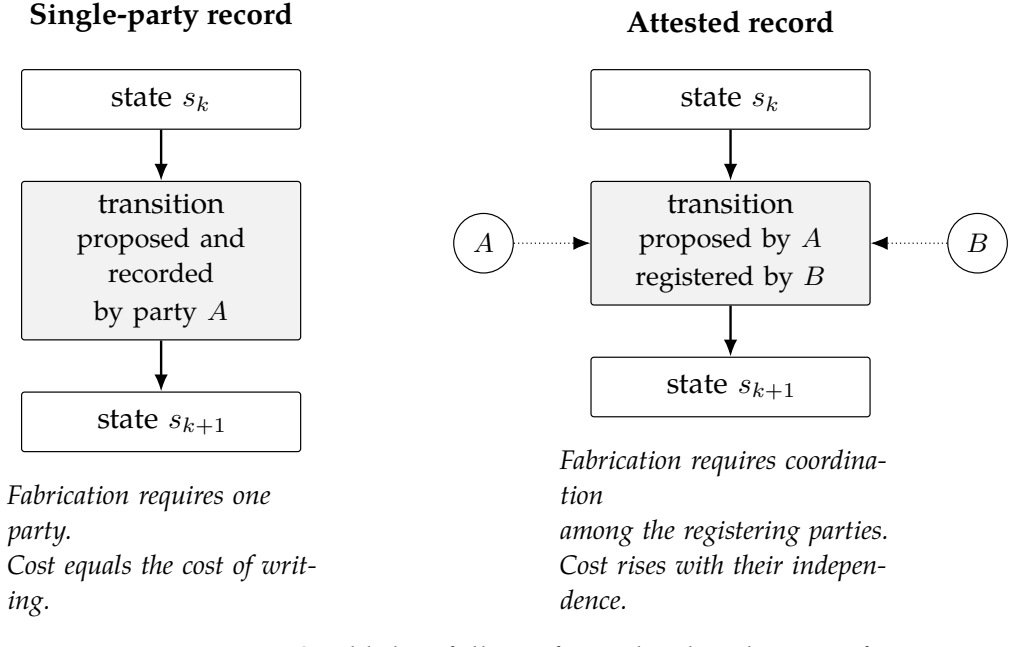
Figure 2. Requirement 9.2. Credibility follows from the distribution of registrations across parties who did not coordinate, and follows from no property of the record’s content, length or detail. The registering party is recorded; the protocol computes no aggregate over registrations, since a count would be a scalar over trajectories and would be farmed by reciprocal registration.
12.3 The Requirement of Registration by a Distinct Party
The third source is the one the design takes.
grRequirementDistributed attestation
A transition is registered by a party distinct from the party proposing it, with that party’s identifier recorded. The credibility of a trajectory follows from the distribution of its registrations across parties who did not coordinate, and follows from no property of the record’s content, length or detail.
gr
The requirement has a precedent recorded in Section 4: the countersigned laboratory notebook, whose evidential force came from a second signature at a date and which required no disclosure of the contents to any further party. The mechanism is old and the present proposal generalises it from a private evidentiary device to the ordinary form of a shared record.
Two consequences shape the specification. The registering act must be cheap, since it falls on a party other than the one who wants the record made, and Grudin’s disparity applies to registrars as much as to authors. And the record must support content addressing and parent links, so that an entry registered at a date cannot be silently altered afterwards; tamper evidence of this kind is available from the substrates the design layers over and requires no new cryptography.
12.4 The Limits of Attestation
Four limits are stated, two of which constrain claims made later in the paper.
Attestation establishes that a distinct party registered a change at a time. It establishes nothing about whether the change was an improvement, whether the claim is true, or whether the registering party understood it. Assessment of content remains at the edges of the system, where Section 2 places it.
Credibility appears only where more than one party is present. A record maintained by a single participant carries no attestation, and therefore carries utility to its author and no evidential weight whatever. Any claim this paper makes about evidence is a claim about arrangements with at least two parties, and the personal case is defended later on grounds of usefulness alone.
Collusion is possible and is not eliminated. Parties who coordinate can produce a mutually attested fabrication, and the cost of doing so rises with the number of independent parties involved and with the visibility of their other work. The design raises the cost of fabrication and does not reduce it to zero, and no arrangement of this kind can.
Counting is excluded. The natural response to the previous limit is to measure attestation depth and treat a heavily attested trajectory as more credible, and that measure is a scalar over trajectories, forbidden by Requirement ? and farmable by reciprocal registration among a small group. Attestation is recorded as a property of each transition, with two values, and the protocol computes no aggregate. A party wishing to weigh a trajectory may do so at Level 3 and owns the consequences.
12.5 The Consequence for the Form of the Design
The requirement of this section determines what kind of object the design must be, and the determination is worth stating explicitly because it settles a question that would otherwise recur.
If credibility followed from a property of the record, a platform would suffice: one operator, one database, one set of rules, and any participant could be given whatever assurance the operator provided. Credibility that follows from distribution across parties who did not coordinate requires those parties to be able to register, read and carry records without depending on a single operator, whose participation would otherwise be the coordination that fabrication requires. Agreement among independent parties about admissible acts and their effects is a protocol.
grxClaim
The fabrication problem is the reason this design takes the form of a protocol. A platform can host a record and cannot supply the independence on which the record’s credibility depends, since the platform’s operator is a party to every entry.
grx
12.6 Summary of Results
This section has established the following. A trajectory record held by a single party is as cheaply fabricated as the artefact whose evidential function it would inherit, so preservation of a process establishes nothing on its own. Of the three available sources of credibility, cost is excluded by the byproduct requirement and pre-commitment covers only what lies in the future, leaving distribution. Requirement ? fixes registration by a distinct party, with the countersigned notebook as precedent, and requires that registering be cheap and that entries be tamper-evident. Attestation establishes registration and not truth, appears only where at least two parties are present, does not eliminate collusion, and is recorded without aggregation. The requirement determines the form of the design: independence from a single operator is what a protocol supplies and a platform cannot.
13. The Unit of Record and the Typing of Transitions
This section fixes what the record records. Its role is to settle a choice that determines everything downstream, since the unit of record decides what can be searched, what can be attested, what can be attributed and what is discarded. Its structure treats the candidate units, the components of a transition, a worked case, the consequences of the choice, and the typing of transitions with the factorisation the typing requires. Its method is comparison of candidates against the requirements already fixed, followed by derivation of the record’s structure from the candidate selected.
13.1 The Candidate Units
Four units are available and are distinguished by the level at which something may be registered.
The utterance is the unit of a transcript. It is cheap to capture, and it fails Requirement ? in a form worth noticing: recording every utterance imposes no cost on participants and produces a volume nobody will read, so the burden moves from capture to interpretation and lands on the same party later.
The output is the unit of the platforms conceded in Section 6. A problem, a hypothesis, a method, a result and an interpretation are each registrable, and their linkage records that one followed another. What cannot be registered is the change itself: the record shows that a second hypothesis exists and does not show that this objection converted the first hypothesis into it.
The artefact version is the unit of version control. It registers difference between successive states of a text, and the difference is computed rather than described, so the reason for the change is absent by construction.
The transition is the unit adopted here. It registers that an identified state became another identified state, through an act of a stated type performed by a party.
13.2 The Components of a Transition
The definition was fixed in Section 2 and its components are stated here with the reason each is required.
A reference to the prior state, which is required because a change that names no antecedent cannot be located in a structure and degrades into commentary. A posterior state, which is what the transition produces. An act of a stated type, which is what makes the record searchable by the kind of thing that happened. The party performing the act, which is what attribution attaches to. The party registering it, which is what Requirement ? supplies. A disposition, which records whether the change was accepted, is contested, or stands unresolved. And links to any transitions in other trajectories whose content the change absorbs, which the section on absorption below requires.
grRequirementGranularity
A transition references a specific identified prior state. A record attached to a project, a repository or a document as a whole is not a transition and is recorded, where it is recorded at all, as commentary.
gr
The requirement explains a failure that Section 6 observed and did not diagnose. Commentary systems have not become epistemic infrastructure because a comment attaches to an artefact: nothing transitions, no state is superseded, and the relation between the comment and any subsequent change is held in the memory of the author alone.
13.3 A Worked Case
grCaseA three-step trajectory in social theory
An initial state holds that trust is a property obtaining between individuals. A second party objects that the account omits institutional power, since a relation between individuals of unequal standing is not the relation the account describes. The proposing party accepts the objection and the state becomes one in which trust is a process shaped by asymmetry of power. A third party, entering from work on commons governance, connects the revised state to an existing literature on monitoring and graduated sanction, and the state becomes one in which trust is generated and maintained under governance arrangements.
gr
The case exhibits every component. Two transitions occur, each referencing the state it altered. The first is an objection performed by a party who is not the author, and its acceptance is the disposition. The second is a connection performed by a party entering the trajectory at that moment, which is the entry mechanism treated in Section \17. Both are attributable to their performers without any claim that either party authored the resulting theory. And the record answers a question no artefact answers: which objection produced which alteration.
13.4 The Consequences of the Choice
Three consequences follow, and the first disposes of a problem that would otherwise require a mechanism of its own.
Curation is a consequence of the unit. A meeting of two hours that alters no state produces no transitions and therefore produces no record, without anyone deciding what deserved to be kept. Where curation is a separate stage performed afterwards, the party performing it holds a position over the archive, and the paper’s own analysis of positions would then apply to it.
Performativity is resisted. A count of transitions is farmable in principle, and Requirement ? forbids the protocol from computing one; more to the point, a transition requires registration by a second party, so inflating the record requires recruiting someone.
Compression becomes possible without a model. Because transitions are typed and reference their antecedents, a trajectory can be read at the level of its transitions by anyone, and the assembly of a summary is available to a reader who has no analytical tools at all. This is what Requirement ? on independence requires in practice.
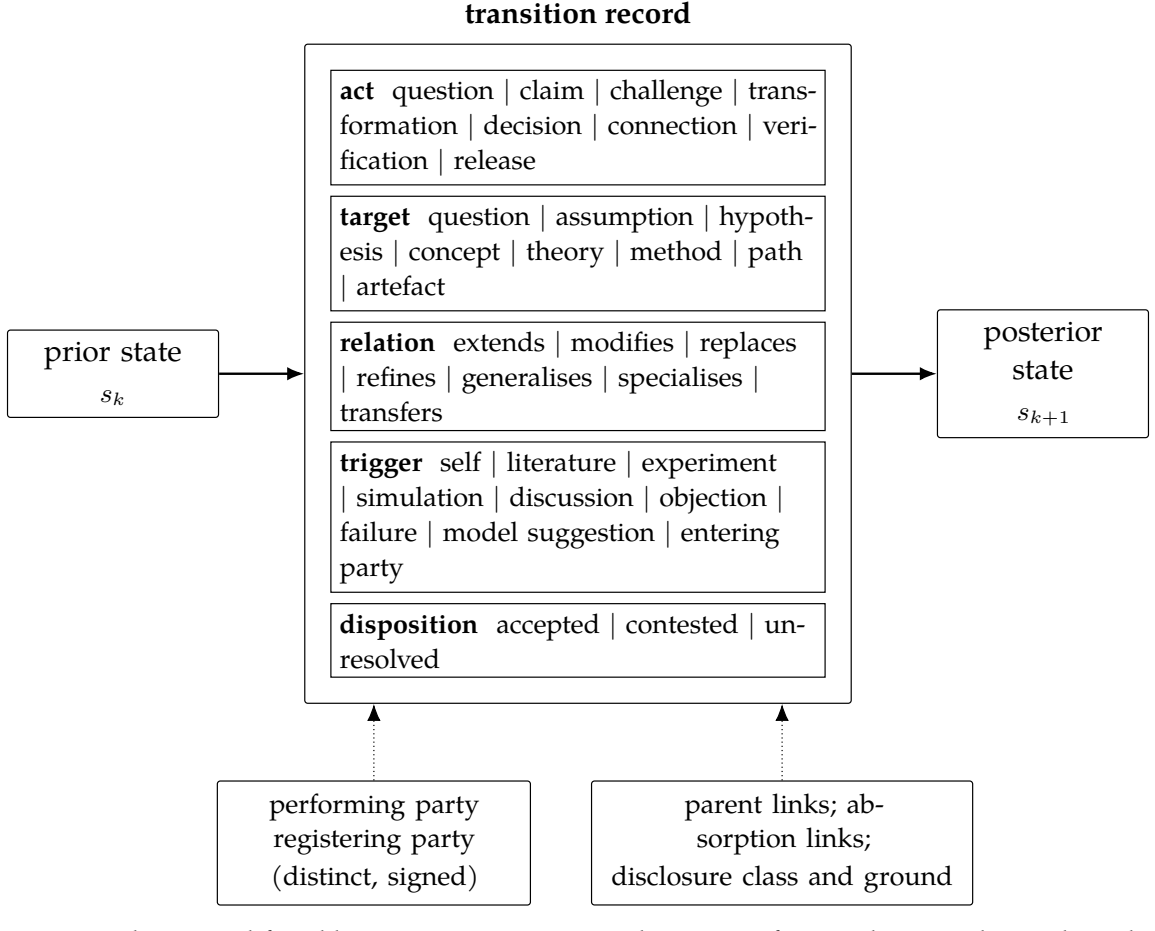
Figure 3. The record fixed by Requirement 10.2. The type is factored into independent dimensions with small closed vocabularies in place of a single enumerated list, so that a contributor makes a small number of narrow choices and agreement between parties classifying the same event stays high. The relation dimension binds to a deployed citation-typing vocabulary. Extension is per dimension and community vocabularies are declared at Level 1. The disposition admits an unresolved value, so that standing objections are recorded as standing.
13.5 The Typing of Transitions
A transition carries a type, and the temptation at this point is a rich taxonomy: separate types for a modified hypothesis, a changed assumption, a reformulated concept, an extended theory, a replaced theory, a split question, a generalised question, a challenged citation, and so on through several dozen.
Such a list is a flattened product. The examples just given vary along three independent dimensions: the act performed, the object it was performed on, and the relation the new state bears to the old. Flattening them multiplies terms, and the multiplication has a measurable cost, since agreement between parties classifying the same event declines as the number of categories rises. A vocabulary in which classification requires deliberation also reintroduces the capture cost that Requirement ? excludes.
grRequirementFactorisation of the type
A transition is typed along independent dimensions with small closed vocabularies, in place of a single enumerated list. The dimensions are the act, the target on which it operates, the relation of the posterior state to the prior, the trigger occasioning it, and the disposition. Extension is per dimension, and community-specific vocabularies are declared at Level 1.
gr
Two elements of the vocabulary are fixed here because arguments later depend on them.
The acts are eight: raising a question, stating a claim, challenging, transforming, deciding, connecting, verifying and releasing. Contribution is not among them, since contribution types a participant’s part in an act and is bound to the deployed taxonomy conceded in Section 7.
The dispositions admit an unresolved value. Most objections in theoretical work are never resolved: they stand, and the work proceeds alongside them. A vocabulary recording only acceptance and rejection would produce a systematically false record of the fields this paper is most concerned with, and would exert pressure toward fabricated closure.
13.6 The Boundaries of the Unit
Two boundaries are recorded. The transition records what its participants articulate, and the capacity that produced it is transmitted only to the extent that it was put into words, which Section \20 treats as a general limit on the whole design. And the typing is adequate only if the dimensions above are the ones that matter across fields, which is an empirical question settled by use; the extension mechanism exists because the answer is expected to differ by community.
13.7 Summary of Results
This section has established the following. Four candidate units are available, and the transition is adopted because the utterance produces unreadable volume, the output cannot register a change, and the artefact version computes difference without reason. A transition comprises a prior state, a posterior state, a typed act, a performing party, a registering party, a disposition, and absorption links. Requirement ? fixes granularity and explains why commentary systems have not become epistemic infrastructure. The worked case exhibits the components and shows what the record answers that no artefact answers. Curation follows from the unit without a separate stage and therefore without a position over the archive. Requirement ? fixes the factorisation of the type, the eight acts are named, and the disposition vocabulary admits an unresolved value so that standing objections are recorded as they stand.
14. Version Identity and the Legitimacy of Divergence
This section treats what happens when a trajectory proceeds in two directions at once. Its role is to fix the design’s position on identity and reconciliation, and to mark the point at which the borrowing from version control stops. Its structure treats the identity of a state across transitions, the absence of a merge operation, divergence as a recorded relation, the disanalogy with software forks, and the capabilities the design forgoes as a result. Its method is analysis of the operations version control requires and of whether their preconditions hold for the object treated here.
14.1 The Identity of a State across Transitions
A trajectory whose states succeed one another raises a question of identity. After a sequence of transitions in which an assumption was abandoned, a concept reformulated and a scope narrowed, whether the resulting state is a later version of the original or a different object is a question with no general answer, and the design does not attempt one.
The position taken is that identity is a matter of record and not of adjudication. A state is a later version of another where a chain of transitions connects them, and the chain is what the record holds. Whether the connected states are recognisably the same theory is a judgement made by readers at Level 3, and the protocol supplies the chain that makes the judgement possible without making it.
14.2 The Absence of a Merge Operation
Version control performs two operations whose preconditions are worth stating, since the borrowing has been extensive and its limit falls here.
Difference between two states is computed mechanically because the object has an identity criterion at the level of bytes and lines. Merging two divergent lines is performed mechanically because changes to distinct regions compose, and where they do not, a conflict is raised for a person to settle; and the result is checkable, since a test suite decides whether the merged object works.
Neither precondition holds for a state of an understanding. Two revisions of a concept do not compose, since a concept revised in two incompatible directions yields no third concept by any rule. No conflict region can be identified, since the incompatibility is not localised in a text. And no test decides the result.
grxClaim
The design supports no merge operation, and this is a boundary of the version-control analogy in place of an omission to be repaired later. What is called integration in this setting is either a synthesis, which is an act producing a new state that references two or more prior states, or an absorption, which is the taking of content from another trajectory with attribution to its originator. Neither combines by rule.
grx
The claim has a practical consequence for terminology, recorded here because it will otherwise mislead implementers. The word merge is used nowhere in the specification, since the substrates over which the design is layered use it for an operation the design does not have.
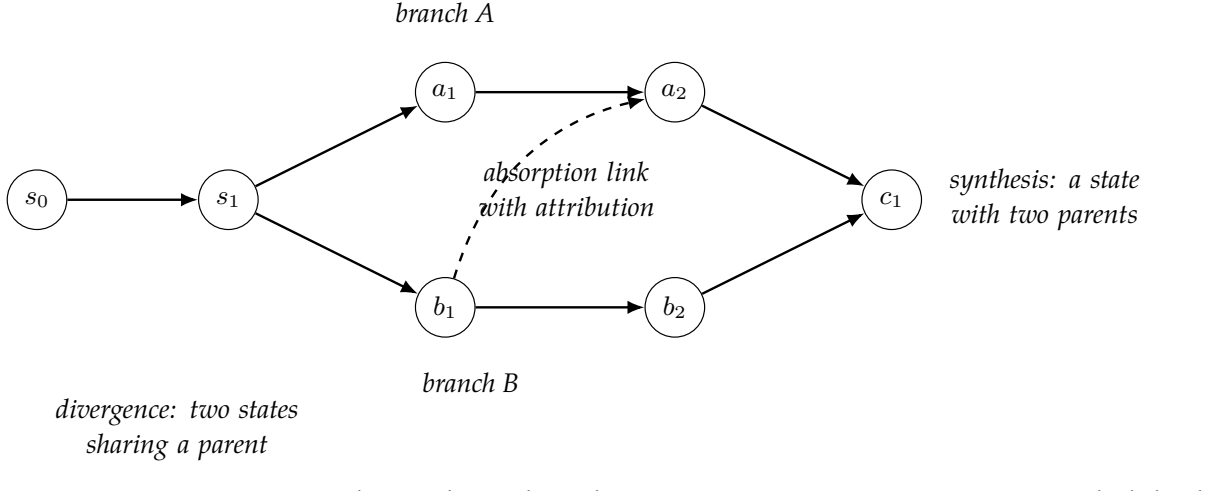
Figure 4. A trajectory is a directed graph and not a sequence. Divergence is recorded, both directions are preserved, and neither is designated the principal line, since in inquiry a fork is frequently the correct outcome. There is no merge operation: two revisions of a concept do not compose, no conflict region localises, and no test decides the result, so integration occurs only as a synthesis referencing several parents or as an absorption carrying attribution across the divergence.
14.3 Divergence as a Recorded Relation
Where a trajectory proceeds in two directions, the design records the divergence and preserves both directions.
Each state references its antecedents through parent links, so a trajectory is a directed graph and not a sequence. A state with two parents is a synthesis. Two states sharing a parent are a divergence, and neither is marked as the principal line, since a protocol that designated one would be adjudicating the question the previous subsection declined.
Attribution crosses divergence. Where a state in one branch absorbs content from a state in another, the absorption is recorded as a link and the originating party is credited, which is the mechanism the section on absorption below requires for its own purposes and which here prevents divergence from severing credit.
14.4 The Disanalogy with Software Forks
In software a fork is ordinarily a failure. The project’s participants could not agree, the effort divides, both lines carry the maintenance cost separately, and the community treats reunification as the desirable outcome.
In inquiry the corresponding event is frequently the correct outcome. Two accounts of the same subject that proceed on incompatible assumptions are not a coordination failure, and forcing them into one account produces something worse than either. A design that treats divergence as a defect would therefore be importing a norm from the substrate along with the mechanism, and the analogy discipline of Section 2 forbids it.
The consequence is that the record’s normal shape is plural. A question with several live accounts appears in the record as several branches with shared ancestry and cross-links where one has absorbed from another, and this is what a healthy trajectory looks like rather than an unfinished one.
14.5 The Capabilities Forgone
Three capabilities are given up, and the cost is real.
There is no canonical current version. A reader arriving at a trajectory with three live branches must choose among them, and the protocol offers no basis for the choice, since any basis it offered would be an ordering of trajectories and is forbidden by Requirement ?.
There is no automatic reconciliation. Where two branches contain compatible improvements, someone must perform a synthesis as an act, and nothing happens by itself.
And divergence has a cost in attention. Every branch is a claim on the finite reviewing capacity treated in the companion paper on collective action, and a design that makes divergence free at the level of the record does not make it free at the level of the people who must read it.
14.6 Summary of Results
This section has established the following. Identity of a state across transitions is a matter of the recorded chain and not of adjudication by the protocol. Merging has no counterpart here, since revisions of a concept do not compose, no conflict region can be localised, and no test decides the result; integration is either synthesis, which references several parents, or absorption with attribution. Divergence is recorded through parent links, both directions are preserved, no branch is designated principal, and attribution crosses the divergence. The disanalogy with software forks is stated: in inquiry a fork is frequently the correct outcome, so plurality is the normal shape of the record. The design forgoes a canonical version, automatic reconciliation, and any protection against the cost that plurality imposes on reviewing capacity.
15. Relational Positions and the Admissibility Condition on Functional Authority
This section treats the positions that an arrangement of the kind proposed here creates, and fixes the condition under which such a position is admissible. Its role is to answer, before the architecture is described, the objection that an infrastructure designed against concentration will reproduce it. Its structure treats the positions the design generates, the evidence against the claim that openness dissolves hierarchy, the condition of admissibility, and the limits of what a protocol can achieve here. Its method is analysis of the acts the design requires, followed by a criterion stated in terms of observables the record supplies.
15.1 The Positions the Design Generates
Four positions arise from the requirements already fixed, and none of them is optional.
A registrar, since Requirement ? obliges a party other than the proposer to register a transition, and in any working group a small number of parties will perform most registrations.
A steward of a trajectory, since parent links, disclosure classes and the resolution of duplicate states require decisions that someone makes.
A holder of disclosure authority, since a disclosure class is enforced by an implementation and its membership is determined at Level 1 by someone.
A custodian of the specification, treated in the companion paper, since a protocol without a maintainer either ossifies or is revised by whoever holds informal power.
These positions are generated by the design and not imported into it. An account claiming that a well-designed arrangement has no positions has failed to describe its own requirements.
15.2 The Evidence against Dissolution by Openness
The claim that functional authority replaces hierarchy where participation is open is attractive and is contradicted by the best-documented cases.
Open-source projects with open participation, public archives and no formal membership develop maintainer authority, committer status and, in many projects, a single party whose decision settles disputes. Empirical work on large populations of open collaborative communities reports concentration of decision rights (shaw2014laboratories) over time as projects grow, with the concentration appearing in communities whose formal rules impose none. The general prediction is older than the cases, and michels1962political stated it for voluntary associations whose rules were explicitly egalitarian.
This paper therefore makes no claim that openness dissolves hierarchy, and the requirements developed here are designed on the assumption that it does not.
15.3 The Condition of Admissibility
The distinction the design needs is between a position constituted by what its holder does and a position that has become a standing its holder possesses.
grDefinitionFunctional and structural position
A position is functional where it is constituted by acts the arrangement requires, where those acts are recorded and attributable, and where continued occupancy depends on continuing to perform them. A position is structural where occupancy confers standing that persists independently of performance, or where the capacity of other participants to act depends on the holder’s permission.
gr
grRequirementAdmissibility of authority
A position in the arrangement is admissible where two conditions hold jointly. The acts constituting it are recorded as transitions or as administrative operations, attributable to the party performing them and visible to participants. And participants retain the capacity to proceed without the holder’s permission, which the portability requirement of the following section supplies.
gr
The two conditions do different work and neither suffices alone. Visibility without exit produces a well-documented autocracy. Exit without visibility produces an arrangement in which participants cannot tell what a position holder has done and therefore cannot judge whether to leave.
The first condition is cheap under the design already fixed, since a registrar’s registrations, a steward’s parent-link decisions and a disclosure holder’s class changes are all recorded acts. The design adds no separate accountability mechanism, and this is the argument for recording administrative operations distinctly from transitions: an arrangement in which a position holder can act without leaving a record would satisfy neither condition.
15.4 The Limits of Provision at the Protocol Level
Three limits are stated plainly.
A protocol cannot prevent positions from forming, and this design does not attempt to. Concentration of registration and stewardship in a few hands is the expected outcome in any working group, and the requirement above governs the terms of the concentration and not its existence.
Recording an act is not review of it. A steward who consistently declines to register transitions from a particular participant leaves a complete record of having done so, and nothing in the protocol responds. What responds is Level 1: a charter that states what a steward owes, and participants who read the record and act on it.
And the condition is stated in terms of capacity and not of use. Participants who could proceed without a holder’s permission, and who in practice never do, are in an arrangement whose authority is bounded in principle and concentrated in fact. The paper claims the bound and does not claim the practice.
15.5 Summary of Results
This section has established the following. The design generates four positions by its own requirements: registrar, trajectory steward, holder of disclosure authority, and custodian of the specification. The claim that openness dissolves hierarchy is contradicted by the open-collaboration evidence and by older results on voluntary associations, and this paper assumes it is false. Definition ? separates functional from structural positions, and Requirement ? fixes admissibility on two joint conditions: the constituting acts are recorded and attributable, and participants retain the capacity to proceed without permission. The first condition follows from recording administrative operations; the second is supplied by portability. A protocol cannot prevent concentration, recording is not review, and the requirement secures a capacity for exit without any claim that the capacity is exercised.
16. Portability of the Trajectory and the Bounding of Position Authority
This section fixes the requirement on which the second condition of admissibility depends. Its role is to establish that the bound on authority in this design is the cost of leaving, and to state what a record must satisfy for that cost to be low. Its structure treats the mechanism by which exit bounds authority, the technical content of portability, the evidence from software and its contrast with scholarly publishing, and the limits of what portability secures. Its method is analysis of a mechanism documented in the literature on organisations, applied to the object this paper designs.
16.1 The Mechanism by Which Exit Bounds Authority
hirschman1970exit’s analysis of responses to decline in organisations (hirschman1970exit) distinguishes exit from voice, and observes that the availability of exit conditions everything about how voice operates. A member who can leave at low cost is in a different relation to those who govern an organisation than a member who cannot, and the difference holds whether or not the member leaves.
Applied here the mechanism is direct. A steward’s authority over a trajectory persists while remaining is preferable to leaving. Where leaving means abandoning the accumulated record, the threshold at which participants leave is high and the authority is correspondingly large. Where leaving means taking the record and continuing, the threshold is low and the authority survives only while it is useful.
grxClaim
In this design the bound on the authority of any position is the cost of exit for the participants subject to it. The bound is a property of the record’s portability and is not established by any rule addressed to the position holder.
grx
The claim explains why the design contains no rules limiting what a steward may do. Such rules require an enforcing party, the enforcing party occupies a position, and the regress terminates only where a participant can act without anyone’s permission.
16.2 The Technical Content of Portability
Portability in the sense required is a conjunction of five properties, each of which fails in some deployed system and each of which is therefore stated.
grRequirementPortability
The complete record of a trajectory, comprising its transitions, their attestations, their attribution and their parent links, is obtainable by any participant without the permission of any position holder; is expressed in a self-describing format readable without the software that produced it; carries identifiers that remain resolvable when the record is held elsewhere; is licensed so that continuation elsewhere is permitted; and may be continued under the same protocol by an implementation the original operator does not control.
gr
The last property is the one that distinguishes portability from export. A system offering a data dump satisfies the first four and leaves the departing participants with an archive. Continuation requires that the format be a protocol other implementations honour, which returns to the conclusion of Section 12 from a second direction.
Persistence of identifiers under relocation deserves a note, since it is the property most often lost. An identifier resolving through the original operator’s service ceases to resolve when participants leave, and the departing record then holds references it cannot follow. This is a constraint on the architecture and is treated in the companion paper.
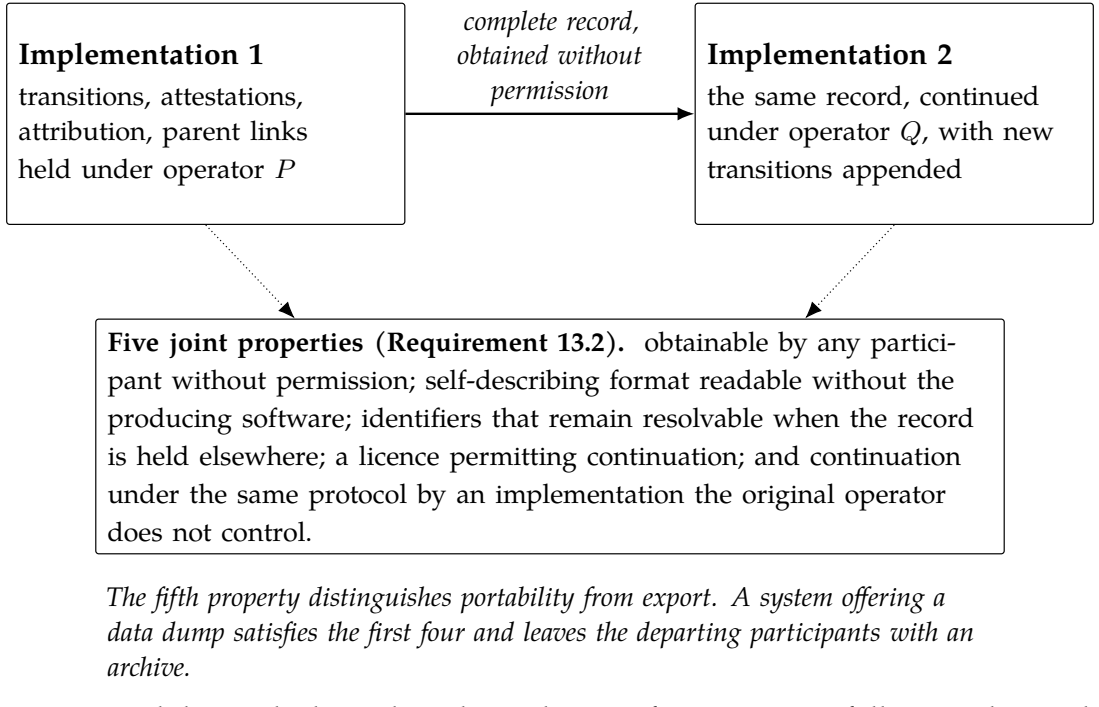
Figure 5. Portability is the bound on the authority of any position, following the mechanism by which the availability of exit conditions the terms on which voice operates. The design therefore contains no rules addressed to position holders, since enforcing such rules would generate the position they were meant to constrain. Portability secures neither the participants, nor the resources, nor the standing, which remains held by the arrangement.
16.3 The Evidence from Software and the Contrast with Publishing
Open-source projects supply the clearest case of the mechanism operating. Maintainers hold substantial authority, and it is bounded by the availability of a fork carrying the entire history at negligible cost. Forks are uncommon, which is the expected result: authority exercised badly enough to provoke one is rare precisely because the option is present, and maintainers who retain their position do so on the strength of being useful.
Scholarly publishing supplies the contrast, and the contrast is instructive because the record there is not portable in the sense required. A journal’s accumulated standing is held in its title, its indexing and its reputation, none of which departs with the people who produced it. Editorial boards that have resigned to found a competing venue have therefore been treated as notable events: the linguistics case in 2015, the informetrics case in 2019, and the machine-learning case in 2001 are cited repeatedly for that reason. The editors carried their judgement and their networks; the accumulated position remained where they left it.
grxClaim
The rarity of editorial secession in scholarly publishing is evidence about exit cost and not about the quality of the arrangements departed from. Where the accumulated record cannot leave with those who produced it, authority over the arrangement is bounded weakly, and the design proposed here differs from the incumbent arrangement principally in this respect.
grx
16.4 The Limits of Portability
Three limits are recorded, and the third is substantial enough to qualify the section’s own claim.
Portability secures the record and not the participants. A steward whose colleagues have no interest in continuing elsewhere holds authority that portability does not touch.
Portability secures the record and not the resources. Where a trajectory depends on an instrument, a licence or a funded position, the party controlling that resource holds an authority no property of the record bounds, which is the subject of the companion paper on the grounds of restriction.
And portability secures the record and not the standing. This is the important limit. Forking a software project transfers the artefact and the history, and the fork’s value to its users is largely intrinsic to what it does. Forking a trajectory transfers the record, and the attention, recognition and institutional acceptance attaching to the original do not travel with it. Standing is positional, as Section 5 established, and positional goods are held by the arrangement rather than by the record.
The claim of this section is therefore bounded as follows. Portability makes exit possible where it is currently impossible, and it converts a prohibitive cost into a substantial one. It does not make exit cheap in the dimension that matters most to a participant whose career depends on recognition, and any expectation that it will produce frequent secession is unwarranted.
16.5 Summary of Results
This section has established the following. The bound on authority in this design is the cost of exit, following Hirschman’s mechanism, and the design accordingly contains no rules addressed to position holders, since enforcement of such rules would generate the position it was meant to constrain. Requirement ? fixes portability as five joint properties, of which continuation under the same protocol by an independent implementation is the one distinguishing portability from export. Open-source practice exhibits the mechanism, and the rarity of editorial secession in publishing is evidence of high exit cost rather than of satisfactory arrangements. Portability secures neither participants, nor resources, nor standing, and it converts a prohibitive exit cost into a substantial one without making exit cheap.
17. Entry Paths and the Bootstrap Condition on Qualification
This section treats the conditions under which a party who holds no position in an arrangement may begin to participate in it. Its role is to establish that the design’s answer to qualification is a mechanism already present in its act vocabulary, and to show why the answers commonly proposed fail. Its structure treats the qualification problem, the bootstrap failure in the usual criteria, the requirement an entry path must satisfy, the mechanism the design supplies, and the problems the mechanism leaves untouched. Its method is derivation of a requirement from a failure, followed by identification of the acts that satisfy it.
17.1 The Qualification Problem
An arrangement in which any party may register a change is exposed to parties acting in bad faith, to parties acting in good faith without competence, and to volume. The natural response is a qualification: participation beyond some minimal level is available to parties who satisfy a condition.
Four conditions are commonly proposed and are worth naming, since each is reasonable and three of them fail. Demonstrated contribution, under which a party who has contributed may contribute further. Agreement to a code of conduct. Trust extended by existing participants. And verification of competence.
17.2 The Bootstrap Failure
The first and third conditions have the same structure and the same defect.
grxClaim
A qualification requiring demonstrated contribution requires access in order to be satisfied and grants access in return for satisfaction, so it is closed against every party who holds no prior position. A qualification resting on trust extended by existing participants has the same form with an intermediate step.
grx
The failure is an instance of a pattern already recorded twice in this paper. Section 5 reported that assessment procedures discriminate against contributions whose form lies far from precedent, and that the literature measuring this is drawn entirely from populations who entered the procedures. The observation of arrow1962economic about information as a commodity has the same shape: the value of a disclosure cannot be assessed without the disclosure, and the disclosure is what the assessment was to license.
The consequence for the present design is direct. An arrangement whose entry condition is prior contribution reproduces, at the scale of a working group, the exclusion this paper’s diagnosis attributes to the incumbent system. It is also, empirically, the arrangement under which open communities concentrate decision rights, since the parties who contributed early are the parties qualified to contribute later.
17.3 The Requirement on an Entry Path
The second and fourth conditions survive, and the fourth survives only in a particular form.
Agreement to a code of conduct is satisfiable by any party at no cost and excludes nobody with the intention of participating in good faith. It is a Level 1 matter and the protocol carries only the reference.
Verification of competence is satisfiable without prior position where the material on which competence is demonstrated is supplied by the arrangement itself.
grRequirementEntry path
An arrangement conforming to this design offers at least one path by which a party holding no prior position may perform an act whose acceptance is decided on the act itself. The path is cheap to attempt, its material is supplied by the arrangement, and its outcome is verifiable by parties other than the one who attempted it.
gr
The requirement is stated as an existence condition and not as a procedure, since the appropriate material differs by field and is a Level 1 matter.
17.4 The Mechanism the Design Supplies
The design already contains the acts the requirement needs, and this is the section’s substantive claim.
A trajectory holds states whose disposition is unresolved: obstacles encountered, objections standing, questions raised without answers. Under Requirement ? each is an identified state that may be referenced. A register of such states, published at whatever disclosure class the arrangement uses, is a list of problems on which a stranger may act.
The acts available to that stranger are those of the vocabulary. A connection referencing an unresolved state and an external literature. A challenge to a claim. A verification of a result. Each references an identified state, each is decided on its content by the parties who hold that state, and none requires any prior standing.
The practice this mirrors is the one described in Section 6 as the reason open-source projects admit strangers more readily than scholarship does. A stranger selects a stated problem, submits work addressing it, and the work is accepted or declined on what it does. The design’s contribution is that the same structure is available for the states of an understanding, since the record holds them as identified objects.
The worked case of Section 13 exhibits the mechanism at its third step, where a party entering from another field connects the current state to a literature its participants had not considered, and is attributed for the connection without any claim to have authored the theory.
17.5 The Problems Untouched by the Entry Path
Four problems remain and are named so that the requirement is not read as a solution to them.
Volume is not addressed. An open entry path in an arrangement with attention worth having attracts more attempts than its participants can assess, and the assessment capacity is a subtractable resource treated in the companion paper on collective action.
Conduct is not addressed. The protocol carries a reference to a code and enforces nothing, and moderation is a Level 1 obligation with a labour cost falling on whoever accepts it.
Competence in restricted work is not addressed by this mechanism. Where a disclosure class restricts access on one of the grounds treated in the companion paper on restriction, entry to that class is governed by the ground and not by the entry path, and the requirement above applies only to what the arrangement discloses.
And an entry path is a capacity and not an outcome. An arrangement satisfying Requirement ? whose participants decline every act by every stranger conforms to the requirement, and the record of the declining is what a reader has to go on.
17.6 Summary of Results
This section has established the following. Qualification by demonstrated contribution or by extended trust is closed against parties holding no prior position, and reproduces at small scale the exclusion this paper diagnoses at large scale, as stated in Claim ?. Requirement ? fixes an entry path that is cheap to attempt, supplied with material by the arrangement, and decided on the act itself. The acts satisfying it are already in the vocabulary, applied to states whose disposition is unresolved, which makes a register of open problems the design’s entry mechanism. Volume, conduct, restricted classes and the actual behaviour of participants lie outside what the requirement secures.
18. Encounter, the Change of the Participant Set, and the Cost of Preparation
This section treats the transitions in which the parties to a trajectory change, and states what the record of such transitions makes available. Its role is to identify the one respect in which this design records something no output-based system records, and to fix the limits of the discovery claim that follows from it. Its structure treats the two kinds of change a trajectory undergoes, the representation of an encounter within the vocabulary already fixed, the significance of recording changes in the participant set, and the boundaries of the matching claim. Its method is analysis of the record’s structure, followed by a narrowing of a claim that is untenable in its general form.
18.1 The Two Kinds of Change a Trajectory Undergoes
A trajectory changes in two respects that the record treats differently.
Its content changes, which is what the transitions of Section 13 record: a claim is challenged, an assumption abandoned, a state superseded.
Its participants change. A party enters, having been absent; a party ceases to act; a party who was a reader performs an act. Content-facing accounts treat this as context. Under the definition adopted here it is a transition like any other, since the arrangement that produces the content is altered by it.
18.2 The Representation of an Encounter
The design adds no primitive for this. An encounter is a transition whose trigger is an interaction, and whose performing party was not previously a party to the trajectory.
grDefinitionEncounter
An encounter is a transition performed by a party who has performed no prior act in the trajectory, with a trigger identifying the occasion of the interaction. Its record therefore holds both the change in content it produced and the change in the participant set it constitutes.
gr
The economy is deliberate. A separate object for meetings, seminars, conversations and reviews would multiply entities that the factorisation of Requirement ? already covers through the trigger dimension, and the occasions themselves are artefacts referenced by the trigger rather than states of the understanding.
18.3 The Significance of Recording the Participant Set
Every other act in the vocabulary transforms what is held. This one transforms who holds it, and the record of a trajectory therefore contains the history of the arrangement that produced the content alongside the content itself.
grxClaim
A record built on transitions holds the generation of the arrangement that produced an understanding, and not the produced understanding alone. Where a system’s unit is an output, the entry of a participant leaves no trace beyond a name attached to a later artefact, and the occasion on which the participant entered, the state that occasioned it and the act performed cannot be recovered.
grx
Two uses follow and are stated without exaggeration. Attribution becomes possible for parties whose contribution altered a trajectory without producing an artefact of their own, which is the population Section 17 is concerned with. And the conditions under which a productive encounter occurred become inspectable, which is material for study rather than an operational function of the protocol.
18.4 The Boundaries of the Matching Claim
An arrangement holding many trajectories invites a claim about discovery: parties may be matched to one another by the states they occupy. The claim is defensible in one form and indefensible in the form usually stated, and the difference matters enough to fix here.
Within a specialty the claim is worthless. A field in which twenty parties work on a question is a dense network whose members already know one another through conferences, review and correspondence, and no infrastructure improves their access to each other.
Across specialties the claim is substantial, and it is substantial for the reason the within-field version fails. Two parties encountering the same structural difficulty in different fields describe it in different vocabularies, so retrieval by topic cannot connect them, and no personal network spans the distance. The demonstration by swanson1986fish that two disconnected literatures can jointly entail a conclusion neither states is the established form of this observation for published claims. The present design extends the object from published claims to recorded states, including states whose disposition is unresolved.
grxClaim
The discovery claim of this design concerns structural similarity between states in different fields, and it concerns nothing within a field. Its plausibility depends on a corpus large enough to contain such pairs, so it is a late property of an adopted arrangement and supplies no reason for any party to adopt one.
grx
Two further boundaries are recorded. The matching itself is an unsolved problem: representing a state so that similarity of structure is computable across vocabularies is a research question, it belongs at Level 3 under the separation of Section 2, and this paper claims a substrate that makes such research possible without claiming any result. And recording an encounter alters the encounter, since parties speak differently when a record is being made, and the material most worth preserving is the least likely to be produced under observation. The conditions under which that cost is acceptable are the subject of the companion paper on the grounds of restriction.
18.5 Summary of Results
This section has established the following. A trajectory changes in content and in its participant set, and both are transitions under the definition adopted. Definition ? fixes an encounter as a transition performed by a party with no prior act in the trajectory, adding no primitive to the vocabulary. Claim ? states what follows: the record holds the generation of the arrangement alongside the content, which makes attribution possible for parties who produced no artefact and makes the conditions of productive encounter inspectable. Claim ? narrows the discovery claim to structural similarity across fields, worthless within a specialty, dependent on a corpus, and therefore unavailable as a reason for adoption. Matching remains an unsolved Level 3 problem, and recording an encounter alters it.
19. Priority, Disclosure Timing, and the Incentives to Early Contribution
This section treats the reason a participant may rationally decline to record or disclose work in progress, and states what the design offers in response. Its role is to establish that the arrangement can be entered without the participant surrendering the protection that concealment presently provides. Its structure treats the disclosure dilemma, priority as the incumbent solution and the point in a trajectory at which it becomes available, the devices already deployed, the requirement this design adds, and the limits of what any such device secures. Its method is analysis of the incentives facing a participant, followed by a requirement stated in terms of what a record must support.
19.1 The Disclosure Dilemma
Circulation of work in progress is where the benefits claimed in this paper arise. Objections arrive while they can still alter a direction, connections are made before a framing has hardened, and parties who would contribute are able to find the work.
Concealment of work in progress is where a participant’s protection lies. A hypothesis, a method or a framing disclosed before it is established may be taken up by a party with more time, more assistance or more standing, and completed first. The concern is rational under the arrangement described in Section 5, since standing accrues to the party who arrives first in public and is not divided according to who had the thought.
The dilemma is asymmetric in a way that matters for this design. A well-positioned party risks little by disclosing early, since the same standing that attracts resources also secures the association of the idea with its author. A party without position bears the whole of the risk, and that party is the one this paper’s diagnosis concerns.
19.2 Priority and the Point at Which It Becomes Available
The incumbent system answers the dilemma with priority, and merton1957priorities establishes that the answer is structural: the reward attaching to being first in public is what makes disclosure rational for a producer who could otherwise withhold.
The defect is temporal. Priority attaches at publication, which occurs after the work is substantially complete, so the protection is unavailable during exactly the phase in which circulation would be most productive. A participant who wishes to be protected during the generative phase has, under the incumbent arrangement, one instrument, which is silence.
19.3 The Devices Already Deployed
Three devices already narrow the gap and are conceded.
Preregistration and Registered Reports register a question and a design in advance, with a timestamp, and in some arrangements with an embargo, so that a claim to the question exists before results are obtained.
Stage-wise publication registers priority at each stage. Octopus, described in Section 6, publishes a research problem, a hypothesis or a method as an independent unit with immediate recognition, and its designers describe the effect as comparable to the registration function of a patent office. This paper claims nothing that Octopus already provides on this point, and the concession is complete.
Preprint deposit performs the function informally in fields whose norms accept it, and the acceptance is what makes it work, which is a fact about communities rather than about the deposit.
What none of these supplies is registration without disclosure. Each requires the participant to publish the thing being registered, so each protects the participant by exposing the work, and the participant who is unwilling to expose the work is returned to silence.
19.4 The Requirement Added Here
The design separates the claim from the disclosure.
grDefinitionSealed registration
A sealed registration is the publication of a value derived from the content of a state, from which the content cannot be recovered and against which the content can later be checked, together with the identifier of the registering party and a time. Disclosure of the content is a subsequent and separate act.
gr
grRequirementRegistration independent of disclosure
Registration of a state or a transition is available at the moment the act is performed and at every disclosure class, including the class disclosing to no party beyond the performer. Disclosure is a separate act, performed later or never, and the record shows that registration occurred at its time without showing what was registered.
gr
The mechanism is a commitment of a standard kind and requires nothing the substrates of this design do not already provide, since content-addressed storage computes the necessary value as a matter of course. Its effect on the dilemma is limited and real: a participant may record a trajectory from its first day, and may open it later at a chosen time, with evidence available throughout that the states existed when the record says they did.
19.5 The Limits of Registration
Five limits are stated, and the last is the one that governs how the requirement should be read.
Sealed registration evidences possession of a content at a time. It evidences no understanding of it, no capacity to develop it, and no priority in any sense a community has not agreed to honour.
It generates nothing. A sealed state is unavailable to every other party, so it produces no objection, no connection and no encounter. The device protects the participant during the phase in which the design’s own benefits are unavailable to them, and it purchases the possibility of later opening rather than the benefits of early opening.
It offers no protection against independent arrival. A second party who reaches the same state without knowledge of the first has done nothing wrong, and the record adjudicates nothing between them.
It requires an implementation the participant trusts to publish the value at the stated time, or a public medium in which the value is deposited, and the trust or the medium is an arrangement outside the protocol.
And a timestamp is not priority. Priority is a community’s recognition of a claim, and the recognition is a Level 1 matter and a matter of norms the design cannot manufacture. The physics and mathematics communities honour deposit; other communities do not; and in a community that does not, the requirement above supplies evidence to a participant who has no forum in which the evidence counts. This paper therefore states the requirement as a necessary condition for entry into the arrangement without concealment, and makes no claim that satisfying it secures a participant’s position.
19.6 Summary of Results
This section has established the following. Circulation of work in progress produces the benefits this paper claims, and concealment supplies the participant’s protection, with the risk falling disproportionately on parties without position. Priority answers the dilemma in the incumbent system and becomes available only at publication, so the generative phase is unprotected. Preregistration, stage-wise publication and preprint deposit narrow the gap and each requires disclosure of the thing registered. Definition ? and Requirement ? separate registration from disclosure, so that a record may begin on the first day and be opened later. Registration evidences possession and not understanding, generates nothing while sealed, adjudicates nothing against independent arrival, depends on an arrangement outside the protocol, and confers no priority in any community that does not recognise it.
20. Transmissibility and the Boundaries of the Articulable Record
This section fixes how much of what a trajectory contains can travel in a record of it. Its role is to bound three claims the paper has made separately, and to show that the bound is the same in each case, which is the strongest single result of Part II. Its structure treats the claim under examination, the evidence on the transmission of capability, and the three consequences that follow for reuse, for evidence and for hazard. Its method is application of an established finding in the history and sociology of science to the object designed here.
20.1 The Claim under Examination
The attractive form of this paper’s proposal holds that a reader may enter another party’s trajectory and continue from the state at which that party stopped. Stated without qualification the claim is false, and the reason it is false constrains the design in three places at once.
20.2 The Evidence on the Transmission of Capability
collins1974tea’s study of the transverse excitation atmospheric laser (collins1974tea; collins2010tacit) reported that laboratories attempting to build the device from published papers failed, and that success followed contact with people who had built one. The conclusion drawn there, and supported since across several fields, is that a substantial part of the capability to perform a technique is held in practice and is transmitted by working alongside a practitioner, with the written record insufficient however detailed it is.
The study of nuclear weapons design by mackenzie1995tacit reported the same structure in a case where the incentive to record fully was extreme, and observed that a capability can be lost when the practitioners disperse, notwithstanding the survival of documents.
The finding is not that records are useless. It is that a record transmits the articulable fraction of what a party held, and that the fraction is smaller than practitioners expect and varies with the kind of work.
grDefinitionThe articulable fraction
The articulable fraction of a trajectory is that part of what its participants held which they were able to put into the record. Its complement is the part transmitted, if at all, by working alongside them, and no property of the record’s design recovers it.
gr
20.3 The Consequence for Reuse
The reuse argument survives in a weakened and still substantial form.
What transfers well is the propositional content of a failure: that an approach was attempted, on what assumption, and what obstruction was met. A party in another field learning that an approach failed because an independence assumption was required is receiving something they can act on, and they are receiving it in a form the original participants were able to write.
What transfers badly is the capability to execute the approach. A reader informed that a method failed under a condition may be unable to apply the method at all, and the record does not supply the ability.
The reuse claim of this paper is therefore a claim about the redirection of attention and not about the transfer of capability. It holds that a party may learn where to look, what has been tried and what obstruction was met, and it does not hold that a party may take up another’s work where it was left.
20.4 The Consequence for Evidence
The evidential claim of Section 11 is bounded by the same fraction.
A trajectory record attested by distinct parties evidences that a party performed the recorded acts at the recorded times. It evidences the capacity those acts required only to the extent that performing them required capacity, and a record can be traversed by a party of modest capability working slowly. The design’s evidential claim is therefore that the record discriminates better than an artefact under present conditions, and it is not a claim that the record measures capacity.
20.5 The Consequence for Hazard, and the Common Component
The same fraction bounds the risk, and the symmetry is worth stating as a result.
Where a trajectory concerns work whose propagation creates danger, what a record could supply to a hostile reader is the propagable part of the method, which is the part its participants were able to articulate. The tacit remainder is as unavailable to that reader as it is to a benign one. Restriction of disclosure remains necessary, since the articulable fraction in some domains is sufficient for harm, and the point here is that benefit and hazard are bounded together.
grxProposition
The component of a trajectory that the artefact omits is simultaneously the component that carries its value in reuse, the component that carries its evidential force, and the component that carries its hazard. The three therefore scale together with the articulable fraction, and no design increases one without increasing the others.
grx
The proposition disposes of a class of proposals that would otherwise be attractive. A design promising the epistemic benefit of an open trajectory while withholding the parts that carry risk is promising to publish the record minus the component that makes it worth publishing. The design’s answer to hazard is therefore governed by disclosure classes and stated grounds, treated in the companion paper on restriction, and not by any selective omission that would leave the benefit intact.
A further instance of the same component is recorded and deferred. What the artefact omits also carries the reputational cost of disclosure, since failures and abandoned directions are the material a participant is least willing to publish. The consequences of that are part of the treatment of exploratory vulnerability in the companion paper.
20.6 Summary of Results
This section has established the following. The claim that a reader may continue another party’s work from the state at which it stopped is false in its unqualified form, and the evidence on tacit knowledge in experimental and design work establishes why. Definition ? fixes the articulable fraction. The reuse claim survives as a claim about the redirection of attention, holding that a party may learn what was tried and what obstruction was met, and not that capability transfers. The evidential claim is bounded to the acts performed and does not measure capacity. The hazard is bounded by the same fraction. Proposition ? states the common component: value in reuse, evidential force and hazard are carried by what the artefact omits, so they scale together, and no design separates them.
21. The Statement of the Gap
This section states once, and in one place, what the surveyed literatures leave unaddressed and what this paper claims in consequence. Its role is to make the contribution auditable: a reader should be able to check the claim against the survey without reconstructing it from remarks distributed through six sections. Its structure is a tabulation of what each literature fixes and leaves, the statement of the gap, and the conditions under which the claim is withdrawn. Its method is comparison, and it introduces no new material.
21.1 The Coverage and the Omission of Each Literature
Table 2 tabulates the survey. Each row names a literature treated above, what that literature fixes, and the element it leaves unfixed. No row is a criticism, since every literature is adequate to the purpose for which it was developed.
Table. The surveyed literatures, what each fixes, and what each leaves unfixed
21.2 The Gap Stated
grxClaim
No arrangement in the surveyed literatures takes the transition between two identified states of an understanding as its unit of record, registers that transition by a party distinct from the one proposing it, attributes content absorbed from one line of work into another, bounds the authority of positions by the portability of the record, and restricts disclosure on a stated ground that determines what remains disclosable. The elements are severally available and the conjunction is unoccupied, and the conjunction is specified here as an interaction protocol where the standards are description languages.
grx
Two qualifications belong with the claim and are stated here rather than in a footnote.
The claim concerns a conjunction and not any element. Each element has an ancestor: attestation in the countersigned notebook, attribution in contributorship taxonomies and moral rights, portability in software forking, grounded restriction in the governance of hazardous research, and typed relations in citation ontologies. The paper asserts novelty for the assembly and for the requirements that force it, and asserts none for the parts.
The claim is about specifications and deployed systems, and not about ideas. Proposals resembling the present one have certainly been made in venues this survey does not reach, and the claim is defeasible accordingly.
21.3 The Conditions under Which the Claim Is Withdrawn
The novelty claim is withdrawn on any of four findings, and each is stated so that a reader can look for it.
A deployed system or published specification whose unit of record is the transition between identified states, with registration by a distinct party, would defeat the claim entire.
A specification defining admissible acts and their effect on a shared state for scholarly work, with conformance conditions, would defeat the claim that the standards surveyed are description languages.
Evidence that the rationale-capture systems failed for reasons other than capture cost, or that they were adopted more widely than this survey reports, would remove the ground on which Requirement ? was derived and with it the paper’s principal design constraint.
And evidence that the separating condition of Definition ? has not weakened, or that evaluation systems have already replaced the artefact as an evidential channel, would remove the premise from which the whole argument proceeds. This last is an empirical matter that the paper does not settle.
21.4 Summary of Results
This section has tabulated what each surveyed literature fixes and leaves unfixed, stated the gap as a conjunction of five elements specified as an interaction protocol, qualified the claim as one about an assembly and not about its parts and as defeasible with respect to venues the survey does not reach, and stated four findings on which the claim is withdrawn.
22. The Requirements Assembled
This section collects the requirements the preceding argument imposes. Its role is to make the paper’s output usable: a specification is judged against requirements, and requirements distributed through twenty sections cannot be applied. Its structure is the table, the three requirements that constrain the design most severely, and the status of the set. Its method is assembly, and it introduces nothing.
22.1 The Table
Table 3 states each requirement with the section that derives it. The wording is compressed; the derivation is where the content is.
Table. The requirements imposed by the argument, with the section deriving each
22.2 The Three That Constrain Most Severely
Three of the sixteen exclude designs that a reader may expect, and each is stated here with what it costs.
R1 excludes any act existing solely so that a record should exist. It follows from the documented cause of the failure of every comparable system, and it is the requirement that eliminates the largest number of otherwise attractive designs, including a general obligation to document reasoning and any separate structuring stage performed after the work.
R10 excludes progress indicators, contribution scores and activity measures. It costs the arrangement the ability to report that a project is going well, to rank contributors for a committee, or to summarise a trajectory’s standing in a number, and the cost is real. Its ground is that a measure adopted to direct attention becomes the object of effort, and the deeper ground is that a quantity computed over a trajectory measures a realisation and not a capacity.
R14 excludes dependence on analytical capability of any kind. It costs the design the ability to require model-assisted capture, matching or summarisation, and its ground is that a protocol depending on a capability not every party has, and whose availability and terms are controlled by others, is not a protocol.
22.3 The Status of the Set
Three statements about the set as a whole.
The set is not claimed to be complete. Practice is expected to raise requirements that argument has not, which is the position taken in the section on method and the reason the specification carries an amendment procedure.
The requirements are not independent. R3 and R7 both serve the credibility of the record, R1 and R15 both serve adoption, and a design failing one frequently fails another.
And the set is what the companion specification is assessed against. Its own table reproduces this one, marking the section that discharges each, and a reader who finds a requirement undischarged there has found a defect in the specification and not in this paper.
22.4 Summary of Results
This section has assembled the sixteen requirements with the sections deriving them. Three are singled out as excluding designs a reader may expect: the byproduct condition, the exclusion of scalar measures, and independence from analytical capability, each with its cost stated. The set is not claimed complete, its members are not independent, and it is the standard against which the companion specification is assessed.
23. The Architecture in Outline
This section describes the arrangement that satisfies the requirements. Its role is to show that they are jointly satisfiable, which an assembled list does not establish, and to indicate where the specification does the work. Its structure treats the three planes, the delegation to existing substrates, the tiers, and what this paper leaves to the companion specification. Its method is description, and no element here is specified: the detail is in the companion paper.
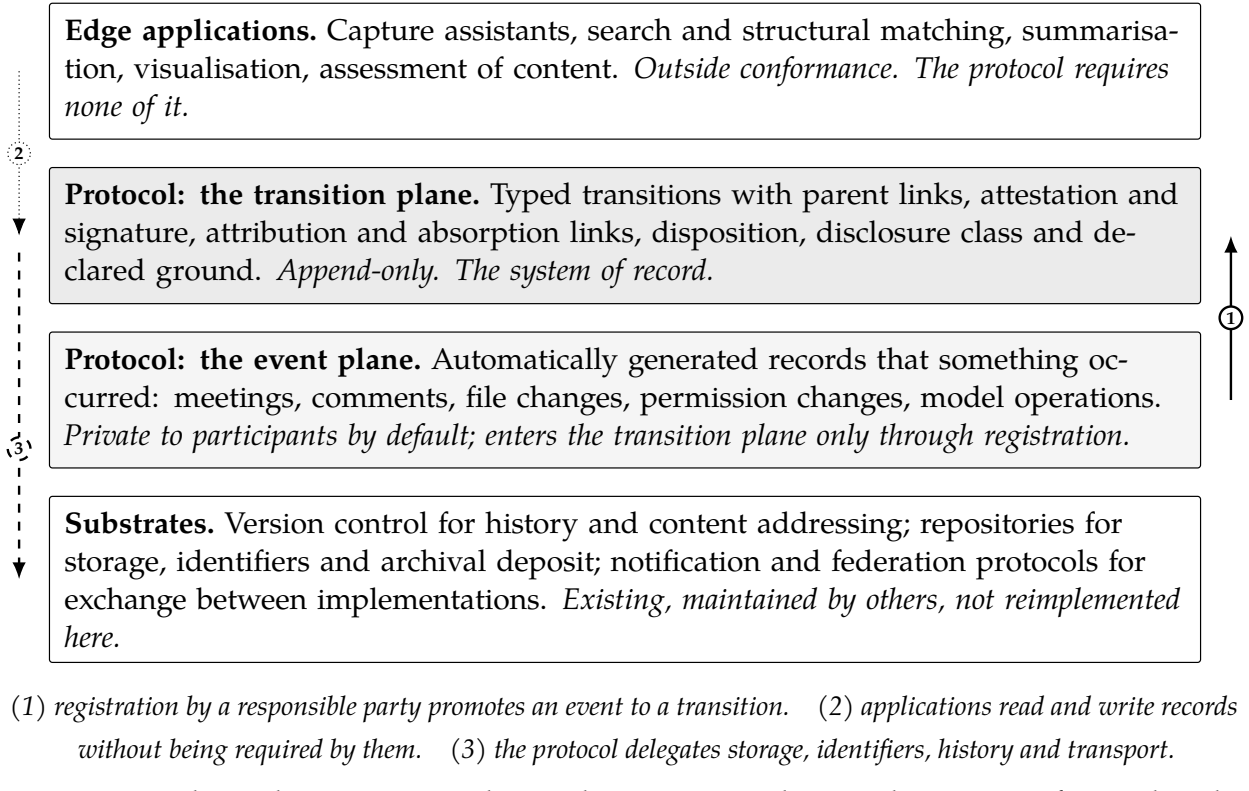
Figure 6. The architecture in outline. The transition plane is the system of record and is append-only; the event plane is captured automatically and is disclosed only through registration; substrates supply what already exists. The protocol adds the transition plane and the rules governing promotion into it, and adds nothing else. The companion specification fixes the content of each plane; this paper states only the division.
23.1 The Three Planes
Figure 6 states the division.
The event plane holds automatically generated records that something occurred: a meeting was held, a comment was posted, a file changed. It is cheap to populate and carries no epistemic claim. It is also where the surveillance hazard falls, since a complete log of who attended and whose files changed is a monitoring record by construction, and the arrangement therefore confines it to participants and discloses it only through registration.
The transition plane is the system of record. It holds typed transitions with their parent links, their attestations and their attribution, it is append-only, and every claim the account makes about credibility, portability and attribution concerns this plane alone.
Artefact references point to produced objects held elsewhere.
Above these sit applications, which read and write records and are required by nothing. The separation is what R14 demands.
23.2 Delegation
The arrangement builds nothing that exists. Version control supplies append-only history, content addressing and transport. Repositories supply storage, persistent identifiers and archival deposit. Notification and federation protocols supply exchange between implementations sharing no operator.
grxClaim
The arrangement contributes the transition plane and the rules governing promotion into it. Every other capability it requires exists, is maintained by parties with the resources to continue maintaining it, and is delegated. A design reimplementing those capabilities would inherit their maintenance and compete with their installed base, which R15 forbids.
grx
23.3 The Tiers
The requirements are satisfiable at three scales, and the stratification is what makes R15 achievable.
At the personal tier a single participant records transitions with parent links against identified states, in an append-only log with derived views, using three acts. What they obtain is a searchable record of what was ruled out and why, a standing list of unanswered objections, and a release that emits a citable document. What they do not obtain is any evidential weight, since attestation is impossible with one party.
At the group tier attestation, contributor roles, absorption links and disclosure classes enter, and credibility begins.
At the open tier propagation, distributed custody, deposit and charter reference enter, and the arrangement becomes exchangeable with implementations elsewhere.
23.4 The Matters Left to the Specification
Four matters are named here and settled in the companion paper.
The act vocabulary and the factorisation of the record type, which is the part of the design with no counterpart in any deployed standard.
The construction of identifiers and signatures, on which the credibility of a record across implementations depends.
The disclosure classes and their binding to declared grounds, which is developed at length in the companion paper on restriction.
And the conformance conditions, without which the requirements above are aspirations.
grxClaim
This paper establishes that the requirements are jointly satisfiable by describing an arrangement that satisfies them, and establishes nothing about whether the arrangement works. Satisfaction of requirements derived by argument is itself an argument, and the account’s own position is that adequacy is settled by use.
grx
23.5 Summary of Results
This section has outlined the architecture. Three planes are distinguished: an event plane that is cheap, private to participants and carries no epistemic claim; a transition plane that is append-only and carries every claim the account makes; and artefact references. Applications sit above and are required by nothing. Storage, history, identifiers, deposit and transport are delegated to systems that exist. The requirements are satisfiable at three scales, with the personal tier supplying utility and no evidential weight and the group tier supplying credibility. Four matters are left to the companion specification: the act vocabulary and the factorisation, identifier and signature construction, disclosure classes and their grounds, and the conformance conditions.
24. Event-Based Computation and Two Speculative Formal Models
This section records two formal representations of a trajectory that the design does not use and that the author proposes for future work. Its role is to state directions with their obstacles, so that the record of the paper includes what was considered and set aside. Its structure treats the sense in which the design is event-based, a generalised heterogeneous dynamical network, a representation borrowed from spin foam models, and what would have to be supplied for either to become formal. Its method is exposition under the envisagement mode fixed in Section 2: nothing here is claimed as a result, and the protocol depends on none of it.
24.1 The Sense in Which the Design Is Event-Based
The record specified in this paper advances on events. A state persists until a transition occurs, transitions occur when a party performs an act, and nothing in the record is updated on a schedule. The contrast with a clocked representation is exact and is worth naming, since it is the property the two models below attempt to formalise.
Computation of this kind has an established engineering literature. Spiking neural networks compute and communicate through discrete events in place of synchronous updates (maass1997networks), and neuromorphic hardware realises the arrangement with asynchronous circuits and event-based communication (indiveri2011neuromorphic). The discrete-event system specification of zeigler2018theory supplies a general formalism for systems evolving on events over a continuous time base, together with a coupling construction under which coupled models are themselves models of the same class.
grRequirementStatus of the borrowing
The design is event-based in the sense stated above. It is not a spiking neural network, it is not inspired by one, and no property of neural computation is transferred to it. The reference is to the class of event-advanced systems, of which spiking networks are one instance and the record specified here is another.
gr
24.2 A Generalised Heterogeneous Dynamical Network
The first proposal generalises the coupling construction in a direction the existing formalisms do not cover.
grDefinitionGeneralised heterogeneous dynamical network
A generalised heterogeneous dynamical network is a set of nodes, each carrying its own state space and its own law of evolution, together with propagation operators that map events emitted at one node into admissible inputs at another. The laws at distinct nodes may be of qualitatively different kinds: discrete dynamics on a complex at one node, spiking dynamics at another, continuous field dynamics at a third.
gr
Figure 7 illustrates the construction. The motivation is that a knowledge trajectory couples participants whose internal dynamics are not of one kind, and that a formalism forcing them into one kind discards what distinguishes them.
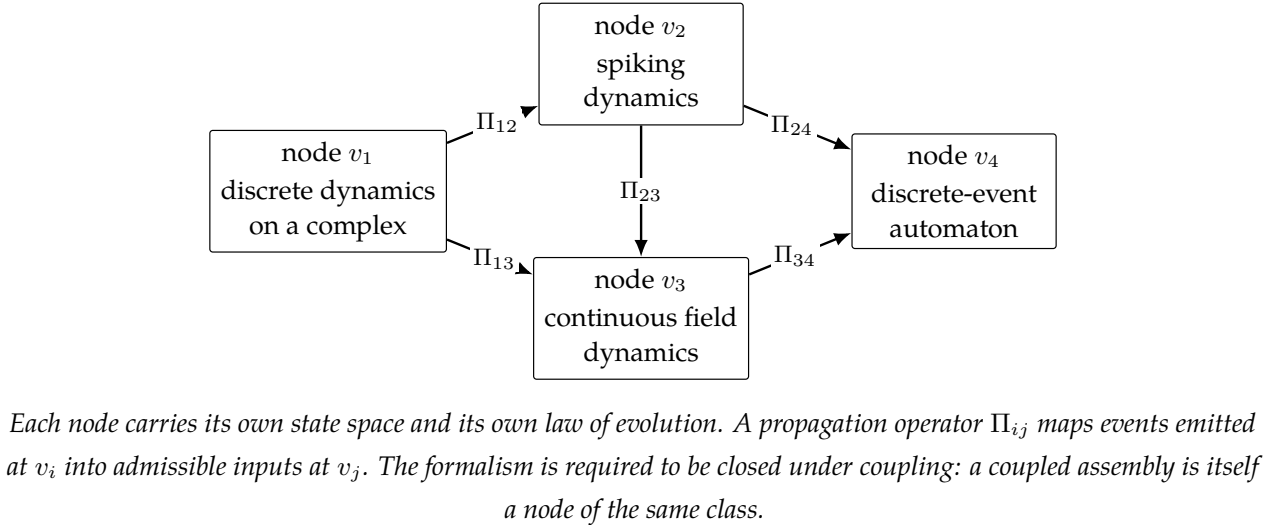
Figure 7. The generalised heterogeneous dynamical network, proposed as envisagement. Nodes carry qualitatively different dynamics, on different state spaces, and are coupled by propagation operators in place of a shared update rule. The nearest existing formalisms are discrete-event system specification with multi-formalism coupling, and multilayer network dynamics; neither supplies coupling across arbitrarily heterogeneous node dynamics with closure. Nothing in the protocol of this paper depends on the model.
Three literatures come near this and none supplies it. The discrete-event specification of zeigler2018theory explicitly aims at multi-formalism coupling and establishes closure for its own class, which makes it the nearest prior art and the model any proposal here must improve upon. Multilayer and multiplex network dynamics (kivela2014multilayer; boccaletti2014structure) treat coupling across layers with differing structure, and generally assume a common dynamical type within a layer. Hybrid systems couple continuous flow with discrete jumps, for two kinds and not arbitrarily many.
Three obstacles are recorded, since a proposal without them is not a proposal.
A shared time base and a consistent ordering of events must be defined across dynamics that individuate events differently. Coupling semantics must be given where node state spaces are of different mathematical types, so that a propagation operator has a well-defined codomain. And closure under coupling must be established, since a construction whose couplings are not themselves objects of the class supports no compositional reasoning.
24.3 A Representation Borrowed from Spin Foam Models
The second proposal is more speculative and is stated for the record.
In spin foam models of quantum gravity a history is a two-complex whose faces carry representations of a group, whose edges carry intertwiners, and whose vertices carry amplitudes, with the amplitude of a history assembled as a product over its faces, edges and vertices (baez1998spin; perez2013spin). A foam interpolates between boundary states and composes with other foams by gluing along shared boundaries.
The proposal is to take the same combinatorial structure with a different assignment: vertices are events, edges couple distinct elements of an event, and faces are primitive elements. A history of an inquiry would then be a two-complex in place of a sequence, and the transitions of Section 13 would appear as its one-dimensional shadow. Figure 8 illustrates the assignment.
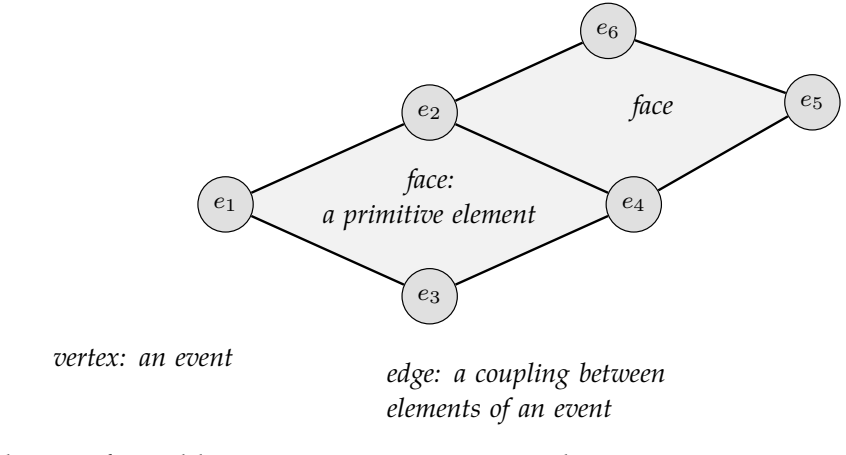
Figure 8. The spinfoam-like representation, proposed as envisagement. Vertices are events, edges couple elements of an event, and faces are primitive elements, so that a history is a two-complex in place of a sequence. The structure is borrowed from spin foam models in quantum gravity, where faces carry representations, edges carry intertwiners and vertices carry amplitudes. Section 24 states what would have to be supplied for the borrowing to become formal in place of figurative, and no result is claimed from it.
The proposal has a respectable ancestry on the philosophical side. Treating events rather than enduring objects as the primitive constituents is Whitehead’s position (whitehead1929process), and formal treatments of reasoning about events and their effects are long established in artificial intelligence (kowalski1986logic).
Three objections are recorded, and the paper does not answer them.
The content of a spin foam derives from the representation theory of a specific group, and absent an analogous algebraic structure on the informational side, the borrowing is figurative. Amplitudes in the physical models are complex and their sums exhibit interference, and there is no evident counterpart to superposition here, so the amplitude machinery may be inert. And a borrowing of heavy formalism without the empirical constraints that give it content in its home domain is a recognised failure mode, which this paper avoids only by claiming nothing from the proposal.
24.4 The Conditions of a Formal Treatment
For either model to become formal in place of figurative, four things would be required, and they are stated so that a later paper can be judged against them.
An explicit mapping from the informational objects to the mathematical ones, in which every element of the formalism has a stated counterpart and no element is left ornamental.
A composition rule under which histories glue consistently along shared boundaries, with the boundary object identified. In the present design the natural candidate is a state of a shared understanding, which is already the unit at which transitions meet.
An interpretation of the weight assigned to a history, and a reason for assigning any weight at all, since a formalism whose amplitudes have no interpretation reduces to a drawing.
And a demonstration that the formalism does work: that some question about trajectories is answerable within it and is not answerable in the directed graph of Section 14, which is the representation the protocol actually uses and which is adequate to everything the protocol requires.
24.5 Summary of Results
This section has recorded the following. The design is event-based in the sense that the record advances on acts and not on a schedule, and Requirement ? fixes that no property of spiking neural computation is transferred to it. Definition ? states a generalised heterogeneous dynamical network in which nodes carry qualitatively different dynamics coupled by propagation operators, with discrete-event specification and multilayer network dynamics as the nearest prior art and with three obstacles named: a shared time base, coupling semantics across differing state-space types, and closure under coupling. A second proposal takes the two-complex of spin foam models with vertices as events, edges as couplings between elements of an event, and faces as primitive elements, and records three objections concerning the absent algebraic structure, the uninterpreted amplitude, and the general hazard of borrowed formalism. Four conditions are stated under which either proposal would become formal, and the protocol specified in this paper depends on neither.
25. Open Problems and the Conditions on Which They Depend
This section records problems the design raises and does not solve, classified by the kind of development each awaits. Its role is to prevent silent assumption: an infrastructure proposal that lists only the difficulties it has answered invites a reader to suppose the remainder are minor. Its structure follows four kinds of dependence, on legal development, on normative development, on organisational and economic development, and on technical development, and it closes by fixing the status of the items listed. Its method is enumeration with the condition of resolution stated for each item, and the section claims no result.
25.1 The Classification Employed
Items are classified by what would have to change for the item to become tractable. Legal dependence means that the item awaits a development in the law or in its interpretation. Normative dependence means that it awaits a change in what communities accept. Organisational and economic dependence means that it awaits arrangements or resources that do not presently exist. Technical dependence means that it awaits a capability that has not been demonstrated. Several items depend in more than one way and are listed under the dependence that binds first.
25.2 Problems Awaiting Legal Development
The position of a party in an ongoing generation is unprotected, as Claim ? established. Sealed registration supplies evidence and no right, and whether evidence of this kind acquires standing in disputes over priority, employment or funding is a question for institutions and courts rather than for a specification.
The relation between erasure rights and integrity guarantees is unsettled in general. This design answers it by separating personal content from the attested skeleton, so that redaction leaves the chain intact, and whether that separation satisfies each regime is a legal question the paper does not adjudicate.
Cross-border operation multiplies the difficulty. A trajectory conducted by parties in several jurisdictions is subject to several regimes of consent, retention, transfer and recording, and the protocol carries the fields that let an implementation comply while determining none of the rules. Whether a workable common practice can be assembled from those fields is a question for the companion paper on normativity and for practice.
The status of contributions produced with model assistance is unsettled in authorship rules and in copyright. The design registers acts and separates registration from authorship, which keeps it compatible with the present position that a model is not an author, and the underlying question remains open.
25.3 Problems Awaiting Normative Development
Whether registration confers priority is a matter of recognition and not of records, as Section 19 stated. Some communities honour timestamped deposit and others do not, and no property of a protocol changes that.
Whether disclosed failure can be non-punitive is the condition on which the reuse argument depends. The material with the highest value to others is the material a participant is least willing to publish, and a community in which publishing a failure damages its author will produce records with the failures removed.
Whether the labour of registration is recognised is the condition on which attestation depends. Registering another party’s transition is unpaid work performed for someone else’s benefit, which is precisely the disparity that defeated the systems surveyed in Section 8, and the design has answered it by making the act cheap without making it rewarded.
Whether an unresolved disagreement is publishable as a state is a question about what a field will accept. The design records standing objections as standing, and a community that treats an unresolved record as a failure will exert pressure toward fabricated closure.
25.4 Problems Awaiting Organisational and Economic Development
The custody of records over decades requires an entity with succession arrangements, and the preservation infrastructure that exists is funded by parties whose commitments are periodically renegotiated. A design whose value appears over a long horizon depends on custody that no protocol supplies.
Assessment capacity is subtractable and is not increased by any of this. An open entry path in an arrangement with attention worth having attracts more attempts than its participants can consider, and rationing without a ranking is an unsolved design problem treated in the companion paper on collective action.
The distribution of overhead is regressive. Recording falls hardest on those with least time, who are the parties the diagnosis concerns, and the byproduct requirement mitigates without removing it.
25.5 Problems Awaiting Technical Development
Representing a state of an understanding so that similarity of structure is computable across vocabularies is the capability on which the cross-field claim of Section 18 depends, and it has not been demonstrated. Retrieval by topic is available and does not perform the task, since the parties concerned describe the same obstruction in different terms.
Analysis of trajectory graphs by their shape is a plausible direction whose applicability is unestablished. Methods that characterise the structure of data by persistent topological features (carlsson2009topology) operate on objects of a kind a trajectory graph resembles, and whether the features they extract correspond to anything a researcher would recognise as a state of an inquiry is unknown. The paper records the direction and claims nothing from it.
Quantum approaches to the same problems are recorded as speculative and are marked as such. Quantum algorithms for similarity search and for the analysis of high-dimensional structure have been proposed (biamonte2017quantum), and the fitting of dynamical models to observed evolution is a candidate for the same treatment. Three obstacles stand between the proposals and any use here: hardware of the required scale and fidelity does not exist, advantage over classical methods is unproven for the tasks concerned, and the representation problem of the preceding paragraph is prior to any method that would consume the representation. A design that assumed such capability would fail the independence requirement of Section 2, and the protocol is specified so that these approaches, if they arrive, arrive at Level 3 as applications over a record that does not depend on them.
25.6 The Status of the Items Listed
Three points fix how the list is to be read.
None of the items is required for conformance. An implementation satisfying the requirements of this paper is conformant with every item on the list unresolved, and the list therefore describes what the arrangement would additionally afford rather than what it needs.
The items differ in their consequences for the paper’s claims. The normative items bear directly on whether the arrangement produces the benefits claimed for it, since a community that punishes disclosed failure or refuses to recognise registration will produce a record with the valuable content absent. The technical items bear on capabilities the paper has already declined to claim.
And the list is stated to be added to. Practice is expected to raise difficulties that argument has not, which is the position taken in Section 2 on the relation between a specification and its use, and the amendment procedure exists to absorb them.
25.7 Summary of Results
This section has recorded the problems the design leaves open, classified by the development each awaits. Legal dependence covers the unprotected position of a party in an ongoing generation, erasure against integrity, cross-border operation, and the status of model-assisted contributions. Normative dependence covers the recognition of registration as priority, the treatment of disclosed failure, the recognition of registration labour, and the acceptability of unresolved states. Organisational dependence covers long-horizon custody, assessment capacity, and the regressive distribution of overhead. Technical dependence covers the representation of a state for structural matching, the analysis of trajectory graphs by shape, and quantum approaches, all of which are placed at Level 3 so that the protocol depends on none of them. None of the items is required for conformance, the normative items bear on the benefits claimed, and the list is expected to grow through practice.
26. Conclusion
This section states what the paper has established, what it has conceded, and what it leaves to the papers that follow it. Its role is to close. Its method is summary, and it introduces no material.
26.1 The Results of the Paper
Five things.
The evidential function of a published artefact rests on a separating condition, and a uniform fall in the cost of producing artefacts weakens that function while leaving the artefact and the systems reading it in place. The weakening is invisible from inside the practice, since the artefacts continue to arrive and continue to be counted.
A record of a process inherits the same weakness where one party produces it alone. Preservation of a research process therefore establishes nothing by itself, and the credibility of such a record must follow from its distribution across parties who did not coordinate. This is why the account produces a protocol in place of a platform: independence from a single operator is what a protocol supplies and a platform cannot.
The representational problem was solved between 1970 and the present, repeatedly, by capable people with funding, and the systems were not adopted. The documented cause is the cost of capture, and a design succeeding where they failed must differ in the economics of recording rather than in the expressiveness of its notation. This single finding excludes more otherwise attractive designs than any other consideration in the paper.
The component of a trajectory that the artefact omits carries its value in reuse, its evidential force and its hazard at once. No design publishes the trajectory minus its dangerous parts and retains the benefit, and the three are bounded together by what participants were able to articulate.
And the layer this paper proposes to restore is not a novelty. Scholarly communication once possessed a correspondence layer that carried the working state of inquiries, the periodical compressed it in 1665, and the compression displaced what it compressed while keeping the registration of priority and shedding the process that had warranted early reports.
26.2 The Concessions Bounding the Contribution
Three concessions, made in full in the survey sections and restated here because they bound the contribution.
Open platforms already decompose publication into typed linked units, register priority at each stage, and support open review. Provenance, contribution, relation and annotation standards already supply the vocabularies. Systems for representing deliberation and scholarly claims already exist and connect to those standards. What remains unclaimed is the conjunction stated in the introduction and the position of the account at the level of an interaction protocol.
The motivation from encounter is not supported by evidence. The best qualitative study of an arrangement designed to produce unplanned encounters reports occupants avoiding them, and the claim this account makes is accordingly about the cost of preparation and never about the frequency of encounter.
And recognition is a positional good, so nothing in the arrangement increases the standing available to those who lack it. Attribution redistributes it, which predicts resistance from parties who benefit from the present invisibility of others’ contributions.
26.3 The Matters Passed to the Companion Papers
The specification of the protocol, which fixes the act vocabulary, the record structure, attestation, identity, disclosure classes, propagation and conformance.
The incentives, collective action and adoption of an arrangement of this kind, which treats where the commons dilemma sits, why an open selection is a contest, what distinguishes a generative arrangement from a competitive one, and the conditions under which adoption is possible.
And the grounds on which such an arrangement may withhold, which develops the four grounds, the residue rule, and the governance of disclosure.
26.4 The Position at Which the Account Stops
The account stops at a specification with no implementation, no deployment and no evidence of use, and it says so in its opening section and again here.
What it offers is a set of requirements derived from stated arguments, an architecture that satisfies them, a statement of what would show each argument wrong, and a list of the problems that remain open with the kind of development each awaits. That is the appropriate output of a design stage, and it is less than a reader hoping for a solution will want.
The problem the account addresses is old. Oldenburg’s correspondence, the countersigned notebook, the issue-based systems of 1970, the design rationale notations, the scholarly claim ontologies and the open platforms of the present decade are all attempts on the same difficulty, which is that the process by which understanding changes is where the information is and is what our arrangements discard. None of the earlier attempts failed for want of a good representation. They failed because recording costs something and the cost falls on the party who gains least.
This account’s contribution is to take that finding as its first constraint rather than as an obstacle to be regretted, and to see what a design looks like when nothing may be required of a participant that the participant would not do anyway. The design that results is smaller than the ones that failed, and whether smaller is enough is a question no argument settles.
26.5 Summary of Results
This section has stated the paper’s five results: the weakening of the artefact as evidence, the dependence of a record’s credibility on distributed attestation and the protocol form that follows, the failure of earlier systems on capture cost and its exclusionary force, the shared component of value, evidence and hazard, and the historical precedent for the displaced layer. Three concessions bound the contribution: the prior art in platforms, standards and representational systems; the absence of evidence for the encounter motivation; and the positional character of recognition. Three matters pass to the companion papers. The account stops at a design stage with no implementation, and its contribution is to take capture cost as its first constraint in place of an obstacle to be regretted.
plainnat
references