Generativity, Attribution and Ownership in Environmental Governance - The Enabling Contribution and What It Is Owed
Abstract
A distributed governance arrangement of the kind this series develops generates findings through a chain: records are maintained, provenance and registers are kept, changes are reported and conjectures accumulated, holdings are assembled and inquiries run, and derived artefacts result. This paper asks how contribution to such a chain should be attributed and what an owner of a derived artefact may do with it. The method is conceptual. The paper’s first position is that the costs and the attribution run in opposite directions along the chain. Cost falls at the beginning, on observation sustained through periods in which nothing is found, on provenance kept by each handler, and on the recording of determinations that nothing could be established; attribution accrues at the end, to the party that made the finding. The paper names the neglected class the enabling contribution, and argues that its neglect is structural and not an oversight, since an enabling contribution is identified only in retrospect and only by the finding it enabled, so no procedure operating at the time of the contribution can recognise it. The second position is that proportional attribution is unavailable here for a reason that does not turn on measurement difficulty. Apportionment schemes require a defined set of alternative combinations against which a contribution’s marginal value is assessed, and for a fifty-year record the relevant counterfactual is not a coalition of parties without one member but a different history, which no apportionment defines. The paper therefore declines shares and proposes that attribution record the chain and not divide it, with the specific requirement that the chain include what was maintained through periods without findings and what was determined to be unestablishable. The third position concerns ownership. Because a derived artefact is generated from a commons whose loss is irreversible, the governing question is not who owns the artefact but what an owner may do with it, and the paper argues that enclosure of a derived artefact is an alteration of a governed condition attracting the burden that this series’ principle imposes, so the owner’s rights are bounded by what their exercise forecloses. The paper surveys authorship and credit practice, apportionment theory, intellectual property and its exceptions, data attribution standards, and commons-based provision, states what each owns, and identifies the residue.
Keywords: attribution; credit; knowledge commons; ownership; environmental data
Notices
On the references. All 19 works cited in this paper have been checked against their sources at claim level: each source was consulted and confirmed to state what the citing sentence attributes to it. No entry in this paper’s bibliography is unverified.
Status. This is a working draft circulated for discussion. It is a preliminary discussion paper and is not a finished statement of its author’s position. Sections and statement numbers are subject to change.
Licence. This work is made available under a Creative Commons Attribution-NonCommercial 4.0 International Licence (CC BY-NC 4.0).
Statement on the use of language models. Drafting, literature search and argumentative criticism for this paper were conducted in dialogue with large language models, specifically Claude (Anthropic) and ChatGPT (OpenAI). The claims, the structure, the selection of material and the position taken are the author’s. References have been checked in stages, to two standards, and the process is incomplete. Part of the corpus has been verified at identity level, meaning author, title and publication coordinates were confirmed against the publisher of record. A smaller part has additionally been verified at claim level, meaning the cited source was consulted and confirmed to state what the citing sentence attributes to it. The remainder is unverified at either standard. The standard reached is marked on each bibliography entry: no mark for claim level, $\ddagger$ for identity level only, $\dagger$ for not yet verified. Corrections made so far are recorded in the project’s citation-verification file; where a source proved not to bear the weight the text placed on it, the text was revised rather than the citation removed.
Companion papers. This paper is Paper 14 of a series on the governance of environmental change, and treats attribution along the generative chain, and the bounds on an owner’s exercise of title. The other papers of the series treat, in order: the object; the field and its three structures; coordination through change; heterogeneous knowledge; the event layer; criticality detection; observational capacity; representational requirements; routing and inquiry; the regime near a threshold; forecasting from the stream; the knowledge commons; responsibility at transitions; and supervisory duties. Paper 12 is reserved and is not yet drafted. A related paper by the author, developed independently of this series, treats the temporal correspondence limitation of evidence-based policy making, being the divergence between the system state that evidence represents and the system state at the moment of decision. Its results on the partition of a state space into estimable and unobservable components, on the blindness of a recency-weighted evidence base to the approach to criticality, and on the allocation of a justificatory burden where temporal correspondence fails, were reached by a different route and bear on several papers of this series.
Suggested citation. Huang, W. Generativity, Attribution and Ownership in Environmental Governance: The Enabling Contribution and What It Is Owed. Working draft.
Discussion Paper Note
This paper is a preliminary discussion paper intended to share an evolving idea and invite further dialogue, criticism, revision, and independent development.
The author does not claim exclusive epistemic ownership over the viewpoints, concepts, or lines of reasoning presented here, nor does the author claim priority as their first originator. Similar or related ideas may have appeared previously in other intellectual, cultural, or disciplinary traditions. Any legal rights retained in this work are intended to support attribution, responsible use, and protection against exploitative or harmful appropriation, and not to restrict independent inquiry, criticism, revision, or further development.
The arguments in this paper should therefore be understood as provisional and historically situated rather than definitive. Readers are encouraged to question, revise, extend, reinterpret, or independently develop the ideas presented here. Where appropriate, acknowledgment of this paper as one point of encounter in the development of related ideas is appreciated, but such acknowledgment should not be understood as granting the author epistemic ownership over the ideas themselves.
Responsible Use and Rights Reservation
The author encourages good-faith discussion, criticism, independent development, and responsible use of the knowledge presented in this work. The author does not claim exclusive epistemic ownership over the ideas or viewpoints discussed herein, nor claim priority as their first originator.
However, the author expressly reserves all rights and remedies available under applicable law with respect to uses of this work or related materials that involve unlawful conduct, harmful or abusive exploitation, improper commercial appropriation, infringement of applicable intellectual property or other legal rights, or conduct contrary to applicable national, regional, or international law.
This reservation is intended to preserve the ability to respond to misuse and harmful appropriation. It should not be interpreted as restricting legitimate academic inquiry, criticism, independent reasoning, or the further development of related ideas.
1. Introduction
A finding in a distributed arrangement of the kind this series describes arrives at the end of a long chain. Some party maintained a station for decades. Others kept the provenance that allows the resulting record to be assessed, and the registers that allow a past finding’s meaning to be recovered. Parties emitted reports of changes in their own subsystems and attached conjectures about couplings. An arrangement carried the reports, an inquiry was opened, holdings were assembled, and a finding was made and acted on.
The finding is attributed to the party that made it, which is correct as far as it goes. This paper is about how far that goes.
The costs along that chain fall overwhelmingly at its beginning, and they fall most heavily during periods in which nothing is found. A station maintained for fifty years without producing a finding is the ordinary case and is not a failure: the establishment condition developed earlier in this series makes the length of an uninterrupted run the quantity that determines which couplings can be established at all, so the fifty years of apparently unproductive maintenance are what made the finding in the fifty-first year possible. The same is true of the less visible elements. A determination that a coupling could not be established from present capacity is a finding about the arrangement’s sight, and it is the input on which the presumptions of the capacity paper operate; it produces no discovery and is recorded, if at all, without attribution.
Along the generative chain of a distributed arrangement, the profile of cost and the profile of attribution run in opposite directions. Cost concentrates at the chain’s beginning, on maintenance sustained through unproductive periods, on provenance kept by each handler, and on the recording of what could not be established; attribution concentrates at its end, on the party that made the finding. The mismatch is structural and not an oversight of practice, since an enabling contribution is identified only in retrospect and only by the finding it enabled, so no procedure operating at the time of the contribution can recognise it.
The paper’s second position concerns what follows. The natural response is to apportion: to determine each contributor’s share and distribute credit accordingly. §5 argues that apportionment is unavailable here, and for a reason that does not turn on the difficulty of measurement. Apportionment schemes assess a contribution by its marginal value across a defined set of alternative combinations, and for a fifty-year record the relevant alternative is not a combination of parties lacking one member but a different history, in which the observation was not made and the years are not recoverable. No apportionment defines that counterfactual, and a scheme that proceeds as though it did is assigning shares against an undefined baseline.
The paper’s proposal is therefore to record the chain and not to divide it, with two specific requirements that current practice does not meet: that the chain include what was maintained during periods without findings, and that it include what was determined to be unestablishable.
The paper’s third position concerns ownership, and it follows the commons paper of this series. A derived artefact is generated from a resource whose loss is irreversible and whose provision is costly to its providers and beneficial to the field. The governing question is accordingly not who owns the artefact, which is answerable by ordinary rules, but what an owner may do with it. §6 argues that enclosure of a derived artefact is an alteration of a governed condition and attracts this series’ justificatory burden, so that an owner’s rights are bounded by what their exercise forecloses.
The paper proceeds as follows. §5 restates the carried positions, sets out the chain, and establishes the mismatch and the unavailability of apportionment. §6 treats ownership and enclosure. §7 surveys the owning literatures. §8 treats the objections and §9 the open questions, and §10 the declinations.
2. The Generative Chain and the Enabling Contribution
2.1 Positions Carried from the Companion Papers
Five results are used and restated so the paper stands alone.
The object of governance is the set of relational conditions under which trajectories are generated, and the governing principle places a dischargeable burden of justification on alterations that would irreversibly foreclose the capacity of other trajectories to continue generating. The principle ranks no claims and supplies no maximand.
The establishment condition holds that a coupling of timescale $\tau$ can be established only from a record whose uninterrupted run is proportional to $\tau$, so the governing quantity of a record is its longest continuous span.
The non-additivity result holds that for claims requiring continuous coverage the value of a record is not additive across interruptions: a corpus supports what its longest run supports, so an interruption’s cost is unrelated to its length and depends on where it falls.
The commons position holds that an environmental knowledge commons is constituted by provision under asymmetric incentive and by irreversibility of loss, that its elements include registers and determinations of absence as well as observations, and that enclosure of a commons-generated element is the epistemic form of severing a coupling.
The absence requirement holds that determinations of absence must be represented at parity with observations, as assertions with author, date, scope, basis, and defeasibility.
2.2 The Chain
The generative chain of a finding comprises five stages. Observation and maintenance: the sustained production of a record, including the periods in which nothing is found and the preservation of comparability across method changes. Provenance and registers: the recording of what each element rests on and of the thresholds, methods and definitions in force, versioned so that a past finding’s meaning is retrievable. Reporting and conjecture: the emission of events and the accumulation of the coupling hypotheses they carry. Assembly and inquiry: the question-relative construction of a structure from holdings, and the bounded process that tasks observation where holdings do not suffice. The derived artefact: the finding, model, assessment or determination that results, including a determination that nothing could be established.
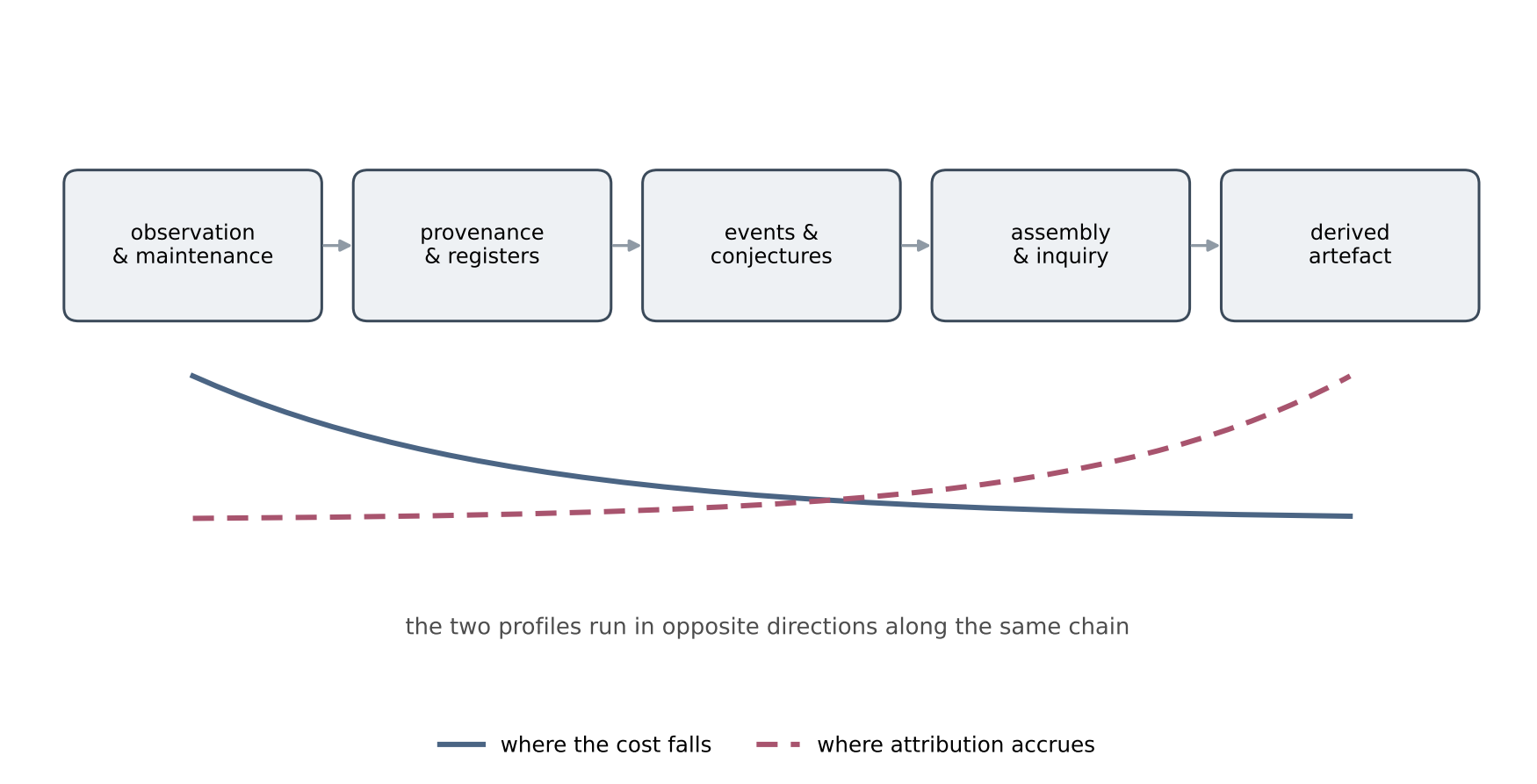
Figure 1. The generative chain and the two profiles. Cost concentrates at the chain’s early stages, where maintenance and provenance are sustained without producing findings; attribution concentrates at its end, on the party that made the finding. The curves are illustrative of the direction and not of any measured magnitude.
2.3 The Enabling Contribution
An enabling contribution is one whose value consists in making a later finding possible and which produces no finding of its own. Its paradigm is maintenance of a record through a period in which nothing is observed to happen; its other instances are the keeping of provenance, the versioning of registers, and the recording of determinations of absence. An enabling contribution has three properties: it is identified only in retrospect, it is identified only by the finding it enabled, and its magnitude is a property of a run and not of any of the run’s parts.
The third property is the one that makes the class distinctive and it follows from the non-additivity result. The value of a fifty-year record for establishing decadal couplings is a property of its continuity, so it cannot be divided among the fifty years, and it cannot be divided among successive custodians without an apportionment the next subsection argues is undefined. A custodian who maintained the record for the middle ten years contributed the continuity across those years, and the continuity across them has value only because the years on either side were also observed.
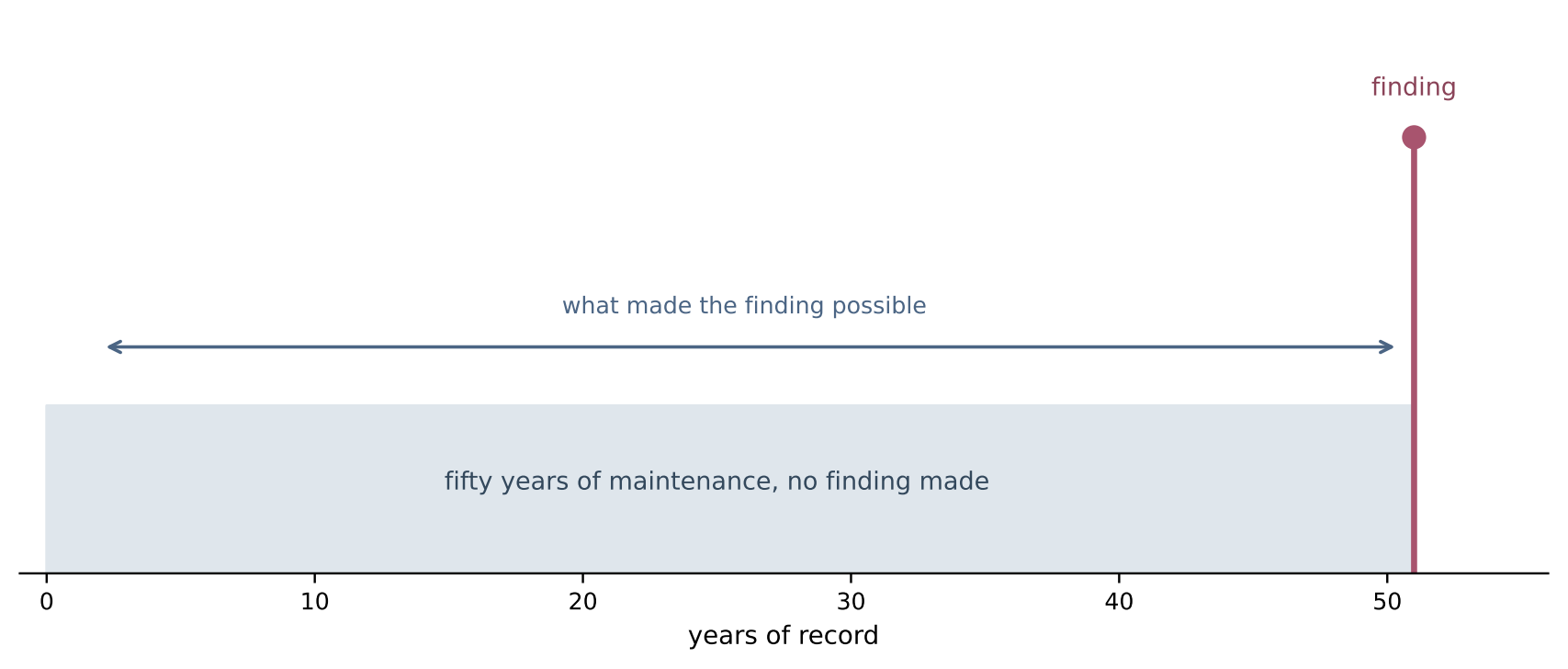
Figure 2. The enabling contribution in its paradigm form. Under the establishment condition with the illustrative factor used elsewhere in this series, a fifty-year uninterrupted run supports establishment of couplings an order of magnitude slower than a five-year run does. The finding in the final year is attributable; the fifty years that made it possible produced no finding and are attributable to nothing.
Claim ?’s structural character can now be stated exactly. A procedure for recognising contributions operates at some time. At the time an enabling contribution is made, there is nothing to recognise, since the finding it will enable has not been made and may never be. At the time the finding is made, the enabling contribution is visible, and the procedure that recognises contributions has already run for the parties whose contributions were visible at the time they were made. No adjustment of a contemporaneous procedure reaches the class, and a retrospective procedure would have to reach back across the working lives of institutions.
2.4 The Unavailability of Apportionment
The natural response to the mismatch is to compute shares, and the apparatus for computing shares of a jointly produced value is well developed. The paper declines it, and the ground is worth stating carefully because it differs from the usual complaint.
The usual complaint is that shares are hard to measure. The complaint here is that the object against which a share would be measured is undefined. An apportionment assesses a contributor by the difference its presence makes across combinations of the other contributors: the value produced with it, against the value produced without it, averaged over the orders in which contributors might have joined. This requires that the alternative combinations be defined, which requires that each contributor’s absence leave a coherent alternative in which the others still act.
For an enabling contribution consisting in a sustained record, the alternative required by apportionment is not a combination of contributors lacking one member but a different history. Removing the custodian does not leave the other contributors producing a smaller value from a shorter record; it leaves a record with a gap, whose value for the claims at issue is determined by its longest remaining run and which no other contributor could supply, since the years are not observable retrospectively. The counterfactual an apportionment requires is therefore not among the combinations an apportionment ranges over, and a scheme that proceeds as though it were is assigning shares against a baseline it has not defined.
Claim ? is the paper’s principal analytical result and two qualifications belong with it.
It does not hold for every contribution to the chain. Contributions that are substitutable, in the sense that another party could have made them at the time and the value would have been the same, admit apportionment in the ordinary way, and much of the later chain consists of such contributions. The claim concerns contributions whose value lies in a temporal run.
And it is not an argument that such contributions deserve nothing. It is an argument that what they deserve cannot take the form of a share, which is a conclusion about the form of the answer and not about its existence. §5 states the alternative.
2.5 Recording the Chain in Place of Dividing It
Where apportionment is unavailable, attribution should record the chain and not divide it. A recorded chain names the contributions on which a finding rests, in the order and over the periods in which they were made, without assigning any of them a proportion. Two requirements distinguish this from present practice: the chain must include what was maintained through periods in which no finding was made, since that is where the enabling contributions lie; and it must include what was determined to be unestablishable, together with the party that so determined, since a determination of absence is a contribution to the arrangement’s sight and is at present recorded nowhere.
Three properties recommend the recorded chain over an apportionment.
It is computable. The provenance apparatus this series requires already relates each element to what it rests on, so a chain is derivable from records the arrangement holds for other reasons, whereas an apportionment would require a counterfactual analysis it cannot perform.
It is honest about form. A chain asserts that these contributions were made and that the finding rests on them, which is true; a share asserts a proportion, which Claim ? shows to be undefined for part of the chain.
And it addresses the incentive problem in the right place. A recorded chain makes maintenance visible without pretending to price it, so an institution assessing whether to continue a programme can see what that programme has enabled, which is the assessment the commons paper argues is currently made against current uses and therefore made wrongly.
The limits are stated with the proposal. A chain is a record and not a reward, so it addresses recognition and not funding, and §9 carries the question of whether anything follows from a chain beyond visibility. A chain naming many contributions dilutes the attention any one receives, which is the ordinary difficulty of long author lists appearing in a new place. And the requirement to record absences and unproductive maintenance is a requirement to record more, whose cost falls on the parties already bearing the chain’s early costs.
| p0.22 p0.20 p0.22 p0.24
| Contribution | When cost falls | Attributed at present | Proposed |
|---|---|---|---|
| Sustained maintenance | Continuously, for decades | Rarely, and by dataset citation where it exists | Named in the chain, with the run it sustained |
| Preserved comparability | At each method change | Not at all | Named, with the overlap performed |
| Provenance keeping | At each handling | Not at all | Named, as the basis of the chain’s derivability |
| Determination of absence | When the attempt is made | Not at all | Named, with the party and the deficiency found |
| Conjecture in a report | At emission | Not at all | Named where a later finding rests on it |
| Assembly and inquiry | At the question | Partly, through process records | Named, with the terms and the parties |
| The finding | At the end | Fully | Unchanged |
Table. Contributions along the chain, when their cost falls, and their present and proposed attribution. The first five rows are the enabling class; the pattern of the third column is the mismatch of Claim ?.
3. Ownership and the Bounds on Its Exercise
3.1 Displacing the Question
Ownership of a derived artefact is ordinarily settled by rules of some generality: an assessment belongs to its authors or their institution, a model to whoever produced it, a database to whoever assembled it, subject to whatever the licences of its inputs require. The paper takes no issue with these rules and argues that they answer a question that is not the governing one here.
Where a derived artefact is generated from a commons whose loss is irreversible and whose provision is costly to its providers and beneficial to the field, the governing question is not who owns the artefact but what an owner may do with it. Ownership settles who decides; this series’ principle constrains what may be decided, since a decision that irreversibly forecloses the capacity of others to continue generating attracts a burden of justification whoever holds the title.
The displacement has a precise content and is not a general scepticism about property. An owner of a derived artefact may do many things that foreclose nothing: use it, publish it, charge for a service built on it, decline to maintain it. The burden attaches to a narrower class, and §6 identifies it.
3.2 Enclosure among the Alterations of Conditions
The commons paper of this series establishes that the terms on which access to an element is granted constitute a distribution of access and information, which is a condition in the principle’s sense. The consequence for derived artefacts follows without further argument.
Enclosure of a derived artefact generated from a commons is an alteration of a governed condition. Where the enclosure forecloses irreversibly, it attracts the principle’s burden, and the party enclosing owes a justification of the same kind as any party proposing any other alteration. Three cases of irreversible foreclosure are distinguishable: enclosure of an artefact that has become the only route to information whose underlying records are no longer accessible; enclosure accompanied by discontinuation of the underlying observation, so that the artefact is the last record; and enclosure of a calibration or method on which other parties’ series depend for comparability, whose withdrawal breaks those series.
The third case is the one least likely to be recognised and the most consequential. A calibration that others have used to render their records comparable is, once adopted, a condition of their records’ interpretability, and its withdrawal or its alteration behind a closed licence breaks comparability in the way the commons paper identifies as loss by discontinuity. The party performing the withdrawal ordinarily regards itself as managing its own asset.
Two limits on Claim ? are stated. The burden is dischargeable, as everywhere in this series, so an enclosure with sufficient reasons proceeds; the claim changes what must be argued and by whom. And the burden attaches to foreclosure and not to charging, so a party that provides access on terms, including paid terms, forecloses nothing and bears no burden on that account, which distinguishes this position from a general argument for free provision.
3.3 The Attribution and Ownership Questions Are Distinct
The two subjects of this paper are related and are not the same, and conflating them produces error in both directions.
Attribution concerns recognition of contribution and operates whether or not anything is owned. A recorded chain names contributions to a finding that is freely published and owned by nobody, and it is worth having in that case for the reasons §5 gives.
Ownership concerns the power to decide about an artefact and operates whether or not contribution is recorded. A party may hold title to an artefact whose chain records dozens of contributors, and the chain does not divide the title.
Attribution and ownership are distinct and neither implies the other. A recorded chain confers no claim to the artefact, and title confers no entitlement to be the chain’s sole entry. Confusing them produces two characteristic errors: the inference that recording a contribution creates a property claim, which would make the chain unrecordable because contributors would resist entries that dilute title; and the inference that holding title settles who contributed, which is the practice that produced the mismatch of Claim ?.
Claim ? matters practically because the first error is what makes institutions reluctant to record long chains. If a chain entry is heard as a claim, then every enabling contributor is a potential claimant and the chain becomes a liability; if it is heard as a record of what a finding rests on, it is a description and the reluctance has no ground. The paper’s proposal depends on the second reading and §9 records the question of whether it can be secured.
3.4 Derived Artefacts and the Commons They Came From
A final relation is stated because it closes the circle with the commons paper.
A derived artefact is itself an element of the commons, since it is non-rival, since others’ work builds on it, and since its loss by discontinuation or by enclosure is irreversible in the ways §6 describes. The maintenance duties the supervisory paper of this series attaches to holders of long records therefore attach, in weaker form, to holders of derived artefacts on which others rely: a model withdrawn, a calibration discontinued, an assessment de-published, each forecloses something that was being built on.
The weaker form is deliberate. A derived artefact is ordinarily reproducible from its inputs where the inputs remain available, so its loss is not irreversible in the way a record’s is, and the duty attaching to it is correspondingly lighter. The duty becomes as strong as a record’s exactly where reproducibility fails, which is where the inputs have themselves been lost or enclosed, and that is the first of the three cases in Claim ?.
4. Prior Treatments of Credit, Apportionment and Ownership
Six literatures own parts of the position.
4.1 Authorship, Credit and Contributorship
Scientific practice has developed criteria for authorship and, in response to their inadequacy for large collaborations, contributorship schemes that record roles in place of conferring undifferentiated authorship, of which the taxonomy now widely adopted in journals is the standard instance (Brand et al., 2015; Allen et al., 2014; International Committee of Medical Journ, 2026). The associated literature examines credit allocation in multi-author work and the systematic under-recognition of infrastructural and technical contribution (Shapin, 1989; Rennie et al., 1997).
This literature owns the move from authorship to a recorded set of roles, and Claim ? is that move applied to a chain that extends beyond a paper’s contributors. Two additions are the paper’s. Contributorship taxonomies record roles in producing the work, and the enabling contributions of §5 were made before the work was contemplated, by parties who may not know it exists. And the taxonomies contain no category for a contribution consisting in a temporal run, nor for a determination that something could not be established, which are the two entries Claim ? requires.
4.2 Data Citation and Software Citation
A body of practice has developed for citing datasets and software as first-class research objects, with principles for citation, persistent identification, and credit to data producers (Data Citation Synthesis Group, 2014; Smith et al., 2016). Repositories issue identifiers and recommended citations, and funders increasingly require them.
The concession is that the machinery for citing a record exists and works. The residue is what it cites. A dataset citation names a dataset and its producer at the time of deposit, and the enabling contribution of §5 is the sustained run, which may span many custodians, many method changes, and many deposits. A record maintained by three institutions across fifty years produces citations naming versions, and the thing that made the finding possible, the continuity across all of them, is named in none.
4.3 Apportionment of Jointly Produced Value
Cooperative game theory supplies the apparatus for dividing a jointly produced value, of which the Shapley value is the canonical solution, characterised by axioms including efficiency, symmetry, and a null-player condition (Shapley, 1953; Young, 1985). Applications to research credit and to network contribution exist (Hausken & Mohr, 2001).
The concession is the apparatus and Claim ? is a claim about its domain of application, not about its correctness. The Shapley value is defined over a characteristic function assigning a value to every coalition of players, and the claim is that for an enabling contribution consisting in a temporal run, the coalition lacking the custodian is not a coalition of the remaining players but a different history, so the characteristic function is undefined at exactly the argument the computation requires. Where a formulation exists that defines it, priority belongs to that formulation and the claim is correspondingly weakened.
4.4 Intellectual Property, Database Rights and Their Exceptions
Copyright, database rights, and their exceptions govern derived artefacts in law, with sui generis database protection in some jurisdictions and exceptions for research and text and data mining (Reichman & Samuelson, 1997; Derclaye, 2008). The literature on the public domain and on the effects of protection over factual compilations addresses the consequences for downstream production (Boyle, 2003; Samuelson, 1994).
This body owns the ownership question in its ordinary form, and Claim ? is not a challenge to it but a statement that it answers who decides and not what may be decided. The paper’s addition is the routing of the second question through this series’ principle, which supplies a criterion for constraint keyed to irreversible foreclosure and applicable whoever holds title.
4.5 Commons Provision and Reward
The commons literature examines how non-rival resources are provided when their benefits are not appropriable, and the associated work on peer production examines the motivations that sustain contribution without price (Benkler, 2006; Hess & Ostrom, 2007; Frischmann et al., 2014). The literature on scientific reward systems analyses recognition as the currency in which contribution is compensated (Merton, 1968; Stephan, 1996).
The relevance to Claim ? is direct: if recognition is the currency, then a contribution that recognition cannot reach is uncompensated in the system’s own terms, and the paper’s mismatch is a statement about a systematic gap in that currency’s coverage. The residue is the identification of the gap’s structural cause, which is the retrospective identifiability of the enabling contribution, and which the reward literature has not treated because its cases are contributions visible when made.
4.6 Attribution in Environmental Assessment Practice
Assessment practice attributes findings to author teams and to the assessment body, and the underlying observational programmes are acknowledged in aggregate where at all. The long-record programmes on which climate and ecological assessment rest are institutionally visible through their data products and are seldom named in the findings those products enable.
The paper offers this as observation and not as a survey, and records that a systematic study of how assessment findings attribute their underlying observational programmes would test Claim ? directly. §9 states it as the empirical question the paper’s central claim invites.
4.7 Residue of the Survey
Consider a chain in which a finding rests on records sustained across decades by successive custodians, on provenance kept by each handler, on determinations that certain things could not be established, and on conjectures carried in reports; where the value of the sustained record for the claims at issue is a property of its uninterrupted run; and where a derived artefact results whose enclosure may foreclose the commons that produced it. The claims that cost and attribution run in opposite directions along such a chain for structural reasons; that apportionment is undefined for contributions whose value lies in a run, because the required counterfactual is a different history and not a coalition; that attribution should therefore record the chain including its unproductive maintenance and its determinations of absence; and that ownership of the derived artefact settles who decides while this series’ principle constrains what may be decided, are advanced by none of the surveyed treatments. Contributorship owns role recording within a work; data citation owns identification of a deposited object; cooperative game theory owns apportionment where the characteristic function is defined; intellectual property owns title and its exceptions; commons scholarship owns provision and the reward currency; and assessment practice owns the attribution of findings to their authors. The composition is the residue claimed.
5. Objections and the Limits of the Position
5.1 The Objection from Dilution
A chain naming every contribution on which a finding rests will be long, and attention is finite. The objection is that a record naming fifty entries confers nothing on any of them, so the proposal replaces a system that recognises the wrong parties with one that recognises nobody.
The paper’s answer distinguishes two functions and concedes one. As a currency of individual reward, a long chain is weak, and the objection holds: an entry among fifty does not advance a career as authorship does. As a record on which institutional decisions are made, a long chain is strong, and this is the function Claim ? claims. An institution deciding whether to continue a monitoring programme can be shown the findings that programme’s run enabled, which is presently not derivable and which the commons paper argues is exactly the assessment now made wrongly against current uses. The proposal is therefore directed at institutional decision and not at individual reward, and the paper accepts that it does little for the latter.
5.2 The Objection from Retrospection
Claim ? argues that enabling contributions are identifiable only in retrospect. The objection is that this defeats the proposal as well as the practice it criticises: if a contribution is invisible at the time, a chain recorded at the time cannot include it, and a chain recorded later must reconstruct across the working lives of institutions.
The answer is that the chain is recorded at the time of the finding and not at the time of the contribution, and that its derivability rests on provenance, which is kept contemporaneously for other reasons. The provenance apparatus this series requires relates each element to what it rests on, so a chain is a query over records already held, and the reconstruction the objection fears is a lookup where provenance was kept. The concession is that it is not a lookup where provenance was not kept, which is the ordinary condition of historical records, so the proposal is prospective and does not recover the chains of findings already made.
5.3 The Objection from Substitutability
Claim ? rests on the assertion that the years of an unmade observation are not recoverable, so removing a custodian leaves a different history. The objection is that this proves too much: many contributions are irreplaceable in some sense, and if irreplaceability defeats apportionment, then apportionment is defeated generally, which is a stronger conclusion than the paper wants and than the apportionment literature accepts.
The paper accepts the objection’s force and narrows the claim in response. Apportionment is defeated here by a specific structure and not by irreplaceability: the contribution’s value is a property of a temporal run, so that the counterfactual removes not a party’s work but a segment of a continuum whose value was in its continuity. A brilliant analyst who could not be replaced is nonetheless replaceable in the relevant sense, since another analyst would have produced some analysis and the coalition without them is well defined. A missing decade is not, since no party’s presence in the coalition supplies it. The claim is therefore about contributions with a run structure, and §5 states it that way.
5.4 The Objection from Ownership
Claim ? may be read as licensing interference with ordinary property in derived artefacts, on grounds that are contestable and that a party could invoke against almost any restriction.
The answer is the narrowness of the burden’s trigger. It attaches to irreversible foreclosure and not to enclosure as such, and §6 enumerates three cases in which the trigger is met, none of which is ordinary commercial exploitation. A party that licenses an artefact commercially while its inputs remain available and its calibrations remain published forecloses nothing and bears no burden. The residual is that the third case, withdrawal of a calibration on which others’ comparability depends, will be contested, since a party is entitled to change its methods and the argument that others’ reliance constrains it is not obviously right. The paper states the case and does not resolve it, and §9 carries it.
5.5 Limits Internal to the Position
Four limits are recorded. The paper offers no mechanism by which a recorded chain produces any consequence beyond visibility, so its practical force depends on institutions choosing to attend to it. The empirical premise of Claim ?, that present practice systematically fails to attribute enabling contributions, is asserted from observation of assessment practice and not established by study. The proposal requires recording more, and the additional recording falls on the parties already bearing the chain’s early costs, which is a distributionally perverse feature the paper has not corrected. And the treatment of ownership is confined to what the series’ principle constrains, so it says nothing about how title should be allocated in the first place, which is the question most parties will regard as the important one.
A further limit is inherited rather than internal. The paper applies the series’ principle to alterations described as irreversibly foreclosing, and the series’ first paper supplies no method for establishing irreversibility, recording the absence as an open question. Where the property is stipulated by the case under discussion, nothing turns on this. Where it would be contested, the paper’s conclusions are conditional on a determination the series has not yet made, and the seventh paper’s establishment condition constrains what evidence such a determination would require without supplying it.
6. Questions Left Open for the Programme
6.1 Questions Concerning the Chain
Consequences of a recorded chain. §8 concedes that the proposal produces visibility and no mechanism. An answer would state what should follow from a chain entry: whether it bears on funding decisions, on the assessment of a programme’s continuation, or on the supervisory review that the companion paper on supervision establishes, and would confront the objection that any consequence attached to entries creates an incentive to claim them.
Derivation from provenance. An answer would establish what provenance suffices to derive a chain, would state which of the elements Claim ? requires are derivable from the representational requirements this series states, and would identify what further recording is needed for the rest.
Chains across custodians. A record sustained by successive institutions has a run whose value belongs to none of them alone. An answer would state how the chain names such a run, and whether the entry is the run itself, treated as an object with custodians, which would be a departure from attributing to parties.
Attribution of determinations of absence. An answer would state how a determination that nothing could be established is entered in a chain, and what the entry asserts, since the contribution consists in having looked and reported failure and its value depends on later parties relying on the report.
6.2 Questions Concerning Apportionment
The boundary of the run structure. Claim ? is narrowed to contributions whose value is a property of a temporal run. An answer would characterise that class precisely, would establish which contributions to the chain fall inside it, and would state whether apportionment is then available for the remainder, which would produce a hybrid the paper has not proposed.
Formulations that define the counterfactual. An answer would establish whether any formulation of cooperative apportionment defines a characteristic function over histories in place of coalitions of players, which would defeat the claim as stated and would be worth knowing.
Non-monetary compensation for enabling contributions. If shares are unavailable, an answer would state what other forms of compensation are appropriate, candidate forms being standing in the arrangement, priority of access under the commons paper’s grading, and duties of support owed by parties that have relied on a run.
6.3 Questions Concerning Ownership
Calibration withdrawal. §8 identifies the third foreclosure case as contested. An answer would state whether reliance by other parties on a published calibration constrains its holder, what notice or overlap discharges the constraint, and how this relates to the method-change duty the commons paper states.
Duties on derived artefacts. §6 attaches a weaker maintenance duty to derived artefacts, strengthening where reproducibility fails. An answer would state the duty precisely, would establish how reproducibility is assessed, and would address the case where an artefact’s inputs are available in principle and irrecoverable in practice.
Interaction with existing licences. An answer would state how the burden of Claim ? interacts with licence terms already attached to inputs, and in particular whether an input’s open licence bears on what a derived artefact’s holder may do, which is the question the copyleft tradition answers in one way and the paper’s principle in another.
6.4 Questions Concerning Evidence
Testing the mismatch. An answer would study, for a body of assessment findings, how their underlying observational programmes are attributed, which would establish or refute Claim ?’s empirical premise. The paper’s central claim rests on this and the study has not been done.
Effect of visibility on maintenance decisions. An answer would establish whether institutions shown what a programme’s run has enabled decide differently about its continuation, which is the mechanism by which the proposal would have effect and which is presently assumed.
7. Declinations and Limits of the Position
The paper claims no novelty in contributorship, in data citation, or in cooperative apportionment, and §7 concedes each in the form its owners state it.
The paper establishes no empirical result. Its premise about present attribution practice is asserted from observation and §9 states the study that would test it.
The paper proposes no allocation of title. It argues that ownership settles who decides and that this series’ principle constrains what may be decided, and it says nothing about how title should be allocated.
The paper supplies no mechanism. A recorded chain confers visibility, and what follows from visibility is the programme’s question and not this paper’s answer.
References
Allen, L., Scott, J., Brand, A., Hlava, M., and Altman, M. (2014). Publishing: credit where credit is due. Nature, 508, 312–313.
Benkler, Y. (2006). The Wealth of Networks: How Social Production Transforms Markets and Freedom. Yale University Press.
Boyle, J. (2003). The second enclosure movement and the construction of the public domain. Law and Contemporary Problems, 66(1), 33–74.
Brand, A., Allen, L., Altman, M., Hlava, M., and Scott, J. (2015). Beyond authorship: attribution, contribution, collaboration, and credit. Learned Publishing, 28(2), 151–155.
Data Citation Synthesis Group (2014). Joint Declaration of Data Citation Principles. Martone, M. (ed.). FORCE11, San Diego CA. doi:10.25490/a97f-egyk.
Derclaye, E. (2008). The Legal Protection of Databases: A Comparative Analysis. Edward Elgar.
Frischmann, B. M., Madison, M. J., and Strandburg, K. J. (eds.) (2014). Governing Knowledge Commons. Oxford University Press.
Hausken, K. and Mohr, M. (2001). The value of a player in $n$-person games. Social Choice and Welfare, 18(3), 465–483.
Hess, C. and Ostrom, E. (eds.) (2007). Understanding Knowledge as a Commons: From Theory to Practice. MIT Press.
International Committee of Medical Journal Editors (2026). Recommendations for the Conduct, Reporting, Editing, and Publication of Scholarly Work in Medical Journals. ICMJE, January 2026 update.
Merton, R. K. (1968). The Matthew effect in science. Science, 159(3810), 56–63.
Reichman, J. H. and Samuelson, P. (1997). Intellectual property rights in data? Vanderbilt Law Review, 50(1), 51–166.
Rennie, D., Yank, V., and Emanuel, L. (1997). When authorship fails: a proposal to make contributors accountable. JAMA, 278(7), 579–585.
Samuelson, P. (1994). The originality standard for literary works under U.S. copyright law. American Journal of Comparative Law, 42(Suppl.), 393–416.
Shapin, S. (1989). The invisible technician. American Scientist, 77(6), 554–563.
Shapley, L. S. (1953). A value for $n$-person games. In H. W. Kuhn and A. W. Tucker (eds.), Contributions to the Theory of Games II, 307–317. Princeton University Press.
Smith, A. M., Katz, D. S., Niemeyer, K. E., and FORCE11 Software Citation Working Group (2016). Software citation principles. PeerJ Computer Science, 2, e86.
Stephan, P. E. (1996). The economics of science. Journal of Economic Literature, 34(3), 1199–1235.
Young, H. P. (1985). Monotonic solutions of cooperative games. International Journal of Game Theory, 14, 65–72. thebibliography