Street Oceanography - An Oceanographic Epistemology of Socio-Cultural Dynamical Systems
Abstract
A street is studied at present as a physical form, a transport link, a commercial location, a public space, a social setting, and a cultural landscape. Each description is well developed, and each treats as background what another treats as its object, which leaves the composite object without a field of its own. This paper gives a preliminary account of the foundations such a field would require, borrowing from oceanography a disciplinary form in place of a set of equations: a field organised around one object, admitting whatever method that object requires, and holding transport, composition, reaction, ecology, deposition and external coupling within a single account.
The paper undertakes five foundational tasks. It fixes the object and its boundary, and states the premise of reciprocal alteration from which the field departs, namely that both the flow and the terrain are heterogeneous and that each alters the other. It sets out the discipline governing the borrowing, admitting a feature of the source field where it brings a theorem or a measurable, and records the standing of each feature on a graded and revisable scale. It identifies four respects in which the object departs from an ocean, which is what indicates a field in place of an application. It maps the field into nine domains of question and nine classes of instrument, gives the correspondence between them, and treats the empty cells of that correspondence as the research agenda. And it states the terms on which the proposal could fail, naming five null accounts any finding must defeat and giving the classification by which the field would first be tested. Three further results bear on practice: the obstructions that keep models of this class hard to deploy, the argument that governance reaches generativity only through susceptibility and the conditions of generation, and the distributive and reflexive questions that acting on conditions raises.
Keywords: street systems; heterogeneity; external forcing; generativity; governance of conditions
Discussion Paper Note
This paper is a preliminary discussion paper intended to share an evolving idea and invite further dialogue, criticism, revision, and independent development.
The author does not claim exclusive epistemic ownership over the viewpoints, concepts, or lines of reasoning presented here, nor does the author claim priority as their first originator. Similar or related ideas may have appeared previously in other intellectual, cultural, or disciplinary traditions. Any legal rights retained in this work are intended to support attribution, responsible use, and protection against exploitative or harmful appropriation, and not to restrict independent inquiry, criticism, revision, or further development.
The arguments in this paper should therefore be understood as provisional and historically situated rather than definitive. Readers are encouraged to question, revise, extend, reinterpret, or independently develop the ideas presented here. Where appropriate, acknowledgment of this paper as one point of encounter in the development of related ideas is appreciated, but such acknowledgment should not be understood as granting the author epistemic ownership over the ideas themselves.
Responsible Use and Rights Reservation
The author encourages good-faith discussion, criticism, independent development, and responsible use of the knowledge presented in this work. The author does not claim exclusive epistemic ownership over the ideas or viewpoints discussed herein, nor claim priority as their first originator.
However, the author expressly reserves all rights and remedies available under applicable law with respect to uses of this work or related materials that involve unlawful conduct, harmful or abusive exploitation, improper commercial appropriation, infringement of applicable intellectual property or other legal rights, or conduct contrary to applicable national, regional, or international law.
This reservation is intended to preserve the ability to respond to misuse and harmful appropriation. It should not be interpreted as restricting legitimate academic inquiry, criticism, independent reasoning, or the further development of related ideas.
Part I. The Standing of the Proposal
1. Introduction
This section states what the paper proposes, the order in which the proposal is made, and the limits under which it is offered. It carries the whole argument in summary, so that a reader who goes no further has the position together with the concessions that qualify it.
A street is ordinarily studied under one of several descriptions. It is a physical form, a transport link, a commercial location, a public space, a social setting, or a cultural landscape. Each description is well developed and each supports a mature literature. A street, however, holds all of these at once, and it changes. What is available is a set of partial accounts, each treating as background what another treats as its object.
This paper proposes a field of study whose object is the composite. The object is the street understood as an open system: heterogeneous flows pass through it; its terrain is heterogeneous in its own right, and is physical, economic, institutional and symbolic together; it is forced from outside on many timescales at once; it responds selectively to what arrives, with the selection differing across the components of what arrives; it accumulates a record of what has passed; and it returns what passes through it to the world in an altered state.
The name proposed for the field is street oceanography, and the reason for the name is given in Section 5. In brief, oceanography is a field organised around an object and not around a method. It admits fluid dynamics, chemistry, biology, sedimentology, and the coupling of its object to the atmosphere and to astronomical forcing, because its object requires all of them and would be misdescribed by any one. That organisational form is what this paper imports, in place of any particular equation.
The argument proceeds in seven parts. Part I fixes the standing of the proposal: Section 4 states what the account withholds; Section 5 gives the grounds of the borrowing, and within it Section ? concedes an existing and different use of the term urban oceanography; and Section 6 sets out the discipline governing the borrowing, together with the criterion by which a feature of the source field is taken up and the graded and provisional standing given to those held back.
Part II fixes the object. It delimits the street system and its boundary, states the premise that both the flow and the terrain are heterogeneous and that each alters the other, and identifies four respects in which the object departs from an ocean. Those departures are what license an independent field, since a system agreeing with an ocean in every structural respect would be studied by importing oceanography whole and would call for a separate field in no respect.
Part III sets out nine domains of question: flows and their composition; terrain, gradients and interfaces; retention and recirculation; affinity and reaction among the components of a street; niches and the construction of conditions; forcing, filtering and response; rhythm across scales; deposition and memory; and co-evolution and generativity. Each domain is presented in the same shape, giving the object of the domain, the questions it opens, the candidate mechanisms and their provenance, the form an answer would take, and what would show the domain to be empty.
Part IV sets out nine classes of method in the same shape, giving what the method registers, its resolution and its blind spots, the domains it serves, and its characteristic failure. One of its sections concerns a difficulty in place of an instrument. Models of the nonlinear, multi-scale, externally forced class that this object appears to require remain hard to deploy, for reasons that survive the acquisition of further data, and the paper states which of its own questions are therefore unmodellable at present.
Part V concerns falsifiability. It identifies the quantities that survive the transposition, names the null accounts that any finding in this field must defeat, and states the conditions under which the proposal would fail, together with the classification deliverable by which the field would first be tested.
Part VI concerns governance, and contains the paper’s principal practical claim. Generativity is inaccessible to direct instruments. The conditions under which generativity is more or less likely, and the landscape that converts external forcing into internal circulation, are ordinarily operable. Governance therefore acts on susceptibility and on conditions. That claim has a distributive consequence, since conditions set for some are borne by others, and a reflexive one, since an epistemology that renders a street measurable renders the people in it measurable also. Part VII gives a single case, and closes.
Three limits govern everything below, and the third governs the other two. Dynamical laws lie outside what the paper asserts: where an equation appears it is a form of statement, and the burden of showing that a particular street satisfies it falls to the empirical work that this paper proposes and leaves to others. Predictive capacity lies outside what the paper claims, since the proposal is epistemological and concerns which questions are worth asking about a street and what would count as answering them. And measurement lies outside what the paper reports, this being a proposal for a field offered before the field exists, to be read as a statement of what would have to hold for the proposal to be worth pursuing.
Three concessions are made here, in advance of their discovery by a reader. The term urban oceanography is already in use, in a sense that this paper does not share, and Section ? states the difference. The claim that a place retains a character while its contents change is long established, and has been shown empirically for places subject to the same external pressures that nonetheless diverged (molotch2000); what this paper adds to that finding is a proposed mechanism and a method of measurement, and Section 18 states the addition. The importation of a systems vocabulary into the study of cities is likewise long established, the metabolism of cities having been described in these terms long before this paper (wolman1965), and Section 5 states what distinguishes the present borrowing from that one.
If the proposal is sound, three things follow that are otherwise unavailable. A street acquires an identity that is dispositional and therefore measurable, consisting in what it absorbs, amplifies, translates and refuses, so that its response characterises it alongside its contents. Streets acquire a classification, since responses can be compared across cases and plotted in a space of properties. And street governance acquires an object other than throughput, since the conditions of future generation are separable from the volume of present activity.
If the proposal is unsound, the most likely reason is stated in Section 31: that the responses of streets to comparable forcing fail to cluster, in which case the vocabulary organises little and the field lacks an object of its own.
2. Scope and the Withholdings the Account Observes
This section fixes the standing of every statement made later. Its objective is to say in advance what the account withholds, so that a reader encountering a fluid-dynamical or chemical term in a later section knows what is being asserted by it. The method is enumeration: each withholding is stated, and the reason for it is given in one sentence. A statement appearing anywhere in this paper that appears to breach one of these withholdings should be read as an error of expression and corrected against this section.
2.1 The Withholdings
Withholding1The reach of the word flow Where the paper writes of flows, the word refers to the movement of people, goods, capital, information and attention through a bounded region, and its commitment ends there. Claims that a person is a fluid parcel, that a crowd is a continuum, or that a street quantity obeys a conservation law of the kind holding for mass or momentum lie outside the account.
Withholding2The office performed by an equation Where a relation is written in the form of an evolution equation, the equation records the structure of a claim and identifies the variables it holds responsible. Derivation of a generator, supply of a closure, and the assertion that a street trajectory solves an equation written here all lie outside the account.
Withholding3The level at which instruments are named The paper proposes classes of instrument in Part IV and states what each registers. Operational definitions adequate to fieldwork, and claims about the precision attainable by existing means, lie outside the account.
Withholding4The evaluative standing of imported terms Terms carried over from oceanography and from ecology arrive stripped of their evaluative associations. Productivity, richness, stability and resilience are used descriptively where they are used at all, and every normative claim in this paper is made in Part VI on its own grounds, with its premises stated there.
Withholding5The relation to the fields the object already belongs to The proposal stands beside urban morphology, urban sociology, cultural geography, retail geography, mobility studies and urban political economy. It offers an organisation of questions that cuts across them, and it remains answerable to their findings wherever those findings bear on it.
2.2 The Consequence of the Withholdings for the Conduct of the Argument
Two consequences follow, and both are restrictions on the author, leaving the reader unconstrained.
Because of Withholdings 2 and 3, the support for every proposition in this paper lies in the prose and outside the mathematical form in which it is written. A form displays the structure of a claim and shows which variables the claim makes responsible for what, and the evidential burden falls elsewhere. Wherever a form appears, the argument carrying the weight is the prose surrounding it.
Because of Withholding 4, every recommendation in Part VI carries its own premise. An observation that a certain arrangement conduces to a certain outcome leaves the arrangement unrecommended until a premise about what is owed is supplied, and the paper treats the capacity of a system to cope with a disturbance as a fact about that system alone.
2.3 The Positive Assertion Remaining After the Withholdings
Set against these withholdings, the account’s positive content is as follows. The paper asserts that the questions in Part III are worth asking of a street, that they are not currently asked together, that asking them together is what an object of this kind requires, and that answering them is possible in principle by the methods in Part IV. That assertion is defeasible, and Section 31 states how.
3. Grounds of the Borrowing and the Standing of the Term
This section gives the reason for taking oceanography as the source and settles the standing of the name. Its objective is to establish that the borrowing is structural in place of decorative, to identify precisely which feature of the source field is imported, and to concede an existing and different use of the term urban oceanography so that the paper claims priority over no existing field. The section proceeds in four steps: it states what kind of field oceanography is; it relates the present use of the term to the established one; it states the correspondence between the source field and the present object; and it distinguishes the present borrowing from an earlier systems import into the study of cities.
3.1 The Organisation of a Field Around an Object
Fields of study are organised in two ways. Some are organised around a method, and take as their object whatever the method can address; econometrics, ethnography and network science are of this kind, and their coherence is the coherence of a technique. Others are organised around an object, and admit whatever method the object requires; their coherence is the coherence of a thing in the world, and their internal heterogeneity of method is a consequence of that.
Oceanography is of the second kind, and unusually so. A single account of a body of water must hold together the mechanics of its motion, the composition of the water and the reactions that composition supports, the organisms that live in it and the succession among them, the material that settles out of it and the record that material forms, and the coupling of the whole to an atmosphere above it and to astronomical forcing beyond that. Removing any one of these leaves the object misdescribed, and each stands on the same footing as the rest.
What makes this the relevant feature is that the difficulty it answers is the difficulty the present object presents. A street is studied at present under several descriptions, each internally sound, and each treating as background what another treats as its object. The physical form is background to the retail account; the retail structure is background to the sociological account; the population is background to the morphological account. The object that would make them one account is a system in which the terrain, the composition of what moves through it, and the external conditions that drive it are simultaneously variable and mutually dependent. That is the kind of object around which a field of the second sort is organised.
The Relation to the Existing Use of Urban Oceanography
Urban oceanography names a field concerned with the physical ocean where it meets a city: the estuarine and coastal waters adjacent to dense urban settlement, their circulation, their exchange with the built shoreline, and the forecasting of their behaviour under storm and tide (blumberg2018). Its object is water. Its methods are those of physical oceanography, applied in a setting where the boundary conditions are anthropogenic and the stakes are municipal. That field stands to the present proposal as the study of an actual river stands to the study of a supply chain described as a flow.
The present use takes from oceanography its organisational form and applies that form to an object of another kind. The object is a street understood as a socio-cultural system. The claim is that this object has the structural features that make oceanography’s disciplinary organisation appropriate, namely a heterogeneous medium moving through a heterogeneous and partly responsive terrain under external forcing on multiple timescales, with transformation of what passes through, accumulation of a record, and coupling back onto the conditions of later motion.
The two uses share a source and share no object. The consequence for this paper is a duty of naming in place of a duty of argument: wherever the word oceanography appears below unqualified, the disciplinary form is intended and not the physical ocean, and wherever a physical oceanographic result is used it is named and its original setting is stated.
A reader who holds that a term already in use should be left alone is entitled to substitute another name throughout, since the argument stands independent of the word. The word carries only the compactness of a claim that would otherwise require a paragraph at each occurrence, namely that the object requires a field organised around it in place of a method applied to it.
3.2 The Import Stated
Claim1The import is organisational What this paper takes from oceanography is the licence to hold transport, composition, reaction, ecology, deposition and external coupling within a single account of one object. It takes no equation, and any equation used later is used on its own separately stated grounds.
3.3 The Correspondence Grounding the Borrowing
The correspondence has five parts, stated here and used throughout.
The first part concerns the medium, which is heterogeneous on both sides. Seawater is not one substance but a carrier of temperature, salinity, dissolved gases, nutrients, suspended matter and organisms, and its behaviour depends on what it carries. The people, goods, capital and information moving through a street likewise carry properties, and the behaviour of the flow depends on them.
The second part concerns the terrain, which is heterogeneous in its own right and acts differentially. Bathymetry steers, blocks, compresses and lifts a flow that would otherwise move uniformly. A street’s terrain does likewise, and is composed of built form, price structure, opening hours, entry thresholds, institutional rules and symbolic standing together.
The third part concerns forcing, which reaches both systems from outside on several timescales at once. An ocean receives wind, heat, freshwater, tides and light, each with its own periodicity or lack of one. A street receives weather, holidays, currency movements, policy, media events and travel patterns, on scales from the hourly to the historical.
The fourth part concerns the response, which on both sides is selective, so that an ocean and a street alike depart from their forcing in what they return. Each converts some part of what arrives into internal motion, attenuates another part, and is indifferent to a third.
The fifth part concerns the record, which both systems keep. What settles out of an ocean forms a stratified deposit that conditions later dynamics. A street likewise carries forward what has passed through it, in built form, in tenancy, in reputation and in expectation.
3.4 The Distinction from an Existing Systems Import
The description of a city in terms of the flows entering and leaving it, and of what happens to those flows within it, is long established; the metabolism of cities was set out in these terms and gave rise to an extensive quantitative literature on the material and energetic budgets of urban regions (wolman1965). That precedent shows the general move to be admissible. It also shows what the present borrowing must add to be worth making.
Two additions are claimed. The first concerns composition: a metabolic account is stated in aggregate quantities of water, fuel and waste, and what this paper requires is an account in which the flow’s composition is the object and the aggregate is a derived and lossy summary of it. The second concerns the terrain: a metabolic account holds the city fixed while material passes through, and what this paper requires is an account in which the terrain is itself altered by the flow, on timescales comparable to the flow’s own. Section 9 treats the second of these as one of the four respects in which the object departs from an ocean, and therefore from any account that holds its container fixed.
4. The Discipline Governing the Borrowing
This section states the criterion by which a feature of the source field is taken up into the account, applies that criterion to the features available, and records the standing each is given. Its objective is to make the borrowing answerable, since a borrowing that admits whatever is suggestive admits everything and constrains nothing. The section gives the criterion, then the argument for it, then the table recording its application, then the commitments generated by the features held back. The standings recorded here are provisional throughout, and the grounds on which each could be revised are given in the last subsection.
4.1 The Criterion of Admission
Criterion1Admission turns on a theorem or a measurable A feature of the source field is carried into this account where it brings with it either a result that constrains what can be the case, or a quantity that can be measured in the target setting. A feature that arrives with a name alone is held in reserve, and may appear in the text as illustration with that standing marked.
The argument for the criterion is that a name transferred without a result performs no work that the plain description did not already perform. To call a slow zone in a street an eddy, and to stop there, is to have renamed a slow zone. The transfer earns its place when it brings the residence-time distribution with it, because that is a quantity the plain description did not possess and one that can be estimated. Similarly, to call two adjacent regimes a front and stop there is renaming; the transfer earns its place when it brings the condition under which a gradient survives contact, because that condition can be false.
A second reason for the criterion is defensive. A vocabulary of this kind is easy to extend and hard to falsify, and its most likely failure is that it becomes a system of labels applicable to anything. The criterion is the paper’s principal guard against that failure, and Section 31 states the guard in its testable form.
The criterion sorts features by what they presently bring, which makes every standing it assigns a report on the state of the argument at the time of writing. A feature held in reserve becomes admissible on the day a result or a measurable is found for it, and the last subsection of this section states what such a finding would look like in each case.
4.2 The Application of the Criterion
Table 1 records the standing given to each feature under Criterion .1, using a graded scale in place of a binary one, since the features held back are held back for reasons of unlike strength. Carried marks a feature that brings a result or a measurable and is used in the argument below. Carried in part marks a feature whose transfer holds within a stated restriction. Held in reserve marks a feature whose transfer awaits a counterpart quantity in the target, and which would be taken up if one were found. Set aside marks a feature whose transfer would require the target to have a structure the account presently attributes to it in no form; this is the strongest reservation the table records, and it remains a reservation.
| @p0.28p0.16p0.48@
| Feature | Standing | Ground of the standing |
|---|---|---|
| Heterogeneity of the medium | Carried | Supplies a composition to be measured, and makes the aggregate a derived quantity |
| Terrain acting differentially on the flow | Carried | Supplies a field over position, and a distinction between steering and blocking |
| External forcing on multiple timescales | Carried | Supplies a decomposition of the driving into components with periods |
| Selective response to forcing | Carried | Supplies a response function, and a distinction between the forcing and its conversion |
| Retention against throughput | Carried | Supplies the residence-time distribution as a measurable |
| Persistence of a gradient under contact | Carried in part | Supplies a condition that can fail; the balance it requires is stated in form and awaits content, see Section 11 |
| Deposition and the formation of a record | Carried in part | Supplies a memory term, and a distinction between accumulation and erasure; the extent of the memory remains unestimated, see Section 17 |
| Governing equations of motion | Held in reserve | A constrained quantity in the target setting has yet to be identified for them |
| Rotational deflection of transport | Held in reserve | A counterpart of the rotational parameter has yet to be identified |
| Conservation of the constituents | Held in reserve | Attention, capital and reputation are treated here without a conservation law; the budgets available in its place are set out in Section 29 |
| Predictive closure | Set aside | Withheld under Withholding 4.2, and obstructed in practice for the reasons in Section 27 |
| Fixity of the floor | Set aside | The target’s terrain moves on the flow’s own timescale, see Section 9 |
| Passivity of the parcel | Set aside | The target’s constituents anticipate, construe and may decline, see Section 37 |
Table. Standing given to the features of the source field under the criterion of Section 6. The standings are provisional, and the grounds on which each could be revised are stated below.
4.3 The Commitments Generated by the Features Held Back
The reservations recorded in Table 1 differ in the weight they carry, and the difference matters for what the rest of the paper owes.
The two features held in reserve on grounds of an absent counterpart, namely the equations of motion and rotational deflection, carry the least weight. In each case the target is presently described without the structure that would give the feature content, and nothing later in the paper turns on the reservation. A reader who identified a target quantity behaving as a rotational parameter behaves would move the feature up the scale, and the account would be extended without disturbance.
Conservation occupies an intermediate position. Attention, capital and reputation are treated here without a conservation law, and the reservation obliges the paper to say what accounting survives in its place; Section 29 discharges that obligation and reports one quantity for which an exact budget does hold. Should a conserved quantity be identified for a street, the accounting of that section would be strengthened and its structure would stand.
The three features set aside carry the weight of the argument, and each generates a positive commitment discharged elsewhere. Setting aside fixity obliges the paper to treat the terrain as a variable of the same system, and Sections 9 and 18 do so. Setting aside passivity obliges it to say what a person is within the account, and Section 37 does so, together with the methodological consequence that a fitted response function moves under the intervention it is used to evaluate. Setting aside predictive closure obliges it to say what formal work remains tractable, and Sections 26 and 27 do so.
Claim2The features set aside are what indicate a separate field A system whose constituents are conserved, whose terrain is fixed, and whose parcels neither anticipate nor construe is an ocean, and would be studied by importing oceanography whole. The three reservations recorded above are therefore the paper’s reason for proposing a field in place of an application, and Section 9 states the corresponding departures in the form the claim requires. The claim stands or falls with those departures: a demonstration that the target satisfies the three idealisations after all would return the features to the carried column and would leave the proposal without its ground.
Part II. The Object
5. Delimitation of the Street System and Its Boundary
This section fixes what the field takes as its object and where that object ends. Its objective is to supply a delimitation precise enough that two investigators studying the same street would agree on what they were studying, and open enough that the delimitation does not settle by stipulation the questions Part III asks. The section states the constituents of the object, then the choice of unit, then the treatment of the boundary, then the difficulty that the delimitation leaves unresolved.
5.1 The Constituents of the Object
The object comprises four things held together, and the account is incomplete if any one is treated as background.
There is a terrain: everything at a location that acts on what passes through it. Terrain in this sense includes built form and street width, and includes also price level, opening hours, entry threshold, language of service, institutional rule and symbolic standing. Section 11 treats terrain as a field over position with several components and argues that those components do not sum.
There are flows, meaning the movement of people, goods, capital, information and attention through the region. A flow in this sense is characterised by its composition and not only by its rate, and Section 10 treats the rate as a derived and lossy summary of the composition.
There are properties carried by the flow: what the constituents of a flow bring with them and what they take away. These include language, purpose, expectation, purchasing capacity, prior acquaintance with the place, and the time available to spend in it.
There is a record: what the passage of previous flows has left behind, in built form, in tenancy, in reputation, in habituated expectation and in institutional rule. Section 17 treats the record as a term in the dynamics and not as an initial condition.
Definition1The street system The street system at a location is the terrain there, the flows through it, the properties those flows carry, and the record of previous passage, taken together and taken as mutually dependent.
5.2 The Choice of Unit
Definition .1 fixes the constituents and leaves the unit open. Several units are available and they are not equivalent. A person, a premises, a building, a segment of street between intersections, a relation between two parties, and an event have each been used as the basic unit in one or another existing account, and the choice among them is consequential, since a quantity defined on one unit is generally not recoverable from the same quantity defined on another.
This paper adopts the segment as its working unit, meaning a length of street bounded by intersections or by a marked change in terrain, and it adopts it provisionally and for a stated reason. The segment is the smallest unit at which the four constituents of Definition .1 are all present at once. A premises has terrain and a record and receives a flow, and has no flow of its own. A person carries properties through the system and possesses no terrain. The segment is where the constituents meet.
Claim2The unit is provisional and its choice is empirical The adequacy of the segment is a question for the field and not a premise of it. A finding that the quantities of Part III vary within segments as much as between them would show the unit too coarse; a finding that they vary only over distances spanning several segments would show it too fine. Section 28 states the design that would decide this.
5.3 The Boundary and Its Treatment
A street system stands open at its edge, and the account supplies a distinction between two kinds of term in place of a closure.
Terms are internal where the account holds their evolution responsible to the other constituents named in Definition .1. Terms are external where the account takes their trajectory as given and asks only how the system converts them. Weather, currency movement, a national holiday, a change in aviation capacity and a policy made elsewhere are external in this sense. The distinction belongs to modelling in place of causation: each external term may well depend causally on the street, and the account simply leaves that dependence uncarried.
Claim3The internal and external division is a choice with consequences, and the choice must be declared Where the boundary is drawn determines which of the paper’s questions can be asked. A quantity placed outside is available for response alone; a quantity placed inside requires its own dynamics. Two investigators may draw the line differently and reach findings that appear to conflict while agreeing on everything observable, so a report in this field states its division explicitly.
The division also has a temporal aspect that Section 16 develops. A forcing repeated often enough is anticipated, and once anticipated it is prepared for; at that point it has entered the system’s own structure while continuing to arrive from outside. The passage from shock to anticipated cycle is therefore a passage across the boundary drawn here, and it is a passage the account must be able to record.
5.4 The Difficulty the Delimitation Leaves Open
One difficulty remains, and this subsection states it openly. Definition .1 requires that the constituents be mutually dependent, and a mutual dependence among four things of different kinds leaves the order of determination open. The account leaves the question of whether terrain determines flow or flow determines terrain aside, since their reciprocal alteration is what Section 8 takes as the field’s departure point. The cost of that position is that the object resists decomposition into a fixed part and a moving part, which is a convenience the study of streets has generally relied on. Section 9 states this as one of the four respects in which the object departs from the source field, and Section 27 states what it costs when a model is attempted.
6. Heterogeneity of the Flow and of the Terrain
This section states the premise from which the field departs. Its objective is to distinguish the proposal from every account in which a street is a container and the people in it are throughput, and to state the distinction in a form that has consequences for measurement. The section gives the premise, then the two commitments it entails, then the reason the premise is not a description that any account would grant, then the form in which it will be used.
6.1 The Premise
Premise1Two-sided heterogeneity and reciprocal alteration Both the flow and the terrain are heterogeneous, and each alters the other. What passes through a street is changed by passing through it, and the street is changed by what passes through it, on timescales that overlap.
The premise has two halves and both are needed. Taken alone, the first half yields an account in which a street processes its visitors and remains itself, which is the structure of a service. Taken alone, the second yields an account in which visitors accumulate and reshape a passive site, which is the structure of a resource under exploitation. Held together, they yield a system with no fixed part.
6.2 The Commitments Entailed by the Premise
The premise commits the account to two things it would otherwise be free of.
The first commitment concerns what is measured of a flow. If the flow is heterogeneous in a way that matters, then a count of the flow is a summary that has discarded the property the account is about. A street receiving ten thousand arrivals of one composition and a street receiving ten thousand of another are, on this premise, receiving different things, and any instrument that returns the same number for both is registering the wrong quantity. Section 10 states the questions this opens, and Section 22 states what an instrument sensitive to composition would have to do.
The second commitment concerns what is held fixed in an analysis. If the terrain is altered by the flow on a comparable timescale, then no analysis may treat the terrain as a parameter and the flow as a variable. Section 9 states the consequence formally, and Section 27 states its cost, which is considerable: the standard method of estimating a response by holding a structure fixed is unavailable where the structure moves while the response is being estimated.
6.3 The Reason the Premise Is Substantive
A reader may grant the premise as obvious. Two considerations show that it is not granted in practice.
The first is that the aggregate measures in general use are insensitive to composition by construction. Footfall, dwell counts, transaction volume and occupancy are quantities of the flow and not of what the flow carries. An account built on them cannot represent the first half of Premise .1 even in principle, and the ubiquity of such accounts is evidence that the premise is not operative.
The second is that the terrain is standardly treated as the slow variable and the flow as the fast one, with the slow variable held fixed while the fast one is studied. That treatment is correct in the source field, where the floor is fixed on the timescale of the water above it. Section 9 argues that it fails in the target, and the failure is the first of the four departures.
Claim2The premise is the field’s point of departure and its principal exposure Every question in Part III is a question about one side of Premise .1 or about the coupling between the sides. If the premise is false in a given setting, meaning that the composition of the flow does not affect what the street does and that the flow does not alter the terrain within the period of study, then that setting has no need of this field and is adequately treated by existing accounts.
6.4 The Form in Which the Premise Is Used
For later reference the premise is written in the following form, which under Withholding 4.2 records the structure of a claim and asserts no dynamical law.
Let $T$ denote the terrain over positions in the segment, let $q$ denote the properties carried by a unit of the flow, and let $\xi$ denote the external terms of Section 7. The two halves of the premise are then written
$$q^{\text{out}} = \mathcal{T}!\left(q^{\text{in}};, T,, \xi\right),
\qquad
\frac{\partial T}{\partial t} = \mathcal{G}!\left(T,, {q},, \xi\right).$$
The first relation says that what leaves differs from what arrived, and that the difference depends on the terrain. The second says that the terrain has a tendency of its own that depends on what has passed through it. The operators $\mathcal{T}$ and $\mathcal{G}$ are left unspecified throughout this paper. What the pair records is the commitment that the two relations are to be studied together, since studying either alone presupposes the other’s argument fixed.
Three of the nine domains of Part III concern the first relation, three concern the second, and three concern the coupling. Section 38 returns to this division when it sets out what a first decade of work in the field would consist of.
7. Departures That License an Independent Field
This section states four respects in which the object differs structurally from the object of the source field. Its objective is to establish that the proposal is a field and not an application, since a system differing from an ocean in no structural respect would be treated by importing oceanography whole and would require no separate account. The section states each departure in turn, giving the idealisation that holds in the source, the respect in which the target fails it, and the consequence for method. Table 2 collects the four.
7.1 Motion of the Floor on the Timescale of the Flow
In the source field the floor is ordinarily fixed on the timescale over which the flow above it is studied. Bathymetry steers the water and the water does not appreciably rebuild the bathymetry within the period of an analysis, which is what permits the terrain to be treated as a parameter. The idealisation is known to fail in one part of the source field, where the bed and the flow are coupled through the divergence of the transported material, an instability of that coupling generates bedforms, and the bedforms alter the roughness and so act back on the flow that produced them (renaud2026). The present object resembles that part of the source field and not the idealisation.
In the target the floor moves on the flow’s own timescale. Tenancy turns over, prices adjust, opening hours are revised, and the composition of the street reorganises, at intervals comparable to those over which the flow itself is observed. The second relation of Equation (1) is therefore not a slow background process that may be suppressed; it is a term of the same order as the first.
The consequence for method is the loss of the fixed-parameter analysis. A response estimated while the terrain is held fixed belongs to a system other than the one observed. Section 27 states the cost of this in the setting where it bites hardest, which is estimation.
7.2 Reversible Alteration of the Floor by Rule
In the source field the floor holds its configuration. It changes by erosion and deposition, slowly and in one direction, and it stays in one configuration throughout.
In the target the effective floor is switchable by rule, reversibly and repeatedly, while the physical fabric stands unchanged. A rule that alters what may enter a space, when it may enter, and how it may be occupied alters the terrain in the sense of Section 7, since terrain there was defined as everything at a location that acts on what passes through it. Such rules can be imposed and lifted on a periodic schedule, and often are.
The consequence for method is unusual and favourable. Where a rule alternates the effective terrain while the built fabric is constant, the flow effect and the terrain effect are separated by an intervention the investigator did not have to arrange. Section 28 treats this as the strongest comparative design available to the field, and Section 33 treats the same feature as the principal instrument of governance.
7.3 Relativity of the Terrain to the Observer
In the source field the floor is a single scalar field, identical for every parcel of water that passes over it. Two parcels of different composition traversing the same location are acted on by the same depth.
In the target the terrain acts differentially on what passes through it. A price threshold, a language of service, a symbolic standing and an entry convention act on some arrivals and not on others, so that two people at the same position are traversing different landscapes. The terrain is therefore a field over position and carried property together, and not a field over position alone.
The consequence for method is that no single scalar terrain exists to be measured. Section 11 develops this and draws from it a further result, which is that the components of terrain named in Section 7 may not be summed into one quantity without an exchange rate among them that the account has no warrant to supply.
7.4 Mediation of the Forcing by an Institutional Reading
In the source field the external forcing acts directly. A body of water is displaced by a gravitational potential and heated by radiation, and the forcing meets the response with an interpretive layer absent between them.
In the target the forcing reaches the system through an institutional reading of it. A periodicity in the world becomes a periodicity in a street by way of a rule that fixes when the occasion falls, who is released from other obligation, and what is expected on the day. The system responds to the reading and not to the underlying regularity, and where the reading is revised the response follows the revision.
The consequence for method is that the forcing term of Equation (1) is itself an object with a history, revisable by decision, and capable of differing between two societies exposed to the same underlying regularity. Section 16 develops the case where two such readings coexist and fail to coincide.
| @p0.22p0.26p0.44@
| Departure | Idealisation in the source | Consequence for method in the target |
|---|---|---|
| Motion of the floor on the flow’s timescale | The floor is fixed while the flow is studied | Fixed-parameter estimation of a response is unavailable |
| Reversible alteration of the floor by rule | The floor changes slowly and in one direction | A repeating rule separates flow effects from terrain effects without contrivance |
| Relativity of the terrain to the observer | One scalar field acts identically on every parcel | Terrain is a field over position and carried property, and its components do not sum |
| Mediation of the forcing by an institutional reading | Forcing acts directly on the medium | The forcing term has a history, is revisable, and may differ across societies under one regularity |
Table. Four respects in which the object departs from the object of the source field, with the idealisation that holds in the source and the consequence for method in the target.
7.5 The Standing of the Departures
Claim1The departures license the field A system in which the floor is fixed, changes only slowly and in one direction, acts identically on everything that passes over it, and receives its forcing directly, is treated adequately by the source field and needs a separate account for nothing. The object of this paper departs from all four idealisations, and the departures are structural, so better instruments would leave them in place.
Claim2The departures differ in their effect on method Motion of the floor and mediation of the forcing each remove a simplification on which estimation ordinarily depends, and Sections 37 and 27 take up what that costs. Reversible alteration by rule supplies a comparison that would otherwise have to be contrived, and relativity of the terrain supplies a mechanism by which structure arises among constituents sharing one location; Sections 11 and 28 take these up.
A fifth candidate departure concerns the constituents of the flow, which anticipate and adjust in a way that no parcel of water does. It is held back from the list because it is a property of the constituents in place of the object’s structure, and because it carries a distinct methodological consequence requiring its own treatment. Section 37 supplies that treatment.
Part III. The Domains of Question
8. Flows and the Composition They Carry
This section opens the first of the nine domains. Its objective is to establish the flow as an object characterised by what it carries, and to state the questions that follow once the rate of a flow is treated as a summary of its composition. The section is arranged in the shape used for all nine domains: the object of the domain, the questions it opens, the candidate mechanisms and where they come from, the form an answer would take, and the condition under which the domain would prove empty.
8.1 The Object of the Domain
A flow through a street segment carries properties. The people in it differ in language, in purpose, in the time they have available, in what they already know of the place, in their capacity and willingness to transact, and in the acquaintance they will carry away. The goods, capital and information in it differ likewise in origin and in what they encode. The domain takes as its object the distribution of these properties, and treats the count of arrivals as a moment of that distribution.
Write $q$ for the properties carried by a unit of flow and $f(q)$ for their distribution over a segment in a period. The rate of arrival is then the zeroth moment of $f$, and Premise 8.1 asserts that quantities of interest depend on $f$ and not on that moment alone.
Two further objects belong here. The first is the alteration of $q$ in passage, written in Equation (1) as the operator $\mathcal{T}$: a person who leaves a street holds a state that differs from the one they arrived with, and the difference is what the street did. The second is the return of the altered flow to the wider system, since what leaves one street enters others, and a street therefore both receives and emits.
8.2 The Questions the Domain Opens
Five questions constitute the domain.
What composition arrives, and from where. A segment receives arrivals of several provenances at once, and the shares are neither fixed nor slowly varying.
What in the passage alters the composition. Between arrival and departure the flow encounters terrain, other flows and the accumulated record, and the domain asks which of these does the altering and in what proportion.
What departs, and in what altered state. The question is symmetrical with the first and is far harder to observe, since departure is rarely instrumented and the altered property is often internal.
At what rate does a given property cross a given threshold. This is the quantitative core of the domain: the conversion of an unfamiliar visitor into a returning one, of a passer-by into a customer, of a customer into an acquaintance of the place.
Under what conditions is the aggregate an adequate summary. A count is not always misleading, and the domain owes an account of the conditions of its adequacy, in place of a blanket rejection.
8.3 Candidate Mechanisms and Their Provenance
Three mechanisms are available and each arrives with a form that constrains it.
The first is transformation in passage, formalised as an operator carrying an input distribution to an output distribution. Its provenance is the treatment of a medium whose properties are altered by the conditions it traverses, and what it brings is an accounting: a rate of transformation can be computed as a flux across a surface in the space of properties, so that the number of units converted from one condition to another in a period is expressible without tracking any individual unit. This is what makes the third and fourth questions tractable in principle.
The second is mixing that yields compositions absent from the inputs. It derives from the observation, in media with several constituents, that contact between two parcels can produce a parcel whose properties lie outside the range spanned by its sources. What it brings to the target is a testable denial: where two populations meet, the resulting composition is not required to lie on the segment between them, and a finding that it always does would be informative.
The third is selection at the boundary. Arrivals are not a random sample of the wider population, and any inference from a measured composition to a street’s effect is exposed to the possibility that the street selected its arrivals in place of altering them. Selection at the boundary lacks a source-field counterpart and is named here because it is the principal confound of the domain.
8.4 The Form of an Answer
An answer in this domain takes one of two forms. It is a transformation operator, estimated from paired distributions at entry and exit, together with a statement of what fraction of the change it accounts for once selection at the boundary is allowed for. Or it is a budget: an accounting, over a stated period and a stated boundary, of the quantity of a property that entered, that left, and that changed condition within, closing to within a reported residual.
The second form is the more demanding and the more useful, since a budget that fails to close identifies a term the account has omitted. Section 29 states which quantities admit a budget of this kind and which do not.
8.5 The Finding That Would Empty the Domain
The domain proves empty on a finding that the composition of departures is indistinguishable from the composition of arrivals once selection at the boundary is allowed for. In that case a street transmits its flow without altering it, the operator $\mathcal{T}$ is the identity, and the count is a sufficient summary after all. The finding is available: it requires paired observation at entry and exit with a comparison population, and Section 22 states what such an instrument would have to register.
9. Terrain, Gradients and Interfaces
This section opens the second domain, whose object is the field through which the flows of Section 10 move. Its objective is to give terrain a form adequate to the departures of Section 9, and to state the questions that follow once terrain acts differentially on what passes over it. The section follows the shape used for all nine domains.
9.1 The Object of the Domain
Terrain was defined in Section 7 as everything at a location that acts on what passes through it. Its components include built form and street width, price level, opening hours, entry threshold, language of service, institutional rule and symbolic standing.
The components of terrain so listed admit no common unit, and the account therefore declines to add them. Terrain is written as a vector-valued field over position,
$$T(x) = \bigl(T_1(x),, T_2(x),, \ldots,, T_k(x)\bigr),$$
whose components are the physical, economic, institutional and symbolic constituents taken separately. The terrain that a particular arrival traverses is then a contraction of this field against a weighting carried by that arrival,
$$\tau_a(x) = \langle w_a,, T(x) \rangle,$$
where $w_a$ encodes what the components mean for an arrival of type $a$. A price threshold weighs heavily for one arrival and negligibly for another; a language of service is decisive for one and invisible to a second.
Claim1The terrain field resists reduction to a single scalar A single scalar field describing the terrain of a segment requires a canonical $w$, and a canonical $w$ amounts to an exchange rate among the components. Supplying one lies beyond the account’s warrant, and the resulting irreducibility is a structural feature of the object and stands apart from any gap in measurement.
Claim .1 has an immediate consequence: any index that ranks streets on a single scale of quality, desirability or vitality has chosen a $w$, and the ranking it produces is a property of that choice as much as of the streets.
9.2 The Questions the Domain Opens
Four questions constitute the domain.
What belongs to terrain, and how are its components registered. The symbolic and institutional components are the difficult ones, since neither is directly observable and both act.
How steeply does the terrain vary over distance. Where $\lvert \nabla \tau_a \rvert$ is large, an arrival crosses regimes within a short walk, and the domain asks whether that steepness has consequences distinct from the variety of what is present.
Do steep gradients persist under contact. Two adjacent regimes exchange arrivals continuously, and the question is what allows the difference between them to survive that exchange in place of eroding into an average.
What occurs at an interface. The domain asks whether a boundary between regimes is a site of exchange, a barrier to it, or both at once under differing conditions.
9.3 Candidate Mechanisms and Their Provenance
Three mechanisms are available.
The first is compression, expressed as a ratio of length scales. Let $L_{\text{grad}}$ be the distance over which the terrain changes appreciably and $L_{\text{walk}}$ the distance an arrival traverses in a visit. The dimensionless ratio
$$\mathcal{C} = \frac{L_{\text{walk}}}{L_{\text{grad}}}$$
distinguishes a segment through which a single visit crosses many regimes from one in which a visit remains inside a single regime. Its source lies in the general practice of characterising a system by the ratio of its scales, and what it brings is a quantity that is comparable across streets of different size and that predicts a difference between a street and a single-owner development of equal area.
The second is the persistence of a gradient under contact. Its provenance is the treatment, in stratified media, of an interface subject to a differential in rate across it, where a criterion balancing the steepness of the gradient against the differential decides whether the interface survives or breaks down. What the transfer carries into the target is a conditional statement in place of a general expectation: a value gradient survives contact only where it is steep enough relative to the differential in flow across it, so that steepening and shearing act against one another and either may prevail.
The third is the double character of an interface. It originates in the observation that a boundary between two media is where they meet and also what keeps them apart. What it brings is a correction to an expectation the domain would otherwise carry: compression may produce adjacency without contact, and a street in which many regimes lie close together is not thereby a street in which many exchanges occur. Section 12 states the distinction between co-presence and exchange that this correction requires.
9.4 The Form of an Answer
An answer in this domain is a measured terrain field with its components kept separate, together with a stated $w$ for each population considered and an explicit acknowledgement that the resulting scalar is relative to that choice. To this is added an estimate of $\mathcal{C}$ for the segment, and a test of the persistence criterion against interfaces observed to have eroded and interfaces observed to have held.
The persistence criterion is the domain’s most valuable possible answer, because it is the one that can be wrong in a specific way. It predicts which interfaces in a given street should erode first, and that prediction is checkable against the historical record of tenancy and use.
9.5 The Finding That Would Empty the Domain
The domain proves empty on a finding that the steepness of the terrain has no consequence beyond the variety of what is present. If two streets containing the same mixture of uses behave alike whether that mixture is finely interleaved or coarsely separated, then $\lvert \nabla \tau \rvert$ carries no information that a diversity index does not already carry, and the domain reduces to an existing one.
10. Retention, Recirculation and the Distribution of Transit Times
This section opens the third domain, whose object is what happens to a flow between entering a segment and leaving it. Its objective is to replace throughput with a distribution of transit times as the domain’s primary quantity, and to distinguish the sharing of a location from the occurrence of an exchange within it. The section follows the shape used for all nine domains.
10.1 The Object of the Domain
Two arrivals may traverse the same segment and spend in it periods differing by three orders of magnitude. The domain takes as its object the distribution of those periods, written $P(\tau)$, together with the features of the terrain that produce its shape.
A distribution of transit times is a standard object wherever a medium passes through a bounded region, and it carries more information than its mean. Its provenance is the analysis of flow through vessels, where the distribution of the time a unit spends inside is estimated by observing the response of the outflow to a marked input, and where two vessels of identical mean transit time are known to behave differently if their distributions differ in shape. What the object brings to the target is the recognition that a segment may be characterised by its retention independently of its rate.
Alongside the distribution stands a second object, namely the local structures that produce long transits: interior spaces that admit a portion of the passing flow and return it to the street after an interval, places of sitting, and configurations that permit return without commitment.
10.2 The Questions the Domain Opens
Four questions constitute the domain.
What sets the shape of $P(\tau)$. The domain asks which features of terrain lengthen transit and which shorten it, and whether the effect is on the body of the distribution or on its tail.
Whether outcomes of interest track the distribution or its mean. A street receiving many brief transits and a street receiving few long ones may have equal aggregate person-time, and the domain asks whether that equality is consequential.
What structures produce return. Retention within a single visit and return across visits are distinct, and the domain asks whether the features producing the one produce the other.
Where the passage occurs from shared location to actual exchange. Co-presence, contact, interaction, exchange and transformation form a sequence in which each stage is a precondition of the next and none entails it, and the domain asks what carries a pair of arrivals from one stage to the next.
10.3 Candidate Mechanisms and Their Provenance
Three mechanisms are available.
The first is local recirculation. It derives from the treatment of regions in a flow where a portion of the medium separates from the main stream, circulates locally, and rejoins it after a delay. What the transfer supplies is the expectation that retention is produced by identifiable structures at identifiable positions, so that a map of retention should be spatially concentrated and not diffuse.
Next in the set stands the requirement of a duration. Its source lies in the elementary observation that a process taking a certain time cannot complete in less. What it brings is a lower bound: where the mass of $P(\tau)$ lies below the duration a given exchange requires, that exchange cannot occur at any rate of arrival, and increasing throughput cannot compensate.
After these comes the staged character of encounter. The staged character of encounter lacks a source-field counterpart and belongs to the target alone. It supplies the domain’s principal caution, which is that a measurement registering co-presence is not thereby measuring exchange, and that a finding of high co-presence is consistent with the complete absence of exchange.
10.4 The Form of an Answer
An answer in this domain is an estimated $P(\tau)$ for a segment, reported with its shape and not only its moments, together with a map locating the structures that produce its tail. To this is added a relation between a feature of the distribution and an outcome that is measured independently, since a distribution alone establishes nothing about consequence.
A stronger answer establishes a threshold: a duration below which a named exchange does not occur, estimated from cases in which the exchange did and did not occur. A threshold of this kind converts the domain’s central intuition into a quantity that governance can act on, and Section 33 treats it accordingly.
10.5 The Finding That Would Empty the Domain
The domain proves empty on a finding that outcomes depend on aggregate person-time alone. If a segment receiving ten thousand transits of one minute is equivalent in every measured respect to one receiving one hundred transits of one hundred minutes, then the shape of $P(\tau)$ carries no information beyond its first moment, and retention is a redundant description of throughput.
11. Composition, Affinity and Reaction Among the Constituents of a Street
This section opens the fourth domain, whose object is the relation among the things a street contains. Its objective is to move from the description of a street by an inventory of its uses to an account of which uses act upon one another and how. The section follows the shape used for all nine domains.
11.1 The Object of the Domain
A street contains uses, goods, prices, signs and languages, and these are ordinarily reported as a list with proportions. The domain takes as its object the relations among the entries of that list: which pairs raise one another’s viability, which pairs reduce it, which combinations produce a demand that neither member produced alone, and which entries alter what others can do without themselves being consumed in the process.
Write $A_{ij}$ for the effect of the presence of use $j$ on the viability of use $i$ at a given separation. The matrix so defined is not symmetric, since the benefit a specialist draws from an anchor differs from the benefit the anchor draws from the specialist, and it is not constant, since the effect depends on separation, on the composition of the flow, and on the terrain of Section 11.
11.2 The Questions the Domain Opens
Five questions constitute the domain.
Which pairs act on one another, and with what sign. The question is prior to any account of clustering, since a cluster is a consequence of the relations and not an explanation of them.
Whether a combination produces something absent from its members. Two uses may generate a demand that neither would have generated alone, and the domain asks when this occurs and what the product is.
Whether proportions matter beyond presence. A combination may require its members in some ratio, so that an excess of one member is inert, and the domain asks whether observed combinations exhibit such ratios.
Whether a favourable combination requires an initiating input. A combination may be viable once established and unable to establish itself, in which case its absence from a street is uninformative about its viability there.
Which entries act without being consumed. Some uses raise the rate at which others interact while capturing little of what results, and the domain asks how such entries are identified and what becomes of them.
11.3 Candidate Mechanisms and Their Provenance
Four mechanisms are available.
The first is affinity, the tendency of certain constituents to occur together and to raise one another’s viability. Its provenance is the treatment of media in which components associate selectively. Its yield here is the matrix $A_{ij}$ as an object to be estimated, and the expectation that its structure is sparse, since most pairs of uses do not act on one another at all.
The second is a threshold in concentration. It originates in the observation that assemblies of components acquire collective properties above a certain density that they lack below it. What it brings is the prediction of a discontinuity: a street crossing a threshold in the density of related uses should acquire a collective character, and the transition should be sharper than the underlying change in composition.
The third is catalysis, the alteration of a rate by a constituent that is not consumed and does not appear in the product. Its provenance is the treatment of reactions whose rate depends on the presence of a species that the reaction leaves unchanged. What it brings to the target is a distinction between the creation of value and its capture, since a catalytic constituent raises the rate at which others transact while itself transacting little.
Claim1Catalytic constituents are exposed to removal by a mechanism indifferent to their effect A constituent whose contribution appears in the takings of others is assessed, for the purposes of tenure, on takings of its own. Where occupancy is allocated by capacity to pay, and capacity to pay tracks capture, a constituent that creates without capturing is removed by an ordinary operation of that allocation, and its removal alters the rate at which the remaining constituents interact. The claim is stated as a mechanism and its magnitude in any street is unestablished; Section 34 treats the allocation it involves.
The fourth is pattern formation from local action and longer-range suppression. It derives from the analysis of systems in which a locally reinforcing process is combined with a suppressing process of longer range, where a spatial pattern with a characteristic spacing arises from an initially uniform state, and where the condition for its emergence is that the suppressing influence extend further than the reinforcing one (turing1952). Its yield for the target is a candidate account of why related uses form bounded clusters with regular spacing, and a condition on which that account depends and which can fail.
11.4 The Form of an Answer
An answer in this domain is an estimated $A_{ij}$ for a class of streets, reported with its dependence on separation, together with a statement of which entries are catalytic under the criterion of Claim .1. To this is added, where the fourth mechanism is invoked, an estimate of the two ranges and a comparison of the predicted spacing with the observed spacing of clusters.
The prior literature on the association of retail uses is extensive and the domain must be answerable to it. What this domain adds to that literature is the third and fourth mechanisms: the identification of constituents that raise rates without capturing returns, and a spacing prediction that an account of pairwise association alone does not generate.
11.5 The Finding That Would Empty the Domain
The domain proves empty on a finding that the observed arrangement of uses is accounted for by their independent responses to terrain. If every apparent affinity dissolves once the terrain of Section 11 is controlled for, so that uses co-occur because they favour the same conditions and not because they act on one another, then $A_{ij}$ is an artefact and the domain has no object.
12. Niches and the Construction of Conditions for Later Occupants
This section opens the fifth domain, whose object is the way occupants of a street alter the conditions under which subsequent occupants can exist. Its objective is to distinguish an account in which constituents compete for given conditions from one in which the conditions are themselves produced by the constituents. The section follows the shape used for all nine domains.
12.1 The Object of the Domain
Section 13 treated the relations among constituents present at one time. This domain treats the relation across time between what is present and what becomes possible. Its object is the set of conditions that determine which occupants a segment can support, together with the alterations that occupants make to that set.
The distinction from the preceding domain is one of tense and of persistence. A catalytic constituent alters a rate while it is present and the alteration lapses on its departure. A constituent that alters conditions leaves behind a state of the segment that outlasts it and that later occupants inherit. The second is what makes the domain distinct, and Section 17 treats the inheritance itself.
12.2 The Questions the Domain Opens
Four questions constitute the domain.
What conditions determine which occupants a segment can support. The conditions include the composition of the flow, the terrain, and the presence of other occupants, and the domain asks how they combine.
Which alterations persist beyond the occupant that made them. An occupant may leave behind an altered flow composition, an altered expectation, an altered rule, or an altered fabric, and these persist for differing periods.
Whether conditions are limiting singly or jointly. The domain asks whether the occupancy a segment supports is set by the scarcest of its conditions taken alone, so that improvement in an abundant condition changes nothing.
Whether some occupants are disproportionate in effect. The domain asks whether the removal of particular occupants alters the set of supportable occupancies out of proportion to the space they held.
12.3 Candidate Mechanisms and Their Provenance
Three mechanisms are available.
The first is the construction of conditions. Its source lies in the treatment of organisms that modify their surroundings in ways that alter the selective conditions their successors meet, so that the environment is partly an inherited product of earlier occupation. What it brings to the target is a sequence in which an occupant alters conditions, the altered conditions admit occupants that could not previously have persisted, and those occupants alter conditions in turn.
The second is limitation by the scarcest condition. Its provenance is the treatment of growth under several requirements, where the attainable level is set by whichever requirement is least available. What the transfer supplies is a diagnostic expectation: interventions that improve an already abundant condition should have no effect, and the identification of a street’s binding condition should be possible by observing which interventions have failed.
The third is succession under disturbance. It originates in the treatment of assemblages in which composition changes in an ordered way after a disturbance, and in which the variety sustained depends on the frequency of disturbance, being reduced both where disturbance is absent and where it is severe (connell1978). What the transfer carries into the target is a non-monotone expectation relating the frequency of turnover in a street to the variety it sustains, and a warning that the same expectation has been contested in its original setting and should be transferred as a hypothesis.
12.4 The Form of an Answer
An answer in this domain is a demonstrated sequence: an identified alteration made by an occupant, a demonstration that the alteration outlasted that occupant, and a demonstration that later occupancies depended on it. The demonstration is historical and requires a record of tenure and use at segment resolution over a period long enough for two turnovers.
A second form of answer identifies the binding condition of a segment, established by a set of interventions of which some changed the supportable occupancy and others did not. This is the domain’s most useful output for Part VI, since a condition that binds is a condition on which governance can act.
12.5 The Finding That Would Empty the Domain
The domain proves empty on a finding that the conditions of a segment are set entirely from outside it. If the occupancies a segment supports are determined by its terrain and by the flows reaching it, with no contribution from what has previously occupied it, then occupants adapt to conditions and construct none, and the domain reduces to Sections 11 and 10.
13. External Forcing, Selective Response and the Conversion of Disturbance
This section opens the sixth domain, whose object is the relation between what arrives at a street from outside and what the street does about it. Its objective is to establish the response function as an object of study in its own right, and to state the questions that follow once the same forcing is observed to produce different responses in different streets. The section follows the shape used for all nine domains.
13.1 The Object of the Domain
A street receives weather, holidays, currency movements, policy made elsewhere, media attention, and changes in the cost and availability of travel. Section 7 placed these outside the boundary, meaning that the account takes their trajectory as given and asks how the street converts them.
The object of the domain is the conversion. Write $F$ for a forcing and $R$ for the response of a segment to it. The domain’s premise is that $R$ is not determined by $F$ alone, since streets exposed to a common $F$ respond unalike, and that the difference resides in a property of the street which the domain names its response function and treats as measurable.
Two further objects belong here. The first is susceptibility, meaning the property of a street that determines how much of an ambient forcing it converts into internal activity; the second is the alteration of the response function itself by repeated exposure, so that a street exposed often enough to a given forcing responds differently on later occasions than on the first.
13.2 The Questions the Domain Opens
Five questions constitute the domain.
What determines the response function. The domain asks which features of terrain, composition and record account for the differing responses of streets to a common forcing.
Which components of a forcing are converted and which pass without effect. A forcing arrives with several components, and the domain asks whether the selection among them is characteristic of the street and stable enough to identify it.
Whether a disturbance can be a resource. The domain asks under what conditions an irregular external disturbance is converted into sustained internal activity in place of being merely absorbed or resisted.
How a response becomes a structure. The domain asks by what process a street’s reaction to a recurring forcing ceases to be a reaction and becomes a standing arrangement, and what marks the passage.
Whether susceptibility is separable from forcing in measurement. Since only the product is observed, the domain asks what observations would separate the two.
13.3 Candidate Mechanisms and Their Provenance
Four mechanisms are available.
The first is selective response. Its provenance is the treatment of systems that respond to a driving of given magnitude by an amount depending on the driving’s character, so that the same input produces unlike outputs in unlike systems. What it brings is the response function as an estimable object and the expectation that its shape is a property of the street.
The second is conversion at a boundary. It derives from the treatment of settings in which an ambient driving produces no local effect in an unbounded region and a large effect where a boundary is present, the geometry supplying what converts the driving into a local process. What it brings to the target is a strong and testable claim: an intervention that alters a street’s geometry alters what the street can convert, while leaving the ambient driving untouched, so that the operable variable is susceptibility.
Claim1Governance acts on susceptibility The forcings a street receives are, with few exceptions, beyond the reach of any authority over that street. What is within reach is the geometry, the rule and the composition that determine how much of an ambient forcing the street converts. A programme of governance directed at forcing is therefore ordinarily idle, and one directed at susceptibility is ordinarily operable. Section 33 develops the claim and Section 34 states its distributive consequence.
The third is the conversion of an irregular driving into sustained activity. Its source lies in the treatment of systems in which a driving of zero mean produces a non-zero mean response, the conversion depending on a nonlinearity together with an asymmetry in the system, so that a symmetric system converts nothing. Its yield here is a condition: a street that converts irregular disturbance into standing activity must be asymmetric in some identifiable respect, and the respect is a candidate for measurement.
The fourth is the passage from disturbance to anticipated occurrence. The passage from disturbance to anticipated occurrence belongs to the target alone, requiring as it does constituents that anticipate. What it brings is a marker for the boundary of Section 7: a forcing that is prepared for in advance has entered the street’s own structure while continuing to arrive from outside, and the preparation is observable in provisioning, staffing and stock.
13.4 The Form of an Answer
An answer in this domain is an estimated response function for a segment, obtained from repeated exposure to forcings of known character, together with a statement of which components were converted and which passed. To this is added, where susceptibility is claimed to have been altered, a comparison across an intervention that changed the geometry while the ambient forcing was unchanged.
The comparison just named is the domain’s most valuable design, and Section 28 states why: an intervention that repeats on a schedule supplies many paired observations of one street under two geometries, which is a comparison that would otherwise have to be contrived and could not be contrived at this scale.
13.5 The Finding That Would Empty the Domain
The domain proves empty on a finding that responses to a common forcing are proportional to exposure. If the differences among streets facing the same holiday, the same weather or the same currency movement are accounted for by how much of it each received, with no residual attributable to a property of the street, then no response function exists to be estimated and the domain reduces to an accounting of exposure.
14. Rhythm Across Scales and the Coupling of Unlike Periods
This section opens the seventh domain, whose object is the temporal structure of a street. Its objective is to establish that a street holds several periodicities at once, that these arrive from sources with unlike origins, and that the interaction among them is the domain’s principal subject. The section follows the shape used for all nine domains.
14.1 The Object of the Domain
A street varies on the hour, across the day, across the week, across the season, across the year, and across periods longer than any of these. The variation is not a single cycle with harmonics; it is the joint effect of several drivings whose periods stand in no simple ratio.
The domain takes as its object the set of these periodicities, their relative phases, and the response of the street to each. Two sources are distinguished, and the distinction matters for what can be revised. Some periodicities reach a street directly through physical conditions, daylight and temperature among them. Others reach it through an institutional reading, in which a rule fixes when an occasion falls and who is released from other obligation. Section 9 identified the second route as one of the four departures from the source field.
A further object belongs here. The terrain of Section 11 is itself periodic, since the opening and closing of premises alters at every hour which parts of a segment act on what passes. The effective terrain is therefore a function of position and time together, and the domain treats its variation as data.
14.2 The Questions the Domain Opens
Five questions constitute the domain.
Which periodicities a given street registers. Streets exposed to the same calendar respond to different parts of it, and the domain asks what accounts for the selection.
What sets a street’s own periods. If a street amplifies drivings whose periods are near its own, the domain must say what those own periods are, and the candidates include the transit times of Section 12, restocking intervals, exhibition and event cycles, and intervals of tenure.
What occurs where two periodicities fail to coincide. Where a street is driven by two calendars whose periods stand in no simple ratio, the domain asks whether parts of the street lock to one and parts to the other, and what follows for the street’s composition.
How the phases of the drivings combine. Recurrences that repeat annually do not repeat identically, since each falls at a different phase of the others, and the domain asks whether the extremes of a street’s activity arise from the coincidence of drivings in place of the magnitude of any one.
Whether a street generates periods absent from its drivings. The domain asks whether the temporal structure of a street contains components that no external driving supplies.
14.3 Candidate Mechanisms and Their Provenance
Four mechanisms are available.
The first is a selective response in period. Its provenance is the treatment of driven systems whose response to a periodic driving depends on the relation between the driving’s period and a period of the system. What the transfer supplies is the expectation that a street amplifies a narrow range of periods and is insensitive elsewhere, together with a consequence worth stating: amplification and breadth stand in tension, so a street that responds strongly to one recurrence is thereby less responsive to others.
The second is the beating of drivings. It originates in the treatment of systems driven by several components at once, where the largest excursions arise where components coincide, and where the coincidence has its own period given by the components and not present in any of them. Its yield for the target is a reordering of the question: the extremes of a street’s activity may be a property of the calendar’s arithmetic in place of a property of any single occasion.
The third is entrainment. Its provenance is the treatment of coupled oscillating systems, where a system driven by another may lock to it when the coupling is strong enough and the ratio of periods near enough to a simple one, and otherwise runs at its own period while beating against the driving (winfree1967; kuramoto1975; pikovsky2001). What it brings to the target is a condition under which a street’s parts lock to an external calendar and a condition under which they fail to, and with it the expectation that a street driven by two calendars may hold both without resolving them.
Completing the set is the generation of components absent from the driving. It derives from the treatment of systems whose response to a driving is not proportional to it, where the response contains components at sums, differences and multiples of the driving’s components. What it brings is a discriminating test, since a system merely transmitting its driving produces no such components. Section 31 states the test in the form the field would use.
14.4 The Form of an Answer
An answer in this domain is a decomposition of a street’s activity into components with periods, obtained over a record long enough to resolve the slowest driving under consideration, together with an attribution of each component to a driving or to the street. To this is added, where locking is claimed, a demonstration that some part of the street holds a period differing from that of another part under a common driving.
The requirement of record length is the domain’s principal practical constraint and is stated plainly: a component of period $T$ is unavailable to any record shorter than $T$, and no quantity of measurement at a finer interval supplies it.
14.5 The Finding That Would Empty the Domain
The domain proves empty on a finding that the temporal structure of a street is exhausted by its exposure. If the decomposition of a street’s activity contains only the components present in its drivings, weighted by exposure, then the street transmits its calendar without adding to it, and the domain reduces to an accounting of what reaches the street and when.
15. Deposition, Erosion and the Entry of History into the Dynamics
This section opens the eighth domain, whose object is what a street retains of what has passed through it. Its objective is to give the record a place in the dynamics in place of a place among the initial conditions, and to distinguish retention that is doing work from retention that is merely visible. The section follows the shape used for all nine domains.
15.1 The Object of the Domain
A street carries forward what has occurred in it. It carries it in fabric, in the boundaries of holdings, in tenure, in rule, in reputation, and in the expectations with which arrivals approach it. The domain takes as its object this carried state, the processes that add to it, the processes that remove from it, and the manner in which it enters what the street does next.
Three properties distinguish the object from an inventory of old things. The record is stratified, in that additions of different periods lie in a determinable order. It is incomplete, in that intervals are absent from it, and the absence is itself informative. And it is subject to disturbance, in that later activity can mix or destroy the order of what was laid down, so that a street whose fabric turns over rapidly retains a record with less resolution.
15.2 The Questions the Domain Opens
Five questions constitute the domain.
What is retained and in what medium. Fabric, holding boundaries, tenure, rule, reputation and expectation retain for differing periods and are removed by differing processes.
How the record enters what happens next. The domain asks whether the past acts as a parameter of the present or as a term in the equation of motion, and the difference is consequential for how it must be represented.
Which intervals are absent, and why. A record with an interval missing may indicate a period of removal, a period of no deposition, or a later disturbance, and the domain asks how these are distinguished.
What resolution the record retains. The domain asks how rapid a turnover a street can sustain while still carrying an ordered record of what preceded.
Whether apparent persistence indicates retention at all. A street exhibiting slow drift may be accumulating something, or may merely be integrating irregular disturbance, and the domain asks how the two are distinguished.
15.3 Candidate Mechanisms and Their Provenance
Four mechanisms are available.
The first is deposition with superposition. Its source lies in the treatment of settling media, in which material accumulates in order, so that position within the accumulation carries temporal information. What the transfer carries into the target is the expectation that the state of a street is readable as a sequence, and the requirement that any such reading state its assumption of undisturbed order.
The second is the interruption of the record. Its provenance is the treatment of accumulations containing surfaces at which a span of time is missing. Its yield here is the recognition that an interval absent from a street’s record is data, and a taxonomy of the ways such an interval arises.
The third is the destruction of order by later activity. It originates in the treatment of accumulations reworked from above, in which the ordering of what was laid down is progressively lost. What it brings to the target is a relation between the rate of turnover and the resolution of the record, and with it the expectation that streets differ in how much of their past remains legible.
The fourth is the reduction of a fast description to a slow one. Its provenance is the treatment of systems in which eliminating rapidly varying components from a description leaves behind a term depending on the system’s own past, together with an irregular residual to which that term is related (mori1965; zwanzig1973). Its yield for the target is the form in which history enters the dynamics: the past appears in the present through a weighting over prior states, and Section 27 states what estimating such a weighting requires.
Claim1Apparent memory requires a demonstration against integration A system driven by irregular disturbance and possessing only weak damping exhibits slow variation and long apparent persistence without retaining anything. Any claim in this domain that a street has accumulated must therefore be established against that account, and Section 30 states it as the standing null of the field.
15.4 The Form of an Answer
An answer in this domain is a dated sequence for a segment, at the resolution of the holding, over a period spanning several turnovers, with the intervals of absence identified and attributed. To this is added a demonstration that some feature of the present state depends on that sequence and not merely on the present composition.
The stronger form of answer estimates the weighting over prior states directly, showing how far back the street’s own behaviour depends and with what decay. That answer is the most demanding in the paper. Procedures for estimating such a weighting from a record exist in the settings where the formalism originated (vroylandt2022), and Section 27 states why the conditions those procedures require are presently unmet for most streets.
15.5 The Finding That Would Empty the Domain
The domain proves empty on a finding that the present state of a street is sufficient for its behaviour. If a street’s response to a given forcing is the same whatever sequence of prior states produced its present composition, then history enters only through that composition, the record is inert, and the domain reduces to Sections 11 and 13.
16. Reciprocal Alteration and the Discrimination of Generativity
This section opens the ninth domain, whose object is the coupling between the two relations of Equation (1), and the quantity that coupling is supposed to produce. Its objective is to state what would have to be shown for a street to be called generative, and to separate that property from others with which it is readily confused. The section follows the shape used for all nine domains, and closes Part III.
16.1 The Object of the Domain
The preceding eight domains treat one side of Premise 8.1 at a time. This domain treats the loop. Arrivals are altered by a street; the altered arrivals bear on what the street subsequently contains; what the street contains alters later arrivals. The object is that circuit, together with the question of what, if anything, it produces that was not present in its inputs.
The property in question is generativity, meaning the capacity of a street to produce states of itself that were not specifiable in advance from its previous states. The domain’s difficulty is that this property is easily confused with three others that are simpler to measure: the volume of activity, the rate of growth, and the variety of what is present. A street may be busy, expanding and various while producing only what its contents already implied.
16.2 The Questions the Domain Opens
Five questions constitute the domain.
Whether the loop closes. The domain asks whether the alteration of arrivals demonstrably feeds back onto the composition of the street, and over what interval.
How generativity is distinguished from activity. The domain asks for a criterion that separates a street producing new states from a street executing many transactions.
How it is distinguished from growth. A street may add occupants of kinds already present, and the domain asks what marks the addition of a kind new to it.
How it is distinguished from variety. A street may hold many kinds while producing none, and the domain asks what observation separates a store of variety from a capacity to generate.
What conditions bear on it. The domain asks which of the properties treated in the preceding eight domains raise or lower the capacity, since the answer is what Part VI requires.
16.3 Candidate Mechanisms and Their Provenance
Three mechanisms are available.
The first is the closure of the circuit. It derives from the general treatment of systems whose output re-enters as input after a delay. What it brings is the requirement that a claim of co-evolution identify the return path and its interval, since a claim that two things change together leaves their coupling open.
The second is dispositional identity. Its source lies in the finding, in the study of places, that settlements subject to the same external pressures diverged and thereafter sustained unlike characters, so that what a place is shows in what it does with what reaches it (molotch2000). What it brings to the target is a definition available for measurement: a street’s identity consists in what it absorbs, amplifies, translates and refuses, and is therefore knowable only under forcing.
Claim1Identity in this account is knowable only under perturbation If what a street is consists in how it responds, then its identity lies beyond an inventory of its contents, and a census of premises, prices or populations leaves observation of a response still to be made. The consequence for method is that the field’s empirical programme is organised around forcings and not around surveys, and Part IV is arranged accordingly.
After these comes the appearance of components exceeding the driving. Its provenance is the treatment of systems whose response contains periodicities beyond those the drivings supply, as stated in Section 16. What the transfer carries into the target is the paper’s candidate discriminator: a street transmitting what reaches it produces only what was sent, while a street generating produces components attributable to sources beyond its drivings. Section 31 states the discriminator in testable form and states its principal limitation.
16.4 The Form of an Answer
An answer in this domain is a demonstration that the circuit closes, consisting of an identified alteration to arrivals, an identified path by which the altered arrivals bear on the street’s composition, and an estimate of the interval. To this is added a discrimination: a demonstration that some state of the street was not derivable from its previous states together with its drivings.
The second requirement is severe and the paper states it as such. A demonstration of non-derivability is a demonstration about the absence of a derivation, and the strongest available substitute is the discriminator of Section 31, which establishes something weaker, namely that the street’s output contains structure exceeding its input.
16.5 The Finding That Would Empty the Domain
The domain proves empty on a finding that streets are adequately described as transmitting what reaches them. The domain proves empty on a finding that the state of a street at any time is derivable from its drivings together with a fixed response function, so that what appears was sent and the response function stays put. Generativity would then lack a referent, the circuit would stand open, and the preceding eight domains would describe a sophisticated conduit.
Part IV. The Methods of the Field
17. Methodological Stance and the Admissible Instruments
This section opens Part IV and fixes the terms on which the following eight sections are to be read. Its objective is to state the position the field takes on method, the shape in which each instrument is presented, and the correspondence between instruments and the domains of Part III. The section states the position first, then the shape, then the correspondence, then the treatment of the empty cells of that correspondence.
17.1 The Position the Field Takes on Method
A field organised around an object admits whatever the object requires and privileges no instrument in advance. Section 5 took this to be the defining feature of the source field, and the same holds here.
Position1Adequacy is settled by the question put to an instrument The adequacy of an instrument follows from the question put to it, and its standing in any discipline leaves that question untouched. A count, a transcript, an image, a rule, a map and a simulation are admissible on identical terms, and each is answerable to the same requirement, namely that it register something the question needs and that its blind spots be declared.
Two consequences follow. The first is that a finding obtained by one instrument defeats a finding obtained by another only on grounds beyond precision, since precision about the wrong quantity remains beside the point. The second is that this Part carries an obligation the field must honour: an instrument is presented here together with what it cannot see, and a report that omits its instrument’s blind spots is incomplete by the standard of this Part.
17.2 The Shape in Which Each Instrument Is Presented
Sections 20 to 28 follow one shape. Each states what the instrument registers; the resolution it achieves in space, in time and in composition, together with what falls below that resolution; the domains of Part III it serves; and its characteristic failure, meaning the error it produces when used beyond its reach.
The fourth element carries most of the weight. An instrument used within its reach produces an ordinary error that further measurement reduces. An instrument used beyond its reach produces a systematic error that further measurement confirms, and the characteristic failures named in this Part are of the second kind.
17.3 The Correspondence Between Instruments and Domains
Table 3 sets the nine domains of Part III against the eight instruments of Sections 20 to 28, marking where an instrument bears directly on a domain’s questions.
| @lcccccccc@
| Domain | Obs. | Spatial | Flow | Symbolic | Series | Network | Model | Comp. |
|---|---|---|---|---|---|---|---|---|
| Flows and composition (§10) | $\bullet$ | $\bullet$ | $\bullet$ | $\bullet$ | $\bullet$ | $\bullet$ | ||
| Terrain and gradients (§11) | $\bullet$ | $\bullet$ | $\bullet$ | $\bullet$ | $\bullet$ | |||
| Retention (§12) | $\bullet$ | $\bullet$ | $\bullet$ | $\bullet$ | $\bullet$ | |||
| Affinity and reaction (§13) | $\bullet$ | $\bullet$ | $\bullet$ | $\bullet$ | $\bullet$ | $\bullet$ | ||
| Construction of conditions (§14) | $\bullet$ | $\bullet$ | $\bullet$ | $\bullet$ | $\bullet$ | $\bullet$ | ||
| Forcing and response (§15) | $\bullet$ | $\bullet$ | $\bullet$ | $\bullet$ | $\bullet$ | $\bullet$ | ||
| Rhythm (§16) | $\bullet$ | $\bullet$ | $\bullet$ | $\bullet$ | $\bullet$ | |||
| Deposition and memory (§17) | $\bullet$ | $\bullet$ | $\bullet$ | $\bullet$ | $\bullet$ | |||
| Reciprocal alteration (§18) | $\bullet$ | $\bullet$ | $\bullet$ | $\bullet$ | $\bullet$ |
Table. Correspondence between the domains of Part III and the instruments of Part IV. A mark indicates that the instrument bears directly on the questions of that domain.
17.4 The Treatment of the Cells Left Empty
An empty cell in Table 3 arises for one of three reasons, and the reasons carry unlike consequences for the agenda of the field.
Some cells are empty because the instrument has no bearing on the question, and nothing follows.
Some are empty because an instrument that would bear on the question has yet to be developed. Section 22 identifies the principal case, which is the registration of what a flow carries at the point of departure from a segment, and Section 38 places its development early in the programme.
Some are empty because the question is presently unanswerable by any instrument, for reasons that further measurement does not remove. Section 27 treats this case, which concerns the class of model that the object of this field appears to require, and states which claims of Part III are affected.
Claim2The empty cells constitute the agenda A field is characterised as much by the questions it cannot yet address as by those it can. The distribution of empty cells in Table 3 is therefore a statement of where work is required, and Section 38 converts it into an order of priority.
18. Situated and Ambulatory Observation
This section presents the first class of instrument. Its objective is to establish direct observation as an instrument with a resolution and a reach, in place of an informal preliminary to the instruments that follow. The section follows the shape set in Section 19.
18.1 The Subjects the Instrument Registers
The instrument registers what is present at a place and time, recorded by an observer according to a stated protocol. Its subjects include the composition of those present, the manner of their occupation of the space, what is displayed and how, what is audible, the state of thresholds between inside and outside, and the sequence in which these change across an interval.
Two protocols are distinguished. Situated observation fixes a position and records what passes it, and its output is a series at one location. Ambulatory observation traverses a route and records what changes along it, and its output is a profile over positions at one time. The two answer different questions of the same street, since the first resolves time at fixed position and the second resolves position at fixed time.
The instrument has a documented antecedent in the study of streets. A survey conducted in a commercial district over four days in May 1925 recorded the dress, comportment and activity of those present at successive positions, and reported the composition it found in proportions; the method was subsequently named and set out as a programme for the systematic recording of contemporary manners, in explicit parallel with the recovery of past ones (kon1925; kon1930). That precedent establishes the instrument’s feasibility at the resolution this field requires, and it supplies a baseline of a kind the field will otherwise lack for a considerable time.
18.2 Resolution and Reach
In space the instrument resolves to the individual frontage, which is finer than any other instrument in this Part. In time it resolves to the interval an observer can sustain, which is a matter of hours. In composition it resolves whatever an observer can discriminate without enquiry, which includes manner, dress, grouping, language spoken and apparent purpose, and excludes provenance, means and prior acquaintance with the place.
What falls below its reach is the long interval. A protocol sustained for hours cannot register a weekly period without repetition on a schedule, and cannot register an annual one without repetition over years. The instrument is therefore a source of high-resolution samples and not of series, unless it is operated as a programme.
18.3 The Domains It Serves
The instrument bears directly on the composition questions of Section 10, since it registers what an aggregate count discards. It bears on the terrain questions of Section 11, since the symbolic and institutional components of terrain are visible to an observer and invisible to most other instruments. It bears on the retention questions of Section 12, since the passage from co-presence to exchange is observable directly and by no other means presently available. And it bears on the rhythm questions of Section 16 at the daily scale.
18.4 The Characteristic Failure
The characteristic failure of the instrument is the generalisation of a sample taken under conditions the observer did not record. An observation made on one afternoon registers a street in one state of a system that Section 16 holds to occupy several, and a report that omits the hour, the day of the week, the season and the weather has recorded an unidentified state.
A second failure follows from the observer’s own position. What an observer discriminates is a function of what that observer is equipped to discriminate, and Section 11 established that the terrain acts differentially on those who traverse it. An observer therefore records the street of an arrival of one type, and a protocol that leaves the observer’s own weighting undeclared has reported a contraction of the terrain field while appearing to report the field.
Both failures are addressed by declaration and not by refinement. A protocol that states its conditions and its observer’s position produces a sample that can be placed; one that does not produces a sample that cannot.
19. Spatial Measurement and the Segmentation of a Street
This section presents the second class of instrument. Its objective is to establish what can be measured of a street’s terrain by survey and by the compilation of records of place, and to state the difficulty that Claim 11.1 imposes on any such measurement. The section follows the shape set in Section 19.
19.1 The Subjects the Instrument Registers
The instrument registers properties attached to positions. Its subjects include the geometry of the carriageway and the footway, the width and continuity of frontage, the position of entrances and of connections to other networks, the occupancy of each holding, the use to which each holding is put, the price level indicated by what is offered, the hours during which each holding is open, and the boundaries of the holdings themselves.
The instrument is composite, since these properties are gathered by unlike means: direct survey, the compilation of registers of premises, the reading of published information about each holding, and the interpretation of imagery. What unites them is the form of their output, which is a value attached to a position.
The measurement of holding boundaries deserves separate mention, since boundaries persist through changes of occupancy and of use, and a record of them therefore reaches further back than a record of what occupies them. Section 17 treats such persistence as a medium of the record.
19.2 Resolution and Reach
In space the instrument resolves to the holding. In time it resolves to the interval at which its sources are revised, which for registers of premises is a matter of months and for imagery a matter of years. In composition it resolves the categorical: the kind of a use, the presence of a threshold, the band of a price.
Two things fall below its reach. The first is the symbolic component of terrain, which attaches to a position and is registered by no survey; Section 23 treats the instrument that reaches it. The second is any property of terrain that varies within the day, since the instrument’s sources are revised on intervals far longer; Section 24 treats the case of opening hours, which are registered here as a static attribute and used there as a temporal one.
19.3 The Domains It Serves
The instrument bears directly on the terrain questions of Section 11, and supplies the components of the field written in Equation (2) that admit categorical registration. It bears on the affinity questions of Section 13, since an estimate of $A_{ij}$ requires the joint distribution of uses over positions and separations. It bears on the questions of Section 14, since the supportable occupancies of a segment are read from what has occupied it. And it bears on Section 17, through the persistence of boundaries.
19.4 The Characteristic Failure
The characteristic failure of the instrument is the summation of components that admit no common unit. A survey returns a value for the width of a footway, a value for the band of a price, and a value for the presence of an institutional restriction, and the temptation to combine these into a single index of the terrain is considerable, since a single index permits ranking and ranking permits comparison.
Claim 11.1 states why the temptation is to be refused. A single scalar terrain requires a weighting among the components, the weighting is an exchange rate the account has no warrant to supply, and an index that supplies one silently reports its own weighting as a property of the street. The failure is characteristic because it is produced by the instrument’s own form: an instrument returning numbers attached to positions invites their combination, and the invitation is not visible in the output.
A second failure concerns the unit. The instrument’s natural unit is the holding, and Section 7 adopted the segment. Aggregation from the first to the second discards the arrangement of holdings within the segment, and Section 11 established that the arrangement is precisely what the compression ratio of Equation (4) measures. A report at segment resolution that has discarded within-segment arrangement has discarded the quantity that distinguishes the streets this field is about.
20. Flow Measurement and the Registration of Composition
This section presents the third class of instrument. Its objective is to state what present means of measuring movement register, to identify the quantity of Section 10 that none of them registers, and to specify what an instrument reaching that quantity would have to do. The section follows the shape set in Section 19.
20.1 The Subjects the Instrument Registers
The instrument registers movement through a bounded region. Its established forms include manual and automatic counting at a cordon, the detection of devices carried by those passing, the reconstruction of trajectories from sequences of such detections, records of entry to and exit from connected networks, and records of transactions occurring within the region.
Two derived quantities are available from these forms. The first is a rate, meaning the number of units crossing a boundary in a period. The second is a transit time, obtained where a unit is detected at entry and again at exit, from which the distribution $P(\tau)$ of Section 12 can be estimated.
A third quantity is partially available. Origin, in the sense of where a unit was before arriving, is recoverable from trajectory records at coarse resolution, and it is the only component of the carried properties $q$ that present instruments register with any reliability.
20.2 Resolution and Reach
In space the instrument resolves to the cordon, which is coarser than the holding and comparable with the segment. In time it resolves finely, to the minute or better, which makes it the only instrument in this Part capable of registering the hourly variation of Section 16 directly.
In composition it resolves almost nothing. This is the instrument’s decisive limitation and the reason for the present section. A count returns the zeroth moment of the distribution $f(q)$ and discards $f$; a trajectory record adds provenance and discards the remainder. Language, purpose, prior acquaintance with the place, available time and capacity to transact are outside the reach of every established form of the instrument.
Claim1The principal instrument of the field registers the aggregate Movement measurement is the most developed, most automated and most widely deployed instrument bearing on a street, and it registers the aggregate that Premise 8.1 identifies as a lossy summary. The abundance of this instrument is therefore a hazard, since it supplies a great deal of evidence about a quantity of limited interest and no evidence about the quantity of interest, and an account is easily organised around what is measured.
20.3 The Domains It Serves
The instrument bears directly on the retention questions of Section 12, since $P(\tau)$ is estimable from paired detection and by no other present means at scale. It bears on the rhythm questions of Section 16 at every scale from the hourly upward, subject to the record-length constraint stated there. It bears on the forcing questions of Section 15, since a response to a dated external event is visible in a rate series. And it bears weakly on Section 10, supplying provenance alone.
20.4 The Instrument the Field Requires
Table 3 leaves a cell empty at the intersection of departure composition with every present instrument, and Section 19 identified this as the principal case of an instrument awaiting development.
What is required is a registration of carried properties at two points, entry and departure, on the same units, with a comparison population that did not traverse the segment. The comparison population is what distinguishes alteration from selection, and Section 10 named selection at the boundary as the domain’s principal confound.
Present forms fall short of this in complementary ways. The forms that resolve composition, meaning direct enquiry and situated observation, operate below the scale at which a unit can be followed from entry to exit. The forms that follow units at scale resolve the aggregate alone. What is required is therefore a design joining the two resolutions, and Section 38 places its development at the head of the programme.
Any such design raises the question treated in Section 35, since an instrument registering what people carry, at two points, on the same individuals, is an instrument of a kind whose deployment is not a neutral matter.
20.5 The Characteristic Failure
The characteristic failure of the instrument is the substitution of the measured aggregate for the quantity a claim concerns. A finding that a street received more arrivals after an intervention is a finding about arrivals, and its use to support a claim about the street’s cultural or commercial condition requires a bridge that the instrument does not supply and that is rarely stated.
A second failure concerns coverage. Every automated form registers a subset of those present, determined by what they carry and by whether they have consented to be registered, and the subset is not a random sample of the population. A rate derived from such a form is therefore a rate for a population defined by the instrument, and its treatment as a rate for the street imports an unstated and shifting selection.
21. Symbolic and Textual Registration
This section presents the fourth class of instrument. Its objective is to state how the components of terrain that no survey reaches may be registered, and to bound what such registration can support. The section follows the shape set in Section 19.
21.1 The Subjects the Instrument Registers
The instrument registers what a street displays and what is said about it. Its subjects include shopfronts, signage, window arrangement, the language and register of what is written, the manner of address used with those who enter, published description in guides and in the press, promotional material issued by occupants and by associations of occupants, and the accounts given by visitors in circulation afterwards.
Two distinct objects are gathered here. The first is display, meaning what the street presents at a position, which is a component of terrain in the sense of Section 11 and is measurable at the holding. The second is description, meaning what is said about the street elsewhere, which is a property of the street’s standing and not of any position in it.
The second object matters for a reason Section 10 makes explicit. What arrivals carry away includes an account they will give, and that account circulates and shapes who later arrives. Description is therefore both an output of the street and a determinant of its input, and it is the most readily observable segment of the circuit that Section 18 requires a claim of co-evolution to identify.
21.2 Resolution and Reach
For display, the instrument resolves in space to the holding, in time to the interval at which a frontage is revised, and finely in composition, since language, register, price signalling and the mode of address are all directly registrable.
For description, the instrument resolves to the street or the district and rarely below, and its temporal resolution follows the rate of publication, which for periodical description is slow and for circulated accounts is fast.
What falls below its reach is the unstated. A rule that operates without being written, an expectation held by occupants and never expressed, and a standing that is acted upon and never described, are all components of terrain in the sense of Section 7 and leave no textual trace. Section 20 reaches some of these and no instrument in this Part reaches all.
21.3 The Domains It Serves
The instrument bears on the terrain questions of Section 11, supplying the symbolic component of Equation (2) that Section 21 could not. It bears on the affinity questions of Section 13, since what a holding displays indicates what it takes itself to be adjacent to. It bears on the forcing questions of Section 15, since a street’s response to an occasion is visible in what it displays for that occasion and in the vocabulary it uses. It bears on Section 17, since description accumulates and old description remains legible. And it bears on Section 18, through the return path just named.
21.4 The Characteristic Failure
The characteristic failure of the instrument is the treatment of a self-description as a description. Promotional material issued by an occupant or an association states what those parties wish understood, and its evidential value concerns their intention and not the street’s condition. The failure is characteristic because such material is abundant, well organised, and easier to obtain than any other textual source.
A second failure concerns the composition of circulated accounts. Those who record and circulate an account of a street are a selection of those who visited it, differing systematically in disposition, in equipment and in purpose from those who did not. An analysis of circulated description therefore reports the street of that selection, and its treatment as the street of all arrivals is the same error identified in Section 22 under coverage, arriving by a different route.
22. Temporal Series and the Identification of Regimes
This section presents the fifth class of instrument. Its objective is to state what is available from records ordered in time, to identify a source of such records that is presently underused, and to state the constraints that govern inference from them. The section follows the shape set in Section 19.
22.1 The Subjects the Instrument Registers
The instrument registers the value of a quantity at successive times. Its subjects include rates of movement, transaction volumes, occupancy of holdings, prices, and the composition of uses, each observed repeatedly over an interval.
One source deserves particular attention, since it is abundant, precise in space, publicly posted, and little used for this purpose. The hours during which each holding is open are declared by its occupant, are revised as conditions change, and are recorded in registers that are widely available.
Claim1Declared opening hours constitute a direct registration of the effective terrain in time A holding remains open while the return from remaining open exceeds the cost of doing so. Its closing hour is therefore a statement, made by the party best placed to make it, about the flow and its conversion at that position in that hour. Taken across the holdings of a segment, declared hours give the effective terrain of Section 16 as a function of position and time, at the resolution of the holding and the hour, without instrumentation.
Two properties of this source are worth stating. It is a declaration and not a measurement, so it registers the occupant’s own estimate, which is itself an object of interest under Section 18. And it is revised slowly, so it registers the settled state of a segment’s rhythm and is insensitive to the exceptional day.
22.2 Resolution and Reach
In time the instrument resolves to the interval of its record, and its reach in time is bounded by the record’s length. Section 16 stated the constraint that governs this Part: a component of period $T$ is unavailable to a record shorter than $T$, and sampling more finely does not supply it. A record of two years cannot register a component of five, and a claim about a slow component from a short record is a claim about a trend the record cannot distinguish from a segment of a cycle.
In space the instrument resolves to whatever its source resolves, which for declared hours is the holding and for movement rates is the cordon. In composition it resolves nothing beyond what its source carries.
22.3 The Domains It Serves
The instrument bears directly on the rhythm questions of Section 16, and is the only instrument in this Part that reaches them above the daily scale. It bears on the forcing questions of Section 15, since a response function is estimated from repeated exposure recorded in time. It bears on the memory questions of Section 17, since a dated sequence is what that domain’s answers require. It bears on Section 13 and Section 14 through the succession of uses at a holding. And it bears on Section 18, since the closure of the circuit is a statement about lagged dependence.
22.4 The Identification of a Regime
Section 16 left open whether a street occupies distinct regimes or varies continuously under its drivings, and this instrument is what settles the question. The two accounts are indistinguishable in a snapshot and are distinguished by a property of the transitions.
A system moving between distinct regimes retraces its path unequally in the two directions, so that the condition at which it enters a regime differs from the condition at which it leaves. A system tracking its driving continuously retraces the same path in both directions. The observation required is therefore a comparison of the ascending and descending passages through a transition, and declared opening hours supply it, since the times at which holdings open and the times at which they close are recorded separately and may be compared for their dispersion and their ordering.
22.5 The Characteristic Failure
The characteristic failure of the instrument is inference about a component longer than the record. The failure is characteristic because it is invisible in the output: a record containing part of a slow cycle is indistinguishable, within that record, from a record containing a trend, and every diagnostic available inside the record returns the same answer for both.
A second failure concerns the interval of observation. A quantity varying faster than the interval at which it is recorded appears in the record at a frequency it does not possess, and the appearance is stable and reproducible. An account drawn from an under-sampled record therefore reports structure that is an artefact of the sampling, and reports it with confidence, since repetition of the measurement reproduces the artefact exactly.
23. Network Representation and Its Layers
This section presents the sixth class of instrument. Its objective is to state what is gained by representing a street as a set of relations, to distinguish the several networks that a single street supports, and to state what such a representation discards. The section follows the shape set in Section 19.
23.1 The Subjects the Instrument Registers
The instrument registers relations between entities. Applied to a street it yields several distinct representations, and conflating them is the source of its principal errors.
The first is a network of places, in which positions are joined by the possibility of movement between them, and which encodes the geometry through which the flows of Section 10 pass.
The second is a network of holdings, in which occupants are joined by the relations of Section 13, with a sign and a magnitude given by the matrix $A_{ij}$ defined there.
The third is a network of movement, in which positions are joined by observed transitions of units between them, and which is derived from the trajectory records of Section 22.
The fourth is a network of parties, in which occupants, owners, associations and authorities are joined by relations of tenure, of membership and of rule.
The four representations share a formal apparatus and share no vertices. The parties of the fourth stand apart from the positions of the first, and a quantity computed on one layer carries its interpretation on that layer alone.
23.2 Resolution and Reach
In space the instrument resolves to whatever its vertices resolve, and its useful property is that it is not confined to metric distance: two positions distant on the ground may be adjacent in the network of movement, and the discrepancy between the two adjacencies is itself informative.
In time the instrument resolves poorly. A network is ordinarily estimated over an interval and reported as a static object, and the interval must be long enough for relations to be observed and short enough for them to be stable. Where the two requirements conflict, as they do wherever the terrain moves at the rate stated in Section 9, the estimated network is an average over a period during which its subject changed.
In composition it resolves nothing, unless composition is carried as an attribute of the vertices.
23.3 The Domains It Serves
The instrument bears on the affinity questions of Section 13, since $A_{ij}$ is a weighted network and its structure is what the domain asks about. It bears on the questions of Section 14, since the conditions supporting an occupancy are partly the presence of others. It bears on the terrain questions of Section 11, through the discrepancy between metric and traversal adjacency. It bears on Section 10, since provenance and destination form a network of exchange between a street and elsewhere. And it bears on Section 18, since the closure of a circuit is a statement about a path in a network of relations.
23.4 The Characteristic Failure
The characteristic failure of the instrument is the computation of a positional quantity on one layer and its interpretation on another. Centrality in the network of places is a statement about geometry; centrality in the network of parties is a statement about standing; and a holding central in the first may be peripheral in the second. Since the two are computed by identical procedures and reported in identical units, the conflation leaves no trace in the output.
A second failure concerns the averaging just described. A network estimated over an interval during which its subject moved reports a structure that obtained at no time, and this failure is not reduced by observing more relations, since more observation lengthens the interval and increases the averaging.
24. Dynamical and Stochastic Representation
This section presents the seventh class of instrument. Its objective is to state what a formal representation supplies to this field, and to distinguish the uses of such a representation that its standing supports from those it does not. The section follows the shape set in Section 19, and Section 27 states the obstruction that governs its practical use.
24.1 The Subjects the Instrument Registers
The instrument registers nothing. It is included in this Part because it stands in the place an instrument would occupy: it takes the output of the preceding instruments, imposes a structure on it, and returns statements that no single instrument yields.
Three classes of representation bear on this field. The first is a state-space representation, in which the segment is assigned a state and a rule of evolution, and which permits a distinction between the state and the observations that partially reveal it. The second is a stochastic representation, in which a driving of unspecified detail is treated as a random process, and which permits a statement about the distribution of outcomes where a statement about the outcome is unavailable. The third is a representation with explicit agents, in which units carrying properties move through a terrain and interact, and which permits the consequences of a stipulated micro-level rule to be examined at the level of the segment.
24.2 The Uses the Instrument Supports
Three uses are supported and are worth distinguishing, since the standing of a representation differs sharply among them.
The first is the demonstration of sufficiency. A representation showing that a stipulated mechanism produces an observed pattern establishes that the mechanism suffices, and establishes nothing about whether it operates. This is the weakest use and the most secure.
Next in the set stands the derivation of a consequence. A representation whose assumptions are held fixed yields statements that follow from them, and such statements are checkable against observation even where the assumptions are not.
The third is the exclusion of an account. A representation showing that a stipulated mechanism cannot produce an observed pattern, under any setting of its free quantities within a stated range, removes that mechanism from consideration. This is the strongest use available to the field at present.
Claim1Exclusion is the use this field can presently support A representation of a street cannot be validated against a repeated trial, since a street is not repeated, and its assumptions cannot be estimated with the precision that a claim of prediction would require, for the reasons given in Section 27. What survives these limitations is the negative use: a demonstration that a proposed mechanism fails to produce what is observed remains informative under all of them.
24.3 The Domains It Serves
The instrument bears on the affinity questions of Section 13, since the pattern-forming mechanism named there is stated as a representation and its condition is checked within one. It bears on Section 14, since a sequence of constructed conditions is examined by stipulating the construction and observing the succession that follows. It bears on Section 15, since a response function is a formal object. It bears on Section 17, since a weighting over prior states is estimated within a representation and by no other means. And it bears on Section 18, since the closure of a circuit is a structural property of a representation.
24.4 The Characteristic Failure
The characteristic failure of the instrument is the transfer of a statement from the first use to the third. A demonstration that a mechanism suffices to produce a pattern is routinely reported in language suggesting that the mechanism is operating, and the transfer is rarely explicit and rarely challenged, since the representation itself is silent on the difference.
A second failure concerns the free quantities. A representation with several unconstrained quantities can be brought to agree with an observation by adjustment alone, and agreement so obtained carries no information about the representation’s structure. The remedy is the reporting of what range of settings the agreement required and what settings would have contradicted the observation, and a representation whose agreement is insensitive to its settings has been shown to be uninformative in a way that its fit conceals.
25. The Deployment Gap in Nonlinear Computational Representation
This section treats an obstruction in place of an instrument. Its objective is to state why representations of the class that this field’s object appears to require remain hard to put to use, to establish that the difficulty is structural, and to say which claims of Part III are affected. The section states the requirement, then the obstructions, then the affected claims, then the tractable position that remains.
25.1 The Representation the Object Appears to Require
The domains of Part III jointly require a representation with four properties. It is nonlinear, since Section 18 rests on the appearance of structure absent from the driving, and a linear representation produces none. It is multi-scale, since Section 16 requires components from the hourly to the historical within one account. It is externally driven by processes of unspecified detail, since Section 15 places those processes outside the boundary. And it carries a dependence on the system’s own past, since Section 17 states that history enters as a weighting over prior states.
A representation with all four properties is constructible. The obstruction concerns what can be done with it once constructed.
25.2 The Obstructions
Five obstructions bear on this field, and none is removed by the acquisition of further data of the kinds available.
The first concerns identification. A representation of this class carries more free quantities than the available records constrain, and distinct settings of those quantities reproduce the same observations. The consequence is that a fitted representation is one of a set that the data does not distinguish, and a statement drawn from a single member of that set has drawn on a selection the data did not make.
The second concerns the absence of repetition. A street is not run twice. The comparison that would establish whether a representation’s agreement with a record reflects its structure is therefore unavailable in the ordinary form, and Section 28 states the substitutes and their limitations.
The third concerns non-stationarity. Section 9 established that the terrain moves at a rate comparable with the flow. A representation estimated over an interval is therefore estimated for a system that changed during the estimation, and lengthening the interval to improve the estimate increases the change it averages over. The two requirements move against one another and no quantity of data resolves them.
The fourth concerns the memory term. Estimating a weighting over prior states requires a record spanning several times the extent of the weighting, and the extent is unknown before the estimation. A record long enough is available for few streets and for few quantities, and the quantity for which it is most often available, namely the occupancy of holdings, is the one whose relation to the domains of Part III is least direct.
Claim1The response function moves under the intervention it is used to evaluate A representation of a street embeds the conduct of parties who anticipate. Where a rule changes, those parties revise their conduct in the light of the new rule, and a relation estimated under the previous rule is a relation among quantities whose determination has altered (lucas1976). The consequence is specific to the use that Part VI requires: a response function fitted to a street’s past behaviour supports a statement about what that street did, and does not support a statement about what it would do under an arrangement that has yet to obtain.
25.3 The Claims of Part III That Are Affected
Three claims are affected directly and should be read with the obstruction in view.
The estimation of the weighting over prior states, named as the stronger form of answer in Section 17, is out of reach for most streets under the fourth obstruction, and the domain’s weaker form of answer is what is presently available there.
The use of a fitted response function to evaluate a proposed intervention, which Section 15 appears to license and which Part VI requires, is restricted by Claim .1 to interventions of a kind already observed.
The demonstration of non-derivability required by Section 18 cannot be obtained from a representation, since the first obstruction leaves open whether some unexamined setting of the free quantities would have derived it. Section 31 states the weaker discriminator that this restriction leaves standing.
25.4 The Position That Remains Tractable
Three uses survive the obstructions, and they define what formal work in this field can presently attempt.
The exclusion of a mechanism survives, for the reason given in Claim 26.1, since a demonstration that no setting within a stated range produces the observation is unaffected by the identification problem.
The derivation of a qualitative consequence survives, meaning a statement about the sign of an effect, the ordering of two outcomes, or the existence of a threshold, since such statements are ordinarily insensitive to the settings that the data leaves undetermined.
The characterisation of a regime survives, meaning a statement that a system occupies one of a small number of distinguishable states with identifiable transitions between them, since this requires the identification of a boundary and not of a trajectory. Section 24 states the observation that supports it.
Claim2The obstruction bears on the order of the programme A field whose questions exceed its present computational means occupies an ordinary position. What follows is an order of work in which the qualitative and comparative results are obtained first and the quantitative representation is attempted where a record of adequate length has been accumulated by that earlier work. Section 38 sets out the order accordingly.
26. Comparative Design and the Selection of Cases
This section presents the last class of instrument and closes Part IV. Its objective is to state what comparison supplies where repetition is unavailable, to give the principle on which cases are to be selected, and to identify the design that the object of this field makes available and that other objects do not. The section follows the shape set in Section 19.
26.1 The Subjects the Instrument Registers
The instrument registers differences between cases observed under conditions that differ in a stated respect. Section 27 established that a street runs once, and comparison stands in the place of the repetition thereby foreclosed.
Three arrangements are available and they differ in what they control.
Comparison across streets sets two or more segments against one another under a common forcing, and controls the forcing while leaving every property of the streets free to differ.
Comparison across time sets one segment against itself before and after a change, and controls the properties of the street while leaving the interval free to carry other changes.
Comparison across a repeating alteration sets one segment against itself under two configurations that alternate on a schedule, and controls both the properties of the street and the interval, since the two configurations recur many times within a short span.
26.2 The Principle of Selection
Cases are selected to vary the quantities the account holds responsible, one at a time, and not to represent a population.
Four quantities are available for this purpose from Part III. The compression ratio of Equation (4) varies from segments crossing many regimes in a single visit to segments holding one. The intensity and periodicity of forcing varies from segments receiving strong dated occasions to segments receiving almost none. The selectivity of the response varies from segments amplifying a narrow range of drivings to segments responding broadly and weakly. And the variety of conditions supporting occupancy varies independently of the variety of occupants present.
Claim1A case that the account predicts to be uninteresting is required A selection consisting of streets chosen for their evident richness lies beyond the reach of discrimination, since every case in it will exhibit the phenomena the account describes. The design requires at least one segment for which the account predicts low compression, weak forcing, broad and shallow response, and no interesting retention, and the account is embarrassed if that segment behaves like the others. A residential street of uniform use is the ordinary instance, and its inclusion is a requirement of the design in place of a gesture toward generality.
26.3 The Design the Object Makes Available
Section 9 identified the reversible alteration of terrain by rule as one of the four departures from the source field, and stated that it supplies a comparison arranged already. This section states what it supplies.
Where a rule alternates the configuration of a segment on a schedule while the fabric stands unchanged, an investigator obtains many paired observations of one street under two terrains, with the composition of arrivals, the occupants, the fabric and the season held as nearly fixed as any field setting permits. The alternation is imposed by an authority for reasons of its own, which removes the investigator from the assignment.
Two properties make the design strong. The alternation recurs, so a single occasion contributes one pair among many and an anomalous occasion is identifiable. And the two configurations are separated by hours, so the slowly moving quantities of Section 9 hold still between them, which is what a comparison across time forgoes.
Two limitations bound it. The configurations are chosen by an authority and are therefore deliberate, so the segments subject to such a rule differ systematically from the remainder. And the alternation is anticipated by everyone concerned, so what is observed under each configuration includes preparation for the other, and Claim 27.1 applies in the form that the observed response is a response to the schedule and not to either configuration alone.
26.4 The Domains It Serves
The instrument bears on every domain of Part III, which is why Table 3 marks its column throughout. It bears most strongly on Section 15, since a response function is identified by exposing unlike streets to a common driving, and on Section 11, since the persistence criterion is tested against interfaces that eroded and interfaces that held.
26.5 The Characteristic Failure
The characteristic failure of the instrument is the selection of cases on the phenomenon the study concerns. Where segments are chosen because they exhibit compressed heterogeneity, high retention or vigorous response, the resulting comparison establishes what such segments have in common and leaves the consequence of those properties open, since every segment admitted possesses them.
A second failure concerns the attribution of a difference. Two streets differ in every respect at once, and a comparison across streets therefore identifies a difference in outcome while leaving open which difference in condition produced it. The design of the preceding subsection is valuable precisely because it removes this failure, and its scarcity is why the failure is common.
Part V. Falsifiability
27. Quantities and the Budgets They Admit
This section opens Part V. Its objective is to determine which of the quantities used in Part III admit an accounting that closes, since Section 6 held conservation in reserve and thereby incurred an obligation to say what accounting survives in its place. The section states the requirement for a budget, applies it, records the result, and states the consequence for the thermodynamic vocabulary.
27.1 The Requirement a Budget Imposes
An accounting closes for a quantity over a region and a period where the amount present at the end equals the amount present at the start, plus what entered, minus what left, plus what was produced within, minus what was destroyed within. A quantity admitting such an accounting supports a strong form of inference, since a failure to close identifies an omitted term and directs attention to it.
The requirement is weaker than conservation. A conserved quantity is neither produced nor destroyed; a quantity admitting a budget may be produced and destroyed provided that the production and destruction are themselves measurable. What defeats a budget is a quantity whose production is unbounded and unobservable, since then any discrepancy is absorbed by an unmeasured term and no failure to close can occur.
27.2 The Application to the Quantities of Part III
Table 4 records the standing of the principal quantities.
| @p0.22p0.18p0.52@
| Quantity | Standing | Ground |
|---|---|---|
| Person-time within a segment | Exact budget | Additive over persons and intervals, created by nobody, bounded for each person by the day |
| Units of a flow crossing a boundary | Exact budget | Countable at a cordon, with entry and exit distinguishable |
| Occupancy of holdings | Exact budget | Finite in number, with each holding in one state at a time |
| Money transacted | Budget with measurement loss | Additive in principle, and unobservable in part |
| Carried properties $q$ | Budget in principle | Additive over units, and presently unmeasurable at departure |
| Attention | No budget | Unbounded in production and without an agreed unit |
| Reputation | No budget | Held by parties outside the region and not localisable |
| Generativity | No budget | Defined in Section 18 as a capacity and not as a stock |
Table. Standing of the principal quantities used in Part III with respect to the requirement stated in Section 29.
Claim1Person-time is the field’s one exact budget Each person disposes of a fixed and equal quantity of time in a period, the time spent within a segment is additive over persons and intervals, and no arrangement creates it. A segment’s person-time is therefore an accounting that closes exactly, and it is the quantity against which the retention questions of Section 12 and the distributive questions of Section 34 are both stated.
Two consequences follow. Any increase in the person-time a segment receives is an equal decrease somewhere, which places the questions of Section 12 within a fixed total and makes them distributive. And a claim that an intervention increased engagement without displacing it from elsewhere is a claim that a budget was violated, and is to be treated accordingly.
27.3 The Consequence for the Thermodynamic Vocabulary
Terms drawn from the vocabulary of energy appear naturally in describing a street, and Section 6 held in reserve the conservation that gives them their content. That reservation has a consequence which this section states plainly.
Claim2The energetic vocabulary functions figuratively here A quantity counts as an energy where it is conserved under a symmetry of the system, and conservation of that kind fails for every quantity in Table 4. Statements about the energy of a street, its dissipation, its overheating or its exhaustion are therefore figures of speech, and this paper confines them to that role.
What remains available in place of an energy is the accounting of Table 4 together with a measure of the departure of a segment’s present arrangement from the arrangement it would occupy if fully mixed. Such a measure requires no conservation law, is computed from the composition alone, and expresses the claim of Section 11 that heterogeneity is a condition of dynamics: where the departure is zero, the gradients of Section 11 vanish and the mechanisms of Part III have nothing to act on. Its construction is stated as an open item in Section 38.
28. The Null Accounts a Finding Must Defeat
This section states the accounts against which any finding in this field is to be established. Its objective is to supply the field with a standing set of alternatives, so that a claim is required to defeat something identified in advance. The section states the requirement, then the accounts, then the observations that separate each from the claims it competes with.
28.1 The Requirement
A field describing rich structure in an object that already exhibits rich variation is exposed to a particular failure: its vocabulary fits, its diagrams are suggestive, and nothing it says could have come out otherwise. The guard against that failure is a set of accounts that would produce the same appearances without the mechanisms the field proposes, held in view whenever a finding is reported.
Requirement1A finding names the null it defeats A report in this field states which of the accounts below it competes with, and states the observation that separates them. A report that does not is incomplete by the standard of this Part, in the same way that Section 19 held a report omitting its instrument’s blind spots to be incomplete.
28.2 The Standing Accounts
Five accounts are named, and they are ordered by how often they will be the correct one.
Integration of irregular disturbance. A system driven by disturbance of no particular period, possessing weak damping and no oscillatory mechanism, exhibits slow variation, long apparent persistence and spectra weighted toward long periods (hasselmann1976). Every claim of memory in Section 17, every claim of a slow structural trend, and every claim of accumulation competes with this account, and Claim 17.1 recorded the requirement.
Selection at the boundary. A segment whose arrivals differ from the wider population produces every appearance of having altered them, and Section 10 named this the domain’s principal confound. Every claim of transformation competes with it, and the separating observation requires a comparison population that did not traverse the segment.
Common exposure. Streets varying together may be responding independently to a driving they share, without any relation between them. Every claim in Section 18 about a closed circuit, and every claim about propagation between segments, competes with this account.
Independent response to terrain. Uses occurring together may favour the same conditions without acting on one another, and Section 13 stated this as the condition under which its domain is empty. Every claim about affinity competes with it, and the separating observation requires variation in composition at fixed terrain.
Artefact of the observing interval. Structure appearing in a record may be produced by the rate at which the record was taken, and Section 24 stated that such structure is stable under repetition of the measurement. Every claim about a period competes with this account, and the separating observation requires the same quantity recorded at a second and finer interval.
28.3 The Observations That Separate
Table 5 sets each account against the claims it competes with and the observation that decides between them.
| @p0.20p0.30p0.42@
| Account | Claims it competes with | Separating observation |
|---|---|---|
| Integration of disturbance | Memory, accumulation, slow structural change (§17) | Dependence of the present response on the order of prior states, at fixed present composition |
| Selection at the boundary | Transformation in passage (§10) | Comparison population not traversing the segment |
| Common exposure | Closure of the circuit, propagation (§18) | Lag structure, and response of one segment to an event local to another |
| Independent response to terrain | Affinity and reaction (§13) | Variation in composition at fixed terrain |
| Artefact of the interval | Periods and regimes (§16, §24) | The same quantity recorded at a finer interval |
Table. The standing accounts, the claims of Part III they compete with, and the observation that separates them.
Claim2The first account is the field’s principal exposure A street exhibits slow variation, apparent persistence, and long-period structure under the account of integration alone, with no terrain, no composition and no memory required. Since those appearances are what most readily suggest that a street has a history acting upon it, the field is at risk of building its most distinctive domain on its most easily explained observation, and the separating observation named in Table 5 is accordingly the most important single measurement the field can make.
29. Falsification Conditions and the Classification Deliverable
This section closes Part V. Its objective is to state the conditions under which the proposal would fail, to give the discriminator by which its central concept is to be separated from mere activity, and to identify the deliverable by which the field would first be judged. The section states the discriminator, then the deliverable, then the conditions of failure, then the template by which an imported result is to be carried with its own critiques.
29.1 The Discriminator for a Response Containing More Than Its Driving
Section 18 required a demonstration that a street produced a state not derivable from its previous states, and stated that a demonstration of non-derivability is beyond reach. What remains available is weaker and is stated here.
A system responding proportionally to its driving returns a response whose components are the components of the driving. A system responding disproportionately returns components at sums, differences and multiples of them. A system possessing a process of its own returns a component that no combination of the driving supplies. The three cases are distinguishable in a record of adequate length, and the distinction is a property of the record and not of any model fitted to it.
Figure 1 displays the three cases on constructed series, so that the appearance to be looked for is fixed before any street is examined. The series are driven at two incommensurable periods, of seven and of $29.5$ days, sampled twenty-four times a day over $512$ days, with additive noise of the same magnitude in all three.
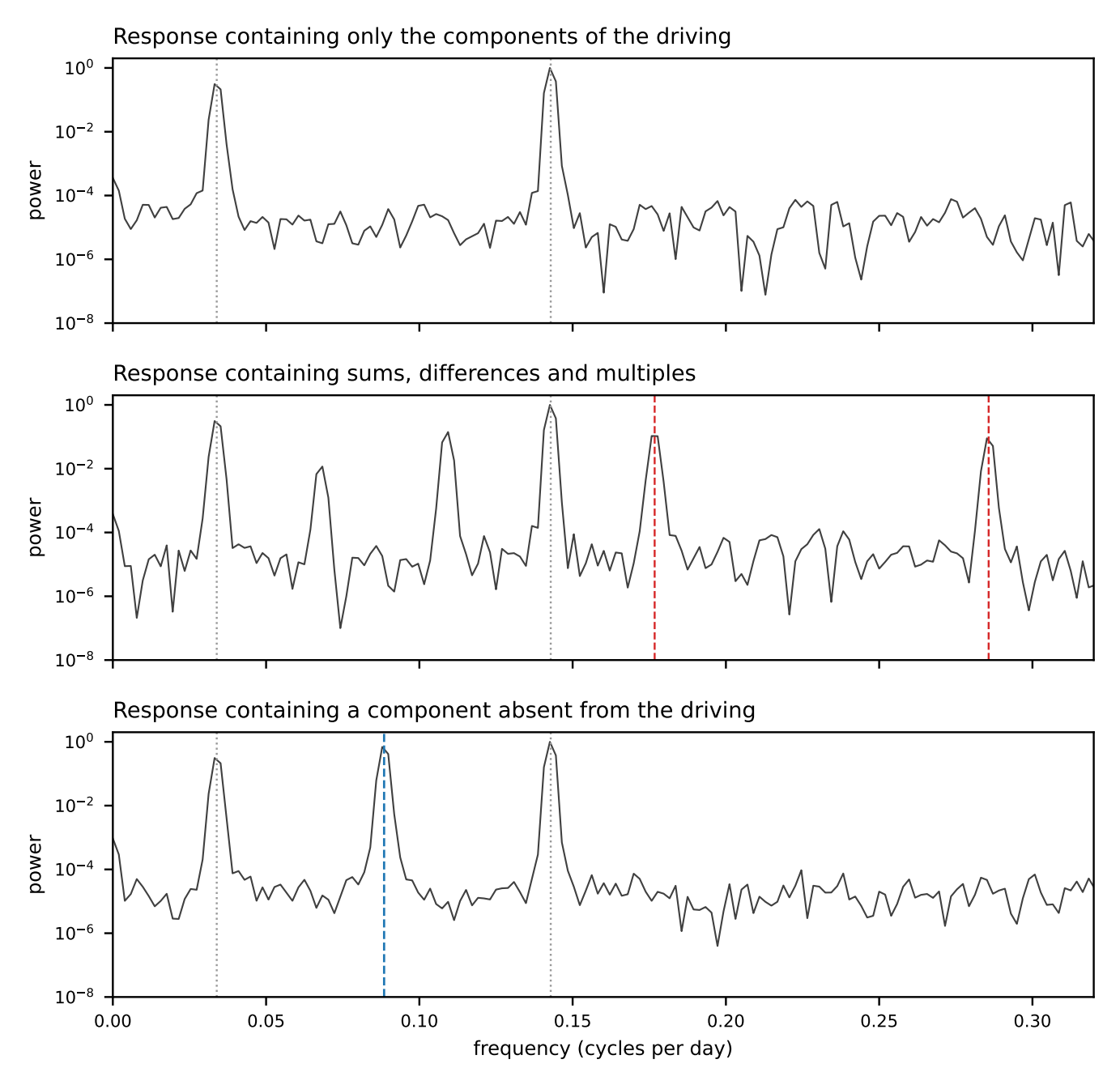
Figure 1. Three cases distinguished in a constructed record. Dotted lines mark the two driving components. In the upper panel the response carries only those components. In the middle panel components appear at multiples and at the sum and difference of the driving, marked in dashes. In the lower panel a component appears at a period supplied by no driving.
The constructed values are reported here, normalised to the strongest driving component, and were computed before this paragraph was written. In the first case the power at twice the weekly component is $5.0\times10^{-6}$ and at the sum of the two drivings $4.7\times10^{-5}$, both at the level of the noise. In the second case the same positions carry $9.0\times10^{-2}$ and $1.1\times10^{-1}$, four orders of magnitude above the first case, with the difference component at $1.4\times10^{-1}$. In the third case the derived positions remain at the noise level while a component at a period of $11.3$ days carries $6.9\times10^{-1}$.
Discriminator1Structure in a response exceeding its driving A street whose record contains components at sums, differences or multiples of its drivings responds disproportionately to them. A street whose record contains a component derivable from no driving possesses a process of its own. Each finding falls short of establishing generativity in the sense of Section 18, and the second stands as the strongest evidence for it presently available.
Two limitations bound the discriminator, and this paragraph states them openly. It requires a record longer than the slowest component considered, under the constraint of Section 16. And it requires that the drivings be enumerated, since a component attributed to the street may belong to a driving the investigator failed to list, which is the account named in Section 30 under common exposure.
29.2 The Deliverable by Which the Field Would First Be Judged
A vocabulary organises nothing until it sorts its cases. The field’s first deliverable is accordingly a classification: segments plotted in a plane of measured properties, with the expectation that they fall into groups.
Figure 2 shows the form such a display would take, with the compression ratio of Equation (4) against the selectivity of response defined in Section 16. The figure is schematic and its points are constructed, since the measurements belong to work this paper proposes and does not perform.
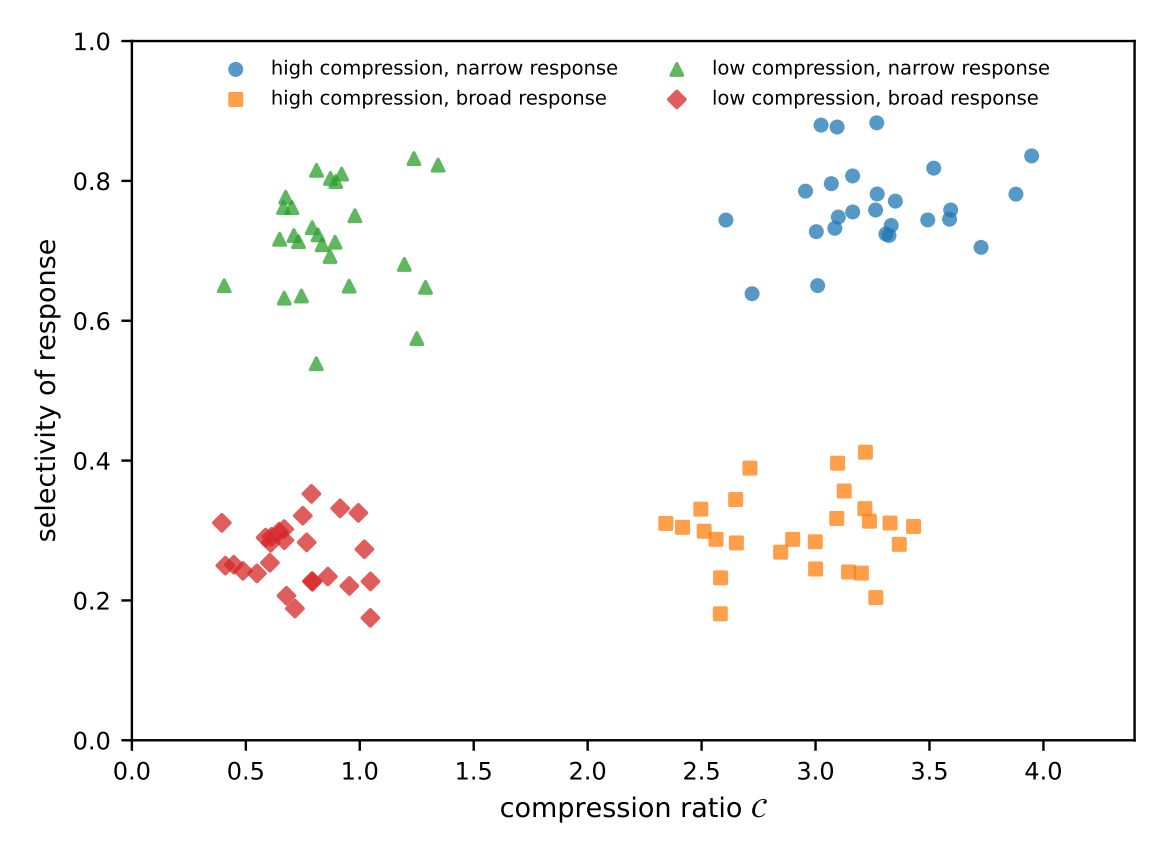
Figure 2. Schematic form of the classification deliverable. Segments are placed by two measured properties, and the field’s first claim is that they occupy distinguishable groups. The points are constructed and no measurement is reported.
Claim2The classification is the field’s first test If segments measured on the properties of Part III occupy distinguishable groups, the vocabulary has sorted its object and the field has a subject matter. If they fill the plane without structure, the properties are descriptions applicable to anything and the field has organised nothing.
29.3 The Findings That Would Defeat the Proposal
Four conditions are stated, and any one of them defeats the proposal as a whole.
The classification of Claim .2 fails to separate. Segments of every kind occupy one undifferentiated region, and the properties of Part III carry no information about which street is which.
The domains of Part III prove empty severally. Each domain stated its own condition of emptiness, and a finding that most of them obtain leaves a vocabulary with no referents.
The standing accounts of Section 30 suffice throughout. Every appearance the field describes is produced by integration, selection, common exposure, independent response to terrain, or the interval of observation, and no residual requires the mechanisms proposed here.
The departures of Section 9 prove inconsequential. Terrain moves slowly after all, rules alter nothing that matters, the observer-relative terrain reduces to a single scalar in practice, and the mediation of forcing has no measurable effect. In that case the object is a special case of the source field and the proposal is a restatement.
29.4 The Template for Importing a Result with Its Critiques
Section 6 admitted a feature of the source field where it brings a theorem or a measurable, and one further requirement is stated here, since a result imported at its date of publication misrepresents the field it came from.
The requirement is illustrated by a result that would otherwise be attractive to Section 15. In the source field, a condition was proposed under which a population subject to alternating regimes of mixing increases only where the depth over which it is mixed becomes smaller than a depth determined by its losses (sverdrup1953). The result supplies exactly what an account of alternating regimes wants, namely an ordering requirement together with a threshold.
The same result has also been contested in its own field. The identification of the mixed layer with the layer over which the population is actually mixed has been questioned, with the turbulent layer proposed in its place (fischer2015), and the sufficiency of the condition for the observed increases has been disputed on other grounds (behrenfeld2010).
Requirement3An imported result carries its own contestation A result taken from the source field is presented in this field together with the objections raised against it there, and is transferred with the standing it currently holds. A result imported at its date of publication, with the subsequent argument omitted, presents as settled what its own field treats as open, and any conclusion drawn from it in this field inherits a confidence the source does not support.
Part VI. Governance
30. Generativity Beyond the Reach of Direct Instruments
This section opens Part VI. Its objective is to establish that the property a governing party would most wish to secure admits no instrument that acts on it, and to identify what the failure of direct action leaves available. The section states the objective a governing party would adopt, the three grounds on which direct action fails, the consequence for the objectives that remain, and the position this leaves for the sections that follow.
30.1 The Objective a Governing Party Would Adopt
A party with authority over a street ordinarily adopts an objective it can measure. The available measures are throughput, transaction volume, occupancy and rent, and each is registered by instruments already deployed for other purposes.
Section 18 identified a property distinct from all of these, namely the capacity of a street to produce states of itself that were not specifiable in advance. A party persuaded by Part III would wish to secure that property, and this section states why the wish admits no direct execution.
30.2 The Grounds Limiting Direct Action
Three grounds are given, and each stands independently, so that the conclusion survives the removal of any one.
The first is definitional. A state specifiable in advance by an authority falls outside the property in question, by the definition of Section 18. An instrument that produces a nominated outcome therefore produces something the definition excludes, and the more precisely an authority specifies what it wishes to see, the more completely it forecloses the property by producing it.
The second is evidential. Section 31 established that non-derivability lies beyond demonstration and that the available discriminator establishes something weaker. A property beyond direct measurement lies beyond the reach of an instrument that adjusts against measurement, since the adjustment would have nothing to read.
The third is procedural. Claim 27.1 established that a relation fitted to a street’s past behaviour moves when the arrangement that produced it changes. An authority proposing to secure the property by acting on a fitted relation is therefore acting on a relation that its own action alters, and the alteration is in an unknown direction.
Claim1The property lies beyond the reach of a targeting instrument An arrangement of incentive, requirement or provision acts upon what can be specified, what can be measured, and what stands in a relation stable under the arrangement’s own introduction. Section 18 placed generativity outside all three, so an arrangement reaches it only through something else.
30.3 The Consequence for the Measurable Objectives
The measurable objectives remain available and their relation to the property is the subject of this subsection.
Claim2Throughput and the property come apart Section 12 established that a distribution of transit times lying below the duration an exchange requires forecloses that exchange at any rate of arrival, and Section 29 established that person-time is fixed in total. An arrangement raising the number of arrivals while shortening each visit therefore raises the measured objective while removing the condition of the unmeasured one, and it does so without any indication appearing in the measure.
The claim concerns independence in place of opposition. The two stand far enough apart that an arrangement optimising the first leaves the second unreported, and the resulting failure is silent, since the instrument reporting success is the one blind to the loss.
A parallel statement holds for variety. Section 18 distinguished a store of variety from a capacity to generate, and an arrangement securing the presence of many kinds secures a stock and leaves the capacity unaddressed.
30.4 The Position This Leaves
The failure of direct action leaves an indirect one, and the rest of Part VI develops it.
Section 18 named conditions that bear on the property as the last of its questions, and Section 14 asked which condition binds a segment. Where a property cannot be acted upon and its conditions can be, action on the conditions is what remains. Section 33 states the form such action takes and the ground on which it is operable, Section 34 states who bears its cost, and Section 35 states what follows from the fact that acting on conditions requires measuring the people whose conditions they are.
Claim3Action on conditions raises a likelihood An arrangement altering the conditions under which the property is more likely leaves its occurrence open, and every arrangement in this Part is offered as a contribution to a likelihood. What is claimed for such an arrangement is that it acts on something an authority can reach, that its effect on the conditions is measurable, and that its relation to the property is stated as a probability.
31. The Operable Layer of Conditions and Landscape
This section states what an authority over a street can act upon, given Claim 32.1. Its objective is to establish susceptibility as the operable variable, to give the properties of an intervention that acts on it, and to state the constraint that keeps such action from becoming an objective to be maximised. The section states the variable, then the forms of intervention, then the properties that make an intervention effective, then the constraint.
31.1 The Operable Variable
Section 15 stated the position in Claim 15.1 and this section develops it. The forcings reaching a street are set elsewhere: the weather, the calendar, the exchange rate, the cost of travel and the attention of media are beyond the reach of any authority over a segment. What determines the street’s response to them is the geometry, the rule and the composition, and these are within reach.
The variable is therefore susceptibility, meaning the property that determines how much of an ambient forcing a street converts into internal activity. An authority unable to alter what passes a street can alter what the street does with what passes.
Two features of susceptibility make it a satisfactory object of action. It is a property of the street and therefore local to the authority’s jurisdiction. And it is stable enough to be altered deliberately, since the geometry and the rule persist while the forcing varies.
31.2 The Forms Intervention Takes
Four forms are available and they act on different components of the terrain of Equation (2).
Alteration of the traversable configuration changes which parts of a segment can be occupied and how. Section 9 identified this form as the one that alters the effective terrain while leaving the fabric standing.
Alteration of a threshold changes who is acted upon by a component of the terrain. A restriction on frontage, on signage or on hours changes the contraction of Equation (3) for some arrivals and leaves it unchanged for others.
Alteration of the conditions of occupancy changes which occupants a segment can support, and Section 14 asked which of those conditions binds.
Alteration of the schedule changes the periodic structure, and Section 16 established that a street responds to some periods and disregards others.
31.3 The Properties That Make an Intervention Effective
Two properties are stated, and the first is the one most likely to be resisted.
Claim1A bounded intervention converts more than an unbounded one A uniform alteration applied across an entire district displaces the whole and creates no differential. Conversion of an ambient forcing into local circulation arises where a boundary exists to convert it, as Section 15 stated in its second mechanism. An intervention that is bounded in space and in time therefore acts through its edge, and an intervention extended until it is universal removes the edge that was doing the work.
The claim has a consequence that runs against the ordinary direction of policy. An arrangement found to succeed in one segment is ordinarily extended, and extension in this account removes the condition of the success. The prediction is testable and is stated as such: a bounded arrangement extended to universality should lose its effect, and a finding that it retains its effect would defeat the claim.
Claim2A repeating intervention supplies a driving at a chosen period Section 16 established that a street’s response depends on the period of what drives it, and Section 9 established that the effective terrain can be altered reversibly. An intervention that recurs on a schedule therefore supplies a driving at a period of the authority’s choosing, and its effect is available to the discriminator of Section 31, since a periodic intervention appears in a record as a component that can be traced.
31.4 The Constraint on Action of This Kind
The preceding claims identify what is operable and supply no reason to operate it. This subsection states the constraint that keeps them from becoming an objective.
Constraint3Susceptibility remains a description This Part describes what susceptibility is and leaves the reasons for raising it to be supplied elsewhere. A street converting a large proportion of every forcing that reaches it is a street with no capacity to disregard, and Section 16 established that selectivity and breadth of response stand in tension, so that a street responsive to everything is a street with no character of its own. The results state what a given arrangement forecloses and what it makes available, and an authority reading them as an instruction to raise conversion has read an objective into a description.
The constraint has a specific application. An arrangement that raises conversion may raise it past the level at which the arrangement itself is sustained, since the activity so generated bears on the parties who maintain the arrangement. An intervention of the kind described in Claim .2 is therefore subject to a limit set by its own effects, and an account of such an intervention that omits the limit has described the instrument without its failure mode.
32. The Distribution of Conditions and Its Bearing on Justice
This section states the distributive questions raised by action on conditions. Its objective is to establish that setting a condition allocates something, to identify what is allocated and to whom, and to state the account’s normative content in a form that ranks nothing. The section states the ground of the questions, then the three allocations, then the constraint form in which the account’s normative content is offered, then what the account declines to supply.
32.1 The Ground of the Questions
Section 33 established that an authority acts on conditions and on the landscape that converts forcing. This section states the consequence that a condition set for a street falls upon parties and not upon a street.
A street is occupied and traversed by parties who differ, and Section 11 established that the terrain acts on them differentially. An alteration to a component of that terrain therefore alters the contraction of Equation (3) by an amount that differs across parties, and an alteration described as uniform is uniform in the component and differential in its effect.
Claim1An alteration to terrain allocates by construction Every alteration to a component of terrain acts unequally across the parties it reaches, since the weightings in Equation (3) differ. A description of an intervention that reports the alteration to the component has reported the instrument and left its incidence unstated, and the incidence is where the distributive question lies.
32.2 The Allocations Involved
Three allocations follow from results already established, and each names a party who bears something.
The allocation of person-time. Section 29 established that person-time is fixed in total and admits an exact budget. Any arrangement that draws additional person-time to a segment draws it from elsewhere, and the party from whom it is drawn is ordinarily unrepresented in the decision, since the segment losing it lies outside the one being governed. An account of an intervention that reports the gain and omits the source has reported half of a transfer.
The allocation of the cost of a condition. A condition set to make a certain kind of generation more likely is borne by whoever must conform to it. A restriction on hours, on frontage, on signage or on use falls on occupants whose viability depends on what is restricted, and the benefit accrues to a capacity that is diffuse and future. The structure is therefore a present and located cost against a diffuse and later benefit, and the parties on the two sides are different parties.
The allocation implicit in removal by ordinary operation. Claim 13.1 established that a constituent creating value it does not capture is removed by an allocation of occupancy that reads capture alone. The removal proceeds without a decision and is therefore attributed to nobody, while the parties who bore the loss are those who used what was removed. An arrangement permitting this operation has allocated, and the absence of a decision leaves that fact standing.
32.3 The Form the Account’s Normative Content Takes
The account supplies its normative content as a constraint on arrangements and not as an objective to be pursued, in keeping with Withholding 4.4.
Constraint2An arrangement states the incidence of the conditions it sets An arrangement that sets a condition on a street in order to make a certain capacity more likely is required to state on whom the condition falls, from where the person-time it attracts is drawn, and which constituents its allocation of occupancy removes. The constraint leaves arrangements unranked against one another, leaves persons unaggregated, and is satisfied by disclosure.
Two features of the constraint are worth stating. It generates a standing asymmetry, since the party bearing a condition and the party benefiting from the capacity differ, and the first is identifiable while the second remains diffuse. And it is defeasible by a showing that the incidence is uniform, which Claim .1 holds to be rare and does not hold to be impossible.
Constraint3A capacity attributed to a street is realised by located parties A statement that a street absorbs a disturbance, adapts to a change or sustains a variety names an aggregate whose realisation falls on identifiable occupants and users. An arrangement justified by such a statement is required to name them, and this account refuses the sentence holding that a system copes, offered as a reason for imposing what it copes with.
32.4 The Provisions the Account Declines to Make
Three provisions lie outside the account: a ranking of arrangements, a measure of how much of a condition a party may be required to bear, and a procedure for deciding among parties whose weightings in Equation (3) conflict.
The reason is stated plainly. A ranking would require a common measure across the components of terrain, and Claim 11.1 placed a canonical weighting beyond the account’s warrant. An account that ranked would therefore have chosen a weighting and would be reporting that choice as a finding, which is the failure identified in Section 21 arriving in normative form.
What the account supplies in place of a ranking is the identification of what is being allocated, which Section 32 argued stays hidden from the measures an authority ordinarily holds.
33. The Reflexivity of the Instrument
This section closes Part VI. Its objective is to state what follows from the fact that the epistemology proposed here renders people measurable at street scale, and to identify the obligation this places on the field. The section states the position the field occupies, then the specific exposures, then the obligation, then the limit of what a paper can settle.
33.1 The Position the Field Occupies
The vocabulary developed in Part III is a vocabulary of flow, retention, composition, conversion and response. The same vocabulary organises the management of crowds, the control of movement and the observation of populations, and the coincidence has a reason, since a description adequate for understanding a street is thereby adequate for acting on those in it.
Section 22 made the exposure specific. The instrument the field most requires registers what individuals carry, at entry and at departure, on the same individuals, with a comparison population. An instrument answering that description is an instrument of observation of persons, and its value to this field is inseparable from its value to parties with other purposes.
Claim1The field’s central instrument is an instrument of observation of persons The quantity that Premise 8.1 identifies as the object of study is a property of individuals, and it survives no aggregation, by the argument of Section 10. A field organised around that quantity is therefore organised around the observation of individuals, and an account of its methods omitting this has described the instrument while leaving its subject aside.
33.2 The Specific Exposures
Three exposures follow and they differ in kind.
The first concerns the instrument itself. A registration of carried properties at two points on the same individuals is a record of who a person is and where they went, and its existence is consequential independently of the use to which this field puts it. The field’s requirement supplies a reason for building such a record and leaves its subsequent use to others.
The second concerns the results. Section 33 establishes which alterations to a terrain change who is acted upon by it, and a result of that form is directly usable to exclude. An account stating how a threshold alters the contraction of Equation (3) for arrivals of a given type has stated how to make a street act on those arrivals and not on others, and the statement serves every purpose for which it is read.
The third concerns the classification. Section 31 proposes that streets be placed in a plane of properties and sorted into groups. A classification of places is an instrument of administration wherever administration is organised by place, and a group established for the purpose of comparison is available as a category for allocation.
33.3 The Obligation This Places on the Field
The obligation takes the form of a requirement on reports in place of a prohibition on work, since a prohibition would be unenforceable and the work will proceed.
Requirement2A report states the uses its result makes available A report in this field states what its result permits a party with authority to do, including uses the author does not endorse. The requirement parallels Section 19, which held that an instrument is presented together with what it cannot see, and Section 30, which held that a finding names the null it defeats. A report satisfying those and omitting this has been careful about its evidence while staying silent about its effects.
Requirement3An instrument is proposed with its access conditions A proposal for an instrument of the kind described in Section 22 states who would hold the record, under what conditions it would be released, and what would be retained. A proposal that specifies the measurement and leaves the holding unspecified has proposed the difficult part while leaving the consequential one aside.
33.4 The Limit of the Paper’s Determination
Two things lie outside what a paper of this kind can determine, and they are named here so that the requirements above read as something short of a resolution.
The first is whether the instrument of Section 22 should be built. That question turns on considerations lying outside the account, and Withholding 4.4 excludes the importation of normative content with the analogy, so the answer must come from elsewhere.
The second is who decides. The field can state what an arrangement forecloses and who bears it, which is the constraint form of Section 34. Standing lies beyond its reach, and a party excluded from a decision remains excluded after a demonstration that the decision falls upon them.
Claim4The account addresses an examiner Part VI addresses a party assessing an arrangement that others propose, and leaves a party designing a street unaddressed. The results state what an arrangement makes available, what it forecloses, and on whom it falls. An authority reading Part VI as a set of instruments has read a description as a design, and Constraint 33.3 refuses the objective that reading requires.
Part VII. Case, Standing and Agenda
34. The Ginza Case and the Purchase of the Question Set
This section presents a single case. Its objective is to show that the questions of Part III have purchase on an actual street, meaning that each of them has a determinate answer there and that the answers are obtainable. The section makes no claim about the street and confirms nothing about the account, for reasons given at its close. It states why the case was chosen, then what it supplies to particular domains, then what it cannot establish.
34.1 The Grounds of the Choice
The case is Ginza, a commercial district in central Tokyo. Three properties recommend it, and each corresponds to a requirement stated earlier in the paper.
The district holds several unlike regimes of price, provenance and use within a few hundred metres, which is the condition that Section 11 requires of a case where the compression ratio is to be estimated. The same district is subject to a documented instrument altering its traversable configuration reversibly and on a schedule, which is the design Section 28 identified as the strongest available to the field. And the district carries a documented observational record reaching back a century, which is what Section 17 requires and what few streets anywhere supply.
34.2 The Record Available to the Observational Instrument
A survey conducted over four days in May 1925 recorded the appearance and comportment of those present along the district’s principal street, between Kyōbashi and Shimbashi, and reported its findings in proportions; the best known of them is that among the women recorded, the proportion in Western dress was of the order of one in a hundred (kon1925). The method was subsequently set out as a programme for the systematic recording of contemporary manners (kon1930).
Two things follow for this paper. The instrument of Section 20 is shown feasible at the resolution the field requires, on this street, by execution and not by argument. And the field acquires for this street a baseline in the composition of the flow, at a date a century before any instrument of Section 22 was available, against which a present survey conducted on the same protocol would be directly comparable.
34.3 The Record Available to the Terrain and Governance Questions
Two documented arrangements bear on the district and each corresponds to a form of intervention named in Section 33.
A district plan enacted by the ward in 1998, after negotiation with an association of the district’s occupants, set a maximum height of $56$ metres on four named streets, with a further ten metres permitted above that for rooftop structures (ginzaheight). In 2003 a redevelopment proposal was made for a building of nearly two hundred metres spanning two blocks, using exception provisions then available under a national urban-renewal measure. An association of parties in the district was established in March 2004 in response; the plan was revised in 2006 to remove the exception provisions, and a body was established in the same year to review proposals against a set of design rules agreed for the district (ginzamachidukuri; ginzaheight).
An arrangement in force since 2 August 1970 closes approximately one kilometre of the principal street to vehicles on Saturdays, Sundays and public holidays. It was introduced simultaneously in this and three other districts of the city at the instance of the then governor (ginzahokoten), and the district received of the order of two hundred and thirty thousand visitors on the first occasion (chuoku). It runs from noon until eighteen o’clock between April and September and until seventeen o’clock between October and March. Performances, the playing of instruments, the sale of goods and all vehicles including bicycles are prohibited within it (ginzahokotenqa). The arrangement was suspended at the end of March 2020 (tokyoshimbun2020).
Four questions of Part III acquire determinate content from these arrangements. The height rule and the design review are an alteration of a threshold in the sense of Section 33, and Section 34 asks on whom the restriction falls. The vehicle closure is an alteration of the traversable configuration, recurring on a schedule, and it is the instance of the design of Section 28. Its suspension supplies an interruption of the kind that Section 17 treats as informative.
The fourth is the more interesting, and it was unanticipated by Part VI. The arrangement that opens the carriageway to those on foot simultaneously forbids the activities by which an opened space is ordinarily occupied, since performance, music and sale are excluded from it by the terms of the arrangement itself. An intervention of this kind therefore withholds at the same moment that it releases, and Constraint 33.3 acquires an instance in which the limit on conversion is written into the instrument. Whether the withholding is a condition of the arrangement’s survival across five decades is a question this paper can pose and cannot answer, and it is recorded in Section 38 accordingly.
34.4 The Purchase of the Remaining Domains
The remaining domains acquire determinate questions of this case without acquiring answers here.
The flows reaching the district differ in provenance to a degree that makes the composition question of Section 10 answerable in principle by the instrument that section requires. The district contains occupants of unlike kind at short separations, which makes the affinity matrix of Section 13 estimable. The declared hours of its holdings vary widely across the day, which makes the effective terrain of Section 24 measurable by the instrument stated there. And it is exposed to dated occasions arriving on more than one calendar, which is the configuration that Section 16 treats.
34.5 The Limits of a Single Case
Claim1The case establishes purchase A case selected for its evident richness lies beyond the reach of discrimination, by the argument of Claim 28.1, since every phenomenon the account describes will be found in it. What this section establishes is that the questions have determinate content on an actual street and that records adequate to answer them exist. The account is tested by the design of Section 28, which requires a segment for which the account predicts nothing of interest, and no such segment appears here.
A second limit concerns transfer. The arrangements described are particular, and their availability elsewhere is a matter for the comparative work of Section 38. A field resting on the peculiarities of one district would be a study of that district, and Section 38 accordingly places comparison across unlike streets ahead of any further work on this one.
35. The Standing of Persons and the Address of the Account
This section states what a person is within the account, and to whom the account’s results are addressed. Its objective is to discharge two obligations incurred earlier: Section 6 set aside the passivity of the constituent and thereby owed a positive statement, and Section 9 deferred a fifth candidate departure on the ground that it required separate treatment. The section states the standing of persons, then the consequences that follow for the account’s form, then the address, then the constraint the address imposes.
35.1 The Standing of Persons
Section 4 withheld any claim that a person is a fluid parcel, and this section states what is asserted in its place.
A person within this account carries properties, is altered by passage, and alters what they pass through, and these three attributes are shared with the constituents of the source field. Three further attributes separate a person from a parcel of water, and each carries a consequence developed elsewhere in the paper. The first is anticipation: the response of a street to an occasion includes preparation made before the occasion arrives, and Section 15 identified the passage from disturbance to anticipated occurrence as a marker of the boundary drawn in Section 7. The second is construal, which builds on the first, since a party that prepares for an occasion has already read it: what a component of terrain does to an arrival depends on what that arrival takes it to be, and Equation (3) records this dependence by making the effective terrain a contraction against a weighting the arrival carries. The third reaches furthest from the source field, and it is refusal: an arrival may decline a threshold that admits them, disregard a signal directed at them, or traverse a segment while participating in nothing there, and each of these lies beyond any constituent of an ocean.
Claim1The account represents persons as parties whose construal enters the terrain What is represented here falls short of a decision procedure and of a preference ordering. What is represented is that the effect of a street upon an arrival is mediated by what the arrival brings to it, and the account carries this in the weighting of Equation (3) and nowhere else. Deliberation, motive and the formation of a purpose lie outside what the paper represents.
35.2 The Consequences for the Form of the Account
Three consequences follow, and each has appeared earlier in its local form.
The terrain admits no single scalar, since arrivals construe its components unalike. This is Claim 11.1, and this section supplies its ground.
A fitted relation does not survive the intervention it is used to evaluate, since the parties whose conduct it summarises revise that conduct when the arrangement changes (lucas1976). This is Claim 27.1.
An aggregate quantity attributed to a street is realised by located parties, since a street has no capacity of its own and what it does is done by those in it. This is Constraint 34.3.
Claim2The three consequences have one source The absence of a canonical terrain, the instability of a fitted relation, and the location of an aggregate capacity in identifiable parties follow from the same attribute, namely that the constituents construe, anticipate and may decline. A reader who rejects the standing given to persons here should reject all three together.
35.3 The Address of the Account
The results of this paper are addressed to a party assessing an arrangement, and Claim 35.4 stated this for Part VI. This section states it for the paper.
An account addressed to a designer supplies a procedure and an objective. An account addressed to an examiner supplies a description of what an arrangement makes available, what it forecloses, and on whom its incidence falls. The results here are of the second kind throughout, and the reason is not modesty. Claim 32.1 established that the property a designer would target admits no instrument, Constraint 33.3 established that the operable variable supplies no maximand, and Claim 11.1 established that no common measure exists in which competing arrangements could be ranked. A procedure would require all three of the things the account has established to be unavailable.
35.4 The Constraint the Address Imposes
Constraint3Every reason for action requires a premise from outside A statement that an arrangement forecloses something is a statement about that arrangement. A reason for adopting or refusing it requires a premise about what is owed, and Withholding 4.4 places such premises outside the account. Where a reader finds a recommendation in this paper, a premise has been supplied from outside it, and the constraint asks only that the supply be visible.
The constraint applies with particular force to Claim 33.1, which holds that a bounded intervention converts more than an unbounded one. That claim states a relation between the extent of an intervention and its effect. It supplies no reason to intervene, no reason to prefer conversion to its absence, and no ground for holding that a street converting more of what reaches it is in a better condition than one converting less.
36. Boundaries, Open Questions and the Order of Work
This section closes the paper. Its objective is to state what the account leaves outside itself, the questions that remain open within it, and the order in which the work should be attempted given the obstruction of Section 27. The section states the boundaries, then the open questions, then the order.
36.1 The Boundaries of the Account
Five things lie outside the account and are named here so that their absence reads as a choice.
A theory of the city lies outside the account. Its object is a segment, and the relation of a segment to the settlement containing it is treated through the external terms of Section 7 alone.
A theory of value lies outside it. Prices, rents and takings enter as components of terrain and as quantities in Table 4, and what determines them is left open.
A theory of the parties who hold authority over a street lies outside it. Part VI treats what an authority can act upon, leaving the constitution of authority and its contestation aside.
The physical fabric considered as an object of design lies outside it. The terrain enters as what acts on passage, and what should be built falls beyond the address stated in Section 37.
The ordinary operation of a street bounds the account. Interruption by disaster, by conflict or by the withdrawal of the population falls outside every domain of Part III, and the mechanisms stated there are asserted for the ordinary case alone.
36.2 The Questions That Remain Open
Seven questions are recorded, each tied to a result that raised it.
The unit of analysis is provisional. Claim 7.2 made the adequacy of the segment an empirical matter and stated the finding that would revise it.
The persistence criterion of Section 11 is stated in form and not in content. What balances the steepness of a value gradient against the differential in flow across it remains unspecified, and the domain’s most valuable answer depends on specifying it.
The measure of departure from a fully mixed arrangement, offered in Section 29 in place of an energy, is described and not constructed.
The extent of the weighting over prior states in Section 17 remains unknown, and the fourth obstruction of Section 27 leaves its estimation an open difficulty.
The instrument of Section 22 remains to be built, and the conditions of its holding, required by Requirement 35.3, remain to be stated.
The relation between the discriminator of Section 31 and the property of Section 18 is evidential in place of definitional, and how much weight the former bears on the latter remains undetermined.
The transfer of the arrangements described in Section 36 to streets governed otherwise is untested.
The durability of an intervention that opens a space while restricting its use is undetermined. Section 36 records one arrangement of that kind which has persisted for five decades. A comparison against arrangements of the second kind, including those that were discontinued, is the observation that would bear on it.
36.3 The Order of Work
Section 27 established that the quantitative representation the object appears to require is presently out of reach, and Claim 27.2 held that this bears on the order of work and not on its viability. The order follows.
The first work is the classification of Claim 31.2, since a field that has not sorted its cases has no subject matter to investigate. It requires the instrument of Section 24, which is available now and costs little, applied across a set of segments selected by the principle of Section 28 and including the uninteresting case required by Claim 28.1.
The second work is the comparison across a repeating alteration, since it is the strongest design the object affords and since the records it requires accumulate only with time. Beginning it early is what makes the later work possible.
The third work is the instrument of Section 22, taken together with the conditions of its holding. Its development is slow, its consequences reach beyond this field, and Section 35 states what accompanies its proposal.
The fourth work is the accumulation of the record that Section 17 requires. It cannot be hastened, and the first and second works produce it as a by-product, which is the principal reason for their order.
The fifth work is the quantitative representation, attempted where the preceding four have produced a record of adequate length and a classification against which a representation can be checked.
Claim1The obstruction determines the order A programme beginning with the representation would fit a model to a record too short to identify it, against a classification still to be built, for a system that moved during the estimation. The order stated here is what remains once those three are refused, and a reordering carries the burden of showing that one of them has ceased to hold.
refs