A Dynamic Model of Resource Capture in Familial Dependency Relations
Transcript
Abstract
Resources acquired outside a family relationship can enlarge a recipient’s opportunities while also becoming available to an actor who exercises control over the recipient. This paper develops a conditional account of the resulting interaction. A resource budget distinguishes retained resources from captured transfers, and a dynamic model allows invested transfers to maintain control and influence subsequent capture. Under a saturating capture technology, the model identifies a threshold above which positive control persists. On that branch, an increase in external resources can reduce stationary independent capacity even while the recipient retains a positive resource flow. The result depends on specified conversion and suppression mechanisms. A fixed-capture counterexample and an extension with background control clarify its limits. A separate increasing-returns specification establishes sufficient conditions for multiple stable equilibria and a threshold separating their basins. The analysis distinguishes these mathematical results from hypotheses about the emergence of familial control. It situates the framework within household economics, psychological control, economic abuse, and kinship sharing; develops observable implications; and separates developmental dependency from restrictions on agency. The contribution is a tractable account of resource-financed control and its evidential requirements. The model provides neither a prevalence estimate nor a general claim that external assistance reduces autonomy.
Keywords: familial dependency; resource capture; household political economy; control; independent capacity; nonlinear dynamics.
Discussion Paper Note
This note explains the status, scope, and intended scholarly use of the paper. It also identifies questions on which criticism and further research would be particularly valuable.
This is a discussion paper offered for critical examination and revision. Its purpose is to organize a possible mechanism linking resource capture and the maintenance of control in specified familial dependency relations. The equations establish conditional properties of a constructed model. Their application to actual relationships requires independent evidence about capture, conversion into control, and effects on practical agency. The numerical illustrations use hypothetical parameters and provide no estimates of prevalence or effect size.
The author makes no claim of conceptual priority or first discovery. Similar concepts, mechanisms, distinctions, and mathematical constructions may already exist in various disciplines under different terminology. Household economics, sociology, psychology, political theory, and research on economic abuse provide important precedents. The review is selective, and the terminology adopted here serves analytical exposition. Any contribution should be evaluated through the precision, usefulness, and limits of the proposed formulation, with due recognition of earlier and parallel work.
Objections, discussion, corrections, alternative formulations, and references to overlooked scholarship are welcome. Particularly useful responses would identify errors in the derivations, challenge the assumed capture and control technologies, develop counterexamples, propose alternative explanations, or specify evidence capable of distinguishing the mechanism from voluntary sharing and legitimate care. Criticism of the scope and interpretation of the model is as welcome as technical correction. Substantial objections may warrant revision of the framework or withdrawal of particular claims.
The analysis concerns relationships satisfying stated conditions. It provides no basis for presuming that family support, interdependence, or continuing support needs are intrinsically coercive. Its examples are hypothetical, and the paper makes no finding about an identifiable person or family. The companion discussion paper examines the normative significance of hidden control for recipients and outside contributors; agreement with its normative analysis is not an assumption of the mathematical results presented here.
Correspondence may be addressed to Wanhong HUANG at huangwanhong@serendip.ngo. Please identify the version and passage concerned when suggesting a correction, so that the issue can be evaluated precisely.
Responsible Use and Rights Reservation
This section records a request for responsible scholarly use and explains its relationship to the permissions stated below.
The author welcomes good-faith criticism, disagreement, independent inquiry, and discussion. Readers are asked to preserve the conditional and provisional character of the analysis when quoting, adapting, or applying it, and to consider foreseeable effects on the privacy and agency of affected people. This ethical request adds no restriction to the licence or to uses otherwise permitted by law. Disagreement with the author requires no authorization.
Rights retained under the licence and independently applicable law remain reserved. This reservation asserts no conceptual priority or ownership of ideas. Reuse does not imply the author’s endorsement. Applicable copyright exceptions and limitations remain available, and any necessary permissions for third-party material must be obtained from the relevant rights holders.
Notices
These notices consolidate the paper’s discussion status, licensing terms, preparation disclosure, and citation information.
Status and scholarly response.
Discussion paper, version dated 10 September 2026. This version has not undergone journal peer review. Objections, discussion, corrections, and identification of earlier or parallel concepts across disciplines are welcome. The author claims no conceptual priority. The paper-specific Discussion Paper Note explains the scope and limits of the inquiry.
Licence.
Copyright © 2026 Wanhong HUANG, to the extent copyright subsists. Except where otherwise indicated, this work is licensed under the Creative Commons Attribution–NonCommercial 4.0 International licence (CC BY-NC 4.0). It permits noncommercial sharing and adaptation subject to its terms, including appropriate attribution, a licence link, and an indication of changes. No additional legal or technological restrictions may be imposed on permitted uses. The legal code governs; this notice is a summary. No warranties are given.
Preparation and responsibility.
AI assistance was used for exploratory dialogue, literature discovery, conceptual analysis, drafting, and computational support where applicable. References were checked online before inclusion; the accompanying source register records access depth and limitations. These checks do not constitute a systematic review or establish originality. Examples are hypothetical, and no participant research is reported. The author remains responsible for reviewing and revising the final text; this discussion version remains open to correction.
Citation and contact.
Please cite Wanhong HUANG, the full paper title, “Discussion paper,” and the version date, 10 September 2026. Correspondence: huangwanhong@serendip.ngo.
Introduction
This section defines the resource-control problem, specifies the paper’s contribution, and explains the relationship between the formal analysis and its proposed familial application. The central question concerns the conditions under which resources acquired by a person contribute to the maintenance of another actor’s control over that person. The analysis proceeds through conceptual distinctions, a tractable dynamic model, and a research design for assessing the mechanism.
Consider an adult recipient who obtains income or support through an external relationship. Some of the resulting resources remain available to the recipient; another part becomes accessible to a family actor who exercises substantial influence over housing, communication, productive activity, or the practical consequences of refusal. If that actor uses captured resources to maintain those control instruments, the external inflow can affect both the recipient’s opportunities and the constraints governing their use. The relevant comparison concerns the subsequent configuration of control and independent capacity, alongside the amount received.
This configuration can arise through several institutional arrangements. A resource transfer may be compelled through credible sanctions, governed by an account arrangement that the recipient cannot effectively revise, or obtained through pressure sustained by dependence on essential support. A family actor may also control decisions without receiving money, and may receive money without controlling decisions. Resource-financed control denotes the narrower conjunction of extraction, conversion into effective control, and a continuing effect on the recipient’s opportunities. Establishing that conjunction requires evidence for each link.
The economic literature already treats household members as actors whose interests and control over resources can differ. Lundberg and Pollak (1993) locate bargaining threats within an ongoing marriage, illustrating that distributional power can operate through alternatives short of dissolution. Doepke and Zilibotti (2017) model parental influence over both preferences and choice sets. Research on economic abuse explicitly examines control over material resources (Adams et al. 2008). The present analysis builds on these precedents by concentrating on the feedback from captured resources to the future capacity to capture and constrain.
The paper makes three limited contributions. First, it separates the accounting of resources from their conversion into agency-relevant capacities. Second, it establishes a conditional threshold and a comparative static in a model with endogenous capture and depreciation. Third, it specifies the additional assumption required for multiple stable regimes. These results organize a mechanism that can be assessed empirically. Their interpretation depends on whether the proposed control technology and its effects adequately describe a particular relationship.
The model represents an institutional process through reduced-form equations. It does not solve an optimizing game between a parent, an adult child, and an outside contributor. Resource supply, the investment share of captured funds, and the institutional environment are held fixed for the main comparative statics. This choice permits transparent analysis of the feedback while limiting claims about equilibrium strategy, welfare, or policy. The term political economy refers here to the distribution and reproduction of effective control over resources and activity.
The familial application concerns a class of relationships meeting the specified conditions. Childhood dependency may help explain an initial asymmetry, but the recipient in the external transaction is treated as an adult. Continuing support needs, including those associated with disability, remain compatible with agency and legitimate care. An adult recipient can exercise meaningful choice within an interdependent relationship; a financial measure of self-sufficiency would inadequately describe that situation.
Section 2 positions the mechanism in adjacent scholarship. Section 3 defines the relational structure and its boundaries. Sections 4 and 5 establish the formal results. Section 6 examines possible antecedents; Section 7 develops an empirical strategy; and Section 8 evaluates the contribution and its limitations. Detailed proofs appear in the appendices.
Literature and Analytical Position
This section compares the proposed mechanism with scholarship on relational power, household allocation, economic abuse, and psychological control. The review identifies direct precedents and specifies the narrower work performed by the present model. It is a targeted review based on verified publications and accessible source material, with no claim to systematic coverage.
Relational Power and Household Allocation
The relational-power literature provides the conceptual basis for treating control as specific to an actor and a domain. Emerson (1962) ties power to dependence within a relationship and examines balancing processes. Accordingly, the variable introduced below represents effective control by one actor over another in specified activities. A person’s wealth, status, or forcefulness alone provides an inadequate measure of this relation.
Household bargaining directs attention to decision rules and disagreement positions. The separate-spheres model shows that a transfer’s distributional consequences depend on the organization of bargaining within the household (Lundberg and Pollak 1993). The present model examines a complementary issue: a resource flow may help reproduce the instruments that influence future allocation. It leaves the bargaining process itself unmodeled.
Parental choice-set restriction also has an explicit economic precedent. Doepke and Zilibotti (2017) distinguish altruistic and paternalistic motives and analyze instruments through which parents influence children’s decisions. Their framework makes the economic environment consequential for parenting. The present paper therefore makes no novelty claim for treating a child’s choices as subject to parental constraints. Its focus is the resource-financed persistence of a specified constraint after external acquisition becomes possible.
Economic Abuse and Kinship Sharing
Research on economic abuse supplies a close substantive comparison for capture and control. Adams et al. (2008) develop a measurement instrument using interviews with 103 survivors of domestic abuse. Their work establishes that economic practices belong within the study of controlling relationships. Extending particular items to adult parent-child relations would require new validation. Stark (2007) provides a broader account of coercive entrapment in intimate relationships; its gendered and institutional setting should remain explicit when concepts travel across domains.
Kinship-sharing research shows that resource transfers and visibility can alter incentives. Baland et al. (2011) combine observations and interviews with a signaling model of costly borrowing as a means of resisting demands for financial help. Jakiela and Ozier (2016) experimentally vary the observability of returns and examine participants’ willingness to sacrifice earnings to conceal income. These contributions substantially anticipate the idea that acquiring resources within a kin network may carry costs. The additional link studied here is the reinvestment of captured resources in control over the same recipient.
A further comparator is the use of coercion to obtain resources through family relationships. Bloch and Rao (2002) study dowry violence as a bargaining instrument. Their setting cautions against treating indirect family extraction as an unexplored topology. The present framework abstracts from that specific institution and examines a dynamic mechanism whose operation would need independent evidence in other settings.
Psychological Control and Epistemic Conditions
The psychological-control literature helps distinguish ordinary guidance from intrusive manipulation. Barber (1996) develops the construct and differentiates it from behavioral control; Soenens and Vansteenkiste (2010) clarifies its relation to self-determination theory. Green and Werner (1996) distinguish intrusiveness from closeness and caregiving. These distinctions support a scope restriction: shared residence, emotional closeness, expectations, and assistance are insufficient indicators of the mechanism analyzed here.
Interpretive conditions may affect whether an imposed restriction can be identified or contested. Sweet (2019) links gaslighting to social inequalities and institutional vulnerabilities, while Fricker (2007) analyzes wrongs affecting people as knowers. The present model leaves these processes outside its state equations. Possible effects on capture, credibility, or control depreciation are hypotheses for a richer specification. Treating interpretation as endogenous in principle does not identify its actual causal role in a case.
Empirical Counterweights and Contribution Boundaries
Evidence on assistance provides a necessary check on the direction of the proposed effect. The mixed-method review by Buller et al. (2018) reports predominantly reductions in intimate partner violence following cash transfers, with limited evidence of overall adverse effects. Partner violence differs from the independent-capacity index used here, and adult parent-child relations differ from the reviewed settings. Nevertheless, that evidence precludes presenting harmful assistance as a general empirical expectation.
The contribution is thus an explicit conditional mechanism. The paper neither infers the sign of an actual transfer’s effect from a relationship label nor treats a mathematical possibility as an empirical regularity. It specifies measurements and comparisons through which the adverse mechanism could be distinguished from beneficial sharing, ordinary allocation conflict, and exogenous hardship.
Relational Structure and Scope Conditions
This section defines the actors, resource categories, and control relations needed for the model. It then distinguishes resource capture from voluntary sharing and specifies the meaning of independent capacity. These distinctions prevent the accounting assumptions from carrying an implicit moral judgment.
Actors, Transactions, and Effective Control
Let
The transaction between
Effective control means a continuing capacity to alter the costs or feasibility of
Capture, Investment, and Resource Conservation
Resource capture denotes a transfer obtained under effective restrictions on refusal or revision in the domain being studied. A consensual contribution to household expenses can have an identical monetary value while belonging to a different relational process. Classification therefore requires evidence about the transfer conditions. The model begins after those conditions have been assessed.
Let
The model concerns a single commensurable resource. Time, income, reputation, and emotional support cannot be added without a defensible measurement rule. Applications involving several resources should use separate accounts and specified conversion processes. Fungibility also matters: externally provided funds may replace expenses that
Independent Capacity and Reachable Possibilities
The capacity variable
The distinction between resources and capabilities has a substantial precedent in Sen (1992). Relational approaches likewise locate autonomy within social conditions that can support or impede agency (Mackenzie and Stoljar 2000). The present interpretation concentrates on the time path by which usable capacity changes. An individual may acquire money while losing the ability to direct work or movement, or may receive extensive care while retaining substantial decision authority.
The phrase generative landscape can describe a set of feasible future trajectories under specified support, institutional, and relational conditions. A defensible comparison must name those conditions. Comparing actual dependence with an imagined world of unlimited independence would provide an unsuitable counterfactual. The scalar
Baseline Model and Stationary Resource Effects
This section presents the baseline dynamics, proves the existence and stability of their stationary states, and derives the conditional resource effect. It then examines two changes in assumptions. The purpose is to identify the precise mechanism responsible for the adverse result.
Dynamic Specification and Assumptions
Control investments produce effective control at rate
A saturating capture function and the dynamic equations are specified in Equation 2.
The positive investment share and the effect of control on
Equation 2 is triangular:
Feasibility and Equilibrium Selection
The feasibility analysis establishes that the model preserves nonnegative states and has bounded trajectories. At
Define the persistence threshold as
Proposition 1 (Persistence threshold). For every
The proof appears in Appendix A. The threshold expresses the balance between reproduction and depreciation near zero control. Its interpretation concerns the persistence of a control technology already present in the relationship. When
The selected equilibrium is continuous at
Resource Inflows and Independent Capacity
The comparative-static analysis examines a sustained increase in
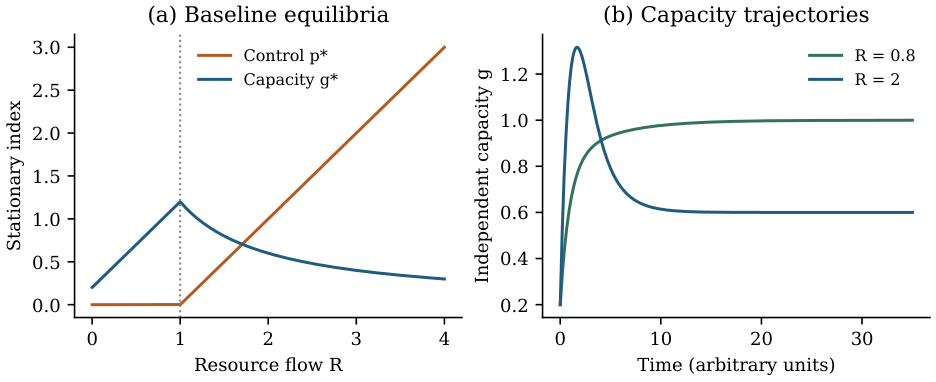
Proposition 2 (Conditional adverse resource effect). In the baseline model, stationary independent capacity increases with the resource flow below
This proposition follows directly from Equation 3. It describes a possible configuration in which beneficial retained resources coexist with an adverse marginal effect of a larger total inflow. It does not state that receiving resources is worse than receiving none. With
Figure 1 illustrates the stationary comparison and two transition paths. The illustration uses arbitrary normalized parameters and contains no empirical observations. For
Capture Technology and Comparative-Static Generalization
The generalization identifies the condition behind the baseline result without relying on its particular capture function. Let
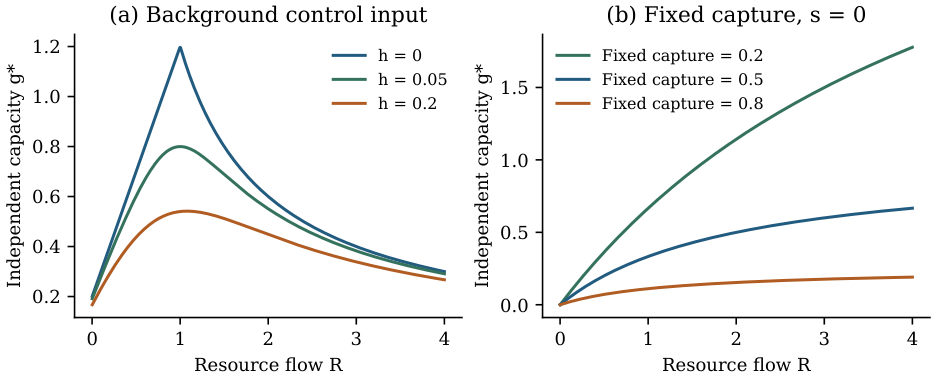
For a concrete counterexample, hold capture at a constant
Background Control and Local Robustness
The background-input extension evaluates the assumption that control can reproduce only from captured resources. Add a constant input
Figure 2 displays the background-input extension alongside the fixed-capture counterexample. Taken together, the cases show that the adverse effect survives one relaxation while changing under another. They are a sensitivity analysis of assumptions, with no calibration to a population.
Increasing Returns and Multiple Stable Regimes
This section establishes the additional conditions under which control can exhibit distinct basins of attraction. It changes the capture technology while preserving the resource account and capacity equation. The distinction matters because positive feedback alone leaves the baseline with a single attracting outcome for positive initial control.
Suppose that capture requires complementary control instruments. Access to a resource account, for example, may become substantially more effective when accompanied by influence over housing or communication. A smooth representation of increasing returns at low control is
The nonzero stationary control stocks are given in Equation 9.
Proposition 3 (Multiple stable control regimes). For
Appendix C proves the result and describes the equality case. In the full two-dimensional system, the state associated with
Figure 3 illustrates the distinct regimes at
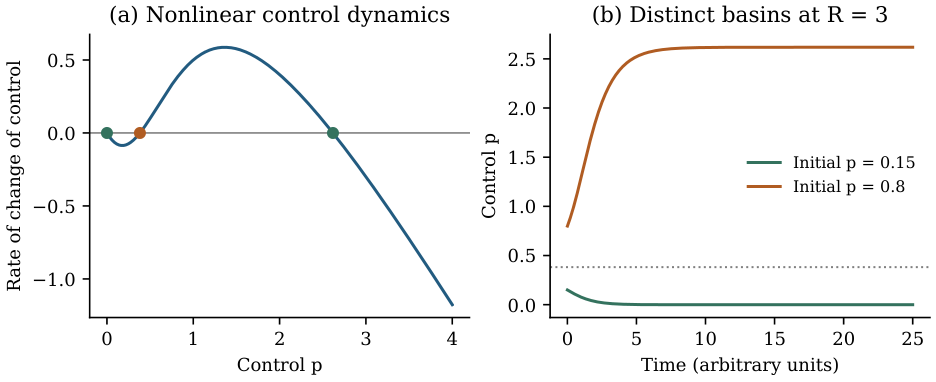
A temporary perturbation can have persistent consequences if it changes the state sufficiently to cross the separating threshold while the post-perturbation parameters again support two attractors. The model does not establish a conventional hysteresis loop between two finite parameter thresholds. Zero control remains locally stable for every finite
The distinction also qualifies intervention language. Moving a stock below a computed threshold is a mathematical statement about this particular specification. Implementing an intervention requires knowledge of the control instruments, possible responses, costs, and the recipient’s priorities. None of those quantities can be recovered from the diagram alone.
Genesis and Risk Conditions
This section separates the emergence of a controlling relationship from the reproduction process described by the equations. It reviews selected findings concerning psychological and relational antecedents, then formulates hypotheses about institutional opportunity. The analysis concerns possible mechanisms and avoids diagnostic classification.
Initial Asymmetry and Relational Development
Childhood dependence provides one route to an initial asymmetry in access to resources, information, and decisions. Whether that asymmetry persists into a particular adult domain depends on subsequent opportunities, support needs, institutions, and relationship practices. The model represents a given initial condition; it supplies no account of its historical origin.
Boundary-dissolution research provides differentiated constructs for examining relational development. Thompson et al. (2024) review 478 studies and distinguish enmeshment, disorganization, caregiving, and coerciveness, with differing associations with psychological difficulties. Their findings support careful separation of these patterns. They do not identify the probability that any pattern leads to the resource-investment loop studied here.
The direction of control may also change across the life course. A younger relative can acquire power over an older family member through financial or care arrangements. The actor labels permit that reversal, but evidence about one direction cannot establish prevalence or mechanisms in the other. An empirical application should define the relationship, developmental period, and domain before measurement.
Unfulfilled Goals and Self-Related Motives
The literature on parental aspirations provides a possible motivational link between a child’s outcomes and a parent’s interests. In an experiment involving 73 parents, Brummelman et al. (2013) find that reflecting on unfulfilled ambitions affects reported wishes for a child to fulfill those ambitions among parents who include the child more strongly in their sense of self. The study measures a desire; its results leave the translation into controlling practices and extraction unresolved.
Ng et al. (2014) examine contingent self-worth and psychological control using two waves of reports from mothers and children in China and the United States. Their study supplies evidence relevant to the connection between a parent’s self-evaluation and controlling behavior. Its sampling, measures, and design constrain population and causal inferences. Cultural group differences in the study provide no basis for classifying individual families by nationality.
The corresponding hypothesis is conditional: when an actor values another person’s achievements as a source of status or compensation, and possesses effective instruments for directing those achievements, the private incentive to preserve control may increase. Shared ambitions can also motivate supportive investments chosen by the recipient. Motive, instrument, and effect must therefore be investigated separately.
Institutional Opportunity and Feedback
Institutional opportunity determines whether a motive can be converted into persistent control. Relevant conditions may include access to funds, control of indispensable services, dependence on a single network, weak possibilities for revising arrangements, and sanctions for refusing transfers. These conditions could affect
A proposed genesis sequence should also accommodate alternative explanations. Limited employment may arise from local labor-market conditions; an adverse health event may increase both assistance and decision support; poverty may constrain both generations. Such common causes can produce correlations between dependence and family involvement without control-generated deprivation. A temporal sequence of control followed by reduced opportunity is informative, yet still requires a credible counterfactual.
Interpretive pressure may reduce reporting or make resource transfers appear voluntary in administrative records. It may also be weak, contested, or irrelevant to a particular mechanism. A study should assess access to independent advice and the consequences of disagreement directly. The framework’s descriptive vocabulary must remain open to accounts from the recipient that revise the researcher’s initial interpretation.
Measurement and Empirical Assessment
This section translates the model into observable implications and distinguishes the evidence needed for description, causal explanation, and model testing. It proposes a longitudinal strategy rather than treating hypothetical examples as an empirical case. The full mechanism remains a research hypothesis.
Observable Components and Rival Interpretations
An empirical study would record transaction types, effective allocation powers, imposed transfers, control investments, and changes in independently usable capacity. Repeated observations are essential because an immediate benefit can coexist with a later adverse adjustment. Table 1 connects the principal model components to possible indicators and competing interpretations.
| Model component | Candidate observation | Competing interpretation |
|---|---|---|
| External flow |
Recipient earnings or support, dated and classified by transaction | Joint funds or borrowed money incorrectly recorded as individual income |
| Capture |
Transfer accompanied by credible penalties for refusal or limited ability to revise | Voluntary sharing, repayment, or agreed cost allocation |
| Control investment |
Captured resources finance access restrictions or substitute for their prior funding | Consumption by |
| Control |
Effective influence over specified decisions and consequences of refusal | Consensual delegation or justified decision support |
| Independent capacity |
Ability to sustain selected activities under refusal or changed arrangements | Income, satisfaction, and account ownership used as insufficient substitutes |
Capture should be assessed with sensitivity to coercion and limited alternatives. A recipient may describe a contribution as voluntary while reporting severe consequences of refusal; another may freely endorse obligations despite substantial material costs. Both descriptions require attention. The researcher’s preference for financial separation cannot serve as the coding rule.
Temporal Predictions and Identification
The baseline proposes a sequence: an external increase raises the amount available for capture; invested capture subsequently maintains control; control increases the capture fraction and affects usable capacity. Failure at any link weakens the complete mechanism. An increase in family transfers alone provides evidence only about allocation.
Several predictions distinguish the model from a fixed-sharing account. Capture fractions should respond to effective control in the relevant domain. Transferred resources should contribute to the maintenance of control instruments. Capacity changes should follow the predicted adjustment pattern after accounting for direct benefits. If a credible change reduces appropriability while preserving support, the allocation and capacity response should differ from an otherwise similar increase in gross resources.
Identifying these effects requires more than correlating earnings and dependence. Earnings can respond to control; anticipated extraction can change effort or concealment; and a common shock can affect all measured variables. Longitudinal within-person evidence can improve temporal resolution but remains vulnerable to time-varying confounding. Changes in payment arrangements, account access, or institutional support may offer useful comparisons only if their accompanying changes are understood. The ethical and practical case for any intervention must be assessed independently of its analytical convenience.
The nonlinear extension makes a stronger demand. Observing persistence does not establish multiple attractors. Evidence would need to support the proposed nonlinearity, distinguish transient adjustment from durable regimes, and address unobserved heterogeneity. Two families at different outcomes under similar incomes may have different parameters. They need not occupy separate basins of the same dynamic system.
Research Ethics and Evidential Status
The present paper contains no participant data and reports no empirical causal estimate. Its examples are constructed to explain concepts. Personal experiences can generate research questions, but converting them into a case study would require a defined evidential method, independent corroboration where appropriate, and careful consideration of confidentiality and consent.
Prospective data collection should minimize information that could expose a participant to retaliation or identify a private relationship through a distinctive combination of events. Participants’ disagreement with the model must remain reportable. A design restricted to people already endorsing the proposed mechanism could describe those accounts while providing a weak test of its scope. Comparison cases involving supportive interdependence and voluntary sharing are analytically necessary.
Discussion and Analytical Limits
This section evaluates the model’s explanatory reach and distinguishes its results from normative and intervention claims. It concentrates on what the formal structure clarifies, what remains assumed, and what further work would materially strengthen the argument.
The principal result is transparent because the retained flow saturates on the positive-control branch while control continues to rise. That transparency is an advantage for interpretation and a limitation on novelty. A mathematical derivation does not establish that the functional form is empirically apt. The general condition in Equation 5 and the counterexample in Equation 6 locate the argument at the level of mechanisms rather than a preferred result.
A stronger political-economic account would endogenize investment in control, resource production, and recipient responses. An actor who extracts excessively may reduce future production, induce exit, or incur enforcement costs. A recipient may conceal resources, change collaborators, accept some family obligations, or negotiate different terms. Existing kinship-sharing studies make those responses especially salient (Baland et al. 2011; Jakiela and Ozier 2016). Their incorporation could change the stationary resource effect and the stability analysis.
The capacity index also limits interpretation. A decline in
The model offers one explanation of persistence without requiring a comprehensive plan by the controlling actor. Yet that explanatory economy cannot establish motive or excuse conduct. The use of a reduced-form control process leaves individual knowledge, justification, and responsibility open. Normative evaluation requires premises concerning agency, coercion, fair obligations, and the recipient’s standing.
The introduction of
Intervention implications are limited to identifying parameters and links worth investigating. Reduced appropriability, increased access to independent support, and lower conversion of resources into control could alter the dynamics. In practice, each may be offset by substitution, retaliation, withdrawal of beneficial care, or new dependence on the outside provider. A general recommendation to reduce resources would not follow from the adverse marginal effect. The recipient’s chosen relationships and goals must inform any evaluation.
Finally, colonial vocabulary performs no necessary role in the derivation. Directed activity and extraction have analogues across several institutional structures. Historical classification would require additional evidence about the features that make a relation colonial. The familial model can be assessed on its specified mechanisms independently of that comparison.
Conclusion
This section consolidates the formal and empirical implications of the analysis. Resource capture can contribute to the persistence of familial control when a portion of captured resources sustains instruments that influence subsequent capture. Under a specified saturating technology, the model has a persistence threshold and an adverse stationary resource effect on a limited index of independent capacity. A fixed-capture comparison yields a beneficial effect, while a separate increasing-returns extension supports multiple stable regimes.
These findings define a conditional theoretical account. Their application requires evidence about transfer conditions, resource conversion, control instruments, and capacity formation over time. Existing work on household bargaining, economic abuse, psychological control, and kinship sharing supplies essential precedents and competing interpretations. The next substantive advance would be a design that can distinguish the proposed feedback from voluntary sharing, beneficial care, and common external constraints.
Proof of Baseline Convergence
This appendix establishes convergence by analyzing the scalar control equation and then the driven linear capacity equation. It also identifies the stability change at the persistence threshold.
For
The Jacobian is lower triangular. Its eigenvalues at the zero-control equilibrium are
Write the capacity equation as
Background-Input Equilibrium and Derivative
This appendix derives the positive equilibrium under background input and evaluates its comparative static. Multiplication of the stationary control equation by
At equilibrium,
Proof of the Nonlinear Regime Structure
This appendix derives the positive equilibria and their stability in the increasing-returns extension. For
The derivative of the control flow at a positive root can be simplified using the equilibrium relation. Its value is given in Equation 13.
At
Numerical Reproducibility
This appendix records how the illustrations can be reproduced and what numerical checking establishes. The accompanying script research/model_analysis.py uses NumPy and Matplotlib, evaluates the analytical stationary states, and integrates the equations using a fixed-step fourth-order Runge–Kutta method. The standard plotted step is
The script verifies resource conservation, equilibrium residuals, nonnegative simulated states, convergence away from the critical point, finite-difference agreement with analytical derivatives, and the two basins of the nonlinear extension. It also generates a stationary-value CSV and a machine-readable verification report. These checks concern implementation and algebraic consistency. The parameter values remain hypothetical and provide no calibration or empirical validation.