A Theory of Manufactured Vulnerability in Relations of Domination
Transcript
Abstract
Assistance can improve a person’s circumstances while sustaining an unjust account of the relationship in which the assistance occurs. This paper develops a theory of a specific mechanism of domination: actors contribute to another party’s vulnerability, restrict the practical possibility of investigating its production, extract value through the terms of relief, and secure authority by presenting themselves as benefactors or saviors. The argument distinguishes socially produced dependence from its wrongful manufacture, historical occurrence from historical recoverability, and useful assistance from the discharge of responsibility. A thought experiment involving injury, appropriation, and assistance financed with the injured party’s resources establishes the importance of these distinctions. The mechanism is then reconstructed through the separate roles of material control, value appropriation, epistemic obstruction, attribution, audience uptake, and renewed power. Comparative vignettes examine family relations, employment, colonial administration, and capital-mediated consumption. The capital case develops a configuration in which commercial actors manufacture insecurity about love and belonging, sell a remedy, and claim moral authorship of the resulting recognition. It distinguishes real commodity value from the justification of the conditions under which that value becomes practically necessary. An elementary formal appendix clarifies the information lost when judgment is restricted to a present transaction. The normative argument supports repair that combines material security, independent historical inquiry, contestable authority, and the affected party’s control over future associations. Freely felt gratitude remains compatible with outstanding claims, while useful relief alone supplies insufficient grounds for obedience or a provider’s claim to be indispensable. The contribution is a bounded account of the interaction between the production of dependence and the governance of its historical interpretation. Its causal links remain empirical hypotheses beyond the stipulated cases.
Keywords: manufactured vulnerability; domination; historical recoverability; capital; value extraction; salvific legitimation; epistemic injustice; reparation; relational agency.
Manuscript status and preparation
This note records the draft’s research status, preparation method, and terms of reuse. It accompanies a theoretical article intended for substantive author review and subsequent scholarly criticism.
Research status.
The article develops conceptual distinctions, a proposed causal mechanism, normative arguments, and explicitly constructed examples. It reports no interviews, original empirical dataset, or tested causal estimates. The literature engagement is targeted. Source identities and the specific material used were verified online before their first inclusion. The accompanying citation_verification.md records access levels and claim limits. Several book-length sources were accessible through publisher abstracts, descriptions, or excerpts; further full-text engagement and an expanded originality assessment belong to preparation for journal submission.
Preparation disclosure.
The research questions and initial examples originate in the author’s supplied exploratory conversation. Preparation of this draft involved OpenAI’s ChatGPT and Codex for conceptual reconstruction, source discovery and online verification, argumentative development, LaTeX drafting, and compilation. This version awaits the author’s substantive review and approval. The attribution on the cover follows the supplied template; it does not record approval of every formulation in this draft.
Responsible use.
The proposed framework invites evidence-based criticism and careful attention to the agency of people whose circumstances are assessed. Applications should distinguish demonstrated relationships from speculative attribution and consider the consequences of disclosure for affected people. These scholarly requests are separate from the licence’s terms.
Licence and rights.
Following the supplied template, copyright 2026 Wanhong Huang. Except where otherwise indicated, this work is made available under the Creative Commons Attribution-NonCommercial 4.0 International License. Its terms govern sharing and adaptation, attribution, and indications of changes. Reuse does not imply authorial endorsement. Third-party rights and applicable copyright exceptions remain governed by their respective terms and applicable law. The author retains rights preserved by the licence. The official deed and legal-code link are available at https://creativecommons.org/licenses/by-nc/4.0/.
Introduction: assistance and historical responsibility
This article examines a mechanism through which the provision or sale of useful responses to need can reproduce domination. Its point of departure is a conflict between the apparent generosity of a present act and the history of the need that the act addresses. A constructed example establishes the problem; conceptual analysis then identifies the conditions under which the problem becomes a sustained relation of power.
Suppose that A wrongfully injures B, takes 100 monetary units belonging to B, and spends 10 of those units on an assistive device that B finds useful. A retains the remaining 90 units. A subsequently presents the device to an audience as evidence of exceptional generosity and demands B’s loyalty. The amounts are stipulated units in a thought experiment. The device’s purchase price measures an expenditure; B’s experience of its usefulness and the losses associated with the injury require separate assessment. The example concerns wrongful injury, appropriation, and control. B’s disability leaves B’s equal moral standing intact and permits many forms of agency, with appropriate support.
The device improves B’s immediate circumstances. Its provision nevertheless raises distinct questions about the ownership of its funding, A’s outstanding responsibilities, B’s freedom to respond emotionally, and the justification of A’s demand for loyalty. An observer shown only the delivery sees a beneficial transaction. An observer who can investigate the injury and appropriation can also identify obligations that the delivery leaves outstanding. A’s power becomes especially consequential when it extends to the information available to these observers: the account books, the witnesses, the interpretation of B’s need, and B’s practical ability to object.
The proposed mechanism connects these material and epistemic dimensions. Actors contribute to another party’s vulnerability, obstruct inquiry into its production, provide selective relief, and obtain recognition as benefactors. That recognition can support demands for gratitude, silence, or obedience. Where relevant audiences accept those demands and give them practical effect, the relation gains a means of reproducing itself. Each connection requires separate support. A favorable narrative may fail to persuade; persuaded observers may lack influence; an affected party may retain strong avenues of challenge. The article therefore develops a conditional explanation of a specified pattern.
The mechanism also has a political-economic dimension. Producing or intensifying a vulnerability can create demand for a response controlled by the same actor or arrangement. The response can then extract money, labour, attention, or recognition while supporting a claim to have rescued the recipient. Throughout the article, relief includes gifts, paid remedies, and the partial performance of existing responsibilities. A savior claim represents the provider as indispensable to a restored life or relationship and can support authority over the conditions of its future development.
The fourth comparative case makes this connection explicit. A commercial arrangement helps construct insecurity about being worthy of love, defines an approved form of desirability, sells a route to recognition, and claims credit for creating love or restoring dignity. The product may be genuinely useful and relationally meaningful. The proposed wrong concerns the production of the insecurity, the terms through which it is exploited, and the authority claimed through its apparent resolution.
Existing work supplies substantial foundations. Social vulnerability, epistemic injustice, power in historical production, and the political significance of gratitude already have established analyses (Rogers et al. 2012; Schiff 2024; Fricker 2007; Trouillot 2015; Schwabe 2026). The present contribution concerns their interaction around a particular transaction: relief offered by an actor implicated in the need for relief. The argument identifies how historical obstruction can alter the public classification of that transaction and how this altered classification can reinforce control. Its normative consequence is a requirement to assess assistance together with relevant responsibility and the conditions under which that responsibility remains open to inquiry.
The method combines conceptual distinctions, stipulated comparisons, mechanism reconstruction, and normative argument. Family, workplace, colonial, and capital-mediated consumer vignettes test the portability and limits of the account. They are analytical constructions. Claims about the frequency, strength, or historical distribution of the mechanism would require additional evidence. The normative argument adopts equal moral standing, the accountability of power, and responsibilities arising from wrongful interference as explicit premises.
Section 2 defines the relational terms and locates the proposal within relevant scholarship. Section 3 considers agency and ambivalence within dependent relations. Sections 4 and 5 reconstruct the mechanism and its epistemic conditions, including value extraction and salvific legitimation. Section 6 develops the argument about relief, paid remedies, and remaining obligations. Comparative applications and repair follow in Sections 7 and 8. Section 9 addresses objections and evidentiary requirements, and Section 10 states the resulting theoretical claim. Appendix A provides an elementary clarification of the information constraints involved.
Conceptual foundations and theoretical position
The conceptual foundation distinguishes vulnerability, its social production, and domination so that the proposed mechanism can be identified without presuming its conclusion. The section first specifies relational exposure, then separates forms of causal involvement, locates the account among adjacent theories, and specifies capital and value extraction. These distinctions determine the burden of argument in the later applications.
Relational vulnerability and agency
The account of vulnerability developed here specifies the harm at issue and the relations through which exposure arises. A person can be vulnerable to loss of housing through dependence on a particular provider, to retaliation through an employment hierarchy, or to misrepresentation through another party’s control of records. A useful description identifies the subject, threat, supporting arrangements, relevant actors, and time horizon. Describing someone simply as vulnerable supplies insufficient information for attributing responsibility or designing a response.
Fineman’s account places embodied vulnerability within a general theory of the human condition and directs attention to institutions that distribute advantage (Fineman 2008). Rogers, Mackenzie, and Dodds distinguish inherent, situational, and pathogenic vulnerability; their discussion connects protection with agency and recognizes that responses to vulnerability can themselves intensify it (Rogers et al. 2012, 23–25). These contributions provide grounds for separating universal susceptibility from the avoidable organization of particular exposures.
Dependence is compatible with agency. Children develop capacities through care; people with continuing support needs can exercise choices through reliable assistance, accessible communication, and shared decision-making. The relevant contrast is between arrangements that make assistance answerable to the supported person’s interests and arrangements that leave consequential power insufficiently controlled. An ideal of universal self-sufficiency would misidentify the problem and could justify withdrawal of necessary support.
For present purposes, a relation of domination exists when an actor or organized arrangement possesses sufficiently durable discretionary control over another party’s important options while that party lacks adequate means to constrain or contest its exercise. This operational definition follows the general republican concern with freedom as non-domination (Pettit 1999), while specifying the dimensions needed for the present analysis. Adequacy depends on whether challenge can affect decisions and can be exercised at tolerable cost. A nominal complaint procedure offers limited protection when using it predictably endangers housing, care, or livelihood.
Durable asymmetry alone remains an incomplete diagnosis. A surgeon’s specialized competence, a caregiver’s responsibilities, or an organization’s coordination requirements can justify forms of authority whose scope and exercise are constrained. Assessment concerns the importance of the options controlled, the reach of discretion, the availability of representation, and the effectiveness of review. People also possess several relationships at once: asymmetry within one relation may be constrained by resources and allies available through another.
Manufacture, attribution, and wrongfulness
The concept of manufacture identifies attributable contributions to exposure or dependence. The distinctions in this subsection prevent a causal description from silently becoming a judgment of blame.
Manufactured vulnerability denotes a practically significant increase or continuation of exposure to specified harms, or dependence on controlled supports, attributable to an actor’s conduct or to an organized social arrangement. Attribution requires an account of the relevant contribution and a justified comparison. The comparison may concern a feasible arrangement without the contribution or a feasible change that would reduce its continuing effect. In ordinary language manufacture suggests deliberate design; the technical use here includes distributed reproduction. Where the evidence supports a narrower description, terms such as created, aggravated, or maintained vulnerability should be preferred.
Creation introduces an exposure that would otherwise be absent under the specified comparison. Aggravation increases an existing exposure. Maintenance preserves a condition through continuing conduct or an omission associated with a specified responsibility and capacity to act. Taking advantage of another’s vulnerability can occur without any of these causal contributions. An external trader may exploit a shortage produced elsewhere; an institution may subsequently maintain that shortage by restricting alternatives. The distinction turns on evidence of contribution, including timing and feasible interventions.
The adjective wrongful requires an additional argument. An avoidable medical dependence might arise through a justified treatment chosen by a patient. Schooling can create reliance on teachers while supporting the development of agency. Relevant normative questions concern the interests affected, authorization, fair allocation of burdens, feasible alternatives, and responsibilities attached to the actor’s position. The cases examined below stipulate or establish a wrongful contribution independently of the subsequent benefaction narrative.
Intention also requires separate treatment. Deliberate orchestration of injury and relief differs from knowing maintenance of an inherited arrangement, culpable neglect, and participation in practices whose combined consequences exceed individual foresight. Distributed production requires tracing rules, incentives, and coordinated effects. A sequence that benefits an institution does not by itself establish that its members planned the sequence. The mechanism can explain a reproduced relation while leaving the distribution of individual blame unsettled.
Theoretical antecedents and explanatory scope
The theoretical comparison identifies the work already accomplished by adjacent accounts and the narrower explanatory task pursued here. Schiff analyzes vulnerability through socially organized precarity and fragility, including relations of privilege and privation (Schiff 2024). Her account is a close antecedent to any claim that vulnerability and its misrecognition are relationally produced. Naming social production therefore supplies insufficient grounds for a contribution claim.
Fricker’s distinction between testimonial and hermeneutical injustice makes credible uptake and shared interpretive resources central to the treatment of people as knowers (Fricker 2007). Dotson directs attention to hearers’ failures and practices of silencing (Dotson 2011). Trouillot examines power within the production of history (Trouillot 2015). The present concept of historical recoverability takes these concerns into a specified problem of responsibility: the capacity to return to a history whose interpretation bears on the standing of an apparent benefactor.
The proposed explanatory addition is the connection between that capacity and the political effects of partial relief. It distinguishes the production of need, the restriction of inquiry, the attribution of assistance, the audience’s response, and the practical consequences of that response. The complete pattern is a particular configuration within wider theories of domination and epistemic power. Cases containing only some elements may be intelligible under those wider theories. A theory of this configuration earns its usefulness by clarifying the links, the conditions of interruption, and the remedial failures that follow from addressing only an isolated element.
Capital, relational value, and exploitation
The political-economic vocabulary specifies how the mechanism can organize accumulation as well as interpersonal obedience. In this article, capital refers to resources organized for accumulation through institutionally structured control over production, circulation, or access to valued goods. The relevant actors include owners, firms, investors, and intermediaries; their positions and conduct require identification. A statement that capital produces vulnerability can concern an attributable organizational strategy or a reproduced arrangement across actors. Its explanatory content depends on showing the activities and connections involved.
Marx’s account of primitive accumulation makes the historical separation of producers from their means of production central to the formation of capitalist relations (Marx 1887). Fraser examines accumulation’s dependence on, and destabilization of, the social reproduction that sustains it (Fraser 2016). These antecedents establish that economic dependence has histories and that productive arrangements can undermine their own social conditions. The present analysis isolates an additional configuration involving the sale of remedies and a claim to moral authority through their provision.
The vulnerabilities at issue can be material, symbolic, or combined. Restricted access to land or income changes practical means of subsistence. A commercially reinforced standard of acceptable appearance can expose a person to humiliation, exclusion, or anxiety about belonging. Where other people act on that standard, the exposure extends beyond private dissatisfaction. The affected person’s inherent dignity remains constant while the social conditions of receiving respect become more demanding and commercially mediated.
Value generation concerns the activities and relations through which something becomes useful or meaningful. Value appropriation concerns who obtains control over its benefits and conditions of access. Value extraction, as used here, identifies benefits secured through that control, including money, labour, attention, information, and reputational credit. These are descriptive distinctions. Exploitation arises when the advantage taken is unjustified under a stated standard concerning the parties’ standing, contributions, responsibilities, and available alternatives. Revenue alone establishes neither exploitation nor adequate compensation.
Wertheimer’s analysis makes mutually advantageous and consensual exploitation a central problem (Wertheimer 1996). That problem matters here because an acquired product or service may improve the recipient’s position within conditions that the provider helped make unjust. The assessment needs to examine both the gains from the present transaction and the production of its background conditions. Section 6.4 develops the corresponding normative argument without presuming a single numerical measure for heterogeneous values.
Romantic recognition provides a particularly revealing case because several participants contribute to its realization. Illouz examines the interrelation of commercial imagery, consumption, and romantic experience (Illouz 1997). A gift may acquire meaning through design, purchase, presentation, interpretation, and a shared history. A firm’s contribution can be substantial while the relationship remains jointly made. The relevant question is how commercial actors acquire returns and authority through this process, especially when they help create the insecurity to which their products are offered as a response.
Relational experience and constrained expression
The account of relational experience examines how the proposed mechanism can coexist with attachment, relief, and strategic agency. Its method is an analysis of possible responses under specified constraints. These responses clarify interpretive limits; they supply neither a universal psychology of dependence nor findings from phenomenological fieldwork.
An individual receiving assistance from someone implicated in the underlying harm may value the assistance and retain a complaint about the harm. The individual may also care about the provider, recognize sacrifices involved in care, and fear the consequences of disagreement. Each response concerns an aspect of a complex relation. Requiring a single evaluative attitude would force the person to suppress relevant reasons: appreciation for immediate help, anger about earlier interference, or concern for a continuing relationship. A theory attentive to agency permits these attitudes to coexist and change.
The vulnerability becomes especially difficult to contest when the provider controls the terms of evaluation. Consider a supported person whose request for access to financial records is characterized as ingratitude. The request concerns the history of resources; the response redirects attention to the requester’s character. If relatives or administrators accept that redirection, the person must now defend moral standing before the original question can be heard. The cost of inquiry includes the risk of losing assistance and the additional burden of demonstrating entitlement to ask.
Expression can be constrained through several routes. A person may lack access to a communicative channel, withhold a statement after assessing the risk of retaliation, or speak clearly to an audience that discounts the statement. These possibilities require different responses. Opening a channel may leave retaliation intact; protecting a speaker may leave prejudicial uptake intact; teaching an interpretive vocabulary may leave material dependence intact. The conceptual separation matters because silence alone cannot discriminate among these circumstances.
Sweet’s study of gaslighting connects destabilization of a person’s reality with social inequalities and institutional resources in domestic-violence relations (Sweet 2019). Its relevance here is the possibility that interpersonal discrediting draws force from a wider social setting. The vignettes in this article extend that analytical concern to stipulated contexts. Their occurrence in other families or organizations requires separate evidence.
Strategic accommodation can constitute agency under severe constraint. A person might praise a provider to retain housing, postpone a complaint until an ally becomes available, or accept assistance while privately preserving documents. Such action can be prudent even when it sustains the public appearance of agreement. Conversely, expressed gratitude may be sincere. The observer’s task is to investigate the relation between expression and available options, while respecting the person’s account of experience.
An emancipatory response must therefore preserve room for ambivalence. Requiring the recipient to renounce attachment, identify publicly as a victim, or accept an outsider’s preferred narrative can introduce a further form of control. The relevant capacity is the person’s supported ability to examine, describe, and revise the relationship, including the possibility of deciding that public disclosure would impose excessive costs. Epistemic agency includes meaningful choice about the occasions and audiences of speech.
Commercially organized insecurity introduces a related form of ambivalence. A person may recognize a brand’s participation in an exclusionary standard and still purchase its product to navigate the resulting social environment. The decision can display practical knowledge of how the environment operates. An assessment that treats the purchaser’s action as evidence of simple credulity would disregard that knowledge. What matters is the range of options the person faces and the costs of acting on a critical understanding.
The experience can also contain a division between personal appreciation and institutional objection. A consumer may treasure an object received from a partner while opposing the commercial suggestion that love requires that object. The partner’s care, the object’s craftsmanship, and the corporation’s interpretation of the exchange concern distinguishable sources of significance. Respect for the consumer’s agency includes room to preserve the valued relation while contesting the conditions through which a commercial actor claims authority over its meaning.
The reproductive mechanism of manufactured vulnerability
The mechanism reconstruction explains how assistance can connect an earlier wrongful contribution to a later strengthening of power. It separates the production of exposure, value extraction through its relief, control over interpretation, and the social effects of claims to rescue. Figure 1 represents a possible pathway through these elements. The arrows express hypothesized dependencies in an analytical model; their occurrence and strength require evidence in an actual case.
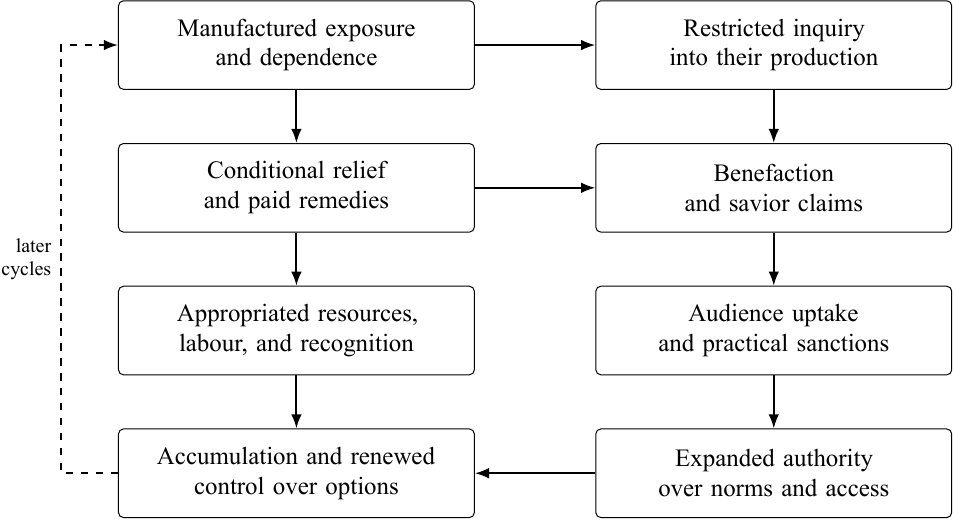
Exposure, alternatives, and continuity
The first component establishes the material relation that makes later relief consequential. A powerful actor contributes to a reduction in practical alternatives: independent income, access to education, safe residence, association, or control over shared resources. Dependence becomes especially consequential when the same actor controls a support that addresses the resulting need. The recipient’s alternatives then include accepting assistance on burdensome terms, pursuing a costly challenge, or suffering avoidable loss.
Causal involvement should be specified at the scale supported by evidence. An individual can directly obstruct an opportunity. A manager can maintain a rule introduced by a predecessor. Several institutions can jointly restrict alternatives through mutually reinforcing policies. The account of continuity must explain how later actors inherit control, resources, obligations, or benefits. Similar organizational names or social identities are insufficient to establish an unbroken causal or normative connection.
Vulnerability also develops over time. A person denied access to training may later have fewer employment alternatives; that reduced choice can increase the provider’s influence over future decisions. Conversely, an independent qualification or reliable outside support can weaken control. The mechanism therefore concerns changes in a relation’s capacity to shape future options, including changes that its participants only partially foresee.
Value extraction and the terms of relief
The extraction component explains how a produced vulnerability becomes a source of benefits for the actor who controls a response. The sequence can involve direct appropriation followed by a limited return, as in the opening example. It can also involve the repeated sale of a remedy, a labour commitment tied to support, or access conditional on information and publicity. The form of transfer and the advantage obtained must be specified for the particular relationship.
The distinctive opportunity arises when the provider helps determine both the person’s predicament and the terms on which relief is available. A commercial actor may reduce the availability of alternatives, influence the standard against which a person is judged, or organize an environment in which an otherwise optional commodity becomes important for participation. The resulting demand can be sincere and the benefit substantial. Those features explain the effectiveness of the transaction within the altered environment; they leave its production and terms open to evaluation.
Extraction can precede, accompany, and follow relief. Earlier appropriation can remove resources with which a person could obtain independent support. Payment for a remedy can transfer additional resources to the provider. Continuing dependence can then generate repeat purchases, work commitments, or endorsements. These temporal positions matter because a single receipt captures only one transfer. A judgment restricted to that receipt may overlook how the transaction rests on an earlier reduction in alternatives and helps sustain a later one.
The return may also cross value domains. A person can spend money to reduce exposure to social exclusion, devote labour to retain a supportive relationship, or surrender control over a personal account in exchange for access to a community. The recipient seeks belonging, security, or an opportunity for development; the provider can receive a financially or institutionally usable benefit. Identifying these exchanges requires tracing what each party contributes and obtains. Treating every item as an amount of money would obscure the relation being reorganized.
Several actors may occupy different positions in this sequence. An investor can fund the production of a standard, a retailer sell the remedy, and an intermediary police access to the audience whose recognition matters. Their coordination can be contractual, organizational, or mediated by shared rules and incentives. Attributing the whole sequence to a single firm requires evidence of that firm’s involvement; attributing it to a broader arrangement requires evidence of the links across participants. The mechanism gains explanatory precision through this differentiation.
A recurring relation can produce simultaneous gains on several sides. Recipients obtain useful objects and experience episodes of acceptance; providers receive revenue and favourable accounts of their role. The institutional question concerns whether these gains depend on maintaining the vulnerability and restricting alternatives to the provider’s route. Evidence that a service improves outcomes is therefore compatible with further inquiry into its role in reproducing dependency. Evidence that it expands effective alternatives would support a different diagnosis.
The feedback into power depends on the use of the extracted benefits. Revenue can finance further promotion, purchase distribution capacity, or strengthen control over venues of recognition. Endorsements can make the provider’s interpretation more credible. New control can make it easier to maintain the conditions of demand. These are proposed links in a possible accumulation process, each requiring evidence. Their separation explains how the production of vulnerability can become economically sustainable even when the initial plan was fragmented or the participants change.
Selective relief and public attribution
The attribution component concerns the classification of assistance. Relief can address an immediate need while leaving the arrangement that produces dependence substantially in place. A payment may meet current expenses while its provider retains discretion over future support. Training may improve skills while the institution restricts recognition of those skills elsewhere. Care can be valuable while access to information and relationships remains controlled. Selectivity here concerns the dimensions addressed, the beneficiaries reached, and the conditions attached.
Classification as benefaction depends partly on which history becomes available and salient. A provider can emphasize visible expenditure while obscuring the source of the money, present the recipient’s need as an intrinsic deficiency, or represent an existing obligation as voluntary sacrifice. The relief can have real usefulness, supplying material for an interpretation that exceeds what usefulness warrants.
For this purpose, the audience may be intimate or institutional: relatives, colleagues, officials, funders, or the recipient’s own network of advisers. Historical obstruction can help an audience accept the benefaction account by removing evidence needed to compare it with an account of repair. The provider’s prestige may also affect credibility, and the recipient’s reliance on support may raise the cost of supplying a correction. These are distinct causal routes that can reinforce one another.
The concept of normative debt reversal names a social reclassification: an actor with outstanding responsibilities becomes publicly treated as a creditor of gratitude or obedience, while the party holding claims is treated as morally indebted. The actual obligations require independent normative assessment. Reversal in the mechanism concerns their public representation and enforcement. This distinction preserves the possibility that a socially effective demand remains unjustified.
Audience uptake and renewed authority
The final component explains the transition from an evaluative claim to a reproduced relation of power. Audiences must do something consequential with the attribution. They might discourage complaints, withhold alternative support, defer to the provider’s decisions, or treat criticism as grounds for exclusion. The provider can then exercise greater discretion or face weaker constraints. Even a formally voluntary expression of gratitude may become a condition for social access when influential observers police its absence.
The recipient can retain critical private beliefs while these effects occur. An individual who recognizes the wrongful history may nevertheless lose allies or face disciplinary consequences. The mechanism can therefore operate through social enforcement alongside continuing resistance. Its strength depends on the audience’s influence, coordination, and access to competing accounts. Public praise without these practical consequences establishes a narrower reputational effect.
Schwabe’s analysis of gratitude in Machiavelli’s political thought already connects interpretations of beneficence with risks to liberty (Schwabe 2026). The particular connection examined here is between an actor’s responsibility for a need and that actor’s capacity to obtain authority through relieving it. The additional role of obstructed inquiry concerns how the relevant responsibility becomes difficult to establish or keep publicly salient.
Interruption can occur throughout the pathway. Relief may be transparently acknowledged as part of a continuing obligation. An independent archive may make appropriation visible. Audiences may appreciate assistance while supporting the recipient’s complaint. Alternative provision may remove the provider’s leverage. These cases delimit the proposed account. A useful explanation must identify the missing or weakened connection and permit a corresponding reduction in its diagnosis of the complete mechanism.
Salvific legitimation and claims of indispensability
The analysis of salvific legitimation distinguishes a claim of rescue from the narrower demand for gratitude. A savior claim represents an actor as the source of a restored or newly possible life, relationship, or community. Its political effect arises when that representation supports authority over the conditions through which such goods can be pursued. Commercial claims to create love, supply dignity, or make flourishing possible can take this form when they extend beyond a bounded claim about a product’s contribution.
The distinction expands the range of responses relevant to the mechanism. An audience may owe a provider no personal loyalty yet accept the provider’s continuing control as indispensable. Consumers may defend an institution’s right to set participation standards because they believe its products make social inclusion possible. Public authorities may protect its discretion on the assumption that reform would destroy the very benefits that vulnerable people need. The reproduced authority concerns who may define and organize access, as well as who receives gratitude.
The attribution can appropriate a jointly generated achievement. Workers produce a service, users create its practices, friends supply affection, and communities sustain recognition. A commercial intermediary may contribute infrastructure or design while representing itself as the author of the whole relational outcome. The problem is an unsupported expansion of credit with practical consequences: the contributions of others become less visible, and the provider’s preferred terms become easier to justify. A complete assessment retains both the intermediary’s contribution and the agency of those through whom the outcome acquires meaning.
The counterfactual implicit in rescue requires particular scrutiny. Compared with remaining in a condition of manufactured deprivation, the provider’s intervention may be highly beneficial. Compared with an accessible arrangement in which the provider had refrained from the wrongful contribution, the intervention can appear as an incomplete and conditional response. Selecting the first comparison and treating it as exhaustive allows the provider to claim indispensability on the basis of a predicament it helped produce.
Salvific legitimation also need not depend on a consciously fabricated story. Employees, recipients, and outside observers may sincerely interpret useful services as evidence of a company’s moral mission. Institutional incentives can reward and repeat that interpretation while discouraging inquiry into the need’s production. The relevant assessment concerns the evidence for the attribution, its omissions, and the authority secured through its uptake. Showing sincere conviction leaves these questions open.
Historical recoverability and the conditions of judgment
The epistemic argument specifies the form of power exercised through access to a relationship’s history. It distinguishes historical occurrence from recoverability, examines the resources needed for inquiry, and clarifies the limits of judging assistance through a present transaction. These distinctions explain how historical obstruction can support the mechanism without changing the underlying past.
Occurrence, evidence, and renewed inquiry
Historical recoverability denotes the practical possibility of returning to a relevant history with evidence, interpretive resources, and opportunities for challenge sufficient to investigate it. An event’s occurrence and an observer’s capacity to reconstruct it are different objects of assessment. Destroying a record changes what can be established through that record. The destruction leaves the earlier event’s occurrence unchanged while altering the conditions of later judgment.
This temporal distinction explains the importance of preserving a capacity for renewed inquiry. A person may acquire a vocabulary for describing an experience only after leaving a relationship. An institution may obtain relevant records after its initial review. New testimony can reveal an earlier pattern whose significance was difficult to recognize in isolation. A procedure that permits only an immediate, fully articulated complaint can exclude evidence whose intelligibility depends on such later developments.
Trouillot’s work establishes power within historical production as an antecedent to this inquiry (Trouillot 2015). The present formulation isolates a practical interest within that wider concern: maintaining the ability to investigate a history that bears on present claims of authority. Recoverability is consequently more demanding than the continued existence of a document. A record held exclusively by the party whose conduct is at issue may survive physically while remaining inaccessible to meaningful challenge.
Resources and standing for reconstruction
The analysis of reconstructive resources separates obstacles that can require different institutional responses. Evidence may be absent because events were unrecorded, records were lost, or witnesses became unavailable. Access may be restricted through ownership, expense, confidentiality arrangements, or selective disclosure. Interpretation may be impeded by unfamiliar technical categories or by a vocabulary that represents avoidable deprivation as a natural trait. Standing may be weakened when a person’s testimony is treated as inherently unreliable or when inquiry invites retaliation.
Several obstacles can occur without deliberate suppression. Resource constraints, administrative failure, and legitimate privacy interests can produce gaps. A judgment of culpable obstruction therefore requires evidence about control, feasible preservation or disclosure, competing interests, and the consequences that could reasonably be anticipated. The diagnostic value of a missing document differs from that of an instruction to destroy records after receiving a complaint. Both affect inquiry; the latter adds evidence relevant to responsibility for that effect.
The concept also separates a claimant’s entitlement to be heard from the truth of every claim advanced. Respect for epistemic agency calls for appropriate uptake, reasons for decisions, and opportunities to challenge adverse interpretations. These procedural commitments are compatible with testing chronology, corroboration, and alternative explanations. The credibility of an institution’s preferred account also requires scrutiny. Inquiry gains integrity through reciprocal evidentiary demands adjusted to actual access to information.
Historical obstruction can outlast direct dependence. A former employee may leave an organization while its archive determines how later employers understand the departure. An adult may gain material independence while family members continue to rely on an inherited description of earlier events. This persistence supplies a reason to examine the governance of records and interpretation as part of the relation’s continuing effects. Material exit and historical correction can follow different trajectories.
Observation windows and normative relevance
The observation-window argument clarifies the informational burden of judging relief. Consider two stipulated histories that end with the same visible delivery of a device. In the first, the provider wrongfully caused the injury and appropriated the funding. In the second, an independent supporter supplies the device from that supporter’s own resources after an unrelated accident. If the question concerns the provider’s outstanding responsibility, the histories warrant different answers under the normative premises adopted here. A record restricted to the delivery lacks the distinction needed to answer that question across both cases.
Appendix A expresses this point as a simple result about information loss. Its significance depends on identifying a justified historical distinction. A richer present record can include the relevant history. The argument therefore concerns the sufficiency of a specified representation; other present-based representations can contain the required information. Historical relevance also has limits: inquiry should track events that affect the need, resource provenance, outstanding obligations, or the justification of the authority being claimed.
When evidence supports several histories, responsible judgment can preserve uncertainty. Immediate assistance may be warranted by current need while responsibility remains under investigation. Institutional rules can permit provisional action and later correction, with appropriate protections for affected parties. Historical uncertainty warrants careful separation of decisions whose evidentiary demands differ. It supplies insufficient grounds either for declaring an alleged perpetrator innocent of every responsibility or for presuming guilt from the mere existence of an evidentiary gap.
The practical implication is a protected capacity to revisit consequential accounts. Records, testimony, interpretive assistance, and review procedures must remain available under conditions consistent with privacy and safety. That capacity limits a provider’s ability to settle the meaning of a relationship through a selectively presented moment of assistance.
Commercial histories and the naturalization of deficiency
The commercial extension examines how a produced need can come to appear as an original condition of the customer. Its method is to distinguish the history of a recognition standard from a present report of demand. A survey showing that customers urgently want a product can describe a real desire while leaving its formation unexplained. Where a provider helped make acceptance depend on the product, the history of that intervention bears on the interpretation of its later response.
The relevant archive includes more than individual transactions. Funding relationships, promotional decisions, changes in membership criteria, earlier representations of acceptable appearance, and accounts from people excluded by a standard can identify how the commercial environment was organized. These materials also permit rival explanations: a firm might follow a pre-existing convention, modify it, amplify it, or actively oppose its exclusionary consequences. Historical inquiry should discriminate among those possibilities and specify the causal role of the particular commercial contribution.
Naturalization occurs when a historically contingent requirement is represented as an inherent truth about the person. The claim that someone lacks an acceptable purchased signal becomes an account of that person’s basic unworthiness. A successful sale can then appear to remedy a personal defect, while the earlier imposition of the requirement becomes difficult to articulate. The epistemic loss concerns causal understanding and the capacity to imagine feasible alternatives to the prevailing standard.
An additional history concerns the outcome’s contributors. A promotional account may include the product and the customer’s transformation while omitting the partner, friends, workers, or community practices through which the product became meaningful. Recovering those contributions can correct an excessive claim to moral authorship. It also helps identify which capacities would remain available if the firm’s authority were reduced.
Commercial influence over interpretation can be challenged through public records, independent inquiry, and competing accounts. Physical survival of an advertisement by itself may provide little practical access to a pattern spread across time, venues, and audiences. Preservation needs to be coupled with the ability to connect the relevant material. The corresponding responsibility depends on actual control, foreseeable significance, and proportionate burdens of access, with privacy and legitimate confidentiality taken into account.
Partial relief, moral credit, and remaining obligations
The normative argument evaluates the transition from a useful act to a claim of moral authority. It first separates the dimensions of assistance, then states the premises concerning responsibility and equal standing, and finally examines gratitude and the completion of repair. The objective is to explain the defect in normative debt reversal while preserving the actual value of help.
Benefit, provenance, and remedial significance
The analysis of assistance distinguishes what an act provides from the responsibilities within which it occurs. An act may improve present welfare, use resources belonging to the recipient, fulfill part of an existing duty, express care, and leave serious losses unaddressed. These descriptions are compatible because they concern different features of the act.
In the opening example, A takes 100 units from B, spends 10 on the device, and retains 90. B’s cash falls by 100 units and B receives the device. A retains 90 units of appropriated money. This accounting locates the resources; it leaves open the device’s significance for B, the consequences of injury, and the obligations arising from appropriation. A purchase costing 10 units does not establish a 10-unit reduction in every remedial claim. Whether an expenditure can properly be credited toward a property-related obligation depends on authorization, the suitability of the response, and the applicable normative standard.
The term partial relief therefore remains deliberately neutral about discharge. Relief can contribute to repair when it addresses a warranted claim in an appropriate way. Restitution in a narrower sense concerns restoration, such as the return of property; reparation can encompass a wider range of responses. Providing an assistive device may help meet support needs while leaving the return of retained funds, acknowledgment of responsibility, and safeguards against further interference unresolved.
An assessment should describe remaining losses in their relevant dimensions. These may include bodily harm, control over resources, interrupted projects, damaged relationships, costs of inquiry, and continuing exposure to retaliation. Money can be a significant means of responding to several dimensions. The availability of money does not itself supply a justified conversion rate among them. Adequacy requires an account of the relation between a response and the claim it is intended to address, including the affected party’s circumstances and choices.
Normative premises and the authority inference
The argument concerning authority adopts equal moral standing and the accountability of consequential power as governing premises. A person’s need for support leaves that person entitled to consideration as a participant in decisions affecting important interests. Wrongful interference generates reasons for the responsible party to address its consequences. A response discharges those reasons only to the extent justified by what it actually addresses and by the conditions under which it is provided.
These premises support a constraint on the inference from relief to obedience. If A’s assistance partly responds to a need for which A is responsible, counting that assistance as a free-standing source of control risks allowing A to derive additional authority from the consequences of A’s own wrongful conduct. The inference omits a fact bearing directly on the act’s moral classification. It also changes the subject of justification: a reason to provide support becomes a purported reason for the recipient to surrender control over important options.
Neither transition follows from the benefit alone. To justify authority, A would need additional reasons specifying its scope, purpose, authorization, and accountability. An agreed role coordinating treatment can have such a justification. A demand for lifelong obedience based on the provision of a device lacks a comparable connection between the authority claimed and the recipient’s supported interests. The objection is particularly strong when the demand constrains the recipient’s ability to investigate or contest the history of the need.
A further consideration concerns incentives within the relation. Allowing wrongfully generated need to become a source of expanded discretionary authority would make the responsible actor’s position improve through a sequence that leaves the affected party with fewer effective options. This consequence reinforces the concern about equal standing. The argument does not depend on proving that A anticipated this advantage; the justification of the claimed authority can be assessed separately from A’s foresight.
The resulting principle is limited: useful relief, considered by itself, provides insufficient justification for discharging unrelated obligations, suppressing a complaint, or demanding deference. The principle permits recognition of a helpful act and authority supported by independent reasons. Its target is an inference whose evidential and normative premises leave the claimed conclusion unsupported.
Gratitude, acknowledgment, and remedial completion
The treatment of gratitude separates an emotional response, a judgment about conduct, and an enforceable claim. B may feel gratitude toward A for competent care, welcome the device, or acknowledge effort involved in providing it. Such responses remain compatible with judgments about appropriation and injury. A theory of justice should preserve B’s freedom to make these distinctions without requiring a prescribed emotional posture.
Even conduct within an existing duty can display attentiveness, skill, or personal concern that merits appreciation. Conversely, gratitude can be withheld for reasons that an observer cannot readily assess. The present argument does not offer a complete theory of gratitude’s fittingness. It identifies the additional justification needed to transform appreciation into a demand backed by control over care, livelihood, association, or speech. Scholarly concern with gratitude’s political effects already supports taking this transformation seriously (Schwabe 2026).
Repair can also reach a defensible point of completion. A responsible actor may acknowledge the history, provide appropriate redress, relinquish unjustified control, and submit remaining disputes to a fair process. The historical occurrence of a wrong then coexists with a judgment that specified obligations have been fulfilled. Preserving a record of that history supplies insufficient grounds for an unlimited continuing demand upon the actor.
Completion must nevertheless be assessed with attention to irreversible loss and competing interests. Some relationships cannot be recreated, and some projects have become unavailable. A fair settlement can establish practical closure without representing every consequence as undone. The affected party’s future agency includes the freedom to maintain distance, form new associations, or resume a relationship voluntarily. Forgiveness, reconciliation, and renewed trust have distinct conditions; a completed material obligation does not automatically establish any of them.
Paid remedies and the allocation of relational value
The extension to paid remedies evaluates a transaction that is useful, commercially authorized, and connected to the provider’s earlier wrongful contribution. The argument separates the comparison used to establish benefit, the obligations arising from that contribution, and the authority claimed over the value that the transaction helps realize.
Consider a variant of the opening example in which A causes the injury and then sells B an appropriate device at a price B can afford. The purchase may be reasonable compared with remaining injured and unsupported. Its reasonableness for B leaves open whether A should charge B to address a need for which A is responsible. Judgments of mutual advantage and judgments of the parties’ outstanding responsibilities answer different questions. An assessment of the whole relationship must keep both visible.
A suitable comparison therefore needs several points of reference. The present predicament identifies the urgency of relief. A justified counterfactual excluding the wrongful contribution identifies the relevant loss. A feasible arrangement of repair identifies ways to respond without renewing unjustified control. These comparisons serve different purposes. Choosing only the first can make almost any useful offer look generous after the person’s alternatives have been sufficiently reduced.
The resulting objection is stronger where an actor knowingly preserves the very condition that makes its remedy necessary. Under the premises of equal standing and responsibility for wrongful interference, the actor’s claim to returns requires scrutiny when those returns depend on continuing the interference or exploiting its consequences on unjustified terms. Fair compensation for a distinct contribution remains possible, but its basis must be separated from an advantage obtained through the wrongful production of need. This is a contextual constraint on a claimed entitlement, with the relevant baseline stated explicitly.
The commercial recognition case adds a further distinction between a commodity and a relational outcome. A firm can transfer an object, provide a venue, or arrange a service. Love, friendship, or belonging also depends on other participants’ choices and contributions. An exchange can legitimately support those relations while giving the seller limited authority over their meaning. The seller’s claim to own the social achievement or dictate its future terms requires additional justification.
This point applies even when a purchased object becomes deeply meaningful. The later emergence of that significance does not retrospectively establish that the firm was entitled to impose a harmful standard of worth. Likewise, a person’s continued attachment to the object need not require endorsement of the standard. Evaluating the historical production of vulnerability and preserving the person’s current values are compatible tasks.
Remedies should therefore avoid forcing a consumer to prove that a valued object was worthless before the surrounding arrangement can be criticized. The appropriate response may preserve possession, recognition of design and labour, and the freedom to enjoy the object while changing the conditions that made acceptance commercially conditional. Refunds or compensation can address particular burdens; broader changes may be needed where the wrong concerns exclusion, constrained association, or control over a shared norm.
The same analysis limits savior claims founded on corporate benevolence. Useful provision can warrant acknowledgment of a specified contribution. Authority over other people’s standing, accounts of their history, and future associations must be justified separately. The moral significance of help lies partly in the relations it supports and the responsibilities it addresses, with the agency of its recipients retained throughout the assessment.
Comparative applications and domain boundaries
The comparative analysis examines the proposed mechanism in family, employment, colonial, and capital-mediated consumer settings. Each vignette stipulates relevant facts to test conceptual coherence and identify evidentiary requirements. The examples support conceptual comparison; empirical prevalence remains a separate question. Table 1 summarizes the institutional differences that constrain comparison. The fourth case examines the manufacture of insecurity about love and belonging, its commercial exploitation, and the provider’s claim to create the goods it makes conditionally accessible. The final subsection tests the distinction between this configuration and other forms of market participation.
| Domain | Controlled supports | Historical inquiry | Authority and agency |
|---|---|---|---|
| Family | Housing, education, care, access to independent resources | Personal records, financial provenance, relatives’ accounts | Developmental responsibilities, attachment, supported choice |
| Employment | Income, training, references, access to professional networks | Personnel records, resource decisions, independent testimony | Organizational coordination, representation, exit, review |
| Colonial administration | Land, public revenue, infrastructure, access to services | Administrative archives, local testimony, financing and labour records | Political standing, collective self-government, institutional continuity |
| Capital and consumption | Access to status-bearing goods, visibility, membership, and financed consumption | Commercial production of norms, promotional funding, prior messaging, and participant contributions | Control over recognition standards, commercial dependence, and claims of rescue |
Family provision and developmental authority
The family vignette tests the distinction between unavoidable developmental dependence and the avoidable restriction of future agency. Suppose a parent repeatedly prevents an adolescent from accepting accessible educational opportunities, restricts contact with potential mentors, and controls money held for the adolescent’s benefit. After the adolescent becomes an adult with limited alternatives, the parent provides housing using part of those funds. Relatives are told that the adult’s dependence reflects personal incapacity and that continued support warrants obedience over employment and intimate relationships.
The relevant manufactured element is the stipulated obstruction of opportunities and independent resources. Ordinary childhood dependence provides the background against which responsibilities arise. The causal inquiry would examine which opportunities were feasible, the reasons for earlier restrictions, the provenance of funds, and the role of other circumstances. A parent may have reasonable grounds to reject a particular opportunity. Establishing wrongful restriction requires attention to developmental interests, available information, and proportionate protection.
The epistemic element arises if the parent prevents access to records, discourages corroborating testimony, or makes the adult’s request for inquiry a condition of continued family membership. Relief becomes a means of debt reversal when its public classification obscures those contributions and relatives enforce the resulting obedience claim. The adult may still value the housing and love the parent. Those attitudes leave the causal and normative questions open.
Care also imposes real burdens on providers. Assessment should recognize their need for rest, resources, and reasonable boundaries. Supporting the recipient’s agency may require distributing care more fairly across a wider network. The response suggested by the mechanism is access to resources, independent advice, and a meaningful voice over future arrangements. Its success depends on the affected person’s supported choices, which can include continuing a valued family relationship.
The family case also demonstrates extraction across different dimensions of value. Suppose the adult’s access to housing is made conditional on extensive unpaid service, public praise, and relinquishing a chosen relationship. The parent then obtains labour, reputational support, and influence over future associations. Each demand requires an independent account of its justification. Fair participation in shared household work can be reasonable; using responsibility for the adult’s constrained position to secure disproportionate control creates a different normative problem.
The parent’s savior claim can also extend beyond reimbursement or gratitude. By claiming to have made the adult capable of a worthwhile life, the parent can claim privileged authority to define which future is worthwhile. The adult’s achievements become evidence of the parent’s indispensability, while disagreement is interpreted as a failure to understand that dependence. Repair must address this attribution where it has practical effects. It should recognize the adult’s contribution to development and preserve a supported ability to make choices that the parent would reject.
Employment, sponsorship, and institutional records
The workplace vignette examines the interaction between organizational authority and control over professional alternatives. Anderson’s account of employment as private government provides a relevant orientation to authority within the employment relation (Anderson 2017). The following example is a separate analytical construction, with workplace rules stipulated for the purpose of the argument.
Suppose an organization assigns a worker to duties that prevent access to promised training, repeatedly blocks applications for external professional opportunities, and records the resulting limited experience as evidence of low potential. A manager later offers a small training allowance drawn from a budget already allocated to that worker. The manager publicizes this as exceptional sponsorship and invokes it to demand unpaid availability and silence about the earlier decisions. Colleagues who control recommendations accept the sponsorship account and penalize the worker’s objections.
The proposed mechanism requires more than dissatisfaction with promotion. Inquiry would need to establish the relevant commitments, decision-making authority, feasible alternatives, actual allocation of funds, and the connection between objections and adverse consequences. Legitimate coordination can constrain schedules, and scarce training may require fair selection. The vignette stipulates a wrongful pattern so that the subsequent classification of relief can be examined clearly.
Personnel records matter because they can transform a restriction produced by organizational decisions into an apparently independent judgment about the worker. Correcting the record addresses that epistemic effect; access to transferable qualifications and independent references addresses the continuing material dependence. An employer’s useful investment can merit appropriate recognition while leaving earlier commitments and fair working terms fully relevant. An account of sponsorship becomes dominating when its practical enforcement enlarges discretion over the worker’s options without adequate justification or challenge.
The extraction in this example is organizational as well as interpersonal. The worker supplies output and additional availability while the manager obtains evidence of successful sponsorship. If the worker succeeds, the organization can appropriate credit for a trajectory that the worker’s own effort and outside relationships helped make possible. If the worker struggles, the record can attribute the result to individual deficiency and justify further dependence on supervision. These interpretations require separate support; an explanation that protects the sponsor under every possible outcome would make its central claim resistant to correction.
A matched comparison helps identify the distinctive mechanism. An organization could provide the same allowance, acknowledge the earlier obstruction, permit independent certification, and protect the worker’s choice of future employer. The immediate financial transfer would remain similar while the relation’s consequences for voice and mobility would change. This comparison directs inquiry toward control over the worker’s developing capacities and the attribution of their achievement, alongside the amount spent on training.
Colonial administration and claims of improvement
The colonial vignette tests the mechanism at a scale involving collective agency, public institutions, and historical continuity. Lu’s work places colonial legacies within an account of structural as well as interactional injustice (Lu 2017). This orientation supports attention to institutional relations extending beyond a transaction between individuals. The constructed case makes the relevant connections explicit without claiming to represent every colonial history.
Suppose a colonial administration appropriates land, redirects public revenue, and constrains local governance in ways that undermine existing means of subsistence. It subsequently builds a water system financed partly through taxes imposed on the affected population and labour supplied under coercive conditions. The system delivers real public benefits. Administrative accounts foreground its construction, minimize the earlier dispossession and local contributions, and represent the population’s dependence as evidence of an enduring need for external rule.
The mechanism concerns the conversion of selected improvement into a justification of political subordination. Assessing that conversion requires an account of the resources and labour used, the opportunities foreclosed, the feasible alternatives, and the population’s participation in determining priorities. A construction ledger alone would provide a limited observation window. So would an account that erased the actual usefulness of the water system or the agency of people who adapted and maintained it.
Collective agency complicates the comparison. Local populations contain different interests, institutions, and distributions of benefit and burden. Some participants may support a project while opposing the authority claimed through it. Administrators can disagree, and later institutions may inherit only some responsibilities or resources. Research must specify the relevant groups and forms of continuity. Responsibility cannot be transferred across generations solely through resemblance or collective identity.
The distinctive normative stakes include political standing, land relations, and the capacity for collective self-government. A household model of paternal care would obscure those stakes. The transferable feature is the interaction between produced dependence, restricted historical judgment, and an authority claim grounded in selective relief. Independent archives and public acknowledgment can improve historical inquiry, while institutional change and control over resources address the power exercised through that history. Each requires forms appropriate to the particular political setting.
In this vignette the water system can also carry extraction forward. Suppose access charges and compulsory work obligations direct additional resources to the administration, while access to alternative supplies remains restricted. The project then provides a benefit and organizes continuing transfers under conditions shaped by the earlier dispossession. The historical account must include the relation between those transfers, the project’s actual costs, and the public’s capacity to govern it.
The savior claim becomes a claim about political competence: the administration represents its contribution as evidence that the population depends on external authority for organized life. That inference can obscure the knowledge, labour, and collective decisions through which the infrastructure functions. Recognizing a useful technical contribution leaves the justification of political rule to a further argument. Neither participation in maintaining a project nor appreciation of its benefits settles the population’s claims concerning self-government.
Capital, manufactured inadequacy, and commercial salvation
The capital case examines the production of a commercially remediable deficiency in the domain of love and belonging. Its analytical function is to show how symbolic standards and economic organization can perform roles otherwise occupied by direct authority or coercive control. The case distinguishes the production of vulnerability, extraction through its remedy, and the appropriation of moral credit. The stipulated configuration concerns a commercial arrangement; an actual application would need to identify the actors and evidence for each connection.
The luxury and romantic-recognition vignette
The constructed setting concerns a network of commercial actors organized around luxury goods and social visibility. Suppose a firm finances messages that associate ordinary appearance and modest consumption with a deficient capacity to attract love. Its sponsored venues and intermediaries reinforce the association by treating branded display as evidence of being an acceptable partner or desirable community member. Members of the relevant social network adopt these standards and impose real costs of exclusion on people who fail to meet them.
The firm then sells objects, memberships, or presentation services as routes to confidence, belonging, and romantic recognition. Some customers receive more favourable treatment after purchase. The objects can also be well-crafted, aesthetically satisfying, and meaningful gifts. The firm advertises these gains as proof of a mission to create love and restore people’s dignity. A company-funded inclusion programme presents selected recipients as people whose lives became worthwhile through its intervention. These details are assumptions of the vignette, with each commercial and social connection open to empirical testing elsewhere.
The initial injury in this account concerns the imposed conditions of recognition and the resulting exposure to humiliation or exclusion. A person’s moral worth remains independent of commercial recognition. The analogy with the assistive-device example identifies a shared causal structure while preserving differences in the kind and severity of harm. It also distinguishes a claim to equal standing from an entitlement to any particular person’s romantic affection. The latter person’s freedom of association remains part of the normative baseline.
Manufactured deficiency and the conditions of acceptance
The production analysis identifies the change that makes the offered remedy consequential. The firm’s conduct helps transform a difference in consumption into a purported defect in the person. A preference for an object becomes linked to whether someone qualifies for ordinary recognition. Where the relevant audience enforces that linkage, the consumer faces a socially produced obstacle to participation as well as a subjective comparison.
Richins’s research offers a limited antecedent for one part of this process: its reported findings connect idealized advertising images with comparison standards and satisfaction with physical attractiveness among young women (Richins 1991). The full vignette requires further claims about commercial involvement, social enforcement, dependence, and legitimation. Those claims are stipulated here and require their own evidence in an empirical study.
The relevant counterfactual retains people’s capacity to enjoy fashion, choose partners, and develop shared symbols. It removes the wrongful commercial contribution to exclusion and the restrictions that make a provider’s remedy practically necessary. The comparison therefore concerns the organization of recognition, with consumers’ reflective preferences and third parties’ liberties included. Differences in taste can remain without making a person’s standing conditional on a commercial gatekeeper’s approved form of self-presentation.
Paid remedies and recurrent extraction
The extraction analysis follows the resources and commitments mobilized by the manufactured deficiency. Customers pay to reduce exposure to rejection; they may also supply attention, accounts of personal transformation, and participation that increases the network’s attractiveness to other users. The firm receives sale revenue and material for promoting its interpretation of the outcome. Contributors can receive genuine benefits while the terms of access continue to direct a disproportionate advantage to the provider.
Recurring standards can make the response provisional. In a further stipulated variant, the firm repeatedly revises the approved signals of desirability, making earlier purchases less effective as markers of belonging. Customers must then commit further resources to preserve the recognition they have gained. Revenue finances further promotion and control of venues, which can strengthen the ability to set the next standard. The resulting feedback explains a possible relation between manufactured insecurity and accumulation without assuming that every changing fashion has that effect.
When purchases are financed through credit, an additional relation requires examination: a remedy sought for social vulnerability can generate financial dependence. The relevant evidence would concern affordability, contractual terms, the provider’s role, and available alternatives. The causal account must keep these matters distinct from the symbolic pressure itself. Either may be present without the other, and their interaction can impose burdens that a description of the purchased object misses.
Historical interpretation and the savior position
The interpretation analysis examines the point from which the firm tells the customer’s story. A narrative beginning with an insecure person and ending with successful consumption makes the product appear to answer an independent need. The earlier production of the comparison standard, the funding of its circulation, and the exclusion of alternative routes can disappear from view. Access to promotional archives, institutional decisions, and participants’ accounts is therefore relevant to assessing the apparent rescue.
The stronger claim concerns authorship of the resulting love or belonging. Affection depends on other people, shared histories, and continuing acts of care. The firm’s object or service can contribute to that relation while the claim to have created it as a whole overstates its role. Publicly treating the firm as a savior can displace participants’ contributions and support the firm’s authority to prescribe the conditions of a successful life. Criticism of its standards can then be characterized as opposition to confidence, inclusion, or love itself.
The funding of an inclusion programme introduces a related attribution question. Customer payments, workers’ efforts, and the firm’s allocation of revenue can all contribute to its resources. These contributions should be traced without equating authorized purchases with the wallet’s outright appropriation. The common concern is whether the provider converts a selective use of resources from an extractive arrangement into a claim to unqualified moral authorship, while leaving its contribution to the need outside the account.
Distributed capital and the durability of control
The scope analysis identifies the form of domination that the case requires. A consumer may be able to change brands while remaining exposed to a shared rule that acceptance must be purchased through approved consumption. Competition between sellers can coexist with that rule when institutions and audiences continue to enforce it. A durable restriction on significant options may therefore operate across an arrangement even where a single firm has limited power over an individual customer.
Such a diagnosis requires identifying the arrangement’s enforcement and the available means of contesting it. If customers can reject the standard without substantial loss, maintain independent relations of recognition, and influence the terms of participation, the case for domination weakens. Where refusal predictably endangers important social access and effective challenge is blocked, the combination of symbolic and economic power becomes more substantial. This distinction concerns effective options and institutional accountability, with effects assessed at the appropriate individual and collective scales.
Market influence and the threshold of domination
The market boundary clarifies the evidence needed to move from influence over preferences to the mechanism described here. A seller may cultivate a sense of inadequacy and offer a product as its remedy. Symbolic recognition, aesthetic pleasure, and participation in a valued practice can nevertheless provide real benefits. Socially constituted value remains a possible object of informed choice.
An advertisement’s influence alone establishes neither an attributable wrongful exposure nor durable control over important options. Application of the full mechanism would require additional evidence: consequential restriction of alternatives, control over inquiry into the relevant need, misclassification of relief, and effective enforcement of a resulting authority claim. Some harmful marketing practices may be better explained through deception, exploitation, or unequal bargaining power. Maintaining this threshold protects the present theory’s explanatory specificity and leaves room for subjects to endorse socially mediated desires.
Repair, institutional responsibility, and future agency
The account of repair derives practical implications from the interaction between material control and historical obstruction. It considers immediate security and inquiry, the allocation of responsibilities, and the evaluation of future possibilities. The proposals are normative design considerations; their institutional form requires adaptation to the relevant domain, resources, and applicable authority.
Material security and independent inquiry
The first design concern is the relation between receiving support and challenging the provider. Where raising a complaint threatens access to essential assistance, a formally available review process may have little practical value. Measures that preserve necessary provision during a dispute can reduce this dependence. Depending on the setting, these may involve an alternative provider, an independently administered fund, representative support, or a protected transfer of records and services.
The justification for immediate assistance should be distinguished from the justification for assigning final responsibility. Current need can warrant provisional support while the cause and distribution of liability remain contested. This separation avoids making historical reconstruction a precondition for meeting urgent needs. It also permits later allocation of costs through an appropriate process. A provisional arrangement must explain its funding, scope, duration, and review conditions so that uncertainty does not become an indefinite and unaccountable exercise of power.
Historical inquiry requires protected access to relevant material and competent interpretation. Appropriate measures can include preservation of records, disclosure to an independent reviewer, assistance with technical documents, opportunities for testimony, and reasons for consequential findings. The design should prevent exclusive control by the party whose conduct is under examination. Independence concerns incentives, appointment, information access, and the capacity to challenge findings; the label alone offers limited assurance.
Disclosure also has costs. Affected people may face renewed exposure, retaliation, or loss of privacy. The UN Basic Principles on Remedy and Reparation identify several forms of reparation and expressly qualify public truth disclosure by reference to possible further harm and safety (United Nations General Assembly 2005, annex, paras. 18–23). That instrument concerns gross human rights violations and serious humanitarian-law violations. It provides a domain-specific illustration of combining remedial dimensions with safeguards for disclosure; its provisions are not asserted here as universally applicable rules for families or workplaces.
The mechanism suggests a coupled design principle. Resources can make inquiry practically possible, and inquiry can clarify the purpose and conditions of resources. A payment that leaves the provider free to retaliate against historical questions can preserve an important part of the relation. An accurate account that leaves the claimant dependent on hostile discretion can do the same. The extent of coordination required should follow the specific links established in the case.
Responsibility, continuity, and shared institutions
The allocation of responsibility separates causal contribution, culpability, legal liability, and forward-looking political responsibility. An actor may have contributed to a condition without acting culpably; a legal duty depends on the relevant legal standard; a participant may have reasons to help change an unjust structure without having caused the initiating harm. Young’s social connection account provides a basis for distinguishing political responsibility concerning structural injustice from an exclusively blame-based model (Young 2011).
Within the proposed mechanism, direct perpetrators have reasons to address wrongful interference attributable to them. Actors who control relevant records may have preservation and disclosure responsibilities arising from that control. Institutions that knowingly enforce an unsupported obedience claim may bear responsibility for their contribution to continuing domination. Other participants can have responsibilities to help establish fair alternatives where their positions provide capacity and connection. Each assignment needs a stated basis and proportionate scope.
Institutional continuity requires particular care. An organization may retain assets, authority, records, and obligations across changes in membership. The retention of these elements can support reasons for institutional repair while leaving individual culpability differentiated. Conversely, the dissolution of an institution can make a direct remedy difficult without eliminating current needs or reasons for collective action. The relevant analysis traces the continuities that actually exist and the authority under which a response could be organized.
Audiences also have a role. A relative, colleague, or public body that withdraws support from a claimant solely because the provider performed a useful act may help enforce the debt reversal. A proportionate corrective response can include withdrawing that sanction, revising an account, facilitating independent review, or restoring access to an opportunity. The aim is accountable correction. Public accusation without adequate grounds can create fresh harms and impair the quality of inquiry.
Baselines, generativity, and chosen futures
The evaluation of repair distinguishes a historical comparison from a desirable future arrangement. A counterfactual without the wrongful interference can help identify losses. A return to the exact prior state may be infeasible, and that state may already contain injustice. The remedial baseline should therefore combine a reasoned account of the relevant interference with present needs, fair institutional conditions, and the affected party’s choices.
Generativity names the capacity of a relationship or arrangement to support further action, learning, association, and the formation of projects. Its normative relevance lies in the person’s ability to shape a future whose content remains partly open. Restored access to education can enable several possible paths, including a decision to pursue an unforeseen vocation. Safe housing can create room for rest and recovery. Money can expand choices when the recipient has meaningful control over its use.
The value of these possibilities is constrained by equal standing. The objective cannot be reduced to maximizing productivity, income, the number of projects completed, or the social prestige of their outcomes. A person requiring lifelong care has a claim to respect and appropriate support independently of projected economic contribution. Rest, withdrawal, and changes of aspiration can express agency. A remedy designed around an institution’s preferred productive future risks reproducing control through its own account of improvement.
Assessment should consequently describe what a response secures and what remains unresolved. Relevant questions concern security of provision, effective voice, access to historical inquiry, freedom of association, and the possibility of revising arrangements. Where a relationship continues, its terms should permit meaningful challenge. Where a person chooses to leave, continuity of essential support may be necessary to make that choice practical. The success of repair lies partly in removing the need to purchase future agency through loyalty to a former source of harm.
Commercial accountability and collective alternatives
The commercial application translates the repair argument into the conditions of recognition and access examined in Section 7.4. Its objectives are to reduce the exposure created by exclusionary standards, make the history and funding of those standards investigable, and limit unsupported claims to control over relational outcomes. The appropriate institutional response depends on the arrangement’s actual sources of power.
Individual information can help where a consumer has effective alternatives. It may have limited force where refusal brings social exclusion that an individual cannot readily change. Collective alternatives then become relevant: independent venues of association, participation rules open to challenge, and forms of recognition whose availability is less dependent on prescribed purchases. Their purpose is to expand practical options and the ability to shape shared norms. Participants should retain scope to enjoy commercial goods and decide which meanings to attach to them.
Accountability for value extraction requires identifying the benefits and burdens at each stage. Charges, commitments, and conditions of access should be assessable in relation to the provider’s contribution and the need’s production. Where an arrangement relies on users’ stories or labour, control over that participation also matters. A recipient’s access to essential support or an earned entitlement should be protected against pressure to provide a celebratory account of the provider’s moral role. Appropriate remedies may include correction, compensation, changes to conditions, and alternatives to continued participation.
The attribution of collective achievement requires a parallel response. Providers can receive credit for design, resources, and coordination while workers, recipients, and communities retain acknowledgment of their own contributions. Public descriptions should specify what an intervention made possible and the evidence for that claim. Where a savior narrative obscures an established contribution to harm, corrective acknowledgment should connect the helpful act with that history and its remaining responsibilities.
These measures depend on institutional capacity and can themselves become sources of exclusion. A reviewer or regulator claiming exclusive authority to define authentic love or legitimate taste would reproduce the problem at a different site. Governance should address demonstrable interference, unjustified terms, and blocked contestation while preserving plural forms of association. The relevant achievement is an expanded capacity to pursue valued relations without making their recognition dependent on an unaccountable provider’s preferred account.
Explanatory limits, objections, and empirical inquiry
The assessment of limits examines the theory’s explanatory value, the role of consent and uncertainty, and the evidence needed for application. These tests delimit the conclusions established through conceptual argument and the further claims that would require empirical investigation.
Explanatory specificity and counterexamples
The objection from redundancy concerns whether a separate mechanism adds anything to established accounts of domination, structural vulnerability, silencing, and gratitude. The combination of familiar elements alone gives limited reason to retain a new analytical category. Its value depends on specifying interactions that affect explanation and intervention.
The present account identifies such an interaction: control over inquiry can change the practical classification of assistance from a response to responsibility into a source of authority. It distinguishes the audience’s acceptance of that classification from its enforcement and connects both to future dependence. This separation supports interventions whose success can be examined link by link. An accurate historical account, for example, may have limited effects while access to support remains conditional on loyalty. Independent support may reduce leverage even before an audience revises its historical interpretation.
Counterexamples constrain the scope. A wrongdoer who provides accountable repair without obstructing inquiry exhibits a relevant history of harm and assistance, while lacking the complete reproductive pathway. An independent rescuer may demand excessive loyalty while having played no role in the original need; this is a related problem of domination through aid. An institution may openly acknowledge its harmful history while audiences still endorse its authority. In that case, historical concealment has limited explanatory force, and the inquiry should examine the audience’s normative commitments or material interests. The proposed mechanism should yield to those alternative explanations where the evidence supports them.
Consent, proportionality, and uncertainty
The consent objection concerns recipients who knowingly accept assistance from an implicated provider. Their decisions deserve serious consideration. An agreement can be reasonable given the person’s objectives, including a desire to preserve a relationship. The fact that a provider has acted wrongfully does not invalidate every later agreement by definition.
Assessment must nevertheless specify what the agreement authorizes. Consent to receive a device can establish permission to deliver it while leaving claims about appropriated funds unresolved. A settlement can address those claims if its scope, information, alternatives, and decision conditions justify that effect. An observer cannot infer a comprehensive waiver from acceptance of needed help alone. This requirement protects the intelligibility of the recipient’s actual choices, including carefully limited compromises.
Proportionality also limits retrospective inquiry. A complete history of a life or institution would impose excessive demands and include much that is irrelevant to the present decision. Investigation should identify the causal and normative connections at issue, consider the likely value of additional evidence, and account for burdens on participants. A reasoned endpoint for an inquiry can coexist with mechanisms for reconsideration when material new evidence emerges.
Uncertainty warrants calibrated conclusions. A finding that an institution restricted access to records may be stronger than a finding that it caused the underlying harm. A finding of causal contribution may be stronger than an inference of deliberate orchestration. Reporting these differences helps avoid allowing the coherence of a narrative to substitute for support at each link.
Evidence, rival explanations, and research design
Empirical inquiry into the mechanism would require a temporally ordered account assembled from multiple sources. The first task is to identify the specified exposure and the actor’s contribution. Relevant material could include resource allocations, earlier commitments, feasible alternatives, decision records, and testimony from differently situated participants. Evidence of subsequent relief then requires attention to its funding, conditions, distribution, and actual usefulness.
The epistemic links require separate observation. Researchers would need to establish who controlled records, how access changed, which interpretations were promoted, and how challenges were received. The link to authority requires evidence that audience uptake affected sanctions, institutional discretion, or access to alternatives. Public gratitude by itself measures none of these effects reliably. Chronological sequence can support inquiry without establishing causation.
Comparisons should include interrupted and absent pathways. Cases with similar needs and assistance but different access to records can help assess the role of historical inquiry. Changes in independent support can help examine material leverage. Rival explanations include benevolent misunderstanding, scarcity, administrative error, legitimate coordination, and pre-existing audience loyalty. The strength of an inference depends on whether the available evidence discriminates among these possibilities.
Research access can itself reproduce asymmetry when institutions supply the dominant archive or condition contact with recipients. A credible design should document these restrictions, protect voluntary participation, and report missing perspectives. The present article supplies distinctions and questions for that work. Its stipulated examples establish conceptual possibility and argumentative consequences; the prevalence and comparative importance of the mechanism remain open empirical matters.
For the capital case, a useful research design would separate the production of insecurity from the later sale and interpretation of relief. Evidence could concern changes in comparison standards, the funding and distribution of messages, the conditions of membership, the costs of refusal, and the allocation of revenue and credit. A rise in sales alone would support a claim about demand while leaving the production and wrongfulness of the relevant vulnerability unsettled.
The account should also distinguish firm-specific influence from a shared commercial standard. Substitution between brands can coexist with continued dependence on the wider standard, while strong alternatives outside that standard can reduce domination. Comparing these possibilities requires evidence about the relevant audience’s conduct and the actual opportunities available to participants. Corporate rhetoric should likewise be compared with audience responses: a claim to create love acquires the proposed legitimating effect only when it changes judgments or practices concerning the provider’s authority.
Conclusion: historical accountability and supported agency
The concluding argument brings the mechanism and its normative implications together. The article has examined a configuration in which an actor’s contribution to vulnerability, extraction through the terms of relief, control over historical inquiry, and claims of rescue jointly support a continuing relation of domination. The configuration depends on audience uptake and its practical enforcement; its elements can also appear separately or fail to produce the predicted effect.
The central distinction concerns the value of assistance and the authority claimed through it. A useful act can address a present need while leaving responsibilities outstanding. When the history of that need is difficult to investigate, the act can acquire a public interpretation that displaces those responsibilities and represents the claimant as indebted. The historical wrong remains a distinct object of judgment even when its social representation changes.
This account makes historical recoverability a practical concern of justice. Evidence, interpretation, and standing determine whether consequential accounts can be revisited. Their protection belongs alongside material security and accountable authority. The family, workplace, colonial, and capital comparisons show how the same proposed connection requires different institutional specifications. The capital case makes especially visible the interaction between the manufacture of inadequacy, commercial extraction, and the appropriation of credit for relational achievement.
The savior position extends beyond an expectation of gratitude. It can represent the provider as indispensable to love, dignity, or collective flourishing and thereby support control over their conditions of access. Examining that claim requires attention to the histories of the need, the actual contribution of the provider, and the agency of others through whom the valued outcome emerges. A useful commodity can remain valuable while the surrounding account of responsibility and authority is corrected.
Repair should expand the affected party’s capacity to investigate the past and shape future associations. It can acknowledge real assistance, permit gratitude, recognize appropriate completion of obligations, and preserve room for ambivalence. Its direction is supported agency under conditions in which care, livelihood, and public standing remain open to fair challenge. The theory’s further development depends on full engagement with adjacent scholarship and evidence capable of testing the separate links identified here.
Information constraints in historical judgment
This appendix formalizes the informational distinction used in Section 5. It states a result about a restricted observation window and a result about the loss of distinctions through coarsening. Both are elementary consequences of the definitions. The substantive work lies in defending which historical distinctions matter normatively and in showing how access changes in actual institutions.
Restricted observations and normative distinctions
The first construction specifies the information available to an evaluator. Let
Proposition 1 (Insufficient observation). If histories
Proof. The common observation gives the same output under
Proposition A.1 applies to the paired device histories only after accepting the premise that the provider’s responsibility differs. A richer observation can encode that difference. The result supplies a test of representational sufficiency and makes no claim that a complete history is required for every decision.
Coarsening and compatible histories
The second construction isolates the loss of information through a deterministic observation channel. Let
Equation 1 models a restricted form of evidentiary loss. Selective disclosure may fit this structure when it discards distinctions without adding evidence. Fabrication, changes in credibility, and strategic interpretation require richer models. The construction supplies neither a probability of guilt nor a numerical measure of epistemic harm. Decisions under uncertainty must additionally specify evidentiary standards and the costs of error, while urgent support can remain justified on independent grounds.