Factual Governance and Jurisprudence in Public Knowledge
Transcript
Abstract
Public knowledge is constituted through relations that extend beyond the categories ordinarily recognized by legal rights and legal adjudication. Questions concerning provenance, historical priority, attribution, recognition, authorship, modification, responsibility, and social status may have significant consequences for the production and circulation of knowledge while remaining only partially operable through conventional legal mechanisms. This work develops a framework for factual governance in public knowledge by distinguishing the heterogeneous kinds of facts that arise within public epistemic fields and examining their different conditions of formation, persistence, revision, contestation, and institutional constitution. The analysis develops a fine-grained taxonomy of material, event, historical, provenance, recognition, social, institutional, and legal facts, together with a comparative account of their properties and relations. Particular attention is given to the distinction between historical occurrence and evidentiary reconstruction, the persistence of provenance under waiver or denial, the formation of social facts through recognition and repetition, and the interaction between public factualization and jurisdiction-specific legal facts. These distinctions support a governance-matching principle according to which modes of governance should correspond to the type, characteristics, generative field, and institutional constitution of the factual relations concerned. For disputes whose relevant relations remain outside effective legal operability, the work develops an account of public factual governance based on evidence, contestability, provenance preservation, correction, and informational enforcement within the public knowledge field itself. For disputes involving legal facts, public factual governance and legal governance are treated as distinct but interacting domains with different competencies, temporalities, remedies, and forms of authority. The work further examines provenance usurpation, historical priority, founderhood, relational dissociation, recursive openness, manifest revision, and the design of public-knowledge licenses. At the institutional level, the work envisages a voluntary transnational public-knowledge governance organization through which participating institutions may adopt common evidentiary and procedural standards, submit factual disputes to independent review, recognize public epistemic findings, and undertake appropriate corrective actions within the records and infrastructures they maintain. Such an arrangement provides a model of associational governance whose authority arises from voluntary participation, procedural legitimacy, shared standards, and distributed implementation. The final parts consider machine-readable provenance, AI-mediated recursive knowledge production, and a generative relational jurisprudence capable of connecting openness, historical integrity, public contestability, and institutional revisability within transnational public knowledge.
Keywords: public knowledge; factual governance; jurisprudence; provenance; social facts; public epistemic governance; public contestation; epistemic adjudication; transnational governance; knowledge licensing
Research Monograph Note
This monograph is a foundational and exploratory inquiry into factual governance and jurisprudence within public knowledge. Its central concern is the formation, persistence, representation, contestation, revision, and governance of facts that acquire practical significance within public epistemic fields.
The inquiry begins from a problem that extends beyond conventional questions of intellectual property and public licensing. Public knowledge is produced, circulated, interpreted, attributed, modified, institutionalized, and reused through heterogeneous relations. Some of these relations are recognized by existing legal systems. Others remain historically, socially, epistemically, institutionally, or relationally significant while possessing only partial or indirect legal operability.
Questions of historical priority, provenance, attribution, authorship, recognition, founderhood, modification, endorsement, responsibility, public representation, and institutional status can influence the development of a field even where conventional legal adjudication provides only limited means for governing the relevant relation. A dispute can therefore possess important factual consequences without corresponding neatly to an enforceable legal claim.
The monograph develops factual governance as a broader analytical field for examining this condition. Factual governance concerns the processes through which factual relations are identified, reconstructed, represented, contested, corrected, stabilized, revised, and institutionally mediated. The concept includes legal governance where legal facts and legally cognizable relations are involved. It also includes forms of public governance that operate through evidence, records, attribution practices, correction, annotation, public findings, institutional standards, metadata, visibility, and other mechanisms through which public factual relations are maintained.
The argument therefore begins from the heterogeneity of facts. A historical fact, a provenance fact, a recognition fact, a social fact, an institutional fact, and a legal fact can possess different conditions of existence and different modes of persistence. They can also respond differently to individual will, collective recognition, institutional action, jurisdiction, evidence, waiver, assignment, correction, and subsequent discovery.
This distinction is particularly important for historical and provenance relations. A past event, once it has occurred, possesses a historical persistence that cannot ordinarily be altered through the later preference, denial, waiver, or self-description of one participant. A person may decline to claim recognition associated with an event. The same person may decline to capitalize upon historical priority, may refuse founder status, or may permit unrestricted subsequent use of an idea. These choices concern subsequent normative, legal, social, and recognition relations. They do not themselves alter the prior event.
The monograph accordingly distinguishes an historical event from the present epistemic reconstruction of that event. Historical reality and present historical judgment occupy different analytical positions. A past event does not change when new evidence appears. The evidentially warranted account of that event can change. Historical inquiry therefore combines persistence at the level of occurrence with revisability at the level of evidentiary reconstruction.
This distinction motivates a broader examination of fact characteristics. Different kinds of facts can vary in their dependence upon individual will, collective recognition, institutional constitution, territorial jurisdiction, temporal persistence, disposability, transferability, evidentiary dependence, social revisability, legal alterability, contestability, enforceability, publicity, and observability. The monograph develops these characteristics before turning to governance because the appropriate governance mechanism depends partly upon the kind of factual relation being governed.
A historical priority relation, for example, may be evidentially revisable while remaining resistant to unilateral waiver or transfer. A social status can depend strongly upon collective recognition and can change when recognition practices change. An institutional status can depend upon the constitutive rules of a particular organization. A legal status can depend upon jurisdiction, applicable law, authorized institutions, and legally prescribed procedures. The use of a single undifferentiated category of fact obscures these differences.
The resulting framework therefore develops a fine-grained taxonomy of factual relations. Material facts, event facts, historical facts, provenance facts, recognition facts, social facts, institutional facts, legal facts, and evidentiary judgments are provisionally distinguished. Normative statuses and normative relations are considered alongside these categories where they interact with factual governance.
The taxonomy is analytical and revisable. It is intended to make relevant differences visible rather than to impose a final ontology of facts. Some categories may overlap in concrete cases. Some facts may depend upon several layers of constitution. Social and institutional practices can participate in the generation of legal status. Historical records can influence recognition. Legal judgments can influence social understanding. Public recognition can influence institutional action. These interactions make relations among fact types as important as the classification itself.
The monograph consequently examines dependence, constitution, evidentiary support, recognition, institutionalization, legal constitution, cross-domain influence, divergence, and conflict among factual relations. One central problem arises when different factual domains diverge. Historical priority can belong to one person while social recognition concentrates around another. Legal ownership of a particular work can belong to an actor whose relation to the historical origin of an underlying concept is different. Institutional designation can diverge from both historical provenance and broader social recognition.
Such divergence acquires practical importance because findings in one domain can migrate into another. A legal judgment concerning copyright can be represented publicly as evidence of intellectual origination. Institutional recognition can gradually acquire the appearance of historical priority. Repeated public attribution can generate founderhood as a stable social status. A widely repeated social fact can subsequently influence legal, institutional, bibliographic, or educational representations.
The monograph describes these processes through the concept of social factualization. Social factualization concerns the processes through which claims, recognitions, descriptions, classifications, and representations acquire sufficient stability within a social field to function as facts for subsequent actors. Repetition, visibility, institutional endorsement, bibliographic representation, metadata, citation, search, education, archival practice, and automated retrieval can participate in such processes.
This possibility creates a governance problem when a socially stabilizing representation depends upon materially incomplete, misleading, or contradicted provenance. An actor may, for example, become publicly recognized as the first originator of a concept despite the existence of identifiable earlier records. An actor can independently rediscover an idea and therefore possess a genuine relation of independent origination while lacking historical priority. A later systematizer or popularizer can become the socially dominant representative of a concept without thereby becoming its earliest identifiable originator.
The monograph therefore distinguishes historical priority from founderhood. Historical priority concerns a temporal and provenance relation reconstructed from evidence. Founderhood is a thicker social status whose formation can involve priority, systematization, institution building, recognition, symbolic centrality, and subsequent collective representation. Historical priority can exist without founderhood. Founderhood can emerge around a later participant. The preservation of provenance therefore need not require the continuing social centrality of an originator.
This distinction supports the possibility of recognition non-capitalization. A person can decline to transform historical priority into symbolic authority, continuing recognition, definitional power, institutional centrality, or control over later development. The origin of a concept does not by itself establish sovereignty over its subsequent generation. Provenance can be preserved while downstream thought remains open to criticism, revision, forking, recombination, and independent development.
At the same time, the relinquishment of priority-based privilege does not transfer historical priority to another actor. A person who declines founder status does not thereby make a later person historically first. Waiver of recognition, waiver of exclusivity, and refusal to cultivate symbolic capital therefore require analytical separation from alteration of historical provenance.
This becomes especially important when provenance erasure is used to support subsequent authority or enclosure. A later actor may attempt to represent a public concept as originating exclusively from that actor and use the resulting recognition to establish canonical authority, institutional control, or restrictive forms of reuse. The relevant injury to the public epistemic field then extends beyond the private recognition interest of an earlier contributor. Historical provenance becomes relevant to the integrity of the public record and to the ability of later participants to understand how a concept emerged.
The monograph develops defensive provenance for this context. Defensive provenance refers to the activation of documented generative history when public factualization begins to depend upon materially misleading claims of origination, priority, continuity, endorsement, responsibility, or authority. Its purpose is limited. Provenance can resist usurpation without generating continuing sovereignty over subsequent knowledge production.
A related concept is provenance-grounded contestability. The framework remains cautious about converting every provenance relation into a new legal right. Historical facts do not automatically generate legal entitlements. The manuscript therefore distinguishes historical relations, normative reasons, public standing to contest factual representations, and legally enforceable rights.
This distinction introduces one of the central jurisprudential problems of the work. Many factual disputes in public knowledge may remain difficult to operationalize within existing legal categories. The absence of a suitable legal claim does not eliminate the possibility of factual governance. Such disputes can instead be examined within the public epistemic field in which the relevant social facts are produced.
Public factual governance therefore becomes a major part of the monograph. Where a dispute primarily concerns historical provenance, public recognition, social factualization, attribution, or similar non-legal relations, the relevant governance mechanisms can include public evidence, provenance records, independent corroboration, archival persistence, correction, annotation, open evidentiary challenge, scholarly response, and institutional review.
The concept of public enforcement is used in this broad informational and institutional sense. Public enforcement does not require the coercive capacities of a state. It can operate by altering the informational conditions through which a factual representation becomes publicly stabilized. A provenance finding, correction notice, contested-status marker, revised metadata record, public dossier, or linked evidentiary statement can introduce friction into a process through which an unsupported claim might otherwise become an uncontested social fact.
The minimal objective of such intervention is frequently contestability. Public factual governance need not replace one disputed founder narrative with another authoritative founder narrative. A system can instead transform an apparently settled claim into a publicly visible contested claim when the available evidence warrants such treatment. This approach preserves room for subsequent evidence, competing historical reconstruction, and correction.
The monograph accordingly examines individual and collective forms of public contestation. These include public provenance notices, individual evidentiary statements, collective provenance attestations, joint statements, public provenance dossiers, persistent archival records, scholarly comments, rejoinders, independent historical reconstruction, platform-level correction, and open evidentiary challenges.
Collective contestation is especially important where a factual dispute has already become embedded in public recognition. Independent participants can attest to records, dates, versions, and prior appearances without assigning themselves authority to create historical truth through majority agreement. Collective attestation strengthens the evidentiary environment while leaving the underlying historical question open to further evidence.
Evidence therefore occupies a central position in the framework. The monograph examines documentary evidence, temporal evidence, version evidence, archival evidence, independent corroboration, evidence of independent development, conceptual similarity, and evidentiary burdens. It also considers graded finding categories such as established on the current record, better supported, contested, unsupported, contradicted by available evidence, and indeterminate.
These categories are designed to preserve epistemic humility. Public factual governance should avoid transforming current evidentiary judgments into claims of permanent and unrevisable truth. A finding can possess sufficient stability for present governance while remaining open to reconsideration when materially significant evidence appears.
The institutional consequences of this position form another major component of the work. Individual public contestation can preserve disagreement, yet stable factual governance requires procedures, standards, records, reviewers, appeal mechanisms, correction protocols, and continuing institutional memory. The monograph therefore considers the institutionalization of public contestability.
The proposed institutional architecture takes the form of a voluntary, transnational, non-state public-knowledge governance organization. The organization is envisaged as an associational institution whose authority arises from voluntary membership, shared procedural commitments, common evidentiary standards, public legitimacy, and the obligations accepted by participating public-knowledge organizations.
Its authority is consequently distinct from territorial sovereignty. A repository, journal, archive, scholarly association, public database, encyclopedic project, or other public-knowledge institution may voluntarily join the organization and accept a membership governance charter. Through that act, the member accepts defined procedures for factual review and defined obligations concerning the implementation of resulting findings within the records it maintains.
The proposed organization can maintain common evidentiary standards, establish review procedures, appoint or recognize independent panels, preserve public dockets, maintain a provenance registry, receive appeals or requests for reconsideration, and monitor member compliance. Participating institutions can contribute reviewers, technical infrastructure, archival capacity, translation, funding, and other shared resources.
This design responds to the trans-institutional character of public knowledge. The same epistemic object can circulate simultaneously through journals, repositories, databases, institutional websites, bibliographic systems, search engines, educational materials, public archives, and AI-mediated retrieval systems. A factual dispute concerning such an object therefore often extends beyond the institution in which the disputed statement first appeared.
Requiring every public-knowledge institution to maintain a complete internal adjudicative mechanism would duplicate expertise, administrative cost, procedural development, archival infrastructure, and public oversight. Smaller organizations may possess limited capacity to maintain such systems. A shared governance infrastructure allows participating institutions to pool review capacity while retaining responsibility for implementation within their own records.
The proposed architecture consequently combines a relatively centralized institutional core with distributed review and local implementation. Shared standards and institutional memory can be maintained centrally. Individual cases can be examined by independent panels drawn from a broader reviewer pool. Member organizations can implement findings within the particular databases, articles, metadata systems, archives, or public interfaces under their control.
The governance power of such an organization derives from membership commitments. A valid finding may trigger an obligation for a member institution to undertake an appropriate corrective action. Possible measures include metadata correction, publication of a correction notice, addition of a provenance annotation, attachment of a contested-status marker, release of a revised dataset, publication of a new version, or linkage to a public factual finding.
Compliance can also possess a public dimension. A member that declines to implement an applicable directive can be identified as non-compliant under the shared standard, subject to the procedures established by the organization. Membership suspension, loss of recognition, or termination may provide associational sanctions. The resulting governance remains grounded in institutional participation and informational consequences.
The monograph treats this organizational architecture as a proposal for institutional analysis. It does not assume the existence of a present international authority with these powers. The proposed institution should also remain limited in jurisdiction. Its purpose concerns provenance-related and other defined factual representations in public knowledge. General authority to determine the truth of scientific theories, philosophical positions, political doctrines, or contested worldviews would exceed the intended domain.
This limitation is essential to the distinction between procedural epistemic authority and truth sovereignty. A public epistemic review institution can evaluate submitted evidence, issue reasoned findings, identify contradictions, record disagreement, and revise its conclusions. Its institutional legitimacy depends upon procedural fairness, transparency, independence, evidentiary quality, conflict-of-interest safeguards, public scrutiny, and revisability. Its authority does not establish an ontological monopoly over truth.
The interaction between public factual governance and conventional legal governance creates a second major institutional problem. Some disputes involve legally cognizable rights, duties, ownership relations, contractual obligations, liabilities, or remedies. Courts and other authorized legal institutions can therefore remain relevant. The presence of a legal dimension does not eliminate the public factual dimension.
The monograph consequently develops a dual-governance approach for legally relevant disputes. Legal institutions can determine legal facts within their jurisdiction and competence. Public factual institutions can continue to examine historical provenance, recognition, public representation, and social factualization within the public epistemic field.
The two domains can exchange evidence and information while preserving their distinct competencies. A legal judgment concerning ownership does not by itself establish historical origination. A public provenance finding does not by itself establish legal ownership, infringement, or liability. Cross-domain translation therefore requires discipline concerning the scope of each finding.
This distinction becomes especially significant under transnational conditions. Public knowledge routinely circulates across territorial and institutional boundaries while legal rights and remedies remain sensitive to jurisdiction. A work can participate in a global epistemic field while legal relations concerning that work vary across national systems. Public factual governance may consequently possess a transnational field of operation even when the corresponding legal facts remain jurisdiction-specific.
The monograph treats this divergence as a jurisprudential problem rather than an inconvenience to be removed through premature uniformity. Territorial legal plurality and transnational public epistemic governance can coexist. Their interaction requires mechanisms for identifying the scope of findings, preserving jurisdictional specificity, avoiding authority spillover, and maintaining public clarity concerning the domain in which a particular decision operates.
Another important divergence concerns finality and revisability. Legal institutions frequently require procedural finality for the settlement of particular disputes. Historical and evidentiary inquiry requires continuing openness to materially significant new evidence. Public epistemic findings therefore require sufficient stability for institutional action together with mechanisms for reconsideration and revision.
Correction itself becomes an object of factual governance. A public record can contain an erroneous or unsupported statement and later be corrected. The correction should improve the present factual representation while preserving the historical record of the earlier state. Silent replacement can obscure the fact that a prior version existed and can make later reconstruction of the record difficult.
The monograph therefore develops the principle of manifest revision. A material correction should become an identifiable provenance event. The prior state, the corrective event, and the current state should remain distinguishable where the medium permits such preservation. A revised record can thereby show what was previously stated, what changed, when the change occurred, why the change occurred, and which evidence or institutional finding motivated the revision.
Manifest revision has different practical forms across media. Metadata can be corrected while preserving a change history. Dynamic web pages can display updated content together with revision records. Scholarly articles can be linked to correction notices, corrigenda, editorial notes, or subsequent versions. Datasets can preserve versioned releases and explicit descriptions of changes. Public factual governance therefore includes both correction and the provenance of correction.
The visibility of a correction also matters. A technically preserved correction that remains effectively invisible may have little influence upon the public formation of the relevant social fact. Material corrections can therefore require a degree of salience proportionate to their relevance for current interpretation. Preservation and public manifestation operate together.
Licensing remains an important component of the monograph, although licensing no longer defines the entire scope of the inquiry. Public-knowledge licenses can govern permissions concerning reproduction, distribution, modification, attribution, preservation of notices, disclosure of changes, downstream licensing, and related legally operable relations.
The monograph examines how license design can contribute to provenance preservation, modification legibility, relational dissociation, recursive openness, anti-enclosure conditions, responsibility allocation, and manifest revision. It also examines the limits of licensing. Some factual relations, including historical priority and broad social recognition, cannot be reduced without remainder to contractual or copyright-based permissions.
License design is therefore situated within a larger architecture of factual governance. Legal mechanisms can regulate relations that are legally operable. Public factual governance can address other aspects of provenance, representation, recognition, and social factualization. The interaction between the two provides a more comprehensive framework than either domain can provide alone.
The distinction among origination, authorship, ownership, possession, access, control, attribution, recognition, provenance, and responsibility is central to this analysis. These relations can coincide in some cases and diverge sharply in others. Their separation prevents the attribution of consequences to one relation merely because another relation is present.
Responsibility receives particular attention. Provenance establishes a generative relation to prior work, yet provenance alone does not assign responsibility for every subsequent use or transformation. A downstream actor can modify, reinterpret, combine, criticize, or apply an earlier contribution. The originator’s historical relation to the earlier contribution remains while responsibility for later interventions can follow the actors who performed, selected, represented, authorized, or disseminated those interventions.
This motivates relational dissociation. A contributor can permit downstream generation while preserving the ability to distinguish the contributor’s own claims, actions, endorsement, and responsibility from later transformations. The preservation of this boundary supports openness while reducing false continuity, false endorsement, and false attribution of responsibility.
Recursive openness provides another important dimension. Public knowledge can be reused across multiple generations of production. Governance therefore concerns more than the relation between an original contributor and one immediate user. It concerns the conditions under which subsequent generations remain able to access, understand, modify, contest, and further generate from the evolving epistemic record.
The monograph examines this problem through a Generative Relational perspective. Within this framework, public knowledge is understood through the relations and generative conditions through which epistemic objects, social statuses, authority, responsibilities, institutions, and subsequent possibilities emerge. The framework places particular emphasis upon the preservation of generativity, provenance integrity, revisability, non-centralization of authority, and resistance to the conversion of historical priority into continuing sovereignty over later knowledge production.
The Generative Relational contribution remains deliberately modest in ontological commitment. Relation is used as an analytical means for tracing generation, dependence, transformation, and governance. The monograph does not require a claim that all factual reality can be exhaustively reduced to one relational ontology. The framework is employed because many of the relevant problems concern transitions among events, records, recognition, social stabilization, institutional constitution, legal status, and future generativity.
Artificial intelligence extends the importance of these problems. Public knowledge increasingly enters recursive production systems in which many human and machine-generated sources can contribute to subsequent outputs. AI systems can retrieve, summarize, recombine, transform, and propagate epistemic materials across scales that make exhaustive human-readable attribution difficult.
The monograph therefore distinguishes immediate attribution from extended provenance. Human-readable attribution can identify materially important sources and contributors. Transformation records can describe significant changes. Machine-readable provenance systems can preserve larger generative lineages that exceed the practical limits of ordinary citation.
AI-mediated public knowledge also changes the dynamics of social factualization. Search systems, retrieval models, generative assistants, recommendation systems, and automated synthesis can reproduce factual representations at large scale. Errors in provenance can consequently become recursively amplified. Corrections and contestation records may likewise require machine-readable forms if they are to participate effectively in future retrieval and synthesis.
This possibility connects public factual governance with technical infrastructure. Provenance identifiers, version relations, correction records, finding identifiers, contested-status metadata, and interoperable public registries can allow factual governance to propagate through repositories, bibliographic systems, search environments, and AI-mediated knowledge systems. The institutional and technical layers therefore require coordinated analysis.
Several commitments guide the monograph:
Public knowledge is treated as a trans-institutional epistemic field in which historical, provenance, recognition, social, institutional, and legal relations can coexist.
Facts are differentiated according to their modes of formation, persistence, constitution, revision, contestation, and governance.
Historical occurrence is distinguished from evidentiary reconstruction of historical occurrence.
Historical priority is distinguished from founderhood, recognition, ownership, and continuing authority.
Provenance is treated as historically significant while remaining insufficient by itself to establish sovereignty over downstream generation.
Renunciation of recognition or priority-based privilege is distinguished from transfer or alteration of historical provenance.
Public factual governance is treated as a meaningful mode of governance for factual relations whose significance exceeds their effective legal operability.
Public enforcement is understood through evidence, correction, annotation, visibility, institutional findings, metadata, and other interventions in the conditions of social factualization.
Contestability is treated as an important governance outcome where available evidence does not justify authoritative factual closure.
Legal governance and public factual governance are treated as distinct, interacting domains with different competencies, remedies, temporalities, and sources of authority.
Transnational public knowledge can support associational governance through voluntary membership, shared standards, pooled expertise, review procedures, and distributed implementation.
Institutional authority is coupled with procedural restraint, transparency, reviewability, and continuing openness to materially significant evidence.
Correction is treated as a new provenance event whose historical trajectory should remain legible.
Licensing is treated as one instrument within a broader architecture of factual governance.
Open downstream generation is coupled with provenance integrity, modification legibility, relational dissociation, and resistance to provenance-based re-enclosure.
Machine-readable provenance and correction are treated as increasingly relevant under AI-mediated recursive knowledge production.
The institutional proposals developed in the monograph remain open to revision, comparison, empirical evaluation, and alternative organizational designs.
The monograph is jurisprudential, philosophical, and institutional in scope. It does not assume that every normative relation identified in the analysis is currently recognized as a legal right, legal duty, legally cognizable interest, or cause of action. Existing law, existing licenses, existing institutional practices, normative arguments, conceptual distinctions, and proposed institutional architectures are therefore separated throughout the work.
Legal analysis requires particular caution. Copyright, moral rights, contractual relations, attribution requirements, remedies, procedural standards, and related doctrines vary across jurisdictions and can change over time. Legal propositions included in the substantive chapters are therefore to be verified against authoritative and current sources before being relied upon. The monograph’s jurisprudential proposals should be read as analytical and normative constructions unless a particular proposition is explicitly grounded in existing law.
The proposed transnational public-knowledge governance organization is likewise an institutional model developed for inquiry. Its structures, authority, membership obligations, review procedures, corrective powers, compliance mechanisms, funding, reviewer selection, and safeguards require further institutional analysis. The purpose of the proposal is to examine how public factual governance could acquire durable procedural capacity without depending upon territorial sovereignty or requiring every participating institution to construct a complete internal adjudicative system.
The work remains attentive to the risks created by such an institution. Centralized factual governance can itself generate epistemic authority, bureaucratic rigidity, procedural inequality, strategic abuse, capture, and new forms of symbolic concentration. The proposed architecture therefore requires limits on jurisdiction, transparent reasoning, conflicts safeguards, appeal or reconsideration, public scrutiny, plural participation, and revisability.
The same caution applies to factual contestation. Contestation procedures can be used defensively to preserve provenance, yet they can also become tools of harassment, reputation management, priority competition, or strategic obstruction. A mature governance architecture therefore requires procedural thresholds and protections that preserve meaningful factual challenge while reducing incentives for abusive or repetitive claims.
The monograph does not presume that every provenance dispute requires formal institutional review. Many disagreements can remain within ordinary scholarly discussion, archival clarification, correction practice, or public exchange. Formal adjudicative mechanisms become more relevant where factual claims have substantial public consequences, where competing evidence requires structured evaluation, where institutional records require coordinated correction, or where disputed factualization has propagated across multiple public-knowledge systems.
The work also preserves the distinction between governance and optimization. The objective is not to maximize the production of findings, corrections, attributions, or institutional interventions. Governance should remain proportionate to the factual relation, the evidentiary stakes, the public consequences, and the generative conditions of the knowledge field.
This restraint reflects a broader Generative Relational orientation. A public knowledge system should preserve the possibility of continued generation, revision, disagreement, independent development, historical reconstruction, and future reinterpretation. Factual governance should therefore support a field in which provenance remains legible, authority remains contestable, corrections remain visible, downstream generation remains possible, and new evidence can still alter present understanding.
The monograph remains a developing work. Its taxonomy of facts, account of fact characteristics, formal representations, jurisprudential distinctions, evidentiary standards, institutional architecture, licensing principles, technical provenance mechanisms, and Generative Relational interpretation may be refined as the inquiry proceeds.
The structure of the monograph follows this progression. It begins by defining the problem structure of factual governance in public knowledge and developing the basic jurisprudential framework. It then constructs a taxonomy of factual relations, examines their characteristics, analyzes relations among fact types, and develops a formal account of fact formation and revision.
Subsequent chapters examine historical priority, independent origination, founderhood, waiver, recognition non-capitalization, provenance, attribution, relational integrity, recursive openness, provenance usurpation, and social factualization. The inquiry then turns to evidentiary standards, public contestation, public epistemic adjudication, and the institutional architecture of a voluntary transnational public-knowledge governance organization.
Later chapters examine public enforcement, corrective directives, manifest revision, historical integrity, public-knowledge license design, and the interface between legal governance and public factual governance under transnational conditions. The final parts extend the analysis to AI-mediated recursive knowledge production, machine-readable provenance, Generative Relational jurisprudence, broader discussion, and open problems.
The resulting work is intended as a coherent foundational monograph rather than a collection of independent interventions. Individual questions within the work can support separate future studies, legal analyses, technical standards, or institutional experiments. Their treatment here is organized around a single underlying problem: how factual relations within public knowledge can be preserved, contested, corrected, governed, and revised when their formation extends across historical, social, institutional, legal, technological, and transnational domains.
Responsible Use and Rights Reservation
This section separates requested scholarly conduct from the legal permissions stated on the following page. It records an ethical request for responsible use and then defines the narrower scope of retained legal rights.
The author encourages good-faith discussion, criticism, independent inquiry, and responsible use of the material in this work. Separately from the licence’s terms, the author asks users to consider foreseeable harms when adapting or applying the proposed framework. This ethical request leaves the licence’s permissions and legally authorized uses unchanged.
The author retains the rights preserved under CC BY-NC 4.0 and may pursue remedies to which the author is legally entitled for breach of the licence or violation of the author’s independently applicable rights. Reuse remains independent from authorial endorsement. Third-party rights require authorization from their respective holders where applicable. Copyright exceptions and limitations, including applicable forms of fair use or fair dealing, remain fully available.
Notices
This page consolidates the manuscript’s publication status, licence, development disclosure, research-programme relation, and suggested citation.
Status.
This working draft records an evolving stage of the author’s position and is circulated for discussion. Definitions, section structure, formal statements, and numbering remain subject to revision. A systematic value-theory review, expanded recognition-theory review, empirical network cases, specialist statistical review, institutional design, and originality audit remain future research stages.
Licence.
Except where otherwise indicated, copyright 2026 Wanhong Huang. This work is made available under the Creative Commons Attribution-NonCommercial 4.0 International License (CC BY-NC 4.0). Subject to its terms, the licence permits sharing and adaptation for noncommercial purposes with appropriate attribution, a link to the licence, an indication of changes, and attribution that preserves the licensor’s independence from the reuse. Reuse is governed solely by that licence; the responsible-use request on the preceding page remains separate from its terms. The licence deed and legal-code link are available at https://creativecommons.org/licenses/by-nc/4.0/. The licence governs in case of conflict with this summary. Third-party material remains subject to the rights held by its respective rights holders.
Statement on the use of language models.
The exploratory discussions and preparation of this paper involved OpenAI’s ChatGPT. ChatGPT supported exploratory dialogue, formal reconstruction, source discovery followed by website verification, exact calculation, argumentative criticism, and drafting in LaTeX. The author selected the research questions, directed and approved the theoretical commitments and epistemic status of the claims, and bears sole responsibility for the manuscript, including its definitions, formal constructions, taxonomy, calculations, arguments, conclusions, and errors. Authorship credit remains with the human author. The access level and claim limit for every cited source are recorded in the accompanying literature audit.
Introduction
This chapter establishes the research object, analytical orientation, and argumentative architecture of the monograph. Its central objective is to identify a class of governance problems that arise when factual relations in public knowledge possess historical, social, institutional, or legal consequences while differing substantially in their modes of formation, persistence, revision, and enforceability. The chapter proceeds conceptually. It first situates public knowledge within recursive processes of epistemic use, then identifies the factual relations embedded in those processes, introduces provenance and social factualization, distinguishes legal and public modes of governance, specifies the scope and principal contributions of the inquiry, and concludes with the structure of the monograph.
The central proposition developed throughout the work is that factual governance requires greater differentiation than a legal-rights framework alone can provide. Public knowledge contains facts whose existence or practical significance arises through heterogeneous mechanisms. A publication date, a historical relation of origination, a provenance chain, a pattern of public recognition, an institutional designation, and a copyright status can concern the same epistemic object while constituting different factual relations. Their governance consequently requires attention to the kind of fact involved, the characteristics through which that fact persists or changes, the field in which it acquires effect, and the institutions capable of acting upon it.
This inquiry uses the term factual governance for the broader set of practices through which factual relations are recorded, reconstructed, represented, contested, corrected, stabilized, revised, and institutionally mediated. Legal governance forms one component of this broader field where legally cognizable relations are involved. Public factual governance concerns the corresponding processes that operate through public evidence, records, attribution practices, correction, annotation, institutional findings, metadata, visibility, and other mechanisms within public epistemic fields. The relation between these domains provides the principal jurisprudential problem of the monograph.
Public Knowledge and Recursive Generative Use
This subsection situates the object of inquiry within the circulation and recursive reuse of public knowledge. Its purpose is to establish why factual relations surrounding knowledge become progressively important once epistemic materials move across authors, institutions, infrastructures, jurisdictions, and generations of subsequent production.
Knowledge made available within a public field can function simultaneously as an object of consultation, a record of prior inquiry, and a resource for later generation. Work on the knowledge commons has emphasized the treatment of knowledge as a shared resource whose production, access, preservation, and governance involve institutional arrangements extending beyond individual consumption (Hess and Ostrom 2007). The present inquiry adopts this generative dimension while using public knowledge as a broader field concept.
Public knowledge, in this monograph, refers to epistemic materials and representations that have entered a domain of public consultation, circulation, reference, interpretation, or reuse. The category can include scholarly publications, preprints, public datasets, archival records, institutional reports, public repositories, encyclopedic materials, software, technical documentation, public commentary, and other epistemically relevant records. These objects can possess heterogeneous legal statuses. Public availability, open access, open licensing, and public-domain status are therefore treated as distinct relations whose precise legal significance is examined separately.
The importance of public knowledge arises partly from its recursive character. A publicly available work can inform a later article; the later article can be summarized in a database; the database can support a review; the review can shape educational material; the resulting representations can enter search systems or machine-learning infrastructure; and these later resources can participate in further knowledge production. A single epistemic object can therefore enter a chain of reproduction, interpretation, transformation, aggregation, and recombination extending far beyond its initial publication.
Existing open licenses already recognize portions of this recursive structure. For example, Creative Commons Attribution 4.0 permits sharing and adaptation subject to conditions that include appropriate attribution and indication of modification, while also restricting representations that imply endorsement by the licensor (Creative Commons 2013a). Such provisions demonstrate that openness can coexist with continuing relational requirements concerning origin, transformation, and representation.
Digital scholarly infrastructure provides another illustration. Crossref supports typed relationships among research objects, including relations concerning versions, derivation, comments, replacement, translation, and related objects; its infrastructure also records updates such as corrections and retractions (Crossref 2022). These mechanisms already encode the intuition that an epistemic object possesses a history and a position within a larger relational network.
The present inquiry extends this observation from technical metadata to jurisprudence. Recursive public knowledge creates continuing questions about what relation a later object bears to an earlier one, who generated particular elements, which transformations occurred, which representations remain accurate, and which statuses later became socially or institutionally stabilized. The relevant object of governance therefore includes both the knowledge artifact and the factual relations surrounding its trajectory.
Recursive use also increases the temporal depth of these relations. An immediate attribution dispute may concern two identifiable works. A mature knowledge field can contain decades of modification, independent rediscoveries, translations, terminological changes, institutional appropriations, competing genealogies, and later claims of priority. Public knowledge can consequently acquire a generative history whose reconstruction cannot be exhausted by identifying the current legal owner of a particular expression.
This temporal and relational depth provides the first motivation for factual governance. Public knowledge remains generative partly because later actors can reuse and transform prior epistemic resources. The intelligibility of that generative process depends upon records capable of preserving how the relevant objects and claims entered the public field.
Factual Relations in Public Knowledge
This subsection identifies the heterogeneous factual relations that motivate the analytical framework developed later in the monograph. Its objective is to show that a single public-knowledge object can participate in several factual domains whose conditions of existence and governance differ.
Consider a concept developed in a manuscript and subsequently circulated through publication, citation, commentary, institutional adoption, and later reuse. Many distinct relations can arise around this trajectory. One person may have formulated an early version of the concept. Another may have authored a later influential text. A publisher may possess particular economic rights in an expression. A library may possess a physical copy. A repository may control continuing access to a digital record. A later scholar may become the person most publicly associated with the concept. A professional association may institutionally recognize that scholar as a principal representative of the field. Each relation describes a different feature of the epistemic history.
The monograph therefore distinguishes, among other categories, origination, authorship, ownership, possession, access, control, attribution, recognition, provenance, and responsibility. These distinctions are analytically important because consequences attached to one relation cannot automatically be transferred to another. Historical origination can differ from legal ownership. Legal ownership can differ from physical possession. Attribution can differ from public recognition. Recognition can differ from historical priority. Provenance can identify a generative antecedent while leaving the responsibility for a later transformation with the actor who performed that transformation.
The broader philosophical literature on social ontology provides an important background for this differentiation. Searle’s account distinguishes institutional facts from facts whose existence does not depend upon the same forms of collective status assignment, and emphasizes the role of collectively recognized status functions in institutional reality (Searle 1995). The present monograph draws upon the underlying problem of heterogeneous factual constitution while developing a taxonomy adapted specifically to public knowledge. It does not require the adoption of a single comprehensive social ontology.
A central distinction concerns occurrence and status. The occurrence of a publication event, for example, has a different mode of persistence from the subsequent social status of a person described as a founder. The publication event can remain historically fixed while the evidentiary reconstruction of its significance evolves. Founderhood, by contrast, can depend upon recognition, repetition, institutional uptake, and symbolic centrality. These relations can interact strongly while remaining analytically separable.
A second distinction concerns historical reality and evidentiary judgment. A past event possesses an occurrence independent of a later historian’s present description of it. Access to that event is mediated through records, testimony, archives, versions, dates, and other forms of evidence. A present conclusion about historical priority should therefore be understood as an evidence-sensitive reconstruction. Newly discovered evidence can revise the reconstruction while leaving the past event itself unchanged.
A third distinction concerns factual relations and normative consequences. Historical priority can generate reasons for accurate provenance reporting. Its existence does not by itself settle questions of ownership, exclusion, remuneration, authority, or downstream control. Similarly, the existence of a legal right can authorize particular legal acts within a jurisdiction while remaining insufficient to establish a broader historical narrative concerning the origin of an idea.
These distinctions indicate why a more detailed taxonomy is required. The later chapters distinguish material, event, historical, provenance, recognition, social, institutional, and legal facts, together with evidentiary judgments and related normative relations. The purpose of that taxonomy is functional as well as descriptive. Different fact types exhibit different forms of dependence, persistence, disposability, transferability, revisability, contestability, and enforceability. Those characteristics affect the forms of governance appropriate to them.
Provenance, Social Factualization, and Governance
This subsection introduces provenance and social factualization as two central processes connecting historical relations with public governance. Its role is to establish how a documented generative history can diverge from the social statuses that later develop around the same epistemic object.
Provenance is used here for the structured generative history through which an epistemic object, formulation, contribution, or transformation entered the public knowledge field. Provenance can include origination, publication, derivation, revision, translation, modification, reuse, and other relations that make the historical trajectory of an object intelligible. The concept is broader than ordinary author attribution because a complex generative chain can contain several contributors, objects, transformations, and institutional contexts.
Provenance has descriptive significance even where it generates limited exclusive legal control. An earlier formulation can remain historically earlier after its originator permits unrestricted reuse. An originator can decline symbolic recognition while the sequence of historical events remains unchanged. A contributor can assign economic rights in a work while the historical fact of that contributor’s authorship persists. These examples suggest a general separation between the history through which knowledge emerged and the later rights or statuses attached to that history.
This separation supports a recurring principle of the monograph: provenance without sovereignty. Preservation of a generative history can serve historical accuracy, attribution, responsibility differentiation, and public intelligibility while leaving subsequent actors free to criticize, transform, extend, or independently redevelop the underlying knowledge. Historical origin therefore need not become continuing authority over future generation.
The converse problem arises when public recognition develops in ways that obscure or contradict the available provenance. A later actor can become more visible than an earlier contributor. Institutional repetition can associate a concept increasingly with the later actor. Educational materials, search systems, citation practices, databases, public profiles, and automated summaries can reinforce the association. A description that initially appears as one claim among several can eventually operate as an accepted social fact.
The monograph uses social factualization for this process of stabilization. Social factualization occurs when representations, categories, recognitions, and statuses acquire sufficient public stability to become operative assumptions for later participants. A socially stabilized claim can then affect attention, citation, institutional recognition, authority, historical narration, and subsequent knowledge production.
Social factualization does not imply fabrication. Many social facts can be well supported, useful, and institutionally necessary. The governance problem arises where social stabilization depends materially upon a provenance claim that available evidence leaves unsupported, contested, or contradicted. The question then concerns the mechanisms through which the public epistemic field can preserve the visibility of relevant evidence and maintain the contestability of the emerging social fact.
A particularly important example concerns historical priority and founderhood. Historical priority refers to a temporal relation reconstructed from evidence. Founderhood is treated in this work as a thicker social status whose formation can involve priority, systematization, recognition, institution building, symbolic centrality, and later collective description. The two relations can diverge. An earliest identifiable contributor can decline to cultivate founderhood. A later systematizer can become widely recognized as the central figure associated with a concept. Independent and parallel origination can further complicate any singular origin narrative.
This distinction makes possible a form of recognition non-capitalization. Historical priority can be preserved without requiring the earlier contributor to convert it into continuing symbolic authority. At the same time, a refusal to cultivate priority-based status cannot transfer the historical sequence to a later actor. Renunciation of privilege and alteration of provenance therefore require separate treatment.
The public interest in provenance becomes especially visible when provenance erasure supports new forms of authority or enclosure. A later actor who acquires public recognition may use an inaccurate origin narrative to claim canonical status, definitional power, or exclusive stewardship over a concept that emerged through a broader history. In such circumstances, provenance can perform a defensive function. Evidence of prior and parallel generation can contest the historical premise upon which the later authority claim depends.
The resulting mechanism is described later as provenance-grounded contestability. Its immediate objective is modest: to preserve the public possibility of evidentiary challenge where a factual representation has begun to stabilize beyond the support provided by the available historical record. A public field can therefore govern factualization partly by preserving access to counter-evidence, disagreement, correction, and revisable findings.
Legal and Public Modes of Governance
This subsection introduces the principal jurisprudential distinction of the monograph. Its objective is to separate legal governance from public factual governance while establishing the conditions under which the two domains interact.
Existing law already governs several relations surrounding public knowledge. International copyright law provides one illustration. The Berne Convention establishes minimum protections for literary and artistic works and recognizes moral rights concerning claims of authorship and certain prejudicial modifications or derogatory actions relating to a work (World Intellectual Property Organization 1979). Public licenses can further structure permissions and conditions concerning reproduction, adaptation, attribution, and modification (Creative Commons 2013a). Publication-ethics institutions also maintain procedures for concerns involving authorship and post-publication correction (COPE Council 2019a).
These mechanisms demonstrate substantial existing capacity for governing authorship, protected expressions, licensing conditions, publication records, and related institutional relations. Their domains remain defined by particular legal doctrines, contractual or licensing structures, organizational rules, and procedural competences. Public knowledge nevertheless gives rise to additional factual questions whose practical significance can exceed their direct legal operability.
A claim that a particular scholar currently appears to be the earliest identifiable proposer of a concept can have historical significance without corresponding to an exclusive copyright interest in the concept. A disputed founder identity can shape recognition and authority while remaining difficult to formulate as a conventional property claim. A misleading account of a conceptual genealogy can affect public understanding even where the underlying expression is freely reusable. These cases motivate a wider conception of governance.
The first mode developed in this work is public factual governance. Where the relevant dispute concerns historical, provenance, recognition, or social relations, governance can occur within the same public epistemic field in which those relations acquire practical effect. Evidence can be published. Earlier records can be preserved. Competing accounts can be annotated. Institutions can revise metadata. Repositories can attach correction notices. Independent panels can issue evidence-sensitive findings. Public databases can make disputed status visible. These interventions alter the informational conditions under which a social fact continues to stabilize.
The monograph refers to such mechanisms collectively as forms of public enforcement. The term identifies governance through public and institutional information rather than territorial coercive power. Its instruments include correction, annotation, visibility, provenance records, public findings, metadata, compliance disclosure, and distributed propagation of revised factual status. Its immediate object is the factual environment in which recognition and social stabilization occur.
Contestability occupies a central position within this form of enforcement. Some disputes can be resolved through strong documentary evidence. Others remain historically indeterminate or conceptually ambiguous. Public governance can respond to these different evidentiary conditions through graded findings. A claim may be supported, contradicted, contested, or indeterminate on the present record. The preservation of that epistemic status can itself prevent an uncertain proposition from acquiring the public appearance of uncontested historical fact.
The second mode is legal governance. Where the relevant relation has been constituted or recognized by applicable law, courts and other authorized legal institutions can determine rights, duties, liabilities, ownership relations, contractual consequences, and remedies within their competence. Legal adjudication can therefore remain essential to public-knowledge disputes that involve legally cognizable relations.
Many significant cases involve both modes simultaneously. A legal dispute concerning ownership of a particular expression can coexist with a historical dispute concerning the earlier development of an underlying concept. The legal finding and the provenance finding can influence one another evidentially while remaining distinct in scope. A legal decision concerning ownership does not, without additional historical grounds, settle conceptual priority. A public finding concerning an earlier formulation does not, without applicable legal grounds, determine copyright ownership or infringement.
This dual structure becomes particularly important under transnational conditions. Public knowledge can circulate globally through repositories, journals, search systems, databases, educational materials, and AI-mediated retrieval. Legal relations remain connected to applicable jurisdictions and their respective doctrines. International instruments provide substantial coordination, while domestic implementation and remedies retain jurisdictional specificity. Public factual governance can therefore operate across a transnational epistemic field while maintaining sensitivity to the territorial and doctrinal limits of legal findings.
The central jurisprudential task is consequently one of differentiated coordination. Legal and public governance can exchange evidence, recognize the existence of findings in adjacent domains, and respond to factual changes. Their conclusions require scope discipline. This monograph develops that discipline through a governance-matching principle: the form of governance should correspond to the type of fact, its characteristic mode of existence, the field through which it acquires practical effect, and the institution competent to alter or represent it.
Scope and Contributions
This subsection defines the boundaries and principal contributions of the monograph. The inquiry is foundational in orientation. It develops a conceptual and jurisprudential architecture for factual governance in public knowledge and uses that architecture to examine provenance, licensing, public contestation, institutional review, correction, transnational governance, and AI-mediated knowledge production.
The first contribution is a fine-grained account of facts in public knowledge. The monograph develops a provisional taxonomy encompassing material, event, historical, provenance, recognition, social, institutional, and legal facts, together with evidentiary judgments and related normative statuses. The taxonomy is accompanied by an analysis of characteristics including dependence on individual will, collective recognition, institutional constitution, jurisdiction, persistence, disposability, transferability, revisability, contestability, enforceability, publicity, and evidentiary dependence.
The second contribution concerns relations among facts. The analysis examines dependence, constitution, evidentiary support, recognition, social factualization, institutionalization, legal constitution, cross-domain influence, divergence, and conflict. This relational account is necessary because many governance problems arise from transitions between factual domains. Historical evidence can shape recognition; recognition can become institutionalized; institutional status can affect public narratives; legal findings can acquire wider social meanings; and later evidence can destabilize earlier representations.
The third contribution is the governance-matching framework. The framework treats the type, characteristics, generative field, and institutional constitution of a fact as relevant to the selection of governance mechanisms. This approach enables non-legal factual disputes to be analyzed as problems of public factual governance while preserving conventional legal governance for legally cognizable relations. Cases spanning both domains are treated through dual governance and disciplined cross-domain translation.
The fourth contribution is an account of provenance and its jurisprudential limits. The monograph distinguishes historical priority from founderhood, recognition, ownership, and authority; examines independent and parallel origination; develops recognition non-capitalization; analyzes the non-disposability and non-transferability of historical provenance; and introduces defensive provenance and provenance-grounded contestability. Together these concepts seek to preserve historical integrity while protecting downstream generative freedom.
The fifth contribution concerns evidence and public adjudication. The work develops evidentiary categories for provenance disputes, examines individual and collective mechanisms of public contestation, and proposes a model of public epistemic adjudication based on procedural fairness, independent review, reasoned findings, public records, reconsideration, and evidentiary revisability.
The sixth contribution is institutional. The monograph envisages a voluntary, transnational, non-state public-knowledge governance organization whose members accept shared evidentiary standards, review procedures, and defined corrective obligations. The proposed architecture combines a relatively centralized institutional core, distributed review capacity, pooled expertise, and local implementation by participating institutions. Its authority arises through associational commitments rather than territorial sovereignty.
The seventh contribution concerns corrective governance. The work develops the principle of manifest revision, under which a material correction becomes a visible provenance event. The prior state, corrective event, and current state remain distinguishable where the relevant medium permits preservation. This principle connects factual accuracy with historical integrity and provides a basis for correction standards across articles, datasets, metadata, repositories, and other public records.
The eighth contribution returns to licensing within the wider factual governance framework. Public-knowledge license design is examined as one mechanism for operationalizing legally relevant relations concerning access, reproduction, modification, attribution, provenance, modification disclosure, recursive openness, relational dissociation, and anti-enclosure conditions. The limits of licensing receive equal attention because several historical and social relations remain only partially reducible to copyright-based or contractual mechanisms.
The ninth contribution extends the framework to AI-mediated recursive knowledge production. Automated retrieval, synthesis, transformation, and propagation can greatly increase both the depth of generative chains and the scale at which factual representations circulate. The monograph therefore examines machine-readable provenance, transformation histories, scalable attribution, automated social factualization, propagation of correction, and synthetic authority.
The inquiry is limited to factual relations relevant to public knowledge and its generative history, representation, institutionalization, and governance. It does not provide a general institution for adjudicating the truth of scientific theories, philosophical doctrines, political positions, or other substantive worldviews. The proposed public institutions are correspondingly limited in jurisdiction. Their principal competence concerns defined factual representations, provenance relations, evidentiary status, and corrective governance.
The legal discussion is jurisprudential and comparative in orientation. Specific legal claims depend upon jurisdiction and require verification against applicable law. The institutional designs developed later in the work are proposals for analysis rather than descriptions of currently existing international authorities. Their viability, legitimacy, funding, procedural design, susceptibility to capture, and empirical performance remain open to further research.
The monograph also adopts a revisable relation to its own conceptual architecture. The fact taxonomy, formal models, evidentiary standards, and institutional designs are analytical constructions intended to make governance problems tractable. Their usefulness depends upon explanatory clarity, institutional applicability, and capacity for refinement as additional cases and literatures are examined.
Structure of the Monograph
This subsection locates the present chapter within the larger architecture of the monograph. The sequence of chapters follows a progression from problem identification through conceptual differentiation and formalization to jurisprudential analysis, institutional design, implementation, and subsequent extension.
Chapter 2 reviews the literatures required for the inquiry, including intellectual property, public knowledge, open licensing, commons governance, authorship and scientific credit, social ontology, provenance, publication ethics, non-state dispute resolution, transnational associational governance, and digital knowledge infrastructure. Chapter 3 then isolates the problem structure of factual governance, with particular attention to legal operability, factual heterogeneity, public social factualization, jurisdictional fragmentation, finality, remedy mismatch, and institutional asymmetry.
Chapter 4 presents the basic framework for factual governance. It develops the fine-grained differentiation of facts, public governance of non-legal factual relations, dual governance of legally relevant relations, public enforcement, transnational institutionalization, and the governance-matching principle. Chapters 5 through 8 construct the analytical foundation of the monograph. They develop the taxonomy of facts, compare their characteristics, model relations among fact types, and formalize processes of factual formation, reconstruction, social stabilization, revision, and governance intervention.
Chapters 9 through 14 apply this foundation to provenance and generative relations in public knowledge. They examine historical priority, independent and parallel origination, founderhood, waiver, recognition non-capitalization, attribution, relational integrity, recursive openness, license design, provenance usurpation, and social factualization. This group of chapters establishes the substantive jurisprudential problems that later institutional mechanisms are designed to address.
Chapters 15 through 20 develop the evidentiary and institutional architecture of public factual governance. They examine evidence standards, public contestation, public epistemic adjudication, transnational associational organization, corrective authority, informational enforcement, and manifest revision. The sequence moves from the evidentiary basis of a contestation to the organizational structures capable of reviewing a dispute and implementing a correction across participating public-knowledge infrastructures.
Chapter 21 examines the interface between legal and public factual governance. Its focus includes jurisdiction-specific legal facts, transnational public governance, cross-domain evidentiary use, authority spillover, legal finality, epistemic revisability, cross-jurisdictional divergence, and the relation between territorial and relational forms of jurisdiction.
Chapter 22 extends the analysis to AI-mediated recursive knowledge production, where attribution, provenance, transformation, recognition, and correction operate across increasingly large human-machine generative chains. Chapter 23 then develops a Generative Relational jurisprudence of public knowledge, connecting provenance integrity, generative freedom, responsibility, contestability, institutional revisability, anti-usurpation, and anti-enclosure.
Chapter 24 draws together the broader theoretical implications of the inquiry. Chapter 25 identifies unresolved conceptual, evidentiary, legal, institutional, technical, and empirical problems. Chapter 26 concludes by restating the relationship among factual differentiation, public governance, legal governance, provenance integrity, and the continuing generativity of public knowledge.
The resulting architecture treats factual governance as a problem extending across ontology, epistemology, jurisprudence, institutional design, and technical infrastructure. The chapters remain connected by a common inquiry: how factual relations in public knowledge can remain historically intelligible, publicly contestable, institutionally governable, legally differentiated, and open to correction as knowledge continues to circulate and generate further knowledge.
Literature Review
This chapter situates the inquiry within the bodies of scholarship, jurisprudence, institutional practice, and technical standardization that already address parts of factual governance in public knowledge. Its objective is to identify the conceptual resources available for the present monograph, clarify the boundaries of those resources, and establish the unresolved problem that motivates the framework developed in subsequent chapters. The review proceeds across fourteen domains: intellectual property and public knowledge; open licensing and commons governance; copyleft and recursive openness; moral rights and attribution; authorship, priority, and scientific credit; social and institutional facts; provenance and version histories; academic disputes and publication ethics; fact-checking and public epistemic practices; non-state dispute resolution; transnational associational governance; public knowledge infrastructure; digital provenance and metadata governance; and the boundary of the present inquiry.
The method of review is deliberately interdisciplinary. Public factual governance does not correspond to a single established field. Relevant problems have instead been distributed among intellectual-property law, sociology of science, social ontology, publication ethics, commons studies, open licensing, information infrastructure, provenance standards, fact-checking, and theories of transnational governance. Each literature therefore illuminates a different part of the problem. The present chapter examines these bodies of work according to the factual relations they make visible, the governance mechanisms they recognize, and the institutional boundaries within which those mechanisms operate.
A recurring observation throughout the review is that several existing literatures already distinguish relations that are frequently conflated in ordinary discourse. Copyright law separates protected expression from broader ideas and facts. Moral-rights doctrine distinguishes economic rights from certain authorial interests. The sociology of science separates priority, credit, visibility, and reputation. Contributorship systems separate authorship labels from specific forms of participation. Social ontology distinguishes institutional facts from facts constituted through other mechanisms. Provenance standards distinguish entities, activities, agents, derivations, and versions. Publication ethics separates correction, retraction, authorship disputes, and contribution. These distinctions provide important foundations for the more comprehensive factual taxonomy developed later in this monograph.
Intellectual Property and Public Knowledge
This subsection reviews the literature connecting public knowledge with intellectual property, open access, and the public domain. Its role is to clarify the legal and institutional background against which factual governance emerges, while preserving the distinction between public availability and the several legal relations that can accompany it.
The modern knowledge-commons literature provides one of the most direct starting points. Hess and Ostrom conceptualize knowledge as a shared resource whose production, preservation, accessibility, enclosure, and institutional governance can be studied through a commons framework (Hess and Ostrom 2007). Their edited volume brings together discussions of intellectual property, libraries, open access, preservation, collaborative production, and associational forms of commons governance. The significance of this approach for the present inquiry lies in its movement from knowledge as an isolated object toward knowledge as a resource embedded in institutions, rules, communities, infrastructures, and patterns of collective action.
The commons literature also emphasizes the possibility of enclosure. Restrictions arising through intellectual-property arrangements, licensing, access prices, technological systems, institutional policies, or failures of preservation can alter the practical availability of knowledge even where digital reproduction is technically inexpensive (Hess and Ostrom 2007). This observation is central to the study of public knowledge because legal availability, technical availability, discoverability, and effective capacity for reuse can diverge.
Boyle develops a related argument through the public domain. His account emphasizes the importance of a domain of informational and cultural resources that can be used without obtaining individualized permission, and places intellectual-property policy within a wider analysis of access, creativity, innovation, and informational freedom (Boyle 2008). The public domain thereby appears as a positive institutional condition for subsequent generation rather than merely the residual category left after exclusive rights expire.
Suber’s account of open access similarly distinguishes accessibility from the traditional distribution structures of scholarly publishing (Suber 2012). Open access is especially relevant to the present monograph because it illustrates how public circulation can be organized through legal permissions, digital infrastructure, repositories, and institutional policies. The resulting public availability of a work does not resolve every relation concerning authorship, provenance, modification, recognition, or subsequent representation.
Benkler’s analysis of the networked information economy broadens the issue from access to production. Networked information systems can support forms of social and peer production whose organization differs from conventional market and firm structures (Benkler 2006). This literature is important for public knowledge because it treats openness as part of a productive environment. Publicly accessible informational resources can enter new combinations and collaborative processes, thereby creating further informational goods.
These bodies of work jointly establish three points relevant to factual governance. First, public knowledge is institutionally constituted through more than publication alone. Second, intellectual-property arrangements shape the conditions of later access and generation. Third, openness can coexist with continuing relations concerning origin, attribution, contribution, institutional stewardship, and transformation.
The present monograph therefore uses public knowledge as a field concept broader than any single intellectual-property category. A work can be publicly accessible while remaining copyrighted. A work can be openly licensed while retaining attribution conditions. A work can enter the public domain while historical provenance continues to matter. A factual statement can itself be uncopyrightable while the publication containing it remains protected. These distinctions make intellectual-property law indispensable to the inquiry while also demonstrating why public factual governance requires additional categories.
Open Licensing and Commons Governance
This subsection examines open licensing as an institutional technique for structuring public reuse. Its objective is to identify the relations that licenses can already operationalize and the limits inherent in governance through permissions derived from legally recognized rights.
Creative Commons licenses provide a particularly important example because they translate a policy of public reuse into standardized legal permissions. The CC BY 4.0 legal code grants worldwide, royalty-free, non-exclusive permissions to reproduce, share, and produce adapted material within the scope of the licensed rights (Creative Commons 2013a). The license simultaneously requires specified attribution information when licensed material is shared, requires indication of modifications, preserves indications of previous modifications, restricts implications of endorsement, and prevents the imposition of certain downstream restrictions on the licensed material (Creative Commons 2013a).
This architecture demonstrates that openness and relational preservation can coexist within one legal instrument. A licensor can authorize broad downstream generation while requiring continuing legibility of source and modification. The same architecture also separates some relations from the license grant. CC BY 4.0 expressly limits the licensed rights to copyright and certain similar rights that the licensor possesses authority to license, while addressing moral rights and other personality interests separately (Creative Commons 2013a). The legal effectiveness of a licensing condition therefore depends upon the right or authority through which the condition is made operative.
This point is central to the present inquiry. A license can regulate acts that would otherwise require permission under copyright or related rights. It has greater difficulty governing historical facts whose existence does not depend upon the licensor’s continuing legal authority. A licensor may request particular descriptions of provenance, yet the historical sequence through which an idea emerged cannot be transferred through the same mechanism by which copyright ownership can sometimes be assigned.
Commons governance literature adds a second dimension. Hess and Ostrom emphasize rules, communities, resources, institutional arrangements, and collective-action problems in the maintenance of knowledge commons (Hess and Ostrom 2007). This shifts attention from the text of an individual license toward the governance environment in which knowledge is created and preserved. Licensing becomes one institutional layer among repositories, communities, standards, archives, scholarly norms, and collective practices.
The relationship between licensing and commons governance is especially important for the later parts of this monograph. A license can supply permissions and obligations for individual transactions or downstream uses. A commons also requires mechanisms for preserving the intelligibility of its history, responding to disputes, maintaining infrastructure, and revising records when new evidence appears. These functions can overlap with licensing while extending beyond it.
Open licensing therefore supplies an important prototype for relational governance. It shows how continuing obligations can accompany broad reuse and how standardized terms can scale across many users without individualized negotiation. The present inquiry later asks whether some of these design principles can be combined with public factual governance while preserving the difference between legal conditions and factual relations whose existence exceeds the authority of a license.
Copyleft and Recursive Openness
This subsection reviews copyleft as a model of recursively preserved openness. Its role is to identify a legal architecture in which the governance objective extends beyond an initial grant of freedom toward conditions affecting later generations of a work.
The GNU General Public License provides the paradigmatic case. GPLv3 describes itself as a free, copyleft license and structures distribution and modification through continuing obligations that protect downstream recipients’ ability to exercise corresponding freedoms (Free Software Foundation 2007). The license therefore addresses a temporal chain extending across versions and recipients. Its preamble explicitly connects the freedoms of present users with responsibilities imposed when covered works are distributed or modified (Free Software Foundation 2007).
The structure is significant for the present monograph because it introduces recursive governance. An initial permission can be designed so that later generative stages remain subject to conditions preserving some feature of the earlier arrangement. In software, source availability, licensing terms, modification notices, and corresponding freedoms can support this recursive structure.
GPLv3 also contains a provenance-related element. Its preamble explains that modified versions should be marked so that problems introduced by later changes are not attributed incorrectly to authors of previous versions (Free Software Foundation 2007). This concern connects modification legibility with responsibility. The chain of derivation matters because the identity of an earlier author does not automatically assign responsibility for a later intervention.
Copyleft therefore contributes two concepts to the present inquiry. The first is recursive openness: governance can concern the conditions of subsequent generation as well as the initial release. The second is transformation legibility: openness can be combined with requirements that preserve information about modification.
The analogy has limits. Software licenses operate within particular copyright-based legal relations, and the structure of derivative works in software does not map directly onto conceptual development, historical priority, scholarly recognition, or social factualization. A concept can be criticized, independently rediscovered, translated, or reformulated in ways whose relation to copyright doctrine is uncertain or absent. The present monograph therefore uses copyleft as an institutional model of recursive governance while developing separate categories for factual and historical relations.
Moral Rights and Attribution
This subsection reviews legal and institutional approaches to attribution, authorial identity, and integrity. Its objective is to locate the existing legal mechanisms that preserve some continuing relationship between creators and works after economic permissions or ownership relations change.
Article 6bis of the Berne Convention provides the principal international reference point for moral rights. The Convention recognizes, independently of economic rights and even after transfer of those rights, an author’s right to claim authorship and to object to certain distortions, mutilations, modifications, or derogatory actions concerning the work that would prejudice the author’s honor or reputation (World Intellectual Property Organization 1979). The provision is important because it demonstrates that authorship-related legal interests can remain conceptually distinct from economic ownership.
Moral-rights doctrine therefore supplies a partial legal analogue for several concerns of the present monograph. Attribution can survive changes in economic rights. Integrity can remain relevant after broad dissemination. The continuing relation between a person and a work can consequently possess legal significance even where the economic structure has changed.
The analogy remains limited in scope. Moral rights concern legally defined relations between authors and protected works, with implementation varying across legal systems. Historical provenance can include relations that exceed authorship of a protected expression. An individual can be an early proposer of a concept while another person authors the text through which the concept becomes influential. A provenance history can also include datasets, institutional records, prior terminologies, translations, or independent development.
Creative Commons illustrates another way in which attribution and non-endorsement can be operationalized. CC BY 4.0 requires retention of specified creator information where supplied, requires indication of modifications, and excludes permission to imply sponsorship, endorsement, or official status by the licensor or designated attribution parties (Creative Commons 2013a). This separates source identification from endorsement and downstream responsibility.
The distinction is central to relational dissociation developed later in this monograph. Attribution identifies a historical or authorial relation. Endorsement concerns present approval or alignment. Responsibility concerns an actor’s relation to an intervention or consequence. Existing licensing practice already demonstrates the importance of preserving these distinctions.
Moral rights and attribution law therefore contribute an established legal vocabulary for continuing authorial relations. They leave open a broader question addressed by this monograph: how public knowledge should preserve historical and provenance relations where those relations do not coincide with the legally defined authorship of a protected work.
Authorship, Priority, and Scientific Credit
This subsection reviews the sociology and institutional practice of scientific credit. Its role is to distinguish historical priority, authorship, contributorship, visibility, and recognition, and to identify the mechanisms through which epistemic contribution can become socially differentiated.
Merton’s study of priorities in scientific discovery remains foundational for understanding the importance of priority within the reward system of science (Merton 1957). Priority disputes reveal that the temporal order of discovery can acquire substantial social consequences. Scientific recognition can become attached to the attribution of first discovery, while multiple and independent discoveries complicate singular narratives of origination.
Merton’s later formulation of the Matthew effect extends the analysis from priority to cumulative recognition. Established scientists can receive disproportionate credit in collaborative or multiple-discovery settings, and their prior standing can increase the visibility of subsequent contributions (Merton 1968). Recognition therefore possesses recursive properties. Visibility and reputation can influence the allocation of later credit, which can in turn reinforce visibility.
This literature is directly relevant to the distinction between historical facts and recognition facts. A scientific contribution may have occurred at a particular time, yet the later allocation of recognition can depend upon institutional status, reputation, communication networks, citation practices, and disciplinary narratives. The socially dominant account of a discovery can therefore diverge from the most complete historical reconstruction.
Modern contributorship initiatives make another distinction visible. Traditional authorship lists compress heterogeneous forms of participation into a comparatively limited representational structure. Brand and colleagues argue that explicit contributor roles can improve attribution and credit by identifying different forms of participation in research (Brand et al. 2015). The CRediT taxonomy subsequently standardized fourteen contributor roles, including conceptualization, data curation, formal analysis, investigation, methodology, software, supervision, validation, visualization, and different forms of writing (National Information Standards Organization 2022).
CRediT is significant because it demonstrates an institutional movement from unitary authorship toward differentiated contribution. The taxonomy does not resolve every question of priority, responsibility, or recognition, yet it shows that a more fine-grained relational representation can improve the legibility of knowledge production.
The sociology of science and contributorship literature jointly suggest that at least four relations require separation: contribution, authorship, priority, and recognition. A person may contribute without being an author. An author may participate without possessing historical priority for every idea in the work. An early contributor may receive limited recognition. A later actor may become symbolically central through systematization, institution-building, or visibility.
This differentiation forms an important precedent for the fact taxonomy developed in Chapter 5. It also supports the later analysis of founderhood. Founderhood can absorb historical priority, recognition, symbolic status, and institutional centrality into a single social label. The existing literature provides resources for separating these components while leaving open the governance of disputes that arise when one component is represented publicly as another.
Social and Institutional Facts
This subsection reviews social ontology as a foundation for distinguishing facts according to their conditions of constitution. Its objective is to clarify why some facts can depend upon collective recognition or institutional rules while other factual relations possess different forms of persistence.
Searle’s account of social reality provides a major analytical reference. The Construction of Social Reality distinguishes facts that depend upon human institutions and collective recognition from features of reality whose existence does not depend upon those forms of social acceptance (Searle 1995). His later account in Making the Social World further develops collective intentionality, status functions, deontic powers, language, and institutional facts (Searle 2010).
The importance of this literature for the present monograph lies in the recognition that factuality can possess heterogeneous constitutive conditions. Money, offices, institutional roles, and many legal statuses exist through social rules and forms of collective recognition. Their existence therefore differs from the occurrence of a past physical event.
This distinction is especially useful for analyzing founderhood and public recognition. The statement that a document was deposited at a particular time and the statement that a particular person is socially regarded as the founder of a field involve different conditions of truth. The first can depend heavily upon documentary and temporal evidence. The second can depend upon recognition practices, language, institutional descriptions, and community stabilization.
Social ontology also supplies an important caution. Theories of institutional facts differ in their accounts of collective acceptance, joint action, deontic powers, and institutional constitution. The present monograph does not attempt to resolve the general debates of social ontology. It uses the literature to motivate a more domain-specific question: which factual relations in public knowledge depend upon historical occurrence, evidence, social recognition, institutional constitution, or legal authority?
This domain-specific orientation becomes particularly important when facts interact. A social recognition fact can influence institutional designation. An institutional designation can influence public recognition. Legal recognition can transform an institutional status. Public repetition can stabilize a description that later becomes embedded in educational and bibliographic infrastructure.
The social-ontology literature therefore contributes the idea of constitutive heterogeneity. The present inquiry extends that insight into factual governance by asking how different modes of constitution correspond to different possibilities of contestation, revision, and institutional action.
Provenance and Version Histories
This subsection reviews provenance standards and version-relational infrastructures. Its objective is to identify technical approaches that already model generative histories and to clarify how those approaches can inform a jurisprudence of public factual relations.
The W3C PROV family constitutes a major formal contribution. PROV-O provides an ontology for representing and interchanging provenance information across heterogeneous systems (Lebo et al. 2013). Its model represents entities, activities, agents, derivations, generations, uses, attributions, associations, and related provenance structures. The significance of PROV-O lies in its treatment of provenance as relational information capable of representation and exchange.
This technical orientation differs from ordinary citation. Citation identifies a referential relationship between works. Provenance can represent a broader generative trajectory involving entities, activities, agents, transformations, and temporal relations. Such a representation is particularly useful for complex knowledge systems in which later objects derive from several sources or pass through multiple transformations.
Crossref provides an applied scholarly-infrastructure example. Its relationship metadata supports typed relationships between research objects and allows relationships to be expressed across identifiers (Crossref 2022). Crossref also distinguishes material updates to scholarly records, including corrections and retractions, from ordinary metadata changes.
Crossmark extends this logic by making the current status of a scholarly work discoverable. Crossref describes status updates as changes that affect the crediting or interpretation of a work and commonly represents significant updates through a separate correction, retraction, or withdrawal record linked to the original object (Crossref, n.d.). This structure is highly relevant to the principle of manifest revision developed later in the monograph.
Version and provenance infrastructures demonstrate that correction can be represented as a relation rather than a silent replacement. An earlier object can remain historically identifiable while a later record communicates its changed status. The public system can therefore preserve both historical integrity and current interpretive guidance.
The existing technical standards, however, generally do not determine the substantive jurisprudential significance of the relations they encode. A system can represent that one object was derived from another without deciding whether the relation creates a legal duty, a historical priority claim, an attribution requirement, or responsibility for later modifications. Technical provenance provides representational capacity. Factual governance requires an additional account of the social, historical, normative, and legal consequences attached to those relations.
This gap creates an important interface for the present inquiry. The later institutional architecture can use machine-readable provenance and version relations while maintaining a separate jurisprudential layer that determines the scope and significance of a public finding.
Academic Disputes and Publication Ethics
This subsection reviews publication-ethics mechanisms for authorship disputes, correction, and retraction. Its objective is to identify existing forms of post-publication factual governance and the limits of journal-centered procedures.
COPE provides a substantial body of guidance in this area. Its discussion document on authorship emphasizes the need for clear authorship and contribution policies and recognizes the difficulty editors face when authorship disputes arise (COPE Council 2019a). The document explicitly observes that editors generally lack the position to adjudicate such disputes fairly and that unresolved authorship disputes may require referral beyond the journal’s ordinary editorial process.
This is important for the present monograph because it exposes an institutional mismatch. Journals maintain records with substantial public epistemic consequences, yet they may possess limited investigative capacity concerning the underlying historical relations among contributors. An editorial office can correct a publication record while remaining poorly positioned to reconstruct a complex dispute involving prior drafts, institutional relationships, independent development, or earlier public records.
COPE’s retraction guidance provides a second model of corrective governance. It recommends that retraction notices be clearly identified, linked to the affected publication, publicly accessible, and accompanied by reasons (COPE Council 2019b). This approach preserves a visible relation between the original record and the corrective action.
Publication ethics therefore already contains a form of manifest revision. The preferred response to a materially defective publication record often involves an explicit corrective notice rather than silent disappearance. This preserves information about the historical state of the scholarly record while communicating its present status.
The limits of publication ethics are equally instructive. Journals and publishers possess authority over their own records. A provenance dispute can spread across several journals, institutional profiles, repositories, bibliographic databases, encyclopedias, conference materials, and public websites. Correction by one publisher may therefore alter only one local node within a broader public factual field.
Publication ethics consequently provides an important institutional precedent for public factual governance while illustrating the need for cross-institutional coordination. The later proposal for shared public epistemic review builds upon the logic of correction, transparency, and reasoned findings while shifting the scale from an individual publisher toward a trans-institutional knowledge field.
Fact-Checking and Public Epistemic Practices
This subsection reviews organized fact-checking as an example of evidence-based public contestation outside conventional courts. Its role is to identify procedural norms through which non-state organizations evaluate public claims and communicate evidentiary findings.
The International Fact-Checking Network provides a useful contemporary model. Its Code of Principles requires signatory organizations to maintain standards concerning non-partisanship, fairness, transparency of sources, methodology, funding, and corrections (International Fact-Checking Network, n.d.). The source-transparency principle emphasizes the ability of readers to inspect the evidentiary basis for a finding, including the use of primary sources where appropriate.
This model is significant because fact-checking operates predominantly within the public informational field. A fact-checking organization ordinarily lacks the coercive authority of a court. Its influence arises through investigation, evidence, publication, reputation, transparency, and subsequent circulation of its findings. This resembles the informational dimension of public enforcement developed later in the present monograph.
Fact-checking also demonstrates the institutional importance of procedure. Credibility depends partly upon consistent standards, declared methodologies, source transparency, independence, and correction policies. Public epistemic authority is therefore produced through institutional practice as well as the content of individual findings.
The analogy to provenance governance remains partial. Fact-checking typically focuses on the accuracy of publicly circulated claims, especially claims of public interest. Provenance disputes can involve complex historical reconstruction, version comparison, conceptual similarity, independent origination, authorship, recognition, and institutional history. These cases can require disciplinary and archival expertise beyond ordinary claim verification.
The present monograph therefore draws from fact-checking the institutional principles of evidence visibility, procedural transparency, correction, and public contestation. It develops a distinct evidentiary framework for provenance and other public-knowledge disputes where the factual object is a generative history rather than a discrete contemporary statement.
Non-State Dispute Resolution
This subsection reviews non-state dispute resolution as an institutional precedent for adjudication grounded in shared rules and participation rather than direct territorial administration. Its objective is to identify governance architectures capable of combining centralized standards, independent review providers, and distributed implementation.
The ICANN Uniform Domain Name Dispute Resolution Policy provides a particularly useful structural example. ICANN-accredited registrars incorporate the UDRP into registration arrangements, and specified disputes can be submitted to approved dispute-resolution service providers (Internet Corporation for Assigned Names and Numbers 2024b). The applicable rules establish procedures for complaints, responses, panel appointment, decisions, and implementation (Internet Corporation for Assigned Names and Numbers 2024a).
Several structural features are relevant to the present inquiry. A central policy defines the governing framework. Multiple approved providers can administer proceedings. Panels decide individual disputes. Registrars implement qualifying decisions within the technical and contractual systems they operate. Governance authority consequently arises from a combination of shared policy, participation in a networked institutional structure, and distributed compliance.
The UDRP concerns a legally and institutionally distinct subject matter, especially trademark-related domain-name disputes. Its substantive standards cannot be transferred directly to public factual governance. Its institutional architecture nevertheless demonstrates how shared standards can support cross-organizational adjudication without requiring every participating organization to maintain a complete independent tribunal.
This architecture is especially relevant to smaller public-knowledge organizations. A small repository or scholarly association may lack the resources required to maintain expert panels, appeals, evidentiary standards, conflict rules, and continuing institutional memory. A shared system can pool these functions while leaving implementation with the organization that controls the relevant record.
The present monograph later adapts this structural insight to a voluntary public-knowledge governance organization. The resulting proposal differs in substantive jurisdiction and corrective powers, but retains the general possibility of common standards, distributed review, and member-level implementation.
Transnational Associational Governance
This subsection reviews scholarship on governance arrangements that operate across national boundaries through private, hybrid, or associational institutions. Its role is to provide a jurisprudential context for the transnational public-knowledge organization proposed later in the monograph.
Halliday and Shaffer’s work on transnational legal orders develops a framework for studying legal ordering across transnational, national, and local levels (Halliday and Shaffer 2015). Their approach is important because it treats legal ordering as a process that can circulate across institutional levels, interact with domestic systems, and develop through relations extending beyond a single state.
The literature on transnational private regulation provides an adjacent perspective. Cafaggi examines private regulation in relation to global public goods and emphasizes the importance of procedural design, accountability, ownership, contracting, and alternative compliance mechanisms (Cafaggi 2012). Private governance can therefore contribute to transnational ordering while raising questions concerning legitimacy, inclusion, capture, and the distinction between public and club benefits.
These literatures are highly relevant to public knowledge because the epistemic field is often transnational before its governance is transnational. Research objects circulate through international journals, repositories, databases, standards organizations, search systems, educational platforms, and AI systems. The legal facts associated with those objects can remain jurisdiction-specific even while the social and epistemic consequences extend across borders.
Associational governance offers one mechanism for addressing this mismatch. Organizations located in different jurisdictions can voluntarily accept shared standards and procedural commitments. Their common institution can develop review capacity, maintain records, and coordinate implementation while leaving national legal systems intact.
This possibility also introduces a legitimacy problem. Voluntary transnational governance can accumulate significant epistemic authority without democratic authorization equivalent to that of a state. Procedural transparency, member participation, conflict safeguards, reviewability, institutional pluralism, and limits of jurisdiction therefore become central design requirements.
The present monograph treats these concerns as constitutive of the institutional problem. The envisioned organization is neither a substitute for national courts nor a global sovereign institution. It is a voluntary associational structure whose authority is limited to the commitments accepted by participating public-knowledge organizations and to the public informational effects of its findings.
Public Knowledge Infrastructure
This subsection reviews infrastructure as a governance layer in public knowledge. Its objective is to show that factual relations are mediated by technical and institutional systems whose design affects visibility, persistence, discoverability, and correction.
Knowledge-commons scholarship already identifies libraries, repositories, archives, communication systems, and preservation practices as components of the institutional environment of shared knowledge (Hess and Ostrom 2007). Open-access scholarship similarly emphasizes that practical access depends upon publishing models, repositories, legal permissions, and digital distribution (Suber 2012).
Networked production adds a generative dimension. Benkler’s account of the networked information economy shows how digital infrastructure changes the conditions under which informational resources can be produced, shared, and combined (Benkler 2006). Infrastructure therefore influences the structure of subsequent generation as well as the availability of existing outputs.
Crossref illustrates the increasingly relational character of scholarly infrastructure. Persistent identifiers and typed metadata relationships allow research objects to be linked across citations, versions, updates, and other relations (Crossref 2022). These relations can then be used by publishers, indexes, libraries, search systems, and downstream services.
Infrastructure consequently participates in factualization. A metadata field can influence search results. A persistent identifier can preserve continuity across versions. An update relation can alert later users to a correction. Citation databases can reinforce the visibility of some associations. Automated systems can reproduce metadata-derived descriptions at substantial scale.
The governance of public facts therefore cannot be separated completely from the infrastructure through which those facts become visible. A public finding with no machine-readable representation may have limited influence in an environment increasingly mediated by automated retrieval. A correction that exists only on one publisher page may fail to propagate into indexes, repositories, and generated summaries.
This infrastructural perspective prepares the later distinction between a human-readable public finding and a machine-readable provenance record. Effective factual governance can require both layers, especially where the public knowledge field is technically distributed.
Digital Provenance and Metadata Governance
This subsection focuses on the governance implications of provenance and metadata standards. Its role is to distinguish the representation of factual relations from the institutional authority to determine their substantive status.
PROV-O provides a general ontology through which provenance can be exchanged between systems (Lebo et al. 2013). Its extensibility is particularly useful for heterogeneous environments because domain-specific systems can specialize the general provenance vocabulary while retaining interoperable structures.
Crossref relationship metadata provides a domain-specific implementation for scholarly objects (Crossref 2022). The system can represent relationships among works and can connect material updates to prior records. Crossmark adds an explicit mechanism for communicating whether a research object has undergone an update affecting its crediting or interpretation (Crossref, n.d.).
These infrastructures demonstrate that metadata can function as more than descriptive cataloguing. Metadata can communicate provenance, status, revision, correction, and relationships among objects. It can therefore participate directly in the governance of public knowledge.
The distinction between metadata representation and factual adjudication remains essential. A metadata schema can provide a field for isDerivedFrom; it does not independently determine whether the historical evidence justifies asserting that relation. An infrastructure can record a correction; another institution must determine that a correction is warranted. A provenance ontology can encode agency and derivation without settling the normative consequences of those relations.
The present monograph consequently treats metadata governance as the technical implementation layer of a broader factual-governance process. Evidence review, procedural legitimacy, and reasoned findings operate at an adjudicative or institutional layer. Persistent identifiers, provenance relations, correction links, and contested-status metadata allow the resulting findings to circulate through the technical field.
This layered architecture becomes especially important under AI-mediated knowledge production. Automated systems can consume structured metadata at scales that make manual interpretation impractical. The factual status of a claim, the existence of a correction, and the provenance of a transformation can therefore require interoperable machine-readable forms if public governance is to remain effective within future knowledge infrastructures.
Boundary of the Present Inquiry
This subsection synthesizes the preceding literatures and identifies the unresolved analytical space occupied by the present monograph. Its objective is to state the research gap with sufficient precision to guide the problem analysis in Chapter 3.
The literature on intellectual property and public knowledge explains how legal rights, public-domain conditions, access, and commons institutions shape the circulation of epistemic resources (Hess and Ostrom 2007; Boyle 2008; Suber 2012). Open licenses demonstrate that broad permission can coexist with attribution, modification disclosure, non-endorsement, and continuing downstream conditions (Creative Commons 2013a). Copyleft demonstrates a particularly strong form of recursive governance in which later generations remain connected to the openness conditions of earlier ones (Free Software Foundation 2007).
Moral-rights doctrine preserves legal interests associated with authorship and integrity beyond some changes in economic rights (World Intellectual Property Organization 1979). The sociology of science differentiates priority, credit, visibility, and cumulative recognition (Merton 1957, 1968). Contributorship systems further differentiate the forms of participation hidden within conventional authorship labels (Brand et al. 2015; National Information Standards Organization 2022).
Social ontology provides concepts for understanding facts whose constitution depends upon collective recognition, institutional rules, language, and deontic structures (Searle 1995, 2010). Provenance and metadata standards provide formal means for representing generative histories, derivations, versions, and updates (Lebo et al. 2013; Crossref 2022, n.d.). Publication ethics provides procedures for authorship disputes, correction, and retraction (COPE Council 2019a, 2019b). Fact-checking provides a model of public evidentiary review built upon transparency, methodological consistency, and correction (International Fact-Checking Network, n.d.).
Non-state dispute-resolution systems demonstrate that shared rules can support distributed adjudication and local implementation (Internet Corporation for Assigned Names and Numbers 2024b, 2024a). Scholarship on transnational legal orders and private regulation demonstrates that governance can operate across territorial boundaries through institutional forms whose legitimacy and compliance mechanisms require independent analysis (Halliday and Shaffer 2015; Cafaggi 2012).
Taken together, these literatures provide most of the conceptual components required for a theory of factual governance. Their existing organization, however, remains segmented according to different institutional objects. Copyright law focuses on legally protected works and rights. Publication ethics focuses on scholarly records and editorial responsibilities. Fact-checking focuses on public claims. Provenance standards focus on representation and interoperability. Social ontology focuses on modes of social constitution. The sociology of science focuses on priority, credit, and recognition. Transnational governance scholarship focuses on ordering across institutions and jurisdictions.
The present inquiry addresses the relations among these domains. Its first problem concerns factual heterogeneity. Public knowledge contains historical, provenance, recognition, social, institutional, and legal facts whose modes of constitution differ. Existing frameworks rarely place these fact types within one comparative account of persistence, disposability, transferability, revisability, contestability, and enforceability.
The second problem concerns governance matching. A factual relation can possess substantial public significance while lacking a suitable legal cause of action or direct legal operability. Existing literature supplies mechanisms for correction, attribution, fact-checking, and institutional review, yet a general jurisprudential account of public governance for such non-legal factual relations remains underdeveloped.
The third problem concerns interaction between legal and public governance. Legally cognizable disputes can simultaneously generate historical and social questions extending beyond a court’s specific legal determination. Legal findings can acquire wider social meanings, while public factual findings can be mistaken for legal determinations. A systematic account is therefore needed for cross-domain translation without collapse of one factual domain into another.
The fourth problem concerns institutional scale. Public knowledge is trans-institutional and frequently transnational, while correction and dispute procedures remain strongly localized. A provenance dispute can appear simultaneously in publications, repositories, metadata systems, institutional profiles, databases, educational resources, search results, and AI-generated representations. Existing publication-level correction mechanisms provide only partial coverage of such a field.
The fifth problem concerns the relationship between factual correction and historical integrity. Existing correction infrastructures already preserve links between original records and subsequent notices (Crossref, n.d.; COPE Council 2019b). The broader jurisprudential principle governing this practice remains to be developed. A factual-governance system requires a theory of when a record should be corrected, how the prior state should remain visible, how the corrective event should be represented, and how the current authoritative presentation should interact with the historical trajectory.
The sixth problem concerns institutional authority. A transnational public epistemic organization could provide shared evidentiary and adjudicative capacity, yet such an organization would itself generate epistemic power. Questions of jurisdiction, standing, evidence, reviewer independence, procedural fairness, appeal, transparency, compliance, institutional capture, and truth sovereignty therefore require treatment as central jurisprudential issues.
The seventh problem concerns licensing. Existing licenses provide powerful mechanisms for legally operable relations, but licensing cannot absorb the whole domain of factual governance. Historical priority, social recognition, founderhood, provenance usurpation, and public factualization can remain important even where copyright permissions have been granted broadly. License design therefore needs to be situated within a larger governance architecture.
The eighth problem concerns AI-mediated recursive knowledge production. Technical provenance standards exist, and public-knowledge infrastructure already supports typed relationships and updates. Automated retrieval and generation increase the scale at which provenance relations, factual errors, recognition patterns, and corrections can propagate. The integration of machine-readable factual governance with public institutional review therefore constitutes a developing problem.
These gaps define the scope of the present monograph. The following chapters construct a framework in which fact types are differentiated, their characteristics are compared, relations among them are modeled, and governance mechanisms are matched to their modes of formation and institutional constitution. The analysis then develops the jurisprudence of provenance, priority, waiver, attribution, public contestation, public epistemic adjudication, transnational associational governance, corrective authority, manifest revision, licensing, legal-public interfaces, and AI-mediated knowledge infrastructure.
The literature reviewed in this chapter therefore supplies neither an empty background nor a complete antecedent theory. It supplies a set of mature but partially disconnected conceptual and institutional resources. The task of the present inquiry is to place those resources within a common architecture of factual governance in public knowledge.
Problem Structure of Factual Governance in Public Knowledge
This chapter identifies the structural problems that motivate a distinct framework of factual governance in public knowledge. Its objective is diagnostic. The preceding literature review showed that intellectual-property law, licensing, publication ethics, social ontology, provenance infrastructure, fact-checking, and transnational governance each address important portions of the problem. The present chapter examines the points at which those existing mechanisms cease to align with the factual relations generated within public knowledge.
The analysis proceeds through fourteen problems. It begins with the limited legal operability of many factual relations and the heterogeneity hidden by undifferentiated uses of the term fact. It then considers the limits of legal classification and adjudication, the public formation of social facts, and forms of governance that operate through informational and institutional conditions. The chapter subsequently examines interactions between legal and public governance, jurisdictional fragmentation, transnationality, differences between finality and revisability, authority spillover, remedy mismatch, and institutional asymmetries. The final subsection brings these difficulties together as a set of governance gaps.
The central diagnostic proposition is that public knowledge contains factual relations whose practical consequences exceed the domain of facts that can be effectively constituted, contested, or corrected through conventional legal procedures. Some disputes concern legal rights directly. Others concern historical occurrence, provenance, recognition, institutional representation, or socially stabilized descriptions. Many combine several of these domains. A governance framework that begins only from legally actionable rights therefore encounters recurring classification, jurisdictional, remedial, and institutional limitations.
Public Knowledge beyond Legal Operability
This subsection identifies the first structural problem: factual significance and legal operability do not coincide. Its objective is to distinguish the existence of a consequential factual relation from the availability of a legal claim through which that relation can be directly governed.
Public knowledge is surrounded by relations that can matter substantially for future knowledge production. These include the temporal order in which formulations appeared, the derivational relation between versions, the identity of contributors to particular transformations, the emergence of public recognition, the attribution of endorsement, and the representation of a person or institution as the originator of a concept. Such relations can affect citation, reputation, historical reconstruction, institutional authority, educational narratives, and subsequent reuse.
Existing law governs some of these relations. Copyright can govern protected expressions and specified acts involving those expressions. Moral rights can protect defined authorial interests in jurisdictions that recognize them. Contracts and licenses can govern legally effective commitments. Defamation, unfair competition, consumer protection, trademark law, and other doctrines can become relevant under particular factual configurations. International copyright instruments also recognize defined relations of authorship and integrity (World Intellectual Property Organization 1979).
The existence of these legal mechanisms does not imply that every factual relation surrounding public knowledge can be translated into a legal claim. Historical priority provides a clear example. A person may possess strong documentary evidence that a formulation appeared in that person’s work before a later public claim of origination by another actor. The earlier temporal relation can possess substantial historical importance even where no copyrightable expression has been copied and no legally recognized exclusive right to the underlying idea exists.
A similar problem arises with founderhood. A community can gradually describe one person as the founder of a field or concept. The resulting social status can affect attention and authority. The earlier historical record may be more complex. The person excluded from the founder narrative may lack a direct legal mechanism through which the social description can be reviewed. The absence of a conventional cause of action leaves the social consequences intact.
The problem can therefore be stated as a divergence between legal operability and factual consequence. A relation may possess weak legal operability while producing strong public effects. Conversely, a legally operative relation may have limited relevance to the broader historical question. Copyright ownership of a particular text, for example, can be legally significant while remaining insufficient to establish who first developed every concept expressed within that text.
This divergence is particularly important in open and public knowledge environments. Open licenses deliberately reduce the need for individualized permission for specified forms of reuse (Creative Commons 2013a). Public-domain materials can circulate without exclusive copyright control. The reduction of exclusive legal control can increase the importance of provenance, attribution practices, version legibility, and public records because the epistemic object can travel through many subsequent contexts.
The first governance problem therefore concerns factual relations whose significance survives beyond the range of available legal claims. Treating such relations as legally irrelevant would collapse legal operability into social or historical importance. Treating every such relation as a new legal right would risk expanding exclusive control over public knowledge. The present inquiry proceeds from the need for a third analytical possibility: governance of significant factual relations can occur through mechanisms whose authority and operation differ from conventional legal rights.
Heterogeneity of Factual Relations
This subsection identifies the second structural problem: factual relations within public knowledge are heterogeneous in their conditions of formation, persistence, and change. Its objective is to show why an undifferentiated category of fact provides an insufficient basis for governance.
The phrase fact about a work can refer to very different kinds of relation. The date on which a manuscript was publicly deposited can be established through a timestamped record. The conclusion that this manuscript contains the earliest currently identifiable formulation of a concept requires historical comparison. The statement that a scholar is widely recognized as the founder of a field concerns a social pattern of recognition. Appointment to an official position depends upon institutional rules. Copyright ownership depends upon applicable legal rules and relevant acts such as authorship, employment, assignment, or succession.
These examples possess different modes of existence. A past publication event does not depend upon continuing public recognition for its occurrence. A founder status can depend heavily upon such recognition. An institutional office can cease to exist through institutional action. A legal ownership relation can change through legally recognized transfer. A historical event cannot ordinarily be transferred from one participant to another through an act of assignment.
The modes of change are equally heterogeneous. A historical event remains in the past while present knowledge concerning the event can be revised through new evidence. A social status can weaken when recognition changes. An institutional classification can be altered by the institution authorized to administer it. A legal status can change through legislation, judgment, contract, transfer, expiration, or another legally operative mechanism.
The same public-knowledge object can therefore support several factual layers simultaneously. An article can possess an authorship history, a publication history, a citation history, a legal status, an institutional status, a version history, and a later social history. These layers interact, yet their interaction does not erase their distinctions.
The governance consequences are substantial. A mechanism appropriate for correcting metadata may be unsuitable for determining legal ownership. A court competent to determine a contractual dispute may lack the evidentiary setting or jurisdictional purpose required for reconstructing a century-long intellectual genealogy. A public historical finding can establish strong evidence of prior publication without possessing authority to transfer legal rights.
Existing literatures already reveal portions of this heterogeneity. Social ontology distinguishes facts constituted through institutional recognition from facts whose existence depends upon different conditions (Searle 1995, 2010). Publication infrastructure distinguishes versions, corrections, and retractions (Crossref 2022). Scientific-credit literature distinguishes priority and recognition. Intellectual-property law distinguishes authorship, ownership, and protected subject matter.
The unresolved problem lies in the absence of a common governance language capable of comparing these factual relations across domains. Without such differentiation, disputes can migrate between vocabularies in misleading ways. A social recognition claim can be described as a historical fact. A legal ownership relation can be treated as proof of intellectual origination. An institutional title can be interpreted as universal recognition. A provenance relation can be mistaken for continuing authority.
The heterogeneity of factual relations therefore precedes the question of governance. A system must first identify what kind of factual relation is at issue before it can determine which institution, evidentiary standard, mode of revision, or corrective mechanism is appropriate.
Limits of Legal Classification
This subsection examines the limits that arise when public-knowledge disputes are classified primarily through established legal categories. Its objective is to show how legally necessary classifications can leave substantial portions of a factual dispute outside the scope of the resulting legal issue.
Legal institutions require classification. A court or administrative body must determine whether a dispute concerns copyright, contract, trademark, defamation, unfair competition, privacy, fraud, or another legally recognized category. Each classification activates particular elements, burdens, defenses, jurisdictional rules, and remedies. This requirement is essential to legal certainty and procedural fairness.
Public-knowledge disputes frequently contain relations extending beyond the selected legal category. Consider a conflict in which actor B claims to have originated concept
A copyright action can address protected expression and legally relevant acts concerning that expression. It does not thereby acquire jurisdiction over the entire historical genealogy of the concept. A defamation claim can address a statement satisfying the applicable legal requirements, yet the proceeding can remain poorly suited to constructing a neutral public provenance record. A contractual action can determine obligations between specified parties while leaving the broader public representation unchanged.
Legal classification therefore performs both an enabling and a narrowing function. It makes formal adjudication possible by identifying the legally relevant relation. The same process excludes surrounding relations that do not satisfy the legal category.
This limitation becomes pronounced when a party seeks legal protection for a relation that the legal system has deliberately left open. Intellectual property regimes generally distinguish protected expressions and inventions from broader domains of ideas, information, facts, methods, and public knowledge according to the relevant doctrine. Attempting to protect historical priority through an overly expansive proprietary theory can therefore conflict with the legal and policy interests served by open intellectual development.
The classification problem also extends across jurisdictions. A relation recognized under one legal system may have a different doctrinal structure in another. Moral rights provide an example of interests whose implementation and remedies vary across national systems despite international coordination through the Berne framework (World Intellectual Property Organization 1979). A public factual relation can consequently remain stable across borders while its legal classification changes.
The difficulty does not imply a defect in law. Legal systems require bounded categories because legal judgments carry coercive and distributive consequences. The problem arises when those categories are treated as an exhaustive taxonomy of socially governable facts.
A jurisprudence of public knowledge therefore requires a distinction between legal classification and factual classification. The former determines which relations can activate legal rules and remedies. The latter identifies the broader factual structures through which public knowledge is historically and socially constituted.
Limits of Legal Adjudication
This subsection examines institutional limitations of conventional legal adjudication in factual disputes surrounding public knowledge. Its objective is to distinguish judicial competence within legal disputes from the broader capacity required to govern trans-institutional public factual fields.
Courts possess important epistemic functions. They receive evidence, apply burdens and standards of proof, hear competing parties, make findings of fact, interpret rules, and produce reasoned judgments. These procedures provide a highly developed model of adjudication. The present monograph therefore draws substantially from legal concepts of procedure, evidence, standing, review, and remedy.
The judicial process remains organized around legal disputes. Courts generally require jurisdiction, procedurally cognizable parties, and claims through which the institution is authorized to act. A historical or provenance disagreement that generates no legally recognized claim can remain outside this structure. The public significance of the disagreement does not itself supply legal jurisdiction.
The problem becomes clearer when the desired outcome is primarily epistemic. A person may seek a public acknowledgment that a particular priority claim is unsupported by earlier records. The desired result may involve correction of metadata, visible annotation of a disputed founder claim, or preservation of a countervailing provenance record. These outcomes differ from ordinary compensatory or coercive remedies.
Legal adjudication also operates through a particular evidentiary record constructed by the parties and procedures of a case. A judgment can therefore be authoritative for the legal controversy while remaining narrower than a comprehensive historical reconstruction. Evidence irrelevant to the legal elements can properly receive limited attention even when it matters to later historiography.
Publication ethics exposes a parallel institutional problem. COPE recognizes that editors can be poorly positioned to resolve contested authorship claims and may need to refer disputes to relevant institutions (COPE Council 2019a). The observation illustrates a wider principle: control over a public record does not automatically generate adequate capacity to reconstruct the underlying factual history.
The cost and accessibility of legal proceedings present another limitation. Complex transnational litigation can demand substantial financial resources, professional representation, time, and institutional capacity. A factual governance system that depends on litigation for ordinary provenance correction would create high barriers to contestation.
Legal adjudication remains essential where legal rights, liabilities, or remedies genuinely require authoritative determination. The structural problem concerns the attempt to make courts the universal forum for all consequential facts in public knowledge. Courts are designed for legal adjudication. Public knowledge contains additional factual processes whose appropriate governance can require other institutional forms.
Public Formation of Social Facts
This subsection examines the formation of social facts within the public knowledge field. Its objective is to show how recognition, repetition, institutional representation, and infrastructure can stabilize descriptions whose consequences extend beyond the original statement.
Public knowledge is not composed solely of propositions about external objects. It also contains descriptions of its own history and participants. Scholars are identified as founders, originators, leading authorities, discoverers, schools, critics, successors, or representatives. Concepts are associated with people, institutions, dates, and traditions. These descriptions shape how later actors enter a field.
Such statuses can emerge incrementally. A later scholar may produce an influential synthesis of earlier work. Subsequent articles cite that synthesis more frequently than its antecedents. Institutional profiles identify the scholar with the concept. Educational materials reproduce the association. Search systems rank the later scholar prominently. Conferences and public commentary repeat the description. Over time, the association can acquire the stability of a social fact.
The process can occur without centralized decision. No single actor needs to issue an authoritative declaration. Social factualization can arise through distributed repetition and mutually reinforcing representations.
This distributed structure complicates correction. A historical counterexample on one website may have little influence if hundreds of other records repeat the dominant description. A correction in one journal can leave institutional profiles, databases, educational materials, and automated summaries unchanged. The factual field therefore has a networked character.
Recognition also affects subsequent generation. A person recognized as the founder of a concept can acquire authority to define its boundaries, narrate its history, identify legitimate successors, or influence institutional allocation of attention. The social fact can therefore become generatively consequential.
Merton’s analysis of cumulative recognition in science illustrates how existing status can influence subsequent allocations of credit (Merton 1968). The present problem extends this insight into public knowledge infrastructure. Recognition can become encoded in metadata, biographies, search rankings, citation conventions, institutional labels, and automated systems.
The governance difficulty concerns social facts whose formation relies upon a materially inaccurate or incomplete historical premise. The public field may come to recognize B as the first originator of
A public factual-governance system must therefore address two levels simultaneously. It should preserve the historical evidence relevant to the priority claim while also recognizing that the socially operative status possesses its own mode of existence. Correcting the historical record does not automatically dissolve the social recognition structure. Governance must intervene in the field through which that recognition is reproduced.
Governance beyond Conventional Legal Enforcement
This subsection examines governance mechanisms whose effects operate through public information and institutional representation. Its objective is to identify a form of enforcement appropriate to factual relations whose practical consequences arise within the public epistemic field.
Conventional legal enforcement can involve damages, injunctions, declarations, transfer of legally recognized interests, penalties, or other remedies backed by institutional authority. These mechanisms are appropriate where a legal relation has been established and the institution possesses competence to alter or protect that relation.
Public factual disputes can require a different type of intervention. A repository can correct metadata. A journal can publish a correction. A database can mark a record as disputed. An archive can preserve an earlier version. A scholarly community can publish a collective evidentiary statement. A review body can issue a reasoned provenance finding. Search and retrieval systems can display the existence of that finding.
The effects of these measures arise through the informational environment. They alter what later users can see, what records are linked, which claims appear settled, and which provenance relations remain discoverable.
Publication correction provides an established analogy. COPE recommends clear, linked, accessible notices where retraction is warranted (COPE Council 2019b). Crossref infrastructure similarly supports explicit relations between original records and subsequent updates. These mechanisms change the public status of a knowledge object through informational intervention.
The concept of enforcement therefore requires functional differentiation. Enforcement within public factual governance can mean implementation of a valid factual finding through correction, annotation, linking, disclosure, or other alterations to the public record.
This form of enforcement possesses limits. A public annotation cannot create copyright ownership. A metadata correction cannot impose criminal punishment. An associational sanction cannot exercise territorial police power. Its power derives from the relation between the institution and the public record it controls or from commitments accepted by participating organizations.
The possibility remains substantial because many contested facts acquire their effects through those same records. If a founder identity is stabilized through metadata, institutional descriptions, bibliographic systems, and public profiles, governance of those representations can alter the process of stabilization.
Public enforcement therefore concerns the governance of factual conditions. Its legitimacy depends upon the evidence, procedures, institutional authority, and proportionality supporting the intervention. These requirements are developed in later chapters.
Interaction between Legal and Public Governance
This subsection examines cases in which legal and public factual governance operate simultaneously. Its objective is to identify the coordination problem created when a dispute contains several factual domains with different institutional authorities.
A public-knowledge dispute can contain both legally cognizable and broader factual relations. An author may allege unauthorized copying of protected expression while also contesting a later actor’s claim of conceptual priority. A publisher may possess economic rights in a work while a different person remains historically associated with its authorship. A court may determine legal ownership while a public archive continues to reconstruct the history of the underlying concept.
These domains can influence one another. A judicial decision becomes part of the public evidentiary record. A provenance record can supply evidence in a legal proceeding. An institutional correction can alter the facts presented in later litigation. The interaction is therefore genuine.
The difficulty arises when one domain is treated as automatically determining another. A judgment that B owns copyright in text
The resulting problem can be described as domain collapse. Distinct facts are compressed into a single narrative because one institutional finding carries strong authority.
Avoiding domain collapse requires explicit scope information. A legal judgment should be represented according to the legal issue it resolved. A public provenance finding should identify the evidentiary proposition it supports. Institutional metadata should preserve these distinctions.
The interaction also creates sequencing problems. A public review may occur before litigation, during litigation, or after judgment. The public institution must determine whether proceeding would interfere with legal process, whether a legal decision should alter its factual inquiry, and how later evidence should be treated after legal finality.
A differentiated governance architecture therefore requires coordination without institutional fusion. Legal governance and public governance can communicate while preserving their respective competencies.
Jurisdictional Fragmentation
This subsection examines the fragmentation produced by territorially organized legal systems. Its objective is to identify the mismatch between jurisdiction-specific legal facts and factual relations circulating through a transnational public knowledge field.
Legal rights are frequently jurisdiction-sensitive. Copyright duration, exceptions, moral rights, remedies, procedural rules, contract interpretation, and related doctrines can differ across legal systems. International treaties create important common structures, yet domestic implementation remains significant (World Intellectual Property Organization 1979).
The same knowledge object can therefore participate in several legal environments simultaneously. A public work available through a global repository can be accessed in many jurisdictions. The relevant rights and remedies may differ according to the applicable law.
Historical provenance exhibits a different spatial structure. A document published in one country can become evidence concerning a global intellectual history. The temporal relation between two publications does not change each time the observer crosses a national border. Social recognition can also spread internationally through publications, search systems, conferences, and digital platforms.
The result is a structural mismatch. Legal facts can be fragmented by jurisdiction while historical and social factualization operate across a transnational epistemic field.
This creates practical complications for governance. A court in jurisdiction
The fragmentation problem also affects remedies. A legal order can require correction or removal within its jurisdiction. Public knowledge infrastructure may replicate the contested information elsewhere. Conversely, a public transnational finding can influence global representation without possessing direct legal enforceability in any country.
The governance challenge therefore requires explicit representation of jurisdictional scope. Legal factuality can be indexed to a jurisdiction while public provenance findings operate through a different relational field. The later distinction between territorial and relational jurisdiction develops from this problem.
Transnational Public Knowledge
This subsection examines the transnational structure of public knowledge itself. Its objective is to show why the field in which public facts are formed frequently exceeds the boundaries of the organizations and states responsible for individual records.
Modern public knowledge circulates through a distributed infrastructure. Research articles can be published by an international publisher, deposited in a national repository, indexed by a bibliographic database located elsewhere, cited by scholars across many countries, summarized in multiple languages, and retrieved through globally accessible AI systems.
The social and historical life of the knowledge object consequently exceeds its site of origin. A correction issued by the original journal enters an environment containing copies, metadata records, citations, cached descriptions, independent databases, and subsequent derivative works.
This transnationality weakens purely local factual governance. An institution can correct its own webpage while leaving the broader social fact substantially unchanged. A university can clarify a biography while external databases continue to repeat the earlier claim.
The same structure creates an argument for shared governance infrastructure. If the object circulates through a common epistemic field, institutions can benefit from common standards for provenance findings, correction notices, status markers, and interoperable metadata.
Transnational governance scholarship demonstrates that ordering can emerge through institutions operating across national and organizational boundaries (Halliday and Shaffer 2015). The present inquiry applies this possibility to public factual governance while preserving the distinction between voluntary associational authority and state law.
The transnational character of the field also raises questions of linguistic and cultural plurality. Priority disputes can involve concepts expressed in different languages, terminologies, disciplinary traditions, and publication systems. Apparent novelty in one linguistic field can coexist with earlier development elsewhere. Public factual governance therefore requires cross-linguistic and cross-institutional evidentiary capacity.
The problem is therefore larger than coordination among journals. It concerns the governance of factual relations within a field whose generative and representational structures are already transnational.
Finality and Revisability
This subsection examines the temporal mismatch between institutional finality and epistemic revisability. Its objective is to distinguish the need for settled institutional action from the continuing possibility that new evidence can change historical understanding.
Legal systems require finality. Parties need to know when a dispute has been resolved sufficiently for rights and obligations to be implemented. Appeal rules, procedural deadlines, and doctrines limiting repeated litigation serve important functions in maintaining stability.
Historical inquiry operates under a different temporal condition. New archival evidence can appear years after an earlier reconstruction. Previously inaccessible correspondence can become public. A dated manuscript can be discovered. A translation can reveal an earlier conceptual formulation. The best-supported historical account can therefore change.
This does not mean that the past event itself changes. The distinction lies between occurrence and reconstruction. The event remains historical while the evidentiary judgment concerning the event is revisable.
Public factual governance must therefore combine two temporal demands. A finding requires enough stability to justify present institutional action. The same finding should remain open to reconsideration when materially significant new evidence appears.
A system that permits unlimited immediate reopening would create instability and strategic harassment. A system that treats every finding as permanently closed would transform provisional historical judgment into institutional dogma.
The resulting design problem concerns controlled revisability. Procedures must define which new evidence is sufficiently material to justify reconsideration, which issues have already been adequately resolved, and how revised findings affect earlier corrections.
The principle of manifest revision later extends this temporal structure to the records themselves. A corrected record should communicate the present status while preserving the trajectory through which the correction occurred.
Finality and revisability therefore represent distinct institutional values. Their appropriate balance depends partly upon the type of factual relation being governed.
Authority Spillover
This subsection examines the migration of authority from one factual domain into another. Its objective is to identify how institutional prestige can transform a limited finding into a broader social claim.
Institutional decisions carry symbolic weight. A court judgment, journal retraction, university investigation, standards-body finding, or public fact-check can influence how later actors understand an underlying dispute. Such influence is often appropriate because institutional procedures can produce valuable evidence and reasoned conclusions.
Problems arise when the authority of the institution exceeds the scope of its finding. A court’s judgment concerning copyright ownership can become a public narrative about intellectual origin. A university’s recognition of a scholar can become evidence of founderhood. A journal’s authorship decision can be interpreted as a complete account of conceptual contribution.
This process can be described as authority spillover. The authority generated within one institutional domain flows into another factual domain through public interpretation.
Authority spillover can operate in both directions. A widely recognized public historical narrative can influence legal argument even where the narrative has never undergone rigorous evidentiary review. A prominent scholar’s social status can shape institutional assessments of contested priority. Public recognition can therefore affect formal institutions just as formal institutions affect public recognition.
The problem becomes especially significant when the institution itself uses strong categorical language. Terms such as founder, inventor, creator, and owner can collapse distinct relations if their scope is not specified.
A factual-governance framework therefore requires semantic discipline. Findings should identify the relation actually reviewed. A priority finding can concern earliest identified evidence. A legal judgment can concern ownership under specified law. A recognition survey can concern public association. Each finding should resist conversion into a more expansive claim without additional evidence.
Epistemic restraint thus becomes part of institutional legitimacy. An institution gains authority partly through the precision with which it limits its own claims.
Remedy Mismatch
This subsection examines the relationship between factual problems and the available forms of institutional response. Its objective is to show that the strength of a remedy does not determine its suitability for a particular fact type.
Legal systems possess powerful remedies. Courts can award damages, issue injunctions, declare rights, invalidate claims, or impose other consequences recognized by law. Such remedies are appropriate where legally protected interests have been established.
Many public factual disputes require a different response. If a bibliographic database incorrectly identifies B as the first proposer of
The remedy should therefore correspond to the factual relation. A provenance error calls primarily for provenance repair. A false attribution of endorsement calls for dissociation. A historical uncertainty can call for visible qualification. An institutional designation can require institutional correction.
Remedy mismatch occurs when an available intervention alters a different relation from the one creating the problem. Monetary damages can compensate a legal injury without correcting a public historical record. Removal of a publication can eliminate visibility while simultaneously destroying evidence important to the history of the dispute. Silent editing can improve present accuracy while obscuring the fact that the earlier representation existed.
The mismatch can also operate through excessive response. A claim that B was not historically first does not automatically justify restricting B’s use of the concept. Provenance correction should therefore avoid converting historical priority into proprietary control.
This problem motivates proportionality within factual governance. Corrective measures should alter the factual conditions necessary to address the identified problem while preserving unrelated generative freedoms and historical records.
Institutional and Resource Asymmetries
This subsection examines inequalities in the capacity to contest and govern public facts. Its objective is to show why institution-specific adjudication can reproduce disparities among organizations and participants.
Factual governance requires resources. A serious provenance dispute can demand archival research, disciplinary expertise, multilingual review, legal understanding, version analysis, procedural administration, and continuing record maintenance. Large universities, publishers, or professional bodies may possess some of these capacities. Small repositories, independent archives, scholarly societies, NGOs, and individual researchers may possess far less.
If every public-knowledge institution must independently create a complete review system, governance costs are duplicated. Each organization would need procedures, reviewers, conflict rules, evidentiary standards, appeals, technical infrastructure, and public documentation.
Duplication also reduces institutional learning. An organization handling one complex case every several years has limited opportunity to develop consistent expertise. A shared institution reviewing many cases can accumulate procedural knowledge, precedents, reviewer networks, and technical standards.
The asymmetry affects individuals as well as institutions. A well-funded actor can maintain legal counsel, public relations, institutional affiliations, and high-visibility publishing channels. An independent researcher can possess strong historical evidence while lacking comparable capacity to make the evidence publicly salient.
This asymmetry matters because social factualization itself can be capital-sensitive. Repetition, visibility, institutional affiliation, and access to authoritative platforms affect which narratives become dominant. The capacity to contest a factual representation can therefore be distributed unequally.
Public factual governance designed only around voluntary individual speech can reproduce this inequality. Formally equal freedom to publish a counterstatement does not create equal capacity for that statement to reach the infrastructures through which the disputed fact is being stabilized.
A shared transnational review system can reduce some of these disparities by pooling expertise and providing standardized procedures. Such a system can itself generate new inequalities if access, reviewer selection, funding, or institutional membership becomes concentrated. Institutional design must therefore treat resource asymmetry as an internal governance problem as well as an external motivation.
Governance Gaps in Public Knowledge
This subsection integrates the preceding problems and identifies the governance gaps that motivate the framework developed in the following chapter. Its objective is to move from a collection of difficulties toward a unified problem structure.
The first gap concerns factual classification. Public knowledge contains heterogeneous factual relations, while existing governance systems frequently begin from domain-specific categories. Copyright law, publication ethics, social ontology, archives, and metadata systems each classify only portions of the factual field. A cross-domain taxonomy is therefore required.
The second gap concerns factual characteristics. Existing systems often specify how a particular institutional fact can change without providing a comparative account of how different fact types depend upon will, recognition, evidence, jurisdiction, persistence, transfer, revision, and institutional authority. Without such comparison, governance mechanisms can be assigned to the wrong objects.
The third gap concerns public governance beyond legal operability. A historical or provenance relation can possess substantial public consequence while supporting no suitable legal claim. Existing mechanisms of public correction and fact-checking provide partial precedents, yet a general jurisprudence of such governance remains underdeveloped.
The fourth gap concerns social factualization. Public recognition can stabilize through distributed infrastructures, while correction mechanisms remain localized. The field therefore lacks a general account of how evidence-based contestation can intervene in the formation of social facts without creating a new centralized authority over historical truth.
The fifth gap concerns interaction between legal and public governance. Courts, publishers, repositories, archives, and public review organizations can issue findings within different domains. The public field lacks sufficiently clear principles for translating these findings across domains while preserving their respective scope.
The sixth gap concerns transnationality. Public knowledge routinely exceeds territorial and organizational boundaries. Legal governance remains jurisdiction-sensitive, and institutional corrections remain fragmented. A shared public factual-governance architecture could operate across this field, yet its authority, legitimacy, membership, and limits require theoretical development.
The seventh gap concerns temporal structure. Institutional decisions require stability, while historical understanding remains revisable. Correction must therefore preserve present intelligibility and past trajectory simultaneously. Existing correction practices provide institutional precedents, while the underlying jurisprudential principle remains insufficiently developed.
The eighth gap concerns remedies. Public factual disputes often require correction, qualification, dissociation, provenance repair, or visibility of contestation. Conventional legal remedies can address adjacent interests while leaving these informational relations unresolved. A differentiated repertoire of corrective mechanisms is therefore needed.
The ninth gap concerns institutional capacity. Public knowledge is shared across organizations, yet the expertise required for factual governance is costly and unevenly distributed. Requiring each organization to construct an independent adjudicative system produces duplication and unequal capacity. Shared infrastructure becomes a plausible institutional response.
The tenth gap concerns licensing. Open licenses demonstrate that legally operable permissions and relational conditions can be standardized at scale (Creative Commons 2013a). Licensing nevertheless reaches only those relations supported by relevant legal rights and institutional commitments. Public factual governance must therefore connect licensing with mechanisms capable of addressing historical and social relations beyond the effective scope of a license.
Taken together, these gaps reveal a common structural problem. Public knowledge is generated through factual relations extending across historical, social, institutional, legal, and technical domains, while governance remains partitioned among institutions whose authority follows narrower categories. The resulting fragmentation can leave consequential factual relations without an appropriate mode of review, correction, or implementation.
The next chapter develops the basic response adopted by this monograph. It proposes a framework in which facts are differentiated at a finer grain, governance mechanisms are matched to their relevant factual characteristics, non-legal factual disputes can be governed through the public epistemic field, legally relevant disputes can receive coordinated legal and public treatment, and shared transnational institutions can provide procedural capacity without claiming sovereignty over historical truth.
Framework for Factual Governance in Public Knowledge
This chapter develops the basic analytical and jurisprudential framework of the monograph. Chapter 3 identified a series of governance gaps arising from heterogeneous factual relations, limited legal operability, distributed social factualization, jurisdictional fragmentation, differences between institutional finality and epistemic revisability, remedy mismatch, and unequal institutional capacity. The present chapter formulates a common response to these problems.
The framework rests upon four analytical moves. First, factual relations in public knowledge are differentiated at a finer grain than the legal and institutional categories through which disputes are ordinarily processed. Second, governance mechanisms are matched to the characteristics and constitutive conditions of the factual relations concerned. Third, factual relations whose effective governance lies primarily in the public epistemic field are treated through mechanisms of public factual governance, including evidence, contestation, correction, annotation, provenance preservation, and institutional review. Fourth, disputes involving legally constituted relations are treated through coordinated legal and public governance, with each domain retaining its own competence and mode of authority.
The framework therefore expands the domain of governance while preserving institutional differentiation. It does not transform every historically or socially important relation into a legal right. It also does not treat the absence of a legal cause of action as the end of governance. The central task is to identify the factual relation, examine how that relation is constituted and maintained, determine the field in which it acquires practical consequences, and select institutions capable of intervening within that field.
A further institutional proposition follows from the trans-institutional character of public knowledge. Stable public factual governance can require shared procedural and evidentiary infrastructure extending across individual repositories, publishers, archives, scholarly organizations, databases, and other public-knowledge institutions. The chapter therefore introduces the possibility of a voluntary transnational public-knowledge governance organization whose authority arises through associational commitments and whose institutional design is developed in later chapters.
Factual Governance beyond Legal Facts
This subsection establishes the domain of factual governance. Its objective is to distinguish governance of factual relations from governance limited to legally constituted facts and legally enforceable claims.
Legal systems constitute and govern a substantial range of factual relations. Ownership, contractual obligation, legally recognized authorship interests, liability, registration, and judicial status can acquire legal consequences through rules and institutions authorized within a jurisdiction. These facts are central to the jurisprudence of public knowledge.
Public knowledge also contains factual relations whose existence and practical effects extend beyond this legal domain. Historical occurrence, provenance, public recognition, intellectual genealogy, independent development, social status, and the sequence of transformations through which a knowledge object evolved can remain significant even where the applicable legal system attaches limited or indirect remedies to them.
The relevant distinction concerns the scope of governance rather than the importance of law. A legally enforceable relation is one kind of governable relation. A historical or social relation can also become governable when institutions or participants possess mechanisms capable of altering its public representation, evidentiary status, visibility, or subsequent reproduction.
Factual governance therefore refers to practices through which factual relations are recorded, reconstructed, represented, contested, corrected, stabilized, revised, and institutionally mediated. The category includes legal governance where legal facts are involved. It also includes public and associational mechanisms whose effects arise through evidence, information, records, standards, membership obligations, and institutional representation.
This wider domain is particularly important where the social consequence of a fact substantially exceeds its legal operability. A historical-priority claim can shape recognition without establishing intellectual property. A founder status can shape authority without creating a formal legal office. A provenance error can distort intellectual history without producing a conventional claim for damages. These relations remain capable of evidentiary review and public correction.
The framework therefore separates two propositions. The first concerns legal recognition: a factual relation may or may not generate a legally enforceable right. The second concerns factual governability: institutions and public knowledge infrastructures may nevertheless possess legitimate means for reviewing and correcting the representation of that relation.
This separation avoids an unnecessary expansion of proprietary control. The protection of provenance need not require the creation of exclusive ownership over ideas, concepts, historical relations, or downstream intellectual development. Governance can preserve factual integrity through mechanisms directed toward records, representation, and contestability.
The resulting jurisprudential field is consequently wider than intellectual property while remaining more limited than a general theory of truth. The present monograph concerns factual relations generated within public knowledge, especially relations concerning provenance, attribution, recognition, historical development, institutional representation, legal status, modification, and correction.
Fine-Grained Differentiation of Facts
This subsection introduces factual differentiation as the primary analytical method of the framework. Its objective is to prevent governance consequences associated with one factual relation from being transferred automatically to another.
Ordinary descriptions of knowledge disputes often compress several relations into one statement. The claim that a person “created” a concept can refer to earliest chronological formulation, independent development, authorship of a particular expression, institutional systematization, public popularization, or social recognition. The claim that a person “owns” knowledge can refer to copyright, possession of a physical object, control over access infrastructure, contractual authority, or broader social control over the conditions of use.
Such compression is especially consequential when factual descriptions carry normative or institutional implications. Historical priority can be converted into an assertion of authority. Legal ownership can be represented as evidence of conceptual origination. Public recognition can be treated as proof of historical priority. Attribution can be interpreted as endorsement. Provenance can be interpreted as responsibility for downstream transformation.
The framework responds by differentiating factual relations before assigning governance consequences. Later chapters develop a taxonomy encompassing material, event, historical, provenance, recognition, social, institutional, and legal facts. Evidentiary judgments and normative relations are treated separately because conclusions about a fact and consequences attached to that fact introduce additional analytical layers.
Fine-grained differentiation serves several functions. It clarifies the object of disagreement. It identifies the form of evidence relevant to that object. It reveals which institution possesses competence to act. It limits authority spillover. It also permits apparently conflicting propositions to coexist where they concern different factual relations.
For example, the following propositions can all be compatible:
A possesses the earliest presently identified published formulation of concept
; B independently developed a closely related formulation at a later date;
B subsequently produced the most influential systematic treatment of
; B became the person most widely associated with
; publisher
possesses specified economic rights in B’s written work; neither A nor B possesses a general exclusive legal right over the abstract concept
.
A unitary vocabulary of “creator” or “owner” would conceal most of this structure. A differentiated factual vocabulary allows each proposition to receive its own evidentiary basis and governance consequences.
The differentiation remains analytical and revisable. Chapter 5 develops the taxonomy in detail, while Chapter 6 examines the characteristics associated with the resulting categories. The present subsection establishes the methodological priority of classification: governance begins by identifying the relation that actually requires governance.
Public Governance of Non-Legal Factual Relations
This subsection develops the first major institutional implication of factual differentiation. Its objective is to relocate factual disputes with limited legal operability into the public field in which their practical consequences are generated.
A common response to a disputed claim is to ask which legal right has been violated. This question is appropriate where the dispute concerns legal ownership, contractual obligation, defamation, infringement, or another recognized legal relation. Some public-knowledge disputes have a different structure.
Suppose that B publicly presents B as the first proposer of concept
Reconstructing this controversy as a proprietary dispute can distort its object. The central issue concerns whether the public field should continue to treat B’s claim of temporal priority as uncontested in the presence of materially relevant earlier evidence.
The framework therefore permits a reduction of such a dispute to public factual governance. The relevant questions become evidentiary and institutional:
Which public records exist?
How reliable are their dates and versions?
How closely related are the formulations?
Is independent development supported?
Which public claims are supported, disputed, or contradicted by the present record?
Which public records reproduce the disputed representation?
Which institutions possess the capacity to correct or qualify those representations?
The resulting governance instruments can include provenance notices, evidence dossiers, independent historical reconstruction, public responses, repository annotations, bibliographic corrections, institutional review, and machine-readable status records.
This approach preserves downstream intellectual freedom because factual review does not require exclusive authority over the concept. A finding that A’s record predates B’s record can coexist with B’s freedom to use, transform, criticize, or independently develop the concept subject to applicable law.
The central object is therefore the public status of the factual claim. Public governance seeks to align that status more closely with available evidence and to maintain visible uncertainty where the evidence remains inconclusive.
Public Epistemic Fields
This subsection defines the field within which public factual governance operates. Its objective is to replace an institution-centered representation of the problem with a relational account of the infrastructures through which public facts acquire practical significance.
A public epistemic field consists of the interconnected environments through which epistemic claims, objects, records, and statuses become publicly available and generatively consequential. Relevant components can include journals, books, repositories, archives, bibliographic databases, universities, professional associations, encyclopedias, conferences, institutional websites, public commentary, search systems, educational materials, persistent identifier systems, and AI-mediated retrieval infrastructures.
The concept is functional rather than territorial. A factual representation can move across several institutions while remaining part of the same broader epistemic process. A statement originating in one publication can become metadata elsewhere, enter an institutional biography, appear in an encyclopedia, influence search results, and later be reproduced by an AI system.
Public epistemic fields therefore possess distributed generative capacity. No single institution necessarily creates the resulting social fact. The interaction among multiple records and representations can stabilize it.
This distributed structure affects governance. The institution controlling one node can alter its own record while leaving the wider factual field largely unchanged. Effective correction can require propagation across several nodes or an interoperable finding capable of being recognized by downstream systems.
The field concept also helps identify jurisdiction. A public factual institution need not claim authority over every actor who discusses a concept. Its authority can concern the records and organizations that participate in a shared governance arrangement and the public findings through which other participants may independently update their representations.
Public epistemic fields consequently provide the generative context for the governance framework. The relevant institution should be understood in relation to the field through which a fact emerges, circulates, and stabilizes.
Governance through Factual Conditions
This subsection specifies the mechanism through which public factual governance can influence social factualization. Its objective is to distinguish governance of the conditions of factual stabilization from control over the speech, thought, or subsequent generation of individual participants.
Social facts in public knowledge can emerge through distributed processes of repetition, recognition, institutional endorsement, citation, metadata representation, and infrastructural reproduction. Their formation therefore depends upon an environment containing claims, evidence, visibility, institutional authority, and competing descriptions.
Governance can intervene in these conditions. An earlier record can be made discoverable. A disputed claim can receive a visible qualification. A database can correct a priority field. A public review panel can publish an evidentiary finding. A repository can link the finding to the relevant record. A search system can expose the contested status to later users.
These interventions do not require the elimination of the disputed claim from public discourse. B may continue to argue that B’s formulation constitutes an independent or conceptually distinct contribution. Governance changes the environment within which that argument becomes socially stabilized.
The relevant target can therefore be understood as the conditions of factualization. A claim whose counter-evidence is invisible possesses different conditions of public stabilization from the same claim accompanied by accessible contrary evidence and a reasoned institutional finding.
This approach is consistent with the infrastructural insights of provenance systems. PROV-O and Crossref relationship metadata demonstrate that relational information can accompany knowledge objects across distributed systems (Lebo et al. 2013; Crossref 2022). The present framework adds an institutional dimension: factual status, correction, and contestation can also be represented as public relational information.
Governance through factual conditions is therefore primarily ecological. It changes the informational environment in which later actors encounter the claim. Its legitimacy depends upon the accuracy, procedural basis, visibility, and proportionality of the intervention.
Contestability and Public Enforcement
This subsection develops contestability as a central objective of public enforcement. Its role is to distinguish the maintenance of evidentiary challenge from institutional production of an alternative monopoly over historical truth.
Some factual disputes permit strong conclusions. A reliably dated public record can directly contradict a claim that no earlier record exists. Other disputes remain more difficult. Two formulations can differ in terminology, language, scope, or conceptual structure. Evidence of independent development can be partial. Earlier materials can be inaccessible or ambiguously dated.
A responsible factual-governance system therefore requires findings with different levels of epistemic strength. Chapter 15 develops these standards in detail. The present framework establishes that uncertainty should remain representable.
The immediate governance objective can therefore be a change in public status from apparent settlement to visible contestation. A claim represented publicly as an uncontested historical fact can be marked as disputed when substantial contrary evidence exists.
This operation does not require the institution to declare an alternative founder. The system can state that B’s exclusive priority claim is contradicted by an earlier identifiable record while leaving the broader status of A, B, and other contributors open to historical analysis.
This structure can be described as public enforcement through contestability. The enforcement effect lies in requiring the public epistemic infrastructure to represent the dispute according to the evidentiary status established through an accepted procedure.
The concept of public enforcement used throughout this monograph therefore differs from state coercion. It includes institutional implementation of factual findings through:
correction;
annotation;
qualification;
provenance linkage;
status marking;
visible correction notices;
metadata revision;
public compliance records; and
machine-readable propagation of findings.
A member institution can possess an obligation to implement such measures without possessing authority to prohibit independent discussion of the underlying subject.
Contestability also provides a safeguard against epistemic centralization. The institution itself remains open to new evidence, reconsideration, and reasoned challenge. Public enforcement consequently preserves a distinction between institutional capacity to govern records and institutional sovereignty over truth.
Dual Governance of Legally Relevant Relations
This subsection develops the framework for disputes containing legally constituted relations. Its objective is to preserve the authority of legal institutions while maintaining governance of the public factual relations that coexist with the legal controversy.
Some disputes in public knowledge clearly engage legal facts. Copyright ownership, contractual licensing conditions, infringement, enforceable attribution obligations, or legally recognized moral rights can require determination by courts or other competent institutions. Existing copyright and licensing frameworks provide concrete examples of such legally operative relations (World Intellectual Property Organization 1979; Creative Commons 2013a).
The existence of a legal relation can coexist with broader historical and social questions. A copyright dispute concerning text
The framework therefore adopts dual governance. Legal governance addresses the facts, rights, obligations, and remedies within the competence of the relevant legal system. Public factual governance addresses the historical, provenance, recognition, representational, and social relations operating within the public knowledge field.
Dual governance does not require simultaneous formal proceedings in every case. The principle concerns competence. Some disputes remain entirely within public governance. Some remain predominantly legal. Others move between the two domains as facts and claims evolve.
The dual structure becomes particularly important where a legally authoritative decision influences public social factualization. A court’s judgment can rightfully become part of the public record. The judgment should be represented according to the legal relation actually determined.
Likewise, public provenance findings can become evidence in subsequent legal proceedings where legally relevant. Their public authority does not convert them automatically into binding legal determinations.
Dual governance therefore creates an interface rather than a hierarchy between the two factual domains.
Functional Differentiation of Legal and Public Governance
This subsection specifies the respective functions of legal and public factual governance. Its objective is to prevent duplication, institutional overreach, and domain collapse.
Legal governance is particularly suited to relations whose constitution or alteration depends upon applicable law. These can include ownership, contractual obligations, infringement, legally recognized authorship interests, liability, legally enforceable remedies, and jurisdiction-specific legal statuses.
Public factual governance is particularly suited to relations whose practical operation depends upon historical evidence, public representation, recognition, institutional records, and distributed epistemic infrastructure. These can include historical priority, provenance, disputed attribution, public founder status, transformation histories, correction status, and the evidentiary standing of public claims.
The division is functional rather than absolute. A provenance fact can become legally relevant evidence. A legal fact can become relevant to the public history of a work. A contractual attribution obligation can connect a legal relation with a public representation.
The framework nevertheless requires each institution to identify the domain of its competence. A public provenance panel should not invalidate a copyright interest through a historical finding. A court’s copyright judgment should not be represented as a comprehensive intellectual genealogy unless the proceeding actually established the relevant historical propositions.
Functional differentiation therefore supports both institutional legitimacy and factual precision. Each institution exercises the form of authority for which its procedures and constitutive rules provide a basis.
Cross-Domain Translation of Findings
This subsection establishes principles for communication between factual domains. Its objective is to permit findings to travel across institutions while preserving information about their source, scope, evidentiary basis, and authority.
Public knowledge relies extensively upon translation between institutional systems. Court judgments are summarized by media and databases. Scholarly corrections enter bibliographic systems. Repository metadata enters search engines. Institutional profiles enter encyclopedic descriptions. Public findings can later be consumed by automated systems.
Each translation creates a risk of semantic expansion. A narrow legal determination can become a broad historical claim. A current evidentiary finding can become an assertion of permanent truth. A social recognition fact can become an assertion of historical origination.
The framework therefore requires scope-preserving translation. A finding communicated across domains should preserve at least four components:
the factual relation examined;
the institution issuing the finding;
the temporal and jurisdictional scope of the finding where relevant;
the epistemic or legal status attached to the conclusion.
For example, a provenance finding can state that a particular document contains the earliest formulation identified within the evidence examined as of a specified date. This formulation communicates temporal priority while leaving space for new evidence.
A legal judgment can be represented as determining copyright ownership under a specified jurisdiction and proceeding. The public record can then preserve the difference between legal ownership and conceptual origination.
Cross-domain translation is therefore an information-preservation problem. Governance depends upon keeping the boundaries of factual relations legible as findings circulate.
Transnational Public Governance
This subsection extends the governance framework across territorial and institutional boundaries. Its objective is to align public factual governance with the transnational field through which public knowledge already circulates.
The transnational character of public knowledge was established in Chapter 3. Articles, datasets, metadata, institutional descriptions, and derived knowledge objects can circulate across many legal jurisdictions and organizations. Historical and social factualization can therefore develop through a field wider than any single institution.
A public-governance architecture can respond by organizing around participation in a shared epistemic network rather than territorial sovereignty. Institutions in different jurisdictions can voluntarily adopt common evidentiary standards, correction protocols, and procedures for recognizing public findings.
This approach has precedents in transnational and non-state governance. Transnational legal-order scholarship examines institutional ordering across national and transnational levels (Halliday and Shaffer 2015). Systems such as the UDRP demonstrate how common standards, independent providers, and distributed implementation can operate across participating organizations (Internet Corporation for Assigned Names and Numbers 2024b, 2024a).
The present framework adapts the structural insight while changing the substantive object. The proposed governance system concerns public factual relations rather than domain-name entitlement. Its principal interventions operate through public records, corrections, status representation, and associational compliance.
Transnational public governance also allows legal plurality to remain visible. A shared public provenance finding can coexist with different national legal rules. The public institution need not harmonize substantive copyright law in order to maintain common standards for evidence concerning publication dates, versions, provenance chains, or public factual representation.
The framework therefore treats transnationality as an organizational property of the public epistemic field rather than a mandate for centralized global sovereignty.
Shared Institutionalization of Public Factual Governance
This subsection develops the institutional consequence of a shared public epistemic field. Its objective is to explain why stable factual governance requires organizational capacity beyond isolated individual statements and institution-specific review.
Individuals can contest public facts directly. They can publish evidence, respond to claims, maintain archives, and request corrections. These practices remain important and are developed in Chapter 16.
Some disputes require more durable institutional capacity. Complex cases can involve competing evidence, archival reconstruction, disciplinary expertise, different languages, version histories, conflicts of interest, and continuing implementation across multiple records. Stable governance therefore requires procedures and institutional memory.
Requiring every public-knowledge organization to construct an independent review system would reproduce the resource problems identified in Section 3.13. Small organizations may lack the expertise or funding required for occasional complex disputes. Separate systems can also produce inconsistent evidentiary standards.
Shared institutionalization responds by pooling governance capacity. Participating institutions can contribute financial resources, reviewer expertise, technical infrastructure, archives, translation, or other forms of support to a common system.
The shared institution can maintain:
procedural standards;
evidentiary standards;
reviewer pools;
conflict-of-interest rules;
public case records;
reconsideration and appeal procedures;
interoperable finding formats;
correction protocols; and
institutional compliance records.
Members retain responsibility for implementing relevant findings within their own records and infrastructures.
This arrangement transforms factual governance into a shared institutional resource. Public knowledge organizations can therefore share both epistemic resources and the procedural capacity required to maintain the integrity of their public factual field.
Transnational Public-Knowledge Governance Organizations
This subsection introduces the organizational form proposed later in the monograph. Its objective is to define the source and limits of the organization’s governance authority without prematurely specifying its full institutional design.
The proposed organization is a voluntary, transnational, non-state public-knowledge governance association. It can resemble an international NGO or membership association in organizational form. Universities, repositories, publishers, scholarly societies, archives, public databases, encyclopedic projects, and other eligible public-knowledge organizations could choose to join.
Membership would involve acceptance of a governance charter. The charter could define evidentiary standards, review procedures, institutional competence, member obligations, correction protocols, reconsideration mechanisms, and conditions of compliance.
The resulting authority can be described as associational governance authority. Its immediate source is the relation between the organization and its participating members. A member accepts specified obligations through voluntary accession to the common governance arrangement.
A valid factual finding could therefore generate an organizational obligation for a member to take appropriate action within the public records it maintains. Such action could include correction of metadata, addition of an annotation, publication of a correction notice, release of a revised version, preservation of a previous state, or linkage to a public finding.
The organization would possess limited associational sanctions for non-compliance. These can include publication of compliance status, suspension, or termination of membership according to established procedures. The organization would possess no general territorial coercive authority through membership alone.
The proposed model therefore combines meaningful governance capacity with voluntary institutional participation. Chapter 18 develops the architecture in detail, including membership, review panels, pooled expertise, corrective obligations, compliance mechanisms, funding, institutional independence, and public oversight.
Institutional Authority and Epistemic Restraint
This subsection develops the limiting principle accompanying institutional authority. Its objective is to prevent a public factual-governance organization from converting procedural authority into generalized sovereignty over truth.
Any organization capable of issuing findings and directing member corrections will accumulate epistemic authority. Its decisions can influence public representation, search, metadata, institutional reputation, and subsequent research. This authority generates corresponding governance risks.
The organization can become overly centralized. Reviewer networks can reproduce disciplinary hierarchies. Institutional members can exercise unequal influence. A procedural standard can rigidify around historically contingent assumptions. Parties can use factual-contestation mechanisms strategically. Findings can acquire greater public authority than their evidence warrants.
The framework therefore couples institutional authority with epistemic restraint. A factual-governance institution should identify the precise proposition under review and the evidence supporting its conclusion. Findings should communicate uncertainty where uncertainty remains. New materially significant evidence should remain capable of triggering reconsideration under defined procedures.
The institution should also prefer narrower factual findings where broader status declarations are unnecessary. In a priority dispute, for example, the institution can find that B’s claim of exclusive historical priority is contradicted by an earlier identifiable record. The institution need not declare A the permanent founder of the field.
This form of narrow adjudication reduces the institution’s participation in creating new social hierarchies. It also supports what later chapters describe as collective contestation without counter-enthronement.
Public reasoning provides another safeguard. Evidence, methodology, conflicts of interest, findings, dissent, correction history, and subsequent revisions should be publicly inspectable to the extent compatible with legitimate privacy and confidentiality requirements.
Institutional legitimacy therefore arises partly from the capacity of the organization to limit itself. Procedural authority, evidentiary transparency, revisability, and public contestability provide alternatives to claims of epistemic infallibility.
Governance Matching Principle
This subsection integrates the framework into a general principle that guides the remainder of the monograph. Its objective is to state the relation between fact type, factual characteristics, generative field, institutional constitution, and governance mechanism.
The preceding analysis has established that factual relations differ in at least four governance-relevant dimensions. They belong to different factual types; they possess different characteristics of persistence and alteration; they acquire practical consequences through different fields; and some depend upon specific institutions for their constitution.
Let
Equation 1 gives a compact representation of the governance-matching principle.
Equation 1 is an analytical schema rather than an optimization function. The expression states that an appropriate governance configuration should be selected in relation to the kind of factual relation, its mode of persistence and change, the field in which its effects are generated, and the institutions capable of constituting or altering the relevant status.
A historical provenance relation can therefore be governed primarily through evidence, archival preservation, public reconstruction, contestation, and revision. A social recognition fact can require intervention in the public representational field through correction, qualification, and visible counter-evidence. An institutional fact can require action by the institution whose constitutive rules sustain it. A legal fact can require determination by a legally competent authority within the relevant jurisdiction.
Composite cases can require several governance mechanisms simultaneously. Dual governance becomes appropriate where legal and public factual relations coexist. Cross-domain translation becomes necessary where findings pass between institutions. Shared transnational governance becomes useful where the relevant public epistemic field exceeds the capacity of individual organizations.
The governance-matching principle also imposes restraint. A governance mechanism should avoid acquiring authority over factual relations beyond the basis supplied by its institutional competence. Historical priority should not be transformed automatically into downstream sovereignty. Public recognition should not be treated automatically as historical evidence. Public provenance review should not be converted automatically into legal adjudication.
The remainder of the monograph develops the components of Equation 1. Chapter 5 constructs the taxonomy represented by
The framework developed in this chapter therefore establishes a layered model of factual governance. Public knowledge contains heterogeneous factual relations. Their governance follows the conditions through which those relations exist and acquire consequences. Public institutions can govern factualization through evidence and informational conditions. Legal institutions retain authority over legally constituted relations. Shared associational institutions can coordinate factual governance across the transnational public knowledge field. The resulting architecture seeks to preserve historical integrity, public contestability, institutional accountability, legal differentiation, and continuing generative freedom within the same jurisprudential structure.
Taxonomy of Facts in Public Knowledge
This chapter develops the factual taxonomy required by the governance framework introduced in Chapter 4. Its objective is to distinguish factual relations according to their primary objects, constitutive conditions, evidentiary bases, and modes of public significance. The taxonomy supplies the categorical component represented by
The classification is analytical and operational. It is intended to support governance by making relevant differences visible. It does not presuppose that every fact belongs exclusively to one category or that the categories exhaust all possible kinds of factuality. A concrete dispute can contain several factual layers simultaneously, and one factual relation can participate in the constitution, evidence, or public interpretation of another.
The chapter distinguishes material facts, event facts, historical facts, provenance facts, recognition facts, social facts, institutional facts, and legal facts. Normative statuses and evidentiary judgments are treated as adjacent analytical layers because governance frequently concerns their interaction with factual relations. The chapter then examines composite and layered facts before specifying criteria for maintaining boundaries among the categories.
Table 1 provides an initial overview. The entries identify the primary analytical object of each category rather than a complete definition.
| Fact type | Primary object | Illustrative basis |
|---|---|---|
| Material fact | Physical or digital state | A document copy exists; a file contains a particular sequence of symbols. |
| Event fact | Occurrence situated in time | A manuscript was deposited, published, modified, cited, or withdrawn at a specified time. |
| Historical fact | Past state, event, or relation | A formulation appeared before another formulation; an event occurred within a particular historical sequence. |
| Provenance fact | Generative or derivational relation | A later work derives from, modifies, translates, incorporates, or responds to an earlier object. |
| Recognition fact | Pattern or act of recognition | A community, institution, or population associates a person with a concept or contribution. |
| Social fact | Socially stabilized status or relation | A person is widely treated as a founder, authority, representative, or member of a school. |
| Institutional fact | Status constituted through institutional rules | A university appoints a person to an office; a journal records a correction or authorship status. |
| Legal fact | Status or relation constituted under law | A person possesses a copyright interest, contractual obligation, or legally recognized liability within a jurisdiction. |
The distinctions in Table 1 become important because each category can exhibit a different relation to individual will, collective recognition, evidence, institutional authority, jurisdiction, persistence, and revision. These characteristics are examined comparatively in Chapter 6.
Material Facts
This subsection defines material facts as the most elementary category used in the present taxonomy. Its objective is to identify physical and digital states that can serve as substrates, objects, or evidence for more complex factual relations.
A material fact concerns the state, configuration, existence, or observable properties of a physical or digitally instantiated object. Within public knowledge, examples include the existence of a printed volume, the presence of a particular file in an archive, the textual contents of a stored document, the physical inscription of a date on a manuscript, or the existence of a particular sequence of bytes in a preserved digital object.
The term material is used broadly enough to include digitally instantiated states. The analytical purpose is to distinguish the state of an object from the institutional or historical meanings subsequently attached to that state. A file can contain a sentence independently of whether a scholarly community recognizes the sentence as conceptually important. A printed document can physically exist independently of whether an institution later classifies it as authoritative.
Material facts frequently provide evidence for other fact types. The contents of a preserved manuscript can support a historical judgment concerning the appearance of a concept. File metadata can support a reconstruction of a version sequence. Physical archival records can support claims concerning authorship, publication, or institutional action.
The evidentiary use of a material state requires additional interpretation. The existence of a date printed on a document does not by itself establish the date on which the document became publicly available. A stored file can contain a modification timestamp whose reliability depends upon the system that generated and preserved it. Material facts therefore provide evidentiary resources while remaining analytically distinct from the conclusions drawn from those resources.
Material facts can also change. A file can be modified, a physical object can be damaged, and a repository can delete a copy. The historical fact that an earlier material state existed remains conceptually distinct from the object’s current material state. This distinction becomes important for version histories and manifest revision.
Event Facts
This subsection defines event facts as facts concerning occurrences situated within temporal processes. Its objective is to distinguish what happened from the enduring objects, statuses, and later interpretations associated with the occurrence.
Public knowledge develops through events. A researcher writes a passage. A manuscript is submitted. A repository receives a deposit. A journal publishes an article. A dataset is revised. An institution issues a correction. A database changes a metadata field. A public body publishes a provenance finding.
Each occurrence can be represented as an event fact when the relevant event is sufficiently specified. Event facts therefore possess a temporal component. They can also include actors, objects, locations, institutional contexts, and other relations required to identify the occurrence.
Event facts are especially important for provenance because generative history is composed partly of ordered events. Publication, modification, derivation, translation, citation, correction, and withdrawal can form a temporal sequence through which a public knowledge object develops.
The temporal order among events can itself become consequential. If event
Event facts should therefore be described with sufficient granularity. A claim that “A proposed
Events can also become objects of institutional governance. A correction event can be required to remain visible. A withdrawal event can be recorded without erasing the earlier publication event. A revision can therefore create an additional event within the history of the record.
Historical Facts
This subsection defines historical facts and distinguishes them from present judgments about the past. Its objective is to preserve the difference between a past occurrence or relation and the evidentiary reconstruction through which present observers attempt to identify it.
Historical facts concern past events, states, sequences, or relations. Within public knowledge, examples include the fact that a document existed at a given time, that one formulation preceded another, that a scholar cited a particular source, or that an institution adopted a terminology during a specified period.
A central characteristic of historical facts is temporal persistence. Once a past event has occurred, later preferences do not alter the occurrence itself. A scholar can later renounce recognition associated with an earlier contribution. The renunciation changes subsequent normative or social relations while leaving the earlier event within the historical sequence.
This temporal persistence must be distinguished from epistemic certainty. Present observers access historical facts through evidence. Documents can be lost, archives can be incomplete, dates can be disputed, and earlier materials can later be discovered. The present evidentiary reconstruction of a historical fact therefore remains revisable.
The monograph uses this distinction extensively. Let
This distinction supports two principles developed later in the monograph. First, historical occurrence possesses resistance to unilateral disposition. Second, present historical judgment remains open to evidentiary revision. These principles allow historical integrity and epistemic humility to coexist.
Historical facts also differ from social representations of history. A community can widely recognize B as the originator of a concept while the available historical record supports an earlier formulation by A. The recognition fact and the historical fact can therefore diverge.
Provenance Facts
This subsection defines provenance facts as relational facts concerning the generative history of public knowledge. Its objective is to identify the connections through which epistemic objects, contributions, versions, and transformations emerge from earlier states and activities.
Provenance concerns more than temporal order. A later object can follow an earlier object without deriving from it. Provenance therefore concerns generative relations such as derivation, modification, incorporation, translation, adaptation, response, reuse, and contribution.
The distinction is especially important in priority disputes. If A publishes formulation
Provenance is therefore relational rather than merely chronological.
Technical provenance standards already represent analogous structures. PROV-O distinguishes entities, activities, agents, derivation, generation, use, attribution, and association (Lebo et al. 2013). Crossref relationship metadata similarly allows scholarly objects to be related through typed connections concerning versions, derivation, commentary, translation, and other relations (Crossref 2022).
The present monograph extends provenance beyond technical representation toward historical and jurisprudential interpretation. A provenance fact can matter for attribution, responsibility differentiation, modification legibility, public historical reconstruction, and anti-usurpation governance.
Provenance facts can form networks rather than simple chains. A later work can combine several prior objects. Parallel traditions can converge. A concept can be translated across languages and substantially reformulated. Several independent origins can later become connected through a common terminology.
A provenance graph can therefore contain multiple ancestors, branches, convergences, and transformations. This structure makes singular founder narratives potentially misleading in complex intellectual histories.
Provenance also requires evidentiary qualification. A derivational relation may be documented directly through citation or correspondence. Other relations can remain inferential. The governance system should therefore distinguish documented provenance from suspected or contested provenance.
The central principle developed later is that provenance can be preserved without becoming sovereignty. A generative relation explains how a public knowledge object entered the field. Its existence does not automatically grant the earlier contributor authority over every subsequent development.
Recognition Facts
This subsection defines recognition facts as facts concerning acts, patterns, or distributions of recognition. Its objective is to distinguish the existence of recognition from the historical or normative proposition that recognition may appear to endorse.
A recognition fact concerns who or what is recognized, by whom, within which field, and under which description. Examples include a scholarly community widely associating B with concept
Recognition facts are empirically meaningful even when the recognized proposition is historically inaccurate. If a large community regards B as the founder of
This distinction is central to the monograph. Recognition can be correct, mistaken, partial, contested, or strategically cultivated. Its existence nevertheless influences the public epistemic field.
Recognition can also vary across communities. One discipline may associate a concept with A, another with B, and a linguistic community with an earlier tradition under different terminology. Recognition facts therefore require a specified recognizing population or institutional context.
The sociology of scientific credit demonstrates that recognition can accumulate unevenly and can be affected by prior status (Merton 1957, 1968). Recognition is consequently a dynamic relation rather than a passive reflection of historical contribution.
Recognition facts can support the formation of thicker social facts. Repeated recognition of B as the originator of
Recognition can also be intentionally declined. A contributor can refrain from cultivating a founder identity or from converting historical priority into symbolic authority. Such conduct can affect future recognition dynamics while leaving the underlying historical provenance unchanged.
Social Facts
This subsection defines social facts for the purposes of public factual governance. Its objective is to identify statuses and relations whose practical existence depends substantially upon social recognition, shared representation, or stabilized collective practice.
Social ontology has long examined facts whose existence depends upon social forms of recognition and collective intentionality. Searle’s account of institutional and social reality provides an important point of reference, especially through its analysis of status functions, collective recognition, and institutional facts (Searle 1995, 2010).
The present taxonomy uses social fact as a broad category for socially stabilized statuses and relations operating within public knowledge. Examples include being widely regarded as the founder of a field, being treated as a canonical authority, belonging socially to a recognized intellectual school, or becoming publicly identified as the representative of a particular concept.
A social fact differs from an individual act of recognition. Recognition by one person can contribute to social factualization. A stable social fact generally requires a wider pattern of recognition, representation, or practice.
Social facts can therefore emerge gradually. Citation patterns, institutional biographies, educational materials, media descriptions, conference programs, search systems, and repeated scholarly language can jointly stabilize a status.
Their persistence can also differ from historical facts. A social status can weaken as recognition changes. A once-dominant founder narrative can be revised when new historical evidence becomes widely incorporated into public representations.
The distinction between social fact and historical fact is particularly important. The proposition that “B is socially regarded as the founder of
Social facts can possess substantial generative consequences. Authority, attention, institutional access, framing power, and definitional influence can follow from socially stabilized status. Their governance therefore concerns more than symbolic description.
Institutional Facts
This subsection defines institutional facts as facts constituted within organized systems possessing identifiable rules, offices, procedures, or recognized decision-making structures. Its objective is to distinguish broad social stabilization from statuses whose existence depends upon a particular institutional order.
Examples of institutional facts in public knowledge include appointment to an academic office, designation as an editor, registration of a correction, assignment of an authorship position by a journal, membership in a scholarly organization, acceptance of a repository record, or classification of a document under an institutional policy.
Institutional facts depend upon constitutive structures. A person becomes the editor of a journal because the relevant institution recognizes the appointment under its procedures. The status can therefore be created, modified, or terminated through institutionally competent action.
The distinction from broader social facts is important. A person can remain socially regarded as an authority after losing an institutional office. A university can designate B as the founder of a research center while the wider scholarly community remains divided concerning B’s historical role.
Institutional facts can also influence other factual domains. An institutional designation can increase public recognition. A journal correction can alter the public evidentiary environment. A repository timestamp can provide evidence for a historical judgment.
Institutional facts therefore occupy an intermediate position between broad social processes and formally legal facts. Some institutions operate under legal frameworks, yet many of their internal statuses arise through organizational rules whose governance significance does not require treating each status as a separate legal fact.
The proposed transnational public-knowledge governance organization developed later in this monograph would itself create institutional facts. Membership, panel appointment, issuance of a finding, compliance status, suspension, and correction directives would arise within its associational governance order.
Their validity would depend upon the organization’s constitutive rules, procedural compliance, and accepted authority among its members.
Legal Facts
This subsection defines legal facts as facts whose relevant status or relation is constituted, recognized, or altered through a legal order. Its objective is to preserve jurisdictional specificity and distinguish legal status from historical, social, and institutional relations.
Examples include copyright ownership, contractual obligation, legally recognized authorship interests, infringement, liability, registration, judicial status, or an enforceable duty arising under applicable law.
Legal facts depend upon legal rules and competent institutions. Their existence can therefore require attention to jurisdiction, applicable law, legal capacity, procedural status, and legally recognized acts such as assignment, licensing, succession, judgment, or expiration.
The Berne Convention illustrates the legal constitution of authorial interests at the international level while leaving implementation to the relevant legal systems (World Intellectual Property Organization 1979). Creative Commons licenses illustrate how legally recognized rights can be used to create standardized permissions and conditions across downstream uses (Creative Commons 2013a).
Legal facts can diverge across jurisdictions. A status recognized in jurisdiction
Legal facts also differ from historical facts in their modes of alteration. Copyright ownership can sometimes be transferred. A contractual relation can be created or terminated through legally effective acts. A judicial judgment can alter the legal position of parties. The historical fact that an event occurred remains part of the past regardless of these subsequent legal changes.
Legal facts can influence public factualization because legal institutions carry significant authority. A judgment concerning ownership can become widely cited in public narratives. This influence does not expand the scope of the legal finding automatically. The distinction between legal fact and public historical interpretation therefore remains essential.
The present monograph accordingly treats law as one constitutive domain within a wider factual field. Legal governance retains authority over legally constituted relations, while adjacent factual domains require their own analytical treatment.
Normative Statuses and Normative Relations
This subsection locates normative statuses and relations adjacent to the factual taxonomy. Its objective is to prevent factual description from being conflated with the normative consequences that may be argued from it.
A factual relation can provide reasons for normative judgment. Historical priority can support an expectation of accurate provenance. Attribution can support obligations of acknowledgment under scholarly norms. Membership in an association can generate procedural obligations. Legal ownership can generate legally enforceable powers under applicable law.
The normative relation belongs to a distinct analytical layer. The existence of historical priority does not by itself determine every obligation that should follow from it. The normative consequences require an additional argument grounded in legal doctrine, institutional rules, ethical principles, professional norms, or another normative framework.
This distinction can be represented through three analytical stages:
a factual relation is identified;
a normative reason or status is argued from the relevant facts and governing principles;
an institutional mechanism determines whether and how the resulting normative relation becomes enforceable.
The separation is especially important for provenance. Historical priority can be historically real while generating no exclusive property right. The same historical relation can nevertheless support a normative argument against false claims of priority or provenance erasure.
Similarly, recognition can create social authority without establishing a normative right to control subsequent development. Attribution can identify a source without implying endorsement. Provenance can identify an epistemic ancestor without assigning responsibility for every downstream application.
The later jurisprudential chapters develop these relations in detail. Section 5.9 establishes the categorical discipline required for that analysis: factual existence, normative significance, and enforceable institutional status should remain separately identifiable.
Evidentiary Judgments
This subsection defines evidentiary judgments as present assessments concerning what the available evidence supports. Its objective is to distinguish the epistemic status of a claim from the underlying factual relation that the claim attempts to describe.
Public factual governance rarely possesses unmediated access to historical events. It works through documents, records, testimony, metadata, archives, versions, citations, correspondence, and other evidentiary materials. A review body therefore produces judgments about what those materials support.
An evidentiary judgment can take forms such as:
the current record strongly supports proposition
; proposition
is better supported than competing proposition ; materially conflicting evidence leaves
contested; the available evidence fails to support
; reliable evidence contradicts
; the available record remains insufficient for a determination.
These statuses do not create the historical event. They communicate the epistemic position justified by the evidence presently available.
The distinction provides the foundation for revisability. A finding can be institutionally actionable while remaining open to materially significant new evidence. A later archive can change the evidentiary judgment without requiring the theory to claim that the past itself changed.
Evidentiary judgments also require scope specification. A review body may identify the earliest formulation found within the evidence submitted or the earliest record located after a defined search. Such a finding differs from an unqualified assertion concerning all possible historical evidence.
This epistemic discipline is particularly important in priority disputes. Expressions such as earliest presently identifiable formulation preserve the relation between the finding and the current evidentiary record.
Chapter 15 develops evidentiary standards and graded finding categories in detail. The present taxonomy treats evidentiary judgment as an analytical layer connecting evidence with governance action.
Composite and Layered Facts
This subsection examines factual configurations that contain several interacting fact types. Its objective is to avoid forcing complex public knowledge relations into artificially singular categories.
Many socially important propositions are composite. The statement that “B is the founder of field
an historical priority relation;
a pattern of public recognition;
substantial intellectual contribution;
institutional participation;
symbolic centrality;
subsequent social stabilization of the founder label.
Different communities can assign different weights to these components. One community can use founder primarily for historical priority. Another can use it for institution building. A third can use it for the scholar who systematized an earlier dispersed body of ideas.
The resulting status is therefore layered.
Legal-public disputes can be similarly composite. A controversy can involve a legal ownership fact, a historical provenance fact, an institutional authorship record, and a recognition dispute simultaneously. A single institution may possess competence over only one layer.
Composite facts create a major source of authority spillover. If a court determines one component, public discourse can treat the decision as resolving the entire composite status. If a university recognizes one person’s institutional contribution, the recognition can be interpreted as historical priority.
Factual governance should therefore decompose composite claims before adjudication. The institution can determine which components fall within its competence and which remain open.
Composite representation also permits more accurate public correction. A finding need not replace “B is the founder” with “A is the founder.” It can state that A possesses the earliest presently identified formulation, B later developed an influential systematization, and founder terminology remains a broader social classification.
Layered factuality therefore supports greater descriptive precision while reducing unnecessary winner-take-all disputes.
Boundaries among Fact Types
This subsection consolidates the taxonomy by identifying criteria for maintaining boundaries among fact types. Its objective is to provide a method for classification when several categories appear relevant to the same dispute.
Five questions are particularly useful.
First, the object criterion asks what the proposition primarily describes. A claim can concern an object’s material state, an occurrence, a past relation, a generative relation, a pattern of recognition, a social status, an institutional status, or a legal status.
Second, the constitution criterion asks what conditions make the fact exist in the relevant sense. A publication event depends upon an occurrence. Founder recognition depends upon social practices. An institutional office depends upon institutional rules. Copyright ownership depends upon legal rules and legally operative events.
Third, the alteration criterion asks what can change the factual relation. A past occurrence possesses historical persistence. Recognition can change through social practice. Institutional status can change through authorized institutional action. Legal status can change through legally effective mechanisms.
Fourth, the evidentiary criterion asks what kind of evidence is relevant to determining the fact. Historical priority can require dated records and comparative analysis. Recognition can require evidence of public or institutional practice. Legal ownership can require legal instruments, applicable law, and procedural findings.
Fifth, the competence criterion asks which institution possesses legitimate authority to alter or authoritatively determine the relevant status. An archive can provide evidence concerning a historical relation. A university can determine its own institutional offices. A court can determine specified legal relations. A public epistemic review body can issue evidence-sensitive findings within the scope accepted by its governance arrangement.
These criteria also reveal that categories can overlap without becoming identical. A legal fact is ordinarily institutional in a broad sense because law operates through institutions, yet legal facts warrant separate treatment because territorial jurisdiction, legal validity, enforceability, and state-recognized remedies give them distinctive governance characteristics.
Provenance facts can also be historical facts where the relevant derivation occurred in the past. Their separate category is justified by the distinctive relational structure and governance significance of generative history.
Recognition facts can contribute to social facts while remaining distinguishable from the stabilized statuses they help generate. An individual act of recognition can exist before any broader social status emerges.
The taxonomy therefore permits hierarchical, overlapping, and relational classification. Its purpose is analytical resolution rather than categorical purity.
The categories developed in this chapter provide the factual vocabulary for the remainder of the monograph. The next chapter shifts from kinds of facts to their characteristics. It examines how the categories differ with respect to individual will, collective recognition, institutional constitution, jurisdiction, persistence, disposability, transferability, epistemic revisability, social and legal alterability, contestability, enforceability, publicity, observability, evidentiary dependence, and social consequence. This comparison provides the second component of the governance-matching framework and explains why factual differentiation produces corresponding differences in governance.
Characteristics of Facts and Modes of Change
This chapter develops the second analytical component of the governance framework introduced in Chapter 4. The preceding chapter distinguished several fact types according to their primary objects and constitutive conditions. The present chapter compares those fact types according to the characteristics through which they persist, change, become knowable, acquire public significance, and become subject to governance.
The objective is comparative rather than classificatory. Two factual relations can belong to different categories while sharing some characteristics. A historical fact and a legal fact can both possess substantial persistence, yet the basis of that persistence differs. A recognition fact and a social fact can both depend upon collective processes, while the social fact can exhibit a greater degree of stabilization. A provenance fact can remain historically persistent while the present evidentiary judgment concerning that provenance remains revisable.
The characteristics examined in this chapter are dependence on individual will, dependence on collective recognition, institutional constitution, jurisdictional dependence, temporal persistence, disposability, transferability, epistemic revisability, social revisability, institutional alterability, legal alterability, contestability, enforceability, publicity and observability, evidentiary dependence, and salience and social consequence. The chapter concludes with a comparative matrix that summarizes the principal differences among the fact types introduced in Chapter 5.
The analysis proceeds from a central distinction between the existence of a fact and the mechanisms through which actors can affect its future representation or consequences. A factual relation can be resistant to direct alteration while remaining highly governable at the level of evidence, recognition, institutional record, or legal consequence. Historical priority provides a clear example. The historical sequence itself is resistant to later will, while public recognition of that sequence can change substantially through evidence, correction, and institutional action.
Dependence on Individual Will
This subsection examines whether the existence or alteration of a factual relation depends upon the will of an individual actor. Its objective is to distinguish factual relations that can be created or changed through individual choice from relations that persist independently of later preference.
Material facts ordinarily exhibit limited dependence upon individual will at the level of their present state. An actor can intentionally alter a file, destroy a document, or create a new record. Once the alteration has occurred, however, the prior material state remains part of the historical sequence. Present control over an object therefore differs from retrospective control over its earlier state.
Event facts similarly resist retrospective alteration. An actor can decide whether to publish a manuscript, withdraw a submission, issue a statement, or modify a dataset. Once the event has occurred, later intention cannot render the event historically unoccurred.
Historical facts consequently exhibit strong resistance to later individual will. A person can deny, reinterpret, regret, or renounce an earlier event. These acts create new events and can alter subsequent social or normative relations. They do not alter the occurrence of the earlier event.
This point is especially important for historical priority. If A publicly formulated concept
Provenance facts exhibit a similar structure. A historical derivational relation cannot ordinarily be eliminated by a later declaration. If work
Recognition facts depend more substantially upon individual will at the local level. An individual can recognize, deny recognition, cite, omit, endorse, or withdraw a prior attribution. A population-level recognition pattern, however, cannot usually be controlled by one participant.
Social facts exhibit still lower dependence upon unilateral individual choice. A person can decline to describe A as the founder of a field, yet a wider community can continue to use that status. Conversely, the person socially recognized as founder can refuse the label without immediately dissolving the collective recognition through which the status persists.
Institutional facts can depend upon individual will where the individual possesses institutionally recognized authority. An editor can issue a decision only within the powers assigned by the relevant institution. A university officer can create or alter some statuses through authorized procedures. Individual will is therefore mediated through institutional competence.
Legal facts similarly depend upon legally effective acts rather than intention alone. A rights holder can sometimes assign or license a right, yet the effect of the act depends upon applicable law and formal requirements. A person’s private wish that legal ownership cease may be insufficient where the legal system requires an additional act.
Dependence on individual will therefore varies according to the constitutive structure of the fact. Historical persistence provides the clearest resistance to later unilateral choice, while institutional and legal facts can sometimes be altered through individual acts whose effectiveness derives from a wider rule system.
Dependence on Collective Recognition
This subsection examines the role of collective recognition in constituting or maintaining factual relations. Its objective is to distinguish facts whose existence is largely independent of social acceptance from statuses that depend upon continuing collective representation.
Material facts and event facts ordinarily possess limited dependence upon collective recognition. A document can exist even if no community is presently aware of it. An event can have occurred even if it later disappears from public memory.
Historical facts likewise do not depend upon collective recognition for their past occurrence. Collective recognition can influence whether a historical fact is known, accepted, contested, or ignored, but it does not constitute the past event itself.
Recognition facts, by definition, concern recognition processes. Their existence therefore depends directly upon actors who recognize a person, object, contribution, or status. The scale of recognition can range from one institution to an international scholarly community.
Social facts possess stronger dependence upon collective recognition. Founderhood, canonical authority, membership in an intellectual school, and similar statuses often emerge through repeated acts of recognition and shared descriptive practice. Their persistence can therefore weaken when collective recognition changes.
Searle’s analysis of institutional and social reality provides an important background for this dependence on collective recognition (Searle 1995, 2010). The present framework adopts the general insight that some statuses depend upon socially recognized constitutive structures while applying it specifically to public knowledge.
Institutional facts also involve collective structures, although their constitution can be more formally bounded. An institution can designate a person as chair even if the wider public is unaware of the appointment. The relevant recognition is institutional rather than general.
Legal facts depend upon legal institutions and socially sustained legal orders, yet individual legal facts do not require contemporaneous recognition by the whole public. Copyright ownership can exist even where most observers are unaware of the owner.
Dependence on collective recognition therefore operates at several levels. Broad social recognition can constitute social status. Institutional recognition can constitute organizational status. Legal institutions can constitute legal status. Historical occurrence remains analytically distinct from all three.
Institutional Constitution
This subsection examines the degree to which facts depend upon organized institutional rules and procedures. Its objective is to distinguish factual relations that arise through ordinary historical occurrence from statuses whose existence requires an institutional framework.
Material, event, historical, and provenance facts can arise outside formal institutions. A person can independently write a manuscript, communicate an idea, or derive a later work from an earlier one. Institutions can record and mediate such events without constituting their basic historical existence.
Recognition facts can be institutional or non-institutional. A university can recognize a scholar formally, while a diffuse research community can generate a recognition pattern without centralized decision.
Institutional facts depend more directly upon constitutive rules. Membership, official authorship records, editorial positions, repository status, review findings, and compliance designations exist within systems that identify who possesses authority to create, modify, or terminate the relevant status.
The existence of these constitutive rules makes institutional alteration possible. A journal can issue a correction under its editorial policies. A public-knowledge governance organization can designate a member as compliant or non-compliant under its charter.
Legal facts possess a particularly formalized institutional constitution. Their creation and alteration depend upon legal rules, authorized procedures, and institutions capable of interpreting or enforcing those rules.
Institutional constitution matters for governance because it identifies a potential site of authoritative intervention. If a fact exists because institution
Historical facts present a different problem. No institution constitutes the past event merely by declaring it. Institutions can issue findings concerning the event and can alter public representation, yet the historical object of the finding remains independent of the institutional decision.
This distinction supports the later limit on public epistemic adjudication. A review organization can constitute the institutional fact that finding
Jurisdictional Dependence
This subsection examines whether a fact depends upon a geographically or institutionally bounded jurisdiction. Its objective is to distinguish jurisdiction-specific statuses from factual relations capable of extending across territorial boundaries.
Material and historical facts are ordinarily weakly jurisdiction-dependent. A manuscript deposited in Japan remains historically deposited there when examined by a researcher in France. The applicable evidentiary access rules can differ, but the past event does not acquire a new temporal order because the observer changes jurisdiction.
Provenance facts likewise possess potentially transnational structure. A work created in one state can derive from a work produced elsewhere. The generative relation crosses territorial boundaries.
Recognition and social facts can be field-specific without being legally territorial. One linguistic or disciplinary community can recognize A as the founder of
Institutional facts are jurisdictional in an organizational sense. A university’s appointment has authority within the institutional order that created it. Another university need not recognize the same status except where rules of mutual recognition apply.
Legal facts possess particularly strong jurisdictional dependence. Applicable law can vary across states, and the same object can have different legal consequences under different legal systems. International treaties create coordination while preserving domestic implementation (World Intellectual Property Organization 1979).
This divergence creates a central challenge for transnational public factual governance. Historical and social factual relations can circulate through a global epistemic field while legal facts remain indexed to particular jurisdictions.
Jurisdictional dependence therefore becomes one of the principal criteria for selecting governance institutions. A transnational provenance body can review a historical record across borders while remaining careful to avoid universal claims concerning legal status.
Temporal Persistence
This subsection examines the degree and basis of factual persistence through time. Its objective is to distinguish persistence of past occurrence from continuing existence of social, institutional, and legal statuses.
Historical facts possess the strongest form of retrospective persistence used in this monograph. Once event
Event facts therefore become temporally persistent as historical facts after their occurrence. The present existence of an object can end while the historical fact that it once existed remains.
Provenance relations exhibit similar persistence where the relevant derivational relation has occurred. If
Recognition facts possess more variable persistence. A community can recognize A strongly at time
Social facts can persist for long periods through repeated social reproduction, yet their current existence can decline as practices change. Founderhood can remain socially stable for decades and later become contested or pluralized.
Institutional facts persist according to institutional rules and ongoing recognition. Membership can expire. Offices can terminate. A correction notice can remain permanently attached to a record.
Legal facts persist according to legal rules. Rights can expire, be assigned, be extinguished, or be altered through legal change.
Temporal persistence therefore requires attention to the temporal index of a fact. A statement about what existed in the past can remain true after the corresponding present status has ended.
This distinction becomes essential for manifest revision. A correction can terminate the present authority of an earlier factual representation while preserving the historical fact that the earlier representation once existed.
Disposability
This subsection examines whether the holder or participant in a factual relation can intentionally extinguish or relinquish the relation. Its objective is to distinguish waiver of rights or status from alteration of historical facts.
Disposability is especially important because public-knowledge discourse often uses the language of waiver without distinguishing what is being waived. A person can waive a legal claim, decline recognition, relinquish an office, or refuse to exercise an available power. These acts concern different factual and normative objects.
Historical occurrence exhibits extremely low disposability. A person cannot dispose of the fact that a past event occurred. A historical participant can decline to invoke the event or can ask others to avoid emphasizing it. The historical relation persists.
Provenance similarly exhibits low disposability where the relation concerns an actual past derivation. An originator can waive an attribution demand where legally or institutionally possible while leaving the historical provenance unchanged.
Recognition can be partially disposable at the level of one’s own conduct. A person can decline awards, request removal of attribution under certain arrangements, or refrain from presenting A as founder. The recognition actions of other participants remain outside unilateral control.
Social status is therefore only partially disposable. A scholar can publicly reject the label of founder while a community continues to use it.
Institutional status can often be disposed of through resignation or another authorized process. The effectiveness of the action depends upon institutional rules.
Legal rights can sometimes be waived, abandoned, licensed, transferred, or otherwise altered, depending upon the applicable law. Disposability is therefore a legally structured property rather than a universal characteristic of rights.
This comparison establishes the basis for the later principle of non-disposability of historical provenance. Renunciation can govern what a person claims or exercises. It does not provide general power to rewrite the historical relation from which the claim arose.
Transferability
This subsection examines whether a factual or normative relation can move from one actor to another through an authorized act. Its objective is to distinguish transfer of rights or status from succession in recognition and historical provenance.
Historical priority is not transferable in the sense relevant to the present framework. If A historically performed event
Provenance relations display the same resistance. A later person can inherit a project, archive, institution, or legal interest while remaining a later node in the generative history.
Recognition can shift between actors, but such a shift is better understood as a change in recognition patterns than a transfer of the earlier recognition fact. A can decline prominence and B can become more central. The historical fact that A previously received recognition remains.
Social roles can sometimes display succession. One scholar can become the leading representative of a school after another scholar withdraws. The later status emerges through new social relations.
Institutional statuses can be transferable or successively reconstituted according to institutional rules. Offices pass between holders. Membership and roles can be reassigned where the institutional structure permits.
Legal rights can often be transferable, although transferability varies by right and jurisdiction. Economic copyright interests can be subject to assignment in many legal systems, while moral rights can exhibit different rules (World Intellectual Property Organization 1979).
Transferability therefore provides a strong diagnostic distinction between historical provenance and proprietary relations. The fact that some legal interests can be transferred should not be projected backward onto the historical relations from which those interests may have emerged.
Epistemic Revisability
This subsection examines the capacity of present knowledge about a fact to change in response to evidence. Its objective is to distinguish revision of knowledge from alteration of the underlying factual relation.
Every fact type can be subject to mistaken representation. A file can be misidentified. An event can be dated incorrectly. A provenance chain can be reconstructed incompletely. Recognition can be measured poorly. A legal status can be misunderstood.
Epistemic revisability therefore concerns the observer’s warranted judgment, not necessarily the fact itself.
Historical and provenance facts exhibit especially important forms of epistemic revisability. New archival materials can change the best-supported account of priority or derivation. The monograph therefore distinguishes historical relation
An institution can legitimately act upon
Recognition and social facts are also epistemically revisable. Better empirical evidence can show that supposed consensus was narrower than assumed.
Institutional and legal facts can be misdescribed even where the constitutive rules are stable. A document can reveal that an institutional appointment was never validly made or that a legal right had already been assigned.
Epistemic revisability is therefore universal at the level of human judgment, while the consequences of revision differ by fact type. Revision of a historical judgment updates reconstruction. Revision of a legal judgment can also trigger formal legal procedures. Revision of a public recognition judgment can change social description.
This characteristic provides the foundation for evidentiary humility throughout the governance framework.
Social Revisability
This subsection examines the capacity of socially recognized factual statuses to change through public practice. Its objective is to distinguish social revision from evidentiary revision.
A community can change what it recognizes. Historical scholarship can introduce new actors into a genealogy. Public controversies can weaken a founder narrative. Terminology can shift across generations.
Social revision therefore concerns changes in the public pattern through which a factual status is reproduced.
Recognition facts exhibit high social revisability. Individuals and institutions can alter whom they credit, cite, or present as authoritative.
Social facts can be more inertial. Once embedded in textbooks, institutional profiles, bibliographic metadata, and public narratives, a status can persist after contrary evidence becomes available.
This lag between evidence and social revision is a central governance problem. The public record can remain socially outdated even after historical inquiry has changed.
Public factual governance therefore seeks to improve the coupling between evidentiary revision and public revision without assuming that social facts can be altered instantaneously by institutional decree.
Correction, annotation, visible provenance, and distributed propagation of findings are mechanisms for influencing this process.
Social revisability also places limits on institutional authority. A tribunal can require member institutions to correct their records. It cannot guarantee that every community immediately changes its social recognition. Public governance operates by altering conditions of recognition rather than directly commanding collective belief.
Institutional Alterability
This subsection examines how institutional facts can be changed through authorized procedures. Its objective is to identify the distinctive governability of statuses constituted within organizations.
Institutional facts generally possess identifiable mechanisms of alteration. A journal can correct an authorship record. A university can amend a public profile. A repository can revise metadata. An association can change membership status. A review organization can reconsider a finding.
The legitimacy of alteration depends upon institutional competence and procedure. A person lacking authority cannot validly change an institutional status merely by announcing the change.
Institutional alterability therefore creates a direct governance interface. Where a public factual problem is reproduced through an institutional record, the institution controlling that record can often implement an immediate correction.
Publication-ethics practices illustrate this structure. Corrections and retractions are represented through formal institutional actions linked to the original scholarly record (COPE Council 2019b). Crossref infrastructure can then propagate information concerning updates (Crossref, n.d.).
Institutional alteration should remain historically legible. Changing a current record need not erase the fact that an earlier institutional state existed. This principle is developed later through manifest revision.
The degree of institutional alterability differs among organizations. Procedures, appeal rights, archival obligations, and technical capacity vary. Shared governance standards can therefore improve consistency across participating institutions.
Legal Alterability
This subsection examines how legal facts can be created, modified, or terminated through legally recognized mechanisms. Its objective is to distinguish legal change from historical and social change.
Legal facts possess relatively formal modes of alteration. Statutory change, judgment, assignment, licensing, succession, expiration, registration, waiver, and contractual agreement can alter legal relations where applicable.
The availability and effect of these mechanisms depend upon jurisdiction. Legal alterability is therefore both institutionally and territorially structured.
A change in legal fact can generate new historical facts. If A assigns an economic right to B at time
Legal alteration can also affect public recognition. A court judgment can increase the visibility of one interpretation of a dispute. Such effects remain distinct from the legal relation formally altered by the judgment.
The distinction is important for public-knowledge licensing. Licenses can alter the legally permitted actions of downstream users without altering historical priority or provenance.
Legal alterability therefore provides one of the strongest examples of why factual governance requires multiple layers. Law can deliberately change legal relations while leaving adjacent historical and social facts to separate governance processes.
Contestability
This subsection examines the capacity of factual representations to be challenged through evidence or procedure. Its objective is to treat contestability as a characteristic distinct from factual mutability.
A fact can be historically persistent while a claim about the fact remains contestable. Historical priority illustrates this distinction. The underlying sequence is fixed, yet competing parties can dispute which record provides the earliest relevant formulation.
Contestability therefore concerns the availability of meaningful procedures and evidence through which a factual representation can be challenged.
Material facts can be contested through forensic or technical evidence. Event facts can be contested through records and testimony. Historical and provenance facts can require archival and comparative evidence. Recognition facts can require empirical evidence concerning public or institutional practice. Institutional and legal facts can be contested through their respective procedural systems.
Contestability is also an institutional property. A factual system that publishes conclusions without allowing response, evidence, or reconsideration provides weaker contestability than one with open procedures.
The framework therefore treats public contestability as a governance good. Where categorical settlement is unwarranted, maintaining the visibility of contestation can be more appropriate than forcing a binary outcome.
Contestability should remain proportionate. Unlimited repetitive challenge can produce harassment and institutional paralysis. Chapter 17 consequently develops standing, procedural thresholds, reconsideration, and appeal as mechanisms for structuring contestation.
Enforceability
This subsection examines the mechanisms through which factual findings can produce binding or practically consequential institutional effects. Its objective is to distinguish legal enforceability from broader forms of public and associational implementation.
Historical facts are not enforced in the same sense as legal obligations. A historical finding can nevertheless become institutionally consequential when a repository, journal, database, or member organization accepts an obligation to represent the finding appropriately.
Recognition and social facts possess limited direct enforceability. An institution cannot ordinarily compel a population genuinely to recognize A as the founder of
Institutional facts can be strongly enforceable within the organization that constitutes them. A member can be suspended. A metadata correction can be required. An internal status can be changed.
Legal facts possess the strongest conventional form of enforceability because state institutions can attach coercive remedies to legal obligations.
The present monograph therefore uses enforceability in a differentiated sense. Legal enforcement operates through law. Associational enforcement operates through membership obligations and sanctions. Public informational enforcement operates through correction, visibility, annotation, and representation.
This distinction allows public factual governance to possess meaningful institutional force without pretending to exercise state sovereignty.
Publicity and Observability
This subsection examines whether factual relations and their evidentiary bases are publicly accessible and observable. Its objective is to identify the role of visibility in factual governance.
A fact can exist without being publicly observable. A private manuscript can contain an early formulation. An unpublished correspondence can document derivation. A legal assignment can remain confidential.
Public governance depends upon evidence that can be evaluated under legitimate procedures. Confidential evidence can sometimes be relevant, yet the inability of later observers to inspect the evidentiary basis affects transparency and public legitimacy.
Publicity therefore operates at several levels. The underlying event can be public or private. The evidence can be public or restricted. The institutional finding can be public or confidential. The correction can be visible or buried in an inaccessible record.
Observability also affects social factualization. Highly visible information can influence recognition disproportionately, while obscure evidence can have little effect despite strong historical relevance.
The public field therefore produces an asymmetry between truth conditions and visibility conditions. A well-supported historical fact can remain socially weak if its evidence is difficult to discover.
Factual governance can respond through archives, persistent identifiers, linked findings, searchable metadata, correction notices, and other infrastructure that improves observability.
Publicity does not imply unrestricted disclosure. Privacy, confidentiality, security, and legitimate archival restrictions can require limits. The governance question concerns how much evidentiary visibility is necessary to support a public factual finding and how limitations should be communicated.
Evidentiary Dependence
This subsection examines how strongly factual governance depends upon particular kinds of evidence. Its objective is to connect fact type with the evidentiary standards developed later in the monograph.
Material facts often permit relatively direct inspection. Historical and provenance facts can require reconstruction from distributed records. Recognition facts can require evidence of patterns rather than isolated statements.
Social facts can be particularly evidence-sensitive because their boundaries are contextual. The statement that B is “widely recognized” requires a specified field, period, population, and basis for assessing recognition.
Institutional facts often have authoritative records maintained by the institution itself. Legal facts can depend upon statutes, contracts, registrations, judgments, and other formal sources.
Evidentiary dependence also varies according to the strength of the claim. Claiming that an earlier record exists requires less than claiming that no earlier relevant record exists anywhere. The latter demands a substantially broader evidentiary basis.
This asymmetry is especially important for priority. A dated earlier counterexample can defeat an exclusive claim that B was first under a specified scope. Establishing that A was absolutely first across all possible sources is much more demanding.
The monograph therefore prefers evidence-sensitive formulations such as earliest presently identifiable formulation where the record does not support stronger closure.
Evidentiary dependence is consequently linked directly to epistemic restraint.
Salience and Social Consequence
This subsection examines the practical significance acquired by factual relations through visibility, recognition, and institutional use. Its objective is to distinguish factual existence from the magnitude of a fact’s social effects.
Two equally accurate historical facts can possess radically different public salience. One can appear prominently in textbooks, search systems, and institutional biographies, while the other remains accessible only in an archive.
Salience affects social factualization because frequently encountered representations are more likely to become default assumptions for later participants.
Recognition, institutional authority, platform visibility, citation, educational use, and machine-mediated retrieval can therefore amplify the social consequence of a factual representation.
This amplification matters for governance. A minor metadata error in an obscure private record may require little intervention. The same error reproduced across major bibliographic databases, encyclopedias, and AI retrieval systems can substantially alter public recognition.
Salience can therefore affect the proportionality of corrective measures. Materially consequential factual errors can justify more visible corrections than low-impact errors.
The governance system should nevertheless distinguish consequence from truth. A highly salient claim does not become historically accurate through visibility. Salience affects the urgency and mode of governance rather than the underlying truth conditions.
Comparative Characteristics of Fact Types
This subsection integrates the preceding characteristics into a comparative account. Its objective is to make visible the structural differences that justify differentiated governance.
Table 2 summarizes the principal tendencies. The entries are intentionally qualitative. Concrete factual relations can vary within each category, and the table should be read as an analytical orientation rather than a deterministic classification.
| Fact type | Will dependence | Recognition dependence | Jurisdiction dependence | Disposability | Transferability | Revision mode | Primary governance implication |
|---|---|---|---|---|---|---|---|
| Material | Variable | Low | Low | Object-dependent | Object-dependent | Material or epistemic | Preservation, authentication, and correction of representation |
| Event | Relevant before occurrence | Low | Usually low | Very low after occurrence | Very low | Epistemic | Temporal and evidentiary reconstruction |
| Historical | Very low | Low | Usually low | Very low | Very low | Epistemic | Evidence, archival integrity, and revisable historical finding |
| Provenance | Very low after generation | Low | Usually low | Very low | Very low | Epistemic | Derivational reconstruction, attribution, and provenance integrity |
| Recognition | Partial | Very high | Field-dependent | Partial | Low | Social and epistemic | Measurement, public representation, and recognition correction |
| Social | Low at individual level | Very high | Field-dependent | Low to partial | Low | Social | Contestability, public correction, and representational intervention |
| Institutional | Rule-mediated | Institutional | Organization-dependent | Often moderate | Rule-dependent | Procedural | Authorized institutional correction and status revision |
| Legal | Legally mediated | Legal-institutional | High | Doctrine-dependent | Doctrine-dependent | Legal and procedural | Competent legal adjudication and jurisdiction-specific remedy |
Table 2 makes visible several relationships that become central to the remainder of the monograph.
Historical and provenance facts combine low dependence on later will with high epistemic revisability at the level of present reconstruction. This combination explains why historical provenance can resist waiver while remaining open to new evidence.
Recognition and social facts depend much more strongly upon public practice. Their governance therefore requires intervention in the field of recognition and representation.
Institutional facts possess comparatively direct mechanisms of alteration because the relevant institution can change the statuses it constitutes under authorized procedures.
Legal facts possess strong jurisdictional dependence and can carry coercive enforceability unavailable to other factual domains.
The comparison also demonstrates why the governance-matching principle cannot be reduced to a hierarchy of stronger and weaker enforcement. A legally powerful remedy can be poorly matched to a historical error. An informational correction can be more appropriate where the factual problem concerns public representation. An institutional annotation can alter social factualization without attempting to alter historical occurrence.
The relevant problem is therefore correspondence between factual characteristics and governance mechanisms.
The next chapter moves from characteristics to relations among fact types. It examines how material records support historical reconstruction, how provenance interacts with recognition, how recognition contributes to social factualization, how institutions constitute statuses, how law constitutes legal facts, and how findings migrate between these domains. That relational model provides the bridge from the static comparison developed here to the dynamic formal account in Chapter 8.
Relations among Fact Types
This chapter develops the relational component of the factual-governance framework. Chapters 5 and 6 examined factual categories and their characteristics. The present chapter shifts the analytical unit from individual facts to relations among facts. Its objective is to identify the different ways in which one factual relation can support, constitute, generate, influence, represent, stabilize, transform, or conflict with another.
The distinction is necessary because public knowledge develops through interconnected factual processes. A material record can provide evidence of an event. Several events can support a historical reconstruction. Historical relations can establish provenance. Recognition can develop around a particular historical narrative. Repeated recognition can contribute to a social status. Institutions can formalize some of those statuses. Legal systems can constitute additional legal relations. Findings produced in one domain can then influence representations in another.
These relations do not form a mandatory linear sequence. Historical priority does not necessarily generate public recognition. Recognition does not necessarily generate institutional status. Institutional recognition does not necessarily create a corresponding legal status. Legal ownership does not necessarily establish historical priority. The relational architecture is therefore better represented as a typed graph containing several kinds of edges.
Let
In Equation 2,
Figure 1 gives a simplified representation of this architecture. The figure emphasizes recurrent relationships while leaving room for additional edges in concrete cases.
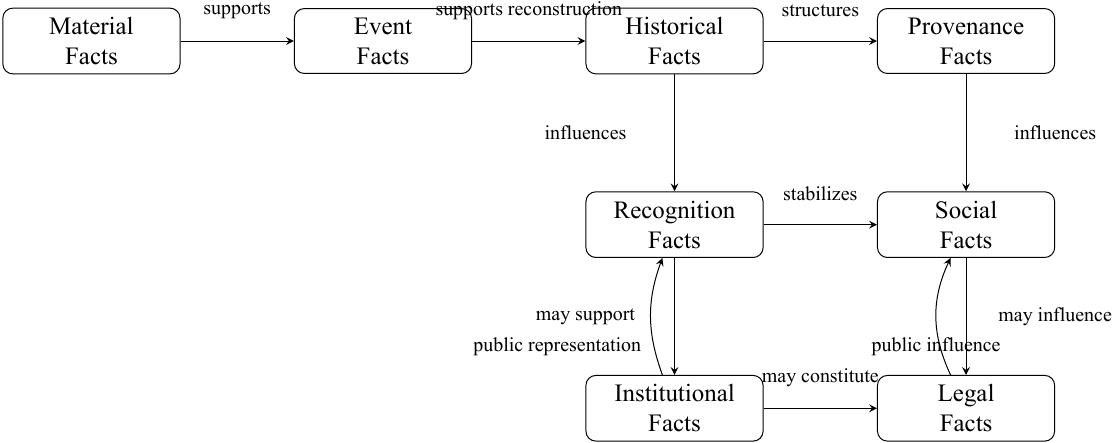
The arrows in Figure 1 should be read as typed possibilities rather than deterministic transitions. The remainder of the chapter specifies these relations and the conditions under which divergence or conflict can occur.
Dependence Relations
This subsection examines dependence relations among facts. Its objective is to identify cases in which the existence, intelligibility, or practical operation of one factual relation requires another factual condition.
Dependence is broader than causal generation. A factual relation can depend upon another because the second relation supplies an object, temporal condition, institutional basis, or constitutive environment required for the first.
A historical fact concerning publication, for example, depends upon some event having occurred. The historical proposition that article
Recognition facts depend upon recognizing agents or institutions. A social status such as founderhood can depend upon a sufficiently stable pattern of recognition, representation, and practice. Institutional membership depends upon the existence of the institution and its constitutive procedures. Legal ownership depends upon a legal system capable of constituting and recognizing the relevant form of ownership.
Dependence should therefore be specified directionally. If fact
Historical priority illustrates this asymmetry. Recognition of A as the first proposer of
Dependence relations are consequently important for governance because they identify leverage points. A socially stabilized status may depend upon a particular historical representation. Revising the representation can weaken a condition supporting the social status while leaving other recognition mechanisms intact.
Governance therefore benefits from distinguishing the fact targeted directly from the factual conditions upon which its public operation depends.
Constitutive Relations
This subsection examines constitutive relations among facts. Its objective is to distinguish relations that participate in making a status exist from relations that merely provide evidence or influence its later development.
Constitution concerns the conditions through which a fact acquires its relevant status. Social and institutional ontology provides the clearest examples. Institutional facts can arise through status functions, rules, procedures, and recognized institutional practices (Searle 1995, 2010).
An appointment procedure can constitute the institutional fact that A holds office
Constitution differs from evidence. A signed appointment letter can provide evidence that an appointment occurred. The institutional procedure and authority through which the appointment becomes valid participate in constituting the status itself.
The distinction becomes important when institutions correct records. Changing evidence concerning a historical event updates the institutional representation of the event. Changing a constitutive institutional rule can alter which statuses exist under that institutional order.
Constitutive relations can also be layered. A legal fact can depend upon an institutional act whose legal significance derives from a wider legal system. A membership decision by a transnational association can constitute an institutional membership fact. The legal consequences of that membership may then depend upon contractual or associational law in the applicable jurisdiction.
Public factual governance therefore requires clarity concerning which facts an institution can constitute and which facts it can only investigate, represent, or influence.
Evidentiary Support Relations
This subsection examines relations through which one factual item supports a judgment concerning another. Its objective is to separate evidentiary support from factual constitution and causal generation.
A material record can support a judgment concerning an event. A repository timestamp can support the proposition that a document was publicly deposited by a certain time. Several dated records can support a historical ordering. Citation, correspondence, and version histories can support a provenance reconstruction.
The support relation is epistemic. Evidence contributes to the warranted assessment of a proposition while remaining distinct from the fact under investigation.
This distinction is especially important when evidence is incomplete. The absence of a known earlier record does not have the same evidentiary force as the presence of a reliably dated earlier counterexample. A historical judgment must therefore reflect the structure and limitations of the supporting evidence.
Evidentiary support can also cross factual categories. A legal judgment can provide evidence that a legal institution reached a particular conclusion. It can also contain testimony or records relevant to historical reconstruction. The legal authority of the judgment and the evidentiary value of materials contained within it are analytically separable.
Institutional records similarly provide evidence without necessarily settling the wider historical question. A university biography stating that B founded field
Public factual governance consequently requires provenance of evidence as well as provenance of knowledge objects. The source, date, institutional context, reliability, and scope of evidence affect the strength of the resulting finding.
Provenance Relations
This subsection examines provenance as a typed generative relation among objects, events, agents, and transformations. Its objective is to distinguish generative lineage from temporal succession and social recognition.
The W3C PROV model provides a useful formal precedent. PROV-O represents entities, activities, agents, derivations, generation, usage, attribution, association, delegation, and related forms of influence (Lebo et al. 2013). A derivation can therefore be represented as a relation in which one entity arises through an activity involving another entity.
Public-knowledge provenance can exhibit an analogous structure. Work
The distinction between temporal order and provenance is essential. Earlier existence creates the possibility of derivation. It does not establish derivation by itself.
Suppose A publishes
Independent origination therefore occupies a distinctive relational position. B can lack historical priority while retaining an independent provenance relation if B developed the formulation without generative dependence upon A.
Complex knowledge histories can involve many-to-many provenance. A later theory can integrate several traditions. A translation can introduce a concept into a new linguistic field and thereby become a generative ancestor of later local work. A computational system can combine hundreds of source objects in producing a new representation.
Provenance graphs therefore provide a more expressive representation than singular founder narratives. They preserve multiplicity, branching, convergence, and transformation.
The jurisprudential significance of provenance arises from this generative structure. Provenance can support accurate attribution and historical reconstruction while remaining distinct from ownership, authority, endorsement, and responsibility for later modifications.
Recognition Relations
This subsection examines recognition as a relation connecting recognizing actors or institutions with persons, objects, contributions, and statuses. Its objective is to show how recognition mediates between historical information and socially stabilized public status.
Recognition can concern different objects. A scholar can recognize A as an important contributor. A university can recognize B as the founder of a research program. A citation can recognize intellectual dependence. An award can recognize achievement. A public biography can recognize a person under a particular historical description.
These relations need to be distinguished according to both recognizing subject and recognized predicate. Recognition of contribution differs from recognition of priority. Recognition of influence differs from recognition of founderhood.
Recognition can draw upon historical evidence while also responding to visibility, reputation, institutional affiliation, language, disciplinary boundaries, and prior recognition. Merton’s analysis of priority and cumulative advantage demonstrates that scientific recognition can become unevenly distributed and recursively amplified (Merton 1957, 1968).
Recognition therefore acts as a bridge between historical relations and social factualization. A historical fact can enter public social reality through recognition practices. The resulting recognition can accurately track the historical relation, partially represent it, or diverge from it.
The relation is also recursive. Existing recognition can make an actor more visible, thereby increasing the probability of subsequent recognition. Public status can consequently develop path dependence.
Governance of recognition cannot rely solely upon commanding belief. Institutions can influence recognition by correcting records, changing descriptions, exposing evidence, and reducing the infrastructural reproduction of unsupported claims.
Recognition relations therefore provide one of the principal pathways through which public factual governance affects the social field.
Social Factualization
This subsection examines the relational process through which recognition and representation stabilize into socially operative facts. Its objective is to identify social factualization as a process connecting distributed acts of recognition with durable social status.
Recognition can remain local and episodic. A social fact requires a greater degree of stabilization. Repetition across institutions, publications, educational materials, databases, and public discourse can transform a local description into an assumed background fact.
The process can be represented schematically in Equation 3.
where
Equation 3 represents a recurrent pathway rather than a universal law. Social factualization can involve additional variables, including institutional authority, salience, repetition, contestation, language, and infrastructural amplification.
Founderhood provides a useful example. A priority claim can enter scholarly discourse. Repeated citation and institutional recognition can associate one actor with the concept. The association can later stabilize into the social status of founder.
Once stabilized, the social fact can influence later interpretation of the historical record. New researchers can begin with the assumption that B is the founder and search the literature accordingly. Social factualization can therefore feed back into the production of subsequent evidence and narratives.
Public factual governance intervenes in this process by altering the informational conditions surrounding
The governance objective concerns evidentiary responsiveness within social factualization. Social facts remain socially generated while their public formation becomes more sensitive to accessible evidence and structured contestation.
Institutionalization
This subsection examines transitions through which factual representations and social statuses become embedded within formal organizations. Its objective is to distinguish broad social factualization from institutional stabilization.
A socially recognized status can enter an institutional system in several ways. A university can adopt founder language in an official history. A scholarly association can create an award bearing a person’s name. A journal can record a contributor under a particular role. A repository can encode a provenance relation in metadata.
Institutionalization changes the governance environment because an identifiable organization now controls a formal representation. The organization can possess procedures capable of revising the relevant record.
Institutionalization can also strengthen a social fact. Institutional representations carry authority and can be repeatedly copied by downstream systems. A university biography can influence encyclopedias, media reporting, search engines, and AI-generated summaries.
The relation therefore runs in both directions. Social recognition can lead to institutionalization, and institutionalization can intensify subsequent social recognition.
Institutionalization can also preserve contestation. An institution can record that a factual claim is disputed. The resulting contested status becomes an institutional fact capable of influencing the wider public field.
This possibility is central to the institutional architecture developed later in the monograph. A public epistemic review body can transform evidentiary assessment into an institutional finding. Participating organizations can then incorporate the finding into their own records.
The institution constitutes the status of the finding under its procedures. Its authority over the underlying historical event remains evidentiary and representational.
Legal Constitution
This subsection examines transitions through which facts acquire legally recognized status or consequences. Its objective is to distinguish legal constitution from historical occurrence, social recognition, and institutional classification.
Legal facts arise through legal rules and legally effective events. Authorship, assignment, licensing, contract formation, registration, succession, judgment, expiration, and statutory change can participate in constituting legal relations according to the applicable jurisdiction.
The Berne Convention illustrates how authorship-related and integrity interests can acquire legal recognition at the international level while remaining subject to implementation within national legal systems (World Intellectual Property Organization 1979). Open licenses similarly use legally recognized rights to constitute standardized downstream permissions and obligations (Creative Commons 2013a).
Historical facts can become inputs into legal constitution without becoming identical to legal facts. Historical authorship can be legally relevant to ownership. A documented license event can alter legally permitted use. A prior publication can affect the application of particular legal rules.
Legal institutions can also create new factual relations. A final judgment is an event fact, an institutional fact, and a source of legal status. Its existence becomes part of the subsequent public history of the dispute.
Legal constitution therefore adds another layer to the factual graph. It can alter rights, duties, liabilities, and remedies while leaving neighboring historical and social relations unchanged.
This layered structure explains why the legal domain requires explicit jurisdictional indexing and scope-preserving translation when its findings enter public factual governance.
Cross-Domain Influence
This subsection examines influences among factual domains that fall short of constitution or evidentiary entailment. Its objective is to identify pathways through which one factual relation changes the probability, salience, or public interpretation of another.
Historical priority can influence recognition. Recognition can influence institutional appointments. Institutional designation can influence social status. A legal judgment can influence public narratives. Public recognition can influence the evidence parties choose to present in later legal proceedings.
These relations are consequential while remaining weaker than logical or constitutive implication.
A prominent legal decision concerning ownership, for example, can increase the public association between B and concept
Similarly, institutional recognition can affect historical research. A research center organized around B can preserve B’s papers more systematically than those of less institutionally visible contributors. The resulting archival asymmetry can shape which historical evidence becomes discoverable.
Cross-domain influence therefore creates feedback loops. Public knowledge governance must examine these loops because factual domains can become coupled over time even where their truth conditions remain distinct.
This insight also cautions against treating factual relations as isolated variables. Governance of one domain can produce secondary effects elsewhere. A correction designed for a metadata field can alter public recognition. A public finding can affect institutional reputation. A legal decision can change the salience of historical evidence.
The proportionality of governance measures therefore requires consideration of both direct and cross-domain effects.
Cross-Domain Translation
This subsection examines the representation of findings as they move between factual and institutional domains. Its objective is to distinguish translation from influence and to preserve the semantic scope of a finding during institutional circulation.
Translation occurs when a finding produced under one factual vocabulary is represented within another system. A court judgment can be summarized in a repository. A provenance finding can be encoded in metadata. A correction issued by a journal can be propagated through Crossref. A social-recognition study can be summarized in an institutional history.
Crossref’s typed relationship infrastructure illustrates how explicit relationships can preserve information about the nature of connections among research objects (Crossref 2022). The broader principle is applicable to factual findings: the receiving system should preserve the type of relation asserted by the source.
A historical finding therefore requires historical language. A legal finding requires jurisdictional and doctrinal scope. An institutional finding requires identification of the issuing institution. A recognition finding requires identification of the relevant population or field.
Loss of type information produces factual collapse. The statement that a court recognized B as the legal owner of
Cross-domain translation should consequently preserve provenance of the finding itself. A downstream representation should remain traceable to the institution, procedure, date, evidence, and scope from which it arose.
This requirement becomes particularly significant for machine-mediated public knowledge, where automated systems can transform concise metadata into broader natural-language statements.
Divergence among Historical, Social, Institutional, and Legal Facts
This subsection examines stable divergence among major factual domains. Its objective is to establish that divergence can be structurally legitimate and does not automatically indicate error.
Consider a concept
Several facts can coexist:
A has the strongest currently identified claim to historical priority;
B receives the greatest public recognition;
C holds the formal institutional title of founding director;
a publisher or employer possesses specified legal rights in a particular work.
These facts describe different relations.
Divergence becomes problematic when one relation is represented publicly as another. B’s recognition becomes historically misleading if it is expressed as exclusive temporal priority despite earlier evidence. C’s institutional title becomes misleading if it is interpreted as proof that C originated the underlying concept.
The governance objective is therefore accurate differentiation rather than forced convergence.
Historical, social, institutional, and legal facts may remain different because their constitutive conditions differ. The public record can represent these differences explicitly.
Such plural representation is especially valuable in intellectual history. Multiple contributions can coexist without requiring a singular founder narrative. Historical priority, independent development, systematization, institution building, public recognition, and legal ownership can each be recorded under the relation they actually describe.
Conflict among Factual Representations
This subsection examines cases in which public representations make incompatible claims concerning the same factual relation. Its objective is to distinguish genuine factual conflict from cross-domain divergence.
Divergence involves propositions about different fact types. Conflict arises when two propositions address the same factual relation and cannot both be sustained under the specified interpretation.
If record
A different pair of statements can coexist: “A published first” and “B is more widely recognized.” The first concerns historical ordering and the second recognition.
Conflict identification therefore depends upon factual typing.
Conflicts can arise from incompatible evidence, ambiguous terminology, different scopes, unreliable records, or differences in conceptual individuation. Two communities may disagree about whether
Public factual governance should therefore decompose a conflict into atomic propositions where possible. A review can separately examine dates, public availability, textual content, conceptual similarity, evidence of access, independent development, and subsequent recognition.
This decomposition reduces the risk that a disagreement over one relation expands into a total dispute over the identity or legitimacy of the actors involved.
Conflict resolution can produce several outcomes. One claim can receive stronger support. Both can remain plausible. The propositions can prove compatible after clarification of scope. The available evidence can remain indeterminate.
The purpose of adjudication is therefore accurate representation of the evidentiary structure of the conflict.
Persistence across Fact Types
This subsection examines how factual relations survive transformations in neighboring domains. Its objective is to clarify why alteration of one fact type does not automatically extinguish related facts.
Suppose A holds legal rights in work
Suppose A is widely recognized as founder of
Suppose a journal corrects an erroneous article. The current institutional record changes. The historical fact that the earlier version was published remains part of the provenance of the article.
Persistence across fact types therefore creates a layered temporal record. Governance should preserve which factual relations ended, which changed, and which remain historical facts concerning prior states.
This principle prevents correction from becoming erasure. A record can lose current authority while retaining historical existence.
Persistence also matters for responsibility. A later modification can create new responsibility without eliminating the provenance relation to earlier contributors. The earlier contributor remains part of the generative history while downstream responsibility becomes localized to later interventions.
The preservation of these layered relations forms the conceptual basis for manifest revision in Chapter 20.
Transformation and Extinction across Fact Types
This subsection concludes the chapter by examining how factual relations change, terminate, and generate successor facts. Its objective is to distinguish transformation of a current status from extinction of historical traces.
Some facts can terminate in their present-tense form. An institutional appointment ends. A legal right expires. A recognition pattern diminishes. A social status can lose practical force.
Termination creates additional historical facts. If A ceases to hold office at time
Some transformations generate new provenance relations. Revising dataset
PROV-O explicitly represents generation, derivation, revision, and invalidation as distinct provenance relations (Lebo et al. 2013). This provides a useful technical analogue for the broader jurisprudential principle developed here: transition should itself become part of the factual record.
Extinction therefore requires careful qualification. Current social recognition can disappear while its earlier existence remains historical. Current legal ownership can cease while the transfer or expiration remains an event fact. A public claim can be withdrawn while the historical fact that it was previously asserted remains.
The distinction can be represented through three temporal states:
where
Equation 4 does not imply that every fact is mutable in the same manner. The expression represents the history of factual representation and status. For historical facts,
This distinction links the static taxonomy developed in Chapter 5 with the dynamic analysis that follows. Facts can support other facts, participate in their constitution, become evidence for them, influence their social stabilization, and persist after neighboring factual relations change.
The relational structure developed in this chapter therefore contains several simultaneous dimensions:
evidentiary relations connect records with warranted judgments;
provenance relations connect generative antecedents with subsequent objects and activities;
recognition relations connect public actors with represented contributions and statuses;
social factualization connects repeated recognition with socially stabilized facts;
institutionalization connects social or evidentiary relations with formal organizational records;
legal constitution connects legally relevant events and rules with jurisdiction-specific legal facts;
cross-domain influence allows factual domains to affect one another without collapsing their truth conditions;
cross-domain translation permits findings to circulate while preserving their type and scope;
persistence preserves historical relations after current statuses change; and
transformation creates new factual states and additional provenance events.
The resulting architecture is a typed relational network rather than a single chain of factual development. This distinction is essential for governance. An intervention directed toward one node or edge can affect neighboring domains while leaving other relations intact.
Chapter 8 develops this relational architecture dynamically. It introduces events, records, evidentiary reconstructions, factual states, recognition dynamics, social factualization, institutional and legal constitution, cross-domain transitions, revision under new evidence, persistence under denial and renunciation, public contestation, and corrective transitions. The objective shifts from identifying which relations exist to modeling how those relations evolve through time and how governance interventions alter their trajectories.
Formal Model of Fact Formation and Revision
This chapter develops a formal representation of the factual architecture introduced in Chapters 5–7. Its objective is to model how factual relations emerge from events and records, how present observers reconstruct historical and provenance relations, how recognition can contribute to social factualization, how institutions and legal orders constitute additional statuses, and how governance interventions alter public factual trajectories.
The formalism is intentionally limited. It is designed to clarify distinctions that are already present in the conceptual argument rather than to reduce public knowledge to a fully calculable system. Historical interpretation, conceptual similarity, institutional judgment, and social recognition contain features that cannot be represented adequately by a small set of scalar variables. The equations therefore function as structural representations of dependence, transition, and revision.
The model distinguishes four levels throughout the chapter:
events and material records;
factual relations that have occurred or presently exist;
evidentiary reconstructions of those relations;
public, institutional, and legal representations through which those relations acquire practical consequences.
This separation is essential. A historical event can remain unchanged while the evidentiary reconstruction of that event changes. A social fact can change while the historical relation underlying it remains stable. An institutional record can be corrected without erasing its earlier state. A legal fact can change through legally effective acts while neighboring provenance relations remain historically persistent.
The dynamic model consequently treats public factual governance as intervention in a typed relational system rather than as direct control over a single undifferentiated factual state.
Events, Records, and Evidence
This subsection defines the elementary objects from which factual reconstruction proceeds. Its objective is to distinguish occurrences, records of occurrences, and the evidentiary use of those records.
Let
An event can generate one or more records. Let
A single event can generate several records. A conference presentation can produce a program entry, recording, slide deck, repository upload, and later citation. A single record can also contain evidence concerning several events.
The evidentiary value of a record therefore requires interpretation. Let
Equation 5 represents this relation.
where
Equation 5 emphasizes that records and evidence are distinct. A record becomes evidence for a proposition through an interpretive relation.
The same record can therefore possess different evidentiary significance for different propositions. A repository timestamp can strongly support the claim that a file existed publicly by a certain date while providing little evidence that every concept contained in the file originated at that date.
Evidence can also possess provenance. Archives, repository systems, persistent identifiers, cryptographic records, institutional metadata, and version histories can affect the reliability assigned to an evidentiary object. The provenance infrastructure represented by PROV-O provides a technical precedent for recording such relations among entities, activities, and agents (Lebo et al. 2013).
The model therefore begins with events and records while refusing to identify either directly with the conclusions of historical inquiry.
Factual States
This subsection defines factual states as temporally indexed configurations of factual relations. Its objective is to provide a common representation for the different fact types introduced in Chapter 5.
Let
Equation 6 gives a compact representation.
where:
denotes relevant material states; denotes relevant event relations; denotes historical relations; denotes provenance relations; denotes recognition relations; denotes social facts; denotes institutional facts; and denotes legal facts.
Equation 6 should not be interpreted as requiring each component to be representable numerically. Each element can itself be a set, graph, institutional status, textual finding, or other structured object.
The vector representation serves primarily to preserve type distinction. A change in
A factual state can therefore change partially. This typed partiality is one of the most important features of the model.
The relevant temporal index also depends upon the fact type. A current social status belongs to the present social state. A historical fact concerning an event at time
Evidentiary Reconstructions
This subsection formalizes the distinction between historical reality and present evidentiary judgment. Its objective is to represent epistemic revision without treating historical change and epistemic change as the same process.
Let
Equation 7 represents the reconstruction process.
where
Equation 7 distinguishes the historical relation
The distinction allows several epistemic states. A proposition can be strongly supported, weakly supported, contested, contradicted, or indeterminate. These statuses are developed institutionally in Chapter 15.
The reconstruction can also contain explicit scope. A review may determine the earliest formulation found within a specified corpus or the earliest publicly verifiable record presently identified. Such conclusions should be represented at the level of
The model thereby preserves the possibility that two inquiries using different evidentiary corpora can produce different reconstructions without implying that history itself possesses two contradictory pasts.
Historical Relations
This subsection represents temporal and historical relations among events. Its objective is to distinguish chronological ordering from stronger claims of origination or derivation.
Let
A temporal priority relation can be represented through Equation 8.
Equation 8 states only that
The meaning of the event must also be specified. A private notebook entry, public repository deposit, conference presentation, and journal publication can receive different significance. Historical priority therefore depends upon both temporal order and event classification.
The present monograph consequently avoids an undifferentiated variable for “first.” A priority proposition should identify first in relation to what event type, evidentiary domain, and conceptual object.
Historical relations can include simultaneity, sequence, overlap, recurrence, and temporal intervals in addition to strict priority. Later chapters focus primarily on priority because of its importance to provenance and founderhood.
Provenance Relations
This subsection formalizes provenance as a generative relation distinct from temporal succession. Its objective is to support representation of derivation, independent development, branching, and convergence.
Let
The provenance structure at time
where
Equation 9 permits relation types such as derivation, translation, modification, incorporation, citation, adaptation, response, or another domain-specific generative relation.
The structure is compatible with provenance standards that distinguish typed relations among entities, activities, and agents (Lebo et al. 2013).
Independent development requires a different representation. If A’s object
This distinction becomes especially important when several independently generated branches later converge. The resulting provenance graph can contain multiple origins without collapsing them into one founder lineage.
Provenance can itself be evidentially uncertain. An edge can therefore carry an evidentiary status rather than being represented merely as present or absent. The detailed evidentiary treatment is deferred to Chapter 15.
Recognition Dynamics
This subsection models recognition as a dynamic public relation. Its objective is to represent how recognition can accumulate, decay, redistribute, and interact with historical evidence and institutional visibility.
Let
An aggregate recognition state can be represented by Equation 10.
where
Equation 10 does not imply that recognition should be reduced to a universal numerical score. The expression captures the principle that social recognition emerges from distributed acts whose influence can differ.
Institutional recognition can carry greater public visibility than an isolated individual statement. A highly cited review can influence subsequent recognition more strongly than an obscure comment. Search ranking and machine-mediated retrieval can add further amplification.
Recognition also exhibits recursive dynamics. Existing recognition can increase the probability of later recognition, a phenomenon compatible with Merton’s analysis of cumulative advantage (Merton 1968).
The model therefore treats recognition as a path-dependent process. Historical evidence is one input among several. Reputation, institutional status, language, infrastructure, visibility, and prior recognition can also shape the trajectory.
Public factual governance can intervene by altering these informational inputs without attempting to control the beliefs of individual actors directly.
Social Factualization Dynamics
This subsection models the transition from distributed recognition to socially stabilized factual status. Its objective is to represent social factualization as a dynamic process with both reinforcement and contestation.
Let
The evolution of social status can be represented schematically through Equation 11.
where:
denotes recognition; denotes relevant institutional representation; denotes public visibility or infrastructural salience; and denotes effective contestation.
Equation 11 captures two important properties.
First, social factualization possesses inertia. Existing status
Second, contestation can modify the trajectory. Public counter-evidence, annotations, institutional findings, and correction can increase
The model does not require governance to force
This distinction provides a formal expression of the principle of public contestability.
Institutional Constitution
This subsection represents the constitution of institutional facts. Its objective is to distinguish institutional decisions from evidentiary findings about historical events.
Let organization
An institutional status can be represented schematically through Equation 12.
Equation 12 indicates that the institutional effect of action
A valid panel decision can therefore constitute the institutional fact that a public provenance finding exists. A correction issued by a journal can constitute a new status in the journal’s publication record. A membership decision can constitute a member’s associational status.
The institution can simultaneously make an evidentiary finding about a historical relation. The institutional existence of the finding and the truth of the underlying historical proposition remain distinct.
This separation allows institutional authority to be meaningful while preserving epistemic restraint.
Jurisdiction-Specific Legal Facts
This subsection formalizes legal facts as facts indexed to a legal order. Its objective is to represent jurisdictional plurality without treating legal status as a universal factual layer.
Let
A legal fact can be represented through Equation 13.
Equation 13 makes explicit that legal status depends upon both legally relevant events and the applicable legal order.
The same epistemic object can therefore possess different legal states across jurisdictions. The model permits
Legal change can occur when
Historical provenance remains represented separately within
Cross-Domain Transitions
This subsection models transitions through which factual relations influence or become represented within other factual domains. Its objective is to distinguish cross-domain effects from logical implication.
Let
where
Equation 14 does not imply equivalence between the two facts.
A historical finding can influence recognition. Recognition can influence institutional designation. Institutional designation can influence public social status. A legal judgment can influence public narratives.
The transition mechanism should therefore preserve information concerning the source relation. Failure to preserve this information produces authority spillover.
Cross-domain transition can also be recursive. A social status can influence which archives are preserved, thereby affecting the evidence available to later historical reconstruction. Public recognition can therefore feed back into the epistemic production of subsequent historical judgments.
The dynamic system consequently contains feedback across domains rather than a one-directional chain.
Revision under New Evidence
This subsection formalizes evidentiary revision. Its objective is to show how new evidence alters present reconstruction while preserving continuity of the underlying historical object.
Suppose the evidence available at time
The revision relation is represented in Equation 15.
Equation 15 permits both new evidence and refined interpretive criteria to alter the warranted judgment.
A later record can therefore change a priority finding. A newly discovered archive can reveal an earlier formulation. Better linguistic analysis can show that two previously treated formulations are conceptually distinct.
Revision should preserve the history of the prior judgment. If an institution previously issued
This requirement connects evidentiary revisability with manifest revision.
Persistence under Denial and Renunciation
This subsection models the distinction between voluntary acts and persistent historical relations. Its objective is to formalize why denial, waiver, or renunciation can alter later social, institutional, or legal states without altering the historical occurrence to which those acts refer.
Suppose A possesses a historical relation
The later act creates a new event. It can influence recognition, institutional representation, normative relations, or legal status.
The historical relation remains:
Equation 16 represents the non-retroactive relation between renunciation and history.
The social consequences can change. Recognition of A can decline. An institution can remove founder terminology at A’s request. A legally waivable claim can cease.
The model therefore allows a voluntary act to alter several components of
This distinction provides the formal basis for later chapters on waiver, recognition non-capitalization, and non-transferability of provenance.
Governance Interventions in Fact Formation
This subsection introduces governance intervention into the dynamic system. Its objective is to represent public factual governance as intervention in records, recognition, institutional status, and informational conditions without treating governance as direct alteration of historical reality.
Let
The public factual state can then evolve according to Equation 17.
where
Equation 17 is intentionally limited to the publicly represented state. A governance intervention does not rewrite the historical event. It changes the representation, institutional status, visibility, or conditions through which later social factualization proceeds.
This distinction defines the appropriate object of public enforcement.
A correction can alter a current metadata representation. A provenance finding can change the status of an unsupported priority claim. A contested marker can alter how later users encounter an unresolved dispute.
Governance intervention therefore acts upon factual conditions rather than upon the past itself.
Public Contestation Dynamics
This subsection models contestation as a dynamic input into public factualization. Its objective is to represent the difference between the existence of counter-evidence and the effective public presence of counter-evidence.
Let
A simple structural representation is given in Equation 18.
where:
denotes counter-evidence; denotes visibility of the contestation; denotes institutional support or recognition; and denotes persistence and propagation through the public field.
Equation 18 explains why a strong historical counterexample can remain socially ineffective if it is inaccessible or invisible.
Public factual governance can therefore increase effective contestation without determining the final social status. Linking evidence, preserving public findings, correcting metadata, and propagating contested status can increase the capacity of later participants to encounter and evaluate the dispute.
The objective is not maximal contestation. Repetitive or abusive challenges can produce noise, harassment, and institutional paralysis. Later chapters therefore introduce procedural thresholds for standing, review, and reconsideration.
Corrective Transitions
This subsection concludes the formal model by representing correction as a provenance-preserving transition. Its objective is to connect evidentiary revision, institutional action, and historical integrity within one dynamic structure.
Let
The corrective process creates a transition event
Equation 19 represents this structure.
Equation 19 distinguishes the current authoritative record from the history of the record. The correction updates
This structure corresponds to existing scholarly infrastructures in which corrections and retractions can be represented as explicit relations to prior records rather than silent replacement (Crossref, n.d.; COPE Council 2019b).
The same principle can be generalized beyond scholarly articles. Metadata, datasets, institutional biographies, provenance registries, repository records, and public factual findings can preserve earlier states while clearly communicating the current representation.
Corrective transitions therefore have two simultaneous requirements.
The first is historical preservation. The prior state should remain reconstructable where preservation is technically and legally possible.
The second is present intelligibility. Current users should be able to identify the corrected status without reconstructing the entire history manually.
These requirements later become the preservation and salience dimensions of manifest revision.
Integration of the Dynamic Model
The formal components developed in this chapter can now be integrated into a single process without reducing the system to a deterministic sequence.
Events generate records. Records become evidence under specified interpretive criteria. Evidence supports present reconstructions of historical and provenance relations. Those relations can influence recognition. Recognition, institutional representation, visibility, and contestation jointly shape social factualization. Institutions can constitute formal statuses and public findings. Legal systems constitute jurisdiction-specific legal facts. Cross-domain transitions allow these factual domains to influence one another. New evidence can revise present reconstruction. Governance interventions can alter public representations and the conditions of social stabilization. Correction creates additional provenance events while preserving earlier states.
The resulting architecture can be summarized conceptually as:
Equation 20 should be read as an analytical map. Each arrow represents a typed relation whose precise meaning depends upon the relevant fact type. Several pathways can operate simultaneously, and none of the displayed transitions is universally mandatory.
The model therefore preserves four forms of plurality.
First, ontological plurality: historical, social, institutional, and legal facts possess different conditions of existence.
Second, epistemic plurality: the evidence available to different inquiries can vary, and present reconstruction remains revisable.
Third, institutional plurality: archives, scholarly institutions, public epistemic organizations, and courts possess different forms of competence.
Fourth, temporal plurality: earlier factual states can remain historically real after current institutional, social, or legal statuses have changed.
These distinctions make the model suitable for the substantive jurisprudential problems examined in the following chapters. Chapter 9 applies the architecture to historical priority, independent and parallel origination, and founderhood. Chapter 10 examines acts of waiver and renunciation within a system where historical relations remain persistent. Chapter 11 develops provenance, attribution, modification, endorsement, and responsibility. Later chapters extend the same dynamic structure to recursive openness, licensing, provenance usurpation, evidentiary adjudication, public enforcement, manifest revision, and AI-mediated knowledge production.
The formal model therefore supplies a dynamic grammar for factual governance. Its central implication is that governance should identify which component of a factual system is capable of legitimate alteration. Historical occurrence is governed through reconstruction and representation. Recognition is governed through the informational conditions of public factualization. Institutional facts are governed through competent procedures. Legal facts are governed through applicable law. Corrections become new events within the history of the record.
This differentiation allows factual governance to remain active without claiming authority to rewrite the past.
Historical Priority and Founderhood
This chapter applies the factual taxonomy and dynamic model developed in Chapters 5–8 to one of the most persistent sources of conflict in public knowledge: the relation among historical priority, origination, authorship, recognition, and founderhood. Its objective is to separate these relations sufficiently for each to receive an appropriate evidentiary and governance treatment.
Priority has long possessed substantial significance within scholarly communities. Merton’s analysis of scientific priority showed that claims to being first form part of the reward structure through which scientific recognition is distributed (Merton 1957). His later analysis of the Matthew effect further demonstrated that existing status can affect subsequent allocation of recognition (Merton 1968). These observations become especially important when the public history of a concept is reconstructed through publications, citations, institutional narratives, databases, and later social recognition.
The present framework distinguishes several questions that are frequently compressed into a single origin narrative. A researcher can possess the earliest presently identified public formulation of a concept. Another researcher can have developed a similar concept independently. A third actor can provide the first extensive systematization. A fourth can establish the institution through which the concept becomes durable. Public recognition can later concentrate around one of these actors. Each relation has its own factual basis.
Founderhood is therefore treated as a socially and institutionally thick status. Historical priority can contribute to founderhood, while founderhood can also draw upon systematization, institutionalization, public recognition, symbolic centrality, and continuity of a research program. This structure permits historical priority without founderhood and founderhood without exclusive historical priority.
The chapter proceeds through historical priority, earliest identifiable origination, independent and parallel origination, priority relations with authorship and recognition, founderhood and its formation, priority without founderhood, origin without centrality, provenance without personification, and the epistemic humility required for priority judgments.
Historical Priority
This subsection defines historical priority as a temporal relation among specified contributions or events. Its objective is to separate priority from the thicker statuses that later become attached to it.
Let
Equation 21 is intentionally narrow. It states that A’s relevant event precedes B’s relevant event. The relation does not determine derivation, authorship of B’s work, legal ownership, public recognition, or founder status.
The event type must therefore be specified. Priority can refer to earliest private formulation, earliest documented formulation, earliest public presentation, earliest repository deposit, earliest formal publication, or another defined event. These relations can produce different chronological orders.
A private notebook entry can precede a public publication while possessing a different public epistemic significance. A conference presentation can precede a journal article. A repository preprint can precede the version of record. Historical priority therefore becomes meaningful only after the relevant event class is defined.
The conceptual object must likewise be specified. Two texts can use the same term for substantially different ideas. Two texts can express materially similar ideas through different terminology. Priority analysis consequently requires both temporal evidence and conceptual individuation.
Historical priority is relational. A can precede B without being globally earliest. A finding concerning A and B therefore differs from an unrestricted claim concerning all possible contributors.
This distinction is important for factual governance. A public review body can confidently establish that A’s identified record predates B’s identified record even when the evidence does not support a universal determination concerning the earliest formulation in intellectual history.
Priority findings should therefore communicate both relational scope and evidentiary scope.
Earliest Identifiable Origination
This subsection develops the concept of earliest identifiable origination. Its objective is to provide an evidentially disciplined alternative to unqualified claims of absolute firstness.
Historical inquiry is constrained by available records. Manuscripts can be lost. Oral discussions can remain undocumented. Earlier publications can exist in inaccessible archives or unfamiliar languages. Similar ideas can appear under different conceptual vocabularies.
A finding of absolute first origination therefore carries a demanding evidentiary burden. Public factual governance frequently has stronger grounds for identifying the earliest record currently supported by the available evidence.
Let
subject to the requirement that each candidate event satisfies the conceptual and evidentiary criteria adopted by the inquiry.
Equation 22 identifies the earliest qualifying event within the evidentiary domain available at time
The phrase earliest presently identifiable formulation therefore carries an important epistemic function. It permits useful historical findings while preserving openness to archival discovery.
This formulation also improves institutional revisability. If new evidence enters
A distinction should also be maintained between earliest identifiable record and earliest identifiable origination. A record proves that a formulation existed by a particular time. Establishing the exact moment of intellectual origination can require stronger evidence. Public governance should prefer the narrower claim where the record supports only existence by a given date.
This evidentiary discipline reduces unnecessary disputes over absolute firstness. Many governance problems can be resolved by establishing that a later exclusive priority claim is incompatible with an earlier identifiable record.
Independent Origination
This subsection distinguishes independent origination from historical priority. Its objective is to preserve the possibility that several actors can generate materially related ideas without a derivational relation among them.
Suppose A publicly formulates
Independent origination concerns the provenance relation between the two generative processes. Let
Equation 24 should be read evidentially. Historical inquiry rarely demonstrates the complete absence of every possible influence. A finding of independent origination therefore depends upon evidence concerning access, communication, citation, intellectual context, testimony, and the plausibility of separate development.
Independent origination preserves an important distinction in public knowledge. B can truthfully state that B independently developed
This distinction reduces the tendency to convert priority disputes into accusations of copying. Historical priority and derivational provenance are different factual relations.
Independent origination also has generative significance. Similar concepts can emerge from different intellectual traditions, methods, languages, or practical problems. Their later convergence can enrich the public knowledge field by revealing alternative generative routes to related structures.
Governance should therefore preserve independent origination where supported. Correcting a claim of exclusive priority should not erase the epistemic significance of an independently generated contribution.
Parallel Origination
This subsection develops parallel origination as a broader structure containing multiple generative trajectories. Its objective is to provide a vocabulary for histories in which several contributors develop related concepts within overlapping periods or partially independent fields.
Parallel origination can arise when A and B develop related formulations without meaningful generative dependence between their trajectories. The events need not be exactly simultaneous. The important relation concerns separate generative pathways whose temporal proximity and intellectual independence make a singular origin narrative inadequate.
The sociology of science has long recognized the importance of multiple discoveries in understanding priority and reward (Merton 1957). The present framework generalizes the problem to public knowledge beyond conventional scientific discovery.
Parallel origination can take several forms. Two researchers can work in the same discipline without knowing one another’s work. Similar concepts can emerge in different linguistic communities. A mathematical formulation and a philosophical formulation can independently instantiate a related structural idea. Several actors can derive similar responses from a widely shared prior problem.
A provenance graph represents this structure more accurately than a linear genealogy. Separate branches can originate independently and later converge through citation, translation, synthesis, or common terminology.
Parallel origination also alters the meaning of priority. A difference of days or months can establish temporal order while having limited significance for the generative independence of the contributions. A historically responsible account can therefore report both temporal sequence and parallel development.
The resulting narrative can state that A’s identified public formulation preceded B’s while available evidence supports B’s independent development. This formulation preserves both facts.
Parallel origination provides an additional reason for restraint in founder classification. A field with several independent origins can possess a polycentric history in which no single founder status adequately represents the generative structure.
Priority and Authorship
This subsection examines the relation between priority and authorship. Its objective is to distinguish temporal origination of a concept from authorship of the works through which that concept becomes publicly represented.
Authorship concerns a relation between contributors and works. Priority concerns temporal order among specified contributions or events. The two relations can coincide while remaining analytically distinct.
A can author the earliest identified publication containing
A can introduce a concept in a jointly authored work while B performs most of the writing. An earlier formulation can appear in correspondence, lecture notes, software documentation, or a dataset whose conventional authorship structure differs from journal publication. A later scholar can author the canonical text through which the concept becomes widely known.
Modern contributorship systems illustrate the heterogeneity hidden within a single authorship label. CRediT distinguishes roles such as conceptualization, methodology, investigation, software, supervision, and writing (National Information Standards Organization 2022). The taxonomy demonstrates that conceptual contribution and textual authorship can occupy different relations within one research output.
Historical priority therefore cannot be inferred solely from author position. Likewise, priority concerning one concept in a multi-concept work does not automatically extend to every author or every idea in the work.
Public factual governance should therefore identify the object of priority with greater granularity than the publication-level authorship record whenever the available evidence permits.
This distinction also protects later authors. A later author who provides a substantial new systematization should receive credit for that contribution without needing to acquire historical priority for the earlier concept.
Priority and Recognition
This subsection examines the relation between historical priority and public recognition. Its objective is to explain why recognition can track, amplify, redistribute, or diverge from chronological priority.
Priority can serve as one source of scientific and scholarly credit. Merton’s analysis places priority within the reward system of science (Merton 1957). Recognition nevertheless depends upon many additional conditions.
Visibility, institutional affiliation, language, disciplinary location, publication venue, reputation, accessibility, pedagogical clarity, later systematization, and network position can all shape which actor becomes associated publicly with a concept.
The Matthew effect further suggests that prior recognition can influence later allocations of credit (Merton 1968). A highly visible actor can therefore accumulate recognition around a contribution even where the historical genealogy contains less visible predecessors.
Historical priority and recognition should consequently be represented by separate relations. Let
Equation 25 represents this separation.
Equation 25 states that historical priority does not guarantee maximal subsequent recognition.
The converse implication is likewise unavailable. High recognition does not establish historical priority.
This divergence can remain normatively acceptable. A later scholar can deserve substantial recognition for systematization, empirical development, pedagogy, institution building, or another contribution. The governance problem arises where recognition is represented through a historically unsupported claim of exclusive origination.
Accurate public representation therefore benefits from plural credit categories. Priority, influence, systematization, institutional development, and public recognition can each be recorded without forcing them into a single ranking.
Founderhood as Social Status
This subsection defines founderhood as a socially thick status. Its objective is to prevent founderhood from being treated as a simple synonym for historical priority.
Within public knowledge, the word founder can perform several functions. It can refer to the earliest proposer of an idea, the person who established a research program, the organizer of an institution, the scholar who provided a canonical systematization, or the figure around whom later collective identity formed.
Founderhood therefore frequently combines several factual relations.
Let
where
Equation 26 does not define a universal scoring formula. It represents the heterogeneous factual components that can contribute to founderhood.
Founderhood itself is therefore treated primarily as a social or institutional status. Historical priority can form one component of the status while remaining conceptually separable.
This distinction explains why two statements can simultaneously be accurate: A possesses the earliest identified formulation, while B is conventionally regarded as the founder of the later institutionalized field.
Public factual governance should clarify what the founder description denotes in a particular context. Where the term implicitly makes a priority claim, the historical evidence becomes directly relevant. Where it primarily denotes institution building, the description should be evaluated according to that institutional history.
The resulting approach reduces semantic disputes generated by using one thick status label for several different contributions.
Formation of Founderhood
This subsection examines the dynamic formation of founderhood. Its objective is to connect the social-factualization model developed in Section 8.7 with the specific case of founder identity.
Founderhood usually develops through time. An actor contributes to a concept or field. Later participants recognize the contribution. Publications repeatedly associate the actor with the field. Institutions adopt the association. Biographies, conferences, educational materials, and databases reproduce the description. The founder label gradually becomes socially stable.
The process can be represented schematically through Equation 27.
where
Equation 27 emphasizes path dependence. Existing founder recognition can reinforce later recognition. Institutional adoption can increase visibility. Visibility can produce further repetition.
Historical accuracy forms one input into the process. It does not uniquely determine the resulting social status.
Founderhood can therefore become self-reinforcing. Once textbooks and institutional histories describe B as founder, later researchers can encounter B before earlier contributors and reproduce the same narrative.
This dynamic explains why correcting a single source can have limited effect. Founderhood can be distributed across a network of reinforcing representations.
Public factual governance can intervene through provenance visibility, correction, qualification, and contestation. The objective is to improve the historical conditions under which founderhood is reproduced. The governance system need not determine a mandatory replacement founder.
Priority without Founderhood
This subsection develops priority without founderhood as a legitimate and potentially desirable factual configuration. Its objective is to separate preservation of historical provenance from accumulation of continuing social authority.
An actor can possess historical priority while declining the social role of founder. The actor can refrain from cultivating symbolic centrality, refuse special authority over subsequent development, or explicitly encourage independent reinterpretation of the concept.
Historical provenance remains relevant in this configuration. Later scholars can accurately identify A’s early contribution while the field develops without organizing itself around A as a central figure.
This possibility is important for public knowledge because priority can easily become a basis for recognition capitalization. The sequence can take the form:
historical priority, public recognition, symbolic status, authority, definitional influence, and potential control over later development.
The sequence is contingent. Preserving the first relation does not require maximizing the later ones.
Priority without founderhood therefore provides a structure for non-capitalization of historical priority. A can accept accurate provenance while declining the conversion of provenance into hierarchical status.
This distinction also resolves an apparent tension between openness and historical integrity. Public knowledge can preserve who generated an earlier formulation while allowing the concept to become institutionally and socially decentered.
The later chapter on waiver and renunciation develops the acts through which a contributor can limit recognition-based consequences while preserving the historical record.
Origin without Centrality
This subsection separates origin from continuing centrality. Its objective is to clarify that a generative starting point does not create a permanent privileged position within the later development of a public knowledge system.
Let
The separation is represented in Equation 28.
Equation 28 captures a central principle of generative public knowledge.
A concept can move beyond the conditions of its initial formulation. Later actors can introduce new evidence, methods, languages, applications, critiques, and theoretical structures. The center of generative activity can therefore move away from the historical origin.
This decoupling is especially important where a field becomes international or interdisciplinary. Permanent centrality of one originator can create intellectual bottlenecks if provenance is treated as continuing authority.
Historical origin remains relevant to understanding the genealogy. Current centrality depends upon contemporary generative relations.
A mature public knowledge system can consequently possess strong provenance and weak person-centered hierarchy simultaneously.
Provenance without Personification
This subsection develops a non-personified representation of provenance. Its objective is to reduce the tendency of public historical narratives to compress complex generative systems into singular heroic actors.
Knowledge frequently emerges through networks. Earlier concepts, methods, datasets, translations, conversations, institutions, technical infrastructures, and collective practices can all participate in generation.
Person-centered historical narratives provide cognitive simplicity. They can also obscure the structure of generation.
A provenance graph offers a different representation. Nodes can include people, documents, concepts, institutions, datasets, events, and technical objects. Edges can record derivation, translation, modification, contribution, influence, or institutionalization.
The resulting history can preserve personal contributions without treating the person as the unique bearer of the entire generative process.
This structure is particularly appropriate for parallel origination. Several independent branches can remain visible. Later convergence does not require the graph to be reorganized around a single founder.
Provenance without personification also supports public epistemic resilience. If knowledge is represented as belonging conceptually to a founder figure, criticism of that figure can become entangled with criticism of the concept. A relational provenance representation separates the generative history from continuing personal sovereignty.
The principle also becomes increasingly important under AI-mediated knowledge production, where generative chains can involve very large numbers of human and machine-mediated sources. Singular authorship narratives become progressively less capable of representing extended provenance.
The objective is therefore accurate generative representation. Persons remain visible where their contributions matter, while the history retains the network structure through which public knowledge actually developed.
Historical Priority and Epistemic Humility
This subsection concludes the chapter by developing epistemic humility as a governance requirement for priority findings. Its objective is to preserve the usefulness of historical reconstruction while limiting unwarranted closure.
Priority claims are especially vulnerable to evidentiary incompleteness. Earlier records can remain undiscovered. Similar concepts can exist under different terminology. Cross-linguistic evidence can be difficult to identify. Private and oral development can leave incomplete traces.
A factual-governance institution should therefore distinguish several strengths of conclusion.
The strongest defensible finding in many cases concerns a relational counterexample. If A’s authenticated public record predates B’s, a claim that B was the earliest public proposer within the relevant conceptual scope becomes difficult to sustain.
A broader claim that A was the first person anywhere to originate the concept requires substantially more evidence.
This asymmetry can be expressed through Equation 30.
Equation 30 supports a preference for negative adjudication where appropriate. A review institution can determine that B’s exclusive priority claim is unsupported or contradicted by earlier evidence without declaring A the final and universal originator.
This approach reduces counter-enthronement. Correction of one inaccurate founder narrative does not require construction of another.
Epistemic humility also requires temporal indexing of findings. A conclusion should remain open to materially significant new evidence. Expressions such as on the current evidentiary record, earliest presently identified public formulation, and within the examined corpus make this revisability explicit.
Historical priority can therefore be governed with considerable rigor without requiring institutional infallibility.
The distinctions developed in this chapter provide the basis for Chapter 10. Once priority, founderhood, recognition, and centrality have been separated, acts of waiver and renunciation can be analyzed with greater precision. A person can relinquish exclusivity, decline recognition cultivation, or reject founder status while the underlying historical priority and provenance relations remain persistent. The following chapter examines which relations can be altered through voluntary action, which remain historically non-disposable, and how public knowledge can preserve provenance without converting that provenance into continuing proprietary or symbolic authority.
Waiver, Renunciation, and Factual Persistence
This chapter examines the effect of voluntary self-limitation upon the factual relations developed in the preceding chapters. Its objective is to distinguish relations that an actor can relinquish, decline to exercise, or cease to cultivate from historical and provenance relations that remain part of the generative record after such voluntary acts.
The distinction becomes necessary once historical priority is separated from founderhood, recognition, ownership, and continuing authority. An actor can wish to release a work broadly, decline exclusive control, request less prominent attribution, reject founder status, or refuse to convert priority into symbolic authority. These choices can be normatively and institutionally significant. They do not all operate upon the same factual object.
The chapter therefore treats waiver and renunciation as typed acts. Their effect depends upon the relation toward which they are directed and upon the legal, institutional, or social system through which the act becomes effective. Legal rights can be waivable, transferable, or inalienable according to applicable law. Institutional statuses can be relinquished according to organizational procedures. Recognition can be discouraged without being controlled completely. Historical occurrence and provenance exhibit a different structure because they concern relations that have already entered the historical sequence.
The analysis proceeds through waivable rights and claims, exclusivity, attribution demands, recognition cultivation, priority-based privilege, historical persistence, non-disposability and non-transferability of provenance, recognition non-capitalization, voluntary self-effacement, and priority without proprietary consequence. The central conclusion is that self-limitation can govern the consequences an actor seeks to draw from history while leaving the historical relation itself intact.
Waivable Rights and Claims
This subsection identifies the first category of voluntary self-limitation: rights, claims, powers, and demands that can be relinquished or left unexercised. Its objective is to distinguish such normative relations from the facts that provide their historical background.
Waiver concerns a normative or institutional relation. An actor possessing a right, privilege, claim, power, or procedural entitlement can in some contexts decline to exercise it or can perform an act through which the relevant system recognizes its relinquishment. The availability and legal effect of waiver depend upon the governing rules.
This dependence is especially important in copyright. The Berne Convention recognizes moral rights independently of economic rights and provides that the relevant authorial rights remain conceptually distinct even after transfer of economic rights (World Intellectual Property Organization 1979). National systems differ in the extent to which particular moral rights can be waived, transferred, or treated as inalienable. The present monograph therefore does not assume a universal power of waiver.
Open licenses illustrate another form of voluntary self-limitation. A rights holder can authorize broad downstream use through standardized permissions. Creative Commons licenses use copyright and related rights to grant specified permissions while retaining defined conditions (Creative Commons 2013a). The legal act changes the normative relation between rights holder and downstream user. It does not alter the earlier history of authorship or creation.
This distinction can be generalized. Let
where
Equation 31 concerns alteration of a normative relation. If
The same principle applies outside law. A scholar can decline to assert a claim to ceremonial precedence, refuse an award, withdraw from an institutional position, or decline to request particular attribution. Each act operates upon a specified relation and should be interpreted according to the rules and social conditions relevant to that relation.
Waiver analysis should therefore begin by identifying the object of waiver. Statements such as “A waived priority” can otherwise conceal several different possibilities: A waived an exclusive legal claim, A waived an attribution demand, A declined recognition, A rejected founder status, or A claimed to renounce the historical fact of having been earlier. These acts have different effects.
Renunciation of Exclusivity
This subsection examines voluntary relinquishment or limitation of exclusive control. Its objective is to show how an actor can reduce proprietary authority over downstream use while preserving historical provenance.
Exclusivity concerns the capacity to exclude others from specified acts. Intellectual-property law can provide exclusive rights over protected subject matter. Contractual arrangements can create additional permissions and restrictions. Institutional policies can govern access to resources or archives.
An actor committed to public knowledge can choose to reduce the role of exclusivity. A copyright holder can license reproduction or adaptation broadly. A repository can provide open access. A contributor can permit downstream forking, translation, criticism, and recombination.
Such renunciation changes the conditions of future generation. It expands the range of actions available to downstream actors and can reduce the originator’s capacity to determine who may continue the work.
The historical relation remains separate. If A authored work
Renunciation of exclusivity can therefore coexist with strong provenance preservation. Indeed, the combination can support a particularly generative public-knowledge structure: downstream control is weak while the historical lineage remains legible.
This arrangement also clarifies the difference between openness and historical erasure. A requirement that downstream users remain free to build upon a work does not require the generative history to become anonymous. Conversely, preservation of provenance does not require the originator to control future development.
The later licensing chapter develops practical mechanisms for combining broad permissions with provenance preservation, modification disclosure, recursive openness, and relational dissociation.
Renunciation of Attribution Demands
This subsection examines voluntary reduction or removal of demands for personal attribution. Its objective is to distinguish an actor’s desire to receive credit from the continued relevance of provenance to the public historical record.
Attribution can serve several functions. It can recognize authorship, identify a source, preserve provenance, allocate credit, enable verification, and distinguish responsibility among versions. These functions should not be treated as identical.
An individual contributor can have little interest in personal visibility and can prefer that downstream users omit prominent personal attribution where legally and institutionally possible. Existing licensing practice illustrates that attribution requirements can contain mechanisms for removal of identifying information at the licensor’s request in specified circumstances (Creative Commons 2013a).
A request to remove personal credit from a particular downstream presentation does not necessarily justify destruction of the underlying provenance record. The two operations concern different layers.
Consider a work with a persistent repository history. A public-facing adaptation can omit prominent personal attribution at the contributor’s request while the repository continues to preserve the original authorship and version history. Personal recognition is reduced while historical reconstructability remains intact.
This distinction becomes especially important where provenance has public epistemic value. Later researchers can need to determine how a concept evolved, which version preceded another, or who performed a material transformation. Complete erasure of source relations can make such reconstruction impossible.
Renunciation of attribution demands should therefore be analyzed according to purpose and layer. A contributor can request less personal display, decline credit capitalization, or waive an enforceable attribution condition where the governing system permits it. Public provenance can remain preserved through archives, metadata, version records, or other minimally intrusive mechanisms.
This layered treatment allows personal self-effacement and historical integrity to coexist.
Renunciation of Recognition Cultivation
This subsection examines an actor’s decision to refrain from cultivating public recognition. Its objective is to distinguish withdrawal from recognition production from control over recognition generated by other actors.
Recognition is partly endogenous to the conduct of the recognized actor. Scholars can emphasize priority, repeatedly present themselves as founders, centralize a terminology around their names, seek ceremonial status, promote institutional narratives, or accumulate symbolic associations between themselves and a field.
An actor can decline these practices. A can avoid presenting A as founder, encourage citation of broader intellectual lineages, support independent branches, and refuse institutional arrangements that make A’s continuing approval a condition of legitimate development.
This conduct can alter recognition dynamics because recognition cultivation is one input into social factualization.
Renunciation of recognition cultivation remains weaker than renunciation of recognition itself. Recognition is relational. Other scholars, institutions, or communities can continue to recognize A despite A’s refusal to cultivate that status.
The distinction is structurally important. A person cannot generally command a community to cease remembering a historically important contribution. The person can control A’s own participation in producing and capitalizing upon the recognition.
Recognition non-cultivation therefore concerns the actor’s generative conduct. It reduces the intentional conversion of provenance into symbolic capital while leaving public actors free to describe the history accurately.
This form of self-limitation is especially compatible with public knowledge. The contribution remains available as part of the field, while later development does not require continuing personal centrality.
Renunciation of Priority-Based Privilege
This subsection examines voluntary refusal to derive special authority from historical priority. Its objective is to distinguish factual priority from the privileges that communities or institutions can attach to being earlier.
Historical priority can generate social consequences. An early contributor can be invited to define canonical terminology, control institutional direction, receive ceremonial precedence, determine membership boundaries, or claim privileged authority over later interpretations.
None of these consequences follows analytically from temporal priority alone. They are social, institutional, or normative relations added to the historical fact.
An actor can therefore preserve an accurate statement of historical priority while renouncing priority-based privilege. A can state that A’s formulation is the earliest presently identified within the relevant record while declining any claim that this temporal relation gives A continuing control over the field.
This distinction is essential to provenance without sovereignty. Historical truth does not require a hierarchy of authority proportional to temporal priority.
Renunciation of priority-based privilege can include refusal of special veto rights, refusal to treat conceptual deviation as disloyalty, refusal to require permission for downstream theoretical development, and refusal to convert priority into perpetual symbolic precedence.
The resulting configuration allows priority to remain a historical descriptor. It ceases to function as an automatic constitutional principle for later governance.
This self-limitation also reduces incentives for priority disputes to become winner-take-all contests. Establishing that A preceded B need not imply that A should occupy the center of the mature field.
Persistence of Historical Occurrence
This subsection establishes the limit that voluntary action encounters at the level of historical occurrence. Its objective is to distinguish the governability of present consequences from the persistence of past events.
Suppose A performed event
The declaration at
The dynamic relation introduced in Section 8.12 therefore has a direct jurisprudential consequence. Voluntary self-limitation operates forward from the act of renunciation. It does not ordinarily possess retrospective power over historical occurrence.
This principle applies equally where A’s motivation is modest or ethically attractive. A contributor can genuinely desire to decenter A’s role in a field. Historical governance should respect that preference at the level of current recognition where appropriate while preserving accurate documentation of the past.
Historical persistence also protects other participants. If a collaborator later wishes to reconstruct how a project emerged, one participant’s renunciation should not authorize alteration of the history shared with the others.
The public character of historical knowledge therefore limits individual control over factual representation. Privacy, safety, confidentiality, and other legitimate interests can justify restrictions upon publication or access in particular contexts. Such restrictions concern governance of disclosure. They do not alter the underlying historical occurrence.
This distinction prevents self-effacement from becoming retrospective falsification.
Non-Disposability of Historical Provenance
This subsection develops the non-disposability of historical provenance as a central principle of the monograph. Its objective is to explain why provenance cannot be treated as property available for unilateral extinction.
A provenance relation records how an epistemic object or contribution entered a generative history. If
The bearer of the earlier contribution can control some consequences attached to provenance. A can waive a claim, authorize broad reuse, decline public credit, or avoid invoking priority.
A cannot, through these acts alone, cause the historical provenance relation to cease having occurred.
The principle can be stated in Equation 32.
where
Equation 32 states that voluntary waiver does not by itself negate the historical provenance relation.
The principle has a public epistemic justification. Provenance can matter to actors beyond its immediate bearer. Historians, archivists, later researchers, collaborators, readers, and institutions can have legitimate interests in understanding how public knowledge developed.
Provenance is therefore partly relationally public once the relevant knowledge has entered a public historical field. The earlier contributor remains a participant in the relation while lacking unilateral authority to dispose of the historical relation for everyone else.
Non-disposability should remain distinct from compulsory publicity. Some provenance information can justifiably remain confidential or receive limited visibility. The principle concerns historical existence and reconstructability, not universal disclosure of every record.
Non-Transferability of Provenance
This subsection develops the second limit upon voluntary disposition: historical provenance cannot be transferred to another actor in the manner of a transferable legal interest. Its objective is to prevent succession in ownership or recognition from being mistaken for succession in historical origin.
Suppose A possesses an established provenance relation to concept
None of these acts makes B the historical actor who performed A’s earlier event.
The distinction can be illustrated through succession. A founds an organization and later resigns. B becomes director and develops the organization far beyond its original scale. B can become the principal current leader while the historical fact of A’s earlier institutional role remains.
The same applies to conceptual work. A can withdraw completely from a field and encourage B to continue it. B can become more generatively important to the later field. Historical provenance remains distributed according to the events that actually occurred.
Non-transferability therefore prevents a misleading interpretation of renunciation. A statement such as “I give the priority to B” can function socially as an expression of generosity, deference, or symbolic recognition. It cannot, by itself, reverse the chronology of documented events.
The appropriate factual description would distinguish the layers: A declines to invoke A’s historical priority and recognizes B’s later contribution, while the earlier provenance record remains unchanged.
This distinction becomes particularly important where the later actor attempts to convert A’s self-effacement into a claim of first origination. Voluntary decentering by A does not constitute transfer of historical priority to B.
Recognition Non-Capitalization
This subsection develops recognition non-capitalization as a positive mode of public-knowledge participation. Its objective is to explain how recognition can be accepted as historically informative without being converted recursively into authority, centrality, or control.
Recognition can function as a form of symbolic resource. Being identified as an originator or founder can produce invitations, citations, institutional positions, interpretive authority, visibility, and increased influence over future development.
The dynamic can therefore become recursive. Recognition generated from an earlier contribution can increase the actor’s capacity to attract further recognition, which then strengthens future authority.
Recognition non-capitalization refers to deliberate limitation of this conversion. The actor does not need to deny the underlying contribution. Instead, the actor declines to use the resulting recognition as a basis for privileged control over later generative processes.
Practical forms can include encouraging plural citation, acknowledging parallel origins, supporting independent institutional leadership, separating historical credit from current decision-making authority, and declining demands that later work conform to the originator’s interpretation.
Recognition non-capitalization therefore differs from anonymity. The history can remain visible. What is limited is the recursive conversion from historical recognition into expanding authority.
This concept also differs from compulsory modesty. A contributor remains free to correct false provenance and to identify actual contributions. Accurate historical self-description is compatible with refusal to transform that description into sovereignty.
Recognition non-capitalization therefore provides a bridge between provenance integrity and generative openness.
Historical Persistence under Voluntary Self-Effacement
This subsection examines the most extensive form of personal renunciation: voluntary self-effacement from the continuing social life of a contribution. Its objective is to show how the public record can respect a contributor’s desire for reduced centrality while avoiding falsification of the generative history.
Self-effacement can involve several acts simultaneously. A can cease public promotion, reject founder terminology, request less prominent attribution, withdraw from institutional leadership, authorize broad reuse, and encourage later communities to develop independently.
These acts can substantially transform recognition and institutional status. They can make the mature field less person-centered.
Historical persistence remains.
A public record can therefore represent two facts at once: A made an earlier contribution, and A subsequently declined continuing founder status or priority-based authority.
The second fact can become an important part of the provenance of the field. Self-effacement itself becomes a historical event revealing how the actor understood the relation between origination and future governance.
This layered representation is preferable to retrospective deletion. Removing A completely from the history would erase both the original contribution and the later decision to decenter it.
A mature archival system can instead preserve the sequence:
earlier contribution, later renunciation of centrality, subsequent distributed development.
Such a record makes the evolution of authority itself historically legible.
Self-effacement therefore provides a useful example of the general principle developed throughout the monograph: correction of present social relations and preservation of historical provenance can operate simultaneously.
Priority without Proprietary Consequence
This subsection concludes the chapter by integrating historical priority with non-proprietary public knowledge. Its objective is to establish that accurate priority can remain meaningful without functioning as a source of exclusive control.
Historical priority answers a temporal question within a specified evidentiary and conceptual scope. Property answers a different normative and legal question concerning powers over an object or activity.
The existence of the first relation therefore does not determine the second.
This distinction is especially important for concepts and theories. Public knowledge depends upon the capacity of later actors to criticize, revise, recombine, translate, and develop prior ideas. Treating historical priority as a general proprietary title would transform intellectual genealogy into a mechanism of conceptual enclosure.
The present framework therefore supports priority without proprietary consequence. Historical provenance can remain documented and contestable. False claims of exclusive origination can be challenged. The early contributor does not thereby acquire an unrestricted right to determine future use, interpretation, or development.
The principle can be summarized through three separations:
historical priority does not establish general conceptual ownership;
preservation of provenance does not establish continuing governance authority over downstream generation; and
renunciation of proprietary or symbolic privilege does not authorize alteration or appropriation of the historical record.
These separations produce a stable relation between openness and provenance. Downstream actors receive broad generative freedom. Earlier contributors retain their place within the historical record. Neither relation needs to consume the other.
This configuration also clarifies the legitimate scope of defensive provenance. An originator can contest a later false claim that B was historically first without asserting a right to prevent B from developing the concept. The standing to challenge false provenance therefore remains narrower than proprietary authority.
Chapter 11 develops the relational implications of this structure. Once historical provenance is preserved while proprietary and recognition-based authority remain limited, the analysis must distinguish attribution, endorsement, modification, responsibility, false continuity, and provenance integrity. The following chapter therefore shifts from the disposition of priority to the relational boundaries that allow public knowledge to remain open while preserving accurate generative histories.
Provenance, Attribution, and Relational Integrity
This chapter develops the relational consequences of the distinctions established in Chapters 9 and 10. Its objective is to separate origination, attribution, recognition, endorsement, modification, and responsibility while identifying the conditions under which these relations can remain intelligible across recursive public-knowledge production.
The central problem arises from relational compression. A source can be cited and subsequently treated as endorsing the downstream use. An earlier author can be named in a derivative work and later regarded as responsible for changes introduced by another actor. A later transformation can be presented as a continuation of an earlier project even where its substantive commitments have changed. Conversely, extensive modification can obscure the generative history through which the later work became possible.
These problems become increasingly important under conditions of open and recursive reuse. Public knowledge benefits from reproduction, adaptation, translation, criticism, recombination, and independent development. Such openness also increases the number of relational transitions separating an earlier contribution from later uses. A governance framework therefore requires mechanisms capable of preserving lineage while distinguishing responsibility across transformations.
The chapter proceeds through origination, attribution, recognition, endorsement, responsibility, modification legibility, relational dissociation, false continuity, false endorsement, false responsibility attribution, provenance erasure, provenance integrity, and relational provenance. The resulting framework can be summarized through a general principle: preservation of a generative relation should preserve the history of generation while keeping distinct the claims, decisions, modifications, endorsements, and responsibilities associated with different actors and stages.
Origination and Provenance
This subsection distinguishes origination from the wider provenance structure within which origination becomes historically intelligible. Its objective is to prevent a point of origin from absorbing the subsequent generative history of a public-knowledge object.
Origination identifies a generative event or process through which a specified object, formulation, distinction, method, or institutional form first emerged within a defined scope. Provenance describes the larger relational history through which that object subsequently developed, circulated, transformed, and entered later generative processes.
An origin can therefore occupy one node within a provenance graph without remaining the center of that graph.
Consider concept
The provenance structure should preserve A’s origination relation while also representing the generative contributions of B, C, and D.
This distinction avoids two distortions. The first occurs when later transformation erases the earlier origin. The second occurs when the origin is treated as containing or authorizing every later development.
Origination therefore establishes a historically relevant relation. Provenance situates that relation within a broader generative network.
The technical logic of provenance standards provides a useful representational precedent. PROV-O distinguishes entities, activities, agents, derivations, attributions, associations, and other typed relations (Lebo et al. 2013). Such structures allow a provenance graph to preserve several kinds of contribution without reducing them to one authorship relation.
The jurisprudential extension developed here concerns the consequences attached to those relations. Origination can justify accurate historical representation. It does not by itself determine endorsement, responsibility, current authority, or ownership of later transformations.
Attribution and Provenance
This subsection distinguishes attribution from provenance. Its objective is to clarify the relationship between identifying contributors and reconstructing the generative history of a knowledge object.
Attribution identifies a person, institution, or source in relation to a specified contribution. Provenance records the wider sequence or network of relations through which an object emerged.
Attribution is therefore one possible representation of provenance. It is usually more selective.
A conventional citation can identify an immediate scholarly source. A complete provenance history can additionally include earlier formulations, translations, datasets, software, institutional infrastructures, prior versions, and intermediate transformations.
This distinction becomes important as generative chains increase in depth. A later work may rely directly upon source
Attribution should therefore be understood as purpose-sensitive. Different contexts require different levels of granularity.
Creative Commons licensing illustrates a legally operationalized form of attribution. CC BY 4.0 requires specified identification of creators and other information where supplied and also requires indication of modifications (Creative Commons 2013a). This structure connects source identification with transformation legibility.
Contributorship frameworks provide another form of differentiation. CRediT separates forms of participation such as conceptualization, methodology, software, investigation, data curation, supervision, and writing (National Information Standards Organization 2022). The resulting structure demonstrates that attribution can identify roles more precisely than an undifferentiated author label.
The present framework extends this principle across recursive public knowledge. Attribution should identify the relation for which credit or source information is being given. Provenance should preserve enough additional structure for the generative history to remain reconstructable.
Attribution and Recognition
This subsection examines the relation between attribution and recognition. Its objective is to distinguish source identification from the symbolic and social effects that attribution can generate.
Attribution can contribute to recognition. Repeated citation of A in relation to concept
The two relations remain distinct.
Attribution can be factually required for source identification even where the actor providing the attribution has no intention of elevating the source to founder status. Recognition can also emerge without precise attribution. A person can become widely associated with a field through institutional visibility even where the underlying contributions are attributed more broadly.
The distinction becomes especially important under recognition non-capitalization. An actor can accept accurate attribution while declining the conversion of attribution into symbolic centrality.
Public-knowledge governance should therefore avoid assuming that accurate attribution requires maximal recognition. A provenance record can identify an earlier contributor precisely while presenting the broader generative network in a plural form.
This approach also supports proportionate attribution. Repeated prominent display of an originator’s name in every downstream use can generate a degree of social centrality exceeding the informational function served by provenance.
Layered provenance provides an alternative. Human-readable attribution can identify materially relevant sources, while persistent technical records preserve extended lineage without requiring every generative ancestor to occupy the same level of public salience.
The distinction between attribution and recognition therefore becomes both an analytical and a design principle.
Attribution and Endorsement
This subsection separates attribution from endorsement. Its objective is to preserve source identification without implying present agreement, sponsorship, approval, or institutional affiliation.
A downstream actor can cite or reuse A’s work while reaching conclusions that A would reject. A critic can reproduce a concept for the purpose of challenging it. A later organization can adopt an earlier method within a political, commercial, or institutional context unrelated to the intentions of its originator.
Attribution remains appropriate because the generative relation persists. Endorsement concerns a different present relation.
Creative Commons licensing already recognizes this distinction. CC BY 4.0 permits attribution while withholding permission to imply sponsorship, endorsement, or official status by the licensor or attribution parties (Creative Commons 2013a).
The same distinction should apply more broadly to public factual governance.
Let
A later work can therefore state that it derives from, adapts, or responds to A’s contribution while simultaneously making clear that the later formulation represents the downstream author’s own position.
This separation becomes essential in recursive knowledge systems. Without it, every generative descendant can create reputational or normative consequences for upstream contributors.
Attribution should preserve lineage. Endorsement should require an independent basis.
Attribution and Responsibility
This subsection distinguishes attribution from responsibility. Its objective is to localize responsibility according to participation in the relevant action, decision, modification, or representation.
An attributed source can contribute causally or conceptually to a later work without controlling the later use. Responsibility therefore requires a more specific relation than provenance alone.
Several forms of responsibility may need to be distinguished:
responsibility for an original formulation;
responsibility for a later modification;
responsibility for selection among available alternatives;
responsibility for institutional adoption;
responsibility for dissemination;
responsibility for a particular application; and
legally constituted liability where applicable.
These relations can belong to different actors.
Suppose A develops a general method. B modifies the method. C selects B’s version for a particular institutional application. D implements the application. The provenance graph contains A, B, C, and D. Responsibility for the consequences of D’s implementation cannot be assigned solely from A’s position in the earlier provenance chain.
This distinction can be summarized through the separation:
Equation 33 states that a provenance relation alone is insufficient to establish responsibility for the downstream object.
Responsibility therefore follows intervention more closely than ancestry. Later chapters on licensing and public governance use this principle to distinguish historical source preservation from allocation of downstream responsibility.
Modification Legibility
This subsection develops modification legibility as a condition of relational integrity. Its objective is to ensure that downstream transformation remains distinguishable from the source state from which it emerged.
Recursive openness permits extensive transformation. A later actor can alter terminology, remove sections, introduce new assumptions, combine a work with other sources, translate it, change its purpose, or develop a substantially different theoretical structure.
Without visible modification, later observers can attribute the transformed state incorrectly to the earlier source.
Modification legibility therefore requires sufficient information to distinguish source and transformation.
The required granularity depends upon context. A minor editorial correction may require only a version indication. A major theoretical transformation can require a substantive statement explaining the change. A dataset revision can require a machine-readable difference record. A software fork can require version and source history.
Open licensing already incorporates this principle in limited form. CC BY 4.0 requires downstream users to indicate modifications and retain indications of previous modifications where applicable (Creative Commons 2013a). GPLv3 similarly emphasizes identification of modified versions in order to distinguish problems introduced by later actors from earlier versions (Free Software Foundation 2007).
The present framework generalizes the principle beyond legally licensed works. Modification legibility is valuable wherever provenance affects interpretation, attribution, or responsibility.
A public knowledge system therefore benefits from the sequence:
source state, identified transformation, current state.
This structure later becomes one component of manifest revision.
Relational Dissociation
This subsection develops relational dissociation as a central governance mechanism for open public knowledge. Its objective is to preserve provenance while separating upstream contributors from downstream claims, modifications, endorsements, and responsibilities.
Relational dissociation addresses a structural tension. If provenance is preserved strongly, upstream contributors can appear permanently attached to every downstream use. If downstream actors eliminate source relations in order to establish independence, the generative history becomes obscured.
The solution is to preserve the relation while differentiating its meaning.
Relational dissociation consists of two simultaneous operations:
preservation of the historically or generatively relevant provenance relation; and
explicit separation of later authorship, modification, endorsement, decision, and responsibility.
A downstream work can therefore communicate:
This work developed from or was informed by source
. Subsequent modifications, interpretations, claims, and applications belong to the present work and should not be attributed to the earlier contributor without an independent basis.
The exact wording need not be standardized at the conceptual level. The important feature is preservation of both lineage and boundary.
Relational dissociation supports generative freedom because downstream actors can depart substantially from the original formulation without pretending to have generated the entire lineage independently.
It also protects upstream actors from responsibility expansion.
The concept is broader than non-endorsement. Non-endorsement concerns approval. Relational dissociation can additionally separate authorship, modification, institutional affiliation, responsibility, and current interpretive authority.
Relational dissociation therefore provides an important bridge between provenance integrity and recursive openness.
False Continuity
This subsection examines false continuity as a distortion of generative relations. Its objective is to identify cases in which later transformation is represented as an uninterrupted continuation of an earlier source despite material changes in authorship, commitments, or institutional context.
Continuity can be genuine. A project can evolve incrementally while maintaining a stable institutional and conceptual lineage.
False continuity arises when the representation of continuity conceals a material discontinuity.
A later actor can retain an earlier project name while replacing its principal theoretical assumptions. An institution can present itself as the direct successor of an earlier initiative despite an intervening organizational rupture. A derivative text can preserve the name of an earlier framework while introducing claims its originator rejected.
The provenance relation can remain real in each of these cases. The distortion concerns the representation of the relation.
False continuity is therefore different from provenance fabrication. A generative connection can exist while the degree of continuity is misrepresented.
Governance requires modification legibility and relational dissociation. Significant transitions should be visible enough for later observers to understand which components persist and which were introduced later.
The problem becomes especially consequential when continuity produces authority. A later institution can invoke an earlier origin in order to inherit legitimacy or canonical status. Accurate provenance then requires both preservation of the connection and visibility of the intervening transformation.
Public factual governance should therefore distinguish lineage from identity. A later object can descend from an earlier object without being identical to it in normative, conceptual, or institutional content.
False Endorsement
This subsection examines representations that imply endorsement without an adequate factual basis. Its objective is to identify endorsement as a time-sensitive relational fact requiring independent support.
False endorsement can arise through explicit statements or through relational presentation. A downstream organization can display A’s name prominently beside a transformed framework in a manner suggesting approval. A derivative work can use attribution language that implies A participated in or supported the later version.
The historical provenance relation does not supply sufficient evidence for this claim.
Endorsement ordinarily requires a relevant act, statement, agreement, or other basis attributable to the purported endorser.
The temporal dimension is also important. A can endorse version
False endorsement can influence recognition and responsibility. Observers can attribute downstream decisions to the earlier contributor or treat the later institution as possessing inherited authority.
Correction can require dissociation statements, metadata changes, removal of misleading presentational elements, or clarification of the version actually endorsed.
The resulting governance principle is straightforward: provenance can remain visible while endorsement is asserted only where independently supported.
False Responsibility Attribution
This subsection examines the backward transfer of responsibility through provenance. Its objective is to protect the distinction between generative ancestry and responsibility for later intervention.
False responsibility attribution occurs when an earlier contributor is treated as responsible for a downstream claim, modification, application, or harm primarily because the later object derives from the earlier contribution.
The error can arise through several mechanisms. A derivative work can retain the earlier author’s name while obscuring extensive modification. A public narrative can describe an entire later movement through the name of an early thinker. An institution can invoke an originator’s authority while implementing a policy the originator never considered.
The appropriate responsibility relation depends upon the relevant intervention.
A contributed concept can remain a causal or intellectual antecedent. This ancestry can be important for historical explanation. Normative or legal responsibility requires further analysis concerning agency, control, foreseeability, decision, participation, institutional role, and applicable rules.
The present monograph therefore treats responsibility locality as a default principle. Responsibility should be traced toward the actor or institution responsible for the relevant modification or decision unless an additional relation justifies extension upstream.
This principle becomes increasingly important as generative chains become longer. Without responsibility locality, remote contributors could accumulate indefinite responsibility for transformations they neither controlled nor endorsed.
Relational dissociation and modification legibility provide practical mechanisms for preventing such backward expansion.
Provenance Erasure
This subsection examines loss or suppression of generative history. Its objective is to distinguish legitimate reduction of attribution salience from material erasure of provenance.
Provenance erasure occurs when a materially relevant generative relation becomes unavailable, hidden, deleted, or represented in a manner that prevents reasonable reconstruction of the lineage.
Erasure can occur intentionally or structurally.
Intentional erasure can include removal of earlier contributors in order to support an exclusive origination claim. Structural erasure can arise when metadata systems preserve only the most recent object, when versions overwrite one another, when citation chains truncate earlier sources, or when platform design makes prior states effectively undiscoverable.
The public consequences can be substantial. Erasure can alter historical reconstruction, recognition, attribution, authority, and responsibility.
The concept requires proportionality. Public knowledge does not need every remote generative ancestor to appear prominently in every downstream presentation. Such a requirement would create excessive attribution burdens and reduce usability.
The relevant criterion is material reconstructability. Provenance integrity requires enough persistent information for materially significant generative relations to remain recoverable through appropriate records.
Human-readable attribution and machine-readable provenance can therefore serve different levels of the same architecture.
Provenance erasure becomes especially serious where the missing relation supports a false priority or authority claim. In these cases, restoration of provenance performs a defensive public function.
Provenance Integrity
This subsection develops provenance integrity as a governance objective. Its objective is to specify the conditions under which generative history remains accurate, reconstructable, and appropriately differentiated.
Provenance integrity contains several dimensions.
The first is historical fidelity. Recorded relations should correspond as closely as possible to the available evidence concerning generation and transformation.
The second is relational typing. Origination, derivation, attribution, recognition, endorsement, and responsibility should remain distinguishable.
The third is transformation legibility. Material modifications should be identifiable.
The fourth is temporal continuity. Earlier states and subsequent transitions should remain reconstructable where preservation is feasible.
The fifth is revisability. Provenance records should be correctable when new evidence changes the best-supported reconstruction.
The sixth is proportional visibility. Materially important provenance should remain sufficiently discoverable to affect interpretation without requiring maximal prominence for every historical relation.
These dimensions imply that provenance integrity is broader than attribution compliance. A work can satisfy an attribution requirement while preserving an incomplete or misleading generative history. Conversely, an extensive provenance system can preserve lineage while presenting a concise attribution to ordinary readers.
Provenance integrity is therefore an infrastructural and jurisprudential property of the public knowledge field.
It also remains compatible with uncertainty. A provenance graph can mark an edge as contested, inferred, or indeterminate. Integrity requires faithful representation of evidentiary status as well as known relations.
Relational Provenance
This subsection concludes the chapter by integrating the preceding distinctions into a relational account of provenance. Its objective is to replace linear ownership-like models of intellectual genealogy with a typed generative network capable of preserving both historical continuity and downstream autonomy.
Relational provenance treats public knowledge as emerging through heterogeneous connections among agents, objects, activities, institutions, and events. These connections can include origination, derivation, translation, modification, citation, collaboration, independent convergence, institutionalization, and later correction.
The resulting structure can be represented as a typed provenance network:
where
Equation 34 extends the provenance graph introduced in Chapter 8 by making explicit the importance of evidentiary status.
A relation can therefore be represented as documented, strongly supported, contested, inferred, or indeterminate according to the standards developed later in Chapter 15.
Relational provenance also separates the consequences attached to edges. A derivation edge supports historical lineage. An attribution relation supports source identification. An endorsement relation requires an independent predicate. Responsibility follows the relevant intervention. Legal relations remain separately constituted.
The resulting structure supports several principles established throughout the monograph:
provenance can persist after waiver of recognition or exclusivity;
provenance can be preserved without granting downstream sovereignty;
attribution can preserve source identity without creating endorsement;
downstream modification can remain open while its authorship and responsibility remain legible;
independent and parallel origination can coexist within one provenance network;
correction can add new provenance events without deleting prior states; and
public historical integrity can coexist with decentralized future generation.
Relational provenance therefore provides the connective infrastructure for the remainder of the monograph. Chapter 12 applies these principles to recursive openness and generative public knowledge. Chapter 13 develops licensing mechanisms capable of supporting some of these relations legally. Chapter 14 examines provenance usurpation and the conversion of historical representation into social authority. Later chapters develop the evidentiary, institutional, and technical mechanisms required to preserve relational integrity across the public knowledge field.
The central result of the present chapter is that openness requires neither relational amnesia nor permanent attachment of downstream acts to upstream contributors. Public knowledge can preserve where a contribution came from, make visible how it changed, identify who performed the relevant transformations, and leave later actors free to continue generating from the resulting field.
Recursive Openness and Generative Public Knowledge
This chapter develops the relation between openness and continuing generation in public knowledge. Its objective is to examine how permissions, provenance, modification, revisability, and anti-enclosure conditions can be organized across successive stages of knowledge production. The analysis builds upon the distinctions established in Chapter 11, especially the separation among provenance, attribution, endorsement, responsibility, and downstream authority.
Public knowledge acquires much of its generative value through reuse. A work can be reproduced, translated, criticized, reformulated, combined with other materials, incorporated into teaching, implemented technically, or used as the starting point for a substantially different intellectual project. Networked production and knowledge-commons scholarship have emphasized the productive significance of shared informational resources and institutional conditions that support continued access and reuse (Benkler 2006; Hess and Ostrom 2007).
Openness can therefore be examined temporally. An initial act of public release affects one stage of a generative process. A recursively open arrangement addresses whether later stages remain capable of supporting further generation. Copyleft provides an established legal example of such temporal architecture in software, where downstream distribution can carry conditions designed to preserve corresponding freedoms for later recipients (Free Software Foundation 2007). The present chapter develops a broader conceptual account suitable for public knowledge whose generative relations can extend beyond copyright-defined derivative works.
Recursive openness requires several forms of differentiation. Reproduction should remain distinguishable from transformation. Transformation should remain legible within provenance. Forks can develop independently without requiring continuing conformity with an originator. Historical relations can persist without granting governance sovereignty. Some relations can be retained across downstream generations while other forms of control are deliberately limited. Anti-enclosure conditions can protect continued generative capacity without turning every historical contributor into a permanent rights holder over later knowledge.
The resulting structure connects openness with relational continuity. A public knowledge commons can remain historically intelligible while permitting substantial divergence among its descendants.
Open Use and Downstream Generation
This subsection identifies downstream generation as the principal temporal dimension of openness. Its objective is to distinguish access to an existing knowledge object from the capacity to use that object in producing subsequent knowledge.
Open access increases the availability of knowledge for reading and consultation (Suber 2012). Open licensing can additionally provide permissions concerning reproduction, sharing, adaptation, and other acts within the scope of the licensed rights (Creative Commons 2013a). The generative significance of these arrangements becomes visible when a later actor uses an available object to produce a new object, interpretation, method, or institutional practice.
Let
where each arrow in Equation 35 represents a generative relation whose type can include reproduction, modification, translation, synthesis, criticism, implementation, or another form of epistemically relevant transformation.
The sequence should not be interpreted as a single linear genealogy. Each
An openness arrangement concerned solely with
This question can involve legal permissions, technical accessibility, provenance information, version availability, and institutional practices. Access to a transformed output can have limited generative value if the source materials, modification history, or legally necessary permissions remain unavailable.
Downstream generation therefore requires a wider understanding of openness. The relevant condition concerns the ability of later participants to enter the generative chain with sufficient legal, informational, and technical capacity to continue developing the knowledge.
The exact level of openness can vary among projects. Some public knowledge resources may seek unrestricted reuse. Others may adopt reciprocal conditions. The present framework does not require one universal licensing architecture. Its concern is the preservation of intelligible and revisable generative relations across successive stages.
Reproduction and Transformation
This subsection distinguishes reproduction from transformation. Its objective is to identify the different provenance and responsibility consequences associated with preserving an earlier state and producing a materially altered one.
Reproduction maintains substantial continuity with an earlier object. A copy of a document, mirrored dataset, archived webpage, or replicated software release can preserve a state for additional users.
Transformation changes the epistemic object. Translation can alter linguistic form. Adaptation can change audience or medium. Conceptual revision can modify assumptions. Synthesis can combine several sources. Criticism can retain a conceptual object while reversing its normative or theoretical interpretation.
The distinction matters because transformations create new generative events. A transformed object retains a provenance relation to its sources while acquiring additional authorship, modification, and responsibility relations.
Modification legibility, developed in Section 11.6, therefore becomes a condition of recursive openness. Later users need enough information to distinguish inherited elements from downstream interventions.
Creative Commons licenses provide a practical example through requirements to indicate modifications when sharing adapted material (Creative Commons 2013a). GPLv3 similarly makes modification history relevant to the identification of later versions (Free Software Foundation 2007).
The principle extends beyond formal licensing. A conceptual framework can be transformed even where copyright law provides little control over the abstract ideas involved. A later scholar can therefore have broad freedom to revise the framework while retaining an epistemic responsibility to describe the relationship accurately where the earlier work materially contributes to the later formulation.
Recursive openness consequently requires both freedom of transformation and visibility of transformation. These conditions support downstream autonomy and historical intelligibility simultaneously.
Copyleft and Recursive Openness
This subsection examines copyleft as an established architecture of recursive permission. Its objective is to identify the structural insight that can be generalized cautiously beyond software licensing.
The GNU General Public License organizes freedom across a sequence of distribution and modification. Its copyleft structure uses copyright-based permissions and conditions to preserve specified freedoms for downstream recipients (Free Software Foundation 2007).
The jurisprudential significance of copyleft lies in its temporal orientation. The governance arrangement concerns the future state of the generative chain in addition to the initial release.
A permissive act at time
The present monograph uses recursive openness as a wider analytical concept. Recursive openness describes an arrangement in which the capacity for further generation remains materially available across successive stages of a public knowledge lineage.
Legal copyleft is one possible implementation. Other components can include open access to prior versions, preservation of provenance, availability of modification records, interoperable metadata, and institutional practices that avoid artificial closure.
The extension requires caution. Concepts, scholarly arguments, historical facts, datasets, software, artistic works, and institutional records possess different legal structures. The scope of copyright-based reciprocity cannot be assumed to follow every conceptual transformation.
Recursive openness is therefore a governance objective whose implementation depends upon the factual and legal relations involved. Chapter 13 examines which portions can be implemented through licensing and which require broader public factual governance.
Generative Continuity
This subsection develops generative continuity as a property of recursively open public knowledge. Its objective is to identify the conditions under which successive actors retain meaningful capacity to continue a knowledge process.
Generative continuity concerns the persistence of usable pathways through a knowledge lineage. A later actor should be able to identify relevant sources, understand material transformations, access the resources necessary for continued work where reasonably available, and determine the permissions and conditions governing reuse.
Generative continuity therefore contains several dimensions.
The first is access continuity. Relevant knowledge objects remain sufficiently accessible for later use.
The second is provenance continuity. Generative relations remain reconstructable across versions and transformations.
The third is permission continuity. Legally necessary permissions remain sufficient for the forms of downstream generation contemplated by the governance arrangement.
The fourth is revision continuity. Later actors retain the capacity to modify, criticize, fork, or replace earlier states.
The fifth is interpretive continuity. Material information concerning changes remains available so that later users can identify the relation between earlier and current states.
Generative continuity does not require substantive continuity of doctrine. A later branch can reject most of the original framework while remaining part of its historical provenance.
This distinction is important because intellectual development frequently proceeds through disagreement. A theory can generate its own critique. A methodology can generate evidence that motivates its replacement. Openness that permits only faithful continuation would provide a narrow form of generation.
Generative continuity therefore concerns the persistence of the conditions for future generation. It leaves the direction of that generation open.
Downstream Revisability
This subsection develops revisability as a core feature of recursively open knowledge. Its objective is to distinguish preservation of provenance from preservation of substantive authority.
A public knowledge object can acquire substantial authority through age, citation, institutional adoption, or association with a prominent originator. Recursive openness requires that these historical relations remain compatible with downstream critical revision.
Downstream revisability includes the capacity to correct errors, modify assumptions, translate concepts into new domains, restructure arguments, and produce competing branches.
The principle applies at several levels.
At the epistemic level, later evidence can challenge earlier conclusions.
At the conceptual level, later actors can redefine or reorganize the framework.
At the institutional level, organizations can revise the rules through which a knowledge resource is maintained.
At the provenance level, later evidence can revise the reconstructed history of the knowledge object itself.
A recursively open system therefore avoids treating the origin state as an immutable canonical endpoint.
This principle also connects with relational dissociation. A later actor can depart extensively from an earlier framework while preserving enough provenance to identify the historical relation. The originator remains part of the lineage without becoming responsible for the later version.
Downstream revisability thus converts openness from access to a generative capacity for transformation.
Forking and Conceptual Plurality
This subsection examines forking as an institutional and epistemic mechanism for plural development. Its objective is to show how public knowledge can preserve a common provenance history while permitting several incompatible future trajectories.
Forking is familiar in software development, where a common codebase can generate independently maintained branches. The same structural idea can apply more broadly to conceptual and institutional development.
A theoretical framework can generate several schools. A dataset can support different analytical pipelines. A governance model can be adapted into different institutional forms. A terminology can be retained by one branch and replaced by another.
Forking becomes especially useful where continued coordination imposes excessive costs or where participants hold incompatible substantive commitments. A public knowledge system with sufficient openness can allow several branches to continue without forcing premature convergence.
The provenance relation between branches should remain visible. Branch
This structure supports conceptual plurality. Historical commonality does not require current doctrinal unity.
Forking also limits founder sovereignty. If an originator retains practical control over which downstream interpretations are considered legitimate, the formal availability of reuse can coexist with strong social closure. The capacity to fork reduces this dependency.
Conceptual plurality therefore becomes one expression of generative freedom. Different communities can test alternative trajectories while preserving the historical information required to understand their common and divergent lineages.
Provenance without Sovereignty
This subsection develops provenance without sovereignty as a central principle of recursive public knowledge. Its objective is to distinguish historical priority and lineage from continuing authority over downstream generation.
Provenance answers questions concerning generative history. It can identify where a concept appeared, which sources contributed to a later object, how a work changed, and which actors performed relevant transformations.
Sovereignty concerns authority to determine permissible future conduct within a domain.
The two relations should remain separate.
An originator can possess strong historical priority while later actors remain free to reinterpret the concept. A source can remain indispensable to the provenance record while possessing no continuing authority over the conclusions drawn by descendants.
This principle follows from the distinction established in Chapter 10: historical provenance possesses persistence while priority-based privileges can be declined or limited.
Provenance without sovereignty also constrains defensive provenance. An actor can challenge a false claim that another person originated the earlier work. The successful correction of that claim does not generate an unrestricted power to supervise later use.
The principle therefore establishes a double boundary:
downstream freedom does not authorize falsification or usurpation of historical provenance; and
historical provenance does not create general authority over downstream generation.
This structure becomes central in Chapter 14, where provenance usurpation and re-enclosure are examined together.
Retained Relations and Downstream Freedom
This subsection identifies the relations that can remain visible across downstream generation without converting openness into continuing personal control. Its objective is to distinguish retained relational information from retained sovereignty.
A recursively open knowledge system can preserve several relations across versions:
provenance;
historically relevant attribution;
modification history;
version identity;
correction status;
dissociation from downstream endorsement;
locally attributable responsibility for later interventions; and
applicable licensing information.
These retained relations support historical and interpretive legibility.
Downstream actors can simultaneously retain broad freedom to reproduce, transform, criticize, combine, and fork the knowledge according to applicable law and institutional conditions.
The distinction between retained relations and retained control is crucial. A provenance requirement can ask B to preserve information that
The first can support relational integrity. The second can significantly limit generative autonomy.
Some projects can legitimately impose stronger conditions for particular reasons. The present framework is concerned with public knowledge whose governance objective includes continuing generativity. Within that context, retained relations should ordinarily serve intelligibility, accountability, and openness.
This principle prepares the licensing analysis in Chapter 13. A public knowledge license should specify carefully which continuing relations are legally implemented and which remain matters of public provenance governance.
Anti-Enclosure Conditions
This subsection develops anti-enclosure conditions for recursive public knowledge. Its objective is to identify mechanisms through which a downstream actor can be prevented from converting access to a shared generative resource into exclusive control over the continuing lineage.
Knowledge-commons scholarship has examined enclosure as a central problem in the governance of shared informational resources (Hess and Ostrom 2007; Boyle 2008). In recursive systems, enclosure can occur after an initially open release.
A downstream actor can add legally restrictive terms where the relevant legal structure permits. Technical barriers can make source materials inaccessible. Institutional control can centralize canonical versions. Provenance erasure can support a claim of exclusive origination. Recognition can be converted into definitional authority over later use.
Anti-enclosure therefore has several dimensions.
Legal anti-enclosure concerns the preservation of downstream permissions through licensing mechanisms such as copyleft where appropriate (Free Software Foundation 2007).
Technical anti-enclosure concerns access to the materials and formats needed for meaningful reuse.
Provenance anti-enclosure concerns preservation of generative history so that a later actor cannot acquire exclusive historical authority through erasure of antecedents.
Institutional anti-enclosure concerns avoidance of governance structures that make one actor’s continuing approval necessary for all legitimate development.
Recognition anti-enclosure concerns resistance to the conversion of symbolic centrality into control over the boundaries of the public knowledge field.
These forms of enclosure can occur independently. A legally open resource can remain institutionally centralized. A technically accessible archive can contain misleading provenance. A perfectly preserved historical record can coexist with restrictive legal terms.
Recursive openness therefore requires attention to the interaction among these dimensions.
Anti-enclosure also requires proportionality. Prevention of downstream closure should preserve legitimate autonomy for independent branches. A fork can adopt a distinct identity, governance structure, or theoretical program while maintaining sufficient provenance to avoid presenting the branch as historically self-originating.
The objective is continued plurality of generative pathways.
Recursive Public Knowledge Relations
This subsection integrates the chapter into a relational model of recursive public knowledge. Its objective is to specify the conditions under which successive generations can remain open, historically intelligible, and independently revisable.
Let
A recursively open transition from
The structure can be represented schematically through Equation 36.
Equation 36 expresses four forms of continuity.
First, the epistemic object can change. Recursive openness therefore permits substantive transformation.
Second, openness remains relevant at the downstream stage. The precise legal and institutional form can differ according to the governing arrangement.
Third, provenance accumulates. The history of
Fourth, dissociative relations remain available. Responsibility and endorsement for
The resulting system permits extensive divergence. Several
Recursive public knowledge is therefore neither an unchanging commons object nor a sequence of isolated works. It is a generative relational field in which knowledge objects can reproduce, transform, branch, converge, and undergo revision while retaining sufficient provenance for their trajectories to remain intelligible.
The chapter yields five principles that guide the later institutional analysis:
openness should be evaluated across generative stages in addition to the initial release;
transformation should remain legible within provenance;
downstream actors should retain meaningful capacity for revision and forking;
historical provenance should remain separate from continuing sovereignty over descendants; and
anti-enclosure mechanisms should address legal, technical, provenance, institutional, and recognition-based forms of closure according to the characteristics of the relevant public knowledge system.
These principles lead directly to Chapter 13. Recursive openness is a broader governance objective, while licensing provides one important mechanism for implementing portions of it. The following chapter therefore examines the extent to which access, reproduction, modification, attribution, provenance, dissociation, anti-enclosure, correction, and machine-readable lineage can be supported through public-knowledge license design, together with the relations that remain beyond the effective reach of licensing.
License Design for Public Knowledge Governance
This chapter examines licensing as one implementation layer within the broader framework of factual governance developed in the preceding chapters. Its objective is to identify which relations in public knowledge can be operationalized effectively through licensing, which relations require additional institutional or public governance, and how license design can support recursive openness without converting provenance into proprietary authority.
Licensing occupies an important position in public knowledge because legal rights can otherwise restrict reproduction, distribution, modification, database reuse, software modification, and other generative activities. Standardized public licenses reduce the need for repeated individualized permission and can attach specified conditions to downstream exercises of licensed rights. Creative Commons licenses, GNU licenses, and Open Data Commons licenses provide established examples of such architectures (Creative Commons 2013a, 2013b; Free Software Foundation 2007; Open Data Commons, n.d.).
Licensing nevertheless operates within a bounded legal domain. A public license grants permissions under rights that the licensor possesses authority to license. The resulting terms can govern acts falling within that legal scope. Historical occurrence, earliest origination, public recognition, founderhood, and other factual relations possess different constitutive conditions. Their existence cannot be created or transferred merely by describing them in a license.
The chapter therefore adopts a layered approach. Legally operable permissions and obligations can be implemented through established public licenses where appropriate. Provenance metadata, factual findings, correction histories, recognition disputes, and institutional obligations can be governed through public factual infrastructure and associational rules. The two layers can interoperate while retaining their different sources of authority.
This approach also responds to license compatibility. Standardized licenses derive substantial value from predictable interpretation and compatibility with wider ecosystems. Creative Commons cautions that modification of its license terms can reduce compatibility and create friction for downstream reuse (Creative Commons, n.d.). The Free Software Foundation similarly treats license proliferation and incompatibility as practical obstacles within free software ecosystems (Free Software Foundation, n.d.). Public-knowledge governance should therefore prefer extension through metadata, governance charters, and supplementary factual infrastructure where those mechanisms can achieve the desired purpose without creating unnecessary legal fragmentation.
Functions of Licensing in Public Knowledge
This subsection identifies the principal functions that licensing can perform within public-knowledge governance. Its objective is to locate licensing within the wider factual architecture developed in Chapters 5–12.
A license operates through legally recognized rights. A rights holder can grant permissions that downstream actors would otherwise need to obtain individually. Depending upon the relevant license and subject matter, these permissions can include reproduction, distribution, modification, adaptation, extraction, re-utilization, or creation of derivative works.
Licensing can therefore reduce transaction costs associated with public generation. A downstream actor need not negotiate separately with the licensor before every qualifying reuse when the public license already grants the necessary permission.
Licenses can also preserve specified relations across downstream use. Attribution requirements can preserve source identity. Modification notices can make transformation visible. Share-alike conditions can preserve specified forms of downstream openness. Non-endorsement provisions can help distinguish source attribution from present approval.
The functions of licensing within the present framework can therefore be grouped into four broad categories:
permission for legally restricted acts;
preservation of selected relational information;
recursive conditions affecting downstream exercise of licensed rights; and
allocation of legally relevant consequences associated with compliance and breach.
These functions remain connected to the licensed rights. Where a downstream actor relies upon an exception, limitation, public-domain status, or another basis that makes the licensor’s permission unnecessary, the public license does not acquire unlimited authority over the actor merely because the material has been marked with the license. Creative Commons licenses expressly preserve applicable exceptions and limitations within their scope provisions (Creative Commons 2013b).
Licensing should consequently be understood as a powerful but bounded governance instrument.
Legal Rights and Factual Relations
This subsection distinguishes the legal rights that support licensing from the factual relations surrounding public knowledge. Its objective is to prevent license language from collapsing legal control, historical provenance, and social status.
Let
The relation can be represented through Equation 37.
Equation 37 expresses the analytical point that licensed legal relations form only part of the wider factual environment of a public knowledge object.
A license can therefore grant permission to reproduce a copyrighted text. The license cannot make the licensor historically earlier than another contributor.
A license can require specified attribution as a condition attached to licensed use. The existence of a provenance relation remains an evidentiary question.
A license can authorize modification. The resulting modification becomes a new historical event whose existence does not depend upon later recognition by the original licensor.
This distinction places a fundamental limit upon license drafting. Terms should govern relations within the legal competence of the licensor. Statements concerning historical priority, founderhood, or factual genealogy should be treated as factual representations capable of independent evidentiary review.
The distinction also protects downstream freedom. Historical provenance retains public significance without becoming an expanded proprietary right over abstract intellectual development.
Access, Reproduction, Distribution, and Modification
This subsection examines the primary permissions through which licenses enable generative use. Its objective is to distinguish several forms of access and reuse whose legal treatment can differ according to subject matter and jurisdiction.
Access is the most basic practical condition of public knowledge. A work that cannot be obtained or consulted provides limited generative value regardless of its formal legal status.
Access alone does not necessarily supply permission for every later act. Reproduction, distribution, adaptation, extraction, and public communication can engage different legally recognized rights.
Creative Commons BY 4.0 provides broad permissions to reproduce, share, and produce adapted material within the licensed rights (Creative Commons 2013a). GPLv3 provides a different architecture designed for software and the availability of corresponding source in specified circumstances (Free Software Foundation 2007). The ODbL addresses database copyright, database rights, extraction, re-utilization, derivative databases, and related forms of database use (Open Data Commons, n.d.).
The diversity of these instruments demonstrates the importance of matching a license to the legal structure of the resource.
A public-knowledge project can contain several object types simultaneously. For example:
prose and figures can be governed by a Creative Commons license;
software can be governed by an appropriate software license;
a structured database can require consideration of database rights;
third-party materials can retain separate licensing conditions; and
factual provenance metadata can be maintained through a governance infrastructure.
A single label should therefore avoid implying that one license governs rights that the licensor does not possess or subject matter outside the license’s designed scope.
Clear object-level licensing information becomes a prerequisite for recursive generation.
Attribution Requirements
This subsection examines attribution as a legally implementable relational condition. Its objective is to connect license-based attribution with the broader distinction among attribution, provenance, recognition, endorsement, and responsibility developed in Chapter 11.
Creative Commons BY 4.0 requires retention of specified identification and license information where supplied, together with indication of modifications when licensed material is shared (Creative Commons 2013a). The license also permits attribution requirements to be satisfied in a manner reasonable for the medium, means, and context.
This contextual flexibility is valuable for public knowledge. Attribution mechanisms should remain proportionate to the form of use.
A journal article can use conventional citation. A dataset can use metadata and a citation file. Software can preserve copyright and license notices. A large-scale machine-readable corpus can require persistent identifiers and structured attribution records.
Attribution requirements should also identify the relation they preserve. A requirement to name A as the author of work
Attribution can therefore remain narrow and factual. The governance objective is source legibility.
Recognition can develop from attribution, yet the license need not attempt to govern the amount of symbolic recognition the attributed actor subsequently receives.
This distinction reduces the risk that attribution becomes a mechanism for mandatory recognition capitalization.
Provenance Preservation
This subsection examines the extent to which licensing can support provenance preservation. Its objective is to distinguish legally enforceable preservation conditions from the broader historical provenance maintained through public infrastructure.
Attribution requirements already preserve part of a generative history. Modification notices preserve another part. Version links and source identifiers can add further provenance information.
A public-knowledge governance system can therefore encourage licensed materials to carry provenance references such as:
persistent identifiers for source objects;
version identifiers;
source repositories;
authorship and contributorship metadata;
modification histories; and
links to machine-readable provenance records.
The legal status of each requirement requires careful analysis. A licensor can attach conditions to exercises of licensed rights within the applicable legal framework. Expansive factual duties applied to every conceivable downstream interaction can exceed the effective legal scope of the license and can create compatibility problems.
The preferred architecture is therefore layered. A standard license governs the legally operative attribution and reuse conditions. A provenance standard maintains richer generative information through persistent metadata.
The distinction provides resilience. Provenance remains reconstructable even where a particular downstream use occurs under a legal exception or after relevant rights expire.
Public provenance therefore should not depend entirely upon the continued existence of private legal control.
Modification Disclosure
This subsection examines disclosure of modifications as a mechanism for maintaining relational integrity. Its objective is to prevent transformed downstream states from being attributed incorrectly to earlier contributors.
Modification disclosure is already present in major open-license architectures. Creative Commons 4.0 requires indication that licensed material has been modified and retention of indications of previous modifications when applicable (Creative Commons 2013a). GPLv3 requires prominent notices concerning specified modified versions of covered software (Free Software Foundation 2007).
These provisions support the principle developed in Section 11.6: transformation should create a visible relational boundary.
Public-knowledge licensing can use this principle at different levels of granularity. A minor formatting change can require limited disclosure. A substantial conceptual revision can warrant a more detailed transformation record.
The governance objective concerns legibility rather than exhaustive annotation of every edit.
A useful modification record should allow later users to determine at least:
that a transformation occurred;
which downstream actor or version performed the transformation where reasonably identifiable;
which source state preceded the transformation; and
where a more detailed version history can be consulted when available.
These requirements localize downstream authorship and responsibility while preserving the provenance link to the source.
Relational Dissociation and Non-Endorsement
This subsection examines the implementation of relational dissociation through license and provenance design. Its objective is to preserve source relations while preventing attribution from implying sponsorship, endorsement, or responsibility for downstream transformations.
Creative Commons 4.0 explicitly withholds permission to imply sponsorship, endorsement, or official status by the licensor or designated attribution parties (Creative Commons 2013b). This provides an established legal analogue for one component of relational dissociation.
The wider principle developed in Chapter 11 reaches further. A downstream version should distinguish:
provenance from authorship of the current version;
source attribution from endorsement;
historical influence from present institutional affiliation; and
upstream contribution from responsibility for later modifications.
License design can support these distinctions through narrowly drafted non-endorsement provisions and modification requirements.
Broader relational dissociation can then be implemented through provenance notices and version metadata.
A downstream actor remains free to state that the work derives from A while also making clear that A did not author, endorse, or supervise the current version.
This combination protects both historical truth and downstream independence.
Recursive Openness
This subsection examines legal mechanisms for preserving openness across successive generations. Its objective is to connect the conceptual framework of Chapter 12 with established reciprocal-license architectures.
Share-alike and copyleft licenses provide prominent implementations of recursive openness.
CC BY-SA 4.0 requires adapted material shared under the license to use a compatible share-alike licensing arrangement and prohibits additional restrictions inconsistent with the licensed freedoms (Creative Commons 2013b). GPLv3 uses a more software-specific copyleft structure to preserve specified freedoms for recipients of covered works (Free Software Foundation 2007). The ODbL applies share-alike conditions to qualifying derivative databases (Open Data Commons, n.d.).
These mechanisms demonstrate that recursive openness can be implemented legally where downstream conduct falls within the relevant licensed rights.
The exact legal mechanism should remain domain-specific. A scholarly essay, software package, and database raise different legal and practical questions.
The present framework therefore treats recursive openness as a governance objective implemented through appropriate existing licenses where feasible.
The objective is continuing generative capacity across downstream stages. The instrument should follow the resource.
Anti-Enclosure Provisions
This subsection examines licensing mechanisms directed toward downstream enclosure. Its objective is to distinguish legally enforceable anti-enclosure from the wider provenance, institutional, and recognition dimensions developed in Chapter 12.
Share-alike conditions can resist one form of legal enclosure by preserving specified downstream freedoms. Prohibitions against additional restrictions or effective technological measures can provide related protection in relevant licenses (Creative Commons 2013b).
GPL copyleft similarly addresses the possibility that recipients of modified software receive fewer freedoms than earlier recipients (Free Software Foundation 2007).
ODbL combines attribution and share-alike obligations with provisions directed toward continued openness of derivative databases (Open Data Commons, n.d.).
These mechanisms address legal or technical forms of enclosure within defined scope.
Other forms of enclosure require different governance mechanisms. Provenance erasure can enable a later actor to present shared knowledge as a self-originated resource. Institutional control can centralize authority over canonical versions. Recognition can become a source of definitional power.
A license alone has limited capacity to govern these social and institutional processes.
Anti-enclosure therefore requires coordination among licensing, provenance infrastructure, institutional design, and public factual governance.
Recognition and Priority Claims
This subsection examines the treatment of recognition and historical priority within public-knowledge licensing. Its objective is to prevent license terms from functioning as unilateral declarations of historical truth.
A licensor can supply attribution information and can identify the source through which the licensed material was released. These representations can become evidence concerning provenance.
A statement written into a license does not acquire historical truth merely because compliance with the license has legal consequences.
A clause declaring the licensor to be the “original founder” of an abstract concept would therefore create several problems. The historical proposition can extend beyond the rights being licensed. The proposition can later become inconsistent with newly discovered evidence. The clause can also transform license compliance into compelled recognition of a disputed social status.
The framework developed in Chapters 9 and 10 supports a narrower approach. Licenses can preserve source attribution and known provenance. Historical priority findings should remain governed by evidence and public factual procedures.
Where the licensor supplies a provenance statement, the statement should remain subject to correction.
Recognition similarly belongs primarily to the public social field. A license can require specified attribution where legally effective. It should exercise restraint in attempting to determine how future communities rank or symbolize the contributor.
License design therefore benefits from a distinction between attribution information and status claims.
Waiver and Retained Relations
This subsection examines the interaction between waiver, broad public permissions, and retained factual relations. Its objective is to show how strong legal self-limitation can coexist with persistent provenance.
CC0 provides an instructive legal architecture. It seeks to waive copyright and related rights to the greatest extent permitted by applicable law and provides a fallback public license where the waiver is ineffective (Creative Commons 2009).
The structure demonstrates the jurisdictional complexity of attempting broad rights relinquishment. Applicable legal systems can impose limits upon the alienability or waiver of particular rights.
From the perspective of factual governance, an even stronger distinction follows. Application of CC0 to a work can reduce legal control substantially. It does not erase authorship history, publication chronology, or provenance.
A contributor can therefore choose maximal legal openness while retaining historical legibility.
This configuration is especially important for public factual data. A project may wish to eliminate legal barriers to reuse while maintaining persistent records concerning data source, transformation, correction, and reliability.
The retained relation should therefore be identified according to its factual function. Historical provenance need not be converted into a continuing exclusive legal claim merely because the provenance remains publicly recorded.
Downstream Responsibility
This subsection examines the allocation of responsibility across licensed transformations. Its objective is to support responsibility locality without using a public license as a universal liability regime.
A downstream actor who modifies, selects, applies, or redistributes a public knowledge resource can create new factual and normative relations.
The source contributor remains part of the provenance chain. Responsibility for the new intervention should be analyzed according to the downstream actor’s conduct, relevant institutional role, applicable law, and other circumstances.
License design can assist by requiring modification notices and avoiding implications of endorsement.
Disclaimers of warranty and liability contained in many public licenses form a separate legal mechanism. Their effectiveness depends upon applicable law and should not be treated as a comprehensive theory of responsibility.
The present framework therefore keeps three layers distinct:
provenance identifies generative ancestry;
responsibility identifies relation to the relevant intervention; and
legal liability depends upon applicable legal rules.
License design should preserve these distinctions rather than attempting to derive all downstream responsibility from contractual language.
Manifest Revision Requirements
This subsection examines the relation between licensing and manifest revision. Its objective is to identify how version and correction legibility can be supported without requiring silent replacement of earlier states.
The principle of manifest revision developed fully in Chapter 20 requires material correction to become an identifiable provenance event.
Licensing can support part of this structure through modification disclosure. Where a user exercises licensed rights to share a transformed object, the license can require some indication that modification occurred.
A broader manifest revision system can add:
persistent version identifiers;
correction dates;
links between prior and current states;
machine-readable update relations;
institutional finding identifiers; and
preservation of materially relevant prior versions.
These functions exceed the ordinary role of a copyright license. Repository and publication infrastructure can implement them more effectively.
The preferred design therefore combines license-based modification legibility with infrastructure-based correction provenance.
This arrangement also permits correction after the licensed rights have expired or where a particular user relies upon an exception. The historical integrity of the correction system does not depend exclusively upon private rights enforcement.
Machine-Readable Provenance Requirements
This subsection examines machine-readable licensing and provenance. Its objective is to prepare public-knowledge governance for environments in which retrieval, transformation, and reuse increasingly occur through automated systems.
Creative Commons has long provided machine-readable licensing information through the Creative Commons Rights Expression Language, or ccREL, based on RDF (Abelson et al. 2008). The architecture demonstrates that legal licensing information can be expressed in a form usable by machines in addition to human-readable deeds and legal text.
Provenance requires a richer relational vocabulary. PROV-O provides a W3C standard for representing entities, activities, agents, derivation, generation, attribution, and related provenance structures (Lebo et al. 2013).
A public-knowledge system can therefore maintain separate but connected machine-readable layers:
a license identifier;
identifiers for the licensed object and version;
creator or contributor metadata;
source and derivation relations;
modification events;
correction status;
public factual findings; and
links to previous and subsequent versions.
The legal license need not contain the entire provenance graph in natural language.
This separation improves scalability. A human reader can receive concise attribution while machines retain access to a deeper relational history.
It also improves revisability. A provenance edge can later be corrected without rewriting the underlying standardized license text.
Machine-readable provenance is therefore best understood as infrastructure supporting licensing and public factual governance simultaneously.
Interoperability with Existing Open Licenses
This subsection develops interoperability as a central design constraint. Its objective is to prevent factual-governance ambitions from producing a fragmented licensing environment that impairs downstream generation.
Standardized licenses create network effects. Users, publishers, repositories, software systems, and institutions can recognize familiar terms without reconstructing a new legal instrument for each resource.
License compatibility becomes especially important when multiple resources are combined. Share-alike and copyleft licenses contain rules governing compatible downstream licensing. The Free Software Foundation maintains extensive compatibility guidance for software licenses (Free Software Foundation, n.d.). Creative Commons similarly defines compatibility mechanisms for BY-SA and warns that customized modifications to CC licenses can interfere with compatibility and reuse (Creative Commons 2013b, n.d.).
The public-knowledge governance framework should therefore adopt a strong presumption in favor of established licenses.
A layered architecture can be represented through Equation 38.
where
Equation 38 expresses functional separation. The three components interact while deriving authority from different sources.
For textual scholarly work, an existing Creative Commons license can remain the legal permission layer. Software can retain a recognized software license. Databases can use appropriate data or database licensing. The public-governance system can operate through provenance identifiers, correction records, and membership commitments.
This architecture minimizes license proliferation while allowing the factual framework to evolve independently.
Jurisdictional Variation
This subsection examines the jurisdictional variability of license operation. Its objective is to preserve legal specificity within a transnational public-knowledge field.
Public licenses are designed for broad international use, yet the legal rights to which they apply remain grounded in applicable legal systems. Copyright, moral rights, database rights, contractual interpretation, enforceability, and remedies can vary across jurisdictions.
The Berne Convention provides a major international framework for copyright and moral rights while leaving substantial implementation to domestic law (World Intellectual Property Organization 1979).
Creative Commons 4.0 addresses copyright and similar rights internationally and contains provisions concerning moral rights, database rights, and other interests within its defined scope (Creative Commons 2013b). ODbL explicitly addresses database copyright, sui generis database rights, and contractual dimensions of database use (Open Data Commons, n.d.).
Public-knowledge governance should therefore avoid claiming universal legal effects from a conceptual license principle.
A transnational governance organization can recommend standardized licensing practices while distinguishing those recommendations from jurisdiction-specific legal conclusions.
This is another application of legal deference with epistemic independence. The organization can maintain common provenance standards without purporting to harmonize every national rule governing intellectual property or contract.
Legal Enforcement of License Conditions
This subsection examines enforcement of conditions contained in a public license. Its objective is to distinguish legal enforcement of licensed rights from public enforcement of factual representations.
A legally valid license can create consequences when a user exercises licensed rights subject to specified conditions. The available enforcement mechanisms depend upon the legal nature of the license, the jurisdiction, the rights involved, the conduct of the parties, and applicable procedural rules.
The present monograph does not attempt to provide a universal theory of public license enforcement.
Its narrower point concerns competence. Questions such as whether a user violated a legally effective attribution or share-alike condition can become legal questions appropriately determined through applicable legal processes.
A public epistemic organization can record the existence of a legal dispute or judgment. It should avoid presenting its own factual procedures as substitutes for legally competent adjudication where binding legal rights are at issue.
Legal enforcement therefore remains one branch of the dual-governance architecture developed in Chapter 4.
Public Governance of License-Related Facts
This subsection examines factual disputes arising around licensing that can be governed publicly even where the ultimate legal interpretation belongs to a court or another competent legal institution. Its objective is to distinguish legal status from publicly verifiable facts concerning license history.
Many license-related propositions are factual before they become legal.
A repository can determine which license notice appeared on version
These questions concern events, records, provenance, and institutional history.
A public factual-governance body can therefore review propositions such as:
which license notice was publicly attached to a specified version;
when that notice appeared;
which actor or institution recorded the change;
whether a later version materially changed the licensing statement; and
whether public metadata accurately represents the version history.
The legal consequences of those facts can remain separate.
This division illustrates the practical value of dual governance. Public factual institutions can improve the evidentiary environment in which legal questions are later determined without usurping legal authority.
Limits of Licensing
This subsection identifies the conceptual and institutional limits of licensing. Its objective is to prevent licensing from becoming an overly expansive model for all public-knowledge governance.
The first limit concerns legal scope. A licensor can grant or condition rights that the licensor possesses authority to license. The instrument cannot create unlimited governance authority over uses that fall outside that legal scope.
The second limit concerns historical facts. A license cannot determine that A was historically first merely through contractual declaration.
The third limit concerns social facts. A license cannot guarantee that a community recognizes A as founder, nor should factual governance depend upon compulsory recognition of such status.
The fourth limit concerns provenance after legal control weakens. Copyright can expire, rights can be waived, and some uses can occur through legal exceptions. Historical provenance can remain relevant beyond these changes.
The fifth limit concerns institutional reach. A license cannot by itself maintain archives, adjudicate contested historical evidence, propagate corrections across repositories, or create independent review panels.
The sixth limit concerns interoperability. Additional bespoke conditions can make otherwise reusable resources difficult to combine. Creative Commons expressly cautions against modifications that fragment standardized licensing (Creative Commons, n.d.).
The seventh limit concerns factual revisability. A contractual clause drafted at one moment can preserve a claim whose evidentiary status later changes. Historical findings therefore require independent correction procedures.
The governance role of licensing is consequently substantial and bounded. Licensing performs best when it governs legally operative permissions and clearly defined relational conditions while interoperating with factual and institutional infrastructure.
Principles for Public-Knowledge License Design
This subsection concludes the chapter by integrating the preceding analysis into a set of principles for public-knowledge license design. Its objective is to provide an operational bridge between recursive openness and the institutional factual-governance system developed in later chapters.
The first principle is rights-scope discipline. License terms should be connected clearly to rights that the licensor possesses authority to license.
The second principle is reuse sufficiency. The selected license should provide downstream actors with the permissions required for the intended form of public generation.
The third principle is provenance legibility. Source identity, version history, and material transformations should remain reconstructable through appropriate attribution and provenance infrastructure.
The fourth principle is modification visibility. Materially transformed versions should remain distinguishable from their source states.
The fifth principle is relational dissociation. Attribution should remain separate from endorsement, present authorship, institutional affiliation, and downstream responsibility.
The sixth principle is recursive openness. Where continued generative freedom is a project objective, downstream legal conditions should be selected with attention to the capacity for subsequent reuse and transformation.
The seventh principle is anti-enclosure. Licensing should be coordinated with technical, provenance, and institutional mechanisms that preserve future generative pathways.
The eighth principle is status restraint. Licenses should avoid using legal compliance to compel acceptance of disputed historical or social status claims.
The ninth principle is factual revisability. Provenance and historical representations associated with licensed material should remain correctable when evidence changes.
The tenth principle is machine readability. License and provenance information should use interoperable identifiers and structured metadata where technically feasible.
The eleventh principle is jurisdictional humility. Public-knowledge licensing should distinguish general design goals from jurisdiction-specific legal conclusions.
The twelfth principle is interoperability. Existing standardized licenses should ordinarily be preferred where they already implement the required legal permissions and conditions.
The thirteenth principle is layered governance. Legal permissions, provenance representation, and public factual adjudication should remain separately identifiable while interoperating within one public-knowledge architecture.
These principles suggest that the future development of public-knowledge licensing may require less invention of entirely new licenses than first appears. Many desired legal functions already exist within mature open-license families. The distinctive contribution of factual governance lies primarily in the additional infrastructure surrounding those licenses: provenance graphs, version histories, public evidentiary findings, contestability, manifest revision, transnational review, and machine-readable correction.
A public-knowledge governance architecture can therefore combine legal stability with institutional innovation. Existing licenses can continue to perform the functions for which they were designed. Public factual governance can address the historical and social relations that licensing leaves open.
Chapter 14 turns to the principal adversarial problem that motivates this additional layer. Once public knowledge remains broadly reusable and historical provenance remains non-proprietary, a later actor can still accumulate recognition through inaccurate claims of origination, erase earlier generative relations, or convert an incomplete historical narrative into authority over the field. The following chapter therefore examines provenance usurpation, social factualization, symbolic capital, defensive provenance, and the public interest in preserving contestable generative histories.
Provenance Usurpation and Social Factualization
This chapter examines distortions of provenance and the social processes through which those distortions can acquire durable public consequences. Its objective is to explain how inaccurate claims concerning origination or priority can move beyond isolated factual error and participate in the formation of recognition, symbolic capital, authority, framing power, definitional power, and possible re-enclosure of public knowledge.
The analysis builds directly upon Chapters 9–13. Historical priority has been distinguished from founderhood, recognition, ownership, and continuing authority. Provenance has been separated from endorsement and responsibility. Recursive openness has been defined through downstream freedom combined with historical legibility. Licensing has been treated as a bounded legal layer within a wider architecture of factual governance. The present chapter examines what occurs when these separations are obscured in the public knowledge field.
The chapter uses provenance usurpation for a class of situations in which an actor, institution, or public representation occupies a provenance position that the available historical evidence does not adequately support. The category is factual and relational. It does not by itself establish deception, plagiarism, copyright infringement, fraud, or another legal wrong. Those conclusions require their own elements, evidence, and competent institutions.
The factual significance of provenance usurpation can exist independently of intent. An inaccurate founder narrative can emerge through cumulative citation, translation loss, archival asymmetry, metadata simplification, institutional repetition, or automated summarization without any actor deliberately fabricating history. The resulting representation can nevertheless affect recognition and future knowledge production.
The chapter therefore distinguishes the origin of the distortion from its public effects. It examines false origination, false priority, provenance erasure, recognition accumulation, symbolic capital formation, authority, framing and definitional power, provenance-based authority claims, re-enclosure, defensive provenance, provenance-grounded contestability, and the public interest in preserving generative history.
A recurrent trajectory can be represented schematically by Equation 39.
where
Equation 39 represents a possible generative pathway. None of its transitions is necessary. A false priority claim can remain socially insignificant. Recognition can develop without creating authority. Authority can be exercised without enclosure. The value of the representation lies in showing how a seemingly narrow provenance error can acquire consequences in factual domains far beyond its initial statement.
False Origination
This subsection defines false origination as an inaccurate representation concerning the generative source of an epistemic object, concept, method, or institution. Its objective is to distinguish an origination error from the related but narrower question of temporal priority.
A claim of origination asserts more than chronological position in many contexts. It can represent an actor as the generative source from which a concept or object emerged.
Suppose B states that B developed concept
False origination arises where that broader proposition conflicts materially with the available provenance evidence.
Several configurations are possible.
An earlier formulation by A can exist and be known to B. An earlier formulation can exist while B developed the concept independently. Several earlier traditions can exist under different terminology. B can be responsible for a new synthesis while earlier components possess distinct origins.
The factual correction appropriate to each configuration differs.
If B independently developed
If B substantially synthesized earlier traditions, the provenance record can credit the synthesis without assigning B the origination of every component.
False origination therefore frequently results from excessive compression of a generative network into a singular source.
The correction should restore the missing relational structure. It need not replace B with another singular originator where the evidence supports a plural, parallel, or layered genealogy.
False Priority
This subsection examines inaccurate claims concerning temporal precedence. Its objective is to distinguish false priority from broader provenance distortion and to identify the evidentiary asymmetry involved in correcting exclusive firstness claims.
False priority concerns a temporal proposition. B can claim to be the first identified public proposer of
The central evidentiary structure was developed in Section 9.12. A single valid earlier counterexample can be sufficient to challenge an exclusive priority claim within the specified conceptual and event scope. Identifying the universal first originator requires a considerably broader evidentiary domain.
This asymmetry has direct governance consequences.
A public factual institution can determine that:
The claim that B provides the earliest presently identified public formulation of
is contradicted by the earlier qualifying record .
The institution can reach this conclusion without issuing the stronger statement that A is the final or universal first originator of
False priority should also remain distinct from independent development. B can lack temporal priority while possessing a genuine independent generative trajectory.
Accurate correction should therefore avoid language that converts correction of priority into an accusation of copying unless the provenance evidence independently supports such a conclusion.
The distinction limits escalation. The factual problem can often be corrected at the level where the evidence is strongest: the temporal claim.
Provenance Erasure
This subsection examines provenance erasure as a generative condition of usurpation. Its objective is to explain how disappearance or reduced discoverability of earlier relations can reshape the public history of knowledge.
Chapter 11 defined provenance erasure as loss or suppression of materially relevant generative relations. The present subsection focuses on its role in social factualization.
Erasure can be active. A later actor can omit known predecessors from a public genealogy, remove source references, overwrite earlier version histories, or present a derivative object as self-originating.
Erasure can also be infrastructural. Databases can preserve only the most recent version. Search systems can rank highly cited later sources above obscure earlier records. Translation can disconnect a concept from its earlier linguistic genealogy. Institutional archives can preserve prominent actors more systematically than peripheral contributors.
These mechanisms produce unequal historical visibility.
Let
Equation 40 captures a central problem of public factual governance. A provenance relation can remain historically real while becoming socially ineffective because later participants rarely encounter it.
Erasure therefore need not destroy the archive completely. Practical undiscoverability can produce similar social consequences.
Restoration requires more than preservation of a hidden record. Effective governance can require discoverability, linkage, metadata repair, and appropriate public salience.
Recognition Accumulation
This subsection examines how provenance representations can contribute to cumulative recognition. Its objective is to explain why an initially limited historical association can become increasingly self-reinforcing.
Recognition is distributed across citations, biographies, awards, institutional descriptions, educational materials, search systems, conferences, and informal public discourse. These acts can accumulate.
Merton’s analysis of the Matthew effect provides an important precedent for understanding cumulative recognition in science. Established status can increase the visibility and credit attached to later contributions, producing recursive advantage in scientific reward and communication systems (Merton 1968).
A provenance claim can enter this recursive structure.
Suppose B is initially described in several visible sources as the originator of
Recognition therefore develops path dependence.
The historical proposition supporting the recognition can receive progressively less direct scrutiny as its social stability increases. Later authors can cite the established narrative rather than reconstructing the original evidence.
Recognition accumulation thus creates an important temporal asymmetry. A weakly supported claim can become socially strong through repetition even when its evidentiary basis remains unchanged.
Public factual governance must consequently evaluate evidence and recognition separately. Frequency of repetition can establish a recognition fact. It does not independently establish the historical proposition being repeated.
Symbolic Capital Formation
This subsection examines the conversion of recognition into symbolic capital. Its objective is to identify the mechanism through which provenance-related recognition can become a reusable social resource.
Bourdieu’s analysis of capital emphasizes that capital can take forms extending beyond directly economic resources and that symbolic recognition can transform the social efficacy of other forms of capital (Bourdieu 1986). The present monograph uses symbolic capital in a narrower analytical sense appropriate to public knowledge: publicly recognized epistemic status that can increase an actor’s capacity to obtain attention, credibility, institutional opportunities, and influence.
Historical priority can contribute to such capital. Being regarded as the originator or founder of a concept can increase invitations, citations, institutional affiliations, media attention, editorial opportunities, and authority within later disputes.
The conversion can occur even where the priority relation itself grants no exclusive legal rights.
This distinction is central. Factual representation can generate material and institutional consequences through social recognition without passing through property law.
The process can be recursive. Symbolic capital generated through founder recognition can increase the actor’s visibility. Increased visibility can produce additional recognition. Later recognition then appears to confirm the earlier founder narrative.
Symbolic capital formation therefore provides one pathway through which factual distortion can become institutionally consequential.
The concept should also remain normatively neutral at the descriptive level. Accurate recognition of a major contributor can legitimately generate symbolic capital. The governance problem concerns symbolic capital generated or maintained materially through unsupported provenance representations.
Authority Formation
This subsection examines the conversion of recognition and symbolic capital into authority. Its objective is to distinguish being historically associated with a contribution from acquiring practical influence over later knowledge production.
Authority in public knowledge can take several forms.
Epistemic authority concerns the degree to which others defer to an actor’s judgment.
Institutional authority concerns formally constituted powers within an organization.
Social authority concerns informal capacity to influence norms, classification, access, or legitimacy.
Canonical authority concerns influence over the interpretation of a framework or tradition.
Founder recognition can contribute to each form without determining them completely.
A community can infer that the originator possesses privileged knowledge of the meaning of a concept. Institutions can invite the recognized founder to define standards or select successors. Later disputes can be resolved through appeals to the founder’s interpretation.
Such authority can be practically useful. An early contributor can possess valuable contextual knowledge. The problem arises when historical position is converted automatically into continuing authority.
The distinction developed in Chapter 9 remains decisive:
Historical origin supplies information about genealogy. Present authority requires an additional institutional, epistemic, or social basis.
Where false provenance supplies that basis, factual correction can therefore have consequences beyond historical accuracy. It can alter the premise upon which authority has been constructed.
Framing Power
This subsection examines framing power as a consequence of accumulated epistemic authority. Its objective is to identify how recognized provenance positions can influence which questions, histories, and interpretations become salient within a public knowledge field.
Framing power concerns the capacity to shape the terms through which a subject is publicly understood.
An actor strongly associated with the origin of
Framing can operate without explicit exclusion.
A literature review can begin its history with B. A database can classify earlier works under categories derived from B’s terminology. Educational materials can describe earlier contributions as precursors to B. Search systems can rank the B-centered vocabulary most prominently.
The public field then acquires a retrospective structure. Earlier knowledge is made intelligible through the categories of a later recognized actor.
Such framing is sometimes useful for organization and pedagogy. It becomes problematic when the resulting history hides materially relevant alternative genealogies or presents one contingent conceptualization as the natural origin of the field.
Provenance governance can therefore contribute to plural framing by preserving earlier terminology, parallel developments, and alternative generative relations.
Definitional Power
This subsection examines definitional power as a stronger form of influence over the boundaries of a public knowledge object. Its objective is to distinguish historical contribution from authority to determine what future uses of a concept count as legitimate.
A recognized founder can acquire practical influence over the definition of a concept. Statements by the founder can be treated as authoritative interpretations. Later developments can be classified as authentic, heterodox, derivative, or external according to their relation to the founder’s formulation.
Definitional power can produce intellectual coherence. Shared terminology can support communication and cumulative inquiry.
The governance concern arises when the power becomes rigid and provenance is used as its principal justification.
An actor can argue:
I originated
; therefore I possess privileged authority to determine what counts as .
The inference combines a historical relation with a governance claim.
The framework developed throughout this monograph rejects automatic passage between these domains. Origination can justify accurate historical representation. Definitional authority requires a separate social, institutional, or epistemic basis.
This distinction becomes particularly important under recursive openness. Later actors must be capable of transforming, forking, and reinterpreting public knowledge. A concept whose legitimate definition remains permanently controlled by its historical originator has limited downstream revisability.
Public provenance can therefore remain strong while definitional power remains contestable.
Provenance-Based Authority Claims
This subsection isolates authority claims whose principal justification derives from provenance. Its objective is to provide a framework for evaluating the transition from historical fact to normative or institutional power.
A provenance-based authority claim has a general structure:
where
Equation 41 represents an argument made in the social field. The arrow is not supplied automatically by the factual taxonomy.
Several weaker authority claims can be reasonable. An originator can possess special evidence concerning the early history of a concept. A contributor can speak authoritatively about A’s own intentions. A project founder can possess institutional authority granted under organizational rules.
These forms of authority have independent bases.
A stronger claim that historical provenance grants continuing authority over every future interpretation requires additional justification.
This distinction provides an important test for public factual governance. When authority is challenged, the inquiry should identify which relation actually grounds the authority: historical knowledge, current expertise, institutional office, contractual rule, community recognition, legal right, or another basis.
Provenance then remains one factual input among several.
Provenance-Based Re-Enclosure
This subsection examines re-enclosure through provenance and recognition. Its objective is to identify a form of closure that can arise even where the underlying public knowledge remains legally open.
Chapter 12 distinguished legal, technical, provenance, institutional, and recognition-based forms of enclosure. Provenance-based re-enclosure occurs when historical or social claims concerning origin are converted into practical control over a knowledge resource that had previously entered a relatively open generative field.
The process can begin with provenance distortion.
Suppose B becomes widely recognized as the exclusive originator of
The underlying concept can remain legally reusable. Effective generative freedom has nevertheless narrowed.
Re-enclosure can therefore be social and institutional.
The danger becomes particularly clear where an earlier contributor A had deliberately renounced priority-based privilege or broad proprietary control. A’s self-decentering could create space for distributed public generation. If B subsequently erases A’s provenance and uses a false origin narrative to establish new centralized authority, openness has been converted into an opportunity for re-enclosure.
This possibility motivates an important principle:
Renunciation of priority-based privilege does not constitute transfer of historical priority.
Preserving this distinction allows an originator to relinquish authority without making the public historical field available for appropriation by a later claimant.
Provenance integrity therefore has an anti-enclosure function. It prevents the absence of proprietary control from being mistaken for absence of historical structure.
Defensive Provenance
This subsection develops defensive provenance as a response to material distortion of a public generative history. Its objective is to identify a form of factual defense capable of resisting usurpation without creating sovereignty over downstream knowledge.
Provenance ordinarily has a descriptive function. It records how a knowledge object emerged.
The function becomes defensive when a materially inaccurate public representation threatens to replace or obscure the supported generative history.
Suppose A has deliberately avoided founder status and permits broad downstream development of
A, historians, archivists, or other participants can then make the earlier provenance more visible.
The defensive act can include publication of dated records, construction of a provenance dossier, archival preservation, correction requests, public annotations, or submission of the dispute to an independent factual review body.
The object of the defense is the factual relation.
Defensive provenance therefore does not require A to claim control over B’s use of
The distinction can be summarized through Equation 42.
where
Equation 42 expresses the dual limitation at the center of the chapter: provenance can resist usurpation while remaining too weak to establish general sovereignty.
Defensive provenance is also available to actors other than the originator. Once the history forms part of public knowledge, historians, archivists, collaborators, institutions, and later researchers can possess legitimate epistemic reasons to preserve it.
Provenance-Grounded Contestability
This subsection develops provenance-grounded contestability as the principal public governance response to unsupported social factualization. Its objective is to distinguish standing to challenge a factual representation from authority to veto social recognition.
A person cannot generally control how an entire community describes its intellectual history. Social facts arise through distributed recognition. Founderhood therefore cannot be governed effectively through a personal veto.
The existence of materially relevant provenance can, however, provide a basis for factual contestation.
If public representations state that B originated
This relation can be called provenance-grounded contestability.
The object is contestation rather than veto.
A public institution can examine the evidence and determine that B’s exclusive priority claim is unsupported, contradicted, or contested. Member institutions can then represent the factual status accordingly.
The wider community remains free to recognize B for systematization, institution building, influence, or another contribution.
This structure allows factual correction without attempting to legislate collective admiration.
Provenance-grounded contestability can also belong to a wider class of participants. The public interest in historical integrity means that standing need not depend exclusively upon personal injury to A.
Chapter 17 develops procedural standing in detail. At the conceptual level, the important point is that a provenance relation can generate an epistemic basis for contestation even where it generates no property right and where its historical participant seeks little personal recognition.
Public Interest in Provenance
This subsection concludes the chapter by developing provenance as a matter of public epistemic interest. Its objective is to explain why preservation of generative history cannot be reduced entirely to the preferences or private rights of individual contributors.
Provenance enables later participants to understand how knowledge emerged, which paths were independent, which contributions were transformed, where responsibility for modifications lies, and how social authority developed.
These functions serve several constituencies.
Historians require provenance to reconstruct intellectual development.
Researchers require provenance to identify conceptual antecedents and alternative branches.
Archives require provenance to preserve relations among records.
Readers require provenance to evaluate source and transformation.
Institutions require provenance to correct public representations.
AI and retrieval systems increasingly require structured provenance to avoid flattening generative histories into unattributed synthetic statements.
The public interest becomes especially clear when an individual originator declines recognition. A’s preference for personal self-effacement can deserve respect. Complete falsification of the shared historical record would affect actors beyond A.
Provenance therefore has a relational public dimension.
This public dimension should remain bounded by other legitimate interests. Privacy, safety, confidentiality, archival restrictions, and proportionality can limit disclosure. Public interest in provenance does not require publication of every private developmental trace.
The relevant governance objective is preservation of materially significant generative relations at a level sufficient for public historical reconstructability.
The argument of this chapter can therefore be condensed into a dual principle:
Provenance should be strong enough to resist usurpation and re-enclosure while remaining too weak to create sovereignty over downstream generation.
This principle integrates historical integrity with recursive openness. A contributor can waive exclusivity, decline recognition capitalization, and leave subsequent actors free to transform the knowledge. The public record can simultaneously prevent a later actor from converting that openness into a false claim of exclusive historical origin.
The chapter also establishes the need for a more developed evidentiary architecture. Defensive provenance and provenance-grounded contestability remain legitimate only when factual findings respond to evidence, conceptual scope, uncertainty, and procedural fairness. A governance system that corrects one unsupported founder narrative through an equally unsupported alternative would reproduce the same structural problem.
Chapter 15 therefore turns from the social consequences of provenance to the standards through which provenance claims should be evaluated. It develops documentary, temporal, archival, version, corroborative, and conceptual evidence; evidentiary burdens; graded findings; and procedures for revision under new evidence. These standards provide the epistemic foundation required for public contestation and adjudication in the subsequent chapters.
Evidence Standards for Factual Governance
This chapter develops the evidentiary framework required for public factual governance. Its objective is to specify how documentary, temporal, version, archival, corroborative, and conceptual evidence should be evaluated; how evidentiary burdens should vary with the strength of a claim; and how public findings should communicate different levels of support without converting provisional historical reconstruction into institutional certainty.
The need for such a framework follows from the distinction established in Chapter 8 between historical relations and present evidentiary reconstructions. Public factual governance acts upon records, representations, and institutional findings. Its legitimacy therefore depends upon the quality and scope of the evidence through which those findings are formed.
The approach developed here is plural rather than reducible to one metric. Evidence quality can depend upon authenticity, temporal proximity, provenance, independence, completeness, conceptual relevance, consistency, and corroboration. These dimensions can interact differently across disputes. A securely timestamped repository record can provide strong temporal evidence while leaving conceptual similarity unresolved. Two conceptually similar texts can provide little evidence of derivation when independent development is strongly supported.
The framework also distinguishes evidentiary support from public repetition. A widely repeated proposition can establish a recognition fact while providing little additional evidence for the historical proposition being repeated. Independent evidence therefore receives greater weight than recursive citation of a common unsupported source.
General epistemological work on evidence emphasizes the relation among evidence, justification, inquiry, and truth while resisting overly simple accounts of evidential support (Haack 2009). The present chapter develops a narrower institutional framework adapted to provenance and public-knowledge disputes. It also draws upon existing public epistemic practices. The International Fact-Checking Network, for example, emphasizes transparent sourcing, preference for suitable primary sources, methodological transparency, consideration of evidence supporting and undermining a claim, and open correction procedures (International Fact-Checking Network, n.d.). These practices provide useful institutional precedents for evidence-sensitive public findings.
The chapter proceeds from evidence types to evidentiary quality and burdens, then develops six principal finding categories: established on the current record, better supported, contested, unsupported, contradicted, and indeterminate. It concludes with evidentiary revision and open challenge.
Documentary Evidence
This subsection examines documentary evidence as a primary evidentiary resource for factual governance. Its objective is to identify the properties that make a document informative about historical events, provenance, authorship, recognition, or institutional status.
Documentary evidence includes manuscripts, publications, correspondence, repository deposits, institutional records, meeting minutes, version files, technical documentation, public webpages, datasets, source-code records, contracts, licenses, archival catalogues, and other persistent representations capable of supporting factual reconstruction.
A document should be evaluated according to the proposition for which it is offered.
A dated publication can support the proposition that a particular formulation was publicly available by a specified time. Correspondence can support the existence of communication between two actors. An institutional appointment letter can support an institutional-status claim. A citation can support evidence of awareness or acknowledgment while requiring additional analysis before stronger claims of intellectual dependence are made.
The evidentiary relation is therefore proposition-specific.
Primary documentary evidence ordinarily deserves particular attention where available. Public fact-checking standards similarly emphasize the use of suitable primary sources and sufficient source transparency to enable readers to examine the evidentiary basis of findings (International Fact-Checking Network, n.d.).
Documentary evidence should also be evaluated for provenance. A screenshot without an identifiable source, date, or preservation history provides weaker grounds than a persistent repository record whose origin and version can be independently inspected.
Several properties are especially relevant:
authenticity of the document;
identity of the record or object;
reliability of its date;
relation between the document and the proposition under review;
completeness of the relevant portion;
provenance of the document itself; and
possibility of independent verification.
Documentary evidence should also remain distinguishable from documentary interpretation. A document can establish that certain words appeared at a particular time while leaving open how those words should be classified conceptually.
Factual governance therefore requires both document verification and proposition-specific interpretation.
Temporal Evidence
This subsection examines evidence used to establish temporal relations. Its objective is to support priority findings while maintaining distinctions among creation, private circulation, public availability, deposit, presentation, and formal publication.
Temporal evidence can include publication dates, repository timestamps, conference programs, archival accession dates, version-control histories, signed correspondence, institutional records, persistent identifiers, and other records capable of locating an event in time.
The evidentiary value of a date depends upon the event that the date represents.
A journal publication date establishes a publication event. A repository timestamp can establish public deposit. A file-creation timestamp can provide evidence concerning a digital object’s history while requiring scrutiny of the system through which the timestamp was generated.
Priority findings should therefore state the event type explicitly.
The temporal relation between two qualifying events is comparatively simple once both events and their dates have been established. The difficult work often lies in determining whether the records correspond to comparable event types and whether the conceptual objects being compared satisfy the inquiry’s criteria.
Temporal evidence also has an asymmetric role in exclusive priority claims. A reliable earlier counterexample can challenge a claim of exclusive firstness within the relevant scope. Establishing universal firstness requires a much broader historical search.
This asymmetry supports narrow findings. A panel can determine that B’s publication does not constitute the earliest identified qualifying record because an earlier record
Temporal precision therefore supports epistemic restraint.
Version Evidence
This subsection examines evidence derived from the relation among successive states of a public knowledge object. Its objective is to preserve distinctions among drafts, preprints, accepted manuscripts, versions of record, corrections, and later revisions.
Version evidence becomes essential when the relevant proposition changed over time. A concept can be absent from an early draft and appear in a later version. Authorship metadata can change. A correction can alter a factual statement. A licensing notice can differ across releases.
The inquiry must therefore identify the version to which a factual claim refers.
Crossref’s versioning guidance distinguishes several stages of scholarly objects and emphasizes explicit relationships among preprints, published versions, and editorially significant updates (Crossref 2022, n.d.). Such infrastructure demonstrates the importance of treating version relations as first-class provenance information.
Version evidence can support several propositions:
a formulation existed by version
; a modification occurred between
and ; a disputed attribution appeared only after a particular revision;
an earlier public state differed materially from the current state;
a correction was issued at a later time; and
a public claim persisted or disappeared across successive versions.
Version comparison should preserve directionality. A later version cannot be used without qualification as evidence that the same content existed in an earlier version.
Silent replacement creates particular evidentiary difficulty. If an institution overwrites a prior state without preserving the earlier version, later reconstruction can become dependent upon cached copies, external archives, or third-party records.
Version preservation therefore has evidentiary as well as archival importance. The manifest-revision framework developed in Chapter 20 builds upon this requirement.
Archival Evidence
This subsection examines archival evidence as a source of historical reconstruction. Its objective is to identify the distinctive role of preserved records whose evidentiary significance depends upon context, arrangement, provenance, and temporal continuity.
Archives can contain materials unavailable in ordinary publication channels: drafts, correspondence, internal reports, notebooks, institutional minutes, early software versions, unpublished translations, and other traces of generative processes.
Such evidence can materially alter a priority or provenance reconstruction.
Archival evidence should be interpreted according to both content and archival context. A document’s location within a collection, relation to neighboring records, accession information, creator history, and preservation context can affect interpretation.
Archival absence should be treated cautiously. Failure to locate a document in one archive provides weaker support for nonexistence than discovery of a positive dated record provides for existence.
This asymmetry becomes especially important where archives are incomplete, unevenly preserved, or organized around prominent actors. Institutional visibility can influence whose records survive and become searchable.
Archival evidence can therefore correct public histories while also reflecting historical asymmetries in preservation.
A public factual-governance institution should document the scope of archival search sufficiently for later reviewers to understand what collections, languages, periods, and record types were examined.
The objective is reproducible historical inquiry within practical limits.
Independent Corroboration
This subsection examines the role of independent corroboration. Its objective is to distinguish multiple independent evidentiary paths from repeated dependence upon a common source.
Several records supporting the same proposition can strengthen an evidentiary case when their informational origins are sufficiently independent.
A repository timestamp, an independently archived conference program, and contemporary correspondence can together provide stronger temporal support than three later articles repeating the same unsourced date.
Corroboration therefore requires provenance analysis of the evidence itself.
Let
This principle can be represented through an evidence-dependency graph whose nodes are evidentiary objects and whose edges represent source dependence. The practical purpose is to identify genuinely separate pathways of support.
Independent corroboration is especially important for socially stabilized claims. A proposition can appear in many publications because each copied an earlier secondary source. The resulting recognition is socially important while adding little independent historical evidence.
Public findings should therefore distinguish multiplicity of repetition from multiplicity of independent support.
Conceptual Similarity
This subsection examines conceptual similarity as evidence in priority and provenance disputes. Its objective is to prevent superficial textual similarity or shared terminology from functioning automatically as proof that two contributions instantiate the same intellectual object.
Priority requires an object over which temporal ordering is evaluated. In conceptual disputes, determining that object can be difficult.
Two formulations can use different language while expressing closely related structures. Two texts can use identical terminology while assigning materially different meanings. Similarity therefore requires comparison across features relevant to the domain.
Tversky’s classic analysis of similarity challenged simple metric conceptions and developed a feature-based account in which common and distinctive features jointly affect similarity judgments (Tversky 1977). The present framework does not adopt Tversky’s model as a universal measure of conceptual identity. The underlying insight remains useful: similarity depends upon selected features, distinctive elements, and context.
A conceptual comparison can therefore examine:
problem addressed;
principal entities or variables;
relational structure;
mechanism or generative logic;
inferential consequences;
intended domain;
terminology;
formal representation; and
distinctive limitations or commitments.
The relative significance of these features is domain-dependent.
Conceptual similarity should consequently be reasoned and inspectable. A panel should explain which features support the comparison and which differences were treated as material.
A bare numerical similarity score is insufficient for many provenance questions because the relevant conceptual structure may be concentrated in a small number of features.
Conceptual Distinctiveness
This subsection examines conceptual distinctiveness as the counterpart to similarity. Its objective is to identify differences capable of separating apparently related contributions into distinct historical objects.
A later formulation can share vocabulary with an earlier one while introducing a different generative structure. A term can be borrowed while its theoretical function changes substantially. Two traditions can address the same problem through incompatible assumptions.
Conceptual distinctiveness therefore concerns differences that materially alter the identity or operation of the concept under review.
The relevant question is contextual. A small formal modification can be decisive in mathematics while a larger terminological change can preserve the same conceptual relation in philosophy or social theory.
A provenance dispute should therefore identify the level of abstraction at which similarity is being claimed.
At a broad level,
This layered analysis allows nuanced findings. A panel can conclude that B’s framework shares an earlier conceptual lineage with A while also recognizing a materially distinctive later contribution.
Conceptual distinctiveness therefore protects downstream innovation from being absorbed into overly expansive claims of ancestry.
Evidence of Independent Development
This subsection examines evidence relevant to independent origination. Its objective is to distinguish temporal priority from generative dependence.
Independent development requires analysis of the pathways through which an actor could have encountered or derived from an earlier source.
Relevant evidence can include:
absence or presence of documented access to the earlier work;
correspondence and research notes;
citation histories;
disciplinary and linguistic separation;
independently dated developmental records;
evidence of a distinct problem-solving trajectory;
testimony capable of external corroboration; and
common antecedents capable of explaining similarity.
None of these factors is mechanically decisive.
Absence of citation does not establish absence of influence. Demonstrated access does not establish derivation. Similarity can arise through common antecedents or convergent reasoning.
Merton’s treatment of multiple and independent discoveries provides an important historical precedent for taking parallel generation seriously rather than treating priority as evidence of dependence (Merton 1957).
Public factual governance should therefore evaluate independent development positively where evidence permits. The question concerns whether the evidence supports a separate generative trajectory.
A finding can consequently state that A possesses earlier temporal priority while B’s independent development is well supported. Such a finding preserves both the chronological and provenance relations.
Evidence Quality
This subsection integrates the preceding evidence types into an account of evidentiary quality. Its objective is to provide a multidimensional framework for evaluating evidence without reducing historical inquiry to one numerical score.
Let
where
Equation 43 is a comparative schema. Its components need not be converted into commensurable numerical values.
Authenticity concerns whether the evidentiary object is what it purports to be.
Reliability concerns the trustworthiness of the information it contains for the proposition under review.
Provenance quality concerns whether the source and history of the evidence can be reconstructed.
Independence concerns whether the evidence contributes information beyond other sources already considered.
Relevance concerns the logical and historical relation between the evidence and the proposition.
Scope adequacy concerns whether the evidence justifies the breadth of the claim.
Evidence quality also depends upon the body of evidence as a whole. Susan Haack’s treatment of evidential justification emphasizes the importance of the quality and interrelation of evidence within inquiry (Haack 2009). Public factual governance similarly requires evaluation of how evidence fits together, where dependencies lie, and which material gaps remain.
A high-quality individual document can therefore coexist with an incomplete overall evidentiary record.
Evidentiary Burdens
This subsection develops evidentiary burdens for public factual findings. Its objective is to align the required evidence with the breadth and consequence of the proposition being asserted.
The burden should increase with the strength of the claim.
A statement that “A’s dated record predates B’s dated record” requires evidence concerning two qualifying records and their temporal order.
A statement that “A is the earliest presently identified public proposer within corpus
A statement that “A was the first person ever to originate
The burden also increases where the finding produces substantial social or institutional consequences.
An annotation that a claim is contested can require credible material counter-evidence. A categorical finding contradicting an established public narrative requires sufficiently strong evidence to justify the corrective intervention.
The burden should also respond to the logical form of the claim. Universal negative claims often require broader search than existence claims. The existence of one authenticated earlier record can establish that an exclusive later-first claim fails within the relevant scope.
Evidentiary burdens therefore constrain institutional overreach by making the strength of a permissible finding proportional to the evidence required to support it.
Evidentiary Confidence
This subsection examines confidence in public factual findings. Its objective is to distinguish the categorical form of a finding from the strength of the evidentiary support underlying it.
Confidence concerns the institution’s warranted degree of assurance given the current evidence, scope, and unresolved alternatives.
Several factors can affect confidence:
quality of the principal records;
degree of independent corroboration;
stability of temporal evidence;
clarity of conceptual comparison;
completeness of the relevant corpus;
strength of alternative explanations;
unresolved provenance dependencies; and
likelihood that inaccessible evidence could materially alter the conclusion.
Confidence should be communicated qualitatively unless a domain supplies a validated quantitative method.
A provenance tribunal should therefore avoid pseudo-precision. Assigning a numerical probability such as
The finding categories developed in the following subsections provide an institutionally more appropriate vocabulary.
Confidence remains temporally indexed. A strongly supported conclusion at time
Established Findings
This subsection defines the strongest ordinary finding category used in public factual governance. Its objective is to communicate robust evidentiary support while preserving scope and revisability.
An established finding indicates that the available evidence provides strong, coherent, and sufficiently corroborated support for the specified proposition within the defined scope of the inquiry.
The preferred formulation is:
Established on the current record.
The temporal qualification is important. The finding represents the current evidentiary state rather than an institutional claim to historical infallibility.
An established finding should ordinarily satisfy several conditions:
the proposition is clearly specified;
the central evidence is authentic and relevant;
significant contrary evidence has been considered;
plausible alternative explanations have been evaluated;
the evidentiary scope is adequate for the breadth of the conclusion; and
remaining uncertainty is insufficient to make the proposition materially contested.
Established status does not require exhaustive knowledge of all possible records.
The category is particularly suitable for atomic propositions such as the existence of a dated document, occurrence of a recorded publication event, or temporal ordering between two securely identified records.
Broader social statuses should generally require greater caution because their constitutive conditions are more complex.
Better-Supported Findings
This subsection defines comparative findings. Its objective is to permit institutional conclusions where one interpretation receives stronger evidentiary support while residual uncertainty remains significant.
A better-supported finding compares two or more competing propositions.
Suppose propositions
The appropriate conclusion is then:
is better supported by the current evidentiary record.
This category is especially useful in historical reconstruction, where evidence can remain incomplete.
A better-supported finding should identify the principal reasons for the comparison. Stronger documentary provenance, earlier authenticated records, greater independent corroboration, or better explanatory fit can justify the difference.
The category prevents institutional pressure toward binary adjudication. Public factual governance can improve the informational environment even where history remains partially open.
Contested Findings
This subsection defines contested status. Its objective is to preserve meaningful disagreement where incompatible factual interpretations possess material evidentiary support.
A claim is contested when substantial evidence or reasoned interpretation supports incompatible positions and the present record does not justify removing the disagreement from public representation.
Contested status requires more than the existence of an objection. A purely assertive challenge unsupported by relevant evidence does not automatically place a well-established proposition into contested status.
The challenge should be material.
Examples include:
conflicting authenticated dates;
unresolved disagreement concerning conceptual identity;
competing provenance reconstructions with substantial evidence;
uncertainty concerning whether development was independent; or
material archival evidence whose interpretation remains disputed.
The public value of contested status lies in preventing premature factualization. A database or institutional history can represent that the issue remains disputed and link to the relevant evidence.
Contestation therefore becomes a legitimate governance outcome.
Unsupported Claims
This subsection defines unsupported status. Its objective is to distinguish absence of sufficient support from positive evidence of falsity.
A claim is unsupported when the evidence presently available does not provide an adequate basis for the proposition at the level of confidence or scope with which it is asserted.
This category is particularly important for expansive priority and founder claims.
A public biography can state that B “originated the field” while providing only evidence that B wrote a highly influential later synthesis. The broader origination claim can therefore be unsupported even though the synthesis itself is well documented.
Unsupported status should not be represented as proof that the proposition is false.
The distinction protects epistemic accuracy. Absence of evidence sufficient for
A public finding can therefore require qualification or removal of an unsupported categorical statement while leaving open the possibility that future evidence could support it.
Contradicted Claims
This subsection defines contradicted status. Its objective is to identify claims for which reliable evidence directly conflicts with a necessary component of the asserted proposition.
A claim is contradicted by the available record when sufficiently reliable evidence supports a proposition incompatible with the claim under the specified definitions and scope.
Historical priority provides a clear example.
If B claims to possess the earliest public formulation of
The evidentiary strength lies in the counterexample.
Contradicted status should remain proposition-specific. The earlier record does not by itself establish that B copied A, acted deceptively, or made no independent contribution.
The public finding should therefore state the contradiction narrowly.
This category provides the basis for negative adjudication without counter-enthronement. An institution can reject an unsupported exclusive claim without awarding a thicker founder status to another actor.
Indeterminate Findings
This subsection defines indeterminate status. Its objective is to preserve cases in which the evidence does not permit a responsible comparative conclusion.
Indeterminacy can arise through several conditions:
relevant records are missing;
dates cannot be authenticated;
conceptual comparison remains too ambiguous;
provenance evidence is insufficient to distinguish dependence from independent development;
several interpretations remain equally plausible; or
the accessible evidentiary domain is too narrow for the question posed.
Indeterminate status is an epistemically substantive conclusion.
An institution that states “indeterminate on the current record” communicates that the issue has been examined and that available evidence fails to justify a stronger determination.
This differs from absence of review.
Indeterminacy also constrains social factualization. Institutions should avoid representing one side categorically where their own review has found the evidence insufficient.
The category therefore converts epistemic humility into an actionable public status.
Evidentiary Revision
This subsection examines revision of factual findings under new evidence. Its objective is to preserve institutional reliability while keeping historical reconstruction responsive to materially significant discoveries.
A finding issued at time
Revision is warranted when the new evidence is sufficiently material to alter the evidentiary status or reasoning of the prior finding.
The process can be represented through Equation 44.
where
Equation 44 represents revision of an institutional judgment rather than alteration of the historical event.
Revision should preserve the earlier finding and the reason for change. Crossref’s infrastructure for corrections and other significant updates provides an established analogue in scholarly communication (Crossref, n.d.). COPE likewise emphasizes visible and reasoned correction of the publication record (COPE Council 2019b).
A revised public factual finding should therefore identify:
the previous conclusion;
the new evidence or reasoning;
the aspect of the prior finding affected;
the revised conclusion; and
the effective date of revision.
This structure prepares the principle of manifest revision developed in Chapter 20.
Open Evidentiary Challenges
This subsection concludes the chapter by developing open evidentiary challenge as a procedural condition of public factual governance. Its objective is to ensure that institutional findings remain publicly contestable while protecting review systems from repetitive or abusive use.
A public factual institution should provide a mechanism through which relevant evidence can be submitted against an existing claim or finding.
The challenge mechanism serves several functions.
It increases the probability that overlooked records become visible.
It allows affected actors and independent researchers to identify errors.
It makes the institution’s own factual authority subject to evidence.
It creates a pathway for correction as archives and public knowledge evolve.
Public fact-checking standards provide a useful precedent through commitments to transparent methodology, source disclosure, reception of claims, and visible correction when credible evidence demonstrates error (International Fact-Checking Network, n.d.).
Openness should remain procedurally structured. A factual-governance institution need not reopen a case whenever a party repeats an argument already considered.
A renewed challenge can be required to identify:
materially new evidence;
a significant error in the prior evidentiary analysis;
a conflict of interest or procedural defect affecting the finding; or
a material change in the scope or factual proposition under review.
These thresholds preserve revisability while limiting harassment and institutional exhaustion.
The evidentiary architecture developed in this chapter can therefore be summarized through six public finding states:
| Finding status | Evidentiary meaning |
|---|---|
| Established on the current record | Strong and coherent support within the stated evidentiary scope, with no material unresolved evidence sufficient to prevent present institutional reliance. |
| Better supported | One proposition receives materially stronger evidentiary support than the relevant alternatives while meaningful uncertainty remains. |
| Contested | Incompatible interpretations possess substantial evidentiary support and the current record warrants preservation of the disagreement. |
| Unsupported | The available evidence does not adequately support the proposition at the breadth or confidence with which it is asserted. |
| Contradicted by the available record | Reliable evidence supports a proposition incompatible with a necessary component of the claim within the specified scope. |
| Indeterminate | The available evidence is insufficient to justify a responsible determination among the relevant alternatives. |
Table 3 provides the vocabulary required for the procedural chapters that follow. The categories avoid a universal binary classification of factual claims. They allow public governance to communicate the actual structure of the evidence.
Three broader principles emerge from the chapter.
First, evidentiary scope constrains factual authority. A finding should remain no broader than the records, conceptual criteria, and temporal domain examined.
Second, evidentiary strength and social recognition are separate variables. Repetition can create a social fact without strengthening the underlying historical evidence.
Third, revisability belongs to institutional legitimacy. A public factual body should be capable of acting on strong present evidence while remaining able to correct itself when the evidentiary field changes.
These principles provide the bridge from evidence to public procedure. Chapter 16 examines the mechanisms through which individuals, collectives, archives, scholars, and institutions can bring factual contestation into the public field before or outside formal adjudication. Chapter 17 then develops public epistemic adjudication itself, using the evidentiary categories defined here to structure standing, review, reasoned findings, appeal, and reconsideration.
Public Contestation outside Legal Adjudication
This chapter develops the public mechanisms through which disputed factual relations can be challenged before, outside, or independently of formal legal adjudication. Its objective is to identify forms of contestation capable of making evidence visible, preserving provenance, correcting public representations, and preventing unsupported claims from acquiring the appearance of uncontested social fact.
The preceding chapter developed evidentiary standards for factual governance. Those standards become socially consequential only when relevant evidence can enter the public epistemic field. A historically significant record can remain practically ineffective if it is inaccessible, disconnected from the disputed claim, or absent from the infrastructures through which later actors encounter the subject. Public contestation therefore concerns the transformation of evidence into visible and persistent epistemic challenge.
The mechanisms examined here operate at several levels. An individual can issue a provenance notice. Several witnesses or contributors can publish a collective attestation. Researchers can assemble a provenance dossier. Archives can preserve relevant historical states. Scholars can publish comments, rejoinders, or independent historical reconstructions. Platforms can correct metadata or attach contested-status notices. Public institutions can receive open evidentiary challenges.
These mechanisms differ in authority. A personal statement represents the speaker’s evidence and interpretation. A collective statement can add corroboration while remaining distinct from independent adjudication. An archival record preserves evidence without necessarily interpreting it. A platform correction changes an institutional representation. A later adjudicative body can evaluate the same materials under formal procedures.
Public contestation should therefore preserve provenance of the contestation itself. Later readers should be able to distinguish primary evidence, participant testimony, scholarly interpretation, collective attestation, institutional correction, and formal finding.
The chapter also addresses a recurrent danger. Correction of an unsupported founder or priority narrative can generate a rival narrative that simply enthrones another actor. Public factual governance should therefore permit negative and plural findings. Establishing that B’s exclusive priority claim is contradicted does not require declaring A the singular founder of the field.
The central objective of public contestation is consequently narrower and more durable: to preserve conditions under which materially disputed factual claims remain evidentially visible and publicly revisable.
Public Provenance Notices
This subsection examines the public provenance notice as a basic mechanism of factual contestation. Its objective is to provide a low-cost means through which relevant provenance evidence can be placed into the public record without requiring immediate institutional adjudication.
A public provenance notice is a persistent statement identifying a disputed provenance or priority representation and presenting evidence relevant to its assessment. The notice can be issued by a contributor, researcher, archivist, institution, or other actor possessing relevant records.
A useful notice should distinguish several components:
the factual proposition being contested;
the relevant source or public representation;
the provenance or historical evidence presented in response;
dates, versions, and persistent identifiers where available;
the scope of the claim being made by the notice;
uncertainties or unresolved questions; and
a stable location from which the evidence can be inspected.
The notice should avoid expanding beyond the evidence. If an earlier dated record establishes that A publicly used formulation
Public provenance notices can be especially useful where the relevant actor does not seek litigation, formal founder recognition, or proprietary control. The notice can preserve historical contestability while leaving downstream use unchanged.
A notice can also protect against later disappearance of the dispute. If the dominant public narrative continues to reproduce B’s exclusive origination claim, the persistent notice preserves an accessible evidentiary counter-record.
The informational value of the notice depends upon its persistence and discoverability. A temporary social-media statement provides weaker historical infrastructure than a versioned repository record with persistent identifiers and archived supporting materials.
Public provenance notices therefore function most effectively when integrated with stable public knowledge infrastructure.
Individual Evidentiary Statements
This subsection examines evidentiary statements issued by individual participants. Its objective is to preserve first-person and participant evidence while maintaining a distinction between testimony and independently established fact.
Individuals can possess unique evidence concerning the development of public knowledge. A researcher can retain dated drafts. A collaborator can describe the sequence of discussions through which a concept emerged. An editor can identify when a manuscript changed. A translator can explain which source version was used.
Such statements can make previously inaccessible evidence available.
Their epistemic status should remain explicit.
A participant statement can be highly probative where it is contemporaneous, specific, internally coherent, and supported by documentary evidence. Retrospective memory can be less reliable, especially where substantial time, recognition incentives, or later conflicts affect recollection.
An evidentiary statement should therefore separate direct observation from interpretation. A participant can state:
I received draft
on the recorded date and discussed formulation with A before the publication of .
This statement concerns events experienced by the speaker.
A stronger statement such as:
A therefore invented the entire field before anyone else.
introduces a historical conclusion whose evidentiary scope extends beyond the speaker’s direct observation.
Individual statements should therefore be evaluated within the evidence framework established in Chapter 15.
The public value of testimony does not require treating the speaker as an adjudicator of the dispute. The statement becomes one evidentiary object whose provenance and scope remain visible.
Collective Provenance Attestations
This subsection examines collective attestations concerning provenance. Its objective is to identify circumstances in which several independent or partially independent witnesses can strengthen the public evidentiary record.
A collective provenance attestation is a statement in which several actors confirm specified historical or provenance propositions.
For example, several members of an earlier research group can attest that a particular terminology, method, or conceptual distinction was in documented use before a later publication.
Collective attestation can increase evidentiary strength where the participants provide genuinely independent observations or independently preserved records.
The number of signatories alone should not determine evidentiary weight.
Twenty signatories repeating a narrative derived from one common source do not provide twenty independent confirmations. Chapter 15 therefore distinguished multiplicity of repetition from multiplicity of independent support.
A high-quality collective attestation should identify:
the proposition jointly affirmed;
which signatories possess direct knowledge;
which evidence is shared among the signatories;
which evidence is independently held;
relevant dates and records; and
any material disagreement among the participants.
Collective provenance attestation can be particularly useful where historical knowledge was generated collaboratively and formal publication records capture only part of the process.
The mechanism should nevertheless avoid collective status manufacture. A group of supporters cannot establish historical priority merely by voting. The attestation remains evidence whose strength depends upon the records, observations, and independence supporting it.
Joint Evidentiary Statements
This subsection distinguishes joint evidentiary statements from collective provenance attestations. Its objective is to provide a mechanism through which parties with different interests can record areas of factual agreement without requiring agreement concerning the entire dispute.
A joint evidentiary statement can be issued by disputing parties, institutions, or representatives who agree upon specified atomic facts.
The parties can agree, for example, that:
document
existed publicly by date ; document
existed publicly by date ; B did not cite
in the first published version of ; the parties disagree concerning conceptual equivalence between
and ; and the available record does not presently resolve whether B had access to
.
This form of decomposition can substantially reduce conflict.
A dispute initially framed as “A versus B over who invented
Joint statements therefore perform a procedural function before adjudication. They identify the evidentiary common ground and isolate the remaining points of disagreement.
The mechanism can also reduce reputational escalation. Parties do not need to accept one another’s broader historical narratives in order to affirm well-supported atomic facts.
Where later adjudication occurs, a joint evidentiary statement can help define the factual scope of review.
Public Provenance Dossiers
This subsection develops the provenance dossier as a structured evidentiary resource. Its objective is to move beyond isolated counterclaims by organizing the records required for independent evaluation.
A public provenance dossier is a curated collection of records, timelines, version comparisons, citations, archival materials, witness statements, and other evidence relevant to a defined provenance question.
The dossier should distinguish source material from argument.
A robust structure can include:
statement of the disputed proposition;
terminology and conceptual scope;
chronology of qualifying events;
primary documentary evidence;
version history;
provenance relations among the principal objects;
evidence relevant to access or independent development;
institutional and public representations of the disputed claim;
identified uncertainties;
competing interpretations; and
a revision history of the dossier itself.
The dossier should preserve persistent links to original records where possible. Copies can be archived where lawful and appropriate, while the relationship between copied evidence and its original source remains explicit.
A provenance dossier can be advocacy-oriented. A contributor seeking correction can compile the evidence supporting A’s position. The advocacy character should be disclosed so that later reviewers can distinguish party-submitted material from independent findings.
The dossier becomes especially valuable when disputes span several institutions. A journal, repository, university, database, and later review body can consult the same evidentiary resource rather than reconstructing the entire history independently.
The dossier itself should remain revisable. Newly discovered evidence can be added with visible version history rather than silently replacing the earlier presentation.
Public provenance dossiers therefore provide a bridge between informal contestation and formal evidentiary adjudication.
Persistent Archival Records
This subsection examines persistent archival preservation as a form of factual governance. Its objective is to show that preservation can maintain contestability even before any institution issues an interpretive finding.
An evidentiary challenge requires records capable of surviving beyond the immediate controversy.
Repositories, institutional archives, web archives, version-control systems, persistent identifiers, and preservation infrastructures can provide such continuity.
The archival function is different from adjudication. An archive can preserve a dated manuscript without deciding whether the manuscript establishes founderhood. Its contribution lies in making later reconstruction possible.
Persistent archives are especially important where public visibility changes. A contributor can later remove a personal webpage. A platform can disappear. A repository can change interface. An institution can rewrite a biography.
Independent preservation limits the possibility that the historical record changes merely because one current representation disappears.
Version histories also allow later researchers to determine when claims entered the public field. A biography stating that B founded
Archival governance should itself preserve provenance. The date of capture, source location, preservation method, and relation to the original object should remain reconstructable.
Persistent archival records provide the temporal infrastructure through which public contestation can survive changes in immediate social attention.
Scholarly Comments and Rejoinders
This subsection examines scholarly comments, responses, and rejoinders as established mechanisms of epistemic contestation. Its objective is to connect factual governance with ordinary scholarly practices of correction and argument.
Scholarly publication already contains mechanisms through which authors can challenge claims made in prior work. Comments, letters, replies, corrigenda, discussion notes, and rejoinders allow contested evidence or interpretation to enter the literature.
These formats provide several advantages.
They create citable records.
They place contestation near the literature in which the disputed claim circulates.
They allow reasoned argument and response.
They can become indexed through scholarly infrastructure and thereby remain discoverable to later researchers.
Publication ethics also emphasizes correction of the scholarly record when material errors are identified (COPE Council 2019b). Comments and rejoinders occupy a complementary role where the dispute concerns interpretation or evidence that remains genuinely contestable.
Their limitations are institutional.
A journal can decline a comment. Publication delays can allow a disputed claim to circulate for years. A controversy can extend across several journals or disciplines. An obscure response can receive much less visibility than the highly cited article it challenges.
Scholarly comments should therefore be understood as one component of a wider public contestation architecture.
Where the dispute concerns provenance, comments benefit from precise factual decomposition. A response should identify which date, document, attribution, or priority statement is being challenged and provide the evidence necessary for independent assessment.
Independent Historical Reconstruction
This subsection examines historical reconstruction undertaken by actors outside the immediate dispute. Its objective is to identify independent inquiry as an important safeguard against provenance narratives controlled exclusively by interested parties.
Parties to a priority dispute possess valuable evidence. They can also possess strong incentives concerning recognition, reputation, and institutional authority.
Independent historians, archivists, domain scholars, or interdisciplinary researchers can therefore contribute by reconstructing the relevant history without representing either party directly.
Independent reconstruction can examine a broader corpus than the parties initially provide. It can include earlier traditions, parallel developments, cross-linguistic sources, institutional records, and conceptual contexts that complicate a binary A-versus-B dispute.
This broader scope is particularly important where both parties share an incomplete origin narrative.
A dispute between A and B over priority can obscure an earlier contributor C. An independent reconstruction can therefore challenge the structure of the dispute itself.
Independence should be understood procedurally rather than metaphysically. Every historian has interpretive commitments and disciplinary location. Relevant safeguards include disclosure of conflicts, transparent sourcing, reasoned methodology, and openness to criticism.
Independent historical reconstruction can remain scholarly rather than adjudicative. Its value lies in producing evidence and interpretation that later institutions can evaluate.
This mechanism also reduces person-centered provenance by allowing the history to be reconstructed around networks, traditions, and transformations rather than the claims of current contestants.
Platform-Level Corrections
This subsection examines corrections implemented by repositories, databases, publishers, encyclopedic platforms, institutional websites, and other public knowledge infrastructures. Its objective is to connect factual contestation with the systems through which social factualization is reproduced.
A factual claim can acquire substantial public force because platforms encode it structurally.
An institutional biography can label B the founder of
Correction at the platform level can therefore alter the informational conditions of social factualization directly.
Possible interventions include:
metadata correction;
addition of a provenance link;
contested-status annotation;
correction notice;
revised institutional description;
linkage to an earlier source;
restoration of version history; and
explicit identification of unresolved factual status.
Crossref’s infrastructure for relationships and updates illustrates how scholarly systems can propagate structured information concerning versions and corrections (Crossref 2022, n.d.).
Platform correction should remain proportionate to evidentiary status.
Where a claim is contradicted, direct correction can be appropriate. Where the evidence remains contested, an annotation or plural representation can be more accurate.
The platform should also preserve the history of material changes. Silent replacement can improve current accuracy while obscuring the evolution of the public record.
Platform-level correction therefore anticipates the manifest-revision principles developed in Chapter 20.
Open Evidentiary Challenges
This subsection applies the open-challenge principle developed in Chapter 15 to the public contestation layer. Its objective is to provide a visible pathway through which new evidence can enter an existing factual representation.
A public challenge mechanism can be maintained by a repository, journal, professional association, provenance registry, or shared governance organization.
The mechanism should allow a challenger to identify:
the factual representation being challenged;
the specific proposition alleged to be inaccurate or incomplete;
the evidence supporting the challenge;
the requested form of correction or qualification; and
the relationship of the challenger to the disputed matter where relevant.
The receiving institution should acknowledge the distinction between submitting a challenge and establishing the challenge.
A public docket can therefore display several states: received, under review, resolved, dismissed, superseded, or transferred to formal adjudication.
Open challenge increases institutional permeability to new evidence. It also creates risks of repetitive complaints, strategic pressure, and harassment.
Procedural thresholds are therefore necessary.
Claims lacking identifiable factual propositions, relevant evidence, or material significance can be declined without treating the underlying actor as silenced from public discussion.
The purpose of the mechanism is evidentiary access to institutional correction, not unlimited compulsory review.
Collective Contestation
This subsection examines collective contestation by scholarly communities, archives, professional groups, or other publics. Its objective is to recognize that provenance can involve a public epistemic interest extending beyond individual claimants.
A provenance distortion can affect an entire field.
Misidentification of an origin can obscure earlier schools, erase a linguistic tradition, distort the history of a discipline, or alter the public representation of collaborative work.
Collective contestation can therefore arise even where the individual historical contributor does not seek recognition.
Several historians can jointly challenge an inaccurate institutional history. A scholarly society can request correction of a misleading founder narrative. An archival community can document a displaced provenance chain.
This collective standing follows from the public character of the historical record.
Collective contestation should remain evidence-centered. Numerical support or institutional prestige cannot substitute for provenance evidence.
The collective also need not nominate a replacement symbolic center.
A community can state that an exclusive origin narrative is unsupported and that the evidence indicates a distributed or polycentric history.
This form of collective contestation is especially compatible with provenance without personification.
Counter-Enthronement Risks
This subsection examines the risk that correction of one provenance distortion creates another concentrated founder narrative. Its objective is to preserve historical integrity without reproducing the social structure being criticized.
Suppose public discourse incorrectly presents B as the sole founder of
A corrective campaign can then begin to present A as the “true founder.”
This transformation may exceed the evidence.
A’s record can establish temporal priority relative to B while leaving open earlier sources, parallel origins, conceptual antecedents, or the distinction between priority and founderhood.
Counter-enthronement therefore occurs when contestation shifts symbolic centrality from B to A without sufficiently examining the structure of the underlying historical field.
The risk is amplified by the same social mechanisms identified in Chapter 14: repetition, visibility, simplified narratives, institutional recognition, and symbolic capital formation.
Public factual governance should therefore prefer relation-specific correction.
Examples include:
A’s public formulation predates B’s identified formulation.
The available evidence contradicts B’s claim of exclusive temporal priority.
The historical record supports several independent or partially independent origination pathways.
These formulations preserve the evidentiary result without manufacturing a new singular founder.
Counter-enthronement risk provides a further justification for negative adjudication, plural provenance, and epistemic humility.
Maintenance of Public Contestability
This subsection concludes the chapter by integrating public contestation into a persistent governance condition. Its objective is to move from one-time challenge toward durable public capacity for evidentiary revision.
Public contestability exists when materially relevant factual claims can be challenged through accessible evidence, visible counter-records, and institutions capable of correcting their own representations.
The condition requires more than freedom of speech.
An individual can possess formal freedom to publish a correction while lacking any realistic pathway for the correction to reach the infrastructures that stabilize the disputed fact.
Effective public contestability therefore depends upon several conditions:
persistent preservation of relevant records;
discoverability of material counter-evidence;
identifiable pathways for correction requests;
capacity for scholarly and public response;
visibility of contested status where warranted;
institutional willingness to revise public records;
procedural access to independent review; and
preservation of correction and challenge histories.
These conditions can be understood as a public epistemic infrastructure of contestability.
The relation between factualization and contestation can be represented schematically through Equation 45.
where
Equation 45 does not prescribe a desired social status. Its role is to emphasize that public factualization should remain responsive to effective contestation.
A governance system succeeds at this level when unsupported claims cannot rely upon invisibility of counter-evidence for their stability.
Public contestability also applies to corrective actors themselves. Provenance notices can be challenged. Collective attestations can be corrected. Historical reconstructions can be superseded. Platform corrections can be reconsidered. Public review institutions can revise their findings.
The architecture is therefore recursively contestable.
This recursive quality prevents factual governance from replacing one unaccountable narrative with another. Public authority remains connected to evidence, visible reasoning, and the continuing possibility of correction.
The mechanisms developed in this chapter occupy an intermediate position between private disagreement and formal public epistemic adjudication. Many disputes can be resolved through archival clarification, scholarly response, or platform correction. Others require an independent body capable of applying shared evidentiary standards, hearing competing parties, and issuing reasoned findings.
Chapter 17 develops that adjudicative layer. It specifies the jurisdiction of public epistemic review, standing, atomic factual findings, negative adjudication, procedural fairness, notice and response, reviewer independence, conflicts of interest, reasoned findings, minority opinions, reconsideration, appeal, new-evidence review, public dockets, and the limits of public epistemic authority.
Public Epistemic Adjudication
This chapter develops the formal adjudicative layer of public factual governance. Its objective is to specify the competence, procedures, outputs, and limits of an institution authorized to evaluate contested factual representations in public knowledge. The chapter builds upon the evidentiary standards of Chapter 15 and the pre-adjudicative mechanisms of Chapter 16.
Public epistemic adjudication becomes relevant where archival clarification, voluntary correction, scholarly exchange, or platform-level response fails to resolve a materially consequential factual dispute. An independent review body can then receive evidence, define the propositions under examination, hear affected participants, apply shared evidentiary standards, and issue a reasoned institutional finding.
The authority exercised in this process is epistemic and associational. A review body can determine that a proposition is established on the current record, better supported, contested, unsupported, contradicted, or indeterminate. It can determine that a particular document existed by a specified date, that one identifiable record precedes another, or that available evidence fails to support an asserted derivational relation. Where its institutional charter provides corrective powers, its findings can also trigger metadata revision, correction notices, contested-status markers, or other public measures within participating institutions.
The review body acquires no general authority over historical reality merely by issuing a finding. The historical event remains the object of evidentiary reconstruction. The adjudicative act creates an institutional fact concerning the status of the proposition under the organization’s procedures.
This distinction can be expressed through Equation 46.
where
Equation 46 distinguishes the proposition from the institutional finding concerning its evidentiary status. The distinction preserves both institutional authority and epistemic revisability.
The chapter proceeds through the relation between epistemic findings and legal judgments, the scope of provenance review, jurisdictional boundaries, standing, atomic findings, negative adjudication, procedural fairness, notice and response, reviewer independence, conflicts of interest, reasoned findings, minority opinions, reconsideration, appeal, review under new evidence, public dockets, procedural transparency, and the limits of epistemic adjudication.
Epistemic Findings and Legal Judgments
This subsection distinguishes public epistemic findings from legal judgments. Its objective is to preserve functional differentiation between evidentiary review and the exercise of legally constituted adjudicative authority.
A public epistemic finding concerns the evidentiary status of a specified factual proposition. Its institutional authority derives from the procedures, standards, and associational commitments of the organization issuing the finding.
A legal judgment derives authority from a legal order. It can determine rights, duties, liabilities, remedies, jurisdiction-specific ownership, contractual obligations, or other legal relations according to applicable law.
The same dispute can contain both dimensions.
A review body can determine that A’s authenticated public record predates B’s record. A court can separately determine copyright ownership in a work. The first conclusion concerns historical evidence. The second concerns a legal relation constituted and adjudicated under law.
The two findings can interact. A court judgment can contain evidence relevant to historical reconstruction. A public provenance finding can supply evidence later used in legal proceedings. Their respective authority remains scope-specific.
This distinction protects the public body from authority spillover. A provenance panel should avoid representing its historical findings as legal determinations where it lacks legal competence.
The converse distinction is equally important. A legal determination of ownership should not automatically be translated into a historical finding of origination unless the judgment actually establishes that proposition on an appropriate evidentiary basis.
The dual-governance architecture developed in Chapter 4 therefore continues at the adjudicative level.
Provenance Review and Status Adjudication
This subsection defines the substantive object of public epistemic review. Its objective is to distinguish review of evidentiary propositions from adjudication of broad symbolic identities.
Provenance review concerns factual relations capable of evidentiary specification. Appropriate subjects can include:
existence of specified documents or records;
dates associated with identifiable events;
order among qualifying records;
authorship or contributorship represented in documentary evidence;
modification and version relations;
citation or documented access;
supported derivational relations;
provenance erasure or omission within specified records;
content of institutional representations;
correction histories; and
evidentiary status of particular priority or provenance claims.
Status adjudication requires greater caution.
Some statuses contain decomposable factual propositions. The statement that B is “the founder of
The review body should ordinarily avoid creating a comprehensive founder status through adjudication. Founderhood is a thick social or institutional status whose constitution can extend beyond historical priority.
A panel can therefore conclude that B’s exclusive temporal priority claim is contradicted while leaving the wider founder label to historically informed social and institutional interpretation.
This approach converts broad identity disputes into reviewable factual relations.
Jurisdictional Boundaries
This subsection defines the jurisdictional boundaries of a public epistemic adjudicative body. Its objective is to specify the source and extent of institutional competence without importing territorial sovereignty into associational governance.
Epistemic jurisdiction can be understood along several dimensions:
subject-matter jurisdiction, concerning the kinds of factual claims the body is authorized to review;
associational jurisdiction, concerning members and institutions that have accepted the governance charter;
record jurisdiction, concerning repositories, metadata, publications, or other records over which member institutions possess corrective capacity;
procedural jurisdiction, concerning the disputes the body can accept under its review rules; and
remedial jurisdiction, concerning the measures the body can require or recommend after a finding.
These dimensions can be represented through Equation 47.
where
Equation 47 represents institutional competence rather than territorial jurisdiction.
A transnational organization can possess epistemic jurisdiction over a dispute because member organizations have accepted shared procedures. Its authority over a non-member can remain limited to public factual findings unless another basis for participation exists.
A finding concerning a non-member’s public claim can therefore be possible where the evidence is public and the claimant receives an opportunity to respond. Corrective directives directed toward the non-member can lack associational force.
The distinction between finding jurisdiction and enforcement jurisdiction should therefore remain explicit.
Transnational non-state dispute-resolution systems provide useful structural precedents for bounded procedural authority. The Uniform Domain Name Dispute Resolution Policy, for example, operates through specified substantive and procedural rules within a defined contractual and institutional framework (Internet Corporation for Assigned Names and Numbers 2024b, 2024a). Public epistemic adjudication concerns a different subject matter, while the example demonstrates how non-state review can derive competence from defined institutional arrangements.
Standing for Factual Contestation
This subsection develops standing for formal factual review. Its objective is to balance access to correction against the risks of strategic harassment, repetitive complaints, and adjudication of disputes lacking sufficient public significance.
Standing should reflect the relational character of provenance.
The directly affected contributor provides the clearest case. A person whose work, authorship, priority, endorsement, or responsibility is represented inaccurately possesses an identifiable relation to the disputed factual claim.
Standing can also extend beyond the individual contributor.
Collaborators can possess interests in the integrity of a shared provenance record. Archives and repositories can seek clarification of records they maintain. Member institutions can request review of factual disputes affecting their public metadata. Researchers can identify material historical errors whose correction serves the integrity of the field.
The public interest in provenance developed in Section 14.13 therefore supports a limited form of public-interest standing.
A suitable standing inquiry can consider:
material relation between the applicant and the disputed record;
possession of relevant evidence;
public significance of the disputed representation;
institutional capacity to implement a resulting finding;
whether another proceeding already addresses the same proposition; and
whether the application identifies a sufficiently specific factual issue.
Standing should not become a mechanism through which popularity determines access. A historically important challenge can be brought by an obscure researcher possessing decisive evidence.
At the same time, the review body can decline applications whose primary object is reputational attack, ideological disagreement, or repetitive relitigation without materially new evidence.
Standing therefore functions as a procedural gateway rather than a judgment on the merits.
Atomic Provenance Findings
This subsection develops atomic factual findings as the preferred unit of epistemic adjudication. Its objective is to reduce broad historical disputes into propositions whose evidence and scope can be evaluated independently.
A complex claim
where each
Equation 48 does not imply that every social status can be reconstructed mechanically from its components. Its purpose is procedural resolution.
Consider the claim:
B founded
.
The review can identify propositions such as:
B published formulation
at time ; A’s qualifying formulation
appeared at time ; and share specified conceptual features; the available record supports or fails to support derivation from A to B;
B later produced the most influential systematization;
institution
formally describes B as founder; and B is widely recognized under the founder label in specified communities.
Each proposition can receive a different evidentiary status.
Atomic adjudication has several advantages.
It reduces semantic ambiguity.
It limits authority spillover.
It permits partial agreement.
It allows correction to target the specific inaccurate representation.
It also makes later revision easier because new evidence can alter one proposition without reopening every aspect of the historical narrative.
Atomic findings therefore form the principal adjudicative object of the framework.
Negative Adjudication
This subsection develops negative adjudication as a preferred response to exclusive or unsupported provenance claims. Its objective is to permit effective correction while minimizing counter-enthronement.
Negative adjudication determines the evidentiary weakness or contradiction of a specified claim without necessarily issuing a stronger affirmative status to a competing actor.
Suppose B claims exclusive temporal priority for
The panel can issue the finding:
B’s claim of exclusive temporal priority is contradicted by the earlier qualifying record identified in the evidentiary record.
The panel does not need to conclude:
A is the true founder of
.
The second statement introduces additional propositions concerning universal priority, founderhood, recognition, and social status.
Negative adjudication therefore aligns the strength of the conclusion with the structure of the evidence.
The mechanism is particularly valuable where the public-governance objective is to prevent unsupported social factualization. Once an exclusive claim is marked as contradicted, repositories and member institutions can cease presenting it as uncontested fact.
The wider historical field can remain plural and open to further research.
Procedural Fairness
This subsection develops procedural fairness for public epistemic adjudication. Its objective is to ensure that factual authority derives from an inspectable and balanced process in addition to evidentiary quality.
Procedural fairness is especially important because public findings can affect reputation, institutional records, recognition, and the visibility of historical claims.
A procedurally legitimate review should ordinarily provide:
a clearly defined factual proposition;
notice to materially affected parties;
reasonable opportunity to submit evidence and response;
access to the material evidentiary record subject to legitimate confidentiality restrictions;
impartial review;
consistent application of evidentiary standards;
a reasoned finding;
identification of the scope and confidence of the conclusion; and
procedures for reconsideration or review where appropriate.
Procedural fairness also protects the institution itself. A finding supported by strong evidence can lose public legitimacy if the review appears to have excluded an affected party or concealed material records.
Non-state dispute-resolution systems commonly institutionalize notice, response, panel appointment, impartiality, and reasoned decisions through procedural rules (Internet Corporation for Assigned Names and Numbers 2024a). Public epistemic governance can adapt similar procedural principles while retaining its distinct subject matter and evidentiary vocabulary.
Fairness does not require identical treatment of materially different evidence. It requires consistent standards and meaningful opportunities to address the propositions under review.
Notice and Response
This subsection develops notice and response as a minimum procedural safeguard. Its objective is to ensure that materially affected actors can understand the claim under review and present relevant evidence before an adverse finding is issued.
Notice should identify:
the proposition under review;
the applicant or initiating institution;
the principal evidence submitted at initiation;
the applicable evidentiary standards;
the expected procedural stages;
the available response period; and
the possible classes of institutional finding.
The respondent should receive a reasonable opportunity to submit records, clarify terminology, challenge authenticity, provide evidence of independent development, identify competing sources, and correct factual assumptions in the initiating submission.
Notice should remain proposition-specific.
A general allegation that B “stole A’s idea” is too broad for disciplined review. The institution should require decomposition into reviewable claims concerning dates, access, similarity, derivation, attribution, or public representation.
Failure to respond should not automatically establish the applicant’s claim. The panel remains responsible for evaluating the evidence.
The absence of response can nevertheless become procedurally relevant where the respondent had adequate notice and possessed a clear opportunity to provide contrary evidence.
The resulting finding should distinguish evidence from procedural silence.
Reviewer Independence
This subsection develops reviewer independence as a condition of adjudicative legitimacy. Its objective is to reduce the influence of institutional loyalty, personal rivalry, disciplinary hierarchy, and recognition incentives upon factual findings.
A reviewer should possess sufficient independence from the parties and from the outcome of the dispute.
Independence includes several dimensions.
Financial independence concerns material interests affected by the outcome.
Institutional independence concerns relationships with organizations whose status is directly implicated.
Scholarly independence concerns close collaboration, rivalry, supervision, or other relationships capable of affecting judgment.
Procedural independence concerns freedom from direction by the governing board, funders, or member institutions regarding the substantive result.
Intellectual familiarity with the subject does not itself create a conflict. Expertise is necessary for conceptual and historical evaluation. The relevant question concerns whether the relationship creates a reasonable basis for doubting impartial review.
Reviewer pools should therefore be sufficiently broad to permit expertise and independence simultaneously.
For cross-disciplinary disputes, panels can include different forms of expertise: domain knowledge, historical method, archival practice, conceptual analysis, and where relevant technical provenance expertise.
Distributed panels also reduce dependence upon a single adjudicator’s interpretive framework.
Conflict-of-Interest Rules
This subsection develops conflict-of-interest rules for reviewers and institutional decision-makers. Its objective is to make potential sources of partiality visible and manageable.
Potential reviewers should disclose material relationships with the parties, institutions, disputed works, and outcome of the proceeding.
Relevant relationships can include:
current or recent employment;
direct financial interests;
close collaboration;
supervisory relationships;
active litigation or formal disputes;
significant public advocacy concerning the specific controversy;
close personal relationships; and
institutional roles capable of benefiting materially from the finding.
Disclosure does not require automatic disqualification in every case. The governing rules can distinguish mandatory recusal from relationships requiring disclosure and procedural assessment.
Parties should receive a limited opportunity to challenge reviewer appointment for identifiable conflicts.
Challenges should themselves remain bounded. Parties should not be able to remove every reviewer who has expressed a general scholarly view relevant to the field.
Conflict rules therefore seek procedural independence while preserving access to genuine expertise.
Reasoned Findings
This subsection develops requirements for reasoned adjudicative findings. Its objective is to make the path from evidence to institutional conclusion inspectable by parties, member institutions, later reviewers, and the wider public.
A reasoned finding should identify at least:
the proposition or propositions under review;
the scope of the inquiry;
the principal evidence considered;
material evidentiary dependencies;
relevant conceptual definitions;
significant arguments of the parties;
contrary evidence;
the evidentiary standard applied;
the finding status assigned to each proposition;
the reasoning supporting the conclusion;
unresolved limitations;
any corrective consequences arising under the governance charter; and
the procedure available for reconsideration or appeal.
The six finding categories introduced in Chapter 15 provide the principal vocabulary: established on the current record, better supported, contested, unsupported, contradicted, and indeterminate.
The finding should preserve these distinctions in its public summary.
A conclusion that B’s claim is unsupported should not be summarized as a finding that B’s claim is false. A conclusion that A’s position is better supported should not be summarized as universal historical certainty.
Reasoned findings therefore also perform a translation function. They preserve the epistemic type and strength of the conclusion when it enters the wider public field.
This requirement is essential for preventing institutional findings from becoming stronger through repeated simplification.
Minority Opinions
This subsection examines minority opinions within multi-member review panels. Its objective is to preserve material interpretive disagreement where panel members reach different conclusions concerning evidence, conceptual scope, or appropriate finding status.
Unanimity can strengthen public confidence where it emerges genuinely. Mandatory unanimity can conceal uncertainty.
A reviewer who disagrees materially with the majority should therefore be able to issue a reasoned minority opinion under defined procedural conditions.
Minority opinions can serve several functions.
They preserve an alternative evidentiary interpretation.
They identify questions likely to matter in later reconsideration.
They prevent institutional consensus from erasing genuine expert disagreement.
They also provide future reviewers with a record of unresolved conceptual or methodological issues.
A minority opinion should respond to the same evidentiary record and procedural scope as the majority finding.
The existence of a minority opinion does not automatically convert every majority conclusion into contested status. The public finding can remain a majority institutional determination while the minority reasoning remains visible.
Where the disagreement concerns a central unresolved evidentiary issue, the panel can also determine that contested or indeterminate status better represents the record.
Minority opinions therefore reinforce epistemic transparency without making institutional decision impossible.
Reconsideration
This subsection develops reconsideration as an internal mechanism for correcting material procedural or analytical error. Its objective is to provide a limited pathway for review without recreating the entire original proceeding whenever a party remains dissatisfied.
Reconsideration can be appropriate where the applicant identifies:
a material factual error in the finding;
evidence already in the record that the panel overlooked;
a material misapplication of the evidentiary standard;
a previously undisclosed conflict of interest;
a significant procedural defect; or
ambiguity in the operative scope of the finding.
Reconsideration should possess a defined filing period where the basis concerns the original record.
The institution can establish a threshold review before reopening the matter. Applications that merely repeat arguments already considered can be dismissed through a short reasoned decision.
Reconsideration should also remain distinguishable from review under genuinely new evidence. The latter concerns change in the evidentiary field and is addressed separately in Section 17.15.
This distinction supports both institutional stability and revisability.
Appeal
This subsection develops appeal within public epistemic governance. Its objective is to provide structural review of significant findings while avoiding an indefinite hierarchy of adjudicative repetition.
An appellate mechanism can be particularly appropriate for findings that produce substantial institutional consequences or establish important interpretive precedents.
The appeal body should possess a function distinct from ordinary reconsideration.
Possible grounds can include:
material procedural irregularity;
inconsistent application of governance standards;
significant error in evidentiary reasoning;
unsupported expansion of institutional jurisdiction;
disproportionate corrective measures; and
questions whose resolution affects the consistency of the wider governance system.
The appellate body can affirm, modify, vacate, or remand the institutional finding according to the organization’s charter.
Appeal should ordinarily operate upon the existing record unless the rules permit supplementary evidence for a defined reason.
The availability of appeal also supports decentralization. First-instance panels can operate through distributed reviewer pools while a smaller appellate structure maintains procedural consistency.
Appeal therefore provides system-level coordination without requiring all initial disputes to be adjudicated centrally.
Review under New Evidence
This subsection develops review triggered by materially new evidence. Its objective is to institutionalize epistemic revisability after ordinary reconsideration and appeal have concluded.
Historical reconstruction can change years after an initial finding. Archives can open. Private correspondence can become public. Earlier versions can be recovered. Cross-linguistic research can identify a previously overlooked source.
A finding that was well supported when issued should therefore remain open to revision when genuinely material evidence enters the record.
The threshold should concern materiality.
New evidence should be capable, if accepted, of affecting the reasoning, confidence, or status of at least one significant proposition in the prior finding.
The review process should preserve both states.
The original finding remains part of the institutional history. The revised finding records the new evidence and explains why the earlier conclusion has been retained, modified, or superseded.
This structure follows the evidentiary-revision model developed in Section 15.18.
Review under new evidence therefore represents institutional strength rather than institutional failure. A public epistemic body acquires legitimacy partly through its demonstrated capacity to revise itself.
Public Dockets
This subsection develops public dockets as infrastructure for adjudicative traceability. Its objective is to preserve the procedural and evidentiary history of factual review.
A public docket can assign a persistent identifier to each proceeding and record its principal procedural states.
The docket can include:
case identifier;
date of initiation;
proposition under review;
public initiating submission;
response;
procedural orders;
panel membership;
disclosed conflicts and resulting decisions;
public evidence where disclosure is appropriate;
final finding;
minority opinions;
reconsideration and appeal history;
later new-evidence review; and
implementation or compliance status.
The docket should distinguish public material from confidential material. Privacy, security, legally protected information, unpublished archival materials, and other legitimate interests can require restricted access.
Where material cannot be disclosed, the public docket should identify the existence and procedural role of the restricted evidence to the extent possible.
Persistent dockets also support machine-readable governance. Repositories and member institutions can link their correction records to the relevant finding identifier.
The adjudicative history then becomes part of the provenance of the public representation itself.
Procedural Transparency
This subsection develops procedural transparency beyond publication of final decisions. Its objective is to make the institutional conditions under which factual authority is exercised available for public evaluation.
Transparency should include the rules governing:
jurisdiction;
standing;
evidence submission;
reviewer appointment;
conflicts of interest;
confidentiality;
evidentiary standards;
finding categories;
corrective measures;
reconsideration;
appeal;
new-evidence review; and
institutional reporting.
The organization should also publish information concerning aggregate activity, such as case numbers, disposition categories, processing stages, recusals, and compliance outcomes, subject to appropriate privacy protections.
Transparency supports accountability because outsiders can evaluate whether similar disputes receive similar procedural treatment.
The International Fact-Checking Network’s emphasis on source and methodological transparency provides an adjacent public-epistemic precedent (International Fact-Checking Network, n.d.). Formal adjudication requires an even more explicit procedural structure because its findings can trigger institutional consequences.
Transparency should also include revision history of procedural rules. Changes to evidentiary standards or jurisdiction should become identifiable governance events.
The institution thereby subjects its own procedures to the same principle of manifest revision that it applies to public factual records.
Limits of Epistemic Adjudication
This subsection concludes the chapter by defining the limits of public epistemic adjudication. Its objective is to preserve a meaningful domain of factual authority while preventing the institution from becoming a general arbiter of intellectual legitimacy, historical identity, or truth.
Several boundaries follow from the preceding framework.
First, public epistemic adjudication concerns propositions capable of evidentiary specification. Questions concerning philosophical correctness, political desirability, theoretical elegance, or ultimate truth ordinarily belong outside this adjudicative function.
Second, the body should distinguish historical findings from social status. It can determine that a record predates another record. It should exercise considerable restraint in declaring one person the definitive founder, intellectual leader, or canonical authority of an entire field.
Third, the body should distinguish factual findings from legal judgments. Questions of copyright ownership, contractual liability, infringement, fraud, or other legally constituted relations belong to legally competent institutions where binding legal determination is required.
Fourth, the body should distinguish provenance from responsibility. Establishing that
Fifth, the body should distinguish evidentiary authority from control over future knowledge generation. A successful provenance claim should not grant the claimant a veto over criticism, modification, translation, or independent development.
Sixth, the body should preserve uncertainty. Indeterminate and contested findings are legitimate institutional outcomes.
Seventh, the body should preserve revisability. Current findings remain historically situated institutional judgments responsive to the evidence available at the time of review.
Eighth, the body should avoid compulsory counter-enthronement. Correction of an unsupported priority narrative should remain proportionate to the propositions actually established.
These limits can be summarized through a principle of epistemic restraint: institutional authority should extend only as far as the evidence, procedure, subject matter, and governance charter jointly support.
Within these boundaries, public epistemic adjudication can exercise meaningful authority. It can distinguish supported from unsupported factual representations, make contested status visible, require participating institutions to preserve the scope of findings accurately, and create persistent records through which later actors can reconstruct the dispute.
The resulting adjudicative architecture therefore differs from both informal public debate and state judicial authority. It occupies an intermediate domain of structured public epistemic governance.
The sequence developed across Chapters 15–17 can now be stated clearly:
Equation 49 represents a governance pathway rather than a mandatory escalation rule. Many disputes can conclude at the public-contestation stage. Formal adjudication becomes appropriate where the factual consequences, institutional disagreement, or persistence of contested representations justify independent review.
The remaining problem concerns institutional scale. A single university, journal, repository, or professional society possesses limited reach over a public knowledge field distributed across organizations and jurisdictions. Repeated independent adjudication can also produce inconsistent standards and duplicated evidentiary work.
Chapter 18 therefore develops a transnational institutional architecture for public factual governance. It examines voluntary membership, a shared governance charter, associational authority, common procedural and evidentiary standards, a central institutional core, distributed review panels, pooled expertise, member recognition of findings, corrective obligations, compliance, public oversight, funding, and the limits of associational authority.
Transnational Institutional Architecture for Public Factual Governance
This chapter develops an institutional architecture capable of supporting the public factual-governance procedures established in the preceding chapters. Its objective is to explain how shared evidentiary standards, independent review, corrective implementation, and public contestability can operate across a public knowledge field distributed among universities, journals, repositories, archives, scholarly societies, publishers, databases, and other organizations.
The institutional problem follows from the structure of public knowledge itself. Provenance relations routinely cross organizational and territorial boundaries. A disputed priority claim can appear in a journal published in one jurisdiction, a university biography maintained in another, a repository hosted elsewhere, and bibliographic or machine-generated representations accessible globally. No single participating institution ordinarily possesses effective authority over the entire factual field.
A transnational architecture can respond through voluntary association. Participating organizations can adopt common procedural and evidentiary standards, recognize findings produced through agreed procedures, and undertake specified corrective actions within the records and infrastructures under their own control. Authority therefore arises from accession, institutional commitment, procedural legitimacy, and repeated recognition among members.
The model belongs to a wider family of transnational governance arrangements in which norms and procedures develop across institutions without requiring a single territorial sovereign. Scholarship on transnational legal orders and transnational private regulation demonstrates the importance of interactions among rule production, institutionalization, implementation, and organizational networks extending across national boundaries (Halliday and Shaffer 2015; Cafaggi 2012). The architecture developed here concerns a narrower domain: public factual governance in knowledge systems.
The proposed organization should remain institutionally modest. Its central functions concern standards, procedure, review infrastructure, registries, compliance reporting, and coordination. Substantive factual review can be distributed among independent panels drawn from pooled expertise. Corrective implementation remains primarily with member institutions possessing control over the relevant records.
This structure combines a common governance core with distributed epistemic and institutional capacity. It also limits concentration of factual authority.
The chapter proceeds through trans-institutional public knowledge, voluntary membership, the governance charter, associational authority, shared standards, central and distributed institutional structures, recognition and implementation of findings, compliance, membership consequences, institutional independence, public oversight, funding, governance commons, and the limits of associational authority.
Trans-Institutional Public Knowledge
This subsection identifies the institutional environment in which transnational factual governance operates. Its objective is to explain why factual relations in public knowledge routinely exceed the organizational boundaries of the institutions that record them.
Public knowledge is produced and maintained through many interacting organizations. Universities employ researchers and publish institutional histories. Journals validate and disseminate scholarly records. Repositories preserve versions. Archives maintain documentary evidence. Bibliographic services connect objects through metadata. Scholarly societies stabilize disciplinary recognition. Publishers and platforms influence visibility and retrieval.
A single knowledge object can therefore possess several institutional representations simultaneously.
Consider work
Correction by one institution does not automatically correct the others.
This fragmentation creates several governance problems:
duplicated factual review;
inconsistent evidentiary standards;
conflicting public representations;
limited propagation of corrections;
uncertainty concerning which institution should investigate a trans-institutional claim; and
weak incentives for institutions possessing only part of the record to undertake costly historical reconstruction.
The relevant factual field is therefore trans-institutional before it is formally transnational.
A shared governance organization responds to this structural property by providing common procedures that remain usable across heterogeneous member institutions.
Voluntary Membership
This subsection develops voluntary membership as the primary basis of institutional participation. Its objective is to establish governance authority without requiring territorial jurisdiction over participating organizations.
Potential members can include universities, research institutes, journals, publishers, repositories, archives, scholarly societies, libraries, databases, nonprofit knowledge organizations, and other institutions maintaining public epistemic records.
Membership should be constituted through explicit accession to the organization’s governance charter.
Let
where
Equation 50 emphasizes that membership itself is an institutionally constituted fact.
Voluntary accession does not imply that every individual factual finding requires renewed consent. By joining, the institution accepts defined procedures through which future findings can acquire specified consequences.
Membership obligations should nevertheless remain limited and foreseeable. Institutions should know which records fall within the governance framework, which review procedures they accept, what corrective measures can be required, and what consequences follow from persistent noncompliance.
Different membership classes can be possible where institutions possess different capacities. An archive can participate primarily in evidence preservation. A journal can possess correction responsibilities. A scholarly society can provide reviewer expertise. The governance charter should preserve common procedural principles while accommodating institutional diversity.
Membership Governance Charter
This subsection develops the governance charter as the constitutive instrument of the organization. Its objective is to specify the relations through which members accept common standards and institutional obligations.
The charter should define at least:
purposes and subject-matter competence;
membership requirements;
evidentiary standards;
adjudicative procedures;
reviewer independence requirements;
conflict-of-interest rules;
finding categories;
member recognition obligations;
corrective obligations;
confidentiality and transparency rules;
compliance procedures;
reconsideration and appeal;
governance of the central organization;
funding principles;
suspension and termination procedures; and
amendment procedures for the charter itself.
The charter should distinguish mandatory obligations from recommended practices.
For example, members can be required to recognize the institutional existence of a final finding issued under the charter. The manner in which a university, journal, and repository implement the finding can differ according to the record each institution maintains.
The charter should also contain explicit limits upon institutional authority. The organization should possess no general power to determine philosophical truth, political legitimacy, artistic value, or social prestige.
The charter is itself subject to revision. Material amendments should be versioned and publicly documented. Members should be able to determine which rules governed a proceeding at a particular time.
The governance system thereby applies historical legibility to its own constitutional development.
Associational Governance Authority
This subsection develops associational governance authority as the principal institutional basis of the proposed organization. Its objective is to explain how meaningful governance can arise without state sovereignty.
Associational authority derives from the relations created by voluntary membership.
Member organizations agree to participate in common procedures and accept specified consequences of findings. The central organization then possesses authority within the domain constituted by those commitments.
The authority can be represented schematically through Equation 51.
where
Equation 51 is an analytical schema rather than a quantitative function.
Associational authority possesses several characteristics.
It is relational because it depends upon membership commitments.
It is bounded because those commitments define its competence.
It is revisable because the governance charter can be amended through authorized procedures.
It is non-territorial because participation follows institutional association rather than geographic location.
It is distributed because implementation occurs through member institutions.
Such authority can nevertheless produce substantial practical effects. A finding recognized by major repositories, journals, and universities can alter the informational environment of public knowledge even without coercive state power.
The legitimacy of the arrangement therefore depends heavily upon procedural quality. Associational authority should increase through reliable process, visible restraint, and institutional trust rather than through claims of inherent epistemic supremacy.
Shared Procedural Standards
This subsection develops common procedural standards for participating institutions. Its objective is to reduce inconsistent treatment of similar factual disputes across the public knowledge field.
The standards should incorporate the safeguards developed in Chapter 17:
clearly specified propositions;
standing requirements;
notice and response;
access to material evidence;
reviewer independence;
conflict-of-interest disclosure;
reasoned findings;
defined finding categories;
reconsideration;
appeal;
new-evidence review; and
public procedural records.
Shared procedure has several advantages.
Parties can understand the process before a dispute arises.
Member institutions can rely upon findings without reconstructing whether the issuing panel used minimally acceptable safeguards.
Reviewers can serve across institutional boundaries under one procedural framework.
Comparable cases can generate more consistent public records.
Shared standards should remain adaptable to the scale of the dispute. A narrowly documented metadata error need not receive the same procedural complexity as a transnational historical-priority dispute involving several institutions.
The charter can therefore establish simplified and full review tracks while preserving minimum procedural guarantees.
Shared Evidentiary Standards
This subsection develops common evidentiary standards across participating institutions. Its objective is to make factual findings portable across the membership without requiring identical disciplinary methodologies.
The evidentiary framework of Chapter 15 provides the common core.
Members can recognize the six principal finding categories:
established on the current record;
better supported;
contested;
unsupported;
contradicted by the available record; and
indeterminate.
Shared standards should also require attention to documentary authenticity, temporal evidence, version history, archival context, independent corroboration, conceptual comparison, evidence of independent development, and scope adequacy.
Disciplinary variation remains possible.
A mathematical-priority dispute can require different expertise from a dispute concerning the history of a legal doctrine or anthropological concept. Conceptual identity can therefore be evaluated through domain-specific methods while the institutional requirements of transparency, scope, and evidentiary reasoning remain shared.
The organization should publish methodological guidance without treating every domain as epistemically homogeneous.
Shared evidentiary standards therefore provide interoperability at the level of institutional reasoning while preserving disciplinary pluralism.
Central Institutional Core
This subsection defines the functions of the central institutional core. Its objective is to identify which capacities should be centralized for consistency and which should remain distributed.
The central core should ordinarily maintain:
the governance charter;
procedural rules;
evidentiary guidance;
case intake infrastructure;
reviewer registries;
conflict-of-interest administration;
case assignment;
public dockets;
finding registries;
appeal infrastructure;
compliance records;
institutional statistics;
technical standards for identifiers and metadata; and
governance of membership.
The central body should avoid unnecessary concentration of substantive historical review.
A permanent centralized epistemic tribunal could accumulate excessive authority, develop entrenched interpretive tendencies, and become vulnerable to capture.
Distributed panels provide an alternative.
The central core therefore coordinates procedure while substantive findings are produced by case-specific reviewers selected according to expertise and independence.
This architecture separates administrative continuity from epistemic judgment.
Distributed Review Panels
This subsection develops distributed review panels as the primary adjudicative units of the organization. Its objective is to combine transnational institutional consistency with decentralized epistemic expertise.
A panel can be constituted for each proceeding from an approved reviewer pool.
Panel composition should respond to the factual structure of the case.
A complex provenance dispute can require:
a domain specialist;
a scholar experienced in historical or archival reconstruction;
a reviewer capable of conceptual comparison;
a technical provenance specialist; and
where relevant, expertise concerning a linguistic or regional tradition implicated by the evidence.
Panels can include three or more reviewers depending upon complexity.
Distributed panels have several advantages.
They reduce dependence upon a permanent group of adjudicators.
They increase the range of available expertise.
They allow geographically and institutionally diverse participation.
They make capture of the entire adjudicative function more difficult.
They also permit the organization to scale without constructing a large central bureaucracy.
Distributed review requires strong procedural infrastructure. Reviewer selection, conflicts, evidence access, confidentiality, deliberation, and decision publication should follow common standards.
The central organization therefore provides procedural unity while panels supply epistemic plurality.
Reviewer Pools and Pooled Expertise
This subsection develops pooled expertise as a shared institutional resource. Its objective is to reduce the burden upon individual member institutions to maintain specialists for rare or complex factual disputes.
Most organizations encounter provenance disputes infrequently. Maintaining permanent expertise in archival methodology, conceptual history, metadata provenance, multilingual research, and factual adjudication can therefore be inefficient.
A shared reviewer pool converts distributed expertise into common governance capacity.
Reviewers can be nominated by member institutions, professional societies, archives, or the central organization according to transparent qualification criteria.
The registry can record:
disciplinary expertise;
language competence;
methodological specialization;
institutional affiliations;
prior review experience;
declared conflicts;
availability; and
relevant training in procedural standards.
Pooled expertise also reduces dependence upon institutional prestige. A reviewer with specialized knowledge from a smaller institution can be more appropriate for a particular historical question than a prominent scholar from a globally recognized university.
Reviewer selection should therefore follow case relevance and independence.
The organization can also maintain training concerning evidence standards, procedural fairness, and reasoned decision writing. Training concerns the common governance method and should not impose substantive disciplinary orthodoxy.
Member Recognition of Findings
This subsection develops the obligation of members to recognize findings issued through authorized procedures. Its objective is to distinguish institutional recognition of a finding from compulsory acceptance of an unrestricted historical narrative.
Recognition begins with the institutional fact that a valid finding has been issued.
A member should therefore avoid representing the reviewed proposition in a manner directly inconsistent with the operative finding without acknowledging the finding’s existence and scope.
Suppose the organization determines that B’s claim of exclusive temporal priority is contradicted by an authenticated earlier record.
A member university maintaining a biography that states categorically that B was the first originator should review that representation.
Recognition does not require every member to use identical wording.
A repository can attach a finding identifier.
A university can revise prose.
A database can alter a status field.
A journal can publish a correction or annotation.
The obligation concerns substantive consistency with the scope of the finding.
Members should also preserve the finding’s epistemic category. A better-supported conclusion should not be transformed into an established finding merely through local implementation.
Recognition therefore requires fidelity to both content and evidentiary status.
Corrective Obligations of Member Organizations
This subsection develops corrective obligations following an operative factual finding. Its objective is to convert shared adjudication into practical change within the public knowledge infrastructures controlled by members.
A member’s obligation should correspond to the relation between the finding and the records the member maintains.
Potential corrective actions include:
correcting inaccurate metadata;
revising institutional biographies;
attaching a contested-status marker;
linking the relevant finding;
adding provenance information;
issuing a correction notice;
restoring an earlier version history;
updating repository descriptions; and
propagating machine-readable correction metadata.
Corrective obligations should be proportionate.
A contradicted claim can justify direct correction.
A contested finding can justify annotation and plural representation.
An indeterminate finding can justify removal of categorical language where the institution previously presented the matter as settled.
The central organization should specify the required factual outcome while allowing members reasonable discretion concerning technical implementation.
This balance preserves institutional autonomy while making membership commitments meaningful.
Local Implementation
This subsection examines implementation by member organizations. Its objective is to adapt transnational findings to heterogeneous institutional infrastructures without losing their substantive meaning.
Member institutions differ in technical systems, governance procedures, publication practices, and legal environments.
Implementation should therefore follow the principle of local competence.
The central organization determines the institutional factual status and any required corrective objective. The member determines how that objective can be implemented effectively within its own systems, subject to review for substantive adequacy.
For example, a repository can update metadata immediately. A journal may need to follow an editorial correction process. A university biography can require approval by a communications or academic office. A database can need a scheduled metadata release.
Local implementation also permits compliance with applicable law. Privacy, employment rules, archival restrictions, and other legal obligations can affect the form of correction.
Where legal constraints prevent the preferred implementation, the member should document the constraint and adopt the closest lawful measure capable of communicating the factual status.
Distributed implementation thereby avoids unnecessary central control while preserving common governance outcomes.
Compliance Monitoring
This subsection develops compliance monitoring as a function of the shared governance organization. Its objective is to determine whether members have performed the commitments accepted through the governance charter.
Compliance monitoring should focus on institutional obligations rather than compulsory intellectual agreement.
Relevant questions include:
whether the member acknowledged an operative finding;
whether required corrective action was undertaken;
whether the implementation preserved the finding’s scope;
whether materially misleading representations remain under the member’s control;
whether implementation occurred within the applicable period; and
whether the member supplied a reasoned explanation for any deviation.
Monitoring can be triggered by member reporting, automated metadata checks, affected-party complaints, or periodic audits.
The compliance body should avoid reopening the substantive merits of the original factual dispute unless a new-evidence procedure has been initiated.
Compliance review concerns implementation of the operative finding.
This distinction prevents enforcement administration from becoming a second adjudicative forum.
Public Compliance Records
This subsection develops public compliance records as a form of informational enforcement. Its objective is to make the institutional implementation of findings visible without relying upon coercive sanctions as the primary governance mechanism.
Each operative finding can possess a compliance record identifying the status of participating institutions materially implicated by the decision.
Possible statuses can include:
implementation completed;
implementation in progress;
implementation partially completed;
implementation under procedural review;
implementation limited by identified legal or technical constraint;
noncompliant; and
no implementation obligation applicable.
These statuses should be accompanied by relevant dates and explanatory information.
Public compliance records create reputational and institutional incentives. A member publicly committed to shared factual standards has reason to avoid a persistent noncompliance designation.
Transparency also protects members. An institution that cannot implement a particular correction because of a legitimate legal constraint can have that reason recorded rather than being represented simply as refusing compliance.
The compliance registry therefore becomes a factual record of governance implementation.
Membership Suspension
This subsection develops suspension as an institutional response to serious or persistent noncompliance. Its objective is to preserve the credibility of membership commitments while allowing remediation before permanent separation.
Suspension should be available where a member:
persistently refuses required corrective implementation;
materially misrepresents findings issued under the charter;
obstructs review procedures;
repeatedly violates independence or conflict-of-interest rules;
manipulates governance infrastructure; or
otherwise breaches a fundamental membership obligation.
Suspension should follow notice and an opportunity to respond.
The suspension decision should identify the violated obligation, the evidence, the duration or conditions of suspension, and the requirements for reinstatement.
A suspended organization can lose specified membership privileges, such as participation in governance votes, nomination of reviewers, or use of active membership recognition.
Existing factual findings concerning the member’s records should remain part of the public governance history.
Suspension therefore changes current membership status without erasing prior participation.
Membership Termination
This subsection examines termination of membership. Its objective is to define the outer institutional consequence available within voluntary associational governance.
Termination can occur through voluntary withdrawal or through an authorized institutional procedure following severe or persistent breach.
Voluntary withdrawal should remain possible according to the charter. Associational governance derives legitimacy partly from voluntary accession.
Withdrawal should nevertheless possess prospective effect.
A member that exits after receiving an adverse finding should not thereby erase the historical fact that the institution accepted the charter when the proceeding occurred.
The public docket should preserve:
the period of membership;
findings issued during membership;
outstanding compliance status at withdrawal;
the withdrawal or termination date; and
the institutional basis of the change.
This structure parallels the broader principle developed throughout the monograph: termination of a current status does not erase its historical existence.
Expulsion initiated by the organization should require a higher procedural threshold than ordinary compliance action because termination changes the institutional relationship fundamentally.
Termination remains the strongest associational measure. It does not generate territorial coercive authority over the former member.
Institutional Independence
This subsection develops institutional independence at the organizational level. Its objective is to protect factual review from domination by major members, funders, political actors, disciplinary blocs, or the central administration itself.
Reviewer independence is insufficient if the institution controlling the review system can manipulate appointments, funding, procedural rules, or publication of findings.
Several safeguards can support organizational independence:
diversified membership;
distributed governance representation;
fixed procedural rules for case assignment;
separation between administrative and adjudicative functions;
transparent funding;
reviewer protections against institutional retaliation;
publication guarantees for valid findings;
independent conflict and ethics procedures; and
term limits for central governance offices.
Large member institutions should not acquire adjudicative weight proportional to financial contribution.
Likewise, a donor should possess no authority to determine the outcome of a case.
Institutional independence supports the credibility of findings precisely because the organization possesses no state monopoly capable of compelling recognition. Its authority depends upon the perceived integrity of its procedures.
Public Oversight
This subsection develops public oversight of the organization itself. Its objective is to make associational governance contestable by actors beyond the formal membership.
The organization should publish its charter, procedural rules, membership, governance structure, funding sources, aggregate case statistics, substantive findings, compliance records, and material amendments.
Public observers should also possess mechanisms for raising governance concerns.
These can include:
procedural complaints;
conflict-of-interest disclosures;
challenges concerning systematic bias;
comments on proposed rule changes;
independent audits;
scholarly evaluation of published decisions; and
public reports concerning institutional performance.
Public oversight is particularly important because the organization’s findings can affect actors who are not members.
A non-member scholar whose historical status is discussed in a proceeding should therefore retain procedural protections even though the organization has no associational authority over that person’s conduct.
Public oversight also makes the governance organization itself part of the public epistemic field. Its classifications and procedures remain open to research, criticism, and revision.
The organization therefore governs factual relations while remaining governed by contestability.
Funding and Institutional Sustainability
This subsection examines funding and sustainability. Its objective is to identify financial arrangements capable of supporting durable transnational review without creating dependency upon parties or dominant institutional members.
Factual adjudication requires resources. Case administration, technical infrastructure, archival preservation, reviewer compensation, translation, appeal, and public reporting generate costs.
A sustainable architecture can combine several sources:
membership contributions;
philanthropic grants;
research-infrastructure funding;
case fees in appropriate proceedings;
public-interest grants;
institutional service agreements; and
in-kind contributions from participating organizations.
Funding diversification is preferable to dependence upon one sponsor.
Case fees require particular caution. A system financed predominantly by complainants can create incentives toward excessive case acceptance. A system requiring high fees can exclude smaller institutions and independent researchers.
Fee waivers or public-interest review funds can therefore preserve access.
Member contributions should also avoid translating financial scale into governance control.
Funding transparency should identify major sources and any material restrictions attached to them.
Institutional sustainability is part of epistemic sustainability. A review body whose archives or findings disappear when a grant ends cannot provide durable public factual governance.
Governance Commons
This subsection develops the concept of a governance commons. Its objective is to identify the shared institutional resources created by transnational factual governance and to explain why those resources should remain broadly reusable.
The organization does more than adjudicate individual disputes.
Over time, it can produce:
evidentiary standards;
procedural templates;
reviewer training materials;
machine-readable finding vocabularies;
provenance schemas;
correction protocols;
public case records;
methodological guidance;
interoperability standards; and
accumulated institutional experience.
These resources form a governance commons.
Member institutions can reuse them locally. Non-members can adopt compatible procedures. Researchers can analyze them. New public-knowledge organizations can build upon them.
The governance framework itself should therefore exhibit recursive openness where legally and practically appropriate.
Open procedural standards also reduce dependence upon the central organization. If the organization ceases to exist, its governance knowledge can remain available for successor institutions.
This feature reduces organizational sovereignty.
The aim is a durable public capacity for factual governance, not permanent dependence upon one institution.
Limits of Associational Authority
This subsection concludes the chapter by specifying the limits of the transnational institutional architecture. Its objective is to ensure that voluntary governance remains proportional to the authority from which it derives.
The first limit is membership scope. The organization can impose membership obligations upon institutions that have accepted the charter. Non-members remain outside direct associational enforcement.
The second limit is subject-matter scope. The organization governs specified factual relations in public knowledge. Its procedures do not create a general jurisdiction over academic, political, moral, or cultural disagreement.
The third limit is epistemic scope. Findings remain evidence-based, revisable institutional judgments. The organization possesses no constitutive power over historical occurrence.
The fourth limit is legal scope. Associational findings should respect the authority of legally competent institutions concerning legal facts and binding legal remedies.
The fifth limit is remedial scope. Member obligations concern records, metadata, annotations, corrections, publication, and other institutionally available measures. The organization possesses no general coercive authority over persons.
The sixth limit is recognition scope. The organization can correct unsupported factual premises while lacking authority to compel admiration, prestige, founderhood, or intellectual allegiance.
The seventh limit is generative scope. Successful provenance review should not create downstream intellectual sovereignty for the actor whose historical relation has been established.
The eighth limit is institutional revisability. The governance charter, standards, and organization itself remain open to review and amendment.
These limits define a form of associational governance capable of substantial public effect while preserving institutional restraint.
The architecture developed in this chapter can therefore be summarized through a distributed governance relation:
where
Equation 52 is an institutional decomposition. Its terms represent complementary governance capacities rather than additive quantitative variables.
The resulting organization possesses a central procedural infrastructure without centralizing the entire epistemic field. Review expertise remains distributed. Corrective implementation remains local. Findings remain public and revisable. Membership supplies associational authority. Public contestability constrains the organization itself.
This architecture also introduces the practical problem addressed in the next chapter. A transnational body can issue reasoned findings and members can accept corrective obligations, yet the governance system still requires concrete mechanisms through which those findings alter public informational conditions.
Chapter 19 therefore develops public enforcement and corrective governance. It examines informational enforcement, corrective directive authority, provenance status markers, metadata correction, dispute annotation, correction notices, repository and bibliographic implementation, distributed propagation, machine-readable enforcement, proportionality, and the limits of corrective intervention.
Public Enforcement and Corrective Governance
This chapter develops the implementation layer through which public factual findings acquire practical effects within public knowledge infrastructures. Its objective is to specify how reasoned findings can be translated into corrections, annotations, provenance markers, metadata changes, public notices, repository updates, compliance records, and machine-readable signals while preserving proportionality, historical integrity, and institutional scope.
The term public enforcement is used here in a deliberately bounded sense. It refers to informational and associational measures that alter the conditions through which factual representations circulate, become visible, and acquire institutional recognition. Public enforcement can make a correction prominent, require a member institution to change inaccurate metadata, attach a contested-status marker, propagate a finding across participating infrastructures, or disclose institutional noncompliance. Its authority derives from evidence, procedure, institutional control over records, and voluntary membership commitments.
This form of enforcement differs structurally from state coercion. A transnational public-knowledge organization ordinarily lacks general authority to seize assets, impose criminal penalties, or compel private belief. Its effective domain consists of records, representations, metadata, institutionally constituted statuses, membership relations, and public informational environments.
The distinction does not make public enforcement inconsequential. Public knowledge is increasingly mediated through repositories, bibliographic databases, institutional webpages, search systems, persistent identifiers, knowledge graphs, and automated retrieval. Alteration of these infrastructures can materially change which factual representations later researchers and machines encounter.
A valid public factual finding can therefore affect social factualization by changing the informational conditions under which recognition develops.
The central implementation problem can be represented schematically through Equation 53.
where
Equation 53 preserves three distinct stages: adjudication, directive formation, and implementation. The separation is important because a finding determines evidentiary status, while the appropriate corrective action depends additionally upon the type of record, institutional competence, public salience, and proportionality.
The chapter proceeds through informational enforcement, corrective directive authority, provenance status markers, metadata correction, dispute annotations, correction notices, repository and bibliographic implementation, public-facing correction, compliance disclosure, distributed propagation, search and retrieval integration, machine-readable enforcement, proportionality, and the limits of corrective governance.
Informational Enforcement
This subsection defines informational enforcement as the basic implementation mode of public factual governance. Its objective is to explain how governance can alter the practical operation of factual representations through changes in information rather than through direct control over historical occurrence or private belief.
A public factual dispute frequently concerns information already circulating through an epistemic field. A repository states that B originated concept
Informational enforcement acts upon the public representation.
Relevant interventions can include:
correction of inaccurate statements;
addition of missing provenance;
qualification of overly broad claims;
attachment of contested-status information;
linkage to an operative factual finding;
publication of correction notices;
restoration of version history;
modification of machine-readable metadata; and
disclosure of a member’s implementation status.
These measures affect the environment through which later factualization occurs.
Suppose an unsupported priority claim previously appeared without qualification in a high-visibility institutional profile. A correction changes the information available to later researchers, journalists, search engines, and AI systems. The historical past remains unchanged. The public generative field has changed.
Informational enforcement therefore works through conditions of visibility, retrieval, interpretation, and repetition.
Its legitimacy depends upon correspondence between the intervention and the underlying finding. A finding of contested status should ordinarily produce a representation of contestation. A finding that a claim is contradicted can justify stronger correction. An indeterminate finding can justify removal of unwarranted certainty.
Informational enforcement is thus finding-sensitive.
Corrective Directive Authority
This subsection develops corrective directive authority as the institutional capacity to require participating organizations to undertake specified corrective action. Its objective is to convert voluntary membership commitments into operational consequences while preserving local implementation.
Corrective directive authority arises from the governance charter developed in Chapter 18. By acceding to the charter, a member accepts defined obligations concerning operative factual findings and records within its control.
A directive should identify:
the operative finding;
the factual proposition affected;
the member record or representation requiring attention;
the required corrective outcome;
the evidentiary status that must be preserved;
the implementation period;
any minimum visibility requirements;
the reporting mechanism; and
procedures for seeking clarification or identifying implementation constraints.
The directive should ordinarily specify the required factual result while allowing the member to choose a technically appropriate implementation.
For example, the organization can require that a categorical claim of exclusive priority cease to be represented as established where an operative finding has classified it as contradicted. A university can revise prose, a repository can alter metadata, and a database can attach a structured status marker.
Corrective directive authority therefore operates through functional equivalence across heterogeneous infrastructures.
The directive should remain narrower than the underlying controversy. A finding concerning temporal priority should produce a correction concerning temporal priority. It should not require removal of accurate statements concerning B’s later influence, systematization, or institutional role.
This principle protects corrective governance from becoming reputational punishment.
Provenance Status Markers
This subsection develops provenance status markers as compact public signals of the evidentiary state of a provenance claim. Its objective is to make contestation and correction visible without requiring every user to read a full adjudicative record.
A provenance status marker can accompany a record, metadata field, biography, database entry, or knowledge object.
Possible marker states can correspond to the evidentiary vocabulary developed in Chapter 15:
established on the current record;
better supported;
contested;
unsupported;
contradicted by the available record; and
indeterminate.
The marker should link to the underlying finding or evidentiary record.
A marker alone is insufficient where its meaning cannot be reconstructed. Users should be able to determine what proposition the status concerns. A “contested” label attached to an entire person or work would be excessively ambiguous. A better implementation identifies the proposition:
Exclusive temporal priority for concept
: contested.
or:
Claim that B’s identified formulation is the earliest public formulation: contradicted by earlier qualifying evidence.
Provenance status markers therefore operate at the proposition level.
They also support machine-mediated public knowledge because structured systems can preserve the distinction between the factual object and its evidentiary status.
Markers should remain versioned. If new evidence changes a finding, the current marker should change while the history of prior statuses remains reconstructable.
Metadata Corrections
This subsection examines correction of structured metadata. Its objective is to identify metadata as a major site through which factual representations acquire durability and propagate across public knowledge infrastructures.
Metadata can encode authorship, dates, relations among versions, publication status, identifiers, institutional affiliations, licenses, citations, and provenance relations.
Errors in these fields can travel widely because downstream systems ingest metadata automatically.
Correction therefore has an amplifying effect.
Crossref’s relationship metadata and Crossmark infrastructure illustrate how structured scholarly systems can represent relationships among research objects and communicate significant updates (Crossref 2022, n.d.). The broader governance principle is that factual correction should enter the structured layer through which later systems retrieve the record.
A metadata correction should preserve:
the identity of the affected record;
the field or relation changed;
the previous value where historical preservation is appropriate;
the corrected value or status;
the effective date;
the basis of the correction;
the finding identifier where applicable; and
version information.
Metadata correction should also preserve factual type.
A legal ownership field should not be silently rewritten because a historical priority finding changed. A provenance field can be corrected independently.
This typed approach reduces cross-domain factual collapse.
Where a metadata schema lacks sufficient expressive capacity, an extension or linked provenance record can be preferable to forcing a complex factual relation into an inappropriate field.
Dispute Annotations
This subsection develops dispute annotations for factual relations that remain contested or indeterminate. Its objective is to provide an implementation mechanism between unqualified representation and definitive correction.
A dispute annotation records that a materially relevant factual proposition is subject to an unresolved evidentiary challenge.
Annotations are especially appropriate where:
competing historical interpretations possess substantial support;
conceptual identity remains disputed;
evidence of independent development remains unresolved;
a formal review is pending;
the current finding is contested; or
the evidentiary record is indeterminate.
The annotation should identify the disputed proposition and provide access to the relevant evidence or finding.
A useful annotation avoids vague reputational signals. Statements such as “controversial author” or “disputed work” communicate little factual information and can create disproportionate stigma.
A proposition-specific annotation is more precise:
The claim that B independently developed
remains contested on the current evidentiary record.
Dispute annotation preserves plural evidence within a single public representation.
It also prevents institutional pressure toward premature closure. A repository does not need to choose a definitive originator where the evidence supports continued contestation.
Annotations should be removed, revised, or superseded when the underlying evidentiary status changes.
Correction Notices
This subsection examines visible correction notices as a mechanism for communicating material changes in public factual representation. Its objective is to ensure that correction reaches users who encountered or may later encounter the earlier statement.
A correction notice should identify:
the earlier representation;
the factual issue requiring correction;
the current representation;
the evidentiary or institutional basis for the change;
the date of correction; and
a persistent link to further information.
Correction notices serve a different function from silent editing.
Silent editing can improve the present text while leaving later observers unable to determine that a material earlier representation circulated publicly.
A visible notice creates a correction event within the provenance of the record.
Publication ethics already recognizes the importance of visible correction and linkage between original and corrected scholarly records (COPE Council 2019b; Crossref, n.d.). Public factual governance extends the same principle to institutional histories, provenance records, and other public knowledge representations.
Visibility should be proportionate to the significance and prior reach of the error.
A widely circulated categorical founder claim can require a more salient correction than a low-visibility metadata typo.
This salience principle becomes central to manifest revision in Chapter 20.
Repository-Level Implementation
This subsection develops repository-level correction as a primary site of public factual enforcement. Its objective is to use repositories as persistent interfaces among knowledge objects, versions, provenance, and corrective findings.
Repositories frequently maintain the objects closest to the evidentiary history of public knowledge. They can preserve deposits, timestamps, versions, associated files, metadata, and persistent identifiers.
A repository implementing a factual finding can:
correct metadata;
add provenance relations;
preserve and expose version history;
attach a correction or dispute notice;
link to an adjudicative finding;
identify superseded representations;
expose machine-readable status; and
preserve prior states for historical reconstruction.
Repository correction should avoid unnecessary alteration of deposited source objects.
If an author deposited a PDF containing a historically inaccurate statement, the repository may lack authority or reason to modify the original file itself. It can preserve the original object while attaching a later correction record or updated version.
This distinction exemplifies manifest revision:
the historical artifact remains, the corrective event becomes visible, and the current institutional representation changes.
Repositories can therefore function as important custodians of factual continuity.
Bibliographic Implementation
This subsection examines correction within bibliographic and citation infrastructures. Its objective is to address systems whose metadata can spread factual representations across large scholarly networks.
Bibliographic databases influence how researchers identify authors, discover prior work, trace citation relations, and reconstruct publication histories.
A factual error in a bibliographic system can therefore have substantial downstream effects.
Corrective implementation can include:
corrected authorship metadata;
revised publication dates;
linked earlier versions;
correction and retraction relations;
provenance links;
updated citation relationships; and
structured dispute or finding identifiers.
Bibliographic systems should distinguish publisher-supplied metadata, institutional findings, and independently reconstructed provenance.
This source distinction helps downstream users evaluate the authority of each field.
Distributed bibliographic correction also presents a synchronization problem. One database can update while another continues to reproduce the earlier record.
Shared identifiers and machine-readable correction events can reduce this fragmentation.
The governance objective is therefore propagation of typed corrective information rather than universal duplication of one textual description.
Public-Facing Corrections
This subsection develops correction of human-facing institutional representations. Its objective is to address biographies, webpages, public histories, explanatory summaries, educational materials, and other sources through which broad publics encounter factual claims.
Public-facing representations often compress complex histories.
A university webpage can describe B as “the founder” of a field. A museum or archive can use a singular origin narrative. A research institute can present one contributor as the sole creator of a collaborative framework.
Compression is sometimes necessary for communication. It should remain responsive to material factual distinctions.
Where a finding affects a public-facing representation, correction can take several forms:
replacement of inaccurate categorical language;
addition of temporal or evidentiary qualification;
recognition of parallel or earlier contributions;
separation of founderhood from historical priority;
addition of a short correction note; and
linkage to a more detailed historical account.
A corrected public statement should remain comprehensible to ordinary readers.
Technical precision should therefore be combined with concise explanation.
For example, replacing “B originated
Public-facing correction therefore translates factual differentiation into accessible language without returning to misleading simplification.
Compliance Disclosure
This subsection examines public disclosure of implementation status. Its objective is to make associational enforcement visible while distinguishing noncompliance from disagreement over the underlying history.
Chapter 18 introduced public compliance records. The present subsection focuses on their use as corrective governance.
When a member receives a valid directive, the governance organization should record whether the member has implemented the required outcome.
Disclosure can indicate:
completed implementation;
partial implementation;
implementation pending;
documented legal or technical limitation;
compliance review in progress; or
noncompliance.
A noncompliance status is itself an institutional fact. It concerns the member’s relationship to the governance charter.
It should not be represented as further evidence concerning the original historical proposition.
A university’s refusal to correct its biography does not make the earlier provenance evidence stronger or weaker. It provides information concerning the institution’s performance of its membership obligation.
This distinction preserves typed governance even within enforcement.
Compliance disclosure can create reputational incentives while remaining procedurally reviewable.
Distributed Propagation of Findings
This subsection develops mechanisms through which operative findings can move across participating public knowledge infrastructures. Its objective is to reduce the persistence of inconsistent records after a valid correction has been issued.
A finding can be locally correct while remaining globally ineffective if other systems continue to reproduce the superseded representation.
Distributed propagation therefore requires identifiable relations among the finding, affected records, and downstream systems.
Let
where each
Equation 54 does not require identical interfaces or prose. It requires semantic preservation.
A repository can expose a structured status marker. A university can revise narrative text. A bibliographic service can update metadata. A search system can ingest the correction signal.
Propagation should preserve the finding identifier and evidentiary status so that downstream transformations remain traceable to the authoritative institutional source.
The system should also avoid uncontrolled propagation of errors made by the governance organization itself. Revision of a finding must therefore generate a new propagation event capable of superseding the earlier signal.
Distributed correction and distributed revisability must develop together.
Search and Retrieval Integration
This subsection examines integration of factual findings into search and retrieval systems. Its objective is to address the increasing role of information-ranking infrastructures in shaping which factual representations become socially salient.
Public knowledge is encountered through retrieval.
A historically accurate correction can remain socially weak if search results continue to rank the inaccurate narrative more prominently and provide no visible indication of the correction.
Search and retrieval integration can therefore include:
indexing of correction and finding records;
linkage between disputed claims and operative findings;
retrieval of corrected metadata;
visibility of current status alongside superseded representations;
provenance-aware ranking signals; and
preservation of links to underlying evidence.
The governance framework does not require a search system to suppress every superseded historical record. Earlier records can remain evidentially important.
The objective is current intelligibility.
A user encountering an earlier founder claim should have a reasonable pathway to discover that the claim was subsequently corrected or contested.
Search integration must also preserve uncertainty. A contested provenance finding should appear as contested. Retrieval infrastructure should avoid transforming institutional qualification into categorical certainty.
This issue becomes particularly important for AI-mediated retrieval, addressed more fully in Chapter 22.
Machine-Readable Enforcement
This subsection develops machine-readable representation of corrective governance. Its objective is to allow automated systems to recognize, propagate, and revise factual status without relying entirely upon natural-language interpretation.
A machine-readable corrective record can contain:
a persistent finding identifier;
the proposition or record affected;
factual type;
evidentiary status;
issuing institution;
date of issuance;
version;
supersession relation;
affected provenance edges;
implementation status; and
links to supporting public evidence.
PROV-O provides an established vocabulary for representing provenance among entities, activities, and agents (Lebo et al. 2013). A public factual governance system can build interoperable corrective relations around such provenance structures without requiring the provenance standard itself to perform adjudication.
Machine-readable enforcement can support several operations.
Repositories can detect that a related record has acquired a correction status.
Bibliographic services can update linked metadata.
Search systems can identify the current institutional finding.
AI retrieval systems can distinguish an original claim from a later correction.
Compliance tools can detect whether member records still reproduce an inconsistent representation.
Machine readability should remain subordinate to the semantic distinctions developed in the monograph. A status code should identify the proposition to which it applies. Otherwise automated systems can spread a vague negative label across an entire person, institution, or body of work.
Structured correction therefore requires both technical interoperability and factual granularity.
Proportionality of Corrective Measures
This subsection develops proportionality as a governing principle for corrective intervention. Its objective is to match the intensity, visibility, and breadth of enforcement to the evidentiary status and social consequence of the factual problem.
A correction should respond to several variables:
strength of the evidentiary finding;
materiality of the inaccurate representation;
public visibility of the record;
extent of downstream propagation;
probability of continuing factualization;
consequences for affected actors;
reversibility of the intervention; and
institutional capacity of the implementing organization.
A low-visibility metadata error can justify a direct metadata correction.
A widely reproduced false exclusive-priority claim can justify a visible correction notice and distributed propagation.
A genuinely contested history can justify annotation and linkage to competing evidence.
An indeterminate question can justify qualification of categorical language.
Proportionality also constrains reputational effects.
A finding concerning one factual claim should not produce a general warning label attached to a person’s entire scholarly record. A provenance dispute should not become an institutional judgment concerning the person’s overall credibility.
Corrective measures should therefore remain proposition-specific and purpose-limited.
Proportionality further supports revisability. Measures should permit efficient modification when new evidence changes the operative finding.
The goal is factual repair of the public informational environment.
Limits of Public Enforcement
This subsection concludes the chapter by defining the limits of public enforcement. Its objective is to ensure that corrective governance remains consistent with the differentiated factual architecture established throughout the monograph.
The first limit concerns historical occurrence. Public enforcement can alter records and representations. It cannot alter the past event that those records describe.
The second limit concerns private belief. Institutions can correct their own public representations and expose evidence. They possess limited legitimate authority over the conclusions that private actors ultimately adopt.
The third limit concerns legal authority. Public enforcement should remain separate from coercive legal remedies unless the relevant institution possesses an independent legal basis for those measures.
The fourth limit concerns membership. Corrective directives obtain associational force principally through the commitments of participating institutions.
The fifth limit concerns factual scope. A correction should remain within the propositions established by the underlying finding.
The sixth limit concerns social status. Correction of historical priority should avoid manufacturing founderhood, prestige, or symbolic hierarchy for a different actor.
The seventh limit concerns generative freedom. Provenance correction should preserve accurate history without producing continuing authority over downstream intellectual development.
The eighth limit concerns uncertainty. Contested and indeterminate relations should remain represented with their corresponding uncertainty.
The ninth limit concerns historical integrity. Corrective implementation should preserve materially relevant earlier states and make the correction event reconstructable.
The tenth limit concerns institutional revisability. Corrective measures should be capable of revision when the operative factual finding changes.
These limits yield a model of enforcement whose force comes primarily from accurate information, institutional commitments, interoperable records, public visibility, and distributed implementation.
The resulting relation can be summarized as follows:
Public factual enforcement changes the conditions under which factual representations circulate and stabilize while preserving the distinction between correction of the public record and alteration of the historical event.
The practical significance of this architecture lies in its distributed effects. A reasoned finding becomes linked to repository records. Metadata is corrected. Public descriptions are revised. Search and retrieval systems gain access to the updated status. Participating institutions disclose implementation. Later users encounter both the current representation and the history through which it became current.
The correction thereby becomes part of public knowledge itself.
This result raises the temporal problem developed in the following chapter. A governance system can improve current accuracy while damaging historical integrity if corrections silently overwrite previous states. Conversely, preserving every prior version without making the current correction salient can leave ordinary users exposed to outdated information.
Chapter 20 therefore develops manifest revision. It examines preservation of prior states, explicit correction events, current authoritative presentation, visibility and salience of material changes, version histories, correction notices, revision of datasets, metadata, articles, and repositories, provenance of corrections, and subsequent evidentiary revision. The objective is to preserve both historical reconstructability and practical clarity through time.
Manifest Revision and Historical Integrity
This chapter develops manifest revision as the temporal architecture of corrective factual governance. Its objective is to explain how public knowledge can be corrected without erasing the history through which the corrected state emerged, and how earlier states can be preserved without allowing obsolete or misleading representations to retain practical authority merely because they remain archived.
The problem arises from two competing requirements.
The first is historical preservation. Public records evolve through publication, revision, correction, retraction, annotation, metadata change, and institutional reinterpretation. Later researchers can need access to earlier states in order to reconstruct what was known, represented, or institutionally accepted at a particular time. Silent replacement can therefore damage historical intelligibility.
The second is present salience. A correction that exists only in an obscure version history can fail to alter the informational conditions encountered by ordinary users. If the earlier statement remains more visible than the correction, the public field can continue to factualize the superseded representation.
Manifest revision combines these requirements. A material correction should produce an identifiable transition among a prior state, a correction event, and a current state. The earlier state remains reconstructable, while the current state becomes sufficiently salient for ordinary epistemic use.
The basic structure can be represented through Equation 55.
where
Equation 55 expresses a temporal sequence rather than a requirement that every minor edit be preserved indefinitely. Manifest revision concerns changes whose factual, interpretive, or institutional significance is sufficient to justify historical legibility.
The chapter proceeds through preservation of prior states, explicit correction events, current authoritative presentation, historical integrity, visibility and salience, version histories, correction notices, revision across datasets, metadata, articles, and repositories, provenance of corrections, and subsequent evidentiary revision.
Preservation of Prior States
This subsection develops preservation as the first requirement of manifest revision. Its objective is to ensure that material earlier states remain reconstructable after a correction changes the current public representation.
A prior state can have historical importance even after its factual authority has been superseded.
Suppose institutional record
The earlier statement remains historically significant for several reasons.
It documents the state of institutional knowledge before correction.
It can explain why later publications reproduced the same claim.
It can provide evidence concerning recognition dynamics.
It can help reconstruct how the factual dispute developed.
It can also reveal the institutional conditions through which the inaccurate representation became stabilized.
Preservation therefore concerns historical intelligibility.
The form of preservation can vary according to medium. A repository can retain an earlier version. A website can preserve a version history or archived snapshot. A database can retain an audit log. A journal can maintain the original article while linking a correction.
Preservation should remain proportionate. Routine typographical edits need not produce permanent public version events where they have no material interpretive consequence.
The relevant question is whether later reconstruction of the factual or institutional history would be impaired materially by loss of the prior state.
Manifest revision therefore introduces a materiality threshold for historical preservation.
Explicit Correction Events
This subsection develops the correction event as a distinct factual object. Its objective is to prevent revision from appearing as if the current state had always existed.
A material correction creates a new event in the history of the record.
The event should be identifiable by at least:
the record affected;
the date of correction;
the institution or actor responsible for the correction;
the factual relation or representation changed;
the prior state affected;
the current state created; and
the evidentiary or procedural basis for the revision where appropriate.
The correction event should therefore possess its own provenance.
Crossref’s Crossmark infrastructure provides an established example of communicating updates to scholarly content and linking readers to the current status of a publication (Crossref, n.d.). Publication-ethics guidance likewise emphasizes visible correction of the scholarly record where material errors require amendment (COPE Council 2019b).
The broader principle applies across public knowledge.
A university rewriting a historical biography should record a material correction.
A provenance registry revising an origin relation should record the adjudicative basis.
A dataset changing a materially significant classification should record the revision event.
An explicit correction event makes institutional self-revision observable.
This observability contributes to legitimacy. Correction becomes evidence that the governance system can respond to new information rather than evidence that its earlier state has been concealed.
Current Authoritative Presentation
This subsection examines the presentation of the current state after revision. Its objective is to ensure that preservation of history does not obscure which representation the institution presently regards as operative.
Manifest revision requires temporal layering.
An archive can preserve
The term authoritative in this subsection is institutionally bounded. It means the representation that the maintaining institution currently treats as operative under its procedures. It does not imply universal historical infallibility.
A current presentation should therefore identify its status clearly.
Where appropriate, it can state:
Current institutional record, revised on [date].
The current presentation should also provide a visible pathway to the correction history where the change was material.
The relation between current authority and historical preservation is therefore asymmetric.
The prior state remains available for reconstruction.
The current state receives priority for ordinary retrieval and institutional use.
Without this distinction, a user can encounter several preserved versions without knowing which one reflects the present finding.
Manifest revision therefore requires both archival multiplicity and current orientation.
Historical Integrity under Revision
This subsection develops historical integrity as a property of revision architecture. Its objective is to preserve the factual sequence of representation, correction, and institutional change.
Historical integrity requires that later observers can determine what the record stated at different times and how the transition occurred.
A corrected record should therefore support reconstruction of at least three questions:
What did the prior public state represent?
What event or evidence triggered revision?
What does the current state represent?
This structure prevents retrospective normalization.
If an institution silently replaces an earlier statement, later users can mistakenly assume that the corrected position had always been the institution’s view.
Historical integrity also protects institutional accountability. A record of correction permits analysis of how long an error persisted, when contrary evidence became available, and how the institution responded.
The same principle applies where the earlier state was reasonable given the available evidence.
A later correction should not necessarily imply that the institution acted improperly at time
Manifest revision therefore preserves the history of knowledge in addition to the history of error.
Visibility of Material Changes
This subsection develops visibility as a condition of effective correction. Its objective is to prevent materially revised information from remaining practically indistinguishable from its superseded state.
A correction can exist formally while remaining informationally weak.
A revised metadata field can be invisible to readers who continue to encounter an earlier cached description.
A journal correction can be missed if the article itself contains no visible link.
A university can alter a biography silently while external pages continue to quote the prior version.
Visibility therefore concerns the discoverability of revision.
Material changes should be represented in locations reasonably connected to the earlier record.
Possible mechanisms include:
banners or correction notices;
version indicators;
linked update records;
visible metadata status;
persistent correction identifiers;
search-indexable correction pages; and
machine-readable supersession relations.
Visibility should remain proportionate to the significance of the change.
A minor bibliographic correction can require only metadata revision. A correction affecting historical priority or public responsibility can require a more visible notice.
The purpose is informational equivalence between the prominence of the earlier claim and the accessibility of its correction.
Salience of Corrections
This subsection distinguishes salience from mere visibility. Its objective is to ensure that corrective information occupies a practical position capable of influencing later interpretation.
A correction can technically be visible while remaining socially negligible.
Suppose an inaccurate founder claim appeared for ten years on a highly ranked institutional page. The institution later places a correction in a separate archival notice that few users encounter.
The correction is public. Its salience is weak.
Salience concerns the relative capacity of the corrective information to enter future attention, retrieval, citation, and interpretation.
The appropriate salience can depend upon:
previous visibility of the inaccurate representation;
duration of its circulation;
number of downstream systems likely to have reproduced it;
materiality of the factual error;
present likelihood of continued reliance; and
public significance of the affected relation.
This principle can be expressed qualitatively as a relation between the public consequence of the prior representation and the required prominence of its correction:
where Equation 56 expresses a proportionality principle rather than a numerical law.
A widely propagated error can justify active dissemination of a correction. An obscure local error can require only local repair.
Salience therefore provides the second foundational dimension of manifest revision alongside preservation.
Version Histories
This subsection examines version histories as the principal temporal infrastructure for manifest revision. Its objective is to preserve ordered relations among successive states of public knowledge objects.
A version history should allow later observers to identify:
distinct versions;
dates associated with each version;
material transformations;
actors or institutions responsible for those transformations where appropriate;
correction relations;
supersession relations; and
the version currently treated as operative.
Crossref’s typed relationships among research objects provide an established example of representing relations among preprints, accepted manuscripts, versions of record, corrections, and updates (Crossref 2022, n.d.).
Version history should remain typed.
A revision can be editorial.
A correction can repair a factual error.
A new edition can contain substantial new content.
A retraction can change the status of a publication while preserving its historical existence.
Collapsing these events into a generic “updated” state reduces historical information.
Version histories also support attribution and responsibility locality. A later actor can be associated with the transformation introduced in
The version graph therefore becomes part of relational provenance.
Correction Notices
This subsection develops correction notices within the manifest-revision architecture. Its objective is to communicate both the fact of correction and the relation between prior and current states.
A correction notice should ordinarily answer five questions:
Which prior representation is affected?
Which proposition or element required revision?
What is the current representation?
Why was the change made?
Where can the relevant evidence or finding be inspected?
A notice should avoid unnecessarily reproducing defamatory, private, or otherwise harmful material where the historical function can be achieved through narrower description.
The notice should also distinguish correction from punishment.
The purpose is to repair the public record.
Where an earlier claim was unsupported rather than knowingly false, the notice should preserve that evidentiary distinction.
Where the new state remains contested, the notice should communicate contestation rather than categorical replacement.
Correction notices therefore translate evidentiary status into temporal public communication.
Dataset Revision
This subsection applies manifest revision to datasets. Its objective is to preserve the evidentiary and analytical significance of data changes across successive releases.
Datasets can change through error correction, new observations, reclassification, deduplication, normalization, changed inclusion criteria, or altered annotation.
Such changes can affect downstream research materially.
A revised dataset should therefore preserve sufficient information to identify:
the prior release;
the current release;
the revision date;
material categories of change;
changed methodological assumptions where relevant;
correction of known errors;
persistent identifiers or version numbers; and
machine-readable relations among releases where feasible.
Historical preservation becomes especially important when published research used the earlier dataset.
Deleting the earlier state can make replication or interpretation of earlier results impossible.
The current dataset should nevertheless be identified clearly as the preferred version for future use where that is institutionally appropriate.
Manifest revision therefore supports both reproducibility of past research and accuracy of present research.
Metadata Revision
This subsection applies manifest revision to metadata. Its objective is to prevent structured factual corrections from erasing the history through which metadata evolved.
Metadata often appears secondary to the underlying knowledge object. Its practical effects can be substantial because search, indexing, citation, and AI retrieval systems rely upon structured fields.
A correction to authorship, date, provenance, institutional affiliation, or license information can therefore alter downstream informational processes widely.
A metadata system supporting manifest revision should maintain:
current values;
material prior values;
timestamps of change;
source of the change;
relation to a correction or finding;
status of superseded values; and
machine-readable version relationships.
The prior value should not remain active merely because it remains archived.
Current and historical layers should therefore be separated structurally.
This distinction is particularly important for automated systems. A machine should be able to determine that a prior field value is historical and superseded rather than treating all preserved values as equally current.
Article Revision
This subsection applies manifest revision to scholarly articles and other published texts. Its objective is to maintain the relation between the persistent scholarly record and subsequent correction.
Published articles present a special case because they function both as current knowledge objects and as historical records of what authors and journals published at a particular time.
Where a material error is corrected, several approaches are possible.
The original version can remain accessible with a linked correction.
A corrected version can be published with an explicit version relationship.
A correction notice can identify the affected passage.
Where the integrity of the work is affected more extensively, retraction or replacement procedures can become relevant according to publication policy.
COPE guidance emphasizes that corrections and retractions should preserve and correct the scholarly record through visible procedures (COPE Council 2019b).
Manifest revision generalizes this principle.
The current reader should be able to identify the article’s present status without losing access to the historical publication state where preservation is appropriate.
Article revision also requires responsibility differentiation. A correction introduced by an editor after author approval, an author correction, and a later publisher annotation are different provenance events.
The record should preserve the actor and procedural basis of each material change.
Repository Revision
This subsection applies manifest revision to repositories themselves. Its objective is to make changes in repository representation historically reconstructable.
A repository can revise:
descriptive metadata;
version relationships;
licensing information;
correction status;
access conditions;
associated files;
provenance links; and
institutional annotations.
The repository can therefore become an active participant in the factual history of the object.
A later correction made by the repository should be distinguishable from a change made by the original depositor.
This distinction matters where provenance is disputed.
If a repository modifies a record after an adjudicative finding, later users should be able to identify that the change reflects institutional implementation of a later decision.
Repository history thus becomes part of the governance provenance.
Persistent repository identifiers can support this structure by connecting states and correction events without requiring the underlying original files to be overwritten.
Provenance of Corrections
This subsection develops the provenance of correction itself. Its objective is to ensure that corrective authority remains traceable.
A correction is a factual and institutional event.
Later users should be able to determine:
who initiated the correction;
which institution evaluated it;
which evidentiary finding supported the change;
who implemented the change;
when implementation occurred; and
which prior and current records the correction connects.
This requirement prevents correction from becoming an unexplained alteration.
It also allows later review of the governance process.
Suppose a provenance finding is subsequently overturned because newly discovered evidence changes the historical reconstruction. The earlier correction should remain traceable to the finding that was operative when the institution acted.
Correction provenance therefore protects institutions from retrospective misinterpretation while preserving accountability.
The structure can be represented through Equation 57.
where
Equation 57 makes the institutional cause of the revision part of the record itself.
Subsequent Evidentiary Revision
This subsection concludes the chapter by examining revision after a prior correction has already been implemented. Its objective is to establish that manifest revision is recursive.
Suppose finding
At time
The governance system should then be capable of issuing a second correction.
The resulting history becomes:
Equation 58 represents the recursive structure of manifest revision.
The second correction should not conceal the first. Both represent legitimate institutional states situated within different evidentiary conditions.
This structure is especially important for historical inquiry, where new archives can change conclusions repeatedly.
A governance institution should therefore resist the temptation to present its latest finding as timeless certainty.
Its authority lies partly in maintaining a visible sequence of evidence-based revision.
Manifest revision thereby becomes more than a technical versioning rule. It is a principle of institutional epistemology.
A public factual-governance system should preserve enough history to allow later reconstruction of its own judgments while presenting the current evidentiary state clearly enough to guide present use.
The chapter can therefore be summarized through two complementary requirements:
A material correction should preserve the history necessary to reconstruct the prior state and should possess sufficient salience to alter the practical informational environment in which the superseded representation previously operated.
These requirements can be termed the preservation principle and the salience principle of manifest revision.
Preservation without salience can leave an obsolete representation socially dominant.
Salience without preservation can produce historical amnesia.
Manifest revision combines the two within one temporal governance architecture.
The resulting model also prepares the legal interface developed in Chapter 21. Public factual findings and corrections can evolve recursively while legal judgments can possess different rules concerning jurisdiction, finality, precedent, appeal, and enforceability. A transnational factual-governance system must therefore determine how legally constituted facts and revisable public epistemic findings can interact without either domain absorbing the authority of the other.
Chapter 21 develops that interface through legal facts, public facts, jurisdiction-specific governance, cross-domain evidentiary use, legal deference, epistemic independence, authority spillover, finality, revisability, cross-jurisdictional divergence, and the relation between territorial and relational jurisdiction.
Interface between Legal and Public Factual Governance
This chapter develops the interface between legally constituted facts and the public factual-governance architecture established in the preceding chapters. Its objective is to explain how legal judgments, historical reconstructions, public epistemic findings, and corrective measures can interact while retaining their distinct sources of authority, temporalities, jurisdictions, and remedial capacities.
The need for an interface follows from the layered factual architecture developed in Chapters 5–8. A single public-knowledge dispute can contain historical facts, provenance relations, social facts, institutional facts, and jurisdiction-specific legal facts. These relations can concern the same actors and objects while remaining constituted through different mechanisms.
A court can determine ownership of copyright in work
Difficulty arises when authority migrates across domains without preservation of scope. A legal judgment concerning ownership can be represented publicly as proof of historical origination. A public provenance finding can be treated as if it invalidated a legally recognized right. A court’s procedural finality can be translated into historical finality. A revisable public finding can be treated as binding legal determination.
The interface developed here is therefore governed by two complementary principles.
The first is legal deference without epistemic surrender. Public factual governance should recognize legally competent determinations within their legal scope while preserving independent historical and evidentiary inquiry where the legal judgment does not settle those questions.
The second is epistemic independence without legal usurpation. Public factual institutions can investigate history, provenance, recognition, and public representation while refraining from exercising powers reserved to legally competent institutions.
The chapter proceeds through legal and public facts, jurisdiction-specific and transnational governance, legal adjudication and historical reconstruction, cross-domain evidentiary use, authority boundaries, finality and revisability, cross-jurisdictional divergence, coordination, and the relation between relational and territorial jurisdiction.
Legal Facts and Public Facts
This subsection distinguishes legal facts from public factual relations. Its objective is to preserve the type distinctions developed in Chapter 5 when the same dispute enters both legal and public epistemic institutions.
A legal fact exists through a legal order. Copyright ownership, contractual obligation, liability, legal authorship status, registration, and judicially recognized rights are constituted or recognized through applicable legal rules.
A public fact, in the present framework, concerns a factual relation whose public operation can arise through historical evidence, provenance, recognition, social factualization, institutional representation, or another public epistemic process.
The distinction can be represented through two indexed relations:
where
Equation 59 does not imply substantive independence in every case. Legal facts can depend upon historical events, and public factual representations can be influenced by legal judgments. The equation preserves their different constitutive domains.
For example, A can remain the historically earliest identifiable originator of a concept while B holds legally recognized copyright in a later work. Historical priority and legal ownership describe different relations.
This distinction forms the basis of the interface developed throughout the chapter.
Jurisdiction-Specific Legal Governance
This subsection examines legal governance within territorial and doctrinal jurisdictions. Its objective is to identify the features of legal facts that make their governance structurally different from transnational public factual governance.
Legal rights and obligations are ordinarily determined through applicable legal systems. Their content can depend upon statutes, treaties, judicial doctrine, contract, choice-of-law rules, and procedural institutions.
The Berne Convention provides an international framework for copyright protection while preserving substantial national implementation (World Intellectual Property Organization 1979). The resulting legal relations therefore remain jurisdiction-sensitive even within an internationally coordinated regime.
Let
Equation 60 permits divergence among legal systems without treating the underlying historical object as fragmented.
Jurisdiction-specific governance can also possess coercive remedies unavailable to public factual institutions. Courts can issue injunctions, damages awards, or other legally authorized measures.
The public factual system should therefore identify the jurisdiction and legal scope of any legal relation it records.
Transnational Public Governance
This subsection contrasts jurisdiction-specific legal governance with the transnational public architecture developed in Chapter 18. Its objective is to identify the different basis through which public factual findings can operate across territorial boundaries.
Public provenance can cross jurisdictions naturally. A concept can originate in one country, be translated in another, institutionalized elsewhere, and circulate globally.
The public factual relation therefore does not require a separate historical truth for every jurisdiction.
A transnational governance organization can review the same evidentiary record through common standards adopted by participating institutions. Its authority arises through association rather than territory.
The resulting scope can be represented schematically as:
where
Equation 61 does not create coercive jurisdiction over non-members. It represents the two principal bases through which the organization can act: review of public evidence and implementation through participating institutions.
The distinction allows transnational factual coordination while preserving the territorial structure of law.
Legal Adjudication and Historical Reconstruction
This subsection examines the relation between legal adjudication and historical reconstruction. Its objective is to clarify how a legal proceeding can produce evidence concerning history while serving a different institutional purpose.
Courts frequently reconstruct past events. They assess documents, testimony, dates, conduct, authorship, contracts, and sequences of action.
The resulting factual findings can be highly relevant to later historical inquiry.
The scope of the reconstruction, however, is shaped by the legal dispute. Parties select evidence according to legal relevance. Procedural rules govern admissibility and burdens. The court decides the issues necessary for the legal case before it.
A judgment concerning copyright ownership can therefore contain detailed historical evidence while leaving broader questions of conceptual priority outside the matters decided.
Public factual governance should distinguish three layers when using such a judgment:
the legal disposition;
factual findings expressly made by the legal institution; and
evidentiary materials contained in or referenced by the proceeding.
Each layer possesses a different form of authority.
Historical reconstruction can therefore learn from legal adjudication without treating every legal conclusion as a general historical settlement.
Public Findings and Legal Proceedings
This subsection examines movement in the opposite direction. Its objective is to identify how public factual findings can enter legal proceedings while remaining epistemic rather than judicial acts.
A public provenance finding can organize documentary evidence, establish a version history, identify temporal relations, and explain the evidentiary basis of a disputed public claim.
A party can later present such material in a legal proceeding where legally relevant.
The court determines its admissibility, weight, and legal significance according to applicable law and procedure.
The public factual body should therefore avoid drafting findings as if they were self-executing legal conclusions.
Its most useful contribution can be evidentiary clarity.
A finding that A’s authenticated record predates B’s record can become one item within a later copyright, contract, defamation, or other proceeding. The legal consequence remains a matter for the competent legal system.
Public factual governance can therefore improve legal fact-finding indirectly through better public evidence infrastructure.
Cross-Domain Evidentiary Use
This subsection develops cross-domain evidentiary use as a controlled form of translation between legal and public factual systems. Its objective is to preserve evidentiary value while preventing authority spillover.
Evidence can move across domains more easily than institutional authority.
An archival record remains potentially relevant whether examined by a historian, a public review panel, or a court. A dated version history can inform several forms of inquiry.
The interpretation and consequence assigned to that evidence can differ.
A public review body can treat a document as evidence of temporal priority. A court can use the same document within a legally defined authorship or contract question.
Cross-domain use should therefore preserve:
source provenance;
original institutional context;
proposition for which the evidence was initially evaluated;
any limitations placed upon the original finding; and
the distinction between evidentiary material and institutional conclusion.
This approach makes evidence portable while keeping judgments scope-bound.
Cross-domain evidentiary use is therefore preferable to cross-domain authority substitution.
Legal Deference and Epistemic Independence
This subsection develops the first governing principle of the interface. Its objective is to specify how public factual institutions should respond to legally authoritative determinations.
Legal deference requires public factual governance to recognize the operative legal status established by a competent legal institution within its jurisdiction and scope.
If a court determines that B owns specified copyright in work
Epistemic independence preserves the capacity to investigate adjacent historical questions.
The same public registry can record that A authored an earlier formulation, that B acquired rights later, or that a provenance relation exists between two works.
Legal deference therefore preserves legal competence.
Epistemic independence preserves historical inquiry.
The principle is especially important where the legal dispute was resolved on a basis that does not require a broad historical finding.
Public factual governance should represent both layers accurately.
Epistemic Findings and Legal Restraint
This subsection develops the complementary principle of legal restraint within public epistemic governance. Its objective is to prevent public factual institutions from converting evidentiary findings into unauthorized legal determinations.
Suppose a public panel finds that A’s work is the earliest presently identified qualifying source for concept
The finding can support provenance correction.
It does not automatically determine:
copyright ownership;
infringement;
contractual breach;
damages;
legal authorship under a particular statute;
enforceability of a license; or
another jurisdiction-specific legal consequence.
The panel should therefore phrase remedial directives in public factual terms.
It can require a member repository to correct inaccurate provenance metadata. It should refrain from declaring a non-member legally liable unless an independent legal basis and competent process supply that authority.
Epistemic findings retain strength through disciplined limitation.
Authority Spillover
This subsection examines authority spillover across legal and public factual domains. Its objective is to identify a recurring mechanism through which institutional conclusions acquire meanings beyond their original competence.
Authority spillover occurs when the prestige, coercive force, or institutional status of one decision causes observers to treat adjacent propositions as settled.
A court judgment can create strong public salience. Media reports, institutional biographies, and databases can simplify the outcome.
The sequence can take the form:
B prevailed legally; therefore B owns the relevant work; therefore B authored the underlying idea; therefore B originated the concept; therefore B is the founder of the field.
Each transition introduces a new factual or normative proposition.
The same problem can occur in the opposite direction. A respected provenance organization can issue an evidentiary finding, after which public actors treat the result as proof of legal infringement.
Scope-preserving translation is therefore essential.
Public summaries should identify which proposition the original institution actually determined.
Authority spillover is a governance problem because the social factualization of the expanded claim can persist long after the original decision.
Remedy Mismatch
This subsection examines mismatch between the factual problem and the remedy available in a particular governance domain. Its objective is to show why effective dual governance requires differentiated remedies.
Legal systems can provide powerful remedies for legal wrongs. Those remedies can be poorly matched to a public provenance distortion where no corresponding legal claim exists.
A court judgment can also resolve a legal dispute without correcting every public representation through which the disputed factual narrative circulates.
Public factual governance possesses a different remedial repertoire:
correction;
annotation;
provenance linkage;
metadata revision;
public findings;
version repair;
institutional compliance measures; and
distributed propagation.
These measures can be particularly well matched to social factualization.
Conversely, a public provenance organization cannot supply damages or other legal remedies where a legally cognizable injury requires them.
The governance-matching principle introduced in Chapter 4 therefore applies directly to remedies.
The appropriate response depends upon the factual relation and the institution capable of altering it.
Legal Finality
This subsection examines finality in legal governance. Its objective is to distinguish procedural closure from broader historical closure.
Legal systems require mechanisms through which disputes reach an operative end. Appeal periods expire. Judgments become final. Reliance interests and institutional stability make continuing litigation costly.
Finality therefore performs an important legal function.
A final legal judgment becomes an operative legal fact even where later historians continue to debate aspects of the underlying events.
The public factual system should preserve the final legal status accurately.
It should also avoid converting procedural finality into a universal epistemic principle.
A later archive can reveal new evidence concerning historical priority without necessarily reopening the final legal judgment.
Legal finality and historical revisability can therefore coexist.
Their interaction depends upon whether the new evidence also triggers a legally recognized procedure capable of altering the legal status.
Epistemic Revisability
This subsection examines revisability within public factual governance. Its objective is to contrast the temporal structure of evidentiary findings with the finality mechanisms characteristic of legal adjudication.
Public historical findings remain indexed to the evidence available at the time of review.
A finding can therefore be revised when materially significant new evidence appears.
The earlier finding remains part of the institutional history through manifest revision.
Epistemic revisability protects public factual governance from presenting institutional conclusions as timeless.
The principle also affects the legal interface.
A public body can revise its historical finding while a related legal judgment remains unchanged.
The current state can therefore contain:
Equation 62 represents a situation in which the legal fact remains stable while the best-supported historical reconstruction changes.
The reverse pattern can also occur. A legal relation can change through appeal, legislation, assignment, or another legally operative event while the historical reconstruction remains stable.
Typed temporality therefore becomes an essential feature of the interface.
Cross-Jurisdictional Divergence
This subsection examines divergence among legal jurisdictions. Its objective is to prevent transnational public factual systems from treating one territorial legal result as universally constitutive.
A work can be subject to different legal rules in different jurisdictions.
Moral rights, ownership, contractual enforceability, database rights, limitations, and available remedies can differ.
The public governance record should therefore index legal claims where jurisdiction matters.
A statement such as:
B is the legal owner of
.
can be incomplete where the determination applies only under legal system
A more accurate representation identifies the relevant jurisdiction and the legal basis where necessary.
Cross-jurisdictional divergence is structurally different from historical disagreement.
Two jurisdictions can legitimately constitute different legal facts concerning the same object.
The public system should represent this plurality without attempting to force a single transnational legal state.
Conflicting Legal Facts across Jurisdictions
This subsection examines stronger forms of legal divergence in which legal statuses appear incompatible across jurisdictions. Its objective is to preserve jurisdictional indexing while identifying the practical consequences of such conflict.
Suppose
The public record can represent both facts:
The apparent contradiction disappears once jurisdiction becomes part of the proposition.
Practical conflict can nevertheless remain. Transnational distribution, platform operation, and institutional conduct can touch several jurisdictions simultaneously.
A public factual-governance organization should identify these conflicts and avoid offering legal harmonization beyond its competence.
Its contribution lies in preserving the structure of the divergence accurately.
This capacity can improve later legal analysis because users encounter jurisdictionally typed legal information rather than a flattened universal status.
Transnational Coordination
This subsection develops coordination between legal and public factual institutions. Its objective is to identify mechanisms through which the two domains can exchange information while retaining institutional autonomy.
Coordination can include:
citation of final legal judgments in public factual records;
provision of public provenance dossiers for use in legal proceedings;
jurisdiction-specific metadata fields;
structured links between factual findings and legal decisions;
correction of public records following legally relevant judgments;
revision of factual records when later evidence changes historical reconstruction; and
referral of legal questions beyond the competence of a public review body.
Coordination should preserve provenance of every institutional conclusion.
A later user should be able to determine whether a status derives from a court, a public provenance panel, a repository, a scholarly society, or another institution.
This institutional typing reduces authority spillover.
Transnational coordination therefore concerns interoperability of findings rather than merger of jurisdictions.
Relational Jurisdiction and Territorial Jurisdiction
This subsection concludes the chapter by comparing relational jurisdiction with territorial jurisdiction. Its objective is to identify a distinctive jurisdictional form appropriate to transnational public knowledge.
Territorial jurisdiction is organized principally through legally recognized connections among persons, conduct, institutions, and geographic legal orders.
The public factual-governance organization developed in this monograph operates through a different structure.
Its authority follows relations.
An institution accepts membership.
A repository controls a record.
A disputed claim concerns a public provenance relation.
A review panel receives authority under the governance charter.
A member agrees to implement valid findings within its own infrastructure.
This structure can be described as relational jurisdiction.
Relational jurisdiction does not displace territorial jurisdiction. It identifies the network of associational, epistemic, and infrastructural relations through which a non-state governance body acquires legitimate competence.
The distinction can be represented through Equation 63.
where
Equation 63 represents coexistence.
A university in Japan can belong to a transnational factual-governance organization. Japanese law remains applicable according to ordinary legal principles. The university can simultaneously accept associational duties to implement public factual findings in its records.
Relational jurisdiction therefore provides a vocabulary for governance whose reach follows institutional participation and public epistemic relations across borders.
The chapter yields four principles for the interface between legal and public factual governance:
legally competent determinations should be represented accurately within their jurisdictional and doctrinal scope;
public factual inquiry should retain independent competence over historical and provenance questions left open by legal adjudication;
public epistemic findings should avoid exercising legal authority beyond the governance body’s competence; and
cross-domain findings should retain their factual type, jurisdiction, evidentiary status, and institutional provenance when they circulate.
These principles allow legal and public factual governance to interact without requiring a unified hierarchy of authority.
Law can govern rights, duties, liability, and coercive remedies.
Public factual governance can govern provenance representation, evidentiary status, public contestability, metadata, correction, and transnational institutional records.
Each domain can use evidence generated by the other.
Each domain can alter factual conditions that later influence the other.
Their competencies remain distinguishable.
This differentiated interface becomes increasingly important under AI-mediated public knowledge. Automated systems can aggregate legal judgments, historical records, institutional metadata, public factual findings, and social recognition into a single generated answer. Without typed provenance, such systems can flatten jurisdictional and epistemic distinctions rapidly.
Chapter 22 therefore examines AI-mediated recursive knowledge production. It develops multi-source generative chains, human and machine contributions, immediate attribution and extended provenance, transformation histories, machine-readable lineage, attribution scalability, responsibility locality, automated recognition dynamics, propagation of errors and corrections, provenance-aware retrieval, synthetic authority, and AI-mediated re-enclosure.
AI-Mediated Recursive Knowledge Production
This chapter extends the factual-governance architecture to knowledge production mediated by artificial intelligence. Its objective is to examine how provenance, attribution, modification, responsibility, recognition, correction, and re-enclosure operate when public knowledge is generated through chains containing both human and machine-mediated transformations.
AI-mediated production intensifies several problems already present in public knowledge. A generated text can combine many antecedent sources. Immediate sources can themselves be synthetic products. Attribution can become difficult to scale. Transformations can occur rapidly and repeatedly. Public recognition can be amplified through automated retrieval and generation. Errors can propagate across systems before human review occurs. Corrections can likewise propagate automatically where provenance and update signals remain available.
The relevant governance problem therefore concerns the structure of the generative chain.
An AI-mediated output can be historically downstream from many human contributions while possessing no simple one-to-one authorial lineage. A generated explanation can rely immediately upon a model, retrieval system, prompt, and selected documents while the model itself was produced through training, fine-tuning, evaluation, software, and infrastructural processes involving many additional actors and objects.
The chapter consequently distinguishes immediate attribution from extended provenance. Immediate attribution identifies actors and sources materially relevant to the present generative event. Extended provenance preserves the wider lineage necessary for later historical reconstruction.
The chapter also develops responsibility locality. Generative ancestry alone does not allocate responsibility for every downstream AI-mediated output. Responsibility should remain connected to the intervention, design choice, deployment decision, modification, or institutional use under examination.
The resulting framework treats AI-mediated public knowledge as an intensified form of recursive relational production. The basic principles developed in the preceding chapters remain applicable while provenance depth, automation speed, and infrastructural concentration create new governance pressures.
Multi-Source Generative Chains
This subsection develops the structure of AI-mediated generative chains. Its objective is to replace singular-source models with a representation capable of preserving many-to-many generative relations.
Conventional scholarly provenance already contains multiple sources. A paper can draw upon earlier publications, datasets, conversations, methods, and software. AI-mediated systems can increase the number and depth of such relations substantially.
Let
The relation can be represented through Equation 64.
Equation 64 is a structural representation. It does not imply that the semantic contribution of each component can be quantified precisely.
Each component can itself possess extensive provenance.
The model can derive from training corpora, fine-tuning datasets, model architecture, code, evaluation, and later updates.
Retrieved material can derive from publications, repositories, databases, and prior synthetic outputs.
Human intervention can include question formation, source selection, conceptual correction, iterative revision, acceptance, rejection, and later editing.
The resulting generative history therefore forms a graph rather than a linear sequence.
The provenance model developed in Chapter 8 and the typed relational structure of PROV-O provide an appropriate general foundation for representing entities, activities, agents, generation, derivation, and attribution (Lebo et al. 2013).
AI-mediated provenance requires the same type discipline at greater scale.
Human and Machine Contributions
This subsection examines the differentiation of human and machine contributions. Its objective is to preserve the distinct roles through which actors and computational systems participate in a generative process.
A single AI-mediated output can contain several forms of human contribution.
A user can identify the research problem.
A researcher can supply the conceptual framework.
An editor can reject generated material and introduce new reasoning.
A programmer can design the system through which retrieval and generation occur.
An institution can select the model and define the deployment environment.
A model can transform input into candidate language, classifications, summaries, code, or other representations.
The public record should therefore avoid compressing the entire process into a single undifferentiated relation such as “AI generated the work.”
The relevant question is which actor or system performed which generative function.
This principle parallels contributorship differentiation in scholarly practice. CRediT demonstrates the value of separating conceptualization, methodology, software, investigation, data curation, supervision, writing, and other forms of contribution (National Information Standards Organization 2022).
AI-mediated production can require additional contribution categories, including prompting, retrieval design, model configuration, synthetic generation, verification, selection, and post-generation transformation.
These categories should remain functional rather than metaphysical. The governance objective is reconstruction of the process through which the public knowledge object emerged.
Human and machine contributions can therefore occupy different nodes and edges within one provenance network.
Immediate Attribution and Extended Provenance
This subsection develops the distinction between immediate attribution and extended provenance. Its objective is to solve the practical tension between provenance completeness and usable public attribution.
A fully expanded AI-mediated provenance graph can contain thousands or millions of generative ancestors. Requiring every downstream output to display all antecedent relations prominently would make attribution unusable.
Complete historical erasure creates the opposite problem.
The distinction can be represented through two layers.
Let
The relation is expressed in Equation 65.
Equation 65 expresses a layered information architecture.
Immediate attribution can identify the human author or responsible editor, relevant retrieved sources, the AI system used, and materially significant transformations.
Extended provenance can preserve additional relations concerning earlier sources, versions, model state, retrieval history, and generative lineage.
The distinction also supports proportional visibility. A remote ancestor can remain historically reconstructable without occupying the same public salience as the source directly transformed in the current output.
This layered architecture becomes increasingly necessary as recursive generation deepens.
Transformation Histories
This subsection examines the history of transformations performed through AI-mediated generation. Its objective is to preserve the difference between source material, intermediate synthetic states, human revision, and current output.
An AI-assisted document can pass through many stages:
human question, generated draft, source retrieval, human criticism, regeneration, manual rewriting, fact correction, structural revision, and final publication.
Each material stage can change the factual relation between the final work and its antecedents.
Transformation history therefore should identify significant generative events rather than preserve every keystroke or transient token sequence.
Relevant events can include:
first substantial synthetic generation;
introduction of a materially important source;
conceptual restructuring;
replacement of unsupported factual content;
major human rewriting;
integration of independently developed material;
translation;
model-assisted recombination; and
final editorial acceptance.
The materiality threshold should remain context-sensitive.
Transformation histories serve several functions.
They support later provenance reconstruction.
They distinguish machine-generated candidate content from human-approved claims.
They localize responsibility for revisions.
They also make recursive AI use visible when one synthetic output becomes an input to later generation.
Transformation history therefore extends manifest revision into the generative process itself.
Machine-Readable Generative Lineage
This subsection develops machine-readable generative lineage as infrastructure for AI-mediated factual governance. Its objective is to make provenance available to automated systems at the same scale at which automated generation occurs.
Natural-language provenance statements alone have limited scalability.
A machine-readable lineage can encode:
object identifiers;
source relations;
model or system identifiers where appropriate;
retrieval events;
human contribution events;
transformation types;
version relations;
correction events;
evidentiary status;
licensing information; and
responsibility-relevant intervention points.
PROV-O already provides a general vocabulary for entities, activities, agents, derivation, generation, attribution, association, and related provenance relations (Lebo et al. 2013).
AI-mediated governance can build domain-specific extensions around such structures.
Machine-readable lineage should preserve uncertainty.
A system can know that source
The lineage should therefore distinguish recorded participation from inferred semantic influence.
This distinction prevents machine-readable provenance from acquiring a false appearance of causal precision.
Attribution Scalability
This subsection examines attribution under conditions of large provenance graphs. Its objective is to prevent both attribution overload and systematic erasure of upstream contributors.
Traditional citation practices assume a manageable number of sources relevant to one publication.
AI-mediated outputs can involve much larger generative fields.
A scalable attribution architecture can therefore use several levels:
concise human-readable attribution for immediately relevant sources;
structured references for materially used retrieved objects;
extended machine-readable provenance for deeper lineage; and
persistent links to versioned provenance records.
The level of attribution should depend upon the relation being communicated.
A source quoted or closely summarized can require direct identification.
A source contributing indirectly through a retrieved synthesis can remain available in extended provenance.
A training-corpus relationship can require another representational layer because the causal contribution of any single item can be difficult to establish at output level.
Attribution scalability therefore requires type and depth.
The objective is to preserve meaningful relational information without presenting every ancestor as equally responsible for, or equally constitutive of, the current output.
Responsibility Locality
This subsection develops responsibility locality for AI-mediated knowledge. Its objective is to prevent responsibility from propagating automatically through large generative ancestry graphs.
The provenance principle established in Chapter 11 remains applicable:
AI mediation makes the distinction more important.
A source author can contribute indirectly to a model’s training environment. A retrieved publication can influence a generated draft. A user can select the draft. An editor can approve the final wording. An institution can deploy the system publicly.
Responsibility for a particular factual representation should therefore be examined near the intervention that made the representation operative.
Relevant responsibility sites can include:
model design;
source curation;
retrieval configuration;
prompt construction;
human selection;
verification;
editorial approval;
institutional deployment; and
later republication.
Different harms or errors can implicate different sites.
Responsibility locality does not imply that only the final user can ever bear responsibility. Upstream actors can possess responsibilities where their own design or intervention is materially relevant.
The principle requires relational analysis at the appropriate causal and institutional layer.
Provenance under Automated Recombination
This subsection examines provenance when automated systems combine many sources into synthetic outputs. Its objective is to preserve generative history without assuming a simple source-to-output mapping.
Automated recombination can occur through retrieval, summarization, synthesis, translation, code generation, multimodal transformation, or repeated model-mediated revision.
The output can resemble several sources while also containing structures that emerge through recombination.
Provenance therefore needs to distinguish:
direct source use;
retrieved contextual influence;
explicit quotation;
close transformation;
synthetic combination;
independent model-mediated generation; and
uncertain or unresolved derivation.
Temporal precedence remains insufficient to establish derivation, just as in human intellectual history.
A prior source can predate a synthetic output while the available record remains insufficient to establish a direct generative edge.
Automated systems therefore do not remove the evidentiary distinction between similarity and provenance.
The scale of recombination makes evidentiary restraint more important because superficial similarity can occur frequently across large information spaces.
Public factual governance should therefore preserve confidence and scope when representing automated provenance relations.
AI-Mediated Social Factualization
This subsection examines the role of AI systems in the formation of social facts. Its objective is to identify automated generation as an increasingly important intermediary between public records and public recognition.
A generated answer can summarize a field, identify a founder, describe an institution, or state a historical priority relation.
Users can then repeat the generated representation.
The representation can enter articles, teaching materials, institutional documents, social media, and later model inputs.
AI-mediated generation therefore becomes part of the recognition dynamics developed in Chapters 7 and 8.
The relevant process can be represented schematically as:
where
Equation 66 captures a recursive loop. AI systems consume public representations and can contribute new public representations that later become inputs to the same field.
An unsupported factual narrative can therefore become increasingly difficult to trace back to its original source.
AI-mediated social factualization raises the importance of provenance-aware retrieval and visible correction.
Automated Recognition Dynamics
This subsection examines automated amplification of recognition. Its objective is to identify how ranking, retrieval, summarization, and repeated generation can alter the distribution of public epistemic visibility.
Recognition historically depended upon citation, publication, teaching, institutional status, and public discourse.
AI-mediated systems add new pathways.
A highly visible actor can appear more frequently in retrieval corpora. Frequent retrieval can increase appearance in generated answers. Generated answers can be copied into new documents. The resulting documents can reinforce later retrieval.
This recursive process can amplify existing recognition asymmetries.
The phenomenon parallels the cumulative-recognition dynamics discussed through Merton’s Matthew effect (Merton 1968), while introducing a new automated mediation layer.
Automated recognition can also flatten distinctions among contribution types. A person widely associated with a concept can be generated repeatedly as its “creator” even where the source record supports a more limited relation such as systematization or popularization.
Public factual governance should therefore make relation types available to retrieval systems.
A machine that can distinguish earliest identifiable formulation, independent development, systematization, founder recognition, and legal ownership has less reason to compress them into one status.
Typed provenance thus becomes a defense against automated recognition collapse.
Automated Propagation of Errors
This subsection examines the propagation of factual error through automated systems. Its objective is to explain why minor representational defects can acquire large downstream effects when repeated through machine-mediated generation.
An error can enter an AI-mediated chain through several routes:
incorrect source metadata;
unsupported institutional biography;
obsolete publication record;
inaccurate retrieved document;
synthetic statement from an earlier model output;
loss of qualification during summarization; and
failure to retrieve a later correction.
Automation can increase both speed and scale of reproduction.
The resulting error can then become evidentially confusing because later documents appear to provide multiple sources while sharing one synthetic ancestor.
The evidence-dependency problem developed in Chapter 15 therefore becomes more difficult under automated propagation.
A factual-governance system should attempt to preserve the provenance of synthetic representations sufficiently to identify common-source dependence.
Automated propagation also strengthens the case for proposition-specific correction signals. A vague warning attached to an entire source provides little help to a system attempting to determine which factual statement was superseded.
Error propagation therefore requires granular, machine-readable, and version-sensitive correction.
Automated Propagation of Corrections
This subsection develops the corrective counterpart to automated error propagation. Its objective is to show how the same infrastructures capable of amplifying error can also amplify revision.
A public factual finding can generate a machine-readable correction event.
Repositories can update metadata.
Bibliographic systems can ingest the update.
Search and retrieval systems can detect the current status.
AI systems can then receive corrected provenance when constructing later answers.
The correction process can therefore follow a distributed pathway:
where
Equation 67 expresses a desirable governance pathway.
Correction propagation should preserve revision history. Systems should be able to determine that an earlier claim existed, that a correction occurred, and which representation is current.
This structure directly extends manifest revision into automated knowledge infrastructure.
Provenance-Aware Retrieval
This subsection develops provenance-aware retrieval as a governance mechanism for AI-mediated public knowledge. Its objective is to make source history, factual type, evidentiary status, and correction state available during information retrieval.
Conventional retrieval can rank documents according to relevance, authority, recency, popularity, or other criteria.
A provenance-aware system can additionally consider:
whether the source is primary or secondary;
whether a record has been superseded;
whether a factual claim has an operative correction;
whether several documents derive from one common source;
whether provenance relations are contested;
whether the source represents legal, institutional, historical, or social factual status;
whether the retrieved item is itself synthetic; and
whether a more current version exists.
The objective is contextualization.
A historical article that has been corrected should remain retrievable for historical purposes while its correction accompanies ordinary factual use.
A legal judgment can remain highly authoritative concerning a legal fact while carrying limited weight for an unrelated founder claim.
A widely repeated secondary statement should not appear as multiple independent historical confirmations merely because it exists in many documents.
Provenance-aware retrieval therefore operationalizes the typed factual graph at the point where machine-mediated knowledge is assembled.
Synthetic Authority
This subsection develops synthetic authority as a public epistemic phenomenon. Its objective is to identify authority generated through repeated machine representation whose apparent stability exceeds the evidentiary basis of the underlying proposition.
A generated statement can appear authoritative because it is fluent, contextually integrated, repeatedly produced, and consistent across several systems.
The appearance of convergence can be misleading where the systems rely upon overlapping source fields or reproduce a common social factualization.
Synthetic authority therefore concerns the public force acquired by a representation through machine-mediated repetition and presentation.
The phenomenon can affect provenance particularly strongly.
If many systems repeatedly state that B founded
The systems can instead reflect the same dominant public narrative.
Synthetic authority should therefore be analyzed through source dependency, provenance depth, and evidentiary diversity.
A factual statement gains stronger historical support from independently authenticated evidence than from repeated synthetic reproduction.
This distinction preserves the evidentiary principles of Chapter 15 under machine-mediated conditions.
AI-Mediated Re-Enclosure
This subsection concludes the chapter by examining re-enclosure within AI-mediated public knowledge. Its objective is to identify how open knowledge can become informationally concentrated even where legal access remains broad.
AI-mediated re-enclosure can take several forms.
Retrieval enclosure occurs when a small number of systems determine which sources become visible to most users.
Provenance enclosure occurs when extended generative histories disappear behind synthetic outputs whose sources cannot be reconstructed adequately.
Recognition enclosure occurs when automated repetition concentrates public association around a limited set of actors.
Definitional enclosure occurs when machine-generated summaries stabilize one interpretation of a concept as the default representation.
Correction enclosure occurs when corrected public records fail to enter the proprietary or technically closed retrieval systems through which users encounter the subject.
These forms of enclosure can coexist with formally open source materials.
The generative problem therefore extends beyond access.
A public knowledge field can remain legally open while its practical interpretation becomes concentrated through a small set of machine-mediated interfaces.
The governance response follows the principles developed throughout the monograph:
preserve machine-readable provenance;
distinguish immediate attribution from extended lineage;
maintain version and correction histories;
expose factual type and evidentiary status;
support provenance-aware retrieval;
preserve responsibility locality;
make independent and parallel origins representable;
prevent recognition from becoming automatic proof of historical priority; and
keep corrective information capable of propagating through the same infrastructures that propagate factual claims.
AI-mediated public knowledge therefore intensifies the need for factual governance while leaving its foundational structure recognizable.
The underlying problem remains relational.
Knowledge is generated through previous knowledge.
Transformations create new provenance.
Recognition can stabilize public status.
Institutional infrastructures shape visibility.
Errors and corrections propagate through the same field.
The distinctive feature of AI mediation is the scale, speed, depth, and opacity with which these relations can accumulate.
The chapter consequently yields four principles.
First, provenance depth should scale with generative complexity. Human interfaces can remain concise while extended machine-readable lineage preserves deeper history.
Second, responsibility should follow materially relevant intervention. Generative ancestry should remain separate from downstream responsibility.
Third, automated factualization should remain correction-sensitive. Systems that propagate public claims should be capable of receiving and propagating structured corrections.
Fourth, synthetic authority should remain evidentially decomposable. Repeated machine representation should remain traceable, where technically possible, to the evidence and provenance from which the representation emerged.
These principles connect the technical problems of AI-mediated knowledge to the jurisprudential synthesis developed in the following chapter.
Chapter 23 develops a generative relational jurisprudence of public knowledge. It returns to the broader questions that have motivated the monograph: relations beyond ownership, provenance without sovereignty, responsibility and intervention, recognition and authority, priority without founderhood, contestability, recursive openness, anti-usurpation, relational revisability, associational governance, relational jurisdiction, and the conditions through which factual integrity can support continuing generation without rigidifying the public knowledge field.
Generative Relational Jurisprudence of Public Knowledge
This chapter develops a generative relational jurisprudence of public knowledge. Its objective is to synthesize the factual, institutional, and jurisprudential distinctions developed throughout the monograph into a framework concerned with the conditions through which public knowledge can remain historically intelligible, contestable, revisable, and capable of continued generation.
The inquiry begins from a simple observation. Public knowledge contains many relations whose practical significance exceeds the vocabulary of ownership. A concept can possess provenance without being owned. A contributor can possess historical priority without acquiring authority over later interpretation. A community can recognize a founder without thereby establishing chronological firstness. A repository can preserve a correction without altering the past. A transnational association can govern public factual representation without acquiring territorial sovereignty.
These distinctions suggest a jurisprudential problem concerning the governance of relations themselves.
The generative relational approach developed here treats knowledge objects, contributors, institutions, factual statuses, and governance arrangements through the relations within which they acquire practical operation. The approach does not require a fixed metaphysical thesis concerning the ultimate ontology of persons, concepts, institutions, or knowledge. Its analytical commitment is narrower: for purposes of public factual governance, the relevant rights, statuses, responsibilities, histories, and authorities can often be understood more adequately by examining how they are generated, maintained, transformed, and contested within relational systems.
This perspective also shifts attention toward conditions of continuing generation. Public knowledge remains generative where later actors can inspect its history, challenge representations, revise prior conclusions, produce alternative branches, preserve materially relevant provenance, and participate in governance without permanent subordination to earlier contributors or institutional centers.
Generativity alone does not supply a complete normative criterion. Systems can generate exclusion, domination, error, and enclosure. The jurisprudential task therefore concerns the conditions under which generation remains compatible with factual integrity, responsibility, plural participation, revisability, and resistance to rigidification.
The chapter develops this synthesis through relations beyond ownership, factual relations and generative conditions, provenance without sovereignty, responsibility and intervention, recognition and proprietary authority, priority without founderhood, contestability and epistemic authority, recursive openness, relational revisability, anti-usurpation and anti-enclosure, generative continuity, public epistemic due process, associational governance, relational jurisdiction, institutional revisability, and generativity with factual integrity.
Relations beyond Ownership
This subsection identifies the jurisprudential significance of factual relations that cannot be reduced adequately to ownership. Its objective is to establish the relational domain within which the synthesis of this chapter operates.
Property provides an important legal structure for governing exclusion, transfer, use, and control. Public knowledge also contains relations whose central questions concern history, attribution, recognition, responsibility, version, institutional representation, and public factual status.
Consider the following relations:
A formulated concept
before B; B independently developed a related formulation;
C translated A’s work;
D materially modified C’s translation;
institution
recognizes B as founder; repository
records A as an earlier source; a later public finding classifies B’s exclusive priority claim as contradicted; and
a member institution subsequently corrects its public description.
These relations differ in factual type and mode of constitution.
Their governance therefore requires several legal, institutional, historical, and epistemic vocabularies simultaneously.
A jurisprudence centered exclusively upon ownership risks compressing these relations into questions concerning who controls the object. The relational framework preserves a broader set of questions:
Who generated which contribution?
Which representation became publicly stabilized?
Which institution constituted a status?
Which actor performed the relevant transformation?
Which relation persists after waiver?
Which relations can be revised?
Which actor possesses standing to contest distortion?
Which institution possesses competence to alter the public record?
The jurisprudential object is therefore a field of typed relations rather than a singular bundle of proprietary claims.
Factual Relations and Generative Conditions
This subsection connects factual relations with the conditions under which public knowledge continues to develop. Its objective is to explain why factual integrity matters beyond historical commemoration.
Provenance, attribution, version history, correction, and evidentiary status shape future generation.
A later researcher deciding whether to reuse a framework benefits from knowing which version is current.
A critic benefits from distinguishing the source formulation from later modifications.
A historian benefits from identifying independent development.
A repository benefits from knowing whether a metadata relation has been superseded.
An AI retrieval system benefits from distinguishing an earlier claim from a later correction.
Factual governance therefore affects the landscape within which later generation occurs.
Let
where
Equation 68 is an analytical model. It expresses the proposition that factual governance modifies the conditions of later generation.
A provenance correction can therefore possess future-oriented importance. It can restore access to alternative intellectual lineages, prevent false authority from rigidifying, and provide later actors with a more accurate map of the field from which new work can emerge.
Provenance without Sovereignty
This subsection places provenance without sovereignty at the center of generative relational jurisprudence. Its objective is to preserve historical relations while preventing them from becoming permanent authority over downstream generation.
Provenance records ancestry, derivation, transformation, and generative relation. Sovereignty concerns authority to determine permissible future development.
The distinction allows public knowledge to preserve history without converting history into rule by ancestors.
An originator can remain visible in the provenance graph.
A later contributor can criticize the originator.
A fork can depart from the original architecture.
A translation can alter terminology.
A community can cease treating the originator as symbolically central.
The historical relation persists while downstream authority remains open.
This principle also protects provenance from the opposite distortion. Downstream freedom does not authorize later actors to claim falsely that the earlier relation never existed.
Generative relational jurisprudence therefore maintains a double constraint:
provenance should remain sufficiently strong to resist historical erasure and usurpation; and
provenance should remain sufficiently limited to avoid creating general control over later generation.
This balance allows a public knowledge commons to possess memory without permanent personal sovereignty.
Responsibility and Intervention
This subsection develops responsibility through intervention. Its objective is to connect responsibility more closely with materially relevant acts than with remote generative ancestry.
A provenance graph can extend across many generations.
If responsibility propagated automatically through every provenance relation, an early contributor could become responsible for transformations that the contributor never anticipated, approved, or observed.
The appropriate inquiry therefore concerns the intervention through which a relevant state became operative.
A later editor who introduces a false attribution performs a different intervention from the source author.
A repository that preserves the false metadata after receiving a valid correction performs another institutional intervention.
An AI system that generates a claim participates in a further generative event, while deployment and publication decisions can involve additional actors.
Responsibility can therefore be distributed across several local relations.
The relational approach asks:
which actor possessed relevant capacity to intervene;
which transformation the actor performed;
which factual state resulted;
what knowledge or notice was reasonably available;
which institutional role governed the intervention; and
which later corrective capacity remained available.
This framework preserves responsibility without transforming provenance into a chain of inherited liability.
Responsibility locality also supports relational dissociation. Earlier contributors can remain historically identifiable while separating themselves from later endorsement and responsibility.
Recognition and Proprietary Authority
This subsection examines the relation between recognition and authority. Its objective is to prevent social visibility from being translated automatically into control over public knowledge.
Recognition can generate symbolic capital.
Symbolic capital can increase institutional influence.
Institutional influence can affect framing, standards, classification, and access to attention.
These effects are socially real even where no formal legal ownership exists.
Generative relational jurisprudence therefore treats recognition as a governable relation whose consequences deserve analysis.
Recognition can be accurate and valuable. Communities need vocabularies for acknowledging contribution, teaching history, and identifying expertise.
The governance problem emerges where recognition becomes a basis for proprietary authority over a shared intellectual field.
The inference from:
A made an important early contribution to
to:
A possesses continuing authority over legitimate future development of
requires an additional normative or institutional basis.
Recognition itself does not supply that basis.
This distinction supports recognition without capitalization into permanent control.
It also explains why a contributor can decline active cultivation of founder status while retaining accurate provenance.
Priority without Founderhood
This subsection integrates historical priority with the relational account of social status. Its objective is to preserve temporal findings without forcing them into singular founder narratives.
Priority is comparatively narrow.
Founderhood is socially thick.
A priority relation can be supported by securely dated evidence. Founderhood can involve recognition, institutional organization, systematization, teaching, symbolic centrality, and later narrative stabilization.
The two therefore belong to different factual structures.
Generative relational jurisprudence treats priority as one historical relation within a wider field.
This makes several configurations intelligible:
A possesses earlier priority while B becomes the recognized founder;
A and B develop similar concepts independently;
several actors generate parallel formulations;
C later systematizes the field and becomes institutionally central;
the community eventually abandons singular founder terminology; and
later evidence revises the reconstructed priority relation.
None of these configurations requires historical erasure.
Priority without founderhood also reduces the social stakes of factual correction. Correcting chronology need not redistribute the entire symbolic hierarchy of a field.
This separation supports negative adjudication and counter-enthronement restraint.
Contestability and Epistemic Authority
This subsection develops contestability as a condition of legitimate epistemic authority. Its objective is to explain why public factual institutions should remain structurally open to challenge.
An institution can possess greater evidentiary expertise than ordinary participants.
It can maintain archival resources.
It can establish procedural standards.
It can issue findings recognized across many member organizations.
These capacities generate epistemic authority.
Generative relational jurisprudence treats this authority as relational and procedural.
Its legitimacy depends upon continuing relations among evidence, reasons, reviewers, affected parties, public records, and revision procedures.
Authority therefore remains strongest when challenge remains possible.
A factual institution that suppresses counter-evidence can preserve institutional power while weakening epistemic legitimacy.
A system that permits reasoned challenge, records minority opinions, and revises findings under new evidence maintains a stronger relation between authority and inquiry.
Contestability is consequently a constitutive governance condition.
It does not require endless reopening of every dispute. Procedural thresholds can preserve institutional stability. It requires a pathway through which material evidence can alter the public status of a claim.
Recursive Openness
This subsection integrates recursive openness into the jurisprudential framework. Its objective is to connect downstream freedom with preservation of the conditions required for later generation.
Openness has a temporal dimension.
A work can be publicly available at one stage while later derivatives become difficult to inspect, revise, or reuse.
Recursive openness concerns the continuity of generative capacity across successive transformations.
The relational jurisprudence developed here connects recursive openness with four additional conditions:
provenance remains reconstructable;
modification remains legible;
downstream actors can fork or revise;
historical ancestry creates no general veto over descendants.
Recursive openness therefore differs from simple availability.
A knowledge object can be readable while its generative history is opaque.
A derivative can be legally reusable while one institution retains practical control over canonical interpretation.
A repository can preserve open files while its metadata conceals significant antecedents.
Generative openness concerns the combined relational environment.
Licensing can contribute to this environment. Provenance infrastructure, contestability, distributed institutions, and public correction are also required where the relevant relations extend beyond legal permissions.
Relational Revisability
This subsection develops relational revisability as a general principle of the jurisprudence. Its objective is to identify which relations can change, which historical relations persist, and how governance can preserve both stability and correction.
Different fact types possess different modes of change.
Historical occurrence persists.
Evidentiary reconstruction can change.
Social recognition can change.
Institutional status can change.
Legal status can change through legally operative events.
Metadata can change.
Governance rules can change.
The relevant jurisprudential problem therefore concerns typed revisability.
A system becomes misleading when every relation is treated either as permanent or as freely revisable.
Historical provenance is not disposable in the same way as a membership status.
An institutional founder designation can be revised.
A legal right can be transferred where the legal order permits.
A public factual finding can be superseded by new evidence.
Relational revisability requires that the mechanism of change correspond to the relation being changed.
This principle extends the governance-matching framework from fact type to temporal transformation.
The objective is neither permanence nor perpetual fluidity. It is legible, type-appropriate change.
Anti-Usurpation and Anti-Enclosure
This subsection integrates anti-usurpation and anti-enclosure into one jurisprudential structure. Its objective is to preserve public generativity against two opposite forms of concentration.
Usurpation concerns appropriation of a provenance position unsupported by the historical record.
Enclosure concerns concentration of practical control over a generative resource or field.
The two processes can reinforce each other.
A later actor can acquire recognition through an inaccurate origin narrative. Recognition can produce symbolic capital. Symbolic capital can generate authority. Authority can support control over standards, definitions, access, or institutional representation.
Provenance distortion can therefore contribute to re-enclosure.
The opposite risk also exists. An early contributor can use accurate priority to justify excessive control over downstream development.
Generative relational jurisprudence constrains both trajectories.
Anti-usurpation preserves the integrity of historical relations.
Anti-enclosure preserves continuing generative capacity.
Together they produce a dual requirement:
The public field should resist appropriation of unsupported historical authority and resist conversion of supported historical relations into permanent control over future generation.
This dual structure is central to the normative architecture of the monograph.
Generative Continuity
This subsection develops generative continuity as a jurisprudential objective. Its purpose is to identify the conditions through which a public knowledge field can remain capable of producing future alternatives without losing historical intelligibility.
Generative continuity requires more than preservation of objects.
An archive can preserve documents while a field loses the capacity to interpret their relations.
A license can preserve legal permission while technical barriers make reuse impractical.
A provenance graph can preserve ancestry while social authority suppresses alternative branches.
Continuity therefore concerns the persistence of pathways.
These pathways include:
access to relevant knowledge;
ability to reconstruct provenance;
possibility of correction;
capacity for independent reinterpretation;
opportunity to fork;
availability of institutional contestation;
preservation of alternative histories; and
ability to revise governance arrangements themselves.
Generative continuity does not require continuous agreement.
Disagreement can itself generate knowledge.
A critical branch can preserve the generative relation to an earlier framework while rejecting its substantive conclusions.
The jurisprudential concern is therefore the preservation of conditions under which disagreement remains productive and historically legible.
Public Epistemic Due Process
This subsection synthesizes procedural fairness into a principle of public epistemic due process. Its objective is to identify the procedural conditions under which factual governance can exercise legitimate authority over public representations.
Public epistemic due process includes:
specification of the factual proposition under review;
disclosure of relevant evidence;
notice to materially affected actors;
meaningful opportunity to respond;
reviewer independence;
conflict-of-interest safeguards;
reasoned findings;
preservation of minority reasoning where material;
proposition-specific remedies;
reconsideration;
appeal where appropriate; and
revision under materially new evidence.
The phrase due process is used here in an institutional and analogical sense within public factual governance. The precise legal content of constitutional or statutory due process remains jurisdiction-specific.
The underlying jurisprudential point concerns the relation between authority and procedure.
A factual institution should acquire practical authority through processes that make its reasoning contestable and inspectable.
Public epistemic due process also constrains the subject of adjudication. Procedural legitimacy does not authorize an institution to decide every question.
The institution should remain focused upon factual propositions within its competence.
Due process therefore governs both how authority is exercised and where its boundaries lie.
Associational Governance
This subsection integrates voluntary institutional association into the generative relational jurisprudence. Its objective is to explain how public factual governance can acquire transnational institutional force without centralized territorial sovereignty.
The organization developed in Chapter 18 derives authority from relations among members.
Institutions accede to a shared charter.
They accept common evidentiary standards.
They participate in distributed review.
They recognize valid findings.
They implement corrections within records under their control.
They remain subject to public compliance reporting.
The resulting authority is generated through institutional relation.
Associational governance has several advantages for public knowledge.
It can cross territorial boundaries.
It can preserve institutional diversity.
It can pool specialist expertise.
It can coordinate correction without requiring a single centralized public authority.
It can also remain voluntary at the level of accession.
These strengths depend upon restraint.
A voluntary association can become functionally coercive if participation becomes indispensable and governance procedures become inaccessible or captured.
Generative relational jurisprudence therefore treats associational legitimacy as dynamic.
It depends upon continued openness of procedure, distributed participation, institutional independence, and realistic possibilities of amendment, criticism, and exit.
Relational Jurisdiction
This subsection develops relational jurisdiction as a jurisprudential category. Its objective is to describe governance competence that follows public knowledge relations and institutional commitments across territorial borders.
The transnational factual organization possesses several relevant relations:
a member has accepted the charter;
a repository maintains a record;
a factual claim falls within the organization’s subject matter;
a panel receives authority through the review process;
an institution possesses capacity to implement the resulting correction.
These relations form the jurisdictional basis of the governance process.
Relational jurisdiction is therefore indexed to connection and competence.
Its principal elements can be represented as:
Equation 69 expresses the relevant relations through which associational competence becomes operative.
Relational jurisdiction coexists with territorial legal jurisdiction.
A member institution remains subject to applicable national law.
The same institution can possess transnational associational obligations concerning metadata, provenance, or correction.
This coexistence permits governance across public knowledge networks without claiming a universal territorial mandate.
Institutional Revisability
This subsection turns the principle of revision toward the governance institution itself. Its objective is to prevent public factual governance from rigidifying into a permanent and self-validating authority structure.
Institutions generate their own facts.
A charter acquires operative status.
A review standard becomes institutionalized.
A finding becomes recognized.
A procedural precedent becomes influential.
These structures can improve consistency while also creating path dependence.
Institutional revisability therefore requires governance mechanisms through which the system can alter its own procedures.
Relevant mechanisms include:
versioned charter amendment;
periodic methodological review;
public consultation;
independent institutional audit;
revision of reviewer-selection procedures;
publication of governance failures;
modification of finding vocabularies;
sunset or reconsideration of experimental rules; and
preservation of prior governance states.
Manifest revision applies here directly.
A governance organization should preserve which rule operated at which time.
Later reform should remain visible.
Institutional revisability also protects against capture. A structure that cannot revise its standards in response to systematic bias can continue producing formally regular decisions while damaging the generative field.
The institution must therefore remain one revisable participant within public knowledge governance.
Generativity and Factual Integrity
This subsection concludes the jurisprudential synthesis by relating generativity to factual integrity. Its objective is to specify the normative balance toward which the framework has been directed.
Factual integrity concerns accurate and revisable representation of materially significant relations.
Generativity concerns the continuing capacity of participants and institutions to develop, criticize, transform, fork, and regenerate public knowledge.
The two conditions can support each other.
Accurate provenance helps later actors discover alternative intellectual lineages.
Version histories allow later actors to understand transformation.
Responsibility locality permits reuse without inherited liability.
Relational dissociation protects originators from false endorsement.
Recursive openness preserves downstream freedom.
Contestability prevents institutional narratives from becoming permanently closed.
Manifest revision allows correction without historical erasure.
Anti-usurpation protects the public record.
Anti-enclosure protects future generative pathways.
The relation between factual integrity and generativity should nevertheless avoid simple maximization.
A system that attempted to preserve every possible provenance detail could produce excessive informational burdens.
A system that reopened every finding continuously could lose institutional stability.
A system that forced attribution of every remote ancestor could make downstream generation impractical.
A system that privileged openness without preserving material historical relations could facilitate provenance erasure and later re-enclosure.
The jurisprudential problem is therefore one of relational calibration.
Governance should preserve the factual relations necessary for historical intelligibility, accountability, and contestation while maintaining sufficient freedom for later actors to continue generating knowledge.
The synthesis developed in this chapter can be expressed through six principles.
Relational differentiation. Ownership, provenance, priority, recognition, responsibility, legal status, institutional status, and social authority should remain analytically distinguishable.
Historical persistence with epistemic revisability. Past events remain historically situated while institutional reconstructions remain responsive to new evidence.
Provenance without sovereignty. Generative history should remain reconstructable without creating permanent downstream authority.
Responsibility through intervention. Responsibility should be connected to materially relevant actions, transformations, institutional roles, and capacities for correction.
Recursive contestability and openness. Public knowledge and the institutions governing it should preserve meaningful pathways for criticism, revision, forking, and correction.
Anti-usurpation with anti-enclosure. Public factual governance should resist unsupported appropriation of historical position while limiting the conversion of legitimate provenance into proprietary or institutional domination.
These principles define the specific contribution of a generative relational jurisprudence to public knowledge.
The framework does not replace intellectual-property law, publication ethics, historical method, archival practice, social epistemology, or institutional governance. It supplies a relational architecture through which their different objects and competencies can be connected.
The result is a jurisprudence concerned less with locating one final holder of authority than with maintaining the conditions through which factual relations can remain visible, contestable, revisable, and capable of supporting further generation.
A public knowledge field governed under these principles can retain memory without freezing hierarchy.
It can preserve priority without requiring founderhood.
It can preserve provenance without constructing sovereignty.
It can recognize contribution without converting recognition automatically into control.
It can correct error without erasing the history of error.
It can institutionalize factual review without treating the reviewing institution as a final source of truth.
It can remain open while developing defenses against usurpation and re-enclosure.
These relations provide the theoretical basis for the broader evaluation in Chapter 24. The following chapter therefore returns to the major tensions developed across the monograph and examines their implications for jurisprudence, property, historical and social facts, waiver, epistemic capitalization, institutional legitimacy, transnational governance, licensing, AI-mediated knowledge infrastructure, openness, and revisability.
Discussion
This chapter evaluates the framework developed across the preceding chapters. Its objective is to draw together the principal conceptual and institutional implications of factual governance in public knowledge, identify tensions that remain after the constructive analysis, and clarify the relation between the framework and adjacent domains of jurisprudence, commons governance, historical inquiry, institutional design, and AI-mediated knowledge infrastructure.
The argument of the monograph has developed through several layers. The early chapters differentiated factual types and their modes of formation. The middle chapters examined priority, founderhood, waiver, provenance, recursive openness, licensing, usurpation, evidence, contestation, adjudication, transnational organization, corrective governance, and manifest revision. The later chapters developed the interface with legal governance, extended the framework to AI-mediated production, and synthesized the resulting structure through a generative relational jurisprudence.
The discussion that follows does not collapse these layers into one governing principle. The principal result of the monograph is precisely that public knowledge contains heterogeneous relations whose governance requires differentiation.
Several recurring tensions organize the chapter.
Historical relations can persist while claims and privileges are waived.
Openness can increase downstream freedom while making provenance usurpation easier.
Recognition can acknowledge contribution while accumulating into symbolic and institutional authority.
Legal judgments can provide authoritative legal closure while leaving historical reconstruction open.
Public epistemic institutions can improve factual governance while becoming new sources of concentrated authority.
Correction can improve present accuracy while damaging historical integrity if earlier states disappear.
AI systems can democratize generative capacity while concentrating retrieval, recognition, and representational power.
The resulting governance problem concerns the maintenance of productive relations among openness, integrity, contestability, responsibility, and revisability.
Factual Governance and Jurisprudence
This subsection considers the jurisprudential significance of factual governance. Its objective is to clarify why the framework belongs partly within jurisprudential inquiry even where many of the relevant relations lack direct legal operability.
Jurisprudence traditionally examines questions concerning legal validity, rights, obligations, authority, institutions, adjudication, and the relation between law and social order. Public factual governance intersects these questions while extending attention toward relations whose social consequences can be substantial before, after, or outside formal legal classification.
Historical priority provides a representative example. Priority can affect prestige, authority, citation, institutional identity, and access to future opportunities. Its practical consequences can therefore resemble the effects of formally protected status even where priority itself is not owned or transferable.
The framework developed in this monograph treats such relations as jurisprudentially relevant because they generate recurring questions of authority, procedure, standing, evidence, institutional competence, correction, and remedy.
This approach does not imply that every socially significant relation should be converted into a legal right.
A central theme of the monograph has been the opposite possibility: some relations can be governed more appropriately through public factual practices, associational institutions, archival infrastructure, and structured contestability.
The broader jurisprudential implication is therefore one of institutional plurality.
Governable relations can exist outside the domain of conventional legal claims. Their governance can still require procedural legitimacy, evidentiary standards, bounded authority, and mechanisms for correction.
Factual governance consequently occupies an intermediate domain between unstructured social discourse and legally coercive adjudication.
Property and Relational Governance
This subsection considers the relation between property-oriented governance and the relational framework developed here. Its objective is to clarify the advantages and limitations of treating public knowledge primarily through control over legally protected objects.
Property mechanisms can provide clear allocations of rights concerning use, exclusion, transfer, reproduction, and modification. Open licensing can then use those rights strategically to create broad permissions and commons-oriented conditions (Benkler 2006; Hess and Ostrom 2007).
Many factual relations surrounding knowledge possess a different structure.
Historical origination cannot be transferred in the manner of property.
Recognition can increase without formal assignment.
Provenance can persist after rights expire.
Responsibility can arise in actors who never owned the underlying resource.
Institutional descriptions can alter social understanding without changing ownership.
The relational framework therefore complements property analysis by asking which relation is actually at stake.
This distinction prevents several common conflations.
Permission to reuse a work does not determine who historically originated an idea.
Possession of copyright does not determine conceptual priority.
Absence of ownership does not make provenance historically irrelevant.
A successful provenance claim does not create ownership of future interpretations.
Relational governance is consequently especially important for public knowledge because openness intentionally reduces some forms of exclusion. Once control over reuse is weakened, governance increasingly depends upon other relations such as provenance, modification legibility, dissociation, responsibility, contestability, and correction.
The movement toward commons-based knowledge production therefore increases the importance of governance beyond property rather than eliminating governance itself.
Historical Facts and Social Facts
This subsection considers the continuing distinction between historical and social facts. Its objective is to clarify why factual governance cannot treat public recognition as a substitute for historical reconstruction.
A community can recognize B as the founder of field
This recognition can be socially real even if an earlier qualifying contribution by A is later discovered.
The historical and social facts therefore can diverge.
The distinction also works in the opposite direction. A can possess strong historical priority while receiving little recognition. The absence of recognition does not remove the historical relation.
Searle’s work on social and institutional reality provides an important background for understanding facts constituted through collective recognition and institutional rules (Searle 1995, 2010). The present framework adds a governance concern generated by the coexistence of recognition-dependent and historically persistent relations.
Public institutions frequently translate between them.
Biographies transform historical information into social narratives.
Awards transform recognition into institutional status.
Databases make classifications persistent.
Educational accounts stabilize selected histories.
These translations can produce useful public orientation. They can also make historical simplification self-reinforcing.
Factual governance therefore requires preservation of typed relations.
A social founder status can be reported as a social or institutional status. Historical priority should be evaluated separately.
The practical consequence is a more plural form of public history. A field can acknowledge B’s central historical influence while preserving evidence that A or several earlier actors developed relevant antecedents.
This plural representation is often more informative than a competition over one singular founder position.
Factual Persistence and Human Will
This subsection considers the limits of individual will over factual relations. Its objective is to clarify the difference between controlling one’s present claims and controlling the historical structure into which those claims enter.
Individuals possess substantial capacity to determine their own conduct.
A contributor can decline to demand attribution.
A researcher can stop cultivating recognition.
An author can grant broad permissions.
A founder can resign an institutional office.
An actor can request reduced public prominence.
These acts can change normative, institutional, and social relations.
Their effects upon historical occurrence are different.
If A publicly formulated
This boundary provides a safeguard against both self-aggrandizement and historical self-erasure.
The actor cannot create historical priority merely through declaration.
The actor also cannot transfer temporal precedence to another person through preference alone.
Human will acts within a factual field that contains relations with different degrees of disposability.
The jurisprudential implication is that autonomy itself should be typed.
Respect for a contributor’s preference can justify limiting current attribution or recognition practices. Respect for that preference does not necessarily justify falsifying the public historical record.
The public interest in provenance therefore places a narrow limit upon complete factual self-disposition.
Waiver and Historical Provenance
This subsection considers the broader implications of the distinction between waiver and factual persistence. Its objective is to clarify how strong self-limitation can coexist with historical integrity.
Waiver is central to open knowledge.
Rights holders can grant extensive permissions or relinquish legally available claims. Contributors can also choose socially to avoid capitalization of their historical position.
The framework developed in Chapter 10 permits these acts while preserving the historical relation.
This configuration supports an important form of intellectual generosity.
A contributor can state, in practical effect:
the work may be used;
later actors may transform it;
the contributor does not seek continuing authority;
the contributor does not require founder status;
the provenance record can nevertheless remain historically accurate.
This arrangement avoids two undesirable alternatives.
The first would require strong personal authority in order to preserve historical credit.
The second would require historical disappearance in order to relinquish that authority.
Provenance without sovereignty provides a third structure.
The relation also protects commons-oriented self-limitation from later appropriation. If A declines to capitalize priority, B does not thereby acquire the historical priority that A declined to use as a source of privilege.
Waiver can therefore reduce power without creating a factual vacuum.
Recognition and Epistemic Capitalization
This subsection considers the accumulation of recognition and its conversion into reusable epistemic advantage. Its objective is to connect factual governance with the broader political economy of public knowledge.
Recognition performs valuable functions.
It identifies contributors.
It helps communities navigate expertise.
It rewards scholarly labor.
It preserves intellectual histories.
Recognition can also accumulate recursively.
Merton’s analysis of cumulative advantage in scientific recognition illustrates how existing status can affect the distribution of later credit (Merton 1968). Bourdieu’s account of symbolic capital similarly provides a language for understanding the conversion of recognition into wider social efficacy.
The factual-governance framework adds provenance to this process.
A priority or founder narrative can become an input into recognition accumulation. Recognition can then produce attention, authority, citation, and institutional opportunity. These effects can make the original narrative more visible and more likely to be repeated.
The resulting process can be described as epistemic capitalization when an epistemic relation becomes a durable resource capable of generating further advantage.
This characterization does not imply that recognition itself is improper.
The governance concern arises where the underlying factual relation is unsupported, where recognition becomes insulated from contestation, or where symbolic capital is converted into authority over future generation.
Recognition non-capitalization therefore should be understood as one possible practice of restraint rather than a universal demand for anonymity.
Public factual governance supports a more basic condition: accumulated recognition should remain separable from the evidence concerning the historical claims upon which that recognition may partly depend.
Provenance and Public Interest
This subsection considers the public dimension of provenance. Its objective is to explain why provenance governance cannot be understood entirely through the preferences of the individuals represented in the provenance graph.
Provenance contributes to collective historical intelligibility.
It permits later researchers to reconstruct conceptual development.
It identifies independent and parallel origins.
It distinguishes original states from modifications.
It localizes responsibility.
It allows corrections to propagate through version histories.
It also makes authority claims historically assessable.
These functions concern later participants who were absent from the original generative event.
Provenance therefore acquires a public epistemic function.
This function does not require maximal disclosure.
Privacy, confidentiality, personal safety, unpublished archival restrictions, and legitimate expectations surrounding private intellectual development can constrain preservation or publication.
The public interest is better understood through materiality.
Relations sufficiently important to the public interpretation of a knowledge object should remain reconstructable where legitimate preservation is possible.
This proportional approach avoids both historical erasure and indiscriminate surveillance of intellectual development.
The public interest in provenance is therefore an interest in reconstructable generative history, not unlimited access to every trace of creation.
Public Contestation and Institutional Legitimacy
This subsection considers the relation between contestability and institutional legitimacy. Its objective is to examine the apparent tension between factual authority and continuing challenge.
An institution created to correct public factual disputes requires some authority. Member organizations must be able to rely upon its findings. Correction cannot remain permanently suspended whenever a party objects.
The same institution can become problematic if its findings cease to be contestable.
The architecture developed in Chapters 15–17 responds through structured revisability.
Initial review requires evidence and procedure.
Findings possess explicit evidentiary statuses.
Reconsideration addresses material errors in the original process.
Appeal supports systemic consistency.
New-evidence review permits later historical revision.
Public dockets preserve the resulting sequence.
Institutional authority therefore remains compatible with closure at a given procedural stage and reopening under specified conditions.
This temporal structure is preferable to both extremes.
Permanent uncertainty would make governance ineffective.
Permanent institutional certainty would transform factual adjudication into truth sovereignty.
Legitimacy arises through bounded decisiveness combined with preserved contestability.
Shared Governance and Institutional Scale
This subsection evaluates the proposed transnational institutional scale. Its objective is to consider why shared governance can improve capacity while also creating risks of centralization.
A purely local model has significant disadvantages.
Each institution must reconstruct complex disputes independently.
Standards can diverge.
Corrections can fail to propagate.
Small institutions can lack relevant expertise.
A shared organization can pool reviewers, standardize procedures, maintain persistent findings, and coordinate implementation.
Transnational governance scholarship has shown that governance can develop through networks of institutions, private standards, and interacting legal and organizational orders (Halliday and Shaffer 2015; Cafaggi 2012). The model developed here uses similar organizational possibilities for a narrowly defined public epistemic purpose.
Scale nevertheless creates power.
A widely recognized provenance organization can become the default source of historical status.
Its classifications can influence repositories, search systems, and AI retrieval.
Its reviewer pool can develop methodological orthodoxy.
Funding can generate institutional dependence.
The architecture therefore distributes substantive review, preserves public dockets, separates central administration from panels, and maintains appeal and public oversight.
Institutional scale is beneficial where it increases shared capacity without concentrating interpretive sovereignty.
The governance organization should consequently function as infrastructure for factual review rather than as the owner of public historical truth.
Legal Plurality and Transnational Governance
This subsection considers the interaction between transnational factual governance and legal plurality. Its objective is to evaluate whether one public factual architecture can operate coherently across heterogeneous legal systems.
The answer depends upon maintaining typed authority.
Historical evidence can cross jurisdictions more readily than legal status.
A publication date can be relevant internationally.
A provenance relation can connect actors across several states.
Copyright ownership, moral rights, contractual effect, and available remedies can remain jurisdiction-specific.
The transnational organization therefore should avoid universalizing one legal system.
Its records can preserve jurisdiction-specific legal facts alongside common public factual findings.
This arrangement creates a layered form of pluralism.
Several legal states can coexist.
One public historical reconstruction can remain transnationally relevant.
Member institutions can implement public corrections according to local legal constraints.
Courts remain authoritative within their legally defined competence.
The framework thereby uses coordination rather than legal homogenization.
This is especially important for knowledge governance because public epistemic relations are often global long before the relevant legal regimes become harmonized.
Epistemic Authority and Procedural Restraint
This subsection considers the internal tension between epistemic competence and institutional restraint. Its objective is to clarify why a capable factual institution should deliberately refuse some forms of determination.
A panel can possess the expertise necessary to evaluate an early manuscript.
It can determine dates, conceptual similarity, version relations, and source access.
The same panel can be tempted to issue broader judgments concerning intellectual importance, founderhood, originality, or disciplinary leadership.
Such expansion can appear efficient because all questions arise from the same controversy.
The monograph argues for restraint.
Atomic findings preserve the relation between evidence and conclusion.
Negative adjudication permits correction without counter-enthronement.
Status categories preserve uncertainty.
Jurisdictional limits prevent epistemic findings from becoming unauthorized legal determinations.
Procedural restraint therefore increases the portability of findings. Institutions are more likely to recognize a narrowly supported proposition than a comprehensive symbolic judgment.
Restraint also protects future inquiry.
A finding concerning dates can remain stable even if later communities revise their interpretation of the concept’s significance.
Epistemic authority becomes more durable when it claims less than the evidence can sustain.
Historical Integrity and Corrective Revision
This subsection considers the tension between correction and preservation. Its objective is to evaluate manifest revision as a solution to the temporal problem of factual governance.
A current public record should communicate the best-supported present representation.
Historical research requires access to earlier states.
These purposes can conflict when correction is implemented through replacement.
Manifest revision resolves the conflict through preservation and salience.
The earlier state remains historically available.
The correction event becomes identifiable.
The current state receives practical priority for ordinary use.
This architecture has broader implications for institutional epistemology.
An institution need not maintain credibility by pretending that it has always been correct.
Visible correction can itself become evidence of procedural reliability.
The public can distinguish an institution that revises under evidence from one that silently reconstructs its own history.
Manifest revision therefore converts institutional fallibility into a governable temporal relation.
The same principle applies to the governance organization itself. Findings, procedures, standards, and charters should possess version histories.
Historical integrity consequently applies recursively to the institutions that govern historical integrity.
Licensing and Factual Governance
This subsection evaluates the role of licensing after the wider factual architecture has been established. Its objective is to clarify both the importance and the limitations of license design.
Licenses are highly effective for granting permissions over legally protected acts and, depending upon the instrument, preserving attribution, modification disclosure, reciprocal openness, and other conditions.
Established open-license ecosystems provide substantial advantages through predictability, interoperability, and accumulated legal practice (Creative Commons 2013a; Free Software Foundation 2007).
The analysis in Chapter 13 suggests that the factual-governance project should avoid placing every desired relation into one bespoke license.
Historical provenance has a wider temporal life than copyright.
Recognition is socially generated.
Priority can be contested after the relevant rights expire.
Correction infrastructure must remain operative even where a downstream user does not rely upon a license.
Institutional findings require procedures that license text cannot itself supply.
A layered architecture is therefore preferable.
Existing licenses can govern reuse.
Machine-readable provenance can preserve generative lineage.
Associational governance can review disputed factual claims.
Repositories can implement correction.
This division also protects recursive openness from license proliferation.
The distinctive contribution of the framework lies primarily in the governance surrounding licensing rather than in the creation of an increasingly elaborate private legal instrument.
AI and Factual Infrastructure
This subsection considers the implications of AI-mediated generation for the institutional framework. Its objective is to evaluate whether AI changes the fundamental structure of factual governance or primarily increases its scale and urgency.
AI systems introduce substantial changes in speed, volume, recombination depth, and opacity.
They can synthesize large source fields rapidly.
They can generate plausible factual narratives without exposing source dependencies directly.
They can reproduce recognition asymmetries.
They can circulate errors at high speed.
They can also expose corrections and provenance to large audiences when the relevant infrastructure is available.
The underlying governance relations remain recognizable.
Sources have provenance.
Transformations occur.
Versions change.
Claims acquire recognition.
Institutions control retrieval infrastructure.
Corrections can be represented.
Responsibility can be analyzed at relevant interventions.
AI therefore intensifies relational complexity rather than eliminating the relevance of provenance.
The most significant infrastructure requirement is machine-readable differentiation.
Automated systems should be able to distinguish:
historical claims from legal status;
current records from superseded states;
primary evidence from repeated secondary claims;
human-readable attribution from extended provenance;
a contested finding from a contradicted finding;
and generative ancestry from downstream responsibility.
Without these distinctions, automation can flatten the factual taxonomy developed throughout the monograph.
AI governance therefore depends partly upon factual infrastructure developed outside the model itself.
Openness, Truthfulness, and Revisability
This subsection concludes the discussion by examining the three principles that most directly characterize the proposed public knowledge environment. Its objective is to clarify their mutual dependence and their possible tensions.
Openness concerns the capacity for knowledge to remain accessible to downstream use, transformation, criticism, and generation.
Truthfulness concerns fidelity between public representation and the best-supported factual relations presently available.
Revisability concerns the capacity to alter epistemic and institutional representations when new evidence, better reasoning, or changed institutional conditions justify revision.
Each principle becomes problematic in isolation.
Openness without factual integrity can facilitate provenance erasure, misattribution, and re-enclosure.
Truthfulness interpreted as permanent institutional certainty can suppress later correction.
Revisability without historical preservation can erase the sequence through which public knowledge developed.
Strong provenance without openness can become a basis of sovereignty.
Strong openness without provenance can create conditions for historical appropriation.
Strong correction without procedural safeguards can create institutional overreach.
The governance architecture developed throughout the monograph therefore depends upon combination.
Public knowledge should remain open enough for later actors to generate.
Its historical relations should remain visible enough to resist usurpation.
Its institutions should possess sufficient authority to correct material distortion.
Their findings should remain narrow enough to preserve epistemic restraint.
Current representations should be reliable enough to guide use.
Their histories should remain visible enough to support later reconstruction.
The resulting structure can be described as a revisable factual commons.
Such a commons possesses neither a single permanent founder nor a final institutional interpreter.
It contains historical relations that persist, social relations that change, legal relations that vary across jurisdictions, and institutional findings that remain responsive to evidence.
The central governance objective is therefore neither preservation of every existing relation nor unrestricted maximization of generative activity.
It is the maintenance of conditions under which public knowledge can continue to develop while its materially important generative histories remain reconstructable, its factual claims remain contestable, and its institutions remain capable of correcting both the public record and themselves.
The discussion also reveals several unresolved questions.
How should conceptual similarity be evaluated across languages and intellectual traditions?
How much evidentiary search is sufficient before an earliest-known finding can be issued?
How should standing be limited when public-interest provenance claims become strategic instruments of harassment?
How can reviewer pools remain genuinely independent?
How should a transnational organization be funded without creating epistemic dependency?
How can correction metadata propagate across proprietary AI and retrieval systems?
How should provenance depth be calibrated when generative chains become extremely large?
How should public factual findings interact with conflicting legal judgments across jurisdictions?
These questions do not undermine the framework. They identify its next research layer.
Chapter 25 therefore develops the principal open problems and research directions arising from the monograph. It examines formal semantics, comparative fact properties, evidentiary thresholds, conceptual similarity, cross-linguistic priority, social factualization, institutional legitimacy, governance capture, interoperability, AI-mediated factualization, procedural abuse, legal interfaces, licensing development, empirical evaluation, and institutional experimentation.
Open Problems and Research Directions
This chapter identifies the principal unresolved questions emerging from the framework developed in the monograph. Its objective is to distinguish the conceptual architecture that has already been established from the theoretical, empirical, institutional, and legal questions that require further research.
The preceding chapters have proposed a taxonomy of factual relations, a governance-matching framework, an evidentiary architecture, a model of public epistemic adjudication, a transnational associational organization, a theory of manifest revision, a differentiated legal interface, and an extension to AI-mediated recursive knowledge production. These components establish a research framework. They do not eliminate the need for domain-specific validation, comparative legal analysis, institutional experimentation, or formal refinement.
Several open problems concern the internal structure of the theory. The boundaries among fact types require further formalization. Evidentiary burdens need calibration across different classes of claims. Conceptual similarity and independent origination remain difficult to evaluate, particularly across languages and intellectual traditions.
Other problems concern institutional implementation. Reviewer selection, funding, capture, procedural abuse, interoperability, and cross-jurisdictional recognition require empirical and organizational study.
A further class concerns technical infrastructure. Machine-readable provenance, large-scale AI-mediated factualization, correction propagation, and provenance-aware retrieval require standards capable of operating across heterogeneous systems.
The chapter therefore treats the framework as revisable. The open problems identified below are part of the architecture itself because public factual governance requires continuing capacity to revise its own categories, procedures, and institutions.
Formal Semantics of Fact Types
This subsection identifies the need for a more rigorous semantics of the fact taxonomy developed in Chapter 5. Its objective is to clarify how factual types can be represented formally without collapsing their different modes of constitution.
The present framework distinguishes material, event, historical, provenance, recognition, social, institutional, and legal facts. It also treats normative relations and evidentiary judgments as adjacent categories.
A more formal account would need to specify the conditions under which a proposition belongs to each class.
Such work could examine:
constitutive predicates for each factual type;
temporal indexing;
institutional indexing;
jurisdictional indexing;
dependence upon recognition;
dependence upon evidence;
persistence conditions;
transformation rules; and
relations among object-level facts and judgments concerning those facts.
The challenge is especially significant for composite facts.
A founder status can contain historical, recognition, institutional, and social components simultaneously. A formal semantics should preserve that layered structure rather than forcing the status into a single factual category.
Future work could therefore develop a typed logical or graph-semantic language for public factual relations.
Comparative Properties of Facts
This subsection identifies the need for systematic comparison of factual properties across domains. Its objective is to test and refine the qualitative comparative framework introduced in Chapter 6.
The present monograph distinguishes properties including disposability, transferability, temporal persistence, social revisability, institutional alterability, legal alterability, contestability, enforceability, publicity, and evidentiary dependence.
These properties currently function as analytical dimensions.
Future work could examine whether recurring empirical patterns exist across fact types.
For example:
which factual relations are most resistant to institutional change;
which social facts respond rapidly to correction;
which types of provenance information remain stable across platforms;
which legal facts exhibit substantial cross-jurisdictional divergence; and
which institutional facts are most vulnerable to social factualization pressures.
Comparative work could also identify additional properties omitted from the current framework.
The objective should remain explanatory rather than taxonomic closure. The comparative table developed in Chapter 6 should be treated as a first map of a larger factual landscape.
Boundaries among Fact Types
This subsection examines unresolved boundaries among factual categories. Its objective is to determine where analytical differentiation remains clear and where hybrid or transitional categories require additional theory.
Several boundaries require particular attention.
Recognition facts and social facts can overlap when repeated recognition stabilizes a public status.
Institutional facts and legal facts can overlap where an institution exercises authority constituted directly by law.
Historical facts and provenance facts can overlap where a historical event is itself a generative relation.
Evidentiary judgments can become institutional facts when formally adopted by a governance body.
These overlaps do not necessarily indicate failure of the taxonomy. They can reflect layered constitution.
Future work should therefore examine whether boundary questions are best handled through sharper categorical rules, multi-typing, hierarchical types, or relation-specific modeling.
The answer can affect both formalization and governance matching.
Evidentiary Thresholds
This subsection identifies the need to calibrate evidentiary thresholds for different classes of public factual findings. Its objective is to move from the qualitative burden framework of Chapter 15 toward operational review standards.
The current framework recognizes that stronger claims require broader evidence.
The remaining problem concerns calibration.
What evidentiary basis should support a finding that a document existed at a particular date?
What additional search should be required before identifying an earliest presently known formulation?
When should competing conceptual interpretations produce a contested finding?
When should an institution move from unsupported to contradicted?
These questions can vary significantly across disciplines.
A mathematically precise priority dispute can differ from a philosophical genealogy involving concepts expressed through different vocabularies.
Future work should therefore develop domain-sensitive evidentiary protocols while preserving common procedural principles.
Empirical examination of historical disputes could help determine which thresholds produce stable and revisable institutional outcomes.
Conceptual Similarity in Priority Disputes
This subsection identifies conceptual similarity as one of the most difficult open problems in priority adjudication. Its objective is to clarify when two historically separated formulations should be treated as instances of the same relevant concept.
Temporal ordering is comparatively straightforward after the objects being ordered have been identified.
Conceptual identity is often substantially harder.
Two formulations can share terminology while possessing different internal structures.
Two formulations can use different terminology while expressing closely related relations.
A later theory can generalize an earlier concept while changing its domain.
A reformulation can preserve the same mechanism while introducing a different formal representation.
Future research should therefore examine methods for comparing conceptual objects through multiple dimensions, including problem structure, relational architecture, mechanism, inferential consequence, domain, formal structure, terminology, and distinctive commitments.
The objective should avoid a universal scalar measure of similarity.
A more promising direction may involve structured comparison profiles whose features and relevance remain explicit and contestable.
Cross-Linguistic Priority
This subsection examines historical priority across languages. Its objective is to address the possibility that language boundaries systematically distort public provenance.
Concepts can appear under different terminology across linguistic traditions.
Translation can occur decades after original publication.
Search infrastructures often privilege dominant languages.
Later scholars can independently reconstruct ideas already developed in sources they could not reasonably access.
These conditions make cross-linguistic priority especially difficult.
Future work should examine:
semantic comparison across languages;
translation history;
terminological drift;
availability of earlier sources;
linguistic access of the relevant actors;
independent development under informational separation; and
structural bias in archival and search visibility.
Cross-linguistic priority also raises normative questions.
Recognition of an earlier formulation should restore historical visibility without erasing genuine independent development by later actors.
The framework of parallel origination can become especially important in this context.
Independent and Parallel Origination
This subsection identifies the need for a richer theory of multiple origination. Its objective is to move beyond singular priority narratives where several generative trajectories produce related outcomes.
The current framework distinguishes historical priority, independent origination, and parallel origination.
Future work should examine how these relations can be represented across complex provenance graphs.
Important questions include:
how much evidence is required to support independence;
how common antecedents should be represented;
how partial awareness affects independence;
how convergent problem structures produce similar concepts;
how near-simultaneous origins should be classified; and
how public recognition should represent several independent trajectories.
A mature account may replace singular founder narratives with structured provenance constellations.
Such a development would have consequences for historical writing, bibliographic representation, and machine-readable attribution.
Social Factualization Metrics
This subsection identifies the empirical problem of measuring social factualization. Its objective is to determine whether the recognition dynamics developed conceptually in Chapters 7, 8, and 14 can be observed systematically.
A social factual status can develop through citation, institutional representation, media repetition, search visibility, educational material, database classification, and automated generation.
Future research could examine measurable indicators such as:
frequency of attribution;
diversity of independent sources;
institutional adoption;
citation-network centrality;
search-result concentration;
persistence of a representation through time;
propagation across languages and platforms; and
responsiveness to public correction.
Any metric should distinguish social stabilization from historical truth.
A highly measured degree of recognition can establish that a social fact is strongly stabilized. It does not establish that the historical proposition embedded within the recognition is accurate.
The empirical study of factualization could help governance institutions identify when a correction requires greater public salience.
Governance Legitimacy
This subsection identifies the need for a deeper account of legitimacy in transnational factual governance. Its objective is to examine when voluntary associational authority becomes sufficiently legitimate for institutions and publics to rely upon its findings.
Procedural quality provides one source of legitimacy.
Expertise provides another.
Voluntary accession by members provides institutional authorization.
Public transparency and revisability provide additional support.
The relative significance of these factors remains open.
Future research should examine how legitimacy changes with institutional scale, membership concentration, decision consistency, public participation, reviewer diversity, funding structure, and error correction.
A particularly important question concerns non-members.
A finding can affect the public status of a person or institution that never joined the governance association.
The organization can possess epistemic reasons to publish the finding while lacking associational authority over the affected non-member.
Legitimacy in such cases requires further theoretical and procedural development.
Institutional Funding and Sustainability
This subsection identifies financing as a structural problem of public factual governance. Its objective is to determine how sustained review can be supported without creating dependency or unequal access.
The architecture proposed in Chapter 18 requires case administration, specialized reviewers, translation, archival work, technical infrastructure, appeal, compliance monitoring, and long-term preservation.
Each function creates recurring costs.
Future research should compare models based on:
membership contributions;
philanthropic support;
public research-infrastructure funding;
case fees;
endowment;
institutional consortia;
in-kind expertise; and
combinations of these mechanisms.
The governance effects of each funding model should be examined alongside its financial sustainability.
A system dominated by large members can become institutionally dependent upon their continued support.
A system relying heavily upon case fees can exclude individuals or smaller organizations.
Funding therefore forms part of governance design rather than an external administrative problem.
Reviewer Selection
This subsection identifies reviewer selection as a central institutional design problem. Its objective is to reconcile expertise, independence, diversity, and procedural consistency.
Complex factual disputes can require several forms of competence.
A domain expert can understand conceptual significance.
A historian can evaluate archival context.
A linguist can assist with cross-language comparison.
A provenance specialist can reconstruct technical records.
Selecting reviewers only through disciplinary prestige can exclude relevant forms of expertise.
Selecting reviewers through narrow community nomination can reproduce existing recognition hierarchies.
Random selection can improve independence while reducing expertise.
Future work should therefore examine hybrid mechanisms involving qualification thresholds, transparent reviewer pools, conflict checks, partial randomization, case-specific expertise matching, and rotating panels.
Reviewer performance should also become evaluable without compromising adjudicative independence.
Institutional Capture
This subsection examines the risk that factual-governance institutions become captured by powerful actors or dominant epistemic communities. Its objective is to identify safeguards against the conversion of public governance into a new source of epistemic concentration.
Capture can occur through funding.
It can occur through reviewer networks.
It can occur through membership voting.
It can occur through disciplinary dominance.
It can occur through control over technical infrastructure.
It can also occur gradually through institutional culture without explicit coordination.
Future research should examine indicators of capture, including concentration of appointments, repeated institutional affiliations, systematic outcome patterns, funding dependency, and exclusion of minority methodological traditions.
Institutional revisability provides one safeguard.
External audit, public dockets, distributed review, term limits, funding diversification, and open procedural data can provide others.
The possibility of capture reinforces the principle that the governance institution itself must remain contestable.
Cross-Platform Interoperability
This subsection identifies interoperability as a practical condition for distributed factual governance. Its objective is to determine how findings and corrections can move across repositories, publishers, bibliographic systems, institutional databases, archives, and AI retrieval infrastructures.
A correction confined to one platform has limited public effect where the superseded representation remains active elsewhere.
Future work should therefore develop interoperable representations for:
finding identifiers;
factual type;
evidentiary status;
provenance relations;
version relations;
correction events;
supersession;
implementation status; and
jurisdiction-specific legal facts.
Existing provenance and scholarly metadata standards provide useful starting points, including PROV-O and structured scholarly relationship metadata (Lebo et al. 2013; Crossref 2022).
The remaining challenge concerns governance semantics.
A common technical vocabulary must preserve the distinctions established in the factual taxonomy rather than flattening them into generic labels.
Machine-Readable Provenance Standards
This subsection examines the need for provenance standards designed explicitly for recursive public knowledge. Its objective is to support provenance depth beyond conventional bibliographic citation.
A suitable standard could represent:
immediate source relations;
extended ancestry;
independent origination;
parallel origination;
transformation type;
human and machine contribution;
evidentiary confidence;
disputed provenance edges;
correction events;
relational dissociation; and
responsibility-relevant interventions.
The standard should support partial knowledge.
Many provenance relations remain uncertain.
A machine-readable graph should therefore permit unknown, inferred, contested, and contradicted edges rather than forcing every relation into a binary present-or-absent state.
Scalability is another problem.
Large AI-mediated generative graphs can become too extensive for ordinary storage, transmission, or interpretation.
Future standards may require layered provenance, summarization, and selective expansion.
AI-Mediated Social Factualization
This subsection identifies AI-mediated factualization as a major empirical research problem. Its objective is to determine how generative systems affect the stabilization of historical, social, and institutional claims.
Several questions remain unresolved.
How frequently do generated answers reproduce dominant founder narratives?
How quickly do corrections enter model-mediated representations?
How much source diversity exists behind apparent agreement among systems?
How often are social recognition facts presented as historical facts?
How frequently are legal and historical statuses conflated?
How does generated language influence subsequent human citation and institutional representation?
These questions require empirical study across models, retrieval systems, languages, and domains.
Longitudinal research is especially important because synthetic outputs can re-enter the public information field and become inputs to later generation.
AI-mediated factualization should therefore be studied as a dynamic process rather than through isolated output accuracy tests.
Abuse of Contestation Procedures
This subsection examines strategic misuse of public factual-governance procedures. Its objective is to determine how openness to challenge can be preserved without allowing contestation itself to become a weapon.
Possible forms of procedural abuse include:
repeated filing of materially identical claims;
mass submission intended to exhaust institutional resources;
use of proceedings primarily for reputational attack;
selective presentation of evidence;
strategic fragmentation of one controversy into numerous cases;
coordinated pressure upon reviewers;
publication of misleading summaries of pending proceedings; and
attempts to convert provisional review into social condemnation.
Future work should develop procedural filters capable of distinguishing legitimate persistence from abusive repetition.
Threshold review, consolidation, filing limits, sanctions within the associational system, and requirements for materially new evidence may provide useful mechanisms.
The safeguards should avoid creating barriers that disproportionately burden less powerful challengers.
Strategic Harassment and Procedural Safeguards
This subsection examines harassment risks affecting parties, reviewers, and institutions. Its objective is to develop procedural safeguards compatible with public transparency.
Factual disputes concerning priority and reputation can become highly personal.
Public dockets can expose participants to pressure.
Reviewer identities can attract campaigns.
Repeated allegations can create reputational damage before findings are issued.
Future governance design should therefore consider:
confidentiality during preliminary review;
restrictions on disclosure of sensitive personal material;
delayed reviewer identification where justified;
anti-retaliation rules;
procedures for abusive communications;
rapid dismissal of manifestly vexatious claims; and
careful distinction between initiation of a case and establishment of a factual claim.
Transparency and protection should be balanced according to procedural stage and public interest.
The open character of factual governance should not require unrestricted exposure of every participant throughout the entire process.
Legal Interface of Epistemic Findings
This subsection identifies unresolved questions concerning the legal significance of public epistemic findings. Its objective is to determine how such findings may be used without acquiring legal effects beyond their institutional competence.
Future comparative legal research should examine whether and how public factual findings can become:
admissible evidence;
expert material;
contractually relevant institutional records;
sources used in defamation disputes;
evidence in authorship or ownership proceedings;
evidence concerning notice or knowledge; and
inputs into administrative or professional proceedings.
The answers can differ across jurisdictions.
A further issue concerns legal exposure of the governance organization itself.
Adverse factual findings can generate claims concerning defamation, privacy, confidentiality, procedural fairness, or other legal interests.
The organization therefore requires legal design capable of preserving epistemic independence while operating responsibly across jurisdictions.
Cross-Jurisdictional Recognition
This subsection examines recognition of factual findings across legal and institutional jurisdictions. Its objective is to determine how a transnational public finding can acquire practical portability without being mistaken for a universally binding legal judgment.
Member institutions can agree contractually or associationally to recognize findings.
Non-members can choose to rely upon them voluntarily.
Courts can evaluate them according to local evidentiary rules.
Repositories can ingest their metadata.
The resulting forms of recognition differ.
Future work should therefore distinguish:
associational recognition;
evidentiary recognition;
institutional adoption;
technical interoperability;
legal recognition; and
public social recognition.
A mature framework may require a conflict-of-findings architecture where different public organizations reach incompatible conclusions.
Such a system would need to preserve institutional provenance, evidentiary status, and procedures for comparative review.
Public-Knowledge License Development
This subsection identifies future work concerning licensing. Its objective is to determine whether existing open licenses combined with factual-governance infrastructure are sufficient or whether specialized legal instruments are needed for particular public-knowledge domains.
Chapter 13 argued for a presumption in favor of established standardized licenses.
That conclusion should remain open to empirical testing.
Future work can examine cases in which existing licenses fail to support important governance objectives involving:
provenance preservation;
modification legibility;
machine-readable lineage;
relational dissociation;
manifest revision;
recursive openness; and
anti-enclosure.
Where gaps exist, supplementary standards or modular terms may be preferable to entirely new licenses.
Any new legal instrument should be evaluated for compatibility, clarity, enforceability, jurisdictional variation, and risk of license proliferation.
Public-knowledge license development should therefore follow demonstrated implementation needs rather than conceptual completeness alone.
Empirical Evaluation of Public Factual Governance
This subsection identifies empirical evaluation as necessary for determining whether the proposed architecture improves public knowledge governance in practice. Its objective is to move beyond conceptual plausibility.
Potential evaluation criteria include:
accuracy of factual findings;
agreement among independent panels;
time required for review;
accessibility to different classes of applicants;
frequency of successful correction;
propagation of corrections across platforms;
rate of later reversal under new evidence;
party perceptions of procedural fairness;
reviewer diversity and independence;
compliance rates among members;
reduction in unsupported categorical claims; and
incidence of procedural abuse.
Experimental comparison among governance models could also be valuable.
One system could use centralized panels.
Another could use distributed reviewer pools.
A third could rely upon pre-adjudicative contestation with limited formal review.
The resulting data could inform institutional revision.
Empirical evaluation should therefore become part of the governance system rather than an external afterthought.
Institutional Experiments
This subsection concludes the research agenda by identifying institutional experimentation as the most direct method for testing the framework. Its objective is to move from conceptual design toward limited, revisable practice.
A full transnational organization need not be created immediately.
Smaller experiments could test individual components.
Examples include:
a public provenance registry for a limited scholarly domain;
a shared evidentiary-review protocol among several repositories;
a pilot reviewer pool for priority disputes;
machine-readable contested-status metadata;
a manifest-revision protocol for institutional biographies;
an open provenance dossier standard;
a cross-institutional correction registry;
an AI retrieval experiment using provenance-aware correction signals; and
a voluntary consortium recognizing common factual finding statuses.
Each experiment should possess explicit criteria for evaluation and revision.
Failure should remain informative.
A procedure that generates excessive cost can be simplified.
A status vocabulary that produces confusion can be revised.
A reviewer-selection mechanism that yields concentrated appointments can be redesigned.
A metadata standard that fails to propagate can be replaced.
Institutional experimentation therefore follows the same generative logic as the framework itself.
Governance arrangements should be capable of producing experience, receiving feedback, and changing their own structure.
The open problems identified throughout this chapter consequently form more than a list of unresolved technical questions. They define a continuing research program.
Some problems require formal theory.
Others require historical and comparative scholarship.
Others require legal analysis.
Several require infrastructure development and empirical testing.
Their diversity reflects the central premise of the monograph: factual governance in public knowledge is a heterogeneous relational problem whose different components should be governed through institutions and methods matched to their factual structure.
The framework should therefore remain open to substantial revision.
Its value will depend ultimately upon whether it can support more accurate historical reconstruction, more proportionate institutional correction, greater public contestability, clearer differentiation of authority, and stronger conditions for continued public knowledge generation.
Chapter 26 concludes the monograph by returning to these aims and summarizing the principal contribution of factual governance and jurisprudence in public knowledge.
Conclusion
This monograph has developed a framework for factual governance and jurisprudence in public knowledge. Its central premise is that public knowledge contains consequential relations that extend beyond the rights and statuses ordinarily recognized through legal classification. Historical priority, provenance, attribution, recognition, founderhood, modification, responsibility, institutional representation, correction, and public factual status can shape the production and circulation of knowledge even where no corresponding legal claim provides an effective mode of governance.
The resulting problem is one of differentiation.
Material facts, event facts, historical facts, provenance facts, recognition facts, social facts, institutional facts, and legal facts arise through different generative conditions. They possess different temporal properties, different modes of revision, different dependencies upon human will and institutional rules, and different forms of public consequence. A governance system that treats these relations as interchangeable risks using the wrong institution, evidentiary standard, or remedy.
The monograph therefore developed a governance-matching framework according to which the governance of a factual relation should respond to its factual type, relevant characteristics, generative field, and institutional conditions. This principle provides the conceptual basis for distinguishing historical inquiry from social recognition, public factual findings from legal judgments, associational authority from territorial jurisdiction, and informational correction from coercive legal enforcement.
One of the principal results concerns historical provenance.
Historical occurrence possesses a form of persistence that differs from legal rights, recognition practices, and institutional statuses. An actor can waive exclusivity, decline attribution demands, avoid cultivation of founder status, and relinquish priority-based privilege. These acts can alter legal, normative, institutional, and social relations. They do not reverse chronology or transfer historical origination to another person.
This distinction supports the principles of non-disposability and non-transferability of historical provenance.
It also permits a separation between provenance and sovereignty.
A contributor can remain part of an accurate generative history while possessing no continuing authority over later criticism, transformation, translation, forking, or conceptual development. Downstream actors can remain free to generate new knowledge while lacking a legitimate basis for falsifying the history through which that knowledge became possible.
This relation provides the foundation for defensive provenance.
Defensive provenance is directed toward preservation of historical integrity rather than acquisition of control. It allows materially inaccurate claims of origination, priority, continuity, endorsement, or responsibility to be challenged while preserving downstream generative freedom.
The resulting balance can be stated in two directions.
Public knowledge requires provenance sufficiently robust to resist usurpation.
Public knowledge also requires provenance sufficiently limited to avoid becoming sovereignty.
This balance becomes especially important under recursive openness.
Public knowledge develops through reproduction, modification, translation, criticism, synthesis, and branching. Openness therefore has a temporal dimension. Permission at an initial moment does not by itself guarantee that later generations remain capable of continuing the knowledge process.
The monograph developed recursive openness to describe the preservation of meaningful generative capacity across successive transformations.
Recursive openness depends upon more than legal permission. It can require access, provenance legibility, modification visibility, revisability, interoperability, and the practical capacity to fork or develop alternative branches.
Licensing provides one important implementation mechanism within this architecture. Existing standardized licenses can govern reproduction, adaptation, attribution, reciprocal openness, and other legally operable relations. Their role remains bounded by the rights that licensors possess authority to license.
The analysis therefore favored a layered architecture in which standardized licenses govern legal permissions, provenance infrastructure preserves generative lineage, and public factual governance addresses historical, institutional, and evidentiary relations outside the effective reach of licensing.
This separation also supports interoperability. Public factual governance need not reproduce the functions already performed effectively by established open-license systems. Its distinctive contribution lies in the surrounding infrastructure of provenance, evidence, correction, contestability, and institutional review.
The monograph also examined the social consequences of factual representation.
Recognition can accumulate.
Accumulated recognition can develop into symbolic capital.
Symbolic capital can support authority.
Authority can influence framing and definition.
These processes can occur even where the original historical proposition possesses weak evidentiary support.
Public repetition therefore cannot substitute for historical evidence.
The distinction between historical facts and social facts allows a community to recognize an influential contributor while preserving a more complex historical record concerning priority, independent origination, and parallel development.
This distinction also motivated the framework of public epistemic adjudication.
The proposed adjudicative system is deliberately narrow. It evaluates specified factual propositions through documentary, temporal, version, archival, corroborative, and conceptual evidence. It communicates results through graded finding categories: established on the current record, better supported, contested, unsupported, contradicted by the available record, and indeterminate.
This vocabulary allows an institution to act without claiming omniscience.
Atomic provenance findings and negative adjudication provide additional restraint. A panel can determine that B’s claim of exclusive temporal priority is contradicted by an earlier qualifying record without declaring A the universal founder of the field.
Correction therefore does not require counter-enthronement.
The legitimacy of public factual adjudication depends upon procedure. Standing, notice and response, reviewer independence, conflict-of-interest rules, reasoned findings, minority opinions, reconsideration, appeal, new evidence review, and public dockets connect epistemic authority to visible and revisable institutional practice.
These safeguards form what the monograph has described as public epistemic due process.
The proposed transnational institutional architecture extends these procedures across organizational boundaries.
Public knowledge already circulates among universities, journals, repositories, archives, publishers, databases, scholarly societies, and other infrastructures. A factual dispute can therefore exceed the practical capacity of any single institution.
The proposed model responds through voluntary associational governance.
Participating organizations accede to a shared charter, accept common procedural and evidentiary standards, contribute to distributed reviewer pools, recognize valid findings, and implement appropriate corrections within records under their control.
The central organization supplies procedural infrastructure while substantive review remains distributed and corrective implementation remains local.
Its authority therefore arises through voluntary participation, shared standards, procedural legitimacy, and distributed institutional recognition.
This architecture also generates a distinctive concept of relational jurisdiction.
Territorial legal jurisdiction remains applicable according to ordinary legal principles. Public factual governance follows another set of connections: membership, control over records, subject-matter competence, procedural authorization, and capacity for implementation.
Relational jurisdiction and territorial jurisdiction can therefore coexist.
The legal interface developed in the monograph depends upon the same form of differentiation.
Legal facts remain jurisdiction-specific where their constitution depends upon law. Public historical and provenance findings can possess a different transnational evidentiary structure.
The resulting relationship is governed by two complementary principles: legal deference without epistemic surrender and epistemic independence without legal usurpation.
Public factual institutions should represent operative legal determinations accurately within their scope. They should retain the capacity to investigate historical questions that those determinations leave open. Their own findings should likewise avoid unauthorized claims concerning legal rights, liability, or remedies.
Evidence can move across domains more readily than authority.
The framework therefore favors cross-domain evidentiary use combined with scope-preserving institutional translation.
Corrective governance provides the practical implementation layer.
A factual finding can lead to metadata correction, provenance status markers, dispute annotations, correction notices, repository updates, bibliographic revision, public-facing correction, machine-readable signals, and public compliance records.
These measures constitute informational and associational enforcement.
Their purpose is to alter the public conditions through which inaccurate representations continue to circulate and stabilize.
Corrective measures should remain proportionate to the strength, materiality, visibility, and propagation of the factual problem.
The monograph also developed manifest revision to address the temporal structure of correction.
A material revision should preserve the prior state, identify the corrective event, and make the current state sufficiently salient for ordinary use.
This architecture combines preservation and salience.
Preservation without salience can leave obsolete information socially dominant.
Salience without preservation can erase the history of the public record.
Manifest revision treats correction as a new provenance event and makes institutional fallibility historically legible.
The same principle applies recursively to the governance organization itself. Its findings, procedures, standards, and charter should remain versioned and revisable.
AI-mediated knowledge production intensifies the importance of these distinctions.
Synthetic outputs can draw upon complex multi-source generative chains. Recognition can be amplified through automated retrieval and repeated generation. Errors can propagate rapidly. Corrections can also propagate rapidly where structured provenance and update signals exist.
The monograph therefore distinguished immediate attribution from extended provenance, developed responsibility locality, and proposed provenance-aware retrieval and machine-readable correction infrastructure.
These mechanisms seek to prevent automated systems from flattening different relations into a single undifferentiated representation.
A legal judgment should remain identifiable as legal.
A historical finding should retain its evidentiary status.
A social founder designation should remain distinguishable from temporal priority.
A synthetic output should remain distinguishable from the primary evidence upon which it relies.
A corrected representation should remain distinguishable from the superseded state.
The theoretical synthesis developed through generative relational jurisprudence connects these distinctions without treating them as one metaphysical system.
The framework focuses upon how factual relations are generated, maintained, transformed, contested, and institutionalized, and upon how those relations shape the conditions for later knowledge generation.
Its normative concern is consequently relational and procedural.
Historical integrity should remain compatible with downstream freedom.
Recognition should remain compatible with contestability.
Authority should remain connected to procedure and competence.
Responsibility should follow materially relevant intervention.
Open knowledge should remain capable of revision.
Institutions governing factual relations should remain capable of revising themselves.
This synthesis leads to a broader conception of a public knowledge commons.
A commons is sustained through more than absence of exclusion. Its continued generativity can depend upon historical legibility, provenance, version integrity, contestability, correction, institutional plurality, and defenses against both enclosure and provenance usurpation.
The resulting public factual commons is therefore simultaneously historical and generative.
It remembers without freezing hierarchy.
It recognizes contribution without making recognition equivalent to ownership.
It preserves provenance without granting sovereignty.
It permits waiver without rewriting history.
It corrects public representation without erasing earlier states.
It supports institutional findings without converting institutions into final sources of truth.
It remains open to new evidence, new interpretations, new branches, and new institutional forms.
The framework developed in this monograph remains preliminary in several important respects. Its factual taxonomy requires further formal refinement. Evidentiary thresholds require empirical calibration. Conceptual similarity and cross-linguistic priority remain difficult problems. The proposed transnational organization requires institutional experimentation. The legal significance of public factual findings requires comparative research. Machine-readable provenance and correction standards require technical implementation. Risks of capture, harassment, procedural abuse, and unequal access require sustained attention.
These limitations define a continuing research program.
The central contribution of the monograph lies in identifying the problem that this research program addresses.
The absence of a legal claim does not imply the absence of a governable factual relation.
Public knowledge contains factual relations that persist, accumulate, interact, and generate consequences across legal, historical, social, institutional, and technical fields.
Their governance requires institutions matched to the conditions through which those relations acquire practical operation.
A mature public knowledge order should therefore contain several forms of authority without reducing them to one another: legal authority, historical evidence, public epistemic review, institutional recognition, archival preservation, and social interpretation.
Its resilience depends upon the possibility that each can correct the others without absorbing the others’ competence.
The resulting jurisprudence is consequently concerned with the maintenance of a revisable relational field.
Within that field, knowledge can circulate without historical amnesia.
Contributors can relinquish privilege without relinquishing truthfulness.
Later actors can generate freely without acquiring a right to usurp the past.
Institutions can adjudicate factual claims without becoming sovereign over history.
Corrections can become authoritative for present use while remaining open to future evidence.
Public knowledge can thereby remain open, historically intelligible, contestable, and capable of continued generation.
These conditions constitute the central objective of factual governance and jurisprudence in public knowledge.