The Generative Grammar of Lacan’s Graph of Desire - Toward a Formal Account of Psychoanalytic Trajectories
Transcript
Abstract
This paper develops a formal framework for representing trajectories through Lacan’s Graph of Desire as generatively produced symbolic structures. The analysis proceeds at two resolutions. A coarse representation uses the registers of the Real, Symbolic, and Imaginary to define register-level trajectory languages, while a finer representation reconstructs traversals through the positions, mathemes, and relations of the Graph of Desire itself. The relation between these levels is treated through projection and coarse-graining, allowing distinct fine-grained derivations to share the same register-level representation.
Rather than presupposing a single privileged generative formalism, the paper examines several families of generative models, including finite-state and regular grammars, context-free and probabilistic grammars, weighted and context-dependent formalisms, graph-based approaches, and neural P systems. These formalisms are evaluated according to the structural properties they preserve, including admissible traversal, recursive generation, recurrent symbol production, derivational history, contextual dependence, and temporally evolving internal configurations. Particular attention is given to the distinction between a generated symbolic word, the derivational process that produces it, and the historically situated psychoanalytic trajectory to which it may be interpreted as corresponding.
The resulting framework treats formal grammar as a disciplined language for comparing multiple resolutions and mechanisms of trajectory generation. It does not identify a formal model with the causal mechanism of subjectivity. The contribution is therefore limited to a structured reconstruction of Lacanian traversal, an explicit relation between coarse and fine trajectory languages, and a comparative account of the generative formalisms available for representing their production.
Keywords: Lacan; Graph of Desire; generative grammar; psychoanalytic trajectories; formal languages; probabilistic context-free grammar; neural P systems; coarse-graining; recursive generation; psychoanalytic formalization.
Discussion Paper Note
This paper is a formal and conceptual investigation of generative models for representing traversal through Lacan’s Graph of Desire. Its purpose is to develop a disciplined language for describing how psychoanalytic trajectories may be generated, represented at different levels of resolution, and compared across different grammatical formalisms. The paper does not claim that Lacan formulated the Graph of Desire as a generative grammar, nor that any particular formal grammar identifies the causal mechanism through which human subjectivity is generated.
The analysis begins from a distinction among three objects:
These objects may be related without being identified. A formal grammar can describe a family of admissible trajectories even when the process that produces those trajectories possesses a richer internal organization than the grammar itself. Conversely, a highly expressive computational model does not acquire psychoanalytic significance merely from its expressive power.
The paper therefore treats generative grammar in a broad formal sense. Regular grammars, finite-state models, context-free grammars, probabilistic context-free grammars, weighted grammars, context-dependent and attributed formalisms, graph-based systems, and neural P systems provide different representational resources. Their relevance depends upon the structural property under investigation. No single formalism is assumed in advance to be the unique or complete grammar of psychoanalytic subjectivity.
A central methodological principle of the paper is consequently:
The complexity of a generative formalism should be justified by the psychoanalytic distinctions that the formalism is required to preserve.
A relatively simple grammar may be sufficient for the analysis of a relatively coarse trajectory. A richer process model may become useful when the analysis requires internal configuration, history dependence, parallel rule application, recursive elaboration, or distinctions among repeated appearances of the same observable symbol. Increased expressive power is therefore treated as an analytical resource rather than as evidence of greater psychological truth.
The paper develops this principle through two principal levels of representation. At the coarse level, the Real, Symbolic, and Imaginary provide a minimal trajectory alphabet,
This representation permits register-level words such as
and allows the analysis of ordering, repetition, recurrence, and other properties visible at the level of register coding. Such a representation can remain useful even when it suppresses distinctions present in the fuller Lacanian structure.
At the finer level, the paper reconstructs a formal vocabulary from Lacan’s Graph of Desire. The relevant positions, mathemes, pathways, crossings, and directional relations must be established from Lacanian sources before their formal roles are fixed. The resulting formal structure is therefore not introduced as a literal transcription of Lacan into mathematics. It is a source-constrained reconstruction whose adequacy depends upon how faithfully it preserves theoretically relevant distinctions in the graph.
The relation between the two levels may be represented schematically as
where
This projection is generally many-to-one. Distinct fine-grained trajectories may therefore satisfy
The resulting loss of information is analytically significant. A coarse RSI word can preserve the order of register traversal while suppressing the Lacanian positions, derivational histories, and contextual distinctions through which that trajectory was generated. The paper consequently treats coarse-graining as a controlled reduction in formal resolution rather than as a replacement of one “incorrect” model by a more complicated “correct” one.
A second distinction concerns derivations and their observable outputs. Let a formal generative system evolve through a sequence of configurations,
An observation or interpretation map may associate these configurations with symbols or structural positions,
The resulting symbolic trace,
records one aspect of the generative process. The trace does not necessarily determine the complete sequence of internal configurations that produced it.
This distinction is particularly important for recurrent trajectories. If
it does not follow that
A return to the same observable register may therefore occur while the underlying formal configuration has changed. The paper accordingly maintains a strict distinction among repeated symbols, recurrent trajectories, register-level cycles, and genuine closure of an underlying state or configuration space.
The word
may, for example, display a return to the Imaginary at the level of register coding. Such a return does not establish that the subject has returned to an identical psychoanalytic state. It also does not establish the existence of a closed orbit in the continuous state-space sense developed in later work. The present paper remains concerned primarily with discrete generation, derivation, traversal, and symbolic observation.
This distinction also clarifies the role of probabilistic grammars. A probabilistic context-free grammar may assign probabilities to derivations or generated words. Such a model can be analytically useful even if the process responsible for producing those trajectories is not itself a probabilistic context-free grammar. Similarly, a regular grammar may provide an adequate finite-state abstraction of local traversal while omitting historical or configurational information.
Neural P systems occupy a different representational position. Their configuration-based evolution provides a possible formal language for temporally unfolding generation in which repeated observable symbols may arise from different internal configurations. The use of such systems in this paper does not attribute neural P-system computation to Lacan, nor does it identify formal “neurons” with biological neurons or Lacanian positions with neurophysiological states. The correspondence, where introduced, is a formal representation whose conceptual role must be stated explicitly.
The paper therefore permits several generative descriptions of the same trajectory family. A regular grammar may emphasize local admissibility. A context-free grammar may emphasize derivational hierarchy. A probabilistic grammar may represent distributions over derivations. An attributed or context-dependent system may retain historically relevant information. A neural P system may represent evolving internal configurations and temporally structured production.
These descriptions need not be mutually exclusive.
A trajectory can admit several generative representations because each representation preserves a different set of distinctions about its production.
The comparative task is therefore to identify what each formalism preserves, what it suppresses, and which additional assumptions it introduces.
The term trajectory also requires caution. A path through a formal reconstruction of the Graph of Desire is first a formal itinerary. Its interpretation as a psychoanalytic trajectory requires an additional semantic relation between graph traversal and the historically situated subject. An arrow in the Graph of Desire cannot be assumed automatically to represent chronological time, physical motion, or a psychologically measurable state transition. Diagrammatic direction, logical relation, retroactive determination, and temporal succession must be distinguished where the Lacanian sources require such distinctions.
The paper therefore uses a layered architecture:
The first relation concerns the operation of the formal system. The second introduces psychoanalytic semantics. Neither relation, by itself, establishes a complete causal mechanism of subjectivity.
Historical situatedness remains part of this semantic problem. The first series of the wider research programme studies the trajectory of a single historically situated subject. External persons, institutions, events, and other relational processes may affect the admissibility or interpretation of a trajectory, but their endogenous dynamics are not modeled in the present paper. Where contextual influence is required, it is represented through simplified external conditions or inputs. Fully coupled multi-subject dynamics are reserved for later work.
The present paper also stops before the continuous and field-theoretic formalizations developed in subsequent papers. It does not require path integrals, propagators, continuous state manifolds, gauge structures, or holonomy in order to establish a generative language of Lacanian traversal. Those constructions become relevant only after the discrete generative objects, their semantics, and the relation among different representational resolutions have been clarified.
The resulting methodological orientation can be summarized in three connected commitments:
Formal languages describe trajectories at specified resolutions. Generative models describe possible structures of production. Neither description should be confused with a fully identified causal mechanism of subjectivity.
The paper proceeds under these commitments. Its aim is to determine how Lacan’s Graph of Desire can support generative representations of psychoanalytic traversal, how coarse and fine trajectory languages relate to one another, how several families of generative systems illuminate different properties of those trajectories, and where the explanatory limits of each formal reconstruction should be placed.
Responsible Use and Rights Reservation
This section separates requested scholarly conduct from the legal permissions stated on the following page. It records an ethical request for responsible use and then defines the narrower scope of retained legal rights.
The author encourages good-faith discussion, criticism, independent inquiry, and responsible use of the material in this work. Separately from the licence’s terms, the author asks users to consider foreseeable harms when adapting or applying the proposed framework. This ethical request leaves the licence’s permissions and legally authorized uses unchanged.
The author retains the rights preserved under CC BY-NC 4.0 and may pursue remedies to which the author is legally entitled for breach of the licence or violation of the author’s independently applicable rights. Reuse remains independent from authorial endorsement. Third-party rights require authorization from their respective holders where applicable. Copyright exceptions and limitations, including applicable forms of fair use or fair dealing, remain fully available.
Notices
This page consolidates the manuscript’s publication status, licence, development disclosure, research-programme relation, and suggested citation.
Status.
This working draft records an evolving stage of the author’s position and is circulated for discussion. Definitions, section structure, formal statements, and numbering remain subject to revision. A systematic value-theory review, expanded recognition-theory review, empirical network cases, specialist statistical review, institutional design, and originality audit remain future research stages.
Licence.
Except where otherwise indicated, copyright 2026 Wanhong Huang. This work is made available under the Creative Commons Attribution-NonCommercial 4.0 International License (CC BY-NC 4.0). Subject to its terms, the licence permits sharing and adaptation for noncommercial purposes with appropriate attribution, a link to the licence, an indication of changes, and attribution that preserves the licensor’s independence from the reuse. Reuse is governed solely by that licence; the responsible-use request on the preceding page remains separate from its terms. The licence deed and legal-code link are available at https://creativecommons.org/licenses/by-nc/4.0/. The licence governs in case of conflict with this summary. Third-party material remains subject to the rights held by its respective rights holders.
Statement on the use of language models.
The exploratory discussions and preparation of this paper involved OpenAI’s ChatGPT. ChatGPT supported exploratory dialogue, formal reconstruction, source discovery followed by website verification, exact calculation, argumentative criticism, and drafting in LaTeX. The author selected the research questions, directed and approved the theoretical commitments and epistemic status of the claims, and bears sole responsibility for the manuscript, including its definitions, formal constructions, taxonomy, calculations, arguments, conclusions, and errors. Authorship credit remains with the human author. The access level and claim limit for every cited source are recorded in the accompanying literature audit.
Introduction
This section establishes the problem addressed by the paper, specifies the level at which the proposed formalization operates, and separates the paper’s formal constructions from claims about psychoanalytic mechanism. The analysis proceeds by treating Lacan’s Graph of Desire as the source of a family of possible formal representations rather than presupposing that one mathematical formalism exhausts its structure. The section first locates the Graph of Desire within Lacan’s work, then formulates the problem of generative traversal, states the epistemic commitments governing the formalization, identifies the intended contribution, and describes the organization of the paper.
Lacan’s Graph of Desire occupies an unusual position between diagram, matheme, and theoretical construction. Its development can be traced through the seminars of the late 1950s, especially The Formations of the Unconscious and Desire and Its Interpretation, and the graph appears in a consolidated form in “The Subversion of the Subject and the Dialectic of Desire in the Freudian Unconscious” in Écrits (Lacan 2017, 2019, 2006). The graph organizes relations among signification, demand, desire, fantasy, the Other, the divided subject, and other Lacanian positions through a structured diagram whose lines, crossings, and levels cannot be reduced without loss to the three registers of the Symbolic, Imaginary, and Real.
The present paper begins from a formal observation. A diagram containing distinguishable positions and admissible passages can support languages of possible traversal. If a sequence of positions is generated according to explicit rules, the resulting sequence can be studied as a formal object. This observation does not establish that Lacan himself conceived the Graph of Desire as a generative grammar. It also does not establish that the psychic processes addressed by psychoanalysis literally execute a grammar. The formal problem is narrower: whether generative formalisms can provide a disciplined representation of possible traversals through a source-constrained reconstruction of the graph.
The word grammar is therefore used in a deliberately broad formal sense. Formal language theory supplies multiple ways of specifying sets of admissible symbolic sequences and the procedures by which such sequences may be generated. Even within classical formal language theory, grammars with different expressive powers preserve different dependencies and structural properties (Chomsky 1956). Other computational traditions provide different models of generation. Spiking neural P systems, for example, describe rule-governed evolution through changing configurations in which temporal organization is part of the computation (Ionescu et al. 2006). These formalisms need not be treated as competing claims about a single hidden mechanism. They can function as representations of different aspects or resolutions of a trajectory-generating process.
This perspective motivates the central object of the paper:
Each arrow requires a separate justification. A production rule belongs to a formal system. A derivation records the application of such rules. A Lacanian itinerary identifies a sequence or structured history within a formal reconstruction of the Graph of Desire. Its interpretation as a psychoanalytic trajectory introduces an additional theoretical relation to a historically situated subject. The paper preserves these levels throughout its analysis.
Scope and Research Problem
The primary research problem concerns the representation of psychoanalytic traversal as a generative process. The paper investigates how symbolic sequences associated with Lacanian structures can be generated at more than one level of resolution, how different grammar families can represent such generation, and how the information preserved by one representation differs from that preserved by another.
The simplest representation begins with the three Lacanian registers:
A finite register-level trajectory is then a word
belonging to some language
For example,
records an ordered sequence of register-level observations. Such a word can represent recurrence, repetition, and changes of register without specifying the finer Lacanian structures through which those observations arise.
This minimal representation has analytical value precisely because it forgets detail. A question concerning only the ordering of register-level positions may require no richer vocabulary. The same representation becomes insufficient when the analysis depends upon distinctions internal to the Graph of Desire. Several structurally different passages may receive the same coarse register label, and repeated appearances of one register need not correspond to identical structural or historical configurations.
The paper therefore develops a second representation based upon the fuller Graph of Desire. Let the source-constrained reconstruction of that graph be denoted provisionally by
The precise components of
The relation between the two resolutions is then represented through a coarse observation or projection,
subject to later refinement of its precise domain and codomain.
A central possibility is that this map is many-to-one. There may exist distinct fine-grained itineraries
for which
The equality of coarse symbolic outputs therefore does not imply equality of derivational histories. This distinction allows the paper to treat the RSI language and the fuller Lacanian language as complementary representations rather than successive attempts to replace an inferior model with a superior one. Their usefulness depends upon the distinctions required by the analysis.
The second part of the research problem concerns the means by which these languages are generated. A finite directed graph already admits a regular language of finite walks under suitable encoding. A regular grammar may therefore provide an adequate baseline for local traversal. More expressive formalisms become relevant when additional structures need to be retained. Context-free grammars can represent certain hierarchical derivations; probabilistic context-free grammars can distribute probability over derivations; weighted grammars can introduce more general values; context-sensitive or attributed systems can retain information affecting rule applicability or interpretation; graph grammars can represent transformation of graph structure; and neural P systems can represent generation through evolving internal configurations.
The presence of several candidate formalisms creates a methodological problem of its own. The paper does not assume that increasing formal expressivity necessarily increases psychoanalytic adequacy. A richer formalism is useful when the distinctions made available by that formalism serve a defined conceptual purpose. Conversely, a comparatively simple grammar can remain adequate when the analytical object is a coarse trajectory language.
The research problem can therefore be stated in a compact form:
How can trajectories associated with Lacan’s Graph of Desire be represented as generatively produced formal structures at multiple resolutions, and which properties of those trajectories are preserved or suppressed by different generative formalisms?
The term trajectory in this formulation remains deliberately qualified. A graph path is initially a formal itinerary. Its relation to a trajectory of the psychoanalytic subject requires an interpretive account developed later in the paper.
Formal and Epistemic Commitments
The formalization is governed by a distinction among phenomenon, theoretical description, and causal mechanism. A formal system may describe a regularity, represent a possible structure of generation, or make previously implicit distinctions explicit without thereby identifying the complete mechanism responsible for the phenomenon.
For the present paper, this distinction can be represented schematically as
where
This commitment is especially important when comparing grammar families. Suppose a probabilistic context-free grammar assigns a distribution
to words or derivations in a trajectory language. The usefulness of that distribution does not require the underlying psychoanalytic process itself to implement a probabilistic context-free grammar. A simpler model can analyze traces produced by a richer generator, just as the outputs of a complex computational process can be studied through finite-state, grammatical, or statistical abstractions without identifying those abstractions with the complete internal architecture of the generator.
The converse caution also applies. A computational formalism with high expressive power does not gain psychoanalytic adequacy from expressivity alone. A system capable of universal computation can represent a vast range of processes. Such capacity becomes informative only after theoretically meaningful constraints determine which configurations, rules, and observations correspond to the Lacanian structures under investigation.
The paper therefore applies a principle of formal economy:
A generative formalism should preserve the distinctions required by the psychoanalytic problem while introducing no additional machinery whose conceptual role remains unspecified.
This principle permits several models to coexist. A regular grammar can serve as a coarse traversal model. A PCFG can become useful when a probability distribution over derivational alternatives is theoretically or empirically justified. A neural P system can become useful when the distinction between observable output and changing internal configuration matters. The models answer different formal questions.
A related commitment concerns recurrence and closure. Consider again the coarse word
The first and final symbols are both
If a process model evolves through configurations
and an observation map satisfies
the equality of observations is compatible with
The paper consequently distinguishes repeated symbols, recurrent symbolic patterns, register-level cycles, and genuine closure of an underlying state or configuration. Continuous state-space closure, geometric transport, and holonomy belong to later stages of the wider research programme and are not required for the discrete generative analysis developed here.
Historical situatedness provides a further constraint. The subject under consideration is a single historically situated subject whose trajectory may be affected by language, institutions, other persons, and events. The present paper does not model those external processes as independent evolving subjects. Where they are needed, they enter through contextual conditions, external inputs, or restrictions upon rule applicability. Fully coupled multi-subject dynamics are reserved for later work.
Finally, Lacanian terminology and formal terminology are kept distinct. Objects, mathemes, relations, and diagrams explicitly found in Lacan’s work are attributed to Lacan only when supported by the relevant sources. Graph grammars, probabilistic grammars, P systems, projection maps, configuration spaces, and related mathematical constructions belong to the present formal reconstruction unless an independent source establishes an earlier connection. This distinction prevents mathematical vocabulary introduced for analytical purposes from being retrospectively attributed to Lacan.
Intended Contribution
The paper’s intended contribution is methodological and formal. It does not rest on the novelty of generative grammar, probabilistic grammars, formal languages, graph-based computation, or neural P systems. These are established areas of research. The possible contribution lies in the construction and comparison of source-constrained generative representations for Lacanian traversal.
The first contribution is a two-resolution trajectory architecture. At one level, the paper develops a deliberately coarse language over
At a finer level, it develops a typed language constrained by the verified structure of the Graph of Desire. The two levels are linked explicitly, allowing the analysis to identify which distinctions disappear when a fine-grained Lacanian itinerary is represented only through its RSI projection.
The second contribution is a formal separation among derivation, itinerary, observation, and psychoanalytic interpretation. Let
where
The third contribution is a comparative treatment of generative formalisms. The paper asks which structural commitments enter when the same trajectory problem is represented through regular, context-free, probabilistic, weighted, context-dependent, graph-based, or neural P-system formalisms. The purpose of the comparison is to make model assumptions explicit. It does not seek a single maximal formalism into which every other model is absorbed.
The fourth contribution concerns recursive and continuing generation. The paper treats a trajectory as potentially open and extendable:
A finite word can therefore represent a prefix of an ongoing process. Where an indefinitely generated trace is theoretically useful, the distinction between finite languages and infinite symbolic traces can be introduced explicitly. This permits recurrence to be discussed without assuming that a trajectory must terminate or close.
The fifth contribution is an account of formal resolution. More detailed representation is treated as useful when the additional distinctions matter to the research problem. Coarse representation is retained when those distinctions can safely be omitted. In this sense, the relation between the RSI language and the full Lacanian language provides an initial case of controlled information loss. Later papers in the wider programme can develop stronger notions of equivalence and quotienting, while the present paper establishes the generative basis required for those developments.
These contributions remain conditional upon the adequacy of the source reconstruction. If the topology, directionality, or semantic function of Lacan’s graph does not license a proposed production rule, that rule must be revised or removed. The formalism is therefore constrained by the psychoanalytic object rather than used as a license to create arbitrary trajectories.
Paper Structure
The remainder of the paper develops the framework from source reconstruction toward generative representation and interpretation.
Section 2 reconstructs Lacan’s Graph of Desire from the relevant primary texts and distinguishes positions, mathemes, pathways, crossings, directionality, and the roles of temporality and retroaction. Its purpose is to determine which elements can legitimately enter the later formal vocabulary.
The following section develops the general notion of psychoanalytic traversal. It separates derivations, itineraries, and interpreted trajectories and establishes criteria for admissible traversal, recursion, recurrence, historical context, and exogenous conditions.
The paper then introduces the coarse RSI language. This representation provides the minimal symbolic vocabulary required to study register-level ordering and recurrence. The subsequent section constructs the fine-grained Lacanian language from the verified Graph of Desire and develops the corresponding typed production rules and history-sensitive structures.
A comparative section examines alternative generative formalisms. Regular and finite-state grammars establish a minimal baseline; context-free, probabilistic, weighted, attributed, context-dependent, and graph-based systems provide progressively different representational resources; neural P systems provide a configuration-oriented account of temporally organized generation. The comparison emphasizes assumptions and analytical roles rather than a hierarchy of psychoanalytic validity.
The process-generating architecture developed thereafter makes explicit the relation among global configuration, rule application, symbolic output, and continuing trajectories. This provides the basis for distinguishing repeated observable positions from repeated internal configurations.
The multi-resolution section relates the fine and coarse trajectory languages through projection and studies many-to-one representation and information loss. The psychoanalytic interpretation section then addresses the semantic step from formal computation or derivation to Lacanian itinerary and historically situated subjective trajectory.
The discussion evaluates the resulting framework, separates established formal machinery from the paper’s domain-specific construction, identifies limitations, and specifies the interface with the weighted and continuous models reserved for subsequent papers. The conclusion summarizes the formal architecture and the unresolved conditions under which a generative account of Lacanian trajectories can be developed further.
Lacan’s Graph of Desire
This section reconstructs the Graph of Desire at the level required for the generative analysis developed in later sections. Its role is to determine which features belong to Lacan’s own diagrammatic construction and which features enter only through the formal reconstruction proposed in this paper. The section proceeds in five steps. It first examines the historical construction and principal versions of the graph. It then distinguishes positions, mathemes, pathways, crossings, and annotations within the diagram. The third subsection considers directionality and the status of relations represented by arrows and intersecting trajectories. The fourth examines temporality and retroaction, which constrain any sequential interpretation of traversal. The final subsection introduces a provisional typed relational representation that will serve as the source structure for the generative models developed later.
The methodological priority of this section is preservation of distinctions. The complete Graph of Desire contains considerably more structure than an alphabet consisting only of the Real, Symbolic, and Imaginary. At the same time, the graphical presence of a line, arrow, label, or crossing does not by itself determine what mathematical object that element should become. The formal reconstruction therefore begins from the source diagram and introduces mathematical types only where their conceptual role can be specified.
Construction and Versions of the Graph
The Graph of Desire did not first appear as a single finished diagram. Its construction extends across a sequence of Lacan’s teaching in the late 1950s. Seminar V, Formations of the Unconscious, develops the graph in connection with the formations of the unconscious, signification, desire, demand, and the circuits through which these relations are articulated (Lacan 2017). Seminar VI, Desire and Its Interpretation, returns immediately to this construction. Its opening lessons are explicitly organized around “Constructing the Graph” and “Further Explanation,” and the accompanying figures develop the structure through successive levels and stages (Lacan 2019).
This developmental history matters for the present formalization. The final diagram can be read synchronically as a structured whole, while the sequence through which Lacan constructs it provides additional information concerning the functions assigned to its components. A line that appears in the complete graph may have been introduced in response to a theoretical problem that becomes less visible once every component is shown simultaneously. The construction history can therefore constrain the interpretation of the completed topology.
The most consolidated presentation used in this paper is found in “The Subversion of the Subject and the Dialectic of Desire in the Freudian Unconscious,” where Lacan introduces the graph as a topology intended to map structures of analytic experience and develops it through a succession of diagrams culminating in the complete graph (Lacan 2006, 671–702). Graph I is introduced as an elementary cell. Subsequent graphs add the positions and circuits that lead toward the fuller structure. The complete diagram should therefore be understood together with these intermediate constructions rather than as an isolated image.
For formal purposes, let
denote source diagrams or construction stages identified in the Lacanian material, with
records the order in which structural complexity is introduced in the source exposition. It does not assert that Lacan supplied a formal rewriting system that literally transforms one graph into the next. The arrows in this sequence belong to the present reconstruction and indicate documentary development.
This distinction will remain important when generative grammar is introduced. The historical construction of the graph can suggest useful decompositions, but a sequence of pedagogical or theoretical diagrams is not automatically a grammatical derivation. Production rules must be justified separately.
Seminar VI further reinforces the importance of preserving several simultaneously operating trajectories. Its staged construction does not reduce the graph to one linear route. The complete object contains several intersecting and partially interdependent circuits (Lacan 2019). Consequently, the formal problem is not adequately captured by extracting a single preferred path through the final diagram.
The paper therefore adopts two source principles. First, the complete graph provides the main inventory of fine-grained Lacanian positions and relations. Second, Seminars V and VI are used to clarify how those components are introduced and what theoretical work they perform (Lacan 2017, 2019). Fink’s close reading of “Subversion of the Subject” provides a secondary interpretive control, especially where the compressed presentation in the Écrits requires careful reconstruction (Fink 2004).
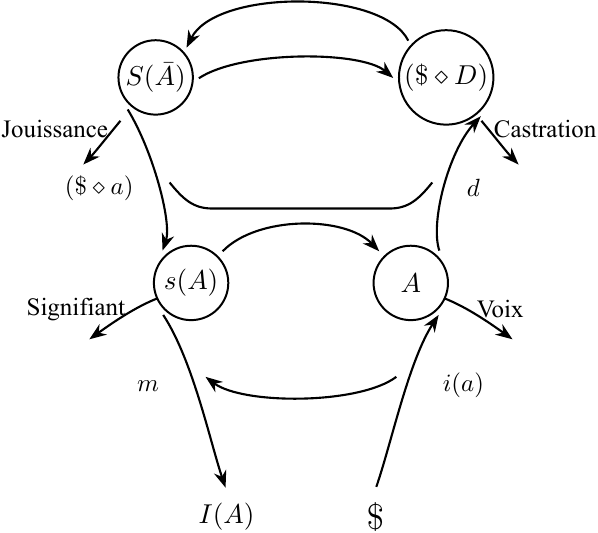
Positions, Mathemes, Pathways, and Crossings
The complete graph contains heterogeneous inscriptions. Treating all visible symbols as members of one undifferentiated alphabet would suppress differences that become important once traversal is formalized. The present subsection therefore identifies several source-level roles without assuming that the proposed categories reproduce Lacan’s own terminology for a formal grammar.
Among the conspicuous positions in the complete graph are inscriptions such as
together with the divided subject and relational mathemes such as
The graph also contains inscriptions including
as well as pathway-associated terms such as Signifier, Voice, Jouissance, and Castration in the complete presentation (Lacan 2006). These inscriptions do not all have the same theoretical function.
The point
The distinction between a position and a matheme is particularly important. A matheme such as
encodes a structured relation. It should not be converted automatically into an atomic symbol whose internal organization has no formal relevance. Depending on the analysis, the matheme may be treated as an indivisible observable label, as a structured term, or as a relation among typed components. These alternatives lead to grammars with different expressive requirements.
Likewise, a pathway label does not necessarily function as a vertex. The inscription
Crossings require separate treatment. Graph I already derives part of its meaning from the intersection of two differently directed trajectories. In the elementary cell, the signifying chain and the curved vector do more than pass near one another. Their crossings participate in the production and punctuation of signification (Lacan 2006). Later stages assign additional structural functions to corresponding positions.
Consequently, the geometric data of the diagram cannot be reduced to a list of labels. At minimum, a source reconstruction must preserve
distinguishable inscriptions;
the trajectories on which they occur;
the ordering of inscriptions along those trajectories;
directed relations indicated by arrows;
intersections among trajectories;
the distinction between lower and upper levels of the graph;
relational mathemes whose internal structure may matter; and
annotations attached to pathways or regions rather than to individual points.
This requirement already suggests that a simple alphabet
is useful only as a provisional inventory. An alphabet alone does not encode the different formal roles played by its members.
The paper therefore reserves the term fine-grained Lacanian vocabulary for the verified collection of objects available to the generative reconstruction, while the precise syntactic type assigned to each member is specified only after its source role has been established.
Direction and Structural Relations
The arrows of the Graph of Desire make direction an indispensable part of the source structure. Their presence nevertheless raises a formal question: what kind of relation does a directed segment encode?
In Graph I, Lacan explicitly distinguishes the direction of the signifying chain from the curved trajectory that intersects it. The graph is therefore already more structured than an undirected network (Lacan 2006). The subsequent diagrams add further directed circuits. A formal reconstruction that discards arrow orientation would lose source information before any generative analysis had begun.
At the same time, three relations must be distinguished:
and
Diagrammatic incidence records that two graphical elements meet or are connected. A source-level directed relation records that Lacan’s diagram assigns orientation to a pathway. A grammatical transition states that a formal generative system licenses a passage from one formal configuration to another.
These relations can overlap without being identical.
For example, suppose two source objects
This relation establishes a directed source connection. A later production
adds a further claim: the generative system permits an admissible derivation whose current structural position is associated with
This distinction protects the model from a simple but consequential error. If every arrow in the source diagram were converted immediately into an unrestricted transition, then every graph walk would become a psychoanalytically admissible trajectory by definition. Such a construction would make the grammar little more than an enumeration of connectivity.
The intended grammar has a stronger task. It must be capable of expressing conditions of traversal where the Lacanian interpretation requires them. The relation
may therefore be necessary for a production without being sufficient for that production.
A further issue concerns the mathematical meaning of the word topology. Lacan himself describes the graph using topological language in “Subversion of the Subject” (Lacan 2006). The present paper distinguishes that usage from a claim that the diagram has already been supplied with all the data of a topological space in the mathematical sense. The first formal reconstruction uses combinatorial incidence, orientation, typing, and path structure. Topological or geometric structures in a stronger mathematical sense are introduced only if later arguments require them.
The same restraint applies to graph-theoretic terminology. The complete diagram may ultimately admit representation as a directed multigraph, a typed graph, a hypergraph, or a more general relational structure. The choice depends on whether every theoretically relevant relation is adequately binary and whether crossings and structured mathemes can be represented without artificial decomposition.
For this reason, the paper does not yet identify the complete source diagram with a conventional directed graph
without qualification. A more flexible typed relational representation is introduced in Subsection 2.5.
Temporality and Retroaction
Directionality does not settle the temporal interpretation of the Graph of Desire. This subsection isolates the temporal constraints that any generative account must respect. Its central concern is the relation between sequential production and retroactive signification.
Graph I provides the clearest source for this problem. Lacan describes the horizontal vector as a signifying chain and the intersecting construction through the operation of the point de capiton. The latter arrests the otherwise indefinite sliding of signification (Lacan 2006). The completed signifying sequence gives earlier elements a determinate signification retrospectively. Fink’s close reading of the graph likewise emphasizes that the graph cannot be understood as a simple forward succession of independently meaningful units (Fink 2004).
This feature places an immediate restriction on the formal interpretation of traversal. A generated sequence
can possess an order of production without requiring the semantic value of
Let
denote a generated prefix and let
denote an interpretation or semantic valuation available at stage
The previously generated formal history remains
while its interpretation changes after a later development. This provides one possible formal distinction between syntactic generation and retroactive semantic determination.
The distinction is useful because it avoids treating retroaction as a literal reversal of chronological motion through the graph. A grammar can continue to generate an ordered trace,
while an associated interpretive layer revises the valuation of part of the existing trace.
Other formalizations remain possible. A context-sensitive grammar might condition future productions on previously generated material. An attributed grammar might propagate and revise semantic attributes. A configuration-based system could preserve a richer internal state whose later evolution changes the interpretation of repeated observable positions. These alternatives are compared in Section 6. The present section establishes only the requirement that retroaction must not disappear through an overly simple sequential encoding.
Seminar VI provides an additional caution by presenting the graph through multiple trajectories whose relations are developed together (Lacan 2019). The resulting structure therefore should not be read automatically as a single chronological chain. Several pathways can participate in one structural account even when a later generative model chooses to linearize a particular observation trace.
Three orders should consequently remain distinct:
Derivational order belongs to the formal grammar or computational system. Diagrammatic direction belongs to the verified Graph of Desire. Interpreted historical time belongs to the psychoanalytic account of the situated subject. A later section may define mappings among them. None of these mappings is assumed to be an identity.
This distinction also clarifies the meaning of recurrence. If a generated trajectory later returns to the same visible inscription, the return does not establish that the interpretation, historical context, or complete generative configuration has returned to its earlier value. Repetition of a label is compatible with transformation of the subject’s history.
Accordingly,
at the level of an observable structural label can coexist with
at the level of a richer generative configuration. This distinction becomes central when recurrent RSI words and configuration-based P-system models are introduced later.
Formal Typing of Graph Elements
The preceding reconstruction suggests that the formal source object should retain heterogeneous element types, directed relations, and structured incidence. This subsection introduces such an object provisionally. Its role is to provide a common source representation from which several later grammar families can be constructed without forcing the Lacanian diagram prematurely into the syntax of any one grammar.
Let
denote the set of verified formalizable objects extracted from the relevant versions of the Graph of Desire. These objects may include positions, mathemes, pathway inscriptions, crossings, and other structural elements whose role has been established from the sources.
Let
be a set of formal types. A provisional inventory may include types such as
These are categories of the present formal reconstruction. They are not presented as Lacan’s own classification of the elements of the graph.
Because one Lacanian inscription may perform more than one formal role, the typing relation is allowed to be multivalued:
A power-set-valued typing relation prevents the model from forcing every object into exactly one syntactic category before the need for such exclusivity has been demonstrated.
Let
denote the set of verified structural relations among elements of
where
The resulting source reconstruction is written provisionally as
where
records the ordered incidence data associated with a relation
The passage from Lacan’s source diagrams to this structure may be represented by a formal reconstruction map
The map
A later RSI classification can then be added as a secondary typing or observation layer. Provisionally, such a relation might have the form
The codomain is again power-set-valued because a unique assignment of every fine-grained Lacanian object to exactly one register has not been established. The role of
This construction provides the source object needed by the rest of the paper:
The first arrow is a source-constrained formal reconstruction. The second will depend upon the grammar family under consideration. A regular grammar, a probabilistic grammar, an attributed system, and a neural P system can all be derived from or constrained by the same verified source structure while preserving different amounts of information.
The principal outcome of this section is therefore a set of constraints rather than a completed grammar. The later grammar must preserve the relevant directionality of the source graph, distinguish heterogeneous formal objects where their Lacanian roles differ, permit a separation between derivational order and retroactive interpretation, and avoid identifying repeated observable positions with repeated complete states. Section 3 uses these constraints to define derivations, itineraries, admissible traversal, and recursive generation.
Generative Models of Psychoanalytic Traversal
This section establishes the general formal vocabulary through which traversal will be represented before particular grammar families are introduced. Its role is to separate four objects that would otherwise be easy to conflate: a formal derivation, an itinerary through the reconstructed Lacanian structure, an observable symbolic trace, and an interpreted psychoanalytic trajectory. The section then specifies admissibility, recursive extension, recurrence and cyclicity, and the treatment of historical context and external conditions. The constructions remain independent of whether the eventual generator is implemented as a regular grammar, a probabilistic context-free grammar, an attributed system, a neural P system, or another formalism.
The starting point is the typed source structure introduced in Section 2,
The present section does not yet specify a unique grammar over
Derivations, Itineraries, and Trajectories
A generative model produces objects through a sequence of rule applications. The internal form of those objects depends upon the model. In a conventional grammar they may be sentential forms; in a finite-state system they may be states; in a rewriting system they may be structured expressions; and in a neural P system they may be global configurations. A model-independent notation is therefore useful.
Let
denote a generative system, where
A finite derivation has the form
where
To connect the generative system with the Lacanian source structure, let
be an observation or readout map, where
Application of
The sequence alone does not necessarily preserve the full internal history of the derivation. It is therefore useful to distinguish a derivational trace from a Lacanian itinerary.
A Lacanian itinerary is written
where the
The exact representation of an itinerary can vary with the chosen formalism. If only positions are relevant, the itinerary may be reduced to
If edge types, crossings, or structured mathemes carry information needed by the analysis, those elements remain explicit.
The term psychoanalytic trajectory refers to a further interpretive level. Let
denote an interpretation relation connecting formal Lacanian itineraries with descriptions of a historically situated subject. Schematically,
Here
The use of a relation rather than immediately assuming a one-to-one function is deliberate. A single formal itinerary may admit more than one psychoanalytic interpretation, and distinct formal itineraries may become indistinguishable at a chosen interpretive resolution.
This layered construction prevents three reductions. A formal derivation is not identified with the diagrammatic path that it produces. A diagrammatic path is not automatically identified with the historical development of a subject. An interpreted trajectory does not by itself establish the causal mechanism through which the corresponding phenomenon arose.
The resulting architecture is therefore
Later sections can simplify this architecture when a particular analytical task does not require all four levels.
Admissible Traversal
The purpose of admissibility is to distinguish structurally licensed trajectories from arbitrary symbolic concatenations. The method used here separates source-level connectivity from constraints introduced by the generative reconstruction.
Let
denote the set of formally representable itineraries over the reconstructed Lacanian source structure. This set may initially contain every sequence compatible with the relevant incidence and directionality relations.
The generative model selects an admissible subset
Membership in
First, an itinerary must respect the source structure. If a step between two formal objects has no corresponding relation in the verified reconstruction, the generative model should not introduce that passage without an explicit additional justification.
Second, graphical connection alone need not imply grammatical admissibility. Suppose
The existence of this source relation does not automatically entail a production
A production rule adds an operational claim concerning how an itinerary may be generated. The rule must therefore specify which features of the source relation license its use.
Third, admissibility may depend upon the derivational history. A transition that is available after one sequence of earlier rule applications may be unavailable after another, even when both derivations produce the same current observable label.
This possibility can be represented by allowing the admissible rule set to depend upon the current configuration:
Where historical information is retained in
Fourth, admissibility may depend upon contextual conditions external to the formal Lacanian position. These conditions are introduced explicitly in Subsection 3.5.
The distinction among source relation, configuration, and production rule also prevents the later comparison of grammar families from becoming circular. A finite-state representation may encode admissibility through its transition relation. A context-sensitive grammar may encode it through surrounding symbols. An attributed grammar may encode it through attributes. A P-system model may encode it through the contents and applicability conditions of rules in a global configuration.
The same psychoanalytic constraint can therefore admit several formal realizations.
The task of the present framework is to identify the constraint before selecting the machinery used to encode it.
Recursive Generation
The generative account treats a psychoanalytic itinerary as extendable. Its role is therefore different from a classification that assigns a completed case to one static category. This subsection distinguishes recursive generation from simple repetition and from literal self-loops in the source graph.
Let
be an admissible finite itinerary. A rule
provided that the corresponding continuation remains admissible.
Repeated application gives
This sequence expresses ongoing generation. It does not require the trajectory to terminate after a predetermined number of steps.
The term recursive is used cautiously. In formal language theory, recursion can refer to the reappearance of a nonterminal within its own derivational expansion. In a broader computational setting, recursive or iterative rule application may instead refer to repeated use of a generative operation on its own outputs. These cases should be distinguished when a particular grammar family is specified.
The present paper therefore separates at least three phenomena:
repeated application of a rule or rule family;
recursive derivational structure;
repeated observation of the same Lacanian or RSI symbol.
None of these requires a literal self-loop on a Lacanian node.
Suppose two stages of a derivation satisfy
while
The same observable position
while the fine generative history is
This distinction is especially important once the RSI alphabet is introduced. A sequence such as
does not require a single Symbolic state possessing a self-loop. It may be the projection of several distinct fine-grained Lacanian configurations, each classified at the same register level.
Recursive generation can also create histories whose later interpretation depends upon earlier derivational structure. A rule system may therefore retain more information than the final emitted word. This possibility provides one reason for comparing ordinary grammars with configuration-based generative systems rather than presupposing that the generated string is a complete representation of the process.
Open, Recurrent, and Cyclic Traversals
This subsection distinguishes several forms of continuation and return that will recur throughout the paper. Its objective is to prevent symbolic repetition from being confused with stronger forms of structural or configurational closure.
A finite derivation can terminate, or it can be treated as a prefix of a longer admissible derivation. For an itinerary
If
the current trajectory admits at least one continuation. The observed finite word can therefore be analyzed as an open prefix of a continuing generative process.
Where indefinitely continuing generation is required, the finite-language representation can be extended from
to infinite traces in
The availability of an infinite-trace representation does not imply that every psychoanalytic process must be modeled as an infinite computation. It simply allows the formalism to represent ongoing production without forcing an arbitrary terminal symbol.
Recurrence begins at a weaker level. An observable sequence is recurrent in a minimal symbolic sense when a previously observed symbol or finite block appears again. For example,
contains a return to
A fine-grained itinerary may exhibit a stronger return if the same formal Lacanian object is revisited:
This still does not imply that the complete generating configurations agree.
A configuration-level return requires
The distinctions can therefore be ordered as
where each implication requires the relevant observation maps to identify the corresponding levels, and the reverse implications do not generally hold.
A cycle in the reconstructed Lacanian graph can likewise be defined combinatorially. If
is an admissible path and
then the itinerary closes at the level of the selected graph objects.
This graph-level closure remains distinct from configuration closure if
It also remains distinct from the stronger notion of closure in a continuous psychoanalytic state space developed only in later work.
The distinction is particularly important for projected register trajectories. A word of the form
can be cyclic with respect to its first and last register labels while the fine Lacanian itinerary remains open. A fine itinerary can itself return to the same graph position while the underlying generator remains in a new configuration. A recurrent trajectory can therefore preserve historical change despite apparent symbolic return.
For the purposes of this paper, the following vocabulary will be used:
open traversal for an itinerary treated as an unfinished prefix with admissible continuation;
symbolic recurrence for repeated observable symbols or blocks;
graph recurrence for revisitation of a fine-grained Lacanian position or structural region;
graph cycle for an admissible itinerary whose selected initial and terminal graph objects coincide;
configuration closure for equality of the complete generating configurations at two stages.
These distinctions allow later sections to discuss languages containing cycles without importing geometric notions of closed orbit or holonomy into the present discrete setting.
Historical Context and Exogenous Conditions
The formalism developed in this paper concerns a single historically situated subject. Its purpose is to retain historical dependence without prematurely introducing a coupled model of several interacting subjects. The method is to represent external relational and institutional processes through contextual variables whose own endogenous dynamics remain outside the present model.
Let
denote the historically accumulated context relevant at stage
denote an exogenous input or disturbance acting upon the modeled subject.
A transition can then be written schematically as
This notation states only that applicability or consequences of a rule may depend upon historical and external conditions. It does not specify the causal mechanism by which those conditions were produced.
The admissible rule set may accordingly take the form
The historical variable
External inputs are treated similarly. If another person, institution, or event affects the subject, the present model may represent the relevant effect through
The present scope can therefore be represented as
while a coupled architecture such as
is reserved for a later research series.
This restriction has two methodological advantages. First, it allows the single-subject grammar to be examined before reciprocal dynamics multiply the number of state variables and rule dependencies. Second, it keeps the epistemic status of exogenous events explicit. The model can represent that an event changes the admissible continuation of a trajectory without claiming to possess a complete model of the agent or institution that produced the event.
Historical context also provides a natural place for differences between apparently identical observable trajectories. Suppose two derivations generate the same coarse word
while their historical contexts differ:
The equality of symbolic outputs does not entail equivalence of their psychoanalytic interpretation. This observation anticipates the multi-resolution analysis developed later in the paper.
The principal result of this section is therefore a general architecture for generative traversal:
together with an interpretive relation connecting the resulting Lacanian itinerary to a historically situated psychoanalytic trajectory.
The architecture is intentionally neutral with respect to the grammar family used to implement it. Section 4 now introduces the simplest representation considered in the paper: a coarse trajectory language over the Real, Symbolic, and Imaginary.
The Coarse RSI Language
This section develops the lowest-resolution trajectory representation used in the paper. Its objective is to determine what can already be represented when a psychoanalytic itinerary is observed only through the three registers of the Real, Symbolic, and Imaginary. The construction is intentionally sparse. It first defines the alphabet and its finite and continuing words, then introduces register-level production and admissibility, distinguishes repeated register observations from repeated states, characterizes the analytical scope of the representation, and identifies the information that this coarse-graining necessarily suppresses.
The RSI language is not proposed as a replacement for the fuller Graph of Desire reconstructed in Section 2. It is a lower-resolution observation of possible trajectories. Its usefulness therefore depends upon the research question. Some questions require only the order in which register-level distinctions appear. Other questions depend upon fine-grained Lacanian positions, derivational histories, or contextual states that the RSI representation cannot preserve.
RSI Alphabet and Register-Level Words
Let the coarse alphabet be
where the symbols denote observations classified, at the selected level of analysis, with respect to the Real, Symbolic, and Imaginary.
The alphabet should be understood as an observational vocabulary rather than as a complete inventory of psychoanalytic states. In particular, the use of a symbol
A finite RSI word is
The set of all finite words over the alphabet is
The psychoanalytically admissible RSI language is some subset
The inclusion may be strict. The construction does not assume that every possible concatenation of
For example,
and
are syntactically well-formed words over
An RSI word records order. Thus
as formal words even though both contain one occurrence of each register. This elementary distinction is important for later psychoanalytic interpretation because the trajectory representation preserves sequence rather than merely the set or frequency of registers encountered.
For a word
its length is written
A finite word may represent either a completed observation interval or a prefix of a continuing trajectory. When continuing generation is relevant, the representation can be extended to infinite words,
The corresponding continuing language is written provisionally as
The distinction between finite and infinite traces concerns the observation window and formal representation. It does not imply that the psychoanalytic subject possesses a literally infinite sequence available as a completed object.
Register-Level Production Rules
A language specifies a collection of admissible words. A generative model must additionally specify how such words can be produced. At the RSI level, the most elementary production problem concerns possible continuation from one register observation to another.
Let
denote a set of register-level production rules. A schematic rule may be written
where
For example, if the model licenses the passages
the corresponding derivation can generate the word
This notation is illustrative rather than a commitment to a regular grammar. Section 6 compares several ways of implementing the same register-level admissibility structure.
More generally, let
denote the set of register observations that may follow a current history
and admissibility depends only on the current register symbol.
A history-sensitive model permits
Two trajectories ending in the same register can then possess different continuation sets because their earlier histories differ.
Suppose
and
Both terminate in
and
need not coincide.
This distinction becomes important when comparing simple finite-state representations with context-sensitive, attributed, probabilistic, or configuration-based generators. The RSI language itself does not determine which memory structure should be used.
Register-level production rules may therefore be considered at several degrees of resolution:
and
The third case is especially important for this paper. An apparent rule
may summarize several distinct fine-grained transitions in the full Lacanian language. The RSI production should therefore be understood as a coarse rule unless an independent argument establishes it as primitive.
Recurrence and Repeated Register States
The RSI alphabet makes recurrence immediately visible. Its low resolution, however, also creates the risk of interpreting repeated symbols as repeated complete states. This subsection formalizes the distinction.
Consider
The first and final observations satisfy
At the level of the RSI word, the trajectory has returned to the same register label. This is a register-level return.
Suppose, however, that the word is produced by a generative process with configurations
and readout map
The observed return requires only
It does not require
The distinction extends to repeated adjacent symbols. If
the observed word contains
This does not require a literal transition from one unique Symbolic state back to itself. The underlying configurations may satisfy
The coarse word
can therefore encode a fine transition
when both fine objects project to the same register:
This gives the RSI language a useful interpretation. Consecutive equal symbols can represent movement that is invisible at the chosen resolution.
More generally, let a finite block
occur more than once within a word. The repeated appearance of
The RSI representation therefore supports several increasingly strong statements:
Only the first two are directly visible in an RSI word.
This distinction also limits the meaning of a register-level cycle. If
the word may be described as returning to its initial register. The term does not imply closure of the full Lacanian itinerary or of an underlying state space.
The use of cyclic language in this section is therefore strictly resolution-dependent.
Expressive Scope of the RSI Representation
The simplicity of the RSI language is analytically useful. This subsection identifies the properties that survive at this level of representation and therefore do not require immediate recourse to the complete Graph of Desire.
First, the language preserves register ordering. It distinguishes
from
and therefore permits questions concerning whether different register-level orders should receive different interpretations.
Second, it preserves register frequency. For a word
as the numbers of occurrences of each register. Frequency alone is weaker than order, but it can remain useful as a descriptive statistic.
Third, the language preserves local transition patterns. For example, one can distinguish occurrences of
and other finite blocks.
Fourth, it preserves symbolic recurrence. Repeated registers and repeated subwords can be identified without knowing the internal configuration that generated them.
Fifth, the language can distinguish finite observed trajectories from continuing ones. Prefixes can be compared through their continuation sets,
Two words ending in the same symbol may have different continuation sets. Such a difference reveals history dependence even before the source of that dependence has been specified.
Sixth, the RSI language permits formal comparison among different generative models. Two models
may generate the same observable language,
while using different internal mechanisms.
This possibility is methodologically important. Equality of generated languages does not imply equality of generators.
Likewise, two models may agree on all trajectories up to a selected finite length while diverging for longer histories. The empirical or theoretical resolution available to an analysis may therefore be insufficient to identify a unique generating formalism.
The RSI language is consequently suitable for questions concerning observable register order, recurrence, local transition patterns, finite prefixes, and coarse continuation structure. These properties can be studied without reconstructing every fine-grained Lacanian relation.
Its simplicity can therefore be a virtue rather than a deficiency.
Limits of Register-Level Resolution
The same abstraction that makes the RSI language economical also determines its limitations. This subsection identifies which distinctions cannot be recovered reliably from an RSI word alone.
Let
denote the set of fine-grained Lacanian itineraries introduced in Section 3. A coarse observation map will later be defined more precisely as
Suppose
while
The RSI word preserves their common register ordering while suppressing the differences that distinguish the two fine itineraries.
Several kinds of information may be lost.
First, the identities of fine Lacanian positions can disappear. Distinct objects in the reconstructed Graph of Desire can receive the same coarse register classification.
Second, edge or relation types can disappear. Two transitions can project to the same ordered pair of registers while corresponding to different relations in the fine structure.
Third, derivational histories can disappear. Distinct rule sequences may produce the same fine itinerary, and distinct fine itineraries may produce the same RSI word.
Fourth, structural context can disappear. A symbol
Fifth, retroactive changes in interpretation are not visible automatically in the symbol sequence. The word records the sequence of coarse observations, while the valuation attached to an earlier symbol may change at a later stage.
Sixth, the complete internal configuration of a richer generator is lost under the observation map. This becomes especially important for configuration-based systems, where
can hold despite
The map to RSI is therefore generally expected to be many-to-one.
This observation suggests an equivalence relation on fine trajectories:
whenever
The corresponding equivalence class
collects fine-grained trajectories that are indistinguishable at the RSI resolution.
The present paper does not yet develop a general quotient-space taxonomy. That problem belongs to later work. The equivalence relation is introduced here only to make the informational meaning of coarse representation explicit.
An RSI word should consequently be read as a partial observation:
The word records the features retained by
The appropriate resolution therefore depends upon the inferential task. If two fine trajectories differ only in features irrelevant to the current analysis, their common RSI representation may be sufficient. If their difference changes the psychoanalytic interpretation, admissible continuations, or later formal dynamics, the finer representation becomes necessary.
This gives the paper a general resolution principle:
A coarse trajectory language is adequate when the distinctions removed by its observation map are irrelevant to the problem under analysis.
Section 5 now develops the complementary fine-grained language. Its purpose is to retain the structural distinctions that the RSI representation deliberately forgets.
The Fine-Grained Lacanian Language
This section develops the higher-resolution symbolic representation associated with the reconstructed Graph of Desire. Its role is to retain distinctions that disappear under the RSI language introduced in Section 4. The construction proceeds from a typed vocabulary derived from the source structure, introduces production rules constrained by verified graph relations, distinguishes generated itineraries from their derivational histories, incorporates structural memory and context-dependent rule applicability, and finally develops a formal treatment of retroactive reinterpretation. The objective is to obtain a language that is sufficiently rich to preserve Lacanian structure while remaining neutral with respect to the particular grammar family used to generate it.
The source of the construction is the typed relational object
introduced in Section 2. The elements of
Typed Vocabulary from the Graph of Desire
The first task is to specify the vocabulary available to the fine-grained language. A flat alphabet containing every visible inscription in the Graph of Desire would be formally possible, but it would erase distinctions among positions, structured mathemes, pathway labels, crossings, and relations. The present construction therefore begins with a typed vocabulary.
Let
denote the set of formal object types established during the source reconstruction. A provisional inventory may include
These types belong to the present formalization. Their purpose is to preserve different operational roles in the later generative system.
For each type
denote the corresponding set of observable symbols. The fine-grained alphabet may then be represented as the typed disjoint union
The use of a disjoint union records type information even when two objects share similar written forms.
A simplified position alphabet may contain source-supported inscriptions such as
while other typed components may include
subject to the source-level distinctions established in Section 2 (Lacan 2006). The formal type of an inscription is determined by its role in the reconstruction rather than by its visual appearance alone.
The resulting fine-grained alphabet should therefore be understood as a family of typed symbols rather than as a single homogeneous list:
This distinction becomes important when defining production rules. A rule that moves between structural positions may differ formally from a rule that introduces or modifies a relational matheme.
Some Lacanian expressions also possess internal formal structure. For example,
contains components whose relation may itself matter to the analysis. The present framework therefore permits two representational resolutions.
At one resolution, a structured matheme may be treated atomically:
At another, its internal syntax may be retained:
The choice between these representations depends upon the generative problem being studied. If the internal composition of the matheme plays no role in the production under consideration, the atomic representation may be sufficient. If transformation or substitution inside the matheme becomes relevant, a structured representation is required.
The fine language therefore begins from a principle of typed resolution:
A Lacanian object should be represented with the minimum internal structure required to preserve the distinctions relevant to the generative analysis.
This principle parallels the relation between the fine Lacanian language and the coarser RSI language. Resolution is increased only when an additional distinction performs analytical work.
Graph-Constrained Production Rules
The typed vocabulary specifies which objects may appear in the language. Production rules determine how those objects can participate in admissible generative histories. The central constraint is that the rules remain compatible with the verified relations of the reconstructed Graph of Desire.
Let
denote the set of fine-grained production rules. For a pair of formal objects
a minimal traversal rule can be introduced only when the source reconstruction contains a relation supporting the corresponding passage:
A schematic production may then have the form
where
In the simplest case, only the destination is emitted:
A derivation then yields a position sequence
If relation types matter, the generated itinerary may instead retain the alternating structure
This richer representation distinguishes two trajectories that visit the same positions through different relation types.
The source graph constrains production through an incidence condition. Writing
a traversal rule corresponding to
for a directed binary relation.
The production system may nevertheless impose stricter conditions than source connectivity. Let
be an applicability predicate for rule
only when
This separates two constraints:
and
The first belongs to the reconstruction of Lacan’s diagram. The second belongs to the generative model.
This separation is necessary because the same graph relation may participate in different derivations under different historical or contextual conditions. It also permits the same source structure to support several grammar families without altering the reconstructed Graph of Desire itself.
The local production rules form the lowest level of the grammar. Composite or macro-level rules can be introduced when a recurrent sequence of local productions has a theoretically meaningful role.
Suppose
is an admissible recurrent structural pattern. A derived rule may summarize this sequence as
where
Such a macro-rule is an analytical abbreviation. It does not replace the fine derivation from which it was constructed.
The distinction between primitive and derived rules will matter when the language is compared with the RSI representation. A coarse rule such as
may correspond to one local fine production or to an entire family of fine-grained derivational sequences.
Fine-Grained Derivation Histories
The generative history of a trajectory contains information that need not survive in its final symbolic output. This subsection distinguishes a derivation from the itinerary it generates and introduces equivalence relations among derivations at different observational resolutions.
Let
be a finite derivation in a candidate generative model.
The associated fine Lacanian itinerary is obtained through a readout map
or, when several simultaneous observations are retained,
The resulting trace is
Two distinct derivations may satisfy
while
This can occur when different internal rule applications or intermediate configurations are invisible under
Define derivational equivalence at the fine observational level by
whenever
An equivalence class
therefore contains derivations that are observationally identical at the fine Lacanian language level even though their internal generative histories differ.
The RSI projection introduces a coarser equivalence relation. If
then define
whenever
Consequently,
implies
provided the same projection is defined on both fine outputs.
The converse need not hold.
This yields a hierarchy of observational resolution:
Information can be lost at each arrow.
A concrete schematic example illustrates the distinction. Suppose
and
are distinct fine itineraries while
and
Then both produce
at the coarse level.
The RSI word therefore identifies a class of possible fine generative histories rather than a unique history.
This distinction is important for later probabilistic modeling. A probability assigned to the observable word
is conceptually different from probabilities assigned to distinct derivations
The distinction remains even when the probabilities sum to the same marginal word probability.
Section 6 will return to this issue when probabilistic context-free and weighted grammars are introduced.
Structural Memory and Context Dependence
Repeated appearance of the same fine Lacanian symbol does not imply that the generative process has forgotten its earlier history. This subsection introduces structural memory as the information required to distinguish historically different visits to the same observable position.
Suppose
The two observations are identical at the level of the fine Lacanian vocabulary. The internal configurations may nevertheless satisfy
The difference between the configurations may encode distinct derivational histories, contextual conditions, accumulated attributes, or other information retained by the chosen generative formalism.
Let
denote the structurally relevant memory available at stage
where
A transition becomes
The update of memory may be written
This representation is deliberately generic. Different grammar families implement
A finite-state grammar may absorb memory into an enlarged state alphabet. A context-sensitive grammar may encode relevant history in neighboring symbols. An attributed grammar may store it in inherited or synthesized attributes. A probabilistic model may condition transition probabilities on selected historical variables. A neural P system may retain it in the global configuration of the system.
The observable symbol therefore need not carry the complete state.
This distinction is particularly useful for repeated Lacanian positions. A trajectory can contain
while the corresponding configurations are
and
with
The formal system has returned to the same observable position while retaining a changed historical configuration.
Context dependence can then be represented through the admissibility function
Two occurrences of the same observable position
This provides a formal basis for history-dependent branching without requiring every historically distinct state to receive a new Lacanian symbol.
The distinction also protects the source vocabulary from uncontrolled proliferation. Without internal memory, repeated historically different occurrences might be represented artificially as
Such indexing can be useful for exposition, but it should not be mistaken for an expansion of Lacan’s own conceptual vocabulary. The memory-bearing configuration offers a cleaner separation between source symbols and model-specific historical state.
Retroactive Reinterpretation
The final requirement of the fine-grained language concerns retroaction. Section 2.4 established that derivational order, diagrammatic direction, and interpreted historical time should remain distinct. The present subsection develops the corresponding formal semantics.
Let
be the Lacanian itinerary generated up to stage
Let
denote the interpretive valuation associated with the current history. For each earlier position
After generation of a new element
Retroactive reinterpretation is represented by the possibility that
for some
The generated symbol
This distinction allows the model to preserve an ordinary forward derivational order
while permitting the semantic interpretation of earlier elements to depend upon later developments.
The architecture can therefore be written as
together with
Generation and reinterpretation are related processes with different formal roles.
Several grammar families can encode this distinction in different ways.
A simple grammar may generate the itinerary while leaving retroactive interpretation to an external semantic layer.
An attributed grammar may update attributes attached to previously generated structures.
A context-dependent rewriting system may allow later context to alter the formal status of earlier material.
A configuration-based generator may preserve internal variables that determine how the accumulated trajectory is interpreted after each step.
The present paper does not assume in advance that one of these methods is the uniquely appropriate formalization of Lacanian retroaction. The comparison in Section 6 evaluates what each approach requires and what information it preserves.
Retroactive interpretation also complicates observational equivalence. Suppose two trajectories have the same fine symbolic trace,
while their interpretive valuations differ,
The equality of fine words is then insufficient to establish equivalence at the psychoanalytic interpretive level.
The hierarchy of representation is consequently extended to
with the understanding that the order of presentation does not imply a single causal chain among these objects.
The principal result of this section is therefore a fine-grained language that preserves more than the order of register labels. It distinguishes typed Lacanian objects, source-constrained passages, derivational histories, structural memory, context-dependent continuation, and retroactive semantic revision.
This additional structure does not make the fine language universally preferable to the RSI representation. It becomes useful when the research problem depends upon distinctions that the coarse language suppresses.
Section 6 now turns from the language itself to the families of formal systems that can generate, approximate, weight, or analyze such trajectory languages.
Generative Formalisms
This section compares several established families of generative formalisms that can be used to represent the trajectory languages developed in the preceding sections. Its role is methodological rather than classificatory. The objective is to determine what each formalism preserves, what additional structure it introduces, and which aspects of Lacanian traversal it can represent economically. The section begins with regular and finite-state models, proceeds through context-free and context-sensitive systems, considers attribute and graph grammars, introduces probabilistic and weighted grammars, and then examines neural P systems as configuration-based generators. The final subsection formulates a model-selection principle based on analytical purpose rather than maximal expressive power.
The comparison begins from a distinction already established in Section 3:
are separate objects.
A language may admit several generative descriptions. Conversely, two generative systems with different internal architectures may produce the same observed language. Formal-language equivalence at a chosen resolution therefore provides limited information about the mechanism by which a trajectory is generated.
This observation is especially important for the present application. A probabilistic context-free grammar may provide a useful representation of the distribution of Lacanian trajectories even if the process producing those trajectories has richer internal memory. A finite-state grammar may provide a useful coarse model of register transitions even if the fine-grained process is history-dependent. A neural P system may represent changing internal configurations while its observable output is subsequently analyzed by a simpler grammar.
The formalisms considered below should therefore be understood as complementary analytical resources.
Regular Grammars and Finite-State Models
This subsection establishes the minimal generative baseline. Its objective is to identify how much of the trajectory problem can already be represented when continuation depends only upon a finite control state. The method is to compare paths through the reconstructed Lacanian structure with the finite-state and regular-language framework developed in classical formal language theory (Chomsky 1956, 1959).
Let
be a regular grammar, where
A right-linear production may have the form
or
where
For the coarse RSI language, one can associate control states with register-level positions. A schematic system may contain rules such as
Repeated rule application can generate
The existence of recurrent or arbitrarily long trajectories therefore does not by itself require a context-free or more powerful grammar. A finite-state system can generate indefinitely extendable words containing repeated cycles.
This observation matters for the interpretation of trajectories such as
The presence of a repeated register, repeated block, or register-level cycle does not provide evidence that a more expressive grammar family is required. Greater expressive power becomes relevant only when the admissibility of future productions depends upon information that cannot be represented by the selected finite control state without an unacceptable expansion of the state space.
The same baseline applies to the fine Lacanian language. If admissible traversal depends only upon the current formal position and a finite set of local conditions, then the path language of the corresponding finite directed structure can be represented by a finite-state system.
The analytical strength of this model is its transparency. It makes local admissibility explicit:
Its principal limitation is equally clear. Two histories arriving at the same control state possess the same continuation structure unless historical information has been encoded by splitting that state into several distinct finite control states.
Thus, if
while both histories are represented by
a simple finite-state model cannot distinguish their futures unless the state representation is refined.
This is a representational limitation rather than evidence that finite-state analysis is useless. Where the research problem concerns only local transition constraints or coarse register-level sequencing, the regular model may be the most economical representation considered in this paper.
Context-Free Grammars
This subsection examines the additional structure introduced by context-free derivation. Its role is to distinguish genuine hierarchical or nested generation from simple recurrence in a trajectory. The method follows the classical distinction between finite-state and phrase-structure generative systems (Chomsky 1959).
A context-free grammar can be represented as
with productions of the form
where
The important formal feature for the present discussion is that one nonterminal can expand into a structured expression containing further nonterminals. This allows derivations whose organization is naturally tree-like rather than merely a sequence of local state transitions.
For example, a schematic production
together with
generates a family such as
The example is formal only. It is not proposed as a Lacanian production rule. Its purpose is to show the difference between repeated traversal and hierarchically generated structure.
A context-free representation becomes relevant to the Lacanian model when a trajectory contains dependencies that are more naturally represented as embedded structures. Possible candidates include derivational organization around structured mathemes, nested interpretive units, or a construction in which one generated structure contains another structurally complete subderivation.
The existence of recursion alone does not establish this requirement. A finite-state cycle such as
already permits repeated generation. Context-free structure becomes useful when the dependency concerns the organization of a derivation rather than only recurrent motion through finitely many observable positions.
This distinction prevents the term recursive from carrying too much formal weight. Psychoanalytic recurrence, repeated return to a register, and recursive nonterminal expansion are different formal phenomena.
For the present framework, a CFG can therefore play at least two roles.
First, it can provide a compact representation of families of Lacanian itineraries whose fine structure contains hierarchical regularities.
Second, its derivation trees can preserve generative distinctions that a surface RSI word suppresses.
Suppose
are two derivation trees while
The same observable trajectory may then possess more than one derivational history. This possibility is particularly important once probabilities or weights are assigned to derivations.
The paper therefore retains context-free grammar as a candidate formalism without assuming that the Graph of Desire itself has context-free structure. That stronger claim requires evidence from the formal reconstruction.
Context-Sensitive Rewriting
This subsection considers rule systems in which production depends upon surrounding or historical information. Its objective is to represent cases where the same visible Lacanian position permits different continuations because the generative context differs. The method draws on the established distinction between context-free and more general phrase-structure grammars (Chomsky 1959) while retaining the broader configuration-based notation introduced earlier.
A schematic context-dependent production has the form
where the replacement of
For the present application, the relevant principle is broader than literal adjacency in a string. The admissibility of a production may depend upon a history or configuration:
Thus, two derivations with the same current observable position,
can satisfy
The difference may reflect derivational history, a contextual condition, or an exogenous input.
This capacity is potentially relevant to historically situated psychoanalytic trajectories because a repeated structural position need not have identical continuation possibilities on each occurrence.
However, context sensitivity should not be introduced merely because psychoanalytic interpretation is historically complex. A finite-state model can represent a bounded amount of historical information by refining its states. An attributed representation can store contextual information separately. A configuration-based system can encode history through its internal state.
The formal question is therefore which representation expresses the required dependency most clearly.
Retroaction introduces a further distinction. A context-dependent production can condition a future step on previously generated material. Lacanian retroactive interpretation may additionally require the semantic valuation of earlier material to change after later generation. These operations are related, but they are formally distinct.
The present framework therefore reserves context-sensitive rewriting for situations in which rule applicability itself depends on context. Changes in the interpretation of an already generated itinerary are handled through the semantic mechanism developed in Subsection 5.5 unless a stronger rewriting model proves necessary.
Attribute Grammars
This subsection introduces a formalism that separates syntactic generation from additional information attached to generated structures. Its role is to provide one possible implementation of structural memory, contextual conditions, and semantic valuation without forcing every such distinction into the terminal alphabet. Attribute grammars extend context-free syntax with attributes and semantic rules associated with grammatical structures (Knuth 1968).
Let a generated occurrence of a symbol
In the present application, possible attributes could represent formally specified properties such as
where each component is introduced only if it performs a defined analytical role.
The advantage of this separation can be seen in repeated positions. Suppose
at the level of the Lacanian vocabulary while
The same source-supported Lacanian inscription can then occur at two historically different points without requiring artificial additions such as
to the Lacanian alphabet.
Attribute propagation can also distinguish information inherited from context from information synthesized during derivation. Knuth’s original attribute-grammar formulation explicitly develops inherited and synthesized attributes as semantic information associated with context-free structures (Knuth 1968).
For the present framework, this distinction provides one possible formal analogue for two directions of informational dependence. Information available from an existing context may constrain a production, while information produced within a derivation may update the interpretation of a larger structure.
This analogy should remain formal. The paper does not identify Lacanian retroaction with Knuth’s attribute evaluation mechanism. It investigates whether attribute propagation supplies a useful computational representation of some dependencies required by the psychoanalytic model.
An attributed Lacanian grammar might therefore separate
from
This division is attractive for the fine-grained language because the verified Lacanian vocabulary can remain stable while model-specific memory is represented outside the source alphabet.
Its usefulness depends upon whether the relevant contextual information can be expressed through a finite and interpretable attribute structure. If the full global configuration of an evolving process matters, a configuration-based architecture may provide a more natural representation.
Graph Grammars
This subsection distinguishes grammar over paths in a fixed graph from grammar that transforms graph structure itself. Its objective is to prevent the phrase grammar of the Graph of Desire from obscuring two different formal projects. Graph grammars and graph transformation constitute an established family of approaches in which graphs themselves are generated or rewritten (Rozenberg 1997).
The model developed so far primarily assumes a reconstructed source structure
whose admissible traversals are generated without changing the source graph at every step.
The basic architecture is therefore
This is different from a graph-rewriting architecture of the form
In the latter case, the structural graph itself changes during generation.
Graph rewriting would become relevant if the theoretical claim concerns transformation of the organization through which future Lacanian relations are possible. For example, if a trajectory were interpreted as modifying the available structural relations themselves, a fixed-graph traversal model could become insufficient.
The current paper does not assume such transformation as a default psychoanalytic mechanism.
This restriction is methodologically useful. The Graph of Desire first provides a source-constrained structure from which trajectories are generated. Alteration of that structure introduces a separate modeling claim and therefore requires separate justification.
Graph-grammar concepts can nevertheless contribute in two ways.
First, the staged construction of the Graph of Desire discussed in Section 2.1 can be compared formally with graph transformation, while preserving the distinction between Lacan’s historical construction of the diagram and our computational reconstruction.
Second, future variants of the model may permit a subject’s effective generative structure to change:
Such an extension could represent structural reorganization rather than movement through a fixed topology.
For Paper 1, graph grammar therefore serves primarily as a boundary case. It clarifies that a grammar generating paths on a graph and a grammar generating graphs are distinct mathematical constructions.
Probabilistic and Weighted Grammars
This subsection introduces quantitative extensions of grammatical generation. Its role is to distinguish admissibility from relative likelihood, accessibility, cost, or another numerical valuation. The discussion remains limited to the formal possibilities required by Paper 1. The empirical or theoretical determination of trajectory weights is reserved for the subsequent discrete-to-continuous analysis.
Probabilistic grammars provide an established way to assign probability measures to derivational alternatives. Booth and Thompson developed a probabilistic treatment of abstract languages in which probabilities are associated with grammatical generation (Booth and Thompson 1973).
For a probabilistic context-free grammar, let
denote the probability assigned to a production expanding the nonterminal
Under the usual normalization for competing expansions of
For a derivation
a conventional product model assigns
When several derivations produce the same terminal word
This distinction is immediately relevant to the present framework.
Suppose
while
and
A probability assigned directly to the coarse word
does not by itself reveal how probability is distributed across the distinct fine-grained derivations that contribute to that observation.
Probabilistic analysis therefore interacts naturally with the multi-resolution structure of the paper.
At the same time, the use of a PCFG does not imply that the underlying psychoanalytic process is itself a PCFG. A PCFG may function as a statistical or formal model of generated trajectory distributions.
This point is analogous to applying a grammatical model to the output of a much richer generative machine. A simplified formalism can analyze an observable language without duplicating the complete mechanism of its producer.
Weighted grammars provide a broader quantitative framework. Weighted context-free grammars are established extensions of CFGs in which productions receive values from an algebraic weight structure, classically a semiring (Stanat 1972).
Let
assign a weight to each production, where
A derivation can then receive an aggregate weight constructed from the weights of its productions. The precise combination operation depends upon the algebraic structure and interpretation selected for
Probability is therefore one possible interpretation of grammatical weighting. Other choices can represent different quantitative objects, provided that their meaning and composition laws are stated explicitly.
For the present programme, possible later interpretations include
or another explicitly defined quantity.
These possibilities remain hypotheses until the quantity being modeled is specified.
This restraint is important. Assigning
to a Lacanian production has no explanatory content until the number
Accordingly, Paper 1 introduces probabilistic and weighted grammars as available representations while leaving the determination of weights open. Paper 2 can then investigate how weighted derivations relate to path sums, coarse-graining, and continuous models without retroactively treating arbitrary numbers as psychoanalytic measurements.
Neural P Systems
This subsection considers a qualitatively different generative architecture. Its objective is to represent trajectory production through an evolving global configuration rather than through a derivation whose observable word is the principal state description. Spiking neural P systems were introduced as a neural-like class of membrane-computing systems in which neurons communicate through spikes along synapses and temporal firing is an explicit part of the computation (Ionescu et al. 2006).
The relevance of this formalism to the present paper is computational rather than neuroscientific. No correspondence is asserted between a formal P-system neuron and a biological neuron, and no Lacanian position is identified with a neurophysiological unit.
The useful structural feature is the distinction between
and
Let a neural P-system-like model have global configuration
at discrete time
Rule application produces
An observation map can then generate a Lacanian symbol,
or an RSI observation,
The resulting trace is
This architecture directly represents a distinction central to the present paper. It is possible that
while
Repeated observable symbols therefore need not correspond to repeated internal configurations.
The original SN P-system framework uses spikes and temporal firing as its computational medium (Ionescu et al. 2006). Subsequent work has explicitly studied SN P systems as generators of string languages. Chen et al. define languages from spike trains associated with computations and analyze their language generation power (Chen et al. 2007).
This literature is especially relevant because it establishes that P-system computation and formal-language generation can be related without requiring the internal objects of the system to coincide with the terminal alphabet of the language.
For the Lacanian application, this suggests a readout architecture:
A further projection yields
The full architecture is therefore
where
A possible source-constrained construction would associate formal units of the machine with selected objects or regions of
and constrain communication relations through verified relations in the Graph of Desire.
Schematically,
and a verified directed relation
may constrain a corresponding communication relation
The arrow
Several features make configuration-based generation attractive for the present problem.
First, a trajectory can continue through an arbitrary number of discrete steps without requiring a completed terminal word to be treated as the primary object.
Second, several internal variables can change while the same Lacanian or RSI symbol is observed.
Third, history can be retained in the global configuration.
Fourth, communication among several structural components can contribute to a single observable output.
Fifth, the generated trace can subsequently be analyzed through an ordinary formal grammar.
The last point is especially important. The adoption of a P-system generator does not displace regular grammars, CFGs, or PCFGs.
Suppose
is the language observed from a P-system model. We may still construct a grammar
whose purpose is to describe some property of
The grammar can be simpler than the generator.
This relation can be written schematically as
A probabilistic grammar could, for example, approximate a distribution over observed trajectories generated by a configuration-based process. A regular grammar could summarize its local transition structure. A CFG could capture a hierarchical regularity in its emitted traces.
These analyses do not require the internal P-system mechanism and the grammatical model to be identical.
The converse also holds. A PCFG can be used directly as a generative model without presupposing an underlying P system.
Neural P systems therefore occupy a distinctive position in the framework: they provide a candidate operational representation of ongoing, configuration-dependent production, while ordinary grammars remain available as generative or analytical descriptions at other resolutions.
Expressivity and Model Selection
This subsection integrates the preceding comparison. Its objective is to define a principled relation between formal expressivity and analytical adequacy. The method is to evaluate each formalism by the distinctions it preserves rather than by locating a single maximally expressive system at the top of the analysis.
The classical grammar literature already establishes that restrictions on grammar form produce classes with different generative capacities (Chomsky 1959). Greater generative capacity, however, does not by itself determine which formalism provides the most informative model of a particular psychoanalytic problem.
An extremely expressive formal system can encode a wide range of possible trajectories. That flexibility can become a weakness when few constraints distinguish psychoanalytically admissible trajectories from arbitrary ones.
The relevant criterion is therefore constrained adequacy.
Let
denote the set of distinctions required to answer an analytical problem
denote the distinctions preserved by a model
A model is representationally sufficient for
Additional expressive capacity may still be useful, but it requires an independent conceptual role.
The candidate formalisms can therefore be summarized as follows:
| Formalism | Principal preserved structure | Potential role in the Lacanian model |
|---|---|---|
| Regular grammar / finite-state model | Finite control and local transition structure | Coarse RSI traversal and locally constrained fine paths |
| Context-free grammar | Hierarchical derivation and nested generative structure | Fine itineraries with theoretically justified hierarchical dependencies |
| Context-sensitive rewriting | Context-dependent rule applicability | History-conditioned or structurally conditioned continuation |
| Attribute grammar | Syntax together with attached and propagated information | Structural memory, contextual attributes, and changing semantic valuations |
| Graph grammar | Generation or transformation of graph structure | Later modeling of changes to the effective structural graph, where justified |
| PCFG | Probability distribution over grammatical derivations | Probabilistic modeling of alternative trajectory derivations |
| Weighted grammar | General quantitative valuation of productions and derivations | Accessibility, cost, frequency, or other explicitly defined trajectory weights |
| Neural P system | Rule-driven evolution of a distributed global configuration | Continuing generation with internal state and temporally structured readout |
The table does not define a ranking.
Different formalisms can describe the same trajectory family at different levels of abstraction. A trajectory language generated by a neural P system can still be analyzed through a PCFG. A PCFG-generated language can be approximated by a finite-state model for a restricted analytical purpose. A fine Lacanian grammar can be projected to a much smaller RSI grammar.
This yields a multi-model architecture:
The models can be compared through their observable languages,
their derivational structures,
and the information retained in their internal configurations.
Equality of observable languages,
does not imply equality of internal generative organization.
Conversely, differences in internal machinery may be irrelevant when the research problem concerns only an observable property preserved by both models.
The model-selection principle adopted in this paper is therefore:
Use a generative formalism at the resolution required by the psychoanalytic distinction under analysis, and introduce additional expressive machinery only when that machinery preserves information that the analysis requires.
This principle permits simple and complex models to coexist without treating complexity as an epistemic hierarchy.
For the coarse RSI language, a regular or probabilistic finite-state representation may often suffice.
For hierarchical fine-grained derivation, a CFG or related grammar may be appropriate.
For history-dependent semantics, contextual or attributed representations may provide greater clarity.
For an evolving internal configuration that continuously produces observable symbols in discrete time, a neural P-system-like architecture becomes a serious candidate.
No choice among these possibilities establishes a causal theory of the psyche.
The next section therefore develops the configuration-based case in greater detail. Its purpose is to show how a process-generating architecture can produce finite or continuing Lacanian traces while retaining information that disappears from the emitted symbolic word.
A Process-Generating Architecture
This section develops a configuration-based generative architecture for Lacanian trajectories. Its role is to show how an evolving formal system can generate symbolic itineraries while retaining internal information that is absent from the emitted word. The objective is not to replace the grammatical models examined in Section 6. Instead, the section constructs one richer generator whose traces may subsequently be analyzed through regular, context-free, probabilistic, weighted, or other grammatical representations.
The construction proceeds in five stages. It first distinguishes global configuration from observable position and specifies rule-driven evolution. It then defines temporal readout into the fine Lacanian and coarse RSI languages. The third subsection examines repeated observable positions under different internal configurations. The fourth constrains a neural P-system-like architecture by the verified structure of the Graph of Desire. The final subsection distinguishes finite observations, unfinished prefixes, and indefinitely continuing traces.
Spiking neural P systems provide the principal computational precedent for this architecture. In their standard form, they consist of formal neurons containing spikes and rule sets, connected by a synapse relation; the system evolves in discrete time through rule application, and the timing of spikes forms part of the computation (Ionescu et al. 2006). Their relevance here lies in this configuration-based and temporally organized structure. No biological or psychoanalytic identity between the components of an SN P system and the elements of Lacan’s theory is assumed.
Configurations and Rule-Driven Evolution
The primary object of a process-generating model is a configuration rather than an emitted symbol. This distinction provides the formal memory required to separate repeated observations from repeated complete states.
Let a generative machine be written abstractly as
where
A computation is a sequence
The configurations contain the state required for subsequent rule application. Their contents need not be completely visible in the symbolic trajectory emitted by the model.
This general form encompasses several possible implementations. For the neural P-system case, a standard SN P system contains a singleton spike alphabet,
together with formal neurons
where
For the present application, it is useful to distinguish the standard computational substrate from a Lacanian interpretation layer. Let
denote the complete formal configuration at time
The evolution law is then written
where
This notation is intentionally more general than a single production
A conventional grammatical derivation often foregrounds the rewriting of a selected syntactic object. A distributed configuration model can allow several local components to contribute to the next global state.
This difference is one reason to consider P-system-like models for the present problem. It provides a natural separation between
and
The latter may contain information about previous generation, simultaneous structural activation, delayed effects, or contextual constraints that is absent from the former.
The same architecture can include the historical and exogenous variables introduced in Subsection 3.5. Rule applicability may be written schematically as
without modeling the endogenous production of
The architecture therefore remains within the first-series scope:
A coupled system containing the evolving states of several subjects remains outside the present paper.
Temporal Traces and Symbolic Output
A configuration-based generator becomes a model of Lacanian trajectories only after an observation rule has been specified. This subsection therefore separates internal computation from symbolic readout. Its method is to define observation maps at the fine Lacanian and coarse RSI resolutions.
In the established SN P-system literature, output can be encoded through the temporal pattern of spikes, and SN P systems have also been studied explicitly as string-language generators (Ionescu et al. 2006; Chen et al. 2007). The Lacanian readout introduced below is an additional construction of the present paper. It does not form part of the standard SN P-system definition.
Let
be a fine-grained observation map.
For a computation
the corresponding observed sequence is
The codomain
If one configuration can support several simultaneously relevant observations, a richer codomain may be used, for example
This possibility should be distinguished from emitting an arbitrarily chosen set of Lacanian symbols. A multi-symbol observation requires an explicit criterion identifying which components of the configuration are jointly observable at a given step.
The RSI trace is obtained through a second observation map,
or through composition with the fine-to-coarse projection:
where the domains permit this composition.
The resulting architecture is
Over a sequence of configurations this gives
Thus the same computation has at least three representations:
and
Each map can discard information.
The observation need not occur at every computational step. Let
denote the selected observation times. Then
This possibility becomes useful when several internal computational steps correspond to one analytically meaningful Lacanian transition.
The distinction also prevents computational time from being identified automatically with historical or phenomenological time. The SN P-system substrate evolves through discrete formal steps. The mapping from those steps to psychoanalytic temporal interpretation is supplied separately.
Accordingly,
and
need not be identified.
The generated word is therefore a temporally ordered formal observation, while its psychoanalytic temporal meaning remains part of the interpretive semantics.
Internal State and Repeated Observable Positions
The principal analytical advantage of a configuration-based generator appears when the same observable Lacanian position occurs more than once. This subsection formalizes that distinction and examines its consequences for recurrence, prediction, and coarse-graining.
Suppose
The observed itinerary revisits
The complete configurations can nevertheless satisfy
The equality of observable positions therefore defines a weaker equivalence relation than equality of configurations.
Define observational equivalence at the fine level by
when
Likewise,
when
The RSI equivalence is generally coarser. Two configurations can satisfy
while
For example, two fine Lacanian positions may both project to
The same distinction applies to continuation. Let
denote the set of formally admissible continuations from configuration
It is possible that
while
Thus the current observable symbol may be insufficient to predict the possible future of the trajectory.
This point provides a precise reason for introducing internal configuration. A model that observes only
may appear non-Markovian because continuation depends upon history not contained in
can retain some of the missing information.
The paper does not assume that a sufficiently rich
Repeated RSI symbols provide the clearest illustration. Consider
Let
and
The word returns to the Imaginary at the selected observational resolution.
Three possibilities remain formally distinct:
or
The first is configuration closure.
The second is fine-symbol recurrence without configuration closure.
The third is recurrence visible only after RSI coarse-graining.
These distinctions make the word
They also clarify the role of traditional grammatical analysis. A PCFG may assign a probability to
Graph-Constrained Neural P-System Representation
This subsection connects the configuration-based architecture to the source-constrained reconstruction of the Graph of Desire. Its objective is to specify how the topology of the Lacanian diagram can constrain a neural P-system-like generator without identifying Lacanian positions with biological neurons. The method is to introduce an explicit representation map from selected formal objects in
A standard SN P system contains a set of formal neurons connected through a directed synapse relation (Ionescu et al. 2006). Let
denote the computational units of the adapted model, and let
denote their directed communication relation.
The Lacanian reconstruction provides
A representation map
can associate a selected subset
with computational units.
The restriction to
For objects represented through
with
may license a synaptic relation
The implication is one-way at this stage. The existence of a Lacanian source relation can constrain computational communication. The computational architecture should not introduce additional Lacanian relations merely because they simplify implementation.
A strict source-constrained version would require
under the appropriate induced representation of relations.
A more flexible model could introduce auxiliary computational units that have no direct Lacanian label. Let
where
Auxiliary units are formally permissible, but their status must remain explicit. They belong to the computational implementation rather than to Lacan’s Graph of Desire.
This distinction is important because a literal one-node-one-neuron translation may force the source diagram into the implementation conventions of SN P systems. The objective is instead to preserve relevant Lacanian constraints while allowing the computational machinery needed to implement them.
Rule sets can be treated similarly. Let
be the local rules associated with
A Lacanian admissibility condition can constrain
without being identified with the syntactic form of a standard spiking rule. The standard SN P formalism provides the computational semantics; the Lacanian reconstruction determines which computational transitions receive a psychoanalytic interpretation.
The architecture can therefore be summarized as
The map
The machine
The map
The RSI observation is obtained subsequently:
None of these arrows is attributed to Lacan.
This layered construction also provides criteria by which the P-system model can fail. A proposed mapping is inadequate if it requires source relations that cannot be justified, collapses Lacanian distinctions required by the analysis, produces trajectories that violate the admissibility conditions, or introduces internal computational distinctions that are later interpreted psychoanalytically without an explicit semantic bridge.
The P-system representation is therefore constrained by the same epistemic standard as the other generative formalisms: expressive power alone does not license psychoanalytic interpretation.
Finite and Continuing Trajectories
The final component of the process-generating architecture concerns the extent of a trajectory in time. Its objective is to allow finite observations without treating them automatically as completed processes, while also permitting indefinitely continuing formal generation where useful.
Let
be a finite computation segment.
Its fine observed trace is
The word
It may be terminal because no rule remains applicable.
It may be terminal because the analytical observation ends at
It may be an unfinished prefix of a longer computation.
These cases should not be conflated.
Let
denote the one-step continuation set.
If
the configuration has at least one formally admissible continuation.
The corresponding observable prefix may therefore belong to the prefix closure of a trajectory language even when it is not itself interpreted as a completed trajectory.
This distinction is particularly relevant to psychoanalytic processes. An observed history generally ends because the observation ends, because the analysis concerns a selected interval, or because a particular formal episode has been bounded for study. None of these conditions requires a claim that the subject’s generative trajectory has globally terminated.
For finite traces, define
as the set of finite observations obtained from the computation segments admitted by the selected readout convention.
This definition is intentionally broader than the specific string-generation convention studied for SN P systems by Chen et al., where languages are formed from spike trains associated with halting computations (Chen et al. 2007). The Lacanian construction can also study finite prefixes of computations whose later continuation remains possible.
If the formal process continues indefinitely,
the observation map can produce an infinite trace
When required, such traces may be represented in
or, after coarse-graining,
This is a construction of the present framework. It should not be read as a claim that the standard language-generation convention of SN P systems is defined through the same
The distinction between finite and continuing trajectories also prevents closure from being imposed by the formalism.
A recurrent sequence such as
can continue indefinitely without returning to the same complete configuration.
Likewise, an observed finite segment
may be only the prefix of
The final
This gives rise to three useful levels:
and
The distinction will remain important in later papers, where governance and dynamical analysis often concern unfinished trajectories rather than completed cycles.
The process-generating architecture developed in this section can now be summarized as
Its principal contribution is the separation of internal generative state, fine Lacanian observation, and coarse register-level observation. A configuration-based model can therefore represent ongoing production and historical differentiation while remaining compatible with simpler grammatical analyses of its emitted trajectories.
Section 8 develops this compatibility systematically by treating the fine Lacanian and RSI languages as related levels of observation and examining the information lost between them.
Multi-Resolution Representation
This section formalizes the relation between the fine-grained Lacanian language and the coarse RSI language. Its role is to show how one psychoanalytic trajectory can admit several representations at different resolutions without requiring those representations to preserve the same information. The section first defines the relevant trajectory spaces, then introduces the fine-to-coarse projection, examines the possibility that distinct derivations share one coarse observation, characterizes information loss under coarse-graining, and concludes with a principle for selecting the resolution appropriate to a given analytical task.
The construction begins from three objects established earlier:
where
The central architecture is
The first map suppresses information internal to the generator while retaining the selected Lacanian itinerary. The second suppresses fine-grained Lacanian distinctions while retaining the selected RSI trajectory.
The paper therefore treats resolution as a sequence of controlled observations rather than as a sequence of increasingly correct models.
Fine and Coarse Trajectory Languages
The first task is to place the fine and coarse languages within one formal architecture. Their relation is easier to state once the distinction between a symbol alphabet, a generated language, and an underlying trajectory space is kept explicit.
Let
denote the set of admissible fine-grained Lacanian itineraries generated by the selected formal system.
An element
may have the form
or, where relation types must be retained,
The exact representation depends upon the information preserved by the fine-grained model.
The coarse RSI language is
An element
records only the selected register-level observations.
The two spaces therefore represent different objects:
while
The difference is structural as well as lexical. A fine itinerary can retain typed positions, relation labels, crossings, derivational distinctions, or other source-constrained information. An RSI word retains only the sequence of register observations selected by the projection.
The same distinction applies to continuing trajectories. Let
denote the fine continuing trajectories admitted by the selected generator, and let
denote their coarse continuing observations.
A finite observation may therefore occur at either resolution:
and
Likewise, a continuing computation may support
and
The existence of these parallel representations permits the paper to compare the same generated process at different levels of abstraction.
It also prevents the coarse RSI representation from being interpreted as an alternative ontology of the subject. The RSI word is an observation of a trajectory at one selected resolution.
Fine-to-Coarse RSI Projection
This subsection defines the map connecting the two trajectory languages. Its objective is to make explicit which fine-grained distinctions are retained when a Lacanian itinerary is represented through RSI coding. The method begins with a local typing relation and extends it to complete itineraries.
Let
be the register-typing relation introduced provisionally in Section 2.5.
The use of
rather than
permits an object to have more than one admissible register association when the Lacanian interpretation does not justify a unique assignment.
Where a single register label is required for a particular observation, an additional selection or observation rule
may be introduced.
The complete local observation is then
For an itinerary
the induced trajectory projection is
Hence
This expression is the simplest case.
A more general projection may omit fine objects that have no independent register-level observation. Let
denote omission from the emitted RSI word. Then a local projection may take values in
For example,
means that
This possibility is important because the fine Lacanian itinerary may contain more structural events than the coarse trajectory has observable register transitions.
Relation labels can be treated similarly. Suppose
A position-only RSI projection may satisfy
while the relation types
are suppressed.
A richer coarse language could preserve selected relation classes, but that would define a different observation space.
The projection is therefore parameterized by the distinctions chosen for preservation.
Let
denote the projection associated with an analytical problem
retains exactly the distinctions required by that analytical resolution.
The RSI map
is one important instance of this more general observation principle.
Multiple Derivations and Shared Projections
The multi-resolution architecture becomes most informative when distinct generative histories collapse to the same observable trajectory. This subsection distinguishes several forms of many-to-one representation and shows where information can disappear.
Let
be two derivations.
The strongest equality is
A weaker condition is equality of their fine Lacanian itineraries:
It is also possible that
while
Thus two derivations can remain distinct at the fine level while becoming indistinguishable at the RSI level.
This yields at least three resolutions of equivalence.
Derivational equality:
Fine observational equivalence:
when
RSI observational equivalence:
when
Under the present architecture,
implies
provided that both fine itineraries lie in the domain of the same RSI projection.
The converse does not generally hold.
A schematic example can be written as
and
with
The word
therefore denotes a class of possible fine histories.
At the trajectory level, define
when
For a coarse word
its fine preimage is
The cardinality of this preimage provides one elementary measure of how many fine trajectories are collapsed by the coarse observation.
If
the word identifies one fine itinerary within the selected model.
If
the word is structurally ambiguous at the fine level.
This ambiguity is formal rather than necessarily psychological. It states that the chosen coarse representation lacks enough information to recover a unique fine itinerary.
The same principle extends to configuration histories. Let
denote the set of complete configuration histories whose readout produces
Several internal computations may generate one fine itinerary, while several fine itineraries generate one RSI word.
The full chain can therefore be many-to-one at more than one stage:
This distinction becomes particularly important when probability or weight is introduced.
If
is defined over derivations, then the probability of a fine itinerary is obtained by aggregating over all derivations that generate it:
Likewise, the probability of an RSI word is
These expressions are included only to clarify the levels at which a later weighted or probabilistic model can operate. Paper 1 does not assign empirical probabilities to Lacanian trajectories.
Information Loss under Coarse-Graining
The purpose of coarse-graining is to suppress distinctions that are unnecessary for a selected analysis. Information loss is therefore expected. The relevant problem is to identify which information has been removed and whether the removed distinctions affect the inference being made.
Let
be a generic observation map from a fine representation
The fiber over
is
All elements of the same fiber are observationally indistinguishable at the resolution
Applied to the present case,
contains the fine Lacanian itineraries identified by the same RSI word.
Several forms of information can be removed by this projection.
The first is positional information. Distinct Lacanian objects may receive the same register label.
The second is relational information. Distinct edge or pathway types may collapse into the same register transition.
The third is derivational information. Different rule histories may produce the same observed itinerary.
The fourth is configuration information. Distinct internal states may emit the same fine or coarse symbol.
The fifth is contextual information. Two identical observed sequences can occur under different historical or exogenous conditions.
The sixth is interpretive information. Retroactive valuation can differ even when the underlying emitted symbols remain the same.
These losses can be represented through a sequence
in which
contains more information than
The symbols “more information” here are used structurally. The paper does not require a numerical information-theoretic measure at this stage.
The projection also defines an equivalence relation:
if
The resulting quotient set is
For the RSI projection,
collects fine itineraries into classes that are indistinguishable at the register level.
There is a natural correspondence between these equivalence classes and the image of the projection:
This observation provides a formal interpretation of the RSI language as a coarse partition of fine trajectory space.
The quotient construction itself is standard mathematics. The paper-specific work lies in defining the psychoanalytically meaningful projection and identifying which distinctions the projection suppresses.
This distinction is important for later research. A future trajectory taxonomy may classify histories through equivalence relations chosen for dynamical or governance purposes. Paper 1 uses equivalence only to explain the relation between generative resolutions.
A coarse representation is therefore useful when differences within one fiber
are irrelevant to the inference being made.
It becomes inadequate when two members of the same fiber possess different properties required by the analysis.
Resolution Selection and Formal Economy
The final task of this section is to determine when the fine Lacanian language is required and when the simpler RSI representation is sufficient. The criterion developed here is based on preservation of distinctions relevant to a specified analytical problem.
Let
denote an analytical task.
Let
denote the properties of a fine trajectory
A projection
is adequate for
Formally, if
adequacy requires
for the distinctions that the analysis treats as relevant.
This condition defines a task-relative notion of sufficient resolution.
For example, suppose
may be sufficient.
Suppose instead that
Likewise, if
The required resolution can therefore be represented as
where
indicates increasing retained structure rather than increasing truth.
This ordering is analytical, not ontological.
A lower-resolution model can be preferable when its retained distinctions are sufficient for the problem and its simpler structure improves interpretability.
A higher-resolution model becomes preferable when the lower-resolution map identifies cases that the analytical problem requires us to distinguish.
This yields a principle of formal economy:
Select the coarsest representation that preserves the distinctions required by the analysis, and move to a finer representation when the suppressed differences alter the relevant inference.
The principle also applies to the choice among generative formalisms.
A regular grammar may be sufficient for a problem defined over local RSI transitions.
A PCFG may be useful when the analytical target is a distribution over coarse derivations.
A fine attributed grammar may be required when historical information changes rule applicability.
A configuration-based P-system model may be required when two identical symbolic traces can arise from internal states with different continuation structures.
No model is therefore privileged by complexity alone.
The multi-resolution architecture developed in this section can be summarized as
Each transition in this chain defines a loss of resolution.
The central analytical problem is to determine whether that loss preserves the distinctions relevant to the task under consideration.
Section 9 now addresses the remaining semantic problem. Formal generation and projection can identify admissible structures and their relations across resolutions. An additional interpretive account is required before those structures can be treated as trajectories of a historically situated psychoanalytic subject.
Psychoanalytic Interpretation
This section addresses the semantic relation between the formal objects constructed in the preceding sections and the historically situated subject to which psychoanalytic interpretation refers. Its role is to prevent formal generation from acquiring psychoanalytic meaning automatically. The section proceeds through four distinctions. It first examines the passage from computational trace to Lacanian itinerary. It then considers the additional interpretive step from Lacanian itinerary to psychoanalytic trajectory. The third subsection introduces historical situatedness as a condition of interpretation. The final subsection separates formal representation from claims concerning causal mechanism.
The central methodological distinction is
The first transition depends upon the observation semantics assigned to the formal generator. The second depends upon psychoanalytic interpretation. Neither transition follows from syntactic generation alone.
This distinction is particularly important for the Graph of Desire. Lacan’s graph organizes relations among signification, demand, desire, fantasy, the Other, and the divided subject, while its directed lines and crossings carry specific theoretical functions (Lacan 2006, 2017, 2019). A formal model can preserve or reconstruct aspects of this structure. It still requires an interpretive account before a generated sequence can be treated as a history of a subject.
From Computation Trace to Lacanian Itinerary
The first interpretive step concerns the relation between the internal evolution of a generative model and the Lacanian symbols through which that evolution is observed. Its objective is to specify when a computational history can be represented as a Lacanian itinerary. The method is to make the observation map explicit and to distinguish computational state from Lacanian meaning.
Let
be a finite computation in a selected generative model.
The formal system by itself supplies only the configurations
has been defined.
The resulting trace is
The map
For a regular grammar, the correspondence may be comparatively direct. A control state can be associated with a verified Lacanian position, and a generated symbol can record movement to another position.
For a configuration-based model, the correspondence is less direct. A global state may contain substantially more information than the Lacanian symbol emitted from it. Several configurations can therefore satisfy
while
The Lacanian itinerary is consequently an observation of the computation, rather than a transcription of its complete internal state.
This distinction becomes especially important for the neural P-system-like architecture developed in Section 7. A computational unit associated with a Lacanian position is a component of our representation. The formal unit does not acquire the psychoanalytic meaning of that position merely through the existence of the mapping.
A defensible observation map should satisfy at least three conditions.
First, its codomain should consist of objects whose Lacanian status has been established from the source reconstruction.
Second, the criterion by which a configuration is mapped to a particular Lacanian observation should be explicit.
Third, the observation map should preserve the distinctions required by the analysis.
The third condition is resolution-dependent. If the problem concerns only register-level order, a coarse observation may be sufficient. If it concerns the difference between
The interpretation of crossings and structured mathemes requires additional care. A crossing in the Graph of Desire may participate in the function of a path without behaving like an ordinary state that a subject simply “occupies.” Likewise, a matheme such as
can encode a structured relation rather than an atomic location (Lacan 2006). The observation semantics must therefore reflect the formal role assigned to such objects in the typed reconstruction.
A generated itinerary can accordingly contain several kinds of elements:
The word traversal should be interpreted broadly enough to accommodate these heterogeneous formal roles.
The outcome of this first semantic step is therefore a source-constrained formal itinerary. It states that a computation has been observed through Lacanian categories according to specified rules. It does not yet state that the resulting itinerary describes the lived or historical development of a particular subject.
From Lacanian Itinerary to Psychoanalytic Trajectory
The second interpretive step concerns the relation between a source-constrained Lacanian itinerary and a psychoanalytic description of a historically situated subject. Its role is to identify the additional assumptions required before formal traversal receives subjective interpretation.
Let
denote the set of admissible Lacanian itineraries and let
denote the space of psychoanalytic trajectory descriptions considered by the present framework.
The interpretive relation is written
Thus,
states that the Lacanian itinerary
Using a relation rather than presupposing a function allows several forms of interpretive underdetermination.
A single fine itinerary may support more than one psychoanalytic reading:
and
Conversely, different fine itineraries can become equivalent under a coarser psychoanalytic description.
The interpretation relation should therefore be constrained rather than arbitrary.
One constraint comes from the theoretical role of the graph element itself. A transition through the formal reconstruction should be interpreted in a manner compatible with the Lacanian function assigned to the corresponding position or relation in the source material (Lacan 2006; Fink 2004).
A second constraint concerns direction. Diagrammatic direction can contribute to the interpretation of a traversal, while it should not be equated automatically with chronological succession.
A third constraint concerns retroaction. The interpretation associated with an earlier part of a trajectory may change after later developments. Thus, for an itinerary prefix
and its extension
the interpretation available at the later stage may revise the significance assigned to earlier elements.
The itinerary remains formally ordered, while the interpretation of its history is updated.
A fourth constraint concerns observational resolution. A coarse word such as
cannot support every interpretation available from the fine trajectories in its preimage.
If
contains several structurally different Lacanian itineraries, then an interpretive claim depending upon those differences cannot be justified from the RSI word alone.
The semantic architecture therefore follows the same resolution principle developed in Section 8:
An interpretation should rely only on distinctions preserved at the resolution from which the interpretation is drawn.
This principle is especially useful when simple grammars are used to analyze the output of richer generators. A PCFG may describe a probability distribution over RSI words. Such a distribution can support claims about the relative occurrence of those words within the model. It cannot recover fine Lacanian distinctions that the terminal alphabet has already removed.
Likewise, a configuration-based generator may distinguish two histories that yield the same fine itinerary. A psychoanalytic interpretation that depends upon the internal difference between those configurations requires a justified semantic relation to that internal state. The mere existence of different configurations is insufficient.
The transition from itinerary to trajectory is therefore an interpretive operation constrained by both Lacanian theory and formal resolution.
Structural Description and Historical Situatedness
The psychoanalytic trajectory considered in this paper belongs to a single historically situated subject. This subsection specifies how historical variation enters the interpretation while preserving the first-series restriction against full coupled multi-subject dynamics.
A structural representation alone can identify that two trajectories occupy the same sequence of Lacanian positions. Historical interpretation can still distinguish them.
Suppose
Let
denote their relevant historical contexts.
Then the resulting psychoanalytic interpretations may satisfy
The equality of formal itineraries therefore does not imply equality of historical meaning.
Historical context may include prior relational experiences, linguistic and institutional conditions, earlier symbolic formations, previous interpretations, and other conditions relevant to the trajectory. The present formalism does not assume that all such information can be encoded completely in a finite state variable.
Instead, historical situatedness enters through the contextual object
introduced earlier.
The interpretive relation can therefore be written schematically as
External events can also modify the context of interpretation. Let
represent an external input.
The relevant architecture remains
The model does not attempt to derive
This restriction matters because the same external event can acquire different significance for subjects with different histories. Even within the single-subject architecture, the interpretation of an input is mediated by the subject’s existing trajectory.
Accordingly, the formal role of
Historical situatedness also provides a reason to avoid treating Lacanian positions as personality categories.
A subject is not assigned permanently to
or any other position appearing in the graph.
The formalism concerns trajectories through structural relations.
A Lacanian position therefore functions as part of an interpretive configuration rather than as an enduring label attached to a person.
The same caution applies to RSI language.
A trajectory containing
does not license the statement that the subject “is Symbolic.” It states only that a selected stage or aspect of the modeled trajectory has received a Symbolic classification under the observation scheme.
This distinction is important for preventing a dynamical representation from becoming a static typology.
Historical situatedness further implies that repeated structural positions may acquire different meanings over time.
Suppose
The later occurrence can belong to a different history,
and therefore support a different interpretive valuation.
The repeated symbol is the same at the selected structural resolution. Its place in the subject’s history has changed.
This gives the trajectory model a form of historical non-equivalence even under symbolic recurrence.
Formal Representation and Causal Mechanism
The final subsection establishes the epistemic boundary of the paper. Its role is to distinguish what follows from a successful formal reconstruction from what would require an independent account of psychological, neurobiological, linguistic, social, or other causal mechanisms.
A formal model can establish several useful results.
It can define a space of admissible trajectories.
It can show that two observed trajectories differ in derivational history.
It can identify when a coarse RSI word corresponds to several fine Lacanian itineraries.
It can represent history-dependent continuation.
It can distinguish symbolic recurrence from configuration closure.
It can compare the expressive resources of several generative formalisms.
None of these results alone identifies the complete mechanism through which a human subject develops.
The distinction can be represented schematically as
together with a separate and only partially known relation to
The arrows indicate relations among explanatory levels. They should not be read as a claim that one level reduces to the next.
This point is particularly important for neural P systems. Their configuration-based dynamics can provide a useful computational representation of historical differentiation and temporal output. Successful use of that representation would not establish that the nervous system implements an SN P system, nor that Lacanian subjectivity is generated by membrane-computing mechanisms.
The same caution applies to probabilistic grammar. If a PCFG fits a set of observed or theoretically generated trajectories well, this can justify its use as a model of the trajectory distribution. It does not establish that the psychoanalytic process internally performs PCFG derivations.
Similarly, a regular grammar can provide an accurate description of a coarse language while omitting internal mechanisms responsible for that regularity.
Formal adequacy is therefore evaluated relative to an explicit target.
Let
denote the property of the psychoanalytic trajectory under investigation.
A model
is useful when the structures represented by
A claim concerning mechanism requires additional evidence.
This gives the paper a hierarchy of epistemic commitments:
The Graph of Desire supplies the psychoanalytic source structure. The present paper supplies formal reconstructions of possible traversal. The interpretation layer connects those reconstructions to historically situated trajectories. The causal mechanisms underlying the corresponding phenomena remain only partially identified.
The hierarchy also determines how novelty should be assessed.
The paper does not claim novelty from the existence of formal grammars, probabilistic grammars, graph grammars, attribute grammars, neural P systems, projection maps, or equivalence relations.
Its possible contribution lies in the source-constrained organization of these tools around the problem of Lacanian traversal, the explicit multi-resolution relation between fine and RSI trajectory languages, and the separation among generative history, observed itinerary, psychoanalytic interpretation, and causal mechanism.
This separation places a limit on what the formalism can presently establish. It also makes later extensions possible without requiring the current model to anticipate their conclusions.
The subsequent discussion evaluates the resulting framework from this epistemic position. It identifies which parts of the construction use established formal machinery, which parts are specific to the present Lacanian reconstruction, which limitations remain unresolved, and how the discrete generative framework interfaces with the weighted and continuous models reserved for later work.
Discussion
This section evaluates the formal framework developed in the preceding sections. Its role is to distinguish established mathematical and computational machinery from the domain-specific construction proposed in this paper, to delimit the explanatory scope of the generative account, to identify unresolved theoretical and formal problems, and to specify the interface with the weighted and continuous models reserved for later work. The discussion therefore concerns the status of the framework rather than introducing another generative formalism.
The paper has developed a layered architecture:
Each layer performs a different analytical role. The framework becomes useful only when these roles remain distinct. In particular, formal generation does not establish a psychological mechanism, coarse-graining does not establish psychoanalytic equivalence, and greater computational expressivity does not establish greater theoretical adequacy.
Established Formal Machinery and Domain-Specific Construction
The principal mathematical and computational ingredients of the framework belong to established bodies of work. Regular and context-free grammars, the hierarchy of phrase-structure restrictions, probabilistic grammars, attribute grammars, weighted grammars, graph grammars, and neural P systems all precede the present application (Chomsky 1956, 1959; Booth and Thompson 1973; Knuth 1968; Stanat 1972; Rozenberg 1997; Ionescu et al. 2006; Chen et al. 2007).
Likewise, the use of mappings, equivalence relations, fibers, and quotient constructions to compare representations at different levels of resolution does not constitute a mathematical novelty.
The contribution of the present paper should therefore be located elsewhere.
The first domain-specific construction is the use of Lacan’s Graph of Desire as a source-constrained structure from which generative trajectory models are built. The Graph of Desire, its mathemes, its staged construction, and its theoretical relations belong to Lacan’s work (Lacan 2006, 2017, 2019). The typed relational object
belongs to the present formal reconstruction.
The second domain-specific construction is the distinction between two trajectory languages:
for fine-grained Lacanian itineraries and
for coarse register-level trajectories.
The paper does not claim novelty from the existence of multiple representational resolutions. Its contribution lies in specifying these two resolutions for the present psychoanalytic problem and making their relation explicit.
The third construction is the fine-to-coarse projection
Again, projection itself is standard mathematics. The paper-specific issue is which Lacanian distinctions are suppressed when a fine itinerary is observed only through RSI coding.
This permits statements such as
while
The significance of this relation lies in the interpretation of the fiber
as a set of fine Lacanian histories that become observationally identical at the selected register resolution.
The fourth construction is the separation among
This separation allows a simple grammar to analyze the traces produced by a richer generator without requiring the two models to share an internal mechanism.
For example, a configuration-based system
may emit an RSI trace
A PCFG can subsequently assign a distribution over such words or their derivations. The PCFG remains a legitimate model of one observable property of the process even when the process itself is represented through a richer configuration space.
The fifth construction concerns the explicit treatment of repeated observations under different internal histories. The framework permits
while
This distinction is particularly important for repeated RSI symbols. It prevents a sequence such as
from being interpreted automatically as a self-loop of one unique Symbolic state.
None of these constructions establishes that the corresponding formal objects are hidden structures implemented by the psyche. Their purpose is to make different representational commitments visible and comparable.
Scope of the Generative Grammar Model
The term generative grammar is used in this paper at two related levels. At the narrower level, it refers to grammatical systems capable of generating formal languages of psychoanalytic trajectories. At the broader level, it refers to rule-governed generative architectures whose traces can be represented as such languages.
This broader usage is required because the trajectory problem is not exhausted by the final word generated by a grammar.
Consider
The word records a sequence of register-level observations. A regular grammar can generate it. A CFG can generate it. A PCFG can assign it a probability. A weighted grammar can assign weights to its derivations. A neural P system can produce a temporally structured computation from which the word is read out.
These representations address different aspects of the same symbolic object.
The existence of several possible representations therefore does not create a requirement to identify one uniquely correct grammar family.
The framework instead distinguishes three questions.
The first concerns language:
The second concerns generation:
The third concerns interpretation:
Different formalisms can answer different subsets of these questions.
A finite-state representation is especially useful when admissibility is local and the current control state contains all distinctions needed for the analysis.
A context-free representation becomes useful when hierarchical derivation matters.
A probabilistic representation becomes useful when alternative derivations or trajectories require a normalized distribution.
A weighted grammar becomes useful when numerical valuation is meaningful without requiring a probability interpretation.
An attributed or context-dependent system becomes useful when identical visible positions permit different continuations under different histories.
A neural P-system-like representation becomes useful when the distinction between observable symbolic position and evolving global configuration is itself part of the analytical problem.
The selection among these formalisms is consequently task-dependent.
This point also clarifies the role of expressive power. A computationally more expressive system can encode a larger family of processes, but this ability can reduce explanatory constraint if the additional machinery is not linked to a psychoanalytic distinction.
A model that can generate almost any computable trajectory does not thereby explain why one Lacanian trajectory is admissible and another is not.
The appropriate question is therefore not
but
This principle applies equally to representational resolution.
The RSI language may be sufficient for a problem concerning register order,
The fine Lacanian language becomes necessary when distinct paths hidden inside the same RSI word must be separated.
The derivational or configuration level becomes necessary when distinct generative histories produce the same fine symbolic itinerary.
Thus,
and
should not be treated as synonyms for theoretical inadequacy.
A deliberately coarse model may be the most appropriate model when the suppressed distinctions do not affect the inference being made.
The generative framework therefore supports a family of models rather than one final formal language of the subject.
Limitations and Unresolved Formal Problems
Several parts of the framework remain deliberately unresolved. This subsection identifies these limits so that later extensions do not convert working hypotheses into inherited assumptions.
The first unresolved problem concerns the formal ontology of the Graph of Desire.
The typed structure
distinguishes positions, mathemes, pathways, crossings, and annotations. This typing is analytically useful, but further source analysis may show that some of these categories should be divided, merged, or represented through different relational structures.
In particular, it remains open whether an ordinary directed graph is sufficient for every part of the reconstruction.
Some Lacanian objects may function more naturally as structured relations than as vertices.
Some crossings may carry information that cannot be represented adequately by binary adjacency alone.
The second unresolved problem concerns the semantics of traversal.
A formal sequence
does not have one self-evident psychoanalytic interpretation.
Diagrammatic direction, derivational order, and historical succession remain distinct.
The semantic relation
therefore requires further specification if the formalism is to move beyond a structural account toward empirical or clinical interpretation.
The third unresolved problem concerns the status of RSI typing.
The provisional relation
avoids forcing every Lacanian object into exactly one register. This flexibility is methodologically safer than a single-valued assignment, but it also postpones a substantive interpretive problem.
For some objects, register classification may be source-supported.
For others, a unique classification may be misleading.
The projection
therefore remains dependent upon a theoretically defensible typing scheme.
The fourth unresolved problem concerns admissibility.
The reconstructed graph supplies source-supported relations. It does not automatically determine a complete grammar of admissible psychoanalytic trajectories.
If every visible arrow becomes an unrestricted production, the grammar risks collapsing into an enumeration of graph connectivity.
If additional constraints are introduced, their psychoanalytic basis must be identified.
The function
used to represent rule applicability is therefore a formal placeholder until specific constraints are justified.
The fifth unresolved problem concerns structural memory.
The framework permits
where
This separation is useful, but the content of
A minimal memory representation may suffice for one grammar, while a richer configuration is required for another.
The model should therefore avoid treating
The sixth unresolved problem concerns retroaction.
The paper represents retroactive reinterpretation through a changing valuation
This architecture separates the generated history from its later interpretation. It remains open whether this semantic-layer representation is sufficient for every Lacanian use of retroaction.
Some cases may require context-dependent production.
Others may require transformation of previously generated structures.
Still others may be represented adequately through updated attributes.
The paper therefore does not identify Lacanian retroaction with one standard computational mechanism.
The seventh unresolved problem concerns probability and weight.
A PCFG can define
or
and a weighted grammar can define
The formal existence of these quantities does not determine their psychoanalytic interpretation.
Empirical frequency, accessibility, salience, cost, and transition propensity are different quantities. They should not be represented by one symbol without specifying which quantity is intended.
The eighth unresolved problem concerns observation.
The maps
and
determine what the formal generator emits as a Lacanian or register-level symbol.
Different readout rules can produce different languages from the same configuration dynamics.
The observation scheme is therefore part of the model rather than a neutral window onto an independently given symbolic trajectory.
The ninth unresolved problem concerns identifiability.
Two different generators may satisfy
They may also agree on all currently observed finite trajectories while diverging on unobserved continuations.
Observed language alone may therefore be insufficient to determine a unique generative architecture.
This limitation matters especially if the framework is later applied empirically.
The tenth unresolved problem concerns historical context and external input.
The first-series model represents
without modeling the endogenous dynamics producing
This simplification is necessary for the present scope, but it excludes reciprocal subject formation, strategic response, mutual interpretation, and other coupled relational processes.
Those phenomena require a later multi-subject architecture.
Taken together, these limitations constrain the principal claim of Paper 1.
The paper provides a formal vocabulary for generating and comparing Lacanian trajectory representations.
It does not yet provide a complete dynamical theory of the psychoanalytic subject.
Interface with Weighted and Continuous Models
The present paper remains primarily discrete. Its outputs are grammars, derivations, configuration histories, symbolic traces, and mappings among different trajectory resolutions. This final subsection identifies how these objects provide the input required by subsequent weighted and continuous models while avoiding an unsupported jump from symbolic grammar to field theory.
Let
be a derivation generated by one of the formalisms considered in this paper.
The first extension available to later work is a weight map
The choice of
For example,
may eventually represent a probability, empirical frequency, accessibility, cost, or another explicitly defined quantity.
A fine Lacanian itinerary can then receive an aggregate weight
obtained from the derivations that generate it.
If several derivations satisfy
a probabilistic model may use
A coarse RSI word can be obtained by another aggregation over the fine preimage:
This gives the later weighted model a natural hierarchy:
Each arrow requires an aggregation rule whose mathematical and conceptual meaning must be stated.
The second extension concerns discrete trajectory spaces.
Let
be the fine trajectory space generated in the present paper.
A later model may equip this space with additional structure, for example a weight, transition kernel, metric, topology, or another relation appropriate to the selected problem.
The introduction of such structure should occur after the discrete trajectory objects have been defined.
The third extension concerns continuous representation.
A subsequent paper may investigate whether a mapping
can associate discrete Lacanian itineraries with trajectories on a continuous state space
Such a mapping cannot be assumed merely because both objects are called trajectories.
It requires a specification of what the continuous state variables represent, how discrete distinctions are embedded or coarse-grained, and which properties of the discrete grammar survive the mapping.
Likewise, a discrete configuration sequence
does not automatically determine a differential equation
A continuous model requires an independently justified state representation, time parameter, and evolution law.
The fourth extension concerns path aggregation.
Once weights and a suitable trajectory space have been defined, one may consider a sum over alternative discrete derivations,
This expression belongs naturally to the later grammar-to-field bridge.
Its meaning depends entirely upon the interpretation of
The existence of a formal sum does not require a quantum-mechanical interpretation.
Likewise, a later continuum expression of the schematic form
requires a defensible continuum trajectory space and measure before it can serve as more than an analogy.
The present paper therefore supplies the objects that such later constructions would need:
Paper 2 can ask how these discrete objects acquire weights and whether a continuous limit or continuous representation is useful.
Paper 3 can then ask whether a genuine state-space dynamics supports concepts such as recurrence, attractors, hysteresis, bifurcation, transport, and closed loops.
This ordering is methodologically important.
The generative grammar is established before trajectory weights.
Trajectory weights are established before path sums.
Discrete-to-continuous mappings are established before continuous field dynamics.
Geometric structures are introduced only after the state space that carries them has been specified.
The resulting sequence is
with each transition treated as a separate modeling problem.
The present paper ends its formal development at the first stage of this sequence. Its purpose is to establish what the generated objects are, how they may be represented through several grammar families, how fine and coarse trajectory languages relate, and which semantic conditions are required before those objects receive psychoanalytic interpretation.
The conclusion now summarizes these results and states the limited form in which a generative grammar of Lacan’s Graph of Desire can presently be defended.
Conclusion
This paper developed a formal framework for representing traversal through Lacan’s Graph of Desire as a problem of generative production. Its central objective was to clarify how psychoanalytic trajectories can be represented at different levels of resolution, generated through different formal architectures, and interpreted without identifying the formalism with the causal mechanism of subjectivity.
The analysis began by reconstructing the Graph of Desire as a source-constrained formal object. Rather than treating all inscriptions in the graph as members of one undifferentiated alphabet, the paper distinguished positions, mathemes, pathways, crossings, annotations, and directed relations. This distinction led to the provisional typed structure
which provides the common source structure for the later generative models.
The paper then introduced two principal trajectory resolutions.
At the coarse level,
provides a minimal alphabet for register-level trajectories. Words such as
or
preserve ordering, repetition, local register transitions, and symbolic recurrence while suppressing much of the fine structure of the Graph of Desire.
At the finer level, the Lacanian trajectory language retains selected positions, mathemes, relations, and derivational distinctions associated with the reconstructed graph. The relation between the two levels was represented through
This projection permits
while
The same RSI word can therefore correspond to several different fine-grained Lacanian itineraries.
This result motivates a general principle developed throughout the paper: representation at lower resolution should be understood through the distinctions it suppresses rather than through an assumption that a more detailed representation is always preferable.
A central part of the analysis concerned the meaning of generation itself. The paper distinguished
These objects need not coincide.
Different derivations may generate the same fine itinerary.
Different fine itineraries may generate the same RSI word.
The same symbolic itinerary may also acquire different interpretations under different historical contexts.
This layered architecture provides a way to discuss generative grammar without assuming that the generated word completely specifies the process that produced it.
The comparison among generative formalisms reinforced this point. Regular grammars and finite-state models provide economical representations of local traversal. Context-free grammars can represent hierarchical derivations. Context-sensitive and attributed systems can retain contextual or historical dependencies. Probabilistic and weighted grammars can assign numerical structure to alternative derivations. Graph grammars become relevant when the structural graph itself changes. Neural P systems provide a configuration-based representation in which temporally evolving internal states can generate observable symbolic traces.
The paper therefore does not identify one of these formalisms as the unique grammar of Lacanian subjectivity.
A trajectory language can admit several generative representations.
A rich generator can produce traces that remain analyzable through a simpler grammar.
A PCFG can describe a distribution over trajectories generated by a more complex process.
A regular grammar can summarize a coarse transition structure without reproducing the internal state of the generator.
A neural P-system-like model can retain changing internal configurations without preventing its output from being analyzed through conventional formal-language methods.
The relevant criterion is the structure preserved by the model.
This led to the principle of formal economy developed in the paper:
Use the coarsest representation that preserves the distinctions required by the analytical problem, and introduce additional generative machinery when the suppressed distinctions alter the inference being made.
The distinction between observable recurrence and underlying closure follows directly from this architecture.
If
it does not follow that
A trajectory such as
can therefore return to the same register while the complete generative configuration has changed.
Likewise, a fine Lacanian itinerary can revisit one structural position without returning to the same historical configuration.
The paper consequently distinguishes symbolic recurrence, graph recurrence, graph-level cycles, and configuration closure. Stronger notions of state-space closure remain outside the present discrete formalism.
Historical situatedness introduces a further distinction. The framework models one subject whose trajectory develops under historical conditions and external influences. Context and exogenous input can affect rule applicability,
without requiring the present model to represent the full endogenous dynamics of the persons or institutions producing
The paper therefore remains within a single-subject architecture. Coupled multi-subject dynamics require a later extension.
Retroaction also places limits on a purely sequential interpretation of grammar. A generated history
can remain formally unchanged while its later interpretation changes:
This permits generative order and retroactive interpretation to coexist without treating later signification as literal backward motion through the formal trajectory.
The resulting framework can be summarized by the following sequence:
Here
is the source-constrained formal reconstruction,
a selected generative model,
its derivational or computational histories,
the resulting fine Lacanian itineraries,
their coarse register-level representations, and
the space of psychoanalytic trajectory descriptions reached through an additional interpretation relation.
The sequence is a representational architecture.
It should not be interpreted as a complete causal chain.
Several unresolved problems remain.
The exact formal typing of some elements of the Graph of Desire may require further refinement.
The admissibility conditions governing fine-grained traversal remain partly dependent upon psychoanalytic interpretation.
The RSI typing relation requires caution wherever a unique register assignment is theoretically doubtful.
The content of structural memory has not been fixed independently of the chosen generative formalism.
Retroaction may require stronger machinery than semantic revaluation in some applications.
Probabilities and weights require independently justified meanings before they can support substantive psychoanalytic claims.
The observation maps connecting internal configuration to Lacanian symbols also remain part of the model rather than direct measurements of an independently given hidden structure.
These limitations define the boundary of the present contribution.
The paper does not establish a complete mathematical mechanism of subjectivity.
It does not claim that Lacan formulated a generative grammar.
It does not claim that the psyche implements a PCFG, neural P system, finite automaton, or another computational device.
It does not claim that recurrence in an RSI word establishes a closed psychoanalytic state-space orbit.
Its narrower contribution is a formal account of how trajectories through a source-constrained reconstruction of the Graph of Desire can be generated, represented at several resolutions, compared across multiple grammar families, and interpreted while preserving the distinction between formal description and causal mechanism.
This discrete architecture also establishes the starting point for later work.
A subsequent weighted model can introduce
over derivations.
A discrete-to-continuous bridge can investigate mappings from
to trajectories in a continuous state representation.
Only after those mappings have been justified does it become appropriate to consider continuous dynamics, recurrence theory, transport, geometric structure, or related field-theoretic constructions.
The present paper therefore ends with a limited formal claim:
Lacan’s Graph of Desire can be investigated through a family of source-constrained generative representations in which fine-grained Lacanian itineraries and coarse RSI trajectories are related explicitly, while derivational history, symbolic observation, psychoanalytic interpretation, and causal mechanism remain analytically distinct.
The value of such a framework lies less in selecting one final grammar than in making explicit what each generative representation preserves, what it forgets, and what additional assumptions are required before a generated trajectory can receive psychoanalytic meaning.