Reconstructing Dynamics In Juridical Inquiry - Evidence, Hidden Histories, And Procedural Judgment
Full text from the PDF
Reconstructing Dynamics In Juridical Inquiry: Evidence, Hidden
Histories, And Procedural Judgment
Wanhong HUANG
Abstract
Juridical inquiry reconstructs legally relevant events and relations from records produced by incomplete, historically changing observation. Several hidden dynamics can generate the same manifestation, while procedures of investigation and recognition can change later evidence. This paper develops a mechanism-centered account of that inverse problem. It presents the complete 53-class taxonomy and a separate twelve-task reconstruction framework, connecting each to evidence, ontology, interpretation and lawful practice. A two-component dynamical construction proves that distinct hidden transition mechanisms can produce identical aggregate trajectories even with continuous noiseless observation. An additional channel separates the specified candidates while illustrating the distinction between state observability and mechanism identification. The philosophical discussion connects causal realism, social epistemology, constructive interpretation and Generative Relational distinctions among identification, operative relations and manifestation. A finite-language representation clarifies what syntactic encoding preserves and what semantic and legal inference still requires. The contribution is a framework for reporting warranted histories, admissible alternatives and discriminating evidence within the authority and proof requirements of a juridical proceeding.
Keywords: legal evidence; dynamical reconstruction; observability; historical inference; procedural judgment.
Discussion Paper Note
This philosophical discussion paper shares an evolving inquiry and invites dialogue, criticism, revision, and independent development. Its definitions, distinctions, and constructions remain open to refinement. Circulation across scholarly and practical communities is part of the purpose of releasing the manuscript.
The author treats the viewpoints, concepts, and lines of reasoning presented here as contributions to a shared field of inquiry. Similar or related ideas may have appeared in other intellectual, cultural, and disciplinary traditions. The manuscript identifies known antecedents and distinguishes inherited positions, interpretive proposals, and arguments developed here. Historical priority remains open to further investigation.
The arguments are provisional and historically situated. Readers are encouraged to question, test, revise, extend, reinterpret, or independently develop the ideas presented here. Where appropriate, acknowledgment of this paper as one point of encounter in the development of a related idea is appreciated. Such acknowledgment records an intellectual route; the ideas remain available for criticism, revision, and independent development.
Definitions introduced here are paper-local analytical stipulations. Attributed definitions follow the cited works. The terminology specifies the scope of the present argument, while its intellectual history remains open to further investigation. Generative Relational theory is treated as an open research programme whose proposals receive critical examination alongside independent literature.
Responsible Use And Rights Reservation
This section records a request for responsible scholarly conduct and identifies the scope of retained rights. Legal permissions are governed by the licence on the following page.
The author encourages good-faith discussion, criticism, independent inquiry, and responsible use of the material. Separately from the licence’s terms, the author asks users to consider foreseeable harms when adapting the arguments, representations, or examples of this paper, particularly in evidence production, interpretation, procedural participation, and consequential legal judgment. The ethical request leaves the licence’s permissions and legally authorised uses unchanged.
The author retains the rights preserved under CC BY-NC 4.0 and may pursue remedies to which the author is legally entitled for breach of the licence or violation of independently applicable rights. Reuse remains independent from authorial endorsement. Third-party rights require authorisation from their respective holders where applicable. Copyright exceptions and limitations, including applicable forms of fair use or fair dealing, remain available.
Notices
This page consolidates the manuscript’s research status, licence, development disclosure, researchprogramme relation, and suggested citation.
Status. This philosophical discussion manuscript is prepared for the author’s substantive review and subsequent scholarly discussion. Finite formal constructions and executed numerical illustrations clarify conditional arguments under declared assumptions. Empirical applications require correspondence evidence. Internal checks assess the stated arguments and examples; independent scholarly assessment can further test their interpretation and adequacy. The source ledgers record the access level and claim scope of consulted works.
Licence. Except where otherwise indicated, copyright 2026 Wanhong Huang. This work is made available under the Creative Commons Attribution-NonCommercial 4.0 International License (CC BY- NC 4.0). Subject to its terms, the licence permits sharing and adaptation for noncommercial purposes with appropriate attribution, a link to the licence, and an indication of changes. Attribution should preserve the licensor’s independence from the reuse. Reuse is governed solely by the licence; the responsible-use request on the preceding page remains separate from its terms. The licence deed and legal code are available at https://creativecommons.org/licenses/by-nc/4.0/. The licence governs in case of conflict with this summary. Third-party material remains subject to its respective rights.
Statement on the use of language models. Preparation involved OpenAI’s ChatGPT and Codex. Language models supported exploratory dialogue, source discovery and checking, argumentative criticism, manuscript revision, LaTeX source preparation and mathematical typesetting, and the development of supporting code and figures. Verification used the sources and access levels recorded in the accompanying ledgers. The author initiated the research questions and directed the research programme; interpretation, acceptance of the arguments, and publication decisions remain subject to the author’s review. Authorship credit and responsibility for the released manuscript remain with the human author.
Code and data availability. The materials include editable manuscripts, a shared 53-class numerical mechanism atlas, domain-specific experiments, generated data, original figures, and reproducibility checks. The source package contains the editable manuscript, source ledgers, supporting scripts and outputs, and a reading guide. Numerical illustrations, where present, use the assumptions stated in their captions and text.
Related research programme. Eight companion inquiries concern urban governance, economics, AI creativity, legal generativity, diplomacy, juridical reconstruction, evidence-based policymaking, and cocreation. Each reproduces the shared 53-class catalogue and twelve reconstruction tasks for standalone use. The papers share a Generative Relational orientation while preserving their separate philosophical questions and justificatory tasks.
Suggested citation. Huang, Wanhong. “Reconstructing Dynamics In Juridical Inquiry: Evidence, Hidden Histories, And Procedural Judgment.” Philosophical discussion paper, 2026.
1 Introduction
1.1 How A Legally Material History Becomes Available For Judgment
Juridical inquiry connects a past event to a present claim through records produced under particular conditions. A document, physical trace, testimony, or transaction can make one aspect of a history available while leaving another unresolved. The recording act can also intervene in the process: a classification changes access, an investigation changes conduct, or a summary becomes the source for later reports. The relevant object is consequently a coupled history of events, manifestations, interpretation, and institutional use. Accurate reconstruction requires attention to how each passage was produced and what it can support.
The practical stakes are question-relative. Establishing that a document originated from a named office supports a proposition about origin. Establishing that its assertion is true, that its recipient understood it, or that it effected a legally relevant operation requires further reasoning. A detailed aggregate series can identify total change while leaving component paths unresolved. Several accounts can therefore agree on what is visible and differ on the proposition material to responsibility or remedy. The inquiry should identify that proposition before choosing the representation, collecting more data, or fitting a dynamical law.
The paper approaches historical truth as an object of warranted inquiry. A commitment to events occurring through actual relations can coexist with recognition that available evidence preserves selected distinctions. Mechanism-oriented realism supplies a philosophical resource for that separation (Bhaskar 1975). Legal sources and interpretive reasoning establish how a supported history enters a particular proceeding. The resulting analysis asks both what happened and what the record permits the proceeding to claim, preserving the premises that connect those questions.
1.2 The Gap Between A Convincing Reconstruction And An Identified Proposition
System identification and causal inference offer important methods for investigating hidden process structure (Brunton, Proctor, and Kutz 2016; Hernán and Robins 2020). Their tasks and assumptions require differentiation. State observability concerns recovery of a state under an assumed dynamics model. Parameter identifiability concerns distinguishing parameter values. Causal identification concerns an intervention contrast under its own assumptions. A historical attribution can require a particular event pathway, while a legally material characterization adds interpretation and authority. A fitted model can perform well at one task while leaving another unresolved.
The exact two-component construction makes this gap explicit. Distinct exchange rates and component histories produce the same complete aggregate trajectory under the declared assumptions. An additional component channel separates the specified candidates. This establishes a mathematical possibility and a discriminating observation within the model family. It motivates a practical inquiry into which record would preserve the historical distinction relevant to the case. More repeated aggregate observations cannot recover a difference absent from their observation map; additional evidence or a justified restriction can change the problem.
Forensic research offers an important institutional context for the broader issue. The National Research Council’s 2009 report addresses scientific and organizational foundations of forensic work, and NIST’s latent-print human-factors report treats a process extending from acquisition through reporting and testimony (National Research Council 2009; Expert Working Group on Human Factors in Latent Print Analysis 2012). The present paper draws only the retrieved broad scope from these records. Its contribution is a cross-domain reconstruction framework connecting measurement, dependence, hidden dynamics, interpretation, and procedural judgment, with specific scientific and legal claims requiring their respective validated sources.
1.3 A Typed Account Of Evidence, Meaning, And Warrant
The argument begins with an evidence record that separates source identity, event time, recording time, custody, content, claimed proposition, and inferential use. These fields prevent an authenticated carrier from silently becoming proof of every asserted consequence. Provenance can reveal that many summaries derive from one observation. Translation can preserve a statement’s form while changing the distinction considered by the proceeding. Investigative feedback can make later conduct partly dependent on earlier institutional action. Each mechanism calls for an observation model suited to its actual role.
Heterogeneous evidence requires typed representation. Quantities, categories, and finite statements admit different operations. The finite-word Hilbert construction preserves ordered syntax and the stated Hilbert-space structure under its finite or countable alphabet assumptions. Its basis correspondence establishes the canonical unitary identification displayed in the paper. Semantic reference, credibility, historical truth, and legal force require additional interpretive and evidential bridges. Sequential operations can differ through changed permissions or resources, with their juridical significance established through the relevant sources and receiving practices.
The philosophical contribution joins these distinctions to evidential justice and authority. Access to recording, interpretation, expertise, and challenge can determine which material distinctions become available for inquiry. Social epistemology supplies resources for examining those conditions (Fricker 2007; Longino 1990; Douglas 2000). Hart and Dworkin supply different resources for institutional recognition and interpretation (Hart 2012; Dworkin 1986). The proposed integration makes the passage from history to manifestation, supported proposition, legal characterization, and authorized judgment explicit. A proceeding can reach a required decision under its standards while the report states the factual uncertainty and surviving alternatives intelligibly.
1.4 From Mechanism Comparisons To A Reviewable Historical Account
The complete catalogue develops each of 53 terminal classes through its phenomenon, practical problem, mechanism, ontology, epistemic design, philosophical implications, and worked comparison. Each common numerical illustration shows consequences of declared rules and carries a domainspecific correspondence note. A real case requires evidence identifying the relevant states, operations, observation process, and lawful route of investigation. Weak transfers receive precise conditions, including quantum applications tied to relevant physical equipment and validated protocols. A mechanism is selected through discriminating implications for a material question, beyond resemblance to a visible pattern.
The twelve reconstruction tasks organize the inferential work. They move through recognition, state estimation, interaction, dynamics, environment, history, mechanism discrimination, resources, scale, function, interpretation, and authority. The sequence is revisable because an observation or institutional act can change several objects together. A proportionate inquiry can use a compact ledger when it resolves the material distinction; a more elaborate model contributes when it reveals a consequential ambiguity or identifies a useful additional record. Added complexity receives appraisal through the claim it helps warrant.
The final research design compares reconstruction procedures under known information restrictions and evaluates supported claims, false additions, unresolved distinctions, and collection burden. The practical objective is a reviewable historical account: what is supported, which assumptions carry the inference, what alternatives remain, and how the applicable procedure treats the uncertainty. This gives non-equilibrium reconstruction a precise role within juridical inquiry while keeping source verification, interpretation, participant standing, and legal authority visible throughout the argument.
2 Evidence, Inference And Jurisprudential Linkages
2.1 System Identification And Hidden Dynamics
Sparse identification provides one method for fitting candidate dynamical laws, and delay reconstruction offers a classical result concerning state representation under specified conditions (Brunton, Proctor, and Kutz 2016; Takens 1981). Their use in juridical settings requires an explicit match to the data-generating process. Changing categories, sparse events, strategic behavior and missing inputs can alter that match. The framework therefore examines observability and structural identifiability before interpreting a fitted rule as a historical mechanism.
2.2 Causal Contrasts And Historical Explanation
Causal inference distinguishes an observed association from a specified intervention effect under assumptions about assignment and dependence (Hernán and Robins 2020). A juridical inquiry often needs a particular historical attribution rather than an average effect. The two tasks can inform one another while retaining different objects. Process tracing and dated records can support a particular passage; population estimates can support a response model with an explicitly justified bridge to the episode.
2.3 Partial Observation And The Information Lost In Aggregation
Research on hidden dissipation demonstrates the importance of coarse observation within physical models (Seifert 2025; Bebon, Robinson, and Speck 2025). The transferable epistemic problem concerns distinctions omitted by an observation map. A physical entropy bound requires its thermodynamic premises. A juridical reconstruction can instead use observable equivalence, model sets and targeted measurements to identify which legally material property survives the chosen representation.
2.4 Interpretation, Authority And Source Checking
Hart and Dworkin provide different jurisprudential resources for institutional recognition and interpretation (Hart 2012; Dworkin 1986). The dynamic account supplies a record of what is supported about a process, with legal characterization requiring the relevant sources and reasons. CEPEJ provides institutional principles for judicial AI, while Magesh and colleagues supply an empirical reason to check generated legal assertions against their claimed sources (CEPEJ 2018; Magesh et al. 2025). The results concern the tested systems and versions; this paper uses them to motivate a verification design rather than infer current product error rates.
2.5 Social Epistemology And Error Exposure
Fricker examines power in epistemic participation; Longino examines criticism and background assumptions; Douglas connects evidential choices with consequences of error (Fricker 2007; Longino 1990; Douglas 2000). The linkage here is institutional. Access to a record, an interpreter and a route of challenge can affect what becomes knowable. The proceeding should retain the premises through which a factual inference becomes consequential and the reasons for its treatment of uncertainty.
3 Representation, Meaning And Juridical Warrant
3.1 A Layered Evidence Record
An evidential item can be represented by source identity, event time, recording time, content, custody history, claimed proposition and inferential use. These fields answer different questions. Authenticating a document supports a claim about the document’s origin. Whether its assertion is true and whether it establishes a legally relevant act require additional reasoning. An altered observation process can change the apparent event distribution even where the underlying conduct is similar.
The GR registers help organize these distinctions. Identification determines the object and continuity criteria. Relational inquiry follows the causal and institutional history. Manifestational inquiry examines how that history becomes recorded and interpretable. The proposed extension makes source dependence and permissible inference explicit within each passage (Huang 2026b).
Readable text
3.2 Quantitative, Categorical And Linguistic Observations
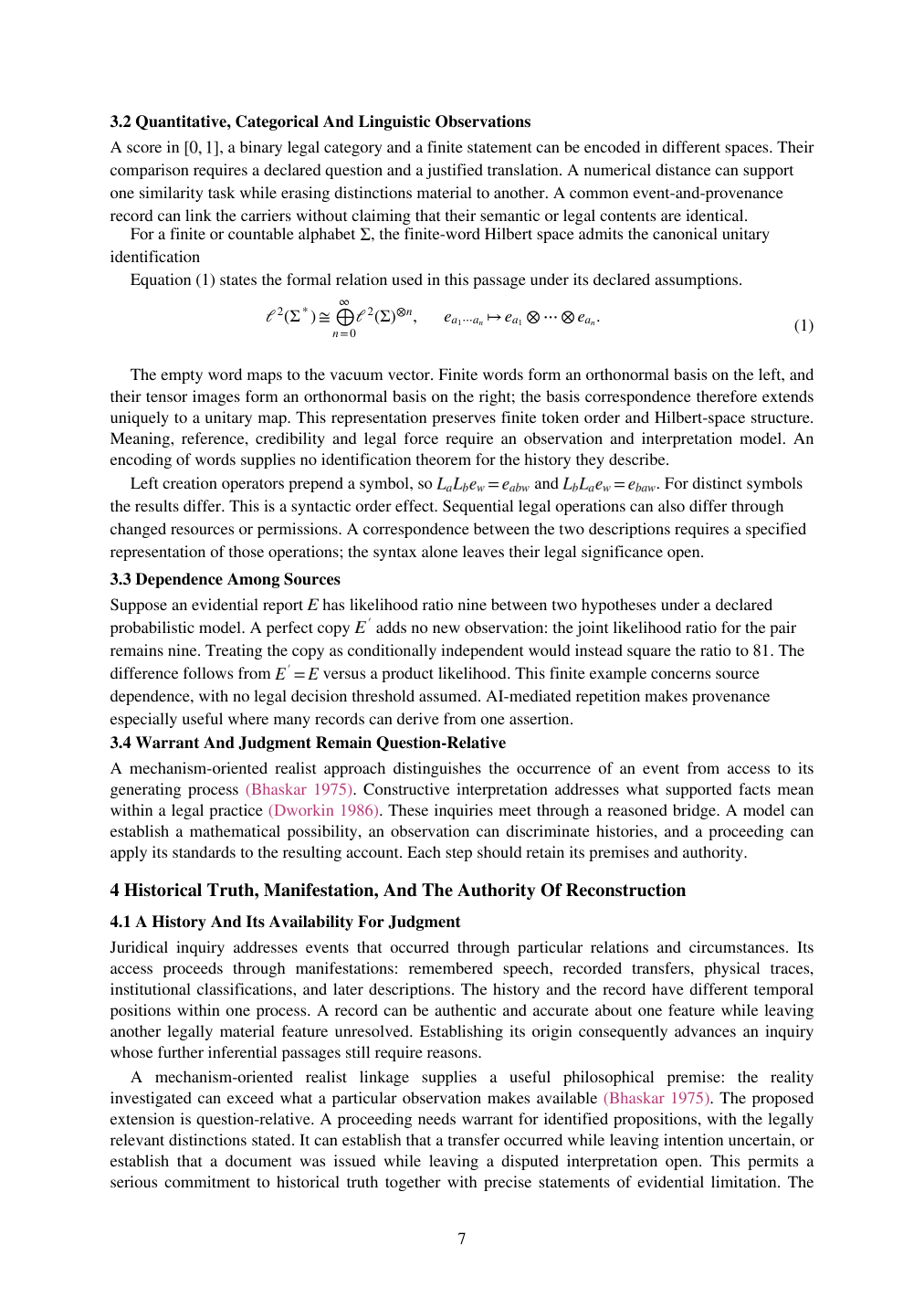
, a binary legal category and a finite statement can be encoded in different spaces. Their comparison requires a declared question and a justified translation. A numerical distance can support one similarity task while erasing distinctions material to another. A common event-and-provenance record can link the carriers without claiming that their semantic or legal contents are identical.
For a finite or countable alphabet , the finite-word Hilbert space admits the canonical unitary
Equation (1) states the formal relation used in this passage under its declared assumptions.
The empty word maps to the vacuum vector. Finite words form an orthonormal basis on the left, and their tensor images form an orthonormal basis on the right; the basis correspondence therefore extends uniquely to a unitary map. This representation preserves finite token order and Hilbert-space structure. Meaning, reference, credibility and legal force require an observation and interpretation model. An encoding of words supplies no identification theorem for the history they describe.
the results differ. This is a syntactic order effect. Sequential legal operations can also differ through changed resources or permissions. A correspondence between the two descriptions requires a specified representation of those operations; the syntax alone leaves their legal significance open.
Suppose an evidential report has likelihood ratio nine between two hypotheses under a declared adds no new observation: the joint likelihood ratio for the pair remains nine. Treating the copy as conditionally independent would instead square the ratio to 81. The versus a product likelihood. This finite example concerns source dependence, with no legal decision threshold assumed. AI-mediated repetition makes provenance especially useful where many records can derive from one assertion. 3.4 Warrant And Judgment Remain Question-Relative
probabilistic model. A perfect copy difference follows from
A mechanism-oriented realist approach distinguishes the occurrence of an event from access to its generating process (Bhaskar 1975). Constructive interpretation addresses what supported facts mean within a legal practice (Dworkin 1986). These inquiries meet through a reasoned bridge. A model can establish a mathematical possibility, an observation can discriminate histories, and a proceeding can apply its standards to the resulting account. Each step should retain its premises and authority.
4 Historical Truth, Manifestation, And The Authority Of Reconstruction
Juridical inquiry addresses events that occurred through particular relations and circumstances. Its access proceeds through manifestations: remembered speech, recorded transfers, physical traces, institutional classifications, and later descriptions. The history and the record have different temporal positions within one process. A record can be authentic and accurate about one feature while leaving another legally material feature unresolved. Establishing its origin consequently advances an inquiry whose further inferential passages still require reasons.
A mechanism-oriented realist linkage supplies a useful philosophical premise: the reality investigated can exceed what a particular observation makes available (Bhaskar 1975). The proposed extension is question-relative. A proceeding needs warrant for identified propositions, with the legally relevant distinctions stated. It can establish that a transfer occurred while leaving intention uncertain, or establish that a document was issued while leaving a disputed interpretation open. This permits a serious commitment to historical truth together with precise statements of evidential limitation. The
argument’s object is the warranted historical claim. A representation earns its adequacy through the distinctions it supports for that use.
4.2 Identifiability As An Argument About Possible Histories
Identifiability makes the inferential gap explicit. Let the admissible family contain histories compatible with the available records and the declared restrictions. A proposition is identified on that family when all members agree about it. A proposition can remain identified even when many other aspects of the history differ. Conversely, excellent prediction of the recorded aggregate can coexist with disagreement about the proposition material to judgment.
The two-component construction supplies a worked instance. The aggregate determines the common decay pattern while exchange rates and component histories remain unresolved. Adding a component observation distinguishes the stated candidates because their implications for that channel differ. The philosophical inference is precise: a better representation contributes by preserving or revealing a consequential distinction. Its complexity and volume supply independent descriptions of the method, while its epistemic value depends on the proposition recovered.
Three restrictions matter. The candidate family can omit a true pathway. Compatibility can depend on a disputed observation model. A legal proposition can require interpretation beyond the mathematical variables. The inquiry should expose each restriction so that criticism can target an actual premise. Sparse identification and reconstruction methods become useful within this discipline when their libraries and observation assumptions match the inferential question (Brunton, Proctor, and Kutz 2016; Takens 1981).
4.3 A Worked Comparison Of Provenance And Repetition
Consider a constructed dispute in which ten summaries repeat one witness’s description of an event. Each summary was prepared from a shared transcript. Compare a second dossier containing two independently produced accounts plus a time-stamped transaction record. The first dossier has greater textual volume and may contain a wider vocabulary. Its common origin constrains what the apparent agreement can establish. The second may offer a discriminating observation even with fewer pages.
The inference proceeds through provenance. Identify the source of each claimed proposition, reconstruct the dependency among carriers, and ask which candidate histories their contents would separate. Under the simple likelihood-ratio example already given, a perfect copy contributes the same evidential event. A summary that adds a new observation requires separate treatment of that addition. Source dependence is therefore a feature to investigate, with degrees and forms that a common label such as corroboration can conceal.
This comparison also concerns semantic access. A witness can understand the relevant local term while the summary translates it into a category carrying a different institutional implication. Preserving the original formulation, translation rationale, and claimed use can make that passage reviewable. D1 concerns the circulation of records through identified channels; C16 concerns the consequential selection of claims into the official account. D8 becomes relevant when earlier interpretations or commitments alter the present response to a statement. Documenting context supplies evidence for investigating that historical dependence.
4.4 Heterogeneous Syntax And The Scope Of A Common Representation
Quantitative, categorical, and linguistic records can be joined through an event-and-provenance structure. Their carriers retain distinct operations. Addition has a defined meaning for appropriately measured amounts; concatenation preserves token order; assigning a legal category depends on its rule of application. A common storage format helps retrieve the records. A common inferential operation requires a further argument about the distinctions it preserves.
The finite-word Hilbert-space construction has a well-defined scope. For a finite or countable alphabet, mapping each finite word to its ordered tensor basis vector preserves the orthonormal basis structure, with the empty word represented by the vacuum. It follows that the two displayed Hilbert
spaces are canonically unitarily identified under those choices. Symbol order is retained. Semantic reference, credibility, and juridical force enter through additional mappings and practices whose adequacy requires evidence and interpretation.
This distinction becomes constructive in a comparison. Two token strings can differ while expressing the same relevant proposition; one token string can support different readings in different contexts. A syntactic distance and a legally material difference consequently answer different questions. The mathematical representation can organize records, express order-sensitive operators, or support a defined retrieval task. Its contribution to historical reconstruction should be assessed at that operation’s actual scope. Retrieval, semantic interpretation, and an institutional act retain their own validation criteria. A passage between representations establishes mode coupling only if an identified dynamical interaction between modes is also demonstrated.
4.5 Evidential Justice As Part Of Information Architecture
Evidence availability is socially produced. A party may possess the only maintenance log, an institution may decide which complaint receives a category, and an interpreter may determine which distinctions become legible. These arrangements influence the model family that can be investigated. They can preserve consequential differences or erase them before formal analysis begins. Epistemic participation therefore concerns the conditions under which relevant testimony and criticism can enter the inquiry (Fricker 2007; Longino 1990).
The proposed linkage has an operational implication. Assess the pathway from an affected person’s experience to the proposition considered by the proceeding. Identify access to recording, translation, expertise, challenge, and correction at each step. A recognized opportunity to submit evidence can coexist with practical inability to make a technically complex record intelligible. Conversely, assistance can improve access while introducing an expert’s assumptions that need exposure to criticism.
This argument adds a dimension to evidential adequacy. A record’s reliability and the fairness of its production have related, distinct grounds. Wider participation can reveal an omitted causal or semantic distinction; fairness also supplies reasons concerning standing and treatment. Douglas’s account of inductive risk supports attention to the consequences of evidential error (Douglas 2000). The application here makes those consequences and their distribution explicit within the proceeding’s lawful standards.
4.6 Legal Authority And The Supported Historical Proposition
A historical proposition and its legal consequence are joined through a reasoned institutional passage. Evidence may support that an authorized office sent a message. Characterizing the message as a valid notice requires the relevant rules, interpretive context, and conditions of communication. Assigning responsibility may add questions about role, knowledge, control, and duty. Each passage can introduce a premise whose source and contestability deserve identification.
Hart and Dworkin provide established resources for institutional recognition and constructive interpretation (Hart 2012; Dworkin 1986). The present proposal concentrates on the evidential interface: which historical claim enters the legal argument, which alternative remains live, and how the interpretation treats that uncertainty. A proceeding can require a decision under a specified proof standard while a wider scientific inquiry retains uncertainty about the history. The authority to decide supplies an institutional consequence; the warrant for the factual proposition remains assessable through its evidence and inferential premises.
This connection supports a disciplined report. State the supported proposition, the candidate alternatives, the assumptions needed for discrimination, and the legal question to which the proposition is addressed. The applicable procedure then determines their consequential treatment. R1-R12 keep recognition, mechanism, meaning, and authority connected while retaining the distinct work of each.
4.7 Objections Concerning Proliferating Alternatives And Practical Closure
An objection holds that every history admits endlessly many imaginative alternatives, making the proposed family unmanageable. The inquiry can answer by defining admissibility through evidence, established constraints, and relevance to the legal issue. A rival matters when it survives those restrictions and changes a material proposition. Speculative additions can be evaluated through the same criteria. The family is a public account of the inquiry’s scope, capable of justified restriction as well as expansion.
A second objection concerns closure. Decisions require endpoints, while further observation can always promise improvement. The response is to compare the decision relevance and lawful accessibility of additional evidence with its time, burden, and likely discriminating value. An aggregate already identifying the material quantity can be sufficient for that purpose. Where a hidden distinction could alter responsibility, a targeted component record may have substantial value. The applicable rules determine how unresolved uncertainty affects judgment. A reconstruction framework contributes by making the remaining alternatives and the reasons for stopping intelligible.
4.8 A Philosophical Protocol For Consequential Reconstruction
The argument yields a compact sequence. Identify the Relational Subject or Object and its legally material continuity criteria. Trace how events become manifestations and how manifestations enter the record. Specify competing histories and identify the propositions on which they differ. Check whether the representation preserves those distinctions, whether independent evidence separates them, and whether the observation process has changed. Finally, connect the supported account to the legal interpretation through explicit sources and reasons.
The catalogue helps locate failures in this sequence. B6 concerns an observation-action loop in which an investigation changes conduct entering later evidence; C13 tests internal transfers within a declared stock-flow account; C14 concerns access blocked by missing complements or prohibited moves; C16 concerns consequential selection into accepted evidence; D8 concerns historical dependence of present interpretation; E8 concerns changes in institutional relations, membership, or authority. Their common lesson is practical. A warranted account depends on a reconstructible relationship among history, manifestation, inference, and authority. Improving that relationship can require a new measurement, a corrected translation, a revised model family, or a better route for challenge. Each improvement has a distinct mechanism and an assessable contribution.
5 Society, Openness And Non-Equilibrium Description
Society is approached here as an open, historically evolving complex system of coupled processes. Production, care, communication, ecological support and institutional operation require continuing activity and exchange. Participants alter relations and environments that subsequently condition their opportunities. The non-equilibrium perspective becomes explanatory when the inquiry identifies the supported flow, adjustment process, persistent current, changing constraint or regime transformation relevant to its question.
This commitment has several levels. Human societies have physical substrates with energy and material throughput. Institutions have resource accounts, authorized operations and interpreted purposes. Particular social models can describe nonstationarity, delayed adjustment, directional transition currents or departure from a specified economic equilibrium. A study should identify which level it uses. Thermodynamic equilibrium, a dynamical fixed point, statistical stationarity and a strategic equilibrium have distinct definitions. A stationary institution can require continuing work; a changing institution can admit a locally useful equilibrium approximation.
Non-equilibrium research offers accounts of driven organization, transport and fluctuation (Prigogine 1977; Cross and Hohenberg 1993; Seifert 2012). These physical theories provide questions and formal resources. A social application specifies the carrier of a flow, the operative relation, the measurement and the conditions under which the model’s prediction can be tested. The ontological
Readable text
correspondence is an argument to develop and assess. It becomes especially consequential when the model concerns interpreted objects such as trust, creativity, legitimacy or justice.
The relevant genealogy spans coupled irreversible transport, morphogenesis, dissipative nonlinear dynamics, ecological resilience and quantum dynamical semigroups (Onsager 1931; Turing 1952; Lorenz 1963; Holling 1973; Lindblad 1976). These traditions pose different questions and supply distinct conditions of application. The catalogue retains those differences while making their potential
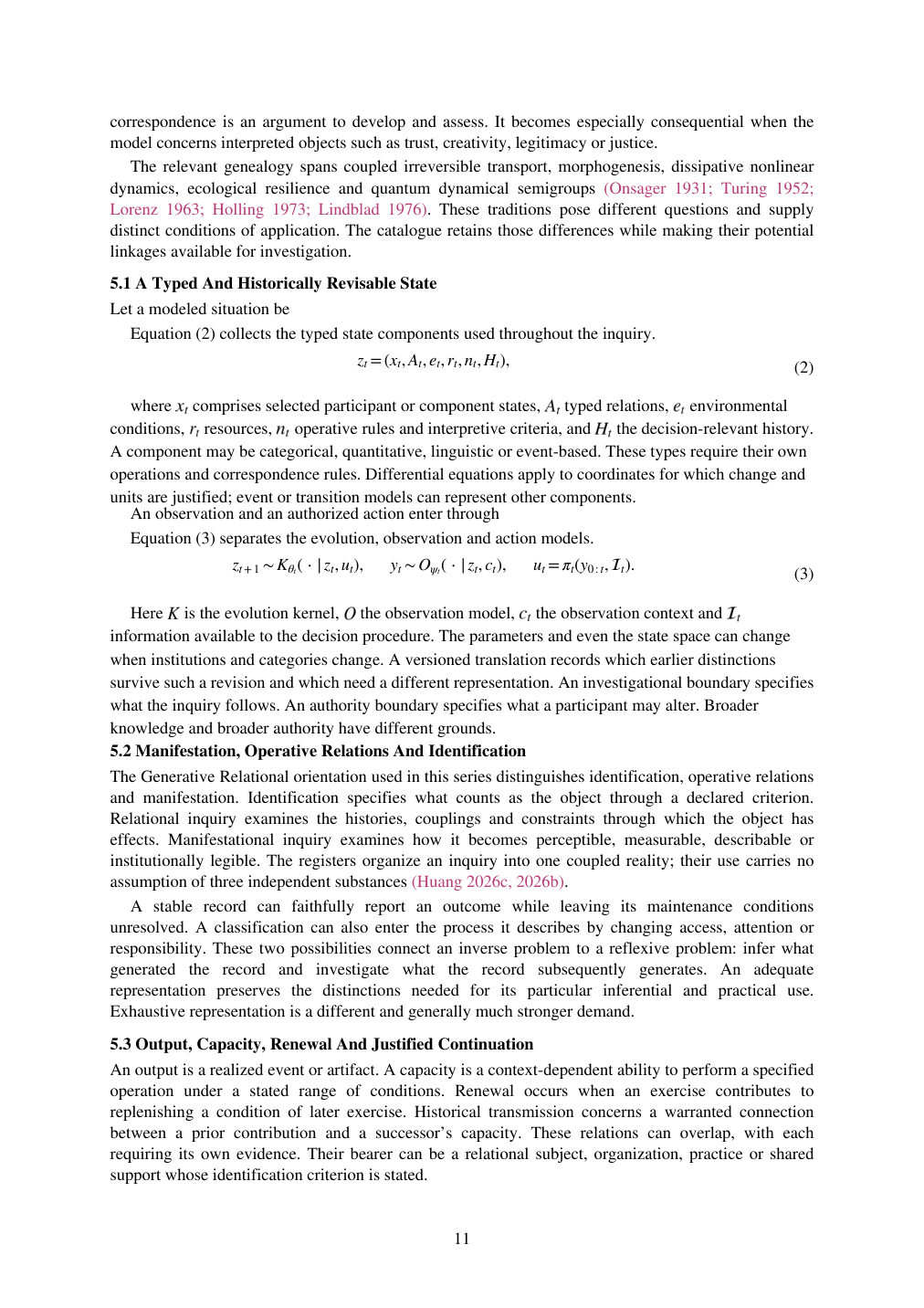
Equation (2) collects the typed state components used throughout the inquiry.
where comprises selected participant or component states, operative rules and interpretive criteria, and A component may be categorical, quantitative, linguistic or event-based. These types require their own operations and correspondence rules. Differential equations apply to coordinates for which change and units are justified; event or transition models can represent other components.
typed relations, environmental the decision-relevant history.
An observation and an authorized action enter through Equation (3) separates the evolution, observation and action models.
Here is the evolution kernel, the observation model, the observation context and information available to the decision procedure. The parameters and even the state space can change when institutions and categories change. A versioned translation records which earlier distinctions survive such a revision and which need a different representation. An investigational boundary specifies what the inquiry follows. An authority boundary specifies what a participant may alter. Broader knowledge and broader authority have different grounds. 5.2 Manifestation, Operative Relations And Identification
The Generative Relational orientation used in this series distinguishes identification, operative relations and manifestation. Identification specifies what counts as the object through a declared criterion. Relational inquiry examines the histories, couplings and constraints through which the object has effects. Manifestational inquiry examines how it becomes perceptible, measurable, describable or institutionally legible. The registers organize an inquiry into one coupled reality; their use carries no assumption of three independent substances (Huang 2026c, 2026b).
A stable record can faithfully report an outcome while leaving its maintenance conditions unresolved. A classification can also enter the process it describes by changing access, attention or responsibility. These two possibilities connect an inverse problem to a reflexive problem: infer what generated the record and investigate what the record subsequently generates. An adequate representation preserves the distinctions needed for its particular inferential and practical use. Exhaustive representation is a different and generally much stronger demand.
5.3 Output, Capacity, Renewal And Justified Continuation
An output is a realized event or artifact. A capacity is a context-dependent ability to perform a specified operation under a stated range of conditions. Renewal occurs when an exercise contributes to replenishing a condition of later exercise. Historical transmission concerns a warranted connection between a prior contribution and a successor’s capacity. These relations can overlap, with each requiring its own evidence. Their bearer can be a relational subject, organization, practice or shared
Readable text
for feasible next operations under constraints , and let sequences through horizon . A proposed generative change can enlarge, preserve or transform this set. Set size alone leaves the value of its contents open. Some sequences create harm, exclusion or unsustainable burden. The assessment therefore specifies task performance, participant experience, resource renewal and justified authority separately. The relational-wealth linkage concerns valuable possibilities that subjects can actually exercise together and the conditions governing their revision
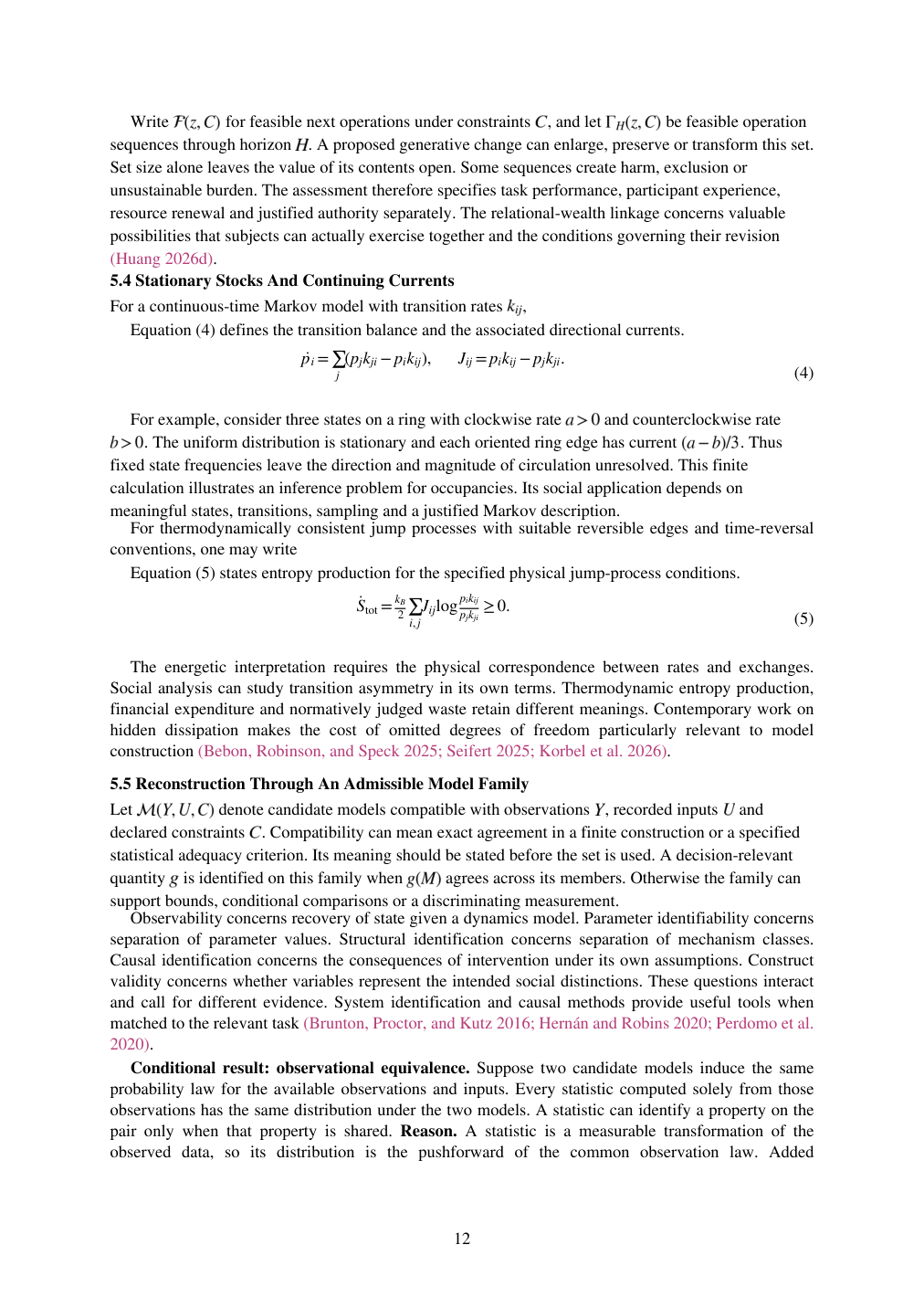
Write (Huang 2026d). 5.4 Stationary Stocks And Continuing Currents
For a continuous-time Markov model with transition rates Equation (4) defines the transition balance and the associated directional currents.
For example, consider three states on a ring with clockwise rate . The uniform distribution is stationary and each oriented ring edge has current fixed state frequencies leave the direction and magnitude of circulation unresolved. This finite calculation illustrates an inference problem for occupancies. Its social application depends on meaningful states, transitions, sampling and a justified Markov description.
For thermodynamically consistent jump processes with suitable reversible edges and time-reversal
Equation (5) states entropy production for the specified physical jump-process conditions.
The energetic interpretation requires the physical correspondence between rates and exchanges. Social analysis can study transition asymmetry in its own terms. Thermodynamic entropy production, financial expenditure and normatively judged waste retain different meanings. Contemporary work on hidden dissipation makes the cost of omitted degrees of freedom particularly relevant to model construction (Bebon, Robinson, and Speck 2025; Seifert 2025; Korbel et al. 2026).
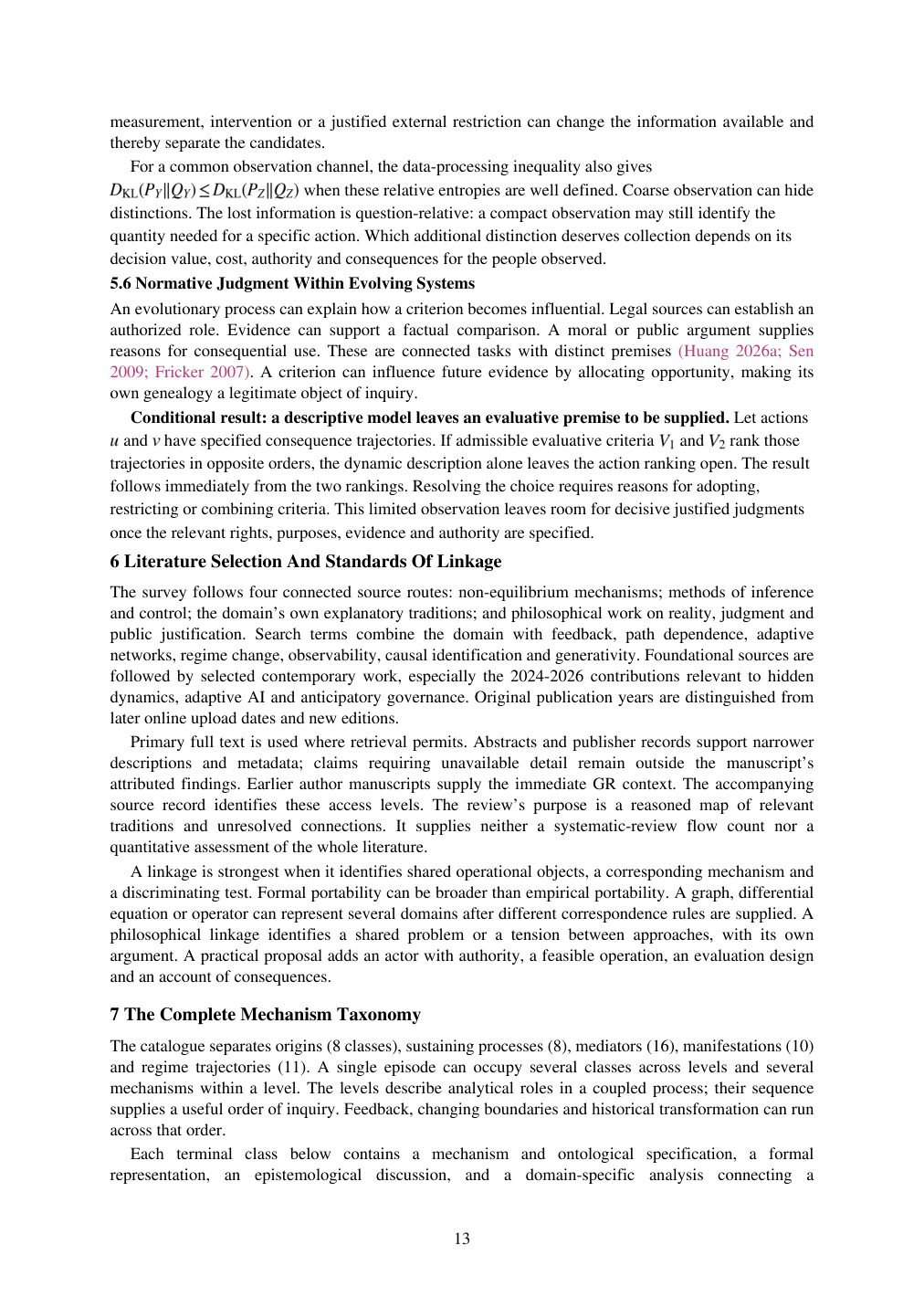
denote candidate models compatible with observations , recorded inputs and declared constraints . Compatibility can mean exact agreement in a finite construction or a specified statistical adequacy criterion. Its meaning should be stated before the set is used. A decision-relevant agrees across its members. Otherwise the family can support bounds, conditional comparisons or a discriminating measurement.
Observability concerns recovery of state given a dynamics model. Parameter identifiability concerns separation of parameter values. Structural identification concerns separation of mechanism classes. Causal identification concerns the consequences of intervention under its own assumptions. Construct validity concerns whether variables represent the intended social distinctions. These questions interact and call for different evidence. System identification and causal methods provide useful tools when matched to the relevant task (Brunton, Proctor, and Kutz 2016; Hernán and Robins 2020; Perdomo et al. Conditional result: observational equivalence. Suppose two candidate models induce the same probability law for the available observations and inputs. Every statistic computed solely from those observations has the same distribution under the two models. A statistic can identify a property on the pair only when that property is shared. Reason. A statistic is a measurable transformation of the observed data, so its distribution is the pushforward of the common observation law. Added
Readable text
measurement, intervention or a justified external restriction can change the information available and
For a common observation channel, the data-processing inequality also gives
when these relative entropies are well defined. Coarse observation can hide distinctions. The lost information is question-relative: a compact observation may still identify the quantity needed for a specific action. Which additional distinction deserves collection depends on its decision value, cost, authority and consequences for the people observed.
An evolutionary process can explain how a criterion becomes influential. Legal sources can establish an authorized role. Evidence can support a factual comparison. A moral or public argument supplies reasons for consequential use. These are connected tasks with distinct premises (Huang 2026a; Sen 2009; Fricker 2007). A criterion can influence future evidence by allocating opportunity, making its
Conditional result: a descriptive model leaves an evaluative premise to be supplied. Let actions and have specified consequence trajectories. If admissible evaluative criteria trajectories in opposite orders, the dynamic description alone leaves the action ranking open. The result follows immediately from the two rankings. Resolving the choice requires reasons for adopting, restricting or combining criteria. This limited observation leaves room for decisive justified judgments once the relevant rights, purposes, evidence and authority are specified.
The survey follows four connected source routes: non-equilibrium mechanisms; methods of inference and control; the domain’s own explanatory traditions; and philosophical work on reality, judgment and public justification. Search terms combine the domain with feedback, path dependence, adaptive networks, regime change, observability, causal identification and generativity. Foundational sources are followed by selected contemporary work, especially the 2024-2026 contributions relevant to hidden dynamics, adaptive AI and anticipatory governance. Original publication years are distinguished from
Primary full text is used where retrieval permits. Abstracts and publisher records support narrower descriptions and metadata; claims requiring unavailable detail remain outside the manuscript’s attributed findings. Earlier author manuscripts supply the immediate GR context. The accompanying source record identifies these access levels. The review’s purpose is a reasoned map of relevant traditions and unresolved connections. It supplies neither a systematic-review flow count nor a
A linkage is strongest when it identifies shared operational objects, a corresponding mechanism and a discriminating test. Formal portability can be broader than empirical portability. A graph, differential equation or operator can represent several domains after different correspondence rules are supplied. A philosophical linkage identifies a shared problem or a tension between approaches, with its own argument. A practical proposal adds an actor with authority, a feasible operation, an evaluation design
The catalogue separates origins (8 classes), sustaining processes (8), mediators (16), manifestations (10) and regime trajectories (11). A single episode can occupy several classes across levels and several mechanisms within a level. The levels describe analytical roles in a coupled process; their sequence supplies a useful order of inquiry. Feedback, changing boundaries and historical transformation can run
Each terminal class below contains a mechanism and ontological specification, a formal representation, an epistemological discussion, and a domain-specific analysis connecting a
Readable text
phenomenon, problem, methods and possible practice. The physical or mathematical source supports the mechanism in its own setting. The domain passage develops a proposed application and states what evidence can support it. Reading the classes comparatively helps locate rival explanations of one
Mechanism and ontology. An imposed preparation places a system in a state that differs from the regime supported by its subsequent dynamics. Quenching, mixing, release and changed constraints belong here. The ontological commitments concern the prepared state, the preparation event and the environment that follows it; separating those objects makes a transient response interpretable. (Cross
Formal representation. Equation (6) states the local mathematical representation for this class.
Notation and conditions. The vector x is a selected state; lambda_1 labels the post-preparation setting; x-star is a fixed point of the displayed model when such a point exists. The initial condition is
Epistemology and methods. Compare histories sharing the later environment and differing in preparation. A single observation after a shock leaves the preparation effect entangled with continuing forcing. Estimate a response timescale and retain evidence from before the event.
Domain analysis and practice. A juridical reconstruction must distinguish the event under inquiry from the conditions it inherited. A recorded conflict may begin after an earlier transfer, classification or loss of access. Define event times, source dates and the relevant initial state separately. Compare candidate histories with different preparations and the same later observations. Seek a contemporaneous record that distinguishes them through a lawful route. The legal relevance of the earlier event requires
Phenomenon And Practical Problem. Consider a constructed dispute over a warehouse inspection conducted shortly after a mandated shutdown. An unusual temperature, queue, or staffing pattern may reflect the shutdown’s preparation of the site, continuing operating conditions, or both. A later inspection can accurately describe the observed state while offering weak evidence about ordinary operation before the event. The juridical problem is to determine which historical proposition the observation supports. Preparation becomes material when the proceeding attributes the observed
deviation to a particular actor, practice, or omission.
Mechanism And Ontological Commitments. The mechanism begins with a preparation event that changes a state or constraint and then lets the process evolve under subsequent conditions. Its objects include the pre-event state, the operation performing the preparation, the resulting state, and the environment during observation. A disturbance and an ongoing driver occupy different causal positions. A state description sufficient for prediction after preparation can still omit the history needed for attribution. The proposed ontology therefore preserves the event linking an authorized or alleged action
Epistemic Design And Discriminating Evidence. An evidential design should recover the preparation timeline, observation delay, ordinary baseline, and relevant continuing inputs. Compare records taken at different delays and sites sharing the later environment but differing in preparation. Where a comparison is observational, document selection into preparation and plausible common causes. Instrument calibration and custody records determine whether an apparent transient belongs to the process or the measurement. The discriminating question is whether the competing histories predict different recovery paths under comparable later conditions (Ashwin et al. 2012; Hernán and Robins
Readable text
Philosophical Reasoning And Practice. The philosophical inference separates occurrence, manifestation, and responsibility. A genuine unusual state establishes that something requires explanation; it acquires an attributed cause through a warranted historical bridge. If preparation can generate the same state as the alleged ordinary practice, a single later manifestation leaves that attribution open. A realist account can pursue the operative event while recognizing this access limitation. Lawful practice consequently reports both the supported observation and the additional premises needed to connect it to the material historical proposition (Bhaskar 1975).
Worked Comparison And Research Proposition. Compare dossiers containing an identical inspection image. One also preserves a timestamped shutdown instruction, measurements before closure, and a documented recovery sequence; the other contains only retrospective descriptions of normality. Their images agree while their capacity to discriminate causes differs. A research study could conceal preparation records from reviewers and then release them, measuring changes in supported attribution, invented causal detail, and acknowledged alternatives. The proposition is conditional: preparation-aware reconstruction improves warrant when preparation materially changes the observation and its history can be independently established. Applicable procedures govern the
Reading the numerical illustration. Figure 1 illustrates the declared mechanism. A preparation changes the subsequent episode under an unchanged transition law. Here the decay rate remains one, while the initial condition changes both the visible transient and its cumulative magnitude. The construction separates an intervention on state from an intervention on the law. A comparison in a social domain would need to establish which conditions were prepared, whether later supports remained comparable, and which cumulative consequence matters.
Mechanism and ontology. A sustained difference between reservoirs can maintain transport through an open system. Reservoirs, exchanged quantities and boundary conditions are part of the explanation. In physical applications, potential differences have units and conjugate fluxes. A socially meaningful difference in access or opportunity requires its own behavioral and institutional conversion mechanism.
Formal representation. Equation (7) states the local mathematical representation for this class.
Notation and conditions. The scalars phi_L and phi_R are boundary potentials in a physical account, J is a specified current, and calligraphic L is its response function. A social correspondence supplies measured quantities and a conversion rule in their own units.
Epistemology and methods. Measure both boundary conditions and the intervening transfer. A persistent gap can coexist with a blocked channel. Distinguish the size of the difference, the conductance of the relation and the resources required to maintain it.
Domain analysis and practice. An observed transfer can reflect a difference in opportunity, an obligation, a threat or an externally supplied resource. Identify the proposed driving condition and the channel through which it could act. Compare records of both endpoints with evidence of the transfer process. A visible inequality leaves causation and legal responsibility open. Reconstruction can specify which additional evidence would distinguish a blocked channel, a voluntary choice and a constrained
Phenomenon And Practical Problem. A disputed transfer can occur between organizations facing different resource or information conditions. A visible difference in holdings may suggest a motive or opportunity, yet the transfer can remain blocked by permissions, infrastructure, or transaction rules. Consider a constructed inquiry into whether an upstream shortage caused a downstream delivery failure. The problem is to separate the difference that could drive movement from the channel that
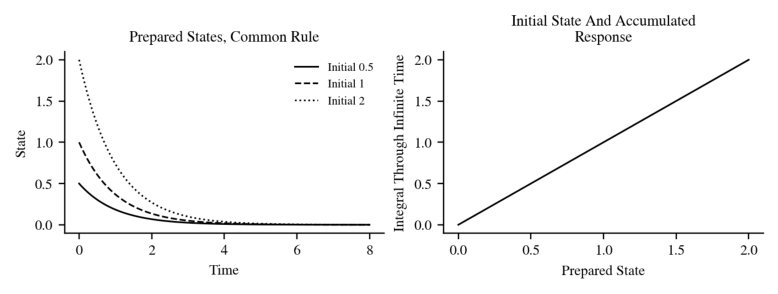
Figure 1. Three exact relaxation trajectories obey dx/dt = -x after different preparations. The right panel evaluates the total response integral, equal to the initial state. An imposed preparation can produce a transient whose later appearance resembles continuing misconduct or ordinary operation. The illustration supports a comparison of initial conditions and observation delays; juridical attribution additionally requires a documented preparation history and evidence linking the modeled state to the material issue.
actually permitted it. An inventory gap alone gives incomplete evidence about either the flow or responsibility for its interruption.
Mechanism And Ontological Commitments. The physical mechanism couples reservoirs through a channel carrying a specified quantity under a potential difference. A juridical application needs an independently justified conversion: what moves, which states create an operative incentive or requirement, and what institutional relation permits passage? Money, documents, materials, and authority have different carriers. They require different boundaries and rules of access. The explanatory object includes both endpoints and the intervening operation. A large disparity can coexist with negligible movement when the channel is absent, constrained, or deliberately closed.
Epistemic Design And Discriminating Evidence. Recover records at both endpoints, the timing of requests, access permissions, channel availability, and completed transfers. Compare occasions with similar differences and different channel conditions, including unsuccessful attempts. Where several pathways connect the endpoints, inspect substitution and hidden intermediaries before assigning the observed current to one route. A stock-flow account can expose missing entries, while process records can identify the blocked operation. The physical reservoir model supplies a question about force and conductance; its thermodynamic coefficients retain their own units and assumptions (Seifert 2012).
Philosophical Reasoning And Practice. A philosophical distinction follows between a condition for action and an exercise of action. Possessing a resource or facing a need can make a pathway relevant without establishing that an actor used, controlled, or even knew that pathway. Attribution requires the additional relations material to the legal proposition. This protects inquiry from converting visible inequality directly into a causal conclusion. It also makes institutional power investigable: authority over a bottleneck may explain who could enable movement, subject to the rules and evidence governing any associated duty (Huang 2026b).
Worked Comparison And Research Proposition. Compare otherwise similar delivery failures. In one, a supplier lacks stock; in another, stock exists but a credential prevents release; in a third, the receiving system cannot accept the shipment. An aggregate shortage report can collapse these histories. A constructed reconstruction study could provide endpoint totals first and then release channel logs, measuring whether reviewers distinguish depletion, exclusion, and receiving failure. The research proposition is that channel-resolved evidence improves explanation when these rival mechanisms imply different feasible actions. The resulting causal account still requires a separate, source-grounded analysis of obligation and responsibility.
Readable text
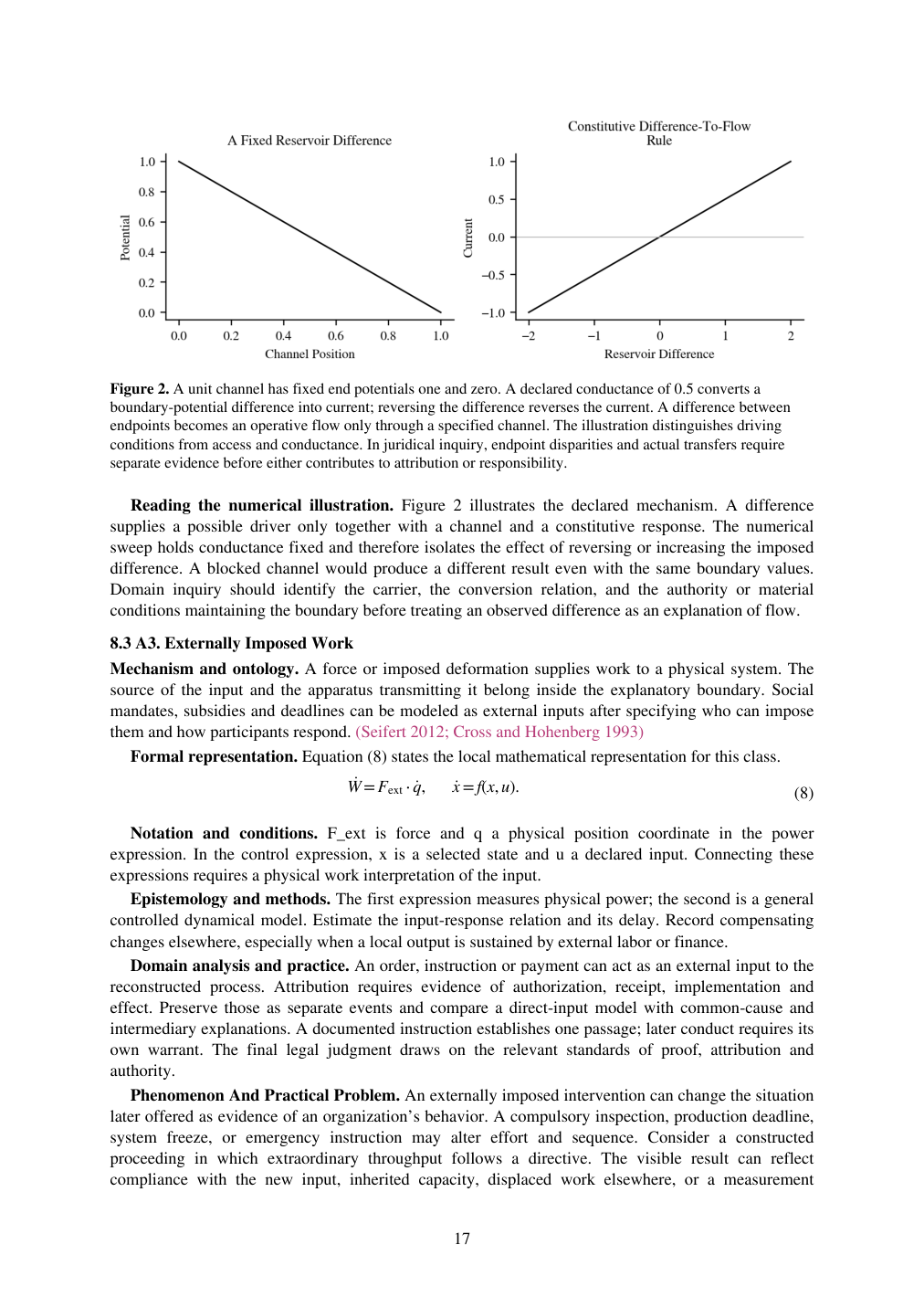
Figure 2. A unit channel has fixed end potentials one and zero. A declared conductance of 0.5 converts a boundary-potential difference into current; reversing the difference reverses the current. A difference between endpoints becomes an operative flow only through a specified channel. The illustration distinguishes driving conditions from access and conductance. In juridical inquiry, endpoint disparities and actual transfers require separate evidence before either contributes to attribution or responsibility.
Reading the numerical illustration. Figure 2 illustrates the declared mechanism. A difference supplies a possible driver only together with a channel and a constitutive response. The numerical sweep holds conductance fixed and therefore isolates the effect of reversing or increasing the imposed difference. A blocked channel would produce a different result even with the same boundary values. Domain inquiry should identify the carrier, the conversion relation, and the authority or material conditions maintaining the boundary before treating an observed difference as an explanation of flow.
Mechanism and ontology. A force or imposed deformation supplies work to a physical system. The source of the input and the apparatus transmitting it belong inside the explanatory boundary. Social mandates, subsidies and deadlines can be modeled as external inputs after specifying who can impose them and how participants respond. (Seifert 2012; Cross and Hohenberg 1993)
Formal representation. Equation (8) states the local mathematical representation for this class.
Notation and conditions. F_ext is force and q a physical position coordinate in the power expression. In the control expression, x is a selected state and u a declared input. Connecting these expressions requires a physical work interpretation of the input.
Epistemology and methods. The first expression measures physical power; the second is a general controlled dynamical model. Estimate the input-response relation and its delay. Record compensating changes elsewhere, especially when a local output is sustained by external labor or finance.
Domain analysis and practice. An order, instruction or payment can act as an external input to the reconstructed process. Attribution requires evidence of authorization, receipt, implementation and effect. Preserve those as separate events and compare a direct-input model with common-cause and intermediary explanations. A documented instruction establishes one passage; later conduct requires its own warrant. The final legal judgment draws on the relevant standards of proof, attribution and
Phenomenon And Practical Problem. An externally imposed intervention can change the situation later offered as evidence of an organization’s behavior. A compulsory inspection, production deadline, system freeze, or emergency instruction may alter effort and sequence. Consider a constructed proceeding in which extraordinary throughput follows a directive. The visible result can reflect compliance with the new input, inherited capacity, displaced work elsewhere, or a measurement
change. The practical problem is to reconstruct the operation imposed and the response it elicited before interpreting the resulting output as evidence of ordinary capability or intent.
Mechanism And Ontological Commitments. Externally imposed work has a precise energetic meaning in physical models. The transferable institutional object is an input supplied or required by an actor outside the modeled subsystem, together with the apparatus transmitting it. A mandate’s text, its receipt, its practical implementation, and its effect are distinct events. The ontology includes the issuing authority, recipient, available alternatives, adjustment delay, and support mobilized. Describing an input as external is relative to an investigational boundary; a wider account can reconstruct how another institution generated that input.
Epistemic Design And Discriminating Evidence. Build a joint chronology of instructions, acknowledged receipt, operational changes, staffing, resources, and observations. Compare response across input intensities or implementation delays where records permit. Similar directives can produce different effects because recipients possess different supports. Distinguish the imposed operation from compensating actions and coincident shocks. A causal comparison needs assumptions about assignment, interference, and changing conditions; a process account needs evidence for each transmission step. The appropriate design follows the actual intervention contrast instead of equating a formal instruction with an effective treatment (Hernán and Robins 2020).
Philosophical Reasoning And Practice. The philosophical premise is that an act’s description depends partly on its institutional and practical context. A response performed under a particular requirement can establish exercised capability while leaving voluntary preference unresolved. Conversely, a directive can create an obligation without ensuring the recipient has the means to fulfill it. Legal characterization therefore joins causal reconstruction to the applicable source, competence, knowledge, and duty questions. The distinction between recognized authority and exercisable capacity gives the inquiry a constructive way to examine those passages (Hart 2012; Huang 2026a).
Worked Comparison And Research Proposition. Compare a team that accelerates delivery after receiving additional equipment with a team given the same deadline and unchanged equipment. Equal final output can conceal different overtime, deferred maintenance, and unmet tasks. A prospective archival study could release directive and resource records in stages and evaluate reviewers’ reconstruction of the operative input. The proposition is that input-aware evidence improves attribution when an external requirement materially changes behavior. Its practical contribution is a report separating what was ordered, what was received, what was feasible, and what occurred, with uncertainty and legal relevance preserved at each step.
Reading the numerical illustration. Figure 3 illustrates the declared mechanism. The external operation is an event with a duration and a transmission pathway. Its consequences continue after the pulse ends because the system retains displacement and velocity. The balance panel identifies where the supplied work goes. A social input can be represented through an analogous controlled variable after its actual operation and participant responses are specified; its institutional cost and authority require an account in their own terms.
8.4 A4. Open Chemical And Material Exchange
Mechanism and ontology. Inflow, removal and reaction can sustain activity through continually renewed inputs. Stocks, channels, transformation processes and boundaries are the relevant objects. Open exchange makes the persistence of an organization conditional on replenishment and disposal, with different accounts needed for physical material, money, information and permissions. (Seifert 2012; Frey and Weyer 2026) Formal representation. Equation (9) states the local mathematical representation for this class.
n=Sv(n)+jin −jout. (9)
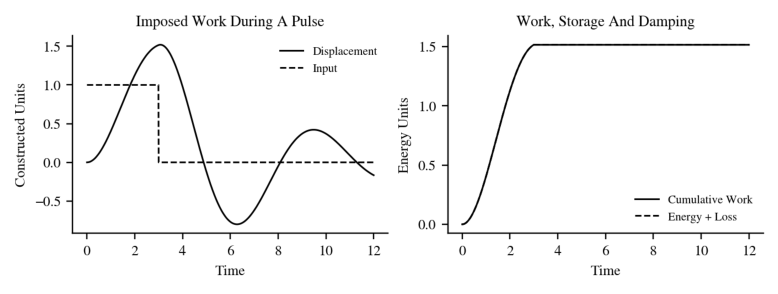
Figure 3. A unit-mass oscillator receives a unit force until time three and then evolves without that input. Damping is 0.4 and stiffness is one. Numerical work agrees with stored energy plus damping loss within 0.004. An imposed input affects a process through transmission, available supports, and adjustment. The illustration represents that conditional response. A juridical account must establish the instruction, its receipt and implementation, and the relevant authority before drawing conclusions about capability, obligation, or responsibility.
Notation and conditions. The vector n contains stocks, v transformation rates and S their stoichiometric coefficients. The j vectors are boundary inflow and outflow rates. Quantities combined in an account must share compatible units.
Epistemology and methods. Specify the stoichiometric matrix S when reactions are physical. In an institutional application, replace it with an independently justified conversion or accounting rule. Trace sources and sinks so that a maintained local stock can be distinguished from depletion outside the boundary.
Domain analysis and practice. An organization’s observed operation can depend on continuing inflows of money, material, information or labor. A static record can omit the source sustaining the activity under inquiry. Reconstruct stocks, transfers and boundary crossings with typed accounts. Compare a self-contained explanation with one involving external support. Source independence and missing records matter to both accounts. The legal relevance of the support depends on the dispute’s specified issue.
Phenomenon And Practical Problem. An organization can maintain visible activity through continuing entries and exits that a snapshot omits. Consider a constructed inquiry into document processing during a disruption. The same number of completed files can be sustained by new staff, transferred cases, external finance, or increasingly selective intake. The juridical problem concerns what the count establishes about the organization and the conduct under examination. A stable local record may coexist with a changed population, concealed outside support, or displaced unfinished work. Each possibility can matter to an allegation concerning performance or control.
Mechanism And Ontological Commitments. Open exchange describes a boundary through which typed quantities enter, leave, or undergo conversion. In chemistry, stoichiometry constrains transformations; institutional inquiry requires its own accounting and authorization rules. A file’s arrival, a person’s assignment, a payment, and a permission occupy different types. Their transitions cannot be inferred through a single conserved scalar. The ontology includes the boundary, source, sink, conversion operation, and account carrying the resulting claim. Reconstructing openness makes apparent autonomy a testable dependence on specified relations and recurring inputs.
Epistemic Design And Discriminating Evidence. Reconcile intake and completion records with transfers, returns, withdrawals, and changes in eligibility. Preserve event time, recording time, category version, and source dependence. Compare the unit’s apparent performance with a wider account following the same cases through neighboring offices. Missing channels can be bounded when a
complete record is unavailable, with the resulting uncertainty carried into the claim. A physical reaction network offers accounting discipline after its correspondence is justified; a social-ecological framework directs attention to interacting institutional and resource components (Seifert 2012; Ostrom 2009).
Philosophical Reasoning And Practice. The philosophical inference concerns the identity of the object evaluated. If a unit continues through changed membership and external support, continuity of its name and output leaves continuity of its operative relations unresolved. A proceeding should state whether it evaluates a legal entity, a workforce, a service function, or a particular transaction history. Different identification criteria can be appropriate to different issues. Their explicit use permits an account of one coupled process while preserving the distinctions required for attribution and challenge (Huang 2026b).
Worked Comparison And Research Proposition. Compare two dossiers reporting equal completions. The first identifies all incoming cases and their dispositions. The second excludes cases transferred before registration and credits externally completed work locally. Both totals can be numerically accurate under their definitions. A reconstruction study could vary boundary transparency and ask reviewers to identify which performance propositions survive both accounts. The research proposition is that exchange-resolved records improve warrant when entries and exits change the meaning of an aggregate. Legal consequences additionally require the relevant duties, recording rules, and evidence about the actor’s role in those changes.
Reading the numerical illustration. Figure 4 illustrates the declared mechanism. An almost constant stock can be the result of continuing replacement. The two panels make the distinction between a stock level and the flows supporting it inspectable. In this exact construction, stopping the inflow would convert the maintained stock into a declining one. A domain application should close the appropriate resource account, identify boundary transfers and transformation, and investigate whether a stable visible quantity depends on continuing replenishment that its usual indicator omits.
8.5 A5. Internal Free-Energy Conversion
Mechanism and ontology. Active constituents convert fuel or stored free energy into motion or work. An operational account identifies the converter, the consumed resource and the work produced. In social inquiry, participants mobilize skills, time and authorized resources; their initiative and interpreted purposes call for a richer ontology than self-propelled particles. (Bebon, Robinson, and Speck 2025)
Formal representation. Equation (10) states the local mathematical representation for this class.
e=Pin −Puse −Ploss. (10)
Notation and conditions. The variable e is a resource or energy stock only where that unit is established. The P terms are rates of supply, use and loss in the same account. Their interpretation is local to the chosen system boundary.
Epistemology and methods. Use this balance for quantities with a defensible common unit. Track resource depletion alongside observable activity. Attribution to internal initiative requires evidence about the resources and constraints through which initiative becomes exercisable.
Domain analysis and practice. Conduct can require skills, resources and practical opportunity that a record of outcome leaves hidden. Define the capacity attributed to a subject and the conditions needed for its exercise at the relevant time. Compare access records, demonstrated operations and rival causal pathways. A later demonstration can inform capability while leaving historical access unresolved. Reconstruction should preserve the distinction between having a means, being able to use it and performing the legally relevant act.
Phenomenon And Practical Problem. Collective output can appear autonomous while depending on work performed by particular participants. Consider a constructed dispute concerning a platform’s claimed productive capacity. Its visible service can depend on moderation, repair, annotation, and coordination performed through separate arrangements. The practical issue is to determine who supplied the operations material to the disputed result and under what conditions. Recognizing
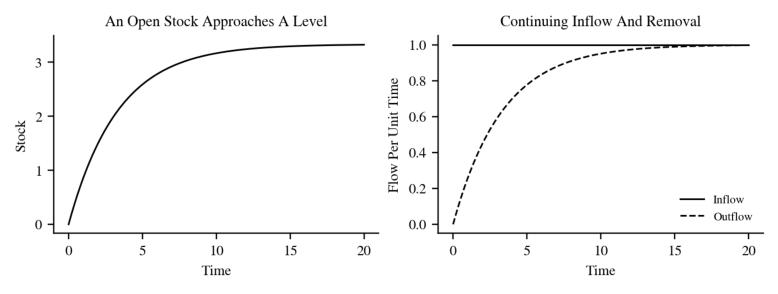
Figure 4. An open reactor-like stock follows dn/dt = 1 - 0.3n from zero. The stock approaches 10/3 while both inflow and removal remain active. Continuing inflow, conversion, and removal can preserve a local stock while changing its composition and support. The illustration is a boundary-sensitive mechanism example. Juridical reconstruction should retain the types and provenance of exchanged objects and test which aggregate claims survive a wider account.
distributed contribution requires evidence of actual work and its causal place; a broad assertion that all activity depends on others leaves the relevant attribution insufficiently resolved.
Mechanism And Ontological Commitments. Active physical constituents consume free energy through converters that produce motion or work. Institutional participants mobilize time, skill, tools, and authorized resources through interpreted purposes. The analogy becomes useful when it directs inquiry toward a demonstrable conversion operation and its supports. The ontology should preserve preparation, exercise, consumed resources, resulting output, and replenishment. Initiative and consent enter through evidence appropriate to human action. A mathematical active-particle description alone establishes neither a participant’s intention nor the normative character of the relation supporting their contribution.
Epistemic Design And Discriminating Evidence. Trace the task through work records, tool changes, communications, and the dependencies of the completed artifact. Compare performance when a particular support is present, interrupted, or substituted, using lawful access and appropriate safeguards. Records should distinguish verified contribution from mere association with the production site. Interviews can reveal undocumented coordination, while independent logs can test timing and practical effect. Physical work on hidden dissipation motivates attention to omitted support costs; the institutional reconstruction requires separate labor, resource, and permission accounts (Bebon, Robinson, and Speck 2025).
Philosophical Reasoning And Practice. The philosophical argument separates a manifestation of competence from its relational production. If a successful output requires several complementary operations, its existence supports inquiry into those complements. Assigning credit, duty, or responsibility requires additional premises identifying their legal or practical significance. The GR account of relational wealth offers a further question: whose later ability was preserved or enlarged through the exercise? That successor-capacity claim differs from the claim that a contribution occurred and needs evidence of usable transmission (Huang 2026d, 2026c).
Worked Comparison And Research Proposition. Compare identical published artifacts. One dossier preserves a version history showing a tester’s correction of a critical defect; another preserves only the final organizational attribution. A controlled review could vary access to dependency and revision records, evaluating justified contribution claims, false additions, and recognition of unresolved work. The proposition is that operation-resolved provenance improves attribution when relevant contribution crosses organizational boundaries. A practical report can identify verified passages and
Readable text
missing evidence without forcing every relation into one numerical share. Applicable commitments and legal sources govern consequential decisions about credit, ownership, or responsibility.
Reading the numerical illustration. Figure 5 illustrates the declared mechanism. Visible exercise can draw down an inherited support while a smaller inflow continues. The account distinguishes accumulated useful exercise from retained capacity and losses. Repetition of the same output over the displayed interval therefore leaves future feasibility unresolved. A social application can ask how skills, authorized resources or participant time support exercise, while preserving their distinct units and reasons. The relevant empirical task is to identify the support actually consumed and the route by which
Mechanism and ontology. A changing environment moves the conditions to which a system responds. A ramp, seasonal input, abrupt shock and intermittent forcing can produce distinct trajectories even when the initial and final environments coincide. Environmental paths and rates therefore enter the ontology alongside the present state. (Ashwin et al. 2012; Ritchie et al. 2023)
Formal representation. Equation (11) states the local mathematical representation for this class.
Notation and conditions. The path Lambda specifies the environmental schedule, r its rate parameter and F the response law. Comparing rates requires common initial conditions or an account of
Epistemology and methods. Compare changes at different rates while holding endpoints comparable. Distinguish a lost stable regime from failure to track a persisting regime. Infer rate effects using measurements of adjustment speed and competing accounts of the external change.
Domain analysis and practice. The environment can change between an alleged event, its observation and the proceeding assessing it. A later test may reproduce present conditions while missing the historical driver. Record environmental versions and the timing of relevant changes. Compare reconstructions under the plausible historical conditions. Report which conclusions survive that variation. Legal use of a reenactment requires an explanation of its correspondence to the issue and
Phenomenon And Practical Problem. The environment relevant to a disputed event may change during the period from preparation to observation. A supplier rule, reporting standard, technical interface, or external demand can change quickly enough that a previously workable response becomes inadequate. Consider a constructed inquiry into a missed response deadline during a system migration. The practical question concerns the conditions actually encountered at each stage. Comparing the final state with an earlier operating standard can conceal a transition whose rate and sequence materially affected feasible action and contemporaneous knowledge.
Mechanism And Ontological Commitments. A time-dependent environment supplies a path of changing conditions to which the subsystem responds. The path’s endpoints, speed, and order can matter independently. The ontology includes the external variable, the operation changing it, the participant’s adjustment capacity, and the information available during transition. A persisting feasible regime can be difficult to track when conditions move rapidly. This mechanism differs from the disappearance of the regime itself. A juridical reconstruction should preserve that distinction when examining whether an observed failure arose through lost support, delayed adjustment, or another
Epistemic Design And Discriminating Evidence. Recover versioned rules, implementation dates, notices, interface logs, and the timing of actual exposure. Compare similar transitions occurring at different rates or with different preparation intervals, while examining selection and concurrent changes. An end-of-period record supplies limited evidence about the path. Candidate mechanisms should predict distinct timing of errors, recovery, and adaptation. Rate-induced tipping research
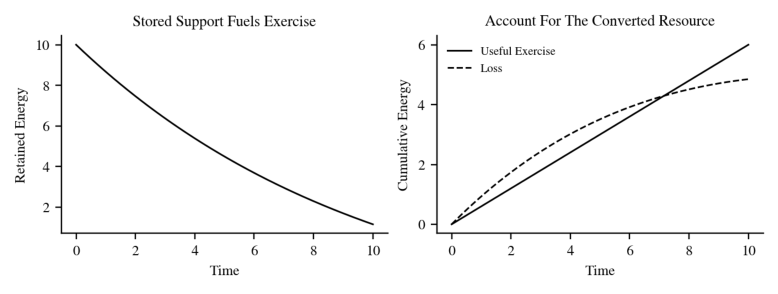
Figure 5. A converter begins with ten energy units, receives 0.2 per time, uses 0.6 and loses 0.1e. The displayed interval ends before exhaustion, and the integrated account closes exactly. A visible collective result can depend on distributed conversion of resources into work. The illustration asks which supporting operations are omitted by a coarse observation. Attribution in a juridical setting requires task-specific provenance, an established contribution pathway, and the rules governing its consequential recognition.
provides a formal precedent for separating tracking failure from a lost stable state; its social transfer requires an operational account of the changing condition and response (Ritchie et al. 2023; Ashwin et al. 2012).
Philosophical Reasoning And Practice. The philosophical premise is historical situatedness of practical judgment. An observer can possess information after the event that was unavailable to the actor during adjustment. Assessing a historical proposition about knowledge or feasible response requires the contemporary information relation, together with the relevant legal standard. This permits criticism of an inadequate response while keeping the evidential bridge explicit. The inquiry can also examine who controlled transition timing and who bore its burdens, with responsibility differentiated through contribution, authority, and applicable duties (Douglas 2000).
Worked Comparison And Research Proposition. Compare two migration episodes with identical old and new systems. One provides a long overlap with usable support; the other switches abruptly while access credentials remain pending. Equal endpoint technology leaves the experienced path different. A constructed reconstruction study could provide only endpoint records and then add dated transition evidence, measuring changes in supported causal and feasibility claims. The proposition is that path-resolved evidence improves warrant when adjustment rates materially affect the event. A report should state the relevant horizon and preserve alternative explanations, including unchanged conduct observed through a revised recording procedure.
Reading the numerical illustration. Figure 6 illustrates the declared mechanism. Equal environmental endpoints leave the path of adjustment open. The construction holds the response law fixed and changes only the speed of the driver. A comparison of final conditions can consequently omit a material lag inherited from the transition. This example concerns tracking error, with the equilibrium remaining stable throughout. A stronger rate-induced-tipping claim would require a basin or viability boundary that the lag crosses and evidence supporting that additional structure.
8.7 A7. Frustrated Or Kinetically Constrained Relaxation
Mechanism and ontology. Barriers, competing constraints and restricted transitions can make relaxation exceptionally slow. A long-lived configuration may inherit its persistence from difficult exit routes. The relevant objects include the transition landscape and the feasible moves, with observation duration determining what counts as persistent. (Ashwin et al. 2012)
Formal representation. Equation (12) states the local mathematical representation for this class.
τescape ∼τ0exp(ΔV/D). (12)
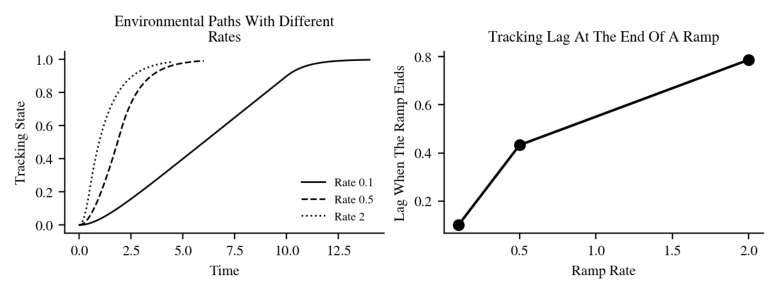
Figure 6. The environment ramps from zero to one at three rates; the state obeys dx/dt = lambda(t) - x. Faster ramps leave a larger tracking lag when the endpoint is reached. Changing conditions can affect a process through their path and rate as well as their endpoints. The illustration motivates reconstruction of exposure and adjustment histories. A juridical interpretation additionally needs contemporaneous information, practical alternatives, and the standard governing the particular historical claim.
Notation and conditions. Delta V is a barrier and D a positive noise scale in the normalized potential model; tau_0 is a prefactor timescale. The exponential relation is an asymptotic approximation under suitable small-noise escape conditions.
Epistemology and methods. The displayed small-noise scaling requires a suitable metastable model. For institutions, investigate switching costs, vetoes and unavailable complements directly. Compare response over several horizons before interpreting a persistent arrangement as an attractive or preferred outcome.
Domain analysis and practice. A persistent arrangement can reflect preference, dependence or blocked alternatives. Reconstruct the feasible transitions available at the relevant time, including costs, permissions and missing complements. Compare a willingness-based explanation with a constraintbased one. Interviews, contracts and contemporaneous attempts can discriminate some pathways. A record of remaining in a relation leaves the voluntariness and legal meaning of that persistence to further evidential and normative analysis.
Phenomenon And Practical Problem. A persistent arrangement can be difficult to leave even when participants prefer another course. Consider a constructed dispute about continued use of an obsolete records system. Switching can require simultaneous permission, data translation, trained staff, and a receiving service. Continued use can therefore reflect constrained transition rather than endorsement. The juridical problem is to establish which alternatives were actually available during the relevant interval. A record of repeated behavior alone leaves preference, dependence, obstruction, and practical inability as distinct possible explanations.
Mechanism And Ontological Commitments. The mechanism restricts accessible transitions through barriers, incompatible requirements, or missing complementary moves. Its ontology includes the present configuration, feasible operations, supports needed for departure, and the time horizon. Physical escape models represent some such restrictions through a potential barrier and noise. An institutional account should instead establish its actual permissions, costs, and dependencies before borrowing a formal landscape. Long persistence can then be explained through difficult exit routes even where the present arrangement has limited attraction or useful function (Ashwin et al. 2012).
Epistemic Design And Discriminating Evidence. Seek dated proposals to change, requests for permission, rejected transfers, available resources, and attempts that failed at different steps. Compare pathways that relax one constraint while leaving others unchanged. Interviews can identify a missing complement, while records of actual alternatives can test the account. A documented possibility should be evaluated through its deadline, cost, and receiving conditions. Observing an unsuccessful attempt
Readable text
improves the evidence about a barrier when the attempt and failure are independently established; it still
Philosophical Reasoning And Practice. The philosophical inference concerns the meaning of an exercised or unexercised option. An option is practically relevant through a sequence that a situated subject can complete. If a necessary step remains unavailable, nominal permission supplies incomplete evidence of effective choice. Capability-oriented reasoning makes this conversion question salient. A proceeding can use it to clarify feasibility while obtaining its conclusions about obligation, consent, or responsibility from the applicable sources and standards. The support needed to investigate a constrained alternative should also remain proportionate to the issue (Sen 2009; Huang 2026b).
Worked Comparison And Research Proposition. Compare two organizations that retain the same platform. One rejects a funded, compatible migration after a documented trial. The other seeks migration but lacks authorization to export required records. Their observed persistence agrees while the explanations differ. A research design could compare reviewers using behavior histories alone with reviewers receiving barrier and alternative-path records. The proposition is that feasible-transition evidence improves interpretation when repeated conduct can arise through several constraint structures. The useful output is a supported account of available moves and remaining uncertainty, preserving the separate legal questions about the reasons and powers governing those moves.
Reading the numerical illustration. Figure 7 illustrates the declared mechanism. Long persistence can be produced by a small transition rate. The rescaled survival curves agree because an exponential waiting law is assumed in this construction, while the unscaled residence time changes strongly with barrier and noise scale. The figure illustrates a declared activated model and its sampling variation. A domain explanation should identify the prohibited or costly transition, compare rival sources of slow change, and inspect the observation horizon before interpreting persistence as successful renewal.
Mechanism and ontology. Quantum preparation, coherent driving, bath coupling and measurement constitute a distinct physical branch. States are density operators and observation follows a specified measurement protocol. This branch completes the taxonomy and provides a boundary case for transfer: its application requires evidence of quantum degrees of freedom relevant to the target explanation.
Formal representation. Equation (13) states the local mathematical representation for this class.
Notation and conditions. The density operator rho is positive with unit trace; H is the Hamiltonian; hbar is the reduced Planck constant. The L operators and nonnegative gamma rates specify dissipation.
Epistemology and methods. The displayed Lindblad form assumes an appropriate Markovian open- system description with nonnegative rates. Ordinary uncertainty, contextual interpretation and order effects have classical representations too. Select between them through discriminating evidence and a
Domain analysis and practice. A dispute concerning quantum equipment requires a scientifically adequate reconstruction of preparation and measurement. Expert evidence should specify the relevant protocol and uncertainty. Most legal history reconstruction can begin with classical event and observation models, including contextual and sequential effects. The choice of a quantum representation needs discriminating predictions. Keep the scientific account, the evidential inference and the legally consequential interpretation traceable as separate steps.
Phenomenon And Practical Problem. A juridical record can contain evidence produced by an apparatus whose relevant operation is quantum physical. A constructed inquiry might concern the provenance of a quantum measurement log or a disputed claim about a device’s preparation. The
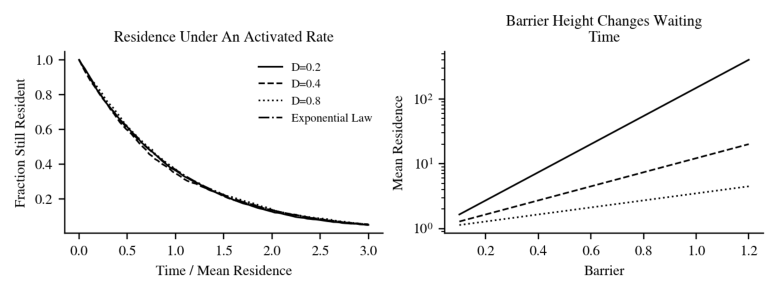
Figure 7. Two thousand waiting times per condition are drawn from the declared activated rate exp(-barrier/D), with unit barrier and unit prefactor. The second panel evaluates the same rate law over barrier heights. Slow departure can arise from difficult or forbidden transitions while the observed arrangement persists. The illustration concerns a declared transition landscape. A juridical application should establish actual complements, permissions, costs, and deadlines before treating persistence as evidence of preference or effective choice.
practical problem is to determine what the apparatus and recorded outcome establish. The taxonomy’s quantum branch also marks a transfer boundary: ordinary ambiguity, sequence effects, and interpretive disagreement already admit classical explanations. Their presence supplies a question for inquiry while the quantum-mechanism claim requires additional physical evidence.
Mechanism And Ontological Commitments. The physical ontology includes a specified preparation, density operator, driving or bath interaction, measurement instrument, and outcome record. A Lindblad description assumes an appropriate open-system approximation and admissible rates. A measurement’s disturbance of a quantum state is an apparatus-specific physical relation. A legal procedure’s alteration of conduct is a different operation requiring its own model. Preserving these types permits the quantum branch to contribute a rigorous evidential question without turning contextual interpretation into evidence of physical quantum dynamics (Lindblad 1976).
Epistemic Design And Discriminating Evidence. A reconstruction should obtain apparatus specifications, calibration and preparation records, observation timing, software versions, and uncertainty estimates. Where the physical claim matters, relevant specialists can compare the proposed quantum account with classical alternatives using discriminating observations. A stable event-andprovenance ledger can connect instrument outputs to later reports and summaries. The inferential chain separates a detector event, a reconstructed physical quantity, and the proposition material to the proceeding. Contemporary open-system perspectives supply physical context; their application remains bounded by the device and observation model actually established (Korbel et al. 2026).
Philosophical Reasoning And Practice. The philosophical linkage is typed evidential mediation. Every record reaches judgment through operations, but the operations can have very different ontologies and validity conditions. If two representations preserve different distinctions, a common numerical format alone supplies an insufficient bridge between them. The useful juridical practice is to state what each representation preserves and what additional interpretation its consequential use requires. A syntactic order-sensitive formalism can help organize records while leaving quantum physical correspondence and legal meaning as separate questions (Huang 2026b).
Worked Comparison And Research Proposition. Compare a dossier containing a detector log with a dossier containing a natural-language summary of that log. Their accessibility and inferential resolution differ. A constructed review could vary the availability of preparation metadata and expert translation, measuring whether reviewers distinguish an instrument outcome from a device-performance claim and a legal characterization. The research proposition concerns provenance and translation: apparatus-aware records improve warrant when preparation or measurement assumptions materially
Readable text
affect the proposition. A successful test of that proposition would establish an evidential benefit; it would leave broader claims about quantum models of social reasoning to their own discriminating
Reading the numerical illustration. Figure 8 illustrates the declared mechanism. Different measurement channels preserve different aspects of this explicitly quantum state. Population measurements alone remain constant while off-diagonal coherence changes. Positivity and trace are checked throughout. The illustration belongs to the quantum physical branch: a social explanation would require relevant quantum degrees of freedom and an independently justified measurement protocol. Its methodological contribution to the wider comparison is the precision with which a state, a
Mechanism and ontology. A constitutive relation connects forces and currents. Near physical equilibrium, linear response provides a controlled approximation; coupled currents require attention to parity, microscopic reversibility and admissible coefficients. The transferable methodological question concerns how a difference becomes a measurable flow under particular institutional or material
Formal representation. Equation (14) states the local mathematical representation for this class.
Notation and conditions. J_i are currents, X_j their conjugate forces, L_ij response coefficients and sigma entropy-production density in the physical account. A positive-semidefinite dissipative part supports nonnegative sigma; reciprocity has additional reversibility and parity premises.
Epistemology and methods. Physical interpretation of sigma requires thermodynamic forces and conjugate fluxes. Estimate social response coefficients in their own units and test changes across regimes. Reciprocity and positivity are hypotheses requiring their respective physical or empirical
Domain analysis and practice. A proposed influence must pass through a channel whose capacity and conditions existed at the relevant time. A financial difference can coexist with an unavailable payment route. Reconstruct the response pathway using dated rules, access and transactions. Compare a working-channel model with a blocked or delayed alternative. Quantified response estimates should identify their population and regime, with any transfer to the disputed history justified explicitly.
Phenomenon And Practical Problem. An observed difference can produce a response only through a particular relation. Consider a constructed inquiry into a backlog moving between administrative units. A large difference in waiting times can trigger redistribution where referral authority and compatible records exist, while an equally large difference elsewhere produces little movement. The practical problem concerns the response pathway used during the disputed episode. A comparison based on the disparity alone can leave actual conduct, blocked access, and available corrective action
Mechanism And Ontological Commitments. Gradient-driven transport connects a defined difference to a current through a constitutive relation. Near-equilibrium physical response has units, parity conditions, and restrictions on coefficients. An institutional application needs a separately identified difference, response, and channel. A waiting-time difference, funding gap, or information disparity can operate through different rules. The coefficient summarizes a stated relation within its conditions of observation. It cannot inherit energetic meaning or reciprocal symmetry merely because a similar linear expression fits the social data (Onsager 1931; Seifert 2012).
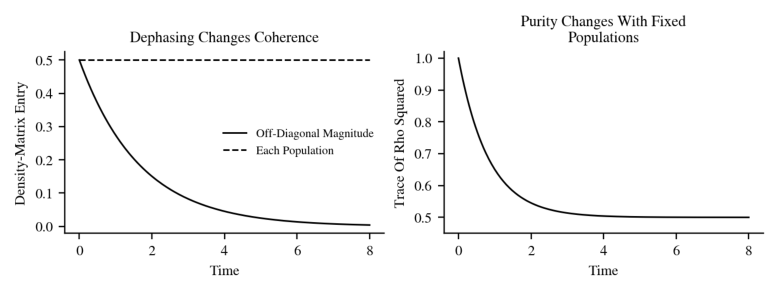
Figure 8. A two-level state begins in an equal coherent superposition and undergoes Lindblad dephasing with L = sigma_z and gamma = 0.3. Populations stay one-half, coherence decays, and purity approaches one-half. Quantum preparation and readout belong to a specified physical apparatus and observation protocol. The illustration represents that branch’s conditions of application. In juridical reconstruction, the device outcome, physical inference, translated record, and legal consequence require separately warranted connections and appropriate specialist evidence.
Epistemic Design And Discriminating Evidence. Collect direction-resolved transfers, measured differences, channel conditions, and the timing of decisions. Compare response under similar differences when permissions or compatibility change. An observed slope can combine selection into the channel with behavior through it, so rival models should include both pathways and common shocks. Inspect nonlinearity, thresholds, and delay before treating one fitted coefficient as stable. A reconstruction should report the supported range and preserve occasions with a difference but no transfer, since those episodes help identify constraints that a successful-flow sample omits.
Philosophical Reasoning And Practice. The philosophical inference concerns dispositional and exercised relations. A channel can possess a capacity to respond under specified conditions while remaining unused on one occasion. Conversely, a realized transfer can depend on an exceptional intervention that the ordinary relation lacks. A juridical account should distinguish those propositions when assessing capability or omission. The relevant legal question determines which condition matters. Mechanism evidence can clarify whether a response was practically possible, while the source and standard of a duty determine the consequences of that possibility.
Worked Comparison And Research Proposition. Compare two referral systems with the same average redistribution. One responds reliably to queue differences through a standing rule; another depends on exceptional discretionary calls. Their aggregate performance agrees while evidence of reproducible corrective capacity differs. A prospective reconstruction study could supply matched totals and then reveal direction, rule, and channel records. The proposition is that response-resolved evidence improves warrant when a legal claim concerns available correction rather than historical throughput alone. The report should identify whether it supports an actual transfer, a conditional response capacity, or an attributed failure to exercise that capacity, preserving each proposition’s evidential requirements.
Reading the numerical illustration. Figure 9 illustrates the declared mechanism. A constitutive matrix expresses a particular coupling, including the effect of one driving component on another current. Positivity is an additional restriction and is checked here through the matrix eigenvalues and the computed quadratic form. The illustration uses scaled model coordinates. A physical entropyproduction interpretation requires the appropriate conjugate forces, fluxes and time-reversal conventions. A social conversion relation requires its own variables, operation and evidence, through which a difference becomes a consequential flow.
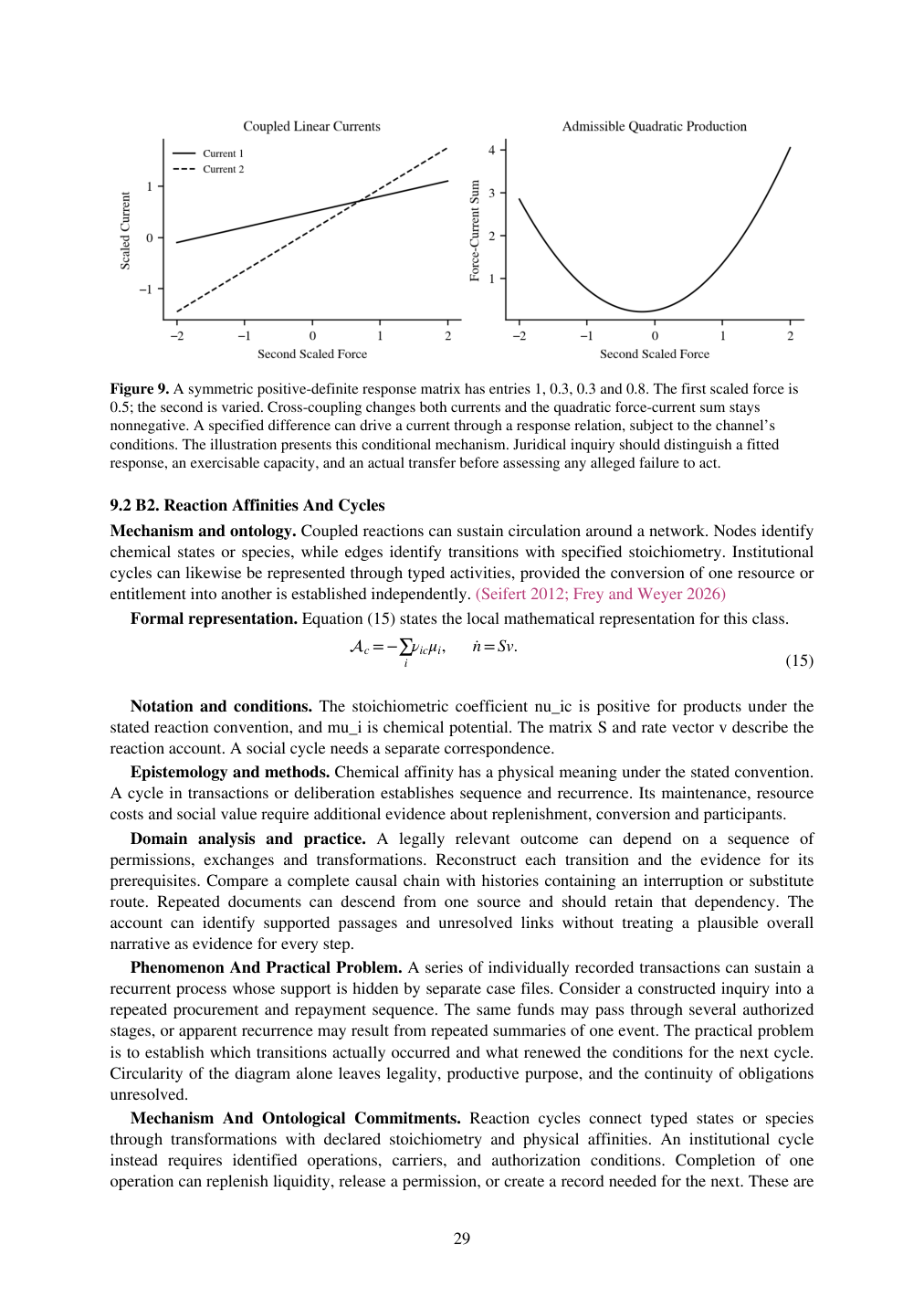
Readable text
Figure 9. A symmetric positive-definite response matrix has entries 1, 0.3, 0.3 and 0.8. The first scaled force is 0.5; the second is varied. Cross-coupling changes both currents and the quadratic force-current sum stays nonnegative. A specified difference can drive a current through a response relation, subject to the channel’s conditions. The illustration presents this conditional mechanism. Juridical inquiry should distinguish a fitted response, an exercisable capacity, and an actual transfer before assessing any alleged failure to act.
Mechanism and ontology. Coupled reactions can sustain circulation around a network. Nodes identify chemical states or species, while edges identify transitions with specified stoichiometry. Institutional cycles can likewise be represented through typed activities, provided the conversion of one resource or entitlement into another is established independently. (Seifert 2012; Frey and Weyer 2026)
Formal representation. Equation (15) states the local mathematical representation for this class.
Notation and conditions. The stoichiometric coefficient nu_ic is positive for products under the stated reaction convention, and mu_i is chemical potential. The matrix S and rate vector v describe the reaction account. A social cycle needs a separate correspondence.
Epistemology and methods. Chemical affinity has a physical meaning under the stated convention. A cycle in transactions or deliberation establishes sequence and recurrence. Its maintenance, resource costs and social value require additional evidence about replenishment, conversion and participants.
Domain analysis and practice. A legally relevant outcome can depend on a sequence of permissions, exchanges and transformations. Reconstruct each transition and the evidence for its prerequisites. Compare a complete causal chain with histories containing an interruption or substitute route. Repeated documents can descend from one source and should retain that dependency. The account can identify supported passages and unresolved links without treating a plausible overall
Phenomenon And Practical Problem. A series of individually recorded transactions can sustain a recurrent process whose support is hidden by separate case files. Consider a constructed inquiry into a repeated procurement and repayment sequence. The same funds may pass through several authorized stages, or apparent recurrence may result from repeated summaries of one event. The practical problem is to establish which transitions actually occurred and what renewed the conditions for the next cycle. Circularity of the diagram alone leaves legality, productive purpose, and the continuity of obligations
Mechanism And Ontological Commitments. Reaction cycles connect typed states or species through transformations with declared stoichiometry and physical affinities. An institutional cycle instead requires identified operations, carriers, and authorization conditions. Completion of one operation can replenish liquidity, release a permission, or create a record needed for the next. These are
different conversion mechanisms. The ontology includes intermediates and timing as well as repeated endpoints. An account of recurrence becomes explanatory when it shows how the necessary condition is renewed, including any outside source sustaining the sequence (Seifert 2012).
Epistemic Design And Discriminating Evidence. Reconstruct dated transitions from independent endpoint records and identify reused documents, copied assertions, and repeated identifiers. Reconcile the quantity moving through the cycle with external additions and losses. Compare cycles that complete with those interrupted at a particular stage. A missing intermediate can discriminate a genuine renewed sequence from an administrative duplication. Where a chemical-cycle formalism is used illustratively, preserve its physical scope; an institutional inference relies on evidence for the actual conversion and accounting rules. Mass-conserving pattern research offers a distinct physical precedent for following redistribution and local states (Frey and Weyer 2026).
Philosophical Reasoning And Practice. The philosophical issue is the identity of a recurrent event. Similar outcomes can constitute a new exercise, a repeated record, or a continuation of one unfinished operation. The inquiry should state the criterion that distinguishes them. It should also separate historical transmission from mere resemblance: a successor may repeat a practice independently, while a documented learning or resource passage can establish inheritance. A cycle’s social or legal value follows from the purposes, affected claims, and authorized operations it supports. Repetition supplies an object of evaluation, with its justification requiring further premises.
Worked Comparison And Research Proposition. Compare two dossiers containing a monthly payment and completion certificate. One preserves delivery evidence, repayment, and renewed working capital at every passage. Another recycles an earlier certificate while the corresponding delivery is absent. A constructed study could vary intermediate and provenance records while holding visible endpoint totals constant. The research proposition is that cycle-resolved reconstruction improves discrimination when renewed conditions and documentary recurrence can diverge. A useful report identifies verified transitions, missing complements, and remaining alternatives. The relevant legal sources then determine which established acts satisfy an obligation or support an attribution.
Reading the numerical illustration. Figure 10 illustrates the declared mechanism. A cycle can be sustained after its state frequencies have settled. This finite transition construction separates evolving occupation from continuing directional exchange. The currents balance at every steady node, so circulation can coexist with zero net stock change. A chemical interpretation would additionally specify species, stoichiometry and reaction affinities. An institutional application would identify the distinct activities carried by the nodes and show how one operation enables the next, with its own resource and authority conditions.
9.3 B3. Mechanical Energy Injection
Mechanism and ontology. Sustained forces, shear and deformation can maintain organized motion. The input is an ongoing maintenance process, distinct from the initiating shock in A3. In social models, recurring implementation work may maintain an arrangement that would decay if its administrative or material support ceased. (Cross and Hohenberg 1993; Bebon, Robinson, and Speck 2025)
Formal representation. Equation (16) states the local mathematical representation for this class.
E =Pin −Pdiss −Pout. (16)
Notation and conditions. E is energy; P_in, P_diss and P_out are compatible rates within the declared boundary. Administrative accounts can instead use time or money, with conversion and external entries specified independently.
Epistemology and methods. Close an energy account where energy is the measured quantity. For administration, separate staff hours, budgets and outputs. A withdrawal or interruption study can identify maintenance dependence when its comparison and consequences are appropriate.
Domain analysis and practice. An operation may require recurring maintenance or supervision. The appearance of a functioning system at one time leaves its support during the disputed interval open.
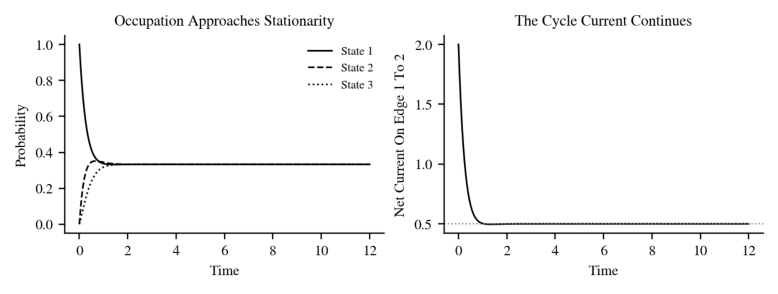
Figure 10. A three-state transition ring has clockwise rate 2 and reverse rate 0.5. From a concentrated initial state, probabilities approach one-third while each oriented steady edge carries net current 0.5. A recurrent pathway requires supported transitions and renewed conditions for another passage. The illustration concerns a declared cycle of typed operations. Juridical reconstruction should verify intermediates and provenance, distinguishing a new exercise, an inherited practice, and repeated documentation of one event.
Seek logs, resource accounts and evidence of interruption. Compare maintained and unsupported histories against the observations. A missing log can reflect several observation processes; its evidential force requires a model of how the record would have been created and retained.
Phenomenon And Practical Problem. An apparently self-maintaining procedure may depend on repeated work that leaves little trace in its final outputs. Consider a constructed dispute over whether a service could function after a contractor’s withdrawal. Delivery totals before withdrawal can coexist with continual troubleshooting, manual reconciliation, and exceptional coordination. The practical issue is to establish the maintenance actually supporting the function. A label such as automated or operational can accurately describe part of the arrangement while obscuring the labor and authority needed to keep it usable over time.
Mechanism And Ontological Commitments. Mechanical injection sustains motion through continuing forces or deformation. The institutional counterpart proposed here is recurring implementation work whose interruption changes the supported process. It differs from an initiating intervention because its explanatory role is continued maintenance. The relevant objects are task, input, operator, frequency, resource, and observed response. An account of dependence should identify the operation that ceases and the pathway through which performance changes. Staff time, financial inputs, and physical energy remain separate quantities with different accounting and evidential requirements.
Epistemic Design And Discriminating Evidence. Recover maintenance tickets, manual overrides, scheduled checks, staffing, and unsuccessful episodes. Compare periods of ordinary support with documented interruptions or substitutions, examining concurrent changes and adaptation. A service may recover through hidden replacement work, making unchanged output insufficient evidence of independence. Withdrawal comparisons require lawful access and attention to consequences; historical records may provide an informative contrast without new disruption. Physical energy accounting motivates a clear boundary, while adaptive-governance research supplies an institutional context for recurrent support and learning (Bebon, Robinson, and Speck 2025; Folke et al. 2005).
Philosophical Reasoning And Practice. The philosophical inference separates possession of an artifact from possession of a continuing capacity. A deployed system can exist while its operation depends on relations that a recipient has not acquired. A claim that capacity was transferred consequently requires evidence of usable support under the relevant conditions. This is a constructive application of relational wealth: successor opportunities depend on tools, knowledge, permissions, and receiving cooperation together. A juridical inquiry can establish that dependence and leave the evaluation of contractual sufficiency or duty to the applicable sources and facts (Huang 2026d).
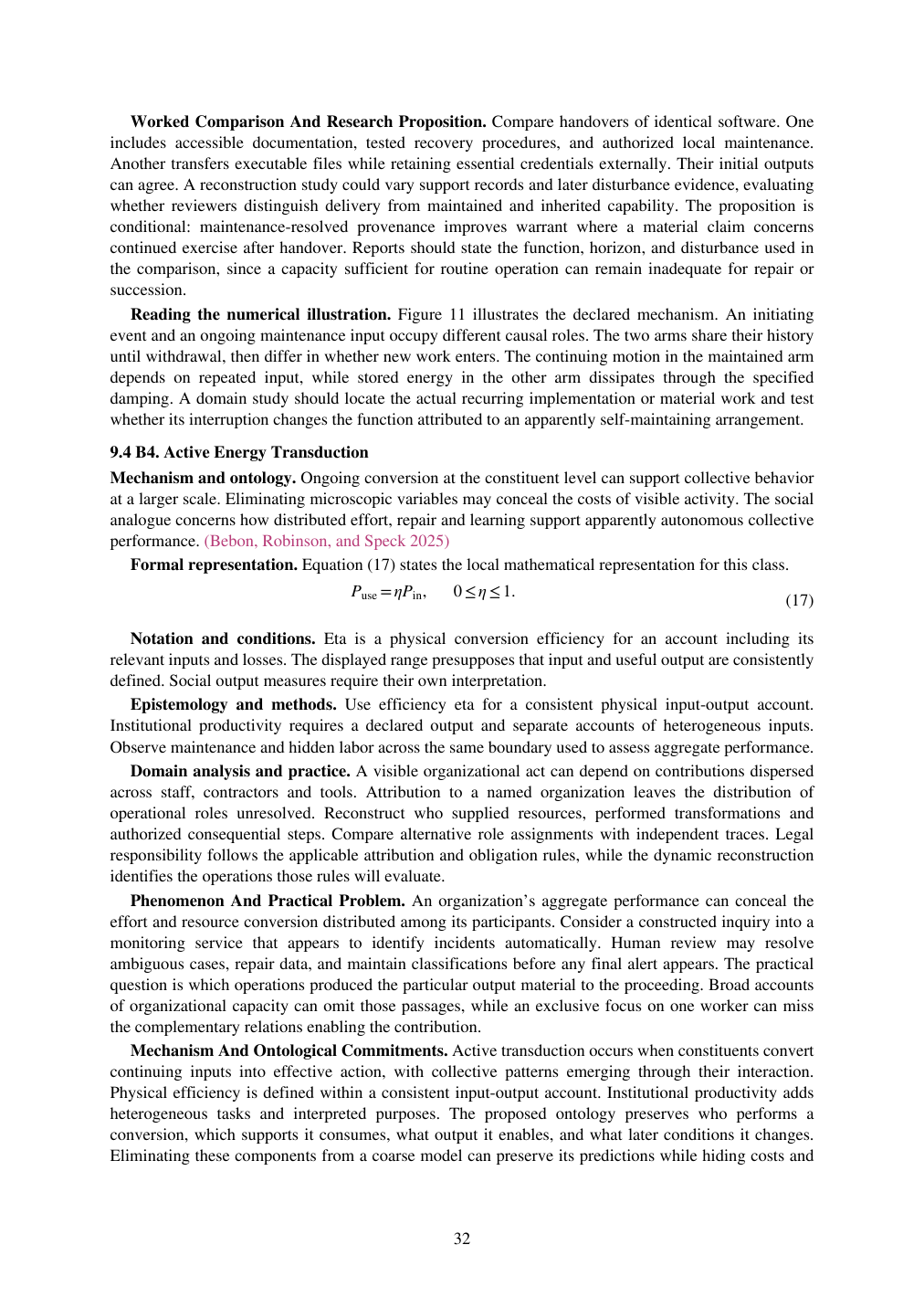
Readable text
Worked Comparison And Research Proposition. Compare handovers of identical software. One includes accessible documentation, tested recovery procedures, and authorized local maintenance. Another transfers executable files while retaining essential credentials externally. Their initial outputs can agree. A reconstruction study could vary support records and later disturbance evidence, evaluating whether reviewers distinguish delivery from maintained and inherited capability. The proposition is conditional: maintenance-resolved provenance improves warrant where a material claim concerns continued exercise after handover. Reports should state the function, horizon, and disturbance used in the comparison, since a capacity sufficient for routine operation can remain inadequate for repair or
Reading the numerical illustration. Figure 11 illustrates the declared mechanism. An initiating event and an ongoing maintenance input occupy different causal roles. The two arms share their history until withdrawal, then differ in whether new work enters. The continuing motion in the maintained arm depends on repeated input, while stored energy in the other arm dissipates through the specified damping. A domain study should locate the actual recurring implementation or material work and test whether its interruption changes the function attributed to an apparently self-maintaining arrangement.
Mechanism and ontology. Ongoing conversion at the constituent level can support collective behavior at a larger scale. Eliminating microscopic variables may conceal the costs of visible activity. The social analogue concerns how distributed effort, repair and learning support apparently autonomous collective
Formal representation. Equation (17) states the local mathematical representation for this class.
Notation and conditions. Eta is a physical conversion efficiency for an account including its relevant inputs and losses. The displayed range presupposes that input and useful output are consistently defined. Social output measures require their own interpretation.
Epistemology and methods. Use efficiency eta for a consistent physical input-output account. Institutional productivity requires a declared output and separate accounts of heterogeneous inputs. Observe maintenance and hidden labor across the same boundary used to assess aggregate performance.
Domain analysis and practice. A visible organizational act can depend on contributions dispersed across staff, contractors and tools. Attribution to a named organization leaves the distribution of operational roles unresolved. Reconstruct who supplied resources, performed transformations and authorized consequential steps. Compare alternative role assignments with independent traces. Legal responsibility follows the applicable attribution and obligation rules, while the dynamic reconstruction
identifies the operations those rules will evaluate.
Phenomenon And Practical Problem. An organization’s aggregate performance can conceal the effort and resource conversion distributed among its participants. Consider a constructed inquiry into a monitoring service that appears to identify incidents automatically. Human review may resolve ambiguous cases, repair data, and maintain classifications before any final alert appears. The practical question is which operations produced the particular output material to the proceeding. Broad accounts of organizational capacity can omit those passages, while an exclusive focus on one worker can miss the complementary relations enabling the contribution.
Mechanism And Ontological Commitments. Active transduction occurs when constituents convert continuing inputs into effective action, with collective patterns emerging through their interaction. Physical efficiency is defined within a consistent input-output account. Institutional productivity adds heterogeneous tasks and interpreted purposes. The proposed ontology preserves who performs a conversion, which supports it consumes, what output it enables, and what later conditions it changes. Eliminating these components from a coarse model can preserve its predictions while hiding costs and
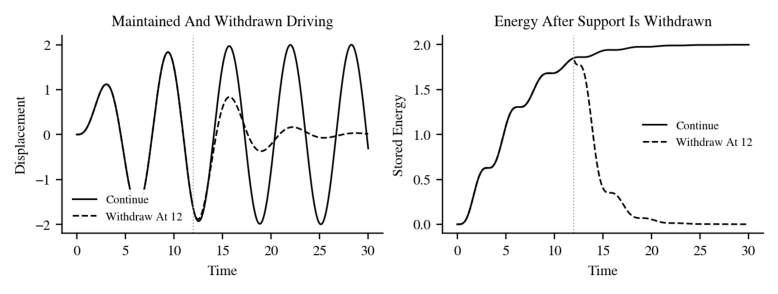
Figure 11. A unit oscillator with damping 0.5 receives sinusoidal forcing. The comparison either continues the drive or withdraws it at time twelve; the later paths reveal the work required to maintain motion. Continuing input can maintain a visible function while the supporting work remains outside its output record. The illustration identifies a maintenance dependence. Juridical reconstruction should test ordinary operation, interruption, substitution, and successor access through separately documented operations and resources.
attribution-relevant dependencies. A more detailed account becomes useful when those omitted distinctions matter to the legal issue (Bebon, Robinson, and Speck 2025).
Epistemic Design And Discriminating Evidence. Trace a sample of outputs backward through preparation, review, repair, and release. Compare the final record with intermediate versions and task logs, preserving source dependence and uncertainty in undocumented work. Interview evidence can identify a candidate contribution pathway; independent timing and artifact changes can test it. Examine whether an interruption at a specified operation affects the claimed function, and whether substitutes reproduce it. The evidential design should distinguish a participant’s actual contribution from mere assignment to a role. A contribution’s legal significance requires the standards appropriate to its consequential use.
Philosophical Reasoning And Practice. The philosophical argument concerns the relation between aggregation and recognition. If the aggregate is produced through complementary operations, coarse success can remain real while offering an incomplete account of its production. Recognition then requires a question-relative return to the relevant scale. Epistemic justice makes the accessibility of that return consequential when some workers lack the means to document or explain their contribution. Fair participation and factual warrant have distinct grounds: a credible hearing can reveal an omitted operation while leaving its occurrence open to assessment (Fricker 2007).
Worked Comparison And Research Proposition. Compare alert dossiers with identical final labels. One preserves a model score alone; another includes the reviewer’s correction, supporting observation, and approval history. The second can establish an additional passage while also introducing assumptions requiring scrutiny. A controlled reconstruction study could vary access to component records and assess supported attribution, calibration, and unresolved dependence. The research proposition is that component-level provenance improves warrant when aggregation removes a material contribution or cost. The report can retain several complementary contributions without forcing their heterogeneous roles into one universal metric of merit (Huang 2026b).
Reading the numerical illustration. Figure 12 illustrates the declared mechanism. The same visible amount of useful exercise can require different input when conversion differs. The illustration keeps the input rate explicit and separates the unobserved complement from the useful channel. This supports an accounting question about apparent collective autonomy: which conversions and constituent work sustain it? For a social application, effort, skill, care and resources should retain their appropriate units, with a justified account of how they enable the operation and who bears their replenishment.
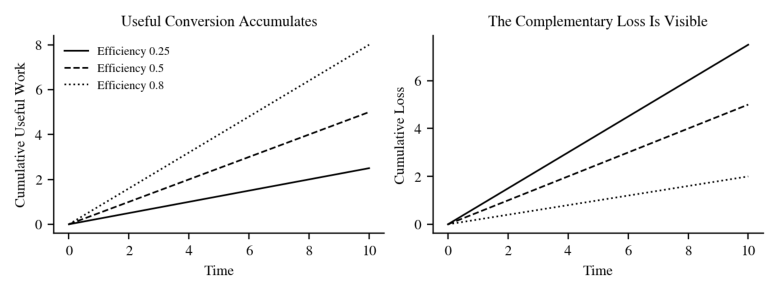
Figure 12. Three converters receive one energy unit per time and have constant efficiencies 0.25, 0.5 and 0.8. Useful work and loss sum to supplied energy in every condition. Distributed constituents can sustain a collective result through different conversion operations. The illustration highlights what coarse observation can omit. Juridical reconstruction should recover contribution pathways at the scale material to the issue, with independent evidence and separate grounds for consequential recognition.
9.5 B5. Time-Dependent And Stochastic Forcing
Mechanism and ontology. A process may be maintained or reshaped by periodic, intermittent or random input. The forcing process is part of the model, with its correlations and temporal resolution. Similar-looking fluctuations can originate from external variability, endogenous dynamics or the observation procedure. (Ashwin et al. 2012; Korbel et al. 2026)
Formal representation. Equation (18) states the local mathematical representation for this class.
dx=f(x,t)dt+B(x,t)dWt. (18)
Notation and conditions. W_t is a standard Wiener process, B a noise-amplitude matrix and f a drift. The stochastic convention matters when B depends on x; jumps and temporally correlated forcing require suitable alternative models.
Epistemology and methods. State the stochastic convention and diffusion assumptions when using this form. Compare measured external inputs with residual variation; examine colored noise and jumps where relevant. A fitted noise term records unresolved variability, with causal interpretation requiring further investigation.
Domain analysis and practice. Random disturbances, scheduled inputs and undocumented shocks can produce similar observed fluctuations. Compare candidate input histories and state-space models using external records where available. Preserve process noise and measurement error as different objects. A well-fitting residual distribution leaves the actual historical disturbance uncertain. Report the range of histories compatible with the evidence and which lawful measurement could narrow it.
Phenomenon And Practical Problem. Irregular conduct or output can arise through externally varying inputs as well as internal choice. Consider a constructed dispute about repeated delays in a logistics process exposed to intermittent demand, weather, or upstream release schedules. Bursts in the visible record may follow those drivers, endogenous congestion, or changed recording. The practical problem is to distinguish these accounts over the material interval. Labeling a residual random can summarize uncertainty while leaving its causes, foreseeability, and relevance to a particular actor unresolved.
Mechanism And Ontological Commitments. A stochastic-forcing model represents an input process with specified timing, distribution, and dependence. The physical or mathematical convention determines how the input enters evolution. An institutional reconstruction should identify the candidate source, observation resolution, response delay, and possible adaptation. Externality is relative to the
Readable text
model boundary: a demand stream may be generated strategically by another participant. White noise, correlated variation, and discrete shocks have different implications. Their substitution can change estimated response and the predicted likelihood of a consequential episode (Korbel et al. 2026).
Epistemic Design And Discriminating Evidence. Collect independently timed input records alongside outputs and implementation histories. Compare models with common external forcing, internal feedback, and changed observation. Inspect residual dependence and performance during ordinary periods as well as selected failures. Historical interventions or naturally occurring interruptions can discriminate pathways when their assignment and side effects are addressed. Simulation can test the consequences of a declared noise model, with sensitivity across plausible alternatives. A rare observed event acquires a frequency interpretation through the sampling and selection process, including comparable non-events (Boettiger and Hastings 2012; Ashwin et al. 2012).
Philosophical Reasoning And Practice. The philosophical inference concerns the difference between unexplained variation and established contingency. A fitted disturbance term records what the chosen representation leaves unresolved. It becomes a causal account through evidence about its source and transmission. A proceeding can still draw a supported conclusion about a particular event without uniquely identifying every fluctuation. The report should state which material proposition agrees across the surviving models. Questions of knowledge, reasonable anticipation, or responsibility then require contemporaneous information and the relevant legal standard, preserving the distinction between
Worked Comparison And Research Proposition. Compare identical delay bursts in two constructed histories. One follows measured upstream releases; another appears only after an office changes how late cases are registered. A reconstruction study could present the output series first and then release input and recording histories, measuring mechanism discrimination and overconfident attribution. The proposition is that jointly observed forcing and measurement histories improve warrant when irregularity has several plausible sources. The useful output is a comparison of supported pathways and robust event-level conclusions, with sensitivity to unobserved inputs and the practical
Reading the numerical illustration. Figure 13 illustrates the declared mechanism. Persistent fluctuations can arise from continuing external stochastic input even when deterministic relaxation is stable. The ensemble mean and variance answer different questions, and the latter is tested against the declared process. A single irregular record would provide less direct evidence about that source. Domain inference should compare external forcing, internal interaction and changing measurement as rival mechanisms, while matching temporal resolution and dependence assumptions to the data actually
Mechanism and ontology. Observation, memory and control change subsequent evolution through a feedback loop. A controller has information, an objective and an ability to act. In social settings these capacities are distributed across offices and participants, making sensing and intervention authority
Formal representation. Equation (19) states the local mathematical representation for this class.
Notation and conditions. The policy pi maps information available through time t to an input u_t. The observations y and state x are distinct objects. A causal implementation uses the information
Epistemology and methods. Record the information available at each decision and the timing of response. Evaluate a policy together with its induced data distribution. Compare alternatives that separate better measurement from greater control over the measured population.
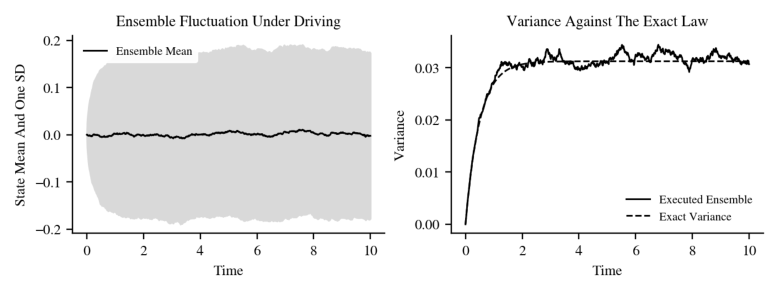
Figure 13. An Euler-Maruyama ensemble of 1,500 Ornstein-Uhlenbeck paths uses dt = 0.01, unit restoring rate and noise coefficient 0.25. The shaded region is one ensemble standard deviation; the second panel compares variance with the exact law. Irregular output can reflect external variability, internal dynamics, or observation changes. The illustration represents one declared forcing process. A juridical application should compare these rival pathways using input and measurement histories, preserving the assumptions behind any frequency, forecast, or attribution.
Domain analysis and practice. Investigation, surveillance and classification can change the behavior being recorded. Reconstruct the timing of observation and the decisions made on its basis. Compare a passive-observation account with one including feedback from investigators or institutions. A later record may be evidence of that interaction. Legal assessment should consider both the process generating the record and the rules governing its collection and consequential use.
Phenomenon And Practical Problem. Investigation can alter the behavior it later records. Consider a constructed inquiry into compliance after a monitoring notice. A decline in reported incidents may reflect changed conduct, selective concealment, reduced exposure, or a new reporting rule. The practical problem is to establish which pathway generated the record and what that record supports about the earlier period. A procedure that improves present monitoring can also change the population and evidence available for historical reconstruction, making its own operation part of the process requiring explanation.
Mechanism And Ontological Commitments. Feedback links observation to action and action to subsequent state and observation. Its ontology includes the sensor, information available at decision time, memory, action rule, authority, and affected process. A controller’s improved information and its expanded power to act are distinct changes. In juridical settings, investigators, regulated participants, and recording systems can each respond to the others. A fitted response under one procedure can therefore fail to transfer to another. Performative-prediction research supplies a formal setting for inquiry into decisions that change the data they subsequently receive (Perdomo et al. 2020).
Epistemic Design And Discriminating Evidence. Version the monitoring policy and record when participants learned of it, how implementation changed, and which observations became possible or inaccessible. Compare reported events with independent outcome or exposure measures. A study can contrast passive observation, disclosed monitoring, and alternative reporting channels where access and authority permit. Each comparison requires attention to assignment, interference, strategic adaptation, and timing. Retain unsuccessful searches and missing records so that reduced visibility can be distinguished from reduced incidence. Longitudinal causal methods help organize these interventiondependent questions (Hernán and Robins 2020).
Philosophical Reasoning And Practice. The philosophical inference joins reflexivity to historical warrant. If the observation procedure changes conduct, later evidence can accurately describe a new regime while leaving an earlier regime underdetermined. If it changes reporting, the apparent trend can combine changed conduct with changed manifestation. Neither possibility makes evidence arbitrary. It
identifies the bridge that a consequential inference must defend. A proceeding should explain how its investigational acts produced the available record, including which material distinctions they preserved, altered, or made harder to recover.
Worked Comparison And Research Proposition. Compare two institutions showing fewer complaints after review. One provides an accessible independent channel and verifies service improvement; the other centralizes reporting through an office whose classification criteria changed. A constructed reconstruction study could hold the complaint totals constant while varying procedural histories and independent observations. The proposition is that feedback-aware reporting improves discrimination when the process producing evidence responds to investigation. Its practical contribution is an account of the policy version, observation conditions, supported historical claims, and surviving alternatives. The authority and fairness of investigation receive their own institutional and participantbased reasons (Fricker 2007).
Reading the numerical illustration. Figure 14 illustrates the declared mechanism. Observation affects the process only through an operative response. Here changing gain changes the closed-loop multiplier while the uncontrolled transition remains fixed. Stronger correction can cross the discretetime stability boundary and amplify deviations. A domain account should identify the sensing channel, the information retained, the response rule and the ability to implement it. Evaluating the regulated target additionally requires reasons concerning the function and affected claims, beyond the sign of the feedback loop.
9.7 B7. Nonreciprocal Effective Coupling
Mechanism and ontology. A response of one component to another can differ from the reverse response. Directional influence can be sustained by asymmetric access, external support or different interaction rules. The object is the directional response relation; its existence alone leaves physical dissipation and political legitimacy to their respective evidence. (Gross and Blasius 2008; Korbel et al. 2026) Formal representation. Equation (20) states the local mathematical representation for this class.

Notation and conditions. The derivatives compare directional response in a declared coordinate system. Different units or variable normalizations change their numerical comparison; a causal interpretation needs an identified intervention or justified structural model.
Epistemology and methods. Define common coordinates before comparing derivatives. In social applications, estimate direction-specific effects and document the authority or resources enabling them. Unequal observed correlations require a separate identification argument before being interpreted as unequal causal influence.
Domain analysis and practice. One party can influence another’s access, resources or available testimony through a direction-specific power. Reconstruct the operational power, its source and its exercise in the relevant episode. Compare effects with shared external causes and with feasible alternatives. Institutional asymmetry can guide inquiry while remaining distinct from proof of a particular act. The legal characterization depends on the relevant duty, attribution rule and warranted facts.
Phenomenon And Practical Problem. A relation can affect its participants unequally in direction and practical force. Consider a constructed dispute involving a platform that can change a supplier’s access while the supplier has little ability to alter the platform’s rule. Correlated changes at the two endpoints can coexist with highly unequal authority, information, and substitution options. The practical problem is to identify the operative directional pathway material to the claim. An undirected contact graph or shared trend can conceal which actor could initiate, block, or correct the consequential operation.
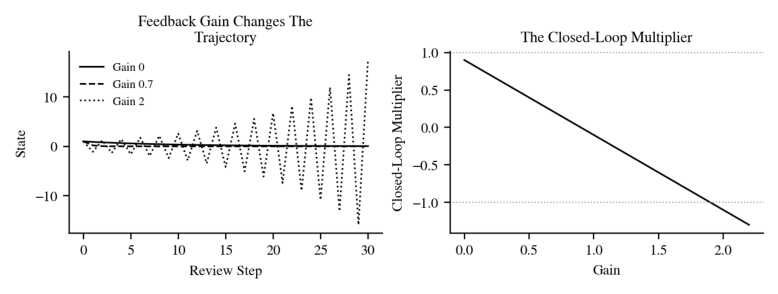
Figure 14. A scalar discrete process x_next = 0.9x + u uses observed-state feedback u = -Kx. The three trajectories share initial state one; gain two produces an alternating growing path. Observation can affect action and thereby change later evidence. The illustration traces a declared feedback loop. Juridical reconstruction should preserve monitoring versions, participant exposure, and independent observations so that conduct change, reporting change, and historical inference can be assessed separately.
Mechanism And Ontological Commitments. Nonreciprocal coupling means that the response in one direction differs from the reverse under a specified representation. Coordinates, units, and intervention contrasts must be comparable before coefficients are compared. Institutional directionality can arise through authorization, technical control, dependence, or selective attention. These mechanisms have different evidence and legal implications. The ontology should identify the particular capacity and domain in which asymmetry operates. Directional influence alone leaves physical dissipation, domination, and legitimacy to their own arguments and conditions (Gross and Blasius 2008; Korbel et al. 2026). Epistemic Design And Discriminating Evidence. Reconstruct direction-specific instructions, access changes, appeals, and actual responses. Compare effects of endpoint actions while examining common causes and selection into the relation. A natural experiment or interruption can help identify influence only under its supported assumptions. Qualitative process evidence can establish a credential or decision pathway that a correlation omits. Record substitutions and failed attempts to challenge the rule, since apparent compliance can arise under constrained alternatives. The design should separate having a formal appeal route from possessing a practically effective capacity to obtain reconsideration.
Philosophical Reasoning And Practice. The philosophical inference concerns a relation’s organization of possibility. One participant’s control can structure the actions available to another without eliminating the latter’s agency. A precise account preserves both the exercised contribution and the constraint. Evaluative conclusions then require a defended standard concerning authority, dependence, and affected claims. GR analysis makes evaluative power itself investigable by asking who can determine which records count and which criteria may change. The legal inquiry should identify the sources and procedures giving that power consequential force (Huang 2026a).
Worked Comparison And Research Proposition. Compare two suppliers whose access is suspended after similar automated flags. One can obtain an independent review with preserved records; another can submit explanations only through the same rule that produced the flag. Their nominal review opportunities agree while their response pathways differ. A constructed study could vary directional-control and appeal records, measuring supported conclusions about influence and feasible correction. The proposition is that direction-resolved evidence improves warrant when the material issue concerns control or effective challenge. Any finding about duty, abuse, or remedy remains attached to the applicable sources, facts, and normative premises.
Reading the numerical illustration. Figure 15 illustrates the declared mechanism. A relation can have direction-dependent consequences even when both components are described with the same state
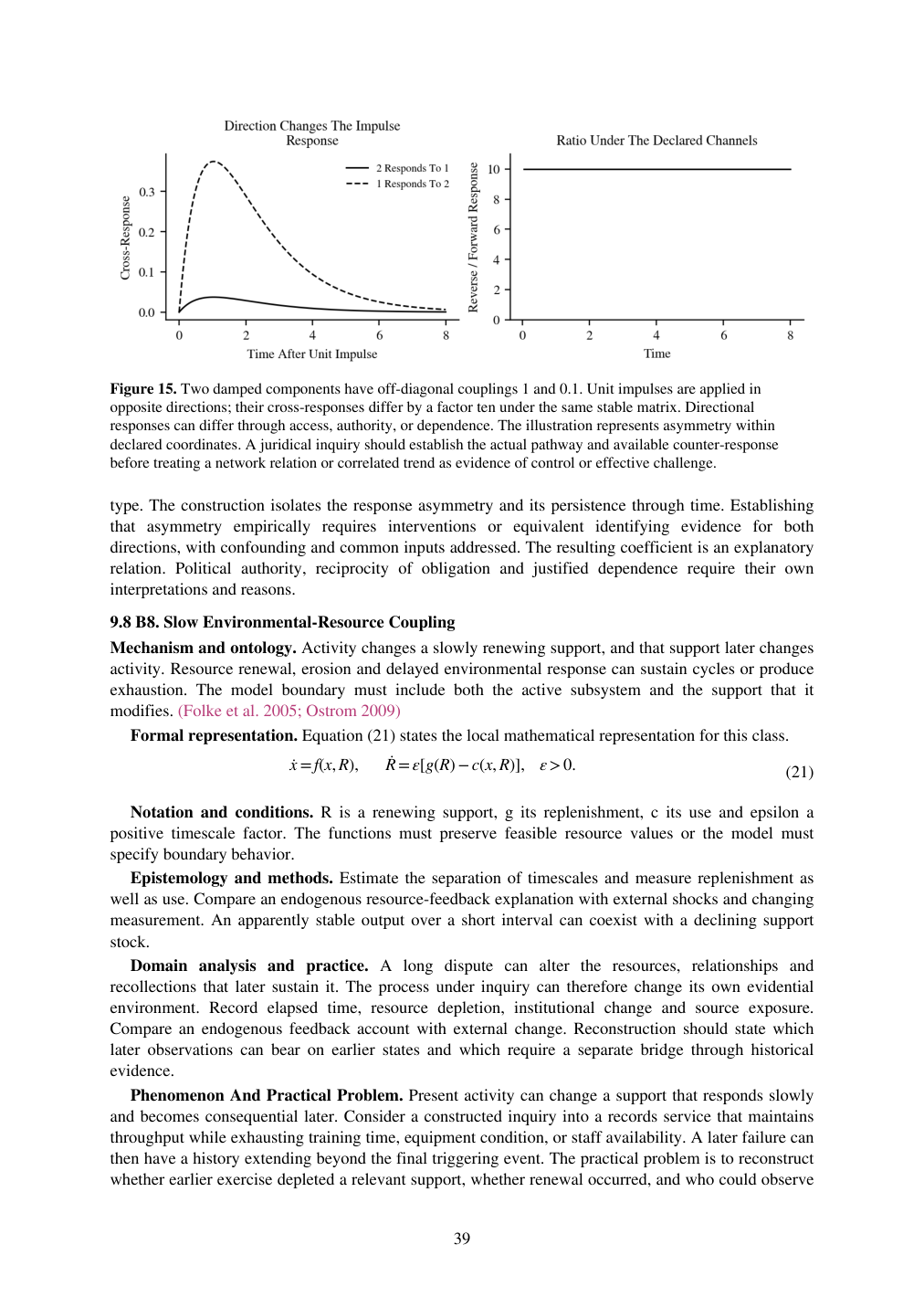
Readable text
Figure 15. Two damped components have off-diagonal couplings 1 and 0.1. Unit impulses are applied in opposite directions; their cross-responses differ by a factor ten under the same stable matrix. Directional responses can differ through access, authority, or dependence. The illustration represents asymmetry within declared coordinates. A juridical inquiry should establish the actual pathway and available counter-response before treating a network relation or correlated trend as evidence of control or effective challenge.
type. The construction isolates the response asymmetry and its persistence through time. Establishing that asymmetry empirically requires interventions or equivalent identifying evidence for both directions, with confounding and common inputs addressed. The resulting coefficient is an explanatory relation. Political authority, reciprocity of obligation and justified dependence require their own
Mechanism and ontology. Activity changes a slowly renewing support, and that support later changes activity. Resource renewal, erosion and delayed environmental response can sustain cycles or produce exhaustion. The model boundary must include both the active subsystem and the support that it
Formal representation. Equation (21) states the local mathematical representation for this class.
Notation and conditions. R is a renewing support, g its replenishment, c its use and epsilon a positive timescale factor. The functions must preserve feasible resource values or the model must
Epistemology and methods. Estimate the separation of timescales and measure replenishment as well as use. Compare an endogenous resource-feedback explanation with external shocks and changing measurement. An apparently stable output over a short interval can coexist with a declining support
Domain analysis and practice. A long dispute can alter the resources, relationships and recollections that later sustain it. The process under inquiry can therefore change its own evidential environment. Record elapsed time, resource depletion, institutional change and source exposure. Compare an endogenous feedback account with external change. Reconstruction should state which later observations can bear on earlier states and which require a separate bridge through historical
Phenomenon And Practical Problem. Present activity can change a support that responds slowly and becomes consequential later. Consider a constructed inquiry into a records service that maintains throughput while exhausting training time, equipment condition, or staff availability. A later failure can then have a history extending beyond the final triggering event. The practical problem is to reconstruct whether earlier exercise depleted a relevant support, whether renewal occurred, and who could observe
or alter that relation. Stable output during the earlier interval supplies incomplete evidence about retained capacity.
Mechanism And Ontological Commitments. The mechanism couples an active subsystem to a resource or environmental state with a different adjustment timescale. Activity affects replenishment or erosion, and the support later changes feasible activity. The ontology contains both processes and the relation linking them. A resource stock, institutional memory, and participant availability require distinct measurements; their common description as support supplies a question rather than an equivalence. A short observation window can hide a long process of depletion. Adaptive-governance and social-ecological research provide established contexts for examining these interacting conditions (Folke et al. 2005; Ostrom 2009).
Epistemic Design And Discriminating Evidence. Collect longitudinal measures of exercise, renewal, stock condition, replacement, and observation quality. Compare models of accumulated internal wear with models of an external shock or changing measurement. A historical interruption in use can help test recovery, while preserved maintenance and staffing records can establish the proposed lag. The relevant horizon follows the support’s renewal time and the legal issue’s temporal scope. Present condition cannot simply be projected backward through undocumented replacements. Missing intervals should appear as uncertainty in the admissible histories, with targeted additional evidence chosen for its discriminating value.
Philosophical Reasoning And Practice. The philosophical premise is that continuation concerns future exercisability as well as current output. If repeated exercise consumes an essential support, responsibility can become distributed across earlier allocations, information, and later decisions. A causal history alone leaves the relevant duty and standard to be supplied. A proceeding can clarify who contributed to depletion, who possessed knowledge, and who controlled renewal, then connect those findings to the appropriate legal grounds. This supports a temporal account of practical capacity without treating every distant dependency as equally material (Huang 2026d).
Worked Comparison And Research Proposition. Compare two services with equal annual completions and the same final outage. One preserves routine renewal and experiences an exceptional external failure; the other defers renewal while a documented support declines. A constructed study could reveal output records first, then support histories, and evaluate whether reviewers discriminate these pathways. The proposition is that paired activity-and-support records improve reconstruction when slow feedback materially changes later feasibility. The report should distinguish supported depletion, its attributed contributions, the information contemporaneously available, and any remaining uncertainty about the trigger and legal consequence.
Reading the numerical illustration. Figure 16 illustrates the declared mechanism. A short record of activity omits the support it is changing. The example couples growth, consumption and renewal, with the relative support rate altering the adjustment episode. A phase trace makes the reciprocal causal pathway visible. An empirical application should measure or bound both the exercise and its slowly changing complement, investigate their respective timescales, and compare rival environmental inputs. Which continuation deserves support depends on the function and distribution sustained by that coupled process.
10 C. Dynamical Mediators
10.1 C1. Linear Instability
Mechanism and ontology. A reference regime loses local stability when an eigenvalue of its linearized dynamics acquires positive real part. States, the reference solution and the perturbation operator are required objects. Local analysis explains initial amplification near that reference; subsequent behavior depends on nonlinear terms and constraints. (Cross and Hohenberg 1993)
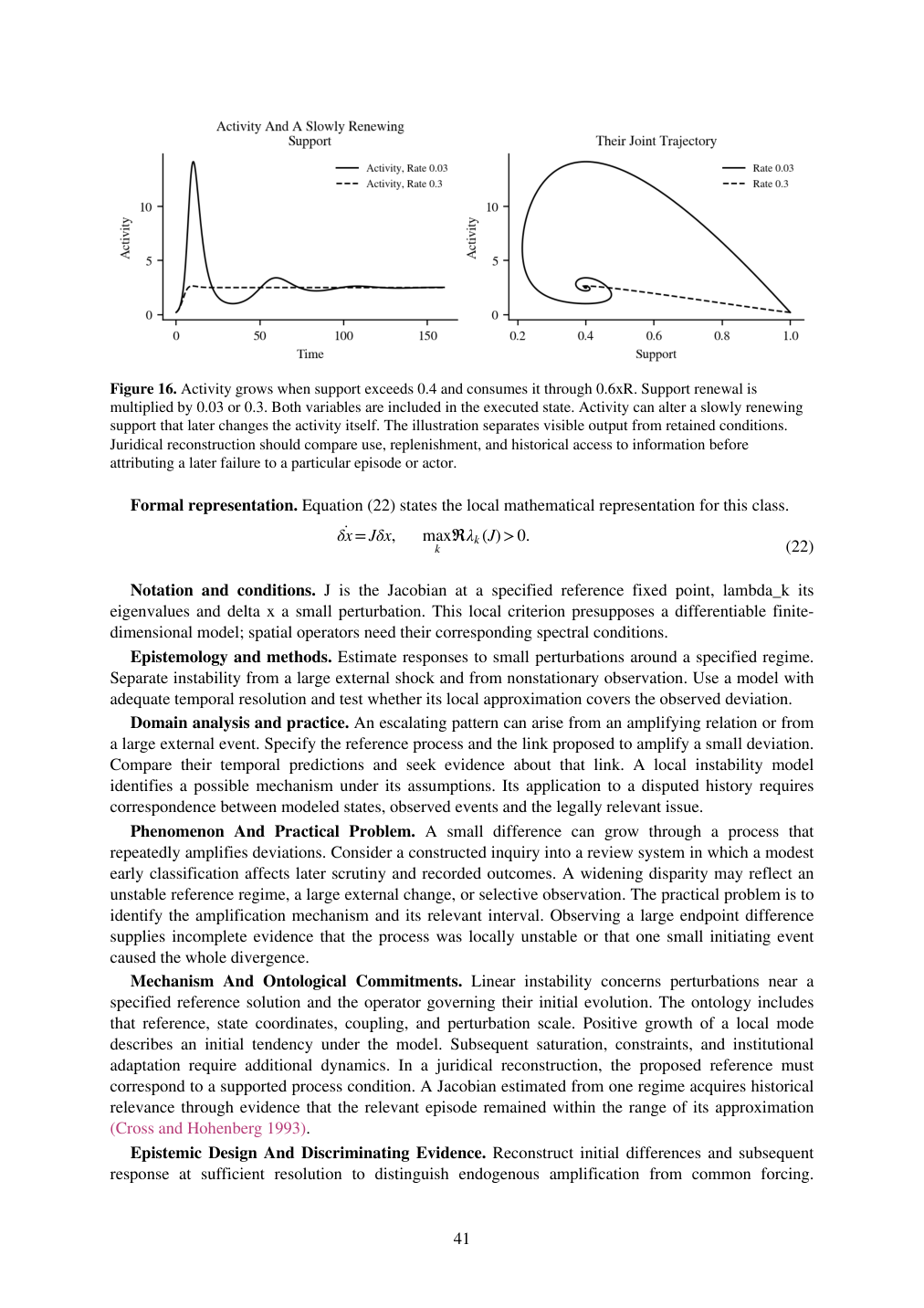
Readable text
Figure 16. Activity grows when support exceeds 0.4 and consumes it through 0.6xR. Support renewal is multiplied by 0.03 or 0.3. Both variables are included in the executed state. Activity can alter a slowly renewing support that later changes the activity itself. The illustration separates visible output from retained conditions. Juridical reconstruction should compare use, replenishment, and historical access to information before
attributing a later failure to a particular episode or actor.
Formal representation. Equation (22) states the local mathematical representation for this class.
Notation and conditions. J is the Jacobian at a specified reference fixed point, lambda_k its eigenvalues and delta x a small perturbation. This local criterion presupposes a differentiable finite- dimensional model; spatial operators need their corresponding spectral conditions.
Epistemology and methods. Estimate responses to small perturbations around a specified regime. Separate instability from a large external shock and from nonstationary observation. Use a model with adequate temporal resolution and test whether its local approximation covers the observed deviation.
Domain analysis and practice. An escalating pattern can arise from an amplifying relation or from a large external event. Specify the reference process and the link proposed to amplify a small deviation. Compare their temporal predictions and seek evidence about that link. A local instability model identifies a possible mechanism under its assumptions. Its application to a disputed history requires correspondence between modeled states, observed events and the legally relevant issue.
Phenomenon And Practical Problem. A small difference can grow through a process that repeatedly amplifies deviations. Consider a constructed inquiry into a review system in which a modest early classification affects later scrutiny and recorded outcomes. A widening disparity may reflect an unstable reference regime, a large external change, or selective observation. The practical problem is to identify the amplification mechanism and its relevant interval. Observing a large endpoint difference supplies incomplete evidence that the process was locally unstable or that one small initiating event
Mechanism And Ontological Commitments. Linear instability concerns perturbations near a specified reference solution and the operator governing their initial evolution. The ontology includes that reference, state coordinates, coupling, and perturbation scale. Positive growth of a local mode describes an initial tendency under the model. Subsequent saturation, constraints, and institutional adaptation require additional dynamics. In a juridical reconstruction, the proposed reference must correspond to a supported process condition. A Jacobian estimated from one regime acquires historical relevance through evidence that the relevant episode remained within the range of its approximation
Epistemic Design And Discriminating Evidence. Reconstruct initial differences and subsequent response at sufficient resolution to distinguish endogenous amplification from common forcing.
Readable text
Compare episodes with similar perturbations under different coupling or review rules. Include ordinary recoveries and measurement changes. A fitted positive growth rate can be sensitive to the observation window, omitted inputs, and selection of an exceptional trajectory. Process tracing should identify each link through which an initial deviation affects later action. A local model becomes useful when it predicts discriminating consequences that survive those comparisons and preserves uncertainty outside
Philosophical Reasoning And Practice. The philosophical inference separates an explanation of sensitivity from a total attribution of consequence. If later outcomes depend on several amplifying operations, an initiating contribution can be material while subsequent decisions remain causally and institutionally consequential. This supports differentiated responsibility through a reconstructed sequence. A legal conclusion additionally needs the standards governing contribution, knowledge, control, and duty. The model supplies conditional evidence about how a deviation propagates. Its instability criterion does not itself determine a moral ranking or an institution’s authority to intervene
Worked Comparison And Research Proposition. Compare two constructed trajectories with the same initial flag and final adverse outcome. One grows through repeated use of the flag in consequential allocation; another follows an independent policy change affecting all participants. A review experiment could release time-resolved decision and exposure records after an aggregate history, measuring whether reviewers distinguish amplification from shared external change. The proposition is that reference-and-pathway evidence improves warrant when a material claim concerns the propagation of a small initial event. Reporting should retain the interval of local support and the separate decisions through which the final consequence became possible.
Reading the numerical illustration. Figure 17 illustrates the declared mechanism. Linearization identifies an initial response near a specified reference. The positive-rate trajectory grows in this linear construction, whose validity for a nonlinear target is local. Later saturation, exit or reorganization requires additional terms and evidence. A domain study should state the reference regime and relevant perturbation, identify the local response, and then test whether the neighborhood supporting that approximation covers the question being asked. A visible abrupt change alone leaves those
Mechanism and ontology. Nonlinear terms can limit an initially growing perturbation and support finite-amplitude organization. A saturation mechanism identifies what constrains further growth: resources, congestion, inhibition or an altered response. A fitted carrying capacity leaves its institutional or material origin to be explained. (Cross and Hohenberg 1993)
Formal representation. Equation (23) states the local mathematical representation for this class.
Notation and conditions. The scalar a is an amplitude, mu its linear growth coefficient and g a positive saturation coefficient. This normal form describes a particular symmetry and local
Epistemology and methods. For mu positive the nonzero fixed points have magnitude sqrt(mu/g); stability follows from the derivative. Estimate saturation over a range of inputs and compare alternative constraints. A plateau can also arise from a measurement ceiling or population replacement.
Domain analysis and practice. A plateau in conduct or harm can reflect capacity limits, changed opportunity or a reporting ceiling. Define the measured outcome and investigate how observations were produced. Compare resource constraints and observation constraints with additional sources. A saturation model should state the mechanism limiting the process. Legal use of an estimated ceiling needs an account of the cases and conditions to which the estimate applies.
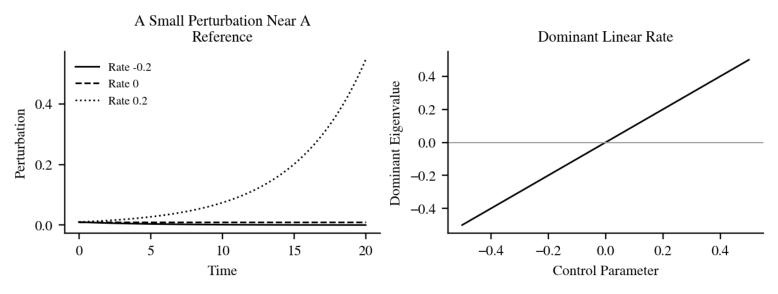
Figure 17. The two-mode diagonal linearization has rates mu and -1. A perturbation of 0.01 in the first mode decays, persists or grows as mu crosses zero. An initial deviation can grow near a specified reference regime when the local dynamics amplify it. The illustration concerns that model-relative tendency. Juridical reconstruction should establish the reference, perturbation scale, and actual propagation pathway before attributing a large historical consequence to local instability.
Phenomenon And Practical Problem. A process can initially grow and later plateau for several reasons. Consider a constructed inquiry into a rising number of recognized claims that eventually stabilizes. The plateau might reflect limited handling capacity, exhaustion of eligible cases, changed filing behavior, or a reporting ceiling. The practical issue is to identify which constraint produced the visible limit and how it affected the people involved. A flat series can accurately describe recorded outcomes while leaving underlying need, unprocessed attempts, and the source of the apparent restraint unresolved.
Mechanism And Ontological Commitments. Nonlinear saturation limits growth through statedependent terms. A physical model may represent competition for resources, inhibition, or altered interactions. An institutional reconstruction requires a specified limiting operation: a queue cap, staffing bottleneck, eligibility boundary, or changed response. These objects have different meanings and evidential traces. The ontology includes both the initially amplifying pathway and the constraint that becomes effective as the state changes. A fitted finite limit describes behavior under its assumptions; it leaves the causal identity and public or legal significance of that limit to investigation (Cross and Hohenberg 1993).
Epistemic Design And Discriminating Evidence. Collect attempted entries, rejections, queue states, completed cases, and changes in recording. Compare the plateau under altered resources or rules, using historical variation when a new intervention would lack authority. Distinguish a ceiling in the measurement instrument from a constraint in the process. Candidate models should predict different responses when an identified bottleneck is relaxed or when demand falls. Examine whether displaced activity appears outside the observed boundary. Evidence of continued unrecorded attempts can materially change the inference drawn from a stable official total.
Philosophical Reasoning And Practice. The philosophical argument distinguishes a process’s boundedness from adequacy of its function. A saturated institution can maintain a stable count while withholding practically significant opportunities. Conversely, a stable count can reflect successful prevention that reduces the relevant demand. Evaluation requires an identification criterion for the function and an account of affected interests. Capability-oriented reasoning asks whether the nominal route remains exercisable. Juridical characterization then uses the sources and standards governing access, recording, and treatment, with the causal explanation preserving its own evidential scope (Sen 2009; Huang 2026b). Worked Comparison And Research Proposition. Compare two offices with identical claim plateaus. One handles all attempts after prevention reduces incidence; another stops registering claims
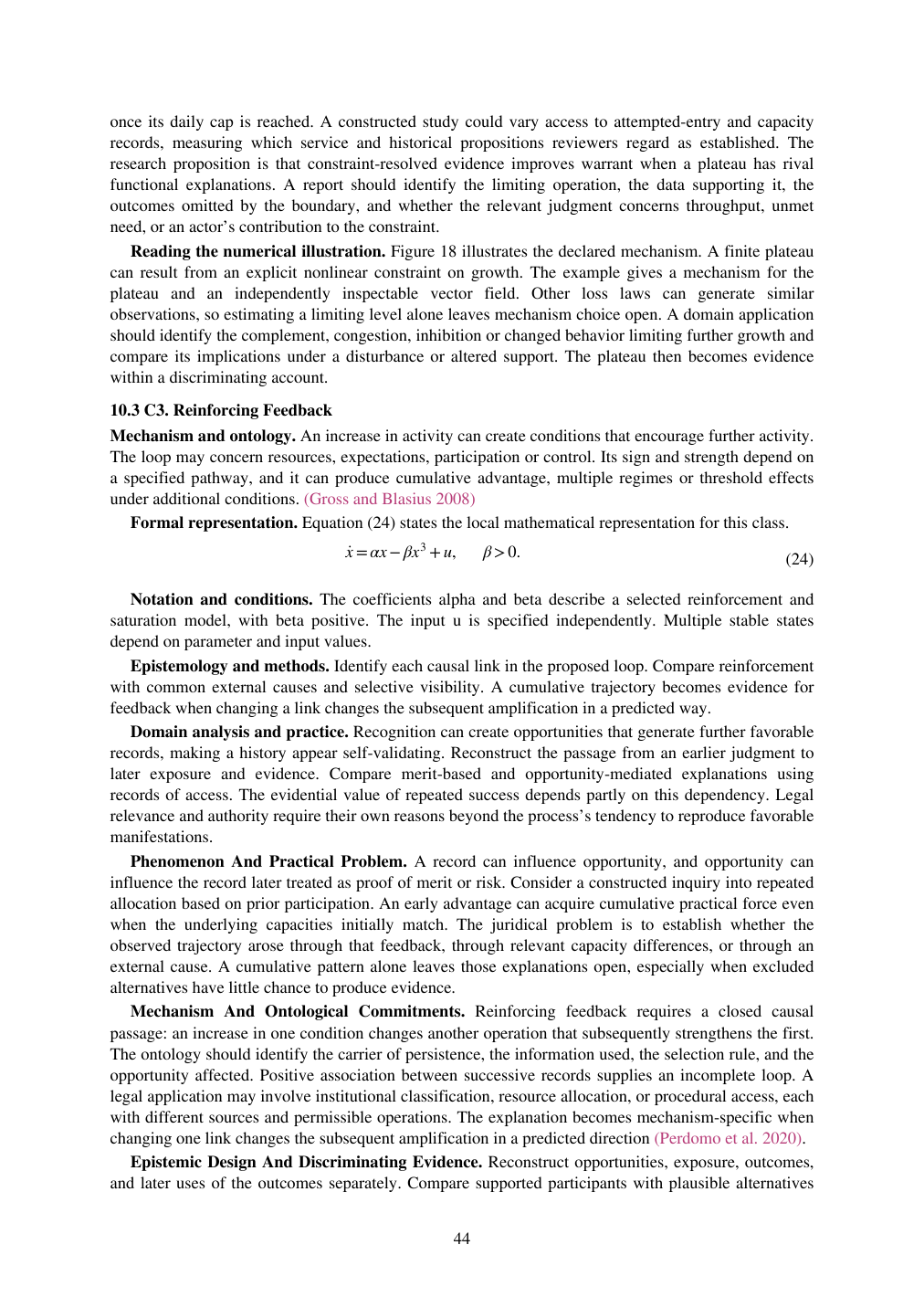
Readable text
once its daily cap is reached. A constructed study could vary access to attempted-entry and capacity records, measuring which service and historical propositions reviewers regard as established. The research proposition is that constraint-resolved evidence improves warrant when a plateau has rival functional explanations. A report should identify the limiting operation, the data supporting it, the outcomes omitted by the boundary, and whether the relevant judgment concerns throughput, unmet
Reading the numerical illustration. Figure 18 illustrates the declared mechanism. A finite plateau can result from an explicit nonlinear constraint on growth. The example gives a mechanism for the plateau and an independently inspectable vector field. Other loss laws can generate similar observations, so estimating a limiting level alone leaves mechanism choice open. A domain application should identify the complement, congestion, inhibition or changed behavior limiting further growth and compare its implications under a disturbance or altered support. The plateau then becomes evidence
Mechanism and ontology. An increase in activity can create conditions that encourage further activity. The loop may concern resources, expectations, participation or control. Its sign and strength depend on a specified pathway, and it can produce cumulative advantage, multiple regimes or threshold effects
Formal representation. Equation (24) states the local mathematical representation for this class.
Notation and conditions. The coefficients alpha and beta describe a selected reinforcement and saturation model, with beta positive. The input u is specified independently. Multiple stable states
Epistemology and methods. Identify each causal link in the proposed loop. Compare reinforcement with common external causes and selective visibility. A cumulative trajectory becomes evidence for feedback when changing a link changes the subsequent amplification in a predicted way.
Domain analysis and practice. Recognition can create opportunities that generate further favorable records, making a history appear self-validating. Reconstruct the passage from an earlier judgment to later exposure and evidence. Compare merit-based and opportunity-mediated explanations using records of access. The evidential value of repeated success depends partly on this dependency. Legal relevance and authority require their own reasons beyond the process’s tendency to reproduce favorable
Phenomenon And Practical Problem. A record can influence opportunity, and opportunity can influence the record later treated as proof of merit or risk. Consider a constructed inquiry into repeated allocation based on prior participation. An early advantage can acquire cumulative practical force even when the underlying capacities initially match. The juridical problem is to establish whether the observed trajectory arose through that feedback, through relevant capacity differences, or through an external cause. A cumulative pattern alone leaves those explanations open, especially when excluded
alternatives have little chance to produce evidence.
Mechanism And Ontological Commitments. Reinforcing feedback requires a closed causal passage: an increase in one condition changes another operation that subsequently strengthens the first. The ontology should identify the carrier of persistence, the information used, the selection rule, and the opportunity affected. Positive association between successive records supplies an incomplete loop. A legal application may involve institutional classification, resource allocation, or procedural access, each with different sources and permissible operations. The explanation becomes mechanism-specific when changing one link changes the subsequent amplification in a predicted direction (Perdomo et al. 2020).
Epistemic Design And Discriminating Evidence. Reconstruct opportunities, exposure, outcomes, and later uses of the outcomes separately. Compare supported participants with plausible alternatives
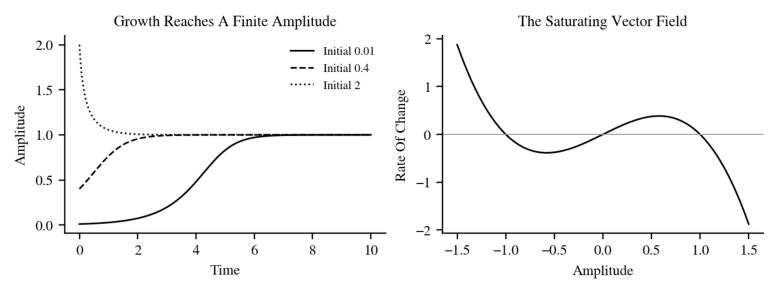
Figure 18. The amplitude equation da/dt = a - a cubed is integrated from three positive initial values. All approach the positive fixed amplitude one under the specified cubic loss. Nonlinear terms can limit growth, while measurement ceilings and population changes can produce similar plateaus. The illustration presents one declared limiting mechanism. Juridical interpretation requires evidence for the actual constraint and the function, access, or historical proposition that its operation affects.
while addressing selection and developmental histories. Lawful audits or historical rule changes can help distinguish observation of an existing difference from production of a later difference. Preserve rejected and unobserved cases where access permits. A simulation can isolate the proposed loop under symmetric assumptions, while an empirical claim needs evidence for its operative links and rival explanations. The resulting account should report which material contrast remains unidentified (Hernán and Robins 2020).
Philosophical Reasoning And Practice. The philosophical inference concerns evidence’s genealogy. A genuine developed capacity can emerge through unequal support, so its present reality and the fairness of its developmental conditions are distinct questions. A proceeding must identify whether it compares current performance, potential under comparable support, or entitlement through a rule. Each object calls for different evidence and reasons. The GR inquiry into evaluative authority makes consequential selection itself available for scrutiny without equating a history of advantage with invalidity of every subsequent judgment (Huang 2026a).
Worked Comparison And Research Proposition. Compare two dossiers showing a strong record and repeated selection. In one, the criterion measures a capability through opportunities distributed independently of the earlier record. In another, selection determines access to the only activity that can improve the score. A constructed review could vary the visibility of exposure histories and evaluate supported interpretations of the disparity. The proposition is that opportunity-resolved reconstruction improves warrant when records and consequential allocation form a feedback loop. The practical report identifies the loop, alternative pathways, and the separately justified grounds for any legal response, preserving relevant differences in need, capacity, and authorized purpose.
Reading the numerical illustration. Figure 19 illustrates the declared mechanism. A reinforcing pathway can amplify an inherited difference and retain several attainable regimes. Saturation prevents unlimited growth in this declared construction. The root diagram shows that the bias and basin both matter for the observed endpoint. A domain account should trace the actual opportunity, resource or expectation loop and test its strength against rival pathways. Explaining the persistence of advantage through such a loop and justifying its allocation remain separate arguments with different premises.
10.4 C4. Stabilizing Feedback
Mechanism and ontology. A deviation elicits a response that reduces that deviation. The regulated variable, reference, sensor and corrective action specify the mechanism. Regulation can preserve a public function or maintain an unequal arrangement; the dynamic sign of feedback supplies a causal description while evaluation examines its object. (Folke et al. 2005)
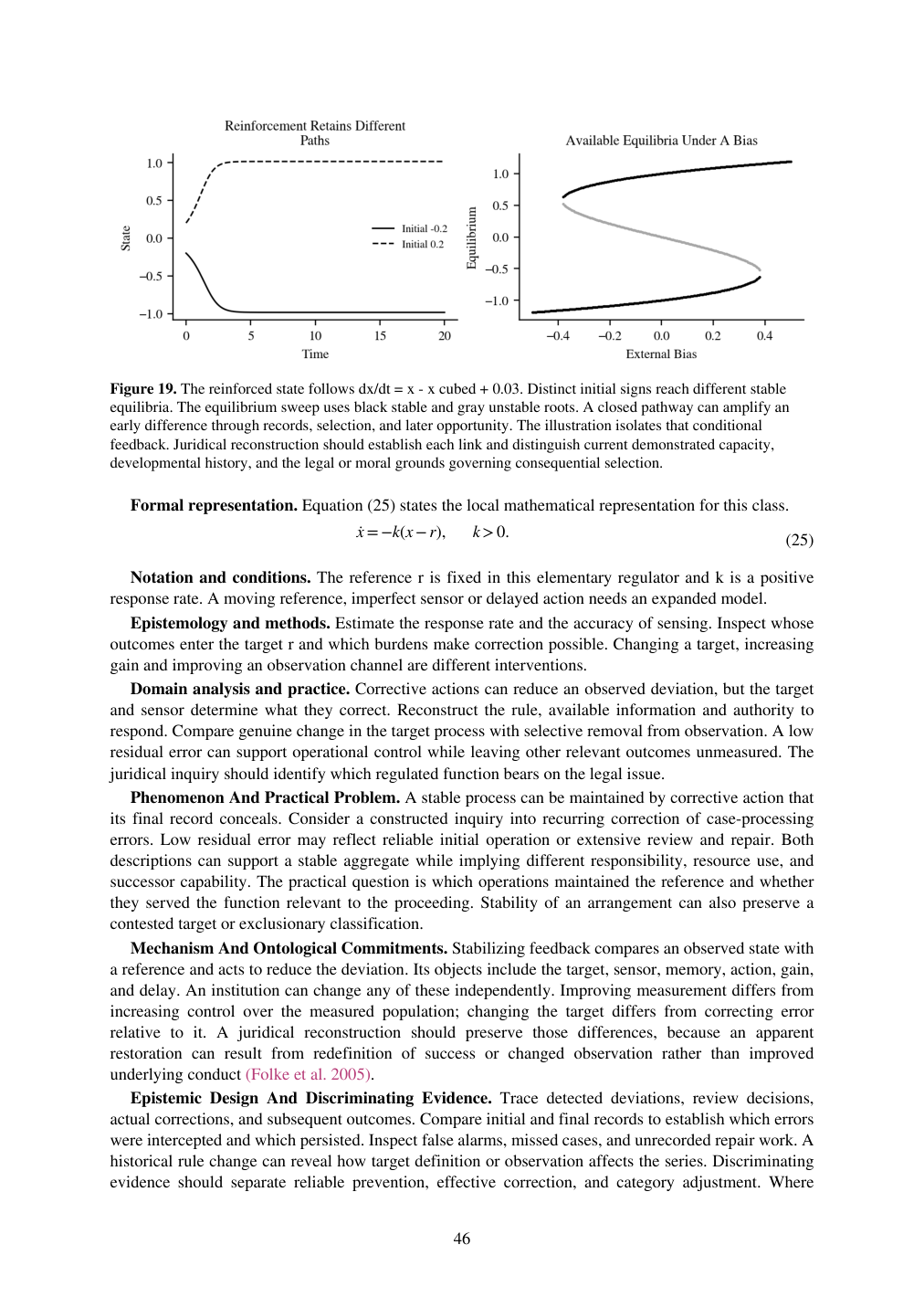
Readable text
Figure 19. The reinforced state follows dx/dt = x - x cubed + 0.03. Distinct initial signs reach different stable equilibria. The equilibrium sweep uses black stable and gray unstable roots. A closed pathway can amplify an early difference through records, selection, and later opportunity. The illustration isolates that conditional feedback. Juridical reconstruction should establish each link and distinguish current demonstrated capacity, developmental history, and the legal or moral grounds governing consequential selection.
Formal representation. Equation (25) states the local mathematical representation for this class.
Notation and conditions. The reference r is fixed in this elementary regulator and k is a positive response rate. A moving reference, imperfect sensor or delayed action needs an expanded model.
Epistemology and methods. Estimate the response rate and the accuracy of sensing. Inspect whose outcomes enter the target r and which burdens make correction possible. Changing a target, increasing gain and improving an observation channel are different interventions.
Domain analysis and practice. Corrective actions can reduce an observed deviation, but the target and sensor determine what they correct. Reconstruct the rule, available information and authority to respond. Compare genuine change in the target process with selective removal from observation. A low residual error can support operational control while leaving other relevant outcomes unmeasured. The juridical inquiry should identify which regulated function bears on the legal issue.
Phenomenon And Practical Problem. A stable process can be maintained by corrective action that its final record conceals. Consider a constructed inquiry into recurring correction of case-processing errors. Low residual error may reflect reliable initial operation or extensive review and repair. Both descriptions can support a stable aggregate while implying different responsibility, resource use, and successor capability. The practical question is which operations maintained the reference and whether they served the function relevant to the proceeding. Stability of an arrangement can also preserve a
Mechanism And Ontological Commitments. Stabilizing feedback compares an observed state with a reference and acts to reduce the deviation. Its objects include the target, sensor, memory, action, gain, and delay. An institution can change any of these independently. Improving measurement differs from increasing control over the measured population; changing the target differs from correcting error relative to it. A juridical reconstruction should preserve those differences, because an apparent restoration can result from redefinition of success or changed observation rather than improved
Epistemic Design And Discriminating Evidence. Trace detected deviations, review decisions, actual corrections, and subsequent outcomes. Compare initial and final records to establish which errors were intercepted and which persisted. Inspect false alarms, missed cases, and unrecorded repair work. A historical rule change can reveal how target definition or observation affects the series. Discriminating evidence should separate reliable prevention, effective correction, and category adjustment. Where
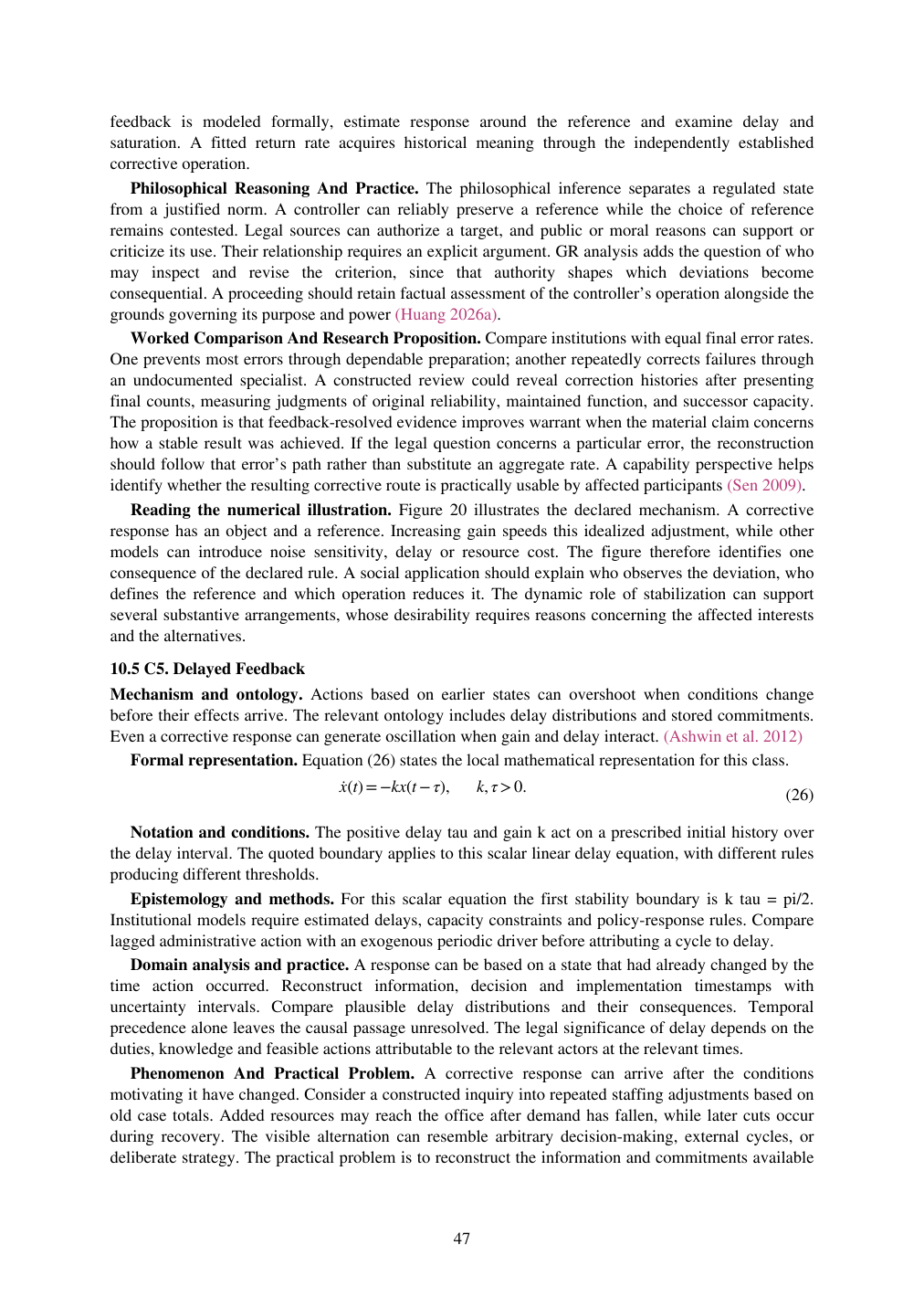
Readable text
feedback is modeled formally, estimate response around the reference and examine delay and saturation. A fitted return rate acquires historical meaning through the independently established
Philosophical Reasoning And Practice. The philosophical inference separates a regulated state from a justified norm. A controller can reliably preserve a reference while the choice of reference remains contested. Legal sources can authorize a target, and public or moral reasons can support or criticize its use. Their relationship requires an explicit argument. GR analysis adds the question of who may inspect and revise the criterion, since that authority shapes which deviations become consequential. A proceeding should retain factual assessment of the controller’s operation alongside the grounds governing its purpose and power (Huang 2026a).
Worked Comparison And Research Proposition. Compare institutions with equal final error rates. One prevents most errors through dependable preparation; another repeatedly corrects failures through an undocumented specialist. A constructed review could reveal correction histories after presenting final counts, measuring judgments of original reliability, maintained function, and successor capacity. The proposition is that feedback-resolved evidence improves warrant when the material claim concerns how a stable result was achieved. If the legal question concerns a particular error, the reconstruction should follow that error’s path rather than substitute an aggregate rate. A capability perspective helps identify whether the resulting corrective route is practically usable by affected participants (Sen 2009).
Reading the numerical illustration. Figure 20 illustrates the declared mechanism. A corrective response has an object and a reference. Increasing gain speeds this idealized adjustment, while other models can introduce noise sensitivity, delay or resource cost. The figure therefore identifies one consequence of the declared rule. A social application should explain who observes the deviation, who defines the reference and which operation reduces it. The dynamic role of stabilization can support several substantive arrangements, whose desirability requires reasons concerning the affected interests
Mechanism and ontology. Actions based on earlier states can overshoot when conditions change before their effects arrive. The relevant ontology includes delay distributions and stored commitments. Even a corrective response can generate oscillation when gain and delay interact. (Ashwin et al. 2012)
Formal representation. Equation (26) states the local mathematical representation for this class.
Notation and conditions. The positive delay tau and gain k act on a prescribed initial history over the delay interval. The quoted boundary applies to this scalar linear delay equation, with different rules
Epistemology and methods. For this scalar equation the first stability boundary is k tau = pi/2. Institutional models require estimated delays, capacity constraints and policy-response rules. Compare lagged administrative action with an exogenous periodic driver before attributing a cycle to delay.
Domain analysis and practice. A response can be based on a state that had already changed by the time action occurred. Reconstruct information, decision and implementation timestamps with uncertainty intervals. Compare plausible delay distributions and their consequences. Temporal precedence alone leaves the causal passage unresolved. The legal significance of delay depends on the duties, knowledge and feasible actions attributable to the relevant actors at the relevant times.
Phenomenon And Practical Problem. A corrective response can arrive after the conditions motivating it have changed. Consider a constructed inquiry into repeated staffing adjustments based on old case totals. Added resources may reach the office after demand has fallen, while later cuts occur during recovery. The visible alternation can resemble arbitrary decision-making, external cycles, or deliberate strategy. The practical problem is to reconstruct the information and commitments available
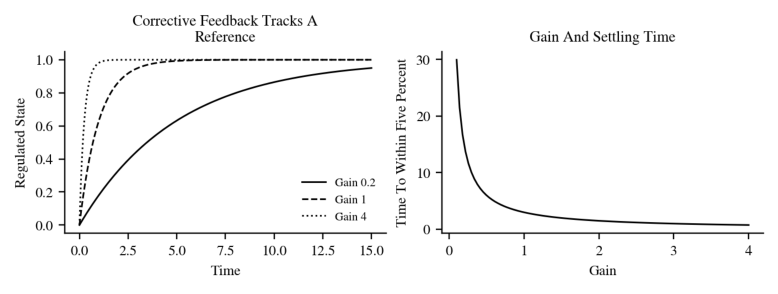
Figure 20. The response dx/dt = -k(x - 1) begins at zero. Its exact five-percent settling time is log(20)/k; the comparison excludes delay, noise, and actuator limits by construction. Corrective feedback can preserve a reference through continuing detection and action. The illustration distinguishes an observed stable state from its maintenance mechanism. Juridical inquiry should reconstruct initial errors, repairs, target changes, and revision authority before interpreting stability as reliability or justified treatment.
when each decision was made and the delay before its effect. A contemporaneous action and a contemporaneous outcome need not belong to the same causal episode.
Mechanism And Ontological Commitments. Delayed feedback carries earlier states into current action through stored information, pending authorization, implementation, or material transmission. The delay distribution and feedback strength determine whether correction damps or amplifies deviations. A scalar delay equation offers a transparent conditional example, while an institutional account needs evidence for the actual clock and pathway. The ontology includes decision time, information time, commitment time, and effect time. Collapsing them into one date can invent simultaneity and conceal an otherwise intelligible sequence (Ashwin et al. 2012).
Epistemic Design And Discriminating Evidence. Construct an event ledger preserving source dates and uncertainty for each passage. Compare observed cycles with common schedules and exogenous demand. Seek historical changes in approval or implementation delay that predict a changed response pattern. Information retained in decision records can establish which state the actor was responding to. A delayed model should be assessed against alternatives using observations beyond its fitting interval. Missing dates should appear as ranges of feasible sequences rather than arbitrarily precise lags. A causal design additionally examines selection and contemporaneous changes affecting the comparison (Hernán and Robins 2020).
Philosophical Reasoning And Practice. The philosophical inference concerns temporal access to reasons. A later observer can evaluate the consequence of an action using evidence unavailable when the commitment became binding. Historical judgment requires the bridge from what was knowable then to what occurred later. This permits a rigorous account of mistaken decisions while avoiding an unexplained substitution of later knowledge for contemporaneous information. Normative questions also arise over who bears waiting and uncertainty during delayed correction. The relevant legal standards govern those consequences, with inductive-risk reasoning helping make their distribution explicit (Douglas 2000).
Worked Comparison And Research Proposition. Compare two offices issuing the same corrective order on the same date. One responds to current verified demand; another acts on an old report after a long authorization chain. Their visible order agrees while their informational and causal histories differ. A constructed study could release dated report and implementation records in stages, measuring whether reviewers recover the relevant sequence and distinguish delay from changing purpose. The proposition is that multi-clock evidence improves warrant when delayed effects are material. The
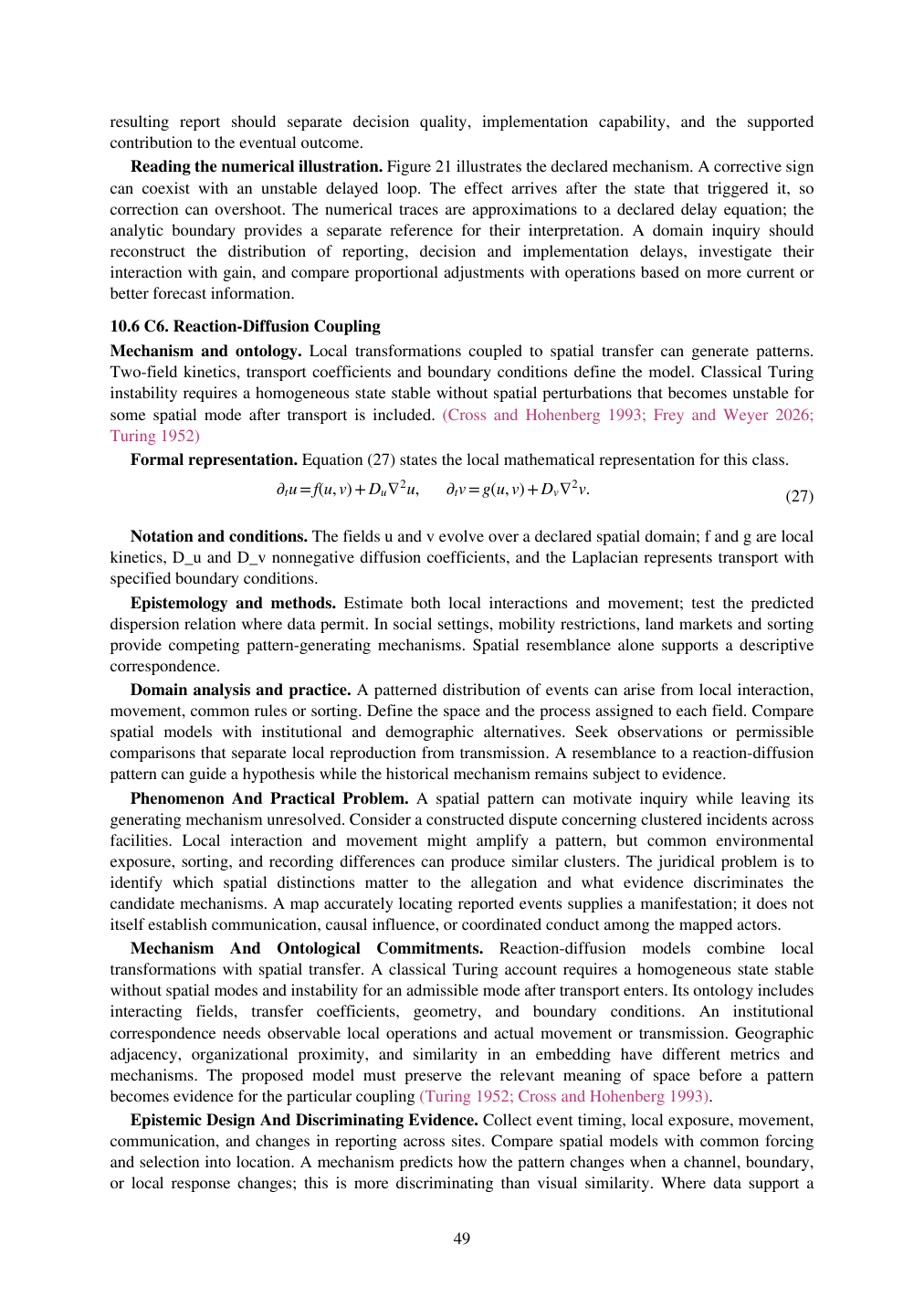
Readable text
resulting report should separate decision quality, implementation capability, and the supported
Reading the numerical illustration. Figure 21 illustrates the declared mechanism. A corrective sign can coexist with an unstable delayed loop. The effect arrives after the state that triggered it, so correction can overshoot. The numerical traces are approximations to a declared delay equation; the analytic boundary provides a separate reference for their interpretation. A domain inquiry should reconstruct the distribution of reporting, decision and implementation delays, investigate their interaction with gain, and compare proportional adjustments with operations based on more current or
Mechanism and ontology. Local transformations coupled to spatial transfer can generate patterns. Two-field kinetics, transport coefficients and boundary conditions define the model. Classical Turing instability requires a homogeneous state stable without spatial perturbations that becomes unstable for some spatial mode after transport is included. (Cross and Hohenberg 1993; Frey and Weyer 2026;
Formal representation. Equation (27) states the local mathematical representation for this class.
Notation and conditions. The fields u and v evolve over a declared spatial domain; f and g are local kinetics, D_u and D_v nonnegative diffusion coefficients, and the Laplacian represents transport with
Epistemology and methods. Estimate both local interactions and movement; test the predicted dispersion relation where data permit. In social settings, mobility restrictions, land markets and sorting provide competing pattern-generating mechanisms. Spatial resemblance alone supports a descriptive
Domain analysis and practice. A patterned distribution of events can arise from local interaction, movement, common rules or sorting. Define the space and the process assigned to each field. Compare spatial models with institutional and demographic alternatives. Seek observations or permissible comparisons that separate local reproduction from transmission. A resemblance to a reaction-diffusion pattern can guide a hypothesis while the historical mechanism remains subject to evidence.
Phenomenon And Practical Problem. A spatial pattern can motivate inquiry while leaving its generating mechanism unresolved. Consider a constructed dispute concerning clustered incidents across facilities. Local interaction and movement might amplify a pattern, but common environmental exposure, sorting, and recording differences can produce similar clusters. The juridical problem is to identify which spatial distinctions matter to the allegation and what evidence discriminates the candidate mechanisms. A map accurately locating reported events supplies a manifestation; it does not itself establish communication, causal influence, or coordinated conduct among the mapped actors.
Mechanism And Ontological Commitments. Reaction-diffusion models combine local transformations with spatial transfer. A classical Turing account requires a homogeneous state stable without spatial modes and instability for an admissible mode after transport enters. Its ontology includes interacting fields, transfer coefficients, geometry, and boundary conditions. An institutional correspondence needs observable local operations and actual movement or transmission. Geographic adjacency, organizational proximity, and similarity in an embedding have different metrics and mechanisms. The proposed model must preserve the relevant meaning of space before a pattern becomes evidence for the particular coupling (Turing 1952; Cross and Hohenberg 1993).
Epistemic Design And Discriminating Evidence. Collect event timing, local exposure, movement, communication, and changes in reporting across sites. Compare spatial models with common forcing and selection into location. A mechanism predicts how the pattern changes when a channel, boundary, or local response changes; this is more discriminating than visual similarity. Where data support a
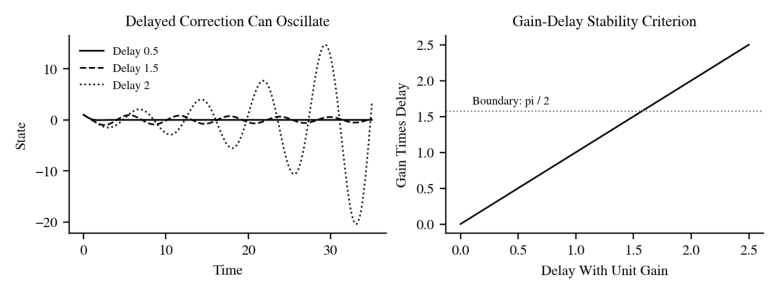
Figure 21. A forward-Euler delay equation uses dx/dt = -x(t - tau), unit prehistory and dt = 0.005. The analytic first stability boundary is gain times delay = pi/2; trajectories illustrate three delays. A response to an earlier state can arrive after conditions change, producing overshoot or apparent cycles. The illustration presents a declared delay mechanism. Juridical reconstruction should preserve information, decision, commitment, and effect times before assessing the reasons and consequences of a historical action.
dispersion relation, examine it alongside uncertainty and alternative models. Sparse records can still establish a particular transmission path through source-grounded chronology. The appropriate method follows the material claim, with direct process evidence potentially sufficient even when a full field model remains unidentified.
Philosophical Reasoning And Practice. The philosophical inference separates pattern recognition from explanation and attribution. If several mechanisms generate the same map, the map supports their shared properties while leaving their differences unresolved. A causal realist orientation treats those mechanisms as questions about the operative process, with observation supplying fallible access. Legal significance requires a further bridge: evidence of diffusion can differ from evidence of an agreement, authorized coordination, or attributable act. The proceeding should identify those distinctions and preserve the inferential premises connecting each supported observation to its intended use (Bhaskar 1975). Worked Comparison And Research Proposition. Compare matched cluster maps. One history includes dated transfers connecting sites before incident changes; another includes a common supplier affecting all sites independently. A constructed reconstruction study could vary access to movement and upstream records, measuring justified mechanism discrimination and false attribution of contact. The proposition is that spatially resolved process evidence improves warrant when several pathways fit the observed pattern. A report should retain scale, boundary, timing, and metric choices, since changing any can alter the apparent cluster. The legal inquiry then determines which established pathway is material to the applicable issue.
Reading the numerical illustration. Figure 22 illustrates the declared mechanism. The instability requires a specific relationship among local kinetics and transport. The dispersion curve verifies that relationship for the chosen coefficients, while the spatial trace shows a small growing mode. The calculation concerns the onset of a pattern; nonlinear selection and its maintained amplitude require additional equations. A domain application should identify two actual fields, their transformations and movement channels, and test spatial alternatives before treating clustering or a wave as evidence for reaction-diffusion genesis.
10.7 C7. Mode Coupling
Mechanism and ontology. Processes at different frequencies or spatial scales can exchange influence through nonlinear terms. Modes are components of a declared representation, with coupling coefficients determined by the underlying dynamics. Interaction among scales can amplify disturbances or channel them into other forms. (Cross and Hohenberg 1993)
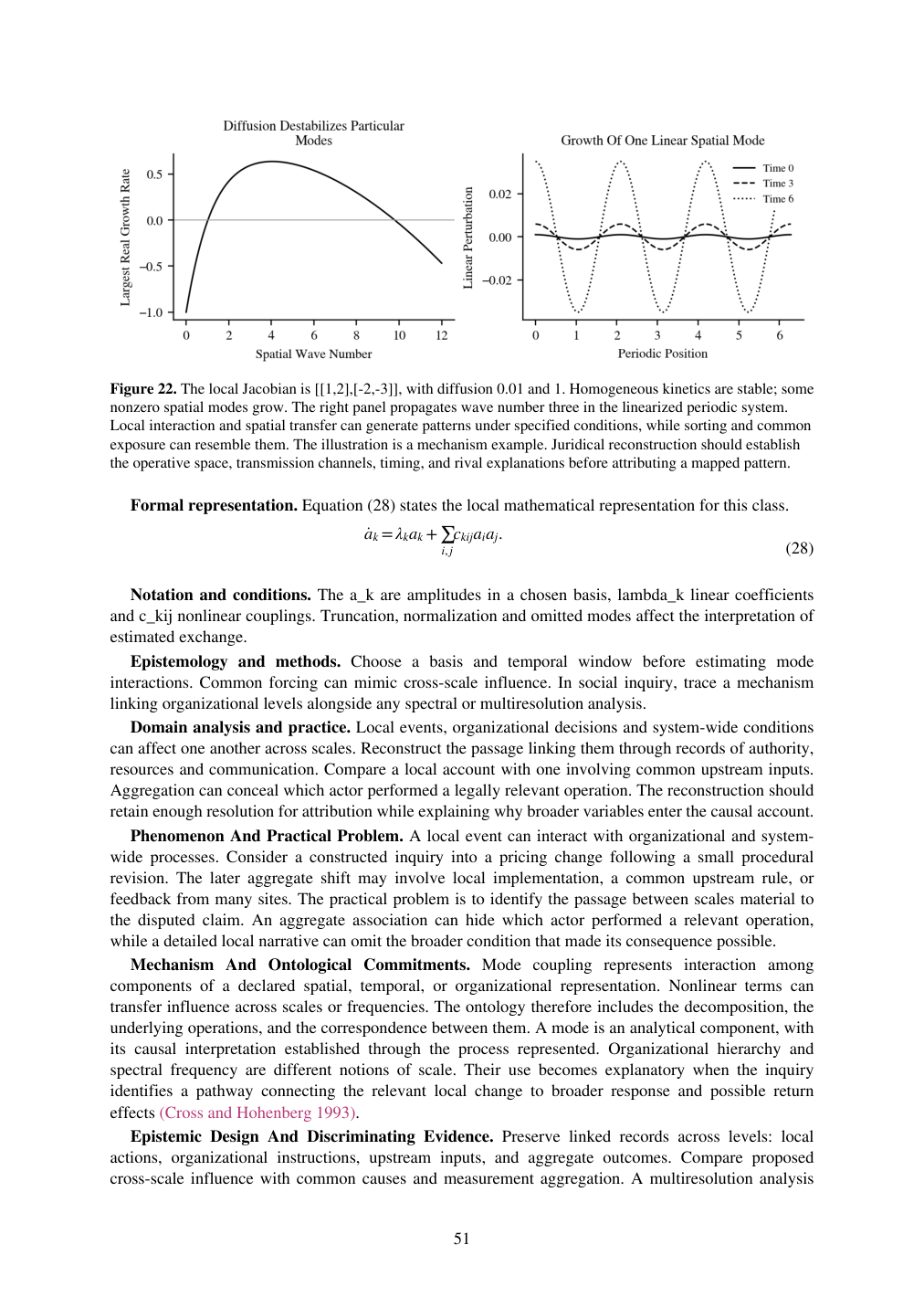
Readable text
Figure 22. The local Jacobian is [[1,2],[-2,-3]], with diffusion 0.01 and 1. Homogeneous kinetics are stable; some nonzero spatial modes grow. The right panel propagates wave number three in the linearized periodic system. Local interaction and spatial transfer can generate patterns under specified conditions, while sorting and common exposure can resemble them. The illustration is a mechanism example. Juridical reconstruction should establish the operative space, transmission channels, timing, and rival explanations before attributing a mapped pattern.
Formal representation. Equation (28) states the local mathematical representation for this class.
Notation and conditions. The a_k are amplitudes in a chosen basis, lambda_k linear coefficients and c_kij nonlinear couplings. Truncation, normalization and omitted modes affect the interpretation of
Epistemology and methods. Choose a basis and temporal window before estimating mode interactions. Common forcing can mimic cross-scale influence. In social inquiry, trace a mechanism linking organizational levels alongside any spectral or multiresolution analysis.
Domain analysis and practice. Local events, organizational decisions and system-wide conditions can affect one another across scales. Reconstruct the passage linking them through records of authority, resources and communication. Compare a local account with one involving common upstream inputs. Aggregation can conceal which actor performed a legally relevant operation. The reconstruction should retain enough resolution for attribution while explaining why broader variables enter the causal account.
Phenomenon And Practical Problem. A local event can interact with organizational and system- wide processes. Consider a constructed inquiry into a pricing change following a small procedural revision. The later aggregate shift may involve local implementation, a common upstream rule, or feedback from many sites. The practical problem is to identify the passage between scales material to the disputed claim. An aggregate association can hide which actor performed a relevant operation, while a detailed local narrative can omit the broader condition that made its consequence possible.
Mechanism And Ontological Commitments. Mode coupling represents interaction among components of a declared spatial, temporal, or organizational representation. Nonlinear terms can transfer influence across scales or frequencies. The ontology therefore includes the decomposition, the underlying operations, and the correspondence between them. A mode is an analytical component, with its causal interpretation established through the process represented. Organizational hierarchy and spectral frequency are different notions of scale. Their use becomes explanatory when the inquiry identifies a pathway connecting the relevant local change to broader response and possible return
Epistemic Design And Discriminating Evidence. Preserve linked records across levels: local actions, organizational instructions, upstream inputs, and aggregate outcomes. Compare proposed cross-scale influence with common causes and measurement aggregation. A multiresolution analysis
can identify a candidate temporal relation, while source and process evidence can establish whether an operation actually transmitted it. Test sensitivity to window, grouping, and representation. A claim about a particular actor requires sufficient resolution for that actor’s contribution. Network-economy research supplies a substantive precedent for examining how connections can transform local shocks into aggregate fluctuations (Acemoglu et al. 2012).
Philosophical Reasoning And Practice. The philosophical premise is question-relative explanatory adequacy. Several scales can provide accurate accounts of one process while preserving different distinctions. A proceeding should retain the distinctions needed for attribution, intention, or implementation, and state the bridge when a broader pattern informs a local claim. This avoids treating a system-level tendency as a complete history of each participant. GR analysis of evidence-based orders adds a governance question: who chooses the representation through which local contributions become consequential, and how can affected participants challenge its omissions (Huang 2026b)?
Worked Comparison And Research Proposition. Compare two local failures with the same organizational loss. One begins locally and propagates through documented dependencies; another follows a system-wide update that independently affects the site and aggregate. A constructed study could release cross-level linkage records after matched outcome summaries, evaluating supported pathways and residual ambiguity. The proposition is that scale-linked provenance improves warrant when aggregate and local explanations disagree on a material attribution. A useful report can preserve several contributing levels while distinguishing causal dependence, statistical association, and the legal grounds assigning responsibility to an identified actor.
Reading the numerical illustration. Figure 23 illustrates the declared mechanism. An observed component can be generated through interaction with another mode even when its own isolated rate is decaying. The exact solution identifies the quadratic channel and compares it with the decoupled rule. Modes here are defined dynamical coordinates with a stated transformation. A domain use should justify its frequency, scale or representational decomposition and test the corresponding coupling operation. Mere association between levels leaves that operative relation to be established.
10.8 C8. Stochastic Escape
Mechanism and ontology. Random perturbations can move a system between long-lived regimes. A basin, transition path and noise model specify the account. Escape can occur while the local stability of the original regime persists, making it distinct from a bifurcation-induced transition. (Ashwin et al. 2012; Boettiger and Hastings 2012) Formal representation. Equation (29) states the local mathematical representation for this class.
dx=−V ′(x)dt+√2D dWt. (29)
Notation and conditions. V is a specified potential, D positive noise intensity and W standard Wiener noise. General non-gradient dynamics require another drift representation. The potential and noise conventions determine barrier and escape interpretations.
Epistemology and methods. Estimate residence times and compare escape-rate predictions across disturbance levels. Validate the assumed potential or use a more general non-gradient model. A selected historical transition leaves the frequency of comparable non-transitions essential to assessing a warning signal.
Domain analysis and practice. A rare event can occur in a stable regime through disturbance, and a selected transition can make common warnings look persuasive. Compare the event with relevant nonevents and state the reference population. Evaluate candidate transition mechanisms prospectively in simulations or external data where possible. A rarity estimate requires an appropriate sampling model. Its legal significance depends on the issue and the permissible inference from the event’s actual evidential context.
Phenomenon And Practical Problem. A consequential departure can occur through a rare disturbance while the earlier regime remains locally stable. Consider a constructed inquiry into an
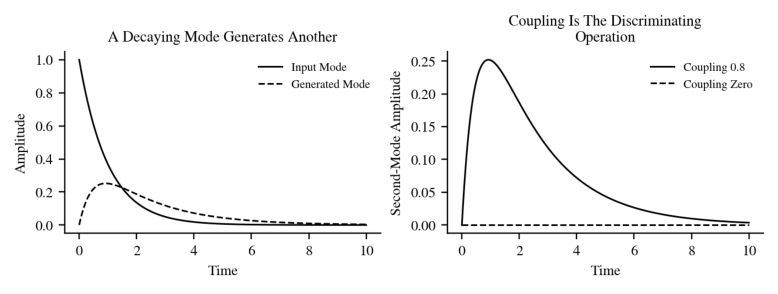
Figure 23. The input mode obeys db/dt = -b, while da/dt = -0.5a + 0.8b squared, with b(0)=1 and a(0)=0. The second panel removes only the coupling term. The panel compares explicit quadratic coupling with a decoupled two-component rule. Juridical reconstruction would justify any scale decomposition and identify the actual transmission pathway, preserving attribution and testing common-input alternatives. The calculation supplies component generation within its model, while organizational correspondence requires separate evidence.
exceptional service collapse after many ordinary recoveries. A retrospective account can select indicators visible before the collapse and treat them as reliable warnings. The practical problem is to establish what those indicators predicted across relevant non-collapse episodes, which disturbance path was supported, and what information was available at the time. A selected endpoint can make a weak historical signal appear decisive.
Mechanism And Ontological Commitments. Stochastic escape represents movement between long-lived regions under a declared disturbance process. A potential landscape is one model family, requiring its own conditions; non-gradient and network processes can have different pathways. The ontology includes the regime, feasible exits, disturbance, observation horizon, and return possibility. Escape while attraction persists differs from loss of stability or inability to track a changing environment. A juridical reconstruction should compare those mechanisms because they imply different histories of support, warning, and feasible response (Ashwin et al. 2012).
Epistemic Design And Discriminating Evidence. Recover comparable episodes with and without exit, preserving the rule used to select the disputed event. Estimate residence or exit behavior only under a supported sampling model and appropriate censoring. Compare warning performance prospectively or on withheld episodes, including false alarms. Process evidence should investigate the proposed disturbance and channel rather than infer them from rarity alone. Early-warning research demonstrates the risk of selected-event evaluation; its methodological lesson applies to the design of a comparison, while the actual juridical setting needs its own reference population and material proposition (Boettiger and Hastings 2012).
Philosophical Reasoning And Practice. The philosophical inference concerns the distinction between occurrence and historical foreseeability. A mechanism can explain an event after detailed investigation while the contemporaneously available evidence supported only a broad set of possibilities. Conversely, a low-frequency event can have been salient through a documented vulnerability and practical warning. The reconstruction should state which proposition its probability or mechanism claim supports. Legal standards determine the relevance of anticipation, knowledge, and available precautions. A precise account of uncertainty can inform that judgment without substituting a hindsight narrative for the evidence available then (Douglas 2000).
Worked Comparison And Research Proposition. Compare a collapse preceded by a documented specific warning with one preceded by a common indicator appearing frequently without collapse. Their selected pre-event charts can look alike. A constructed study could vary access to the warning’s reference population and feasible-response records, measuring discrimination between explanation,
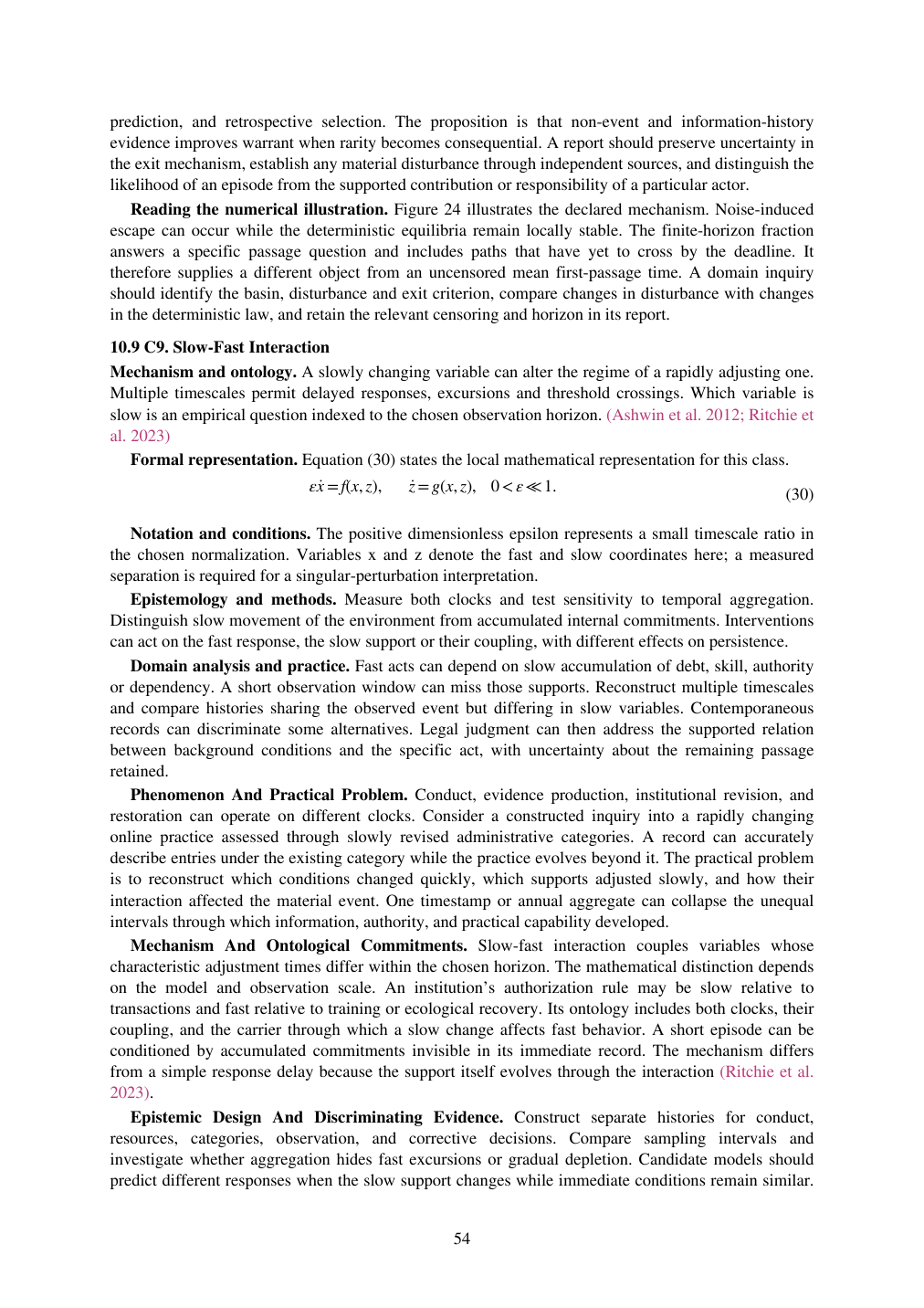
Readable text
prediction, and retrospective selection. The proposition is that non-event and information-history evidence improves warrant when rarity becomes consequential. A report should preserve uncertainty in the exit mechanism, establish any material disturbance through independent sources, and distinguish the likelihood of an episode from the supported contribution or responsibility of a particular actor.
Reading the numerical illustration. Figure 24 illustrates the declared mechanism. Noise-induced escape can occur while the deterministic equilibria remain locally stable. The finite-horizon fraction answers a specific passage question and includes paths that have yet to cross by the deadline. It therefore supplies a different object from an uncensored mean first-passage time. A domain inquiry should identify the basin, disturbance and exit criterion, compare changes in disturbance with changes in the deterministic law, and retain the relevant censoring and horizon in its report.
Mechanism and ontology. A slowly changing variable can alter the regime of a rapidly adjusting one. Multiple timescales permit delayed responses, excursions and threshold crossings. Which variable is slow is an empirical question indexed to the chosen observation horizon. (Ashwin et al. 2012; Ritchie et
Formal representation. Equation (30) states the local mathematical representation for this class.
Notation and conditions. The positive dimensionless epsilon represents a small timescale ratio in the chosen normalization. Variables x and z denote the fast and slow coordinates here; a measured separation is required for a singular-perturbation interpretation.
Epistemology and methods. Measure both clocks and test sensitivity to temporal aggregation. Distinguish slow movement of the environment from accumulated internal commitments. Interventions can act on the fast response, the slow support or their coupling, with different effects on persistence.
Domain analysis and practice. Fast acts can depend on slow accumulation of debt, skill, authority or dependency. A short observation window can miss those supports. Reconstruct multiple timescales and compare histories sharing the observed event but differing in slow variables. Contemporaneous records can discriminate some alternatives. Legal judgment can then address the supported relation between background conditions and the specific act, with uncertainty about the remaining passage
Phenomenon And Practical Problem. Conduct, evidence production, institutional revision, and restoration can operate on different clocks. Consider a constructed inquiry into a rapidly changing online practice assessed through slowly revised administrative categories. A record can accurately describe entries under the existing category while the practice evolves beyond it. The practical problem is to reconstruct which conditions changed quickly, which supports adjusted slowly, and how their interaction affected the material event. One timestamp or annual aggregate can collapse the unequal intervals through which information, authority, and practical capability developed.
Mechanism And Ontological Commitments. Slow-fast interaction couples variables whose characteristic adjustment times differ within the chosen horizon. The mathematical distinction depends on the model and observation scale. An institution’s authorization rule may be slow relative to transactions and fast relative to training or ecological recovery. Its ontology includes both clocks, their coupling, and the carrier through which a slow change affects fast behavior. A short episode can be conditioned by accumulated commitments invisible in its immediate record. The mechanism differs from a simple response delay because the support itself evolves through the interaction (Ritchie et al. Epistemic Design And Discriminating Evidence. Construct separate histories for conduct, resources, categories, observation, and corrective decisions. Compare sampling intervals and investigate whether aggregation hides fast excursions or gradual depletion. Candidate models should predict different responses when the slow support changes while immediate conditions remain similar.
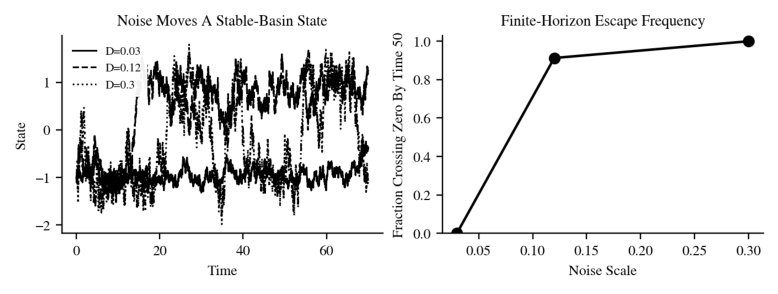
Figure 24. Euler-Maruyama paths follow dx = (x - x cubed)dt + sqrt(2D)dW. The escape panel uses 700 additional paths per noise condition and counts first crossings of zero before time fifty. A rare disturbance can produce departure without eliminating local attraction beforehand. The illustration represents one declared escape process. Juridical reconstruction should compare non-exit episodes, selection rules, and contemporaneous information before using an exceptional event to infer warning quality, foreseeability, or responsibility.
Dated archives and operational logs can connect these scales, while interviews can identify an initially omitted clock. Delay reconstruction or equation discovery requires assumptions about sufficient state and observation that changing social categories can challenge. Formal methods should retain those conditions alongside the recovered trajectory (Takens 1981; Brunton, Proctor, and Kutz 2016).
Philosophical Reasoning And Practice. The philosophical inference concerns historically situated identity and practical judgment. A continuing legal label can organize a process whose operative relations change at another speed. Whether that continuity is adequate depends on the proposition and function being evaluated. A proceeding should preserve the category version and distinguish the event’s time from the time it became institutionally recognizable. Questions of timely protection, reliance, and revision then require the relevant legal and normative premises. A rapid descriptive change alone supplies an incomplete reason for accelerating or reopening every institutional decision.
Worked Comparison And Research Proposition. Compare two episodes with identical transaction totals and formal rules. One occurs before participants acquire a new technical capability; the other occurs afterward while the reporting category remains unchanged. A constructed study could reveal training, interface, and classification histories in stages, measuring supported distinctions about capability and recorded conduct. The proposition is that multi-timescale evidence improves warrant when a slow support or category conditions a fast event. The report should identify which clock matters to each conclusion, preserve uncertainty over their coupling, and explain how the established historical distinctions enter the applicable legal issue.
Reading the numerical illustration. Figure 25 illustrates the declared mechanism. Different adjustment rates can organize one episode through alternating fast and slow passages. The small coefficient belongs to a specified equation, so the designation of a fast state has a mathematical meaning here. A domain study should identify the quantities that adjust on each timescale, test the feedback connecting them and ask whether the observation interval resolves the fast part. Apparent abruptness may then be examined as a passage within a slower evolving process.
10.10 C10. Synchronization
Mechanism and ontology. Interacting oscillators can develop coordinated phase relations. Phase, natural frequency and coupling specify the mechanism. Social coordination requires observable recurring processes and channels of mutual adjustment; similar calendar timing can instead originate from a common schedule. (Gross and Blasius 2008)
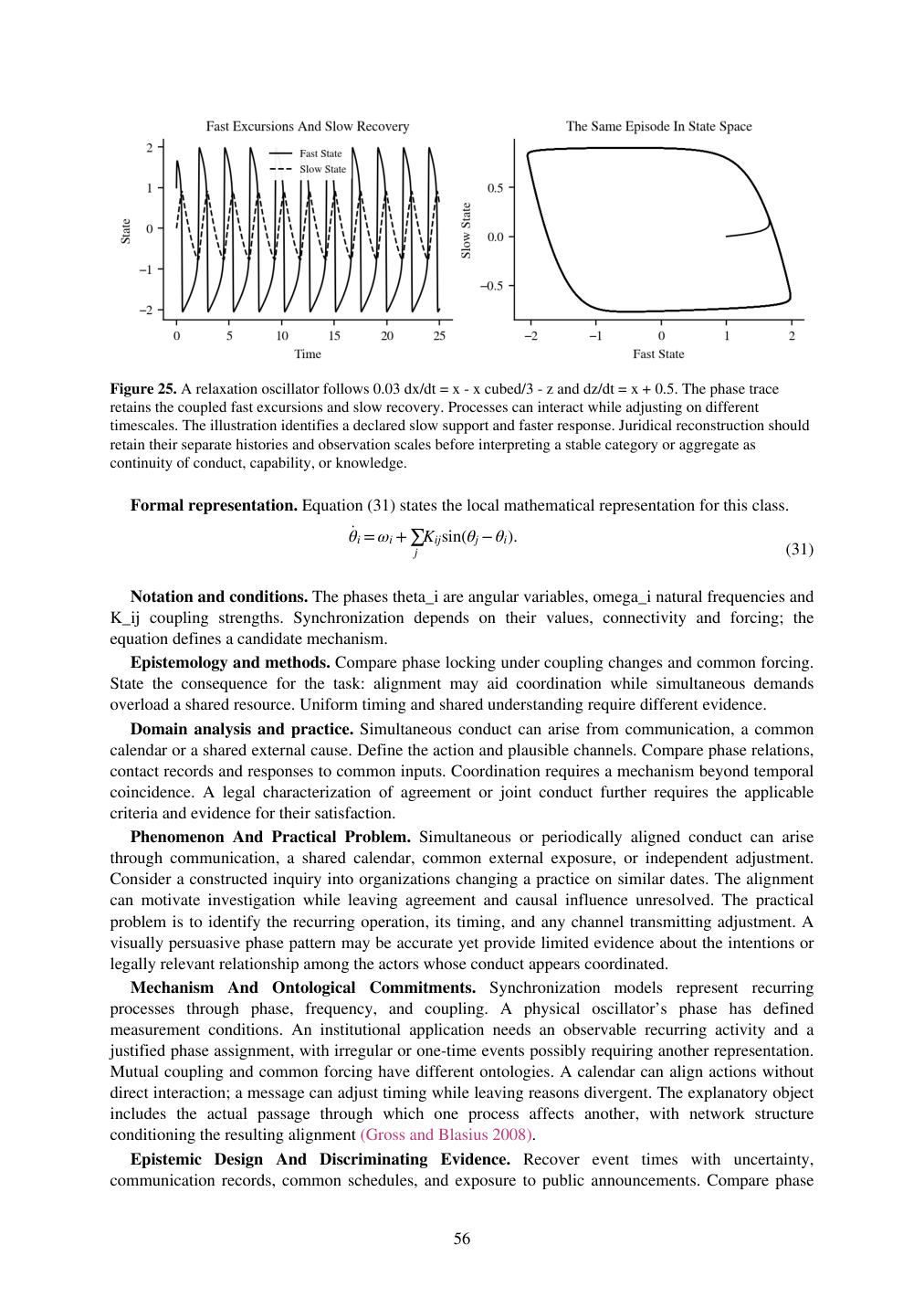
Readable text
Figure 25. A relaxation oscillator follows 0.03 dx/dt = x - x cubed/3 - z and dz/dt = x + 0.5. The phase trace retains the coupled fast excursions and slow recovery. Processes can interact while adjusting on different timescales. The illustration identifies a declared slow support and faster response. Juridical reconstruction should retain their separate histories and observation scales before interpreting a stable category or aggregate as
Formal representation. Equation (31) states the local mathematical representation for this class.
Notation and conditions. The phases theta_i are angular variables, omega_i natural frequencies and K_ij coupling strengths. Synchronization depends on their values, connectivity and forcing; the
Epistemology and methods. Compare phase locking under coupling changes and common forcing. State the consequence for the task: alignment may aid coordination while simultaneous demands overload a shared resource. Uniform timing and shared understanding require different evidence.
Domain analysis and practice. Simultaneous conduct can arise from communication, a common calendar or a shared external cause. Define the action and plausible channels. Compare phase relations, contact records and responses to common inputs. Coordination requires a mechanism beyond temporal coincidence. A legal characterization of agreement or joint conduct further requires the applicable
Phenomenon And Practical Problem. Simultaneous or periodically aligned conduct can arise through communication, a shared calendar, common external exposure, or independent adjustment. Consider a constructed inquiry into organizations changing a practice on similar dates. The alignment can motivate investigation while leaving agreement and causal influence unresolved. The practical problem is to identify the recurring operation, its timing, and any channel transmitting adjustment. A visually persuasive phase pattern may be accurate yet provide limited evidence about the intentions or legally relevant relationship among the actors whose conduct appears coordinated.
Mechanism And Ontological Commitments. Synchronization models represent recurring processes through phase, frequency, and coupling. A physical oscillator’s phase has defined measurement conditions. An institutional application needs an observable recurring activity and a justified phase assignment, with irregular or one-time events possibly requiring another representation. Mutual coupling and common forcing have different ontologies. A calendar can align actions without direct interaction; a message can adjust timing while leaving reasons divergent. The explanatory object includes the actual passage through which one process affects another, with network structure conditioning the resulting alignment (Gross and Blasius 2008).
Epistemic Design And Discriminating Evidence. Recover event times with uncertainty, communication records, common schedules, and exposure to public announcements. Compare phase
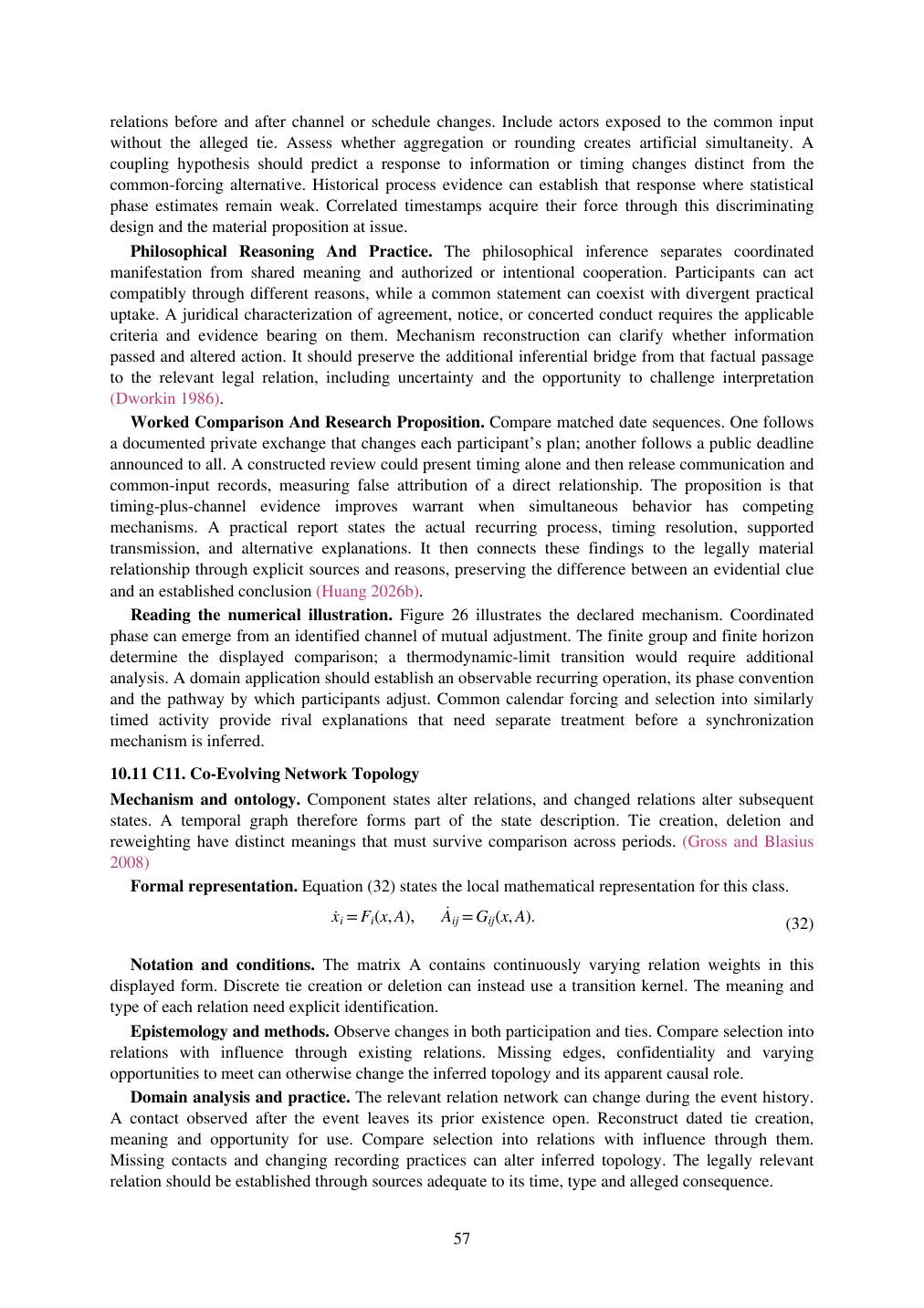
Readable text
relations before and after channel or schedule changes. Include actors exposed to the common input without the alleged tie. Assess whether aggregation or rounding creates artificial simultaneity. A coupling hypothesis should predict a response to information or timing changes distinct from the common-forcing alternative. Historical process evidence can establish that response where statistical phase estimates remain weak. Correlated timestamps acquire their force through this discriminating
Philosophical Reasoning And Practice. The philosophical inference separates coordinated manifestation from shared meaning and authorized or intentional cooperation. Participants can act compatibly through different reasons, while a common statement can coexist with divergent practical uptake. A juridical characterization of agreement, notice, or concerted conduct requires the applicable criteria and evidence bearing on them. Mechanism reconstruction can clarify whether information passed and altered action. It should preserve the additional inferential bridge from that factual passage to the relevant legal relation, including uncertainty and the opportunity to challenge interpretation
Worked Comparison And Research Proposition. Compare matched date sequences. One follows a documented private exchange that changes each participant’s plan; another follows a public deadline announced to all. A constructed review could present timing alone and then release communication and common-input records, measuring false attribution of a direct relationship. The proposition is that timing-plus-channel evidence improves warrant when simultaneous behavior has competing mechanisms. A practical report states the actual recurring process, timing resolution, supported transmission, and alternative explanations. It then connects these findings to the legally material relationship through explicit sources and reasons, preserving the difference between an evidential clue
Reading the numerical illustration. Figure 26 illustrates the declared mechanism. Coordinated phase can emerge from an identified channel of mutual adjustment. The finite group and finite horizon determine the displayed comparison; a thermodynamic-limit transition would require additional analysis. A domain application should establish an observable recurring operation, its phase convention and the pathway by which participants adjust. Common calendar forcing and selection into similarly timed activity provide rival explanations that need separate treatment before a synchronization
Mechanism and ontology. Component states alter relations, and changed relations alter subsequent states. A temporal graph therefore forms part of the state description. Tie creation, deletion and reweighting have distinct meanings that must survive comparison across periods. (Gross and Blasius Formal representation. Equation (32) states the local mathematical representation for this class.
Notation and conditions. The matrix A contains continuously varying relation weights in this displayed form. Discrete tie creation or deletion can instead use a transition kernel. The meaning and
Epistemology and methods. Observe changes in both participation and ties. Compare selection into relations with influence through existing relations. Missing edges, confidentiality and varying opportunities to meet can otherwise change the inferred topology and its apparent causal role.
Domain analysis and practice. The relevant relation network can change during the event history. A contact observed after the event leaves its prior existence open. Reconstruct dated tie creation, meaning and opportunity for use. Compare selection into relations with influence through them. Missing contacts and changing recording practices can alter inferred topology. The legally relevant relation should be established through sources adequate to its time, type and alleged consequence.
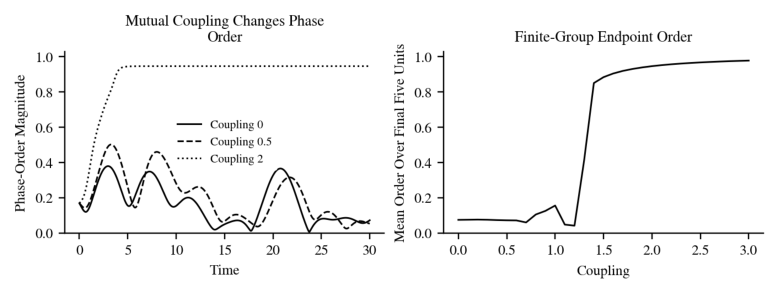
Figure 26. Twenty-four all-to-all phase oscillators have frequencies evenly spread from -1 to 1 and paired initial phases. Euler integration uses dt = 0.02; endpoint order is averaged over the last five time units. Aligned timing can arise through coupling or a common driver. The illustration represents a specified synchronization mechanism. Juridical reconstruction should compare channels, shared schedules, and temporal resolution before treating co-occurrence as evidence of shared meaning, agreement, or attributable coordination.
Phenomenon And Practical Problem. The relation network relevant to an event can change during and after the event history. Consider a constructed inquiry into responsibility for a distributed project. A contact visible in a later directory may have formed after the disputed act, while a temporary earlier channel may have disappeared. The practical problem is to establish which relations existed, what they permitted, and when they could be exercised. A static network assembled retrospectively can create apparently feasible transmission paths that were unavailable during the material interval.
Mechanism And Ontological Commitments. Coevolving topology treats relations as state variables: participant behavior changes ties, and changed ties affect later behavior. Tie creation, deletion, weight, and meaning are distinct operations. The ontology should distinguish communication, ownership, authorization, resource transfer, and interpretive affiliation even when they connect the same endpoints. Selection into a tie differs from influence through it. The relation’s time and practical accessibility determine whether it could carry the alleged operation. Adaptive-network research supplies a formal setting for examining these coupled changes (Gross and Blasius 2008).
Epistemic Design And Discriminating Evidence. Construct a temporal, typed graph from dated sources, preserving uncertainty and provenance for each edge. Compare candidate paths with actual availability of credentials, offices, and receiving participants. Inspect whether observed similarity preceded tie formation or followed it, and include plausible common causes. Missing edges can reflect confidentiality, weak recording, or genuine absence, requiring different treatment. Interviews can identify a candidate channel, while dated operational records can test its use. A reconstructible path should preserve the sequence and conditions enabling each step instead of relying on graph reachability alone.
Philosophical Reasoning And Practice. The philosophical inference concerns the difference between a possible relation and a historical relation. A model can show that a path would permit transmission under declared conditions. Establishing that the event used it requires evidence of its existence and operation at the relevant time. Identity across network versions also needs a criterion: a stable office name can conceal changed personnel, authority, or function. GR analysis makes those translations explicit so that an object remains intelligible through transformation while unmatched distinctions remain available for criticism (Huang 2026b).
Worked Comparison And Research Proposition. Compare two project histories with the same final network. One has an operational link before a material decision; the other creates it during later remediation. A constructed study could vary access to edge dates and relation types, measuring invented paths, supported transmission claims, and acknowledged alternatives. The proposition is that
Readable text
temporal and typed network provenance improves warrant when later structure can be mistaken for earlier opportunity or control. A useful report distinguishes documented contact, feasible transmission, actual use, and the legal characterization assigned to that use. The relevant sources determine the
Reading the numerical illustration. Figure 27 illustrates the declared mechanism. The network is part of the evolving state. It mediates adjustment while the current differences also change future ties. The construction declares both directions of the loop and preserves the meaning of its weighted edges. A domain study should distinguish creation, removal and reweighting, record their timing and address shared causes and selection. A graph snapshot can describe structure while leaving this coevolutionary
Mechanism and ontology. Directional interactions can change collective modes, stability and propagation. This mediator concerns the collective consequences of asymmetric coupling, complementing B7, which identifies its maintenance. A directed influence matrix may have complex eigenvalues and nonorthogonal modes. (Gross and Blasius 2008; Korbel et al. 2026)
Formal representation. Equation (33) states the local mathematical representation for this class.
Notation and conditions. A is a real linear response matrix in a declared coordinate system. Directionality and nonnormality are different properties. Stability follows from eigenvalues, while transient amplification also depends on eigenvectors and the chosen norm.
Epistemology and methods. Asymmetry permits several behaviors depending on the full matrix; it leaves the outcome to calculation. Inspect eigenvalues and transient amplification, then validate the directional pathways. Social directionality includes authority, dependency and attention, each needing
Domain analysis and practice. Directional influence can produce asymmetric or transient collective responses. A source with broad reach can amplify an interpretation across many records. Trace the directed channels and shared source dependencies. Compare independently generated evidence with propagated assertions. A collective pattern supplies additional warrant only to the extent its information
is genuinely additional under the observation model.
Phenomenon And Practical Problem. Directional relations can produce collective behavior that a symmetric summary conceals. Consider a constructed inquiry into how an institutional instruction propagated across a service network. A central office may influence many others while receiving limited correction, and a temporary surge can occur even where long-run modeled deviations decay. The practical problem is to identify which directional pathways and modes mattered during the material episode. Stable averages or an eventual return can leave substantial intermediate amplification and its
Mechanism And Ontological Commitments. Nonreciprocal collective response concerns the modes produced by asymmetric coupling. A directed matrix can have nonorthogonal modes and transient amplification, with the actual behavior determined by the full operator and initial condition. Asymmetry alone guarantees neither instability nor a particular outcome. An institutional ontology needs typed influence, authority, resources, and observation channels. The collective object differs from any single directional edge: several individually modest relations can jointly amplify a disturbance. Their legal relevance depends on the supported path and the particular actor or function under
Epistemic Design And Discriminating Evidence. Recover direction-specific actions and timeresolved responses, including lateral correction and external inputs. Compare symmetric and directed models against intermediate trajectories, rather than only endpoints. Examine sensitivity to
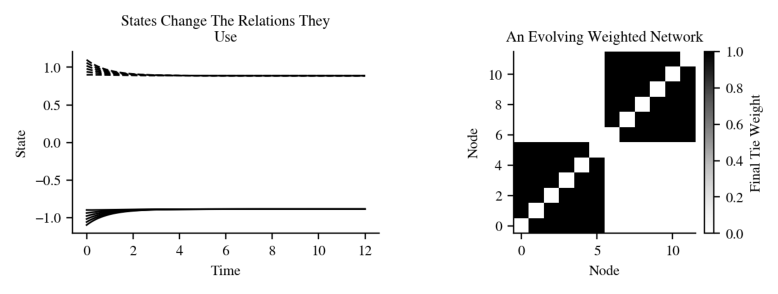
Figure 27. Twelve states adjust through current tie weights; weights relax toward exp(-state difference squared/0.08). Initial groups have stronger internal ties. The second panel displays the executed final weights. Behavior can change ties while ties change subsequent behavior. The illustration concerns a declared adaptive network. Juridical reconstruction should retain edge timing, meaning, and accessibility so that later contact, feasible transmission, and an actual historical pathway receive separate evidential treatment.
conditions and omitted channels. Where a matrix model is justified, assess eigenvalues together with transient behavior and robustness of the estimated operator. Process evidence should establish how the instruction, resource, or criterion traveled. A physical nonreciprocity analogy can guide a question, while political authority and thermodynamic dissipation require their own correspondence and evidence (Korbel et al. 2026).
Philosophical Reasoning And Practice. The philosophical inference separates endpoint restoration from an adequate history of consequence. A process can eventually recover while imposing material interim burdens. A juridical inquiry concerning a specific injury or opportunity therefore needs the trajectory at the relevant resolution. The distribution of influence can also affect which interim experiences enter the record. Epistemic-justice reasoning makes that access problem visible, while factual assessment continues to test the content and provenance of each account. A public or legal conclusion identifies the grounds on which those established burdens matter (Fricker 2007).
Worked Comparison And Research Proposition. Compare two networks with equal final output and similar long-run stability. One disperses an instruction through several correcting routes; another concentrates it through a directional chain that creates a large temporary backlog. A constructed reconstruction study could reveal intermediate and directional records after matched endpoints, evaluating supported causal and burden claims. The proposition is that trajectory-and-direction evidence improves warrant when transient collective response is material. The report should distinguish a modeled mode, a documented communication pathway, an actor’s contribution, and any legal duty or power attached to that contribution, preserving their separate inferential premises.
Reading the numerical illustration. Figure 28 illustrates the declared mechanism. Asymmetry can affect a collective response through more than the eigenvalue signs. The maximum singular value asks which unit perturbation is most amplified at a given time, while the first panel follows one specified state. The two quantities have different inferential roles. A domain analysis should justify the response coordinates and norm, compare directional channels and inspect whether an asymptotically stable arrangement can still generate consequential transient burdens within the relevant deadline.
10.13 C13. Conservation And Redistribution
Mechanism and ontology. A conserved stock constrains possible redistribution and couples local changes through a shared account. The conserved quantity and boundary must be explicit. Resource reallocation can change access and outcomes even when its aggregate quantity stays fixed. (Frey and Weyer 2026; Axtell and Farmer 2025)
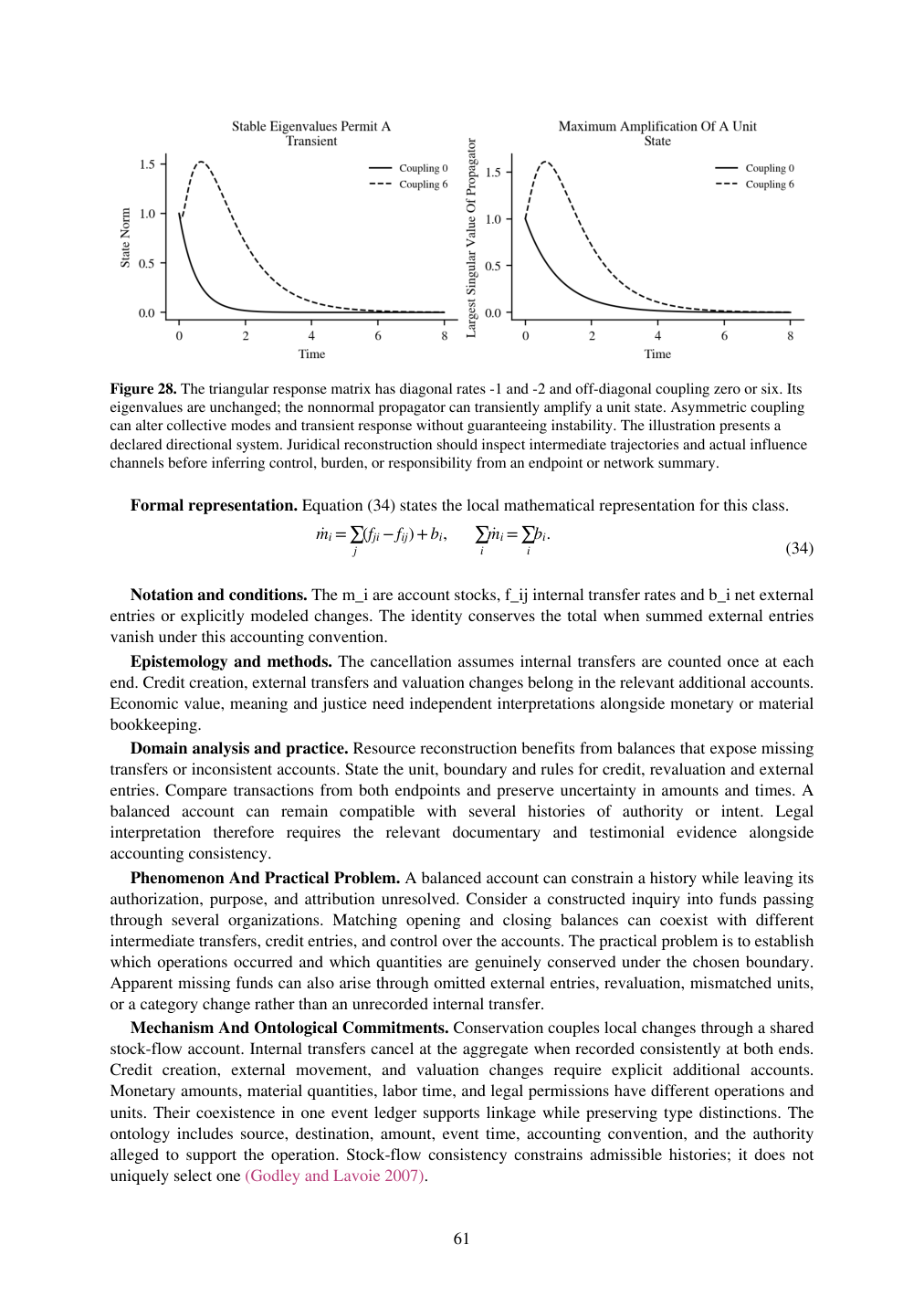
Readable text
Figure 28. The triangular response matrix has diagonal rates -1 and -2 and off-diagonal coupling zero or six. Its eigenvalues are unchanged; the nonnormal propagator can transiently amplify a unit state. Asymmetric coupling can alter collective modes and transient response without guaranteeing instability. The illustration presents a declared directional system. Juridical reconstruction should inspect intermediate trajectories and actual influence channels before inferring control, burden, or responsibility from an endpoint or network summary.
Formal representation. Equation (34) states the local mathematical representation for this class.
Notation and conditions. The m_i are account stocks, f_ij internal transfer rates and b_i net external entries or explicitly modeled changes. The identity conserves the total when summed external entries
Epistemology and methods. The cancellation assumes internal transfers are counted once at each end. Credit creation, external transfers and valuation changes belong in the relevant additional accounts. Economic value, meaning and justice need independent interpretations alongside monetary or material
Domain analysis and practice. Resource reconstruction benefits from balances that expose missing transfers or inconsistent accounts. State the unit, boundary and rules for credit, revaluation and external entries. Compare transactions from both endpoints and preserve uncertainty in amounts and times. A balanced account can remain compatible with several histories of authority or intent. Legal interpretation therefore requires the relevant documentary and testimonial evidence alongside
Phenomenon And Practical Problem. A balanced account can constrain a history while leaving its authorization, purpose, and attribution unresolved. Consider a constructed inquiry into funds passing through several organizations. Matching opening and closing balances can coexist with different intermediate transfers, credit entries, and control over the accounts. The practical problem is to establish which operations occurred and which quantities are genuinely conserved under the chosen boundary. Apparent missing funds can also arise through omitted external entries, revaluation, mismatched units, or a category change rather than an unrecorded internal transfer.
Mechanism And Ontological Commitments. Conservation couples local changes through a shared stock-flow account. Internal transfers cancel at the aggregate when recorded consistently at both ends. Credit creation, external movement, and valuation changes require explicit additional accounts. Monetary amounts, material quantities, labor time, and legal permissions have different operations and units. Their coexistence in one event ledger supports linkage while preserving type distinctions. The ontology includes source, destination, amount, event time, accounting convention, and the authority alleged to support the operation. Stock-flow consistency constrains admissible histories; it does not
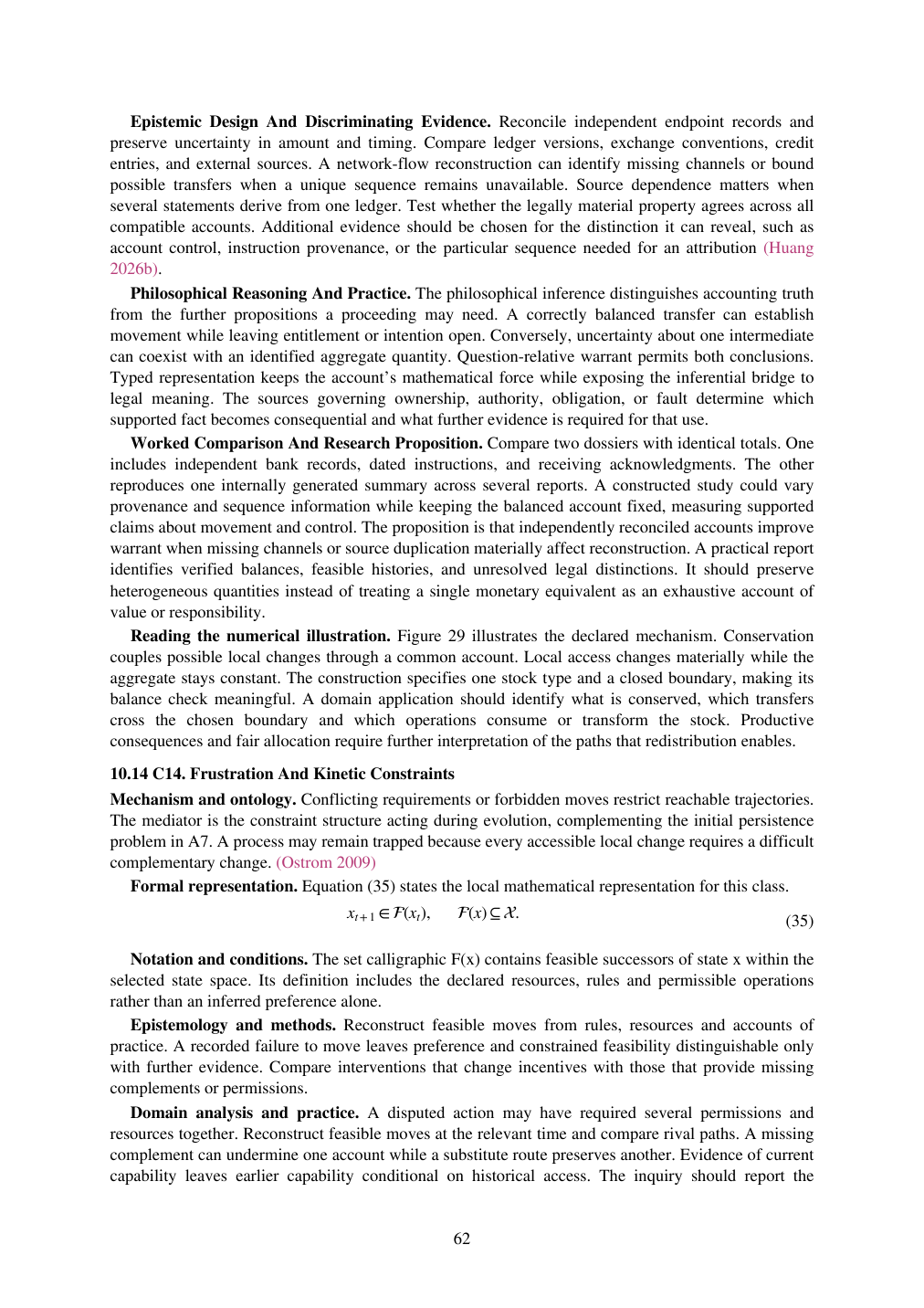
Readable text
Epistemic Design And Discriminating Evidence. Reconcile independent endpoint records and preserve uncertainty in amount and timing. Compare ledger versions, exchange conventions, credit entries, and external sources. A network-flow reconstruction can identify missing channels or bound possible transfers when a unique sequence remains unavailable. Source dependence matters when several statements derive from one ledger. Test whether the legally material property agrees across all compatible accounts. Additional evidence should be chosen for the distinction it can reveal, such as account control, instruction provenance, or the particular sequence needed for an attribution (Huang Philosophical Reasoning And Practice. The philosophical inference distinguishes accounting truth from the further propositions a proceeding may need. A correctly balanced transfer can establish movement while leaving entitlement or intention open. Conversely, uncertainty about one intermediate can coexist with an identified aggregate quantity. Question-relative warrant permits both conclusions. Typed representation keeps the account’s mathematical force while exposing the inferential bridge to legal meaning. The sources governing ownership, authority, obligation, or fault determine which supported fact becomes consequential and what further evidence is required for that use.
Worked Comparison And Research Proposition. Compare two dossiers with identical totals. One includes independent bank records, dated instructions, and receiving acknowledgments. The other reproduces one internally generated summary across several reports. A constructed study could vary provenance and sequence information while keeping the balanced account fixed, measuring supported claims about movement and control. The proposition is that independently reconciled accounts improve warrant when missing channels or source duplication materially affect reconstruction. A practical report identifies verified balances, feasible histories, and unresolved legal distinctions. It should preserve heterogeneous quantities instead of treating a single monetary equivalent as an exhaustive account of
Reading the numerical illustration. Figure 29 illustrates the declared mechanism. Conservation couples possible local changes through a common account. Local access changes materially while the aggregate stays constant. The construction specifies one stock type and a closed boundary, making its balance check meaningful. A domain application should identify what is conserved, which transfers cross the chosen boundary and which operations consume or transform the stock. Productive consequences and fair allocation require further interpretation of the paths that redistribution enables.
Mechanism and ontology. Conflicting requirements or forbidden moves restrict reachable trajectories. The mediator is the constraint structure acting during evolution, complementing the initial persistence problem in A7. A process may remain trapped because every accessible local change requires a difficult
Formal representation. Equation (35) states the local mathematical representation for this class.
Notation and conditions. The set calligraphic F(x) contains feasible successors of state x within the selected state space. Its definition includes the declared resources, rules and permissible operations
Epistemology and methods. Reconstruct feasible moves from rules, resources and accounts of practice. A recorded failure to move leaves preference and constrained feasibility distinguishable only with further evidence. Compare interventions that change incentives with those that provide missing
Domain analysis and practice. A disputed action may have required several permissions and resources together. Reconstruct feasible moves at the relevant time and compare rival paths. A missing complement can undermine one account while a substitute route preserves another. Evidence of current capability leaves earlier capability conditional on historical access. The inquiry should report the
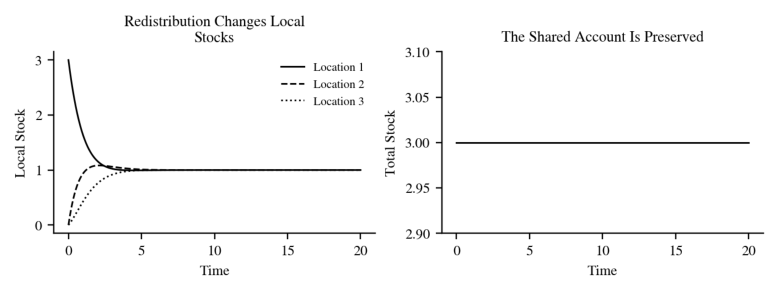
Figure 29. Three locations exchange a conserved stock through clockwise rate 0.6 and reverse rate 0.1. The initial stock is concentrated in one location; the total remains three. Conserved quantities constrain redistribution while allowing several intermediate histories. The illustration presents an explicit accounting boundary. Juridical reconstruction should reconcile units, external entries, timing, and provenance, then supply the separate evidence and legal grounds needed for authorization, intention, or responsibility.
specific constraint and its source rather than treating feasibility as a global property of a person or organization.
Phenomenon And Practical Problem. An observed failure to act can reflect a blocked prerequisite rather than a rejected opportunity. Consider a constructed inquiry into an applicant who fails to complete a review route. The route may require an unavailable document, a credential controlled by another office, or a response arriving after the deadline. The practical problem is to determine which sequence was actually feasible. A formal list of available steps can conceal incompatible timing and missing complements, while a reconstructed path can clarify where an attempt stopped and which actor controlled that transition.
Mechanism And Ontological Commitments. Kinetic constraints restrict allowable moves within the evolving process. They can arise through rules, resources, incompatibility, or a need for several coordinated changes. The ontology contains states, permissible operations, preconditions, and relevant clocks. It differs from a simple preference representation because an actor can value a destination while lacking a path to it. A legal rule may constitute permission, yet practical exercise can additionally require cooperation and resources. An institutional framework helps locate those interacting requirements while the actual feasible set needs case-specific evidence (Ostrom 2009).
Epistemic Design And Discriminating Evidence. Build a prerequisite graph from rules and dated attempts, then test its practical correspondence through records of successful and failed completion. Compare nominal permission with actual access, cost, timing, and receiving conditions. Investigate alternative paths and whether they were known and usable during the material interval. A path declared feasible should preserve every required complement. Where the record remains incomplete, report a set of compatible paths and identify the missing transition whose evidence would change the conclusion. A causal explanation of failure should distinguish the blocked step from external withdrawal or changed purpose.
Philosophical Reasoning And Practice. The philosophical inference concerns exercisable opportunity. A nominal entitlement and a practical capability can diverge through conversion conditions. Capability-oriented reasoning supplies a way to identify that gap, while legal interpretation determines what follows from it. An inquiry into responsibility should distinguish who created a constraint, who could remove it, what information they possessed, and which duty applied. Relational analysis can sharpen those distinctions without spreading responsibility indiscriminately across every dependency. Its appropriate boundary follows the material proposition and the supported causal pathway (Sen 2009; Huang 2026d).
Worked Comparison And Research Proposition. Compare two applicants who submit no final appeal. One declines an accessible route after receiving the necessary records. Another requests those records but receives them after the filing window. Their final procedural status agrees while the feasible histories differ. A constructed review could vary prerequisite and timing records, evaluating supported conclusions about opportunity, action, and remaining alternatives. The proposition is that sequencefeasibility evidence improves warrant when noncompletion has competing mechanisms. A practical report states which moves were authorized, available, attempted, and completed, with the relevant procedural and normative standards attached to their consequential treatment.
Reading the numerical illustration. Figure 30 illustrates the declared mechanism. A missing complementary operation can block a path even when its destination is admissible. The finite construction states the feasible configurations and the proposal rule separately. A coordinated move changes reachability; it leaves the value of the destination for further judgment. A domain inquiry should identify the actual prerequisite relations, test whether the proposed complement removes the blockage, and include the authority, coordination cost and distribution of burdens required to perform it.
10.15 C15. Absorbing-State Dynamics
Mechanism and ontology. An absorbing state or set has no exit under the specified transition rule. The definition concerns the model and its boundary; an environmental intervention can alter that rule. Extinction, closure and inactivity require empirical criteria appropriate to the observed organization. (Gross and Blasius 2008)
Formal representation. Equation (36) states the local mathematical representation for this class.
P(x,A)=1 for every x∈A. (36)
Notation and conditions. P is a one-step transition kernel and A a specified absorbing set. Every state in the set remains within it with probability one under that kernel. Changed outside inputs can change the kernel.
Epistemology and methods. Here P(x,A) is the one-step probability of remaining in the absorbing set. Establish which actions and outside supports the model includes. Treat evidence of dormancy, preservation and possible re-entry separately when interpreting an apparent endpoint.
Domain analysis and practice. A reconstruction can treat loss, closure or destruction as absorbing only relative to its allowed operations. Investigate backup records, successor roles and external restoration routes. Compare irreversible loss with inaccessibility or dormancy. The relevant legal endpoint may differ from the physical or organizational one. Each needs an identification criterion and evidence appropriate to the claim being made.
Phenomenon And Practical Problem. A process can appear to reach an irreversible endpoint while recovery remains possible through an omitted external operation. Consider a constructed inquiry into destroyed or closed records. A local system may have no internal restoration function while a backup, successor archive, or independent source preserves the relevant content. The practical problem is to identify the operation set within which an endpoint is claimed. Loss, inaccessibility, dormancy, and practical nonrecoverability can have different historical and legal significance even when each appears as an empty search result.
Mechanism And Ontological Commitments. An absorbing set retains the process under every transition allowed by the specified rule. The definition is relative to state space, boundary, and admissible operations. Adding external support or revising the rule can change reachability. The ontology should distinguish the carrier, recoverable content, permissions, functional use, and the criteria identifying the object across restoration. An archive’s name can persist after its usable record is lost, while a new carrier can preserve access. The model’s absorbing property supplies a conditional statement whose empirical correspondence requires direct investigation (Gross and Blasius 2008).
Epistemic Design And Discriminating Evidence. Inventory backups, copies, custody transfers, successor roles, access credentials, and independent traces. Document search scope and restoration
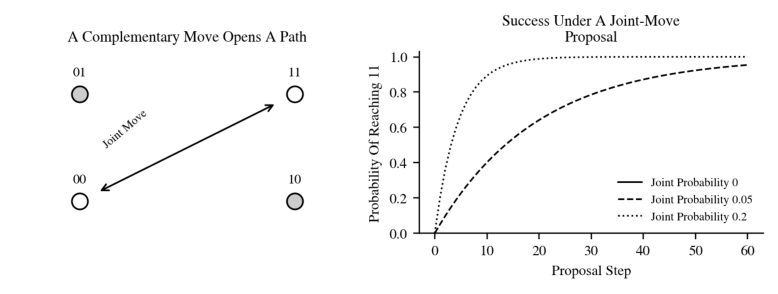
Figure 30. Only binary configurations 00 and 11 satisfy the declared compatibility constraint. Single-bit proposals cannot connect them; a simultaneous two-bit proposal succeeds with probability p per step. Gray states violate the constraint. A destination can remain unreachable when required moves, complements, or timings are unavailable. The illustration represents a declared feasible-transition structure. Juridical reconstruction should distinguish nominal permission, usable pathways, and actual attempts before interpreting noncompletion or assigning its legal consequence.
attempts, preserving unsuccessful tests as evidence about the operation set. Compare destruction with technical inaccessibility and temporary withdrawal of permission. A recovery experiment on an authorized copy can investigate a mechanism without altering the original record. Where recovery depends on uncertain conditions, report bounds or a family of possibilities rather than a binary assertion based on one search. Source provenance remains essential when a restored record enters evidential use.
Philosophical Reasoning And Practice. The philosophical inference concerns the identity of what has ended. The loss of a physical carrier, legal status, accessible information, and practical function are different propositions. Each needs an identification criterion and evidence. Process-oriented thinking permits continuity through changed carriers while leaving historical transmission to its own proof. A juridical account should state which endpoint matters and how a possible restoration preserves or changes the relevant object. The legal consequence of loss or closure follows from the applicable sources, timing, duty, and information available (Whitehead 1978; Huang 2026b).
Worked Comparison And Research Proposition. Compare two empty archive searches. One follows verified destruction of every relevant copy within an established boundary; another follows a credential change while an independent backup remains. A constructed study could vary search and recovery histories, measuring supported conclusions about absence and irreversibility. The proposition is that operation-set and provenance records improve warrant when an endpoint’s legal significance depends on recoverability. A practical report distinguishes what was searched, what operations were possible, what restoration was tested, and which material content remains unresolved. It preserves the difference between a model’s absorbing state and a supported historical conclusion.
Reading the numerical illustration. Figure 31 illustrates the declared mechanism. Absorption is a property of the permitted transitions. Probability reaching the first state remains there under the declared matrix, so its occupancy equals the probability of passage by that deadline. A domain use should state the boundary and identify which internal operations have ceased to permit return. An external operation or a changed rule can create a different process, whose availability, cost and authority require a separate account.
10.16 C16. Information-Mediated Selection
Mechanism and ontology. Information changes which alternatives are retained, funded or enacted. The mechanism includes a candidate population, an observation channel, an evaluator and consequential selection. Criteria can themselves change through the actions they favor, producing a second-order feedback. (Perdomo et al. 2020; Hughes et al. 2024)
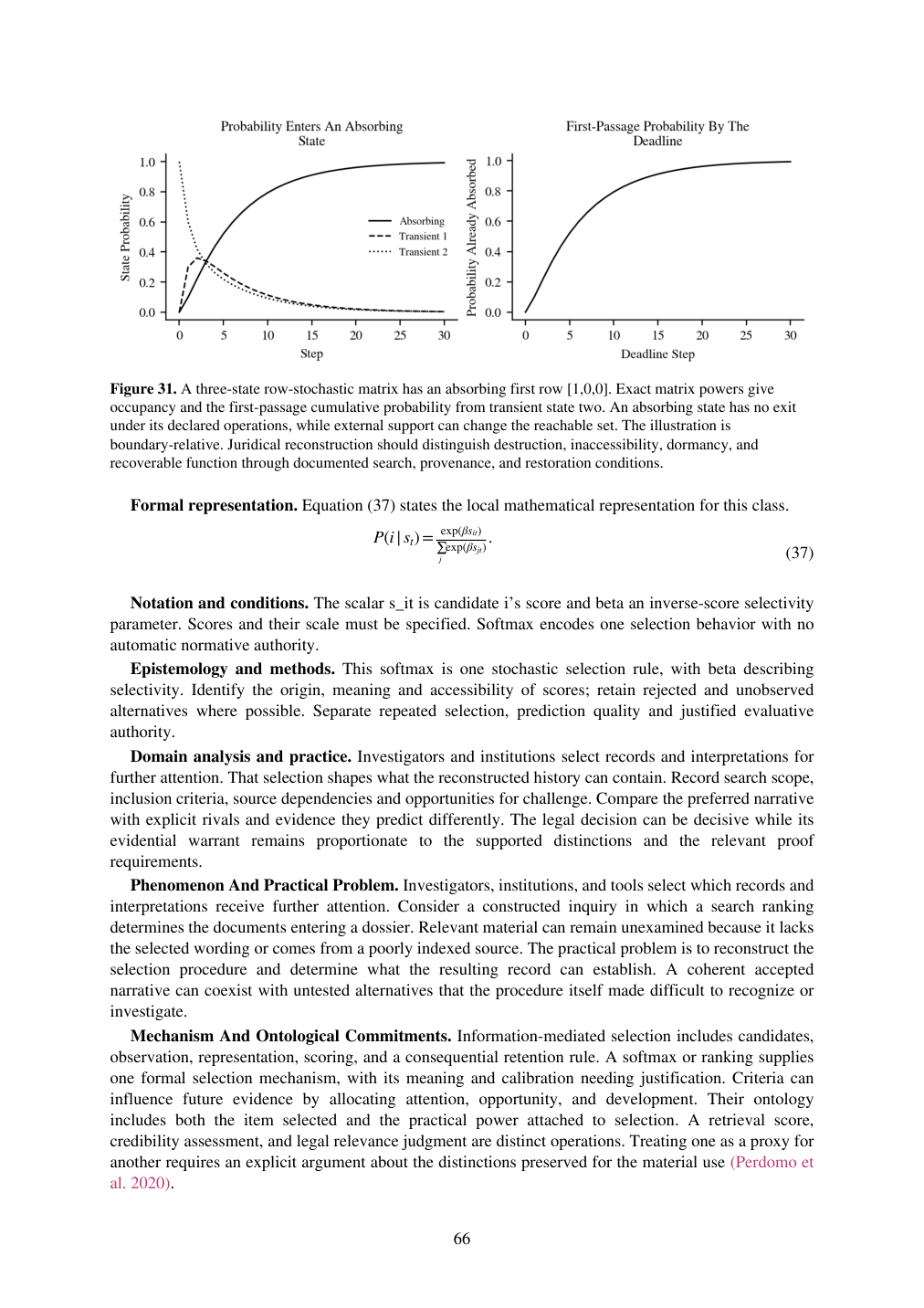
Readable text
Figure 31. A three-state row-stochastic matrix has an absorbing first row [1,0,0]. Exact matrix powers give occupancy and the first-passage cumulative probability from transient state two. An absorbing state has no exit under its declared operations, while external support can change the reachable set. The illustration is boundary-relative. Juridical reconstruction should distinguish destruction, inaccessibility, dormancy, and recoverable function through documented search, provenance, and restoration conditions.
Formal representation. Equation (37) states the local mathematical representation for this class.
Notation and conditions. The scalar s_it is candidate i’s score and beta an inverse-score selectivity parameter. Scores and their scale must be specified. Softmax encodes one selection behavior with no
Epistemology and methods. This softmax is one stochastic selection rule, with beta describing selectivity. Identify the origin, meaning and accessibility of scores; retain rejected and unobserved alternatives where possible. Separate repeated selection, prediction quality and justified evaluative
Domain analysis and practice. Investigators and institutions select records and interpretations for further attention. That selection shapes what the reconstructed history can contain. Record search scope, inclusion criteria, source dependencies and opportunities for challenge. Compare the preferred narrative with explicit rivals and evidence they predict differently. The legal decision can be decisive while its evidential warrant remains proportionate to the supported distinctions and the relevant proof
Phenomenon And Practical Problem. Investigators, institutions, and tools select which records and interpretations receive further attention. Consider a constructed inquiry in which a search ranking determines the documents entering a dossier. Relevant material can remain unexamined because it lacks the selected wording or comes from a poorly indexed source. The practical problem is to reconstruct the selection procedure and determine what the resulting record can establish. A coherent accepted narrative can coexist with untested alternatives that the procedure itself made difficult to recognize or
Mechanism And Ontological Commitments. Information-mediated selection includes candidates, observation, representation, scoring, and a consequential retention rule. A softmax or ranking supplies one formal selection mechanism, with its meaning and calibration needing justification. Criteria can influence future evidence by allocating attention, opportunity, and development. Their ontology includes both the item selected and the practical power attached to selection. A retrieval score, credibility assessment, and legal relevance judgment are distinct operations. Treating one as a proxy for another requires an explicit argument about the distinctions preserved for the material use (Perdomo et
Epistemic Design And Discriminating Evidence. Record queries, corpus versions, inclusion criteria, rankings, rejected items, and opportunities for challenge. Compare retrieval against independently assembled sources and evaluate whether selection systematically omits a rival mechanism. Preserve dependencies among summaries and original records. A blinded review can test whether access to the selection history changes supported claims or exposes missing alternatives. Legal AI research motivates direct source checking within its tested systems and versions; it does not supply current error rates for every tool. Verification should therefore examine the actual system, task, and retrieved evidence used here (Magesh et al. 2025).
Philosophical Reasoning And Practice. The philosophical inference concerns evaluative power over knowability. If a procedure controls which distinctions become visible, it helps shape the evidential field later used to justify conclusions. Its practical force and its warranted authority remain distinct. GR norm-formation analysis makes the criterion’s origin, recognition, and revision available for inquiry. A legally consequential selection procedure should identify its authorized role and permit challenge to material omissions. Factual criticism can then target a specific representation or selection premise while preserving the force of findings supported independently of that premise (Huang 2026a).
Worked Comparison And Research Proposition. Compare dossiers containing the same final summary. One discloses a broad search, tested rival queries, and reasons for exclusion. Another contains only highly ranked results from a narrow vocabulary. A constructed study could vary search transparency and counter-source access, evaluating justified closure, false confidence, and recognition of surviving histories. The proposition is that selection-aware provenance improves warrant when inclusion rules materially shape mechanism discrimination. A practical report should identify the corpus, procedure, supported propositions, and important unresolved alternatives, connecting its stopping decision to the proceeding’s authority, evidential requirements, and burden of further investigation.
Reading the numerical illustration. Figure 32 illustrates the declared mechanism. A selection rule acts on the information available to it. Increased intensity concentrates choice under exact scores, while observation error changes the mean probability of selecting the candidate with the highest stipulated latent score. This separates a candidate property, its manifestation and consequential selection. A domain account should validate the score for its intended purpose, examine who controls observation and selection, and preserve the opportunity to revise a criterion when its omissions become consequential.
11 D. Observable And Recognizable Phenomena
11.1 D1. Transport And Circulation
Mechanism and ontology. Observable currents record movement across declared boundaries or between specified states. A current is a manifestation of activity whose generating mechanism can include gradients, active conversion and rule-governed transfer. Persistent circulation can coexist with stable aggregate stocks. (Seifert 2012)
Formal representation. Equation (38) states the local mathematical representation for this class.
Jij =pikij −pjkji. (38)
Notation and conditions. The p_i are probabilities and k_ij transition rates of the chosen continuous-time Markov account. J_ij is a net oriented current. The observation resolution and state partition determine which transitions it records.
Epistemology and methods. Estimate directional transitions at a resolution sufficient to detect recrossings and missing channels. The same aggregate throughput can conceal different paths, concentrations and replenishment requirements. Interpret a recorded transfer according to what changed hands and under which terms.
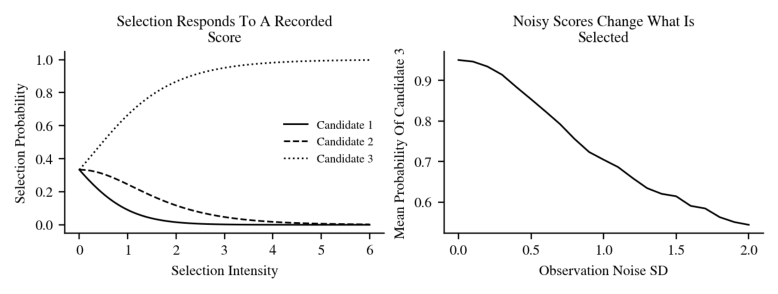
Figure 32. Softmax selection uses scores zero, one and two. The second panel adds independent Gaussian score noise, averages 10,000 readouts per noise level and fixes selection intensity at three. Selection determines which candidates and distinctions receive consequential attention. The illustration represents a declared information-mediated rule. Juridical reconstruction should preserve corpus, query, ranking, exclusion, and revision histories so that the accepted record and its surviving alternatives can be assessed through explicit evidential and institutional grounds.
Domain analysis and practice. Transfers, messages and event sequences are observable manifestations with heterogeneous meanings. Define what each record establishes and what further inference it supports. Trace source provenance and timing, distinguishing an asserted transfer from an independently verified one. Compare alternative causal paths consistent with the same totals. Reconstruction can identify unresolved passages for focused inquiry, while legal consequences depend on the warranted facts and applicable rules.
Phenomenon And Practical Problem. A transfer record makes movement visible while leaving its generating pathway and interpretation partly open. Consider a constructed inquiry into messages passing among offices. The same volume can reflect independent reports, repeated copies, or a sequence of instructions that changes subsequent action. The practical problem is to establish what moved, where it originated, who received it, and which operation followed. Counts of messages, funds, or materials can establish a current under declared conventions while leaving source independence, practical uptake, and authorization unresolved.
Mechanism And Ontological Commitments. Transport is a manifestation indexed to states, boundaries, direction, and observation resolution. The generating mechanism can involve a difference, an imposed operation, active conversion, or a rule-governed transfer. A circulation pattern can persist while aggregate stocks remain constant. Its ontology therefore includes event identity and channel as well as endpoint occupancy. In physical jump models, directional transition currents have a defined probabilistic meaning. A juridical application needs a typed event convention and evidence that the recorded transition corresponds to the material action (Seifert 2012).
Epistemic Design And Discriminating Evidence. Reconcile sender, carrier, and receiver records with time uncertainty, retransmissions, and failed delivery. Distinguish receipt from reading, practical response, and acknowledgment of a commitment. Preserve copies and common-source dependence rather than counting each carrier as independent evidence. Compare candidate pathways that yield the same total volume and identify an additional record capable of separating them. Where only sampled transitions are available, examine missing channels and recrossings. The design should state whether it estimates a flow, reconstructs a particular transfer, or identifies the consequence of that transfer.
Philosophical Reasoning And Practice. The philosophical inference separates circulation of a manifestation from circulation of warrant or authority. Repetition can expand visibility while leaving the underlying evidential event unchanged. Conversely, a new recipient can supply an independent observation or a practically consequential response. Meaning and legal force enter through those
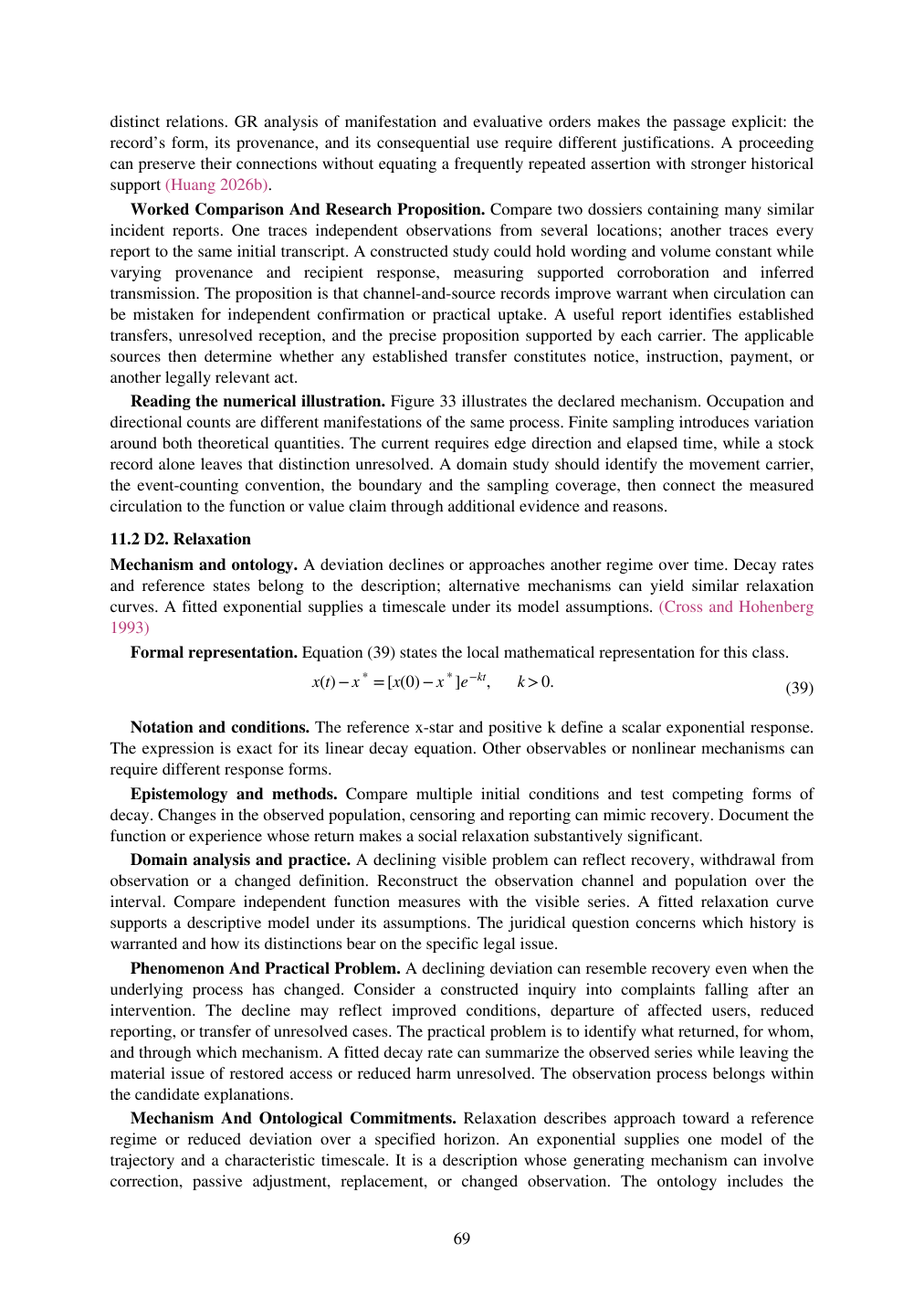
Readable text
distinct relations. GR analysis of manifestation and evaluative orders makes the passage explicit: the record’s form, its provenance, and its consequential use require different justifications. A proceeding can preserve their connections without equating a frequently repeated assertion with stronger historical
Worked Comparison And Research Proposition. Compare two dossiers containing many similar incident reports. One traces independent observations from several locations; another traces every report to the same initial transcript. A constructed study could hold wording and volume constant while varying provenance and recipient response, measuring supported corroboration and inferred transmission. The proposition is that channel-and-source records improve warrant when circulation can be mistaken for independent confirmation or practical uptake. A useful report identifies established transfers, unresolved reception, and the precise proposition supported by each carrier. The applicable sources then determine whether any established transfer constitutes notice, instruction, payment, or
Reading the numerical illustration. Figure 33 illustrates the declared mechanism. Occupation and directional counts are different manifestations of the same process. Finite sampling introduces variation around both theoretical quantities. The current requires edge direction and elapsed time, while a stock record alone leaves that distinction unresolved. A domain study should identify the movement carrier, the event-counting convention, the boundary and the sampling coverage, then connect the measured circulation to the function or value claim through additional evidence and reasons.
Mechanism and ontology. A deviation declines or approaches another regime over time. Decay rates and reference states belong to the description; alternative mechanisms can yield similar relaxation curves. A fitted exponential supplies a timescale under its model assumptions. (Cross and Hohenberg Formal representation. Equation (39) states the local mathematical representation for this class.
Notation and conditions. The reference x-star and positive k define a scalar exponential response. The expression is exact for its linear decay equation. Other observables or nonlinear mechanisms can
Epistemology and methods. Compare multiple initial conditions and test competing forms of decay. Changes in the observed population, censoring and reporting can mimic recovery. Document the function or experience whose return makes a social relaxation substantively significant.
Domain analysis and practice. A declining visible problem can reflect recovery, withdrawal from observation or a changed definition. Reconstruct the observation channel and population over the interval. Compare independent function measures with the visible series. A fitted relaxation curve supports a descriptive model under its assumptions. The juridical question concerns which history is warranted and how its distinctions bear on the specific legal issue.
Phenomenon And Practical Problem. A declining deviation can resemble recovery even when the underlying process has changed. Consider a constructed inquiry into complaints falling after an intervention. The decline may reflect improved conditions, departure of affected users, reduced reporting, or transfer of unresolved cases. The practical problem is to identify what returned, for whom, and through which mechanism. A fitted decay rate can summarize the observed series while leaving the material issue of restored access or reduced harm unresolved. The observation process belongs within
Mechanism And Ontological Commitments. Relaxation describes approach toward a reference regime or reduced deviation over a specified horizon. An exponential supplies one model of the trajectory and a characteristic timescale. It is a description whose generating mechanism can involve correction, passive adjustment, replacement, or changed observation. The ontology includes the
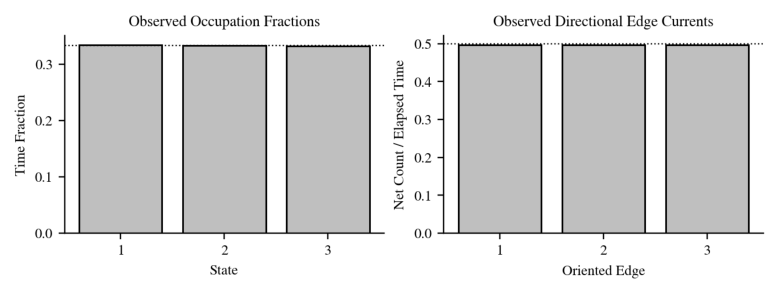
Figure 33. An executed continuous-time three-state ring is observed for 5,000 time units, with clockwise and reverse rates 2 and 0.5. Dotted lines mark exact stationary occupation one-third and edge current 0.5. A visible current records typed movement while its mechanism, source independence, and uptake remain further questions. The illustration concerns a declared transition convention. Juridical reconstruction should preserve direction, provenance, and reception evidence before interpreting circulation as corroboration, communication, or authorized action.
reference, observed population, state variable, and continuity criterion. A return of an indicator and restoration of an exercisable function are distinct propositions. Their relation requires a justified mapping between the measured variable and the social or legal concern (Cross and Hohenberg 1993).
Epistemic Design And Discriminating Evidence. Compare several initial conditions, observation windows, and plausible decay forms. Preserve entry, exit, censoring, category, and reporting histories. Independent measures of attempted use or unmet need can discriminate genuine functional recovery from disappearance of the observed population. Process records should identify the operation proposed to reduce the deviation. A causal comparison needs a supported intervention contrast and assumptions about changing conditions. A trajectory that predicts the aggregate accurately can still leave the relevant mechanism unidentified, as the paper’s hidden-components construction demonstrates.
Philosophical Reasoning And Practice. The philosophical inference concerns the identity of recovery. If the public or legal concern is accessible performance, fewer recorded failures acquire that meaning through evidence of continued opportunity and successful exercise. An unchanged population label can conceal changed membership or conversion burdens. Capability-oriented reasoning helps identify those distinctions. Juridical interpretation then connects the supported recovery claim to the applicable rights, duties, or remedy requirements. A decision can justifiably use a compact indicator when it preserves the material distinction, with its adequacy argued for that purpose (Sen 2009; Huang 2026b). Worked Comparison And Research Proposition. Compare two services with identical complaint decay. One documents repaired access among the original users; another loses users who can no longer complete the complaint route. A constructed review could provide the same time series and then reveal independent follow-up and reporting histories, measuring justified conclusions about improvement and residual uncertainty. The proposition is that population-and-function records improve warrant when relaxation can arise through attrition or observation change. A practical report should state the reference, horizon, affected population, and evidence for the restoring operation, distinguishing a fitted timescale from a demonstrated history of recovery.
Reading the numerical illustration. Figure 34 illustrates the declared mechanism. Early agreement in a relaxation record can leave later response unresolved. The two constructions share initial level and slope, then separate because one observation combines two decaying components. A domain inquiry should compare possible hidden mixtures, replacement and changing measurement before interpreting a fitted timescale as a unique causal mechanism. Additional observations are useful when they
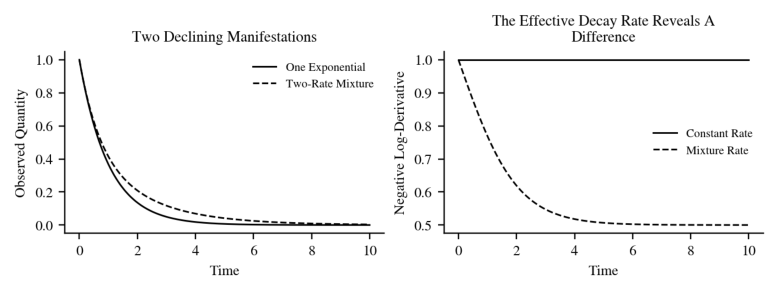
Figure 34. An exact unit-rate decay is compared with an equal mixture of rates 0.5 and 1.5. The mixture has the same initial value and initial derivative, while its later effective rate changes. A declining deviation can result from recovery, replacement, or changed observation. The illustration shows one declared relaxation pattern. Juridical reconstruction should establish the reference, population continuity, and operative pathway before treating a fitted decay rate as evidence of restored function or fulfilled remedy.
discriminate the component structure or identify the decision-relevant future quantity across the remaining alternatives.
11.3 D3. Oscillation
Mechanism and ontology. A recurring trajectory can be autonomous, externally forced or produced by delayed feedback. Period, phase and amplitude characterize the manifestation. Its explanation requires the mechanism that renews the cycle and the resources consumed during repetition. (Cross and Hohenberg 1993)
Formal representation. Equation (40) states the local mathematical representation for this class.
x(t)=̄x +acos(ωt+φ). (40)
Notation and conditions. The mean x-bar, amplitude a, angular frequency omega and phase phi describe a sinusoidal component. The formula characterizes a signal; autonomous, forced and feedback mechanisms need separate explanatory models.
Epistemology and methods. This expression describes a simple periodic signal. Examine phase response, changes in forcing and cycle-to-cycle resource accounts before selecting a mechanism. Irregular recurrence can call for renewal or event models with variable intervals.
Domain analysis and practice. Repeated events can reflect a schedule, delayed response, deliberate coordination or selective reporting. Define a cycle and retain missing or irregular episodes. Compare timing predictions and external records. Recurrence can identify a question for investigation while the mechanism remains open. Legal inferences about practice, knowledge or agreement require additional evidence appropriate to the concept and legal context invoked.
Phenomenon And Practical Problem. Recurring output can reflect an autonomous cycle, an external schedule, delayed correction, or a recording convention. Consider a constructed inquiry into periodic access restrictions. Their recurrence might follow a maintenance calendar, repeated resource depletion, strategic adjustment, or batch reporting. The practical problem is to identify the operation renewing the cycle and the relationship material to the dispute. A regular sequence supplies a descriptive pattern while leaving its cause, necessity, avoidability, and effect on particular participants open to further investigation.
Mechanism And Ontological Commitments. Oscillation is a manifestation characterized by period, phase, amplitude, and recurrence conditions. A sinusoid is one representation, with irregular recurrence potentially calling for event or renewal models. The ontology includes what repeats and the
supports consumed or restored during repetition. An externally forced cycle requires the driver’s history; an internally sustained cycle requires a mechanism renewing its motion. A juridical reconstruction should distinguish recurrence of a label, an actual operation, and an effect on users. Similar calendar dates alone leave those identities unresolved (Cross and Hohenberg 1993).
Epistemic Design And Discriminating Evidence. Recover event times, implementation records, external schedules, and resource states through several cycles. Compare phase changes after an interruption or altered schedule. Include incomplete and failed cycles so that an account is not selected solely from successful recurrence. Examine whether temporal aggregation creates or erases a period. A delayed-feedback candidate should predict a different response to changed timing from an externally scheduled account. Independent records of the driver or renewal operation can identify a pathway even where the available series is too short for reliable spectral estimation.
Philosophical Reasoning And Practice. The philosophical inference concerns the continuity of a practice through repeated events. A name can recur while its participants, authority, and practical function change. Conversely, changing forms can preserve one operation relevant to the legal issue. The proceeding should identify the criterion under which episodes belong to the same practice and the evidence linking them historically. Evaluation then asks which effects and burdens recur and what reasons support their treatment. An efficient cycle can reproduce exclusion, while an interrupted cycle can reflect a justified transition. Dynamic recurrence supplies a question for normative judgment.
Worked Comparison And Research Proposition. Compare periodic closures with identical schedules. One follows documented renewal work necessary for safe operation; another continues after the original technical need disappears while alternative access remains blocked. A constructed study could reveal maintenance and alternative-path records after matched calendars, evaluating supported conclusions about cause and feasible adjustment. The proposition is that cycle-resolved operational evidence improves warrant when repetition can be mistaken for necessity or consistent purpose. A practical report should distinguish recurrence, maintained function, historical transmission, and the sources governing any continuing obligation. Adaptive-governance research offers a setting for examining how institutions renew or revise such recurring arrangements (Folke et al. 2005).
Reading the numerical illustration. Figure 35 illustrates the declared mechanism. The same recurring observation can be supported through different operations. Before withdrawal these two outputs coincide, yet the external input has a decisive causal role in one arm. The comparison identifies an intervention capable of separating the models under their assumptions. A domain account should locate what renews each cycle, compare autonomous interaction, common schedules and delayed correction, and investigate the resources and authority enabling the relevant discriminating change.
11.4 D4. Spatial Patterns
Mechanism and ontology. Clustering, segregation, waves, interfaces and domains are recognizable arrangements in a chosen space. The space can be geographic, organizational or representational, with its metric justified independently. Pattern description and pattern genesis are distinct analytical tasks. (Cross and Hohenberg 1993; Frey and Weyer 2026)
Formal representation. Equation (41) states the local mathematical representation for this class.
C(r)=[(u(s)−̄u)(u(s+r)−̄u)]. (41)
Notation and conditions. The field u, spatial location s and displacement r define the correlation under a chosen measure. The displayed expectation uses suitable averaging assumptions; changing boundaries or means require corresponding local definitions.
Epistemology and methods. Specify stationarity or use local alternatives when estimating a correlation function. Compare movement, local interaction, sorting and boundary effects. A pattern in an embedding also depends on the representation through which distances were constructed.
Domain analysis and practice. An observed spatial or semantic cluster depends on category boundaries and recording. Reconstruct those choices before treating the pattern as evidence of a
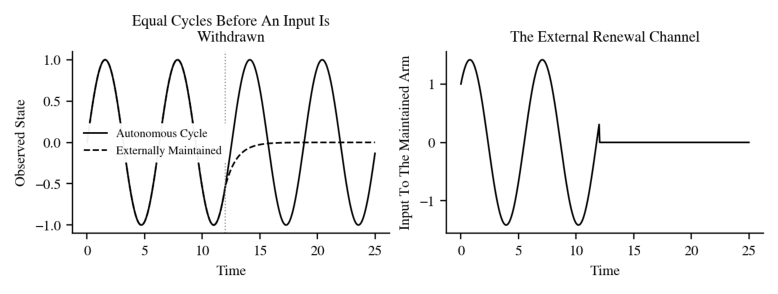
Figure 35. One observed sine is the projection of a unit autonomous rotation. Another follows dx/dt = -x + u with u = cos(t) + sin(t) until time twelve; input withdrawal separates the exact trajectories. Recurring trajectories can be internally sustained, externally scheduled, or produced by delayed response. The illustration depicts one declared oscillatory pattern. Juridical reconstruction should identify what repeats, its driver and renewal work, and whether the practical function and authority continue across episodes.
common cause. Compare the pattern across reasonable representations and relevant covariates. A stable cluster can guide targeted inquiry. Its legal significance depends on which facts it helps establish and whether plausible alternative mechanisms have been examined.
Phenomenon And Practical Problem. A map can make a distribution visible while its categories and geometry shape what appears. Consider a constructed inquiry into unequal service access across neighborhoods. Clusters can reflect movement, sorting, resource allocation, or a boundary that excludes certain attempts. The practical problem is to establish which pattern is material and how it relates to actual opportunities or conduct. A visually clear spatial arrangement can remain compatible with several historical mechanisms and different experiences among people assigned to the same location.
Mechanism And Ontological Commitments. Spatial pattern is a manifestation in a declared space with its own metric, boundary, and resolution. Geographic distance, travel time, organizational proximity, and representational similarity answer different questions. The ontology includes the units placed in that space, their relation to the observed process, and the aggregation rule. Clustering in an embedding can depend substantially on the encoding. A juridical reconstruction should preserve the meaning of a measured separation before treating it as a causal or practical barrier. Urban network science supplies a substantive context for examining flows and connections (Batty 2013).
Epistemic Design And Discriminating Evidence. Compare results across defensible boundaries, scales, and measures of access. Recover historical locations, opening conditions, transport links, and changes in recording. Independent observations of attempted and completed service can test whether mapped availability translates into exercise. Candidate explanations should predict different changes when a route, eligibility rule, or reporting channel changes. A pattern can inform a bounded inquiry while a mechanism claim requires evidence for the actual pathway. Source provenance and category versions should remain linked to every spatial unit used in a consequential comparison.
Philosophical Reasoning And Practice. The philosophical inference distinguishes proximity from accessible possibility. A nearby service can remain unusable through time, permission, language, or complementary-support constraints. Capability-oriented reasoning makes those conversion conditions part of the object evaluated. A proceeding can then ask which spatial representation preserves the legally material opportunity. Epistemic participation also matters because groups with weak reporting access can disappear from the map. Fair access to description and factual assessment of the resulting claims remain connected tasks with distinct grounds (Sen 2009; Fricker 2007).
Worked Comparison And Research Proposition. Compare districts with identical straight-line distances to an office. One has a usable route and compatible hours; another has a blocked crossing and
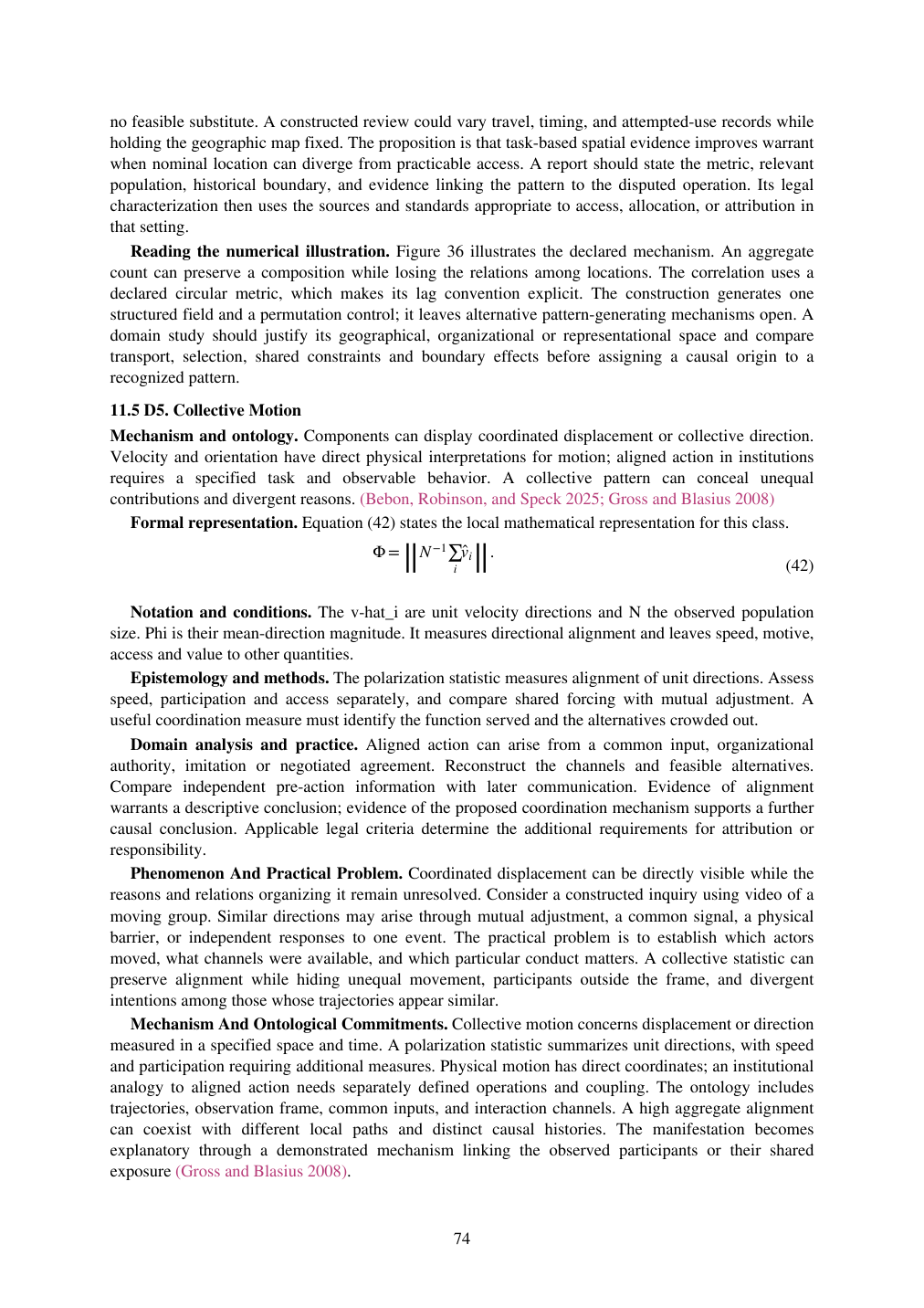
Readable text
no feasible substitute. A constructed review could vary travel, timing, and attempted-use records while holding the geographic map fixed. The proposition is that task-based spatial evidence improves warrant when nominal location can diverge from practicable access. A report should state the metric, relevant population, historical boundary, and evidence linking the pattern to the disputed operation. Its legal characterization then uses the sources and standards appropriate to access, allocation, or attribution in
Reading the numerical illustration. Figure 36 illustrates the declared mechanism. An aggregate count can preserve a composition while losing the relations among locations. The correlation uses a declared circular metric, which makes its lag convention explicit. The construction generates one structured field and a permutation control; it leaves alternative pattern-generating mechanisms open. A domain study should justify its geographical, organizational or representational space and compare transport, selection, shared constraints and boundary effects before assigning a causal origin to a
Mechanism and ontology. Components can display coordinated displacement or collective direction. Velocity and orientation have direct physical interpretations for motion; aligned action in institutions requires a specified task and observable behavior. A collective pattern can conceal unequal contributions and divergent reasons. (Bebon, Robinson, and Speck 2025; Gross and Blasius 2008)
Formal representation. Equation (42) states the local mathematical representation for this class.
Notation and conditions. The v-hat_i are unit velocity directions and N the observed population size. Phi is their mean-direction magnitude. It measures directional alignment and leaves speed, motive,
Epistemology and methods. The polarization statistic measures alignment of unit directions. Assess speed, participation and access separately, and compare shared forcing with mutual adjustment. A useful coordination measure must identify the function served and the alternatives crowded out.
Domain analysis and practice. Aligned action can arise from a common input, organizational authority, imitation or negotiated agreement. Reconstruct the channels and feasible alternatives. Compare independent pre-action information with later communication. Evidence of alignment warrants a descriptive conclusion; evidence of the proposed coordination mechanism supports a further causal conclusion. Applicable legal criteria determine the additional requirements for attribution or
Phenomenon And Practical Problem. Coordinated displacement can be directly visible while the reasons and relations organizing it remain unresolved. Consider a constructed inquiry using video of a moving group. Similar directions may arise through mutual adjustment, a common signal, a physical barrier, or independent responses to one event. The practical problem is to establish which actors moved, what channels were available, and which particular conduct matters. A collective statistic can preserve alignment while hiding unequal movement, participants outside the frame, and divergent intentions among those whose trajectories appear similar.
Mechanism And Ontological Commitments. Collective motion concerns displacement or direction measured in a specified space and time. A polarization statistic summarizes unit directions, with speed and participation requiring additional measures. Physical motion has direct coordinates; an institutional analogy to aligned action needs separately defined operations and coupling. The ontology includes trajectories, observation frame, common inputs, and interaction channels. A high aggregate alignment can coexist with different local paths and distinct causal histories. The manifestation becomes explanatory through a demonstrated mechanism linking the observed participants or their shared
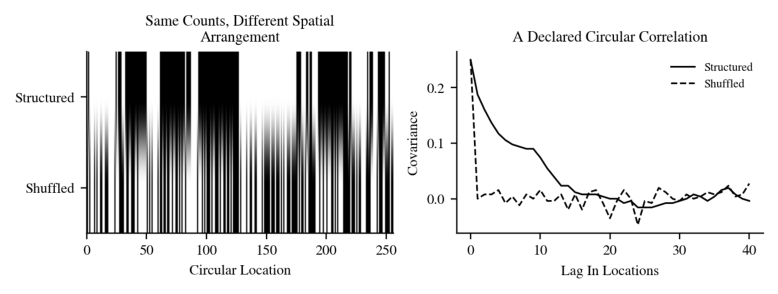
Figure 36. A median-thresholded moving-average field on 256 circular sites is compared with a permutation of the same values. The marginal counts agree; the spatial covariance distinguishes their arrangement. A spatial pattern depends on the chosen objects, metric, boundary, and observation. The illustration represents one declared arrangement. Juridical reconstruction should compare plausible generators and task-relevant access conditions before treating proximity, clustering, or separation as evidence of a particular causal or legal relationship.
Epistemic Design And Discriminating Evidence. Preserve original recordings, synchronization uncertainty, camera geometry, occlusion, and relevant surrounding events. Compare apparent alignment with common signals and feasible routes. Event-level process evidence can establish a particular communication or action without requiring a complete collective-motion model. If automated tracking contributes, validate it against task-relevant errors such as identity swaps or missed participants. A statistical comparison should include alternative observation frames and reference episodes. The design should state whether it establishes movement, mutual adjustment, practical coordination, or the legally relevant act attributed to a particular participant.
Philosophical Reasoning And Practice. The philosophical inference separates collective description from attributed agency. A group-level pattern can be real while its members participate through different knowledge, options, and purposes. The record must preserve the resolution needed for the proposition at issue. A relational account examines how barriers, signals, and available routes condition action while retaining the participant’s actual contribution. Legal characterization adds the applicable criteria for intention, agreement, or responsibility. An accurate group statistic supplies evidence at its own level, with the bridge to an actor’s historical act requiring further reasons.
Worked Comparison And Research Proposition. Compare recordings with the same alignment score. One shows participants adapting to each other’s communicated plan; another shows independent movement around a newly closed route. A constructed reconstruction study could vary access to wider video and communication records, measuring supported attribution and false claims of common purpose. The proposition is that trajectory-and-context evidence improves warrant when alignment has rival mechanisms. A practical report should distinguish measured direction, feasible routes, observed communication, and established individual acts. The source and interpretation of each claim should remain available for challenge, especially when a compressed visualization becomes consequential (Huang 2026b).
Reading the numerical illustration. Figure 37 illustrates the declared mechanism. An order parameter compresses a distribution of directions. The velocity field restores some of the component information hidden by that scalar, while the update rule supplies the proposed alignment mechanism. Display positions here are independent plotting locations rather than a local-interaction geography. A domain use should identify actual coordinated operations and channels of adjustment, examine who contributes or bears the costs, and preserve the distinction between behavioral alignment and participants sharing purposes or reasons.
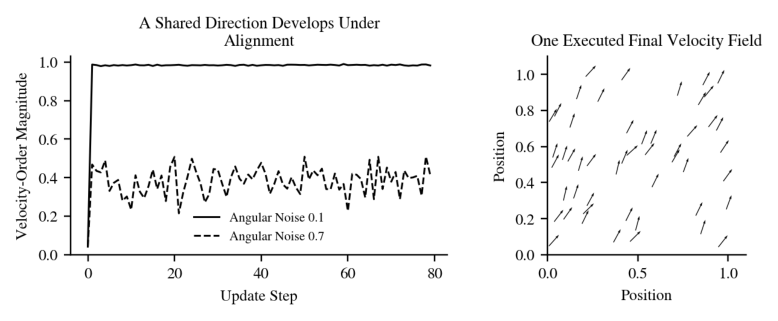
Figure 37. Fifty unit-velocity headings update toward their global mean direction plus uniform angular noise. The initial headings are shared. The quiver panel shows the lower-noise final headings at declared display positions. Aligned displacement can arise through interaction, common signals, or shared constraints. The illustration is a declared collective-motion pattern. Juridical reconstruction should preserve trajectories, observation limits, and actor-level evidence before translating a group statistic into claims about coordination, intention, or responsibility.
11.6 D6. Intermittency And Chaos
Mechanism and ontology. A time series can contain bursts, irregular switching or sensitive dependence. Deterministic chaos concerns specified deterministic dynamics; stochastic variation and changing observation can produce similar irregularity. Time resolution and state reconstruction constrain the interpretation. (Cross and Hohenberg 1993; Lorenz 1963)
Formal representation. Equation (43) states the local mathematical representation for this class.
‖δx(t)‖≈‖δx(0)‖eλt. (43)
Notation and conditions. Delta x is a small initial perturbation and lambda an appropriate sensitivity exponent under the model. Finite records and noise complicate its estimation. Irregularity alone leaves several generating processes admissible.
Epistemology and methods. A positive estimated Lyapunov exponent becomes evidence for chaos only with adequate assumptions and robustness tests. Compare stochastic and nonstationary alternatives. Prediction horizons and decision horizons can remain useful even where detailed long-term prediction is limited.
Domain analysis and practice. Irregular records can arise from noise, hidden state changes, observation gaps and deterministic dynamics. Compare these accounts before interpreting unpredictability as intrinsic chaos. Report the temporal resolution and the model’s observable predictions. A juridical inquiry can retain several compatible dynamic histories and seek a measurement that separates them. The decision standard governs how unresolved ambiguity bears on the legal conclusion.
Phenomenon And Practical Problem. An irregular history can limit detailed prediction while still supporting specific factual conclusions. Consider a constructed inquiry into a rapidly changing operational process with bursts and reversals. The record may reflect deterministic sensitivity, stochastic inputs, changing rules, or unstable observation. The practical problem is to discriminate these accounts before assigning the label chaos. Unpredictability of a complex future and uncertainty about a particular past event have different objects. A proceeding may establish a documented act even when a model cannot reconstruct every state or predict its distant consequences.
Mechanism And Ontological Commitments. Deterministic chaos concerns sensitive dependence within specified deterministic dynamics. A positive Lyapunov exponent has a defined meaning relative to state, metric, time, and perturbation. Irregularity alone supplies a broader manifestation. Intermittency can also involve switching or bursts with different causes. The ontology should identify the governing process and observation channel, including whether they remain stable over the relevant interval. Changing categories and external inputs can mimic properties attributed to internal sensitivity. A juridical application needs evidence for the actual mechanism and the material distinction it would resolve (Lorenz 1963).
Epistemic Design And Discriminating Evidence. Compare deterministic, stochastic, and nonstationary candidates using held-out observations and sensitivity to reconstruction choices. Investigate missing inputs, recording changes, and sampling limitations. Delay-based state reconstruction requires conditions about the system and observation that sparse strategic social records can challenge. A fitted complexity measure should be assessed against suitable alternatives instead of becoming a causal explanation through its name. Direct source evidence can establish a specific transition even where global reconstruction remains unavailable. The design should report which quantities and histories are identified within the surviving family (Takens 1981; Brunton, Proctor, and Kutz 2016).
Philosophical Reasoning And Practice. The philosophical inference concerns the relation between explanatory ambition and warrant. An inquiry can acknowledge limits on comprehensive prediction while making a well-supported local claim. Conversely, an elaborate reconstructed trajectory can offer false historical precision if observationally equivalent models disagree on the material event. A realist approach follows the operative process through the evidence available, with representation assessed for its particular use. Legal standards then determine what consequence follows from established facts and remaining uncertainty. The dynamic label itself supplies neither a universal excuse nor a standard of proof.
Worked Comparison And Research Proposition. Compare dossiers with identical irregular aggregate series. One also preserves a dated instruction and verified local response; another contains only a fitted trajectory. A constructed study could vary that independent event evidence and evaluate supported historical claims, invented detail, and calibrated prediction. The proposition is that questionrelative reconstruction improves warrant when global irregularity can obscure locally identified acts. A report should state the competing sources of unpredictability, the interval supported by its model, and the evidential bridge to each material proposition. It should preserve the difference between a mathematical sensitivity result and an empirically established social mechanism.
Reading the numerical illustration. Figure 38 illustrates the declared mechanism. The numerical comparison illustrates sensitivity in a specified deterministic system. Its log-distance trace is a finitetime diagnostic, with intervals affected by local stretching, contraction and eventual saturation. It supplies neither a Lyapunov-spectrum estimation procedure nor an identification of chaos from an arbitrary social time series. A domain investigation should compare noise, external change and observation artifacts, justify its reconstructed state, and report which prediction horizon remains useful under its actual evidence and error scale.
11.7 D7. Collective Phase Transitions
Mechanism and ontology. A collective order parameter can change regime as control conditions vary. A phase-transition account specifies the order parameter, control parameter, size dependence and limiting procedure. Abrupt social change can motivate this inquiry while several noncritical mechanisms remain admissible. (Cross and Hohenberg 1993; Boettiger and Hastings 2012)
Formal representation. Equation (44) states the local mathematical representation for this class.
χN =N([m2]−[m]2). (44)
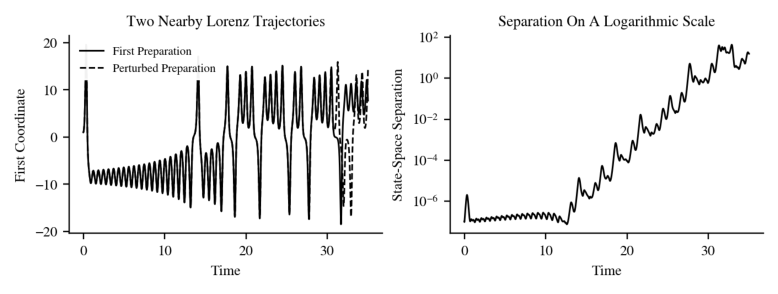
Figure 38. Two Lorenz trajectories use sigma = 10, rho = 28 and beta = 8/3, with an initial first-coordinate difference of 10 to the power -7. The finite-time separation grows and later saturates within the bounded sampled motion. Irregularity can arise through deterministic sensitivity, noise, or changing observation. The illustration concerns a specified dynamical model. Juridical reconstruction should test those alternatives and retain independently supported local facts, distinguishing prediction limits from uncertainty about the particular historical proposition before judgment.
Notation and conditions. The order parameter m is defined for a system of size N; chi_N is its scaled variance in the chosen ensemble. Interpretation as response susceptibility requires the relevant model and response relation.
Epistemology and methods. Treat susceptibility here as a fluctuation statistic under the chosen normalization. Test finite-size behavior and alternative explanations such as a common shock or administrative reclassification. A fitted power law alone leaves mechanism and universality unresolved.
Domain analysis and practice. An abrupt change in observed cases can follow a real transition or a change in reporting, enforcement or classification. Preserve the category and policy history. Compare independent sources and mechanism-specific predictions. A phase-transition account requires stronger evidence concerning scale and collective behavior. The reconstruction should first establish what changed in the observation process and in the underlying legally relevant conduct.
Phenomenon And Practical Problem. Abrupt collective change can motivate a phase-transition hypothesis while several ordinary mechanisms remain possible. Consider a constructed inquiry into a sudden increase in registered incidents after a policy reform. The change may reflect altered conduct, new reporting access, reclassification, or collective interaction. The practical problem is to establish what changed and whether the proposed transition mechanism is material to the legal issue. A steep graph or fitted power law can make a historical narrative persuasive while leaving its underlying population, boundary, and recording process unresolved.
Mechanism And Ontological Commitments. A phase-transition account specifies an order parameter, control condition, system size, and limiting procedure. Finite systems can display sharp change without establishing critical scaling. The ontology includes interactions through which collective behavior emerges and the observation mapping used to measure it. An institution’s abrupt category revision is a different event from a dynamical transition among unchanged states. A juridical reconstruction should preserve those possibilities rather than let one graphical appearance determine the mechanism. Physical pattern and transition research supplies formal resources whose social correspondence requires an explicit argument (Cross and Hohenberg 1993).
Epistemic Design And Discriminating Evidence. Recover category versions, policy implementation, exposure, and independent observations of conduct. Compare scale dependence and alternative noncritical explanations where the available data support such tests. Evaluate early-warning performance prospectively, including false positives and non-transition episodes. A selected historical event can distort apparent predictive success. If the material proposition concerns a specific
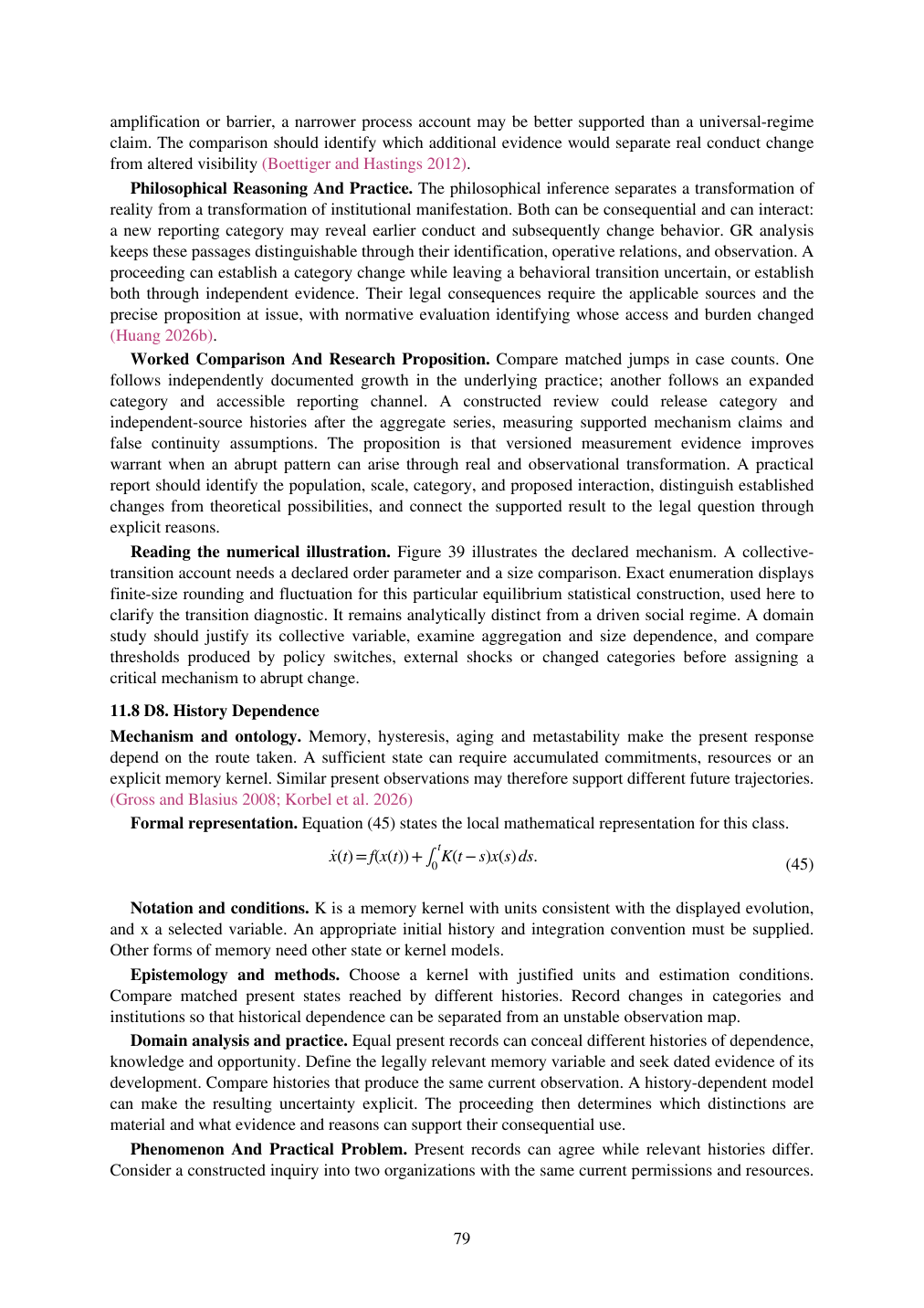
Readable text
amplification or barrier, a narrower process account may be better supported than a universal-regime claim. The comparison should identify which additional evidence would separate real conduct change
Philosophical Reasoning And Practice. The philosophical inference separates a transformation of reality from a transformation of institutional manifestation. Both can be consequential and can interact: a new reporting category may reveal earlier conduct and subsequently change behavior. GR analysis keeps these passages distinguishable through their identification, operative relations, and observation. A proceeding can establish a category change while leaving a behavioral transition uncertain, or establish both through independent evidence. Their legal consequences require the applicable sources and the precise proposition at issue, with normative evaluation identifying whose access and burden changed
Worked Comparison And Research Proposition. Compare matched jumps in case counts. One follows independently documented growth in the underlying practice; another follows an expanded category and accessible reporting channel. A constructed review could release category and independent-source histories after the aggregate series, measuring supported mechanism claims and false continuity assumptions. The proposition is that versioned measurement evidence improves warrant when an abrupt pattern can arise through real and observational transformation. A practical report should identify the population, scale, category, and proposed interaction, distinguish established changes from theoretical possibilities, and connect the supported result to the legal question through
Reading the numerical illustration. Figure 39 illustrates the declared mechanism. A collective- transition account needs a declared order parameter and a size comparison. Exact enumeration displays finite-size rounding and fluctuation for this particular equilibrium statistical construction, used here to clarify the transition diagnostic. It remains analytically distinct from a driven social regime. A domain study should justify its collective variable, examine aggregation and size dependence, and compare thresholds produced by policy switches, external shocks or changed categories before assigning a
Mechanism and ontology. Memory, hysteresis, aging and metastability make the present response depend on the route taken. A sufficient state can require accumulated commitments, resources or an explicit memory kernel. Similar present observations may therefore support different future trajectories.
Formal representation. Equation (45) states the local mathematical representation for this class.
Notation and conditions. K is a memory kernel with units consistent with the displayed evolution, and x a selected variable. An appropriate initial history and integration convention must be supplied. Other forms of memory need other state or kernel models.
Epistemology and methods. Choose a kernel with justified units and estimation conditions. Compare matched present states reached by different histories. Record changes in categories and institutions so that historical dependence can be separated from an unstable observation map.
Domain analysis and practice. Equal present records can conceal different histories of dependence, knowledge and opportunity. Define the legally relevant memory variable and seek dated evidence of its development. Compare histories that produce the same current observation. A history-dependent model can make the resulting uncertainty explicit. The proceeding then determines which distinctions are material and what evidence and reasons can support their consequential use.
Phenomenon And Practical Problem. Present records can agree while relevant histories differ. Consider a constructed inquiry into two organizations with the same current permissions and resources.
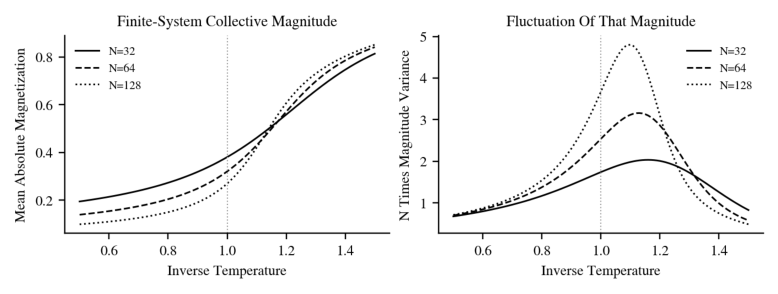
Figure 39. Exact finite Curie-Weiss weights are enumerated for N = 32, 64 and 128. The order parameter is absolute magnetization per spin; the right panel is N times its variance. The dotted line marks the infinite-system critical inverse temperature one. An abrupt collective pattern can reflect interaction, a common shock, or revised categories. The illustration presents a declared transition model. Juridical reconstruction should establish observables, population, scale, and observation history before assigning a phase-transition mechanism or drawing its consequential historical interpretation.
One developed those conditions through a disputed contribution; the other acquired them independently. Alternatively, both can reach the same balance through different sequences of access and deprivation. The practical problem is to identify which memory-bearing relation matters to the legal proposition and what evidence preserves it. A current snapshot can be sufficient for one operational decision while remaining inadequate for historical attribution or remedy.
Mechanism And Ontological Commitments. History dependence means that a response or consequence depends on the path through which the present state arose. A sufficient state may require accumulated commitments, learned routines, or an explicit memory carrier. Memory, hysteresis, aging, and metastability have different mechanisms. Their common lesson is to investigate what retains the earlier influence. A juridical ontology should distinguish a historical event, its persistent effect, and its later record. The proposed carrier must do explanatory work beyond the general fact that every process has a past (Gross and Blasius 2008).
Epistemic Design And Discriminating Evidence. Seek dated sequences, version histories, inherited obligations, training records, and material changes linking the earlier event to the present condition. Compare matched current states reached through different documented paths. Test whether a proposed memory variable predicts a material difference under similar present inputs. Process tracing can establish transmission where a complete quantitative model is unavailable. Category changes require a translation account so that apparent memory can be distinguished from shifting observation. Report which historical distinctions survive across evidence-compatible paths and which need an additional source or restriction (Huang 2026b).
Philosophical Reasoning And Practice. The philosophical inference concerns historical identity and justified restoration. If a present condition can arise through several paths, its manifestation alone leaves descent and responsibility unresolved. A remedy can correct a current record while leaving a closed opportunity or inherited burden requiring separate treatment. Juridical judgment should identify the continuity criterion and the relation between past contribution and present effect. Process philosophy provides a setting for examining persistence through change, with the concrete criterion and evidential test developed for the material inquiry (Whitehead 1978).
Worked Comparison And Research Proposition. Compare two corrected records that are identical at review. One error was removed before a training allocation; another remained during selection and was corrected afterward. Their present manifestations agree while the opportunity histories differ. A constructed study could vary sequence and downstream records, measuring recognition of distinct
Readable text
restoration questions and supported causal attribution. The proposition is that memory-carrier and sequence evidence improves warrant when a current state conceals material historical differences. A practical report should distinguish the correction performed, effects that continue, supports available for restoration, and the legal reasons governing each possible response.
Reading the numerical illustration. Figure 40 illustrates the declared mechanism. A present input can accompany different states because prior paths determine basin occupation. The comparison also varies the speed of the same environmental route. A sufficient representation for prediction therefore needs the relevant retained state or history, with its identification criterion declared. A domain study should trace the carrier of memory, distinguish historical dependence from an omitted current driver, and seek observations or interventions that separate histories with materially different consequences.
Mechanism and ontology. Relations can fragment, merge, rewire or acquire new carriers while activity continues. Identity criteria determine whether a later organization counts as continuation, replacement or a new formation. Network statistics offer partial descriptions alongside histories of authority and
Formal representation. Equation (46) states the local mathematical representation for this class.
Notation and conditions. The vertex and edge sets identify components and typed relations at time t. Calligraphic T is a declared graph update driven by states and inputs. Identity criteria determine how
Epistemology and methods. Track entrants, exits, relation types and identification rules. Compare structural continuity with functional continuity. A stable name, aggregate output or graph summary can hide changes in membership, control and practical accessibility.
Domain analysis and practice. A name or identifier can persist across a merger, split or transfer of authority. Reconstruct identity through explicit organizational and legal criteria. Track membership, roles, assets and obligations with their sources. Compare structural continuity, historical descent and functional substitution. This avoids letting a stable label silently decide which subject performed an act
Phenomenon And Practical Problem. An organization can retain its name or aggregate output through substantial changes in membership, relations, and authority. Consider a constructed inquiry into a service after merger. The successor may inherit records and practical competence, receive only a formal role, or assemble an independent capacity. The practical problem is to establish which continuity matters to the disputed claim. A familiar label can conceal a changed operation, while a new label can carry a function historically transmitted through documented tools, personnel, permissions, and
Mechanism And Ontological Commitments. Structural reorganization changes nodes, edges, relation types, or the space through which the organization is represented. Fragmentation, merger, and rewiring have distinct pathways. The ontology includes entry, exit, authority, resources, and identification criteria across versions. A graph statistic can describe one aspect while omitting the practical meaning of a changed tie. Organizational identity, functional continuity, and historical transmission therefore require separate tests. Adaptive-network research supports studying changing relations; a juridical application must additionally establish the sources and operations relevant to
Epistemic Design And Discriminating Evidence. Construct a versioned map of offices, personnel, permissions, resource accounts, and service pathways. Preserve translations between old and new categories, including unmatched records. Compare performance under relevant disturbances and investigate whether a successor can exercise the inherited function without exceptional support. Historical documents establish which assets, knowledge, or powers passed; operational evidence tests
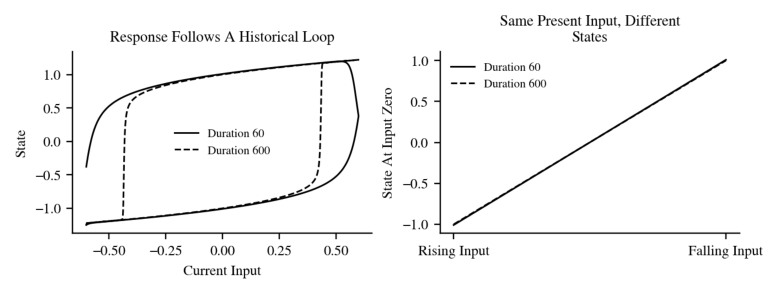
Figure 40. The cubic state law dx/dt = lambda + x - x cubed is driven from lambda = -0.6 to 0.6 and back. Durations sixty and six hundred show rate dependence and a historical loop; the right panel samples zero input on each leg. The present can retain earlier influence through commitments, learning, resources, or other memory carriers. The illustration is a declared history-dependent process. Juridical reconstruction should establish the carrier and sequence, distinguishing current agreement from historical descent, continued effect, and the grounds of restoration.
their usability. A stable output can reflect substitution or external provision, requiring a wider boundary. The report should distinguish what continued through descent from what was recreated or supplied by another arrangement.
Philosophical Reasoning And Practice. The philosophical inference concerns criteria of sameness through transformation. Different inquiries can legitimately follow a legal entity, a practical function, a contribution history, or an affected relation. Their conclusions should state the criterion used and the bridge between them. A source can establish a formal succession while leaving practical capability unresolved. Conversely, functional continuity can exist without proving the legal consequence alleged. GR relational-wealth analysis makes successor exercisability a distinct question, with jurisprudential sources determining the authority and obligations attached to the supported transformation (Huang 2026d; Hart 2012). Worked Comparison And Research Proposition. Compare two handovers with the same successor title. One transfers accessible records, trained staff, and maintenance permission; another leaves essential access with the predecessor. A constructed review could reveal authority and operation records after formal documents, measuring supported conclusions about legal succession, functional continuity, and actual capacity. The proposition is that versioned structural and functional evidence improves warrant when nominal continuity can hide changed supports. A practical report identifies the object followed, verified transfers, unresolved translation, and feasible successor operations. It connects those findings to the particular legal issue through explicit sources and reasons.
Reading the numerical illustration. Figure 41 illustrates the declared mechanism. The same degree summary can accompany different relations and different paths. The numerical event sequence demonstrates one transformation with preserved node identities, while a fuller identity criterion could also follow membership, authority or function. A domain inquiry should record which edge operation occurred and what it means, retain consequential provenance, and compare the operations made feasible by each configuration. A structural statistic becomes useful through the distinctions it preserves for that question.
11.10 D10. Functional Non-Equilibrium Organization
Mechanism and ontology. Sensing, proofreading, adaptation and regulation use sustained activity to perform a specified function. A functional account identifies a task, success conditions and the operations supporting it. Social functions are plural and can be contested by the people affected. (Bebon, Robinson, and Speck 2025; Ostrom 2009)
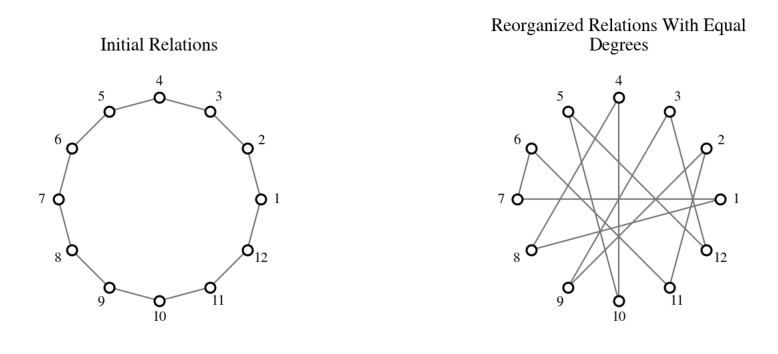
Figure 41. Forty accepted degree-preserving edge swaps transform a twelve-node cycle. The node identities and individual degrees are preserved; the actual pairwise relations change. The CSV records both full edge sets. Structure can change while a name, output, or function continues. The illustration presents a declared reorganization. Juridical reconstruction should identify the continuity criterion, versioned relations, actual transfers, and successor capabilities before connecting organizational change to a legal or historical conclusion.
Formal representation. Equation (47) states the local mathematical representation for this class.
QT =[l(xT,)]. (47)
Notation and conditions. The task is calligraphic T, ell a declared loss and Q_T its expected value at horizon T. A threshold or comparison requires a justified interpretation of the task, population and consequences.
Epistemology and methods. Here ell is a declared task-loss function, not a universal value measure. Compare function under perturbation and withdrawal of support. Record which constituencies selected the task and whether success transfers costs or loss of capacity outside the evaluation boundary.
Domain analysis and practice. A reconstruction can explain how an operation performs a function while leaving the actor’s intention and legal duty open. State the functional task and test its dependence on the proposed operation. Compare alternative pathways and collateral effects. Legal interpretation determines which function, knowledge or purpose is relevant. The dynamic account provides supported causal relations for that judgment with its own scope made clear.
Phenomenon And Practical Problem. A process can perform a useful function through continuing sensing, correction, and resource use. Consider a constructed inquiry into an automated verification service. A low error count can reflect effective checking, an easy test population, hidden human repair, or a task definition that omits difficult failures. The practical problem is to establish what function was performed under which conditions and by which operations. A label such as accurate or compliant compresses several possible propositions whose evidence and consequential significance can differ.
Mechanism And Ontological Commitments. Functional organization identifies a task, success conditions, operations, and support requirements. In physical non-equilibrium systems, sustained activity can enable sensing or proofreading. An institutional application adds interpreted purposes, plural constituencies, and authority over the task. A loss function represents an explicitly chosen comparison; it does not supply a universal measure of value or legal adequacy. The ontology includes ordinary and disrupted conditions, relevant population, timing, and the carriers of continued performance. Physical work on omitted dissipation motivates attention to hidden support while preserving its energetic scope (Bebon, Robinson, and Speck 2025).
Epistemic Design And Discriminating Evidence. Define the claimed operation and test it on cases representing the material difficulty, including failures and boundary conditions. Record preparation, checking, intervention, and repair rather than only final scores. Compare alternatives under matched support and report any additional participant or verification burden. Examine whether performance survives withdrawal or substitution of exceptional inputs. A procedure can be reliable for one use and poorly supported for another. Source checking and version-specific validation are particularly relevant where generated outputs enter legal research, with empirical findings confined to tested systems and tasks (Magesh et al. 2025).
Philosophical Reasoning And Practice. The philosophical inference joins function to justified purpose. Evidence that a system achieves a declared target establishes a conditional performance claim. The appropriateness of that target depends on the issue, affected claims, and authorized role. A juridical proceeding can use operational tests while retaining legal interpretation of adequacy. Social-ecological analysis also asks whether local success displaces costs or depletes supports outside the evaluation boundary. The report should therefore distinguish task achievement, maintained capacity, successor use, and normative justification, giving each its own evidence and premises (Ostrom 2009).
Worked Comparison And Research Proposition. Compare two verification systems with identical benchmark accuracy. One preserves provenance and enables correction of a material error; another offers an untraceable score with similar aggregate success. A constructed study could vary traceability, challenge, and support records, evaluating which legally material claims reviewers can independently verify. The proposition is that function-and-support evidence improves warrant when aggregate performance leaves the operation needed for consequential use unresolved. A practical report states task, population, threshold, horizon, resource boundary, and revision route. It should identify what was demonstrated and which transfer to another function remains an empirical or interpretive question.
Reading the numerical illustration. Figure 42 illustrates the declared mechanism. A functional account identifies the task, success measure and supporting operation. The two declared integrals make one performance-cost comparison explicit, without supplying a public welfare ranking. Other tasks or cost accounts can yield a different comparison. A domain investigation should identify whose function is being assessed, whether participants can actually exercise it, and how its supporting resources and authority are renewed. Successful output and justified continuation then receive their respective evidence and reasons.
12 E. Persistence, Transformation, And Dissolution
12.1 E1. Transient Relaxation
Mechanism and ontology. A regime can be an episode in a longer passage toward another configuration. A transient is defined relative to dynamics and observation horizon. Its duration can be practically consequential even when asymptotic analysis assigns it no permanent status. (Ashwin et al. 2012) Formal representation. Equation (48) states the local mathematical representation for this class.
τA =inf{t≥0:xt ∉A}. (48)
Notation and conditions. The set A identifies the regime and tau_A is its first-exit time. The definition can be applied to deterministic or stochastic paths. Censoring and the finite observation horizon affect estimation.
Epistemology and methods. Define the regime A and use appropriate censoring for unfinished episodes. Compare first-exit distributions and changing environments. Institutional assessment should state whether a temporary service, coalition or learning episode achieved its time-bounded purpose.
Domain analysis and practice. A short-lived pattern can be historically important even if it would decay under continued conditions. Define the episode and compare its duration with the available observation window. Account for censored endings and changing environments. Reconstruction should
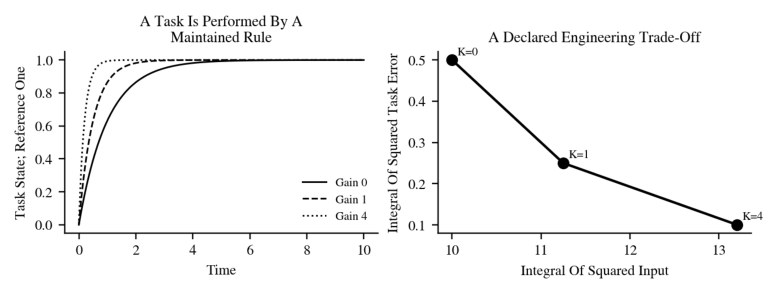
Figure 42. The plant dx/dt = -x + u uses u = 1 + K(1 - x) from x(0)=0. Higher gain reduces integrated squared error while changing a declared quadratic input-cost proxy over time zero to ten. A function requires a declared task, success conditions, and sustained supporting operations. The illustration represents one such conditional organization. Juridical reconstruction should test performance, provenance, repair, and boundary costs separately, then connect the demonstrated function to the standards and authority governing its use.
distinguish an observed cessation, an inferred exit time and an asymptotic prediction. Their legal significance depends on the event interval and issue the proceeding must resolve.
Phenomenon And Practical Problem. A temporary regime can have substantial historical consequences even if it would disappear under continued conditions. Consider a constructed inquiry into an emergency processing arrangement. Its short duration may reflect successful completion, loss of support, replacement, or observation ending before the episode’s conclusion. The practical problem is to establish the regime’s purpose, entry, exit, and relevant horizon. Calling the arrangement temporary gives an incomplete account of what it accomplished, which burdens it imposed, and whether its termination followed the mechanism alleged in the proceeding.
Mechanism And Ontological Commitments. A transient is defined relative to dynamics, a regime criterion, and observation time. Its duration can be practically important even when asymptotic analysis assigns it no permanent status. The ontology includes the initiating state, supported operations, exit condition, and possible successor. A finite record can establish a period of activity while leaving ultimate persistence unresolved. A juridical reconstruction should distinguish observed cessation, inferred first exit, and a model’s long-run prediction. These statements require different evidence and can bear differently on a time-bounded duty or claim (Ashwin et al. 2012).
Epistemic Design And Discriminating Evidence. Recover entry and exit records, continuing supports, task completion, and reasons for observation ending. Compare unfinished episodes using appropriate censoring instead of treating every last record as termination. Include episodes that reach the declared purpose and those interrupted before it. A model can compare exit pathways under stated inputs, while archives and operational records can establish the particular transition. The design should report uncertainty in event times and the criterion used to identify the regime. A short observation window may be adequate when it contains the complete interval material to the legal question.
Philosophical Reasoning And Practice. The philosophical inference concerns the relation between temporal extent and significance. A short-lived arrangement can create an enduring permission, artifact, burden, or capacity. Its value and legal effect therefore depend on what it did and left possible, with duration supplying only part of the account. GR analysis distinguishes current output, renewed support, and historical transmission. A proceeding can follow each passage and identify the sources governing any continuing obligation. This permits an intelligible assessment of a completed episode without making indefinite persistence its presumed standard of success (Huang 2026d).
Worked Comparison And Research Proposition. Compare emergency units that operate for the same interval. One completes its task and transfers accessible records; another stops after losing staff
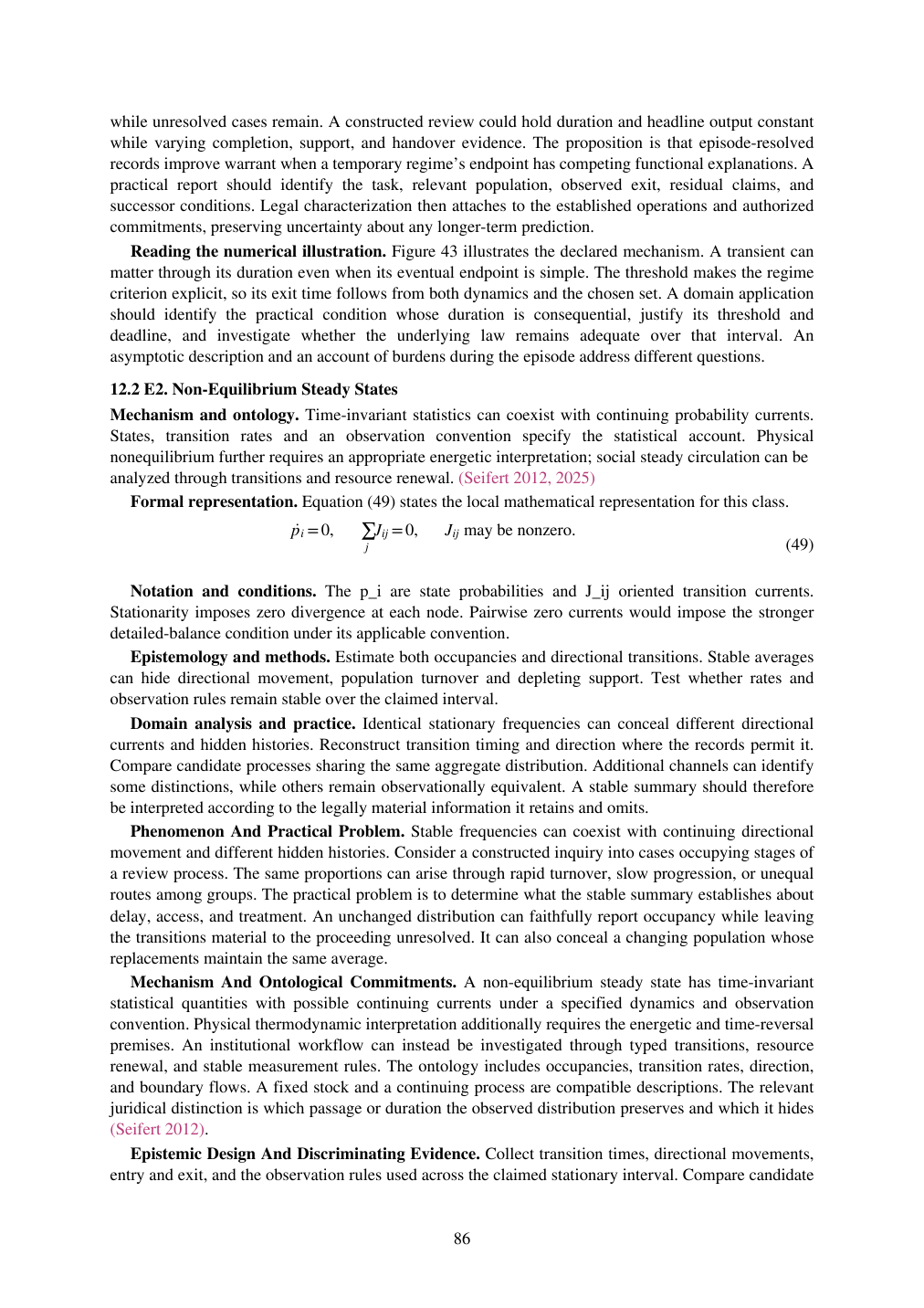
Readable text
while unresolved cases remain. A constructed review could hold duration and headline output constant while varying completion, support, and handover evidence. The proposition is that episode-resolved records improve warrant when a temporary regime’s endpoint has competing functional explanations. A practical report should identify the task, relevant population, observed exit, residual claims, and successor conditions. Legal characterization then attaches to the established operations and authorized commitments, preserving uncertainty about any longer-term prediction.
Reading the numerical illustration. Figure 43 illustrates the declared mechanism. A transient can matter through its duration even when its eventual endpoint is simple. The threshold makes the regime criterion explicit, so its exit time follows from both dynamics and the chosen set. A domain application should identify the practical condition whose duration is consequential, justify its threshold and deadline, and investigate whether the underlying law remains adequate over that interval. An asymptotic description and an account of burdens during the episode address different questions.
Mechanism and ontology. Time-invariant statistics can coexist with continuing probability currents. States, transition rates and an observation convention specify the statistical account. Physical nonequilibrium further requires an appropriate energetic interpretation; social steady circulation can be analyzed through transitions and resource renewal. (Seifert 2012, 2025)
Formal representation. Equation (49) states the local mathematical representation for this class.
Notation and conditions. The p_i are state probabilities and J_ij oriented transition currents. Stationarity imposes zero divergence at each node. Pairwise zero currents would impose the stronger detailed-balance condition under its applicable convention.
Epistemology and methods. Estimate both occupancies and directional transitions. Stable averages can hide directional movement, population turnover and depleting support. Test whether rates and observation rules remain stable over the claimed interval.
Domain analysis and practice. Identical stationary frequencies can conceal different directional currents and hidden histories. Reconstruct transition timing and direction where the records permit it. Compare candidate processes sharing the same aggregate distribution. Additional channels can identify some distinctions, while others remain observationally equivalent. A stable summary should therefore be interpreted according to the legally material information it retains and omits.
Phenomenon And Practical Problem. Stable frequencies can coexist with continuing directional movement and different hidden histories. Consider a constructed inquiry into cases occupying stages of a review process. The same proportions can arise through rapid turnover, slow progression, or unequal routes among groups. The practical problem is to determine what the stable summary establishes about delay, access, and treatment. An unchanged distribution can faithfully report occupancy while leaving the transitions material to the proceeding unresolved. It can also conceal a changing population whose
Mechanism And Ontological Commitments. A non-equilibrium steady state has time-invariant statistical quantities with possible continuing currents under a specified dynamics and observation convention. Physical thermodynamic interpretation additionally requires the energetic and time-reversal premises. An institutional workflow can instead be investigated through typed transitions, resource renewal, and stable measurement rules. The ontology includes occupancies, transition rates, direction, and boundary flows. A fixed stock and a continuing process are compatible descriptions. The relevant juridical distinction is which passage or duration the observed distribution preserves and which it hides
Epistemic Design And Discriminating Evidence. Collect transition times, directional movements, entry and exit, and the observation rules used across the claimed stationary interval. Compare candidate
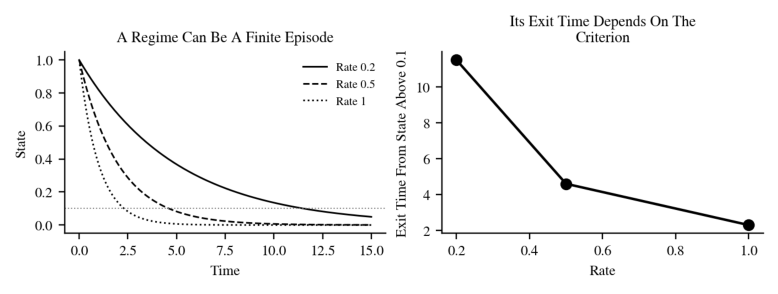
Figure 43. An exact decay begins at one; the transient regime is defined by x greater than 0.1. Its exit time is log(10)/k for each of the three positive rates. A transient regime is an episode defined by its dynamics, persistence criterion, and observation horizon. The illustration supports a conditional account of entry and exit. Juridical reconstruction should distinguish completed purpose, interruption, censored observation, and residual obligations through episode-specific evidence.
processes sharing the same occupancy distribution but differing on the material property. A component record or event trace may separate them when additional aggregate samples do not. Test rate and population stability instead of assuming it from a flat mean. Research on coarse-grained trajectories supplies a physical precedent for investigating omitted dynamics; its entropy-production bounds retain their own assumptions, while a juridical use concerns identified transitions and histories (Seifert 2025).
Philosophical Reasoning And Practice. The philosophical inference is question-relative sufficiency. A compact distribution can identify the quantity needed for one comparison while leaving another claim unidentified. More detail earns its value through a discriminating contribution to the actual issue. This avoids both unwarranted confidence in stable averages and an unbounded demand to reconstruct everything. A proceeding should state the legally material proposition and compare whether it agrees across compatible histories. The decision’s authority and proof requirements determine the treatment of unresolved alternatives, with evidence and legal consequence connected through explicit premises (Huang 2026b).
Worked Comparison And Research Proposition. Compare two review processes with identical stage frequencies. One moves every participant through all stages promptly; another rapidly replaces some entrants while others remain blocked. A constructed study could present occupancies first and then release individual event traces, measuring supported delay and access claims. The proposition is that current-and-duration evidence improves warrant when steady distributions conceal material path differences. A practical report identifies the stationarity interval, transition convention, population continuity, and which properties are actually recovered. It preserves the distinction between a stationary summary, an identified mechanism, and a justified conclusion about treatment.
Reading the numerical illustration. Figure 44 illustrates the declared mechanism. Steady frequencies can coexist with ongoing directional activity, and the same frequencies can hide opposite currents. Exact stationarity is checked using the transition generator. The construction identifies a statistical non-equilibrium feature; its energetic interpretation would require physical correspondence. A domain study should follow actual transitions and resource renewal alongside stocks, inspect which readout discriminates the circulation relevant to its question, and evaluate the function or distribution sustained by that flow through additional substantive premises.
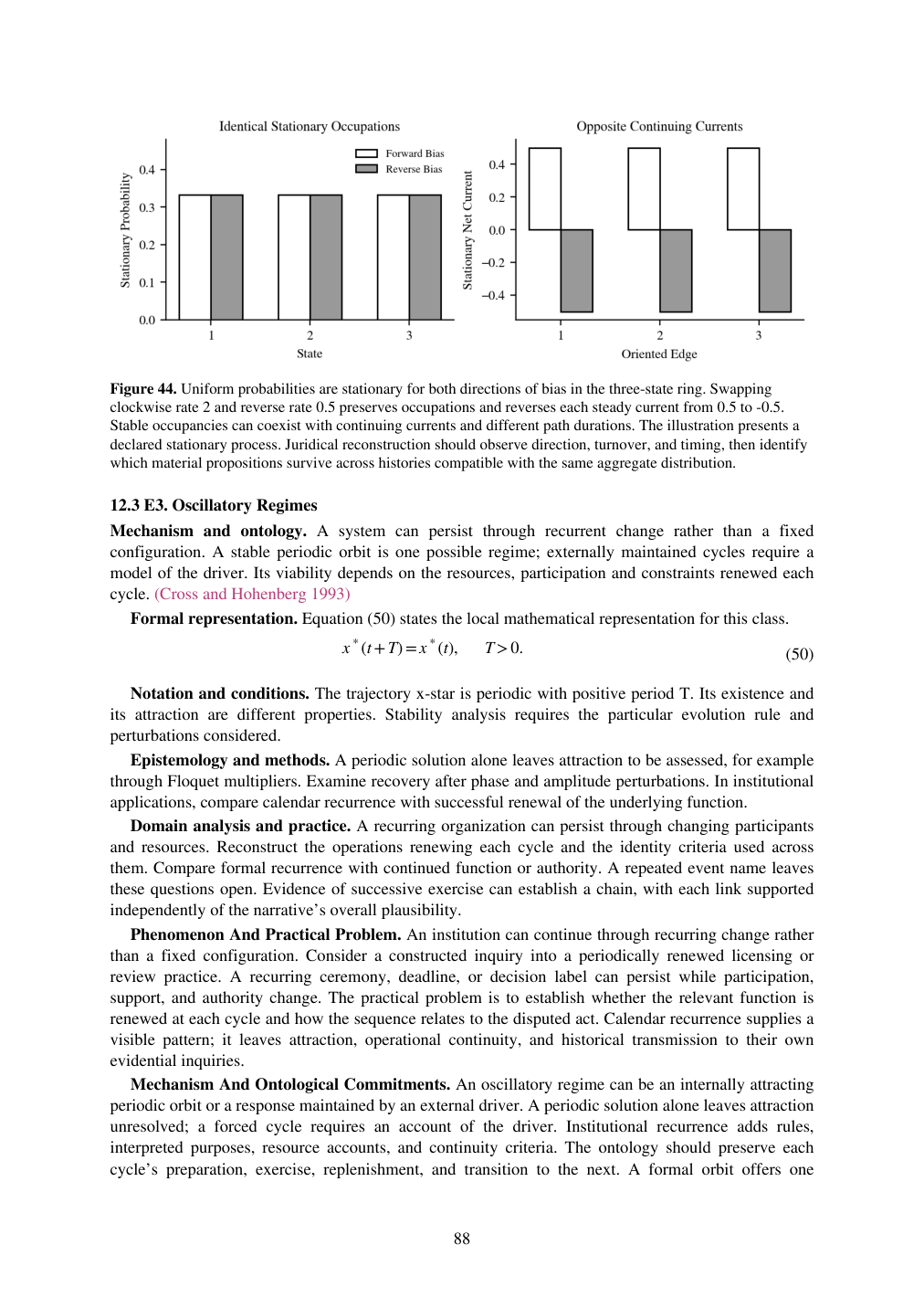
Readable text
Figure 44. Uniform probabilities are stationary for both directions of bias in the three-state ring. Swapping clockwise rate 2 and reverse rate 0.5 preserves occupations and reverses each steady current from 0.5 to -0.5. Stable occupancies can coexist with continuing currents and different path durations. The illustration presents a declared stationary process. Juridical reconstruction should observe direction, turnover, and timing, then identify which material propositions survive across histories compatible with the same aggregate distribution.
Mechanism and ontology. A system can persist through recurrent change rather than a fixed configuration. A stable periodic orbit is one possible regime; externally maintained cycles require a model of the driver. Its viability depends on the resources, participation and constraints renewed each
Formal representation. Equation (50) states the local mathematical representation for this class.
Notation and conditions. The trajectory x-star is periodic with positive period T. Its existence and its attraction are different properties. Stability analysis requires the particular evolution rule and
Epistemology and methods. A periodic solution alone leaves attraction to be assessed, for example through Floquet multipliers. Examine recovery after phase and amplitude perturbations. In institutional applications, compare calendar recurrence with successful renewal of the underlying function.
Domain analysis and practice. A recurring organization can persist through changing participants and resources. Reconstruct the operations renewing each cycle and the identity criteria used across them. Compare formal recurrence with continued function or authority. A repeated event name leaves these questions open. Evidence of successive exercise can establish a chain, with each link supported
independently of the narrative’s overall plausibility.
Phenomenon And Practical Problem. An institution can continue through recurring change rather than a fixed configuration. Consider a constructed inquiry into a periodically renewed licensing or review practice. A recurring ceremony, deadline, or decision label can persist while participation, support, and authority change. The practical problem is to establish whether the relevant function is renewed at each cycle and how the sequence relates to the disputed act. Calendar recurrence supplies a visible pattern; it leaves attraction, operational continuity, and historical transmission to their own
Mechanism And Ontological Commitments. An oscillatory regime can be an internally attracting periodic orbit or a response maintained by an external driver. A periodic solution alone leaves attraction unresolved; a forced cycle requires an account of the driver. Institutional recurrence adds rules, interpreted purposes, resource accounts, and continuity criteria. The ontology should preserve each cycle’s preparation, exercise, replenishment, and transition to the next. A formal orbit offers one
conditional representation, while a time-varying event model may better preserve irregular deadlines and changes in authority (Cross and Hohenberg 1993).
Epistemic Design And Discriminating Evidence. Trace several cycles using dated source records, including interruptions, late actions, and failed renewal. Compare phase and amplitude responses to disturbances where these quantities have a justified meaning. Investigate whether the same function is exercised by changed participants and whether resources or permissions are actually restored. A stable name can mask substitution or dwindling access. Historical evidence should establish the chain between cycles instead of treating repeated wording as independent proof. Where a dynamical model contributes, report the observation and stability assumptions alongside the episode-specific evidence.
Philosophical Reasoning And Practice. The philosophical inference concerns persistence through enacted renewal. A practice exists over time through operations that can preserve, alter, or end its conditions. The relevant criterion can follow a legally recognized arrangement, a usable function, or an evidenced lineage. Process philosophy provides a setting for examining that continuity, with the present framework specifying its inferential tests. Normative evaluation asks whether the recurrence deserves continuation and how its burdens are distributed. Those premises remain distinct from the fact that a cycle reliably reproduces itself (Whitehead 1978; Huang 2026d).
Worked Comparison And Research Proposition. Compare recurring review programs with the same schedule. One renews trained personnel, accessible records, and challenge routes; another repeats the formal meeting while practical participation contracts. A constructed review could reveal support and access histories after matched calendars, evaluating supported claims of continuity and function. The proposition is that cycle-level renewal evidence improves warrant when recurrence can conceal transformed practical capacity. A report should identify which operation continued, what changed between cycles, and the sources governing authority at each stage. It should preserve any unresolved gap between repeated manifestation and a usable continuing institution.
Reading the numerical illustration. Figure 45 illustrates the declared mechanism. A persistent regime can involve continuing change. Stability here concerns return toward a periodic set, while phase continues to evolve. The exact radial solution makes the attracting direction explicit. A domain application should identify the operation repeated through the cycle, the supports and constraints renewed during recurrence and the distinction between an internally supported cycle and external scheduling. Assessing its continuation also requires a justified function, horizon and distribution of recurring burdens.
12.4 E4. Metastability
Mechanism and ontology. A regime can persist for a long interval while retaining a feasible escape route. Residence duration depends on barriers, disturbance and environmental change. The useful ontology includes both the continuing configuration and the pathways through which it could change. (Ashwin et al. 2012; Holling 1973)
Formal representation. Equation (51) states the local mathematical representation for this class.
Pr(τA >t)≈e−κt. (51)
Notation and conditions. Kappa is a positive constant-hazard approximation for exit from A. Its adequacy is an empirical or model-specific question. A changing hazard requires a corresponding survival function.
Epistemology and methods. An exponential survival model requires roughly constant hazard; test alternatives and account for censoring. Persistence can reflect capability, switching costs or unequal exit power. Compare these explanations with evidence about actual alternatives.
Domain analysis and practice. A long-lived relation can end through a rare disturbance while retaining local stability beforehand. Compare a metastable model with gradual deterioration and external intervention. Residence histories and non-exit cases help discriminate them. The reconstruction should state the horizon over which persistence was supported and the uncertainties in inferred exit
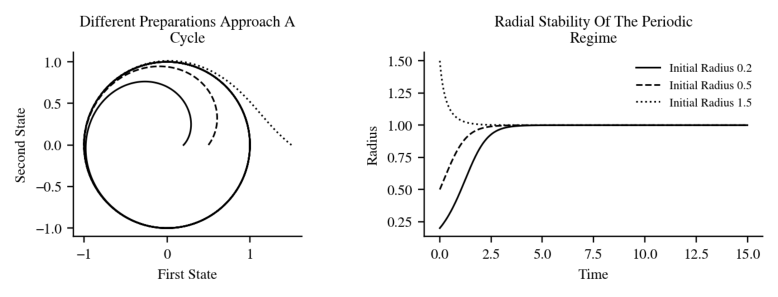
Figure 45. The autonomous radial law dr/dt = r(1 - r squared) with angular speed one has an attracting unit cycle. Exact positive-radius solutions show three preparations approaching its periodic orbit. A regime can persist through recurrent change supported internally or by an external driver. The illustration concerns a declared oscillatory regime. Juridical reconstruction should verify renewal, authority, participation, and functional continuity across cycles, with periodic appearance distinguished from attraction and historical transmission.
routes. A legal assessment of foreseeability requires the applicable standard and contemporaneously available evidence.
Phenomenon And Practical Problem. A long-lived arrangement can retain an exit route while appearing stable over the observed interval. Consider a constructed inquiry into a dependent supplier relationship that ends suddenly. Its prior duration may reflect useful cooperation, high switching costs, restricted alternatives, or temporary support. The practical problem is to determine which mechanism sustained the relation and what changed at departure. Persistence supplies evidence that an arrangement endured, while leaving its attractiveness, voluntary character, vulnerability, and the feasibility of earlier exit unresolved.
Mechanism And Ontological Commitments. Metastability describes prolonged residence with a feasible escape pathway under specified dynamics and disturbance. A constant-hazard approximation is one model requiring its own empirical support. Institutional persistence may be maintained through sunk commitments, credentials, knowledge, or coordination. Those carriers can change even while visible activity stays similar. The ontology includes the regime criterion, support, alternatives, and time horizon. A short record can establish endurance without identifying an escape distribution or a stable preference. Tipping research supplies a formal comparison among disturbance, instability, and tracking mechanisms (Ashwin et al. 2012).
Epistemic Design And Discriminating Evidence. Collect residence histories, non-exit cases, attempted transitions, available substitutes, and changes in external support. Compare a raredisturbance account with gradual depletion or altered permission. Account for censoring and changing hazard before fitting survival quantities. Dated failed exits can establish a barrier, while later success may depend on a new complement unavailable earlier. The reconstruction should preserve contemporaneous alternatives and information. Ecological resilience research offers a conceptual precedent for distinguishing persistence and response properties, with the specific institutional relation investigated through its own operations and evidence (Holling 1973).
Philosophical Reasoning And Practice. The philosophical inference concerns the relation between endurance and practical freedom. A subject can participate actively within a relation while facing constrained departure. Identifying those constraints clarifies the space of feasible action and the authority structuring it. Capability-oriented reasoning makes exit conditions an intelligible object of evaluation, while legal standards determine which constraints matter to consent, duty, or responsibility. A causal account of persistence therefore contributes evidence without deciding the relation’s
legitimacy through longevity or stability alone. The report should state the actual normative bridge (Sen 2009). Worked Comparison And Research Proposition. Compare equally long supplier relationships. One offers usable alternatives throughout; another becomes transferable only after documentation and credentials are released. Their residence durations agree while the history of feasible exit differs. A constructed review could vary barrier and substitution records, measuring supported conclusions about persistence and practical choice. The proposition is that exit-path evidence improves warrant when duration can be misread as preference or inevitability. A useful report distinguishes observed residence, supported sustaining mechanisms, contemporaneous alternatives, and uncertainty about the departure, then connects those findings to the applicable legal issue through explicit sources and reasons.
Reading the numerical illustration. Figure 46 illustrates the declared mechanism. Long residence and permanent closure are different properties. The survival curve quantifies the declared escape opportunity, while the single path makes departure and return visible within a finite horizon. This is a constant-rate construction; changing environments, heterogeneous barriers or aging can alter its law. A domain inquiry should identify feasible exit routes, retain censored observations and compare disturbances and support changes before treating long survival as evidence of renewal or justified stability.
12.5 E5. Aging
Mechanism and ontology. Response properties can depend on the time elapsed since preparation or reorganization. Two-time measurements expose this dependence. In social systems, cohort change, institutional learning and accumulating obligations can generate temporal variation with different causal explanations. (Korbel et al. 2026)
Formal representation. Equation (52) states the local mathematical representation for this class.
C(tw +t,tw) depends on both t and tw. (52)
Notation and conditions. The two-time correlation C uses a waiting time t_w and later lag t. Aging in this operational description concerns dependence on waiting time after accounting for observation and cohort change.
Epistemology and methods. Keep waiting time, calendar time and cohort membership distinguishable. Compare observation drift, attrition and real changes in response. A model fitted to one institutional age needs evidence before its parameters are transferred to another.
Domain analysis and practice. A process and its records can change with elapsed time through wear, learning, memory revision and cohort replacement. Reconstruct waiting time, calendar time and source exposure separately. Compare stable-observation and drifting-observation models. A later testimony or test can remain relevant while requiring a bridge to the earlier state. The strength of that bridge depends on the mechanism and supporting evidence.
Phenomenon And Practical Problem. Response properties can depend on time elapsed since preparation or reorganization. Consider a constructed inquiry into a newly formed review office whose processing changes as staff learn and obligations accumulate. A later response may differ from an earlier one under similar immediate demand. The practical problem is to distinguish organizational age, calendar changes, cohort composition, and observation drift. A comparison using current performance to reconstruct earlier capability can be misleading when the supports and practical knowledge enabling that performance developed during the intervening period.
Mechanism And Ontological Commitments. Aging concerns dependence on elapsed preparation time beyond a single time difference. Two-time measurements make that dependence explicit. Institutional counterparts can involve learning, accumulating commitments, asset wear, or changing membership, each with its own carrier. Their common description as age should not replace mechanism discrimination. The ontology includes preparation, experience, support, and the units followed across time. Physical perspectives on non-equilibrium dynamics motivate attention to memory and changing
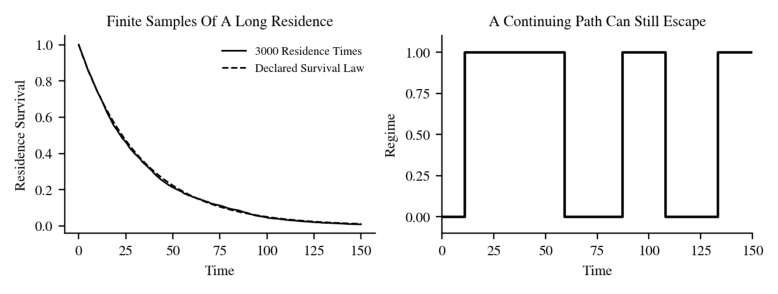
Figure 46. Three thousand residence times use an exponential escape rate 0.03. A separate two-regime path uses that rate for both transitions, so re-entry is possible after escape. Long residence can coexist with a feasible but difficult escape route. The illustration represents one declared metastable regime. Juridical reconstruction should compare support, barriers, alternatives, and non-exit histories before interpreting persistence as preference or a sudden departure as loss of stability.
descriptions, while the proposed juridical application requires an independently supported institutional mechanism (Korbel et al. 2026).
Epistemic Design And Discriminating Evidence. Preserve preparation dates, training, membership, resource condition, rule versions, and the observation process. Compare matched stages across cohorts and similar calendar conditions where available. A difference between older and younger units can reflect selection or common environmental change, requiring explicit alternatives. Longitudinal records can identify whether the same unit changed, with attrition and replacement retained in the account. A reconstruction should state whether it estimates current state, recovers an earlier capability, or identifies the mechanism producing change. These are different tasks even when they use the same time series.
Philosophical Reasoning And Practice. The philosophical inference concerns historical capability and evidence acquired later. Demonstrated competence at review can be genuine while supplying limited evidence of competence at an earlier act. Conversely, early failure can coexist with a subsequently learned capacity. GR analysis separates realized output, context-dependent capacity, renewal, and historical transmission. A proceeding can establish when a relevant support became exercisable, then apply the appropriate standard to the material interval. This permits a temporal account of responsibility that preserves learning and change without inferring either immunity or fault from organizational age alone (Huang 2026d, 2026b).
Worked Comparison And Research Proposition. Compare offices with equal current accuracy. One possessed the relevant training before the disputed decision; another acquired it through a later correction. A constructed study could vary preparation and learning histories, measuring supported judgments about earlier capability and the source of present performance. The proposition is that twotime and support records improve warrant when present observations can be projected backward across learning or depletion. A practical report states the age convention, population continuity, mechanism, and contemporaneous information, identifies uncertainty in the historical reconstruction, and connects the supported temporal distinction to the applicable legal question.
Reading the numerical illustration. Figure 47 illustrates the declared mechanism. Two-time dependence can arise through the history of a surviving cohort. This exactly evaluated example is a conditional persistence function, whose aging appearance follows from a heavy-tailed waiting law and selection by survival. It provides one explicit mechanism for age-dependent response. A domain study should compare that pathway with learning, accumulating obligations, cohort replacement and changes in the environment, preserving the preparation event and the two observation times in its evidence.
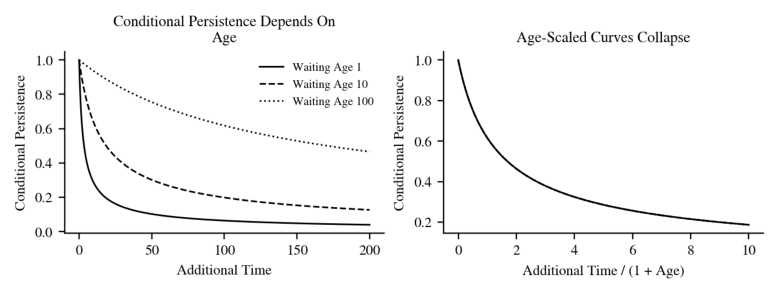
Figure 47. A waiting-time law has survival (1 + t) to the power -0.7. Conditional on having survived to age tw, further persistence is [(1 + tw)/(1 + tw + t)] to that power. The right panel uses the declared age scaling. Response can depend on elapsed time since preparation, alongside calendar and cohort changes. The illustration presents one declared aging pattern. Juridical reconstruction should establish the carrier of change and the material interval before projecting present capability backward or interpreting age as a causal explanation.
12.6 E6. Critical Regimes
Mechanism and ontology. Criticality concerns specified scaling and correlation behavior near a transition under appropriate limits. It can motivate questions about responsiveness and collective organization. Its desirability depends on the task, costs and disturbance; a universal optimum for creativity or governance requires an additional argument. (Cross and Hohenberg 1993; Boettiger and Hastings 2012)
Formal representation. Equation (53) states the local mathematical representation for this class.
ξ∼|λ−λc|−ν. (53)
Notation and conditions. Xi is a defined correlation length, lambda a control parameter, lambda_c a candidate critical value and nu an exponent. The scaling is a model- and limit-dependent relation with finite-size qualifications.
Epistemology and methods. Define correlation length, control parameter and estimation range. Test finite-size effects and competing noncritical models. Increased variance or autocorrelation can be informative under particular mechanisms, with prospective false-positive evaluation determining operational usefulness.
Domain analysis and practice. A critical-regime explanation of a disputed event requires defined observables and comparison with shocks, noise and category change. Evaluate warnings against nontransition episodes and report false positives. A legal reconstruction can examine specific amplification and delay mechanisms with more modest data. The stronger criticality claim should remain indexed to the evidence and limits supporting it.
Phenomenon And Practical Problem. A regime near a hypothesized transition can display heightened response, variance, or persistence. Consider a constructed inquiry into warnings before institutional breakdown. Such patterns might reflect critical dynamics, external shocks, reporting changes, or ordinary fluctuations selected after the event. The practical problem is to establish whether the warning distinguished relevant futures and what it made knowable during the material interval. Calling a setting critical can compress urgency, instability, and collective sensitivity into one label, while the underlying mechanisms and legal questions require more precise treatment.
Mechanism And Ontological Commitments. A critical-regime account specifies an order parameter, control condition, correlations, size, and limiting procedure. Scaling relations have a range and assumptions. Increased variance or autocorrelation can arise under several mechanisms, so their
Readable text
presence is an observation rather than a complete identification result. The ontology includes the process, observation, perturbation, and relevant comparison regime. A social application must establish how the proposed interaction generates the material response. A claim that criticality is desirable for creativity, governance, or justice requires an additional task-specific evaluative argument (Cross and
Epistemic Design And Discriminating Evidence. Evaluate warning performance prospectively or through withheld episodes, including false alarms and non-transitions. Test sensitivity to boundary, aggregation, observation changes, and common inputs. Compare critical and noncritical models on implications material to the decision. A narrower documented vulnerability can support a useful warning even where stronger scaling claims remain unresolved. Early-warning research makes selected- event bias a concrete concern. The design should preserve the information contemporaneously available, the action the signal could support, and the costs of mistakes under plausible alternatives
Philosophical Reasoning And Practice. The philosophical inference separates a scientifically proposed regime from a publicly consequential category. An institution can act on a warning through a justified precautionary or evidential standard while the exact mechanism remains uncertain. The report should state that bridge, including the purposes and affected claims. Conversely, a retrospective model can explain heightened response without establishing that a particular actor possessed adequate advance information. Inductive-risk reasoning makes error consequences relevant to the evidential demand, with the applicable legal sources determining their role in the proceeding (Douglas 2000).
Worked Comparison And Research Proposition. Compare warnings with similar pre-event trajectories. One was tested against ordinary episodes and linked to a feasible response; another was selected after breakdown from many untested indicators. A constructed study could vary validation and information histories, measuring supported conclusions about predictive warrant and historical knowledge. The proposition is that prospective-comparison evidence improves reconstruction when a criticality narrative becomes consequential. A practical report distinguishes observed symptoms, supported mechanism, warning performance, available action, and the legal standard governing anticipation or intervention. It preserves uncertainty at the stronger theoretical level while identifying any material conclusion robust across competing accounts.
Reading the numerical illustration. Figure 48 illustrates the declared mechanism. Critical scaling is a claim about a specified family and limit. Here the covariance and exponent are stipulated through an exactly defined Gaussian field, with finite positive distances plotted. The result gives an operational meaning to correlation length and its parameter dependence. A domain application should justify its field, metric, control parameter and size limit, compare rival causes of extended correlation, and supply separate reasons for any claim that such responsiveness improves a public or creative task.
Mechanism and ontology. A population or process may enter a regime from which the declared internal rules permit no return. The regime-level consequence complements the transition mechanism C15. Changing the boundary, adding external support or revising the rules can change the set of
Formal representation. Equation (54) states the local mathematical representation for this class.
Notation and conditions. The conditional probability concerns a specified absorbing set A and the permitted dynamics. The statement presupposes those dynamics remain in force over the future interval.
Epistemology and methods. Specify the actions included in the probability statement. Empirical closure, loss of a carrier and loss of recoverable capacity require separate tests. Examine preserved knowledge, permissions and external relations when considering possible restoration.
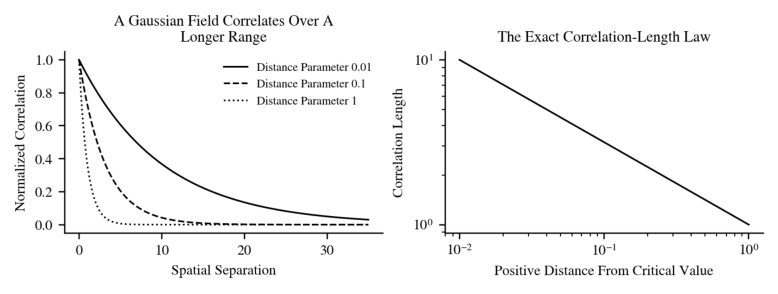
Figure 48. The normalized covariance of an infinite-line massive Gaussian field with spectrum proportional to 1/(a + k squared) is exp(-sqrt(a) times distance), with positive a. Its correlation length is exactly a to the power -1/2; the figure evaluates this model law over a finite parameter range. Critical-regime claims require specified observables, scales, and comparisons, while similar warning patterns can have other causes. The illustration is conditional on its model. Juridical reconstruction should distinguish regime identification, prospective warning performance, contemporaneous knowledge, and the grounds for consequential action.
Domain analysis and practice. An apparent endpoint can be physical destruction, legal finality, administrative inactivity or loss of access. Define which object and boundary the claim concerns. Investigate preserved carriers, successor authority and possible restoration. A model’s absorbing state expresses its permitted transitions. Evidence and legal interpretation determine whether that representation matches the endpoint relevant to the proceeding.
Phenomenon And Practical Problem. A process can remain within an endpoint regime after the event that produced it, while residual participants, records, and duties continue. Consider a constructed inquiry into a closed service. The service’s internal rules may permit no new activity, yet successors or external support can preserve some function. The practical problem is to establish which object entered the endpoint and which obligations or capacities remain. Closure of an organization, loss of an operating route, and destruction of recoverable information can coincide or diverge.
Mechanism And Ontological Commitments. An absorbing regime is defined by the transitions allowed after entry: the process remains within the specified set unless its rule or boundary changes. This is a regime-level consequence, distinct from the particular transition causing absorption. The ontology includes entry criterion, admissible actions, support, and identification across possible restoration. A physical or organizational endpoint can leave other processes active. An institutional account should state which operations are excluded by law, technical design, resource loss, or the investigational boundary. The mathematical property remains relative to that declared operation set (Gross and Blasius 2008).
Epistemic Design And Discriminating Evidence. Reconstruct the entry event and subsequent records, testing whether activity ceased, moved, became inaccessible, or continued through another carrier. Inventory archives, resources, permissions, successor roles, and restoration possibilities. Compare internal inactivity with external interventions capable of changing the rule. A claim of permanent closure requires support appropriate to its horizon and criterion. A report should preserve uncertainty in future restoration while establishing the historical absence relevant to the proceeding. Direct evidence about residual duties or transferred records can matter even when the broader regime model remains incomplete.
Philosophical Reasoning And Practice. The philosophical inference concerns differentiated endings. The identity of a legal entity, practical function, relational subject, and information object can follow different continuity criteria. Process-oriented reasoning allows an endpoint for one object alongside continuation for another. GR analysis adds a question about usable successor possibilities:
preserved content or permission becomes a capacity through actual receiving conditions. Juridical interpretation then connects the established endpoint and remainder to the applicable sources governing closure, succession, and continuing claims. Absorption in a model supplies a conditional description, with its legal significance argued separately (Whitehead 1978; Huang 2026d).
Worked Comparison And Research Proposition. Compare services that accept no new cases after closure. One transfers accessible records and functioning referral routes; another retains records without usable permissions and leaves cases without a receiving office. Their internal activity is equally absent while consequences for users differ. A constructed review could vary remainder and successor evidence, measuring supported conclusions about function and continuity. The proposition is that postentry operational records improve warrant when a closed regime can conceal continuing effects or successor options. A practical report identifies what ended, when and through which rule, what remains active, and the sources governing each consequential relationship.
Reading the numerical illustration. Figure 49 illustrates the declared mechanism. Absorbing character depends on the rule and boundary. The internal retention process permits decline and extinction while supplying no route from zero. The displayed external operation changes that reachable set explicitly. A domain inquiry should state which internal operations have ended and which outside actor, resource or rule revision could reopen them. The availability and justification of reopening then depend on real capacities, costs, permissions and affected claims, beyond the mathematical observation that an added channel changes the process.
12.8 E8. Structural Transformation
Mechanism and ontology. An organization can change its relations, membership or authority while retaining some processes. Transformation requires an explicit identity criterion and a record of what changes. A representation that fixes categories forever can conceal precisely the transition under investigation. (Gross and Blasius 2008; Ostrom 2009)
Formal representation. Equation (55) states the local mathematical representation for this class.
t+1 =(t,ut,ηt). (55)
Notation and conditions. Calligraphic S is an organizational description and U its declared update, with eta representing unresolved variation. Changes of state space require an account of how old and new descriptions correspond.
Epistemology and methods. Here S denotes an organizational description, potentially with changing state space. Retain translations and unmatched categories across revisions. Compare effects on functions and participant capacities alongside topological or legal changes.
Domain analysis and practice. The reconstructed process can change its own categories and relations. Preserve versioned identification rules and translations across the transition. Compare models with fixed and changing state spaces against the records. An unmatched category should remain visible where translation would erase a material distinction. Legal interpretation determines how changed categories bear on continuity, attribution and obligation.
Phenomenon And Practical Problem. A process can change its membership, rules, or authority while preserving some operations. Consider a constructed inquiry into a regulatory body after a governance reform. The name and headline output may remain stable while decision rights, categories, and challenge routes change. The practical problem is to establish which legal and historical object the proceeding follows through that transformation. Comparing records across the reform requires a translation that preserves material distinctions without assuming that every earlier category has an unchanged later equivalent.
Mechanism And Ontological Commitments. Structural transformation can alter the state description itself, including relation types and available operations. The ontology therefore includes the former and later organizations, the act of revision, and a versioned correspondence between them. Some objects persist, some split or merge, and others become unmatched. A static model can conceal
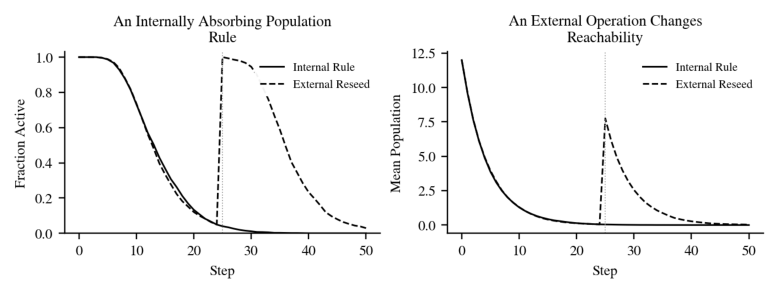
Figure 49. Each of 1,500 populations begins at twelve and independently retains each member with probability 0.8 per step. Zero is internally absorbing. The separate intervention arm inserts eight members into empty populations at step twenty-five. An absorbing regime persists under its declared operations after entry, while other objects and functions may continue. The illustration is boundary-relative. Juridical reconstruction should identify the endpoint criterion, residual records and duties, and any external or successor operations that change the relevant possibilities.
precisely this transition. Institutional and adaptive-network perspectives supply resources for examining interacting components and changing relations, with the legal application adding the sources through which the transformation acquires authority and practical force (Gross and Blasius 2008; Ostrom 2009).
Epistemic Design And Discriminating Evidence. Preserve constituting instruments, decision histories, category translations, personnel changes, access permissions, and implementation records. Compare formal revision with actual exercise and examine transitional gaps. A versioned event ledger should retain both original classifications and subsequent reinterpretations. Test which conclusions survive alternative translations. Independent records can establish a continuing operation even where categories change, while a stable category can conceal a different operation. A reconstruction should identify which mismatches are evidential uncertainty and which reflect an actual change in the object, then choose additional evidence for the material distinction.
Philosophical Reasoning And Practice. The philosophical inference concerns identity and warranted interpretation through change. A recognized institutional act can establish formal continuity, while a causal or functional account investigates what the act enables. Neither passage supplies the other’s entire warrant. Hart’s source-recognition problem and constructive interpretation provide reference points for examining institutionally authorized continuation. The present framework adds explicit recording of changed feasible operations and observation conditions. A proceeding can therefore state which historical proposition is preserved, which requires reinterpretation, and what sources and reasons govern the translation (Hart 2012).
Worked Comparison And Research Proposition. Compare reforms that retain the same publicfacing office. One preserves the route for a claim while changing internal staffing; another transfers authority to a different body while leaving the old interface visible. A constructed review could vary constituting and operational records, measuring supported conclusions about authority, access, and continuity. The proposition is that versioned institutional evidence improves warrant when stable manifestations conceal transformed powers. A practical report identifies the continuity criterion, verified changes, unmatched categories, and actual receiving relations. It connects each supported claim to the relevant legal issue through explicit sources, preserving the separate question of whether the transformation is justified.
Reading the numerical illustration. Figure 50 illustrates the declared mechanism. Structural transformation can preserve selected features while changing the operations supported by the arrangement. The event sequence retains membership and connectivity but alters reachability distance
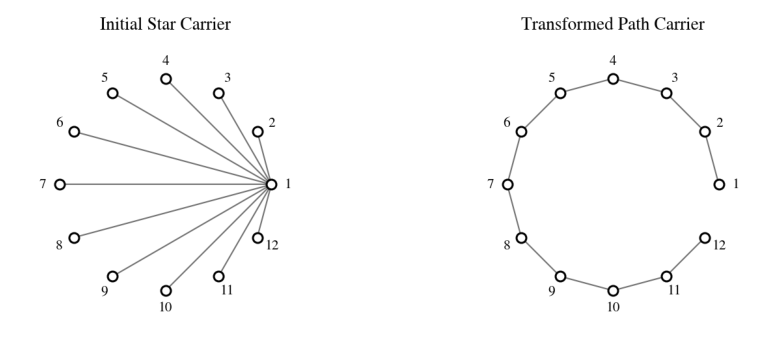
Figure 50. A twelve-node star is transformed into a path through ten edge replacements. Membership, connectivity and eleven undirected edges are preserved. Maximum distance from node one changes from one to eleven. Transformation can change the relations and categories through which an institution operates and becomes visible. The illustration represents a declared revision. Juridical reconstruction should preserve versioned correspondences, unmatched objects, authorized powers, and practical access before treating stable names or outputs as continuity.
and the position of the former hub. Those are explicit identity and functional distinctions. A domain inquiry should state which memberships, roles or authority relations carry forward, trace how the transition affects real operations, and investigate whose capacities and obligations change despite continuity of a nominal institution or aggregate structural count.
12.9 E9. Functional Succession
Mechanism and ontology. A later arrangement can perform a function previously supported by another organization. Functional identity, organizational identity and historical transmission have different criteria. Succession may preserve a capacity through changed carriers while redistributing authority, effort and access. (Folke et al. 2005; Ostrom 2009)
Formal representation. Equation (56) states the local mathematical representation for this class.
Q(Gt+1,xt+1;)≥qmin. (56)
Notation and conditions. Q is a declared functional-performance measure, q_min a chosen threshold and calligraphic T the task. The inequality is a criterion to justify for the question and population being assessed.
Epistemology and methods. State the task, threshold, population and deadline. Compare pre- and post-transition performance under matched disturbances and resource accounts. Historical tracing is needed to establish which capacities were inherited and which were independently created.
Domain analysis and practice. A successor can perform an earlier function through different operations and authority. Reconstruct the transfer and test the successor’s actual capacity. Compare historical transmission with independent creation and nominal assignment. Continuity of service leaves responsibility and ownership to their relevant legal rules. The factual account should state which carrier, permission and operation continued and which changed.
Phenomenon And Practical Problem. A successor can carry a function after its earlier organization ends, yet formal assignment can exceed practical capability. Consider a constructed inquiry into a service transferred to a new provider. Records, training, equipment, permissions, and user routes may pass together or separately. The practical problem is to establish what the successor could actually do within the relevant deadline and which capacities were historically inherited. A successful later output
may arise through the transfer, exceptional outside support, or independent reconstruction, each with different implications for the disputed claim.
Mechanism And Ontological Commitments. Functional succession identifies a task, population, success threshold, horizon, and carrier capable of performing it. Organizational identity, functional identity, and historical transmission have different criteria. The ontology includes the predecessor’s contribution, transfer operation, receiving conditions, successor exercise, and support for continued use. An inherited artifact becomes a usable capacity through complementary knowledge and authority. A social-ecological framework supplies a setting for studying interacting supports and institutional adaptation, while the particular succession claim requires evidence of the actual chain (Ostrom 2009; Folke et al. 2005).
Epistemic Design And Discriminating Evidence. Compare pre- and post-transfer performance under relevant demands and disturbances, preserving resource and population differences. Trace tools, records, personnel, permission, and receiving acknowledgment. Test ordinary operation and recovery from a realistic interruption where access permits. Historical sources establish descent; operational tests establish function. An apparently successful handover can depend on an exceptional specialist who later leaves. The report should identify that support instead of treating initial output as proof of reproducible successor capability. Missing links should remain explicit alternatives or bounded uncertainties in the reconstruction.
Philosophical Reasoning And Practice. The philosophical inference concerns generativity’s historical passage. A prior contribution can enable later exercise without determining its entire content, since successors add knowledge and choices. Accurate attribution should recognize both the inherited support and the new work. GR relational wealth makes valuable exercisable possibilities a distinct object of assessment, while legal interpretation determines the sources governing any obligation or entitlement attached to succession. A functional benefit does not alone establish legal continuity, and formal continuity acquires practical adequacy through evidence about the function it is expected to carry (Huang 2026d).
Worked Comparison And Research Proposition. Compare providers with identical transfer documents. One can retrieve cases, maintain tools, and respond independently; another produces early outputs through continued predecessor intervention. A constructed study could reveal dependency and disturbance records after formal handover evidence, measuring supported conclusions about transfer and capability. The proposition is that successor-operation evidence improves warrant when formal assignment and reproducible performance can diverge. A practical report identifies the task, relevant users, deadline, inherited components, additional supports, and verified exercise. It connects these findings to the actual legal issue while preserving uncertainty about future demands outside the tested range.
Reading the numerical illustration. Figure 51 illustrates the declared mechanism. Succession requires a usable operation through the later carrier. The model separates the timing of carrier replacement from the quality of the transmitted capacity and tests their sum against an explicit task criterion. A domain inquiry should establish what successors can actually perform, the complements and permissions they inherit, and the historical connection supporting a transmission claim. Choosing a function, threshold and transition burden additionally requires substantive reasons from the relevant public, legal or collaborative setting.
12.10 E10. Dissolution
Mechanism and ontology. A structure dissolves when it ceases to meet an explicit persistence criterion. Resource loss, instability, disturbance, rapid change, rewiring, substitution, self-limitation and cascades are distinct cross-cutting pathways. Dissolution can coexist with continuing participants, records and successor functions. (Ashwin et al. 2012; Gross and Blasius 2008)
Formal representation. Equation (57) states the local mathematical representation for this class.
τdiss =inf{t:P(t)<pmin}. (57)
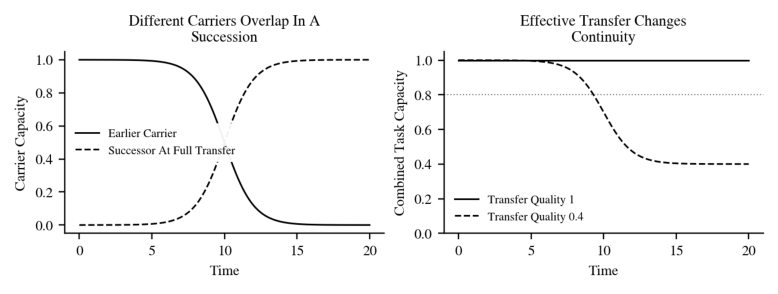
Figure 51. Carrier capacities are assumed additive. Complementary logistic profiles are combined using a stipulated effective conversion factor one or 0.4. The declared functional threshold is 0.8. Organizational handover can occur while the poorer transfer falls below that criterion. A function can continue through a new carrier when usable supports and receiving conditions are established. The illustration concerns conditional succession. Juridical reconstruction should distinguish formal assignment, demonstrated function, historical transmission, and continuing dependence before evaluating the legal consequence of a handover.
Notation and conditions. P is a defined persistence measure and p_min its chosen threshold. The stopping time depends on those identification criteria. A different target, including function or authority, can have a different endpoint.
Epistemology and methods. Specify what P measures and distinguish it from welfare or justice. Observe residual capacity and the allocation of closure costs. A self-limiting institution deserves that description when its own operation changes a condition supporting its continued necessity.
Domain analysis and practice. A structure can dissolve through depletion, instability, disturbance, rapid change, rewiring, substitution, self-limitation or a cascade. Treat these as rival or combined pathways and specify the persistence criterion. Reconstruct residual duties, supports and records. A self-limiting account requires evidence that the structure’s own operation changed a condition of its necessity. Legal consequences require the relevant rules for closure, succession and remaining claims.
Phenomenon And Practical Problem. An organization can cease through resource loss, instability, disturbance, rapid environmental change, rewiring, substitution, self-limitation, or a cascade. Consider a constructed inquiry into a project’s termination. The same cessation date can follow exhaustion, successful completion, transfer of its task, or an avoidable interruption. The practical problem is to establish the persistence criterion and the pathway material to the dispute. A final inactive state can conceal residual capacity, continuing duties, and unequal closure burdens, while a statement of purpose can leave the actual mechanism of ending unresolved.
Mechanism And Ontological Commitments. Dissolution is an endpoint relative to an explicit criterion of structural or functional persistence. The pathway and the object ending must be specified separately. Resource removal differs from lost attraction; changed structure differs from lost function. A self-limiting account needs a causal path from the organization’s operation to a changed condition supporting its continued necessity. Mere ending after activity establishes sequence, with the stronger explanation requiring additional evidence. The ontology should preserve residual resources, knowledge, authority, and possible successors alongside the endpoint (Ashwin et al. 2012; Gross and Blasius 2008).
Epistemic Design And Discriminating Evidence. Build an end-of-episode account linking support, decisions, external conditions, task completion, and transfers. Compare rival pathways on observations they predict differently. Examine unsuccessful rescue or succession attempts and identify the prerequisites they lacked. A cessation announcement can establish an institutional event while operational evidence shows activity continuing elsewhere. Where the persistence criterion changes during the episode, retain both versions. The reconstruction should distinguish observed endpoint,
inferred cause, historical contribution, and consequences for specific claims. Additional evidence earns its value through resolving one of those material distinctions.
Philosophical Reasoning And Practice. The philosophical inference concerns justified endings and continued responsibility. An institution’s persistence and its function can deserve different evaluations. A fitting closure can conclude a purpose while requiring a supported transition for affected participants; an indefinite continuation can reproduce an unjustified dependency. GR analysis directs attention to the remaining possibilities and the supports needed for successor exercise. Legal consequences then follow through applicable rules and commitments. The causal explanation can clarify who controlled resources or decisions while leaving the sources of duty and the reasons for a remedy explicit (Huang 2026d).
Worked Comparison And Research Proposition. Compare projects ending on the same date with identical headline outputs. One completes a bounded task and transfers usable knowledge; another stops after access to an essential complement is withdrawn. A constructed review could vary purpose, support, and successor records, measuring supported explanations of cessation and residual capability. The proposition is that pathway-and-remainder evidence improves warrant when inactivity has competing functional histories. A practical report identifies what ended, why the criterion is appropriate, which supports or duties remain, and what transition was feasible. It preserves the distinct evidence needed for a claim that the project made its own continued operation unnecessary.
Reading the numerical illustration. Figure 52 illustrates the declared mechanism. A dissolution criterion identifies an endpoint relative to an object and a threshold. The pathways producing that endpoint can differ materially, and their similarly scaled indices carry their own substantive interpretations. The figure compares declared forms of departure rather than estimating one universal mechanism. A domain account should reconstruct the causal route, preserve residual duties and successor possibilities, and distinguish ending a particular carrier from losing every participant, record or useful function historically associated with it.
12.11 E11. Recurrence
Mechanism and ontology. An absent organization or function can reappear. Similarity of form, continuity of historical descent and restoration of a usable capacity give different meanings to return. Memory, retained supports and new environmental conditions can each contribute. (Gross and Blasius 2008; Folke et al. 2005) Formal representation. Equation (58) states the local mathematical representation for this class.
τ +
A =inf{t>texit :xt ∈A}. (58)
Notation and conditions. The time t_exit identifies the earlier departure from A; tau_A-plus is first re-entry afterward. The set A must express the intended identity criterion, with historical descent assessed through additional evidence.
Epistemology and methods. Define the returning object and observe the intervening absence. Compare restoration from retained supports with independent re-creation. The assessment of return includes successor access, changed obligations and the grounds for retaining or revising the earlier arrangement.
Domain analysis and practice. A later organization can resemble an earlier one through descent, restored supports or independent re-creation. Define the criterion of return and reconstruct the period of absence. Compare archives, permissions, personnel and operative knowledge. A recurrence claim can be functional, historical or legal, each with its own evidence. Keeping these meanings explicit supports a judgment that addresses the particular continuity at issue.
Phenomenon And Practical Problem. An absent organization or function can reappear through restoration, inheritance, or independent recreation. Consider a constructed inquiry into a revived service using an earlier name. Similar branding and output can conceal new participants, authority, and support, while a different form can preserve a documented historical lineage. The practical problem is to establish what returned and how the intervening absence relates to the current claim. A later successful
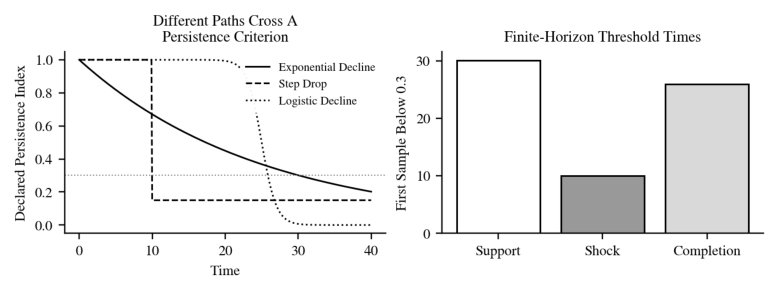
Figure 52. Three explicitly constructed normalized persistence paths cross the same declared threshold 0.3. The paths are prescribed by an exponential function, a step at time ten and a logistic decline centered at twenty-five; times are sampled at intervals 0.1. Causal interpretations require separate evidence. Dissolution can arise through several pathways and can coexist with residual records, duties, or successor functions. The illustration concerns a declared persistence criterion. Juridical reconstruction should compare causal paths and remaining possibilities before interpreting cessation as completion, failure, or self-limitation.
operation can demonstrate present function while leaving continuity, descent, and the source of its capability unresolved.
Mechanism And Ontological Commitments. Recurrence requires an identification criterion, an observed absence, and a later reentry or restoration event. The ontology includes retained memory, preserved artifacts, external supports, new conditions, and the operations linking them. Returning to a region of state space differs from restoring the same legal entity or usable function. A model can represent reentry under declared rules, while historical transmission needs evidence of the actual carrier across absence. Adaptive-network and governance perspectives provide settings for investigating changed relations and renewed operation (Gross and Blasius 2008; Folke et al. 2005).
Epistemic Design And Discriminating Evidence. Recover records before absence, during preservation or dormancy, and after reappearance. Trace custody, permission, personnel, tools, and learning, comparing a restoration pathway with independent recreation. A missing observation period should be distinguished from verified inactivity. Test whether the current operation depends on retained supports and whether those supports preserve the distinctions material to the issue. A later name or document can be authentic while expressing a new claim of continuity that requires separate investigation. The report should retain uncertainty about unmatched components and the limits of the search.
Philosophical Reasoning And Practice. The philosophical inference concerns identity through interruption. Similarity can be sufficient for a task comparison while historical descent remains material to attribution, obligation, or recognition. Different objects can therefore have different recurrence criteria within one episode. GR analysis asks whether the restored relation makes a valuable operation exercisable and how earlier contributions support it. Successors also add new work and authority. A juridical account should identify those passages rather than treat recurrence as either complete sameness or complete novelty through a single visible label (Huang 2026d).
Worked Comparison And Research Proposition. Compare revived workshops with identical products and names. One restores archived methods through documented teaching and permission; another independently develops a comparable technique after the earlier practice disappears. A constructed review could vary custody and learning histories while holding present output constant, measuring supported claims of function and descent. The proposition is that interruption-and-carrier evidence improves warrant when resemblance can be mistaken for historical transmission. A practical report identifies the returning object, verified absence, retained supports, new contributions, and
applicable sources governing any consequential claim. It preserves the difference between present success, restored opportunity, and the historical relationship asserted through return.
Reading the numerical illustration. Figure 53 illustrates the declared mechanism. A visible return of support can have different consequences for a formerly available function. The full-input arm regains the declared threshold, while the lower-input arm approaches a capacity below it. A retained record follows a separate stipulated path. A domain inquiry should identify whether recurrence concerns form, historical continuity or exercisable function, trace the supports linking the episodes, and assess which new work and permissions are required for a consequential return.
13 An Integrated Inquiry And Intervention Method
13.1 The Question Determines The Object And Representation
Start with a concrete contrast: continuation versus interruption, one action sequence versus another, a visible pattern versus rival generating mechanisms. Specify the subject or object through its identification criterion. Record variables with their types and units, relations with their meanings, and the horizon on which the comparison matters. A current indicator and a historical event can enter the same inquiry while retaining their different evidential roles.
The mechanism catalogue then supplies candidate explanations. It does not assign a cause through resemblance. Select a manageable set of rivals whose implications differ on a material question. An apparently stable output might reflect adequate renewal, hidden depletion or replacement of the observed population. A useful inquiry identifies an observation, comparison or lawful intervention that could distinguish these accounts. Models can be revised when the present ontology cannot express a supported distinction.
13.2 Match The Method To The Inferential Task
Conservation and stock-flow accounts test balances and expose missing channels. Temporal networks and event models represent changing relations and sequences. State-space methods estimate latent trajectories under an observation model. Sparse equation discovery investigates a specified library of possible dynamics; its library, noise treatment and data coverage bound the inference (Brunton, Proctor, and Kutz 2016). Delay reconstruction has mathematical conditions concerning the system, observation and embedding; noisy, changing and strategically responsive social settings require an explicit justification of those conditions (Takens 1981).
Causal estimation requires a declared intervention contrast and assumptions addressing assignment, confounding, interference and temporal feedback (Hernán and Robins 2020). Process tracing, archives, observation and participant accounts investigate the operations and meanings behind a possible pathway. Simulation tests consequences of specified rules and supports model discrimination through distinct predictions. Its credibility for intervention depends on correspondence, calibration and out-ofregime validation. Different methods can answer complementary parts of the same question.
13.3 Preserve Interpretation And Disagreement
A measurement can be accurate for its own variable while providing an incomplete representation of the public or legal concern. An embedding can preserve one similarity and erase another. A ranking can depend on weights, boundary and task definition. Record these premises and retain distinctions whose loss would change the decision. Where comparisons remain unresolved, a partial order or a set of admissible judgments can be more informative than a forced total ranking (Huang 2026b).
Critical scrutiny also concerns access to evidence production. Opportunity, resources and institutional uptake can influence whose capabilities become visible. A richer record can improve warrant and impose additional burdens. Choose a proportionate route that can answer the relevant question, with confidentiality, participant effort and lawful access included in the design. An absence of evidence becomes interpretable through an account of the search and observation process.
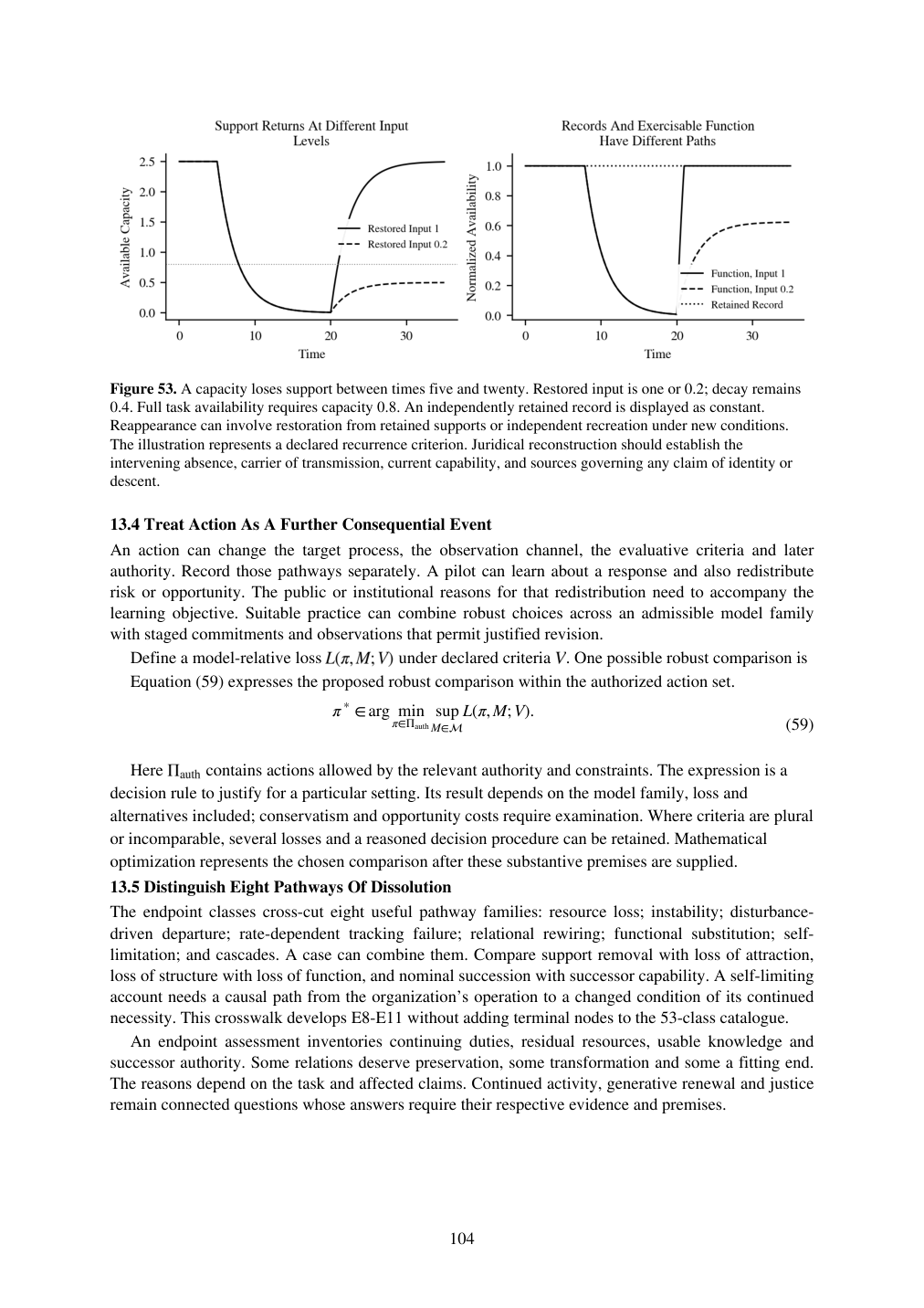
Readable text
Figure 53. A capacity loses support between times five and twenty. Restored input is one or 0.2; decay remains 0.4. Full task availability requires capacity 0.8. An independently retained record is displayed as constant. Reappearance can involve restoration from retained supports or independent recreation under new conditions. The illustration represents a declared recurrence criterion. Juridical reconstruction should establish the intervening absence, carrier of transmission, current capability, and sources governing any claim of identity or
An action can change the target process, the observation channel, the evaluative criteria and later authority. Record those pathways separately. A pilot can learn about a response and also redistribute risk or opportunity. The public or institutional reasons for that redistribution need to accompany the learning objective. Suitable practice can combine robust choices across an admissible model family with staged commitments and observations that permit justified revision.
under declared criteria . One possible robust comparison is Equation (59) expresses the proposed robust comparison within the authorized action set.
contains actions allowed by the relevant authority and constraints. The expression is a decision rule to justify for a particular setting. Its result depends on the model family, loss and alternatives included; conservatism and opportunity costs require examination. Where criteria are plural or incomparable, several losses and a reasoned decision procedure can be retained. Mathematical optimization represents the chosen comparison after these substantive premises are supplied.
The endpoint classes cross-cut eight useful pathway families: resource loss; instability; disturbance- driven departure; rate-dependent tracking failure; relational rewiring; functional substitution; self- limitation; and cascades. A case can combine them. Compare support removal with loss of attraction, loss of structure with loss of function, and nominal succession with successor capability. A self-limiting account needs a causal path from the organization’s operation to a changed condition of its continued necessity. This crosswalk develops E8-E11 without adding terminal nodes to the 53-class catalogue.
An endpoint assessment inventories continuing duties, residual resources, usable knowledge and successor authority. Some relations deserve preservation, some transformation and some a fitting end. The reasons depend on the task and affected claims. Continued activity, generative renewal and justice remain connected questions whose answers require their respective evidence and premises.
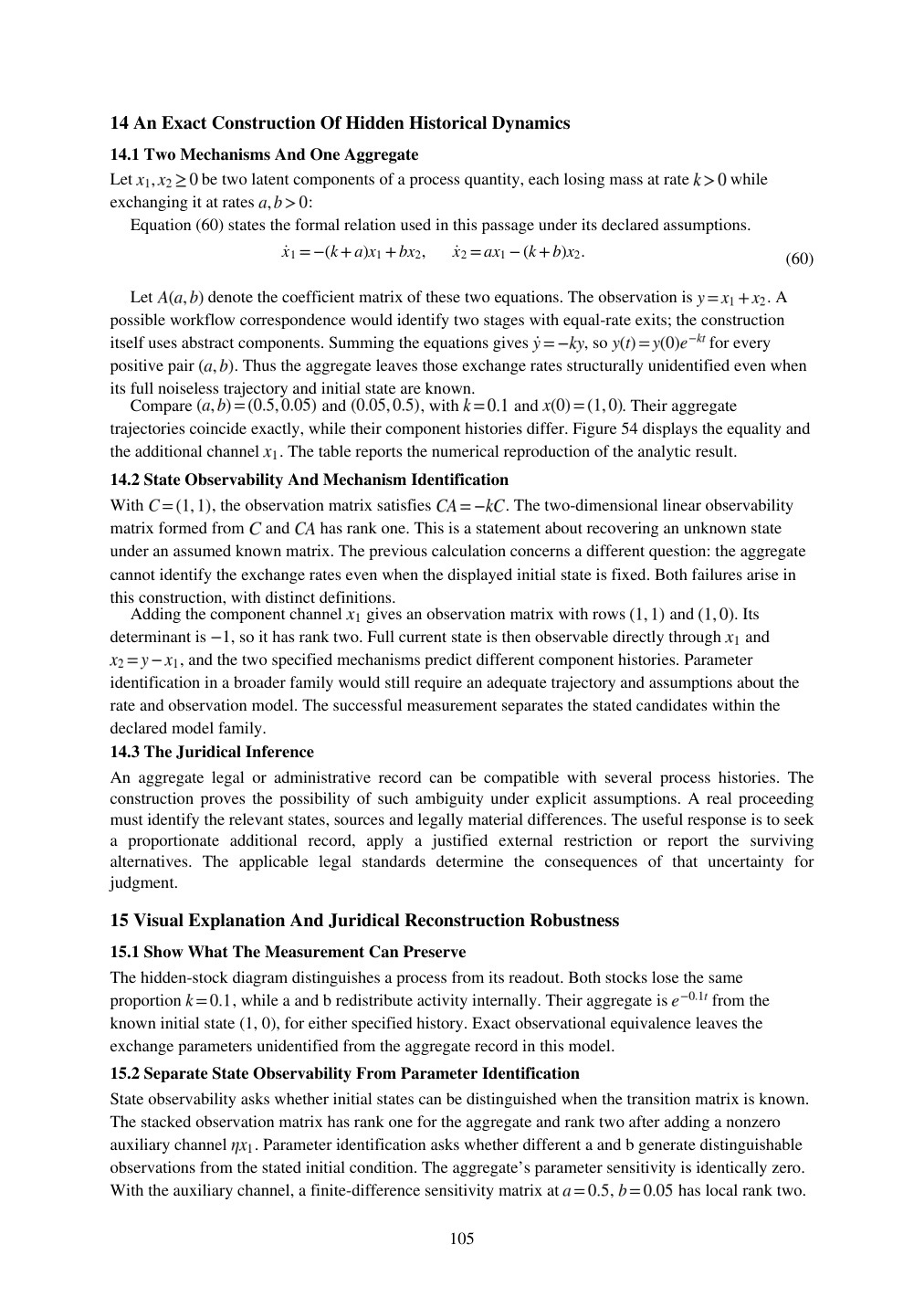
Readable text
14 An Exact Construction Of Hidden Historical Dynamics
be two latent components of a process quantity, each losing mass at rate Equation (60) states the formal relation used in this passage under its declared assumptions.
denote the coefficient matrix of these two equations. The observation is possible workflow correspondence would identify two stages with equal-rate exits; the construction itself uses abstract components. Summing the equations gives . Thus the aggregate leaves those exchange rates structurally unidentified even when
Let positive pair its full noiseless trajectory and initial state are known.
trajectories coincide exactly, while their component histories differ. Figure 54 displays the equality and . The table reports the numerical reproduction of the analytic result.
With , the observation matrix satisfies matrix formed from and this construction, with distinct definitions.
has rank one. This is a statement about recovering an unknown state under an assumed known matrix. The previous calculation concerns a different question: the aggregate cannot identify the exchange rates even when the displayed initial state is fixed. Both failures arise in
gives an observation matrix with rows , so it has rank two. Full current state is then observable directly through , and the two specified mechanisms predict different component histories. Parameter identification in a broader family would still require an adequate trajectory and assumptions about the rate and observation model. The successful measurement separates the stated candidates within the
Adding the component channel determinant is declared model family. 14.3 The Juridical Inference
An aggregate legal or administrative record can be compatible with several process histories. The construction proves the possibility of such ambiguity under explicit assumptions. A real proceeding must identify the relevant states, sources and legally material differences. The useful response is to seek a proportionate additional record, apply a justified external restriction or report the surviving alternatives. The applicable legal standards determine the consequences of that uncertainty for
15 Visual Explanation And Juridical Reconstruction Robustness
The hidden-stock diagram distinguishes a process from its readout. Both stocks lose the same , while a and b redistribute activity internally. Their aggregate is known initial state (1, 0), for either specified history. Exact observational equivalence leaves the exchange parameters unidentified from the aggregate record in this model.
15.2 Separate State Observability From Parameter Identification
State observability asks whether initial states can be distinguished when the transition matrix is known. The stacked observation matrix has rank one for the aggregate and rank two after adding a nonzero . Parameter identification asks whether different a and b generate distinguishable observations from the stated initial condition. The aggregate’s parameter sensitivity is identically zero. With the auxiliary channel, a finite-difference sensitivity matrix at
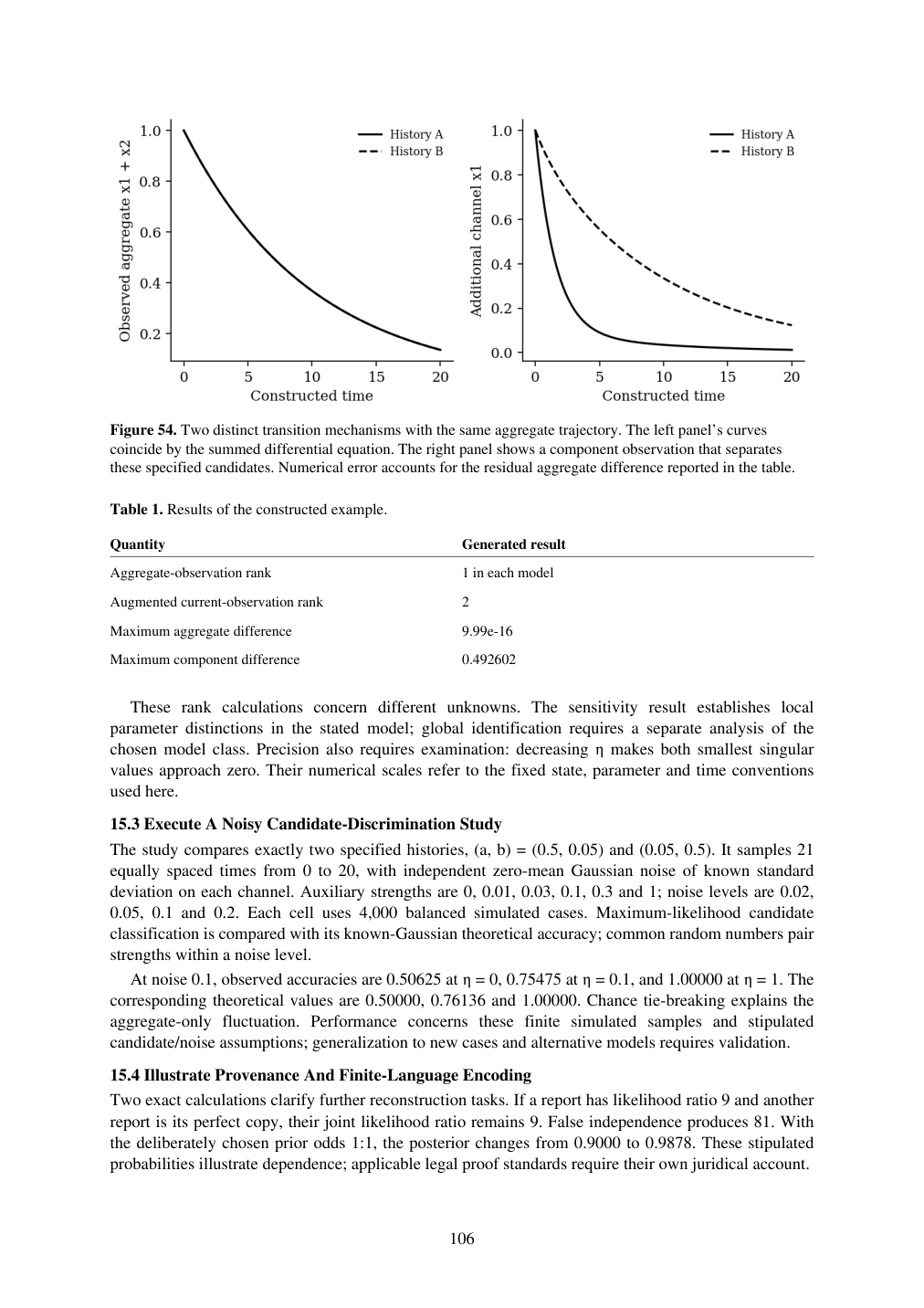
Readable text
Figure 54. Two distinct transition mechanisms with the same aggregate trajectory. The left panel’s curves coincide by the summed differential equation. The right panel shows a component observation that separates these specified candidates. Numerical error accounts for the residual aggregate difference reported in the table.
These rank calculations concern different unknowns. The sensitivity result establishes local parameter distinctions in the stated model; global identification requires a separate analysis of the chosen model class. Precision also requires examination: decreasing η makes both smallest singular values approach zero. Their numerical scales refer to the fixed state, parameter and time conventions
The study compares exactly two specified histories, (a, b) = (0.5, 0.05) and (0.05, 0.5). It samples 21 equally spaced times from 0 to 20, with independent zero-mean Gaussian noise of known standard deviation on each channel. Auxiliary strengths are 0, 0.01, 0.03, 0.1, 0.3 and 1; noise levels are 0.02, 0.05, 0.1 and 0.2. Each cell uses 4,000 balanced simulated cases. Maximum-likelihood candidate classification is compared with its known-Gaussian theoretical accuracy; common random numbers pair
At noise 0.1, observed accuracies are 0.50625 at η = 0, 0.75475 at η = 0.1, and 1.00000 at η = 1. The corresponding theoretical values are 0.50000, 0.76136 and 1.00000. Chance tie-breaking explains the aggregate-only fluctuation. Performance concerns these finite simulated samples and stipulated candidate/noise assumptions; generalization to new cases and alternative models requires validation.
15.4 Illustrate Provenance And Finite-Language Encoding
Two exact calculations clarify further reconstruction tasks. If a report has likelihood ratio 9 and another report is its perfect copy, their joint likelihood ratio remains 9. False independence produces 81. With the deliberately chosen prior odds 1:1, the posterior changes from 0.9000 to 0.9878. These stipulated probabilities illustrate dependence; applicable legal proof standards require their own juridical account.
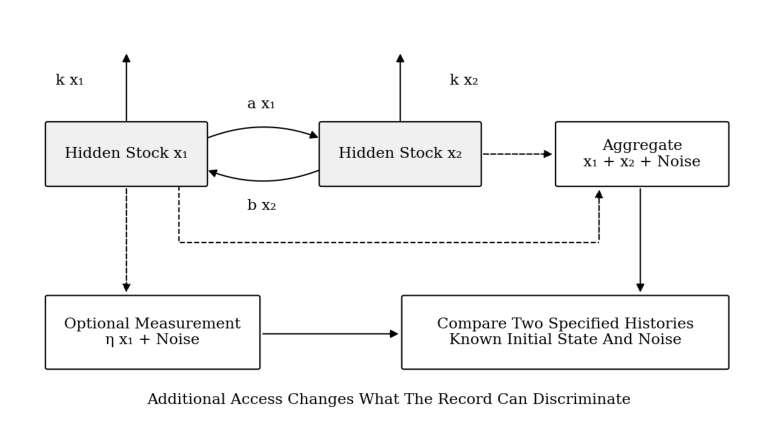
Figure 55. Hidden exchange, common losses and two possible readouts. Dashed paths denote observation. The auxiliary measurement accesses one component; its availability and noise are assumptions of the constructed comparison.
The finite language illustration enumerates the empty word and six words of lengths one and two over the alphabet a, b. Their seven basis vectors have identity Gram matrix and rank seven. Thus ab and ba remain distinct. This checks a finite part of the syntactic encoding argument. Meaning, truth, relevance and legal force require additional interpretive and evidentiary work.
15.5 Relate Reconstruction To Responsible Judgment
An underlying process, an accessible record and an authorized conclusion are distinct objects. Critical realism helps articulate that separation; social epistemology asks how assumptions and criticism become accessible (Bhaskar 1975; Longino 1990). The practical lesson is to record what a measurement distinguishes, compare live alternatives and retain provenance. Reliable candidate classification can contribute evidence. A justified juridical decision additionally requires relevant sources, interpretation, procedural authority and reasons concerning the persons affected.
16 Twelve Tasks Of Juridical Reconstruction
16.1 R1. Recognize And Type The Phenomenon
Identify the legally relevant event separately from its report and later classification. Record source and event times with uncertainty. A changed category can alter the visible series, so recognition criteria should be preserved alongside the records.
Recognition should begin with the proposition material to the proceeding and the event that the record allegedly manifests. Separate an event’s occurrence, its recording, its classification, and its later use. Source identity, event time, recording time, custody, claimed content, and inferential purpose should remain linked. A category can change who enters a dataset or what counts as an incident. Preserve its versions and identify unmatched cases. A Relational Subject or Object requires continuity criteria appropriate to the issue, particularly where a continuing institutional name conceals changed membership, permissions, or practical operation.
Consider a hypothetical record described as proof that a notice was received. Authentication can support its origin; dispatch logs can support transmission; evidence of access and the receiving practice can bear on receipt; legal rules determine the consequence. Each passage needs its own premises.
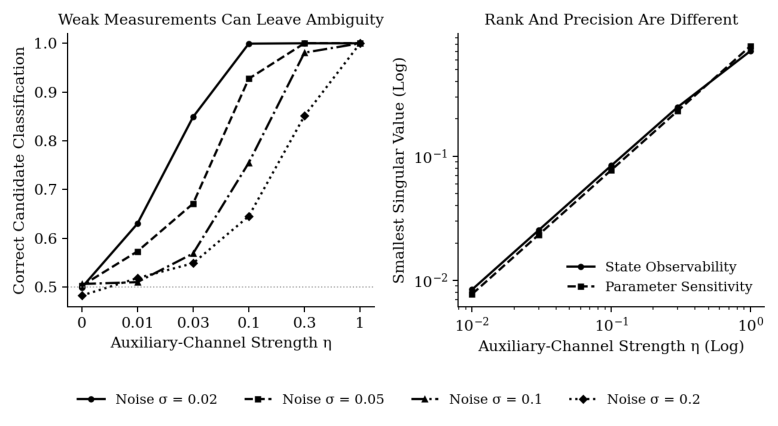
Figure 56. Executed classification sensitivity and two distinct rank diagnostics. Noise curves concern choosing between two known candidates, while the singular-value curves concern known-system state observability and local parameter sensitivity.
Source-grounded jurisprudential interpretation supplies resources for connecting supported facts to institutional characterization (Dworkin 1986). The practical result is an issue-specific evidence ledger that exposes the inferential use of each item. Its limits should identify uncertain dates, disputed translations, and observation gaps, permitting a targeted challenge to the relevant premise and a precise account of the dossier’s evidential scope.
16.2 R2. Estimate The Latent State
Specify what must be recovered and the observation model linking it to evidence. Check state observability under the assumed dynamics. Where recovery is partial, report the supported set or bounds and identify which legal distinctions remain material.
State estimation should specify what hidden historical distinction matters and how the available evidence observes it. In the two-component construction, the aggregate preserves total decline while leaving component allocation unresolved. State observability is assessed under an assumed known dynamics matrix; parameter identification asks whether the observations distinguish possible matrices. These questions remain separate even when they fail in the same example. A proceeding may need only an identified aggregate proposition, or it may require a component distinction material to attribution. Define that requirement before interpreting an estimated trajectory as the recovered history.
Consider a hypothetical administrative workflow with a total case count and two latent processing stages. Several stage histories can fit the same aggregate. A contemporaneous stage-specific timestamp can distinguish the specified alternatives, while a later summary of the total adds precision without recovering the missing distinction. Use a state-space model only with explicit assumptions about missingness, recording, and dynamics. Report bounds or admissible states where recovery remains partial. The practical recommendation concerns a lawful, proportionate additional channel or the treatment of unresolved uncertainty under the applicable procedure. A successful component observation establishes its stated discrimination, with broader parameter and causal claims requiring further evidence.
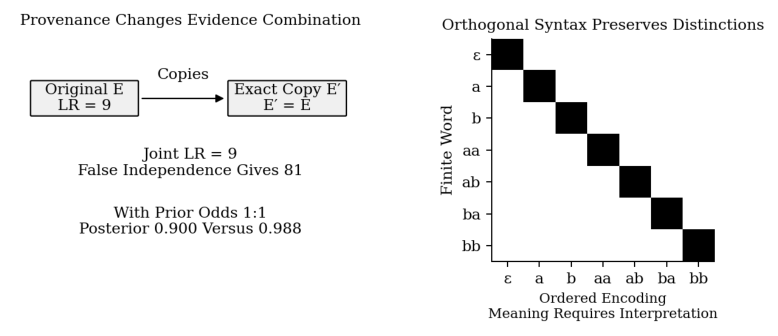
Figure 57. Exact provenance and finite-language illustrations. A copied source supplies dependent evidence. The identity matrix preserves seven distinct words, with ε denoting the empty word; semantic and juridical interpretation require additional inquiry.
16.3 R3. Recover Interactions
Define the time and meaning of a relation before drawing an influence graph. Compare selection into the relation, action through it and common causes. The graph should retain source dependencies and the evidential status of each alleged edge.
Interaction reconstruction identifies dated relations through which a legally material effect could pass. Contact, authority, transfer, copied information, and common membership have different meanings. A graph should distinguish authenticated links, inferential links, and disputed allegations. Source dependence belongs within that graph: several statements can descend from one report, and their agreement can reflect shared provenance. The likelihood-ratio construction shows how a perfect copy retains one evidential event under its declared probability model. More complicated partial dependence requires its own account of what was copied and what new observation was added.
Imagine a hypothetical allegation inferred from frequent communications and repeated summaries. Compare direct influence, shared external instruction, and copying from a common source using dated messages, independent records, and the actual operation attributed to the contact. A missing edge can reflect absent records or genuinely absent interaction; its evidential meaning depends on the observation process. Causal inference supplies methods for declared contrasts under explicit dependence assumptions (Hernán and Robins 2020). The practical report should retain relation types and provenance so legal attribution can address the supported pathway. Network proximity can direct investigation, while responsibility requires the relevant factual and normative premises beyond proximity itself.
16.4 R4. Identify Candidate Dynamics
State rival transition or behavioral rules and examine whether available records distinguish them. Equation discovery and narrative reconstruction can each depend on restricted candidate libraries. Record the restrictions and test implications beyond the observations used to construct the preferred account.
Candidate dynamics should express rival histories or transition rules that differ on the proposition material to judgment. A fitted rule can reproduce visible outcomes while alternatives generate the same observations. The exact construction shows structural nonidentification of the exchange rates from the aggregate under its assumptions. A discovery method searches a selected library, making its omissions part of the inferential boundary (Brunton, Proctor, and Kutz 2016). The proceeding should preserve the restrictions that render one account preferable, including assumptions about initial state, missing inputs,
strategic response, and observation. Mathematical compatibility and historical support are related findings with different scopes.
Consider a hypothetical transfer sequence compatible with direct instruction and an intermediary acting independently. Compare predictions about dates, access, resource use, and communications that the two mechanisms would leave. A narrative should identify the evidence for each transition instead of allowing overall plausibility to establish every link. Test implications outside the material used to construct the preferred account where lawful records permit. The practical result can be a supported mechanism, bounded alternatives, or a statement that the available record cannot discriminate. Its legal consequence follows through applicable proof and attribution rules, with the inferential uncertainty stated intelligibly for review.
16.5 R5. Reconstruct The Environment
Identify external inputs, institutional rules and resource conditions operating during the relevant interval. Later conditions can support a historical comparison only through a justified bridge. Report the range of environmental paths still compatible with the evidence.
Historical environment reconstruction concerns the conditions operating when the disputed event occurred. Technology, access rules, organizational mandates, physical surroundings, and resource availability can change before observation or reenactment. A later test can establish present capability while leaving past opportunity uncertain. Define which conditions are external to the selected process and identify actors controlling them in the broader setting. Retain their timing and versions. A sensitivity analysis can ask which conclusions survive the plausible historical range, with the range justified through contemporaneous records and relevant expert evidence.
Imagine a hypothetical dispute about whether a technical message could have been received during a service interruption. Compare present-day operation with historical device configuration, network availability, permissions, and known failures. An experiment reproducing only the current interface can miss the material constraint. Independent logs and contemporaneous attempts can discriminate some pathways. A simulation can examine declared historical conditions, while its correspondence requires source checking and uncertainty about unrecorded inputs. The practical report should identify the conclusion robust across plausible conditions and the further record needed for remaining material differences. Legal treatment of a reenactment depends on the proceeding’s rules and a reasoned explanation of consequential similarities and differences.
16.6 R6. Reconstruct Historical Paths
Use dated events and feasible-transition constraints to compare histories. Separate temporal precedence from causal transmission. A memory-bearing state can summarize a relevant history when the proposed summary preserves the distinctions required by the legal issue.
Path reconstruction concerns a particular legally material sequence, beyond a population average or general propensity. Temporal precedence can constrain possibilities while leaving causal transmission unresolved. Use dated events, feasible-transition rules, resource access, and received information to compare histories. A history-bearing state can summarize prior commitments or permissions if it preserves the distinction needed for the issue. A mechanism-oriented realist linkage supports examining the process generating a manifestation (Bhaskar 1975). Its historical attribution requires case-specific evidence, with plausible paths stated and tested through their distinct historical implications.
Consider a hypothetical document whose later use depends on an earlier authorized transfer of custody. Compare a direct-transfer history, a copied-document history, and a later substitution using provenance, timestamps, access records, and authenticating evidence. Each history can predict a similar final artifact while differing on the material passage. Investigate the records they would produce differently and the observation processes that could remove them. The practical result should state supported events, inferred connections, and unresolved alternatives. A compact chronology can aid review when it preserves these distinctions, while visual or textual continuity should avoid implying evidential certainty for an unsupported link in the sequence.
16.7 R7. Discriminate Mechanisms
Seek an observation or lawful comparison for which the rival accounts predict materially different results. The choice should respect the proceeding’s authority and the rights governing evidence collection. An already available independent source may provide the needed distinction with less burden than a new investigation.
Mechanism discrimination begins with credible accounts that disagree on a material proposition and an observation they predict differently. The additional component channel in the construction separates the specified histories because it measures their hidden difference. Its success concerns that family and observation model. A real investigation must establish the source, timing, lawful accessibility, and reliability of the proposed channel. More data have value when they add decision-relevant distinctions; repeated summaries can leave the same ambiguity intact. Collection burden and the proceeding’s authority constrain the available comparison.
Imagine a hypothetical financial dispute in which a total balance fits both an authorized redistribution and an unrecorded external entry. A contemporaneous transfer ledger or independent receiving record can discriminate the stated accounts more directly than another total-balance summary. Evaluate how the record would be generated, retained, and authenticated under each history. A missing record receives force only through that observation model. The practical inquiry should compare information value with cost, delay, and affected rights. If the lawful evidence leaves a material distinction unresolved, report the surviving alternatives and the assumptions needed to separate them. The applicable procedure determines how that uncertainty enters judgment and any decision to stop collection.
16.8 R8. Reconstruct Resource Use
Close financial, material or labor accounts in their respective units. Include external entries and missing channels. Balanced transfers support an accounting claim; intention, authorization, value and responsibility require the evidence and rules relevant to those further propositions.
Resource reconstruction should identify the stock, unit, boundary, and interval relevant to a transfer claim. Internal movements cancel in a consistent account, while external entries, losses, creation, and valuation changes require explicit terms. Reconcile sending and receiving records and distinguish a commitment, authorization, payment, and use. Financial and material accounts can be linked through documented operations while retaining different units. A balanced account can expose a missing channel or contradiction. It supports an accounting proposition whose relation to intention, consent, value, or responsibility requires further evidence and legal reasoning.
Consider a hypothetical organization accused of diverting resources because one office’s stock fell while another’s rose. Compare an internal transfer with independent external inflow, reclassification, and delayed recording. Use provenance, transaction time, custody, and boundary records to test those pathways. Source repetition should remain visible when multiple reports use one ledger. Where missingness prevents exact closure, report intervals or alternative reconciliations relevant to the issue. The practical result can direct proportionate inquiry toward a particular unobserved entry. Legal attribution should then address the supported operation, the authority governing it, and the applicable proof requirement, with uncertainty in the account preserved through that passage.
16.9 R9. Connect Scales
State which distinctions aggregation removes. A population-level effect and a particular actor’s history have different objects. Explain the bridge whenever one informs the other, preserving resolution needed for attribution and challenge.
Scale linkage asks whether a population, organizational, or aggregate finding supports the proposition about a particular event or subject. Aggregation can remove sequence, component allocation, and heterogeneity. The hidden-history construction demonstrates one exact loss of distinction. Conversely, a detailed local record can establish an episode while leaving the prevalence of its mechanism unresolved. Specify the bridge whenever one scale informs another, including
assumptions about population, support conditions, and matching. A common institutional category supplies a classification whose adequacy for causal or juridical transfer requires further argument.
Imagine a hypothetical service with a high aggregate compliance rate while the disputed case involves a subgroup subject to a different authorization route. Compare overall performance with the relevant pathway and contemporaneous case records. A population estimate can inform a prior expectation under justified assumptions; it cannot by itself recover the particular path. Causal-inference methods require explicit contrasts and dependence conditions (Hernán and Robins 2020). The practical report should state which distinctions the summary preserves and which material differences remain hidden. Targeted disaggregation can help when lawfully available and decision-relevant, while unnecessary detail can increase burden. Legal attribution should address the supported case-specific event through the applicable factual and normative premises.
16.10 R10. Reconstruct Function
Specify the operation, task and conditions of success. Test alternative pathways and dependence on the proposed support. Functional performance can inform an issue while leaving purpose, duty and intention to their own legal and evidential analysis.
Function reconstruction specifies the operation, task, context, and condition of success. A device can be capable of a task without having performed it during the disputed interval. An organization can perform a function through a substitute pathway while the alleged support was absent. Distinguish demonstrated capability, historical exercise, intended purpose, and assigned duty. A withdrawal comparison can identify dependence under its assumptions, while a later test requires a bridge to historical conditions. Functional language should preserve the relevant constituency and avoid assuming that one observed output captures every legally material effect.
Consider a hypothetical notice system that produces a dispatch receipt. The receipt can establish a system operation while delivery, comprehension, and legal sufficiency require different evidence and rules. Compare the alleged pathway with a substitute manual process, using contemporaneous logs, access, and receiving practices. Expert evidence can clarify technical performance; constructive interpretation addresses its legal characterization through relevant sources (Dworkin 1986). The practical result should state what task was accomplished, under which conditions, and how strongly that finding supports the material proposition. A successful technical function can inform judgment while leaving intention, duty, and responsibility to the further evidential and legal analysis appropriate to the proceeding.
16.11 R11. Reconstruct Interpretation
Investigate how relevant participants understood a manifestation at the time. Retain competing meanings and their contextual evidence. Later conformity in vocabulary can leave earlier interpretation unresolved. Practical uptake and shared semantic understanding require separate support.
Interpretation reconstruction examines the meaning relevant participants could receive in the historical setting. Preserve original language, translation, context, roles, and the operation allegedly effected. A finite statement’s ordered syntax can be encoded by the displayed finite-word Hilbert construction under its alphabet assumptions. The canonical unitary correspondence preserves basis and order structure; it supplies a representation whose semantic and legal use requires additional mappings. Syntactic noncommutativity from prepending symbols establishes an order effect in that representation. A correspondence to sequential legal operations needs independently specified permissions, resources, and receiving rules.
Imagine a hypothetical exchange in which a translated word is treated as authorization while the original term could denote an invitation to seek approval. Compare contemporaneous usage, the recipient’s response, institutional procedure, and expert translation evidence. A later standardized vocabulary can leave the earlier meaning unresolved. The practical report should identify supported readings, their contextual premises, and consequences for the legal issue. Dworkin supplies a resource for constructive interpretation within legal practice (Dworkin 1986). A credible analysis makes the
reasoned passage from manifested statement to claimed act reviewable, with alternatives retained where the evidence and relevant sources leave a material ambiguity.
16.12 R12. Reconstruct Normative Authority
Trace the criterion’s origin, recognition and authorized use, with the legal sources appropriate to the proceeding. Prevalence and practical influence help explain its operation. Justification of consequential use requires the relevant legal and public reasons and an adequate route of challenge.
Authority reconstruction identifies the sources, roles, and procedures governing consequential use of a supported account. Admissibility, proof, attribution, and remedy are different legal questions. A model’s predictive accuracy establishes an empirical achievement within its tested scope, while its permitted use depends on the relevant procedure and issue. Hart supplies a resource for institutional recognition, with source-grounded analysis needed for the actual setting (Hart 2012). Preserve who selected the criterion, who may apply it, and how a party can challenge the evidence or interpretation. Changes in those powers can alter future evidence production.
Consider a hypothetical proceeding using an automated summary that selects a subset of testimony. Trace the summary’s sources, omissions, claimed proposition, authorized role, and available correction route. Independent source checking can reveal unsupported additions or lost qualifications. Fricker and Longino motivate attention to participation and effective criticism (Fricker 2007; Longino 1990). Their application here asks whether affected parties can make a material distinction intelligible and obtain a consequential response. The practical report should distinguish a supported factual proposition from its authorized legal consequence. A required decision can be reached under the applicable standard while the evidential uncertainty and reasons for treating it remain explicit and reviewable.
17 A Prospective Juridical Research Design
Begin with a defined legal issue and construct a source-grounded event ledger. Separate records that authenticate, describe, infer or legally characterize an event. Preserve dependencies among testimony, summaries and model-generated outputs. Identify candidate histories and a decision-relevant property on which they differ. Test observability and compatibility where formal models are used, and use explicit process evidence for passages the formalization leaves unrepresented.
Compare reconstruction procedures on lawfully accessible historical or constructed cases with known information restrictions. Vary observation resolution, source dependence, category changes and investigator feedback. Evaluate supported claims, false additions, unresolved distinctions and the burden of obtaining further evidence. A blinded review can examine whether the resulting account makes its inferential limits and reasons intelligible. Decisions concerning actual parties remain within their authorized procedures and proof requirements.
The design should include successful ordinary methods as comparators. A compact event ledger or professional review may resolve a question that a more elaborate dynamical model leaves unchanged. The contribution of the model is established when it identifies a material dependency, separates plausible histories or improves a justified decision under its actual cost and access conditions.
18 Implications For Juridical Knowledge
The central problem is which historical distinctions the evidence supports. The exact construction shows that even complete aggregate observation can leave hidden transition mechanisms unidentified. Added information can resolve a particular ambiguity when it measures the relevant difference. Syntactic encoding can preserve a record’s form while semantic and legal warrant require further argument.
The proposed framework combines the full mechanism catalogue, twelve reconstruction tasks and question-relative reporting of admissible histories. It connects formal inference with source analysis, interpretation and procedural authority. This gives juridical inquiry a concrete method for
reconstructing dynamics while retaining the reasons and standards through which a warranted historical account becomes a legal judgment.
19 Research Materials And Authorial Review
The editable manuscript, shared mechanism catalogue, simulation programs, generated outputs and original figures accompany this paper. The source record identifies primary-source links and the access level used in the survey. Reported experimental summaries are generated by the accompanying programs. The prose also introduces hypothetical conceptual comparisons whose stipulated quantities serve an argumentative purpose. Exact equality claims receive the analytical argument given in the text. Reproduction uses Python with NumPy, SciPy and Matplotlib; the package records the versions used.
The remaining empirical research question is the correspondence between the proposed mechanisms and particular social settings. An application should specify its observation process, feasible alternatives, institutional authority and validation design. The manuscript supplies complete coverage of the declared catalogue and a concrete basis for that further inquiry. The author can revise substantive commitments, select empirical cases and assess the literature and arguments before any external scholarly submission.
19.1 AI Assistance Statement
This revised manuscript and its accompanying code were prepared with ChatGPT and Codex assistance in literature retrieval, conceptual organization, drafting, argumentative criticism, formal checking, programming and presentation. Wanhong HUANG supplied the research direction and the request for the eight-paper series. The manuscript is presented for the author’s substantive review and decision about further development and circulation. The statement records the assistance actually used in this preparation; responsibility and final approval require the author’s own assessment.
References
Acemoglu, Daron, Vasco M. Carvalho, Asuman Ozdaglar, and Alireza Tahbaz-Salehi. 2012. “The Network
Origins of Aggregate Fluctuations.” Econometrica 80 (5): 1977–2016. https://doi.org/10.3982/ECTA9623. Ashwin, Peter, Sebastian Wieczorek, Renato Vitolo, and Peter Cox. 2012. “Tipping Points in Open Systems:
Bifurcation, Noise-Induced and Rate-Dependent Examples in the Climate System.” Philosophical Transactions of the Royal Society A 370: 1166–84. https://pubmed.ncbi.nlm.nih.gov/22291228/. Axtell, Robert L., and J. Doyne Farmer. 2025. “Agent-Based Modeling in Economics and Finance: Past, Present,
and Future.” Journal of Economic Literature 63 (1): 197–287. https://doi.org/10.1257/jel.20221319. Batty, Michael. 2013. The New Science of Cities. MIT Press.
https://mitpress.mit.edu/9780262534567/the-new-science-of-cities/. Bebon, Robin, Joshua F. Robinson, and Thomas Speck. 2025. “Thermodynamics of Active Matter: Tracking
Dissipation Across Scales.” Physical Review X 15: 021050. https://doi.org/10.1103/PhysRevX.15.021050. Bhaskar, Roy. 1975. A Realist Theory of Science. Leeds Books.
https://www.versobooks.com/products/1569-a-realist-theory-of-science. Boettiger, Carl, and Alan Hastings. 2012. “Early Warning Signals and the Prosecutor’s Fallacy.” Proceedings of
the Royal Society B. https://pmc.ncbi.nlm.nih.gov/articles/PMC3497104/. Brunton, Steven L., Joshua L. Proctor, and J. Nathan Kutz. 2016. “Discovering Governing Equations from Data
by Sparse Identification of Nonlinear Dynamical Systems.” Proceedings of the National Academy of Sciences 113 (15): 3932–37. https://doi.org/10.1073/pnas.1517384113. CEPEJ. 2018. “European Ethical Charter on the Use of Artificial Intelligence in Judicial Systems and Their
Environment.” Council of Europe. https://rm.coe.int/ethical-charter-en-for-publication4-december-2018/16808f699c. Cross, M. C., and P. C. Hohenberg. 1993. “Pattern Formation Outside of Equilibrium.” Reviews of Modern
Physics 65: 851–1112. https://doi.org/10.1103/RevModPhys.65.851. Douglas, Heather. 2000. “Inductive Risk and Values in Science.” Philosophy of Science 67 (4): 559–79. https://w
ww.cambridge.org/core/journals/philosophy-of-science/article/abs/inductive-risk-and-values-in-science/D637 9A8CA7FB22DA3F2A8727462866C0.
Dworkin, Ronald. 1986. Law’s Empire. Harvard University Press.
https://www.filosoficas.unam.mx/~cruzparc/empire.pdf. Expert Working Group on Human Factors in Latent Print Analysis. 2012. “Latent Print Examination and Human
Factors: Improving the Practice Through a Systems Approach.” 7842. NIST Interagency/Internal Report. Gaithersburg, MD: National Institute of Standards and Technology. https://doi.org/10.6028/NIST.IR.7842. Folke, Carl, Thomas Hahn, Per Olsson, and Jon Norberg. 2005. “Adaptive Governance of Social-Ecological
Systems.” Annual Review of Environment and Resources 30: 441–73. https://doi.org/10.1146/annurev.energy.30.050504.144511. Frey, Erwin, and Henrik Weyer. 2026. “Pattern Formation Beyond Turing: Physical Principles of
Mass-Conserving Reaction-Diffusion Systems.” Annual Review of Biophysics 55: 493–514. https://doi.org/10.1146/annurev-biophys-030822-031638. Fricker, Miranda. 2007. Epistemic Injustice: Power and the Ethics of Knowing. Oxford University Press.
https://doi.org/10.1093/acprof:oso/9780198237907.001.0001. Godley, Wynne, and Marc Lavoie. 2007. Monetary Economics: An Integrated Approach to Credit, Money,
Income, Production and Wealth. Palgrave Macmillan. https://doi.org/10.1057/9780230626546. Gross, Thilo, and Bernd Blasius. 2008. “Adaptive Coevolutionary Networks: A Review.” Journal of the Royal
Society Interface 5 (20): 259–71. https://doi.org/10.1098/rsif.2007.1229. Hart, H. L. A. 2012. The Concept of Law. 3rd ed. Oxford University Press.
https://india.oup.com/product/the-concept-of-law-9780198729990/. Hernán, Miguel A., and James M. Robins. 2020. Causal Inference: What If. Chapman & Hall/CRC.
https://miguelhernan.org/whatifbook. Holling, C. S. 1973. “Resilience and Stability of Ecological Systems.” Annual Review of Ecology and Systematics
4: 1–23. https://doi.org/10.1146/annurev.es.04.110173.000245. Huang, Wanhong. 2026a. “An Inquiry into Evaluative Norm Formation and Justice in Self-Evolving AI
Knowledge Systems.” Author manuscript, current supplied version 6. https://huang-wanhong.com/publication. Huang, Wanhong. 2026b. “An Inquiry into the Formation of Evidence-Based Partial Orders in the Governance of
Human–AI Evolutionary Production.” Author manuscript, current supplied version 6. https://huang-wanhong.com/publication. Huang, Wanhong. 2026c. “Evolutionary Project Ecologies in Economics: A Conceptual Framework and
Institutional Prospects.” Author manuscript, current supplied version 4. https://huang-wanhong.com/publication. Huang, Wanhong. 2026d. “Relational Wealth: Definition and Characteristics.”
https://doi.org/10.17613/nq7js-vz283. Hughes, Edward, Michael D. Dennis, Jack Parker-Holder, Feryal Behbahani, Aditi Mavalankar, Yuge Shi, Tom
Schaul, and Tim Rocktäschel. 2024. “Position: Open-Endedness Is Essential for Artificial Superhuman Intelligence.” In, 235:20597–616. Proceedings of Machine Learning Research. https://proceedings.mlr.press/v235/hughes24a.html. Korbel, Jan, Artemy Kolchinsky, Sarah A. M. Loos, Gonzalo Manzano, Rosalba Garcia-Millan, Olga Movilla
Miangolarra, and Édgar Roldán. 2026. “Quo Vadis, Stochastic Thermodynamics?” Journal of Non-Equilibrium Thermodynamics 51 (4): 577–94. https://doi.org/10.1515/jnet-2026-0051. Lindblad, Göran. 1976. “On the Generators of Quantum Dynamical Semigroups.” Communications in
Mathematical Physics 48: 119–30. https://doi.org/10.1007/BF01608499. Longino, Helen E. 1990. Science as Social Knowledge: Values and Objectivity in Scientific Inquiry. Princeton
University Press. https://press.princeton.edu/books/ebook/9780691209753/science-as-social-knowledge-0. Lorenz, Edward N. 1963. “Deterministic Nonperiodic Flow.” Journal of the Atmospheric Sciences 20: 130–41.
https://wind.mit.edu/~emanuel/Lorenz/EdLorenz/Deterministic\_63.pdf. Magesh, Varun, Faiz Surani, Matthew Dahl, Mirac Suzgun, Christopher D. Manning, and Daniel E. Ho. 2025.
“Hallucination-Free? Assessing the Reliability of Leading AI Legal Research Tools.” Journal of Empirical Legal Studies. https://doi.org/10.1111/jels.12413. National Research Council. 2009. Strengthening Forensic Science in the United States: A Path Forward.
Washington, DC: The National Academies Press. https://doi.org/10.17226/12589. Onsager, Lars. 1931. “Reciprocal Relations in Irreversible Processes. I.” Physical Review 37: 405–26.
https://doi.org/10.1103/PhysRev.37.405.
Ostrom, Elinor. 2009. “A General Framework for Analyzing Sustainability of Social-Ecological Systems.”
Science 325 (5939): 419–22. https://doi.org/10.1126/science.1172133. Perdomo, Juan, Tijana Zrnic, Celestine Mendler-Dünner, and Moritz Hardt. 2020. “Performative Prediction.” In,
119:7599–609. Proceedings of Machine Learning Research. https://proceedings.mlr.press/v119/perdomo20a.html. Prigogine, Ilya. 1977. “Time, Structure and Fluctuations.”
https://www.nobelprize.org/uploads/2018/06/prigogine-lecture.pdf. Ritchie, Paul D. L., Hassan Alkhayuon, Peter M. Cox, and Sebastian Wieczorek. 2023. “Rate-Induced Tipping in
Natural and Human Systems.” Earth System Dynamics 14. https://doi.org/10.5194/esd-14-669-2023. Seifert, Udo. 2012. “Stochastic Thermodynamics, Fluctuation Theorems and Molecular Machines.” Reports on
Progress in Physics 75: 126001. https://doi.org/10.1088/0034-4885/75/12/126001. Seifert, Udo. 2025. “Universal Bounds on Entropy Production from Fluctuating Coarse-Grained Trajectories.”
Preprint, arXiv:2512.07772. https://arxiv.org/abs/2512.07772. Sen, Amartya. 2009. The Idea of Justice. Harvard University Press.
https://philosophy.fas.harvard.edu/publications/idea-justice. Takens, Floris. 1981. “Detecting Strange Attractors in Turbulence.” In, 366–81. Springer.
https://doi.org/10.1007/BFb0091924. Turing, Alan M. 1952. “The Chemical Basis of Morphogenesis.” Philosophical Transactions of the Royal Society
B 237: 37–72. https://doi.org/10.1098/rstb.1952.0012. Whitehead, Alfred North. 1978. Process and Reality: An Essay in Cosmology. Free Press.
https://www.simonandschuster.com/books/Process-and-Reality/Alfred-North-Whitehead/9780029345702.