A Generative Relational Account of Social Facts - A Preliminary Discussion of Journalism and the Reconstruction of Social Reality
Abstract
Journalism is designated to report social facts. Whether that designation can be discharged is ordinarily treated as a question about the reporter, to be answered by care and resources; this paper treats it as a question about the object. On the account developed here a social fact has no presymbolic form, and comes to presence through the relations among situated representations produced under different language systems, so that the reconstruction available to a reader lives in the structure of divergence among them. Two consequences are derived and verified. A reconstruction so constituted survives no coarsening of the representations that carry it, which places balance and consensus summary among the operations that degrade the object they are meant to secure; and fidelity so constituted is a property of an ensemble while obligation attaches to a member, so that no single report discharges it. The paper then returns one negative result and one positive. Criteria requiring an actor to preserve or enlarge a downstream capacity are inoperable, since they require a prediction over an outcome space that cannot be specified in advance, and the same unavailability places the whole burden of prediction on departures from faithful report. What survives is a condition internal to the artefact: the domain of a claim is contained in the relational neighbourhood its material was drawn from, or the extension carries a declared warrant. The paper contributes an ontology in which divergence is constitutive, an assessment condition checkable at the time of writing, a case in which two rationales for one professional practice prescribe opposite remedies, and a formal apparatus whose propositions were checked before being stated.
1. Introduction
1.1 The designation and the expectation attached to it
Journalism carries a designation that few other occupations state so plainly. A journalist is to find out what happened in society and to report it. The designation is old, it is written into professional codes, and it survives in the ordinary expectation a reader brings to a newspaper. A reader who opens a report about a strike, a policy decision or a disturbance in a city expects to learn what occurred, and expects the report to be answerable if what it says is inaccurate.
The designation also organises the profession’s account of its own failures. Where a report misleads, the failure is described as a lapse in accuracy, in fairness, or in the diligence with which sources were checked, and the remedy prescribed is a correction, a wider range of voices, or a stricter procedure. Each of these presupposes that the designation is dischargeable and that a particular report fell short of discharging it.
1.2 The obstacles ordinarily raised, and their standing in this paper
Four obstacles are ordinarily raised against the designation, and all four are conceded here at the outset as established background.
A journalist observes interviews, documents, footage, official statements and statistics, so that what is reported is evidence about an occurrence and never the occurrence itself. A city produces many thousands of occurrences daily and a newspaper reports a few dozen, so that a set of individually accurate sentences still delivers a picture governed by the selection that produced it. Description in a natural language carries connotation, so that the same episode admits several wordings whose implications differ. And participants in the same episode occupy different positions within it and undergo it differently.
Each of these observations has an established literature behind it, surveyed in Section 3, and none is claimed here as a finding. They are the starting conditions of the problem and not its solution, and the paper’s contribution begins where they leave off.
1.3 The relocation of the difficulty from the reporter to the object
The four obstacles are ordinarily presented as limitations on the reporter, which invites the thought that a sufficiently careful, sufficiently resourced, sufficiently disinterested reporter would approach the ideal asymptotically. This paper withholds that thought and locates the difficulty in the mode of being of what is to be reported.
A social fact, on the account developed here, holds no presymbolic form. There exists no fixed, unmediated state of the social world lying beneath its descriptions and waiting to be copied by whichever description is most careful. A social fact comes to presence through the relations among situated representations of it, produced by parties positioned differently within the episode and operating under different language systems in the broad sense, which is to say under different repertoires of category, remembered precedent and admissible inference. Government statements, eyewitness accounts, court records, statistical series, expert analyses and the reports of several journalists are each such representations, and the reconstruction available to anyone stands in the relations among them.
The word doing the work in the previous sentence is relations, and its content is specific. The reconstruction lives in how the representations stand to one another, which includes where they agree, where they contradict one another, what each omits and what each emphasises. Divergence is therefore informative, and it is a constituent of the object in place of noise obscuring it.
The relocation matters because it changes what a failure is. On the ordinary account a report fails by falling short of an attainable standard. On the account developed here the standard is unattainable by any single report whatever, and the question of what a report may nonetheless be held to has to be answered afresh.
1.4 The questions the paper puts
Three questions follow from the relocation and they organise the paper.
The first is ontological and epistemological together. What is a social fact, such that a plurality of divergent accounts is constitutive of it, and how may something so constituted be known at all by a party positioned within it.
The second is normative and concerns what is unavailable. Given that the reporting ideal is undischargeable, which criteria for assessing a report survive that finding and which are removed by it.
The third is normative and concerns what remains. Given the criteria that are removed, what condition on a particular report is available to an actor at the time of writing, and what does the condition leave unaddressed.
1.5 The account of a social fact developed here
Two consequences follow directly from the account of Section 1.3, and they are derived formally in Part IV and checked by computation before being stated.
The first concerns coarsening. An operation that merges representations into a single summary, a balanced account or a consensus formulation removes distinctions among them, and the distinctions removed are the ones in which the reconstruction consisted. A reconstruction so constituted therefore survives no coarsening of the representations that carry it. The professional remedies most often prescribed for partiality belong to this family of operations, since balance, the neutral wording, the single authoritative version and the summary that reconciles competing accounts all reduce the divergence a reader can see. Those operations therefore degrade the object they are meant to secure.
The second concerns the level at which fidelity is a predicate. If the reconstruction is constituted by an ensemble of representations, then faithfulness is a property of that ensemble. Professional obligation, however, attaches to an individual reporter writing an individual report, and a property of an ensemble is not discharged by any member of it. The reporter is bound to a standard whose subject is at a different level from the subject of the obligation. This asymmetry is not a paradox and it is not a counsel of despair; it marks a division of normative territory that the paper later draws with some care, between what an actor can be held to and what only the arrangement as a whole can be assessed against.
1.6 The results obtained, negative and positive
The paper returns one negative result and one positive, and they are stated together here because each is incomplete without the other.
The negative result removes a family of criteria. A criterion asking of any intervention whether it preserves or enlarges the capacity of the wider system to continue generating understanding is inoperable by an actor, since applying it requires a judgement about what an intervention will do to a nonlinear system across an open horizon, and over an outcome space that cannot be specified in advance. The point is Humean and it is not merely a counsel of epistemic modesty, since it removes a class of justifications from use. Its removal is moreover asymmetric, and the asymmetry is the sharpest practical consequence in the paper. Faithful report, with nothing omitted, requires no prediction, since its justification rests on what the material supports. Every departure from that default, and suppression in particular, rests on a claim about what disclosure would do. The whole burden of prediction therefore falls on the departure, and the prediction is what the Humean point denies. Suppression justified by anticipated damage to stability, harmony or a fragile process is thereby left without the form of argument it requires.
The positive result is deliberately modest and it supplies what the negative result leaves the actor. A condition on a report can be stated that is internal to the artefact and checkable at the time of writing, with no prediction of any kind. The domain over which a claim is asserted is to be contained within the relational neighbourhood from which the material was drawn, and any extension beyond it is to carry a declared warrant. Material gathered among shoppers in one district supports a claim about those shoppers; a claim about a city requires either material from the city or an explicit statement of the extension and its grounds. The violation is termed migration here, and Part IV gives it a formal reading under which it is a quotient operation, irreversible at each application and accumulating along a chain. The condition covers considerably more than sampling scope, since the same structure governs the passage from an utterance to an attributed disposition, from a quoted phrase to a rendered summary, and from a report to the versions of it that circulate onward.
1.7 The criterion the results converge on
These two results together define what this paper means by reconstructability, which is the criterion it proposes and the word its argument converges on. Reconstructability is the detectability of the collapses a report performs. It is not the recoverability of an original, since no original is available and quotients are not invertible. A report is reconstructable to the degree that a reader can see where distinctions were merged, on whose authority material entered, at what remove from the material a formulation stands, and for whom the account was written.
The devices that carry this are already in professional use. Attribution, direct quotation, the sourcing note, the declaration of a selection boundary, the modal qualifier and the correction column each keep a collapsed distinction on the record without restoring it to the account. The claim advanced here is that these devices are ordinarily justified on the wrong grounds, as instruments of fairness between sides, and that on the present account they do different work with different failure conditions.
A residue remains, and the paper declares it in place of dissolving it. The conditions above are complete at the level of the individual report and unavailable at the level of the arrangement. A press system composed entirely of reports each of which declares its boundaries faithfully may still be silent about whole regions of the society it covers, and no member of that system commits any fault. The residue belongs to governance, and Part IX refers it there without attempting to settle it.
1.8 The contributions claimed and their limits
Four contributions are claimed, and each is stated with the limit that attaches to it.
The paper supplies an ontology of social facts under which divergence among accounts is constitutive and not residual, positioned in Section 3 against the accounts that come nearest to it. The limit is that the ontology is a position and not a demonstration, and Section 4.5 shows that the paper’s later results stand for a reader who declines it.
The paper supplies an assessment condition that is checkable at the time of writing, independent of the truth of the claim assessed, and applicable to a particular artefact. The limit is that the condition is sufficient for nothing and reaches only the individual report.
The paper exhibits a case in which two rationales for one professional practice prescribe opposite remedies, which makes the difference between the present account and the professional self-description testable in principle. The limit is that one documented case is exhibited and no claim of frequency is made anywhere in the paper.
The paper offers a formal apparatus of modest strength, order-theoretic and combinatorial, whose propositions were checked by computation before being stated, together with an illustrative dynamical and field-theoretic presentation whose use as a source of standards is declined on stated grounds. The limit is that the apparatus carries no time evolution and supports no measurement.
Beyond these, the paper is offered as a preliminary discussion. Its case material is one practice, its literature is predominantly Anglophone, and the questions it leaves open are enumerated at Section 45.
1.9 The arrangement of the paper
The paper proceeds in nine parts. Part I fixes scope and reviews the prior formulations against which the account must be positioned. Part II states the ontology of social facts in generative relational terms and derives the coarsening result. Part III states the corresponding epistemology, covering the position of the observer, the chain of mediation that precedes any report, and the levels at which fidelity and obligation attach. Part IV develops the formal account, comprising the carrier and the situated renderings, the categorical reading of the ensemble, the typed statement of the containment condition, the quotient reading of migration, composition along a chain, the operation of annotation, a heterogeneous dynamical construction with a field-theoretic presentation, and the grounds on which their use as a source of criteria is declined. Part V works through the sites of the circuit one at a time under a uniform template. Part VI treats the allocation of interpretive labour among reporter, commentator and public, and its variation across press systems and across time. Part VII establishes the limits of consequential assessment. Part VIII states the conditions available to a reporting actor. Part IX addresses the residue, the historical condition under which claims are tested, and the boundaries of the undertaking, including the standing of this account as itself one situated representation among others.
2. Scope, the Companion Papers, and the Bounds of the Case Material
The role of this section is to fix the boundaries of the undertaking before any argument is made within them. Its objective is to state four things: what the paper takes as its object and what it sets aside; which results are imported from companion papers and are therefore cited without re-derivation; how the journalistic case material is used and what discipline governs its use; and what the paper declines to attempt. The method is declarative throughout, and each restriction is stated so that a reader may hold the argument to it.
2.1 The object and its restrictions
The object of the paper is the mode of being of a social fact and the conditions under which a report of one can be assessed. Journalism supplies the case, and it is chosen for a reason stated in Section 2.3 below, and the choice carries no claim that journalism is the only practice in which the problem arises.
Four restrictions apply. The paper treats social facts and leaves natural facts aside; whether the account extends to the latter is a question it neither asks nor answers. The paper treats the individual reporting actor and the individual report as the primary unit, and it reaches the level of the press system only in Part IX, where the residue is declared and referred onward. The paper concerns the conditions of assessment and offers no doctrine of professional virtue, no account of what disposition a good journalist possesses, and no programme of reform for any institution. The paper takes no position on any dispute reported by any of the material it discusses.
2.2 Results imported from companion papers
Several constructions used below belong to companion papers and are cited in place of being rebuilt. The reader is owed a clear statement of what is borrowed, since the originality of the present account depends on it.
From the study of diplomacy among heterogeneous knowledge systems the paper takes the position that a concept has no invariant metaphysical form, the emission and construal account under which what crosses between parties is a material event carrying no semantic content and the receiving party generates meaning under its own operations, the construction of a joint frame as a common coarsening of the parties’ distinction structures, the result that a coarser joint frame registers less divergence while making agreement easier, and the treatment of reservations and filed declarations as annotations that keep a collapsed distinction on the record without admitting it to the frame. The present paper adds that the object so reconstructed is a social fact and that the parties performing the reconstruction are numerous, uncoordinated and unknown to one another.
From the companion study of injustice among heterogeneous knowledge systems the paper takes the arrangement of an epistemic circuit into sites and the discipline of treating those sites as positions in one process. Part V follows that arrangement, with the deviations stated at the head of the part and defended there. Propagation along a chosen pathway, where a party selects its intermediaries and retains a measure of control over them, belongs to that paper. The propagation treated here is unchosen, in that the writer of a report selects nothing downstream of publication.
From work on the distribution of the translation burden the paper takes the concealment result, under which a default that imposes a burden conceals the imposition by taking the grammatical form of a refusal to act. Part VI applies that result to interpretive abstention in journalism, which supplies it with a codified professional doctrine and a documented history that the original setting lacked.
From work on distributed responsibility the paper takes the control condition and the treatment of foreseeability, which Part VII uses to draw the boundary between consequences an actor may be held to and consequences an actor may not. From work on two levels of degradation the paper takes the distinction between an operation that blocks a generation while leaving the grammar intact and an operation that alters the grammar itself, which Part VI uses to establish that constraining an interpretive space is the stronger of the two available interventions. From work on the production of subjects the paper takes the result that a system generates the relational subjects its own operation requires, which Section 32 applies to the constitution of social entities through coverage. From the metamodel of ontologically heterogeneous social dynamics the paper takes the treatment of a mechanism as an operator on a distinction structure and the irreversibility of the collapses such operators perform, which Part IV uses directly.
2.3 The use of the case material
Journalism is chosen as the case for three reasons, and the reasons are properties of the practice, in place of expressions of interest in it.
The practice occupies the position of an intermediary explicitly and by profession. A reporter receives representations from parties, construes them, and re-emits a representation of its own to an audience that will construe it again. Composition of construal with emission is what distinguishes an intermediary formally from a source or a receiver, and journalism institutionalises that position under a name.
A public record of its own knowledge operations is kept by the practice. Corrections columns, sourcing conventions, style guides revised across decades, ombudsman reports and the documented separation of news from comment together constitute an archive of how a profession has answered the questions this paper asks. Few knowledge practices leave so legible a trace of their own rules of admission.
The practice allocates interpretive labour differently in different places and at different times. The separation of news from comment has a datable history and an uneven distribution across press systems, which allows a claim about allocation to be exhibited, in place of being argued alone.
Three disciplines govern the use of this material. Case material is organised by mechanism throughout, and never by outlet, country or episode, so that no section of the paper reads as an assessment of any organisation’s conduct. Named organisations appear only where a cited source already names them and only as procedural fact. No verdict is offered on any contested matter that the material happens to concern, and where an example would require one, a constructed example is used and marked as constructed.
2.4 The declinations recorded in advance
Four declinations are recorded here and defended at the points where they bind.
The paper coins no new species of justice. A discussion of this kind generates candidate names readily, and a list of them was considered and set aside during the development of the argument. The sites of Part V carry the analysis, and no section of this paper is titled after a kind of wrong.
The paper draws no criterion from a dynamical or topological model. Sections 17 and 18 construct a representation in which the parties along a pathway carry their own dynamics and their own state spaces, and Section 20 admits that construction for what it shows about the object while declining its use as a source of standards, on three grounds of which the first is that the selection of the invariants to be preserved is the normative question itself.
The paper proposes no criterion requiring an actor to preserve, enlarge or optimise any quantity. Part VII establishes that criteria of that family are unavailable to an actor, and the establishment is one of the paper’s two principal results. Nothing later in the paper reintroduces such a criterion under another name.
The paper does not settle the question of agency. Section 36 states the minimal assumption that the argument requires, marks it as an assumption, and proceeds.
3. Prior Formulations of the Social Fact and of Journalistic Knowledge
The role of this section is to position the account against the formulations that already occupy its ground, in three literatures that rarely cite one another. Its objective is to identify, for each formulation, what it supplies to the present account and what it leaves unaddressed, so that the contribution claimed in later parts is the residue of this survey and nothing wider. The structure follows the three literatures in turn: social ontology in Sections 3.1 to 3.4, the sociology of knowledge and of the media in 3.5 to 3.6, and social epistemology in 3.7 to 3.9. The method is concession first. Each formulation is stated in terms its authors would accept before any differentiation is offered, and the differentiation is confined to what the present account can establish.
3.1 Fleck and the genesis of a fact
Ludwik Fleck’s Genesis and Development of a Scientific Fact (1935) is the closest ancestor of the position developed here, and the resemblance extends to its title. Fleck holds that a fact possesses a history, that it is produced within a thought collective operating under a thought style, and that the style governs what is perceptible, what counts as a problem and what counts as a solution. A fact on this account is neither discovered ready-made nor invented at will, since the style constrains what can be seen while remaining itself historically formed.
Three things are taken from Fleck without modification. A fact has a genesis. The genesis proceeds within a collective and under a style. And the style is a condition of perception, so that it operates prior to any judgement about evidence.
Two features fix the reach of the position for present purposes. Fleck’s collective is a community of practitioners who share a style, and the sharing is what makes it a collective; the parties whose representations constitute a social fact in the present account share no style, are frequently unaware of one another, and coordinate on nothing. And Fleck’s concern is the scientific fact, produced within an institution designed to produce facts, whereas a social fact is constituted partly by parties who are its participants and who bear its consequences.
3.2 Durkheim and the thesis of externality
The term social fact belongs to Émile Durkheim, and in The Rules of Sociological Method (1895) it carries almost the opposite of the sense used here. A social fact for Durkheim is external to the individual, exercises constraint upon the individual, exists independently of its individual manifestations, and is to be treated methodologically as a thing.
The externality thesis records a real datum and the present account preserves it. A social fact does constrain, it does resist the wishes of those who encounter it, and an account that made it a matter of description alone would be refuted by ordinary experience. Section 7 accepts the datum and derives the constraint from the material conditions under which representations are sustained, which supplies the resistance Durkheim observed without the substance claim he attached to it. The disagreement is therefore narrow and specific. Constraint is conceded; independence from all systems of representation is declined.
3.3 Searle, collective acceptance, and the institutional fact
John Searle’s The Construction of Social Reality (1995) supplies the major contemporary ontology of social facts. Institutional facts arise where a status function is imposed on an object or event by collective acceptance, in the form under which a term counts as bearing a status within a context, and the resulting facts are objective in the epistemic sense while being observer-relative in the ontological sense. Money, borders, marriage and office are the standard examples.
Searle’s account is conceded in its domain and the domain is the point of differentiation. Institutional facts of the Searlean kind are constituted by acceptance, and where acceptance obtains the fact is determinate. The social facts at issue in journalism include a large class for which acceptance neither obtains nor is being sought: a strike, a protest, an increase in military spending, a corruption case, a period of economic hardship. What such an episode is remains under dispute by the parties to it while it is occurring, and the dispute is a constituent of the episode. The present account locates the fact in the relations among the parties’ representations, which requires no convergence and survives its permanent absence.
3.4 Hacking, dynamic nominalism, and the looping of human kinds
Ian Hacking’s “Making Up People” (1986) and the later account of looping effects (1994) hold that classifying people brings into being ways for people to be, that those so classified respond to the classification, and that the response alters the classification in turn. The kind and the people it names are formed together, and the process is historically located.
The claim developed in Section 32, that coverage participates in constituting the social entities it reports, is Hacking’s claim at a particular site, and the concession is complete. What the present account contributes there is the site and the mechanism of its operation in a press system, together with the observation that the looping runs through an intermediary who is bound by professional obligation, which the general form of the thesis does not consider.
3.5 Luhmann and the reality constructed by mass media
Niklas Luhmann’s The Reality of the Mass Media (1996) holds that the mass media constitute a functionally differentiated system which produces the reality that other systems in society operate upon, and that it does so through its own selections under a binary code, with no transfer of information between operationally closed systems. Luhmann is the heaviest owner in this survey, since the denial of transfer and the constructed character of the reported world are both his.
The denial of transfer is conceded outright and is treated in Section 2.2 as an imported result. Two differences fix what remains. Luhmann’s systems observe one another and do not reconstruct a shared object, so the question of whether a reconstruction is faithful to anything has no place in that framework, while the present account asks precisely that question and answers it with a condition internal to the artefact. And Luhmann offers no normative condition on a report, since the theory describes the operation of a system and declines to prescribe to it.
3.6 Objectivity in journalism studies and the history of the norm
Two positions in journalism studies bear directly on the argument. Gaye Tuchman’s Making News (1978) treats objectivity as a strategic ritual, a set of procedures through which reporters protect themselves against the charge of partiality, including the presentation of conflicting possibilities, the presentation of supporting evidence, the judicious use of quotation marks, the structuring of information in an appropriate sequence, and the separation of fact from comment. Michael Schudson’s Discovering the News (1978) gives the norm a datable history and locates its consolidation in a particular period and a particular professional formation.
Both are conceded, and Tuchman’s list is more than conceded, since it enumerates the devices this paper later reads as annotation. The differentiation is confined to their rationale. Tuchman explains the devices by the occupational need for defensibility; Schudson explains the norm by the conditions of its adoption. Section 25.5 argues that the same devices admit a further explanation on which they preserve a divergence structure, and that the two explanations diverge in their consequences under conditions the following subsection identifies.
3.7 Situated knowledge and objectivity at the level of the community
Donna Haraway’s account of situated knowledges (1988) holds that all vision is positioned, that the view from nowhere is unavailable, and that objectivity is to be sought in located and accountable seeing. Helen Longino’s Science as Social Knowledge (1990) holds that objectivity is a property of a community and of its practices of criticism, achieved through public venues for criticism, uptake of criticism, shared standards, and equality of intellectual authority.
Longino is the nearest rival to the central asymmetry of this paper, since objectivity as a community property and fidelity as an ensemble property are close in form. Three conditions separate them, and they are Longino’s own conditions. Longino requires venues in which criticism circulates, uptake by those criticised, and standards held in common. The parties whose representations constitute a social fact satisfy none of the three. A resident interviewed in a district, a ministry issuing a statement, a court entering a record and a foreign correspondent filing a dispatch neither criticise one another nor share a standard by which criticism could be adjudicated. Longino’s community achieves objectivity through interaction; the ensemble at issue here achieves nothing, since it is not an agent and does not act. The asymmetry that follows in Section 11 is therefore stronger than Longino’s result and less consoling, because it identifies a property with no bearer capable of securing it.
3.8 Epistemic injustice and the agent-centred form of its taxonomies
Miranda Fricker’s Epistemic Injustice (2007) distinguishes testimonial injustice, in which prejudice causes a hearer to give a deflated level of credibility to a speaker’s word, from hermeneutical injustice, in which a gap in collective interpretive resources leaves a person unable to render an experience intelligible. Kristie Dotson and Gaile Pohlhaus have extended the family, the first with testimonial smothering and contributory injustice, the second with wilful hermeneutical ignorance, and both argue that interpretive resources may exist and be refused.
Fricker’s own account of hermeneutical injustice is structural and explicitly identifies no perpetrator, so the absence of a wrongdoer is anticipated and is not claimed here. The differentiation lies elsewhere. The wrong identified in Part VIII involves no deflation of credibility, since the speakers are believed; and it involves no gap in interpretive resources, since the resources required to state it are ordinary and available. A report whose material comes from one neighbourhood and whose claim is asserted over another commits a wrong that this family of accounts has no place for, because every party to it is believed and every concept required is possessed.
3.9 Selection, gatekeeping, and framing
A large empirical literature already holds the observations from which the problem of this paper starts, and it is recorded here as conceded background. Gatekeeping research from David Manning White (1950) onward, and its later synthesis, establishes that news is produced by successive selections under organisational constraint. Agenda-setting research from Maxwell McCombs and Donald Shaw (1972) establishes that the salience of issues in coverage transfers to the salience of issues among audiences. Robert Entman (1993) gives framing its standard formulation, under which to frame is to select aspects of a perceived reality and make them more salient so as to promote a particular problem definition, causal interpretation, moral evaluation or treatment recommendation. Leon Sigal (1973) and Herbert Gans (1979) establish the predominance of official channels among the sources from which reporters draw, which supports the claim of Section 9 that a reporter occupies a position downstream of prior transformations.
None of the observations in this paragraph is claimed as a finding of the present paper, and each is used as an established premise. What the literature supplies is description of the operations; what it leaves unaddressed is a condition under which a given artefact may be assessed, since the descriptive apparatus of gatekeeping, agenda-setting and framing applies equally to a careful report and a careless one.
3.10 Social ontology beyond collective acceptance
Work in social ontology since Searle has loosened the tie between a social fact and any single act of collective acceptance, and three developments bear on the present account. Anscombe’s distinction between brute and institutional facts establishes that a fact may be brute relative to one description and institutional relative to another, so that the pair is a relation between descriptions and no partition of the world (Anscombe, 1958). Epstein separates the question of what grounds a social fact at a time from the question of what anchors the frame principles by which such facts are grounded at all, and shows that the two questions have different answers, so that a settled grounding may rest on an unsettled anchoring (Epstein, 2015). Gilbert and Tuomela develop the collective side into plural subjects and we-mode intentions (Gilbert, 1989; Tuomela, 2007), and Ásta locates social properties in acts of conferral (Ásta, 2018).
Each of these is conceded, and each stops at the same place. Every one of them locates the constitution of a social fact in something a collective does, whether accepting, committing, anchoring or conferring, and each therefore presupposes a collective sufficiently unified to do it. The situations treated here are the ones where no such collective exists at the time the report is written, since what an episode is remains under dispute among parties who are not acting jointly at all. Epstein’s separation is the most useful of the four for the present purpose, since an unsettled anchoring is close to what Part II describes, and the difference is that this account locates the unsettlement in the relations among the accounts and not in the frame principles behind them.
3.11 Social representations and the relational constitution of a collective account
The nearest sustained programme treating representations as relational objects is the social representations tradition. A social representation is there a system of values, ideas and practices produced and sustained by a group, formed through anchoring an unfamiliar object in existing categories and objectifying it into something usable, and it is held to constitute the object for that group in place of describing an object given independently (Moscovici, 1961; Jodelet, 1989). Later work in the tradition treats divergence between the representations held by different groups as a mechanism of intergroup differentiation.
The concession is substantial and the difference is precise. The tradition holds that representations are relational, that they constitute their objects, and that they diverge across groups, all of which this account accepts. What it studies, however, is how a representation becomes shared within a group and how groups come to differ, so that divergence appears as an outcome to be explained. The present account puts divergence in the constitutive position: the object of a report is the structure the divergent accounts compose, and it is available to no group as a representation of its own. The difference shows in what each treats as loss. A convergence of representations is, for the tradition, the formation of a shared object; for this account it is the operation Proposition ? describes.
3.12 Controlled equivocation and the productive treatment of non-agreement
Viveiros de Castro’s account of controlled equivocation is the strongest existing statement that non-agreement between accounts is productive and not a defect. Equivocation is there treated as a tool of objectification and not as a subjective failure, error or deception, and comparison proceeds by controlling the equivocation in place of resolving it (Viveiros de Castro, 2004).
The position is conceded in full and it is the closest antecedent of Part II’s central move. Two differences fix what remains. The account is a method for anthropological comparison between a small number of identified perspectives held by an inquirer in view, whereas the ensemble treated here is large, uncoordinated, and unavailable in its entirety to any party including the reporter. And the method carries no consequence for an artefact: it tells an anthropologist how to compare and states no condition that a particular text satisfies or fails, which is what Part VIII supplies.
3.13 Information flow among situated classifications
A formal treatment of situated representations linked by structure-preserving maps already exists and this paper uses it. Barwise and Seligman construct classifications, each pairing tokens with types under a relation of a token being of a type; infomorphisms as contravariant pairs of maps between classifications; channels as families of infomorphisms sharing a core; and local logics, which are fallible and system-relative rules of inference attached to a classification (Barwise & Seligman, 1997).
The apparatus is adopted here in preference to constructing an equivalent one. A party’s account is a classification, a rendering is an infomorphism, and what Part IV calls a neighbourhood is a set of classifications with a common core. The difference lies in what is asked of the structure. Barwise and Seligman analyse how information flows through a distributed system whose parts carry information about one another, and the regularity of the system is the condition of flow. This account asks what a plurality of classifications constitutes when they do not agree, and treats the failures of flow as constituents of the object in place of noise degrading it. Chu spaces are the categorical setting of the same construction (Barr, 1979), and the stochastic counterpart used at Section 12 is the theory of Markov categories (Fritz, 2020).
3.14 The aggregation of divergent judgements
A distinct family of formal work takes divergence as an input and returns a single output. Aumann’s construction of the meet of information partitions supplies the exact ancestor of the joint frame of Section 6 (Aumann, 1976). Judgment aggregation studies the conditions under which individual judgements on logically connected propositions can be combined (List & Pettit, 2002). Work on the value of cognitive diversity establishes conditions under which a diverse group outperforms a group of individually stronger members (Hong & Page, 2004; Page, 2007), a result whose interpretation is contested on the ground that it turns on randomness in the selection of heuristics (Thompson, 2014).
The family is conceded and it is the clearest available contrast. Every member of it treats divergence as raw material for a procedure whose output is a single judgement, a single frame or a single prediction, and the value of divergence is the value of that output. Proposition ? concerns what the procedure costs, and the present account holds that the structure consumed by the aggregation is the object a reader needs. The contrast is sharpest in the diversity results, where a plurality of positions is valuable because the aggregate performs better; here a plurality of positions is what there is to be seen.
Table. Prior formulations, the locus each assigns, and the residue each leaves
| Formulation | Assigned locus | Contribution taken | Residue left | |
|---|---|---|---|---|
| Fleck (1935) | The thought collective and its style | Facts possess a genesis under a style | Parties sharing no style and coordinating on nothing | |
| Durkheim (1895) | The fact itself, external and coercive | Constraint as a datum to be explained | Constraint without independence from representation | |
| Searle (1995) | Collective acceptance of a status | Institutional facts within their domain | Episodes under dispute while occurring | |
| Hacking (1986) | Classification and its looping | Coverage participates in constituting entities | The obligation borne by the intermediary | |
| Luhmann (1996) | The operations of a closed system | The denial of transfer | A condition under which an artefact is assessed | |
| Tuchman (1978) | Occupational need for defensibility | The enumeration of the devices | A second rationale for the same devices | |
| Longino (1990) | The critical practices of a community | Objectivity above the individual | An ensemble that interacts on nothing | |
| Fricker (2007) | Credibility and interpretive resources | Structural wrong without a perpetrator | A wrong where speakers are believed | |
| Gatekeeping and framing | Selection and salience | The operations, as established premises | Assessment of a particular artefact | |
| Epstein (2015) | Grounding separated from anchoring | Unsettled anchoring beneath settled grounding | Unsettlement located among the accounts | |
| Moscovici, Jodelet | Group formation of a representation | Representations relational and constitutive | Divergence in the constitutive position | |
| Viveiros de Castro (2004) | Equivocation between perspectives | Non-agreement as a tool of objectification | A condition binding an artefact | |
| Barwise | Seligman (1997) | Flow across situated classifications | The apparatus, adopted here in full | Failures of flow read as constituents |
| Aumann, aggregation, diversity | A procedure returning one output | The joint frame construction | The structure the procedure consumes |
3.15 The residue left by the survey
Table 1 collects the preceding subsections. Reading down its final column yields a single gap, which Claim ? states and which the remainder of the paper occupies.
claim
Claim 3.1. (The residue). Existing formulations locate the wrong of a representation in the credibility accorded to a speaker, in the items admitted to coverage, in the salience conferred on what is admitted, or in the frame imposed upon it. Where the material of a report is drawn from one relational neighbourhood and its claim is asserted over a wider one, none of these locations applies, since every speaker is believed, the items are admitted, the salience conferred may be proportionate, and no frame need be imposed. A wrong of this form is therefore unnamed, and it is available for assessment without any prediction of consequences, since it is settled by the artefact and its material alone.
claim
Three features of Claim 3.1 are carried forward. Its subject is a relation between two domains, which Part IV renders formally. Its assessment requires no access to the world beyond the material the reporter holds, which Part VII shows to be the property that makes it usable where consequential criteria are unavailable. And its scope extends past sampling, since the same relation governs the passage from an utterance to an attributed disposition and from a report to the versions of it that travel onward, both treated in Part V.
The Ontology of Social Facts
4. The Social Fact in Generative Relational Terms
The role of this section is to state what a social fact is on the account this paper develops, in advance of any claim about how one may be reported. Its objective is to fix four commitments: the refusal of a presymbolic form, the situated character of every representation, the mode of presence that remains available once the first commitment is made, and the strength at which the language-system claim is asserted. The structure follows those four in order and closes with a statement of the independence of the paper’s later constructions from the commitments made here. The method is to state each commitment, identify the objection it attracts, and answer the objection at the strength the paper can sustain.
4.1 The refusal of a presymbolic form
The first commitment is negative and everything else in the paper depends on it. There exists no presymbolic social fact: no fixed and determinate state of the social world that lies beneath the descriptions given of it, is identifiable independently of every system of representation, and would be reported by whichever description succeeded in copying it.
The commitment is restricted in two ways that keep it modest. It concerns social facts and leaves natural facts untouched, so nothing here bears on whether a physical quantity has a determinate value independently of its measurement. And it denies a presymbolic form to the fact while affirming the occurrence of events. People assembled in a square, a ministry issued a document, prices rose. Occurrences of that kind are conceded without reservation, and the commitment concerns what makes them a strike, a protest, a crisis, a reform or a provocation, which is a further question and the one journalism is asked to answer.
The commitment is old in one form and its familiar version is weaker than the one used here. That a description is theory-laden, that observation is selective, and that categories are historically formed are established positions and are conceded in Section 3. The commitment made here goes further, since it denies that there is a determinate object standing behind the descriptions to which they are more or less adequate. A reader who accepts theory-ladenness while retaining the determinate object holds a coherent position, and Section 4.5 states what such a reader may still take from the paper.
4.2 Situated representation and the language system in the broad sense
The second commitment concerns what does exist. Every account of an episode is produced by a party occupying a position within or adjacent to it, and every account is rendered in a language system in the broad sense, which is to say a repertoire of categories, remembered precedents, admissible inferences and standards for what counts as showing something to be so.
Language system in this sense extends past natural language, and the extension is required for the argument. Two accounts rendered in the same natural language may belong to different systems in this sense, as a court record and an eyewitness statement do, since the categories available to each and the inferences admissible within each differ systematically. Two accounts rendered in different natural languages may belong to systems that differ additionally in the ways studied by the companion papers on translation. Both differences operate in the same manner here.
A party’s position and its system are related and remain distinct. Position determines what a party is in a way to observe and what it undergoes; the system determines what the party can render of what it observes. A shopkeeper and a ministry official may occupy positions that make different aspects of the same week available to them, and may in addition hold repertoires that would render the same aspect differently.
4.3 The mode of presence available to a social fact
The third commitment is positive and is the substance of the account. A social fact comes to presence in the relations among the situated representations of an episode. It is neither identical with any one of them nor located beneath them, and it holds no form apart from the relations in which it appears.
Presence in this formulation carries a deliberate weight and is preferred to existence. A social fact is present in the way an object of witnessing is present. Witnessing is positioned, fallible and accountable, and a witness does not author what is witnessed. The vocabulary is chosen for that middle position, since it declines the claim that the fact is a substance available to inspection and declines equally the claim that it is constituted by whatever any party says.
Relations among representations, on this account, comprise their agreements, their contradictions, their omissions and their emphases. Where two accounts of an episode diverge, the divergence is a constituent of the fact and carries information about it, since parties positioned differently render differently for reasons that belong to the episode. Section 5 develops this and Section 6 draws the consequence that governs the rest of the paper.
4.4 The strength of the language-system claim
The commitments above invite an objection of long standing, and the paper answers it by weakening the claim to the strength it needs. If accounts belong to different language systems, and if what a system yields depends on the system, the position appears to assert a scheme and a content, with the content inaccessible except through some scheme. Donald Davidson’s argument against that dualism is well known and the companion paper on multilingual democracy has already declined the strong form of the claim by conceding full semantic translatability.
The same concession is made here and the claim is graded accordingly. Any account rendered in one system can be translated into another with its truth conditions preserved, and no party’s account is unintelligible to another party in principle. What differs across systems is the cost of the rendering, the distinctions that a system’s ordinary repertoire makes available without special effort, and the inferences that follow from an account without further argument. Difference in these three is sufficient for every result in this paper, and difference in intelligibility is neither claimed nor required.
claim
Claim 4.1. (The graded language-system claim). Accounts rendered in different systems remain mutually translatable with truth conditions preserved. Systems differ in the distinctions their ordinary repertoires supply, in the cost of rendering a distinction absent from that repertoire, and in the inferences an account licenses without further argument. The results of this paper require the second set of differences alone.
claim
4.5 The independence of the later constructions
A reader who declines the commitments of this section may still hold the paper to its results, and the paper is arranged so that this is possible. The constructions of Part IV take as given a family of situated representations and the distinctions each carries, and they establish results about the operations that combine them. Those results hold for a reader who believes that a determinate social fact stands behind the representations and that the representations approximate it with varying success. Such a reader will read Proposition ? as a claim about the loss of information under aggregation, and will read the condition of Part VIII as a constraint on warranted assertion. The commitments of this section supply an interpretation of those results and are required by none of them.
5. The Ensemble of Situated Representations and the Structure of Its Divergence
The role of this section is to give the relations named in Section 4.3 a determinate content, so that the proposition of Section 6 has something definite to be about. Its objective is to identify the members of the ensemble, to enumerate the constituents of divergence, to fix the formal carrier used throughout the paper, and to say what a reader does with the ensemble. The method is to introduce the formal apparatus at the least strength that carries the argument, and to defer everything further to Part IV.
5.1 The members of the ensemble
The ensemble of representations of an episode has no fixed membership and no boundary given in advance. A partial list for an ordinary episode includes the statements of participants, the statements of officials, documents entered into a record, images, statistical series, the accounts of adjacent parties who were affected without participating, expert analyses produced afterwards, and the reports of any journalists who attended. Each is a rendering by a party at a position under a system, and none is the episode.
Three features of the ensemble matter for the argument and are recorded here. Its members are produced independently, in that most parties render without consulting one another. Its members are produced at different times, so that later renderings may be responses to earlier ones. And its membership is open, so that a representation produced years afterwards joins the ensemble on the same footing as one produced on the day.
5.2 The constituents of divergence
Divergence among the members of an ensemble takes four forms, and the paper treats all four as informative.
Two accounts may contradict one another, asserting incompatible things about the same aspect of an episode. Two accounts may omit differently, one carrying an aspect the other passes over. Two accounts may emphasise differently, giving unequal prominence to aspects both include. And two accounts may agree, which is informative in proportion to the independence of the parties producing them.
The four are not ranked, and contradiction holds no privileged position among them. A pattern of omission across accounts from a particular position carries as much about an episode as an explicit disagreement does, and frequently more, since an omission indicates what a position does not make available while a contradiction may indicate only that two parties are arguing.
5.3 Distinction structures as the formal carrier
The apparatus used from here to the end of the paper is minimal and is imported from the metamodel of ontologically heterogeneous social dynamics. Let $S$ be a set whose elements are the possible ways an episode might have been, understood as the states a party could in principle discriminate between. A party $i$ that renders an account thereby draws distinctions, and the distinctions it draws determine an equivalence relation $\sim_i$ on $S$: states $x$ and $y$ stand in $\sim_i$ where party $i$’s account treats them alike, so that nothing in the account separates the one from the other.
A representation is therefore carried formally by a partition of $S$. The finer the partition, the more the account discriminates. Two parties diverge exactly where their partitions differ, and the divergence structure of an ensemble is the family ${\sim_i}$ together with the information about which member of the family draws which distinction.
The apparatus is deliberately weak. It carries no probabilities, no ordering of accounts by accuracy, and no metric on $S$. Everything the paper establishes is established at this strength, and Section 20 explains why nothing stronger is introduced.
5.4 The reconstruction performed by a reader
A reader who encounters several members of an ensemble performs an operation the paper terms reconstruction, and the operation has a definite object. The reader learns which distinctions were drawn by which party, where the parties agree and where they part, and what each position made available. What a reader arrives at is a structured field of positioned accounts, and the social fact is present in that field in the sense of Section 4.3.
Reconstruction on this account is not the recovery of an original, and Section 6 shows why the recovery is unavailable in principle. A reader who has seen four accounts of an episode holds something that no one of the four supplied, and holds nothing that could be checked against the episode itself.
6. Coarsening and Its Effect on the Reconstruction
The role of this section is to establish the first result of the paper. Its objective is to show that the operations which produce a single agreed account from an ensemble remove exactly what the reconstruction consisted in, and to show that the removal deepens as the number of accommodated accounts grows. The structure is: the construction of a joint frame, the statement of the proposition with its verification, the identification of the professional operations belonging to the family, and a statement of what the result withholds. The method is a construction on the apparatus of Section 5, checked numerically before the proposition is asserted.
6.1 The joint frame as a common coarsening
An account statable jointly by several parties must distinguish nothing that any of them fails to distinguish, since a distinction one party does not draw cannot be carried by a formulation that party endorses. Formally, a jointly statable frame is an equivalence relation coarser than every $\sim_i$, and the finest such relation is the join $\bigvee_i \sim_i$, obtained as the transitive closure of the union of the individual relations.
The join is the most that agreement can carry. Any actual agreed formulation is coarser still, since drafting introduces further compromise, so results established for the join hold a fortiori for the formulations produced in practice.
6.2 The proposition on coarsening
claim
Proposition 6.1. (Coarsening and the divergence structure).
Let ${\sim_i}{i=1}^{k}$ be the distinction structures of an ensemble and let $J_k = \bigvee{i\le k} \sim_i$ be their join. Then (i) the distinctions carried by $J_k$ are non-increasing in $k$, so that accommodating a further account never enlarges and generally reduces what the joint frame can state; (ii) $J_k$ retains exactly the distinctions drawn in common and no distinction drawn by any proper subset of the parties; and (iii) $J_k$ is invariant under permutation of which party drew which distinction, so that the attribution of distinctions to positions is unrecoverable from the joint frame. Consequently the divergence structure of Section 5.3 survives no passage to a joint frame.
claim
The proposition was checked before being stated, on a construction chosen so that the parties differ in the way the account requires. An episode is represented by $d$ binary attributes, so that $|S| = 2^{d}$. Each party attends to an attribute set consisting of a core shared by all parties together with a private set drawn at random from the remainder, and identifies states agreeing on the attributes it attends to. Table 2 reports the result with $d=12$, a shared core of three attributes and a private set of three per party, averaged over two thousand draws.
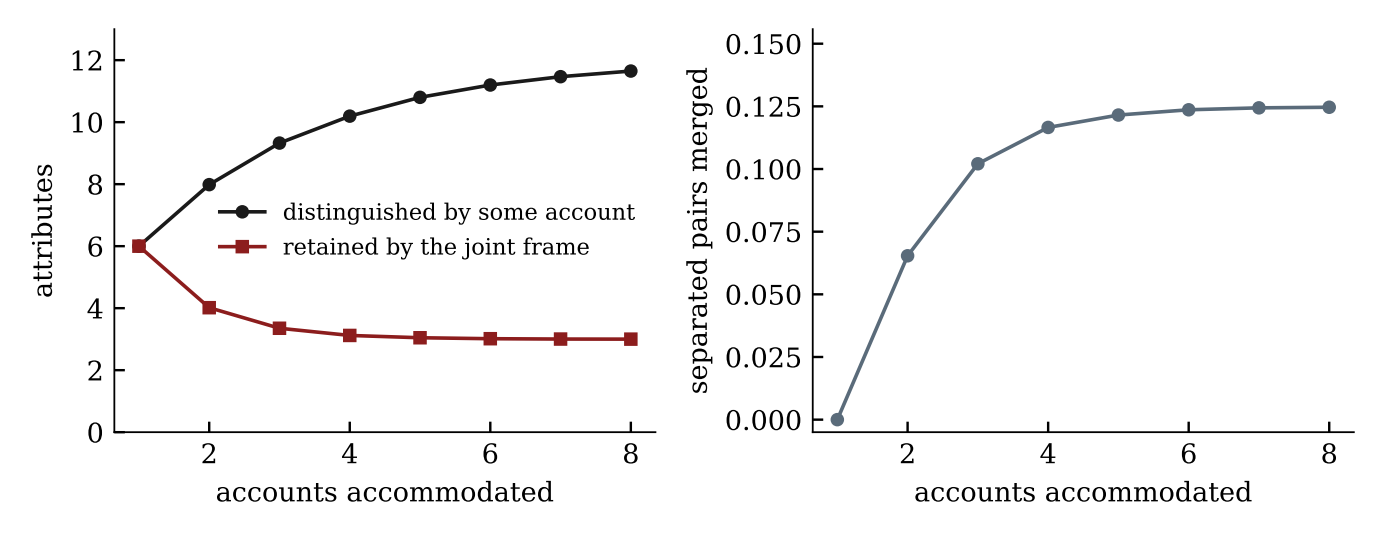
Figure 1. Accommodation against discrimination in the construction of Table 2. As accounts are accommodated from one to eight, the attributes distinguished by some account rise from 6.00 to 11.65 while the attributes retained by the joint frame fall from 6.00 to 3.00, the fall being monotone in every draw; the share of pairs separated by some account and merged by the joint frame rises from zero to 0.125.
Table. Attributes retained by the joint frame as accounts are accommodated ($d=12$, shared core of $3$, private set of $3$ per party, $2000$ draws)
| Accounts | Attributes distinguished | Attributes retained | Fraction of separated |
|---|---|---|---|
| accommodated | by some account | by the joint frame | pairs merged |
| 1 | 6.00 | 6.00 | 0.0000 |
| 2 | 8.00 | 4.00 | 0.0660 |
| 3 | 9.29 | 3.35 | 0.1025 |
| 4 | 10.20 | 3.11 | 0.1175 |
| 5 | 10.80 | 3.03 | 0.1225 |
| 6 | 11.21 | 3.01 | 0.1238 |
| 8 | 11.67 | 3.00 | 0.1246 |
Three assertions in the proposition were checked separately. Monotonicity in clause (i) held in every one of one hundred and sixty thousand steps sampled. The floor in clause (ii) held without exception: the joint frame retained the shared core and converged to it, holding on average four of the eight attributes distinguished by some account at two parties and three of the twelve at eight parties. The permutation invariance of clause (iii) was checked by exhausting the orderings of a fixed collection of five parties, which yielded a single joint frame throughout.
The direction of the second column against the third is the substance of the result. As accounts accumulate, the attributes distinguished by some account rise and the attributes the joint frame can carry fall. Accommodation and discrimination move against one another.
6.3 The professional operations belonging to the family
Several operations in ordinary journalistic practice compute a joint frame or something coarser, and the proposition applies to each without further argument.
A summary that reconciles competing accounts into a single narrative retains what the accounts share. A balanced formulation that presents two positions as symmetric supplies a frame in which the asymmetries between their evidential bases are undrawn. A neutral wording chosen because it is acceptable to every party is by construction a formulation none of them would contest, which is to say one that distinguishes nothing any of them declines to distinguish. A consensus account attributed to no one removes the attributions that clause (iii) shows to be unrecoverable afterwards.
Each of these operations is ordinarily prescribed as a remedy for partiality. On the present account each removes the material in which the reconstruction consisted, and Section 25.5 takes up the case in which the two readings prescribe opposite remedies.
6.4 Overreadings of the result excluded
Proposition ? is easily overread and three restrictions are recorded here.
The proposition establishes no prohibition on summary. Summarising is a condition of a report being read at all, and a paper that concluded otherwise would be recommending an artefact no one could use. What the proposition establishes is the cost of the operation and the location of that cost, which Part VIII uses to state a condition that summarising reports can satisfy.
The proposition recommends no maximisation of divergence. An ensemble is not improved by containing more disagreement, and nothing here supplies a reason to seek out contradictory accounts for their own sake. The proposition concerns what a given ensemble carries and what an operation on it removes.
The proposition identifies no remedy. Clause (iii) states that attribution is unrecoverable from the joint frame, which leaves open whether it might be kept elsewhere. Section 16 shows that it can, by a family of devices that hold a distinction on the record without returning it to the frame, and the argument for those devices rests on this clause.
7. Material Conditions and the Limits They Place on Representation
The role of this section is to answer the charge that the commitments of Section 4 leave every account as good as every other. Its objective is to identify what constrains representation once a presymbolic fact is refused, to state the affiliation of that answer, and to fix the strength at which the affiliation is held. The structure is: the charge, the constraint, what the constraint supplies, and what it withholds. The method is to derive the constraint from a commitment the paper has already made, so that the answer is internal to the account.
7.1 The charge of relativism
If no determinate social fact stands behind the accounts given of an episode, the accounts appear to have nothing to answer to. Each party renders under its own system, no system is privileged, and comparison of accounts appears to be comparison of preferences. An account that ignores every consideration adverse to it would then be one representation among others, and the vocabulary of error would have no application.
The charge is serious and a framework that could not answer it would license the very suppression Part VII sets out to block, since a party wishing to dismiss an unwelcome account could do so by classifying it as merely another perspective.
7.2 The constraint material conditions impose
Representations answer to the material conditions under which they are produced and sustained. A rendering of an episode carries commitments about what occurred, about what will be found on inspection, about what parties will say when asked, and about what will follow. Those commitments are not settled by the system that produced the rendering, and a rendering whose commitments fail is placed under a pressure its author does not control.
The constraint operates without a presymbolic fact because it operates through occurrences and through practice. A ministry’s account of a shortage commits it to what will be observed in a warehouse. A description of a district as prosperous commits its author to what a visitor will find there. An account maintained against accumulating failures of this kind can be maintained, and maintaining it has a cost that rises, which is a material fact about the arrangement holding the account in place.
claim
Claim 7.1. (The material constraint). An account of an episode is sustained under conditions that its own system does not fix. Accounts differ in what they commit their authors to and in the cost of maintaining those commitments as occurrences accumulate. Comparison of accounts is therefore comparison of sustainability under determinate conditions, and it requires no presymbolic fact to be well defined.
claim
7.3 The affiliation of the answer
Claim 7.1 states in the paper’s own vocabulary a position that belongs to dialectical historical materialism, and the affiliation is acknowledged. Material relations condition which representations of a society can be produced, which can be held, and which become unmaintainable. The categories through which a society understands itself are historically formed, and the conditions of their formation are the conditions of their revision.
The affiliation carries a further consequence the paper uses in Part IX. A normative order stands under the same constraint as an account, so that the criteria by which a practice is assessed are themselves historically formed and revisable. A journalistic norm has a date, a condition of adoption and a condition under which it ceases to be maintainable, and Section 31 exhibits this for the separation of news from comment.
7.4 The limits of the materialist affiliation
Two restrictions are placed on the affiliation and both are required by commitments the paper has already made.
The constraint supplies no direction of travel. Nothing established here entails that accounts improve over time, that a society’s self-understanding converges, or that the unmaintainable is replaced by the more adequate. Claim 7.1 states which accounts come under pressure and states nothing about what succeeds them. A reading on which history approximates a target would require the target, and Section 4.1 refused it.
The constraint supplies no criterion available to an actor. Whether an account will prove unmaintainable is settled afterwards and by conditions the author does not control, so Claim 7.1 licenses no judgement at the moment of writing. Part VII establishes this limitation in general and Part VIII states what remains available in its place.
The Epistemology of Social Facts
8. Witnessing and the Position of the Observer
The role of this section is to fix the vocabulary in which the paper describes what an observer of an episode does, given that Part II withheld both the copying of a determinate fact and the free constitution of one. Its objective is to justify the choice of witnessing as that vocabulary, to concede the prior formulations it belongs to, to place the reporter’s own account within the ensemble, and to state what the vocabulary withholds. The method is to derive the requirements on the vocabulary from Part II and then to show that witnessing meets them.
8.1 The requirements on the vocabulary
Four requirements follow from Part II. The description must be positioned, since Section 4.2 established that every account is produced from a place within or adjacent to the episode. It must be fallible, since a positioned account may be mistaken about what it reports and Section 7 supplied the conditions under which the mistake tells. It must be accountable, since a party may be asked how it came to render as it did. And it must withhold authorship, since a party that rendered an episode did not thereby make the episode be as rendered.
The fourth requirement is the demanding one and it excludes the vocabularies most readily available. Observation in its usual sense meets the first three and suggests a determinate object observed. Construction meets the first three and grants the party authorship of what it reports. A vocabulary is wanted that carries position, fallibility and accountability while withholding both the determinate object and the authorship.
8.2 The fit of witnessing to the four requirements
Witnessing meets the four requirements, and it meets them by virtue of features that ordinary usage already carries. A witness stands somewhere and saw what that position afforded. A witness may be wrong, and the wrongness is a defect in the account and no defect in the episode. A witness may be questioned, and answering is part of what witnessing is. And a witness did not bring about what was witnessed, which is the feature that distinguishes the vocabulary from every constructivist alternative.
Presence is preferred to existence throughout for the same reason. A social fact is present to a witness in the way an episode is present, through what a position affords, and the formulation declines the claim that the fact is a substance lying available for inspection. Presence and witnessing together mark the middle position the paper requires.
8.3 Prior formulations conceded
The register is not original and its owners are acknowledged. Donna Haraway’s situated knowledges holds that all vision is from somewhere, that the view from nowhere is a trick, and that objectivity is located and accountable seeing. Miranda Fricker’s account of testimony supplies the vocabulary in which a witness may be wronged as a witness, which Part V uses at the site of admission. The distinction between what is present and what is available as an object to hand belongs to a longer tradition, and the present use of presence answers to it without adopting its apparatus.
8.4 The reporter’s account within the ensemble
A consequence follows immediately and it governs the remainder of the paper. A reporter who renders an episode produces a representation, and that representation joins the ensemble of Section 5.1 on the same footing as the others. The reporter’s account is one more positioned rendering, drawing distinctions under a repertoire, and it is subject to every result Part II established about members of an ensemble.
The consequence is uncomfortable and it is not softened here. Professional training, verification procedures and institutional standing affect the quality of a rendering and change neither its status nor its level. A reporter’s account does not stand above the ensemble surveying it, and Section 11 shows what follows for the obligations that can attach to it.
8.5 The limits of the vocabulary of witnessing
Witnessing licenses no privileged witness. Nothing in the vocabulary supplies a position from which more is afforded than from other positions, and the reporter’s position is not such a position. What a reporter has is access to several positions in sequence, which is a different advantage and one that Section 9 qualifies.
Witnessing supplies no verification through sincerity. A witness who reports honestly what a position afforded may render an account that fails under the conditions of Claim 7.1, and the honesty affects the assessment of the witness while leaving the assessment of the account untouched.
9. The Chain of Mediation and the Position of the Reporting Actor
The role of this section is to locate the reporter within the sequence of transformations that produces a published account. Its objective is to establish that a reporter occupies a position downstream of prior transformations, to record the empirical support for that claim, to draw the structural consequence, and to identify what a record of the prior transformations would carry. The method is to combine the ontological claim of Part II with the established findings of source research.
9.1 Sources as representations already rendered
What reaches a reporter has been rendered before it arrives. A ministry statement is that ministry’s account of an episode, produced under its repertoire and answering to its position. An eyewitness account is a rendering by a party who was somewhere in particular. A court record is a rendering under rules of admission that exclude most of what was said. A statistical series is the output of a classification scheme adopted for purposes of its own. Footage is framed.
A reporter therefore begins with an ensemble and produces a further member of it. The operation performed is construal followed by emission, and Section 2.2 records the companion paper from which that pair is imported. Composition of the two on the same content is what distinguishes an intermediary formally from a source or an audience.
9.2 The empirical record of source dependence
The claim of the previous subsection is supported by long-standing findings in source research and is stated here as established background. Leon Sigal’s study of reporting practice found the predominance of official channels among the origins of published news, and Herbert Gans’s study of national news organisations found the same pattern under a different method. Later work on the indexing of coverage to the range of debate among institutional actors extends the finding to the boundaries of what appears at all.
The findings support the structural claim without being identical with it. They establish where reporters obtain material, which is a fact about practice. The structural claim is that whatever the origin, the material arrives already rendered, which holds for material obtained from an unofficial source exactly as it holds for material obtained from a ministry.
9.3 Every node receives, transforms and emits
A general consequence follows and it removes a category the practice relies on. There is no origin node in a chain of representations. A party who was present at an episode rendered it under a repertoire, and that party’s account is downstream of the episode in the same manner as every later account. The notion of a primary source marks a position in a chain and marks no difference in kind.
The consequence for journalism is direct and uncomfortable. A reporter who renders material for an audience performs the operation that parties downstream of publication will also perform. The difference between a reporter and a party who summarises a published report on a social platform lies in position within the chain and in the declaration of the role, and it lies in no epistemic kind. Part VIII returns to this and shows that the difference in declared role is what makes the reporter bindable while the downstream party is not.
9.4 Provenance and the record of transformations
The preceding subsections suggest a device the paper develops in Part VIII. A representation may be accompanied by a record of the transformations that produced it, so that a reader learns not only what is asserted but through what sequence the assertion arrived. Attribution performs exactly this at one hop, since a sentence reporting that a ministry announced something records that the assertion entered through the ministry.
Analogues exist in other domains and are cited without being borrowed wholesale. Source criticism in historiography subjects a document to questions about its production before subjecting it to questions about its content. Provenance recording in data processing keeps the derivation of a value alongside the value. Both indicate what a record of transformations is for, and Section 16 states what it can and cannot restore.
10. Opacity and the Limits of Access to the Generative Process
The role of this section is to state what a reporter is unable to establish about the production of the representations it receives, and to fix the consequences of that limitation for what may be required of a report. Its objective is to distinguish the sources of the limitation, to identify the compression it forces, and to bound the demand for source criticism accordingly. The method is to import the treatment of opacity from a companion paper and to apply it at this site.
10.1 The sources of opacity distinguished
A reporter receiving a representation would need, in order to assess it fully, an account of how it was produced. Access to that account fails for two structurally different reasons, and the companion study of generative opacity establishes the distinction that is used here.
Opacity of the first kind arises from complexity. The process that produced a statistical series, a policy position or a collective account of an episode may involve many parties over an extended period, with no participant holding the whole. Nobody withholds anything and the process remains unavailable.
Opacity of the second kind arises from power exercised over what is recorded. A party in a position to determine what enters a record determines thereby what a later inquiry can find, and the determination is invisible to the inquiry, since what was excluded leaves no trace in what remains. The two kinds differ in mechanism and coincide in effect.
10.2 The compression forced by opacity
Both kinds of opacity force the same compression. An account of how a representation was generated being unavailable, a reporter works with what is recordable: documents that exist, statements that can be obtained, occurrences that can be dated, discrepancies that can be exhibited. The generative process is reached through its traces where it is reached at all.
The compression is a working condition and no fault of the practice, and the paper records it in order to bound what may be demanded. A condition on reports that required knowledge of how each source’s account was generated would be a condition no report could satisfy.
10.3 The bound on source criticism
A demand that a reporter establish the interest, position and production conditions of every source admits no stopping point of its own, since each answer invites the same questions about its own source. Some bound is therefore required, and the bound the paper adopts is stated at the site of admission in Part V and refined in Part VIII: what is owed concerns the recording of the position from which material entered, which is available, and does not concern the generative process behind that position, which frequently is not.
The distinction is sharp and worth stating plainly. That a statement came from a ministry is available to a reporter and is recordable in a sentence. Why the ministry says what it says is frequently unavailable, and a condition resting on it would fail Section 37’s requirement that conditions be checkable at the time of writing.
11. Fidelity at the Level of the Ensemble and Obligation at the Level of the Member
The role of this section is to establish the second result of the paper and the one that divides its normative territory. Its objective is to show that the property Part II identified as fidelity attaches to an ensemble, that professional obligation attaches to a member, and that the first is undischargeable by the second. The structure is: the two levels, the proposition with its verification, the division that follows, and a statement of what the asymmetry declines to excuse. The method is a construction on the apparatus of Section 5, checked numerically before the proposition is asserted.
11.1 The two levels at which the predicates attach
Part II located the social fact in the relations among the members of an ensemble. Whether those relations are available to a reader is therefore a property of the ensemble, settled by which positions are represented within it and which distinctions its members among them draw. Call an ensemble adequate with respect to a set of distinctions where some member of it draws each.
Professional obligation attaches elsewhere. A code of practice binds a reporter writing a report, a newsroom publishing one, and an editor answering for it. The subject of the obligation is a member of the ensemble, and no member is in a position to determine the composition of the ensemble it joins, since the other members are produced by parties over whom it has no authority and frequently no knowledge.
11.2 The proposition on ensemble and member
claim
Proposition 11.1. (Levels of fidelity and of obligation).
Let ${\sim_i}$ be an ensemble and let adequacy with respect to a set of distinctions be the property that each is drawn by some member. Then (i) adequacy is a property of the ensemble and of no member, since the same member belongs to adequate and to inadequate ensembles; (ii) the contribution a fixed member makes to adequacy is settled by the other members and is therefore no function of the member; and (iii) where the distinctions at issue exceed those any single position affords, no member secures adequacy under any conduct available to it. Consequently a standard defined at the level of the ensemble is undischargeable by an obligation borne at the level of the member.
claim
The proposition was checked on the construction of Section 6, holding one member fixed and drawing its co-members at random. Table 3 reports the marginal contribution of the fixed member, measured as the attributes it adds to those the remaining members already cover, over twenty thousand draws at each ensemble size.
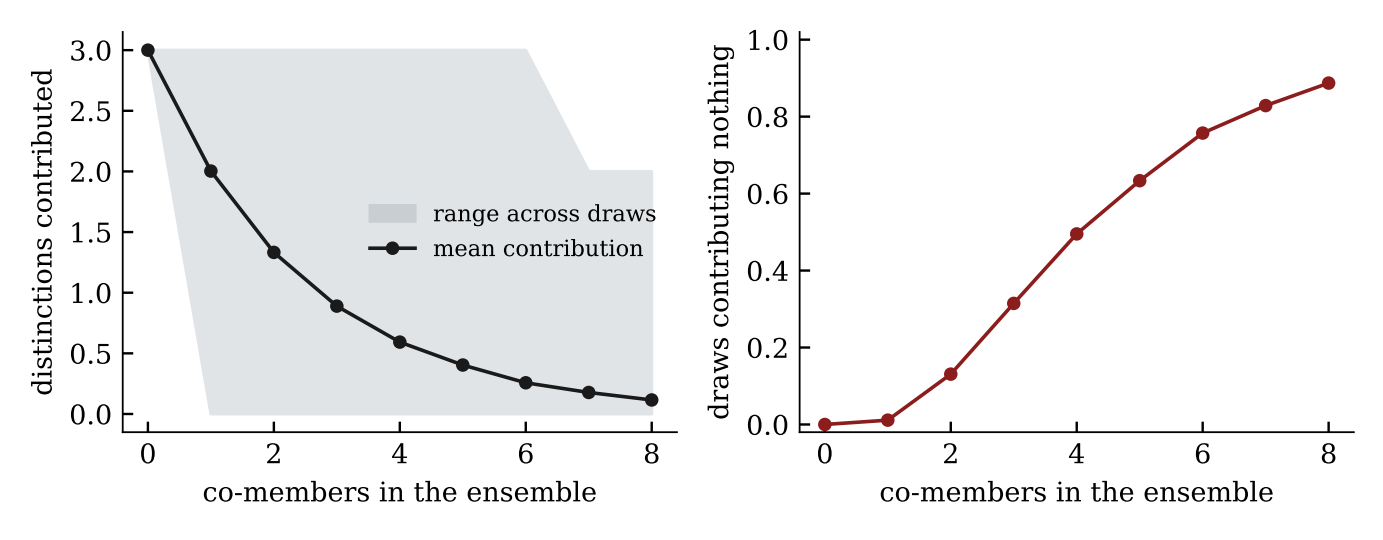
Figure 2. The contribution of one fixed report in the construction of Table 3. The report is unchanged throughout and its co-members are drawn at random. Mean contribution falls from 3.000 with no co-members to 0.116 with eight, while the range across draws remains 0 to 3 at every point; the share of draws in which the identical report contributes nothing rises to 0.495 at four co-members and 0.887 at eight.
Table. Marginal contribution of one fixed report as its co-members vary ($d=12$, shared core of $3$, private set of $3$ per party, $20000$ draws)
| Co-members | Mean marginal | Standard | Range | Proportion of draws |
|---|---|---|---|---|
| drawn | contribution | deviation | contributing nothing | |
| 0 | 3.000 | 0.000 | 3 to 3 | 0.000 |
| 1 | 2.003 | 0.701 | 0 to 3 | 0.011 |
| 2 | 1.332 | 0.773 | 0 to 3 | 0.131 |
| 3 | 0.889 | 0.731 | 0 to 3 | 0.315 |
| 4 | 0.593 | 0.651 | 0 to 3 | 0.495 |
| 6 | 0.257 | 0.470 | 0 to 3 | 0.757 |
| 8 | 0.116 | 0.328 | 0 to 2 | 0.887 |
The fourth column establishes clause (ii). One and the same report, unchanged in every respect, contributes three attributes to some ensembles and nothing at all to others, and at four co-members it contributes nothing in roughly half of the draws. Its contribution is settled by parties it never encountered.
Clause (iii) was checked separately. A single member of this construction attends to six of the twelve attributes at most, so adequacy with respect to all twelve lies beyond any conduct available to it. Across draws, the proportion of ensembles covering all twelve rose from zero at two members to $0.209$ at five and $0.684$ at eight, and reached $0.931$ at twelve. Adequacy is achieved by ensembles at rates the ensembles do not control and no member secures.
11.3 The division of normative territory that follows
The division has a counterpart in the literature on responsibility and the counterpart supports it. A structure in which an outcome is produced by many parties acting independently, with no single party’s contribution sufficient and none dispensable, is the problem of many hands, and it is known to defeat attributions of responsibility framed at the level of the individual official (Thompson, 1980). Young’s social connection model responds by holding that responsibility for a structural outcome is shared, forward-looking and political, and is not assignable as liability to any participant (Young, 2011). The present division is the same shape reached from the epistemic side, and the two literatures should be read together: what Proposition ? establishes formally about adequacy is what these accounts establish normatively about outcomes produced by uncoordinated parties.
Proposition ? divides the paper’s normative territory, and the division is derived and not stipulated. Conditions that a member can satisfy under its own conduct are available for professional obligation, and Part VIII establishes which conditions those are. Properties defined over the ensemble are unavailable for professional obligation and are assessable only at the level of the arrangement that produces the ensemble, which is a question of governance and which Part IX refers onward.
A concrete form of the division is worth stating in advance. A press system may consist entirely of reports each of which meets every condition Part VIII imposes, and may still leave whole positions in a society unrepresented in the ensemble. Every member is faultless and the ensemble is inadequate, and the two statements are consistent.
11.4 Overreadings of the asymmetry excluded
The asymmetry supplies no member with an excuse, and three limits are recorded.
The asymmetry concerns properties of the ensemble alone. Conditions on the artefact remain fully binding on the member, and Part VIII shows that they are neither weak nor few.
The asymmetry concerns what an obligation can require and not what an actor may attend to. A reporter who considers which positions are already represented and which are absent is doing something intelligible and frequently valuable, and the proposition establishes only that no obligation can be defined in those terms with the reporter as its subject.
The asymmetry supports no inference to the futility of individual conduct. Clause (ii) states that a member’s contribution is settled by the others, which is a claim about the determination of the contribution and no claim about its size. The same table shows contributions of three attributes, and a report that adds a position no other member holds has added it.
The Formal Account
12. The Carrier, the Situated Renderings, and the Joint Factor
The role of this section is to assemble in one place the apparatus used through Part IV, some of which was introduced at working strength in Part II. Its objective is to fix the carrier on which everything is defined, to introduce the second structure the paper requires, and to state what the apparatus deliberately excludes. The method is to add the least structure at each step and to record the reason for each addition.
12.1 The carrier and the renderings
Let $S$ be a set whose elements are the ways an episode might have been. A party $i$ renders the episode and thereby draws distinctions, carried by an equivalence relation $\sim_i$ on $S$, where $x \sim_i y$ holds where party $i$’s rendering treats $x$ and $y$ alike. The quotient $S/{\sim_i}$ is what party $i$’s account discriminates.
Section 6 established the behaviour of the join $\bigvee_i \sim_i$ and Section 11 the behaviour of coverage across an ensemble. Both results are used below without restatement.
12.2 Positions and neighbourhoods
A second structure is required, since the results of Part VIII concern the relation between where material came from and what a claim is asserted about. Let $P$ be a set of positions, whose elements are the places within a society from which an episode is undergone and rendered. Positions are individuated by what they afford, so that two parties occupy one position where the same aspects of the episode are available to each on the same terms.
A report’s material is drawn from a subset $N \subseteq P$, termed the neighbourhood of the report. A report’s claim is asserted over a subset $D \subseteq P$, termed its domain of assertion. Both are ordinarily left implicit in a published report and both are determinate, since the material came from somewhere and the claim is about someone.
12.3 The joint factor and the order on domains
Subsets of $P$ are ordered by inclusion, and the order is the structure the containment condition is stated on. A domain $D$ is a coarsening of a domain $N$ where $N \subseteq D$, and passing from $N$ to $D$ merges the positions in $D \setminus N$ with those the material actually reached.
The two structures interact in one place and the interaction is worth recording. Positions differ in what they afford, so distinct positions supply distinct distinctions on $S$. Merging positions therefore merges the distinctions they supplied, which is what makes the operations of Part VIII operations on the divergence structure of Part II and not merely operations on a population.
12.4 The relation of the apparatus to information-flow theory
The constructions above are an instance of an existing formalism and are presented as such. Barwise and Seligman treat a situated representation as a classification pairing tokens with types, a rendering between representations as an infomorphism, and a family of infomorphisms sharing a core as a channel, with a local logic attached to each classification supplying its fallible and system-relative rules of inference (Barwise & Seligman, 1997). A party’s account in the present setting is a classification, a rendering is an infomorphism, and a neighbourhood is a set of classifications sharing a core. The categorical setting of the same construction is that of Chu spaces (Barr, 1979), and its stochastic counterpart is the theory of Markov categories (Fritz, 2020).
The debt is acknowledged in place of being avoided, and the difference is one of question and not of machinery. Information-flow theory analyses how a distributed system carries information about itself and treats the regularity of the system as the condition under which flow occurs, so that a failure of flow is a limit on the analysis. This paper asks what a plurality of classifications constitutes where they do not agree, and treats the failures as constituents of the object. The apparatus is therefore borrowed and the use of it is the paper’s own.
12.5 The ensemble read as a diagram and the joint frame as its limit
The constructions of this section admit a categorical reading which states the paper’s central claim more compactly than the prose does, and it is given here for that reason and not for any result that depends on it.
Take the positions $P$ ordered by inclusion of the neighbourhoods they generate, so that $P$ is a poset and therefore a category whose arrows are the inclusions. Each party’s account assigns to a neighbourhood the distinctions drawn there, and a smaller neighbourhood receives the restriction of what a larger one carries. The assignment is accordingly contravariant, and the ensemble of accounts is the presheaf of Equation (1),
$$\mathcal{A} \colon \mathbf{Pos}^{\mathrm{op}} \longrightarrow \mathbf{Set},
\qquad
N \longmapsto \mathcal{A}(N),$$
whose value at $N$ is the set of accounts supported at $N$ and whose restriction maps carry an account to what it says of a smaller neighbourhood.
The joint frame of Section 6 is a limit of the diagram formed by the accounts. Proposition ? states what taking that limit costs: the limit retains the commonly drawn distinctions and no distinction belonging to any proper subset of the parties, and it is invariant under permuting which party drew which distinction.
The claim of Part II is then stated in one line. The object a reader requires is the diagram, and the aggregation procedures surveyed at Section 3.14 return its limit. A limit is a single object equipped with maps to the others, and the information discarded in passing from a diagram to its limit is exactly the information Section 5 identifies as the constituent.
A second formulation sharpens the same point and is offered with a caution. A presheaf is a sheaf when compatible accounts given on parts glue uniquely to an account on the whole. The ensemble treated here is not a sheaf in that sense, since accounts supported at different positions do not agree where their neighbourhoods meet, and the attempted gluing is the join whose cost Proposition ? measures. Read this way, the social fact is the obstruction to gluing and not the glued section. The caution is that the paper establishes no gluing conditions and proves no statement in these terms; the reading orients and the propositions of Sections 6 and 14 carry the weight.
12.6 Structures excluded from the apparatus
The apparatus carries no probability measure on $S$ or on $P$, no ordering of renderings by accuracy, no metric on either set, and no time evolution. Each exclusion is deliberate.
A probability measure would invite an expected loss and thereby a quantity to be minimised, which Section 20 and Part VII both refuse. An accuracy ordering would require the presymbolic fact Section 4.1 declined. A time evolution would require the dynamics Section 20 shows to be unavailable. What remains is order-theoretic and combinatorial, and every result below is established at that strength.
13. Types, Judgements, and the Condition on Coercion Between Them
The role of this section is to state, in a form that can be checked against the text of a report, the relation that Part VIII will make normative. Its objective is to give the judgement forms, to define the operation the paper terms coercion, to distinguish the two readings a general sentence admits, and to record the modest prior art of the apparatus. The method is definitional throughout, and no norm is asserted here.
13.1 The forms a typed judgement takes
Three forms suffice. A piece of material is judged to be of a type, written $e : N$, where $N$ is the neighbourhood from which it was drawn. A property is judged to hold of some element of a type, written $\exists x{:}N., P(x)$. And a property is judged to hold of a type generally, written $\forall x{:}D., P(x)$, or in the weaker forms ordinary language supplies, in which a property is attributed to a domain without quantifying explicitly over it.
A report is read here as a set of such judgements together with the material supporting them. The reading is coarse and it is sufficient, since the relation at issue holds between the type in the material judgement and the type in the assertion.
13.2 The rules governing a typed judgement
The judgements of Section 13.1 obey rules, and writing them down fixes what the apparatus permits with more precision than prose allows. Let $\Gamma$ record what a report’s material establishes, let $\mathrm{Claim}(N)$ be the type of claims supported at the neighbourhood $N$, and let $\mathrm{Warrant}(N,D)$ be the type of grounds licensing the passage from $N$ to a wider $D$. Three rules govern the formation of a claim in a report, and Equation (2) collects them.
$$\begin{aligned}
&\frac{\Gamma \vdash m : \mathrm{Material}(N)}{\Gamma \vdash c : \mathrm{Claim}(N)}
\ \ (\textsc{form})
\qquad
\frac{\Gamma \vdash c : \mathrm{Claim}(N) \quad D \subseteq N}{\Gamma \vdash c : \mathrm{Claim}(D)}
\ \ (\textsc{narrow})\[1.2ex]
&\qquad\qquad
\frac{\Gamma \vdash c : \mathrm{Claim}(N) \quad \Gamma \vdash w : \mathrm{Warrant}(N,D)}{\Gamma \vdash c : \mathrm{Claim}(D)}
\ \ (\textsc{widen})
\end{aligned}$$
The first forms a claim from material. The second narrows a claim to a smaller domain and requires nothing beyond the inclusion. The third widens a claim and requires a term of warrant type, which is the declaration Section 37 makes normative.
Two features of (2) carry the argument of Part VIII.
The first is a variance. Narrowing is free and widening is not, so $\mathrm{Claim}(-)$ is contravariant in its index and behaves as the presheaf of Section 12.5 behaves. A report may always say less of a smaller region than its material supports, and it may say more of a larger one only by supplying $w$.
The second is that migration has no rule. There is no fourth rule carrying $\mathrm{Claim}(N)$ to $\mathrm{Claim}(D)$ for $N \subset D$ without a warrant, and the absence is the whole content of the condition. A migrated claim is accordingly a term admitting no derivation in this system, and a report containing one asserts something for which it exhibits no proof. The formulation is worth having because it locates the defect in the derivation and not in the claim: a term may fail to typecheck while denoting something true, which is Section 14.2 stated in another notation.
13.3 Coercion and its licence
claim
Definition 13.1. (Coercion and its licence). Where a report’s material is judged at type $N$ and its claim is asserted at type $D$ with $N \neq D$, the report performs a coercion from $N$ to $D$. The coercion is licensed where $D \subseteq N$, since a claim asserted over part of the neighbourhood the material reached requires nothing further; and where $N \subset D$, the coercion is licensed only by a declared map from $N$ to $D$ together with a warrant for it. A coercion from $N$ to $D$ with $N \subset D$ and no declared map is termed unlicensed.
claim
The definition is stated so that its application requires the report and its material alone. Whether $N \subset D$ holds is settled by where the material came from and what the claim is about, and both are known to the writer at the time of writing. Nothing about readers, consequences or subsequent events enters.
13.4 The two readings of a general sentence
Ordinary journalistic prose leaves the quantifier implicit, and the implicit quantifier is where unlicensed coercion ordinarily occurs. A sentence reporting that residents are worried about prices admits a reading on which some residents encountered by the reporter said so, and a reading on which the property is attributed to residents generally. The first is a judgement at the neighbourhood the material reached. The second asserts at a wider type.
The devices that fix the reading are ordinary and are enumerated here for use in Part V: an explicit quantifier of restricted force, a locative or temporal restriction, an attribution naming the party through whom the material entered, and a modal qualifier marking the strength of the assertion. Each fixes $D$ in the text, and their absence leaves $D$ to be supplied by the reader.
13.5 The prior art of the apparatus
The apparatus claims nothing. Type discipline, sortal logic, the fallacy of composition and the treatment of quantifier scope are old, and the linguistic literature on hedging and evidentiality has studied the devices of the previous subsection in detail. What is claimed is the application: a published sentence is read as a typed judgement, the implicit quantifier is treated as fixing a domain of assertion, and the declaration of a scope is treated as the warrant on a coercion.
13.6 The division of labour with Part VIII
Definition 13.1 is a definition and asserts no obligation. That an unlicensed coercion is a defect, that the defect is one a reporting actor may be held to, and that the condition survives the limitations Part VII establishes are three further claims, and each is made in Part VIII where the grounds for it are available. Part IV establishes what the operations are and how they behave.
14. Migration Under the Quotient Reading
The role of this section is to give unlicensed coercion a structural reading and to establish what follows from it. Its objective is to identify the operation, to state its irreversibility, to quantify the ambiguity it introduces, and to show that its scope extends past the sampling case that motivates it. The method is a short proof, since the result follows from a property of the operation and admits no informative simulation.
14.1 The operation performed by a migration
Membership and identity are different structures, and the difference is the whole of this section. That a party belongs to a class relates two things of different kinds and leaves the class articulated. That a class is identified with a wider one merges them, so that positions previously distinguished become one position.
An unlicensed coercion from $N$ to $D$ therefore acts as a quotient on $P$, identifying the positions of $N$ with those of $D \setminus N$ for the purposes of the claim. The reader receiving the claim receives the quotient and receives no indication that one was taken. The paper terms the operation migration, since the claim has moved from the neighbourhood that generated it to a wider one.
14.2 The proposition on the irreversibility of migration
claim
Proposition 14.1. (Irreversibility of migration).
Let a report perform an unlicensed coercion from $N$ to $D$ with $N \subset D$. Then (i) the quotient map $q : P \to P/{\approx}$ identifying the positions of $D$ is not injective, so it admits no left inverse and $N$ is unrecoverable from the claim; (ii) the number of neighbourhoods consistent with the claim is $2^{|D|} - 1$, so the ambiguity introduced grows exponentially in the coarseness of the domain asserted; and (iii) no property of the claim distinguishes a report whose material reached all of $D$ from one whose material reached a single position within it.
claim
Clause (i) follows from non-injectivity, since a map identifying two distinct elements has no left inverse. Clause (ii) counts the non-empty subsets of $D$, each of which is a neighbourhood from which material yielding the same claim might have been drawn. Clause (iii) restates clause (i) in the terms in which a reader encounters the claim: the text asserts of $D$ and carries no marker of the neighbourhood, so the strongest and the weakest evidential situations are textually identical.
Clause (iii) is the one that matters for practice, and it identifies what makes migration a defect distinct from inaccuracy. A migrated claim may be true. Where a claim asserted of a city is true of the city, the report that asserted it from material gathered in one district has stated something correct, and has stated it without the support its form implies. The defect lies in the relation between the claim and its material, and it is present whether the claim holds or fails.
14.3 The scope of the result
Migration in the sampling case is the readiest illustration and is the narrowest instance. Three further instances are treated in Part V and are recorded here to fix the generality of Proposition ?.
A rendering may migrate across a boundary of kind. An utterance is material of one type and a disposition attributed to the speaker is a claim of another, so that reporting a formulation of cautious consideration as reluctance coerces from the type of what was said to the type of what was meant. The declared map required by Definition 13.1 would be an account of why the utterance warrants the attribution.
A rendering may migrate across a boundary of time. Material gathered during one period supports claims about that period, and a claim about a society’s condition asserts over a wider temporal domain. Section 25 treats this at the site of registration.
A published report may be migrated by parties downstream of it. A report asserting that some residents expressed concern may be summarised as residents being furious and summarised again as a city rejecting a policy, each step a further quotient. Section 15 establishes what accumulates along such a sequence.
15. Composition Along a Chain, and the Accumulation of Collapse
The role of this section is to establish what happens to a claim transmitted through a sequence of parties, each of which may coerce further. Its objective is to state the accumulation result, to verify it, and to record that the sequence extends upstream of the reporting actor as well as downstream. The method is a construction on the apparatus of Section 12, checked numerically before the proposition is asserted.
15.1 The chain along which coercions compose
Let a claim originate with material drawn from a neighbourhood $N_0 \subseteq P$ and pass through parties $1, \dots, n$, each of which receives an assertion at some domain and re-emits an assertion at a domain of its own. Let $D_t$ be the domain at which the claim is asserted after $t$ hops. Each party performs a coercion in the sense of Definition 13.1, and the coercion at each hop composes with those before it.
The construction assumes nothing about the parties beyond their performing the operation. They are uncoordinated, unknown to one another, and unknown to the party at the head of the chain, which is the condition Section 2.2 identified as distinguishing this case from a chain of chosen intermediaries.
15.2 The proposition on accumulation
claim
Proposition 15.1. (Accumulation along a chain).
Along a chain of coercions, (i) the domain of assertion is non-decreasing in the number of hops, since each party asserts at a domain including the one it received; (ii) the neighbourhood recoverable by a reader at the end of the chain is non-increasing, and where no party records the domain it received, the reader recovers nothing finer than the final domain; and (iii) the composition of the coercions is itself a coercion, so a chain of individually small enlargements is indistinguishable at the end from a single large one.
claim
Clause (iii) is the clause with practical force. A sequence in which each party enlarges the domain modestly, and in which no party commits an enlargement that would be remarkable on its own, terminates in a claim whose relation to its material is the same as that of a claim fabricated at the outset. Nothing in the terminal claim distinguishes the two histories.
15.3 The verification of the accumulation result
The proposition was checked on a construction in which a population is divided into thirty-two positions, a report’s material is drawn from two of them, each hop merges five further positions into the domain of assertion, and the chain runs to six hops. Twenty thousand chains were drawn at each setting. Where no party records the domain it received, the reader’s tightest available knowledge is the final domain, which averaged $21.19$ of the thirty-two positions against the two the material reached. The reader’s capacity to detect that any collapse occurred was zero in every such chain, since the terminal claim carries no marker of its history.
15.4 The upstream half of the chain
Section 9 established that a reporting actor receives material already rendered, and Proposition ? applies to that portion of the sequence without modification. Material reaching a reporter has passed through coercions performed by parties upstream, and the reporter’s own operation composes with them.
The total collapse separating a reader from the positions that generated the material is therefore the composition of an upstream portion the reporter did not perform and a downstream portion the reporter did not choose. What the reporter performs is one hop, and Part VII establishes that this fact fixes the boundary of what may be required of it.
16. Annotation and the Partial Inversion of a Collapse
The role of this section is to establish what a recording device can restore once Proposition ? has established that the collapse itself is irreversible. Its objective is to define the device, to state what it recovers, to verify the statement, and to identify the distribution of its value along a chain. The method is the same construction as Section 15, with a recording step added.
16.1 The device of annotation described
An annotation on a claim is a record, carried alongside the claim, of the domain at which the material supporting it was drawn. A sentence reporting that shoppers interviewed in a particular district expressed a concern annotates the claim it makes, since it carries its own neighbourhood. A sentence attributing an assertion to the party that made it annotates at one hop, since it records the position through which the material entered. A note stating that the views of a further stratum remain to be investigated annotates by exhibiting a boundary the report did not cross.
The devices are already professional practice, and Section 3.6 recorded that their enumeration belongs to the study of objectivity as an occupational routine. What is added here is an account of what they do formally.
16.2 The proposition on annotation
claim
Proposition 16.1. (Partial inversion under annotation).
An annotation does not invert the quotient of Proposition ? and restores no distinction the collapse removed. It records that a collapse occurred and the domain at which the material stood before it. Consequently (i) a reader of an annotated claim can detect the collapse, which a reader of an unannotated claim cannot; (ii) the tightest neighbourhood available to a reader at the end of a chain is the smallest domain any surviving annotation records; and (iii) the value of an annotation is greater the earlier in a chain it is made, since a later annotation records a domain already enlarged.
claim
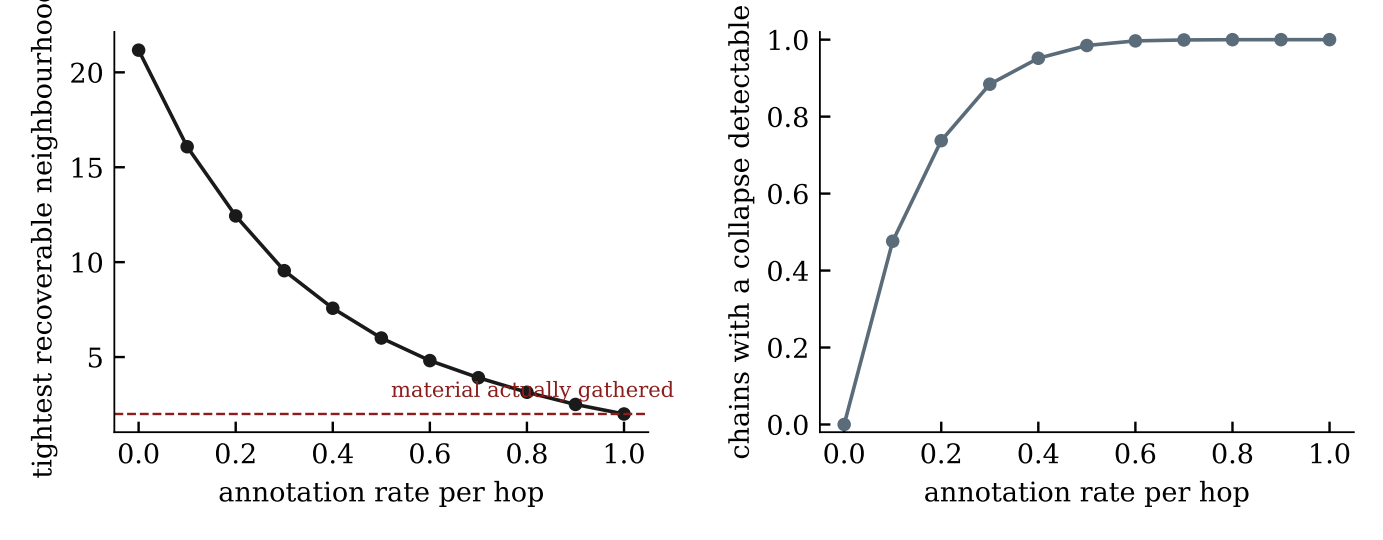
Figure 3. Annotation along a chain, in the construction of Table 4. Material is drawn from two positions of thirty-two and five further positions are merged at each of six hops. With no annotation the tightest neighbourhood a reader can recover is 21.17 positions and no collapse is detectable in any chain; at an annotation rate of one half the figures are 6.00 positions and 0.985 of chains; at rate one the reader recovers exactly the two positions the material came from.
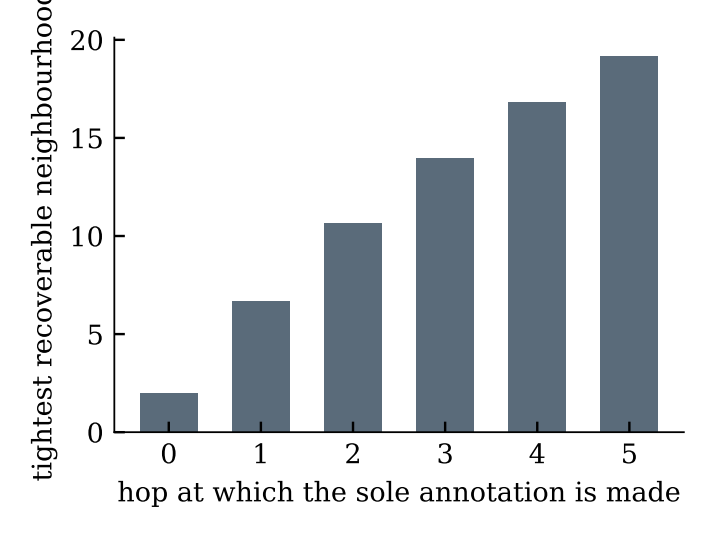
Figure 4. Position of a single annotation along the chain of Figure 3, against what a reader at the end can recover. One annotation made at the first hop leaves the reader with 2.00 positions; the same single annotation made at the last hop leaves 19.15, a ratio of 9.58.
Table. Reader’s knowledge at the end of a six-hop chain, by annotation rate ($32$ positions, material from $2$, five positions merged per hop, $20000$ chains)
| Proportion of parties | Tightest neighbourhood | Proportion of chains in which |
|---|---|---|
| annotating | available to the reader | a collapse is detectable |
| 0.00 | 21.19 | 0.000 |
| 0.10 | 16.23 | 0.465 |
| 0.25 | 10.99 | 0.818 |
| 0.50 | 6.06 | 0.981 |
| 0.75 | 3.47 | 1.000 |
| 1.00 | 2.00 | 1.000 |
Table. Tightest neighbourhood available to the reader where exactly one party annotates, by its place in the chain (same construction, $20000$ chains)
| Hop at which the sole | Tightest neighbourhood |
|---|---|
| annotation is made | available to the reader |
| 0 | 2.00 |
| 1 | 6.69 |
| 2 | 10.64 |
| 3 | 13.98 |
| 4 | 16.79 |
| 5 | 19.17 |
16.3 The verification of the annotation result
Table 4 reports clauses (i) and (ii). Where no party annotates, the reader’s tightest available neighbourhood is the final domain of $21.19$ positions and the collapse is detectable in no chain at all. At an annotation rate of one half the tightest available neighbourhood falls to $6.06$ positions and the collapse is detectable in $98.1$ per cent of chains. Where every party annotates the reader recovers the original neighbourhood of two positions exactly.
Table 5 reports clause (iii), and the magnitude of the effect is the finding worth carrying forward. A single annotation made at the head of the chain leaves the reader with the two positions the material reached. The same single annotation made at the last hop leaves the reader with $19.17$ positions, which is close to the $21.19$ of no annotation at all. One annotation is worth roughly ten times as much at the head of a chain as at its end.
The consequence for the practice is direct. A reporting actor stands near the head of the chain that carries its claim, and the annotation it makes is therefore worth more than any annotation made downstream of it. Part VIII draws the normative conclusion; the structural fact is established here.
16.4 The limits of annotation as a device
Three limits are recorded, and the first is the most important.
Annotation restores no distinction. Proposition ? stands, and a reader of a well annotated report holds a record that a collapse occurred and holds none of what the collapse removed. The reader who learns that a claim rests on material from one district learns thereby that the claim about the city is unsupported at that width, and learns nothing about the other districts.
Annotation is defeated by the parties downstream. Table 4 measures what survives, and an annotation is carried onward only where the transmitting party carries it. The device is therefore reliable at the point of writing and unreliable as a guarantee of what a distant reader receives, and Part VII establishes that the second is beyond what may be required.
Annotation supplies no quantity to be maximised. The tables measure a construction and report its behaviour; they license no criterion instructing an actor to increase a rate. Part VIII states the condition in the form a single artefact can satisfy.
17. Propagation Represented as a Heterogeneous Dynamical Network
The role of this section is to exhibit a construction in which the parties along a propagation pathway are represented with their own internal dynamics and their own state spaces. Its objective is to state the construction, to establish what it represents that the apparatus of Sections 12 to 16 leaves unrepresented, to identify the prior work it draws on, and to fix its status within the paper. The structure follows those four steps. The method is constructive, and Section 17.5 states in advance that no proposition of this paper rests on what follows.
17.1 The status of the construction
The construction of this section is illustrative. It is offered to show that the operations described in Parts IV and V admit a representation in which parties carry dynamics of their own, and no result stated elsewhere in the paper depends on it. The companion paper on diplomacy adopts the same discipline for its field-theoretic layer, presenting it as evidence that an abstract structure has a realisation of that kind and resting no claim upon the realisation alone.
The discipline is recorded first because the construction is more ambitious than anything else in the paper, and a reader is owed a clear statement of how much weight it carries. It carries none. What it supplies is a representation, and Section 20 states what a representation of this kind can and cannot be used for.
17.2 Nodes with their own dynamics
Let a propagation pathway consist of parties indexed by $i$. The apparatus of Section 12 assigns each party a position and treats what a party does with a received claim as a coercion between domains. The present construction assigns each party a state space $X_i$ and an evolution rule $F_i$ acting on it, so that the party has an interior and a history.
The state spaces are permitted to differ in kind, and the permission is the substance of the construction. A party representing an individual reader may be assigned a finite-dimensional space with continuous dynamics of the sort used for excitable systems. A party representing an editorial process may be assigned a finite set of states with a transition rule, so that its dynamics are discrete. A party representing a linguistic community may be assigned a space carrying a topology and no metric, so that expressions are near one another in a sense that supports no numerical distance. A party representing a diffusive medium may be assigned a function space with an evolution equation of the kind used for continuous media.
Nothing requires these spaces to embed in a common one, and the construction is offered precisely because a common embedding would suppress the feature at issue. Section 4.2 established that parties operate under different repertoires of category and licensed inference, and a representation forcing all parties into one state space would represent the parties and lose the heterogeneity that Part II identified as constitutive.
17.3 Relations with their own dynamics
An ordinary network carries a fixed weight on each edge, and the state of the network is the collection of node states. The construction here treats the relation between two parties as an object with dynamics of its own.
Let $\phi_{ij}$ denote what carries an assertion from party $i$ to party $j$. Since $X_i$ and $X_j$ may differ in kind, $\phi_{ij}$ is a map between spaces of different kinds and is not required to be linear, continuous or distance-preserving. It is the formal counterpart of the operations of Part V, in which rendering, translation and construal each carry material across a boundary that no numerical coupling would respect.
The relation is permitted to evolve, and Equation (3) states the pair of rules that results.
$$\frac{d x_i}{dt} = F_i!\left(x_i, {\phi_{ji}}\right),
\qquad
\frac{d \phi_{ij}}{dt} = G_{ij}!\left(x_i, x_j, \phi_{ij}\right)$$
The pair records that parties change under what reaches them and that what reaches them changes under the parties. The second equation of (3) is what distinguishes the construction from an ordinary network, in which the relation carries a fixed weight. Section 9.2 described the same interdependence without formal apparatus: a reporter’s relation to a source is altered by what the source has previously supplied, and the alteration governs what the reporter admits afterwards.
17.4 Continuous and discrete evolution within one system
The construction permits continuous and discrete evolution to coexist within one system. A party may evolve continuously over intervals and undergo a discontinuous change at particular instants, which is written as Equation (4).
$$\dot{x} = F(x) \ \text{ between events},
\qquad
x(t^{+}) = H!\left(x(t^{-})\right) \ \text{ at an event}.$$
The two clauses of (4) apply to one party over one interval, which is what a system of mixed regimes requires.
The permission matters for the case. A readership’s disposition toward a subject develops over months and its exposure to a particular report occurs at an instant. An editorial process holds a state and changes it at a decision. A relation between an outlet and a source erodes gradually and terminates at a point. A representation confined to one of the two regimes would misdescribe the pathway that Section 26 treats.
17.5 The reach of the construction and its remainder
Three features of the case become representable here that the apparatus of Part IV leaves out.
The interior of a party becomes representable. Part IV treats a party as a position affording distinctions and says nothing about what the party does between receiving and re-emitting. The construction assigns that interval a state and a rule.
The evolution of a relation becomes representable. Part IV treats the pathway as given and asks what composes along it, and the construction allows the pathway itself to change while claims travel on it.
The coexistence of regimes becomes representable, which no single formalism of Part IV accommodates.
Two features remain outside it and both are recorded. The rules $F_i$, $G_{ij}$ and the maps $\phi_{ij}$ are unspecified, and Section 20 establishes that specifying them is unavailable in this setting. And the construction is compatible with the results of Part IV without entailing them, since Propositions ?, ? and ? concern the relation between a claim and its material and are silent about any party’s interior.
17.6 A simulation of the construction
The construction admits simulation, and one is reported here to establish that a system of the kind described runs and that its heterogeneity is not merely notational. Four parties are taken. Party A carries a two-dimensional continuous state with excitable dynamics of the FitzHugh-Nagumo form. Party B carries four discrete states with a transition rule and no metric. Party C carries a position in a finite space given by an adjacency structure, so that its admissible moves are fixed by that structure and by no distance. Party D carries a field on forty-eight sites evolving by diffusion with a source. The three relations joining them evolve under the parties they join, by the second rule of Section 17.3.
Figure 5 reports one run. Every panel is on one time axis, which is what the construction claims to permit: a continuous trajectory, a step function on four states, a walk on an adjacency structure, and a field on a spatial support all evolve together, and the relations joining them are non-constant throughout.
What the simulation establishes is bounded and is stated. It establishes that the construction is coherent and runs, which a formalism is entitled to be asked for. It establishes nothing about journalism, since the rules were chosen for illustration and were not estimated from anything. Section 33.5 gives the general form of that limit.
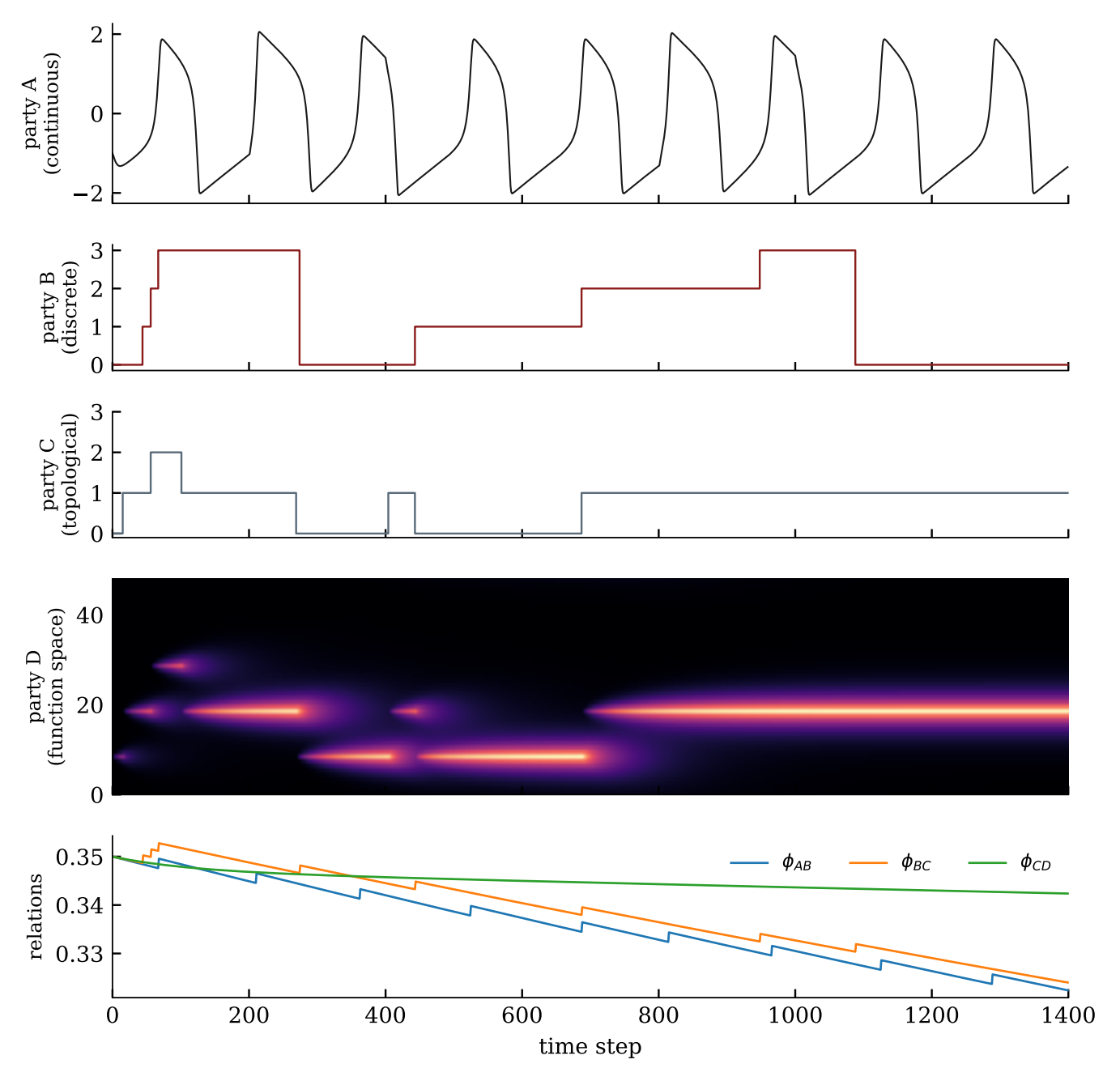
Figure 5. One run of the construction of Section 17. Party A is continuous in two dimensions, ranging over $[-2.06, 2.06]$; party B is discrete, making eight transitions among four states; party C moves seven times among four blocks with its moves restricted by an adjacency structure and by no distance; party D is a field on forty-eight sites. The relations $\phi_{AB}$, $\phi_{BC}$ and $\phi_{CD}$ evolve throughout, with the visible steps occurring at events in the parties they join.
17.7 Prior work assembled by the construction
The construction assembles established components and invents none of them.
Systems combining continuous evolution with discrete transitions are studied as hybrid dynamical systems, and their theory supplies the regime of Section 17.4. Systems composed from parts along shared boundaries, with the parts permitted to differ, are treated in the categorical literature on open dynamical systems and structured cospans, which supplies the composition of Section 17.3 and is already cited by the companion paper on diplomacy. Networks whose propagation is event-driven and threshold-crossing are studied as spiking networks, and such a network is the special case of the present construction in which every node carries the same excitable dynamics and the relations are static.
The generalisation at issue is therefore in three directions at once: the node dynamics are permitted to differ in kind, the relations are permitted to evolve, and the state spaces are permitted to carry different structure. Whether the three generalisations together admit a theory is a question this paper does not address, and Section 20.5 records what follows from leaving it open.
18. Two Strategies for a Dynamics That Resists Specification
The role of this section is to describe two ways in which a formal treatment may proceed where the concrete dynamics of a system cannot be written down, and to determine what each offers the present case. Its objective is to state the algebraic strategy and to identify the form of it that this paper has already adopted, to state the background-independent strategy and to identify the question in this paper it bears on, and to record the limitation both share. The structure follows those three steps. The method is comparative, and both strategies are described in the terms used for them in physics before either is applied here.
18.1 The situation calling for a strategy
Section 17 left the rules unspecified, and the omission is not an accident of exposition. A treatment of the pathway would require the response of a receiving party to a given message, which is the object no available method supplies for the case at hand. Two strategies are used in physics where a comparable difficulty arises, and they differ in what they give up.
18.2 The algebraic strategy
The first strategy replaces the concrete state space with an algebra of quantities and replaces the trajectory with a transformation of that algebra. In place of a state moving through a space, one has an algebra of observables and a family of maps carrying the algebra to itself, so that the object of study becomes the relations among the quantities and the way those relations are preserved under evolution. Operator-algebraic formulations of this kind are standard where a concrete description is unavailable or unwieldy.
The strategy is a concession and is understood as one. Information about where a system is located is surrendered, and what is retained is the structure of the relations among its quantities.
This paper has already taken that strategy, at the strength its material supports. Part IV specifies no trajectory for any party and works with operations acting on a structure of distinctions, with the composition of those operations, and with what the composition preserves. A full operator-algebraic treatment requires structure the case does not supply, since the quantities at issue admit no natural norm and no natural involution, and imposing either would assert a quantitative comparison among renderings that Section 12.4 declined for stated reasons. What the case supports is the weaker algebraic object of a monoid of operations acting on a structure of distinctions, which is the apparatus Part IV uses.
Recording this changes nothing in the results and it locates them. The order-theoretic and combinatorial apparatus of Part IV is the algebraic strategy applied at the strength available, and Section 20.5 draws the consequence.
18.3 The background-independent strategy
The second strategy declines to fix the structure within which the dynamics occur, and treats that structure as generated together with what occurs in it. A theory of this kind begins with no given arena and derives the arena from the relations it describes, so that the structure and the dynamics are determined together. The classical instance in physics is a theory in which the geometry is a dynamical variable and is acted on by what it carries.
The strategy bears on this paper at an identified point. Section 12 introduced a set of positions and took it as given, and Section 45.2 recorded as an open question whether positions can be individuated in a manner stable across reports. A background-independent treatment is the form an answer would take. In place of a fixed set of positions within which parties are located, one would have relations among parties from which the positions are derived, so that what a position is would be settled by the pattern of renderings and construals in which it figures.
The attraction is exact for the object of Part II. A social fact was described there as carried by relations among situated representations and as holding no form independent of them, and a treatment fixing the set of positions in advance reintroduces at the level of the apparatus the antecedent structure that the ontology declined. Consistency therefore favours the strategy.
18.4 The limitation both strategies share
A limitation applies to both and it is stated plainly because it governs what Section 20 concludes.
Neither strategy supplies content by itself. The algebraic strategy yields an algebra and a family of transformations, and which algebra and which transformations remains to be given. The background-independent strategy yields a structure determined together with its dynamics, and in physics the determination is performed by an equation relating the two. No counterpart of that equation is available here. A background-independent construction for the present case would therefore state that positions are generated by relations and would leave the generation unconstrained, so that every configuration is permitted and none is excluded.
A schema that excludes nothing constrains nothing. The constructions of Sections 17 and 18 are accordingly representations of the kind of object a propagation system is, and they are not theories of any propagation system. Section 20 states what may and may not be done with a representation in that condition.
19. A Field-Theoretic Presentation and the Standing of Its Constructions
The role of this section is to give the background-independent strategy of Section 18.3 a concrete presentation. Its objective is to write down an action for the system of Section 17 and to state at once what an action does and does not license, to describe how a discrete and a continuous description of one system stand to one another, to give a discrete background-independent presentation in which no set of positions is fixed in advance, and to record the standing of all three. The structure follows those four steps. The method is illustrative, and Section 19.5 states again that no proposition of this paper rests on anything below.
19.1 The action functional and the reading it does not carry
Let the coupled system of Section 17 be written as the stochastic evolution of the parties together with the relations among them given in Equation (5).
$$\dot{z} = \Phi(z) + \eta, \qquad z = \left({x_i},{\phi_{ij}}\right),
\qquad \langle \eta(t),\eta(t’)\rangle = 2D,\delta(t-t’),$$
so that a trajectory of the whole arrangement is a path $z(\cdot)$ over an interval. Equation (5) carries the parties and the relations among them in a single state, which is what the background-independent reading of Section 18.3 requires. The probability density on such paths is written as the exponential of the functional in Equation (6).
$$S[z] ;=; \frac{1}{4}\int ! dt \ \left(\dot{z}-\Phi(z)\right)^{!\top} D^{-1} \left(\dot{z}-\Phi(z)\right),
\qquad
P[z] \ \propto \ e^{-S[z]},$$
which is the form due to Onsager and Machlup, and whose field-theoretic setting is the response-function formalism of Martin, Siggia and Rose. The relations $\phi_{ij}$ enter as components of $z$, so the arrangement of parties and the parties themselves are carried by the single functional of (6).
The reading this functional does not carry must be stated before anything is done with it, since an extremal principle invites it immediately. Here $S$ is a log-probability. Its extremum is the most probable trajectory of the arrangement, and a most probable trajectory is not a preferred one. No party wants it, no party benefits from it, and its being most probable supplies no reason for any party to bring it about or to leave it alone. A stable configuration is not thereby good, a transition away from one is not thereby a harm, and the height of a barrier is no part of a case for the arrangement the barrier maintains. The companion treatment in the framework’s dynamical work states the same guardrail, and Section 20.3 gives the reason it is required here: an inequality between two values of a quantity is an objective function whatever notation carries it.
Two further limits are recorded. The systematic part $\Phi$ is unspecified, and Section 20.4 establishes that specifying it is unavailable in this setting. And a Gaussian noise term with a single diffusion matrix assumes a common scale on the components of $z$, which the heterogeneity of Section 17.2 was introduced to deny. The functional above is therefore a schematic and is offered as one.
19.2 Discrete and continuous descriptions of one arrangement
A question arising from Section 17 concerns the coexistence of discrete and continuous descriptions. The condensed-matter treatment of that question is the relevant one and it is stated here in its simplest form.
Consider a chain of sites with a coupling between adjacent ones, and let the correlation length be the distance over which the state at one site remains informative about the state at another, measured in units of the spacing. Where the correlation length is of the order of one site, no description ignoring the spacing is available, since the system’s behaviour is settled at the scale of the spacing itself. Where the correlation length is large in those units, a description that ignores the spacing is available, since features at the scale of a single site wash out of any quantity defined over the correlation length. Figure 6 exhibits the transition for a chain in which the correlation length has a closed form.
Three features of the condensed-matter treatment bear on the present use and are stated because the bare correlation length does not convey them.
The passage between the two descriptions is performed by an operation on the degrees of freedom themselves. Sites are grouped into blocks, each block is assigned a single variable standing for the group, and the couplings are recomputed for the blocked system; iterating the operation generates a sequence of descriptions at successively coarser scales. A continuum description is what the sequence approaches where the correlation length is large in units of the spacing, and it is unavailable where the correlation length is of the order of one site, since the blocking then discards what settles the behaviour.
Descriptions obtained in this way are insensitive to most of what the underlying arrangement contains. Systems differing in their constituents and in the detail of their couplings yield the same long-wavelength description and the same exponents governing it, so that a coarse description identifies a class of arrangements and never one arrangement. Structure absent from the underlying system may also appear in the coarse description, since a lattice with no continuous symmetry can acquire one in the long-wavelength limit, together with excitations that exist only in that limit.
The operation and the paper’s own apparatus are the same operation seen twice. Blocking merges degrees of freedom and the merged distinctions become unavailable to any quantity defined on the blocked system, which is Proposition ? in a physical setting, with the consolation that the physicist chooses the blocking and may return to the finer description at will. A reader of a report has no corresponding recourse, which Proposition ? established.
The conclusion for this paper is modest and it is the one Section 17.4 needs. Discreteness and continuity are two descriptions of one arrangement at two scales, and which of them is available is settled by the arrangement and not by a prior choice of formalism. A representation permitting parties of both kinds is therefore not incoherent, and it need not decide in advance which description any party takes.
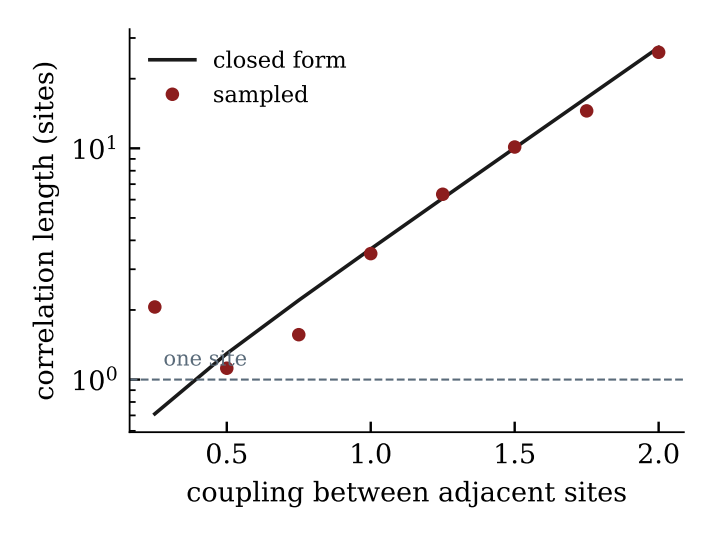
Figure 6. Correlation length of a chain of coupled sites, in units of the spacing, against the coupling between adjacent sites. The closed-form values run from 0.71 sites at coupling 0.25 to 27.30 sites at coupling 2.00, a factor of 38, with sampled estimates shown beside them. Below the marked level no description ignoring the spacing is available; well above it one is.
The limit of the analogy is recorded. In condensed-matter physics the passage between scales is performed by a renormalisation calculation on a specified Hamiltonian, and the universality of the result is established in the calculation and is never assumed. Nothing in this paper specifies a Hamiltonian for any social arrangement, so what Figure 6 establishes is the availability of the two descriptions in a system where the calculation can be done, and nothing about any arrangement of parties.
19.3 A discrete presentation with no antecedent set of positions
Section 18.3 identified background independence as the strategy consistent with Part II, since a treatment fixing the set of positions in advance reintroduces at the level of the apparatus an antecedent structure the ontology declined. A discrete construction of that kind is available and is sketched here.
Take a two-dimensional complex and read its cells in three ways. A vertex is a construal event, at which a party takes what has reached it and produces a state of its own. An edge is a rendering, carrying material from one construal to the next. A face is a distinction carried along a sequence of renderings, so that a face is bounded by the edges through which one distinction travels.
Labels are assigned to the complex. A face carries a label recording which distinction it carries. An edge carries a map compatible with the labels on the faces meeting at it, which is the rendering performed there. A vertex carries an amplitude depending on the labels around it, which is the weight of that construal. A quantity for the whole complex is then written as the sum in Equation (7), taken over all admissible labellings of a product of local amplitudes.
$$Z ;=; \sum_{\text{labellings}} \ \prod_{f} A_f \ \prod_{e} A_e \ \prod_{v} A_v ,$$
The sum in (7) runs over labellings and over nothing else, so no arena is presupposed and none appears; this is the form used for spin foams in the quantum-gravity literature, where faces carry representations of a group and edges carry intertwiners between them. Figure 7 exhibits a complex of this kind.
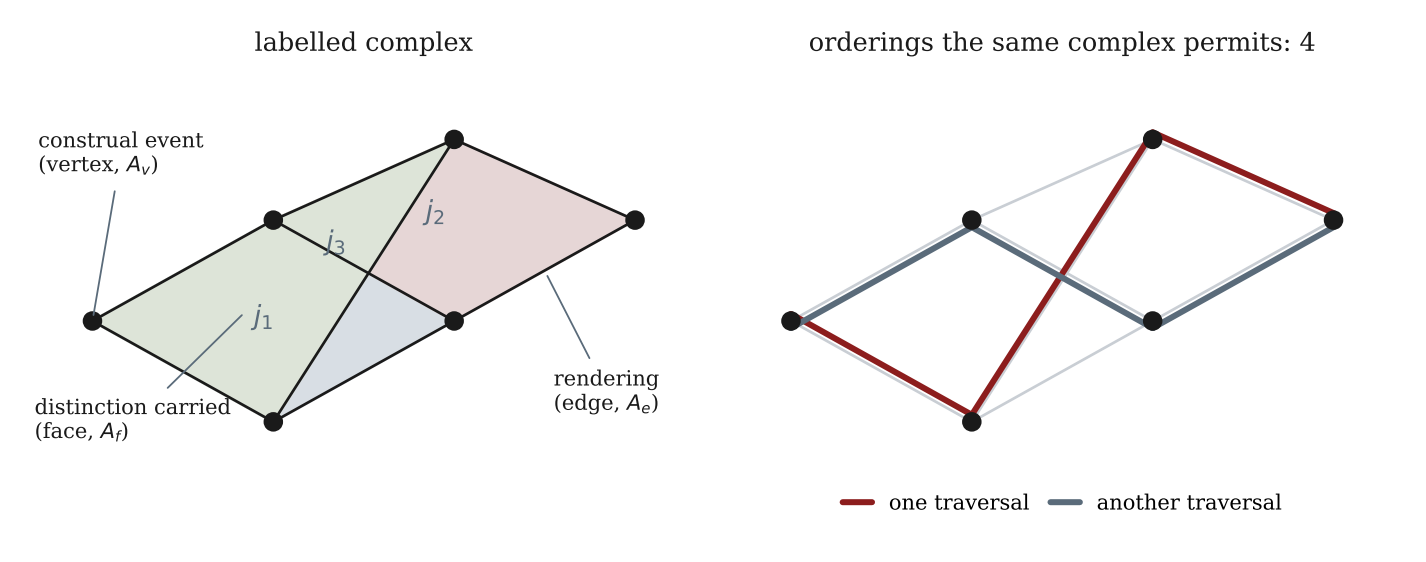
Figure 7. An illustrative complex of the form described in this section. The left panel shows six construal events, eight renderings between them, and three shaded faces carrying the labels $j_1$, $j_2$ and $j_3$. The right panel shows two traversals of the identical complex; the orderings of the six events compatible with the direction of every rendering number four, so that a particular reading of the record is one selection among several the structure permits.
Three features make the construction the right shape for the strategy of Section 18.3. No set of positions is given in advance, since what plays the part of a position is settled by the pattern of faces and their labels. The arena and what occupies it are determined together, since the complex and its labelling are summed over jointly. And the construction is discrete throughout while admitting a continuum description in the regime of Section 19.2, which is the coexistence Section 17.4 required.
A fourth feature belongs to the reading of a record. The complex carries no direction of its own, so an order in which the record is traversed is a choice, and different traversals are related by that freedom. A particular reading of an arrangement of representations is therefore one traversal among those the structure permits, and its selection is a further act that the structure does not perform. The framework’s companion work on musical structure makes the same observation for a spin-foam presentation there.
19.4 Candidate invariants and the readings they would carry
An account of the kind sketched above is ordinarily wanted for the invariants it makes available, and a reader is owed a list of the candidates together with what each would mean in the present setting. Table 6 gives one. The list is drawn from dynamical systems and from field theory, and it is offered so that the ground given at Section 20.2 can be assessed against particular items in place of an abstraction.
Two observations follow from the list and they pull in opposite directions.
The first is that a reading is available for every item. Components record whether any pathway of renderings joins a position to the public record. Independent cycles record routes along which a claim returns to its origin and is received there as corroboration from elsewhere, which is a recognisable pathology of a dense reporting system. Persistence across a filtration separates a division of the arrangement that survives the discarding of weak relations from one visible only at low threshold. The Conley index is the invariant designed for the question of what survives perturbation of a dynamics, which is the question a criterion of this family asks.
The second is that the list itself exhibits the ground on which the criterial use is declined. Ten items, each with a defensible reading, and nothing in the apparatus that selects among them. A report leaving the components of an arrangement intact while destroying its independent cycles satisfies one candidate criterion and fails another, and which of the two a reporting actor is answerable for is settled by a judgement no invariant supplies. Section 20.2 states the point in general; Table 6 is the point in particular.
Table. Candidate invariants from dynamical systems and from field theory, with the reading each would carry in the present setting.
| Invariant | Reading in the present setting |
|---|---|
| Components ($\pi_0$, $b_0$) | Whether any pathway of renderings joins a position to the public record |
| Fundamental group ($\pi_1$) | Routes between two parties that no continuous deformation identifies, so that a correction sent along one need not reach a party served by the other |
| First Betti number ($b_1$) | Independent cycles, along which a claim returns to its origin and is received there as independent corroboration |
| Persistent homology | Which features survive as weak relations are discarded, separating a durable division from one visible at low threshold only |
| Euler characteristic, genus | Gross combinatorial properties of the record’s complex, available and probably too coarse to bear on any assessment |
| Winding number, topological charge | A configuration that no sequence of small revisions carries to a uniform one |
| Conley index | What survives perturbation of an isolated invariant set, which is the robustness question a criterion of this family asks |
| Poincaré–Hopf index | A constraint on how many settled configurations an arrangement can carry at once |
| Morse index of $S$ | The number of unstable directions at a settled configuration |
| Chern number with bulk-boundary correspondence | A global invariant that forces a locally observable feature at a boundary |
One item on the list is worth separating from the rest, since it names the shape an answer to this paper’s central asymmetry would take. Proposition ? established that adequacy is a property of an ensemble and of no member, and Section 41 referred what follows to governance for that reason. A bulk-boundary correspondence is precisely a result under which a global invariant of a system necessitates a feature observable at its edge, so that a property of the whole becomes detectable locally. A correspondence of that kind for an arrangement of reports would connect the ensemble level to something a single report exhibits, and the asymmetry of Proposition ? would be answered in place of being referred onward.
No such correspondence is available here and none is claimed. Establishing one would require the dynamics that Section 20.4 records as unavailable, and the invariant would have to be selected before it could be computed, which returns the difficulty of Section 20.2. The observation is recorded as a description of what would have to be shown, and Section 45 lists it among the questions the account leaves open.
19.5 The contribution of the presentation
Two things are supplied and one is withheld.
The construction supplies a formal setting in which the ontology of Part II and the apparatus of Part IV are compatible with a background-independent treatment, which answers the consistency question Section 18.3 raised.
The construction supplies a statement of the open question at Section 45.2 in a form where progress would be visible. A derivation of positions from the labelling of a complex would be an answer to it, and the absence of such a derivation here is the reason the question remains open.
What is withheld is content. No amplitude $A_f$, $A_e$ or $A_v$ is specified, and a sum over labellings with unspecified amplitudes excludes no labelling. Section 18.4 established the consequence and it is unchanged: a schema that excludes nothing constrains nothing, and the constructions of Sections 17 to 19 are representations of the kind of object a propagation arrangement is and are not theories of any such arrangement.
19.6 The standing of the three constructions
The action of Section 19.1, the scale relation of Section 19.2 and the complex of Section 19.3 carry no proposition of this paper. Every result stated in Parts II, III, IV, VII and VIII was established before this section and holds without it, and Section 20 states which uses of these constructions are admitted and which are declined.
20. The Use Admitted for the Preceding Constructions and the Use Declined
The role of this section is to state a methodological decision that the two preceding sections make unavoidable. Its objective is to distinguish two uses to which a dynamical representation may be put, to admit the first, to give three grounds for declining the second, and to record what the paper’s results rest on in consequence. The structure follows those four steps. The method is to make the strongest available case for the declined use before answering it.
20.1 The two uses distinguished
A representation of the kind constructed in Sections 17 and 18 admits two uses, and the paper’s position differs between them.
The first use is representational. A construction may be offered to show what kind of object a propagation system is, to establish that heterogeneity of the parties is expressible, and to locate the paper’s own apparatus within a wider family of formal treatments. Sections 17 and 18 are offered for that use and the paper admits it.
The second use is criterial. A construction may be offered as the source of a standard by which a report is assessed, in the form of a requirement that certain properties of the configuration survive the report’s entry into it. Connectivity, the separation into components, the presence of cycles and the persistence of features across scales are the candidate properties, and a criterion requiring a report to preserve the properties that matter is the natural proposal. The paper declines that use on three grounds.
20.2 The selection of the invariants
The first ground is that the criterial use relocates the problem it appears to solve. A criterion requiring the preservation of the invariants that matter is empty until the invariants are specified, and specifying which relations a report must preserve is the normative question the paper set out to answer. Connectivity, hierarchy, dependency and cyclical structure are candidates, and which of them a given report is required to carry is settled by a judgement the formalism does not supply and cannot supply.
The ground is not a complaint about difficulty. The circularity would remain in a setting where every dynamical quantity was known exactly, since the selection of the invariants is prior to their measurement. It is therefore untouched by the constructions of the preceding two sections, which improve the representation and settle nothing about which of its features a report is answerable for.
20.3 The form of a preserved-capacity invariant
The second ground concerns the invariant the framework would most naturally propose. A criterion holding that the generative capacity of a configuration after a report is at least its capacity before is an inequality between two values of a quantity, which is an objective function written in another notation. Its adoption would reverse the position of Part VII, and a formalism is a poor place to reverse a position, since the notation lends the reversal an appearance of derivation.
Part VII establishes further that no actor can evaluate such a quantity, so the criterion would be inoperable as well as impermissible. A formalism that produces a quantity nobody may maximise and nobody can compute is performing no work.
20.4 The unavailability of the dynamics
The third ground is the practical one and it is decisive on its own. Applying a criterion of this kind requires the dynamics of the interpreting systems and of the reporting system to be written down, and they are not available. The response of a receiving party to a given message is the object that would have to be specified, and the companion paper on diplomacy records the same limitation for its own field-theoretic layer, resting no proposition upon it.
Section 18.4 establishes that the two strategies available where a dynamics resists specification do not remove this ground. The algebraic strategy surrenders the trajectory and retains a structure of relations, and which relations obtain remains to be supplied. The background-independent strategy determines the arena together with the dynamics and requires a constraint relating them, and no counterpart of such a constraint is available for the present case. A schema permitting every configuration excludes none, and a criterion drawn from it would exclude nothing either.
20.5 The apparatus the results rest on
The apparatus the propositions rest on is the one Part IV used before Sections 17 and 18 were introduced. It is order-theoretic and combinatorial, it requires no dynamics, no measurement of any party’s response, and no probability measure, and every proposition of this Part was checked before being stated. Proposition ? gives migration its structural reading, Proposition ? gives the accumulation along a chain, and Proposition ? gives what a recording device restores.
Section 18.2 located that apparatus, and the location is worth restating here. The order-theoretic and combinatorial treatment is the algebraic strategy applied at the strength the material supports, and it is therefore continuous with the formal tradition the declined use belongs to. What separates them is the use, and the separation is the content of this section: the results the criterial use was wanted for are obtained without it, and the representational use is admitted for what it shows about the object.
The Sites of the Circuit
21. Admission
Part V works through the sites at which a social fact is rendered, transmitted and received, treating each under an identical template. The template has five parts: the operation performed at the site, the failure of that operation, the alteration of the rule under which the site operates, the prior treatments the site has received, and the case material available at it. Uniformity is the point of the arrangement, since the anatomy is exhibited by the recurrence of one structure across seven positions.
Two features of the arrangement are declared here. The sites are positions within one process and are no taxonomy of kinds, and no section of this Part is named after a species of wrong; the discipline follows the companion study of injustice among heterogeneous knowledge systems, which established that a list of kinds proliferates while a list of sites does not. And the seven sites depart from that companion’s five in two places, with reason: translation is separated from rendering because a reporting actor re-emits what it has construed, so that two renderings occur in sequence at one node; and reception is separated from construal because the addressee of a published report is a multitude unknown at the time of writing, which the diplomatic case does not present.
The distinction between this Part and Part VIII is stated once and holds throughout. Part V describes operations and their failures. Part VIII states the conditions a reporting actor may be held to, which span the sites and are established on the grounds Part VII makes available.
A candidate taxonomy was developed during the work leading to this paper and is set out in Table 7, together with the position at which each of its items is treated here. Two purposes are served by presenting it. A reader arriving from the vocabulary of propagation ethics is given a map from that vocabulary into this arrangement, so that nothing on the list is silently dropped. And the arrangement adopted here is exhibited against the alternative it was chosen over, which is the form in which a methodological decision is answerable.
Two features of the mapping are worth stating. Every item on the candidate list has a position in the present arrangement, and several items map onto one site, which is the expected result if the items are aspects of one process. And one item on the list is treated differently from the rest. A criterion of generative preservation was proposed there as the apex of the taxonomy, with the remaining items to be assessed by their contribution to it. Part VII establishes that a criterion of that form is unavailable to a reporting actor, and Section 42.3 establishes that the same exclusion applies to formulations of it that avoid the word capacity. The item accordingly appears in the table at the place where the paper treats it, which is among the properties of an arrangement assessed after the fact and not among the conditions on a report.
Table. A candidate taxonomy of propagation ethics and the position of each item in the present arrangement.
| Candidate item | Position in this paper |
|---|---|
| Source | Section 9, the chain of prior renderings; Section 21 |
| Selection | Section 21, the site of admission |
| Representation | Section 22, the site of rendering |
| Translation, rephrasing | Section 23, the site of translation |
| Interpretation | Section 24; Section 29 on constraint |
| Context | Section 25, the site of registration |
| Accessibility | Section 27; Section 40.3, the addressee |
| Pathway, propagation | Section 26; Proposition ? |
| Power | Section 32, visibility and distribution |
| Responsibility | Part VII throughout; Proposition ? |
| Feedback, correction | Section 16; Section 42 |
| Temporal | Section 25; Section 42 |
| Topological | Sections 17 to 19; declined as criterial at Section 20 |
| Generative preservation | Section 42, as a property of an arrangement; excluded as a criterion for an actor by Proposition ? |
21.1 The operation of admission
Admission constitutes the field that a report observes. Before any account is rendered, a set of positions has been approached and a complement has been passed over, and the operation determines which parties are in a position to contribute material at all. In the apparatus of Section 12 the operation fixes the neighbourhood $N$ from which material will be drawn.
Admission is unavoidable and is no defect. A report treating a defined object legitimately approaches the positions that object concerns, and a report on luxury retail that draws its material from luxury retail has admitted correctly. The operation is a condition of any report existing.
21.2 Failure at admission
The operation fails where a position that would have supplied a distinction relevant to the report’s own object is passed over. Failure at this site is settled against the object the report declares, and a report whose declared object is a city fails where it approaches one district of it.
The failure has a characteristic invisibility. What a passed-over position would have supplied is absent from the material, so the absence leaves no trace in the material, and a reporter reviewing its own notes finds nothing missing. Section 10 identified the same structure in the exercise of power over what is recorded.
21.3 Alteration of the rule of admission
The rule may itself change, and the alteration is the more consequential of the two failures. The rule of admission specifies which parties count as competent producers of material, and a change in it removes a class of parties from consideration in advance of any particular report. Where a category of person ceases to be a party whose account is sought, no individual report registers an omission, since the omission has been performed by the rule.
The distinction between the two failures follows the treatment of degradation in two levels developed in a companion paper. A failure of the operation blocks a particular admission and leaves the rule available for use. An alteration of the rule removes the possibility of noticing, since the standard against which an omission would be measured has moved with the omission.
21.4 Prior treatments of admission
Gatekeeping research treats the operation directly and has done so since the mid-twentieth century, establishing that news is the output of successive selections under organisational constraint (White, 1950; Shoemaker & Vos, 2009). Research on news values establishes the criteria by which an occurrence becomes reportable at all (Galtung & Ruge, 1965; Harcup & O’Neill, 2017). Research on sources establishes the pattern of the selections, finding a predominance of official channels and a tendency for coverage to track the range of elite disagreement (Sigal, 1973; Gans, 1979; Bennett, 1990). Tuchman’s account of symbolic annihilation names the case in which a group is absent from coverage as a standing condition and not as an omission on any occasion (Tuchman, 1978). The companion study of diplomacy supplies the formal treatment used here, in which parties admit or withhold recognition of one another as competent producers of facts, and the resulting structure is a directed graph whose edges are not transitive. Fricker’s account of testimonial injustice supplies the case in which admission is withheld through prejudice about the speaker (Fricker, 2007).
None of these supplies a condition on a particular report, and each describes the operation without stating what a given artefact owes. The distance is widest at exactly the point Section 21.2 identifies: gatekeeping asks whether an item entered, and the question here is what the field of relations at entry contained and whether the report’s later claims remain within it.
21.5 Case material at admission
casestudy
Case Study 18.1. (Material gathered in one district). Constructed. A reporter preparing an account of how a city is experiencing a rise in prices gathers material in a commercial district frequented by affluent shoppers. The material is accurate, the parties spoke sincerely, and every sentence attributed to them is faithful.
casestudy
Case Study ? shows an admission fixing a neighbourhood, and the neighbourhood is narrower than the declared object. Whether a defect has occurred is settled by what the report goes on to assert, which is the subject of Part VIII and of Definition 13.1. The site itself yields the determinate fact that $N$ is one district and that the object declared is a city.
22. Rendering
22.1 The operation of rendering
Rendering depicts a party and its account in the report’s own prose. A statement obtained in an interview becomes a sentence in a published text, a party becomes a description, and a set of remarks becomes a characterisation. The operation assigns categories, since a sentence about what a party said must say what kind of party said it.
Rendering is likewise unavoidable. A report composed entirely of unedited transcripts would render by the act of transcribing and would render badly, since a reader would have no means of holding the material together.
22.2 Failure at rendering
The operation fails where the categories assigned carry commitments the material does not support. Reporting that shoppers said something and reporting that consumers said something differ, since the second assigns a category defined by a relation to a market and the first records a location. Reporting that a party expressed a concern and reporting that a party opposes a policy differ in the same way.
The failure is a coercion in the sense of Definition 13.1, performed across a boundary of kind. Section 14 established that the coercion is irreversible and that a reader cannot recover from the sentence which category the material supported.
22.3 Alteration of the rule of rendering
The rule fixes the repertoire of depictions available for a class of parties. Its alteration narrows the repertoire, so that a party becomes depictable in a small number of ways and in no others. A community that can be depicted as requiring assistance and cannot be depicted as holding knowledge, history and relations of its own has undergone an alteration at this site, and no individual report is the site of it.
The consequence follows the pattern of Section 21.3. Where the repertoire has narrowed, a reporter writing within it commits no identifiable fault, since the available depictions are the available depictions.
22.4 Prior treatments of rendering
Depiction has an established literature and its findings are conceded here. Hall’s account of encoding treats a representation as produced under codes that the producer does not invent (Hall, 1980), and his later work on representation establishes that meaning is fixed by the practices of a system and not by resemblance (Hall, 1997). Critical discourse analysis supplies the detailed apparatus: Fowler on the transformations that news language performs on events (Fowler, 1991), Fairclough on media discourse (Fairclough, 1995), van Dijk on the structures of news (van Dijk, 1988), and van Leeuwen’s inventory of the ways a social actor may be represented, including inclusion and exclusion, activation and passivation, nomination and categorisation (van Leeuwen, 2008). Spivak’s distinction between representation as political proxy and representation as depiction fixes which of the two is at issue here (Spivak, 1988).
Each of these analyses how a single depiction encodes an asymmetry, and the analysis is finer than anything this paper offers at the level of the sentence. What none supplies is a relation between depictions, which is what Section 22.2 requires: the defect treated here is a rendering asserting at a type its material does not support, and it is assessable against that material without any judgement about the ideology the depiction carries.
22.5 Case material at rendering
casestudy
Case Study 19.1. (Two renderings of one set of notes). Constructed, continuing Case Study ?. The reporter’s notes record that several people said prices had risen and that they were buying less. Two renderings are available. One reports that several shoppers interviewed said they had reduced their spending. The other reports that affluent consumers are anxious about the economy.
casestudy
The second rendering of Case Study ? assigns a category, attributes a state, and asserts at a domain, performing three coercions in one sentence. Each is available for inspection against the notes, and none requires any judgement about consequences.
23. Translation
23.1 The operation of translation
Translation transfers an expression from the system in which it was produced to the system in which the report is written. The operation runs between natural languages where a source spoke another, and it runs equally within one natural language, since Section 4.2 established that a court record, an official statement and an eyewitness account belong to different systems in the broad sense.
Translation follows construal at the same node, and the sequence is what distinguishes an intermediary formally. A reporter construes what it received and then emits a rendering of its own, so two operations occur at one position in the chain.
23.2 Failure at translation
The operation fails where the target expression asserts at a type the source expression does not support. A formulation stating that a matter will be considered carefully is an utterance about a process. A formulation stating that a party is reluctant is a claim about a disposition. The second may be correct and it is a claim of a different kind, and the passage from the first to the second is a coercion requiring the declared warrant of Definition 13.1.
Failure at this site is easy to overlook because both formulations are short and both appear to report the same remark. The apparatus of Part IV makes the difference explicit, since the two sentences are judgements at different types.
23.3 Alteration of the rule of translation
The rule fixes which distinctions the target repertoire carries. Its alteration removes a distinction from the target, so that expressions requiring it become unrenderable and the parties who rely on it become unable to have their positions stated. A distinction available in a source system and absent from a target system imposes a cost on whichever party must supply it, and the companion paper on the distribution of the translation burden establishes that the cost falls asymmetrically and that its imposition is concealed by the default.
23.4 Prior treatments of translation
News translation is an established field and its central finding is the one this section needs. Bielsa and Bassnett establish that translation in news agencies is not a distinct stage performed on a finished text but is distributed through the writing itself, so that the translated item is rewritten for a different readership under different conventions (Bielsa & Bassnett, 2009). Schäffner establishes the same for political discourse reported across languages (Schäffner, 2004). The philosophical literature supplies the limit: Quine’s indeterminacy establishes that no fact of the matter fixes a unique manual (Quine, 1960), Davidson’s argument against conceptual schemes constrains how strongly the point may be stated (Davidson, 1974), and Cassin’s lexicon documents the terms whose transfer between philosophical languages is contested and not difficult (Cassin, 2014). Work on quotation in news establishes that reported speech is transformed in ways readers do not see (Ekström, 2002).
The literature establishes that transformation occurs and is unavoidable, and it assesses a translation by its adequacy to a source. The condition proposed here is different in kind and narrower: Section 23.2 treats the case in which a target expression asserts at a type the source does not support, which is settled by comparing the two expressions and needs no judgement about adequacy overall.
23.5 Case material at translation
casestudy
Case Study 20.1. (Three renderings of a formulation of cautious consideration). Constructed. An official body issues a formulation of cautious consideration, and three renderings are available in a target language: that the body will consider the matter carefully, that it is hesitant, and that it is reluctant. The first stays at the type of the utterance. The second and third assert at the type of a disposition, and the third asserts more strongly than the second.
casestudy
A reporter selecting among the three renderings of Case Study ? performs a coercion at the second and at the third, and the material available to it consists of the formulation, the circumstances of its issue, and whatever the body has done previously. Whether the coercion is licensed is settled by whether that material is exhibited alongside the rendering.
24. Construal
24.1 The operation of construal
Construal generates a reading at the receiving end. A published report is a material event, and what a reader takes from it is produced by the reader’s own repertoire acting upon that event. The companion study of diplomacy establishes the construction used here, in which a message acts as an operator upon the receiver’s state and determines no state on its own.
The operation is performed by every receiver, including the reporter with respect to its sources. Section 23.1 recorded that construal and emission compose at an intermediary node.
24.2 Failure at construal
The operation fails where the reading generated diverges from the reading the material supports and the divergence goes undetected on both sides. The reader holds an account, the writer believes an account was conveyed, and the two accounts differ with nothing in the exchange registering the difference.
Detection is the whole of the problem at this site. A divergence that surfaces can be addressed, and the companion paper’s condition of detectability and reopening was formulated for exactly this case. Section 16 established what a recording device contributes to detection, and Table 4 measured it.
24.3 Alteration of the rule of construal
The rule is the reader’s repertoire, and its alteration is the operation Part VI treats under the heading of constraint. A message may move a reader’s state, and a message may alter how the reader processes subsequent messages. The second is the stronger operation, and Section 29 establishes that it is stronger and states the condition under which its exercise is defensible.
24.4 Prior treatments of construal
The generation of meaning at the receiving end is the settled position of several literatures. Reddy’s analysis of the conduit metaphor established that ordinary talk about communication builds in a transfer that does not occur (Reddy, 1979). Maturana and Varela’s structural coupling makes the received event a perturbation whose effect is determined by the receiving system (Maturana & Varela, 1987). Luhmann denies transfer between operationally closed systems (Luhmann, 1996). Relevance theory supplies the inferential machinery by which an utterance underdetermines what is communicated (Sperber & Wilson, 1986). Reception studies establish the same empirically for audiences (Hall, 1980).
These are imported and not improved upon. What they leave is the multi-party case: each treats a sender and a receiver, and the object of this paper is what a plurality of construals composes when the parties construing do not encounter one another.
24.5 Case material at construal
casestudy
Case Study 21.1. (A sentence whose domain is left unfixed). Constructed. A sentence reports that residents are worried about prices and is published without restriction. A reader whose repertoire supplies a category of residents as an undifferentiated public construes a claim about a city. A reader familiar with the district construes a claim about that district. Neither reader is unreasonable and the sentence supports both, since the domain of assertion was left for the reader to supply.
casestudy
Case Study ? exhibits the relation between this site and the condition of Part VIII. Fixing the domain in the text removes the divergence at its source, and the devices that fix it were enumerated in Section 13.3.
25. Registration
25.1 The operation of registration
Registration determines what a report’s frame can hold. A published account establishes a set of terms in which the episode is presented, and relations expressible in those terms enter the account while relations inexpressible in them are absent from it. The operation covers the context supplied around an occurrence and the temporal position assigned to it.
The operation is the site at which the joint frame of Section 6 appears in a single artefact. A report presenting several parties adopts terms in which all of them can be presented, and Proposition ? governs what those terms can carry.
25.2 Failure at registration
The operation fails where a relation required to make the episode intelligible has no place in the frame adopted. A report stating that a state increased its military spending, presented in a frame containing that state alone, has no place for the actions of adjacent states, for the sequence in which the actions occurred, or for the commitments each had entered previously. Every sentence may be accurate and the frame carries no position from which the omitted relations could be stated.
Failure at this site is the one a reader is least able to detect, since a frame is exhibited by what it contains and an absent relation leaves no gap where it would have stood. The companion study of injustice among heterogeneous knowledge systems treats the same failure under the heading of non-registration, and the treatment of the boundary of those whose costs are counted in an exchange relation establishes the same structure for the accounting of value.
25.3 Alteration of the rule of registration
The rule fixes which relations a frame is capable of carrying, and its alteration removes a relation from the available repertoire. A frame in which an episode has a beginning and no antecedents, or in which a society has a condition and no trajectory, has undergone such an alteration. The temporal case is the clearest: a description assigning a society a fixed character registers no transition, no contradiction under development, and no condition inherited from what preceded, and a reader working within the frame has no means of asking after them.
25.4 Prior treatments of registration
Framing research treats the operation and supplies its standard formulation, under which to frame is to select aspects of a perceived reality and make them more salient so as to promote a particular problem definition, causal interpretation, moral evaluation or treatment recommendation (Entman, 1993; Scheufele, 1999). Gitlin’s study establishes that a frame governs which actors appear as agents and which as background (Gitlin, 1980). Work on false balance establishes that a frame presenting two positions evenly may misrepresent the state of the evidence, with the study of United States prestige-press coverage of anthropogenic climate change the documented instance (Boykoff & Boykoff, 2004), and later work tracking the practice over a longer period (Boykoff et al., 2021). The critique of the view from nowhere holds that a stance of studied neutrality is itself a position and conceals the fact (Rosen, 2010).
Framing research describes what a frame emphasises and what it omits. The claim required here is stronger and structural: Section 25.2 concerns a relation for which the frame has no place at all, so that its absence leaves no gap where it would have stood. That is a claim about what a frame can record and not about what a framer chose to include.
25.5 Case material at registration
casestudy
Case Study 22.1. (Balanced presentation examined in published research). Documented, and the best evidenced case in the paper. Boykoff and Boykoff examined coverage of climate change in five United States newspapers over the period from 1988 to 2002, sampling six hundred and thirty-six articles from a population of three thousand five hundred and forty-three, and found that adherence to the professional norm of balanced presentation produced coverage in which a scientific position and its rejection appeared as symmetric alternatives (Boykoff & Boykoff, 2004). Their conclusion was that the practice of balance, applied to a matter on which the evidential situations of the two positions differed, produced a divergence between the coverage and the state of the field.
casestudy
Case Study ? is exhibited for a structural reason and not for its subject matter. A balanced frame presents two positions as occupants of one category, and a frame doing so carries no position from which the difference in their evidential bases could be registered. The failure is therefore at registration and is exactly the operation Proposition ? describes, since the frame that accommodates both is coarser than either and the asymmetry between them is among the distinctions it cannot state.
Two rationales for the same professional practice diverge at this point, and the divergence is the sharpest practical result the paper obtains. Under the rationale of fairness between sides, the practice of presenting several parties fails where the parties are unequally represented, and the remedy is a more even presentation. Under the rationale developed here, the practice succeeds where it preserves the divergence among positions and fails where it merges them, so a more even presentation of two positions in one frame deepens the failure. The two rationales prescribe opposite remedies in the case just described, and the practice they assess is the same practice.
Section 16 supplies what the second rationale recommends in its place. Attribution, the recording of an evidential basis alongside a position, and the exhibition of the difference between the two bases are annotations, and they keep the asymmetry on the record without requiring the frame to carry it.
26. Circulation
26.1 The operation of circulation
Circulation carries a published report onward through parties the report’s author did not select. A report is summarised, quoted in part, restated, recirculated with commentary attached, and reduced to a fragment, by parties who are unknown at the time of writing and whose number is unbounded.
The operation differs at one decisive point from the transmission treated in the companion study of diplomacy. A party sending a message through chosen intermediaries selects the pathway and retains a measure of control over it. A party publishing a report selects nothing downstream, and Section 15 constructed the chain on that assumption.
26.2 Failure at circulation
The operation fails through iterated coercion. A claim asserted of some members of a neighbourhood is restated of the neighbourhood, then of a wider one, and then of a population, each step performing a quotient in the sense of Section 14. Proposition ? establishes that the domain of assertion is non-decreasing along such a sequence and that the composition of the steps is itself a coercion, so a terminal claim reached through many unremarkable enlargements is indistinguishable from one fabricated at the outset.
The verification of Section 16 measured the magnitude. In the construction used there, a claim whose material reached two of thirty-two positions arrived at the end of six hops asserted over twenty-one, with the collapse detectable in no chain at all where no party recorded what it had received.
26.3 Alteration of the rule of circulation
The rule fixes which forms survive transmission. Alterations at this site are performed by the architecture through which material moves, since a channel that carries a headline and discards its qualifications has altered what a report can transmit, whatever the report contains. A reporting actor operates under whichever rule obtains and does not set it.
26.4 Prior treatments of circulation
Circulation has an established descriptive literature. Secord’s programme treats knowledge as constituted in its movement and not merely conveyed by it (Secord, 2004), and Raj develops the same for knowledge moving between regions under unequal conditions (Raj, 2007). Research on diffusion and cascades supplies the quantitative treatment of onward transmission. Work on headlines establishes that a headline is read by many who read no further and that headline and body may diverge. The division of newsroom labour is documented: the sub-editing stage rewrites headlines and leads and unifies copy assembled from several sources (Vandendaele et al., 2015), and digital-first reorganisation has redistributed that function without removing it (Robotham, 2022).
The descriptive literature establishes that claims are altered as they travel. What it does not supply is a condition binding the party at the head of the chain, and Section 26.3 supplies one by way of Proposition ?: the operation performed downstream is the same operation performed at the head, so a report’s resistance to it is settled at the time of writing.
26.5 Case material at circulation
casestudy
Case Study 23.1. (The composition of headlines within a newsroom). Documented, and presented as a common pattern with its variation noted. In the traditional newsroom division the writing of headlines belongs to the sub-editing or copy-editing function and lies outside the reporting function (Vandendaele et al., 2015), so that the element of a published artefact most likely to be extracted and circulated on its own is composed by a party other than the one who gathered the material. Digital-first operations have altered the division in places, with some reporters supplying their own headlines and some functions consolidated (Robotham, 2022).
casestudy
The structure Case Study ? exhibits is the one Section 11 established, appearing now inside a single organisation. A condition binding the writer of a report does not bind the writer of its headline, and the headline is the portion of the artefact that circulation is most likely to carry. The residue is a matter of organisational design and belongs with the material Part IX refers onward.
27. Reception
27.1 The operation of reception
Reception is the arrival of a report at an addressee holding a particular repertoire. The operation is distinguished from construal because the addressee of a published report is a multitude, unknown individually at the time of writing, and heterogeneous in the categories and background its members hold.
The operation is the site at which the paper’s criterion becomes relative to a party. Section 40 states the criterion and establishes what follows from its relativity.
27.2 Failure at reception
The operation fails where the report is unreconstructable by the addressee it was written for. A sentence framed in the vocabulary of a specialised field arrives at a general readership as an event from which little can be generated, and the failure is a property of the pairing and of neither party alone.
A second failure runs in the other direction and is the more common. A report simplified for accessibility may remove the relational structure a reader requires, so that a formulation stating that inflation harms everyone arrives with nothing from which the differences among positions could be reconstructed. Accessibility purchased by removing differentiation is the coarsening operation of Proposition ? performed for a benign reason.
27.3 Alteration of the rule of reception
The rule is the repertoire an addressee holds, and repeated reception alters it. A readership addressed for a long period in terms that carry no differentiation among positions loses the categories in which differentiation would be received, which is the alteration Section 24.3 identified at the level of an individual reader and which appears here at the level of an audience.
27.4 Prior treatments of reception
The condition of the addressee has been treated most fully in the study of public understanding of science, where the deficit model holds that public difficulty arises from a shortfall of knowledge to be remedied by better transmission. The critique of that model establishes that lay parties bring competences and situated knowledge of their own, and that their difficulty frequently concerns the institution making the claim and not its content (Wynne, 1992; Jasanoff, 2005). Readability and plain-language research supplies the practical apparatus for adjusting a text to a readership, and the critique of simplification establishes that adjustment may remove the distinctions that made the claim informative.
The literature establishes that a text meets a repertoire it does not supply, and it frames the problem as one of better transmission or of better mutual engagement. This account holds that no transmission occurs at all, so the question at Section 27.2 becomes which collapses a reader of the declared description can detect, and Section 40 states the condition that follows.
27.5 Case material at reception
casestudy
Case Study 24.1. (Two formulations of one distributional claim). Constructed. A report may state that inflation harms everyone, or may state that consumers face higher prices while some producers face higher costs, with the two effects falling on different parties. The second is no harder to read than the first and carries a distinction the first removes.
casestudy
Case Study ? shows that accessibility and differentiation are independent, and the independence is what the second failure of Section 27.2 obscures. A report may be simple and differentiated, and the operation that removes differentiation is chosen and is not forced by the requirement of being read.
The Allocation of Interpretive Labour
28. Interpretive Abstention and the Transfer of the Interpretive Burden
The role of this section is to examine the professional doctrine under which a reporter supplies occurrences and leaves their significance to others. Its objective is to show that the doctrine performs an allocation, to identify the feature of its formulation that conceals the allocation, to record the unequal incidence of what it allocates, and to state what the journalistic case adds to a result the corpus already holds. The method is to take the doctrine at its own valuation and then to ask what follows for the party on whom the labour lands.
28.1 The doctrine of interpretive abstention
A reporter is to establish what occurred and to leave to the reader what it means. The doctrine has an obvious appeal, since it appears to withhold from the reporter a power the reporter has no title to, and it appears to leave the reader’s judgement intact. It is stated in professional codes, it is taught, and it is defended by practitioners as the ground of the trust a publication holds.
The doctrine is stated in a negative form, and the form is the object of this section. A reporter following it refrains: from characterising, from concluding, from evaluating. What the doctrine describes is an omission, and an omission appears to impose nothing on anyone.
28.2 The transfer the doctrine performs
Interpretation of an episode is work, and the work has to be done somewhere for the episode to be understood by anyone. A doctrine under which a reporter declines it therefore locates it elsewhere, and the elsewhere is the reader. A reader receiving occurrences without their relations supplies the relations, and a reader supplying them draws on whatever background, time and access it holds.
The doctrine is accordingly not the absence of an allocation, and it is a particular allocation stated in the grammar of a refusal. Whether the allocation is defensible is a further question and one this section leaves open; that it is an allocation is settled by the observation that the labour does not cease to exist when a reporter declines it.
28.3 The concealment of the transfer
The companion paper on the distribution of the translation burden establishes the general result, and the result is imported here without re-derivation. A default that imposes a burden conceals the imposition where the default takes the grammatical form of a refusal to act, since a party asked to justify an imposition can point out that it did nothing.
Journalism supplies the general result with an unusually clean instance. The doctrine of abstention is written down, it is taught as a positive professional virtue, and its formulation is explicitly negative. A practitioner defending it may accurately state that no interpretation was imposed on any reader, and the accuracy of that statement is precisely what makes the allocation difficult to see.
28.4 The incidence of what is transferred
Interpretation transferred to readers lands on readers unequally, and the inequality follows the distribution of what interpretation requires. Background knowledge of a policy area, time to consult further sources, access to several accounts of the same episode and familiarity with the conventions of the genre are unevenly held.
A consequence follows for the doctrine’s appeal. The doctrine is defended as leaving the reader’s judgement intact, and it leaves intact the judgement of a reader equipped to exercise it. For a reader lacking what the exercise requires, the doctrine supplies material from which a reading will be generated by whatever repertoire is available, which Section 24 treated at the site of construal.
28.5 The contribution of the journalistic case
The general result was established in a setting without institutions dedicated to the operation. Journalism supplies three features that setting lacked: a doctrine of abstention codified in professional codes, a documented history of its adoption, and a documented history of its partial abandonment as publications introduced analysis, explanatory sections and context alongside reporting. Section 31 takes up the second and third.
29. Constraint Distinguished from Determination
The role of this section is to examine a third position between supplying an interpretation and withholding one. Its objective is to state that position, to distinguish the two operations it rests on, to raise the objection that the distinction runs opposite to the way it is ordinarily taken, and to state the condition under which the position is defensible. The method is to grant the position its strongest formulation and then to test it against the treatment of degradation in two levels.
29.1 The position on constraint under examination
A reporter may decline to supply a reading of an episode while shaping the conditions under which a reader generates one. Verified occurrences, the relations among them, the positions from which each account came, the boundaries of what the material reached and the points at which evidence stops are all available to be recorded, and recording them narrows the readings a reader can reach without selecting among those that remain.
The position is attractive and it answers the objection of Section 28 directly. A reporter adopting it neither abandons the reader nor replaces the reader’s judgement, and it supplies the labour that the doctrine of abstention transfers.
29.2 The two operations available to a report
The position rests on a distinction between acting upon a reader’s state and acting upon the rule by which a reader generates states. Supplying a conclusion moves a reader toward that conclusion. Narrowing the space of readings alters what the reader is in a position to reach.
The companion study of diplomacy distinguishes the two formally, separating a term that displaces a receiving system from a term that alters the coefficients by which the system responds to what it subsequently receives. The distinction is exact and the position of Section 29.1 depends on it.
29.3 The objection to the modesty of constraint
The position is ordinarily presented as the modest option, and the treatment of degradation in two levels establishes that it is the stronger one. A failure at the first level blocks a particular generation and leaves the rule intact, so that a party remains able to notice what was blocked. An alteration at the second level rewrites the rule, and it is the severer form precisely because it carries no sense of loss: the capacity by which the loss would be registered is among the things altered.
Supplying a conclusion is an operation of the first kind. A reader may reject a conclusion, may hold it provisionally, and may notice that a conclusion was supplied. Narrowing the space of available readings is an operation of the second kind, and a reader within a narrowed space has no vantage from which the narrowing appears.
The objection therefore reverses the ordinary presentation. A reporter who declines to conclude and shapes the interpretive field has performed the more powerful of the two interventions, and has performed the one whose exercise is harder to detect.
29.4 The condition that licenses it
The objection relocates the defence of the position and does not destroy it. What distinguishes a defensible constraint from an alteration of the second level is whether the constraint is itself on the record as a constraint. A boundary recorded in the text is a boundary a reader can see, can weigh, and can decline; a boundary operating through what the text omits is a boundary a reader has no means of locating.
The devices are those of Section 16, and the argument for them is now derived. Where a report records the domain its material reached, the positions through which material entered, and the point at which evidence stops, its constraints are exhibited alongside their effects. Transparency of constraint is therefore no professional courtesy, and it is the property that separates the operation of Section 29.1 from an alteration of the rule.
29.5 The consequence for professional practice
Two consequences are recorded and both are taken up in Part VIII.
A report that constrains without recording its constraints is in a worse position than a report that concludes openly, and the ordering is the reverse of the professional intuition. The second exhibits its intervention, and the first performs a stronger intervention invisibly.
A report that constrains and records its constraints has performed an operation for which the paper supplies a defence, and the defence rests on nothing about consequences. Whether the constraints are recorded is settled by the text.
30. The Three Roles of Reporter, Commentator, and Public
The role of this section is to describe the institutional arrangement through which the labour of Section 28 is distributed in practice. Its objective is to state the division as practitioners state it, to characterise the orders of reconstruction it assigns, to show that the boundary between the first two is unavailable in the form the division requires, and to establish that the arrangement is an allocation. The method is descriptive first and analytical second.
30.1 The division as practitioners state it
A practitioner defending the doctrine of abstention frequently locates the labour precisely. Interpretation of an episode belongs to a commentator or an analyst holding the historical, theoretical or domain knowledge that interpretation requires, and the reporter’s task is to supply a reliable account of what occurred. The division has an institutional expression in the separation of news pages from comment pages and in the separation of reporting staff from columnists.
The division is a reasonable answer to a real difficulty. Interpretation of a complex episode does require knowledge a reporter working to a deadline may lack, and a division of labour that assigns it to a party better placed is a recognisable form of professional organisation.
30.2 The orders of reconstruction the division assigns
The division assigns three orders. A reporter establishes what occurred, what evidence exists, which claims are in contention and what remains unsettled. A commentator establishes why the episode occurred, what it signifies, what may follow and which account best explains it. A public determines what is to be done.
The three are ordered by distance from the material, which is the measure introduced in Section 13.3 and developed in Part VIII. Each order operates on the output of the one before it, so the arrangement is a chain in the sense of Section 15.
30.3 The boundary between the first two orders
The division requires a boundary between the first and second orders, and Part V establishes that the boundary is unavailable in the form required. A reporter selects which positions to approach, assigns categories in rendering, transfers expressions between systems, and adopts a frame. Each is an operation with interpretive content, and Section 22.2 established that a category assignment carries commitments the material may fail to support.
The consequence is not that the division is worthless. The consequence is that the division allocates a continuum by drawing a line across it, and that the line’s position is a decision. Where the line is drawn determines how much of the labour a reporter performs and how much falls to parties later in the chain.
30.4 The arrangement as an allocation
The preceding subsections yield the claim this Part requires. The three-role arrangement distributes interpretive labour among institutional positions, the distribution is settled by where a line is drawn across a continuum, and the drawing is a decision made by an institution and not a feature of what reporting is. Section 31 exhibits the decision by showing that it has been made differently.
31. Comparative and Historical Variation in the Allocation
The role of this section is to exhibit the claim of Section 30.4 with evidence. Its objective is to establish that the allocation of interpretive labour varies across press systems and across time, so that the arrangement familiar in one setting is a historical formation and no property of reporting as such. The method is to cite comparative and historical research and to state carefully what the variation does and does not establish.
31.1 The claim to be exhibited
A feature present in every case would be consistent with its being constitutive of reporting. A feature present in some cases and absent in others is a formation with conditions, and identifying it as such requires only that the variation be exhibited. The claim at issue is that the separation of reporting from interpretation is a feature of the second kind.
31.2 The comparative evidence across press systems
Hallin and Mancini’s survey of media institutions across eighteen West European and North American democracies identifies three models of media system and distinguishes them along dimensions that include the relation between journalism and political life. The model they term liberal, which they locate in the North Atlantic countries, is characterised by information-oriented journalism, strong professionalisation and internal pluralism within outlets. The model they term polarised pluralist, which they locate in Mediterranean countries, is characterised by external pluralism among outlets and by a tradition of commentary-oriented journalism that persists more strongly than elsewhere. Their third model, the democratic corporatist, occupies a further position in Northern and Central Europe.
The typology is cited here for one feature and no more. Press systems differ in how much interpretive labour is performed within reporting, and the difference is systematic and is associated with political and institutional conditions the survey identifies. No claim is made here about the merits of any model, and the models are named as the source names them.
31.3 The historical evidence for the separation
The historical record supplies the second half of the exhibition. Schudson’s history of the objectivity norm in the American press establishes that the norm has a date, that it consolidated under identifiable conditions, and that the arrangement preceding it was different. Tuchman’s study of news production establishes that the separation of fact from comment is one of a set of procedures adopted for an occupational purpose, which places it among practices with conditions of adoption.
Subsequent movement in the same systems supplies further evidence. Analysis sections, explanatory formats and context boxes introduce interpretive labour into positions the earlier arrangement reserved, and their introduction is a redrawing of the line of Section 30.3.
31.4 The reach of the comparative and historical evidence
The variation establishes that the allocation is an allocation. An arrangement that differs across systems and moves within systems is a decision under conditions, and a practitioner who describes the familiar arrangement as what reporting is has mistaken a formation for a nature.
The result matters for the argument of Section 28. A doctrine that transfers interpretive labour to readers can be defended on its merits, and it cannot be defended on the ground that no alternative exists, since alternatives are in operation.
31.5 The limits of the comparative and historical evidence
The variation supplies no ranking. Nothing established here shows that one allocation serves readers better than another, that the movement observed within systems is an improvement, or that the systems are converging. Section 7 withheld a direction of travel from the account and the withholding applies here in full: the evidence shows that the arrangement is contingent, and it shows nothing about which contingency is preferable.
32. The Powers of Visibility and Distribution, and the Generative Conditions of Social Entities
The role of this section is to characterise the powers a reporting institution exercises, given the account of social facts developed in Part II. Its objective is to identify the two powers, to state what they operate upon, to bound the claim against overstatement, and to indicate where the assessment of their exercise belongs. The method is to derive the powers from the ontology and to import the treatment of subject production from a companion paper.
32.1 The powers of visibility and of distribution
A reporting institution determines which episodes are rendered publicly at all, which is the power of visibility, and it determines the extent and the channels of a rendering’s onward movement, which is the power of distribution. The first fixes whether an episode enters the ensemble of Section 5 in a publicly available form. The second fixes how far the resulting member travels.
Neither power is a matter of asserting falsehoods, and both operate through operations Part V has already described. The power of visibility is exercised at admission. The power of distribution is exercised at circulation and through the choices of format and channel that determine what circulation can carry.
32.2 The generative conditions of social entities
Part II located a social fact in the relations among situated representations, and a consequence follows for the entities such facts involve. A public issue, a movement, an affected group, a scandal and a historical event are constituted through the representations in which they appear, so a practice determining which representations become publicly available participates in the conditions under which such entities come to presence, acquire an identity, enter relations with other entities and persist.
Two prior positions are conceded here and the claim adds only the site. The account of classification and its looping effects establishes that classifying people brings ways of being into existence and that those classified respond to the classification. A companion paper establishes that a system generates the relational subjects its own operation requires, with the criterion being whether the resulting recognition can be contested.
32.3 The bound on the claim
Overstatement is easy at this point and is avoided. A reporting institution does not declare entities into existence. It operates as one participant among institutions, movements, courts, statistical agencies and the parties themselves, each of which produces representations, and the constitution of an entity proceeds through all of them.
What the institution holds is a position of unusual reach within that process and no authority over its outcome. The distinction matters for Part VII, since a power that operates through many other parties is a power whose exercise cannot be assessed by its results.
32.4 The level at which the powers are assessed
Assessment of the two powers is not available at the level of a report. Which episodes a publication covers over a period, which positions it approaches habitually, and which channels carry its output are properties of an institution and of a press system, and Proposition ? established that properties at that level are undischargeable by obligations borne at the level of a member.
The assessment therefore belongs with the residue, and Part IX refers it to governance. What remains available at the level of the report is established in Part VIII, and the two are kept apart deliberately.
The Limits of Consequential Assessment
33. Prediction and the Limit It Places on Consequential Criteria
The role of this section is to establish the negative result of the paper. Its objective is to identify a family of criteria that a relational framework generates readily, to determine what applying one of them requires of an actor, to show that the requirement is unmet, and to state the consequence. The structure follows those four steps and closes with three restrictions on the result. The method is argumentative, and Section 33.5 states why no simulation is offered in support.
33.1 The family of criteria at issue
A framework treating social facts as relationally constituted generates a characteristic family of criteria. Each member of the family assesses an intervention by what it does to the capacity of the wider arrangement to continue generating understanding. A report is to be assessed by whether it preserves the conditions under which a society can go on reconstructing its own situation, by whether it leaves dialogue possible, by whether it forecloses future correction, or by whether the relational field it enters remains capable of transformation afterwards.
Criteria of this family are attractive within the framework and they are consistent with everything Parts II to VI established. Each is stated in the framework’s own vocabulary, each avoids the appeal to a presymbolic fact that Section 4.1 refused, and each addresses what the account identifies as at stake.
33.2 The inference the family requires
An actor applying a criterion of the family must determine, at the time of writing, what a report will do to the capacity of an arrangement over some period afterwards. The determination is an inference from a present artefact to a future state of a system.
Three features of the system make the inference the demanding kind. The parties who will receive the report are numerous, uncoordinated and unknown to the writer, which Section 26 established for the case of unchosen circulation. The relation between what enters such a system and what the system does is nonlinear, so that comparable inputs yield outcomes of very different magnitude. And the period over which the capacity would be assessed is open, since a criterion assessing the capacity at a fixed horizon is arbitrary at the horizon and a criterion assessing it indefinitely is never settled.
33.3 The unavailability of the inference
The inference required is inductive and concerns a system whose relevant regularities are neither stable nor known. Nothing in the actor’s position supplies a warrant for it. The general difficulty of grounding inference from observed cases to unobserved ones is old, and the present setting adds the three features of the previous subsection, each of which worsens it.
The point is stronger than a counsel of modesty. A criterion that could be applied badly would be a criterion applied badly, and an actor could be asked to apply it with more care. A criterion whose application requires an inference no warrant supports is one that no degree of care makes available.
33.4 The proposition on unavailability
claim
Proposition 33.1. (Unavailability of consequential criteria).
Let a criterion assess an act by the state of an open system at some later time. Applying such a criterion requires an inference from the act to that state. In the setting of Section 26, where the receiving parties are numerous, uncoordinated and unknown to the actor, the relation between input and outcome is nonlinear, and the horizon is unfixed, no warrant available to the actor supports that inference. Criteria of this family are therefore inoperable by the actor, in the sense that no conduct available to the actor constitutes applying them.
claim
The proposition converges with a constraint the framework holds on independent grounds. A criterion instructing an actor to preserve or enlarge a capacity states a quantity to be protected or increased, and the guardrails of the framework exclude such quantities as objective functions. The two exclusions have different grounds, the first epistemic and the second normative, and they reach the same conclusion. A criterion of this family is impermissible within the framework and would be unusable even where permitted.
33.5 The reply from expected value
An objection at this point is decisive if it succeeds and it must be met in its own terms. The objection grants everything established above and denies that anything follows. Nobody claimed a reporting actor knows what will happen. A decision under uncertainty requires no such knowledge; it requires a probability distribution over outcomes and a valuation of them, and it selects the action maximising expected value. Uncertainty is the condition decision theory was built for, so an argument establishing uncertainty establishes nothing against a consequential criterion.
The objection is correct wherever the outcomes can be enumerated and a distribution over them is available. The reply below denies the antecedent for the case at hand and does so in three steps.
33.6 The unavailability of a distribution over outcomes
The first step concerns enumeration. An expectation is taken over a specified set of outcomes, and the specification must be complete, since a distribution assigning no probability to an unlisted outcome treats it as impossible. What a report may produce over an open horizon in a society is not a set anyone can list. Parties not yet in existence will construe it, uses not yet invented will be made of it, and categories under which its effects would be described will themselves be formed later, which Section 4 treated as the mode of being of the object and which recurs here as a limit on the outcome space. Decision theory distinguishes a small world, in which the states are given, from a large world, in which they are not, and the distinction is internal to that literature and not an objection imported from outside (Savage, 1954; Binmore, 2009).
The second step concerns the growth of the state space. Work on unawareness establishes that a standard state space cannot represent an agent who does not conceive of a contingency, and that awareness of new possibilities alters a prior in ways no conditioning on the old space reproduces (Dekel, Lipman & Rustichini, 1998; Karni & Vierø, 2013). An actor who will later distinguish outcomes it cannot presently formulate holds no distribution over the outcomes that will matter.
The third step is that the difficulty is recognised in moral philosophy under its own name. Cluelessness is the position that an agent has reasons to think the unforeseeable effects of one action systematically better than those of another and reasons of comparable weight in the opposite direction, with no way of weighing them, so that expected-value reasoning has nothing determinate to operate on (Lenman, 2000; Greaves, 2016). The situation described in Section 33.2 is of that form: reasons of comparable weight are available for opposite predictions about what a disclosure does to a relational field over years, and the account offers no procedure for adjudicating between them.
What obtains here is therefore uncertainty in the sense distinguished from risk, where a distribution is unavailable in place of being merely unknown (Knight, 1921; Ellsberg, 1961). Proposition ? is a claim about that condition and not about the difficulty of estimation.
33.7 Restrictions placed on the result
The result is easily overread and three restrictions are recorded.
Proposition ? asserts no general scepticism about prediction. Many inferences about consequences are well warranted, and Section 35 identifies the features that distinguish them. What the proposition denies is the availability of the particular inference the criteria of Section 33.1 require.
Proposition ? asserts nothing about whether consequences matter. Consequences of a report are real, they fall on parties, and an account on which they were of no significance would be indefensible. What the proposition establishes concerns their availability to an actor deciding at the time of writing.
Proposition ? rests on no simulation and none is offered. A model of downstream propagation would be a model the author had specified, and measuring the unpredictability of a system one has designed establishes nothing about the availability of an inference in the world. The construction of Section 15 was used for a different purpose, to establish what composes along a chain given that the chain occurs, which requires no claim about what will occur.
34. The Burden of Prediction and Its Placement
The role of this section is to establish that the unavailability of Section 33 operates asymmetrically, and to draw the practical consequence. Its objective is to identify the default that requires no prediction, to establish that departures from it do require one, to state the resulting proposition, and to apply it to the argument most often used to justify withholding a report. The method is to compare the justificatory structure of the default with that of a departure.
34.1 The default and its justification
The default of the practice is faithful report with nothing omitted. A reporter establishes what the material supports and publishes an account of it.
The justification of the default rests on the material. Asked why an account was published, a reporter answers by exhibiting the material that supports it and the operations by which the account was produced from that material. Every element of the answer is available at the time of writing, and Part V established that the operations are inspectable against the material.
34.2 The justification of a departure
A departure from the default withholds something the material supports, and the withholding requires a justification of a different structure. Asked why an account was withheld, an actor answers by describing what publication would have brought about. Disclosure would have damaged a fragile process, or inflamed a situation, or been misused, or destabilised an arrangement worth preserving.
Every such answer is a claim about a future state of an open system, and Proposition ? established that no warrant available to the actor supports it. The justification of the departure requires precisely the inference the actor is unable to make.
34.3 The proposition on the burden
claim
Proposition 34.1. (Asymmetric placement of the burden).
The justification of faithful report rests on the material and its operations, both available to the actor at the time of writing. The justification of a departure from faithful report rests on a claim about a future state of the receiving system. By Proposition ? the second is unavailable in the setting at issue. The burden of prediction therefore falls entirely on the departure, and a class of justifications for withholding is thereby unavailable in principle.
claim
34.4 The practical consequence for suppression
Proposition ? bears on an argument of long standing and wide use. Withholding a report is regularly justified by anticipated damage: to stability, to public order, to social harmony, to a negotiation in progress, to an institution’s standing. The argument is convenient, since it is available to any party that prefers a report unpublished and requires no engagement with the material.
The proposition establishes that arguments of this form are unavailable in principle to the actor who would make them. The point is stronger than the familiar observation that such arguments are often made in bad faith, since it holds against a party making the argument in complete sincerity. A sincere prediction about the effects of publication on an open system is a prediction the party is in no position to make.
The scope of the consequence is fixed by Proposition ? and by Section 35. It reaches justifications resting on diffuse and long-range consequences, which is where the argument from anticipated damage ordinarily rests, and it leaves untouched the cases the following section identifies.
34.5 The limits of the asymmetric placement
The asymmetry establishes no duty to publish. A reporter may decline to publish for reasons that make no prediction at all, including that the material fails to support the account, that the account has been overtaken, or that publication would perform an act whose character is settled at the time of the act. Section 35 treats the last of these.
The asymmetry likewise establishes no immunity for what is published. Parts V and VIII state conditions on a published report, and Proposition ? concerns the withholding decision alone.
35. Foreseeability and the Reliability of the Inference
The role of this section is to bound the preceding result, since cases exist in which a reporting actor plainly does bear responsibility for a consequence. Its objective is to identify those cases, to locate the line correctly, to state the markers by which the line is drawn, and to record what remains undecided. The method is to import the treatment of foreseeability and control from a companion paper and to apply it at this site.
35.1 The cases resistant to the exclusion
Three cases resist the argument of Section 34 and each is a real limit on it. Publication identifying a confidential source exposes that source. Publication naming a person under threat locates that person. Publication of operational detail during an ongoing action supplies it to whoever is acting.
In each case a reporting actor who published would be answerable for what followed, and an account denying this would be indefensible. The task is to state why these cases differ from the diffuse case without reopening the door Proposition ? closed.
35.2 The line drawn through the reliability of the inference
The line does not run between acts with consequences and acts without them, since every publication has consequences. The line runs through the reliability of the inference from the act to the consequence.
An inference is reliable where the chain from act to consequence is short, where the mechanism connecting them is known, where the number of parties intervening is small, and where the consequence is what a party receiving the publication would be acting to bring about. Publication identifying a source satisfies all four. An inference is unreliable where the chain is long, the mechanism is unspecified, the intervening parties are numerous and uncoordinated, and the consequence emerges from their aggregate behaviour. An argument from damage to social stability satisfies all four of these.
35.3 The control condition imported from the companion work
The companion work on responsibility in distributed systems supplies the general treatment and it is imported without re-derivation. Responsibility attaches where an actor holds a position from which the outcome is governed, and the position is characterised by what the actor can know and by what the actor’s own act settles. The companion work on cumulative and sub-threshold contribution establishes the complementary case, in which a harm emerges from an accumulation to which many parties contributed and no contribution settles the outcome.
Applying the treatment here yields the same line. The exposure of a source is settled by the act of publication, since the identifying detail is in the text and its effect requires no further contribution the reporter must forecast. The condition of a society after a period of coverage is settled by an accumulation to which a single report contributes without governing.
35.4 The matters left undecided by the foreseeability line
Two matters are left open and are recorded as open.
The markers of Section 35.2 admit degrees, and cases occupy the range between the two ends described. A publication that supplies material a hostile party could use in some further action, through a mechanism that is partly known, is not resolved by the markers alone. The paper offers no procedure for such cases and states only that the markers identify what the argument must be about.
The paper takes no position on how a case at the resistant end is to be resolved once identified. That a reporter is answerable for the exposure of a source establishes that a consideration enters, and how it weighs against the considerations favouring publication is a question of professional judgement on which nothing here bears.
36. The Assumption of Agency and Its Minimal Statement
The role of this section is to make explicit an assumption the preceding Part requires, since a discussion of what an actor may be held to presupposes something about actors. Its objective is to state the assumption at the least strength the argument needs, to record what is thereby left unasserted, and to note the qualification the framework itself imposes. The method is to identify the assumption from the use made of it.
36.1 The use to which the assumption is put
Parts VII and VIII assess conduct. An assessment of conduct presupposes that the actor could have conducted itself otherwise in some sense, since an assessment addressed to a party with no available alternatives is a description of an outcome and no assessment of an act.
The presupposition is required at exactly one point and no further. Sections 34 and 29 distinguish between publishing and withholding, and between recording a constraint and leaving it unrecorded, and each distinction requires that both members were available.
36.2 The minimal statement of the assumption
claim
Assumption 36.1. (Minimal agency). A reporting actor holds reasons bearing on the conduct at issue, is able to consider them, and is able to act on the outcome of considering them. Where an actor is so placed, its conduct is available for assessment.
claim
The assumption is the ordinary standard of legal and professional responsibility and is asserted at that strength. It requires no thesis about the ultimate springs of action, and a reader may hold whatever view of that question it holds while accepting Assumption 36.1.
36.3 The positions on agency left unasserted
Three positions are left unasserted deliberately. No thesis is offered about whether the actor’s deliberation is itself determined by antecedent conditions. No thesis is offered about the compatibility of responsibility with such determination. And no thesis is offered about the relation between an agent’s reasons and its causal history.
The formula holding that freedom consists in acting with knowledge of one’s conditions belongs to a tradition the paper is affiliated with in Section 7, and it is recorded here as that tradition’s position and no finding of this account.
36.4 The qualification the framework imposes
The framework’s own commitments qualify the assumption in one respect, and the qualification is recorded so that the account remains consistent. Parts II and III treat parties as constituted through the relations they stand in, and a companion paper develops the resulting account of how a subject is generated within a relational structure. An actor’s capacity to hold and weigh reasons is on that account formed within relations and is no antecedent endowment.
The qualification leaves Assumption 36.1 intact. What the assumption requires is that the capacity be present, and how the capacity came to be present is a separate question. An actor whose capacity was formed by a professional training and an institutional position holds it, and holding it is what the assessments of Parts VII and VIII require.
Conditions Available to the Reporting Actor
37. The Containment of Claim Scope Within the Relational Neighbourhood
The role of this section is to state the positive result of the paper. Its objective is to convert the definition given at Section 13 into a condition on a report, to establish that the condition is of the kind Part VII left available, to state what satisfying it requires of a working reporter, and to record what it does not require. The structure follows those four steps. The method is to build only on results already established, and no new apparatus is introduced here.
37.1 The position after Part VII
Part VII closed off a family of criteria and left a requirement in its place. Proposition ? established that a criterion assessing a report by the later state of an open system is inoperable by the actor. Proposition ? established that the default of faithful report requires no such assessment and that every departure from it does. What survives that closure is any condition whose application requires the report and the material from which it was made, and nothing further.
Definition 13.1 already has that character. A report’s material is judged at a neighbourhood of positions, its claim is asserted over a domain of positions, and whether the domain exceeds the neighbourhood is settled by the report together with the record of how it was made. No reader is consulted, no consequence is anticipated, and no later event bears on the answer.
37.2 The condition of containment stated
claim
Condition 37.1. (Containment of claim scope).
Let a report be made from material judged at a neighbourhood $N$ of positions and let it assert a claim over a domain $D$. The condition is satisfied where $D \subseteq N$, and where $N \subset D$ it is satisfied only if the report declares the extension and states the ground on which the extension is taken. A report asserting over a domain wider than its neighbourhood without such a declaration fails the condition, whether or not the claim asserted holds.
claim
Three features of the condition follow from its form and are recorded here.
The condition is settled at the time of writing. Everything it refers to is available to the party who made the report: which positions supplied material, what the claim asserts, and whether a declaration accompanies it. This is what Part VII’s closure requires of any surviving condition, and Condition ? was constructed to meet it.
The condition is independent of the truth of the claim. Section 14.2 established that a migrated claim may hold, and that its holding does not repair the relation between the claim and the material. A report that asserts of a city what it gathered in one district has failed the condition even where the assertion is correct of the city, since what its form implies about its support is false while what it says about the city is true.
The condition admits extension and does not forbid it. A report generalising beyond its material satisfies the condition by saying so and by giving its ground. The permitted grounds are ordinary: a prior survey, an administrative series, an established regularity, a further body of reporting. What the condition excludes is silent extension.
37.3 The requirements satisfaction places on a report
Satisfaction requires two things of the text and one of the practice behind it.
Of the text it requires that the domain asserted over be identifiable. A claim whose subject is left indeterminate cannot be tested against a neighbourhood, so formulations that leave the subject to be supplied by the reader defeat the condition without violating it. Of the text it further requires that any extension be marked where it occurs, in the sentence performing it, since a declaration placed elsewhere leaves the extending sentence available for separate circulation, as Section 26 established.
Of the practice it requires that the neighbourhood be recorded. A reporter who cannot say afterwards which positions supplied the material cannot establish satisfaction, and a condition that could not be checked by a party other than the author would be of limited use. The recording need not be published in full, and Section 40 treats what a reader is owed.
37.4 Restrictions placed on the condition
The condition is narrow, and three restrictions preserve its narrowness.
Condition ? governs the relation between a claim and its material. It says nothing about which positions a reporter ought to have consulted. A report drawn from a single position satisfies the condition where it asserts over that position alone, and Section 11 established why no condition on a member can require more.
Condition ? is not a rule of sampling, and Section 39 distinguishes the two.
Condition ? is sufficient for nothing. A report may satisfy it and fail at every other site of Part V, and the sites are independent in this respect. The paper offers the condition as available and never as complete.
38. Coarsening Distance and Its Grammatical Markers
The role of this section is to treat the passage from material to formulation, which Condition ? governs at one point and which operates continuously throughout a report. Its objective is to establish that no interpretation-free floor exists in that passage, to describe the passage as a matter of degree, to identify the devices in ordinary journalistic grammar that record where a formulation stands, and to withhold a taxonomy. The structure follows those four steps, and the method uses a constructed example throughout, marked as constructed.
38.1 The absence of a floor
A reporter gathering material in a shopping district records statements by particular people at a particular time. A published sentence reporting that some affluent consumers expressed concern about rising prices stands at a remove from those statements. The remove has several components. Individual speakers have been placed in a category. Several statements have been treated as instances of one theme. A term used by nobody present has been supplied.
None of these operations is avoidable by a reporter writing a report. Publishing the statements alone would leave the selection of which statements unexplained and would still require the reporter to decide which portions of each to reproduce. The relevant conclusion is therefore not that a floor is hard to reach. There is no floor. Every formulation stands at some remove from the material, and Section 22 established the operation by which the remove is produced.
38.2 Remove as a matter of degree
Since the passage admits no floor, what remains available is the comparison of removes. Three formulations of the same material illustrate the range. A sentence reporting that several people interviewed in one district said they had reduced discretionary spending stays close to what was said and attributes it where it was said. A sentence reporting that some affluent consumers appear concerned about rising prices has performed a category assignment and a thematic grouping. A sentence reporting that the country’s wealthier households are losing confidence in the economy has performed both of those and has additionally asserted over a domain the material does not reach.
The three differ in degree along one dimension and the third differs in kind along a second. The dimension of degree is the remove of the formulation from the material. The second dimension is the relation between the domain asserted over and the neighbourhood, which Condition ? governs and which is satisfied by the first two and failed by the third. The two dimensions are independent, and a formulation may stand at a considerable remove while asserting within its neighbourhood.
38.3 The grammatical markers of remove
Ordinary journalistic grammar carries devices that record where a formulation stands on the first dimension. Four families are in common use.
Attribution locates a claim at a position and records that the claim is the position’s own. Quotation reproduces an expression at the least available remove and leaves the rendering of it to the reader. Modal and quantificational qualification records the strength and extent of what is asserted, through terms such as some, several, may, appears, and among those interviewed. Location of the material records where and when it was gathered.
Section 16 established what such devices do formally. They restore no distinction, since Proposition ? stands, and they record that a collapse occurred and where. The families above are therefore the grammatical realisation of annotation at the level of the sentence, and Section 16’s finding on the value of an annotation near the head of a chain applies to them directly.
38.4 The taxonomy of kinds withheld
The three formulations of Section 38.2 invite division into kinds, and the division is declined. Naming them observation, description and interpretation would suggest three species of statement with boundaries between them, and no such boundaries exist. The first formulation performs a selection among statements and a decision about which portion to reproduce, so it is interpretive in the same sense as the second and to a smaller degree.
What the section establishes is therefore comparative and not classificatory. Of two formulations of the same material, one may stand at a greater remove than the other, and the markers record which. A report is assessable in these terms without any statement in it being assigned to a kind.
39. Rendering Distinguished from Sampling
The role of this section is to answer the strongest objection to Condition ?. Its objective is to state the objection at full strength, to identify the assumption it rests on, to show that the assumption fails for the object described in Part II, and to exhibit a case where the two accounts prescribe differently. The structure follows those four steps. The method is comparative, and the case is the one already examined at Section 25.5.
39.1 The objection from sampling methodology
Condition ? resembles a familiar methodological requirement. A researcher who draws a sample from one subpopulation and reports a conclusion about a wider population has committed an error of external validity, and the correction is to restrict the conclusion to the subpopulation or to draw a sample that supports the wider claim. The condition appears to restate that requirement for journalism.
If it does, two consequences follow and both are damaging. The condition is not new, since the requirement is a century old and is taught in every methods course. And the condition is poorly fitted, since journalism does not draw probability samples, does not estimate population parameters, and could not be reformed into a practice that did.
39.2 The assumption the objection rests on
The objection treats a set of interviews as a sample and treats the object of the report as a distribution of some property over a population. On that treatment the purpose of gathering more material is to estimate the distribution more precisely, and the defect in the Ginza case is that a small and unrepresentative sample has been used to estimate a parameter it cannot support.
Part II described a different object. A social fact is carried by situated representations and the reconstruction available from them lies in the structure of their divergence. Section 12.3 established the feature that matters here: distinct positions afford distinct distinctions, so that what a position contributes is a way of dividing the situation and not a further observation of the same divisions. A report drawing on several positions is therefore a partial rendering of a structure, and Condition ? governs the relation between what was rendered and what is asserted.
39.3 The prediction on which the accounts diverge
The two accounts predict differently about what repairs a defective report, and the difference is testable against practice.
On the sampling account the defect is insufficiency, and the remedy is more material. Interviewing forty people in the district supports a claim about the district more strongly than interviewing four, and interviewing forty in each of several districts supports a claim about the city.
On the present account additional material from the same positions adds no distinctions, since Section 12.3 locates the contribution in the position and not in the count. What repairs the report is material from positions that afford distinctions the existing material does not carry. Forty interviews in one district and four in that district support claims about the district that differ in one respect and stand at the same neighbourhood.
The predictions come apart most clearly where material is abundant and positions are few. A report drawing extensively on two positions has a large body of material and a neighbourhood of two, and on the sampling account it is well supported while on the present account it renders a structure of two positions and may assert over no more.
39.4 The case in which the accounts prescribe differently
Case Study ? is a documented instance in which coverage presented two positions in a single frame and did so with increasing evenness. On the sampling account the defect there is one of weighting, and the remedy is a presentation whose evenness matches the distribution of expert opinion. On the present account the defect is at registration, since the frame carried no position from which the difference in the evidential bases of the two could be recorded, and a more even presentation within the same frame leaves that unchanged.
The case therefore does what Section 39.3 requires of it. The two accounts identify different defects in the same coverage and prescribe operations that differ, and the operation the present account prescribes, which is annotation of the asymmetry in place of adjustment of the proportions, is available where the other is contested.
40. Reconstructability, the Detectability of Collapse, and the Declaration of the Addressee
The role of this section is to state the criterion the paper has been converging on and to fix its status. Its objective is to define reconstructability in terms already established, to distinguish it from the recovery of an original, to state the two conditions that carry it and to mark the difference in their strength, and to record what the criterion does not supply. The structure follows those four steps, and the method builds on Proposition ?, Proposition ? and Section 27.
40.1 The definition of reconstructability
claim
Definition 40.1. (Reconstructability).
A report is reconstructable to the extent that a reader can determine, from the report itself, where its formulations collapsed distinctions available in its material, at which positions its material was gathered, at what remove from that material its formulations stand, and over which domain its claims are asserted.
claim
The definition is deliberately weak in one respect and specific in another. It requires nothing about what a reader concludes, and it requires that certain features of the report’s own construction be visible in it.
40.2 Recovery of the material excluded
Reconstructability is not the recoverability of the material from the report, and the exclusion is forced by a result already established. Proposition ? showed that the map from a neighbourhood to a domain is not injective, so that the neighbourhood is unrecoverable from the claim. Section 16.4 showed that annotation restores no collapsed distinction. A criterion requiring recovery would therefore be unsatisfiable by any report.
A further exclusion follows from Part II. Reconstructability is not fidelity to a state of affairs behind the representations, since Section 4.1 refused any such state for social facts. Formulations comparing a reader’s reconstruction with the situation itself are unavailable within this account, and the definition above avoids them.
What remains is detection. A reader of a reconstructable report knows that something was merged and where, and knows what the report’s support extends to. That knowledge is compatible with the merged distinctions remaining unavailable, and it is what permits the reader to seek them elsewhere or to withhold a conclusion.
40.3 The two conditions and the difference in their strength
Two conditions carry reconstructability and they differ in a respect the paper must not obscure.
Condition ? is internal to the artefact. Its application requires the report and the record of its material, both of which are in the hands of the party assessing it, and its satisfaction is settled without reference to any reader.
The second condition is relative to a party. Section 27 established that the same report is reconstructable by a reader holding one repertoire and unreconstructable by a reader holding another, so that reconstructability in the sense of Definition ? is a property of a report together with an addressee.
The relativity does not defeat the criterion and it changes what the criterion can require. A requirement of reconstructability by every reader is unsatisfiable, and a requirement of reconstructability by some reader is met by any report whatever. What is available between them is a requirement on the declaration of the addressee. A report is written for a readership, the choice of readership governs the repertoire the report may presuppose, and the choice is the reporter’s own. The condition is that the readership addressed be identifiable from the report and that the report be reconstructable by a reader of that description.
40.4 The symmetry between the two ends of the circuit
The two conditions have the same form at opposite ends of the circuit, and the correspondence is worth stating.
At the source end, material is gathered at a neighbourhood of positions and the defect is the silent extension of a claim beyond it. At the receiving end, a report is written for a readership and the defect is the silent presupposition of a repertoire beyond what that readership holds. In both cases the operation is admissible and the omission of the declaration is what fails. In both cases the declaration costs a sentence and restores nothing, and its whole function is to keep on the record a boundary that the report’s form would otherwise conceal.
Section 16 treated the general device. Sections 37 and 40 are its two applications, and the paper claims one mechanism operating at both.
40.5 Matters the criterion leaves unsettled
Three restrictions close the part.
The criterion supplies no quantity. Reconstructability admits of degree, and nothing in the account licenses a reporter to maximise it, to trade it against other properties of a report, or to treat a more reconstructable report as better without qualification. Section 33 excluded criteria of that form and the exclusion binds here.
The criterion reaches the member and not the arrangement. A press system composed of reports each of which satisfies both conditions may still leave regions of a society unaddressed, and Section 11 established that no condition on a member reaches that. Part IX takes up the residue.
The criterion is defeasible downstream. Section 16.4 recorded that a party circulating a portion of a report may discard its declarations, and nothing a reporter does at the point of writing prevents this. The criterion is therefore assessable at the time of writing and is no guarantee of anything afterwards, which is the only form Part VII leaves available.
The Residue and the Historical Condition
41. The Residue at the Level of the Ensemble and Its Referral to Governance
The role of this section is to state what the conditions of Part VIII leave unaddressed and to determine what kind of question the remainder is. Its objective is to describe the residue precisely, to establish that its treatment lies outside the assessment of a report, to identify the sites at which it arises, and to record what the paper declines to supply in its place. The structure follows those four steps. The method is to derive the referral from Proposition ? and to add nothing to it.
41.1 The residue described
Section 37.4 recorded that Condition ? says nothing about which positions a reporter ought to have consulted, and Section 40.5 recorded that the criterion reaches the member and not the arrangement. The residue is what those two restrictions leave.
Its concrete form is a situation that Proposition ? permits and that the conditions of Part VIII cannot reach. Consider an arrangement in which every published report declares the positions from which its material was drawn, asserts within its neighbourhood, marks its extensions, and addresses a readership it identifies. Every report satisfies both conditions. The positions from which material is drawn across the whole arrangement may nonetheless cluster narrowly, so that the situations of some parties are addressed by no report at all. No member of the arrangement has failed any condition available to it, and the arrangement leaves regions of the society it covers unrepresented.
The situation is consistent, and its consistency is the point. Proposition ? established that adequacy is a property of the ensemble and of no member, that a fixed member’s contribution is settled by the other members, and that where the distinctions at issue exceed what a single position affords, no member secures adequacy under any conduct available to it. The residue is that proposition seen from the side of remedy.
41.2 The kind of question the residue is
Two properties of the residue determine where its treatment belongs, and both were established earlier.
The residue concerns the distribution of positions across an arrangement, which no party to the arrangement determines. A reporter selects the positions its own material comes from and selects nothing about the positions other reporters draw on. The object of assessment is therefore a configuration produced by many parties acting independently, and Section 11.3 already drew the division that follows: conditions on a member belong to professional obligation, and properties of an arrangement belong to governance.
The residue is assessable after the fact and is unavailable as a guide beforehand. Whether an arrangement leaves positions unaddressed is determinable by examining the arrangement, and a reporter deciding what to write cannot determine it, since the reporter does not know what others will publish. A condition of this form therefore fails the requirement Part VII established for anything a working actor may be held to.
The referral is accordingly derived and is not a matter of preference about disciplinary boundaries. Assessment of the arrangement is available, it is not available to the member, and the party to whom it is available is whoever can act on the configuration.
41.3 The sites at which the residue arises
Three of the sites of Part V generate residue of this kind, and naming them fixes what a governance treatment would have to address.
At admission, the question is which positions have access to publication at all across an arrangement, which Section 21 showed leaves no trace in the material of any single report.
At circulation, the question is the distribution of channels and the concentration of the pathways along which reports travel, which Section 26 showed no writer selects.
At reception, the question is the distribution of readerships across the arrangement, since Section 40.3 permits each report to address a readership of its own and nothing at the level of the member ensures that the readerships together cover the society.
Section 25.5.5 referred one further matter here. The composition of headlines by a party other than the one who gathered the material is a feature of organisational design, and it produces the ensemble asymmetry inside a single organisation. Its treatment belongs with the others.
41.4 The criterion for the arrangement declined
The paper states the residue and offers no criterion for it, and the declination has a reason beyond the limits of the case material.
A criterion for the arrangement would assess a configuration by what it makes possible, and criteria of that form were excluded in Part VII for the actor. Whether the exclusion carries over to a party assessing an arrangement after the fact is a separate question, since such a party makes no prediction and examines a configuration already in existence. The question is open and this paper does not settle it. What the paper does record is that a criterion for the arrangement cannot be obtained by generalising a condition on a member, since Proposition ? establishes that the two attach at different levels.
42. The Testing of Claims and the Continuation of the Process
The role of this section is to state the temporal condition under which the comparisons of Section 7 are available at all. Its objective is to establish that the sustainability of an account is settled over time and by a process, to identify what the process requires in order to settle anything, to distinguish the resulting condition from a criterion available to an actor, and to withhold the readings the material invites. The structure follows those four steps. The method is to hold the section within what Section 7 and Proposition ? jointly permit.
42.1 Settlement over time
Section 7 established the floor that keeps the account of Part II clear of the position that all representations stand alike. Accounts are sustained under conditions their own systems do not fix, they commit their authors to differing degrees, and the cost of maintaining those commitments differs. Comparison of accounts is comparison of sustainability under determinate conditions.
Sustainability is settled afterwards. An account is maintained or abandoned as the conditions under which it was offered develop, as commitments it carried are called on, and as parties positioned differently render their own accounts of the same situation. The settlement therefore requires a period during which those things occur, and it requires that the accounts remain available for comparison during it.
42.2 The requirements of the settlement
Two requirements follow, and both concern the process and not any participant in it.
The comparison requires that competing accounts continue to exist. Where an arrangement retains one account of a situation and the others become unavailable, nothing is compared, and the retained account is sustained in a sense that carries no information, since its survival was secured by the removal of the alternatives.
The comparison requires that the situation continue to develop and that the development remain observable. An account whose commitments are never called on is neither sustained nor abandoned, and an account whose commitments are called on outside the view of anyone who might record it leaves the calling unrecorded.
One empirical caution belongs here, since the requirements above are often assumed to be met by the availability of corrections. Whether a correction reaches a party who received the original claim, and what it does to that party’s judgement, is contested in the research literature. An early finding that corrections could strengthen the misperception they addressed (Nyhan & Reifler, 2010) has not survived replication at scale, with a large programme of experiments finding no such effect across the issues where it was most expected (Wood & Porter, 2019). Nothing in this section rests on either finding, and the requirements above concern whether competing accounts remain available for comparison and not what any reader concludes from them.
A failure of either requirement is termed foreclosure here. Foreclosure is a property of an arrangement over a period, and the description of it above states what it consists in without stating what any party should do about it.
42.3 The distinction from a criterion for an actor
Foreclosure is not a criterion available to a reporting actor, and the paper is explicit about this because the material of this section is where such a criterion would most naturally be reintroduced.
An actor applying a criterion of foreclosure would have to determine at the time of writing whether a report will contribute to the removal of competing accounts or to the obscuring of a development. That determination is the inference Proposition ? denies. The exclusion applies here with full force and it applies to formulations of the criterion that avoid the word capacity, since what the proposition excludes is the inference and not any particular vocabulary.
What remains available is descriptive and retrospective. An arrangement in which one account was retained and others removed can be described as such, and the description is available to a party examining the period afterwards. This places foreclosure with the residue of Section 41 and not with the conditions of Part VIII.
42.4 Readings withheld from the material
The material of this section supports three readings that the account does not license, and each is refused explicitly.
No direction of travel is asserted. Nothing established here entails that accounts sustained over longer periods are better, that a sequence of accounts converges, or that later accounts stand closer to anything. Section 4.1 refused the state of affairs that a claim of convergence would require, and a claim of improvement without such a state would have no content.
No claim is made that a process left open settles anything in particular. The requirements of Section 42.2 are necessary for a comparison to occur and are not sufficient for it to occur, and an arrangement satisfying both may compare nothing.
No injunction follows for a participant. That a comparison requires competing accounts to remain available does not establish who is to keep them available, and Section 41.4 already recorded that the paper offers no criterion at that level.
43. The Constraint Form of the Account and the Results Declared
The role of this section is to state what form the account takes and to set out its results in one place. Its objective is to describe what constraint form requires of an account of this kind, to declare the negative result, to declare the positive result, and to record what the paper declines to add to them. The structure follows those four steps. The method is summary, and every result stated here was established in an earlier part.
43.1 The form the account takes
An account in constraint form states what a situation permits and what it excludes, and it withholds any quantity to be increased. The distinction bears on this paper at three points.
An account in constraint form may establish that a class of criteria is unavailable, which Part VII does. It may state a condition that an artefact satisfies or fails, which Part VIII does. It does not rank artefacts that satisfy the condition, and it does not identify a property of which more is better.
The discipline has a cost and the cost is accepted here. A reader wanting an ordering of reports from better to worse will not obtain one from this account. What the account supplies is a determination, for a given report, of whether a particular defect is present.
43.2 The negative result declared
Proposition ? establishes that criteria assessing a report by the later state of the arrangement it enters are inoperable by a reporting actor, since applying one requires an inference no warrant available to the actor supports. Proposition ? establishes that the unavailability falls asymmetrically: the default of faithful report requires no such inference and every departure from it does, so that the whole burden of prediction rests on the departure.
Two consequences of the pair are recorded again here because they are easily separated from the propositions that carry them. The first is that no degree of care makes a criterion of the excluded family available, since what is absent is a warrant and not an effort. The second is that a justification for withholding material on the ground of anticipated damage to a relationship, a process or a settlement requires precisely the inference that is unavailable, and that this holds against a party arguing in complete sincerity.
43.3 The positive result declared
Condition ? states a defect assessable from a report and the record of its material. A claim asserted over a domain wider than the neighbourhood from which its material was drawn, without a declared extension and a stated ground, is defective in a respect independent of whether the claim holds.
Definition ? states the criterion the condition serves. A report is reconstructable to the extent that a reader can determine from it where distinctions were collapsed, at which positions the material was gathered, at what remove the formulations stand, and over which domain the claims are asserted. Section 40.3 records that the criterion has a party-relative component and that what is available at the level of the member is the declaration of the addressee.
Proposition ?, Proposition ?, Proposition ? and Proposition ? supply the machinery. The first establishes that accommodation and discrimination move against one another, the second that a coercion of scope is irreversible and its neighbourhood unrecoverable, the third that coercions compose so that a chain of unremarkable enlargements is indistinguishable at its end from a single large one, and the fourth that annotation records a collapse without restoring it and does so with an effect concentrated near the head of a chain.
43.4 Additions declined at this point
Three additions suggest themselves at this point and each is declined.
The paper adds no criterion of the form under which a report is assessed by a property of which more is better. The framework within which the account is written carries several conditions of that shape already, and a further one would weaken the set without adding to it. The declination is recorded here as a decision and not as an oversight.
The paper coins no species of wrong. The sites of Part V carry the analysis, and Claim ? established that the defect at issue is unnamed in the existing taxonomies for reasons that a new name would obscure.
The paper offers no programme. Section 41 refers the arrangement to governance and stops, and Sections 29 and 31 describe the allocation of interpretive labour without recommending a placement of the line.
44. The Boundaries of the Undertaking and the Standing of the Account Itself
The role of this section is to state where the account is weak and to apply its own criterion to itself. Its objective is to record the limits of the case material, the limits of the formal apparatus, the limits of the survey, and the standing of the paper as one situated representation among those it describes. The structure follows those four steps. The method is declarative, and each limit is stated so that a reader may weigh the results against it.
44.1 The limits of the case material
The paper reads one practice. Whether the account extends to other intermediary practices is untested here, and Section 2 recorded that journalism was chosen for three structural properties and never as the only site at which the problem arises.
The case material is documentary and constructed in unequal proportions. One documented case is used, at Section 25.5, and it is exhibited for a structural reason with no verdict on its subject matter. Every other example in Parts V and VIII is constructed and marked as constructed. Constructed examples establish that an account is coherent and applicable, and they establish nothing about frequency. No claim of frequency is made anywhere in the paper.
The literature drawn on is predominantly Anglophone, and the comparative material of Section 31 covers eighteen democracies of the North Atlantic and Western Europe. The account is stated in terms that do not depend on that provenance, and its testing against practices outside it remains to be done.
44.2 The limits of the apparatus
The apparatus on which the propositions rest is order-theoretic and combinatorial, and Section 20 gave three grounds for declining the criterial use of the dynamical representation constructed at Sections 17 and 18. Two limits follow from that choice.
The apparatus carrying the results has no time evolution, so nothing in it describes how an arrangement changes. The representation of Section 17 has time evolution and specifies none of its rules, and Section 18.4 established that a schema of that kind excludes no configuration. Section 15 treats composition along a chain and establishes what composes given that a chain occurs, which is a different matter from describing a process.
The apparatus supports no measurement. The verifications reported at Tables 2, 3, 4 and 5 are computations within constructed models, and their function is to establish that the propositions hold in the constructions and to expose the conditions under which they would fail. They measure nothing in the world, and Section 33.5 recorded why no simulation could support the negative result.
44.3 The limits of the survey
Section 3 surveys three literatures and each has a larger body of work than the survey reaches. The claim made there is a claim about the shape of the available formulations and not about their number, and a formulation that already states Claim 3.1 would defeat it. The survey has looked for one and has not found one, which is weaker than establishing that none exists.
44.4 The standing of this account
The paper describes an object carried by situated representations and it is itself one such representation, so its own criterion applies to it.
Its neighbourhood is declarable. The material is a body of philosophical and social-scientific literature, one documented content analysis, one comparative study of press systems, and a set of constructed examples. No newsroom was observed, no practitioner was interviewed, and no corpus of reporting was analysed by the author. The account is therefore rendered from a position outside the practice it treats, and the positions of practitioners enter it only through the published literature.
Its addressee is declarable. The paper is written for readers who work on social ontology, on the epistemology of collective knowing, or on the normative assessment of intermediary practices, and it presupposes a repertoire on that basis. Section 40.3 requires that the addressee be identifiable, and the requirement is met here by stating it.
Its domain is declarable and is narrower than the ontological vocabulary might suggest. Part II states a position on social facts, and Section 4.5 records that the results of Parts IV, VII and VIII stand for a reader who declines that position, since each is a claim about the relation between a claim and the material that produced it.
A reflexive objection remains and is recorded without a resolution. An account holding that no single representation is adequate to a social fact is a single representation of the practices it describes, and its own adequacy is a property of an ensemble to which it belongs. The account cannot exempt itself, and Proposition ? applies to it in the terms in which it applies to a report. What follows is that this paper’s contribution is settled by the other accounts of the same object, which is the position the paper attributes to every member of an ensemble, including itself.
45. Questions Opened by the Account
The role of this section is to record what the account leaves open, in a form specific enough that a subsequent treatment could take one item and work on it. Its objective is to list those questions and to indicate for each what would count as progress. The structure groups them by the part that generates them. The method is enumerative, and no question is answered here.
45.1 Questions from the ontology and the epistemology
Whether the account of Part II extends to facts that are neither social nor natural in the ordinary contrast, such as facts about artefacts, standards and measurements, is untreated. Progress would consist in identifying whether the divergence of situated representations plays the constitutive role there that Section 5 assigns it.
Whether the material floor of Section 7 can be stated with enough precision to adjudicate a particular disagreement between two accounts is open. The section establishes that comparison of sustainability requires no presymbolic fact and does not establish that a comparison is available in any given case.
Whether the bound placed on source criticism at Section 10.3 is at the right place is open. The bound rests on what is available to a reporter, and a practice with different investigative resources would find a different bound available.
45.2 Questions from the formal account
Whether the composition result of Proposition ? has a counterpart for annotations that are added downstream, in place of surviving from the head, is untreated. The verification of Section 16 models annotation as originating at a hop and surviving or failing, and a treatment of annotation supplied by a later party would bear on correction practices.
Whether positions can be individuated in a manner that is stable across reports is open, and the paper treats the individuation as given. A treatment that derived the individuation from the distinctions positions afford would strengthen Section 12 considerably.
Whether a correspondence between a global invariant of an arrangement and a locally observable feature of a single report can be established is the question Section 19.4 raises. Progress would consist in exhibiting one, since such a correspondence would answer the asymmetry of Proposition ? in place of referring it to governance.
45.3 Questions from the normative parts
Whether criteria of the excluded family become available to a party assessing an arrangement after the fact is the question Section 41.4 posed and left open. Such a party makes no prediction, and whether the exclusion of Proposition ? carries over to retrospective assessment is undetermined here.
Whether the intermediate cases of foreseeability admit a general treatment is open. Section 35 identifies four markers that separate the clear cases at either end and leaves the cases where the markers divide.
Whether the declaration of an addressee can be required without licensing a report to presuppose whatever repertoire its declared readership is said to hold is open. Section 40.3 states the requirement and does not constrain the choice of readership, and a treatment that constrained it would need a ground the present account does not supply.
Whether the allocation of interpretive labour admits assessment at all, given that Section 31 establishes only its variation, is the largest question the paper leaves. Establishing that a line is drawn by decision falls short of establishing that any position of the line is better placed than another, and the account offers no means of closing that distance.
References
Anderson, Elizabeth. ``Epistemic Justice as a Virtue of Social Institutions.’’ Social Epistemology 26(2), 2012, 163–173.
Anscombe, G. E. M. ``On Brute Facts.’’ Analysis 18(3), 1958, 69–72.
Ásta. Categories We Live By: The Construction of Sex, Gender, Race, and Other Social Categories. New York: Oxford University Press, 2018.
Aumann, Robert J. ``Agreeing to Disagree.’’ The Annals of Statistics 4(6), 1976, 1236–1239.
Barr, Michael. $$-Autonomous Categories. Lecture Notes in Mathematics 752. Berlin: Springer, 1979.
Barwise, Jon, and Jerry Seligman. Information Flow: The Logic of Distributed Systems. Cambridge Tracts in Theoretical Computer Science 44. Cambridge: Cambridge University Press, 1997.
Bennett, W. Lance. ``Toward a Theory of Press-State Relations in the United States.’’ Journal of Communication 40(2), 1990, 103–125.
Berger, Peter L., and Thomas Luckmann. The Social Construction of Reality. Garden City, NY: Doubleday, 1966.
Bielsa, Esperança, and Susan Bassnett. Translation in Global News. London: Routledge, 2009.
Binmore, Ken. Rational Decisions. Princeton: Princeton University Press, 2009.
Boykoff, Maxwell T., and Jules M. Boykoff. ``Balance as Bias: Global Warming and the US Prestige Press.’’ Global Environmental Change 14(2), 2004, 125–136. DOI 10.1016/j.gloenvcha.2003.10.001.
Boykoff, Maxwell T., et al. ``Balance as Bias, Resolute on the Retreat?’’ Environmental Research Letters 16(9), 2021.
Cassin, Barbara, ed. Dictionary of Untranslatables: A Philosophical Lexicon. Trans. ed. Emily Apter, Jacques Lezra and Michael Wood. Princeton: Princeton University Press, 2014.
Daston, Lorraine, and Peter Galison. Objectivity. New York: Zone Books, 2007.
Davidson, Donald. ``On the Very Idea of a Conceptual Scheme.’’ Proceedings and Addresses of the American Philosophical Association 47, 1973–74, 5–20.
Dekel, Eddie, Barton L. Lipman, and Aldo Rustichini. ``Standard State-Space Models Preclude Unawareness.’’ Econometrica 66(1), 1998, 159–173.
Dotson, Kristie. ``Tracking Epistemic Violence, Tracking Practices of Silencing.’’ Hypatia 26(2), 2011, 236–257.
Durkheim, Émile. The Rules of Sociological Method. Trans. W. D. Halls, ed. Steven Lukes. New York: Free Press, 1982 [1895].
Ekström, Mats. ``Epistemologies of TV Journalism: A Theoretical Framework.’’ Journalism 3(3), 2002, 259–282.
Ellsberg, Daniel. ``Risk, Ambiguity, and the Savage Axioms.’’ Quarterly Journal of Economics 75(4), 1961, 643–669.
Entman, Robert M. ``Framing: Toward Clarification of a Fractured Paradigm.’’ Journal of Communication 43(4), 1993, 51–58.
Epstein, Brian. The Ant Trap: Rebuilding the Foundations of the Social Sciences. New York: Oxford University Press, 2015. DOI 10.1093/acprof:oso/9780199381104.001.0001.
Fairclough, Norman. Media Discourse. London: Edward Arnold, 1995.
Fleck, Ludwik. Genesis and Development of a Scientific Fact. Trans. Fred Bradley and Thaddeus J. Trenn, ed. Thaddeus J. Trenn and Robert K. Merton. Chicago: University of Chicago Press, 1979 [1935].
Fowler, Roger. Language in the News: Discourse and Ideology in the Press. London: Routledge, 1991.
Fricker, Miranda. Epistemic Injustice: Power and the Ethics of Knowing. Oxford: Oxford University Press, 2007. (Hermeneutical injustice defined at p. 155; its purely structural character at p. 159.)
Fritz, Tobias. ``A Synthetic Approach to Markov Kernels, Conditional Independence and Theorems on Sufficient Statistics.’’ Advances in Mathematics 370, 2020, art. 107239. DOI 10.1016/j.aim.2020.107239.
Galtung, Johan, and Mari Holmboe Ruge. ``The Structure of Foreign News.’’ Journal of Peace Research 2(1), 1965, 64–91.
Gans, Herbert J. Deciding What’s News. New York: Pantheon, 1979.
Gilbert, Margaret. On Social Facts. London: Routledge, 1989.
Gitlin, Todd. The Whole World Is Watching. Berkeley: University of California Press, 1980.
Greaves, Hilary. ``Cluelessness.’’ Proceedings of the Aristotelian Society 116(3), 2016, 311–339.
Hacking, Ian. ``Making Up People.’’ In Thomas C. Heller, Morton Sosna and David E. Wellbery (eds.), Reconstructing Individualism. Stanford: Stanford University Press, 1986, 222–236.
Hacking, Ian. ``The Looping Effects of Human Kinds.’’ In Dan Sperber, David Premack and Ann James Premack (eds.), Causal Cognition. Oxford: Clarendon Press, 1994.
Hall, Stuart. ``Encoding/Decoding.’’ In Culture, Media, Language. London: Hutchinson, 1980, 128–138.
Hall, Stuart, ed. Representation: Cultural Representations and Signifying Practices. London: Sage, 1997.
Hallin, Daniel C., and Paolo Mancini. Comparing Media Systems: Three Models of Media and Politics. Cambridge: Cambridge University Press, 2004.
Harcup, Tony, and Deirdre O’Neill. ``What Is News? News Values Revisited (Again).’’ Journalism Studies 18(12), 2017, 1470–1488.
Haraway, Donna. ``Situated Knowledges: The Science Question in Feminism and the Privilege of Partial Perspective.’’ Feminist Studies 14(3), 1988, 575–599.
Hong, Lu, and Scott E. Page. ``Groups of Diverse Problem Solvers Can Outperform Groups of High-Ability Problem Solvers.’’ Proceedings of the National Academy of Sciences 101(46), 2004, 16385–16389.
Jasanoff, Sheila. Designs on Nature: Science and Democracy in Europe and the United States. Princeton: Princeton University Press, 2005.
Jodelet, Denise. Les représentations sociales. Paris: Presses Universitaires de France, 1989.
Karni, Edi, and Marie-Louise Vierø. ```Reverse Bayesianism’: A Choice-Based Theory of Growing Awareness.’’ American Economic Review 103(7), 2013, 2790–2810. DOI 10.1257/aer.103.7.2790.
Knight, Frank H. Risk, Uncertainty and Profit. Boston: Houghton Mifflin, 1921.
Lenman, James. ``Consequentialism and Cluelessness.’’ Philosophy & Public Affairs 29(4), 2000, 342–370. DOI 10.1111/j.1088-4963.2000.00342.x.
List, Christian, and Philip Pettit. ``Aggregating Sets of Judgments: An Impossibility Result.’’ Economics and Philosophy 18(1), 2002, 89–110.
Longino, Helen E. Science as Social Knowledge: Values and Objectivity in Scientific Inquiry. Princeton: Princeton University Press, 1990.
Luhmann, Niklas. The Reality of the Mass Media. Trans. Kathleen Cross. Stanford: Stanford University Press, 2000 [1996].
Maturana, Humberto R., and Francisco J. Varela. The Tree of Knowledge: The Biological Roots of Human Understanding. Boston: Shambhala, 1987.
McCombs, Maxwell E., and Donald L. Shaw. ``The Agenda-Setting Function of Mass Media.’’ Public Opinion Quarterly 36(2), 1972, 176–187.
Moscovici, Serge. La psychanalyse, son image et son public. Paris: Presses Universitaires de France, 1961.
Nyhan, Brendan, and Jason Reifler. ``When Corrections Fail: The Persistence of Political Misperceptions.’’ Political Behavior 32(2), 2010, 303–330.
Page, Scott E. The Difference: How the Power of Diversity Creates Better Groups, Firms, Schools, and Societies. Princeton: Princeton University Press, 2007.
Pohlhaus, Gaile, Jr. ``Relational Knowing and Epistemic Injustice: Toward a Theory of Willful Hermeneutical Ignorance.’’ Hypatia 27(4), 2012, 715–735.
Quine, Willard Van Orman. Word and Object. Cambridge, MA: MIT Press, 1960.
Raj, Kapil. Relocating Modern Science. Basingstoke: Palgrave Macmillan, 2007.
Reddy, Michael J. ``The Conduit Metaphor.’’ In Andrew Ortony (ed.), Metaphor and Thought. Cambridge: Cambridge University Press, 1979, 284–310.
Robotham, Andrew. ``You Said Digital First! A Five-Dimensional Definition According to Journalists from Three Swiss Newspapers.’’ Journalism Practice, 2022. DOI 10.1080/17512786.2022.2104745.
Rosen, Jay. ``The View from Nowhere: Questions and Answers.’’ PressThink, 2010.
Savage, Leonard J. The Foundations of Statistics. New York: Wiley, 1954.
Schäffner, Christina. ``Political Discourse Analysis from the Point of View of Translation Studies.’’ Journal of Language and Politics 3(1), 2004, 117–150.
Scheufele, Dietram A. ``Framing as a Theory of Media Effects.’’ Journal of Communication 49(1), 1999, 103–122.
Schudson, Michael. Discovering the News: A Social History of American Newspapers. New York: Basic Books, 1978.
Searle, John R. The Construction of Social Reality. New York: Free Press, 1995.
Secord, James A. ``Knowledge in Transit.’’ Isis 95(4), 2004, 654–672. DOI 10.1086/430657.
Shoemaker, Pamela J., and Tim P. Vos. Gatekeeping Theory. New York: Routledge, 2009.
Sigal, Leon V. Reporters and Officials: The Organization and Politics of Newsmaking. Lexington, MA: D. C. Heath, 1973.
Sperber, Dan, and Deirdre Wilson. Relevance: Communication and Cognition. Oxford: Blackwell, 1986.
Spivak, Gayatri Chakravorty. ``Can the Subaltern Speak?’’ In Cary Nelson and Lawrence Grossberg (eds.), Marxism and the Interpretation of Culture. Urbana: University of Illinois Press, 1988, 271–313.
Thompson, Dennis F. ``Moral Responsibility of Public Officials: The Problem of Many Hands.’’ American Political Science Review 74(4), 1980, 905–916.
Thompson, Abigail. ``Does Diversity Trump Ability? An Example of the Misuse of Mathematics.’’ Notices of the American Mathematical Society 61(9), 2014, 1024–1030.
Tuchman, Gaye. ``Objectivity as Strategic Ritual: An Examination of Newsmen’s Notions of Objectivity.’’ American Journal of Sociology 77(4), 1972, 660–679. DOI 10.1086/225193.
Tuchman, Gaye. Making News: A Study in the Construction of Reality. New York: Free Press, 1978.
Tuchman, Gaye. ``The Symbolic Annihilation of Women by the Mass Media.’’ In Gaye Tuchman, Arlene Kaplan Daniels and James Benét (eds.), Hearth and Home: Images of Women in the Mass Media. New York: Oxford University Press, 1978.
Tuomela, Raimo. The Philosophy of Sociality: The Shared Point of View. Oxford: Oxford University Press, 2007.
Vandendaele, Astrid, Ludovic De Cuypere, and Helena Van Praet. ``Beyond `Trimming the Fat’: The Sub-editing Stage of Newswriting.’’ Written Communication 32(4), 2015, 368–395. DOI 10.1177/0741088315599391.
van Dijk, Teun A. News as Discourse. Hillsdale, NJ: Lawrence Erlbaum, 1988.
van Leeuwen, Theo. Discourse and Practice: New Tools for Critical Discourse Analysis. Oxford: Oxford University Press, 2008.
Viveiros de Castro, Eduardo. ``Perspectival Anthropology and the Method of Controlled Equivocation.’’ Tipití: Journal of the Society for the Anthropology of Lowland South America 2(1), 2004, 3–22.
White, David Manning. ``The `Gate Keeper’: A Case Study in the Selection of News.’’ Journalism Quarterly 27(4), 1950, 383–390.
Wood, Thomas, and Ethan Porter. ``The Elusive Backfire Effect: Mass Attitudes’ Steadfast Factual Adherence.’’ Political Behavior 41, 2019, 135–163. DOI 10.1007/s11109-018-9443-y.
Wynne, Brian. ``Misunderstood Misunderstanding: Social Identities and Public Uptake of Science.’’ Public Understanding of Science 1(3), 1992, 281–304.
Young, Iris Marion. Responsibility for Justice. New York: Oxford University Press, 2011.