Co-Experience and the Legibility of Contribution - A Preliminary Discussion of Evaluation by Non-Participants
Abstract
Contributions that sustain households, workplaces, communities and research fields are
routinely absent from the records by which those same formations are assessed. The
standard explanations locate the absence in power, in exclusion, or in the cost of
observation. This paper proposes a different mechanism and argues that it operates prior
to all three. Value of the generative kind, which consists in what a relation makes
possible for its participants, is carried by evidence available only from inside the
relation; value of the allocative kind, which consists in stocks already held, is carried
by evidence available at a distance. An evaluator positioned outside a relation therefore
faces an evidence set that is not merely smaller but systematically biased in kind, and
the bias survives complete good faith, unlimited recording capacity and equal access. The
paper states this as a legibility asymmetry, gives it a minimal order-theoretic carrier,
and verifies the resulting monotonicity by simulation. Three consequences follow. The
familiar appeal to coarse-graining explains less than it appears to, since universality
arguments support the evaluator and not the objection to him. The appeal to scarcity is
misplaced, since a resource constraint fixes a budget and never fixes what the budget is
spent on. And the case for retaining fine-grained material rests on option value under
irreversibility, which requires no prediction and no moral premise. The account is
offered as a diagnosis with a determinate mechanism, and it declines to supply either a
criterion of justice or a design for the infrastructure its diagnosis would recommend.
1. Introduction
A household is sustained by care that appears in none of the accounts by which households
are compared. A workplace functions through adjustments that its performance records
cannot register. A research field advances through review, correction, translation and
maintenance that its bibliometric representation omits. The observation is old, and it has
been made carefully and often. What remains open is the mechanism. If the contributions
are real, if the parties reporting them are sincere, and if recording them has become
cheap, the persistence of the omission calls for an explanation that survives all three
conditions.
This paper proposes such a mechanism. The proposal turns on a distinction between two
modes in which a party may hold value, together with a claim about the evidence each mode
makes available. A party holds value allocatively when the value consists in stocks
already accumulated: income, credentials, titles, equipment, publications, property. A
party holds value generatively when the value consists in what a relation
containing that party makes possible for its participants: the capability a colleague
raises, the steadiness a partner supplies, the trust a neighbour maintains, the
corrections a reviewer produces. The distinction is familiar in outline. The claim
developed here concerns its evidential consequences. Allocative holdings are carried by
indicators that survive transmission to a party who has never entered the relation.
Generative holdings are carried by indicators that are produced within the relation and
degrade sharply as the observer moves outside it.
From these two premises a structural result follows. An evaluator positioned outside a
relation receives an evidence set that is not merely smaller than the evidence available
inside it. The set is biased in kind. Whatever the evaluator’s diligence, budget or good
will, the material that reaches the evaluator is disproportionately allocative, and the
disproportion widens as the distance between evaluator and relation grows. Evaluation
conducted from outside therefore favours allocative value systematically, and it does so
under conditions of complete sincerity, unlimited recording capacity and equal access.
This paper calls the result a legibility asymmetry, states it as a proposition over
a minimal order-theoretic carrier, and verifies the associated monotonicity by simulation.
Three consequences give the result its interest. The first concerns the familiar appeal to
scale. It is often said that the ordinary contribution disappears because large systems
must aggregate, and that aggregation loses detail. The appeal is weaker than it appears.
Taken seriously, the theory of coarse-graining supports the evaluator: universality
arguments establish precisely that microscopic detail is irrelevant to macroscopic
observables, so a party who invokes coarse-graining to explain the omission has invoked a
body of theory which holds that the omitted material does not matter. The legibility
asymmetry supplies what coarse-graining alone lacks, since it identifies a loss that is
selective in kind, which no argument from aggregation delivers.
The second concerns scarcity. The standing objection to any proposal for finer
representation is that attention, administration and memory are limited. The objection is
sound and it is misapplied. A resource constraint fixes a budget; it never fixes what the
budget is spent on. Framed in the vocabulary of rate–distortion theory, scarcity
determines the rate and leaves the distortion measure entirely open, and the distortion
measure is where the selection between allocative and generative material is made. The
objection from scarcity therefore leaves the substantive question untouched.
The third concerns justification. A recommendation to retain material whose future use
cannot be specified appears to require a prediction, and predictions about open social
systems are unavailable. The recommendation can be grounded without one. Where a loss is
irreversible and where learning is expected, preserving the capacity to recover
fine-grained material carries positive option value on standard arguments, with no appeal
to a moral premise and no claim about which particular contribution will later matter. The
justification is therefore available to a reader who rejects every normative commitment in
this paper.
Two limits are fixed at the outset and observed throughout. This paper supplies a
diagnosis and declines to supply a criterion of justice. Whether a given instance of
illegibility wrongs anyone is a question about the conditions under which representational
loss becomes injustice, and that question is treated in a companion paper. This paper also
declines to design the infrastructure its diagnosis would recommend. The design problem
depends on technical, legal and institutional conditions that are presently unavailable,
and a proposal offered in advance of those conditions would describe a hope in the grammar
of a solution.
The argument proceeds in five parts. Part I fixes the object and the
restrictions on it (§2) and states the prior formulations of the phenomenon
together with what each of them settles and leaves open (§3).
Part II distinguishes the two modes of value and their evidence
(§4), states the observation condition on generative value
(§5), proves the legibility asymmetry (§6), and reports
its verification (§7). Part III treats the appeal to
scale (§8), the appeal to scarcity (§9), and the
justification from option value (§10). Part IV applies the
result at four sites. Part V records what the account declines
(§12) and states its limits (§13).
Part I. The Problem of Illegible Contribution
2. Scope of the Account and Restrictions Placed on It
This section fixes what the paper is about. It states the object and the four restrictions
that bound it, records the results imported from companion work, describes how case
material is used and the disciplines observed in using it, and lists in advance the
positions the paper declines to take. The purpose of stating the declinations early is to
let a reader see the size of the claim before the argument that supports it.
2.1 The object of the account and its four restrictions
The object is the relation between an evaluator’s position and the kind of evidence
available to that evaluator. Four restrictions bound it.
The first restriction is to evaluation of parties by other parties. The account
concerns situations in which one party forms an assessment of what another party
contributes, holds or is worth to some formation. Self-assessment lies outside it, as does
assessment of objects that stand in no relation to the assessor.
The second restriction is to position, understood as participation in the relation
being assessed. The account distinguishes evaluators who participate in a relation from
evaluators who stand outside it, and it treats intermediate degrees of participation as
lying on a continuum between those poles. Position in this sense is separate from
authority, expertise, interest and sincerity, each of which varies independently of it.
The third restriction is to contribution, in place of welfare, desert or
entitlement. The account concerns what a party supplies to a formation and the evidence by
which that supply becomes available to an assessor. Whether a contribution merits reward,
and on what principle, lies outside it.
The fourth restriction is diagnostic. The account states a mechanism and its
consequences. It stops short of the normative question of when the resulting loss
constitutes a wrong, and it stops short of institutional design.
2.2 Results imported from companion work and the terms on which they are used
Four results are imported and used without re-argument.
From the treatment of generative and allocative modes in generative relational economics,
the paper takes the distinction between value already held and value made possible through
relation, together with the position that the two are separate modes of holding and no
ordering between them is asserted.
From the work of Eglash and the Center for Generative Justice, the paper takes the central
structural idea on which everything here rests: that the fate of generated value turns on
whether it returns to those who generate it, and that alienation is the appropriate
diagnostic for its failure to return (Eglash, 2016). The debt is substantial and is
acknowledged here in the framing and again in §3. The present paper works
one layer earlier than that programme. Eglash asks whether generated value returns; this
paper asks under what conditions its generation is observable at all, since a contribution
invisible to the parties who allocate cannot enter the circuit whose closure Eglash’s
criterion concerns.
From the analysis of interpretive authority in the companion work on organisational rule
interpretation, the paper takes the position that the party holding authority over an
interpretation is generally distinct from the party the interpretation concerns.
From the analysis of relational grammar, the paper takes the position that asymmetry
between parties generates power and that generativity absorbs it, together with the
consequence that absorption capacity varies independently of formal access.
2.3 Case material and the disciplines observed in its use
Case material enters at four sites in Part IV: household evaluation of a
prospective member, ordinary workplace contribution, academic evaluation, and public
measurement regimes. The sites are selected because they differ in the dimension the
account treats, which is the position of the evaluator, while resembling one another in
the features that would otherwise explain the phenomenon. In each, the evaluator is
sincere, the contribution is real, and recording is inexpensive.
Three disciplines are observed. Cases are organised by mechanism and never by domain, so
that a reader can see which feature is doing the work. Named organisations and named
persons appear only where a cited source names them. And constructed cases are marked as
constructed at the point of use, so that no illustrative example is mistaken for evidence.
One further discipline concerns the author’s own history. The origin of the framework
within which this paper sits lies in a sequence of personal decisions whose outcomes were
favourable. Such a sequence confirms a thesis about generative trajectories only because
it succeeded, and the population of unsuccessful trajectories is invisible by the same
mechanism the paper describes. Autobiographical material is therefore used to state a
problem and never to support a claim, and §13 records the point as a
standing limit.
2.4 Positions declined in advance
Four positions are declined, and the declinations hold throughout.
The paper asserts no ranking between the two modes of value. Allocative evaluation
is appropriate to a wide class of problems, and the account gives a reconstruction of why
parties adopt it that treats them as reasoning well under their conditions.
The paper asserts no criterion of justice. The legibility asymmetry establishes that
an evaluative regime loses a determinate kind of material. Whether a given loss wrongs
anyone requires a further argument, which is given elsewhere.
The paper asserts no quantity to be maximised. In particular it recommends no
maximisation of visibility, no maximisation of recorded contribution and no maximisation
of generativity. The reasons are given at §12, and they are reasons of
principle: an objective function over these quantities would license trades across
persons, which the framework within which this paper sits forbids.
The paper asserts no design. It identifies a class of infrastructure that its
diagnosis would recommend and states why the specification of such infrastructure is
unavailable under present conditions.
3. Prior Formulations of Illegible Contribution
This section states the formulations already available for the phenomenon this paper
treats, and fixes for each what it settles and what it leaves open. The method is
concession first: each formulation is stated in terms its authors would accept before any
differentiation is attempted, and the differentiation is confined to what the present
account can establish. Where a formulation already contains the claim developed here, that
is recorded and the claim is not asserted again. The section closes with a statement of the
residue, which is the portion of the phenomenon that no located formulation settles.
3.1 The ecology of visible and invisible work in Star and Strauss
Star and Strauss state the closest available version of the thesis (Star & Strauss, 1999). Their
opening position is that no work is inherently visible or invisible, and that work is seen
through a selection of indicators, which may be strained muscles, a finished artefact or a
changed state of affairs. The indicators shift with context, and the relation between
visible and invisible work is settled by negotiation over them. They describe the
disembedding of background work, the production of a non-person in domestic service, and
the movement of work backstage, and they note that as industrial practice changes the
inference from indicator to work grows longer and may become wholly abstract.
The concession is complete. The selection-of-indicators thesis is the general form of what
this paper argues, the lengthening of the inference chain is the phenomenon
§5 analyses, and the ecological framing is compatible throughout.
The differentiation is narrow and concerns the status of the selection. Star and Strauss
treat the set of available indicators as settled by negotiation, so that a different
negotiation would make different work visible. The present account holds that for one
class of value the distal indicator is unavailable independently of any negotiation, since
what would have to be transmitted is a change in what a relation makes possible for its
participants, and the parties positioned to register that change are the participants. A
negotiation may alter which of the available indicators are attended to; it does not
supply an indicator that the evidence structure withholds. The difference matters for
remedy: on the negotiated reading, the appropriate response is a renegotiation, while on
the present reading a renegotiation conducted among non-participants cannot reach the
material at issue.
3.2 Generative justice and the circulation of unalienated value
Eglash’s generative justice (Eglash, 2016) supplies the framework within which this
paper works. Its central proposal is that the destructive force Marx (Marx, 1975) located in
capitalism has its root in the alienation of value from those who generate it, that the
analysis extends beyond labour value to ecological and expressive value, and that the
bottom-up formations of the last decades, peer production and community agroecology among
them, restore circulation of unalienated value where top-down economic governance did not.
The programme is stated in terms of self-generative cycles through which value returns to
its generators, and the diagnosis of failure is extraction, which converts a circuit into a
one-directional flow.
The concession here is more than a courtesy, since the account also contains the
invisibility observation. Eglash records that self-generative processes continue inside the
categories labelled labour and nature while being kept out of sight, and names the gendered
caring economy and the stressed ecological base as the instances. The present paper adds no
part of that.
The differentiation concerns the order of explanation. In Eglash’s account the invisibility
of the caring economy accompanies extraction and is read through it: value is alienated, and
the self-generative processes behind the alienated flow are thereby out of view. The claim
developed here is that a positional condition on observation obtains whether or not
extraction occurs, so that the same illegibility appears in a household evaluating a
prospective member, where no value is being extracted from anyone, and in a research field
assessing an unfamiliar programme, where the assessing parties stand to gain nothing. The
present account therefore works one layer earlier: it concerns the conditions under which
generation is observable at all, and a contribution that is not observable to the parties
who allocate cannot enter the circuit whose closure Eglash’s criterion concerns.
3.3 Local knowledge and the limits of its transmission in Hayek
Hayek’s account of the knowledge problem holds that the knowledge on which an economy runs
is dispersed, that much of it is knowledge of the particular circumstances of time and
place, and that such knowledge cannot be conveyed in statistical form to any central
authority (Hayek, 1945). A centre receives what survives aggregation, and what survives
aggregation excludes precisely the knowledge held by the party on the spot.
The concession is complete and the priority is Hayek’s. The structure of the present
argument is the structure of his: material available at a position fails to reach a party at
a distance, and the failure is a property of the material and the distance in place of a
deficiency of the recipient.
Two differences bound the transfer. Hayek’s contrast is between knowledge held locally and
knowledge held centrally, and it concerns knowledge of circumstances; the contrast here is
between two modes in which a party holds VALUE, and it concerns the evidence by which one
party’s holding is discriminated from another’s. And Hayek’s conclusion is institutional, a
case for a mechanism that economises on transmitted knowledge; the present account draws no
institutional conclusion and §12 says why. What this paper adds to his is
the asymmetry: Hayek’s dispersed knowledge is lost symmetrically across content, while
Proposition 6.1 concerns a loss selective by mode.
3.4 Tacit knowing in Polanyi
Polanyi’s thesis that we can know more than we can tell establishes that a substantial
class of what a person knows resists articulation, that such knowing is exhibited in
performance in place of statement, and that it is acquired through participation
(Polanyi, 1966).
The concession is complete. The differentiation is that Polanyi’s subject is the knower’s
own inarticulate knowledge, while the object here is the evidence available to a third party
about a relation between two others. The two are connected, since a participant’s knowledge
of what a relation makes possible is frequently tacit in his sense, and §5
gives a different reason for the transmission failure: the counterfactual form of the
indicator, which would resist transmission even where the participant’s knowledge was fully
articulate.
3.5 Observability and incentive in contract theory
Contract theory has established the consequences of differential observability with a
precision the present account does not attempt. Spence’s signalling model shows that parties
invest in attributes whose observability is high, whatever those attributes contribute
(Spence, 1973). Holmström and Milgrom’s multitask analysis establishes the result closest
to this paper: where an agent allocates effort across tasks that differ in how well they can
be measured, incentives attached to the measurable tasks draw effort away from the others,
and the optimal contract may therefore provide weak incentives or none (Holmström & Milgrom, 1991).
The concession is unreserved and the result is stronger than anything proved here. What
Proposition 6.1 supplies is upstream of it. Contract theory takes the measurability of a
task as given and derives the consequences; the present account asks why the measurability
of a contribution should be distributed as it is, and answers in terms of the evaluator’s
position and the range of the indicator. The two accounts compose: the legibility asymmetry
supplies a reason for the measurement structure whose consequences the multitask model
derives.
The differentiation also bounds what this paper may claim about conduct. Reactivity effects
of the kind §11 predicts are already established in that literature and in the
sociology of quantification, and no part of them is claimed here.
3.6 State legibility in Scott
Scott’s account of legibility holds that the modern state renders populations, land and
practice into forms it can count, tax and administer, and that the simplifications
constituting that rendering are not neutral summaries but interventions which reshape what
they describe (Scott, 1998). Local and practical knowledge is characteristically what
the simplification omits, and the omission is consequential where the administered scheme
is imposed with sufficient force.
The concession is full, and Scott supplies the mechanism by which a representation acts
back on its object, which the present account uses at §8 and does not
re-argue. Two differences bound the transfer. Scott’s simplifier is a centre with
administrative purposes, so the omission is explained by what the centre needs; the account
here concerns an evaluator with no administrative purpose and no power over the evaluated,
and the same omission appears. And Scott’s contrast term is practical knowledge held
locally, where the contrast term here is a mode of value, which cuts across the local and
the codified alike.
3.7 Classification and its residual categories in Bowker and Star
Bowker and Star establish that classification systems carry consequences for what can be
seen, said and done, that every system generates residual categories into which
non-conforming material is placed, and that the work of maintaining a classification is
itself characteristically invisible (Bowker & Star, 1999). Their residual category is the
formal counterpart of what the present paper treats as illegible material.
The concession is full. The differentiation is that a residual category is a feature of a
scheme and can in principle be repaired by a better scheme, whereas the material at issue
here is withheld by the evaluator’s position and is unaffected by refinement of the scheme.
A classification maintained by non-participants and refined indefinitely does not thereby
acquire access to what participation affords.
3.8 Commensuration and reactivity in Espeland, Stevens and Sauder
Espeland and Stevens (Espeland & Stevens, 1998) describe commensuration as a social process
which transforms qualities into a common metric, and record that the transformation both
enables comparison and destroys the information that made the compared items distinct.
Espeland and Sauder show that public measures are reactive: parties alter their conduct in
response to being measured, and the two mechanisms they identify are self-fulfilling
prophecy and commensuration (Espeland & Sauder, 2007). Their case is the ranking of law schools,
where administrators critical of the method describe themselves as unable to disregard it.
The concession is full, and reactivity is imported as the mechanism by which an evaluative
regime alters the formation it assesses. The differentiation concerns what the metric
loses. On the commensuration account the loss falls on distinctions of quality within a
compared set, and it falls symmetrically. The claim here is that the loss is asymmetric by
mode: what survives commensuration is disproportionately the allocative material, since
that is the material the metric can be built from at a distance. This is a claim about the
composition of the surviving set and not about its size, and it is not stated in the
commensuration literature.
3.9 Quantification and its critics
Porter’s account of quantification traces the pursuit of objectivity through numbers to the
weakness of authority in the settings where it is most insisted upon, so that the numerical
form is a response to distrust (Porter, 1995). Muller and Merry document the
displacement of judgement by metrics across public and professional settings and the costs
that follow (Muller, 2018; Merry, 2016). Fourcade and Healy describe the classification
situations that scoring regimes create and the life chances they distribute
(Fourcade & Healy, 2013).
The concession is full, and Porter supplies a point the present account depends on: the
numerical form is adopted where trust between the parties is absent, which is to say where
the evaluator stands outside the relation. §5 takes this as corroboration
of the positional claim from an independent direction. The differentiation is that this
literature treats the metric as the object of criticism, while the present account treats
the metric as a downstream consequence of an evidence structure that would constrain a
purely qualitative evaluator in the same direction.
3.10 Looping effects in Hacking
Hacking’s looping effects establish that classifications of people interact with the people
classified, who alter under the description, so that the object of a human classification
moves in response to it (Hacking, 1995). The present account concedes the mechanism
outright and adds only its site.
3.11 Reproductive and care labour in feminist economics
A substantial literature establishes that the labour sustaining a workforce is excluded
from the accounts by which economies are measured, that the exclusion is neither accidental
nor neutral, and that measurement conventions for national accounts have been contested on
exactly this ground (Waring, 1988). The concession is full and the priority is theirs.
The differentiation is one of extension: the mechanism proposed here predicts the same
illegibility for contributions carrying no gendered division at all, and §7
supplies the structural reason.
Claim 3.1. (The residue left by prior formulations). Existing formulations locate the invisibility of contribution in the selection of indicators, in the dispersion of knowledge across positions, in the inarticulacy of what a knower knows, in the incentive consequences of differential measurability, in the interests of a simplifying centre, in the residual categories of a classification, in the losses of commensuration, in the politics of measurement, or in the extraction of generated value. Where an evaluator is sincere, holds no administrative purpose, refines the scheme without limit, and extracts nothing, the invisibility persists. Its persistence is settled by the evaluator’s position with respect to the relation assessed, and by that alone.
Part II. The Mechanism of Positional Illegibility
4. The Two Modes of Value and the Evidence Each Makes Available
This section fixes the distinction on which the argument rests and states it in
evidential terms. Its objective is to establish that the two modes differ in what they
make available to an observer, and its method is to give the distinction first in terms
of holding and then in terms of the indicators through which a holding becomes known. The
section closes by recording what the distinction does not assert.
4.1 The distinction stated in terms of holding
A party holds value allocatively when the value consists in a stock the party
possesses independently of any particular relation: income, credentials, titles,
equipment, tenure, published work, property. Such a holding is individuated by reference
to the party alone. It survives the dissolution of any relation the party stands in, and
it is transferable in the sense that its description carries to a new setting without
alteration.
A party holds value generatively when the value consists in what a relation
containing that party makes possible for its participants: the capability a colleague
raises, the steadiness a partner supplies over a long horizon, the trust a neighbour
maintains, the corrections a reviewer produces in work that is not theirs. Such a holding
is individuated by reference to the relation. It has no description that omits the other
party, and it does not survive the dissolution of the relation, though its effects may.
The distinction admits a compact formal statement, and the statement is worth having
because it fixes what is meant by a description that omits the other party. Let a pair of
parties carry a joint state. An allocative holding is one for which the joint state
factorises, so that a description of the first party alone is available and the joint
description adds nothing about that holding. A generative holding is one for which the
joint state does not factorise, so that no description of the first party alone is
available. The difference matters for the argument that follows, since in the second case
what a distant observer receives is a marginal of a joint state and never an incomplete
report of a state the party possesses. The strong form of this contrast, in which a
completely determinate joint state is compatible with a completely indeterminate marginal,
has no counterpart in classical probability, so the formal statement above is entered here
as a structural characterisation and carries no claim that social systems exhibit any
physical phenomenon.
The distinction is one of mode and not of importance, of moral standing, or of magnitude.
The same party ordinarily holds value in both modes at once, and a holding in one mode
frequently supports a holding in the other.
4.2 The distinction restated in terms of indicators
Following Star and Strauss, a holding becomes known through indicators, and the inference
from indicator to holding may be short or long (Star & Strauss, 1999). The two modes differ in
the indicators available.
An allocative holding has indicators that are themselves artefacts: a salary figure, a
degree certificate, a title in a register, a list of publications, a deed. Such artefacts
are produced for transmission, they are stable under transmission, and the inference from
artefact to holding is short and can be performed by a party with no acquaintance with the
holder.
A generative holding has indicators that are events within the relation: an exchange after
which one party can do something previously beyond them, a period during which a
difficulty was borne and did not become a crisis, a sequence of small corrections that
prevented an error from propagating. Such events are not produced for transmission. They
are frequently unmarked at the time of occurrence, they lack a natural artefactual residue,
and the inference from them to the holding requires knowledge of the counterfactual course
of the relation, which is available to the participants and to no one else.
4.3 Positions the distinction leaves open
The distinction asserts no ordering. No claim is made that generative holdings are more
valuable, more deserving of reward, or more fundamental than allocative holdings, and the
argument of this paper is consistent with a reader who ranks them in the opposite
direction.
The distinction asserts no exhaustiveness. Holdings that fall clearly under neither
heading are not thereby denied; the argument requires only that a substantial class of
holdings falls under each.
The distinction asserts no correlation with any social category. Parties of every
description hold value in both modes, and §7 establishes that the
mechanism proposed here operates where no division by category is present at all.
5. The Observation Condition on Generative Holdings
This section states the condition that carries the argument. Its objective is to establish
that the indicators of a generative holding degrade with the observer’s distance from the
relation, and its method is to identify the feature of those indicators responsible for
the degradation and then to give three independent corroborations. The section closes by
bounding the condition.
5.1 Distance from a relation and the transmission of indicators
Let the distance of an observer from a relation be the number of relational steps
separating the observer from participation in it. An observer at distance zero is a
participant. An observer at distance one receives an account from a participant. An
observer at greater distance receives an account of an account, and so on outward through
the ordinary chains by which information about parties reaches those who assess them.
The claim is that indicators differ in the distance over which they remain discriminable,
and that the difference tracks the mode. Call the number of steps over which an
indicator remains discriminable its range. Artefactual indicators have long range,
since an artefact produced for transmission passes through a chain with its discriminating
content intact: a salary figure at distance five discriminates exactly what it
discriminates at distance one. Event indicators have short range, since what must be
transmitted is a difference between the course a relation took and the course it would
otherwise have taken, and that difference is registered by the parties who underwent both
sides of it.
5.2 The feature responsible for the degradation
The degradation follows from the counterfactual form of the generative indicator. To
report that a colleague raised a capability is to report a comparison between what
occurred and what would have occurred absent the relation. The second term of that
comparison is available to the participants as experience and is available to a distant
observer only as testimony, which the observer must then weigh without access to the
comparison that would license the weighing.
This is a structural feature and not a deficiency of effort. A participant who wishes to
transmit the holding faces the same obstacle as the observer who wishes to receive it: the
material has no artefactual form that carries the comparison. Increasing the volume of
testimony does not supply the missing term, and a distant observer who receives more
testimony receives more material of the kind whose weighing was the difficulty.
5.3 Corroborations from three independent directions
Porter’s history of quantification supplies the first (Porter, 1995). He finds that
recourse to numerical form is heaviest where personal authority is weakest and trust
between the parties thinnest, which is to say where the assessing party stands outside the
relation assessed. On the present account this is what would be expected, since the
numerical form is built from the indicators that survive distance.
The reactivity literature supplies the second (Espeland & Sauder, 2007). Parties subject to
public measurement reorganise conduct toward the measured dimensions. On the present
account the measured dimensions are disproportionately the transmissible ones, so
reactivity should press conduct toward allocative production, which is what its case
material reports.
The record of invisible work supplies the third (Star & Strauss, 1999; Waring, 1988). The categories
of work that recur in that record, care, maintenance, repair, articulation, coordination,
share the feature identified here: their product is a difference between what happened and
what would have happened, and they leave no artefact when they succeed.
5.4 Restrictions placed on the observation condition
The condition concerns discriminability and not existence. A distant observer may know
perfectly well that generative holdings exist and may believe sincerely that a party has
them. What the condition denies is the availability of material by which one party’s
generative holding is discriminated from another’s.
The condition admits exceptions and does not require their absence. Some generative
holdings acquire artefactual residues, and some institutions manufacture such residues
deliberately. §9 treats these as the interesting cases, since they show the
range of an indicator to be alterable by design.
The condition is stated over positions and never over persons. No party is held to be
incapable of perceiving generative value, and a party moves between positions in the
ordinary course of life.
6. The Legibility Asymmetry
This section states the paper’s central result. Its objective is to establish that the
composition of the evidence available to an evaluator shifts toward allocative material as
the evaluator’s distance rises, and its method is a minimal order-theoretic construction
over the carrier of §5 together with a proof of three clauses. The third
clause corrects a natural but incorrect statement of the thesis.
6.1 The carrier
Let $A$ be a finite set of value-bearing attributes carried by a relation, partitioned into
allocative attributes $A_a$ and generative attributes $A_g$, with $|A_a| = n_a$ and
$|A_g| = n_g$. Each attribute $i$ carries a range $r_i \in {1,2,\dots}$ in the sense of
§5. An evaluator stands at distance $d$, and attribute $i$ is
legible to that evaluator exactly when $r_i \geq d$. Write $S_a(d)$ and $S_g(d)$ for
the survival functions of the range distributions over $A_a$ and $A_g$, and define the
allocative share of the legible set as
$$\sigma(d) ;=; \frac{n_a S_a(d)}{n_a S_a(d) + n_g S_g(d)} .$$
The quantity so defined is a ratio of expected counts and no expectation of a ratio. Writing
$L_a(d)$ and $L_g(d)$ for the numbers of legible attributes of each mode, $\sigma$ is
$\mathbb{E}[L_a]/(\mathbb{E}[L_a]+\mathbb{E}[L_g])$, which differs from
$\mathbb{E}[L_a/(L_a+L_g)]$ in general. The two are reported separately at
§7, and the difference between them is a finite-sample effect that vanishes
as the number of attributes grows. Every claim below is a claim about $\sigma$ as defined.
No probability measure over outcomes is introduced, no ordering by accuracy is assumed, and
no metric on attributes is required. The construction carries exactly the distinction of
§4 and the range notion of §5, and nothing further.
Proposition 6.1. (The legibility asymmetry). (i) If the survival ratio $S_a/S_g$ is non-decreasing, which is the hazard-rate order on the two range distributions, then $\sigma$ is non-decreasing in $d$. (ii) The conclusion is independent of $|A|$, of the evaluator’s diligence, and of the recording capacity available, none of which enters the hypothesis. (iii) First-order stochastic dominance of the allocative range distribution is insufficient: there exist range distributions with $S_a \geq S_g$ pointwise for which $\sigma$ is non-monotone.
6.2 Proof of the three clauses
For clause (i), write $\rho(d) = n_g S_g(d) / (n_a S_a(d))$, so that
$\sigma(d) = 1/(1+\rho(d))$. Since $\sigma$ is strictly decreasing in $\rho$, and $\rho$ is
non-increasing exactly when $S_a/S_g$ is non-decreasing, the claim follows immediately.
For clause (ii), the counts enter $\sigma$ only through the ratio $n_g/n_a$, which is
constant in $d$; hence scaling $|A|$ at fixed composition leaves $\sigma$ pointwise
unchanged. The independence holds of $\sigma$ as defined and does not hold of the
expected ratio, which carries a finite-sample dependence on the number of attributes;
§7 reports its size. Diligence and capacity enter the model nowhere, since the construction fixes
which attributes are discriminable and says nothing about how many of the discriminable
ones an evaluator troubles to consult. An evaluator of unlimited diligence consults the
whole legible set, and the whole legible set is what $\sigma$ describes.
For clause (iii), pointwise dominance constrains the sign of $S_a - S_g$ and leaves the
monotonicity of $S_a/S_g$ free. A pair of survival functions satisfying dominance while
crossing in hazard rate therefore produces a non-monotone share, and
§7 exhibits one.
6.3 The reading clause (iii) forces
Clause (iii) matters because the thesis is naturally stated in the weaker form: allocative
indicators travel further, therefore distant evaluation favours them. That statement is
false as it stands. What is required is that the allocative advantage in range be
sustained across the whole span of distances, which is what the hazard-rate
condition asserts. Where the advantage is concentrated at short distances and dissipates
thereafter, an intermediate evaluator sees a more allocative evidence set than either a
participant or a very distant party, and the bias is not monotone in distance at all.
The consequence for the argument is a restriction in place of a loss. The claim of this
paper is entered under the hazard-rate condition, §7 exhibits the
condition’s failure as well as its satisfaction, and Part IV asks at each
site whether the condition holds there.
7. Verification of the Legibility Asymmetry
This section reports the numerical verification of Proposition 6.1. Its objective is to
confirm each clause on an explicit construction before the proposition is used, and its
method is a closed-form evaluation of $\sigma$ together with a Monte-Carlo evaluation over
sampled attribute sets. The script is verify/legibility.py and is supplied with
the paper.
7.1 Construction used in the verification
Ranges are drawn geometrically, which fixes a constant hazard for each mode and so places
the two distributions in hazard-rate order by construction whenever the parameters differ.
The allocative parameter is $p_a = 0.12$ and the generative parameter $p_g = 0.45$, giving
mean ranges of roughly $8.3$ and $2.2$ steps. Attribute counts are $n_a = n_g = 40$, so
that $\sigma(1) = 0.5$ exactly and any departure from one half is produced by the range
structure alone. Distances run from $1$ to $12$. The Monte-Carlo evaluation draws $4000$
independent attribute sets.
7.2 Results obtained for the three clauses
Table 1 reports the closed-form and sampled values of $\sigma$.
The allocative share rises from $0.5000$ at $d=1$ to $0.9943$ at $d=12$, with zero
monotonicity violations in eleven steps in closed form and zero in the sampled evaluation.
By $d=4$ the share is $0.8038$, so that four relational steps from a relation four fifths
of the discriminable material concerns holdings the party would carry into any setting
whatever.
Clause (ii) is confirmed by evaluating $\sigma$ at $|A| \in {4,10,40,200,1000}$ with
composition held fixed. The maximum pointwise deviation across those five sizes is
$1.11 \times 10^{-16}$, which is floating-point noise. The expected ratio behaves
differently and its departure from $\sigma$ is reported here so that no reader mistakes the
two: the maximum pointwise difference is $0.024$ at four attributes per mode, $0.009$ at
ten, $0.003$ at forty and $0.0005$ at two hundred. The sampled column of
Table 1 is therefore close to $\sigma$ at the size used and is not equal
to it. The share is therefore a property of
the composition and the range structure, and no quantity of recorded attributes alters it.
Clause (iii) is confirmed on a constructed pair of survival functions satisfying
$S_a \geq S_g$ at every distance while crossing in hazard rate. The resulting share rises
to $0.7500$ at $d=2$ and then falls monotonically to $0.5161$ at $d=9$ before recovering
slightly, giving seven monotonicity violations in eleven steps. Dominance alone therefore
fails to deliver the result, exactly as clause (iii) states.
Table. Allocative share $\sigma(d)$ of the legible evidence set, by evaluator distance.
Columns two and three give the hazard-ordered construction in closed form and under
$4000$ Monte-Carlo draws. Column four gives the constructed pair satisfying first-order
dominance without hazard-rate order.
| $d$ | $\sigma$ (closed form) | $\sigma$ (Monte Carlo) | $\sigma$ (dominance only) |
|---|---|---|---|
| 1 | 0.5000 | 0.5000 | 0.5000 |
| 2 | 0.6154 | 0.6169 | 0.7500 |
| 3 | 0.7191 | 0.7210 | 0.6250 |
| 4 | 0.8038 | 0.8065 | 0.6000 |
| 5 | 0.8676 | 0.8690 | 0.5714 |
| 6 | 0.9129 | 0.9138 | 0.5484 |
| 7 | 0.9437 | 0.9443 | 0.5283 |
| 8 | 0.9641 | 0.9643 | 0.5238 |
| 9 | 0.9772 | 0.9777 | 0.5161 |
| 10 | 0.9857 | 0.9855 | 0.5238 |
| 11 | 0.9910 | 0.9911 | 0.5385 |
| 12 | 0.9943 | 0.9943 | 0.5556 |
7.3 The headline result and its correct scope
The result carried by Table 1 and Figure 1 is that
an evaluator standing four steps from a relation sees an evidence set four fifths of which
concerns transferable holdings, on a construction in which the relation carries equally
many attributes of each mode and the evaluator consults every attribute available. The
distortion is produced by the transmission structure and by nothing the evaluator does.
Three overreadings are excluded. The construction supplies no estimate of any real
distribution of ranges, and the parameters are illustrative; what is verified is the
behaviour of $\sigma$ under stated hypotheses, and the empirical question of which
hypotheses hold at a given site is left to Part IV. The result licenses no
inference that distant evaluation is inaccurate, since an evaluator may be entirely
accurate about the allocative material and the result concerns composition alone. And the
result identifies no wrong, for the reason given at §2: the question of
when representational loss becomes injustice is treated in the companion paper and is not
settled here.
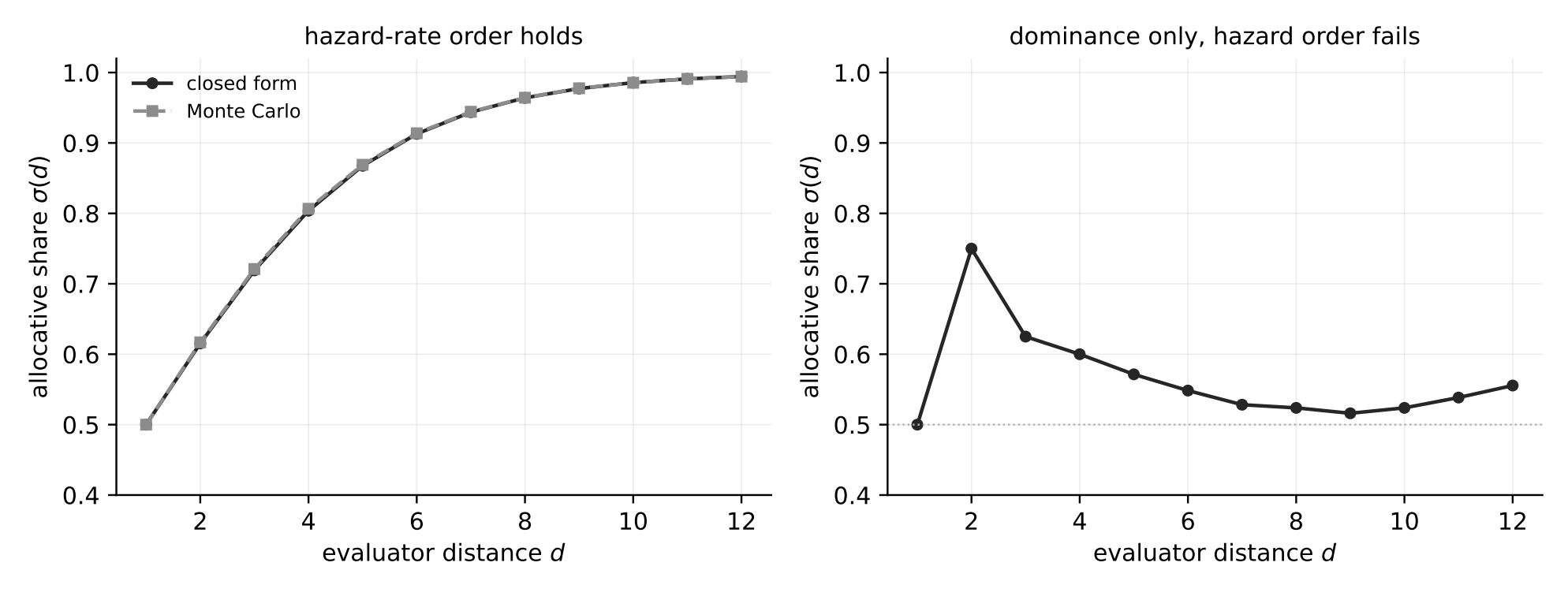
Figure 1. Allocative share of the legible evidence set against evaluator distance. The left panel gives the hazard-ordered construction, in closed form and under $4000$ Monte-Carlo draws. The right panel gives a pair of range distributions satisfying first-order stochastic dominance while crossing in hazard rate, where the share peaks at $d=2$ and declines thereafter.
Part III. Consequences for Three Standing Arguments
8. The Appeal to Scale and the Limits of Coarse-Graining
This section examines the explanation most often given for the disappearance of ordinary
contribution, which is that large systems must aggregate and aggregation loses detail. Its
objective is to establish that the explanation is weaker than it appears and that the
result of §6 supplies what it lacks. The method is to state the appeal
in the strongest form its own theory supports, and then to identify the feature of that
theory which turns it against the party making the appeal.
8.1 The appeal stated at full strength
The appeal runs as follows. A description of a large formation cannot carry every property
of its constituents. Descriptions at higher scales are therefore constructed by
coarse-graining, in which many microscopic configurations are mapped to one macroscopic
variable. Individual contributions vanish from the higher description for the same reason
individual molecules vanish from a description in terms of temperature and pressure. The
disappearance of the ordinary contributor is thus a consequence of a necessary operation
and carries no imputation against anyone.
The appeal is stated at full strength because it is largely correct, and because the
theory it invokes is precise enough to be checked.
8.2 The feature of the theory which reverses the appeal
The theory of coarse-graining does not hold merely that detail is lost. It holds that
detail is lost because it is irrelevant to the macroscopic observable. In the
renormalisation-group treatment, couplings are classified as relevant or irrelevant
according to their behaviour under repeated rescaling, and the content of universality is
that systems differing arbitrarily in their microscopic constitution exhibit identical
macroscopic behaviour, since the differences reside in irrelevant couplings. Batterman’s
analysis makes the point in the strongest available form: the coarse-graining apparatus is
what explains the autonomy of higher-level description (Batterman, 2002).
A party who invokes coarse-graining to explain why the ordinary contribution disappears has
therefore invoked a body of theory whose content is that the omitted material makes no
difference to what the higher description is about. The appeal does not excuse the loss; it
denies that anything was lost. Any argument that proceeds from coarse-graining to a
complaint about the omission is committed to both halves of a contradiction.
8.3 The supplement the legibility asymmetry supplies
Proposition 6.1 supplies what the appeal lacks, which is selectivity. Coarse-graining as
such is indifferent to the content of what it discards; it discards whatever the
macroscopic variable does not depend on, and the discarding is symmetric across
microscopic content of every kind. The result of §6 concerns a loss
that is asymmetric by mode, so that the surviving description is not a smaller
sample of the original but a differently composed one.
The difference matters for what can be inferred. From a symmetric loss nothing follows
about which parties are advantaged by the description that survives. From an asymmetric
loss it follows that parties holding value predominantly in the mode with shorter range
are represented less adequately in the surviving description, at every distance, whatever
the description’s purpose.
8.4 The condition under which fine-grained material becomes load-bearing
One feature of the theory works in the other direction and should be recorded, since it
converts a moral demand into a question about system behaviour. Irrelevance is a property
relative to a fixed point. Near a critical boundary the correlation length grows without
bound, and microscopic fluctuations propagate to macroscopic scales; the couplings that
were irrelevant in the ordinary regime are the ones that carry the transition. A system
that has permanently discarded its capacity to resolve fine-grained material has therefore
discarded it precisely against the regime in which such material becomes load-bearing.
The observation is recorded and is not developed here. It carries a substantial
antecedent, namely that the formation in question approaches a stability boundary, and
establishing that antecedent for any particular social formation lies outside this paper.
The point is registered because it locates the argument for retention in the behaviour of
systems and not in a preference about representation, and §10 gives the
version of the argument that requires no such antecedent.
9. The Budget and the Distortion Measure
This section treats the standing objection from scarcity. Its objective is to establish
that a resource constraint fixes how much can be retained and never fixes what is retained,
and its method is to restate the problem in the vocabulary of lossy compression, where the
two quantities are separated by construction. The section closes by bounding the transfer.
9.1 The objection stated at full strength
Attention, administration, memory and record-keeping are limited. A formation of any size
cannot maintain the resolution toward each of its members that a small group maintains
toward each of its own. Any proposal to represent contribution more finely therefore
proposes an expenditure, and the expenditure competes with every other use of the same
resources. The objection is sound, and no argument in this paper denies it.
9.2 The separation the objection overlooks
A lossy representation is specified by two independent components. The first is a
rate, which is the quantity of description permitted. The second is a
distortion measure, which fixes what counts as a costly discrepancy between the
original and its representation. Shannon’s rate–distortion theory establishes the
relation between them, giving for each admissible distortion the minimum rate that achieves
it, and the theory is defined only once a distortion measure has been supplied
(Shannon, 1959; Cover & Thomas, 2006). The information-bottleneck formulation makes the dependence
explicit by fixing the distortion in terms of information retained about a designated
variable, so that the compression preserves what is relevant to that variable and discards
the rest (Tishby, Pereira & Bialek, 1999).
The separation is the whole of the reply. Scarcity fixes the rate. It leaves the distortion
measure entirely undetermined. Two representations of a formation may consume identical
resources while differing completely in which discrepancies they treat as costly, and the
selection between allocative and generative material is made in the distortion measure and
nowhere else. An objection from scarcity therefore establishes that some material must go
and establishes nothing whatever about which material that is.
9.3 The question the separation opens
Once the two components are separated, the substantive question becomes determinate and
is a question about authority: which party fixes the distortion measure under which a
formation represents its own members. The question is answerable in a way that the
undifferentiated complaint about scarcity is not, since the parties who set evaluative
criteria are ordinarily identifiable, and their position with respect to the relations
being evaluated is ordinarily ascertainable.
Proposition 6.1 then bears on the answer. A party who sets the distortion measure from
outside the relations concerned is subject to the same asymmetry as any other distant
observer, so the measure will be built from the material available at that distance. The
composition of an evaluative regime is thus explained without recourse to any imputation of
motive, and the explanation is available in the case where the setting party is entirely
well disposed toward the parties evaluated.
9.4 Restrictions placed on the transfer
The transfer is conceptual and no rate–distortion calculation is offered. A calculation
would require a source distribution over the material to be represented and a numerical
distortion function, and neither is available for the objects at issue. What transfers is
the separation of the two components, which is a structural feature of any lossy
representation and holds independently of whether the quantities can be computed.
No claim is made that a distortion measure sensitive to generative material can presently
be specified. §12 records that the specification is unavailable, and gives
the reason.
10. The Justification from Option Value
This section supplies the justification for retaining material whose future use cannot be
specified. Its objective is to establish that the justification requires no prediction
about which contribution will later matter, and its method is to apply the standard
treatment of irreversibility under uncertainty and then to check its three conditions
against the case. The section closes with the limits of what the argument delivers.
10.1 The demand the justification must meet
A recommendation to retain fine-grained material invites an immediate demand: state the
benefit. The obvious form of answer is that some retained contribution will later prove
valuable. That answer is unavailable. It requires an inference from present material to a
future state of an open social system, and no warrant supports such an inference at the
horizons in question. A justification resting on it would be a justification resting on a
prediction that the party offering it is in no position to make.
10.2 The standard treatment of irreversibility under uncertainty
Arrow and Fisher, and Henry independently, establish that where a decision is uncertain in
its consequences, where one option forecloses possibilities the other preserves, and where
information is expected to arrive, there is a positive value attaching to the preserving
option over and above its expected direct benefit (Arrow & Fisher, 1974; Henry, 1974). The quantity
is the quasi-option value, and it is positive under those three conditions alone. It
requires no estimate of which future contingency will obtain, and it is not an expression
of risk aversion; Fisher and Hanemann establish that the quantity survives risk neutrality
and is distinct from the option value associated with attitudes to risk
(Fisher & Hanemann, 1987).
10.3 The three conditions checked against the case
Uncertainty holds by the argument of §10.1: which contributions will
later matter is exactly what is unavailable.
Irreversibility holds by a feature of records specifically. A contribution that was
never recorded cannot be recovered later by any expenditure, since the material that would
have supported the reconstruction is the material that was not produced. This is the
asymmetry that makes the case a case of irreversibility in the required sense: retention is
reversible, since retained material may always be discarded afterwards, while
non-retention is not.
Expected learning holds because the criteria by which contribution is assessed
demonstrably change. §3 records several such changes, and the historical
literature on measurement conventions supplies more. A party who holds that assessment
criteria have reached their final form is committed to a position that the record of the
last century refutes.
10.4 Properties of the option-value justification and its withheld claims
The argument delivers a justification with three properties worth stating plainly. It
requires no moral premise, so it is available to a reader who rejects every normative
commitment in this paper. It requires no prediction, so it is untouched by the objection of
§10.1. And it is stated in the currency of the objection from scarcity,
since a positive quasi-option value is an item on the same ledger as the cost of retention.
Three things are withheld. The argument establishes the sign of the quantity and not its
magnitude, so it settles no case in which the cost of retention is high and cannot be used
to license an expenditure of any particular size. It applies to the irreversible component
of a representational decision alone, so material that could be reconstructed later falls
outside it. And the concept must be used in its own sense: the quasi-option value of Arrow,
Fisher, Hanemann and Henry is not equivalent to the option value of the investment
literature, and the two have been shown to come apart (Mensink & Requate, 2005).
Part IV. The Result at Four Sites
11. Application of the Result at Four Evaluative Sites
This section applies Proposition 6.1 at four sites. Its objective is to establish that the
sites differ in the dimension the account treats, which is the position of the evaluator,
while resembling one another in the features that would otherwise explain the phenomenon,
and to determine at each site whether the hazard-rate condition of clause (i) obtains. Its
method is a common template: the relation and the evaluator’s position, the indicators
available at that position, the standing of the hazard-rate condition, and what the account
predicts. The section closes with a carrier result that all four sites share, together with
its verification.
11.1 Household evaluation of a prospective member
The relation is between two people who propose to form a household. The evaluators are
family members who stand at one or two relational steps: they receive accounts of the
relation, and in the ordinary case they receive them from one participant.
The indicators available to a participant include the whole class of event indicators
described at §5: the effect of the relation on what each party attempts,
sustains and recovers from. The indicators available at one or two steps are the
transferable ones, and the questions characteristically put at that distance ask after
income, dwelling, occupation and prospective role. Those questions are frequently
described as materialistic. The account gives a different reconstruction: they are the
questions whose answers survive the distance at which they are asked.
The hazard-rate condition holds at this site, since no device converts the event
indicators into transmissible artefacts and the allocative advantage in range is
accordingly sustained. Two consequences follow. The disagreement is not a disagreement
about facts, since the parties are not weighing one evidence set differently but holding
different evidence sets. And the evaluating party is reasoning well: an evaluator who bears
the consequences of a bad outcome, and who holds only the transferable material, is right
to weight what is available and verifiable, so the position is rationally reconstructible
without any imputation of narrowness.
11.2 Ordinary contribution within a workplace
The relation is between a worker and the colleagues, tasks and clients the work engages.
The evaluators occupy a graded series of positions: a supervisor at one step, a personnel
function at two, a promotion or reduction committee at three or more.
The indicators available fall out as the account predicts. Output counts, credentials,
attendance and formally assigned responsibilities are artefactual and survive the whole
series. The contributions whose product is a difference between what happened and what
would have happened, which is to say the anticipation of a fault, the steadying of a
colleague, the small correction that prevented a propagation, leave no residue when they
succeed. This is the class Star and Strauss enumerate (Star & Strauss, 1999), and its members
share the structural feature identified at §5.
The hazard-rate condition holds at this site in the default case and is alterable by
design, which makes the workplace the clearest illustration of §11.5 below.
The account predicts that the assessment of a worker becomes more allocative as it rises
through the series, that the prediction holds with every evaluator sincere, and that a
worker aware of the gradient has reason to redirect effort toward artefact production, the
last being the reactivity effect documented by Espeland and Sauder (Espeland & Sauder, 2007).
11.3 Evaluation within an academic field
The relation is between a researcher and the work, students, collaborators and readers the
research engages. The evaluators are again graded: a collaborator at zero steps, a referee
at one with respect to a particular manuscript, a departmental committee at two or three,
a national assessment exercise at more.
This site is the interesting one, because the field maintains a device that leaves
transmissible traces of acts whose product is otherwise an event inside a relation. A
citation is a durable public record that a piece of work enabled a later piece, and a
version-control history is a durable public record that a contribution entered a shared
artefact. Such devices give a subclass of generative attributes a range they would
otherwise lack. Other generative contributions in the same field, and in particular
refereeing, supervision, correction and the maintenance of shared resources, have no such
device and retain the short range of §5.
The hazard-rate condition therefore holds at this site only under a further condition on
the devices, which §11.5 states and verifies. The account’s prediction here
is accordingly conditional and is the sharpest test available to it.
11.4 Public measurement of an economy
The relation is between a party and the households, communities and environments the
party’s activity engages. The evaluator is a measurement regime at the greatest distance
the account contemplates, since national accounts are constructed from returns that have
passed through many intermediate renderings.
The indicators available are the artefactual ones exclusively, and the literature on
national accounting has established for decades that the labour sustaining a workforce is
excluded from them (Waring, 1988). The hazard-rate condition holds at this site and
holds strongly, since no device of the kind described at §11.3 exists for
domestic care, and Proposition 6.1 then places the allocative share close to its ceiling.
The account adds two things to the existing treatment. It predicts the exclusion without
appeal to any division by social category, which is the extension recorded at
§3. And it locates the remedy in the distortion measure of
§9 in place of the rate, so that the familiar reply that fuller accounts
would be prohibitively expensive misses its target.
11.5 Artefactual carriers and the two results they admit
The four sites differ in one respect that the account can treat formally. Call a device
that leaves a transmissible trace of a generative act an artefactual carrier. A
citation is one, a version-control record is one, a signed review is one, and a structured
record of who was consulted before a decision is one. A carrier does not convert a
generative attribute into an allocative attribute, since what it records remains a property
of a relation. It alters that attribute’s range.
What a carrier records requires care, and stating it wrongly would put the account in an
untenable position. A carrier records participation and never a share of
contribution. The distinction is forced by §4: a generative holding is
individuated by reference to a relation and admits no description omitting the other party,
so a quantity of the form “the portion of this outcome produced by this party” is not
defined for holdings of that mode. A version-control record does not assert that a
contributor caused a project to succeed; it asserts that the contributor was present and
performed a determinate act. The first assertion has no truth value on this account, and
the second is verifiable. The carriers named above are all of the second kind, and any
device of the first kind lies outside what the account recommends.
The restriction is not a weakening. Circulation among participants, which is the structure
this account borrows from generative justice (Eglash, 2016), requires an identification
of the participants and requires no apportionment among them. Apportionment belongs to the
allocative mode, where holdings are individuated by reference to a party alone and shares
are therefore defined.
Let a fraction $c$ of generative attributes be carried, and let the carrier have survival
function $S_c$, so that the effective generative survival function is
$S_g^{\text{eff}} = (1-c) S_g + c S_c$. Two results follow, and they are verified in
verify/carrier.py and reported in Table 2 and
Figure 2.
Say that a carrier is no more durable than the allocative artefacts when
$S_c/S_a$ is non-increasing, which is the hazard-rate condition of §6 applied to the
carrier, and more durable when $S_c/S_a$ is somewhere increasing.
Proposition 11.1. (Carriers and the two regimes they produce). (i) Where the carrier is no more durable than the allocative artefacts, and where the hazard-rate condition of Proposition 6.1 holds, $\sigma$ remains non-decreasing in $d$. Where in addition $S_c = S_a$, the limiting allocative share is $n_a/(n_a + c,n_g)$. (ii) There exist more durable carriers for which $\sigma$ acquires an interior maximum and declines thereafter, and for which at sufficient $c$ it falls below its value at $d=1$. Being more durable is necessary for this and is not sufficient.
Clause (i) is proved directly. Write $S_g^{\text{eff}}/S_a = (1-c)(S_g/S_a) + c(S_c/S_a)$.
Both terms are non-increasing under the stated hypotheses, a convex combination of
non-increasing functions is non-increasing, and $\sigma = 1/(1+\rho)$ with
$\rho = (n_g/n_a),S_g^{\text{eff}}/S_a$ is therefore non-decreasing. The limit statement
requires $S_g/S_a \to 0$ and $S_c/S_a \to 1$, which the case $S_c = S_a$ supplies and a
general carrier need not.
Clause (ii) is an existence claim and is established by the construction reported below.
Nothing here shows that every more durable carrier produces an interior maximum, and the
necessity direction is what the proof of clause (i) delivers: where $S_c/S_a$ is
non-increasing everywhere, no interior maximum arises.
Clause (i) refutes a hypothesis worth recording, since it was the one this paper began
with. A partial carrier might be expected to relocate the maximum of $\sigma$ to an
intermediate distance, on the reasoning that close and distant evaluators would both hold
generative material while an intermediate evaluator held neither. The verification refutes
it. Writing $\sigma = 1/(1+\rho)$ with $\rho = n_g S_g^{\text{eff}}/(n_a S_a)$, a mixture
whose components are each no more durable than $S_a$ leaves $S_g^{\text{eff}}/S_a$
non-increasing, so $\sigma$ cannot turn. At $c=0.25$ the share still rises monotonically
and merely stops at $0.7989$ in place of $0.9978$. A carrier of this kind caps the
asymmetry and does not reverse it.
Clause (ii) identifies the condition under which reversal occurs, and the condition is
demanding: the carrier must outlast the allocative artefacts it competes with. One feature
of the construction should be reported so that the effect is not over-attributed. In the
lower block the allocative artefacts themselves go stale, and at $c = 0$ that alone
produces a single late decrease of $\sigma$ over thirteen steps. The carrier is therefore
responsible for the early and large reversal, and it is not responsible for the whole of
the departure from monotonicity. The case is
real. A published record that one contribution enabled another persists indefinitely, while
a current position, a current holding and a current income lose their discriminating force
as they age. Under that pairing the verification gives an interior maximum at $d=6$ for
$c=0.05$ and at $d=3$ for $c=0.30$, with the share falling to $0.1069$ and $0.0197$
respectively at the far end. At sufficient distance the surviving evidence becomes
predominantly generative.
The consequence for design is narrow and should be stated as such. A carrier improves the
composition of distant evidence in every case, so the recommendation to build one needs no
further support. The stronger property, which is reversal, is available only where the
carrier is built to outlast the allocative record, and durability is therefore the design
parameter that matters and not coverage alone. §12 records what this paper
declines to specify about such devices.
Table. Allocative share under artefactual carriers, by carried fraction $c$. The upper
block gives a carrier no more durable than the allocative artefacts; the lower gives a
permanent carrier set against allocative artefacts that go stale. Peak $d$ is the distance
at which $\sigma$ is greatest and violations count decreases of $\sigma$ over thirteen
steps.
| $c$ | $\sigma(1)$ | $\sigma(4)$ | $\sigma(14)$ | peak $d$ | violations |
|---|---|---|---|---|---|
| 6lCarrier no more durable than the artefacts | |||||
| 0.00 | 0.5000 | 0.8038 | 0.9978 | 14 | 0 |
| 0.10 | 0.5000 | 0.7577 | 0.9074 | 14 | 0 |
| 0.25 | 0.5000 | 0.6978 | 0.7989 | 14 | 0 |
| 0.50 | 0.5000 | 0.6165 | 0.6662 | 14 | 0 |
| 0.80 | 0.5000 | 0.5409 | 0.5554 | 14 | 0 |
| 6lPermanent carrier, staling artefacts | |||||
| 0.00 | 0.5000 | 0.7732 | 0.9347 | 13 | 1 |
| 0.05 | 0.5000 | 0.7316 | 0.1069 | 6 | 8 |
| 0.15 | 0.5000 | 0.6606 | 0.0386 | 4 | 10 |
| 0.30 | 0.5000 | 0.5766 | 0.0197 | 3 | 11 |
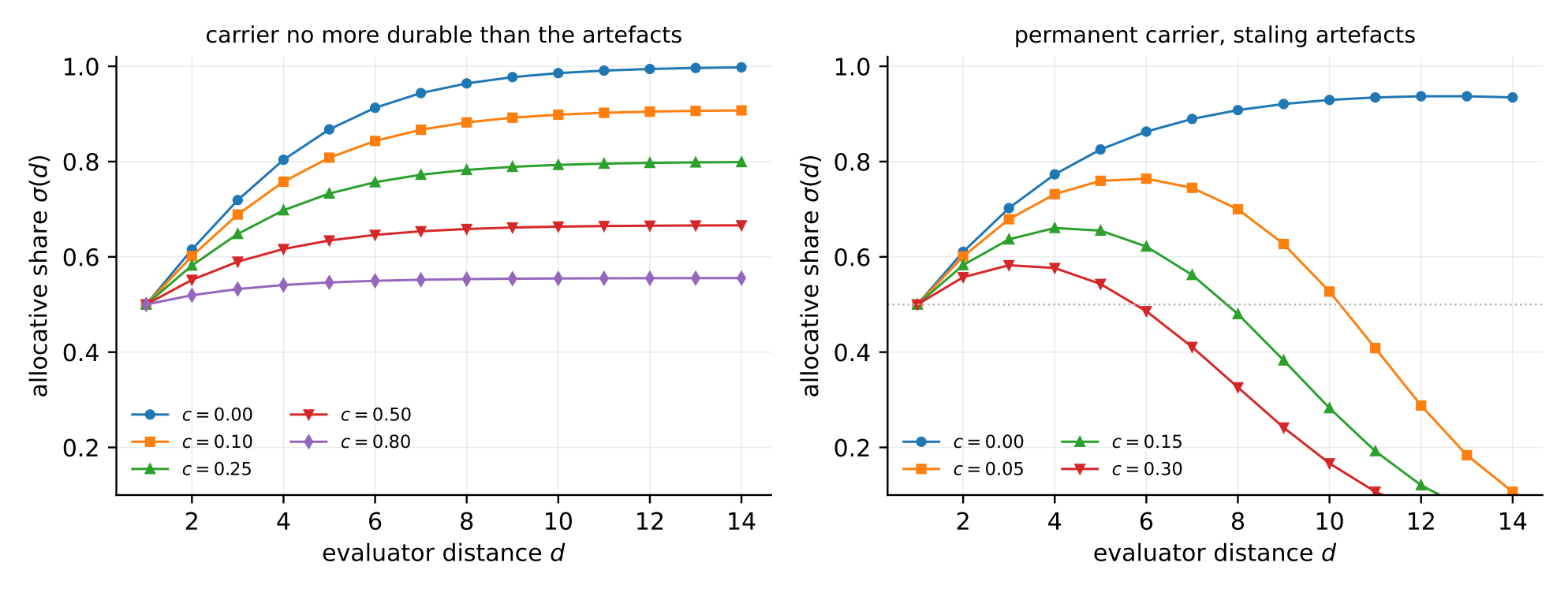
Figure 2. Allocative share under artefactual carriers. The left panel gives carriers no more durable than the allocative artefacts, where the share stays monotone and the carried fraction sets a ceiling. The right panel gives a permanent carrier set against allocative artefacts that go stale, where the share turns at an interior distance and falls below the dotted line at one half.
11.6 The objection from the non-localisability of a generative event
An objection remains, and it is the most serious one the account faces. Where a generative
event occurs between parties, it may be denied that there is any fact of the matter about
which party generated it. The capability a colleague raises is raised in an encounter whose
elements include both parties, their histories, the occasion and much that neither
controlled. On that view the generative event is not merely hard to observe from a
distance; it is not localised to any participant at all, and a device recording who
generated what would be recording something that does not obtain.
The objection is granted in the form in which it is strongest, and the account is
consistent with it. Nothing in this paper asserts that a generative event has a locus among
its participants. Proposition 6.1 concerns the composition of an evidence set and
Proposition 11.1 concerns the range of an indicator, and neither requires that any outcome
be apportioned. The carrier restriction stated at §11.5 above is what makes this
consistency available: a record of participation is well formed whether or not the
generative event is localisable, since it asserts presence and act and asserts nothing about
production.
Two consequences follow and are worth stating. Any reading of the account on which the
remedy for illegibility is a better attribution of credit is mistaken, and the account
opposes such a remedy on grounds of its own. And the companion treatment of distributed
responsibility in this framework is the same structure with the sign reversed: there, an
outcome is produced by many hands and no participant is the locus of its production; here,
a possibility is generated in a relation and no participant is the locus of its generation.
The two are one result about relational events, and neither is repaired by finer
measurement.
11.7 A formation constructing co-presence at scale
The four sites above are all sites at which the condition of §5 holds and the account
predicts a failure. A site at which the condition is deliberately defeated is available, and
it is included because an account that exhibits only failures has not shown its condition to
be satisfiable. The case is constructed and is marked as constructed.
Consider a performance formation whose members are recruited without prior distinction and
which maintains a small resident venue, a schedule of frequent performances before audiences
of a few hundred, occasions on which members and audience meet directly, and a published
record in which members write in their own names over years. The formation’s characteristic
product is generative in the sense of §4: what a member supplies is largely the effect she
has on other members and on those attending, and that effect has the counterfactual form
§5 identifies.
The arrangement bears on the account in two ways.
It shortens the distance at which the assessment is made. Repeated attendance at a small
venue places a large number of parties at zero or one relational step from the relation
being assessed, where the corresponding assessment of a nationally distributed performer is
made at four or more. The account predicts a lower allocative share at the first site than
the second on the strength of position alone, and the prediction does not rest on any claim
about the quality of what is produced at either.
It supplies carriers of the kind §11.5 describes, and supplies them at the participation
level the restriction there requires. A dated performance record establishes that a member
was present and performed; a member’s own published writing over years establishes a
sequence of acts; an occasion of direct meeting is attested by both parties. None of these
records a share of any outcome, and by §11.6 none could.
Two features of the case are worth stating because they bear on Proposition 11.1 and not
merely on the illustration. The carriers here are durable in the sense clause (ii) requires,
since a dated record of a performance does not lose its discriminating force as it ages,
while the allocative attributes of a performer characteristically do. And the arrangement is
costly: maintaining a small venue, frequent performance and direct meeting consumes
resources that a distribution-only arrangement does not, which is the form the trade-off of
§9 takes at this site.
Two overreadings are excluded. The case establishes that the condition is satisfiable and
establishes nothing about whether any actual formation of this kind is well conducted, fairly
organised, or free of the hierarchies that §11.8 records such records as developing. And
the case supplies no measurement; it identifies an arrangement whose structure the account
predicts to behave differently, and the measurement described at §13.2 remains undone.
11.8 Overreadings of the site material excluded
Three exclusions apply to this Part.
The four sites are constructed and are marked as constructed. None reports a measurement,
the parameters of §11.5 are illustrative in the sense fixed at
§7, and no claim is made about the actual range distributions obtaining at
any site.
The gradient identified at each site is a gradient in the composition of available
evidence and never a gradient in accuracy, competence or good faith. Every evaluator in
this Part is stipulated to be sincere and diligent, and the results are obtained under that
stipulation.
The carrier results license no recommendation about any particular institution. Clause (ii)
in particular identifies a structural property of durable public contribution records and
supplies no ground for holding that any existing record of that kind is well designed,
fairly maintained, or free of the hierarchies that such records are known to develop.
Part V. The Boundaries of the Account
12. Positions Declined and the Grounds for Declining Them
This section argues the four declinations announced at §2. Its objective is
to show that each is a position taken on grounds and no evasion, and its method is to state
for each what the paper would have to establish in order to assert the contrary, and why
that is unavailable. The section closes with the one declination whose ground is temporal
in place of principled.
12.1 Grounds for declining a ranking between the two modes
An account that established a legibility asymmetry and then ranked the modes would have
supplied an ordering the asymmetry does not contain. Proposition 6.1 concerns the
composition of an evidence set. It supplies no measure on which a generative holding
exceeds an allocative one, and it is consistent with the reader who holds that transferable
holdings are the ones that matter, since such a reader will read the result as a finding
that distant evaluation performs well.
The declination has a further use. A ranking would convert the account into a partisan
claim on behalf of one class of holder, and the result would then stand or fall with that
claim. Kept separate, the structural result survives disagreement about the ranking and is
available to parties on both sides of it.
12.2 Grounds for declining a criterion of justice
To assert that a legibility failure wrongs anyone, the account would need a criterion
distinguishing losses that constitute wrongs from losses that are the ordinary price of
representation. It holds no such criterion, and the reason is that supplying one requires
settling a prior question: whether a representational loss becomes a wrong through its
magnitude, through its distribution, through the availability of a remedy, or through some
further feature. That question is the subject of the companion paper of this series, and
the treatment there proceeds by way of a condition on the recoverability of the destroyed
distinction. Anticipating it here would state a conclusion without its argument.
The declination is consequential and should be read as a restriction on what has been
shown. Nothing in this paper establishes that any party has been wronged.
12.3 Grounds for declining a quantity to be maximised
The account recommends no maximisation of visibility, of recorded contribution, or of
generativity. Three reasons apply, and the third is the one that carries.
The first is internal. Proposition 11.1 shows that the effect of a carrier depends on its
durability relative to the artefacts it competes with, so a recommendation stated in terms
of coverage alone would be false on the account’s own model.
The second is empirical. Recording capacity has expanded enormously without producing a
corresponding expansion of recognition, and the settings in which contribution is most
exhaustively recorded are not the settings in which it is most fully acknowledged. A
maximisation recommendation is therefore not supported by the historical record of what
increased recording has in fact produced.
The third is a matter of principle and holds independently of the other two. An objective
function over any of these quantities aggregates across the parties it ranges over, and an
aggregate permits a shortfall borne by one party to be offset by a surplus held by another.
The framework within which this paper sits forbids that offsetting, and it forbids it under
every substitution of the maximand, generativity included. A quantity to be maximised is
therefore excluded by the same argument whatever quantity is proposed, and the exclusion is
not a scruple about measurement.
12.4 Grounds for declining an infrastructure design
This declination differs from the other three, since its ground is the present state of
technical, legal and institutional conditions and not a matter of principle.
What the account would need in order to specify a carrier of the kind described at
§11.5 is a set of conditions that cannot presently be met together: a
representation of a generative act that is durable and portable, that is held by the party
who performed the act in place of the platform that recorded it, that confers standing
without becoming a surveillance record, and that resists the concentration into hierarchy
that contribution records are observed to develop. Each of these is a research programme.
The last is the most difficult, since it is a property of the social use of a record and no
property of the record itself.
The condition of the account is therefore that a design problem has been identified and no
design offered. The reasoning that supports this position is Wanhong’s own and is worth
stating in his terms: a society can institutionalise only what its technological, legal and
economic conditions make feasible, so that a proposal advanced in the absence of those
conditions describes a hope in the grammar of a solution. The claim entered here is that
the design problem is now stated precisely enough that its conditions can be recognised
when they arrive.
13. Limits of the Account and Directions for Further Work
This section states what remains unsettled. Its objective is to place the account’s
weaknesses on the record in a form a critic can use, and its method is to distinguish
limits internal to the argument from limits on its evidential base and limits arising from
its origin. The section closes with the three directions the account leaves open.
13.1 Limits internal to the argument
The result is conditional and the condition is substantive. Proposition 6.1(i) holds under
the hazard-rate order, and Proposition 6.1(iii) shows that the weaker and more natural
hypothesis of first-order dominance does not suffice. Every application in
Part IV therefore carries an antecedent that the account asserts and does not
establish, since determining the range distributions obtaining at a real site would require
measurements that have not been made.
The result concerns composition and not accuracy. An evaluator whose evidence set is
overwhelmingly allocative may be entirely correct about every item in it, and nothing in
the account licenses the inference that distant assessments are mistaken. What the account
supports is a claim about what such assessments are assessments of.
The account treats position as one-dimensional. Real evaluative settings involve parties
positioned differently with respect to different aspects of the same relation, and a
supervisor may stand at zero steps from one part of a worker’s contribution and at four
from another. A treatment adequate to that would replace the scalar distance of
§5 with a structure over aspects, and the present account does not supply
one.
13.2 Limits on the evidential base
No measurement is reported in this paper. Both verifications establish the behaviour of
$\sigma$ under stated hypotheses on explicitly constructed distributions, and neither
estimates a quantity in the world. The parameters were chosen to make the mechanism legible
and carry no empirical warrant.
The account is in consequence testable and untested. The form a test would take is
determinate: hold a contribution fixed, vary the position of the assessing party, and
compare the composition of the material each party can supply in support of an assessment.
The prediction is that the allocative proportion rises with distance under the hazard-rate
condition and is capped under a carrier, at the values Table 2 reports for
the corresponding parameters.
The one arrangement at which the account’s condition is satisfied is treated analytically
and is constructed. §11.7 exhibits a formation in which co-presence is deliberately
produced at scale and durable participation records are maintained, which establishes that
the conditions the account describes are satisfiable and that satisfying them is not free.
What the treatment does not establish is the cost. No formation of the kind was measured,
the resources such an arrangement consumes are stated qualitatively, and whether the
arrangement is affordable at a given scale is therefore open. A critic should press that
question before any other, since an account whose conditions are satisfiable only at
prohibitive cost has established less than it appears to.
The carrier results in particular have an adversarial reading the account cannot presently
answer. Where a durable contribution record exists, its maintenance is itself work of the
generative kind, and the parties who perform it are observed to receive obligation in place
of recognition. A theory that recommends durable records therefore recommends a device
whose own upkeep instantiates the problem the theory describes. This is a genuine
regress and is recorded here without resolution.
13.3 Limits arising from the origin of the account
The framework within which this paper sits originated in a sequence of personal decisions
whose outcomes were favourable, and §2 recorded the discipline that follows.
The limit is stated here in full because it bears on how the account may be used.
A trajectory that succeeded confirms a thesis about generative trajectories only in virtue
of having succeeded. The population of trajectories that began in the same way and produced
nothing is invisible, and it is invisible by the mechanism this paper describes, since a
generative process that terminated left no artefact. The account therefore possesses no
base rate, and it must not be read as establishing that small beginnings characteristically
produce large trajectories. What it establishes concerns the evidence available to an
evaluator, and that result is symmetric between trajectories that flourished and
trajectories that failed.
13.4 Directions the account leaves open
Three directions follow from the limits above.
The first is the measurement described at §13.2, which is the shortest route
from the present account to an empirical claim.
The second is the structure over aspects described at §13.1, which would
replace scalar distance with a representation of partial participation and would allow the
common case in which one party is close to some of a relation and distant from the rest.
The third is the normative question this paper declines. The account establishes that
evaluative regimes lose a determinate kind of material and that the loss is systematic. The
question of when such a loss constitutes an injustice, and of what a party may claim on the
strength of it, is the subject of the companion paper, and the present result is offered as
its diagnostic ground.
References
Arrow, Kenneth J., and Anthony C. Fisher. ``Environmental Preservation, Uncertainty, and Irreversibility.’’ The Quarterly Journal of Economics 88(2), May 1974, 312–319. DOI 10.2307/1883074.
Batterman, Robert W. The Devil in the Details: Asymptotic Reasoning in Explanation, Reduction, and Emergence. Oxford: Oxford University Press, 2002.
Bowker, Geoffrey C., and Susan Leigh Star. Sorting Things Out: Classification and Its Consequences. Cambridge, MA: MIT Press, 1999.
Eglash, Ron. ``An Introduction to Generative Justice.’’ Teknokultura 13(2), 2016, 369–404. DOI 10.5209/rev_TEKN.2016.v13.n2.52847.
Espeland, Wendy Nelson, and Michael Sauder. ``Rankings and Reactivity: How Public Measures Recreate Social Worlds.’’ American Journal of Sociology 113(1), 2007, 1–40. DOI 10.1086/517897.
Espeland, Wendy Nelson, and Mitchell L. Stevens. ``Commensuration as a Social Process.’’ Annual Review of Sociology 24, 1998, 313–343. DOI 10.1146/annurev.soc.24.1.313.
Fourcade, Marion, and Kieran Healy. ``Classification Situations: Life-Chances in the Neoliberal Era.’’ Accounting, Organizations and Society 38(8), 2013, 559–572. DOI 10.1016/j.aos.2013.11.002.
Hacking, Ian. ``The Looping Effects of Human Kinds.’’ In Dan Sperber, David Premack and Ann James Premack (eds), Causal Cognition: A Multidisciplinary Debate. Oxford: Clarendon Press, 1995, 351–383. DOI 10.1093/acprof:oso/9780198524021.003.0012.
Merry, Sally Engle. The Seductions of Quantification: Measuring Human Rights, Gender Violence, and Sex Trafficking. Chicago: University of Chicago Press, 2016.
Muller, Jerry Z. The Tyranny of Metrics. Princeton: Princeton University Press, 2018.
Polanyi, Michael. The Tacit Dimension. Garden City, NY: Doubleday, 1966.
Power, Michael. The Audit Society: Rituals of Verification. Oxford: Oxford University Press, 1997.
Porter, Theodore M. Trust in Numbers: The Pursuit of Objectivity in Science and Public Life. Princeton: Princeton University Press, 1995.
Scott, James C. Seeing Like a State: How Certain Schemes to Improve the Human Condition Have Failed. New Haven: Yale University Press, 1998.
Spence, Michael. ``Job Market Signaling.’’ The Quarterly Journal of Economics 87(3), August 1973, 355–374.
Star, Susan Leigh, and Anselm Strauss. ``Layers of Silence, Arenas of Voice: The Ecology of Visible and Invisible Work.’’ Computer Supported Cooperative Work 8(1–2), 1999, 9–30. DOI 10.1023/A:1008651105359.
Cover, Thomas M., and Joy A. Thomas. Elements of Information Theory, 2nd edn. Hoboken: Wiley-Interscience, 2006.
Fisher, Anthony C., and W. Michael Hanemann. ``Quasi-Option Value: Some Misconceptions Dispelled.’’ Journal of Environmental Economics and Management 14(2), June 1987, 183–190.
Henry, Claude. ``Option Values in the Economics of Irreplaceable Assets.’’ The Review of Economic Studies 41(5), 1974, 89–104.
Hayek, F. A. ``The Use of Knowledge in Society.’’ The American Economic Review 35(4), September 1945, 519–530.
Holmström, Bengt, and Paul Milgrom. ``Multitask Principal-Agent Analyses: Incentive Contracts, Asset Ownership, and Job Design.’’ Journal of Law, Economics, and Organization 7 (special issue), 1991, 24–52.
Marx, Karl. ``Economic and Philosophic Manuscripts of 1844.’’ In Karl Marx and Frederick Engels: Collected Works, vol. 3. London: Lawrence & Wishart, 1975, 229–346.
Mensink, Paul, and Till Requate. ``The Dixit–Pindyck and the Arrow–Fisher–Hanemann–Henry Option Values Are Not Equivalent: A Note on Fisher (2000).’’ Resource and Energy Economics 27(1), January 2005, 83–88.
Shannon, Claude E. ``Coding Theorems for a Discrete Source with a Fidelity Criterion.’’ IRE National Convention Record 7, part 4, 1959, 142–163.
Tishby, Naftali, Fernando C. Pereira, and William Bialek. ``The Information Bottleneck Method.’’ In Proceedings of the 37th Annual Allerton Conference on Communication, Control and Computing, 1999, 368–377. arXiv:physics/0004057.
Waring, Marilyn. If Women Counted: A New Feminist Economics. San Francisco: Harper & Row, 1988.