The Admissibility of Representational Transformation - A Preliminary Discussion of Alienation and the Restoration of Distinction
Abstract
Every representation of a person by an institution transforms what it represents, and
every such transformation loses something. The observation is not by itself a complaint,
since a representation that lost nothing would be unusable, and a theory holding all such
loss to be unjust would describe a world in which justice is unavailable. This paper
separates the two things that are ordinarily run together in the diagnosis. Information
loss is a property of the map; alienation is a property of the relation between a person
and the use made of the map. The two are independent, and one counterexample pair
establishes it: exhaustive surveillance loses nothing and alienates completely, while a
nickname loses a great deal and alienates no one. On that separation the paper builds a
taxonomy of transformation over two axes in place of a list of kinds, and states an
admissibility condition: a transformation is inadmissible when the distinction it destroys
cannot be restored at the instance of the person it concerns. The condition is defended
against three objections. It is not procedural, since a nominal right of restoration that
no attainable act would exercise fails it. It is not predictive, since whether a route of
restoration exists is a present structural fact and no forecast. And it does not aggregate,
since it is stated per person and admits no offsetting. The condition is applied to
evidence-based policy and to archival appraisal, and its limits are stated: it is a
necessary condition and never a sufficient one, and a transformation may satisfy it and
remain monstrous.
1. Introduction
An institution that acts toward a person must first represent that person. A hospital
represents a patient as a record, a state represents a resident as an entry, an employer
represents a worker as a file, and a policy represents a population as a distribution.
Each representation is a transformation of what it represents, and each transformation
loses material that the untransformed situation contained. The observation is old and it is
usually offered as a complaint.
Offered as a complaint it proves too much. A representation that lost nothing would be the
situation itself and would be useless for the purposes representations serve, since what
makes a representation intelligible is precisely that it has discarded almost everything.
The observation also proves too much in a second way. If every loss of this kind
constituted an injustice, then injustice would be the ordinary and unavoidable condition of
every institution that acts toward anyone, and a theory delivering that result has
described a world in which justice is unavailable and has thereby ceased to distinguish
cases. The companion paper of this series establishes that representational loss is
systematic and selective; it declines the question of when such a loss wrongs anyone. This
paper takes up that question.
The argument begins by separating two things that the received diagnoses run together.
Information loss is a property of a map: some distinctions present in the domain are
absent from the image, and the map cannot be inverted. Alienation is a property of
the relation between a person and the use made of a map: the person confronts a
representation of himself as something standing over against him, which he cannot reach,
enter or answer. These are ordinarily treated as one phenomenon, with loss taken to be the
mechanism and alienation its effect. They are independent, and a single pair of cases
establishes the independence. Exhaustive surveillance loses nothing whatever and alienates
completely. A nickname among friends loses almost everything and alienates no one. Since
loss and alienation vary independently in both directions, neither is a measure of the
other, and a diagnosis that treats them as one will misidentify both the cases it should
condemn and the cases it should permit.
The separation yields a taxonomy. Where the received treatments offer lists of kinds of
transformation, scale transition, datafication, measurement, institutionalisation,
archiving, this paper places transformations on two axes: what the transformation does to
the distinctions available, and whether it leaves a route by which the person concerned can
reach the representation made of him. The familiar kinds then appear as regions of that
space in place of species of a genus, and their normative differences follow from their
positions.
On the second axis the paper states its condition. A transformation is
inadmissible when the distinction it destroys cannot be restored at the instance of
the person it concerns. Three properties recommend the condition and are established in
Part III. It is not procedural, since a nominal right of restoration that
no attainable act would exercise does not satisfy it; what is required is that some
attainable act of the person reach the representation, which is a condition of
reachability and no condition of formal availability. It is not predictive, since whether
such a route exists is a present structural fact about an arrangement and requires no
forecast of what will follow; this is what allows the condition to survive the standing
difficulty about inferences to future states of open systems. And it does not aggregate,
since it is stated of each person severally and permits no shortfall borne by one to be
offset by a surplus held by another.
The debt this paper owes is stated at the outset and again at length in
§3. The idea that the fate of what a person generates turns on whether it
returns to him, and that alienation is the diagnostic for its failure to return, is
Eglash’s (Eglash, 2016). The extension attempted here is from value to interpretation:
where generative justice asks whether the value returns to its generator, this paper asks
whether the interpretation returns to the person interpreted, whether he can
re-enter the description made of him. The concept of alienation on which that extension
rests is Jaeggi’s, and her reconstruction of alienation as a failure of appropriation
carried out without appeal to any human essence is both the resource this paper uses and
the position from which it must differentiate itself (Jaeggi, 2014).
Two limits are fixed at the outset. The condition is necessary and never sufficient. A
transformation may leave every route of restoration open and remain monstrous in what it
does, and nothing in this paper licenses the inference from admissibility to justice. And
the condition is stated for representations made by institutions of persons; its extension
to the representation of groups, of the dead, and of parties who cannot act on their own
behalf raises problems this paper identifies and does not solve.
The argument proceeds in five parts. Part I fixes the object
(§2) and states the prior formulations (§3).
Part II establishes the independence of loss and alienation
(§4) and constructs the taxonomy (§5).
Part III states the admissibility condition (§6),
distinguishes reachability from formal availability (§7), and gives the
stratification by tense that fixes what binds now (§8).
Part IV applies the condition to evidence-based policy
(§9) and to archival appraisal (§10).
Part V records the positions declined (§11) and the limits
of the account (§12).
Part I. The Problem of Admissible Transformation
2. Scope of the Condition and Restrictions Placed on It
This section fixes what the paper is about. It states the object and the restrictions
bounding it, records what is imported from companion work, describes the use made of case
material, and lists the positions declined in advance. The declinations are stated early so
that a reader can see the size of the claim before the argument for it.
2.1 The object of the condition and its four restrictions
The object is a representational transformation: an operation by which a party or an
institution produces a representation of a person and acts on the representation in place
of the person. Four restrictions bound it.
The first is to transformations that are acted upon. A description that no one uses
falls outside the account, since the condition concerns the relation between a person and
the use made of a representation of him, and where there is no use there is no such
relation.
The second is to persons as the subjects represented. Representations of groups, of
the dead, of future parties and of those who cannot act on their own behalf raise a
distinct problem, since the condition is stated in terms of an act available to the person
concerned. §12 records the extension as unfinished.
The third is to admissibility and never to justice. The condition sorts
transformations into those that may be performed and those that may not, and it supplies no
ordering within either class. A transformation may be admissible and bad, and the account
says so.
The fourth is to structure and never to outcome. Whether a route of restoration
exists is settled by the arrangement in force at the time of the transformation. Nothing in
the condition depends on what the transformation later produces.
2.2 Results imported from companion work
Four results are imported and used without re-argument.
From the companion paper on the legibility of contribution, the paper takes the result that
representational loss is selective in kind and not merely in quantity, together with its
consequence that the material a distant evaluator holds is systematically composed. That
paper establishes that a determinate class of material is lost; this paper asks when such a
loss may not be performed.
From Eglash’s generative justice, the paper takes the structure on which its condition is
modelled: that what a person generates should return to him, and that the failure of the
return is the site at which alienation is diagnosed (Eglash, 2016). The extension to
interpretation is stated at §3 and is the paper’s own.
From Jaeggi’s reconstruction of alienation, the paper takes the definition of alienation as
a relation of relationlessness and its analysis as a failure of appropriation, together with
the methodological commitment that made the reconstruction possible, which is that the
diagnosis appeals to no antecedent account of a human essence (Jaeggi, 2014).
From the companion work on organisational rule interpretation, the paper takes the result
that interpretive authority extends to the rules governing challenges to its own exercise,
which is the recursion that §7 must survive.
2.3 Case material and the disciplines observed in its use
Two extended cases are treated, in Part IV: evidence-based policy, and the
appraisal of records for archival retention. They are chosen because they lie at opposite
ends of the axis the condition concerns. Evidence-based policy is a setting in which the
transformation is performed for the benefit of the represented parties and in which the
route of restoration is characteristically absent. Archival appraisal is a setting in which
the profession performing the transformation has developed an explicit doctrine about what
must remain reachable, and has done so under exactly the constraint of scarcity that is
usually offered as a reason for having no such doctrine.
Three disciplines are observed. Cases are organised by the structural feature at issue and
never by domain. Named institutions and named jurisdictions appear only where a cited source
names them. And constructed examples are marked as constructed at the point of use.
2.4 Positions declined in advance
Four positions are declined and the declinations hold throughout.
The paper asserts no criterion of justice. Its condition is necessary and never
sufficient, and §11 gives the argument for keeping it so.
The paper asserts no prohibition on loss. Compression is what makes a representation
usable, and a recommendation to minimise loss would be a recommendation to make
representations unintelligible. The account has a floor and no minimum.
The paper asserts no quantity to be maximised, including no maximisation of
restorability, reversibility or transparency. The reason is given at §11
and is the same in form as the reason given in the companion paper: an objective function
over any such quantity aggregates across persons, and aggregation permits the offsetting
this account forbids.
The paper asserts no procedural machinery. The condition states what must remain
available and stipulates no institutional apparatus for making it available. The reason is
that an institution which imports the apparatus of due process acquires along with it the
recursion recorded at §2.2, and the condition would then be satisfied by the
appearance of the machinery in place of the availability of the act.
3. Prior Formulations of Alienation and Contestation
This section states the formulations already available for the phenomenon this paper
treats, and fixes for each what it settles and what it leaves open. The method is
concession first, as in the companion paper: each position is stated in terms its authors
would accept before any differentiation, and the differentiation is confined to what the
present account can establish. The section closes by stating the residue.
3.1 Objectification and alienation in Marx
The distinction the paper needs is already drawn in Marx’s early writings (Marx, 1975), where
objectification and alienation are separate. To externalise oneself in an object is the
human mode of activity and carries no defect: a made thing stands outside its maker
necessarily. Alienation arises where the externalised product confronts its producer as an
alien power, over which he has no command and which acts upon him. The defect lies in the
relation between producer and product, and never in the fact of externalisation.
The concession is full and the priority is Marx’s. The present paper adds no part of the
distinction and takes from it the structural point on which everything here depends: that
the mere production of a standing-apart representation cannot be the wrong, since it is the
condition of representation as such.
Two features of the classical formulation are set aside. The account is stated for
productive labour and its objects, where this paper treats descriptions of persons produced
by institutions. And the classical critique carries a philosophical anthropology in which
the alienated condition is a departure from a human essence, which the next subsection
removes.
3.2 Alienation as disturbed appropriation in Jaeggi
Jaeggi reconstructs alienation as a relation of relationlessness (Jaeggi, 2014). On her
formulation alienation is not the absence of a relation but a relation itself, a deficient
one, and it consists in a disturbed appropriation of self and world: a failure to make
one’s own life one’s own. Overcoming alienation is correspondingly a relation, a relation
of appropriation, and not a return to any undifferentiated unity. The reconstruction is
carried out without appeal to a conception of human essence, which is what allows the
diagnosis to survive the standard objection that alienation critique presupposes an
account of what human beings really are.
This is the closest prior work to the condition of §6, and the
concession is correspondingly large. The appropriation test and the restoration condition
have the same shape: both ask whether the person stands in a relation to something of his
that he can enter and make his own, and both refuse to settle the question by reference to
any antecedent account of what he essentially is. The methodological commitment is imported
in full, and it is what makes this paper’s condition compatible with the historicised
treatment of criteria described at §11.
The differentiation concerns the bearer of the failure. Jaeggi’s alienation is a condition
of a subject, diagnosed in his relation to his own life, roles, desires and world, and her
four cases are cases of a person’s relation to himself. The condition stated here is a
property of an arrangement: it asks whether an institution’s transformation leaves a
route by which the person concerned may reach the representation, and it is assessable
without any determination of the person’s inner condition. The two come apart in both
directions. A person may be alienated in Jaeggi’s sense from a representation that he is
fully able to contest, and an arrangement may foreclose every route of contestation while
the person concerned remains, as a matter of his own self-relation, wholly untroubled. The
present account speaks to the second case and is silent on the first.
3.3 The return of value in generative justice
Eglash’s generative justice (Eglash, 2016) supplies the structure this paper’s
condition imitates. Its diagnosis is that value alienated from its generators converts a
circuit into a one-directional flow, and its criterion concerns whether what a party
generates returns to that party.
The concession is complete and the debt is structural in place of incidental: the form of
the condition stated at §6 is the form of Eglash’s criterion, applied to
a different object.
The differentiation is that object. Generative justice concerns the return of value.
This paper concerns the return of interpretation: whether the person represented can
re-enter the description made of him, whether or not any value has been extracted from him.
The two questions separate in the case that matters for the argument here. Where an
institution represents a person for his own benefit, extracts nothing, and confers a
benefit upon him, no value has failed to return, and the description may nonetheless stand
over against him in a way he cannot reach. §9 treats a whole class of such
cases.
3.4 The duty to hear the other side in natural justice
The requirement that a party be heard before a decision adverse to him is taken is among the
oldest in the law, and it is the closest ancestor of the condition stated at
§6. Its content is that the affected party must have notice of what is
alleged, an opportunity to answer it, and a decision-maker obliged to attend to the answer;
its scope has been extended well beyond courts, and the modern treatment locates it within a
general account of fair procedure (Galligan, 1996).
The concession is unreserved and the priority is not in question. Condition 6.1 is a
generalisation of this requirement, and Test 7.1 is a statement of what the requirement
demands where the machinery of hearing is present and the substance is absent.
Two differentiations are available and both are narrow. The doctrine attaches to
decisions, and the condition here attaches to representational transformations, many of
which are performed without any decision being taken and without any adverse determination
being contemplated; the evidence-transfer case of §9 is of that kind. And the
doctrine is a requirement on procedure, which §7 argues is satisfiable while
the substance fails; the response given there is the two-clause test, and the test is
offered as a reading of what the duty to hear requires in place of a replacement for it.
3.5 Legality and congruence in Fuller
Fuller’s account of the internal morality of law states eight conditions a system of rules
must satisfy to be a legal system at all, among them that rules be promulgated, be
prospective, be intelligible, and, the condition bearing most directly here, that there be
congruence between the rules as declared and the conduct of officials administering them
(Fuller, 1969).
The concession is complete, and Fuller supplies the form of argument this paper uses: a
floor stated as a condition of the practice’s being what it claims to be, in place of a
substantive standard imposed from outside it. The differentiation is that his conditions
govern rules and their administration, while the condition here governs representations and
their standing, and that congruence is a relation between two things an institution does,
while restoration at the instance of the person is a relation between an institution and a
party. His congruence condition is nonetheless the nearest structural precedent, and where
an institution’s declared procedure for correction diverges from what it will in fact
answer, the failure is Fuller’s and this paper’s at once.
3.6 Contestability in the design of automated decision systems
A literature in the design of automated decision systems holds that such systems should be
contestable by design, meaning responsive to human intervention across the system
lifecycle, and Alfrink and colleagues (Alfrink et al., 2023) have assembled the sociotechnical
features that make them so. Related instruments give a person subject to an automated decision a right to obtain human
intervention and to contest the decision, and the legal literature treats that right as
distinct from any right to an explanation (Bayaml oglu, 2022).
This is the closest prior owner of the return-path requirement in its applied form, and the
concession is unreserved. The features that literature identifies are the practical content
of what §7 calls reachability, and no part of that content is claimed here.
Two differentiations bound the relation. The first is derivation. Contestability in that
literature is a design desideratum, motivated by fairness, legitimacy and accountability
and justified by the harms that follow from its absence. The condition stated here is
derived from an account of what a representational transformation is, and it therefore
applies to transformations performed by no automated system at all, including the wholly
human ones treated at §10. The second is scope. That literature concerns
decisions and the possibility of disputing them; the condition here concerns
distinctions destroyed in the representation, which may be destroyed without any
decision being taken and which constrain every decision taken later.
3.7 Recognition, epistemic injustice, and the interpretive resources of the
subject
Two further bodies of work stand close enough to require positioning. Accounts of
recognition treat the subject’s standing as constituted through the acknowledgement of
others, and accounts of epistemic injustice treat the subject’s capacity to render his own
experience intelligible as unequally distributed. Both identify wrongs that the present
condition would classify as failures of the return path, and both supply mechanisms this
paper does not attempt to replace.
The differentiation is the level at which the failure is located. Those accounts concern
what happens to a person within an interpretive economy. The condition here concerns a
property of a transformation, assessable before any particular person’s standing or
resources are examined, and it is therefore usable in advance of the wrong occurring. The
relation between the two is that a transformation failing the condition is a standing
precondition for the wrongs those accounts describe, and this paper claims nothing stronger.
Claim 3.1. (The residue left by prior formulations). Existing formulations locate the defect in the standing-apart of a product from its producer, in a subject’s disturbed appropriation of his own life, in the failure of generated value to return to its generator, in the undisputability of an automated decision, in the denial of a hearing, in the divergence of official conduct from declared rule, or in the distribution of interpretive resources. Where nothing is extracted, where the subject is untroubled, where no decision has yet been taken, and where the interpretive resources are ordinary, and where every declared procedure for objection is available and is administered as declared, a transformation may still destroy a distinction that the person it concerns has no route to restore. That configuration is the object of this paper.
Part II. The Separation of Loss from Alienation
4. The Independence of Information Loss and Reachability
This section establishes the paper’s hinge. Its objective is to show that information loss
and the availability of a route back are independent properties of a transformation, and
its method is a counterexample pair, a minimal construction over which both properties are
defined, and a proposition in three clauses whose third refutes any account that measures
admissibility by amount of loss. The section closes by recording what the independence does
not establish.
4.1 The counterexample pair
Consider two transformations.
An institution records every attribute of a person’s conduct, retains the record
indefinitely, admits no application to inspect it, and gives no account of the categories
under which the record is read. Nothing whatever has been discarded. The person can reach
no part of the representation that governs him.
A group of friends refers to one of their number by a nickname fixed years ago on an
occasion now half-remembered. Almost everything about the person has been discarded, and
the description that remains is inaccurate in most respects. The person may at any time say
that the name no longer fits, and the group will take up the objection.
The first loses nothing and alienates completely. The second loses almost everything and
alienates no one. Since the two properties vary in opposite directions across this pair,
neither is a measure of the other, and the diagnosis that treats loss as the mechanism of
alienation has misdescribed both cases.
4.2 A construction over which both properties are defined
Let a population be described by $d$ binary attributes, so that a person is a point
$x \in {0,1}^d$. An institution performs a transformation $T$ that retains a subset $R$
of the attributes and discards the remainder. The fibre $T^{-1}(T(x))$ is the set of
persons the institution cannot distinguish from $x$, and for a uniform population the
information loss is the conditional entropy $H(X \mid T(X))$, which equals the number of
discarded attributes in bits.
Separately, the institution discloses a set $D$ of facts about its own procedure: which
attributes it retained, and how the retained attributes were combined. Say that a
return route exists for $x$ when the disclosure suffices for the person to determine
which fibre he has been placed in and to name an attribute of the placement he disputes,
which holds when $R$ is recoverable from $D$.
The construction makes visible what the counterexample pair asserts. $R$ fixes what the
institution can see. $D$ fixes what the person can find out about what it saw. They are
separate choices, made by the same party, at different points, and neither constrains the
other.
Proposition 4.1. (Independence of loss and reachability). (i) There exist transformations with zero information loss admitting no return route. (ii) There exist transformations with the greatest information loss the construction admits, which is $d-1$ bits where one attribute is retained, admitting a return route. (iii) At every level of information loss, both values of reachability are available, so that pairs of transformations exist with identical loss and differing reachability. It follows that admissibility is no function of the amount of loss, and no monotone transformation of the amount of loss expresses it. The inference holds for any account on which the availability of a return route is settled by what an institution discloses about its own procedure, independently of how much it retained; where the two are coupled the conclusion would require a separate argument, and §12 records that as unsettled.
4.3 Verification of the three clauses
The verification is verify/independence.py and is supplied with the paper. It
takes $d = 10$ and samples twenty thousand designs, drawing a retained set and a disclosure
set independently.
All four quadrants are occupied. The sampled designs divide into $1768$ lossless without a
return route, $173$ lossless with one, $14169$ lossy without one and $3890$ lossy with one.
Clauses (i) and (ii) are therefore satisfied on the construction, and
Figure 1 places the four cases discussed in this paper in the
corresponding quadrants.
Clause (iii) is established exhaustively in place of statistically, by checking at each
level of loss whether disclosures exist making the retained set recoverable and disclosures
exist making it unrecoverable. Both hold at all ten levels. Table 1
reports an explicit pair: retaining three attributes of ten gives seven bits of loss under
either disclosure, while the disclosure ${0,1,2,5,7}$ leaves a return route and the
disclosure ${0,1,5,7,9}$ does not.
One reported figure requires a caution. The sampled correlation between loss and
reachability over these designs is $+0.27$, and it carries no structural content. It is a
property of the measure placed over designs, since a smaller retained set is easier for a
randomly drawn disclosure to cover, and a different sampling scheme yields a different
number. The exhaustive result of the preceding paragraph is what establishes the
proposition, and the sampled correlation is reported here only so that a reader who
computes it is not misled.
4.4 Consequences the independence carries and excludes
The independence carries one consequence of the first importance. Every proposal to
diagnose the defect by the quantity discarded is unavailable, whatever the quantity. This
includes proposals framed in terms of information, in terms of the fraction of a person’s
attributes represented, and in terms of the fidelity of a representation to its object. By
clause (iii) two arrangements may agree exactly on any such quantity and differ on whether
the person concerned can reach the representation, and it is the second on which this paper
rests.
Three things are excluded. The independence establishes nothing about the frequency with
which the four quadrants are occupied in practice, and the sampled proportions above are
properties of a sampling scheme. It establishes nothing about the severity of the cases in
any quadrant, since severity requires an ordering the account declines to supply. And it
does not show that loss is unimportant. Loss is what §5 organises the
first axis around, and the companion paper is devoted to establishing that a determinate
kind of loss occurs systematically.
Table. Two designs with identical information loss and differing reachability, from
verify/independence.py. Ten binary attributes; the institution retains attributes
${0,1,2}$ in both cases, discarding seven bits. The disclosure determines whether the
person can locate the fibre in which he has been placed.
| Design | Retained $R$ | Disclosure $D$ | Return route |
|---|---|---|---|
| A | ${0,1,2}$ | ${0,1,2,5,7}$ | available |
| B | ${0,1,2}$ | ${0,1,5,7,9}$ | unavailable |
| 4lInformation loss $H(X\mid T(X)) = 7$ bits in both designs |
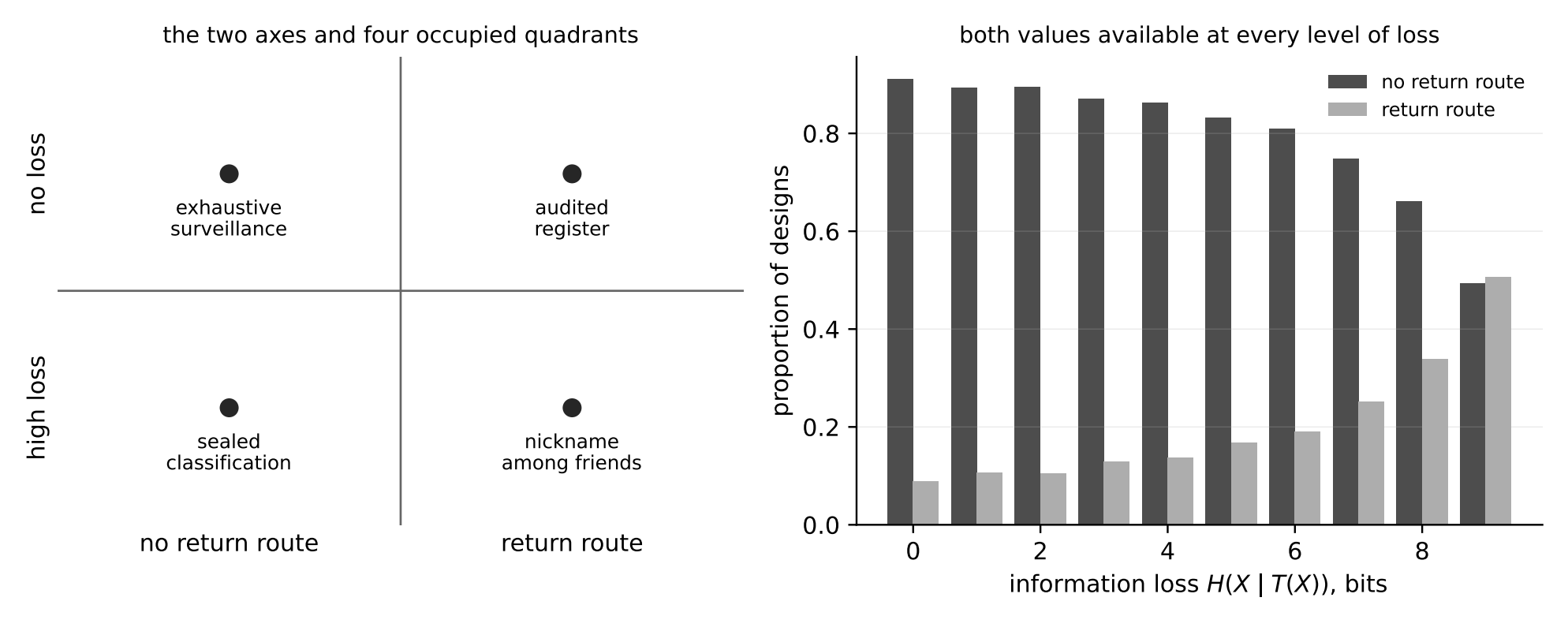
Figure 1. The two axes and their occupancy. The left panel places the cases discussed in this paper in the four quadrants formed by information loss and the availability of a return route. The right panel reports, for twenty thousand sampled designs over ten binary attributes, the proportion admitting and lacking a return route at each level of information loss; both values occur at every level.
5. A Taxonomy of Transformation over the Two Axes
This section replaces the received list of kinds of transformation with a taxonomy over the
two axes established at §4. Its objective is to show that the familiar kinds
are regions of a space in place of species of a genus, and its method is to state each axis
with its levels and then to locate the received kinds. The section closes by stating what
the taxonomy leaves out.
5.1 The first axis and its three levels
The first axis concerns what a transformation does to the distinctions available, and it
divides into three levels along the semiotic division of syntax, semantics and pragmatics.
At the syntactic level a transformation alters the form of a representation while
the distinctions it carries are preserved: a record is re-encoded, a table is reshaped, a
scale is renamed. Losses at this level are recoverable by construction, since the operation
is invertible.
At the semantic level a transformation alters what the representation says: fibres
are merged, categories are coarsened, a continuous quantity is banded, a case is assigned
to a class. This is the level at which information loss in the sense of §4
occurs.
At the pragmatic level a transformation alters what the representation licenses:
what may be inferred from it, what may be done on its authority, and how it acts on the
party it describes. A representation unchanged in form and content may be moved from an
advisory role to a determinative one, and the movement changes nothing about the
distinctions carried while changing everything about their effect.
The three levels are ordered by the difficulty of noticing a change, and the ordering
matters for the second axis. A syntactic change is visible in the artefact. A semantic
change is visible to a party who holds the earlier categories. A pragmatic change may leave
every artefact identical.
5.2 The second axis and its two values
The second axis is the one the condition of §6 concerns, and it takes
the two values established at §4: a route by which the person concerned may
reach the representation either exists or does not. §7 shows that the axis
requires a further distinction within the positive value, since a route may exist formally
and be unattainable in fact, and it is the attainable case that the condition demands.
5.3 The received kinds located in the space
The kinds ordinarily listed as species can now be placed.
Scale transition, in which a description of individuals is replaced by a description of a
population, is a semantic operation whose reachability varies independently: a population
statistic may be published with the sampling frame and the individual right of correction,
or without either.
Datafication, in which conduct is converted into records, is characteristically syntactic
and semantic together, and it is the kind most often assumed to be alienating in itself.
The counterexample pair of §4 shows why that assumption fails, since
datafication can be lossless and the alienation attaches to the second axis.
Measurement and scoring are semantic at the point of construction and pragmatic in effect,
since a score alters what may be done to a person on its authority. The reactivity
documented in the sociology of quantification is a pragmatic-level phenomenon on this
taxonomy.
Institutionalisation, in which an informal understanding is replaced by a rule, is
primarily pragmatic: what changes is the standing of the description and the acts it
licenses.
Archival retention and disposal are semantic at the point of appraisal and are the clearest
case in which the second axis is explicitly designed for, which is why
§10 treats the profession’s own doctrine at length.
5.4 Positions the taxonomy leaves out
The taxonomy is a taxonomy of transformations and no taxonomy of wrongs. Nothing follows
from a transformation’s position in the space about how bad it is, and the account supplies
no ordering within either axis.
The taxonomy does not partition. A single institutional operation ordinarily performs
syntactic, semantic and pragmatic transformations at once, and the levels are aspects under
which one operation may be considered.
The taxonomy is silent about the party performing the transformation. Whether a
transformation is performed by an official, an algorithm, a committee or a community makes
no difference to its position in the space, and §3 records the literature
that treats one such party specially.
Part III. The Admissibility Condition
6. The Condition on Restoration at the Instance of the Person
This section states the paper’s condition. Its objective is to fix the condition precisely
enough that a reader can apply it to an arrangement, and its method is to state it, then to
derive its three advertised properties, then to record what it is a condition on. The
section closes with the limit that governs every later use of it.
6.1 The condition
Condition 6.1. (Admissibility of a representational transformation). A representational transformation is inadmissible in respect of a person when the distinction it destroys cannot be restored at that person’s instance. Restoration at a person’s instance requires that some act available to him bring the destroyed distinction back within the operation of the representation that governs him.
Three terms carry the weight. The distinction it destroys is fixed by the first axis
of §5: the transformation merged cases that were previously separable, or
withdrew a licence to draw a difference. At that person’s instance means that the
initiative lies with him, so that an arrangement in which the distinction may be restored
only when the institution chooses to restore it does not satisfy the condition.
Available to him is the demanding term and is treated at §7.
6.2 The property of standing per person
The condition is stated of each person severally, and it admits no aggregation. An
arrangement satisfying it for many and failing it for one has failed it, and no surplus of
restorability held by others repairs the failure.
This property is deliberate and it is the reason the account declines an objective function
at §11. A quantity of restorability summed or averaged over a population
would permit the shortfall borne by one person to be offset by a surplus held by another,
and the offsetting is exactly what the condition exists to forbid. The point holds
whatever quantity is proposed and is not a scruple about measurement.
6.3 The property of requiring no forecast
Whether an act available to a person would bring a destroyed distinction back within the
operation of a representation is a question about the arrangement in force. It is settled
by what the arrangement provides, by what the person may do under it, and by what the
institution is bound to do in response. Each of these obtains at the time of the
transformation.
The property matters because the alternative conditions all require an inference this
account cannot license. A condition holding that a transformation is inadmissible when it
will later cause harm, or when the destroyed distinction will later prove to have been
needed, requires an inference to a future state of an open social system, and no warrant
supports such an inference at the horizons in question. The difficulty is Hume’s and it is
not softened by care. Condition 6.1 is structural precisely so that the difficulty cannot
reach it, and this is a design choice made in view of the objection and not an accident of
formulation.
6.4 The property of being separable from the attitude of the institution
The condition says nothing about how the institution regards the person. An institution may
satisfy it while holding him in contempt, and may fail it while acting throughout in his
interest. §9 treats a case of the second kind at length, since the setting
there is one in which the transformation is performed for the benefit of the parties
represented.
The separability is what makes the condition applicable from outside. A test requiring
access to an institution’s regard for a person would be unavailable to anyone but the
institution, and would be satisfied by its own account of itself.
6.5 The limit that governs every use of the condition
Condition 6.1 is necessary and never sufficient. A transformation may leave every route of
restoration open and be monstrous in what it does, and a reader who infers from
admissibility to justice has made an inference the account forbids. What the condition
sorts is what may be performed; among the transformations it permits, it supplies no
ordering whatever.
The limit is not a hedge. It follows from the argument of §4, which
established that the second axis is independent of the first: since the condition is stated
on the second axis alone, it is silent about everything the first axis carries, and the
first axis carries most of what makes a transformation good or bad in its effects.
7. Reachability Distinguished from Formal Availability
This section fixes the demanding term in Condition 6.1. Its objective is to show that a
formally available route of restoration does not satisfy the condition, and its method is
to state the failure mode, to give the test that separates the cases, and to place the
result against the precedents that state it in other vocabularies. The section closes with
the recursion the test must survive.
7.1 The failure mode
An arrangement may provide, in terms, that a person may object to the description under
which he has been placed, and may provide a channel through which the objection is
received, and may record the objection when it is made, while no objection he could
formulate would alter the description. Every formal element of restoration is present and
the destroyed distinction is beyond recovery.
The mechanism is familiar in several settings. Where a description absorbs every act that
would count against it, so that compliance confirms it and protest confirms it and silence
confirms it, the description cannot be defeated by any conduct available to the person. And
where a value has been adopted widely enough within a collective that non-convergence costs
recognition, formal revisability survives while substantive revisability has ended, since
the parties whose agreement would be required have been constituted by the structure whose
revision is at issue.
7.2 The test that separates the cases
The separating test asks a question about attainability, not about provision.
Test 7.1. (Attainability of restoration). A route of restoration is attainable for a person when there exists an act available to him whose performance would defeat the standing description of him, and when performing it would place the institution under an obligation to answer. A route that is provided and that no available act would exercise is formal and does not satisfy Condition 6.1.
One feature of the first clause requires comment, since it appears to conflict with the
property claimed at §6.3. The clause is counterfactual in form: it asks whether some
available act would defeat the standing description. That counterfactual is settled
by the arrangement in force, in the way that whether a key would open a lock is settled by
the key and the lock, and it makes no claim about a future state of an open system. This is
narrower than the unqualified statement made at §6.3, and an arrangement whose response to
a given act is genuinely indeterminate is one on which the test returns no verdict.
The two clauses are separate and both are required. The first fails in the absorption case,
where acts are available and none defeats the description. The second fails where an act
would defeat the description if answered and the institution is under no obligation to
answer, which is the position of a person whose objection is received, filed and left.
7.3 Precedents for the test in other vocabularies
The test is not new and it is worth showing how old it is, since the age is evidence that
it is tracking something.
Peirce’s first rule of reason is that inquiry must not be blocked, and his account of truth
as the opinion on which investigation would finally settle makes the availability of
further inquiry constitutive in place of instrumental (Peirce, 1898). On that account an
arrangement foreclosing further inquiry into a description has done something to the
description’s standing and not merely to the convenience of those subject to it.
Longino’s conditions for the objectivity of a knowledge-producing community include not
only the existence of venues for criticism but the uptake of criticism, and she
states the second condition separately because the first is satisfiable without it
(Longino, 1990). Uptake is the second clause of Test 7.1 in another vocabulary, arrived
at from the epistemology of science and directed at a different problem.
The design literature on contestable systems specifies the practical features by which
responsiveness to dispute is achieved (Alfrink et al., 2023). Test 7.1 states what those
features must accomplish and leaves their specification to that literature, which is ahead
of this paper on the practical question.
7.4 The recursion the test must survive
An institution holding interpretive authority over a description ordinarily holds authority
also over the rules governing challenges to that description, and over the rules governing
challenges to those rules. The regress is real, and it is what defeats every attempt to
satisfy Condition 6.1 by installing machinery.
The test survives the recursion because its clauses are stated over acts and answers and
not over procedures. Whether some act available to a person would defeat the standing
description of him is a question about the description and the acts, and it can be asked
at any level of the regress without being answered by the presence of a procedure at that
level. An institution that has installed a complete apparatus of review, and under which no
act available to a person would alter what is said of him, fails the test at the first
clause, and the completeness of the apparatus is no part of the answer.
This is the reason §2 declines to specify procedural machinery. The account
states what must be attainable and holds that the arrangements by which it is made
attainable are various, historically formed, and outside its competence to design.
8. The Stratification of the Condition by Tense
This section answers an objection that the preceding two sections invite. Its objective is
to show that the account’s deferral of the substantive question to later assessment is
forced in place of chosen, and its method is to apply the standard decomposition of
properties of infinite behaviours. The section closes by stating what binds now.
8.1 The objection from deferral
The objection runs as follows. An account that assesses transformations by whether they
remain open to later restoration has deferred the question that matters. Someone is
governed now by a description that is wrong now, and to be told that the description
remains open to future revision is to be told that his case will be considered by parties
not yet in existence. The account protects the interests of future interpreters and
abandons the person in front of it.
The objection is serious and it is not answered by insisting that revision is valuable. It
is answered by showing that the account contains a component binding in the present and by
identifying which component that is.
8.2 The decomposition that fixes the two components
Properties of infinite behaviours divide exhaustively. A safety property asserts
that nothing of a specified kind ever occurs, and it is refuted by a finite prefix of a
behaviour, so that a violation is detectable at a determinate moment. A liveness
property asserts that something of a specified kind eventually occurs, and no finite prefix
refutes it, so that satisfaction is settled only in the limit. Every property of infinite
behaviours is the intersection of a safety property and a liveness property
(Alpern & Schneider, 1985).
The decomposition applies here directly. That a route of restoration is attainable
is a safety property: it is violated at the moment an arrangement forecloses the route, the
violation is present in the finite record up to that moment, and no later development is
needed to establish it. That the description is eventually corrected is a liveness
property: no finite record settles it, and it is the component the account defers.
8.3 The consequence for what binds now
The consequence is that the deferral is partial and its boundary is fixed by the
decomposition in place of by preference. Condition 6.1 is a safety property and binds at
every moment, including the moment at which a person is governed by a description he
disputes. What the account defers is the liveness component, which is the substantive
question of whether the description was right, and that component is deferred because no
finite record settles it and not because the account declines to answer it.
The objection of §8.1 is therefore correctly aimed at an account that
retained only the liveness component, and such an account would indeed have nothing to say
to a person suffering now. The present account retains a safety component and states it as
a demand on the arrangement in force: the person must, now, be able to make himself an
object that must be answered. Whether the answer he receives is correct is a further
question, and it is one on which this paper is silent by design.
8.4 Restrictions placed on the stratification
The decomposition establishes that the two components are exhaustive and disjoint in form.
It establishes nothing about their relative importance, and a reader who holds the liveness
component to be the one that matters is not contradicted by anything here.
The decomposition is applied to an arrangement and not to a person’s experience. That a
violation is detectable in a finite record does not entail that anyone detects it, and
§12 records the absence of an observer as an open problem the account shares
with its companions.
Part IV. The Condition at Two Sites
9. Evidence-Based Policy and the Transfer of a Finding
This section applies Condition 6.1 to evidence-based policy. Its objective is to show that
the condition identifies a defect in a setting where the transformation is performed for
the benefit of the parties represented and where all the ordinary explanations of
representational wrong are absent, and its method is to describe the transformation, to
concede what the existing critical literature already establishes, and then to apply the
condition and the test. The section closes with what the application does not show.
9.1 The transformation performed in evidence-based policy
A trial establishes an effect in a study population. The finding is rendered as an estimate
with an interval, and the estimate is transferred to a target population where a measure is
adopted on its authority. A person in the target population is then treated under a rule
whose warrant rests on what happened to other persons elsewhere.
Located in the taxonomy of §5, the operation is semantic and pragmatic
together. It is semantic because the fibres of the study population are merged into a
summary quantity and the conditions under which the effect obtained are dropped from the
transferred item. It is pragmatic because the estimate moves from a report of what occurred
to an authority for what is to be done.
9.2 The findings of the existing critical literature on evidence transfer
Cartwright and Hardie (Cartwright & Hardie, 2012) establish the point on which everything here
depends, and the priority is theirs. A trial showing that a policy worked somewhere does
not support the expectation that it will work here. What produced the effect there was the
policy together with a set of support factors that played a positive causal role,
and the transfer is warranted only where the corresponding factors obtain in the target
situation. Their horizontal search asks whether those factors are present here, and their
vertical search asks at what level of abstraction the causal description should be pitched
so that it picks out something that will play the same role.
Two consequences of their account are conceded outright. The material lost in the transfer
is not incidental detail; it is the material on which the warrant of the transfer depends.
And the loss is invisible in the transferred item, since an estimate carries no record of
the support factors that were present when it was produced.
The present account adds nothing to this diagnosis. What it adds is a question the
diagnosis does not raise.
9.3 The condition applied
Cartwright and Hardie address the policymaker. Their remedy is that the party performing
the transfer should conduct the two searches before relying on the estimate, and the
remedy is correct. Condition 6.1 asks a different question: whether the person in the
target population, treated under the rule, holds a route by which the dropped material can
be brought back within the operation of the rule that governs him.
In the ordinary case he does not, and the reason is structural in place of accidental. The
support factors dropped in the transfer are properties of the study situation, and the
person is in the target situation. He is in a position to know that the rule fits his case
badly and in no position to name the factor whose absence accounts for the misfit, since
the record of which factors were present is held where the trial was conducted and the
transferred estimate carries none of it. His objection therefore takes the form of a report
that the measure is not working for him, and a report of that form is answered within the
regime by the observation that the measure works on average.
Test 7.1 fails at both clauses. No act available to him defeats the standing description,
since the description is an average to which his individual case is not a counterexample.
And the regime is under no obligation to answer a report of that form, since it has already
discharged its evidential burden by the trial.
9.4 The features of the case that make it useful
Three features make this a strong case for the condition in place of a convenient one.
The transformation is performed for the benefit of the parties represented. Nobody is
extracting anything from them, and the policymaker’s motive is to help. So the case cannot
be redescribed as a wrong of exploitation, and the diagnoses that locate the defect in
extraction have no purchase.
The parties conducting the transfer are frequently the most methodologically scrupulous
available, and the regime exists because earlier practice was insufficiently evidenced. The
defect is therefore not a failure of rigour, and it survives every increase in rigour of the
kind the regime itself recognises.
The interpretive resources of the person are ordinary and adequate. He understands what a
trial is, what an average is, and what it means for a measure to be adopted on evidence. So
the case is not a case of hermeneutical injustice, and Claim 3.1’s residue is exhibited
here in a setting no existing account claims.
9.5 Positions the application does not support
The application does not condemn evidence-based policy, and no such conclusion follows from
anything in this paper. The condition sorts arrangements and not practices, and the same
practice conducted with a route of restoration in place satisfies it.
The application does not supply the route. What would satisfy Condition 6.1 here is an
arrangement under which the person may raise a claim of the form that a named factor
present in the study situation is absent in his, and under which the regime is bound to
answer that claim. Whether such an arrangement is feasible, and at what cost, is a question
this paper does not settle and §11 explains why.
The application asserts nothing about the correctness of any particular transfer. Condition
6.1 is a condition on admissibility, and a transfer may be admissible and wrong or
inadmissible and correct.
10. Archival Appraisal and the Doctrine of What Must Remain Reachable
This section treats a profession that has developed an explicit doctrine about the object of
Condition 6.1, under the constraint of scarcity that is usually offered as the reason for
having no such doctrine. Its objective is to show that the condition has been worked out in
practice in one field and to take from that field what a general account can use, and its
method is to state the appraisal problem, the doctrines developed in answer to it, and the
points at which those doctrines meet and diverge from the condition. The section closes
with the limit the field itself records.
10.1 The appraisal problem
An archive cannot keep everything. It must decide, at the moment of accession and under a
fixed budget, which records to retain and which to destroy, and the decision is made before
anyone knows what future users will ask. The problem has the structure of the objection
this paper’s companion answers at the level of rate and distortion: scarcity fixes the
quantity retained, and something further must fix the selection.
Destruction is irreversible in the strict sense. A record not kept cannot be reconstructed
later at any cost, since the material that would support the reconstruction is the material
destroyed. Appraisal is therefore a decision under uncertainty with an irreversible arm, and
the profession has known this longer than any other.
10.2 Doctrines developed in answer to the problem
Three developments in the field bear on the condition.
Schellenberg (Schellenberg, 1956) organised appraisal around the values a record
carries, distinguishing the primary value it holds for the originating body from the
secondary value it may hold for later users, with retention decided by the second where
the first has lapsed. This locates the decision in a judgement about future use, which is
the structure Condition 6.1 declines.
Cook’s macro-appraisal (Cook, 1992; Cook, 2005) reverses the object of judgement. In
place of appraising records, it appraises the functions, processes and relationships that
generated them, and retains records as evidence of those. The reversal matters here because it moves the criterion from
a forecast about future interest to a structural feature of the present: which functions
were exercised, by which bodies, in relation to which parties.
Upward’s records continuum (Upward, 1996) reconceives the record as something that
continues in use in place of passing through a life cycle terminating in an archive. The framing is close enough to the
present account’s that the coincidence is worth stating: a record on that view is
constituted by its continued availability for further use, which is the object Condition
6.1 protects, arrived at from the requirements of recordkeeping practice.
10.3 Points at which the doctrines meet the condition
Two points of contact are substantive.
Macro-appraisal’s shift to functions and relationships is the same move Condition 6.1 makes
in shifting from the content lost to the route that remains. Both replace a judgement about
what will later matter with a judgement about a present structural feature, and both do so
for the same reason, which is that the first judgement requires an unavailable inference.
Harris (Harris, 2007) establishes that appraisal decisions determine whose account of a
past can later be raised, and that the parties least represented in the record
are ordinarily those least able to contest their absence. That is Condition 6.1 stated for a
collective subject and over historical time, and this paper’s restriction to individual
persons at §2 means the collective case is conceded and not treated.
10.4 Points at which the doctrines diverge from the condition
Two divergences are equally instructive.
Archival appraisal is performed by a custodian on behalf of future users, and the initiative
lies with the custodian throughout. Condition 6.1 requires that the initiative lie with the
person concerned. The condition is therefore more demanding in one direction than the
professional doctrine, and the difference is not a criticism of the doctrine, since a person
cannot exercise an initiative in respect of a record made a century after his death.
Archival practice necessarily makes a judgement about what will later be of interest, even
under macro-appraisal, since the functions chosen for documentation are chosen on some view
of what will matter. Condition 6.1 makes no such judgement and can make none. This is a
limitation of the condition and not of the practice: a working archive must decide, and a
condition that refuses forecasts supplies no decision procedure.
10.5 The limit the field records against itself
The field’s own literature records that appraisal criteria have changed repeatedly, that
records destroyed under one set of criteria were wanted under the next, and that no set of
criteria has proved stable. The observation is the strongest available evidence for the
expected-learning premise on which the option-value argument of the companion paper rests,
and it is evidence produced by practitioners against their own instruments.
It is also the strongest available caution against this paper’s own condition. If a century
of professional attention under exactly this constraint has produced no stable criterion,
the presumption is against any general condition stated from outside the practice, and
§12 records the point as a standing objection the account does not answer.
Part V. The Boundaries of the Account
11. Positions Declined and the Grounds for Declining Them
This section argues the four declinations announced at §2. Its objective is
to show that each rests on a ground and no evasion, and its method is to state for each
what the account would have to establish in order to assert the contrary, and why that is
unavailable. The section closes with the declination whose ground differs in kind from the
other three.
11.1 Grounds for declining a criterion of justice
To move from Condition 6.1 to a criterion of justice, the account would need a bridge from
admissibility to rightness. It has none, and Proposition 4.1 explains why. The condition is
stated on the second axis, the two axes are independent, and the first axis carries the
material that determines what a transformation does to a person. An account restricted to
the second axis therefore cannot express what the first axis settles, and this is a
consequence of the paper’s own central result in place of a limitation adopted for caution.
Two things follow. A transformation may satisfy Condition 6.1 and be gravely wrong, and no
inference from admissibility to justice is available anywhere in this paper. And a
transformation may violate Condition 6.1 and be, on balance and in its effects, better than
an available alternative that satisfies it; the condition sorts what may be performed and
supplies no ordering among the transformations it permits.
11.2 Grounds for declining a prohibition on loss
A prohibition on loss would prohibit representation. §4 established that
compression is what makes a representation usable, since a representation retaining every
distinction present in its object is that object and serves none of the purposes
representations serve. A recommendation to minimise loss is therefore a recommendation to
approach unintelligibility, and it is unavailable to any account that expects institutions
to act.
The account has a floor and no minimum, and the distinction is worth stating plainly. A
floor is a constraint that some arrangement must satisfy. A minimum is a point on a scale
toward which arrangements are to be moved. Condition 6.1 is the first and never the second,
and it is compatible with a transformation that discards nearly everything.
11.3 Grounds for declining a quantity to be maximised
The account recommends no maximisation of restorability, of reversibility, or of
transparency. The reason holds for each and for any further quantity proposed in their
place.
An objective function over such a quantity ranges over the persons affected and therefore
aggregates. Aggregation permits a shortfall borne by one person to be compensated by a
surplus held by another, and Condition 6.1 exists to forbid exactly that compensation,
since it is stated of each person severally. A maximisation recommendation would
accordingly contradict the condition it was intended to serve, and the contradiction is
formal in place of practical: it obtains under every substitution of the maximand,
including maximands defined over the very property the condition names.
A second reason is available and is weaker, and it is recorded so that the first is not
mistaken for the only one. Transparency in particular has been shown to be satisfiable in
ways that leave the substance untouched, and a regime maximising a measure of transparency
may perform worse under Test 7.1 than a regime that publishes less and answers more.
11.4 Grounds for declining procedural machinery
This declination follows from §7 and is the one most likely to be read as
an evasion.
An institution holding interpretive authority over a description holds authority also over
the rules governing challenges to it. Any machinery specified from outside is therefore
administered by the party whose description is at issue, and the specification of machinery
supplies that party with a determinate account of what compliance consists in. The
predictable result is an arrangement complete in every specified feature under which no act
available to a person alters what is said of him, which is precisely the failure Test 7.1
was constructed to detect.
The account therefore states what must be attainable and leaves the arrangements by which
it is made attainable to the settings in which they are built. This is a limitation and the
account does not disguise it: a condition that specifies no machinery gives an institution
seeking to comply nothing to build. §12 records the point, and
§3 records that the design literature on contestable systems is ahead of
this paper on exactly that question and should be read alongside it.
12. Limits of the Account and Directions for Further Work
This section states what remains unsettled. Its objective is to place the account’s
weaknesses on the record in a form a critic can use, and its method is to separate limits
internal to the condition from limits on its application and limits it shares with its
companions. The section closes with the directions left open.
12.1 Limits internal to the condition
The condition supplies no observer. Whether an act available to a person would defeat the
standing description of him is a fact about an arrangement, and the account says nothing
about who is positioned to determine it. The party best placed to answer is ordinarily the
institution, and the institution is the party whose arrangement is under assessment. This
is a serious gap and the account does not close it.
Two features of the apparatus are less settled than the body of the paper implies. Test 7.1
is counterfactual in its first clause; §7.2 gives the reason this is compatible with the
no-forecast property, and where an arrangement’s response to an act is genuinely
indeterminate the test returns no verdict, which is a gap of unknown size. Proposition
4.1(iii) assumes that what an institution discloses about its procedure is settled
independently of how much it retained, and arrangements coupling the two would require a
separate argument this paper does not supply.
The condition individuates distinctions loosely. Condition 6.1 speaks of the distinction a
transformation destroys, and in an arrangement of any complexity a transformation destroys
many distinctions at once, of which some are restorable and some are not. A fully specified
version would quantify over the destroyed distinctions and state which of them the
condition ranges over, and this paper does not supply that specification.
The condition is stated for persons. §2 restricted it accordingly, and
§10 showed what the restriction costs: the archival case concerns records
that will govern parties not yet born, for whom no act is available at the time of the
transformation and who therefore fall outside the condition entirely. Any extension to
collective and future subjects requires a different account of whose instance is in
question, and the extension is not attempted here.
12.2 Limits on the application of the condition
The two cases of Part IV are treated analytically and no empirical claim is
made about either. The evidence-based-policy case describes a structure and reports no
study of how regimes actually respond to individual objection, and the archival case relies
on the professional literature’s own account of its practice.
The condition has been applied to no case in which it is satisfied. Every worked
application in this paper identifies a failure, and an account that has exhibited only
failures has not shown that its condition is satisfiable at reasonable cost. This is a
defect in the presentation and a direction for further work.
12.3 Limits the account shares with its companions
The strongest objection to this paper is stated at §10.5 and is not
answered there or here. A profession has worked on the object of Condition 6.1 for a
century, under exactly the constraint of scarcity that makes the problem hard, and has
produced no stable criterion. The presumption that follows is against any general condition
stated from outside a practice, and this paper offers no reason to think itself an
exception beyond the narrowness of what it claims.
The account also inherits the difficulty about historically formed criteria. Condition 6.1
is offered as a condition, and the position taken throughout this series is that criteria
of assessment are themselves formed within history and revisable. The consistent form of
the claim is therefore immanent: the condition is offered as one the practices it addresses
already avow, in the doctrines of review, of appeal, of correction, and of contestation
they maintain and fail to honour. Whether that reading holds for each practice addressed is
a question this paper raises and settles for none of them.
12.4 Directions the account leaves open
Three directions follow.
The first is the observer problem of §12.1, which is the most damaging of the
internal limits and which the companion papers of this series also record. An account
stating what must be attainable, with no party positioned to determine whether it is
attainable, has stated a condition that cannot be applied by anyone but the party it
constrains.
The second is the extension to collective and future subjects, for which the archival
literature is the natural starting point, since it is the body of work that has taken the
question of parties not yet born most seriously.
The third is the formal treatment. Condition 6.1 speaks of a route back, and a route back
is a structure over transformations in place of a property of any one of them. The formal
apparatus adequate to that, and to the related question of what survives a change of
interpretive frame, is developed in the third paper of this series.
References
Alfrink, Kars, Ianus Keller, Gerd Kortuem, and Neelke Doorn. ``Contestable AI by Design: Towards a Framework.’’ Minds and Machines 33(4), December 2023, 613–639. DOI 10.1007/s11023-022-09611-z.
Alpern, Bowen, and Fred B. Schneider. ``Defining Liveness.’’ Information Processing Letters 21(4), October 1985, 181–185. DOI 10.1016/0020-0190(85)90056-0.
Bayaml oglu, Emre. ``The Right to Contest Automated Decisions under the General Data Protection Regulation: Beyond the So-Called `Right to Explanation’.’’ Regulation & Governance 16(4), 2022, 1058–1078.
Cartwright, Nancy, and Jeremy Hardie. Evidence-Based Policy: A Practical Guide to Doing It Better. Oxford: Oxford University Press, 2012.
Cook, Terry. ``Mind Over Matter: Towards a New Theory of Archival Appraisal.’’ In Barbara L. Craig (ed.), The Archival Imagination: Essays in Honour of Hugh A. Taylor. Ottawa: Association of Canadian Archivists, 1992, 38–70.
Cook, Terry. ``Macroappraisal in Theory and Practice: Origins, Characteristics, and Implementation in Canada, 1950–2000.’’ Archival Science 5(2–4), 2005, 101–161.
Eglash, Ron. ``An Introduction to Generative Justice.’’ Teknokultura 13(2), 2016, 369–404. DOI 10.5209/rev_TEKN.2016.v13.n2.52847.
Fuller, Lon L. The Morality of Law, revised edn. New Haven: Yale University Press, 1969.
Galligan, D. J. Due Process and Fair Procedures: A Study of Administrative Procedures. Oxford: Clarendon Press, 1996.
Harris, Verne. Archives and Justice: A South African Perspective. Chicago: Society of American Archivists, 2007.
Jaeggi, Rahel. Alienation. Translated by Frederick Neuhouser and Alan E. Smith, edited by Frederick Neuhouser, foreword by Axel Honneth. New York: Columbia University Press, 2014.
Longino, Helen E. Science as Social Knowledge: Values and Objectivity in Scientific Inquiry. Princeton: Princeton University Press, 1990.
Marx, Karl. ``Economic and Philosophic Manuscripts of 1844.’’ In Karl Marx and Frederick Engels: Collected Works, vol. 3. London: Lawrence & Wishart, 1975, 229–346.
Peirce, Charles Sanders. ``The First Rule of Logic.’’ In The Essential Peirce: Selected Philosophical Writings, Volume 2 (1893–1913), edited by the Peirce Edition Project. Bloomington: Indiana University Press, 1998, 42–56.
Schellenberg, Theodore R. Modern Archives: Principles and Techniques. Chicago: University of Chicago Press, 1956.
Upward, Frank. ``Structuring the Records Continuum, Part One: Post-Custodial Principles and Properties.’’ Archives and Manuscripts 24(2), November 1996, 268–285.