Loop Observables and the Gauge Structure of Interpretation - A Preliminary Discussion of Evaluation without an External Frame
Abstract
An assessment of a social arrangement is made from some interpretive frame, and no frame
stands outside the history it assesses. The difficulty this creates is familiar and is
usually met either by privileging one frame or by abandoning the possibility of
frame-independent content. This paper proposes a third route, taken from the treatment of
the same structural problem in gauge theory. Where a quantity defined at a point depends on
a choice of local frame, the quantity carried around a closed loop does not, and the
loop-carried quantity is the frame-independent content of a system that has no privileged
frame anywhere. The paper develops the proposal in three steps. It fixes the signature of
an assessment, arguing that the object evaluated is the transformation and never the
transformed structure, and that the resulting type is recursive and coalgebraic: an
assessment returns a restructured world together with a new assessor. It identifies the
equivalence appropriate to such an object as bisimulation, from which it follows that no
scalar quotient of the assessment relation exists. And it identifies interpretive frames
with gauge, bisimilarity with gauge equivalence, and the frame-independent content with
holonomy around closed circuits. Two results follow that the paper verifies numerically.
Loop traces are invariant under every change of frame while edge-local quantities are not,
and the failure of translations to compose to the identity around a cycle is a measurable
anholonomy. The paper states the relation to generative justice in one line: where that
programme locates a conserved quantity, this one locates a holonomy, and the two differ in
precisely the way a local conservation law differs from a global obstruction.
1. Introduction
Every assessment of a social arrangement is made from somewhere. The party assessing holds
a vocabulary, a set of distinctions, a body of precedent and a sense of what counts as a
reason, and these are formed within the history the assessment is about. No frame stands
outside that history, and the observation is not a sceptical flourish but a condition of
the problem: a frame that stood outside would have to be acquired from somewhere, and there
is nowhere else.
The received responses are two, and both are unsatisfactory in the same way. One privileges
a frame, whether by appeal to reason, to a procedure, or to a position held to be neutral,
and the privilege is always contestable by the argument just given. The other concludes
that frame-independent content is unavailable and that assessments are reports of the frame
that made them, which delivers a result no one can act on and which is self-undermining
when applied to itself.
A third route is available and has been worked out at length for a structurally identical
problem. In a gauge theory, a quantity defined at a point depends on a choice of local
frame that is arbitrary and unremovable; there is no canonical frame anywhere and no
theorem produces one. Nothing follows about the unavailability of physical content.
Quantities carried around closed loops are invariant under every change of local
frame, and the loop-carried quantity is the physical content of a theory that has no
privileged frame at any point. The structure of the escape is worth naming precisely,
because it is what this paper transposes: the frame-independent content is recovered not by
finding a better frame but by identifying which quantities are indifferent to the choice,
and those quantities are the ones defined on closed circuits.
The transposition is developed in three steps.
The first fixes what is being evaluated. An assessment applied to a transformed structure
evaluates the wrong object, since the same structure may be produced by a transformation
that may be performed and by one that may not, and no inspection of the result distinguishes
them. The object of evaluation is therefore the transformation, and the assessment is a map
from transformations to something. §4 argues that the something includes
a further assessor, so that the type is recursive: an assessment returns a restructured
world together with the assessor that world now carries. That type is the type of a Mealy
machine, and its natural home is coalgebra.
The second fixes the equivalence. For objects of that type, the appropriate notion of
sameness is bisimulation: two assessment arrangements are equivalent when they sustain the
same observable interactions at every future step. §6 derives the
consequence, which is that no scalar quotient of the arrangement exists, so that the
familiar demand for a measure of justice is asking for something the object’s type
excludes.
The third makes the gauge identification. An interpretive frame is a local choice, made at
a position in a relational structure, of the vocabulary under which what happens there is
described. §7 argues that the redundant part of interpretive difference is
gauge, that the criterion separating the redundant part from the substantive part is
bisimilarity, and that the frame-independent content is accordingly the holonomy around
closed circuits of translation between positions. §8 verifies the two claims
that carry the account: loop traces are invariant under every change of frame, and
edge-local quantities are not.
Two consequences are stated as results. The first is negative and is due to the structure
of the gauge problem itself: no global choice of interpretive frame is available, and this
is not a practical difficulty but an obstruction of the kind Gribov identified, which
§9 states in its transposed form. The second concerns the absence of a
global measure. §10 shows that an assessment field with non-trivial holonomy
admits no potential, so that a locally determinate direction of assessment coexists with
the non-existence of any global quantity of which that direction is the gradient. Three
properties the companion papers of this series required are thereby obtained together: no
global scalar, a determinate local direction, and dependence on the path taken.
The relation to generative justice can be stated in one line and is the paper’s principal
claim about its own position. Eglash’s criterion is a conserved quantity: value
generated returns to its generator, and the criterion is stated locally, holds without
reference to any observer, and requires no loop (Eglash, 2016). The criterion offered
here is a holonomy: it is defined only on closed circuits, it is trivial in the
absence of curvature, and it detects an obstruction in place of a conservation. The two are
compatible and they are not the same kind of thing, and the difference is exactly the
difference between a local conservation law and a global obstruction.
The debts and the limits are stated together. The apparatus is borrowed and no part of it is
original to this paper; what is offered is an identification of the social structure to
which the apparatus applies, and an argument that the identification is forced by the
problem in place of chosen for its elegance. §2 records that the paper
supplies no criterion of justice, that its worked model is a lattice construction and no
claim about any actual society, and that the difficulty about diffeomorphism-invariant
observables which motivates the whole apparatus in physics is an open problem there and is
not solved here.
The argument proceeds in five parts. Part I fixes the object
(§2) and states the prior formulations (§3).
Part II fixes the signature (§4), gives the coalgebraic
type (§5), and derives the equivalence (§6).
Part III makes the gauge identification (§7), verifies the loop
observables (§8), and states the obstruction (§9).
Part IV treats the absence of a potential (§10) and the
formulation without background time (§11).
Part V records the positions declined (§12) and the limits
of the account (§13).
Part I. The Problem of Evaluation without an External Frame
2. Scope of the Transposition and Restrictions Placed on It
This section fixes what the paper does and, more importantly for a paper of this kind, what
it does not. It states the object, the four restrictions bounding it, the terms on which
formal apparatus is borrowed, and the positions declined in advance. The discipline
governing the borrowing is stated at length, since a transposition of physical formalism
into social theory fails characteristically by borrowing the vocabulary without the
constraints that give it content.
2.1 The object of the transposition and its four restrictions
The object is the structure of assessment in a system that contains no position exterior to
itself. Four restrictions bound it.
The first is to structure and never to content. The paper asks what form an
assessment can take given that no frame is privileged, and it supplies no assessment of
anything.
The second is to relational systems with distinguishable positions. The
construction requires that a system be decomposable into positions between which
translation occurs, and that translations compose. Systems admitting no such decomposition
lie outside it.
The third is to frame-dependence as the difficulty. Other difficulties about
assessment, concerning power, interest, information and capacity, are real and are treated
in the companion papers of this series. They are held fixed here.
The fourth is to admissibility of a formalism. The paper argues that a certain
apparatus fits a certain problem, and the argument is that the fit is forced by features of
the problem. Whether the resulting account is true of any society is a separate question on
which this paper offers nothing.
2.2 The discipline governing the borrowed apparatus
Four rules are observed throughout, and they are stated so that a reader can check
compliance.
No physical claim is made. Nothing in this paper asserts that societies are gauge theories,
that social quantities obey any physical law, or that any physical constant, scale or
mechanism applies to social material. The apparatus is mathematical, and gauge theory is
where the mathematics was developed.
Every borrowed term is given a social definition before use, and the definition is what the
argument uses thereafter. Where a borrowed term carries connotations the social definition
does not license, the connotations are excluded explicitly at the point of definition.
Where the physics is unsettled, the paper says so and declines to lean on it. This applies
in particular to §11, where the construction of observables invariant
under the relevant symmetry is an open problem in the physical case and is not solved by
being transposed.
No numerical result about any society is derived. §8 reports computations
on an explicitly constructed model, and what they verify is that the model has the
properties claimed for it.
2.3 Results imported from companion work
Three results are imported and used without re-argument.
From the companion paper on the legibility of contribution, the paper takes the result that
the evidence available to an assessor is composed by the assessor’s position, which is the
substantive reason the frame problem is not merely epistemic.
From the companion paper on the admissibility of representational transformation, the paper
takes Condition 6.1 and the test of attainability that accompanies it, and it takes the
question that paper leaves open at its close: a route back is a structure over
transformations in place of a property of any one of them, and the apparatus adequate to
that structure is what this paper supplies.
From the analysis of translation between normative languages in the companion work on
multilingual democracy, the paper takes the finding that a residue survives translations
each of which is individually faithful. §8 argues that this residue is a
holonomy, which converts a reported observation into a measurable quantity.
2.4 Positions declined in advance
Four positions are declined and the declinations hold throughout.
The paper asserts no criterion of justice. It supplies a form that a criterion must
take in a system without a privileged frame, and the companion papers supply the criteria.
The paper asserts no quantity to be maximised. §6 shows that the
relevant equivalence admits no scalar quotient, and §10 shows that the
assessment field admits no potential. A maximisation recommendation would therefore
contradict two of the paper’s own results.
The paper asserts no claim that interpretive difference is redundant. The gauge
identification applies to the redundant part of interpretive difference and to no other
part, and §7 states the criterion separating them and insists on it. An
account treating all interpretive difference as gauge would have made interpretation inert,
which contradicts the companion papers and is false besides.
The paper asserts no model of any actual society. The construction of
§8 is a lattice of positions with group-valued edges, chosen because it is
the smallest structure carrying the properties at issue.
3. Prior Formulations of Assessment without an Exterior Position
This section states the formulations already available for the structure this paper treats,
and fixes for each what it settles and what it leaves open. The method is concession first.
Two of the formulations own components of the account outright, and they are treated first
and at greatest length so that the size of what remains is visible before it is claimed.
3.1 The phase factor as the intrinsic description in gauge theory
The transposition this paper attempts has a precise ancestor in the physics it borrows
from, and the ancestor states the paper’s own thesis for its own domain. Wu and Yang
establish that an intrinsic and complete description of a gauge field in a region is given
by the nonintegrable phase factor, which carries more than the field strength and less than
the potential, and that the correct mathematical setting is a connection on a principal
fibre bundle (Wu & Yang, 1975). Their argument proceeds from the Aharonov–Bohm effect, in
which a particle is affected in a region where the field strength vanishes while the loop
integral of the potential does not (Aharonov & Bohm, 1959). Wilson’s loop variable supplies the
observable computed at §8 (Wilson, 1974), and Berry’s geometric phase
establishes that a system carried around a closed circuit acquires a quantity settled by the
geometry of the circuit (Berry, 1984), with the adiabatic assumption removed by Aharonov
and Anandan (Aharonov & Anandan, 1987).
The concession is unreserved and it is the largest in this paper. The proposition that the
frame-independent content of a system with no privileged local frame resides on closed
circuits is not a discovery of this paper. It is a settled result in the physics, stated
with a precision the present work does not approach, and the whole of Part III
is an attempt to identify a social structure to which it applies.
The differentiation is correspondingly narrow and should be stated plainly. What is offered
here is the identification, together with an argument that the identification is forced by
the frame problem in place of chosen for its elegance, and together with the criterion at
§7 separating redundant interpretive difference from substantive difference.
That criterion has no counterpart in the physical case, since there the gauge group is
given and the question of which differences are redundant does not arise as a question about
the world.
3.2 The reality of gauge quantities in philosophy of physics
Whether the loop quantities of a gauge theory should be read as the theory’s ontology, and
what to say about the local quantities that are not invariant, is a developed question in
the philosophy of physics, and Healey’s treatment is the standard reference (Healey, 2007).
The question there is what a gauge theory says the world contains, and the available
positions range over local, non-local and holonomy interpretations.
The concession is complete. The differentiation is that this paper takes no position on the
physical question and borrows the mathematical structure alone, under the disciplines fixed
at §2. A reader who holds a local interpretation of gauge theories is not
contradicted by anything here, since nothing here concerns what a gauge theory says the
physical world contains.
3.3 Legal power in Hohfeld
Hohfeld’s analysis of jural relations identifies a power as the capacity to alter
the jural relations of oneself or another (Hohfeld, 1913). A power is therefore not a
claim about how things stand but an operator on the structure of claims, duties, privileges
and liabilities, and its exercise leaves a different structure in place.
The concession is complete and the priority is a century old. The signature argued for at
§4, in which an assessment maps a structure to a structure, is the
signature of a Hohfeldian power, and this paper adds no part of that identification. What
§5 adds is the recursive component: the operator returns, together with the
restructured relations, the operator that the restructured relations now carry. Hohfeld’s
analysis is synchronic and states the correlatives obtaining at a moment; the addition here
concerns what the exercise of a power does to the powers available afterwards.
3.4 Autopoietic law in Luhmann
Luhmann’s account of law as an autopoietic system holds that the legal system produces its
own elements, applies its own code, and generates the criteria by which its operations are
assessed, so that no external position supplies those criteria (Luhmann, 2004). This is
the closest available position to the one taken here and it must be conceded without
qualification, since it already contains the central negative claim: there is no exterior
from which the system may be assessed, and the search for one is a category error.
The differentiation concerns what follows from the negative claim. Luhmann’s system
observes and produces, and the account is descriptive: it explains how a system that
supplies its own criteria operates and it declines to supply a criterion of its own. The
present paper asks a further question, which is whether any content survives the absence of
an exterior position, and it answers that a determinate class of quantities does. That
answer is unavailable within the systems-theoretic vocabulary because that vocabulary lacks
the notion of a quantity carried around a circuit of translations between positions, and
supplying it is what the borrowed apparatus is for.
3.5 Revision constrained by postulates in the AGM tradition
The theory of belief revision developed by Alchourrón, Gärdenfors and Makinson constrains a
revision operator by postulates on the operator itself, in place of by a metric on the
states it produces (Alchourrón et al., 1985). The form is exactly the form required here: the
question raised by an operator-valued account of assessment is what constrains the operator,
and the AGM answer is that the constraints are stated on the operation and are checkable
without an external standard.
The concession is full, and the connection to jurisprudence is not incidental, since
Alchourrón was a legal theorist and the tradition was developed with normative systems in
view. The differentiation is that AGM postulates are stated over a single agent’s corpus
and presuppose a fixed underlying language. The problem treated here arises where the
language itself varies by position, so that the operators at different positions are not
operators on a common object, and it is precisely that variation which the gauge
identification of §7 is introduced to handle.
3.6 Relational quantum mechanics and the partial observable
Rovelli’s relational interpretation holds that the state of a system is defined only
relative to another system, and that a description from no position is unavailable
(Rovelli, 1996). The associated notion of a partial observable, a quantity to
which a number can be attached by a measurement while carrying no prediction on its own,
together with the complete observable formed as a correlation between partial
observables, supplies the technical form of the position (Rovelli, 2002).
The concession is full and the paper depends on it at §11. The
differentiation is one of domain and is small: the present account applies the structure to
interpretive frames in a social system, where the analogue of a measurement is a
translation between positions and the analogue of a correlation is a circuit that returns
to its origin. The transfer is stated as a transfer and §2 governs it.
3.7 Output as a changed relation in restorative and transitional justice
Two bodies of practice treat the output of a justice process as a changed relation between
parties in place of a verdict about a past act. Restorative practice organises encounters
whose product is an altered relation among the participants, and transitional arrangements
are constructed to change the terms on which a society proceeds after a conflict.
The concession is that the operator conception is not novel in practice, and practitioners
in both traditions have long described their work in terms this paper’s signature
formalises. The differentiation is that neither tradition asks what content survives the
absence of a privileged frame, since both proceed within a frame settled for the occasion
by the parties or by an authorising instrument.
3.8 Inquiry that is not blocked, and criticism that is taken up
Two results imported by the companion paper of this series belong here as precedents for
the loop conception in particular. Peirce (Peirce, 1898) makes the continued availability
of inquiry constitutive of the standing of a conclusion, and Longino (Longino, 1990)
requires the
uptake of criticism and not merely the existence of venues for it. Both locate the content
of an assessment in what happens across a sequence of exchanges in place of at any one of
them, which is the temporal counterpart of the claim that content resides on circuits.
Claim 3.1. (The residue left by prior formulations). Existing formulations supply the operator signature, the absence of an exterior position, the constraint of an operator by postulates on its operation, the relativity of a description to a position, the treatment of an outcome as a changed relation, and, in the physics, the whole apparatus by which frame-independent content is located on closed circuits. What none supplies is a criterion, applicable where the admissible changes of frame are not given in advance, distinguishing the interpretive differences that are redundant from those that are degrees of freedom of the system. That criterion is the object of Part III, and the results of §8 are the borrowed apparatus applied once it is fixed.
Part II. Assessment as an Operator
4. The Signature of an Assessment
This section fixes what an assessment is applied to and what it returns. Its objective is
to establish that the object of evaluation is the transformation and never the transformed
structure, and its method is an argument from the indistinguishability of results together
with a statement of the resulting signature. The section closes with what the signature
excludes.
4.1 The argument from indistinguishability of results
Let $S$ be a relational structure and $t$ a transformation carrying $S$ to $S’ = t(S)$. An
assessment of the form $J(S’)$ evaluates the result. The difficulty is that $S’$ carries no
record of how it was reached. The same $S’$ may be produced by a transformation that
destroyed a distinction while leaving a route by which the distinction may be restored, and
by a transformation that destroyed the same distinction and closed the route. On the
account of the companion paper these two differ in admissibility, and no inspection of $S’$
distinguishes them, since what differs is a property of the passage in place of a property
of the endpoint.
The argument generalises beyond that particular criterion. Any criterion sensitive to the
manner of a change is unavailable to a function of the changed state alone, and criteria of
that kind are the norm in the assessment of institutions, where consent, notice, reason and
availability of challenge are properties of how a result was arrived at.
4.2 The signature that follows
The object evaluated is therefore $t$, and the signature is
$$J : \mathrm{Struct} \longrightarrow \mathrm{Struct},$$
so that an assessment is itself a transformation of the structure it assesses. This is the
signature of a Hohfeldian power (Hohfeld, 1913), and §3 conceded the
priority.
Two features of the signature carry consequences.
An assessment has the same type as the transformations it assesses. It is therefore itself
subject to whatever criterion governs transformations, and the criterion applies to it in
the ordinary way. This looks like a regress and is self-application: a criterion that could
not be applied to its own instrument would require a position exempt from assessment, which
is the exterior position §1 denied. A verdict-returning signature, of the
form $J : \mathrm{Struct} \to {0,1}$ or $J : \mathrm{Struct} \to \mathbb{R}$, avoids the
self-application by placing the assessment at a level the structure does not contain, and
that level is unavailable.
An assessment changes what it assesses. This is a consequence of the signature and not an
additional claim, and it is the formal counterpart of the observation that an authoritative
interpretation of a past alters the terms on which subsequent interpretations are made.
4.3 Positions the signature excludes
The signature excludes an assessment that leaves its object untouched, and any account
requiring a purely observational assessment is inconsistent with it.
The signature excludes a scalar or binary output as the whole of an assessment. It does not
exclude the derivation of scalar summaries from an assessment for particular purposes, and
§6 states the precise sense in which such summaries fail to be faithful.
The signature is silent about which transformations are assessments and which are merely
transformations. Punishment, reform and conquest all carry structures to structures, and
§3 recorded that the constraint distinguishing them is stated on the
operation in the manner of the AGM postulates (Alchourrón et al., 1985) and not derived from
the signature.
5. The Recursive Type and Its Coalgebraic Form
This section refines the signature. Its objective is to establish that the assessment
returned by an assessment is part of what an assessment returns, and that the resulting type
is coalgebraic, and its method is to state the refinement, identify the resulting type, and
name what the identification delivers. The section closes with the restrictions on the
identification.
5.1 The refinement
An assessment made at one time is made by a party whose vocabulary, precedents and standards
were formed by assessments made earlier. After an assessment, the standards available for
the next assessment differ from those available before it: a precedent has been set, a
distinction has been drawn or foreclosed, a category has been extended. The assessing
capacity is therefore among the things an assessment transforms.
The refined signature makes this explicit. An assessment carries a structure to a
restructured world together with the assessment that world now carries,
$$J ;\cong; \mathrm{Struct} \longrightarrow (\mathrm{Struct} \times J).$$
5.2 The type so obtained
The refined signature is a recursive type, and it is a familiar one. A machine that
consumes an input, emits an output, and yields a successor machine is a Mealy
machine, and the type above is exactly that of a Mealy machine over the alphabet
$\mathrm{Struct}$. In coalgebraic terms it is a coalgebra for the functor
$F(X) = \mathrm{Struct} \to (\mathrm{Struct} \times X)$, and the final coalgebra of that
functor is the space of stream transducers, whose elements are behaviours in place of
states (Rutten, 2000).
Three things follow from the identification and are used later.
The object is a behaviour. Two assessment arrangements are the same object when they behave
the same way indefinitely, and §6 makes this precise.
The object does not terminate. A final verdict would be a state at which the transducer
stops emitting, and the type has no such state. This is the formal content of the position
that an assessment is always open to a further assessment, and it is a property of the type
in place of a stipulation added to it.
The object carries its own context. Whatever an assessment must retain about the history
that produced it is carried in the successor machine, so no separate context parameter is
required and none should be added. The alternative signature, in which a context $C$ is
supplied as an argument, would make the assessment a function evaluable at any context and
therefore separable from every history, which is the exterior position again in another
notation.
5.3 Restrictions on the identification
The identification is a statement about type and carries no dynamics. Nothing here fixes how
an assessment transforms a structure, and the whole content of any particular account lies
in that unstated part.
The identification supplies no existence claim. That an object of this type exists for a
given social arrangement is an assumption, and it is a substantial one wherever the
arrangement’s assessing capacity is not stable enough to be treated as a machine at all.
The identification is not an appeal to computation. No claim is made that assessment is
computable, that societies compute, or that any implementation is intended. The apparatus is
used for its notion of behavioural equivalence, which §6 needs.
6. Bisimulation and the Absence of a Scalar Quotient
This section derives the equivalence appropriate to the object fixed at
§5, and draws the consequence that motivates the whole account. Its
objective is to establish that the demand for a measure of justice asks for something the
object’s type excludes, and its method is to state the equivalence, state the proposition,
and prove it. The section closes with the reading the proposition licenses and the readings
it does not.
6.1 The equivalence
For objects individuated by input-output behaviour at a terminating computation, equality
of results is the correct equivalence. For objects that do not terminate and are
individuated by the interactions they sustain, it is not, and the appropriate notion is
bisimulation: two systems are bisimilar when every transition of one can be matched
by a transition of the other leading to states that are again bisimilar, so that no
sequence of observations distinguishes them (Park, 1981; Milner, 1989).
Applied here, two assessment arrangements are equivalent when, for every structure
presented, they emit restructured worlds that stand in the relation and yield successors
that are again equivalent. In the vocabulary of the companion papers, the observations are
the acts a person may perform and the answers he receives, so that two arrangements are
equivalent when the same acts are available under both and the same answers are owed.
Proposition 6.1. (Absence of a faithful scalar quotient). Let $\sim$ be bisimilarity on assessment arrangements. (i) Any map $\mu$ from arrangements to a totally ordered set that respects $\sim$ identifies arrangements that differ in the acts available under them, whenever two non-bisimilar arrangements receive the same value. (ii) A map that separates all non-bisimilar arrangements cannot be totally ordered unless bisimilarity classes are themselves totally ordered by some independent relation, and no such relation is supplied by the type. (iii) Consequently a scalar measure of an assessment arrangement is either coarser than bisimilarity or presupposes an ordering the type does not contain.
6.2 Proof of the three clauses
For clause (i), let $A \not\sim B$ and $\mu(A) = \mu(B)$. By the definition of
bisimilarity there is a finite sequence of observations distinguishing $A$ from $B$, so the
two differ in an act available or an answer owed at some point, and $\mu$ has identified
them.
For clause (ii), a map separating all non-bisimilar arrangements is injective on
bisimilarity classes, so a total order on its image induces a total order on the classes.
The type of §5 supplies no such order: it supplies a set of behaviours and
the relation $\sim$, and $\sim$ is an equivalence and no order. Any total ordering is
therefore additional structure imposed from outside the type.
Clause (iii) is the disjunction of the two.
6.3 The reading the proposition licenses
The proposition says that the demand for a measure of justice is a demand for additional
structure, and that the additional structure has to be argued for separately. It does not
say that no such structure can ever be supplied. What it removes is the supposition that a
measure is implicit in the object and awaits discovery, and that supposition is what
motivates most attempts to construct one.
The result also explains a familiar experience in the assessment of institutions.
Arrangements are frequently incomparable in a way that resists resolution, and participants
report that a comparison is being forced. On this account the report is accurate: the
comparison requires an order the object does not carry, and the party supplying the order
is making a substantive choice which the appearance of measurement conceals.
6.4 Readings the proposition excludes
The proposition excludes no particular scalar summary. Summaries are useful for particular
purposes and the account is not an argument against measurement as such. What it establishes
is that a summary is coarser than the object, and therefore that two arrangements receiving
the same summary may differ in what a person may do under them.
The proposition establishes nothing about which arrangements are better. It concerns the
availability of an ordering and not its content.
The proposition does not show that assessments are incomparable in practice. Parties compare
arrangements constantly and act on the comparisons, and they do so by supplying, from their
own position, exactly the additional structure clause (ii) identifies. What that position
contributes is the subject of Part III.
Part III. The Gauge Structure of Interpretation
7. Interpretive Frames and the Criterion of Redundancy
This section makes the identification on which the rest of the paper depends. Its objective
is to establish that a determinate part of interpretive difference is redundant in the
technical sense, and to fix the criterion separating that part from the rest. Its method is
to state the identification, to state the objection that defeats a careless version of it,
and to answer the objection with the equivalence derived at §6. The section
closes with what the identification excludes.
7.1 The identification
Let a relational system be decomposed into positions, each carrying a vocabulary in
which what happens there is described. A change of frame at a position is a
relabelling of that vocabulary. A translation along a relation between two positions
is a map carrying descriptions at the first into descriptions at the second.
The identification is that a change of frame is a gauge transformation. Its two defining
features are present. It is local, in that it may be performed at one position without
being performed at any other. And the composition of translations must transform
consistently under it, so that a change of frame at a position alters every translation
incident on that position in a determinate way.
7.2 The objection that defeats the careless version
Gauge redundancy requires that the content of the theory be indifferent to the choice. If
every difference between interpretive frames were gauge, then interpretation would make no
difference to anything, and the companion papers of this series establish the contrary at
length: a description is causally efficacious, and two descriptions of one situation may
license different acts and produce different histories.
The objection is decisive against the version of the identification that treats all
interpretive difference as gauge, and that version is declined at §2. What
is required is a criterion partitioning interpretive difference into a redundant part and a
substantive part, applicable without appeal to a privileged frame.
7.3 The criterion, which is the equivalence already derived
The criterion is bisimilarity. Two frames are gauge-equivalent when the assessment
arrangements they induce are bisimilar in the sense of §6: the same acts are
available under both, and the same answers are owed. Frames differing in vocabulary while
licensing the same acts and owing the same answers stand in the relation, and their
difference is redundant. Frames licensing different acts do not stand in it, and their
difference is a degree of freedom of the system in place of a choice of description.
Three features recommend the criterion.
It is stated in terms already fixed. §6 derived bisimilarity from the type
of the object, and no new apparatus is introduced to obtain the partition.
It appeals to no privileged frame. Whether two frames license the same acts is settled by
the acts, and the question can be put from any position.
It is falsifiable in the direction that matters. A single act available under one frame and
unavailable under the other establishes that the difference is substantive, which prevents
the identification from being used to dismiss disagreements as merely verbal.
7.4 Positions the identification excludes
The identification does not say that vocabulary is unimportant. It says that a difference
of vocabulary which changes no act is redundant for the purpose of locating
frame-independent content, and vocabulary matters for many other purposes, several of them
treated in the companion papers.
The identification supplies no procedure for deciding, in a given case, whether two frames
are bisimilar. Determining this requires knowing the acts available under each, and
§13 records the difficulty of establishing that from any position.
The identification is not an argument that social systems have a gauge group. Which changes
of frame are admissible in a given system is an empirical question about that system, and
the constructions of §8 stipulate a group in place of deriving one.
8. Loop Observables and Their Verification
This section establishes the paper’s central positive result. Its objective is to show that
quantities defined on closed circuits are invariant under every change of frame while
quantities attached to single translations are not, and that translations each of which
loses nothing may fail to compose to the identity around a circuit. Its method is a
construction, two propositions, and their numerical verification. The section closes with
the reading the results license.
8.1 The construction of the loop and edge quantities
A relational system is a finite graph. Vertices are positions in the sense of
§7. A directed edge $e = (u,v)$ carries a translation $U_e$, an invertible
map from the frame at $u$ to the frame at $v$. Translations are taken in $SU(2)$
throughout, so that every translation is invertible and loses nothing: whatever is
expressible at $u$ is expressible at $v$ after translation. A change of frame at a position
is a group element $g_v$ acting by
$$U_e ;\longmapsto; g_u , U_e , g_v^{-1}, \qquad e = (u,v).$$
Two quantities are compared. The edge-local quantity is
$w_e = \operatorname{Re}\operatorname{Tr}(U_e)$, attached to a single translation. The
loop quantity for a closed cycle $c = (e_1,\dots,e_k)$ is
$W_c = \operatorname{Re}\operatorname{Tr}(U_{e_1}\cdots U_{e_k})$.
The choice of $SU(2)$ is a stipulation and carries no claim. A finite non-abelian group
would serve equally, and the results below depend on non-commutativity and on nothing else.
Proposition 8.1. (Invariance of loop observables). $W_c$ is invariant under every change of frame at every position, and $w_e$ is not. Where every translation is a pure change of frame, so that $U_e = h_u h_v^{-1}$ for some assignment $h$, every loop quantity takes its trivial value.
Proposition 8.2. (Anholonomy of lossless translations). Translations each of which is invertible and loses nothing may fail to compose to the identity around a closed circuit. The failure is measurable as the rotation angle of the composite, and it is zero exactly when the assignment of translations is a pure change of frame.
8.2 Verification of the two propositions
The verification is verify/holonomy.py and is supplied with the paper. The graph
has eight positions and twelve relations, and five independent cycles are tracked.
For Proposition 8.1, five hundred independent changes of frame were applied at all eight
positions simultaneously. The loop quantities moved by at most
$7.2 \times 10^{-16}$, with a mean deviation of $3.2 \times 10^{-16}$, which is
floating-point noise. The edge-local quantities moved by up to $3.77$ on a scale whose
full range is $4$, with a mean deviation of $2.60$. The contrast is the result: the same
transformation that leaves the loop quantities fixed to machine precision moves the
edge-local quantities across most of their range. Where every translation was constructed
as a pure change of frame, the holonomy angle over all five cycles was zero identically.
For Proposition 8.2, translations were built as a pure change of frame composed with a
distortion of controlled magnitude. At zero distortion the holonomy angle vanishes on every
cycle. At a distortion of $0.10$ the mean angle is $0.365$ radians and every cycle exceeds
the threshold of $0.01$. At $0.50$ the mean is $2.18$ radians and the maximum is $3.14$,
which is the largest angle the group admits. Every translation used was unitary to within
$3.2 \times 10^{-16}$ and therefore invertible and lossless. Table 1 and
Figure 1 report the results.
8.3 The reading the results license
The first result is the transposition announced at §1. In a system where
every position carries its own frame and no frame is privileged, quantities attached to
single translations carry no frame-independent content, and quantities carried around
closed circuits carry it entirely. An assessment that is to survive change of frame is
therefore an assessment of a circuit, and an assessment attached to a single relation is an
artefact of the frames at its endpoints.
The second result converts a reported observation into a measurable one. The companion work
on multilingual democracy records a residue surviving translations each of which is
individually faithful. Proposition 8.2 identifies that residue: the pairwise faithfulness
of translations places no constraint whatever on the composite around a circuit, since
faithfulness is a property of each map separately and the composite is a property of the
assignment. The residue is the holonomy, and it is zero exactly when the assignment is a
pure change of frame, which is to say when the parties differ in vocabulary alone.
8.4 Readings the results exclude
Nothing here shows that any actual system has non-trivial holonomy. The construction
stipulates translations and reports what follows; whether a given social arrangement
exhibits the structure is an empirical question the paper does not address.
Nothing here shows that non-trivial holonomy is bad. The results identify an invariant and
supply no evaluation of it, and §12 records that supplying one would
require the ordering Proposition 6.1 denies.
Nothing here licenses the inference that a large holonomy indicates a large disagreement.
The angle is a group-theoretic quantity in a stipulated group, and no interpretation of its
magnitude in social terms is offered.
Table. Verification of Propositions 8.1 and 8.2, from verify/holonomy.py.
Eight positions, twelve relations, five independent cycles. The upper block reports
deviation under five hundred independent changes of frame applied at all positions. The
lower block reports the holonomy angle as the distortion of each translation is raised,
with every translation invertible and lossless throughout.
| 4lDeviation under change of frame | |||
|---|---|---|---|
| Quantity | maximum | mean | scale |
| loop observables $W_c$ | $7.2\times 10^{-16}$ | $3.2\times 10^{-16}$ | 4 |
| edge-local $w_e$ | $3.77$ | $2.60$ | 4 |
| 4lHolonomy angle by distortion of each translation | |||
| Distortion | mean angle | maximum | fraction above $0.01$ |
| 0.00 | 0.0000 | 0.0000 | 0.0000 |
| 0.10 | 0.3652 | 0.8016 | 1.0000 |
| 0.25 | 1.0408 | 2.4286 | 1.0000 |
| 0.50 | 2.1782 | 3.1414 | 1.0000 |
| 0.75 | 2.1830 | 3.1409 | 1.0000 |
| 1.00 | 2.1923 | 3.1415 | 1.0000 |
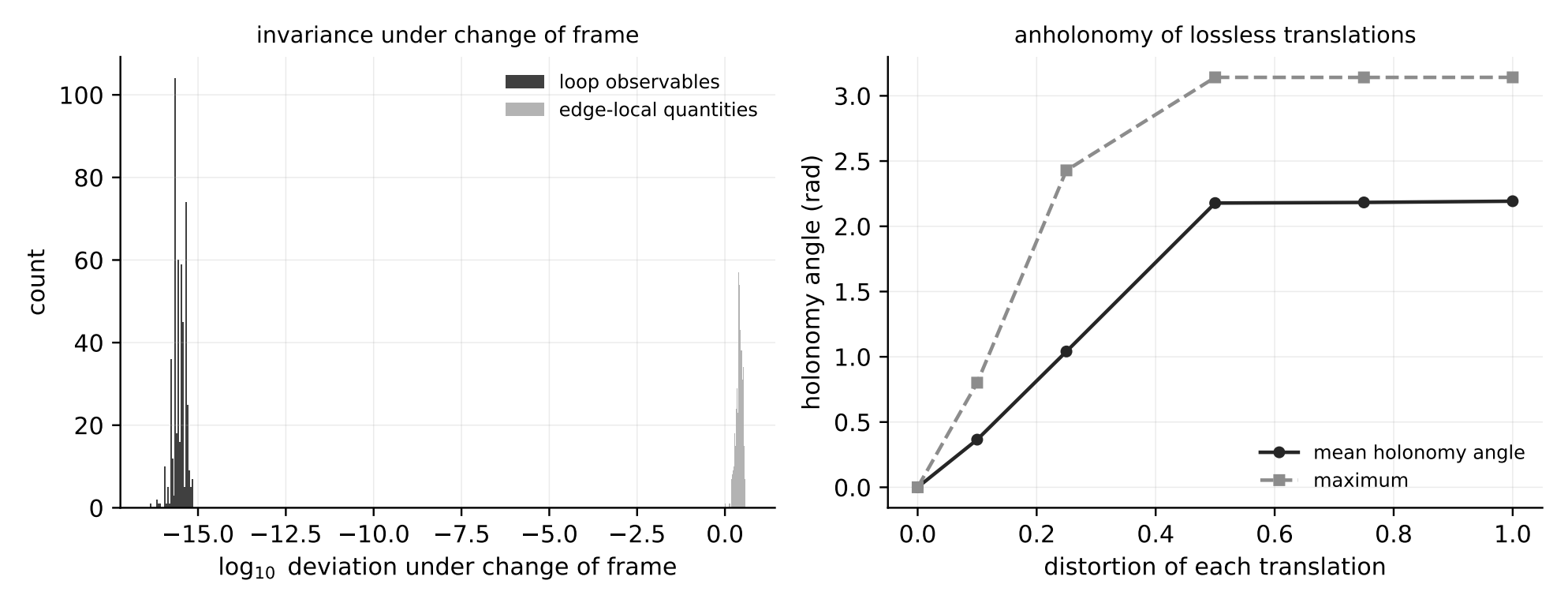
Figure 1. Loop observables against edge-local quantities. The left panel gives the distribution of deviations under five hundred independent changes of frame at all positions; loop observables move by floating-point noise while edge-local quantities move across most of their range. The right panel gives the holonomy angle around closed circuits as the distortion of each individually lossless translation is raised from zero.
9. The Obstruction to a Global Choice of Frame
This section states the negative result that accompanies the positive one. Its objective is
to establish that a global choice of interpretive frame is unavailable as a matter of
structure, and its method is to state the physical result, state its transposed form, and
fix the conditions under which the transposition holds. The section closes with what
follows for practice.
9.1 The result in its original setting
Fixing a gauge means selecting, for each configuration, one representative from the family
related by changes of frame. In an abelian theory this can be done globally and without
ambiguity. In a non-abelian theory it cannot: Gribov showed that the standard gauge-fixing
conditions admit multiple distinct configurations satisfying the same condition, so that
the selection is not unique, and Singer established that the obstruction is topological and
that no continuous global gauge fixing exists (Gribov, 1978; Singer, 1978).
9.2 The transposed form
Fixing an interpretive frame globally means selecting, for the whole system, one vocabulary
in which all positions describe what happens. Where the group of admissible changes of
frame is non-commutative, and the construction of §8 shows that
non-commutativity is what produces holonomy at all, the corresponding statement holds: no
global selection is available that is both unambiguous and continuous in the configuration.
Two consequences are worth stating separately.
A global frame may be imposed and cannot be derived. Legal codification, official history
and standardised measurement all impose one, and the imposition is a choice made at a
position in the system. This is consistent with the imposition being necessary, useful, or
the best available course.
The impossibility is structural and not a matter of effort or of goodwill. A party who
fails to find a neutral vocabulary has not failed at a task that better parties accomplish.
9.3 Conditions under which the transposition holds
The transposition requires two conditions and holds only under them, and stating them is
what keeps the section from being an appeal to authority.
The admissible changes of frame must fail to commute. Where they commute, the abelian case
obtains, global gauge fixing is available, and nothing in this section applies. Whether
admissible reframings commute in a given system is an empirical question.
The configuration space must carry enough structure for the topological argument to have
content. Singer’s result concerns a specific class of spaces, and the transposed statement
is offered here as a structural analogy in place of a derived theorem. §2
governs, and §13 records this as the weakest step in the paper.
9.4 The consequence for practice
The consequence is narrow and is worth stating precisely because a broad version is
tempting. It is available, and often necessary, to fix a frame locally in order to compute
anything at all, and the results of §8 are unaffected by which local frame
is chosen. What is unavailable is the claim that a fixed frame is the neutral one. The
practical recommendation that follows is therefore procedural and modest: a party imposing
a frame should record that a frame has been imposed, since the content that survives the
imposition is defined on circuits and remains computable by anyone who knows what was
imposed.
Part IV. Assessment without a Global Quantity and without Background Time
10. The Assessment Field and the Absence of a Potential
This section draws the consequence of §8 for the form an assessment can
take. Its objective is to establish that a locally determinate direction of assessment
coexists with the non-existence of any global quantity of which that direction is the
difference, and its method is a discrete construction over the same graph, a proposition,
and its verification. The section closes with the three properties the result delivers
together.
10.1 The construction of the assessment field
Retain the graph of §8 and replace the translations by real numbers. An
edge $e = (u,v)$ carries a scalar $a_e$, read as the assessed change in passing from
position $u$ to position $v$. A potential is an assignment $\varphi$ of a number to
each position satisfying $a_e = \varphi(v) - \varphi(u)$ for every edge, so that the
assessed change between any two positions is the difference of a single global quantity
evaluated at them.
A potential is what a measure of justice would be. It assigns to each position a value, and
the assessed change between positions is the difference of the values. The question of
whether an assessment field admits a potential is therefore the question of whether the
familiar demand for such a measure can be met, restated so that it has a determinate
answer.
Proposition 10.1. (Local determinacy without a global quantity). (i) On a connected graph, a potential exists exactly when the sum of $a_e$ around every cycle vanishes, so that the cycle sums are the obstruction, and the potential is then unique up to an additive constant. (ii) Where no potential exists, the assessed change between two positions depends on the path taken between them. (iii) The local direction of assessment is nonetheless fully determined at every relation: each $a_e$ has a definite value, and what fails is the existence of a global quantity of which those values are the differences.
10.2 Verification of the three clauses
The verification is verify/potential.py. The graph has eight positions and twelve
relations and is connected, so the incidence map has rank seven and the space of assignments admitting no
potential has dimension five, which is the number of independent cycles.
Where the assignment is constructed from a potential, the largest cycle sum is
$4.4 \times 10^{-16}$ and the assessed change between two given positions is identical
across all twelve distinct paths between them, to within $4.4 \times 10^{-16}$. Where the
assignment is drawn without that construction, the largest cycle sum is $1.58$, the
least-squares residual of the equation $a = B\varphi$ is $1.46$ in place of zero, and the
assessed change between the same two positions spreads by $3.20$ across the same twelve
paths. Every edge continues to carry a definite value throughout, in the range $[-1.39,
1.16]$, which is clause (iii).
Table 2 and Figure 2 report a sweep in which the
assignment is mixed between a component derived from a potential and a component drawn
freely. Both the cycle sums and the spread across paths rise monotonically with the weight
of the second component, and both vanish exactly at weight zero.
10.3 The three properties obtained together
The result delivers three properties that the companion papers of this series each required
separately, and it delivers them from one construction.
There is no global scalar. Proposition 6.1 established that the type of an assessment
admits no faithful scalar quotient; Proposition 10.1 establishes the corresponding
statement for the field, and the obstruction is the same object that §8
identified as the frame-independent content. The conclusion is not isolated. Arrow’s
impossibility theorem establishes, for a different construction and under different
conditions, that no aggregation of individual orderings into a social ordering satisfies a
short list of requirements (Arrow, 1951), and the cyclic phenomena that result are the
social-choice counterpart of a non-vanishing cycle sum. The present result is therefore an
addition to a family and no novelty in kind.
The local direction is determinate. An assessment at a particular relation, between two
particular positions, has a definite value and may be acted on. This is what allows an
account with no global measure to be usable, and it answers the objection that a theory
declining a measure has left its holders unable to act.
The assessment is path-dependent. Which sequence of positions was traversed settles the
accumulated assessment, so that the history of a system enters its assessment
constitutively in place of evidentially. This is the formal counterpart of the position
that an assessment made at one time alters the terms on which later assessments are made,
which §4 obtained from the signature.
10.4 Readings the result excludes
The result establishes nothing about which assessments are correct. It concerns the
availability of a certain form and not the content of any instance of it.
The result does not show that global measures are useless. A measure may be constructed by
fixing a reference position and a set of paths, and the construction is often useful; what
the result establishes is that such a measure depends on the paths chosen, so that two
parties using different paths obtain different values without either making an error.
The result carries no claim that any actual assessment field has non-trivial cycle sums.
The construction stipulates a field and reports what follows.
Table. Verification of Proposition 10.1, from verify/potential.py. Eight
positions, twelve relations, five independent cycles, twelve distinct paths between the
two positions compared. The assignment is mixed between a component derived from a
potential and a component drawn freely, with the weight of the second given in the first
column.
| Weight of the free component | mean maximum cycle sum | mean path spread |
|---|---|---|
| 0.00 | 0.0000 | 0.0000 |
| 0.10 | 0.3068 | 0.5665 |
| 0.25 | 0.7744 | 1.4216 |
| 0.50 | 1.5115 | 2.8531 |
| 0.75 | 2.2770 | 4.1814 |
| 1.00 | 3.1552 | 5.8290 |
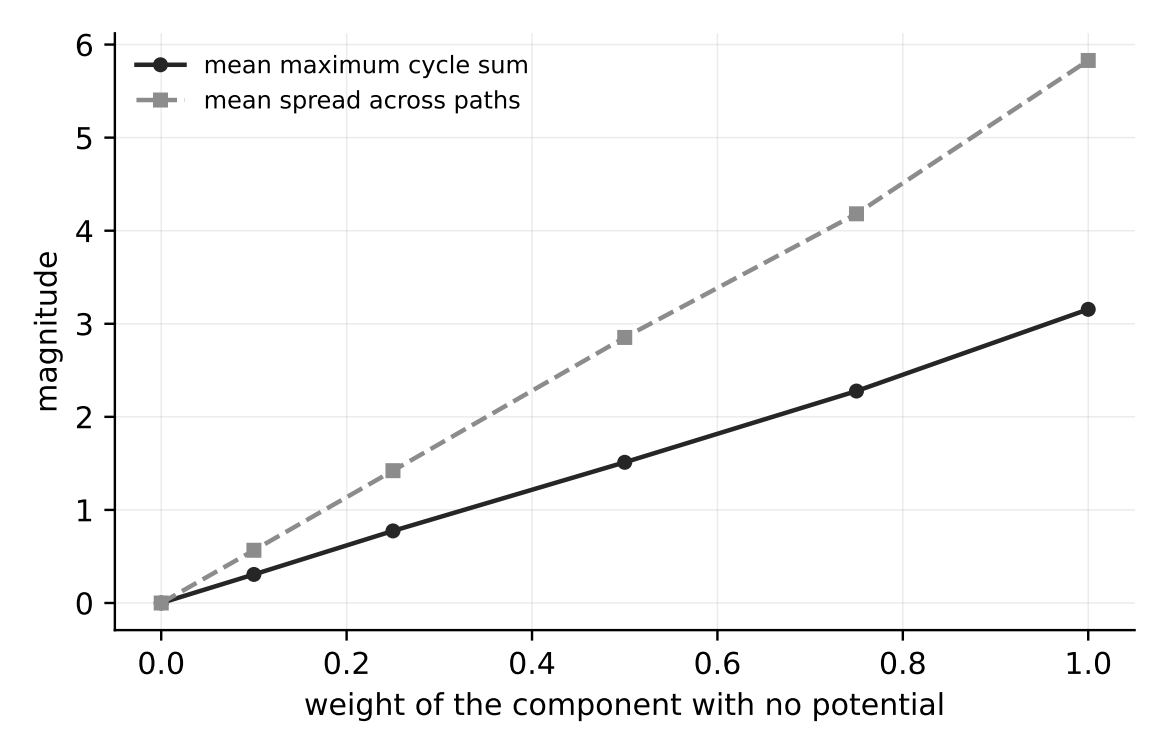
Figure 2. The obstruction to a potential and its consequence for path dependence. Both the largest cycle sum and the spread of the assessed change across the twelve distinct paths between two positions rise with the weight of the component admitting no potential, and both vanish where the assignment is derived from a potential.
11. The Formulation without Background Time
This section removes an assumption the preceding sections carried tacitly. Its objective is
to show that the account is better stated without a background time, and that the
difficulty about assessment altering its own object dissolves when it is, and its method is
to state the difficulty, apply the relational treatment, and then state the costs. The
section closes with the costs, which are substantial.
11.1 The difficulty carried by the time-indexed formulation
§4 obtained that an assessment alters what it assesses. Stated against a
background time this appears paradoxical: the assessment at time $t$ is made of a structure
which the assessment then changes, so the object assessed is not the object that exists
afterwards, and the assessment appears to be about something it has destroyed.
The appearance of paradox is produced by the background time and not by the structure. It
arises because the formulation privileges a foliation, a division of the history into
successive instants, and then asks after the relation between the instants.
11.2 The relational treatment
In the relational treatment there is no background time and no privileged foliation. A
choice of time is itself a choice of frame, and the analysis of §7 applies to
it: it is local, it is not derivable, and quantities depending on it are not
frame-independent. What replaces evolution is correlation. A quantity to which a value can
be attached by a determinate operation, while carrying no significance on its own, is a
partial observable; a correlation between partial observables is a complete
observable, and complete observables are what the theory is about (Rovelli, 2002).
Transposed, an assessment made at a position and a moment is a partial observable. It
carries no frame-independent content on its own, which §8 already
established for a different reason. The correlation between an assessment and the structure
it assesses is a complete observable, and it is defined on the whole history in place of at
an instant.
11.3 Gains delivered by the relational reformulation
Two gains follow and both are substantial.
The paradox of §11.1 dissolves. There is no instant at which the object
assessed is replaced by another, since the history is one object and the assessment and the
structure assessed are correlated within it. What looked like an assessment destroying its
object is a correlation holding across a history.
The Hume difficulty is removed entirely for this account, in place of merely being avoided.
An assessment stated as a condition on a whole history requires no forecast, since it
asserts nothing about what will happen, and constrains which histories are
admissible. This is the form in which the companion papers’ conditions are best stated: the
condition on attainability of a route back is a constraint on admissible histories, and the
safety component identified there is exactly a set of histories closed under taking finite
prefixes.
11.4 The costs the reformulation imposes
Two costs must be stated and neither is small.
The demand of a person suffering now becomes harder to express, not easier. Where no
foliation is privileged, the present has no distinguished status, and a condition binding
now requires a foliation to say what now is. The available answer is relational: the
foliation is supplied by the affected party’s own trajectory, so that what binds now is
what binds at the position of the person concerned along his own history. This is coherent
and it is an additional commitment, and an account that took the timeless formulation
without making it would have lost the ability to speak to anyone in particular.
The construction of observables invariant under the relevant symmetry is an open problem in
the physical case. It has not been solved there and it is not solved by being transposed
here. §2 committed the paper to saying so where the physics is unsettled,
and this is the principal instance. What the paper takes from the relational treatment is
the form of the position and not a worked technique.
11.5 Readings the reformulation excludes
The reformulation carries no claim that time is unreal, that social processes are timeless,
or that the experience of succession is illusory. It concerns which quantities are
frame-independent and holds fixed everything else.
The reformulation does not make interpretation inert. Two assessments leading respectively
to different courses are two different histories and no two descriptions of one history,
and §7 fixed the criterion that separates these cases. Removing background
time converts a causal claim into a constraint claim, and it leaves the substantive content
of the claim untouched.
Part V. The Boundaries of the Account
12. Positions Declined and the Grounds for Declining Them
This section argues the four declinations announced at §2. Its objective is
to show that each follows from a result established in the body of the paper in place of
being adopted for caution, and its method is to derive each from the result that supports
it. The section closes with the declination whose ground is different in kind.
12.1 Grounds for declining a criterion of justice
The paper supplies the form a criterion must take in a system with no privileged frame, and
that form is restrictive: by Proposition 6.1 the criterion admits no faithful scalar
expression, by Proposition 8.1 its frame-independent content is defined on circuits, and by
Proposition 10.1 it corresponds to no global quantity. A criterion satisfying those
constraints is supplied by the companion papers of this series, and supplying another here
would duplicate them without the case material that makes them assessable.
The division is worth stating explicitly, since a reader may reasonably ask what this paper
would be for otherwise. The companion papers state conditions and defend them against
objections drawn from practice. This paper establishes what kind of object such a condition
can be, and its results constrain any condition whatever, including conditions the author
of this series would reject.
12.2 Grounds for declining a quantity to be maximised
Two results of this paper exclude a maximand independently, and the exclusion is therefore
overdetermined.
Proposition 6.1 establishes that no scalar respecting bisimilarity separates arrangements
that differ in the acts available under them. A maximand is such a scalar, so a
recommendation to maximise it recommends acting on a quantity that is blind to the
distinctions the account exists to track.
Proposition 10.1 establishes that the assessment field admits no potential where cycle sums
fail to vanish. A maximand is a potential, so the recommendation presupposes the vanishing
of exactly the quantity §8 identified as the frame-independent content of
the system. Maximising is available only where there is nothing frame-independent to
detect.
12.3 Grounds for declining the treatment of all interpretive difference as gauge
§7 stated the objection and the criterion answering it, and the declination
is recorded here because it is the one most likely to be attributed to the paper by a reader
who has taken the gauge vocabulary and left the criterion behind.
Interpretive difference is gauge exactly where the arrangements induced are bisimilar. A
difference in the acts available or the answers owed is a difference in the system and no
difference in its description, and the whole apparatus of Part III applies to
the first kind only. An account that dropped the criterion would hold that no interpretation
ever makes a difference, which contradicts the companion papers, contradicts
§4 of this paper, and is false.
12.4 Grounds for declining any claim about an actual society
This declination differs in kind from the other three, since its ground is the state of
the evidence and not a result.
Every construction in this paper stipulates its objects. The group of admissible changes of
frame is stipulated at §8 and is not derived from any system; the graph is
constructed; the translations are drawn. What the computations establish is that the
constructions have the properties claimed for them, which is what a verification of a
proposition should establish and is nothing more.
What would be required to say anything about an actual arrangement is an identification, in
that arrangement, of the positions, the admissible reframings, and the translations between
positions, together with evidence that reframings compose as the construction assumes.
§13 records the difficulty of obtaining any of these.
13. Limits of the Account and Directions for Further Work
This section states what remains unsettled. Its objective is to place the account’s
weaknesses on the record in a form a critic can use, and its method is to order them by
severity, beginning with the weakest step in the paper. The section closes with the
directions left open and the relation of this paper to its companions.
13.1 The weakest step and its consequences
The transposition of the Gribov and Singer results at §9 is the weakest
step in the paper, and §9.3 said so at the point of use. Those results
concern a specific class of configuration spaces with structure that the social case has
not been shown to possess, and the transposed statement is a structural analogy in place of
a derived theorem.
Two consequences follow. The negative claim of §9, that no global choice of
frame is available, is the least secure claim in the paper and should be read as a
conjecture with a motivation. And the results that do not depend on it are unaffected:
Propositions 6.1, 8.1, 8.2 and 10.1 are established independently, and a reader who rejects
§9 entirely loses none of them.
13.2 The absence of an observer
The account states which quantities are frame-independent and says nothing about who is
positioned to compute them. Computing a loop observable requires knowing the translations
around a circuit, which requires occupying, or having reliable reports from, every position
on it. The companion paper on the legibility of contribution establishes that reports across
positions are systematically composed by the positions they come from, so the material
required is exactly the material that paper shows to be difficult to obtain.
This is the same gap the companion papers record, and it is recorded here as shared in
place of solved. An account identifying an invariant that no party is positioned to measure
has produced a theoretical result and no instrument.
13.3 Limits internal to the constructions
The group is stipulated. Whether the admissible reframings in any social system compose,
whether they form a group at all, and whether they fail to commute are three separate
empirical questions, and the third carries §9 and part of the significance
of §8. Where reframings commute, the abelian case obtains and the account
reduces to something much weaker.
The positions are stipulated. A decomposition of a social system into positions between
which translation occurs is assumed throughout, and systems admitting no stable
decomposition lie outside the account by §2. Whether any actual system
admits one is not addressed.
The magnitude of a holonomy is uninterpreted. §8 reports angles in a
stipulated group, and no reading of those magnitudes in social terms is offered or
available. The account distinguishes zero from non-zero and no more.
13.4 The open problem inherited from the physical case
§11 depends on the relational treatment, and the construction of
observables invariant under the relevant symmetry is unsolved in the physical case. The
paper takes the form of the position and no technique, and a reader who holds that the
physical problem is fatal to the relational programme will hold the same of
§11.
13.5 Directions the account leaves open and the relation to the companion papers
Three directions follow.
The first is the identification problem of §13.3: what would have to be
established about a social arrangement for the constructions here to apply to it. This is
the shortest route from the present results to a claim about anything.
The second is the observer problem of §13.2, which the three papers of this
series record in common and none of them answers.
The third is the relation between the invariant identified here and the conditions stated
in the companion papers. Those conditions are stated per person and at a position, and
§8 establishes that quantities so stated carry no frame-independent content.
Whether the conditions can be restated on circuits without losing what makes them
conditions on persons is the question this series leaves open, and it is the question on
which its coherence depends.
That question has a determinate form and is worth stating as the closing item. Eglash’s
criterion is a conserved quantity and is stated locally, and the criterion of this series is
a holonomy and is stated on circuits. A criterion of the first kind can be applied by a
party at a position; a criterion of the second kind cannot. Whether an account of justice
can be built on quantities of the second kind, and remain a criterion that a person may
invoke on his own behalf, is not settled by anything in these three papers.
References
Alchourrón, Carlos E., Peter Gärdenfors, and David Makinson. ``On the Logic of Theory Change: Partial Meet Contraction and Revision Functions.’’ The Journal of Symbolic Logic 50(2), June 1985, 510–530.
Aharonov, Yakir, and Jeeva Anandan. ``Phase Change during a Cyclic Quantum Evolution.’’ Physical Review Letters 58(16), 1987, 1593–1596.
Aharonov, Yakir, and David Bohm. ``Significance of Electromagnetic Potentials in the Quantum Theory.’’ Physical Review 115(3), 1959, 485–491.
Arrow, Kenneth J. Social Choice and Individual Values. New York: Wiley, 1951.
Berry, M. V. ``Quantal Phase Factors Accompanying Adiabatic Changes.’’ Proceedings of the Royal Society of London A 392(1802), 1984, 45–57.
Eglash, Ron. ``An Introduction to Generative Justice.’’ Teknokultura 13(2), 2016, 369–404. DOI 10.5209/rev_TEKN.2016.v13.n2.52847.
Gribov, V. N. ``Quantization of Non-Abelian Gauge Theories.’’ Nuclear Physics B 139, 1978, 1–19.
Healey, Richard. Gauging What’s Real: The Conceptual Foundations of Contemporary Gauge Theories. Oxford: Oxford University Press, 2007.
Hohfeld, Wesley Newcomb. ``Some Fundamental Legal Conceptions as Applied in Judicial Reasoning.’’ The Yale Law Journal 23(1), November 1913, 16–59.
Longino, Helen E. Science as Social Knowledge: Values and Objectivity in Scientific Inquiry. Princeton: Princeton University Press, 1990.
Luhmann, Niklas. Law as a Social System. Translated by Klaus A. Ziegert, edited by Fatima Kastner and others. Oxford: Oxford University Press, 2004.
Milner, Robin. Communication and Concurrency. New York: Prentice Hall, 1989.
Park, David. ``Concurrency and Automata on Infinite Sequences.’’ In Peter Deussen (ed.), Theoretical Computer Science: 5th GI-Conference, Lecture Notes in Computer Science 104. Berlin: Springer, 1981, 167–183.
Rutten, J. J. M. M. ``Universal Coalgebra: A Theory of Systems.’’ Theoretical Computer Science 249(1), 2000, 3–80. DOI 10.1016/S0304-3975(00)00056-6.
Peirce, Charles Sanders. ``The First Rule of Logic.’’ In The Essential Peirce: Selected Philosophical Writings, Volume 2 (1893–1913), edited by the Peirce Edition Project. Bloomington: Indiana University Press, 1998, 42–56.
Rovelli, Carlo. ``Relational Quantum Mechanics.’’ International Journal of Theoretical Physics 35(8), 1996, 1637–1678.
Rovelli, Carlo. ``Partial Observables.’’ Physical Review D 65(12), 2002, 124013.
Singer, I. M. ``Some Remarks on the Gribov Ambiguity.’’ Communications in Mathematical Physics 60(1), 1978, 7–12.
Wilson, Kenneth G. ``Confinement of Quarks.’’ Physical Review D 10(8), 1974, 2445–2459.
Wu, Tai Tsun, and Chen Ning Yang. ``Concept of Nonintegrable Phase Factors and Global Formulation of Gauge Fields.’’ Physical Review D 12(12), December 1975, 3845–3857. DOI 10.1103/PhysRevD.12.3845.