Distributed Infrastructures for the Governance of Environmental Change - Physical, Epistemic and Communicative Structure in Interdependent Earth–Human Systems
Abstract
Governance of environmental change addresses a field composed of many interdependent infrastructures, energy, water, food production, ecosystems, settlements, health, transport, industry, and the digital systems that instrument them, whose couplings carry consequences across sectoral and jurisdictional boundaries. Existing arrangements govern these infrastructures sector by sector, and existing proposals for improvement concentrate on integration, the assembly of distributed observations into a single coherent picture of the system. This paper argues that integration in that sense is unavailable for a field of this kind, and proposes a different architecture. The method is conceptual and architectural: the paper distinguishes three structures that are ordinarily conflated, the physical structure of dependence among infrastructures, the epistemic structure of who knows what about which dependence, and the communicative structure of who reports to whom, and treats their divergences as governance-relevant quantities in their own right. Three consequences follow. A dependence that is physically present and communicatively absent constitutes a determinate and observable governance failure, which supplies a diagnostic that requires no model of the whole. The assembly of heterogeneous observations into one state estimate presupposes a privileged common representation, which physics supplies to meteorology and which coupled social-ecological fields do not possess, so integration must proceed at a layer that does not require it. And the absent edges of the physical structure, the couplings that exist and are unrecorded, are the governance-critical objects, which inverts the usual emphasis on what is measured. The paper’s contribution is to define the three structures, to state their divergences as the primary diagnostic of the architecture, to distinguish the position from interdependency analysis, polycentric governance, and Earth observation integration programmes, and to identify the open questions that estimation of these structures raises. Its role is foundational for a wider programme, and it reports no empirical estimate.
Keywords: environmental governance; interdependent infrastructures; institutional fit; distributed knowledge; multilayer networks
Notices
On the references. All 41 works cited in this paper have been checked against their sources at claim level: each source was consulted and confirmed to state what the citing sentence attributes to it. No entry in this paper’s bibliography is unverified.
Status. This is a working draft circulated for discussion. It is a preliminary discussion paper and is not a finished statement of its author’s position. Sections and statement numbers are subject to change.
Licence. This work is made available under a Creative Commons Attribution-NonCommercial 4.0 International Licence (CC BY-NC 4.0).
Statement on the use of language models. Drafting, literature search and argumentative criticism for this paper were conducted in dialogue with large language models, specifically Claude (Anthropic) and ChatGPT (OpenAI). The claims, the structure, the selection of material and the position taken are the author’s. References have been checked in stages, to two standards, and the process is incomplete. Part of the corpus has been verified at identity level, meaning author, title and publication coordinates were confirmed against the publisher of record. A smaller part has additionally been verified at claim level, meaning the cited source was consulted and confirmed to state what the citing sentence attributes to it. The remainder is unverified at either standard. The standard reached is marked on each bibliography entry: no mark for claim level, $\ddagger$ for identity level only, $\dagger$ for not yet verified. Corrections made so far are recorded in the project’s citation-verification file; where a source proved not to bear the weight the text placed on it, the text was revised rather than the citation removed.
Companion papers. This paper is Paper 2 of a series on the governance of environmental change, and treats the physical, epistemic and communicative structures of an interdependent field and their divergences. The other papers of the series treat, in order: the object; coordination through change; heterogeneous knowledge; the event layer; criticality detection; observational capacity; representational requirements; routing and inquiry; the regime near a threshold; forecasting from the stream; the knowledge commons; attribution and ownership; responsibility at transitions; and supervisory duties. Paper 12 is reserved and is not yet drafted. A related paper by the author, developed independently of this series, treats the temporal correspondence limitation of evidence-based policy making, being the divergence between the system state that evidence represents and the system state at the moment of decision. Its results on the partition of a state space into estimable and unobservable components, on the blindness of a recency-weighted evidence base to the approach to criticality, and on the allocation of a justificatory burden where temporal correspondence fails, were reached by a different route and bear on several papers of this series.
Suggested citation. Huang, W. Distributed Infrastructures for the Governance of Environmental Change: Physical, Epistemic and Communicative Structure in Interdependent Earth–Human Systems. Working draft.
Discussion Paper Note
This paper is a preliminary discussion paper intended to share an evolving idea and invite further dialogue, criticism, revision, and independent development.
The author does not claim exclusive epistemic ownership over the viewpoints, concepts, or lines of reasoning presented here, nor does the author claim priority as their first originator. Similar or related ideas may have appeared previously in other intellectual, cultural, or disciplinary traditions. Any legal rights retained in this work are intended to support attribution, responsible use, and protection against exploitative or harmful appropriation, and not to restrict independent inquiry, criticism, revision, or further development.
The arguments in this paper should therefore be understood as provisional and historically situated rather than definitive. Readers are encouraged to question, revise, extend, reinterpret, or independently develop the ideas presented here. Where appropriate, acknowledgment of this paper as one point of encounter in the development of related ideas is appreciated, but such acknowledgment should not be understood as granting the author epistemic ownership over the ideas themselves.
Responsible Use and Rights Reservation
The author encourages good-faith discussion, criticism, independent development, and responsible use of the knowledge presented in this work. The author does not claim exclusive epistemic ownership over the ideas or viewpoints discussed herein, nor claim priority as their first originator.
However, the author expressly reserves all rights and remedies available under applicable law with respect to uses of this work or related materials that involve unlawful conduct, harmful or abusive exploitation, improper commercial appropriation, infringement of applicable intellectual property or other legal rights, or conduct contrary to applicable national, regional, or international law.
This reservation is intended to preserve the ability to respond to misuse and harmful appropriation. It should not be interpreted as restricting legitimate academic inquiry, criticism, independent reasoning, or the further development of related ideas.
1. Introduction
The infrastructures through which human societies act on the environment are coupled to one another and to ecological systems. Electricity supply depends on water for cooling and conveyance; irrigated agriculture depends on electricity; both depend on hydrological regimes that agriculture and settlement alter; health systems absorb the consequences of heat, which the built environment amplifies and the energy system responds to; and the digital systems that measure all of these have become a dependency of each. A perturbation entering at one point propagates through couplings that cross the boundaries of the institutions responsible for the parts.
Governance is organised otherwise. Authority over these infrastructures is divided by sector and by jurisdiction, and each authority holds a detailed model of its own domain and a thin one of its neighbours. The mismatch is familiar and has a name in the environmental governance literature, the problem of fit between institutions and the ecological systems they govern (Young, 2002; Folke et al., 2007). The standard response is integration: assemble the distributed observations, harmonise the models, and produce a shared picture of the coupled system on which coordinated decisions can be based. Earth observation programmes have pursued this for two decades (Group on Earth Observations, 2005; Nativi et al., 2015), and the more recent digital-twin proposals pursue it with larger models and better instruments (Bauer et al., 2021).
This paper argues that integration in that sense is unavailable for fields of this kind, and that the unavailability is structural and not a deficiency of present technique. The argument turns on a distinction the literature ordinarily leaves implicit. Three different structures are in play whenever an interdependent field is governed.
- $G_P$, the physical structure: which subsystems in fact affect which others, through material, energetic, hydrological, ecological, and economic couplings. This structure exists independently of anyone’s knowledge of it.
- $G_E$, the epistemic structure: which parties hold what knowledge of which couplings, at what resolution, with what provenance, and in which representational language. This structure is a property of parties and their instruments.
- $G_C$, the communicative structure: which parties in fact report what to which others, on what occasions, under what obligations. This structure is a property of institutions and their arrangements.
The three are routinely conflated, and each conflation produces a characteristic error. Treating $G_E$ as $G_P$ mistakes the recorded couplings for the operative ones, which is the error Scott (Scott, 1998) identified in administrative legibility and which recurs whenever an unmeasured dependence is treated as absent. Treating $G_C$ as $G_E$ mistakes reporting lines for knowledge, and attributes to an institution the understanding held by the parties that report to it. Treating $G_P$ as available to anyone mistakes the field for a system with a viewpoint, and no party in an interdependent field occupies one.
The physical, epistemic and communicative structures of an interdependent field are distinct objects, and the divergences among them are governance-relevant quantities. In particular, a coupling present in $G_P$ and absent from $G_C$ constitutes a governance failure that can be identified without any model of the field as a whole, since its identification requires only evidence that the coupling exists and evidence that no reporting relation corresponds to it.
Claim ? is the paper’s position, and its practical content lies in the second sentence. A diagnostic that requires a model of the whole system is unavailable to every party, for the reason the field’s governance is difficult in the first place. A diagnostic that compares two structures pairwise is available to any party that can establish one coupling and inspect the reporting arrangements bearing on it. The architecture proposed in §8 is built on diagnostics of this second kind.
The remainder of the paper proceeds as follows. §5 defines the three structures and the divergence quantities. §7 states what the adjacent literatures own, principally infrastructure interdependency analysis, multilayer network theory, the fit literature, polycentric and adaptive governance, and the Earth observation integration programmes, and identifies what the position adds to each. §8 gives the argument against state integration for heterogeneous fields and states the alternative layer at which integration can proceed. §9 lists the questions the position leaves open, chiefly those concerning estimation.
2. Definition of the Three Structures and Their Divergences
2.1 The Physical Structure of Dependence
Let the field comprise infrastructures and ecological subsystems indexed $i = 1,\dots,n$. The physical structure is a directed, typed, weighted graph
$$G_P = (V, E_P), \qquad e_{ij}^{(k)} \in E_P,$$
where an edge of type $k$ from $i$ to $j$ records that a change in $i$ produces a change in $j$ through a coupling of that type. The types are heterogeneous: material and resource flow, energy flow, hydrological and ecological coupling, financial and market coupling, and regulatory coupling. Three attributes of an edge carry governance weight beyond its existence. Its sign and magnitude determine whether a perturbation is amplified or absorbed. Its delay determines whether the consequence appears within the horizon over which the acting party is assessed. Its reversibility determines whether the coupling, once altered, can be restored. The third is the attribute on which the governing principle of the wider programme turns, and it is a property of the edge and not of either node.
$G_P$ is not observed directly. It is inferred from records, and its inference is the epistemic problem the next subsection describes. Two features of $G_P$ deserve statement because they are ordinarily suppressed by the graphical presentation. First, $G_P$ is dense: in a coupled field almost every pair of infrastructures is connected by some path, and a graph in which every node reaches every other carries little discriminating information. The analytically useful content lies in the edge attributes, in the typed structure, and in the identification of the couplings that matter under given conditions, and not in the adjacency pattern. Second, $G_P$ is dynamic: couplings strengthen, weaken, and form. A field’s coupling structure under drought differs from its structure under ordinary conditions, and a governance arrangement calibrated to the second may be unfit for the first.
The climate system occupies a distinctive place in this structure and is not a node of it. A warming trend does not couple to the energy system as one infrastructure couples to another; it modifies the parameters of many couplings at once, raising cooling demand on the energy–water edge, altering the hydrological edge into agriculture, and shifting the health edge from the built environment. It is a slow field that acts on the edges of $G_P$, and it is not an element of $V$. This is the structural reason environmental change resists assignment to any sector: an object that modifies all couplings simultaneously has no sectoral address.
2.2 The Epistemic Structure
The epistemic structure records what is known, by whom, about which couplings:
$$G_E : (\text{party } a, \text{ edge } e_{ij}) \mapsto \kappa_a(e_{ij}),$$
where $\kappa_a$ carries the resolution of the knowledge, its provenance, its uncertainty, and the representational language in which it is held. Three properties distinguish $G_E$ from $G_P$.
Knowledge of couplings is unevenly distributed, and its distribution follows the distribution of instruments and of operational presence. A party observes a coupling it operates across, and observation sustained over time is the constituent of observational capacity that present expenditure cannot supply. Knowledge of couplings is harder to acquire than knowledge of states: a state may be measured at an instant, and a coupling is established only from covariation over a period, so the epistemic structure lags the physical structure by a duration set by the coupling’s own timescale. And knowledge of couplings is held in incommensurable representations: the hydrologist’s account of an edge, the epidemiologist’s, and the grid operator’s are not three measurements of one quantity, and their reconciliation is the problem §8 takes up.
2.3 The Communicative Structure
The communicative structure records who in fact reports what to whom:
$$G_C = (V_A, E_C),$$
over parties $V_A$, where an edge records an established flow of information, its occasions, its contents, and the obligation if any under which it occurs. $G_C$ is institutional: it is constituted by mandates, agreements, standards, professional practice, and habit. It is also, characteristically, sectoral, since reporting relations are established within domains of authority and only exceptionally across them.
2.4 Divergence Quantities
The three structures do not coincide, and their divergences are the paper’s diagnostic objects.
For a coupling $e_{ij}$ present in $G_P$, define three divergences: the coupling is unwitnessed where no party holds knowledge of it in $G_E$; uncommunicated where knowledge exists in $G_E$ but no reporting relation in $G_C$ carries it to a party whose conduct bears on the coupling; and misattributed where a reporting relation exists in $G_C$ that carries a representation of the coupling not warranted by any party’s knowledge in $G_E$. The aggregate divergence of the field is the collection of such couplings, classified by kind.
The three kinds call for different remedies, and distinguishing them is the diagnostic’s practical value. An unwitnessed coupling calls for observation and cannot be remedied by improved reporting. An uncommunicated coupling calls for a reporting arrangement and is remediable at low cost, since the knowledge already exists and only its route is missing. A misattributed coupling calls for correction of a record that is worse than an absence, since an institution acting on it believes itself informed.
The uncommunicated divergence is the tractable class and the one governance arrangements systematically neglect. Knowledge of a cross-sectoral coupling ordinarily exists somewhere in the field, held by an operator, a research programme, or an affected community, and its failure to reach the party whose conduct bears on the coupling is a property of the reporting arrangement and not of the state of knowledge. An architecture that identified this class alone would alter the distribution of consequential information without requiring any new observation.
Claim ? is the paper’s practical proposal in its narrowest form, and §8 states the layer at which such an architecture can operate.
2.5 The Standing of Absent Edges
A representation of $G_P$ records the couplings its compilers know. The couplings that exist and are unrecorded are, by construction, invisible in it, and they are the couplings through which unanticipated propagation occurs. Every serious infrastructure failure of the past several decades has proceeded in part through a dependence that the responsible parties did not represent, and the retrospective account of such an event ordinarily identifies the coupling as obvious once named.
This has a consequence for how such a field should be depicted and reasoned about. A diagram of known dependencies invites the inference that the depicted structure is the structure, and the inference is available precisely where it is least warranted, since a field whose couplings are well understood is a field whose governance is not in difficulty. The position taken here is that a representation of an interdependent field should carry its own incompleteness as a first-class element: alongside the recorded couplings, the couplings suspected and unmeasured, and the regions of the field for which no party holds a coupling model at all. §9 states the estimation problem this raises.
3. Inventory of the Infrastructures and Their Couplings
The position of §5 is stated over an abstract field. This section fixes the field concretely, because a claim about the divergence of three structures is assessable only against a determinate account of what the subsystems are and how they are coupled. The inventory below is offered as a working decomposition and not as a natural partition; §9 records the question of whether any principled partition exists.
3.1 The Subsystems
Eleven subsystems are distinguished, grouped by the kind of process that constitutes them.
Physical and engineered. (1) The energy system: generation, transmission, distribution, and fuel supply. (2) The water system: catchment, storage, conveyance, treatment, and discharge. (5) The settlement and built environment: buildings, urban form, drainage, and thermal mass. (9) The transport and mobility system: networks, fleets, and logistics. (10) The industrial and economic system: extraction, manufacture, and the markets that allocate their products.
Biophysical. (3) The food and agricultural system: cultivation, livestock, fisheries, processing, and distribution, which is engineered and biophysical at once. (4) Ecosystems and biodiversity: the biotic communities and the processes of regulation, provision, and habitat that they sustain.
Social and human. (6) Social and human systems: populations, livelihoods, settlement patterns, and practices. (8) The health system: surveillance, care provision, and the burden of disease it registers.
Institutional and informational. (7) Institutional and governance infrastructure: authorities, rules, standards, and the procedures through which they are made and applied. (11) Digital and data infrastructure: sensing, computation, communication networks, and the models and records they carry.
Two remarks bear on the decomposition. The institutional subsystem is unlike the others in that its couplings are predominantly regulatory and reach every subsystem including itself, which makes it a hub in the coupling structure and the entity whose own conditions the wider programme takes as its object. The digital subsystem has acquired a similar reach within a generation: it now conditions the operation of every other subsystem and, as §5 argued, its records constitute much of what any party holds of $G_E$. A field in which one subsystem instruments all others and another regulates all others has two coupling concentrations, and their failure modes differ.
The epistemic infrastructure is distinguished here from the digital. Monitoring programmes, scientific institutions, long observational records, and locally held ecological knowledge are not reducible to sensing and computation, and collapsing them into the digital subsystem conceals the fact that the most valuable epistemic asset in an interdependent field, an observational record of sufficient duration to establish a coupling, is not produced by any amount of present computational capacity.
3.2 The Couplings
Five types of coupling are distinguished, following the categories that recur across the interdependency literature (Rinaldi et al., 2001): material and resource flow; energy flow; information flow; financial and economic flow; and regulatory relation. Figure 1 gives the typed adjacency of the eleven subsystems under this classification.
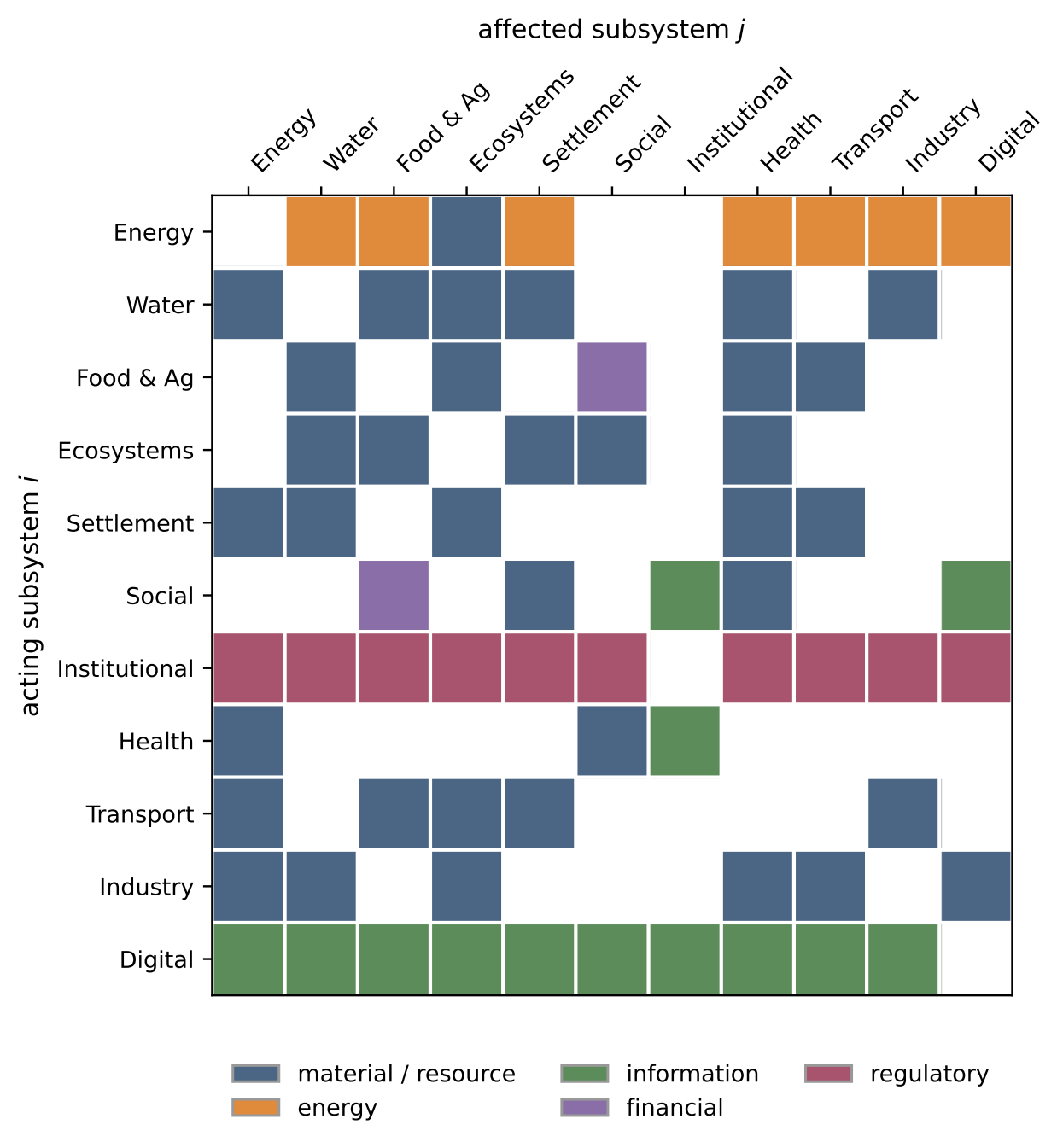
Figure 1. Typed couplings among the eleven subsystems. A cell in row $i$, column $j$ records a coupling through which a change in $i$ produces a change in $j$, coloured by type. The structure is dense: sixty-eight of the one hundred and ten ordered pairs carry a coupling of some type, which is the feature discussed in §5. The figure records the couplings the author is able to state, and its blank cells are therefore of two kinds, pairs that are uncoupled and pairs whose coupling is unrecorded here.
Several couplings carry the paper’s argument and are stated explicitly.
Energy and water are coupled in both directions and by different types. Thermal generation and fuel processing consume water for cooling; water abstraction, conveyance, treatment, and desalination consume energy. The coupling is bidirectional, and a perturbation of either propagates to the other and returns.
Water and food are coupled by abstraction for irrigation and livestock, and by return flows carrying nutrients and residues to receiving waters. The delay on the return branch is long, and the effect appears in a subsystem whose authority is ordinarily distinct from the one that authorised the abstraction.
Ecosystems and social systems are coupled by provision and regulation: pollination, fisheries, flood attenuation, and the livelihoods drawn from them. This coupling is characteristically asymmetric in legibility. Its degradation registers in the social subsystem as loss of income or of protection, and the ecological process that produced the loss ordinarily holds no institutional representation of its own.
Settlement, energy, and health form a triangle that the paper returns to. Urban form and building stock determine thermal exposure; exposure determines cooling demand, which loads the energy system; and the same exposure determines the burden that reaches the health system. A heat episode therefore enters three subsystems at once through couplings that no single authority holds.
Industry and ecosystems are coupled by emission, land occupation, and extraction, and this coupling is where the irreversibility attribute is most often decisive: a discharge may be halted while its effect on a receiving system persists, and an occupied habitat may be vacated without being restored.
Institutional couplings are of a distinct type. A regulatory relation does not transmit material or energy; it alters the permissions under which another subsystem operates, and its effect is therefore conditional on compliance and on the capacity of the regulated subsystem to respond. Regulatory couplings also carry the longest formation delays, since the making of a rule is slow relative to the processes it governs.
3.3 The Attributes That Carry the Governance Weight
The adjacency of Figure 1 understates what a governance arrangement needs. Three attributes of a coupling, beyond its existence and type, determine whether an arrangement can act on it, and the three are largely independent of one another.
Delay. The interval between a change in the acting subsystem and the appearance of its consequence in the affected one ranges over eight orders of magnitude within the field enumerated above, from the seconds on which digital control operates to the decades and centuries on which land occupation and extraction register in ecological systems. Delay matters for governance in a specific way: a consequence appearing beyond the horizon over which the acting party is assessed is, for that party’s decision procedure, absent. An arrangement that reviews conduct annually is structurally unable to attach weight to a coupling whose consequence appears in thirty years, whatever its magnitude.
Reversibility. A coupling may be altered in ways that can be undone and in ways that cannot, and the distinction does not follow the reversibility of the act producing the alteration. A discharge may be halted while its effect on a receiving system persists; a habitat may be vacated without being reoccupied; a severed migration route may be legally reopened and remain unused. This is the attribute on which the governing principle of the wider programme turns (Huang, 2026), and it is a property of the coupling and its alteration together, and not of the act alone.
Asymmetry. A coupling that runs in both directions ordinarily runs with different strength and different delay in each. Energy and water are coupled reciprocally, and the energy required for water conveyance responds within hours while the water available for thermal cooling responds over seasons. An arrangement treating a bidirectional coupling as a single relation will be calibrated to one of its directions.
Figure 2 places the couplings enumerated above in the plane of delay and reversibility, and the placement makes a structural feature visible: the couplings with the longest delays are, in this field, predominantly those whose alteration is least reversible. The two attributes are correlated because both derive from the timescale of the affected process, and the correlation is adverse for governance, since the couplings that most warrant attention are those whose consequences arrive last.
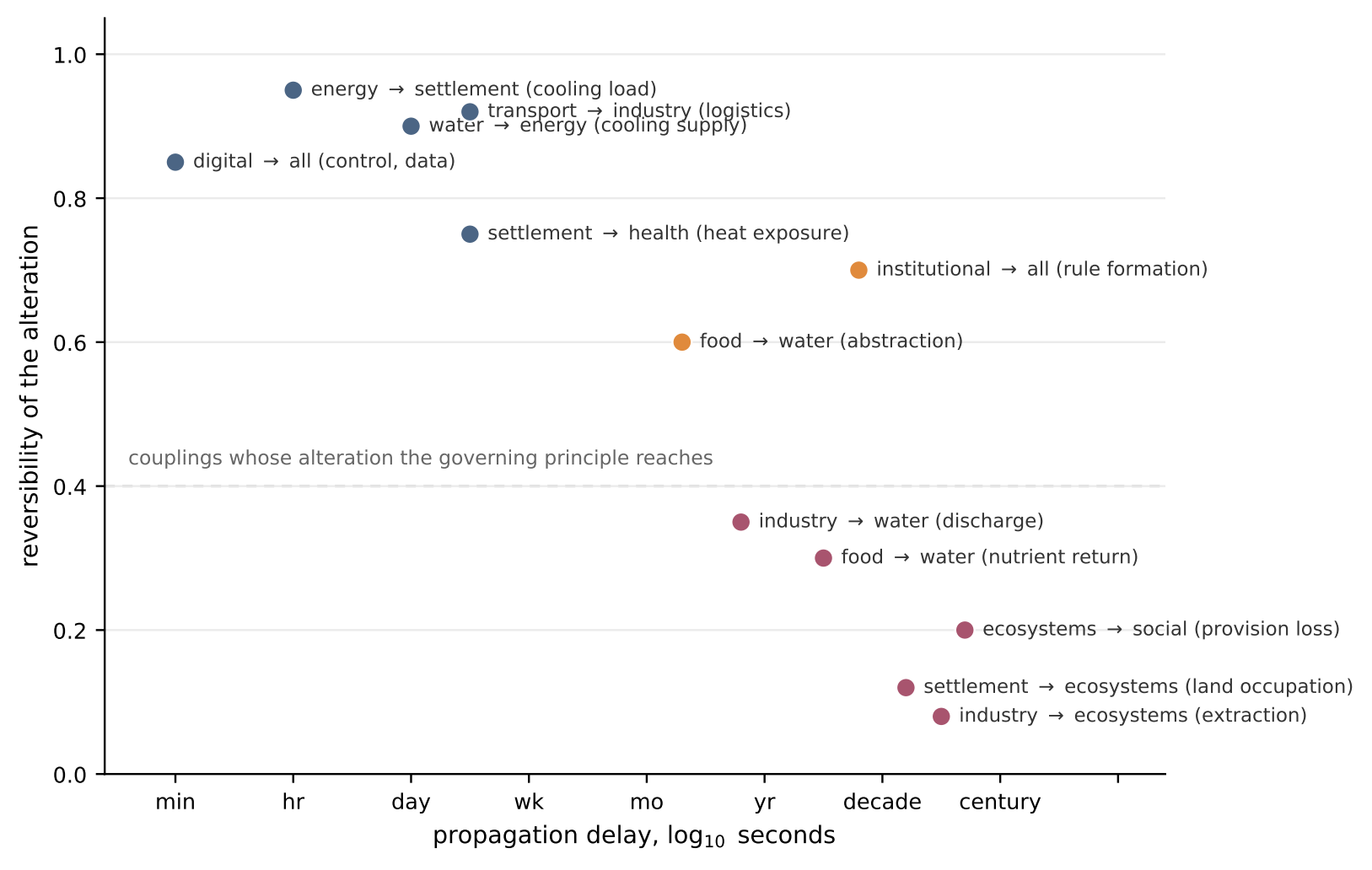
Figure 2. Couplings of the field placed by propagation delay and by the reversibility of their alteration. Positions are indicative and are offered to display the structure of the plane, and no position rests on a measurement. The adverse correlation between the two attributes is the feature the section discusses: the couplings whose alteration is least reversible are those whose consequences appear last.
3.4 Conditional Structure and the Compound Case
The coupling structure is not fixed. A coupling’s strength depends on the state of the subsystems it joins, and couplings that are negligible under ordinary conditions become dominant under others. Three mechanisms produce this dependence.
Threshold activation. A coupling may be inoperative until a variable in the acting subsystem crosses a value. Reservoir storage above a level decouples agricultural abstraction from urban supply, and below that level the two compete directly for the same volume. The governance consequence is that arrangements calibrated on the ordinary regime are calibrated on a coupling structure that does not obtain when they are most needed.
Saturation and buffer exhaustion. Buffers absorb perturbation and thereby suppress couplings that would otherwise transmit it: reserve margin in the energy system, storage in the water system, redundancy in transport, and slack capacity in health provision. A buffer’s function is to prevent propagation, and its exhaustion restores the coupling abruptly. A field operating with thin buffers is a field whose effective coupling structure is denser than its ordinary structure, and efficiency improvements that reduce buffers alter the coupling structure without altering any physical connection.
Compound conditions. Several couplings may be stressed simultaneously by a common cause, and the resulting demand may exceed what the arrangement could meet even where each coupling separately is within tolerance. A heat episode coinciding with low river flow stresses the energy–water coupling from both sides, since generation requires more cooling water at the moment less is available and demand is at its peak. Compound conditions are the case in which the slow field’s action on the edges of $G_P$ becomes operationally decisive, since what warming principally changes is the frequency with which several couplings are stressed at once.
3.5 Worked Case: Propagation of a Heat Episode
The following traces one perturbation through the inventory, and is offered to display the structure the paper’s diagnostic applies to.
A multi-day heat episode enters the field through the settlement subsystem, where urban form and building stock determine exposure. Three couplings activate within hours. Cooling demand loads the energy system, at a time when generation capacity is reduced by high ambient and cooling-water temperature, so the energy–settlement and water–energy couplings are stressed together. Heat exposure produces excess morbidity, which reaches the health system with a delay of one to several days and concentrates in populations whose exposure is determined by the built environment they inhabit. Transport and digital infrastructure degrade under thermal stress, which bears on the capacity of the other subsystems to respond.
Over weeks, further couplings activate. Water abstraction rises across agricultural, urban, and industrial users simultaneously, and the reservoir threshold discussed above may be crossed, converting three previously independent demands into direct competition. Agricultural yield losses register in the food subsystem and, through markets, in the social subsystem. Ecological effects, from thermal stress in receiving waters and in terrestrial systems, register over months and years.
The governance structure that meets this episode is ordinarily constituted as follows. The energy authority observes load and generation margin. The water authority observes storage and abstraction. The health authority observes presentations and mortality. The meteorological service observes and forecasts the driver. Each holds an adequate representation of its own subsystem. In most arrangements no standing relation carries the energy authority’s projection of a demand peak to the water authority whose abstraction decisions bear on cooling supply, or carries the health authority’s early presentations to the settlement authority whose interventions could alter exposure, or carries either to the social-protection function whose measures reach the exposed population. The couplings obtain; the knowledge exists in the field, distributed; the reporting relations corresponding to the couplings are absent.
This is the uncommunicated divergence of Definition ?, and the case has two features that make it the paper’s paradigm. The remedy requires no new observation, since every relevant quantity is already measured by some party. And the failure is invisible in the record of any single authority, since each authority’s own performance, assessed against its own subsystem, may be adequate throughout. A diagnostic operating within subsystems cannot find it; a diagnostic comparing $G_P$ against $G_C$ finds it directly.
3.6 The Slow Field
Climate change enters this structure in the manner §5 described. It is not a twelfth subsystem. It alters the parameters of the couplings already enumerated: it raises the cooling load on the energy–settlement edge, shifts the hydrological regime on which the water–food edge depends, moves the ranges and phenologies on the ecosystem edges, and changes the frequency of the compound conditions under which several edges are stressed at once. A governance arrangement organised by subsystem has no place to assign an object of this kind, and the standard response, the creation of a dedicated climate authority alongside the sectoral ones, produces an authority whose object is the modification of couplings for which the sectoral authorities remain responsible.
3.7 Divergence in the Inventory
Figure 3 illustrates the divergence of Definition ? in its minimal form, over three parties and three couplings.
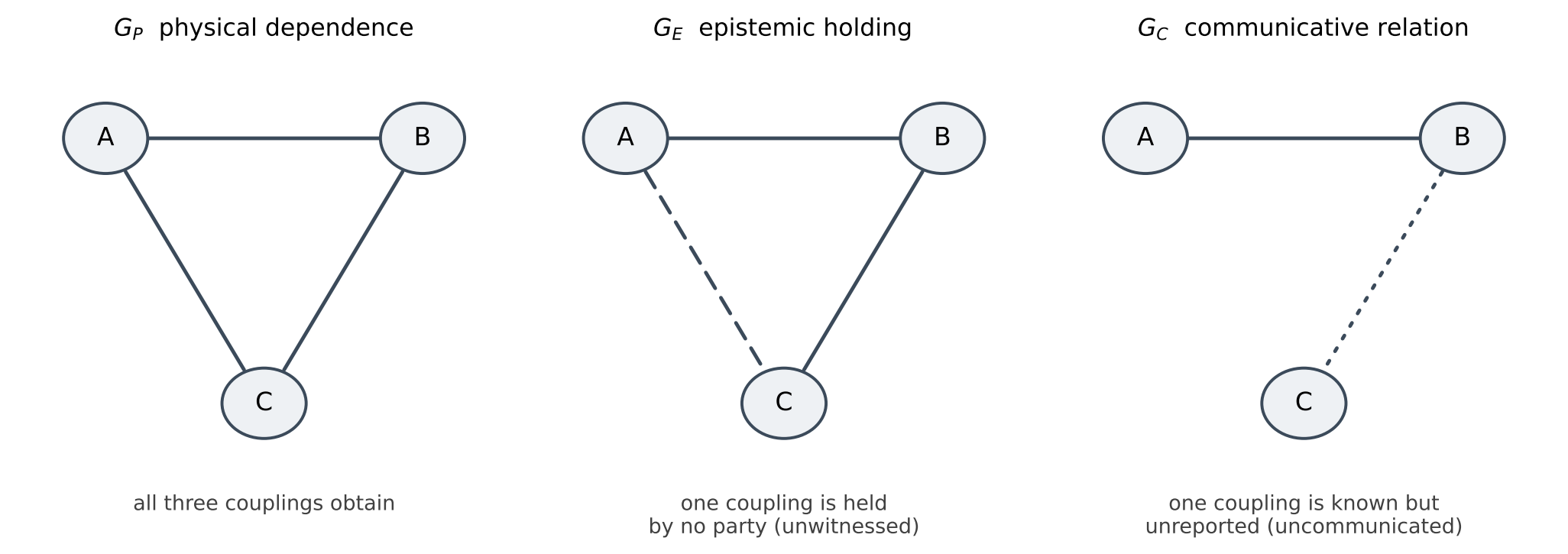
Figure 3. Divergence among the three structures in minimal form. Three couplings obtain physically; one is held by no party, and one is held but carried by no reporting relation. The classification of Definition ? distinguishes these two failures, which call for different remedies.
The inventory permits the divergence to be stated concretely. Of the couplings enumerated above, the energy–water edge is well witnessed and, in many jurisdictions, well communicated, since both subsystems are operated by parties with instruments and are regulated by authorities in contact. The water–food return-flow edge is witnessed by agricultural and environmental agencies whose reporting relations to one another are weaker, and the delay on the edge means that its consequences arrive after the decisions that produced them have been recorded as complete. The ecosystem–social edge is frequently unwitnessed at the resolution at which it operates, since the parties best placed to observe it hold no instruments recognised by the arrangements that would act on the finding. The settlement–energy–health triangle is the case in which all three subsystems are separately well instrumented and the couplings among them are, in most arrangements, carried by no standing reporting relation at all: each authority observes its own load and none is informed of the others’ by design.
The last case is the paper’s paradigm of the uncommunicated divergence, and it is the one Claim ? concerns. No new observation is required to remedy it. The remedy consists in an arrangement under which a change registered in one of the three is carried to the other two.
4. Prior Treatments of Interdependence, Fit, and Integration
Six literatures bear on the position. This section states what each establishes, in the form its authors state it, and identifies what the position adds and what it takes without amendment. The review is ordered from work on the physical structure, through work on institutions, to work on integration of observation.
4.1 Interdependency Analysis and the Modelling of Coupled Infrastructures
Rinaldi, Peerenboom, and Kelly (Rinaldi et al., 2001) established the framework on which the field rests, distinguishing physical, cyber, geographic, and logical interdependencies and setting out the dimensions along which coupled infrastructures should be characterised, among them the type of coupling, the tightness of the coupling, the order of effects, and the state of operation of the systems concerned. Their treatment of higher-order effects, in which a disruption reaches a third infrastructure through a second, is the direct ancestor of the propagation structure assumed throughout this paper.
Buldyrev and colleagues (Buldyrev et al., 2010) supplied the formal result that established the field’s urgency. In two interdependent networks, failure propagates back and forth between layers, and the resulting collapse is abrupt where the corresponding single network degrades gradually; a broader degree distribution, which makes a single network more robust, makes an interdependent pair more fragile. The result is a warning against reasoning about coupled systems from the properties of their parts, and the present paper adopts it.
Multilayer network theory (Arenas et al., 2014) supplies the general formalism, unifying the several traditions that had independently arrived at networks with multiple edge types and multiple node layers. Where the paper writes $G_P$ with typed edges, it is writing in this formalism and claims no part of it. Subsequent work on cascading failure and on the identification of critical components in coupled infrastructure has developed the modelling considerably (Ouyang, 2014).
The relation of this literature to the position is one of layering. It models the physical structure, and it models it better than the present paper does. The questions it poses are posed by an analyst who holds the coupled model: which components are critical, how failure propagates, what redundancy is required. It does not model the distribution of knowledge of the couplings among the parties that operate them, nor the reporting arrangements among those parties, and the divergences of Definition ? are not statable in it. The paper takes $G_P$ from this literature and adds two structures it does not treat.
4.2 The Nexus Framing of Sectoral Coupling
A parallel literature analyses the coupling of resource systems directly. The water–energy–food nexus framing, consolidated at the Bonn conference of 2011 and developed extensively since (Hoff, 2011; Bazilian et al., 2011), argues that these three systems are so coupled that policies addressing one produce consequences in the others, and that sectoral analysis is therefore inadequate to any of them. Subsequent assessments of the framing report that its analytical promise has outrun its institutional realisation: the couplings are documented, and governance arrangements corresponding to them remain rare (Leck et al., 2015; Albrecht et al., 2018). The related literature on telecoupling (Liu et al., 2013) extends the analysis to distant connections, in which land use, trade, and migration link systems that share no geographic proximity.
This literature establishes the empirical content of the couplings the present paper enumerates, and the enumeration of §6 draws on it. The difficulty the nexus literature identifies as its own is instructive for the position. The assessments cited report that nexus analysis produces knowledge of couplings which does not reach the sectoral authorities whose decisions bear on them, and that the obstacle is institutional. Stated in the terms of §5, the nexus literature has been constructing $G_E$ for two decades and reporting that $G_C$ has not followed. The present paper takes that finding as evidence for Claim ? and offers the divergence classification as a way of stating it precisely.
4.3 Institutional Fit, Interplay, and Scale
Young (Young, 2002) posed the correspondence between institutional arrangements and the biophysical systems they govern as the central analytical question of institutional environmental research, and distinguished problems of fit from problems of interplay among institutions and of scale. Folke and colleagues (Folke et al., 2007) reviewed a decade of subsequent work and concluded that ecosystems and institutions are ordinarily mismatched in function, in spatial extent, and in temporal rhythm. Cash and colleagues (Cash et al., 2006) analysed the associated cross-scale and cross-level problems and identified the failure to recognise scale mismatches as a systematic source of governance failure. Ekstrom and Young (Ekstrom & Young, 2009) proposed a procedure for assessing fit by comparing the components of an ecosystem against the components of the institution addressing it.
Priority for the general formulation is conceded, and the problem this paper addresses is a species of misfit in Young’s sense. The addition is specificity of a kind that carries a practical consequence. Fit is ordinarily assessed at the level of an institution and an ecosystem taken whole, and yields judgements of the form that a jurisdiction is poorly matched to a watershed. Definition ? states misfit per coupling and classifies it by kind, which converts a general diagnosis into a determinate finding about a particular edge: this coupling obtains, this party’s conduct bears on it, and no arrangement carries the relevant knowledge to that party. A finding in this form identifies a remedy and identifies which remedy; a finding of general misfit does neither. The classification also separates two failures that the fit literature ordinarily treats together, since an institution may be poorly matched to an ecosystem because nobody has observed the relevant process, or because the observation exists and does not travel, and these call for different responses.
4.4 Polycentric, Adaptive, and Experimentalist Arrangements
Ostrom (Ostrom, 1990) established that common-pool resources are governed effectively by arrangements crafted locally under conditions she set out as design principles, and later argued that responses to global environmental change proceed through polycentric systems of overlapping decision centres in which no centre holds the whole (Ostrom, 2010). Adaptive governance (Folke et al., 2005) treats management as an experiment revised against monitored response, and the resilience tradition from which it draws (Holling, 1973; Walker et al., 2004) supplies the distinction between the persistence of a system, its capacity to adapt, and its capacity to transform. Experimentalist governance (Sabel & Zeitlin, 2012) formalises the recursive architecture: framework goals set centrally, discretion left to local units, regular reporting and peer review of local performance, and periodic revision of the framework itself in the light of what the reporting reveals.
This family holds the institutional form the present position presupposes, and the debt is substantial. The architecture indicated in §8 is polycentric, and it is offered as a specification of the informational relations among centres, and not as an alternative to them. The reporting-and-review element of experimentalist governance is the nearest existing institutional analogue to the arrangement the paper argues for.
The addition concerns the adequacy condition. These traditions establish that multiple centres can govern effectively and characterise the conditions under which they do; they treat the information flowing among centres as a design variable to be arranged case by case, and their reporting requirements are ordinarily directed upward, from local unit to framework-setter, in the service of revising the framework. The position here treats the flow among centres as the governed object, states its adequacy against $G_P$, and directs the requirement laterally: a communicative structure is adequate to a field when the couplings through which consequences propagate carry information to the parties whose conduct bears on them, whether or not those parties stand in any hierarchical relation.
4.5 Programmes of Earth Observation and Their Integration
The Global Earth Observation System of Systems was established under a ten-year implementation plan (Group on Earth Observations, 2005) to federate the world’s Earth observation resources into an interoperable whole serving nine societal benefit areas. Assessments of its trajectory report substantial achievement in data-sharing policy and in brokered access to heterogeneous catalogues, alongside persistent difficulty in semantic and structural interoperability across domains (Nativi et al., 2015). The difficulty is not one of ingestion: the reported obstacles concern the reconciliation of variables, resolutions, quality descriptions, and provenance conventions established independently in each domain.
The digital-twin programmes pursue the integrative goal with larger models and finer instruments. Bauer, Stevens, and Hazeleger (Bauer et al., 2021) set out the case for a digital twin of the Earth capable of simulating physical processes and human intervention together at kilometre scale, and the European Destination Earth initiative implements a programme of this kind. Assessment of these programmes is premature, and the position takes no view on their value within the domains where their governing physics applies.
The relation to this family is the paper’s sharpest disagreement, and §8 states the argument. The disagreement concerns neither the value of Earth observation nor the interoperability of data formats, both of which the position requires and neither of which it disputes. It concerns the assumption that assembling distributed observations into a single coherent representation of the coupled field is the form integration must take. The two decades of experience recorded in the assessments are read here as evidence about the difficulty of that form for cross-domain cases, and the architecture indicated in §8 is an attempt to state what integration can mean where that form is unavailable.
4.6 Socio-Technical and Informational Studies of Infrastructure
A distinct tradition treats infrastructure as constituted by social and technical elements together, and its findings bear directly on the distinction between the three structures. Hughes (Hughes, 1983) established the study of large technical systems and the notion of the reverse salient, the lagging component that governs the development of the whole. Star and Ruhleder (Star & Ruhleder, 1996) argued that infrastructure is relational and becomes visible principally upon breakdown, which states in general form the observation of §5 that the couplings governing propagation are ordinarily those no party had represented. Bowker and Star (Bowker & Star, 1999) analysed classification and standardisation as consequential political acts, establishing that the categories through which a domain is recorded determine what can subsequently be seen and said of it, which is the ancestor of this paper’s treatment of threshold specification in §8. Edwards (Edwards, 2010) traced the construction of the global climate knowledge infrastructure and showed that data, models, and institutions are mutually constitutive, so that a global observational record is an institutional achievement and not a natural given.
This literature owns the claim that the epistemic and communicative structures are objects in their own right with their own politics, and the present paper concedes it. The addition is the pairing with an explicit physical structure and the resulting divergence quantities: the tradition analyses how infrastructures and their classifications come to be as they are, and the position here asks the further question of whether the resulting arrangement is adequate to the couplings it must govern, which requires the comparison Definition ? makes.
4.7 Transitions, Regimes, and the Multi-Level Perspective
The sustainability transitions literature analyses how socio-technical regimes change. Geels (Geels, 2002) set out the multi-level perspective, in which niche innovations, an established regime, and a slowly changing landscape interact, and subsequent work has developed the analysis of transition pathways and of the interaction between coupled regimes (Geels, 2011; Markard et al., 2012). The landscape level of that framework and the slow field of §5 are the same structural idea arrived at independently: an exogenous, slowly varying condition that alters the pressures on a regime without being a member of it.
The relation is complementary and the difference is in the question. Transitions research asks how a regime changes and what governs the pathway; it is a theory of change in a sector or a coupled set of sectors over decades. The position here asks what a governing arrangement must know and communicate to act on couplings at operational timescales, and the two questions are addressed to different aspects of the same field. The transitions literature does supply one finding the position takes seriously: transitions in one regime alter the couplings on which others depend, so that a decarbonisation pathway is also a reconfiguration of the water, land, mineral, and digital couplings enumerated in §6.
4.8 Systemic Risk and the Monitoring of Coupling in Finance
Financial regulation confronted a structurally similar problem earlier and responded institutionally. Acemoglu, Ozdaglar, and Tahbaz-Salehi (Acemoglu et al., 2015) established that the relation between network density and systemic stability is non-monotone: dense interconnection absorbs small shocks and propagates large ones, so that no single degree of coupling is uniformly preferable. Haldane and May (Haldane & May, 2011) argued the parallel between financial and ecological networks directly, and Battiston and colleagues (Battiston et al., 2012) developed measures of an institution’s systemic significance that depend on its position in the network and not on its size. On the institutional side, composite indicators of systemic stress were constructed that weight the correlation among market segments, on the reasoning that stress matters most when it is shared (Kremer & Duca, 2012), and macroprudential supervision was established as a function distinct from the supervision of individual firms.
Three elements of this response bear on the position. The first is the recognition that an arrangement supervising each unit against its own condition can leave the coupled system unsupervised, which is the structural situation the heat case of §6 displays. The second is the construction of indicators over the coupling structure itself, and not over the states of the units. The third is the institutional consequence, the creation of a function whose object is the coupling and not any of the coupled parties. The analogy is not an argument, and financial networks differ from the present field in a decisive respect, since they possess a common unit of account in which exposures are expressed and the field enumerated in §6 has none. That difference is the subject of §8.
4.9 Cross-Domain Integration Attempted Institutionally
Several programmes have attempted the institutional integration this paper argues about, and their record is evidence. The One Health framing, developed jointly by the international organisations responsible for human health, animal health, and the environment, addresses precisely a set of couplings that cross institutional boundaries, and assessments of its implementation report that the analytical case is widely accepted while operational integration across the three sectors remains partial (FAO, UNEP, WHO, and WOAH, 2022). Disaster risk reduction under the Sendai framework (United Nations, 2015) established cross-sectoral coordination requirements and an associated monitoring apparatus. Early warning arrangements coordinated internationally have achieved cross-border dissemination of hazard alerts at scale, and the associated status assessments record uneven coverage and a persistent gap between the issuance of warnings and action upon them.
The pattern across these programmes is consistent and is the paper’s principal empirical support. Where the object of integration is a shared data format or a common alerting channel, the programmes succeed. Where the object is a standing relation under which one authority informs another of a change in its own subsystem bearing on the other’s responsibilities, they succeed unevenly and slowly. The position offers the divergence classification as an account of why: the first is a problem of representation and the second is a problem of arrangement, and the two have been pursued as though the first solved the second.
4.10 Standards for the Exchange of Environmental Occurrence
Standards for the exchange of environmental information exist and are operationally significant. The Common Alerting Protocol (OASIS, 2010) provides a single format in which warnings of many hazard types are issued and disseminated, and it underpins the international alerting arrangements developed under the Early Warnings for All initiative. Within the observational domain, the Open Geospatial Consortium’s Observations and Measurements model supplies a general structure for observation, procedure, and property (Cox, 2011), and recent work extends this structure to environmental occurrences of specific classes, notably the Emission Event Modeling Language activity, whose standards working group was proposed for public comment in 2024 and launched at the Open Geospatial Consortium’s technical committee in June 2025, and whose standard is at the time of writing under development and not yet published (Open Geospatial Consortium, 2024; Open Geospatial Consortium, 2025).
These standards are the nearest existing objects to the layer the position proposes, and the relation must be stated exactly. The Common Alerting Protocol standardises the form of a warning issued to those who should act on it, and its content model concerns hazard, area, urgency, severity, and certainty; it is a public-warning instrument and not a structure through which institutions inform one another of consequential change in their own subsystems. The observation model, and the emission-event work building on it, supply an ontology through which data of specified kinds can be exchanged and combined, which is a data-interoperability achievement and a precondition of what the position proposes. Neither supplies a governance layer: neither specifies which parties an occurrence should reach, on what grounds, under what obligation, nor what the receiving party is thereby required to consider. The position is composable with these standards and is not an alternative to them, and the questions it raises begin where their content models end.
5. The Unavailability of State Integration and the Layer That Remains
5.1 The Condition Under Which Assimilation Succeeds
Operational meteorology is the strongest existing instance of distributed observation integrated into coordinated action, and its architecture repays examination because it is ordinarily read as the model such programmes should follow. Observation in that system is thoroughly distributed, across national services, satellites, aircraft, ships, and automatic stations, and exchange proceeds under common standards. Integration, however, is not distributed. Heterogeneous observations are assimilated into a single estimate of one state vector, a field of temperature, pressure, density, and velocity, from which forecasts are produced.
Assimilation of this kind rests on a condition the meteorological case satisfies and does not have to argue for. There exists a privileged common representation of the system, and the physics supplies it: the state variables are given by the governing equations, conservation laws relate observations of different kinds to those variables, and an observation of any sort can be expressed as a constrained measurement of the common state. Heterogeneity of instruments is then a technical matter, since a radiosonde and a satellite radiance are two noisy measurements of one underlying field.
Assimilation into a common state estimate presupposes a privileged representation of the system, in which the observations of all parties can be expressed as measurements of shared variables. Fields composed of coupled ecological, infrastructural, and social subsystems do not possess such a representation, and the deficiency is structural. The hydrologist’s account of a river, the epidemiologist’s account of a heat exposure, and the operator’s account of a load are not noisy measurements of one latent variable, and no set of conservation laws relates them. Integration of the meteorological kind is therefore unavailable for such fields, and its unavailability follows from the constitution of the field, and not from the state of instruments or of computation.
Claim ? is stated as a limitation and carries a positive consequence. It fixes when the meteorological architecture is the right one to imitate: within any domain that does possess a privileged representation, assimilation is available and should be used. Atmospheric, hydrological, and electrical subsystems each satisfy the condition internally. The claim bears on integration across such domains, and its consequence is that a coupled field should be expected to contain several regions of successful assimilation which cannot themselves be assimilated into one another.
5.2 The Layer at Which Coordination Remains Available
If parties cannot share a state, the question is what they can share. Three candidates are available in principle: raw observations, which cannot be interpreted without the representational apparatus of the observing domain; models, which cannot be composed without a common ontology; and occurrences, statements that something consequential has changed, together with what is affected and with what confidence.
The third is the layer the position proposes. An occurrence can be emitted by a party in its own terms and received by a party holding a different representation, because its content concerns change and consequence, and not the identity of an underlying variable. That a river’s flow has departed from its historical range is intelligible to an agricultural authority that holds no hydrological model. That heat admissions have risen is intelligible to a grid operator that holds no epidemiological one. The receiving party requires no access to the sender’s ontology, and requires only a statement of the change, its degree of unusualness, the relations the sender suspects it bears on, and the sender’s confidence.
Two arguments support this layer beyond its availability. The first concerns translation cost. Establishing correspondences between $n$ domain representations pairwise requires a number of mappings that grows quadratically, while a shared occurrence layer requires each domain to map into one intermediate structure, which grows linearly. The second concerns what the layer permits to be withheld. An occurrence is a derived statement, and its emission does not entail disclosure of the record from which it was derived. A party may report that admissions have risen by a stated proportion with a stated confidence while disclosing no patient record, and this makes the layer compatible with confidentiality regimes that block the sharing of observations outright.
Coordination among parties holding incommensurable representations of a field is available at the layer of reported occurrence, and the reporting arrangement so constituted is the object whose adequacy Definition ? assesses. A field’s communicative structure is adequate when the couplings through which consequences propagate carry occurrences to the parties whose conduct bears on them, and its inadequacies are identifiable pairwise, without any party holding a representation of the field as a whole.
5.3 Content of a Reported Occurrence
The layer is stated abstractly above, and a proposal at this level of generality is assessable only if the content of a report is specified. Six elements are required, and each is required for a reason that can be stated.
The change. The alteration itself, expressed in the emitting party’s own terms, with the quantity and the period over which the alteration is measured. The emitting party’s terms are used because translation into a common vocabulary is the operation the layer exists to avoid.
The degree of unusualness. The alteration expressed against the emitter’s own record of ordinary behaviour, since a receiving party holding no model of the emitter’s subsystem cannot judge whether a stated quantity is remarkable. This element is what permits a receiver to attend to a report from a domain it does not understand.
The confidence. The emitter’s assessment of the reliability of its own observation, which allows a receiver to weight a report without access to the instrument that produced it.
The suspected relations. The couplings through which the emitter believes the change may bear on other subsystems, stated as hypotheses and marked as such. This element is what makes the layer a construction of $G_P$ over time as well as a channel: reports carry conjectures about couplings, and the conjectures accumulate into a record that can be assessed.
The affected parties as the emitter understands them. The emitter’s view of who should receive the report, which is ordinarily incomplete and is therefore a claim to be revised and not an instruction to a router.
The provenance. The basis on which the report rests, held so that a later assessment can trace a finding to its basis, and so that two reports resting on the same underlying observation are not counted as two confirmations.
The first three elements make a report interpretable across domains. The fourth and fifth make it routable. The sixth makes it assessable. A layer supplying the first three without the last is a warning channel; a layer supplying all six is an instrument for constructing the epistemic and physical structures as it operates.
5.4 Comparison of the Two Architectures
Table 1 sets the two architectures against one another on the dimensions that matter for a coupled field.
| p0.24 p0.34 p0.34 | Assimilation into a state | Exchange of occurrence |
|---|---|---|
| Precondition | A privileged common representation of the system | Agreement on the form of a report, and none on the content of the domains |
| Object produced | An estimate of the state of the field | A record of consequential changes and of the couplings conjectured to carry them |
| Failure mode | Domains whose variables do not reduce to the common set are excluded or distorted | Changes below an emitter’s threshold, or withheld by it, are absent from the record |
| Cost of adding a domain | Reconciliation of its variables with the common representation | One mapping into the report form |
| Disclosure required | The observations themselves | A derived statement, with the underlying record retained |
| Applicability | Within a domain governed by shared laws | Across domains sharing no representation |
Table. The two integration architectures compared. The row on applicability states the paper’s position: the architectures are suited to different scopes, and the error the position identifies is the application of the first beyond the conditions under which it operates.
The table makes the position’s modesty explicit. Exchange of occurrence is inferior to assimilation wherever assimilation is available, since a state estimate supports prediction that a record of occurrences does not. The argument of Claim ? is that assimilation is unavailable across the domains of a coupled field, and the recommendation follows from the unavailability and not from any superiority of the alternative.
5.5 Two Difficulties the Architecture Inherits
Two difficulties follow from the proposal, and the paper records them without resolving them.
The first concerns what silence means. In an architecture in which parties emit occurrences when something consequential changes, the absence of an emission is ambiguous among several conditions: nothing consequential occurred; something occurred and the sender’s instruments did not register it; something occurred and the sender’s model of ordinary behaviour was inadequate to mark it as unusual; and something occurred which the sender had reason to withhold. The last is not a marginal case, since the costs of emission fall on the sender and its benefits fall elsewhere, and a party bearing the cost may set its own threshold of consequence high. An architecture that treats silence as evidence of ordinariness is unsound in a field of parties with divergent interests.
The second concerns the standing of thresholds. An occurrence is emitted when a change exceeds some threshold of consequence, and whoever specifies those thresholds determines what the architecture can see. The specification is ordinarily made by reference to historical records, and records of the required length are held by parties that have operated in the field longest. The distribution of authority over thresholds thus follows a distribution of instruments, and the resulting arrangement may be unable to register consequences that fall outside the experience the records encode. §9 carries both difficulties forward.
6. Questions Left Open for the Programme
Estimation of the physical structure. By what procedure is a coupling established between subsystems whose observations are recorded in different representations and at different resolutions? Methods for detecting dynamical coupling from paired time series exist in the ecological literature and require no shared model of the coupled systems, and their applicability to infrastructural and social records is the question. An answer would state the conditions on the records under which a coupling can be established, and the conditions under which the procedures mislead.
Estimation of absent edges. A coupling that no party has recorded cannot be found in the records. By what means may the regions of a field in which unrecorded couplings are likely be identified in advance of the event that reveals them? Candidate approaches include structural argument from material and spatial adjacency, systematic retrospective study of failures, and deliberate perturbation under controlled conditions. An answer would state which of these bear on which classes of coupling, and would say honestly which classes remain inaccessible.
Specification of consequence. What renders a change consequential enough to be reported, and by what procedure is the threshold set? The paper has argued that the specification carries the architecture’s power and follows the distribution of records. An answer would state a procedure for specification that does not vest the determination in the parties whose conduct the resulting reports would constrain, and would confront the fact that a threshold set by institutional act, in place of one inferred from a record, is contestable by parties holding no record at all.
Interpretation of silence. Under what conditions may the absence of a report be treated as evidence of ordinary conditions? An answer would characterise the arrangements under which non-emission is informative, which will require attention to the incentives of emitting parties and to the observability of instrument failure, and would state what a receiving party is entitled to infer where those conditions do not hold.
Divergence as a measured quantity. The divergences of Definition ? are defined but not measured. What would an estimate of a field’s aggregate divergence consist in, and against what would it be validated? An answer would need a procedure for establishing that a coupling exists which is independent of the reporting arrangements whose adequacy is being assessed, and the independence requirement is the difficulty.
Standing of the architecture within the field. An arrangement that routes occurrences among infrastructures is itself an infrastructure. It concentrates couplings on itself, constitutes a dependency for the parties that come to rely on it, and presents a point at which failure or manipulation would propagate widely. An answer would apply the paper’s own diagnostic to the architecture and state what follows for its design, including the possibility that a sufficiently central routing layer is itself a governance risk of the kind the architecture was built to detect.
Partition of the field. The inventory of §6 decomposes the field into eleven subsystems, and the decomposition is conventional. A different partition would produce a different coupling structure, and quantities defined over the structure, including the divergences, are therefore partition-dependent. An answer would state what makes a partition admissible, and would establish which findings of the diagnostic are invariant under change of admissible partition and which are artefacts of a chosen one.
Conditional structure. Couplings activate at thresholds, buffers suppress propagation until exhausted, and compound conditions stress several couplings at once. The diagnostic as stated compares structures at a moment. An answer would extend it to a conditional form, in which the adequacy of a communicative structure is assessed against the coupling structure obtaining under the conditions for which the arrangement is intended, and would confront the fact that those conditions are ordinarily the ones for which the least observational record exists.
Buffers as governed objects. Buffers appear in this paper as a mechanism that suppresses coupling, and the argument implies that their depletion alters the effective coupling structure without altering any physical connection. An answer would characterise buffers across the subsystems of §6, state how their depletion could be observed at the level of the field and not merely within a single subsystem, and address the difficulty that buffer reduction is ordinarily recorded as an efficiency improvement.
7. Declinations and Limits of the Position
The paper claims no novelty in the modelling of interdependent infrastructures. The taxonomy of interdependence, the cascade results, and the multilayer formalism belong to the literatures cited in §7, and the physical structure is taken from them without amendment.
The paper supplies no estimate. The three structures are defined, and no procedure for estimating any of them is given, no field is characterised, and no divergence is measured. The questions of §9 are the programme’s, and until they are answered the position is a proposal about what should be estimated.
The paper establishes no result about the frequency or severity of divergence in any actual field. Claim ? asserts that the uncommunicated class is tractable and neglected, and the assertion is argued from the structure of the case and not from a survey.
The paper proposes no institution. It states what a communicative arrangement must achieve to be adequate to a field’s couplings, and declines to specify the body that would maintain it, the standard it would administer, or the authority under which it would operate. Those questions belong to the papers on the standard and on supervisory duties, and specifying them here, in advance of the answers to §9, would furnish an account of compliance to parties whose conduct the arrangement is meant to reach.
References
Acemoglu, D., Ozdaglar, A., and Tahbaz-Salehi, A. (2015). Systemic risk and stability in financial networks. American Economic Review, 105(2), 564–608.
Albrecht, T. R., Crootof, A., and Scott, C. A. (2018). The water-energy-food nexus: a systematic review of methods for nexus assessment. Environmental Research Letters, 13(4), 043002.
Battiston, S., Puliga, M., Kaushik, R., Tasca, P., and Caldarelli, G. (2012). DebtRank: too central to fail? Financial networks, the FED and systemic risk. Scientific Reports, 2, 541.
Bauer, P., Stevens, B., and Hazeleger, W. (2021). A digital twin of Earth for the green transition. Nature Climate Change, 11, 80–83.
Bazilian, M., Rogner, H., Howells, M., et al. (2011). Considering the energy, water and food nexus: towards an integrated modelling approach. Energy Policy, 39(12), 7896–7906.
Bowker, G. C. and Star, S. L. (1999). Sorting Things Out: Classification and Its Consequences. MIT Press.
Buldyrev, S. V., Parshani, R., Paul, G., Stanley, H. E., and Havlin, S. (2010). Catastrophic cascade of failures in interdependent networks. Nature, 464, 1025–1028.
OASIS (2010). Common Alerting Protocol Version 1.2. OASIS Standard, 1 July 2010, Organization for the Advancement of Structured Information Standards. Adopted by ITU-T as Recommendation X.1303 bis (2014).
Cash, D. W., Adger, W. N., Berkes, F., et al. (2006). Scale and cross-scale dynamics: governance and information in a multilevel world. Ecology and Society, 11(2), 8.
Cox, S. (2011). Observations and Measurements. OGC Abstract Specification Topic 20 / ISO 19156. Open Geospatial Consortium. Revised as ISO 19156:2023, Geographic Information: Observations, Measurements and Samples.
Edwards, P. N. (2010). A Vast Machine: Computer Models, Climate Data, and the Politics of Global Warming. MIT Press.
Ekstrom, J. A. and Young, O. R. (2009). Evaluating functional fit between a set of institutions and an ecosystem. Ecology and Society, 14(2), 16.
Open Geospatial Consortium (2024). OGC to Form Emission Event Modeling Language Standards Working Group: Public Comment Sought on Charter. Request for public comment, 12 August to 2 September 2024. OGC, Arlington VA.
Open Geospatial Consortium (2025). Emission Event Modeling Language (EmissionML) Standards Working Group. Launched at the 132nd OGC Technical Committee Meeting, Mérida, 11 June 2025. Standard under development as of August 2026; repository at https://github.com/opengeospatial/EmissionML.
Folke, C., Hahn, T., Olsson, P., and Norberg, J. (2005). Adaptive governance of social-ecological systems. Annual Review of Environment and Resources, 30, 441–473.
Folke, C., Pritchard, L., Berkes, F., Colding, J., and Svedin, U. (2007). The problem of fit between ecosystems and institutions: ten years later. Ecology and Society, 12(1), 30.
Geels, F. W. (2002). Technological transitions as evolutionary reconfiguration processes: a multi-level perspective and a case-study. Research Policy, 31(8–9), 1257–1274.
Geels, F. W. (2011). The multi-level perspective on sustainability transitions: responses to seven criticisms. Environmental Innovation and Societal Transitions, 1(1), 24–40.
Group on Earth Observations (2005). The Global Earth Observation System of Systems (GEOSS) 10-Year Implementation Plan. GEO Secretariat, Geneva.
Haldane, A. G. and May, R. M. (2011). Systemic risk in banking ecosystems. Nature, 469, 351–355.
Hoff, H. (2011). Understanding the Nexus. Background paper for the Bonn 2011 Conference: The Water, Energy and Food Security Nexus. Stockholm Environment Institute.
Holling, C. S. (1973). Resilience and stability of ecological systems. Annual Review of Ecology and Systematics, 4, 1–23.
Holló, D., Kremer, M., and Lo Duca, M. (2012). CISS: a composite indicator of systemic stress in the financial system. ECB Working Paper 1426, European Central Bank.
Huang, W. (2026). Irreversible foreclosure and the allocation of justificatory burden in governance beyond epistemic reach. Knowledge Commons. https://doi.org/10.17613/6bkgx-zmk02
Hughes, T. P. (1983). Networks of Power: Electrification in Western Society, 1880–1930. Johns Hopkins University Press.
Kivelä, M., Arenas, A., Barthelemy, M., Gleeson, J. P., Moreno, Y., and Porter, M. A. (2014). Multilayer networks. Journal of Complex Networks, 2(3), 203–271.
Leck, H., Conway, D., Bradshaw, M., and Rees, J. (2015). Tracing the water-energy-food nexus: description, theory and practice. Geography Compass, 9(8), 445–460.
Liu, J., Hull, V., Batistella, M., et al. (2013). Framing sustainability in a telecoupled world. Ecology and Society, 18(2), 26.
Markard, J., Raven, R., and Truffer, B. (2012). Sustainability transitions: an emerging field of research and its prospects. Research Policy, 41(6), 955–967.
Nativi, S., Mazzetti, P., Santoro, M., Papeschi, F., Craglia, M., and Ochiai, O. (2015). Big data challenges in building the Global Earth Observation System of Systems. Environmental Modelling and Software, 68, 1–26.
FAO, UNEP, WHO, and WOAH (2022). One Health Joint Plan of Action (2022–2026): Working Together for the Health of Humans, Animals, Plants and the Environment. Food and Agriculture Organization of the United Nations, Rome. doi:10.4060/cc2289en.
Ostrom, E. (1990). Governing the Commons: The Evolution of Institutions for Collective Action. Cambridge University Press.
Ostrom, E. (2010). Polycentric systems for coping with collective action and global environmental change. Global Environmental Change, 20(4), 550–557.
Ouyang, M. (2014). Review on modeling and simulation of interdependent critical infrastructure systems. Reliability Engineering and System Safety, 121, 43–60.
Rinaldi, S. M., Peerenboom, J. P., and Kelly, T. K. (2001). Identifying, understanding, and analyzing critical infrastructure interdependencies. IEEE Control Systems Magazine, 21(6), 11–25.
Sabel, C. F. and Zeitlin, J. (2012). Experimentalist governance. In D. Levi-Faur (ed.), The Oxford Handbook of Governance, 169–183. Oxford University Press.
Scott, J. C. (1998). Seeing Like a State. Yale University Press.
United Nations (2015). Sendai Framework for Disaster Risk Reduction 2015–2030. United Nations Office for Disaster Risk Reduction, Geneva.
Star, S. L. and Ruhleder, K. (1996). Steps toward an ecology of infrastructure: design and access for large information spaces. Information Systems Research, 7(1), 111–134.
Walker, B., Holling, C. S., Carpenter, S. R., and Kinzig, A. (2004). Resilience, adaptability and transformability in social-ecological systems. Ecology and Society, 9(2), 5.
Young, O. R. (2002). The Institutional Dimensions of Environmental Change: Fit, Interplay, and Scale. MIT Press. thebibliography