Forecasting Event Propagation in Environmental Governance - What a Fitted Excitation Kernel Estimates
Abstract
The event layer developed earlier in this series produces a stream of timed, typed, source-assessed reports across the parties of an interdependent field. Such a stream invites a familiar statistical treatment, since point processes in which past events raise the intensity of future ones are well understood and their multivariate form supplies exactly a matrix of cross-excitations among sources. This paper takes up that treatment and argues that its most natural interpretation is wrong in a way that matters. The method is analytical, with one verified simulation. The paper’s central claim is that an excitation kernel fitted to a governance event stream is not an estimate of the field’s physical coupling structure. An observed excitation from party $i$ to party $j$ is generated by a chain of four things: a coupling that obtains, a threshold at which the second party’s instruments register a consequence, a carriage arrangement that delivered the first party’s report, and the second party’s own emission decision. Two of the four are institutional settings, and both are revisable, so a fitted kernel measures the composition and cannot be decomposed into its factors without information the stream does not contain. The consequence is a division of uses. The fit is invalid for structural inference, so a coupling may not be asserted from an excitation, nor denied from its absence; and it is valid and useful for operational purposes, since what an arrangement needs in order to route reports, allocate attention, and anticipate load is precisely the reporting-conditional propagation the fit does estimate. The paper develops three further results. The branching ratio of the stream is a relational quantity computable from the stream alone and is a candidate network-level indicator of the kind the criticality paper of this series calls for, with the caveat that it measures the reporting cascade and not the physical one. As that ratio rises, the share of activity attributable to the stream’s own history rises with it, so what a forecast is forecasting changes, and near unity the forecast concerns the arrangement more than the field. And valid estimation presupposes that thresholds and carriage were stable over the fitting window or that their changes are retrievable, which makes the versioned registers required elsewhere in this series a precondition of the method and not an administrative convenience. The paper surveys the point-process, seismological, network-cascade and infrastructure-modelling literatures, states what each owns, and identifies the residue.
Keywords: point processes; cascade forecasting; excitation kernels; event streams; environmental governance
Notices
On the references. All 24 works cited in this paper have been checked against their sources at claim level: each source was consulted and confirmed to state what the citing sentence attributes to it. No entry in this paper’s bibliography is unverified.
Status. This is a working draft circulated for discussion. It is a preliminary discussion paper and is not a finished statement of its author’s position. Sections and statement numbers are subject to change.
Licence. This work is made available under a Creative Commons Attribution-NonCommercial 4.0 International Licence (CC BY-NC 4.0).
Statement on the use of language models. Drafting, literature search and argumentative criticism for this paper were conducted in dialogue with large language models, specifically Claude (Anthropic) and ChatGPT (OpenAI). The claims, the structure, the selection of material and the position taken are the author’s. References have been checked in stages, to two standards, and the process is incomplete. Part of the corpus has been verified at identity level, meaning author, title and publication coordinates were confirmed against the publisher of record. A smaller part has additionally been verified at claim level, meaning the cited source was consulted and confirmed to state what the citing sentence attributes to it. The remainder is unverified at either standard. The standard reached is marked on each bibliography entry: no mark for claim level, $\ddagger$ for identity level only, $\dagger$ for not yet verified. Corrections made so far are recorded in the project’s citation-verification file; where a source proved not to bear the weight the text placed on it, the text was revised rather than the citation removed.
Companion papers. This paper is Paper 11 of a series on the governance of environmental change, and treats what a model fitted to the event stream estimates, and the division between its valid and invalid uses. The other papers of the series treat, in order: the object; the field and its three structures; coordination through change; heterogeneous knowledge; the event layer; criticality detection; observational capacity; representational requirements; routing and inquiry; the regime near a threshold; the knowledge commons; attribution and ownership; responsibility at transitions; and supervisory duties. Paper 12 is reserved and is not yet drafted. A related paper by the author, developed independently of this series, treats the temporal correspondence limitation of evidence-based policy making, being the divergence between the system state that evidence represents and the system state at the moment of decision. Its results on the partition of a state space into estimable and unobservable components, on the blindness of a recency-weighted evidence base to the approach to criticality, and on the allocation of a justificatory burden where temporal correspondence fails, were reached by a different route and bear on several papers of this series.
Suggested citation. Huang, W. Forecasting Event Propagation in Environmental Governance: What a Fitted Excitation Kernel Estimates. Working draft.
Discussion Paper Note
This paper is a preliminary discussion paper intended to share an evolving idea and invite further dialogue, criticism, revision, and independent development.
The author does not claim exclusive epistemic ownership over the viewpoints, concepts, or lines of reasoning presented here, nor does the author claim priority as their first originator. Similar or related ideas may have appeared previously in other intellectual, cultural, or disciplinary traditions. Any legal rights retained in this work are intended to support attribution, responsible use, and protection against exploitative or harmful appropriation, and not to restrict independent inquiry, criticism, revision, or further development.
The arguments in this paper should therefore be understood as provisional and historically situated rather than definitive. Readers are encouraged to question, revise, extend, reinterpret, or independently develop the ideas presented here. Where appropriate, acknowledgment of this paper as one point of encounter in the development of related ideas is appreciated, but such acknowledgment should not be understood as granting the author epistemic ownership over the ideas themselves.
Responsible Use and Rights Reservation
The author encourages good-faith discussion, criticism, independent development, and responsible use of the knowledge presented in this work. The author does not claim exclusive epistemic ownership over the ideas or viewpoints discussed herein, nor claim priority as their first originator.
However, the author expressly reserves all rights and remedies available under applicable law with respect to uses of this work or related materials that involve unlawful conduct, harmful or abusive exploitation, improper commercial appropriation, infringement of applicable intellectual property or other legal rights, or conduct contrary to applicable national, regional, or international law.
This reservation is intended to preserve the ability to respond to misuse and harmful appropriation. It should not be interpreted as restricting legitimate academic inquiry, criticism, independent reasoning, or the further development of related ideas.
1. Introduction
The architecture of this series produces a stream. Parties emit typed reports when quantities in their own subsystems change consequentially, an arrangement carries those reports to parties whose conduct bears on the change, and the receiving parties, observing consequences in their own subsystems, emit in turn. Over time the stream accumulates: timed, sourced, typed, marked with the emitter’s assessment and its provenance.
A stream of this kind invites an obvious treatment. Point processes in which past events raise the intensity of future ones are a mature subject, their multivariate form supplies a matrix of cross-excitations indexed by source, and fitting such a model to the stream would yield, for each ordered pair of parties, an estimate of how strongly and over what interval a report from the first raises the rate of reports from the second. The estimate would be cheap, would require no model of the field’s physics, and would produce exactly the object an arrangement seems to need.
The temptation the treatment carries is the subject of this paper. The fitted matrix looks like an estimate of the field’s coupling structure, and an arrangement holding it would appear to have acquired, from its own operational records, the physical structure that the second paper of this series establishes no party holds. That would be a considerable finding, and it is not available.
An excitation kernel fitted to a governance event stream is not an estimate of the field’s physical coupling structure. An observed excitation from party $i$ to party $j$ is generated by a chain of four factors: a coupling that obtains between their subsystems, a threshold at which $j$’s instruments and standards register the consequence, a carriage arrangement that delivered $i$’s report to $j$, and $j$’s own decision to emit. Two of these are institutional settings and both are revisable. The fitted kernel measures the composition, and the stream contains no information by which the composition may be decomposed into its factors.
Claim ? is a negative result and the paper’s principal contribution, and its consequences run in both directions. A coupling may not be asserted from an observed excitation, since the excitation may reflect a carriage arrangement and a reporting practice with no coupling behind it, as when two parties both report because both receive a third’s report. And a coupling may not be denied from an absent excitation, since the absence may reflect an unwitnessed coupling, a threshold set high, or a carriage map that never delivered, each of which the second and fifth papers of this series identify as ordinary conditions.
The paper’s second position is that the same fit is nonetheless useful, and useful for the things an arrangement actually does. Routing, attention allocation, and anticipation of load are all questions about what reports will arrive, not about what couplings obtain, and the reporting-conditional propagation the fit estimates is exactly the quantity those questions require. The division of uses is the paper’s practical content and is stated in §6.
The paper’s third position concerns a quantity computable from the stream alone. A self-exciting process has a branching ratio, the expected number of events each event directly triggers, and the expected total cluster generated by one exogenous arrival is a divergent function of it. The branching ratio of a governance event stream is a relational measure of the field’s reporting cascade, computable without any party holding the whole, and it is therefore a candidate for the network-level indicator the criticality paper of this series argues an arrangement needs. §6 develops the candidacy and states its caveat, which follows from Claim ?: it measures the reporting cascade.
The paper proceeds as follows. §5 restates the carried positions, sets out the model, and establishes the confound. §6 develops the division of uses, the branching ratio, and what a forecast forecasts as endogeneity rises. §7 surveys the owning literatures. §8 treats the objections and §9 the open questions, and §10 the declinations.
2. The Model and the Confound
2.1 Positions Carried from the Companion Papers
Five results are used and restated so the paper stands alone.
The three structures of a field are the physical structure of dependence, which obtains independently of anyone’s knowledge; the epistemic structure of who knows what about which coupling; and the communicative structure of who reports what to whom. Their divergences are governance-relevant quantities, and a coupling present in the first while absent from the third is a determinate failure that no volume of reporting corrects.
The event is a timed, sourced report carrying a change in the emitter’s own representation, its unusualness against the emitter’s own record, confidence, hypotheses about couplings marked as such, affected parties as a revisable claim, and provenance. Six classes are distinguished, among them capability-change events reporting an alteration in a party’s own capacity to observe.
The threshold position holds that an event is emitted when a change crosses a condition specified by the emitter against its own record, that the specification is where an arrangement’s power is exercised, and that thresholds should be held in public versioned registers retrievable as at a past date.
The routing position distinguishes declared, correspondence, and structural delivery, and holds that routing breadth is a governed parameter whose two errors differ in observability.
The criticality position holds that the governance-relevant precursors in an interdependent field are relational, requiring paired records spanning parties, and calls for network-level indicators computable by an arrangement and by no single party.
2.2 The Model
Let parties be indexed $i = 1,\dots,m$ and let $N_i(t)$ count the events emitted by party $i$ up to time $t$. A marked multivariate self-exciting model of the stream specifies conditional intensities
$$\lambda_i(t) = \eta_i(t) ;+; \sum_{j=1}^{m} \int_{0}^{t} g_{ij}(t-s,, z) , dN_j(s),$$
where $\eta_i$ is the exogenous rate at which party $i$ emits independently of the stream’s history, $g_{ij}$ is the excitation kernel from $j$ to $i$, and $z$ denotes the mark carried by the triggering event, being its class, magnitude, unusualness, and confidence. The branching matrix has entries $n_{ij} = \int_0^{\infty} g_{ij}(u,\cdot),du$, and the process is stable where the spectral radius of that matrix is below one.
The specification is standard and the paper claims no part of it. Two features are noted because the argument turns on them. The kernel is estimated from the stream and from nothing else, so whatever the stream’s generation involves is inside the estimate. And the exogenous rate $\eta_i$ absorbs everything that causes party $i$ to emit for reasons unrelated to other parties’ emissions, which includes both genuine external forcing and the party’s own internal observation, so the exogenous-endogenous split is a split in the model and not in the field.
2.3 The Four-Factor Chain
Consider what must happen for a report from party $j$ to be followed by a report from party $i$ in a manner the fit records as excitation.
A coupling must obtain, or else some other relation must produce the co-occurrence, and §8 treats the case where none does. Registration must occur: the consequence propagating along the coupling must be large enough, at $i$’s instruments and against $i$’s record, to cross $i$’s triggering condition. Carriage must have delivered $j$’s report to $i$, or $i$ must have observed independently; where carriage delivered, $i$’s attention was directed and its subsequent emission is partly a consequence of the delivery and not only of the coupling. And $i$ must emit, which is a decision taken under the incentives the fifth paper describes, where the cost of emission falls on the emitter and the benefit elsewhere.
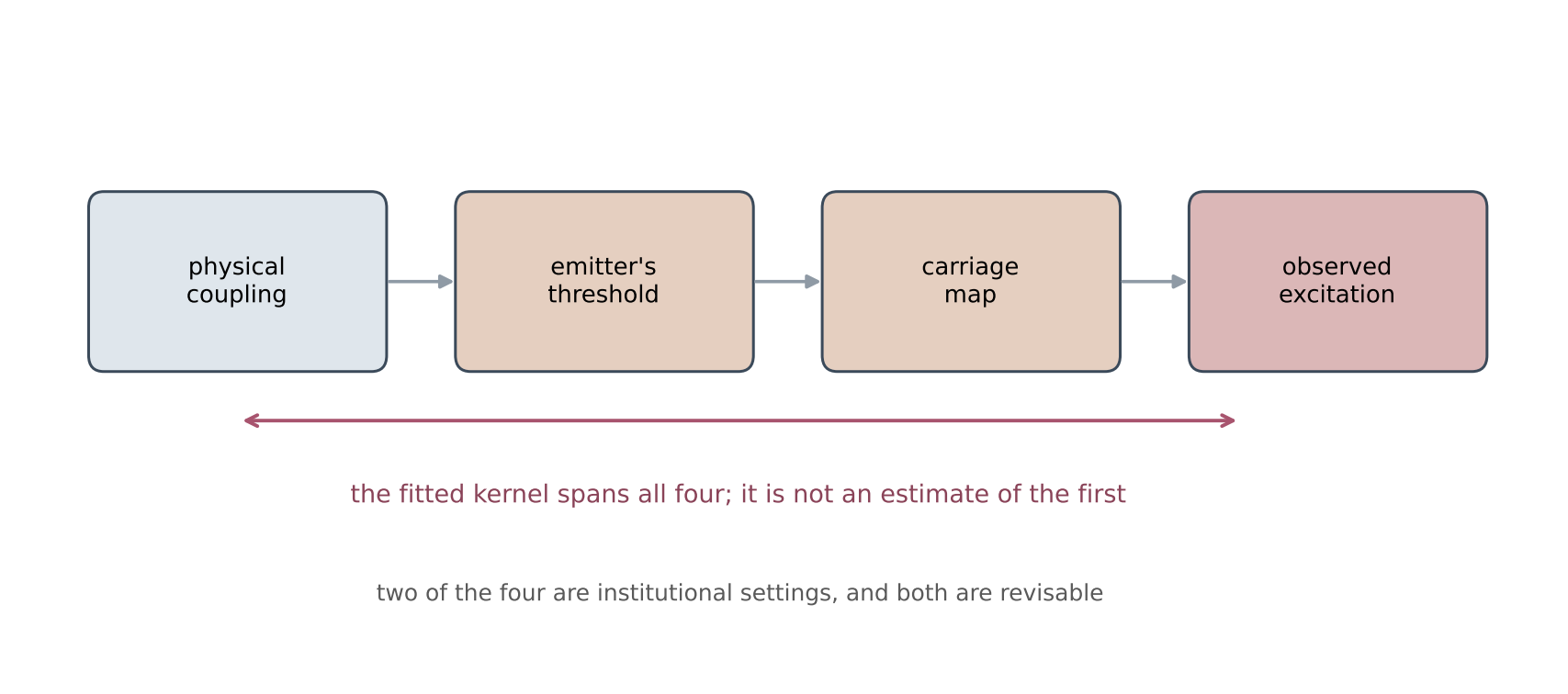
Figure 1. The chain that generates an observed excitation. Only the first element is a fact about the field; the second and third are institutional settings held in registers and carriage maps, and both are revisable. A fitted kernel spans the whole chain.
Claim ? follows, and three specific failures of the structural reading are worth stating because each has a governance consequence.
An apparent excitation without a coupling arises where carriage delivers $j$’s report to $i$ and $i$’s consequent inspection of its own subsystem finds something it would not otherwise have looked for. The stream records $j$ exciting $i$; the field contains no relation between them beyond the arrangement that connected them. This is a routing artefact, and it is more likely the broader the arrangement routes, so an arrangement that has widened its structural routing will find its fitted kernel densifying for reasons internal to the arrangement.
A coupling without an excitation arises wherever the second paper’s uncommunicated divergence obtains: the coupling propagates, the consequence registers, and no report is emitted because $i$’s threshold is high or its channel is not maintained. The fit records nothing, and an arrangement reading absence as absence of coupling has converted a reporting failure into a structural finding.
A drifting kernel without a changing field arises when a threshold is lowered or a carriage map extended. The excitation from $j$ to $i$ rises, the coupling is unchanged, and an arrangement monitoring its kernel for structural change will register the change as one.
The observed excitation matrix drifts with the arrangement’s own settings. A lowered threshold, a widened routing, or a restored channel each raises entries in the fitted kernel without any alteration of the field, and each is an act the arrangement itself performs. Consequently a kernel fitted across a window in which thresholds or carriage changed is fitted across two generating processes, and estimation is valid only where the settings were stable over the window or where their changes are retrievable and can be conditioned upon. The versioned registers required elsewhere in this series are therefore a precondition of this method and not an administrative convenience.
Claim ? converts a documentation requirement into a methodological one, and it has an uncomfortable corollary: most existing environmental reporting series were not accompanied by versioned records of the thresholds under which they were generated, so a kernel fitted to a historical stream is fitted across changes that cannot be identified.
2.4 The Valid Estimand
The negative result would be sterile without its complement, and the complement is stated exactly.
Under the condition that thresholds, carriage, and emission practice were stable over the fitting window, the fitted kernel is a valid estimate of the reporting-conditional propagation of the arrangement as configured: the rate at which reports from one party are followed by reports from another, given the arrangement’s settings. This is a property of the composition of field and arrangement, it is the quantity that governs what reports will arrive and when, and it is therefore the quantity an arrangement requires for routing, for attention allocation, and for anticipating load. It is not a property of the field, and it changes when the arrangement changes.
Claim ? is the paper’s positive result and it is deliberately modest. The estimate is of the arrangement in operation, and an arrangement’s own operation is a legitimate object of estimation, since it is what the arrangement can act on directly and what its own decisions alter. The error the paper warns against consists in reading the estimate as a discovery about the field, which would be a discovery the second paper of this series argues cannot be made from reports alone.
3. Uses, the Branching Ratio, and the Drift of the Forecast
3.1 The Division of Uses
Claims ? and ? divide the model’s uses cleanly, and the division is the paper’s practical content.
| p0.28 p0.15 p0.45
| Use | Status | Reason |
|---|---|---|
| Anticipating which parties will report next, and when | Valid | The estimand is reporting-conditional propagation, which is what determines arrivals |
| Anticipating load on a receiving party | Valid | Same estimand; load is a property of arrivals |
| Setting routing priority among candidate recipients | Valid, with caution | Uses the arrangement’s own structure; risks entrenching current carriage |
| Detecting a change in the stream’s cascade behaviour | Valid | The branching ratio is computable from the stream alone |
| Asserting that a coupling obtains | Invalid | Excitation may be produced by carriage and attention without a coupling |
| Denying that a coupling obtains | Invalid | Absence may be produced by a threshold, an unmaintained channel, or an unwitnessed coupling |
| Estimating a coupling’s strength or delay | Invalid | The kernel’s shape reflects registration and emission latencies as well as propagation |
| Monitoring the field for structural change | Invalid | The kernel drifts with the arrangement’s own settings |
Table. Uses of a fitted kernel, divided by whether the estimand supports them. The valid uses concern the arrangement in operation; the invalid ones concern the field.
The third row carries a caution worth drawing out. Using the fitted kernel to prioritise routing is valid on the estimand and creates a feedback: reports routed by the kernel generate excitations that the next fit records, so an arrangement that routes on its own fit reinforces its current carriage and progressively starves the structural routing that the routing paper of this series identifies as its only source of correction about couplings it does not represent. The recommendation that follows is determinate: an arrangement using the fit for routing priority should reserve a fixed share of its routing to structural delivery, and should not let that share be set by the fit.
3.2 The Branching Ratio
A quantity computable from the stream alone deserves separate treatment, because the criticality paper of this series argues that an arrangement needs network-level indicators and that no single party can compute them.
The branching ratio $n$ is the expected number of events each event directly triggers, given by the spectral radius of the branching matrix of Definition ?. Its consequence for cascade size is standard: the expected total number of events generated by one exogenous arrival, including that arrival, is $1/(1-n)$, which diverges as $n \to 1$. Figure 2 reports a simulation confirming this across the range of interest.
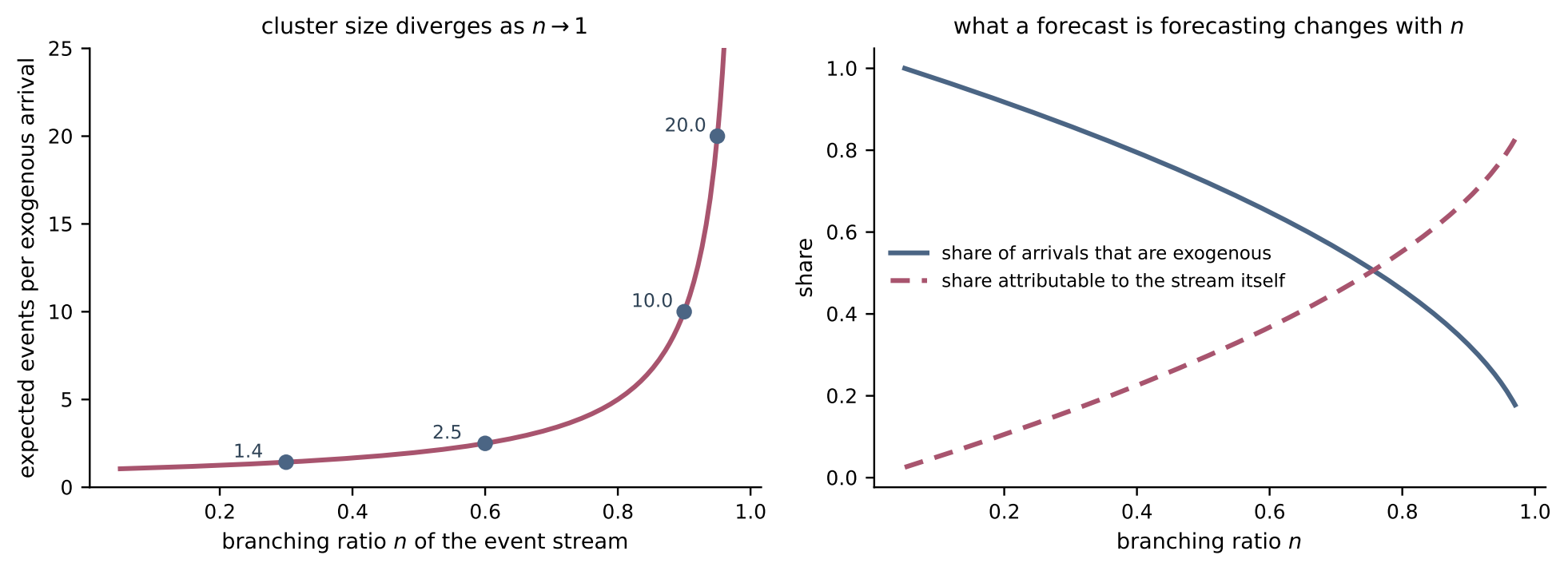
Figure 2. The branching ratio and what it governs. The left panel shows expected cluster size against branching ratio, with simulated means marked; twenty thousand simulated clusters per point track the theoretical value within two per cent across the range, and the ninety-ninth percentile of cluster size rises from five events at $n=0.3$ to over three hundred at $n=0.95$. The right panel shows the share of arrivals attributable to the stream’s own history rising with $n$, so that at $n=0.9$ roughly two thirds of activity is endogenous. Both panels are computed by the accompanying simulation.
The branching ratio of a governance event stream is a relational quantity computable by an arrangement and by no single party, and its rise is a candidate network-level indicator of the kind the criticality paper of this series requires. Its caveat follows from Claim ?: it measures the cascade in the reporting process, so a rise may reflect a field becoming more tightly coupled, an arrangement having widened its routing, or thresholds having been lowered, and the stream does not distinguish these. It is nonetheless informative under a stable configuration, where the settings have not changed and a rise is therefore attributable to the field or to the parties’ emission practice.
Two properties recommend it despite the caveat. It is computable from the stream alone, requiring none of the paired records that edge-level and network-level indicators otherwise demand, which the capacity paper of this series shows to be unevenly available. And its consequence is sharply nonlinear near unity, so a modest rise in $n$ produces a large rise in the tail of cluster size, which is exactly the property that makes an indicator worth watching: at $n = 0.9$ the simulation puts the ninety-ninth percentile of cluster size at over a hundred events, and at $n = 0.95$ at over three hundred.
3.3 The Drift of the Forecast’s Referent
The right panel of Figure 2 states a consequence that is easy to miss. As $n$ rises, the share of activity attributable to the stream’s own history rises with it, and at $n = 0.9$ roughly two thirds of arrivals are endogenous.
The interpretation of a forecast changes with the branching ratio. At low $n$ a forecast of the stream is largely a forecast of exogenous arrivals, which is to say of the field. At high $n$ it is largely a forecast of the stream’s own propagation, which is to say of the arrangement’s response to what it has already reported. An arrangement reading its forecasts as statements about the field will therefore be increasingly wrong about what it is reading as its own reporting becomes more reactive, and the error is invisible in the forecast’s accuracy, which may be high precisely because endogenous propagation is the more predictable component.
Claim ? is the paper’s second warning and the more subtle of the two, since accuracy is the usual test of a forecast and accuracy improves in the regime where the interpretation degrades. An arrangement should therefore report the endogenous share alongside any forecast, which is computable from the same fit and costs nothing.
3.4 The Connection to the Near-Critical Regime
Two relations to the paper on governing near criticality are stated, one supporting and one cautionary.
The supporting relation is that a rising branching ratio under a stable configuration is an indicator that does not depend on estimating a recovery rate, and therefore does not inherit the estimation bias that paper establishes. It is computed from event counts and their timing, and its own estimation difficulties, treated in §8, are of a different kind.
The cautionary relation is that the near-critical regime degrades this method as it degrades others, by a route specific to it. Near a threshold an arrangement is likely to be adjusting its own settings, lowering thresholds and widening carriage in response to concern, and Claim ? establishes that a kernel fitted across such adjustments is fitted across two processes. The period in which the indicator would be most valuable is therefore the period in which the configuration is least stable, which is a version of the triple bind arriving in a new place and is recorded as such.
4. Prior Treatments of Excitation and Cascade
Six literatures own parts of the position.
4.1 Self-Exciting Point Processes
Hawkes introduced the self-exciting process and its mutually exciting multivariate form, with the spectral condition for stationarity (Hawkes, 1971; Hawkes, 1971), and the cluster representation established the equivalence to a branching structure in which each event generates offspring (Hawkes & Oakes, 1974). The subsequent literature developed estimation, non-parametric kernel recovery, goodness-of-fit through the time-rescaling theorem, and the treatment of marks (Ogata, 1978; Daley & Vere-Jones, 2003; Bacry et al., 2015).
This literature owns the model of Definition ? entire, the branching-ratio result of §6, and the estimation apparatus. The paper contributes nothing to it and its simulation confirms a textbook consequence. The literature does not supply, because its applications ordinarily observe the process directly, an analysis of what the fitted kernel estimates when the observation of the process is itself institutionally mediated, which is Claim ?.
4.2 Seismology and the Epidemic-Type Model
The epidemic-type aftershock sequence model applies the self-exciting form to earthquake catalogues, with magnitude-dependent productivity and an established kernel form, and is the most developed applied use of the machinery (Ogata, 1988; Ogata, 1998). Its literature has confronted the difficulty most relevant here: catalogue incompleteness after large events, where detection thresholds rise transiently because the instruments are saturated, biases estimated parameters, and a substantial methodological literature addresses the correction (Helmstetter et al., 2006; Hainzl, 2016).
The concession is important and the parallel is close. Seismology discovered that a detection threshold varying over time corrupts the fit, and developed methods to estimate and condition on the varying completeness. That is the same difficulty as Claim ?, arrived at empirically in a domain where the threshold’s variation is a property of instruments and not of institutions. Two differences bear. Seismic completeness varies as a physical consequence of the events themselves and can be estimated from the catalogue’s own magnitude distribution, where a governance threshold varies by institutional decision and leaves no such signature. And the seismic catalogue is a record of events in the field, where a governance stream is a record of reports, so the mediation runs through parties with interests and not only through instruments.
4.3 Excitation Models in Social and Financial Systems
The machinery has been applied widely to systems whose events are human actions: financial order flow and market activity, where the branching ratio has been estimated and its proximity to unity debated (Filimonov & Sornette, 2012; Hardiman et al., 2013), and social media cascades, where endogenous and exogenous activity have been distinguished (Crane & Sornette, 2008; Zhao et al., 2015).
Two contributions from this literature are used. The finance literature’s estimation of the branching ratio, and its argument that a high estimated ratio indicates activity largely generated by the market’s own dynamics, is the direct ancestor of Claim ?. And its methodological controversy is directly relevant: estimates of the branching ratio near unity are sensitive to kernel specification and to non-stationarity, and the debate over whether high estimates reflect genuine reflexivity or unmodelled exogenous variation is unresolved. The present paper’s Claim ? inherits that unresolved question and states it as an open one.
4.4 Cascades on Networks
A distinct literature models cascades on interdependent networks, establishing that failure propagates between coupled layers and that the resulting fragility exceeds that of comparable single networks (Buldyrev et al., 2010), and developing threshold and percolation models of cascade extent (Watts, 2002; Brummitt et al., 2012).
This literature owns the analysis of cascade in the physical structure, and the relation to the present paper is exactly the one Claim ? draws: these models concern propagation through couplings, and the excitation fitted here concerns propagation through reporting. The two would coincide only in an arrangement whose thresholds were uniform, whose carriage was complete, and whose parties emitted without discretion, which is not a condition any field of this series satisfies.
4.5 Infrastructure Interdependency Simulation
Interdependency modelling of critical infrastructures simulates propagation across coupled systems using physical models, agent-based representations, or input-output formulations (Rinaldi et al., 2001; Ouyang, 2014; Haimes et al., 2005). These are the tools an arrangement would use where it holds a model of the field.
The residue is the condition under which they apply. These methods require a model of the coupled systems, calibrated to their physics or economics, and the second paper of this series argues that no party of an environmental field holds one across its domains. The excitation approach is attractive precisely because it requires no such model, and the present paper’s argument is that the price of requiring no model is that the estimate is not of the modelled thing.
4.6 Identification of Causal Structure from Observational Streams
A methodological literature addresses the recovery of causal structure from observed dependence, establishing what is and is not identifiable from observational data, the role of interventions, and the conditions under which latent common causes defeat identification (Pearl, 2009; Eichler, 2013). Work on Granger causality and its point-process analogues addresses precisely the question whether one series’ history improves prediction of another’s (Granger, 1969; Kim et al., 2011).
This literature owns the general form of Claim ?, and the concession is unreserved: that predictive dependence does not establish causal structure in the presence of confounding is its central and long-established teaching. The paper’s addition is the identification of the specific confounders in this setting, which are institutional and enumerable, and the observation that two of them are settings the arrangement itself controls, so the arrangement is not merely subject to confounding but is one of the confounders.
4.7 Residue of the Survey
Consider a stream of reports emitted by parties with discretion, under thresholds each party sets against its own record, carried by an arrangement whose map is incomplete and whose breadth is a governed parameter, and observed only through those reports. The claims that an excitation kernel fitted to such a stream estimates the composition of field and arrangement and cannot be decomposed; that the arrangement’s own settings are among the confounders, so the kernel drifts when the arrangement acts; that valid estimation therefore presupposes versioned registers of thresholds and carriage; that the fit remains valid for the operational uses that concern arrivals and not couplings; and that the branching ratio is a network-level indicator computable without paired records, whose interpretation changes with its own value, are advanced by none of the surveyed literatures. Point-process theory owns the model and the branching result; seismology owns the varying-completeness problem for physically mediated detection; the social and financial applications own branching-ratio estimation and the reflexivity debate; network cascade models own propagation through couplings; infrastructure simulation owns model-based propagation; and causal identification owns the general impossibility. The composition is the residue claimed.
5. Objections and the Limits of the Position
5.1 The Objection from Triviality
Claim ? may be met with the response that it restates a commonplace: correlation does not establish causation, confounding defeats identification, and no competent analyst would read a fitted kernel as a physical structure.
The paper accepts that the general principle is elementary and argues that its specific form here is not, in three respects. The confounders are enumerable, and enumerating them is what converts a general caution into a design requirement; Claim ? follows from the enumeration and would not follow from the general principle. Two of the confounders are under the analyst’s own institution’s control, which is an unusual situation: the arrangement fitting the model is among the causes of what it fits, so the usual remedy of controlling for confounders requires the arrangement to record its own past decisions, which it will not have done unless required to. And the direction of the failure is asymmetric in a governance-relevant way: the absence of an excitation is more likely to be produced by institutional causes than its presence is, since an unwitnessed coupling and an unmaintained channel both produce silence, so an arrangement reading the kernel structurally will systematically under-count couplings, which is the same direction as the errors identified elsewhere in this series.
5.2 The Objection from the Branching Ratio’s Estimation
Claim ? recommends the branching ratio as an indicator, and the finance literature’s controversy establishes that estimates near unity are sensitive to kernel specification and confounded by non-stationarity in the exogenous rate. The objection is that the recommended indicator is the one the applied literature has found hardest to estimate reliably.
The paper concedes the difficulty and narrows the recommendation. The recommendation is not a point estimate of $n$ and is the monitoring of its change under a stable configuration, which is less demanding: an estimate biased by a mis-specified kernel is biased similarly across successive windows, so a rise is informative where a level is not. The narrowing has a cost the paper states: a slow drift in the exogenous rate produces the same signature as a rise in endogeneity, and distinguishing them requires exactly the independent knowledge of the field that the arrangement lacks.
5.3 The Objection from the Marks
The model of Definition ? admits marks, and an arrangement’s events carry rich ones: class, unusualness, confidence, hypotheses. The objection is that the paper has treated the stream as if it were bare timings, and that the marks contain exactly the information that might decompose the confound, since an event’s hypotheses name the couplings its emitter believes it bears on.
This is the strongest constructive objection and the paper regards it as partly right. Hypotheses are conjectures, marked as such, and their accumulation is the mechanism by which the architecture builds a record of candidate couplings; a fit conditioning on them would be estimating something closer to a coupling structure than a bare fit does. This falls short of resolving the confound because hypotheses are supplied by emitters, so a fit conditioned on them inherits the emitters’ epistemic structures, which is the limitation the routing paper identifies in declared routing. The paper’s position is that marks improve the fit and do not change its estimand, and §9 records the question of how much they improve it.
5.4 The Objection from Utility
If the fit cannot be read structurally, and its valid uses concern the arrangement’s own operation, the objection is that the method tells an arrangement about itself and contributes nothing about the field it governs.
The answer is that the arrangement’s own operation is a legitimate and neglected object. An arrangement that can anticipate its own load, that can detect a change in its own cascade behaviour, and that can report the endogenous share of its activity is better governed than one that cannot, and the supervisory paper of this series identifies exactly these as objects a review function should assess. The concession is that the paper offers no route from the stream to the field, and that an arrangement wanting the field must observe it, which is the burden the capacity paper of this series analyses.
5.5 Limits Internal to the Position
Four limits are recorded. The paper reports no fit to any real stream, since no arrangement of the kind this series describes exists, so every claim about what a fit would estimate is analytical. The stability condition under which Claim ? holds is stated and not operationalised, so the paper does not say how much drift in thresholds or carriage defeats an estimate. The treatment assumes the stream is fully observed by the arrangement, which is false where events are carried to some parties and not others, so an arrangement holding a partial stream fits a further-mediated object the paper has not analysed. And the branching ratio’s caveat, that a rise may reflect the field or the arrangement, has no resolution within the method, which is the same structure as the confound and is not separately remediable.
6. Questions Left Open for the Programme
6.1 Questions Concerning Estimation
Operationalising the stability condition. Claim ? holds where thresholds, carriage, and emission practice were stable over the fitting window. An answer would state how much change defeats an estimate, would supply a diagnostic computable from the versioned registers, and would establish whether a fit can be corrected for a recorded change or only invalidated by it.
Transfer of the seismological corrections. Seismology corrects for time-varying detection completeness using the catalogue’s own magnitude distribution. An answer would establish whether an analogous internal signature exists in a governance stream, candidate sources being the distribution of reported unusualness and the heartbeat record, and would state what correction is available where none does.
The contribution of marks. §8 concedes that conditioning on hypotheses, class, and unusualness improves the fit without changing its estimand. An answer would quantify the improvement and establish whether any conditioning set available from the stream identifies the coupling factor, which the paper doubts and has not shown impossible.
Partial observation of the stream. An arrangement may hold only the events carried to it. An answer would characterise what a fit to a partial stream estimates, and would state whether the partiality is correctable from the carriage map, which the arrangement holds.
6.2 Questions Concerning the Branching Ratio
Distinguishing a rising ratio from a drifting exogenous rate. These produce the same signature and the arrangement lacks the independent knowledge to separate them. An answer would state what additional observation separates them, candidate sources being capability-change events, which report alterations in observation, and comparison across arrangements in similar fields.
Calibration as an indicator. An answer would state what magnitude and duration of rise in the branching ratio should trigger which grade in the detection arrangement, and would connect this to that paper’s requirement that grade definitions be public and versioned.
Relation to the physical cascade. An answer would establish under what conditions, if any, the reporting cascade’s branching ratio bounds or informs the physical cascade’s, which is the question the network-cascade literature would have to be joined to this one to answer.
6.3 Questions Concerning Use
The reserved share for structural routing. §6 recommends that an arrangement routing on its own fit reserve a fixed share to structural delivery. An answer would state the share, and would establish whether it should vary with the fit’s own density, since a densifying kernel is evidence either of learning or of self-reinforcement.
Reporting the endogenous share. An answer would establish how the endogenous share should be presented alongside a forecast so that a recipient reads the forecast correctly, and would confront the finding that forecast accuracy rises in the regime where interpretation degrades.
Use in supervisory assessment. The supervisory paper of this series requires a review function assessing an arrangement’s adequacy. An answer would state which properties of a fitted kernel are usable in that assessment, since the kernel’s drift with the arrangement’s settings makes it a record of the arrangement’s own conduct as well as a forecast instrument.
Behaviour under the near-critical regime. §6 observes that an arrangement near a threshold is likely to be adjusting its own settings, which is when the estimate is least valid. An answer would state what may be salvaged in that period, and whether a configuration frozen deliberately for the purpose of preserving estimability is a defensible arrangement or an abdication.
7. Declinations and Limits of the Position
The paper establishes no result in point-process theory. The model, the cluster representation, and the branching result belong to that literature, and the simulation confirms a textbook consequence.
The paper reports no fit to any real event stream. No arrangement of the kind this series describes exists, and every claim about what a fit would estimate is analytical.
The paper claims no novelty in the general proposition that predictive dependence does not establish causal structure, which is conceded to the causal identification literature, nor in the varying-completeness problem, which seismology addressed first in its own setting.
The paper proposes no estimator, no kernel specification, and no software. It states an estimand, the conditions under which the estimand is what an arrangement wants, and the registers a valid estimate presupposes.
References
Bacry, E., Mastromatteo, I., and Muzy, J.-F. (2015). Hawkes processes in finance. Market Microstructure and Liquidity, 1(1), 1550005.
Brummitt, C. D., D’Souza, R. M., and Leicht, E. A. (2012). Suppressing cascades of load in interdependent networks. Proceedings of the National Academy of Sciences, 109(12), E680–E689.
Buldyrev, S. V., Parshani, R., Paul, G., Stanley, H. E., and Havlin, S. (2010). Catastrophic cascade of failures in interdependent networks. Nature, 464, 1025–1028.
Crane, R. and Sornette, D. (2008). Robust dynamic classes revealed by measuring the response function of a social system. Proceedings of the National Academy of Sciences, 105(41), 15649–15653.
Daley, D. J. and Vere-Jones, D. (2003). An Introduction to the Theory of Point Processes, Volume I: Elementary Theory and Methods, 2nd edn. Springer, New York. doi:10.1007/b97277. (Volume II: General Theory and Structure, 2008.)
Eichler, M. (2013). Causal inference with multiple time series: principles and problems. Philosophical Transactions of the Royal Society A, 371, 20110613.
Filimonov, V. and Sornette, D. (2012). Quantifying reflexivity in financial markets: toward a prediction of flash crashes. Physical Review E, 85(5), 056108.
Granger, C. W. J. (1969). Investigating causal relations by econometric models and cross-spectral methods. Econometrica, 37(3), 424–438.
Haimes, Y. Y., Horowitz, B. M., Lambert, J. H., et al. (2005). Inoperability input-output model for interdependent infrastructure sectors. I: Theory and methodology. Journal of Infrastructure Systems, 11(2), 67–79.
Hainzl, S. (2016). Rate-dependent incompleteness of earthquake catalogs. Seismological Research Letters, 87(2A), 337–344.
Hardiman, S. J., Bercot, N., and Bouchaud, J.-P. (2013). Critical reflexivity in financial markets: a Hawkes process analysis. The European Physical Journal B, 86, 442.
Hawkes, A. G. (1971). Spectra of some self-exciting and mutually exciting point processes. Biometrika, 58(1), 83–90.
Hawkes, A. G. (1971). Point spectra of some mutually exciting point processes. Journal of the Royal Statistical Society B, 33(3), 438–443.
Hawkes, A. G. and Oakes, D. (1974). A cluster process representation of a self-exciting process. Journal of Applied Probability, 11(3), 493–503.
Helmstetter, A., Kagan, Y. Y., and Jackson, D. D. (2006). Comparison of short-term and time-independent earthquake forecast models for southern California. Bulletin of the Seismological Society of America, 96(1), 90–106.
Kim, S., Putrino, D., Ghosh, S., and Brown, E. N. (2011). A Granger causality measure for point process models of ensemble neural spiking activity. PLoS Computational Biology, 7(3), e1001110.
Ogata, Y. (1978). The asymptotic behaviour of maximum likelihood estimators for stationary point processes. Annals of the Institute of Statistical Mathematics, 30, 243–261.
Ogata, Y. (1988). Statistical models for earthquake occurrences and residual analysis for point processes. Journal of the American Statistical Association, 83(401), 9–27.
Ogata, Y. (1998). Space-time point-process models for earthquake occurrences. Annals of the Institute of Statistical Mathematics, 50, 379–402.
Ouyang, M. (2014). Review on modeling and simulation of interdependent critical infrastructure systems. Reliability Engineering and System Safety, 121, 43–60.
Pearl, J. (2009). Causality: Models, Reasoning, and Inference, 2nd edn. Cambridge University Press.
Rinaldi, S. M., Peerenboom, J. P., and Kelly, T. K. (2001). Identifying, understanding, and analyzing critical infrastructure interdependencies. IEEE Control Systems Magazine, 21(6), 11–25.
Watts, D. J. (2002). A simple model of global cascades on random networks. Proceedings of the National Academy of Sciences, 99(9), 5766–5771.
Zhao, Q., Erdogdu, M. A., He, H. Y., Rajaraman, A., and Leskovec, J. (2015). SEISMIC: a self-exciting point process model for predicting tweet popularity. Proceedings of KDD 2015, 1513–1522. thebibliography