Generative Condition Governance for Environmental Change - Conditions of Generation in Interdependent Earth–Human Systems
Abstract
Environmental governance addresses a field that no governing party can represent, predict, or command, and in which every governing party is itself a member. Under this condition the two classical objects of governance both fail: governing outcomes presupposes a causal model adequate to steer the system, and governing target states presupposes in addition a representation of the state space shared across parties that describe the field in incommensurable languages. This paper proposes a third object. This paper proposes a third object, the set of conditions under which trajectories are generated, and develops it as a position: generative condition governance. The method is conceptual and definitional, and the paper reports no empirical study. Conditions are defined relationally, over the topology of couplings, the distribution of access and information, buffers, permissions, and institutional rules, and the generative structure of a field is stated as a one-to-many map from conditions to admissible trajectory bundles. Three insights follow. The relational definition permits coordinated action among parties holding no common ontology of states, since a coupling can be recognised from either side of it. The one-to-many map reduces the governor’s epistemic burden from predicting a trajectory to characterising an admissible set. And power relations are themselves elements of the condition set, so the position cannot treat conditions as politically neutral and must answer the objection that condition governance is power exercised at one remove. The paper’s contribution is to state the object exactly, to distinguish it from the traditions that own adjacent claims, principally ordoliberal framework doctrine, constitutional political economy, mechanism design, the cultivation arguments of the epistemic tradition, capability theory, and platform generativity, and to fix the layered architecture and the open questions of a research programme built on this object. Its role in that programme is foundational: it argues for a research direction, and establishes no result.
Keywords: generative condition governance; environmental governance; epistemic limitation; irreversible foreclosure; relational conditions
Notices
On the references. All 37 works cited in this paper have been checked against their sources at claim level: each source was consulted and confirmed to state what the citing sentence attributes to it. No entry in this paper’s bibliography is unverified.
Status. This is a working draft circulated for discussion. It is a preliminary discussion paper and is not a finished statement of its author’s position. Sections and statement numbers are subject to change.
Licence. This work is made available under a Creative Commons Attribution-NonCommercial 4.0 International Licence (CC BY-NC 4.0).
Statement on the use of language models. Drafting, literature search and argumentative criticism for this paper were conducted in dialogue with large language models, specifically Claude (Anthropic) and ChatGPT (OpenAI). The claims, the structure, the selection of material and the position taken are the author’s. References have been checked in stages, to two standards, and the process is incomplete. Part of the corpus has been verified at identity level, meaning author, title and publication coordinates were confirmed against the publisher of record. A smaller part has additionally been verified at claim level, meaning the cited source was consulted and confirmed to state what the citing sentence attributes to it. The remainder is unverified at either standard. The standard reached is marked on each bibliography entry: no mark for claim level, $\ddagger$ for identity level only, $\dagger$ for not yet verified. Corrections made so far are recorded in the project’s citation-verification file; where a source proved not to bear the weight the text placed on it, the text was revised rather than the citation removed.
Companion papers. This paper is Paper 1 of a series on the governance of environmental change, and treats the object of governance: the relational conditions under which trajectories are generated, and the burden attaching to their irreversible foreclosure. The other papers of the series treat, in order: the field and its three structures; coordination through change; heterogeneous knowledge; the event layer; criticality detection; observational capacity; representational requirements; routing and inquiry; the regime near a threshold; forecasting from the stream; the knowledge commons; attribution and ownership; responsibility at transitions; and supervisory duties. Paper 12 is reserved and is not yet drafted. A related paper by the author, developed independently of this series, treats the temporal correspondence limitation of evidence-based policy making, being the divergence between the system state that evidence represents and the system state at the moment of decision. Its results on the partition of a state space into estimable and unobservable components, on the blindness of a recency-weighted evidence base to the approach to criticality, and on the allocation of a justificatory burden where temporal correspondence fails, were reached by a different route and bear on several papers of this series.
Suggested citation. Huang, W. Generative Condition Governance for Environmental Change: Conditions of Generation in Interdependent Earth–Human Systems. Working draft.
Discussion Paper Note
This paper is a preliminary discussion paper intended to share an evolving idea and invite further dialogue, criticism, revision, and independent development.
The author does not claim exclusive epistemic ownership over the viewpoints, concepts, or lines of reasoning presented here, nor does the author claim priority as their first originator. Similar or related ideas may have appeared previously in other intellectual, cultural, or disciplinary traditions. Any legal rights retained in this work are intended to support attribution, responsible use, and protection against exploitative or harmful appropriation, and not to restrict independent inquiry, criticism, revision, or further development.
The arguments in this paper should therefore be understood as provisional and historically situated rather than definitive. Readers are encouraged to question, revise, extend, reinterpret, or independently develop the ideas presented here. Where appropriate, acknowledgment of this paper as one point of encounter in the development of related ideas is appreciated, but such acknowledgment should not be understood as granting the author epistemic ownership over the ideas themselves.
Responsible Use and Rights Reservation
The author encourages good-faith discussion, criticism, independent development, and responsible use of the knowledge presented in this work. The author does not claim exclusive epistemic ownership over the ideas or viewpoints discussed herein, nor claim priority as their first originator.
However, the author expressly reserves all rights and remedies available under applicable law with respect to uses of this work or related materials that involve unlawful conduct, harmful or abusive exploitation, improper commercial appropriation, infringement of applicable intellectual property or other legal rights, or conduct contrary to applicable national, regional, or international law.
This reservation is intended to preserve the ability to respond to misuse and harmful appropriation. It should not be interpreted as restricting legitimate academic inquiry, criticism, independent reasoning, or the further development of related ideas.
1. Introduction
Environmental governance addresses a field that no governing party can represent, predict, or command. The atmosphere, oceans, ecosystems, and the human infrastructures coupled to them form one interdependent system; every governor is a member of the system it would govern; and the knowledge any party holds of the field is partial in principle, since the field exceeds every situated observer. Under these conditions the two classical objects of governance both fail. Governance of outcomes presupposes a causal model adequate to steer the system toward a chosen state, and no party holds one. Governance of states, the prescription of a target configuration $x^{*}$, presupposes in addition a shared representation of the state space across heterogeneous parties, and the parties describe the field in languages that do not translate into a common ontology.
This paper proposes a third object. The object that remains governable, where trajectories are not, is the set of conditions under which trajectories are generated: the couplings among subsystems, the distribution of access and information, the buffers and reserves that absorb perturbation, the permissions that open or close courses of action, and the institutional rules under which parties interact. A migration corridor is a condition; the herd’s population trajectory is what the condition generates. Provenance and openness rules are conditions; the knowledge a commons produces is what they generate. The claim, stated at full strength:
In interdependent Earth–human systems under severe epistemic and operational limitation, the primary object of governance is the relational conditions of generation. Governance of outcomes and governance of target states are treated as special cases, admissible where a party’s epistemic reach locally suffices, and unavailable for the system taken as a whole.
The position is normative and architectural at once. Normatively it relocates responsibility: a party is answerable for the conditions it maintains and alters, and this answerability survives the failure of outcome attribution that distributed nonlinear systems produce. Architecturally it selects the instruments: a governance of conditions requires primitives that sense and coordinate change across heterogeneous parties, and §5 states these as the differential and event-based layers the accompanying programme develops.
The general form of the position, that governance should set framework conditions and decline to steer processes, is old and owned. The Freiburg School’s distinction between Ordnungspolitik and Prozesspolitik states it for the market order (Eucken, 1952; Schnellenbach, 2023); constitutional political economy states it as the choice of constraints against choices within constraints (Brennan & Buchanan, 1985); mechanism design formalizes it as the design of rules under which desired behaviour is an equilibrium (Hurwicz, 1973; Maskin, 2008); Hayek (Hayek, 1945; Hayek, 1973) grounds it in the dispersal of knowledge and reaches for the gardener’s vocabulary of cultivation; and the recent environmental literature has carried the ordoliberal form directly into climate politics under the name of green ordoliberalism (Callison, 2024). In the digital domain, Zittrain (Zittrain, 2006) made the generative capacity of a system the object of policy concern, and the platform literature has generalized the concept (Thomas & Tee, 2022). Capability theory (Sen, 1999) governs conditions for functionings; Foucault (Foucault, 2007) described security apparatuses that govern through the milieu; adaptive and experimentalist governance (Folke et al., 2005; Sabel & Zeitlin, 2012) govern through framework goals, local discretion, and recursive revision. §6 concedes each of these claims in the precise form its owner states, together with the prior work of this programme, whose criterion of irreversible foreclosure (Huang, 2026) the present position imports whole.
Three commitments survive the concessions, and no surveyed tradition holds them together; §6 argues that each existing tradition rejects at least one of them.
- The object. The conditions cultivated are conditions of generativity, the capacity of heterogeneous trajectories to continue producing possibilities, in a coupled Earth–human field whose members include non-speaking trajectories and the governor itself. The ordoliberal object is the competitive market order; the mechanism-design object is an outcome function chosen in advance; the platform object is technological innovation. None extends to a field the governor belongs to and cannot exit.
- The normative core. The cultivation is bound to plurality and revisability: conditions are governed for plural, revisable generation, and not toward an outcome the governor has chosen, and the sole trigger licensing constraint is the irreversible-foreclosure criterion of Huang (Huang, 2026), which allocates a dischargeable burden of justification and ranks no claims. This is what separates the position from every doctrine in which framework-setting serves a substantive end held by the framework-setter, and §7 argues it is also the answer to the objection that condition governance is manipulation at one remove.
- The primitives. The position is coupled to an operational layer, differential coordination and event-based signalling among parties that share no state ontology, which the framework doctrines lack and which the companion papers of this series develop. A condition governance without these primitives cannot observe the conditions it governs.
The paper is a position paper. It argues for a research programme by stating its central concept, conceding the prior art, and listing the questions that remain open, and it establishes no result. §5 defines conditions, states the principle, and gives the two canonical examples. §6 is the concession section. §7 states and answers the manipulation objection. §8 lists the open questions the programme must answer, several of which are known to be hard. §9 states what the position declines to claim.
2. The Concept and Its Governing Principle
2.1 Relational Definition of the Condition Set
Let the governed field comprise heterogeneous subsystems $i = 1,\dots,n$ with trajectories $\tau_i$, coupled by relations $R_{ij}$. A condition is any element of the configuration that shapes which trajectories can be generated without prescribing which trajectory is realized.
The condition set of a field at time $t$ is
$$C_t ;=; {,&\text{couplings } R_{ij};\ \text{access and information distribution};\
&\text{buffers and reserves};\ \text{permissions};\ \text{institutional rules},},$$
and the field’s generative structure is the map $C_t \mapsto \mathcal{T}(C_t)$, the set of trajectory bundles the conditions admit. Governance of conditions is deliberate alteration or preservation of elements of $C_t$, undertaken without selecting an element of $\mathcal{T}(C_t)$.
Three features of Definition ? carry the position. First, conditions are relational: a corridor is a coupling between habitat patches, a disclosure rule is a relation between knowers, a buffer is a relation between a system and its perturbations. A condition is a property of a relation and not of a node taken alone, which is the feature that permits heterogeneous parties to act on conditions they describe in different languages. Second, the map $C_t \mapsto \mathcal{T}(C_t)$ is one-to-many: conditions admit bundles of trajectories, and which member of the bundle is realized falls to the field’s own dynamics. The governor’s epistemic burden is thereby reduced from predicting a trajectory to characterizing an admissible set, and this reduction is what makes the object governable under the limitation §4 states. Third, power relations are themselves elements of $C_t$: the distribution of access, information, and permission is a condition among conditions, so the position cannot treat conditions as politically neutral, and §7 takes the consequence seriously.
2.2 Statement of the Governing Principle
Preserve and cultivate conditions for viable, plural, and revisable generation; constrain those conditions, and only those, that amplify irreversible foreclosure of the generative capacity of other trajectories. The trigger for constraint is the criterion of Huang (Huang, 2026): where a course available to a party would irreversibly foreclose the capacity of a trajectory other than the party’s own to continue generating, the burden of justification lies with the party adopting the course; below that threshold, claims on the condition set remain plural and fall to ordinary political settlement.
The principle has a positive and a negative face, and the asymmetry between them is deliberate. The positive face, cultivation, is permissive and plural: many condition sets are viable, and the principle ranks none of them. The negative face is narrow and triggered: constraint attaches to a determinate structural property, irreversible foreclosure, and its consequence is a dischargeable burden and not a bar. Both features are inherited from that criterion with their derivations, and the present paper adds no second trigger. In particular the principle contains no maximand: it does not maximize generativity, diversity, option value, or any quantity over $\mathcal{T}(C_t)$, for the reason that any such quantity aggregates, and aggregation permits the substitution of one trajectory’s foreclosure for another’s enlargement.
2.3 Ecological and Epistemic Instances
The corridor. A development corridor would sever a migration corridor. Trajectory governance asks what the herd’s population will do and cannot answer; state governance prescribes a population target and cannot enforce it. Condition governance governs the coupling: connectivity, water access, the severance itself. Whether the herd flourishes falls to the field; whether the field retains the condition under which flourishing is possible falls to the governor, and the severance, an irreversible foreclosure of a condition, is exactly what Principle ? places under burden.
The commons. A knowledge commons for environmental observation cannot govern what knowledge its participants will generate. It governs conditions: openness gradients, provenance preservation, attribution rules, access permissions. The knowledge emerges; the conditions are maintained. Enclosure of a commons-generated resource behind an exclusive gate is the corridor severance of the epistemic field, and falls under the same burden.
The two examples are chosen from the opposite ends of the field, one ecological and one epistemic, because the position’s claim to generality rests on the same structure appearing in both: a relational condition, a generated bundle, a foreclosure that is the condition’s destruction.
2.4 The Revisability of the Principle Itself
A principle requiring that conditions be governed so that they remain revisable is subject to its own requirement. The point is not rhetorical. A framework that demanded revisability of the arrangements it governs while presenting itself as settled would hold, at its centre, a condition exempt from the treatment it prescribes for every other, and the exemption would be unmotivated: the epistemic premise from which the principle is derived, that the field exceeds every situated representation of it, applies to the party formulating the principle as much as to any party the principle addresses.
The commitment is therefore stated explicitly and its content specified, since a general profession of fallibility commits to nothing.
Principle ? is advanced as revisable, and three components of it are identified as the ones a subsequent formulation is most likely to alter: the trigger, which selects irreversible foreclosure and might be replaced by a condition that is easier to establish or that captures a class this one misses; the scope of the plurality commitment, which withholds all ranking and might be narrowed to admit rankings within classes of trajectory; and the individuation of conditions, which the paper leaves relative to a party and a horizon. A revision of any of the three is a revision of the principle and not an application of it, and this paper claims no authority to determine which of them a subsequent formulation should keep.
Three consequences follow from stating the commitment in this form.
The first concerns how the principle should be read where it and a considered judgement conflict. A principle held revisable is evidence about the case and not a determination of it, and a case in which the principle yields a verdict its author would reject on reflection is a datum about the principle. This is a weaker status than normative principles are ordinarily accorded, and it is the status the framework’s own epistemic premise supports.
The second concerns the standing of the parties the principle addresses. A governor invoking a revisable principle cannot appeal to it as settled ground against a party that contests it, since the contestation may be the occasion of the revision, and this consequence is not incidental. The objection treated in §7 is that condition governance offers nothing determinate to contest; a principle explicitly identifying the three components at which it is most likely to be wrong supplies determinate points of attack, and the identification is therefore part of the answer.
The third concerns what revisability does not license. A principle open to revision is not thereby open to suspension in a particular case, and the distinction matters because the two are easily conflated by a party under burden. Revision alters the principle for all cases going forward and is undertaken in the open, on stated grounds, and is itself assessable; suspension leaves the principle in force and exempts one occasion from it, which is the structure of the exception and not of the revision. An arrangement that permits the second under the description of the first has substituted a discretion for a rule.
2.5 Layered Architecture of the Programme
Figure 1 sets out the architecture the concept organises. The concept is its apex, and the position paper states the layers so the programme’s remaining papers have their places fixed. The operational layer answers how conditions and their changes are observed among parties sharing no common ontology: differential coordination, which governs and communicates changes $\dot{x}$ and $\Delta R_{ij}$; event-based signalling, which discretizes consequential change into sparse asynchronous events; and criticality detection, which monitors when the field approaches configurations in which small alterations of conditions produce large irreversible reconfigurations. The normative layer answers when alteration of conditions is permitted: the burden criterion, supervisory duties over the health of generative processes, and commons obligations. The four elementary operations on conditions are those identified in the prior governance work of this programme: enable, constrain, prevent, and leave open, the last being an active operation and not an absence of governance. Each layer is a paper of the accompanying series; the present paper fixes only the object they share.
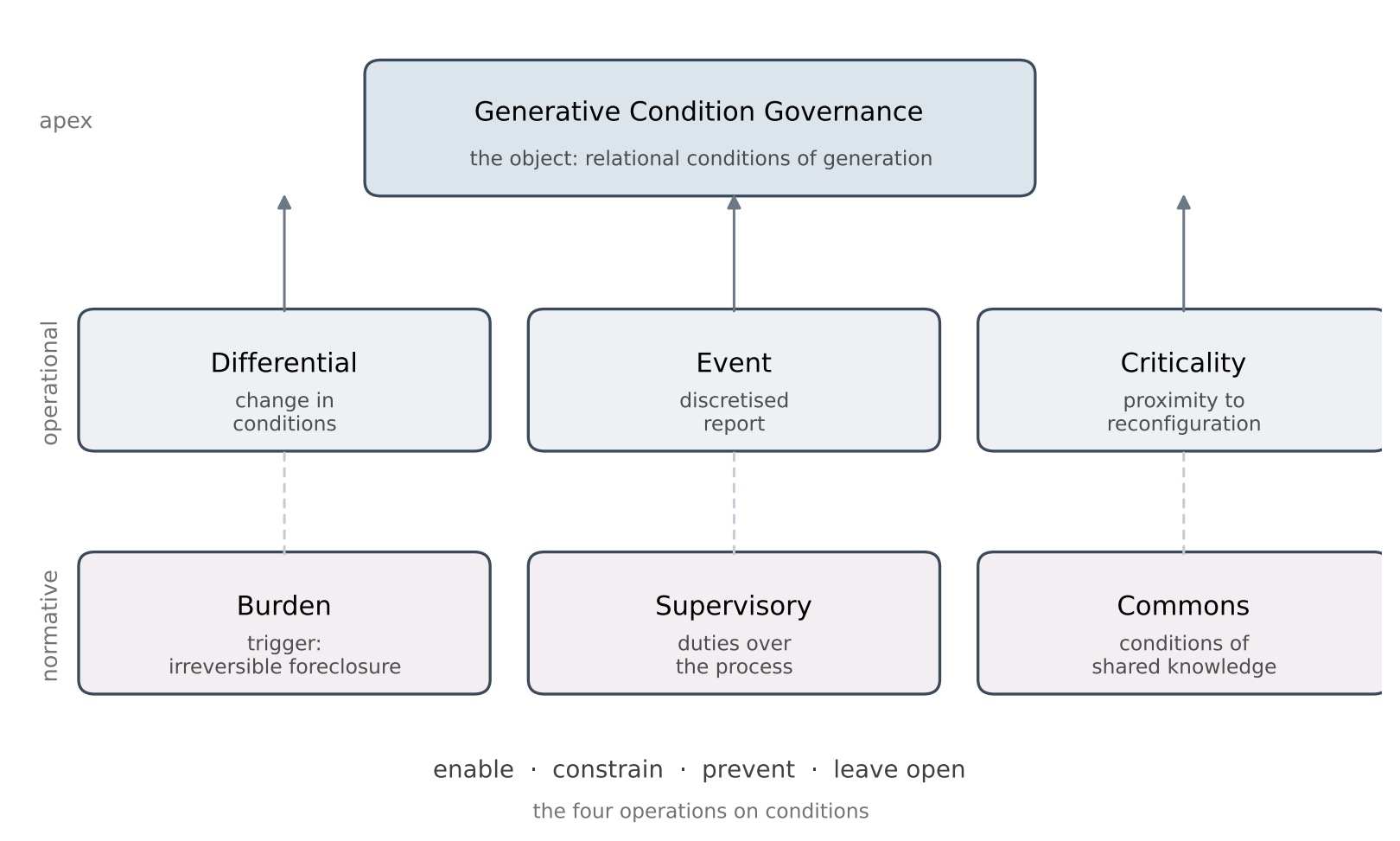
Figure 1. The architecture the concept organises. The operational layer supplies the means by which conditions and their alterations are observed and reported among parties holding no common representation; the normative layer supplies the grounds on which alteration is permitted, required, or placed under burden. The four operations apply at both layers, and the dashed relation records that the normative layer’s application depends on findings the operational layer produces.
3. Prior Formulations of Framework Governance
The doctrine that governance should establish conditions and decline to steer processes has been stated repeatedly, in economics, in political theory, in development ethics, and in technology policy. This section states what each family owns, in the form its owners state it, and identifies which of the three commitments of §4 each family declines. The section is ordered from the traditions that share the most with the present position to those that share the least.
3.1 The Freiburg Doctrine of Framework Order
Eucken (Eucken, 1952) distinguished Ordnungspolitik, policy directed at the framework within which economic activity proceeds, from Prozesspolitik, policy directed at the activity itself and its outcomes. On the Freiburg account the state establishes and maintains the constitutive rules of an economic order and abstains from directing the transactions the order produces; the order is not a natural fact and requires deliberate cultivation and maintenance (Schnellenbach, 2023). Schnellenbach (Schnellenbach, 2023) states the operative content precisely: on the Freiburg account rules bound the discretion available to policymakers without fixing the outcomes that follow, so that what they establish is a field of play rather than a result. This is the general form of Claim ?, stated some seventy years earlier, and priority for it is conceded.
The environmental extension is recent and direct. Callison and Söding (Callison, 2024) trace an ordoliberal political ecology in German environmental politics, naming fossil ordoliberalism, green ordoliberalism, and ordoliberal geoengineering, and show framework-setting operating on climate policy as its object. Condition governance of environmental systems is therefore not unprecedented, and the present position does not present itself as such.
The Freiburg doctrine declines the first commitment and the second. Its object is a competitive market order among human transactors, and the framework it maintains is maintained for that order; the parties whose conditions are secured are legal and economic persons, and a field whose members include non-speaking trajectories and the framework-setter itself falls outside its subject matter. Its normative core is a substantive end, the competitive order, held by the framework-setter, whereas Principle ? binds cultivation to plurality and revisability and licenses constraint on one structural trigger alone. The difference is visible in the treatment of foreclosure: the Freiburg framework restrains the accumulation of private power because such power distorts competition, and Principle ? restrains foreclosure because it removes a capacity to continue generating, whatever the competitive consequence.
3.2 Constitutional Political Economy and Mechanism Design
Buchanan’s programme separates the choice of constraints from choices made within constraints, and locates the distinctive object of constitutional analysis in the former (Brennan & Buchanan, 1985). Mechanism design supplies the formal counterpart: given a social objective, design the rules of interaction so that the objective is realized as an equilibrium of self-interested behaviour (Hurwicz, 1973; Maskin, 2008). Both own, and own more precisely than the present paper states it, the proposition that rules and outcomes are distinct objects of choice and that acting on the first is the tractable route to influencing the second.
Both decline the second commitment, and mechanism design declines it in the sharpest available form. A mechanism is designed toward a social choice function fixed in advance; the designer knows what outcome the rules should induce and selects rules that induce it. Principle ? withholds this specification. No social choice function over $\mathcal{T}(C_t)$ is available to a governor whose representation of the field is partial in principle, and the position declines any maximand over trajectory bundles for the reason stated in §5. The formal relation is worth stating plainly: mechanism design solves an inverse problem, from a desired outcome to the rules producing it; condition governance faces a field for which the inverse problem is not posed, since no party holds the outcome specification the inversion would require.
3.3 Cultivation under Dispersed Knowledge
Hayek grounds a version of the doctrine in the epistemic premise the present paper shares: the knowledge relevant to coordination is dispersed and never available in aggregate to any mind or agency (Hayek, 1945), from which follows a distinction between rules of just conduct that frame action and commands that direct it (Hayek, 1973), and the recommendation that a complex order be cultivated by providing the conditions of its growth. Scott (Scott, 1998) supplies the complementary negative result, that schemes to render a field legible for administration alter what they measure and destroy the local knowledge on which the field’s functioning depended.
This family shares the epistemic premise and the cultivation vocabulary, and declines the second commitment by drawing a prohibitive conclusion from the premise. From partial knowledge Hayek infers abstention and decentralization; from legibility’s costs Scott infers restraint toward the local. Neither supplies a criterion selecting which interventions a party under the epistemic limitation should nevertheless make or decline, and both conclusions presuppose that a field released from direction proceeds acceptably, which is a substantive dynamical claim, and it does not hold for several of the cases that motivate environmental governance. A shell of orbital debris above the critical density cascades whether or not any party acts; a system past a threshold does not return by being left alone. Condition governance holds the epistemic premise and refuses the inference, and Principle ? is the criterion the family lacks.
3.4 Capability Theory and the Generativity of Platforms
Sen’s capability approach takes the freedom to achieve valuable states, rather than the states achieved, as the primary space of evaluation (Sen, 1999), which is the move from generated states to the conditions of generation carried out in the domain of human well-being. Zittrain (Zittrain, 2006) made the generative capacity of a technical system, its capacity to produce unanticipated change through uncoordinated contribution, an object of policy concern in its own right, and the management literature has since generalized generativity across organizational and platform settings (Thomas & Tee, 2022). The vocabulary of the present paper is theirs, and the concession is made in full: governing conditions for generativity is established in two mature literatures.
Both decline the first commitment. The capability approach evaluates conditions for the functionings of persons, and the trajectories whose generative capacity Principle ? protects include populations, ecological couplings, and epistemic communities that are not persons and hold no interests in the sense the approach requires. Platform generativity concerns a designed artefact governed from outside by an owner who sets its terms; the environmental field has no owner, no outside, and no terms-setter, and the governor whose conditions are at issue is a participant in the field whose conditions it alters. The present position may be read as the transfer of the platform-generativity question to a field that cannot be owned, and the transfer is not trivial, since ownership is what supplies the platform literature its normative standpoint.
3.5 Governing through the Milieu
Foucault’s analysis of security apparatuses describes a form of power that operates on the milieu, the environment of circulation within which a population’s conduct unfolds, in place of operating through prohibition addressed to subjects (Foucault, 2007). The description is the closest thing in political theory to an account of what condition governance is, and it is offered as a diagnosis of power and not as a recommendation. The present paper concedes the description and inherits the diagnosis as an objection, treated in §7.
3.6 Adaptive, Polycentric, and Experimentalist Governance
Ostrom’s work on common-pool resources and polycentric systems established that governance of shared environmental resources is achieved by overlapping, partially independent decision centres operating under locally crafted rules, and that no single centre need hold the whole (Ostrom, 1990; Ostrom, 2010). Adaptive governance treats management as an experiment revised against monitored response (Folke et al., 2005). Experimentalist governance formalizes the recursive architecture: framework goals set centrally, implementation discretion left local, regular reporting and peer review, periodic revision of the goals themselves (Sabel & Zeitlin, 2012), with the European water regime as its paradigm case.
This family owns the institutional architecture the present programme’s operational layer presupposes, and the debt is substantial. It declines the first commitment in a specific way. These traditions ask how institutions should be arranged so that governance learns; they take the object of learning to be effective management of a resource, and supply no criterion for which alterations of the field a learning institution should decline to make. An institution can revise its way toward a foreclosure and satisfy every requirement of adaptive design in doing so, since the foreclosure will be discovered only after the capacity it removed is gone. Principle ? states what adaptiveness alone cannot.
3.7 Governing through Goals and Indicators
A distinct family governs by setting goals and measuring progress toward them, leaving the means to those addressed. Kanie and Biermann (Kanie & Biermann, 2017) analysed the Sustainable Development Goals as an instance of governance by goal-setting, in which non-binding objectives with associated indicators substitute for regulatory instruments, and identified the absence of any causal consensus linking the goals to the means as a defining feature of the arrangement. The associated literature on indicator governance establishes that measurement arrangements exert governing force in their own right, since what is counted becomes the object of effort (Merry, 2011; Fukuda-Parr, 2014).
This family shares with the present position the refusal to prescribe means, and declines the first commitment in a manner worth stating because the failure is instructive. Goal-setting governs by specifying an outcome and leaving the route open, which is the inverse of condition governance, and it inherits the pathology Goodhart identified: a target set on a measured quantity alters the behaviour that produces the measurement. Condition governance specifies no outcome, and therefore does not have this pathology in this form; the corresponding pathology arrives at the point where conditions must be observed, and it is treated as an open question in §8.
3.8 Framework Setting in Legal and Regulatory Theory
Legal theory holds a developed literature on the choice between rules that prescribe conduct and arrangements that structure the field within which conduct occurs. Responsive regulation (Ayres & Braithwaite, 1992) arranges enforcement as an escalating pyramid, reserving command for cases where lighter instruments fail. Management-based regulation (Coglianese & Lazer, 2003) requires regulated parties to establish their own processes for identifying and controlling hazards, which is the regulation of a condition of production and not of its output. Smart regulation (Gunningham et al., 1998) treats instrument choice as a design problem across a range of state and non-state mechanisms. Reflexive law (Teubner, 1983) proposes that legal intervention in complex social subsystems should aim at their internal procedures of self-regulation, on the ground that direct substantive prescription fails against systems with their own operative logic.
Teubner’s position is the closest legal analogue to the present one, and the resemblance is worth stating precisely: both hold that a field with its own generative dynamics resists substantive prescription, and both conclude that intervention should be directed at conditions. Two differences follow from the objects. Reflexive law’s conditions are the procedures of a social subsystem, and the subsystems it addresses are self-describing, which the ecological trajectories of the present field are not. And reflexive law is a theory of legal intervention with an identified intervening institution; the present position addresses a field in which the intervening parties are members and no institution stands outside.
3.9 Environmental Ethics and the Standing of the Non-Speaking
The position governs conditions bearing on trajectories that articulate no claims, and the tradition addressing their standing must be conceded. Leopold’s land ethic (Leopold, 1949) extended moral consideration to the biotic community as such. Jonas (Jonas, 1984) argued that technological capacity creates responsibility toward what cannot reciprocate, and grounded a priority of the adverse prognosis on that asymmetry. Stone (Stone, 1972) proposed legal standing for natural objects, and the rights-of-nature jurisprudence that followed has since produced constitutional and statutory instances. Nussbaum (Nussbaum, 2023) extends capability theory to animals, addressing the bearer problem noted in §6.
The position takes from Jonas the structure of an asymmetric responsibility relation and declines the general imperative he founds on it, and it declines the representational strategy that Stone’s line pursues. The reason is stated in §5: Principle ? constrains the conduct of parties that are present, articulate, and addressable, and requires no trajectory to acquire a voice, a representative, or a legal person in order to be within its scope. This is a narrower claim than the ethical traditions make, and it is available to a party holding any view of the moral standing of what is foreclosed, which is the feature that lets the principle operate where standing is contested.
3.10 Boundaries, Safe Operating Spaces, and Viability
A further family specifies conditions as a region within which a system must be kept. Rockström and colleagues (Steffen & Noone, 2009) proposed planetary boundaries defining a safe operating space for humanity, and the framework has been assessed and revised repeatedly since (Steffen & Richardson, 2015). The tolerable-windows approach in climate policy (Bruckner et al., 1999) specifies admissible corridors and derives the emission paths compatible with them. Viability theory (Aubin, 1991; Cury et al., 2005) supplies the mathematics: given a dynamical system and a set of constraints, the viability kernel is the set of states from which the constraints can be satisfied indefinitely by some admissible control, and the theory computes with kernels in place of optimising trajectories.
This family is the formal ancestor of the position’s structure and is conceded as such. Its object is a region of a state space, and its governing question is whether the system can be kept inside. The present position differs in the object and not in the form: the conditions of Definition ? are relations and not states, and the principle attaches to the alteration of a relation and not to the departure of a state from a region. The two are complementary and the complementarity can be stated exactly: a boundary or viability constraint specifies where the field must stay, and condition governance concerns the couplings, buffers, and permissions through which it is capable of staying anywhere at all.
| p0.30 p0.30 p0.30
| Family | Owned claim | Commitment declined |
|---|---|---|
| Freiburg framework order | Governance sets the framework and abstains from directing the process | Object (a market order among transactors) and normative core (a substantive end held by the framework-setter) |
| Constitutional political economy; mechanism design | Rules and outcomes are distinct objects of choice; rules can be designed to induce an outcome | Normative core: the design is directed toward a social choice function fixed in advance |
| Cultivation under dispersed knowledge | Knowledge is dispersed; complex orders are cultivated and not commanded | Normative core: the conclusion drawn is prohibitive, and presupposes that an unforced field proceeds acceptably |
| Capability theory; platform generativity | Conditions of generation are the proper object of evaluation and of policy | Object: both require a bearer holding interests, or an owner standing outside the artefact |
| Security and the milieu | Power operates on the environment of conduct and not by prohibition | Offered as diagnosis and not recommendation; inherited as the objection of §7 |
| Polycentric, adaptive, experimentalist governance | Distributed centres govern effectively and revise their rules against monitored response | Object: supplies no criterion for which alterations a learning institution should decline |
| Governing through goals | Means may be left open while an objective is specified | Object: specifies an outcome, which is the inverse of governing conditions |
| Responsive, management-based, reflexive law | Intervention may be directed at a field’s own procedures of self-regulation | Object: the fields addressed are self-describing, and an institution stands outside them |
| Environmental ethics of the non-speaking | Responsibility extends to what cannot reciprocate | Strategy: standing and representation, where the position constrains addressable parties |
| Boundaries, safe operating spaces, viability | A field must be kept within a region from which continuation remains possible | Object: a region of a state space, where the position’s conditions are relations |
Table. The surveyed families, the claim each owns, and the commitment of §4 each declines. The table summarises the subsections above and supports Claim ?.
3.11 Residue of the Survey
Consider a field in which the governing party is a member and cannot exit; the trajectories affected include populations and couplings that hold no interests and articulate no claims; no party holds a representation of the field adequate to specify an outcome function over it; and the institutions concerned are adaptive, polycentric, and revise their rules against monitored response. In such a field, an alteration of relational conditions may irreversibly foreclose the capacity of other trajectories to continue generating, and no formulation surveyed above states an object of governance, a normative core, and an operational primitive that jointly apply. The Freiburg and mechanism-design families supply a framework object and a substantive end their framework serves; the epistemic family supplies the premise and a prohibitive conclusion; capability and platform theories supply generativity as an object and a bearer the field does not contain; the adaptive family supplies the architecture and no criterion of decline.
Claim ? fixes what the remainder of the programme must supply, and §8 states it as questions.
4. Condition Governance and the Exercise of Power at One Remove
The objection developed in this section follows from the position’s own definition, and the paper treats it as the most serious it faces. If power relations are elements of $C_t$ (§5), then a party that governs conditions governs the distribution of power, and it does so without ever commanding an outcome that could be contested. Bachrach and Baratz (Bachrach & Baratz, 1962) identified the second face of power in a structure of this kind: the capacity to keep an issue from arising is exercised without any observable decision, and it favours whichever party the prevailing arrangement already favours. Lukes (Lukes, 2005) extended the analysis to a third dimension, in which the arrangement shapes what parties take their interests to be. Choice architecture states the benign version of the same mechanism, arranging the conditions of choice so that predictable behaviour follows while formal freedom is preserved (Thaler & Sunstein, 2008). Foucault’s milieu (Foucault, 2007) is the general description. The objection may then be put as follows: condition governance is the technique described in those literatures, now given a normative endorsement, and the feature that recommends it over command, that it requires no outcome specification, is the same feature that makes it difficult to contest, since it offers no determinate proposal against which objection can be raised.
Two features of the position bear on the objection, and one of them is insufficient. The insufficient one is the disclaimer of outcome selection. A party may govern conditions with no outcome in view and still narrow the field decisively, and the accumulation results known for foreclosure under distributed action apply here without modification: a sequence of individually defensible alterations to $C_t$ can compose into a foreclosure that no single alteration would have produced, and on such a sequence there is no occasion on which any party’s course is contested. The objection is therefore not answered by intention, and the position does not attempt it.
The objection is answered by the pair of restrictions that Principle ? places on the governor’s own conduct. The first is plurality. A condition set is governed for the continued generation of plural trajectories, and the principle ranks none of them; a governor invoking it acquires no authority to prefer the trajectory it favours, and no measure over $\mathcal{T}(C_t)$ against which such a preference could be justified. This is what distinguishes the position from choice architecture, whose architect knows which choice the arrangement should produce and arranges conditions to produce it. The second is revisability. Conditions are governed so that the field’s parties retain the capacity to alter the conditions later, which entails that a governor may not install conditions whose effect is to remove the standing of others to revise them. A choice architecture is not required to preserve the architected party’s capacity to rearrange the architecture; Principle ? imposes this requirement on the condition governor, and an arrangement that fails it fails the principle, and does not merely apply it aggressively.
Generative condition governance is distinguished from the arrangement of conditions toward a chosen behaviour by two properties of the governing rule and by no property of the governor’s intention: the rule supplies no ranking over the trajectories the conditions admit, and it prohibits conditions that remove other parties’ capacity to revise the conditions. An arrangement satisfying both is contestable in the respect that matters, since any party may challenge a condition on the ground that it forecloses revision, and the challenge requires no agreement about which trajectory is preferable.
Claim ? states what the position can defend, and the defence is partial in three respects, which the paper records and leaves unresolved. First, the two restrictions constrain the rule and not its administration: a party determining that a condition is revisable is ordinarily a party with an interest in that determination, and the distribution of the capacity to make such determinations is unequal in ways the principle does not correct. Second, revisability is cheap to assert and expensive to verify, since a condition’s reversibility is a factual matter about a system whose dynamics no party fully holds. Third, the objection has a form that survives both restrictions: an arrangement may satisfy plurality and revisability at every step and still, through accumulation, arrive at a field in which one party’s trajectory is the only one the conditions still admit. §8 carries these forward as questions, and the position claims no more than that they are the right ones.
5. Questions Left Open for the Programme
The position fixes an object and leaves the programme’s substance undone. The questions below are grouped by the part of the position they bear on: the concept, the principle, the operational layer, the institutional consequences, and the position’s own standing. Each states what would count as an answer, and several are known to be difficult in ways the statement records.
5.1 Questions Concerning the Concept
Individuation. What distinguishes a condition from a trajectory in a field where the outputs of one subsystem are the conditions of another? A river’s flow is a trajectory to the hydrologist and a condition to the farmer, and the distinction of §5 is therefore relative to a party and a timescale. An answer would supply the relativisation explicitly, stating for which party and over which horizon an element of the field counts as a condition, and would show that the principle’s verdicts are stable under the admissible relativisations.
Composition of conditions. Conditions are not independent of one another: a buffer is a condition whose function is to suppress a coupling, a permission is a condition governing the alteration of other conditions, and an institutional rule conditions the conditions it regulates. Is there a partial order among conditions, and if so, does the principle apply uniformly across its levels, or does a condition governing other conditions warrant a different treatment? An answer would state the ordering and its consequences for the principle.
Identity of a capacity through change. The principle protects the capacity of a trajectory to continue generating, and a trajectory that changes substantially may retain a capacity of a different kind. A river regulated by a dam generates differently and generates still. An answer would state when a capacity has been foreclosed and when it has been transformed, and would confront the possibility that the distinction is unavailable without a judgement about which generation matters, which the plurality commitment withholds.
5.2 Questions Concerning the Principle
Determination of irreversibility. The trigger fires on a property that is a factual matter about a particular field over a stated horizon, and no method for establishing it is supplied. An answer would state what evidence bears on the determination, who is competent to make it, and what follows where the determination is contested, since a party wishing to avoid the burden may contest the determination in place of discharging it.
Sufficiency of discharge. The burden is discharged by giving reasons sufficient to warrant proceeding, and no standard of sufficiency is stated. An answer would face a dilemma the paper records: a standard high enough to be demanding operates as a prohibition and thereby becomes the veto the position declined, and a standard low enough to be dischargeable in the ordinary case operates as a formality that predictably every party satisfies.
Accumulation. A sequence of alterations to the condition set, each satisfying the principle at the moment it is assessed, may compose into a foreclosure that no single alteration would have produced. On such a sequence the principle never fires, and no occasion arises on which any party’s course is contested. An answer would state what rule governs sequences, and would confront the two available repairs, aggregation of the parties into a single governing party, which presupposes an authority the field lacks, and conditioning the rule on the state of the field, which imports the difficulty of determining that state.
Interaction of the trigger with the plurality commitment. Where two courses each irreversibly foreclose some trajectory and one must be taken, both bear the burden and the principle ranks neither. An answer would state what the principle contributes in such a case beyond the requirement that both parties argue, and would say whether a residual ordering is available that does not amount to the ranking the position declines.
Observation. How are conditions observed, and by whom? Couplings are harder to measure than states, since a coupling is established by observing covariation over time, and the capacity to observe a system is ordinarily acquired by parties that operate within it. An answer would characterise the distribution of observational capacity over the parties in a field and state what an arrangement must secure so that a condition may be established by a party other than the one whose conduct the finding constrains.
5.3 Questions Concerning the Operational Layer
Coordination without a common ontology. By what primitive do parties describing the field in incommensurable languages act jointly on a shared condition? The paper asserts that couplings are recognisable from either side, and this requires an operational statement. The programme’s candidate is coordination through correspondences among changes in place of agreement about states, on the ground that agreement that a quantity is declining demands far less shared representation than agreement about what the quantity is. An answer would state the conditions under which such correspondences are identifiable and the conditions under which they mislead.
Specification of what counts as an alteration. The operational layer registers changes in conditions, and a threshold determines which changes are registered. Whoever specifies the threshold determines what the arrangement can see, and thresholds are ordinarily specified from records held by parties that have operated in the field longest. An answer would state a procedure for specification that does not vest the determination in the parties whose conduct the resulting findings would constrain.
Gaming of the observable. Where the alteration of a condition triggers a burden, parties acquire an interest in the appearance of their conditions. An answer would state which of the layer’s observables are manipulable, at what cost, and what an arrangement can do about it, and would treat the general result that a measure adopted as a target ceases to measure what it did.
Criticality. Near a threshold, the map $C_t \mapsto \mathcal{T}(C_t)$ is sensitive to small alterations of conditions, and the sensitivity rises exactly where the field’s dynamics are hardest to estimate. An answer would state how the permissible magnitude of condition alteration should depend on the field’s proximity to such a threshold, and would confront the possibility that proximity is undetectable for entire classes of transition.
5.4 Questions Concerning Institutional Consequence
Distribution of the capacity to observe conditions. Observation of a coupling requires instruments and a record of sufficient duration, and both are ordinarily held by parties that operate within the field. A principle keyed to a property that some parties can establish and others cannot allocates argumentative burden by an allocation of instruments. An answer would characterise that distribution and state what an arrangement must secure so that a condition can be established by a party other than the one whose conduct the finding constrains.
Standing to invoke the principle. The principle allocates a burden and says nothing about who may raise it. An answer would state whether the burden arises upon challenge or independently of any challenge, and would confront the consequence that a burden arising only upon challenge is available in proportion to a party’s capacity to challenge.
Incumbency. A party whose alterations of the field are complete bears little from a regime of burdens, and a party whose use lies in prospect bears the whole of it. The principle holds no resources to correct this, since correction requires a judgement about the prior distribution of use. An answer would state whether such a judgement is available consistently with the plurality commitment, and if it is not, would say plainly what the principle concedes.
Accountability. If a party is answerable for conditions and not for outcomes, what form does the answerability take? The candidate is a duty over the process by which conditions are maintained, discharged by conduct and assessed continuously, on the model of supervisory regimes in domains where outcomes resist attribution. An answer would state the duties, their bearers, and the standard of assessment.
5.5 Questions Concerning the Position Itself
Self-application. A governance architecture is itself a condition in the field it governs: it concentrates couplings, creates dependencies, and constitutes a point of failure. An answer would apply Principle ? to the architecture, and would say what follows for its design if the answer is unfavourable.
Conditions under which the position would be abandoned. Principle ? declares the position revisable, and a revisable position should state what would occasion its revision. Three candidates are offered. A demonstration that the trigger fires on almost every alteration would show it does no selecting work. A demonstration that no arrangement can establish irreversibility at the point of decision would show the principle unusable whatever its merits. And a demonstration that the field admits a common representation after all, so that outcomes can be specified and steered, would remove the premise from which the position is derived. An answer would establish or refute one of these.
Domain of validity. The position is stated for fields whose members include the governor and whose dynamics exceed every party’s representation, and no account is given of which actual fields satisfy these conditions or of how the satisfaction would be established. An answer would state the conditions in assessable form, and would identify at least one field that fails them, since a condition satisfied everywhere selects nothing.
6. Declinations and Limits of the Position
Four declinations, stated so that the position is not read as claiming more than it argues.
The position claims no novelty for framework governance as such. §6 concedes the general doctrine to the Freiburg School, its formalisation to mechanism design, its epistemic grounding to the knowledge-dispersal tradition, its evaluative form to the capability approach, its application to generativity to the platform literature, its legal form to reflexive and management-based regulation, its ethical extension to the non-speaking to environmental ethics, its regional form to the boundaries and viability literatures, and its environmental application to recent work in political ecology. Table 1 records the concessions in summary. The residue claimed is stated in Claim ?, and the paper claims no more than that.
The position is advanced as revisable in the specific sense of Principle ?, which identifies the trigger, the scope of the plurality commitment, and the individuation of conditions as the components a subsequent formulation is most likely to alter. A reader who rejects any of the three is disagreeing with the position at a point the position has itself identified, and the paper regards such disagreement as the expected course of the programme.
The position supplies no measure. It offers no quantity over trajectory bundles, no index of generativity, and no method for determining whether a given alteration of conditions is irreversible. The last is a factual question about a particular field, admitting dispute, and a party wishing to avoid a burden may contest the determination in place of discharging it.
The position ranks no claims. It is compatible with the loss of a great deal. Where no alteration would irreversibly foreclose another trajectory’s capacity to continue generating, claims on the condition set remain plural and are settled by ordinary politics, and the principle is silent about who should prevail.
The position proposes no institution. It states an object, a principle, and a set of questions, and it deliberately withholds an institutional design, on the ground that a design specified in advance of the answers to §8 would be administered by the parties whose conduct is at issue and would furnish them a determinate account of compliance. The programme owes the answers; the conditions an arrangement must satisfy can be stated once those answers are known.
References
Aubin, J.-P. (1991). Viability Theory. Birkhäuser.
Ayres, I. and Braithwaite, J. (1992). Responsive Regulation: Transcending the Deregulation Debate. Oxford University Press.
Bachrach, P. and Baratz, M. S. (1962). Two faces of power. American Political Science Review, 56(4), 947–952.
Bruckner, T., Petschel-Held, G., Toth, F. L., et al. (1999). Climate change decision-support and the tolerable windows approach. Environmental Modeling and Assessment, 4, 217–234.
Brennan, G. and Buchanan, J. M. (1985). The Reason of Rules: Constitutional Political Economy. Cambridge University Press.
Callison, W. and Söding, L. (2024). A climate fit for capitalism: ordoliberalism’s political ecology and German environmental politics. Environmental Politics, 33(6), 997–1018.
Coglianese, C. and Lazer, D. (2003). Management-based regulation: prescribing private management to achieve public goals. Law and Society Review, 37(4), 691–730.
Cury, P. M., Mullon, C., Garcia, S. M., and Shannon, L. J. (2005). Viability theory for an ecosystem approach to fisheries. ICES Journal of Marine Science, 62(3), 577–584.
Eucken, W. (1952). Grundsätze der Wirtschaftspolitik. Mohr Siebeck.
Schnellenbach, J. (2023). The concept of Ordnungspolitik: rule-based economic policymaking from the perspective of the Freiburg School. Public Choice, 195(3), 283–300.
Folke, C., Hahn, T., Olsson, P., and Norberg, J. (2005). Adaptive governance of social-ecological systems. Annual Review of Environment and Resources, 30, 441–473.
Foucault, M. (2007). Security, Territory, Population: Lectures at the Collège de France 1977–1978. Palgrave Macmillan.
Fukuda-Parr, S. (2014). Global goals as a policy tool: intended and unintended consequences. Journal of Human Development and Capabilities, 15(2–3), 118–131.
Gunningham, N., Grabosky, P., and Sinclair, D. (1998). Smart Regulation: Designing Environmental Policy. Oxford University Press.
Hayek, F. A. (1945). The use of knowledge in society. American Economic Review, 35(4), 519–530.
Hayek, F. A. (1973). Law, Legislation and Liberty, Volume 1: Rules and Order. University of Chicago Press.
Huang, W. (2026). Irreversible foreclosure and the allocation of justificatory burden in governance beyond epistemic reach. Knowledge Commons. https://doi.org/10.17613/6bkgx-zmk02
Hurwicz, L. (1973). The design of mechanisms for resource allocation. American Economic Review, 63(2), 1–30.
Jonas, H. (1984). The Imperative of Responsibility: In Search of an Ethics for the Technological Age. University of Chicago Press.
Kanie, N. and Biermann, F. (eds.) (2017). Governing through Goals: Sustainable Development Goals as Governance Innovation. MIT Press.
Leopold, A. (1949). A Sand County Almanac. Oxford University Press.
Lukes, S. (2005). Power: A Radical View, 2nd edn. Palgrave Macmillan.
Maskin, E. S. (2008). Mechanism design: how to implement social goals. American Economic Review, 98(3), 567–576.
Merry, S. E. (2011). Measuring the world: indicators, human rights, and global governance. Current Anthropology, 52(S3), S83–S95.
Nussbaum, M. C. (2023). Justice for Animals: Our Collective Responsibility. Simon and Schuster.
Ostrom, E. (1990). Governing the Commons: The Evolution of Institutions for Collective Action. Cambridge University Press.
Ostrom, E. (2010). Polycentric systems for coping with collective action and global environmental change. Global Environmental Change, 20(4), 550–557.
Rockström, J., Steffen, W., Noone, K., et al. (2009). A safe operating space for humanity. Nature, 461, 472–475.
Sabel, C. F. and Zeitlin, J. (2012). Experimentalist governance. In D. Levi-Faur (ed.), The Oxford Handbook of Governance, 169–183. Oxford University Press.
Scott, J. C. (1998). Seeing Like a State. Yale University Press.
Sen, A. (1999). Development as Freedom. Oxford University Press.
Steffen, W., Richardson, K., Rockström, J., et al. (2015). Planetary boundaries: guiding human development on a changing planet. Science, 347(6223), 1259855.
Stone, C. D. (1972). Should trees have standing? Toward legal rights for natural objects. Southern California Law Review, 45, 450–501.
Teubner, G. (1983). Substantive and reflexive elements in modern law. Law and Society Review, 17(2), 239–285.
Thaler, R. H. and Sunstein, C. R. (2008). Nudge: Improving Decisions About Health, Wealth, and Happiness. Yale University Press.
Thomas, L. D. W. and Tee, R. (2022). Generativity: a systematic review and conceptual framework. International Journal of Management Reviews, 24(2), 255–278.
Zittrain, J. (2006). The generative Internet. Harvard Law Review, 119, 1974–2040. thebibliography