Event-Based Environmental Governance - Sparse Asynchronous Coordination in Interdependent Earth–Human Systems
Abstract
Coordination in an interdependent environmental field cannot run on continuous shared monitoring. The parties hold different instruments, observe at different rhythms, guard some of their records, and share no representation into which a common state could be assimilated. This paper develops the alternative reporting layer indicated in the earlier papers of its series: governance coordination conducted through events, sparse asynchronous reports that something consequential has changed, emitted by the party that observed the change, in its own terms, against its own record. The method is conceptual with a formal core borrowed from established literatures. The paper defines the event as a governance primitive, distinguishes it from the alarm, the indicator, and the disclosure, states its content requirements, and separates six classes of event whose triggering conditions and record requirements differ. Four insights organise the development. Event-triggered reporting concentrates communication where a field is moving, and results in control engineering establish that sparse triggered communication can maintain bounded deviation where periodic reporting of the same frequency cannot, so sparseness is a design principle and not a compromise. Events among distributed parties admit no global ordering: the order of unrelated events is undefined, only causal order is available, and governance procedures that presuppose a single timeline are therefore unsound for distributed fields. The determination of what counts as an event, the threshold of consequence, carries the arrangement’s power and follows the distribution of records. And silence is systematically ambiguous among ordinary conditions, instrument failure, inadequate baselines, and strategic withholding, so an arrangement’s treatment of non-reporting is as consequential as its treatment of reports. The paper surveys event-triggered control, distributed systems theory, event-based epidemic surveillance under the International Health Regulations, notification duties in international environmental law, incident-reporting regimes in aviation safety, disturbance ecology, complex event processing, and neuromorphic sensing, states what each owns, and identifies the residue. It reports no empirical study; its formal claims are borrowed and their sources stated.
Keywords: event-based governance; asynchronous coordination; notification duties; surveillance; threshold specification
Notices
On the references. All 28 works cited in this paper have been checked against their sources at claim level: each source was consulted and confirmed to state what the citing sentence attributes to it. No entry in this paper’s bibliography is unverified.
Status. This is a working draft circulated for discussion. It is a preliminary discussion paper and is not a finished statement of its author’s position. Sections and statement numbers are subject to change.
Licence. This work is made available under a Creative Commons Attribution-NonCommercial 4.0 International Licence (CC BY-NC 4.0).
Statement on the use of language models. Drafting, literature search and argumentative criticism for this paper were conducted in dialogue with large language models, specifically Claude (Anthropic) and ChatGPT (OpenAI). The claims, the structure, the selection of material and the position taken are the author’s. References have been checked in stages, to two standards, and the process is incomplete. Part of the corpus has been verified at identity level, meaning author, title and publication coordinates were confirmed against the publisher of record. A smaller part has additionally been verified at claim level, meaning the cited source was consulted and confirmed to state what the citing sentence attributes to it. The remainder is unverified at either standard. The standard reached is marked on each bibliography entry: no mark for claim level, $\ddagger$ for identity level only, $\dagger$ for not yet verified. Corrections made so far are recorded in the project’s citation-verification file; where a source proved not to bear the weight the text placed on it, the text was revised rather than the citation removed.
Companion papers. This paper is Paper 5 of a series on the governance of environmental change, and treats the reporting layer: the event as a governance primitive and the regimes governing silence. The other papers of the series treat, in order: the object; the field and its three structures; coordination through change; heterogeneous knowledge; criticality detection; observational capacity; representational requirements; routing and inquiry; the regime near a threshold; forecasting from the stream; the knowledge commons; attribution and ownership; responsibility at transitions; and supervisory duties. Paper 12 is reserved and is not yet drafted. A related paper by the author, developed independently of this series, treats the temporal correspondence limitation of evidence-based policy making, being the divergence between the system state that evidence represents and the system state at the moment of decision. Its results on the partition of a state space into estimable and unobservable components, on the blindness of a recency-weighted evidence base to the approach to criticality, and on the allocation of a justificatory burden where temporal correspondence fails, were reached by a different route and bear on several papers of this series.
Suggested citation. Huang, W. Event-Based Environmental Governance: Sparse Asynchronous Coordination in Interdependent Earth–Human Systems. Working draft.
Discussion Paper Note
This paper is a preliminary discussion paper intended to share an evolving idea and invite further dialogue, criticism, revision, and independent development.
The author does not claim exclusive epistemic ownership over the viewpoints, concepts, or lines of reasoning presented here, nor does the author claim priority as their first originator. Similar or related ideas may have appeared previously in other intellectual, cultural, or disciplinary traditions. Any legal rights retained in this work are intended to support attribution, responsible use, and protection against exploitative or harmful appropriation, and not to restrict independent inquiry, criticism, revision, or further development.
The arguments in this paper should therefore be understood as provisional and historically situated rather than definitive. Readers are encouraged to question, revise, extend, reinterpret, or independently develop the ideas presented here. Where appropriate, acknowledgment of this paper as one point of encounter in the development of related ideas is appreciated, but such acknowledgment should not be understood as granting the author epistemic ownership over the ideas themselves.
Responsible Use and Rights Reservation
The author encourages good-faith discussion, criticism, independent development, and responsible use of the knowledge presented in this work. The author does not claim exclusive epistemic ownership over the ideas or viewpoints discussed herein, nor claim priority as their first originator.
However, the author expressly reserves all rights and remedies available under applicable law with respect to uses of this work or related materials that involve unlawful conduct, harmful or abusive exploitation, improper commercial appropriation, infringement of applicable intellectual property or other legal rights, or conduct contrary to applicable national, regional, or international law.
This reservation is intended to preserve the ability to respond to misuse and harmful appropriation. It should not be interpreted as restricting legitimate academic inquiry, criticism, independent reasoning, or the further development of related ideas.
1. Introduction
The companion papers of this series establish a field in which continuous shared monitoring is unavailable. Parties observe different subsystems with different instruments at different rhythms; their records are partly confidential; their representations do not reconcile into a common state; and the couplings through which consequences propagate cross the boundaries of every party’s view. Coordination in such a field, if it occurs, must run on something thinner than a shared picture, and the second paper of the series proposed what: an occurrence layer, in which parties report consequential change and the reports are carried to those whose conduct bears on it.
The present paper develops that layer in full. Its subject is the event: a discrete report, emitted at a time of the emitter’s determination, that something consequential has changed. The paper’s position is that the event is the correct communicative primitive for distributed environmental governance, and the position rests on four supports of different kinds: an efficiency argument, that triggered reporting concentrates scarce attention where the field is moving; a formal argument, borrowed from control engineering, that sparse triggered communication can preserve what matters where equally sparse periodic communication cannot; a structural argument, borrowed from distributed systems theory, that events among unsynchronised parties admit only a partial order, with consequences for any procedure that presupposes a timeline; and an institutional argument, that the event is already the operative primitive of the most successful existing cross-boundary arrangements, in epidemic surveillance, in transboundary notification, and in safety reporting, so the proposal generalises a form with an institutional record.
In a field whose parties cannot share continuous state, governance coordination should be conducted through events: sparse, asynchronous, source-assessed reports of consequential change, carried under standing arrangements to the parties on whose conduct the change bears. The event layer is the operational form of the communicative structure whose adequacy the second paper of this series defines, and its design questions, what triggers a report, what a report contains, who receives it, and what silence means, are the concrete form of that paper’s divergence diagnostics.
The care in the claim lies in three distinctions drawn in §5. An event is not an alarm: an alarm is addressed to those who should act and asserts urgency, where an event asserts consequence and leaves the receiving party’s response to the receiving party. An event is not an indicator: an indicator is a quantity maintained continuously and compared against reference levels, where an event is emitted at a time the observed change determines. And an event is not a disclosure in the regulatory sense: a disclosure serves the assessment of the discloser, where an event serves the coordination of the field.
The paper proceeds as follows. §5 restates the positions carried from the companion papers, defines the event and its content, states the borrowed formal results with their conditions, and works a case. §6 surveys the nine literatures that own adjacent claims. §7 treats the objections, of which the threshold objection and the silence objection are the most serious. §8 lists the open questions and §9 the declinations.
2. The Event Primitive, Its Formal Standing, and Its Content
2.1 Positions Carried from the Companion Papers
Four results from the series are used and are restated so the paper stands alone.
The object of governance, from the first paper, is the set of relational conditions under which a field’s trajectories are generated: couplings, buffers, permissions, the distribution of access and information, and institutional rules. Reporting arrangements are among these conditions, so the design of the event layer is itself an exercise of the governance it serves, and the layer’s own properties fall under the principles it implements.
The three structures, from the second paper, are the physical structure of dependence, the epistemic structure of who knows what, and the communicative structure of who reports to whom. Their divergences are governance-relevant quantities: a coupling that obtains physically while no reporting relation corresponds to it is a determinate failure, identifiable pairwise without a model of the whole. The second paper also supplied a six-element content model for a reported occurrence and two difficulties, the ambiguity of silence and the politics of thresholds, which the present paper develops as its own.
The differential, from the third paper, is the pattern of change in a party’s own representation, assessed against that party’s own record. Agreement about the direction and unusualness of a change is available to parties for whom agreement about states is not. The relation to the present paper is exact: an event is a differential discretised at a threshold of consequence. The third paper supplies the continuous object and its varieties, of order, of object, and of form; the present paper supplies the discretisation, the transport, and the institutional surround.
The assembly, from the fourth paper, is the question-relative structure in which heterogeneous holdings are brought to bear on a decision with disagreement preserved. Events are among the inputs from which assemblies are constructed, and the provenance element of the event’s content model exists partly for that use: an assembly that cannot trace two reports to a common underlying observation counts one confirmation as two.
2.2 Definition of the Event
An event is a tuple
$$e = \big(, \tau,; s,; \delta,; u,; \kappa,; H,; A,; \pi ,\big)$$
comprising the emission time $\tau$; the source party $s$; the change $\delta$, stated in the source’s own representation; the source’s assessment $u$ of the change’s unusualness against its own record; the source’s confidence $\kappa$ in its own observation; the hypotheses $H$ the source advances about couplings the change may bear on, marked as hypotheses; the parties $A$ the source believes affected, offered as a revisable claim; and the provenance $\pi$, recording what the report rests on. An event stream is the set of events emitted in a field, partially ordered as §5 describes. An event arrangement is a standing institutional structure specifying, for a class of events, the triggering conditions, the receiving parties, the obligations of emission and of response, and the treatment of silence.
The definition packages the second paper’s content model into a primitive and adds the arrangement, which is where the institutional substance lies. Three contrasts fix the primitive’s character.
Event and alarm. An alarm asserts urgency and addresses parties who should act; it belongs to the last stage of an escalation. An event asserts consequence and addresses parties whose conduct the change bears on, who may respond by attending, by preparing, by withholding an intervention, or by nothing. Collapsing the two produces the familiar pathology in which every report must justify itself as urgent, and reports of slow consequential change, the characteristic form of environmental change, have no channel.
Event and indicator. An indicator is maintained continuously and read against reference levels; its rhythm is the maintainer’s. An event’s timing is determined by the observed change, which is the source of the sampling advantage stated below, and its assessment is made against the emitter’s record, which is what makes it statable without a shared ontology.
Event and disclosure. A regulatory disclosure is owed by a party about itself, serves the assessment of that party, and is addressed to an authority. An event may concern a change in a system nobody operates, serves the coordination of parties other than the emitter, and is addressed laterally. The legal ancestors of the event are therefore the notification duties surveyed in §6 and not the disclosure regimes, though the two share machinery.
2.3 Classes of Event
Definition ? treats the event as one primitive, and an arrangement must distinguish classes, because the triggering logic, the carriage, and the duties differ across them. Six classes recur in the field described by the second paper of this series.
Threshold crossings report that a quantity has left a range the emitter maintains as ordinary. These are the simplest class and the one the sparseness results address most directly.
Rate excursions report that a quantity is changing faster than the emitter’s record leads it to expect, without regard to the level reached. These are the discretisation of the third paper’s differentials, and their inclusion is what prevents the event layer from inheriting the blindness to rate-induced transition that state-based instruments carry.
Pattern departures report that an established regularity has shifted, broadened, or lost coherence. These carry most of what environmental change consists in, seasons arriving earlier, recurrence intervals shortening, a monsoon becoming erratic, and their triggering conditions are the least developed, since a departure from a periodicity admits several inequivalent measures.
Coupling changes report that a relation between subsystems has altered: a quantity now responds to another differently from how it formerly responded. These are the events the first paper’s object requires, since conditions are relations and their alteration is what the governing principle addresses. They are the hardest class to emit, because establishing a change in a coupling requires paired records over a period, which a single party seldom holds.
Capability changes report an alteration in the emitter’s own capacity to observe: an instrument lost, a station closed, a record discontinued, a method changed. These are events about the epistemic structure and not about the field, and an arrangement that omits them permits a degradation of sight to appear as a quieting of the field, which is the manipulation of least visibility identified in §7.
Expectation failures report that something anticipated has not occurred: a flow pulse absent, a migration not arriving, a seasonal transition not registering. These are the converse of threshold crossings and are structurally awkward, since their trigger is the expiry of an interval and not the arrival of an observation, and an arrangement must maintain the expectation to detect its failure.
An event arrangement covering only threshold crossings inherits the deficiencies of state-based governance in discretised form. The rate, pattern, and coupling classes are what carry the field’s characteristic changes, the capability class is what protects the arrangement’s own soundness, and the expectation class is what prevents non-occurrence from being unreportable. The classes differ in the records they require to trigger, and the ordering of that requirement, from a single series through paired series to maintained expectations, determines which classes a given party can emit at all.
Claim ? has a design consequence recorded here and carried to §8: the classes a field’s arrangement covers are determined by the records its parties hold, so an arrangement’s class coverage is a further quantity on which the second paper’s divergence diagnostics operate, and the coupling class in particular will be systematically under-emitted in any field whose parties hold only their own subsystems’ records.
2.4 Comparison with the Alternative Reporting Forms
Table 1 sets the event arrangement against the two forms it is offered in place of, on the dimensions that determine what an arrangement can achieve.
| p0.19 p0.23 p0.21 p0.24 | Periodic reporting | Alarm | Event arrangement |
|---|---|---|---|
| Timing determined by | The reporting calendar | The hazard’s severity | The observed change |
| Assertion carried | A value | Urgency, and a call to act | Consequence, with confidence |
| Addressed to | A supervising authority | Those who must act | Parties the change bears on |
| Direction | Vertical | Broadcast | Lateral |
| Assessment made by | The receiver, against a standard | The emitter, against a hazard scale | The emitter, against its own record |
| Slow change | Visible only across many reports | Unreportable, since not urgent | Reportable as rate or pattern departure |
| Meaning of silence | The interval has not elapsed | No hazard is asserted | Governed explicitly by the arrangement |
| Shared ontology required | Yes, for the reported values | Partly, for the hazard scale | No, for direction and unusualness |
Table. Three reporting forms compared. The event arrangement’s distinguishing properties are the emitter-relative assessment, which removes the requirement of a shared ontology, and the explicit treatment of silence, which the other two forms leave implicit.
The table also locates what the event arrangement gives up. Periodic reporting supports time series and the statistical operations that require regular sampling, which an event stream does not; an arrangement wanting both must run a periodic channel alongside, and the heartbeat of §5 is the minimal instance of one. The alarm carries an obligation to act that the event deliberately withholds, and a field in which action must be compelled requires the alarm form for that class of hazard, with the event arrangement carrying everything the alarm’s severity threshold excludes.
2.5 The Formal Standing of Sparse Triggered Reporting
Two formal results are borrowed, and the paper states them with their conditions and claims neither.
The first belongs to event-triggered control. In a control system where communication between sensor and controller is costly, the classical arrangement samples periodically, and the alternative transmits when the state’s deviation from the last transmitted value crosses a threshold. The literature establishes that event-triggered schemes can guarantee stability and bounded deviation with substantially fewer transmissions than periodic schemes achieving the same bound, and that a minimum inter-event time can be guaranteed, so the scheme does not degenerate into continuous transmission (Tabuada, 2007; Heemels et al., 2012). The condition the result requires is stated with it: the guarantee presupposes a model of the plant sufficient to derive the triggering condition, and the guarantee concerns a single loop with a designed trigger.
The transfer to governance is therefore an analogy with a stated gap. The supported proposition is that sparseness is compatible with adequacy: communication concentrated at consequential change can preserve what a receiving party needs where equally sparse periodic reporting cannot, since the periodic scheme spends its budget on quiescent periods and sleeps through excursions. Figure 1 displays the structure. The unsupported proposition, which the paper does not assert, is any quantitative guarantee for a governance field, since no party holds the model from which a triggering condition with guarantees could be derived. The gap is recorded in §8.
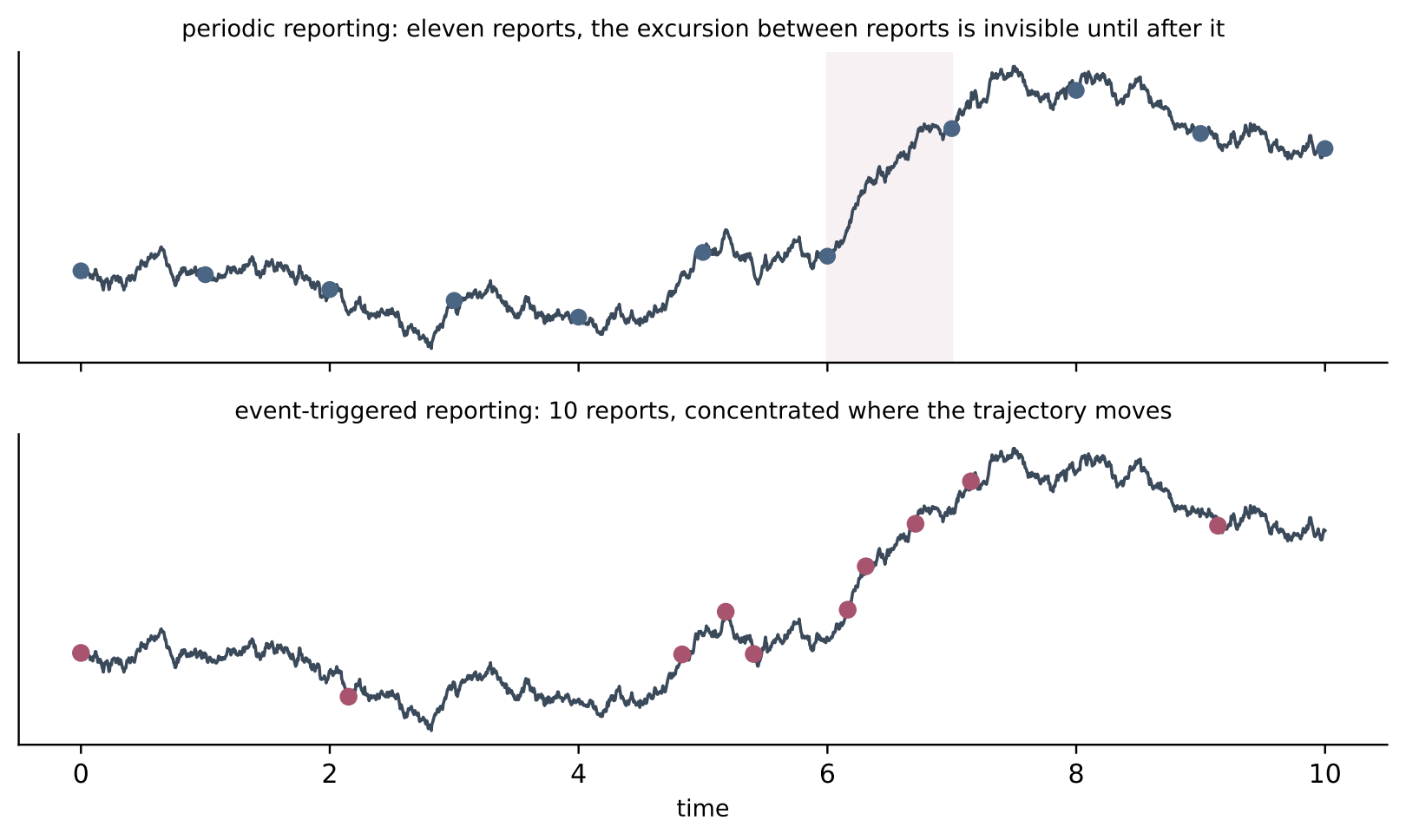
Figure 1. One trajectory reported periodically and by event trigger, with comparable report counts. The periodic scheme spends reports on quiescent periods and registers the excursion only after it; the triggered scheme concentrates reports where the trajectory moves. The comparison illustrates the structure of the borrowed result and establishes nothing quantitative about governance fields.
The second result belongs to distributed systems theory. Among processes that communicate by messages and share no clock, the order of events is not total: an event that causally precedes another, by being its sender’s past when the message was sent, is ordered before it, and events with no causal path between them have no order at all (Lamport, 1978). Logical and vector clocks recover exactly the causal order and no more (Fidge, 1988; Mattern, 1989).
An event stream in a distributed governance field is partially ordered by causal precedence and admits no sound total order. Consequently, any procedure that presupposes a single timeline of occurrences, a unique sequence in which things happened, is unsound for such a field: two events with no causal path between them have no fact of the matter as to which came first that the field’s own structure supplies. Procedures of attribution, of priority, and of audit that turn on which party acted first must therefore either establish causal precedence, which the event structure supports, or import an external clock, which is an institutional act whose authority requires its own justification.
Claim ? is the paper’s sharpest structural point and Figure 2 displays it. Its practical content is easy to understate. Governance procedures routinely reconstruct timelines, in incident inquiries, in the sequencing of obligations, and in the assignment of priority to claims, and the reconstruction presupposes that a total order exists to be found. In a field of unsynchronised parties the presupposition fails, and the failure is structural and not evidential: more evidence does not order causally unrelated events. The sound object is the causal partial order, and arrangements should be designed to record it, which the provenance and hypothesis elements of Definition ? serve.
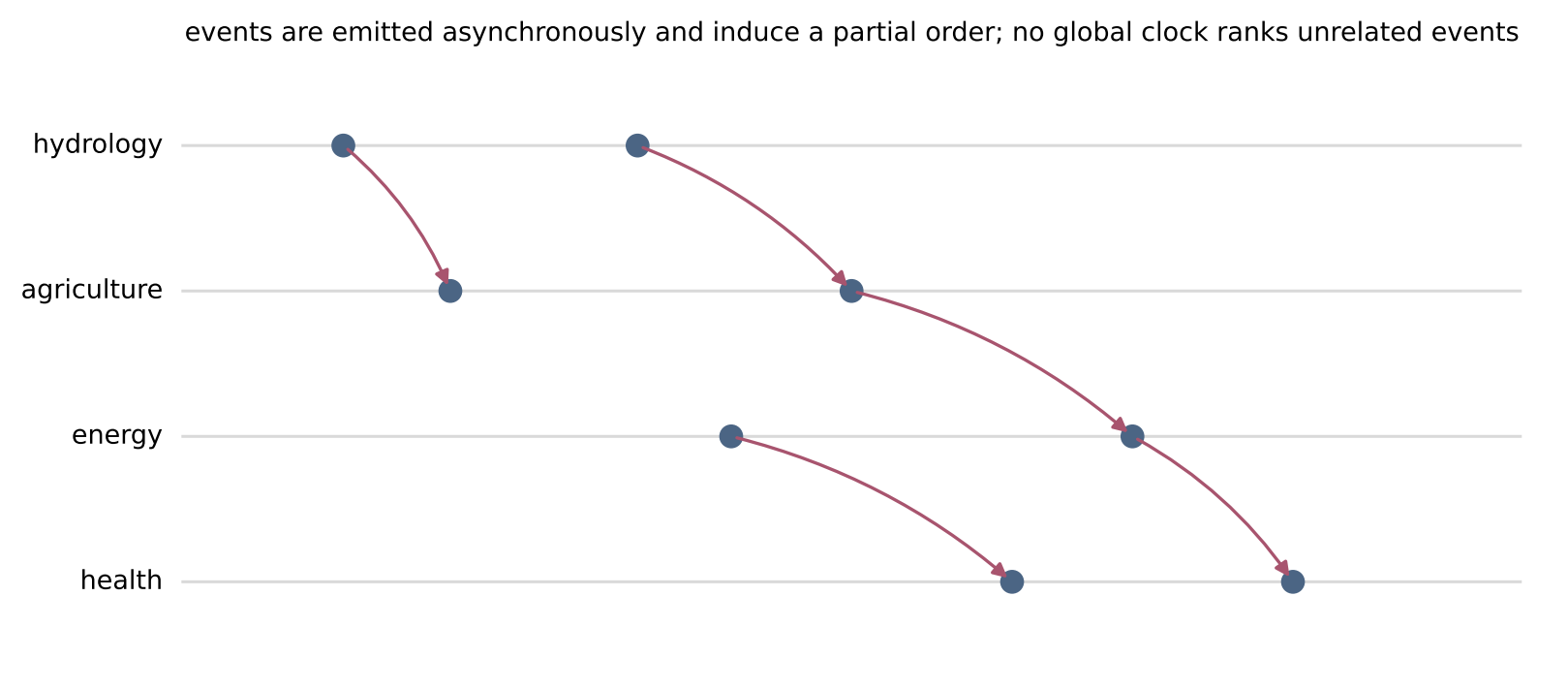
Figure 2. Events among four parties. Arrows mark causal influence, where an emission was in the receiving party’s past when it acted. The causal order is partial: events on different lines with no connecting path have no defined order, and a procedure requiring one must impose it.
2.6 Thresholds and the Emitter’s Record
An event is emitted when a change crosses a threshold of consequence, and the two questions an arrangement must answer are who sets the threshold and against what record unusualness is assessed. The companion papers supply the difficulty and the present paper states it as a claim.
The specification of triggering conditions is the point at which an event arrangement’s power is exercised. Thresholds determine what the arrangement can see; they are specified against records; records of the required duration are held by parties that have operated longest; and the assessment of unusualness is made by the emitting party against its own history. The distribution of authority over thresholds therefore follows the distribution of instruments and of operational tenure, and an arrangement that leaves thresholds wholly to emitters vests a governing determination in the parties whose conduct the resulting reports would constrain.
Two partial correctives are available within the primitive and are stated with their costs. Triggering conditions may be made public and contestable, so that a threshold is an institutional object subject to challenge, at the cost of the negotiation the primitive was adopted to minimise. And multiple horizons may be required, so that a change unremarkable against a short record is also assessed against the longest available one, at the cost of privileging the parties that hold long records, which is the distribution the corrective was meant to loosen. The residual is recorded honestly: the threshold problem is displaced and reduced by these devices, and it is not solved.
2.7 The Meanings of Silence
The absence of an event is ambiguous among at least four conditions: nothing consequential occurred; something occurred and the instruments did not register it; something occurred and the emitter’s model of ordinary behaviour absorbed it; and something occurred and the emitter withheld. The ambiguity matters because receiving parties act on silence, treating it as evidence of ordinariness, and because the costs of emission fall on the emitter while its benefits fall elsewhere, so the fourth condition is not marginal.
An event arrangement is incompletely specified until it states what silence licenses. Three regimes are distinguishable. Under uninformative silence, non-emission licenses nothing, and a receiving party’s state of information is unchanged by it; this is sound and forfeits most of the layer’s value. Under qualified silence, non-emission licenses the inference that no triggering change was registered, conditional on stated facts about the emitter’s instruments and thresholds being verifiable; this is the regime the arrangement should seek, and its cost is the verification. Under presumed ordinariness, non-emission licenses the inference that conditions are ordinary; this is the regime arrangements drift into, and it is unsound wherever emitters bear costs or hold interests.
The heartbeat, a periodic minimal emission asserting that the emitter is observing and its threshold is in force, converts the second regime from an assumption into a checkable condition at modest cost, and is the one element of continuous communication the paper endorses: what is maintained continuously is not the state but the standing of the channel.
2.8 Worked Case: A Compound Dry Season
The case follows the arrangement through the compound conditions the second paper identified as the operationally decisive ones.
A basin enters an unusually dry spring. Under an event arrangement with the content model of Definition ?, the following stream develops. The hydrological service emits early: snowpack and soil moisture have departed the seasonal envelope of its record, confidence high, hypotheses naming irrigation supply and late-summer flows, affected parties including the agricultural and energy authorities. The agricultural authority, receiving this, emits none of its own for weeks, and its heartbeat continues, so the silence is qualified: no triggering change in plantings or abstraction has been registered. In early summer the energy operator emits: cooling-water intake temperature is approaching its permitted ceiling earlier than in any year of its record, hypotheses naming generation capacity in the peak weeks, confidence moderate because the intake record is short. The health authority holds no coupling to any of these parties in the standing arrangement, which is itself a finding available in advance from the second paper’s diagnostic: the settlement-heat pathway is physically present and communicatively absent.
The stream’s value is then concrete. The energy operator’s report, ordered causally after the hydrological one and linked to it by hypothesis, lets the water authority weigh an abstraction restriction weeks before either level alone would have compelled it, and lets the restriction be discussed against two source-assessed reports whose provenance is inspectable. The stream’s limits are equally concrete. The order between the agricultural authority’s eventual report and the energy operator’s is undefined, since neither was in the other’s causal past, and an inquiry later asking which sector moved first is asking a question the field does not answer. The health pathway remains dark, and no volume of events among the connected parties illuminates a coupling the arrangement does not carry. And every threshold in the stream was set by its emitter, so the stream’s completeness is exactly as good as the distribution of instruments and standards that Claim ? describes.
2.9 Latency, Horizon, and the Value of a Report
An event’s worth to a receiving party depends on the relation between two intervals: the time between the change and the report’s arrival, and the time the receiving party requires to act. The relation determines what a report is for, and an arrangement that ignores it will carry reports that arrive correctly and uselessly.
For an event concerning a coupling from subsystem $i$ to subsystem $j$, let the report latency be the interval from the change in $i$ to the report’s arrival at the party governing $j$; let the propagation delay be the interval from the change in $i$ to the appearance of its consequence in $j$, which is the edge attribute the second paper defines; and let the response time be the interval the party governing $j$ requires to alter its own conduct. A report is actionable where latency plus response time is less than propagation delay, and advisory otherwise.
Definition ? does not license discarding advisory reports, and the paper states why because the temptation is strong and the reasoning against it is not obvious. An advisory report, arriving too late for the receiver to alter the consequence in train, retains three uses. It permits preparation for the consequence, which is action of a different kind on the same event. It enters the record from which the correspondence between the two subsystems is established, so a stream of advisory reports is what makes later reports actionable, and an arrangement that suppresses them forecloses its own improvement. And it is the material from which the field’s coupling structure is progressively constructed, which is the accumulation §5 attributes to the hypothesis element of the content model.
Two consequences follow for design. Because propagation delays in the second paper’s inventory span eight orders of magnitude, and because the delay and the irreversibility of a coupling’s alteration are adversely correlated there, the couplings whose alteration matters most are those on which reports are most likely to be merely advisory. An arrangement built for actionability alone will therefore concentrate on the fast, reversible couplings and neglect the slow, irreversible ones, which inverts the priority the series’ governing principle sets. And the response time is a property of the receiving institution and not of the field, so an arrangement can convert advisory reports into actionable ones by reducing response times, which is an institutional investment with a determinate target, and one of the few points at which the series’ architecture yields a directly actionable recommendation.
2.10 Constitution of an Arrangement
Definition ? specifies what an arrangement contains and not how one comes into being, and the omission would leave the proposal without a path from a field’s present condition to the arrangement it describes. Four elements are required, and the paper states them as requirements without proposing a body to supply them.
A carriage map, stating which classes of event from which emitters reach which receivers. Its adequacy is assessed by the second paper’s diagnostic against the physical structure, and its construction begins from the couplings that are already known, so an arrangement’s initial map is a lower bound on what the field requires and is expected to grow as coupling-class events accumulate.
Threshold registers, holding the triggering conditions in force for each emitter and class, public so that they are contestable under §7, and versioned so that a change in what the arrangement can see is itself datable. A threshold register makes the arrangement’s sight a matter of record and not of practice.
Channel standing, being the heartbeat obligations and their monitoring, without which the arrangement operates in the uninformative-silence regime and forfeits most of its value.
A review function, assessing the arrangement’s own adequacy: its class coverage, its silence structure, its habituation signatures, and the divergence between its carriage map and the couplings the accumulated events have revealed. The function’s independence is the difficulty, since the parties competent to assess an arrangement are its participants, and the paper carries this to §8 and to the series’ papers on supervision.
An event arrangement is constituted by a carriage map, a public versioned threshold register, channel-standing obligations, and a review function, and each of the four is itself an object of the governance the arrangement serves. The carriage map is a communicative structure and falls under the second paper’s diagnostic; the threshold register is a distribution of the capacity to determine what is seen; channel standing is a condition maintained or allowed to lapse; and the review function is a supervisory duty. An arrangement is therefore not an instrument that governance uses but a set of conditions that governance maintains, and its decay is a governance failure of the same kind as those it exists to detect.
2.11 Requirements Statable over an Event Arrangement
Four kinds of requirement complete the primitive’s institutional form. Emission requirements oblige a party to maintain stated triggering conditions on stated quantities, and are the event-layer form of the differential paper’s reporting requirement. Carriage requirements oblige the arrangement to deliver classes of events to the parties standing in established correspondence to them, and their adequacy is assessed against the physical structure by the second paper’s diagnostic. Response requirements oblige a receiving party to consider, to acknowledge, or in stated classes to act, and they are deliberately the weakest of the four, since the event asserts consequence and not prescription. Channel requirements oblige emitters to maintain heartbeats and receivers to monitor them, converting silence into the qualified regime of Claim ?. None of the four requires agreement about states, which is the constraint the series carries throughout.
3. Prior Treatments of Event-Based Coordination
Nine literatures own parts of the position. The survey states what each establishes and what the residue is.
3.1 Event-Triggered and Self-Triggered Control
The control literature formalised the question of when to communicate. Event-triggered control transmits when a triggering condition on the state is met, self-triggered control computes at each transmission the latest time the next may safely occur, and the central results establish stability and performance guarantees with transmission counts far below periodic schemes, together with guaranteed minimum inter-event times (Tabuada, 2007; Heemels et al., 2012). The literature has extended the results to networked and multi-agent settings, where consensus and coordination are achieved under event-triggered communication among many agents (Dimarogonas et al., 2012).
This literature owns the formal content of the sparseness argument, and §5 borrows it with its conditions stated. The residue is the institutional surround: the literature designs triggers from plant models for agents built to cooperate, and the questions of who sets thresholds among parties with interests, what reports contain beyond the state, and what silence means among strategic emitters do not arise in it.
3.2 Ordering, Time, and Knowledge in Distributed Systems
Lamport (Lamport, 1978) established that among processes sharing no clock, the happened-before relation, generated by local sequence and message transmission, is the sound order, and that it is partial; logical clocks realise it, and vector clocks characterise it exactly (Fidge, 1988; Mattern, 1989). The subsequent literature developed consistent snapshots, showing that a meaningful global state of a distributed computation can be assembled from local records without stopping the system (Chandy & Lamport, 1985), and the epistemic tradition analysed what groups of communicating agents can know, establishing severe limits on the attainment of common knowledge under unreliable communication (Halpern & Moses, 1990).
The concessions are complete and the borrowings are load-bearing: Claim ? is Lamport’s result carried to a new referent. Two elements of the residue are worth stating. The distributed-systems literature concerns processes designed to cooperate within one system, and its snapshots and clocks are implemented by a designer standing outside; the governance field has neither. And the epistemic results, on the unattainability of common knowledge, bear on the series’ broader argument that arrangements requiring agreement are built on an unavailable foundation, a connection the paper notes and does not develop.
3.3 Complex Event Processing and Event-Driven Architecture
The software literature developed the event as an architectural primitive. Complex event processing treats streams of primitive events as material from which composite events are inferred by pattern (Luckham, 2002); event-driven architectures organise systems around the production and consumption of events in place of shared state; publish-subscribe systems decouple emitters from receivers so that neither need know the other (Eugster et al., 2003); and event sourcing records a system’s history as its authoritative representation, deriving current state from the event log.
These traditions own the engineering of event transport and composition, and an implementation of the present proposal would be built on them. The residue is again institutional, and one borrowed idea deserves emphasis: the publish-subscribe decoupling is the engineering form of a property the governance layer requires, that an emitter need not know all the parties its report concerns, since the affected-parties element of Definition ? is a revisable claim and the carriage requirement places completion of the routing with the arrangement.
3.4 Neuromorphic and Event-Based Sensing
Event cameras transmit per-pixel brightness changes as they occur, in place of frames, achieving microsecond latency and orders-of-magnitude data reduction for scenes that are mostly static (Lichtsteiner & Posch, 2008; Gallego & Orchard, 2022). The biological precedent is older than the engineering: sensory systems throughout the animal kingdom respond to change and adapt away constant stimuli.
The concession is the demonstration, in silicon and in biology, that change-based transmission is a complete sensing strategy and not a lossy convenience: the event stream suffices to reconstruct what matters about the scene. The residue is the level: these systems operate below interpretation, and the governance event carries assessment, hypothesis, and provenance, which no pixel emits.
3.5 Event-Based Surveillance under the International Health Regulations
Public health operates the most developed institutional event layer in existence, and it is the closest ancestor of the present proposal. The International Health Regulations (2005) are organised around the event, defined in the instrument as a manifestation of disease or an occurrence that creates a potential for disease; they oblige states parties to assess events against a decision instrument and to notify the World Health Organization of events that may constitute a public health emergency of international concern; and they authorise the Organization to take account of reports from sources other than official notifications (World Health Organization, 2016; Fidler, 2005). The decision instrument itself repays examination, since its design answers questions this paper has posed. It states four criteria, being the seriousness of the public health impact, whether the event is unusual or unexpected, the risk of international spread, and the risk of interference with international travel or trade; and it requires notification where any two of the four are satisfied, with a small named class of diseases notifiable in every circumstance irrespective of the instrument. Surveillance practice distinguishes indicator-based surveillance, the routine collection of structured data against case definitions, from event-based surveillance, the organised capture of unstructured reports of occurrences, and treats the two as complementary components of one architecture (Kuehne et al., 2019).
The concessions are substantial and specific, and three features of the instrument bear directly on §5. Its trigger is not a scalar threshold on a single quantity but a rule over four criteria requiring any two, which is a design that avoids committing the arrangement to one dimension of consequence. One of its four criteria is that the event be unusual or unexpected, which is the assessment against a party’s own expectation that Definition ? carries, appearing here as a treaty term; and an empirical review of events assessed in one region reports it as the most frequently satisfied of the four, which is modest evidence that unusualness does the work the present paper attributes to it. And two of the four criteria concern consequence to other parties, so the trigger is partly relational and not a property of the emitting subsystem alone, which is the form an emission requirement should take where the point of reporting is to reach parties the change bears on. The IHR therefore embody emission requirements with a specified assessment instrument, which is a worked instance of the threshold problem’s institutional form, qualified by the observation that published evaluation of the instrument’s performance is thin; the authorisation of non-official sources is an institutional answer to strategic silence, since a state’s withholding does not extinguish the Organization’s awareness; and the indicator/event complementarity is the division of labour between the third paper’s continuous differentials and the present paper’s discretised reports, operating at treaty scale. The residue is the scope: the IHR govern one hazard class within one sector under one central receiver, and the present proposal concerns lateral carriage among heterogeneous sectors with no centre, where the assessment instrument, the receiver set, and the response obligations must all be constituted, and none is inherited.
3.6 Notification Duties in International Environmental Law
International environmental law contains the event layer’s legal ancestors. The duty to notify other states of emergencies likely to produce transboundary harm is stated in the Rio Declaration and reflected in custom; the corpus of the law of transboundary harm includes notification and consultation duties for planned activities with significant risk (mph Rio Declaration on Environment and D, 1992; International Law Commission, 2001). Treaty regimes give the duty standing machinery: the Convention on the Transboundary Effects of Industrial Accidents establishes notification systems for industrial accidents capable of transboundary effects (mph Convention on the Transboundary Effe, 1992), the Espoo Convention obliges notification of planned activities with likely significant adverse transboundary impact (mph Convention on Environmental Impact A, 1991), and watercourse agreements oblige riparians to notify of planned measures and emergencies. The International Court of Justice has treated notification and consultation as procedural obligations with independent standing in transboundary contexts (International Court of Justice, 2010).
This body of law owns the proposition that a party observing a consequential change owes its report to the parties the change bears on, which is the normative core of the emission requirement. Three elements of the residue are identifiable. The legal duties are predominantly bilateral and state-to-state, where the field of this series requires lateral carriage among sectoral authorities, operators, and communities within and across jurisdictions. The triggering standards are qualitative and contested case by case, where an arrangement requires standing specified conditions. And the duties attach to emergencies and planned activities, the fast end of the spectrum, where the characteristic environmental event is slow consequential change, for which the legal materials supply no template.
3.7 Incident and Near-Miss Reporting in Safety-Critical Industries
Aviation safety built reporting arrangements whose design answers the incentive problems §5 raises. Voluntary confidential reporting systems receive accounts of incidents and near misses under guarantees of confidentiality and, within limits, of protection from enforcement use, and their sustained yield of safety-relevant reports is credited to those guarantees (Reynard et al., 1986; Barach & Small, 2000). The literature on safety culture generalises the finding: reporting flows where the arrangement is just toward reporters, and dries where reports are used against them (Reason, 1997; Dekker, 2007). Mandatory occurrence-reporting regimes coexist with the voluntary systems, and the pairing is itself a design: the mandatory channel carries the defined serious classes, the voluntary channel carries what the definitions miss.
The concession is the demonstrated institutional solution to emitter incentives: the cost of emission is lowered by confidentiality and protection, and the finding that this works is empirical and robust across industries. The residue is the referent: incident reporting concerns occurrences within the reporter’s own operation, where the environmental event frequently concerns a system nobody operates, so the protections must attach to reports about the commons and the analogue of enforcement use must be identified before the design transfers.
3.8 Disturbance and Regime Dynamics in Ecology
Ecology distinguishes pulse disturbances, discrete events from which a system may recover, from press disturbances, sustained alterations of conditions, and analyses regimes by their disturbance frequencies and the couplings among them (Bender et al., 1984; Turner, 2010). The distinction bears directly on the primitive’s scope: a pulse maps naturally to an event, and a press is the differential paper’s slow drift, registering as an event only at the threshold crossings along its course. The concession is the taxonomy and the finding that governance of ecological systems must handle both; the implication carried forward is that an event layer alone under-serves press dynamics, which is the division-of-labour point of the third paper arriving from the ecological side.
3.9 Early Warning Systems and Their Assessed Gaps
The international early warning architecture, developed across hazard domains and consolidated under the Early Warnings for All initiative, operationalises detection, forecasting, dissemination, and response at global scale, with the Common Alerting Protocol as its format layer (OASIS, 2010; World Meteorological Organization, 2022). Its assessments consistently locate the weak links in the last stages, in the reach of warnings to those at risk and in the capacity to act on them.
The concession is the operating instance of event dissemination at scale, and the assessed record supplies the caution the present paper carries into §7: the constitution of the receiver side, the response requirement, is where event arrangements fail in practice, and a design effort concentrated on emission and transport misallocates attention.
3.10 Residue of the Survey
Consider a field of heterogeneous parties, sectoral authorities, operators, research programmes, and communities, holding incompatible representations, observing at unsynchronised rhythms, bearing asymmetric costs of reporting, and coupled through a physical structure that no party holds. The claim that lateral coordination in such a field should be conducted through a standing event arrangement, with source-assessed triggering, a content model carrying assessment, hypothesis, affected parties, and provenance, carriage assessed against the physical structure, response requirements deliberately weaker than emission requirements, and an explicit regime for silence, is advanced by none of the surveyed literatures. Control theory owns the sparseness results for designed triggers and cooperative agents; distributed systems theory owns the causal order and its clocks for processes with a designer; the software traditions own transport and composition; sensing owns the sufficiency of change-transmission below interpretation; the health regulations own the instrument for one hazard class under one central receiver; international environmental law owns the bilateral duty for emergencies and planned activities; safety reporting owns the incentive solution for occurrences within the reporter’s operation; ecology owns the pulse-press taxonomy; and the warning architecture owns dissemination at scale with its assessed gaps. The composition of these elements into a lateral, multi-sector, standing arrangement for consequential environmental change, and the statement of its design questions as the concrete form of the communicative-structure diagnostics of this series, is the residue claimed.
4. Objections and the Limits of the Position
4.1 The Threshold Objection
The most serious objection is internal and Claim ? states its ground: the arrangement’s power lies in its triggering conditions, the conditions follow the distribution of records and instruments, and the parties best equipped to specify them are the parties whose conduct the reports would constrain. An event layer, the objection runs, is therefore not an escape from the politics of representation that the series diagnoses; it relocates that politics into threshold specification, where it is less visible.
The paper’s answer is partial and is stated as such. The relocation is conceded, and two properties of the relocated politics distinguish it from the politics it replaces. A threshold is a small, determinate, public object, contestable in a way that an entire representational scheme is not: a party can argue that a triggering condition should be lower, and the argument is tractable, where a party confronting an integrated assessment model can contest nothing smaller than the model. And the threshold’s effects are observable in the stream itself, since a threshold set too high produces a silence that the surrounding parties’ events contradict, which is a detectable signature; a misrepresentation inside an integrated account produces no corresponding trace. The politics is not removed. It is made smaller, more public, and more auditable, and the paper claims no more.
4.2 The Silence Objection
A second objection holds that Claim ? concedes the arrangement’s failure: if silence is ambiguous and the qualified regime requires verification, then the arrangement depends on exactly the verified trust it was meant to substitute for.
The answer distinguishes what must be verified. The qualified regime requires verification of facts about instruments and thresholds, that a gauge operates, that a stated condition is in force, and does not require verification of the field itself. Verification of the first kind is inspection of an emitter’s apparatus, is bounded, and is the object of the heartbeat; verification of the second kind would be the shared monitoring whose unavailability motivates the series. The objection collapses the two. The residual force it retains is real: apparatus inspection across many parties is an institutional cost, and an arrangement that cannot fund it operates in the uninformative-silence regime, where the layer’s value is largely forfeit. The dependence of the layer’s value on this modest but real institutional investment is a finding, and the paper records it without disputing it.
4.3 The Flood Objection
The converse of silence is flooding: a party whose reports impose consideration duties on others can emit strategically, and even without strategy, a low threshold multiplies events until receivers triage by source reputation, which reintroduces the credibility hierarchies the fourth paper’s machinery was designed to expose. The paper’s resources against this are the minimum inter-event logic of the control literature, carried over as rate discipline on emission requirements, and the provenance element, which makes repeated emission from one underlying observation detectable. Neither touches the deeper form, in which a party’s genuine instruments genuinely trigger often because its subsystem is genuinely volatile, and receivers habituate. Habituation is the event layer’s characteristic decay mode, the counterpart of the moving baseline in the differential layer, and the paper has no device against it beyond naming it.
4.4 The Composition Objection
Single events rarely warrant response; patterns do. An arrangement carrying only primitive events pushes composition onto each receiver, which multiplies the interpretive burden the layer was meant to reduce; an arrangement that composes centrally, inferring composite events by pattern, reintroduces a central interpreter whose patterns embody exactly the model commitments the series argues no party can hold for the field. The complex-event-processing machinery makes composition feasible and does not answer whose patterns run. The paper takes the difficulty to be genuine and unresolved, and marks the question of where composition sits, at emitters, at receivers, or at an accountable intermediate whose patterns are public and contestable, as among the arrangement’s constitutional questions in §8.
4.5 Limits Internal to the Position
Four limits are recorded without remedy. The event layer under-serves press dynamics, registering slow change only at threshold crossings, and depends on the differential layer’s multi-horizon assessment for exactly the changes that matter most in the field it serves. The causal order of Claim ? is sound and sparse, and many pairs of events that governance would wish ordered are simply unordered; the claim protects against false timelines and supplies no true one. The affected-parties element is a revisable claim whose revision requires the physical structure that the second paper shows no party holds, so routing completeness is bounded by the field’s own divergence. And the arrangement presupposes parties that emit in good faith under stated conditions; against systematic fabrication, as distinct from withholding, it offers provenance inspection and nothing further.
5. Questions Left Open for the Programme
5.1 Questions Concerning Triggering
Derivation of triggering conditions without a plant model. The control results derive triggers from models and the field supplies none. An answer would state what can play the model’s role, candidate objects being the emitter’s own record, the established correspondences of the third paper, and the coupling hypotheses accumulated in prior events, and would state what weaker guarantee than the control-theoretic one is then available and against what it is defined.
Contestation of thresholds. §7 argues that a threshold is a contestable object. An answer would specify the procedure: who has standing to challenge a triggering condition, before whom, against what criterion, and with what effect while the challenge is pending, since a threshold suspended is a channel dark.
Multi-horizon triggering. The corrective of assessing changes against several horizons privileges holders of long records. An answer would state whether horizon-relative triggering can be arranged so that a party with a short record is not thereby a party whose subsystem is under-reported, which may require the arrangement to hold records in commons, and would connect that requirement to the series’ commons paper.
5.2 Questions Concerning the Stream
Composition’s seat. An answer would state where the inference from primitive to composite events sits, and for the intermediate option would specify what makes a pattern public and contestable in the way §7 requires, since a pattern language can encode model commitments as thoroughly as a model.
Retention and the stream as record. Event sourcing treats the log as the authoritative history. An answer would state what retention the governance stream requires, who holds it, and under what access regime, and would confront the tension between the audit value of a complete log and the reporting-suppression effects that enforcement use of logs produces in the safety literature.
Cross-arrangement carriage. Events will originate in arrangements constituted separately, under different content models and triggering standards. An answer would state what minimal shared structure permits carriage across arrangements without a global standard, which is the federation question, and whether the six-element content model is that structure or merely a candidate for it.
Coverage of the coupling class. Claim ? identifies coupling-change events as those the series’ governing object requires and as the hardest to emit, since establishing that a relation has altered needs paired records over a period. An answer would state who is competent to emit them in a field whose parties hold only their own subsystems’ records, candidate answers being an arrangement-level function computing on carried streams and a commons of paired records, and would say what follows if neither is available.
Triggering conditions for pattern departure. A periodicity may shift, broaden, or lose coherence, and these are inequivalent. An answer would state what triggers each, and would confront the requirement that the emitter hold a record long enough to establish the pattern before it can report a departure from it.
Expectation failures and their maintenance. An expectation-failure event triggers on the expiry of an interval, so an arrangement must hold expectations to detect their failure. An answer would state who maintains the expectations, on what basis they are revised, and how revision is prevented from silently absorbing the very failures the class exists to report, which is the moving-baseline problem in a new location.
5.3 Questions Concerning Response and Assessment
The weakest sufficient response requirement. The paper sets response requirements deliberately weak. An answer would state the weakest requirement that still makes carriage consequential, candidates running from logged receipt through mandatory consideration to reasoned reply, and would identify the classes of event, if any, for which stronger requirements are warranted and who determines the classes.
Assessment of an arrangement. The second paper supplies the divergence diagnostic for the communicative structure generally. An answer would operationalise it for an event arrangement: what observable properties of a stream, its coverage of known couplings, its silence structure, its habituation signatures, measure the arrangement’s adequacy, and what body conducts the measurement, given that the arrangement’s own operators are interested parties.
Habituation. An answer would state what device counteracts receiver habituation to frequent emitters, the layer’s characteristic decay mode, and would confront the possibility that none does, in which case arrangements require periodic reconstitution and the paper’s standing-arrangement language overstates what can stand.
Response times as a governed quantity. §5 observes that an arrangement can convert advisory reports into actionable ones by reducing receiving institutions’ response times. An answer would state what determines a response time, which reductions are available at what cost, and whether response time should itself be an object of requirement, which would make the arrangement’s value partly a function of duties on receivers and not on emitters alone.
Independence of the review function. Claim ? requires a function assessing the arrangement’s adequacy, and its competent assessors are its participants. An answer would state what independence is achievable, what can be assessed from the stream alone without participant testimony, and what the series’ supervisory papers must supply for the remainder.
5.4 Questions Concerning Foundations
The event’s individuation. A change is an event under a description, and the same alteration of the field may be one event or several depending on the emitter’s categories. An answer would state what turns on the individuation, in particular for response requirements and for the stream’s statistical use, and whether the arrangement requires an individuation discipline or tolerates emitter-relative counting.
Formal semantics for the governance stream. The paper borrows the causal order and the content model separately. An answer would supply a single formal object, a partially ordered set of typed, marked emissions with provenance relations, state which operations over it are sound, and connect it to the assembly structure of the fourth paper, so that the stream’s contribution to an assembly is a defined operation and not an editorial act.
Quantitative adequacy. The borrowed control results establish sparseness’s compatibility with adequacy under conditions the field violates. An answer would establish any quantitative statement of the form: under stated assumptions on the field’s dynamics and the arrangement’s triggers, the receiving parties’ deviation from timely awareness is bounded, which would convert the paper’s analogy into a result and is the programme’s hardest open item.
6. Declinations and Limits of the Position
The paper claims no formal result. Its two formal supports are borrowed, from event-triggered control and from the theory of distributed systems, with their conditions stated and their gaps to the governance setting recorded.
The paper claims no priority for event-based coordination as an institutional form. The International Health Regulations, the notification duties of international environmental law, and the reporting systems of safety-critical industries are operating instances, and §6 concedes each in the form its instruments state.
The paper does not claim that the event layer suffices. It under-serves press dynamics by construction, depends on the differential layer for slow change and on the assembly for interpretation, and its value degrades to little under uninformative silence and receiver habituation, as §7 records.
The paper proposes no institution. It defines a primitive, an arrangement, and four kinds of requirement, and declines to specify the bodies, the sanctions, or the funding, which belong to the papers on the standard, on supervision, and on the commons.
References
Barach, P. and Small, S. D. (2000). Reporting and preventing medical mishaps: lessons from non-medical near miss reporting systems. BMJ, 320(7237), 759–763.
Bender, E. A., Case, T. J., and Gilpin, M. E. (1984). Perturbation experiments in community ecology: theory and practice. Ecology, 65(1), 1–13.
OASIS (2010). Common Alerting Protocol Version 1.2. OASIS Standard, 1 July 2010, Organization for the Advancement of Structured Information Standards. Adopted by ITU-T as Recommendation X.1303 bis (2014).
Chandy, K. M. and Lamport, L. (1985). Distributed snapshots: determining global states of distributed systems. ACM Transactions on Computer Systems, 3(1), 63–75.
Dekker, S. (2007). Just Culture: Balancing Safety and Accountability. Ashgate.
Dimarogonas, D. V., Frazzoli, E., and Johansson, K. H. (2012). Distributed event-triggered control for multi-agent systems. IEEE Transactions on Automatic Control, 57(5), 1291–1297.
Convention on Environmental Impact Assessment in a Transboundary Context (1991). UNECE, Espoo.
Eugster, P. T., Felber, P. A., Guerraoui, R., and Kermarrec, A.-M. (2003). The many faces of publish/subscribe. ACM Computing Surveys, 35(2), 114–131.
Fidge, C. J. (1988). Timestamps in message-passing systems that preserve the partial ordering. Proceedings of the 11th Australian Computer Science Conference, 56–66.
Fidler, D. P. (2005). From international sanitary conventions to global health security: the new International Health Regulations. Chinese Journal of International Law, 4(2), 325–392.
Gallego, G., Delbrück, T., Orchard, G., et al. (2022). Event-based vision: a survey. IEEE Transactions on Pattern Analysis and Machine Intelligence, 44(1), 154–180.
Halpern, J. Y. and Moses, Y. (1990). Knowledge and common knowledge in a distributed environment. Journal of the ACM, 37(3), 549–587.
Heemels, W. P. M. H., Johansson, K. H., and Tabuada, P. (2012). An introduction to event-triggered and self-triggered control. Proceedings of the 51st IEEE Conference on Decision and Control, 3270–3285.
International Law Commission (2001). Draft Articles on Prevention of Transboundary Harm from Hazardous Activities, with Commentaries. UN Doc. A/56/10; Yearbook of the International Law Commission, 2001, vol. II, Part Two. United Nations.
Kuehne, A., Keating, P., Polonsky, J., et al. (2019). Event-based surveillance at community and health facility levels in low- and middle-income countries. BMJ Global Health, 4(6), e001878.
Lamport, L. (1978). Time, clocks, and the ordering of events in a distributed system. Communications of the ACM, 21(7), 558–565.
Lichtsteiner, P., Posch, C., and Delbrück, T. (2008). A 128$$128 120 dB 15 $$s latency asynchronous temporal contrast vision sensor. IEEE Journal of Solid-State Circuits, 43(2), 566–576.
Luckham, D. (2002). The Power of Events: An Introduction to Complex Event Processing in Distributed Enterprise Systems. Addison-Wesley.
Mattern, F. (1989). Virtual time and global states of distributed systems. In Parallel and Distributed Algorithms, 215–226. North-Holland.
International Court of Justice (2010). Pulp Mills on the River Uruguay (Argentina v. Uruguay), Judgment, ICJ Reports 2010, 14.
Reason, J. (1997). Managing the Risks of Organizational Accidents. Ashgate.
Reynard, W. D., Billings, C. E., Cheaney, E. S., and Hardy, R. (1986). The Development of the NASA Aviation Safety Reporting System. NASA Reference Publication 1114.
Rio Declaration on Environment and Development (1992). United Nations Conference on Environment and Development, Rio de Janeiro. UN Doc. A/CONF.151/26 (Vol. I), Annex I. Principles 18 and 19.
Tabuada, P. (2007). Event-triggered real-time scheduling of stabilizing control tasks. IEEE Transactions on Automatic Control, 52(9), 1680–1685.
Convention on the Transboundary Effects of Industrial Accidents (1992). UNECE, Helsinki.
Turner, M. G. (2010). Disturbance and landscape dynamics in a changing world. Ecology, 91(10), 2833–2849.
World Health Organization (2016). International Health Regulations (2005), 3rd edn. WHO, Geneva. Annex 2, decision instrument for the assessment and notification of events that may constitute a public health emergency of international concern. Annexes 1–4 subsequently amended by resolution WHA77.17 (2024), in force 19 September 2025.
World Meteorological Organization (2022). Early Warnings for All: Executive Action Plan 2023–2027. WMO, Geneva. thebibliography