Differential Environmental Governance - Coordination through Change among Systems Sharing No Common Ontology
Abstract
Coordinated action on an interdependent environmental field requires that parties describing the field in different terms act together on the same processes. The usual route to such coordination is agreement about states: a shared account of what a quantity is, and a shared target for it. This paper argues that agreement of that kind is expensive in representational commitment and frequently unavailable, and proposes a primitive that is cheaper. The method is conceptual and definitional, developed through a graded account of what agreement of successive kinds requires. The paper’s central observation is that agreement about the direction and unusualness of a change demands far less shared representation than agreement about the identity of the quantity that changed, so that parties who cannot describe a system in common terms may nonetheless recognise, report, and act on correspondences among changes. Three consequences are developed. Differentials are proposed as an ontology-light coordination primitive, with the conditions under which correspondences among changes are identifiable and the conditions under which they mislead. The argument is grounded in a dynamical result and not in convenience alone: transitions induced by the rate at which a system is forced are not detectable from its state, so a governance arrangement addressed only to states is blind to a class of transition in principle. And the limits of the primitive are stated at length, including its blindness to a system already in an unacceptable state whose rate of change is zero, from which follows a division of labour between constraints stated over states and governance conducted over changes. The paper concedes the philosophical treatment of difference and repetition, the structural analysis of relational value, existing rate-based regulatory instruments, and derivative action in control engineering, and identifies what remains unclaimed. It reports no empirical study and establishes no formal result.
Keywords: differential governance; coordination; heterogeneous systems; rate-induced transition; environmental governance
Notices
On the references. All 32 works cited in this paper have been checked against their sources at claim level: each source was consulted and confirmed to state what the citing sentence attributes to it. The one general reference to a textual tradition rather than to a located passage (the Yijing) is marked as such in the bibliography. No entry in this paper’s bibliography is unverified.
Status. This is a working draft circulated for discussion. It is a preliminary discussion paper and is not a finished statement of its author’s position. Sections and statement numbers are subject to change.
Licence. This work is made available under a Creative Commons Attribution-NonCommercial 4.0 International Licence (CC BY-NC 4.0).
Statement on the use of language models. Drafting, literature search and argumentative criticism for this paper were conducted in dialogue with large language models, specifically Claude (Anthropic) and ChatGPT (OpenAI). The claims, the structure, the selection of material and the position taken are the author’s. References have been checked in stages, to two standards, and the process is incomplete. Part of the corpus has been verified at identity level, meaning author, title and publication coordinates were confirmed against the publisher of record. A smaller part has additionally been verified at claim level, meaning the cited source was consulted and confirmed to state what the citing sentence attributes to it. The remainder is unverified at either standard. The standard reached is marked on each bibliography entry: no mark for claim level, $\ddagger$ for identity level only, $\dagger$ for not yet verified. Corrections made so far are recorded in the project’s citation-verification file; where a source proved not to bear the weight the text placed on it, the text was revised rather than the citation removed.
Companion papers. This paper is Paper 3 of a series on the governance of environmental change, and treats coordination through reported change among parties holding no common representation. The other papers of the series treat, in order: the object; the field and its three structures; heterogeneous knowledge; the event layer; criticality detection; observational capacity; representational requirements; routing and inquiry; the regime near a threshold; forecasting from the stream; the knowledge commons; attribution and ownership; responsibility at transitions; and supervisory duties. Paper 12 is reserved and is not yet drafted. A related paper by the author, developed independently of this series, treats the temporal correspondence limitation of evidence-based policy making, being the divergence between the system state that evidence represents and the system state at the moment of decision. Its results on the partition of a state space into estimable and unobservable components, on the blindness of a recency-weighted evidence base to the approach to criticality, and on the allocation of a justificatory burden where temporal correspondence fails, were reached by a different route and bear on several papers of this series.
Suggested citation. Huang, W. Differential Environmental Governance: Coordination through Change among Systems Sharing No Common Ontology. Working draft.
Discussion Paper Note
This paper is a preliminary discussion paper intended to share an evolving idea and invite further dialogue, criticism, revision, and independent development.
The author does not claim exclusive epistemic ownership over the viewpoints, concepts, or lines of reasoning presented here, nor does the author claim priority as their first originator. Similar or related ideas may have appeared previously in other intellectual, cultural, or disciplinary traditions. Any legal rights retained in this work are intended to support attribution, responsible use, and protection against exploitative or harmful appropriation, and not to restrict independent inquiry, criticism, revision, or further development.
The arguments in this paper should therefore be understood as provisional and historically situated rather than definitive. Readers are encouraged to question, revise, extend, reinterpret, or independently develop the ideas presented here. Where appropriate, acknowledgment of this paper as one point of encounter in the development of related ideas is appreciated, but such acknowledgment should not be understood as granting the author epistemic ownership over the ideas themselves.
Responsible Use and Rights Reservation
The author encourages good-faith discussion, criticism, independent development, and responsible use of the knowledge presented in this work. The author does not claim exclusive epistemic ownership over the ideas or viewpoints discussed herein, nor claim priority as their first originator.
However, the author expressly reserves all rights and remedies available under applicable law with respect to uses of this work or related materials that involve unlawful conduct, harmful or abusive exploitation, improper commercial appropriation, infringement of applicable intellectual property or other legal rights, or conduct contrary to applicable national, regional, or international law.
This reservation is intended to preserve the ability to respond to misuse and harmful appropriation. It should not be interpreted as restricting legitimate academic inquiry, criticism, independent reasoning, or the further development of related ideas.
1. Introduction
An interdependent environmental field is acted on by parties that describe it differently. A hydrological agency, an agricultural ministry, a grid operator, an epidemiological service, and the population living in a watershed hold accounts of the same field that are not translations of one another. They employ different variables at different resolutions, hold different standards of evidence, and answer to different mandates. Coordinated action nonetheless requires that they act together on the same processes.
The usual route to such coordination runs through agreement about states. Parties are brought to a shared account of what the relevant quantities are, a shared method of measuring them, and a shared target for their values, after which coordination is a matter of each party doing its part toward the target. This route is well developed and its instruments are familiar: harmonised indicators, common state variables, negotiated numerical objectives. It is also expensive, and its expense is not principally administrative. To agree that a target value of a quantity should be attained, two parties must first agree what the quantity is, which commits them to a shared concept, and how it is scaled, which commits them to a shared unit. Where their descriptions of the field are constituted differently, that commitment is unavailable, and the effort to manufacture it consumes the deliberative capacity that coordination was meant to produce.
This paper proposes a cheaper primitive. Two parties may agree that a quantity in the field is falling, that its fall is unusual by the standards of the record held by whichever of them observes it, and that the fall bears on both of them, while holding incompatible accounts of what the quantity is and disagreeing about what its value should be. Agreement of this kind requires that each recognise a change and its direction, and requires nothing further about the identity of what changed.
Agreement about the direction and unusualness of a change requires materially less shared representation than agreement about the identity or the value of the quantity that changed. Consequently, in fields whose parties hold no common ontology of states, coordination is available over changes where it is unavailable over states, and the differential is the appropriate primitive of a governance arrangement for such a field.
Two supports are offered for Claim ?, and they are of different kinds. The first is the representational argument just sketched, developed in §5 into a graded account of what agreement of successive kinds costs. The second is dynamical and is the stronger of the two. Certain transitions in nonlinear systems are induced by the rate at which a control parameter is moved and not by the value it reaches: a system that tracks a slowly moving equilibrium may fail to track the same equilibrium moved quickly over the same interval, and be carried out of its basin of attraction. A governance arrangement whose instruments are stated over states is unable to represent such a transition, since the states traversed are identical in the two cases. Differentials are therefore not merely a convenient primitive for heterogeneous parties; they are the correct object for a class of transition that state-based instruments cannot address in principle.
The claim requires care, and the care is mostly in what it does not assert. Regulating rates is old and widespread, and §6 concedes the instruments. The philosophical treatment of difference as prior to identity is older, and is conceded. Derivative action is elementary in control engineering, and is conceded. The claim made is the epistemic proposition of Claim ?: that the differential is what parties sharing no ontology can nonetheless share, and that a governance architecture may therefore be built on it. §7 states the primitive’s limits at length, of which the most serious is that a field already in an unacceptable state whose rate of change is zero is invisible to it, from which follows a division of labour between constraints stated over states and governance conducted over changes.
The paper proceeds as follows. §5 defines the primitive, sets out the graded cost of agreement, and states what coordination through correspondences among changes requires. §6 surveys the traditions that own adjacent claims. §7 states the limits and the division of labour they imply. §8 lists the open questions, and §9 the declinations.
2. The Primitive and the Cost of Agreement
2.1 Graded Cost of Agreement between Parties
Consider two parties holding accounts $A$ and $B$ of a field, and consider what each of the following agreements commits them to.
Agreement on the value of a quantity. That the quantity stands at a stated value commits both to a common concept and a common scale, and to a common method of measurement adequate to place a value on that scale. This is the most demanding agreement available.
Agreement on the identity of a quantity. That the parties are speaking of the same thing commits both to a common concept, which is a substantial commitment where the concept is theoretically loaded. Soil moisture as an agronomic variable and as a hydrological one are not the same concept, and neither is a mistake.
Agreement on the magnitude of a change. That a quantity has changed by a stated amount commits both to a common unit and requires no agreement about the level from which the change proceeded, which is a weaker commitment than either of the above.
Agreement that the ordinary range has been exceeded. That an observed value lies outside what the observing party’s own record leads it to expect commits the parties to nothing about the quantity at all. The judgement is made within the emitting party’s representation and against its own history, and what the receiving party takes from it is that something the emitter regards as ordinary has ceased to be so.
Agreement on the direction of a change. That a quantity is rising or falling commits both to the ordering of the quantity and to nothing else.
Figure 1 arranges these commitments. The line drawn across it marks the point at which agreement begins to require a shared ontology, and the paper’s proposal is that a governance arrangement for a heterogeneous field should be built below that line.
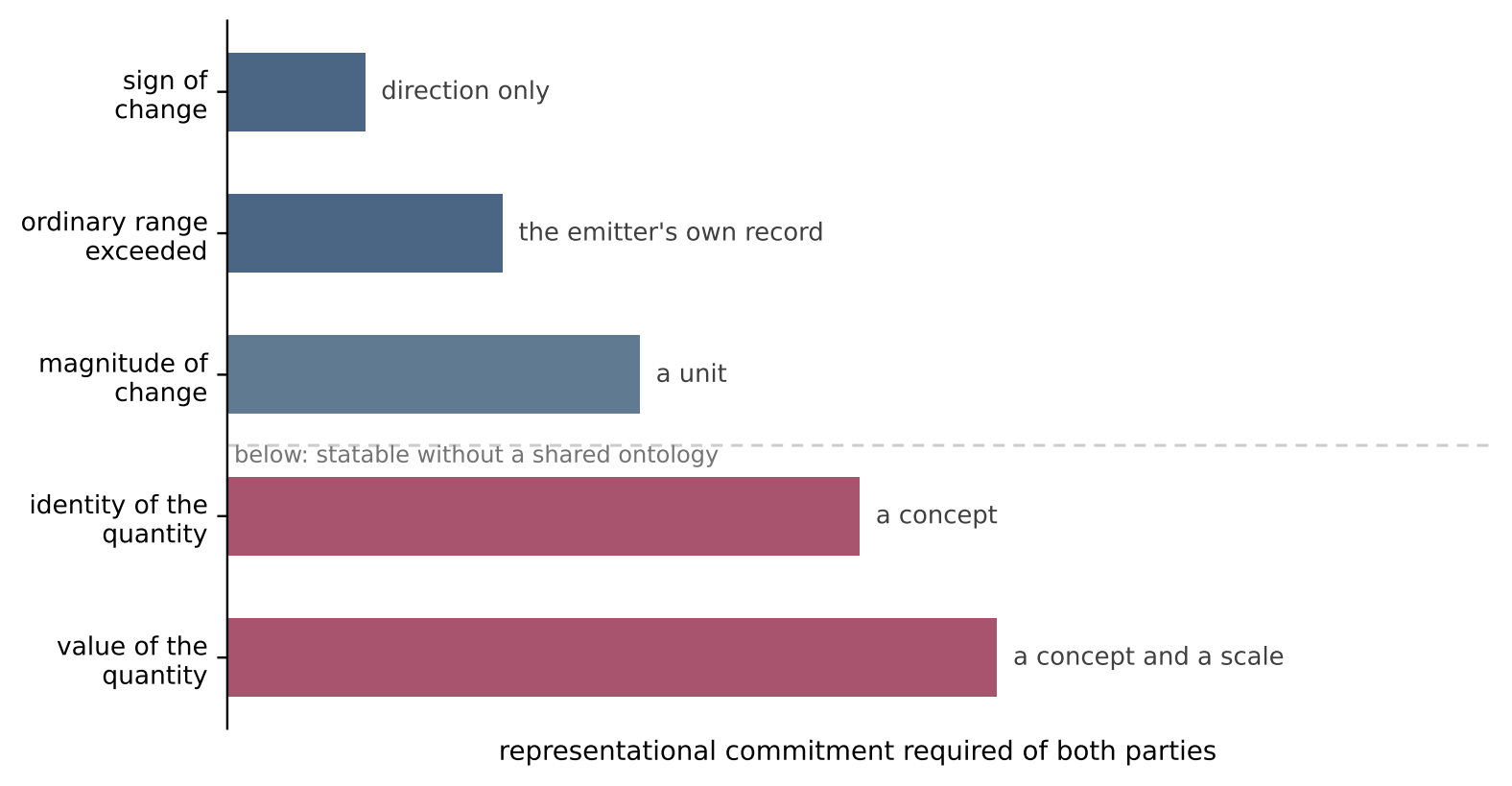
Figure 1. Kinds of agreement between two parties, ordered by the representational commitment each requires. The lower three are statable by parties holding incompatible accounts of the field; the upper two require a shared concept and, in the limiting case, a shared scale.
The point is easiest to see in a case where no shared representation exists even in principle. A rooster’s call and the passage of a day stand in a stable relation, and a farmer who understands nothing of what the call is to the bird can nonetheless act on the relation between the call and the daily cycle. No shared concept is available, and coordination proceeds through a correspondence between changes. Cases in governance are less extreme and have the same structure: an agricultural authority and a public health service coordinate on the observation that a season has shifted, without any shared account of what a season is.
2.2 Definition of the Primitive
Let subsystems $i$ be described by parties in representations $X_i$ that are not assumed to be mutually translatable. The differential of a subsystem is the pattern of change in its own representation, $\Delta x_i$ or $\dot{x}i$, together with the emitting party’s assessment of that change against its own record of ordinary behaviour. A differential correspondence between subsystems $i$ and $j$ is a stable relation between $\Delta x_i$ and $\Delta x_j$, established from paired records and requiring no map between $X_i$ and $X_j$. Governance conducted over these objects, the setting of requirements on $\Delta x_i$ and the coordination of parties through correspondences $C^{\Delta}{ij}$, is differential governance.
Three features of Definition ? carry the argument.
The correspondence is between changes and not between quantities. It asserts that when one subsystem changes in a certain way, another changes in a related way, and it asserts nothing about a common underlying variable. This is what makes the object available across incompatible representations, and it is also what limits it, since a correspondence so established is evidence of coupling and not an account of the mechanism.
The unusualness of a change is assessed within the observing party’s representation. No external standard of significance is required, which is what permits the assessment to be made at all; the cost is that the standard is the emitter’s, and §7 treats the consequences.
The primitive is silent about levels. A requirement stated over $\dot{x}$ says nothing about $x$, and this silence is the primitive’s principal limitation and the subject of §7.
2.3 Varieties of Differential
Definition ? speaks of change without distinguishing kinds, and three distinctions bear on what a governance arrangement can state.
Order. A requirement may be stated over the first derivative, the rate at which a quantity changes, or over the second, the rate at which that rate changes. The distinction is consequential where a party is required to reduce a quantity: a requirement that emissions fall is satisfied by any decline, and a requirement that the decline itself accelerate is a materially different obligation. Higher-order requirements are cheaper still in representational terms, since they refer to the shape of a trajectory and not to its position, and they are correspondingly weaker.
Object. A differential may be taken of a subsystem’s own state or of a relation between subsystems. The second is the object the wider programme requires, since the conditions it takes as its governing object are relations, and their alteration is a change in a coupling and not in a level. A report that a coupling has strengthened, that a river’s flow now responds to rainfall differently from how it responded before, is a differential report of the second kind, and it is available to a party that holds no account of what either quantity is in the other party’s terms. Relational differentials are harder to observe than state differentials, for the reason given in the companion paper on infrastructures: a relation is established from covariation over a period, and a state is measured at an instant.
Form. Change may be reported as a direction, as a magnitude, or as a departure from an established pattern. The third is distinct from the first two and is the form the opening example of §5 actually exhibits. The farmer knows nothing of the call’s rising or falling, and knows that it recurs, and that its recurrence stands in a stable relation to the daily cycle. A departure from a periodicity is a differential of the third form, and it is the form most of the phenomena of environmental change take: seasons arriving earlier, flood recurrence intervals shortening, a monsoon becoming erratic. The formalism of §5 extends to it directly, since a pattern is a structure in a record and a departure from a pattern is assessable against that record by the party holding it, but the extension should be stated because the vocabulary of rates invites a narrower reading.
2.4 Relativity to Horizon
A change exists only relative to an interval over which it is assessed, and this relativity is not a defect of measurement. A quantity oscillating within a day exhibits large changes at hourly resolution and none at annual resolution; a quantity drifting over decades exhibits none at either. Two parties assessing the same quantity over different intervals will disagree about whether it is changing, and their disagreement is not resolvable by better instruments.
A differential is defined relative to a horizon, and an arrangement stating requirements over differentials must state the horizon with them. Two consequences follow. Parties observing a common field at different horizons will report different findings without either being in error, so the horizon is a further term on which agreement is required, and the saving that Claim ? identifies is therefore partial. And the horizons at which parties observe are determined by their operational rhythms and by the records they hold, which are not chosen for their fitness to the processes being governed.
Claim ? qualifies the paper’s central claim and is stated here, and not in the section of limits, because it belongs to the definition of the primitive. The qualification is real and is bounded: agreement about a horizon is agreement about an interval of time, which every party represents, and it is therefore materially cheaper than agreement about what a quantity is. The saving survives the qualification and is smaller than the unqualified statement of §5 suggests.
2.5 Relation to the Companion Positions
Two connections to the accompanying papers are stated so the primitive’s place is not mistaken.
The conditions that the first paper of this series takes as the object of governance are relations, and their alteration is what a governance arrangement must observe and constrain. A differential of the relational kind just distinguished is what such an alteration looks like in a record. The primitive proposed here is therefore the operational form of that position’s object, and the two are not independent proposals.
The second paper distinguishes the physical, epistemic, and communicative structures of an interdependent field and argues that assembling the parties’ observations into a common state estimate is unavailable across its domains. That argument establishes the negative result; the present paper supplies the positive counterpart, since if a common state is unavailable, coordination must proceed on something else, and the graded account of §5 identifies what remains available.
2.6 The Dynamical Argument
The representational argument establishes that differentials are cheap to share. A second argument establishes that they are, for a class of transition, the only adequate object.
In a nonlinear system subject to a moving control parameter, a transition may occur because the parameter is moved quickly, without the parameter reaching any value at which the system’s equilibrium structure changes. The system tracks a slowly moving equilibrium and fails to track the same equilibrium moved faster over the same interval; having fallen behind, it is overtaken by the boundary of its basin and leaves. Transitions of this kind are distinguished in the mathematical literature from those induced by a parameter crossing a bifurcation value and from those induced by noise (Ashwin et al., 2012), and they have been analysed for climatic and ecological systems (Wieczorek et al., 2011; Scheffer et al., 2009).
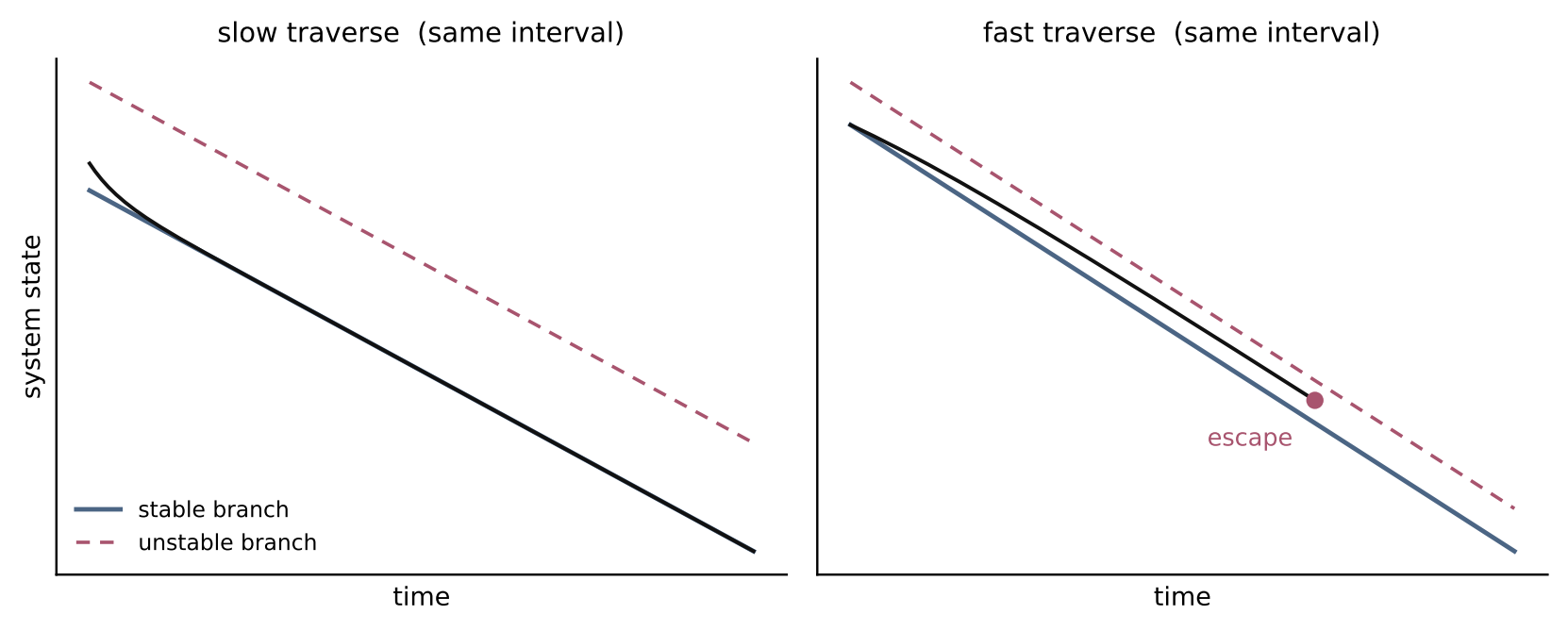
Figure 2. Schematic of a rate-induced transition. The control parameter traverses the same interval in both panels, and the equilibrium structure encountered is identical. In the left panel the system tracks the moving equilibrium; in the right the same interval is traversed faster, the system falls behind, and it is overtaken by the boundary of its basin. The states visited before escape are contained in the states visited on the left, so no requirement stated over states distinguishes the two cases.
Figure 2 shows the structure. Its governance consequence is stated as follows.
Where a transition is induced by the rate at which a system is forced, the states traversed on the transitioning path are contained in those traversed on a path that does not transition. No requirement stated over states distinguishes the two paths, and a governance arrangement whose instruments are stated exclusively over states is therefore unable to address transitions of this class. Requirements stated over rates distinguish them.
Claim ? is a statement about the reach of instruments and not a claim about the frequency of such transitions in any actual field, which is an empirical question the paper does not address. Its force is conditional and is sufficient for the argument: to whatever extent a field contains rate-sensitive transitions, an arrangement addressed only to levels cannot reach them.
The claim also has a bearing on early warning. Indicators of an approaching transition that operate through the slowing of a system’s recovery from perturbation are keyed to the loss of stability of an occupied equilibrium, and a rate-induced transition need involve no such loss, since the equilibrium may remain stable throughout while the system fails to keep up with it. An arrangement relying on such indicators inherits the same blindness, and this is a further reason for governing the forcing rate directly.
2.7 Worked Case: A Basin under Shifting Seasonality
The following traces the primitive through a case, and is offered to display what an arrangement built on it would and would not achieve.
Consider a river basin in which an agricultural authority, a water authority, an ecological research programme, and a downstream fishery operate. Their representations do not translate. The agricultural authority records planting and harvest dates, areas, and yields. The water authority records storage, abstraction, and discharge at gauging stations. The research programme records phenological events in vegetation and invertebrates. The fishery records catch, effort, and the timing of a spawning run. There is no common state variable and no common model, and an attempt to construct one would require each party to accept the others’ categories.
Under a differential arrangement each party assesses its own record. The agricultural authority observes that the planting window has moved earlier by an amount unusual against its own history. The research programme observes that an emergence date has moved earlier by a different amount. The fishery observes that the spawning run has not moved. The water authority observes that the timing of peak flow has advanced.
Three findings become available that no party held alone. The first is a set of correspondences: the planting window, the emergence date, and the peak flow have moved together across several years, and the spawning run has not. The second is a divergence, which is the finding of substance: two coupled processes that formerly co-occurred are separating, and the separation is visible only in the comparison of differentials, since each series taken alone shows a modest shift. The third is a candidate coupling the parties had not represented, if the abstraction schedule set by the agricultural calendar now falls at a different point relative to the flow regime than it formerly did.
The arrangement’s failures should be equally clear. It does not establish that the shifted planting window causes anything, nor that the divergence between emergence and spawning is driven by a common climatic forcing and not by a coupling between them, nor whether the fishery’s stability is robustness or the absence of a response that will arrive later. It does not say what should be done. It delivers this: four parties who could not have constructed a shared account of the basin now hold a common object of attention, arrived at without any of them adopting another’s categories, and that the object is a divergence between rates which none of their separate records displays.
2.8 Coordination through Correspondence
The primitive supports coordination in a specific way, and the mechanism should be stated to avoid a stronger reading.
Parties emit reports of changes assessed as unusual within their own representations. A receiving party holding no account of the emitter’s subsystem can nonetheless establish, over time, that changes of a certain kind in the emitter’s reports are followed by changes of a certain kind in its own. The correspondence so established is a claim about the field constructed from paired records, and its establishment requires no theory shared between the parties, no common variable, and no prior model of the coupling. Once established, it supports action of a limited kind: the receiving party may treat the emitter’s report as a reason to attend to its own subsystem, to prepare a response, or to withhold an intervention it would otherwise have made.
The limits of the mechanism are as important as its availability. A correspondence is evidence of a relation and does not identify its direction, its mechanism, or the presence of a common driver acting on both. Two subsystems responding independently to a season exhibit a correspondence and are not coupled. Methods developed in the ecological literature address exactly this difficulty and recover directional coupling from paired time series without a shared model (Sugihara et al., 2012), and §8 records the question of their applicability to institutional records.
The requirements a governance arrangement may state over differentials are correspondingly modest and are of three kinds: that a quantity move in a stated direction, which is a monotonicity requirement; that its rate of change lie within stated bounds, which is a rate limit; and that a change assessed as unusual be reported to parties standing in an established correspondence, which is a reporting requirement. None of the three requires agreement about the value the quantity should take.
3. Prior Treatments of Difference, Rate, and Coordination
The proposal touches five literatures with quite different objects. Each owns a claim that must be conceded before the residue can be stated, and the concessions are extensive.
3.1 The Philosophical Priority of Difference
The proposal that difference is prior to identity, and that repetition and variation are the terms in which becoming should be analysed, is Deleuze’s (Deleuze, 1968), and priority is conceded without reservation. Deleuze’s argument is that representation subordinates difference to identity by treating the differing thing as a variant of a self-identical original, and that an adequate account reverses the order. Process philosophy in Whitehead’s development (Whitehead, 1929) takes events and their transitions, and not enduring substances, as the fundamental entities. In the Chinese tradition the Yijing treats change as the primary object of a practice concerned with the conduct of affairs, and the associated commentarial tradition develops a vocabulary for reasoning about situations in terms of their tendency and phase, and not in terms of their composition (mph Yijing (Book of Changes), with the m, n.d.).
These traditions own the ontological priority of difference, and the present paper does not argue for it and does not require it. Its claim is epistemic and institutional: whatever the metaphysical order of difference and identity, agreement about differences is available to parties for whom agreement about identities is not, and a governance arrangement may be built on the former. A reader who holds that identity is metaphysically prior may accept Claim ? without inconsistency, since the claim concerns what parties can establish between themselves and not what the world is composed of.
3.2 Relational Value in Structural Analysis
Saussure’s account of linguistic value (Saussure, 1916) holds that a sign’s value is constituted by its differences from other signs of the same system, and not by any positive content of its own. This is the closest structural ancestor of the paper’s use of differences, and it is conceded. Its scope must be stated precisely, because the paper’s use exceeds it: Saussurean value is intra-systemic, and the differences that constitute a sign’s value are differences within one language. Claim ? requires a relation between the differential structures of two systems that share no elements at all, which is a further step.
That step belongs to Lévi-Strauss (Strauss, 1958; Strauss, 1964), whose structural analysis compares systems by the transformations relating their sets of oppositions, and treats two myths as instances of one structure where their internal relations correspond even though no element of one appears in the other. This is the operation Definition ? requires, and the concession is unreserved. Two differences from the present use should be recorded. Structural analysis is applied to symbolic systems and the present proposal to dynamical ones, and the correspondence sought there is atemporal where the correspondence here is between changes over time. Neither difference is decisive, and neither is claimed as an advance; the lineage is acknowledged and the extension is where the paper’s contribution lies, if it has one.
3.3 Rate-Based Instruments in Regulation
Regulation of rates is common and long established, and any claim to novelty in regulating rates would be false. Emission standards stated per unit of output, harvest quotas per season, abstraction limits per period, and speed limits are all instruments stated over rates. In environmental regulation specifically, rate-based emission trading has been implemented at scale: the Dutch nitrogen oxides system allocated obligations as an emission performance rate per unit of energy input, and the design has been analysed comparatively against mass-based schemes (Sholtz et al., 2001). Rate-based approaches recur in the design of emissions trading generally (Fischer, 2003), and intensity-based targets have been used in national climate commitments.
The distinction between these instruments and the present proposal must be made carefully, because both are described as governing rates and they govern different things. An emission performance rate is an intensity, a ratio of emissions to output, and it is a quantity whose value is specified in the instrument: the regulated party is required to keep a ratio below a stated number. Establishing such a requirement demands exactly the agreement Claim ? says is expensive, since the parties must agree what emissions are, what output is, and what number the ratio may not exceed. The differential of Definition ? is a rate with respect to time, and the requirements stated over it in §5 are directional and boundary requirements that fix no value.
International climate practice contains one instrument closer to the present proposal, and it should be named. The requirement that each successive national commitment represent a progression beyond the one it replaces is a monotonicity requirement stated over a trajectory, and it is binding on the direction of change while leaving the level to each party. This is differential governance operating in treaty law, and the paper claims no priority over it. The paper adds the account of why an instrument of this form is available where instruments stating levels are not, which the practice does not supply.
3.4 Derivative Action in Control Engineering
Control engineering has acted on rates since its beginnings. Proportional-integral-derivative control uses the rate of change of the error term to anticipate its future development, and rate and slew limiting are standard elements of control design (Murray, 2008). Model predictive control solves a constrained optimisation over a receding horizon and admits rate constraints directly among its constraints (Rawlings et al., 2017).
The concession is complete on the technical point: governing a system through its rates, and limiting rates of change to preserve stability, is elementary and old. Two differences bear on the paper’s claim. Control design presupposes a model of the plant and a specified reference; the present setting supplies neither, since the field’s dynamics are not held by any party and no reference state is agreed. And a controller is a single agent acting on a system, where the present proposal concerns coordination among many parties none of which holds the system. The engineering literature therefore owns the manipulation of rates and does not address the question of Claim ?, which is what many parties holding incompatible representations can agree to act on.
3.5 Coordination without Shared Representation in Other Fields
Several literatures address coordination among parties lacking a common representation, and their solutions are instructive because they differ from the one proposed here.
The literature on boundary objects (Star & Griesemer, 1989) identifies artefacts that are used jointly by communities holding different accounts of them, being plastic enough to accommodate local interpretation and robust enough to maintain a common identity. This is a solution to the same problem, and the difference is in the object: a boundary object is a shared artefact interpreted differently, and the present proposal is a shared form of report whose content remains in the emitter’s terms. The two are compatible, and a differential report may function as a boundary object.
Work on standards and classification (Bowker & Star, 1999) establishes that the categories through which a field is recorded are consequential and contested, which bears directly on the assessment of unusualness in Definition ?, since the emitter’s record embeds a classification. Studies of trading zones and interactional expertise (Galison, 1997; Collins & Evans, 2007) describe how communities develop restricted forms of exchange adequate for joint work without full mutual understanding, and a differential report is naturally read as an element of such a restricted exchange.
Ecological research supplies the technical counterpart. Convergent cross mapping (Sugihara et al., 2012) establishes directional coupling between variables from paired time series, using the structure of reconstructed attractors and requiring no model relating the variables; the method rests on the embedding results of Takens (Takens, 1981). The relation to the present proposal is exact and should be stated plainly: this method addresses the establishment of a correspondence, which the present paper takes as given and does not contribute to, and the paper’s proposal concerns what a governance arrangement does with a correspondence once established. Any implementation would use methods of this family as a component.
3.6 Rates in Environmental Science and Policy
Environmental science has treated rates of change as objects distinct from levels for some time, and the treatments are directly relevant.
The planetary boundaries framework specified, among its original nine boundaries, a rate of biodiversity loss expressed in extinctions per million species-years, which is a boundary stated over a rate and not over a stock (Steffen & Noone, 2009). The framework’s subsequent revision replaced that formulation, and the episode is instructive for the present paper: the difficulty reported was that a rate boundary carries no information about the level from which the loss proceeds, which is the limitation of §7 appearing in a live scientific framework (Steffen & Richardson, 2015).
The velocity of climate change, the speed at which climatic conditions move across a landscape, was introduced as a measure distinct from the magnitude of warming and shown to bear on whether populations can track the conditions they require (Loarie et al., 2009). This is a rate-based quantity whose governance significance is precisely rate-based: what threatens a population is not only where the climate arrives but how fast it travels, since the capacity to follow is finite.
In conservation and restoration ecology, the concept of a historical range of variation specifies what a system’s ordinary variability has been, and treats departures from that range, and not departures from a fixed state, as the object of concern (Landres et al., 1999). This is the same structure as the assessment of unusualness in Definition ?, developed independently and in a single domain, and priority for the structure in that domain is conceded.
Climate science distinguishes the rate of warming from the level reached in its treatment of overshoot, where the governing questions concern how far a threshold is exceeded, for how long, and how quickly the excursion is reversed. These are questions about a trajectory and not about a state, and the fact that policy discourse has moved toward them is evidence that instruments stated over levels alone have been found insufficient.
3.7 Detection of Change against a Record
The assessment of unusualness in Definition ? is a statistical operation with a long history, and the history should be acknowledged because it supplies both methods and cautions.
Statistical process control was developed to distinguish variation intrinsic to a process from variation indicating that something has altered, and its central device, the control chart, assesses an observation against limits derived from the process’s own record (Shewhart, 1931; Montgomery, 2013). This is exactly the operation an emitting party performs under Definition ?, and the tradition supplies the vocabulary of common and special causes of variation together with a substantial body of practice on how the limits should be set.
Change-point detection addresses the identification of the moment at which a series’ generating process alters, in retrospective and sequential forms (Page, 1954; Aminikhanghahi & Cook, 2017), and the sequential form is what an arrangement operating in real time requires. The cautions the literature supplies are as relevant as the methods: detection is a trade-off between delay and false alarm which no procedure escapes, the trade-off is governed by the magnitude of the change relative to the process’s variability, and small persistent changes are detected late by every method.
These literatures own the detection problem. The present paper contributes nothing to it and takes from it the constraint that an arrangement built on reported unusualness inherits a delay-versus-false-alarm trade-off which cannot be designed away, and which must therefore be allocated deliberately.
3.8 Rate and Level in Macroeconomic Policy
Monetary policy has conducted an extended argument about the object of a policy rule that bears on the present question, and the parallel is close enough to be informative. A central bank may target the rate of price change, which leaves the price level to drift with accumulated deviations, or it may target the level, which commits it to reversing past misses (Svensson, 1999; Bernanke, 2017). The known trade-off is that rate targeting is simpler to communicate and forgives accumulated error, and level targeting anchors long-horizon expectations at the cost of requiring compensating action for departures already past.
Two elements transfer. The first is the diagnosis: rate targeting’s characteristic failure is base drift, the same failure this paper records in §7 under moving baselines, and the monetary literature has examined it for decades under a different name. The second is the response: the proposals that have gained ground are hybrid, retaining a rate rule in ordinary conditions and invoking a level criterion where accumulated deviation becomes large. That structure is the division of labour of Claim ? arrived at in another domain, and its independent arrival is a modest support for the position.
The disanalogy should be stated. A central bank is a single authority acting on a system it partly constitutes and possesses an agreed measure of the quantity at issue; the present setting supplies neither. The parallel is therefore instructive about the properties of rate rules and supplies no argument about coordination among heterogeneous parties.
3.9 Requirements of Direction in Law
Legal instruments stated over the direction of change exist and are not marginal. The principle of non-regression in environmental law holds that levels of protection already attained should not be lowered, which is a monotonicity requirement on a trajectory of legal protection, and it has been advanced in scholarship and adopted in several jurisdictions (Prieur, 2012). Its proponents are explicit that the requirement is directional and not a bar on change: a legislative formulation adopted in one jurisdiction states that environmental protection may be the object only of constant improvement, and the principle’s leading advocate insists that the law must remain modifiable provided the modification is an improvement. The requirement is therefore stated over the direction of change and leaves the magnitude and the level open, which is the form Claim ? identifies as available where agreement about levels is not. Standstill obligations perform the same function in other fields of law. Ratchet arrangements in international environmental agreements require successive commitments to progress beyond their predecessors. Phase-in and phase-out schedules regulate the rate at which a substance or a practice is withdrawn, and are common in chemicals and ozone regimes.
The concession is that requirements of direction are established legal instruments. The survey does not find a general account of why such instruments are available in circumstances where instruments stating levels are not, and it is that account, and not the instruments, that the present paper offers. One further convergence is worth recording, because it locates the same difficulty from the other side. The principle’s leading advocate has posed, as the question the doctrine most needs answered, how the thresholds and criteria of regression are to be determined; and that is the difficulty §8 states as the evasion of a monotonicity requirement by a movement of negligible magnitude. A doctrine of direction and a governance primitive of direction encounter the same open question, which is modest support for the claim that the primitive is the general form of which the doctrine is an instance. A second observation follows from the legal material and bears on §8: non-regression and ratchet provisions are ordinarily paired with a floor, a level below which protection may not fall regardless of direction, which is the division of labour of Claim ? appearing in drafting practice.
3.10 Regulation and Variety in Cybernetics
Cybernetic analysis of regulation supplies a general constraint that bears on the whole proposal. Ashby’s law of requisite variety holds that a regulator can absorb only as much variety as it can itself represent and generate (Ashby, 1956), from which follows a difficulty for any arrangement governing a field more various than its own descriptive apparatus. Beer’s development of the argument into an account of viable systems (Beer, 1972) treats the attenuation of variety as the central design problem of an organisation.
The bearing on this paper is direct and cuts both ways. A differential report is an attenuator: it reduces the variety of an emitting party’s state to a small number of statements about change, which is what permits a receiver of limited capacity to attend to it. The law then implies that the attenuation is lossy in a definite sense, and that an arrangement built on differential reports can regulate only those aspects of the field that survive the attenuation. Whether the aspects that survive are the ones governance requires is not settled by the argument, and is recorded in §8.
3.11 Residue of the Survey
Consider parties that hold incompatible representations of a common field, that hold no model of the field’s dynamics, that agree on no reference state, and that stand in no hierarchical relation to one another. The claim that such parties can coordinate on reported changes assessed within each party’s own record, that requirements stated over the direction and rate of change are the instruments available to them, and that a class of transition exists which such requirements reach and requirements stated over states do not, is not made by any of the treatments surveyed. The philosophical traditions establish the priority of difference and address no governing arrangement; structural analysis supplies the correspondence operation and addresses symbolic systems; rate-based regulation supplies instruments that fix values and thereby require the agreement at issue; control engineering supplies rate manipulation for a single agent holding a model; and the coordination literatures supply mechanisms of restricted exchange without addressing what is exchanged in a field governed under dynamical uncertainty.
4. Limits of the Primitive and the Division of Labour They Imply
The primitive fails in identifiable ways, and the failures determine what it must be combined with.
4.1 Blindness to an Unacceptable Standing State
A quantity may stand at a value that is unacceptable and change not at all. A pollutant concentration held constant above a threshold of harm, a population reduced to a remnant and stable there, a stock of atmospheric carbon that would remain elevated for centuries if emissions ceased entirely: in each case the differential is zero and the situation is grave. A governance arrangement conducted wholly over differentials registers nothing.
The failure is structural and admits no repair within the primitive, since it follows directly from the silence about levels noted in §5. It has a further and less obvious form. Where a system has already been carried across a threshold, the requirement that its rate of change be held small is precisely wrong, since what is required is a large change in the direction of recovery. A rate limit imposed indifferently to level therefore protects the status quo, and the status quo may be the harm.
Differential governance requires a complementary layer stated over states, and the division of labour between them is determinate: constraints stated over states specify the region within which the field must be kept, and governance conducted over changes operates within that region and across the parties who cannot agree on a point inside it. Neither layer substitutes for the other. A field held within a viable region by state constraints may still be carried out of it by a rate that state constraints do not register; a field coordinated only through changes may be held stable in an unacceptable condition.
Claim ? places the paper’s proposal in relation to the boundary and viability literatures, which supply the outer layer, and the relation is complementary and not competitive. The outer layer is expensive in exactly the way §5 describes, since specifying a region requires the shared representation the differential avoids, and the division of labour is therefore also a division of cost: agreement is purchased once, at the level of the region, and is not required again for each coordinated action within it.
| p0.21 p0.35 p0.35 | Requirement over states | Requirement over changes |
|---|---|---|
| Agreement required | The quantity, its scale, and the value it may take | The quantity’s ordering, and the horizon of assessment |
| Statable across incompatible representations | No | Yes, for direction and for unusualness |
| Reaches rate-induced transition | No | Yes |
| Reaches a standing unacceptable level | Yes | No |
| Characteristic failure | Agreement unattainable, so no requirement is set | Base drift, and protection of an unacceptable status quo |
| Legal instances | Standards, limit values, thresholds | Non-regression, ratchet provisions, phase-out schedules |
| Cost of agreement | Paid once for the region, and again for each revision | Paid once for the horizon and the ordering |
Table. Requirements stated over states and over changes compared. The two rows on reach are complementary and neither dominates, which is the ground of the division of labour stated in Claim ?.
4.2 Slow Drift below the Threshold of Notice
A change small enough to be unremarkable in every period may accumulate over many periods into a large one. Where the assessment of unusualness is made against a record, and the record is updated as the drift proceeds, the drift is progressively absorbed into what the record represents as ordinary, and no period contains a change that the arrangement registers. This is the differential analogue of the accumulation problem, and it is aggravated by the very feature that makes the primitive cheap: assessment against the emitter’s own record is available without external agreement and is therefore relative to a baseline that moves.
Three partial repairs are available, and each has a cost the paper records. A baseline may be fixed at a stated date, which reintroduces an agreement about a level and returns part of the expense the primitive avoids. Assessment may be conducted over multiple horizons simultaneously, so that a change unremarkable over a year is assessed against a decade, which requires records of the longer duration and is unavailable to parties that have not held them. Or the cumulative departure from a fixed baseline may itself be treated as the reported quantity, which converts a differential arrangement into a level arrangement for that quantity and is appropriate for some cases and not others.
4.3 The Standard of Unusualness and Its Holder
Assessment against the emitter’s own record is what makes the primitive available, and it locates a determination of consequence with the emitting party. Three consequences follow.
The emitter’s record encodes a history, and a change unprecedented in that history may be ordinary in the field. A short record produces frequent reports of unusualness; a long one produces few. A field of parties with unequal records therefore generates reports at rates that reflect the records and not the field.
The emitter bears the cost of reporting and does not receive its benefit, which falls to the parties standing in correspondence. A party assessing its own changes against its own standard, under an arrangement in which reporting is costly, has an interest in a standard that reports rarely.
And a party whose reports trigger requirements on others acquires an interest in reporting, which is the converse case and equally a distortion. The arrangement is exposed at both ends, and §8 carries the question.
4.4 Correspondence without Mechanism
A correspondence established from paired records supports the inference that attention is warranted and does not support an inference about mechanism. Three failure modes follow. A common driver acting on two subsystems produces a correspondence between them where no coupling exists. A correspondence established under one regime may not hold under another, and the regimes in which governance is most needed are those least represented in the records from which correspondences are estimated. And a correspondence may be real and its direction misidentified, which produces intervention on the wrong subsystem.
The paper’s position on this is that differential correspondence is a device for allocating attention and for triggering enquiry, and that action bearing substantially on a party requires more. Where the action contemplated is itself reversible and small, the correspondence may suffice; where it is neither, the arrangement should require the enquiry that a correspondence alone cannot replace.
4.5 Aggregation across Correspondences
A party may stand in correspondence with several others, and their reports may conflict, one indicating a change warranting restraint and another a change warranting intervention. The primitive supplies no rule for combining them. This is a genuine gap and not an oversight: a combination rule would require weights across the reporting parties, and weights of that kind are an ordering over parties, which the framework’s commitment to plurality withholds. Whether an aggregation is available that respects that commitment is stated in §8 as an open question, and the paper does not assume that one is.
5. Questions Left Open for the Programme
5.1 Questions Concerning Establishment
Estimation of correspondence from institutional records. Methods for recovering directional coupling from paired time series were developed for ecological data with particular properties: long records, dense sampling, and stationarity over the observation period. Institutional records are short, irregular, and shaped by reporting practice. An answer would state the conditions on institutional records under which such methods are informative, and would characterise the errors they produce where those conditions fail.
Discrimination of common drivers. A correspondence produced by a shared driver is indistinguishable, in paired records alone, from one produced by coupling. An answer would state what additional evidence discriminates them in a governance setting, where controlled perturbation is ordinarily unavailable, and would say what an arrangement should do while the discrimination is pending.
Stability of correspondence across regimes. Correspondences are estimated from records of ordinary conditions and are relied on under unusual ones. An answer would characterise the classes of correspondence that persist across regime change and those that do not, and would state how an arrangement should treat a correspondence whose regime of validity is unknown.
5.2 Questions Concerning Instruments
Setting of rate bounds without agreement on levels. The instruments of §5 include bounds on rates of change, and a bound is a number. An answer would state how such a bound may be set without reintroducing the agreement about the quantity that Claim ? says is expensive, and would confront the possibility that the saving is partial and that some agreement must be purchased at this point.
Composition of rate requirements. Requirements on the rates of several subsystems may be individually satisfiable and jointly incompatible, given the couplings among them. An answer would state the conditions under which a set of rate requirements is jointly feasible, which is a question about the field’s coupling structure and not about any party’s conduct.
Monotonicity requirements and their evasion. A requirement that a quantity move in a stated direction is satisfiable by a movement of any magnitude, including one negligibly small. An answer would state what an arrangement can add to a monotonicity requirement to prevent nominal compliance, and would confront the fact that a magnitude requirement is a level requirement in disguise.
5.3 Questions Concerning the Standard of Notice
Specification of unusualness. Assessment against the emitter’s own record locates a governing determination with the party whose conduct may be constrained by it. An answer would state a procedure for specifying the standard that neither vests it in the emitter nor requires the external agreement the primitive was adopted to avoid.
Moving baselines. Where a record is updated as a drift proceeds, the drift is absorbed into the ordinary. An answer would state when a baseline should be fixed and when it should move, and would confront the objection that a fixed baseline embeds a judgement about a preferred historical condition.
Incentives at both ends. A party bearing the cost of reporting has an interest in reporting rarely, and a party whose reports trigger requirements on others has an interest in reporting often. An answer would characterise the arrangements under which reporting is neither suppressed nor inflated, and would treat the general result that a measure adopted as a trigger ceases to measure what it did.
5.4 Questions Concerning the Primitive Itself
Selection of horizon. Claim ? establishes that a differential is defined relative to an interval and that parties observe at intervals set by their operational rhythms. An answer would state how a horizon should be selected for a governed process, would confront the case in which the process’s own timescale is unknown, and would say what an arrangement should do where parties cannot agree on a horizon, which is the residual disagreement the primitive does not dissolve.
Departure from pattern as a governed object. The third form of differential distinguished in §5, departure from an established periodicity, covers much of what environmental change consists in and is formally less developed here than direction and rate. An answer would state what requirements can be laid over a pattern, given that a pattern is a structure in a record and that its alteration may consist in a shift, a broadening, or a loss of regularity, which are three different things.
Observation of relational differentials. A change in a coupling is the object the wider programme requires and is harder to observe than a change in a state, since a coupling is established from covariation over a period. An answer would state what length and quality of paired record is required to establish that a coupling has altered, as against the establishment that it exists, and would confront the likelihood that the requirement exceeds what most institutional records satisfy.
Attenuation and what survives it. A differential report reduces the variety of an emitting subsystem to a small number of statements, and the cybernetic argument implies that an arrangement can regulate only what survives the reduction. An answer would characterise what is lost in the reduction for classes of subsystem, and would state whether the surviving aspects are those governance requires, which the argument leaves open.
Delay and false alarm. The detection literature establishes that assessment against a record trades delay against false alarm and that the trade-off cannot be designed away. An answer would state how the trade-off should be allocated in a governance arrangement, where the costs of the two errors fall on different parties, and would treat the case of a small persistent change, which every method detects late.
5.5 Questions Concerning Combination and Scope
Aggregation of conflicting reports. A party standing in several correspondences may receive reports indicating incompatible responses. An answer would state whether a combination rule is available that does not impose an ordering over the reporting parties, and if none is, would state what a receiving party should do, which may be to treat the conflict as itself the finding.
Boundary between the layers. Claim ? divides labour between state constraints and differential governance and does not say where the boundary falls. An answer would state which properties of a field determine how much must be settled at the level of the region and how much may be left to coordination within it.
Empirical incidence of rate sensitivity. Claim ? is conditional and asserts nothing about how often rate-induced transitions occur in the fields governance addresses. An answer would identify subsystems in which the phenomenon has been demonstrated, and would state what evidence would establish its presence or absence in a candidate field.
Applicability beyond environmental fields. The argument turns on features that are not peculiar to environmental systems: parties holding incompatible representations, no shared model, no agreed reference. An answer would identify other fields with these features and state whether the primitive transfers, which would also test whether the conditions of Claim ? select anything at all.
6. Declinations and Limits of the Position
The paper claims no novelty in the regulation of rates. Instruments stated over rates are widespread in regulation, in law, and in macroeconomic policy, and §6 concedes them; the claim concerns what parties sharing no ontology can agree to act on, and not the existence of rate-based instruments.
The paper claims no novelty in the assessment of change against a record. Statistical process control and change-point detection own that operation together with its limits, and the paper takes both from them.
The paper claims no result in dynamical systems. The existence of rate-induced transitions is established in the literature cited, and the paper draws a governance consequence from it and contributes nothing to the mathematics.
The paper supplies no method for establishing correspondences. It takes the existence of such methods from the ecological literature and asks what an arrangement does with their output; the questions of §8 concerning estimation are the programme’s and are not answered here.
The paper argues no metaphysical priority of difference over identity. Claim ? is epistemic and institutional, and is available to a reader who holds the contrary metaphysical view.
The paper proposes no institution. It states a primitive, three forms of requirement statable over it, and the layer it must be combined with, and declines to specify the body that would maintain a reporting arrangement, the standard it would administer, or the authority under which it would operate.
References
Aminikhanghahi, S. and Cook, D. J. (2017). A survey of methods for time series change point detection. Knowledge and Information Systems, 51(2), 339–367.
Ashby, W. R. (1956). An Introduction to Cybernetics. Chapman and Hall.
Ashwin, P., Wieczorek, S., Vitolo, R., and Cox, P. (2012). Tipping points in open systems: bifurcation, noise-induced and rate-dependent examples in the climate system. Philosophical Transactions of the Royal Society A, 370, 1166–1184.
Aström, K. J. and Murray, R. M. (2008). Feedback Systems: An Introduction for Scientists and Engineers. Princeton University Press.
Beer, S. (1972). Brain of the Firm. Allen Lane.
Bernanke, B. S. (2017). Monetary policy in a new era. Paper prepared for the conference Rethinking Macroeconomic Policy, Peterson Institute for International Economics, Washington DC, 12–13 October 2017. Published in O. Blanchard and L. H. Summers (eds.), Evolution or Revolution? Rethinking Macroeconomic Policy after the Great Recession, MIT Press, 2019.
Bowker, G. C. and Star, S. L. (1999). Sorting Things Out: Classification and Its Consequences. MIT Press.
Collins, H. and Evans, R. (2007). Rethinking Expertise. University of Chicago Press.
Deleuze, G. (1968). Différence et Répétition. Presses Universitaires de France. English translation: Difference and Repetition, Columbia University Press, 1994.
Fischer, C. (2003). Combining rate-based and cap-and-trade emissions policies. Climate Policy, 3(S2), S89–S103.
Galison, P. (1997). Image and Logic: A Material Culture of Microphysics. University of Chicago Press.
Landres, P. B., Morgan, P., and Swanson, F. J. (1999). Overview and use of natural variability concepts in managing ecological systems. Ecological Applications, 9(4), 1179–1188.
Lévi-Strauss, C. (1958). Anthropologie Structurale. Plon.
Lévi-Strauss, C. (1964). Le Cru et le Cuit. Plon.
Loarie, S. R., Duffy, P. B., Hamilton, H., et al. (2009). The velocity of climate change. Nature, 462, 1052–1055.
Montgomery, D. C. (2013). Introduction to Statistical Quality Control, 7th edn. Wiley.
Page, E. S. (1954). Continuous inspection schemes. Biometrika, 41(1–2), 100–115.
Prieur, M. (2012). Non-regression in environmental law. S.A.P.I.EN.S, 5(2).
Rawlings, J. B., Mayne, D. Q., and Diehl, M. M. (2017). Model Predictive Control: Theory, Computation, and Design, 2nd edn. Nob Hill Publishing.
Rockström, J., Steffen, W., Noone, K., et al. (2009). A safe operating space for humanity. Nature, 461, 472–475.
de Saussure, F. (1916). Cours de Linguistique Générale. Payot.
Scheffer, M., Bascompte, J., Brock, W. A., et al. (2009). Early-warning signals for critical transitions. Nature, 461, 53–59.
Shewhart, W. A. (1931). Economic Control of Quality of Manufactured Product. Van Nostrand.
Sholtz, A. M., Van Amburg, B., and Wochnick, C. (2001). An enhanced rate-based emission trading program for NOx: the Dutch model. The Scientific World Journal, 1(S2), 984–993.
Star, S. L. and Griesemer, J. R. (1989). Institutional ecology, translations and boundary objects. Social Studies of Science, 19(3), 387–420.
Steffen, W., Richardson, K., Rockström, J., et al. (2015). Planetary boundaries: guiding human development on a changing planet. Science, 347(6223), 1259855.
Sugihara, G., May, R., Ye, H., et al. (2012). Detecting causality in complex ecosystems. Science, 338(6106), 496–500.
Svensson, L. E. O. (1999). Price-level targeting versus inflation targeting: a free lunch? Journal of Money, Credit and Banking, 31(3), 277–295.
Takens, F. (1981). Detecting strange attractors in turbulence. In Dynamical Systems and Turbulence, Lecture Notes in Mathematics 898, 366–381. Springer.
Whitehead, A. N. (1929). Process and Reality: An Essay in Cosmology. Macmillan, New York. Gifford Lectures 1927–28; corrected edn. ed. D. R. Griffin and D. W. Sherburne, Free Press, 1978.
Wieczorek, S., Ashwin, P., Luke, C. M., and Cox, P. M. (2011). Excitability in ramped systems: the compost-bomb instability. Proceedings of the Royal Society A, 467, 1243–1269.
Yijing (Book of Changes), with the Xici (Great Treatise) commentary. Classical Chinese text of uncertain date. Cited for the tradition of reasoning about situations in terms of change; no specific edition or passage is relied upon. For orientation see R. J. Lynn, The Classic of Changes: A New Translation of the I Ching as Interpreted by Wang Bi (Columbia University Press, 1994), and R. J. Smith, Fathoming the Cosmos and Ordering the World: The Yijing and Its Evolution in China (University of Virginia Press, 2008). thebibliography