Criticality Detection in Distributed Environmental Governance - Relational Precursors, Standing Arrangements, and Graded Duties
Abstract
Interdependent Earth–human systems contain thresholds at which small further forcing produces large and partly irreversible reconfiguration, and a governance arrangement for such systems requires warning of their approach. A substantial scientific literature supplies early warning indicators, and recent assessment reports that several major thresholds are near or crossed. This paper does not add to the indicator literature. Its subject is the step that literature leaves open: what it is for detection to be a governance function, operated as a standing arrangement whose findings carry duties, among parties none of which observes the field whole. The method is conceptual, with the statistical material taken from its owners and its conditions stated. Four positions organise the paper. Detection in an interdependent field is relational before it is local: the precursors of system-scale transition lie in the coupling structure, in rising co-movement and shared stress across subsystems, and these are visible only to an arrangement that spans parties, so the communicative structure of the field is a precondition of its warning system and not an accessory. Detection outputs should enter governance as graded standing levels with duties attached to each grade, on the model of the operating arrangements in volcanology, famine classification, and prudential supervision, and not as binary alarms. The soundness conditions of the underlying indicators are restrictive and partly institutional: entire transition classes escape them, including the rate-induced transitions treated earlier in this series, and coupled human response can mute the signatures the indicators read. And the capacity to detect is unevenly held, so a detection arrangement inherits the distribution of instruments and records, a matter developed as a justice question in the next paper of the series. The paper surveys the early warning literature and its critiques, spatial and network extensions, systemic-stress measurement in finance, and the operating institutional instances, states what each owns, and identifies the residue. It reports no empirical study and establishes no statistical result.
Keywords: critical transitions; early warning; relational indicators; alert levels; environmental governance
Notices
On the references. All 21 works cited in this paper have been checked against their sources at claim level: each source was consulted and confirmed to state what the citing sentence attributes to it. No entry in this paper’s bibliography is unverified.
Status. This is a working draft circulated for discussion. It is a preliminary discussion paper and is not a finished statement of its author’s position. Sections and statement numbers are subject to change.
Licence. This work is made available under a Creative Commons Attribution-NonCommercial 4.0 International Licence (CC BY-NC 4.0).
Statement on the use of language models. Drafting, literature search and argumentative criticism for this paper were conducted in dialogue with large language models, specifically Claude (Anthropic) and ChatGPT (OpenAI). The claims, the structure, the selection of material and the position taken are the author’s. References have been checked in stages, to two standards, and the process is incomplete. Part of the corpus has been verified at identity level, meaning author, title and publication coordinates were confirmed against the publisher of record. A smaller part has additionally been verified at claim level, meaning the cited source was consulted and confirmed to state what the citing sentence attributes to it. The remainder is unverified at either standard. The standard reached is marked on each bibliography entry: no mark for claim level, $\ddagger$ for identity level only, $\dagger$ for not yet verified. Corrections made so far are recorded in the project’s citation-verification file; where a source proved not to bear the weight the text placed on it, the text was revised rather than the citation removed.
Companion papers. This paper is Paper 6 of a series on the governance of environmental change, and treats criticality detection as a governance function, with graded levels and attached duties. The other papers of the series treat, in order: the object; the field and its three structures; coordination through change; heterogeneous knowledge; the event layer; observational capacity; representational requirements; routing and inquiry; the regime near a threshold; forecasting from the stream; the knowledge commons; attribution and ownership; responsibility at transitions; and supervisory duties. Paper 12 is reserved and is not yet drafted. A related paper by the author, developed independently of this series, treats the temporal correspondence limitation of evidence-based policy making, being the divergence between the system state that evidence represents and the system state at the moment of decision. Its results on the partition of a state space into estimable and unobservable components, on the blindness of a recency-weighted evidence base to the approach to criticality, and on the allocation of a justificatory burden where temporal correspondence fails, were reached by a different route and bear on several papers of this series.
Suggested citation. Huang, W. Criticality Detection in Distributed Environmental Governance: Relational Precursors, Standing Arrangements, and Graded Duties. Working draft.
Discussion Paper Note
This paper is a preliminary discussion paper intended to share an evolving idea and invite further dialogue, criticism, revision, and independent development.
The author does not claim exclusive epistemic ownership over the viewpoints, concepts, or lines of reasoning presented here, nor does the author claim priority as their first originator. Similar or related ideas may have appeared previously in other intellectual, cultural, or disciplinary traditions. Any legal rights retained in this work are intended to support attribution, responsible use, and protection against exploitative or harmful appropriation, and not to restrict independent inquiry, criticism, revision, or further development.
The arguments in this paper should therefore be understood as provisional and historically situated rather than definitive. Readers are encouraged to question, revise, extend, reinterpret, or independently develop the ideas presented here. Where appropriate, acknowledgment of this paper as one point of encounter in the development of related ideas is appreciated, but such acknowledgment should not be understood as granting the author epistemic ownership over the ideas themselves.
Responsible Use and Rights Reservation
The author encourages good-faith discussion, criticism, independent development, and responsible use of the knowledge presented in this work. The author does not claim exclusive epistemic ownership over the ideas or viewpoints discussed herein, nor claim priority as their first originator.
However, the author expressly reserves all rights and remedies available under applicable law with respect to uses of this work or related materials that involve unlawful conduct, harmful or abusive exploitation, improper commercial appropriation, infringement of applicable intellectual property or other legal rights, or conduct contrary to applicable national, regional, or international law.
This reservation is intended to preserve the ability to respond to misuse and harmful appropriation. It should not be interpreted as restricting legitimate academic inquiry, criticism, independent reasoning, or the further development of related ideas.
1. Introduction
Assessment of the Earth system now reports proximity to thresholds in terms that governance cannot treat as background. The most recent global assessment of tipping elements places the central estimate for warm-water coral reef collapse at a warming level already exceeded, and identifies further elements whose thresholds lie within the range current policies produce (Lenton, 2025; McKay et al., 2022). Whatever position one takes on any single estimate, the structural situation is settled: the fields this series addresses contain critical transitions, their approach is partly detectable, and the detection is at present a scientific activity whose relation to governance is unspecified.
That relation is this paper’s subject. The scientific literature on early warning supplies indicators: statistical signatures, principally rising variance and rising autocorrelation, that precede a class of transitions as a system’s recovery from perturbation slows (Scheffer et al., 2009; Dakos et al., 2012). The literature also supplies the honest record of the indicators’ limits, surveyed in §6. No literature supplies the institutional form: what a standing detection arrangement for an interdependent field consists in, who operates it, what its findings oblige, and how its known failure modes are carried into the duties it triggers. The gap is consequential in both directions. Detection without institutional form produces findings that arrive nowhere in particular and oblige nothing, which is the assessed condition of much of the present warning landscape. Institutional form designed without the indicators’ limits inherits false confidence, and near a critical threshold false confidence is the most expensive commodity there is.
Criticality detection in a distributed environmental field is a governance function and not a monitoring product. Its outputs are events in the sense of the fifth paper of this series, entering standing arrangements as graded findings with duties attached to each grade; its soundness conditions are institutional as much as statistical, since the indicators it runs on presuppose records, spans, and continuity of observation that only arrangements secure; and its design must carry the indicator literature’s negative results as load-bearing elements, principally the transition classes that escape detection and the muting of signatures in coupled human–environment systems.
The paper’s second position sharpens where detection must look. For a single system observed whole, the classical indicators are computed on one series. The fields of this series are not single systems observed whole; they are couplings among subsystems observed separately by parties that do not share records. In such a field, the precursors of system-scale transition are themselves relational: subsystems that formerly fluctuated independently begin to move together, stress ceases to be local, and the share of variance that is shared rises. Indicators of this kind are computed on the coupling structure, and no party holding one subsystem’s records can compute them.
For an interdependent field, the governance-relevant precursors of critical transition lie in the relational structure, in rising co-movement, rising shared stress, and rising synchrony across subsystems, and their observation requires paired records spanning parties. The communicative structure whose adequacy the second paper of this series defines is therefore a precondition of the field’s warning capacity: a field whose couplings are uncommunicated is a field whose approach to criticality is invisible in principle, whatever instruments its several parties hold.
Claim ? is the paper’s connection to the series’ spine, and its converse gives the series’ diagnostic a further use: the divergence findings of the second paper, locating couplings that obtain and are unreported, are simultaneously a map of where the field’s warning system is blind.
The paper proceeds as follows. §5 restates the carried positions, defines the detection arrangement and its grades, states the indicator material with its conditions, and works a case. §6 surveys the owning literatures and the operating institutional instances. §7 treats the objections, of which the false-alarm objection and the capacity objection are the most serious. §8 lists the open questions and §9 the declinations.
2. The Detection Arrangement, Its Levels, and Its Grades
2.1 Positions Carried from the Companion Papers
Five results from the series are used and restated so the paper stands alone.
From the first paper, the object of governance is the set of relational conditions under which trajectories are generated, and the governing principle constrains, under a burden of justification, those alterations of conditions that irreversibly foreclose other trajectories’ capacity to continue generating. Criticality is where this principle acquires urgency: near a threshold, small alterations of conditions produce large irreversible reconfigurations, so the class of condition-alterations falling under the burden expands as a threshold nears. Detection is thereby tied to the normative core: a graded finding of proximity is, among other things, a finding about how wide the burdened class currently is.
From the second paper, a field has three structures, physical, epistemic, and communicative, whose divergences are diagnosable pairwise. The bearing here is Claim ?: relational indicators are computed on paired records, so the epistemic structure determines what is computable and the communicative structure determines what is assembled, and the divergence map doubles as a blindness map.
From the third paper, agreement about changes is cheaper than agreement about states, and one negative result is carried whole: transitions induced by the rate of forcing traverse states contained in non-transitioning paths, so no state-based requirement distinguishes them, and indicators keyed to the loss of stability of an occupied equilibrium do not precede them, since the equilibrium may remain stable throughout. Whatever a detection arrangement achieves, a class of transitions escapes it by construction, and the arrangement’s duties must be written for a field in which undetected transition remains possible.
From the fourth paper, heterogeneous holdings are brought to bear through assemblies that preserve disagreement, and from the fifth, coordination runs on events with source assessment, provenance, and an explicit regime for silence. A detection finding is an event of a particular class, and the arrangement below is an event arrangement in the fifth paper’s sense, specialised in its triggering logic and, distinctively, in the duties its grades attach.
2.2 Definition of the Arrangement
A criticality detection arrangement for a field comprises: a set of monitored objects, each a subsystem, a coupling, or a network of couplings; for each object, one or more indicators with stated soundness conditions, stated data requirements, and a stated record of the transition classes they do not precede; a graded scale of standing levels, each defined by stated indicator conditions; for each level, the duties it activates, of verification, of carriage, of response, and of restraint; and a specified operator for each element, with the operator’s own interests recorded. A finding is an event, in the sense of the fifth paper, whose change-content is a level transition on a monitored object, and which carries the indicator basis, its confidence, and its provenance as that paper’s content model requires.
Three elements of Definition ? carry the paper’s contribution, and each is developed in turn: the levels at which objects are monitored, the grades and their duties, and the required carriage of the indicators’ negative record.
2.3 Node, Edge, and Network Levels of Observation
Indicators operate at three levels, and the levels differ in what they presuppose institutionally.
Node level. The classical indicators are computed on a single series: as a system’s dominant restoring rate weakens toward a bifurcation, its recovery from perturbation slows, and the slowing appears as rising variance and rising autocorrelation in fluctuations (Scheffer et al., 2009; Dakos et al., 2012). A single party holding one adequate record can compute these, so the node level presupposes only the party’s own observational continuity.
Edge level. In a coupled field, a subsystem may show little node-level change while its coupling to another strengthens or begins transmitting stress. The relevant computations are on paired series: rising cross-correlation, rising co-occurrence of excursions, lead-lag structure that shifts. Finance developed the institutional instance: composite stress indication that weights the correlation among market segments, on the stated reasoning that stress is systemic in the measure that it is shared (Kremer & Duca, 2012). Edge-level computation presupposes paired records across parties, which is exactly what the second paper’s uncommunicated divergence denies a field.
Network level. System-scale precursors appear in the joint structure of many series: rising synchrony, a rising share of variance carried by a common component, spatial correlation lengthening, and network early warning signals computed on the coupling graph (Suweis & D’Odorico, 2014; MacLaren et al., 2025; Dakos et al., 2010). These presuppose an assembled view spanning many parties, which no party holds and only an arrangement can constitute.
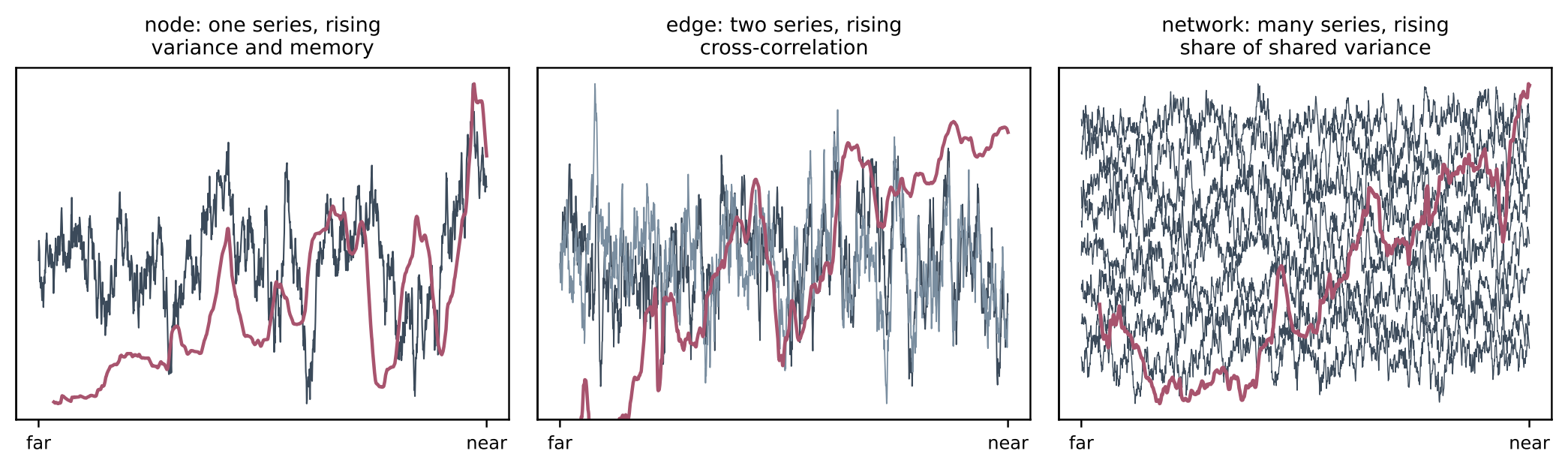
Figure 1. The three levels of observation on simulated series. At the node level a single series shows rising variance and memory as its restoring rate weakens. At the edge level two series show rising cross-correlation as their coupling strengthens. At the network level many series show a rising share of shared variance. The levels differ in what they presuppose: one record, paired records, an assembled span. Positions are illustrative and no governance quantity is derived from them.
The three levels form an institutional ladder: node-level detection is available to single parties, edge-level detection is available only where paired records span parties, and network-level detection is available only to a constituted arrangement. Since the precursors of system-scale transition in an interdependent field are predominantly edge- and network-level phenomena, the field’s warning capacity is a property of its communicative structure, and investment in instruments without investment in carriage purchases node-level sight and system-level blindness.
2.4 Grades and Their Duties
A detection output that is a binary alarm inherits the alarm’s pathology, identified in the fifth paper: every finding must justify itself as urgent, and slow approach, the characteristic form here, has no channel. The operating institutional instances have converged from several directions on the same alternative, graded standing levels with duties attached, and the paper adopts the form. Volcanology maintains alert levels with defined observational bases and defined implications for aviation and evacuation (Fearnley et al., 2012); famine classification maintains five phases with stated evidentiary standards and stated response implications (IPC Global Partners, 2021); prudential supervision maintains graded interventions triggered by indicator conditions (Kremer & Duca, 2012). The convergence across domains that do not cite one another is evidence that the form answers to the problem’s structure.
Detection findings should enter governance as transitions on a graded scale of standing levels, with each grade defined by stated indicator conditions and attaching stated duties, and with the duty structure ordered so that early grades activate duties of verification and carriage, intermediate grades activate duties of preparation and response, and high grades raise the justificatory burden on alterations of the conditions coupled to the monitored object. The last is the specific connection to the series’ normative core: a grade is, among other things, a public determination of how the first paper’s burden currently falls.
Figure 2 displays the form. Two properties of the duty ordering deserve statement. The early duties are epistemic, verification of instruments and activation of carriage, because the indicator literature’s false-positive record makes action on a first excursion unsound and because the qualified-silence regime of the fifth paper requires exactly this verification to mean anything. And the high-grade duty is a burden shift and not a prohibition, inheriting the structure of the series’ principle: a party proposing to alter a condition coupled to an object at high grade must justify the alteration in advance, which is a procedural consequence that operates without any prediction of the transition’s timing, and is therefore robust to the timing uncertainty that the statistical material cannot remove.
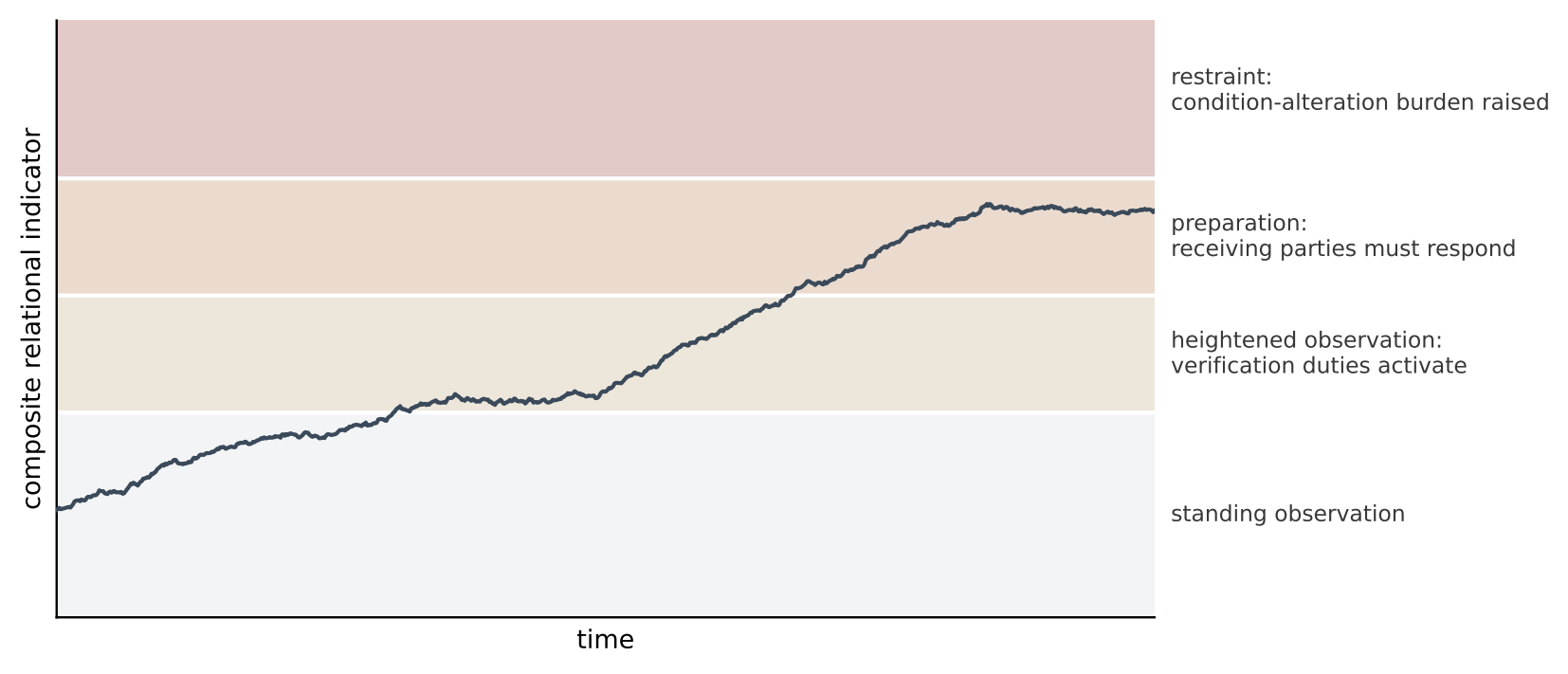
Figure 2. A composite relational indicator crossing graded standing levels. Each grade attaches duties: verification and carriage at the first, preparation and response at the second, a raised justificatory burden on coupled condition-alterations at the third. The grades are standing institutional objects and the indicator conditions defining them are public and contestable, on the threshold discipline of the fifth paper.
2.5 The Negative Record among the Design Elements
The indicator literature’s negative results are ordinarily treated as caveats. Definition ? requires them carried as elements of the arrangement, and the requirement is substantive because each negative result has a duty consequence.
Three escapes are established. Transitions without precursors: systems can shift with no detectable early warning, including chaotic transitions and transitions driven by large shocks (Hastings & Wysham, 2010; Boettiger et al., 2013). Rate-induced transitions: carried from the third paper, these involve no loss of stability of the tracked equilibrium and therefore no slowing to detect. Muted signatures: in coupled human–environment systems, adaptive human response absorbs and reshapes fluctuations, and the tipping-point assessment reports a muting of signal strength, together with ambiguity about which transition a signal heralds, as a challenge peculiar to social-ecological systems (Lenton et al., 2023). The same assessment records a finding that bears on where an arrangement should look: in modelling studies of coupled social-ecological systems, the early warning signals carried by the social time series have been found the more reliable indicators of an approaching transition. An arrangement monitoring only the ecological subsystem may therefore be monitoring the series in which the signal is weakest, which is a further reason for the relational and cross-party observation Claim ? requires, and a demanding one, since social series are held by parties whose records and standards differ from those of environmental monitoring programmes. To these the arrangement must add the detection-theoretic constraint carried from the third and fifth papers, that assessment against a record trades delay against false alarm and no procedure escapes the trade.
An arrangement whose duties are conditioned only on detected proximity is unsound for fields containing the established escape classes, since it converts absence of warning into licence. The duty structure must therefore include grade-independent elements: the restraint principle of this series’ first paper operates on the irreversibility of a proposed alteration and not on detected proximity, and remains in force at every grade including the lowest. The grades modulate the burden; they do not create it. An arrangement in which low grade extinguishes restraint has made the indicator suite, with its known blind classes, the sole custodian of the field’s irreversibilities, which no reading of the statistical literature supports.
Claim ? is the paper’s principal design consequence and the point where the detection arrangement and the series’ normative core lock together. Its practical form is the fourth duty class of Definition ?: restraint duties exist at all grades and tighten with grade, and the arrangement’s public documentation states, for each monitored object, which transition classes the indicator suite does not precede, so that the meaning of a low grade is fixed in the instrument itself as absence of detected approach and not as established distance.
2.6 Worked Case: A Semi-Enclosed Sea under Multiple Loads
A semi-enclosed sea receives nutrient loads from agricultural catchments in several jurisdictions, supports fisheries managed separately, and exhibits the documented capacity of such systems for abrupt shifts to a low-oxygen regime. The parties: agricultural and environmental authorities in each jurisdiction, fishery bodies, a marine research consortium, and municipal water operators.
At the node level, each party’s own records support classical indicators on its own series, and several show little: catchment nutrient series are stationary by jurisdiction, and no single fishery’s landings show rising variance. At the edge level, paired records begin to carry information no party held: excursions in oxygen at the consortium’s stations co-occur increasingly with temperature excursions, and landings series in formerly independent fisheries begin to co-move. At the network level, the assembled picture shows the share of variance common to oxygen, stratification, and landings rising over a decade, which is the signature Claim ? concerns, and it is computable only because a standing arrangement carries the paired records.
The arrangement’s operation is then concrete. The network indicator crosses the first grade: verification duties activate, the consortium’s instrument record is inspected, and carriage to all riparian authorities becomes obligatory, converting what was research into standing. Crossing the second grade activates preparation: fishery bodies must state response plans and municipal operators must assess intake vulnerability. At the third grade the burden shifts: a proposal in one jurisdiction to expand catchment drainage, an alteration of a condition coupled to the monitored object, now bears a justificatory burden it would not bear at low grade, and bears it under a public determination and not an ad hoc objection. Throughout, the documentation states the escapes: the suite does not precede shock-driven shifts, and coupled response, the fisheries adjusting effort to early signs, may mute the very signatures being read, so low grade licenses no expansion of irreversible alteration. The case also displays the ladder’s cost honestly: two jurisdictions’ agricultural records never enter the paired computations, their couplings to the sea remain unwitnessed in the second paper’s sense, and the arrangement’s blindness map, published with its findings, says so.
3. Prior Treatments of Detection and Warning
Seven literatures and three operating institutional instances own parts of the position.
3.1 Early Warning Indicators for Critical Transitions
The core literature established that a class of transitions is preceded by critical slowing down: as a system approaches a fold bifurcation, its dominant restoring rate weakens, recovery from perturbation lengthens, and the slowing appears in fluctuation statistics as rising variance and rising lag-one autocorrelation (Scheffer et al., 2009; Dakos et al., 2012; Carpenter & Brock, 2006). The methods literature supplies estimation practice, detrending discipline, and significance testing against surrogates (Dakos et al., 2012). Extensions include flickering between states as an alternative signature and indicator behaviour under differing noise regimes. Deep-learning approaches train classifiers on libraries of simulated transitions and report sensitivity to signatures beyond the classical pair (Bury et al., 2021).
This literature owns the statistical content entire, and the paper adds nothing to it. The critical literature is owned equally and is load-bearing here: demonstrations that transitions occur without warning in chaotic and shock-driven regimes (Hastings & Wysham, 2010), analyses of false-positive behaviour and the requirement that multiple indicators agree (Boettiger & Hastings, 2012; Ditlevsen & Johnsen, 2010), and the finding that detection performance depends on data quantities that field records rarely supply. The residue this paper claims is stated at the section’s close and concerns none of the statistics.
3.2 Spatial and Network Extensions
A younger literature moves the indicators from single series to structures. Spatial early warning signals, rising spatial correlation and characteristic patterning, precede transitions in spatially extended systems (Dakos et al., 2010). Network formulations compute warning signals on coupled systems, identifying rising synchrony and changes in the correlation network’s structure as system-scale precursors, with results for ecological and socio-environmental networks (Suweis & D’Odorico, 2014; MacLaren et al., 2025). This is the statistical basis of the edge and network levels of §5, and its youth is part of the present paper’s occasion: the governance deployment of relational indicators is unclaimed ground precisely because the indicators themselves are recent.
3.3 Assessment of Earth-System Tipping Elements
The identification of large-scale tipping elements, ice sheets, circulation systems, biomes, and the estimation of their thresholds is an assessment literature of its own (Lenton et al., 2008; McKay et al., 2022), and its most recent instalment reports the coral threshold exceeded and calls directly for governance commensurate with the findings (Lenton, 2025). The same assessment lineage supplies the muting result used in Claim ?: coupled human response can suppress classical signatures in exactly the managed systems where arrangements would run (Lenton et al., 2023).
This literature owns the substantive findings and the call; the residue is the institutional form the call leaves open, which is this paper’s subject.
3.4 Systemic Stress Measurement in Finance
Prudential supervision confronted relational detection earlier and built operating machinery. Composite indicators of systemic stress weight the correlation among market segments, embodying the principle that stress is systemic in the measure that it is shared (Kremer & Duca, 2012); network measures rank institutions by the propagation their position enables (Battiston et al., 2012); and macroprudential frameworks attach graded interventions to indicator conditions. Three elements transfer and are used: the correlation-weighted composite as the edge-level form, the institutional recognition that unit-level supervision leaves the coupled system unsupervised, and the graded-intervention structure. The disanalogy is carried from the second paper and restated: finance possesses a common unit of account in which exposures are expressed, and the fields here do not, so the composite’s construction, trivial there, is itself an open question here.
3.5 Operating Institutional Instances of Graded Warning
Three arrangements operate the graded form at scale and are the closest ancestors of §5.
Volcanic alert systems maintain standing levels with defined observational bases, defined audiences, and defined implications, and the critical literature on them documents the difficulties the present paper inherits: level definitions negotiate scientific uncertainty against decision needs, transitions between levels are contested, and standing down is harder than standing up (Fearnley et al., 2012).
Famine early warning and classification operates a five-phase scale with stated evidentiary standards per phase and stated response implications, across many countries and data regimes (IPC Global Partners, 2021). Its documented pathologies transfer: phase determinations are negotiated where governments hold the data, and response lags classification even when classification succeeds, which is the fifth paper’s finding that the receiver side is where arrangements fail.
Epidemic surveillance under the International Health Regulations, treated at length in the fifth paper, supplies the treaty-scale instance of assessment instruments and non-official sourcing, and is carried here as ancestry without repetition.
These instances own the graded form in operation. The residue is the referent and the span: each operates within one hazard domain with a defined operator, and none monitors the coupling structure of a multi-sector field or attaches duties to relational indicators.
3.6 Warning Governance and Its Assessed Gaps
The literature on warning systems as institutions, and the international architecture’s own assessments, locate the persistent failures in dissemination reach and response capacity, and record uneven coverage concentrated against the least-resourced (World Meteorological Organization, 2022; Garcia & Fearnley, 2012). The finding is carried in two directions: into the duty structure, whose response duties are the arrangement’s weakest point by this record, and into the next paper of the series, since the distribution of warning capacity is the distribution of observational capacity under another name.
3.7 Residue of the Survey
Consider an interdependent field of separately governed subsystems whose couplings no party observes whole, containing transition classes with and without detectable precursors, monitored, where monitored at all, by parties with unequal records and interests. The claim that criticality detection for such a field is a governance function whose arrangement comprises monitored relational objects, indicator suites carried with their negative record, graded standing levels attaching ordered duties from verification through response to a tightening justificatory burden, grade-independent restraint anchored in irreversibility, and a published blindness map derived from the field’s own communicative divergences, is advanced by none of the surveyed literatures or instances. The indicator literatures own the statistics and their limits; the network extensions own the relational signatures; the assessment lineage owns the findings and the call; finance owns the composite and the graded intervention within one unit of account; and the operating instances own the graded form within single domains. The composition, and the two structural claims that motivate it, that relational precursors make the communicative structure a precondition of warning, and that the negative record must be carried in the form of duties and not of caveats, is the residue claimed.
4. Objections and the Limits of the Position
4.1 The False-Alarm Objection
The most practical objection: indicators with the documented false-positive record, run continuously over many objects, will cross grades often, duties will activate against events that do not come, and the arrangement will spend its credibility, after which findings that matter arrive into habituation. The volcanological record documents the dynamic, including its asymmetry, that standing down a level is institutionally harder than standing one up, so false alarms ratchet.
The paper’s answer has three parts and concedes a residual. The graded form is itself the first part: the early grades attach epistemic duties, verification and carriage, whose activation against a false positive costs inspection effort and not evacuation, so the expensive duties sit behind multiple grade transitions, and the design places the indicator literature’s demanded multi-indicator agreement at the grade boundaries where costs jump. The second part is the burden form of the high grade: a justificatory burden on proposed alterations is a duty whose false activation delays projects and does not mobilise populations, chosen partly because its false-positive cost is bounded and reversible, in contrast to the alarm forms whose false activations are unrecoverable. The third part is publication of the operating characteristics: an arrangement that states expected false rates per grade converts each activation from a claim that transition approaches into a claim that stated conditions obtain, which is checkable and survives non-events. The residual is conceded plainly: habituation is behavioural and not procedural, the fifth paper named it the event layer’s characteristic decay mode without remedy, and grades slow it without stopping it.
4.2 The Capacity Objection
Claim ? makes warning capacity a function of paired records and spans, and these follow wealth, tenure, and prior instrumentation. The objection: the arrangement therefore watches best over the best-watched, its grades will be determined by the well-instrumented about fields others inhabit, and its blindness map will coincide with the map of the marginal. The global record supports the premise, with warning coverage lowest where exposure is highest.
The paper concedes the objection’s premise entirely and locates the response in two places. Within the arrangement, the blindness map is the partial remedy: publishing where the arrangement cannot see, derived from the second paper’s divergence diagnostics, at least prevents the silence of the unwatched from being read as the safety of the unwatched, which is the reading Claim ? blocks in general form. Beyond the arrangement, the objection is the subject of the next paper of the series, on the distribution of observational capacity as a justice question, and the present paper’s contribution to it is the demonstration that capacity is not merely useful but constitutive: under Claim ?, to lack carriage is to lack warning in principle, which converts the distributional question from one about better and worse service into one about presence and absence of a protective function.
4.3 The Manipulation Objection
Grades attached to duties create interests in the grades. Parties bearing the high-grade burden acquire an interest in indicators reading low, holders of monitored records acquire leverage over what the computations receive, and the general result that a measure adopted as a target ceases to measure holds with full force. The paper carries the fifth paper’s partial answers, public contestable definitions and provenance inspection, and adds the specific vulnerability of relational indicators: a cross-correlation is computable only from what parties supply, so under-supply is the manipulation of least visibility, and it is formally indistinguishable from the capacity gaps of the previous objection. The arrangement’s response duty on data supply, and the qualified-silence machinery inspecting whether instruments operate, are the available instruments, and the paper records that against a party willing to degrade its own records, they inspect degradation and cannot prevent it.
4.4 Limits Internal to the Position
Four limits without remedy. The composite question is open: the finance instance builds its correlation-weighted composite inside one unit of account, the field has none, and §8 carries the construction as unsolved, so Figure 2 displays a form whose defining quantity is not yet defined. The escape classes bound the whole enterprise: for transitions without precursors the arrangement contributes nothing beyond the grade-independent restraint, and the honest statement is that detection governs the detectable and the principle governs the rest. Grade definitions negotiate uncertainty against decision need, the volcanological literature documents that the negotiation is political, and the paper supplies the requirement of publicity without supplying the criterion the negotiation should apply. And the arrangement presupposes observational continuity through institutional time, records spanning decades held to consistent standards, which is a commons problem the series treats elsewhere and without whose solution the indicator suites have nothing to run on.
5. Questions Left Open for the Programme
5.1 Questions Concerning the Indicators’ Institutional Form
Construction of the relational composite. The edge- and network-level indicators require combination across subsystems measured in incommensurable units. An answer would state what plays the role the unit of account plays in the finance composite, candidate constructions being rank-based and copula-based forms that use only each series’ own ordering, and would establish what such constructions preserve and discard, since the choice re-imports the fourth paper’s aggregation commitments at the statistical layer.
Grade definitions under stated error rates. An answer would supply a procedure deriving grade boundaries from stated tolerances for false activation and missed approach per duty class, making the delay-versus-false-alarm allocation explicit and contestable, and would confront the dependence of any such derivation on transition models the field does not supply.
Standing down. The operating instances document that descending a grade is harder than ascending. An answer would state the conditions under which a grade is lowered, who bears the burden of that determination, and how the asymmetry of its error costs differs from the ascending case, since a wrong descent extinguishes duties exactly where Claim ? says absence of warning must not.
Observation of the social subsystem. The assessment literature reports that in coupled social-ecological models the early warning signals carried by social series are the more reliable. An answer would state which social series bear the signal, who holds them, and on what terms they enter a detection arrangement, and would confront the consequence that a detection function reaching into social observation acquires the standing difficulties that environmental monitoring of ecological variables does not.
5.2 Questions Concerning the Arrangement
The operator and its interests. Definition ? requires operators specified with interests recorded. An answer would state which separations matter, whether the computer of indicators, the keeper of grade definitions, and the bearer of high-grade burdens must be distinct bodies, and what review runs across them, which is the supervisory question of the series’ later papers arriving here concretely.
Monitored-object selection. The set of watched objects is chosen, and the choice allocates the arrangement’s capacity. An answer would state the criterion for admitting an object to monitoring, would connect it to the physical-structure inventory of the second paper, and would confront the circularity that admission criteria lean on the couplings’ importance, which the arrangement exists to discover.
The blindness map’s authority. The published map of what the arrangement cannot see is proposed as a remedy in two objections. An answer would state who compiles it, against what it is audited, and what prevents it from functioning as a liability shield, in which publication of blindness substitutes for its repair.
5.3 Questions Concerning Composition with the Series
Detection findings in assemblies. A grade transition enters decision processes through the fourth paper’s assemblies. An answer would state the finding’s standing there: whether a grade is one claim among the holdings or a structural parameter of the assembly itself, and what happens where parties’ own indicators disagree with the arrangement’s grade, which the preservation of disagreement requires be representable.
Interaction with the near-criticality regime. The series reserves for a later paper the governance regime near criticality, where detection, safe intervention, and estimation degrade together. An answer belongs to that paper and the present one contributes the interface: what a detection arrangement owes the near-critical regime, candidate answers being its full uncertainty structure in place of its grades, and its record of what was not computable and why.
Restraint calibration across grades. Claim ? makes restraint grade-independent in existence and grade-dependent in weight. An answer would state the weighting: how much a grade tightens the burden, in what currency the tightening is expressed, and whether the calibration can avoid reintroducing the maximand the first paper declines.
5.4 Questions Concerning Foundations
Indicator validity across the field’s heterogeneity. The soundness conditions of the classical indicators are stated for well-mixed systems near fold bifurcations. An answer would characterise, for the subsystem classes of the second paper’s inventory, which indicator families are sound, which transition classes each field plausibly contains, and where the honest entry is that neither is known.
The arrangement’s own criticality. A detection arrangement concentrates carriage and becomes a dependency, and its failure is a coupling failure of the kind it monitors. An answer would apply the arrangement to itself, stating its own monitored objects and grades, and would confront the regress this begins and where it may be cut.
Verification of the relational claims. Claims ? and ? assert that system-scale precursors are predominantly relational in interdependent fields. The assertion is theoretically motivated and empirically open. An answer would state what evidence from operating multi-sector records would establish or refute it, and the paper’s standing is conditional on the answer.
6. Declinations and Limits of the Position
The paper establishes no statistical result. The indicator content, the negative record, and the network extensions belong to the literatures cited, and the paper’s use of them is application with conditions stated.
The paper does not treat governance within the near-critical regime, where detection, safe probing, and estimation degrade jointly; that treatment is reserved to a later paper of the series, and the present paper supplies its detection-side interface only.
The paper does not resolve the distribution of observational capacity. It demonstrates that the distribution is constitutive of warning and hands the justice question to the next paper.
The paper proposes no institution. It defines an arrangement, its levels, grades, duties, and required negative record, and declines to specify bodies, sanctions, or funding, which belong to the papers on the standard, on supervision, and on the commons.
References
Armstrong McKay, D. I., Staal, A., Abrams, J. F., et al. (2022). Exceeding 1.5$^$C global warming could trigger multiple climate tipping points. Science, 377(6611), eabn7950.
Battiston, S., Puliga, M., Kaushik, R., Tasca, P., and Caldarelli, G. (2012). DebtRank: too central to fail? Financial networks, the FED and systemic risk. Scientific Reports, 2, 541.
Boettiger, C. and Hastings, A. (2012). Quantifying limits to detection of early warning for critical transitions. Journal of the Royal Society Interface, 9(75), 2527–2539.
Boettiger, C., Ross, N., and Hastings, A. (2013). Early warning signals: the charted and uncharted territories. Theoretical Ecology, 6(3), 255–264.
Bury, T. M., Sujith, R. I., Pavithran, I., et al. (2021). Deep learning for early warning signals of tipping points. Proceedings of the National Academy of Sciences, 118(39), e2106140118.
Carpenter, S. R. and Brock, W. A. (2006). Rising variance: a leading indicator of ecological transition. Ecology Letters, 9(3), 311–318.
Dakos, V., van Nes, E. H., Donangelo, R., Fort, H., and Scheffer, M. (2010). Spatial correlation as leading indicator of catastrophic shifts. Theoretical Ecology, 3(3), 163–174.
Dakos, V., Carpenter, S. R., Brock, W. A., et al. (2012). Methods for detecting early warnings of critical transitions in time series illustrated using simulated ecological data. PLoS ONE, 7(7), e41010.
Ditlevsen, P. D. and Johnsen, S. J. (2010). Tipping points: early warning and wishful thinking. Geophysical Research Letters, 37, L19703.
Fearnley, C. J., McGuire, W. J., Davies, G., and Twigg, J. (2012). Standardisation of the USGS Volcano Alert Level System: analysis and ramifications. Bulletin of Volcanology, 74(9), 2023–2036.
Garcia, C. and Fearnley, C. J. (2012). Evaluating critical links in early warning systems for natural hazards. Environmental Hazards, 11(2), 123–137.
Lenton, T. M., Armstrong McKay, D. I., Loriani, S., et al. (eds.) (2023). The Global Tipping Points Report 2023. University of Exeter. Section 2.5 on early warning of tipping points in impacts.
Lenton, T. M., et al. (eds.) (2025). The Global Tipping Points Report 2025. University of Exeter. doi:10.5281/zenodo.18163977.
Hastings, A. and Wysham, D. B. (2010). Regime shifts in ecological systems can occur with no warning. Ecology Letters, 13(4), 464–472.
Holló, D., Kremer, M., and Lo Duca, M. (2012). CISS: a composite indicator of systemic stress in the financial system. ECB Working Paper 1426, European Central Bank.
IPC Global Partners (2021). Integrated Food Security Phase Classification Technical Manual Version 3.1. FAO, Rome.
Lenton, T. M., Held, H., Kriegler, E., et al. (2008). Tipping elements in the Earth’s climate system. Proceedings of the National Academy of Sciences, 105(6), 1786–1793.
MacLaren, N. G., Aihara, K., and Masuda, N. (2025). Applicability of spatial early warning signals to complex network dynamics. Journal of the Royal Society Interface, 22(226), 20240696.
Scheffer, M., Bascompte, J., Brock, W. A., et al. (2009). Early-warning signals for critical transitions. Nature, 461, 53–59.
Suweis, S. and D’Odorico, P. (2014). Early warning signs in social-ecological networks. PLoS ONE, 9(7), e101851.
World Meteorological Organization (2022). Early Warnings for All: Executive Action Plan 2023–2027. WMO, Geneva. thebibliography