The Environmental Knowledge Commons - Irreversibility, Non-Additivity, and the Grading of Access
Abstract
The architecture developed in this series depends on a shared epistemic resource: long observational records, the provenance that makes them assessable, the registers that make past findings interpretable, and the accumulated conjectures about couplings that reporting produces. This paper treats that resource as a commons and asks what follows. The method is conceptual, with one small formal observation and a comparative survey. The paper’s first position is that the commons problem here differs from the classical one in its structure. Environmental knowledge is non-rival, so the difficulty lies in provision under an asymmetry and not in subtractability, since the costs of observation and maintenance fall on the holder while the benefits fall on the field, and the resource can be lost irreversibly by unilateral non-provision. The second position is a property of records that strengthens the case for maintenance duties beyond the usual arguments: for claims requiring continuous coverage, the value of a record is not additive across interruptions, so two thirty-year segments separated by a gap support what a thirty-year record supports and not what a sixty-year record supports, and the loss from an interruption is therefore unrelated to the interruption’s length. The third position concerns openness. Binary openness is inadequate in both directions, since some records are dangerous to release and some are dangerous to withhold, and the paper develops a grading of access by the relation between the requester and the resource, with the grading itself treated as a governed condition subject to the series’ principle and not as an administrative matter. The fourth position is that such a commons is generative in a definite sense: its value lies in the claims it will support that nobody has yet formulated, so a governance arrangement optimising it against current uses will discard the property that makes it worth maintaining. The paper surveys common-pool resource theory, knowledge commons scholarship, infrastructure theory, the enclosure literature, operating data-sharing regimes in meteorology and Earth observation, access and benefit-sharing instruments, and indigenous data governance, states what each owns, and identifies the residue. It reports no empirical study.
Keywords: knowledge commons; environmental records; graduated access; irreversibility; data governance
Notices
On the references. All 17 works cited in this paper have been checked against their sources at claim level: each source was consulted and confirmed to state what the citing sentence attributes to it. No entry in this paper’s bibliography is unverified.
Status. This is a working draft circulated for discussion. It is a preliminary discussion paper and is not a finished statement of its author’s position. Sections and statement numbers are subject to change.
Licence. This work is made available under a Creative Commons Attribution-NonCommercial 4.0 International Licence (CC BY-NC 4.0).
Statement on the use of language models. Drafting, literature search and argumentative criticism for this paper were conducted in dialogue with large language models, specifically Claude (Anthropic) and ChatGPT (OpenAI). The claims, the structure, the selection of material and the position taken are the author’s. References have been checked in stages, to two standards, and the process is incomplete. Part of the corpus has been verified at identity level, meaning author, title and publication coordinates were confirmed against the publisher of record. A smaller part has additionally been verified at claim level, meaning the cited source was consulted and confirmed to state what the citing sentence attributes to it. The remainder is unverified at either standard. The standard reached is marked on each bibliography entry: no mark for claim level, $\ddagger$ for identity level only, $\dagger$ for not yet verified. Corrections made so far are recorded in the project’s citation-verification file; where a source proved not to bear the weight the text placed on it, the text was revised rather than the citation removed.
Companion papers. This paper is Paper 13 of a series on the governance of environmental change, and treats the shared epistemic resource, the irreversibility of its loss, and the grading of access. The other papers of the series treat, in order: the object; the field and its three structures; coordination through change; heterogeneous knowledge; the event layer; criticality detection; observational capacity; representational requirements; routing and inquiry; the regime near a threshold; forecasting from the stream; attribution and ownership; responsibility at transitions; and supervisory duties. Paper 12 is reserved and is not yet drafted. A related paper by the author, developed independently of this series, treats the temporal correspondence limitation of evidence-based policy making, being the divergence between the system state that evidence represents and the system state at the moment of decision. Its results on the partition of a state space into estimable and unobservable components, on the blindness of a recency-weighted evidence base to the approach to criticality, and on the allocation of a justificatory burden where temporal correspondence fails, were reached by a different route and bear on several papers of this series.
Suggested citation. Huang, W. The Environmental Knowledge Commons: Irreversibility, Non-Additivity, and the Grading of Access. Working draft.
Discussion Paper Note
This paper is a preliminary discussion paper intended to share an evolving idea and invite further dialogue, criticism, revision, and independent development.
The author does not claim exclusive epistemic ownership over the viewpoints, concepts, or lines of reasoning presented here, nor does the author claim priority as their first originator. Similar or related ideas may have appeared previously in other intellectual, cultural, or disciplinary traditions. Any legal rights retained in this work are intended to support attribution, responsible use, and protection against exploitative or harmful appropriation, and not to restrict independent inquiry, criticism, revision, or further development.
The arguments in this paper should therefore be understood as provisional and historically situated rather than definitive. Readers are encouraged to question, revise, extend, reinterpret, or independently develop the ideas presented here. Where appropriate, acknowledgment of this paper as one point of encounter in the development of related ideas is appreciated, but such acknowledgment should not be understood as granting the author epistemic ownership over the ideas themselves.
Responsible Use and Rights Reservation
The author encourages good-faith discussion, criticism, independent development, and responsible use of the knowledge presented in this work. The author does not claim exclusive epistemic ownership over the ideas or viewpoints discussed herein, nor claim priority as their first originator.
However, the author expressly reserves all rights and remedies available under applicable law with respect to uses of this work or related materials that involve unlawful conduct, harmful or abusive exploitation, improper commercial appropriation, infringement of applicable intellectual property or other legal rights, or conduct contrary to applicable national, regional, or international law.
This reservation is intended to preserve the ability to respond to misuse and harmful appropriation. It should not be interpreted as restricting legitimate academic inquiry, criticism, independent reasoning, or the further development of related ideas.
1. Introduction
The architecture of this series runs on a resource it has so far treated as available. Assessments of unusualness are made against records. Couplings are established from paired records over periods proportional to the couplings’ own timescales. Findings are interpretable only where the thresholds in force when they were made can be retrieved. Reports accumulate conjectures about couplings that no party asserted alone. Each of these is an element of a shared epistemic resource, and the architecture’s operations degrade in proportion as the resource does.
The resource has an unusual economics and an unusual politics. It is non-rival: a record used by one party is not thereby less available to another, so the classical commons problem of subtractability does not arise. It is nonetheless at risk, and from a direction the classical analysis does not address. Its provision is costly to whoever provides it and beneficial to the field, so under-provision is the expected outcome. Its loss is irreversible, since the years a discontinued record would have covered are not observable retrospectively. And its enclosure is available at low cost to whoever holds it, since a non-rival resource is excluded by a decision and not by consumption.
The governance problem of an environmental knowledge commons is constituted by provision under asymmetric incentive and by irreversibility of loss, and not by subtractability. The instruments the classical analysis supplies, which limit appropriation from a subtractable resource, address a difficulty this resource does not have; the instruments required here secure provision, prevent unilateral discontinuation, and govern the terms of access, which the classical analysis addresses only incidentally.
The paper’s second position is a small formal observation with a large consequence for maintenance duties, and it is developed in §5. For claims requiring continuous coverage, and establishment of a coupling is such a claim, the value of a record is not additive across interruptions. Two thirty-year segments separated by a gap support the claims a thirty-year record supports, and not those a sixty-year record supports. The loss from an interruption is therefore not proportional to the interruption’s length: a one-year gap in the middle of a sixty-year record destroys the same capacity as a thirty-year gap would. This is the property that distinguishes observational records from most resources, and it is the reason maintenance is not merely desirable.
The paper’s third position concerns openness, where the series’ general preference for open provision meets cases that defeat it. Locational detail of vulnerable objects, records identifying persons, and material held under another party’s authority are all cases in which release causes harm, and the environmental record supplies each. Binary openness fails in both directions, since a rule of release harms in these cases and a rule of discretion returns the resource to its holder. §6 develops a grading of access by the relation between the requester and the resource, and treats the grading as a governed condition, so that a party’s decision about the terms on which its records are available falls under the series’ principle like any other alteration of conditions.
The paper’s fourth position states what makes the commons generative, and it follows the series’ first paper. The value of a long record lies substantially in the claims it will support that nobody has yet formulated, since the questions a field’s governance will face are not known in advance and the record is what makes them answerable when they arrive. An arrangement that assesses a record against its current uses, and maintains it in proportion to them, will discard precisely the property that makes it worth maintaining.
The paper proceeds as follows. §5 restates the carried positions, defines the commons and its elements, and develops the irreversibility and non-additivity arguments. §6 develops the grading of access. §7 surveys the owning literatures and the operating regimes. §8 treats the objections, of which the provision objection is the most serious. §9 lists the open questions and §10 the declinations.
2. The Commons, Its Elements, and the Two Structural Properties
2.1 Positions Carried from the Companion Papers
Five results are used and restated so the paper stands alone.
The object of governance is the set of relational conditions under which trajectories are generated, and the distribution of access and information is among them; the governing principle constrains, under a burden of justification, alterations that would irreversibly foreclose other trajectories’ capacity to continue generating; and the principle is bound to plurality and revisability, with no maximand over outcomes.
The epistemic structure of a field records which parties hold what knowledge of which couplings; knowledge of couplings is harder to acquire than knowledge of states, since a coupling is established only from covariation over a period.
The differential is assessed against the emitter’s own record, and the assessment of unusualness is therefore relative to a record’s depth; parties with short records report frequently and parties with long records report seldom, so a field of unequal records generates reports reflecting the records and not the field.
The capacity position defines observational capacity as instruments, record, competence, standing, and maintenance, states the establishment condition $T_{\text{record}} \gtrsim k\tau$ relating required record length to a coupling’s timescale, and holds that irreversible degradation of observational capacity is a foreclosure.
The supervisory position grounds duties of maintenance in the irreversibility of a record’s loss and not in its utility, and constitutes them as conduct-keyed duties owed jointly to an arrangement and its participants, dischargeable by notice and transfer where maintenance is to cease.
2.2 The Elements of the Commons
The environmental knowledge commons of a field comprises: observational records, characterised by span, sampling interval, continuity, and method stability; the provenance relating each record to the instruments, methods, and hands through which it passed; the registers of thresholds, methods, and grade definitions, versioned so that a past finding’s meaning is retrievable; the accumulated coupling conjectures that reporting produces, marked as conjectures; the determinations of absence, being what is known to be unobserved, unestablished, or unwitnessed; and the derived artefacts, being models, calibrations, and assessments, each carrying the provenance of its inputs. Each element is non-rival in use and each is producible only by acts that some party must perform.
Two elements of Definition ? are ordinarily omitted from accounts of scientific data and are load-bearing here. The registers are included because a finding whose governing threshold is unrecoverable is uninterpretable, so a register lost destroys the usability of findings that remain; a corpus of records without its registers is a corpus of numbers whose meanings have gone. The determinations of absence are included because the architecture’s diagnostics operate on them, and because they are the elements most likely to be discarded by a curation practice organised around what was measured.
2.3 Irreversibility and Its Two Forms
The resource is lost in two ways and the distinction matters for what duties follow.
Loss by cessation. Observation stops, and the years thereafter are unobserved. The loss is total for that period and no expenditure recovers it. This is the case the supervisory paper grounds maintenance duties on.
Loss by discontinuity. Observation continues under a changed method, a moved station, or a changed sampling interval, and the record’s internal comparability breaks. Content is preserved and usability is not, for the class of claims requiring a homogeneous series. This form is more common than cessation, less visible, and frequently produced by an improvement, since methods advance and an advancing method breaks the series it improves.
Loss by discontinuity is a foreclosure in the principle’s sense and is ordinarily produced by acts undertaken for good reasons. A method change that improves measurement while breaking comparability forecloses the class of claims requiring homogeneity, and the foreclosure is not remedied by reverting the method, since the intervening observations were made under the new one. It follows that the duty attaching to method change is not a prohibition, which would foreclose improvement in the other direction, and is a duty of overlap and documentation: parallel operation of both methods for a period sufficient to establish the transfer, or, where that is unavailable, documentation sufficient for a later user to know what cannot be compared.
Claim ? states the paper’s most practically consequential duty, since method change is routine and its cost is ordinarily assessed as an operational matter with no reference to the corpus the change affects.
2.4 Non-Additivity across Interruptions
The establishment condition carried from the capacity paper has a consequence for interrupted records that is worth stating exactly, because it determines how much an interruption costs.
A claim establishing a coupling of timescale $\tau$ requires observation covering enough realisations of $\tau$ to distinguish covariation from coincidence, and the observation must be continuous over that span, since a gap removes the realisations it spans and breaks the continuity of the series across it. For such claims the relevant quantity of a record is therefore not its total years but its longest uninterrupted run.
For claims requiring continuous coverage, the value of a record is not additive across interruptions: a corpus of segments supports the claims its longest run supports, and no combination of shorter runs substitutes. Consequently the loss from an interruption is unrelated to the interruption’s length and is determined by where it falls: a one-year gap at the midpoint of a sixty-year record reduces the slowest establishable coupling by half, and a one-year gap at the end reduces it not at all. An assessment of an interruption’s cost by its duration is therefore systematically wrong, and wrong in the direction of understating.
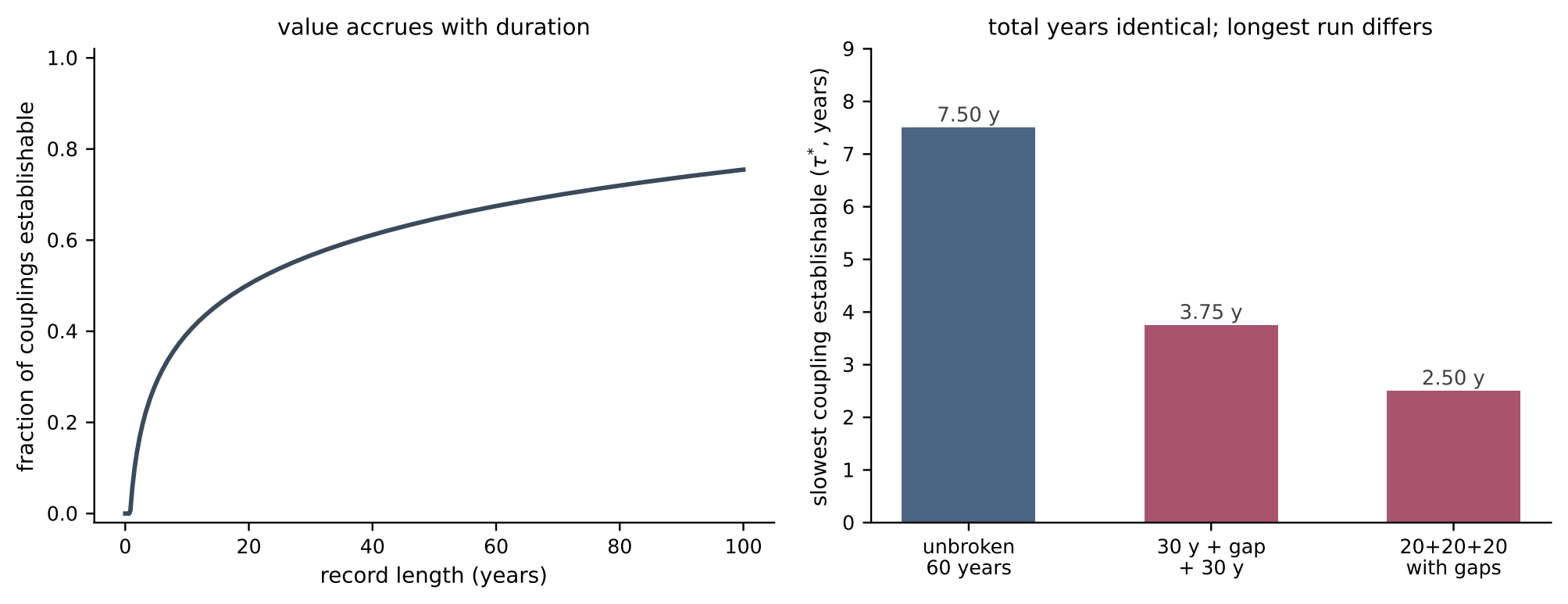
Figure 1. Duration and interruption. The left panel shows the fraction of couplings establishable as a record lengthens, under an illustrative distribution of coupling timescales. The right panel shows the exact consequence of Claim ?: three corpora of sixty total observation-years, differing only in their longest uninterrupted run, support establishment of couplings up to $\tau^{} = T_{\text{run}}/k$, which differs by a factor of three between the unbroken corpus and the one broken into thirds. The factor $k$ is illustrative; the ratio is not.*
Two consequences follow. Assessments of a monitoring programme by its total observation-years, which is the usual administrative measure, misvalue interrupted programmes upward and continuous ones downward. And the timing of a planned interruption is a governance question with a determinate answer, since an interruption at the end of a record costs less than one at its midpoint, which is a rare case in this series of a recommendation that is both determinate and cheap.
2.5 The Generative Property
The final structural property connects the commons to the series’ governing principle.
An environmental knowledge commons is generative in the sense the series’ principle protects: its value lies substantially in the claims it will support that no party has yet formulated, since the questions a field’s governance will face are not known in advance and the record is what makes them answerable when they arrive. It follows that a corpus assessed against its current uses is assessed against the wrong quantity, and that a curation practice retaining what is used and discarding what is not implements exactly the foreclosure the principle forbids, without any decision to foreclose anything.
The claim has a practical form. Every retention decision is a prediction about future questions, and the predictions are made by parties whose own questions are the ones they can imagine. The determinations of absence in Definition ? are the clearest case: no current use motivates retaining a record that a coupling was unobserved in a given decade, and that record is what a later party needs to know whether a silence in the corpus is evidence.
Two limits on Claim ? are recorded. It supplies no argument for retaining everything, since retention is costly and the argument would prove too much; what it supplies is a reason for the burden to fall on discarding and not on retaining, which is a weaker and defensible position. And it does not distinguish a corpus whose future value is high from one whose future value is low, so it operates as a general presumption and not as a criterion, which §9 records as the obvious question.
3. The Grading of Access
3.1 The Inadequacy of Binary Openness
The series has a general preference for open provision and it cannot be carried through as a rule, because the environmental record contains material whose release causes harm. Three classes recur.
Locational detail of vulnerable objects. Precise locations of remaining populations of exploited species, of unprotected sites, and of infrastructure whose vulnerabilities the record exposes. Release of such detail assists the parties the record exists to guard against, and the difficulty is well documented in conservation and in critical-infrastructure practice.
Records identifying persons. Health presentations, abstraction and consumption at household resolution, and observations attached to identifiable holdings. These carry the ordinary confidentiality obligations, and the environmental use does not displace them.
Material held under another party’s authority. Observations of a community’s territory, of practices held under that community’s control, and of holdings whose terms of collection restricted their use. The authority-to-control principle in indigenous data governance is the developed statement of this class, and the present paper accepts it as a constraint and not as a competing consideration.
A rule of release harms in each class. A rule of holder discretion returns the resource to whoever holds it, which is the enclosure the paper opposes, and does so under a description that makes the enclosure look like prudence. Neither rule is available, and the grading below is what remains.
3.2 Access Graded by Relation
Access to an element of the commons is graded on two dimensions: the sensitivity class of the element, being ordinary observation, locational detail of vulnerable objects, records of identified parties, or material held under another’s authority; and the relation the requester stands in to the resource, being no stated relation, affected by the system described, subject of the record, or bearer of a duty over a coupling the record concerns. The grade determines the form of access: open, mediated or aggregated, available on request with stated grounds, or withheld.
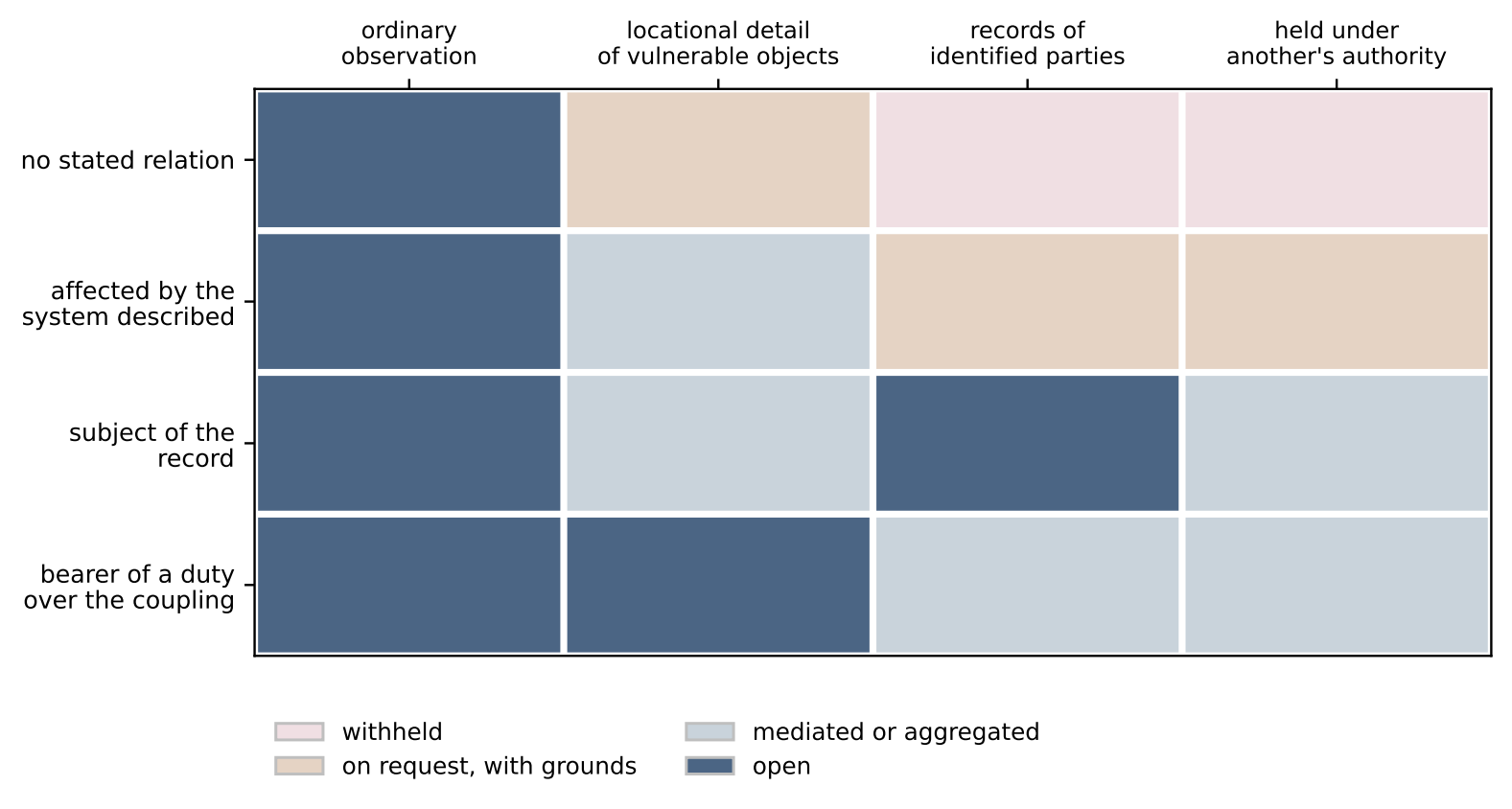
Figure 2. Access graded by sensitivity class and by the requester’s relation to the resource. The grading is illustrative of the structure and no cell is proposed as settled. The row for duty-bearers is the paper’s distinctive element: a party under a duty to look, to carry, or to maintain requires access to discharge it, and a grading that denies such access makes the duty undischargeable.
Three features of Definition ? carry the position.
The relation dimension is what distinguishes this from ordinary sensitivity classification. Ordinary practice grades by the material’s sensitivity alone and applies the resulting grade uniformly to all requesters, with exceptions administered case by case. Grading by relation makes the exceptions the structure: a party affected by the system a record describes stands differently to that record from a party with no stated relation, and the difference is principled and not administrative, since the affected party’s claim is grounded in the same relation that makes the system’s behaviour bear on it.
The duty-bearer row is the paper’s own and follows from the supervisory and capacity positions. A party under a duty to look, to carry, or to maintain requires the access that discharge requires, and an arrangement that imposes the duty and withholds the access has imposed an undischargeable duty. This is a determinate constraint on the grading and it cuts against the holder’s interest, since the duty-bearers are frequently the parties the holder would most wish to exclude.
The aggregation grade is what makes the middle of the table usable. Much of what a sensitive record supports is supported by a derived statement that does not disclose the record: that abstraction in a district rose by a stated proportion, that presentations rose against a stated baseline, that a population is declining without stating where it is. The event layer of this series is built on exactly this property, since an occurrence is a derived statement whose emission does not entail disclosure of the record it derives from, and the grading inherits it.
3.3 The Grading Is Itself a Governed Condition
The terms on which access to an element of the commons is granted are a distribution of access and information and therefore a condition in the sense of this series’ principle. It follows that a holder’s alteration of those terms is an alteration of a governed condition, assessable like any other, and that an alteration foreclosing a capacity irreversibly attracts the principle’s burden. Enclosure of a commons-generated element is the epistemic form of severing a coupling: it removes a relation through which other trajectories were generating, and the burden falls on the party that would sever it.
Claim ? places the openness question inside the architecture and not beside it, and has two consequences worth stating.
A holder tightening access owes a justification of the same kind as a party proposing any other alteration of conditions, and the justification is assessable: the sensitivity class is stated, the affected relations are identifiable, and the availability of an aggregation grade is a question of fact. A tightening justified by a sensitivity class that an aggregation grade would have accommodated is not justified.
And the grading, being a condition, is subject to the revisability commitment the series’ principle carries. A grading fixed permanently forecloses its own correction, so a grading arrangement must state how it is revised and by whom, which §9 records as unresolved.
3.4 Provision and Its Asymmetry
Grading governs access to what exists. The harder question is what causes it to exist, given that costs fall on holders and benefits on the field. Four arrangements are available and each is partial.
Public provision. Observation as a public function, funded from general revenue. This is how most long environmental records exist, and its weakness is the one the record shows: programmes are discontinued when budgets contract, and the discontinuation’s cost falls due decades later on parties with no voice in the decision. The maintenance duties of the supervisory paper are directed at exactly this.
Mandated contribution. Observation required of parties as a condition of operating, which is the permit-monitoring form generalised. Its weakness is that mandated observation is self-directed and compliance-facing, so it produces records of parties’ own operations and not of the couplings between them.
Reciprocal clubs. Parties exchanging records on terms of mutual access, which is the form the meteorological regime took. Its strength is that it is stable without an external funder; its weakness is that it serves those who hold records to exchange, and the capacity paper’s analysis applies directly: a party with nothing to contribute is outside the club, and it is ordinarily the party the club’s records concern.
Benefit-sharing arrangements. Access conditioned on returning a share of what is derived, which is the access and benefit-sharing form developed for genetic resources. Its strength is that it addresses the extraction the data-sovereignty literature documents; its weakness is that it presupposes a derivable benefit that can be traced and valued, and much environmental knowledge produces diffuse benefit that resists both.
| p0.18 p0.20 p0.26 p0.24
| Element | Principal threat | Instrument | Residual difficulty |
|---|---|---|---|
| Long records | Cessation; discontinuity | Maintenance duty; overlap and documentation on method change | Who funds a successor on cessation |
| Provenance | Attrition through handling | Representational requirement; carried with derived artefacts | Cost falls on each handler |
| Registers | Overwriting | Versioning; queryable as at a past date | Requires the representational machinery |
| Coupling conjectures | Discarded as unconfirmed | Retention with conjecture marking | Volume, and no criterion for discard |
| Determinations of absence | Never recorded | First-class representation | Bounded only by the acts that generate them |
| Derived artefacts | Enclosure | Grading by relation; burden on tightening | The aggregation grade must exist to be required |
Table. Elements of the commons, their principal threats, the instrument this series proposes, and what remains unresolved in each case.
The paper takes no position on which arrangement should predominate, and states the criterion by which the choice should be assessed: an arrangement’s adequacy is measured by whether the couplings the field’s governance turns on are observed by somebody, which is the second paper’s divergence diagnostic applied to provision. On that criterion all four arrangements are jointly insufficient at present, since the couplings that cross parties are the ones none of the four reliably produces.
4. Prior Treatments of Commons and of Data Access
Seven bodies of work own parts of the position.
4.1 Common-Pool Resource Theory
Ostrom established that common-pool resources are governed effectively by institutions crafted by their appropriators, and identified design principles including clearly defined boundaries, congruence between rules and local conditions, collective-choice arrangements, monitoring by parties accountable to appropriators, graduated sanctions, and conflict-resolution mechanisms (Ostrom, 1990; Ostrom, 2010). The analysis proceeds from the resource’s subtractability: appropriation by one reduces what remains, and the institution’s function is to limit appropriation.
The concession is that the institutional repertoire is Ostrom’s, and the monitoring and graduated-sanction principles are adopted directly by the supervisory paper of this series. Claim ? states the difference: the resource here is non-rival, so the difficulty the design principles address does not arise, and the difficulties that do arise, provision under asymmetric incentive and irreversibility of loss, are addressed by that literature only where it treats provision of the institution itself. The boundary principle in particular transfers poorly, since a non-rival resource has no appropriator set to bound and the paper’s grading is by relation and not by membership.
4.2 Knowledge Commons Scholarship
Hess and Ostrom extended the analysis to knowledge as a commons, identifying provision and openness as the governing problems where subtractability is absent (Hess & Ostrom, 2007), and the governing-knowledge-commons framework developed a structured method for analysing such arrangements across cases (Frischmann et al., 2014). Benkler’s analysis of commons-based peer production established that non-rival resources can be provided at scale without price or hierarchy under stated conditions (Benkler, 2006).
This literature owns the reframing from subtractability to provision, and Claim ? is a restatement of its central move for one domain. Two additions are the paper’s. The irreversibility of loss is not a feature of the knowledge commons this literature principally examines, since a software repository or a body of scholarship is not lost by ceasing to add to it, and an observational record is; the temporal structure of the resource is different and the duties that follow are stronger. And the non-additivity property of Claim ? has no analogue in a corpus whose elements are independent, since the value of a body of articles is not determined by its longest uninterrupted run.
4.3 Infrastructure Theory and the Case for Open Access
Frischmann’s analysis of infrastructure resources argues that where a resource is a general-purpose input to a wide range of downstream productive activities, and where the value of those activities is not appropriable by the infrastructure’s owner, open access is justified because demand-side value is undervalued by any owner’s pricing (Frischmann, 2012). Environmental records fit the characterisation closely: they are non-rival, general-purpose inputs whose downstream uses are numerous and largely unforeseen.
This is the strongest existing argument for open provision of the resource and it is conceded. The addition is Claim ?’s temporal form: Frischmann’s argument concerns unforeseen uses at a time, and the present paper’s concerns unforeseen questions in the future, which strengthens the case where the record’s span is what makes future questions answerable, and which supplies the specific consequence that retention decisions are predictions about questions.
4.4 Enclosure and the Anticommons
Boyle’s analysis of a second enclosure movement documented the extension of exclusive rights over previously open intellectual resources and the losses that follow (Boyle, 2003), and Heller’s anticommons analysis established that fragmented exclusion rights can under-use a resource as thoroughly as unrestricted access over-uses a subtractable one (Heller, 1998).
Claim ? is this literature’s concern placed inside the present architecture, and the addition is the placement itself: enclosure of a commons-generated element is analysed here as an alteration of a governed condition attracting the series’ burden, which converts a critique into a procedural consequence. The anticommons analysis is directly relevant to a grading arrangement with many holders, and §8 carries it as an objection.
4.5 Operating Data-Sharing Regimes
Three regimes operate at scale and are the paper’s evidence that the arrangements it discusses are practicable.
Meteorology established free and unrestricted international exchange of an agreed set of data and products, with a category of additional data exchanged on conditions, which is a graded arrangement in operation and the closest existing instance of §6’s structure (World Meteorological Organization, 1995; World Meteorological Organization, 2021). Its stability is instructive: the arrangement holds because every party requires others’ data to do its own work, which is the reciprocal-club form, and the capacity paper’s analysis of who is outside such a club applies.
Earth observation moved toward open provision in stages, with the opening of a major satellite archive at no cost widely credited with a substantial increase in use, and with data-sharing principles adopted for the federated system of systems (Group on Earth Observations, 2015; Wulder et al., 2012).
Biodiversity information is aggregated internationally under open licensing with mediation for sensitive occurrence records, which is an operating instance of the locational-sensitivity class of §6 (Chapman, 2020).
These regimes own the demonstration and supply the design details a proposal would adopt. The residue is that each grades by material and by contributor category, and none grades by the requester’s relation to the resource in the sense of Definition ?, nor recognises a duty-bearer’s claim of access.
4.6 Access and Benefit-Sharing Instruments
The Convention on Biological Diversity and the Nagoya Protocol establish that access to genetic resources is subject to prior informed consent and mutually agreed terms, with benefits shared with providers (mph Convention on Biological Diversity, 1992; mph Nagoya Protocol on Access to Genetic, 2010), and the extension of these arrangements to digital sequence information has been the subject of extended negotiation, producing a multilateral mechanism whose design addresses exactly the difficulty of tracing diffuse benefit from widely used data.
This body owns the proposition that access to a knowledge resource may be conditioned on terms that recognise the position of those from whom it derives, and it is the developed legal instance of the fourth provision arrangement in §6. The residue is scope: these instruments address resources with identifiable providers and traceable derived benefit, and the environmental records this paper concerns frequently have neither, so the model informs the treatment of the material-held-under-authority class and does not generalise to the corpus.
4.7 Data Governance Principles and Indigenous Authority
The FAIR principles state requirements for findable, accessible, interoperable, and reusable data (Wilkinson et al., 2016), and the CARE principles state collective benefit, authority to control, responsibility, and ethics as requirements for indigenous data, developed against a record in which openness served purposes the observed did not set (Carroll & Garba, 2020). The two are explicitly complementary, and the pairing is the clearest existing statement that openness is a means and not a value.
The paper adopts both and takes CARE’s authority-to-control as a constraint on Definition ? and not as a consideration weighed against openness. The residue is that these principles govern the terms of access and say little about provision or about maintenance, which are this paper’s other two concerns.
4.8 Residue of the Survey
Consider a non-rival epistemic resource whose provision is costly to holders and beneficial to a field, whose elements include registers and determinations of absence as well as observations, whose loss by cessation or by discontinuity is irreversible, whose value for the claims that matter is determined by longest uninterrupted run and not by total content, and access to which must be graded because release and withholding are each harmful for identifiable classes. The claims that such a commons is constituted by provision and irreversibility and not by subtractability, that the value of its records is non-additive across interruptions with the consequences Claim ? states, that access should be graded by the requester’s relation to the resource with a duty-bearer’s claim among the relations, and that the grading is itself a governed condition whose tightening attracts the series’ justificatory burden, are advanced by none of the surveyed treatments. Common-pool theory owns the institutional repertoire for subtractable resources; knowledge commons scholarship owns the reframing to provision; infrastructure theory owns the argument from unforeseen downstream use; the enclosure literature owns the critique; the operating regimes own the demonstration and grade by material and contributor; benefit-sharing instruments own conditioned access where providers are identifiable; and the data principles own the terms of access and the authority constraint. The composition is the residue claimed.
5. Objections and the Limits of the Position
5.1 The Provision Objection
The paper’s duties operate on a resource that must first exist, and the paper has not said what causes it to exist. §6 sets out four provision arrangements and finds each partial, and the objection is that a treatment of a commons which cannot answer the provision question has addressed the easier half: rules for maintaining and sharing what exists are of limited value where the binding constraint is that too little is observed in the first place.
The paper concedes the priority of the objection and offers three things short of an answer. The maintenance duties address a form of under-provision that is invisible in provision statistics, since a discontinued programme reduces future observation without appearing as a decision not to observe, and Claim ? shows the loss is larger than the accounting suggests. The grading of §6 lowers the cost of provision to holders, since a holder who need not choose between full release and withholding may contribute at a grade it can accept, and the aggregation grade in particular converts an impossible contribution into a possible one. And the criterion at the section’s close, that provision is adequate where the couplings governance turns on are observed by somebody, at least states what a provision arrangement is for, which the present landscape does not. None of these produces observation, and the honest statement is that the provision question is prior to this paper and unanswered by it.
5.2 The Anticommons Objection
A grading arrangement with many holders, each determining terms for its own elements, produces a resource that is nominally shared and practically unusable, since a party assembling a corpus must satisfy many gradings at once and any single refusal defeats the assembly. This is the anticommons structure and it is a real risk of the proposal, which distributes grading authority to holders by design.
Three partial answers. The duty-bearer row of Definition ? operates across holders, so a party under a duty to look holds a claim of access against each holder on the same ground and does not negotiate separately in substance. The burden on tightening in Claim ? operates against the accumulation, since each tightening is separately assessable and a holder cannot tighten silently. And the aggregation grade reduces the number of refusals that bite, since a corpus assembled from derived statements requires fewer permissions than one assembled from records. The residual is genuine: the proposal trades a risk of enclosure by a single holder for a risk of fragmentation across many, and the paper has no argument that the trade is favourable in all cases.
5.3 The Objection from Retention Cost
Claim ? places the burden on discarding, and the objection is that retention is not free: storage, curation, format migration, and the maintenance of interpretability all cost, and a presumption against discarding accumulates obligations without limit.
The paper’s answer distinguishes the elements. For observational records the cost of retention is small relative to the cost of production and shrinking, so the presumption is cheap where it matters most. For derived artefacts the cost is comparable and the presumption is correspondingly weaker, and the paper does not extend it there. For registers and determinations of absence the cost is trivial and the value is disproportionate, since they are what makes the rest interpretable. The presumption is therefore not uniform across Definition ?, and §9 records that the paper has not stated it element by element, which it should.
5.4 The Openness Objection
The paper’s grading may be read as licensing withholding under a principled description, since a holder wishing to enclose can locate its material in a sensitivity class and grade accordingly, and the grading gives the enclosure a vocabulary it previously lacked.
The answer is Claim ?’s burden and its assessability, and the answer’s strength depends on an arrangement willing to assess. Where such an arrangement exists, a tightening justified by a sensitivity class that an aggregation grade would have accommodated is not justified, and the justification is checkable. Where no such arrangement exists, the objection stands: a grading vocabulary in the hands of holders and unassessed by anyone is a better instrument for enclosure than a binary rule, and the paper’s proposal is unsafe without the supervisory arrangement of the companion paper. The dependency is stated plainly because it is a real condition on the proposal and not a cross-reference.
5.5 Limits Internal to the Position
Four limits are recorded. The factor $k$ in the establishment condition is unspecified, so Figure 1’s ratio is exact and its absolute values are not. The non-additivity claim is stated for claims requiring continuous coverage and the paper has not characterised which claims those are, beyond establishment of couplings, so its scope is narrower than the general statement suggests. The grading of Figure 2 is illustrative and no cell is defended, and the arrangement by which a grading is revised is unspecified though the revisability commitment requires one. And the paper treats the commons of a field as though its boundaries were given, where in fact what belongs to a field’s commons is contested, and the contest is the same one that determines who is a participant in the arrangement.
A further limit is inherited rather than internal. The paper applies the series’ principle to alterations described as irreversibly foreclosing, and the series’ first paper supplies no method for establishing irreversibility, recording the absence as an open question. Where the property is stipulated by the case under discussion, nothing turns on this. Where it would be contested, the paper’s conclusions are conditional on a determination the series has not yet made, and the seventh paper’s establishment condition constrains what evidence such a determination would require without supplying it.
6. Questions Left Open for the Programme
6.1 Questions Concerning the Resource
Scope of the non-additivity property. Claim ? holds for claims requiring continuous coverage. An answer would characterise that class beyond establishment of couplings, would identify claims for which segments do combine, and would state what partial recovery is available from proxy records, documentary evidence, and overlapping series held by other parties, since the practical question at every interruption is what can be salvaged.
The value of an interruption’s position. The paper observes that an interruption at a record’s end costs less than one at its midpoint. An answer would state the general relation between an interruption’s position and its cost, which would convert a rare determinate recommendation into a usable rule for programmes facing an unavoidable suspension.
Element-by-element retention presumptions. §8 concedes that the presumption against discarding should differ across the elements of Definition ?. An answer would state it for each, with the cost and the expected future value that justify it.
Boundaries of a field’s commons. An answer would state what determines whether an element belongs to a field’s commons, and would confront the coincidence between that determination and the determination of who participates in the arrangement, since the two questions are answered by the same parties.
6.2 Questions Concerning Access
Defence of the grading. Figure 2 is illustrative. An answer would defend a grading cell by cell, and would state the principle by which a cell is settled where the sensitivity class and the requester’s relation pull in opposite directions, which is the case the table’s middle occupies.
Revision of a grading. The revisability commitment requires that a grading state how it is revised and by whom. An answer would supply the arrangement, and would confront the difficulty that the parties competent to revise a grading are ordinarily the holders whose terms it governs.
Sufficiency of the aggregation grade. Much of the proposal’s workability rests on derived statements substituting for records. An answer would establish, for classes of use, whether an aggregation adequate for the use is available without disclosure, since where it is not the grading collapses to a binary choice for that use.
Standing of a duty-bearer’s claim. The duty-bearer row is the paper’s distinctive element and its enforcement is unspecified. An answer would state what a duty-bearer denied access may do, and against whom, and would connect this to the supervisory paper’s response repertoire.
6.3 Questions Concerning Provision
Provision of cross-party couplings. The paper’s criterion finds all four provision arrangements jointly insufficient for couplings that cross parties, which are the couplings governance turns on. An answer would state what arrangement produces them, and would confront the possibility that no arrangement of the four families does, in which case a fifth is required and the paper has not identified it.
Succession on cessation. The maintenance duty is dischargeable by notice and transfer, and the paper has not said to whom transfer runs where no party will accept custody. An answer would state whether the duty extends to funding a successor, what happens on the holder’s dissolution, and whether an obligation to accept custody can attach to anyone.
Benefit-sharing where benefit is diffuse. The fourth provision arrangement presupposes traceable benefit. An answer would state whether an analogue is constructible for environmental knowledge, where the benefit is a field’s improved governability, or would establish that the family does not transfer, which would narrow the available arrangements to three.
Interaction with the capacity distribution. A reciprocal club serves those with records to exchange. An answer would state what terms of membership a club should offer to parties with observation to contribute and no instrumental record, and would connect the answer to the standing element of the capacity paper’s definition, since the question is whether a commons can admit a contribution it cannot audit.
7. Declinations and Limits of the Position
The paper claims no novelty in commons analysis, in the reframing from subtractability to provision, in the infrastructure argument for open access, or in the critique of enclosure. §7 concedes each in the form its owners state it.
The paper answers no provision question. It states a criterion by which provision arrangements should be assessed and finds the available families jointly insufficient for the couplings that matter, and §8 concedes that this leaves the prior question unanswered.
The paper defends no grading. Figure 2 illustrates a structure and its cells are not proposed as settled.
The paper’s proposal is conditional on an assessing arrangement. §8 states that a grading vocabulary unassessed by anyone is a better instrument for enclosure than a binary rule, so the proposal should not be adopted apart from the supervisory arrangement the companion paper develops.
The paper reports no empirical study of any commons, and its account of the operating regimes is drawn from their published instruments and from secondary literature.
References
Benkler, Y. (2006). The Wealth of Networks: How Social Production Transforms Markets and Freedom. Yale University Press.
Boyle, J. (2003). The second enclosure movement and the construction of the public domain. Law and Contemporary Problems, 66(1), 33–74.
Carroll, S. R., Garba, I., Figueroa-Rodríguez, O. L., et al. (2020). The CARE Principles for Indigenous Data Governance. Data Science Journal, 19(1), 43.
Convention on Biological Diversity (1992). United Nations, Rio de Janeiro.
Frischmann, B. M. (2012). Infrastructure: The Social Value of Shared Resources. Oxford University Press.
Frischmann, B. M., Madison, M. J., and Strandburg, K. J. (eds.) (2014). Governing Knowledge Commons. Oxford University Press.
Chapman, A. D. (2020). Current Best Practices for Generalizing Sensitive Species Occurrence Data. GBIF Secretariat, Copenhagen. https://doi.org/10.15468/doc-5jp4-5g10
Group on Earth Observations (2015). GEOSS Data Sharing Principles and Data Management Principles. GEO Secretariat, Geneva.
Heller, M. A. (1998). The tragedy of the anticommons: property in the transition from Marx to markets. Harvard Law Review, 111(3), 621–688.
Hess, C. and Ostrom, E. (eds.) (2007). Understanding Knowledge as a Commons: From Theory to Practice. MIT Press.
Nagoya Protocol on Access to Genetic Resources and the Fair and Equitable Sharing of Benefits Arising from their Utilization (2010). Secretariat of the Convention on Biological Diversity.
Ostrom, E. (1990). Governing the Commons: The Evolution of Institutions for Collective Action. Cambridge University Press.
Ostrom, E. (2010). Polycentric systems for coping with collective action and global environmental change. Global Environmental Change, 20(4), 550–557.
Wilkinson, M. D., Dumontier, M., Aalbersberg, I. J., et al. (2016). The FAIR Guiding Principles for scientific data management and stewardship. Scientific Data, 3, 160018.
World Meteorological Organization (1995). Resolution 40 (Cg-XII): WMO Policy and Practice for the Exchange of Meteorological and Related Data and Products. WMO, Geneva. Superseded by Resolution 1 (Cg-Ext(2021)).
World Meteorological Organization (2021). Resolution 1 (Cg-Ext(2021)): WMO Unified Policy for the International Exchange of Earth System Data. WMO, Geneva.
Wulder, M. A., Masek, J. G., Cohen, W. B., Loveland, T. R., and Woodcock, C. E. (2012). Opening the archive: how free data has enabled the science and monitoring promise of Landsat. Remote Sensing of Environment, 122, 2–10. thebibliography