Responsibility for Environmental Critical Transitions - Attributing the Approach in Place of the Crossing
Abstract
Environmental harm following a critical transition presents a responsibility problem that ordinary causal doctrine handles badly. Many parties contributed forcing over decades; the transition occurred at a threshold whose crossing no party’s contribution was sufficient to produce and which each party’s contribution was necessary to; the harm manifested later; and the crossing itself was ordinarily not observed at the time. This paper proposes a relocation of the causal question. The method is conceptual and doctrinal. Its scope is deliberately narrow: the general difficulties of apportionment in distributed generative systems are treated in separate work and are not re-argued here, and the paper confines itself to what is specific to environmental transitions. The central claim is that causation of the crossing is not apportionable while causation of the approach is, and that responsibility should therefore attach to a party’s contribution to the approach and not to its contribution to the transition. The ground is structural: at a threshold each contribution is necessary and none is sufficient, which is the configuration in which shares are undefined, whereas cumulative forcing toward the threshold is additive and admits shares by construction. Relocating the question to the approach makes the tractable quantity the object of the doctrine, and the paper argues this is what the leading proportional-contribution litigation has in substance already done, in affirming a principle of proportional liability for contribution to a global forcing while failing on the facts of the particular exposure. Three further results are developed. The relocation converts responsibility into a quantity over rates, which connects it to the differential treatment developed earlier in this series and makes the relevant evidence the record of a party’s forcing over time. It supplies a determinate join to the supervisory duties treated in a companion paper, since a breach of an epistemic duty is evidence of a kind courts already receive and does not require the attribution the conduct-keyed regime was adopted to avoid. And it locates the discovery and limitation difficulty precisely, since a crossing established years after it occurred, by estimates a companion paper shows to be biased toward reporting stability, gives defendants an honest ignorance defence that the epistemic duties are the appropriate answer to. The paper surveys attribution science, the doctrines of necessity and sufficiency, proportional and market-share liability, and the climate litigation record.
Keywords: causation; proportional liability; critical transitions; attribution science; environmental harm
Notices
On the references. All 16 works cited in this paper have been checked against their sources at claim level: each source was consulted and confirmed to state what the citing sentence attributes to it. No entry in this paper’s bibliography is unverified.
Status. This is a working draft circulated for discussion. It is a preliminary discussion paper and is not a finished statement of its author’s position. Sections and statement numbers are subject to change.
Licence. This work is made available under a Creative Commons Attribution-NonCommercial 4.0 International Licence (CC BY-NC 4.0).
Statement on the use of language models. Drafting, literature search and argumentative criticism for this paper were conducted in dialogue with large language models, specifically Claude (Anthropic) and ChatGPT (OpenAI). The claims, the structure, the selection of material and the position taken are the author’s. References have been checked in stages, to two standards, and the process is incomplete. Part of the corpus has been verified at identity level, meaning author, title and publication coordinates were confirmed against the publisher of record. A smaller part has additionally been verified at claim level, meaning the cited source was consulted and confirmed to state what the citing sentence attributes to it. The remainder is unverified at either standard. The standard reached is marked on each bibliography entry: no mark for claim level, $\ddagger$ for identity level only, $\dagger$ for not yet verified. Corrections made so far are recorded in the project’s citation-verification file; where a source proved not to bear the weight the text placed on it, the text was revised rather than the citation removed.
Companion papers. This paper is Paper 15 of a series on the governance of environmental change, and treats responsibility for harm following a transition, relocated from the crossing to the approach. The other papers of the series treat, in order: the object; the field and its three structures; coordination through change; heterogeneous knowledge; the event layer; criticality detection; observational capacity; representational requirements; routing and inquiry; the regime near a threshold; forecasting from the stream; the knowledge commons; attribution and ownership; and supervisory duties. Paper 12 is reserved and is not yet drafted. A related paper by the author, developed independently of this series, treats the temporal correspondence limitation of evidence-based policy making, being the divergence between the system state that evidence represents and the system state at the moment of decision. Its results on the partition of a state space into estimable and unobservable components, on the blindness of a recency-weighted evidence base to the approach to criticality, and on the allocation of a justificatory burden where temporal correspondence fails, were reached by a different route and bear on several papers of this series.
Suggested citation. Huang, W. Responsibility for Environmental Critical Transitions: Attributing the Approach in Place of the Crossing. Working draft.
Discussion Paper Note
This paper is a preliminary discussion paper intended to share an evolving idea and invite further dialogue, criticism, revision, and independent development.
The author does not claim exclusive epistemic ownership over the viewpoints, concepts, or lines of reasoning presented here, nor does the author claim priority as their first originator. Similar or related ideas may have appeared previously in other intellectual, cultural, or disciplinary traditions. Any legal rights retained in this work are intended to support attribution, responsible use, and protection against exploitative or harmful appropriation, and not to restrict independent inquiry, criticism, revision, or further development.
The arguments in this paper should therefore be understood as provisional and historically situated rather than definitive. Readers are encouraged to question, revise, extend, reinterpret, or independently develop the ideas presented here. Where appropriate, acknowledgment of this paper as one point of encounter in the development of related ideas is appreciated, but such acknowledgment should not be understood as granting the author epistemic ownership over the ideas themselves.
Responsible Use and Rights Reservation
The author encourages good-faith discussion, criticism, independent development, and responsible use of the knowledge presented in this work. The author does not claim exclusive epistemic ownership over the ideas or viewpoints discussed herein, nor claim priority as their first originator.
However, the author expressly reserves all rights and remedies available under applicable law with respect to uses of this work or related materials that involve unlawful conduct, harmful or abusive exploitation, improper commercial appropriation, infringement of applicable intellectual property or other legal rights, or conduct contrary to applicable national, regional, or international law.
This reservation is intended to preserve the ability to respond to misuse and harmful appropriation. It should not be interpreted as restricting legitimate academic inquiry, criticism, independent reasoning, or the further development of related ideas.
1. Introduction
A wetland shifts to a low-water state and does not return. A reef system bleaches past recovery. A fishery collapses and the stock does not rebuild. In each case harm follows a transition, the transition follows a threshold crossing, and the crossing follows forcing contributed by many parties over decades. Someone bears the loss, and the question is whether anyone answers for it.
Ordinary causal doctrine handles this badly, and the difficulty is not one of evidence. Consider the structure. Each party’s forcing was necessary to the crossing, in the sense that had that party alone not contributed, the threshold would not have been reached. No party’s forcing was sufficient, since none alone would have reached it. This configuration is familiar to the law of causation and its treatments are known to be unsatisfactory in exactly the case where the contributions are numerous and small. And the difficulty compounds: the crossing itself was not observed when it occurred, the harm manifested later, and the establishment that a crossing had occurred came later still.
Figure 1 sets the two questions side by side, and the paper’s proposal follows from the comparison.
Causation of the crossing is not apportionable and causation of the approach is. At a threshold each contribution is necessary and none is sufficient, which is the configuration in which shares are undefined; cumulative forcing toward the threshold is additive and admits shares by construction. Responsibility should therefore attach to a party’s contribution to the approach and not to its contribution to the transition, which relocates the causal question to the quantity that is tractable and leaves the intractable one aside.
The relocation is less radical than it sounds and the paper argues in §5 that the leading proportional-contribution litigation has in substance already made it. A claim asserting that a major emitter should bear a share of protective costs proportionate to its share of cumulative global emissions is a claim about contribution to an approach; the court that affirmed the principle while dismissing on the facts of the particular exposure was accepting the relocated question and finding the plaintiff’s evidence on the specific hazard insufficient.
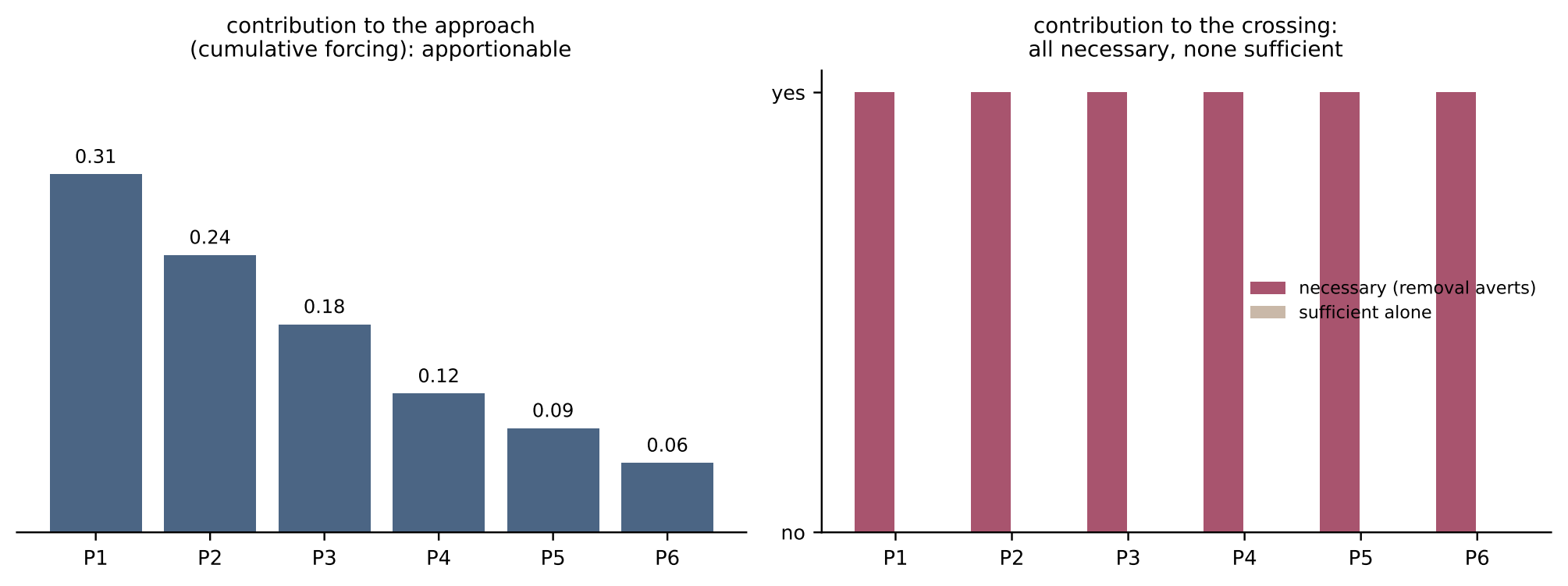
Figure 1. Two questions about the same parties. Cumulative contribution to the approach is additive and admits shares. Contribution to the crossing does not: with the threshold set at any level above the total less the smallest contribution, every party is necessary and no party is sufficient, which is verified by the accompanying computation.
Three consequences are developed. The relocation makes responsibility a quantity over rates, since a contribution to an approach is a flow over time, which connects it to the differential treatment developed earlier in this series and makes the relevant evidence a party’s record of forcing, and not any reconstruction of the transition. It supplies a determinate join between this paper and the supervisory duties of a companion paper, since a breach of an epistemic duty is evidence of a kind courts already receive without requiring the outcome attribution that the conduct-keyed regime was adopted to avoid. And it locates the discovery difficulty precisely: a crossing established years after it occurred, by estimates that a companion paper shows to be biased toward reporting stability, furnishes defendants an honest ignorance defence, and the epistemic duties are the appropriate answer to it.
Scope. This paper is deliberately narrow. The general difficulties of apportioning contribution in distributed generative systems, including the order dependence of marginal contribution where the aggregate response is concave, the retrospective ascription of a transition date, and the treatment of endogenous predisposition, are the subject of separate work by the author and are not re-argued here. The material that follows concerns what is specific to environmental transitions: the threshold structure, the attribution science available, the limitation and discovery problem, and the interaction with the epistemic duties this series establishes.
The paper proceeds as follows. §5 restates the carried positions and develops the relocation. §6 treats the joins to epistemic duty and to discovery. §7 surveys the doctrines and the litigation record. §8 treats the objections and §9 the open questions, and §10 the declinations.
2. The Relocation to the Approach
2.1 Positions Carried from the Companion Papers
Four results are used and restated so the paper stands alone.
The governing principle places a dischargeable burden of justification on alterations of conditions that would irreversibly foreclose the capacity of other trajectories to continue generating; the trigger is a structural property of the alteration and there is no maximand.
The differential position holds that agreement about the direction and unusualness of a change is available where agreement about states is not, that a differential is defined relative to a horizon, and that a class of transitions is induced by the rate at which a system is forced.
The near-critical position holds that detection reliability, the safe intervention margin, and estimation accuracy degrade together as a threshold nears, and that estimation of persistence near the unit root is biased downward, so that the recovery rate is overstated and the error runs toward apparent safety, amplifying as the threshold nears.
The supervisory position constitutes the duties arising on the epistemic layer as conduct-keyed duties assessed against stated obligations, on the ground that outcome-keyed liability requires attribution through couplings that defeat it and fails silently where attribution fails.
2.2 The Crossing and the Absence of a Share
The structure is stated exactly because the argument depends on it and not on a general complaint about multiple causation.
Let parties $1,\dots,m$ contribute forcing $f_1,\dots,f_m$, and let the threshold be crossed where the cumulative forcing reaches $F^{}$. Suppose $\sum_i f_i \geq F^{}$ and $\sum_{i \neq j} f_i < F^{}$ for every $j$. Then every party is necessary, in the sense that its removal averts the crossing, and no party is sufficient, in the sense that its contribution alone does not produce it. The condition holds whenever $F^{}$ exceeds the total less the smallest contribution, which is the ordinary situation where contributions are numerous and the total exceeds the threshold by less than any single share.
Two familiar responses to this configuration are unavailable here.
Apportionment by marginal contribution assigns each party the difference its presence makes. Under the stated condition that difference is the whole harm for every party, since each removal averts the crossing, so the shares sum to $m$ times the harm and the scheme is not a division.
Apportionment by order of contribution assigns responsibility to whoever crossed the threshold. This is arbitrary in a way the structure makes plain: the contributions are simultaneous in effect and their labelling as first or last is a fact about the order of accounting and not about the field. The paper notes that where the aggregate response is concave and not a step, marginal shares become order-dependent in a further way, and refers that difficulty to the separate work indicated in §4.
Under the stated condition the crossing admits no non-degenerate division of responsibility. Marginal-contribution apportionment assigns the whole harm to every party; order-based apportionment assigns it to one party on a ground that is an artefact of accounting. A doctrine that persists in asking who caused the transition therefore faces a choice between over-assignment and arbitrariness, and this is a property of the threshold structure and not a deficiency in the evidence.
2.3 The Approach and the Share It Admits
The cumulative forcing that produced the approach is additive by construction, and shares in it are computable wherever the individual forcings are.
A party’s approach share over a period is its contribution to the cumulative forcing that moved the system toward the threshold during that period, expressed as a proportion of the total forcing over the same period, and computed from the party’s own record of its forcing activity.
Three properties recommend Definition ? as the object of a doctrine.
It is computable from records parties keep for other reasons. A party’s forcing is ordinarily documented in its own operational records: quantities produced, emitted, abstracted, or occupied. This is the evidence the leading litigation has in fact relied on.
It is a rate quantity, which connects it to the differential treatment of this series. A contribution to an approach is a flow, and the relevant evidence concerns a party’s forcing over time and not any reconstruction of the transition, so the difficulties of dating a crossing do not enter the computation of the share.
And it is independent of the threshold’s location. The approach share is a proportion of contributed forcing and does not require that $F^{*}$ be known, which matters because the near-critical position establishes that estimates of a system’s distance from its threshold are biased. A doctrine resting on approach shares is therefore insulated from an estimation failure that a doctrine resting on the crossing would inherit.
Responsibility attaching to approach shares avoids three failures that responsibility attaching to the crossing incurs. It does not require the threshold’s location, which is badly estimated and biased toward apparent safety. It does not require the crossing’s date, which is established retrospectively and is contested. And it does not require a division of the crossing, which Claim ? shows to be unavailable. It requires the parties’ forcing records, which exist.
2.4 The Price of the Relocation
The relocation is not free and the paper states its price.
The connection to the harm is weakened. A party’s approach share is a share of forcing, and a defendant may object that it is being held to a proportion of a quantity and not to a consequence it produced. The answer is that the alternative connection is the one Claim ? shows to be unavailable, so the choice is between a weakened connection and none; but the objection is real and §8 treats it.
The doctrine becomes indifferent to the threshold’s proximity. A party contributing forcing to a system far from any threshold bears an approach share on the same terms as one contributing near a threshold, which is counterintuitive and arguably wrong. The paper’s response is that proximity should enter through the burden structure of this series’ principle, which tightens with grade, and not through the share, which should remain a clean measure of contribution.
And the doctrine says nothing about the last increment. A party whose contribution was the one under which the system crossed bears the same share as one that contributed the same amount earlier. This is the correct result on the paper’s argument, and it will be resisted, since intuitions about causation attach to the proximate act.
3. Joins to Epistemic Duty and to Discovery
3.1 The Discovery and Limitation Problem
Figure 2 sets out the sequence and the difficulty it produces.
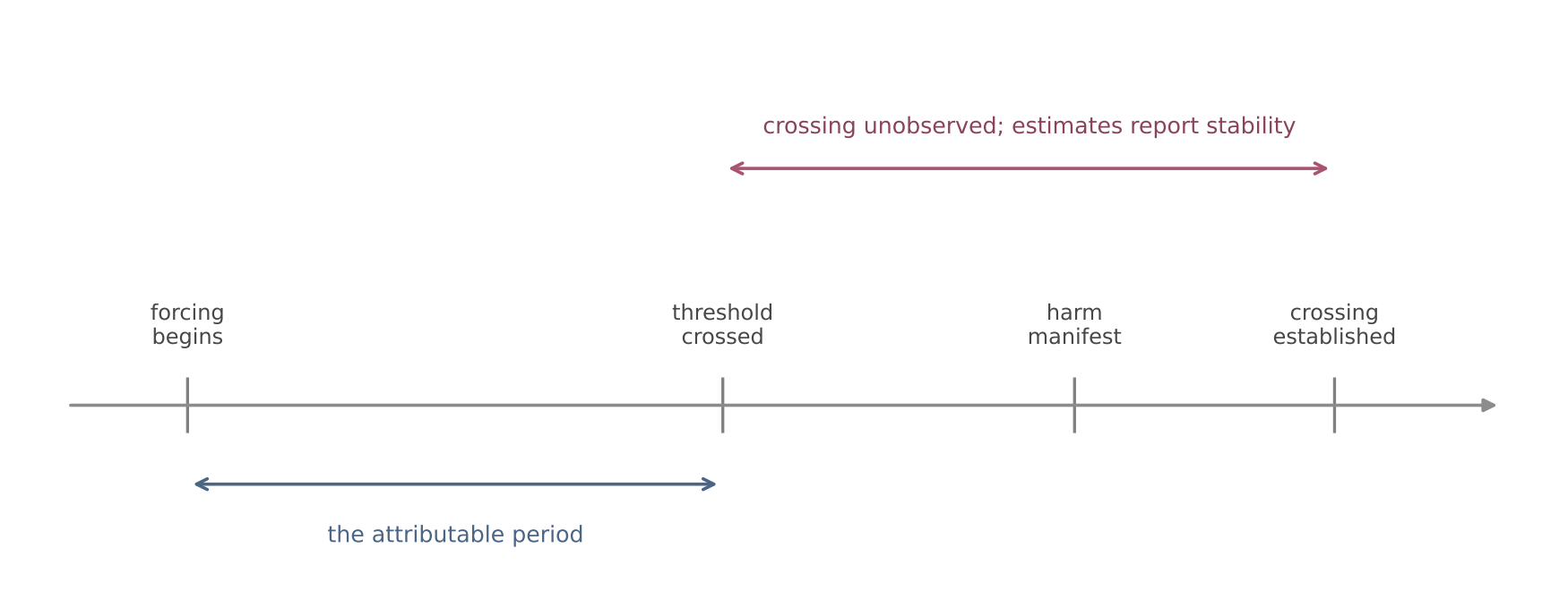
Figure 2. The sequence at a critical transition. Forcing accumulates over an extended period; the threshold is crossed without being observed; harm manifests later; and the crossing is established later still. The interval between crossing and establishment is where the estimation bias of the companion paper operates, so parties acting during it are told the system is more stable than it is.
Three consequences follow for doctrine, and only the third is specific to critical transitions.
Limitation periods running from the harm’s manifestation are ordinary and their difficulties are known. Limitation periods running from the wrongful act are severe here, since the forcing may have been contributed decades before, and discovery rules that postpone accrual until the claimant knew or should have known address this in many systems.
The intermediate interval is the distinctive difficulty. Between the crossing and its establishment, parties continue to contribute forcing while the available estimates report a system that is recovering adequately. The near-critical position of this series establishes that those estimates are biased toward stability and that the bias amplifies as the threshold nears, so a party contributing during that interval may honestly maintain that the best available science reported room. This is a defence a court will find substantial, and it is a defence the paper takes to be, in the ordinary case, honestly available.
The interval between an unobserved crossing and its establishment furnishes contributors an honest ignorance defence that is strongest where the system was closest to its threshold, because the estimation bias amplifies there. A doctrine that answers this by tightening the standard of knowledge attributed to defendants asks them to have known what the available methods systematically understated. The appropriate answer is a duty-based one: parties bearing epistemic duties are answerable for whether they observed, carried, and maintained, and their discharge or breach of those duties is determinable without any finding about what the system’s state actually was.
3.2 The Evidential Standing of an Epistemic Breach
The supervisory paper of this series constitutes epistemic duties as conduct-keyed and expressly leaves open how a breach interacts with a liability proceeding. Claim ? supplies the connection and this subsection states it.
A breach of an epistemic duty is admissible and probative in a proceeding about approach shares, and it enters in three ways that do not require outcome attribution. It bears on the ignorance defence, since a party that failed to observe a coupling its own conduct bore on cannot rely on the state of knowledge its own failure helped produce. It bears on the evidential burden, since a party that failed to keep records it was obliged to keep should not benefit from their absence, which is the adverse-inference structure the capacity paper of this series develops. And it bears on the assessment of the forcing itself, since a party’s approach share is computed from its own records and their inadequacy is its own doing.
Three limits on Claim ? are stated so the join does not overreach.
A breach is evidence and not a substitute for the share. A party in breach of every epistemic duty still bears the approach share its forcing warrants and no more; the breach affects what defences are available and what inferences may be drawn, and it does not enlarge the share.
The separation the supervisory paper values is preserved in one direction only. That paper draws on safety-reporting practice, in which fact-finding is separated from liability to preserve candour, and the present claim admits breach findings into liability proceedings, which weakens that separation. The paper’s position is that a breach of a duty is different from a candid report, and that the separation should protect the second and not the first: a party’s honest report of a failure it discovered should not be turned against it, and its failure to look at all should be.
And the direction of the inference is limited. Discharge of epistemic duties is not a defence to an approach share. A party that observed diligently and contributed forcing bears its share, since the share attaches to the forcing and the duties concern the field’s governability.
3.3 The Standing Question
An approach share is owed to someone, and this series’ principle protects trajectories that hold no interests and articulate no claims. The paper does not resolve who may sue for the loss of a wetland’s capacity, and states the position it takes on the narrower question that arises here.
Where a harm falls on identifiable parties, whose livelihoods, water supply, or protection depended on the capacity foreclosed, standing is ordinary and the approach-share doctrine operates without difficulty. Where the foreclosed capacity had no such dependents, the doctrine has nothing to attach to, and the appropriate response on this series’ architecture is not a liability claim but the burden structure operating in advance, which is what the governing principle supplies and which requires no plaintiff. The two mechanisms therefore divide the field between them, and §9 records the question of what happens where dependents exist but are unable to bring proceedings, which is the ordinary case for the parties the capacity paper identifies.
4. Doctrines, Science, and the Litigation Record
Six bodies bear on the position.
4.1 Necessity, Sufficiency and Their Doctrinal Treatments
The law of causation has long treated cases in which a but-for test fails or over-assigns. The NESS analysis holds a condition causal where it is a necessary element of a set of conditions sufficient for the outcome, which accommodates overdetermination and duplicative causation (Wright, 1985; Hart, 1985). Doctrines of material contribution to harm and of material increase in risk relax the but-for requirement where the claimant cannot show which of several exposures produced the injury, developed principally in industrial disease litigation (mph Fairchild v Glenhaven Funeral Servic, n.d.; Barker v Corus UK Ltd [2006] UKHL 20, [2, n.d.).
This body owns the analytical treatment and the paper does not add to it. Claim ? states that the threshold structure of a critical transition is the configuration in which these treatments give either everything or nothing: NESS marks every contributor causal, which is correct and does not divide; the material-contribution line divides by exposure share, which is in substance the relocation this paper proposes, applied to a different mechanism. That correspondence is the paper’s strongest doctrinal support and is stated as such.
4.2 Proportional and Market-Share Liability
Where a claimant cannot identify which of several producers caused an injury, market-share liability apportions among producers by their share of the relevant market, developed in pharmaceutical litigation and confined since (mph Sindell v Abbott Laboratories , 26 C, 1980; Geistfeld, 2001). Proportional liability more generally assigns damages by a defendant’s contribution to the risk or to the aggregate cause.
These are the doctrinal ancestors of Definition ?, and the concession is unreserved. Two differences bear. Market-share liability apportions among producers of a fungible product where exactly one of them caused the injury and the claimant cannot say which; the approach share apportions among contributors all of whom contributed, which is a different and simpler epistemic situation. And market-share doctrine has been confined by courts uneasy about liability without identified causation, which is the reception the present proposal should expect, and §8 treats it.
4.3 Attribution Science
Probabilistic event attribution estimates the change in likelihood or intensity of an event class attributable to anthropogenic forcing, expressed as a fraction of attributable risk or a risk ratio (Allen, 2003; Stott et al., 2004; National Academies of Sciences, Engineer, 2016). The field has matured and its results are now produced rapidly enough to be available while an event is in public attention. Source attribution studies trace shares of cumulative emissions to identifiable producers (Heede, 2014; Ekwurzel et al., 2017).
These two literatures supply between them exactly what Definition ? requires, and their pairing is what makes the relocated question evidentially tractable: source attribution gives the share of forcing, and event attribution gives the connection between forcing and the hazard. The residue concerns the transition case specifically. Event attribution estimates a change in the probability of an event class under a forcing, which is a statement about a distribution and not about a threshold crossing, and the paper is not aware of an established method that attributes a regime shift to forcing shares in the way event attribution attributes an extreme event. That gap is recorded in §9 and is the principal evidential obstacle to the proposal.
4.4 The Climate Litigation Record
Claims seeking contribution from major emitters toward the costs of protective measures have been brought and have produced a significant appellate treatment. In the leading European instance a Peruvian claimant sought from a German utility a share of the cost of protective works at a glacial lake, proportionate to that utility’s share of cumulative global emissions (mph Luciano Lliuya v. RWE AG , Oberlande, n.d.). The claim was founded on the property provision of the German Civil Code governing interference, under which the owner of an affected property may require a disturber to remove an imminent interference and the disturber bears the necessary costs of removal without regard to fault. The appellate court, in a judgment of 28 May 2025, dismissed the claim on the facts, finding the probability that a glacial outburst would affect the claimant’s property within the relevant period to be of the order of one per cent and the consequences slight in any event, while holding that a major emitter may in principle be obliged to bear a share of the cost of preventive measures proportionate to its share of emissions, and that the obligation may arise before those costs have been incurred.
The paper reads this outcome as support for its central claim, and one feature of the judgment strengthens the reading beyond what the outcome alone establishes. The court accepted in principle a share of a forcing, computed from the defendant’s own emissions record as a proportion of a global total, which is Definition ?. The claim was defeated by the connection between that forcing and the particular hazard at the particular property, which is an evidential question about the hazard and not about the apportionment. And the remedy sought was a share of the cost of preventive works and not compensation for a loss, which is the form §9 identifies as the more apt one where the capacity foreclosed has no market expression, and which the court accepted may be owed before any cost has been incurred. The relocation this paper proposes is therefore already available in the doctrine, and the obstacle lies where the previous subsection places it.
Advisory proceedings before international courts and tribunals have addressed states’ obligations in respect of climate change, and their treatment of obligations of conduct is more relevant to the supervisory paper of this series than to this one.
4.5 Cumulative Effects in Environmental Assessment
Assessment regimes require consideration of cumulative effects, being the incremental effect of a proposed action added to other past, present and reasonably foreseeable actions (Council on Environmental Quality, 1997; Duinker & Greig, 2006). The literature documents the persistent failure of the requirement in practice, since each proponent assesses its own increment against a baseline that already includes others’ contributions, so no assessment addresses the aggregate.
This literature is the administrative counterpart of the paper’s problem and its documented failure is instructive: the incremental framing produces exactly the outcome Claim ? predicts, in which each contribution is individually negligible and the aggregate is unaddressed. The approach-share framing is a possible answer within assessment as well as within liability, and §9 records the question.
4.6 Ecological Regime Shifts and Their Causal Structure
The ecological literature documents regime shifts in lakes, reefs, drylands, and fisheries, with multiple drivers acting together and thresholds whose location is estimated with wide uncertainty (Scheffer et al., 2001; Folke et al., 2004). Its treatment of multiple stressors establishes that shifts are ordinarily produced by combinations, and that the removal of any one stressor may prevent the shift while none alone produces it.
This is the empirical foundation of the threshold structure the paper’s argument rests on, and the concession is complete: the structure is the ecologists’ finding and the paper draws a doctrinal consequence from it.
4.7 Residue of the Survey
Consider harm following a regime shift produced by forcing contributed by many parties over decades, where each contribution was necessary to the crossing and none sufficient, where the crossing was unobserved and established retrospectively, and where the estimates available during the intervening period were biased toward reporting stability. The claims that the crossing admits no non-degenerate division while the approach does; that responsibility should attach to approach shares computed from parties’ own forcing records and independent of the threshold’s location and the crossing’s date; that the leading proportional-contribution litigation has in substance accepted this relocation and failed on the hazard connection and not on the apportionment; and that breach of an epistemic duty enters such a proceeding as evidence bearing on the ignorance defence and the evidential burden without requiring outcome attribution, are advanced by none of the surveyed treatments. The causation doctrines own necessity and sufficiency; the proportional-liability line owns apportionment by share where causation is unidentified; attribution science owns the estimation of forcing shares and of event likelihoods; the litigation record supplies the affirmation in principle; cumulative-effects assessment owns the administrative counterpart and its failure; and ecology owns the threshold structure. The composition is the residue claimed.
5. Objections and the Limits of the Position
5.1 The Objection from the Weakened Connection
A defendant held to an approach share answers for a proportion of a forcing and not for a harm it can be shown to have produced. The objection is that this is liability without causation in the sense the law requires, and that the courts’ confinement of market-share liability shows the reception such proposals receive.
Three parts to the answer and a concession. The connection is not absent: the forcing produced the approach, the approach produced the crossing, and the crossing produced the harm, so what is weakened is the individuation of the defendant’s share within a chain that is otherwise intact. The alternative is not a stronger connection but none, since Claim ? establishes that the crossing admits no division, so a court insisting on individuated causation of the transition will find for no plaintiff in any case of this structure. And the material-contribution line already accepts a comparable weakening where the claimant cannot identify which exposure produced the injury, so the doctrinal resources exist.
The concession is that these arguments were available to market-share plaintiffs and did not secure the doctrine’s general acceptance, and the paper offers no reason to expect a different reception beyond the observation that the alternative in this class of case is systematic non-recovery.
5.2 The Objection from Indifference to Proximity
An approach share attaches to forcing regardless of how near the system was to its threshold, so a party contributing to a far-from-threshold system bears a share on the same terms as one contributing near the crossing. The objection is that this is wrong on any view of responsibility: the contribution that mattered was the one made when it mattered.
The paper’s position is that proximity should enter the architecture through the burden, which tightens with grade under this series’ detection arrangement, and not through the share. Two reasons. Proximity is badly estimated and biased, so a share weighted by proximity would inherit an error the unweighted share avoids, which is the property Claim ? identifies as the relocation’s principal advantage. And a proximity weighting rewards the party that contributed early and heavily over one that contributed late and lightly, which is not obviously the right result either. The paper accepts that the intuition the objection expresses is strong and that its own answer is partly a concession to tractability.
5.3 The Objection from the Attribution Gap
§7 concedes that event attribution estimates changes in the likelihood of event classes and that no established method attributes a regime shift to forcing shares. The objection is that the proposal’s evidential foundation is therefore missing at precisely the point it is needed.
The paper accepts this as its principal weakness. Two mitigations are offered and neither is sufficient. Where a regime shift’s proximate driver is an extreme event whose attribution is available, the existing methods reach the shift indirectly, and a number of documented shifts have such triggers. And source attribution of cumulative forcing is established independently of event attribution, so the share is computable even where the hazard connection is not, which locates the missing element precisely and is what the leading litigation’s outcome demonstrates. The gap is recorded as the programme’s principal evidential obligation in §9.
5.4 The Objection from the Epistemic Join
Claim ? admits epistemic breach into liability proceedings, and the supervisory paper values a separation between fact-finding and liability drawn from safety-reporting practice. The objection is that the join undoes the separation and will suppress the candour the separation exists to preserve.
The paper’s distinction between a breach of a duty and a candid report of a discovered failure is stated in §6 and is the answer it has. Its weakness is that the line is easier to state than to administer, since a party’s report of its own failure to observe is both a candid report and evidence of a breach. The paper records that a regime admitting the second while protecting the first requires a rule it has not supplied, and that in the absence of such a rule the separation is at risk.
5.5 Limits Internal to the Position
Four limits. The paper is confined by its scope declaration and therefore says nothing about the general apportionment difficulties that arise where the aggregate response is concave, which will be the case in many actual systems and which the separate work indicated must supply. The threshold structure of §5 is stated for a step, and where the transition is gradual the necessity condition may fail for the smallest contributors, which narrows the claim. The standing question is answered only for the case where identifiable dependents exist. And the proposal has no account of remedy quantum: an approach share is a proportion, and what it is a proportion of, whether the cost of protective works, the value of the foreclosed capacity, or something else, is not settled here.
6. Questions Left Open for the Programme
6.1 Questions Concerning Evidence
Attribution of regime shifts to forcing shares. §8 identifies this as the proposal’s principal evidential gap. An answer would establish whether the methods of probabilistic event attribution extend to threshold crossings, would characterise the classes of shift for which they do, and would state what evidential standard is achievable where they do not.
Forcing records and their adequacy. An approach share is computed from parties’ own records. An answer would establish what records exist, at what resolution and over what periods, for the forcing classes relevant to documented regime shifts, and would state what follows where a party’s records are inadequate, which connects to the adverse-inference structure of the capacity paper.
The relevant period. An approach share is a proportion over a period, and the period’s boundaries determine the shares. An answer would state how the period is fixed, would confront the circularity that a period beginning at the onset of the approach requires the approach to be dated, and would establish whether a period fixed by other means, such as the availability of records or the date of knowledge, is defensible.
6.2 Questions Concerning Doctrine
Quantum. An approach share is a proportion of something. An answer would state of what: the cost of protective works, the value of the foreclosed capacity, the cost of restoration where restoration is possible, or a measure yet to be identified, and would address the case where the capacity’s value has no market expression.
Gradual transitions. The necessity condition of §5 is stated for a step. An answer would establish what holds where the transition is gradual, in particular whether the smallest contributors cease to be necessary and what follows for their shares.
Reception. §8 concedes that market-share liability was confined. An answer would examine why, would establish whether the reasons transfer to the approach-share case, and would identify what features of a doctrine make apportionment by share acceptable to courts, since the leading environmental judgment affirmed the principle while the pharmaceutical line was narrowed.
6.3 Questions Concerning the Joins
Protecting candour while admitting breach. §8 identifies the needed rule and does not supply it. An answer would state how a party’s candid report of its own failure is protected while its failure to look remains admissible, drawing on the safety-reporting regimes where the analogous line is administered.
Standing where dependents cannot sue. The paper answers standing only where identifiable dependents exist and are able to proceed. An answer would address the ordinary case in which they exist and cannot, and would state whether the burden structure operating in advance is the whole of the response, which would leave the harm uncompensated.
Interaction with cumulative-effects assessment. An answer would establish whether the approach-share framing is usable administratively, so that a proponent’s increment is assessed against the aggregate and not against a baseline that already absorbs others’ contributions, which is the failure the assessment literature documents.
6.4 Questions Concerning Scope
Composition with the general apportionment analysis. This paper is confined by its scope declaration. An answer would state how the approach-share proposal composes with the treatment of order-dependent marginal contribution under concave aggregate response, which the separate work indicated supplies, and would establish whether the relocation survives in that setting.
Transitions with no identifiable contributors. Some regime shifts follow forcing whose contributors are diffuse beyond identification. An answer would state whether the doctrine has any application there, or whether such cases fall wholly to the anticipatory burden structure.
Restoration duties. The paper treats responsibility for harm and not obligations to restore. An answer would establish whether an approach share grounds a duty to contribute to restoration where restoration is possible, which is a different remedy from compensation and may be more apt where the capacity foreclosed had no dependents.
7. Declinations and Limits of the Position
The paper is confined by the scope declaration in §4. The general problems of apportionment in distributed generative systems, including order dependence under concave aggregate response, the retrospective ascription of transition dates, and endogenous predisposition, are treated in separate work by the author and are not argued here.
The paper claims no novelty in the doctrines of necessity and sufficiency, in proportional or market-share liability, or in attribution science, and §7 concedes each in the form its owners state it.
The paper establishes no evidential method. It identifies the attribution of regime shifts to forcing shares as the gap its proposal requires filling and does not fill it.
The paper settles no quantum and proposes no measure of damages.
The paper takes no position on the standing of trajectories that hold no interests, and confines itself to the case in which identifiable dependents exist.
References
Allen, M. (2003). Liability for climate change. Nature, 421, 891–892.
Barker v Corus UK Ltd [2006] UKHL 20, [2006] 2 AC 572. Reversed in relation to mesothelioma by the Compensation Act 2006, s. 3; proportionate apportionment retained for other asbestos diseases, Heneghan v Manchester Dry Docks [2016] EWCA Civ 86.
Council on Environmental Quality (1997). Considering Cumulative Effects under the National Environmental Policy Act. Executive Office of the President, Washington DC.
Duinker, P. N. and Greig, L. A. (2006). The impotence of cumulative effects assessment in Canada: ailments and ideas for redeployment. Environmental Management, 37(2), 153–161.
Ekwurzel, B., Boneham, J., Dalton, M. W., et al. (2017). The rise in global atmospheric CO$_2$, surface temperature, and sea level from emissions traced to major carbon producers. Climatic Change, 144, 579–590.
Fairchild v Glenhaven Funeral Services Ltd [2002] UKHL 22, [2003] 1 AC 32.
Folke, C., Carpenter, S., Walker, B., et al. (2004). Regime shifts, resilience, and biodiversity in ecosystem management. Annual Review of Ecology, Evolution, and Systematics, 35, 557–581.
Geistfeld, M. (2001). Scientific uncertainty and causation in tort law. Vanderbilt Law Review, 54(3), 1011–1037.
Hart, H. L. A. and Honoré, T. (1985). Causation in the Law, 2nd edn. Oxford University Press.
Heede, R. (2014). Tracing anthropogenic carbon dioxide and methane emissions to fossil fuel and cement producers, 1854–2010. Climatic Change, 122, 229–241.
Luciano Lliuya v. RWE AG, Oberlandesgericht Hamm (Higher Regional Court of Hamm), 5th Civil Panel, case 5 U 15/17, judgment of 28 May 2025, on appeal from Landgericht Essen, case 2 O 285/17. Leave to appeal on a point of law was not granted.
National Academies of Sciences, Engineering, and Medicine (2016). Attribution of Extreme Weather Events in the Context of Climate Change. National Academies Press, Washington DC. doi:10.17226/21852. Updated by Attribution of Extreme Weather and Climate Events and Their Impacts (2026).
Scheffer, M., Carpenter, S., Foley, J. A., Folke, C., and Walker, B. (2001). Catastrophic shifts in ecosystems. Nature, 413, 591–596.
Sindell v Abbott Laboratories, 26 Cal. 3d 588, 607 P.2d 924 (1980).
Stott, P. A., Stone, D. A., and Allen, M. R. (2004). Human contribution to the European heatwave of 2003. Nature, 432, 610–614. Erratum: Nature, 436, 1200 (2005).
Wright, R. W. (1985). Causation in tort law. California Law Review, 73(6), 1735–1828. thebibliography