The Distribution of Observational Capacity in Environmental Governance - Epistemic Position, Establishment, and the Duty to Look
Abstract
The architecture developed in the earlier papers of this series presupposes throughout that parties can observe the field they govern: conditions must be characterised, changes assessed against records, couplings established, and approaching thresholds detected. This paper takes that presupposition as its subject. Observational capacity is unevenly held, its distribution follows the distribution of instruments and of operational tenure, and the international record shows warning and monitoring coverage lowest where exposure is highest. The method is conceptual and the paper’s contribution is to state why this distribution is a matter of justice and not of service quality, and what follows procedurally. Four positions are developed. Observational capacity is constituted by duration and cannot be acquired at the moment of need, since establishing that a coupling obtains requires paired records spanning a multiple of the coupling’s own timescale, so capacity is a stock accumulated by presence and no expenditure substitutes for the years not observed. This yields an establishment frontier whose adverse property is that the couplings requiring the longest records are those whose alteration is least reversible, so the parties least instrumented are excluded from precisely the claims that matter most. A governing principle keyed to a property that must be established, as this series’ principle is, therefore allocates protection along the distribution of instruments unless something is done about it, and four asymmetries compound: over establishment, over the standards defining what counts as unusual, over the credibility accorded to accounts, and over which couplings are examined at all. The paper’s constructive proposal is a duty to look, owed by parties holding capacity toward couplings their own conduct bears on, with an adverse inference available where the duty is unmet, drawing on the treatment of evidential control in the law of proof; and a set of presumptions operating where capacity is absent, so that the silence of the unobserved is not read as the safety of the unobserved. The paper surveys environmental justice, procedural rights in environmental law, epistemic injustice, community-based monitoring, indigenous data sovereignty, the sociology of undone science, and the law of evidential control, states what each owns, and identifies the residue. It reports no empirical study.
Keywords: observational capacity; environmental justice; evidential burden; monitoring; epistemic position
Notices
On the references. All 23 works cited in this paper have been checked against their sources at claim level: each source was consulted and confirmed to state what the citing sentence attributes to it. No entry in this paper’s bibliography is unverified.
Status. This is a working draft circulated for discussion. It is a preliminary discussion paper and is not a finished statement of its author’s position. Sections and statement numbers are subject to change.
Licence. This work is made available under a Creative Commons Attribution-NonCommercial 4.0 International Licence (CC BY-NC 4.0).
Statement on the use of language models. Drafting, literature search and argumentative criticism for this paper were conducted in dialogue with large language models, specifically Claude (Anthropic) and ChatGPT (OpenAI). The claims, the structure, the selection of material and the position taken are the author’s. References have been checked in stages, to two standards, and the process is incomplete. Part of the corpus has been verified at identity level, meaning author, title and publication coordinates were confirmed against the publisher of record. A smaller part has additionally been verified at claim level, meaning the cited source was consulted and confirmed to state what the citing sentence attributes to it. The remainder is unverified at either standard. The standard reached is marked on each bibliography entry: no mark for claim level, $\ddagger$ for identity level only, $\dagger$ for not yet verified. Corrections made so far are recorded in the project’s citation-verification file; where a source proved not to bear the weight the text placed on it, the text was revised rather than the citation removed.
Companion papers. This paper is Paper 7 of a series on the governance of environmental change, and treats the distribution of observational capacity as a governed condition and a question of justice. The other papers of the series treat, in order: the object; the field and its three structures; coordination through change; heterogeneous knowledge; the event layer; criticality detection; representational requirements; routing and inquiry; the regime near a threshold; forecasting from the stream; the knowledge commons; attribution and ownership; responsibility at transitions; and supervisory duties. Paper 12 is reserved and is not yet drafted. A related paper by the author, developed independently of this series, treats the temporal correspondence limitation of evidence-based policy making, being the divergence between the system state that evidence represents and the system state at the moment of decision. Its results on the partition of a state space into estimable and unobservable components, on the blindness of a recency-weighted evidence base to the approach to criticality, and on the allocation of a justificatory burden where temporal correspondence fails, were reached by a different route and bear on several papers of this series.
Suggested citation. Huang, W. The Distribution of Observational Capacity in Environmental Governance: Epistemic Position, Establishment, and the Duty to Look. Working draft.
Discussion Paper Note
This paper is a preliminary discussion paper intended to share an evolving idea and invite further dialogue, criticism, revision, and independent development.
The author does not claim exclusive epistemic ownership over the viewpoints, concepts, or lines of reasoning presented here, nor does the author claim priority as their first originator. Similar or related ideas may have appeared previously in other intellectual, cultural, or disciplinary traditions. Any legal rights retained in this work are intended to support attribution, responsible use, and protection against exploitative or harmful appropriation, and not to restrict independent inquiry, criticism, revision, or further development.
The arguments in this paper should therefore be understood as provisional and historically situated rather than definitive. Readers are encouraged to question, revise, extend, reinterpret, or independently develop the ideas presented here. Where appropriate, acknowledgment of this paper as one point of encounter in the development of related ideas is appreciated, but such acknowledgment should not be understood as granting the author epistemic ownership over the ideas themselves.
Responsible Use and Rights Reservation
The author encourages good-faith discussion, criticism, independent development, and responsible use of the knowledge presented in this work. The author does not claim exclusive epistemic ownership over the ideas or viewpoints discussed herein, nor claim priority as their first originator.
However, the author expressly reserves all rights and remedies available under applicable law with respect to uses of this work or related materials that involve unlawful conduct, harmful or abusive exploitation, improper commercial appropriation, infringement of applicable intellectual property or other legal rights, or conduct contrary to applicable national, regional, or international law.
This reservation is intended to preserve the ability to respond to misuse and harmful appropriation. It should not be interpreted as restricting legitimate academic inquiry, criticism, independent reasoning, or the further development of related ideas.
1. Introduction
Every position in this series depends on observation. Conditions are governed, and a condition must be characterised before it can be preserved or altered under a burden. Changes are reported, and a change is assessed against a record. Couplings carry consequences, and a coupling is established from paired observation over time. Approaching thresholds are detected, and detection runs on indicators computed from series of stated length and quality. The architecture is therefore built on a capacity it has so far treated as available.
It is not evenly available. The instruments, records, and personnel through which a field is observed are held by some parties and not others, and their distribution follows wealth, institutional age, and prior investment. The international assessment record makes the pattern explicit for the warning function specifically. Coverage has grown substantially, with a hundred and nineteen countries, three in five, now reporting a multi-hazard early warning system, and it remains lowest among small island developing states, where fewer than half report one, and least comprehensive in Africa, notwithstanding that Africa records the largest improvement of any region (United Nations Office for Disaster Risk , 2025; World Meteorological Organization, 2022). The same assessment reports the consequence directly: disaster-related mortality is close to six times lower in countries with more comprehensive warning capability than in countries with limited capability. That figure is the paper’s empirical starting point, and it should be read carefully, since it does not merely establish that warning is useful. It establishes that the distribution of a capacity tracks the distribution of survival, which is the sense in which the subject of this paper is a question of justice and not of service quality. For monitoring more broadly, the same asymmetry appears wherever it is measured, in station density, in record continuity, and in the disciplinary coverage of what is measured at all.
The ordinary framing of this is a capacity gap, to be closed by assistance. That framing is not wrong and it is insufficient, because it treats observation as a service whose absence produces worse governance for those without it. The earlier papers of this series establish something stronger. Under the sixth paper’s argument, the precursors of system-scale transition in an interdependent field are relational and computable only from records spanning parties, so a party without carriage lacks warning in principle and not merely in quality. Under the first paper’s principle, constraint on a proposed alteration of conditions is triggered by irreversible foreclosure, a property that must be established; a party unable to establish it cannot invoke the protection the principle affords. Observation is therefore not an input to the architecture’s operation but a condition of its protections applying at all.
The distribution of observational capacity determines the distribution of the protections this series’ architecture affords. Where a governing principle is triggered by a property that must be established, and where establishment requires records that only sustained presence produces, the principle protects trajectories in proportion to the instruments trained on them. The distribution of capacity is accordingly a matter of justice in the primary sense, concerning who is protected, and not in the derivative sense of who is served well.
The paper’s second position concerns why the gap does not close on the terms usually proposed. Observational capacity is not a stock that expenditure produces. Establishing that a coupling obtains requires paired records spanning some multiple of that coupling’s own timescale, and no instrument installed today produces the years that were not observed. A party that begins observing now begins accumulating, and until the accumulation reaches the frontier described in §5 it cannot establish the couplings that concern it, while a party that has observed for a century already can. The asymmetry has an adverse structure the second paper’s inventory supplies: the couplings requiring the longest records are the slow ones, and slow couplings are those whose alteration is least reversible, so the exclusion falls hardest exactly where the stakes are highest.
The paper’s third position is constructive, since a diagnosis of asymmetry that proposes nothing is of limited use. §6 develops a duty to look, owed by parties holding capacity with respect to couplings their own conduct bears on, together with an adverse inference where the duty is unmet, and a set of presumptions operating where capacity is absent on all sides. The materials are drawn from the treatment of evidential control in the law of proof, where the problem of a party holding the evidence that would decide against it is old and has answers.
The paper proceeds as follows. §5 restates the carried positions, defines observational capacity and establishment, states the frontier and the four asymmetries, and works a case. §6 develops the duty to look and the presumptions. §7 surveys the owning literatures. §8 treats the objections, of which the strategic-ignorance objection and the paternalism objection are the most serious. §9 lists the open questions and §10 the declinations.
2. Observational Capacity, Establishment, and the Frontier
2.1 Positions Carried from the Companion Papers
Four results are used and restated so the paper stands alone.
From the first paper, governance takes as its object the relational conditions under which trajectories are generated, and its principle places a burden of justification on alterations that would irreversibly foreclose other trajectories’ capacity to continue generating. Two features matter here. The distribution of access and information is itself among the governed conditions, so the subject of this paper falls inside the object of the series and not beside it. And the burden is triggered by a property that must be established, which is the dependence Claim ? exploits.
From the second paper, a field has three structures, physical, epistemic, and communicative, and the epistemic structure has a property carried whole into this paper: knowledge of couplings is harder to acquire than knowledge of states, since a state may be measured at an instant and a coupling is established only from covariation over a period. The second paper also supplies the inventory in which propagation delays span eight orders of magnitude and in which delay and irreversibility are adversely correlated, the couplings whose alteration is least reversible being those whose consequences appear last.
From the third paper, a change is assessed against a record and is defined relative to a horizon, and the horizons at which parties observe are set by their operational rhythms and by the records they hold, which are not chosen for their fitness to the processes governed.
From the sixth paper, detection is a governance function whose relational indicators require paired records spanning parties, so warning capacity is a property of the communicative structure, and a party without carriage lacks warning in principle. That paper also establishes that a low grade means absence of detected approach and not established distance, which is the general form of the presumption §6 develops for the unobserved.
2.2 Definition of Observational Capacity
The observational capacity of a party with respect to an object is the tuple
$$O = \big(, I,; R,; C,; S,; M ,\big)$$
comprising the instruments trained on the object; the record already accumulated, characterised by its length, its sampling interval, its continuity, and the stability of its methods; the competence to conduct and interpret the measurement; the standing to have the resulting account received in the arrangements where it would matter; and the maintenance, being the assured continuation of all four. Capacity is relative to an object and to a claim: a party may hold capacity sufficient to report a state and insufficient to establish a coupling, since the two make different demands on $R$.
Three features of Definition ? carry the paper.
The record $R$ is the element that money cannot supply. Instruments are purchasable, competence is trainable, standing is grantable, and maintenance is fundable. A record of thirty years is produced by thirty years of observation, and a party beginning today holds a record of zero length whatever it spends. This is the sense in which capacity is constituted by duration.
Standing $S$ is included deliberately, because a capacity whose findings are not received is not a governance capacity. A community holding detailed observation whose account no arrangement admits is, for the purposes of this series’ machinery, as unable to establish a coupling as a party holding no observation at all, though the two deficits call for different remedies and §6 distinguishes them.
Maintenance $M$ is included because capacity decays. A discontinued station, a changed method, a lapsed programme: each converts an accumulating record into a truncated one, and the second paper’s inventory shows that the value of a record is superlinear in its length for the claims that matter, so a lapse costs more than the years it spans.
2.3 Establishment and the Frontier
A party establishes a claim where the record it holds suffices to support that claim under the evidential standard of the arrangement in which the claim is advanced. Establishment of a coupling between subsystems requires paired records covering enough realisations of the coupling’s characteristic timescale to distinguish covariation from coincidence; writing $\tau$ for that timescale, the requirement takes the form $T_{\text{record}} \gtrsim k\tau$ for some factor $k$ depending on the coupling’s strength, the noise, and the standard applied.
This condition bears on a question the series’ first paper leaves open. That paper’s trigger fires on irreversible foreclosure and supplies no method for establishing irreversibility, asking what evidence would bear on the determination. Definition ? supplies part of an answer, since the couplings whose alteration is least reversible are on this paper’s argument precisely those whose establishment demands the longest records, so the evidential requirement runs with the property to be determined. The determination itself remains unsupplied in the general case, and what is offered here is a constraint on the evidence any determination would need rather than the determination.
The functional form in Definition ? is stated as a form and not as a result, and the paper claims no value for $k$; what is claimed is the proportionality, that the record needed grows with the timescale of the thing to be shown, which is not contentious and which has a consequence that is.
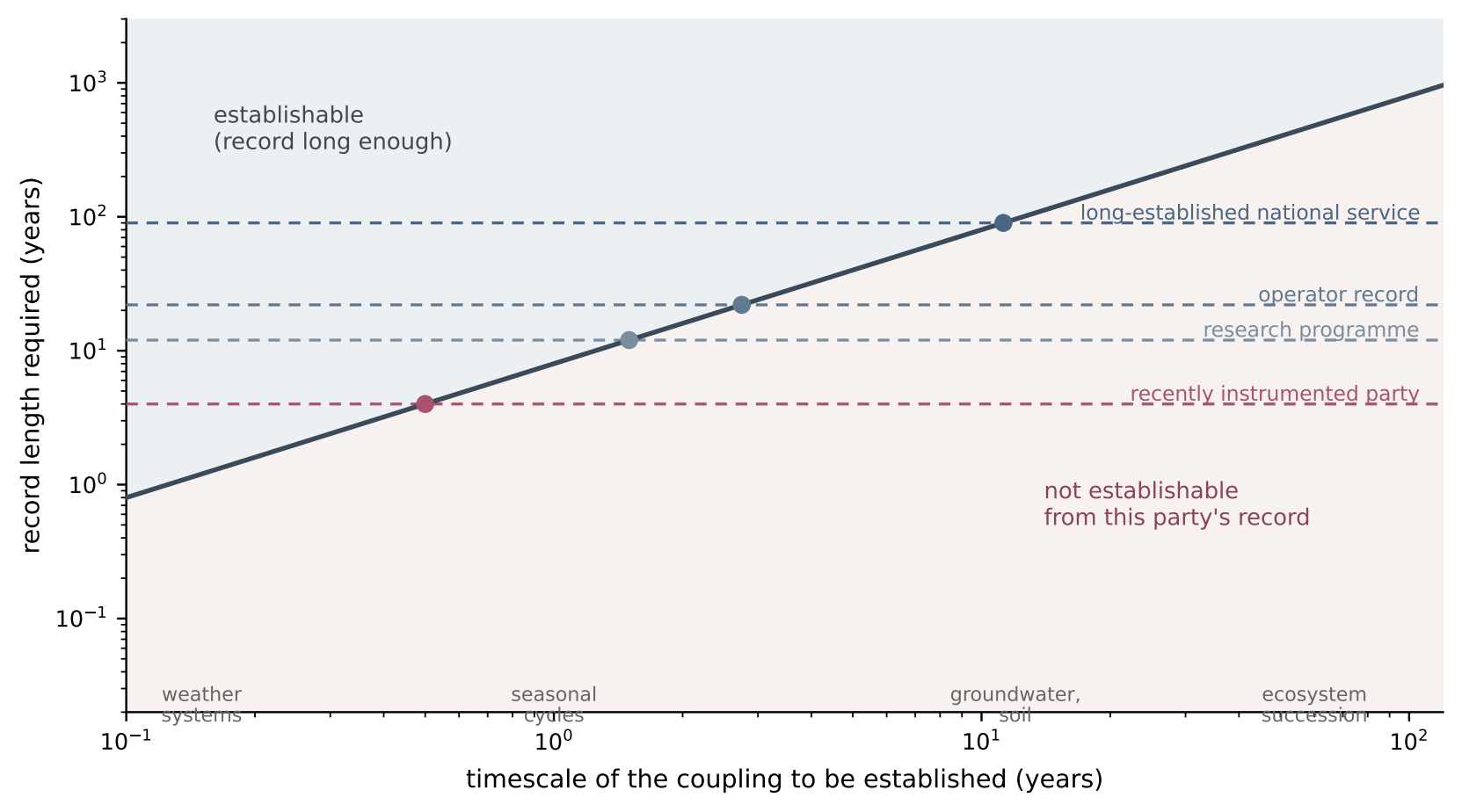
Figure 1. The establishment frontier. A coupling of timescale $\tau$ can be established from a record of length at least $k\tau$; the line is the frontier and the shaded region below it is the set of claims a party cannot establish from its own record. Horizontal lines mark the record depths of parties of different institutional ages, and the marked point on each is the slowest coupling that party can currently establish. Values are illustrative; the figure displays the structure of the constraint and no quantity in it is measured.
The parties least able to establish couplings are excluded from the claims that matter most. Establishment requires records proportional to the coupling’s timescale; the second paper’s inventory shows the slowest couplings to be those whose alteration is least reversible; and a governing principle triggered by irreversible foreclosure therefore requires, of a party seeking its protection, precisely the records that recent instrumentation cannot supply. The exclusion is not uniform across claims but concentrated on the class of claims the principle exists to address.
Claim ? is the paper’s central analytical result and its structure deserves stating plainly. It is not the observation that some parties observe better than others, which is familiar. It is that the gradient of exclusion runs in the same direction as the gradient of consequence: fast reversible couplings are establishable from short records and are the ones that matter least; slow irreversible couplings require long records and are the ones the series’ principle is built for. A remedy that raises all parties’ capacity uniformly closes the gap for the former long before the latter.
2.4 Four Compounding Asymmetries
The capacity asymmetry appears at four levels, and they compound, each operating on the terms the one above it sets.
Establishment. Who can show that a coupling obtains, which Claim ? addresses.
Standard setting. Whose record defines what counts as ordinary. The third paper’s assessment of unusualness is made against a record, and the fifth paper’s triggering conditions are specified from records; both therefore encode the experience of whichever parties hold the long series. A change unprecedented in a short record is ordinary in a long one, and the arrangement that adopts the long record’s standard has determined that the short-record party’s alarm is noise.
Credibility. Whose account is received once advanced. Here the fourth paper’s distinction is carried and is essential to keeping the analysis honest: where an account is discounted because it is not expressed in the form the arrangement receives, the deficit is procedural and a procedure receiving other forms remedies it; where it is discounted because it rests on a thinner record, the discount tracks a real evidential difference and correcting prejudice leaves it in place. Only the first is testimonial injustice. The second is what this paper is about, and it is not cured by better reception.
Agenda. Which couplings are examined at all. A coupling nobody has thought to look for generates no record anywhere, and the choice of what to measure is made by the parties with instruments, in the light of the questions their own positions raise. This asymmetry is prior to the other three and least visible, since its product is an absence.
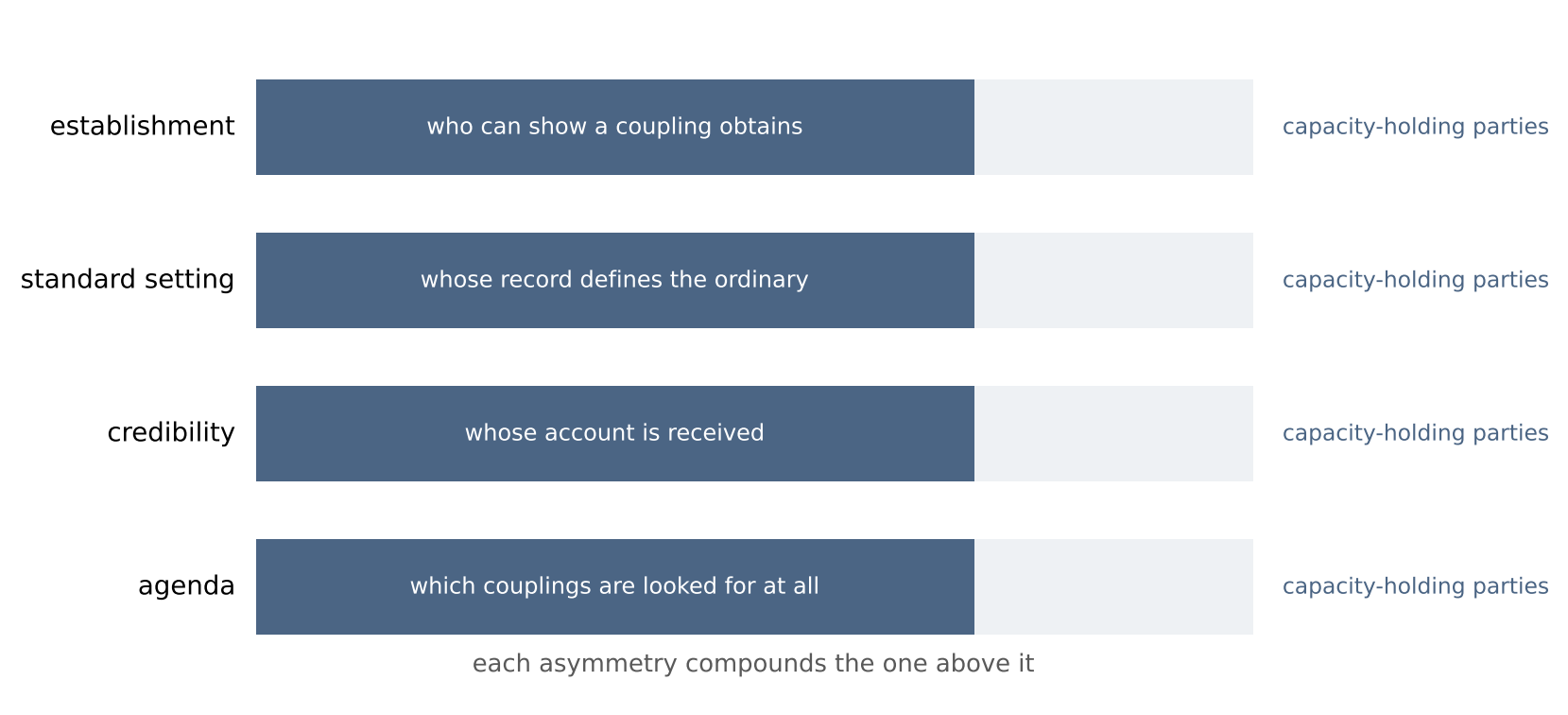
Figure 2. The four asymmetries. Each operates on terms the one above it sets: what is examined determines what records exist, records determine what can be established, and the standards against which findings are judged are drawn from the same records. The proportions shown are schematic.
2.5 Worked Case: A Contested Aquifer
An aquifer underlies an agricultural district, a growing settlement, and an industrial abstraction. A national hydrological service holds gauge records from the 1950s at three points. The industrial operator holds high-resolution records at its own wellfield from the date of its licence twelve years ago. The settlement’s water utility holds abstraction and quality records from its own boreholes, eight years. A farming community holds no instrumental record and detailed observation across three generations of where and when shallow wells failed. A research programme holds four years of intensive multi-point monitoring.
A proposal is made to expand industrial abstraction. Under this series’ principle the question is whether the expansion would irreversibly foreclose the aquifer’s capacity to support the other uses, and the relevant coupling, between abstraction at depth and shallow-well availability across the district, has a characteristic timescale of decades, since the aquifer’s response to drawdown propagates slowly and its recovery, if it recovers, is slower.
The frontier then determines who may say what. The national service alone holds a record spanning the coupling’s timescale, and its three points are not sited to resolve the district. The operator’s twelve years, however dense, cannot establish a decadal coupling; its records can establish, and do, that its own local drawdown is within licence. The utility and the research programme are further from the frontier. The farming community holds the only account covering the coupling’s timescale, and it is not instrumental, so its reception depends entirely on the standing element of Definition ?.
The asymmetries then compound in a way the case makes concrete. On agenda, no party had instrumented the shallow-well relation, because the operator measures its own field, the utility measures its own supply, and the service measures the regional resource; the coupling at issue belonged to nobody’s monitoring question. On standard setting, the operator’s twelve-year record defines its own baseline, against which current drawdown is unremarkable. On establishment, no party can show the decadal coupling from instrumental records. On credibility, the community’s account is the only one covering the period and is discounted, and the fourth paper’s distinction must be applied carefully: part of the discount is procedural, remediable by an arrangement that receives such accounts, and part reflects a genuine difference in what a non-instrumental record can support about magnitudes.
The outcome under an arrangement without the machinery of §6 is determinate and unjust in a specific way. The burden falls on whoever asserts foreclosure; nobody can establish it; the expansion proceeds; and the record that would have decided the question is the record nobody was required to make. The case is chosen because nothing in it involves bad faith by any party.
3. The Duty to Look and the Presumptions of Non-Establishment
3.1 The Structure the Remedy Must Have
The worked case identifies the defect precisely: an evidential rule that places the burden on whoever asserts foreclosure, applied in a field where the capacity to establish foreclosure is unevenly held, produces outcomes determined by the distribution of instruments. Three corrections are conceivable and two are inadequate.
Raising capacity uniformly is the standard proposal and is necessary, and Claim ? shows it insufficient on the timescale that matters, since a party instrumented today reaches the frontier for decadal couplings in decades. Lowering the evidential standard is the second, and it is a poor instrument, since a standard low enough to admit assertions from short records admits them from every party including those with an interest in asserting, and the fourth paper’s manipulation objection applies with full force. The third correction operates on the allocation of the burden and not on its height, and it is the one this section develops.
The materials are old. The law of proof has long addressed the case of a party holding the evidence that would decide against it. Where evidence lies peculiarly within one party’s knowledge or control, courts have shifted the burden of production to that party; where a party has destroyed or failed to preserve evidence it should have kept, an adverse inference is available; where an occurrence is of a kind that ordinarily does not happen absent negligence and the instrumentality was in the defendant’s control, the inference runs without proof of the specific failure (Wigmore, 1940; Nesson, 1985; Gorelick et al., 1989). In environmental regulation, the same structure appears as monitoring conditions attached to permits, and in international environmental law as the obligation to conduct impact assessment before authorising an activity with likely significant transboundary effect (International Court of Justice, 2010; mph Convention on Environmental Impact A, 1991). None of these is the proposal below, and each supplies part of its form.
3.2 The Duty to Look
A party bears a duty to look with respect to a coupling where three conditions hold: the party’s own conduct bears on the coupling, in the sense that alterations of conditions it controls propagate along it; the party holds observational capacity sufficient to establish the coupling, or could bring such capacity into being at a cost proportionate to the alteration it proposes; and no other party in the arrangement holds capacity sufficient to establish it. The duty is discharged by observing, over the period the coupling’s timescale requires, by stated methods, with the record placed where the arrangement can reach it.
Four features of Definition ? are load-bearing.
The duty attaches to capacity plus involvement, and not to capacity alone. A party with instruments and no involvement bears no duty under this definition, since the alternative makes the well-instrumented into the field’s monitoring service by fiat, which is neither fair nor sustainable.
The duty is residual: it arises where nobody else can establish the coupling. Where a competent public programme holds the relevant record, the party proposing an alteration owes no duplicate observation, and the duty’s function is to prevent the case in which nobody is required to look and therefore nobody does.
The duty runs to observation and not to conclusion. It is discharged by the record honestly made and placed, whatever the record shows. This matters because a duty discharged only by a favourable finding is a duty to produce a finding, which corrupts the observation it requires.
The record is placed, which imports the commons question the series treats elsewhere. A record held privately discharges nothing, since establishment requires that the arrangement reach it, and a party permitted to hold its own monitoring record confidentially retains the asymmetry the duty exists to correct.
Where a party bearing a duty to look has not looked, and an alteration it proposes is challenged on the ground that it would irreversibly foreclose a coupling the party did not observe, the arrangement should proceed as though the coupling were established. The inference is not a finding about the field; it is an allocation of the consequences of an absence to the party that could have removed it and did not. Its justification is the same as that of the adverse inference in the law of proof: where one party controls whether the evidence exists, placing the risk of its non-existence on the other party rewards the failure to produce it.
Claim ? is the paper’s principal constructive proposal, and three qualifications belong with it.
The inference is rebuttable, and it is rebutted by looking. A party that observes and finds no coupling has discharged the duty and defeated the inference, which is the outcome the arrangement wants, since it produces the record the field lacked.
The inference operates only within the duty’s conditions. Where no party could have established the coupling, no inference arises against anyone, and §6 treats that case separately below. Where a public programme held the capacity and did not look, the inference runs against that programme’s principal and not against a proponent who reasonably relied on it, which is a matter for the supervisory papers of this series.
The inference has a proportionality limit the paper states without resolving: an alteration whose scale is small relative to the cost of the observation the duty would require should not attract a duty at all, and the threshold at which it does is not specified here.
3.3 Presumptions Where No Party Holds Capacity
The harder case is the one the worked case ends on: nobody can establish the coupling, and no party is at fault for that. Here no adverse inference is available and the question is what an arrangement should do with an absence for which nobody is responsible.
Where a coupling is unestablished and no party held the capacity to establish it, an arrangement should not treat the absence of establishment as evidence of absence. Two presumptions follow. The absence of a finding is a finding about the arrangement’s sight and not about the field, which is the sixth paper’s grade-independence carried to the evidential setting. And where the alteration proposed is irreversible, the unestablished coupling should be treated as a reason for delay proportionate to the time the observation would require, on the ground that the irreversibility is the party’s choice while the ignorance is nobody’s.
The second presumption is the one that does work and the one most open to objection, since it converts an absence of knowledge into a ground for delay, and §8 treats the objection. Its ground is the asymmetry between the two errors. An alteration delayed to permit observation is recoverable; an irreversible alteration made under an ignorance that observation would have removed is not. The presumption operates only where the alteration is irreversible and only for the period the observation requires, and where that period exceeds any tolerable delay, the honest conclusion is that the decision must be made in ignorance, which the arrangement should record as such, and should not disguise as a finding.
3.4 Observational Capacity among the Governed Conditions
The remedies above operate within a proceeding. A further consequence operates on the field’s conditions directly, and it follows from the first paper without further argument.
The distribution of access and information is among the conditions the series’ principle governs. An alteration that degrades another party’s observational capacity, by discontinuing a station, by enclosing a record, by withdrawing from a shared programme, or by changing a method in a way that breaks a series, is therefore an alteration of a governed condition and falls to be assessed like any other. Where such an alteration would irreversibly foreclose a capacity, by breaking a continuity that cannot be reconstructed, it attracts the principle’s burden on the same terms as the severance of a physical coupling.
Observational capacity is a governed condition, and its irreversible degradation is a foreclosure in the sense of this series’ principle. A record discontinued cannot be resumed, since the intervening years are not observable retrospectively, and a series broken by a method change is not repaired by reverting the method. Duties of maintenance therefore attach to holders of long records independently of any particular proceeding, and the case for treating such records as commons rests on this, and not on their utility.
Claim ? connects this paper to the commons paper of the series and states the connection’s ground: the argument for holding long environmental records in common is not that sharing is efficient but that the alternative permits their irreversible loss by unilateral decision.
| p0.16 p0.24 p0.24 p0.22
| Deficit | Nature of the absence | Remedy | Available when |
|---|---|---|---|
| Agenda | The coupling was never examined | Duty to look, on the involved party with capacity | The party proposes an alteration bearing on it |
| Record | The record is too short for the coupling | Presumption against reading absence as safety; delay proportionate to observation | The alteration is irreversible |
| Instrument | No instruments are trained on the object | Capacity investment, and duties of maintenance on existing records | Continuously, independent of proceedings |
| Standing | The account exists and is not received | Procedural: an arrangement receiving other forms of account | Immediately, at low cost |
| Weight | The account rests on a thinner record | Not remediable by reception; only by record or by burden allocation | Through the two rows above |
Table. Five capacity deficits and their remedies. The last two rows separate the procedural deficit, which better reception cures, from the evidential deficit, which it does not, and the separation is what keeps the analysis of credibility honest.
4. Prior Treatments of Epistemic Position and Evidential Asymmetry
Eight literatures own parts of the position, and the concessions are extensive.
4.1 Environmental Justice and the Distribution of Environmental Burden
The environmental justice literature established that environmental harms are distributed along lines of race, income, and political power, and that the distribution is produced by siting decisions, regulatory attention, and enforcement practice (Bullard, 1990; Mohai et al., 2009). Its analytical apparatus distinguishes distributive justice, concerning who bears harms, procedural justice, concerning who participates in decisions, and recognition justice, concerning whose claims are treated as intelligible (Schlosberg, 2007).
The present paper’s subject is a species of what that literature calls procedural injustice, and priority for the general concern is conceded. The addition is a mechanism. Procedural justice is ordinarily analysed in terms of participation, notice, and access to decision processes, and the paper’s argument is that a party may hold all three and still be unable to make its claim, because the claim requires an evidential record that participation does not supply. Access to a hearing at which one cannot establish what one asserts is a form of exclusion that the participation framing does not reach, and Claim ? states its structure.
4.2 Procedural Rights in Environmental Law
The Aarhus Convention establishes rights of access to environmental information, of public participation in decision-making, and of access to justice in environmental matters, and it obliges parties to ensure that public authorities hold and disseminate environmental information (mph Convention on Access to Information,, 1998). The Escazú Agreement establishes an analogous framework for Latin America and the Caribbean with explicit attention to the position of those in vulnerable situations (mph Regional Agreement on Access to Info, 2018). Right-to-know regimes oblige operators to report specified emissions to public registers.
This body of law owns the right of access to information that exists, and the residue is exactly the complement: it addresses what is held and says comparatively little about what is not observed. An access right operates on a record; where no record was made, access delivers nothing, and the duty to look of §6 is directed at that gap. The impact-assessment obligation is the nearest existing instrument, since it requires investigation before authorisation, and §6 may be read as a generalisation of its logic from discrete projects to standing couplings.
4.3 Epistemic Injustice
Fricker distinguished testimonial injustice, in which prejudice reduces the credibility accorded to a speaker, from hermeneutical injustice, in which a party lacks the interpretive resources to render its experience intelligible (Fricker, 2007), and Dotson analysed forms of silencing operating through the audience (Dotson, 2011). The literature has been extended to environmental and climate contexts.
The concession is complete and the paper takes the analysis as it stands. The distinction this paper insists on is carried from the fourth paper and is repeated because it is easy to lose: a discount tracking a genuine difference in evidential support is not testimonial injustice, and treating it as such misdirects the remedy toward reception when the deficit lies in the record. The paper’s contribution here is to name what the remainder requires, which is capacity and burden allocation, and not credibility correction. Whether the systematic production of that evidential difference is itself an injustice of a further kind is a question the paper raises in §9 and does not settle.
4.4 Undone Science and the Sociology of Non-Knowledge
A body of work examines the systematic non-production of knowledge. Frickel and colleagues analyse undone science, research that is left unfunded and unperformed and whose absence serves identifiable interests, and show that the shape of what is not known is patterned and not random (Frickel et al., 2010; Hess, 2007). Proctor’s agnotology examines the deliberate production and maintenance of ignorance, including the manufacture of doubt in contested regulatory science (Proctor & Schiebinger, 2008).
This literature owns the agenda asymmetry of §5 entire, and it is the closest ancestor of the duty to look, since it establishes that absences of knowledge are produced and are not merely gaps. Two differences bear. That literature is analytic and its object is the research system as a whole, where the present proposal is a procedural device operating within a governance arrangement. And its central cases involve interested non-production, where Claim ? addresses the case in which nobody is at fault, which the literature does not treat because non-culpable ignorance is not its subject.
4.5 Community-Based Monitoring and Citizen Science
A substantial literature documents monitoring conducted by residents and volunteers, its data quality, and the conditions under which its findings are received by authorities (Conrad & Hilchey, 2011; Fraisl et al., 2020). Work on street science and popular epidemiology documents cases in which community-generated observation established relations that institutional monitoring had not examined (Corburn, 2005; Brown, 1992). The literature also documents the characteristic frustrations: findings held to standards not applied to institutional data, programmes dependent on volunteer continuity, and the difficulty of sustaining a record over the periods that matter.
The concession is substantial and specific. This literature owns the demonstration that capacity can be built outside institutions and the analysis of the standing element of Definition ?. Its documented frustration with record continuity is independent support for the maintenance element and for Claim ?, since a community programme’s lapse forecloses exactly as an institutional one does.
4.6 Indigenous Data Sovereignty and Governance of Observation
The CARE principles for indigenous data governance state collective benefit, authority to control, responsibility, and ethics as requirements complementary to technical openness (Carroll & Garba, 2020), developed against a record in which observation of indigenous peoples and territories served purposes those peoples did not set. The related literature on data colonialism analyses the extraction of data from populations as a mode of appropriation (Couldry & Mejias, 2019).
This literature is a necessary corrective to a proposal that would otherwise read as an argument for more observation of everyone. The paper accepts the correction and states its consequence for the duty to look: the duty is owed by parties with respect to couplings their own conduct bears on, which directs observation toward the observer’s own effects and not toward populations, and a duty framed the other way, obliging observation of communities by those with instruments, would be an instrument of exactly the extraction this literature documents. Where the observation the duty requires would touch a community’s territory or practices, the authority-to-control principle governs the terms, and the duty does not override it.
4.7 Capacity Building in Earth Observation and Warning
The international architecture treats capacity as a programme objective, and its assessments supply the empirical basis of §4: warning coverage has grown and remains unevenly distributed with the least coverage among the most exposed, and mortality falls with the comprehensiveness of the capability held (United Nations Office for Disaster Risk , 2025; World Meteorological Organization, 2022). Observation programmes similarly document station density and record continuity as persistent difficulties, with the sharpest deficits in regions of least investment.
This work owns the measurement of the gap and the operational programmes addressing it. The residue is the framing: capacity appears there as an input to be supplied, and the present paper argues it is a condition of protection and a governed object, from which Claim ? and the remedies of §6 follow. The practical difference is that a gap framed as a service deficit is addressed when resources permit, and a gap framed as an unequal distribution of protection bears on the validity of decisions taken meanwhile.
4.8 Evidential Control in the Law of Proof
The law of proof has long treated the case of a party controlling the evidence. Where facts lie peculiarly within one party’s knowledge, the burden of production may shift to that party; spoliation doctrine permits an adverse inference where a party has failed to preserve evidence it had reason to keep; and the res ipsa loquitur structure permits inference from an occurrence where the instrumentality was in the defendant’s control (Wigmore, 1940; Gorelick et al., 1989; Nesson, 1985). In environmental and safety regulation, monitoring conditions attached to permits perform a comparable function ex ante, obliging the operator to generate the record on which its own compliance will be assessed.
These materials own the structure of Claim ? and are its acknowledged source. Two extensions are the paper’s own. The doctrines address evidence that existed and was destroyed, or that lies within a party’s knowledge; the duty to look addresses evidence that was never created, which is a step the spoliation cases do not take, though permit-monitoring conditions take it in a narrower setting. And the doctrines operate between parties to a proceeding, where the couplings at issue here may concern trajectories that are not parties at all, so the inference’s beneficiary must be identified by the arrangement, and not by the pleadings.
4.9 Residue of the Survey
Consider a governance arrangement whose protective principle is triggered by a property requiring establishment; parties whose observational capacity differs in instruments, record depth, competence, standing, and maintenance; couplings whose timescales require records proportional to them, the slowest being those whose alteration is least reversible; and no party at fault for the absence of the records that would decide. The claims that the distribution of observational capacity thereby determines the distribution of the arrangement’s protections, that the exclusion is concentrated on the claims that matter most, that a residual duty to look with an adverse inference is the appropriate allocation of the resulting risk, that non-culpable non-establishment warrants presumptions in place of a finding of absence, and that observational capacity is itself a governed condition whose irreversible degradation is a foreclosure, are advanced by none of the treatments surveyed. Environmental justice owns the distributive concern and analyses participation; procedural environmental law owns access to records that exist; epistemic injustice owns credibility and its correction; the sociology of non-knowledge owns interested absence; community monitoring owns capacity built outside institutions; data sovereignty owns the terms on which observation may proceed; capacity programmes own the measurement of the gap; and the law of proof owns the inference from control, for evidence that existed. The composition is the residue claimed.
5. Objections and the Limits of the Position
5.1 The Strategic-Ignorance Objection
The sharpest objection to Claim ? is that it creates the incentive it exists to defeat. If not looking attracts an adverse inference, a party will look selectively, observing where findings are likely favourable and avoiding capacity where they are not, and will structure itself so that the conditions of Definition ? do not attach: capacity is held by a subsidiary, involvement is disclaimed, and the coupling is somebody else’s.
The paper’s answer is partial. Definition ? attaches on capacity that a party could bring into being at proportionate cost, which reaches the party that divested its instruments, and the involvement condition attaches to conduct and not to corporate form, which reaches the structural arrangement. Neither closes the case of a party that never acquired capacity it might have acquired, and the paper does not propose a duty to have looked in the past, which would be unadministrable. The residual is real: the duty operates best against parties that hold capacity and worst against those that have arranged not to, which is an incentive gradient in the wrong direction, and §9 carries it.
A second form of the objection concerns the quality of compelled observation. A party required to look and disadvantaged by what it might find has an interest in a record that establishes nothing: sampling designed to miss, methods chosen for their noise, discontinuities at convenient moments. The duty’s discharge condition, observation by stated methods over the required period with the record placed, is the available answer, and it converts the question into one of method specification and audit, which is the supervisory question the series treats elsewhere. The paper records that a duty to look presupposes an arrangement capable of assessing whether looking occurred, and that this presupposition is not trivial.
5.2 The Paralysis Objection
Claim ? converts an absence of knowledge into a ground for delay proportionate to the observation required, and observation of decadal couplings requires decades. The objection: this is a veto on any irreversible alteration in any inadequately observed field, which is most fields, and a governance architecture that produces this result has failed a practical test.
Three parts to the answer, and a concession. The presumption is limited to irreversible alterations, which is a small subset of what parties propose, and the series’ first paper argues at length that the irreversibility trigger is narrow and dischargeable, and not prohibitive. The delay is proportionate to the observation required and not to the coupling’s timescale, and the two differ, since a decadal coupling may be partly resolved by intensive short-period observation combined with proxy records, which is a matter for the arrangement’s assessment. And the presumption is defeasible by the party proceeding on stated grounds, which is the first paper’s burden structure and not a bar.
The concession is that where these do not apply, where the alteration is genuinely irreversible, the coupling genuinely slow, and no shorter observation is informative, the position does imply that the decision is being made in ignorance. The paper takes the honest recording of that as preferable to its concealment, and acknowledges that an arrangement recording it will sometimes proceed anyway, which the position permits and requires be visible.
5.3 The Paternalism Objection
A proposal to increase observation may serve those observed poorly, and the data sovereignty literature documents the record. The objection: an architecture that treats more observation as better will license extraction, and the parties with instruments will be authorised to observe the parties without them in the name of protecting them.
The paper accepts the objection’s premise and has structured Definition ? against it: the duty is owed with respect to couplings the duty-bearer’s own conduct bears on, so it directs observation toward the observer’s effects and not toward populations. Two residual difficulties are recorded. Observation of one’s own effects on a territory is observation on that territory, and the terms belong to those whose territory it is, which the paper states as a constraint on the duty’s discharge and does not work out. And the standing element of Definition ? could be read as advising communities to become legible to arrangements on those arrangements’ terms, which is precisely the demand the traditional-knowledge literature identifies as destructive; the paper’s position is that standing should be achieved by arrangements receiving other forms of account, as Table 1 states, and not by accounts converting themselves.
5.4 Limits Internal to the Position
Four limits without remedy here. The factor $k$ in Definition ? is unspecified and probably not constant across coupling types, so the frontier of Figure 1 has the right shape and no calibration. The proportionality threshold at which a proposed alteration attracts a duty is unstated, and it is doing considerable work, since it determines how often the machinery engages. The duty’s beneficiary is unidentified where the coupling concerns trajectories that are not parties, and the arrangement must supply what the pleadings would ordinarily supply. And the whole apparatus presupposes an arrangement with the standing to allocate burdens and assess discharge, which is a governance capacity as unevenly distributed as the observational capacity it would correct, so the paper’s remedies are least available where its diagnosis bites hardest.
6. Questions Left Open for the Programme
6.1 Questions Concerning Establishment
Calibration of the frontier. An answer would establish, for classes of coupling in the second paper’s inventory, what record length supports establishment at stated evidential standards, and would state whether the required factor varies systematically with coupling type, since a frontier that bends differently for hydrological and ecological couplings has different distributional consequences from the uniform one Figure 1 draws.
Substitution among record properties. Density, duration, and spatial coverage are distinct properties of a record, and the paper has treated duration as the binding one. An answer would state the substitution available, in particular whether dense short records combined with proxy or documentary evidence establish couplings that neither would establish alone, since the answer determines how much of the frontier is a hard constraint and how much a research problem.
Non-instrumental records at the frontier. The worked case turns on a community account covering the coupling’s timescale in a form no instrument produced. An answer would state what such an account can and cannot establish, distinguishing the temporal claims it supports well from the magnitude claims it supports poorly, and would supply the assessment criterion an arrangement should apply, which neither uncritical acceptance nor instrumental-only admission provides.
6.2 Questions Concerning the Duty
The proportionality threshold. An answer would state at what relation between the scale of a proposed alteration and the cost of the required observation a duty to look attaches, and would confront the circularity that the scale of an alteration’s consequences is what the observation would determine.
Duties on non-proponents. The duty as defined attaches to parties proposing alterations. An answer would state whether a standing duty attaches to parties whose ongoing conduct bears on a coupling without any new proposal, which is the larger case, and would say what triggers it if no proposal does.
Discharge and its audit. An answer would specify what constitutes discharge, in method, duration, and placement, and would state who audits it, addressing the incentive to produce a record that establishes nothing, which §8 identifies and does not answer.
The inference’s beneficiary. Where the foreclosed coupling concerns a trajectory that is not a party, an answer would state on whose behalf the adverse inference operates and who may invoke it, connecting this to the standing question the series’ first paper leaves open.
6.3 Questions Concerning Capacity among the Conditions
Maintenance duties on long records. Claim ? makes irreversible degradation of observational capacity a foreclosure. An answer would state what duties of maintenance follow for holders of long records, who bears the cost where the holder wishes to discontinue, and whether the duty survives the holder’s dissolution, which is the archival case.
Method change as foreclosure. A method change that breaks a series’ comparability destroys the record’s use for establishment while preserving its content. An answer would state when such a change is a foreclosure, and would confront the fact that methods must improve, so a rule forbidding change would foreclose in the other direction.
Capacity investment under the principle. If capacity is a governed condition, an answer would state whether the principle generates positive duties to build it and on whom, or whether it generates only the negative duty not to degrade what exists, which is the weaker and more defensible reading the paper has taken without argument.
6.4 Questions Concerning Justice
The status of produced evidential disadvantage. The paper distinguishes credibility discounts that track genuine evidential differences from those that do not, and treats only the second as testimonial injustice. An answer would address whether a genuine evidential difference systematically produced by historical distributions of investment is itself an injustice of a further kind, and if so, what follows procedurally, since the paper’s remedies address the consequence and not the production.
Interaction with the arrangement’s own capacity. §8 observes that the machinery presupposes governance capacity distributed as unevenly as observational capacity. An answer would state what the position implies where no arrangement competent to allocate burdens exists, and whether the analysis then supports claims addressed to other fora, which is a question about the relation between this architecture and existing legal orders.
7. Declinations and Limits of the Position
The paper establishes no empirical result about the distribution of observational capacity. It takes the distributional record from the assessments cited and argues about its significance.
The paper claims no novelty in the identification of environmental injustice, of epistemic injustice, of undone science, or of the inference from evidential control. §7 concedes each in the form its owners state it.
The paper supplies no calibration. The establishment frontier is stated as a form, its factor is unspecified, and the proportionality threshold governing when the duty attaches is not given, so the machinery is specified as to structure and not as to operation.
The paper proposes no institution. It states a duty, an inference, two presumptions, and a maintenance obligation, and declines to specify the body that would administer them, which belongs to the supervisory papers of this series.
The paper does not argue that more observation is better. Its duty is directed at a party’s own effects, its remedies for the standing deficit run to reception and not to conversion, and it accepts the constraint that observation touching a community’s territory proceeds on that community’s terms.
References
Convention on Access to Information, Public Participation in Decision-Making and Access to Justice in Environmental Matters (1998). UNECE, Aarhus.
Brown, P. (1992). Popular epidemiology and toxic waste contamination: lay and professional ways of knowing. Journal of Health and Social Behavior, 33(3), 267–281.
Bullard, R. D. (1990). Dumping in Dixie: Race, Class, and Environmental Quality. Westview Press.
Carroll, S. R., Garba, I., Figueroa-Rodríguez, O. L., et al. (2020). The CARE Principles for Indigenous Data Governance. Data Science Journal, 19(1), 43.
Conrad, C. C. and Hilchey, K. G. (2011). A review of citizen science and community-based environmental monitoring: issues and opportunities. Environmental Monitoring and Assessment, 176(1–4), 273–291.
Corburn, J. (2005). Street Science: Community Knowledge and Environmental Health Justice. MIT Press.
Couldry, N. and Mejias, U. A. (2019). Data colonialism: rethinking big data’s relation to the contemporary subject. Television and New Media, 20(4), 336–349.
Dotson, K. (2011). Tracking epistemic violence, tracking practices of silencing. Hypatia, 26(2), 236–257.
Regional Agreement on Access to Information, Public Participation and Justice in Environmental Matters in Latin America and the Caribbean (2018). United Nations, Escazú.
Convention on Environmental Impact Assessment in a Transboundary Context (1991). UNECE, Espoo.
Fraisl, D., Campbell, J., See, L., et al. (2020). Mapping citizen science contributions to the UN Sustainable Development Goals. Sustainability Science, 15, 1735–1751.
Frickel, S., Gibbon, S., Howard, J., et al. (2010). Undone science: charting social movement and civil society challenges to research agenda setting. Science, Technology and Human Values, 35(4), 444–473.
Fricker, M. (2007). Epistemic Injustice: Power and the Ethics of Knowing. Oxford University Press.
Gorelick, J. S., Marzen, S., and Solum, L. (1989). Destruction of Evidence. Wiley Law Publications.
Hess, D. J. (2007). Alternative Pathways in Science and Industry: Activism, Innovation, and the Environment in an Era of Globalization. MIT Press.
Mohai, P., Pellow, D., and Roberts, J. T. (2009). Environmental justice. Annual Review of Environment and Resources, 34, 405–430.
Nesson, C. (1985). The evidence or the event? On judicial proof and the acceptability of verdicts. Harvard Law Review, 98(7), 1357–1392.
Proctor, R. N. and Schiebinger, L. (eds.) (2008). Agnotology: The Making and Unmaking of Ignorance. Stanford University Press.
International Court of Justice (2010). Pulp Mills on the River Uruguay (Argentina v. Uruguay), Judgment, ICJ Reports 2010, 14.
Schlosberg, D. (2007). Defining Environmental Justice: Theories, Movements, and Nature. Oxford University Press.
Wigmore, J. H. (1940). A Treatise on the Anglo-American System of Evidence in Trials at Common Law, Including the Statutes and Judicial Decisions of All Jurisdictions of the United States and Canada, 3rd edn, 10 vols. Little, Brown, Boston.
World Meteorological Organization (2022). Early Warnings for All: Executive Action Plan 2023–2027. WMO, Geneva.
United Nations Office for Disaster Risk Reduction and World Meteorological Organization (2025). Global Status of Multi-Hazard Early Warning Systems 2025. UNDRR and WMO, Geneva. Launched at the COP30 climate summit, Belém, November 2025; the primary monitoring report for the Early Warnings for All initiative and for Target G of the Sendai Framework. thebibliography