Routing and Distributed Inquiry in Environmental Governance - Delivering Reports under an Incomplete Structure
Abstract
The event layer developed earlier in this series leaves two questions open by design. An emitting party names the parties it believes a change affects, and that naming is a revisable claim and not a routing instruction, so an arrangement must complete the delivery; and a report asserts consequence without prescribing a response, so an arrangement must have some means of doing more than delivering when more is warranted. This paper takes up both. The method is conceptual, with one small quantitative observation. On routing, the paper distinguishes three modes by what each requires and what each costs: delivery to parties the emitter declared, delivery along correspondences established from paired records, and delivery inferred from structural adjacency where no correspondence has been established. The modes trade reach against precision, and the paper’s central observation is that the trade is not symmetric: because the physical structure of a field is incomplete in every party’s hands, reach can be bought only by delivering to parties for whom the report is irrelevant, and the marginal volume required per additional coupling reached rises steeply, while the cost of that volume falls on receivers as the habituation that the event layer identifies as its characteristic decay mode. Routing breadth is therefore a governed parameter trading blindness against habituation, and neither end of its range is safe. On inquiry, the paper proposes a bounded, question-relative process that an arrangement may open when a report warrants more than attention, which tasks observation under the duty to look, assembles the holdings that bear on the question with disagreement preserved, and terminates in an action, a finding that the material does not warrant one, or a determination of what could not be established. The paper argues that inquiry has an epistemic function beyond the question it answers, since an inquiry that establishes a coupling adds it to the carriage map, so an arrangement learns its own structure from the inquiries it runs. The paper treats strategic silence and the corruption of routing observables inside the design and not as afterthoughts, surveys the literatures on information routing, on regulatory escalation, and on inquiry design, and identifies the residue. It reports no empirical study.
Keywords: routing; escalation; inquiry; environmental governance; information infrastructure
Notices
On the references. All 16 works cited in this paper have been checked against their sources at claim level: each source was consulted and confirmed to state what the citing sentence attributes to it. No entry in this paper’s bibliography is unverified.
Status. This is a working draft circulated for discussion. It is a preliminary discussion paper and is not a finished statement of its author’s position. Sections and statement numbers are subject to change.
Licence. This work is made available under a Creative Commons Attribution-NonCommercial 4.0 International Licence (CC BY-NC 4.0).
Statement on the use of language models. Drafting, literature search and argumentative criticism for this paper were conducted in dialogue with large language models, specifically Claude (Anthropic) and ChatGPT (OpenAI). The claims, the structure, the selection of material and the position taken are the author’s. References have been checked in stages, to two standards, and the process is incomplete. Part of the corpus has been verified at identity level, meaning author, title and publication coordinates were confirmed against the publisher of record. A smaller part has additionally been verified at claim level, meaning the cited source was consulted and confirmed to state what the citing sentence attributes to it. The remainder is unverified at either standard. The standard reached is marked on each bibliography entry: no mark for claim level, $\ddagger$ for identity level only, $\dagger$ for not yet verified. Corrections made so far are recorded in the project’s citation-verification file; where a source proved not to bear the weight the text placed on it, the text was revised rather than the citation removed.
Companion papers. This paper is Paper 9 of a series on the governance of environmental change, and treats the delivery of reports under an incomplete structure, and bounded inquiry. The other papers of the series treat, in order: the object; the field and its three structures; coordination through change; heterogeneous knowledge; the event layer; criticality detection; observational capacity; representational requirements; the regime near a threshold; forecasting from the stream; the knowledge commons; attribution and ownership; responsibility at transitions; and supervisory duties. Paper 12 is reserved and is not yet drafted. A related paper by the author, developed independently of this series, treats the temporal correspondence limitation of evidence-based policy making, being the divergence between the system state that evidence represents and the system state at the moment of decision. Its results on the partition of a state space into estimable and unobservable components, on the blindness of a recency-weighted evidence base to the approach to criticality, and on the allocation of a justificatory burden where temporal correspondence fails, were reached by a different route and bear on several papers of this series.
Suggested citation. Huang, W. Routing and Distributed Inquiry in Environmental Governance: Delivering Reports under an Incomplete Structure. Working draft.
Discussion Paper Note
This paper is a preliminary discussion paper intended to share an evolving idea and invite further dialogue, criticism, revision, and independent development.
The author does not claim exclusive epistemic ownership over the viewpoints, concepts, or lines of reasoning presented here, nor does the author claim priority as their first originator. Similar or related ideas may have appeared previously in other intellectual, cultural, or disciplinary traditions. Any legal rights retained in this work are intended to support attribution, responsible use, and protection against exploitative or harmful appropriation, and not to restrict independent inquiry, criticism, revision, or further development.
The arguments in this paper should therefore be understood as provisional and historically situated rather than definitive. Readers are encouraged to question, revise, extend, reinterpret, or independently develop the ideas presented here. Where appropriate, acknowledgment of this paper as one point of encounter in the development of related ideas is appreciated, but such acknowledgment should not be understood as granting the author epistemic ownership over the ideas themselves.
Responsible Use and Rights Reservation
The author encourages good-faith discussion, criticism, independent development, and responsible use of the knowledge presented in this work. The author does not claim exclusive epistemic ownership over the ideas or viewpoints discussed herein, nor claim priority as their first originator.
However, the author expressly reserves all rights and remedies available under applicable law with respect to uses of this work or related materials that involve unlawful conduct, harmful or abusive exploitation, improper commercial appropriation, infringement of applicable intellectual property or other legal rights, or conduct contrary to applicable national, regional, or international law.
This reservation is intended to preserve the ability to respond to misuse and harmful appropriation. It should not be interpreted as restricting legitimate academic inquiry, criticism, independent reasoning, or the further development of related ideas.
1. Introduction
Two elements of the event layer were left unspecified in the paper that developed it, and the omissions were deliberate. An event carries the emitter’s view of which parties the change affects, and that element was defined as a revisable claim and not as an instruction to a router, on the ground that an emitter cannot know the couplings its change propagates along. Completion of the delivery was placed with the arrangement, and the arrangement’s means of completing it were not stated. Separately, an event asserts consequence and leaves the response to the receiving party, which is what distinguishes it from an alarm; but an arrangement in which every report is delivered and nothing further happens has no way of doing more when more is warranted, and the response requirements stated there were deliberately the weakest of the four kinds.
This paper supplies both. Its first subject is routing: how a report reaches parties the emitter did not name, given that no party holds the physical structure along which the change will propagate. Its second is inquiry: what an arrangement does when a report warrants more than attention, and how that process terminates.
The routing problem has a structure worth stating before any mechanism is proposed. An arrangement routes on its carriage map, and the map is a representation of the physical structure, which the second paper of this series establishes that no party holds and that diverges from every party’s epistemic structure in ways that are diagnosable pairwise and not globally. Routing is therefore inference under an incomplete structure, and the incompleteness is not a temporary deficiency to be corrected but the standing condition. Two failure modes follow and they pull in opposite directions. A narrow routing delivers only where a coupling is already known, which is the condition the second paper’s uncommunicated divergence describes and which no volume of reporting corrects, since a coupling nobody has represented generates no delivery. A broad routing delivers widely and buys its reach by delivering to parties for whom the report is irrelevant, whose cost falls as the habituation the event paper identifies as the layer’s characteristic decay mode.
Routing breadth is a governed parameter trading blindness against habituation, and neither end of its range is safe. Because the structure is incomplete, additional reach is purchased by additional irrelevant delivery, and the marginal volume required per additional coupling reached rises steeply as reach approaches the couplings that are least well represented, which are the couplings the arrangement most needs to reach. An arrangement that sets breadth once and leaves it has chosen a point on this trade without acknowledging that it did so.
The paper’s second position concerns what escapes the trade. Inquiry is proposed as the mechanism by which an arrangement does more than deliver, and its distinctive property is epistemic. An inquiry that establishes a coupling adds that coupling to the carriage map, so subsequent reports route along it without the breadth that would otherwise have been required. Inquiry therefore converts a routing problem into a structural finding, and an arrangement learns its own carriage map from the inquiries it runs, which is the only mechanism in the architecture by which the map improves without a party volunteering a coupling nobody asked about.
The paper’s third commitment is to treat the corruption of routing observables inside the design. Where routing determines who receives what, parties acquire interests in the routing, and where an inquiry imposes costs, parties acquire interests in the thresholds that open one. §8 treats these, and §5 states the design consequences where they can be stated.
The paper proceeds as follows. §5 restates the carried positions and develops the three routing modes and the breadth parameter. §6 develops inquiry, the escalation ladder, and the learning property. §7 surveys the owning literatures. §8 treats the objections and §9 the open questions, and §10 the declinations.
2. Routing under an Incomplete Structure
2.1 Positions Carried from the Companion Papers
Five results are used and restated so the paper stands alone.
The three structures of a field are the physical structure of dependence, which obtains independently of anyone’s knowledge; the epistemic structure of who knows what about which coupling; and the communicative structure of who reports what to whom. Their divergences are governance-relevant quantities, classified as unwitnessed, uncommunicated, or misattributed, and a divergence is diagnosable pairwise, from evidence about a single coupling, without any party holding a complete structure.
The differential is a change assessed in the emitting party’s own representation against its own record, and a differential correspondence between two subsystems is a stable relation between their changes, established from paired records and requiring no map between their representations.
The event carries the change, the emitter’s assessment of its unusualness, confidence, hypotheses about couplings the change may bear on, the parties the emitter believes affected as a revisable claim, and provenance. Six classes of event are distinguished, of which coupling-change events are the hardest to emit and capability-change events report alterations in a party’s own capacity to observe.
The assembly is a temporary, question-relative structure drawing on the holdings of parties whose knowledge bears on a question, preserving disagreement, uncertainty, and acknowledged ignorance as content, and terminating in an action taken on stated grounds or in the finding that the material does not warrant the action.
The duty to look is a residual duty owed by a party whose conduct bears on a coupling, that holds or could obtain capacity to establish it, where no other party holds such capacity; discharged by observation over the period the coupling’s timescale requires, by stated methods, with the record placed where the arrangement can reach it.
2.2 Three Modes of Delivery
An arrangement delivers a report by one or more of three modes. Declared routing delivers to the parties the emitter named in the event’s affected-parties element. Correspondence routing delivers to parties standing at the far end of a differential correspondence established from paired records involving the emitting subsystem. Structural routing delivers to parties inferred to be affected from adjacency, from shared resource or medium, or from the type of the change, where no correspondence has been established. The modes differ in what they require of the arrangement, in their reach, and in the proportion of their deliveries that land on a coupling that in fact obtains.
The three are ordered, and the ordering is the paper’s practical claim about how an arrangement should be built.
Declared routing requires nothing of the arrangement beyond delivery, and its precision is high because an emitter naming an affected party ordinarily has a reason. Its reach is the smallest, and its limit is exactly the limitation the event paper anticipated in defining the element as a revisable claim: an emitter names the parties it knows of, so declared routing reproduces the emitter’s own epistemic structure and reaches no coupling the emitter has not represented.
Correspondence routing requires that the arrangement hold established correspondences, which requires paired records spanning parties, which the capacity paper shows to be unevenly available. Its precision is lower than declared routing’s, since a correspondence is evidence of a relation and does not establish its direction or exclude a common driver. Its reach is wider, and its distinctive property is that it delivers along couplings that no party asserted: a correspondence established from records is a finding about the field, and routing on it carries reports to parties neither of whom named the other.
Structural routing requires only a typed inventory of the field’s subsystems and their adjacencies, which the second paper of this series supplies. Its precision is low by construction, since adjacency is a weak ground for consequence. Its reach is the widest and it is the only mode that can deliver along a coupling that is unwitnessed, which is the class the second paper identifies as irremediable by improved reporting.
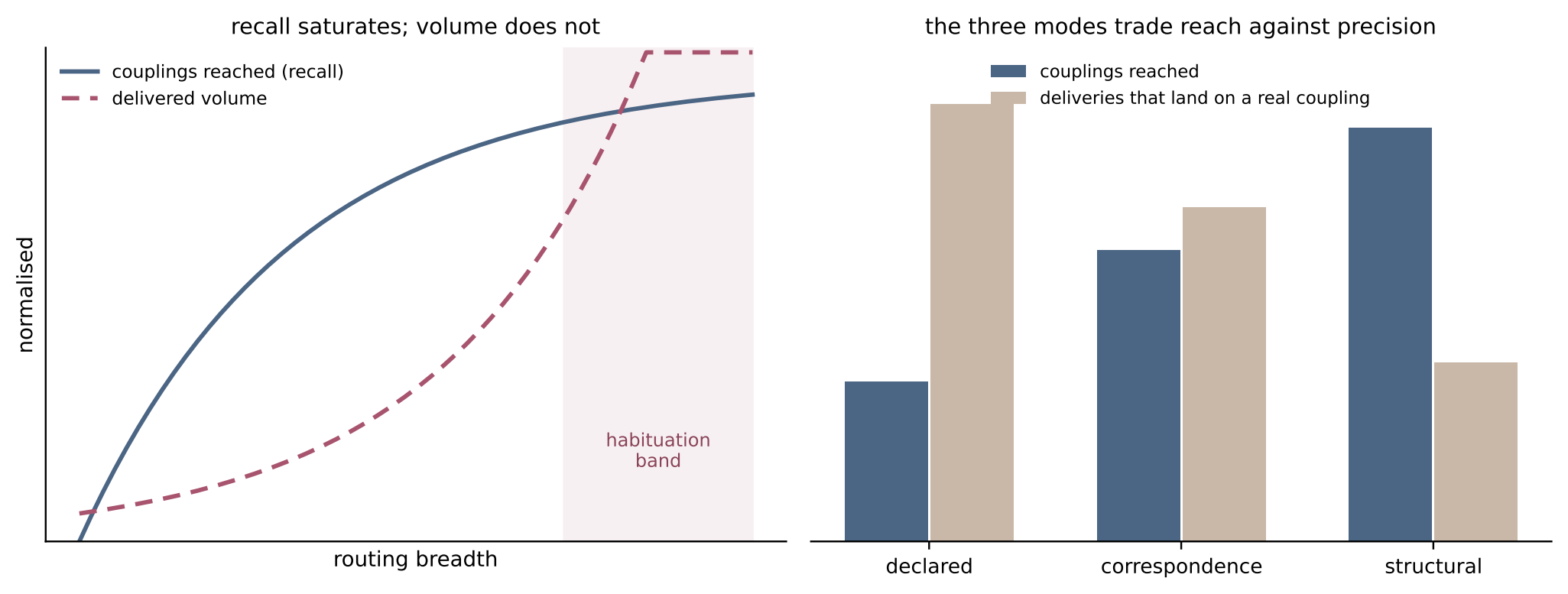
Figure 1. The routing trade. The left panel shows recall saturating as routing breadth increases while delivered volume continues to grow; under the illustrative forms plotted, the marginal delivered volume per unit of additional recall is about fifty times higher at high breadth than at low. The right panel shows the three modes ordered by reach and by the proportion of deliveries landing on a coupling that obtains. Values are illustrative and display the structure of the trade; no quantity is measured.
2.3 The Breadth Parameter and Its Asymmetry
Claim ? states the trade and this section states why its two errors are not comparable.
A missed delivery is a report that did not reach a party whose conduct bears on the coupling it concerns. Its cost is borne by that party and by whatever the coupling carries consequence to, it is not observed by anyone at the time, and it is discovered, if at all, after the consequence has arrived. The arrangement generates no record of it.
A spurious delivery is a report that reached a party the change does not concern. Its cost is the receiving party’s attention, it is observed immediately by that party, and the arrangement generates a record of it. Its accumulation produces habituation, which the event paper identifies as the layer’s characteristic decay mode and for which it supplies no remedy.
The two routing errors differ in observability, and the difference biases an arrangement’s own assessment of its routing. Spurious deliveries are visible to receivers and are complained of; missed deliveries are visible to nobody and are complained of by nobody. An arrangement that adjusts its breadth in response to the complaints it receives will therefore narrow monotonically, and will narrow fastest where its structural knowledge is weakest, since that is where structural routing generates the most spurious deliveries. The adjustment must be made against a measure the arrangement constructs deliberately, and cannot be left to feedback.
Claim ? identifies a failure that operates without anyone deciding anything, and it is the paper’s principal warning. Two partial measures are available. The arrangement can hold a record of deliveries that were later found relevant, drawn from inquiries and from retrospective study of events, which supplies a count of what narrow routing would have missed. And it can vary breadth deliberately across a field’s regions, treating breadth as an object to be assessed and not a setting, which the requirements of the eighth paper make representable through the versioned register.
2.4 Corruption of the Routing Observables
Routing determines who receives what, so parties acquire interests in it, and three specific corruptions follow from the mechanisms above.
An emitter’s affected-parties element is a claim, and an emitter may under-name to avoid the attention its report would attract or over-name to impose consideration duties on others. Declared routing therefore inherits the emitter’s interest directly, which is an argument for the arrangement completing the delivery and not relying on the declaration.
A correspondence is estimated from records that parties supply, so under-supply degrades the correspondences that would route reports toward the under-supplying party. This is the manipulation of least visibility identified in the criticality paper, and it is formally indistinguishable from a capacity deficit, which is why the capability-change event class exists: a party that ceases to supply should generate an event saying so.
A structural inference rests on a typed inventory, and the inventory is compiled. A party with influence over the inventory can arrange that its subsystem is adjacent to little. The inventory is therefore a governed condition in the series’ sense, and its compilation is subject to the same requirements of authorship and versioning that the threshold registers bear.
3. Inquiry and the Escalation Ladder
3.1 The Ladder
An arrangement whose only operation is delivery cannot do more when more is warranted, and an arrangement that escalates directly from delivery to compulsion has the alarm’s structure, which the event layer was constructed to avoid. Five steps are distinguished, and Figure 2 orders them.
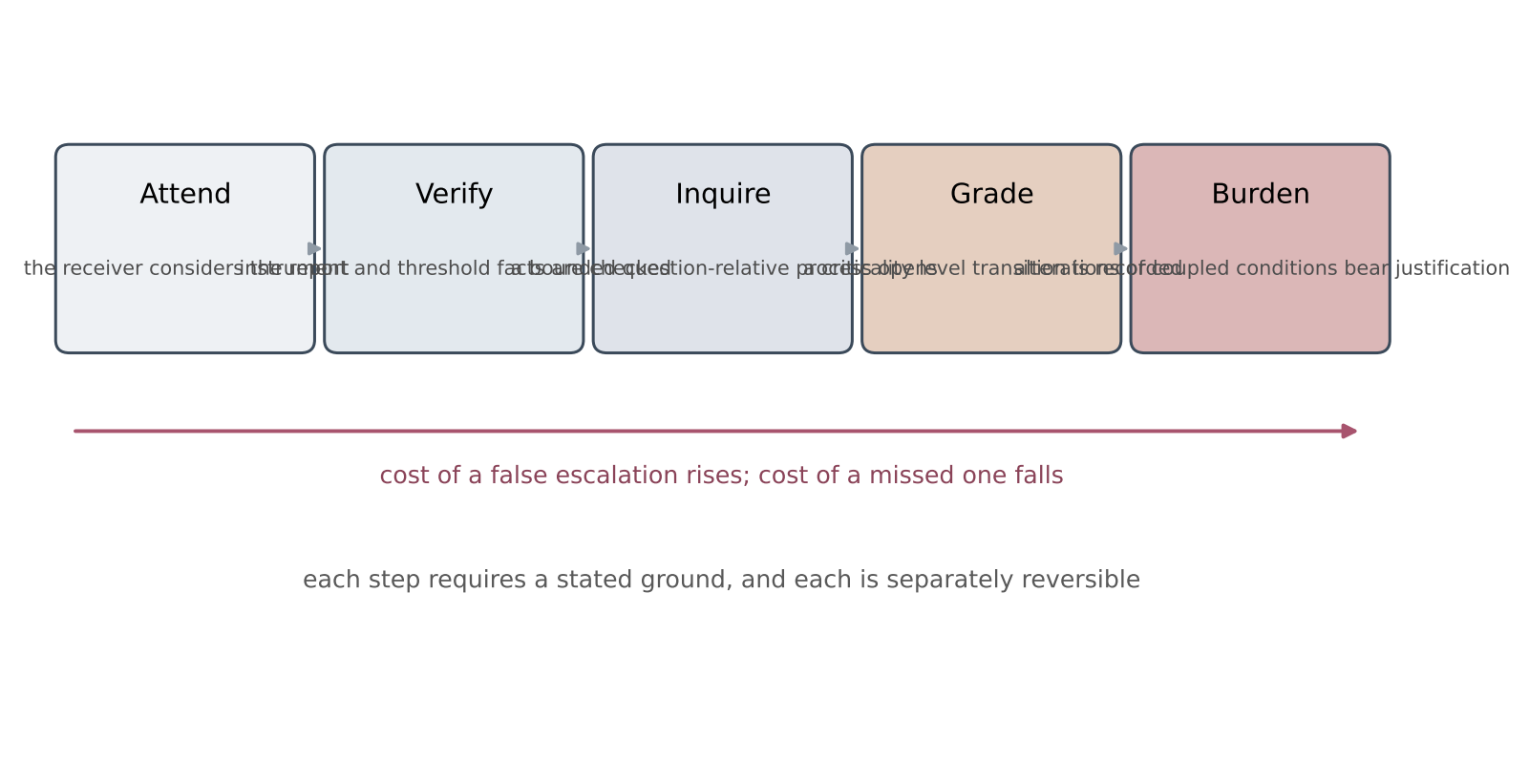
Figure 2. The escalation ladder. Each step requires a stated ground and each is separately reversible. The cost of a false escalation rises along the ladder and the cost of a missed one falls, which is what makes graduation the appropriate form: the steps that are cheap to take wrongly are the ones taken on weak grounds.
Attend is the receiving party’s consideration of a delivered report, which is the weakest response requirement the event paper states. Verify checks the instrument and threshold facts on which the report’s interpretation depends, which is the operation that converts the silence regime on the emitting channel from an assumption into a checkable condition. Inquire opens the bounded process developed below. Grade records a criticality level transition, with the duties the sixth paper attaches. Burden raises the justificatory requirement on alterations of conditions coupled to the object concerned.
The ordering of the ladder is determined by the asymmetry of its errors and not by the severity of its steps. Attending and verifying on weak grounds cost inspection effort, are reversible, and generate records that improve the arrangement; grading and burdening on weak grounds impose costs on parties and consume the arrangement’s credibility. The steps whose false activation is cheap therefore sit low and may be triggered on weak grounds, and this ordering is what permits an arrangement to respond to a report without either ignoring it or treating it as established.
3.2 Inquiry
An inquiry is a bounded process opened by an arrangement in respect of a stated question, comprising: the question, stated so that its answer is determinable; the parties whose holdings or capacity bear on it; a period; the observations tasked, which may include activation of duties to look; the assembly constructed from the holdings, with disagreement, uncertainty and acknowledged ignorance preserved; and a termination, in an action taken on stated grounds, in a finding that the material does not warrant the action contemplated, or in a determination of what could not be established and by which party. An inquiry is dissolved on termination and its findings are placed in the record.
Four features of Definition ? carry the position.
Inquiry is bounded, in question, in parties, and in period. An unbounded inquiry is an institution, and the fourth paper’s argument against standing integrated accounts applies to it in full: a body constituted to inquire acquires authority with age and becomes the object subsequent work must reconcile with.
Inquiry tasks observation. This is what distinguishes it from an assembly, which operates on the holdings that exist. An inquiry may activate a duty to look, which means it can generate the record the question requires and does not merely discover that the record is absent, and the seventh paper’s adverse inference supplies what follows where the tasked party does not look.
Inquiry has three terminations and not two. The third, a determination of what could not be established and by which party, is the one arrangements will be tempted to omit, and it is the one the eighth paper’s representation of absence exists to carry. It is also the input to the seventh paper’s presumptions, since a determination that nobody held the capacity is what triggers them.
Inquiry is opened by the arrangement, which places a determination with the arrangement that parties will contest. §8 treats the threshold for opening, which is the mechanism’s principal exposure.
3.3 The Learning Property
The paper’s second substantive claim concerns what inquiry does beyond answering its question.
An inquiry that establishes a coupling adds that coupling to the carriage map, so subsequent reports concerning it route by correspondence where they previously required structural breadth or went undelivered. Inquiry is therefore the mechanism by which an arrangement improves its own routing, and it is the only such mechanism in the architecture that does not depend on a party volunteering a coupling nobody asked about. An arrangement that runs inquiries and does not feed their structural findings back into its carriage map has discarded the larger part of what the inquiry produced.
Claim ? has three consequences worth stating.
The value of an inquiry is not exhausted by its own question, so the criterion for opening one should not be the importance of that question alone. An inquiry into a question of modest importance that would establish a coupling of wide significance is worth more than its question suggests, and an arrangement assessing inquiries by their questions will systematically under-open in exactly the regions where its map is weakest.
An inquiry terminating in the third form, that a coupling could not be established, is also a structural finding, since it records that the coupling is not establishable from present capacity and identifies the deficiency. This is an input to the capacity paper’s remedies and is discarded by any practice treating a failed inquiry as a null result.
And the carriage map’s growth is a measure of the arrangement, since a map that does not grow is either complete, which is not the case in any field this series addresses, or is not being informed by what its arrangement learns.
3.4 Thresholds for Opening an Inquiry
An inquiry costs, and something must determine when one opens. Three candidate triggers are stated with their properties.
Grade-triggered. A criticality grade transition opens an inquiry automatically. This has the advantage of being determinate and the disadvantage of inheriting the detection arrangement’s blind classes, so the fields where inquiry is most needed, those whose transitions the indicator suites do not precede, generate no trigger.
Divergence-triggered. An inquiry opens where a report arrives along a coupling for which no carriage existed, on the ground that such a report is evidence of a structural gap. This is the trigger best aligned with the learning property, and its weakness is that it depends on a report having arrived, which structural routing must have delivered.
Request-triggered. A party may request an inquiry. This is the trigger that reaches what the other two miss, and it is the one most exposed to strategic use, since a party may request inquiries to impose cost on others or to delay. The paper’s position is that requests should require stated grounds and that a pattern of unfounded requests is itself assessable, which is a weak answer, and that no arrangement should rely on the other two triggers alone, since between them they reach only what the arrangement already partly knows.
| p0.17 p0.23 p0.24 p0.24
| Mode | Requires | Reaches | Characteristic failure |
|---|---|---|---|
| Declared | Nothing beyond delivery | Couplings the emitter has represented | Reproduces the emitter’s epistemic structure |
| Correspondence | Paired records spanning parties | Couplings established from records, named by nobody | Degrades where parties under-supply records |
| Structural | A typed inventory of subsystems | Couplings not yet witnessed | Low precision; habituation in receivers |
| Inquiry | Capacity, a period, and a trigger | Couplings none of the three routed | Cost, and contest over the opening threshold |
Table. The three routing modes and inquiry compared. Inquiry appears in the same table because it is the operation by which an unrouted coupling becomes a routed one, so its output is an input to the modes above it.
4. Prior Treatments of Delivery, Escalation, and Inquiry
Six literatures own parts of the position.
4.1 Content-Based Routing and Publish-Subscribe Systems
The distributed-systems literature developed the machinery for delivering messages to recipients determined by content and not by address. Publish-subscribe architectures decouple emitters from receivers so that neither need know the other, and content-based variants match messages to subscriptions expressed as predicates over message content (Eugster et al., 2003; Carzaniga et al., 2001). The associated work addresses matching efficiency, subscription languages, and delivery guarantees.
This literature owns the mechanism of the declared and correspondence modes entirely, and an implementation would be built on it. The residue is that its receivers subscribe: a party states what it wishes to receive, and the system delivers accordingly. The problem of this paper is the converse, since the parties an environmental report concerns are frequently parties that do not know the coupling exists and therefore cannot have subscribed to it, and structural routing is the mode that addresses exactly the non-subscriber. A subscription model reproduces the epistemic structure of its subscribers in the same way declared routing reproduces the emitter’s.
4.2 Information Retrieval and the Precision–Recall Trade
The trade between reach and precision is old and formalised. Information retrieval established precision and recall as the governing measures, characterised their trade, and developed the apparatus for choosing an operating point, including the observation that the appropriate point depends on the relative costs of the two errors (Rijsbergen, 1979; Manning & Raghavan, 2008). Signal detection theory supplies the general form, in which an operating point on a receiver characteristic is chosen against a cost ratio (Green & Swets, 1966).
The concession is complete and the paper’s Claim ? is this trade named for a new setting. The addition is Claim ?, and it is a claim about the observability of the two errors and not about their costs, which the retrieval literature ordinarily treats as known: in this setting one error is recorded and complained of and the other is invisible, so the operating point drifts under feedback even where the cost ratio is correctly understood. This asymmetry has no counterpart in a retrieval system where the missed documents can be counted against a ground truth.
4.3 Responsive Regulation and Enforcement Pyramids
Ayres and Braithwaite proposed that enforcement be arranged as a pyramid, with persuasion at the base and severe sanctions at the apex, and that regulators escalate only as lighter instruments fail (Ayres & Braithwaite, 1992). The subsequent literature examined the conditions under which pyramids operate as intended and the difficulties of descending them (Braithwaite, 2011; Black & Baldwin, 2010).
This literature owns the graduated form of Figure 2, and the concession is unreserved. Two differences bear on the present use. The enforcement pyramid escalates against a party in response to non-compliance, where the ladder here escalates in response to a finding about the field and its lower steps address no party’s conduct at all. And the pyramid’s ordering is by severity of sanction, where Claim ? orders by the asymmetry of the errors, which produces the same shape for a different reason and yields a different criterion for where a step belongs.
4.4 Incident Escalation in Operational Practice
Operational domains have developed escalation practice in detail. Incident-management frameworks define severity levels with associated response obligations and escalation paths; clinical deterioration systems compute aggregate scores from routine observations and attach graded responses to score bands, and their literature documents both their benefit and their characteristic failure, that escalation is triggered and not acted on (Smith et al., 2013; Jones et al., 2011). Aviation and process industries operate alert and escalation hierarchies with defined criteria.
The concession is the operating demonstration that graduated escalation on stated criteria works at scale. The residue is the referent, since these systems escalate within a single organisation whose authority over the escalated-to party is settled, and the arrangement here escalates across parties standing in no hierarchical relation. Their documented failure, that a triggered escalation produces no response, is the same finding the warning literature reports and is carried into §8.
4.5 Inquiry, Investigation, and the Design of Fact-Finding
Public inquiries, accident investigation bodies, and inspectorates supply the institutional forms of bounded fact-finding. Independent transport-safety investigation is conducted under a separation from liability proceedings intended to preserve candour, with findings directed at causes and remedies and not at blame (International Civil Aviation Organizatio, 2020; Dekker, 2007). The literature on public inquiries examines terms of reference, the bounding of scope, and the difficulty that an inquiry’s terms determine its findings (Elliott & McGuinness, 2002).
This literature owns the form and supplies the paper’s most important borrowed feature: the separation of fact-finding from liability, which is what permits the third termination of Definition ? to be recorded honestly. Its treatment of terms of reference is the ancestor of the requirement that an inquiry’s question be stated so that its answer is determinable, and its documented pathology, that scope determines findings, is the reason §8 treats the opening threshold as the mechanism’s principal exposure. The residue is that these bodies investigate events that have occurred, where an inquiry here may be opened on a report of a change whose consequences have not appeared, and may terminate in a finding that nothing warrants action.
4.6 Active Learning and the Value of Acquiring Information
Machine learning has developed the analysis of when acquiring an observation is worth its cost, in active learning, where a learner selects the instances whose labels are most informative, and in Bayesian experimental design and value-of-information analysis, where the expected reduction in uncertainty is weighed against the cost of the observation (Settles, 2009; Lindley, 1956; Raiffa & Schlaifer, 1961).
The relevance is to Claim ? and the concession is that the general question, when is it worth acquiring information, belongs to these literatures. Two differences prevent direct transfer. These frameworks evaluate an acquisition against a stated decision problem or model, and an inquiry’s structural yield is valuable for decisions not yet posed, which is the generative property the commons paper states and which value-of-information analysis has no apparatus for. And the acquisition here is performed by parties with interests, not by a learner, so the cost of an observation is borne by whoever is tasked and the design question includes who bears it.
4.7 Residue of the Survey
Consider an arrangement delivering reports among parties that have not subscribed, along a structure no party holds, where one delivery error is recorded and the other is invisible, and where the arrangement may open bounded fact-finding that tasks observation by parties with interests and may terminate in a determination that nothing could be established. The claims that routing breadth is a governed parameter trading blindness against habituation, that the asymmetric observability of the two routing errors causes an arrangement adjusting on feedback to narrow monotonically and fastest where its knowledge is weakest, that an escalation ladder should be ordered by the asymmetry of its errors and not by the severity of its steps, and that inquiry’s principal yield is structural, so that an arrangement learns its carriage map from the inquiries it runs, are advanced by none of the surveyed literatures. Publish-subscribe owns delivery for subscribers; retrieval owns the precision-recall trade with countable errors; responsive regulation owns the graduated form against a party’s conduct; operational escalation owns the practice within a single authority; inquiry design owns bounded fact-finding after events, with the separation from liability; and active learning owns acquisition value against a stated decision problem. The composition is the residue claimed.
5. Objections and the Limits of the Position
5.1 The Habituation Objection
The paper’s routing proposal buys reach with irrelevant delivery, and the event paper identifies habituation as the layer’s characteristic decay mode without supplying a remedy. The objection is that structural routing therefore destroys the layer it is meant to complete: receivers habituate, attention is withdrawn from the channel, and the reports that matter arrive into indifference.
Three partial answers and a concession. The escalation ladder separates delivery from consequence, so a structurally routed report arrives at the attend step and imposes no obligation beyond consideration, which is a smaller demand than the objection assumes. Reports carry their routing mode, so a receiver can weight a structurally routed report differently from a declared one without discarding either, and an arrangement that conceals the mode denies receivers the information they need to allocate attention sensibly. And breadth can be varied by region and by receiver, so a party may hold a narrow default and a wider one for the couplings it has declared an interest in. The concession is that none of these removes habituation; they slow it and make it assessable, and the honest statement is that the arrangement’s attention budget is finite and no routing scheme creates more of it.
5.2 The Feedback Objection Turned Around
Claim ? argues that an arrangement adjusting breadth on receiver complaints will narrow monotonically. The objection is that the paper’s own remedy, a deliberate measure of what narrow routing would have missed, is constructed from inquiries and retrospective study, both of which are themselves triggered by what the arrangement noticed, so the measure inherits the same blindness it was built to correct.
The paper accepts the objection’s force and identifies the one source that partly escapes it. A coupling revealed by an event that arrived along no existing carriage, which the divergence trigger of §6 responds to, is evidence about the map that did not come from the map, and structural routing is the mode that produces such arrivals. This makes structural routing the arrangement’s principal instrument for correcting its own structural knowledge, which strengthens the case against narrowing it and does not answer the objection, since a coupling reached by no mode at all remains invisible to every measure the arrangement can construct. That residue is the second paper’s unwitnessed class and this paper does not reach it.
5.3 The Inquiry Threshold Objection
An inquiry imposes costs on tasked parties, so the threshold for opening one is contested, and the paper has placed the determination with the arrangement. The objection runs from both directions: a threshold set low permits inquiries to be used as an instrument against parties, and a threshold set high permits an arrangement to decline the inquiries that would embarrass its participants.
The paper’s resources are the series’ standing ones and are thin here. Opening grounds are stated and recorded, so a pattern of openings and declinings is assessable by the review function of the supervisory paper. The three triggers of §6 are partly independent, so an arrangement declining request-triggered inquiries still faces grade and divergence triggers. And the third termination makes a declined inquiry’s cost visible, since an arrangement that never opens an inquiry produces no determinations of non-establishment and thereby leaves its own map unimproved, which the growth measure of Claim ? reveals over time. The paper records that these detect misuse and do not prevent it, and that an arrangement whose participants are unwilling to be inquired into will not be repaired by a threshold rule.
5.4 The Standing Objection
Inquiry tasks observation, and observation is costly to whoever performs it. A party tasked under a duty to look bears the cost of a question it did not raise, and the seventh paper’s proportionality threshold, which governs when the duty attaches, is unstated there and unstated here. The objection is that the mechanism can therefore impose unbounded cost on a party through the choices of others.
The paper’s position is that the duty’s conditions bound the exposure, since a party is taskable only where its own conduct bears on the coupling and where no other party holds the capacity, and that a tasked party may contest both conditions. The threshold is what the paper cannot supply, and the honest statement is that the mechanism is under-specified at exactly the point where a tasked party’s protection would lie.
5.5 Limits Internal to the Position
Four limits are recorded. The quantitative form of Figure 1 is illustrative and the paper has no estimate of the actual trade in any field, so Claim ? states a structure whose parameters are unknown. Structural routing requires a typed inventory of subsystems and adjacencies, and the second paper supplies one whose compilation the present paper has just identified as manipulable, so the mode’s foundation is an object the paper distrusts. The learning property of Claim ? assumes inquiries yield structural findings that generalise, and an inquiry establishing a coupling under particular conditions may establish nothing about the coupling under others, which the third paper’s regime-dependence point makes likely. And the whole apparatus presupposes an arrangement with the standing to route, to open inquiries, and to task observation, whose constitution the series has not supplied and which this paper, like the others, assumes.
6. Questions Left Open for the Programme
6.1 Questions Concerning Routing
Estimation of the trade. An answer would estimate, for a field with operating records, the actual relation between routing breadth, couplings reached, and delivered volume, which would convert Claim ? from a structure into a design instrument and would establish whether the marginal cost rises as steeply as the illustrative forms suggest.
A measure of missed delivery. §8 concedes that the arrangement’s measure of what narrow routing would have missed is constructed from sources sharing its blindness. An answer would state what independent evidence bears on missed deliveries, candidate sources being retrospective study of events whose propagation is later reconstructed, and comparison across arrangements with different breadths in similar fields.
Receiver-side breadth control. The paper suggests a party may hold a narrow default and a wider setting for declared interests. An answer would state whether breadth should be controlled by receivers, by the arrangement, or jointly, and would confront the consequence that receiver control reproduces the subscription model whose limitation §7 identifies.
Provenance of the inventory. Structural routing rests on a typed inventory whose compilation is manipulable. An answer would state how an inventory is compiled, versioned, and contested, and whether its entries require a stated basis in the way the eighth paper requires of determinations of absence.
6.2 Questions Concerning Inquiry
The opening threshold. An answer would state what warrants opening an inquiry, would address the divergence between the importance of the question and the structural yield that Claim ? identifies, and would state who may contest an opening or a refusal.
The tasking threshold. An answer would supply the proportionality threshold at which a duty to look attaches, which the seventh paper leaves open and which is the tasked party’s protection. This is jointly owed by that paper and this one and is the more urgent for being the point at which the mechanism imposes cost.
Generalisation of structural findings. An answer would state the conditions under which a coupling established by an inquiry may be relied on for routing under regimes other than those observed, and would connect this to the third paper’s open question on the stability of correspondences across regimes.
Termination in the third form. An answer would state what an arrangement does with a determination that a coupling could not be established: whether it stands as a standing entry in the carriage map’s blindness record, what triggers its revisitation, and how it interacts with the seventh paper’s presumptions.
6.3 Questions Concerning the Ladder
Descent. The ladder’s steps are described as reversible and the paper has not said how a step is descended. An answer would state the grounds for descent and would confront the asymmetry the criticality paper documents, that descending a level is institutionally harder than ascending one.
Skipping. An answer would state whether steps may be skipped where grounds are strong, and would confront the tension between graduation’s benefits and the case where a report warrants immediate burden, which the ladder as stated would delay through three intermediate steps.
The response gap. The operational literature and the warning literature both report that escalation is triggered and not acted on. An answer would state what a lateral arrangement can do about a receiver that attends and does nothing, given that its response requirements are deliberately weak and that it holds no authority over receivers.
Interaction with the supervisory function. Several of this paper’s exposures are answered by assessment, which the supervisory paper places with a review function of contested independence. An answer would state which of routing breadth, inquiry openings, and ladder ascents are assessable from the arrangement’s own records alone, since those are the parts a modestly resourced reviewer can reach.
7. Declinations and Limits of the Position
The paper claims no novelty in content-based routing, in the precision-recall trade, in graduated enforcement, or in the design of bounded fact-finding, and §7 concedes each in the form its owners state it.
The paper supplies no estimate of the routing trade in any field, and Figure 1 displays a structure whose parameters it does not know.
The paper does not reach the unwitnessed class. A coupling that no mode delivers along and no inquiry examines remains outside the arrangement, and §8 states that no measure the arrangement can construct detects it.
The paper leaves the tasking threshold unstated, which is the point at which its mechanism imposes cost on a party, and it records this as the most consequential of its omissions.
The paper proposes no institution and assumes an arrangement whose constitution the series has not supplied.
References
Ayres, I. and Braithwaite, J. (1992). Responsive Regulation: Transcending the Deregulation Debate. Oxford University Press.
Black, J. and Baldwin, R. (2010). Really responsive risk-based regulation. Law and Policy, 32(2), 181–213.
Braithwaite, J. (2011). The essence of responsive regulation. UBC Law Review, 44(3), 475–520.
Carzaniga, A., Rosenblum, D. S., and Wolf, A. L. (2001). Design and evaluation of a wide-area event notification service. ACM Transactions on Computer Systems, 19(3), 332–383.
Dekker, S. (2007). Just Culture: Balancing Safety and Accountability. Ashgate, Aldershot. 2nd edn 2012; 3rd edn 2017 retitled Just Culture: Restoring Trust and Accountability in Your Organization (CRC Press).
Elliott, D. and McGuinness, M. (2002). Public inquiry: panacea or placebo? Journal of Contingencies and Crisis Management, 10(1), 14–25.
Eugster, P. T., Felber, P. A., Guerraoui, R., and Kermarrec, A.-M. (2003). The many faces of publish/subscribe. ACM Computing Surveys, 35(2), 114–131.
Green, D. M. and Swets, J. A. (1966). Signal Detection Theory and Psychophysics. Wiley.
International Civil Aviation Organization (2020). Annex 13 to the Convention on International Civil Aviation: Aircraft Accident and Incident Investigation, 12th edn, incorporating Amendments 1–18. ICAO, Montreal.
Jones, D. A., DeVita, M. A., and Bellomo, R. (2011). Rapid-response teams. New England Journal of Medicine, 365, 139–146.
Lindley, D. V. (1956). On a measure of the information provided by an experiment. Annals of Mathematical Statistics, 27(4), 986–1005.
Manning, C. D., Raghavan, P., and Schütze, H. (2008). Introduction to Information Retrieval. Cambridge University Press.
Raiffa, H. and Schlaifer, R. (1961). Applied Statistical Decision Theory. Harvard Business School.
Settles, B. (2009). Active Learning Literature Survey. Computer Sciences Technical Report 1648, University of Wisconsin-Madison.
Smith, G. B., Prytherch, D. R., Meredith, P., Schmidt, P. E., and Featherstone, P. I. (2013). The ability of the National Early Warning Score to discriminate patients at risk of early cardiac arrest, unanticipated intensive care unit admission, and death. Resuscitation, 84(4), 465–470.
van Rijsbergen, C. J. (1979). Information Retrieval, 2nd edn. Butterworths. thebibliography