A Computational Taxonomy for Distributed Environmental Governance - Object Classes, Required Operations, and the Representation of Absence
Abstract
The preceding papers of this series develop an architecture for governing interdependent Earth–human systems: conditions as the object, three distinct structures of the field, coordination through reported change, assembly of heterogeneous knowledge, an event layer, criticality detection with graded duties, and observational capacity as a governed condition. Each of these commits the architecture to representing something, and the commitments are not arbitrary. This paper collects them. The method is analytical: from each preceding position the paper derives what an implementation would have to hold and what operations it would have to support, states the result as eight object classes with their required operations and their soundness constraints, and assesses existing standard families against them. The paper’s central finding concerns what the architecture requires that data standards do not supply. Standards for environmental information are built to represent what has been observed; the architecture requires, at parity with observations, the representation of absences: couplings that obtain and are unwitnessed, ignorance a party acknowledges, claims that could not be established and by whom, transition classes an indicator suite does not precede, the silence regime in force on a channel, and the difference between a low reading and an unread instrument. A schema that cannot express these cannot carry the architecture’s findings, since several of its central determinations are determinations about absence. Three further constraints are developed. Event streams admit only a causal partial order, so a representation timestamping to a global clock encodes a fact the field does not supply. Heterogeneous holdings must be carried without forced aggregation, so a schema permitting one value per field cannot hold the disagreement the architecture preserves as content. And assessments of change are horizon-relative, so an unqualified magnitude is not a well-formed claim. The paper surveys observation and sensor standards, alerting formats, provenance vocabularies, argument interchange, and graph and ontology languages, and maps their coverage against the eight classes. It closes with numbered requirements for a reference architecture. It reports no implementation and specifies no encoding.
Keywords: governance infrastructure; interoperability; provenance; representation of ignorance; reference architecture
Notices
On the references. All 14 works cited in this paper have been checked against their sources at claim level: each source was consulted and confirmed to state what the citing sentence attributes to it. No entry in this paper’s bibliography is unverified.
Status. This is a working draft circulated for discussion. It is a preliminary discussion paper and is not a finished statement of its author’s position. Sections and statement numbers are subject to change.
Licence. This work is made available under a Creative Commons Attribution-NonCommercial 4.0 International Licence (CC BY-NC 4.0).
Statement on the use of language models. Drafting, literature search and argumentative criticism for this paper were conducted in dialogue with large language models, specifically Claude (Anthropic) and ChatGPT (OpenAI). The claims, the structure, the selection of material and the position taken are the author’s. References have been checked in stages, to two standards, and the process is incomplete. Part of the corpus has been verified at identity level, meaning author, title and publication coordinates were confirmed against the publisher of record. A smaller part has additionally been verified at claim level, meaning the cited source was consulted and confirmed to state what the citing sentence attributes to it. The remainder is unverified at either standard. The standard reached is marked on each bibliography entry: no mark for claim level, $\ddagger$ for identity level only, $\dagger$ for not yet verified. Corrections made so far are recorded in the project’s citation-verification file; where a source proved not to bear the weight the text placed on it, the text was revised rather than the citation removed.
Companion papers. This paper is Paper 8 of a series on the governance of environmental change, and treats the representational requirements the architecture generates, including determinations of absence. The other papers of the series treat, in order: the object; the field and its three structures; coordination through change; heterogeneous knowledge; the event layer; criticality detection; observational capacity; routing and inquiry; the regime near a threshold; forecasting from the stream; the knowledge commons; attribution and ownership; responsibility at transitions; and supervisory duties. Paper 12 is reserved and is not yet drafted. A related paper by the author, developed independently of this series, treats the temporal correspondence limitation of evidence-based policy making, being the divergence between the system state that evidence represents and the system state at the moment of decision. Its results on the partition of a state space into estimable and unobservable components, on the blindness of a recency-weighted evidence base to the approach to criticality, and on the allocation of a justificatory burden where temporal correspondence fails, were reached by a different route and bear on several papers of this series.
Suggested citation. Huang, W. A Computational Taxonomy for Distributed Environmental Governance: Object Classes, Required Operations, and the Representation of Absence. Working draft.
Discussion Paper Note
This paper is a preliminary discussion paper intended to share an evolving idea and invite further dialogue, criticism, revision, and independent development.
The author does not claim exclusive epistemic ownership over the viewpoints, concepts, or lines of reasoning presented here, nor does the author claim priority as their first originator. Similar or related ideas may have appeared previously in other intellectual, cultural, or disciplinary traditions. Any legal rights retained in this work are intended to support attribution, responsible use, and protection against exploitative or harmful appropriation, and not to restrict independent inquiry, criticism, revision, or further development.
The arguments in this paper should therefore be understood as provisional and historically situated rather than definitive. Readers are encouraged to question, revise, extend, reinterpret, or independently develop the ideas presented here. Where appropriate, acknowledgment of this paper as one point of encounter in the development of related ideas is appreciated, but such acknowledgment should not be understood as granting the author epistemic ownership over the ideas themselves.
Responsible Use and Rights Reservation
The author encourages good-faith discussion, criticism, independent development, and responsible use of the knowledge presented in this work. The author does not claim exclusive epistemic ownership over the ideas or viewpoints discussed herein, nor claim priority as their first originator.
However, the author expressly reserves all rights and remedies available under applicable law with respect to uses of this work or related materials that involve unlawful conduct, harmful or abusive exploitation, improper commercial appropriation, infringement of applicable intellectual property or other legal rights, or conduct contrary to applicable national, regional, or international law.
This reservation is intended to preserve the ability to respond to misuse and harmful appropriation. It should not be interpreted as restricting legitimate academic inquiry, criticism, independent reasoning, or the further development of related ideas.
1. Introduction
An architecture is committed by its positions. If governance takes conditions as its object, an implementation must hold conditions. If coordination runs on reported change, it must hold reports of change and the records against which they were assessed. If disagreement is preserved as content, it must hold disagreement without resolving it. If detection findings carry duties, it must hold findings, grades, and the duties they activate. These commitments are determinate, and collecting them is a prerequisite to any implementation and to any assessment of what existing standards would supply.
This paper collects them. It is not a specification and it does not propose an encoding; it states what an encoding would have to be capable of, in the form of eight object classes with their required operations, and it assesses the existing standard landscape against that statement. The eight classes are derived in §5 from the preceding papers and not stipulated.
The central finding concerns a mismatch of purpose. Standards for environmental information exist in quantity and are mature: observations, sensors, alerts, metadata, provenance, and ontologies are all served. They are built to represent what has been observed, which is what data standards are for. The architecture developed in this series requires something in addition, and requires it at parity and not as an annotation: the representation of what has not been observed, established, or determined.
The architecture requires the representation of absences at parity with observations. Six classes of absence are load-bearing in the preceding papers: a coupling that obtains while no party holds knowledge of it; ignorance a party acknowledges within its own holding; a claim that could not be established, together with which party lacked the capacity; the transition classes an indicator suite does not precede; the silence regime in force on a reporting channel; and the distinction between an instrument reading low and an instrument not read. A schema that can express only what was observed cannot carry the architecture’s findings, because several of its central determinations are determinations about absence, and a determination about absence recorded as a missing field is indistinguishable from a failure to record.
Claim ? is the paper’s principal contribution and the point at which it departs from the interoperability literature it otherwise defers to. The point is not that data standards handle missing values poorly, which is a technical matter they handle adequately. It is that in this architecture an absence is frequently a finding, arrived at deliberately and carrying consequences, and a finding requires the same apparatus as any other content: provenance, confidence, scope, and the identity of whoever determined it. The seventh paper’s presumption that absence of establishment is a finding about the arrangement’s sight and not about the field is unimplementable in a schema where absence of establishment appears as an empty cell.
Three further constraints, each derived from a preceding paper, are developed in §5 and stated here so the shape of the argument is visible. Event streams among unsynchronised parties admit only a causal partial order, so a representation that assigns a global timestamp and orders by it encodes an ordering the field does not supply. Heterogeneous holdings are carried without forced aggregation, so a schema admitting one value per field cannot hold what the architecture preserves. And assessments of change are relative to a horizon, so a magnitude recorded without its horizon is not a well-formed claim in this architecture, whatever it is elsewhere.
The paper proceeds as follows. §5 derives the eight classes with their operations and constraints. §6 develops the representation of absence. §7 surveys the standard families and maps their coverage. §8 states numbered requirements for a reference architecture. §9 treats the objections and §10 the open questions, and §11 the declinations.
2. Derivation of the Object Classes
2.1 Positions Carried from the Companion Papers
Seven results generate the requirements, and each is restated so the paper stands alone.
The first paper takes as the object of governance the relational conditions under which trajectories are generated, comprising couplings, buffers, permissions, the distribution of access and information, and institutional rules, related to trajectories by a one-to-many map. Its principle places a burden of justification on alterations that would irreversibly foreclose other trajectories’ capacity to continue generating, and identifies revisability as a component of the principle itself.
The second paper distinguishes the physical structure of dependence, the epistemic structure of who knows what, and the communicative structure of who reports to whom, classifies their divergences as unwitnessed, uncommunicated, or misattributed, and gives couplings three governance-bearing attributes: delay, reversibility, and asymmetry.
The third paper makes the differential the coordination primitive, distinguishes changes by order, by object, and by form, and establishes that a differential is defined relative to a horizon, so that parties observing at different horizons disagree without either being in error.
The fourth paper defines a holding as claims with method, evidence, uncertainty, scope, and provenance, argues that collective knowledge is a structure over holdings and not their union, and represents assemblies as argumentation frameworks admitting several extensions, with quantitative claims carried as credal sets or belief functions.
The fifth paper defines the event with eight elements, distinguishes six classes of event, establishes that event streams admit only a causal partial order, and specifies three regimes for the meaning of silence.
The sixth paper defines a detection arrangement with monitored objects, indicator suites carried with the transition classes they do not precede, graded standing levels, and duties attaching to each grade.
The seventh paper defines observational capacity as instruments, record, competence, standing, and maintenance, states the establishment condition relating required record length to a coupling’s timescale, and treats capacity as a governed condition whose irreversible degradation is a foreclosure.
2.2 The Eight Classes
The architecture requires eight object classes.
R, Conditions: elements of the condition set, with type, the parties whose conduct bears on them, and the attributes of delay, reversibility, and asymmetry where the condition is a coupling.
G, Structures: the physical, epistemic, and communicative structures over conditions and parties, and the divergences among them, classified by kind.
T, Order: the causal partial order over emissions, and the horizons relative to which changes are assessed.
E, Events: typed, source-assessed reports with change, unusualness, confidence, hypotheses, affected parties, and provenance.
K, Holdings: claims with kind, method, evidence, uncertainty, scope, provenance, and acknowledged ignorance, together with assemblies constructed from them.
C, Criticality: monitored objects, indicator suites with their soundness conditions and non-preceded transition classes, grades, and grade transitions.
S, Standards: triggering conditions, methods, evidential standards, and grade definitions, held in versioned registers.
A, Arrangements: carriage maps, duties of emission, carriage, response, restraint and observation, and review functions.
Figure 1 shows which classes must reference which. The dependency structure is itself a finding of modest interest: S and T are referenced by most others and reference almost nothing, so they are the architecture’s foundational classes, and A references broadly and is referenced by nothing, so an implementation may be built without it and will then hold the field’s description while representing none of its governance.
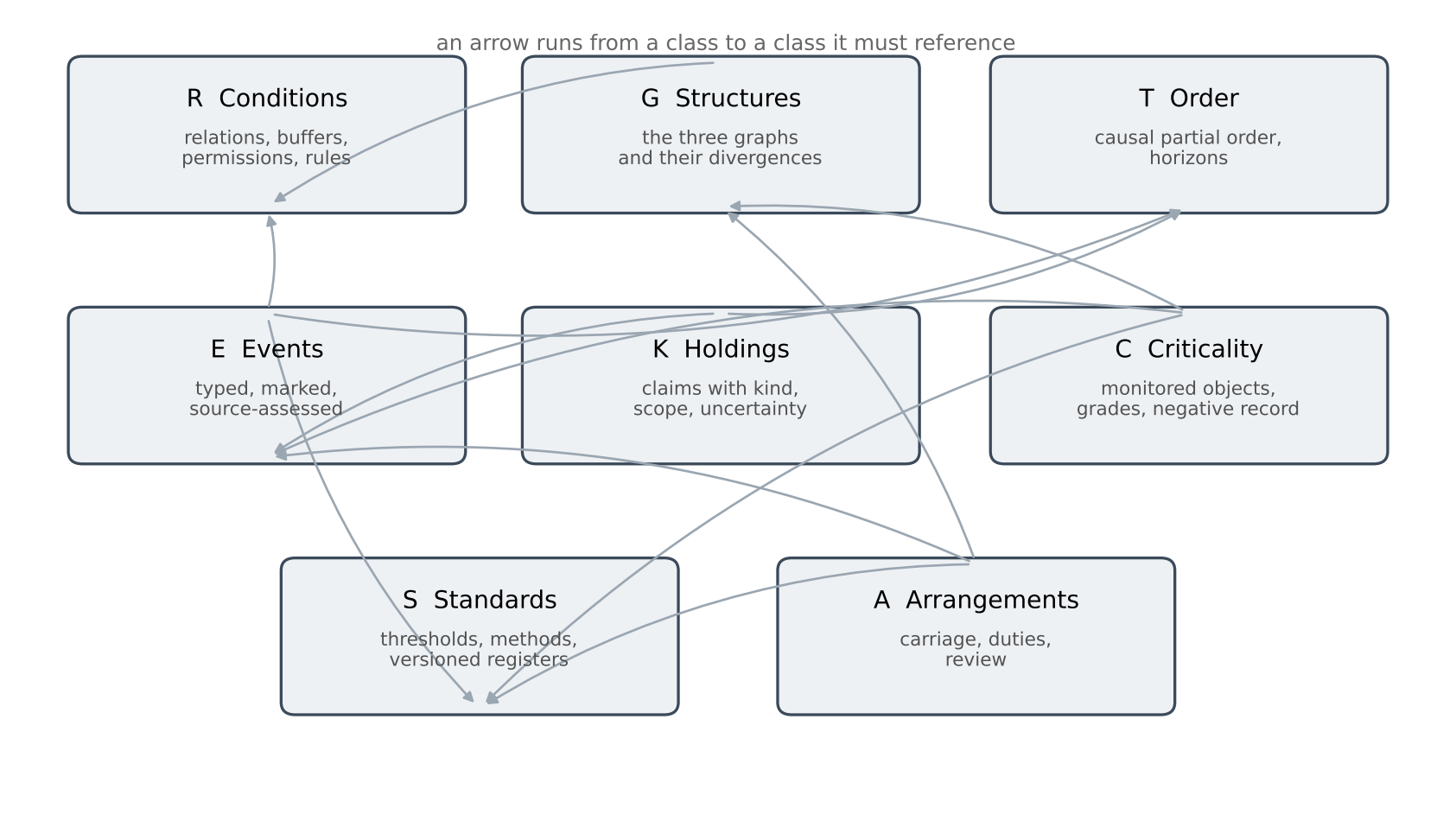
Figure 1. The eight object classes and the references among them. An arrow runs from a class to a class it must be able to reference. Standards and Order are foundational; Arrangements references broadly and is referenced by nothing, so an implementation omitting it holds a description of the field and none of its governance.
2.3 Required Operations
A class specified without operations is a filing convention, and the operations are where the architecture’s commitments become concrete.
Over R, an implementation must support assertion that a condition obtains, statement of its attributes, and recording of an alteration with its author. It must distinguish an alteration from a variation, since the principle attaches to alterations parties make and not to the field’s own movement.
Over G, it must support pairwise comparison of two structures over a nominated condition, returning the divergence kind, and must do so without requiring any party to hold the whole structure, which is the second paper’s central practical claim and would be defeated by a representation demanding a complete graph before comparison.
Over T, it must support the happened-before relation, the query whether two emissions are ordered, and the answer that they are not. The third answer is required and is where implementations will fail, since a comparison function returning a total order on timestamps will report an order where none exists.
Over E, it must support emission, carriage to parties determined by A, and the derivation of composite events from patterns, with the pattern’s author recorded, since the fifth paper leaves the seat of composition open and an implementation must therefore make it explicit.
Over K, it must support assembly for a question, the addition of a claim with its relations of support and attack, computation of admissible extensions, and dissolution. It must return several extensions where several exist, and must not select among them.
Over C, it must support evaluation of indicator conditions, grade transition with its basis, and query of a monitored object’s non-preceded transition classes, which is the sixth paper’s negative record made operational.
Over S, it must support versioned amendment with author and date, and the query of what condition was in force at a past moment, since a finding’s meaning depends on the threshold then in force and an implementation overwriting thresholds destroys the interpretability of its own history.
Over A, it must support assessment of a carriage map against a nominated structure, activation of duties by grade or by event class, and recording of discharge.
Three operations that ordinary data infrastructure supports must be withheld. A total order over emissions must be unavailable, since the field supplies none and its provision would encode a fact that does not obtain. Aggregation to a single value across holdings must be unavailable by default, since the fourth paper’s impossibility makes the aggregation rule a substantive commitment that an implementation would otherwise make silently. And an unqualified magnitude of change must be inexpressible, since a differential without its horizon is not a well-formed claim in this architecture. An implementation that supports these three conveniently will be used conveniently, and the architecture’s positions will be defeated at the level of the schema without any decision to abandon them.
Claim ? is the paper’s second contribution and it is a claim about design and not about capability. Nothing prevents an implementation from computing a total order; the point is that offering the operation makes the unsound answer the path of least resistance, and the architecture’s commitments survive only where the schema makes their violation visible.
3. The Representation of Absence
3.1 Six Classes of Absence and Their Content
Claim ? asserts that absences must be representable at parity with observations. This section states what each absence consists in, so that the requirement is assessable.
Unwitnessed coupling. The second paper’s first divergence kind: a coupling obtains and no party holds knowledge of it. The record’s content is a coupling assertion whose epistemic support is empty, together with the ground on which the coupling is nonetheless asserted, ordinarily structural argument from adjacency or a retrospective finding after an event. The determination has an author and a date, since a coupling unwitnessed today may be witnessed tomorrow and the transition is itself governance-relevant.
Acknowledged ignorance. The fourth paper’s element of a holding: a party’s statement that it holds no account of a nominated quantity or coupling. Its content is the party, the object, and the scope over which the ignorance is asserted. It is distinguished from a claim with wide uncertainty, and the fourth paper’s belief-function apparatus supplies the formal distinction: uncertainty distributes commitment across possibilities, and ignorance leaves commitment unassigned.
Non-establishment. The seventh paper’s central finding: a claim that could not be established, with the party that attempted it, the record it held, and the shortfall. Its content includes which of the five capacity elements was deficient, since the paper’s remedies differ by element, and whether any party held sufficient capacity, since the duty to look attaches on that answer.
Non-preceded transition classes. The sixth paper’s negative record: for a monitored object, the transition classes its indicator suite does not precede. The content is a suite, an object, and a class of transition, and the assertion is a standing property of the arrangement and not an event.
Silence regime. The fifth paper’s three regimes: what non-emission on a channel licenses. The content is a channel, a regime, and the verification facts on which a qualified regime depends, together with the heartbeat record that makes those facts checkable.
Unread instrument. The distinction between a low reading and no reading. The content is an instrument, a period, and a reason, and its absence from a schema is the failure that permits a degradation of observation to appear as a quieting of the field, which the fifth paper identifies as the manipulation of least visibility.
3.2 The Requirement Stated
Each of the six absences is a determination with an author, a date, a scope, and a basis, and each is defeasible by later observation. A representation must therefore carry absences as first-class assertions with the same apparatus as positive claims, and must distinguish them from three things a schema ordinarily conflates them with: a field not yet populated; a field whose value is unknown to the recorder; and a value of zero. The three are distinguishable by their bases, since a determination of absence has one and the others do not, so the distinction is implementable and the requirement is not a counsel of perfection.
The practical test of Claim ? is a query an implementation must answer: for a nominated coupling, is there no reported change because no change occurred, because no party observes it, because the observing party’s threshold was not crossed, because the observing party’s instrument was down, or because the record has not been consulted? Each answer directs a different action, and the first four are findings the architecture generates. A schema in which all five present as an empty result set makes the architecture’s principal diagnostic unavailable through the ordinary route of never being asked.
3.3 The Consequence for Openness
A representation carrying absences carries information about what parties do not know and cannot establish, which is information about their positions. Two consequences follow and are recorded here because they qualify the openness the series otherwise favours.
An arrangement’s blindness map, in the sixth paper’s sense, is a map of where its findings are unavailable, and is therefore of use to a party wishing to act where nothing will be noticed. The seventh paper’s argument for publishing such maps stands, since the alternative permits the silence of the unwatched to be read as safety, and the paper records the cost without resolving it: publication informs both those the map protects and those it exposes them to.
A record of non-establishment identifies which parties lack which capacities, which is a description of relative weakness. The seventh paper’s remedies require the record, since the duty to look and its inference attach on determinations of who could and could not establish, so the information must exist within the arrangement; whether it must be public is a separate question the paper leaves to the commons and supervisory papers of the series.
4. Existing Standard Families and Their Coverage
Six families bear on the requirements, and the assessment below concerns fitness for the eight classes and implies no criticism of standards meeting the purposes for which they were built.
4.1 Observation, Sensor, and Environmental Data Standards
The Open Geospatial Consortium’s Observations and Measurements model, adopted also as an international standard, supplies a general structure relating an observation to a feature of interest, an observed property, a procedure, and a result (Cox, 2011), and the SensorThings and SensorML specifications extend it to sensor systems and their tasking (Liang et al., 2016; Botts & Robin, 2014). Climate and forecast conventions structure gridded scientific data with controlled vocabularies for variables (Eaton et al., 2020), and metadata standards specify discovery and lineage description for geographic information (International Organization for Standardi, 2014). The Emission Event Modeling Language activity extends the observation model to emission events specifically, and is the closest existing object to the architecture’s event class (Open Geospatial Consortium, 2024; Open Geospatial Consortium, 2025). Its conceptual model composes an emission event from a start, an end, a quantity with the method by which the quantity was determined, and a source feature, with observations of several kinds linked to the event and uncertainty carried in the temporal, spatial and quantitative dimensions. The standard is under development and not published at the time of writing, so the assessment here is of a design and not of an adopted specification.
This family covers the observational substrate thoroughly and is where an implementation would begin. Assessed against Definition ?, its coverage is substantial for E in respect of the change content, partial for T through observation timestamps, and partial for S through procedure descriptions. It does not address R, since a condition is a relation and the model’s feature of interest is an entity; nor G, since divergence between structures is not an observational quantity; nor C, K, or A. The residue is therefore not a gap in the standards but a difference of object: these represent measurements, and the architecture requires, in addition, representations of relations, of holdings, of findings about absence, and of institutional arrangement.
4.2 Alerting and Warning Formats
The Common Alerting Protocol supplies a single structure for warnings across hazard types, with elements for category, urgency, severity, certainty, area, and instruction (OASIS, 2010), and underpins international dissemination arrangements. Its coverage against the taxonomy is partial for E and partial for C, since severity and certainty are grade-like. Three mismatches are structural and were identified in the fifth paper: the format asserts urgency and instruction, where the architecture’s event asserts consequence and leaves the response to the receiver; it is addressed to those who should act, where the event is addressed to parties whose conduct bears on the change; and its content model has no place for hypotheses about couplings, for provenance beyond the sender, or for the emitter’s assessment against its own record.
4.3 Provenance Vocabularies
The W3C provenance recommendation supplies a model of entities, activities, and agents, with relations of derivation, generation, attribution, and revision, designed to express how a thing came to be as it is (Groth & Moreau, 2013; Moreau & Missier, 2013). This is the most directly usable existing component for the architecture, and it addresses the requirement that appears across several classes: the fourth paper’s need to detect two reports resting on one observation, the fifth paper’s provenance element, the seventh paper’s record of who determined what, and the versioning requirement over S.
Two extensions are needed and are stated as the residue. The provenance model expresses how an entity was produced and has no native expression for a determination that something was not produced, which is Claim ?’s requirement; an absence determination is an entity in the model’s terms, but the modelling pattern by which absences are expressed as entities with bases is not supplied and would need to be fixed by convention. And the model is agnostic about the ordering of activities, so the causal partial order of T must be carried alongside it and cannot be derived from it.
4.4 Argument Interchange and Structured Disagreement
The argument interchange format supplies a representation of arguments and their relations, developed for exchange among argumentation systems (McGinnis & Modgil, 2006; Rahwan et al., 2007), and implements the attack structure that Dung frameworks operate over. The fourth paper’s assembly is representable here directly, and the coverage against K is substantial.
Two mismatches are recorded. The format was developed for argument within a shared discourse, and the architecture’s claims arrive in incommensurable representations, so the attack relations that the format carries must be supplied by a determination the format does not make, which is the fourth paper’s open question appearing at the schema level. And the format has no native carriage of the quantitative apparatus the fourth paper pairs with it, so credal sets or belief functions attached to claims sit outside the argument structure and their participation in attack relations is unspecified.
4.5 Graph, Ontology, and Semantic Web Languages
The resource description framework, the web ontology language, and the associated query language supply general apparatus for graph-structured data, class hierarchies, inference, and federation over distributed stores (Cyganiak et al., 2014; W3C OWL Working Group, 2012). These are the natural substrate for R, G, and the reference structure of Figure 1, and the federated query capability matches the architecture’s requirement that no party hold the whole.
The relevant limitation for this architecture is the open-world assumption’s cut. Under it, absence of an assertion is not an assertion of absence, which is right for the architecture’s purposes and is why these languages are a better substrate here than closed-world stores. It does not, however, supply the positive apparatus Claim ? requires: expressing that a determination of absence was made, by whom, on what basis, and defeasibly. Negation as failure and the closed-world variants get the wrong answer, and the correct pattern is to reify determinations as entities, which is available and is a convention to be fixed and not a capability to be built.
4.6 Event Transport and Governance Data Standards
Event transport specifications supply envelope formats and delivery semantics for event-driven systems, and publish-subscribe machinery supplies the decoupling the fifth paper’s carriage requires. Coverage against E is substantial at the transport layer and absent at the content layer, which is the division the fifth paper drew between engineering and institutional questions.
For A, the arrangements class, the assessment is that no standard family addresses it. Duties, carriage maps, discharge records, and review functions are institutional objects, and the standards landscape contains no vocabulary for them. Statistical data and metadata exchange standards address the reporting of indicators to institutions and do not represent the obligations under which reporting occurs. This is the taxonomy’s largest gap and it is the least surprising, since the architecture’s arrangements are proposals and there is no reason a standard should exist for an object not yet in use.
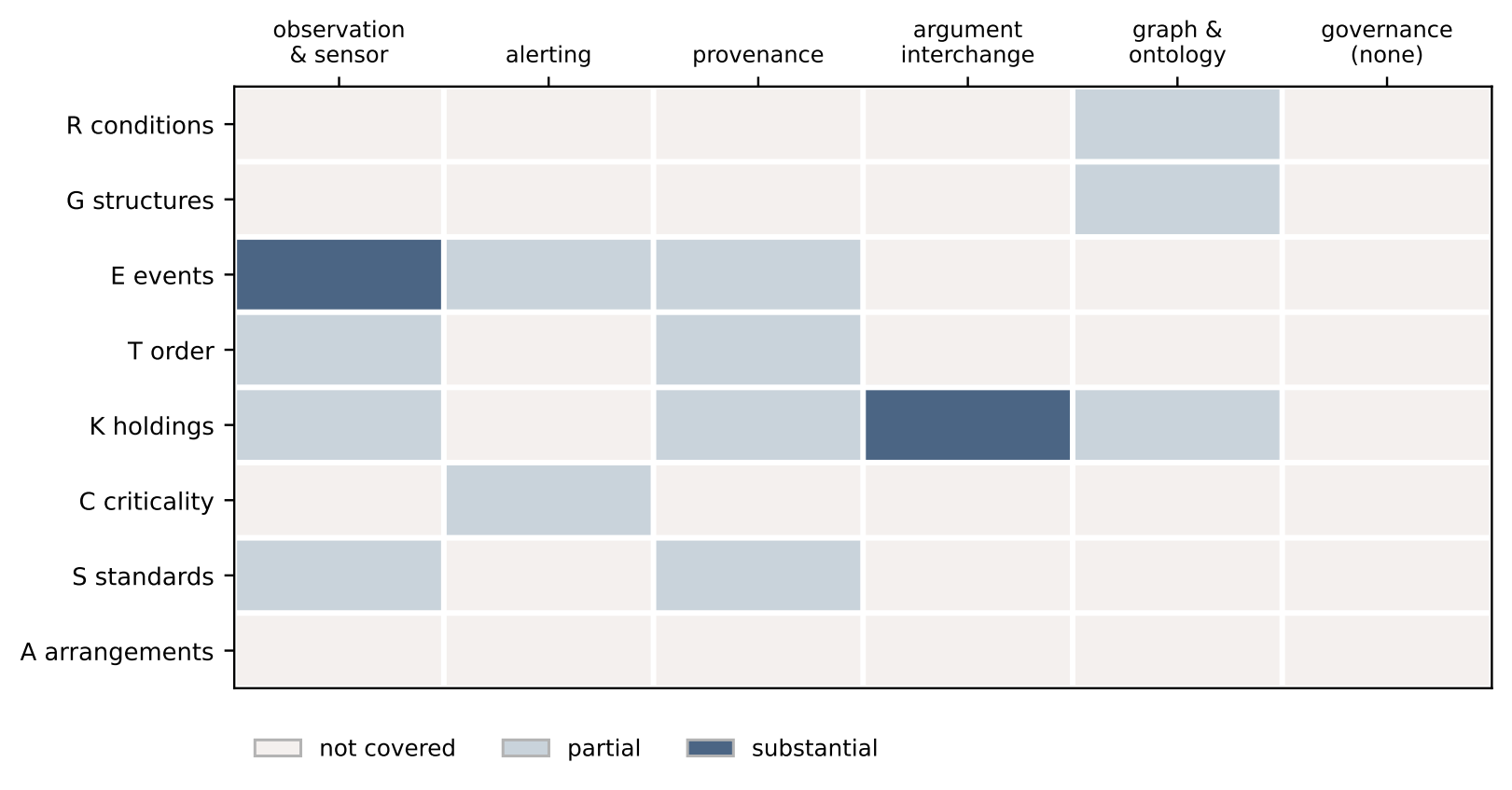
Figure 2. Coverage of the eight object classes by existing standard families. Thirty-four of forty-eight cells are uncovered. The pattern is intelligible: the families were built to represent observations, sensors, warnings, lineage, arguments, and graphs, and the architecture requires in addition relations as governed objects, findings about absence, criticality grades, and institutional arrangement.
4.7 Residue of the Survey
Consider an implementation required to hold conditions as relations with governance attributes, three structures and their pairwise divergences, a causal partial order without a total order, source-assessed typed events, holdings with acknowledged ignorance and assemblies admitting several extensions, criticality grades with the transition classes their suites do not precede, versioned threshold registers queryable as at a past date, and arrangements with duties and their discharge. No existing standard family supplies more than a part, the parts they supply are largely complementary and only slightly overlapping, and the requirement they jointly fail is the representation of determinations of absence with author, basis, and defeasibility. Observation standards own the measurement substrate; alerting formats own dissemination for a differently structured primitive; provenance vocabularies own lineage and are the most reusable component; argument interchange owns the disagreement structure within a shared discourse; graph languages own the substrate and the open-world stance; transport specifications own delivery. The composition, and the absence requirement in particular, is the residue.
5. Requirements for a Reference Architecture
The requirements below state what an implementation must be capable of. They are numbered for reference, are stated at the level of capability and not of encoding, and are derived from the positions restated in §5 with the deriving paper noted. They are offered as a first statement and are expected to be wrong in detail.
5.1 Requirements on Representation
REQ-1. Conditions as relations. The representation shall admit conditions whose subject is a relation among parties or subsystems, with type, delay, reversibility, and asymmetry as attributes of the relation, and shall not require a condition to be expressed as a property of a single entity. (Papers 1, 2.)
REQ-2. Three structures, separately. The representation shall hold the physical, epistemic, and communicative structures as distinct objects over the same conditions, and shall not merge them into a single annotated graph, since their divergence is the quantity of interest. (Paper 2.)
REQ-3. Pairwise divergence without the whole. It shall be possible to compute the divergence kind for a nominated condition from the two structures’ assertions about that condition alone, without any party holding a complete structure. (Paper 2.)
REQ-4. Determinations of absence. The representation shall admit, as first-class assertions with author, date, scope, basis, and defeasibility, each of the six absences of §6, and shall distinguish them from an unpopulated field, from a value unknown to the recorder, and from a value of zero. (Papers 2, 4, 5, 6, 7.)
REQ-5. Horizon-qualified change. Every assertion of a change shall carry the horizon over which it was assessed and the record against which unusualness was judged. An unqualified magnitude shall not be well formed. (Paper 3.)
REQ-6. Claims with kind. Every claim shall carry its logical kind, so that a probability, a rate ratio, a valuation, a qualitative account, and a norm are distinguishable, and no operation shall combine claims of different kinds into a single value. (Paper 4.)
REQ-7. Unassigned commitment. The representation shall distinguish uncertainty distributed over possibilities from commitment left unassigned, and shall admit the second as content. (Paper 4.)
REQ-8. Event content. An event shall carry emission time, source, change in the source’s representation, unusualness against the source’s record, confidence, hypotheses marked as such, affected parties marked as a revisable claim, provenance, and its class among the six. (Paper 5.)
5.2 Requirements on Operations
REQ-9. Partial order, and its incompleteness. Ordering queries over emissions shall return ordered-before, ordered-after, or unordered, and the third shall be a normal result. No operation shall impose a total order on emissions, and any external clock used for practical purposes shall be recorded as an external imposition and distinguished from causal order. (Paper 5.)
REQ-10. Assembly without selection. Assembly operations shall return all admissible extensions where several exist, shall not select among them, and shall record the attack relations on which the computation ran together with their author. (Paper 4.)
REQ-11. No default aggregation. Aggregation across holdings shall not be available as a default operation. Where an aggregation is performed, the rule applied shall be recorded with the result, and the result shall be distinguishable from a claim any party advances. (Paper 4.)
REQ-12. Provenance sufficient for double counting. Provenance shall be sufficient to determine whether two claims rest on a common underlying observation, and any operation weighting claims by the number of parties advancing them shall consult it. (Papers 4, 5.)
REQ-13. Negative record queryable. For a monitored object it shall be possible to query the transition classes its indicator suite does not precede, and a grade shall not be returned without that record being available with it. (Paper 6.)
REQ-14. Versioned standards, queryable as at a date. Triggering conditions, thresholds, methods, and grade definitions shall be versioned with author and date, and it shall be possible to retrieve the version in force at any past moment. Amendment shall not overwrite. (Paper 5. The grade definitions of Paper 6 fall within this requirement’s scope, but that paper leaves their derivation an open question, so this requirement states what versioning they would need once definable and does not presuppose that they are.)
REQ-15. Silence regime explicit. Each channel shall carry the silence regime in force, and where the regime is qualified, the verification facts on which it depends and their heartbeat record shall be retrievable. (Paper 5.)
5.3 Requirements on Arrangement
REQ-16. Carriage assessable. A carriage map shall be representable and assessable against a nominated physical structure, returning the couplings for which no carriage exists. (Papers 2, 5.)
REQ-17. Duties and discharge. Duties of emission, carriage, response, restraint, and observation shall be representable with their bearers, their activating conditions, and their discharge records. (Papers 5, 6, 7.)
REQ-18. Capacity and establishment. Observational capacity shall be representable with its five elements, and a determination of non-establishment shall record which element was deficient and whether any party held sufficient capacity. (Paper 7.)
REQ-19. Capacity degradation as an alteration. Discontinuation of a record, enclosure, withdrawal from a programme, and a method change breaking comparability shall be representable as alterations of conditions, with the same apparatus as alterations of physical couplings. (Paper 7.)
REQ-20. Self-description. The arrangement shall hold its own carriage map, threshold registers, class coverage, and blindness map as objects within the representation, so that the diagnostics the architecture applies to a field are applicable to the arrangement. (Papers 5, 6.)
5.4 Requirements Deliberately Absent
Three requirements a reader might expect are omitted with reasons.
No requirement of a common ontology of states is stated, and none should be. The architecture’s positions are constructed to avoid needing one, and a specification requiring parties to map their variables into a shared vocabulary would defeat the third and fourth papers at the schema level while appearing to serve them.
No requirement of completeness is stated. An implementation is not required to hold all conditions, all events, or all holdings, and the architecture is built for partial views; a completeness requirement would be unsatisfiable and would license the treatment of what is held as what there is.
No requirement of a central store is stated. REQ-3’s pairwise computability and the federated capability of the graph languages are the substitutes, and a central store is one permissible implementation among others, whose own risks the fifth paper’s self-application question raises.
6. Objections and the Limits of the Position
6.1 The Adoption Objection
A specification that cannot be adopted is of no use, and this one imposes costs at every point of entry: parties must record horizons they do not currently record, mark claim kinds, supply provenance sufficient for double-count detection, and maintain versioned threshold registers. The objection is that a standard demanding this much will be ignored in favour of one demanding less, and that the correct strategy is to extend an existing family minimally.
The paper accepts a substantial part of this. The requirements are stated as capabilities of an architecture and not as conditions of participation, and the distinction matters practically: a party emitting events without provenance is emitting less useful events and is not excluded, and an implementation may hold what it receives and record what is missing, which is what REQ-4 makes possible. The strategy the paper would endorse follows from the survey: build on the provenance vocabulary and the graph substrate, adopt the observation model for the measurement layer, and specify only what the survey shows to be missing, which is the absence pattern, the partial order, the claim-kind marking, and the arrangement vocabulary. The paper resists the inference from adoption cost to requirement abandonment, since REQ-9 and REQ-11 are cheap to implement and expensive to omit, and their omission is invisible until an unsound answer has been relied on.
6.2 The Premature-Formalisation Objection
The architecture is a proposal and its positions are open at many points, including where composition sits, how attack relations are derived across representations, and how relational composites are constructed. Specifying object classes for an architecture whose questions are open risks fixing the wrong things, and a specification acquires authority with use, as the fourth paper argues of standing assessments.
The paper takes the objection seriously enough to have restricted itself. It states no encoding, no vocabulary terms, and no schema, and its requirements are capability statements that several encodings would satisfy. Two of the eight classes, C and A, correspond to objects that do not yet exist in practice, and the paper’s assessment of them is correspondingly weaker; the honest description is that R, G, T, E, and K are derived from positions the series has argued, while C and A are derived from proposals it has made. The paper’s own revisability follows the first paper’s principle: the taxonomy is advanced as revisable, and the class most likely to be wrong is A, whose duties are proposals whose institutional form is unsettled.
6.3 The Absence Objection
Claim ? may be met with the response that recording absences is unbounded, since the couplings that do not exist and the claims nobody has made are infinite, and a schema admitting absence assertions invites the population of an infinite space.
The answer is that the six classes of §6 are bounded by their bases. An unwitnessed coupling is recorded because some party asserted the coupling on structural grounds; a non-establishment is recorded because some party attempted establishment; a non-preceded transition class is recorded because a suite was assessed. Each absence assertion arises from an act, and the space is bounded by the acts performed. The recording of absences that nobody has determined is no part of the proposal, and the objection correctly rejects it, and the distinction is exactly the one Claim ? draws between a determination of absence and an unpopulated field.
6.4 Limits Internal to the Position
Four limits are recorded. The taxonomy is derived from one architecture and its generality is untested; classes that appear fundamental here may be artefacts of this series’ commitments, and the paper has no way to distinguish these. The requirements are unvalidated, since no implementation exists and a specification unexercised by implementation is known to be wrong in ways only implementation reveals. The coverage assessment of Figure 2 is a judgement made against standards the author has read and not an exhaustive review, and a family serving a class better than assessed would change the residue. And the arrangements class is the least developed in the taxonomy and the most consequential for the architecture, since it is the class that distinguishes a governance infrastructure from a data infrastructure, and it is the class for which the survey found nothing to build on.
7. Questions Left Open for the Programme
7.1 Questions Concerning the Classes
Minimality and independence of the taxonomy. The eight classes are derived and not shown to be independent or minimal. An answer would establish whether any class reduces to others, in particular whether S is a specialisation of R, since a threshold is a rule and rules are conditions, and would state what turns on the answer for an implementation.
The individuation of conditions in a schema. The first paper leaves the individuation of conditions relative to a party and a horizon, and a representation must nonetheless assign identifiers. An answer would state what makes two parties’ assertions assertions about the same condition, which is the identity problem the open-world substrate defers and does not solve.
Generality beyond this architecture. An answer would test the taxonomy against a governance architecture built on different commitments, and would report which classes survive, since a taxonomy that only fits its source is a restatement of it.
7.2 Questions Concerning Absence
The modelling pattern for determinations of absence. The paper argues that absences must be reified as determinations with bases and states no pattern. An answer would supply one over the provenance vocabulary, would state how defeasance is represented when a later observation removes an absence, and would establish whether the pattern supports the query of §6 that distinguishes the five reasons for an empty result.
Bounding in practice. §9 argues that absence assertions are bounded by the acts that generate them. An answer would establish, for a field of realistic size, what volume of absence assertions results, since a bound in principle that yields an unmanageable volume in practice is not a satisfactory answer to the objection.
Absence and access control. §6 records that absence records describe relative weakness and that their publication cuts both ways. An answer would state what access regime applies to absence determinations, distinguishing those an arrangement must publish, such as its own blindness map, from those it must hold but need not disclose, such as a party’s non-establishment.
7.3 Questions Concerning Operations
Combining the argumentative and quantitative structures. The fourth paper leaves open how a credal set attached to a claim participates in an attack relation, and the schema question is the same question. An answer would state what an implementation stores and what it computes, and whether the combination is a representational matter or requires a semantics neither literature supplies.
The seat and authorship of composition. The fifth paper leaves the seat of composite-event inference open, and REQ-8 requires the pattern’s author be recorded. An answer would state what a pattern is as an object, whether patterns are themselves versioned standards under S, and what it means for a pattern to be contestable.
External clocks and their standing. REQ-9 requires that any imposed total order be recorded as an imposition. An answer would state what practical operations require one, since scheduling and retention plainly do, and would establish which conclusions may and may not be drawn from an order so imposed.
7.4 Questions Concerning Realisation
The minimal viable subset. An answer would identify which requirements a first implementation must satisfy for the architecture’s positions to survive, and which may be deferred, since a specification of twenty requirements with no priority ordering will be implemented in the order of least difficulty.
Federation across arrangements. Arrangements constituted separately will hold incompatible instantiations of these classes. An answer would state what minimal agreement permits carriage across them, and whether the eight classes are that agreement or whether a further layer is required, which is the fifth paper’s federation question at the level of representation.
Validation. An answer would state how a candidate specification is tested short of full implementation, candidate methods being the reconstruction of documented governance failures in the representation to see whether the failure is expressible, and the attempt to state, in the representation, the findings of each of the preceding seven papers.
8. Declinations and Limits of the Position
The paper specifies no encoding. It states capabilities and declines to propose vocabulary terms, schemas, or serialisations, which belong to a specification the programme has not written.
The paper claims no novelty in any standard family surveyed, and proposes reuse and not replacement for the observation model, the provenance vocabulary, the argument interchange format, and the graph substrate.
The paper reports no implementation and no validation. Its requirements are derived from positions and not tested against use, and §9 states that a specification unexercised by implementation is known to be wrong in ways implementation alone reveals.
The paper does not claim the taxonomy is minimal, independent, or general. It is derived from one architecture, and §10 records the test that would establish otherwise.
References
Botts, M. and Robin, A. (2014). OGC SensorML: Model and XML Encoding Standard, Version 2.0. OGC 12-000, Open Geospatial Consortium. Revised as Version 2.1, OGC 12-000r2.
OASIS (2010). Common Alerting Protocol Version 1.2. OASIS Standard, 1 July 2010, Organization for the Advancement of Structured Information Standards. Adopted by ITU-T as Recommendation X.1303 bis (2014).
Chesñevar, C., McGinnis, J., Modgil, S., et al. (2006). Towards an argument interchange format. The Knowledge Engineering Review, 21(4), 293–316.
Cox, S. (2011). Observations and Measurements. OGC Abstract Specification Topic 20 / ISO 19156. Open Geospatial Consortium. Revised as ISO 19156:2023, Geographic Information: Observations, Measurements and Samples.
Eaton, B., Gregory, J., Drach, B., et al. (2020). NetCDF Climate and Forecast (CF) Metadata Conventions, Version 1.8. Later versions released; Version 1.11 current at time of writing.
Open Geospatial Consortium (2024). OGC to Form Emission Event Modeling Language Standards Working Group: Public Comment Sought on Charter. Request for public comment, 12 August to 2 September 2024. OGC, Arlington VA.
Open Geospatial Consortium (2025). Emission Event Modeling Language (EmissionML) Standards Working Group. Launched at the 132nd OGC Technical Committee Meeting, Mérida, 11 June 2025. Standard under development as of August 2026; repository at https://github.com/opengeospatial/EmissionML.
International Organization for Standardization (2014). ISO 19115-1: Geographic Information –- Metadata –- Part 1: Fundamentals. ISO, Geneva. Amended by Amd 1:2018 and Amd 2:2020; new edition under development.
Liang, S., Huang, C.-Y., and Khalafbeigi, T. (2016). OGC SensorThings API Part 1: Sensing, Version 1.0. OGC 15-078r6, Open Geospatial Consortium. Superseded by Version 1.1, OGC 18-088; Version 2.0 in development.
Groth, P. and Moreau, L. (eds.) (2013). PROV-Overview: An Overview of the PROV Family of Documents. W3C Working Group Note.
Moreau, L. and Missier, P. (eds.) (2013). PROV-DM: The PROV Data Model. W3C Recommendation.
Rahwan, I., Zablith, F., and Reed, C. (2007). Laying the foundations for a world wide argument web. Artificial Intelligence, 171(10–15), 897–921.
W3C OWL Working Group (2012). OWL 2 Web Ontology Language Document Overview, 2nd edn. W3C Recommendation.
Cyganiak, R., Wood, D., and Lanthaler, M. (eds.) (2014). RDF 1.1 Concepts and Abstract Syntax. W3C Recommendation. thebibliography