Supervisory Jurisprudence for the Environmental Knowledge Commons - Process Duties Where Outcomes Resist Attribution
Abstract
The architecture developed in this series generates duties whose institutional form it repeatedly leaves open: to observe couplings one’s own conduct bears on, to carry consequential reports to the parties they concern, to maintain the standing of a reporting channel, to preserve records whose discontinuation cannot be undone, to publish where an arrangement cannot see, and to keep the registers that make past findings interpretable. This paper supplies that form. Its subject is the epistemic infrastructure of an interdependent environmental field, and its thesis is that such duties should be constituted as supervisory duties over process, assessed continuously against conduct, and not as liabilities keyed to outcomes. The argument for the form is that outcome-keyed liability requires attribution through couplings that are delayed, nonlinear, and jointly produced, and that where attribution fails the liability fails silently, leaving conduct ungoverned while appearing to govern it. Process duties do not require attribution: whether a party observed, carried, maintained, or published is determinable at the time and by inspection. The method is conceptual and comparative, drawing the form from prudential supervision of financial institutions, management-based regulation, and safety-case regimes, and stating what transfers and what does not. Four positions are developed. The commons character of long environmental records is the ground of the duties and not merely their occasion, since the alternative permits irreversible loss by unilateral decision. Supervisory duties in this domain are owed to the arrangement and its participants jointly, which distinguishes them from fiduciary duties owed to identified beneficiaries and from regulatory duties owed to the state. The natural sanctions exclude damages, and comprise the burden shift, the adverse inference, and the suspension of standing, each of which operates without any finding about outcomes. And the regime is exposed at the point every supervisory regime is exposed, the independence and competence of the supervisor, which in this domain is aggravated because the parties competent to assess an epistemic arrangement are its participants. The paper surveys prudential supervision, management-based and systems-based regulation, safety cases, fiduciary and stewardship duties, commons governance, and archival and data-stewardship obligations, states what each owns, and identifies the residue. It reports no empirical study and proposes no statutory text.
Keywords: supervisory duties; process regulation; knowledge commons; environmental governance; institutional design
Notices
On the references. All 22 works cited in this paper have been checked against their sources at claim level: each source was consulted and confirmed to state what the citing sentence attributes to it. No entry in this paper’s bibliography is unverified.
Status. This is a working draft circulated for discussion. It is a preliminary discussion paper and is not a finished statement of its author’s position. Sections and statement numbers are subject to change.
Licence. This work is made available under a Creative Commons Attribution-NonCommercial 4.0 International Licence (CC BY-NC 4.0).
Statement on the use of language models. Drafting, literature search and argumentative criticism for this paper were conducted in dialogue with large language models, specifically Claude (Anthropic) and ChatGPT (OpenAI). The claims, the structure, the selection of material and the position taken are the author’s. References have been checked in stages, to two standards, and the process is incomplete. Part of the corpus has been verified at identity level, meaning author, title and publication coordinates were confirmed against the publisher of record. A smaller part has additionally been verified at claim level, meaning the cited source was consulted and confirmed to state what the citing sentence attributes to it. The remainder is unverified at either standard. The standard reached is marked on each bibliography entry: no mark for claim level, $\ddagger$ for identity level only, $\dagger$ for not yet verified. Corrections made so far are recorded in the project’s citation-verification file; where a source proved not to bear the weight the text placed on it, the text was revised rather than the citation removed.
Companion papers. This paper is Paper 16 of a series on the governance of environmental change, and treats the duties arising on the epistemic layer, constituted as supervisory duties over process. The other papers of the series treat, in order: the object; the field and its three structures; coordination through change; heterogeneous knowledge; the event layer; criticality detection; observational capacity; representational requirements; routing and inquiry; the regime near a threshold; forecasting from the stream; the knowledge commons; attribution and ownership; and responsibility at transitions. Paper 12 is reserved and is not yet drafted. A related paper by the author, developed independently of this series, treats the temporal correspondence limitation of evidence-based policy making, being the divergence between the system state that evidence represents and the system state at the moment of decision. Its results on the partition of a state space into estimable and unobservable components, on the blindness of a recency-weighted evidence base to the approach to criticality, and on the allocation of a justificatory burden where temporal correspondence fails, were reached by a different route and bear on several papers of this series.
Suggested citation. Huang, W. Supervisory Jurisprudence for the Environmental Knowledge Commons: Process Duties Where Outcomes Resist Attribution. Working draft.
Discussion Paper Note
This paper is a preliminary discussion paper intended to share an evolving idea and invite further dialogue, criticism, revision, and independent development.
The author does not claim exclusive epistemic ownership over the viewpoints, concepts, or lines of reasoning presented here, nor does the author claim priority as their first originator. Similar or related ideas may have appeared previously in other intellectual, cultural, or disciplinary traditions. Any legal rights retained in this work are intended to support attribution, responsible use, and protection against exploitative or harmful appropriation, and not to restrict independent inquiry, criticism, revision, or further development.
The arguments in this paper should therefore be understood as provisional and historically situated rather than definitive. Readers are encouraged to question, revise, extend, reinterpret, or independently develop the ideas presented here. Where appropriate, acknowledgment of this paper as one point of encounter in the development of related ideas is appreciated, but such acknowledgment should not be understood as granting the author epistemic ownership over the ideas themselves.
Responsible Use and Rights Reservation
The author encourages good-faith discussion, criticism, independent development, and responsible use of the knowledge presented in this work. The author does not claim exclusive epistemic ownership over the ideas or viewpoints discussed herein, nor claim priority as their first originator.
However, the author expressly reserves all rights and remedies available under applicable law with respect to uses of this work or related materials that involve unlawful conduct, harmful or abusive exploitation, improper commercial appropriation, infringement of applicable intellectual property or other legal rights, or conduct contrary to applicable national, regional, or international law.
This reservation is intended to preserve the ability to respond to misuse and harmful appropriation. It should not be interpreted as restricting legitimate academic inquiry, criticism, independent reasoning, or the further development of related ideas.
1. Introduction
The preceding papers of this series generate obligations and stop short of constituting them. A party whose conduct bears on a coupling nobody observes should observe it; an arrangement should carry consequential reports to the parties whose conduct they bear on; a channel’s silence means nothing unless the instruments behind it are verified; a record discontinued cannot be resumed; an arrangement that cannot see somewhere should say so; a threshold register overwritten destroys the interpretability of its own history. Each of these was stated as a requirement and each was deferred, in the same terms, to a treatment of supervision. This paper is that treatment, and its scope is the epistemic infrastructure of an interdependent environmental field: the observation, reporting, and record-keeping on which the architecture’s other operations depend.
The form the duties should take is the paper’s first question, and the case against the obvious answer is the argument’s foundation. The obvious answer is liability: a party whose failure to observe or to report contributes to environmental harm should answer for the harm. Liability so keyed requires that the harm be attributed to the failure, through couplings that are delayed by years to decades, nonlinear, jointly produced by many parties, and mediated by the conduct of others. Attribution through such couplings is difficult in the ordinary case and unavailable in many, and the failure mode is the one that matters: where attribution fails, the liability does not announce that it has failed. It produces no finding, the conduct stands unassessed, and the regime continues to appear to govern what it has ceased to reach.
Where the connection between conduct and outcome runs through couplings whose delay, nonlinearity, and joint production defeat attribution, a regime keyed to outcomes governs the conduct only to the extent attribution succeeds, and fails silently where it does not. A regime keyed to conduct, assessing whether stated duties were discharged at the time and by inspection, governs the same conduct without requiring attribution. For the epistemic infrastructure of an interdependent environmental field, the second form is the appropriate one, and the duties identified across this series should be constituted as supervisory duties over process.
Claim ? is not an argument that outcomes do not matter, and §8 states the cost of the move plainly: a conduct-keyed regime severs the assessment from the harm, and a party that discharges every duty and presides over a catastrophe has, on this regime, done what was required. The paper’s position is that this cost is worth bearing for the epistemic layer specifically, where the duties are determinate and their discharge is inspectable, and it takes no position on the outcome-facing questions of causation and responsibility, which belong to a separate paper of the series.
The paper’s second position concerns why these duties are owed at all, and locates the ground in the commons character of the records. A long environmental record is not merely useful to others; it is unrepeatable, since the years it covers are not observable retrospectively, so its holder’s decision to discontinue it, to enclose it, or to change a method in a way that breaks its comparability forecloses a capacity that no expenditure restores. Duties of maintenance follow from that irreversibility and not from the record’s utility, and §5 develops the consequence: the commons in question is constituted by the irreversibility of its loss.
The paper’s third position is that supervisory duties in this domain are owed jointly to the arrangement and its participants, which places them between the two familiar forms. A fiduciary duty is owed to an identified beneficiary whose interests it serves; a regulatory duty is owed to the state and enforced by it. The duties here are owed with respect to an infrastructure on which many parties and some non-parties depend, and §6 argues that this determines both who may complain of a breach and what the appropriate response to breach is.
The paper proceeds as follows. §5 restates the carried positions, states the case for the conduct-keyed form, and develops the commons ground. §6 sets out the duties, their bearers, the standard of assessment, and the sanctions. §7 surveys the regimes from which the form is drawn. §8 treats the objections, of which the supervisor’s independence and the severance from outcomes are the most serious. §9 lists the open questions and §10 the declinations.
2. The Conduct-Keyed Form and Its Ground
2.1 Positions Carried from the Companion Papers
Six results are used and restated so the paper stands alone.
The object of governance is the set of relational conditions under which trajectories are generated, and the distribution of access and information is among them; the governing principle places a burden of justification on alterations that would irreversibly foreclose other trajectories’ capacity to continue generating.
The three structures of a field, physical, epistemic, and communicative, diverge, and a coupling present in the first while absent from the third is a determinate failure identifiable pairwise, without any party holding a model of the whole.
The event layer runs on source-assessed reports under a standing arrangement comprising a carriage map, a public versioned threshold register, channel-standing obligations, and a review function; the silence on a channel licenses an inference only where the emitter’s instruments and thresholds are verified; and the arrangement’s own elements are themselves governed conditions, so its decay is a governance failure of the same kind as those it detects.
The detection function enters governance as graded standing levels with duties attached, and carries the transition classes its indicator suite does not precede, so that a low grade means absence of detected approach and not established distance; an arrangement publishes a map of where it cannot see.
The capacity position defines observational capacity as instruments, record, competence, standing, and maintenance, establishes that a coupling of timescale $\tau$ requires a record proportional to $\tau$, proposes a residual duty to look owed by involved parties holding capacity with an adverse inference where unmet, and holds that irreversible degradation of observational capacity is a foreclosure in the principle’s sense.
The representational requirements include versioned standards queryable as at a past date, determinations of absence carried with author and basis, and self-description, so that the diagnostics applied to a field apply to the arrangement.
2.2 The Case for Keying to Conduct
Figure 1 sets out the structural difference between the two forms.
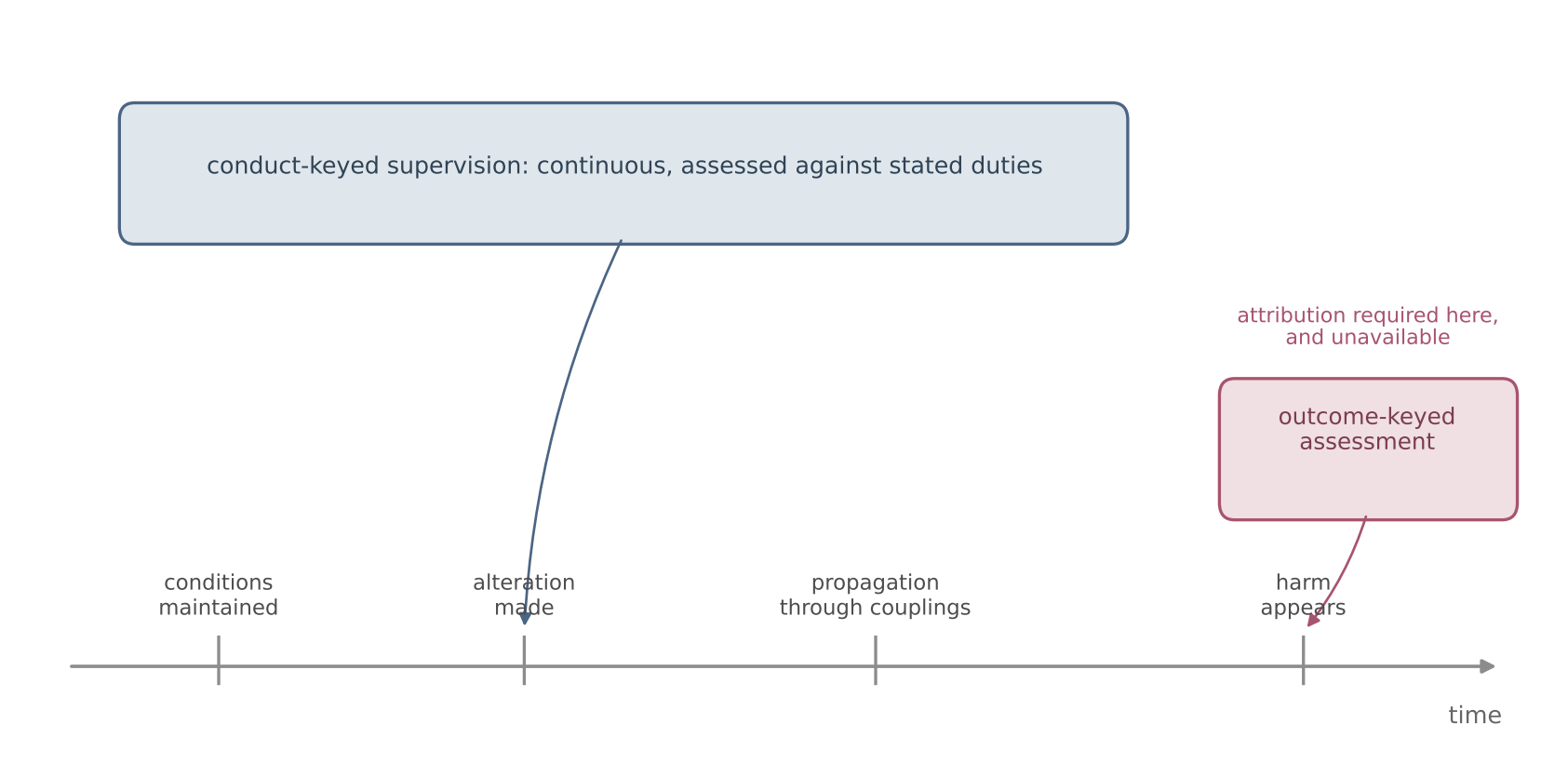
Figure 1. The object and timing of assessment under each form. An outcome-keyed regime assesses after harm appears and must trace back through the couplings; a conduct-keyed regime assesses at the time, against duties stated in advance. The difference that matters concerns what must be shown, and not promptness: the first requires attribution through the couplings, and the second requires inspection of conduct.
Four features of the epistemic layer make it a good candidate for the conduct-keyed form, and stating them also states the limits of the recommendation, since a domain lacking them is a poor candidate.
The duties are determinate in advance. Whether a party was required to observe a coupling, to carry a class of report, or to maintain a register is settled by the arrangement’s own documents, and a party can know its obligations before acting, which outcome-keyed liability under deep uncertainty does not permit.
Discharge is inspectable. Whether observation occurred by stated methods over a stated period, whether a report was carried, whether a heartbeat was maintained, whether a register was versioned: each is determinable from records that the discharge itself produces, so assessment does not depend on reconstructing a counterfactual.
Failure is contemporaneously visible, or can be made so. An unmaintained channel is detectable while it is unmaintained. This is the property outcome-keyed liability lacks entirely in this domain, where the failure to observe is discovered, if at all, at the moment the observation would have been useful and is not available.
And the harm the duties guard against is diffuse and prospective. A failure to observe produces no identifiable injury to an identifiable party, and produces a field less governable than it would have been, which is precisely the kind of consequence that outcome-keyed regimes handle worst and that supervisory regimes elsewhere were built to address.
The four properties are jointly the criterion for the conduct-keyed form, and they are properties of a domain and not of a preference. Where duties cannot be stated in advance, where discharge is not inspectable, where failure is invisible until harm appears, or where the harm is concentrated on identifiable parties, the case made here does not carry, and outcome-keyed liability retains its ordinary place. The recommendation is therefore bounded to the epistemic infrastructure and is not a general thesis about environmental liability.
2.3 The Commons Ground
The duties require a ground, since a party asked to observe, to carry, or to maintain will ask why it owes this to anyone. Three grounds are available and the third is the paper’s.
The utility ground holds that shared records are valuable and that sharing is efficient. It is true and it grounds nothing, since efficiency arguments support duties only where the efficient arrangement is also the one each party prefers, which is not this case: the costs of observation and maintenance fall on the holder and the benefits fall on the field.
The reciprocity ground holds that parties benefiting from others’ records owe records in return. It grounds duties among parties that hold records and grounds nothing as against a party that holds none and wants none, which includes the party whose alteration is at issue.
The irreversibility ground is the paper’s, and it follows from the series’ principle without further premise. A long record is unrepeatable: the years it covers are not observable retrospectively, and a series broken by a method change is not repaired by reverting the method. A holder’s decision to discontinue, to enclose, or to break comparability therefore forecloses a capacity that no expenditure restores, and it does so for every party that would have used the record and for trajectories that hold no record of their own.
The commons character of long environmental records is constituted by the irreversibility of their loss and not by their utility. On this ground the duties of maintenance are not owed because sharing is efficient but because unilateral discontinuation forecloses a generative capacity, which the series’ principle places under a burden of justification wherever it occurs. The consequence is that the duty attaches to the holder of a long record independently of whether anyone is currently using it, since the foreclosure operates on future use, and independently of whether the holder benefits from others’ records, since the burden is not reciprocal in structure.
Claim ? carries a further consequence that §6 develops: the burden is dischargeable, in the principle’s usual way, so a holder that cannot bear the cost of maintenance does not thereby breach a duty. It owes notice sufficient for the capacity to be assumed by another, and the transfer of what would otherwise be lost, which is the archival obligation in its proper place.
2.4 Duties Owed to the Arrangement and Its Participants
Supervisory duties in this domain sit between the two familiar forms and the placement determines who may complain and what follows from breach.
A fiduciary duty is owed to identified beneficiaries whose interests the fiduciary serves, and its remedies run to those beneficiaries. The duties here cannot take this form, since the parties affected by a failure to observe include trajectories that hold no interests in the required sense and future parties who are not identified.
A regulatory duty is owed to the state and enforced by it. This form is available for some of the duties and is inadequate as the general form, for the reason the sixth and seventh papers give: a state is frequently among the parties whose conduct the duties would constrain, and it is frequently the holder of the records whose maintenance is at issue.
The duties are owed to the arrangement and to its participants jointly: to the arrangement, because its adequacy is the object the duties protect, and to the participants, because the arrangement exists for their coordination and holds no interests of its own. Two consequences follow. Standing to complain of a breach belongs to any participant whose coordination the breach impairs, and does not require that participant to show injury of its own. And the response to breach runs to the arrangement’s operation, by restoring carriage, compelling observation, or shifting a burden, and not to compensation, since there is ordinarily no party whose loss could be measured.
3. The Duties, Their Assessment, and the Responses to Breach
3.1 The Duty Stack
The duties fall into four tiers, each assessed by the tier above it, and Figure 2 displays the arrangement.
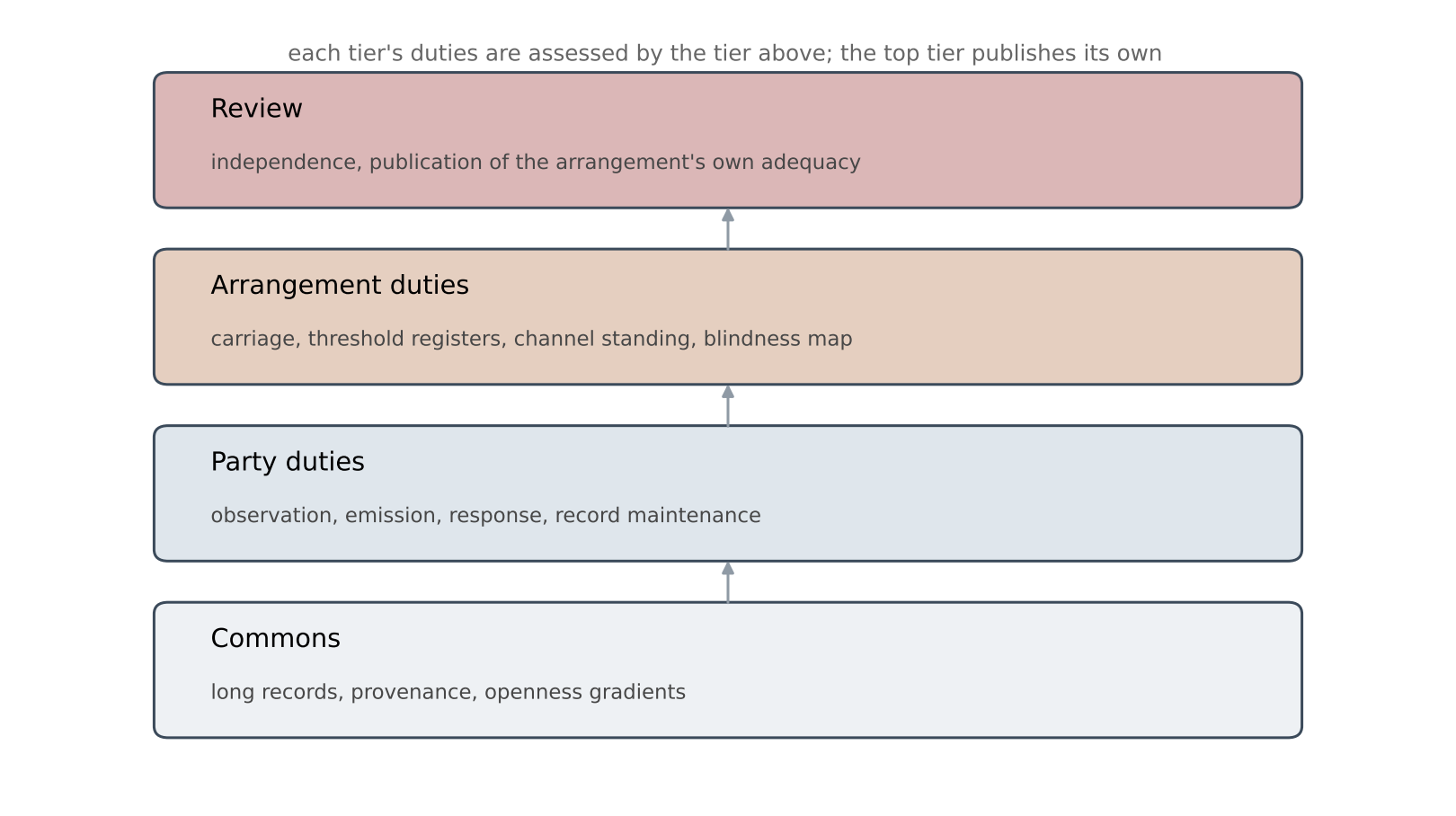
Figure 2. The duty stack. Commons duties concern the records themselves; party duties concern what participants do with respect to couplings their conduct bears on; arrangement duties concern the machinery that carries reports; review assesses the arrangement. Each tier is assessed by the tier above, and the top tier’s own adequacy is published, which is the substitute for a further tier that does not exist.
Commons duties attach to holders of long records: to maintain, to preserve comparability across method changes or to document the discontinuity where comparability cannot be preserved, and, where maintenance is to cease, to give notice sufficient for the capacity to be assumed and to transfer what would otherwise be lost. These follow from Claim ?.
Party duties attach to participants with respect to couplings their conduct bears on: to observe where the seventh paper’s residual conditions hold; to emit events of the classes the arrangement specifies, on thresholds held in a public register; to maintain channel standing through heartbeats; and to consider, acknowledge, or in stated classes respond to reports carried to them.
Arrangement duties attach to whoever operates the machinery: to carry reports according to a map assessable against the physical structure; to keep threshold registers versioned and queryable as at a past date; to monitor channel standing; and to publish the map of what the arrangement cannot see, which the sixth paper requires and the seventh paper relies on.
Review assesses the arrangement’s own adequacy, in class coverage, silence structure, carriage divergence, and the accumulation of habituation, and publishes the assessment.
3.2 The Standard of Assessment
Three properties of the standard are stated, since a process duty assessed on the wrong standard becomes an outcome duty by another route.
The standard is conduct against stated duties and not results. A party that observed by stated methods over the required period and found nothing has discharged its duty to look; a party that observed carelessly and happened to find the coupling has not. The asymmetry is deliberate and is the same one the seventh paper states in requiring that the duty run to observation and not to conclusion, since a duty discharged only by a favourable or a useful finding is a duty to produce findings.
The standard is contemporaneous. Discharge is assessed against the arrangement’s documents as they stood at the time, which is why the versioning requirement is load-bearing and not administrative: a register that overwrites makes retrospective assessment of past conduct impossible, and an assessor working from current thresholds will find breaches that were not breaches and miss breaches that were.
The standard is continuous. Supervision of this kind is not an inquiry convened after an event but an ongoing relation, which is what distinguishes it from an audit and what makes contemporaneous visibility of failure useful. A channel unmaintained for a year should be found in the first month.
3.3 Responses to Breach
The responses available in a conduct-keyed regime differ from those of an outcome-keyed one, and the difference is a feature. Four are appropriate here and each operates without any finding about outcomes.
Compelled discharge. The primary response to a failure to observe, to carry, or to maintain is an order to do it, since the duty’s object is the arrangement’s operation and the breach’s harm is its impairment. This is available where the duty remains dischargeable and is unavailable where the failure has already foreclosed, which is the maintenance case.
The adverse inference. Where a party bearing a duty to look has not looked, the seventh paper’s proposal applies: the coupling is treated as established for the purpose of the proceeding in which the party’s proposed alteration is assessed. The inference is rebuttable by looking, and its function is to place the risk of an absence on the party that could have removed it.
The burden shift. A broader form of the same structure: a party in breach of its epistemic duties bears the justificatory burden on alterations it proposes, at a level it would not otherwise bear, and does so without any finding that its breach caused anything.
Suspension of standing. A party that does not maintain its channel, or that emits on thresholds it has not registered, may have its emissions accorded reduced weight in assemblies, or may lose the ability to invoke the arrangement’s protections for itself. This is the sanction with the sharpest teeth and the greatest risk of misuse, and §8 treats it.
The appropriate responses to breach of an epistemic supervisory duty are compelled discharge, the adverse inference, the burden shift, and suspension of standing, and damages are not among them. The reason is not that breach causes no loss but that the loss is a diminished capacity of the field to be governed, which is distributed across participants and non-participants and is not measurable as any party’s injury. A regime that reached for damages would have to identify a plaintiff and quantify a harm, which reintroduces the attribution problem the conduct-keyed form was adopted to avoid.
| p0.16 p0.23 p0.23 p0.24 | Outcome-keyed liability | Prudential supervision | This proposal |
|---|---|---|---|
| Object assessed | The harm and its causes | The firm’s risk position and management | The party’s epistemic conduct |
| Timing | After harm | Continuous | Continuous |
| Attribution required | Yes | No | No |
| Owed to | The injured party | The regulator, for systemic stability | The arrangement and its participants |
| Typical response | Damages | Capital add-on, restriction, direction | Compelled discharge, inference, burden shift, suspension |
| Failure mode | Silent, where attribution fails | Capture, and pro-cyclicality | Capture, and the supervisor’s own capacity |
Table. Three forms compared. The proposal takes its timing, its independence from attribution, and its response repertoire from prudential supervision, and differs in the object assessed and in whom the duties are owed to.
3.4 The Supervisor
Every element above presupposes a supervisor, and the question of who supervises is the regime’s hardest and is not answered here. Three constraints on the answer are stated.
The supervisor requires competence of a specific kind: to assess whether observation occurred by stated methods, whether a carriage map corresponds to a physical structure, and whether an indicator suite’s negative record is honestly stated. This competence is held by the same community that operates the arrangements, which is the independence difficulty in its acute form.
The supervisor requires separation from the burdens: whoever keeps the threshold registers, whoever computes indicators, and whoever bears the high-grade justificatory burden should not be one body, and the review function should be separate from all three.
The supervisor’s own adequacy requires publication in place of a further tier. The stack terminates, and the substitute for a supervisor of supervisors is that the review function publishes its own assessments, its own coverage, and its own blindness, so that its failures are visible to participants who lack authority over it. This is a weak substitute and the paper says so.
4. Regimes from Which the Form Is Drawn
Seven bodies of practice and scholarship own parts of the position.
4.1 Prudential Supervision of Financial Institutions
Banking supervision is the paradigm of a conduct-keyed regime operating where outcomes resist attribution. Its architecture combines minimum requirements with a supervisory review process under which supervisors assess a firm’s own risk management and may impose requirements beyond the minima, and with disclosure obligations intended to make the firm’s position assessable by others (Basel Committee on Banking Supervision, 2006; Basel Committee on Banking Supervision, 2012). The structure of its core standard is itself instructive for §6: the principles are ordered so as to separate what supervisors are to do themselves, which occupies the first half, from what they are to expect of supervised parties, which occupies the second. A duty stack that distinguishes the obligations of an arrangement from the obligations of its participants is therefore not a novelty of the present proposal but the form the paradigm regime already takes. The macroprudential turn after 2008 added the explicit object of systemic stability, on the recognition that supervising each firm against its own condition leaves the coupled system unsupervised (Borio, 2003; Hanson et al., 2011).
Five elements transfer and are used. The first is the structural separation just described. Assessment is continuous and of process, not of outcomes. The supervisor assesses the adequacy of the supervised party’s own arrangements, which is the structure of every duty in §6. The response repertoire is directive and restrictive, and not compensatory, which Claim ? adopts. And the macroprudential insight, that unit-level supervision leaves couplings unsupervised, is the same recognition the second paper of this series makes about environmental infrastructures.
Three elements do not transfer and the differences are stated because they bear on the design. Prudential supervision has a common unit of account in which exposures are expressed, and this field has none. It has a defined perimeter of supervised entities, licensed and enumerable, where an environmental arrangement’s participants include operators, authorities, research programmes, and communities with no licensing relation. And its supervisor derives authority from the state’s power over licences, where an epistemic arrangement’s supervisor ordinarily has no such lever. The literature’s own diagnosis of capture and of pro-cyclicality is carried into §8 as the acknowledged failure mode.
4.2 Management-Based and Systems-Based Regulation
A regulatory literature analyses regimes that require regulated parties to establish their own processes for identifying and controlling hazards, and to be assessed on those processes. Coglianese and Lazer characterise management-based regulation as intervention at the planning stage, appropriate where outputs are difficult to monitor and where regulated parties are heterogeneous (Coglianese & Lazer, 2003), and subsequent work examines when such regimes succeed and when they become paper compliance (Coglianese & Nash, 2006; Gunningham et al., 1998). Meta-regulation analyses the state’s regulation of parties’ own self-regulation (Parker, 2002).
This literature owns the general form of a duty to have a process and be assessed on it, and its conditions for appropriateness are the ancestors of Claim ?. Its documented failure mode is directly relevant: management-based requirements degrade into documentation exercises where the assessor cannot judge substance, which is the risk the seventh paper identifies in a duty to look discharged by observation designed to establish nothing. The residue is the object: these regimes address a party’s management of its own hazards, and the duties here concern a party’s contribution to an infrastructure shared with others.
4.3 Safety Cases and Regimes of Demonstrated Adequacy
Safety-case regimes require an operator to demonstrate to a regulator that risks have been reduced so far as is reasonably practicable, with the burden of demonstration on the operator and the regulator assessing the demonstration (Health and Safety Executive, 2006; Kelly, 1998). The form was adopted in offshore, nuclear, and rail settings after inquiries into major failures found prescriptive rules inadequate to complex systems.
Two elements transfer. The allocation of the demonstrative burden to the party proposing the activity is the structure of this series’ governing principle. And the regulator’s role, assessing a demonstration and not verifying compliance with a rule, is the competence the supervisor of §6 requires. The residue is that a safety case concerns an operator’s own installation and a defined hazard, where the epistemic duties concern couplings that cross operators and a hazard that is the field’s ungovernability.
4.4 Fiduciary and Stewardship Obligations
Fiduciary law imposes duties of loyalty and care on parties holding discretion over another’s interests, and its analytical literature examines when the form is appropriate (Frankel, 2011; Miller, 2014). Public trust doctrine holds certain natural resources in trust for present and future beneficiaries, and has been invoked in environmental litigation (Sax, 1970; Wood, 2013). Stewardship framings in environmental governance impose care obligations without an identified beneficiary (Chapin et al., 2010).
These literatures own the vocabulary of duty without a contractual relation, and public trust owns the extension to future and unidentified beneficiaries. §5 declines the fiduciary form for the reason stated there, that the affected include trajectories holding no interests and future parties not identified, and Claim ? takes the intermediate position. Public trust doctrine is the nearest ancestor of that position and differs in that it vests the trust in the state, which the present arrangement cannot do for the reason given.
4.5 Commons Governance and Knowledge Commons
Ostrom’s design principles for common-pool resource institutions include monitoring by parties accountable to appropriators, graduated sanctions, and conflict-resolution mechanisms (Ostrom, 1990), and the knowledge commons literature adapts the analysis to non-rival resources where the governance problem is provision and openness, and not subtraction (Hess & Ostrom, 2007; Frischmann et al., 2014).
The concession is substantial: monitoring by accountable parties and graduated sanctions are Ostrom’s, and the four responses of §6 are a graduated set in her sense. Two differences are recorded. Her design principles are descriptive generalisations from institutions that succeeded, and the present duties are proposals. And the knowledge commons literature’s central problem is provision under non-rivalry, where the problem here is the irreversibility of loss, which Claim ? argues is a distinct ground: a knowledge resource may be non-rival, freely provided, and still irreversibly lost if the observation stops.
4.6 Archival and Data Stewardship Obligations
Archival science and research data management have developed obligations of preservation, appraisal, and custodianship, together with standards for trustworthy repositories and reference models for open archival information systems (Consultative Committee for Space Data Sy, 2012; CoreTrustSeal, 2022). The FAIR principles state requirements for findable, accessible, interoperable, and reusable data (Wilkinson et al., 2016), and the CARE principles state complementary requirements of collective benefit, authority to control, responsibility, and ethics for indigenous data (Carroll & Garba, 2020).
This literature owns the practice of preservation and the criteria for trustworthy custody, and an implementation of the commons duties would adopt its standards. The residue is the ground and the addressee: these obligations are ordinarily voluntary or contractual, undertaken by repositories toward depositors and users, and Claim ? grounds a duty on the holder of a record whether or not it has undertaken custodianship, which is a stronger claim these frameworks do not make.
4.7 Environmental Monitoring Duties in Existing Law
Existing environmental law contains monitoring obligations: permit conditions requiring self-monitoring and reporting, obligations of continuous emissions monitoring in some regimes, impact-assessment requirements including post-consent monitoring, and reporting obligations under multilateral environmental agreements. These are the closest existing instruments to the party duties of §6 and they establish that duties to observe and report are ordinary regulatory furniture.
The residue is threefold and is the paper’s specific ground. Existing monitoring duties are almost entirely self-directed: a party monitors its own emissions or its own installation, and the duty to look of the seventh paper is directed at couplings, which cross the party’s boundary. They are compliance-facing: the record serves the assessment of the duty-bearer, where the duties here serve the coordination of others. And they contain no analogue of the maintenance duty on long records, since a permit’s monitoring obligation ends with the permit, and Claim ? concerns records whose value is precisely that they outlast the arrangements under which they began.
4.8 Residue of the Survey
Consider an epistemic infrastructure spanning parties with no licensing relation, no common unit of account, and no supervisor holding a lever over all of them; duties concerning couplings that cross party boundaries; records whose loss is irreversible and whose holders may discontinue them unilaterally; and harms that are diffuse, prospective, and unattributable. The claims that duties in such a setting should be conduct-keyed on the four properties of Claim ?, that their ground is the irreversibility of the records’ loss and not their utility, that they are owed jointly to the arrangement and its participants with standing in any participant whose coordination is impaired, and that the appropriate responses are compelled discharge, adverse inference, burden shift, and suspension of standing to the exclusion of damages, are advanced by none of the surveyed regimes. Prudential supervision owns the conduct-keyed form within a licensed perimeter and a common unit of account; management-based regulation owns the duty to have a process, for the party’s own hazards; safety cases own the demonstrative burden for a defined installation; fiduciary and public trust doctrines own duty without contract, vested in the state; commons governance owns monitoring by accountable parties and graduated sanctions, generalised from institutions that succeeded; archival stewardship owns preservation practice, undertaken voluntarily; and environmental monitoring law owns self-directed compliance-facing observation. The composition is the residue claimed.
5. Objections and the Limits of the Position
5.1 The Severance Objection
The gravest objection is the cost Claim ? concedes at the outset. A conduct-keyed regime assesses whether duties were discharged and says nothing about what happened. A party that observed by stated methods, carried every report, maintained every register, and presided over an irreversible loss has, on this regime, done what was required. The objection is that a regime with this property has substituted the appearance of accountability for its substance, and has done so in a domain where the losses are exactly the ones that matter.
Three parts to the answer and a concession. The regime is not offered as a replacement for outcome-facing responsibility, which this series treats separately, and the two are compatible: nothing in a conduct-keyed epistemic regime forecloses a liability regime operating on the same field, and the paper’s claim is that the epistemic layer needs the first and cannot be governed by the second alone. The alternative it is compared against is not a working outcome regime but a regime that fails silently, and the comparison should be made on that basis: a conduct regime that finds a party compliant has at least produced a determination, where an outcome regime that cannot attribute produces nothing and leaves the same conduct unassessed. And the discharge of these particular duties is not incidental to outcomes, since the duties are the ones that make foreclosures visible in advance; a party that discharges them fully will more often be a party that saw what was coming.
The concession: the answer holds where the duties are well specified and holds less as specification degrades, and a badly specified duty stack produces exactly the appearance of accountability the objection describes. The regime’s honesty therefore depends on the quality of its own duty specification, which is a fragile foundation and is the reason §9 treats specification as the programme’s principal obligation.
5.2 The Supervisor Objection
The regime’s second exposure is the supervisor’s independence and competence, and the difficulty is acute here for a reason peculiar to the domain. To assess whether observation was competent, whether a carriage map matches a physical structure, or whether an indicator suite’s negative record is honestly stated, an assessor must hold the technical competence that the arrangement’s participants hold. The pool of competent assessors and the pool of interested parties largely coincide.
The paradigm regime treats this as a matter for the standard itself and not for the supervisor’s discretion, which is worth recording because the present paper had treated independence as a design problem to be solved locally. Among the core principles of banking supervision, one is devoted to the supervisor: it requires operational independence, transparent processes, sound governance, budgetary arrangements that do not undermine autonomy, adequate resources, and accountability, together with legal protection for supervisory staff. Naming these as requirements upon the supervisory function, at the same level as the requirements it imposes on others, is a design available here, and the present proposal should adopt it: an arrangement’s review function is subject to stated conditions of independence, resourcing and accountability, and its failure to meet them is assessable in the way any other duty is.
That said, the difficulty of competence is not answered by a principle, and the paper’s remaining resources are three, none sufficient alone. Separation of roles within the arrangement, so that the register-keeper, the indicator-computer, the burden-bearer, and the reviewer are distinct, which addresses conflict without addressing competence. Publication of the review function’s own assessments and blindness, which substitutes visibility for authority and depends on participants having somewhere to take what they see. And the structural point that much of what must be assessed is assessable from the stream itself: whether heartbeats were maintained, whether registers were versioned, whether carriage occurred, and whether emissions are consistent with declared thresholds are determinable without the domain competence that assessing observational quality requires. The honest division is that the mechanical duties are supervisable by a body of modest competence and the substantive ones are not, and a regime that supervises only the first has real value and should not be mistaken for the whole.
5.3 The Capture and Ossification Objections
Prudential supervision’s own literature supplies both. Capture: a supervisor in continuous relation with supervised parties comes to share their view of what is reasonable, and the continuity that makes conduct-keyed supervision effective is the same continuity that produces capture. Ossification: a regime assessing conduct against stated duties freezes the duties, and parties optimise against them, so the duties become the ceiling of practice.
The paper carries the series’ standing devices and claims no more. Public versioned registers make the duties contestable objects, and their versioning makes drift visible. The revisability commitment of the series’ first paper applies to the duty specification as to everything else. Against capture specifically, the paper has only the publication requirement and the observation that an epistemic arrangement’s capture has a signature the arrangement itself can carry: divergence between the couplings the accumulated events reveal and the carriage map the supervisor accepts.
5.4 The Suspension Objection
Suspension of standing is the sharpest sanction and the most dangerous. A party whose emissions are accorded reduced weight, or which loses the ability to invoke the arrangement’s protections, has been excluded from a coordination infrastructure, and exclusion is available as a weapon against parties that are inconvenient. The seventh paper’s analysis makes the danger concrete: the parties least able to satisfy formal channel and register requirements are the parties with least capacity, and a sanction keyed to formal compliance would fall on them hardest while the well-resourced comply trivially.
The paper’s position is that suspension should be available only for duties within a party’s capacity to discharge, that a capacity deficit is a ground for assistance and not for sanction, and that the determination of which is which must itself be reviewable. This is a statement of what the regime should do and not a mechanism, and the paper records that a regime unable to make the distinction reliably should not hold the sanction at all.
5.5 Limits Internal to the Position
Four limits are recorded. The duties are stated at the level of kind and not of content, so the regime is specified as to structure and unspecified as to what any party actually owes. No account is given of how a supervisory arrangement comes into being among parties none of which is subject to a common authority, which is the constitutive question and is prior to everything here. The regime presupposes the representational machinery of the eighth paper, since contemporaneous assessment against versioned registers is unachievable without it, so the proposal is contingent on an implementation that does not exist. And the paper’s scope excludes the outcome-facing questions, which means it offers no account of what happens where an epistemic breach and an environmental harm are both present, which will be the ordinary case in practice.
A further limit is inherited rather than internal. The paper applies the series’ principle to alterations described as irreversibly foreclosing, and the series’ first paper supplies no method for establishing irreversibility, recording the absence as an open question. Where the property is stipulated by the case under discussion, nothing turns on this. Where it would be contested, the paper’s conclusions are conditional on a determination the series has not yet made, and the seventh paper’s establishment condition constrains what evidence such a determination would require without supplying it.
6. Questions Left Open for the Programme
6.1 Questions Concerning Specification
Content of the duties. The duties are stated as kinds. An answer would specify, for at least one field, what a party actually owes: which couplings, at what resolution, over what period, to what standard of method. §8 identifies this as the programme’s principal obligation, since the regime’s honesty depends on it.
The proportionality of the duty to look. The seventh paper leaves unstated the relation between the scale of a proposed alteration and the observational cost at which a duty attaches. An answer belongs jointly to that paper and this one, and would state how the threshold is set and by whom, since the supervisor must apply it.
Assessment of observational quality. Compelled observation may be designed to establish nothing, and §8 concedes that assessing this requires domain competence the supervisor may lack. An answer would state what tests of a record’s adequacy are available to a non-specialist assessor, candidate approaches being pre-registration of method, comparison against parallel records, and audit by rotating peers.
6.2 Questions Concerning the Supervisor
Constitution of the supervisory function. An answer would state how a supervisor is constituted among parties subject to no common authority, and whether the function can be distributed among participants under mutual assessment, which would avoid the constitutive problem at the cost of the independence the function requires.
The mechanical and the substantive. §8 divides duties into those assessable from the stream and those requiring domain competence. An answer would draw the line precisely, since it determines what a modestly resourced supervisor can achieve and therefore what a minimal regime looks like.
Signatures of capture. The paper suggests that capture has a signature, divergence between the couplings events reveal and the carriage map the supervisor accepts. An answer would establish whether the signature is detectable in practice, and what other signatures exist, since a regime whose only defence against capture is publication needs something for participants to look at.
6.3 Questions Concerning Sanction
Capacity deficit distinguished from breach. Suspension is available only where discharge was within a party’s capacity. An answer would state how the determination is made and reviewed, and would confront the fact that a party may allow its capacity to lapse, so the distinction cannot rest on present capacity alone.
Calibration of the burden shift. A party in breach bears a heightened justificatory burden. An answer would state how much heightened, in what currency, and would confront the difficulty that a burden calibrated to the breach’s gravity requires a judgement of gravity that the severance from outcomes denies the regime.
Interaction with outcome-facing liability. An answer would state what follows where an epistemic breach and an environmental harm are both present: whether the breach is evidence in the liability proceeding, whether the conduct regime’s finding binds, and whether double jeopardy concerns arise. This is the join between this paper and the responsibility paper of the series and is presently unmade.
6.4 Questions Concerning Ground and Scope
The archival obligation on cessation. Claim ? makes the duty dischargeable by notice and transfer. An answer would state to whom transfer is owed where no party will accept custody, whether the duty extends to funding a successor, and what happens on the holder’s dissolution.
Method change and the preservation of comparability. A method change that improves measurement while breaking a series is a foreclosure and an improvement at once. An answer would state the conditions under which such a change is permissible, the documentation that discharges the duty, and whether parallel operation of both methods for a period should be required.
Transfer beyond the epistemic layer. Claim ? bounds the recommendation by four properties. An answer would test whether other layers of this architecture satisfy them, in particular whether duties concerning the alteration of physical couplings are conduct-keyed on the same grounds, which would considerably widen the proposal and requires the test to be applied honestly.
7. Declinations and Limits of the Position
The paper claims no novelty in the conduct-keyed supervisory form, which belongs to prudential supervision, to management-based regulation, and to safety-case regimes, each conceded in §7 in the form its practitioners state it.
The paper does not address causation or responsibility for environmental outcomes, which the series treats separately. Its silence on those questions is a scope decision and not a claim that they lack answers.
The paper proposes no statutory text, no institution, and no jurisdiction. It states duties by kind, an assessment standard, a response repertoire, and constraints on the supervisory function, and declines to specify the body, the instrument, or the enforcement route.
The paper supplies no duty content. §9 records this as the programme’s principal obligation, and until it is met the regime is a form without a substance and should be read as such.
The paper’s proposal is contingent on representational machinery that does not exist. Contemporaneous assessment against versioned registers presupposes the requirements of the eighth paper of this series, and a regime attempting the assessment without them would assess current documents against past conduct, which §6 identifies as unsound.
References
Basel Committee on Banking Supervision (2006). International Convergence of Capital Measurement and Capital Standards: A Revised Framework, Comprehensive Version. BCBS 128, Bank for International Settlements. Since integrated into the consolidated Basel Framework.
Basel Committee on Banking Supervision (2012). Core Principles for Effective Banking Supervision. BCBS 230, Bank for International Settlements, Basel, September 2012; endorsed at the 17th International Conference of Banking Supervisors, Istanbul. Revised again in 2024.
Borio, C. (2003). Towards a macroprudential framework for financial supervision and regulation? CESifo Economic Studies, 49(2), 181–215.
Carroll, S. R., Garba, I., Figueroa-Rodríguez, O. L., et al. (2020). The CARE Principles for Indigenous Data Governance. Data Science Journal, 19(1), 43.
Chapin, F. S., Carpenter, S. R., Kofinas, G. P., et al. (2010). Ecosystem stewardship: sustainability strategies for a rapidly changing planet. Trends in Ecology and Evolution, 25(4), 241–249.
Coglianese, C. and Lazer, D. (2003). Management-based regulation: prescribing private management to achieve public goals. Law and Society Review, 37(4), 691–730.
Coglianese, C. and Nash, J. (2006). Management-based strategies: an emerging approach to environmental protection. In C. Coglianese and J. Nash (eds.), Leveraging the Private Sector: Management-Based Strategies for Improving Environmental Performance, pp. 3–30. Resources for the Future Press, Washington, DC.
CoreTrustSeal (2022). CoreTrustSeal Trustworthy Data Repositories Requirements 2023–2025. CoreTrustSeal Standards and Certification Board. Superseded by the 2026–2028 Requirements.
Frankel, T. (2011). Fiduciary Law. Oxford University Press.
Frischmann, B. M., Madison, M. J., and Strandburg, K. J. (eds.) (2014). Governing Knowledge Commons. Oxford University Press.
Gunningham, N., Grabosky, P., and Sinclair, D. (1998). Smart Regulation: Designing Environmental Policy. Oxford University Press.
Hanson, S. G., Kashyap, A. K., and Stein, J. C. (2011). A macroprudential approach to financial regulation. Journal of Economic Perspectives, 25(1), 3–28.
Hess, C. and Ostrom, E. (eds.) (2007). Understanding Knowledge as a Commons: From Theory to Practice. MIT Press.
Health and Safety Executive (2006). A Guide to the Offshore Installations (Safety Case) Regulations 2005. Guidance on Regulations L30, 3rd edn. HSE Books. See also the Offshore Installations (Offshore Safety Directive) (Safety Case etc.) Regulations 2015.
Kelly, T. P. (1998). Arguing Safety: A Systematic Approach to Managing Safety Cases. DPhil thesis YCST-99-05, Department of Computer Science, University of York.
Miller, P. B. (2014). The fiduciary relationship. In A. S. Gold and P. B. Miller (eds.), Philosophical Foundations of Fiduciary Law, pp. 63–90. Oxford University Press.
Consultative Committee for Space Data Systems (2012). Reference Model for an Open Archival Information System (OAIS). CCSDS 650.0-M-2. Issued as ISO 14721; superseded by ISO 14721:2025.
Ostrom, E. (1990). Governing the Commons: The Evolution of Institutions for Collective Action. Cambridge University Press.
Parker, C. (2002). The Open Corporation: Effective Self-Regulation and Democracy. Cambridge University Press.
Sax, J. L. (1970). The public trust doctrine in natural resource law: effective judicial intervention. Michigan Law Review, 68(3), 471–566.
Wilkinson, M. D., Dumontier, M., Aalbersberg, I. J., et al. (2016). The FAIR Guiding Principles for scientific data management and stewardship. Scientific Data, 3, 160018.
Wood, M. C. (2013). Nature’s Trust: Environmental Law for a New Ecological Age. Cambridge University Press. thebibliography