Relational Power Expansion - Boundary, Opacity, and the Sustainability of Generative Relations
Abstract
A companion paper indexes the appropriation of relational value by the region
of a six-part lifecycle at which the appropriation is performed, and by the
aspect of that region on which it operates: the form an interaction may take,
the conditions under which it becomes possible, or the process by which it
occurs. This paper takes up a structure that indexing makes visible. A position
holding power within one relation acquires a holding over a second relation
formed by one of its parties with someone else, draws value from the second,
and converts that value into a wider holding. Five results are offered. The
difference between redirecting flows within a relation and determining what a
relation can generate is a difference in which aspects a position holds and
across how many regions, rather than a difference of degree, and a position
supplying a configuration’s first grammar constitutes it rather than extending
into it. The holding sustains itself where the lifecycle’s closure runs through
that position, and enlarges itself where captured value is converted into
further relational surfaces. The holding alters the composition of what is
generated, determines the gap between generated and representable value, and
leaves return undefined rather than blocked, so that the question of what share
was taken loses the terms in which it could be put. Parties affected may be
wronged along several independent directions, of which the one surviving the
widest disagreement concerns parties outside the original relation, who commit
scarce resources on a judgement about someone else and form no judgement about
the position that receives them; these mechanisms are stated as prima facie.
An arrangement of this kind consumes the generativity on which its own
continuation depends, a result about the arrangement’s conditions rather than
its justice, which holds whether or not the preceding grounds are accepted.
Three sources of the power required are distinguished, and relations resting on
antecedent power are treated as the hardest case. The analysis is restricted to
interpersonal, familial, educational, professional, and organizational
relational systems.
Keywords: relational power; boundary overreach;
Discussion Paper Note
This paper is a preliminary discussion paper intended to share an evolving idea
and invite further dialogue, criticism, revision, and independent development.
Its definitions, distinctions, and constructions remain provisional.
Circulation across scholarly and practical communities is part of the purpose
of releasing the manuscript at this stage.
The author treats the viewpoints, concepts, and lines of reasoning presented
here as contributions to a shared field of inquiry. Similar or related ideas
have appeared in other intellectual, cultural, and disciplinary traditions, and
each section concedes those the author is aware of where it draws on them. The
manuscript separates the researcher-origin proposal from later formal
reconstruction and leaves historical priority open pending a systematic
originality review.
The arguments should be understood as provisional and historically situated.
Readers are encouraged to question, test, revise, extend, reinterpret, or
independently develop the ideas presented here. Where appropriate,
acknowledgment of this paper as one point of encounter in the development of a
related idea is appreciated. Such acknowledgment records an intellectual route;
the ideas themselves remain available for criticism, revision, and independent
development.
Responsible Use and Rights Reservation
This section separates requested scholarly conduct from the legal permissions
stated on the following page. It records an ethical request for responsible use
and then defines the narrower scope of retained legal rights.
One caution is specific to this manuscript. A description of how a relation is
reconfigured can be read as a specification for reconfiguring one. The purpose here is diagnostic: to give parties inside such
arrangements a vocabulary in which their situation becomes sayable, and to give
institutions a structure against which their own arrangements can be examined.
The author encourages good-faith discussion, criticism, independent inquiry,
and responsible use of the material in this work. Separately from the licence’s
terms, the author asks users to consider foreseeable harms when adapting or
applying the proposed framework. This ethical request leaves the licence’s
permissions and legally authorized uses unchanged.
The author retains the rights preserved under CC BY-NC 4.0 and may pursue
remedies to which the author is legally entitled for breach of the licence or
violation of the author’s independently applicable rights. Reuse remains
independent from authorial endorsement. Third-party rights require authorization
from their respective holders where applicable. Copyright exceptions and
limitations, including applicable forms of fair use or fair dealing, remain
fully available.
Notices
This page consolidates the manuscript’s publication status, licence,
development disclosure, research-programme relation, and suggested citation.
Status.
This working draft records an evolving stage of the author’s position and is
circulated for discussion. Definitions, section structure, and numbering remain
subject to revision. Empirical case work and a systematic originality audit
remain future research stages.
Licence.
Except where otherwise indicated, copyright 2026 Wanhong Huang. This work is
made available under the Creative Commons Attribution-NonCommercial 4.0
International License (CC BY-NC 4.0). Subject to its terms, the licence permits
sharing and adaptation for noncommercial purposes with appropriate attribution,
a link to the licence, an indication of changes, and attribution that preserves
the licensor’s independence from the reuse. Reuse is governed solely by that
licence; the responsible-use request on the preceding page remains separate
from its terms. The licence deed and legal-code link are available at
https://creativecommons.org/licenses/by-nc/4.0/. The licence governs in
case of conflict with this summary. Third-party material remains subject to the
rights held by its respective rights holders.
Statement on the use of language models.
The exploratory discussions and preparation of this paper involved Anthropic’s
Claude and OpenAI’s ChatGPT. These systems supported exploratory dialogue,
literature and historical survey with subsequent verification against publisher
and journal pages, argumentative criticism, and drafting in . The author
selected the research questions, directed and approved the theoretical
commitments and epistemic status of the claims, and bears sole responsibility
for the manuscript, including its definitions, arguments, conclusions, and
errors. Authorship credit remains with the human author. Every source cited
here has been verified against a publisher, journal, or institutional page;
sources encountered in survey and not so verified are excluded from the
manuscript and recorded separately in the accompanying literature audit.
Companion paper.
This paper is a companion to Relational Value Exploitation: Taxonomy and
Mechanisms. What If the More Real a Relation Becomes, the More Exploited It
Becomes?, which supplies the six-region lifecycle, the aspect grammar, the
register layer, the admissibility conditions, and the corpus of 225 sites
referred to throughout. Section 5 restates what is needed
so that the present paper stands alone. Two further companion papers develop a
gauge-theoretic account of value circulation: The Geometry of Value: Loop
Deficits as Invariant Measures of Structural Exploitation and The
Structure of Exploitation on Heterogeneous-Value Loops: Gauge Symmetry,
Holonomy, and the Loop Deficit.
Suggested citation.
Huang, Wanhong. “Relational Power Expansion: Boundary, Opacity, and the
Sustainability of Generative Relations.” Working discussion paper, 2026.
1. Introduction
A companion paper indexes the appropriation of relational value by the region of
a lifecycle at which it occurs and by the aspect of a relation on which it
operates. That indexing makes a further structure visible, and the present paper
takes it up. A position holding power within one relation acquires access to a
second relation formed by one of its parties with someone else, draws value from
the second, converts that value into a wider holding, and continues. The parties
to the second relation may see nothing irregular at any point, and the position
drawing on them is party to their relation in no ordinary sense.
The paper describes the mechanism by which such a holding is acquired, the
circuits by which it sustains and enlarges itself, the several independent
grounds on which parties affected by it may object, and the consequences the
arrangement has for its own continuation. Five results are offered. The
difference between redirecting flows within a relation and determining what a
relation can generate is a difference in which aspects a position holds and
across how many regions of the lifecycle, rather than a difference of degree,
and a position supplying a configuration’s first grammar constitutes it rather
than extending into it, however wide that scope. The holding sustains itself
where the lifecycle’s closure runs through the holding position, and enlarges
itself where captured value is converted into the acquisition of further
relational surfaces. The holding alters the composition of what a configuration
generates, determines the gap between generated and representable value, and
leaves return undefined rather than blocked, so that the question of what share
was taken loses the terms in which it could be put. Parties affected by such an
arrangement may be wronged along several directions that hold independently of
one another, and the paper identifies those mechanisms and states its
conclusions as prima facie rather than settled. An arrangement of this kind
consumes the generativity on which its own continuation depends, which is a
result about the arrangement’s conditions rather than about its justice, and it
holds whether or not the preceding ground is accepted.
The fourth and fifth results warrant a word about what they claim. The fourth
identifies mechanisms giving a reason for objection which an arrangement has to
answer, and stops there. A judgement that a particular arrangement is unjust on
balance requires premises about standing, entitlement, and development that this
paper states where it uses them and declines to defend, and
Section 22 records the limitation. The fifth requires no theory of
justice at all. It concerns whether an arrangement can continue on its own
terms, and a reader who rejects every argument of Part III faces it unchanged.
The order of presentation runs from the mechanism through the objections to the
consequences, and a reader interested only in the last may read
Sections 9 and 11 and then Part IV.
Among the objections, one deserves marking here because it survives the widest
disagreement. Where a position reaches across into a relation formed by others,
the parties to that relation committed scarce and frequently unrecoverable
resources on a judgement about a party they knew, and formed no judgement about
the position that receives what they committed. Their case can be pressed
granting the position whatever claim it asserts against the party it constituted
or employed, and granting that the claim is discharged willingly, since those
parties are party to neither question. The paper takes that argument first for
this reason, at Section 12, ahead of the questions requiring a
view about what parties owe one another.
This paper restricts its analysis to interpersonal, familial, educational,
professional, and organizational relational systems, and does not extend its
claims to territorial or geopolitical relations. The mechanisms described may or
may not obtain in relations of other kinds, and nothing here settles that
question in either direction. The restriction is a stipulation rather than a
finding, and Section 22 records it among the paper’s limits.
The sequence is as follows. Part I supplies the framework.
Section 5 restates the apparatus carried from the
companion paper and adds the quantities this argument requires, among them the
heterogeneity of relational value, the distinction between value generated and
capacity to generate, and portability.
Section 6 states the five ontological commitments the argument
presupposes, of which the separability of a relation’s grammar from its
instances does the decisive work. Section 7 distinguishes three
sources of the power a position requires.
Section 8 divides the first of those sources according to
whether the position supplied the configuration’s first grammar, and fixes the
time at which that question is assessed.
Part II states the mechanism. Section 9 describes how a
position holding power in one relation acquires a holding over another, and
defines relational boundary overreach. Section 10 states what
distinguishes the two kinds of holding and gives the five conditions under which
the second obtains. Section 11 describes the circuit by which
such a holding reproduces itself, the further circuit by which it enlarges
itself, and what both do to the value a configuration generates.
Part III states the objections. Section 12 treats parties
outside the original relation. Section 13 treats conversion
between value domains standing under no arrangement that fixes a rate between
them. Section 14 treats what the arrangement makes of
the three parties and the relation involved in it.
Section 15 separates the fairness of a conversion and the
legitimacy of a use from the question whether any claim exists.
Section 16 presses that question and reaches a bounded
conclusion.
Part IV states the consequences for the arrangement itself.
Section 17 describes the capacity a party ordinarily
acquires by generating and what becomes of it where the arrangement absorbs it.
Section 18 describes the foreclosure of the procedure by
which the terms of a relation are amended.
Section 19 gives the maintenance balance, establishes that
a position’s power and the generativity it draws on can move in opposite
directions, and assembles the part into a single sequence.
Part V applies the account and closes. Section 20 treats relations
resting on antecedent power, which are the hardest cases the paper addresses.
Section 21 states five respects in which reversal is harder than
establishment and identifies where intervention reaches the mechanism.
Section 22 records the limits, the obligations the account incurs,
and the results.
2. Preliminaries
This section restates the apparatus carried from the companion paper and adds
the quantities the present argument requires. It has three objectives. The first
is to give the definition of relational value, the lifecycle across which it is
generated, and the aspect distinction on which
Section 10 turns. The second is to establish the heterogeneity
of relational value and to distinguish generated value from the capacity to
generate. The third is to restate the quantities used throughout. The method is
expository, and nothing in the section is argued again, since the companion
paper supplies the arguments and the corpus of sites. Subsections 5.1
and 5.2 carry material a reader of the companion
paper will find partly new; the remainder is restatement.
2.1 Relational value and its lifecycle
Relational value is value generated by a relational configuration rather than
by any party to it, and is accordingly not decomposable in advance into shares
belonging to parties who existed before the configuration did.
Definition ? carries the framework’s founding commitment and
is load-bearing throughout. Trust, shared language, coordination routines,
tacit knowledge, standing, and the capacity to generate again are all generated
by a configuration and none of them has a prior decomposition. Any allocation
of such value among the parties is a decision taken under some description
rather than a finding about the value.
The generation of relational value is coarse-grained into six regions, given at
Equation (1).
$$\mathcal F_1 \to \mathcal F_2 \to \mathcal F_3 \to \mathcal F_4 \to
\mathcal F_5 \to \mathcal F_6 \to \mathcal F_1’$$
The regions are encounter and relation possibility, relation formation, shared
experience and co-generation, valuation and recognition, circulation and
conversion, and return and relational reproduction. Three properties
distinguish this from a value chain and each is used below. Each region is
extended in relational time rather than instantaneous. Regions overlap. Each
region admits finer resolution into a structure of the same shape, so that
a node observed at one scale is a region at the next. The final arrow records
that the sixth region resets the space of relations with which the next cycle
begins, so Equation (1) is a circuit rather than a chain. That
closure is the object of Section 11.
2.2 Heterogeneity of relational value
Relational value arises in several domains, which
Equation (2) sets out.
$$V_R = V_{\mathrm{material}} \mid V_{\mathrm{symbolic}} \mid
V_{\mathrm{epistemic}} \mid V_{\mathrm{affective}} \mid
V_{\mathrm{network}} \mid V_{\mathrm{generative}}$$
The decomposition is analytic. Equation (2) is written with
separators rather than with sums, and the notation records that the components
are distinguished without being assumed commensurable. Whether two of them stand
in a determinate ratio is a question about the normative arrangement under which
the parties stand, and Section 13 treats it.
A second distinction concerns what a cycle leaves behind. The value generated in
a cycle and the capacity to generate in the next are separate quantities:
$$V_t \ \neq \ G_t$$
Equation (3) separates two questions that the vocabulary of
extraction runs together. Taking $V_t$ and holding $G_{t}$ onward are different
operations, and Sections 10 and 19 turn
on the difference.
Portability is the extent to which a relational value retains its function when
moved out of the configuration that generated it, as at
Equation (4), where $\pi$ approaches unity for value that travels
intact and falls toward zero for value whose function depends on the
configuration.
$$\pi\bigl(V_R\bigr) \in [0,1]$$
Trust, standing within a particular network, and the credit a party carries with
specific counterparties are low in $\pi$. Equation (4) is used at
Sections 15 and 16, where what a transfer
does to the transferred value is at issue.
2.3 Aspects
Within a region, the form aspect concerns the structure into which an
interaction is organized; the conditions aspect concerns what makes an
interaction of that kind possible at all; the process aspect concerns
how the interaction actually proceeds and among whom.
The distinction was found at the encounter region and holds at the remaining
five. It is the pivot of this paper, and Section 10 states
why. Sites are coded as at Equation (5), with $i$ the region,
$d \in {\mathrm F,\mathrm C,\mathrm P}$ the aspect, and $n$ the position
within the aspect, so that $\mathrm{E}4.\mathrm F.1$ is the first form-aspect
site of the valuation region.
$$\mathrm{E}i.d.n$$
Of the 225 sites in the companion corpus, 119 are form-aspect or
conditions-aspect and 106 are process-aspect.
2.4 Registers
The Lacanian registers supply the layer beneath the aspect grammar. They are
treated as knotted rather than as three exclusive categories, since an
intervention entering at one propagates to the others. Each action accordingly
carries an entry register $r_0 \in {\Reg,\Ima,\Sym}$, being the register in
which the intervention first operates; a driving form, being the mechanism by
which it passes from one register to the next; and a trajectory, being the
typical path of propagation.
Two results of the companion paper are used here. The first is that the
registers admit unequal enumeration: the Symbolic is a code and the operations
upon it are enumerable, the Imaginary admits enumeration up to a set of typical
figures, and the Real admits only a short list of ways in which an encounter
with it may be staged, being the production of a lack, the production of an
excess, the staging of a rupture, and the exposure of a limit. The second is
distributional. Across the corpus, entry through the Real holds between a tenth
and a fifth of the sites at the first three regions, falls to none at valuation
and one in twenty at circulation, and returns to an eighth at reproduction,
while entry through the Imaginary does not follow that movement. The companion
paper argues the absence at valuation from what that region’s operations act
upon, and reads the pattern through the formula that what is foreclosed from
the Symbolic returns in the Real.
2.5 Admissibility
Gatekeeping, ranking, matching, role assignment, deferral, and succession are
how coordination works, so a framework classifying each as appropriation empties
the term. The companion paper accordingly governs every site by four joint
conditions, applied to a named position rather than to an arrangement in
aggregate.
A quantity surrendered at one position persistently fails to return, and an
identifiable position receives the difference.
The receiving position also determines the description under which the
arrangement is accounted for: the categories, the registries, the boundaries of
the relevant circuit, or the standards of contribution.
No act available to the depleted party opens a channel through which value
returns to the relation that generated it.
The relation-specific sedimentation borne by the depleted party, comprising
history, identity investment, non-portable capacity, and foregone alternatives,
is unmatched by the receiving position.
Condition ? is the local form of a structure this paper
generalizes at Section 10 and applies to a conversion rate at
Section 13. Condition ? refers to non-portable
capacity, which Equation (4) now quantifies.
2.6 Quantities carried forward
Four further quantities from the companion paper are used throughout and are
restated here without their derivations.
The space of relations available to a party at a time is written $\Omega_t$.
The companion paper records the case in which the formation of a relation
contracts that space, as at Equation (6), so that stability and
foreclosure advance together.
$$R_t \longrightarrow \Omega_{t+1}, \qquad
\lvert \Omega_{t+1}\rvert < \lvert \Omega_t\rvert$$
The representation gap is the part of generated value that the available
formats of valuation do not admit, as at Equation (7). Value falling
in this gap receives no low valuation. It receives no term, and the difference
matters, since a low valuation can be argued against while an absent one
supplies nothing to argue with.
$$\Delta_V = V_{\mathrm{generated}} - V_{\mathrm{represented}}$$
Conversion capacity is the extent to which a given party can turn a relational
value into another form. Equation (8) records the case in which
the same value carries materially different capacity for different parties to
the relation that generated it, and Section 15 extends the
comparison to a position outside that relation.
$$\kappa_A\bigl(V_R\bigr) \ll \kappa_B\bigl(V_R\bigr)$$
The return ratio is the proportion of value generated from a relation that
reaches the relation again, as at Equation (9).
$$\rho_R = \frac{\text{value returned to the generative relation}}
{\text{value generated from the relation}}$$
Two outcomes at the close of a cycle are distinguished by what happens to the
relation’s capacity to generate, written $G$. Equation (10)
records generative circulation and Equation (11) extractive
circulation.
$$R_t \rightarrow V_t \rightarrow R_{t+1},
\qquad G\bigl(R_{t+1}\bigr) > G\bigl(R_t\bigr)$$
$$R_t \rightarrow V_t \rightarrow X,
\qquad G\bigl(R_{t+1}\bigr) < G\bigl(R_t\bigr)$$
Equations (6), (10) and (11) together
carry Sections 11 and 19.
3. The Ontology of Configurations, Grammar, and Constitution
The arrangements this paper examines involve a position operating on the terms
under which a relation proceeds. That description presupposes that a relation is
the kind of thing which can be entered and rewritten, and the presupposition
requires support. This section supplies it. Five commitments are stated. The
first concerns the standing of relations, the second their extension, the third
the separability of a relation’s grammar from its instances, and the fourth the
reach of an operation on that grammar into the parties. The third does the
decisive work, and Section 10 rests on it. The fifth
distinguishes two ways a relation may stand to the ends of those involved in it,
and Section 8 reaches the same line from the direction of
antecedence. The method is to state each commitment, to concede the positions
that support it, and to record where the supporting literature is divided.
3.1 Relations as primitive
The first commitment is that relations are not derived from the parties
standing in them. On the received alternative, parties exist with properties
and interests, and relations are what they enter into; on the commitment
adopted here, transactions and relations are the primitive units of the social,
and parties are what those relations produce and continue to reform
(Emirbayer, 1997). The relation is accordingly an object with its
own reality and its own emergent properties rather than a summary of the
parties’ dispositions (Donati, 2011), and actors reform one
another through the transactions that compose it
(‘epelteau, 2008).
A related formulation treats social wholes as composed of parts joined by
relations of exteriority, so that a component may be detached from one whole
and function in another (DeLanda, 2006). That is the property the
present paper requires of a grammar at Section 6.3, and it is
noted here because it makes the requirement less peculiar than it might
otherwise appear.
The commitment is contested within the literature it draws on, and the paper
records the dispute rather than concealing it. On the morphogenetic account,
structure and agency are distinct strata whose interplay is analysed across
time, and agents mediate structure through a reflexive internal
deliberation that is not reducible to the relation
(Archer, 1995). Nothing in this paper requires the stronger
transactional position to the exclusion of that account. What it requires is
weaker, and both accounts supply it: that a relation possesses structure
distinguishable from the parties, and that operations on that structure reach
the parties. The reflexive internal conversation, on the morphogenetic account,
is what Section 14 needs, since the terminal state
described there is one in which an imposed grammar is what the party
deliberates with.
3.2 Relations as extended
The second commitment is that a relation occupies an extended region rather
than a point. This is already carried by Equation (1): relation
formation is an interval containing approach, testing, role confirmation,
boundary setting, commitment, conflict, and repair rather than an instant at
which a relation begins. Extension has a consequence used throughout. A position
may hold one part of a relation’s extent and not another, so that questions of
who controls what admit answers indexed by region rather than answers about the
relation as a whole. Without extension, Claim ? could not be
stated, since aspect scope is scope across regions.
The paper writes relational spacetime for the extent, in relational time
and in local relational structure, over which a configuration exists and
generates. The term claims no analogy with physical spacetime beyond extension
and the indexing of events within it, and Section 22 records the
borrowing as a limit.
3.3 Grammar as separable from instance
The third commitment is the one that makes grammar-level extension available as
a phenomenon distinct from the redirection of flows, and it follows from
Definition ? rather than being imported.
Within any region, the interactions that actually occur are drawn from the
interactions that are available, and what is available is fixed by the form and
the conditions. Two parties in a laboratory may or may not co-author; whether
co-authorship is a thing that can happen between them is settled elsewhere, by
whoever determines the roles, the crediting scheme, and the conditions of
access. Write $\mathcal G$ for the structure that fixes availability and
$\mathcal A$ for the interactions realized under it, as at
Equation (12).
$$\mathcal G ;\longmapsto; \mathcal A$$
The paper calls $\mathcal G$ the grammar of the relation. The term is used in
its generative sense: a finite structure from which an open set of admissible
instances is produced, such that a competent party can tell an admissible
instance from an inadmissible one without having encountered it before. Nothing
linguistic is claimed beyond that.
The grammar of a relation and the interactions realized under it are distinct
objects. A position may therefore operate on the grammar while performing no
interaction, and an operation on the grammar alters the set of admissible
interactions without altering any interaction that has occurred.
Proposition ? is what the aspect distinction of
Definition ? asserts, restated so that its consequence is
visible. Form-aspect and conditions-aspect sites operate on $\mathcal G$;
process-aspect sites operate within $\mathcal A$. The companion corpus is
accordingly a partition of operations by which of the two objects they touch,
and 119 of its 225 sites touch the first.
Three consequences follow and are used later.
An operation on $\mathcal G$ leaves no trace in the record of interactions,
since it alters what could have occurred rather than what did. A party
examining the arrangement’s conduct finds nothing wrong with it, which is the
observation Claim ? develops.
An operation on $\mathcal G$ is answerable in terms other than those in which
interactions are contested. A dispute about an interaction has an object, being
the interaction; a dispute about a grammar has as its object the terms in which
disputes are conducted, and Condition ? records why such
disputes tend not to terminate.
A grammar can be replaced while the relation continues. This is the possibility
the paper’s whole argument rests on. The parties, the history, and the
interactions may all persist across a replacement of $\mathcal G$, so that
nothing observable at the level of $\mathcal A$ marks the moment, and the
relation afterwards generates according to terms it did not author.
3.4 Constitution and the distinction from coercion
The fourth commitment joins the first three. Where parties are produced and
reformed by the relations they stand in, and where a relation’s grammar is
separable and replaceable, replacing the grammar reaches the parties.
Where parties are constituted by a relation, an operation on the relation’s
grammar is an operation on the parties. It reaches what they take themselves to
be doing, what they take to be available, and what they take to count.
Coercion presupposes a party with a formed intention that is then overcome, and
is contested by pointing to the pressure applied. An operation on $\mathcal G$
under Proposition ? acts on the formation of intention rather
than upon a formed one. It is accordingly answered by something other than the
removal of pressure, and its absence at the level of interactions is evidence of
its completeness rather than of its absence.
Corollary ? states the paper’s sharpest claim about the
structure and the one most likely to be resisted. The evidential structure it
describes is uncomfortable, since it holds that the absence of visible
compulsion is consistent with the structure being present. The paper treats that
as a reason for caution rather than as licence. Absence of compulsion is
consistent with the structure and is equally consistent with an ordinary
well-functioning relation, so the criterion of Section 10 and
the feedback condition of Section 11 are required to distinguish
them, and they are stated so that a finding requires positive evidence about who
holds which aspects at which regions.
Two established positions support Proposition ? and are conceded
here rather than derived. Pedagogic action imposes a cultural arbitrary by an
arbitrary power, and is effective in proportion as the imposition is
misrecognized as natural (Bourdieu & Passeron, 1970). Power is at its
most effective where it operates on what parties want, so that grievances do
not arise and no conflict is observable (Lukes, 1974); the second face
of the same account concerns keeping matters off the agenda without any
decision being taken (Bachrach & Baratz, 1962). The present contribution lies
elsewhere than in the insight that power can operate at this level. It is the
statement of that level as the aspect structure of a relation, indexed by
region, which makes it a matter of who holds what rather than a matter of
degree.
3.5 Instrumental and constitutive relations
The fifth commitment concerns how a relation stands to the ends of those
involved in it. Two arrangements are distinguishable.
A relation stands instrumentally to a position where the relation serves
as a means to ends the position holds independently of it. A relation stands
constitutively to its participants where participation in the relation
forms part of what those participants take their ends to be.
Definition ? bears on the arrangements examined here in a
specific way. Where a position outside a configuration comes to hold over it
under Definition ?, the configuration stands instrumentally to
that position, since the position’s ends were formed elsewhere and the
configuration serves them. The parties within it may at the same time stand
constitutively to it. The two standings are compatible, and their coexistence is
what Section 14 describes.
Three questions distinguish arrangements along this line and are used where the
distinction matters: which parties generate what the configuration produces;
which parties are treated as means to ends they do not hold; and whether
participation in the relation forms part of the participants’ own ends or serves
purposes formed outside it.
Definition ? and Condition ? reach the
same line from opposite directions. The condition asks whether a configuration
carried a grammar the position did not supply; the definition asks whether the
configuration serves ends formed outside it. A position supplying a
configuration’s first grammar ordinarily stands within the ends the
configuration serves, and a position acquiring a holding over a configuration
formed by others ordinarily does not. The two tests are stated separately
because the ordinary case admits exceptions, and
Corollary ? gives one.
4. Sources of Relational Power
The arrangements examined in this paper require a position to hold power within
a relation. This section states where such power comes from. It has three
objectives. The first is to distinguish three sources. The second is to describe
their co-occurrence and to set out what each implies for remedy. The third is to
give two grounds on which a position holding process-level advantage may
nonetheless operate at the level of a relation’s grammar. The method is
classificatory in the first two parts and explanatory in the third, and the
grounds offered there describe pressures on a position rather than deliberations
within one, as Remark ? records. The distinctions drawn here
are presupposed by Section 8, which divides the first
source, and by Section 9, which begins from a position holding
power of any of the three.
4.1 Three sources
The power a position requires in order to hold aspect scope arises from three
sources. Antecedent power, written P1, precedes the relation and is
acquired otherwise than through it. Emergent power, written P2, is
produced by the relation itself and subsequently turned back upon it.
Imported power, written P3, originates in a system other than the
relation and is exercised inside it.
P1, antecedent power.
The power precedes the relation. The party subject to it did not select the
relation and in many cases could not have. A child does not select its parents,
an entrant to a profession does not select the accreditation regime already in
force, and a user in a market with one platform does not select the platform.
What distinguishes P1 is that the question of consent to the relation does not
arise, since there was no moment at which consent could have been given or
withheld.
Relations resting on P1 are the paper’s hardest cases, and
Section 20 treats the hardest of them. They are hardest because
some of them are necessary. A child has to be constituted by someone, and an
account under which every non-selected constitutive relation counts as
grammar-level extension would be worthless.
Section 8 divides P1 for that reason.
P2, emergent power.
The parties begin comparably placed, and the asymmetry is produced by the
relation itself before being turned back on it. The mechanisms are those the
companion paper enumerates: relation-specific sedimentation that raises the
cost of leaving, capability retained on one side and not transmitted,
accumulation at a position through which work is routed, and topology that
consolidates around a centre. What was symmetrical at the outset is
asymmetrical after some cycles, and the asymmetry is then available to be
converted into aspect scope.
P2 is the source most amenable to remedy, because the accumulation is
observable while it occurs and the arrangement passes through states in which
it has yet to complete. It is also the source most likely to be innocent in
origin, since the mechanism operates whether or not any party intended the
outcome.
P3, imported power.
The power originates in a system other than the relation and is brought into
it. Legal instruments, accreditation monopolies, capital, and institutional
office are the ordinary carriers. The distinguishing feature is that the
instrument was constituted for a purpose outside the relation and is exercised
inside it.
The companion paper already names this at a single site, in the admissibility
note attached to the restriction of mobility, which holds that the site is in
use where a party to the relation is also the party controlling the permission,
so that an instrument constituted for public purposes is converted into private
leverage. The present section generalizes that observation into a source.
4.2 Co-occurrence
The three co-occur, and the ordinary case is a compound.
Parenting is P1 with P3 layered over it, since the antecedent asymmetry of
constitution is supplemented by guardianship law, schooling requirements, and
control of documents. Employment in a firm is typically P2 with P3, since
sedimented non-portable capability is supplemented by contractual instruments.
Academic supervision combines all three: an antecedent asymmetry the student had
no occasion to consent to, asymmetries the supervisory relation itself produces
in the form of unshared capability and routed work, and instruments constituted
elsewhere in the form of examination authority, funding control, and
accreditation.
Table 1 states what each source implies for remedy.
| @P0.16P0.26Y@
| Source | Character | Implication for remedy |
|---|---|---|
| P1 antecedent | Power precedes the relation; no moment of consent existed | Reversal is unavailable, since the asymmetry stands beyond retrospective |
| undoing. The available standard concerns the direction the asymmetry moves | ||
| over time, and Section 20 states it. | ||
| P2 emergent | Power produced by the relation and turned back on it | Addressable at the point of accumulation, since the arrangement passes |
| through states in which the asymmetry is incomplete and observable. | ||
| P3 imported | Power constituted elsewhere and exercised inside the relation | Addressable at the instrument, and outside the relation. The instrument’s own |
| constituting system can restrict its exercise, which is what the separation | ||
| of institutional office from private interest is for. |
Table. Sources of power and what each implies for remedy
A framework naming only the structure would recommend the same response in
every case. The three sources recommend different ones, and in the compound
case they recommend acting where the sources differ rather than where the
structure is most visible. An arrangement resting on P2 and P3 is best
addressed at the imported instrument, since that is exercisable from outside
and requires no party inside the relation to act against their accumulated
position.
4.3 Grounds for operating on a grammar
A position able to hold form and conditions is ordinarily also able to take
more through process sites. The question of why it would do the former merits an
answer, and two are available from the framework rather than from supposition.
Contestability of extraction against contestability of grammar.
By Condition ?, the position controlling the description
controls which charges can be brought. A charge concerning an interaction has
an object and can be pressed. Rewriting the grammar converts a contestable
appropriation into one that lacks a formulation, and by
Proposition ? it does so without altering any interaction
that has occurred.
This yields a prediction. Grammar-level extension should intensify after
disputes rather than before them, since the occasion for moving from process to
form is the demonstration that process-level appropriation can be challenged. An
arrangement that has recently survived a challenge and responded by revising
its categories, its crediting scheme, or its terms of participation is the
observable case. Section 22 records what would tell against this.
Extraction has a ceiling and a grammar raises it.
The companion paper identifies a mechanism in which extraction is paced against
the point at which the arrangement collapses, so that a position drawing on a
relation is drawing against a quantity it is consuming. Process-level
appropriation therefore approaches a limit set by the relation’s capacity to
survive. Altering what the relation generates moves the limit instead of
approaching it, and Equations (10) and (11) state
the difference: a configuration whose grammar directs it toward what the holder
requires may show rising $G$ while returning nothing to the terms in which the
configuration would have described its own flourishing.
Section 19 qualifies the second ground. Raising the
ceiling defers the limit rather than removing it, since the quantity being
consumed remains the one the arrangement depends on.
Both grounds describe pressures on a position rather than deliberations within
one. A position that revises its categories after a dispute need not have
reasoned that revision forecloses the dispute, and a position whose grammar
raises the ceiling need not have sought the ceiling. The conditions of
Section 10 are stated over arrangements for this reason, so
that a finding rests on what a position holds rather than on what it intended.
5. Antecedence and the Distinction Between Constitution and Extension
Sections 6 and 10 establish that a relation
has a separable grammar and that a position may hold form-aspect and
conditions-aspect sites across several regions of the lifecycle. Both leave one
question unaddressed: whether the configuration had a grammar before the
position arrived. This section supplies the missing condition. It has three
objectives. The first is to state antecedence as a requirement on grammar-level
extension. The second is to divide antecedent power, as
Definition ? introduces it, into a constitutive and a
non-constitutive form. The third is to fix the time at which antecedence is
assessed. The method is definitional throughout, and the section closes by
recording one dependency on an unsolved problem and one consequence for
Section 20.
5.1 The antecedence requirement
Write $\mathcal G_t(R)$ for the grammar in force in configuration $R$ at time
$t$, in the sense fixed at Equation (12), and write
$\sigma(\mathcal G)$ for the position that supplied a given grammar. Two
arrangements are then distinguishable at the moment a position $p$ comes to hold
form and conditions in $R$ at time $t$:
$$\mathcal G_{s}(R) = \varnothing \quad \text{for all } s < t ,$$
and
$$\exists, s < t : \ \mathcal G_{s}(R) \neq \varnothing
\ \ \text{and} \ \ \sigma!\left(\mathcal G_{s}(R)\right) \neq p .$$
A configuration $R$ has an antecedent grammar relative to a position $p$ at time
$t$ where Equation (14) holds, that is, where $R$ operated at
some earlier moment under a grammar supplied by a position other than $p$.
Grammar-level extension by a position $p$ requires that $R$ have an antecedent
grammar relative to $p$ in the sense of Definition ?.
Where Equation (13) holds, the holding by $p$ is
constitution. The position supplies the configuration’s first grammar.
The consequence is a division of cases that
Sections 10 and 11 leave joined. A position
supplying a configuration’s first grammar constitutes it, whatever the reach of
its aspect scope and whatever the persistence of the resulting arrangement.
Grammar-level extension requires a grammar to displace. Upbringing, the founding
of a firm, and the establishment of an institution fall on the constituting side
at origin, and they do so by Definition ? rather than by a
judgement made later about their conduct.
Condition ? settles which predicate applies to an
arrangement. It settles nothing about whether the arrangement is justified. A
constituting position may hold its aspect scope well or badly, and the grounds
on which a constitution is assessed are distinct from the grounds on which
extension is assessed. Section 20 treats the first;
Sections 12 through 16 treat the second.
5.2 Constitutive and non-constitutive antecedent power
Definition ? identifies antecedent power, written P1, as power
that precedes the relation and is not acquired through it. That description
covers two arrangements which Condition ? now separates.
Antecedent power divides according to whether the position supplied the
configuration’s first grammar. Constitutive antecedent power, written
P1a, is held by a position satisfying Equation (13).
Non-constitutive antecedent power, written P1b, is held by a position
whose power precedes the relation while the configuration operated under a
grammar the position did not supply, as at Equation (14).
P1a, constitutive antecedent power.
The position precedes the party and supplies the first grammar under which the
party’s configuration operates. A parent stands in this relation to an infant, a
founding body to the institution it establishes, and an accreditation regime to
a profession at the point of its formation. The question of consent does not
arise here for the reason given at Definition ?, and it is
joined by a second reason: there was no prior grammar under which consent could
have been expressed.
P1b, non-constitutive antecedent power.
The position precedes the relation while the configuration carries a grammar
from elsewhere. A platform entering a field in which professional relations
already operate under their own terms holds power of this kind, as does an
employer with respect to relations an employee formed before the employment and
maintains outside it. The distinguishing feature is displacement: something was
in force, and the holding replaces it.
Definition ? groups P1a and P1b because both precede the
relation and neither admits a moment of consent. They separate on the question
Condition ? asks, and they separate on remedy. Where a
constitution is at issue the available responses concern how the constituting
position exercises its scope. Where an extension is at issue the available
responses concern the boundary that was crossed, which
Section 9 treats.
5.3 The time at which antecedence is assessed
Equations (13) and (14) are indexed to the
moment of the holding. That indexing carries a result which a reader would
otherwise reach as an objection.
A configuration generates a grammar of its own over time. The lifecycle of
Equation (1) is a circuit, and each completed cycle leaves the
configuration operating under terms shaped by what it has generated, by the
parties it has formed, and by the relations it has entered. Write this as
$$\mathcal G_{t+1}(R) = \Phi!\left(\mathcal G_t(R),, H_t(R),, \Pi_t(R)\right),$$
where $H_t$ is the configuration’s history to $t$ and $\Pi_t$ its participants
at $t$. Where $\Phi$ is sensitive to its second and third arguments, the grammar
in force at a later moment is not the grammar the constituting position
supplied.
Antecedence is assessed at the time of the holding under examination rather than
at the configuration’s origin. A position holding P1a at $t_0$ and holding again
at $t_1 > t_0$ faces $\mathcal G_{t_1^-}(R)$, which by
Equation (15) the configuration generated. The later holding
therefore satisfies Equation (14) and falls under
Condition ?.
A single position may constitute a configuration at one moment and extend into
it at another. Constitution at origin confers no standing to displace the
grammar the configuration subsequently generates.
Corollary ? is what makes
Condition ? a working condition rather than a bar on
examining constituting positions. A founding position that later replaces terms
its configuration has generated is displacing something, and the fact of having
supplied the first grammar leaves that displacement to be assessed on the
grounds of Section 9.
5.4 Standing of the condition
Equations (13) and (14) quantify over a
configuration $R$ whose extent is presupposed. Determining whether a later
arrangement is the same configuration under an evolved grammar or a distinct
configuration with a grammar of its own requires a criterion of membership,
which the companion problem list records as open and identifies as an exercise
of the power it would regulate. The condition stated here inherits that
limitation, and arguments in later sections that turn on the identity of a
configuration are qualified accordingly.
Two consequences close the section. Upbringing at origin is constitution under
Definition ?, so Section 20 opens from that
result rather than arguing toward it, and the question of whether a family
constitutes its child is settled here. The configurations a constituted party
later forms with others carry grammars that party’s constituting position did
not supply, so a holding over those configurations falls under
Condition ? by Proposition ?. The mechanism
by which such a holding is acquired is the subject of
Section 9.
6. Boundary Overreach and the Extension of Relational Control
Section 8 establishes that a holding over a configuration
operating under a grammar the position did not supply falls to be assessed as
extension. This section states the mechanism by which such a holding is
acquired. It has four objectives. The first is to describe the ordinary
situation from which extension proceeds, which is a position holding power in a
configuration it may well have constituted. The second is to state how a newly
generated configuration can afford an opportunity for that power to operate
beyond its original scope. The third is to locate the boundary the extension
crosses, and to concede what existing work has established about boundaries
before the paper’s own claim is made. The fourth is to define relational
boundary overreach. The method is descriptive and definitional, and the modal
discipline observed throughout is that the mechanism described is available
rather than necessary. The section closes by recording what the definition
presupposes.
6.1 Existing relational power as the starting condition
Write $P_p(R)$ for the power a position $p$ holds within configuration $R$, in
the sense fixed by Definition ?. The starting condition of this
section is the ordinary case
$$P_p(R_1) > 0 ,$$
in which $p$ holds power within a configuration to which it stands in an
established relation. Equation (16) describes parents,
employers, supervisors, and platforms alike, and describes them in a condition
that calls for no comment. A constituting position holds power in what it
constituted, and a party to a relation holds power within it.
The question of this section concerns what such a position may do when a party
to $R_1$ forms a further configuration. Write $R_2$ for a configuration formed
by a party $q$ with a third party $r$, where $q$ is also a party to $R_1$. The
question is whether $R_2$ can serve as a surface on which $P_p$ operates.
6.2 Opportunity-driven extension
A newly formed configuration affords resources that did not previously exist.
Write $O(R_2)$ for what $R_2$ affords, comprising access, trust, reputation,
expertise, institutional entry, and the capital these command. The extension at
issue runs
$$P_p(R_1) \ \longrightarrow \ O(R_2) \ \longrightarrow \ P_p(R_2) ,$$
where the first arrow denotes the use of established power to reach what the new
configuration affords, and the second denotes the acquisition of power within
$R_2$ itself.
Equation (17) states an available pathway. Existing relational
power can create opportunities for its own extension into newly generated
relational space, and the frequency with which it does so is an empirical
question this paper leaves open. The claim advanced here concerns the structure
of the pathway and the grounds on which a particular instance may be assessed.
The distinguishing feature of Equation (17) is that $p$
acquires power within a configuration it neither constituted nor joined. The
route runs through $q$, whose membership in both configurations is what makes
the pathway available.
6.3 The boundary between configurations
Equation (17) presupposes a boundary, since an extension
requires something to extend across. Existing work has established a good deal
about what that boundary is.
Boundaries between social categories and between the domains of social life have
been treated across several disciplines as objects with their own production and
maintenance, and the study of them has been directed at relational processes
rather than at static demarcations (Lamont & ‘ar, 2002). Closer to the
present case, relational work in economic sociology holds that parties use
economic activity to create, maintain, and renegotiate ties, and that they
attend to the match between a transaction and the relation it belongs to
(Zelizer, 2005; Zelizer, 2012). The boundary between one
relation and another is accordingly a social object which parties themselves
produce and police. The present paper takes it up in that character rather than
introducing it.
What the present section adds concerns a position standing outside the boundary.
The literature cited describes the matching work parties perform within and
between their own relations, together with the disputes that follow a mismatch.
The claim below is asserted against a position that is party to one
configuration and not to the other.
A node’s membership in one configuration leaves that node’s other
configurations outside the first. Standing in $R_1$ gives $p$ no title in $R_2$
by virtue of $q$’s membership in both.
Claim ? is a claim about title rather than about influence.
A party to $R_1$ may affect $R_2$ in many ordinary ways, through advice, through
reputation, and through the capacities the earlier relation formed. The claim
concerns the further step at which $R_2$ is treated as available to $p$.
6.4 Relational boundary overreach
Relational boundary overreach obtains where a position $p$, holding power in
configuration $R_1$ under Equation (16), acquires access to
or control over a configuration $R_2$ that $p$ neither constituted nor joined,
by way of a party $q$ common to $R_1$ and $R_2$, and where the acquisition is
not the subject of an agreement to which the remaining parties to $R_2$ are
party.
Definition ? has three components which come apart. The
holding in $R_1$ may be entirely legitimate. The route through $q$ may be
uncontested by $q$. The absence of agreement by the remaining parties to $R_2$ is
what the definition turns on, and Section 12 treats those
parties directly.
Employment. An employer holding $R_1$ with an employee treats the
employee’s professional relations as assets of the employment. The
configurations at issue were formed by the employee with counterparties who
contracted with the employee.
Supervision. A supervisor holding $R_1$ with a research student
treats the student’s collaborations and academic network as available to the
supervisor’s programme. The collaborators entered configurations with the
student.
Intermediation. A platform holding $R_1$ with a user treats
relations the user forms through the platform as the platform’s own, and
extends terms over them accordingly. The counterparties formed configurations
with the user.
The three instances differ in the source of $P_p$, in the domain of the value at
stake, and in the presence or absence of an explicit contract at $R_1$. They
share the structure of Definition ?. The mechanism is
accordingly available wherever a party belongs to two configurations and a
position in one holds power sufficient to reach the other. Its availability
holds across kinds of relation.
6.5 Standing of the definition
Definition ? presupposes that $R_1$ and $R_2$ are distinct
configurations and that the parties to each are determinate. Both presuppositions
rest on a criterion of membership, which the companion problem list records as
open and identifies as an exercise of the power that criterion would regulate.
Remark ? records the same dependency for
Condition ?. Arguments in
Sections 12 and 16 that turn on the
distinctness of $R_2$ inherit it, and they are qualified where they do.
Two lines run forward from the definition. Where the extension yields value that
returns to $p$ as further power, the arrangement acquires the feedback structure
Section 11 describes. Where the remaining parties to $R_2$
committed resources on a judgement about $q$, their position is the subject of
Section 12, which the paper takes first because it can be
argued without settling anything about what $q$ owes $p$.
7. Flow-Level Extraction and Grammar-Level Extension
Section 9 states how a position acquires a holding over a
configuration it neither constituted nor joined. This section states what
distinguishes two kinds of holding. It has four objectives. The first is to
establish the reach of a position holding process-aspect sites. The second is to
establish the reach of a position holding form-aspect and conditions-aspect
sites, and to define aspect scope. The third is to state the distinction between
the two kinds and to record three properties of it. The fourth is to give the
conditions under which the second kind obtains, applied jointly and to a named
position. The method is to derive the reach of each holding from
Proposition ? and to constrain the resulting classification
by conditions calibrated so that ordinary coordination falls outside it.
7.1 Reach of a process-aspect holder
By Proposition ?, process-aspect sites operate within the
set of realized interactions and form-aspect and conditions-aspect sites
operate on the structure that makes interactions available.
A position holding only process-aspect sites can redirect, block, delay,
accelerate, and appropriate flows within a relation, and lacks the capacity to
alter which interactions are available to it. The set of admissible interactions
is fixed by sites the position does not hold, so the relation retains the
capacity to generate what it generated before, and retains the terms in which it
describes what it generates.
The proposition follows from the aspect definition and merits statement because
its consequence is easy to miss. A position that takes a great deal through
process sites is operating inside a structure it did not author and cannot
change. Should it withdraw, the relation continues, and continues in the same
terms. What was taken is recoverable in principle, since the description
under which it was taken survives the withdrawal and can be used to state the
claim.
That is the situation the companion paper analyses throughout, and its four
conditions are calibrated to it. Condition ? presupposes
that a quantity can be identified as having been surrendered.
Condition ? presupposes a channel of return that could exist.
Both presuppose a description in which the loss is expressible.
7.2 Reach of form and conditions holding
A position holding form-aspect or conditions-aspect sites at a region
determines, for that region, which interactions are available. Where it holds
such sites at several regions, it determines the availability of interactions
across the span of the relation’s generation, and thereby determines what the
relation is capable of generating.
The step from one region to several is where the holding changes character,
and the reason is the overlap and sequence recorded at
Equation (1). A position holding the form of encounter
determines who may meet whom, which fixes the population of relations that can
form. A position holding the conditions of co-generation determines what those
relations can produce. A position holding the form of valuation determines
which of what is produced can appear as value at all. Each of these is
defensible alone. Held together, they compose an arrangement in which the
relation generates what the holder’s grammar admits, describes what it
generates in the holder’s terms, and retains no route by which either could be
otherwise.
The aspect scope of a position is the set of regions at which it holds
form-aspect or conditions-aspect sites.
7.3 The distinction
A position of empty aspect scope engages in flow-level extraction: it
redirects flows within a structure it takes as given. A position whose aspect
scope spans several regions engages in grammar-level extension: it
determines what the configuration is capable of generating. The second is
subject to the conditions of Section 10.5.
The difference between the two holdings of Definition ? is a
difference in which aspects a position holds, and across how many regions,
rather than a difference of degree.
Three properties of Claim ? merit statement.
It is checkable rather than rhetorical. Aspect scope is a set of regions, and
determining it requires establishing which sites a named position holds, which
is a question about an arrangement rather than a judgement about its character.
The companion corpus supplies the sites and their aspect assignments.
It concerns kind rather than magnitude. A position may extract a great deal
through process sites and have empty aspect scope, and a position may extract
very little and hold form at four regions. The claim says nothing about how much
is taken, which is consistent with Claim ?, where the
quantity taken ceases to be the operative question.
It generalizes an existing condition rather than introducing a new one.
Condition ? holds that a position determining the description
under which an arrangement is accounted for thereby determines which charges
can be brought against it. That condition concerns one region and one
description. Aspect scope is the same structure taken across the lifecycle and
extended from description to availability.
7.4 Requirement of multi-region scope
A position holding form at a single region is common and is ordinarily
legitimate. A journal determines the form in which contributions may be
recognized. A licensing body determines the conditions of professional
encounter. A landlord determines the conditions under which a household
occupies a space. Each of these falls outside
Definition ?, and a criterion including them would fail for the
reason the companion paper’s admissibility notes exist to prevent.
Two features distinguish the multi-region case.
The first is compounding. Where availability is fixed at one region, parties
adapt at the others, and the adaptation is theirs. A field that recognizes only
certain outputs is a field in which parties choose how to respond, including by
building alternative venues. Where availability is fixed at the encounter,
formation, valuation, and reproduction regions together, the adaptations
themselves run through the holder’s grammar, and the alternative venue is a
relation the holder’s form of encounter left unavailable.
The second is that the relation loses the position from which the grammar could
be contested. Contesting a grammar requires a relation governed otherwise, in
which the contest can be conducted and its terms held. Where aspect scope spans
the lifecycle, the relations in which contest might be organized are themselves
formed under the grammar in question. This is the structural statement of what
Section 14 treats as an outcome for the party, and
the order of explanation runs from the structure to the outcome rather than the
reverse. Section 18 states the same foreclosure at the level
of the terms rather than of the relations.
7.5 Conditions
The companion paper governs every site by four joint conditions, so that
ordinary coordination escapes classification as appropriation by construction.
The same discipline is required here, and more of it, since the evidence is
structural rather than transactional.
A named position holds form-aspect or conditions-aspect sites at several
regions of the configuration’s lifecycle.
The space of relations available to the configuration at the next cycle is
determined at that position, as at Equation (18).
The terms in which the configuration’s own value is described are supplied by
that position, so that the configuration accounts for what it generates in
terms it did not author.
What the configuration will generate in subsequent cycles is determined at that
position rather than within the configuration.
The configuration operated under a grammar that position did not supply, in the
sense of Condition ?, assessed at the time of the holding
under Proposition ?.
Condition ? is what distinguishes grammar-level extension from
constitution. A position satisfying the first four conditions while supplying
the configuration’s first grammar constitutes it, however wide its aspect scope,
and Section 20 treats that case.
Conditions ? through ? are applied jointly
and to a named position. Severally they are insufficient, and each has
ordinary instances. A regulator satisfies Condition ? alone. A
funder whose cycle governs a laboratory’s next year satisfies
Condition ? alone. An accounting standard satisfies
Condition ? alone. A commissioning client satisfies
Condition ? alone. Any position arriving after a
configuration has formed satisfies Condition ? alone. Each of
these falls outside Definition ?, and a framework finding
otherwise would be useless.
Remark ? carries a further requirement that
Section 22 restates as a limit. The conditions concern structure
rather than intention, so a finding under them says nothing about whether any
party sought the arrangement. Structures of this kind arise from accumulated
ordinary decisions at least as often as from design.
No number of regions is proposed as the threshold in
Condition ?. A threshold would suggest a precision the framework
lacks, and the available statement is comparative: aspect scope over more
regions makes contest harder in the manner described at
Section 10.4, and the conditions are used to compare
arrangements rather than to classify one in isolation.
Section 22 records this as a limit, together with the further
thresholds left open at Sections 17
and 18.
8. Power-Value Feedback and Self-Reinforcing Expansion
Section 10 states what a position holds. This section states
what the holding does over successive cycles. It has five objectives. The first
is to locate the point at which a lifecycle closes and to define closure at a
position outside the configuration. The second is to establish that such a
holding reproduces itself. The third is to establish that it can also increase
itself, which reproduction alone does not deliver. The fourth is to state four
changes in the value the configuration generates. The fifth is to draw those
changes together and to relate the whole to the companion paper’s conditions.
The method is to derive each result from the aspect apparatus of
Section 10 rather than to observe it.
8.1 Location of closure
Equation (1) ends with an arrow from the sixth region back to
the first. The reproduction region does more than return value or fail to return
it. It resets the space of relations with which the next cycle begins: which
parties remain, what capacity they carry, what alternatives they have, and
therefore which relations are available to be formed.
Write $\Omega_{t+1}$ for that space, as at Equation (6), and $X$
for a position external to the configuration.
A configuration is externally closed where the space of relations available to
it at the next cycle is determined at a position outside it, as at
Equation (18).
$$\mathcal F_6 \longrightarrow X \longrightarrow \Omega_{t+1}$$
The contrast is with Equation (19), in which the reset runs
through the configuration itself.
$$\mathcal F_6 \longrightarrow \Omega_{t+1}$$
Figure 1 sets the two out. The circuit closes in both cases.
Under Equation (18) the relation continues, generates, and begins
each cycle from a space of possibility set elsewhere. That is the formal
statement of the difference between an arrangement that is being drained and one
whose terms of continuation are held outside it.
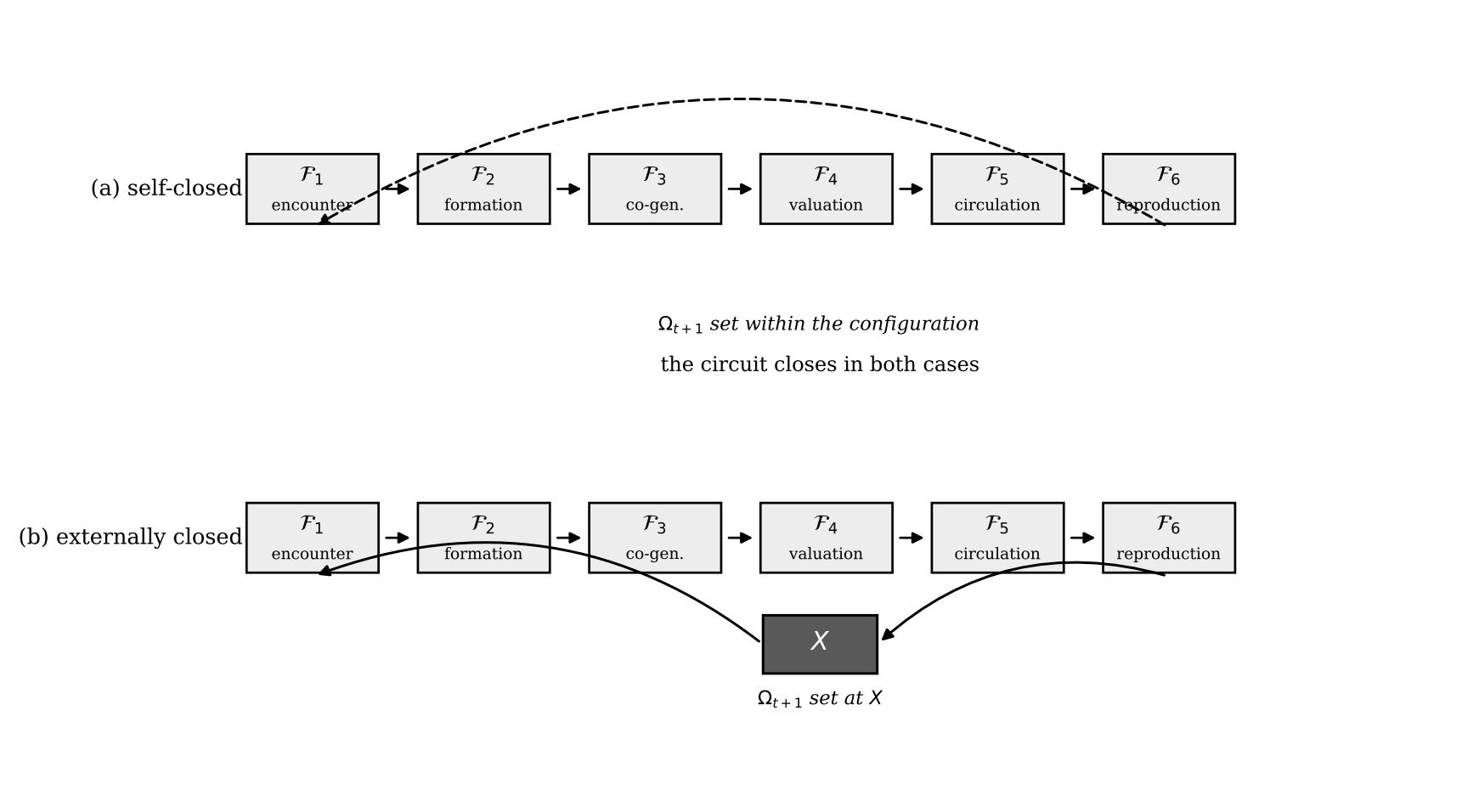
Figure 1. Self-closure and external closure. In both panels the lifecycle circuit of Equation (1) closes and the configuration continues to generate. In panel (b) the reset of the possibility space runs through a position outside the configuration, as at Equation (18), so that each cycle begins from terms set elsewhere. Nothing observable within the six regions distinguishes the two.
8.2 Reproduction of the holding
Where a position holds aspect scope across several regions and the
configuration is externally closed at that position, the arrangement reproduces
the conditions of its own extraction without further intervention. The
configuration enters each cycle with the space of relations the position has
set, forms relations under the position’s grammar, generates what that grammar
admits, and arrives again at a reproduction region the position closes.
The loop of Equation (20) records it, with $\mathcal G_X$ the grammar
the external position supplies.
$$\mathcal F_t \xrightarrow{\ \mathcal G_X\ } V_t
\longrightarrow X \longrightarrow \mathcal F_{t+1}^{,X}$$
8.3 Amplification
Equation (20) returns the arrangement to its starting state. A second
circuit raises the position’s holding rather than restoring it. Value captured
from a configuration is convertible into the acquisition of further relational
surfaces, and a position operating on more surfaces holds more:
$$P_t \ \longrightarrow \ V_{\mathrm{captured}} \ \longrightarrow
\Omega^{\mathrm{new}}p \ \longrightarrow \ P{t+1} > P_t$$
where $\Omega^{\mathrm{new}}_p$ denotes configurations newly available to the
position, whether by the mechanism of Section 9 or by the
ordinary purchase of access.
Equation (20) and Equation (21) are distinct circuits.
The first returns a holding to itself across cycles and admits a steady state.
The second raises the holding, and a steady state requires some term the
arrangement supplies from elsewhere. Section 17 concerns
whether such a term is available.
Proposition ? matters for what a remedy must reach. An
arrangement in the first circuit is arrested by interrupting the loop at any
point. An arrangement in the second continues to grow while any single
interruption holds, since the holding acquired in earlier cycles operates on
surfaces the interruption leaves untouched.
8.4 Effects on generated value
Composition.
Under flow-level extraction a relation generates and a share is taken. The
quantity generated is what it would have been, and the dispute concerns its
division. Under grammar-level extension the quantity generated differs. By
Proposition ?, the grammar fixes which interactions are
available, and relational value is generated by interactions.
Where a position holds form and conditions across regions, the value the
configuration generates differs in composition from the value it would have
generated under a grammar it authored. The difference is other than a share of a
fixed quantity, and it survives any redistribution of what was generated.
Proposition ? has a corollary that merits statement rather
than avoidance. Since the counterfactual composition is unobservable, no party
can demonstrate what the configuration would have generated otherwise. This is a
limit on the framework’s evidential reach, recorded at
Section 22, and it also describes the situation the configuration
is in, since the loss includes the evidence of the loss.
Authorship of the representation gap.
The companion paper defines the representation gap at Equation (7)
and treats it as a structural feature of any valuation apparatus, since no set
of formats admits everything. Holding form at the valuation region changes its
status.
Where a position holds the form-aspect sites of the valuation region, the
contents of $\Delta_V$ are determined at that position. What the configuration
generates outside the admitted formats is foreclosed by construction rather
than by the general limits of representation.
This is the point at which the companion paper’s foreclosure result becomes an
act rather than a condition. There, the unrepresentable passes through valuation
unrecorded because no vocabulary admits everything. Here, a position determines
the vocabulary, and thereby determines which of a configuration’s generation
will be recorded. Assessment categories, crediting schemes, and performance
taxonomies operate in this way wherever the position issuing them also draws on
what the assessed configuration generates: the categories function as the terms
in which contribution is thereafter required to appear.
Status of return.
The return ratio at Equation (9) presupposes a denominator, and the
companion paper’s sites of obstruction, diversion, dilution and delay all
presuppose a return that exists and is prevented from arriving.
Where a position holds the form-aspect sites of the reproduction region, the
forms in which return may be made are the forms that position issues. A return
in any other form is withheld from the class of possible claims, and $\rho_R$
has no denominator the configuration can state in its own terms.
The distinction between blocked and undefined return is one the paper turns on,
and ordinary experience supplies it. A party owed payment and not paid can say
what is owed. A party whose contribution has no category can say that something
is wrong while lacking the terms to say what would answer it. The first is a
grievance. The second is the condition in which grievances form without becoming
formulable, and Section 14 treats what becomes of a
party held in it.
Direction of conversion.
Equation (8) records that the same relational value may carry
materially different conversion capacity for different parties, and the
companion paper treats this as a circumstance arising from position, access, and
the holding of instruments. Under grammar-level extension it is a property of
the grammar. A position holding form at the circulation region determines which
carriers value may travel on and which conversions are available, so what the
configuration generates is convertible by the position and not by the
configuration, and the acts available to the configuration are the acts the
grammar admits.
8.5 The share question
Under grammar-level extension the operative question ceases to be what share of
a relation’s generation was taken.
A configuration under such a holding generates a composition it did not choose,
has the unrepresentable part of that composition determined for it, lacks terms
in which to state a return, and lacks the capacity to convert what it holds. The
question of what share was taken accordingly has no formulation available to the
configuration. The share may be small and the answer may be agreed. The question
lacks terms.
Corollary ? explains something the companion paper observes
and leaves unexplained. Parties in such arrangements frequently report being
unable to say what was taken from them, and the report is ordinarily treated as
a failure of articulation on their part. It is accurate. The vocabulary in
which the statement would be made is supplied by the position the statement
would be made against.
It also explains why remedies aimed at fairer shares leave such arrangements
substantially unchanged. A better division presupposes an agreed account of
what is to be divided, and that account is the thing at issue.
Section 21 takes up what a remedy directed at the grammar would
require.
8.6 Relation to the companion paper’s conditions
The four conditions of Section 5.5 and the five of
Section 10.5 stand in a definite relation, and stating it
prevents the two sets from being read as competitors.
The companion paper’s conditions decide whether an appropriation has occurred at
a site. Their object is a transaction, their evidence is a flow, and their
question is whether a quantity surrendered failed to return to an identifiable
position that also controlled the description.
The conditions of Section 10.5 decide whether a
configuration stands under grammar-level extension. Their object is the
configuration, their evidence is the distribution of aspect holding across
regions together with the location of closure, and their question is whether the
configuration generates on terms it did not author.
The two hold independently. An arrangement may satisfy all four companion
conditions at many sites and none of the five, which is heavy extraction within
a grammar the parties retain. An arrangement may satisfy all five and few of the
companion conditions at any site, which is the case
Claim ? concerns, and which is the harder case to see,
because at every site the arrangement passes inspection.
Political economy supplies an antecedent for the structure of this section, and
the concession can be made precise. Marx distinguishes the subsumption under
capital of a mode of labour already developed before the capital-relation
emerged, which he calls formal subsumption, from the case in which the labour
process is itself transformed ()[appendix]marx1976capital. Two
correspondences hold. The antecedence requirement of
Condition ? is the condition Marx builds into formal
subsumption, namely that something was already in operation before the position
arrived. Propositions ? through ? state
what the transformation becomes where the process generates recognition,
coordination, standing, or care rather than commodities, in that the
reorganization runs through the terms of description, since those are what
constitute the value in the first place. The paper claims no identity with the
analysis cited, and the differences noted at
Remark ? apply here as well.
9. The Third-Party Position: Opacity, Non-Operability, and Legibility
Definition ? turns on the absence of agreement by the parties
to $R_2$ other than the common party. This section treats those parties. It has
four objectives. The first is to describe what such a party commits and on what
basis. The second is to distinguish two ways in which the structure such a party
enters may be inaccessible, namely the destination of what is committed and the
identity of the position that effectively governs the relation. The third is to
separate a practical failure from both, which survives the removal of either.
The fourth is to state the principle these failures offend. The method is
analytic, working from the position of a party who has no view about the
relation between $p$ and $q$ and needs none. The section is placed first among
the injustice arguments for that reason: it can be argued without settling what
$q$ owes $p$.
9.1 What the third party commits
Let $r$ be a party to $R_2$ other than $q$, and let $V_r$ be what $r$ commits to
$R_2$. The resources at issue are frequently scarce and non-reproducible: an
introduction, a recommendation, a trusted professional opening, an allocation of
attention, or access to a network that admits few. A party commits such
resources on a judgement, and the judgement is about $q$. Trust extended in
$R_2$ rests on what $r$ takes $q$ to be, on the history $r$ and $q$ have, and on
what $r$ expects the configuration to become.
Two features of this commitment matter for what follows. Resources of this kind
are not recovered on discovering that the judgement was misplaced, since an
introduction once made has been made. Resources of this kind also carry the
committing party’s own standing, since a recommendation stakes the reputation of
the party who gives it.
9.2 Allocation opacity
Where $p$ has acquired access to $R_2$ under
Definition ?, the value $r$ commits may reach $p$. Write
$$\mathrm{Allocation}_r(q) \ \neq \ \mathrm{Destination}(V_r) ,$$
where the left side is the party to whom $r$ directed the commitment and the
right side is the position at which the value arrives.
Allocation opacity obtains where Equation (22) holds and $r$
lacks the means to establish that it holds.
The operative failure is narrower than a comparison of how well $p$ and $q$
would use what was committed. A party assessing whether to commit scarce
resources forms a judgement about a recipient, and $r$ formed no judgement about
$p$ at all. The question of whether $p$ merits the commitment was never
presented to the party entitled to decide it, and
Section 15 takes up the separate question of what the
resources are then used for.
9.3 Agency opacity
A second inaccessibility concerns the structure itself. Write $R_{qr}$ for the
configuration as $r$ experiences it and $R_{pqr}$ for the configuration in which
$p$ effectively holds. The condition at issue is
$$\text{experienced structure } R_{qr} \ \neq \ \text{effective structure } R_{pqr} .$$
Agency opacity obtains where Equation (23) holds and the
divergence is unavailable to $r$.
Three capacities depend on what Equation (23) withholds. The
first is epistemic, concerning the identity of the parties to whom $r$ stands in
relation. The second is operational, concerning which party $r$ must reach in
order to govern the configuration, given that address to $q$ may leave the
controlling position untouched. The third concerns exit and revision, since
whether to remain in a configuration and on what terms is assessed against the
structure a party takes themselves to be in.
Relational opacity is the composite of Definitions ?
and ?, comprising opacity of the destination of committed
value together with opacity of the effective agency structure.
Condition ? treats schema power as held against the parties
within a configuration. Definition ? describes the same
power operating against a party who is inside a configuration and to whom the
composition of that configuration is unavailable. The two are the same condition
seen from different positions.
9.4 Non-operability
Disclosure answers the definitions above. A third failure survives it.
Relational non-operability obtains where a participant is unable to govern a
configuration effectively because the operative agency structure lies beyond the
reach of that participant’s action.
Where $r$ learns that $p$ holds in $R_2$, the instruments available to $r$ remain
those that reach $q$. Negotiation, renegotiation, conditioning of further
commitment, and withdrawal are all addressed to the visible party, while the
position that determines the destination of $V_r$ sits outside the range of
each. Write
$$\mathrm{Governability}_r(R_2) \ \downarrow$$
for the resulting reduction, which Equation (24) registers
independently of what $r$ knows.
A remedy directed at relational opacity leaves non-operability standing.
Disclosure supplies $r$ with the effective structure and supplies no instrument
that reaches $p$. The two failures accordingly call for different remedies, and
the second is the condition under which the first becomes consequential.
Proposition ? has the shape of a problem the companion
list records as open, in which the effective point of intervention is
unavailable at the point where the loss appears. The paper states the structure
and leaves the general problem where the companion list leaves it.
9.5 The legibility principle
A participant committing scarce relational resources to a configuration should,
within reasonable limits, have access to the effective agency structure of that
configuration.
Definition ? states an obligation owed by a structure to a
participant. The direction is worth marking, since the same property appears in
the literature running the other way. Administration proceeds by rendering a
domain legible, which requires that local arrangements first be simplified into
categories the governing position can read, and the simplification is a
condition of governing at all (Scott, 1998). Legibility in that
direction is imposed by a governing position upon those it governs and operates
as an instrument of rule. Legibility in the sense of
Definition ? is owed to a party who commits resources, and
its absence operates to that party’s cost. The property is one property and the
obligation runs in opposite directions in the two cases.
9.6 The third party’s claim
Entering a configuration with $q$ constitutes no agreement by $r$ to make $r$’s
scarce relational resources available to a position $r$ is unable to identify,
assess, negotiate with, or constrain.
Claim ? requires no view about what $q$ owes $p$. Granting a
claim by $p$ upon $q$ in full, and granting that $q$ discharges it willingly,
the position of $r$ is unaffected by either grant, since $r$ is party to neither
question. The argument of this section is available to a reader who accepts
every claim $p$ makes.
The section identifies mechanisms by which a party’s position may be wronged and
states them as such. Whether a particular arrangement is unjust on balance
depends on considerations the paper does not settle, and
Section 22 records the limitation. The claim advanced is that the
mechanisms described give a reason for objection which the arrangement has to
answer.
10. Heterogeneous Value Domains and Asymmetric Conversion
Section 15 separates the fairness of a conversion from the
existence of a claim and from the legitimacy of a use. This section treats the
first of those questions. It has four objectives. The first is to establish that
relational value occupies several domains which need not share a scale. The
second is to state what a conversion between domains requires. The third is to
describe two features of the conversions at issue here, namely who sets the rate
and how the domains differ in scarcity. The fourth is to record what the section
needs from a general theory of value and to show that it needs very little. The
method is to defeat particular conversions rather than to supply a scale, and
Remark ? states why that suffices.
10.1 Domains of relational value
Equation (2) sets out the domains in which relational value
arises. The decomposition is analytic, and it carries no commitment that the
components share a scale or admit summation. Two values may each be value while
standing in no determinate ratio to one another.
Write $V^{(a)}$ and $V^{(b)}$ for values in distinct domains. A conversion
between them is a mapping
$$\lambda : V^{(a)} \longmapsto V^{(b)} ,$$
and the question this section asks concerns what licenses a particular
$\lambda$.
10.2 What a conversion requires
From the fact that $V^{(a)}$ and $V^{(b)}$ are both values it does not follow
that they are exchangeable at any determinate rate. Shared possession of the
property of being valuable establishes no ratio between two things, and a rate
holds only where some normative arrangement supplies it.
A conversion under Equation (25) is unlicensed where the
parties stand under no normative arrangement fixing a rate between the domains,
and the rate applied is supplied by one of them.
The arrangements described in this paper present conversions of a particular
shape. A contribution is made in one domain, comprising subsistence, care,
instruction, time, and material support. A return is claimed in another,
comprising access, standing, professional opportunity, reputation, capacity, and
future income. The claim arises over the first and is asserted over the second,
and the two lie in domains between which
Proposition ? finds no antecedent ratio.
10.3 Who sets the rate
Where no arrangement supplies $\lambda$, it is supplied by a party. The
arrangements at issue place both accounts in the same hands:
$$\lambda = \lambda_p , \qquad
p \ \text{holds the account of what was given and of what is owed} .$$
Equation (26) is Condition ? applied to a
conversion rate. The position supplying the terms in which a relation’s value is
described thereby supplies the ratio at which one kind of value discharges a
claim arising over another, and the ratio admits revision upward without
encountering any term the arrangement supplies.
Proposition ? connects this section to the criterion of
Section 10. A holding of the conditions aspect at the valuation
region is a holding of the terms of description, and the setting of $\lambda$ is
an exercise of that holding rather than a further kind of power.
10.4 Asymmetry of scarcity
The domains at issue differ in a second respect. What was contributed is
frequently common, substitutable, and reproducible, while what is claimed is
frequently scarce, non-substitutable, and not reproducible:
$$\text{scarcity}\bigl(V^{(a)}\bigr) \ \ll \ \text{scarcity}\bigl(V^{(b)}\bigr) .$$
Under Equation (27) a conversion at any rate transfers a resource
whose replacement is unavailable in exchange for one whose provision was
available from other sources. The vocabulary of return describes the
transaction while the scarcity difference determines what each party gives up.
Proposition ? is independent of
Proposition ?. A rate set by an impartial third party would
leave Equation (27) untouched, since the asymmetry is a feature of
the domains rather than of the procedure.
10.5 What the section requires of a theory of value
The comparison of value across kinds is recorded as an open problem in the
companion problem list, and this section neither solves it nor depends on its
solution. Defeating a particular conversion requires establishing that no
arrangement licenses the rate applied, which
Definition ? states and which is decidable in a given case by
examining what the parties stand under. Supplying a rate would require the
general theory. The asymmetry of the section’s requirements follows from the
asymmetry of the tasks: a conversion is defeated by the absence of a licence and
is sustained only by the presence of one.
Nothing here denies that a contribution grounds a claim, and
Proposition ? states the claim the paper allows. What the
section denies is that a claim arising in one domain is dischargeable at a rate
of the claimant’s own setting in a domain the claimant did not supply. A reader
holding that the domains are commensurable after all is answered by
Proposition ? and Proposition ?, neither of
which turns on incommensurability.
11. Instrumentalization of the Subject, the Third Party, and the Relation
Sections 12 and 13 treat the position of a
party outside the original relation and the conversion by which value crosses
between domains. This section treats what the arrangement makes of those
involved in it. It has four objectives. The first is to identify three parties
and one relation that are put to use, and to distinguish the manner of each. The
second is to state the mechanism as a single sequence. The third is to describe
the developed form, in which the arrangement continues without the holding
position acting. The fourth is to record what the developed form implies for
Section 21. The method is to apply an existing analysis of
instrumentalization to the structure established in the preceding sections, and
the ground of the objection is conceded at
Remark ? rather than derived.
11.1 Three parties and a relation
Let $p$ hold power in $R_1$ with $q$, and let $R_2$ be the configuration $q$
forms with $r$, as at Definition ?. Four things are put to
use, and the manner differs in each case.
The relation.
$R_2$ serves ends formed outside it. By
Definition ? it stands instrumentally to $p$, whose ends were
settled in $R_1$, while standing constitutively to $q$ and $r$, who are within
it. Relational instrumentalization is the reduction of a configuration to a
channel for value moving to a position that is no party to it.
The constituted party.
$q$ generates within $R_2$ and transmits what is generated to $p$. The manner of
use here differs from simple appropriation, since $q$’s generative capacity is
what operates and $q$’s standing with $r$ is what makes the transmission
available. Generativity proxying is the use of a party’s capacity to generate as
an instrument for a position that supplies no part of the conditions of that
capacity, in the sense of Definition ?.
The third party.
$r$ commits scarce relational resources on a judgement about $q$ and supplies,
without being asked, the resource that reaches $p$.
Section 12 establishes the opacity under which the commitment
is made, and the present point is narrower: $r$ functions within the arrangement
as a source, and the function was assigned rather than accepted.
The holding position.
$p$ is the point at which the value accumulates. Naming $p$ here records that
the arrangement has an accumulating position rather than a diffuse
beneficiary, which is what makes the sequence below traceable.
The objection to treating a party as a means is not this paper’s. The tradition
that holds human beings to be ends in themselves, never to be used by anyone
merely as a means, supplies it (Kant, 1998). A later analysis
separates the elements ordinarily gathered under objectification, among them
instrumentality and the denial of autonomy, and treats them as distinct rather
than as one thing (Nussbaum, 1995). That separation is what
the present section requires, since the three parties above are used in
different manners and a single undifferentiated charge would obscure the
differences.
11.2 The sequence
The elements described above compose in a definite order:
$$\begin{aligned}
&P_p(R_1) \ \to \ \text{boundary overreach into } R_2 \
&\quad \to \ \text{capture of } V_{R_2} \ \to
\text{$q$ as conduit},\ \text{$r$ as source} \
&\quad\quad \to \ P_p \uparrow \ \to \ \text{further reach}
\end{aligned}$$
Each stage of Equation (28) is established elsewhere in the paper.
The first is Equation (16), the second
Definition ?, the third Definition ?, the
fifth Equation (21). The fourth is the subject of this section.
Under Equation (28) no single party’s treatment accounts for the
arrangement. The relation is reduced to a channel, one party’s generativity
operates as an instrument, and another party supplies a resource under a
description that was never presented. A remedy addressed to any one of the three
leaves the sequence otherwise intact.
11.3 The developed form
An arrangement of this kind admits a state in which the holding position ceases
to act and the arrangement continues.
A configuration under grammar-level extension is in its developed form where the
parties within it apply the imposed grammar to themselves and to one another
without instruction, enforce it against parties who depart from it, and describe
their own value in its terms when no external party is present.
Three features distinguish the developed form from the states preceding it.
External enforcement becomes unnecessary rather than merely infrequent, so the
holding position may withdraw entirely while the arrangement continues. The
parties become enforcers, and correction is experienced by them as maintaining a
standard rather than as serving anyone. The grammar becomes the medium of the
parties’ own deliberation, which is the strongest form: the terms are what the
parties think in, so a formulation of the alternative would have to be
constructed before it could be considered.
The phenomenon is owned by an established literature and is conceded rather than
claimed. The oppressed host the oppressor’s frame internally, so that liberation
requires the expulsion of that frame rather than the substitution of one party
for another within the same structure (Freire, 1968). The mechanism
by which an imposition comes to appear natural is misrecognition
(Bourdieu & Passeron, 1970).
The developed form is the condition in which Equation (18)
obtains with the external position absent from it. The reset of $\Omega_{t+1}$
continues to run on the imposed grammar, the operation is performed within the
configuration, and the loop of Equation (20) closes without $X$.
Proposition ? carries the section’s contribution, which
lies in the placement rather than in the phenomenon. Read as a property of
persons, the developed form indicates a response addressed to persons, through
consciousness, education, and recognition of what has occurred. Read as a
property of a circuit, it indicates a response addressed to the point at which
the circuit closes, which is the reproduction region and the sites determining
what the next cycle begins from. The two responses are compatible and they
differ, and Section 21 takes up why the second is ordinarily
harder to reach.
11.4 The register account
The companion paper’s register layer describes the sequence by which the state
arrives, and this is the one place in the paper where that apparatus does work
rather than supplying vocabulary.
The imposed grammar enters as symbolic material, being categories, names,
standards, and the terms in which contribution is recorded. It forms an image
of the party and of the relation, since a party told what counts forms a
picture of themselves as the kind of party who does or does not produce it.
That image is then borne materially, in the actual conduct of work, the actual
allocation of time, and the actual accumulation or loss of capacity. It returns
to the symbolic when the party states the grammar to others as their own.
Equation (29) records the sequence.
$$\Sym \longrightarrow \Ima \longrightarrow \Reg \longrightarrow \Sym’$$
The final term distinguishes this from the trajectories the companion corpus
ordinarily records. Most of its sites terminate in the Real, where an
intervention issues in conduct. One site terminates in the Symbolic, being the
one at which a norm is repeatedly formulated until parties inside the
arrangement formulate it to newer parties, and the companion paper assigns that
trajectory for this reason: the mechanism completes when the party becomes its
author.
Equation (29) is that closure at the scale of a configuration rather
than a site. At its final term $\mathcal G_X$ and the configuration’s own
grammar are the same object, and the question of whose grammar it is has no
observable answer. Section 18 states the same completion in
terms of the authority to revise, since a party who formulates the grammar as
their own has ceased to hold grounds on which to contest it.
Corollary ? holds that an operation on a grammar acts on
the formation of intention rather than on a formed one.
Equation (29) states the path. A configuration in its developed form
exhibits no compulsion, no dispute, and no grievance, and exhibits none of them
because the grammar in which a grievance would be formed is the one at issue.
The caution of Section 6.4 applies with full force here,
since the same observable picture is presented by a relation that is working
well, and the absence of dispute alone supports no finding. The conditions of
Section 10.5 require positive evidence about aspect holding,
closure, and antecedence, and this section supplies no shortcut around them.
11.5 Consequences for reversal
Two consequences of the developed form bear on Section 21 and
are stated here.
Removing the holding position changes little. Where the configuration performs
the operations on itself, the departure of $X$ leaves
Equation (18) running with an internal party in the role. A
structure of this kind accordingly survives the departure of the position that
established it, which is why a remedy directed at the position alone leaves the
circuit closing as before.
A prior state is unavailable for return. A configuration that has passed through
the sequence of Equation (29) has generated, over the intervening
cycles, its history, its capacities, its relationships, and its members’
self-understanding under the imposed grammar. What preceded the grammar stands
beyond recovery, since the parties who would recover it are the parties the
grammar formed. Section 21 treats what remains available in
place of return.
12. Use Legitimacy: Misallocation, Degradation, and Normative Misuse
Sections 12 through 14 concern how
a position acquires access to a configuration and what the acquisition does to
the parties. This section concerns what follows the acquisition. It has three
objectives. The first is to separate three questions the argument has so far
treated together, and to establish that the later two are answerable
independently of the first. The second is to distinguish three ways in which the
use of transferred relational value may be assessed. The third is to record what
each assessment requires and what it leaves open. The method is to hold the
question of entitlement in suspense throughout, so that the section’s results
are available to a reader who grants the upstream position whatever claim it
asserts.
12.1 Three questions held apart
The argument to this point has moved between questions that come apart:
$$\text{claim legitimacy} \ \neq \ \text{conversion fairness}
\ \neq \ \text{use legitimacy} .$$
The first asks whether the upstream position holds any claim over what a party
later generates. The second asks whether an early contribution and a later
scarce resource are justly convertible, which Section 13
treats. The third asks what the resources are used for once transferred.
The second and third questions of Equation (30) are answerable
without settling the first. A transfer may be assessed for the fairness of its
conversion and for the legitimacy of its use on the assumption that some claim
exists, since both assessments concern what happens to the resource rather than
whether it was owed.
Proposition ? governs the sections that follow it.
Section 16 presses the first question and reaches a bounded
conclusion, that a contribution creates a reason for reciprocity without an
unlimited right of conversion. The present section presses the third and reaches
its conclusions on a stronger concession still, namely that the claim is granted
in full.
12.2 Misallocation
The companion paper records that a given value carries materially different
conversion capacity for different parties, as at Equation (8),
where the parties compared are parties to the relation that generated the value.
The present case compares a party to the generating configuration with a
position outside it:
$$\kappa_p\bigl(V_{R_2}\bigr) \ \ll \ \kappa_q\bigl(V_{R_2}\bigr) .$$
Relational misallocation obtains where value generated in a configuration is
transferred to a position whose capacity to convert it falls materially below
that of the parties who generated it, as at
Equation (31).
The ground of Equation (31) is the path and context dependence
of relational value. An introduction, a standing, or an access is convertible by
a party positioned within the history that produced it, and its conversion by a
position outside that history yields less. Removal of relational value from the
context of its generation therefore reduces what the value can accomplish, and
the reduction is a property of the transfer rather than of the transferee’s
competence. The companion paper records a site of this kind under the heading of
decontextualization, reached there from the direction of the generating party
rather than from the destination.
12.3 Generative degradation
A second assessment concerns the configuration the value came from. Where the
remaining parties to $R_2$ observe that what they extend to $q$ is drawn on by
$p$, their basis for extending further is affected:
$$\text{observed diversion} \ \to \ \text{trust}!\downarrow
\ \to \ \text{further extension}!\downarrow
\ \to \ G\bigl(R_2\bigr)!\downarrow .$$
Under Equation (32) the extraction of value from a
configuration reduces the condition under which that configuration generates
value. The trajectory is that of Equation (11), obtaining here for
a position that is not a party to the configuration whose generativity declines.
Proposition ? distinguishes this case from the extractive
circuit the companion paper describes. There the extracting position stands
inside the relation whose return ratio falls and bears some part of the
consequence. Here the position bears none, since its own configuration is $R_1$
and the decline registers in $R_2$. Section 19 takes up
what follows where the position’s yield depends on the declining configuration.
12.4 Normative misuse
A third assessment concerns the purposes the transferred value serves.
Effective conversion establishes that a position can use a resource and leaves
open whether the use is legitimate.
An increase in a position’s generative capacity supplies no assessment of the
purposes to which the increase is put. From the observation that a position
converts a transferred resource well, nothing follows about whether the
conversion is one the arrangement has reason to sustain.
Normative misuse obtains where value transferred under
Definition ? funds an extension of the transferring position’s
holding, as at Equation (33).
The uses at issue are those that return to the mechanism of
Section 9:
$$V_{R_2} \to p \ \to
{\text{control},\ \text{dependence},\ \text{advantage},
\text{entry to further relations},\ \text{exclusion}}
\ \to \ P_p!\uparrow .$$
Where Equation (33) obtains, the transfer has become an
input to the circuit Section 11 describes, and the claim under
which the transfer was made is functioning as an instrument of expansion.
The three assessments are independent of one another. A transfer may be
converted well and still fund expansion, satisfying
Definition ? while failing
Definition ?. A transfer may be converted poorly and fund
nothing further. Equation (32) may obtain whatever the
destination does with what it receives, since it turns on what the remaining
parties observe.
12.5 Standing of the section
Each assessment requires a comparison the paper supplies no measure for.
Equation (31) compares conversion capacities,
Equation (32) posits a response by parties whose reasoning is
not modelled, and Definition ? requires the destination of a
transferred resource to be traced. What is established is that the three
assessments are distinct, that each is available without settling the question
of entitlement, and that an arrangement satisfying the first question may fail
any of them.
13. Provenance, Standing, and Historical Contribution
Section 12 argues from the position of a party who has no view
about what the common party owes the upstream position. This section takes up
that owing directly, and does so in a way that leaves its magnitude
undetermined. It has four objectives. The first is to establish that a
contribution to a party’s generative capacity is partial, and to state what
follows for claims resting on it. The second is to show that such claims lack a
natural terminus, and to concede the existing treatment of the structure that
results. The third is to distinguish a claim upon a party from a claim upon
value that party generates jointly with others. The fourth is to state what the
co-generating party’s own claim consists in. The method is to press the second
and later questions without settling the first, so that the argument stands for
a reader who grants the upstream position a substantial claim.
13.1 The partiality of a contribution to generative capacity
Let $G_q$ be the generative capacity of a party $q$, and let $p$ have
contributed to its formation. That contribution enters alongside others:
$$G_q = f\bigl(H_p,\ q,\ R_1, R_2, \ldots,\ E,\ L,\ \chi,\ \tau \bigr),$$
where $H_p$ is the history of $p$’s contribution, $E$ is education, $L$ is later
encounter, $\chi$ is chance, and $\tau$ is the party’s own practice, reflection,
failure, and self-transformation. Each argument of $f$ in
Equation (34) rewrites $G_q$ over time, and the capacity operating
at any later moment is the joint product of all of them.
Generative provenance overclaim is the treatment of a partial contribution to
the formation of a capacity as an entitlement over the whole capacity and over
what it subsequently produces.
From $H_p$ appearing as one argument of Equation (34) it follows
neither that $G_q$ belongs to $p$ nor that the value $G_q$ generates at every
later moment is owed to $p$. Causal contribution to the formation of a capacity
leaves the question of continuing entitlement over the capacity’s products open,
and Equation (34) shows why: the contribution is one condition
among several, and the others continue to operate after it has ceased.
Proposition ? sharpens the result recorded in this
programme, that origin confers no claim. The earlier statement denies that being
the source of something grounds a continuing claim upon it. The present
statement adds that the source was in any case partial.
13.2 Termination
A claim resting on a completed contribution admits no internal limit on what
discharges it. Where $V_1, V_2, V_3, \ldots$ are the values $q$ generates in
successive cycles, the structure at issue is
$$V_1 \to p, \quad V_2 \to p, \quad V_3 \to p, \quad \ldots$$
in which each newly formed capacity is absorbed into the existing entitlement as
it appears. The contribution is finite and the entitlement claimed from it is
open-ended.
Perpetual relational rent is continuing benefit drawn from a party’s later
generated value by virtue of a relational position formed in the past, in the
absence of continuing corresponding contribution. Equation (35)
gives its form.
Class analysis has treated a structure of this shape. A concept of class as
exploitation has been founded on control over assets that produce economic
rents, on a broad conception of property rights
(rensen, 2000), and the proposal was contested on publication by
commentators who questioned the identification of exploitation with rent
(Wright, 2000; Goldthorpe, 2000). Definition ? names a
relational instance of the structure that exchange concerns, and the paper takes
no position on the class-theoretic question at issue between the parties to it.
In the treatment cited the rent-producing asset is held by the beneficiary. The
arrangement described here admits a beneficiary holding no such asset, whose
yield depends instead on another party’s continuing generation.
Section 19 takes up the consequence, which is that the
yield persists only while the generating party’s conditions are maintained.
A contribution creates a reason for reciprocity. It creates no unlimited right
of conversion across value domains and no standing entitlement to the products
of later cycles. Reciprocity so understood is bounded in what it may require,
revisable as the relation’s history develops, and constrained by the claims of
the parties currently generating.
Proposition ? concedes what the reciprocity claim contains
and denies what the conversion adds.
Section 13 treats the conversion itself, and the present
section proceeds to a question that arises whatever its outcome.
13.3 Value generated with others
Let $q$ and $r$ generate value in the configuration $R_2$ they form together.
The value in question is
$$V_{R_2} = f\bigl(G_q,\ G_r,\ R_2,\ H_{R_2}\bigr),$$
where $H_{R_2}$ is the history of that configuration. The generative capacity of
$q$ enters Equation (36) as one argument among four, and $p$
enters it only through $H_p$ in Equation (34), which is one
argument of one argument.
Co-creation appropriation is a claim by a position upon value generated jointly
by several parties, resting on a historical relation with one of them.
$V_{R_2}$ resists decomposition into a portion belonging to $q$ and a portion
belonging to $r$. Trust, cooperative opportunity, shared knowledge, joint
results, reputation, and access arise from $R_2$ itself, so a division of them
between the parties has no determinate result to report.
A claim upon one contributor yields no claim upon value that contributor
generates jointly with another. Where $p$ takes $V_{R_2}$, $p$ disposes of what
$r$ participated in producing.
13.4 Standing
The operative concept is standing. A position may hold a claim upon a party
while lacking any qualification to participate in decisions internal to a
configuration that party forms with others.
Historical contribution to one participant’s generative conditions confers no
automatic standing over value later co-generated in a distinct relational
system.
Definition ? carries the argumentative weight of this
section, and it does so by relocating the burden. The contested question is what
$q$ owes $p$, and it requires a position on the ethics of the relation between
them. The question Definition ? raises is available without
one:
Granting that $q$ owes $p$ a return, it remains to be shown that $q$ may
discharge the obligation unilaterally with relational value generated jointly
with $r$.
Claim ? resembles an intuition about property, that an
obligation owed to one party is not dischargeable with an asset held jointly
with another. The paper advances it as a claim about relational value and makes
no claim about positive law, since the sharing conception of co-ownership on
which the intuition rests is a contested position in property theory rather than
a description of doctrine (Penner, 2006). The force of
Claim ? rests on Proposition ? and
Corollary ?, both of which are established above.
13.5 The co-generating party’s claim
The claim available to $r$ extends beyond a share of $V_{R_2}$ to participation
in the decision whether $V_{R_2}$ is transferable at all.
Claim ? follows from the character of the value at issue.
Access, trust, reputation, standing, and future cooperation are low in
portability at Equation (4), since their function depends on the
configuration that generated them, so a transfer of any of them out of $R_2$
alters what is transferred as well as what remains. Where the value admits no clean division under
Proposition ?, a claim to a portion of it has no determinate
object, while a claim to participate in deciding its disposition does.
The distinction Claim ? draws is drawn in the analysis of
ownership, where the right to manage a thing, meaning the right to decide how
and by whom it shall be used, is separated from the right to the income it
yields (‘e, 1961). The claim advanced here is of the first kind.
Naming it so identifies what $r$ loses under Definition ?,
which is a governing capacity rather than a quantity.
Equation (36) and Definition ? treat $R_2$
as a distinct relational system. Remark ? records the
criterion of membership on which that treatment rests, which the companion
problem list holds open. The comparison of value across kinds, on which
Section 13 turns, is recorded as open there as well.
14. Counter-Power Co-Production and Its Capture
Sections 12 through 16 give reasons for
holding an arrangement of the kind described objectionable. The present part
proceeds differently. It describes what such an arrangement does to its own
conditions, and the results it reaches hold whether or not the reasons already
given are accepted.
This section opens that argument. It has four objectives. The first is to state
what value production ordinarily produces alongside value. The second is to
specify that product in terms admitting assessment. The third is to describe its
capture and the inversion capture effects. The fourth is to give the dynamic
consequence and to concede the existing treatment of the category the section
uses. The method is to state a condition on relational systems and then to
describe an arrangement in which the condition fails.
14.1 What value production ordinarily produces
A party generating value acquires more than the value. Generation places the
party in a position from which the terms of the relation can be affected, and
the acquisition is ordinary rather than exceptional. Write
$$G_q \ \to \ V_q \ \to \ P^{\mathrm{c}}_q ,$$
where $P^{\mathrm{c}}_q$ is the capacity the generating party acquires to
constrain the power operating upon it.
A relational system satisfies counter-power co-production where value produced
within it enlarges the producing party’s capacity to constrain the power that
the value relation generates, as at Equation (37).
Definition ? concerns constraint rather than the removal of
power. What it requires is that power in the relation remain answerable, so that
the relation between the parties admits adjustment as their contributions
change:
$$P_p \ \dashv \ P^{\mathrm{c}}_q ,$$
where Equation (38) denotes a standing constraint rather than an
equality of holdings.
14.2 The capacities at issue
The capacity written $P^{\mathrm{c}}_q$ decomposes into six, which are listed so
that the condition of Definition ? may be assessed in a
given arrangement rather than asserted of it.
- Bargaining capacity, the party’s position in settling the terms on which its generation continues.
- Exit capacity, the availability of departure and the cost it carries, which conditions the weight of the party’s voice within the relation (Hirschman, 1970).
- Interpretive authority, the party’s standing to say what its own contribution and the relation’s terms amount to.
- Resource autonomy, the party’s command of what it generates.
- Network independence, the party’s access to relations that do not run through the position holding power over it.
- Agenda-setting capacity, the party’s ability to determine which questions the relation treats as open, the absence of which operates through the exclusion of questions from consideration rather than through their defeat (Bachrach & Baratz, 1962).
14.3 Capture and inversion
Where the position holding power in the relation controls the destination of
what the party generates, the terminus of
Equation (37) changes:
$$G_q \ \to \ V_q \ \to \ P_p ,
\qquad \Delta P_p > 0 , \qquad \Delta P^{\mathrm{c}}_q < 0 .$$
Counter-power capture obtains where resources, capacities, relations, or
standing that a party generates, and which would enlarge that party’s capacity
to constrain the power operating upon it, are absorbed by that power and
reinforce it, as at Equation (39).
Capture in the sense of Definition ? moves both quantities of
Equation (39) at once. What would have constrained the position
holding power becomes an addition to it, so the generation that would ordinarily
enlarge a party’s standing enlarges the capacity exercised over that party
instead.
Proposition ? distinguishes capture from the loss of value.
An arrangement taking $V_q$ and leaving $P^{\mathrm{c}}_q$ intact reduces one
quantity. Capture reduces the second while raising the first term of the
position holding power.
14.4 The dynamic consequence
Section 11 describes a circuit in which captured value returns
as increased power. The present section adds what the capture removes from that
circuit. Write the change in the position’s power as
$$\frac{dP_p}{dt} = \alpha V - \gamma P^{\mathrm{c}}_q ,$$
in which the second term operates as a constraint. Under
Definition ? that term ceases to constrain and enters with the
opposite sign:
$$\frac{dP_p}{dt} = \alpha V + \beta P^{\mathrm{captured}} .$$
Under the transition from Equation (40) to
Equation (41) the arrangement generates no internal limit on the
growth of the position’s power. Constraint on such an arrangement is therefore
available from outside it, and the arrangement supplies none of its own.
Proposition ? concerns the absence of an endogenous limit
on expansion. It carries no claim of divergence in a mathematical sense, and
Equations (40) and (41) are offered as a
representation of the direction of the change rather than as an estimated model.
14.5 Standing of the category
Power meeting a counterweight has an established treatment. The concept of
countervailing power holds that concentrated economic power calls forth
organised power on the opposite side of a market, in strong buyers and in
organised labour, and that the resulting constraint operates where competition
among sellers has ceased to (Galbraith, 1952). The category the
present section uses is that category.
Two differences fix what the section adds. Countervailing power in the treatment
cited arises on the opposite side of a market and responds to concentration.
Definition ? locates the counterweight inside the value
relation and derives it from the act of generation, so its production is
endogenous to the relation rather than a response mounted against it. Capture in
the sense of Definition ? has no counterpart in the treatment
cited at all, since a counterweight that fails to organise differs from one that
forms and is absorbed. Proposition ? concerns the second.
The section states a condition and describes its failure. Whether
Definition ? holds as a general requirement on relational
systems is a question the paper raises and leaves for the treatment
Section 22 records. What is established here is that the failure
described has consequences for the arrangement itself, which
Sections 18 and 19 carry forward.
15. Normative Revisability and Its Suppression
Section 17 describes the absorption of a capacity a party
generates. This section describes the foreclosure of a second capacity, namely
the capacity to revise the terms under which the relation operates. It has four
objectives. The first is to state the ordinary cycle by which the terms of a
relation are amended. The second is to give the mechanism by which that cycle is
arrested. The third is to name what the arrested cycle withholds. The fourth is
to concede the existing treatment of contestation and to state what the present
account adds. The method is to describe a structure of interpretive authority
rather than to assess any particular normative content, which
Remark ? records as a constraint on the section.
15.1 The ordinary cycle
The terms governing a relation are amendable in the ordinary case. A party
offers an interpretation of what the terms require, the interpretation is open
to contest, and contest issues in revision:
$$\text{interpretation} \ \to \ \text{contest} \ \to \ \text{revision} .$$
Equation (42) rests on a commitment this programme carries
throughout. The terms governing a relation arise within that relation’s history
rather than standing outside it, so they develop as the history develops:
$$N_{t+1} = \Phi!\left(N_t,\ R_t,\ \Delta H_t,\ \Pi_t,\ V_t\right),$$
where $N_t$ are the terms in force, $\Delta H_t$ the increment of the relation’s
history, $\Pi_t$ its participants, and $V_t$ the value generated in the cycle.
Equation (43) stands to the terms of a relation as
Equation (15) stands to its grammar.
A position holding that the terms settled in the past thereby settle the future
denies that $\Phi$ in Equation (43) is sensitive to its third,
fourth, and fifth arguments. The denial is a denial of the historicity of the
terms rather than a substantive claim about what they require.
15.2 Fixation
Equation (42) is arrested where one party’s interpretation is
treated as the terms themselves. Write $I_p(N)$ for the interpretation a position
$p$ advances. The mechanism at issue is
$$P_p \ \to \ I_p(N), \qquad I_p(N) \equiv N ,$$
in which the holding of power secures the interpretation and the interpretation
is thereafter identified with the terms it interprets.
Normative fixation obtains where a position’s interpretation of the terms
governing a relation is treated as those terms, as at
Equation (44), so that the interpretation is withdrawn from
the contest of Equation (42).
Revisability deprivation obtains where an incumbent position prevents
participants from using newly generated experience, value, and counter-power as
grounds for contesting and revising the terms governing their relation.
Three capacities are withheld under Definition ?.
Interpretive agency is withheld, which is the standing to say what the terms
amount to and which appears among the capacities listed at
Section 17.2. Contestability is withheld, which is the
availability of the second stage of Equation (42). Participation
in the making of the terms is withheld, which is the third stage.
The section takes no position on what any obligation between parties requires.
An obligation of care, of return, of loyalty, or of deference admits several
readings, and the availability of a reading is what
Equation (42) concerns. What is described here is the
distribution of authority to settle among those readings. The object is
accordingly a structure of normative production rather than a normative content,
and disagreement about content is what Equation (42) presupposes
rather than what it condemns.
15.3 Compounding with capture
Definitions ? and ? describe foreclosures
that support one another. Fixed terms supply a justification for the position’s
holding, the holding secures the capture of what parties generate, and the
capture removes the capacity through which the terms might have been contested:
$$P_t \ \to \ N^{\ast} \ \to \ \text{justification of } P_t
\ \to \ \text{capture of } P^{\mathrm{c}}
\ \to \ P_{t+1} \ \to \ \text{enforcement of } N^{\ast} ,$$
where $N^{\ast}$ denotes terms withdrawn from revision under
Definition ?.
Under Equation (45) newly generated capacity forms no
counterweight and newly generated experience amends no term. Correction of the
arrangement from within accordingly requires a capacity the arrangement absorbs
and a procedure the arrangement has withdrawn.
Proposition ? states why the two sections belong
together and why their order matters. Capture alone leaves a procedure of
revision available to a party who retains standing elsewhere. Fixation alone
leaves a capacity that may be exercised in other arenas. Together they close
both.
15.4 Standing of the account
Authority exposed to contestation has an established treatment. Freedom
understood as non-domination has been developed together with a conception of
legitimate government under which authority is subject to systematic contestation
by those it governs, and the design of institutions is assessed by whether it
sustains that exposure (Pettit, 1997). A reader arriving from
political theory will reach for that treatment here, and the concession is due.
The present account differs in what it makes contestation answerable to.
Contestability in the treatment cited is a property of institutional design,
held against interference that tracks no interest of the governed. The account
here is diachronic. Equation (43) holds that the terms are
generated in the relation’s history, so what a party acquires the standing to
contest with is what the relation has since produced, namely experience, value,
and capacity that postdate the terms in force.
Definition ? concerns the refusal of those grounds rather
than the absence of a contesting procedure. The identification at
Equation (44) is a further difference, since a position
asserting its own reading as the terms themselves is not described by the
category of arbitrary interference.
The section describes a mechanism and states what it withholds. The threshold at
which an interpretation ceases to be one party’s reading and becomes fixation in
the sense of Definition ? is a question the paper raises and
leaves open, and Section 22 records it among the limitations.
Section 19 carries the consequence of the mechanism for
the arrangement’s own continuation.
16. Generative Conditions and the Sustainability of Relational Systems
Sections 17 and 18 describe two ways in
which an arrangement forecloses its own correction. This section states what
follows for the arrangement’s continuation. It has four objectives. The first is
to give the balance governing a party’s generative capacity across cycles. The
second is to describe a beneficiary whose yield depends on generation it does
not maintain. The third is to establish that a position’s power and the
generativity of the system it draws on can move in opposite directions. The
fourth is to state the principle these results support and to assemble the
sections of this part into a single sequence. The method is dynamic rather than
normative, and the conclusion reached here is available to a reader who declines
every argument of Sections 12
through 16.
16.1 The maintenance balance
Generativity is not a stock that persists without replenishment. Write the
balance across one cycle as
$$G\bigl(R_{t+1}\bigr) = G\bigl(R_t\bigr)
- \text{regeneration}_t - \text{extraction burden}_t ,$$
where regeneration comprises what returns to the conditions under which the
party generates, and the extraction burden comprises what the party expends in
meeting the claims made upon it. Equation (9) gives the return ratio
by which the first term is assessed.
Where the second term exceeds the first over successive cycles,
$$\text{extraction burden}_t > \text{regeneration}_t
\quad \Longrightarrow \quad
\frac{dG}{dt} < 0 ,$$
and the arrangement instantiates Equation (11) rather than
Equation (10). Sustained, the trajectory of
Equation (47) carries $G$ toward exhaustion.
Equation (47) states a direction under a condition rather than an
outcome. Whether the condition holds in a given arrangement is an empirical
question, and the paper’s claim concerns what follows where it does.
16.2 Yield without maintenance
A position may draw from a configuration while contributing nothing to the
conditions under which that configuration generates. Where $p$ receives value
generated by $q$ and supplies no part of the regeneration term in
Equation (46), the arrangement has the form
$$G_q \to V_q \to p ,
\qquad p \nrightarrow \text{regeneration of } G_q .$$
Generativity-dependent yield is benefit whose continuation requires another
party’s continuing generation, held by a position that supplies no part of the
conditions of that generation, as at Equation (48).
Definition ? names the maintenance side of
Definition ?. The two describe one arrangement, the first by what
the position receives and the second by what the position withholds.
Political economy has analysed a comparable division. Surplus arising from
production is first appropriated by one position and thereafter divided among
further categories of persons, taking the forms of profit, interest, merchants’
profit, and rent, so that positions which did not produce the surplus receive
portions of it (Marx, 1976). The comparison holds at the level of
structure, in that a yield accrues to a position distinct from the one
generating. The paper claims no identity between the two cases, and the
differences in the constitution of the parties, in the character of the value,
and in the presence or absence of a market are left unexamined here.
16.3 Divergence of position and system
Combining Equation (48) with the feedback of
Section 11 gives a circuit in which the yield finances an
increase in the drawing position’s power, which in turn raises the extraction
burden in Equation (46):
$$G_q \to V_q \to p \to P_p!\uparrow \ \to
\text{extraction burden}!\uparrow \ \to G_q!\downarrow .$$
Under Equation (49) the power held by a position and the
generativity of the system that position draws on move in opposite directions.
Accumulation at a position is therefore compatible with decline in the
arrangement as a whole, and the accumulation supplies no evidence of the
arrangement’s health.
Extraction that succeeds in the short run is consistent with generative collapse
in the long run, since the quantity the extraction consumes is the quantity on
which its own continuation depends.
16.4 The sustainability principle
A relational system sustains the power or benefit of some participants
compatibly with generative sustainability where it does so without
systematically degrading the generative conditions of those on whose continuing
generativity the system depends.
Definition ? requires no absence of extraction. It
requires that the cycle close, so that a sufficient portion of generated value
returns to the conditions from which generation proceeds:
$$V_{\text{generated}} \ \to \ V_{\text{return}} \ \to \ G_{\text{renewed}} .$$
Where the final arrow of Equation (50) is absent, the
arrangement exhibits return-cycle failure, which
Equation (9) measures.
16.5 The sequence assembled
The sections of this part describe stages of one sequence rather than
independent defects:
$$\begin{aligned}
&\text{normative fixation} \ \to \ \text{counter-power capture} \
&\quad \to \ \text{open-ended extraction} \ \to \ \text{depletion of generative conditions} \
&\quad\quad \to \ \text{collapse of relational generativity} .
\end{aligned}$$
Fixation removes the capacity to amend the terms, as
Section 18 states. Capture removes the capacity to
counterbalance, as Section 17 states. Extraction draws the
scarce resource, as Section 16 states. Depletion follows by
Equation (47), and collapse by
Corollary ?.
Under Equation (51) a position reproduces itself by consuming
the generativity on which its reproduction depends. The arrangement is
accordingly limited by its own operation, independently of any assessment of its
justice.
Proposition ? carries the fifth contribution of the
paper and states it in the form it takes. The arguments of
Sections 12 through 16 give reasons for
holding an arrangement of this kind objectionable. The present proposition holds
whether or not those reasons are accepted.
16.6 Dependence and its exposure
Where a system’s generativity rests substantially on one party, that party’s
withdrawal from generating or from transmitting what is generated makes the
dependence visible.
Under $G_{\text{system}} \approx G_q + \cdots$, cessation of generation or
transmission by $q$ reveals that the drawing position’s apparent power rested on
$q$’s generativity. A position may accordingly combine high control with low
independent generativity, while a position holding little control sustains the
system’s generation.
Proposition ? is offered as a diagnostic of where generation
occurs in an arrangement. The paper draws no recommendation from it, and the
question of what any party has reason to do is outside the scope
Section 22 records.
The results of this section rest on Equation (46) and on the
sections it draws together. Their application to a particular arrangement
requires the extraction burden and the regeneration term to be assessed, and the
paper supplies no measure for either. What is established is the structure of
the dependence and the direction of the trajectory under a stated condition.
17. The Constitutive Case: Family, Education, and Professional Formation
Relations resting on antecedent power are the hardest cases the paper treats,
and Section 7 defers them here. This section addresses them. It
has five objectives. The first is to record what Section 8
settles about their classification and to state the standard that applies to a
position which constitutes. The second is to apply
Section 12 to parties outside the constituting relation, which
the section takes first because it requires no view about what the constituted
party owes. The third is to apply Sections 14
and 15 to the constituted party. The fourth is to display
the general mechanism across the domains within the paper’s scope. The fifth is
to treat the case in which a formation expands what is available along one
dimension while contracting it along others. The method is application
throughout, and the section introduces one definition and one claim of its own.
17.1 Classification and the standard for a constituting position
A position supplying a configuration’s first grammar constitutes it, by
Definition ?, however wide its aspect scope. Upbringing at
origin therefore falls outside Definition ?, and the question
of whether a family constitutes its child is settled at
Section 8 rather than argued here.
Constitution stands in need of its own standard, and
Remark ? records that antecedence supplies none.
A constitutive relation is one that a party could not have selected, cannot
exit at reasonable cost, and through which the party’s capacities, vocabulary,
and self-understanding are formed.
A constituting position meets the standard where $\Omega_t$ expands over the
relation’s course, and fails it where $\Omega_t$ is held constant or
contracted. The condition concerns the direction in which the space of the
party’s available future relations moves rather than the degree of authority
exercised.
$$\lvert \Omega_{t+1} \rvert > \lvert \Omega_t \rvert
\quad\text{(standard met)}
\qquad
\lvert \Omega_{t+1} \rvert \leq \lvert \Omega_t \rvert
\quad\text{(standard failed)}$$
The content of Claim ? is that a legitimate constitutive
relation works toward the dissolution of the asymmetry it operates under. A
parent exercising authority over a child is building the child’s capacity to
select, to describe, to convert, and in the end to leave. The authority is
justified by its own eventual dissolution, and its exercise is measured against
that. A constituting position that exercises the same authority while working to
preserve the asymmetry fails the standard, and the developed form of
Section 14 is available to the second and closed to
the first, since a party whose $\Omega$ has expanded holds relations the
constituting grammar does not govern, which by
Section 10.4 is the position from which a grammar can be
contested.
Standing of the condition.
The condition is established in philosophical form. A child holds rights that
the child cannot yet exercise and that those with authority over the child are
obliged to hold open until the child can, so that decisions taken during the
period of authority are constrained by what they leave available afterwards
(Feinberg, 1992). Claim ? is that position, stated
over the space of available relations rather than over rights, and extended from
children to constitutive relations generally.
The position is contested, and the paper cites the dispute rather than the
founding statement alone. The grounding of the right has been reconstructed in
ways that alter its scope (Millum, 2014), its relation to
liberal neutrality has been argued in both directions
(Lotz, 2006; Dietrich, 2020), and the existence of a right of
this kind has recently been denied outright (Millum, 2025). The
paper’s use survives most of this dispute, since it requires a comparative
criterion about the direction $\Omega$ moves rather than a right with
determinate content. It fails against the denial, and
Section 22 records the dependency.
The quantity the condition tracks has an established formulation in welfare
economics, where what a party can do or be is treated as a set of achievable
functionings, and advantage is assessed over that set rather than over holdings
or satisfactions (Sen, 1985). $\Omega$ is the relational
restriction of that construction, in that the set is of available relations
rather than of functionings generally and the assessment is comparative over
time rather than across parties. The paper claims no priority in the move from
holdings to what a party is in a position to do, which belongs to that
literature.
Two further pieces of apparatus support the condition. Where exit is costly,
voice carries the whole burden of correction and loyalty operates to retard
exit (Hirschman, 1970), so a constitutive relation that expands
$\Omega$ progressively restores exit as an option and thereby relieves voice of
a burden it cannot carry alone. The distinction between authority exercised over
a party who cannot yet judge for themselves and authority exercised over one who
can is the distinction the paternalism literature draws, with the first
justified in terms that lapse as the party’s capacity develops
(Dworkin, 1972; Feinberg, 1986).
17.2 Parties outside the constituting relation
The constituted party forms configurations with others as capacity develops.
Where the constituting position reaches those configurations under
Definition ?, the parties to them occupy the position
Section 12 describes.
Their case is taken first for the reason Claim ? gives. A
party who extends a professional opening, a collaboration, or an introduction to
the constituted party formed a judgement about that party and formed none about
the constituting position. Allocation opacity and agency opacity obtain in the
terms of Definitions ? and ?, and
non-operability obtains in the terms of
Definition ?, since the instruments available to such a
party reach the constituted party alone.
This argument requires no view about what the constituted party owes the
constituting position. Granting the claim in full, and granting that it is
discharged willingly, the position of the outside party is untouched by either
grant. Section 16 presses the question of the claim itself and
reaches a bounded conclusion; the present subsection reaches its conclusion
without pressing it at all.
17.3 The constituted party
Where value generated in the constituted party’s later configurations is
transmitted to the constituting position, the party functions as the conduit
described at Section 14.1. Generativity proxying obtains where the
constituting position supplies no part of the conditions under which the party
now generates, in the sense of Definition ?.
Three questions are held apart here as at
Equation (30). Whether the constituting position holds a claim is
the first, and Proposition ? states the paper’s answer,
that contribution creates a reason for reciprocity without an unlimited right of
conversion. Whether an early contribution and a later scarce resource are
convertible at a rate the position sets is the second, and
Section 13 answers it. What the transferred resources are used
for is the third, and Section 15 answers that. The second
and third are answerable on the assumption that the first is settled in the
position’s favour.
17.4 The mechanism across the paper’s domains
Definition ? operates wherever a party belongs to two
configurations and a position in one holds power sufficient to reach the other.
The instances given at Section 9.4 recur here with the
constituting relation in the first position.
An employer treats an employee’s professional relations as assets of the
employment. A supervisor treats a research student’s collaborations as available
to the supervisor’s programme. A platform treats relations formed by a user
through it as its own. A constituting position treats the configurations a
constituted party later forms as extensions of the constituting relation. The
four differ in the source of power under Definition ? and share
the structure of Definition ?, which is why the paper
addresses the constitutive case within a general treatment rather than as a
subject of its own.
17.5 Selection along dimensions
Claim ? treats $\Omega$ as a single quantity, and the
ordinary case is otherwise.
A formation that directs a party toward one discipline, one vocation, or one
institution expands the party’s available relations along the selected
dimension and contracts them along others. No aggregate answer to
Equation (52) is available, and the paper manufactures none.
Three things can be said, and the third is the useful one.
Any constitutive relation selects, since a formation that selected nothing would
form nothing. Selection as such therefore marks nothing, and a criterion holding
otherwise would return the worthless answer the conditions of
Section 10.5 are constructed to avoid.
The dimensions resist comparison, and no exchange rate between them is proposed.
Section 22 records the absence as a limit rather than as a detail.
What can be asked is whether the party acquires the capacity to revise the
selection.
A formation that develops a party’s ability to assess the dimension it selected,
to acquire what it did not supply, and to leave, satisfies
Equation (52) on the side of the standard met, even where it
contracted the party’s options along some dimension in the interval. A formation
that develops capacity only within the selected dimension, and forecloses the
capacities by which the selection could be assessed, satisfies it on the other
side. The operative question concerns second-order capacity rather than the
inventory of first-order options.
Proposition ? states at the level of a party’s formation
what Section 18 states at the level of a relation’s terms.
The capacity to assess and revise a selection is the capacity
Definition ? concerns, held by a party rather than
exercised against a norm, and a formation failing
Proposition ? produces a party who lacks the grounds on
which the formation could be contested.
Childhood and structural domination have been compared in an established
literature, and the comparison there runs opposite to any use made here. That
work concerns the figuring of dominated peoples as children and the function of
that figuring in justifying rule
(Rollo, 2018; Burman, 2018). The present section treats upbringing as
the benign limiting case of a non-exitable constitutive relation and takes
nothing from the infantilization argument. The two uses are compatible and
distinct, and reading this section as an instance of the pattern that literature
criticizes would be a misreading the paper forestalls here.
18. The Asymmetry of Reversal
The preceding sections describe how an arrangement of this kind is established
and what it does while it operates. This section treats its reversal. It has
three objectives. The first is to state five respects in which reversal is
harder than establishment. The second is to identify the points at which
intervention reaches the mechanism rather than its output, in an order that runs
against the intuitive one. The third is to record two things the framework
declines to supply, since their absence would otherwise be read as oversight.
The method is to derive each asymmetry from a result already established, and no
new apparatus is introduced.
18.1 Five asymmetries
The circuit closes internally.
By Proposition ?, a configuration in its developed form
closes its own circuit on the imposed grammar. The departure of the holding
position accordingly leaves the loop running with a party inside the
configuration in its role. A remedy directed at the position alone therefore
reaches the party performing the operation and leaves the operation in place.
The holding grows while a single interruption holds.
By Proposition ?, an arrangement in the amplification
circuit acquires further relational surfaces from the value it captures.
Interrupting the circuit at one configuration leaves the holding acquired in
earlier cycles operating on surfaces the interruption never reaches, so reversal
addressed to a single relation is overtaken while it proceeds. This asymmetry
has no counterpart in the reproduction circuit, where a single interruption
arrests the whole.
The evidence was never generated.
By Corollary ?, a configuration under such a holding cannot
state what was taken, since the vocabulary in which the statement would be made
is the one at issue. A remedy applied at the point where the loss becomes
apparent arrives after the record that would support it went unmade. This is the
result the companion paper reaches for the reproduction region, arriving here at
the scale of a configuration: intervention belongs where the grammar was
replaced rather than where the depletion appears.
Absence of a prior state.
A configuration that has passed through several cycles under an imposed grammar
has generated its history, its capacities, its relationships, and its members’
self-understanding under that grammar. What preceded it stands beyond recovery,
since the parties who would recover it were formed by what displaced it. A
programme of restoration accordingly has no object, and a programme that
constructs an object and calls it restoration is doing something else, whatever
its merits. What follows a successful intervention is a composition arising from
the whole history, including the imposed grammar, rather than a survival of what
preceded it.
Asymmetry in the cost of aspect scope.
Establishing the structure requires holding form and conditions and letting the
configuration generate. Leaving it requires that the configuration acquire the
capacity to author form and conditions for itself, which is a capacity the
structure specifically failed to develop, since by
Section 10.4 the relations in which such a capacity would be
built were themselves formed under the grammar. The asymmetry concerns
capacities rather than will. Establishment uses capacities the holding position
already had, and reversal requires capacities the arrangement prevented from
forming.
18.2 Points of intervention
Five points follow from the framework, in an order that runs against the
intuitive one.
Restore the position from which the grammar can be contested.
By Section 10.4, contesting a grammar requires a relation
governed otherwise. The first move is accordingly the creation or protection of
relations outside the aspect scope of the position in question rather than the
correction of any particular term. This is what the framework says the value of
an outside relation consists in, and it explains why arrangements of this kind
are characteristically hostile to their members’ external affiliations without
any policy needing to say so.
Restore the grounds of revision.
By Definition ?, what forecloses correction from within
is the refusal of newly generated experience, value, and capacity as grounds for
contesting the terms. An intervention that reopens those grounds addresses the
foreclosure directly, and by Proposition ? it is
insufficient alone, since a party admitted to contest without the capacity to
press a contest changes nothing.
Return counter-power to the generating party.
By Definition ?, what a party generates is absorbed by the power
operating upon it. An intervention directed at the six capacities of
Section 17.2 supplies the term Equation (41) lacks,
and it is the complement of the preceding point. Together the two address
Proposition ?, and separately neither does.
Widen the admissible form before addressing the share.
By Proposition ? and Corollary ?, a
remedy directed at the division of what is recognized operates within the
vocabulary whose boundary is the problem. Adding a format changes the vocabulary
rather than refining within it, and reaches $\Delta_V$ where a refinement fails
to. The difficulty is that the party positioned to add a format is ordinarily
the party Condition ? identifies, which is why this intervention
is usually pursued from outside the configuration.
Move the closure.
By Proposition ? the structure sustains itself because
$\Omega_{t+1}$ is set externally. An intervention that returns the
determination of the next cycle’s possibility space to the configuration
addresses the mechanism rather than its output. In institutional terms this is
the difference between a transfer of resources and a transfer of the authority
to decide what the configuration will do next, and the framework holds that the
second alters the loop where the first leaves it running.
The five points above are addressed to the parties bearing the cost. A separate
consideration bears on the holding position.
Proposition ? establishes that the arrangement consumes
the generativity its own continuation depends on, so a position with a
sufficiently long horizon has reason of its own to reach the same points. The
paper records the convergence and rests nothing on it, since the horizon on
which the argument depends is the quantity the arrangement is least likely to
have.
18.3 Resources the framework withholds
Two things the framework declines to offer are stated, since their absence is
otherwise read as an oversight.
The framework offers no account of restoration, for the reason given at
Section 21.1. It can distinguish a configuration that determines
its own next cycle from one that does not, and it has no resources for saying
that a configuration has returned to a condition it held before.
The framework offers no account of what replaces the imposed grammar. Where the
capacity to author form and conditions has been prevented from developing, the
grammar following a successful intervention is composed from what is available,
which includes the imposed grammar itself. The framework holds this outcome
consistent with the closure having moved, and it supplies no ground for saying
whether the result is good. That is a question about the substance of the new
grammar and belongs to a normative theory the paper lacks.
The asymmetries jointly imply that reversal of this structure is a long
constructive process rather than an event. Nothing here supports a picture in
which a configuration is held by an external position and becomes free when the
position withdraws. By Proposition ? the withdrawal is
close to inconsequential in the developed form, and by
Section 21.3 what follows is a construction rather than a
recovery. The formulation this framework converges on holds that liberation
requires the expulsion of a frame rather than the substitution of one party for
another inside it (Freire, 1968), and the present contribution is a
structural account of why the substitution changes so little.
19. Limits, Obligations, and Conclusion
This section records what the paper leaves undone. It has three parts. The first
states the limits, severest first, and gathers the thresholds and open problems
the preceding sections defer here. The second states obligations the account
incurs, in the form of work required to test or complete it. The third
summarizes the results.
19.1 Limits
Membership is presupposed throughout.
Every application of the conditions of Section 10.5 is to a
named position within a configuration whose extent is assumed, and
Definition ? presupposes that two configurations are distinct.
Section 20 shows that the extent is frequently the object of the
dispute rather than its background. The companion problem list states this as an
open problem and notes that determining membership is itself an exercise of the
power the conditions would regulate. Remarks ?,
? and ? record the dependency
where it bites.
No measure is proposed.
Aspect scope is a set of regions rather than a magnitude, $\Omega$ is unmeasured,
portability at Equation (4) is defined without a procedure for
assigning values, and Section 20.5 declines an exchange rate
between the dimensions along which $\Omega$ moves. The absence of a common
measure across kinds is stated as an open problem in the companion problem list,
where it is argued to defeat comparative arguments independently of any question
about prediction. Section 13 is constructed so that it needs
no such measure, and the framework elsewhere compares arrangements without
ranking them.
Three thresholds are left open.
Remark ? declines a number of regions for
Condition ?. Remark ? declines a point at which
an interpretation advanced by one party becomes normative fixation.
Remark ? declines to settle whether counter-power
co-production holds as a general requirement on relational systems rather than
as a condition whose failure the paper describes. Each is left open for the same
reason: stating a threshold would claim a precision the framework lacks, and the
arguments the paper makes require comparison rather than classification.
The counterfactual is unobservable.
Proposition ? holds that a configuration under such a
holding generates a composition different from what it would otherwise have
generated, and no party can demonstrate the difference. The proposition is
accordingly untestable in the form given, and its status is that of an
implication of the framework rather than of a finding. The companion problem
list locates the reason one level deeper, in the claim that the portion of a
capacity which makes it generative rather than productive lies outside the
evidence by construction.
Constitutive reach is partial.
Proposition ? holds that an operation on a relation’s grammar
reaches the parties. Imposed forms are in fact taken up and redirected toward
ends the imposing position did not intend, and the framework has no account of
that remainder. Where the remainder is large the framework will overstate what
the imposed grammar determines.
The discriminating condition depends on a contested position.
Claim ? is a comparative form of the requirement that
constitutive authority hold open what the party will later be able to exercise
(Feinberg, 1992). The existence of a right of that kind has been denied
(Millum, 2025), and although the paper requires a direction rather
than a right with determinate content, a reader persuaded by that denial will
find Section 20 without a foundation.
The evidential structure is uncomfortable.
Corollary ? holds that the absence of visible compulsion is
consistent with the structure being complete.
Remark ? states the guard, that the same observable
picture is presented by a relation in good order and that a finding therefore
requires positive evidence about aspect holding, closure, and antecedence. The
guard is necessary and the author declines to claim it sufficient, since a
framework of this shape can be misused by a party who wants a grievance and
lacks one.
The five conditions are unweighted.
Nothing states what to conclude where four of five are satisfied, which is the
ordinary case.
The scope is restricted by stipulation.
The paper confines its analysis to the domains stated at
Section 4 and extends its claims no further. The mechanisms
described may or may not obtain in relations of other kinds, and nothing here
settles the question either way. A reader who finds the structure recognizable
elsewhere is left to determine what further conditions such an extension would
require.
Spacetime is a borrowed word.
Section 6.2 claims only extension and the indexing of events, and
the term carries connotations the paper does not earn.
No normative theory is supplied.
The framework describes a structure. Part III identifies mechanisms by which
parties may be wronged and states its conclusions as prima facie, and a
judgement that a given arrangement is wrong on balance requires premises about
standing, entitlement, and development that the paper states where it uses them
and declines to defend. Part IV is independent of this limit, since
Proposition ? concerns the arrangement’s own conditions
rather than its justice.
19.2 Obligations
The survey underlying this paper located no formal model of the replacement of
an institutional grammar. A dynamical or option-set treatment of
Equation (20) and Equation (21), in which $\Omega$ is
carried explicitly, would test whether the closure and amplification circuits
have the consequences the paper attributes to them.
Section 7.3 predicts that a position responds to a successful
challenge at the process level by revising form and conditions. The prediction
is testable on institutional records, and a finding that revisions of category
and crediting schemes are uncorrelated with prior challenges would tell against
the account.
Operational indicators are required for aspect scope, for the location of
closure, for the direction of $\Omega$ in constitutive relations, and for the
six capacities of Section 17.2, together with an account of what
each fails to capture. The last is the most tractable, since bargaining
position, exit cost, and network independence admit observation in a way the
others resist.
The redirection of imposed forms by those subject to them requires an account
within the framework. The natural place to look is the register layer, since
redirection is a matter of what parties do with a symbolic apparatus rather than
of what the apparatus admits.
Definition ? is stated as a condition whose failure the
paper describes. Whether it holds as a general requirement on relational systems
requires an argument the paper does not supply, and
Remark ? records the question rather than answering it.
19.3 Conclusion
The companion paper indexes the appropriation of relational value by the region
of a lifecycle at which it is performed and by the aspect on which it operates.
This paper takes up a structure that indexing makes visible: a position holding
the form and the conditions at several regions, extending across the boundary
into configurations formed by others, until the arrangement reproduces and
enlarges itself.
Five results are offered.
The difference between redirecting flows and determining what a configuration
can generate is a difference in aspect scope rather than in degree, and a
position supplying a configuration’s first grammar constitutes rather than
extends, however wide that scope.
The structure sustains itself where the lifecycle’s closure runs through the
holding position, and enlarges itself where captured value is converted into
further relational surfaces.
The holding alters the composition of what is generated, authors the gap between
generated and representable value, and leaves return undefined rather than
blocked, so that the question of shares loses the terms in which it could be
put.
Parties may be wronged by such an arrangement along several independent
directions, and the paper identifies the mechanisms and states its conclusions
as prima facie. The direction that survives the widest disagreement concerns
parties outside the original relation, whose position can be argued without
settling anything about what the parties inside it owe one another.
An arrangement of this kind consumes the generativity on which its own
continuation depends, and the result holds whether or not any of the preceding
directions is accepted.
The central problem the paper leaves standing concerns who acquires the capacity
to redirect the relations through which future value can be generated.
20. Terms and Notation
@p0.24p0.53p0.16@
Terms of art
\
Term & Meaning & Defined at \
3@lTable , continued from the previous page\
Term & Meaning & Defined at \
3r@continued on the next page\
Flow-level extraction & A position of empty aspect scope redirects flows within a structure it takes as given & Def. ? \
Grammar-level extension & A position whose aspect scope spans several regions determines what the configuration is capable of generating & Def. ? \
Constitution & A position supplies the configuration’s first grammar & Def. ? \
Antecedent grammar & A grammar in force before the position’s holding and supplied by another position & Def. ? \
Relational value & Value generated by a configuration rather than by any party, with no prior decomposition into shares & Def. ? \
Region & One of the six coarse-grained sub-extents of the lifecycle & Eq. (1) \
Aspect & Form, conditions, or process: the object on which an intervention operates & Def. ? \
Grammar & The structure fixing which interactions are available within a relation & §6.3 \
Instance & An interaction realized under a grammar & Eq. (12) \
Aspect scope & The set of regions at which a position holds form-aspect or conditions-aspect sites & Def. ? \
External closure & The space of relations available at the next cycle is determined outside the configuration & Def. ? \
Developed form & The parties apply, enforce, and deliberate in the imposed grammar without external instruction & Def. ? \
Relational boundary overreach & A position acquires access to or control over a configuration it neither constituted nor joined, by way of a common party, absent agreement by the remaining parties & Def. ? \
Relational opacity & Composite of opacity as to the destination of committed value and as to the effective agency structure & Def. ? \
Relational non-operability & A participant is unable to govern a configuration because the operative agency structure lies beyond the reach of that participant’s action & Def. ? \
Unlicensed conversion & A conversion between value domains at a rate supplied by one of the parties rather than by a normative arrangement & Def. ? \
Relational misallocation & Value is transferred to a position whose capacity to convert it falls materially below that of the parties who generated it & Def. ? \
Normative misuse & Transferred value funds an extension of the transferring position’s holding & Def. ? \
Generative provenance overclaim & A partial contribution to the formation of a capacity is treated as an entitlement over the whole capacity and its products & Def. ? \
Perpetual relational rent & Continuing benefit drawn from later generated value by virtue of a past relational position, absent continuing contribution & Def. ? \
Co-creation appropriation & A claim upon value generated jointly by several parties, resting on a historical relation with one of them & Def. ? \
Co-generative standing & Historical contribution to one participant’s generative conditions confers no automatic standing over value later co-generated elsewhere & Def. ? \
Counter-power co-production & Value produced within a system enlarges the producing party’s capacity to constrain the power the value relation generates & Def. ? \
Counter-power capture & What a party generates, and which would enlarge its capacity to constrain, is absorbed by that power and reinforces it & Def. ? \
Normative fixation & A position’s interpretation of the terms governing a relation is treated as those terms & Def. ? \
Revisability deprivation & An incumbent prevents participants from using newly generated experience, value, and counter-power as grounds for contesting the terms & Def. ? \
Generativity-dependent yield & Benefit whose continuation requires another party’s continuing generation, held by a position supplying no part of the conditions of that generation & Def. ? \
Generative sustainability & A system sustains some participants without systematically degrading the generative conditions of those on whose generativity it depends & Def. ? \
Instrumental standing & A relation serves ends a position holds independently of it & Def. ? \
Constitutive standing & Participation in a relation forms part of what its participants take their ends to be & Def. ? \
Antecedent power (P1) & Power preceding the relation and not acquired through it & Def. ? \
Emergent power (P2) & Power produced by the relation and turned back upon it & Def. ? \
Imported power (P3) & Power constituted in another system and exercised inside the relation & Def. ? \
Constitutive relation & Not selected, not exitable at reasonable cost, and forming the party’s capacities and vocabulary & Def. ? \
Representation gap & The part of generated value that available formats of valuation do not admit & Eq. (7) \
Authored gap & A representation gap whose contents are determined at a holding position rather than by the general limits of representation & Prop. ? \
Undefined return & Return in a form the issuing position does not admit, which is not withheld and is not a possible object of a claim & Prop. ? \
Absorption & A surrendered quantity persistently fails to return and an identifiable position receives the difference & Cond. ? \
Schema power & The receiving position also determines the description under which the arrangement is accounted for & Cond. ? \
Blocked return & No act available to the depleted party opens a channel of return & Cond. ? \
Asymmetric depth & Relation-specific sedimentation borne by one party and unmatched by the other & Cond. ? \
@p0.16p0.61p0.16@
Notation
\
Symbol & Meaning & First use \
3@lTable , continued from the previous page\
Symbol & Meaning & First use \
3r@continued on the next page\
$\mathcal F_k$ & The $k$th region of the lifecycle & Eq. (1) \
$\mathcal G$ & The grammar of a relation & Eq. (12) \
$\mathcal G_X$ & A grammar supplied by an external position $X$ & Eq. (20) \
$\mathcal A$ & The interactions realized under a grammar & Eq. (12) \
$X$ & A position external to the configuration & Eq. (18) \
$\Omega_t$ & The space of relations available to a party at $t$ & Eq. (6) \
$\Delta_V$ & Representation gap & Eq. (7) \
$\kappa_i$ & Conversion capacity of party $i$ & Eq. (8) \
$\rho_R$ & Return ratio & Eq. (9) \
$G(R_t)$ & Generative capacity of a relation at $t$ & Eq. (10) \
$\Reg,\ \Ima,\ \Sym$ & The Real, Imaginary, and Symbolic registers & §5.4 \
$\mathrm{E}i.d.n$ & Site code: region, aspect, position & Eq. (5) \
$\pi(V_R)$ & Portability of a relational value & Eq. (4) \
$\lambda$ & A conversion between value domains & Eq. (25) \
$P_p(R)$ & Power held by position $p$ within configuration $R$ & Eq. (16) \
$P^{\mathrm{c}}_q$ & Counter-power acquired by a generating party $q$ & Eq. (37) \
$N_t$ & The terms governing a relation at $t$ & Eq. (43) \
$I_p(N)$ & The interpretation of those terms advanced by position $p$ & Eq. (44) \
P1, P2, P3 & Antecedent, emergent, and imported power & Def. ? \
Acknowledgments
The author thanks Ron Eglash for dialogue that helped inspire the wider inquiry
into generative justice and value circulation within which this paper was
developed. The definitions, propositions, historical mapping, arguments,
conclusions, and errors remain the author’s responsibility. This acknowledgment
records intellectual inspiration from dialogue.
References
Margaret S. Archer. Realist Social Theory: The Morphogenetic Approach. Cambridge University Press, Cambridge, 1995.
Peter Bachrach and Morton S. Baratz. Two faces of power. American Political Science Review, 56(4):947–952, 1962. JSTOR 1952796.
Pierre Bourdieu and Jean-Claude Passeron. Reproduction in Education, Society and Culture. Sage, London and Beverly Hills, 1977. French original La reproduction: Éléments pour une théorie du système d’enseignement, Éditions de Minuit, 1970. “Foundations of a Theory of Symbolic Violence” at pp. 1–68.
Erica Burman. Child as metaphor: Colonialism, psy-governance, and epistemicide. World Futures, 74(7–8):546–562, 2018.
Manuel DeLanda. A New Philosophy of Society: Assemblage Theory and Social Complexity. Continuum, London and New York, 2006.
François Dépelteau. Relational thinking: A critique of co-deterministic theories of structure and agency. Sociological Theory, 26(1):51–73, 2008.
Frank Dietrich. Liberalism, neutrality, and the child’s right to an open future. Journal of Social Philosophy, 51(1):104–128, 2020.
Pierpaolo Donati. Relational Sociology: A New Paradigm for the Social Sciences. Routledge, London and New York, 2011.
Gerald Dworkin. Paternalism. The Monist, 56(1):64–84, 1972.
Mustafa Emirbayer. Manifesto for a relational sociology. American Journal of Sociology, 103(2):281–317, 1997.
Joel Feinberg. The child’s right to an open future. In William Aiken and Hugh LaFollette, editors, Whose Child? Children’s Rights, Parental Authority, and State Power, pages 124–153. Rowman & Littlefield, Totowa, NJ, 1980. Reprinted in Feinberg, Freedom and Fulfillment: Philosophical Essays, Princeton University Press, 1992, pp. 76–97.
Joel Feinberg. Harm to Self. The Moral Limits of the Criminal Law, Volume 3. Oxford University Press, New York and Oxford, 1986.
Paulo Freire. Pedagogy of the Oppressed. Herder and Herder, New York, 1970. Portuguese original written 1967–68; first published in Spanish 1968.
John Kenneth Galbraith. American Capitalism: The Concept of Countervailing Power. Houghton Mifflin, Boston, 1952.
John H. Goldthorpe. Rent, class conflict, and class structure: A commentary on sørensen. American Journal of Sociology, 105(6):1572–1582, 2000.
Albert O. Hirschman. Exit, Voice, and Loyalty: Responses to Decline in Firms, Organizations, and States. Harvard University Press, Cambridge, MA, 1970.
A. M. Honoré. Ownership. In A. G. Guest, editor, Oxford Essays in Jurisprudence, pages 107–147. Oxford University Press, Oxford, 1961.
Immanuel Kant. Groundwork of the Metaphysics of Morals. Cambridge University Press, Cambridge, 1998. Translated by Mary Gregor.
Michèle Lamont and Virág Molnár. The study of boundaries in the social sciences. Annual Review of Sociology, 28:167–195, 2002.
Mianna Lotz. Feinberg, mills, and the child’s right to an open future. Journal of Social Philosophy, 37(4):537–551, 2006.
Steven Lukes. Power: A Radical View. Palgrave Macmillan, Houndmills and New York, 2 edition, 2005. First edition 1974.
Karl Marx. Capital: A Critique of Political Economy, Volume One. Penguin in association with New Left Review, Harmondsworth, 1976. Formal and real subsumption at pp. 1019–1038, within “Results of the Immediate Process of Production”, pp. 948–1084, translated by Rodney Livingstone.
Joseph Millum. The foundation of the child’s right to an open future. Journal of Social Philosophy, 45(4):522–538, 2014.
Joseph Millum. No right to an open future. Journal of Applied Philosophy, 2025.
Martha C. Nussbaum. Objectification. Philosophy & Public Affairs, 24(4):249–291, 1995.
James E. Penner. Ownership, co-ownership, and the justification of property rights. In Timothy Endicott, Joshua Getzler, and Edwin Peel, editors, Properties of Law: Essays in Honour of Jim Harris, pages 166–188. Oxford University Press, Oxford, 2006.
Philip Pettit. Republicanism: A Theory of Freedom and Government. Oxford University Press, Oxford, 1997.
Toby Rollo. Feral children: settler colonialism, progress, and the figure of the child. Settler Colonial Studies, 8(1):60–79, 2018.
James C. Scott. Seeing Like a State: How Certain Schemes to Improve the Human Condition Have Failed. Yale Agrarian Studies. Yale University Press, New Haven, 1998.
Amartya Sen. Commodities and Capabilities. Professor Dr. P. Hennipman Lectures in Economics, Volume 7. North-Holland, Amsterdam, 1985.
Aage B. Sørensen. Toward a sounder basis for class analysis. American Journal of Sociology, 105(6):1523–1558, 2000.
Erik Olin Wright. Class, exploitation, and economic rents: Reflections on sorensen’s “sounder basis”. American Journal of Sociology, 105(6):1559–1571, 2000.
Viviana A. Zelizer. The Purchase of Intimacy. Princeton University Press, Princeton, 2005.
Viviana A. Zelizer. How i became a relational economic sociologist and what does that mean? Politics & Society, 40(2):145–174, 2012.