Relational Value Exploitation - Taxonomy and Mechanisms - What If the More Real a Relation Becomes, the More Exploited It Becomes?
Abstract
Value generated within a relation can be appropriated at points that no single
account of exploitation covers. Ordinary treatments locate appropriation at
production and distribution. This paper proposes a taxonomy indexed instead by
the lifecycle of relational value, coarse-grained into six sub-spacetimes:
encounter, formation, co-generation, valuation, circulation, and reproduction.
Each is treated as an extended region rather than a point, so that regions
overlap and each admits finer resolution into a structure of the same shape.
Within a region, three aspects separate the object of intervention: the form
an interaction may take, the conditions under which it becomes possible, and
the process by which it actually occurs. A Lacanian layer then supplies the
dynamics. Registers are not treated as three mutually exclusive categories.
Each exploitative action receives an entry register, a driving form, and a
trajectory across registers, on the ground that an intervention entering at one
register propagates through the others. Tabulation of the resulting corpus
of 225 mechanisms yields a distributional result. Interventions entering
through the Real hold between a tenth and a fifth of the sites at the
encounter, formation, and co-generation regions, fall to none at valuation and
one in twenty at circulation, and return to an eighth at reproduction.
Interventions entering through the Imaginary do not follow that movement and
persist through valuation, so the depletion is specific to the Real rather than
a general effect of symbolic dominance. The paper reads this pattern through
the Lacanian formula for foreclosure: relational depletion has no term in the
registers that perform valuation and circulation, so it is not recorded as a
loss and returns at the reproduction stage as exhaustion, dissolution, and lost
generative capacity. The title question receives a restricted answer.
Relational depth raises the appropriable surface and the cost of exit, so it
raises exploitability where the depth is asymmetric, meaning that one party’s
relation-specific sedimentation is unmatched by the other’s. Because the
uncompressed configuration space is combinatorially large, the taxonomy is
organized into atomic sites, single-stage composites, and multi-stage motifs,
and each site carries a local admissibility test separating exploitation from
ordinary relational coordination. The framework is a revisable conceptual
proposal. Empirical use requires operational indicators for depth, register
entry, and return, together with rival-mechanism tests.
Keywords: exploitation; relational value; value lifecycle;
Discussion Paper Note
This paper is a preliminary discussion paper intended to share an evolving idea
and invite further dialogue, criticism, revision, and independent development.
Its definitions, distinctions, and taxonomic constructions remain provisional.
Circulation across scholarly and practical communities is part of the purpose
of releasing the manuscript at this stage.
The author treats the viewpoints, concepts, and lines of reasoning presented
here as contributions to a shared field of inquiry. Similar or related ideas
may have appeared in other intellectual, cultural, and disciplinary traditions.
The manuscript therefore states its known antecedents, separates the
researcher-origin proposal from later formal reconstruction, and leaves
historical priority open pending a systematic originality review.
The arguments should be understood as provisional and historically situated.
Readers are encouraged to question, test, revise, extend, reinterpret, or
independently develop the ideas presented here. Where appropriate,
acknowledgment of this paper as one point of encounter in the development of a
related idea is appreciated. Such acknowledgment records an intellectual route;
the ideas themselves remain available for criticism, revision, and independent
development.
Responsible Use and Rights Reservation
This section separates requested scholarly conduct from the legal permissions
stated on the following page. It records an ethical request for responsible use
and then defines the narrower scope of retained legal rights.
The taxonomy below describes mechanisms through which relational value is
appropriated. A description of a mechanism can be read as an instruction for
performing it. The author’s purpose is diagnostic and protective: to give
parties who bear relational depletion a vocabulary in which their situation
becomes sayable, and to give institutions a checklist against which their own
arrangements can be examined. The author asks readers to weigh foreseeable
harms before applying the material, and asks in particular that the mechanisms
described at the formation and co-generation stages be used for detection and
remedy rather than for design.
The author encourages good-faith discussion, criticism, independent inquiry,
and responsible use of the material in this work. Separately from the licence’s
terms, the author asks users to consider foreseeable harms when adapting or
applying the proposed framework. This ethical request leaves the licence’s
permissions and legally authorized uses unchanged.
The author retains the rights preserved under CC BY-NC 4.0 and may pursue
remedies to which the author is legally entitled for breach of the licence or
violation of the author’s independently applicable rights. Reuse remains
independent from authorial endorsement. Third-party rights require authorization
from their respective holders where applicable. Copyright exceptions and
limitations, including applicable forms of fair use or fair dealing, remain
fully available.
Notices
This page consolidates the manuscript’s publication status, licence,
development disclosure, research-programme relation, and suggested citation.
Status.
This working draft records an evolving stage of the author’s position and is
circulated for discussion. Definitions, section structure, taxonomic entries,
and numbering remain subject to revision. A systematic review of exploitation
theory, an expanded psychoanalytic review, empirical case work, and an
originality audit remain future research stages.
Licence.
Except where otherwise indicated, copyright 2026 Wanhong Huang. This work is
made available under the Creative Commons Attribution-NonCommercial 4.0
International License (CC BY-NC 4.0). Subject to its terms, the licence permits
sharing and adaptation for noncommercial purposes with appropriate attribution,
a link to the licence, an indication of changes, and attribution that preserves
the licensor’s independence from the reuse. Reuse is governed solely by that
licence; the responsible-use request on the preceding page remains separate
from its terms. The licence deed and legal-code link are available at
https://creativecommons.org/licenses/by-nc/4.0/. The licence governs in
case of conflict with this summary. Third-party material remains subject to the
rights held by its respective rights holders.
Statement on the use of language models.
The exploratory discussions and preparation of this paper involved Anthropic’s
Claude and OpenAI’s ChatGPT. These systems supported exploratory dialogue,
taxonomic reconstruction, source discovery followed by website verification,
tabulation and counting, argumentative criticism, and drafting in . The
author selected the research questions, directed and approved the theoretical
commitments and epistemic status of the claims, and bears sole responsibility
for the manuscript, including its definitions, taxonomy, constructed examples,
arguments, conclusions, and errors. Authorship credit remains with the human
author. The access level and claim limit for every cited source are recorded in
the accompanying literature audit.
Related research programme.
This paper belongs to the author’s work on generative relational theory and its
economic and jurisprudential extensions. The companion papers are
The Geometry of Value: Loop Deficits as Invariant Measures of Structural
Exploitation, which develops a gauge-theoretic account of value circulation in
which the loop deficit is an observable rather than a criterion of
exploitation, and The Structure of Exploitation on Heterogeneous-Value
Loops: Gauge Symmetry, Holonomy, and the Loop Deficit, which treats
exploitation as a symmetry phenomenon on circuits carrying several kinds of
value. The
present paper takes responsibility for the lifecycle-indexed taxonomy, the
aspect grammar, the register-dynamic layer, the foreclosure result, and the
asymmetric-depth thesis. Companion work retains responsibility for the formal
invariants, the admissibility conditions in their gauge-theoretic form, and
governance design.
Suggested citation.
Huang, Wanhong. “Relational Value Exploitation: Taxonomy and Mechanisms.
What If the More Real a Relation Becomes, the More Exploited It Becomes?”
Working discussion paper, 2026.
1. Introduction
This section states the motivating problem, defines the paper’s object, gives
the three claims that organize the taxonomy, and sets out the sequence of
analysis.
A research assistant contributes ideas across three years of weekly discussion
and appears as third author. A moderator sustains a community whose reputation
becomes a platform’s valuation. A supplier learns a joint production routine
and finds the routine retained after the contract ends. A carer maintains the
conditions under which another person works, and the maintenance is recorded
nowhere. These situations share a structure. Value arises within a relation
rather than within any party to it, and the value is appropriated at a point
where the arrangement’s own accounting registers no loss.
Existing accounts of exploitation locate appropriation at production and
distribution. Value is created and then unequally divided. The situations above
resist that placement. In the third case the appropriated object is a capacity
rather than an output. In the second the object is a reputation that no
participant produced alone. In the first the appropriation occurs at the point
where a contribution is named, with the underlying work unchanged. In the
fourth the appropriated object is the condition of production and has no
category in which to appear. Appropriation, in other words, has a location in
the life of a relation, and that location varies.
This paper takes the location seriously and builds the taxonomy on it.
Relational value exploitation is the asymmetric appropriation, redirection,
blocking, conversion, or foreclosure of value generated by a relational
configuration, carried out by a party positioned to control some transition of
that configuration, and registered as a loss in no accounting available to the
depleted party.
Definition ? carries three commitments worth stating at once. The
value is generated by a configuration and is therefore not decomposable in
advance into shares belonging to prior subjects. The appropriation runs through
control over a transition rather than through possession of a thing. The final
clause makes invisibility constitutive: an arrangement in which the depleted
party can state the loss in the arrangement’s own terms is a dispute about
distribution, and belongs to a different analysis.
1.1 The three claims
The generation of relational value admits a coarse-graining into six regions:
encounter, formation, co-generation, valuation, circulation, and reproduction.
Each region is an extended relational sub-spacetime rather than an instant.
Regions overlap. Each region admits finer resolution into a structure of the
same shape, so that a node at one scale is a region at the next.
Exploitative interventions are located by the register through which they
enter and by the trajectory along which they propagate, rather than by
membership in a single register. Across the corpus of mechanisms tabulated
below, interventions entering through the Real hold between a tenth and a fifth
of the sites at the encounter, formation, and co-generation regions, fall to
none at valuation and one in twenty at circulation, and return to an eighth at
reproduction. Interventions entering through the Imaginary do not follow that
movement and persist through valuation.
Relational depletion accordingly has no term in the registers that perform
valuation and circulation, is recorded as a loss in no account produced there,
and returns at the reproduction stage as exhaustion, dissolution, and lost
generative capacity.
Relational depth enlarges the appropriable surface and raises the cost of exit.
Depth also raises the cost of appropriation to the appropriating party, because
appropriation degrades the relation that generates the value. Exploitability
therefore rises with depth where the depth is asymmetric, meaning that the
relation-specific sedimentation borne by one party is unmatched by the other’s.
Claim ? is the restricted form of the question in the paper’s
title. The unrestricted form, under which deeper relations are exploited more,
is refuted by ordinary cases: depth commonly brings voice, mutual hostage, and
reciprocal constitution, all of which reduce appropriation. The restriction to
asymmetric depth preserves the intuition and states a condition under which it
holds.
1.2 Contributions and sequence
The paper makes five contributions. First, it indexes exploitation by lifecycle
region rather than by domain, so that the same mechanism can be recognized
across academic, platform, employment, and intimate settings. Second, it
separates within each region the form of an interaction, its conditions, and
its process, and shows that this triple recurs at every region. Third, it
supplies a register-dynamic layer in which entry, driving form, and trajectory
replace categorical assignment to one register. Fourth, it reports the
distribution of register entry across the corpus and draws the foreclosure
result of Claim ? from it. Fifth, it attaches to every
taxonomic site a local admissibility test, so that ordinary coordination is not
classified as exploitation by construction.
Section 5 states the antecedent traditions and the boundary
of the present contribution. Section 6 defines the
architecture: regions, aspects, registers, coding, combinatorics, and
admissibility. Sections 7 through 12 give the six
regional taxonomies, with one subsubsection per site. Section 13
treats composites and motifs. Section 14 reports the
register distribution and develops the foreclosure result.
Section 15 develops the asymmetric-depth thesis.
Section 16 states limits, obligations, and the consolidated
position.
2. Antecedent Structure and Contribution Boundary
This section locates the proposal within economic, sociological,
psychoanalytic, and critical traditions, and identifies the role licensed by
each and the boundary of the present contribution.
The most direct antecedent concerns the title thesis of this paper rather
than its taxonomy. The economics of transaction costs established that investment specific to a
relation creates a quasi-rent appropriable by the counterparty, and that the
appropriability rises with the specificity of the investment
(Williamson, 1985; Klein & Crawford, 1978). The claim that a deeper
relation is more exploitable is, in that vocabulary, the claim that
relation-specific investment invites hold-up. Claim ? asserts no
priority over that result. Two differences define the present contribution.
That literature analyses the problem within one contracting frame and one
accounting, so the question of which losses have terms available to them does
not arise. Its object is the quasi-rent rather than the constitution of the
parties by the relation, and it therefore has no place for the appropriation of
generative capacity, of standing, or of the conditions of reproduction.
Table 1 organizes the remaining comparison.
| @P0.19YY@
| Tradition | Licensed role | Present boundary |
|---|---|---|
| Transaction cost and hold-up | Relation-specific investment creates appropriable quasi-rent | |
| (Williamson, 1985; Klein & Crawford, 1978) | Supplies the title thesis in contracting form. The present paper adds the | |
| lifecycle location of appropriation and the question of which losses are | ||
| expressible. | ||
| Capital conversion and misrecognition | Forms of capital are convertible at rates that depend on position, and | |
| domination operates through misrecognition (Bourdieu, 1986) | Asymmetric convertibility and misrecognition are taken from this source. The | |
| register-dynamic layer and the lifecycle index are the present addition. | ||
| Commensuration | Rendering heterogeneous qualities comparable is a consequential social | |
| process (Espeland, 1998) | Owns metricization and comparability imposition at the valuation region. The | |
| paper treats them as sites within a wider taxonomy. | ||
| Categorical inequality | Exploitation and opportunity hoarding operate through durable categorical | |
| boundaries (Tilly, 1998) | Supplies the paired structure of extraction and exclusion. The present paper | |
| distributes both across lifecycle regions. | ||
| Exit, voice, and loyalty | Exit cost and loyalty govern responses to decline (Hirschman, 1970) | Supplies the exit-cost component of relational depth. |
| Brokerage | Position between otherwise disconnected parties yields advantage | |
| (Burt, 1992; Simmel, 1950) | Supplies intermediation rent. The paper adds the condition separating | |
| generative from extractive intermediation. | ||
| Recognition | Standing, disrespect, and participatory parity are distinct moral objects | |
| (Honneth, 1996; Fraser, 2003) | Licenses the valuation region’s normative weight. Recognition capture is | |
| treated as one site rather than as the general form of injustice. | ||
| Epistemic injustice | Credibility deficit and interpretive resource scarcity are wrongs of | |
| knowledge (Fricker, 2007) | Supplies the hermeneutical reading of the foreclosure result. | |
| Subsumption | Capital can subordinate the labour process itself and not only its product | |
| (Marx, 1976) | Licenses generativity capture. The present paper generalizes the object from | |
| the labour process to relational capacity. | ||
| Digital and platform labour | Participation, attention, and sociality are productive and appropriable | |
| (Terranova, 2000; Zuboff, 2019; Fuchs, 2014) | Supplies the circulation region’s empirical setting. The taxonomy claims | |
| applicability beyond platforms. | ||
| Reproductive and affective labour | The work sustaining the conditions of production is systematically | |
| unrecorded (Federici, 2012; Hochschild, 1983) | Supplies the reproduction region and its invisibility mechanism. | |
| Relational sociology | Transactions rather than substances are the primitive units of the social | |
| (Emirbayer, 1997) | Licenses the ontological starting point of Definition ?. | |
| Lacanian registers | Real, Imaginary, and Symbolic are knotted rather than separable | |
| (Lacan, 2006); what is foreclosed from the Symbolic returns in the | ||
| Real (Lacan, 2006) | Supplies the register layer and the formula read in | |
| Claim ?, subject to Remark ?. The | ||
| distributional finding and its economic reading are the present addition. | ||
| Psychoanalysis of consumption | Desire and enjoyment are constitutive of the consuming subject | |
| (ohm & Batta, 2010); fetishism and narcissism structure consumption | ||
| (Cluley, 2012) | Establishes that psychoanalytic apparatus, Lacanian in the first case and | |
| Freudian in the second, has been applied to markets. The present paper | ||
| applies it to the appropriation of relational value. |
Table. Antecedent traditions and contribution boundaries
Three exclusions are stated here. The paper offers no theory of value
magnitude and therefore no measure of how much is appropriated at a site. It
offers no general normative theory, so that a judgment of injustice requires
premises the paper does not supply. It offers no empirical prevalence claim,
so that the frequency of any mechanism remains open.
3. Architecture of the Taxonomy
This section defines the four layers on which every taxonomic entry below is
built: the lifecycle region, the aspect, the register dynamics, and the
admissibility test. It closes with the coding scheme and with the reason the
taxonomy is organized into levels rather than enumerated.
3.1 Regions as sub-spacetimes
Write $\mathcal F$ for the relational spacetime of an arrangement, understood
as the set of relational events together with the states that persist between
them. The coarse-graining of Claim ? partitions the generation
of relational value into six regions, given in Equation (1).
$$\mathcal F_1 \to \mathcal F_2 \to \mathcal F_3 \to \mathcal F_4 \to
\mathcal F_5 \to \mathcal F_6 \to \mathcal F_1’$$
The regions are encounter and relation possibility, relation formation, shared
experience and co-generation, valuation and recognition, circulation and
conversion, and return and relational reproduction. The final arrow records
that reproduction resets the possibility space with which the next cycle
begins, so that Equation (1) is a circuit rather than a chain.
Three properties distinguish this from a value chain.
Each region is extended. Relation formation is not an instant at which a
relation begins; it is an interval containing approach, testing, role
confirmation, boundary setting, commitment, conflict, and repair. Formally, a
region is written as in Equation (2), with $[t_a,t_b]$ an
interval of relational time and $\mathcal R_{\mathrm{loc}}$ the local
relational structure.
$$\mathcal F_k = [t_a,t_b] \times \mathcal R_{\mathrm{loc}}$$
Regions overlap. Value is generated while a relation is still forming;
recognition and circulation begin while generation continues; circulation
alters the relation that generated the value. Equation (3)
records this.
$$\mathcal F_i \cap \mathcal F_j \neq \varnothing$$
Regions are scale-relative. A node observed at one resolution is a region at
the next, as recorded in Equation (4).
$$\text{node at scale } L ;=; \text{region at scale } L-1$$
Trust, observed within relation formation, is a node. Resolved further, trust
is itself a region containing its own encounter, formation, generation,
valuation, circulation, and reproduction of expectations. A university is a
node in a network of institutions and a region containing departments,
laboratories, people, interactions, and events. Equation (4)
implies that the six-region division claims no natural joint in the social
world. It claims a resolution at which a taxonomy of appropriation becomes
statable, and rests on that ground alone.
3.2 Aspects: form, conditions, process
Within a region, three aspects separate the object on which an intervention
operates. The distinction was found at the encounter region and then tested at
the remaining five, where it holds.
For a region $\mathcal F_i$, the form aspect concerns the structure into
which an interaction is organized; the conditions aspect concerns what
makes an interaction of that kind possible at all; the process aspect
concerns how the interaction actually proceeds and among whom.
The three answer distinct questions, given in Table 2. Keeping
them apart matters because a single practice frequently operates on more than
one, and the practice is then a composite rather than a taxonomic atom. A
platform commission is an instance. Requiring that value pass through the
platform operates on form; charging for passage operates on conditions;
retaining a share at each passage operates on process. Treating the commission
as one mechanism conceals that a reform addressing only the rate leaves the
other two untouched.
| @P0.13YYY@
| Region | Form | Conditions | Process |
|---|---|---|---|
| Encounter | In what form may we meet? | Under what conditions can meetings | |
| occur? | Who actually meets whom? | ||
| Formation | What relation are we becoming? | Under what conditions can it | |
| stabilize? | How does it stabilize? | ||
| Co-generation | In what structure do we generate together? | Under what | |
| conditions is generation possible? | How is value actually generated? | ||
| Valuation | In what form can value become recognizable? | Who controls the | |
| conditions of recognition? | How is value attributed and compared? | ||
| Circulation | Through what carrier may value travel? | Under what conditions | |
| may it move or convert? | Where does value actually flow, and into what? | ||
| Reproduction | In what form may value return, and to whom? | Under what | |
| conditions can the relation regenerate? | How does return, or its absence, | ||
| occur? |
Table. The aspect grammar and its question at each region
3.3 Registers as dynamics
The Lacanian registers supply the layer beneath the aspect grammar. Their role
here requires care, because two mistakes are available.
The first mistake treats the Real as material infrastructure, the Imaginary as
psychology, and the Symbolic as documentation, and then sorts mechanisms into
three boxes. The registers do not partition in that way. The Real is what
resists complete symbolization and appears through lack, excess, rupture, and
limit rather than as an object available for manipulation
(Lacan, 2006). An actor does not control the Real. An actor arranges
the conditions under which another party encounters it.
The second mistake treats the registers as independent coordinates. They are
knotted, and an intervention entering at one propagates to the others. Cosmetic
presentation in a service role enters through symbolic codes of appearance,
forms an idealized image, and issues in an attraction the subject cannot fully
articulate. The same practice therefore has a symbolic entry and a real
terminus, and belongs to no single register.
The paper accordingly replaces categorical assignment with three descriptors.
An exploitative action carries an entry register $r_0
,,$, being the register through which the intervention first
operates; a driving form $\delta$, being the mechanism by which the
intervention passes from one register to the next, drawn from lack, desire,
identification, recognition, prohibition, fantasy, rupture, and repetition; and
a trajectory $\tau=(r_0,r_1,\ldots,r_k)$, being the typical path of
propagation.
The governing principle is stated as follows.
The entry register of an intervention constrains the operations initially
available to it and does not constrain the registers in which its effects
appear.
Proposition ? has a consequence used throughout the taxonomy.
Because operations available at entry differ by register, the three registers
admit different degrees of enumeration. The Symbolic is a code, so the
operations upon it are enumerable: classify, name, authorize, prohibit, rank,
encode, contract, and record. The Imaginary admits enumeration up to a set of
typical figures: image, identification, expectation, fantasy, and desire. The
Real admits no enumeration of operations upon it, and admits only a short list
of ways in which an encounter with it may be staged: the production or
intensification of a lack, the production of an excess that ordinary attention
fails to absorb, the staging of a rupture, and the exposure of a limit.
The Real column of any linguistic taxonomy leaves a systematic remainder. A
taxonomy in which the Real were enumerated as completely as the Symbolic would
indicate that a symbolic representation had been substituted for it. The
sparseness of the Real-entry mechanisms below is therefore reported as a
feature of the object rather than corrected.
3.4 Admissibility: exploitation and coordination
Gatekeeping, ranking, matching, role assignment, deferral, boundary setting,
and succession are how coordination works. A taxonomy that classifies each as
exploitation empties the term. Every site below therefore carries a local
admissibility note, governed by four joint conditions.
A quantity surrendered at one position persistently fails to return, and an
identifiable position receives the difference.
The receiving position also determines the description under which the
arrangement is accounted for: the categories, the registries, the boundaries of
the relevant circuit, or the standards of contribution.
No act available to the depleted party opens a channel through which value
returns to the relation that generated it.
The relation-specific sedimentation borne by the depleted party, comprising
history, identity investment, non-portable capacity, and foregone alternatives,
is unmatched by the receiving position.
Conditions ? through ? are applied jointly
and to a named position rather than to an arrangement in aggregate. Severally
they are insufficient. A consented subsidy satisfies
Condition ? alone. A standard-setting body satisfies
Condition ? alone. A concluded collaboration satisfies
Condition ? alone. An apprenticeship satisfies
Condition ? alone. The taxonomic sites below name locations at
which appropriation becomes available, and the conditions decide whether it has
occurred.
3.5 Coding and the levels of the taxonomy
Each atomic site receives a code of the form given in Equation (5),
with $i$ the region, $d \in {\mathrm F, \mathrm C, \mathrm P}$ the aspect,
and $n$ the position within the aspect.
$$\mathrm{E}i.d.n$$
Site $\mathrm{E}2.\mathrm C.5$ is accordingly the fifth condition-aspect
mechanism of the formation region. Codes are stable across revisions and are
used to write composites.
Enumeration of complete configurations is not attempted, and the reason is
arithmetic. Writing $n_i$ for the number of sites at region $i$, and allowing
each region to carry at most one mechanism or none, the number of nonempty
configurations is given by Equation (6).
$$N_{\mathrm{single}} = \prod_{i=1}^{6}\bigl(1+n_i\bigr)-1$$
Allowing several mechanisms at one region replaces the choice with a subset,
and Equation (7) follows.
$$N_{\mathrm{multi}} = 2^{\sum_{i=1}^{6} n_i}-1$$
With the corpus tabulated below, Equation (7) exceeds $2^{230}$.
Neither quantity is a result about society; both are elementary counts, and
they are recorded because they establish that the taxonomy proceeds by
compression rather than by listing. The compression adopted has three levels.
The first level is the atomic site, a pair of aspect and action within
one region, coded by Equation (5) and carrying its register
dynamics and its admissibility note. Sections 7
through 12 enumerate these.
The second level is the single-region composite, a set of sites within
one region that operate together. Composites are defined as a class and are
not enumerated.
The third level is the multi-region motif, a small directed structure in
which a site at one region creates, amplifies, conceals, or legitimates a site
at another. Writing $\prec$ for that dependence, a motif has the form of
Equation (8).
$$M = \bigl({e_1,\ldots,e_k}, \prec\bigr)$$
The dependence relation itself admits classification into enabling,
amplification, conditioning, lock-in, concealment, and legitimation. Motifs are
treated in Section 13. Their point is that a mechanism at the
formation region and a mechanism at the valuation region can constitute one
object of analysis when the first is what makes the second available, which a
list of atoms cannot express.
The region of a site is where the intervention is performed. It is not the
extent of the value affected. Dependency structured at the formation region can
reach co-generation, valuation, circulation, reproduction, and relational
futures that have not yet occurred. Reach is recorded as a property of each
site rather than as a further classificatory axis, on the ground that promoting
it would multiply the taxonomy without distinguishing mechanisms.
4. Encounter and Relation Possibility
This section gives the taxonomy of the first region. Its object is the space of
relations that can come into existence at all: who may meet whom, in what form,
and under what conditions. Value has not been generated here, and in most cases
no relation yet exists. Appropriation is nonetheless available, because the
distribution of future relational value is settled in part by which relations
are permitted to form.
Appropriation of relational value can be performed before the relation that
generates the value exists. The object appropriated at this region is the
conditions and the probability of future relational generation.
Table ? lists the thirty-three sites of this region with their
register dynamics. The table carries the code, the action, the entry register,
the driving form, and the typical trajectory. Exploitation logic and worked
instances are given in the subsections rather than in the table, which keeps
the columns legible and prevents the example from being mistaken for the
definition.
Three of the four modes by which an encounter with the Real may be staged
appear here as stable sites: lack at ?, excess
at ?, and rupture at ?. Exposure of a limit has no
stable site at this region and appears first at co-generation, where a
subject’s existing arrangements are found unable to supply something the
arrangement demands.
@p0.075p0.225p0.055p0.235p0.23@
Encounter region: atomic sites and register dynamics
\
Code & Action & Entry & Driving form & Typical trajectory \
5@lTable , continued from the previous page\
Code & Action & Entry & Driving form & Typical trajectory \
5r@continued on the next page\
E1.F.1 & Relational-role imposition & $\Sym$ & classification, authorization & $\Sym\to\Ima\to\Reg$ \
E1.F.2 & Mandatory intermediation & $\Sym$ & institutionalization, dependency & $\Sym\to\Reg\to\Ima$ \
E1.F.3 & Hierarchical formatting & $\Sym$ & rank, authority & $\Sym\to\Ima\to\Reg$ \
E1.F.4 & Publicity structuring & $\Sym$ & boundary making & $\Sym\to\Reg\to\Ima$ \
E1.F.5 & Identifiability structuring & $\Sym$ & naming, traceability & $\Sym\to\Ima\to\Reg$ \
E1.F.6 & Temporal-form structuring & $\Sym$ & scheduling, scarcity & $\Sym\to\Reg\to\Ima$ \
E1.F.7 & Appearance-based encounter design & $\Sym$ & aesthetic coding, identification & $\Sym\to\Ima\to\Reg$ \
E1.F.8 & Affective framing & $\Ima$ & fantasy, identification & $\Ima\to\Sym\to\Reg$ \
E1.C.1 & Condition appropriation & $\Sym$ & ownership, exclusion & $\Sym\to\Reg\to\Ima$ \
E1.C.2 & Infrastructure control & $\Sym$ & access, dependency & $\Sym\to\Reg\to\Ima$ \
E1.C.3 & Resource withholding & $\Reg$ & deprivation, dependency & $\Reg\to\Ima\to\Sym$ \
E1.C.4 & Condition degradation & $\Reg$ & friction, instability & $\Reg\to\Ima\to\Sym$ \
E1.C.5 & Structured lack production & $\Reg$ & lack, desire & $\Reg\to\Ima\to\Sym$ \
E1.C.6 & Scarcity construction & $\Sym$ & prohibition, lack & $\Sym\to\Reg\to\Ima\to\Sym$ \
E1.C.7 & Risk production & $\Ima$ & fear, uncertainty & $\Ima\to\Sym\to\Reg$ \
E1.C.8 & Desirability construction & $\Ima$ & fantasy, identification & $\Ima\to\Sym\to\Reg$ \
E1.C.9 & Qualification control & $\Sym$ & credentialing, authorization & $\Sym\to\Ima\to\Reg$ \
E1.C.10 & Classification-based exclusion & $\Sym$ & labelling, categorization & $\Sym\to\Ima\to\Reg$ \
E1.C.11 & Mobility restriction & $\Sym$ & boundary, immobility & $\Sym\to\Reg\to\Ima$ \
E1.P.1 & Access restriction & $\Sym$ & prohibition, authorization & $\Sym\to\Ima\to\Reg$ \
E1.P.2 & Visibility manipulation & $\Sym$ & salience, suppression & $\Sym\to\Ima\to\Reg$ \
E1.P.3 & Ranking & $\Sym$ & ordering, comparison & $\Sym\to\Ima\to\Reg$ \
E1.P.4 & Matching control & $\Sym$ & classification, compatibility & $\Sym\to\Ima\to\Reg$ \
E1.P.5 & Encounter routing & $\Sym$ & recommendation, redirection & $\Sym\to\Ima\to\Reg$ \
E1.P.6 & Attention steering & $\Ima$ & desire, salience & $\Ima\to\Sym\to\Reg$ \
E1.P.7 & Attention capture through excess & $\Reg$ & excess, rupture & $\Reg\to\Ima\to\Sym$ \
E1.P.8 & Trust priming & $\Sym$ & recognition, endorsement & $\Sym\to\Ima\to\Reg$ \
E1.P.9 & Fear priming & $\Ima$ & anxiety, avoidance & $\Ima\to\Sym\to\Reg$ \
E1.P.10 & Frequency manipulation & $\Sym$ & repetition, habituation & $\Sym\to\Reg\to\Ima$ \
E1.P.11 & Encounter interruption & $\Sym$ & rupture, prohibition & $\Sym\to\Reg\to\Ima$ \
E1.P.12 & Alternative-path suppression & $\Sym$ & exclusion, dependency & $\Sym\to\Reg\to\Ima$ \
E1.P.13 & Sequencing control & $\Sym$ & ordering, framing & $\Sym\to\Ima\to\Reg$ \
E1.P.14 & Timing manipulation & $\Sym$ & urgency, scarcity & $\Sym\to\Reg\to\Ima$ \
Three settings recur through the constructed examples of this paper and are
introduced here. The laboratory is a research group led by a principal
investigator, containing doctoral students, postdoctoral researchers, and a
research assistant. The platform is an online service on which
contributors write, curate, and moderate, and which stands between them and
their readers. The household is an arrangement in which one adult
sustains the conditions under which another works. Each example is constructed
and describes no actual person or organization.
4.1 Encounter form
The sites of this aspect operate on the structure into which a meeting is
organized. They do not decide whether two parties meet. They decide what a
meeting between them can be.
Relational-role imposition (E1.F.1)
Definition.
A party with authority over the setting assigns, in advance of any meeting, the
roles under which the parties may encounter one another, and thereby fixes the
range of relations the meeting can produce.
Register dynamics.
Entry is symbolic, since a role is a position in a system of names. The driving
form is classification followed by authorization. The trajectory runs
$\Sym\to\Ima\to\Reg$: the assigned name shapes what each party imagines is
appropriate to ask, expect, or offer, and issues in the actual conduct of the
meeting, including what is said and what remains unsaid.
Constructed example.
A platform admits new participants either as contributors or as readers. Two
people who might have collaborated meet within an interface that gives one of
them a publishing surface and the other a comment field. Nothing forbids
collaboration. The encounter is nonetheless organized as address and response,
and the joint project neither party rules out is also never proposed.
Admissibility.
Role assignment is how most institutions make interaction legible, and a
university that distinguishes supervisors from candidates is not thereby
exploiting anyone. The site is in use where the assigning party also receives the value the
restricted form makes available, satisfying
Conditions ? and ? together, and where no
route exists by which the parties may renegotiate the role,
Condition ?.
Mandatory intermediation (E1.F.2)
Definition.
A third position is made unavoidable, so that a relation which could form
directly may form only through it.
Register dynamics.
Entry is symbolic, through a rule or a terms-of-service provision that
prohibits direct contact. The driving form is institutionalization passing into
dependency. The trajectory runs $\Sym\to\Reg\to\Ima$, since the rule produces
an actual absence of any direct channel, after which the parties cease to
imagine the direct relation as available.
Constructed example.
A platform’s terms prohibit contributors from publishing contact details, and
its interface strips them from posted text. A reader who wishes to commission
work and a contributor who wishes to accept can reach each other only through
the platform’s brokering feature, which retains a share. After two years,
contributors describe direct commissioning as something that is not done.
Admissibility.
Intermediation is often generative. A broker who supplies discovery, assurance,
and dispute resolution creates the relation from which it draws. The site is in use where the direct channel is actively prevented and
retention occurs at the position that prevents it, which is
Conditions ? and ? jointly. Where the
intermediary would survive the removal of the prohibition, the site is not in
use.
Hierarchical formatting (E1.F.3)
Definition.
The meeting is organized so that a difference of standing is present before any
interaction, with the effect that subsequent exchange carries an asymmetry
neither party introduced.
Register dynamics.
Entry is symbolic, through rank, title, and the arrangement of precedence. The
driving form is rank passing into authority. The trajectory runs
$\Sym\to\Ima\to\Reg$: the marked difference produces an image of relative
entitlement to speak, which issues in the actual distribution of speaking time,
initiative, and refusal.
Constructed example.
A laboratory holds its intake meetings in the principal investigator’s office,
with the investigator seated and the candidate standing until invited. The
practice is described internally as informal. Candidates who later report
having been unable to raise questions about authorship at intake describe the
setting rather than any statement made in it.
Admissibility.
Differences of standing frequently track differences of responsibility, and a
clinic in which the attending physician holds final authority is functioning
rather than extracting. The site is in use where the formatting exceeds the
responsibility it tracks and where the marked position also determines what
counts as a contribution, which is Condition ?.
Publicity structuring (E1.F.4)
Definition.
Whether an encounter occurs in public, in semi-public, or in private is
determined by a party other than the participants, altering what may be
expressed and therefore what relation may form.
Register dynamics.
Entry is symbolic, through the rules that establish the boundary. The driving
form is boundary making. The trajectory runs $\Sym\to\Reg\to\Ima$, since the
rule produces actual conditions of exposure or seclusion, and the parties then
form expectations calibrated to those conditions.
Constructed example.
A platform removes private messaging and requires that all exchange occur on
public threads. Contributors who might have raised a concern about payment
terms find that raising it publicly marks them, and that no other channel
exists. Coordination among contributors does not form.
Admissibility.
Public deliberation is a legitimate design goal and transparency requirements
protect participants in many settings. The site is in use where the structuring party benefits from the coordination
it prevents, which links
Conditions ? and ?, and where the same
party is exempt from the exposure it imposes.
Identifiability structuring (E1.F.5)
Definition.
The party controlling the setting determines whether participants appear under
their own names, under institutional titles, under pseudonyms, or anonymously,
and thereby determines what each party can know about the other at the moment
of encounter.
Register dynamics.
Entry is symbolic, through naming and the rules of traceability. The driving
form is naming passing into identifiability. The trajectory runs
$\Sym\to\Ima\to\Reg$: the available identity information shapes the image each
party forms, and that image issues in actual conduct such as candour,
deference, or withdrawal.
Constructed example.
A platform displays reviewer identities to authors and withholds author
identities from reviewers, then reverses the arrangement for a different class
of submission. In each configuration the party whose identity is visible
moderates their expression. The platform describes both configurations as
neutral defaults.
Admissibility.
Anonymity protects, and identification enables accountability; both are
ordinary design choices. The site is in use where the configuration is selected
by a party that gains from the resulting asymmetry of candour, and where the
configuration itself is not open to challenge by those subject to it.
Temporal-form structuring (E1.F.6)
Definition.
The encounter is organized as brief, one-off, or open-ended, so that the
relations it can produce are bounded in advance by the time available to them.
Register dynamics.
Entry is symbolic, through scheduling rules and formats. The driving form is
scheduling passing into scarcity. The trajectory runs $\Sym\to\Reg\to\Ima$: the
format produces an actual limit on what can be said, and the parties then
imagine the relation as one of a kind that does not develop.
Constructed example.
A professional association organizes its annual meeting as timed rotations of
seven minutes. Attendees exchange affiliations and leave. Longer conversations
occur at a separate dinner, admission to which is by the association’s
invitation.
Admissibility.
Brief formats are efficient and often welcome. The site is in use where the
organizing party retains the longer format for a selected group and derives
advantage from the difference, and where attendees have no route to the format
they would choose.
Appearance-based encounter design (E1.F.7)
Definition.
The manner in which a party is first presented is designed by a third position,
so that the encounter begins from an image the presented party did not compose
and the encountering party did not choose.
Register dynamics.
Entry is symbolic, since dress, grooming, and comportment are codes with a
grammar. The driving form is aesthetic coding passing into identification. The
trajectory runs $\Sym\to\Ima\to\Reg$, terminating in an attraction or
deference the encountering party is frequently unable to state a reason for.
Site ? addresses the distinct case in which the presentation is
designed to exceed absorption rather than to signify.
Constructed example.
A retailer specifies uniform, grooming, and greeting for floor staff, and
trains a standard opening posture. Customers report the staff as unusually
attentive. Neither the specification nor its purpose is disclosed to customers,
and staff are evaluated on conversion.
Admissibility.
Uniforms identify, and professional presentation is ordinary. The site is in use where the designed presentation is used to produce an
inclination that the encountering party would revise if the design were
disclosed, and
where the presented party bears the labour of maintaining it without receiving
the value it produces.
Affective framing (E1.F.8)
Definition.
The emotional character of an encounter is established in advance, so that
parties arrive already disposed to read the relation as intimate, prestigious,
safe, or urgent.
Register dynamics.
Entry is imaginary, since the intervention operates first on the image of the
relation rather than on any rule. The driving form is fantasy passing into
identification. The trajectory runs $\Ima\to\Sym\to\Reg$: the produced image is
subsequently ratified by symbolic markers such as titles and ceremonies, and
then issues in actual commitments of time and money.
Constructed example.
A laboratory conducts its recruitment weekend as a series of shared meals at
the investigator’s home, described as how the group works. Candidates arrive at
the formal interview having already understood the group as a family. Questions
about working hours are not asked, and the group’s attrition rate is not
mentioned.
Admissibility.
Hospitality is not extraction, and a welcoming setting can be exactly what a
newcomer needs. The site is in use where the produced image diverges
systematically from the arrangement’s operation, and where the party producing
it receives the additional commitment the image induces, which is
Conditions ? and ? jointly.
4.2 Encounter conditions
The sites of this aspect operate on what makes encounters of a given kind
possible at all. They are the deepest sites of the region, since a party
controlling conditions need form no view about which particular encounters
should occur.
Condition appropriation (E1.C.1)
Definition.
A party takes ownership of the resources on which the formation of a class of
relations depends, and thereby acquires the power to determine whether
relations of that class occur.
Register dynamics.
Entry is symbolic, through the assignment of property and the exclusion it
authorizes. The driving form is ownership passing into exclusion. The
trajectory runs $\Sym\to\Reg\to\Ima$: the assignment produces an actual
condition of access or its absence, and parties then imagine the space of
available relations accordingly.
Constructed example.
The only hall in a small city suitable for gatherings above one hundred people
is purchased by a firm that continues to rent it out. Community organizations
retain access at a fee. Meetings that would have been convened on a possibility
are now convened on a budget, and the organizations that lack one stop
convening.
Admissibility.
Ownership of a venue is not exploitation, and a firm that maintains a hall
supplies a genuine condition. The site is in use where the owner also
determines which purposes qualify for access, Condition ?, and
where the value generated by the gatherings does not return to sustain the
conditions of gathering, Condition ?.
Infrastructure control (E1.C.2)
Definition.
A party operates the connective infrastructure through which encounters are
carried, and thereby determines the technical envelope within which relations
may form, without necessarily owning the conditions in the sense
of ?.
Register dynamics.
Entry is symbolic, through interface rules and protocol specifications. The
driving form is access passing into dependency. The trajectory runs
$\Sym\to\Reg\to\Ima$, since specifications produce an actual envelope of the
possible, and parties then come to imagine the envelope as the shape of the
world.
Constructed example.
A platform’s application programming interface permits a contributor to be
followed but supplies no method by which contributors may form a group. The
absence is a design decision recorded in no policy. Contributors organize
through an external service, are told that linking to it violates the terms,
and disperse.
Admissibility.
Every infrastructure has an envelope, and a design that omits a feature is
usually a matter of scope. The site is in use where the omission is maintained
against demand, where the operating party benefits from the coordination the
omission prevents, and where no route exists by which users may obtain the
capability elsewhere.
Resource withholding (E1.C.3)
Definition.
Resources necessary for a party to form relations of its own are held back, so
so that entry into a particular relation becomes the route by which the
party obtains them.
Register dynamics.
Entry is real, since the intervention operates first as an actual absence borne
by the other party rather than as a rule addressed to them. The driving form is
deprivation passing into dependency. The trajectory runs $\Reg\to\Ima\to\Sym$:
the absence is experienced before it is understood, produces an image of the
withholding party as the source of what is missing, and is finally rationalized
in the vocabulary of merit or of policy.
Constructed example.
A doctoral candidate requires computing allocation to complete a study. The
allocation exists and is unassigned. It is released after the candidate agrees
to join a second project of the investigator’s choosing. No refusal is
recorded, and no policy is cited.
Admissibility.
Resources are finite and their allocation is a legitimate exercise of judgment.
The site is in use where the resource is available, where the condition
attached to its release is unrelated to its use, and where the releasing party
receives the additional work the condition secures.
Condition degradation (E1.C.4)
Definition.
The environment in which relations form is made worse, so that relations
continue to be possible while becoming thinner, more effortful, and less likely
to deepen.
Register dynamics.
Entry is real, through fatigue, noise, interruption, and instability. The
driving form is friction passing into instability. The trajectory runs
$\Reg\to\Ima\to\Sym$: degradation is borne materially, comes to be imagined as
a property of the participants rather than of the setting, and is then named as
a lack of engagement or of collegiality.
Constructed example.
An employer moves to hot-desking, removes the shared kitchen, and schedules
meetings across the lunch hour. Lateral acquaintance between teams declines
over eighteen months. The employer commissions a survey, which reports low
cross-team collaboration, and responds with a mandatory networking programme.
Admissibility.
Cost control and space reduction are ordinary and frequently necessary. The
site is in use where the degrading party retains the value of the coordination
it has made harder, and where the parties bearing the degradation have no route
to restore the conditions, which is Condition ?.
Structured lack production (E1.C.5)
Definition.
A lack is produced or intensified in a party, so that the party begins to seek,
and a particular relation is positioned as what the seeking is for.
Register dynamics.
Entry is real, in the restricted sense available at this register. The
intervening party does not manipulate the Real, and arranges instead the
conditions under which the other party encounters something the existing
symbolic order fails to close. The driving form is lack passing into desire.
The trajectory runs $\Reg\to\Ima\to\Sym$: the experienced insufficiency
produces an image of what would satisfy it, and that image is then given a name
under which it may be pursued. Site ? is the symbolic-entry
counterpart, in which the object is made scarce rather than the subject made
wanting.
Constructed example.
A professional body publishes an annual competency framework. Each edition
names a capability that most members do not hold. Members describe themselves
as behind. The body offers certification in the named capability. The framework
is revised annually, and the condition of being behind is never closed.
Admissibility.
Naming a gap in professional capability is a service where the gap is real and
the standard is set by parties who do not sell the remedy. The site is in use
where the same position sets the standard and supplies what meets it,
Condition ?, and where the insufficiency is renewed rather than
resolved, so that no act of the depleted party closes it,
Condition ?.
Scarcity construction (E1.C.6)
Definition.
Access to a relation that is not naturally limited is made limited, so that the
relation acquires value from its restriction rather than from its content.
Register dynamics.
Entry is symbolic, through the rule declaring the limit. The driving form is
prohibition passing into lack. The trajectory runs
$\Sym\to\Reg\to\Ima\to\Sym$: the declared limit produces an actual exclusion,
the exclusion produces a wanting, and the wanting is finally expressed in the
symbolic vocabulary of exclusivity. The return to the Symbolic distinguishes
this site from ?, where the lack is not resolved into a name that
the restricting party issues.
Constructed example.
A platform introduces an invitation-only tier with no additional features,
issuing one hundred invitations per month against unmet demand. Members of the
tier describe their access as an achievement. The platform reports increased
retention across both tiers.
Admissibility.
Genuine capacity limits are ordinary, and a seminar that seats twenty is not
constructing scarcity. The site is in use where the limit is set without a
capacity constraint, and where the party setting it captures the resulting
increase in commitment.
Risk production (E1.C.7)
Definition.
The alternatives to a given relation are rendered dangerous in the perception
of a party, so that the party’s range of acceptable relations contracts without
any alternative being closed.
Register dynamics.
Entry is imaginary, since the intervention operates first on the image of the
alternative rather than on any fact about it. The driving form is fear passing
into uncertainty. The trajectory runs $\Ima\to\Sym\to\Reg$: the produced fear
is subsequently supported by symbolic material such as cautionary cases and
policies, and issues in the actual avoidance of the alternatives.
Constructed example.
A firm’s onboarding materials recount three anonymized incidents in which
former employees who joined competitors faced litigation. No case is
identified, and the firm has commenced no such action in nine years. Departures
to competitors fall.
Admissibility.
Warning about genuine hazards is a duty rather than a mechanism, and a firm
that discloses real legal exposure is protecting its staff. The site is in use
where the represented hazard exceeds the actual one, and where the party
producing the representation is the beneficiary of the resulting reduction in
alternatives, which combines Conditions ?
and ?.
Desirability construction (E1.C.8)
Definition.
A class of relational object is made to appear as the one worth pursuing, so
that alternatives cease to be considered while remaining formally open.
Register dynamics.
Entry is imaginary, through the construction of an ideal image. The driving
form is fantasy passing into identification. The trajectory runs
$\Ima\to\Sym\to\Reg$, since the ideal is ratified through rankings and
prestige vocabulary and then issues in the actual distribution of applications,
relocations, and years.
Constructed example.
Public discussion of a discipline concentrates on six laboratories. Graduates
who fail to enter them describe their careers as compromised, including those
in positions with better resources and supervision. Applications to the six
laboratories exceed their capacity by two orders of magnitude, and their
conditions of work are set accordingly.
Admissibility.
Reputation frequently tracks quality, and concentrating attention on excellent
work is not a mechanism. The site is in use where the parties who benefit from
the concentration also produce and maintain the representation that causes it,
and where the resulting excess supply is converted into worse terms for
entrants.
Qualification control (E1.C.9)
Definition.
Entry into a relational space is made conditional on a credential, and the
issuance of the credential is controlled by a party with an interest in the
space.
Register dynamics.
Entry is symbolic, through certification and the authorization it confers. The
driving form is credentialing passing into authorization. The trajectory runs
$\Sym\to\Ima\to\Reg$: the credential produces an image of the holder as the
kind of party with whom relations are appropriate, and issues in actual
admission.
Constructed example.
An association restricts conference attendance to holders of its certificate,
which it issues after a course it also delivers. Practitioners trained
elsewhere are competent and absent. The association reports that its members
constitute the field.
Admissibility.
Credentials protect the public where competence is hard to observe and error is
costly. The site is in use where the issuing party is also the beneficiary of
restricted entry, and where no independent route to demonstrating the same
competence is recognized.
Classification-based exclusion (E1.C.10)
Definition.
A classification applied before any interaction determines which parties are
eligible to encounter which others, so that the outcome of a relation is
settled before the relation is available.
Register dynamics.
Entry is symbolic, through labelling and categorization. The driving form is
labelling passing into categorization. The trajectory runs
$\Sym\to\Ima\to\Reg$: the label produces an image of the labelled party held by
others and eventually by the party, and issues in actual exclusion.
Site ? concerns a credential the party may seek; this site
concerns a classification assigned to them.
Constructed example.
A lending platform assigns each applicant a tier from a model whose inputs
include the applicant’s postal district. Applicants in the lowest tier are not
declined and are instead shown no offers. The applicants are told that no offer
is currently available.
Admissibility.
Classification is unavoidable at scale and frequently improves matching. The
site is in use where the classifying party is the beneficiary of the resulting
allocation, where the classification is unavailable for inspection or
challenge, and where its inputs stand in for the property they claim to
measure.
Mobility restriction (E1.C.11)
Definition.
Physical or legal movement is constrained, and the space of possible encounters
contracts with it.
Register dynamics.
Entry is symbolic where the restriction operates through permission, and the
material variant in which movement is obstructed directly is the real-entry
counterpart. The driving form is boundary passing into immobility. The
trajectory runs $\Sym\to\Reg\to\Ima$: the permission regime produces an actual
inability to travel, and the parties then imagine their relational horizon at
the scale movement permits.
Constructed example.
A research visa is tied to a single named host institution and lapses on
departure. A postdoctoral researcher who wishes to change groups after a
disagreement would forfeit residence. The disagreement is not pursued.
Admissibility.
Immigration control and site security are exercises of legitimate authority
whose purposes lie outside any single relation. The site is in use where a
party to the relation is also the party controlling the permission, so that a
public instrument is converted into private leverage, and where the tie raises
exit cost without a corresponding commitment on the controlling side,
Condition ?.
4.3 Encounter process
The sites of this aspect operate on how encounters actually proceed within a
given form and under given conditions. They decide who meets whom, in what
order, how often, and with what disposition.
Access restriction (E1.P.1)
Definition.
A party positioned at the boundary of a relational space decides which parties
may pass into it, and thereby determines directly which encounters can occur.
Register dynamics.
Entry is symbolic, through the rule of admission and the authority to apply it.
The driving form is prohibition passing into authorization. The trajectory runs
$\Sym\to\Ima\to\Reg$: the decision produces an image of belonging and its
absence, and issues in actual presence or absence in the room.
Constructed example.
A laboratory’s weekly meeting is described as open to the group. Attendance
requires the investigator’s addition to a calendar invitation. Two research
assistants have not been added in a year and hear of decisions afterwards.
Admissibility.
Admission control is necessary wherever a space has capacity, confidentiality,
or safety requirements. The site is in use where the deciding party gains from
the exclusion, where the criterion is not stated, and where the excluded party
has no route of appeal, which is Conditions ?
and ?.
Visibility manipulation (E1.P.2)
Definition.
Parties who have entered a shared space are prevented from appearing in one
another’s field of perception, so that the encounter fails without any
exclusion having been performed.
Register dynamics.
Entry is symbolic, through the rules governing what is surfaced. The driving
form is salience passing into suppression. The trajectory runs
$\Sym\to\Ima\to\Reg$: the suppressed party is absent from the image others form
of the space, and is then absent from their actual conduct.
Site ? removes a party from the space; this site leaves them in
it and removes them from perception. Site ? concerns the order in
which the visible appear.
Constructed example.
A platform reduces the distribution of posts containing external links.
Contributors who cite sources see engagement fall and attribute the fall to
their writing. The policy is not published. Contributors adapt by ceasing to
cite.
Admissibility.
Every system that presents more items than a reader can attend to performs
selection, and selection is not suppression. The site is in use where the
selecting party benefits from the pattern of suppression, where the rule is
withheld from those it governs, and where affected parties have no route to
learn why their reach changed.
Ranking (E1.P.3)
Definition.
The order in which parties appear to one another is determined by a third
position, so that encounter probability is redistributed without any party
being hidden.
Register dynamics.
Entry is symbolic, through the ordering rule. The driving form is ordering
passing into comparison. The trajectory runs $\Sym\to\Ima\to\Reg$: position in
an order produces an image of relative worth, which issues in the actual
allocation of attention, since attention to a list decays sharply with
position.
Constructed example.
A hiring platform orders candidates by a responsiveness score. Recruiters
review the first page. Candidates in other time zones are placed lower, are
never reviewed, and receive no indication that a score exists.
Admissibility.
Ordering is unavoidable in any presentation of many items, and ordering by a
declared and relevant criterion is a service. The site is in use where the
ordering party sells position, where the criterion is undisclosed, or where the
criterion measures something other than what it is taken to measure and the
ordering party knows this.
Matching control (E1.P.4)
Definition.
A third position determines which parties are paired with which, so that the
set of encounters is composed rather than discovered.
Register dynamics.
Entry is symbolic, through the classification scheme on which compatibility is
computed. The driving form is classification passing into a grammar of
compatibility. The trajectory runs $\Sym\to\Ima\to\Reg$: the pairing produces
an image of the counterpart as suitable, and issues in the actual relation.
Constructed example.
A graduate programme assigns supervisors by an internal allocation that
balances teaching load. Students are told the allocation reflects research fit.
A student whose interests lie elsewhere spends four years on a topic chosen for
them and describes the fit as their own failure.
Admissibility.
Assignment solves genuine coordination problems and often protects the weaker
party from a market. The site is in use where the assigning party optimizes for
its own objective while representing the assignment as fit,
Condition ?, and where reassignment is unavailable.
Encounter routing (E1.P.5)
Definition.
A party seeking one counterpart is directed toward another, so that the
encounter occurs and the intended encounter does not.
Register dynamics.
Entry is symbolic, through recommendation and redirection. The driving form is
recommendation passing into redirection. The trajectory runs
$\Sym\to\Ima\to\Reg$: the recommendation produces an image of the offered
counterpart as the relevant one, and issues in the actual meeting.
Site ? composes pairs where none was sought; this site substitutes
one counterpart for another.
Constructed example.
A booking service receives a search for a named independent workshop and
returns three sponsored workshops above it, with the named one below the fold.
The service reports that users chose the sponsored options.
Admissibility.
Recommendation is valuable where the user’s stated target is a poor proxy for
their interest, and substitution is often welcome. The site is in use where the
substitution serves the routing party’s revenue, where the sponsorship is not
disclosed at the point of choice, and where the sought counterpart is
suppressed rather than merely accompanied.
Attention steering (E1.P.6)
Definition.
Within a field in which several parties are equally visible, the disposition to
attend is directed toward some and away from others.
Register dynamics.
Entry is imaginary, since the intervention operates on desire and salience
rather than on the composition of the field. The driving form is desire passing
into salience. The trajectory runs $\Ima\to\Sym\to\Reg$: the produced
inclination is subsequently rationalized in the language of quality and issues
in actual approach. Site ? removes parties from the field; this
site leaves the field intact and alters what is wanted from it.
Constructed example.
A conference organizer places one group’s poster beside the refreshment table
and assigns the remainder to a corridor. All posters are listed in the
programme. The favoured group reports substantially more discussions and is
invited to the following year’s panel.
Admissibility.
Some arrangement of a space is unavoidable, and arrangement is not steering.
The site is in use where the arranging party has an interest in the parties
favoured, and where the arrangement is represented as neutral to those subject
to it.
Attention capture through excess (E1.P.7)
Definition.
A presentation is composed to exceed what ordinary perception absorbs, so that
attention is interrupted and an encounter begins from a break rather than from
a judgment.
Register dynamics.
Entry is real, in the restricted sense of Section 6.3. The
intervening party arranges the conditions of an encounter with something the
existing perceptual and symbolic order fails to absorb. The driving form is
excess passing into rupture. The trajectory runs $\Reg\to\Ima\to\Sym$: the
break occurs before it is understood, produces an image of the presented party
as remarkable, and is finally named in the vocabulary of style or presence.
Site ? concerns presentation that signifies within a code; this
site concerns presentation designed to exceed one.
Constructed example.
A performer’s stage presentation uses a scale of costume and lighting that no
other act in the venue attempts. Audience members afterwards report having been
unable to look away and are unable to say why. Merchandise purchase is
concentrated in the twenty minutes following the set.
Admissibility.
Striking presentation is an ordinary and often admirable feature of
performance, display, and design. The site is in use where the interruption is
engineered by a party other than the presented one, where it is converted
immediately into a commitment made under interruption, and where the presented
party bears the cost of sustaining it without receiving the value.
Trust priming (E1.P.8)
Definition.
A disposition to trust or to distrust is established before any interaction
supplies evidence for it, so that the encounter begins from a credence the
parties did not earn.
Register dynamics.
Entry is symbolic, through badges, titles, ratings, and endorsements. The
driving form is recognition passing into endorsement. The trajectory runs
$\Sym\to\Ima\to\Reg$: the marker produces an image of reliability, and issues
in the actual extension of credit, disclosure, or discretion.
Constructed example.
A marketplace displays a verification badge indicating that a seller has
supplied a business registration. Buyers read the badge as an assurance of
performance. The marketplace’s dispute records show no difference in fulfilment
between badged and unbadged sellers, and the badge is sold as part of a
subscription.
Admissibility.
Signals that compress verification history are among the most useful
institutions available, and rating systems reduce genuine uncertainty. The site
is in use where the marker is sold rather than earned, where it is read as
certifying more than it certifies and the issuing party knows this, and where
the issuing party captures the resulting trust.
Fear priming (E1.P.9)
Definition.
A disposition to avoid certain parties is established in advance, so that
encounters with them do not occur and the absence is experienced as the party’s
own preference.
Register dynamics.
Entry is imaginary, through the production of an image of threat. The driving
form is anxiety passing into avoidance. The trajectory runs
$\Ima\to\Sym\to\Reg$, terminating in actual avoidance. Site ?
produces risk attaching to a class of alternative arrangements; this site
produces it attaching to particular counterparts.
Constructed example.
A department head refers to a colleague in another group as difficult in
private conversation with new arrivals. No incident is cited. Arrivals do not
approach the colleague, whose collaborations decline, which is subsequently
noted in review as evidence of poor collegiality.
Admissibility.
Warning a newcomer about a person who has caused documented harm is protective
and belongs to ordinary care. The site is in use where no incident supports the
representation, where the representing party benefits from the isolation
produced, and where the represented party has no route to learn of or answer
the representation.
Frequency manipulation (E1.P.10)
Definition.
How often two parties encounter one another is controlled, so that familiarity
accumulates on some pairings and fails to accumulate on others.
Register dynamics.
Entry is symbolic, through scheduling and rotation rules. The driving form is
repetition passing into habituation. The trajectory runs $\Sym\to\Reg\to\Ima$:
the schedule produces actual co-presence, and repeated co-presence produces the
image of the counterpart as familiar and safe.
Constructed example.
A manager schedules a preferred report into every client meeting and rotates
the remainder. Within a year clients name the preferred report as their contact
and the manager cites client preference in the promotion case.
Admissibility.
Continuity of contact serves clients and is a legitimate scheduling objective.
The site is in use where the scheduling party represents the resulting
familiarity as an independent judgment of merit, which is
Condition ?, and where the rotation is not disclosed to the
parties evaluated by its outcome.
Encounter interruption (E1.P.11)
Definition.
A contact that has begun to develop is broken off by a third position, so that
the relation does not reach the point at which it could sustain itself.
Register dynamics.
Entry is symbolic, through the instrument by which the break is effected, and
the driving form is rupture passing into prohibition. The trajectory runs
$\Sym\to\Reg\to\Ima$: the instrument produces an actual discontinuity, and the
parties then imagine the relation as one that did not work.
Constructed example.
Two contributors on a platform begin a joint series. The platform revises its
policy on co-authored posts mid-series and removes the format. The series ends.
Each contributor privately concludes that the other lost interest.
Admissibility.
Products change and features are retired for ordinary reasons. The site is in
use where the interrupting party benefits from the failure of the relation,
where the timing tracks the relation’s development rather than a product cycle,
and where no route exists by which the parties may continue.
Alternative-path suppression (E1.P.12)
Definition.
The other relations a party might form are reduced in number, so that the
remaining relation gains power from the absence of alternatives rather than
from what it offers.
Register dynamics.
Entry is symbolic, through the rules that close the alternatives. The driving
form is exclusion passing into dependency. The trajectory runs
$\Sym\to\Reg\to\Ima$: the rule produces an actual reduction in reachable
counterparts, and the party then imagines the remaining relation as necessary.
Formally, a party’s degree in the graph of available relations falls toward
one, as recorded in Equation (9).
$$\deg(i) = k ;\longrightarrow; \deg(i) \approx 1$$
Constructed example.
A firm’s contract prohibits its consultants from contact with former clients
for two years and from acceptance of introductions made through firm
engagements. A consultant of nine years finds, on leaving, that the network
built in those years is unreachable.
Admissibility.
Protection of client relationships and of confidential information is a
legitimate contractual interest. The site is in use where the restriction
exceeds that interest, where the restricting party retains the relationships
the restriction detaches, and where the depleted party’s investment in them was
unmatched, which is Conditions ? and ?.
Sequencing control (E1.P.13)
Definition.
The order in which a party encounters several counterparts is determined by a
third position, so that each encounter is interpreted through the ones placed
before it.
Register dynamics.
Entry is symbolic, through the ordering of the process. The driving form is
ordering passing into framing. The trajectory runs $\Sym\to\Ima\to\Reg$: the
earlier encounter supplies the frame within which the later is imagined, and
the frame issues in actual judgment. Site ? orders parties within
a single presentation; this site orders encounters across time.
Constructed example.
A programme arranges for candidates to meet the two most demanding laboratories
first and the sponsoring laboratory last. Candidates describe the sponsoring
laboratory as unusually supportive. The comparison set was composed by the
sponsor.
Admissibility.
Some order is necessary and a well-designed sequence can help a candidate
calibrate. The site is in use where the sequencing party is one of the compared
options, and where the composition of the comparison set is not disclosed.
Timing manipulation (E1.P.14)
Definition.
The window within which an encounter or a decision is available is set so that
the decision is taken under time pressure the setting party controls.
Register dynamics.
Entry is symbolic, through the declared deadline. The driving form is urgency
passing into scarcity. The trajectory runs $\Sym\to\Reg\to\Ima$: the deadline
produces an actual foreclosure of consultation, comparison, and reflection, and
the party then imagines the decision as one they made.
Constructed example.
An offer of a funded position is issued on a Friday with acceptance required by
Monday, before two other decisions are due. The deadline reflects no
administrative constraint. The candidate accepts and later learns that both
other offers would have been made.
Admissibility.
Deadlines are necessary wherever places are finite and cohorts are
assembled to a calendar. The site is in use where the deadline is unrelated to any
constraint, where it is timed against the candidate’s alternatives rather than
against the institution’s calendar, and where extension is refused without
reason.
5. Relation Formation
This section gives the taxonomy of the second region. Its object is the passage
from a relation that has become possible to a relation that is constituted:
what the parties are becoming to each other, on what conditions the arrangement
stabilizes, and by what process it settles into a form that persists. The first
region determined whether a meeting could occur. This region determines what
the meeting becomes.
Appropriation can be built into the constitution of a relation rather than
performed upon it afterwards. Where it is, the arrangement generates the
asymmetry it later exhibits, and a party examining the arrangement’s operation
finds nothing wrong with it.
A relation that has formed alters the space of relations its parties can
subsequently form. Equation (10) records the case in which
formation contracts that space, so that stability and foreclosure advance
together.
$$R_t \longrightarrow \Omega_{t+1}, \qquad
\lvert \Omega_{t+1}\rvert < \lvert \Omega_t\rvert$$
Equation (10) is where the paper’s title question acquires its
first concrete form. A relation deepens by accumulating history, obligation,
identity, and dependence. Each of these is also a term in the cost of leaving.
Section 15 takes up the consequence; this section supplies the
mechanisms.
A note on the reading of this section is owed here rather than in the front
matter. Several sites below describe practices with an established literature
in coercive control and in the psychology of influence, and a description of a
practice can be read as a specification for it. The admissibility paragraphs
are written for the party who suspects that something is happening to them and
lacks the vocabulary to say what. The correct use of this section is
retrospective and diagnostic.
Table ? lists the thirty-nine sites of the region.
@p0.075p0.225p0.055p0.235p0.23@
Formation region: atomic sites and register dynamics
\
Code & Action & Entry & Driving form & Typical trajectory \
5@lTable , continued from the previous page\
Code & Action & Entry & Driving form & Typical trajectory \
5r@continued on the next page\
E2.F.1 & Role fixation & $\Sym$ & naming, authorization & $\Sym\to\Ima\to\Reg$ \
E2.F.2 & Hierarchical stabilization & $\Sym$ & rank, authority & $\Sym\to\Ima\to\Reg$ \
E2.F.3 & Dependency structuring & $\Reg$ & lack, asymmetry & $\Reg\to\Ima\to\Sym$ \
E2.F.4 & Exclusivity imposition & $\Sym$ & prohibition, possession & $\Sym\to\Reg\to\Ima$ \
E2.F.5 & Reciprocity asymmetrization & $\Sym$ & obligation, expectation & $\Sym\to\Ima\to\Reg$ \
E2.F.6 & Boundary expansion & $\Sym$ & entitlement, role extension & $\Sym\to\Ima\to\Reg$ \
E2.F.7 & Boundary contraction & $\Sym$ & exclusion, distancing & $\Sym\to\Ima\to\Reg$ \
E2.F.8 & Identity incorporation & $\Ima$ & identification, belonging & $\Ima\to\Sym\to\Reg$ \
E2.F.9 & Pseudo-intimacy construction & $\Ima$ & fantasy, identification & $\Ima\to\Sym\to\Reg$ \
E2.F.10 & Contractual enclosure & $\Sym$ & codification, obligation & $\Sym\to\Reg\to\Ima$ \
E2.C.1 & Trust condition control & $\Sym$ & recognition, reassurance & $\Sym\to\Ima\to\Reg$ \
E2.C.2 & Information asymmetry maintenance & $\Sym$ & opacity, selective disclosure & $\Sym\to\Ima\to\Reg$ \
E2.C.3 & Uncertainty production & $\Ima$ & anxiety, dependence & $\Ima\to\Reg\to\Sym$ \
E2.C.4 & Security withholding & $\Reg$ & lack, vulnerability & $\Reg\to\Ima\to\Sym$ \
E2.C.5 & Recognition scarcity & $\Sym$ & scarcity, desire & $\Sym\to\Ima\to\Reg$ \
E2.C.6 & Alternative-resource suppression & $\Sym$ & dependency, foreclosure & $\Sym\to\Reg\to\Ima$ \
E2.C.7 & Norm opacity & $\Sym$ & ambiguity, discretion & $\Sym\to\Ima\to\Reg$ \
E2.C.8 & Norm shifting & $\Sym$ & reinterpretation, discretion & $\Sym\to\Ima\to\Reg$ \
E2.C.9 & Resource-conditioned attachment & $\Sym$ & scarcity, dependency & $\Sym\to\Reg\to\Ima$ \
E2.C.10 & Exit-cost construction & $\Reg$ & sunk cost, lock-in & $\Reg\to\Ima\to\Sym\to\Reg$ \
E2.C.11 & Vulnerability amplification & $\Reg$ & insecurity, exposure & $\Reg\to\Ima\to\Sym$ \
E2.P.1 & Commitment acceleration & $\Sym$ & urgency, binding & $\Sym\to\Ima\to\Reg$ \
E2.P.2 & Commitment delay & $\Sym$ & withholding, deferral & $\Sym\to\Ima\to\Reg$ \
E2.P.3 & Selective reciprocity & $\Sym$ & conditional exchange & $\Sym\to\Ima\to\Reg$ \
E2.P.4 & Reciprocity escalation & $\Ima$ & indebtedness, obligation & $\Ima\to\Sym\to\Reg$ \
E2.P.5 & Trust acceleration & $\Ima$ & identification, projection & $\Ima\to\Sym\to\Reg$ \
E2.P.6 & Trust withholding & $\Sym$ & evaluation, deferral & $\Sym\to\Ima\to\Reg$ \
E2.P.7 & Trust asymmetry production & $\Sym$ & authority, opacity & $\Sym\to\Ima\to\Reg$ \
E2.P.8 & Disclosure extraction & $\Ima$ & intimacy, confidence & $\Ima\to\Sym\to\Reg$ \
E2.P.9 & Selective self-presentation & $\Ima$ & concealment, image & $\Ima\to\Sym\to\Reg$ \
E2.P.10 & Relational mirroring & $\Ima$ & similarity, identification & $\Ima\to\Sym\to\Reg$ \
E2.P.11 & Affective synchronization & $\Reg$ & resonance, attachment & $\Reg\to\Ima\to\Sym$ \
E2.P.12 & Intermittent reinforcement & $\Reg$ & lack, repetition & $\Reg\to\Ima\to\Reg\to\Sym$ \
E2.P.13 & Conflict manufacture & $\Sym$ & antagonism, coalition & $\Sym\to\Ima\to\Reg$ \
E2.P.14 & Coalitional enclosure & $\Sym$ & inside and outside & $\Sym\to\Ima\to\Reg$ \
E2.P.15 & Norm internalization steering & $\Sym$ & repetition, identification & $\Sym\to\Ima\to\Sym$ \
E2.P.16 & Consent engineering & $\Sym$ & framing, normalization & $\Sym\to\Ima\to\Reg$ \
E2.P.17 & Boundary testing & $\Reg$ & incremental violation & $\Reg\to\Ima\to\Sym\to\Reg$ \
E2.P.18 & Normalization through repetition & $\Sym$ & habituation & $\Sym\to\Reg\to\Ima\to\Sym$ \
5.1 Relation form
The sites of this aspect determine what the parties are becoming to one
another. They operate on the shape of the relation rather than on the terms
under which it holds.
Role fixation (E2.F.1)
Definition.
A relation that is developing is given a name that arrests it, so that the
forms it might otherwise have taken cease to be available.
Register dynamics.
Entry is symbolic, through the act of naming and the authority to make the name
stick. The driving form is naming passing into authorization. The trajectory
runs $\Sym\to\Ima\to\Reg$: the name organizes what each party imagines is
proper to the relation, and issues in the actual range of requests made.
Site ? imposes a role before any meeting; this site fixes one
onto a relation already under way.
Constructed example.
A research assistant has been proposing study designs for a year. At the first
formal review the investigator records the position as technical support. The
description is accurate to the contract and inaccurate to the work. Subsequent
design proposals are received as helpfulness rather than as contribution.
Admissibility.
Naming a relation is how parties coordinate expectations, and a clear
description of a role protects the person in it. The site is in use where the
naming party receives the contribution the name renders invisible, which is
Conditions ? and ? jointly, and where the
named party has no route by which the name may be revised.
Hierarchical stabilization (E2.F.2)
Definition.
A difference of standing that arose from a temporary condition is converted
into a permanent feature of the relation, outliving the condition that
justified it.
Register dynamics.
Entry is symbolic, through the marks that record standing. The driving form is
rank passing into authority. The trajectory runs $\Sym\to\Ima\to\Reg$: the
recorded difference produces an image of settled competence, and issues in the
actual allocation of decisions.
Constructed example.
A founder holds technical authority in a two-person venture because they were
the only engineer. Four years later the second founder has the deeper technical
knowledge. Architecture decisions continue to route through the first, and the
arrangement is described as how the company has always worked.
Admissibility.
Stable authority reduces coordination cost and is worth preserving through
short fluctuations in expertise. The site is in use where the stabilized
position resists the evidence that would revise it, where the holder is the
beneficiary of that resistance, and where the other party’s accumulated
investment in the venture makes departure costly,
Condition ?.
Dependency structuring (E2.F.3)
Definition.
The relation is constituted so that one party’s continued functioning runs
through it, with the effect that the relation’s terms are set against the cost
of its absence rather than against the value of its presence.
Register dynamics.
Entry is real, since the intervention operates first through what the party
would actually lack, and the driving form is lack passing into asymmetry. The
trajectory runs $\Reg\to\Ima\to\Sym$: the dependence is lived before it is
recognized, produces an image of the counterpart as indispensable, and is
finally expressed in a vocabulary of loyalty or of gratitude. This site is the
formation-region counterpart to ?, which reduces alternatives
before the relation exists.
Constructed example.
A doctoral candidate’s visa, salary, laboratory access, dataset, and sole
reference letter all run through one supervisor. Each arrangement is standard
in isolation. Their concentration means that any disagreement is a disagreement
about the candidate’s continued existence in the country.
Admissibility.
Concentration of support is often unavoidable in small institutions and is
frequently generous rather than strategic. The site is in use where the
concentration is maintained after alternatives become available, where the
concentrating party draws terms from it, and where no route exists by which the
dependent party may diversify, which is Condition ?.
Exclusivity imposition (E2.F.4)
Definition.
The relation is constituted as excluding others of its kind, so that the
party’s remaining relational capacity is reserved to it.
Register dynamics.
Entry is symbolic, through the prohibition and the claim of possession it
carries. The driving form is prohibition passing into possession. The
trajectory runs $\Sym\to\Reg\to\Ima$: the prohibition produces an actual
absence of parallel relations, and the party then imagines the relation as
their only one.
Constructed example.
A gallery contract requires that an artist show nowhere else worldwide, with no
minimum number of exhibitions required of the gallery. The artist shows twice
in five years. The gallery’s roster grows.
Admissibility.
Exclusivity is a fair exchange where the exclusive party makes a matching
commitment, and many good arrangements are exclusive. The site is in use where
exclusivity runs one way, so that the sedimentation borne by one party is
unmatched, which is Condition ?.
Reciprocity asymmetrization (E2.F.5)
Definition.
A relation understood by both parties as mutual is constituted so that giving
runs in one direction and obligation in the other.
Register dynamics.
Entry is symbolic, through the vocabulary in which the exchange is described.
The driving form is obligation passing into expectation. The trajectory runs
$\Sym\to\Ima\to\Reg$: the description produces an image of a debt outstanding,
and issues in the actual pattern of who gives what.
Constructed example.
A senior colleague describes early assistance to a junior as an investment.
Over eight years the junior supplies reviews, referrals, and teaching cover.
Requests running the other way are received as surprising. The original
assistance amounted to two introductions.
Admissibility.
Asymmetric giving is normal and often admirable, and mentorship is rarely
balanced within any short interval. The site is in use where the asymmetry is
maintained by a description the giving party cannot contest, and where the
account is never closed, so that no act discharges the obligation.
Boundary expansion (E2.F.6)
Definition.
The domain over which the relation carries authority grows beyond the domain in
which it was formed.
Register dynamics.
Entry is symbolic, through claims of entitlement attaching to the role. The
driving form is entitlement passing into role extension. The trajectory runs
$\Sym\to\Ima\to\Reg$: the extended claim produces an image of the relation as
one of general standing, and issues in actual compliance in the new domain.
Constructed example.
An employer introduces a wellbeing programme requiring disclosure of sleep and
exercise data, then a policy on social media conduct outside work, then a
review of secondary employment. Each step is presented as an extension of care.
Admissibility.
Relations legitimately broaden, and a colleague who becomes a friend has
expanded a boundary by agreement. The site is in use where the expansion runs
from the stronger position, where refusal carries cost in the original domain,
and where the expanding party gains from the new domain.
Boundary contraction (E2.F.7)
Definition.
The domain in which the relation carries obligation is narrowed on one side
while the domain in which it carries claim is preserved on the other.
Register dynamics.
Entry is symbolic, through the redescription of what the relation covers. The
driving form is exclusion passing into distancing. The trajectory runs
$\Sym\to\Ima\to\Reg$: the narrowing produces an image of the relation as
limited in exactly the respects in which support would be owed, and issues in
the actual withdrawal of that support. This site and ? frequently
appear together, and the pair is a single-region composite treated in
Section 13.
Constructed example.
A platform describes contributors as independent creators when questions of
sick pay and equipment arise, and as members of its community when questions of
content standards and exclusivity arise. Both descriptions appear in the same
handbook.
Admissibility.
Limits on the scope of a relation are proper and protective, and no
relationship carries unlimited obligation. The site is in use where the
narrowing party retains the corresponding claims, so that scope is asymmetric
between obligation and entitlement.
Identity incorporation (E2.F.8)
Definition.
A party comes to understand the relational role as constitutive of who they
are, with the consequence that leaving the relation is experienced as a change
of self rather than a change of arrangement.
Register dynamics.
Entry is imaginary, since the intervention operates on the image the party
holds of themselves. The driving form is identification passing into belonging.
The trajectory runs $\Ima\to\Sym\to\Reg$: the image is subsequently ratified by
titles, insignia, and forms of address, and issues in actual conduct including
the acceptance of terms that a party holding the role externally would refuse.
This site is the clearest instance of relational depth in the sense of
Section 15, and Condition ? is frequently satisfied
through it.
Constructed example.
A laboratory refers to its members as its people and marks arrivals and
departures with ceremony. Members describe themselves by the group’s name
before their discipline. A postdoctoral researcher offered better terms
elsewhere declines, and afterwards describes the alternative as not who I am.
Admissibility.
Belonging is a good and identity-forming institutions are among the most
valuable things people join. The site is in use where the incorporating party
draws terms from the raised cost of exit, and where the incorporation is
cultivated while the reciprocal commitment is withheld, which is
Conditions ? and ?.
Pseudo-intimacy construction (E2.F.9)
Definition.
Markers of closeness are supplied at a level the underlying reciprocity does
not support, so that a party invests on the strength of an intimacy the
relation has not established.
Register dynamics.
Entry is imaginary, through the image of a relation closer than the one in
force. The driving form is fantasy passing into identification. The trajectory
runs $\Ima\to\Sym\to\Reg$, terminating in actual investment of time, money, and
defence of the counterpart. Site ? makes the role part of the
self; this site makes the counterpart appear closer than they are.
Constructed example.
A subscription service addresses supporters by first name in messages composed
by template, thanks them for being part of the family, and marks anniversaries.
Support requests receive replies after eleven days from an unnamed queue.
Admissibility.
Warmth is not deception, and organizations that treat people kindly are not
manipulating them. The site is in use where the represented closeness is
produced by a party that has arranged its operations to prevent the reciprocity
the representation implies, and where the additional commitment it induces
accrues to that party.
Contractual enclosure (E2.F.10)
Definition.
The relation is fixed in an instrument whose terms outlast the circumstances
that produced them, so that revision requires the consent of the party the
terms favour.
Register dynamics.
Entry is symbolic, through codification. The driving form is codification
passing into obligation. The trajectory runs $\Sym\to\Reg\to\Ima$: the
instrument produces actual constraint, and the parties then imagine the terms
as the shape of the relation.
Constructed example.
An early collaboration agreement assigns all derived intellectual property to
one party, reflecting that party’s sole funding at the time. Funding later
becomes joint. The clause governs eleven subsequent projects, and its amendment
requires unanimity.
Admissibility.
Written terms protect the weaker party at least as often as the stronger, and
durability is the point of a contract. The site is in use where the instrument
is drafted by the party it favours, where amendment is procedurally reserved to
that party, and where the counterparty’s investment has since become
relation-specific.
5.2 Formation conditions
The sites of this aspect operate on what allows a relation to stabilize:
trust, information, security, norms, resources, and the cost of leaving.
Trust condition control (E2.C.1)
Definition.
A party controls which evidence, signals, or institutions are capable of
producing trust, and thereby controls whether relations excluding it can
stabilize at all.
Register dynamics.
Entry is symbolic, through the designation of what counts as assurance. The
driving form is recognition passing into reassurance. The trajectory runs
$\Sym\to\Ima\to\Reg$: the designated signal produces confidence, and issues in
the actual extension of credit or commitment. Site ? primes trust
toward a particular party; this site controls the machinery by which trust
becomes available.
Constructed example.
A single agency issues the reference letters that a professional field
recognizes. Practitioners with fifteen years of practice and no letter are
unable to form new engagements. The agency also operates a placement service.
Admissibility.
Assurance institutions solve a real problem and their concentration is
sometimes efficient. The site is in use where the controlling party competes in
the market its assurance governs, and where no alternative route to
demonstrating reliability is recognized.
Information asymmetry maintenance (E2.C.2)
Definition.
A difference in knowledge of the relation’s real terms is preserved through the
period in which the relation forms, so that one party commits on a picture the
other knows to be incomplete.
Register dynamics.
Entry is symbolic, through selective disclosure. The driving form is opacity
passing into selective disclosure. The trajectory runs $\Sym\to\Ima\to\Reg$:
the incomplete account produces a favourable image of the arrangement, and
issues in actual commitment.
Constructed example.
A platform’s contributor agreement states a revenue share and omits that the
share applies after a platform fee deducted at source. Contributors compute
expected earnings from the stated figure. The deduction appears in a schedule
available on request.
Admissibility.
Complete disclosure of every term at first contact is impossible and would
serve nobody. The site is in use where the omitted term is one the other party
would act on, where the omission is preserved rather than incidental, and where
the omitting party gains from the commitments made under it.
Uncertainty production (E2.C.3)
Definition.
The future of the relation is held indeterminate, so that a party continues to
invest in the hope of resolution rather than on the basis of settled terms.
Register dynamics.
Entry is imaginary, since the intervention operates on the image of a future
that is neither promised nor refused. The driving form is anxiety passing into
dependence. The trajectory runs $\Ima\to\Reg\to\Sym$: the indeterminate image
produces actual continued effort, and the effort is finally described in the
vocabulary of commitment or of promise. Site ? defers a
commitment that has been sought; this site prevents the question from acquiring
a form in which it can be put.
Constructed example.
A research assistant asks whether the position will be converted to a doctoral
place. The answer over three years is that it depends on how things develop.
Each answer is truthful. No criterion is stated, and none is applied.
Admissibility.
Genuine uncertainty is common and honesty about it is a virtue. The site is in
use where the uncertainty is producible into determinacy at will by the party
maintaining it, and where that party receives the effort the indeterminacy
sustains, which is Conditions ?
and ?.
Security withholding (E2.C.4)
Definition.
Stability that could be provided is not provided, so that the party remains
exposed and looks to the relation rather than to any arrangement for its
security.
Register dynamics.
Entry is real, through actual exposure borne by the party. The driving form is
lack passing into vulnerability. The trajectory runs $\Reg\to\Ima\to\Sym$: the
exposure is lived, produces an image of the counterpart as the source of
whatever safety exists, and is then named as flexibility or as the nature of
the sector.
Constructed example.
A care organization employs support workers on contracts renewed monthly. Its
funding is committed in three-year cycles. Workers who raise concerns are not
dismissed and are not renewed, and the pattern is visible to the rest.
Admissibility.
Short contracts are sometimes the only instrument available to an organization
whose own funding is short. The site is in use where the organization’s
horizon exceeds the one it passes on, where the difference is retained as
flexibility at the organization, and where the exposure produces the compliance
from which it benefits.
Recognition scarcity (E2.C.5)
Definition.
Acknowledgement is made rare within the relation, so that its occasional
provision organizes the party’s effort around obtaining it.
Register dynamics.
Entry is symbolic, through the rules governing when acknowledgement is issued.
The driving form is scarcity passing into desire. The trajectory runs
$\Sym\to\Ima\to\Reg$: the rarity produces an image of acknowledgement as a
thing of great worth, and issues in actual additional effort.
Site ? concerns the timing pattern of provision rather than its
overall rate.
Constructed example.
A department names one outstanding contributor a year from a staff of sixty.
The award carries no money. Applications for it require a portfolio taking
approximately forty hours to assemble, and the portfolios are used in the
department’s own reporting.
Admissibility.
Selective honours are meaningful precisely because they are selective, and
distinction that everyone receives distinguishes nobody. The site is in use
where the scarcity is set by the party receiving the effort it produces, and
where acknowledgement of ordinary good work is withheld in order to preserve
the scarcity of the exceptional kind.
Alternative-resource suppression (E2.C.6)
Definition.
A party’s access to resources outside the relation is closed, so that the
relation becomes the route to what the party needs.
Register dynamics.
Entry is symbolic, through the rules that close the outside routes. The driving
form is dependency passing into foreclosure. The trajectory runs
$\Sym\to\Reg\to\Ima$: the rules produce an actual absence of outside supply,
and the party then imagines the relation as the only source.
Constructed example.
A laboratory’s policy requires that all external collaborations be approved by
the head, and approval has not been granted in four years. Members hold no
independent grants and no outside co-authorship. The policy is described as
protecting focus.
Admissibility.
Coordination of external commitments is a legitimate management interest,
particularly where funders impose conditions. The site is in use where approval
is withheld without stated criteria, where the suppressing party benefits from
the resulting concentration, and where the suppression persists across a period
long enough to make the members’ capacities non-portable.
Norm opacity (E2.C.7)
Definition.
The standards governing the relation are left unstated, so that the party who
interprets them holds a discretion that the other party cannot see as
discretion.
Register dynamics.
Entry is symbolic, through the absence where a standard would be. The driving
form is ambiguity passing into discretion. The trajectory runs
$\Sym\to\Ima\to\Reg$: the absence produces an image of a standard that exists
and has not yet been met, and issues in actual continued effort toward it.
Constructed example.
A group has no written criterion for authorship. Members are told that
substantial contribution is the standard. Whether a given contribution is
substantial is decided at the point of submission by the person who decides the
author list.
Admissibility.
Standards resist codification in genuinely novel work, and premature
specification can be worse than silence. The site is in use where the
unspecified standard is applied by a party with an interest in its application,
where specification is requested and declined, and where the party subject to
it has no route of appeal.
Norm shifting (E2.C.8)
Definition.
The standards of the relation are changed during its course, so that a party
who has met the stated requirement is found to have met a superseded one.
Register dynamics.
Entry is symbolic, through reinterpretation of what the standard was. The
driving form is reinterpretation passing into discretion. The trajectory runs
$\Sym\to\Ima\to\Reg$: the revised standard produces an image of the party’s
work as insufficient, and issues in the actual production of more of it.
Site ? leaves the standard unstated; this site states it and
moves it.
Constructed example.
A promotion requires two lead publications. A candidate produces two. The
requirement is then described as two lead publications in venues of the first
rank. The candidate produces a third. The requirement is then described as
sustained independent funding.
Admissibility.
Standards rise legitimately as a field advances, and an institution is entitled
to raise its expectations. The site is in use where the revision is applied
retrospectively to a party who relied on the earlier statement, where the
revising party receives the additional work, and where no version of the
standard is recorded in a form the party may hold the institution to.
Resource-conditioned attachment (E2.C.9)
Definition.
Access to resources a party requires is tied to the continuation of the
relation rather than to the work the resources serve.
Register dynamics.
Entry is symbolic, through the rule of allocation. The driving form is scarcity
passing into dependency. The trajectory runs $\Sym\to\Reg\to\Ima$: the rule
produces actual conditional access, and the party then imagines continuation as
a precondition of their work rather than as a choice about it.
Constructed example.
A collaborator’s access to a shared dataset, an instrument booking, and a
mailing list is administered by the group and terminates on departure. The
dataset was assembled jointly. No provision exists for continued access to the
portion the departing party built.
Admissibility.
Institutional resources properly attach to institutional membership, and
withdrawal on departure is ordinary. The site is in use where the resource in
question was co-produced, where no provision for continuation is offered even
on terms, and where the resulting non-portability is what makes the relation
costly to leave.
Exit-cost construction (E2.C.10)
Definition.
Conditions are accumulated during formation whose effect is to make departure
progressively more expensive, so that the relation is held by the cost of
leaving rather than by the value of staying.
Register dynamics.
Entry is real, through the actual accumulation of non-transferable capacity,
history, and foregone alternatives. The driving form is sunk cost passing into
lock-in. The trajectory runs $\Reg\to\Ima\to\Sym\to\Reg$: the accumulation
occurs materially, produces an image of departure as loss, is expressed in the
vocabulary of investment and of commitment, and returns to the Real as the
actual inability to leave. Equation (11) records the loss on exit as
the sum of the value embedded in the relation and the cost of rebuilding it
elsewhere.
$$L_i = V_i(R) + C_{\mathrm{reconstruction}}$$
Constructed example.
An engineer spends six years mastering a proprietary internal system with no
external equivalent, accumulating standing legible only within the firm.
Compensation is below market. Offers elsewhere require starting at a level the
engineer held four years earlier.
Admissibility.
Deep specialization is productive and firms properly invest in
firm-specific capability. The site is in use where the accumulation is steered
toward the non-portable form where a portable one was available, where the firm
sets terms against the exit cost it constructed, and where the investment is
unmatched on the firm’s side, which is Condition ?.
Vulnerability amplification (E2.C.11)
Definition.
The party’s exposure outside the relation is increased, so that the relation’s
protective value rises without any improvement in what it offers.
Register dynamics.
Entry is real, through actual increases in exposure such as the concentration
of housing, income, immigration standing, and professional reputation in one
counterparty. The driving form is insecurity passing into exposure. The
trajectory runs $\Reg\to\Ima\to\Sym$: the exposure is borne, produces an image
of the relation as shelter, and is finally described as an integrated package
of support. Site ? withholds security that could be given; this
site increases the exposure against which security is measured.
Constructed example.
An employer provides accommodation, arranges the work permit, and holds the
professional registration. Each was offered as a benefit at recruitment. A
dispute over unpaid hours is also a dispute about housing and residence.
Admissibility.
Integrated provision is genuinely valuable to a newcomer and is often the only
practical arrangement. The site is in use where the concentration is maintained
after separation becomes feasible, where the concentrating party sets terms
against the aggregate exposure, and where unbundling is refused.
5.3 Formation process
The sites of this aspect operate on how the relation actually settles: the
sequencing of commitment, the movement of trust and disclosure, the rhythm of
reward, and the process by which an arrangement comes to be experienced as
normal.
Commitment acceleration (E2.P.1)
Definition.
A binding commitment is obtained before the party has acquired the information
that would inform it.
Register dynamics.
Entry is symbolic, through the instrument by which the commitment is taken. The
driving form is urgency passing into binding. The trajectory runs
$\Sym\to\Ima\to\Reg$: the instrument produces an image of an opportunity
closing, and issues in the actual signature. Site ? compresses a
decision about whether to meet; this site compresses a decision about what to
become.
Constructed example.
A studio offers a three-year exclusive on the day of a first meeting, with the
terms available for signature that afternoon and described as standard.
Comparable agreements in the sector run to eighteen months.
Admissibility.
Fast agreement suits both sides where the terms are standard and the market is
thin. The site is in use where speed is set by the offering party against the
other party’s ability to compare, where an extension is refused without reason,
and where the terms diverge from what comparison would have revealed.
Commitment delay (E2.P.2)
Definition.
A commitment sought by one party is deferred while that party’s contribution is
received in full, so that performance and obligation are separated in time.
Register dynamics.
Entry is symbolic, through the deferral itself. The driving form is withholding
passing into deferral. The trajectory runs $\Sym\to\Ima\to\Reg$: the deferral
produces an image of a commitment approaching, and issues in continued
performance. Site ? prevents the question from taking a form;
this site receives the question and postpones the answer.
Constructed example.
A contributor is asked to serve as acting editor pending a decision on the
permanent appointment. The decision is scheduled and rescheduled over two
years. The acting role carries the work of the permanent one and none of its
authority.
Admissibility.
Appointment processes are slow for legitimate reasons and interim arrangements
are often the best available. The site is in use where the deferral is within
the gift of the party receiving the work, where the interim role carries full
duties, and where the party has no route to a decision.
Selective reciprocity (E2.P.3)
Definition.
Responsiveness is supplied when the relation serves the responding party and
withdrawn otherwise, so that the pattern of exchange trains one party toward
unconditional availability.
Register dynamics.
Entry is symbolic, through the conditional structure of response. The driving
form is conditional exchange. The trajectory runs $\Sym\to\Ima\to\Reg$: the
pattern produces an image of the counterpart as busy rather than as selective,
and issues in the party’s actual continued availability.
Constructed example.
A collaborator replies within the hour when a deadline of theirs is near and
after three weeks otherwise. Over two years the other party begins holding
their own work open in anticipation of the fast periods.
Admissibility.
Uneven responsiveness is usually a matter of load rather than of strategy, and
most people are worse correspondents than they intend. The site is in use where
the pattern tracks the responding party’s interest rather than their
availability, and where the resulting asymmetry of availability is converted
into work performed.
Reciprocity escalation (E2.P.4)
Definition.
Small unrequested benefits are supplied early, establishing an obligation
against which progressively larger returns are drawn.
Register dynamics.
Entry is imaginary, since the intervention operates on the party’s sense of
standing in relation to the other. The driving form is indebtedness passing
into obligation. The trajectory runs $\Ima\to\Sym\to\Reg$: the felt debt is
expressed in the vocabulary of favour and of loyalty, and issues in actual
performance.
Constructed example.
An intermediary covers a newcomer’s conference registration, then their travel,
then an introduction. Eighteen months later the intermediary requests
unremunerated work on a commercial project. The newcomer describes refusal as
impossible after everything.
Admissibility.
Generosity that creates goodwill is not a mechanism and gift relations are
among the oldest forms of social binding. The site is in use where the early
benefits are calibrated to establish obligation rather than to help, where the
returns exceed them by an order of magnitude, and where the account is not
closable by any act of the obliged party.
Trust acceleration (E2.P.5)
Definition.
A party is brought to extend confidence beyond what the available evidence
supports, so that the relation proceeds on a credence it has not earned.
Register dynamics.
Entry is imaginary, through the production of identification. The driving form
is identification passing into projection. The trajectory runs
$\Ima\to\Sym\to\Reg$: the identification is ratified in shared vocabulary and
declared common purpose, and issues in the actual transfer of information,
money, or discretion. Site ? primes trust before an encounter;
this site accelerates it within one under way.
Constructed example.
A prospective partner discloses an apparent confidence at a second meeting and
describes the other party as the only person who would understand. Reciprocal
disclosure follows. A joint venture is agreed at the fourth meeting without
reference checks.
Admissibility.
Rapid trust is often correct and is the basis of much good collaboration. The
site is in use where the accelerating party structures the disclosure to
produce reciprocity, where the disclosed material is of low actual sensitivity,
and where the accelerated trust is converted into a commitment the party would
not otherwise make.
Trust withholding (E2.P.6)
Definition.
A party is required to continue demonstrating reliability after the
demonstration is complete, so that effort directed at proving trustworthiness
never terminates.
Register dynamics.
Entry is symbolic, through the evaluative frame in which the party is held. The
driving form is evaluation passing into deferral. The trajectory runs
$\Sym\to\Ima\to\Reg$: the frame produces an image of the self as not yet
adequate, and issues in continued demonstration.
Constructed example.
A researcher’s fourth submission is again returned with a request for
additional validation. Comparable submissions from other members of the group
are forwarded without validation. The difference is not stated and is visible
in the group’s records.
Admissibility.
Scrutiny is proper and its intensity may reasonably differ with experience. The
site is in use where the standard applied to one party diverges from that
applied to comparable others, where the divergence is undisclosed, and where
the withholding party receives the additional work it produces.
Trust asymmetry production (E2.P.7)
Definition.
Transparency is required of one party while opacity is retained by the other,
so that the relation is legible in one direction only.
Register dynamics.
Entry is symbolic, through the rules governing reporting and disclosure. The
driving form is authority passing into opacity. The trajectory runs
$\Sym\to\Ima\to\Reg$: the asymmetric rule produces an image of one party as
accountable and the other as authoritative, and issues in the actual flow of
information.
Constructed example.
Staff record activity in fifteen-minute increments visible to management.
Decisions on allocation and promotion are taken in meetings whose minutes are
not circulated. Both arrangements are described in the same policy on
transparency.
Admissibility.
Asymmetric disclosure is often required by law, by confidentiality, or by the
different responsibilities of the parties. The site is in use where the
asymmetry exceeds any such requirement, where the opaque party uses the
information it receives to set the terms it does not disclose, and where the
transparent party has no route of inspection.
Disclosure extraction (E2.P.8)
Definition.
Personal, professional, or strategic information beyond what the relation
requires is obtained during formation, under conditions in which withholding
would read as reticence.
Register dynamics.
Entry is imaginary, through the frame of confidence within which the request
appears. The driving form is intimacy passing into confidence. The trajectory
runs $\Ima\to\Sym\to\Reg$: the frame is ratified by the language of openness
and issues in the actual transfer of information that is later used.
Constructed example.
A recruitment process includes an informal conversation in which candidates are
invited to discuss family plans, financial pressures, and other applications.
The conversation is described as getting to know each other. Notes are retained
and consulted at the offer stage.
Admissibility.
Getting to know a prospective colleague is ordinary and mutual candour builds
good working relations. The site is in use where the disclosure runs one way,
where the material obtained bears on the terms subsequently offered, and where
its retention is undisclosed to the disclosing party.
Selective self-presentation (E2.P.9)
Definition.
The stronger party composes an account of itself from which the features
bearing on the other party’s decision are absent, so that the relation forms
against an incomplete counterpart.
Register dynamics.
Entry is imaginary, through the composed image. The driving form is concealment
passing into image. The trajectory runs $\Ima\to\Sym\to\Reg$: the image is
supported by selectively chosen symbolic material and issues in actual
commitment. Site ? withholds terms of the arrangement; this site
composes a picture of the party offering them.
Constructed example.
A group’s recruitment page features four alumni now holding faculty positions.
Twenty-one members left the group in the same period, of whom three hold
academic posts. The page states nothing false.
Admissibility.
Presenting one’s best case is universal and expected on both sides of a
recruitment. The site is in use where the omitted material is the material a
reasonable party would act on, where the composing party knows this, and where
the resulting commitment is relation-specific and costly to reverse.
Relational mirroring (E2.P.10)
Definition.
The values, idiom, and interests of the other party are reflected back to them,
producing a sense of recognition that the underlying commonality does not
support.
Register dynamics.
Entry is imaginary, through similarity and the identification it produces. The
driving form is similarity passing into identification. The trajectory runs
$\Ima\to\Sym\to\Reg$: the reflected image is confirmed in shared vocabulary,
and issues in actual preference for the mirroring party.
Constructed example.
A sales representative reviews a prospective client’s public writing before a
meeting and introduces two of its themes as personal convictions. The client
describes the representative as unusually aligned with their thinking and
selects them over a cheaper supplier.
Admissibility.
Preparation before a meeting is courteous and finding genuine common ground is
the substance of most good relationships. The site is in use where the
reflected material is adopted rather than held, where the mirroring is
undisclosed and would change the other party’s judgment if disclosed, and where
it substitutes for the qualities on which the decision purports to rest.
Affective synchronization (E2.P.11)
Definition.
Emotional and bodily entrainment is produced through shared intensity, so that
attachment forms at a rate the parties’ actual knowledge of one another does
not support.
Register dynamics.
Entry is real, in the restricted sense of Section 6.3, since
collective rhythm, exhaustion, and co-presence operate below the level at which
they are articulated. The driving form is resonance passing into attachment.
The trajectory runs $\Reg\to\Ima\to\Sym$: entrainment occurs bodily, produces
an image of the group as a unity the party belongs to, and is afterwards
named as culture or as spirit.
Constructed example.
An organization opens each intake with a three-day residential of long
sessions, shared sleeping arrangements, short nights, and collective
declarations. Participants describe an unusual closeness with people they met
on the first morning. Attrition in the following year falls.
Admissibility.
Shared intensity is how many good communities form, and ritual is not
manipulation. The site is in use where the entrainment is engineered by a party
that benefits from the resulting attachment, where conditions such as sleep
restriction are components of the design, and where the attachment is converted
into terms accepted during the period it holds.
Intermittent reinforcement (E2.P.12)
Definition.
Attention, approval, or reward is supplied on an irregular schedule, so that
effort is sustained by the unpredictability of provision rather than by its
rate.
Register dynamics.
Entry is real, since the mechanism operates through a rhythm of presence and
absence that the party lives before interpreting. The driving form is lack
passing into repetition. The trajectory runs $\Reg\to\Ima\to\Reg\to\Sym$: the
irregular provision is experienced, produces an image of the next occasion as
imminent, returns to the Real as continued effort, and is finally described as
dedication. Site ? sets the overall rate of acknowledgement; this
site sets its distribution in time, and the two are separable, since a generous
overall rate delivered unpredictably produces the effect and a sparse rate
delivered predictably does not.
Constructed example.
A supervisor is unresponsive for weeks, then sends an unprompted message
describing a student’s work as the most interesting in the group. The pattern
repeats without relation to the work submitted. The student checks messages
through the night.
Admissibility.
Irregular contact is usually a symptom of an overloaded schedule rather than a
schedule of reinforcement. The site is in use where the pattern is uncorrelated
with the quality of what is submitted, where it is correlated with the party’s
signs of disengagement, and where the sustained effort accrues to the
reinforcing party.
Conflict manufacture (E2.P.13)
Definition.
An external antagonist is supplied, so that internal cohesion forms faster than
the parties’ actual agreement warrants and internal disagreement becomes
disloyalty.
Register dynamics.
Entry is symbolic, through the naming of the antagonist. The driving form is
antagonism passing into coalition. The trajectory runs $\Sym\to\Ima\to\Reg$:
the named antagonist produces an image of the group as under threat, and issues
in actual closure of the group’s boundary.
Constructed example.
A group’s leadership describes a rival laboratory as engaged in a campaign
against it. No instance is produced. Members cease attending the rival’s
seminars, and a member who maintains a collaboration there is described as
naive.
Admissibility.
Real conflicts exist and naming them is often necessary for a group’s survival.
The site is in use where no instance supports the representation, where the
naming party benefits from the closure it produces, and where the closure
removes the members’ alternative relations rather than protecting them.
Coalitional enclosure (E2.P.14)
Definition.
The distinction between inside and outside is made the organizing feature of
the relation, so that the party’s remaining relations are reclassified as
external.
Register dynamics.
Entry is symbolic, through the vocabulary of membership. The driving form is
the distinction between inside and outside. The trajectory runs
$\Sym\to\Ima\to\Reg$: the distinction produces an image of outsiders as not
understanding, and issues in the actual attenuation of outside ties.
Site ? supplies an antagonist; this site requires no antagonist
and operates through the boundary alone.
Constructed example.
A venture adopts a vocabulary in which its staff are insiders and everyone else
is described as not in the arena. Social events fall on weekends. Within two
years staff report that their friendships are almost entirely internal.
Admissibility.
Strong internal culture is valuable and shared identity does real work. The
site is in use where the enclosure reduces the members’ alternatives while the
enclosing party’s own alternatives are preserved, and where the reduction is
what makes the terms of membership sustainable.
Norm internalization steering (E2.P.15)
Definition.
The relation’s terms are brought to be understood by the party as natural and
proper, so that compliance no longer requires enforcement.
Register dynamics.
Entry is symbolic, through repeated formulation of the terms as principles. The
driving form is repetition passing into identification. The trajectory runs
$\Sym\to\Ima\to\Sym$: the formulation produces an image of the compliant self as
the good member, and returns to the Symbolic as the party’s own statement of
the norm to others. The return to the Symbolic distinguishes this site from
those terminating in the Real, since the mechanism completes when the party
becomes an enforcer of it.
Constructed example.
A group repeats that people who care about the work do not count their hours.
Within three years the phrase is used by junior members to correct newer ones.
No policy on hours exists.
Admissibility.
Shared norms are the substance of professional culture and internalization is
how any craft is transmitted. The site is in use where the internalized norm
allocates a burden to the party internalizing it, where the party formulating
it is exempt, and where the norm’s effect is to prevent the party from stating
a claim they would otherwise have.
Consent engineering (E2.P.16)
Definition.
Formal agreement is obtained under conditions arranged so that the agreement
carries the appearance of choice and little of its substance.
Register dynamics.
Entry is symbolic, through the framing of the decision, its defaults, and its
presentation. The driving form is framing passing into normalization. The
trajectory runs $\Sym\to\Ima\to\Reg$: the framing produces an image of the
choice as free and unremarkable, and issues in the actual agreement.
Constructed example.
A platform presents a revised agreement as a single acceptance covering
continued use and a new grant of derivative rights. Declining ends access to
four years of the contributor’s archived work, which is exportable only in a
format the platform’s own tools read.
Admissibility.
Standard-form agreement is the only workable instrument at scale and defaults
are unavoidable. The site is in use where the bundling joins terms a party
would accept to terms they would refuse, where the cost of declining is
constructed rather than intrinsic, and where the constructing party is the
beneficiary.
Boundary testing (E2.P.17)
Definition.
The limit of what a party will accept is established through a sequence of
small increments, each of which is minor relative to the last, so that the
cumulative position is reached without a point at which refusal was natural.
Register dynamics.
Entry is real, since each increment is a small actual imposition rather than a
statement about the relation. The driving form is incremental violation. The
trajectory runs $\Reg\to\Ima\to\Sym\to\Reg$: the increment is borne, produces
an image of the party as reasonable for having borne it, is described as the
way things are done, and returns to the Real as the next increment.
Constructed example.
A first request concerns a document over a weekend. Two months later the
request concerns a weekend of work. Six months later a holiday is deferred.
Each request is small against the one preceding it, and none is refused.
Admissibility.
Relations legitimately deepen through accumulated small favours, and most
long-standing collaborations look like this from outside. The site is in use
where the increments run one way, where the cumulative position is one the
party would have refused if put at once, and where refusal at any point carries
a cost the party has by then acquired.
Normalization through repetition (E2.P.18)
Definition.
An arrangement recognized at its introduction as exceptional becomes, through
repetition, the standard against which the relation is measured.
Register dynamics.
Entry is symbolic, through the description of the arrangement as temporary. The
driving form is habituation. The trajectory runs
$\Sym\to\Reg\to\Ima\to\Sym$: the description authorizes an actual period of the
arrangement, the period produces an image of it as ordinary, and the
arrangement is finally restated as the standard. Site ? escalates the demand; this site
holds the demand constant and moves the baseline.
Constructed example.
A team accepts a fortnight of extended hours for a launch. The launch recurs
quarterly. In the third year the hours are described in the induction pack as
the team’s normal rhythm, and a new member who works to contract is counselled
about fit.
Admissibility.
Genuine peaks require exceptional effort and teams properly rise to them. The
site is in use where the exception recurs on a schedule the imposing party
controls, where the baseline is revised without renegotiation of terms, and
where the party bearing it has by then accumulated the exit cost
of ?.
6. Shared Experience and Co-generation
This section gives the taxonomy of the third region. Its object is the
mobilization of a constituted relation’s generative capacity: the structure in
which parties generate together, the conditions under which generation is
possible, and the process by which value actually arises from interaction.
What is generated here exceeds the output. Equation (12) records
the composition, in which the interaction term is the part that belongs to no
prior party.
$$V = V_A + V_B + V_{AB}, \qquad V_{AB} \gg V_A + V_B$$
Alongside the output there arise trust, shared language, coordination routines,
tacit knowledge, reusable material, reputation, and the capacity to generate
again. The last of these is the region’s distinctive object, and the
distinction between taking what was generated and taking the capacity to
generate is developed at ?.
Appropriation at this region can take the capacity and direction of generation
rather than its product. A party may retain everything produced and lose the
ability to produce again, and a party may lose nothing produced and lose the
authority to determine what is produced next.
Several sites below repeat operations already named at the formation region:
uncertainty is produced at ? and again at ?,
acknowledgement is made irregular at ? and again
at ?, and an exception is made standard at ? and
again at ?. The repetition is not redundancy. The operation is
the same and the object differs: at formation the object is the terms of the
relation, and here the object is the work. This recurrence supports the
compression announced in Section 6.5, and
Section 14 returns to it, since a small operation set
recurring across six objects accounts for the corpus more economically than an
enumeration does.
Table ? lists the forty-five sites of the region. The exposure of a
limit, the fourth mode by which an encounter with the Real may be staged and
the one absent from Section 7, appears here
at ?.
@p0.075p0.225p0.055p0.235p0.23@
Co-generation region: atomic sites and register dynamics
\
Code & Action & Entry & Driving form & Typical trajectory \
5@lTable , continued from the previous page\
Code & Action & Entry & Driving form & Typical trajectory \
5r@continued on the next page\
E3.F.1 & Contribution-role fixation & $\Sym$ & role assignment & $\Sym\to\Ima\to\Reg$ \
E3.F.2 & Hierarchical production formatting & $\Sym$ & authority, command & $\Sym\to\Ima\to\Reg$ \
E3.F.3 & Invisible-support formatting & $\Sym$ & non-classification & $\Sym\to\Ima\to\Reg$ \
E3.F.4 & Pseudo-collaboration construction & $\Ima$ & fantasy, framing & $\Ima\to\Sym\to\Reg$ \
E3.F.5 & Unilateral agenda setting & $\Sym$ & authority, problem definition & $\Sym\to\Ima\to\Reg$ \
E3.F.6 & Task fragmentation & $\Sym$ & decomposition, opacity & $\Sym\to\Reg\to\Ima$ \
E3.F.7 & Contribution isolation & $\Sym$ & separation & $\Sym\to\Reg\to\Ima$ \
E3.F.8 & Prospective authorship shaping & $\Sym$ & anticipatory attribution & $\Sym\to\Ima\to\Reg$ \
E3.C.1 & Resource asymmetry maintenance & $\Sym$ & scarcity, dependency & $\Sym\to\Reg\to\Ima$ \
E3.C.2 & Tool and infrastructure enclosure & $\Sym$ & ownership, access & $\Sym\to\Reg\to\Ima$ \
E3.C.3 & Information withholding & $\Sym$ & opacity, selective disclosure & $\Sym\to\Ima\to\Reg$ \
E3.C.4 & Knowledge dependency construction & $\Sym$ & expertise monopoly & $\Sym\to\Reg\to\Ima$ \
E3.C.5 & Time asymmetry & $\Reg$ & urgency, unequal availability & $\Reg\to\Ima\to\Sym$ \
E3.C.6 & Risk externalization & $\Sym$ & uncertainty allocation & $\Sym\to\Reg\to\Ima$ \
E3.C.7 & Cost externalization & $\Reg$ & burden transfer & $\Reg\to\Sym\to\Ima$ \
E3.C.8 & Recognition uncertainty in generation & $\Sym$ & ambiguity, desire & $\Sym\to\Ima\to\Reg$ \
E3.C.9 & Reward uncertainty & $\Sym$ & intermittent expectation & $\Sym\to\Ima\to\Reg$ \
E3.C.10 & Artificial scarcity of participation & $\Sym$ & exclusivity, competition & $\Sym\to\Ima\to\Reg$ \
E3.C.11 & Alternative-generation suppression & $\Sym$ & exclusivity, foreclosure & $\Sym\to\Reg\to\Ima$ \
E3.C.12 & Generative-environment degradation & $\Reg$ & fatigue, instability & $\Reg\to\Ima\to\Sym$ \
E3.C.13 & Limit exposure & $\Reg$ & impossibility, insufficiency & $\Reg\to\Ima\to\Sym$ \
E3.P.1 & Contribution extraction & $\Reg$ & effort appropriation & $\Reg\to\Sym\to\Ima$ \
E3.P.2 & Attention extraction & $\Ima$ & salience, repetition & $\Ima\to\Reg\to\Sym$ \
E3.P.3 & Affective labour extraction & $\Ima$ & care, attachment & $\Ima\to\Reg\to\Sym$ \
E3.P.4 & Creative appropriation in generation & $\Sym$ & reframing, capture & $\Sym\to\Ima\to\Reg$ \
E3.P.5 & Selective incorporation & $\Sym$ & inclusion and exclusion & $\Sym\to\Ima\to\Reg$ \
E3.P.6 & Contribution dilution & $\Sym$ & aggregation & $\Sym\to\Ima\to\Reg$ \
E3.P.7 & Contribution inflation & $\Sym$ & narrative control & $\Sym\to\Ima\to\Reg$ \
E3.P.8 & Feedback withholding & $\Sym$ & opacity, dependency & $\Sym\to\Ima\to\Reg$ \
E3.P.9 & Selective feedback & $\Sym$ & reinforcement & $\Sym\to\Ima\to\Reg$ \
E3.P.10 & Intermittent recognition & $\Ima$ & scarcity, repetition & $\Ima\to\Sym\to\Reg$ \
E3.P.11 & Goal shifting & $\Sym$ & moving standard & $\Sym\to\Ima\to\Reg$ \
E3.P.12 & Scope creep imposition & $\Sym$ & obligation expansion & $\Sym\to\Reg\to\Ima$ \
E3.P.13 & Generative redirection & $\Sym$ & agenda control & $\Sym\to\Ima\to\Reg$ \
E3.P.14 & Generativity suppression & $\Sym$ & prohibition, constraint & $\Sym\to\Reg\to\Ima$ \
E3.P.15 & Generativity capture & $\Sym$ & ownership, futurity & $\Sym\to\Ima\to\Reg$ \
E3.P.16 & Recombination capture & $\Sym$ & aggregation, synthesis control & $\Sym\to\Ima\to\Reg$ \
E3.P.17 & Coordination rent extraction & $\Sym$ & brokerage, indispensability & $\Sym\to\Ima\to\Reg$ \
E3.P.18 & Conflict-based productivity extraction & $\Sym$ & competition, antagonism & $\Sym\to\Ima\to\Reg$ \
E3.P.19 & Identity-based overcontribution & $\Ima$ & identification, belonging & $\Ima\to\Sym\to\Reg$ \
E3.P.20 & Moralization of contribution & $\Sym$ & normativity, guilt & $\Sym\to\Ima\to\Reg$ \
E3.P.21 & Normalization of overproduction & $\Sym$ & habituation & $\Sym\to\Reg\to\Ima\to\Sym$ \
E3.P.22 & Learning capture & $\Sym$ & knowledge retention & $\Sym\to\Reg\to\Ima$ \
E3.P.23 & Failure externalization & $\Sym$ & blame allocation & $\Sym\to\Ima\to\Reg$ \
E3.P.24 & Success appropriation & $\Sym$ & narrative ownership & $\Sym\to\Ima\to\Reg$ \
6.1 Co-generative form
The sites of this aspect operate on the structure within which parties generate
together, and thereby on which contributions are capable of appearing as
contributions at all.
Contribution-role fixation (E3.F.1)
Definition.
Positions within the generating work are assigned in advance, so that some
parties occupy roles from which conception is not expected and others occupy
roles from which execution is not expected.
Register dynamics.
Entry is symbolic, through the assignment of production roles. The driving form
is role assignment. The trajectory runs $\Sym\to\Ima\to\Reg$: the assignment
produces an image of who has ideas, and issues in the actual pattern of who
speaks at design meetings. Site ? fixes the role a party holds in
a relation; this site fixes the role they hold in a piece of work.
Constructed example.
A laboratory divides its members into those who design studies and those who
run them. Assignment follows seniority at entry. Members of the second group
who propose designs are thanked and redirected, and after two years stop
proposing.
Admissibility.
Division of labour raises output and specialization serves those who choose it.
The site is in use where assignment does not track capability, where the
assigning party receives the conceptions the assignment renders invisible, and
where no route exists by which a member may move between the groups.
Hierarchical production formatting (E3.F.2)
Definition.
Joint generation is organized as instruction and compliance, so that a process
described as collaborative produces contributions only along a single
direction.
Register dynamics.
Entry is symbolic, through the command structure. The driving form is authority
passing into command. The trajectory runs $\Sym\to\Ima\to\Reg$: the structure
produces an image of the directing party as the source of the work, and issues
in the actual distribution of initiative.
Constructed example.
A project is described in its funding application as a collaboration between
three groups. Its meetings consist of the lead group reporting decisions and
the others reporting progress against them. Two of the three groups have no
mechanism by which to propose a change of direction.
Admissibility.
Direction is necessary and someone has to decide. The site is in use where the
arrangement is represented externally as collaboration while operating as
command, so that the directing party draws the standing of collaboration and
the authority of hierarchy at once.
Invisible-support formatting (E3.F.3)
Definition.
Work sustaining the conditions of generation is classified as something other
than contribution, so that its performance leaves no trace in the record of who
produced what.
Register dynamics.
Entry is symbolic, through the absence of a category. The driving form is
non-classification. The trajectory runs $\Sym\to\Ima\to\Reg$: the missing
category produces an image of the work as natural rather than as performed, and
issues in its actual allocation to the same parties year after year.
Constructed example.
A group’s contribution statement recognizes conception, analysis, and writing.
Data cleaning, instrument maintenance, scheduling, and the management of
conflict between members are performed by two people and appear nowhere. Both
are described in review as reliable rather than as productive.
Admissibility.
No taxonomy of contribution is complete and every scheme omits something. The
site is in use where the omission is stable, where the omitted work is
necessary to the output that is recognized, and where the parties who define
the categories are those whose work the categories capture, which is
Condition ?.
Pseudo-collaboration construction (E3.F.4)
Definition.
The appearance of joint creation is maintained while decision rights and
benefit rights remain concentrated, so that participants contribute at the
level appropriate to partners and receive at the level appropriate to
suppliers.
Register dynamics.
Entry is imaginary, since the intervention operates on the participants’
picture of what they are part of. The driving form is fantasy passing into
framing. The trajectory runs $\Ima\to\Sym\to\Reg$: the picture is ratified by
the vocabulary of partnership and issues in actual contribution at partner
level. Site ? organizes the work as command openly; this site
organizes it as command and describes it as collaboration.
Constructed example.
A platform describes its moderators as community partners, holds a monthly
forum for their proposals, and implements none of them over three years.
Moderators continue to prepare proposals. The forum is cited in the platform’s
governance disclosures.
Admissibility.
Consultation that does not bind is legitimate where it is described accurately.
The site is in use where the framing induces contribution the participants
would withhold if the decision structure were stated, and where the framing
party receives that contribution.
Unilateral agenda setting (E3.F.5)
Definition.
The question to be worked on is determined by one party, so that others
contribute within a problem they had no part in choosing.
Register dynamics.
Entry is symbolic, through the definition of the problem. The driving form is
authority passing into problem definition. The trajectory runs
$\Sym\to\Ima\to\Reg$: the defined problem produces an image of the field of
relevant work, and issues in the actual direction of effort.
Constructed example.
Doctoral projects in a group are selected from a list the investigator
maintains. Candidates arriving with their own question are told it is
interesting and unfunded. Eight theses over a decade develop a single
programme, and its direction is the investigator’s alone.
Admissibility.
Programmatic coherence is valuable and a principal investigator is answerable
for a funded direction. The site is in use where the agenda-setting party is
also the beneficiary of the resulting concentration, and where contributors
have no route by which a question of their own may enter, which
is ? in its prospective form.
Task fragmentation (E3.F.6)
Definition.
The work is divided finely enough that contributors cannot see the whole to
which they contribute, and therefore cannot state what their contribution was
worth.
Register dynamics.
Entry is symbolic, through the decomposition scheme. The driving form is
decomposition passing into opacity. The trajectory runs $\Sym\to\Reg\to\Ima$:
the scheme produces actual isolation from the assembled product, and
contributors then imagine their work as minor.
Constructed example.
A data service issues annotation tasks of forty seconds each without indication
of the model, the client, or the purpose. Annotators are paid by the task. The
assembled corpus is licensed for a sum no annotator is in a position to
compare against their payment.
Admissibility.
Decomposition is how large work is organized and fine tasks are often the only
way to distribute it. The site is in use where the decomposition is finer than
the coordination requires, where the assembling party alone holds the view of
the whole, and where that view is what would allow contributors to state a
claim, which is Conditions ? and ?.
Contribution isolation (E3.F.7)
Definition.
Contributors are prevented from communicating with one another, so that each
faces the coordinating party alone and no comparison of terms is possible.
Register dynamics.
Entry is symbolic, through the rules or architecture that prevent lateral
contact. The driving form is separation. The trajectory runs
$\Sym\to\Reg\to\Ima$: the rule produces an actual absence of lateral ties, and
each contributor then imagines their own terms as particular to them.
Site ? hides the product; this site hides the other producers.
Constructed example.
A firm engages twenty specialists on separate contracts, each containing a
confidentiality clause covering its own terms. Rates differ by a factor of
three for equivalent work. No specialist is in a position to establish this.
Admissibility.
Confidentiality of individual terms protects some parties and is often
requested by them. The site is in use where the clause is imposed by the
engaging party, where the engaging party benefits from the absence of
comparison, and where no aggregate figures are published in its place.
Prospective authorship shaping (E3.F.8)
Definition.
Attribution is settled before the work is done, so that the record of who
generated the value is fixed independently of what each party contributes.
Register dynamics.
Entry is symbolic, through the anticipatory allocation of credit. The driving
form is anticipatory attribution. The trajectory runs $\Sym\to\Ima\to\Reg$: the
allocation produces an image of the contributions to come, and issues in the
actual conduct of the work, since a party whose position is fixed has no reason
to exceed it.
Constructed example.
At a project’s first meeting the order of authors is agreed by seniority and
recorded in the plan. A junior member subsequently supplies the central
argument. The order is not revisited, and the agreement is cited as the reason.
Admissibility.
Early clarity about attribution prevents disputes and protects junior parties
at least as often as it harms them. The site is in use where the agreement is
treated as final against contribution that diverges from it, where revision is
unavailable, and where the party who drafted the agreement benefits from its
rigidity.
6.2 Co-generative conditions
The sites of this aspect operate on what makes joint generation possible:
resources, tools, knowledge, time, risk, cost, and the expectations under which
parties commit effort.
Resource asymmetry maintenance (E3.C.1)
Definition.
Control of the materials of generation is preserved on one side, so that joint
work proceeds on terms set by the party that could withdraw its conditions.
Register dynamics.
Entry is symbolic, through the allocation rules. The driving form is scarcity
passing into dependency. The trajectory runs $\Sym\to\Reg\to\Ima$: the rules
produce actual conditional access, and the parties then imagine the
arrangement as the natural shape of the collaboration.
Constructed example.
A collaboration between two groups runs on data held by one and analysed by the
other. Access is granted quarterly and renewed at the holder’s discretion. The
analysing group’s four-year programme depends on renewals that have never been
refused and have never been guaranteed.
Admissibility.
Resource holders bear obligations to funders and to subjects that constrain
what they may grant. The site is in use where the discretion exceeds those
obligations, where terms are set against the dependent group’s accumulated
commitment, and where no durable access arrangement is offered.
Tool and infrastructure enclosure (E3.C.2)
Definition.
The instruments through which value is generated are owned by a party that
charges for their use, so that a share of what is generated is drawn at the
point of generation.
Register dynamics.
Entry is symbolic, through ownership and the access terms it authorizes. The
driving form is ownership passing into access. The trajectory runs
$\Sym\to\Reg\to\Ima$: the terms produce actual conditional use, and users then
imagine the instrument as the only means available.
Constructed example.
A platform supplies the editing, hosting, and distribution tools its
contributors use, and takes a share of revenue in each. A contributor
publishing elsewhere loses their archive, their formatting, and their
subscriber list, none of which is exportable in a usable form.
Admissibility.
Building and maintaining tools is real work and charging for it is proper. The
site is in use where the share exceeds the cost of provision by a margin
sustained through the absence of alternatives, where portability is withheld,
and where the enclosing party is the same party that withholds it.
Information withholding (E3.C.3)
Definition.
Knowledge material to the work is retained by one party while the other bears
the risk of producing without it.
Register dynamics.
Entry is symbolic, through selective disclosure. The driving form is opacity
passing into selective disclosure. The trajectory runs $\Sym\to\Ima\to\Reg$:
the incomplete brief produces an image of the task as the one described, and
issues in actual work directed at the wrong target.
Constructed example.
A contractor is briefed on functional requirements and not on the budget, the
client’s actual decision criteria, or the two competing proposals. Three
revisions are performed. The unstated criterion is disclosed after the third.
Admissibility.
Not every fact can be shared, and duty requires that some be withheld. The site is
in use where the withheld fact is one the working party would act on, where the
withholding party bears none of the cost of the resulting misdirection, and
where the cost falls on the party who could have avoided it.
Knowledge dependency construction (E3.C.4)
Definition.
Knowledge required for generation is kept undocumented and untransmitted, so
that the work continues to route through the party who holds it.
Register dynamics.
Entry is symbolic, through the absence of a record where a record would be. The
driving form is expertise monopoly. The trajectory runs $\Sym\to\Reg\to\Ima$:
the absence produces actual routing of the work, and the group then imagines
the holder as indispensable. Site ? withholds facts about a
particular task; this site withholds the method.
Constructed example.
An engineer maintains a system with no documentation, declines to pair, and
handles all incidents. The arrangement is described as efficient. The team’s
capacity to operate the system does not grow over four years, and the
engineer’s leverage in each salary discussion does.
Admissibility.
Documentation is costly and its absence is usually a symptom of pressure rather
than a strategy. The site is in use where transmission is declined when offered
and resourced, where the holder converts the resulting routing into terms, and
where the group has no route to acquire the knowledge otherwise.
Time asymmetry (E3.C.5)
Definition.
Urgency is borne by one party while discretion over timing is retained by the
other, so that the cost of the schedule falls where the control over it does
not.
Register dynamics.
Entry is real, through the actual distribution of nights, weekends, and waiting.
The driving form is urgency passing into unequal availability. The trajectory
runs $\Reg\to\Ima\to\Sym$: the asymmetry is lived, produces an image of one
party as responsive and the other as busy, and is finally named as
professionalism or as seniority.
Constructed example.
A supervisor returns comments on a Friday evening requiring revisions by
Monday, then takes eleven weeks to respond to the revision. The pattern holds
across four submissions. The student reorganizes their year around the
possibility of a response.
Admissibility.
Senior workloads are genuinely heavier and response times legitimately differ.
The site is in use where the demanding party’s own delays are not accounted
against the same schedule, where the waiting party’s time carries no cost to
the arrangement, and where the resulting availability is what the arrangement
runs on.
Risk externalization (E3.C.6)
Definition.
The uncertainty attaching to joint generation is allocated to the party with
less capacity to bear it, while the return conditional on success is allocated
elsewhere.
Register dynamics.
Entry is symbolic, through the allocation instrument. The driving form is
uncertainty allocation. The trajectory runs $\Sym\to\Reg\to\Ima$: the
instrument produces an actual exposure, and the exposed party then imagines the
exposure as the nature of the work.
Constructed example.
A delivery platform sets fares per completed job. Waiting time, cancellation,
vehicle failure, and demand fluctuation fall on the courier. The platform’s
revenue per completed job is invariant to all four.
Admissibility.
Allocating risk to the party best placed to manage it is efficient and often
right. The site is in use where the allocation runs against that principle,
where the allocating party is insulated from the variance it creates, and where
no instrument is offered by which the bearing party may hedge.
Cost externalization (E3.C.7)
Definition.
The material cost of sustaining generation is borne by contributors while the
value generated accrues elsewhere.
Register dynamics.
Entry is real, through the actual expenditure borne. The driving form is burden
transfer. The trajectory runs $\Reg\to\Sym\to\Ima$: the expenditure is made,
is subsequently classified as the contributor’s own investment, and produces an
image of the arrangement as entrepreneurial. Equation (13) records
the comparison the site makes available, in which the ratio of value received
to cost borne differs between positions.
$$\frac{V_i}{C_i} ;\gg; \frac{V_j}{C_j}$$
Constructed example.
Contributors to an open repository supply equipment, connectivity, testing
hardware, and the time of maintenance. A firm builds a commercial product on
the repository and returns nothing to it. Its accounts record no cost of
acquisition for the component.
Admissibility.
Voluntary contribution to a commons is a gift and is not thereby exploited, and
many contributors want exactly the arrangement they have. The site is in use
where an identifiable position absorbs the difference and controls the terms of
use, and where no channel exists through which return may reach the
contributors, which is Conditions ?
and ?.
Recognition uncertainty in generation (E3.C.8)
Definition.
Whether a contribution will be acknowledged is left open through the period in
which it is made, so that effort continues in pursuit of a determination that
is not offered.
Register dynamics.
Entry is symbolic, through the absence of a stated criterion at the point where
one would apply. The driving form is ambiguity passing into desire. The
trajectory runs $\Sym\to\Ima\to\Reg$: the openness produces an image of
acknowledgement as achievable, and issues in continued production.
Site ? holds the relation’s future open; this site holds the
standing of a particular piece of work open.
Constructed example.
Contributors to a jointly written report are told that authorship will be
determined once the shape of the report is clear. It is not clear at
submission. The determination is made by the party assembling the final draft.
Admissibility.
Contribution is genuinely hard to assess before work is complete and premature
allocation causes its own harms, as at ?. The site is in use
where the deciding party is a beneficiary of the decision, where no criterion is
supplied on request, and where the uncertainty is what sustains the
contribution.
Reward uncertainty (E3.C.9)
Definition.
Material return for contribution is held indeterminate, so that parties supply
effort against a possibility rather than an entitlement.
Register dynamics.
Entry is symbolic, through the structure of the indeterminate offer. The
driving form is intermittent expectation. The trajectory runs
$\Sym\to\Ima\to\Reg$: the structure produces an image of a return that may
arrive, and issues in actual unpaid or underpaid effort.
Site ? concerns acknowledgement and this site concerns payment,
and the two are separable, since arrangements exist that acknowledge fully and
pay nothing.
Constructed example.
An early-stage firm defers a share of salary against equity whose terms are not
settled. Staff work for two years against the deferral. The instrument is
issued at a valuation and with a vesting schedule determined after the work is
performed.
Admissibility.
Contingent reward aligns interests and is appropriate where the contingency is
genuine and symmetric. The site is in use where the terms of the contingent
instrument are set by one party after the effort is sunk, and where that party’s
own return is not subject to the same contingency.
Artificial scarcity of participation (E3.C.10)
Definition.
Inclusion in the generating work is presented as a scarce privilege, so that
contributors accept terms calibrated to the value of admission rather than to
the value of their contribution.
Register dynamics.
Entry is symbolic, through the declared limit on participation. The driving
form is exclusivity passing into competition. The trajectory runs
$\Sym\to\Ima\to\Reg$: the limit produces an image of participation as a
distinction, and issues in acceptance of the terms attached to it.
Site ? makes a relation scarce; this site makes the work scarce.
Constructed example.
A studio admits four assistants a year from several hundred applicants, and
describes the position as the most sought in its field. Assistants are unpaid
for six months. The studio’s output over that period is produced substantially
by them.
Admissibility.
Selective admission is proper where places are genuinely limited by supervision
capacity or by resources. The site is in use where the limit is set below
capacity, where the party setting it receives the work, and where the terms
accepted are calibrated to admission rather than to contribution.
Alternative-generation suppression (E3.C.11)
Definition.
A contributor’s capacity to generate is reserved to one arrangement, so that no
part of it is available to any other.
Register dynamics.
Entry is symbolic, through the reservation instrument. The driving form is
exclusivity passing into foreclosure. The trajectory runs $\Sym\to\Reg\to\Ima$:
the instrument produces an actual absence of parallel work, and the contributor
then imagines their capacity as belonging to the arrangement.
Site ? closes access to outside resources; this site closes the
outward flow of the party’s own capacity.
Constructed example.
An employment contract assigns to the employer all inventions conceived during
the term, whether or not related to the work and whether or not made using its
resources. An employee’s unrelated project developed at weekends is claimed on
departure.
Admissibility.
Employers properly claim what their resources and direction produce. The site
is in use where the claim extends beyond the domain of the work, where the
claiming party makes no corresponding commitment to develop what it claims, and
where the contributor loses the capacity to generate elsewhere.
Generative-environment degradation (E3.C.12)
Definition.
The conditions under which parties generate well are worsened while the demand
for output is preserved, so that the arrangement draws against capacity it is
consuming.
Register dynamics.
Entry is real, through fatigue, interruption, and overload. The driving form is
fatigue passing into instability. The trajectory runs $\Reg\to\Ima\to\Sym$: the
degradation is borne, produces an image of declining performance as personal,
and is finally recorded as a capability concern. Site ? degrades
the conditions of encounter; this site degrades the conditions of work.
Constructed example.
A team’s calendar is filled to ninety per cent with meetings, its notification
channels are always on, and its planning horizon is one week. Output quality
declines. The organization introduces a performance improvement process for two
members.
Admissibility.
Periods of pressure are unavoidable, and organizations sometimes run hot for
good reason.
The site is in use where the degradation persists past the period that
justified it, where the degrading party continues to draw the output, and where
the decline is attributed to the parties bearing it rather than to the
conditions.
Limit exposure (E3.C.13)
Definition.
A party is placed before a task their existing capability, tools, and
arrangements are unable to complete, so that the insufficiency of their own
apparatus is disclosed to them and the arrangement supplies what closes it.
Register dynamics.
Entry is real, and this site is the fourth mode of staging an encounter with
the Real, the one absent from Section 7. The driving form is
impossibility passing into insufficiency. The trajectory runs
$\Reg\to\Ima\to\Sym$: the failure is met before it is understood, produces an
image of the self as not yet adequate, and is finally named as a development
need. The site differs from ?, where something is absent from the
party’s situation, in that here nothing is absent and the party’s whole
apparatus is found unequal to what is asked.
Constructed example.
A consultancy assigns new analysts a first engagement calibrated to fail
without the firm’s proprietary method, which is taught in the second month.
Analysts describe the first month as the point at which they understood they
needed the firm. Retention through year three is materially higher for those
who experienced it.
Admissibility.
Stretch assignments develop people and encountering the edge of one’s
competence is how anyone learns. The site is in use where the failure is
engineered rather than encountered, where the party engineering it supplies the
remedy, and where the resulting dependence is converted into terms, which is
Conditions ? and ?.
6.3 Co-generative process
The sites of this aspect operate on how value actually arises through
interaction: what is drawn from contributors, how their contributions are
handled as they are made, how the standard of completion moves, and how the
capacity to generate is directed and retained.
Contribution extraction (E3.P.1)
Definition.
Effort beyond the terms of the arrangement is drawn from a contributor without
a corresponding return, so that the arrangement’s output rises and its
obligations do not.
Register dynamics.
Entry is real, since the intervention consists in the actual taking of hours,
capability, and bodily effort. The driving form is effort appropriation. The
trajectory runs $\Reg\to\Sym\to\Ima$: the effort is expended, is recorded in
the output rather than in the account of who produced it, and produces an image
of the contributor as committed.
Constructed example.
A support worker’s shift covers eight residents. Two additional residents are
added without a change of hours or pay. The work is completed. The
organization’s cost per resident falls and is reported as a productivity gain.
Admissibility.
Effort fluctuates and colleagues cover for one another as a matter of course.
The site is in use where the additional effort is structural rather than
occasional, where an identifiable position absorbs the difference, and where no
route exists by which the contributor may have the addition recognized.
Attention extraction (E3.P.2)
Definition.
The attention of participants is drawn continuously as the input to generation,
so that presence itself becomes the productive act.
Register dynamics.
Entry is imaginary, through salience and the anticipation of what the next
interval holds. The driving form is salience passing into repetition. The
trajectory runs $\Ima\to\Reg\to\Sym$: the anticipation produces actual time
spent, and the time is finally recorded as engagement.
Constructed example.
A platform notifies contributors of partial signals, showing that a post is
being read without showing by whom or how many. Contributors return every few
minutes. The aggregate of those returns is the inventory the platform sells.
Admissibility.
Services that people want to use hold attention, and holding it is not a
mechanism. The site is in use where the interface is calibrated against
withdrawal rather than against use, where the extracted attention is the
arrangement’s product, and where participants are not in a position to see that
it is.
Affective labour extraction (E3.P.3)
Definition.
The work of maintaining the emotional conditions of joint generation is drawn
from particular parties and is not counted as work.
Register dynamics.
Entry is imaginary, through the attachment that makes the work feel owed. The
driving form is care passing into attachment. The trajectory runs
$\Ima\to\Reg\to\Sym$: the attachment produces actual effort, which is finally
described as a disposition of the person rather than as a task performed.
Site ? removes the category; this site draws the work.
Constructed example.
One member of a group absorbs conflict, reassures those who are struggling, and
manages the relationship with a difficult collaborator. The group functions.
The member’s own project is two years behind, and the delay is discussed at
review without reference to the cause.
Admissibility.
Caring for colleagues is a good and most people who do it want to. The site is
in use where the work is allocated by position rather than chosen, where the
arrangement depends on it, and where it is excluded from the account of
contribution while its absence would be immediately visible.
Creative appropriation in generation (E3.P.4)
Definition.
An idea still in the joint process is restated in a form that attributes it to
one party, before the process has produced a record capable of contradicting
the restatement.
Register dynamics.
Entry is symbolic, through the restatement itself. The driving form is
reframing passing into capture. The trajectory runs $\Sym\to\Ima\to\Reg$: the
restatement produces an image of the origin of the idea, and issues in the
actual attribution recorded downstream.
Constructed example.
A proposal emerges over three group discussions with contributions from four
people. A week later one of them presents it to the faculty as an idea they
have been developing. No minutes exist. The account is not contested, and after
a year it is the only account.
Admissibility.
Ideas genuinely have unclear origins and honest parties frequently misremember
who said what. The site is in use where the restating party is systematically
the beneficiary, where the absence of a record is maintained by that party, and
where those present have no route by which an alternative account may be
entered, which is Condition ?.
Selective incorporation (E3.P.5)
Definition.
The usable part of a contribution is taken while the contributor’s authority
over its development is excluded, so that the contribution enters and the
contributor does not.
Register dynamics.
Entry is symbolic, through the decision about what is adopted. The driving form
is inclusion and exclusion. The trajectory runs $\Sym\to\Ima\to\Reg$: the
decision produces an image of the contribution as a suggestion rather than as a
direction, and issues in the actual exclusion of its author from what follows.
Constructed example.
A student proposes a method that the group adopts. The student is not included
in the subsequent design work, is not consulted on the extension, and appears
fourth on the resulting paper. The method is described in it without reference
to its origin.
Admissibility.
Good ideas properly circulate beyond their authors and no contributor owns a
method. The site is in use where the adopting party controls both the adoption
and the composition of what follows, and where the pattern is stable across
contributors and contributions.
Contribution dilution (E3.P.6)
Definition.
Identifiable contributions are aggregated into a collective attribution, so
that individual claims lose their object.
Register dynamics.
Entry is symbolic, through the aggregating description. The driving form is
aggregation. The trajectory runs $\Sym\to\Ima\to\Reg$: the description produces
an image of the work as undivided, and issues in the actual impossibility of
any individual claim upon it.
Constructed example.
A report’s acknowledgements thank the team. Its substantive analysis was
performed by two people over five months, and its remaining contributors
attended meetings. The report is cited by the organization as evidence of its
own analytical capacity.
Admissibility.
Collective attribution is appropriate where contribution was genuinely
collective, and insisting on individual credit can itself be corrosive. The
site is in use where aggregation is applied selectively, where the aggregating
position is separately credited, and where the aggregation removes the record
by which a contributor could establish what they did.
Contribution inflation (E3.P.7)
Definition.
The share of the work attributable to a dominant party is enlarged in the
account of it, so that coordination or supervision is recorded as generation.
Register dynamics.
Entry is symbolic, through control of the account. The driving form is
narrative control. The trajectory runs $\Sym\to\Ima\to\Reg$: the account
produces an image of the party’s role, and issues in the actual allocation of
subsequent opportunity. This site and ? are complementary, and
their conjunction is a single-region composite treated in
Section 13.
Constructed example.
A project lead’s contribution consisted of scheduling, budget management, and
the final read-through. The internal record describes the lead as having driven
the intellectual direction. The record is written by the lead.
Admissibility.
Coordination is real work and its systematic undervaluation is a genuine
problem in its own right. The site is in use where the account is composed by
the party it describes, where it is the only account, and where the parties who
could correct it are the ones whose share it reduces.
Feedback withholding (E3.P.8)
Definition.
Information about the quality of a contribution is withheld while further
contributions are requested, so that the contributor cannot improve
independently and remains reliant on the evaluating party.
Register dynamics.
Entry is symbolic, through the absence of an evaluation where one is due. The
driving form is opacity passing into dependency. The trajectory runs
$\Sym\to\Ima\to\Reg$: the absence produces an image of a standard the
contributor has not grasped, and issues in continued production directed at
guessing it.
Constructed example.
A researcher submits four chapters over eighteen months and receives no
comments. Each submission is followed by a request for the next. At the end the
work is described as having required extensive revision.
Admissibility.
Feedback is expensive and delays are usually a matter of workload. The site is
in use where the evaluating party continues to request work through the period
of silence, where the silence is selective across contributors, and where the
contributor has no alternative evaluator available.
Selective feedback (E3.P.9)
Definition.
Evaluation is supplied at moments calculated to sustain contribution rather
than at moments when it would inform the work.
Register dynamics.
Entry is symbolic, through the timing rule governing response. The driving form
is reinforcement. The trajectory runs $\Sym\to\Ima\to\Reg$: the timing produces
an image of the evaluator as attentive at the decisive moments, and issues in
continued contribution. Site ? withholds throughout; this site
supplies at chosen points.
Constructed example.
A contributor who has begun to reduce their output receives, within the week,
the first substantive praise in eight months. Output returns to its previous
level. The pattern recurs at nine-month intervals over four years.
Admissibility.
Encouragement at low points is kind and effective management often looks like
this. The site is in use where the timing tracks the contributor’s
disengagement rather than the work, where it is decoupled from any assessment
of quality, and where the sustained output accrues to the evaluating party.
Intermittent recognition (E3.P.10)
Definition.
Acknowledgement of contribution is supplied irregularly and at high intensity,
so that a low overall rate of recognition sustains a high rate of contribution.
Register dynamics.
Entry is imaginary, through the image of the next occasion. The driving form is
scarcity passing into repetition. The trajectory runs $\Ima\to\Sym\to\Reg$: the
anticipation is ratified when acknowledgement arrives, and issues in continued
production. This site stands to ? as the work stands to the
relation, per Remark ?.
Constructed example.
Once each year an investigator names a member’s work as the best thing the
group has done. The naming is unrelated to any assessable difference in
quality. Members describe the possibility of being named as what the year is
for.
Admissibility.
Praise is good and unpredictable praise is not thereby a schedule. The site is
in use where the distribution is uncorrelated with assessable quality, where
ordinary acknowledgement is withheld to preserve the intensity of the
occasional kind, and where the sustained contribution accrues to the
recognizing party.
Goal shifting (E3.P.11)
Definition.
The standard of completion is revised as the work approaches it, so that
contribution is extended without renegotiation of what is owed for it.
Register dynamics.
Entry is symbolic, through the restatement of the requirement. The driving form
is a moving standard. The trajectory runs $\Sym\to\Ima\to\Reg$: the restated
requirement produces an image of the work as not yet done, and issues in
further production. Site ? moves the standard of the relation;
this site moves the standard of the deliverable.
Constructed example.
A commissioned analysis is agreed at three scenarios. At delivery a fourth is
requested, then a sensitivity analysis, then a revised presentation format. The
fee is fixed. The commissioning party describes each addition as clarification
of the original scope.
Admissibility.
Requirements are discovered during work and revision is often the honest
consequence. The site is in use where revision is unaccompanied by adjustment
of consideration, where the revising party controls the determination of
whether a change is a clarification or an addition, and where no route to
renegotiation exists.
Scope creep imposition (E3.P.12)
Definition.
Additional work is attached incrementally to an agreed task, each increment
minor against the last, so that the total substantially exceeds what was
agreed.
Register dynamics.
Entry is symbolic, through the framing of each addition as small. The driving
form is obligation expansion. The trajectory runs $\Sym\to\Reg\to\Ima$: the
framing produces actual additional work, and the party then imagines the
enlarged task as the task. Site ? tests the limits of the
relation; this site enlarges the content of an assignment.
Constructed example.
A design engagement for one interface acquires a second screen, then a style
guide, then a component library, then documentation. Each is introduced as a
small addition while you are in there. The engagement is priced on the first
interface.
Admissibility.
Adjacent work is often genuinely cheaper to perform in place and both parties
benefit. The site is in use where the additions accumulate without repricing,
where the imposing party controls the characterization of each, and where
refusal at any point carries a cost accrued through the earlier ones.
Generative redirection (E3.P.13)
Definition.
Capacity assembled for one purpose is turned toward another chosen by the
controlling party, so that the contributors’ generative effort serves an end
they did not join.
Register dynamics.
Entry is symbolic, through the exercise of agenda control. The driving form is
agenda control. The trajectory runs $\Sym\to\Ima\to\Reg$: the redirection
produces an image of the new purpose as continuous with the old, and issues in
the actual reallocation of work. Site ? sets the agenda at the
outset; this site changes it after capacity has assembled.
Constructed example.
A volunteer community builds a translation corpus for public access. The
hosting foundation licenses the corpus exclusively to a commercial partner and
directs the community’s remaining effort at the partner’s priority languages.
The public access commitment is retired in a governance note.
Admissibility.
Purposes properly evolve, and organizations adapt to their circumstances.
The site is in use where the redirection is decided by a party that does not
contribute the capacity, where the contributors have no vote on it, and where
the new purpose transfers value out of the arrangement that assembled them.
Generativity suppression (E3.P.14)
Definition.
Contributors are confined to execution, so that their capacity to originate is
held unused while their capacity to produce is drawn.
Register dynamics.
Entry is symbolic, through prohibition and the constraints of the process. The
driving form is prohibition passing into constraint. The trajectory runs
$\Sym\to\Reg\to\Ima$: the constraint produces an actual absence of originated
work, and the contributor then imagines themselves as an executor.
Constructed example.
A studio’s process requires that all concepts originate with the creative
director. Staff produce variations within approved concepts. After four years
several report having lost the habit of generating concepts at all.
Admissibility.
Coherent direction requires that not everyone originate, and disciplined
execution is a skill. The site is in use where the confinement is permanent
rather than developmental, where the confining party retains the value of the
capacity it holds unused, and where the confinement erodes the capacity itself,
which is a cost borne at the reproduction region.
Generativity capture (E3.P.15)
Definition.
The capacity and direction of future generation are taken rather than the
present product, so that the arrangement acquires what the party will make
rather than what they have made.
Register dynamics.
Entry is symbolic, through instruments that reach forward. The driving form is
ownership passing into futurity. The trajectory runs $\Sym\to\Ima\to\Reg$: the
instrument produces an image of the party’s future work as already committed,
and issues in the actual foreclosure of alternatives.
Equation (14) records the object, being expected generation
over the remaining horizon rather than the present quantity.
$$E\bigl[V_{t+1}, V_{t+2}, \ldots\bigr] \longrightarrow X$$
This is the region’s distinctive site and the ground of
Claim ?. It differs from ?, which holds
capacity unused, and from ?, which enlarges a present task.
Constructed example.
An agreement assigns to a publisher a right of first refusal over an author’s
next four works, at terms to be set by the publisher at the time of each. The
author’s capacity to write is not diminished. Its direction and its price are
now settled elsewhere.
Admissibility.
Forward commitments are ordinary and often favourable, since they supply the
security that makes long work possible. The site is in use where the forward
right is unpriced, where its terms are set unilaterally at exercise, and where
the party granting it has by then no alternative counterparty, which is
Conditions ? and ?.
Recombination capture (E3.P.16)
Definition.
The right to combine many separate contributions into a product of far greater
value is held by a party that produced none of them.
Register dynamics.
Entry is symbolic, through the terms that reserve the combining right. The
driving form is aggregation passing into control of synthesis. The trajectory
runs $\Sym\to\Ima\to\Reg$: the reservation produces an image of the combination
as the combining party’s creation, and issues in the actual allocation of the
combined value.
Constructed example.
A repository’s terms permit contributors to license individual entries and
reserve to the operator the right to publish the assembled corpus. The corpus
is licensed commercially. No individual entry has material value, and the
corpus has a great deal.
Admissibility.
Assembly is genuine work and creates value that the parts do not have.
The site is in use where the combining party takes the entire increment, where
the terms reserving the right were not negotiated by the contributors, and
where no channel returns any part of it, which is
Condition ?.
Coordination rent extraction (E3.P.17)
Definition.
A central position in the flow of joint work draws a share disproportionate to
the coordination it supplies, sustained by the absence of any route around it.
Register dynamics.
Entry is symbolic, through the rules that route the work. The driving form is
brokerage passing into indispensability. The trajectory runs
$\Sym\to\Ima\to\Reg$: the routing produces an image of the position as
essential, and issues in the actual concentration of information at it.
Section 5 concedes brokerage to its established literature;
the addition here is the condition distinguishing generative from extractive
intermediation.
Constructed example.
Communication between a client and six subcontractors passes through a managing
agent, whose contract forbids direct contact. The agent’s coordination
occupies four hours a week. Its share is thirty per cent.
Admissibility.
Coordination is valuable and its supplier is entitled to be paid for it.
Following the criterion at Equation (15), the site is in use
where the value captured substantially exceeds the generation enabled and the
position is maintained by preventing the direct channel.
$$E_M = \frac{\text{value captured by } M}{\text{generation enabled by } M}$$
Conflict-based productivity extraction (E3.P.18)
Definition.
Competition among contributors is manufactured, so that output rises through
mutual pressure rather than through anything the arrangement supplies.
Register dynamics.
Entry is symbolic, through comparative ranking and its publication. The driving
form is competition passing into antagonism. The trajectory runs
$\Sym\to\Ima\to\Reg$: the ranking produces an image of colleagues as rivals,
and issues in actual increases in effort together with actual reductions in
cooperation.
Constructed example.
A team’s individual output is posted weekly in rank order. Output rises
eighteen per cent in a quarter. Requests for help between team members fall to
near zero, and two members leave within the year.
Admissibility.
Comparison motivates and transparency about performance is often owed. The site
is in use where the ranking is introduced for its pressure rather than for its
information, where the cooperative capacity it consumes is not accounted, and
where the extracting party is insulated from the attrition it produces.
Identity-based overcontribution (E3.P.19)
Definition.
A party’s identification with the arrangement is drawn on to obtain
contribution beyond what the terms provide, so that the arrangement is funded
by the party’s sense of who they are.
Register dynamics.
Entry is imaginary, through identification and belonging. The driving form is
identification passing into belonging. The trajectory runs
$\Ima\to\Sym\to\Reg$: the identification is expressed in the vocabulary of
mission and issues in actual unpaid effort. This site is the co-generative
counterpart of ?, which produces the identification.
Constructed example.
An organization’s staff are told that people who believe in the work do not
watch the clock. Average hours exceed contracted hours by a third. Staff who
raise the discrepancy describe themselves afterwards as having been
disappointing.
Admissibility.
Mission-driven work is meaningful and many people rightly give more to it. The
site is in use where the identification is cultivated by the party receiving
the excess, where the excess is structural rather than occasional, and where
raising it is coded as a failure of belief.
Moralization of contribution (E3.P.20)
Definition.
Additional contribution is recast as an ethical requirement, so that its
refusal becomes a moral failing rather than a negotiating position.
Register dynamics.
Entry is symbolic, through the moral vocabulary applied to the request. The
driving form is normativity passing into guilt. The trajectory runs
$\Sym\to\Ima\to\Reg$: the vocabulary produces an image of refusal as
selfishness, and issues in actual compliance. Site ? draws on
who the party is; this site draws on what a good person would do.
Constructed example.
An organization delivering essential services describes a request for overtime
pay as taking money from the people it serves. The request is withdrawn. The
organization’s reserves are not discussed.
Admissibility.
Some work carries genuine moral weight and appeals to it are sometimes proper.
The site is in use where the moral frame is deployed by the party that
benefits materially, where the alternatives to the contributor’s sacrifice are
not disclosed, and where the frame forecloses a claim the contributor would
otherwise have.
Normalization of overproduction (E3.P.21)
Definition.
An exceptional level of output becomes, through repetition, the standard
expectation, so that the ordinary case is measured against the exceptional one.
Register dynamics.
Entry is symbolic, through the description of the exceptional period as a
target. The driving form is habituation. The trajectory runs
$\Sym\to\Reg\to\Ima\to\Sym$: the description authorizes the actual period, the
period produces the image of it as ordinary, and the level is finally restated
as the baseline. This site stands to ? as the work stands to the
relation.
Constructed example.
A group publishes six papers in a year in which two members worked through
their leave. The following year’s target is set at six. The two members are not
consulted, and the year in which they worked through leave is described as
demonstrating what the group can do.
Admissibility.
Ambitious targets are legitimate and past achievement is evidence of capacity.
The site is in use where the exceptional period’s cost is not counted in
setting the new baseline, where the party setting it did not bear that cost,
and where the parties who did have no route to have it counted.
Learning capture (E3.P.22)
Definition.
The capability accumulated by contributors through joint work is retained by
the arrangement in a form the contributors cannot take with them.
Register dynamics.
Entry is symbolic, through the rules governing what may be documented, taken,
or described afterwards. The driving form is knowledge retention. The
trajectory runs $\Sym\to\Reg\to\Ima$: the rules produce an actual absence of
portable record, and the contributor then imagines their experience as
unprovable. Site ? withholds knowledge from contributors; this
site withholds their own accumulated knowledge from them on exit.
Constructed example.
An analyst develops methods across four years of engagements. Client
confidentiality prevents description of the work, internal tooling prevents
export of the methods, and the firm’s policy prevents publication. The analyst
leaves with four years of experience they are unable to demonstrate.
Admissibility.
Confidentiality obligations are real and firms properly own what they develop.
The site is in use where the restriction exceeds those obligations, where no
sanitized or attestable form is offered, and where the resulting
non-portability is what makes departure costly, which is
Condition ?.
Failure externalization (E3.P.23)
Definition.
Adverse outcomes of joint generation are attributed to contributors while
favourable outcomes are attributed to the directing position.
Register dynamics.
Entry is symbolic, through the allocation of blame. The driving form is blame
allocation. The trajectory runs $\Sym\to\Ima\to\Reg$: the allocation produces
an image of the directing party as sound and the contributors as unreliable,
and issues in the actual distribution of subsequent opportunity.
Constructed example.
A study fails to replicate. The investigator’s account attributes the failure
to the execution of the protocol. The protocol was specified by the
investigator, and the account is the one the funder receives.
Admissibility.
Accountability properly attaches to those who performed the work, and honest
post-mortems name causes. The site is in use where the allocation is
systematically asymmetric across cases, where the allocating party is the
subject of the allocation, and where those blamed have no route to enter their
own account.
Success appropriation (E3.P.24)
Definition.
An outcome produced by a relational configuration is retold as the achievement
of a single party, so that the configuration disappears from the account of its
own product.
Register dynamics.
Entry is symbolic, through control of the narrative. The driving form is
narrative ownership. The trajectory runs $\Sym\to\Ima\to\Reg$: the account
produces an image of an individual capacity, and issues in the actual
concentration of subsequent resources at that party. This site is completed at
the valuation region, where Section 10 treats the removal of
relational context as its own mechanism.
Constructed example.
A product built by eleven people over three years is described in every
external account as the founder’s vision. The founder’s next venture raises on
that account. None of the eleven is identifiable from it.
Admissibility.
Public accounts are necessarily short, and a single name is often the only
workable shorthand. The site is in use where the shortening is performed by its
beneficiary, where it is the only account available, and where the resources it
attracts are allocated on the strength of a capacity that was in fact
relational.
7. Valuation and Recognition
This section gives the taxonomy of the fourth region. Its object is the passage
from value that has been generated to value that has been made recognizable:
the form in which it may appear, the conditions under which recognition is
issued, and the process by which it is attributed, compared, and named.
The passage is not neutral. Writing $\Phi$ for the valuation process, whose
arguments are the symbolic order in force, the images available, and the
material record, Equation (16) records that recognized value is
the output of an operation rather than a reading of a quantity.
$$\hat V = \Phi\bigl(V;\ \mathcal S,\ \mathcal I,\ \mathcal R\bigr)$$
A quantity that no available format admits does not receive a low value at this
region. It receives no value, and the difference matters, since a low value can
be argued against and an absent one supplies nothing to argue with.
Equation (17) names the residue.
$$\Delta_V = V_{\mathrm{generated}} - V_{\mathrm{represented}}$$
Appropriation at this region alters no transfer and no output. It alters which
party is recorded as having generated the value and which dimensions of the
value survive into the record.
7.1 The absence of real entry
This region carries no site entering through the Real, and the absence is
argued rather than reported.
An intervention entering through the Real operates by arranging the conditions
of an encounter with what resists symbolization. The operations of the
valuation region operate upon representations: formats, metrics, credentials,
attributions, comparisons, and records. An intervention here therefore acquires
purchase only through a representation, and the Real affords no point of entry.
Whatever part of the generated value resists representation passes through this
region unrecorded. It is therefore unavailable to any claim made downstream,
since circulation and conversion operate on what valuation has produced. The
residue $\Delta_V$ of Equation (17) is not merely unmeasured. It is
unsayable in the vocabulary in which subsequent claims are made.
The formula invoked here belongs to a clinical doctrine. Lacan advances
foreclosure as an account of psychosis, in which the foreclosed element is a
particular signifier, the Name-of-the-Father, and its return in the Real takes
the form of hallucination and delusion (Lacan, 2006). Nothing in
that doctrine licenses the general social reading the present paper gives it.
The extension is an analogy, defended here only by its yield: it
predicts where in a lifecycle the Real should be absent, that prediction is
argued independently at Proposition ?, and the corpus is
consistent with it. A reader who rejects the analogy may take
Corollary ? on its own terms, since its argument rests on
what the valuation region’s operations act upon and requires no psychoanalytic
premise.
Corollary ? is the pivot of Claim ?.
The Lacanian formula holds that what is foreclosed from the Symbolic returns in
the Real. Section 12 identifies the return: relational depletion
appears at the reproduction region as exhaustion, dissolution, and lost
generative capacity, having been recorded as a loss nowhere between its
production and its arrival.
The corollary also explains a difficulty in ordinary dispute. A party who has
supplied coordination, care, tacit knowledge, or the maintenance of the
conditions of work frequently reports being unable to state what was taken.
The report is accurate. The taking occurred at a region whose vocabulary
contains no term for the thing.
Table ? lists the thirty-four sites of the region. Two mechanisms
present in the source material are absent here and are not omissions. Scarcity
of recognition is already a site at ?, where its object is the
relation, and irregular acknowledgement is already a site
at ?, where its object is the work. Repeating them here would
count one operation twice, and Remark ? governs the
treatment.
@p0.075p0.225p0.055p0.235p0.23@
Valuation region: atomic sites and register dynamics
\
Code & Action & Entry & Driving form & Typical trajectory \
5@lTable , continued from the previous page\
Code & Action & Entry & Driving form & Typical trajectory \
5r@continued on the next page\
E4.F.1 & Value-format imposition & $\Sym$ & codification, commensuration & $\Sym\to\Ima\to\Reg$ \
E4.F.2 & Metricization & $\Sym$ & quantification, ranking & $\Sym\to\Ima\to\Reg$ \
E4.F.3 & Monetization framing & $\Sym$ & price representation & $\Sym\to\Ima\to\Reg$ \
E4.F.4 & Credentialization & $\Sym$ & certification, authorization & $\Sym\to\Ima\to\Reg$ \
E4.F.5 & Authorship formatting & $\Sym$ & attribution grammar & $\Sym\to\Ima\to\Reg$ \
E4.F.6 & Ownership encoding & $\Sym$ & property assignment & $\Sym\to\Reg\to\Ima$ \
E4.F.7 & Binary recognition formatting & $\Sym$ & inclusion and exclusion & $\Sym\to\Ima\to\Reg$ \
E4.F.8 & Prestige formatting & $\Ima$ & status, distinction & $\Ima\to\Sym\to\Reg$ \
E4.C.1 & Recognition access control & $\Sym$ & gatekeeping, authorization & $\Sym\to\Ima\to\Reg$ \
E4.C.2 & Evaluator monopoly & $\Sym$ & authority concentration & $\Sym\to\Ima\to\Reg$ \
E4.C.3 & Evidence control & $\Sym$ & disclosure, record control & $\Sym\to\Reg\to\Ima$ \
E4.C.4 & Record asymmetry & $\Sym$ & documentation inequality & $\Sym\to\Ima\to\Reg$ \
E4.C.5 & Attribution opacity & $\Sym$ & ambiguity, discretion & $\Sym\to\Ima\to\Reg$ \
E4.C.6 & Comparability imposition & $\Sym$ & commensuration & $\Sym\to\Ima\to\Reg$ \
E4.C.7 & Temporal control of recognition & $\Sym$ & delay, withholding & $\Sym\to\Reg\to\Ima$ \
E4.C.8 & Interpretive asymmetry & $\Sym$ & framing power & $\Sym\to\Ima\to\Reg$ \
E4.C.9 & Norm-setting capture & $\Sym$ & standard setting & $\Sym\to\Ima\to\Reg$ \
E4.P.1 & Credit capture & $\Sym$ & attribution, ownership & $\Sym\to\Ima\to\Reg$ \
E4.P.2 & Credit dilution & $\Sym$ & aggregation & $\Sym\to\Ima\to\Reg$ \
E4.P.3 & Credit reassignment & $\Sym$ & narrative reassignment & $\Sym\to\Ima\to\Reg$ \
E4.P.4 & Value under-recognition & $\Sym$ & devaluation & $\Sym\to\Ima\to\Reg$ \
E4.P.5 & Value inflation & $\Ima$ & prestige amplification & $\Ima\to\Sym\to\Reg$ \
E4.P.6 & Selective recognition & $\Sym$ & inclusion and exclusion & $\Sym\to\Ima\to\Reg$ \
E4.P.7 & Misrecognition & $\Ima$ & projection, distortion & $\Ima\to\Sym\to\Reg$ \
E4.P.8 & Recognition withholding & $\Sym$ & lack, dependence & $\Sym\to\Ima\to\Reg$ \
E4.P.9 & Ranking manipulation & $\Sym$ & ordering, comparison & $\Sym\to\Ima\to\Reg$ \
E4.P.10 & Benchmark manipulation & $\Sym$ & reference control & $\Sym\to\Ima\to\Reg$ \
E4.P.11 & Narrative appropriation & $\Sym$ & storytelling, framing & $\Sym\to\Ima\to\Reg$ \
E4.P.12 & Context stripping & $\Sym$ & decontextualization & $\Sym\to\Ima\to\Reg$ \
E4.P.13 & Context loading & $\Sym$ & framing, association & $\Sym\to\Ima\to\Reg$ \
E4.P.14 & Symbolic substitution & $\Sym$ & proxy replacement & $\Sym\to\Ima\to\Reg$ \
E4.P.15 & Reputation capture & $\Ima$ & association, prestige & $\Ima\to\Sym\to\Reg$ \
E4.P.16 & Stigma production & $\Sym$ & labelling, exclusion & $\Sym\to\Ima\to\Reg$ \
E4.P.17 & Legitimacy capture & $\Sym$ & authorization, institutionalization & $\Sym\to\Ima\to\Reg$ \
7.2 Valuation form
The sites of this aspect determine the shape value takes in order to become
recognizable. They decide what can appear, and therefore what
$\Delta_V$ contains.
Value-format imposition (E4.F.1)
Definition.
A single admissible form of contribution is established, so that value
generated in other forms is absent from the record rather than recorded at a
low level.
Register dynamics.
Entry is symbolic, through the specification of the admissible form. The
driving form is codification passing into commensuration. The trajectory runs
$\Sym\to\Ima\to\Reg$: the format produces an image of what counts as real work,
and issues in the actual redirection of effort toward what the format admits.
Constructed example.
A department’s promotion case admits refereed articles, competitive grants, and
doctoral completions. A member who rebuilt the department’s teaching, mediated
a decade of disputes, and maintained the shared instrument has an empty case.
The case is described as thin.
Admissibility.
Every evaluative system admits some things and not others, and specification is
what makes evaluation possible at all. The site is in use where the party
setting the format is the beneficiary of the exclusions, which is
Condition ?, and where the excluded work is necessary to the
output the format recognizes.
Metricization (E4.F.2)
Definition.
Heterogeneous contribution is compressed into a scalar, so that the dimensions
along which contributions differ cease to be available for argument.
Register dynamics.
Entry is symbolic, through the construction of the measure. The driving form is
quantification passing into ranking. The trajectory runs $\Sym\to\Ima\to\Reg$:
the number produces an image of the party’s standing, and issues in the actual
allocation of resources. The general process of rendering unlike things
comparable is conceded to its literature at Section 5; the
site here is its use as a location of appropriation.
Constructed example.
A hospital evaluates clinicians by patients seen per session. A clinician whose
consultations run long because their patients are the most complex records the
department’s lowest figure. The measure carries no term for complexity, and
none is introduced.
Admissibility.
Measures make large systems governable and their absence favours whoever is
best connected. The site is in use where the omitted dimension is known to the
measuring party, where correction is declined, and where the measured parties
have no route by which a second dimension may enter.
Monetization framing (E4.F.3)
Definition.
Relational value is represented as a price, so that what has no price is
represented as having no value.
Register dynamics.
Entry is symbolic, through the price representation. The driving form is price
representation. The trajectory runs $\Sym\to\Ima\to\Reg$: the price produces an
image of the arrangement as an exchange, and issues in the actual treatment of
unpriced contribution as free.
Constructed example.
A platform reports the value of its community as the revenue attributable to
it. Moderation, dispute resolution, and the induction of new members appear in
the report as costs avoided. The community’s own account of what it produces
has no place in the document.
Admissibility.
Financial representation is required of most organizations and is not a
mechanism. The site is in use where the framing party is the one whose
contribution the price captures, where the unpriced contribution is the input
its revenue depends upon, and where no parallel account is maintained.
Credentialization (E4.F.4)
Definition.
Value is recognized only when certified by a designated issuer, so that the
issuer stands between generated value and its acknowledgement.
Register dynamics.
Entry is symbolic, through certification. The driving form is certification
passing into authorization. The trajectory runs $\Sym\to\Ima\to\Reg$: the
certificate produces an image of demonstrated capability, and issues in the
actual allocation of positions. Site ? uses credentials to
control who may enter a relational space; this site uses them to control which
value is acknowledged.
Constructed example.
An accreditation body recognizes prior practice only through its own assessment
route, priced at several months of median earnings in the occupation.
Practitioners of fifteen years are recorded as unqualified until they pay.
Admissibility.
Certification protects the public where competence is costly to observe. The
site is in use where the issuer prices the route against the value of
recognition rather than the cost of assessment, and where no alternative route
to demonstrating the same competence is admitted.
Authorship formatting (E4.F.5)
Definition.
The grammar in which contribution is attributed admits a limited set of
positions, so that contributions that do not fit the positions are distributed
among them by convention rather than by fact.
Register dynamics.
Entry is symbolic, through the attribution grammar. The driving form is
attribution grammar. The trajectory runs $\Sym\to\Ima\to\Reg$: the ordered list
produces an image of the relative contribution, and issues in the actual
allocation of subsequent opportunity.
Constructed example.
A field reads first authorship as principal contribution and last authorship as
direction. A study conceived by its third author, executed by its second, and
funded by its last is read by every reader as belonging to the first and the
last. The convention is not stated anywhere and is known to everyone.
Admissibility.
Attribution grammars compress genuinely complex facts into a readable form and
the alternative is unreadable. The site is in use where the parties who benefit
from the convention are those who administer it, where a contribution statement
is available and not used, and where the misallocation is systematic rather
than incidental.
Ownership encoding (E4.F.6)
Definition.
Value generated by a configuration is encoded as the property of a single
party, so that a quantity with no decomposition into prior shares acquires one
by legal operation.
Register dynamics.
Entry is symbolic, through property assignment. The driving form is property
assignment. The trajectory runs $\Sym\to\Reg\to\Ima$: the assignment produces
actual exclusive control, and the parties then imagine the value as having
originated where the title sits. The difficulty is stated at
Equation (12): the interaction term belongs to no party in advance,
and any assignment of it is a decision rather than a finding.
Constructed example.
A dataset is assembled from the observations of two hundred contributors, the
schema of one institution, and the curation of a small team. Title vests in the
institution by the terms of the contributor agreement. Its licensing revenue is
recorded as institutional income.
Admissibility.
Title has to sit somewhere and clear ownership enables use. The site is in use
where the assignment is drafted by the party receiving it, where no share
attaches to the contributors, and where no channel returns any part of the
proceeds to them.
Binary recognition formatting (E4.F.7)
Definition.
Continuous contribution is recorded as present or absent against a threshold,
so that contribution below it is recorded as none.
Register dynamics.
Entry is symbolic, through the threshold rule. The driving form is inclusion
and exclusion. The trajectory runs $\Sym\to\Ima\to\Reg$: the binary record
produces an image of the party as having contributed or not, and issues in the
actual allocation.
Constructed example.
A scheme records a researcher as having contributed to a project where their
time on it exceeds twenty per cent. Four researchers at fifteen per cent
appear nowhere. Their combined time exceeds that of the recorded contributor.
Admissibility.
Thresholds reduce administrative burden and prevent trivial claims. The site is
in use where the threshold is set by the party whose recorded share rises as
others fall below it, and where the aggregate excluded contribution is material
to the output.
Prestige formatting (E4.F.8)
Definition.
Value is recognized through position within an order of standing, so that
identical work receives different recognition according to where it appears.
Register dynamics.
Entry is imaginary, since standing is a matter of the image a name carries
rather than of any rule. The driving form is status passing into distinction.
The trajectory runs $\Ima\to\Sym\to\Reg$: the image is ratified in rankings and
lists, and issues in the actual allocation of attention and resources.
Constructed example.
Two identical manuscripts are circulated as preprints, one under the name of a
well-known department and one under a regional institute. The first receives
eleven times the readership in the first month. The difference precedes any
reading.
Admissibility.
Reputation carries genuine information and using it economizes on scarce
attention. The site is in use where the standing is maintained by the parties
who benefit from it, where it substitutes for rather than supplements
assessment, and where no route exists by which work outside the order may be
assessed on its content.
7.3 Valuation conditions
The sites of this aspect operate on who may issue recognition, on what evidence
it rests, and on the standards by which it is governed.
Recognition access control (E4.C.1)
Definition.
Entry into the process by which recognition is issued is controlled, so that a
party’s work is assessed only if a gatekeeper permits it to be assessed.
Register dynamics.
Entry is symbolic, through the rule of nomination or submission. The driving
form is gatekeeping passing into authorization. The trajectory runs
$\Sym\to\Ima\to\Reg$: the rule produces an image of those assessed as the field
of candidates, and issues in the actual absence of the rest.
Constructed example.
A prize accepts nominations from members of its own academy. A body of work
outside the academy’s networks is never nominated, and the prize’s record shows
no unsuccessful candidacy for it.
Admissibility.
Nomination systems economize on assessment and screen out unserious claims. The
site is in use where the nominating body’s members are eligible for what they
control, and where no route to assessment exists outside it.
Evaluator monopoly (E4.C.2)
Definition.
Authority to determine what a contribution was worth is concentrated in one
party, so that no second assessment is available against which the first may be
tested.
Register dynamics.
Entry is symbolic, through the concentration of evaluative authority. The
driving form is authority concentration. The trajectory runs
$\Sym\to\Ima\to\Reg$: the single source produces an image of its judgment as
the fact of the matter, and issues in the actual dependence of the assessed
party.
Constructed example.
A candidate’s record consists of one supervisor’s letter, one internal review
written by the same supervisor, and a set of publications on which the
supervisor is corresponding author. No other party has a basis for an
independent view.
Admissibility.
Concentrated assessment is unavoidable in small fields and often reflects who
actually knows the work. The site is in use where the concentrating party is a
counterparty in the relation being assessed, where a second assessor is
available and not used, and where the assessed party has no route to obtain one.
Evidence control (E4.C.3)
Definition.
Which materials may enter the assessment is determined by a party with an
interest in its outcome.
Register dynamics.
Entry is symbolic, through the admissibility rule. The driving form is
disclosure passing into control of the record. The trajectory runs
$\Sym\to\Reg\to\Ima$: the rule produces an actual limitation on what is before
the assessor, and the assessed party then imagines the shortfall as their own.
Constructed example.
A review admits published outputs and excludes internal reports, teaching
materials, and correspondence. Two thirds of a member’s work over the period is
therefore not before the panel. The exclusion is described as a rule about
scope.
Admissibility.
Scope rules are necessary and panels cannot read everything. The site is in use
where the rule is set by a party whose own record the rule favours, where the
excluded material is material to the question, and where no supplementary route
is offered.
Record asymmetry (E4.C.4)
Definition.
The party that maintains the record of what occurred is a party to what
occurred, so that one side’s account is documented and the other’s is
recollection.
Register dynamics.
Entry is symbolic, through the ownership of documentation. The driving form is
documentation inequality. The trajectory runs $\Sym\to\Ima\to\Reg$: the record
produces an image of what happened, and issues in the actual resolution of any
later dispute. Site ? exploits the absence of a record during
generation; this site concerns the ownership of the record that exists.
Constructed example.
Design decisions are recorded in a document that one party edits. Its revision
history is not shared. A dispute about who proposed the central idea is
resolved by reference to the document.
Admissibility.
Someone has to keep the record and whoever does will keep it from their own
vantage. The site is in use where the record is the sole admissible evidence,
where its history is withheld, and where the keeping party is a beneficiary of
its content.
Attribution opacity (E4.C.5)
Definition.
The standard governing attribution is left unstated, so that its application in
any particular case is discretionary and unreviewable.
Register dynamics.
Entry is symbolic, through the absence where a standard would be. The driving
form is ambiguity passing into discretion. The trajectory runs
$\Sym\to\Ima\to\Reg$: the absence produces an image of a standard the party has
not met, and issues in continued effort rather than in a claim.
Site ? leaves the relation’s norms unstated; this site leaves the
attribution rule unstated.
Constructed example.
A group has no criterion for who is named on outputs. Members who ask are told
that it depends on the case. Across thirty outputs the same two names appear on
every one, and no member is in a position to say that a rule was broken.
Admissibility.
Attribution genuinely resists codification and rigid rules produce their own
injustices. The site is in use where specification is requested and declined,
where the deciding party is a beneficiary of every decision, and where the
pattern across cases is unavailable to those subject to it.
Comparability imposition (E4.C.6)
Definition.
Contributions of different kinds are placed in a single ordering, so that a
comparison with no ground is nonetheless produced and acted on.
Register dynamics.
Entry is symbolic, through the construction of the common scale. The driving
form is commensuration. The trajectory runs $\Sym\to\Ima\to\Reg$: the common
scale produces an image of the contributions as differing in degree, and issues
in the actual allocation. Site ? compresses one contribution to a
scalar; this site places unlike contributions on a single scale.
Constructed example.
A single index ranks a theoretical monograph, a clinical trial, a software
library, and a policy submission. Weights are set by a committee whose stated
purpose is to avoid privileging any field. The index determines the allocation
of nine posts.
Admissibility.
Allocation across unlike claims requires some comparison and refusing to
compare is itself a decision. The site is in use where the weights are set by
parties whose own kind of work the weights favour, and where the incommensurate
character of the comparison is not disclosed alongside its output.
Temporal control of recognition (E4.C.7)
Definition.
When recognition is issued is controlled, so that its timing serves the issuing
party’s need for continued contribution rather than the point at which the
contribution was made.
Register dynamics.
Entry is symbolic, through the scheduling of the determination. The driving
form is delay passing into withholding. The trajectory runs
$\Sym\to\Reg\to\Ima$: the delay produces an actual extension of the party’s
dependence, and the party then imagines recognition as approaching.
Constructed example.
A promotion decision is deferred at four successive cycles, each time on
procedural grounds. The candidate remains in post at the lower grade,
performing the duties of the higher one, for the entire period.
Admissibility.
Processes are slow and deferral is often administrative rather than strategic.
The site is in use where the deferral is within the gift of the party receiving
the work, where the duties of the higher position are performed throughout, and
where no route to a decision exists.
Interpretive asymmetry (E4.C.8)
Definition.
The authority to determine what a contribution means rests with one party, so
that the same act may be recorded as initiative or as overreach according to
who describes it.
Register dynamics.
Entry is symbolic, through the exercise of framing power. The driving form is
framing power. The trajectory runs $\Sym\to\Ima\to\Reg$: the description
produces an image of the act, and issues in its actual consequences.
Constructed example.
A member raises a methodological objection at a group meeting. The objection is
recorded in the minutes as a request for clarification. The same member’s
identical objection, later restated by the group head, is recorded as a change
of direction.
Admissibility.
Someone interprets, and interpretation is not misconduct. The site is in use
where the interpreting party benefits from the interpretations given, where the
pattern is stable across cases, and where the interpreted party has no route by
which an alternative description may be entered on the record.
Norm-setting capture (E4.C.9)
Definition.
The rule determining what counts as value is itself controlled by a party
subject to it, so that the standard and the performance are set by the same
position.
Register dynamics.
Entry is symbolic, through control of standard setting. The driving form is
standard setting. The trajectory runs $\Sym\to\Ima\to\Reg$: the standard
produces an image of the field’s purpose, and issues in the actual direction of
everyone’s effort. This site is Condition ? in its purest form
and underwrites many of the sites above.
Constructed example.
A platform defines quality content, publishes the definition, and applies it in
its distribution. The definition tracks the characteristics of content on which
the platform’s advertising performs best. Contributors adapt, and the
adaptation is recorded as an improvement in quality.
Admissibility.
Standards have to be set and the parties who know a field are the ones
competent to set them. The site is in use where the setting party’s material
interest is served by the standard, where the interest is undisclosed, and
where those governed have no representation in its revision.
7.4 Valuation process
The sites of this aspect operate on how generated value is actually attributed,
compared, described, and named.
Credit capture (E4.P.1)
Definition.
Acknowledgement for value produced by a configuration is concentrated on a
party whose contribution was one among several.
Register dynamics.
Entry is symbolic, through the act of attribution. The driving form is
attribution passing into ownership. The trajectory runs $\Sym\to\Ima\to\Reg$:
the attribution produces an image of the party as the source, and issues in the
actual allocation of subsequent opportunity.
Constructed example.
An analysis conducted by four people over a year is presented to the board by
one, who answers all questions and is thereafter referred to as the person who
did the work. The other three are listed in an appendix the board does not
read.
Admissibility.
Presentation by one person is practical and does not by itself misattribute.
The site is in use where the presenting party does not correct the resulting
impression, where the correction is available at no cost to them, and where
subsequent allocation follows the impression.
Credit dilution (E4.P.2)
Definition.
Acknowledgement is spread across a group wide enough that no member’s share is
identifiable, so that individual claims lose their object at the point of
attribution.
Register dynamics.
Entry is symbolic, through the aggregating attribution. The driving form is
aggregation. The trajectory runs $\Sym\to\Ima\to\Reg$: the collective form
produces an image of undivided work, and issues in the actual absence of any
individual record. Site ? aggregates contributions during
generation; this site aggregates the attribution afterwards.
Constructed example.
A funder requires named contributions. The submission lists thirty-one names in
alphabetical order under a single heading. Two of the thirty-one performed
substantially all of the work, and the record supports no such reading.
Admissibility.
Collective attribution is honest where contribution was collective and prevents
scrambles for position. The site is in use where the aggregating party is
separately credited outside the aggregate, and where the aggregation removes
the only record by which a member could establish what they did.
Credit reassignment (E4.P.3)
Definition.
Acknowledgement is moved from the party who generated the value to another, so
that the record states an origin the process did not have.
Register dynamics.
Entry is symbolic, through the revised attribution. The driving form is
narrative reassignment. The trajectory runs $\Sym\to\Ima\to\Reg$.
Site ? concentrates acknowledgement on a genuine participant;
this site moves it to a different party.
Constructed example.
A method developed by a departing researcher is described in the group’s
subsequent grant application as having been developed by the group’s current
lead. The departing researcher’s name appears in no version of the application.
Admissibility.
Attribution is revised for good reasons, including the correction of earlier
errors. The site is in use where the revision follows the departure or the
weakening of the original party, where the revising party is the recipient, and
where no route of correction is available to the party displaced.
Value under-recognition (E4.P.4)
Definition.
A class of contribution is systematically recorded below its actual weight,
without being excluded from the record altogether.
Register dynamics.
Entry is symbolic, through the weight assigned. The driving form is
devaluation. The trajectory runs $\Sym\to\Ima\to\Reg$: the low weight produces
an image of the work as unskilled, and issues in the actual terms on which it
is engaged. This site differs from ?, where the contribution has
no admissible form at all.
Constructed example.
An organization’s competency framework places relationship management two bands
below technical delivery. The organization’s revenue is retained overwhelmingly
through relationships. The framework is reviewed by a committee of technical
directors.
Admissibility.
Weights are judgments and reasonable people rank contributions differently. The
site is in use where the weighting party’s own kind of contribution is favoured
by the weights, where evidence against the weighting is available, and where
the parties affected have no representation in the review.
Value inflation (E4.P.5)
Definition.
The recognized value of a contribution rises with the standing of the party
associated with it rather than with anything about the contribution.
Register dynamics.
Entry is imaginary, through the image standing carries. The driving form is
prestige amplification. The trajectory runs $\Ima\to\Sym\to\Reg$: the image is
ratified in citation and invitation, and issues in the actual allocation of
resources. This site is the complement of ?, and their
conjunction across a field is treated as a composite in
Section 13.
Constructed example.
A short commentary from a well-known laboratory is cited two hundred times in
three years. A longer study establishing the same point, published a year
earlier by an unknown group, is cited nine times, six of them by the
commentary’s own authors.
Admissibility.
Standing carries information about reliability and attending to it is rational
under scarce time. The site is in use where standing substitutes for
assessment rather than supplementing it, and where the parties who benefit are
those who maintain the order of standing.
Selective recognition (E4.P.6)
Definition.
Recognition is issued for the parts of a contribution that serve the issuing
party and withheld for the parts that do not.
Register dynamics.
Entry is symbolic, through the choice of what to acknowledge. The driving form
is inclusion and exclusion. The trajectory runs $\Sym\to\Ima\to\Reg$: the
selection produces an image of what the party is good at, and issues in the
actual direction of their future work.
Constructed example.
A member’s reliability in execution is praised at every review over six years.
Their two proposals for a change of direction are not mentioned in any review.
The member is subsequently described as lacking strategic contribution.
Admissibility.
Reviews are selective by necessity, since a complete account would be
useless.
The site is in use where the selection is stable and tracks the issuing party’s
interest, where the omitted material is what the party is later found to lack,
and where the party cannot see the pattern from any single review.
Misrecognition (E4.P.7)
Definition.
A contribution is recorded as an act of a different kind, so that its meaning
rather than its magnitude is altered.
Register dynamics.
Entry is imaginary, since the intervention operates through the image of the
contributing party rather than through a rule. The driving form is projection
passing into distortion. The trajectory runs $\Ima\to\Sym\to\Reg$: the image is
expressed in the record and issues in actual consequence. The term is taken
from its established use in the sociology of domination, conceded at
Section 5.
Constructed example.
A member’s objection to a proposed schedule is recorded as a concern about
their own workload. The objection concerned patient safety. The member is
subsequently offered support with resilience.
Admissibility.
Misunderstanding is common and most of it is innocent. The site is in use where
the recharacterization runs consistently in a direction that relieves the
recording party of a claim, and where the recharacterized party has no route to
enter their own account.
Recognition withholding (E4.P.8)
Definition.
Acknowledgement that is due is not issued, so that the party continues to work
toward a determination that is available and not given.
Register dynamics.
Entry is symbolic, through the non-issuance. The driving form is lack passing
into dependence. The trajectory runs $\Sym\to\Ima\to\Reg$: the absence produces
an image of the work as not yet sufficient, and issues in further production.
Site ? controls when recognition arrives; this site concerns its
non-arrival where the determination has in fact been made.
Constructed example.
A supervisor has privately described a thesis as complete to two colleagues.
The student is told it needs more work. Two further chapters are produced over
nine months and are not incorporated.
Admissibility.
Reserve about praise is a style and high standards are a service. The site is
in use where the determination has been reached and is not communicated, where
the withholding party receives the further work, and where the party has no
independent assessor available.
Ranking manipulation (E4.P.9)
Definition.
A party’s position in a recognized ordering is altered by an act on the
ordering rather than on the contribution.
Register dynamics.
Entry is symbolic, through the operation on the order. The driving form is
ordering passing into comparison. The trajectory runs $\Sym\to\Ima\to\Reg$.
Site ? orders parties to control who encounters whom; this site
orders them to control what their work is recorded as worth.
Constructed example.
Internal performance scores are moderated in a calibration meeting to fit a
distribution set in advance. Two members whose raw assessments were identical
receive different final bands, decided by which of their managers argued
longer.
Admissibility.
Calibration corrects for differences in rater severity and is defensible. The
site is in use where the adjustment is driven by a target distribution unrelated
to performance, where the process is undisclosed to those ranked, and where the
resulting order governs allocation.
Benchmark manipulation (E4.P.10)
Definition.
The reference against which a contribution is assessed is chosen so as to
produce the assessment desired.
Register dynamics.
Entry is symbolic, through control of the reference. The driving form is
reference control. The trajectory runs $\Sym\to\Ima\to\Reg$: the chosen
reference produces an image of the contribution as strong or weak, and issues
in the actual determination. Site ? moves the party within a
fixed order; this site changes what the order is against.
Constructed example.
A team’s output is compared to the organization’s weakest comparable team in
its manager’s promotion case and to its strongest in the case for its own
budget. Both comparisons are drawn from the same dataset, and neither cites the
other.
Admissibility.
Comparators are chosen and every choice is arguable. The site is in use where
different comparators are used for the same object according to the conclusion
sought, where the choice is not disclosed, and where the choosing party is the
beneficiary of both conclusions.
Narrative appropriation (E4.P.11)
Definition.
The account of how the value came about is composed by a party whose role it
enlarges, so that the story rather than the record does the attributive work.
Register dynamics.
Entry is symbolic, through control of the account. The driving form is
storytelling passing into framing. The trajectory runs $\Sym\to\Ima\to\Reg$.
Site ? appropriates a success during and immediately after
generation; this site concerns the durable account that becomes the record.
Constructed example.
A history of an organization is commissioned from a writer briefed by its
current leadership. Two founding contributors who left after a dispute appear
in one sentence each. The history is the only extended account and is cited by
all subsequent ones.
Admissibility.
Histories are written from somewhere and no account is neutral. The site is in
use where the commissioning party is a subject of the account, where competing
accounts are unavailable, and where the account governs subsequent allocation
of standing.
Context stripping (E4.P.12)
Definition.
The relational history that produced a value is removed from its record, so
that the value appears to have originated in an individual capacity.
Register dynamics.
Entry is symbolic, through decontextualization. The driving form is
decontextualization. The trajectory runs $\Sym\to\Ima\to\Reg$: the stripped
record produces an image of an individual achievement, and issues in the actual
allocation of resources to that individual.
Equation (18) records the operation, in which value conditional
on a relation and a history is rewritten as value attaching to a party.
$$V\bigl(A \mid R, H\bigr) \longrightarrow V(A)$$
This site has a particular standing in the present framework. Definition 1.1
holds that relational value is generated by a configuration and is not
decomposable in advance into shares of prior subjects. Removal of the
configuration from the record is therefore the operation that makes every
subsequent individual attribution appear well founded, and de-relationalization
is accordingly a mechanism in its own right rather than a byproduct of
compression.
Constructed example.
A profile describes a researcher’s finding without reference to the group in
which it was made, the instrument another group built, the dataset a community
assembled, or the eleven years of institutional support. The finding is then
described as evidence of an exceptional individual, and further support is
allocated on that basis.
Admissibility.
Accounts are necessarily shortened, and naming everyone is impossible. The site
is in use where the shortening is performed by the party it favours, where the
removed context is what a reader would need to allocate correctly, and where
allocation follows the shortened account.
Context loading (E4.P.13)
Definition.
Association is added to a contribution’s record, so that assessment is
performed on the association rather than on the contribution.
Register dynamics.
Entry is symbolic, through the added association. The driving form is framing
passing into association. The trajectory runs $\Sym\to\Ima\to\Reg$. This site
is the complement of ?, which removes context; here context is
supplied that the work did not carry.
Constructed example.
A submission is circulated with a covering note recording that the work was
conducted under a named programme and reviewed by a named figure. Neither
statement is false, and neither bears on the submission’s content. Assessors
report high confidence.
Admissibility.
Provenance is genuine evidence and supplying it is often required. The site is
in use where the supplied association bears no relation to the quality of the
work, where its supply is selective across submissions, and where the supplying
party controls both the association and the assessment.
Symbolic substitution (E4.P.14)
Definition.
A proxy marker replaces the assessment it was introduced to summarize, so that
the marker is assessed and the underlying value is not.
Register dynamics.
Entry is symbolic, through the elevation of the proxy. The driving form is
proxy replacement. The trajectory runs $\Sym\to\Ima\to\Reg$: the marker
produces an image of the underlying quality, and issues in the actual decision.
This site differs from ? in that the proxy need not be a
quantity, and the substitution is of one object of assessment for another
rather than a compression of many dimensions into one.
Constructed example.
A hiring process was designed to assess reasoning under uncertainty. It comes
to be conducted by reference to the candidate’s undergraduate institution,
which was originally recorded as one input among nine. The other eight are
still collected and are not read.
Admissibility.
Proxies are indispensable and a good proxy is a genuine economy. The site is in
use where the proxy has displaced rather than summarized the assessment, where
the displacement is unacknowledged, and where the parties advantaged by the
proxy are those who maintain the process.
Reputation capture (E4.P.15)
Definition.
Standing generated by a configuration accrues to a single party within it, so
that the party carries away a reputation the configuration produced.
Register dynamics.
Entry is imaginary, through the image the configuration produces and the party
comes to hold. The driving form is association passing into prestige. The
trajectory runs $\Ima\to\Sym\to\Reg$: the image is ratified in the party’s
titles and invitations, and issues in the actual transfer of the standing when
the party moves.
Constructed example.
A platform’s reputation for careful discussion is produced by four hundred
volunteer moderators over six years. The reputation is carried in the
platform’s name, is recorded as goodwill in its accounts, and is realized on
its sale. No moderator holds a transferable record of having produced it.
Admissibility.
Institutions properly accumulate reputations and their members benefit from
being associated with them. The site is in use where the standing is realizable
by the holding party and unrealizable by its producers, and where no portable
record is offered to the producers, which is Condition ?.
Stigma production (E4.P.16)
Definition.
A negative marker is attached to a party, reducing the recognized value of
their contribution independently of its content.
Register dynamics.
Entry is symbolic, through the label. The driving form is labelling passing
into exclusion. The trajectory runs $\Sym\to\Ima\to\Reg$: the label produces an
image of the party, and issues in the actual devaluation of their work.
Site ? produces avoidance before an encounter; this site
discounts a contribution already made.
Constructed example.
A member who declines an unpaid role is described in subsequent discussions as
not a team player. Their work over the following two years receives the
department’s lowest assessments. The assessments cite collegiality.
Admissibility.
Records of conduct are legitimate and collegiality is a real requirement. The
site is in use where the marker follows the assertion of a claim, where the
marking party is the party against whom the claim was made, and where the
marker attaches to work it does not concern.
Legitimacy capture (E4.P.17)
Definition.
The standing that a configuration’s work confers on the arrangement as a whole
accrues to the institution that hosts it, so that the institution’s authority
is produced by parties who receive none of it.
Register dynamics.
Entry is symbolic, through the institutional attribution. The driving form is
authorization passing into institutionalization. The trajectory runs
$\Sym\to\Ima\to\Reg$: the attribution produces an image of the institution as
the source of the standard, and issues in its actual authority over subsequent
cases. Site ? concerns reputation carried by a party; this site
concerns legitimacy accruing to a structure.
Constructed example.
A voluntary body’s standards are drafted by practitioners who serve without
payment. The body cites the standards as evidence of its authority in a
successful bid for statutory recognition. The drafters are subsequently subject
to the regime and have no seat in it.
Admissibility.
Institutions properly draw legitimacy from the quality of what is done under
them. The site is in use where the legitimacy is converted into authority over
its own producers, where the producers hold no position in the resulting
structure, and where their contribution is not recorded in the instrument that
establishes it.
8. Circulation and Conversion
This section gives the taxonomy of the fifth region. Its object is value that
has been made recognizable and now moves: across relations, across systems, and
between forms. Two processes are combined here and are separable.
Equation (19) records transport, in which a value of one kind passes
between positions, and Equation (20) records conversion, in which a
value of one kind becomes a value of another.
$$V^{(a)}_A \longrightarrow V^{(a)}_B \longrightarrow V^{(a)}_C$$
$$V^{(a)} \xrightarrow{\ C\ } V^{(b)}$$
Most of the region’s sites operate at the intersection. A party that controls
the path and the conversion together controls the flow of relational value
without altering the quantity generated at any point in it.
Two quantities organize the region. The first is conversion capacity, being the
extent to which a given party can turn a relational value into another form.
Equation (21) records the case in which the same value carries
different capacity for different parties.
$$\kappa_A\bigl(V_R\bigr) \ll \kappa_B\bigl(V_R\bigr)$$
An interaction on a platform is convertible by one participant into
acquaintance and by the other into behavioural data, prediction, advertising
inventory, and capital. Nothing about the generated value differs between them.
The second quantity is portability, being the fraction of accumulated value a
party can carry out of the arrangement that produced it.
Equation (22) records the asymmetry that arises where a firm retains
what a departing member loses.
$$\pi_{\mathrm{member}} \ll 1, \qquad \pi_{\mathrm{firm}} \approx 1$$
Appropriation at this region requires no reduction in the value generated and
no alteration of its attribution. Control of the route, the carrier, the
convertibility, and the return path is sufficient.
Table ? lists the forty sites of the region. Two mechanisms present
in the source material are held at the reproduction region rather than here.
Obstruction of return and redirection of reinvestment concern whether the
generating relation is replenished, which is the object of
Section 12, and they appear there as ?
and ?.
@p0.075p0.225p0.055p0.235p0.23@
Circulation region: atomic sites and register dynamics
\
Code & Action & Entry & Driving form & Typical trajectory \
5@lTable , continued from the previous page\
Code & Action & Entry & Driving form & Typical trajectory \
5r@continued on the next page\
E5.F.1 & Carrier imposition & $\Sym$ & encoding, standardization & $\Sym\to\Ima\to\Reg$ \
E5.F.2 & Currency-format imposition & $\Sym$ & commensuration, monetization & $\Sym\to\Ima\to\Reg$ \
E5.F.3 & Mediated circulation & $\Sym$ & intermediation, brokerage & $\Sym\to\Reg\to\Ima$ \
E5.F.4 & Closed-loop circulation & $\Sym$ & enclosure, exclusivity & $\Sym\to\Ima\to\Reg$ \
E5.F.5 & Non-portable value formatting & $\Sym$ & lock-in, non-transferability & $\Sym\to\Reg\to\Ima$ \
E5.F.6 & Conversion monopoly & $\Sym$ & authorization, exclusivity & $\Sym\to\Ima\to\Reg$ \
E5.F.7 & Asymmetric convertibility & $\Sym$ & differential access & $\Sym\to\Reg\to\Ima$ \
E5.F.8 & One-way circulation design & $\Sym$ & directionality, enclosure & $\Sym\to\Reg\to\Ima$ \
E5.C.1 & Channel ownership & $\Sym$ & ownership, access & $\Sym\to\Reg\to\Ima$ \
E5.C.2 & Network access control & $\Sym$ & membership, authorization & $\Sym\to\Ima\to\Reg$ \
E5.C.3 & Liquidity control & $\Sym$ & withholding, scarcity & $\Sym\to\Reg\to\Ima$ \
E5.C.4 & Portability restriction & $\Sym$ & lock-in, enclosure & $\Sym\to\Ima\to\Reg$ \
E5.C.5 & Interoperability restriction & $\Sym$ & incompatibility, standard control & $\Sym\to\Reg\to\Ima$ \
E5.C.6 & Conversion-rule opacity & $\Sym$ & opacity, discretion & $\Sym\to\Ima\to\Reg$ \
E5.C.7 & Exchange-rate control & $\Sym$ & pricing, conversion ratio & $\Sym\to\Ima\to\Reg$ \
E5.C.8 & Fee imposition & $\Sym$ & rent extraction & $\Sym\to\Reg\to\Ima$ \
E5.C.9 & Temporal withholding & $\Reg$ & delay, dependency & $\Reg\to\Ima\to\Sym$ \
E5.C.10 & Priority access control & $\Sym$ & ranking, privilege & $\Sym\to\Ima\to\Reg$ \
E5.C.11 & Conversion information asymmetry & $\Sym$ & opacity, informational advantage & $\Sym\to\Ima\to\Reg$ \
E5.C.12 & Risk transfer in circulation & $\Sym$ & risk allocation & $\Sym\to\Reg\to\Ima$ \
E5.P.1 & Value diversion & $\Sym$ & redirection & $\Sym\to\Reg\to\Ima$ \
E5.P.2 & Intermediation rent extraction & $\Sym$ & brokerage, indispensability & $\Sym\to\Ima\to\Reg$ \
E5.P.3 & Conversion appropriation & $\Sym$ & transformation, ownership & $\Sym\to\Ima\to\Reg$ \
E5.P.4 & Value laundering & $\Sym$ & reframing, detachment & $\Sym\to\Ima\to\Reg$ \
E5.P.5 & Relational decontextualization & $\Sym$ & abstraction, portability & $\Sym\to\Ima\to\Reg$ \
E5.P.6 & Selective circulation & $\Sym$ & inclusion and exclusion & $\Sym\to\Ima\to\Reg$ \
E5.P.7 & Circulation blocking & $\Sym$ & prohibition, friction & $\Sym\to\Reg\to\Ima$ \
E5.P.8 & Circulation acceleration & $\Sym$ & urgency, amplification & $\Sym\to\Reg\to\Ima$ \
E5.P.9 & Circulation throttling & $\Sym$ & scarcity, pacing & $\Sym\to\Reg\to\Ima$ \
E5.P.10 & Ranking-mediated flow capture & $\Sym$ & ordering, preferential routing & $\Sym\to\Ima\to\Reg$ \
E5.P.11 & Network centralization & $\Sym$ & brokerage, topology control & $\Sym\to\Reg\to\Ima$ \
E5.P.12 & Artificial bottleneck creation & $\Sym$ & scarcity, congestion & $\Sym\to\Reg\to\Ima$ \
E5.P.13 & Reputation conversion capture & $\Ima$ & prestige, monetization & $\Ima\to\Sym\to\Reg$ \
E5.P.14 & Attention conversion capture & $\Ima$ & salience, monetization & $\Ima\to\Sym\to\Reg$ \
E5.P.15 & Trust conversion capture & $\Ima$ & credibility, transfer & $\Ima\to\Sym\to\Reg$ \
E5.P.16 & Credential conversion capture & $\Sym$ & authorization, opportunity & $\Sym\to\Ima\to\Reg$ \
E5.P.17 & Cross-domain value arbitrage & $\Sym$ & differential valuation & $\Sym\to\Ima\to\Reg$ \
E5.P.18 & Conversion-chain opacity & $\Sym$ & concealment, complexity & $\Sym\to\Ima\to\Reg$ \
E5.P.19 & Residual-value capture & $\Sym$ & accumulation & $\Sym\to\Reg\to\Ima$ \
E5.P.20 & Value leakage engineering & $\Reg$ & friction, asymmetry & $\Reg\to\Sym\to\Ima$ \
8.1 Circulation form
The sites of this aspect determine the carrier value takes in order to travel
and the shape of the path it may travel along.
Carrier imposition (E5.F.1)
Definition.
A single admissible carrier is established for the movement of value, so that
value that cannot be loaded onto it does not travel.
Register dynamics.
Entry is symbolic, through the specification of the carrier. The driving form
is encoding passing into standardization. The trajectory runs
$\Sym\to\Ima\to\Reg$: the carrier produces an image of what is transmissible,
and issues in the actual immobility of everything else.
Site ? determines what may be recognized; this site determines
what may move.
Constructed example.
A field transmits standing through citation. A researcher’s most consequential
work is a maintained software library used by two hundred groups. It is not
citable in the form the field’s instruments read, and the researcher’s record
shows a gap of four years.
Admissibility.
Standard carriers are what make value transmissible at all and their absence
would favour whoever is best introduced. The site is in use where the party
specifying the carrier benefits from what the specification excludes, and where
an available alternative carrier is declined.
Currency-format imposition (E5.F.2)
Definition.
Heterogeneous relational value is compressed into a single unit of exchange, so
that its differences cease to travel with it.
Register dynamics.
Entry is symbolic, through the unit’s construction. The driving form is
commensuration passing into monetization. The trajectory runs
$\Sym\to\Ima\to\Reg$: the unit produces an image of the values as
interchangeable, and issues in their actual exchange at a common rate.
Constructed example.
A community’s contributions of writing, moderation, translation, and dispute
resolution are recorded in a single points currency. Points are earned at rates
set by the operator. Dispute resolution earns at one fifth the rate of writing
and takes four times as long.
Admissibility.
A common unit enables exchange across contributions that would otherwise not
trade. The site is in use where the rates are set by the party that receives
the aggregate, where they diverge from any defensible account of cost or of
value, and where contributors have no representation in their setting.
Mediated circulation (E5.F.3)
Definition.
Value is prevented from passing directly between the parties who generated and
who use it, so that every passage crosses a third position.
Register dynamics.
Entry is symbolic, through the rule requiring passage. The driving form is
intermediation passing into brokerage. The trajectory runs
$\Sym\to\Reg\to\Ima$: the rule produces an actual absence of direct routes, and
the parties then imagine the intermediary as the market.
Site ? makes intermediation mandatory for the formation of a
relation; this site makes it mandatory for the movement of value.
Constructed example.
A distribution agreement prevents a producer from selling directly to any
customer served by the distributor. The producer’s own customers, acquired
before the agreement, are within the definition. Every subsequent sale to them
carries the distributor’s margin.
Admissibility.
Distribution is real work and exclusivity is the ordinary price of investment
in a channel. The site is in use where the intermediary’s position is
maintained by prohibition rather than by service, and where the prohibition
covers relations the intermediary did not create.
Closed-loop circulation (E5.F.4)
Definition.
Value may be used only within the system that issued it, so that accumulation
inside the system produces no claim outside it.
Register dynamics.
Entry is symbolic, through the terms of redemption. The driving form is
enclosure passing into exclusivity. The trajectory runs $\Sym\to\Ima\to\Reg$:
the terms produce an image of the accumulated balance as wealth, and issue in
its actual expenditure inside the system.
Constructed example.
Contributors accrue credits redeemable against the platform’s own services.
Credits are not withdrawable and expire after eighteen months. The platform
reports contributor earnings in credits at their nominal value.
Admissibility.
Internal currencies reduce transaction cost and can favour the parties who hold
them. The site is in use where the issuing party sets both the earning and the
redemption rates, where expiry returns unredeemed value to the issuer, and
where reporting states nominal rather than realizable value.
Non-portable value formatting (E5.F.5)
Definition.
Accumulated value is held in a form that has no meaning outside the arrangement
that produced it, so that departure extinguishes it.
Register dynamics.
Entry is symbolic, through the format in which accumulation is recorded. The
driving form is lock-in passing into non-transferability. The trajectory runs
$\Sym\to\Reg\to\Ima$: the format produces an actual loss on departure, and the
party then imagines their accumulated standing as belonging to the
arrangement.
Constructed example.
A firm’s internal reputation is recorded in a ratings history, a network of
internal advocates, and knowledge of a proprietary process. An employee of
eleven years describes their standing to an external recruiter and finds that
none of it is statable.
Admissibility.
Internal systems are internally meaningful and no firm can guarantee external
legibility. The site is in use where a portable form was available and not
adopted, where the arrangement sets terms against the resulting exit cost, and
where the accumulation was directed toward the non-portable form.
Conversion monopoly (E5.F.6)
Definition.
The right to turn one kind of value into another is reserved to a single party,
so that every conversion crosses a position that prices it.
Register dynamics.
Entry is symbolic, through the reservation. The driving form is authorization
passing into exclusivity. The trajectory runs $\Sym\to\Ima\to\Reg$: the
reservation produces an image of the conversion as a service, and issues in the
actual concentration of the converted value.
Constructed example.
Attention generated by contributors is convertible into revenue only through
the platform’s advertising system. Contributors may not sell placement
themselves, may not carry their audience elsewhere, and receive a share
determined by the platform.
Admissibility.
Operating a conversion mechanism is costly and exclusivity may be the only way
to fund it. The site is in use where the reservation is maintained by
prohibition of alternatives, where the share is set unilaterally, and where the
parties generating the convertible value have no route around it.
Asymmetric convertibility (E5.F.7)
Definition.
The same relational value carries materially different conversion capacity for
different parties to the relation that generated it.
Register dynamics.
Entry is symbolic, through the differential access that establishes the
asymmetry. The driving form is differential access. The trajectory runs
$\Sym\to\Reg\to\Ima$: the differential produces actual divergence in what each
party realizes, and the parties then imagine the divergence as reflecting
differences in what they contributed. The site is stated at
Equation (21). The convertibility of capital forms and its
dependence on position is conceded to its literature at
Section 5; the contribution here is its placement as a site
in the lifecycle and its relation to the return question of
Section 12.
Constructed example.
A household arrangement generates coordination, trust, and the conditions of
sustained concentration. One party converts these into a professional record
and an income. The other converts them into nothing that any institution
recognizes. Both parties generated them jointly.
Admissibility.
Parties differ in what they can do with what they have, and the difference is
often innocent. The site is in use where the asymmetry is maintained by the
advantaged party’s control over the conversion mechanism, where the
disadvantaged party has no route to a conversion of their own, and where terms
are set against the difference.
One-way circulation design (E5.F.8)
Definition.
The system of movement is built so that value enters readily and leaves with
difficulty.
Register dynamics.
Entry is symbolic, through the asymmetric design of the paths. The driving form
is directionality passing into enclosure. The trajectory runs
$\Sym\to\Reg\to\Ima$: the design produces an actual asymmetry in flow, and the
parties then imagine accumulation inside the system as the natural state.
Constructed example.
Importing a contributor’s existing archive takes one action. Exporting it
produces a file whose format no other service reads, after a request processed
within thirty days. Both features are documented.
Admissibility.
Import is genuinely easier to build than export and asymmetry of effort is
usual. The site is in use where the asymmetry is maintained after export is
requested and resourced, where the designing party benefits from the retention,
and where the format is chosen for its illegibility elsewhere.
8.2 Circulation conditions
The sites of this aspect operate on the conditions under which value may move
or convert at all: the channels, the rates, the timing, and the information.
Channel ownership (E5.C.1)
Definition.
The routes along which value travels are owned by a party that charges for
passage and may deny it.
Register dynamics.
Entry is symbolic, through ownership and the access terms it authorizes. The
driving form is ownership passing into access. The trajectory runs
$\Sym\to\Reg\to\Ima$: the terms produce actual conditional passage, and the
parties then imagine the channel as the only route.
Constructed example.
An academic field’s dissemination runs through five publishers. A body of work
outside them travels no further than the author’s own network, and the field’s
indexing instruments do not record it.
Admissibility.
Building and maintaining channels is real work with real cost. The site is in
use where ownership is used to price passage against the value carried rather
than the cost of carriage, and where the owning party prevents alternative
routes from forming.
Network access control (E5.C.2)
Definition.
Entry to the network in which value circulates is conditional on membership
granted by a party within it.
Register dynamics.
Entry is symbolic, through the membership rule. The driving form is membership
passing into authorization. The trajectory runs $\Sym\to\Ima\to\Reg$: the rule
produces an image of the network as a community of the qualified, and issues in
the actual exclusion of the rest.
Constructed example.
Access to a trading network requires sponsorship by two existing members.
Members are compensated for sponsorship through a share of the entrant’s
subsequent volume. Entry rates track sponsorship economics rather than
competence.
Admissibility.
Networks properly control admission where trust and settlement risk are at
stake. The site is in use where admission is priced by incumbents to whom the
proceeds flow, and where competence supplies no independent route in.
Liquidity control (E5.C.3)
Definition.
Whether accumulated value can be converted into a usable form at a given moment
is determined by the party holding it.
Register dynamics.
Entry is symbolic, through the rule governing redemption. The driving form is
withholding passing into scarcity. The trajectory runs $\Sym\to\Reg\to\Ima$:
the rule produces actual illiquidity, and the party then imagines their balance
as provisional. Site ? concerns the imposition of delay in a
particular case; this site concerns the standing power to determine
convertibility.
Constructed example.
A marketplace holds seller balances subject to a reserve policy revised at the
operator’s discretion. The reserve rises for sellers whose disputes exceed a
threshold the operator sets and does not publish. Sellers cannot forecast
available funds.
Admissibility.
Reserves protect buyers against genuine settlement risk. The site is in use
where the policy is undisclosed, where the held balances earn for the holder,
and where no route exists by which a seller may contest a reserve.
Portability restriction (E5.C.4)
Definition.
Value accumulated within a system is prevented from being carried to another,
though a portable form exists.
Register dynamics.
Entry is symbolic, through the rule prohibiting transfer. The driving form is
lock-in passing into enclosure. The trajectory runs $\Sym\to\Ima\to\Reg$.
Site ? concerns a format that is intrinsically non-portable; this
site concerns a portable value that is not permitted to move.
Constructed example.
A contributor’s ratings, review history, and subscriber list exist in
structured form and are exportable by the operator for its own analytics. The
terms prohibit export by the contributor. The prohibition is described as a
protection of other users’ privacy.
Admissibility.
Third-party privacy is a genuine constraint on portability and often decisive.
The site is in use where the stated ground does not cover the restricted data,
where the restricting party exports the same data for its own purposes, and
where the restriction is what makes departure costly.
Interoperability restriction (E5.C.5)
Definition.
Incompatibility between systems is maintained, so that value remains where it
was generated for want of anywhere it can go.
Register dynamics.
Entry is symbolic, through control of the standard. The driving form is
incompatibility passing into control of the standard. The trajectory runs
$\Sym\to\Reg\to\Ima$: the standard produces an actual barrier, and the parties
then imagine the systems as incommensurable.
Constructed example.
Two professional registers hold equivalent records in different schemas.
Mapping between them is technically straightforward. Each body declines to
publish its schema, and practitioners moving between jurisdictions re-accredit
from the beginning.
Admissibility.
Divergent standards arise for historical reasons and their reconciliation is
costly. The site is in use where reconciliation is declined after being offered
and funded, and where the declining parties benefit from the re-accreditation
the divergence requires.
Conversion-rule opacity (E5.C.6)
Definition.
The rule by which one value becomes another is withheld, so that the converting
party retains an unreviewable discretion over the outcome.
Register dynamics.
Entry is symbolic, through the withholding of the rule. The driving form is
opacity passing into discretion. The trajectory runs $\Sym\to\Ima\to\Reg$: the
absence produces an image of the conversion as technical, and issues in actual
acceptance of whatever it yields.
Constructed example.
A platform’s revenue share depends on a quality factor, a retention factor, and
a category weighting, none of which is published. Two contributors with
identical audiences receive amounts differing by a factor of three. Neither can
formulate a question about it.
Admissibility.
Formulas are withheld to prevent gaming, and the concern is real. The site is
in use where withholding exceeds what anti-gaming requires, where no audited
aggregate is published in its place, and where the withholding party is the
residual claimant on the difference.
Exchange-rate control (E5.C.7)
Definition.
The ratio at which one kind of value becomes another is set unilaterally by a
party on one side of the conversion.
Register dynamics.
Entry is symbolic, through the setting of the ratio. The driving form is
pricing passing into the conversion ratio. The trajectory runs
$\Sym\to\Ima\to\Reg$. Site ? conceals the rule; this site
concerns the authority to set it whether or not it is published.
Constructed example.
An operator sets the rate at which contributor credits convert to currency, and
revises it downward twice in a year. Credits already earned convert at the
prevailing rate rather than the rate at which they were earned. Both revisions
are announced.
Admissibility.
Rates change, and an issuer needs the ability to revise them. The site is in use
where revision applies retroactively to value already earned, where the setting
party is the counterparty to every conversion, and where no instrument allows a
holder to fix a rate.
Fee imposition (E5.C.8)
Definition.
A charge is levied on the movement of value itself, so that a share is taken at
each passage independently of anything supplied at that passage.
Register dynamics.
Entry is symbolic, through the charging rule. The driving form is rent
extraction. The trajectory runs $\Sym\to\Reg\to\Ima$: the rule produces an
actual reduction at each passage, and the parties then imagine the charge as
the cost of the system. The distinction from a payment for service is the one
at Equation (15).
Constructed example.
A payment intermediary charges a percentage on transfers. Its cost per transfer
is invariant to the amount. Its charge on a large transfer between two parties
who have transacted for a decade equals its charge on a first transfer between
strangers.
Admissibility.
Charging for a service is proper and percentage pricing is a common way to fund
one. The site is in use where the charge is unrelated to the cost or risk
borne, where it is sustained by the absence of an alternative route, and where
the charging party prevents such a route from forming.
Temporal withholding (E5.C.9)
Definition.
Value that has been earned is held before release, so that the party bears an
actual gap in means while the holding party has use of the amount.
Register dynamics.
Entry is real, since the intervention operates first as an actual absence of
means borne by the party rather than as a statement about the arrangement. The
driving form is delay passing into dependency. The trajectory runs
$\Reg\to\Ima\to\Sym$: the gap is lived, produces an image of the holding party
as the source of what will arrive, and is finally described as a settlement
cycle.
Constructed example.
A contractor is paid ninety days after invoice. The contractor pays its own
suppliers within thirty. The difference is financed by the contractor at
commercial rates, and the client records the terms as working-capital
efficiency.
Admissibility.
Settlement takes time and terms are a normal subject of negotiation. The site
is in use where the terms are imposed rather than agreed, where the imposing
party is the beneficiary of the float, and where the bearing party has no
alternative counterparty, which is Condition ?.
Priority access control (E5.C.10)
Definition.
Some parties are placed earlier in the flow of value than others by a rule that
sells position rather than reflecting contribution.
Register dynamics.
Entry is symbolic, through the priority rule. The driving form is ranking
passing into privilege. The trajectory runs $\Sym\to\Ima\to\Reg$: the rule
produces an image of the prioritized as the leading parties, and issues in
their actual receipt of the flow first.
Constructed example.
A marketplace offers paying sellers first refusal on incoming orders.
Non-paying sellers receive what remains. Order counts are published and are
read by buyers as evidence of quality.
Admissibility.
Priority is a legitimate product and paying for it is ordinary commerce. The
site is in use where the resulting order is represented to third parties as
evidence of something else, and where the parties disadvantaged are not in a
position to know the rule.
Conversion information asymmetry (E5.C.11)
Definition.
One party to a conversion knows the realizable value of what is converted and
the other does not, so that the price is set against the ignorance.
Register dynamics.
Entry is symbolic, through the informational position. The driving form is
opacity passing into informational advantage. The trajectory runs
$\Sym\to\Ima\to\Reg$: the asymmetry produces an image of the offered price as
the price, and issues in the actual conversion at it.
Constructed example.
An agent acquires rights from a community for a fixed sum, having already
negotiated a licence at eleven times that figure. The community is told the
market is uncertain. The prior negotiation is not disclosed.
Admissibility.
Traders properly hold private information and are not obliged to surrender
their whole book. The site is in use where the informed party stands in a
relation of trust to the other, where the information concerns the very
transaction proposed, and where no independent valuation is available.
Risk transfer in circulation (E5.C.12)
Definition.
The risks of movement, being price, credit, and performance risk, are allocated
to the party least able to bear them while the return is allocated elsewhere.
Register dynamics.
Entry is symbolic, through the allocation instrument. The driving form is risk
allocation. The trajectory runs $\Sym\to\Reg\to\Ima$. This site stands
to ? as circulation stands to generation.
Constructed example.
A marketplace guarantees buyers a full refund on any dispute and charges the
refund to the seller regardless of outcome. Its own commission is retained. The
policy is presented as buyer protection.
Admissibility.
Buyer protection creates the trust on which a marketplace runs and benefits
sellers collectively. The site is in use where the intermediary retains its
commission on reversed transactions, where it bears none of the loss it
allocates, and where sellers have no route of appeal.
8.3 Circulation process
The sites of this aspect operate on where value actually flows, at what rate,
through whom, and into what form.
Value diversion (E5.P.1)
Definition.
Value on a path toward the parties who generated it is redirected to a party
that did not.
Register dynamics.
Entry is symbolic, through the instrument effecting the redirection. The
driving form is redirection. The trajectory runs $\Sym\to\Reg\to\Ima$: the
instrument produces an actual change of destination, and the generating parties
then imagine the arrangement as one in which nothing was ever due to them.
Constructed example.
Advertising revenue attributable to a contributor’s pages is booked to a
platform-wide pool from which a fixed programme budget is drawn. The residual
is retained. The contributor is told there is no per-page accounting.
Admissibility.
Pooling is administratively necessary and often favours smaller contributors.
The site is in use where per-source accounting exists internally and is
withheld, and where the pooling party is the residual claimant.
Intermediation rent extraction (E5.P.2)
Definition.
A position on the path of circulation draws a share disproportionate to what it
supplies, sustained by the absence of a route around it.
Register dynamics.
Entry is symbolic, through the routing rules. The driving form is brokerage
passing into indispensability. The trajectory runs $\Sym\to\Ima\to\Reg$.
Site ? draws rent on the coordination of generation; this site
draws it on the movement of what was generated. The criterion is
Equation (15), and the distinction between generative and
extractive intermediation turns on whether the position would survive the
removal of its prohibitions.
Constructed example.
An agent takes twenty per cent of a performer’s fee, negotiates one engagement
a year, and holds a clause covering all engagements including those the
performer sources. The clause survives termination for two years.
Admissibility.
Agents create engagements that would not otherwise exist and are entitled to
share in them. The site is in use where the share extends to engagements the
position did not create, and where the extension is what sustains the share.
Conversion appropriation (E5.P.3)
Definition.
A party controlling a conversion retains the increment the conversion creates,
so that the difference between the input and output forms accrues wholly to the
converter.
Register dynamics.
Entry is symbolic, through the terms governing the conversion. The driving form
is transformation passing into ownership. The trajectory runs
$\Sym\to\Ima\to\Reg$: the terms produce an image of the converted value as the
converter’s creation, and issue in its actual retention.
Constructed example.
Interaction records generated by users are converted into a predictive model.
The model’s licensing revenue substantially exceeds the platform’s cost of
conversion. Users are told that their data is used to improve the service.
Admissibility.
Conversion is genuine work and its performer is entitled to a return on it. The
site is in use where the increment is retained in full, where the terms
reserving it were not negotiated, and where the input’s producers have no
channel through which any share may reach them.
Value laundering (E5.P.4)
Definition.
Value is passed through enough transformations that its connection to the
relation that generated it becomes untraceable, so that later claims have no
object to attach to.
Register dynamics.
Entry is symbolic, through the sequence of transformations. The driving form is
reframing passing into detachment. The trajectory runs $\Sym\to\Ima\to\Reg$:
the sequence produces an image of the final asset as originating with its
current holder, and issues in the actual impossibility of tracing.
Constructed example.
Community-contributed material is aggregated, cleaned, restructured,
rebranded, and licensed to a subsidiary, which incorporates it into a product
described as proprietary. Each step is documented. No document connects the
first to the last.
Admissibility.
Assets are legitimately restructured and provenance is often lost innocently.
The site is in use where the sequence is longer than any operational purpose
requires, where the party performing it is the beneficiary of the resulting
untraceability, and where a provenance record was feasible and not kept.
Relational decontextualization (E5.P.5)
Definition.
Value is detached from the relational history that produced it in order to make
it portable, and the detachment removes the basis on which its producers could
claim it.
Register dynamics.
Entry is symbolic, through abstraction. The driving form is abstraction passing
into portability. The trajectory runs $\Sym\to\Ima\to\Reg$: the abstracted form
produces an image of the value as free-standing, and issues in its actual
circulation without its origin.
Site ? strips context in order to reattribute credit. This site
strips it in order to move the value, and the difference matters because the
motive here is functional. Portability genuinely requires abstraction, so the
mechanism arrives with a good reason attached, which is what makes it the
hardest site in the region to contest.
Constructed example.
Local agricultural knowledge held across a region’s practice is documented,
standardized, and published as a database of techniques. The database is
accurate and useful. It contains no record of which communities hold which
practice, and licensing of it returns nothing to any of them.
Admissibility.
Abstraction is what makes knowledge transmissible and refusing it would confine
value to its origin. The site is in use where a provenance layer was feasible
and omitted, where the omitting party captures the licensing value, and where
the omission is what prevents any return, which is
Condition ?.
Selective circulation (E5.P.6)
Definition.
Only value favourable to the controlling party is permitted to move, so that
the circulating record is a filtered sample presented as the whole.
Register dynamics.
Entry is symbolic, through the filtering rule. The driving form is inclusion
and exclusion. The trajectory runs $\Sym\to\Ima\to\Reg$: the filtered flow
produces an image of the arrangement’s performance, and issues in the actual
decisions of third parties.
Constructed example.
A service solicits reviews from customers whose transactions completed without
incident and does not solicit from the remainder. All published reviews are
genuine. The aggregate rating is not.
Admissibility.
Soliciting feedback is normal and no service can compel every customer to
respond. The site is in use where solicitation is conditioned on the expected
content, where the conditioning is undisclosed, and where the resulting
aggregate is presented as representative.
Circulation blocking (E5.P.7)
Definition.
Value is prevented from leaving, entering, or moving within a system, so that
it remains where the blocking party can use it.
Register dynamics.
Entry is symbolic, through the prohibition. The driving form is prohibition
passing into friction. The trajectory runs $\Sym\to\Reg\to\Ima$.
Site ? restricts portability as a standing condition; this site
concerns particular acts of prevention.
Constructed example.
A researcher’s request to deposit a preprint is refused on the ground that the
work is under commercial evaluation. The evaluation continues for three years.
The work is not published in any form during it.
Admissibility.
Embargoes serve legitimate commercial and confidentiality purposes. The site is
in use where the embargo exceeds the purpose in duration, where the blocking
party has use of the blocked value in the interval, and where no route to
release exists.
Circulation acceleration (E5.P.8)
Definition.
Movement of certain value is hastened beyond its own rhythm, so that it is
realized before the relation that produced it can register the consequences.
Register dynamics.
Entry is symbolic, through the amplifying rule. The driving form is urgency
passing into amplification. The trajectory runs $\Sym\to\Reg\to\Ima$: the rule
produces an actual surge, and the parties then imagine the surge as demand.
Constructed example.
A platform’s distribution concentrates on content showing early engagement,
producing an eight-hour peak. Contributors reorganize their work toward
material that peaks. The stock of durable material on the platform declines
over two years.
Admissibility.
Responsive distribution serves readers and rewards work that lands. The site is
in use where acceleration is tuned to the platform’s realization rather than to
readers, where its effect on the stock of durable work is known, and where
contributors bear the reorganization.
Circulation throttling (E5.P.9)
Definition.
Movement is slowed deliberately, producing a scarcity from which the throttling
party benefits.
Register dynamics.
Entry is symbolic, through the pacing rule. The driving form is scarcity
passing into pacing. The trajectory runs $\Sym\to\Reg\to\Ima$. This site is the
complement of ?, and a system operating both simultaneously on
different classes of value is a single-region composite.
Constructed example.
Withdrawals below a threshold are processed weekly, and above it, monthly.
Contributors adjust their behaviour to stay below the threshold, which reduces
the operator’s outflow. The processing cost is identical in both cases.
Admissibility.
Batch processing is efficient and thresholds are ordinary operational tools.
The site is in use where the pacing is unrelated to cost, where it produces
behaviour favourable to the pacing party, and where that effect is the
observable purpose of the design.
Ranking-mediated flow capture (E5.P.10)
Definition.
An ordering is used to concentrate the flow of attention and value on parties
selected by the ordering party.
Register dynamics.
Entry is symbolic, through the ordering rule. The driving form is ordering
passing into preferential routing. The trajectory runs $\Sym\to\Ima\to\Reg$.
Site ? orders parties to control encounter, and
site ? orders them to control assessment. Here the object is the
flow itself.
Constructed example.
A search interface places paid results above organic ones with a label of low
contrast. Eighty per cent of clicks fall on the first three positions. Merchants
who decline to pay experience a fall in volume they attribute to demand.
Admissibility.
Advertising funds free services and disclosed advertising is unobjectionable.
The site is in use where the disclosure is calibrated to be unread, where the
ordering party is the seller of position, and where displaced parties are not
in a position to identify the cause.
Network centralization (E5.P.11)
Definition.
A distributed structure of flow is reorganized around a single position, so
that value that once moved along many paths now moves along one.
Register dynamics.
Entry is symbolic, through the rules that consolidate the topology. The driving
form is brokerage passing into control of the topology. The trajectory runs
$\Sym\to\Reg\to\Ima$: the rules produce an actual change in the graph, and the
parties then imagine the centre as infrastructure.
Constructed example.
Regional exchanges settle their own trades until a national platform offers
free connectivity. Within four years the regional systems are decommissioned.
The platform then introduces per-transaction charging, and no regional
capability remains to restore.
Admissibility.
Consolidation produces real efficiencies and network effects are not a
mechanism. The site is in use where the transitional terms are withdrawn once
the alternatives are gone, and where the centralizing party arranged the
withdrawal of the alternatives.
Artificial bottleneck creation (E5.P.12)
Definition.
A constriction that no capacity limit requires is introduced, and passage
through it is priced.
Register dynamics.
Entry is symbolic, through the rule establishing the constriction. The driving
form is scarcity passing into congestion. The trajectory runs
$\Sym\to\Reg\to\Ima$. Site ? constructs scarcity of a relation;
this site constructs scarcity of passage.
Constructed example.
A certification body limits examination sittings to two per year at a single
location, then offers a priority route at four times the fee. Its assessment
capacity is not the binding constraint, and the limit is set administratively.
Admissibility.
Capacity limits are real and queueing is often unavoidable. The site is in use
where the limit exceeds the capacity constraint, where the constraining party
sells relief from it, and where no alternative provider is permitted.
Reputation conversion capture (E5.P.13)
Definition.
Standing produced by a configuration is converted into a realizable asset by a
single party within it.
Register dynamics.
Entry is imaginary, through the image of standing that the configuration
produced. The driving form is prestige passing into monetization. The
trajectory runs $\Ima\to\Sym\to\Reg$: the image is encoded in valuation and
issues in an actual realization. Site ? concerns the accrual of
the standing; this site concerns its conversion into a form the holder can
realize.
Constructed example.
A community’s standing for reliability is realized on the sale of the platform
that hosts it. The purchase price is attributed substantially to goodwill. The
community learns of the sale from a public announcement.
Admissibility.
Businesses are sold and goodwill is a legitimate component of value. The site
is in use where the goodwill was produced by unpaid parties, where they hold no
instrument through which any part of the realization reaches them, and where
their consent was not required for it.
Attention conversion capture (E5.P.14)
Definition.
Attention generated between participants is converted into revenue by a third
party to the interaction.
Register dynamics.
Entry is imaginary, through the salience that draws attention. The driving form
is salience passing into monetization. The trajectory runs
$\Ima\to\Sym\to\Reg$. Site ? draws the attention; this site
converts it.
Constructed example.
Two friends exchange messages about a purchase they are considering. The
exchange is the occasion of an advertising impression sold at auction. Neither
participant is a party to the auction, and neither receives any part of its
proceeds.
Admissibility.
Advertising funds services people choose to use and the exchange is not thereby
illegitimate. The site is in use where the converting party controls the
disclosure of what is converted, where no alternative funding arrangement is
offered, and where participants have no route to withhold the input while
retaining the service.
Trust conversion capture (E5.P.15)
Definition.
Trust built within a relation is converted into commercial, political, or
institutional advantage by the party holding it.
Register dynamics.
Entry is imaginary, through the credence the relation produced. The driving
form is credibility passing into transfer. The trajectory runs
$\Ima\to\Sym\to\Reg$: the credence is expressed as an endorsement and issues in
actual behaviour by the trusting parties.
Constructed example.
A commentator builds an audience over eight years on independent analysis, then
accepts undisclosed payment to recommend a product. The audience acts on the
recommendation at the rate established by the eight years.
Admissibility.
Trust is properly convertible and disclosed endorsement is an ordinary
transaction. The site is in use where the conversion is undisclosed, where the
trust was built on a representation of independence, and where the trusting
parties bear the cost of acting on it.
Credential conversion capture (E5.P.16)
Definition.
The route by which a credential becomes an opportunity is controlled by the
party that issues the credential.
Register dynamics.
Entry is symbolic, through the issuance and placement rules. The driving form
is authorization passing into opportunity. The trajectory runs
$\Sym\to\Ima\to\Reg$. Site ? controls which value is recognized;
this site controls what recognition converts into.
Constructed example.
A training provider issues the qualification and operates the placement service
through which the qualification is used. Employers recruit through the service
alone. Graduates who decline the placement contract hold a qualification with
no route to employment.
Admissibility.
Integrated training and placement genuinely helps graduates and is often the
point of the programme. The site is in use where the integration is exclusive,
where the issuing party prices the placement against the credential’s value,
and where no independent route to employment is recognized.
Cross-domain value arbitrage (E5.P.17)
Definition.
A party acquires value where it is cheaply valued and realizes it where it is
dearly valued, holding a position in both domains that the producing party does
not.
Register dynamics.
Entry is symbolic, through the difference in valuation regimes. The driving
form is differential valuation. The trajectory runs $\Sym\to\Ima\to\Reg$.
Constructed example.
A firm engages contributors in a community where the contribution is understood
as collegial, and sells the aggregate into a commercial market where it is
understood as an asset. The firm participates in both and is the only party
that does.
Admissibility.
Arbitrage moves value to where it is most useful and is not in itself a wrong.
The site is in use where the acquiring party conceals from the producing side
the valuation obtaining on the other, and where the producing side has no
access to the second domain, which is Conditions ?
and ?.
Conversion-chain opacity (E5.P.18)
Definition.
The sequence by which a contribution becomes a return is concealed, so that
parties supplying inputs cannot establish what their inputs became.
Register dynamics.
Entry is symbolic, through the concealment. The driving form is concealment
passing into complexity. The trajectory runs $\Sym\to\Ima\to\Reg$: the
concealed chain produces an image of the process as technical, and issues in
the actual absence of any claim.
Constructed example.
A user’s activity becomes a behavioural feature, then a segment, then an
inventory category, then a price. Each step is documented internally. The
user’s disclosure states that data is used to personalize experiences.
Admissibility.
Complete disclosure of an internal processing chain is neither feasible nor
of use to most readers. The site is in use where a comprehensible summary is
feasible and withheld, where the withholding party is the residual claimant on
the chain, and where the concealment is what prevents a claim from being
formulated.
Residual-value capture (E5.P.19)
Definition.
Quantities too small to be worth any individual party’s attention are
aggregated at a position where the aggregate is substantial.
Register dynamics.
Entry is symbolic, through the terms that assign the residue. The driving form
is accumulation. The trajectory runs $\Sym\to\Reg\to\Ima$: the terms produce an
actual accumulation, and the contributing parties then imagine their individual
share as having been worthless.
Constructed example.
Unredeemed balances below a minimum withdrawal threshold revert to the operator
after a period. Each balance is a trivial sum. The annual aggregate is a
material line in the operator’s accounts.
Admissibility.
Thresholds reduce processing cost and dormancy rules are common. The site is in
use where the threshold is set above the processing cost, where the reversion
is to the party setting it, and where no aggregation route is offered by which
holders could realize their balances collectively.
Value leakage engineering (E5.P.20)
Definition.
A small loss is built into each passage of value, so that the accumulated
transfer is substantial while no single instance is worth contesting.
Register dynamics.
Entry is real, since the intervention operates as a persistent shortfall borne
in the party’s own means before it is located in any rule. The driving form is
friction passing into asymmetry. The trajectory runs $\Reg\to\Sym\to\Ima$: the
shortfall is experienced, is eventually traced to a schedule of charges and
spreads, and produces an image of the arrangement as costly rather than as
extractive.
Constructed example.
A remittance service quotes a low headline charge and applies a spread on the
exchange rate. A sender remitting monthly for a decade transfers, through the
spread alone, an amount exceeding two months of the remitted sum. The spread is
disclosed in a rate table.
Admissibility.
Spreads compensate genuine risk and disclosed pricing is legitimate. The site
is in use where the total cost is disaggregated across components no party
sums, where the aggregate is known to the charging party and to nobody else,
and where a single comprehensible figure is feasible and not given.
9. Return and Relational Reproduction
This section gives the taxonomy of the sixth region. Its object is what becomes
of value after it has circulated, and in particular whether any part of it
returns to sustain the relation that generated it. The region closes the
circuit of Equation (1) and resets the possibility space with
which the next cycle begins.
Equation (23) defines the return ratio, being the proportion of the
value generated from a relation that reaches the relation again.
$$\rho_R = \frac{\text{value returned to the generative relation}}
{\text{value generated from the relation}}$$
Two outcomes are available at the close of a cycle.
Equation (24) records generative circulation, in which the
relation’s capacity to generate is greater after the cycle than before, and
Equation (25) records extractive circulation, in which value has
moved and the capacity that produced it has fallen.
$$R_t \rightarrow V_t \rightarrow R_{t+1},
\qquad G\bigl(R_{t+1}\bigr) > G\bigl(R_t\bigr)$$
$$R_t \rightarrow V_t \rightarrow X,
\qquad G\bigl(R_{t+1}\bigr) < G\bigl(R_t\bigr)$$
Appropriation at this region takes the arrangement’s capacity to generate again
rather than any quantity it has generated. An arrangement satisfying
Equation (25) may show no unpaid invoice, no misattributed
credit, and no diverted payment, and be consuming the conditions of its own
production throughout.
9.1 The return of the real
Section 10.1 established that the Real affords no point of entry
at the valuation region, and Section 11 found the circulation
region close behind it. This region reverses the movement, and the reversal is
argued before it is counted.
The object of the reproduction region is the arrangement’s capacity to generate
again. That capacity is borne materially, in the persons who hold it, the time
in which it recovers, and the conditions that sustain it. Interventions here
therefore act upon something that is not exhausted by any representation of it,
and the Real supplies entry points that the representational middle denies.
By Corollary ?, relational depletion acquires no term at
the regions where value is valued and moved, and therefore generates no record
during the interval in which it accumulates. It becomes apparent at this region
in the forms available to it here, being exhaustion, departure, breakdown, and
the dissolution of the arrangement. Those forms are events rather than claims.
A party who observes them at this region has no document from any earlier
region with which to establish what was taken.
Corollary ? completes Claim ? and states the
sense in which the Lacanian formula is being used. What is foreclosed from the
Symbolic returns in the Real: the depletion excluded from the vocabulary of
valuation and circulation returns at reproduction as a material fact about
people and arrangements, and it returns in a form that supports no claim,
because the record that would have supported one was never made.
The return recorded in Section 14 restores Real entry to
approximately the share it held at the encounter and co-generation regions. It
does not exceed that share. The claim is that the Real is depleted across the
representational middle and present at either side of it, and no claim is made
that reproduction is the region of greatest Real involvement.
Table ? lists the thirty-four sites of the region.
@p0.075p0.225p0.055p0.235p0.23@
Reproduction region: atomic sites and register dynamics
\
Code & Action & Entry & Driving form & Typical trajectory \
5@lTable , continued from the previous page\
Code & Action & Entry & Driving form & Typical trajectory \
5r@continued on the next page\
E6.F.1 & Return-format imposition & $\Sym$ & codification & $\Sym\to\Ima\to\Reg$ \
E6.F.2 & Individualised return formatting & $\Sym$ & atomisation & $\Sym\to\Reg\to\Ima$ \
E6.F.3 & Symbolic-only return & $\Sym$ & recognition substitution & $\Sym\to\Ima\to\Reg$ \
E6.F.4 & Deferred-return formatting & $\Sym$ & promise, futurity & $\Sym\to\Ima\to\Reg$ \
E6.F.5 & Conditional-return formatting & $\Sym$ & obligation, compliance & $\Sym\to\Ima\to\Reg$ \
E6.F.6 & Gift reframing of owed return & $\Ima$ & gratitude, discretion & $\Ima\to\Sym\to\Reg$ \
E6.F.7 & Closed reinvestment formatting & $\Sym$ & enclosure & $\Sym\to\Reg\to\Ima$ \
E6.F.8 & Successor formatting & $\Sym$ & lineage, legitimacy & $\Sym\to\Ima\to\Reg$ \
E6.F.9 & Debt inversion & $\Ima$ & indebtedness & $\Ima\to\Sym\to\Reg$ \
E6.F.10 & Termination formatting & $\Sym$ & closure, settlement & $\Sym\to\Ima\to\Reg$ \
E6.C.1 & Surplus determination control & $\Sym$ & accounting authority & $\Sym\to\Ima\to\Reg$ \
E6.C.2 & Return-accounting opacity & $\Sym$ & opacity & $\Sym\to\Ima\to\Reg$ \
E6.C.3 & Reproduction-cost externalisation & $\Reg$ & burden transfer & $\Reg\to\Sym\to\Ima$ \
E6.C.4 & Recovery withholding & $\Reg$ & fatigue, denial of rest & $\Reg\to\Ima\to\Sym$ \
E6.C.5 & Slack elimination & $\Sym$ & tightening, utilisation & $\Sym\to\Reg\to\Ima$ \
E6.C.6 & Maintenance invisibility & $\Sym$ & non-classification & $\Sym\to\Ima\to\Reg$ \
E6.C.7 & Memory control & $\Sym$ & record ownership & $\Sym\to\Ima\to\Reg$ \
E6.C.8 & Succession control & $\Sym$ & inheritance & $\Sym\to\Ima\to\Reg$ \
E6.C.9 & Dependency renewal conditioning & $\Sym$ & dependency & $\Sym\to\Reg\to\Ima$ \
E6.C.10 & Reproductive-alternative foreclosure & $\Sym$ & non-portability & $\Sym\to\Reg\to\Ima$ \
E6.C.11 & Vulnerability persistence & $\Reg$ & insecurity & $\Reg\to\Ima\to\Sym$ \
E6.P.1 & Return-flow obstruction & $\Sym$ & blocking & $\Sym\to\Reg\to\Ima$ \
E6.P.2 & Return diversion & $\Sym$ & redirection & $\Sym\to\Reg\to\Ima$ \
E6.P.3 & Return dilution & $\Sym$ & aggregation & $\Sym\to\Ima\to\Reg$ \
E6.P.4 & Return delay & $\Sym$ & timing & $\Sym\to\Reg\to\Ima$ \
E6.P.5 & Selective return & $\Sym$ & discrimination & $\Sym\to\Ima\to\Reg$ \
E6.P.6 & Reproduction redirection & $\Sym$ & agenda control & $\Sym\to\Ima\to\Reg$ \
E6.P.7 & Generative-capacity extraction & $\Sym$ & capability transfer & $\Sym\to\Reg\to\Ima$ \
E6.P.8 & Relational asset stripping & $\Sym$ & dissolution & $\Sym\to\Reg\to\Ima$ \
E6.P.9 & Exhaustion pacing & $\Reg$ & extraction near collapse & $\Reg\to\Ima\to\Sym$ \
E6.P.10 & Terminal extraction & $\Sym$ & end-game & $\Sym\to\Reg\to\Ima$ \
E6.P.11 & Narrative closure & $\Sym$ & historiography & $\Sym\to\Ima\to\Reg$ \
E6.P.12 & Nostalgic re-enrolment & $\Ima$ & image of the past & $\Ima\to\Sym\to\Reg$ \
E6.P.13 & Guilt-based re-enrolment & $\Ima$ & betrayal coding & $\Ima\to\Sym\to\Reg$ \
9.2 Return form
The sites of this aspect determine the form return may take and the party to
whom it may be made. They decide, before any quantity is settled, whether the
relation is a possible recipient at all.
Return-format imposition (E6.F.1)
Definition.
A limited set of forms is established in which return may be made, so that
needs having no corresponding form receive nothing.
Register dynamics.
Entry is symbolic, through the specification of admissible forms. The driving
form is codification. The trajectory runs $\Sym\to\Ima\to\Reg$: the format
produces an image of what the arrangement owes, and issues in the actual
absence of everything else.
Constructed example.
A university returns to its academic staff titles, authorship, and research
allowance. It has no instrument through which time may be returned. A member
whose depletion is entirely a depletion of time receives an allowance they
have no hours in which to spend.
Admissibility.
Institutions have limited instruments and cannot return everything. The site is
in use where an instrument is available and not adopted, where the party
specifying the formats is the beneficiary of the omission, and where the
omitted form is the one the depleted party requires.
Individualised return formatting (E6.F.2)
Definition.
Return is made only to persons and never to the relation, so that the unit that
generated the value is never replenished.
Register dynamics.
Entry is symbolic, through the atomising rule of distribution. The driving form
is atomisation. The trajectory runs $\Sym\to\Reg\to\Ima$: the rule produces an
actual decay of the shared conditions, and the parties then imagine the
arrangement as a set of individuals who happen to work together. The site
follows directly from Definition ?: where value is generated by a
configuration, a distribution rule admitting only individual recipients has no
account into which the configuration’s share can be paid.
Constructed example.
A firm distributes its surplus as individual bonuses. Its shared testing
infrastructure, its documentation, and its internal training all degrade over
four years. Each year’s bonus pool is larger than the cost of maintaining them.
Admissibility.
Individual reward is fair, legible, and what most people want. The site is in
use where no channel of any size exists for return to the shared conditions,
where their degradation is visible to the distributing party, and where the
parties bearing the degradation have no route to propose the alternative.
Symbolic-only return (E6.F.3)
Definition.
Standing is returned where resource was supplied, so that the circuit closes in
the register of recognition and remains open in the register of means.
Register dynamics.
Entry is symbolic, through the substitution of a recognition for a transfer.
The driving form is recognition substitution. The trajectory runs
$\Sym\to\Ima\to\Reg$: the acknowledgement produces an image of the account as
settled, and issues in the actual continuation of the supply.
Constructed example.
A conference names its reviewers in the proceedings and pays them nothing. Each
review takes four hours. The conference’s registration income exceeds its costs
by a margin larger than the reviewing at any plausible rate.
Admissibility.
Recognition is a genuine return and many contributors value it above payment.
The site is in use where the recognizing party has the means to make a material
return and does not, where the recognition is what forecloses the request, and
where the supply is structural rather than voluntary.
Deferred-return formatting (E6.F.4)
Definition.
Return exists only as a future form, so that present contribution is exchanged
against an instrument whose realization lies beyond the contributor’s control.
Register dynamics.
Entry is symbolic, through the deferred instrument. The driving form is promise
passing into futurity. The trajectory runs $\Sym\to\Ima\to\Reg$: the instrument
produces an image of the return as secured, and issues in present contribution
against it. Site ? concerns uncertainty about whether reward will
be given; this site concerns a return whose form is settled and whose
realization is not.
Constructed example.
A cooperative issues members patronage certificates redeemable at the board’s
discretion in a year the board declares. No year has been declared in eleven
years. The certificates appear on members’ statements at face value.
Admissibility.
Deferral is often the only responsible course where an arrangement’s finances
are uncertain. The site is in use where the deferring party controls the
condition of realization, where its own returns are not similarly deferred, and
where no route to realization is available to the holder.
Conditional-return formatting (E6.F.5)
Definition.
Return is made contingent on continued participation, which converts a payment
for what was done into an instrument governing what will be done.
Register dynamics.
Entry is symbolic, through the condition attached. The driving form is
obligation passing into compliance. The trajectory runs $\Sym\to\Ima\to\Reg$:
the condition produces an image of the return as a reward for loyalty, and
issues in actual continuation.
Constructed example.
A firm’s deferred compensation vests only for staff in post at the vesting
date and is forfeited on resignation for any reason. The deferred portion
grows with tenure. Staff describe their accumulated forfeiture exposure as the
reason they have not left.
Admissibility.
Retention instruments are lawful, common, and often generous in aggregate. The
site is in use where the forfeited amount is consideration for work already
performed, where the forfeiture accrues to the party imposing it, and where the
exposure grows with the very sedimentation that makes departure costly, which
is Condition ?.
Gift reframing of owed return (E6.F.6)
Definition.
A return that is owed is presented as an act of generosity, so that it may be
withdrawn at will and gratitude is owed for it.
Register dynamics.
Entry is imaginary, since the intervention operates on the image of the
transfer rather than on its amount. The driving form is gratitude passing into
discretion. The trajectory runs $\Ima\to\Sym\to\Reg$: the image is expressed in
the vocabulary of goodwill, and issues in the actual absence of any claim.
Constructed example.
A supervisor describes the writing of a reference letter as something done for
those who have earned it. The letter is a condition of the candidate’s
progression and a normal duty of the role. The description makes its
withholding unremarkable.
Admissibility.
Generosity beyond duty is real and should be recognized as such. The site is in
use where the reframed act belongs to the role, where the reframing party gains
discretion it would otherwise lack, and where the reframing removes a claim the
other party would have had.
Closed reinvestment formatting (E6.F.7)
Definition.
Return is usable only within the system that issued it, so that replenishment
of the relation is possible only through the party from whom it is owed.
Register dynamics.
Entry is symbolic, through the terms of use. The driving form is enclosure. The
trajectory runs $\Sym\to\Reg\to\Ima$. This site stands
to ? as reproduction stands to circulation: there the closed loop
constrains what a holder may buy, and here it constrains how a relation may
rebuild.
Constructed example.
A research group’s returned overhead may be spent on equipment purchased
through the institution’s own supplier at a premium of a third. The group needs
the time of a technician, which the scheme does not fund.
Admissibility.
Restricted funding is standard practice and reflects real accountability
requirements. The site is in use where the restriction routes the return back
to the party that owed it, and where the form the relation actually needs is
excluded by the scheme.
Successor formatting (E6.F.8)
Definition.
The party that counts as the relation’s continuation is defined, so that return
made to the successor discharges the obligation without reaching those who
generated the value.
Register dynamics.
Entry is symbolic, through the definition of succession. The driving form is
lineage passing into legitimacy. The trajectory runs $\Sym\to\Ima\to\Reg$: the
definition produces an image of continuity, and issues in the actual
destination of the return.
Constructed example.
A project’s returns are directed to an alumni association formed after the
project ended, chaired by its former director. The working group that produced
the results is not constituted as anything and receives nothing. The
association is described as the project’s legacy body.
Admissibility.
Successor bodies solve a genuine problem where the original arrangement has
dissolved. The site is in use where the successor is constituted by the party
owing the return, where those who generated the value hold no position in it,
and where their exclusion is what makes the discharge possible.
Debt inversion (E6.F.9)
Definition.
The contributing party is positioned as the one who owes, on the ground that
they were permitted to contribute, so that the direction of obligation is
reversed.
Register dynamics.
Entry is imaginary, through the image of the arrangement as having conferred an
opportunity. The driving form is indebtedness. The trajectory runs
$\Ima\to\Sym\to\Reg$: the image is expressed in the language of gratitude, and
issues in the actual absence of any claim and frequently in further
contribution. Site ? builds an obligation through benefits
supplied; this site produces one from the fact of participation alone.
Constructed example.
Volunteers at an institution are told that the experience they gained is the
return. Several go on to paid roles elsewhere and describe themselves as owing
the institution. The institution’s own accounts record their labour as a saving.
Admissibility.
Access to experience is a real benefit and volunteering is frequently a fair
exchange. The site is in use where the arrangement’s own accounts record the
labour as a saving while its account to the contributor records it as a gift,
and where the inversion is what prevents the claim.
Termination formatting (E6.F.10)
Definition.
What counts as the end of the relation is defined, and the definition
extinguishes claims that had not yet been made.
Register dynamics.
Entry is symbolic, through the instrument of termination. The driving form is
closure passing into settlement. The trajectory runs $\Sym\to\Ima\to\Reg$: the
instrument produces an image of the account as closed, and issues in the actual
bar to any subsequent claim.
Constructed example.
A departure agreement records a payment as full and final settlement of all
claims. It is presented on the last day, with the final salary conditional on
signature. The claims it settles include ones the departing party has not yet
identified.
Admissibility.
Settlement provides finality that both parties usually want. The site is in use
where signature is conditioned on a payment already owed, where the timing
prevents advice, and where the settling party is aware of claims the other has
not identified.
9.3 Return conditions
The sites of this aspect operate on whether the relation is able to reproduce
its generative capacity: whether a surplus is found to exist, whether the cost
of maintenance is borne, whether recovery occurs, and whether any record
survives on which a claim could rest.
Surplus determination control (E6.C.1)
Definition.
Whether anything remains to be returned is determined by the party that would
return it.
Register dynamics.
Entry is symbolic, through the accounting authority. The driving form is
accounting authority. The trajectory runs $\Sym\to\Ima\to\Reg$: the accounts
produce an image of an arrangement operating at margin, and issue in the actual
absence of a return.
Constructed example.
A production company allocates corporate overhead, interest on internal loans,
and a distribution fee to each project. No project has shown a net profit in
nine years. Participants remunerated on net profit have received nothing, and
the company has grown throughout.
Admissibility.
Cost allocation is necessary and every method is contestable. The site is in
use where the allocating party is the residual claimant, where the method is
not open to inspection by those it determines, and where no independent
verification is available.
Return-accounting opacity (E6.C.2)
Definition.
Whether return occurred is not ascertainable, so that the question cannot be
put in a form that admits an answer.
Register dynamics.
Entry is symbolic, through the absence of the account. The driving form is
opacity. The trajectory runs $\Sym\to\Ima\to\Reg$: the absence produces an
image of the arrangement as having done what it could, and issues in the actual
impossibility of a claim.
Constructed example.
A foundation reports its community reinvestment as a single figure combining
grants, staff time, and the notional value of donated services. Communities
receiving nothing cannot establish this from the report, and no other report
exists.
Admissibility.
Aggregate reporting is standard and disaggregation is costly. The site is in
use where disaggregated figures exist internally, where they are withheld from
the parties whose return they concern, and where the reporting party is the
beneficiary of the aggregate presentation.
Reproduction-cost externalisation (E6.C.3)
Definition.
The cost of keeping the relation able to generate is borne by the parties whose
capacity is being consumed.
Register dynamics.
Entry is real, since the intervention consists in an actual burden carried
before it is named in any account. The driving form is burden transfer. The
trajectory runs $\Reg\to\Sym\to\Ima$: the burden is borne, is classified as
personal commitment or as vocation, and produces an image of the arrangement as
sustaining itself. Site ? externalises the cost of generation;
this site externalises the cost of remaining able to generate.
Constructed example.
A community forum runs on the work of moderators who absorb hostility, mediate
disputes, and induct newcomers without payment or support. The forum’s
operating costs, as reported, are hosting and one part-time engineer. Moderator
turnover is high and is treated as a recruitment matter.
Admissibility.
Voluntary stewardship is among the best things people do and is not thereby
exploited. The site is in use where the arrangement’s continued operation
depends on the borne cost, where an identifiable position absorbs the
difference, and where no channel returns any part of it to those bearing it.
Recovery withholding (E6.C.4)
Definition.
The time in which generative capacity regenerates is taken, so that the
arrangement draws on capacity that has not been restored.
Register dynamics.
Entry is real, through fatigue and the actual absence of recovery. The driving
form is fatigue passing into the denial of rest. The trajectory runs
$\Reg\to\Ima\to\Sym$: the depletion is borne, produces an image of the self as
failing to cope, and is finally named as a resilience concern.
Constructed example.
An on-call rota assigns one week in three with no compensating time. Staff take
their annual leave and answer calls during it. The organization’s leave
utilization figures are healthy, and its incident response times are cited as a
strength.
Admissibility.
Availability is genuinely required in many services and rotas are the standard
means. The site is in use where recovery is nominally provided and practically
prevented, where the arrangement’s performance depends on the practice, and
where the depletion is recorded against the individuals rather than against the
rota.
Slack elimination (E6.C.5)
Definition.
The unstructured capacity from which future generation arises is removed in
favour of measured utilisation.
Register dynamics.
Entry is symbolic, through the utilisation target. The driving form is
tightening passing into utilisation. The trajectory runs $\Sym\to\Reg\to\Ima$:
the target produces an actual absence of uncommitted time, and the parties then
imagine the absence of new work as a failure of initiative.
Constructed example.
A group introduces a ninety per cent billable target. Its three most cited
programmes over the previous decade began in unbilled time. No new programme
begins in the four years following, and the group’s utilisation is its best
recorded.
Admissibility.
Utilisation targets are a legitimate response to real financial pressure. The
site is in use where the arrangement’s generative history is known to depend on
the eliminated capacity, where the eliminating party retains the near-term
gain, and where the loss falls on a later period the target does not measure.
Maintenance invisibility (E6.C.6)
Definition.
The work of maintaining the conditions of generation is not classified as work,
so that its non-return leaves no trace and its withdrawal is unforeseeable.
Register dynamics.
Entry is symbolic, through the absence of a category. The driving form is
non-classification. The trajectory runs $\Sym\to\Ima\to\Reg$.
Site ? removes the category during generation, and this site
concerns its consequence at reproduction: an unrecorded input cannot be
budgeted, and an unbudgeted input is discovered only when it stops.
Constructed example.
One member of a team has maintained the shared build system for six years. No
role, budget line, or objective records this. The member leaves. The system
fails within a month, and the organization’s review describes the failure as
unforeseeable.
Admissibility.
Informal maintenance arises naturally and formalizing every contribution would
be oppressive. The site is in use where the absence of the record is what
prevents the return, where the arrangement depends on the maintenance, and
where the classifying party is the beneficiary of the omission.
Memory control (E6.C.7)
Definition.
The record of what the relation produced is held by one party, so that claims
to return have no evidentiary basis once the relation ends.
Register dynamics.
Entry is symbolic, through ownership of the record. The driving form is record
ownership. The trajectory runs $\Sym\to\Ima\to\Reg$.
Site ? concerns the record’s use in attribution; this site
concerns its availability after the relation closes.
Constructed example.
A departing employee’s access to internal systems terminates at the moment of
notice. The record of what they built, whom they advised, and what they
proposed exists only there. Their subsequent account of their work is
unverifiable, including to themselves.
Admissibility.
Access termination is a normal security control with obvious justification. The
site is in use where no export of the departing party’s own record is offered,
where the offer would carry no security cost, and where the absence of the
record is what prevents any subsequent claim.
Succession control (E6.C.8)
Definition.
Who inherits the relation’s accumulated capacity is determined by a party
external to those who accumulated it.
Register dynamics.
Entry is symbolic, through the appointment power. The driving form is
inheritance. The trajectory runs $\Sym\to\Ima\to\Reg$: the appointment produces
an image of continuity, and issues in the actual transfer of the accumulated
capacity to a party of the appointing position’s choosing.
Constructed example.
A laboratory’s data, methods, and collaborations pass to a successor named by
the institution. The three members who built them over a decade are not
consulted and are not candidates. Two leave the field.
Admissibility.
Institutions properly appoint to institutional positions and continuity is a
legitimate objective. The site is in use where the appointing party is external
to the accumulation, where those who built the capacity have no standing in the
decision, and where the transfer extinguishes their access to what they built.
Dependency renewal conditioning (E6.C.9)
Definition.
Return is granted on condition that dependence continues, so that replenishment
of the relation is available only at the price of its perpetuation on the
present terms.
Register dynamics.
Entry is symbolic, through the condition attached to renewal. The driving form
is dependency. The trajectory runs $\Sym\to\Reg\to\Ima$: the condition produces
an actual constraint on the relation’s development, and the parties then
imagine the terms as permanent.
Constructed example.
A funder renews a community organization’s grant annually on condition that the
organization not seek other funders in its area of work. The grant covers
seventy per cent of costs. The condition is described as avoiding duplication.
Admissibility.
Funders legitimately coordinate and exclusivity sometimes serves the funded
party. The site is in use where the condition prevents the recipient from
reducing its dependence, where the funder benefits from the dependence, and
where renewal remains annual while the constraint is permanent.
Reproductive-alternative foreclosure (E6.C.10)
Definition.
The relation is prevented from regenerating elsewhere, so that its dissolution
in one place is its dissolution altogether.
Register dynamics.
Entry is symbolic, through the instrument of prevention. The driving form is
non-portability. The trajectory runs $\Sym\to\Reg\to\Ima$.
Site ? restricts the portability of value; this site restricts
the portability of the relation itself.
Constructed example.
A team of nine that has worked together for six years is dissolved in a
restructuring. Their contracts prohibit joint departure and solicitation of one
another for eighteen months. The coordination capacity built over six years is
not reconstituted anywhere.
Admissibility.
Protection against team lift-outs is a recognized commercial interest. The site
is in use where the restriction operates after the arrangement has itself
dissolved the team, where the restricting party retains no use for the capacity
it is preventing from reforming, and where the prevention is what extinguishes
it.
Vulnerability persistence (E6.C.11)
Definition.
The party is maintained at a level of insecurity at which any return appears
sufficient, so that the adequacy of return is measured against precariousness
rather than against contribution.
Register dynamics.
Entry is real, through the actual persistence of exposure. The driving form is
insecurity. The trajectory runs $\Reg\to\Ima\to\Sym$: the exposure is borne,
produces an image of the arrangement as what stands between the party and
worse, and is finally described as a competitive labour market.
Site ? amplifies vulnerability during formation; this site
maintains it across cycles.
Constructed example.
An organization renews its delivery staff on nine-month contracts over seven
years. Each renewal is received with relief. Pay has risen below inflation
throughout, and the organization’s reserves have tripled.
Admissibility.
Fixed terms are sometimes the only instrument an organization’s own funding
permits. The site is in use where the organization’s horizon exceeds the one it
passes on, where the difference accrues to it as flexibility, and where the
insecurity is what makes the return acceptable.
9.4 Return process
The sites of this aspect operate on how return, or its absence, actually
occurs, and on what happens to the arrangement’s generative capacity at the
close of a cycle.
Return-flow obstruction (E6.P.1)
Definition.
Value on a path back toward the generating relation is prevented from arriving.
Register dynamics.
Entry is symbolic, through the instrument of prevention. The driving form is
blocking. The trajectory runs $\Sym\to\Reg\to\Ima$: the instrument produces an
actual absence of replenishment, and the relation then imagines its decline as
its own.
Constructed example.
A firm builds a product on an open library, generating substantial revenue. Its
policy prohibits contribution to external projects on legal review grounds. The
library’s two maintainers reduce their work and the library’s release cadence
falls.
Admissibility.
Legal review of external contribution is prudent and its outcome is often
negative for good reason. The site is in use where the reviewing party is the
principal beneficiary of the library, where alternatives to code contribution
such as funding are also declined, and where the obstruction is what produces
the decline.
Return diversion (E6.P.2)
Definition.
Return owed to the generating relation is sent to a different recipient.
Register dynamics.
Entry is symbolic, through the redirecting instrument. The driving form is
redirection. The trajectory runs $\Sym\to\Reg\to\Ima$.
Site ? diverts value in transit; this site diverts value already
identified as a return.
Constructed example.
A licensing agreement provides that a share of revenue returns to the
originating department. The share is credited to the central research fund and
allocated by a committee to institutional priorities. The department receives
nothing in four years.
Admissibility.
Central allocation serves institutional purposes and can be fairer than local
retention. The site is in use where the return was represented to the
generating parties as theirs, where the diverting party sets the allocation,
and where the generating parties have no standing before it.
Return dilution (E6.P.3)
Definition.
Return is made to a pool wide enough that the generating relation’s share is
negligible.
Register dynamics.
Entry is symbolic, through the definition of the pool. The driving form is
aggregation. The trajectory runs $\Sym\to\Ima\to\Reg$.
Sites ? and ? aggregate contribution and
attribution; this site aggregates the return itself.
Constructed example.
A profit share distributes an amount attributable to one division across a
workforce of four thousand. The division of thirty that produced it receives
the same per-head amount as everyone else. The scheme is described as
recognizing collective effort.
Admissibility.
Firm-wide schemes have real virtues and prevent divisive internal competition.
The site is in use where the attribution exists internally and is set aside
only for the return, where the setting party’s own remuneration tracks the
attribution, and where the generating unit’s replenishment depends on what it
does not receive.
Return delay (E6.P.4)
Definition.
Return is withheld until after the point at which it could have sustained the
relation.
Register dynamics.
Entry is symbolic, through the timing decision. The driving form is timing. The
trajectory runs $\Sym\to\Reg\to\Ima$: the delay produces an actual gap during
which capacity is lost, and the parties then imagine the eventual return as
having been made.
Constructed example.
A funding renewal arrives eight months after the previous grant ended. Three of
the five staff have taken other posts by then. The renewal is at the previous
level, and the capacity it was intended to sustain no longer exists.
Admissibility.
Funding cycles are slow for reasons no single party controls. The site is in
use where the timing is within the gift of the returning party, where the
consequence of the gap is foreseeable, and where the returning party retains
the use of the funds during it.
Selective return (E6.P.5)
Definition.
Return is made only to compliant parties, which converts replenishment into an
instrument of discipline.
Register dynamics.
Entry is symbolic, through the selection rule. The driving form is
discrimination. The trajectory runs $\Sym\to\Ima\to\Reg$: the rule produces an
image of return as a reward, and issues in the actual differentiation of
capacity across the arrangement.
Constructed example.
Discretionary research funds are allocated to members who have supported the
head’s proposals at committee. The correlation is visible across six years in
the group’s own records. No criterion is published.
Admissibility.
Discretionary allocation is legitimate and judgment about promise is what it is
for. The site is in use where allocation tracks compliance rather than the
declared criterion, where the allocating party benefits from the compliance,
and where the pattern is unavailable to those subject to it.
Reproduction redirection (E6.P.6)
Definition.
The relation’s regenerative capacity is turned toward the controlling party’s
next cycle rather than toward the relation’s own renewal.
Register dynamics.
Entry is symbolic, through the exercise of agenda control at the point of
renewal. The driving form is agenda control. The trajectory runs
$\Sym\to\Ima\to\Reg$. Site ? redirects capacity within a cycle;
this site redirects what would have renewed the arrangement itself.
Constructed example.
A community’s fundraising, conducted to endow its own long-term operation, is
applied to the launch of the parent organization’s new programme. The community
is thanked for enabling growth. Its own operating deficit is unchanged.
Admissibility.
Growth is often the best use of a surplus and organizations properly make that
judgment. The site is in use where the surplus was raised on a representation
of purpose, where the redirecting party is external to the raising, and where
the redirection leaves the raising arrangement unable to renew.
Generative-capacity extraction (E6.P.7)
Definition.
The capacity itself is taken rather than its output: the people, the routines,
and the tacit coordination that constitute the arrangement’s ability to
generate.
Register dynamics.
Entry is symbolic, through the instruments effecting the transfer. The driving
form is capability transfer. The trajectory runs $\Sym\to\Reg\to\Ima$: the
instruments produce an actual relocation of the capacity, and the originating
arrangement then imagines its decline as a loss of individuals.
Site ? captures the direction of future generation while leaving
the capacity in place; this site removes the capacity.
Constructed example.
An acquirer purchases a company for its team, retains the eleven engineers on
individual contracts, disperses them across four unrelated groups, and closes
the product. The coordination built over five years does not survive the
dispersal and was the stated reason for the purchase.
Admissibility.
Acquiring capability is a legitimate purpose and the parties acquired are
usually well compensated. The site is in use where the capacity resided in the
configuration rather than in the individuals, where the acquirer’s own actions
destroy it, and where the parties who built it hold no instrument recording
what was destroyed.
Relational asset stripping (E6.P.8)
Definition.
An arrangement is dissolved and its transferable components retained, so that
what could be moved is taken and what could not is discarded.
Register dynamics.
Entry is symbolic, through the instruments of dissolution. The driving form is
dissolution. The trajectory runs $\Sym\to\Reg\to\Ima$.
Site ? takes the capacity intact; this site takes the separable
parts and abandons the rest.
Constructed example.
A publisher acquires a magazine, retains its archive, brand, and subscriber
list, and closes its editorial operation. The editorial relationships with two
hundred contributors, built over twenty years, are transferable to nobody and
end.
Admissibility.
Acquisition and restructuring are lawful and often the only alternative to
closure. The site is in use where the separable assets were produced by the
relations being discarded, where the discarded relations receive nothing, and
where no attempt at continuation is made despite its feasibility.
Exhaustion pacing (E6.P.9)
Definition.
Extraction is set at the highest rate the arrangement survives, so that the
relation persists in a condition of permanent near-depletion.
Register dynamics.
Entry is real, since the intervention operates through an actual load carried
in bodies and hours before it appears in any measure. The driving form is
extraction near collapse. The trajectory runs $\Reg\to\Ima\to\Sym$: the load is
borne, produces an image of the arrangement as demanding, and is finally
described as a high-performance environment. Attrition is the observable
consequence and is treated as a recruitment problem.
Constructed example.
A service raises caseloads until turnover reaches twenty-eight per cent, then
holds them there. Turnover at that level is sustainable given the recruitment
pipeline. The caseload is not reduced in the following four years, and quality
measures are not collected.
Admissibility.
Operating near capacity is efficient and some attrition is normal. The site is
in use where the load is set by reference to the attrition it produces, where
the arrangement’s capacity to generate is known to be falling, and where the
setting party captures the near-term output.
Terminal extraction (E6.P.10)
Definition.
Extraction is maximized where the relation will not continue, since no future
cycle constrains it.
Register dynamics.
Entry is symbolic, through the decision to close. The driving form is the
end-game. The trajectory runs $\Sym\to\Reg\to\Ima$: the decision produces an
actual final period of intensified demand, and the parties then imagine the
period as an unusually difficult stretch.
Constructed example.
A closure is decided in March and announced in November. Between those dates
the unit is set targets above any it has met, and its members work to them.
Redundancy terms are calculated on service length and are unaffected by the
final period’s output.
Admissibility.
Winding down an operation properly requires completing commitments. The site is
in use where the demand exceeds what completion requires, where the closing
party withholds the decision in order to obtain it, and where the parties
bearing it receive no share of what it produces.
Narrative closure (E6.P.11)
Definition.
The arrangement’s history is written so that no claim of unreturned value
remains sayable within it.
Register dynamics.
Entry is symbolic, through the composition of the account. The driving form is
historiography. The trajectory runs $\Sym\to\Ima\to\Reg$: the account produces
an image of the arrangement as having been fair, and issues in the actual
absence of claims. This is the operation of ? performed at the
close, and its effect is stronger, since a completed account admits no
correction from a relation that no longer exists.
Constructed example.
A closing programme publishes a final report describing an equitable
partnership that achieved its objectives. Two partner organizations that
collapsed during the programme appear in a list of participants. The report is
the only surviving account and is the one cited by the funder’s evaluation.
Admissibility.
Final reports are required and are properly written by those who ran the
programme. The site is in use where the composing party is the subject of the
account, where no other account survives, and where the parties depleted by the
programme had no route to enter theirs before it closed.
Nostalgic re-enrolment (E6.P.12)
Definition.
A party re-enters the arrangement on the strength of an image of its earlier
terms rather than an assessment of its present ones.
Register dynamics.
Entry is imaginary, through the retained image of the relation as it was. The
driving form is the image of the past. The trajectory runs
$\Ima\to\Sym\to\Reg$: the image is confirmed by continuities of name, place,
and vocabulary, and issues in the actual re-entry.
Constructed example.
A researcher returns to a group after six years, remembering its openness and
its long unstructured discussions. Every senior member of that period has left
and the group now operates to quarterly deliverables. The name, the room, and
the seminar series are unchanged.
Admissibility.
Returning to a place one valued is ordinary and often right. The site is in use
where the arrangement maintains the surface continuities while knowing the
substance has changed, where the returning party is not told, and where the
re-entry restores an exit cost the party had discharged.
Guilt-based re-enrolment (E6.P.13)
Definition.
Departure is coded as betrayal, so that a party remains or returns in order to
avoid the description rather than in order to obtain anything.
Register dynamics.
Entry is imaginary, through the image of the departing self. The driving form
is betrayal coding. The trajectory runs $\Ima\to\Sym\to\Reg$: the image is
expressed in the language of loyalty and abandonment, and issues in actual
continuation. Site ? moralizes the supply of contribution; this
site moralizes the act of leaving.
Constructed example.
A member of a small organization gives notice. Colleagues are told that the
departure places the year’s work at risk. The member withdraws the notice,
remains two further years, and describes the decision afterwards as one they
did not make.
Admissibility.
Departures do cause real difficulty and saying so is honest. The site is in use
where the difficulty is a consequence of the arrangement’s own failure to
provide for succession, where the party invoking it benefits from the
continuation, and where the coding forecloses a decision the party would
otherwise have been free to make.
10. Composites and Motifs
The sites of Sections 7 to 12 are atoms. Actual
arrangements combine them, and the combination is frequently the object worth
analysing, since a site that is innocuous alone can be the enabling condition
of one that is not. This section defines the two composite levels announced at
Section 6.5 and names the motifs the corpus makes visible.
10.1 Single-region composites
A single-region composite is a set of two or more sites within one region that
operate together, written $C_i \subseteq A_i$ with $\lvert C_i\rvert \ge 2$.
Composites at this level are defined as a class and are not enumerated, for the
reason given at Equation (7). Three recur often enough to name.
The asymmetric boundary composite joins ?
and ?. The domain over which the relation carries claim is
enlarged while the domain over which it carries obligation is narrowed. Neither
site alone establishes anything, since relations properly broaden and limits
are properly set. Their conjunction on one party is the structure of a relation
that has become unilateral without any term of it changing.
The attribution scissors composite joins ?
and ?. Identifiable contribution is aggregated into a collective
attribution at the same time as a coordinating role is enlarged in the account.
The two operations are complementary: the first removes the object of any
individual claim and the second supplies a beneficiary for what the removal
released.
The differential pacing composite joins ?
and ?. Movement of value favourable to the controlling party is
accelerated while movement unfavourable to it is slowed. Each is defensible in
isolation as responsiveness or as batch efficiency. Their simultaneous
operation on different classes of value within one system is the observable
signature.
10.2 Multi-region motifs
For sites $e_p$ and $e_q$, write $e_p \prec e_q$ where the operation of $e_p$
makes $e_q$ available, more effective, harder to escape, harder to see, or
easier to justify.
A motif is a pair $M = ({e_1,\ldots,e_k}, \prec)$ as at
Equation (8), in which at least two sites belong to different
regions.
The dependence relation itself admits classification, and the kind of
dependence determines what a remedy at the upstream site achieves.
Enabling dependence makes the downstream site possible, so removal
upstream removes the downstream site. Amplifying dependence increases
its yield without being necessary to it. Conditioning dependence sets
the terms on which it operates. Lock-in dependence raises the cost of
escaping it. Concealing dependence removes the evidence that would
support a claim against it. Legitimating dependence supplies the account
under which it appears proper.
Table 3 names nine motifs the corpus makes visible.
| @p0.19p0.245p0.125Y@
| Motif | Chain | Dependence | What the chain achieves |
|---|---|---|---|
| Dependency and extraction | E2.F.3 $\prec$ E3.P.1 | enabling | Constitution of the relation as dependence makes uncompensated effort |
| available without any instrument compelling it. | |||
| Prospective credit | E3.F.8 $\prec$ E4.P.1 | conditioning | Attribution settled before the work fixes the record independently of what |
| each party contributes. | |||
| Recognition and conversion | E4.P.1 $\prec$ E5.P.16 | enabling | Concentrated credit becomes the input to a conversion the same position |
| controls. | |||
| Invisibility and non-return | E3.F.3 $\prec$ E6.C.6 $\prec$ E6.C.3 | concealing | Work absent from the categories of generation is absent from the budget of |
| reproduction, so its cost falls on those performing it. | |||
| Depth and terminal draw | E2.C.10 $\prec$ E6.F.5 $\prec$ E6.P.10 | lock-in | Accumulated exit cost supports conditional return, which supports maximal |
| extraction at the close. | |||
| Enclosure and foreclosure | E5.F.5 $\prec$ E5.C.4 $\prec$ E6.C.10 | lock-in | Non-portable formatting, restricted portability, and prevented regeneration |
| compound into the extinction of a relational capacity. | |||
| Format chain | E4.F.1 $\prec$ E5.F.1 $\prec$ E6.F.1 | enabling | A contribution with no admissible form at valuation acquires no carrier at |
| circulation and no return format at reproduction. | |||
| Narrative chain | E3.P.24 $\prec$ E4.P.11 $\prec$ E6.P.11 | legitimating | An account composed during generation becomes the durable record and then the |
| closing history, each stage foreclosing correction at the next. | |||
| Identity chain | E2.F.8 $\prec$ E3.P.19 $\prec$ E6.P.13 | amplifying | Identification produced at formation is drawn on during generation and |
| invoked against departure at reproduction. |
Table. Multi-region motifs
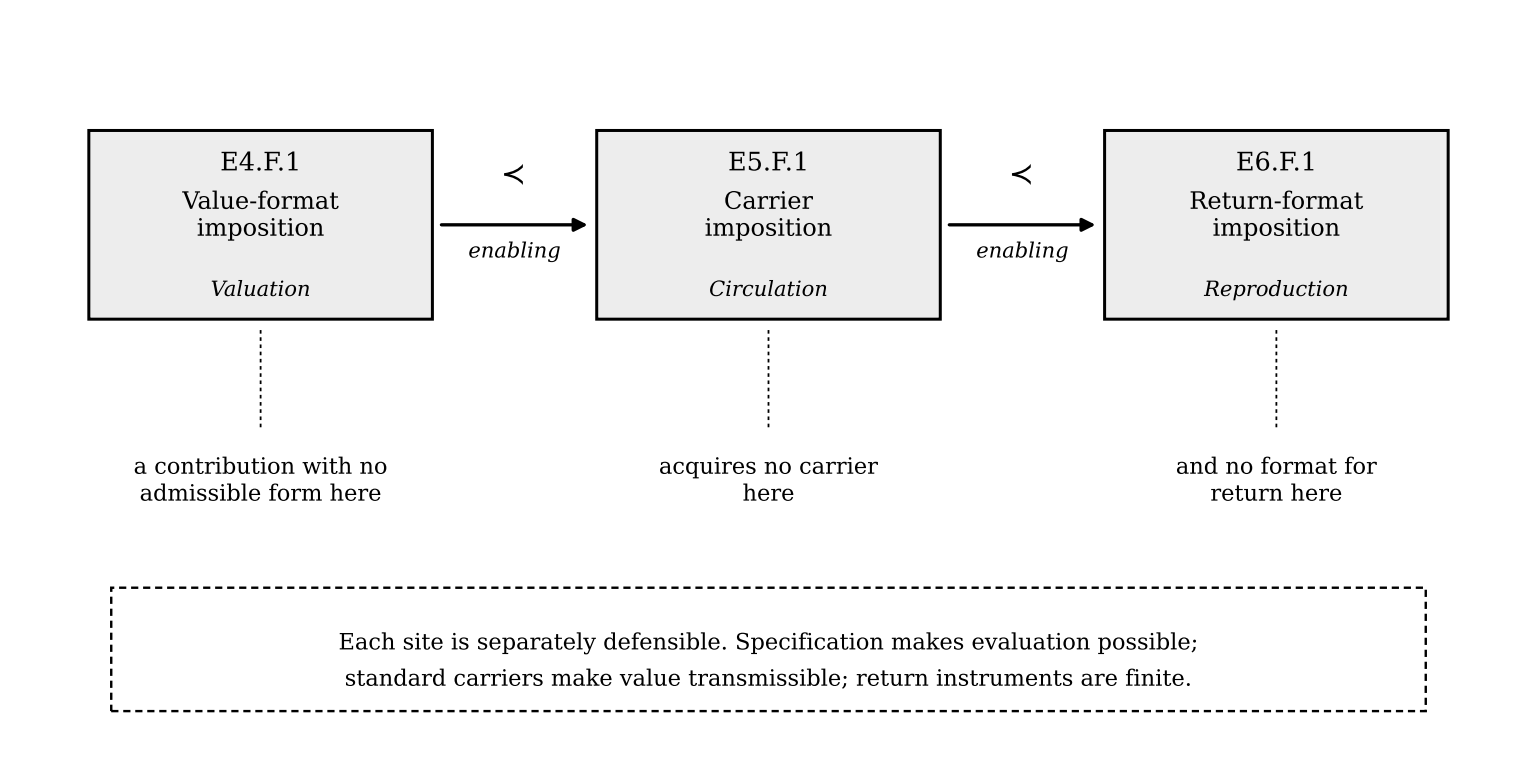
Figure 1. The format chain, an enabling motif spanning three regions. Each site is individually defensible, and their composition produces a contribution that was generated, never represented, never moved, and never returned, with no party having performed anything identifiable as a taking.
Figure 1 sets it out. The format chain deserves separate
comment, since it is the foreclosure result
of Corollary ? stated as a mechanism rather than as an
argument. Where a contribution has no admissible form at the valuation region,
it acquires no carrier at circulation and no format for return at reproduction.
The three sites are separately defensible. Specification is what makes
evaluation possible, standard carriers are what make value transmissible, and
limited return instruments are an ordinary institutional fact. Their
composition produces a contribution that was generated, was never represented,
never moved, and was never returned, with no party having performed anything
identifiable as a taking.
10.3 A worked composite
The laboratory of the constructed examples illustrates how atoms assemble.
Resources are held on one side, so joint work proceeds on terms the holder
could withdraw, which is ?. The question worked on is chosen by
the holder, which is ?. Whether contributions will be
acknowledged is left open through the period in which they are made, which
is ?, and effort accordingly continues, which
is ?. Members are confined to execution, which
is ?. The outcome is retold as the achievement of the
investigator, which is ? and then ?. The record
that would support a different account is held by the institution and
terminates on departure, which is ?.
Six of these seven sites pass the admissibility conditions individually. A
principal investigator is answerable for a funded direction and properly sets
it. Resources are finite and their allocation is a matter of judgment.
Attribution is genuinely hard to assess before work is complete. Presentation
by one person is practical. Access termination is a normal security control.
The arrangement is nonetheless one in which
Conditions ?, ?, ?,
and ? are jointly satisfied at a named position, and the
composite is what makes that visible. This is the reason the taxonomy carries a
composite level rather than a list.
The kind of dependence determines the point at which a remedy is effective. In
an enabling chain, action at the upstream site removes the downstream one, so
the format chain is addressed by widening admissible form at ?
rather than by adjusting return at ?. In a concealing chain the
upstream site removes the evidence, so remedy requires that a record be made at
the time, which is a demand on the generation region rather than on the
reproduction region where the loss becomes apparent. In a lock-in chain the
downstream site is the effective point, since the upstream accumulation has
already occurred.
11. Register Distribution and the Foreclosure Result
This section reports the distribution of register entry across the corpus,
states what the distribution licenses, and develops the consequences of
Corollary ? for accounting and for remedy.
11.1 Method and its limits
Each of the 225 sites carries one entry register, assigned by
Definition ? as the register in which the intervention first
operates. Assignment was performed at the point of drafting each site, against
its definition rather than against its vocabulary. Two conventions were held
throughout. An intervention operating first as an absence or a burden borne by
the other party is assigned to the Real even where an instrument authorized it,
which is why withholding of resources, of security, and of settlement enters
there. An intervention operating within a code is assigned to the Symbolic even
where its terminus is bodily, which is why presentation designed to signify is
separated at ? from presentation designed to exceed absorption
at ?.
Three limits on what the count establishes are stated here.
The corpus was assembled by the reasoning that then counted it. A distribution
over a set the analyst composed is not an observation about the world, and the
figures below are internal to the taxonomy. This is the strongest objection
available to the section and it is conceded without qualification.
Two of the six figures are insulated from that objection and the rest are not.
The absence of Real entry at valuation is argued at
Proposition ? from what the region’s operations act upon, and
its return at reproduction is argued at Proposition ? from
what that region’s object consists in. Both arguments would stand if the counts
came out otherwise, in which case the discrepancy would indicate an error in
the site assignments. The counts corroborate the arguments and do not establish
them.
The unit of the count is the site rather than the incidence. A region with more
sites of a given kind is not thereby a region where interventions of that kind
occur more often. Prevalence is an empirical question the paper does not
address.
11.2 The distribution
Table 4 gives the counts.
| @p0.28rrrr@
| Region | Sites | Symbolic | Imaginary | Real |
|---|---|---|---|---|
| 1 Encounter | 33 | 24 (73%) | 5 (15%) | 4 (12%) |
| 2 Formation | 39 | 24 (62%) | 8 (21%) | 7 (18%) |
| 3 Co-generation | 45 | 35 (78%) | 5 (11%) | 5 (11%) |
| 4 Valuation | 34 | 30 (88%) | 4 (12%) | 0 (0%) |
| 5 Circulation | 40 | 35 (88%) | 3 (8%) | 2 (5%) |
| 6 Reproduction | 34 | 26 (76%) | 4 (12%) | 4 (12%) |
| Total | 225 | 174 (77%) | 29 (13%) | 22 (10%) |
Table. Entry register by region
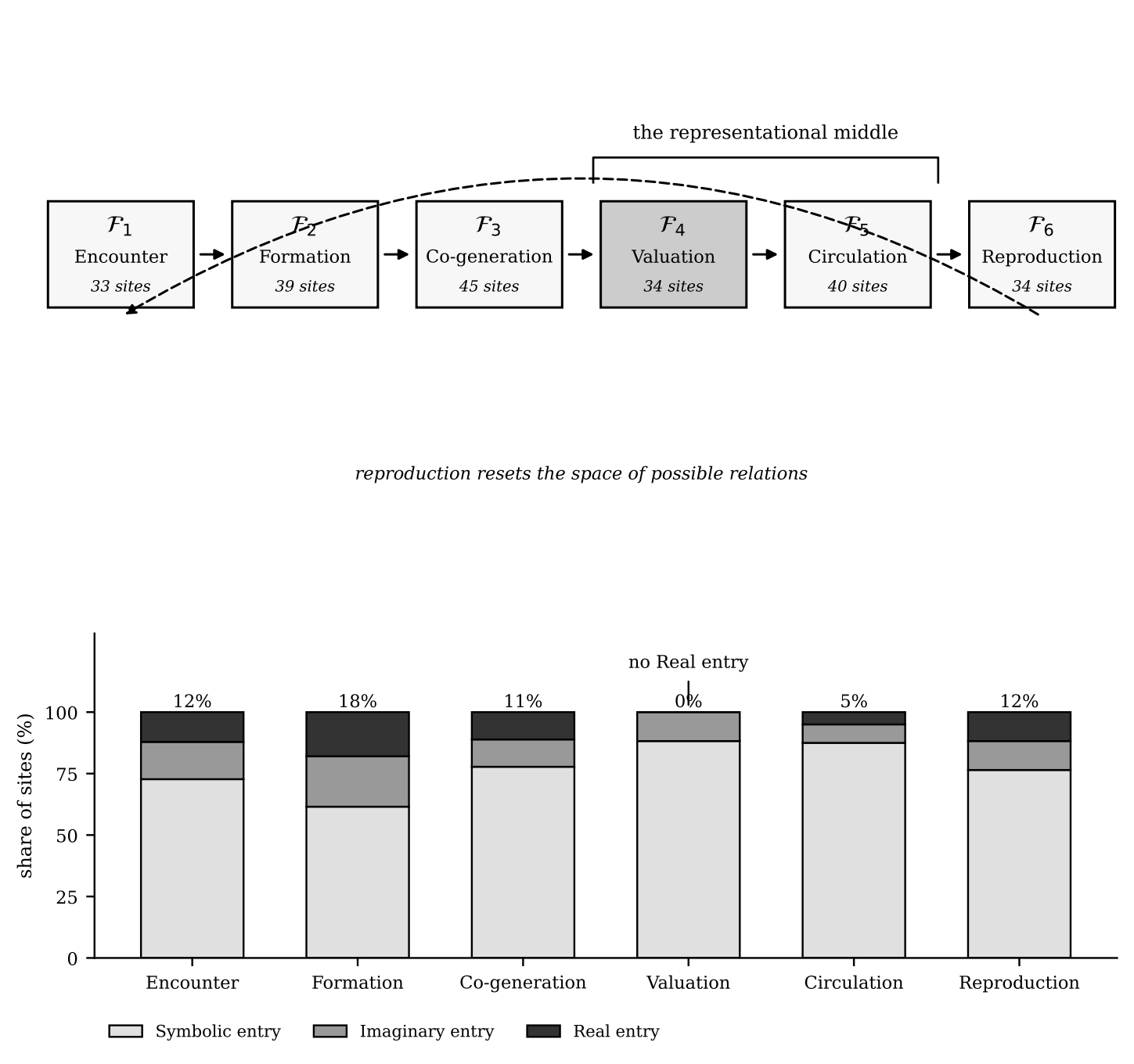
Figure 2. The lifecycle circuit and the distribution of entry register. The upper panel gives the six regions of Equation (1), with the dashed arc recording that reproduction resets the space of possible relations. Regions shaded darker carry no site entering through the Real. The lower panel gives the share of sites at each region by entry register. Real entry holds between a tenth and a fifth at regions 1 to 3, is absent at valuation, stands at one in twenty at circulation, and returns to an eighth at reproduction. Imaginary entry does not follow that movement.
Three findings follow.
Depletion of the Real across the representational middle.
Real entry holds between a tenth and a fifth of the sites at the encounter,
formation, and co-generation regions, falls to none at valuation and one in
twenty at circulation, and returns to an eighth at reproduction. Regions 4 and
5 are the regions at which value is made representable and the representation
is moved, and they are the regions at which the Real affords no purchase. The
claim is stated over the pair rather than over valuation alone, since
circulation operates on what valuation produced and inherits its vocabulary.
Register specificity of the depletion.
Imaginary entry runs 15, 21, 11, 12, 8, and 12 per cent across the regions and
holds at an eighth through valuation, where Real entry is absent. The
representational middle therefore excludes one register and retains the other.
This is what the theory requires rather than an anomaly in it. Recognition
operates through images, so prestige, misrecognition, inflation of value by
association, and the accrual of reputation all have purchase at valuation. What
resists symbolization has none. A general account in which the Symbolic simply
crowds out everything else would predict both registers falling together, and
that is not the shape of the corpus.
Recurrence of a small operation set across objects.
The corpus contains substantially fewer operations than sites. Uncertainty is
produced at ?, ?, and ?, with the
relation, the acknowledgement, and the reward as its successive objects.
Acknowledgement is made irregular at ? and ?.
An exception becomes a baseline at ? and ?. A
standard is moved at ? and ?. Context is removed
to reattribute at ? and to make portable at ?. An
ordering reallocates encounter at ?, assessment
at ?, and flow at ?. Scarcity is constructed of a
relation at ?, of participation at ?, and of
passage at ?. Aggregation dissolves a claim
at ?, ?, and ?. Rent is drawn on a
position at ? and ?. Risk is allocated downward
at ? and ?.
This is the compression announced at Section 6.5. The taxonomy is
better described as a small set of operations crossed with the six objects the
lifecycle supplies than as an enumeration of 225 unrelated mechanisms, and the
practical consequence is that a party who recognizes an operation at one region
has reason to look for it at the others.
Four mechanisms present in the source material appear once in the corpus rather
than at every region where they could be described, because the operation and
its object are already sited elsewhere. Scarcity of recognition is held
at ?, where its object is the relation, and is not repeated at
valuation. Irregular acknowledgement is held at ?, where its
object is the work. Obstruction of return and redirection of reinvestment are
held at ? and ?, where their object is the
replenishment of the generating relation, and are not repeated at circulation.
Counting these at more than one region would inflate the corpus and would
double-count the operations reported above.
11.3 Foreclosure read economically
Corollary ? and Corollary ? together give the
paper’s central claim its content. Value generated within a relation includes
components that the available formats of valuation admit and components that
they do not: the maintenance of the conditions of work, the absorption of
conflict, tacit coordination, the capacity to generate again. The second class
is not valued at a low level. It receives no term.
The consequence is not that these components are undercompensated. It is that
their loss produces no entry in any account at the regions where accounts are
made. A party depleted in this way passes through valuation and circulation
without a record of the depletion having been created anywhere. The loss
accumulates and arrives at the reproduction region in the forms available
there, which are exhaustion, departure, breakdown, and dissolution.
By that point the arrangement is in the position described at
Corollary ?. What has occurred is an event rather than a claim.
The party observing it holds no document from any earlier region with which to
establish what was taken, and the arrangement’s own records are consistent with
everything having been in order throughout, because they were kept in a
vocabulary in which the loss had no name.
Two consequences follow for the design of remedies, and both run against the
intuitive placement.
Remedies applied at the reproduction region arrive after the record that would
support them was not made. Compensation schemes, exit settlements, and
post-hoc reviews all operate on evidence, and the evidence was foreclosed
upstream. The effective intervention is at ?, being the range of
admissible form, and at the recording practices of the generation region.
Remark ? states the general form: in a concealing chain, remedy
belongs where the concealment occurs.
Remedies that improve measurement address only what is representable. A better
metric, a fuller contribution statement, or a more careful attribution scheme
operates within the vocabulary whose boundary is the problem. They are worth
having and they do not reach $\Delta_V$. What reaches it is the addition of a
format, which is a change in the vocabulary rather than a refinement within it,
and the party positioned to make that change is ordinarily the party
Condition ? identifies.
12. Relational Depth and Asymmetric Exploitability
This section takes up the question in the paper’s title. It defines relational
depth in the terms the framework supplies, states why the unrestricted thesis
fails, states the restricted thesis, and identifies what would tell against it.
12.1 Depth as register sedimentation
The word real in the title does not name the Lacanian register, and the two
are separated here to prevent the confusion.
The depth $\mathfrak{R}$ of a relation for a party is the extent to which the
relation has become constitutive of that party’s situation. It accumulates
across all three registers: materially, in shared history, non-portable
capacity, and foregone alternatives; imaginarily, in identification and in the
party’s picture of who they are; and symbolically, in roles, titles,
obligations, and the vocabulary in which the party describes their own life.
Depth in this sense is what Section 8 describes being produced.
Identification at ? is its imaginary component, exit cost
at ? its material component, and role fixation
at ? its symbolic component. A relation becoming real, in the
sense the title intends, is the long sedimentation and institutionalization of
all three.
$$\mathfrak{R}(R) = f\bigl(\Reg\text{-sedimentation},\ \Ima\text{-sedimentation},\ \Sym\text{-sedimentation}\bigr)$$
Equation (26) is a statement of composition rather than a
functional form. No measure is proposed, and Section 16 records
the absence as a limit.
12.2 Status of the unrestricted thesis
The unrestricted thesis holds that exploitation rises with depth, as at
Equation (27).
$$\frac{\partial E}{\partial \mathfrak{R}} > 0$$
Three considerations tell against it, and each is available from the corpus
itself.
Depth raises the cost of appropriation to the appropriating party. Where the
value is generated by the configuration, as Definition ? holds,
appropriation that degrades the configuration reduces what there is to
appropriate in the next cycle. Site ? exists as a distinct
mechanism precisely because this constraint binds: extraction has to be paced
against collapse, and the pacing is a concession to the constraint rather than
an escape from it. Site ? is its complement, and its
availability only at the close confirms that the constraint operates
everywhere else.
Depth commonly produces reciprocal hostage. A party deeply embedded in a
relation is also a party whose withdrawal is costly to the counterpart, and
many of the strongest positions available to the weaker party in the corpus
depend on exactly this. Site ? is a mechanism operated by a
subordinate position against a superior one, and it works because depth runs
both ways.
Depth produces voice. Sedimentation of history and identity supplies the
standing from which claims are made and the shared vocabulary in which they are
intelligible. A relation with no depth affords a party very little from which
to object.
The unrestricted thesis therefore has counterexamples in its own material. It
is stated in the paper’s title as a question, and the answer given here is
negative in that form.
12.3 The restricted thesis
Exploitability rises with depth where the depth is asymmetric. Writing
$\mathfrak{R}_A$ and $\mathfrak{R}_B$ for the depth borne by each party, the
relevant quantity is the difference, and the effect runs through the three
consequences of unmatched sedimentation: an enlarged appropriable surface, a
raised cost of exit, and a reduced capacity to state a claim.
$$\frac{\partial E}{\partial \bigl(\mathfrak{R}_A - \mathfrak{R}_B\bigr)} > 0$$
Equation (28) states Condition ? in
differential form, and supplies the sense in which the title question receives
an affirmative answer.
The three consequences are separable. The enlarged surface is a matter of what
there is to take: a party constituted by the relation supplies not only labour
but attention, identification, standing, coordination, and the capacity to
generate again, and Sections 9 and 12 enumerate
the sites at which each is available. The raised exit cost is the quantity of
Equation (11) and is what allows terms to be set against the cost of
leaving rather than the value of staying. The reduced capacity to state a claim
is the contribution the present framework adds, and it runs through
Corollary ?: the components of value that deep relations
generate disproportionately are the components that the valuation region admits
least readily. Care, coordination, maintenance, and the absorption of conflict
grow with depth and are exactly the classes for which $\Delta_V$ is large.
That last point is the connection between the paper’s two claims, and it is
worth stating directly. Depth increases the share of generated value that is
unrepresentable. Unrepresentable value is foreclosed at the valuation region.
Foreclosed value produces no record. A party without a record has no claim.
Depth accordingly raises exploitability through the epistemic channel and not
only through the two channels the hold-up literature identifies.
12.4 Evidence bearing against the claim
Claim ? is a conditional statement about a quantity the
paper does not measure, and its testability rests on proxies that later work
would have to defend. Four observations would tell against it.
Arrangements exhibiting large depth asymmetry together with high return ratios
in the sense of Equation (23), sustained across cycles and without
external enforcement, would indicate that asymmetric depth does not by itself
generate the effect. Long-standing craft apprenticeships and some family firms
are the obvious places to look.
Arrangements in which the deeply embedded party sets the terms would indicate
that the direction of the effect is not fixed by depth. Cases in which a
subordinate holds an arrangement through irreplaceable tacit knowledge, as
at ?, are candidates, and the question is whether they are
exceptions or a second regime.
A finding that the classes of value generated disproportionately in deep
relations are in fact well represented by available formats would remove the
epistemic channel and leave the claim resting on the hold-up literature’s two
channels alone.
A finding that depth asymmetry is generally accompanied by compensating
institutions such as tenure, licensing, collective representation, or fiduciary
duty, and that these are effective, would confine the claim to arrangements
outside their reach.
Section 5 concedes relation-specific investment and the
appropriability of quasi-rent to their literature. The restricted thesis adds
two things to that account. It locates the appropriation across a lifecycle
rather than at the point of contract renegotiation, so that mechanisms
operating at valuation and at reproduction come into view. And it identifies a
channel that a single-accounting analysis has no place for, being the
unavailability of terms in which the loss could be stated. Where the hold-up
literature analyses a party who knows what they are losing and lacks the
bargaining position to prevent it, the present account also treats a party who
lacks the vocabulary to say what it was.
13. Limits, Obligations, and Conclusion
13.1 Limits
The severest limits are given first.
The corpus is the author’s construction and the distributional finding of
Section 14 is internal to it. Section 14.1
states the concession and identifies the two figures insulated by argument. An
independent coding of a mechanism set assembled without the register layer
would be the appropriate test, and it has not been performed.
Every example in the paper is constructed. Constructed examples establish that
a mechanism is describable and coherent. They establish nothing about its
frequency, its distribution across sectors, or its magnitude. No empirical
claim is made anywhere in the paper, and none should be read into it.
No measure of magnitude is proposed. The paper says where value can be
appropriated and supplies no way to say how much was. This restricts the
framework to diagnosis and prevents it from supporting any claim about the size
of a wrong. A companion problem list argues that the obstacle is deeper than
the absence of a metric, since a measure of what was taken presupposes a
decomposition of jointly generated value that Definition ? denies,
and states the difficulty as an open problem rather than as a task.
Depth is defined at Definition ? and not measured, so
Equation (28) is not testable in the form given. Operational
indicators for the three components of sedimentation are the first thing later
work would need.
The corpus supplies no account of when a foreclosed contribution could have
been made. Several sites turn on a configuration generating less, or generating
differently, than it otherwise would have, and the comparison is with a state
of affairs no party can exhibit. The companion problem list argues that this is
not a difficulty of evidence: the portion of a generative capacity which makes
it generative rather than productive lies outside the record by construction,
because entering the record is what exercise consists in. Sites resting on that
comparison are accordingly diagnostic and support no claim.
The six-region division has no claim to being a natural joint.
Equation (4) states that a node at one scale is a region at
the next, from which it follows that the division is a choice of resolution.
The defence offered is that this resolution makes a transferable taxonomy
statable, and a different resolution might make a better one statable.
The aspect grammar was found at the encounter region and tested at the other
five. It holds there. Whether it holds at other coarse-grainings of the
lifecycle, or in domains organized differently from those the examples draw on,
is open.
The Real is treated through four modes of staged encounter and is otherwise
left as a systematic remainder, per Remark ?. A reader who
holds that the Real admits fuller specification will find the treatment thin,
and a reader who holds that it admits none will find the four modes already too
many. The paper occupies a position between these and defends it only by use.
The admissibility conditions are stated jointly and are not weighted. Nothing
in the paper says what to conclude where three of four are satisfied, which is
the ordinary case in practice.
The framework describes mechanisms and supplies no normative theory. A judgment
that a given arrangement is unjust requires premises about standing,
entitlement, and desert that the paper does not offer.
13.2 Obligations
The distributional finding should be tested by independent coders working from
site definitions supplied without the register assignments, on a corpus
assembled by parties other than the present author.
Later work should propose and defend indicators for the three components of
relational depth, for the return ratio of Equation (23), and for the
representation gap of Equation (17), together with an account of what
each indicator fails to capture.
Case studies should test whether the motifs of Table 3 recur in
settings the author did not draw on, and should report motifs the taxonomy
fails to accommodate.
Work on remedy should follow Remark ? and address
the range of admissible form and the recording practices of the generation
region, rather than the compensation practices of the reproduction region
alone. Proposals should state what each addition to the admissible vocabulary
costs and whom it burdens.
13.3 Conclusion
The paper proposes that exploitation of relational value be indexed by the
region of the value lifecycle at which an intervention is performed, by the
aspect of that region on which it operates, and by the register through which
it enters and propagates. Six regions coarse-grain the lifecycle. Each is
extended, they overlap, and each resolves into a structure of the same shape.
Within a region, form, conditions, and process separate the object of
intervention, and the triple holds at all six. Registers locate an intervention
and do not contain its effects, so each site carries an entry register, a
driving form, and a trajectory rather than a category. Four joint conditions
decide whether a site has been used exploitatively, applied to a named position
rather than to an arrangement in aggregate, and each of the 225 sites carries
its own statement of the non-exploitative case.
The distributional finding is that the Real is depleted across the valuation
and circulation regions and present on either side of them, while the Imaginary
persists throughout. The absence at valuation is argued from what the region’s
operations act upon and the return at reproduction from what its object
consists in, so the finding does not rest on the count alone. Read through the
Lacanian formula, relational depletion has no term where value is valued and
moved, generates no record while it accumulates, and arrives at the
reproduction region as an event that supports no claim.
The title question receives a restricted answer. Depth does not by itself raise
exploitation, since it also raises the cost of appropriation, produces
reciprocal hostage, and supplies voice. Depth raises exploitability where it is
asymmetric, through an enlarged appropriable surface, a raised cost of exit,
and a reduced capacity to state a claim. The third channel is the one this
framework adds, and it connects the paper’s two results: the components of
value that deep relations generate disproportionately are the components that
valuation admits least readily, so depth increases the share of what is
generated that can never be said to have been taken.
14. Register of Sites
Table ? lists all 225 atomic sites in code order, with the
region and aspect in which each is defined, its entry register, and the page on
which it is treated. Codes follow Equation (5) and are stable
across revisions.
@p0.072p0.295p0.145p0.105p0.055r@
Register of the 225 atomic sites
\
Code & Site & Region & Aspect & Entry & Page \
6@lTable , continued from the previous page\
Code & Site & Region & Aspect & Entry & Page \
6r@continued on the next page\
E1.F.1 & Relational-role imposition & Encounter & Form & $\Sym$ & item:e1f1 \
E1.F.2 & Mandatory intermediation & Encounter & Form & $\Sym$ & item:e1f2 \
E1.F.3 & Hierarchical formatting & Encounter & Form & $\Sym$ & item:e1f3 \
E1.F.4 & Publicity structuring & Encounter & Form & $\Sym$ & item:e1f4 \
E1.F.5 & Identifiability structuring & Encounter & Form & $\Sym$ & item:e1f5 \
E1.F.6 & Temporal-form structuring & Encounter & Form & $\Sym$ & item:e1f6 \
E1.F.7 & Appearance-based encounter design & Encounter & Form & $\Sym$ & item:e1f7 \
E1.F.8 & Affective framing & Encounter & Form & $\Ima$ & item:e1f8 \
E1.C.1 & Condition appropriation & Encounter & Conditions & $\Sym$ & item:e1c1 \
E1.C.2 & Infrastructure control & Encounter & Conditions & $\Sym$ & item:e1c2 \
E1.C.3 & Resource withholding & Encounter & Conditions & $\Reg$ & item:e1c3 \
E1.C.4 & Condition degradation & Encounter & Conditions & $\Reg$ & item:e1c4 \
E1.C.5 & Structured lack production & Encounter & Conditions & $\Reg$ & item:e1c5 \
E1.C.6 & Scarcity construction & Encounter & Conditions & $\Sym$ & item:e1c6 \
E1.C.7 & Risk production & Encounter & Conditions & $\Ima$ & item:e1c7 \
E1.C.8 & Desirability construction & Encounter & Conditions & $\Ima$ & item:e1c8 \
E1.C.9 & Qualification control & Encounter & Conditions & $\Sym$ & item:e1c9 \
E1.C.10 & Classification-based exclusion & Encounter & Conditions & $\Sym$ & item:e1c10 \
E1.C.11 & Mobility restriction & Encounter & Conditions & $\Sym$ & item:e1c11 \
E1.P.1 & Access restriction & Encounter & Process & $\Sym$ & item:e1p1 \
E1.P.2 & Visibility manipulation & Encounter & Process & $\Sym$ & item:e1p2 \
E1.P.3 & Ranking & Encounter & Process & $\Sym$ & item:e1p3 \
E1.P.4 & Matching control & Encounter & Process & $\Sym$ & item:e1p4 \
E1.P.5 & Encounter routing & Encounter & Process & $\Sym$ & item:e1p5 \
E1.P.6 & Attention steering & Encounter & Process & $\Ima$ & item:e1p6 \
E1.P.7 & Attention capture through excess & Encounter & Process & $\Reg$ & item:e1p7 \
E1.P.8 & Trust priming & Encounter & Process & $\Sym$ & item:e1p8 \
E1.P.9 & Fear priming & Encounter & Process & $\Ima$ & item:e1p9 \
E1.P.10 & Frequency manipulation & Encounter & Process & $\Sym$ & item:e1p10 \
E1.P.11 & Encounter interruption & Encounter & Process & $\Sym$ & item:e1p11 \
E1.P.12 & Alternative-path suppression & Encounter & Process & $\Sym$ & item:e1p12 \
E1.P.13 & Sequencing control & Encounter & Process & $\Sym$ & item:e1p13 \
E1.P.14 & Timing manipulation & Encounter & Process & $\Sym$ & item:e1p14 \
E2.F.1 & Role fixation & Formation & Form & $\Sym$ & item:e2f1 \
E2.F.2 & Hierarchical stabilization & Formation & Form & $\Sym$ & item:e2f2 \
E2.F.3 & Dependency structuring & Formation & Form & $\Reg$ & item:e2f3 \
E2.F.4 & Exclusivity imposition & Formation & Form & $\Sym$ & item:e2f4 \
E2.F.5 & Reciprocity asymmetrization & Formation & Form & $\Sym$ & item:e2f5 \
E2.F.6 & Boundary expansion & Formation & Form & $\Sym$ & item:e2f6 \
E2.F.7 & Boundary contraction & Formation & Form & $\Sym$ & item:e2f7 \
E2.F.8 & Identity incorporation & Formation & Form & $\Ima$ & item:e2f8 \
E2.F.9 & Pseudo-intimacy construction & Formation & Form & $\Ima$ & item:e2f9 \
E2.F.10 & Contractual enclosure & Formation & Form & $\Sym$ & item:e2f10 \
E2.C.1 & Trust condition control & Formation & Conditions & $\Sym$ & item:e2c1 \
E2.C.2 & Information asymmetry maintenance & Formation & Conditions & $\Sym$ & item:e2c2 \
E2.C.3 & Uncertainty production & Formation & Conditions & $\Ima$ & item:e2c3 \
E2.C.4 & Security withholding & Formation & Conditions & $\Reg$ & item:e2c4 \
E2.C.5 & Recognition scarcity & Formation & Conditions & $\Sym$ & item:e2c5 \
E2.C.6 & Alternative-resource suppression & Formation & Conditions & $\Sym$ & item:e2c6 \
E2.C.7 & Norm opacity & Formation & Conditions & $\Sym$ & item:e2c7 \
E2.C.8 & Norm shifting & Formation & Conditions & $\Sym$ & item:e2c8 \
E2.C.9 & Resource-conditioned attachment & Formation & Conditions & $\Sym$ & item:e2c9 \
E2.C.10 & Exit-cost construction & Formation & Conditions & $\Reg$ & item:e2c10 \
E2.C.11 & Vulnerability amplification & Formation & Conditions & $\Reg$ & item:e2c11 \
E2.P.1 & Commitment acceleration & Formation & Process & $\Sym$ & item:e2p1 \
E2.P.2 & Commitment delay & Formation & Process & $\Sym$ & item:e2p2 \
E2.P.3 & Selective reciprocity & Formation & Process & $\Sym$ & item:e2p3 \
E2.P.4 & Reciprocity escalation & Formation & Process & $\Ima$ & item:e2p4 \
E2.P.5 & Trust acceleration & Formation & Process & $\Ima$ & item:e2p5 \
E2.P.6 & Trust withholding & Formation & Process & $\Sym$ & item:e2p6 \
E2.P.7 & Trust asymmetry production & Formation & Process & $\Sym$ & item:e2p7 \
E2.P.8 & Disclosure extraction & Formation & Process & $\Ima$ & item:e2p8 \
E2.P.9 & Selective self-presentation & Formation & Process & $\Ima$ & item:e2p9 \
E2.P.10 & Relational mirroring & Formation & Process & $\Ima$ & item:e2p10 \
E2.P.11 & Affective synchronization & Formation & Process & $\Reg$ & item:e2p11 \
E2.P.12 & Intermittent reinforcement & Formation & Process & $\Reg$ & item:e2p12 \
E2.P.13 & Conflict manufacture & Formation & Process & $\Sym$ & item:e2p13 \
E2.P.14 & Coalitional enclosure & Formation & Process & $\Sym$ & item:e2p14 \
E2.P.15 & Norm internalization steering & Formation & Process & $\Sym$ & item:e2p15 \
E2.P.16 & Consent engineering & Formation & Process & $\Sym$ & item:e2p16 \
E2.P.17 & Boundary testing & Formation & Process & $\Reg$ & item:e2p17 \
E2.P.18 & Normalization through repetition & Formation & Process & $\Sym$ & item:e2p18 \
E3.F.1 & Contribution-role fixation & Co-generation & Form & $\Sym$ & item:e3f1 \
E3.F.2 & Hierarchical production formatting & Co-generation & Form & $\Sym$ & item:e3f2 \
E3.F.3 & Invisible-support formatting & Co-generation & Form & $\Sym$ & item:e3f3 \
E3.F.4 & Pseudo-collaboration construction & Co-generation & Form & $\Ima$ & item:e3f4 \
E3.F.5 & Unilateral agenda setting & Co-generation & Form & $\Sym$ & item:e3f5 \
E3.F.6 & Task fragmentation & Co-generation & Form & $\Sym$ & item:e3f6 \
E3.F.7 & Contribution isolation & Co-generation & Form & $\Sym$ & item:e3f7 \
E3.F.8 & Prospective authorship shaping & Co-generation & Form & $\Sym$ & item:e3f8 \
E3.C.1 & Resource asymmetry maintenance & Co-generation & Conditions & $\Sym$ & item:e3c1 \
E3.C.2 & Tool and infrastructure enclosure & Co-generation & Conditions & $\Sym$ & item:e3c2 \
E3.C.3 & Information withholding & Co-generation & Conditions & $\Sym$ & item:e3c3 \
E3.C.4 & Knowledge dependency construction & Co-generation & Conditions & $\Sym$ & item:e3c4 \
E3.C.5 & Time asymmetry & Co-generation & Conditions & $\Reg$ & item:e3c5 \
E3.C.6 & Risk externalization & Co-generation & Conditions & $\Sym$ & item:e3c6 \
E3.C.7 & Cost externalization & Co-generation & Conditions & $\Reg$ & item:e3c7 \
E3.C.8 & Recognition uncertainty in generation & Co-generation & Conditions & $\Sym$ & item:e3c8 \
E3.C.9 & Reward uncertainty & Co-generation & Conditions & $\Sym$ & item:e3c9 \
E3.C.10 & Artificial scarcity of participation & Co-generation & Conditions & $\Sym$ & item:e3c10 \
E3.C.11 & Alternative-generation suppression & Co-generation & Conditions & $\Sym$ & item:e3c11 \
E3.C.12 & Generative-environment degradation & Co-generation & Conditions & $\Reg$ & item:e3c12 \
E3.C.13 & Limit exposure & Co-generation & Conditions & $\Reg$ & item:e3c13 \
E3.P.1 & Contribution extraction & Co-generation & Process & $\Reg$ & item:e3p1 \
E3.P.2 & Attention extraction & Co-generation & Process & $\Ima$ & item:e3p2 \
E3.P.3 & Affective labour extraction & Co-generation & Process & $\Ima$ & item:e3p3 \
E3.P.4 & Creative appropriation in generation & Co-generation & Process & $\Sym$ & item:e3p4 \
E3.P.5 & Selective incorporation & Co-generation & Process & $\Sym$ & item:e3p5 \
E3.P.6 & Contribution dilution & Co-generation & Process & $\Sym$ & item:e3p6 \
E3.P.7 & Contribution inflation & Co-generation & Process & $\Sym$ & item:e3p7 \
E3.P.8 & Feedback withholding & Co-generation & Process & $\Sym$ & item:e3p8 \
E3.P.9 & Selective feedback & Co-generation & Process & $\Sym$ & item:e3p9 \
E3.P.10 & Intermittent recognition & Co-generation & Process & $\Ima$ & item:e3p10 \
E3.P.11 & Goal shifting & Co-generation & Process & $\Sym$ & item:e3p11 \
E3.P.12 & Scope creep imposition & Co-generation & Process & $\Sym$ & item:e3p12 \
E3.P.13 & Generative redirection & Co-generation & Process & $\Sym$ & item:e3p13 \
E3.P.14 & Generativity suppression & Co-generation & Process & $\Sym$ & item:e3p14 \
E3.P.15 & Generativity capture & Co-generation & Process & $\Sym$ & item:e3p15 \
E3.P.16 & Recombination capture & Co-generation & Process & $\Sym$ & item:e3p16 \
E3.P.17 & Coordination rent extraction & Co-generation & Process & $\Sym$ & item:e3p17 \
E3.P.18 & Conflict-based productivity extraction & Co-generation & Process & $\Sym$ & item:e3p18 \
E3.P.19 & Identity-based overcontribution & Co-generation & Process & $\Ima$ & item:e3p19 \
E3.P.20 & Moralization of contribution & Co-generation & Process & $\Sym$ & item:e3p20 \
E3.P.21 & Normalization of overproduction & Co-generation & Process & $\Sym$ & item:e3p21 \
E3.P.22 & Learning capture & Co-generation & Process & $\Sym$ & item:e3p22 \
E3.P.23 & Failure externalization & Co-generation & Process & $\Sym$ & item:e3p23 \
E3.P.24 & Success appropriation & Co-generation & Process & $\Sym$ & item:e3p24 \
E4.F.1 & Value-format imposition & Valuation & Form & $\Sym$ & item:e4f1 \
E4.F.2 & Metricization & Valuation & Form & $\Sym$ & item:e4f2 \
E4.F.3 & Monetization framing & Valuation & Form & $\Sym$ & item:e4f3 \
E4.F.4 & Credentialization & Valuation & Form & $\Sym$ & item:e4f4 \
E4.F.5 & Authorship formatting & Valuation & Form & $\Sym$ & item:e4f5 \
E4.F.6 & Ownership encoding & Valuation & Form & $\Sym$ & item:e4f6 \
E4.F.7 & Binary recognition formatting & Valuation & Form & $\Sym$ & item:e4f7 \
E4.F.8 & Prestige formatting & Valuation & Form & $\Ima$ & item:e4f8 \
E4.C.1 & Recognition access control & Valuation & Conditions & $\Sym$ & item:e4c1 \
E4.C.2 & Evaluator monopoly & Valuation & Conditions & $\Sym$ & item:e4c2 \
E4.C.3 & Evidence control & Valuation & Conditions & $\Sym$ & item:e4c3 \
E4.C.4 & Record asymmetry & Valuation & Conditions & $\Sym$ & item:e4c4 \
E4.C.5 & Attribution opacity & Valuation & Conditions & $\Sym$ & item:e4c5 \
E4.C.6 & Comparability imposition & Valuation & Conditions & $\Sym$ & item:e4c6 \
E4.C.7 & Temporal control of recognition & Valuation & Conditions & $\Sym$ & item:e4c7 \
E4.C.8 & Interpretive asymmetry & Valuation & Conditions & $\Sym$ & item:e4c8 \
E4.C.9 & Norm-setting capture & Valuation & Conditions & $\Sym$ & item:e4c9 \
E4.P.1 & Credit capture & Valuation & Process & $\Sym$ & item:e4p1 \
E4.P.2 & Credit dilution & Valuation & Process & $\Sym$ & item:e4p2 \
E4.P.3 & Credit reassignment & Valuation & Process & $\Sym$ & item:e4p3 \
E4.P.4 & Value under-recognition & Valuation & Process & $\Sym$ & item:e4p4 \
E4.P.5 & Value inflation & Valuation & Process & $\Ima$ & item:e4p5 \
E4.P.6 & Selective recognition & Valuation & Process & $\Sym$ & item:e4p6 \
E4.P.7 & Misrecognition & Valuation & Process & $\Ima$ & item:e4p7 \
E4.P.8 & Recognition withholding & Valuation & Process & $\Sym$ & item:e4p8 \
E4.P.9 & Ranking manipulation & Valuation & Process & $\Sym$ & item:e4p9 \
E4.P.10 & Benchmark manipulation & Valuation & Process & $\Sym$ & item:e4p10 \
E4.P.11 & Narrative appropriation & Valuation & Process & $\Sym$ & item:e4p11 \
E4.P.12 & Context stripping & Valuation & Process & $\Sym$ & item:e4p12 \
E4.P.13 & Context loading & Valuation & Process & $\Sym$ & item:e4p13 \
E4.P.14 & Symbolic substitution & Valuation & Process & $\Sym$ & item:e4p14 \
E4.P.15 & Reputation capture & Valuation & Process & $\Ima$ & item:e4p15 \
E4.P.16 & Stigma production & Valuation & Process & $\Sym$ & item:e4p16 \
E4.P.17 & Legitimacy capture & Valuation & Process & $\Sym$ & item:e4p17 \
E5.F.1 & Carrier imposition & Circulation & Form & $\Sym$ & item:e5f1 \
E5.F.2 & Currency-format imposition & Circulation & Form & $\Sym$ & item:e5f2 \
E5.F.3 & Mediated circulation & Circulation & Form & $\Sym$ & item:e5f3 \
E5.F.4 & Closed-loop circulation & Circulation & Form & $\Sym$ & item:e5f4 \
E5.F.5 & Non-portable value formatting & Circulation & Form & $\Sym$ & item:e5f5 \
E5.F.6 & Conversion monopoly & Circulation & Form & $\Sym$ & item:e5f6 \
E5.F.7 & Asymmetric convertibility & Circulation & Form & $\Sym$ & item:e5f7 \
E5.F.8 & One-way circulation design & Circulation & Form & $\Sym$ & item:e5f8 \
E5.C.1 & Channel ownership & Circulation & Conditions & $\Sym$ & item:e5c1 \
E5.C.2 & Network access control & Circulation & Conditions & $\Sym$ & item:e5c2 \
E5.C.3 & Liquidity control & Circulation & Conditions & $\Sym$ & item:e5c3 \
E5.C.4 & Portability restriction & Circulation & Conditions & $\Sym$ & item:e5c4 \
E5.C.5 & Interoperability restriction & Circulation & Conditions & $\Sym$ & item:e5c5 \
E5.C.6 & Conversion-rule opacity & Circulation & Conditions & $\Sym$ & item:e5c6 \
E5.C.7 & Exchange-rate control & Circulation & Conditions & $\Sym$ & item:e5c7 \
E5.C.8 & Fee imposition & Circulation & Conditions & $\Sym$ & item:e5c8 \
E5.C.9 & Temporal withholding & Circulation & Conditions & $\Reg$ & item:e5c9 \
E5.C.10 & Priority access control & Circulation & Conditions & $\Sym$ & item:e5c10 \
E5.C.11 & Conversion information asymmetry & Circulation & Conditions & $\Sym$ & item:e5c11 \
E5.C.12 & Risk transfer in circulation & Circulation & Conditions & $\Sym$ & item:e5c12 \
E5.P.1 & Value diversion & Circulation & Process & $\Sym$ & item:e5p1 \
E5.P.2 & Intermediation rent extraction & Circulation & Process & $\Sym$ & item:e5p2 \
E5.P.3 & Conversion appropriation & Circulation & Process & $\Sym$ & item:e5p3 \
E5.P.4 & Value laundering & Circulation & Process & $\Sym$ & item:e5p4 \
E5.P.5 & Relational decontextualization & Circulation & Process & $\Sym$ & item:e5p5 \
E5.P.6 & Selective circulation & Circulation & Process & $\Sym$ & item:e5p6 \
E5.P.7 & Circulation blocking & Circulation & Process & $\Sym$ & item:e5p7 \
E5.P.8 & Circulation acceleration & Circulation & Process & $\Sym$ & item:e5p8 \
E5.P.9 & Circulation throttling & Circulation & Process & $\Sym$ & item:e5p9 \
E5.P.10 & Ranking-mediated flow capture & Circulation & Process & $\Sym$ & item:e5p10 \
E5.P.11 & Network centralization & Circulation & Process & $\Sym$ & item:e5p11 \
E5.P.12 & Artificial bottleneck creation & Circulation & Process & $\Sym$ & item:e5p12 \
E5.P.13 & Reputation conversion capture & Circulation & Process & $\Ima$ & item:e5p13 \
E5.P.14 & Attention conversion capture & Circulation & Process & $\Ima$ & item:e5p14 \
E5.P.15 & Trust conversion capture & Circulation & Process & $\Ima$ & item:e5p15 \
E5.P.16 & Credential conversion capture & Circulation & Process & $\Sym$ & item:e5p16 \
E5.P.17 & Cross-domain value arbitrage & Circulation & Process & $\Sym$ & item:e5p17 \
E5.P.18 & Conversion-chain opacity & Circulation & Process & $\Sym$ & item:e5p18 \
E5.P.19 & Residual-value capture & Circulation & Process & $\Sym$ & item:e5p19 \
E5.P.20 & Value leakage engineering & Circulation & Process & $\Reg$ & item:e5p20 \
E6.F.1 & Return-format imposition & Reproduction & Form & $\Sym$ & item:e6f1 \
E6.F.2 & Individualised return formatting & Reproduction & Form & $\Sym$ & item:e6f2 \
E6.F.3 & Symbolic-only return & Reproduction & Form & $\Sym$ & item:e6f3 \
E6.F.4 & Deferred-return formatting & Reproduction & Form & $\Sym$ & item:e6f4 \
E6.F.5 & Conditional-return formatting & Reproduction & Form & $\Sym$ & item:e6f5 \
E6.F.6 & Gift reframing of owed return & Reproduction & Form & $\Ima$ & item:e6f6 \
E6.F.7 & Closed reinvestment formatting & Reproduction & Form & $\Sym$ & item:e6f7 \
E6.F.8 & Successor formatting & Reproduction & Form & $\Sym$ & item:e6f8 \
E6.F.9 & Debt inversion & Reproduction & Form & $\Ima$ & item:e6f9 \
E6.F.10 & Termination formatting & Reproduction & Form & $\Sym$ & item:e6f10 \
E6.C.1 & Surplus determination control & Reproduction & Conditions & $\Sym$ & item:e6c1 \
E6.C.2 & Return-accounting opacity & Reproduction & Conditions & $\Sym$ & item:e6c2 \
E6.C.3 & Reproduction-cost externalisation & Reproduction & Conditions & $\Reg$ & item:e6c3 \
E6.C.4 & Recovery withholding & Reproduction & Conditions & $\Reg$ & item:e6c4 \
E6.C.5 & Slack elimination & Reproduction & Conditions & $\Sym$ & item:e6c5 \
E6.C.6 & Maintenance invisibility & Reproduction & Conditions & $\Sym$ & item:e6c6 \
E6.C.7 & Memory control & Reproduction & Conditions & $\Sym$ & item:e6c7 \
E6.C.8 & Succession control & Reproduction & Conditions & $\Sym$ & item:e6c8 \
E6.C.9 & Dependency renewal conditioning & Reproduction & Conditions & $\Sym$ & item:e6c9 \
E6.C.10 & Reproductive-alternative foreclosure & Reproduction & Conditions & $\Sym$ & item:e6c10 \
E6.C.11 & Vulnerability persistence & Reproduction & Conditions & $\Reg$ & item:e6c11 \
E6.P.1 & Return-flow obstruction & Reproduction & Process & $\Sym$ & item:e6p1 \
E6.P.2 & Return diversion & Reproduction & Process & $\Sym$ & item:e6p2 \
E6.P.3 & Return dilution & Reproduction & Process & $\Sym$ & item:e6p3 \
E6.P.4 & Return delay & Reproduction & Process & $\Sym$ & item:e6p4 \
E6.P.5 & Selective return & Reproduction & Process & $\Sym$ & item:e6p5 \
E6.P.6 & Reproduction redirection & Reproduction & Process & $\Sym$ & item:e6p6 \
E6.P.7 & Generative-capacity extraction & Reproduction & Process & $\Sym$ & item:e6p7 \
E6.P.8 & Relational asset stripping & Reproduction & Process & $\Sym$ & item:e6p8 \
E6.P.9 & Exhaustion pacing & Reproduction & Process & $\Reg$ & item:e6p9 \
E6.P.10 & Terminal extraction & Reproduction & Process & $\Sym$ & item:e6p10 \
E6.P.11 & Narrative closure & Reproduction & Process & $\Sym$ & item:e6p11 \
E6.P.12 & Nostalgic re-enrolment & Reproduction & Process & $\Ima$ & item:e6p12 \
E6.P.13 & Guilt-based re-enrolment & Reproduction & Process & $\Ima$ & item:e6p13 \
15. Terms and Notation
Table ? gives the terms of art used in the paper with the site of
their definition. Table ? gives the notation.
@p0.24p0.53p0.16@
Terms of art
\
Term & Meaning & First use \
3@lTable , continued from the previous page\
Term & Meaning & First use \
3r@continued on the next page\
Relational value exploitation & Asymmetric appropriation of value generated by a relational configuration, registered as a loss in no accounting available to the depleted party & Def. ? \
Relational sub-spacetime & An extended region of the value lifecycle, not an instant, admitting finer resolution into a structure of the same shape & Claim ? \
Region & One of the six coarse-grained sub-spacetimes of Equation (1) & §6.1 \
Aspect & Form, conditions, or process: the object on which an intervention within a region operates & Def. ? \
Entry register & The register in which an intervention first operates & Def. ? \
Driving form & The mechanism by which an intervention passes from one register to the next & Def. ? \
Trajectory & The typical path of propagation across registers & Def. ? \
Real & That which resists complete symbolization, appearing through lack, excess, rupture, and limit & §6.3 \
Imaginary & The register of image, identification, expectation, fantasy, and desire & §6.3 \
Symbolic & The register of code: classification, naming, authorization, prohibition, rank, encoding, contract, record & §6.3 \
Taxonomic asymmetry & The systematic remainder the Real leaves in any linguistic taxonomy & Rem. ? \
Atomic site & A pair of aspect and action within one region, coded by Equation (5) & §6.5 \
Single-region composite & Two or more sites within one region operating together & Def. ? \
Multi-region motif & A small directed structure in which sites at different regions stand in dependence & Def. ? \
Dependence & The relation $\prec$ by which one site makes another available, more effective, harder to escape, harder to see, or easier to justify & Def. ? \
Absorption & A quantity surrendered persistently fails to return and an identifiable position receives the difference & Cond. ? \
Schema power & The receiving position also determines the description under which the arrangement is accounted for & Cond. ? \
Blocked return & No act available to the depleted party opens a channel of return & Cond. ? \
Asymmetric depth & Relation-specific sedimentation borne by one party and unmatched by the other & Cond. ? \
Relational depth & The extent to which a relation has become constitutive of a party’s situation, across all three registers & Def. ? \
Representation gap & The part of generated value that available formats of valuation do not admit & Eq. (17) \
Foreclosure & Here, the exclusion of the unrepresentable from the vocabulary of valuation and its return at reproduction & Cor. ? \
Return ratio & The proportion of value generated from a relation that reaches the relation again & Eq. (23) \
Generative circulation & A cycle after which the relation’s capacity to generate is greater & Eq. (24) \
Extractive circulation & A cycle after which that capacity is lower & Eq. (25) \
Conversion capacity & The extent to which a party can turn a relational value into another form & Eq. (21) \
Portability & The fraction of accumulated value a party can carry out of the arrangement that produced it & Eq. (22) \
Generativity capture & Appropriation of the capacity and direction of future generation rather than of the product & §? \
Reach & The extent of value affected by a site, distinct from the region at which it is performed & Rem. ? \
@p0.16p0.61p0.16@
Notation
\
Symbol & Meaning & First use \
3@lTable , continued from the previous page\
Symbol & Meaning & First use \
3r@continued on the next page\
$\mathcal F$ & The relational spacetime of an arrangement & §6.1 \
$\mathcal F_k$ & The $k$th region of the lifecycle & Eq. (1) \
$[t_a,t_b]$ & The interval of relational time over which a region extends & Eq. (2) \
$\mathcal R_{\mathrm{loc}}$ & The local relational structure of a region & Eq. (2) \
$\Reg,\ \Ima,\ \Sym$ & The Real, Imaginary, and Symbolic registers & Def. ? \
$r_0$ & Entry register of an action & Def. ? \
$\delta$ & Driving form of an action & Def. ? \
$\tau$ & Register trajectory of an action & Def. ? \
$\mathrm{E}i.d.n$ & Code of an atomic site: region, aspect, position & Eq. (5) \
$n_i$ & Number of sites at region $i$ & Eq. (6) \
$N_{\mathrm{single}}$ & Configurations with at most one mechanism per region & Eq. (6) \
$N_{\mathrm{multi}}$ & Configurations allowing several mechanisms per region & Eq. (7) \
$M$ & A multi-region motif & Eq. (8) \
$\prec$ & Dependence between sites & Def. ? \
$C_i$ & A single-region composite within region $i$ & Def. ? \
$A_i$ & The set of sites available at region $i$ & §6.5 \
$\Omega_t$ & The space of relations available to a party at $t$ & Eq. (10) \
$\deg(i)$ & Degree of a party in the graph of available relations & Eq. (9) \
$L_i$ & Loss on exit: value embedded plus cost of reconstruction & Eq. (11) \
$V_{AB}$ & The interaction term of jointly generated value & Eq. (12) \
$V_i / C_i$ & Ratio of value received to cost borne at a position & Eq. (13) \
$E_M$ & Value captured by an intermediary over generation enabled by it & Eq. (15) \
$\Phi$ & The valuation process & Eq. (16) \
$\hat V$ & Recognized value & Eq. (16) \
$\Delta_V$ & Representation gap & Eq. (17) \
$V(A\mid R,H)$ & Value conditional on a relation and a history & Eq. (18) \
$\kappa_i$ & Conversion capacity of party $i$ & Eq. (21) \
$\pi_i$ & Portability available to party $i$ & Eq. (22) \
$\rho_R$ & Return ratio & Eq. (23) \
$G(R_t)$ & Generative capacity of a relation at $t$ & Eq. (24) \
$\mathfrak{R}$ & Relational depth & Def. ? \
$E$ & Extent of exploitation, used only comparatively & Eq. (27) \
Acknowledgments
The author thanks Ron Eglash for dialogue that helped inspire the wider inquiry
into generative justice and value circulation within which this paper was
developed. The definitions, taxonomy, register construction, constructed
examples, arguments, conclusions, and errors remain the author’s
responsibility. This acknowledgment records intellectual inspiration from
dialogue.
References
Williamson, O. (1985). The Economic Institutions of Capitalism: Firms, Markets, Relational Contracting. Free Press.
Klein, B., Crawford, R., Alchian, A. (1978). Vertical Integration, Appropriable Rents, and the Competitive Contracting Process. Journal of Law and Economics.
Bourdieu, P. (1986). The Forms of Capital. Handbook of Theory and Research for the Sociology of Education.
Espeland, W., Stevens, M. (1998). Commensuration as a Social Process. Annual Review of Sociology.
Tilly, C. (1998). Durable Inequality. University of California Press.
Hirschman, A. (1970). Exit, Voice, and Loyalty: Responses to Decline in Firms, Organizations, and States. Harvard University Press.
Burt, R. (1992). Structural Holes: The Social Structure of Competition. Harvard University Press.
Simmel, G. (1950). The Sociology of Georg Simmel. The Free Press.
Honneth, A. (1996). The Struggle for Recognition: The Moral Grammar of Social Conflicts. MIT Press.
Fraser, N., Honneth, A. (2003). Redistribution or Recognition? A Political-Philosophical Exchange. Verso.
Fricker, M. (2007). Epistemic Injustice: Power and the Ethics of Knowing. Oxford University Press.
Marx, K. (1976). Capital: A Critique of Political Economy, Volume One. Penguin in association with New Left Review.
Terranova, T. (2000). Free Labor: Producing Culture for the Digital Economy. Social Text.
Zuboff, S. (2019). The Age of Surveillance Capitalism: The Fight for a Human Future at the New Frontier of Power. PublicAffairs.
Fuchs, C. (2014). Digital Labour and Karl Marx. Routledge.
Federici, S. (2012). Revolution at Point Zero: Housework, Reproduction, and Feminist Struggle. PM Press, Common Notions and Autonomedia.
Hochschild, A. (1983). The Managed Heart: Commercialization of Human Feeling. University of California Press.
Emirbayer, M. (1997). Manifesto for a Relational Sociology. American Journal of Sociology.
Lacan, J. (2006). On a Question Prior to Any Possible Treatment of Psychosis. Écrits: The First Complete Edition in English.
Lacan, J. (2006). Écrits: The First Complete Edition in English. W. W. Norton.
Böhm, S., Batta, A. (2010). Just Doing It: Enjoying Commodity Fetishism with Lacan. Organization.
Cluley, R., Dunne, S. (2012). From Commodity Fetishism to Commodity Narcissism. Marketing Theory.