From Contingency to Creative Attractor Transition - Perturbation Capture and Turbulence-Like Dynamics in Generative-Relational Systems
Transcript
Abstract
This paper develops a preliminary dynamical hypothesis of creativity centered on the conversion of contingent perturbations into persistent changes in a generative system. It distinguishes stochastic variation from dynamically consequential contingency: abundant random variation may remain local when perturbations are rapidly damped or absorbed by an established attractor. Creative reorganization is instead treated as regime-dependent. Systems operating in metastable or near-critical regions may exhibit greater susceptibility to small disturbances, although criticality is used here as an operational hypothesis rather than a claim of a unique physical critical point. The paper introduces perturbation capture for the retention and relational incorporation of a contingent event such that it can affect later generation. Under sufficient susceptibility, capture may combine with nonlinear amplification, cross-scale propagation, historical retention, and feedback on future sensitivity to destabilize an epistemic attractor and reorganize subsequent generative dynamics. The term turbulence-like is used cautiously for such sustained multiscale, history-dependent dynamics and is not intended to identify epistemic systems with fluid turbulence. A Generative Relational formulation allows states, relations, and the effective generator to co-evolve, so that a perturbation can alter both current output and future production. The framework yields testable predictions for human and artificial creativity and treats their differences as empirical questions of perturbation exposure, capture, amplification, retention, regime regulation, and generator reconfiguration rather than as essential differences between biological and artificial agents.
Keywords: contingency; creativity; perturbation capture; knowledge attractors; metastability; criticality; nonlinear dynamics; epistemic turbulence; generative-relational systems; artificial intelligence; scientific discovery; attractor transition
Discussion Paper Note
This paper develops a preliminary dynamical hypothesis of creativity. Its central concern is not the production of an isolated novel output, but the conditions under which a small and initially contingent perturbation can become structurally consequential for a generative system. The paper asks how an event that could have been locally absorbed, ignored, or forgotten can instead be retained, coupled to other relations, amplified across scales, and eventually alter the system’s future mode of generation. Creativity is therefore examined as a possible regime of historical transformation rather than as a scalar property attached to an individual person, model, or artifact.
The inquiry begins from a distinction between stochastic variation and consequential contingency. Randomness can produce variation without producing historical change. A system can receive many random perturbations while remaining dynamically close to the same attractor, especially when deviations are rapidly damped and later states are generated under an effectively unchanged relational structure. The availability of stochasticity is therefore not treated as sufficient for creativity. What matters is whether a perturbation can enter the system’s continuing history and modify the relations through which subsequent states are generated.
The term contingency is used in a modest and operational sense. The paper does not require a metaphysical thesis about indeterminism or free will. An event is treated as contingent relative to a specified generative description when it is not fixed as a necessary continuation of the trajectory represented at that level of analysis and when its occurrence can introduce a difference whose downstream consequences depend upon the state and relational structure of the receiving system. This formulation permits stochastic events, unanticipated environmental encounters, anomalous observations, accidental conceptual juxtapositions, and socially mediated encounters to be compared without assuming that they share a single ontological source.
A second distinction concerns perturbation and perturbation capture. A perturbation is any locally introduced difference relevant to the chosen level of description. Capture occurs when that difference is retained within the system’s relational organization strongly enough to affect later generation. The same perturbation can therefore disappear in one system and become historically consequential in another. Capture is relational and state-dependent: the downstream effect of an event depends not only on the event itself but also on the configuration into which it enters, the relations available for coupling, and the persistence of the modifications that follow.
The paper treats attractors as analytical descriptions of relatively stable generative organization. A knowledge attractor need not be a literal fixed point. Depending on the scale of analysis, it can be represented as a basin of recurrent interpretations, a metastable conceptual configuration, a family of preferred trajectories, or a region of state space toward which perturbations are repeatedly damped. The attractor vocabulary is used to describe the persistence of organized knowledge while preserving the possibility that the landscape itself can evolve.
This possibility is important because creativity, in the strong sense examined here, may require more than movement within a fixed attractor landscape. A novel combination can remain a novel point inside an unchanged space of possibilities. A more consequential transformation occurs when the perturbation changes relations, alters future sensitivities, modifies the effective generator, destabilizes an existing basin, or contributes to the formation of a new region of relative stability. The paper therefore distinguishes output novelty from attractor transition and generator reconfiguration.
The current formulation adds a further condition that is necessary to make the perturbation hypothesis dynamically plausible: epistemic susceptibility. Small perturbations cannot be expected to produce large structural consequences under all dynamical conditions. Deep inside a strongly restoring basin, many differences will decay. At the opposite extreme, a highly disordered system may fail to retain enough structure for perturbations to become cumulative rather than merely noisy. The paper therefore examines metastable and near-critical regimes in which stability and sensitivity can coexist.
The term criticality is used cautiously. The paper does not claim that creative cognition, scientific inquiry, or language-model inference possesses a single physical critical point analogous to a particular phase transition in a well-specified material system. Nor does it identify turbulence with criticality. In fluid dynamics, turbulent states can persist away from the onset of transition, and transitions can involve subcritical mechanisms, finite-amplitude perturbations, intermittency, coexistence, and other structures that resist a single simplified picture. The present argument therefore uses near-critical, marginally stable, and metastable as a family of analytical possibilities describing regimes in which susceptibility to perturbation becomes comparatively high while meaningful organization remains available for propagation and retention.
This clarification leads to a new question within the paper: why would a creative system approach such a regime? It is insufficient to assume that a system happens to occupy a highly susceptible region whenever creativity occurs. A more complete hypothesis requires processes that can move the system between excessive stability and excessive disorder. The paper provisionally calls this problem criticality regulation. The phrase does not imply that the system explicitly computes a critical point. It refers more broadly to endogenous or relational processes that alter the effective restoring forces, exploratory range, unresolved tensions, coupling density, or persistence of alternative configurations and thereby change the system’s susceptibility to future perturbations.
In human inquiry, several candidate processes can be examined under this heading without being assumed to share one mechanism. Unresolved anomalies can remain active rather than being immediately normalized. Exposure to unfamiliar domains, places, interlocutors, or representations can weaken the closure of an existing conceptual basin. Deliberate comparison of incompatible explanations can preserve tension between competing structures. Periods of exploration, mind wandering, cross-domain association, and environmental variation can increase the diversity of relations available for coupling. Conversely, formalization, writing, testing, criticism, and repeated reconstruction can stabilize emerging structures that would otherwise dissipate. The paper treats creative inquiry as potentially involving recurrent movement between exploration and consolidation rather than a permanent location at maximum instability.
This formulation is compatible with a Generative Relational perspective. The basic analytical object is not an isolated creator but a temporally evolving system of states, relations, encounters, constraints, and generative mappings. A simple representation may write a state trajectory as
The paper does not treat relations as static edges appended to otherwise self-contained entities. Relations can be produced, weakened, redirected, removed, or reinterpreted through the trajectory itself. The effect of a later perturbation can consequently depend on earlier perturbations because the medium through which it propagates has already changed. This historical dependence distinguishes a sequence of independent random shocks from a relational cascade. Past perturbations can alter which future events become salient, what counts as an anomaly, which concepts are available for association, and which pathways of amplification remain open.
Nonlinearity enters when the downstream structural effect is not proportional to the magnitude of the initiating perturbation. A small event can disappear, remain local, or propagate through multiple relational levels. The paper is especially interested in trajectories in which an initially small difference modifies one relation, the modified relation changes the interpretation of a second event, the resulting configuration opens additional couplings, and the cumulative process eventually reorganizes a larger conceptual structure. Such processes motivate the language of cascade and cross-scale amplification.
The term epistemic turbulence is reserved for a stronger and still hypothetical regime. It is not used as a synonym for randomness, complexity, or creative freedom. Nor is it a claim that epistemic systems satisfy the Navier–Stokes equations or possess fluid-mechanical turbulence in a literal sense. The analogy is useful only if it supports discriminable dynamical features. Candidate features include sustained sensitivity to perturbations, intermittent amplification, interaction among multiple scales, path dependence, nonlocal propagation through a changing relational network, coexistence of locally stable and unstable regions, and feedback through which the resulting flow of change alters the conditions of later flow.
This restriction permits the turbulence analogy to fail without collapsing the larger perturbation-capture hypothesis. Empirical work may show that creative transitions are better described by metastability, intermittency, branching, critical slowing, transient chaos, excitable dynamics, heteroclinic motion, or other nonlinear mechanisms. The paper therefore treats turbulence-like dynamics as a provisional family resemblance and a source of testable questions, not as an asserted physical identity.
Human creativity provides one domain in which the framework can be examined. The relevant unit need not be the isolated brain. Human creative trajectories are embedded in changing environments, material practices, social relations, archives, institutions, languages, tools, and histories of prior encounter. Movement through heterogeneous environments can increase exposure to unanticipated perturbations, while long-term projects can preserve unresolved questions across such encounters. A person may therefore carry a relatively stable research tension through changing relational fields until an apparently minor event becomes capable of coupling to that tension and redirecting the trajectory. The familiar practices of walking, travelling, browsing shelves, changing workplaces, speaking with heterogeneous interlocutors, and moving between disciplines are treated as possible mechanisms of perturbation exposure rather than romantic evidence of creativity by themselves.
The framework also makes a more precise comparison with contemporary generative artificial intelligence possible. Large language models can produce substantial stochastic variation, surprising combinations, and high-quality creative artifacts. The present paper does not deny these capacities and does not define human creativity as an ontologically privileged category. The comparative question concerns dynamical organization. Random sampling may alter an output without altering the relational conditions under which later outputs are generated. Repeated generation can therefore exhibit novelty while still remaining strongly attracted toward high-probability conceptual and stylistic regions.
Recent empirical work motivates this distinction without settling it. Studies of collective creative diversity report that current language-model outputs can be more homogeneous than human output pools, and some prompt or parameter changes do not eliminate the diversity gap. Research on scientific discovery has also reported difficulty in generating fundamental discoveries from scratch when the model must identify anomalies and create new hypotheses rather than operate within a represented knowledge space. At the same time, other studies show that structured diversity interventions, including differentiated personas and prompting conditions, can mitigate some homogenization effects. The paper therefore avoids treating attractor recovery as an immutable property of artificial systems. It is a design-sensitive empirical hypothesis.
The comparison can be stated through several separable quantities. A system may differ in perturbation exposure, capture probability, relational coupling, amplification gain, persistence, recovery time, susceptibility, cross-scale propagation, and the degree to which prior perturbations alter responses to future perturbations. A system that generates highly varied outputs may still show low historical retention. A system with strong memory may still show weak relational amplification. A system may exhibit high sensitivity while losing coherence too quickly to stabilize a new structure. Creativity should therefore not be inferred from any single one of these dimensions.
The empirical programme proposed by the paper is correspondingly longitudinal. A central experiment would begin from matched initial configurations, introduce small controlled perturbations, and measure whether trajectories merely diverge locally or produce persistent changes in later concept formation and problem representation. Repeated perturbations can be applied at different levels of system stability to estimate a response curve rather than a single creativity score. Candidate measures include perturbation-response gain, recovery time, relational cascade breadth, persistence half-life, trajectory divergence, changes in future salience, and changes in the mapping from later inputs to outputs.
Criticality regulation can also be approached experimentally. Rather than assuming a fixed control parameter, experiments can manipulate conditions that change closure, contradiction retention, memory, exploratory breadth, relational heterogeneity, or consolidation. The central question is whether there exists a region in which small perturbations produce structured, persistent, and historically cumulative divergence while semantic and inferential coherence remain above a specified threshold. Evidence for such a region would support a metastability or near-critical interpretation. Failure to find it would require revision of the framework.
The paper therefore makes several claims at different epistemic strengths. It strongly distinguishes randomness from historically consequential change. It proposes perturbation capture and relational amplification as useful analytical constructs. It hypothesizes that strong creative transitions are facilitated by regimes of elevated susceptibility that retain sufficient organization for cumulative propagation. It further hypothesizes that some creative systems may regulate their movement between stability and instability. Finally, it offers epistemic turbulence as a cautious analogy for a subset of possible multiscale, self-altering dynamics. These claims are intentionally separable so that empirical failure at one level does not force acceptance or rejection of the entire framework.
The paper does not claim that creativity requires literal turbulence, that all creative acts involve attractor transition, that human cognition uniquely occupies a critical regime, or that contemporary artificial intelligence is incapable of scientific or theoretical innovation. It also does not assume that instability is normatively desirable. Systems can become unstable in ways that destroy coherence, increase error, or amplify harmful and irrelevant perturbations. The relevant problem is not maximal sensitivity but a structured relation among sensitivity, retention, revision, and stabilization.
The broader theoretical objective is to reframe a familiar question. Instead of asking only how a creator produces a novel idea, the paper asks how a generative system becomes capable of allowing a contingent difference to acquire a history. That history can alter the relations through which later events are interpreted, amplify differences that would otherwise disappear, move the system toward or across an attractor boundary, and eventually form a new relative stability. Under this view, creativity is neither identical with randomness nor reducible to departure from convention. It is investigated as a possible dynamics through which contingency becomes generatively consequential.
Responsible Use and Rights Reservation
This section separates requested scholarly conduct from the legal permissions stated on the following page. It records an ethical request for responsible use and then defines the narrower scope of retained legal rights.
The author encourages good-faith discussion, criticism, independent inquiry, and responsible use of the material in this work. Separately from the licence’s terms, the author asks users to consider foreseeable harms when adapting or applying the proposed framework. This ethical request leaves the licence’s permissions and legally authorized uses unchanged.
The author retains the rights preserved under CC BY-NC 4.0 and may pursue remedies to which the author is legally entitled for breach of the licence or violation of the author’s independently applicable rights. Reuse remains independent from authorial endorsement. Third-party rights require authorization from their respective holders where applicable. Copyright exceptions and limitations, including applicable forms of fair use or fair dealing, remain fully available.
Notices
This page consolidates the manuscript’s publication status, licence, and development disclosure.
Status.
This working draft develops a preliminary theoretical hypothesis and is circulated for discussion. The terminology of perturbation capture, epistemic turbulence, criticality regulation, generative feedback, and attractor transition remains subject to conceptual and empirical refinement. Systematic literature review, formal analysis, simulation, longitudinal experimentation, and comparative human–AI testing remain necessary before stronger causal or general claims can be supported.
Licence.
Except where otherwise indicated, copyright 2026 Wanhong Huang. This work is made available under the Creative Commons Attribution-NonCommercial 4.0 International License (CC BY-NC 4.0). Subject to its terms, the licence permits sharing and adaptation for noncommercial purposes with appropriate attribution, a link to the licence, an indication of changes, and attribution that preserves the licensor’s independence from the reuse. Reuse is governed solely by that licence; the responsible-use request on the preceding page remains separate from its terms. The licence deed and legal-code link are available at https://creativecommons.org/licenses/by-nc/4.0/. The licence governs in case of conflict with this summary. Third-party material remains subject to the rights held by its respective rights holders.
Statement on the use of language models.
The exploratory discussions and preparation of this paper involved OpenAI’s ChatGPT. ChatGPT supported exploratory dialogue, formal reconstruction, source discovery followed by website verification, argumentative criticism, and drafting in LaTeX. The author selected the research questions, directed and approved the theoretical commitments and epistemic status of the claims, and bears sole responsibility for the manuscript, including its definitions, formal constructions, arguments, conclusions, and errors. Authorship credit remains with the human author.
Illustrative simulations.
Figures 1, 2, 3, 4, and 5 are toy dynamical simulations or schematic phase-space / phase-diagram constructions created solely to illustrate distinctions developed in the text. They are not empirical measurements of human cognition, brains, or large language models. The corresponding Python source and fixed random seeds are included in the manuscript project under simulations/.
Introduction
The Problem of Creative Regime Change
Creativity is commonly evaluated through properties of products or responses: novelty, originality, usefulness, semantic distance, flexibility, or the capacity to generate multiple candidate solutions. These measures are indispensable, but the rapid improvement of generative artificial intelligence exposes a distinction that product-level assessment alone does not settle. A system may generate an output that is statistically unusual, semantically distant, or highly rated by human judges while the underlying conditions of generation remain substantially unchanged. Conversely, a comparatively small event may have little immediate novelty yet redirect a longer intellectual trajectory by changing what the system subsequently notices, how it represents a problem, which relations it treats as relevant, and which questions it is capable of asking. The present paper concerns this second phenomenon: creative change as a possible reorganization of a generative dynamics rather than novelty as an isolated property of an output.
Recent work on large language models makes the distinction empirically consequential. Generative AI can improve the judged creativity of individual human outputs in some tasks, including short-story production and brainstorming (Doshi and Hauser 2024; Lee and Chung 2024). Large-scale comparisons also show that current language models can perform strongly on established divergent-thinking tasks. At the same time, the distributions produced by humans and models need not have the same structure: Wang et al. report greater human variability and a higher human right tail in a large comparison of divergent creativity, while attempts to increase model creativity through several prompting interventions produced thresholded, mixed, or negative effects (Wang et al. 2026). At the collective level, AI-assisted outputs can become more similar even when the average quality of individual outputs improves (Doshi and Hauser 2024). In autonomous language–image loops, repeated generation has also been observed to converge toward a small set of generic motifs across diverse initial prompts and temperature settings, a result explicitly interpreted in terms of attraction toward high-probability regions of the learned distribution (Hintze et al. 2026). These findings do not establish that artificial systems are categorically non-creative. They instead suggest that output novelty, distributional diversity, trajectory persistence, and structural reorganization should be analytically separated.
The same distinction appears in scientific discovery. Ding and Li report that a contemporary generative model could support incremental discovery within represented hypothesis and experimental spaces but struggled in their experimental setting to originate the kind of fundamental discovery that required anomaly detection and construction of a genuinely new hypothesis space (Ding and Li 2025). That result should not be generalized beyond its design, and future systems may overcome the reported limitations. Its theoretical importance lies elsewhere. It highlights a difference between searching a rich existing space and undergoing a change in the space through which subsequent search is organized. A system can possess enormous representational breadth while remaining dynamically attracted to established ways of classifying, explaining, and completing a problem.
This paper therefore begins from a narrower question than whether humans or machines are “creative.” It asks what must happen dynamically for a small, contingent difference to cease being a local variation and become historically consequential to a generative system. The central object is not an isolated novel response but a trajectory in which a perturbation is retained, enters relations with other states, is amplified through those relations, modifies future sensitivity, and can eventually destabilize an established attractor. The hypothesis developed below is that strong forms of creative reorganization may depend on this conversion of contingency into persistent relational change.
Randomness within Stable Knowledge Dynamics
Randomness alone does not provide such a conversion. Let a generative system occupy a state
If the system lies well inside a strongly stable basin, many perturbations can be locally consequential while remaining globally transient. The state changes, but the restoring dynamics continue to return later states toward the same region. In that case,
The point is not that randomness is irrelevant. Contingent variation supplies differences that a system may capture. The distinction is between the presence of perturbations and their dynamical fate. A perturbation can be damped, absorbed into an existing explanation, retained as an unresolved anomaly, coupled to another relation, or amplified across levels of organization. The same initial magnitude can therefore have very different downstream effects depending on the state and relational configuration of the receiving system. A theory of creativity that stops at the production of variation cannot distinguish these outcomes.
Nonlinear approaches to creativity already provide important precedents for treating creative processes as emergent, history-dependent, and dynamically organized rather than as the linear sum of independent components (Schuldberg and Guisinger 2021). The present proposal narrows this dynamical intuition around a specific transition problem. It asks how a contingent perturbation can become coupled to a relational structure strongly enough that subsequent generation no longer proceeds under approximately the same effective dynamics. The relevant contrast is thus
This distinction also provides a preliminary meaning for a knowledge attractor. The term does not imply that a theory, concept, or research programme is literally a point attractor in a known physical state space. It denotes a relatively stable organization of representations, inferential relations, explanatory habits, problem formulations, and search pathways toward which trajectories tend to return after small disturbances. Such attractors can be useful. Scientific and conceptual work requires enough stability for accumulated distinctions, methods, and evidence to remain available. The problem of creativity is therefore not the elimination of attractors. It is the possibility of leaving or reorganizing an attractor when perturbations become structurally informative.
Susceptibility and the Fate of Contingent Perturbations
The previous distinction introduces a further problem. A small perturbation cannot be expected to reorganize every stable system at every moment. The effect of a perturbation depends on susceptibility. A system that is too strongly stabilized can suppress differences before they propagate; a system that is insufficiently organized can amplify differences without retaining a coherent new structure. The present paper therefore treats creative reorganization as regime dependent. Of particular interest are metastable or near-critical regions in which the restoring force of an established organization is weakened enough for perturbations to propagate while sufficient structure remains for those perturbations to couple, accumulate, and be retained.
The language of criticality must be used carefully. In fluid dynamics, transitions to turbulence can involve threshold phenomena, intermittent coexistence, nonlinear amplification, and non-equilibrium critical behaviour, but turbulence is not identical with residence at a single critical point; in some shear flows, transition can also be subcritical and depend on finite-amplitude disturbances. Contemporary work relating turbulent transition to directed percolation illustrates both the value and the danger of transferring the language of critical phenomena too casually (Hof 2023). Accordingly, the term near-critical in this paper is operational. It refers to a region of elevated susceptibility in which relatively small perturbations can generate disproportionately large and persistent reorganizations while the system retains enough coherence for the resulting trajectory to remain interpretable. No claim is made that epistemic systems instantiate the same universality class as any fluid or statistical-mechanical system.
This qualification changes the research question in an important way. It is insufficient to ask how a perturbation is amplified after a susceptible regime has already been assumed. A theory of creative dynamics must also ask how a system approaches, maintains, or leaves such a regime. Human research practices suggest one possible family of mechanisms. Unresolved anomalies can be preserved rather than immediately normalized; incompatible representations can be held in tension; movement across disciplines and environments can alter the distribution of encountered perturbations; and periods of exploration can alternate with periods of formal consolidation. Such practices need not imply conscious regulation of a physical critical point. They may nevertheless change the effective balance between restoring forces and susceptibility.
The paper uses criticality regulation as a provisional name for this higher-order process. The basic idea is that a creative system may differ not only in its response to perturbations but also in its capacity to alter the conditions of that response. Excessive stabilization produces robustness at the cost of responsiveness. Excessive destabilization produces variation at the cost of retention and coherence. A metastable regime lies between these failures. The relevant dynamics may therefore involve recurrent movement between exploration and consolidation rather than a monotonic drive toward disorder.
This perspective also clarifies the role of contingency. A contingent event is not important merely because it is unpredictable. It becomes creatively relevant when the receiving system can capture it. Perturbation capture will denote the process by which an initially local difference is retained within the relational organization of the system so that it affects later transitions. Capture is thus distinct from exposure. A researcher, an institution, or an artificial agent can encounter many heterogeneous inputs while integrating almost none of them into the relations that govern subsequent inquiry. Conversely, a minor observation can become highly consequential if it couples to an unresolved tension and modifies the interpretation of later events.
The proposed sequence can be summarized schematically as
The Generative-Relational Hypothesis
The generative-relational formulation of the paper treats states, relations, and effective generators as co-evolving objects. Let
This path dependence gives the term generative a specific role. A perturbation is not fully characterized by the immediate response it elicits. Its significance includes the counterfactual difference it makes to later generation. A small encounter may alter which observations are salient, which concepts can be associated, which anomalies remain unresolved, which external sources are sought, and which later perturbations can propagate. In the strongest case, the propagation medium is itself modified by the propagation. The system therefore changes how it can subsequently be changed.
The term turbulence-like epistemic dynamics is introduced for a stronger, still hypothetical regime within this broader framework. It does not mean random thought, high entropy, or unrestricted divergence. It denotes a family of trajectories displaying several candidate features in combination: nonlinear amplification of small perturbations, interaction across scales of representation, intermittent or uneven propagation, persistent path dependence, coexistence of relatively stable and unstable regions, and feedback through which the evolving relational structure changes the transmission of later perturbations. The analogy to turbulence is useful only to the extent that these features can be operationalized and discriminated from simpler alternatives such as independent noise, ordinary branching, or monotonic exploration. If empirical work shows that creativity is better described through metastability, excitable dynamics, transient chaos, heteroclinic switching, or another nonlinear mechanism, the larger perturbation-capture hypothesis can survive the failure of the turbulence analogy.
This formulation yields a more precise human–AI comparison. Current generative models clearly possess mechanisms for stochastic variation, recombination, and controlled exploration. Some also show strong performance on creativity benchmarks. The hypothesis does not infer from their architecture that they cannot undergo creative reorganization. Instead, it asks whether present systems differ from long-running human creative trajectories in the coupling among perturbation exposure, capture probability, relational amplification, historical retention, susceptibility regulation, and generator reconfiguration. The observed convergence of autonomous generative loops toward generic motifs (Hintze et al. 2026), the reduction of collective diversity under some forms of AI assistance (Doshi and Hauser 2024), and reported limitations in an experimental scientific-discovery setting (Ding and Li 2025) provide reasons to study this dynamical organization directly. They are motivating observations, not proofs of the proposed mechanism.
The resulting empirical contrast is therefore not
Analytical Contribution and Paper Structure
The paper makes five separable contributions. First, it distinguishes stochastic novelty from historically consequential contingency and identifies the fate of perturbations as an object of creativity research. Second, it introduces perturbation capture as the process through which an initially local difference enters a persistent relational trajectory. Third, it places susceptibility, metastability, and criticality regulation between random variation and nonlinear amplification, thereby avoiding the assumption that perturbations are automatically magnified. Fourth, it develops a cautious concept of turbulence-like epistemic dynamics to describe a possible regime of multiscale, path-dependent, self-altering propagation without identifying epistemic systems with fluid turbulence. Fifth, it recasts human–AI creativity as a comparative dynamical research programme concerned with measurable quantities such as capture probability, perturbation-response gain, recovery time, cascade breadth, persistence, trajectory divergence, and changes in future susceptibility.
The claims have deliberately different epistemic strengths. The distinction between randomness and persistent structural change is conceptual. Perturbation capture is proposed as an analytical construct. The role of near-critical or metastable susceptibility is a hypothesis. Criticality regulation is a stronger hypothesis concerning endogenous movement between stability regimes. Epistemic turbulence is the most speculative component and is presented as a candidate description whose usefulness depends on future formal and empirical discrimination. Separating these levels is important because evidence against literal turbulence, or against any unique critical regime, would not by itself refute the more general claim that creative trajectories can be studied through the capture, amplification, retention, and structural consequences of perturbations.
The remainder of the paper develops the proposal in stages. Section 2 situates it in literatures on creativity, nonlinear dynamics, distributed and relational accounts of cognition, attractor-based analysis, scientific discovery, and generative artificial intelligence. Section 3 fixes the analytical scope and separates levels of description. Section 4 develops attractor and perturbation dynamics, followed by the treatment of metastability, criticality, and epistemic susceptibility in Section 5. Section 6 defines contingency and perturbation capture, Section 7 examines relational amplification and cascade formation, and Section 8 specifies the restricted meaning of turbulence-like epistemic dynamics. Section 9 develops generator reconfiguration as the higher-order consequence through which past perturbations alter future generation. Sections 10 and 11 examine human creative trajectories and artificial generative systems respectively. Section 12 converts the framework into an empirical programme, Section 13 states boundary conditions and competing explanations, Section 14 considers broader implications, and Section 15 concludes. The objective throughout is not to replace established theories of creativity with a fluid-mechanical metaphor, but to isolate a dynamical question that becomes especially visible in the age of generative AI: under what conditions can a contingent perturbation acquire enough relational history to change the regime that generated it?
Literature Review
This section situates the present hypothesis across several literatures that have usually developed in parallel: nonlinear accounts of creativity, distributed and embodied approaches to creative cognition, research on serendipity and scientific discovery, work on metastability and criticality in complex systems, and recent studies of creativity and convergence in generative artificial intelligence. The purpose is not to assimilate these traditions into a single vocabulary. Each addresses a different level of analysis and carries distinct empirical and theoretical commitments. The review instead identifies the point at which their explanatory reach begins to overlap: creative change frequently involves variation, environmental interaction, instability, and reorganization, yet the mechanism through which a small contingent event becomes a persistent transformation of a generative system remains comparatively under-specified. The present paper develops its hypothesis at that intersection.
Dynamical Accounts of Creative Change
Creativity research has long contained models in which novelty is treated as the result of variation, recombination, search, or movement through a space of possibilities. A smaller but important body of work has made the temporal dynamics of creative change itself the primary object of explanation. Nonlinear dynamical systems approaches are especially relevant because they replace a simple proportionality between input and creative output with sensitivity to state, interaction, feedback, and history. Schuldberg and Guisinger, for example, explicitly connect creativity research with nonlinear dynamics, emergence, phase-space reasoning, and the possibility that relatively simple interactions can generate irregular or qualitatively new patterns of behavior (Schuldberg and Guisinger 2021). Their treatment extends an order–chaos tradition in which creative activity is associated with movement among competing tendencies rather than a fixed level of divergence or control.
This dynamical orientation matters for the present paper for two reasons. First, it makes room for state-dependent response. The same stimulus need not have the same effect when the system occupies different regions of its state space. Second, it allows creative change to be represented as a transition among regimes rather than merely an increase in a scalar creativity score. A system can be locally stable, transiently unstable, multistable, intermittently exploratory, or reorganized around a different attractor. These distinctions are conceptually richer than an account in which novelty is measured only by the rarity or distance of an output.
At the same time, the nonlinear creativity literature does not by itself settle which disturbances become historically consequential. The existence of nonlinear interactions makes amplification possible, but possibility is not yet a mechanism of selection, retention, and propagation. A small perturbation may disappear, remain local, or reorganize the system depending on the current configuration and on how the perturbation couples to ongoing processes. The present paper therefore takes nonlinear dynamics as a necessary conceptual resource while reserving separate terms for perturbation capture, relational amplification, historical retention, and attractor transition.
A related implication is that creative dynamics should be distinguished from unconstrained disorder. Nonlinearity can generate both structured emergence and unstable variation. The explanatory task is therefore to identify regimes in which a system retains enough organization to accumulate consequences while remaining sufficiently susceptible for small disturbances to alter subsequent trajectories. This problem connects the creativity literature to work on metastability and criticality considered below, but it should not be reduced to a claim that creativity occurs at one universal “edge of chaos.” Different systems may reach high sensitivity through different mechanisms, and some transitions may be subcritical or triggered by finite perturbations rather than by proximity to a unique critical point.
Distributed and Relational Accounts of Creative Process
A second relevant tradition relocates creativity from an isolated internal faculty to a temporally extended interaction among persons, artifacts, practices, and environments. Embodied, embedded, enactive, and extended approaches have emphasized that creative cognition can be distributed across bodily action, material structure, social interaction, and cultural resources. Malinin’s review of 4E approaches to creativity describes creative processes as emerging through person–material–environment interactions and connects this view to work on distributed cognition, improvisation, design, and socio-material dynamics (Malinin 2019). In these accounts, the environment is not merely a source of inputs for an otherwise self-contained mind; it participates in the organization of the creative process.
This relational perspective is important for explaining why contingencies can matter differently across apparently similar agents. An unexpected observation has no fixed creative value in isolation. Its consequences depend on the relations already available to connect it with problems, memories, practices, tools, collaborators, or unresolved tensions. A perturbation that is irrelevant in one relational configuration may become generative in another. This dependence is compatible with empirical and historical observations of creativity in improvisational domains, where subsequent possibilities are produced through ongoing interaction and where the process cannot be reconstructed as a sequence of independent choices made by isolated participants (Malinin 2019).
The relational literature also provides a basis for treating mobility, environmental heterogeneity, and interactional diversity as more than contextual decoration. Moving among different environments changes the set of possible encounters and the relations through which those encounters can be interpreted. From the standpoint of the present paper, such changes can be represented as alterations in perturbation exposure and coupling structure. This does not imply that more environmental variation always increases creativity. Exposure can be high while capture remains low; heterogeneous stimuli can also overload or fragment a system. The relevant point is that the probability and consequence of a perturbation are jointly determined by the event and by the relational configuration through which it is received.
Distributed approaches, however, typically stop short of specifying a dynamical criterion for when relational interaction produces a regime transition. They establish that creativity can be socially, materially, and temporally distributed, but they do not necessarily distinguish a perturbation that is briefly incorporated into an activity from one that recursively changes the system’s future generative organization. The present framework adopts the relational insight while adding a longitudinal distinction between transient coupling and historically retained reconfiguration.
Contingency and Serendipity in Discovery
The role of chance in discovery provides a third line of antecedents. Historical and philosophical discussions of serendipity have repeatedly emphasized that important discoveries may depend on observations, errors, encounters, or connections that were not specified by the original search. Yaqub’s taxonomy of serendipity distinguishes multiple forms of unexpected discovery and identifies theory-led, observer-led, error-borne, and network-emergent mechanisms (Yaqub 2018). This taxonomy is particularly relevant because it rejects a single undifferentiated category of “lucky accident”: the generative consequences of chance depend on the structure of inquiry and on the mechanism through which the unexpected event becomes connected to a problem or opportunity.
Creativity research reaches a similar conclusion. Ross argues that chance and accidents can contribute to creativity, while emphasizing that chance by itself is insufficient; serendipity requires a capacity to recognize and use what has occurred (Ross 2025). This distinction closely approaches the concern of the present paper. Random events can be abundant without becoming creative events. A useful theory therefore needs an intermediate mechanism between exposure to contingency and creative reorganization. The term perturbation capture is introduced later for this intermediate process: the contingent event is retained, connected to existing or newly formed relations, and allowed to influence subsequent generation.
The literature on serendipity also reveals a temporal asymmetry that is easy to overlook. An event can acquire significance retrospectively. At the moment of encounter, its future consequences may be indeterminate; only through later relations does it become identifiable as a turning point. This creates a difficulty for output-centered measures of creativity. If the creative significance of an event is partly constituted by the trajectory that follows, then evaluating only the immediate novelty of the first response misses the process through which contingency becomes history. The present paper therefore treats persistence and downstream reorganization as distinct dimensions of creative dynamics.
Serendipity research nonetheless tends to describe the occurrence and classification of unexpected discoveries more readily than the dynamical amplification that follows them. It can identify an error-borne or network-emergent event without specifying why the event decays in one case and propagates across conceptual scales in another. The distinction is important for the turbulence-like analogy developed later. A perturbation must do more than appear; it must be coupled, amplified, and retained strongly enough to influence the attractor landscape of later cognition or inquiry.
Metastability, Criticality, and Susceptibility
Work on complex systems and neuroscience supplies concepts for describing regimes in which small disturbances have unusually large or long-range consequences. In coordination dynamics, metastability denotes a regime in which tendencies toward integration and segregation coexist, allowing transient coordination without permanent locking into a single configuration. Tognoli and Kelso use metastability to characterize flexible neural coordination across time and scale (Tognoli and Kelso 2014). The concept is useful here because it describes organized flexibility rather than either complete stability or complete disorder.
Criticality provides a related but distinct vocabulary. Reviews of neural criticality describe critical regimes as regions in which multiscale fluctuations, high susceptibility, and broad dynamic repertoires can emerge near transitions between more ordered and more disordered behavior (Cocchi et al. 2017). These ideas have motivated proposals that cognitive systems may benefit from operating near regimes that balance stability with responsiveness. The present paper uses this literature cautiously. Evidence that neural systems exhibit critical or near-critical dynamics does not establish that scientific or conceptual creativity is itself a critical phenomenon, and the same mathematical structure cannot be assumed to transfer across levels simply because the terminology is suggestive.
The relevance is instead methodological. Criticality and metastability provide ways to separate three questions that are often conflated: the magnitude of a perturbation, the susceptibility of the current system, and the magnitude of the eventual response. A small perturbation can have a large consequence when susceptibility is high; a large perturbation can have little lasting consequence when restoring forces are strong. This distinction is central to any explanation of why additional stochasticity alone may fail to generate creative regime change.
The turbulence-transition literature adds a further caution. Turbulence is not synonymous with a single critical point, and transitions to turbulence can involve coexistence, intermittency, directed-percolation-like phenomena, or subcritical routes in which finite perturbations trigger qualitatively different dynamics (Hof 2023). Accordingly, the present paper uses turbulence-like as a constrained analogy for multiscale propagation, nonlinear amplification, and recursively modified flow structure. It does not infer epistemic turbulence from fluid-dynamical results, nor does it require every creative transition to pass through a universal physical critical state. The narrower hypothesis is that a susceptible or metastable regime may increase the probability that contingent perturbations become structurally consequential.
This literature also sharpens the problem of regulation. If both excessive stability and excessive disorder can inhibit coherent reorganization, a creative system may benefit from mechanisms that alter its own susceptibility. In biological systems, homeostatic and plastic processes are frequently discussed as mechanisms that regulate dynamical regimes. In epistemic systems, candidate mechanisms could include exploration, prolonged maintenance of unresolved anomalies, exposure to heterogeneous environments, alternation between divergent and convergent activity, or deliberate reorganization of representations. These possibilities motivate the later concept of criticality regulation, which is presented as a hypothesis rather than an established property of creative cognition.
Generative AI, Novelty, and Collective Convergence
Recent studies of large language models complicate any simple contrast between machine repetition and human creativity. On several tasks used to assess divergent thinking or creative production, contemporary models can reach or exceed average human performance, and AI assistance can improve the judged novelty or usefulness of individual outputs (Lee and Chung 2024; Wang et al. 2026). These results make it difficult to identify creativity with a uniquely human capacity to produce uncommon combinations. A model can generate outputs that are locally novel, surprising to evaluators, and competitive on established creativity metrics.
At the same time, a different pattern appears when the unit of analysis shifts from an individual response to a population or trajectory of responses. Doshi and Hauser found that generative AI assistance could increase the creativity of individual stories while reducing collective diversity across stories (Doshi and Hauser 2024). Moon, Green, and Kushlev later reported a homogenizing effect in a large set of college-admissions essays: additional human essays contributed more new ideas than additional GPT-4 essays, and the diversity gap persisted under the prompt and parameter modifications tested in their experiments (Moon et al. 2025). Large-scale comparisons likewise report that human and LLM distributions can differ even when mean-level creativity is similar, with highly creative human responses occupying parts of the distribution that are not captured by a simple average comparison (Wang et al. 2026).
These findings are directly relevant to an attractor-based interpretation, but they do not by themselves prove the existence of epistemic attractors. Homogeneity can arise from many mechanisms, including shared training distributions, common decoding procedures, evaluation incentives, or task constraints. Still, convergence becomes especially suggestive when it appears in iterative systems. Hintze and colleagues report that autonomous language–image generation loops can converge toward a small number of generic visual motifs over repeated cycles, a phenomenon they interpret in terms of high-probability attractors associated with the learned distribution (Hintze et al. 2026). Such results support the empirical legitimacy of asking how repeated generative dynamics can contract diversity even when stochastic variation remains available.
Scientific discovery provides a still stronger test than one-shot divergent ideation. Ding and Li distinguish between incremental assistance and discovery “from scratch” in a molecular-genetics task and report limitations in the model’s ability to originate the decisive hypothesis and experimental pathway that characterize the historical discovery (Ding and Li 2025). Their findings should not be generalized into a universal impossibility claim about AI discovery. Models, tools, training regimes, and agentic architectures are changing rapidly, and other tasks may produce different outcomes. The result is nevertheless important because it exposes a difference between generating plausible candidate ideas within a known problem space and reorganizing the space of relevant questions, variables, and interpretations.
Taken together, the AI literature suggests that stochastic generation, local novelty, and high performance on creativity benchmarks can coexist with population-level convergence or difficulty in sustaining open-ended discovery. The present paper treats this coexistence as a dynamical research problem. If a model can generate many variations while most trajectories are drawn back toward high-probability regions, then the quantity of perturbation is not the only relevant variable. The coupling, persistence, amplification, and feedback of perturbations become equally important. This is the point at which the AI literature meets the nonlinear, relational, and serendipity literatures reviewed above.
Mechanistic Gap across the Literatures
The preceding traditions establish several components of the problem. Nonlinear creativity research legitimizes regime change, emergence, feedback, and state-dependent response. Distributed and embodied approaches show that creative processes can be organized across relations among persons, artifacts, environments, and practices. Serendipity research demonstrates that unexpected events can become constitutive of discovery while also distinguishing chance from the capacity to exploit chance. Criticality and metastability research provides a vocabulary for susceptibility, multiscale coordination, and transitions among dynamical regimes. Generative-AI studies show that local novelty can coexist with collective homogenization, recurrent convergence, or limitations in open-ended scientific discovery.
What remains less developed is a common mechanism connecting these observations over time. The central missing sequence is not simply
Two further gaps follow from this formulation. The first concerns regime dependence. A perturbation that is capable of initiating a cascade near a susceptible region may be damped in a strongly stable regime. The theory therefore requires an account of metastability, near-critical susceptibility, and possible mechanisms of criticality regulation. The second concerns recursion. A sufficiently consequential creative event may alter not only the current state but also the relations, sensitivities, or update rules that determine how later events are interpreted. In that case the object of explanation is no longer a sequence of outputs generated by a fixed process; it is a process whose effective generator changes with its own history.
These gaps define the scope of the sections that follow. The analysis first specifies the state, relational, and generative objects required for the model; it then separates attractor structure, susceptibility, contingency, capture, amplification, turbulence-like propagation, and generator reconfiguration. Human and artificial systems are compared only after these components have been distinguished. This ordering is intended to prevent observed human–AI differences from being treated as primitive facts and to make the framework falsifiable at the level of intermediate mechanisms.
Analytical Scope and Levels of Description
This section fixes the objects and levels of description used in the remainder of the paper. Its purpose is not to provide a complete theory of cognition, scientific discovery, or language-model inference. It specifies a minimal representation within which the fate of a perturbation can be distinguished from the immediate novelty of an output. The representation is deliberately permissive. It can be instantiated at the level of an individual researcher, a research group, a scientific field, an artificial agent, or a coupled human–AI system, provided that the chosen level supports an explicit account of state, relation, history, perturbation, and future generation. The same notation can therefore describe different systems while leaving their substantive mechanisms open to empirical determination.
The central analytical commitment is that creative change can occur at more than one level. A system may produce an unusual state while preserving the relations and generative mechanisms that produced it. It may also change the relations among its internal or external components while leaving its broader attractor landscape intact. In stronger cases, a sequence of captured perturbations can alter the effective generator or reorganize the landscape of recurrent trajectories. The framework consequently separates state variation, relational reconfiguration, generator modification, and attractor transition. These are related possibilities rather than interchangeable descriptions of novelty.
System Boundary and Scale of Analysis
Let a focal generative system at time
This scale dependence matters because a perturbation can be local at one level and structural at another. A chance observation can be a small event in the history of an individual researcher while becoming a major perturbation to a disciplinary programme if it is retained, replicated, and institutionally amplified. Conversely, a large external event may remain dynamically minor for a particular research trajectory if it fails to couple to any active relation. Magnitude is therefore not assigned solely by the apparent size of an event. It is indexed to the receiving system and to the level at which downstream change is measured.
The paper accordingly avoids treating creativity as a property that must be located exclusively inside an individual subject. The relevant unit is a temporally extended generative configuration. This does not erase individual agency. It permits individual agency to be represented as one dynamically consequential component within a broader relational process. The same choice also avoids building a biological or artificial distinction into the formalism before the comparative question has been examined.
Minimal Generative Configuration
A minimal description of the focal system is written as
The state variable
The relational structure
The history term
The effective generator
Finally,
Table 1 summarizes these objects and their intended analytical roles.
| Symbol | Object | Analytical role | Illustrative manifestations |
|---|---|---|---|
| resolved state | Current configuration at the selected level | active hypothesis, conceptual state, reasoning step, provisional theory | |
| relational organization | Determines pathways of coupling and propagation | conceptual links, evidential dependencies, social or tool-mediated relations | |
| retained history | Carries path dependence into later generation | unresolved anomalies, remembered encounters, persistent prior revisions | |
| effective generator | Governs local transition from current configuration | inferential rule, search policy, generative propensity, reasoning dynamics | |
| regime controls | Modulates restoring force, susceptibility, and stability | coupling strength, exploration pressure, memory persistence, contextual heterogeneity | |
| perturbation | Introduces a locally distinguishable difference | anomaly, accidental encounter, random variation, unexpected observation |
Perturbation, Response, and Structural Consequence
A perturbation
The immediate response to a perturbation is written schematically as
This distinction provides a criterion for the strong use of creative transition in the paper. The term does not refer to every novel state. It refers to trajectories in which a perturbation contributes to persistent modification beyond the immediate output, especially when later generation becomes counterfactually different because the perturbation occurred. If
Attractors, Basins, and Epistemic Stability
The attractor vocabulary is used at an effective rather than literal level unless a particular model warrants stronger mathematical commitments. Let
The restoring tendency of an attractor matters because it determines what happens after novelty appears. If a perturbation produces a transient deviation
The notion of a knowledge attractor therefore does not imply that knowledge is static. Stable systems can display rich internal motion, exploration, and local novelty. What matters is whether such motion remains organized by the same recurrent constraints. A research programme can generate thousands of new papers while retaining the same core problem decomposition; a language model can produce highly diverse continuations while repeatedly returning to familiar explanatory patterns. Attractor stability is therefore compatible with abundant variation.
The paper uses attractor transition for the stronger case in which the trajectory leaves one region of effective stability and enters another, or in which the landscape itself is sufficiently reorganized that the previous basin structure no longer provides an adequate description. This distinction allows the later analysis to separate three phenomena that are easily conflated: exploration within a basin, transition between basins, and reconfiguration of the landscape that defines the basins.
Susceptibility and Regime Distance
The effect of a perturbation depends on where the system is located relative to its stability structure. To represent this dependence without asserting a universal physical critical point, let
A deeply stable configuration may have low
For conceptual convenience, let
Historical Retention and Generative Reconfiguration
The framework treats historical retention as the bridge between local perturbation and higher-order change. A perturbation becomes historically consequential when some difference produced at time
This last possibility is especially important. Suppose perturbation
The paper therefore reserves generative reconfiguration for persistent changes in the organization of future production. Such reconfiguration can occur through modifications of
Analytical Non-Equivalences and Empirical Commitments
The representation above is useful only if it preserves distinctions that can fail independently. Table 2 states the principal non-equivalences that guide the later argument. Each separates a phenomenon that can be observed relatively easily from a stronger dynamical claim that requires additional evidence.
| Weaker observation | Stronger dynamical claim |
|---|---|
| High randomness or sampling entropy | High epistemic susceptibility |
| Novel output | Persistent relational reconfiguration |
| Large immediate response | Nonlinear historical amplification |
| Many heterogeneous encounters | High perturbation-capture probability |
| Trajectory divergence | Attractor transition |
| Attractor transition | Reconfiguration of the attractor landscape |
| Memory or archival persistence | Causal historical retention |
| High instability | Structured metastability or near-criticality |
| Cross-domain association | Multiscale relational cascade |
| Repeated variation | Turbulence-like epistemic dynamics |
These distinctions constrain the empirical programme. Evidence for the framework cannot consist only of higher creativity ratings, lexical diversity, or one-step semantic distance. At minimum, experiments must measure some combination of perturbation size, immediate response, persistence, relational change, future susceptibility, recovery time, trajectory divergence, and transition between recurrent regimes. The same logic applies to human and artificial systems. If an artificial agent exposed to a small perturbation produces a striking answer but returns to the same conceptual organization on subsequent tasks, the event supports output novelty but not generator reconfiguration. If a human participant remembers an anomaly but the memory does not alter later inference, storage has occurred without the stronger form of historical retention proposed here.
The formal representation is therefore intentionally incomplete in two senses. First, it does not specify the concrete geometry of state, relation, or attractor space; those choices belong to particular experiments and domains. Second, it does not assume that all creative systems share one route from perturbation to transition. Different systems may realize susceptibility, capture, amplification, and retention through different mechanisms. The comparative claim is structural: if a perturbation becomes creatively consequential in the strong sense used here, its downstream history must be describable through changes that exceed a transient output difference and alter some component of future generation.
Sections 4 through 9 now develop these components separately. Section 4 begins with the local dynamics of attractors and perturbations. Section 5 examines the regime dependence of susceptibility. Section 6 specifies contingency and perturbation capture, Section 7 develops relational amplification, Section 8 identifies the stronger conditions under which the language of epistemic turbulence becomes informative, and Section 9 returns to the higher-order case in which the history of perturbation changes the generator itself.
Attractor and Perturbation Dynamics
The analytical representation introduced in Section 3 separates transient novelty from changes that persist in the organization of later generation. This section develops the local dynamical vocabulary needed for that distinction. The central object is the relation between a perturbation and the stability structure into which it is introduced. A small difference can be rapidly damped, temporarily amplified and then forgotten, redirected into another recurrent regime, or retained strongly enough to deform the effective landscape through which subsequent trajectories evolve. These outcomes depend on more than perturbation magnitude. They depend on direction, timing, relational coupling, basin geometry, and on whether the receiving system itself changes while responding.
The argument therefore treats an attractor as an analytical description of recurrent constraint rather than as a literal claim that cognition, scientific fields, or language models possess low-dimensional physical attractors of a known mathematical form. The language is useful when a family of trajectories repeatedly returns to, remains within, or is organized by a comparatively stable region of generative state space. The corresponding notion of perturbation is equally relational: an event is dynamically small when its initial displacement is local relative to the chosen description, even if its later consequences become large. This formulation permits the paper to ask how weak initial differences can acquire strong historical consequences without identifying creativity with instability itself.
Stable Generative Regimes and Restoring Dynamics
Let
The epistemic interpretation is straightforward. A researcher can encounter an anomalous datum, an unfamiliar concept, or an accidental association and nevertheless return to the same explanatory programme after a brief excursion. A language model can produce an unusual continuation while later responses converge again toward familiar conceptual structures. A scientific field can contain many local disagreements while preserving its dominant problem decomposition and evidential standards. In each case, variation occurs inside a stable regime. Stability therefore does not imply inactivity, repetition, or lack of novelty. It means that deviations remain organized by restoring constraints strong enough to prevent a persistent transition to a different generative organization.
This point is important because output-level diversity can coexist with strong attractor stability. If the basin surrounding an epistemic regime is broad, the system may explore a large variety of states while still returning to the same recurrent organization. The distinction can be expressed by separating within-basin displacement from basin exit. Let
The restoring dynamics need not be globally simple. Nonlinear systems may possess several coexisting attractors, transient chaotic sets, or complicated basin boundaries. Classic work on nonlinear dynamics showed that basin geometry can itself become fractal, making long-run outcomes highly sensitive to small differences in initial condition (Grebogi et al. 1987). The present framework does not assume such geometry for epistemic systems. It uses the result as a warning against equating local stability with globally simple response. A system can be locally well organized and nevertheless possess nearby regions in which small directional differences lead to distinct long-run trajectories.
Finite-Time Amplification and Perturbation Gain
Asymptotic stability also does not imply that every perturbation decays monotonically. In non-normal systems, perturbations can undergo strong transient growth even when all eigenmodes of the linearized dynamics are asymptotically decaying. Hydrodynamic stability provides a well-known example: small disturbances can be amplified by many orders of magnitude despite the absence of an unstable eigenvalue in the conventional linear analysis (Trefethen et al. 1993). This observation is useful for the present argument because it separates three properties that would otherwise be conflated: asymptotic stability, finite-time amplification, and regime transition.
For a perturbation
The gain is therefore directional as well as scalar. Let a perturbation be decomposed as
This observation sharpens the distinction between randomness and creativity. Random sampling can increase the frequency with which a system explores unusual states, but random perturbations need not align with dynamically consequential directions. A system can display abundant stochasticity while remaining strongly restoring in the dimensions that organize its future generation. Conversely, a single structured perturbation may have high gain because it couples directly to a relation supporting the current regime. The relevant variable is not the quantity of randomness alone but the interaction between perturbation geometry and the receiving system’s response structure.
Finite-time gain also gives a first operational route to the notion of perturbation capture developed later. A perturbation that is immediately damped has low downstream consequence. A perturbation that is strongly amplified but then fully erased has transient consequence. A perturbation whose amplification changes
Basin Geometry and Finite-Amplitude Thresholds
The relation between stability and transition becomes especially clear in systems where the incumbent state is linearly stable but finite perturbations can nevertheless trigger qualitatively different dynamics. Pipe flow is a canonical example. The laminar profile can remain linearly stable while sufficiently strong and appropriately structured perturbations trigger turbulent motion; the transition therefore depends on finite-amplitude disturbances and on sensitive initial-condition geometry rather than on a simple linear instability (Eckhardt et al. 2007; Schneider et al. 2007). Experiments and simulations further show that transient turbulent structures can proliferate and, under appropriate control conditions, become sustained (Avila et al. 2011). These fluid results do not establish an epistemic mechanism, but they provide a precise counterexample to the intuition that a stable regime can be left only after it first becomes linearly unstable.
For the present framework, let
This directional view is particularly useful for knowledge systems. A large amount of additional information can remain dynamically weak if it fits existing categories. A comparatively small anomaly can be powerful if it attacks a relation that stabilizes the current explanatory structure. The same observation applies to social relations surrounding inquiry. A brief encounter with a differently trained collaborator, an instrument that reveals a previously inaccessible variable, or a contradiction between two independently trusted representations can have greater structural consequence than a much larger quantity of homogeneous evidence. The perturbation becomes consequential because of where it enters the relational organization, not merely because of how much information it contains.
The geometry of the basin also affects predictability. Near a smooth boundary, the sign of a small displacement in one sensitive direction can determine the long-run regime. Near a complicated or folded boundary, outcome sensitivity can be considerably stronger. Work on the “edge of chaos” in shear flows characterizes a separating set between trajectories that decay and trajectories that enter long-lived turbulent dynamics (Skufca et al. 2006; Schneider et al. 2007). The present paper uses the edge metaphor only structurally: creative systems may possess regions in which similar initial states have sharply different long-run consequences because they lie near a transition boundary. Section 5 develops the broader question of susceptibility and near-critical organization without assuming that every epistemic transition can be reduced to a basin-crossing picture.
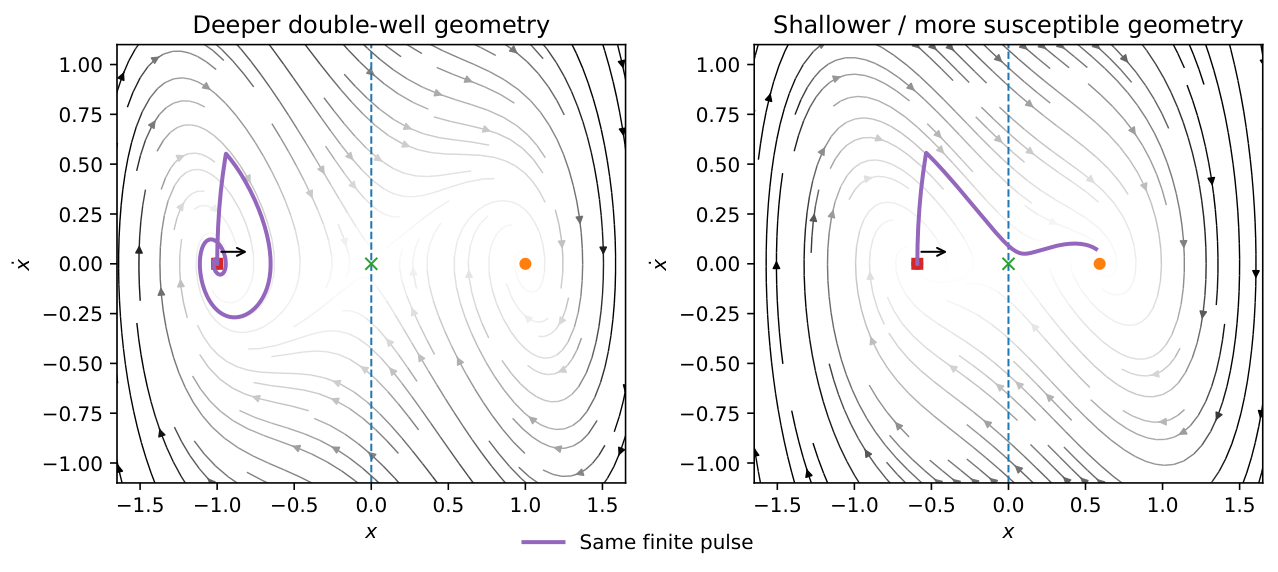
Figure 1 now gives the same point directly in phase-space form. The figure shows two illustrative phase portraits for a damped double-well toy system, with identical finite pulses applied from the left attractor. In the deeper geometry, the perturbed trajectory remains within the original basin and spirals back toward the incumbent attractor. In the shallower geometry, the same pulse crosses the schematic basin boundary and ultimately enters the opposite basin. The figure is not a cognitive model. Its role is only to show why perturbation magnitude alone is insufficient: transition depends on the geometry of the receiving landscape and on where the perturbation enters that landscape.
Recovery, Escape, and Transition Persistence
A transient excursion should be distinguished from a persistent regime change. Let
For empirical purposes, at least three observations should therefore be separated. The first is response amplitude, captured approximately by
The distinction is central for creativity. A striking idea can be forgotten. A dramatic brainstorming episode can leave the research programme unchanged. An unusual model output can receive a high novelty score while having no influence on subsequent generation. Conversely, a small conceptual revision can quietly alter which future observations are noticed, which sources are retrieved, and which questions appear meaningful. Such a revision may initially have low observable amplitude while later reorganizing the trajectory. Creative consequence is therefore temporally extended and cannot be inferred from the salience of the first response.
The same reasoning also guards against an overly simple perturbation-threshold model. If the system’s relational organization changes during the excursion, the effective basin and the threshold for later perturbations can change before the trajectory either recovers or escapes. A perturbation can therefore weaken restoring forces without immediately producing transition. Several perturbations that would each be sub-threshold in isolation can become collectively consequential when earlier events modify the response to later ones. This mechanism leads directly to historical accumulation and relational amplification, developed in Sections 6 and 7.
Evolving Attractor Landscapes
The strongest departure from a fixed dynamical picture occurs when the attractor landscape itself evolves. Let
This distinction yields three levels of perturbational consequence. At the weakest level, the perturbation moves the system within a basin while
An evolving landscape is important for historical systems because the path of inquiry can alter the conditions under which later inquiry proceeds. Once a new concept has been stabilized, a new instrument adopted, a new collaborator incorporated, or an anomaly retained as a standing problem, later perturbations are received by a different system. This is the formal reason that a sequence of encounters cannot always be modeled as independent shocks to an unchanged state space. Earlier events can change the geometry through which later events propagate.
The concept also prevents the framework from reducing creativity to boundary crossing. Some creative developments may indeed resemble escape from one stable region into another. Others may create a new dimension of description, alter the relations that define proximity, or transform the criteria by which a state counts as stable. Scientific theory change provides familiar qualitative examples: a new representation can preserve many empirical observations while reorganizing which variables are fundamental, which anomalies are salient, and which inferential moves are legitimate. The paper does not claim that such changes literally instantiate a mathematically known attractor bifurcation. It claims that any dynamical account of strong creative reorganization must permit the effective transition structure to evolve rather than treating the possibility space as permanently fixed.
Section 5 now turns to the regime conditions under which perturbation gain, boundary sensitivity, and landscape deformation may become more likely. Metastability and near-criticality are considered as candidate descriptions of structured susceptibility, while preserving the distinctions established here: large gain is not equivalent to transition, transition is not equivalent to turbulence, and neither requires that the system sit at a unique physical critical point.
Metastability, Criticality, and Epistemic Susceptibility
Section 4 established that stable generative regimes can nevertheless display large finite-time amplification, directional thresholds, and basin-dependent transitions. The remaining question is why a system should ever occupy a region in which small perturbations become unusually consequential. If the system remains deep inside a strongly restoring basin, contingent events are likely to be damped. If it becomes too weakly constrained, however, perturbations may proliferate without producing coherent retention. The present section therefore introduces structured susceptibility: a regime in which responsiveness to perturbation is elevated while enough organization remains to preserve, compare, and propagate the consequences of that perturbation.
The concepts of metastability and criticality are useful here, but they must be separated carefully. Metastability describes a dynamical organization in which partially autonomous components can form and dissolve temporary coordinations rather than remaining either fully independent or permanently synchronized. In cognitive neuroscience, metastability has been developed as a way to characterize the coexistence of integration and segregation across changing neural ensembles (Tognoli and Kelso 2014). Criticality, by contrast, refers more specifically to behavior associated with the vicinity of a transition between dynamical regimes, often including marginal stability, enhanced correlation lengths, broad response ranges, or scale-free statistics. The neural criticality literature remains active and contested: reviews have emphasized both computational advantages proposed near criticality and unresolved questions about measurement, mechanism, and universality (Cocchi et al. 2017; Hesse and Gross 2014). A recent viewpoint and meta-analysis has argued that criticality may function as a homeostatically regulated computational setpoint in the brain, while still presenting this as a hypothesis to be tested rather than a settled identity between neural function and a single mathematical critical point (Hengen and Shew 2025).
The present paper therefore uses near-critical and metastable as analytical hypotheses about susceptibility, not as ontological claims that creative cognition or artificial inference literally instantiate the same phase transitions observed in fluids, magnets, or neuronal avalanche models. The central question is narrower: whether creative reorganization becomes more likely in regimes that combine elevated perturbation gain, competing restoring tendencies, temporary coordination, and preservation of enough structure for perturbations to acquire historical consequence.
Sensitivity under Structured Stability
Let
High susceptibility alone is insufficient. A system whose responses become arbitrarily divergent under tiny perturbations may simply be unstable. Creativity requires some continuing constraint under which distinctions can be retained and compared. Let
This definition separates structured susceptibility from both rigidity and disorganization. In a strongly restoring regime,
This interpretation is compatible with, but more cautious than, claims that creativity occurs literally at an “edge of chaos.” Earlier work has proposed that creative cognition may benefit from a balance between ordered and chaotic dynamics, especially where flexibility increases without destroying usefulness or coherence (Bilder and Knudsen 2014). Such arguments are suggestive because they identify an apparent inverted-U relation between rigidity and unconstrained variability. They do not establish that creative processes occupy a unique critical point, nor do they specify the perturbational mechanism by which a local event becomes historically consequential. The present framework treats the balance as a regime-selection problem and asks how that regime changes perturbation gain, retention, and transition probability.
A more useful visualization of the regime idea is a phase diagram rather than another time-series trajectory. Figure 2 therefore presents an illustrative control-parameter map with one axis representing restoring organization and the other representing amplification or relational coupling. The colored regions distinguish an over-stable zone, an intermediate window of structured susceptibility, and an over-amplifying or incoherent zone. The figure is intentionally schematic: it does not claim that empirical creative systems are governed by these exact axes or boundaries. Its role is to visualize the claim that the relevant question is not whether a system is simply random or simply ordered, but where it lies in a regime space that jointly shapes damping, propagation, and coherence.
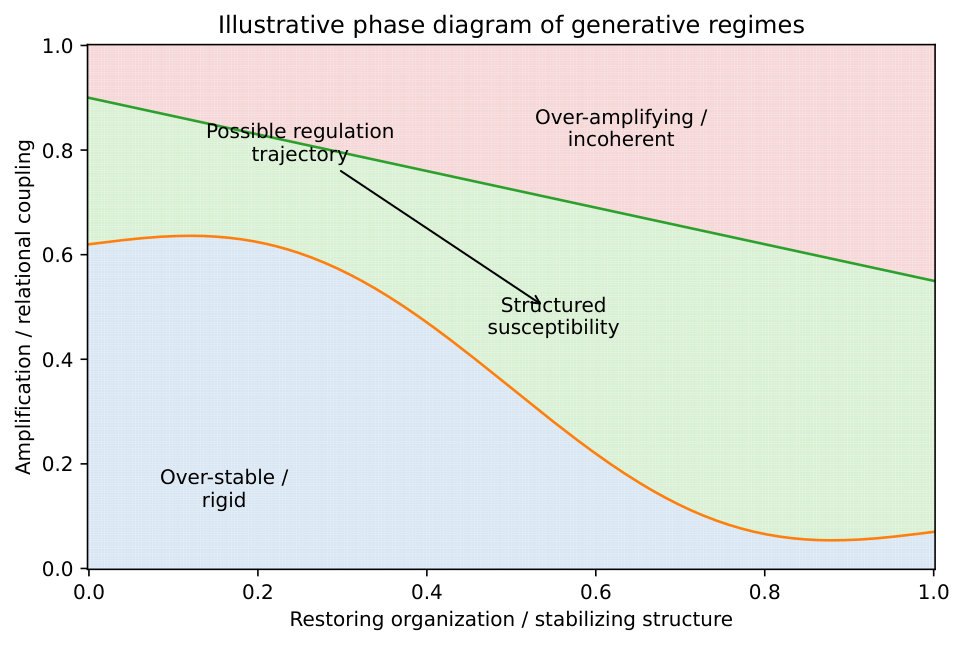
A complementary bifurcation-style view is shown in Figure 3. Using the normal form
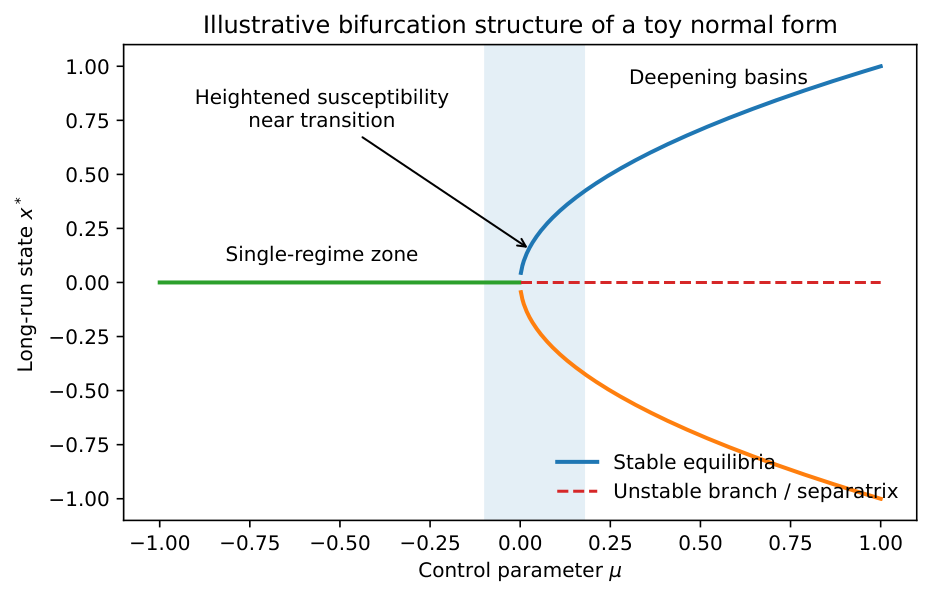
Near-Critical Regimes as an Analytical Hypothesis
In classical critical phenomena, susceptibility can increase near a transition because restoring forces weaken and correlations extend over larger scales. The same mathematical vocabulary motivates a useful hypothesis for creative systems: the effective cost of moving away from the incumbent organization may decrease in some regions of parameter space, so that perturbations that would be absorbed elsewhere can propagate more broadly. Let
Several cautions are required. First, Equation (30) is not proposed as a universal law. Non-normal transient amplification, finite-amplitude basin crossing, and history-dependent landscape deformation can all produce high gain away from a conventional critical point, as Section 4 emphasized. Second, the relevant transition set may be extended, folded, or multidimensional. A generative system can be near one transition while far from another. Third, finite systems rarely exhibit the singular behavior of infinite-system phase transitions. For empirical cognitive or artificial systems, one should expect broadened transition regions rather than mathematically sharp points.
The most defensible use of criticality in this paper is therefore operational. A near-critical epistemic regime is one in which small, structured perturbations display increased probability of persistent cross-component propagation, long recovery times, competition among multiple recurrent organizations, or qualitative change in later generative behavior. None of these signatures alone proves criticality. Together, however, they identify a region in which the system behaves as though restoring constraints are weakened enough for local differences to become systemically consequential.
Metastability provides a complementary description. Tognoli and Kelso characterize metastability as the coexistence of tendencies toward integration and independent component activity rather than permanent synchronization (Tognoli and Kelso 2014). An epistemic analogue would be a system in which conceptual, evidential, or social substructures are neither locked into one globally fixed interpretation nor completely disconnected. Several partially autonomous representations can coexist long enough to interact, compete, or form temporary coalitions. Such a regime can increase the number of relational pathways through which a perturbation propagates while preventing immediate collapse into either one dominant interpretation or unstructured multiplicity.
This gives a more precise role to unresolved contradiction. If two explanatory frames are immediately collapsed into one, the perturbation created by their incompatibility is damped. If they remain permanently isolated, no relational amplification occurs. A metastable regime allows partial coexistence with intermittent coupling. The contradiction can then persist as a structured tension that modifies subsequent attention, retrieval, and problem formulation. In this sense, metastability can supply the relational medium through which near-critical susceptibility becomes epistemically productive.
Endogenous Movement across Stability Regimes
The introduction of a susceptible region creates a deeper problem. Even if creative transition is easier near such a region, why should a generative system approach it? A theory that simply assumes near-criticality relocates rather than solves the explanatory problem. The control parameters
The strongest version of this idea would identify a genuine self-organized critical process. The present paper does not make that claim. Self-organized criticality is a technical concept involving systems that endogenously evolve toward critical organization under particular driving and dissipation conditions. Neural systems have been discussed in these terms, but the empirical status and precise mechanisms remain debated (Hesse and Gross 2014). For creative systems, the more modest hypothesis is endogenous regime movement: interactions with unresolved error, novelty, relational heterogeneity, and task demands can modify the variables that determine stability and susceptibility.
Let
This formulation allows several routes toward susceptibility. Persistent anomalies can weaken confidence in a dominant representation. Exposure to heterogeneous environments can increase the number of alternative couplings available to a problem. Cross-disciplinary interaction can reduce the exclusivity of one explanatory vocabulary. An unresolved question can remain active across multiple contexts, allowing otherwise weak events to become relevant. Conversely, successful consolidation, repeated confirmation, or strong normative constraint can deepen the incumbent basin and reduce sensitivity to perturbation. The control landscape therefore becomes historically endogenous.
A useful distinction follows between perturbation exposure and criticalization. Exposure changes the events presented to a system. Criticalization changes the system’s susceptibility to those events. Walking through unfamiliar environments, reading outside a field, or interacting with differently trained collaborators may increase exposure to heterogeneous perturbations. But the same activities can also alter control conditions by loosening habitual coupling, sustaining unresolved questions, or creating competing representations. The first effect changes the distribution of
This distinction is important for artificial systems. Increasing sampling temperature, injecting random context, or generating many candidate ideas primarily changes perturbation frequency or local variability. Such interventions need not move the system toward a structured-susceptibility regime. A model can become more random while remaining organized by the same high-probability conceptual attractors, or it can become incoherent before any stable alternative structure forms. A stronger intervention would have to alter the effective restoration and retention dynamics: for example, how long contradictory frames remain active, how prior anomalies constrain later generation, which relations are allowed to reorganize, and whether earlier deviations change the response to later ones. These possibilities are examined empirically in Sections 11 and 12.
Exploration and Consolidation as Criticality Regulation
If excessive stability and excessive instability are both unfavorable, a creative system may benefit from mechanisms that regulate movement between them. This paper calls the general possibility criticality regulation, again without implying a literal physical thermostat controlling distance to a unique phase transition. The term denotes adaptive control over susceptibility: processes that increase openness to perturbation when an incumbent structure becomes too rigid and restore coherence when exploration becomes too unconstrained.
A schematic regulation rule can be written as
This alternation provides a dynamical interpretation of familiar research practices. Exploratory reading, informal conversation, travel, wandering, speculative analogy, and open-ended note-taking can increase relational diversity and maintain unresolved alternatives. Formal modeling, experimental design, proof, revision, and exposition reduce degrees of freedom and stabilize what has been learned. If consolidation occurs too early, a perturbation is normalized before it can propagate. If exploration persists indefinitely, no reorganization is retained strongly enough to constrain future thought. The relevant process is therefore not maximal divergence but repeated movement between loosening and stabilization.
The neural criticality literature offers a useful analogy because it asks whether development, plasticity, and homeostatic control can tune a biological network toward a computationally advantageous marginal regime. Hengen and Shew argue, on the basis of a synthesis and meta-analysis, that criticality may act as a homeostatic endpoint supporting computational capacity (Hengen and Shew 2025). The present framework does not transfer that conclusion to creativity. It extracts a structural possibility: a system may possess regulatory mechanisms whose function is not to eliminate variability but to preserve a working range in which variability remains consequential without becoming destructive.
This suggests that creative capacity may depend partly on regulatory flexibility. Two systems can display similar average novelty while differing in their ability to change regime when novelty ceases to be useful. One may remain rigid until a very large perturbation forces transition. Another may loosen its constraints in response to unresolved anomalies, enter a susceptible regime, capture informative perturbations, and then reconsolidate around a reorganized structure. A third may become unstable but lack a mechanism for reconsolidation. The relevant comparison is therefore dynamic rather than static.
A practical empirical prediction follows. If creativity depends on regulated susceptibility, then performance should not increase monotonically with any single variable such as randomness, entropy, diversity, or exploration. Instead, one should expect task- and system-dependent regions in which increasing flexibility initially improves perturbation propagation and conceptual reorganization, followed by deterioration when coherence or retention falls below a functional threshold. The predicted relation resembles an inverted-U only at a coarse level; in multidimensional systems the high-performing region may be a ridge, manifold, or moving zone rather than a single optimum.
Criticality beyond a Single Transition Point
The final conceptual requirement is to avoid turning “criticality” into a universal label for all interesting instability. Different mechanisms can generate sensitivity, and different creative processes may rely on different combinations of them. Subcritical basin escape can occur while a local regime remains linearly stable. Non-normal dynamics can produce strong transient gain far from an asymptotic instability. Metastable coordination can generate rich switching without a conventional phase transition. Historical accumulation can move basin boundaries gradually until an apparently small final perturbation triggers escape. These mechanisms can coexist.
For that reason, the paper treats the critical zone as an empirical family of high-susceptibility regimes rather than as a single theoretical point that every creative system must approach. Let
This broader formulation also clarifies the relation between criticality and the turbulence-like hypothesis developed later. Criticality concerns susceptibility and transition conditions. Turbulence-like epistemic dynamics concern the subsequent organization of amplified perturbations: recursive coupling, multiscale propagation, interaction among multiple perturbations, and feedback on the structures through which later perturbations flow. A system can be highly susceptible without entering turbulence-like dynamics. A single perturbation can trigger an attractor transition without generating sustained cascade behavior. Conversely, once a turbulence-like regime is established, it may persist over a wider parameter range than the narrow region in which the initial transition occurred, just as physical turbulence need not be identified with the critical onset conditions that first allow it to emerge (Hof 2023; Eckhardt et al. 2007).
The working hypothesis can therefore be stated in conditional form. Creative reorganization becomes more probable when a generative-relational system enters a structured-susceptibility regime in which restoring constraints are sufficiently weakened for perturbations to propagate, relational alternatives remain available, and historical retention is strong enough to preserve the consequences of that propagation. Such a regime may be approached endogenously through criticality regulation, but neither near-criticality nor metastability is treated as a necessary universal cause of creativity. They are candidate dynamical conditions whose explanatory value depends on whether they predict perturbation gain, capture, persistence, and later generator change better than simpler accounts based on randomness or output novelty alone.
Section 6 turns from regime conditions to the event-level mechanism itself. The next question is not whether a perturbation can be amplified in principle, but how a contingent encounter becomes captured: how an initially local event is selected, retained, related to existing structures, and made available to modify subsequent generation rather than disappearing as unrecorded variation.
Contingency and Perturbation Capture
The preceding sections separated perturbation magnitude from dynamical susceptibility. This section turns to the event-level mechanism that connects them. Its purpose is to specify what is meant by contingency in the present framework, to distinguish mere exposure from capture, and to identify the conditions under which an initially local event becomes part of the system’s causal history. The discussion proceeds from the status of a contingent event relative to a generative description, through relational incorporation and the temporal separation of event, recognition, and explicit use, to capture probability, historical retention, and altered future susceptibility. The central claim is conditional rather than universal: an event becomes creatively consequential when its difference is preserved in a form that can reorganize later generation, including cases in which the event begins to affect the system before the system can explicitly recognize its relevance.
Contingency Relative to a Generative Description
Contingency is used here as a relational property between an event and a specified generative description. It does not require metaphysical indeterminism, and it is not identified with random sampling. An event can be deterministic at one level of description while remaining contingent relative to the epistemic system that encounters it. A researcher’s unplanned conversation, an anomalous measurement, a book found while searching for another, or an unfamiliar concept encountered in a neighboring discipline can all function as contingent events when their occurrence and relevance were not fixed by the operative trajectory of inquiry.
Let
This distinction is consistent with serendipity research, which separates chance occurrence from the mechanisms by which an unexpected event becomes a discovery. Yaqub’s taxonomy shows that serendipitous outcomes can emerge through different configurations of observation, theory, error, and network interaction rather than through a single category of luck (Yaqub 2018). Ross likewise emphasizes that chance and accident do not by themselves constitute creativity; recognition and productive use remain necessary (Ross 2025). In the present framework, these observations motivate a dynamical intermediate variable between event exposure and later reorganization.
The distinction also prevents a common ambiguity in comparisons between human and artificial systems. Randomized decoding, random retrieval, random prompts, or random environmental inputs can increase the number of perturbations presented to a model. They do not establish that the model has encountered contingency in the stronger historical sense relevant here. The stronger question is whether the incoming difference becomes coupled to an unresolved trajectory, changes the interpretation of other elements, survives subsequent generation, and thereby alters what later perturbations can do.
The event itself should therefore be separated from the perturbation induced in the focal system. Let
Relational Incorporation and Capture
The term perturbation capture denotes the conversion of a local perturbation into a retained component of subsequent generative dynamics. Capture is stronger than perception, storage, or immediate response. A system may notice an anomaly, record it faithfully, and still proceed exactly as before. Conversely, a small and incompletely remembered event can be strongly captured if it changes the relations through which later evidence is interpreted.
A minimal representation distinguishes an uncaptured perturbation from a captured one by its effect on the later generative configuration. Let
A useful qualitative capture-strength functional is
This distinction makes room for two different forms of incorporation. Assimilative incorporation occurs when an event is assigned to an existing category or explanatory relation in a way that reduces its perturbative effect. The event can be remembered while the incumbent attractor remains essentially unchanged. Generative capture occurs when incorporation creates or modifies relations that remain active in later generation. The contrast can be written schematically as
Temporal Separation of Perturbation, Recognition, and Capture
A contingent event need not become explicit at the moment when it first enters the system. This temporal separation is important because accounts of serendipity and creativity can otherwise collapse contingency into subjective surprise. In the present framework, an event can acquire causal relevance before the focal system can represent that relevance explicitly. A weak trace can be incorporated into memory, association, attention, bodily orientation, a concept graph, or an unresolved problem structure and become generatively active only after later events provide a relation through which the earlier perturbation can be interpreted.
Let
This distinction separates contingency from surprise. Surprise is an epistemic or phenomenological response of a system at a particular time. Contingency, as defined above, concerns the relation between an event and the operative generative trajectory. An event can therefore be contingently consequential even when it initially produces little surprise. Conversely, an event can be highly surprising while leaving no persistent generative trace. The relevant contrast can be stated schematically as
To represent this possibility, let
This delayed activation gives rise to a form of retrospective capture. Later relations can change the effective significance of earlier events without changing the fact that those events occurred. If a later event
This mechanism also offers a dynamical interpretation of incubation and delayed insight. An apparently sudden conceptual connection can be the representational manifestation of several weakly retained perturbations whose relations accumulated below explicit salience. If
The distinction is especially consequential for comparisons between human and artificial systems. A system that preserves only information already classified as relevant may be poor at retaining perturbations whose significance is not yet representable. Long-term creativity may therefore depend partly on the capacity to preserve weak traces under uncertain relevance and to permit their later reactivation under changed relational conditions. For artificial agents, this yields a concrete design and measurement question: whether information that fails an immediate relevance criterion can nevertheless produce a persistent low-strength change in later retrieval, association, or model-mediated action. Such a mechanism would be distinct from merely enlarging a context window or storing every encountered token. The empirical target is delayed causal availability.
Figure 4 illustrates this temporal separation in phase-space form. The horizontal axis represents a latent retained trace and the vertical axis an expressed state. An early event displaces the system along the latent dimension while leaving the expressed dimension almost unchanged, so that little overt difference is yet visible. A later cue then couples to the retained trace and produces a delayed excursion in the expressed state. The construction is intentionally schematic: it demonstrates that the time of causal entry, the time of recognition, and the time of expressed consequence can be separated even in a minimal dynamical system.
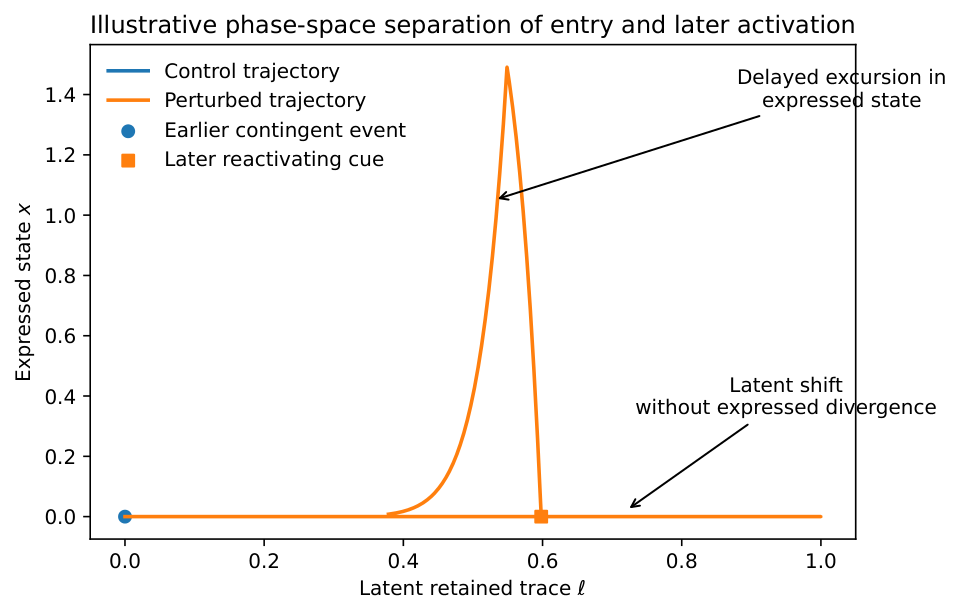
This temporal account also modifies the meaning of capture probability developed next. Capture need not be a single decision made at
Selection, Salience, and Capture Probability
Most perturbations disappear. Any realistic theory of creative change therefore requires a selection mechanism, while allowing selection to occur at more than one temporal stage. A person walking through a city, a laboratory receiving measurements, or an artificial agent browsing a large corpus is exposed to far more differences than can become historically active. Some are selected immediately; others persist as weak traces and are selected only after later relations make them salient. The relevant quantity is therefore not only perturbation rate but the conditional probability that a perturbation is registered, retained, reactivated, and eventually becomes generatively consequential under the current and evolving relational configuration.
Let
Several components can contribute to
This representation yields a useful explanation of heterogeneous creative response. An event that appears trivial to one researcher can become decisive for another because the second already possesses a relation or unresolved question that allows the event to bridge previously separated structures. The difference is not reducible to intrinsic event novelty. It depends on the geometry of
The same logic also explains why increasing exposure does not guarantee increased creativity. If
Historical Retention and Path Dependence
Capture becomes especially important when the perturbation alters the meaning of later events. This property distinguishes a historical system from a sequence of independent responses. Suppose perturbation
This recursive property helps explain why creative trajectories can display retrospective structure. At the time of the initial encounter, the event may have no obvious significance. Later relations can reactivate it, reinterpret it, or connect it to a newly formed question. The historical consequence of the original perturbation is therefore partly generated after the event itself. In such cases, capture is distributed across time: an initial weak trace in
A simple recursive representation is
The distinction also bears directly on artificial systems. Long context windows, vector stores, episodic memory, or retrieval systems can increase access to prior information, but access alone does not establish historical retention in the sense used here. A stored event becomes dynamically retained only when it changes later transition probabilities, relation formation, retrieval policy, or interpretation. Conversely, a model with limited explicit memory can still display path dependence within a trajectory when earlier generated relations constrain later reasoning. Empirical comparisons should therefore measure causal use of history rather than memory capacity alone.
Perturbations that Modify Future Susceptibility
The strongest form of capture occurs when a perturbation changes the system’s susceptibility to later perturbations. This is the point at which contingency begins to modify the medium through which future contingency propagates. In the notation of Sections 3 and 5, a captured event can alter
Let
This higher-order effect provides a bridge between perturbation capture and criticality regulation. Repeated capture of unresolved anomalies can increase relational tension, diversify active alternatives, or weaken restoration toward an incumbent explanation, thereby moving the effective control configuration toward a structured-susceptibility region. Capture can also produce the opposite movement: a successful new synthesis can consolidate relations, reduce uncertainty, and deepen a newly formed basin. The creative trajectory can therefore contain alternating phases in which captured perturbations first increase susceptibility and later contribute to restabilization.
The resulting process is richer than stochastic variation. A random sequence can generate many different local states while preserving the same response law. A historically captured sequence can modify the law governing response to the next event. Schematically,
This formulation also clarifies the empirical burden of the perturbation-capture hypothesis. Evidence for capture requires more than an unusual output following an unusual input. A convincing test should show persistence beyond the immediate response, mediation through a changed relational or historical configuration, and a measurable counterfactual difference in later generation. Stronger evidence would show that the earlier perturbation changes later susceptibility, capture probability, or the direction of relational propagation. These criteria make the concept falsifiable: if injected perturbations repeatedly produce local novelty but no persistent downstream difference under matched trajectories, the capture mechanism is not supported in that system and regime.
Section 7 develops the next stage of the hypothesis. Once a perturbation has been captured, its creative consequence depends on whether the retained difference remains local or propagates through multiple relations and scales. The next problem is therefore one of amplification: how changes in one part of a generative-relational system recruit other components, interact with later perturbations, and produce cascade-like reorganization whose magnitude exceeds the scale of the initiating event.
Relational Coupling and Cross-Scale Amplification
Section 6 described perturbation capture as a historical process through which a contingent difference acquires a persistent place in the effective state of a generative system. Capture alone, however, does not explain strong creative reorganization. A retained perturbation can remain confined to one concept, one local association, or one episode of retrieval. The present section therefore addresses the next stage of the hypothesis: the conditions under which a locally captured difference propagates through a changing relational structure, recruits additional components, interacts with later perturbations, and produces a downstream effect whose scale exceeds that of the initiating event.
The language of amplification is familiar across nonlinear dynamics, network science, and path-dependent systems. Small shocks can sometimes trigger large cascades when local thresholds, topology, feedback, and system susceptibility align. In threshold-network models, for example, a small initiating seed can remain local or trigger a global cascade depending on the structure of vulnerable connections rather than on the seed magnitude alone (Watts 2002). Historical path-dependence models likewise show how small early events can be amplified through positive feedback and eventually shape macroscopic trajectories (Arthur 1989). These literatures do not provide a ready-made model of creativity, but they establish a general point that is central here: downstream magnitude cannot be inferred from initiating magnitude without knowing the structure through which the perturbation propagates.
In a generative-relational account, amplification is not treated as the growth of an isolated signal moving through a fixed network. The network itself can change during propagation. Relations can be created, weakened, redirected, grouped into higher-order structures, or reinterpreted through later events. Higher-order interaction research is relevant in this respect because collective dynamics can depend on interactions among groups rather than being reducible to pairwise edges (Battiston et al. 2021). For epistemic systems, this means that a perturbation may acquire consequence not only because it travels farther, but because its passage changes which relations exist and which combinations of relations become dynamically active.
Relational Pathways of Perturbation Propagation
Let the captured perturbation at time
This distinction matters because the same perturbation can encounter very different pathways in two systems with superficially similar knowledge contents. A captured observation may connect directly to an unresolved question in one trajectory, remain isolated in another, and conflict with a highly stabilized explanation in a third. Propagation is therefore conditional on local connectivity, bridge relations, competing restoring forces, and the availability of structures capable of recruiting the perturbation into a wider reorganization. The relevant unit is not merely the event or the concept, but the configuration in which the event becomes dynamically situated.
The directionality of propagation is also important. Relations need not be symmetric. A new observation can alter the interpretation of a theory without the theory producing an equivalent change in the observation, and a methodological revision can reorganize multiple empirical categories while leaving some categories causally unable to modify the method in return. Let
This endogenous rewiring differentiates relational amplification from simple diffusion. Diffusion assumes that a quantity spreads over a pre-existing substrate. Creative reorganization can instead involve simultaneous change in the quantity, its interpretation, and the substrate through which it propagates. A concept borrowed from another discipline, for example, can enter as a weak analogy, change the interpretation of an unresolved problem, create a new bridge among previously separated variables, and thereby make later observations newly relevant. The amplification occurs through a sequence of relation-making events rather than through repeated transmission of an unchanged item.
Thresholded Recruitment and Nonlinear Gain
Propagation becomes strongly nonlinear when downstream components respond only after combinations of influences cross local thresholds. Let
This representation helps distinguish weak association from cascade formation. If a new relation alters one local state but fails to recruit additional components, then the perturbation has been captured but not strongly amplified. If the altered state raises the probability that neighboring structures cross their own thresholds, the perturbation can propagate recursively. The resulting process resembles threshold cascades in network models, where large outcomes can be triggered by small seeds under specific topological and susceptibility conditions (Watts 2002). The analogy is structural rather than literal: epistemic components need not be binary nodes, and their thresholds can be context-dependent, historically modified, and multidimensional.
A useful operational quantity is a relational amplification factor over horizon
Nonlinearity is present when
Cross-Scale Cascades in Generative Structure
Creative reorganization often involves changes at multiple descriptive scales. A local event can first alter an association, then a concept, then the representation of a problem, and finally the organization of a research programme. These levels should not be treated as a rigid hierarchy, but they provide a useful way to distinguish propagation from cross-scale propagation. Let
The direction of influence need not remain bottom-up. Once a higher-scale representation changes, it can feed back downward by altering what lower-scale differences become salient, how evidence is classified, or which local relations are worth preserving. A revised theoretical frame can therefore change the interpretation of previously collected observations, just as a local anomaly can initiate revision of the frame. Cross-scale amplification is consequently recursive:
This recursive structure is one reason higher-order interaction is relevant. If epistemic relations are represented only as independent pairwise links, a reorganization that depends on a coordinated configuration of several concepts may be missed. A hypothesis can become meaningful only when a set of observations, methodological constraints, and conceptual distinctions are jointly present. In higher-order systems, group-level interactions can produce collective behaviors that are qualitatively different from those expected under pairwise coupling alone (Battiston et al. 2021). For the present framework, the implication is methodological: empirical measures of epistemic cascade should not assume in advance that all amplification can be decomposed into independent dyadic associations.
A cascade can be described through breadth, depth, duration, and scale reach. Let
History-Dependent Propagation
The most important difference between relational cascades and repeated stochastic variation is that propagation changes the conditions of later propagation. Historical path dependence can therefore arise before any full attractor transition occurs. Arthur’s analysis of increasing returns provides a classic illustration of how small historical events can become amplified through self-reinforcing feedback and influence which macroscopic trajectory is selected (Arthur 1989). The present framework generalizes the structural intuition while avoiding the claim that epistemic systems follow the same economic mechanism.
Let
This mechanism yields a form of cumulative sensitivity. Several weak perturbations can remain individually subthreshold while jointly reshaping the propagation geometry. A later event can then trigger a large response because the earlier history has already altered local thresholds, bridge relations, or restoring forces. Such a trajectory can appear retrospectively sudden even when the relevant reorganization developed gradually. The final visible transition is then the last step of a longer relational accumulation rather than the sole causal event.
The converse process is also possible. Cascades can generate stabilizing relations that reduce later propagation. A newly formed synthesis can absorb previously conflicting observations, increase local coherence, and raise the effective threshold for further reorganization. Amplification should therefore not be modeled as an indefinitely increasing process. Creative trajectories can alternate between propagation and consolidation, consistent with the criticality-regulation account developed in Section 5.
Amplification, Saturation, and Dissipation
A useful theory of amplification must also explain why most perturbations do not become cascades. At least four limiting mechanisms are relevant. First, local damping can erase a perturbation before it recruits additional relations. Second, topological isolation can preserve a perturbation while preventing it from reaching bridge structures. Third, saturation can make additional activation produce diminishing downstream change once many relevant components have already reorganized. Fourth, competing cascades can interfere with one another, producing cancellation, fragmentation, or loss of coherence.
These possibilities can be represented by an effective cascade balance,
The resulting distinction is important for the transition to Section 8. A large relational cascade is still not equivalent to epistemic turbulence. Cascades can be directional, finite, and organized around a single perturbation pathway. Turbulence-like dynamics require a stronger regime in which multiple perturbations and scales interact persistently, amplification and damping become spatially or conceptually heterogeneous, and the propagation process itself continually modifies the conditions of subsequent propagation. A cascade can therefore be one ingredient of epistemic turbulence without exhausting the concept.
The empirical implication is that tests of the present framework should estimate not only output divergence but the structure of propagation. Controlled perturbation experiments can compare matched trajectories with respect to cascade breadth, dependency depth, persistence, scale reach, interaction gain, and modification of later propagation operators. Evidence for relational amplification would require downstream structural effects that exceed immediate response and are mediated by identifiable relational changes. Stronger evidence would show that the cascade modifies susceptibility or propagation for later perturbations. Section 8 develops the additional conditions under which such cascades may form a sustained turbulence-like epistemic regime rather than remaining isolated episodes of nonlinear reorganization.
Turbulence-Like Epistemic Dynamics
The preceding sections have separated several mechanisms that are often compressed into the single language of “creative instability.” A contingent perturbation may be registered without being retained; it may be retained without being amplified; it may be amplified without crossing scales; and a cross-scale cascade may still terminate without producing a sustained change in the regime of generation. The present section therefore introduces epistemic turbulence only as a provisional name for a stronger dynamical configuration in which perturbations continue to interact across scales, propagate through a historically changing relational medium, and repeatedly modify the conditions of their own future propagation. The term is intended to identify a research hypothesis, not to claim that epistemic systems obey the Navier–Stokes equations or instantiate fluid turbulence in a literal physical sense.
The distinction is important because randomness, chaos, and turbulence are not interchangeable even in physical dynamics. Fully developed fluid turbulence involves nonlinear transfer across scales, persistent fluctuations, dissipation, and structured multiscale organization rather than undifferentiated disorder (Wit et al. 2024; Johnson and Wilczek 2024). Likewise, transition studies show that laminar and turbulent behaviours can coexist over extended parameter ranges, and that onset can involve intermittent localized structures rather than a single instantaneous switch from order to disorder (Hof 2023; Avila et al. 2023). These features motivate, but do not determine, the present analogy. The epistemic hypothesis concerns whether a generative system can exhibit a comparable organizational form: locally initiated changes become recursively coupled, distributed over several descriptive scales, intermittently intensified and damped, and capable of reorganizing the relational pathways through which later changes travel.
Scope and Limits of the Turbulence Analogy
The strongest reason to retain the turbulence analogy is not that creative thought appears disorderly. Disorder alone is theoretically weak. A sequence of independent random outputs can be highly irregular while possessing almost no historical organization. The relevant analogy instead concerns the coexistence of three properties: nonlinear interaction, multiscale propagation, and endogenous modification of the propagation field. These properties distinguish a turbulence-like regime from both stable attraction and unstructured noise.
Let
This point marks a major departure from a literal fluid analogy. A physical energy cascade commonly refers to transfer through a hierarchy of spatial scales until dissipation becomes dominant (Wit et al. 2024). Epistemic reorganization can move in more than one direction. A local anomaly can alter a theoretical representation, while a new theoretical representation can later change how the original anomaly is classified. Thus one can have
The analogy also does not imply that every creative process is turbulent. Some discoveries may arise from relatively smooth accumulation, direct deduction, or deliberate search inside a stable representation. Nonlinear dynamical accounts of creativity already caution against reducing creative activity to a single order–chaos continuum (Schuldberg and Guisinger 2021). The present hypothesis is narrower: a subset of strong creative reorganizations may involve a turbulence-like regime in which initially local perturbations acquire sustained, interacting, multiscale consequences.
Persistent Multiscale Cascades
A single large cascade is insufficient for epistemic turbulence. Section 7 allowed a perturbation to propagate from one scale to another and then terminate. A turbulence-like regime requires continued production, interaction, and redistribution of perturbative consequences over a nontrivial time window. Let
This requirement makes historical dependence central. If each perturbation produces an independent novelty and the system resets before the next perturbation arrives, then a large number of creative-looking outputs can be generated without turbulence-like dynamics. By contrast, if an earlier perturbation changes the relational substrate through which later perturbations propagate, then successive events become dynamically coupled. Let the effective propagation operator evolve according to
The resulting trajectory can exhibit recursive amplification. Suppose a perturbation
The cascade can nevertheless remain bounded. Amplification may saturate, competing interpretations can interfere destructively, or consolidation processes can absorb the active changes into a newly coherent structure. Turbulence-like dynamics should therefore be understood as a temporally extended regime, not as an irreversible commitment to permanent instability. The system may enter such a regime, remain there for a period, and later leave it through stabilization or attractor reorganization.
Intermittency and Coexisting Epistemic Regimes
Transition to turbulence in physical flows is frequently spatially and temporally intermittent. Laminar and turbulent regions can coexist, and localized turbulent structures can decay, split, or proliferate depending on control conditions (Hof 2023; Avila et al. 2023). The epistemic analogy suggests that creative reorganization need not involve a whole cognitive or artificial system becoming uniformly unstable. High-amplification activity can remain localized to a subset of concepts, questions, or representational layers while other components remain strongly stabilized.
Let
This formulation also clarifies the relation between criticality and turbulence-like dynamics. Section 5 introduced a structured-susceptibility region in which perturbation gain is elevated while coherence and retention remain sufficient for organized propagation. Such a region can make turbulence-like episodes more probable, but near-criticality is neither identical to turbulence nor necessarily required in a unique physical sense. In subcritical fluid transition, for example, finite-amplitude perturbations can trigger turbulent dynamics even when the laminar state remains linearly stable (Eckhardt et al. 2007; Schneider et al. 2007). The epistemic hypothesis therefore permits several routes: movement toward a high-susceptibility regime, finite perturbations that cross a basin boundary, or accumulated relational changes that progressively reduce restoring forces.
The converse distinction is equally important. A system can be highly unstable yet fail to sustain organized creative propagation. If relation changes are too rapid to be retained, if every interpretation is replaced before it can constrain subsequent processing, or if interaction becomes effectively decorrelated, the regime approaches unstructured noise rather than epistemic turbulence. The relevant zone is therefore characterized by structured instability: enough instability for perturbations to propagate and interact, but enough organization for those interactions to leave cumulative historical consequences.
Self-Modification of the Propagation Medium
The strongest version of the hypothesis concerns the point at which cascades alter not only the current relational configuration but also the rules that determine later propagation. In fluid turbulence the flow field transports quantities while itself being governed by nonlinear dynamics. The epistemic analogue proposed here is more abstract: relational reorganization changes which future inputs are salient, which pathways are available, which representations are stable, and which forms of update are likely. The medium through which perturbations propagate is partly produced by earlier propagation.
Let
This condition provides a bridge between cascade dynamics and the generator reconfiguration developed in Section 9. Not every change in
The distinction is also relevant for artificial systems. Increasing sampling temperature can enlarge local variation without changing the relational pathways by which later inputs are processed. Adding random documents can increase perturbation exposure without guaranteeing retention. A long-context or memory mechanism can preserve information without making preserved traces causally active in subsequent reinterpretation. The turbulence-like hypothesis therefore predicts that stochasticity, exposure, and storage will each be insufficient when the system lacks mechanisms through which prior perturbations can modify later capture, coupling, and propagation.
Provisional Signatures and Falsification Criteria
Because “epistemic turbulence” is an analogical term, it requires explicit empirical constraints. The concept should be abandoned or narrowed if its proposed signatures cannot be distinguished from ordinary stochastic variation, isolated cascades, or generic instability. Rather than compressing the regime into one scalar index, the present paper treats it as a conjunction of partially independent observables over a time window
The first signature, multiscale participation, asks whether relational changes remain confined to one descriptive level or repeatedly propagate among several levels. The second, nonlinear interaction, asks whether combined perturbations produce consequences that cannot be approximated by the sum of their independent effects. The third, intermittency, asks whether propagation occurs through temporally or structurally localized bursts rather than through homogeneous drift. The fourth, endogenous pathway modification, asks whether the process changes the effective routes, thresholds, or capture propensities through which later perturbations act. The fifth, historical persistence, asks whether measurable consequences remain after the original input is no longer present and whether those consequences alter responses to later events.
Several observations would count against the hypothesis. If perturbation-induced divergences disappear once sampling noise is controlled, then the apparent regime may be merely stochastic. If large semantic divergence occurs without persistent changes in relational structure or future perturbation response, it is better described as output variation. If cross-scale effects can be reproduced by a fixed linear propagation model, the turbulence-like language adds little. If historical retention is unnecessary and independent prompts generate equivalent patterns, the proposed recursive mechanism is weakened. Conversely, evidence of path-dependent multiscale interaction, burst-like activation, endogenous rewiring, and persistent modification of later response would justify further development of the hypothesis.
The present section therefore uses turbulence neither as an ornament nor as a completed physical theory of creativity. It names a candidate intermediate regime between perturbation capture and durable generator reconfiguration. Its explanatory role is to specify how a generative system might temporarily sustain structured instability long enough for contingent differences to interact across scales, alter their own propagation medium, and produce consequences that cannot be reduced to independent novelty events. Whether human creative trajectories or artificial generative systems actually instantiate such a regime remains an empirical question developed in Sections 10–12.
Attractor Transition and Generator Reconfiguration
Sections 4–8 separated several stages that can occur after a perturbation enters a generative system. A perturbation can produce a local deviation, be retained in relational or historical structure, propagate through nonlinear coupling, participate in a multiscale cascade, and, under suitable conditions, contribute to a turbulence-like epistemic regime. None of these stages by itself establishes that the system has entered a new generative organization. The present section therefore addresses the stronger transition: the point at which perturbation-induced change persists beyond the active episode and alters the structures that organize future generation.
The distinction is essential for a theory of creativity. A system can generate a highly novel trajectory while continuing to be governed by the same effective relations and restoring tendencies. It can also leave one stable region and settle into another while the larger attractor landscape remains unchanged. The strongest case occurs when the transition modifies the landscape, the effective generator, or the system’s response profile to later perturbations. These levels are nested possibilities rather than a single event. The paper uses creative attractor transition for trajectories in which contingent perturbations contribute to a persistent reorganization of future generative possibilities, and reserves generator reconfiguration for cases in which the effective rule or transition propensity governing later production is itself changed.
Trajectory Divergence and Structural Transition
A trajectory can diverge substantially from a reference path and still remain structurally transient. Let
The weakest case is state displacement. The perturbed trajectory remains different for some time because
It is therefore useful to represent post-perturbation structural persistence as a vector rather than a single distance,
A structural transition occurs when the downstream difference remains located in generatively consequential components after the initiating perturbation has ceased to act directly. This definition excludes two common false positives. The first is long but passive memory: a trace can remain stored while exerting no effect on later generation. The second is long output divergence produced by a one-time state displacement in a system whose underlying transition organization is unchanged. In both cases persistence exists, but the evidence for a changed generative structure remains weak.
This distinction also clarifies why novelty scores alone cannot establish theoretical innovation. An unusual hypothesis, metaphor, or proof strategy can be a large displacement in output space while leaving the system’s subsequent problem decomposition, evidence weighting, or conceptual relations unchanged. The stronger phenomenon relevant to this paper requires that the earlier perturbation alter the conditions under which later outputs are generated.
Attractor Transition and Basin Reorganization
The attractor vocabulary introduced in Section 3 separates within-basin exploration from movement between recurrent organizations. Suppose the incumbent generative regime is represented by attractor
Basin geometry makes such transitions strongly directional. A stable regime can lie near a boundary along one relational direction while remaining strongly restoring along another. Fractal or intricate basin boundaries in nonlinear systems further show that nearby states can have sharply different long-term outcomes (Grebogi et al. 1987). The epistemic implication is modest but important: a small conceptual difference can matter disproportionately when it enters along a direction that intersects a weakly stabilized boundary, while a much larger difference can remain dynamically harmless when it points toward strongly restored dimensions.
An attractor transition is still weaker than a reorganization of the attractor landscape. If
This distinction is useful for historical and scientific change. Path-dependent systems can become locked into one macroscopic trajectory because early differences are amplified by later feedback (Arthur 1989). A later transition can therefore require more than selecting a different available option; it may require the accumulation of changes that alter the feedback structure sustaining the incumbent regime. The present framework treats such change as landscape reorganization when the effective stability relations among candidate organizations are themselves modified.
A practical signature of landscape reorganization is a change in return structure. After a simple excursion, removal of the perturbation restores the previous regime. After a basin transition, the system may remain in
Effective Generator Reconfiguration
Attractor transition concerns where trajectories stabilize. Generator reconfiguration concerns how later trajectories are produced. Recall the effective representation
One way to express the distinction is through a matched-state transition test. Let
The effective status of
This formulation also prevents the hypothesis from equating creativity with parameter change. A model can be fine-tuned and thereby undergo a large
Figure 5 gives an illustrative common-future-input test. Two toy generators receive different prior histories, with one history changing an effective gain parameter. They are then presented with the identical future probe sequence. Persistent differences in response under the matched future input reveal a change in the response function rather than a merely different current state. The construction is intentionally transparent because it visualizes the logic of Equation 87; real human or artificial systems would require substantially stronger controls to distinguish generator change from hidden-state or memory effects.
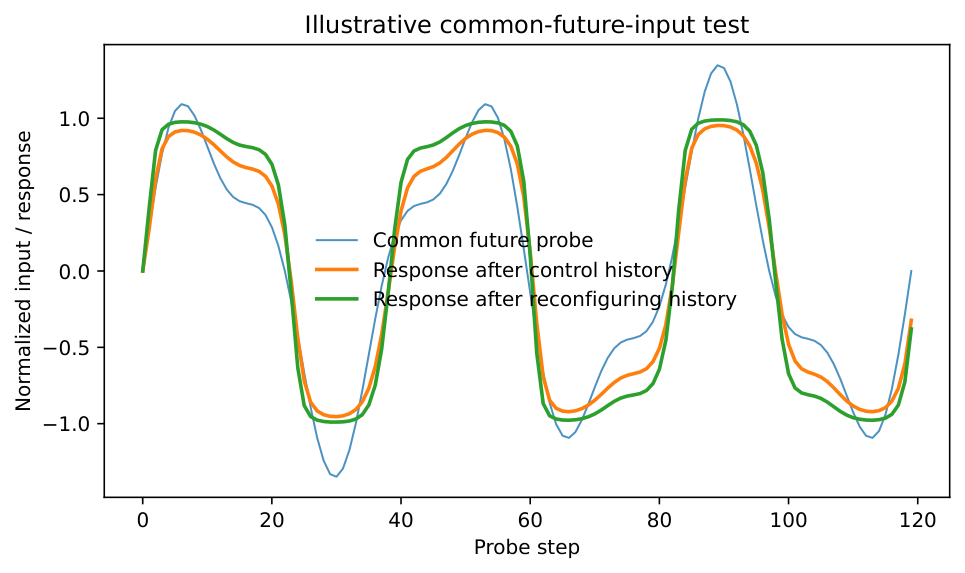
Recursive Modification of Perturbation Response
A strong implication of generator reconfiguration is that a past perturbation changes how future perturbations are processed. The system has then changed not only what it currently represents but its response surface to contingency. Section 5 introduced susceptibility
A historically consequential transition occurs when an earlier event
The recursive property makes historical contingency more than sequence dependence. The past does not merely determine which state the system occupies; it changes the map from future events to future consequences. This mechanism helps explain how a small early encounter can acquire increasing significance over time. An event can first modify one relation. The changed relation can alter the capture of later events, which can then reinforce a new interpretation. The resulting organization can eventually make the original event appear retrospectively decisive. The causal importance of the first perturbation is therefore partly produced by later history.
The same logic clarifies a possible limitation of contemporary generative AI. Random sampling, prompt variation, or retrieval can expose a model to abundant perturbations, yet the perturbations may remain weakly consequential if each episode begins with nearly the same response profile. Persistent memory can improve historical retention, but a stored event contributes to generator reconfiguration only when it changes later capture, coupling, or transition behavior. Section 11 develops this comparison in detail. At the present analytical level, the prediction is simple: systems with similar output diversity can differ sharply in creative dynamics if one system exhibits persistent
Consolidation of Newly Formed Generative Regimes
A creative transition does not culminate in permanent instability. A turbulence-like episode can destabilize an incumbent organization and open alternative pathways, but a new theory, method, or conceptual system becomes generatively consequential only if some of the resulting relations acquire enough stability to organize later work. Creative dynamics therefore require a second movement from amplification toward consolidation.
The full trajectory can be represented schematically as
Metastability is relevant here because a productive creative system may consolidate several partially autonomous organizations rather than collapse into one rigid attractor. Neural and coordination research uses metastability to describe regimes in which integration and segregation coexist over time (Tognoli and Kelso 2014). The present framework borrows only the structural intuition: creative consolidation can preserve multiple viable configurations and controlled transitions among them. A newly formed theory can therefore be stable enough to support inference while remaining revisable in response to future perturbations.
This final stabilization also creates the conditions for another creative cycle. Once the new regime becomes established, later unresolved anomalies can again accumulate, relational heterogeneity can again increase susceptibility, and new perturbations can become capable of destabilizing the organization. Creativity is therefore better represented as repeated alternation between relative stabilization and structured reopening than as a one-directional movement from order to disorder.
Table 3 summarizes the levels separated in this section. The ordering indicates increasing evidential strength for durable generative change, although empirical systems can display mixtures and partial transitions.
| Level | Primary change | Indicative evidence |
|---|---|---|
| State excursion | Temporary output or trajectory divergence under a stable restoring organization. | |
| Relational persistence | Retained differences that causally affect later generation under common inputs. | |
| Attractor transition | Persistent settlement into a different recurrent organization after the initiating perturbation ends. | |
| Landscape reorganization | Altered basin geometry, return structure, or availability and stability of recurrent regimes. | |
| Generator reconfiguration | Systematic transition differences under matched evaluation configurations. | |
| Response-profile reconfiguration | Changed capture, susceptibility, amplification, or propagation for later perturbations. |
The hierarchy also preserves an important epistemic limitation. A persistent attractor transition can stabilize an error, ideology, delusion, or unproductive research programme as readily as a valuable scientific theory. Dynamical generativity therefore does not establish truth, justification, or normative desirability. The present paper concerns the mechanism through which contingent perturbations may become historically consequential and reorganize future generation. Evaluation of the epistemic quality of the resulting regime requires additional criteria that lie beyond the dynamical hypothesis developed here.
The section therefore closes the mechanistic chain developed since Section 4. Contingency supplies perturbations; structured susceptibility affects their gain; capture allows them to enter history; relational amplification allows them to propagate; turbulence-like dynamics provide a candidate regime for sustained multiscale interaction; attractor transition and generator reconfiguration describe the point at which the consequences become durable in future generation. Sections 10 and 11 next examine how this chain may appear differently in human creative trajectories and contemporary artificial generative systems.
Human Creative Trajectories
The preceding sections developed a dynamical hypothesis without assigning any of its mechanisms exclusively to human cognition. Contingent perturbations can be registered, retained, amplified through relations, participate in multiscale cascades, and under suitable conditions contribute to persistent reconfiguration of future generation. The present section asks how this sequence may appear in human creative practice. Its purpose is not to establish a uniquely human faculty, nor to reduce creativity to a fixed psychological mechanism. It is to identify features of human research and creative trajectories that are compatible with the framework developed above and that can later serve as contrasts for artificial generative systems.
Human creative work is especially relevant because it unfolds over heterogeneous timescales. A question can remain unresolved for years; a weakly encoded event can become useful only after a later encounter; environmental movement can expose a researcher to cues that were never selected in advance; and periods of exploration can alternate with writing, formalization, and consolidation. These properties make human trajectories a useful case for studying historical retention and path-dependent susceptibility. The same person can become differently responsive to the same class of events because earlier work has changed which relations are available, which anomalies remain active, and which forms of evidence are treated as salient.
The discussion therefore focuses on five recurring features: persistent unresolved questions, delayed activation of earlier traces, environmental heterogeneity and movement, cross-domain relational coupling, and alternation between exploration and consolidation. None is sufficient for creativity by itself. Their relevance lies in the possibility that they jointly create conditions under which small perturbations can acquire disproportionate and historically durable consequences.
Persistent Questions and Prepared Relational Structure
Creative trajectories often contain problems that remain active despite the absence of an immediate solution. Such problems need not occupy focal attention continuously. They can instead persist as unresolved constraints on interpretation, making some later events more consequential than they would otherwise be. In the language of Section 6, the system carries not only stored content but a prepared relational structure that affects the probability that a future perturbation will be registered and retained.
Research on opportunistic memory provides a useful cognitive analogue. Seifert and Patalano argue that pending goals can be encoded in ways that later permit ordinary environmental cues to trigger recognition of an opportunity (Seifert and Patalano 2001). Earlier work on opportunistic assimilation similarly emphasized that apparently sudden insight can depend on preparation created by prior impasse and on later cues that become relevant only because the unresolved problem has already shaped memory and expectation (Seifert et al. 1995). These findings do not establish the stronger dynamical claims of the present paper, but they support an important temporal point: the causal preparation for an insight can precede the conscious recognition of the event that appears to trigger it.
Let
This helps distinguish exposure from prepared susceptibility. Two researchers can encounter the same paper, visual pattern, conversation, or anomaly while only one experiences a useful conceptual transition. The difference need not be located in a stable trait such as general intelligence or openness. It can arise because their histories have produced different
Persistent questions can also contribute to the criticality-regulation mechanism proposed in Section 5. A fully closed explanatory structure supplies strong restoring forces because new observations can be rapidly absorbed into familiar categories. An unresolved contradiction or anomalous observation reduces this closure. If the question is retained rather than prematurely resolved, it can sustain a region of structured susceptibility in which later perturbations have higher gain. The creative value of an open problem therefore does not lie only in the information it lacks. Its continued presence can alter the dynamical condition under which future information is received.
Latent Retention, Incubation, and Delayed Recognition
Human creative experience often separates the time at which a relevant event occurs from the time at which its relevance becomes recognizable. Section 6 introduced this distinction through event entry, recognition, and explicit capture. Human incubation research provides one empirical anchor for such temporal separation. A meta-analysis by Sio and Ormerod found a positive incubation effect across problem-solving studies, with the size of the effect depending on task and incubation conditions (Sio and Ormerod 2009). Baird and colleagues further reported that an undemanding task associated with greater mind wandering improved performance on previously encountered divergent-thinking problems relative to demanding activity, rest, or no break (Baird et al. 2012). These studies do not imply that unconscious processing is always creative, but they challenge a model in which productive restructuring occurs only during continuous focal attention.
Within the present framework, incubation can be represented as continued evolution of relational and historical variables while the focal problem is not being explicitly solved. A weak trace produced at time
This temporal structure produces what Section 6 called retrospective capture. Suppose an earlier event
This mechanism provides a dynamical interpretation of delayed insight. The recognizable moment of an idea may be the point at which a gradually reorganizing relational structure crosses a representational threshold, not the point at which all of its causes first appeared. A sequence of weakly consequential encounters can accumulate through
The distinction is also important methodologically. If experiments evaluate only immediate responses to perturbations, they can miss the class of effects in which a perturbation acquires consequence after a delay. Longitudinal designs should therefore track not only whether an event produces an immediate idea but whether it alters later retrieval, problem framing, or sensitivity to other cues. Human creativity may depend in part on the ability to retain material whose future importance is not yet known.
Environmental Heterogeneity and Perturbation Exposure
Creative work takes place in environments rather than in an isolated state space. Changes of place, bodily movement, conversation, reading outside an immediate task, and exposure to incongruent settings alter the distribution of perturbations available to a person. The framework developed here treats such changes neither as romantic prerequisites of creativity nor as direct causes of theoretical innovation. Their more limited role is to change perturbation exposure and, in some cases, the relational context through which perturbations are interpreted.
Walking provides a particularly clear example because it has been experimentally studied. Across four experiments, Oppezzo and Schwartz found that walking increased performance on divergent creative ideation tasks during and shortly after walking, while the same benefit did not extend straightforwardly to a convergent task requiring a single correct association (Oppezzo and Schwartz 2014). The result does not establish that walking causes major discovery, and part of the effect appears to arise from movement itself rather than from a visually rich environment. Its relevance to the present hypothesis is narrower: changing bodily activity can alter the generative regime in which ideas are produced, rather than merely supplying more factual input.
Environmental incongruence offers another partial analogue. Van Hooijdonk and colleagues used virtual environments in which ordinary objects appeared in either congruent or incongruent contexts and found greater cognitive flexibility and originality in the incongruent conditions (Van Hooijdonk et al. 2022). Again, this is not evidence for epistemic turbulence. It indicates that a change in contextual relations can affect the ease with which familiar objects are represented under alternative relations. In the notation of this paper, the same local object
These results motivate a simple distinction between perturbation rate and perturbation consequence. Let
This perspective offers a restrained interpretation of the recurring practice of walking, travelling, changing work locations, or reading beyond one’s immediate field among some researchers and creators. Such practices can be understood as forms of environmental heterogeneity that alter both the stream of perturbations and the context in which existing questions are carried. The researcher does not need to know in advance which event will matter. Indeed, preselecting only obviously relevant inputs can reduce the chance of encountering a perturbation whose importance becomes visible only after relational recombination.
Cross-Domain Coupling and Relational Reorganization
Human theoretical creativity frequently involves relations among materials that were previously organized under different conceptual systems. An analogy between domains, an imported mathematical structure, a historical comparison, or a contradiction between disciplinary vocabularies can create new pathways through which a perturbation propagates. The present framework interprets such cases as changes in relational topology rather than as mere addition of information.
Let
The consequences are strongly path dependent. Once the bridge begins to support useful inference, later reading and attention can preferentially reinforce it. The system starts to encounter new material through the newly formed relation, which changes both
The same process can also destabilize incumbent attractors. A concept that appeared coherent inside one disciplinary vocabulary can become underdetermined or contradictory when mapped into another. This creates a form of controlled epistemic tension. The value of interdisciplinary exposure is therefore not necessarily that one field supplies a ready-made answer to another. Its stronger creative role can be to weaken an incumbent restoring structure by making previously invisible alternatives or incompatibilities representable.
This interpretation is consistent with chance-based accounts of scientific creativity that emphasize stochastic or serendipitous combinations under domain constraints (Simonton 2004). The present paper adds a dynamical qualification. A combination is not creative merely because it is improbable. Its significance depends on whether the new relation is retained, recruited into later reasoning, and capable of changing the system’s transition structure. Cross-domain novelty that remains a one-off metaphor is dynamically weaker than a relation that reorganizes future problem decomposition, evidence weighting, or search.
Exploration, Consolidation, and Recurrent Reopening
Human creative trajectories also illustrate why persistent instability cannot be the endpoint of the model. Research alternates between periods in which relations proliferate and periods in which they are compressed, tested, formalized, or written into a more stable structure. The former can increase susceptibility and expose the system to alternative pathways; the latter allows the resulting organization to persist, be communicated, and generate further deductions.
This alternation corresponds to the criticality-regulation cycle introduced in Section 5. Exploration can increase relational heterogeneity, preserve competing frames, and delay premature closure. Consolidation can reduce uncontrolled branching by selecting definitions, fixing notation, testing consequences, and establishing provisional explanatory commitments. Neither phase is sufficient on its own. A permanently stabilized system has low sensitivity to perturbation, while a permanently destabilized system cannot preserve the structures through which perturbations acquire cumulative meaning.
Writing and formalization are especially important examples of consolidation because they externalize relational commitments. An implicit association becomes a stated distinction, equation, diagram, or argument that can be inspected and subjected to counterevidence. This process can stabilize a newly formed attractor, but it can also reveal contradictions that initiate another cycle of reopening. Consolidation therefore does not simply terminate creativity. It creates a structured object against which later perturbations can act.
A human creative trajectory can consequently be represented as repeated movement through relative regimes,
This account also explains why contingency should not be identified with externally injected randomness. Human environments are only partly controlled, and the person does not know in advance which perturbations will become useful. More importantly, the same encounter is filtered through a history of unresolved questions, latent traces, prior relations, bodily and environmental context, and current stability regime. The creative consequence of contingency therefore emerges from interaction between event and history rather than from randomness alone.
The human case thus supports the central distinction of the paper without proving it. Random perturbation is cheap; historically consequential perturbation is not. Human creative practice contains several mechanisms that can convert the former into the latter: unresolved questions prepare susceptibility, latent retention preserves weak traces, environmental heterogeneity changes encounter opportunities, cross-domain coupling opens new propagation paths, and consolidation preserves reconfigured structures. Section 11 turns to contemporary artificial generative systems and examines which parts of this chain they can already instantiate, which are only externally simulated, and which remain empirically uncertain.
Artificial Generative Systems
The preceding sections have described creativity through a sequence of dynamical distinctions: perturbation exposure is not equivalent to capture; capture is not equivalent to amplification; amplification is not equivalent to attractor transition; and attractor transition is not yet equivalent to reconfiguration of the effective generator. These distinctions are especially important for contemporary artificial generative systems because such systems can exhibit substantial output novelty while preserving much of the underlying organization that makes later outputs probable. The relevant comparison is therefore not between “creative humans” and “uncreative machines.” It is between different kinds of generative organization and the different ways in which contingent perturbations can, or cannot, become historically consequential within them.
This section treats an artificial generative system as more than a single parameterized model. A useful minimal representation is
Stochastic Variation within Learned Generative Landscapes
Large language models are intrinsically capable of stochastic variation. Sampling temperature, decoding strategy, random seed, prompt phrasing, and contextual framing can all alter the realized trajectory. Such variation can be substantial and can produce outputs that are novel at the level of wording, combination, analogy, or proposed solution. Large-scale comparisons now show that language models can perform strongly on several divergent-creativity tasks, even while human and model distributions remain different in their tails and dispersion (Wang et al. 2026). The present hypothesis therefore does not use the presence of novelty as a dividing line between human and artificial generation.
The stronger issue is whether stochastic deviation changes the system’s later generative organization. Consider a base model with fixed parameters
This distinction becomes clearer when the same prompt is sampled repeatedly. One may observe a cloud of semantically distinct responses while the distribution remains concentrated around recurring explanatory forms, stylistic motifs, or familiar conceptual combinations. The relevant phenomenon is not exact repetition but return toward a family of high-probability regions. Empirical work on autonomous language–image loops is particularly suggestive: repeated text–image–text iteration can converge toward a restricted set of generic motifs even when no external agent explicitly requests convergence (Hintze et al. 2026). Likewise, studies of creative production have reported that generative-AI assistance can improve individual evaluations while reducing diversity across a population of outputs (Doshi and Hauser 2024), and direct comparisons have found homogenizing effects in model-generated writing pools (Moon et al. 2025). These results do not establish a literal semantic attractor in the strict dynamical-systems sense, but they motivate the weaker claim that generative probability landscapes can exert restoring pressures toward recurrent regions of representation.
The distinction may be expressed through two different operations. Stochastic variation perturbs the realized sample,
Attractor Recovery and Output Homogeneity
The attractor language becomes useful when local deviations repeatedly lose influence. Let
This interpretation helps separate two empirical questions that are often collapsed. The first is whether an artificial system can produce an idea not previously written in exactly the same form. The second is whether an initially small deviation can reorganize the space of later questions, categories, evidence relations, or hypothesis-generation rules. Current evidence supports strong performance on the first question in many settings while leaving the second substantially more open. In scientific-discovery tasks, for example, Ding and Li report that generative AI can support incremental discovery yet struggles more when successful inquiry requires identifying anomalous evidence and constructing a genuinely new hypothesis space rather than searching within an already represented one (Ding and Li 2025). This finding should not be generalized into a universal incapacity, but it is compatible with a distinction between exploring a learned landscape and modifying the effective geometry of that landscape.
Collective homogeneity is also relevant because it suggests that independent stochastic trajectories need not imply independent generative structures. If many samples are produced from closely related probability landscapes, local diversity can coexist with population-level convergence. From the present perspective, this is a warning against using sample variance as a complete proxy for creative susceptibility. A system can be highly variable in
The same point applies to iterative self-generation. Repeatedly feeding outputs back as inputs can lengthen a trajectory, but length alone does not create historical generativity. If feedback reinforces the same high-probability motifs, iteration can deepen an existing attractor rather than destabilize it. The dynamical distinction is therefore between recurrence that increases basin depth and recurrence that modifies basin geometry. Both are forms of history dependence, but only the latter provides the kind of structural transition required by the stronger creativity hypothesis.
External Memory and Partial Historical Retention
Contemporary LLM-based agents complicate any simple claim that artificial systems lack memory. Memory mechanisms have become a major design component in agent architectures, with systems storing observations, prior executions, summaries, reflections, or retrieved records across interactions (Zhang et al. 2025). Benchmarks likewise distinguish multiple forms of factual and reflective memory and evaluate how effectively agents can preserve and use historical information (Tan et al. 2025). The relevant theoretical issue is therefore not the binary presence or absence of memory but the form of retention and the causal role that retained traces play in later generation.
Long-term retention remains imperfect. Evaluations of extended conversational histories find that long-context and retrieval-based systems improve access to earlier material but still face difficulties with long-range temporal and causal structure (Maharana et al. 2024). More recent work on agent memory management also shows that retrieved experience can strongly shape subsequent behavior: similar retrieved episodes tend to induce similar outputs, while erroneous or poorly aligned memories can propagate error over time (Xiong et al. 2026). This is especially important for the present framework because it demonstrates that artificial memory can already create genuine path dependence. A stored record can change later action even when the underlying foundation model parameters are unchanged.
Path dependence, however, is not identical to generative reconfiguration. An agent can retrieve a previous solution and reproduce its structure with high fidelity. Such experience-following can increase persistence while simultaneously reducing exploratory breadth. In dynamical terms, memory can either facilitate transition or deepen an existing basin. A useful decomposition is
This point also clarifies the earlier insight that a perturbation can become consequential before it is explicitly recognized. Artificial systems could, in principle, support an analogue of latent retention if weak traces are stored without an immediate importance label and become relevant only under later relational conditions. Many current memory architectures instead depend on explicit summarization, salience scoring, similarity retrieval, or task-conditioned storage. These mechanisms are useful but may preferentially preserve what the system already knows how to identify as relevant. A stronger generative memory would need to retain some low-salience traces whose significance can emerge retrospectively when the relational configuration changes. Whether such mechanisms improve creativity or merely increase noise is a testable design question rather than an assumption.
Relational Scaffolding through Agents and Environments
The effective artificial system can also be expanded through tools, environments, multiple agents, external corpora, simulators, and human interaction. These components increase perturbation exposure and can create relational structures that do not exist within a single inference pass. A browsing agent may encounter information not selected by the original prompt; a multi-agent system may preserve competing interpretations; a tool-using system may receive experimental or computational results that contradict its initial expectation. In the notation of Equation (97), these mechanisms alter
This expanded view prevents an overly narrow comparison between a human researcher embedded in a rich environment and a stateless language model invoked once. If creativity is relational, the appropriate artificial unit may also be a model–memory–tool–environment system rather than a bare model. Yet this move creates a second distinction: relational complexity can be externally scaffolded or endogenously reorganized. An orchestration script can force five agents to disagree, inject random papers, preserve all contradictions, and periodically request synthesis. Such a system may display more diverse trajectories even if no component has learned to regulate the process. The resulting creativity, if any, would still be real at the system level, but the source of criticality regulation would reside in the surrounding architecture rather than in the foundation model itself.
Table 4 summarizes several relevant differences among artificial configurations. The table is schematic rather than taxonomic; individual systems can combine features from multiple columns.
| Mechanism | Single inference configuration | Memory- and environment-augmented configuration |
|---|---|---|
| Perturbation exposure | Prompt and sampling variation | Tool outputs, environmental events, retrieved records, other agents, human interaction |
| Historical retention | Mainly active context | Persistent memory, artifacts, logs, summaries, modified environment |
| Relational reconfiguration | Usually bounded by current context | Possible through memory rewriting, tool-created structure, changed orchestration, recurrent interaction |
| Attractor recovery | Strong return to learned high-probability regions may remain visible | Can be weakened or reinforced depending on memory and environmental feedback |
| Criticality regulation | Mostly externally controlled through prompting and decoding | Potentially implemented through adaptive exploration, contradiction retention, memory policy, and consolidation cycles |
| Generator change | Usually no persistent parameter update | Effective generator can change through system state; weight-level adaptation is optional |
The implication is not that agentic scaffolding solves the creativity problem. It changes the object of analysis. Once persistent memory and environmental interaction are present, the appropriate question becomes whether the combined system exhibits structured susceptibility, nonlinear relational amplification, and durable modification of its own perturbation-response profile. Some apparent human–AI differences may shrink under this broader comparison, while new differences may appear in how relations are formed, pruned, reinterpreted, and stabilized.
Artificial Regulation of Epistemic Susceptibility
The strongest open problem concerns regulation of susceptibility. Randomness can be increased directly; context can be lengthened; memories can be accumulated; agents can be multiplied. None of these operations is equivalent to moving the system into a structured high-susceptibility regime. The critical-zone hypothesis developed in Section 5 requires a balance: perturbations must be able to propagate beyond local variation while coherence and retention remain sufficient for cumulative reconstruction.
For an artificial system, a control vector can be written schematically as
A system that increases
At present, much of this regulation is externally supplied. Prompt writers decide whether contradictions should remain unresolved; agent designers choose memory policies; benchmark tasks determine when exploration ends; decoding parameters are fixed or heuristically adjusted; humans decide when an output is interesting enough to pursue. This does not imply that artificial criticality regulation is impossible. It means that the location of the regulating mechanism must be identified rather than assumed. A future system could, in principle, estimate its own recovery rate, novelty saturation, contradiction density, or relational gain and alter
The strongest form of the hypothesis would therefore require an endogenous loop,
This framing yields a more precise human–AI comparison. Contemporary artificial systems clearly possess stochasticity, can be embedded in heterogeneous environments, and increasingly possess persistent memory. They can therefore instantiate several ingredients of the proposed dynamics. The unresolved issue is whether these ingredients combine into a self-sustaining process in which contingent perturbations alter relational structure, relational change modifies future susceptibility, and the system can regulate movement between excessive stability and excessive disorder. Under this view, the creativity problem is neither a metaphysical boundary nor a single benchmark score. It is a question about the architecture of historical change in a generative system.
Empirical Predictions and Experimental Programme
The framework developed in the preceding sections is intended to generate discriminable empirical consequences rather than a retrospective vocabulary for describing any instance of novelty. Its central objects are trajectories, response functions, relational change, and historically altered generative conditions. An adequate empirical programme must therefore move beyond one-shot ratings of originality. A system can produce an unusual output while remaining dynamically unchanged, and a system can undergo substantial internal reorganization without immediately producing an output that evaluators judge to be creative. The relevant tests must ask whether controlled perturbations alter subsequent propagation, recovery, retention, and generation across time.
The programme proposed here is organized around matched trajectories. Human participants or artificial systems begin from comparable initial configurations, receive experimentally controlled perturbations, and are then followed through common subsequent tasks or probes. The design separates perturbation exposure from capture, capture from amplification, amplification from persistence, and persistence from generator reconfiguration. This decomposition makes it possible for individual components of the hypothesis to fail independently. A finding that stochastic variation increases local novelty but leaves later response unchanged, for example, would be compatible with perturbation exposure while counting against a stronger claim of historically consequential reconfiguration.
Matched Trajectories and Perturbation-Response Mapping
The basic experimental unit is a paired or replicated trajectory beginning from a matched state. Let
A first family of experiments should estimate perturbation-response surfaces rather than single creativity scores. Perturbations can vary in magnitude
For artificial systems, matched trajectories can be generated by cloning the same model, system state, memory store, tool configuration, and decoding parameters immediately before the perturbation. For human experiments, exact cloning is unavailable, but within-participant repeated designs, matched problem sets, randomized perturbation timing, and hierarchical models can estimate response distributions. Human work should prioritize longitudinal tasks with unresolved problem structures rather than isolated divergent-thinking prompts, because the framework concerns cumulative history. Short laboratory tasks remain useful for estimating local gain and recovery, while longer projects are needed for claims about attractor and generator change.
The first prediction is therefore a response-geometry prediction rather than a creativity-ranking prediction. If perturbation capture depends on relational configuration, then response variance should be systematically explained by perturbation direction, timing, and relational placement after controlling for nominal perturbation magnitude. A purely noise-driven account predicts substantially weaker structure in this mapping.
Stability-Regime Manipulation and Structured Susceptibility
The criticality component of the framework predicts that perturbation gain depends on the generative regime in which the perturbation arrives. Experiments should manipulate candidate control variables without assuming that any one variable is identical with criticality. In artificial systems these variables can include sampling temperature, contradiction-retention policy, memory persistence, exploratory breadth, number and diversity of external sources, degree of agent disagreement, consolidation frequency, and strength of retrieval from established solutions. In human studies related manipulations can involve time pressure, task closure, environmental novelty, competing representations, incubation intervals, or the degree to which unresolved alternatives remain active.
Let
This formulation yields a direct comparison between stochasticity and susceptibility. One condition can increase sampling variability while leaving memory, contradiction policy, and relational structure fixed. A second condition can alter those relational controls while holding sampling variability approximately constant. If increased randomness alone reproduces the same persistence, cross-scale propagation, and response-profile change as the structured manipulation, then the stronger criticality hypothesis loses explanatory value. If stochasticity increases immediate diversity but structured regime manipulation disproportionately increases historical persistence and later response change, the distinction developed in Sections 5 and 11 receives support.
A particularly informative design uses adaptive regime control. After each iteration, the system is estimated to be excessively restoring, productively susceptible, or excessively disorganized according to prespecified indicators. An adaptive controller then changes
Latent Retention and Delayed Reactivation
Section 6 distinguished perturbation entry from recognition and explicit conceptual capture. This distinction generates a separate experimental prediction: some perturbations should influence later generation even when they do not produce an immediate detectable response. Such effects require designs that preserve weak traces and test delayed reactivation rather than measuring only immediate salience.
An artificial experiment can introduce low-salience information
The relevant quantity is therefore not recall accuracy alone. Let
Human experiments can implement the same logic through incidental exposure. Participants working on a persistent problem encounter weakly relevant stimuli whose later utility is not announced. Subsequent tasks create new relational contexts in which some of those stimuli could become useful. Immediate recognition, later recollection, and later structural use can then be separated. The hypothesis predicts that delayed generative consequence will not be reducible to immediate subjective surprise. A perturbation may be causally retained before participants can report why it matters.
A strong result would show retrospective activation: the later event changes the effective significance of the earlier trace, producing a relation that was not expressed at first exposure. Failure to observe any delayed influence beyond explicit recall would weaken the proposed distinction between latent retention and ordinary memory retrieval. Conversely, finding delayed influence without conscious recognition would support the broader claim that contingency can enter a generative history before it becomes an explicitly represented event.
Relational Cascades and Interaction Structure
The amplification hypothesis predicts that historically consequential perturbations propagate through coupled relations rather than simply accumulating as independent additions. Experiments should therefore measure interaction among perturbations and the scale structure of resulting change. A simple starting point is a perturbation-interaction index. For two controlled perturbations
Cascade breadth can be estimated by tracing which representational components change after a perturbation. In an artificial research agent these components might include concept graphs, search queries, retrieved documents, hypotheses, experimental choices, memory updates, and later explanatory language. In a human study they can include coded problem representations, information-seeking behavior, verbal protocols, drafts, diagram structure, and later decisions. A multiscale cascade should display linked changes across more than one level rather than merely a large semantic displacement in the final answer.
This design permits a direct test of history-dependent propagation. Introduce the same second perturbation
Evidence for isolated large effects would support nonlinear amplification but remain insufficient for the stronger turbulence-like hypothesis. The latter requires recurrent interactions across a window, intermittent bursts, multiscale participation, and endogenous modification of propagation pathways. The signature vector
Attractor Transition and Generator Reconfiguration Tests
The strongest empirical claims concern attractor and generator change. These claims require more stringent evidence than persistent divergence. A trajectory may remain different because a remembered fact, prompt fragment, or external artifact is still present. Generator reconfiguration requires evidence that the mapping from future conditions to generated behavior has changed in a systematic way.
A first test concerns attractor recovery. After the experimental perturbation phase, external novelty is removed and both perturbed and control trajectories are exposed to a standardized sequence of probes. If the perturbed trajectory rapidly converges to the same representational region as the control, the perturbation was transient. If it stabilizes in a different recurrent region while preserving functional coherence, an attractor-transition interpretation becomes more plausible. Recovery can be quantified through the decay of trajectory distance,
A second test concerns changes in basin geometry. A system is probed with a standardized perturbation battery before and after the candidate transition. If perturbation directions that previously returned to the old regime now produce different recovery times, thresholds, or destinations, the observed change concerns the perturbation-response landscape rather than a single state. This can be summarized by a response-profile distance
The strongest test is a common-future-input counterfactual. Two histories
This procedure also guards against a common false positive. If a purported theoretical transition disappears as soon as the original prompt, salient memory, or supporting artifact is removed, the system may have experienced sustained contextual steering rather than generator reconfiguration. That distinction does not make the contextual effect unimportant; it locates the mechanism more precisely.
Comparative Conditions and Falsification Structure
A practical experimental series should compare mechanisms factorially rather than bundle them into a single “creative AI” condition. Table 5 presents a minimal artificial-system design. The exact implementation depends on the model and task, but the contrasts separate randomness, retention, relational heterogeneity, and adaptive susceptibility regulation.
| Condition | Primary manipulation | Diagnostic long-horizon prediction |
|---|---|---|
| Baseline | Standard decoding and fixed context | Ordinary variation followed by recovery toward established response regions |
| Stochasticity | Increased sampling variation | Higher immediate diversity with limited increase in persistence or response-profile change |
| Perturbation exposure | Heterogeneous external inputs | More unusual encounters whose long-horizon effects depend on capture and retention |
| Historical retention | Persistent low- and high-salience traces | Delayed reactivation and longer path dependence, with possible reinforcement of existing attractors |
| Relational coupling | Competing frames and recurrent reinterpretation | Wider cascades and stronger perturbation-interaction effects |
| Regulated susceptibility | Adaptive exploration–consolidation controls | Increased probability of persistent transition while coherence remains above threshold |
Several predictions follow from the combined framework. First, stochasticity should increase local diversity more reliably than it increases historical transformation. Second, perturbation effects should be direction- and history-dependent rather than functions of magnitude alone. Third, some regime configurations should show higher structured susceptibility than strongly restoring or excessively disorganized configurations. Fourth, latent traces should sometimes acquire generative relevance after delayed relational changes. Fifth, successful cascades should alter the effect of later perturbations. Sixth, the strongest creative transitions should produce measurable change in the perturbation-response profile and, in some cases, in the effective generator under common future probes.
These predictions can fail in informative ways. If output diversity, persistence, and generator change all scale monotonically with sampling randomness, the proposed distinction between stochasticity and structured susceptibility would be weakened. If retained history never changes the consequence of later perturbations beyond direct retrieval, the generative account of historical retention would require revision. If all apparent cascades are captured by fixed interaction networks, endogenous pathway modification is unnecessary. If common-future-input tests show no persistent response change after controlling for explicit context and memory, claims of generator reconfiguration should be withdrawn. If no coherent high-susceptibility region can be identified, the criticality component should be replaced by a different account of amplification.
The turbulence-like component carries the strongest burden of evidence. It should be retained only if a simpler dynamical description fails and the data show recurrent nonlinear interaction, multiscale transfer, intermittency, historical persistence, and changing propagation pathways over a sustained window. A finding of creativity without these signatures would not falsify the broader perturbation-capture framework; it would instead restrict the turbulence analogy to a smaller class of cases or eliminate it entirely.
The empirical programme therefore treats the framework as a hierarchy of increasingly strong claims. Perturbation exposure is weaker than capture; capture is weaker than relational amplification; amplification is weaker than persistent attractor transition; generator reconfiguration is stronger still; and epistemic turbulence denotes a particular candidate regime through which some of these transitions may occur. Designing experiments around this hierarchy permits gradual theory refinement and reduces the risk that evocative dynamical language substitutes for measurement.
Boundary Conditions and Alternative Explanations
The framework developed in the preceding sections is intentionally stronger than a claim that creative systems are variable, nonlinear, or historically dependent. It proposes a sequence in which contingent perturbations can be captured, amplified through relational structure, retained across time, and, in some cases, contribute to attractor transition or reconfiguration of the effective generator. Each step therefore faces alternative explanations that are simpler than the full hypothesis. This section identifies those alternatives and states the conditions under which the stronger dynamical vocabulary should be withheld. The purpose is not to defend every element of the framework against reduction. It is to establish a hierarchy of explanations in which more elaborate concepts are introduced only when weaker accounts fail.
A central methodological principle follows. Observing a novel output does not justify inference to a new attractor; observing persistent divergence does not justify inference to a changed generator; and observing large nonlinear amplification does not justify inference to epistemic turbulence. The relevant empirical question at each stage is whether the next-stronger concept explains residual structure that remains after simpler mechanisms are controlled. The framework is therefore compatible with many creative events being produced by ordinary search, recombination, contextual steering, transient growth, or externally scaffolded interaction. Its distinctive claims concern a narrower class of historically consequential transitions.
Novelty within Stable Generative Regimes
The first boundary condition concerns novelty that remains entirely inside a stable generative regime. A system can produce unfamiliar, useful, or statistically rare outputs while the relations that organize later generation remain substantially unchanged. This possibility is especially important in large language models, whose sampling procedures can access a broad set of continuations from a fixed parameterization. Human participants can likewise produce novel combinations by recombining familiar concepts, retrieving remote associations, or exploring an established problem representation. Strong performance on divergent-creativity tasks therefore provides evidence for local generative range but not for attractor transition or generator reconfiguration (Lee and Chung 2024; Wang et al. 2026).
Let
This boundary matters for collective diversity as well. Generative-AI assistance can improve individual creative evaluations while making a population of outputs more similar (Doshi and Hauser 2024), and direct comparisons likewise report homogenization at the distributional level (Moon et al. 2025). Such findings are consistent with a generative landscape that is locally rich but globally structured around recurrent regions. They do not establish that every sample returns to a literal dynamical attractor. They show instead that output-level novelty and landscape-level restructuring must be measured separately.
The same caution applies to scientific idea generation. A model may generate an unusual hypothesis by recombining represented elements while remaining inside an inherited hypothesis space. The stronger transition claim becomes relevant only when the perturbation changes what is treated as a variable, what evidence is considered relevant, how categories are related, or which questions become generatively available. Work on scientific discovery that distinguishes incremental search from construction of a new hypothesis space is therefore particularly important for the present argument (Ding and Li 2025). A successful theory of creativity should accommodate both forms rather than requiring every useful novelty to involve turbulence-like reorganization.
Transient Amplification and Fixed Nonlinear Dynamics
A second alternative is that apparently dramatic creative change results from strong but fixed nonlinear dynamics. Section 4 emphasized that stable systems can exhibit substantial finite-time amplification. In non-normal systems, small perturbations can grow transiently even when all asymptotic modes are stable (Trefethen et al. 1993). Likewise, nonlinear systems can display sensitive dependence, complicated basin geometry, or large responses near fractal boundaries without changing the equations that govern them (Grebogi et al. 1987). A large conceptual excursion is therefore insufficient evidence that the propagation medium or effective generator has been modified.
This distinction can be represented by separating state dependence from rule dependence. Under a fixed nonlinear map,
Subcritical transition provides a related caution. Pipe flow can remain linearly stable while finite-amplitude disturbances trigger turbulent dynamics, and the relevant threshold depends strongly on perturbation structure (Eckhardt et al. 2007; Schneider et al. 2007; Avila et al. 2011). The analogy supports the importance of directional thresholds and basin geometry, but it also shows that large transitions need not require gradual movement toward a unique critical point. In epistemic systems, an unusually well-positioned perturbation may trigger a major representational transition while the broader stability regime remains comparatively unchanged. Such a case would support perturbation sensitivity and attractor transition while providing weaker evidence for endogenous criticality regulation.
The resulting boundary is therefore explicit. The framework does not predict that every strong creative transition must pass through a prolonged near-critical regime. Finite-amplitude crossing, transient amplification, and basin-edge effects remain viable alternatives. The criticality component should be retained only when systematic variation in control conditions reveals a region of structured susceptibility that predicts transition probability better than perturbation magnitude and direction alone.
Memory, Contextual Steering, and Accumulative History
Persistent divergence can also arise from ordinary accumulation. A system that stores prior outputs, summaries, retrieved documents, or user instructions may behave differently later simply because different content remains available. Contemporary LLM-agent architectures make this possibility especially important because external memory can create substantial path dependence even when the underlying model parameters are fixed (Zhang et al. 2025; Tan et al. 2025). Long conversational histories can likewise influence future responses through direct retrieval rather than through a change in the relational organization of generation (Maharana et al. 2024).
The present framework therefore distinguishes historical retention from historical reconfiguration. Suppose two artificial trajectories differ because one memory contains item
The stronger case requires an effect that survives control for the directly retained content. Let
Memory can also stabilize the wrong structure. Recent work on memory management in LLM agents reports experience-following behavior in which prior records bias later action, including propagation of earlier errors (Xiong et al. 2026). This finding is directly relevant to the present boundary conditions. Retention can deepen an existing attractor, lock in an accidental path, or preserve a maladaptive interpretation. Historical dependence is therefore neither equivalent to creativity nor intrinsically beneficial. A generative history becomes theoretically distinctive only when retained traces participate in later relational reorganization and alter future susceptibility in ways that cannot be reduced to direct replay.
Metastable Switching, Chaos, and Loss of Coherence
A fourth alternative concerns systems that switch among states without undergoing durable generative reorganization. Metastability describes the coexistence of tendencies toward integration and segregation and is widely used in accounts of brain dynamics (Tognoli and Kelso 2014). A metastable system can display rich switching, variable dwell times, and context-sensitive transitions while preserving an overarching set of available states. Such behavior may support flexible cognition without requiring either criticality or turbulence-like self-modification.
This possibility is particularly important because several observable signatures can overlap. Intermittent bursts, irregular transitions, and elevated response diversity can occur in a metastable switching process. Chaotic dynamics can produce strong sensitivity to initial conditions. High sampling temperature can produce high output entropy. None of these observations alone establishes the structured, historically coupled multiscale process defined in Section 8. The discriminating issue is whether perturbations change the distribution and organization of future transitions rather than merely selecting among pre-existing states.
At the opposite boundary, excessive instability destroys the retention required by the framework. Let
This boundary prevents a common misinterpretation of the criticality hypothesis. The proposed target is not maximal entropy, maximal switching, or maximal distance from established representations. It is a regime of structured susceptibility in which perturbations can propagate while enough organization remains for consequences to accumulate. Neural criticality research provides useful models for sensitivity and regime balance (Cocchi et al. 2017; Hengen and Shew 2025), but the present paper does not infer creativity from any single neural or statistical marker of criticality. The empirical burden remains at the level of generative consequence.
Exogenous Scaffolding and Distributed Generative Change
A fifth boundary concerns the location of the generative mechanism. Creative change often occurs in distributed systems composed of people, artifacts, institutions, tools, texts, and environments rather than inside an isolated individual. Embodied and 4E approaches explicitly emphasize this distributed organization (Malinin 2019), while serendipity research shows that chance encounters depend on environmental structure as well as on the preparedness of the agent (Yaqub 2018; Ross 2025). The same point applies to artificial systems whose apparent creativity can depend heavily on search engines, retrieval stores, external evaluators, human feedback, or multi-agent orchestration.
This distribution creates a potential attribution error. Suppose an LLM repeatedly receives heterogeneous documents from an external search system and a human curator selectively preserves anomalies. The resulting trajectory may display delayed reactivation, cross-domain coupling, and strong conceptual transition. It would be misleading to attribute the entire effect to the language model. The appropriate unit of analysis is the coupled system
The distributed interpretation does not weaken the framework. It changes the level at which the framework should be applied. A human researcher may depend on notebooks, colleagues, archives, laboratories, walking environments, and institutional routines; an artificial research system may depend on retrieval, tool calls, persistent databases, and evaluation agents. The empirical task is to identify where a perturbation enters, where it is retained, where amplification occurs, and which component changes the later response profile. Claims about human–AI differences should therefore be formulated at matched system boundaries. Comparing an isolated model call with a socially embedded human researcher would conflate architecture with environment.
This point also limits essentialist interpretations. If an artificial system equipped with appropriate memory, heterogeneous environmental access, self-revision, and adaptive orchestration eventually exhibits the same perturbation-response signatures proposed here, the framework provides no principled reason to exclude it from the relevant class of generative systems. Conversely, a human operating under rigid routines and strongly constrained informational conditions may remain inside a stable attractor for long periods. The hypothesis concerns dynamical organization, not biological membership.
Scope Conditions of the Turbulence Analogy
The strongest boundary concerns the term epistemic turbulence. The concept is useful only if it adds discriminating structure beyond generic nonlinearity. Physical turbulence involves specific conservation laws, fields, scale-dependent transfer, dissipation, and statistical regularities that are not assumed to exist in knowledge dynamics (Johnson and Wilczek 2024; Wit et al. 2024). The present paper therefore uses turbulence-like language at the level of a constrained analogy: sustained nonlinear interaction across scales, intermittency, history-dependent propagation, and endogenous modification of the propagation medium.
Several observations would be insufficient. A single cascade, however large, is not turbulence. High semantic entropy is not turbulence. Sensitive dependence under a fixed chaotic map is not turbulence. Frequent switching among pre-existing representations is not turbulence. A sequence of creative outputs generated independently from a common model is not turbulence. Even persistent attractor transition is not by itself turbulence, because transition can occur through direct threshold crossing or other simpler mechanisms.
Table 6 summarizes the principal competing accounts and the corresponding discriminating observations.
| Alternative account | Sufficient explanation when | Evidence required for a stronger claim |
|---|---|---|
| Novel search within a stable regime | Rare outputs occur while later response structure remains stable | Persistent change in basin use, relation structure, or perturbation-response profile |
| Fixed nonlinear amplification | Large divergence follows from stationary nonlinear dynamics | History-dependent change in propagation pathways or later response mapping |
| Contextual or memory steering | Later differences track retained explicit content | Residual response-profile difference after reconstruction, ablation, or content matching |
| Metastable switching | Trajectories move among a stable repertoire of states | Modification of the repertoire, transition structure, or future susceptibility |
| Exogenous scaffolding | Human, tool, or organizational components supply the decisive capture and revision | Localization of persistent change within the coupled system and matched system-boundary comparison |
| Turbulence-like regime | — | Recurrent multiscale interaction, intermittency, persistence, and endogenous pathway modification beyond simpler models |
The hierarchy implied by Table 6 is deliberately conservative. The paper’s weakest claims concern perturbation exposure and capture. Stronger claims concern nonlinear relational amplification and persistent attractor transition. Generator reconfiguration requires additional counterfactual evidence. Epistemic turbulence carries the highest burden because it should be invoked only when recurrent multiscale interaction and changing propagation pathways explain observations that simpler models leave unresolved.
The framework is therefore falsifiable at several levels rather than as an all-or-nothing package. If creativity is well explained by broad search inside fixed generative landscapes, attractor-transition claims should be restricted. If persistent change is reducible to explicit memory, generator-reconfiguration claims should be withdrawn. If high susceptibility does not cluster in any identifiable regime, the criticality component should be replaced by another amplification mechanism. If recurrent cascades are captured by stationary nonlinear models, the turbulence analogy should be abandoned. These revisions would narrow the framework while preserving any lower-level mechanisms that remain empirically supported.
This layered structure is important for the broader argument. The aim is not to maximize the amount of dynamical language applied to creativity. It is to identify the minimal mechanism needed to explain how contingency can sometimes become historically consequential. The next section therefore turns from mechanism discrimination to the broader implications of treating creativity as regime-dependent generative change.
Discussion
The purpose of this discussion is to draw together the implications of the proposed framework without converting its provisional mechanisms into settled facts. The preceding sections treated creativity as a trajectory-level phenomenon in which perturbation exposure and capture can be followed by relational amplification, historical retention, regime change, and possible reconfiguration of the effective generator. Taken together, these elements shift the analytical focus from isolated novelty toward the conditions under which contingency acquires persistent generative consequence. This perspective changes how creativity can be compared across humans and artificial systems, how scientific-discovery systems can be designed, and how strong concepts such as criticality and epistemic turbulence should be interpreted.
Regime-Dependent Generative Change
The framework suggests that creative performance can be decomposed into at least three analytically distinct levels. The first concerns output novelty: a system produces an uncommon idea, sentence, hypothesis, or combination. The second concerns trajectory change: a perturbation alters subsequent search, interpretation, or relational organization over a nontrivial interval. The third concerns generative change: the history of perturbation alters the response profile through which later inputs are interpreted and amplified. These levels can coexist, yet they need not coincide.
A useful summary is therefore
This decomposition reframes the familiar distinction between variation and discovery. Search within a broad but stable landscape can generate highly novel outputs, including outputs that human evaluators judge original. Existing LLM studies show that artificial systems can perform strongly on several divergent-thinking and idea-generation tasks, while other studies report population-level homogenization or difficulty with discovery from sparse anomalous evidence (Doshi and Hauser 2024; Wang et al. 2026; Ding and Li 2025). The present framework interprets these findings as compatible rather than contradictory. A system can exhibit substantial pointwise novelty while remaining strongly attracted to established representational structures. Conversely, an initially modest perturbation can become important if it reorganizes later relations and changes what the system subsequently treats as salient, plausible, or worth exploring.
The framework places creative transformation between two limiting regimes. Deep inside a stable basin, perturbations are likely to decay before they reorganize the system. Under poorly constrained instability, variations can proliferate while historical retention and conceptual integration weaken. The theoretically interesting region is one in which susceptibility and coherence coexist long enough for a perturbation to propagate, interact with existing structures, and become consolidatable. This is the motivation for the structured susceptibility concept introduced in Section 5. Neural and dynamical-systems research on criticality and metastability offers useful formal analogies for such a balance (Cocchi et al. 2017; Tognoli and Kelso 2014; Hengen and Shew 2025), while the framework leaves open whether epistemic systems realize the same mechanisms physically.
This interpretation also gives creativity an explicitly temporal character. A creative event may become recognizable only after its consequences have unfolded. An idea that initially appears minor can later reorganize a research programme, while an apparently radical proposal can disappear without altering subsequent reasoning. Evaluation at the instant of production therefore captures only one slice of the process. Longitudinal analysis should ask whether a perturbation survives, what it recruits, how it changes later transition probabilities, and whether consolidation produces a new but revisable regime.
Structured Susceptibility and Regime Regulation
The framework gives a central role to the tension between stability and susceptibility. Creative reorganization requires enough stability for relations to persist and enough susceptibility for established relations to become revisable. This tension appears in several domains already discussed in the paper: finite-amplitude transition in stable physical systems, metastable switching in neural dynamics, incubation and delayed insight in cognitive studies, and changing trajectory diversity in generative models. These examples motivate a common analytical question: how readily can a system amplify a perturbation while preserving enough organization for the resulting change to become historically consequential?
The answer is unlikely to be captured by a single scalar such as entropy, temperature, or semantic diversity. A high-entropy output distribution can indicate broad exploration while saying little about retention or later reorganization. A low-entropy distribution can reflect either rigid convergence or well-consolidated structure. The relevant object is therefore a joint regime profile. Let
This view also clarifies the role of criticality. The strongest version of a criticality thesis would claim that creativity depends on a specific physical critical point. The present framework requires much less. It proposes that creative amplification may become more likely in regimes where restoring forces are weakened enough for small perturbations to matter while coherent organization remains available. Such a regime can arise through multiple mechanisms, including near-critical dynamics, metastability, non-normal amplification, finite-amplitude transitions, adaptive exploration, or distributed environmental coupling. Section 13 therefore treated criticality as one candidate explanation within a broader susceptibility framework.
A further implication concerns regulation. Systems capable of creative reorganization may benefit from alternating processes that increase and decrease susceptibility. Exploration can broaden accessible relations, maintain unresolved anomalies, expose the system to heterogeneous environments, or loosen overly stable interpretations. Consolidation can compress, formalize, test, and stabilize emerging structures. The resulting cycle can be represented schematically as
Interpretive Status of Epistemic Turbulence
The turbulence-like hypothesis is the strongest and most easily overstated part of the framework. Its purpose is not to rename any irregular or surprising trajectory as turbulence. Random sampling can generate large fluctuations; a nonlinear but fixed system can amplify a perturbation; a single cascade can cross several descriptive scales; and a metastable system can switch between recurrent states. None of these observations alone requires the language of epistemic turbulence.
The term becomes useful only when several stronger properties coexist over a nontrivial interval. These include repeated interaction across scales, nonlinear dependence among perturbations, intermittent amplification and damping, historical persistence, and endogenous modification of later propagation pathways. In this sense, the proposed regime is closer to a temporarily self-reorganizing propagation process than to generic disorder. Physical turbulence motivates this focus on structured multiscale interaction and intermittent transition, but the analogy stops short of importing a conserved energy cascade or the governing equations of fluid mechanics (Wit et al. 2024; Johnson and Wilczek 2024; Hof 2023; Avila et al. 2023).
The interpretive gain is therefore conditional. If empirical trajectories can be explained by stationary nonlinear dynamics, ordinary metastable switching, direct replay from memory, or independent stochastic variation, then the turbulence language should be withdrawn in favour of the simpler account. If, however, perturbations repeatedly alter the medium of their own future propagation, and this alteration is necessary to explain persistent multiscale reorganization, then a turbulence-like regime becomes a useful intermediate concept between local capture and durable generator reconfiguration.
This intermediate status also prevents the paper from making turbulence a universal theory of creativity. Some creative changes can arise through deliberate search, gradual accumulation, direct recombination, or relatively smooth conceptual refinement. The stronger hypothesis concerns a subset of cases in which small or weakly salient perturbations become disproportionately consequential because the receiving system is both susceptible and historically self-modifying. The empirical programme in Section 12 is designed to distinguish such cases from simpler alternatives rather than to assume them in advance.
Historical Dynamics of Contingency
The treatment of contingency in this paper has a broader implication for theories of creativity and discovery. Contingency enters the framework as a source of perturbation, yet its significance is determined by relations and history. Two systems exposed to the same event can experience different consequences because their relational organization, unresolved questions, retained traces, and current regime differ. The effective perturbation is therefore relational rather than purely exogenous.
This point is consistent with empirical work on serendipity, incubation, prepared mind, and environmental context (Seifert et al. 1995; Seifert and Patalano 2001; Yaqub 2018; Ross 2025). The framework extends these observations by distinguishing event occurrence from recognition and explicit conceptual capture. A perturbation can leave a weak trace before its relevance becomes representable. Later events can reactivate this trace and reorganize its meaning within a new relational configuration. The causal sequence can therefore contain substantial delay:
Such a view changes the interpretation of creative environments. Mobility, walking, cross-disciplinary reading, varied social interaction, and heterogeneous information exposure can increase the rate and diversity of perturbations without guaranteeing creative transformation. Walking has been associated with improved divergent ideation in controlled experiments (Oppezzo and Schwartz 2014), and contextual incongruity can affect creative flexibility (Van Hooijdonk et al. 2022). In the present framework, these effects can be represented as changes in exposure and susceptibility rather than as direct causes of theoretical innovation. The decisive process still depends on capture, retention, amplification, and consolidation.
This historical treatment also provides a reason to preserve weak or currently uninterpretable traces in artificial research systems. A memory architecture optimized only for immediate relevance may discard precisely the material whose importance can emerge later. Yet indiscriminate retention introduces its own problems of noise, contamination, and lock-in. The design challenge is therefore to maintain a revisitable historical substrate in which low-salience perturbations can be reactivated under changed relations. Such a substrate would support delayed consequence without requiring every encountered item to remain equally active.
Matched System Boundaries for Human–AI Comparison
The framework discourages comparisons that treat biological status as the explanatory variable. Human creative trajectories are embedded in bodies, environments, social relations, institutions, artifacts, and long histories. Artificial systems increasingly include persistent memory, retrieval, external tools, evaluators, multi-agent interaction, and adaptive orchestration. A meaningful comparison therefore requires matched system boundaries and matched temporal horizons.
This leads to a distributed formulation. Let a generative system be
This comparison permits several outcomes. Artificial systems may eventually show stronger perturbation retention and systematic self-reconfiguration than current systems. Human systems can also remain highly rigid when exposure and relational heterogeneity are restricted. The framework therefore treats differences observed today as contingent architectural and organizational differences rather than permanent species boundaries. This is especially important because generative-AI performance changes rapidly as memory, tool use, and agent architectures evolve (Zhang et al. 2025; Tan et al. 2025; Xiong et al. 2026).
At the same time, current AI systems raise a specific dynamical concern. Large models can sample broad output spaces, yet broad stochastic variation does not by itself establish a historical mechanism through which perturbations change later susceptibility. The relevant empirical question is whether a system can transform
The comparison also suggests that apparent AI convergence may have several causes. It can reflect training-distribution attractors, decoding constraints, prompt conventions, shared evaluation criteria, memory reinforcement, or orchestration policies. Studies reporting homogenization in AI-assisted production and convergence in autonomous loops provide useful evidence for such attraction effects (Doshi and Hauser 2024; Moon et al. 2025; Hintze et al. 2026). The framework interprets these effects as measurable properties of a coupled generative system rather than as proof of an intrinsic limit of artificial creativity.
Generative Design for Scientific Discovery Systems
A central practical implication concerns systems intended to support scientific discovery. Most AI research assistance is optimized for accuracy, retrieval, summarization, ranking, or rapid completion. These functions are valuable, yet a system devoted to discovery may also require mechanisms that preserve unresolved anomalies, diversify relation structures, revisit previously weak traces, and regulate the balance between exploration and consolidation.
The framework therefore suggests several design targets. First, perturbation exposure should include heterogeneity that is relevant enough to interact with the current problem while remaining sufficiently distant to create new relational possibilities. Second, anomaly retention should allow unresolved observations to persist across sessions without forcing premature interpretation. Third, relational memory should represent more than item storage by preserving how concepts, questions, evidence, and prior failures became connected. Fourth, adaptive regulation should detect excessive convergence or excessive dispersion and alter search, memory access, or reasoning constraints accordingly. Fifth, consolidation should test emerging structures against evidence and competing explanations before they become dominant attractors.
These functions can be organized as a recurrent discovery loop:
Scientific-discovery experiments provide a particularly useful test bed because the target is richer than stylistic originality. An artificial system can be evaluated on whether it notices anomalies, preserves them, constructs hypotheses that change under new evidence, revises its variable set, and develops representations that support new predictions. Work showing limitations of LLMs in reconstructing some discovery processes from sparse evidence motivates this direction (Ding and Li 2025), while the empirical programme in Section 12 specifies how such claims can be tested against simpler accounts.
Evaluation beyond Dynamical Transformation
The final implication concerns evaluation. Dynamical transformation is descriptive. Epistemic value is normative and evidential. A system can leave an established attractor and stabilize around a false theory. It can amplify a misleading perturbation, preserve a biased historical trace, or enter a highly coherent but poorly grounded conceptual regime. The framework therefore supplies no automatic equation between generative change and epistemic improvement.
This distinction can be represented by separating a dynamical transformation score
This separation is especially important for artificial systems capable of recursive self-modification. Increased perturbation gain, stronger memory, and wider cross-domain coupling can improve creative reach while also amplifying errors and lock-in. Memory studies already show that retained experience can propagate prior mistakes (Xiong et al. 2026). A discovery architecture should therefore couple generativity with explicit mechanisms for error correction, provenance tracking, adversarial evaluation, and periodic reopening of consolidated assumptions.
The broader implication is that creativity can be understood as a capacity for historically consequential reorganization under conditions of regulated susceptibility. Scientific creativity adds an epistemic requirement: the reorganized regime must continue to answer to evidence and remain revisable. This dual requirement preserves the value of instability while preventing instability itself from becoming the criterion of success. The concluding section summarizes the resulting hypothesis and the empirical commitments that would support, narrow, or reject it.
Conclusion
This paper has developed a dynamical hypothesis of creativity centered on a distinction that becomes increasingly important in the age of generative artificial intelligence: variation is not the same as transformation. A system can produce unusual, diverse, or statistically rare outputs while remaining governed by substantially the same effective generative organization. Conversely, a comparatively small event can have little immediate novelty yet become historically consequential if it is retained, coupled to existing relations, amplified across scales, and incorporated into the conditions that shape future generation. The central claim of the paper is therefore not that creativity requires randomness, nor that humans possess a privileged source of indeterminacy unavailable to artificial systems. It is that stronger forms of creative reorganization may depend on how contingent perturbations are converted into persistent changes of a generative trajectory.
The proposed framework separates several stages that are often collapsed in discussions of creativity. Perturbation exposure supplies differences. Perturbation capture determines whether those differences enter the continuing relational organization of the system. Susceptibility conditions the gain available to a captured perturbation. Relational amplification determines whether local consequences recruit additional concepts, questions, memories, evidence, or practices. Historical retention allows those consequences to survive beyond the moment of encounter. Attractor transition marks a persistent change in the regime toward which trajectories tend to return, while generator reconfiguration denotes the stronger case in which the system subsequently responds differently even under matched future inputs. These stages can be summarized as
A second contribution concerns the role of stability. The framework rejects the assumption that increasing randomness or disorder should monotonically increase creativity. A system that is too stable can damp perturbations before they acquire structural consequence. A system that is too unstable can generate abundant variation while failing to preserve coherent relations long enough for theory formation. The relevant regime is therefore one of structured susceptibility: sufficient sensitivity for perturbations to propagate, combined with sufficient organization for their consequences to be retained, compared, tested, and consolidated. Metastability and near-criticality were introduced as candidate descriptions of such a regime, not as necessary physical identities. The stronger hypothesis of criticality regulation concerns whether a creative system can alter its own balance between exploration and consolidation so that it repeatedly approaches and leaves regions of heightened susceptibility.
The turbulence analogy occupies an even more restricted position. The paper has not claimed that thought, science, or language models obey the equations of fluid turbulence, nor that epistemic change contains a conserved quantity analogous to kinetic energy. The term epistemic turbulence was reserved for a provisional regime in which several stronger signatures occur together: nonlinear interaction among perturbations, persistent multiscale propagation, intermittency, path dependence, modification of the propagation medium, and historical effects that survive beyond a single cascade. If ordinary metastable switching, fixed nonlinear amplification, explicit memory replay, or another simpler model explains the relevant observations, the turbulence hypothesis should be weakened or abandoned. The broader perturbation-capture framework does not depend on the literal success of this analogy.
This hierarchy of claims is important for empirical work. The paper therefore proposed an experimental programme based on trajectories rather than isolated creative products. Perturbation-response surfaces can test whether small changes are damped or amplified. Delayed-reactivation designs can test whether low-salience events leave latent traces that become consequential only under later relations. Matched-history and common-future-input tests can distinguish persistent generator reconfiguration from temporary contextual divergence. Ablations of memory, relation structure, environmental heterogeneity, or regulation mechanisms can test whether apparently creative transitions require historical retention or can be explained by simpler stochastic effects. These experiments would allow the framework to fail selectively. Randomness may prove sufficient for some tasks, criticality may prove unnecessary, and turbulence-like language may prove unhelpful. Such outcomes would narrow rather than invalidate the more basic distinction between local novelty and historically consequential reorganization.
The comparison between human and artificial creativity should be understood in the same non-essentialist way. Human creative trajectories unfold within long-lived systems of bodies, environments, social relations, artifacts, institutions, unresolved problems, and weak traces. The relevance of those traces may emerge only later. Artificial systems increasingly include persistent memory, retrieval, tools, evaluators, interacting agents, and adaptive orchestration. The relevant comparison is therefore not between biological and artificial substrates in isolation, but between coupled systems with matched boundaries and timescales. Current models may possess abundant stochastic variation while differing in how perturbations are retained, how relational structures are revised, how susceptibility is regulated, and whether past encounters change future perturbation-response profiles. These are architectural and dynamical questions that remain open to redesign and empirical test.
The framework also changes the interpretation of contingency. A contingent event need not be consciously experienced as surprising when it occurs. It can enter a system before its significance is recognized, persist as a weak relational trace, and become generatively active only after later events alter the context in which it is interpreted. The creative importance of contingency therefore lies neither in unpredictability alone nor in subjective surprise. It lies in the possibility that an event acquires a history. A perturbation becomes creative in the stronger sense when its consequences continue to reorganize relations after the event itself has passed, eventually changing what the system notices, what it asks, how it searches, and how later perturbations can propagate.
This historical view also explains why creative transformation cannot be evaluated solely by dynamical magnitude. Leaving an attractor is not equivalent to discovering a better theory. A false explanation, an ideological fixation, or a poorly grounded conceptual regime can also be dynamically stable and historically consequential. Creative reorganization must therefore remain distinct from epistemic evaluation. The capacity to destabilize and rebuild generative structures is one requirement of discovery; responsiveness to evidence, predictive adequacy, criticism, provenance, and revisability are another. A scientifically valuable system must be capable both of escaping established organizations and of submitting newly formed organizations to tests that can destabilize them again.
The resulting hypothesis is deliberately modest. It does not offer a complete theory of creativity, a neural theory of insight, or a general physical law of knowledge. It proposes a tractable dynamical question: under what conditions can a perturbation cease to be a transient deviation and become part of the mechanism that generates future thought? The answer advanced here is that contingency becomes creatively consequential when a system can capture it, retain it, couple it to a heterogeneous relational history, amplify it under a sufficiently susceptible regime, and allow the resulting reorganization to modify later generative conditions. On this view, the central difficulty of creativity is not the production of randomness. It is the conversion of contingency into history.