Sustaining Generativity under Epistemic Capitalism - A Praxis for the Epistemic Proletariat
Transcript
Abstract
This paper develops a praxis for sustaining inquiry under unequal control of its material and institutional conditions. It defines the epistemic proletariat relationally through the dependence of inquiry-capable people and collectives on externally governed means of production and reproduction. Historical materialist diagnosis is joined to a differentiated account of ocean–atmosphere dynamics and to conditional models of viable action. Oceanic transport, water-property transformation, air–sea exchange, topographic mediation, waves, and moving coastal boundaries supply distinct causal roles for conceptual construction. An explicit translation procedure connects these roles to social hypotheses. Process I, generative upwelling, concerns viable changes in access, capabilities, relations, and constraints. Process II concerns adaptive intervention under changing conditions, combining a revisable local model with supervision of action windows, controllability, uncertainty, and continuation. The analysis distinguishes field-mediated cost reduction, stable transient amplification, critical slowing, and actual transition. Worked derivations establish how limited action depends on control channels, target geometry, response delay, and resource reserves. Generative layers are represented as overlapping regimes of constraint, with control and return operating across them. Reproduction and recirculation connect immediate outcomes to the possibility of subsequent inquiry and to collective changes in governing institutions. A constructed research-association case and bounded historical contrasts clarify the scope of the framework. The contribution is an integrated theoretical account of viable access, timed intervention, and governed continuation. Physical laws and mathematical results remain distinct from empirical social explanation and situated normative judgment.
Keywords: generativity; epistemic capitalism; epistemic proletariat; historical materialism; generative justice; ocean–atmosphere dynamics; viability; adaptive governance; collective praxis; reproduction
深处借势而升,临界借扰而变
In depth, rise with available forces; near a transition, change through perturbation.
Authorial formulation developed in the exploratory dialogue.
The analytical distinctions and conditions are developed in the paper.
Discussion Paper Note
This paper circulates as a discussion paper for reflection, discussion, and concept development. It makes no claim to have originated any of the concepts it presents. Similar or related concepts may already exist in other works or traditions. To the best of the author’s knowledge, the paper identifies relevant theories, concepts, and precedents, while acknowledging that its account may be incomplete. Objections, criticism, corrections, references to overlooked work, and further discussion are welcome as contributions to its continuing development.
This discussion paper examines the conditions under which people and collectives can sustain meaningful inquiry while depending on infrastructures, institutions, and resources governed by others. It develops a praxis of material reproduction, changing access, adaptive intervention, and collectively governed return. The subject includes employed researchers, independent inquirers, and research associations wherever the relevant relation of dependence can be demonstrated.
The argument brings historical materialist diagnosis into conversation with generative justice, ocean–atmosphere dynamics, and mathematical control. These contributions perform different tasks. Political economy identifies relations of production and control. Ocean dynamics supplies differentiated mechanisms for conceptual construction. Mathematics establishes consequences of declared models. Historical and institutional investigation tests their social interpretation. Ethical evaluation concerns the purposes, rights, burdens, and relations involved in a particular practice.
The paper organizes its praxis through two recurrent processes. Generative upwelling changes the conditions that make inquiry and participation feasible. Adaptive transition identifies and realizes a bounded intervention under changing circumstances. Reproduction and recirculation operate throughout both processes, connecting present activity to continued inquiry. A transition has practical significance only in relation to the conditions and possibilities that follow it.
The formal results are conditional. Several elementary models are solved explicitly and checked numerically, while the social state variables and objectives remain proposals requiring empirical and participant justification. The historical materials are used as bounded contrasts. The framework’s adequacy for a particular institution depends on evidence concerning its actual action channels, resource costs, observation limits, decision rights, and reproductive consequences.
The draft preserves a distinction between formal representation and situated normative interpretation. Its models can clarify a constraint or reveal an inconsistency in a proposed action. They cannot decide the value of an inquiry, the justice of an allocation, or the acceptability of a burden independently of historical and relational judgment.
Responsible Use and Rights Reservation
This section states the paper’s discussion status and invitations to scholarly engagement, records an ethical request for responsible use, and defines the scope of retained legal rights. Legal permissions are stated on the following page.
The paper is circulated for reflection, discussion, and concept development, without a claim of conceptual originality or priority. Similar concepts may have been developed elsewhere. Related theories, concepts, and precedents are acknowledged to the best of the author’s knowledge, with the possibility of omissions remaining open. Objections, criticism, corrections, further references, and discussion are welcome and can inform subsequent revisions.
The author encourages good-faith discussion, criticism, independent inquiry, and responsible use of the material in this work. Separately from the licence’s terms, the author asks users to consider foreseeable harms when adapting or applying the proposed framework. This ethical request leaves the licence’s permissions and legally authorized uses unchanged.
The author retains the rights preserved under CC BY-NC 4.0 and may pursue remedies to which the author is legally entitled for breach of the licence or violation of the author’s independently applicable rights. Reuse remains independent from authorial endorsement. Third-party rights require authorization from their respective holders where applicable. Copyright exceptions and limitations, including applicable forms of fair use or fair dealing, remain fully available.
Notices
This page consolidates the manuscript’s publication status, licence, development disclosure, and accompanying research materials.
Status.
This discussion paper circulates for reflection, discussion, and concept development. Its theoretical and methodological argument remains open to criticism and revision, and it makes no claim of conceptual originality or priority. The models and numerical examples are illustrative and have not been calibrated to an observed institution. Source identities and reading depths are recorded in the preparation package. Specialist review, closer examination of selected literature, and empirical investigation remain necessary before drawing application-specific conclusions.
Licence.
Except where otherwise indicated, copyright 2026 Wanhong Huang. This work is made available under the Creative Commons Attribution-NonCommercial 4.0 International License (CC BY-NC 4.0). Subject to its terms, the licence permits sharing and adaptation for noncommercial purposes with appropriate attribution, a link to the licence, an indication of changes, and attribution that preserves the licensor’s independence from the reuse. Reuse is governed solely by that licence; the responsible-use request on the preceding page remains separate from its terms. The licence deed and legal-code link are available at https://creativecommons.org/licenses/by-nc/4.0/. The licence governs in case of conflict with this summary. Third-party material remains subject to the rights held by its respective rights holders.
Statement on the use of language models.
The development of this draft involved OpenAI’s ChatGPT and Codex for exploratory dialogue, literature discovery and verification, mathematical reconstruction, criticism, drafting, and document preparation. The human author directs the research programme and retains responsibility for reviewing the draft’s arguments, sources, calculations, and conclusions. Language-model assistance does not confer authorship. The present text remains subject to the author’s substantive review.
Research materials.
The accompanying preparation package contains the conceptual refinement, derivation notebook, source ledger, verified bibliography, and reproducible numerical checks. The manuscript develops these materials into a continuous argument. Its historical contrasts have the evidentiary limits stated in the text.
Introduction
This paper examines the practical conditions under which inquiry can continue when the means of producing and sustaining knowledge are unequally controlled. It develops a praxis connecting material reproduction, changes in access, adaptive intervention, and the governance of returns. The argument proceeds through political economy, a differentiated ocean–atmosphere account, and explicit models of viable action. These components establish a framework for investigation and practice under conditions that remain historically and institutionally specific.
Conditions of epistemic production
Publicly available knowledge can expand the possibilities of inquiry while leaving the conditions of effective participation unequal. A researcher may obtain an article yet lack the instrument needed to test its result. A community may contribute data while possessing little authority over the models constructed from it. A research association may gain access to a computational service whose price, availability, and renewal remain externally determined. Such situations bring knowledge circulation into relation with livelihood, infrastructure, time, institutional rules, and control.
The political-economic problem concerns the organization of these relations. An increase in available information can coexist with a widening difference between those able to convert it into further inquiry and those dependent on externally governed conditions. Academic-capitalism research and work on AI concentration identify institutional contexts for examining this difference (Slaughter and Rhoades 2009; Verdegem 2024). The 2026 AI Index reports that industry produced more than 90% of its category of notable models in 2025 (Stanford Institute for Human-Centered Artificial Intelligence 2026). That indicator concerns a specified category of model development. It provides a bounded illustration of infrastructure asymmetry, without measuring the whole field of knowledge production.
The consequences appear in the organization of ordinary research. A project can be intellectually promising and materially unsustainable. Access can arrive after the relevant occasion has passed. A contribution can attract attention while increasing unpaid maintenance work. Conversely, cooperation can change the available instruments, provide protected time, or establish a more durable form of participation. A theory of praxis must distinguish these mechanisms and examine how they interact.
Generativity and the epistemic proletariat
Generativity refers here to the situated capacity to initiate, sustain, revise, and connect meaningful inquiries, including the reproduction of their enabling conditions. Its exercise can produce publications, artifacts, methods, relationships, or clarified problems. No single output type exhausts the capacity. Periods of learning, reflection, maintenance, and recovery can contribute to its continuity even when they produce few immediately visible results.
The epistemic proletariat is defined through a relation of dependence: inquiry-capable people and collectives rely on indispensable conditions governed by others, under arrangements that confer consequential power over access, direction, or return. This definition concerns relations of production rather than credentials or an income category alone. Salaried and independent researchers can occupy different forms of the position. A collective can reduce dependence at one scale while encountering it at another.
The central problem is the preservation and transformation of generative conditions within these relations. Individual ingenuity can matter, but the available actions depend on institutions and cooperation. A shared facility, a maintenance agreement, a bargaining process, or a public provision can change what individuals are able to do. Collective agency therefore enters the framework as a possible change to the surrounding field.
Processes of praxis
The paper distinguishes two recurrent processes. Process I, generative upwelling, concerns viable changes in access, capabilities, relations, and constraints. It includes learning and repositioning as well as organized changes to the institutions that govern inquiry. Process II concerns adaptive intervention under changing conditions. It includes identifying a feasible direction, fitting action to a temporal opening, and establishing a continuation after entry into a desired arrangement.
Reproduction and recirculation connect both processes to subsequent inquiry. Returns may include resources, learning, access, relationships, and decision rights. Their consequences depend on who receives them, whether they can be converted into usable conditions, and which maintenance costs follow. Entry into a desirable arrangement is therefore evaluated together with the ability to continue within or beyond it.
Ocean dynamics provides a disciplined source of distinctions for this construction. Transport, property transformation, wave propagation, air–sea exchange, and moving coastal boundaries involve different mechanisms. The corresponding social analysis must likewise distinguish movement through an existing field, changes in productive capacity, coordination, and institutional transformation. Section 5 states an explicit translation procedure linking physical mechanisms to abstract roles and then to social hypotheses.
Contribution and organization
The contribution is the integration of viable access, timed and controllable intervention, and reproductive continuation within a relational account of epistemic production. Generative justice, including Eglash and Garvey’s basin framework, is a direct predecessor (Eglash and Garvey 2014). The present analysis adds explicit distinctions concerning resource constraints, action channels, response delays, partial observation, and the persistence of outcomes. Its mathematical results concern specified models; the social applications remain hypotheses requiring evidence and situated judgment.
Section 2 reviews the relevant literature, and Section 3 establishes the philosophical and methodological commitments. Sections 4–7 develop the physical foundation, conceptual mapping, generative layers, and contradiction-guided diagnosis. Sections 8–12 formalize the processes and their integration with reproduction. A constructed case and bounded historical contrasts follow in Section 13. The final sections specify evidence, limitations, and institutional implications. The appendices provide derivations and a protocol for examining applications.
Literature Review
This section locates the paper within research on capitalist knowledge production, collective organization, generative justice, hydrosocial relations, ocean dynamics, and adaptive control. The review compares the explanatory work of these traditions and identifies the connections developed here. Its purpose is a theoretically directed synthesis. The source record accompanying the manuscript distinguishes inspected texts, abstracts, and bibliographic records; detailed historical claims are confined to the material examined.
Labor, knowledge, and accumulation
Political economy directs attention to the relation between productive capabilities and command over their conditions of exercise. Marx’s 1859 preface provides a formulation of the historical relation between productive forces and relations of production (Marx 1859). For epistemic production, this orientation requires examining the institutions through which knowledge-bearing people obtain instruments, time, cooperation, and the means of subsistence. The possession of a productive capacity and authority over its deployment are distinct questions. An analysis restricted to the quantity of knowledge an individual possesses therefore leaves the relevant relations of production incompletely specified.
Labor-process research supplies a neighboring set of questions. Braverman’s study concerns the organization and degradation of work under monopoly capital; Burawoy examines the production of consent within the labor process (Braverman 1998; Burawoy 1982). These works identify an established field in which control, work organization, and participation require explanation. Their relevance here lies in that problem orientation. A direct transfer of an industrial workplace analysis to every form of research would require additional argument concerning employment, ownership, professional authority, and the organization of inquiry.
The present analysis distinguishes two processes that can accompany one another. Epistemic development concerns changes in the capacity to understand, investigate, criticize, and generate further inquiry. Capital accumulation concerns historically organized claims over assets, labor, revenues, and future returns. A research result can contribute to both processes through different relations. The distinction permits examination of cases in which public circulation expands knowledge while the infrastructure required to act upon that knowledge becomes more concentrated. It also permits recognition of inquiry whose contribution to collective understanding carries little exchange value.
Academic capitalism and artificial intelligence
Academic-capitalism research addresses connections among higher education, markets, the state, and the commercialization of knowledge. Slaughter and Rhoades organize their study around policies, institutional practices, and organizational relations connecting universities and markets (Slaughter and Rhoades 2009). This provides an established context for examining how the conditions of inquiry change through funding, intellectual-property arrangements, managerial organization, and the treatment of students and researchers. The relevant unit extends beyond an individual scholar’s motivations.
Contemporary AI infrastructures intensify the importance of this distinction between available artifacts and productive control. Verdegem analyzes concentrated corporate power in AI and develops a commons-oriented alternative (Verdegem 2024). The analysis makes ownership and governance relevant to debates frequently organized around the capabilities of individual systems. Publicly usable interfaces can coexist with unilateral authority over prices, withdrawal, access priorities, and technical changes. Conversely, a collectively governed infrastructure may still require concentrated expertise and continuing external support. Institutional form and effective capability consequently need joint examination.
These literatures support the present problem while leaving room for a more explicit account of situated action. A diagnosis of concentration does not by itself identify how a particular research association should allocate its next month of work. Equally, a practical arrangement that improves one group’s access need not alter the underlying distribution of authority. The framework developed below connects those scales through a distinction between trajectory changes within a field and organized changes to the field’s rules, resources, and control channels.
Cooperation, organization, and reproduction
Historical arguments about cooperation already connect immediate productive practices to wider political conditions. Marx’s 1864 address discusses cooperative production alongside the limitations of isolated initiatives and the significance of broader political organization (Marx 1864). Gramsci’s account of factory-council formation in 1919 records an effort to create workplace representation through workers’ own organizational activity (Gramsci 1919). Both sources make collective organization part of the object of praxis. They are primary political texts whose descriptions and judgments require historically situated interpretation.
The contribution of these materials to the present inquiry concerns mechanisms of association. Shared work can produce capacities for representation, coordination, learning, and mutual provision. Such capacities can subsequently alter the conditions under which individual work occurs. The sequence is potentially recursive: an association enables action; action changes the association’s resources and authority; the changed organization conditions later action. Its persistence depends on maintenance and on relations with institutions outside the association.
Institutional evidence also cautions against treating cooperative organization as a sufficient explanation of durability. Mondragon’s historical account describes linked cooperative institutions, while its 2013 report records a major enterprise crisis and employment-support responses (MONDRAGON Corporation n.d., 2013). These materials justify examining productive organization together with supporting institutions and exposure to failure. Their corporate provenance limits the conclusions available from them alone. Section 13 uses them as bounded contrasts concerning infrastructure and reproduction.
Generative justice
Generative justice supplies a direct predecessor for the connection between productive contributors, the conditions of production, and the circulation of returns. Eglash and Garvey explicitly employ basins of attraction to discuss generative arrangements, including relationships among cooperation, participation, and supporting conditions (Eglash and Garvey 2014). Their contribution matters to the genealogy of the present project: a dynamical vocabulary already exists within this literature.
Eglash’s historical discussion places generative justice in a critical relation to his interpretation of Marxist centralization (Eglash 2016). The argument should be treated as a substantive position within the debate. Historical materialist diagnosis and decentralized generative organization cannot simply be declared identical. Their relationship requires examination of the institutions that exercise control, the scales at which coordination is necessary, and the forms through which participants can contest decisions.
Computational reparations extends this concern to computational support for value generators and the restoration of circular value flows (Eglash et al. 2024). This perspective makes the organization of return central to evaluating a technical intervention. A useful computational artifact can participate in extractive relations if the people maintaining its conditions receive insufficient support or authority.
The extension proposed in this paper concerns the relation among constrained access, identifiable action channels, limited response time, and reproductive continuation. These are additional specifications of a praxis problem. They permit examination of cases in which an opening exists but remains unactionable, or an intervention succeeds initially while its consequences cannot be sustained. The formal construction is intended to make those distinctions inspectable. Its evaluative interpretation remains accountable to participants and to the historical relations that give the outcomes their meaning.
Ocean circulation and transformation
Oceanographic research distinguishes circulation pathways, energetic maintenance, and transformations of water properties. Cessi’s review organizes the global overturning circulation, while Marshall and Speer examine closure through Southern Ocean upwelling (Cessi 2019; Marshall and Speer 2012). This literature replaces an undifferentiated image of upward travel with a question about linked pathways and the mechanisms that maintain them.
The distinction becomes especially consequential near boundaries. Ferrari and colleagues analyze the relationship among mixing, interior transformation, and boundary processes (Ferrari et al. 2016). Observations within a sloping submarine canyon provide evidence of localized diapycnal upwelling (Wynne-Cattanach et al. 2024). Together, these contributions motivate explicit attention to geometry and flux divergence. A large local mixing coefficient does not determine the direction of vertical motion independently of the surrounding budget.
Wave research connects large-scale forcing to spatially distributed transformation. Internal tides arise through the interaction of tidal currents with topography; wave propagation and subsequent instability can distribute energy beyond the generation site (Garrett and Kunze 2007; Sarkar and Scotti 2017). Reviews of internal-wave mixing and upper-ocean turbulence identify the need to consider multiple forcing and dissipation pathways (Whalen et al. 2020; D’Asaro 2014). Wind, wave, and current interactions also involve feedback among components (Gille et al. 2026). These mechanisms support a differentiated account of external forcing, local coupling, and delayed effects.
Water-mass transformation provides an integrative framework for connecting property budgets to circulation and biogeochemistry (WALIN 1982; Groeskamp et al. 2019). The object being transformed is a class defined by properties; its changing membership differs from the history of a single tagged parcel. This distinction will matter to the conceptual translation. A change in collective classification, an individual’s movement, and a transformation of productive capability are likewise different empirical objects, although they may interact.
Hydrosocial relations
Hydrosocial research already examines the relation between water, infrastructure, authority, and social organization. Linton and Budds develop a relational-dialectical account of the hydrosocial cycle, while the hydrosocial-territories literature emphasizes political and spatial relations (Linton and Budds 2014; Boelens et al. 2016). These contributions establish a relevant precedent for treating material flows and social power together.
The present use of ocean dynamics has a different immediate object: the construction of a praxis for people dependent on externally governed epistemic conditions. Nevertheless, the hydrosocial literature disciplines that construction. An infrastructure’s physical operation and its institutional organization enter the same historical situation. A laboratory, data repository, or computing facility possesses technical properties while also embedding rules of admission, maintenance, and command. Describing only the flow of information would leave those relations unspecified.
The conceptual translation therefore includes a distinct intermediate level. A physical mechanism identifies an abstract causal role, such as transport through an existing field, transformation of a carried property, or access through a moving boundary. The proposed epistemic counterpart then requires evidence of a social mechanism. This procedure provides a route from analogy to researchable claims while preserving the differences between fluid motion and purposive collective action.
Control, transient dynamics, and tipping
Control theory separates the evolution a system would undergo from the interventions available to an actor. Its relevance here concerns that distinction and the effects of limited resources, incomplete observation, and finite horizons. Optimization-based control and model-predictive control provide explicit architectures for comparing actions, representing constraints, and revising decisions as observations arrive (Murray 2010; Rawlings et al. 2017). Their engineering results apply under mathematical assumptions that a social application must examine independently.
Transient-dynamics research further distinguishes stability from finite-time response. Trefethen and colleagues show the significance of nonnormal dynamics for hydrodynamic stability analysis (Trefethen et al. 1993). A stable linear system can amplify particular perturbations before their eventual decay. This supplies a direct counterexample to the claim that every large response indicates nonlinear transition.
Tipping research distinguishes changes associated with bifurcation, noise, and the rate of environmental change (Ashwin et al. 2012). Research on early-warning signals also identifies circumstances in which recovery slows as a transition approaches (Scheffer et al. 2009). Consequently, rapid environmental variation, high susceptibility, slow local relaxation, and rapid institutional response require separate descriptions. Their combination in a particular case must be demonstrated.
These distinctions are useful because practical narratives often compress them. A successful action may exploit favorable drift without amplification; an amplified response may leave the governing regime intact; a stable arrangement may fail to track rapidly changing conditions. Sections 9 and 10 develop elementary models that separate these possibilities.
Integrative contribution
The proposed contribution concerns the organization of a sequence of problems. An inquirer must remain able to continue, obtain or transform access, identify an actionable opening, intervene through effective channels, and secure a viable continuation. Different literatures illuminate different relations within this sequence. Table 1 records their principal roles and the additional connection developed here.
| Tradition | Existing analytical contribution | Connection developed here |
|---|---|---|
| Political economy and labor process | Productive conditions, control, appropriation, and work organization | Relations between situated intervention and collective changes to field conditions |
| Generative justice | Generators, governed return, and generative arrangements | Entry cost, action channels, timing, and continuation |
| Ocean dynamics | Coupled transport, property transformation, forcing, and boundaries | A differentiated source of causal roles for conceptual construction |
| Hydrosocial analysis | Material flows and historically organized social power | An explicit translation procedure for epistemic praxis |
| Control and transition theory | Reachability, transient response, constraints, and adaptation | A conditional operational account joined to reproduction and situated judgment |
This synthesis supports a bounded theoretical claim. The paper develops a common interface among these concerns and derives several consequences of specified models. Establishing the framework’s empirical adequacy requires investigation of actual projects, associations, and institutions. Establishing its political and ethical value requires argument about the relations it helps to preserve or change.
Philosophical and Methodological Framework
This section establishes the material, relational, and historical commitments governing the argument. It first defines the conditions and positions represented by the framework, then develops the role of dialectical diagnosis and collective agency. It concludes by distinguishing mathematical representation, empirical explanation, and normative judgment.
Material conditions of inquiry
Inquiry requires organized conditions of activity. An embodied researcher needs subsistence, care, rest, and usable time. A research practice also depends on inherited languages, techniques, instruments, archives, and relations of cooperation. These conditions vary with the object and method of inquiry. Some projects require specialized equipment; others depend principally on access to people, places, or a community’s trust. Their heterogeneity prevents a complete account through a single stock of information.
The material character of these conditions does not imply that every relevant relation is a physical possession. A permission, a reliable commitment, or recognized authority to participate can determine whether an instrument is usable. Material analysis therefore includes the institutions through which possibilities become effective. A public database that cannot be interpreted, processed, or questioned within available time represents a different condition from a usable research resource.
The distinction between possession and effective use also clarifies the reproduction of epistemic capacity. A researcher may retain remembered knowledge while losing the conditions needed to employ it. Exhaustion, exclusion, discontinued software support, or the withdrawal of an indispensable collaborator can make an otherwise familiar method impracticable. Conversely, a modest addition to shared infrastructure can render existing abilities usable. Generativity concerns the continuing relation between capacities and their conditions of exercise.
Definition 1 (Generative capacity). Generative capacity is the situated ability of a person or collective to initiate, sustain, revise, and connect meaningful inquiries, including the ability to reproduce the conditions upon which subsequent inquiry depends.
The definition identifies an object of analysis while leaving meaningfulness open to situated justification. Different communities may disagree about a project’s significance, appropriate methods, or acceptable burdens. Such disagreement enters the governance of inquiry. It should remain visible when a model selects a target or evaluates a continuation.
Epistemic capitalism and productive control
Epistemic capitalism denotes, in this paper, an organization of knowledge production in which capacities, infrastructures, and outputs become objects and means of capitalist accumulation. Its analysis concerns the institutional relations connecting productive activity to ownership, investment, command over labor, appropriation, and claims on future returns. The term identifies a political-economic configuration whose operation must be demonstrated in particular settings.
The distinction from epistemic development is consequential. An increase in reusable knowledge or competence can expand productive possibilities without establishing a corresponding claim to profit or control. Capitalist accumulation involves further relations through which these possibilities are owned, governed, financed, or appropriated. Conversely, an institution can expand the value of its assets while restricting the inquiry that particular contributors are able to pursue.
Epistemic capitalism can operate through public and cooperative settings as well as private firms. The relevant question is how the setting connects to accumulation and control. Publicly financed work can enter arrangements that concentrate downstream authority; a cooperative can depend on commercially governed infrastructure. Identifying such a connection requires evidence about contracts, financing, asset control, work organization, or return allocation. The presence of hierarchy or scarcity alone is insufficient to establish a capitalist relation.
This qualification also governs the class concept. Ordinary institutional dependence includes many relations that cannot be classified through ownership alone. A publicly accountable allocation rule, a community’s stewardship obligation, and an investor’s power over a productive platform have different histories and consequences. The analysis should specify which relation grants control, how that control is reproduced, and how it connects to the surrounding political economy.
Generative capacity and capitalist command can therefore develop unevenly. A contributor can acquire substantial competence while remaining unable to determine the conditions of its use. A collective can increase its shared capacity while its dependence on an indispensable external service intensifies. These configurations motivate the relational definition that follows and the distinction between local access gains and changes to governing institutions.
Relational position and epistemic proletarianization
The concept of an epistemic proletariat identifies a relation between productive capability and control over indispensable conditions. Ordinary interdependence becomes a question of class when dependence grants others consequential powers to direct activity, exclude participants, appropriate returns, or determine continuation. The degree and form of these powers require empirical specification.
Definition 2 (Epistemic proletarian position). An epistemic proletarian position is a relation in which a person or collective possesses capacities for inquiry while depending substantially on conditions of epistemic production and reproduction governed by others, within arrangements connected to capitalist accumulation that confer consequential authority over access, direction, or return.
The definition includes several possible contractual and organizational situations. Salaried employment may provide stable resources while subordinating research direction. Independent inquiry may preserve agenda choice while leaving access precarious. A small organization can exercise internal autonomy while remaining dependent on a platform, funder, or public authority. These differences matter because they imply different avenues of action.
A person may occupy different positions across projects. Ownership of a tool for one inquiry does not confer control over the infrastructure of another. A collective can also reduce its members’ dependence while becoming vulnerable at a larger scale. The analysis therefore records the relation, indispensable condition, counterpart, and temporal horizon. Proletarianization names a process through which the separation between productive capacities and effective command over their conditions is extended or intensified.
This formulation permits examination of intermediate and contradictory positions. A researcher may be subordinated to a funding institution while exercising exclusionary authority over students or assistants. An association may defend open inquiry while transferring maintenance costs to unpaid contributors. Class analysis must trace these differentiated relations rather than assign an exhaustive moral identity to each person.
Historical materialism and contradiction
Historical materialism provides a method for examining the conditions under which productive capacities and institutions develop together. Marx’s account of the relation between productive forces and relations of production establishes a point of departure (Marx 1859). The present inquiry uses that orientation to examine historically specific configurations of knowledge, infrastructure, livelihood, and control. A diagnosis must identify the institutions and practices through which its claimed tendencies are reproduced.
The term contradiction concerns relations that generate opposed tendencies while binding those tendencies together. Public research may depend on wide circulation while the institutions financing it seek exclusive appropriation. A platform may require contributions from a broad community while limiting that community’s authority over maintenance and access. These formulations identify possible relations for investigation. Demonstrating a contradiction requires explaining how the tendencies arise from the same organized configuration.
Mao’s discussion of principal contradictions and principal aspects provides a more specific vocabulary for strategic diagnosis (Mao 1937). Its use here is methodological and historically attributed. A principal-relation diagnosis proposes that a particular relation organizes the present configuration of obstacles and possibilities. It must be supported through investigation of causation, mediation, and feasible change.
The diagnosis remains revisable because interventions can transform the configuration they address. Access to an instrument can expose a previously secondary shortage of interpretive competence. A successful collaboration can make control over renewal more consequential. The same practical obstruction can also arise from different relations. An inability to finish a study might reflect a training need, a care burden, an exclusionary evaluation system, or a combination. Section 7 develops the corresponding discipline of diagnosis.
Collective agency and changes to the field
The subject of praxis can be an individual, association, cooperative, network, or public institution. These subjects possess different action channels. An individual can change a method, negotiate a commitment, or preserve time. An association can pool resources, maintain a shared record, and represent demands. Public institutions can provide infrastructure and change rules at scales inaccessible to smaller actors.
Collective action changes more than the amount of available effort. It can create new kinds of intervention. A pooled instrument changes the resource constraint; a maintenance agreement changes the expected duration of access; a representation rule changes who can decide. These changes belong within the dynamics of the field. Treating the field as permanently external would exclude an essential aspect of political praxis.
The formation of a collective is itself a material process. Coordination consumes time, conflict requires institutions of resolution, and delegated roles can become concentrated powers. Participation may impose unequal burdens when some members have less discretionary time or greater exposure to retaliation. A collective’s formal openness therefore needs examination alongside effective voice, exit, representation, and support.
The framework admits both local improvement and wider transformation. A researcher who secures access has achieved a consequential change in the conditions of inquiry. Whether the action changes the relation of subordination at a broader scale is a further question. The distinction permits practical gains to be assessed without making them stand for an entire transformation of the political economy.
Abstraction, evidence, and normative interpretation
The argument operates at several levels. Physical equations describe a declared approximation to material processes. Mathematical derivations establish consequences of specified assumptions. Social models propose variables and mechanisms for a particular institutional setting. Normative interpretation evaluates the purposes, burdens, rights, and consequences involved. Movement between these levels requires explicit justification.
A target set, for example, can specify continued access to a laboratory. Mathematics may establish the minimum intervention cost under a model of admission and resource use. Empirical inquiry must determine whether the assumed controls and costs correspond to the institution. Normative inquiry must assess whose projects receive access, whose work maintains the laboratory, and which forms of authority the arrangement creates. The cost calculation cannot settle those questions by itself.
The same distinction applies to success. A transition can satisfy a modeled target while imposing new dependencies on contributors elsewhere. A project can remain productive by drawing down unpaid care or ecological resources outside the modeled boundary. Adequate interpretation therefore includes the choice of boundary and the people whose activities sustain it. The model should support this inquiry by making exclusions and dependencies inspectable.
This methodological arrangement preserves a role for formal reasoning without assigning it authority over the whole practical situation. A useful model can reveal an inconsistency, distinguish causal mechanisms, or show that a proposed action cannot fit the available time. Participants can then revise the model, reject its target, or change the institution. Reflexive revision is part of the praxis being modeled.
Ocean–Atmosphere Foundations
This section develops the physical foundation of the framework through conservation laws, constitutive relations, and boundary conditions. It distinguishes circulation from property transformation, then connects deep pathways to waves, atmosphere, chemistry, biology, and coasts. The purpose is to identify compatible mechanisms whose abstract roles can subsequently be examined in epistemic production.
State, geometry, and the tracked object
An oceanic state includes velocity, pressure, temperature, salinity, composition, and the geometry of its boundaries. These variables occupy different roles in the equations. Pressure gradients and buoyancy enter momentum; temperature and salinity determine density through a thermodynamic relation; topography constrains boundary motion; mixing transports properties; reactions transform chemical species. A comprehensive account must connect these roles through compatible budgets.
For a local rotating, incompressible Boussinesq approximation, let
The tracked object also requires specification. A tagged parcel follows the velocity field and may exchange heat and dissolved substances. A tracer cloud spreads and can lose a compact identity. A water mass is a class defined by properties, so its membership changes when those properties change. A statement that deep water reaches the surface can refer to different aspects of these objects. Distinguishing them avoids assigning one trajectory to an entire property class.
Density is pressure dependent. TEOS-10 provides the thermodynamic reference for Absolute Salinity, Conservative Temperature, pressure, and density (TEOS-10 n.d.b, n.d.a). For local stability calculations, a pressure-referenced buoyancy approximation is necessary: a vertical gradient of raw in-situ density at great depth includes compression. In a locally stable reference state,
Deep pathways and boundary transformation
The overturning circulation connects pathways that differ in geometry, property change, and energetic maintenance (Cessi 2019; Marshall and Speer 2012). Motion along a sloping density surface can change geometric height while largely retaining the same locally referenced density class. Cross-density motion requires a corresponding change in the parcel’s relation to surrounding buoyancy. Consequently, a universal account of ascent through successive fixed gravitational levels would obscure the governing dynamics.
A useful local identity makes this distinction explicit. Let a buoyancy surface be
In a steady one-dimensional interior approximation with vertical diffusivity
Ridges, sills, slopes, and canyons can redirect flow, alter exchange, and concentrate wave conversion or turbulent processes. A stationary topographic boundary does not provide an unlimited energy source. It mediates interactions with maintained currents and waves. The energy supplied by tides or winds can be transformed at one location and dissipated elsewhere, while property transformation and circulation close through a broader spatial pattern.
Waves, shear, and irreversible mixing
Internal gravity waves arise in stratified water, with rotation modifying their propagation. Tidal currents moving over topography can generate internal tides, and the resulting waves can transmit energy away from their source (Garrett and Kunze 2007). Their interaction with shear, boundaries, and other waves can produce instability and turbulence (Sarkar and Scotti 2017; Whalen et al. 2020). This connects external forcing to local transformation through a sequence whose stages remain physically distinct.
For a uniformly stratified, inviscid rotating fluid, a plane wave with horizontal wavenumber
Turbulence introduces fluxes and dissipation. Under a locally stationary kinetic-energy balance and a downgradient buoyancy-flux closure, the diffusivity relation is
Shear and nonlinear interaction also perform different energetic tasks. Perturbations can extract energy from a maintained mean flow through linear coupling, while nonlinear advection redistributes energy among perturbation scales. The distinction is derived in Appendix B. It will later support an account of small interventions whose subsequent effects draw upon an existing field. The source of the response and the size of the initiating action need separate budgets.
Air–sea exchange and response time
The atmosphere supplies momentum through wind stress and exchanges heat and water with the ocean. A bulk stress depends on wind relative to the surface current, atmospheric density, and a transfer coefficient. Heat exchange combines radiation, sensible heat, latent heat, and, where relevant, precipitation-related terms. Evaporation, rainfall, runoff, and ice processes affect freshwater and salt budgets. Official flux documentation provides the context for a validated calculation; the compact expressions used here are stated approximations (NOAA Pacific Marine Environmental Laboratory n.d.).
Let
Mixed-layer depth supplies a qualified reason for relatively rapid thermal response. Consider a homogeneous layer of fixed depth
The coupling also operates from ocean to atmosphere. Currents alter relative wind; waves modify surface conditions; temperature affects exchanges. Research on wind, waves, and surface currents emphasizes these interactions (Gille et al. 2026). Externality is therefore relative to a chosen subsystem and timescale. A reduced model that eliminates a changing environmental component can acquire memory, as the elementary calculation in Appendix A demonstrates.
Astronomical forcing and phase
Tides originate in differential gravitational forcing by the Moon and Sun. Expanding the gravitational potential in an Earth-centered frame removes a spatially constant term and the uniform acceleration of the frame. The remaining leading potential is quadrupolar, with a force scale proportional to
A harmonic representation expresses local tidal elevation as a sum of constituents with location-dependent amplitudes and phases (NOAA n.d.a). The astronomical frequencies do not determine the local response by themselves. Depth, rotation, geometry, and dissipation shape the amplitudes, phases, and currents. Tidal influence also extends into the deep ocean through interaction with topography.
Periodic elevation creates a temporal structure, but cumulative transport requires additional dynamics. Rectification, asymmetric boundaries, mixing, or spatially varying currents can generate a residual effect. The distinction between oscillation and accumulated displacement matters to the later concept of an action window. A periodic opening provides an occasion for a specified action; repetition alone does not guarantee progress.
Chemistry, biology, and property budgets
Chemical and biological processes enter through composition, reaction, settling, and feedback on properties such as density or optical absorption. Temperature and salinity transport can also interact through unequal diffusivities. Nonlinear thermodynamics permits a mixture to differ from a linear interpolation of its components. Appendix A derives the curvature correction and distinguishes arithmetic density comparison from the mass-consistent specific-volume budget.
A dissolved or particulate tracer requires a transport equation with diffusion, reaction, and any relative settling flux. Uptake and remineralization transfer material among forms; a consistent reaction network respects the relevant elemental budgets. These mechanisms can change water properties and ecological conditions. Their contribution cannot be represented by adding a generic upward biological force to the momentum equation. Reviews of biologically generated mixing also qualify the contribution of organism-driven turbulence to ocean-wide mechanical mixing (Kunze 2019).
Property-class inventories provide a common interface. In a fixed impermeable volume
Coasts, shorelines, and coupled pathways
The sea surface and the shoreline are different boundaries. Surface arrival concerns a parcel or property class reaching the upper ocean. Shoreline crossing concerns a moving wet–dry boundary where sea elevation meets topography. Shelf currents, waves, runoff, wind stress, and atmospheric pressure can affect the approach. Inner-shelf circulation has its own coupled wind- and wave-driven mechanisms (Lentz and Fewings 2012).
At a shoreline defined by
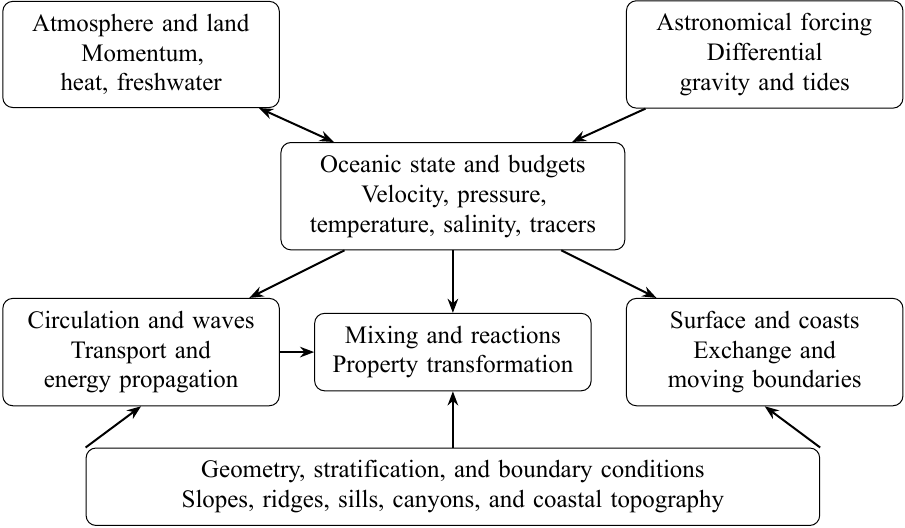
Figure 1 integrates the physical architecture. Its arrows indicate specified causal couplings, and its branches distinguish transport from property transformation. The diagram supplies an organized physical foundation for the next section’s translation. It does not imply a universal trajectory from trench to land or a universal ordering of timescales by depth.
Conceptual Mapping
This section specifies the method by which the physical account informs a theory of epistemic praxis. It introduces an intermediate level of causal roles, applies it to several mechanism families, and identifies the evidence needed for social interpretation. The procedure makes the analogy a source of explicit hypotheses rather than a substitute for institutional explanation.
Levels of translation
A physical mechanism can be abstracted with respect to a particular causal relation. Advection describes movement conditioned by an existing field. Property transformation changes what the moving object can subsequently do within that field. A boundary condition limits admissible motion. Coupling permits a change in one component to affect another. These abstractions retain selected relations while discarding most of the physical specification.
An epistemic application supplies a further interpretation. Existing field dynamics might correspond to the changing availability of public infrastructure. Property transformation might correspond to learning that makes an instrument usable. A boundary might correspond to an admission or renewal rule. Each proposal requires evidence connecting actions, relations, and outcomes. The same physical role may have several social realizations, and the same institution may perform several roles.
The intermediate level prevents ambiguous substitution. A qualification can function as evidence of competence, an admission condition, a status signal, or a contractual requirement. Treating it as a generic potential would conceal the mechanism through which it affects a particular project. Its modeled role should depend on what the qualification changes and who has authority to recognize it.
Table 2 gives a set of translations used in the paper. The final column states the evidence needed to move from a useful analogy to a supported social claim.
| Physical mechanism | Abstract role | Epistemic interpretation | Required evidence |
|---|---|---|---|
| Advection in a maintained circulation | Field-conditioned movement | An external institutional change lowers a project’s intervention requirements | Matched target, horizon, resources, and action channels |
| Water-property transformation | Change in subsequent possibilities | Learning or methodological collaboration makes existing access usable | Demonstrated capability and an identified change in feasible inquiry |
| Topographic and boundary constraints | Geometry of admissible paths | Permissions and infrastructure rules condition participation | Rules, effective enforcement, and feasible alternatives |
| Wave propagation and coupling | Mediated influence | A demonstration or association changes another institution’s response | Identified transmission channel, direction, delay, and consequence |
| Mixed-layer thermal storage | Response time under stated damping | Prepared capacity affects responsiveness to a specified event | Preparation costs, decision process, and observed response times |
| Moving shoreline | Relative boundary motion | Eligibility changes while the applicant’s situation also evolves | Time-resolved rules, state changes, and the relevant target |
| Flux and maintenance budgets | Continued reproduction | Returns replenish inquiry and shared infrastructure | Recipients, conversion conditions, maintenance costs, and persistence |
Mechanism families and institutional specificity
Transport and transformation identify different practical tasks. Obtaining access to a public archive changes the resources within reach. Learning to interpret its records changes the capabilities brought to those resources. A workshop can accomplish both, but the distinction remains useful when diagnosing a failure. Repeatedly expanding access will have limited effect when the actual obstruction concerns interpretation, while repeated training cannot remove a binding exclusion rule.
Coupling introduces a further distinction. Public visibility can create encounters without establishing reciprocal work. A contribution affects future possibilities only through a process connecting it to interpretation, use, collaboration, resource allocation, or authority. The relevant input–output relation may be highly selective. A large response in an irrelevant channel can consume resources while leaving the chosen inquiry target unchanged.
Temporal access concerns the relationship between changing conditions and the time required for action. An opening can close during the interval needed to discover it, understand its conditions, deliberate, prepare materials, and obtain a response. Preparedness changes that interval, but maintaining preparedness also uses resources. The analysis therefore joins timing to reproduction rather than treating rapid response as an unconditional objective.
Storage and memory concern the persistence of prior conditions. A relationship can remain useful after the event that initiated it; a resource commitment can carry delayed obligations; a previous exclusion can affect present trust. If these effects matter, a memoryless model of the present state needs augmentation. The mathematical treatment can use additional state variables or a declared approximation, while institutional inquiry determines what has actually persisted.
Reflexivity and the limits of correspondence
People and institutions interpret the situations in which they act. They can revise a target, contest an admission rule, organize a new facility, or reject a modeled definition of success. These capacities require an environment that can respond to collective action. The distinction between subject and field is therefore analytical and revisable.
Knowledge also differs from a conserved fluid. Its communication can reproduce an accessible expression without preserving interpretation, competence, authority, or material access in equal measure. Learning can create possibilities that a fixed state catalogue did not contain. The framework represents selected variables for a specified inquiry; it does not postulate a conservation law for knowledge or an exhaustive space of future discoveries.
The physical analogy remains productive when it exposes distinctions and directs investigation. It becomes misleading when the prestige of a physical equation substitutes for evidence about institutions. The paper consequently uses formal results in a conditional form: given the specified dynamics, inputs, target, resources, and horizon, a conclusion follows. The correspondence between those specifications and a social situation must be established separately.
This method also permits the analogy to fail locally. A proposed phase effect may disappear once resource differences are accounted for. An apparent threshold may be a discretionary judgment with changing criteria. A seemingly stable regime may be maintained through continuous negotiation. Such findings improve the analysis by identifying a more appropriate mechanism and revising the corresponding praxis.
Generative Layers
This section constructs generative layers as relatively persistent configurations of constraints and mediating relations. It begins with the conditions required for continued inquiry, distinguishes recurrent regime types, and then examines overlap, reversal, and nested positions. The resulting structure supports diagnosis while leaving its empirical granularity open.
Construction of the regime model
A layer identifies a configuration in which certain relations organize the practical work required to continue. The concept concerns the form of the problem rather than a universal rank. A research practice must reproduce its contributors, obtain usable conditions, develop relevant competence, become communicable to appropriate others, and sustain some form of coordination. Authority over these processes and the allocation of returns operates across them.
The functions are distinguishable because one can be present while another remains obstructed. Equipment can be available without the competence or time needed to use it. Competence can persist while permission is withdrawn. A contribution can be understood locally while excluded from a wider channel of evaluation. A highly visible project can remain dependent on revocable infrastructure. These configurations require different interventions.
A regime description should therefore include the project, relevant community, indispensable condition, responsible actors, and horizon. The same individual can occupy several regimes at once. A layer is useful when it groups situations that require a sufficiently similar diagnosis and response. The number and boundaries of these groups should be revised when the empirical material demands it.
Reproduction and productive access
The reproduction regime concerns the continuity of the people and relationships sustaining inquiry. Livelihood, care, rest, health, and time enter this regime as conditions of activity. A project that can be completed only through repeated depletion has a different temporal structure from one supported through realistic cycles of work and recovery. A viability analysis should be able to represent both the activity and the recovery needed to repeat it.
Productive access concerns effective use of indispensable means. Formal availability is one component, alongside affordability, permissions, compatibility, reliability, and the competence needed to engage with a resource. Revocation and renewal matter because inquiry unfolds over time. A temporary allocation can enable an experiment while leaving verification, maintenance, or follow-up impossible.
These regimes often interact. A free facility may be inaccessible because its opening hours conflict with paid work or care. A paid access arrangement may save enough time to make a project feasible. An institution can also transfer access costs into invisible preparation and administrative labor. The diagnosis should record the complete relation rather than classify a resource by price alone.
Epistemic transformation and communicability
Epistemic transformation concerns the development of the ability to use resources critically and productively. Reading, experimentation, apprenticeship, methodological collaboration, and translation can change the inquiries an actor is able to pursue. Such transformation includes the capacity to recognize limitations, revise a question, and distinguish a productive direction from a misleading one.
An accumulation of materials can coexist with an unresolved transformation problem. The immediate task may be to develop an interpretation or method that connects available resources to a specific question. This can require extended attention and uncertain exploration. Treating every interval without a visible output as inefficiency would misidentify the process.
Communicability concerns the forms through which others can encounter, understand, scrutinize, and use a contribution. The relevant form depends on a community and purpose. A demonstration, oral explanation, technical record, translation, or reproducible procedure may be more appropriate than a conventional publication in a particular setting. The criterion is an actual relation of interpretation or scrutiny.
Communicability can also become a site of appropriation or exclusion. The channels that confer recognition may impose costly forms, privilege certain languages, or transfer rights. A contribution’s increased visibility consequently requires examination of the relations through which visibility becomes access, authority, or return.
Reciprocal coupling, control, and return
Reciprocal coupling concerns durable connections among actors, tools, institutions, and projects. Contact becomes productive coordination when participants establish a shared problem, workable responsibilities, and conditions for continued contribution. Complementarity can create possibilities unavailable to isolated actors. It can also produce dependencies when an indispensable role lacks a viable replacement or adequate support.
Control and return concern authority over direction, allocation, maintenance, and continuation. These questions arise in every regime. A shared instrument can improve access while leaving its renewal under unilateral control. A successful collaboration can produce resources whose allocation excludes the people maintaining the work. Conversely, an enforceable participation right can improve the durability of access even before output increases.
Table 3 summarizes the initial regime typology. Its codes identify diagnostic categories for case analysis. They should not be treated as a universal developmental scale.
| Regime | Characteristic obstruction | Evidence of a consequential change |
|---|---|---|
| R: Reproduction | An inquiry cycle depletes indispensable conditions | Repeated cycles become possible with realistic maintenance and recovery |
| A: Productive access | Required means are unavailable, unusable, or insecure | Effective access with a credible continuation or alternative |
| E: Epistemic transformation | Available resources exceed current usable competence | Demonstrated capability and a newly feasible line of inquiry |
| L: Communicability | Relevant others cannot interpret or evaluate the contribution | Actual understanding, scrutiny, or reuse |
| C: Reciprocal coupling | Encounters fail to establish sustained joint work | Commitments change subsequent productive possibilities |
| G: Control and return | Authority or replenishment remains insufficient for continuation | Consequential changes in decision rights, allocation, or maintenance |
Overlap, reversals, and nested positions
The regimes overlap because inquiry depends on several conditions simultaneously. A peer association may address access, learning, and communicability in one arrangement. Its success can also expose a new maintenance burden. Movement among regimes is therefore recurrent and can include regression. A publication, credential, or invitation is evidence of a transition only when it changes the relevant configuration.
Layer membership also depends on scale. A collective can provide secure access to its members while remaining vulnerable to an external platform. An individual can participate effectively in a local community while encountering exclusion elsewhere. These nested positions require a relational description that distinguishes internal provision from external dependence.
Transitions can be continuous or discrete. Growing competence changes some capabilities gradually. An account closure or a funding decision can abruptly alter permissions and reserves. A revised diagnosis may change the regime label while leaving the material state continuous. The formal distinction between a diagnostic change and an institutional event prevents the model from manufacturing a transition whenever its classification changes.
Response speed and transition sensitivity are additional properties of a regime. They can vary independently of its place in the diagnostic typology. A reproduction crisis can develop rapidly; an access arrangement can remain stable for years; a communicability opportunity can have a short deadline without any dynamical instability. The architecture of Process II therefore monitors these properties separately.
Contradiction-Guided Praxis
This section develops a method for selecting and revising interventions within the generative regimes. It distinguishes structural contradictions from project constraints, examines the diagnosis of principal relations, and connects investigation to individual and collective action. The method concerns historically situated judgment supported by causal evidence.
Structural relations and binding constraints
A structural contradiction concerns opposed tendencies reproduced through a relation. A binding constraint concerns a specific limit on an action or trajectory under stated conditions. The two objects can be connected, but they answer different analytical questions. A shortage of usable time may be the immediate constraint on inquiry, while the organization of employment, care, or access produces that shortage.
The distinction matters to intervention. Rescheduling a task can alleviate a local shortage without changing its institutional source. Shared care or protected research time can alter the relation through which the shortage recurs. Both changes may be consequential. Their scope should be specified so that a practical improvement is neither dismissed nor mistaken for a transformation of the wider configuration.
A constraint is also relative to a project and horizon. The absence of a particular instrument may block one method while leaving another feasible. A deadline can bind a short-term application while having little relevance to a longer collective campaign. An analysis of praxis should therefore identify the chosen target before ranking obstacles to it.
The target itself can be questioned. An institution may define success in a way that imposes unsustainable work or inappropriate forms of evaluation. Participants can respond by changing a method, negotiating conditions, or organizing an alternative venue. Such actions transform the problem definition and belong within the analysis.
Principal relations and causal diagnosis
A principal-relation diagnosis proposes that a particular relation organizes the current configuration of obstacles and possibilities. The vocabulary draws on Mao’s account of principal contradictions and principal aspects, while the material and historical orientation is broader (Mao 1937; Marx 1859). Its practical use requires investigation of the mechanisms through which the proposed relation conditions other activities.
A defensible diagnosis specifies actors, indispensable conditions, authority, opposed tendencies, and mediating processes. It compares plausible alternatives and traces what an intervention would change. For a computational research project, lack of equipment, inadequate interpretation, unstable livelihood, and exclusionary renewal rules may produce similar visible symptoms. The alternatives imply different action channels and different expectations.
Evidence for strategic priority can take several forms. A constraint may recur across otherwise different projects. An intervention may remove several subordinate obstacles together. A supposed skill deficit may persist despite successful training because an institution continues to withhold authorization. These observations support a causal argument; they do not automatically identify a principal contradiction.
The effects of a diagnosis also require scrutiny. An organization may characterize overwork as an individual failure of responsiveness because that account preserves its control of staffing or deadlines. A participant may attribute every difficulty to infrastructure because training would expose an uncomfortable limitation. Investigation should examine how each explanation distributes responsibility and which evidence could revise it.
Mediation and indirect intervention
An indirect action can alter a consequential relation through a sequence of mediations. A reading group may develop shared competence, then produce a demonstration, then use the demonstration to obtain institutional access. A maintenance cooperative may make a facility more reliable, then gain a recognized role in decisions about its continuation. These sequences require explicit causal connections between stages.
Complementarity is especially relevant. Equipment and competence can jointly make a study feasible even when neither intervention suffices alone. For a declared outcome
Indirect action also carries risk of displacement. A strategy intended to improve access through increased visibility may consume the time needed for the research itself. A partnership intended to secure infrastructure may produce a new dependence on a single intermediary. The relevant comparison includes both the intended mediation and its effects on reproduction and control.
Strategic attention to secondary relations is therefore compatible with an analysis of principal relations. The practical route to a wider change can pass through a more accessible relation. The justification depends on whether the sequence can be traced and whether the intermediate arrangements preserve the capacity to continue.
Investigation, action, and revision
The method begins with a description of the actual inquiry cycle: its purposes, work, resources, participants, dependencies, and expected continuation. The next step formulates rival diagnoses of the binding configuration. Candidate actions are then evaluated for their direct and mediated effects, resource costs, timing, and implications for others. Observation after intervention tests both the action and the diagnosis.
This sequence includes qualitative evidence. Participants may know that a decision channel is ineffective even when numerical records are unavailable. Records of access withdrawal, administrative delay, maintenance work, or excluded proposals can reveal a mechanism that aggregate output measures miss. Quantification is useful where it clarifies a well-defined relation and should be withheld where it would conceal uncertainty.
Revision can concern the state estimate, the causal model, the chosen target, or the collective’s organization. A failed action may indicate insufficient effort, an incorrect mechanism, a changed institution, or an unacceptable cost. These possibilities should be distinguished because repeated application of the same intervention can deepen depletion.
The inquiry cycle also requires intervals for deliberation and reflection. Rapid response is valuable only relative to a justified opening and a feasible action. A group that reduces every decision to immediate reaction may lose the interpretive capacity needed to recognize changes in the governing relation. Reproduction includes the conditions for judgment.
Collective transformation of conditions
Collective praxis can alter action channels, resources, and rules. Bargaining can establish protected time. Shared infrastructure can change the cost of an experiment. Contributor representation can affect renewal and maintenance. Public provision can make access less dependent on an individual’s ability to purchase or negotiate it.
These changes can be evaluated through their distribution and durability. A facility that admits a few exceptional participants may improve their trajectories while leaving the general access relation intact. A publicly accountable allocation process can change who is entitled to participate and how exclusion is contested. The difference concerns the institution’s operation over subsequent cases.
Collective transformation also requires internal safeguards against renewed concentration of authority. The people who administer a shared resource can acquire discretionary powers through their technical knowledge or control of records. Governance must therefore support intelligible procedures, replacement of roles, maintenance resources, and means of contestation. These are productive conditions of the collective, not merely external constraints on its efficiency.
Contradiction-guided praxis consequently joins immediate action to the history and reproduction of governing relations. It provides the diagnostic orientation for Process I and the supervisory interpretation for Process II. The mathematical models that follow specify consequences within this orientation while leaving its historical judgments open to evidence.
Generative Upwelling
This section formalizes Process I as viable change in the conditions and possibilities of inquiry. It defines the joint state of subject, field, and resources, then develops target access, intervention cost, and meaningful options. An exact elementary example isolates the contribution of a changing field, and a final discussion connects the model to path dependence.
Joint dynamics and observation
Let
The decomposition is a modeling choice rather than an assertion that project action and institutional action are always separable. A negotiation can affect both. A richer full dynamics can include both controls in both equations. The distinction identifies causal roles that should be specified in an application.
Viability and inquiry cycles
Define a time-dependent viable region through conditions
An inquiry cycle can contain concentrated effort and planned recovery. Viability need not mean a constant instantaneous level of productivity. It can include schedules and cumulative constraints that preserve the ability to resume. A relevant state description must record the reserves and commitments needed to make that assessment.
Viability is also distinct from desirability. An arrangement may preserve a project’s minimum conditions while maintaining an objectionable distribution of authority or burdens. The viable region expresses specified practical limits. Its normative adequacy remains part of the wider evaluation.
Target access and intervention cost
Choose a target
For budget
Equation 8.3 describes viable entry. Durable continuation requires a subsequent residence interval or a terminal set with a demonstrated continuation policy. The associated resource use must be included. Access whose renewal cannot be sustained is a different outcome from access supported through subsequent inquiry cycles.
Changing fields and meaningful options
Process I can change the state, available controls, resource limits, and institutional conditions. To isolate a field-mediated contribution to a particular transition, compare two specified field scenarios with the same initial state, target, calendar interval, control conventions, information assumptions, and viability requirements. When both costs are finite, Equation 8.4 defines the contrast.
The contrast also differs from comparing costs at unrelated dates. A later opportunity may arrive after reserves have declined or the remaining horizon has shortened. Waiting can improve an external condition while making the full inquiry cycle less viable. A coherent comparison includes those changes.
Access to a chosen target and the range of meaningful options are separate quantities. For a fixed catalogue of targets
An exact model of field-mediated access
A scalar model isolates the logical content of borrowed potential. Let the normalized dynamics be
Proposition 3 (Field-mediated cost reduction). Under the scalar model above, an increase in integrated favorable drift weakly decreases the minimum intervention cost for the upper-half-line target. It decreases the cost strictly while the required controlled displacement remains positive.
Proof. Endpoint feasibility requires
For a unit horizon,
The target convention matters. Exact equality
Path dependence and recurrent upwelling
The order of interventions can change their consequences. Training before access may prepare a group to use a short opening; access before training may provide the setting in which competence develops. A public demonstration may precede a negotiation, while a negotiated permission may be necessary before a demonstration can be produced. These are institutionally specified sequences.
For smooth vector fields
Generative upwelling is consequently recurrent. An intervention changes the configuration from which the next inquiry proceeds. Successful access can expose a transformation need, and a new capability can make collective action possible. The process preserves continued inquiry while revising its conditions and possibilities.
Perturbation and Transition Mechanisms
This section distinguishes the dynamical mechanisms through which bounded interventions can produce consequential effects. It connects perturbation energy to local response, separates stable transient amplification from transition, and derives the contrast between susceptibility and relaxation near a fold. These distinctions provide the diagnostic basis for Process II.
Perturbation energy and maintained fields
A small initiating action can draw on a field whose maintenance requires resources supplied elsewhere. In fluid mechanics, perturbations around a maintained mean flow can extract energy through the mean velocity gradient. For compatible incompressible boundary conditions, their energy balance contains the production term
This analysis distinguishes the initiating input from the energy subsequently redistributed through the system. Nonlinear advection redistributes perturbation energy among modes under the stated boundary conditions, while linear coupling can already extract energy from the mean. Hydrodynamic stability research provides the relevant precedent for examining transient response independently of eigenvalue stability (Trefethen et al. 1993).
The epistemic interpretation is conditional. A demonstration may initiate a response in an institution whose resources and coordination already exist. The demonstrator’s effort and the resources sustaining the response belong to different budgets. The causal channel, direction of benefit, and distribution of costs must be identified before such a case can be described as borrowing from a field.
Local directions and finite-time evolution
Let
Define the transition matrix through
Stable transient amplification
A transparent linear example separates large response from regime change. The matrix and exact transition matrix in Equation 9.3 follow by solving the second component and substituting into the first.
The example demonstrates stable transient amplification. It does not supply a different attractor or a durable change. An institutional analogue would require an identified transient channel and evidence that its output affects the desired target. Increased attention alone would leave that interpretation incomplete.
Input and output selection are consequential. A permitted action may fail to excite an amplifying direction. An amplified state component may be irrelevant to access or may impose additional maintenance costs. A mathematical measure of overall response must therefore be connected to the chosen outcome and the actual control channels.
Fold geometry, susceptibility, and relaxation
The local fold model provides a distinct mechanism. Consider
The distinction also appears in a periodic response. Linearization around
The local potential
Environmental rate and transition mechanisms
A system can lose tracking because its environment changes too rapidly even when each frozen configuration retains a stable state. Consider
This example expresses a rate-induced mechanism, distinct from a frozen-parameter bifurcation or noise-induced escape (Ashwin et al. 2012). It is relevant to the problem of adaptation because maintaining a locally favorable configuration can depend on how rapidly its conditions move. It remains an illustrative dynamical model rather than evidence that an institution follows this particular equation.
Table 4 consolidates the diagnostic distinctions. The next section uses them to define an architecture that can choose among preparation, adaptation, transition, stabilization, and withdrawal.
| Property | Diagnostic object | Practical interpretation |
|---|---|---|
| Field-mediated access | Matched target cost or feasibility contrast | Existing changes can reduce a required intervention |
| Transient amplification | Finite-time input–output gain | A permitted perturbation can produce a large temporary response |
| Local relaxation | Linearized decay or recovery time | A displaced configuration can recover quickly or slowly |
| Transition sensitivity | Boundary geometry and specified mechanism | A small change may alter the continuation regime |
| Environmental rate | Forcing rate relative to tracking dynamics | A locally stable arrangement can fail to keep pace |
| Institutional responsiveness | Observation-to-effect latency | A feasible action can arrive within or outside an opening |
| Persistence | Viable continuation after entry | An initially attained outcome can be maintained |
Adaptive Governance
This section develops Process II as an architecture for choosing, timing, and revising interventions under changing and partially observed conditions. It connects a local model of response to supervision of transition mechanisms, remaining time, uncertainty, and reproduction. The architecture supports adaptation within an arrangement as well as an attempted transition to a different one.
Local identification and action channels
Local identification concerns the relationship among an available action, a relevant outcome, and a specified horizon. Where quantitative data are available, the practitioner can estimate a local state and input model. Where they are limited, a qualitative model can identify plausible signs, delays, dependencies, and boundaries of uncertainty. Both approaches require distinguishing observed association from an intervention’s causal effect.
The local model must include actual channels. An invitation to comment, a negotiated meeting, a formal application, and a collective representation process may reach different decision points. Their efficacy depends on authority, timing, and information. A model that treats all visible responses as equivalent controls would conceal these differences.
For an instantaneous action parameter
Local identification consumes resources and may alter the field. A demonstration can both reveal and influence an institution’s response. The information gained from it may depend on how participants interpreted its purpose. Any proposed probe should therefore have an explicit practical rationale and be evaluated for its effects on trust, workload, and future cooperation.
Controllability and target geometry
For action distributed over time, the relevant object is the controllability Gramian. In the linear model of Equation 9.2, let
Approximate a desired terminal region by
These formulas omit state and input bounds. Removing bounds produces a cost lower bound when the dynamics and other problem data remain identical. If the linear model approximates nonlinear institutional dynamics, the result is a local estimate with no general lower-bound guarantee for the original problem. Optimization-based control supplies the formal method, while an application must justify its model and admissible controls (Murray 2010).
Moving boundaries and temporal openings
An opportunity can change through both the subject’s trajectory and movement of an institutional boundary. Let a desired region satisfy
A periodic example makes the timing relation explicit. Let the terminal shortfall be
The periodic form is an analytical example of timed access. Institutional openings need not repeat regularly or have astronomical causes. The transferable relation concerns the fit among a changing shortfall, available control, and the time at which an intervention can take effect.
Latency, observation, and model validity
A practical response includes discovery, interpretation, deliberation, execution, and propagation to the relevant outcome. For a serial process, a necessary timing condition is Equation 10.6.
Preparation can reduce latency through reusable records, shared knowledge, delegated roles, and prior deliberation. Maintaining such preparation also uses time and resources. Its value depends on the opportunities it makes actionable and on its contribution to the broader inquiry cycle. Continuous alertness that undermines recovery can reduce viability while increasing nominal responsiveness.
A local prediction also has a validity horizon. Suppose the true dynamics is Lipschitz with constant
Frequent updates cannot compensate for an uninformative observation channel. A publicly visible response may reveal little about an institution’s renewal policy. An estimated correlation may change when the institution recognizes the intervention. Adequate identification requires observations relevant to the mechanism and a willingness to revise the model when those observations cease to support it.
Transition supervision
The supervisory function evaluates whether a local control problem remains an appropriate description of the situation. Its diagnostic vector includes viable margins, target cost, controllable directions, transient gain, evidence about stability or basin structure, remaining time, uncertainty, and prospects of maintenance. Different components have different units and meanings. Combining them into one universal criticality score would conceal their distinct causal roles.
The expression criticality governance refers here to supervision of a specified transition mechanism. Where the opening is an ordinary rule change or favorable drift, the supervisor should describe that mechanism directly. A transition-sensitive situation calls for closer attention to local model validity and the consequences of crossing. The objective is a justified continuation, not instability as an end in itself.
The supervisor can authorize preparation, a limited probe, immediate action, stabilization, waiting, or withdrawal. These modes are practical responses to a diagnosis. They need not correspond to a slower timescale than the local controller; supervision must update quickly enough when the mechanism itself changes. Collective judgment enters through authority to select targets, impose constraints, or reject an intervention whose burdens are unacceptable.
Process II-A concerns continued adaptation within an arrangement. Process II-B concerns an attempted transition followed by stabilization or a planned exit. A change of target, a loss of access, or unexpected depletion can return the process to the diagnostic work of Process I. The two processes therefore share observations and resources.
Receding-horizon organization
A receding-horizon procedure estimates the present situation, compares actions over a bounded interval, implements the first action, observes its effects, and revises the plan. Model-predictive control supplies an established architecture for this sequence (Rawlings et al. 2017). The present application can use a small set of qualitative alternatives or a quantitatively specified optimization, depending on the evidence.
Figure 2 represents the relation among observation, local comparison, supervision, and action. Reproductive constraints and collective judgment shape the admissible problem. An engineering proof of recursive feasibility requires compatible terminal sets, continuation policies, and disturbance assumptions. Repeated replanning in an uncalibrated social model supplies a disciplined comparison rather than such a proof.
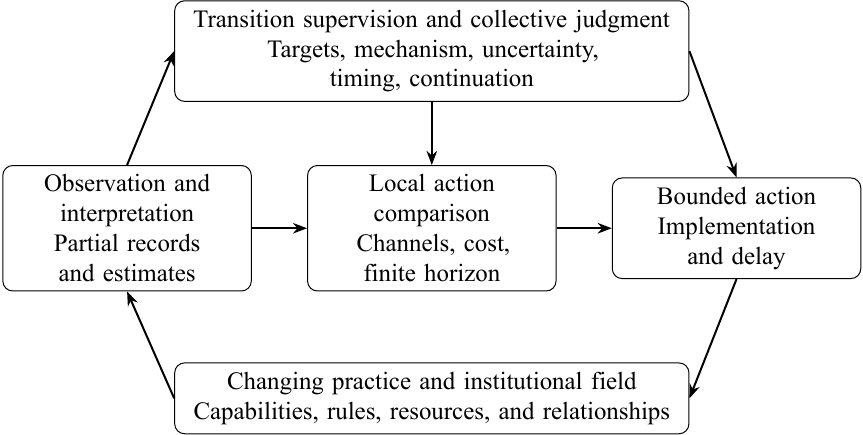
This organization gives responsiveness a bounded purpose. The interval of action is selected in relation to the opening, uncertainty, and reproductive conditions. It preserves the capacity to revise the target and to change the institutions that define available actions.
Integration of Upwelling and Transition
This section joins Processes I and II through their common state, resource, and continuation requirements. It identifies how preparation changes a later intervention problem, states a conditional compatibility result, and examines failures that separate access from durable transition. The integration concerns a recurrent organization of praxis.
Preparation and the location of intervention
Process I changes the situation from which an intervention becomes possible. Learning can alter the capability state; an association can create an input channel; a maintenance agreement can change the viable region; a public resource can enlarge the available budget. These changes affect both the minimum target cost and the ability to observe or respond.
Process II uses a current configuration to realize a chosen intervention. Its effective location is relational as well as spatial or informational. A person may be near a decision in the sense of possessing a recognized channel, prepared evidence, and a credible response path. Mere awareness of the decision does not provide the same position.
The distinction between preparation and intervention is analytical. A public demonstration can develop competence, create a relationship, and influence an allocation at once. An attempted transition can also reveal the need for additional preparation. The integration must admit such overlap while retaining separate accounts of what changed, what resources were used, and what continuation became possible.
Compatibility of access, timing, and continuation
The combined process requires compatible trajectories. A viable preparation path must lead to a state from which the proposed action is feasible. The action must arrive within the relevant opening and remain within acceptable model uncertainty. Its endpoint must permit continued inquiry under the resources and commitments that remain.
A simple deterministic result makes the compatibility requirement explicit. Let
Proposition 4 (Compatible viable continuation). Suppose the controlled deterministic dynamics admits unique trajectories under the chosen piecewise admissible controls. Assume that the three trajectories share matching endpoint states, remain in the same specified viable region, satisfy their time-dependent permissions and constraints, and obey Equation 11.1. If the intervention ends in a target subset from which the continuation is feasible, their concatenation is a viable realization of preparation, target entry, and continuation over
Proof. Define the control piecewise on the three intervals. Matching endpoint states and uniqueness join the trajectory segments. Each segment satisfies the relevant constraints, and the resource state is passed unchanged from the endpoint of one segment to the start of the next. Additivity of the integral cost gives Equation 11.1. The target and continuation properties follow from the assumptions on the latter two segments. ◻
The proposition is a composition result, with substantive requirements in its assumptions. It prevents a preparation plan from spending resources that a transition plan independently assumes are still available. It also prevents a terminal entry condition from standing for a demonstrated continuation. Under uncertainty, the deterministic construction must be replaced by a justified robust or probabilistic policy statement; favorable sample paths are insufficient.
The resulting integration uses a conjunction of conditions. Access, controllability, latency, uncertainty, and reproduction have different roles. Multiplying them into a single index would require additional assumptions about units, compensation, and value. A feasible path and its resource account provide a more transparent object for review.
Recurrence and changes to the field
The endpoint of one inquiry becomes part of the initial condition of another. A new relationship can support later learning; a resource commitment can create maintenance obligations; an intervention can alter an institution’s subsequent response. The field is changed by practice and can change the meaning of later actions.
Reproduction consequently operates throughout the sequence. Some returns arrive before a target is reached, as in mutual teaching or shared maintenance. Some costs emerge after visible success, as in support demands or renewal obligations. The time of each flow matters to viability. A future reward cannot automatically cover a present shortfall.
Figure 3 represents the recurrent architecture. Its feedback paths include renewed diagnosis, collective institutional change, and the allocation of returns. The diagram should be read as a set of possible relations. The actual sequence depends on the project and historical configuration.
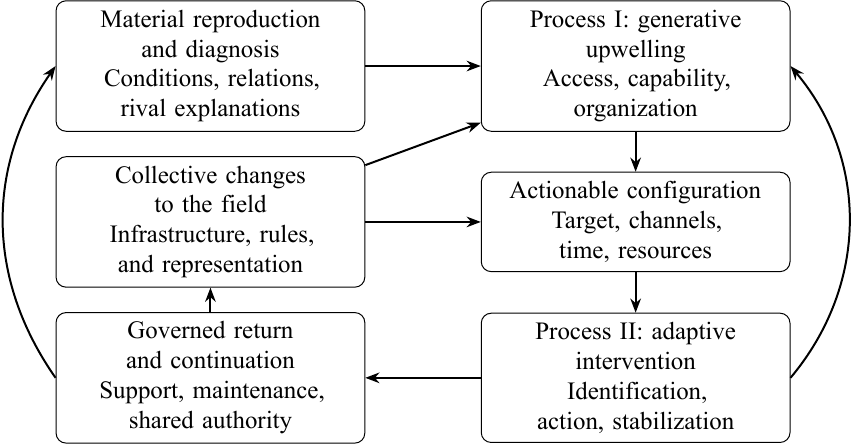
Failure configurations and strategic implications
An accessible opening can fail through insufficient continuation resources. A group may obtain a facility allocation and complete a demonstration while lacking the time to maintain data, software, or participation. The entry target has been reached, but the reproductive condition has not. A revised plan may need a smaller project, an explicit support commitment, or a different institutional arrangement.
A second failure concerns direction. High transient gain can occur in a channel that does not affect the target. A widely circulated contribution may generate attention while the authority controlling access remains unresponsive. The relevant diagnosis concerns the input map and target geometry, not the overall intensity of public reaction.
A third failure concerns timing. Prepared competence and adequate resources may arrive after the decision window has closed. Conversely, an immediate opportunity can be refused because the necessary deliberation cannot be completed responsibly within it. Timing is part of feasibility, and a missed occasion does not by itself diagnose deficient generativity.
A fourth failure concerns a changing mechanism. An intervention modeled as a routine application can become a negotiation about governance. The assumptions supporting a local cost estimate then cease to organize the situation. Supervision should revise the problem or return to diagnosis, rather than continue optimizing against the earlier model.
These configurations clarify the practical thesis. Sustaining generativity involves maintaining and transforming the relations through which action can be prepared, directed, timed, and continued. Each process addresses a different part of that organization, while collective praxis can alter the conditions connecting them.
Reproduction and Recirculation
This section examines how the consequences of inquiry become conditions for subsequent inquiry. It distinguishes return flows by resource, connects allocation to governance, and derives a simple model of continued capacity. The analysis evaluates sustainability through reproduction and maintenance rather than an assumed requirement of indefinite expansion.
Resource-specific return
Returns can include money, protected time, renewed access, competence, relationships, and authority. These forms differ in their conversion conditions. Recognition can lead to a funded opportunity, but it can also impose unpaid obligations. Access to an instrument can save time in one activity while increasing maintenance work in another. A useful return account records both the recipient and the practical transformation through which the return supports inquiry.
Let
For a scalar resource with constant terms and
Timing is part of the balance. A promised payment after completion cannot finance an indispensable purchase before work begins unless an additional credit or support arrangement exists. A renewal decision can arrive after the current access expires. Delays and commitments therefore belong in a sufficiently complete resource state.
Allocation, authority, and maintenance
Generative justice directs attention to contributors and the organization of return (Eglash et al. 2024). The present framework connects that concern to the conditions of continuation. The distribution of returns matters because contributors occupy different positions in the production and maintenance of an outcome. A visible author, a technical maintainer, a community providing data, and a caregiver may enable the same project through different activities.
Control over allocation also shapes future possibilities. A grant to a principal investigator, an enforceable resource commitment to a collective, and a discretionary invitation to an individual can have different reproductive consequences even when their immediate monetary values coincide. Authority over renewal, agenda, and maintenance influences the reliability of the return.
A commons arrangement therefore requires an account of its supporting labor and institutions. Public availability can expand use while maintenance remains concentrated among a few contributors. A collectively governed project can also develop unequal voice when administrative and technical roles become difficult to replace. Institutional analysis should examine how participation, responsibility, support, and decision rights are connected. Ostrom’s differentiated social-ecological framework provides a relevant precedent for attending to institutional configurations (Ostrom 2009).
Reproduction includes uses sometimes categorized as consumption. Food, housing, rest, care, and recovery preserve the people and relations that make inquiry possible. Treating them only as deductions from productive return would distort the material account. A sustainable arrangement can support a modest level of output while reproducing substantial capacity for future inquiry.
Continued capacity across inquiry cycles
A simplified recurrence illustrates the distinction between reproduction and indefinite growth. Let
The calculation shows that external support can sustain capacity even when internal returns alone do not replace losses. It also shows why a short-term gain is insufficient evidence of sustainable reproduction. A project can increase capacity during an unusually favorable interval and then deplete it when support or return changes. The relevant object is the sequence of conditions and flows.
The scalar capacity is an illustrative model choice. Its coefficients would require justification for a particular practice, and a multidimensional description is preferable when resources cannot be substituted. A multiplier above one predicts growth only within the linear approximation. It supplies no conclusion about distribution, ecological burden, or the value of the inquiry.
Collective reproduction and externalized burdens
An arrangement can maintain its immediate participants by shifting costs elsewhere. Unpaid support work, ecological damage, or dependence on a precarious supplier can remain outside a narrowly chosen budget. The framework’s resource boundary must therefore be scrutinized alongside its apparent viability. Continued output within the boundary can coexist with depletion of its supporting conditions.
Collective governance can make these relations more visible by recording maintenance, care, access conditions, and contested allocations. It can also establish commitments that allow contributors to plan a realistic inquiry cycle. Such organization requires resources of its own and should be evaluated through actual participation rather than formal procedure alone.
Reproduction is consequently both a material condition and an object of political contestation. Participants can disagree about what should be maintained, whose capacities should receive support, and which dependencies should be transformed. The formal budget clarifies the consequences of an allocation; the justification of that allocation requires situated judgment.
Recirculation completes the recurrent architecture of praxis. Returns support the next cycle, can alter the field through shared infrastructure or authority, and can revise the subject’s available actions. Generativity is sustained when these processes preserve a capacity for continued and revisable inquiry under conditions that remain open to collective evaluation and change.
Individual and Collective Praxis
This section applies the framework to a constructed research association and then develops bounded historical contrasts. The constructed case follows the same participants through diagnosis, access, a timed intervention, and continuation. The historical materials identify organizational mechanisms and evidentiary limits. Neither component is presented as an empirical validation of the complete model.
A constructed research association
Consider six independent researchers developing an environmental-data study. They possess relevant experience and access to public data, but require dependable computing, methodological review, and time for documentation. Their initial target is a renewable arrangement for computation and peer scrutiny with a recognized role in decisions affecting their participation. All quantities and institutional events in this case are illustrative.
Each member initially has twenty hours per month of usable inquiry time after accounting for paid work, care, and recovery. The aggregate is 120 hours, although tasks remain subject to individual availability and competence. The proposed monthly work totals 138 hours: 84 for research and analysis, 24 for documentation, 18 for coordination and administration, and 12 for maintenance. The initial plan therefore exceeds available time before uncertainty or interruption is included.
The immediate diagnosis identifies coupled reproduction and access constraints. Buying equipment would leave the time deficit and add maintenance obligations. Abandoning documentation would make the result difficult to scrutinize and reproduce. A strategy focused only on increased individual effort would weaken the very conditions the project needs to maintain.
The association reorganizes work through shared records and explicit responsibilities. In the constructed plan, documentation falls to 12 hours and coordination to 10, while research and maintenance remain at 84 and 12. A support commitment supplies 20 additional protected hours, taking total available time to 140. Planned use is now 118 hours, leaving a 22-hour aggregate margin. The group must still check that specialized tasks fit the particular members’ availability. Aggregate feasibility alone cannot allocate expertise.
Table 5 records the time account. The reductions are stipulated effects of the constructed reorganization, not estimates of typical collective efficiency. Their purpose is to demonstrate how the viability comparison should be made.
| Activity or resource | Initial plan, hours | Revised plan, hours |
|---|---|---|
| Research and analysis | 84 | 84 |
| Documentation | 24 | 12 |
| Coordination and administration | 18 | 10 |
| Maintenance | 12 | 12 |
| Total planned use | 138 | 118 |
| Available protected time | 120 | 140 |
| Unallocated time margin | 22 |
The group also arranges shared computing through a public facility and develops a reproducible demonstration using a modest initial allocation. This is Process I: access, competence, communicability, and reproduction change together. The group records the facility’s renewal rules and identifies which decisions can be negotiated collectively.
An opening and a bounded intervention
Suppose the facility announces a ten-day period for proposals concerning a renewable participation programme. The association learns of it after two days, leaving eight. Without preparation, its remaining interpretation, deliberation, preparation, and propagation stages would take two, one, four, and two days respectively. The nine-day chain exceeds the remaining opening.
Prepared records and established roles reduce those remaining stages to one day each in the constructed scenario. The four-day chain fits within the eight days left. The original discovery delay remains part of the history; it is not counted a second time in the comparison of remaining work. The example distinguishes preparation that reduces latency from an institutional change that creates the opening.
The action target also requires precision. An increased number of public responses to the demonstration would not necessarily affect the facility’s allocation decision. The association therefore identifies an authorized proposal channel and a decision-maker able to establish the relevant commitment. Its local model concerns the connection between the proposal, the allocation process, and the requested governance terms.
A viable intervention includes its documentation and follow-up costs. If the facility requests additional work that removes the time margin, the association must revise the proposal or obtain further support. The supervisory judgment can also reject an offer that provides computation while assigning indefinite unpaid maintenance obligations. A formally successful admission would otherwise conceal a deterioration in reproduction.
The normalized scalar and Gramian examples developed earlier can guide the structure of comparison. Their numerical coefficients are not estimated from this association. A real application would require records of interventions, decisions, resource use, and relevant alternatives before assigning quantitative cost or probability values.
Continuation and institutional consequences
Assume that the association obtains a six-month access arrangement with a stated renewal procedure and contributor representation in a maintenance discussion. Entry is followed by observation across successive inquiry cycles. The group records actual research time, support work, interruptions, access reliability, and participation in decisions. The stipulated outcome becomes durable only to the extent that these conditions support continuation.
Returns include demonstrated capability, a reusable method, renewed access, and relationships with reviewers. Their value depends on their use in subsequent inquiries. A public result can also generate additional requests. The association should record whether these requests replenish capacity, consume the time margin, or create new dependencies.
The governance terms distinguish a trajectory improvement from a wider institutional change. An exceptional allocation to this association improves its access. A transparent process through which other eligible groups can obtain comparable access changes the rule governing subsequent cases. Contributor representation may similarly range from a consultative occasion to a consequential decision right. The empirical assessment should specify which change occurred.
The case therefore yields a set of observations rather than a single success score. These include the initial constraint configuration, actual changes in time and access, the latency of the intervention, the authority of its channel, and the persistence and distribution of returns. A project can improve on some dimensions while remaining vulnerable on others.
Historical contrasts in organization
Historical materials supply contrasting forms of organization. Marx’s 1864 address treats cooperative production as consequential while connecting its limitations to wider political conditions (Marx 1864). The relevant comparison concerns the relation between local productive organization and institutions that shape its reach. A contemporary association’s effective internal cooperation may still depend on externally governed access, finance, or permissions.
Gramsci’s 1919 account of the Brevetti-Fiat council records workplace representation organized through sections and trades (Gramsci 1919). Its relevance concerns the construction of collective channels and the relation between productive activity and representation. The account expresses a participant’s political interpretation. It cannot by itself establish the long-term effectiveness or wider consequences of council organization.
Mondragon’s history links cooperative development with supporting institutions, while its 2013 report describes the Fagor crisis and responses involving employment support (MONDRAGON Corporation n.d., 2013). The contrast concerns reproduction under vulnerability. Productive success, supporting infrastructure, and exposure to enterprise failure can coexist. The corporate sources provide bounded evidence of reported arrangements and responses; independent analysis is required for a general explanation of outcomes.
These comparisons identify questions for a praxis framework: which capacities association creates, which external dependencies persist, how representation becomes effective, and which institutions support contributors when a productive arrangement fails. They do not establish that historical organizations followed an oceanic mechanism or a specified control law.
Individual action and collective scale
Individual praxis remains consequential within this account. A person can preserve a feasible inquiry cycle, develop competence, maintain a reliable record, or negotiate a workable commitment. Such actions can prepare conditions for association. Their evaluation should include the resources and relations that make them possible.
Collective praxis can change the action set. Shared infrastructure, protected time, representation, and public provision create possibilities that additional individual effort alone may not provide. Yet collective scale does not automatically remove dependency or unequal authority. The organization must reproduce its contributors and maintain accountable control over its own conditions.
The relation between scales is therefore recursive. Individual actions can sustain a collective; collective institutions can change individual possibilities; external institutions can constrain or support both. A comprehensive account of generativity follows these relations across successive cycles and examines where productive capacity remains separated from effective control.
Scope and Evidence
This section specifies the claims established by the framework and the evidence required for its social applications. It distinguishes analytical verification from empirical identification, formulates possible counterevidence, and describes a research design suited to relational and temporal mechanisms.
Status of the formal results
The scalar cost formula, the stable linear amplification example, the Gramian solution, and the elementary transition models are mathematical results under explicit assumptions. Numerical checks compare selected consequences with direct substitution, quadrature, finite differences, and independent differential-equation integration. The accompanying package reports twenty-five successful numerical and structural checks. Appendix C describes their scope.
These checks do not estimate a real institution’s dynamics. An accurate calculation can still be based on an inappropriate target, absent control channel, or unsupported parameter. A local linear approximation can fail when a decision process changes its rules. A scalar resource representation can conceal non-substitutable requirements. The mathematical and empirical questions therefore require separate evaluation.
Several results also depend on existence or regularity conditions. An infimum at a budget boundary need not be attained. A constrained controller requires admissible trajectories. A state-dependent model needs a sufficiently informative observation process. A viability claim under diffusion differs from an inward deterministic drift condition. These restrictions are retained because they affect the meaning of practical success.
Identification of social mechanisms
An empirical application should begin with an actual inquiry or institutional relation rather than an abstract score. The record should identify participants, targets, indispensable resources, permissions, action channels, timing, and continuation. It should distinguish formal rules from their effective operation and document how participants interpret the arrangement.
A field-mediated access claim requires a meaningful comparison. Relevant alternatives should share a target, horizon, and resource convention, or the differences should be modeled explicitly. If groups facing different opportunities also have different reserves, the observed outcome cannot isolate a timing effect without further evidence. Selection into the opportunity may itself depend on unobserved competence or institutional connections.
A controllability claim concerns interventions and outcomes. Correlations among publicly visible variables may provide little information about an institution’s response to a new action. Evidence can include decision records, changes in permissions, interrupted sequences, comparable rejected proposals, and participant accounts. Where direct experiments are inappropriate, process tracing can examine the sequence linking an action to its claimed effect.
A reproduction claim requires follow-up. Immediate output, attention, or admission is insufficient evidence of continued generativity. Subsequent workloads, maintenance, access renewal, learning, and participation in decisions should be observed across realistic cycles. The record should include people whose support work lies outside the most visible project boundary.
Propositions and counterevidence
Table 6 connects the framework’s conditional propositions to evidence and possible counterevidence. The propositions concern mechanisms that can be examined independently. A finding may support one component while requiring revision of another.
| Proposition | Supporting observations | Counterevidence or rival explanation |
|---|---|---|
| Field changes can lower a specified access cost | Comparable targets require less intervention after an identified rule or resource change | Different reserves, targets, or selection explain the outcome |
| Preparation can improve use of a short opening | Recorded stages shorten while the target and judgment requirements remain comparable | Apparent speed comes from omitted work or weaker evaluation |
| Effective channels condition intervention | Identified authority links an action to the desired decision | Public response increases without changing the target condition |
| Regime diagnosis can improve action selection | Different constraint configurations require different successful interventions | A generic resource difference explains all cases |
| Entry and continuation are distinct | Initial admission coexists with divergent later maintenance and access | The target already included the full observed continuation |
| Collective organization can change field conditions | Rules, resources, or decision rights change beyond an isolated case | Only exceptional access changes, or burdens move to excluded contributors |
| Returns can reproduce inquiry | Resource and authority changes support subsequent cycles | Output is sustained through depletion or externalized maintenance |
Counterevidence should include failed attempts, abandoned projects, and regression. Restricting analysis to visible successes would conceal the resources needed to survive unsuccessful intervention. It could also mistake retrospective narratives of timing for evidence of an identifiable opening.
Comparative and participatory inquiry
A suitable initial design combines comparative process tracing with participatory institutional analysis. Cases should vary in access conditions, resource security, collective organization, and the temporal structure of opportunities. The unit can be a project sequence, an association, or an access relation, provided the boundary is explicit.
Participants should be able to challenge the diagnosis, target, and resource account. Their disagreement can identify omitted labor, unequal burdens, or an institutional relation obscured by aggregate measures. Participation in interpretation does not remove the need to evaluate evidence; it expands the record of what must be explained.
Quantitative calibration should follow specification of observable variables and plausible mechanisms. A useful first model may be a bounded decision record rather than a fitted high-dimensional dynamical system. Model complexity should reflect the information available and the practical distinctions required.
The framework is therefore open to revision at several levels. Particular mappings can fail; a regime typology can require different categories; a local control description can prove inappropriate; a target can be rejected on normative grounds. These possibilities are part of the research programme rather than exceptions to be hidden by the formalism.
Discussion
This section develops the institutional and theoretical implications of the integrated framework. It connects the formal distinctions to infrastructure, commons governance, temporal organization, and the relation between generativity and political-economic transformation.
Infrastructure and durable participation
The framework directs attention to the duration and governability of access. A resource can be technically available while its renewal, maintenance, or terms remain too uncertain for a sustained inquiry. Institutional design should therefore consider the complete cycle through which participants obtain access, develop competence, produce a contribution, and continue or transfer the work.
Protected time, reliable infrastructure, intelligible procedures, and supported maintenance can change the viable action set. Their effects differ from increasing the number of opportunities advertised. An opening whose requirements exceed available resources remains inaccessible, while a modest commitment can make an existing opportunity actionable.
Durability also depends on authority. Participants who can contest allocation, understand renewal conditions, and influence maintenance possess different possibilities from those dependent on discretionary favor. These arrangements can be evaluated through their actual effects on continuation and participation. A formal right without a usable channel may have limited practical force.
Collective institutions can also preserve alternatives. Shared records, interoperable tools, and transferable competence can reduce the consequences of a single access withdrawal. Maintaining alternatives consumes resources, so their value should be considered in relation to the vulnerabilities they address and the inquiry they support.
Commons, appropriation, and governed return
Public availability and generative control are distinct institutional achievements. An artifact can circulate widely while the means of updating, evaluating, or applying it remain concentrated. A commons can expand access while relying on unacknowledged maintenance. Conversely, a temporary boundary can protect the time needed to develop a contribution or support a community’s authority over its conditions.
The framework evaluates these arrangements through their relations and consequences. It asks which capacities are enabled, which dependencies persist, who governs continuation, and how returns are allocated. Generative justice provides a relevant orientation toward contributors and return, while the models clarify particular constraints and effects (Eglash 2016; Eglash et al. 2024). Neither a nominally open form nor a positive resource balance determines the whole normative assessment.
A practical implication is that dissemination should be considered alongside support for reproduction. An institution that funds an initial artifact while leaving its maintenance unresourced creates a different trajectory from one that supports continuing stewardship. A project that receives attention can require governance of requests and obligations to prevent depletion of its contributors.
Temporal organization and the conditions of judgment
The analysis gives response speed a specific role. An intervention must fit an opening, but the time required for interpretation and deliberation belongs within that condition. Speed can be improved through preparation and shared organization. It can also be purchased by weakening scrutiny or shifting costs onto participants with less power.
Generative praxis should therefore preserve differentiated timescales. Some tasks benefit from rapid coordination; others require extended learning, careful observation, or recovery. An institution that demands the same tempo from all activities can undermine the transformations upon which later responsiveness depends.
The distinction between critical slowing and rapid external change further cautions against a general acceleration imperative. A situation can become more sensitive while recovering more slowly. The appropriate response may involve narrower action, greater reserves, a shorter prediction horizon, or withdrawal. The model should identify the relevant mechanism before assigning a temporal strategy.
Generativity and political-economic transformation
The immediate objective is continued meaningful inquiry under unequal conditions. Achieving that objective can produce local gains without transforming the class relation at a wider scale. The framework preserves this distinction while locating possible connections through collective field change.
A group that secures access changes its trajectory. A rule that makes access available to subsequent groups changes an institutional relation. A supported association can build capacities for representation and maintenance that alter later possibilities. These processes may connect local praxis to wider political-economic change, but the connection requires a historical account of organization, conflict, and scale.
The paper’s mathematical contribution is to clarify some conditions of such processes. It distinguishes attainable targets from assumed opportunities, temporary response from persistent change, and return from reproductive sufficiency. Its philosophical contribution is to place those distinctions within a material and relational analysis of inquiry.
The framework consequently remains answerable to the purposes and judgments of those whose activity it represents. Sustaining generativity includes the capacity to revise a method, contest a target, refuse an extractive arrangement, and organize different conditions of inquiry. Formal representation supports that capacity when it makes constraints and consequences more intelligible.
Conclusion
This paper has developed a praxis for sustaining generativity under unequal control of epistemic production and reproduction. The argument defines the epistemic proletariat relationally, constructs overlapping regimes of generative constraint, and connects historical diagnosis to individual and collective action.
Process I concerns viable changes in access, capabilities, relations, and institutions. Process II concerns the identification and realization of bounded interventions under changing conditions. Their integration requires compatible resources, effective action channels, sufficient time, acceptable uncertainty, and a feasible continuation. Reproduction and governed return connect both processes to subsequent inquiry and to possible changes in the surrounding field.
The ocean–atmosphere account supplies differentiated mechanisms of transport, transformation, coupling, and boundary motion. The mathematical models distinguish field-mediated cost reduction, stable transient amplification, transition sensitivity, and persistence. These results establish conditional relations and expose several ways in which a seemingly favorable opportunity can remain unactionable or unsustainable.
The social framework requires empirical identification and situated normative judgment. Its practical value lies in making the conditions of action and continuation explicit, while preserving the capacity to revise targets and organize different institutions. Generativity is sustained through the reproduction and transformation of the relations that allow inquiry to continue.
Physical Derivations
This appendix supplies the physical calculations supporting Section 4. It fixes thermodynamic and sign conventions, derives the forcing and wave relations, and records the assumptions behind transformation and boundary models. The equations describe selected compatible approximations; a global ocean simulation would require additional closures, geometry, forcing data, and numerical treatment.
Thermodynamic closure and mixing
In a local Boussinesq region at a common reference pressure, density is
Nonlinear mixing follows from the curvature of the equation of state. Let
For small adiabatic displacements in a resting stratified state, parcel buoyancy remains fixed while environmental buoyancy changes by
Air–sea exchange and mixed-layer budgets
Let
Differentiating the linear buoyancy relation and inserting heat and freshwater input gives Equation 4.4. Integrating the scalar budgets over a homogeneous mixed layer gives a further distinction between surface input and entrainment. With depth
For the fixed-depth anomaly model in Equation 4.5, multiply by the integrating factor
Tidal potential and Ekman transport
For a celestial mass
For a steady integrated Ekman layer with negligible stress at its base, horizontal momentum gives
Internal-wave elimination
Take constant
Differentiation gives vertical group velocity
Turbulent budgets and water-mass transformation
Let
To derive Equation 4.2, differentiate
The inventory identity in Equation 4.6 follows from differentiating
Tracer reactions and relative settling
Let
Surface waves and coastal momentum
For irrotational inviscid water of mean depth
Let total depth be
The regular shoreline condition
Environmental memory
An eliminated environmental component can generate a memory term even when the enlarged model is Markovian. Consider
Viability, Control, and Transition Derivations
This appendix derives the mathematical results supporting Processes I and II. It treats attainment, dynamic programming, ordered interventions, perturbation energy, optimal control, timing, stochastic residence, and continuation. Each result applies to its stated model and information assumptions.
Attainment and the information state
The distinction between an infimum and an attained minimum affects budget feasibility. Consider
The main scalar example uses a closed half-line target and exhibits an attaining control explicitly. More general problems require conditions on targets, controls, dynamics, and compactness. Model uncertainty provides an additional reason to leave a positive margin when an intervention is evaluated against a resource budget.
The deterministic full-state value function also has a specific information interpretation. Under partial observation, an exact dynamic program generally requires an information state, such as a belief distribution under a justified probabilistic model. Using a point estimate in a full-state controller is an approximation. Resource reserves, remaining budgets, and relevant memory must be represented in the state when they affect future admissibility.
Dynamic programming and control dependence
Let the full deterministic dynamics be
If
The scalar cost proof in Proposition 8.1 is an exact alternative to solving the partial differential equation. Its simplicity makes the counterfactual assumptions visible. A more elaborate numerical value function would still need the same specification of state, target, information, resources, and horizon.
Ordered flows and institutional events
Let
Discrete changes can be represented through a hybrid model. Let a diagnostic regime
Perturbation energy
Write an incompressible velocity as
Projection onto energy-orthonormal divergence-free modes gives a system
Propagators and the Gramian optimum
For the time-varying linear equation, variation of constants gives Equation 9.2. The transition matrix depends on time ordering. Equality with the exponential of an integrated Jacobian holds under suitable commutation conditions; it should not be assumed for general changing coupled dynamics.
To obtain Equation 10.2, minimize
For the half-space
Moving boundaries and model error
Differentiating
For the periodic shortfall, budget feasibility from Equation 10.3 reduces to
For the error bound, compare true and predicted trajectories under the same applied input within a valid tube. Lipschitz continuity and a bounded model discrepancy imply that the upper derivative of their distance obeys
Fold and rate-induced transitions
For
The translating bistable model separates tracking failure from loss of frozen stability. With
Stochastic entry and residence
For a controlled diffusion
The interior buffer has a mathematical purpose. For
An elementary committor calculation provides a separate exact result. For
Receding-horizon control and continuation
At observation time
For a closed maintainable region with a regular smooth representation
Verification and Case Protocol
This appendix records the scope of mathematical verification and a protocol for subsequent institutional applications. The numerical examples support selected analytical derivations. The case protocol specifies evidence needed to interpret those derivations in relation to actual inquiry.
Numerical verification
The preparation package contains a reproducible script that performs twenty-five numerical and structural checks. The checks include a quadratic mixing identity, the mass-consistent volume comparison, mixed-layer relaxation, the tidal force expansion, Ekman sign conventions, internal-wave amplitude residuals, the sign of mixing-induced transformation, a property-class inventory, and the shallow-water wave limit.
Control checks cover the scalar cost optimum, ordered flows, noncommuting time evolution, stable transient amplification, Gramian control, the half-space target, and an unreachable Gramian direction. Further checks concern moving boundaries, periodic windows, a model-error bound, fold geometry, rate-induced transition, the one-dimensional committor, the stochastic residence buffer, and the reproductive recurrence. The structural check verifies the forty-eight stable equation identifiers in the preparation notebook.
The numerical methods include direct substitution, quadrature, finite differences, and fourth-order Runge–Kutta integration of stated ordinary differential equations. Examples and tolerances are recorded with the code. They contain no fitted social parameters. Their agreement with the analytical results supports those particular calculations and does not validate the whole coupled physical model or a social prediction.
Figure 4 compares three of the worked mechanisms. The variables are normalized. The first panel fixes a unit target and horizon, the second varies a coupling while preserving negative eigenvalues, and the third approaches a fold by reducing its parameter. Their separate responses are the reason for retaining distinct diagnostic quantities.
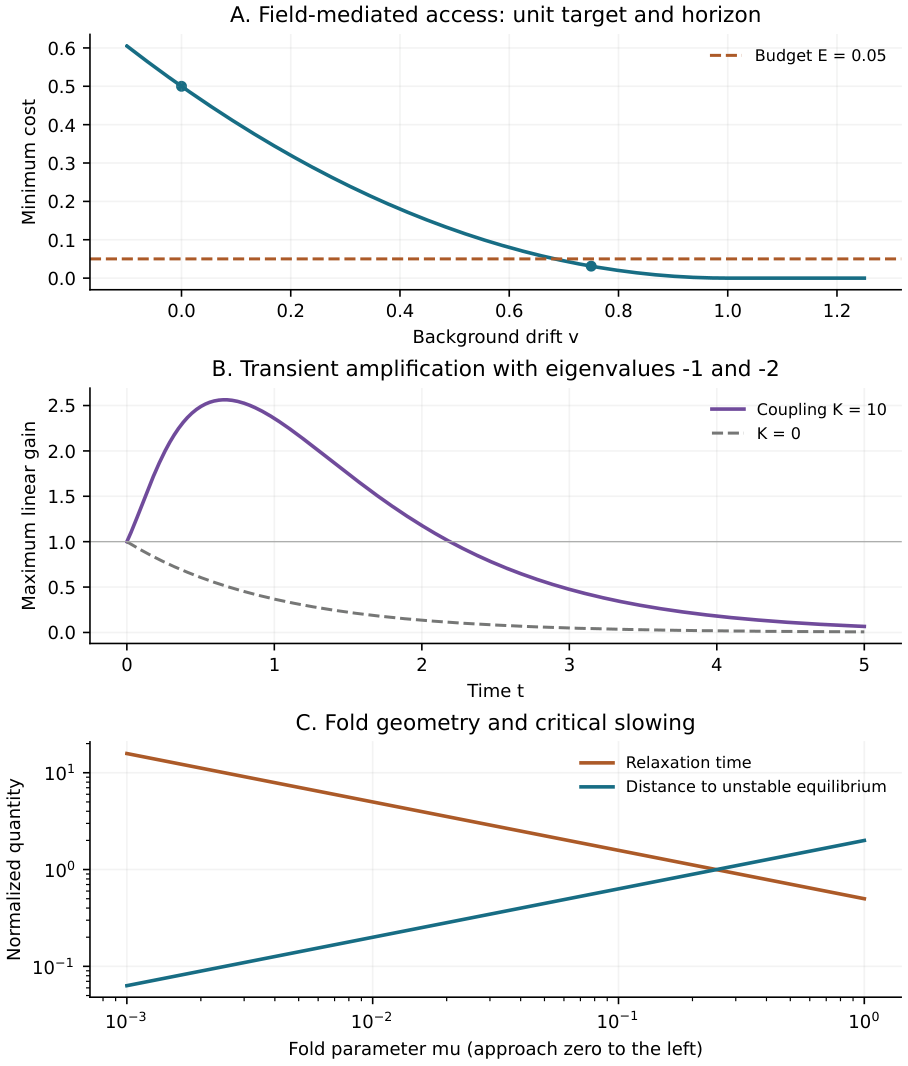
Institutional case record
An application should define its unit of analysis before assigning numerical variables. A project sequence, an access relation, and an organization have different boundaries. The record should state the initial situation, the target and its justification, the horizon, and the conditions required for continued inquiry.
Table 7 gives a minimal case record. Each item should include its evidence source and uncertainty. Participant disagreement should be retained where it affects the diagnosis or interpretation.
| Record component | Required specification |
|---|---|
| Subject and boundary | Participants, supporting contributors, relevant institution, and scale |
| Inquiry and target | Practical purpose, desired condition, alternatives, and participant justification |
| Resources and reproduction | Money, time, care, infrastructure, permissions, maintenance, and recovery |
| Control relations | Decision authority, renewal, appropriation, representation, and contestation |
| Diagnostic configuration | Binding conditions, rival explanations, and proposed principal relation |
| Action channels | Permitted interventions, actual decision points, expected effects, and constraints |
| Temporal structure | Discovery, interpretation, decision, execution, propagation, and remaining window |
| Observation and uncertainty | Records available, omitted variables, identification limits, and model revisions |
| Outcome and continuation | Entry, subsequent cycles, distribution of returns, depletion, and institutional changes |
| Comparative evidence | Failed attempts, alternative trajectories, selection processes, and counterevidence |
Reproduction of the draft materials
The source ledger and BibTeX file record verified source identities and the depth of inspection. Publisher descriptions and metadata are distinguished from inspected full texts. The manuscript limits detailed historical conclusions accordingly; expanded case analysis requires additional direct and independent evidence.
The accompanying draft is written in the supplied XeLaTeX template. Section files, appendices, figures, and references are kept separately so that substantive revision can proceed without reconstructing the document. The validation record reports compilation, citation, cross-reference, and layout checks for the generated PDF. These document checks are distinct from mathematical verification and from the empirical adequacy of the argument.