Criticality Hypothesis of International Politics
Transcript
Abstract
This position paper proposes the Criticality Hypothesis of International Politics: international politics, understood as a heterogeneous, historically evolving, and adaptive relational system, may under some conditions exhibit dynamics associated with near-critical regimes. The hypothesis is motivated by a recurring theoretical problem. International political relations can display persistent asymmetries and reinforcing structures, yet the system does not necessarily remain indefinitely confined to a single stable relational configuration. Actors, especially those subject to strong relational constraints, may generate heterogeneous, locally inconsistent, or apparently directionless actions whose system-level effects differ from the apparent direction of the actions themselves. Such perturbations need not specify an alternative terminal order. They may instead inhibit irreversible relational lock-in, preserve alternative couplings, and maintain the possibility of future reconfiguration.
The paper develops the hypothesis through a deliberately abstract and politically neutral framework. It first introduces the minimum conceptual vocabulary of dynamical systems and complex adaptive systems, including state space, trajectories, attractors, basins of attraction, perturbation, sensitivity, emergence, self-organization, and multiscale dynamics. It then reviews criticality in complex systems and the critical brain hypothesis as an important intellectual background. The transfer is explicitly limited: evidence or functional arguments concerning neural criticality do not establish political criticality. They motivate a structurally analogous question concerning whether a distributed relational system can remain sufficiently persistent to retain organization while sufficiently susceptible to permit substantial reconfiguration.
Within this framework, power asymmetry is treated as a possible source of attractor formation and contraction of reachable relational futures, while heterogeneous adaptation may supply decentralized counter-perturbations. The paper formulates the central criticality claim as a testable hypothesis rather than a law, and distinguishes it from teleological assertions that the international system seeks, optimizes, or normatively benefits from criticality. Several possible mechanisms are retained as open questions, including response-repertoire expansion, the coexistence of persistence and adaptability, distributed adaptation, asymmetry-induced anti-lock-in feedback, relational redundancy, and differential persistence of dynamical regimes. The paper further identifies two downstream hypotheses for later investigation: a political-turbulence hypothesis concerning the amplification and interaction of perturbations near susceptible regimes, and a turbulence-mediated historical-transition hypothesis concerning large-scale escape from established relational attractors. These extensions remain provisional. The primary contribution is a conceptual research programme for examining whether international politics can exhibit near-critical relational dynamics that preserve reconfigurability without predetermining the direction of future political order.
Keywords: international politics; criticality; dynamical systems; complex adaptive systems; near-criticality; power asymmetry; relational lock-in; perturbation; reachable futures; reconfigurability; critical brain hypothesis; political turbulence
Responsible Use and Rights Reservation
This section separates requested scholarly conduct from the legal permissions stated on the following page. It records an ethical request for responsible use and then defines the narrower scope of retained legal rights.
The author encourages good-faith discussion, criticism, independent inquiry, and responsible use of the material in this work. Separately from the licence’s terms, the author asks users to consider foreseeable harms when adapting or applying the proposed framework. This ethical request leaves the licence’s permissions and legally authorized uses unchanged.
The author retains the rights preserved under CC BY-NC 4.0 and may pursue remedies to which the author is legally entitled for breach of the licence or violation of the author’s independently applicable rights. Reuse remains independent from authorial endorsement. Third-party rights require authorization from their respective holders where applicable. Copyright exceptions and limitations, including applicable forms of fair use or fair dealing, remain fully available.
Notices
This page consolidates the manuscript’s publication status, licence, development disclosure, research-programme relation, and suggested citation.
Status.
This working draft records an evolving theoretical position and is circulated for discussion. The Criticality Hypothesis of International Politics is presented as a hypothesis requiring independent conceptual and empirical assessment. Definitions, formal statements, section structure, operational criteria, and empirical implications remain subject to revision. The manuscript does not evaluate or advocate the policies of any particular state, government, alliance, political movement, or contemporary conflict. Named political cases are intentionally excluded from the present theoretical formulation.
Licence.
Except where otherwise indicated, copyright 2026 Wanhong Huang. This work is made available under the Creative Commons Attribution-NonCommercial 4.0 International License (CC BY-NC 4.0). Subject to its terms, the licence permits sharing and adaptation for noncommercial purposes with appropriate attribution, a link to the licence, an indication of changes, and attribution that preserves the licensor’s independence from the reuse. Reuse is governed solely by that licence; the responsible-use request on the preceding page remains separate from its terms. The licence deed and legal-code link are available at https://creativecommons.org/licenses/by-nc/4.0/. The licence governs in case of conflict with this summary. Third-party material remains subject to the rights held by its respective rights holders.
Statement on the use of language models.
The exploratory discussions and preparation of this paper involved OpenAI’s ChatGPT. ChatGPT supported exploratory dialogue, formal reconstruction, source discovery followed by verification, argumentative criticism, and drafting in LaTeX. The author selected the research questions, theoretical commitments, political-neutrality constraints, and epistemic status of the claims, and bears sole responsibility for the manuscript, including its definitions, hypotheses, formal constructions, arguments, conclusions, and errors. Authorship credit remains with the human author.
Introduction
International politics presents a persistent dynamical puzzle. Political relations can become highly structured, historically path-dependent, and strongly asymmetric. Security arrangements, institutional expectations, economic dependencies, legal commitments, informational infrastructures, and repeated patterns of coordination can reinforce one another over time. Such reinforcement suggests the possibility of increasingly deep relational attractors: configurations from which ordinary perturbations produce only limited deviation and toward which subsequent interactions tend to return. Yet international political history is also marked by repeated reconfiguration. Relations that appear durable can become susceptible to relatively small disturbances; local actions can propagate across scales; previously marginal alternatives can acquire systemic significance; and configurations that once appeared stable can lose their capacity to contain subsequent change. The coexistence of persistence and recurrent reorganization raises a theoretical question that is not exhausted by describing either stability or instability alone.
This paper proposes the Criticality Hypothesis of International Politics as a preliminary framework for investigating that question. The proposal is deliberately modest. It does not assert that international politics is always critical, that every political system converges toward a critical point, or that criticality constitutes a desirable political condition. It asks whether international politics, understood as a heterogeneous, historically evolving, and adaptive relational system, may under some conditions operate within, approach, or recurrently return toward regimes in which the system remains organized while becoming unusually susceptible to perturbation and reconfiguration. The central object is therefore not a particular institutional order, distribution of power, or historical outcome. It is the dynamical relation between persistence and reconfigurability.
Complexity-oriented work has long challenged representations of political systems in which aggregate outcomes can be inferred by simply adding independent actor-level effects. Jervis emphasized interconnectedness, feedback, nonlinear consequences, and the possibility that the effect of an action depends on the wider system in which it occurs (Jervis 1997). More recent work has explicitly described aspects of the international political system as a complex adaptive system in which systemic properties can emerge from interactions that are not reducible to the intentions of individual actors (Winston 2023). Complexity approaches remain heterogeneous, but they provide a useful starting point for a paper concerned with emergent macrodynamics, changing interaction structures, and effects that cannot be read directly from the apparent direction of local action.
Criticality introduces a more specific conjecture into this complexity framework. In statistical physics and nonlinear science, critical regimes are associated with transitions between qualitatively different forms of collective behavior. Near such regimes, systems can exhibit heightened susceptibility, long-range dependence, scale-spanning fluctuations, and responses whose magnitude is not simply proportional to the initiating perturbation. The present paper does not assume that all of these signatures will have direct political analogues. Instead, it asks whether the conceptual distinction among strongly damped, highly amplifying, and near-critical response regimes can clarify a recurring property of international relational systems: the possibility that a political action with limited local magnitude may become consequential because of the state of the surrounding relational system rather than because the action itself contains a correspondingly large directional force.
The critical brain hypothesis provides an especially instructive intellectual background. Beggs and Plenz reported neuronal avalanche dynamics in cortical networks and related the observed branching behavior to a critical regime balancing propagation and runaway excitation (Beggs and Plenz 2003). Subsequent work developed functional arguments linking criticality or near-criticality to dynamic range, information transmission, information capacity, flexible reorganization, and related computational properties (Shew and Plenz 2013). Contemporary reviews also emphasize that brain criticality remains methodologically and conceptually contested, including questions about how criticality should be identified, whether exact criticality is required, and how proposed functional advantages should be interpreted (O’Byrne and Jerbi 2022). This controversy is useful rather than inconvenient for the present inquiry. It demonstrates both why near-critical organization can be theoretically interesting and why apparent scale-free or complex behavior cannot by itself establish criticality.
The transfer made here is therefore a transfer of a question, not a transfer of an answer. The international political system is not treated as a brain, political actors are not treated as neurons, and political criticality is not inferred from neural criticality. The structural analogy is narrower. Both domains raise the possibility that distributed interaction among heterogeneous components can generate macroscopic regimes in which persistence and responsiveness coexist. In the political domain, however, the components are reflexive actors embedded in history, institutions, interpretation, strategic uncertainty, and asymmetric relations. They can modify not only their state but also the interaction rules, couplings, classifications, and institutions through which subsequent dynamics occur. Any political theory of criticality must therefore be relational, historical, and adaptive rather than a direct transplantation of a fixed physical model.
A second point of departure concerns power asymmetry. Persistent asymmetry can deepen particular relational configurations. If one set of relations becomes increasingly reinforced, alternatives may become more difficult to sustain, and the set of practically reachable future configurations may contract. This paper describes that possibility as relational lock-in. Lock-in need not imply literal permanence. It refers to a condition in which accumulated couplings make alternative configurations increasingly costly, inaccessible, or dynamically unlikely under ordinary perturbations. In such circumstances, the political significance of a local action cannot be evaluated only by asking which terminal order it appears to favor. Some actions may have a different systemic function: they may preserve alternative couplings, interrupt reinforcing feedback, maintain redundancy, or prevent the system from crossing into a more difficult-to-reverse basin of attraction.
This distinction motivates one of the paper’s central analytical commitments.
Claim 1 (Local direction and systemic function). The apparent direction of a political action need not coincide with its system-level dynamical function. An action that does not coherently specify an alternative terminal configuration may nevertheless alter susceptibility, coupling structure, basin boundaries, or the accessibility of future relational configurations.
The claim does not imply that apparently inconsistent behavior is secretly rational, beneficial, or criticality-preserving. Nor does it infer intention from effect. A political actor may pursue a narrow local objective while its action contributes to a system-level pattern that no actor designed. Conversely, an actor may intend to preserve flexibility while producing greater lock-in. The analytical distinction is between the vector suggested by an action when viewed locally and the transformation of the surrounding relational field produced through interaction. This distinction is especially important in a system in which effects are mediated by other actors, institutions, histories, and adaptive responses.
The possibility of heterogeneous anti-lock-in effects leads to the paper’s preliminary central hypothesis.
Hypothesis 2 (Preliminary Criticality Hypothesis of International Politics). International politics, understood as a heterogeneous and adaptive relational system, may under some conditions exhibit near-critical dynamics in which decentralized interactions inhibit complete relational lock-in while preserving sufficient organization for perturbations to propagate, interact, and support substantial future reconfiguration.
This formulation is intentionally weaker than a claim that the international system automatically restores itself to a critical point. At least three levels of the hypothesis must be distinguished. A minimal version claims only that near-critical political regimes can occur. An endogenous version claims that interaction among political actors can itself generate or sustain such regimes. A stronger restorative version would claim that departures toward excessive rigidity or excessive disorder generate feedbacks that tend to move the system back toward a near-critical region. The present paper develops the conceptual basis required to distinguish these forms, but it does not assume that the strongest form is true.
The hypothesis also differs from familiar equilibrium language. A near-critical regime need not be a balance point at which opposing forces cancel. It may instead be a region of continuing adaptation in which couplings, constraints, and effective response functions remain in motion. The object of analysis is therefore not necessarily a fixed equilibrium
Power asymmetry gives this abstract problem a specifically political form. Where relational influence is highly unequal, more constrained actors may face increasing costs if their available alternatives disappear. This can create incentives for relational diversification, redundancy, partial decoupling, or maintenance of otherwise secondary relations. Such behavior need not amount to coherent opposition, and different actors need not share an objective. The aggregate result can nevertheless be a heterogeneous perturbation field that complicates complete system-wide lock-in. The paper therefore considers whether asymmetric systems can generate counter-perturbations endogenously, not because the system possesses a collective intention, but because actors adapt locally to the vulnerabilities created by narrowing alternatives.
This possibility should not be confused with a universal law of counterbalancing. A growing asymmetry may sometimes suppress alternatives rather than generate effective counter-perturbation. Constraints may become too strong, coordination may fail, or adaptive responses may reinforce rather than weaken the dominant configuration. The criticality hypothesis is valuable only if it remains open to such failure conditions. The paper consequently treats asymmetry-induced anti-lock-in feedback as one possible mechanism among several, alongside distributed adaptation, relational redundancy, differential persistence of dynamical regimes, and the possibility that near-critical configurations support a comparatively broad effective response repertoire.
The response-repertoire idea offers a possible bridge to the functional arguments surrounding brain criticality while remaining politically neutral. A rigidly ordered system may preserve coherence but permit only a narrow range of effective responses. A highly disordered system may display extensive variation while lacking the continuity required for responses to persist, propagate, or become institutionally consequential. A near-critical regime may, under some conditions, combine sufficient continuity with sufficient susceptibility to support a larger set of realizable responses. The relevant concept is not the maximization of a politically defined social good. It is the descriptive possibility of a broad effective response repertoire: multiple distinguishable responses that remain dynamically accessible and sufficiently coherent to matter at the system level.
Open Question 3 (Origins of political near-criticality). If near-critical dynamics occur in international politics, what mechanisms generate or sustain them? Candidate explanations include response-repertoire effects, coexistence of persistence and adaptability, distributed local adaptation, asymmetry-induced counter-perturbation, relational redundancy, and differential persistence of regimes. The present paper treats these as competing or complementary mechanisms rather than established causes.
The open status of this question is methodologically important. It would be circular to argue that international politics must become near-critical because near-criticality would be useful. Functional advantage does not establish causal emergence. Even if a near-critical regime were shown to support greater reconfigurability, further work would still be required to explain how such a regime is produced, maintained, or revisited. The paper therefore separates the existence question, the mechanism question, and the functional question. Evidence for one does not automatically answer the others.
The proposed framework also creates a pathway toward two further hypotheses concerning political turbulence and historical transition. International-relations scholarship has previously used the language of turbulence to describe systemic change (Rosenau 1990), and self-organized criticality has already been employed in an agent-based model of war-size distributions (Cederman 2003). These precedents establish that nonlinear and criticality-oriented concepts are not foreign to the study of international politics. The present project, however, develops a different chain of conjectures. If a political relational system enters a highly susceptible regime, heterogeneous perturbations may propagate across scales, interact nonlinearly, and produce intermittent episodes of rapid relational reorganization. Such dynamics may be described provisionally as turbulence-like. If these episodes weaken confinement to an established attractor or reorganize the effective attractor landscape, they may contribute to large-scale historical transition.
The ordering of these hypotheses matters. Political turbulence is not assumed in order to prove political criticality, and historical change is not treated as evidence that a critical transition must have occurred. Instead, the paper establishes a hierarchy of increasingly demanding conjectures. The criticality hypothesis concerns susceptibility and reconfigurability. The political-turbulence hypothesis concerns the amplification and interaction of perturbations under sufficiently susceptible conditions. The turbulence-mediated historical-transition hypothesis concerns the possibility that such dynamics contribute to escape from historically persistent relational configurations. Each step requires independent conceptual clarification and, eventually, empirical testing.
This hierarchy also clarifies the paper’s treatment of history. The argument is not that history proceeds through predetermined stages or that turbulence carries political systems toward a normatively or developmentally superior destination. The direction of a perturbation does not determine the eventual historical configuration. Large-scale transition can instead be understood as a change in the geometry of accessible trajectories. A system may leave an established basin while several subsequent configurations remain possible. Historical consequence is then better represented as a function of perturbation, susceptibility, coupling structure, accumulated trajectory, and subsequent adaptation than as a simple function of event magnitude.
The distinction is potentially useful for explaining why seemingly modest events can sometimes become historically consequential while larger disturbances elsewhere or at other times decay without comparable structural change. In a strongly damped regime, a perturbation can be absorbed while leaving the underlying relational configuration largely intact. In a susceptible regime, the same local disturbance may interact with pre-existing tensions, redundancies, dependencies, and adaptive responses to produce a cascade. The explanatory burden therefore shifts from asking only how large an initiating event was to asking what kind of dynamical system received it.
A position paper making such claims must also define its limits. First, criticality should not become a metaphor for any situation that appears complicated, unstable, or dramatic. The concept earns analytical value only if future work can identify operational distinctions among ordinary volatility, crisis, instability, and near-critical dynamics. Second, mathematical language does not by itself provide political explanation. Attractors, basins, perturbations, and reachable sets are analytical constructions whose usefulness depends on defensible mappings to historical and relational data. Third, system-level descriptions cannot erase agency, interpretation, institutions, violence, law, or lived political experience. The purpose of formalization is to clarify one dimension of relational dynamics, not to replace the substantive contents through which political relations exist.
Fourth, the hypothesis is non-teleological. The international system is not assumed to want criticality, optimize criticality, or possess a unified function. Emergent near-critical dynamics, if they exist, can arise from interactions among actors pursuing incompatible aims. Fifth, the hypothesis is non-normative in its initial form. A near-critical system is not thereby more peaceful, just, democratic, legitimate, or desirable. Heightened susceptibility can preserve alternatives, but it can also increase cascade risk, instability, and vulnerability to harmful perturbations. Normative evaluation requires additional criteria that are not supplied by criticality alone.
Remark 4 (Political neutrality and analytical scope). The Criticality Hypothesis of International Politics is a descriptive and explanatory proposal about relational dynamics. It does not rank political actors, justify particular policies, or infer normative legitimacy from either stability or reconfigurability. The manuscript therefore develops the hypothesis through abstract actors, relations, and dynamical configurations rather than named contemporary cases.
The paper’s contributions are consequently conceptual rather than empirical. First, it reconstructs a minimal dynamical-systems vocabulary for readers who do not work in physics or nonlinear dynamics and distinguishes fixed-rule dynamical models from complex adaptive systems in which interaction rules themselves can evolve. Second, it reviews criticality and the critical brain hypothesis as an intellectual background while establishing strict limits on cross-domain analogy. Third, it develops an explicitly relational representation of international politics in which power asymmetry can deepen attractor-like configurations and contract reachable futures. Fourth, it distinguishes local action direction from system-level dynamical function and develops the possibility of perturbation without predetermined destination. Fifth, it formulates the Criticality Hypothesis of International Politics in progressively stronger forms and identifies candidate mechanisms that remain open research questions. Sixth, it links criticality to the concepts of effective response repertoire, reachable futures, and political reconfigurability. Finally, it specifies downstream hypotheses concerning political turbulence and historical transition while treating them as research programmes rather than conclusions.
The paper is organized accordingly. The next section introduces dynamical systems and complex systems, including states, trajectories, attractors, perturbations, emergence, self-organization, adaptation, and multiscale dynamics. The following sections develop criticality in complex systems and then examine the critical brain hypothesis, including its functional arguments and methodological controversies. The paper subsequently clarifies the limits of cross-domain transfer and constructs international politics as an evolving relational system. It then develops power asymmetry, attractor formation, relational lock-in, and perturbation without predetermined direction before presenting the central hypothesis in its more precise form. Later sections examine possible origins of political near-criticality, effective response repertoire, and reachable futures. The final theoretical sequence develops the relation from critical susceptibility to turbulence-like political dynamics and to the further hypothesis of turbulence-mediated historical transition. The paper concludes with observable implications, falsifiability conditions, conceptual limitations, and a discussion of the broader research programme.
The central proposal can therefore be stated in its most restrained form: international politics may sometimes remain neither deeply locked into a single relational configuration nor dissolved into unconstrained disorder, but organized within regimes whose susceptibility permits continuing reconfiguration. Whether such regimes exist, how they could be identified, why they might emerge, how power asymmetry affects them, and whether they contribute to turbulence-like historical transformation are empirical and theoretical questions left deliberately open. The purpose of the present paper is to make those questions precise enough to become researchable.
Dynamical Systems and Complex Systems: Conceptual Foundations
The criticality hypothesis developed in this paper relies on a vocabulary that is common in nonlinear dynamics and complexity science but less familiar in some areas of international-relations scholarship. This section introduces only the concepts needed for the later argument. Its purpose is not to transform political analysis into a branch of physics, nor to claim that political systems can be represented by a single closed-form differential equation. The purpose is methodological: dynamical-systems language makes it possible to distinguish a system’s current configuration from its possible trajectories, to represent stability as a property of motion rather than as a static description, and to ask how perturbations, feedback, history, and changing interaction structures alter what futures remain accessible. Standard introductions to nonlinear dynamics emphasize precisely this shift from isolated states to trajectories, stability, bifurcations, phase-space geometry, and long-run behavior (Strogatz 2018).
For the present paper, this vocabulary is especially useful because the central hypothesis concerns neither equilibrium alone nor disorder alone. It concerns the possibility that an international relational system can remain organized while retaining substantial susceptibility to reconfiguration. Concepts such as attractor, basin of attraction, perturbation, path dependence, emergence, adaptation, and multiscale dynamics provide a way to state that problem more precisely. At the same time, each concept requires qualification when transferred to politics. Political actors interpret situations, remember history, anticipate one another, alter institutions, and sometimes change the very rules through which later interactions occur. The relevant system is therefore not merely nonlinear; it is historical, reflexive, relational, and adaptive.
States, Dynamics, and Trajectories
A dynamical description begins by distinguishing a system’s state from the rule by which that state changes. Let
Definition 5 (State). A state is a representation containing the variables treated as sufficient, relative to a specified model and temporal resolution, to characterize the system’s current configuration for the purpose of analysing its subsequent evolution.
The qualification “relative to a specified model” is important. A state is not the total reality of the world. In political analysis, no finite vector can exhaust institutions, beliefs, histories, legal meanings, material capacities, informal expectations, and interpersonal relations. State construction is therefore an epistemic choice. One model may represent military and economic capacities; another may represent alliance ties and institutional memberships; another may encode a relational network with weighted and typed edges. Different state representations can support different dynamical questions. The use of
A trajectory is the path traced by the evolving state through time. If the system begins at
Definition 6 (Trajectory). A trajectory is the temporally ordered evolution of a represented system through its state space under a specified set of dynamical rules, constraints, and perturbations.
The distinction between state and trajectory is already consequential for political reasoning. A snapshot may show a highly asymmetric distribution of capabilities, yet the dynamical question is whether that configuration is self-reinforcing, eroding, oscillating, vulnerable to perturbation, or embedded in a larger transition. The same static configuration can participate in different dynamics. For this reason, statements about political “stability” should ideally specify whether they refer to low short-term variation, return after disturbance, persistence of a relational pattern, durability of an institution, or confinement within a broader region of state space.
State Space and Phase-Space Representation
The set of states admitted by a model forms its state space. In classical dynamical-systems analysis, a phase space is a state space in which each point represents a complete instantaneous state for the variables under study. Trajectories become curves through this space. The geometric perspective is valuable because it replaces the question “What is the system?” with several more discriminating questions: Where is it currently located? What directions of motion are locally available? Which regions are reachable? Which regions attract nearby trajectories? Where are boundaries between qualitatively different forms of motion? (Strogatz 2018)
Definition 7 (Relational state space). A relational state space is a model-dependent space whose points represent configurations of politically relevant actors, relations, constraints, and, where necessary, variables describing the structure through which those relations evolve.
For international politics, the relational qualifier matters. A model that represents actors only by intrinsic attributes can miss the fact that capacities and constraints often depend on relations: access, dependence, recognition, credibility, institutional position, informational connectivity, and strategic options are not properties of isolated units alone. A relational state may therefore require a network
State-space reasoning also clarifies why the number of possibilities should not be confused with the number of dimensions. A system may have many formal degrees of freedom yet be dynamically restricted to a narrow region because constraints and feedbacks make most combinations inaccessible. Conversely, a modest-dimensional representation can contain qualitatively different basins and transition pathways. The later concept of reachable futures depends on this distinction. What matters is not merely what states can be written down, but what states can actually be reached from the current configuration under admissible dynamics and perturbations.
Remark 8 (Representation and political ontology). The use of a state space is an analytical representation, not a commitment that political reality consists fundamentally of points in a mathematical space. The present paper uses phase-space language to reason about trajectories, accessibility, stability, and transition while leaving questions of political ontology open.
This remark sets an important methodological boundary for the entire paper. Mathematical language can sharpen relations among propositions without licensing ontological overreach. The political meaning of a variable, relation, or boundary must still be argued for independently.
Stability, Attractors, and Basins of Attraction
A central advantage of dynamical-systems language is that stability can be described in terms of what happens after displacement. The simplest stable equilibrium is a state toward which nearby trajectories return after small perturbations. Nonlinear systems, however, can possess more complicated long-run structures, including periodic or chaotic attractors. In general usage, an attractor is a set or region toward which trajectories from some surrounding set tend to evolve over time (Strogatz 2018).
Definition 9 (Attractor). For the purposes of this paper, an attractor is a dynamically persistent state, set, or relational regime toward which a nontrivial set of admissible trajectories tends to move or within which those trajectories tend to remain.
This deliberately broad definition is more suitable for political application than a narrowly technical one. A political attractor need not be a fixed point. It may be a recurring institutional pattern, a family of relational configurations, a persistent coalition structure, or a regime in which particular forms of interaction reproduce themselves despite local variation. The key idea is not immobility but dynamical confinement.
The states whose trajectories tend toward a given attractor constitute its basin of attraction. Basin geometry matters because two systems located near one another may evolve toward different long-run regimes if they lie on different sides of a basin boundary. Conversely, a substantial perturbation can sometimes move a system from one basin into another even if the attractors themselves are far apart.
Definition 10 (Basin of attraction). The basin of attraction of an attractor is the set of states that, under the specified dynamics and in the absence of sufficiently disruptive perturbations, tend toward or remain associated with that attractor.
The basin metaphor is especially useful for discussing lock-in. If repeated interactions deepen a basin, ordinary disturbances may cease to be sufficient to move the system across its effective boundary. This need not mean that change becomes impossible. It means that the magnitude, coordination, timing, or structural location of perturbation required for transition has changed. In social systems, the “depth” of a basin is therefore not a literal physical depth; it is shorthand for the strength of self-reinforcement and the difficulty of escaping a relational configuration under the available mechanisms of change.
Claim 11 (Stability as relational confinement). For the purposes of the criticality hypothesis, political stability is more usefully treated as a property of trajectories and relational confinement than as the mere persistence of an observed state. A system can vary substantially while remaining within one attractor regime, and it can appear momentarily unchanged while approaching a transition in its underlying dynamics.
This claim is modest but important. It prevents the later argument from equating visible calm with dynamical stability or visible fluctuation with instability. Near-critical systems can display fluctuations while remaining organized; deeply locked systems can also undergo substantial local activity without changing their larger relational regime.
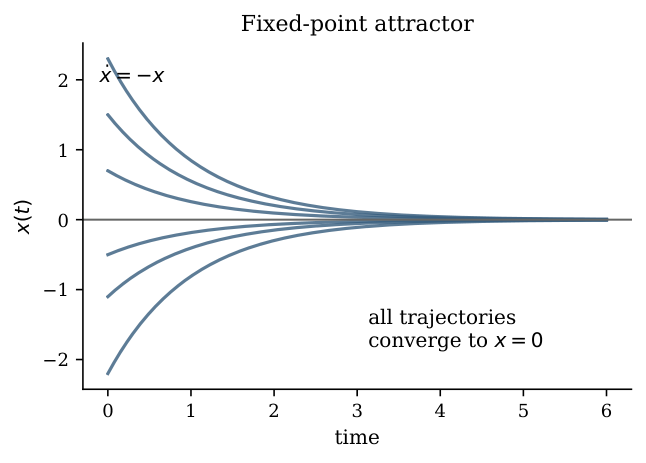
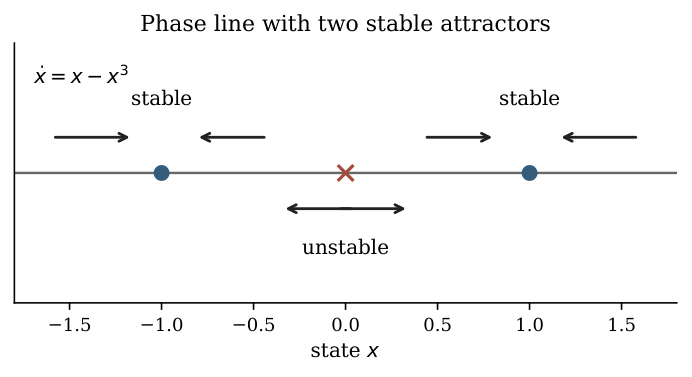
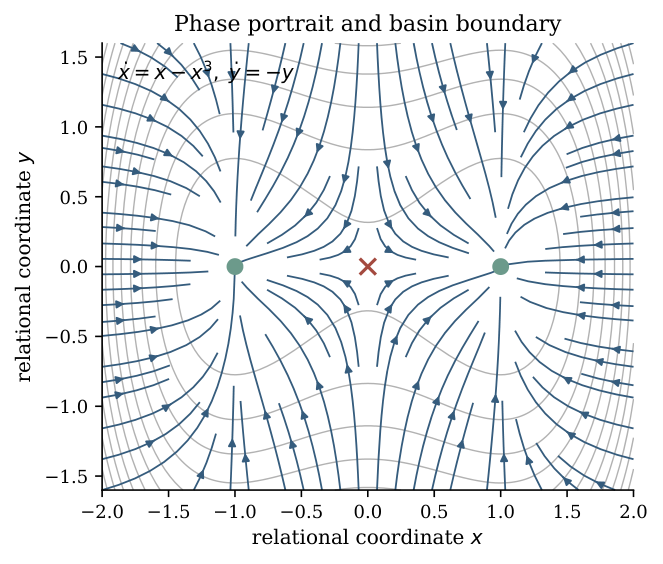
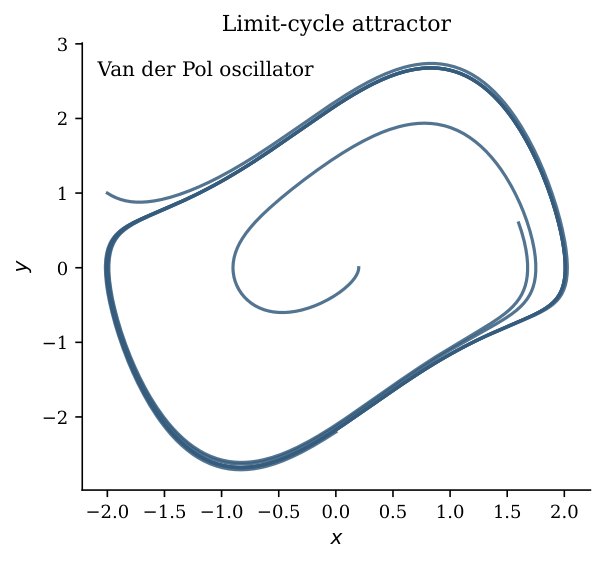
Figure 1 provides a visual guide to the vocabulary introduced in this subsection. Figure 1(a) shows the simplest case of a single stable fixed-point attractor; Figure 1(b) adds the idea of two stable attractors separated by an unstable boundary; Figure 1(c) makes the basin structure visible in two dimensions; and Figure 1(d) clarifies that persistence can also take the form of a stable cycle rather than a single resting point. For the later political argument, the important transferable lesson is not the specific equations shown in the panels but the more general point that persistence can take multiple dynamical forms and that basin structure determines which trajectories are pulled toward which attractor.
Perturbation, Sensitivity, and Transition
A perturbation is a disturbance that changes the state, a parameter, a coupling, or some other element relevant to the system’s evolution. In elementary models a perturbation may be represented as a small displacement
Definition 12 (Perturbation). A perturbation is a change, event, intervention, or endogenous fluctuation that displaces a represented system or alters a relation, parameter, constraint, or interaction rule relevant to its subsequent dynamics.
The effect of a perturbation is not determined by its magnitude alone. A small perturbation may decay rapidly in one regime and propagate widely in another. The relation between disturbance and response is captured by the broad idea of sensitivity. The later discussion of criticality will develop a more specific concept of susceptibility, but the present point is simpler: identical or similar inputs need not produce identical or proportionate outputs across different system states.
This is one source of nonlinearity. In a linear system, doubling an input doubles its effect and independent effects can be superposed. In a nonlinear system, feedback, thresholds, saturation, and interaction among variables can make the response depend on the system’s current configuration. The consequences of an action therefore cannot always be inferred from the action considered in isolation. This observation is familiar in systems-oriented political analysis, where feedback and interaction can transform the consequences of policies or strategic moves (Jervis 1997).
A transition occurs when the system moves between qualitatively different dynamical regimes or attractor structures. Such transitions can result from large shocks, accumulation of gradual changes, alteration of parameters, crossing of a threshold, or interaction among multiple perturbations. Later sections will distinguish critical transitions from other forms of change. For now, the important point is that political reconfiguration can depend jointly on the perturbation and on the susceptibility of the surrounding system.
Proposition 13 (State-dependent consequence). If the response function of a political relational system is nonlinear or configuration-dependent, then the historical consequence of a perturbation cannot in general be inferred from the perturbation’s local magnitude or apparent direction alone.
The proposition is almost definitional once nonlinearity is admitted, but it prepares a major claim of the paper. A disturbance that appears minor can become consequential when relations amplify it; a disturbance that appears large can be absorbed when the surrounding structure damps it. This does not imply that every small event is a hidden cause of major change. It implies that event magnitude and system susceptibility must be analytically separated.
Path Dependence and Irreversibility
Dynamical systems are often introduced through equations in which the present state contains everything needed to determine future motion. Political systems complicate that assumption because history can matter in ways not captured by a thin description of the present. Institutions accumulate commitments, actors acquire reputations, infrastructures create switching costs, categories become embedded in administrative practice, and repeated coordination can make one path easier to continue than to abandon. Economic and political scholarship on increasing returns and path dependence has emphasized how sequences of earlier events can shape later possibilities, including processes of self-reinforcement and lock-in (Arthur 1994; Pierson 2000).
Definition 14 (Path dependence). A process is path dependent when the range, probability, cost, or meaning of later transitions depends materially on the sequence through which the current configuration was reached, rather than only on a history-independent description of that configuration.
Path dependence does not mean that history mechanically determines the future. It means that histories change the dynamical landscape. Two apparently similar present configurations may differ because one rests on a dense web of reinforcing commitments while the other is newly formed and weakly institutionalized. A sufficiently rich state representation can, in principle, encode relevant historical information. In practice, however, treating history explicitly is often clearer than pretending that an observed snapshot is sufficient.
Irreversibility should likewise be used with care. Some physical processes are irreversible in a strict thermodynamic sense. Political uses are usually weaker. A political transition may be practically irreversible because reversal would require unavailable resources, coordination, legitimacy, or institutional reconstruction; it may be historically irreversible because recreating an earlier configuration would not recreate the historical conditions under which that configuration originally existed. The present paper therefore uses irreversible primarily in an effective and path-dependent sense.
Definition 15 (Effective irreversibility). A political transition is effectively irreversible over a specified horizon when returning to a prior relational configuration, or to a functionally equivalent configuration, lies outside the practically reachable set under the resources, institutions, constraints, and perturbations available during that horizon.
This definition explicitly depends on a time horizon and a model of available action. A configuration may be irreversible over a decade and reversible over a century; inaccessible to one actor and accessible to a coordinated set of actors; or formally possible but politically implausible. The later language of reachable futures will make these dependencies more explicit.
The concept of hysteresis also provides useful intuition. In systems exhibiting hysteresis, reversing the parameter that produced a transition does not necessarily restore the original state along the same path. Political analogues are common in principle: removing an initial cause may fail to undo the institutions, expectations, dependencies, or identities that accumulated after it. The paper does not assume that such political processes obey a particular hysteresis equation. The analogy is used to emphasize that “remove the pressure” and “restore the prior configuration” are different operations.
Interacting Components and Complex Systems
A system becomes analytically complex not merely because it contains many components, but because interactions among those components generate collective behavior that cannot be understood adequately by considering each component independently. Complexity research encompasses many traditions and does not provide a single universally accepted definition. For the present paper, three features are particularly relevant: heterogeneous interacting components, nonlinear dependence among effects, and macroscopic patterns that emerge from distributed interaction. Simon’s classic discussion of the “architecture of complexity” emphasized hierarchy and near decomposability as recurring features of complex systems, while later work on complex adaptive systems foregrounded interacting adaptive agents and emergent order (Simon 1962; Holland 1995).
Definition 16 (Complex relational system). A complex relational system is a system in which heterogeneous components interact through a changing structure of relations such that collective dynamics cannot be reconstructed adequately by treating component behavior as independent and additive.
The definition intentionally does not require chaos, randomness, or criticality. A complex system can be highly organized. Complexity refers here to interaction structure and emergent dependence, not to disorder. Likewise, a complicated system with many parts can remain analytically decomposable if the parts interact weakly. Complexity becomes especially consequential when changes in one region alter the conditions under which other components respond.
This feature motivates a relational rather than purely actor-centred representation. Let a simplified system be denoted by
The distinction is central to later claims about power asymmetry. If power is partly relational, then a change in one actor’s resources may alter network dependencies, expectations, access, and strategic options. Those relational changes can then modify the effective meaning of the original resource change. Feedback operates through the relation structure rather than through isolated actor attributes alone.
Emergence and Self-Organization
Emergence refers broadly to system-level patterns or properties produced through interaction among lower-level components but not straightforwardly identifiable with any one component’s properties or intentions. In complex adaptive systems, global order can arise from local rules without a central designer. Holland’s work made emergence and adaptation central to the study of such systems, while traditions of nonequilibrium science examined self-organization as the formation of macroscopic order through internal dynamics and interaction with an environment (Holland 1995; Nicolis and Prigogine 1977).
Definition 17 (Emergent pattern). An emergent pattern is a system-level regularity generated through interactions among components whose existence, scale, or functional role is not reducible to the isolated state or intention of any single component.
Emergence is especially important for this paper because the criticality hypothesis is not primarily a claim about actor intention. No political actor needs to intend that the international system remain near criticality. A collection of actors can pursue heterogeneous local objectives while jointly generating a macro-dynamic that preserves or destroys reconfigurability. The distinction between local intention and emergent systemic function protects the theory from teleology.
Self-organization is a related but stronger concept. It describes the endogenous formation or maintenance of organized macroscopic structure through interactions internal to the system, typically without a single external controller specifying the resulting pattern. In open systems, “internal” never means isolated from an environment; flows of energy, information, material resources, or constraints may be essential. The concept concerns the absence of centralized specification of the macrostructure, not absence of external conditions.
Definition 18 (Self-organization). Self-organization is the endogenous production or maintenance of macroscopic order through distributed interaction among system components, without requiring a single actor or controller to specify the resulting global configuration in advance.
This definition again requires caution in political use. Institutions may be deliberately designed, and many political orders result from explicit coercion or planning. A system can therefore combine designed and self-organized components. The criticality hypothesis does not require that the whole international system be self-organized in a pure sense. It asks whether some macroscopic dynamical properties, including possible anti-lock-in effects, can emerge from decentralized interaction even when many local structures are intentionally constructed.
Remark 19 (Emergence without normative endorsement). An emergent or self-organized pattern is not thereby desirable, efficient, legitimate, peaceful, or just. “Self-organized” is a causal and structural description, not a normative commendation.
This distinction will remain important when the paper later considers whether near-criticality can emerge endogenously. Even if such a regime preserved reconfigurability, that would not establish that the regime should be politically maintained.
Complex Adaptive Systems and Evolving Interaction Rules
The concept of a complex adaptive system adds adaptation to interaction and emergence. Components alter behavior in response to experience, feedback, environmental change, and one another. Holland’s early work on adaptation and later synthesis of complex adaptive systems emphasized rule-governed agents whose repeated interaction can transform aggregate patterns (Holland 1992, 1995). In international politics, adaptation is richer still because actors can interpret, learn, imitate, deceive, institutionalize, and strategically modify the environment faced by others.
A fixed dynamical equation such as
Definition 20 (Adaptive relational dynamics). A relational system exhibits adaptive dynamics when actors or relations modify their response rules, couplings, constraints, or interpretive strategies as a consequence of prior interactions and observed conditions.
This creates a second-order problem. In an ordinary control setting, one may ask how to select an input
Claim 21 (Endogenous evolution of the interaction law). For an adaptive political relational system, the effective law governing state transitions may itself be historically endogenous. Analysis of political trajectories therefore requires attention not only to movement within a state space but also to changes in couplings, constraints, and response rules that reshape the effective dynamical landscape.
This claim is one reason the present paper speaks of attractors and criticality cautiously. If the dynamical landscape evolves, then an attractor is not necessarily a permanent object waiting to be discovered. Basins can deepen, flatten, split, merge, or disappear as interaction rules change. Political criticality may therefore concern a moving landscape rather than a transition within a fixed one.
Adaptation also complicates the distinction between endogenous and exogenous perturbations. An event originating outside a selected subsystem may be exogenous relative to that subsystem, while the resulting response is endogenous to the wider system. Likewise, what looks like a shock at one scale may be the accumulated output of slow processes at another. The paper will therefore specify the scale of analysis whenever using the terms endogenous, exogenous, local, or systemic.
Multiscale Dynamics
Complex systems often contain processes operating at different spatial, organizational, and temporal scales. Simon’s account of hierarchical organization and near decomposability highlighted how subsystems can display strong internal interaction while remaining connected to larger structures (Simon 1962). In political systems, relevant scales may include individuals, organizations, governments, transnational networks, institutional regimes, regional structures, and wider international relational configurations. Temporal scales can range from rapid strategic decisions to institutional adaptation occurring over decades.
Definition 22 (Multiscale dynamics). Multiscale dynamics are processes in which patterns and interactions occurring at different temporal, relational, or organizational scales influence one another, such that no single scale is sufficient to explain the system’s evolution.
Multiscale analysis matters for three reasons. First, a perturbation may be small at one scale but large at another. A localized institutional revision may be negligible relative to aggregate material capabilities yet decisive within a tightly coupled network. Second, causal influence can propagate upward and downward across scales. Local interactions can aggregate into systemic patterns, while systemic constraints alter the incentives and possibilities facing local actors. Third, apparent stability can be scale-dependent. A macrostructure may appear persistent while its microrelations are rapidly changing, or local institutions may remain intact while the larger relational environment moves toward a different regime.
The criticality hypothesis will rely heavily on this multiscale perspective. Near-critical behavior, if present, would not imply that every component is individually critical. A system-level susceptibility can arise from the pattern of coupling among components. Likewise, heterogeneous local responses can contribute to a global pattern without being coordinated or even mutually compatible. The later discussion of political turbulence will ask whether perturbations can interact across scales in ways that produce intermittent and disproportionate reorganization. This possibility cannot be represented adequately by a single-level account of action.
Proposition 23 (Scale-relative interpretation). Terms such as stability, perturbation, order, and transition are scale-relative in a complex political system. A pattern that constitutes noise at one scale may contribute to structure at another, while a pattern that appears stable at one scale may depend on rapid reorganization at another.
The proposition does not imply that all interpretations are equally valid. It requires analysts to specify the scale at which a claim is made and to examine whether cross-scale interactions alter the conclusion.
Conceptual Commitments for the Criticality Hypothesis
The concepts introduced above establish the minimum language required for the next stage of the paper. They can be condensed into several commitments.
First, international politics will be represented dynamically rather than as a sequence of unrelated snapshots. The relevant objects are trajectories and transformations of relational configurations. Second, stability will be treated as a property of dynamical confinement and response to perturbation, not simply as low observed variation. Third, attractors and basins will be used as analytical descriptions of self-reinforcing relational regimes rather than as claims that political orders behave exactly like mechanical systems. Fourth, path dependence implies that historical trajectories can reshape future accessibility and make some transitions effectively irreversible over relevant horizons. Fifth, complex-system effects arise through interaction, feedback, and emergence, so system-level consequences cannot always be read directly from actor-level intentions. Sixth, adaptation means that the effective interaction law can itself evolve, making the political dynamical landscape historically endogenous. Seventh, all of these claims are scale-sensitive.
These commitments also establish several limits. A political state space is model-dependent. An attractor is not a moral category. Self-organization does not imply legitimacy. Adaptation does not imply improvement. Nonlinearity does not imply chaos. Complexity does not imply criticality. Most importantly, nothing in this section establishes that international politics actually operates near a critical regime. It only supplies a vocabulary in which that hypothesis can be posed without relying on metaphor alone.
Research Obligation 24 (Domain-specific operationalization). Any later empirical use of dynamical-systems concepts in international politics must specify how states, relations, perturbations, attractors, transition boundaries, and scales are operationalized in the political domain. Formal vocabulary should not substitute for domain-specific measurement or historical interpretation.
The next section turns from this general foundation to the more specific concept of criticality. It distinguishes critical transitions, susceptibility, collective reorganization, self-organized criticality, near-criticality, and quasi-criticality. Only after those distinctions are made can the central political hypothesis be stated with sufficient precision.
Criticality in Complex Systems
The preceding section introduced a dynamical vocabulary for describing systems whose configurations evolve through interaction, feedback, perturbation, and historical dependence. The present section narrows that vocabulary to criticality. This step requires care because the word “critical” is used in several partially overlapping ways across physics, dynamical-systems theory, complex-systems research, ecology, neuroscience, and ordinary political language. A critical point in statistical physics, a bifurcation that induces a critical transition, a self-organized critical state, and a broad near-critical regime are related ideas, but they are not interchangeable. Treating them as synonyms would obscure rather than clarify the hypothesis developed later in this paper.
The purpose of this section is therefore conceptual and methodological. It introduces the minimum distinctions needed to ask whether an international relational system could display dynamics analogous to critical or near-critical regimes without assuming in advance that it does. The discussion begins with dynamical regimes and critical transitions, then turns to susceptibility, perturbation propagation, cascades, self-organized criticality, near-criticality, and quasi-criticality. The final subsection isolates the property most relevant to the later political argument: reconfigurability. Throughout, mathematical expressions are used to identify structural relations, not to imply that political data already instantiate a particular universality class or physical phase transition.
Dynamical Regimes
A dynamical system can display qualitatively different forms of behavior as parameters, couplings, or constraints change. A trajectory may converge rapidly toward a fixed point, circulate around a periodic orbit, wander within a bounded irregular set, switch intermittently among metastable configurations, or undergo a qualitative change when a control parameter crosses a threshold. It is useful to call these broad forms of behavior dynamical regimes. The term emphasizes that the same system architecture can support different macroscopic patterns under different conditions.
Definition 25 (Dynamical regime). A dynamical regime is a qualitatively distinguishable pattern of system behavior that persists over a nontrivial range of states, parameters, or timescales. Regimes are distinguished by properties such as stability, characteristic response to perturbation, correlation structure, propagation of activity, or accessibility of alternative configurations.
Consider a parameterized system
For the purposes of this paper, the important distinction is not between particular physical phases but between kinds of dynamical response. A strongly contracting regime tends to suppress small disturbances. A strongly amplifying regime may allow disturbances to grow rapidly. Between such idealized extremes, there may exist regions in which the system remains organized while exhibiting unusually strong susceptibility to perturbation and a broad distribution of response scales. Criticality concerns this transition structure, not merely the presence of visible fluctuation.
Remark 26 (Criticality and ordinary instability). Criticality should not be equated with instability in the ordinary sense. A system can be unstable because trajectories diverge rapidly from a state, yet display none of the scaling, correlation, or transition properties associated with critical phenomena. Conversely, a finite system can remain bounded and operational while exhibiting strong susceptibility and large correlated fluctuations near a critical region.
This distinction will later be essential for political analysis. Political instability, crisis, or disorder cannot be used as observational synonyms for criticality. A criticality hypothesis requires a more specific claim about how perturbations propagate, how relational configurations become accessible, and how system-level response changes near a transition regime.
Critical Transitions
The phrase critical transition is widely used for abrupt qualitative change in systems whose underlying conditions may have shifted gradually. Ecological research has emphasized that systems can approach thresholds at which relatively small additional changes precipitate large transitions to contrasting regimes (Scheffer et al. 2001). Work on early-warning signals further connects such transitions to changing recovery rates, variance, and autocorrelation as systems approach certain bifurcations (Scheffer et al. 2009). Kuehn provides a mathematical treatment linking critical transitions to bifurcations, fast–slow dynamics, and stochastic effects (Kuehn 2011).
A simple schematic representation separates a slowly evolving control variable from faster system dynamics:
Definition 27 (Critical transition). A critical transition is a qualitative shift between dynamical regimes associated with the loss, weakening, or reorganization of a previously sustaining dynamical structure, such that gradual changes in conditions can produce a comparatively abrupt change in system behavior.
This definition is intentionally broader than a single bifurcation type. Critical transitions can be induced by different mechanisms, and noise may interact with deterministic structure. The paper therefore does not assume that every political transition can be represented as a saddle-node bifurcation or any other canonical normal form. The relevant lesson is structural: the magnitude and timing of an observed transition need not be proportional to the immediately preceding change in external conditions.
The concept also clarifies the role of historical timing. Suppose the system is governed schematically by
Proposition 28 (Regime-dependent consequence). The consequence of a perturbation cannot in general be inferred from its magnitude or apparent direction alone. Its system-level effect depends on the dynamical regime, coupling structure, and proximity to transition boundaries at the time the perturbation occurs.
The proposition is a general dynamical statement rather than a political conclusion. Later sections will ask whether it helps explain why superficially similar political actions can dissipate in one historical configuration yet contribute to large-scale reorganization in another.
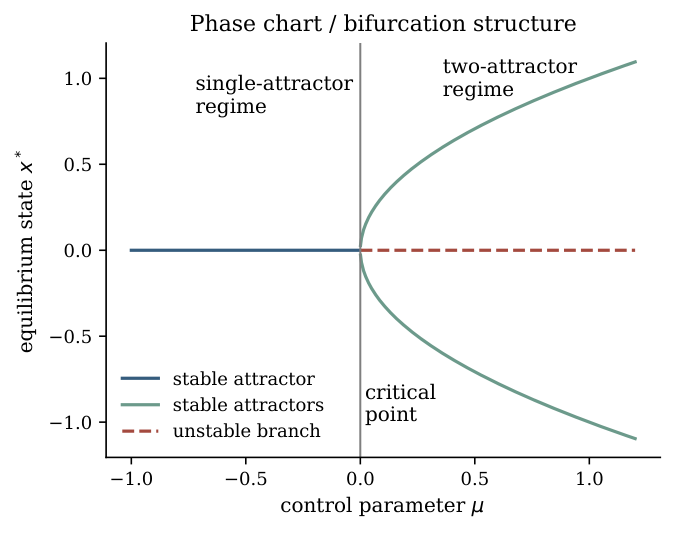
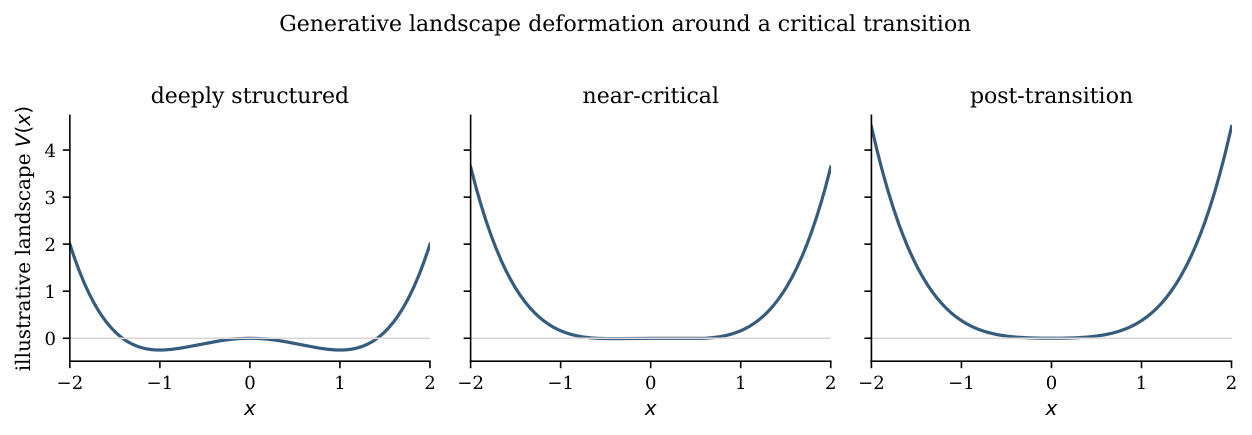
Figure 2 makes the idea of a critical transition more concrete. In Figure 2(a), the phase chart shows how a change in conditions can reorganize the number and stability of available attractors. Figure 2(b) presents the same idea in a generative-landscape language: the near-critical regime is visually characterized by a shallower and less sharply separated landscape, so that previously absorbed perturbations can begin to matter systemically.
Susceptibility and Perturbation Propagation
A central reason critical regimes attract attention is their enhanced responsiveness. In statistical mechanics, susceptibility measures how strongly an observable changes in response to a conjugate field. In a generic dynamical setting, the idea can be expressed more broadly as sensitivity of a system-level observable
Definition 29 (Dynamical susceptibility). Dynamical susceptibility denotes the degree to which a system-level response changes under a specified perturbation, conditional on the system’s current regime and coupling structure.
Two further concepts help explain why high susceptibility is not merely large local volatility. The first is correlation. Near continuous critical points in many physical systems, fluctuations can become correlated over increasing distances. A characteristic correlation length
These formulas are not imported later as political estimators. Their conceptual role is to distinguish local fluctuation from system-level susceptibility. If a perturbation affects only its immediate neighborhood and rapidly disappears, the system has a limited propagation range for that mode. If effects remain correlated across broader parts of the system, a local intervention can become systemically consequential.
Claim 30 (Propagation is structurally mediated). A perturbation becomes systemically consequential through the interaction structure that transmits, transforms, suppresses, or amplifies it. Systemic consequence is therefore a property of the perturbation–system relation, not of the perturbation considered in isolation.
This claim will later support a key distinction in the political argument. An action can have a clear local direction while producing a different aggregate function after passing through a heterogeneous relational network. The direction of the initial intervention and the geometry of its propagation are analytically distinct.
Enhanced susceptibility also creates a dual possibility. It can increase adaptive responsiveness, but it can also increase vulnerability to cascades and unwanted amplification. Nothing in the concept of criticality establishes that susceptibility is beneficial. Its normative value depends on what propagates, for whom, at what cost, and under what institutional and historical conditions.
Cascades and Collective Reorganization
Many complex systems respond to gradual driving through discrete events whose sizes span broad ranges. Sethna, Dahmen, and Myers use the term “crackling noise” for systems in which slowly changing conditions generate impulsive responses over many scales, emphasizing scaling and universality across diverse physical examples (Sethna et al. 2001). The general lesson is that macroscopic response can be organized into cascades rather than smooth proportional adjustment.
Definition 31 (Cascade). A cascade is a sequence of interacting responses in which an initial perturbation changes conditions for subsequent responses, allowing effects to propagate through multiple components or scales before terminating.
Cascade size can be represented by a quantity
Power-law-like behavior, however, is not sufficient evidence of criticality. Heavy-tailed distributions can arise through multiple mechanisms, finite samples can make distributions difficult to distinguish, and fitted exponents alone do not identify an underlying critical point. The methodological burden is therefore stronger than observing occasional large events or plotting data on logarithmic axes.
Research Obligation 32 (Evidence beyond scale-free appearance). An empirical claim of political criticality should not rely on a power-law fit, heavy-tailed event distribution, or visually scale-free pattern alone. Evidence should connect observed scaling, where present, to an explicit transition mechanism, response structure, finite-size behavior, correlation pattern, or other domain-appropriate diagnostics that distinguish criticality from alternative generative processes.
The cascade perspective nevertheless provides an important bridge to the later turbulence hypothesis. A perturbation can change a relation, that relational change can alter the effective environment of other actors, and those actors can in turn generate new responses. The resulting process is not a simple multiplication of the initial force. Each stage transforms the conditions for the next stage. Formally, a sequence may be written as
Claim 33 (Event magnitude and historical consequence). The magnitude of an initiating event and the magnitude of the resulting system-level reorganization need not be monotonically related. Large consequences can arise from modest perturbations in highly susceptible coupling structures, while large perturbations can dissipate in strongly absorbing regimes.
In this paper, that claim remains a structural possibility. It does not license retrospective narratives in which every major historical transformation is attributed to a small “trigger.” Identifying a cascade requires reconstructing the intermediate relational mechanisms through which effects were transmitted and transformed.
Self-Organized Criticality
The classical theory of critical phenomena often considers a control parameter that must be tuned toward a transition point. Bak, Tang, and Wiesenfeld proposed a stronger idea: some spatially extended dynamical systems may evolve toward a critical state through their own slow driving and dissipative dynamics, a proposal they termed self-organized criticality (Bak et al. 1987). The canonical intuition is that local thresholds, slow loading, and fast relaxation can produce avalanches over a broad range of scales without an external controller continuously setting the system exactly at a critical parameter value.
Definition 34 (Self-organized criticality). Self-organized criticality is the hypothesis that the internal dynamics of an appropriate driven, dissipative, interacting system can generate and maintain a critical or scale-invariant regime without continuous external fine-tuning of a control parameter to a critical value.
The phrase “self-organized” is easily overextended. It does not mean that every adaptive system becomes critical, that criticality is an inevitable endpoint, or that the resulting regime is optimal. The original claim concerns particular classes of dynamical mechanisms. Conservation properties, separation of driving and relaxation timescales, threshold dynamics, network structure, and finite-size effects can all matter.
This caution is particularly important because nonconserving systems can display broad pseudo-critical regions without satisfying the stronger conditions of genuine self-organized criticality. Bonachela and colleagues show, in the context of models motivated by neuronal avalanches, that dissipative nonconserving dynamics can require tuning and may instead display broad quasi-critical behavior (Bonachela et al. 2010). Their analysis is domain-specific, but its methodological lesson is general: apparent self-organization toward a scale-free regime does not by itself establish true criticality.
Remark 35 (Strength of the self-organization claim). The later Criticality Hypothesis of International Politics does not presuppose self-organized criticality in the strong Bak–Tang–Wiesenfeld sense. A political relational system could display recurrent near-criticality, adaptive return toward susceptible regimes, or broad quasi-critical behavior without satisfying the formal conditions of a self-organized critical system.
This distinction protects the political hypothesis from an unnecessary burden. The paper need not claim that international politics automatically tunes itself to a mathematically exact critical point. Its weaker and more plausible question is whether endogenous interaction can sometimes resist deep lock-in and sustain a region of heightened reconfigurability.
Self-organization also should not be anthropomorphized. In an adaptive social system, actors may have intentions, but the aggregate regime can still be unintended. If decentralized choices collectively move the system toward a near-critical region, it does not follow that any actor intended to maintain criticality. This separation between local intention and emergent macro-dynamics will become central in the later formulation of the political criticality hypothesis and in the discussion of its possible origins.
Near-Criticality and Quasi-Criticality
Exact criticality is an idealized concept. Real systems are finite, noisy, heterogeneous, and often nonstationary. Their control parameters may drift, their interaction networks may evolve, and the relevant critical manifold may itself move. For these reasons, many empirical discussions concern systems that operate near a critical point or within a broad region displaying some critical-like properties rather than exactly at a singular mathematical point.
Definition 36 (Near-critical regime). A near-critical regime is a region of state–parameter space sufficiently close to a relevant transition structure that the system exhibits enhanced susceptibility, extended correlations, multiscale response, slowed recovery, or other critical-like dynamical properties, while not requiring exact residence at a mathematical critical point.
Near-criticality is therefore a relational notion: a system is near criticality relative to a specified transition, observable, and scale. The distance need not be Euclidean distance in the raw state variables. In high-dimensional systems it may instead refer to distance from a critical surface or region in an effective parameter space.
The term quasi-criticality is useful when a system persistently wanders through a broad pseudo-critical region or displays approximate scaling without satisfying the conditions for an exact critical state. In the self-organized quasi-criticality account developed for nonconserving systems, apparent critical behavior can occupy a finite region and depend on slow adaptive processes rather than exact tuning (Bonachela et al. 2010). The distinction is especially relevant for social systems, where interaction rules and effective parameters are unlikely to remain fixed long enough to support a simple equilibrium critical point.
Definition 37 (Quasi-critical dynamics). Quasi-critical dynamics refer here to persistent or recurrent critical-like behavior generated over a finite region of a changing dynamical landscape, without assuming exact tuning to a singular critical point or exact scale invariance in the infinite-system limit.
For the later political hypothesis, this concept may ultimately prove more appropriate than exact criticality. International politics is finite, historically evolving, and reflexive. Actors adapt to observed conditions; institutions reshape interaction rules; and the relevant relational state space changes over time. A moving system can therefore pass repeatedly through regions of high susceptibility or remain within a corridor of reconfigurability without ever satisfying the idealized assumptions of an equilibrium critical point.
Claim 38 (Political relevance of finite critical regions). For historically evolving relational systems, a theoretically useful criticality hypothesis need not require exact critical-point occupancy. It may instead concern recurrent residence within finite regions where perturbations propagate across scales and alternative configurations remain unusually accessible.
The claim is methodological rather than empirical. It specifies what the later political hypothesis is allowed to mean. Whether international politics actually exhibits such regions remains an open question requiring independent evidence.
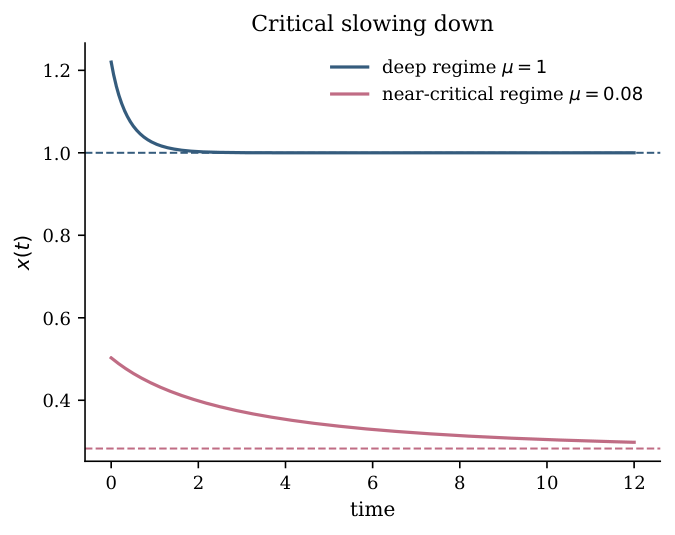
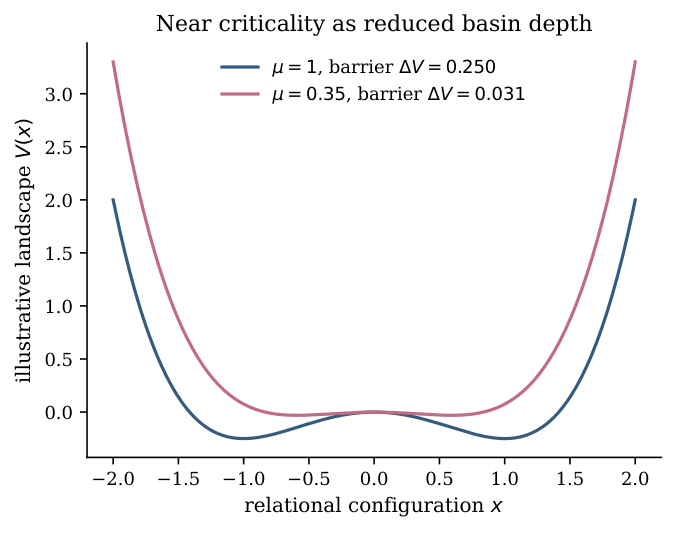
Figure 3 highlights two signatures that are especially useful for the paper’s later political analogy. Figure 3(a) depicts critical slowing down: the same perturbation decays more slowly when the system lies closer to a transition. Figure 3(b) expresses the same intuition through barrier reduction: near criticality, effective basin depth decreases, so a disturbance that once remained trapped may become capable of pushing the system toward reorganization.
Criticality and Reconfigurability
The concept most important for the remainder of the paper is reconfigurability. Criticality is scientifically interesting for many reasons, including scaling, universality, collective response, and information-processing properties. The present argument does not require all of these properties. It focuses on a narrower possibility: near a suitable transition regime, a system may retain organized persistence while becoming more capable of moving among qualitatively different configurations.
Definition 39 (Reconfigurability). Reconfigurability is the capacity of a system to undergo substantial changes in relational or dynamical organization under finite perturbations while retaining enough structural continuity for the resulting configuration to remain systemically meaningful.
This definition excludes two extremes. A perfectly rigid system has continuity but little reconfigurability: perturbations decay before they can alter the organization of the system. A completely incoherent system may exhibit abundant change but lack persistent structures through which distinct configurations can be identified or sustained. Reconfigurability concerns the coexistence of persistence and transformability.
A simple conceptual decomposition is
Proposition 40 (Reconfigurability differs from volatility). Observed variation in system state is neither necessary nor sufficient for high reconfigurability. Reconfigurability depends on the accessibility of qualitatively distinct dynamical configurations, not simply on the amplitude or frequency of short-run fluctuation.
This proposition is central to the later political application. A period containing frequent disputes, policy changes, or institutional noise may nevertheless remain deeply confined within a stable relational attractor. Conversely, a period of apparent calm may lie close to a transition boundary if couplings and constraints have changed in ways that make alternative configurations newly accessible. Criticality is therefore relevant not because it predicts visible disorder but because it may alter the geometry of possible response.
The literature on critical systems sometimes motivates criticality through functional benefits such as enhanced sensitivity or dynamic range. For example, models of excitable networks can exhibit maximal dynamic range at a critical point (Kinouchi and Copelli 2006). The next section will examine the much broader critical-brain literature, where such functional arguments have been developed more explicitly. At the present stage, however, the paper deliberately refrains from inferring that near-criticality optimizes an international political function. There is no politically neutral scalar objective analogous to a sensory network’s dynamic range, and the normative desirability of responsiveness depends on the content and distribution of consequences.
What can be retained is a weaker structural question. If a system is too strongly confined, many perturbations terminate without changing its relational organization. If it is too weakly organized, perturbations may not produce durable alternative configurations. A near-critical region may, under some conditions, support a wider repertoire of consequential responses. Whether that possibility applies to international politics becomes an empirical and theoretical question rather than an imported conclusion.
Open Question 41 (Criticality and accessible response repertoire). Under what conditions does proximity to a critical or quasi-critical regime enlarge the effective repertoire of system-level responses while preserving sufficient coherence for those responses to produce durable relational reconfiguration?
The open question anticipates the later discussions of possible origins of political near-criticality and of effective response repertoire. It also establishes the boundary between the present background section and the paper’s original hypothesis. Criticality provides a language for heightened susceptibility, multiscale propagation, and transition among dynamical regimes. It does not by itself explain why an international political system would occupy such a regime, whether power asymmetry generates counter-perturbations, or whether criticality is recurrent over historical time.
Several conceptual safeguards can now be stated. Criticality is not synonymous with complexity. It is not synonymous with instability, crisis, conflict, or disorder. A critical transition is not identical to self-organized criticality. Self-organized criticality is not implied by the existence of cascades. Power-law-like distributions are not sufficient proof of criticality. Near-criticality does not imply exact critical-point tuning. Quasi-criticality permits critical-like behavior over a finite and evolving region. Finally, no dynamical property carries an intrinsic political or moral valuation.
Research Obligation 42 (Discriminating criticality from neighboring explanations). Any later empirical test of the Criticality Hypothesis of International Politics must specify observations capable of distinguishing near-critical dynamics from ordinary instability, exogenous shock response, strategic balancing, stochastic volatility, path dependence within a stable basin, and other noncritical mechanisms that can also produce large or heterogeneous political change.
With these distinctions in place, the paper can turn to the critical brain hypothesis. That literature offers a particularly developed example of the claim that a complex adaptive system may operate near a critical regime because such a regime can support a combination of responsiveness, coordination, and functional variety. It also offers equally important methodological cautions: empirical signatures of criticality are contested, multiple notions of criticality coexist, and apparent scaling does not settle the mechanism. The brain literature will therefore be used as intellectual background and as a source of questions, not as evidence that international politics is critical.
The Critical Brain Hypothesis
The preceding section developed criticality as a family of dynamical ideas concerning transitions, susceptibility, correlated fluctuation, cascades, and reconfigurability. The present section turns to neuroscience because the critical brain hypothesis provides an unusually developed example of an attempt to connect those ideas to the functioning of a heterogeneous, adaptive, multiscale system. The relevance of this literature to the present paper is methodological as much as substantive. Neuroscience has had to confront questions that will later reappear in a different form in international politics: how to infer criticality from finite observations, how to distinguish criticality from generic variability, how to relate system-level dynamical regimes to functional capacities, and how to avoid treating a suggestive analogy as a demonstrated mechanism.
The brain literature is particularly useful because it contains both an affirmative research program and sustained criticism of that program. Experimental studies of neuronal avalanches, theoretical models of excitable networks, and analyses of large-scale neural dynamics have motivated the proposal that neural systems may operate at or near a critical transition (Beggs and Plenz 2003; Kinouchi and Copelli 2006; Chialvo 2010; Cocchi et al. 2017). At the same time, researchers have shown that power-law-like activity, avalanche statistics, or other apparent signatures can arise in noncritical systems or can depend strongly on measurement and preprocessing choices (Touboul and Destexhe 2010, 2017; O’Byrne and Jerbi 2022; Tian et al. 2022). The critical brain hypothesis therefore should not be presented as an established fact imported into political theory. It is more valuable here as a mature case of a cross-disciplinary hypothesis whose conceptual promise is inseparable from its empirical and methodological difficulties.
Neural Dynamics and Neuronal Avalanches
The brain is composed of interacting units organized across many spatial and temporal scales. Neural activity is neither perfectly synchronized nor fully independent. Local interactions can propagate through circuits, transient coalitions of neural populations can form and dissolve, and patterns observed at one scale may coexist with qualitatively different patterns at another. This multiscale organization has encouraged the use of statistical-physics and dynamical-systems concepts in neuroscience, including synchronization, metastability, phase transitions, branching processes, and critical phenomena (Chialvo 2010; Cocchi et al. 2017).
A central empirical point in the modern critical-brain literature was the observation by Beggs and Plenz of neuronal avalanches in cortical preparations (Beggs and Plenz 2003). Neural activity appeared in cascades whose sizes varied substantially, with empirical distributions displaying scaling behavior compatible with a critical branching-process interpretation. The significance of the observation was not simply that some events were large and others small. A critical interpretation suggests that activity can propagate over a broad range of scales without being restricted either to rapid extinction or to system-wide saturation.
Definition 43 (Neuronal avalanche). A neuronal avalanche is a temporally connected cascade of neural activity defined with respect to an observational procedure, typically by grouping activity events into contiguous temporal bins or related spatiotemporal clusters. Avalanche size and duration describe the extent of the resulting cascade.
The definition deliberately includes the observational procedure. Avalanches are not objects that can be identified independently of sampling, temporal binning, thresholding, spatial resolution, and the neural variable being measured. This dependence later becomes important because apparent scaling can change with data-processing choices. The existence of a broad avalanche-size distribution is therefore a starting point for inference rather than a sufficient demonstration of criticality.
A simple branching-process intuition nevertheless helps clarify why avalanches became important. Let
Claim 44 (Propagation repertoire near a transition). In an excitable network, a regime near the transition between rapid extinction and excessive amplification can support a broader repertoire of propagation scales than either strongly subcritical or strongly supercritical regimes.
This claim is intentionally structural. It does not establish that the living brain universally occupies such a regime. It identifies the property that motivates later functional arguments: a system close to a propagation transition can potentially respond to perturbations at multiple scales rather than converting most inputs into either negligible or saturated outputs.
The critical-brain hypothesis subsequently expanded beyond neuronal avalanches. Studies have investigated scale-free temporal correlations, synchronization transitions, whole-brain network dynamics, and changes in distance to criticality across behavioral or physiological conditions. Reviews by Chialvo and by Cocchi and colleagues situate these findings within a broader proposal that critical phenomena may help explain how large neural systems generate a flexible repertoire of coordinated configurations (Chialvo 2010; Cocchi et al. 2017). Yet this expansion also makes conceptual discipline more important: different measurements may correspond to different transitions, models, or notions of criticality, and evidence for one does not automatically establish the others.
Criticality and Dynamic Range
One of the strongest reasons for studying neural criticality is functional rather than merely descriptive. A neural system must respond to inputs that vary greatly in intensity. If activity is too strongly damped, weak but meaningful inputs may fail to propagate. If activity is too strongly amplified, many distinct inputs may drive the system toward similar saturated responses. An intermediate regime may therefore enlarge the range of input intensities that can be meaningfully distinguished.
Kinouchi and Copelli formalized this intuition in networks of excitable elements and showed that dynamical range can be maximized at a critical point separating quiescent and self-sustained activity (Kinouchi and Copelli 2006). Shew and colleagues subsequently reported experimental results linking neuronal-avalanche dynamics with maximal dynamic range in cortical networks (Shew et al. 2009). These studies are significant for the present paper because they move beyond the descriptive statement that critical-like statistics occur. They ask whether proximity to a transition changes what the system can do.
Let
In a strongly subcritical network, the response function may remain close to baseline over a substantial range of weak inputs because perturbations fail to propagate. In a strongly supercritical network, internally sustained activity can compress the usable response interval because the network is already highly active or easily saturated. Near the transition, amplification is sufficient to propagate weak inputs while finite network structure still permits stronger inputs to generate distinguishable increases in response.
Proposition 45 (Functional interpretation of near-critical sensitivity). If a system must preserve sensitivity to weak perturbations while avoiding indiscriminate saturation under stronger perturbations, an intermediate dynamical regime can provide a larger effective response range than either strong attenuation or strong amplification.
The proposition does not depend on the brain specifically, and that is precisely why it is useful for later theoretical transfer. However, it also illustrates a danger. One cannot infer from the desirability of a large dynamic range that a system must evolve toward criticality. Nor can one infer that the same quantity should be maximized in a political system. The neuroscience result establishes a domain-specific functional relationship under particular models and measurements. Its cross-domain value lies in revealing a possible form of reasoning: a transition regime can be interesting because it supports a conjunction of capacities that are difficult to obtain at either extreme.
Information Processing and Response Repertoire
The functional argument has been extended from dynamic range to information-processing properties. Shew and Plenz review evidence and models linking criticality to dynamic range, information transmission, and information capacity in cortical systems (Shew and Plenz 2013). More broadly, the critical-brain literature often proposes that a near-critical regime offers a favorable compromise between overly rigid collective behavior and weakly coordinated local activity. The system can support substantial correlations without collapsing all components into one undifferentiated mode.
For the purposes of the present paper, the most transferable idea is not that criticality “maximizes information” in some universal sense. Information measures depend on variables, tasks, timescales, and coding assumptions. A safer concept is the response repertoire: the set of distinguishable dynamical responses that the system can generate while retaining enough coherence for those responses to propagate and influence subsequent activity.
Definition 46 (Neural response repertoire). The neural response repertoire denotes the set of dynamically distinguishable patterns or trajectories that a neural system can access in response to internal or external perturbations over a specified observational scale and time horizon.
This definition is intentionally relational and dynamical. A large number of instantaneous microstates does not necessarily imply a large effective repertoire. If the states are unstructured noise with negligible persistence, they may not support differentiated system-level responses. Conversely, a highly ordered system can be coherent but dynamically poor if many distinct perturbations produce nearly the same trajectory. The relevant quantity is therefore not variety alone but usable variety under continuing system organization.
One can represent this intuition schematically by separating diversity and coherence. Let
Claim 47 (Repertoire rather than maximal disorder). The functional appeal of neural criticality is not maximal variability by itself. It is the possibility that a system can sustain a broad repertoire of differentiated responses while retaining sufficient interaction structure for those responses to become coordinated and consequential.
This formulation is important for the later political hypothesis. It prevents “criticality” from being treated as a celebration of disorder. The relevant structural question is whether a system can preserve multiple dynamically accessible responses without losing the coherence required for continued operation. Neuroscience provides a concrete domain in which such a balance has been investigated, but it does not establish that the same balance exists, is desirable, or is optimized in international politics.
Recent work continues to develop strong functional versions of the critical-brain hypothesis. Hengen and Shew, for example, propose criticality as a possible unifying computational setpoint and synthesize a large body of experimental work through 2024 (Hengen and Shew 2025). This is an important contemporary statement of the affirmative research program. It should nevertheless be read together with critical and methodological literature rather than as closure of the debate. The existence of competing interpretations is itself instructive for the present paper: functional advantages can motivate a hypothesis, but they cannot substitute for independent identification of the underlying regime.
Adaptability and Metastable Dynamics
A second concept adjacent to criticality is metastability. Metastable dynamics involve configurations that persist long enough to be dynamically meaningful but remain transient, allowing the system to leave one configuration and enter another. In neuroscience, metastability has been used to characterize the coexistence of integration and segregation: neural populations can coordinate temporarily while retaining sufficient autonomy for changing coalitions and differentiated functions (Tognoli and Kelso 2014).
Criticality and metastability are not synonyms. A system can exhibit metastable switching for mechanisms unrelated to a critical phase transition, and evidence of transient coordination does not establish criticality. Nevertheless, the concepts intersect around a common problem: how can a system preserve enough stability to sustain coherent organization while remaining sufficiently flexible to reorganize?
Definition 48 (Metastable neural regime). A metastable neural regime is a dynamically persistent but nonpermanent configuration of neural activity whose lifetime is long relative to local fluctuations yet finite relative to the system’s broader evolution.
Metastability is particularly relevant to cognition because fixed global synchronization would sharply reduce the number of distinguishable configurations available to the system, while complete independence would weaken coordination. Tognoli and Kelso describe metastability as permitting tendencies toward integration and segregation to coexist rather than requiring the system to settle permanently into either condition (Tognoli and Kelso 2014). Criticality research asks a related but distinct question: whether proximity to a transition provides a dynamical basis for rich switching, broad correlation structures, and flexible response.
The conjunction suggests a useful general intuition. Adaptive systems often require both memory and departure from memory. If every perturbation immediately erases the existing configuration, continuity is weak. If no perturbation can materially alter the configuration, adaptation is weak. A system able to occupy persistent but revisable regimes can retain historical structure while remaining capable of reorganization.
Claim 49 (Continuity–adaptability tension). For an adaptive system, persistence and reconfiguration are not simply opposites. Functional adaptability can require enough persistence to maintain organized states and enough susceptibility to permit transitions among them.
The claim will later reappear in political form, but its meaning must not be transferred mechanically. Neural populations do not possess sovereignty, strategic intention, historical narratives, legal standing, or normative claims. The value of the neural case is therefore structural: it makes explicit a dynamical problem in which stability and flexibility can be jointly necessary rather than mutually exclusive.
Near-Critical and Quasi-Critical Accounts
The phrase “the brain is critical” can be misleading if interpreted as the assertion that a finite, driven, heterogeneous biological system remains exactly at a mathematically ideal critical point. Contemporary literature distinguishes several possibilities, including ordinary criticality, self-organized criticality, quasi-criticality, and self-organized quasi-criticality (O’Byrne and Jerbi 2022; Tian et al. 2022). These distinctions are especially relevant to this paper because international politics is also finite, externally and internally driven, heterogeneous, historically changing, and unlikely to satisfy the assumptions of an ideal equilibrium critical point.
A near-critical account weakens the requirement of exact tuning. Let
Quasi-critical accounts go further by recognizing that driven systems may wander around a critical region rather than remain precisely fixed to it. Bonachela and colleagues argued that nonconservative systems can self-organize toward a region surrounding a critical point rather than achieving generic exact criticality, motivating the language of self-organized quasi-criticality (Bonachela et al. 2010). Tian and colleagues provide a systematic account of the distinctions among ordinary criticality, quasi-criticality, self-organized criticality, and self-organized quasi-criticality in the context of brain research (Tian et al. 2022).
Remark 50 (Finite-system formulation). For finite adaptive systems, the empirically relevant question may concern distance to a critical region, recurrent approach to such a region, or critical-like response over a bounded range rather than exact occupancy of an ideal critical point.
This remark is one of the most important methodological lessons for the political argument. If the later paper speaks of political near-criticality, the intended claim should concern a regime of enhanced susceptibility and reconfigurability, not exact equality to a universal critical parameter. The weaker formulation is not merely rhetorical caution; it better matches the properties of finite systems whose couplings, boundaries, and driving processes themselves evolve.
O’Byrne and Jerbi similarly emphasize contemporary work on distance to criticality, edge-of-chaos phenomena, and near-critical dynamics rather than reducing the field to a single exact-criticality claim (O’Byrne and Jerbi 2022). This broader formulation is useful, but it also creates a new empirical burden. If “near-critical” is defined too flexibly, almost any complex variation could be redescribed after the fact as critical-like. A rigorous hypothesis therefore needs operational criteria that specify which response properties are expected to change as the system approaches or leaves the proposed critical region.
Empirical Controversies
The critical brain hypothesis is scientifically valuable in part because it has generated clear disagreement about evidence and inference. The most important controversy for present purposes concerns the use of scaling and power-law statistics as evidence of criticality. Power laws are compatible with many critical phenomena, but compatibility is not identification. Similar distributions can arise through alternative mechanisms, finite-size effects, heterogeneous mixtures, thresholding procedures, stochastic processes, or network structure.
Touboul and Destexhe showed that apparent power-law scaling and avalanche-like statistics can be generated by stochastic processes and later demonstrated power-law statistics and scaling in models operating away from criticality (Touboul and Destexhe 2010, 2017). These results challenge any inference of the form
Other critiques concern the assumptions required for self-organized criticality. Classical self-organized criticality models often depend on features such as slow driving, separation of timescales, or conservation-like conditions. Neural systems are continuously driven and biologically regulated, so the mapping is not automatic. Bonachela and colleagues argued that nonconservative neuronal models may self-organize near, but not generically exactly to, criticality (Bonachela et al. 2010). This critique helped motivate quasi-critical formulations rather than simply invalidating the wider research program.
Advocates of the critical-brain hypothesis have responded by emphasizing that no single statistical signature should carry the full evidential burden. Beggs, for example, argues that collective interaction, information-processing properties, and long-range temporal structure distinguish critical neural dynamics from simple stochastic surrogates that mimic selected signatures (Beggs 2022). Recent affirmative syntheses continue to argue that substantial experimental evidence supports criticality or near-criticality as a meaningful organizing principle (Hengen and Shew 2025). The literature therefore remains active rather than reducible to a simple verdict.
Claim 51 (Convergent-evidence requirement). No isolated empirical signature is sufficient by itself to establish neural criticality. Examples include an apparent power law, a broad event-size distribution, high variance, and large responsiveness. Identification requires a theoretically coherent combination of signatures, model comparison, and evidence connecting those signatures to a transition structure.
The disagreement also concerns scale. Evidence for critical-like behavior at one organizational level does not establish that all neural levels share the same critical point or universality class. Measurements derived from single units, local field potentials, electrophysiological populations, and whole-brain imaging involve different observables and coarse-graining procedures. Cocchi and colleagues emphasize the multiscale character of brain criticality research, while Tian and colleagues detail methodological pitfalls in translating statistical-physics concepts into empirical neuroscience (Cocchi et al. 2017; Tian et al. 2022). These warnings are directly relevant to any political application because political observations are even more heterogeneous in measurement, scale, and historical context.
A further controversy concerns functional inference. Even if a system is near criticality, it does not follow that every function is optimized there. Shew and Plenz review specific functional benefits supported by models and experiments, but Tian and colleagues warn against overgeneralizing such benefits beyond the quantities actually studied (Shew and Plenz 2013; Tian et al. 2022). A statement such as “criticality improves computation” therefore needs decomposition into observable functions: dynamic range, information transmission, memory, sensitivity, repertoire, or some other defined quantity.
Remark 52 (Function-specific interpretation). Functional arguments for criticality are quantity-specific. Evidence that one response property is maximized or enhanced near a transition does not establish that the regime is globally optimal, healthy, desirable, or superior with respect to every system function.
This qualification will be indispensable later. Even if international politics exhibited near-critical dynamics, the result would not imply that such dynamics maximize peace, justice, welfare, stability, or any other normative objective. The hypothesis concerns dynamical organization first. Normative evaluation is a separate problem.
Methodological Lessons for Cross-Domain Transfer
The critical brain literature provides a useful background for the present paper because it shows how a hypothesis can travel from statistical physics into a complex empirical domain without becoming a literal identity between domains. The brain is not a sandpile, an Ising lattice, or a branching process. These models isolate structural mechanisms and generate testable predictions. Their usefulness depends on whether the predicted relationships survive contact with neural data. The same discipline should govern any movement from neuroscience to international politics.
The first lesson is to transfer a question before transferring an answer. The neural literature asks whether a large heterogeneous system can benefit dynamically from occupying a region between excessive attenuation and excessive amplification, or between overly rigid coordination and weakly consequential local activity. The corresponding political question is whether an evolving international relational system can display a regime in which perturbations remain capable of propagating and reorganizing relations without every perturbation either disappearing or producing indiscriminate systemic breakdown. The neural evidence motivates the intelligibility of the question; it does not answer it.
Claim 53 (Question-transfer principle). Cross-domain use of the critical brain hypothesis is methodologically justified only as a source of structural questions and candidate mechanisms unless independent evidence establishes that the target domain exhibits the relevant dynamical signatures.
The second lesson is to specify the mapped variables. A political “perturbation” cannot be assumed to correspond to a neural spike, an alliance to a synapse, or a state to a neuron. Such one-to-one metaphors are unnecessary and potentially misleading. The useful level of abstraction lies higher: heterogeneous components interact through changing couplings; local disturbances can decay, propagate, or amplify; collective regimes constrain accessible responses; and system-level properties can emerge without being represented in any single component.
The third lesson is to distinguish mechanism from function. In neuroscience, one question concerns whether neural dynamics are near a phase transition; another concerns why such a regime might be maintained; another concerns what functional capacities it supports. These questions can be represented schematically as
The fourth lesson is to prefer finite and revisable formulations. The distinctions among ordinary criticality, near-criticality, quasi-criticality, and self-organized quasi-criticality show that adaptive systems may not conform to an idealized exact critical point (O’Byrne and Jerbi 2022; Tian et al. 2022). A political theory should therefore begin with a modest claim about a region of enhanced susceptibility and reconfigurability and only later ask whether stronger self-organizing or restorative tendencies are empirically defensible.
The fifth lesson is to build falsifiability into the concept. If every instance of stability can be called subcritical, every crisis supercritical, and every intermediate pattern near-critical, the theory explains nothing. The brain literature’s methodological controversies demonstrate the need for alternative models, multiple signatures, explicit scale choices, and measurements of distance from a proposed transition. Political criticality will require equivalent discipline, though the observables will differ.
Research Obligation 54 (Independent political identification). The Criticality Hypothesis of International Politics must be evaluated using political observables and political relational data. Evidence from brain criticality can motivate model structure, candidate mechanisms, and measurement principles, but it cannot serve as empirical evidence for political criticality.
The sixth lesson concerns functional humility. The brain literature sometimes motivates criticality through enhanced dynamic range, information processing, or computational flexibility. International politics has no politically neutral analogue of a single brain objective function. Different actors can hold incompatible purposes, values, and interpretations of system performance. The present paper will therefore avoid claiming that political criticality maximizes a global “function.” It will instead consider narrower descriptive quantities such as relational reconfigurability, effective response repertoire, and the continued accessibility of alternative configurations. Whether those properties are normatively desirable in a particular context is a separate question.
Remark 55 (No brain–world identity). The argument developed in this paper does not treat the international system as a brain. The comparison concerns a family of dynamical questions about heterogeneous interaction, susceptibility, multiscale propagation, and reconfigurability. Biological architecture, cognition, intentionality, normativity, and political agency remain domain-specific.
The critical-brain literature thus plays three roles in the present argument. First, it provides a scientifically developed example of a near-criticality hypothesis applied to a complex adaptive system. Second, it supplies candidate functional ideas—especially dynamic range, response repertoire, and flexible reconfiguration—that can be reformulated as open questions rather than assumed political truths. Third, its controversies provide methodological warnings about false positives, scale dependence, competing mechanisms, and overgeneralized functional claims.
These lessons establish the proper direction of the next step. The paper will not move from “the brain may be critical” to “international politics is critical.” It will move from the existence of a serious criticality research program in neuroscience to a more limited proposition: it is conceptually legitimate to ask whether another heterogeneous, adaptive, multiscale relational system can exhibit an analogous regime of enhanced susceptibility and reconfigurability, provided that the target-domain hypothesis is defined independently and exposed to independent tests. The following section therefore develops the structural analogy and, equally importantly, the domain differences that constrain it.
From Neural Criticality to Political Relational Systems
The preceding discussion has established two points that must now be held together. First, criticality is a general dynamical concept whose usefulness is not confined to one material domain. Statistical physics developed the language of phase transitions, susceptibility, scaling, and universality precisely because systems with very different microscopic constituents can sometimes display comparable macroscopic organization near transitions (Stanley 1999). Second, the critical-brain literature shows both the promise and the danger of extending that language into a highly heterogeneous adaptive system. Neural criticality has motivated hypotheses concerning dynamic range, metastability, response repertoire, and collective reorganization, while also generating sustained disagreement over identification, mechanism, scale, and functional interpretation. The present paper therefore reaches a methodological hinge. It must explain how a question originating in one domain can be reformulated for international politics without turning analogy into evidence.
The transition is not based on the proposition that a political system is biologically similar to a brain. It is based on a weaker and more precise observation: both can be represented, for some research purposes, as multicomponent systems in which heterogeneous units interact through changing couplings, local changes can produce nonlocal consequences, and system-level patterns can emerge that are not reducible to the intention or state of any single component. International-relations scholarship has already used complex-systems language to study precisely such features. Jervis emphasized nonlinear system effects in political and social life, while more recent work has explicitly treated international political phenomena as emergent properties of complex adaptive systems (Jervis 1997; Winston 2023). This literature does not establish political criticality. It does, however, make the target-domain question conceptually admissible.
The role of this section is therefore methodological rather than evidential. It specifies the structure of the analogy, identifies domain differences that constrain it, distinguishes transfer of concepts from transfer of conclusions, and formulates the conditions under which criticality can become an independently meaningful political hypothesis. The resulting argument is deliberately asymmetric: the neural case can motivate variables, distinctions, and research questions, but the political domain must supply its own objects, mechanisms, observables, and possible refutations.
Structural Analogy across Domains
Cross-domain reasoning becomes scientifically useful when it concerns relations among abstract properties rather than superficial resemblance between objects. A brain and an international political system differ in material composition, evolutionary history, scale, agency, and normativity. No productive argument follows from treating neurons as miniature political actors or political actors as enlarged neurons. The potentially transferable content lies instead in a more abstract relational pattern.
Let a system at time
Definition 56 (Structural analogy). A structural analogy between systems
The definition deliberately permits partial correspondence. For the present paper, the relevant shared properties are candidates such as heterogeneity, distributed interaction, nonlinear response, feedback, multiscale organization, historical dependence, and the possibility that collective configurations alter the future responses of their constituent parts. These features are already familiar within complex-systems approaches to international politics (Jervis 1997; Winston 2023). They are sufficient to motivate a question about dynamical regimes, but not sufficient to answer it.
A useful way to express the intended analogy is to distinguish three levels. At the component level, units receive constraints and opportunities from their local relational environments. At an intermediate level, clusters, institutions, coalitions, networks, or functional groupings may form and persist. At the system level, collective configurations can modify which component-level actions are possible, costly, consequential, or amplified. The causal traffic is therefore potentially bidirectional across scale:
The concept of universality in critical phenomena provides an instructive but limited precedent. Near some phase transitions, macroscopic critical behavior can become relatively insensitive to many microscopic details, allowing systems with different constituents to share certain scaling properties (Stanley 1999). The present paper does not claim that brains and international politics occupy a common universality class. Such a claim would require far stronger mathematical and empirical evidence. The methodological lesson is narrower: difference in material composition does not by itself make comparison of abstract dynamical properties meaningless. What matters is whether the relevant coarse-grained structure can be independently specified and observed in each domain.
Claim 57 (Structural comparability). Material and semantic differences between neural and political systems do not preclude comparison of selected dynamical properties, but any such comparison is valid only at the level for which a domain-independent relation has been explicitly defined.
This claim sets a strict boundary. A relation such as sensitivity to perturbation can be defined abstractly across domains. A concept such as legitimacy cannot be transferred from neuroscience because the neural domain does not contain the corresponding social meaning. Conversely, a neural observable such as spike timing cannot simply be replaced by a political event count and treated as the same variable. Structural analogy therefore operates through selective abstraction, not wholesale translation.
Domain-Specific Differences
The differences between the two domains are not residual complications to be ignored after an analogy has been established. They determine which parts of the analogy survive. International politics contains properties that make its dynamics fundamentally different from those of neural tissue, and these differences must enter the theory before the criticality hypothesis is stated in political terms.
The first difference is reflective agency. Political actors can form beliefs about the system, reason strategically, revise objectives, conceal intentions, communicate interpretations, and react to theories about their own behavior. Their actions may be anticipatory rather than merely responsive. A representation such as
The second difference is semantic and normative constitution. Political relations are partly sustained by meanings, categories, rules, identities, expectations, and institutions. A treaty, recognition relationship, legal status, diplomatic convention, or norm cannot be represented adequately by interaction intensity alone. Winston’s complex-systems account of international norms is relevant here because it treats norms as emergent system properties that arise from interaction and then shape subsequent actors and relations (Winston 2023). Political couplings may therefore be simultaneously material, institutional, and interpretive.
The third difference is historically reconstructive agency. Political actors do not merely carry traces of past interaction; they can actively reinterpret the past. Archives, narratives, doctrines, precedents, and collective memories can alter present action even when the physical conditions that produced them no longer exist. The effective state of a political system can therefore depend on a historically mediated representation of earlier states. A minimal formulation is
The fourth difference is open-ended institutional construction. Political actors can create new organizations, categories, procedures, jurisdictions, and channels of interaction. They can also abolish or transform existing ones. The effective graph on which political dynamics unfold is therefore endogenous. Both
The fifth difference concerns normativity and standing. A neural critical regime may be evaluated in terms of information transmission, dynamic range, or cognitive performance. An international political regime cannot be evaluated by an analogous scalar objective without importing a political theory. Stability, adaptability, diversity, autonomy, security, justice, welfare, and peace are distinct concepts that can conflict. The present hypothesis therefore cannot infer political desirability from dynamical richness.
Remark 58 (No normative inheritance). If critical or near-critical dynamics are functionally advantageous for some neural processes, no political evaluation follows. A political system can be highly reconfigurable while also producing coercion, insecurity, violence, exclusion, or other normatively contested outcomes.
A sixth difference is the possibility of deliberate manipulation of observables. Political actors can generate signals designed to shape the beliefs of observers and other participants. Apparent disorder, consistency, alignment, or diversification may therefore differ from underlying relational change. Any empirical test of political criticality must distinguish observed communication from the broader configuration of material and institutional relations.
These domain differences imply that political criticality, if meaningful, must be defined at a higher level of abstraction than any specific neural mechanism. The target concept cannot be neuronal avalanches translated into political events, nor branching ratios translated directly into diplomatic interactions. The relevant political object is a regime of relational susceptibility and reconfigurability whose indicators must be derived from political data and political theory.
Claim 59 (Target-domain reconstruction). A cross-domain hypothesis becomes scientifically meaningful only after its central concepts are reconstructed in terms of the target domain’s own components, relations, mechanisms, observables, and failure conditions.
This claim is stronger than a warning against metaphor. It creates a research obligation. If the paper cannot specify what a political perturbation, relational configuration, transition, susceptibility, and reconfiguration would mean independently of neural vocabulary, then the criticality hypothesis has not yet been formulated.
Transfer of Concepts and Transfer of Questions
The most productive form of transfer in this paper is transfer of questions. The neural literature asks how a large distributed system can remain organized while retaining substantial responsiveness to changing inputs. It asks whether intermediate regimes can support a wide repertoire of collective states, whether proximity to transition alters dynamic range, and whether critical-like activity can emerge or be regulated without centralized control. These questions can be reformulated politically without assuming that their neural answers survive.
The distinction can be represented as three increasingly demanding forms of transfer:
For example, the question “can a system be simultaneously persistent and highly reconfigurable?” transfers easily. The concept of susceptibility can also be transferred in an abstract sense if one can define a political response variable
Proposition 60 (Question-transfer principle). Suppose a source-domain hypothesis links an abstract dynamical property
The proposition clarifies the role of the critical-brain literature. The source-domain problem is the coexistence of persistence, sensitivity, and a broad response repertoire. The target-domain problem is whether international political relations can preserve organized continuity while remaining open to substantial reconfiguration. Neural evidence motivates the question because it demonstrates that the tension is scientifically meaningful in at least one complex adaptive setting. Political evidence must determine whether an analogous relation exists in international politics.
This logic also protects the argument from a common form of functional reasoning. Suppose near-critical neural dynamics can increase dynamic range. It would be invalid to infer that an international system should become near-critical because a broad political response repertoire would be useful. Functional advantage does not itself explain origin. Even if a near-critical political regime later proves to preserve more relational alternatives, a separate mechanism is required to explain why such a regime would emerge, recur, or persist.
The distinction will matter later when the central hypothesis is stated. The hypothesis contains at least three separable questions. First is an identificatory question: do relevant political observables display a regime that is meaningfully closer to a transition than alternative regimes? Second is a mechanistic question: what processes move the system toward, around, or away from that regime? Third is a functional question: what changes in the system’s effective response repertoire when distance to that regime changes? Evidence for one does not automatically answer the others.
Open Question 61 (Functional correspondence). If political near-criticality can be operationalized independently, does proximity to such a regime covary with a broader effective repertoire of relational responses, or are the functional arguments developed in neural systems domain-specific?
The question is intentionally open because “response repertoire” itself must later be defined politically. A large number of observable actions is not sufficient. Variation that cannot persist, propagate, or reorganize relations may amount to noise rather than effective response variety. The later analysis therefore distinguishes nominal diversity from effective variety.
Limits of Biological and Physical Analogy
A useful interdisciplinary theory must specify where analogy stops. Four limits are especially important for the present paper.
The first is the limit of scale equivalence. Neural studies can sometimes define measurements over relatively well-characterized spatial and temporal windows. International politics has no natural unit corresponding to a neuron, cortical column, or recording interval. A political “component” can be defined at multiple levels, and the relevant level may change with the question. Criticality identified at one aggregation scale may disappear at another. The system may also contain overlapping subsystems whose transition regimes are not synchronized.
The second is the limit of boundary specification. A neural preparation or recording system can often be bounded operationally. The boundaries of international politics are porous. Economic systems, technological infrastructures, ecological processes, domestic institutions, transnational networks, and cultural processes can alter political relations. A model may draw a boundary for tractability, but the excluded environment can still act as a driver. Near-criticality in an open political system must therefore be distinguished from a transition imposed by an omitted exogenous process.
The third is the limit of variable commensurability. Statistical physics achieves much of its power by identifying order parameters and control parameters with precise relationships. Political systems often lack a single scalar order parameter. Multiple dimensions of relational organization may change asynchronously. A proposed political critical point may consequently be a critical region, transition manifold, or family of regime boundaries rather than one parameter value. The language of near-criticality is useful partly because it permits this more plural geometry, but it must not become so elastic that every period of uncertainty qualifies.
The fourth is the limit of intentional explanation. In a physical system, an observed restoring force need not be interpreted as an intention to preserve the phase. In international politics, actors may possess intentions, but emergent system-level consequences still need not coincide with those intentions. The presence of agency therefore creates two simultaneous explanatory levels:
Claim 62 (Nonteleological emergence). If international political interactions generate a near-critical system-level regime, the existence of that regime does not imply that any actor intends, understands, or seeks system-wide criticality.
This point is central to the later discussion of apparently inconsistent actions under asymmetric constraint. A constrained actor may diversify relations for local reasons such as reducing dependency, preserving bargaining options, or responding to domestic pressures. If many such actions collectively inhibit a single relational lock-in, the system-level anti-lock-in effect is emergent. It should not be redescribed as a hidden collective objective.
The same caution applies to the language of self-organization. Scholarship in international relations has long recognized that system effects can arise from interaction without centralized design (Jervis 1997). Complexity-oriented work also studies emergent and self-organizing political patterns (Winston 2023). Yet political systems contain intentional institutions and coordinated interventions as well. The relevant dynamics may therefore combine spontaneous emergence, strategic adaptation, and designed organization. The paper should not force all three into one category.
Research Obligation 63 (Analogy audit). For every concept imported from physics, neuroscience, or general complex-systems theory, subsequent sections must identify: (i) the political object to which the concept refers; (ii) the observables by which it could be distinguished from alternatives; (iii) the domain-specific mechanisms that could generate it; and (iv) at least one condition under which the proposed analogy would fail.
This obligation makes the analogy falsifiable at the conceptual level before empirical testing begins. It also prevents a rhetorical pattern in which mathematical vocabulary is introduced only to redescribe political observations after the fact.
Criticality as a Political Hypothesis
After these restrictions, the bridge to international politics can be stated narrowly. The critical-brain literature gives reason to take seriously a general dynamical possibility: a heterogeneous adaptive system need not choose between deep rigidity and unconstrained disorder. There may exist intermediate or near-transition regimes in which organized structures persist while the system remains unusually susceptible to perturbation and capable of substantial reconfiguration. The political question is whether international relational systems ever exhibit an independently identifiable version of that regime.
Let
Definition 64 (Political near-criticality, provisional). A political relational system is provisionally described as near-critical when its coarse-grained dynamics occupy a bounded regime in which susceptibility to relational perturbation and capacity for collective reconfiguration are elevated relative to neighboring regimes, while sufficient structural persistence remains for configurations and perturbations to have system-level consequences.
This definition intentionally includes three elements: comparative susceptibility, reconfigurability, and persistence. High volatility alone does not qualify. A system in which perturbations generate only unstructured fluctuations may be unstable without being near-critical in the sense relevant to this paper. Conversely, a deeply stable system that preserves long-lived relations but rapidly absorbs all perturbations may be organized without being near-critical.
The definition is also non-normative. “Elevated reconfigurability” is a dynamical property, not a political recommendation. The paper does not infer that the system ought to remain near a transition, nor that actors should deliberately increase instability. Indeed, one downstream possibility is that excessive susceptibility can increase the risk of destructive cascades. The normative implications, if any, would require separate arguments about the values at stake and the legitimacy of intervention.
Hypothesis 65 (Bridge hypothesis). During some historical intervals, international political relational systems may occupy or repeatedly approach near-critical regimes. In such regimes, perturbations that would decay in more rigid configurations may propagate across relations and scales while sufficient organization remains for consequential reconfiguration.
The bridge hypothesis is deliberately weaker than the central hypothesis developed later. It does not yet claim that such regimes arise endogenously, that asymmetry helps generate counter-perturbations, or that criticality preserves a broad set of reachable futures. Those are additional propositions requiring additional mechanisms. At this stage, the purpose is simply to establish a target-domain hypothesis that no longer depends logically on the brain analogy.
This independence is essential. Once Definition 5.9 and Hypothesis 5.10 are stated, the political research programme can in principle proceed even if a future consensus were to reject strong versions of the critical-brain hypothesis. Neuroscience serves as intellectual background and methodological discipline. Its truth claims are not premises required by the political hypothesis.
Proposition 66 (Domain-independence criterion). A political criticality hypothesis has achieved conceptual independence from its source analogy when its definitions, expected signatures, candidate mechanisms, alternative explanations, and rejection conditions can be stated entirely in political-system terms.
The remaining sections undertake that reconstruction. The next section specifies international politics as an evolving relational system rather than a fixed collection of units. Later sections introduce asymmetric relational influence, attractor formation, lock-in, perturbation without predetermined direction, and reachable futures. Only after those political concepts are developed will the paper state the full Criticality Hypothesis of International Politics. The sequence is intentional: analogy opens the question, but the political relational model must carry the argument.
International Politics as an Evolving Relational System
The preceding section established a methodological requirement: political criticality must be reconstructed in political-system terms before the central hypothesis can be evaluated. This section supplies that reconstruction. Its purpose is not to claim that one formal model exhausts international politics, nor to settle long-standing debates over the ontology of the international system. It introduces a deliberately thin representation capable of carrying the later arguments about asymmetry, lock-in, perturbation, reachability, and criticality. The representation treats international politics as an evolving relational system whose actors, couplings, rules, and historically available configurations can all change through time.
This move has precedents in several strands of international-relations scholarship. Jervis emphasized that political systems contain interdependence, feedback, nonlinear effects, and consequences that cannot be reconstructed by summing isolated actions (Jervis 1997). Network-oriented work has likewise argued that persistent patterns of relations can constitute system-level structures that enable and constrain actors (Hafner-Burton et al. 2009). Constructivist theory has long examined the mutual constitution of agents and structures, while recent complexity-oriented work explicitly describes international norms as emergent properties of a complex adaptive international political system (Wendt 1999; Winston 2023). The present paper does not combine these literatures into a single substantive theory. It uses them to justify a modest analytical starting point: political outcomes may depend on configurations of relations whose structure is historically generated and whose evolution cannot be inferred from actor attributes alone.
A useful coarse-grained representation is
Definition 67 (Evolving political relational system). An evolving political relational system is a time-indexed system
The definition is intentionally permissive about the identity of actors and the dimensions of relation. It is an analytical framework for asking dynamical questions, not a claim that all political meanings are reducible to a graph or differential equation. Its value for the present paper is that it makes three features explicit from the outset. First, relational configuration is itself a state variable of interest. Second, political dynamics may alter the rules by which future political dynamics occur. Third, the future possibility space can therefore change as a consequence of the trajectory already taken.
Political Actors and Relational Configuration
The word “actor” can conceal substantial theoretical disagreement. Different analyses may take governments, organizations, institutions, collective movements, transnational networks, or other organized entities as relevant units. The present framework does not require one universal list. It requires only that the units selected at a given scale can participate in relations that generate politically consequential effects. Actorhood is therefore operational rather than metaphysical in this paper.
Definition 68 (Political actor). For a specified scale of analysis, a political actor is an analytically distinguishable unit whose actions or relational positions can alter, preserve, or condition politically consequential configurations within the modeled system.
The definition avoids identifying actors with fixed substances. A collective entity can remain analytically relevant even while its internal composition changes, and the same empirical entity can be represented differently at different scales. What matters is whether the chosen decomposition supports the causal and relational questions under examination.
The second primitive is relation. A dyadic relation
Network analysis in international relations is useful here because it treats relational structure as more than a list of pairwise contacts. Persistent patterns of relations can produce emergent positions, pathways, clusters, dependencies, and constraints that affect subsequent action (Hafner-Burton et al. 2009). The present paper adopts this relational insight while remaining agnostic about any single network metric.
Definition 69 (Relational configuration). A relational configuration
A configuration is therefore not reducible to the sum of isolated actor properties. If two systems contain actors with similar individual attributes but connect them through different dependency structures, institutions, communication channels, or commitments, their subsequent dynamics can differ. Jervis’s account of system effects makes this point in general terms: changing one relation can alter the environment in which other relations operate, so total consequences can be nonlinear and indirect (Jervis 1997).
Claim 70 (Relational non-separability). For an evolving political relational system, the consequence of an actor’s action generally cannot be specified from the actor’s attributes and action alone; it also depends on the contemporaneous relational configuration and on how that configuration transmits, dampens, redirects, or amplifies the action.
This claim is modest. It does not deny actor-level explanation. It states that actor-level explanation is incomplete whenever relational mediation changes the effect of the same action across configurations. That dependence is essential for the later distinction between the local direction of a perturbation and its system-level consequence.
Evolving Couplings
If
The distinction matters because a perturbation can have two different kinds of consequence. It may alter
Definition 71 (Political coupling). A political coupling is a relation through which the state, action, or interpretation of one actor changes the constraints, incentives, information, opportunities, or effective responses available to another actor or set of actors.
A coupling can be direct or mediated, material or institutional, symmetric or asymmetric, reinforcing or compensatory, and persistent or transient. The definition concerns consequential dependence, not moral evaluation. A stronger coupling is not presumed to be beneficial or harmful.
The changing-coupling view also clarifies why static descriptions of “the system” can become misleading over long historical intervals. A configuration that is stable at one time can contain slow processes that progressively change its own coupling structure. What appears to be persistence in observable outcomes can coexist with accumulating structural change beneath the surface. Conversely, frequent visible events can occur while the deeper coupling architecture remains comparatively stable. The criticality hypothesis later requires distinguishing these levels because high event frequency alone does not establish high structural reconfigurability.
Proposition 72 (Second-order consequence of relational change). If a political action changes a coupling that mediates subsequent interactions, then its consequence includes both the immediate change it produces and the change in the response function governing later perturbations.
The proposition follows directly from Equation (36). If
Heterogeneity and Distributed Adaptation
Complex adaptive systems are characterized not merely by many components but by components whose responses differ and whose adaptation changes the environment faced by others (Holland 1992, 1995). International politics intensifies this problem because political actors possess different capacities, histories, institutional positions, information, time horizons, objectives, and interpretations. Heterogeneity is therefore not noise around a representative actor. It can be a source of system-level dynamics.
Let the action of actor
This representation has two consequences. First, actors facing the same system-level event need not generate the same response. Second, system-level adaptation need not be coordinated. A pattern can emerge from the aggregation and interaction of many locally intelligible responses even when no actor possesses a model of the whole. Jervis’s system-effects perspective and Winston’s complex-adaptive account of norms both emphasize forms of emergence in which collective properties arise from interaction and subsequently condition participants (Jervis 1997; Winston 2023).
Definition 73 (Distributed political adaptation). Distributed political adaptation is a process in which heterogeneous actors revise actions, strategies, relations, or interpretations in response to locally available conditions, while the combined consequences of those revisions alter the environment to which the same or other actors subsequently adapt.
The definition does not assume rational optimization. Adaptation may be strategic, institutional, habitual, experimental, negotiated, or partly unintended. Nor does it assume that the resulting system-level pattern is efficient. The important point is recursive environmental modification:
This recursion is one of the candidate foundations for later near-critical dynamics. If local adaptations differ, then the system continually produces a heterogeneous perturbation field. Whether that field stabilizes a configuration, fragments it, or preserves a region of reconfigurability is an open question. A later section will treat those possibilities as competing mechanisms rather than assuming one in advance.
Claim 74 (Heterogeneity of response). Even under a common system-level disturbance, distributed political adaptation can generate divergent local responses because actors occupy different relational positions and update under different histories, information sets, constraints, and response rules.
This claim later allows apparently inconsistent political actions to be analyzed without first labeling them irrational. Inconsistency at the system level may reflect heterogeneity at the actor level, multidimensional relations, temporal sequencing, or adaptation to different local constraints. A criticality account becomes relevant only if those heterogeneous responses display a coherent dynamical relation to susceptibility and reconfiguration.
Multiscale Political Dynamics
International politics is also multiscale. Relations formed at one scale can condition interactions at another, and patterns that appear stable under one coarse graining can be unstable under another. The relevant scales are not limited to spatial size. They can include organizational levels, temporal horizons, institutional layers, functional domains, and degrees of aggregation.
A generic coarse-graining operator
This matters directly for criticality. Critical phenomena are often identified through relationships across scales, but political scales are analytically constructed and historically variable. A responsible political criticality hypothesis cannot assume that one universal aggregation level reveals the relevant transition. It must examine whether signatures of susceptibility, propagation, and reconfiguration remain coherent across plausible scales or whether they are artifacts of one representation.
Claim 75 (Scale-conditioned dynamics). A political system can exhibit different apparent stability, susceptibility, and reconfigurability at different analytical scales; therefore, any claim of political criticality must specify the scale at which the claimed regime is defined and the relations by which dynamics propagate across scales.
Cross-scale feedback can be written schematically as
Historical Dependence
The political relational system represented here is historical in a stronger sense than simply having a time index. Earlier trajectories can alter both present constraints and the interpretation of present conditions. Work on path dependence in political science has emphasized that increasing returns, sequencing, institutional persistence, and positive feedback can make earlier events consequential for later options (Pierson 2000). The present framework generalizes that intuition by allowing history to affect actor states, relations, interaction rules, and the interpretation through which actors respond.
A purely Markovian representation would assume that the current state
Definition 76 (Effective historical dependence). An evolving political relational system exhibits effective historical dependence when two configurations that appear equivalent under a chosen present-state description can respond differently to comparable perturbations because their prior trajectories have generated different persistent relations, rules, expectations, capacities, or interpretations.
This definition is important for the later discussion of attractors. A political attractor cannot be understood only as a location in a timeless state space if the geometry of that space depends on the trajectory. Historical development can deepen, flatten, split, or reconstruct basins by changing institutions and couplings. The paper will therefore use attractor language as a coarse-grained dynamical representation, not as a claim that political history follows a fixed landscape established in advance.
Proposition 77 (Trajectory-dependent response). If historically accumulated relations or rules modify the system’s response function, then equal-sized perturbations applied to observationally similar configurations can produce different consequences after different trajectories.
This proposition supplies a formal basis for one of the paper’s later historical questions: why an event that is absorbed in one period can participate in a cascade in another. The event alone is insufficient to determine the outcome; susceptibility depends on the historically formed relational configuration in which the event occurs.
Changing Rules of Interaction
The strongest departure from a fixed dynamical-system representation occurs when the effective rules of interaction change endogenously. Section 2 introduced this possibility abstractly through a time-dependent evolution law. Here it can be expressed politically by allowing
Constructivist work in international relations has emphasized that agents and social structures can be mutually constitutive rather than related only through external constraint (Wendt 1999). Winston’s complexity account similarly treats norms as emergent properties that arise from interaction and then feed back into the constitution, relationships, and behavior of agents (Winston 2023). The present paper adopts only the dynamical implication required here: some politically consequential rules can be generated and transformed within the system they regulate.
Definition 78 (Endogenous rule evolution). Endogenous rule evolution occurs when interactions within the political relational system alter the institutions, conventions, categories, or response parameters that shape the consequences of subsequent interactions.
This property complicates the usual picture of a trajectory moving through a fixed phase space under a fixed vector field. A more appropriate schematic representation is
Claim 79 (Evolution of political phase geometry). When relations and interaction rules change endogenously, the politically relevant state space is not merely traversed through time; its effective geometry of constraints, transitions, and reachable configurations can itself be reconstructed by the trajectory.
This claim is particularly important for the paper’s use of attractor language. Later sections will speak of basin deepening and relational lock-in, but those basins should be understood as effective structures generated by a current regime. They can persist for long periods and still remain historically revisable.
Relational State Space and Reachable Configurations
The preceding components can now be assembled into the political object needed by the criticality hypothesis. Let
The concept of reachability then introduces time and constraint. Given current configuration
Definition 80 (Reachable relational configuration). A relational configuration
Reachability is therefore conditional. It depends on what actions are feasible, what constraints are treated as operative, which exogenous changes are admitted, and how the model represents rule evolution. The paper will not equate a larger reachable set with a better political order. Reachability is a descriptive property of possibility structure. Its normative interpretation requires additional arguments.
The distinction between present state and reachable set provides a language for relational lock-in. A system may remain apparently functional while the diversity of configurations that can still be reached without extraordinary disruption becomes progressively narrower. Conversely, a system can retain substantial structural persistence while preserving multiple pathways for future reconfiguration. The criticality hypothesis developed later concerns this second possibility: a regime in which organization persists but sensitivity and reconfigurability remain elevated enough that the relational future is not dynamically confined to one increasingly deep basin.
Claim 81 (Present-state insufficiency for political possibility). The current relational configuration
Remark 82 (Analytical, not ontological, state space). The relational state space
Research Obligation 83 (Relational operationalization). Any empirical test of the Criticality Hypothesis of International Politics must state explicitly: (i) the actors and scale included in
The political reconstruction is now sufficiently independent of the neural analogy to carry the remainder of the paper. International politics has been represented as a heterogeneous, historically dependent, multiscale relational system in which actors adapt under different local conditions, couplings evolve, and interaction rules can be revised endogenously. This representation does not yet imply criticality. It establishes the dynamical object on which a criticality hypothesis can be formulated. The next section examines one process that can reshape its effective possibility space: persistent power asymmetry and the formation of reinforcing relational attractors.
Power Asymmetry and Relational Lock-In
The preceding section represented international politics as an evolving relational system whose actors, couplings, interaction rules, and reachable configurations can change through time. This section introduces the first mechanism that can deform that possibility structure: persistent power asymmetry. The purpose is not to reduce political power to one scalar resource, nor to claim that asymmetry necessarily produces domination or lock-in. The narrower argument is dynamical. When influence, dependence, connectivity, institutional access, or other consequential capacities are distributed unevenly, repeated interaction can reinforce some relational pathways more strongly than others. If those reinforcements accumulate, the effective landscape of political possibilities can become increasingly uneven: some configurations become easier to reproduce, while alternatives become progressively more costly, fragile, or inaccessible.
This formulation is consistent with a long relational tradition in the study of power. Emerson treated power and dependence as properties of social relations rather than as attributes held independently of relations (Emerson 1962). In international-relations scholarship, Keohane and Nye emphasized that interdependence can be asymmetric and that different patterns of dependence generate different forms of bargaining power (Keohane and Nye 2012). Barnett and Duvall likewise argued that power in international politics cannot be exhausted by direct coercive control and must include broader relational and structural forms through which actors are differentially enabled and constrained (Barnett and Duvall 2005). Network-oriented work further demonstrates that unequal positions in transnational structures can create differentiated capacities and vulnerabilities (Hafner-Burton et al. 2009; Farrell and Newman 2019). These literatures do not establish the attractor model proposed here. They justify treating asymmetry as relational, multidimensional, and capable of altering the conditions under which future action occurs.
The central question is therefore not simply who is stronger at a given moment. It is whether persistent asymmetry can become self-reinforcing by modifying the relational system through which subsequent interactions are generated. Once that occurs, power asymmetry becomes relevant to criticality because it may reduce susceptibility to alternative configurations. The system can remain active and adaptive while nevertheless becoming increasingly confined to one family of relational trajectories.
Asymmetric Relational Influence
Power asymmetry should first be distinguished from difference. Two actors may differ substantially in resources, size, information, institutional access, or connectivity without those differences becoming politically consequential in the same relation. Conversely, an apparently modest difference can become important when one actor controls a relation, pathway, or alternative on which another depends. For the present paper, asymmetry is therefore defined at the level of relational consequence rather than by a universal inventory of capabilities.
Let
Definition 84 (Relational power asymmetry). A relation or relational configuration exhibits power asymmetry when the actors involved possess persistently unequal capacities to alter one another’s effective constraints, opportunities, dependencies, or future relational options through that configuration.
The word “persistently” matters. Temporary asymmetry can influence an event without reconstructing the system. The mechanism of interest here requires sufficient duration or repetition for asymmetric effects to feed back into later relations. A single unequal interaction need not deepen an attractor. Recurrent asymmetric interaction, however, can modify institutions, expectations, standards, infrastructures, information pathways, or alternative options in ways that affect subsequent dependence.
Remark 85 (Power is multidimensional). Definition 7.1 does not identify power with military, economic, institutional, informational, technological, legal, or symbolic capacity alone. Different dimensions may be asymmetric in different directions, and the net relational effect can change across issue areas and time. The paper therefore does not assume a universal ranking of actors by “total power.”
This multidimensionality is important for the later criticality hypothesis. If all dimensions of relation moved together under one ordering, asymmetry might generate a relatively simple gradient. In a multiplex system, however, actors may be constrained strongly along one relation while retaining alternative capacities in another. Such heterogeneity can either accelerate lock-in, when asymmetries reinforce one another, or preserve reconfigurability, when different dimensions provide alternative pathways. Section 7 focuses on the first possibility; later sections return to the second.
Claim 86 (Asymmetry as transition-geometry deformation). Persistent relational power asymmetry can affect political dynamics not only by changing immediate outcomes but also by changing the relative accessibility of future transitions among relational configurations.
Claim 7.3 is stronger than the statement that powerful actors often obtain preferred outcomes. It concerns the geometry of future possibility. If repeated asymmetric interaction makes some couplings easier to reproduce and alternative couplings harder to sustain, then the consequence of asymmetry survives beyond the immediate decision. This is the first step from power difference toward attractor formation.
Reinforcing Couplings
The relevant dynamical mechanism is reinforcement. A relation is reinforcing when its operation changes the system so that the same relation, or a closely related family of relations, becomes more likely, less costly, or more consequential in subsequent periods. Political path-dependence research has long emphasized that increasing returns can make early developments progressively more difficult to reverse because institutions and expectations adapt around established pathways (Pierson 2000). Grewal’s account of network power provides a related relational mechanism: standards of coordination can become more valuable as adoption grows while alternatives lose viability (Grewal 2008). The present paper abstracts from the substantive domains of these theories and retains a general dynamical insight: use can alter the relative future attractiveness and feasibility of use.
Let
Definition 87 (Reinforcing political coupling). A political coupling is reinforcing over a specified interval when its operation changes the relational or institutional environment in a way that increases the future probability, effectiveness, relative attractiveness, or switching cost of reproducing that coupling or a functionally connected set of couplings.
Reinforcement can occur through several abstract channels. First, actors may invest in relation-specific capacities, making existing pathways cheaper than alternatives. Second, institutions may be constructed around recurrent interaction, so continued participation becomes administratively or legally easier than reconfiguration. Third, information and expectations can become coordinated around existing relationships. Fourth, alternative relations may atrophy through disuse. Fifth, one reinforcing coupling can strengthen another: informational dependence can deepen institutional dependence, which can in turn increase the value of the informational relation. None of these channels requires a central designer.
The distinction between reinforcement and coercion is useful here. A relation can become self-reinforcing even when each individual interaction remains formally voluntary. Conversely, direct coercion need not produce durable lock-in if it fails to reconstruct the relational environment. The attractor language concerns persistence generated by system structure, not a moral or legal classification of each interaction.
Proposition 88 (Multiplex reinforcement). Suppose that a set of couplings
The proposition is structural rather than quantitative. Its significance is that relational lock-in may arise from cross-domain feedback. An asymmetry that would be reversible in isolation can become difficult to reverse when several domains support one another. The system then acquires a form of memory: past coupling patterns are stored in the institutions, expectations, capacities, and alternatives produced by previous interactions.
Remark 89 (Reinforcement is contingent). Positive feedback does not imply unlimited consolidation. Saturation, countervailing relations, institutional revision, exogenous change, learning, or endogenous resistance can interrupt reinforcement. The paper therefore treats reinforcing couplings as a possible mechanism of lock-in, not as a universal law of asymmetric relations.
Attractor Formation
Section 2 introduced attractors as regions toward which trajectories tend to evolve under specified dynamics. In political analysis the term must be used carefully. A political attractor is not a hidden destiny, a preferred constitutional form, or a metaphysical endpoint of history. It is an analytical description of recurrent relational configurations that become dynamically easier to reproduce than nearby alternatives.
Let
Definition 90 (Effective political attractor). An effective political attractor is a historically bounded family of relational configurations toward which a nontrivial set of admissible political trajectories recurrently converge or return because the contemporaneous coupling structure, interaction rules, and adaptive responses preferentially reproduce that family of configurations.
This definition matches the paper’s evolving-system framework. The attractor can itself be generated historically, altered by its own reproduction, and eventually disappear. Its existence is therefore compatible with historical change. What matters is local dynamical confinement during a specified interval.
Persistent asymmetry can contribute to attractor formation when asymmetric outcomes reconstruct the conditions of subsequent interaction. Suppose that configuration
Claim 91 (Asymmetry-mediated attractor formation). When persistent power asymmetries are coupled to positive relational feedback, they can contribute to the formation of effective political attractors by making some relational configurations progressively easier to reproduce than available alternatives.
The wording “contribute” is deliberate. Attractor formation can arise from many mechanisms besides power asymmetry, including coordination, shared norms, institutional complementarity, or common adaptation to environmental constraints. Conversely, strong asymmetry can fail to form an attractor when alternative relations remain abundant or counter-perturbations continually disrupt reinforcement. The claim identifies one pathway relevant to the later criticality hypothesis.
Remark 92 (Attractor language does not imply historical inevitability). An effective political attractor is a statement about conditional trajectory concentration over a specified interval. It does not imply that the configuration is permanent, universally stable, normatively legitimate, or historically necessary. The same relational system may later undergo basin deformation, attractor disappearance, or transition into another dynamical regime.
Basin Deepening
Attractor formation alone is insufficient for the argument. A system may fluctuate around an attractor while retaining easy access to alternatives. The stronger phenomenon is basin deepening: ordinary perturbations become progressively less capable of moving the system into a qualitatively different relational regime.
For gradient systems one can visualize basin depth through a potential landscape, but international politics cannot generally be assumed to possess a scalar potential. A more portable idea is an escape requirement. Let
Definition 93 (Effective basin deepening). An effective political basin deepens over an interval when the class of ordinary perturbations capable of producing exit contracts, or equivalently when an empirically justified escape requirement from the basin increases relative to previously available alternatives.
This definition deliberately avoids assuming a smooth potential function. It asks a directly political question: how difficult has it become to produce a durable transition away from the established relational configuration? Basin depth can increase even while surface-level events remain volatile. Frequent disputes, leadership changes, negotiations, or policy reversals can occur inside a basin if they leave the deeper coupling structure intact.
Claim 94 (Event volatility and basin depth are distinct). High observed event volatility is compatible with a deep effective relational basin when fluctuations alter short-term states but leave the coupling structure and transition constraints that reproduce the underlying relational configuration substantially intact.
This distinction will later help separate political criticality from ordinary instability. A system can appear turbulent at the event level while remaining structurally locked in, just as a superficially calm system can contain increasing susceptibility to a regime transition. The relevant object is the relation between perturbation and structural reconfiguration.
Basin deepening can also arise through the disappearance of alternatives rather than direct strengthening of the dominant configuration. If one pathway remains unchanged while competing pathways lose institutions, knowledge, coordination capacity, or access, the relative escape requirement can still rise. This is why power asymmetry is linked to the future possibility structure rather than only to present control.
Proposition 95 (Relative deepening through alternative erosion). An effective attractor can become more confining even if its internal coupling strength remains approximately constant, provided that feasible alternative pathways deteriorate sufficiently that exit from the attractor requires greater coordination, cost, or structural reconstruction.
The proposition matters because relational power can operate through the architecture of alternatives. Emerson’s power-dependence formulation already makes the availability of alternatives central to dependence (Emerson 1962). In the present dynamical vocabulary, alternative erosion changes basin geometry by narrowing the routes through which the system can leave its current relational regime.
Contraction of Reachable Futures
The reachability framework introduced in Section 6 now permits a more precise statement of lock-in. Let
Because the cardinality of a continuous reachable set is generally uninformative, contraction should not be represented simply by
Definition 96 (Relational lock-in). A political relational system exhibits relational lock-in with respect to a specified horizon and admissibility class when historically accumulated couplings and constraints substantially reduce access to alternative relational configurations, such that ordinary adaptation predominantly reproduces a restricted family of trajectories and departure requires exceptional perturbation or structural reconstruction.
This definition is intentionally stronger than persistence. Stable institutions or durable relations are not thereby classified as locked in. Lock-in requires a loss of accessible alternatives relative to a relevant comparison. The concept is therefore relational and counterfactual: what alternative trajectories remain feasible, at what cost, and under which constraints?
Claim 97 (Reachability contraction without state convergence). Relational lock-in can intensify even when the observed political state continues to vary substantially, because contraction concerns the set of accessible future configurations rather than convergence of all observables toward a single fixed state.
This claim is central to the paper. International politics need not become static for its future possibility structure to narrow. A system can display continuous negotiation, competition, institutional modification, and local adaptation while increasingly reproducing the same higher-order relational dependencies. The loss occurs in the geometry of alternatives.
A useful conceptual decomposition is
Remark 98 (Reachability is not a normative ranking). A larger reachable set is not automatically preferable. Some reachable configurations may be destructive, coercive, or otherwise undesirable, and some constraints are intentionally created to exclude them. The present section uses contraction descriptively. Normative conclusions concerning which possibilities should be preserved require independent ethical and political arguments.
Irreversibility and Loss of Reconfigurability
The limiting case of lock-in is effective irreversibility. Political irreversibility should not be understood as logical impossibility. Almost any institutional or relational arrangement may be imaginable under sufficiently radical changes of assumptions. The relevant question is whether reversal remains attainable through the capacities, timescales, and perturbations available to actors situated inside the historical system.
Definition 99 (Effective political irreversibility). A relational transition is effectively irreversible over a specified horizon when returning to a previously accessible family of configurations requires changes outside the ordinary adaptive capacity, admissible perturbation class, or relevant timescale of the system under analysis.
Effective irreversibility can arise through sunk relational investments, institutional complementarity, cumulative dependency, loss of alternative knowledge or organization, or feedback among several such mechanisms. Political path-dependence scholarship emphasizes precisely this possibility: the cost of reversing a sequence can increase as actors adapt to and invest in the established path (Pierson 2000). The paper adds a reachability interpretation. What becomes irreversible is not necessarily one observable policy; it may be the loss of practical access to a previous region of relational state space.
Reconfigurability is the converse analytical concern. Let
Proposition 100 (Asymmetry–lock-in pathway). Consider an evolving political relational system in which: (i) consequential influence is persistently asymmetric; (ii) asymmetric interactions strengthen a connected set of reinforcing couplings; (iii) countervailing pathways do not expand at an equal or greater rate; and (iv) the resulting structure increases the escape requirement from the recurrent relational regime. Under these conditions, persistent asymmetry can generate a pathway toward relational lock-in through effective basin deepening and contraction of ordinarily reachable futures.
Proposition 7.17 is the principal formal statement of this section. It is conditional, not universal. None of its premises is guaranteed in international politics. In particular, premise (iii) anticipates the next stage of the paper: constrained actors can create new couplings, diversify relations, and generate perturbations that interrupt reinforcement. The possibility of such responses is precisely why asymmetry does not imply permanent consolidation.
Open Question 101 (Thresholds of relational confinement). Under what conditions does persistent asymmetry remain a reversible difference in influence, and under what conditions does it cross a threshold at which reinforcing couplings begin to contract the system’s ordinary reachable set faster than adaptation regenerates alternatives?
This question is empirical and scale dependent. There may be no universal threshold. Different relational dimensions can possess different switching costs, memory lengths, and feedback strengths. A system may therefore approach lock-in unevenly: one domain can become strongly confined while others remain highly reconfigurable. Such heterogeneous confinement may itself become important for near-critical dynamics because surviving alternative couplings can become channels through which perturbations propagate.
Research Obligation 102 (Identification of political lock-in). An empirical claim of relational lock-in should specify: (i) the relational configuration alleged to be recurrent; (ii) the reinforcing mechanisms that reproduce it; (iii) the relevant alternatives and evidence that their accessibility has declined; (iv) the horizon and perturbation class relative to which reversal is judged difficult; (v) the distinction between event-level volatility and structural transition; and (vi) evidence capable of distinguishing genuine contraction of reachable futures from temporary strategic preference, ordinary institutional persistence, or measurement omission.
The section has established a possible route from power asymmetry to dynamical confinement without treating power as a single resource or political history as predetermined. Persistent asymmetry can, under specified conditions, alter future transition geometry by reinforcing couplings, creating effective attractors, deepening their basins, and narrowing the configurations reachable through ordinary adaptation. Yet this mechanism immediately produces a further puzzle. Actors subject to increasing constraint do not necessarily respond by moving monotonically along the gradient created by the dominant relation. They may diversify, oscillate, combine apparently inconsistent actions, or generate perturbations whose local direction gives little indication of their system-level effect. The next section examines that possibility by separating the direction of a political action from its function in preserving or reconstructing relational alternatives.
Perturbation without Predetermined Direction
Section 6 represented international politics as an evolving relational system, and Section 7 developed a possible pathway from persistent asymmetry to relational lock-in. The present section introduces the complementary possibility. Political actions that appear inconsistent, weakly coordinated, or directionally ambiguous at the actor level can alter the geometry through which later interactions occur. Their systemic significance therefore need not be exhausted by the terminal configuration toward which they appear to point at the moment of action.
The distinction is central to the paper’s criticality hypothesis. If every politically consequential action had to specify and advance a common alternative destination, resistance to lock-in would require coordinated agreement on a replacement order. That requirement is unnecessarily strong. A perturbation can interrupt reinforcing feedback, preserve an alternative coupling, maintain an independent channel of adaptation, or prevent the disappearance of a future pathway even when it does not identify which pathway should later be chosen. In this sense, a political perturbation can be structurally consequential while remaining destination-indeterminate.
The section develops this claim in seven steps. It first distinguishes local action from system-level effect, then separates the directional content of an intervention from its dynamical function. It subsequently introduces heterogeneous perturbation fields, counter-directional action, and relational diversification. These concepts support a definition of anti-lock-in dynamics and, finally, a more precise account of the preservation of relational degrees of freedom. The analysis remains descriptive. An anti-lock-in effect is not thereby rational, legitimate, stabilizing, peaceful, or normatively desirable.
Local Action and System-Level Effect
A political action occurs at some location in a relational system. It is generated by one or more actors, under locally available information, through institutions and interpretive structures that are themselves historically situated. Its consequences, however, need not remain local. Once transmitted through the relational configuration, the action can induce responses by other actors, modify expectations, alter institutional procedures, change the value of alternatives, or reconstruct couplings through which subsequent actions propagate. The distinction introduced in Claim 1.1 can therefore be stated more precisely as a distinction between an intervention and the system response generated through that intervention.
Let
Definition 103 (Political perturbation). A political perturbation is an action, event, or relational modification that changes the subsequent trajectory or transition structure of an evolving political relational system relative to a specified baseline. A perturbation may be deliberate or unintended, local or distributed, transient or persistent, and may alter either current state variables, relational couplings, interaction rules, or some combination thereof.
The definition is intentionally broader than policy intervention. An action counts as a perturbation because of its dynamical consequence relative to a baseline, not because an actor describes it as one. The same nominal action can therefore be a weak perturbation in one relational configuration and a strong perturbation in another. This follows from the state-dependent consequence developed in Section 2 and from the relational non-separability stated in Claim 6.4.
To distinguish immediate from structural effects, let
Claim 104 (Temporal separation of political effect). The immediate directional effect of a political action and its later structural effect can differ because the action may modify the relational configuration or transition rule through which subsequent interactions are generated.
This is not a claim that long-term consequences are always more important than short-term consequences. It is a claim about analytical completeness. When interaction rules and couplings evolve, an evaluation restricted to the immediate displacement of observable variables can miss changes in the future response function of the system.
Directional Force and Systemic Function
The language of “force” can be useful if treated carefully. In the present paper it does not imply a literal mechanical force or a conserved physical quantity. It denotes a directed intervention pressure relative to a selected political variable or relational configuration. Direction is therefore reference-dependent. An action can be “toward” or “away from” a configuration only after the relevant dimensions and comparison have been specified.
Suppose
Definition 105 (Systemic dynamical function). The systemic dynamical function of a political perturbation, relative to a specified analytical horizon and set of diagnostics, is the change it induces in the system’s transition structure after accounting for relational mediation, adaptive responses, and changes in coupling or interaction rules. This function is distinct from both the actor’s intention and the perturbation’s immediate directional content.
The definition avoids attributing purpose to the system. “Function” here is retrospective and analytical: it identifies what the perturbation does to transition possibilities. It does not claim that the international system selected the perturbation in order to produce that result. This distinction is especially important for an emergent account of criticality. A system-level pattern can arise from interacting local adaptations even when no actor represents the pattern as an objective.
Proposition 106 (Non-equivalence of direction and function). Let
The proposition formalizes a central intuition of the paper. An action need not “push” the system toward an alternative attractor in order to weaken confinement within the present one. It may instead alter a basin boundary, preserve a bypass relation, maintain switching capacity, or delay the disappearance of an alternative. Conversely, visible opposition to a dominant configuration need not increase reconfigurability if it destroys alternative channels, provokes stronger reinforcement, or becomes absorbed into the same coupling structure.
This is why apparently directionless or inconsistent action cannot be classified from surface form alone. The relevant question is not merely “Which destination does this action favor?” but also “How does this action change the set and cost of later transitions?” The latter question is the one required by a reachability-based account of lock-in.
Heterogeneous Perturbations
The international relational system contains many actors whose information, vulnerabilities, histories, and adaptive rules differ. Distributed adaptation therefore generates a field of perturbations rather than a single control input. Let
Definition 107 (Heterogeneous perturbation field). A heterogeneous perturbation field is a collection of contemporaneous or sequential political perturbations generated by actors with non-identical positions, information, objectives, constraints, and response rules, such that the perturbations differ in direction, scale, timing, relational location, or mechanism of transmission.
Heterogeneity has two analytically distinct effects. First, it creates response diversity: a common system-level change can elicit multiple forms of adaptation. Second, it makes aggregation nonlinear. If one actor modifies a coupling before another actor responds, the second response occurs in a different relational environment. The resulting macrodynamics cannot in general be obtained by adding the isolated effects of the actions as if they occurred independently.
Claim 108 (Emergent anti-confinement without coordination). A heterogeneous perturbation field can reduce effective relational confinement even when no participating actor intends to preserve system-level reconfigurability and no shared alternative terminal configuration is specified.
The claim follows from the distinction between intention and effect. One actor may preserve an alternative informational channel for its own local reasons; another may maintain institutional redundancy; another may avoid exclusive commitment because of uncertainty; another may revise a relation after observing the responses of others. If these locally generated changes keep otherwise disappearing pathways accessible, their aggregate effect can be anti-confining without collective design.
This possibility is adjacent to, but distinct from, the international-relations literature on hedging. Hedging research describes actor-level behavior under uncertainty that can combine mixed or even opposite measures, avoid full commitment, and preserve fallback positions or strategic autonomy (Kuik 2026). The present concept of heterogeneous perturbation is broader in three respects. First, it is defined by dynamical effect rather than by membership in a foreign-policy strategy category. Second, it permits unintentional and emergent consequences. Third, its principal object is the geometry of system-level transition possibilities rather than the strategic success of a focal actor. Hedging may therefore instantiate anti-lock-in dynamics in some circumstances, but the two concepts are not equivalent.
Counter-Directional Action
A one-dimensional description of political alignment can make multidimensional action appear contradictory. Suppose an actor maintains relations across
Definition 109 (Counter-directional perturbation). A counter-directional perturbation is a political perturbation whose consequential components point in different directions relative to a selected relational reference, or whose immediate directional content differs from the direction of its later effect on lock-in, reachability, or reconfigurability.
The definition includes two cases. The first is simultaneous multidimensionality: cooperation, accommodation, diversification, and resistance can coexist across different relational dimensions. The second is temporal reversal of effect: an action that appears to deepen one relation at the present moment may create resources, information, institutional access, or switching capacity that later reduces confinement. The converse is equally possible.
Counter-directionality should not be romanticized. Apparent inconsistency can arise from incoherent decision making, organizational conflict, incomplete information, domestic contestation, short planning horizons, or simple error. Nothing in the criticality hypothesis licenses interpreting all contradictory behavior as hidden structural wisdom.
Remark 110 (No presumption of latent rationality). The classification of a perturbation as counter-directional or anti-lock-in must be based on evidence about its relational consequences, not on the assumption that apparently inconsistent political behavior is secretly coherent, optimal, or systemically beneficial.
This methodological restriction is essential for falsifiability. If every incoherent action could be re-described after the fact as serving criticality, the hypothesis would become immune to disconfirmation. The later empirical section therefore requires comparison with alternative explanations and independent indicators of changes in coupling, reachable alternatives, or switching capacity.
Relational Diversification
One recurrent way to preserve alternatives is relational diversification. Diversification does not require symmetry among relations and does not require equal commitment to every available pathway. Its defining feature is the maintenance or creation of more than one consequential route through which resources, information, institutional access, coordination, recognition, or other politically relevant capacities can be obtained or exercised.
Definition 111 (Relational diversification). A political actor or subsystem exhibits relational diversification when it maintains or develops multiple consequential relational pathways whose effective availability is not completely reducible to the same controlling bottleneck, such that the loss or closure of one pathway does not automatically eliminate all relevant alternatives.
The bottleneck qualification is important. A network can display many formal ties while remaining functionally concentrated if all of them depend on the same infrastructure, permission, standard, clearing mechanism, institutional gatekeeper, or other shared point of control. The number of relations is therefore a poor proxy for effective diversification. What matters is whether the relations preserve partially independent capacities to respond.
This point connects to power-dependence theory, in which dependence varies with the availability and value of alternatives (Emerson 1962), and to network approaches emphasizing that structural position can create differentiated opportunities and constraints (Hafner-Burton et al. 2009; Barnett and Duvall 2005). The present paper adds a dynamical interpretation: diversification matters because it can modify future transition geometry.
Let
Proposition 112 (Diversification and escape capacity). If relational diversification creates or preserves pathways that are sufficiently independent of the reinforcing structure responsible for an effective attractor, and if those pathways remain usable under the relevant horizon and resource constraints, then diversification can lower the effective escape requirement from that attractor or prevent its further increase.
The proposition is conditional. Diversification can fail if alternatives are nominal rather than usable, if switching costs are prohibitive, if supposedly independent pathways share a hidden bottleneck, or if maintaining many weak relations consumes capacities required for effective adaptation. Diversification can also create new dependencies. The concept therefore identifies a possible mechanism of anti-lock-in, not a universal prescription.
Anti-Lock-In Dynamics
The preceding concepts can now be combined into a direct definition. Lock-in was defined in Section 7 through contraction of ordinarily reachable alternatives and increasing difficulty of structural exit. Anti-lock-in dynamics are changes that counter this process. They need not reverse an existing attractor, dissolve every reinforcing relation, or restore a previous configuration. Their minimal effect is to prevent or weaken the loss of reconfigurability.
Definition 113 (Anti-lock-in perturbation). Relative to a specified baseline, horizon, and relational configuration, an anti-lock-in perturbation is a perturbation that weakens the contraction of ordinarily reachable alternatives, reduces or prevents growth in the effective escape requirement from a confining relational regime, preserves an otherwise disappearing independent pathway, or increases the system’s capacity for higher-order relational reconfiguration.
This definition makes anti-lock-in explicitly counterfactual. The question is not whether the system becomes unconstrained after the perturbation. The question is whether it remains less confined than it would have been under the relevant baseline trajectory. A perturbation can therefore be anti-lock-in even if overall asymmetry continues to increase.
Let
Proposition 114 (Anti-lock-in without destination selection). An anti-lock-in perturbation need not increase the probability of any particular alternative terminal configuration. It is sufficient that the perturbation preserves or restores transition possibilities that would otherwise become effectively inaccessible.
This proposition is the formal core of the section. It separates preserving choice from making the choice. In a highly uncertain system, an actor or collection of actors may lack the knowledge, authority, coordination, or agreement necessary to identify a desirable terminal order. Nevertheless, actions can still alter whether future selection remains possible. The effect resembles keeping several doors open rather than deciding which door must eventually be entered.
The distinction also explains why anti-lock-in perturbations can appear politically “messy.” If different actors preserve different pathways for different reasons, the aggregate pattern may contain accommodation and resistance, convergence and divergence, institution-building and partial withdrawal. From a destination-oriented perspective these actions can appear incoherent because they do not form a single vector toward a shared endpoint. From a possibility-space perspective, their common systemic effect may lie elsewhere: they prevent the transition graph from losing too many edges.
Claim 115 (Destination-indeterminate preservation). A political relational system can preserve future reconfigurability through a set of perturbations whose aggregate effect maintains transition possibilities even when the perturbations neither share a common objective nor converge on a common alternative configuration.
The claim remains compatible with failure. Perturbations may be too weak, too late, mutually destructive, or absorbed by the dominant configuration. They may also increase instability faster than they preserve usable alternatives. The criticality hypothesis therefore requires more than the existence of counter-perturbation; it requires a regime in which perturbations are consequential enough to inhibit complete lock-in while the system retains sufficient organization for relational alternatives to remain usable. That stronger proposition belongs to Section 9.
Preservation of Relational Degrees of Freedom
The phrase “degrees of freedom” is useful only if its political meaning is defined explicitly. It does not refer here to the exact mechanical degrees of freedom of a physical system. It denotes the number or dimensionality of consequential relational variables that can still be adjusted with some independence under the capacities and constraints relevant to the actors being studied.
Definition 116 (Effective relational degree of freedom). An effective relational degree of freedom is a politically consequential dimension of relational configuration that remains independently adjustable, within a specified horizon and admissible action class, to an extent sufficient to alter future transition possibilities rather than merely produce transient variation inside the same effective basin.
This definition excludes cosmetic variation. If many observable choices all produce the same higher-order dependency structure, they do not constitute many effective degrees of freedom in the sense relevant to this paper. Conversely, a seemingly narrow institutional or relational option can count as significant if it enables access to a qualitatively different future pathway.
Where a differentiable local model is justified, one possible operational clue is the sensitivity of selected relational observables
Claim 117 (Lock-in as loss of effective relational dimensions). One manifestation of relational lock-in is the progressive loss of independently consequential directions of adaptation: formally distinct actions increasingly lead back into the same higher-order relational regime, while fewer interventions remain capable of opening qualitatively different trajectories.
This claim provides a direct bridge to criticality. A system near complete lock-in may possess many events but few effective directions of reorganization. A system in uncontrolled disintegration may possess many fluctuations but insufficient persistence for alternative structures to remain usable. The criticality hypothesis will ask whether international politics can, under some conditions, occupy an intermediate regime in which a comparatively broad set of consequential relational degrees of freedom remains active while enough structure persists for perturbations to propagate and be retained.
Remark 118 (Anti-lock-in is not a normative criterion). Preserving relational degrees of freedom is not by itself a complete political or ethical objective. Some constraints protect persons, institutions, expectations, or public goods; some additional pathways enable coercion, violence, or domination; and some forms of reconfigurability can undermine valuable stability. The present concept is analytical. Any argument that a particular degree of freedom ought to be preserved requires an independent normative justification.
Research Obligation 119 (Identification of anti-lock-in effects). An empirical claim that an apparently inconsistent or counter-directional political action has an anti-lock-in function should specify: (i) the baseline trajectory against which the effect is evaluated; (ii) the relational basin or confining structure at issue; (iii) the pathway, coupling, or degree of freedom allegedly preserved; (iv) evidence that the perturbation changes reachability, escape requirement, or reconfigurability rather than merely producing event-level variation; (v) the relevant time horizon; (vi) whether the effect was intended, anticipated, or emergent; and (vii) plausible alternative explanations, including organizational incoherence, domestic contestation, error, opportunism, or measurement omission.
The section has established the conceptual mechanism required for the central hypothesis. Political perturbations need not be evaluated exclusively by the alternative order toward which they appear to move. In an evolving relational system, a perturbation can instead matter because it changes the architecture of future movement. Heterogeneous actors can preserve different pathways for different reasons; counter-directional actions can have effects that differ from their immediate orientation; relational diversification can maintain partially independent adaptive channels; and anti-lock-in dynamics can preserve effective relational degrees of freedom without selecting a common destination.
This framework does not yet establish political criticality. It identifies the ingredients from which a criticality hypothesis can be constructed. The next section asks the stronger question: whether decentralized perturbations, persistent organization, and resistance to complete relational lock-in can combine at the system level into a near-critical political regime.
The Criticality Hypothesis of International Politics
The preceding sections have assembled the conceptual components required for the paper’s central proposal. International politics has been represented as an evolving relational system whose actors, couplings, interaction rules, and historically relevant constraints can change through time. Persistent asymmetry can, under some conditions, reinforce particular relational configurations and contract the set of ordinarily reachable alternatives. At the same time, political perturbations need not point coherently toward a common replacement order in order to modify this process. They can preserve channels, interrupt reinforcement, alter transition costs, or maintain degrees of freedom whose significance becomes visible only at a later time. The present section brings these elements together as the Criticality Hypothesis of International Politics.
The proposal is intentionally stated as a family of hypotheses rather than as an empirical law. The weakest form asks whether international politics can, under some conditions and at some analytically defensible scale, exhibit dynamics associated with a near-critical regime. A stronger form asks whether heterogeneous political interactions can endogenously generate or maintain such a regime. A stronger form still asks whether increasing lock-in can itself produce feedbacks that partially restore reconfigurability. These formulations should not be collapsed. Evidence that a political system is unusually susceptible to perturbation would not by itself establish self-organization, and evidence of self-organization would not by itself establish restorative feedback.
The section proceeds in six steps. It first states the hypothesis and distinguishes its levels of strength. It then connects actor-level perturbation to relational dynamics, defines the political meaning of near-criticality, and specifies how a system-level regime may emerge without centralized coordination. It next develops continued reconfigurability as the principal descriptive consequence of interest. The final subsection excludes teleological and normative readings. The argument is compatible with the broader complexity tradition in international relations, which has long emphasized nonlinear system effects, adaptation, and emergence (Jervis 1997; Winston 2023). It is also distinct from earlier applications of self-organized criticality to international phenomena, such as Cederman’s agent-based account of scale-free war-size distributions (Cederman 2003). The present hypothesis concerns the preservation and reconstruction of relational reconfigurability under asymmetric and historically evolving constraints, rather than the derivation of a particular event-size distribution.
Statement of the Hypothesis
Let the international relational system at time
The political use of criticality in this paper does not require the identification of a single scalar control parameter or a universal critical point. Finite, adaptive, historically changing systems can instead be studied for near-critical regimes characterized by elevated susceptibility, broad propagation of perturbations, multiscale reorganization, and continued access to qualitatively distinct configurations. The relevant question is whether a political relational system can remain sufficiently organized for inherited structure to matter while remaining sufficiently susceptible for nontrivial reconfiguration to remain dynamically accessible.
Hypothesis 120 (Minimal Criticality Hypothesis of International Politics). At an appropriate relational scale and under some conditions, international politics may exhibit a near-critical regime characterized by elevated susceptibility to perturbation, multiscale relational reconfiguration, and incomplete confinement to a single effective relational attractor. In such a regime, the system remains structured enough to preserve historically consequential organization while retaining substantial capacity for transition among alternative relational configurations.
This is the minimum claim advanced by the paper. It does not assert that international politics is permanently near criticality, that every subsystem shares the same regime, or that one globally defined critical point exists. It is compatible with prolonged intervals of relative rigidity, locally supercritical disruption, highly stable subsystems, and coexistence among different dynamical regimes. It also leaves open whether an observed near-critical regime is produced by endogenous interaction, by exogenous forcing, by institutional design, or by a historically contingent combination of these factors.
The minimal hypothesis therefore concerns possible regime structure. A stronger proposal concerns its origin.
Hypothesis 121 (Endogenous Criticality Hypothesis). Heterogeneous and adaptive interactions among political actors may, under some conditions, endogenously generate or maintain a near-critical relational regime. The relevant system-level susceptibility need not be planned by any actor; it may emerge from distributed adaptation, heterogeneous perturbation, relational diversification, and feedback among changing couplings.
The endogenous form introduces an emergent mechanism. The international system has previously been treated in complexity-oriented scholarship as a setting in which system properties can arise from interactions that are not reducible to any single actor’s design (Winston 2023). The present hypothesis applies this general possibility to the dynamical regime itself. It asks whether the distribution and interaction of adaptive responses can become part of the explanation for why the relational system does not settle permanently into either complete rigidity or unstructured disintegration.
A third version adds a specific feedback structure connecting lock-in pressure to counter-perturbation.
Hypothesis 122 (Restorative Criticality Hypothesis). When relational lock-in intensifies, the vulnerabilities and losses of optionality experienced by some constrained actors may increase incentives for relational diversification, redundancy, counter-coupling, or other anti-lock-in perturbations. Under suitable coupling conditions, the aggregate effect of these responses may partially restore reconfigurability and move the affected relational subsystem toward a more near-critical regime.
The restorative hypothesis is explicitly conditional. Increasing asymmetry can instead suppress alternatives, fragment constrained actors, raise switching costs, or make counter-perturbations ineffective. Nothing in the hypothesis guarantees restoration. Its empirical content lies precisely in the possibility that the feedback can fail. A world in which increasing lock-in systematically eliminates all meaningful counter-response would weigh strongly against the restorative formulation even if the minimal hypothesis remained viable.
Proposition 123 (Non-equivalence of the three forms). Evidence consistent with the Minimal Criticality Hypothesis does not, by itself, establish the Endogenous Criticality Hypothesis; evidence consistent with the Endogenous Criticality Hypothesis does not, by itself, establish the Restorative Criticality Hypothesis.
The proposition is methodological rather than mathematical. It prevents an inferential slide from observing a dynamical regime to asserting its origin, and from asserting its origin to asserting a specific negative-feedback mechanism. The distinction is especially important because self-organized criticality is a stronger concept than near-criticality. Earlier sections therefore treated self-organized criticality as one candidate family rather than as the default interpretation of all political susceptibility.
Actor-Level Perturbation
The hypotheses require a bridge between local political action and system-level regime. Section 8 supplied the first part of that bridge by separating the immediate direction of an action from its later dynamical function. The present subsection specifies the role of actor-level perturbations in the criticality proposal.
Let
The joint perturbation field generated by many such responses may be written schematically as
Claim 124 (Distributed perturbation principle). A near-critical political regime, if it exists, need not be maintained by a single balancing actor or by coordinated agreement on a common terminal order. Heterogeneous local responses can collectively alter susceptibility, transition costs, and relational accessibility even when their immediate purposes are mutually unrelated.
This claim distinguishes the hypothesis from an equilibrium account in which a compensating force is assumed to appear in direct proportion to a disturbance. Distributed perturbations need not cancel one another, and they need not return the system to a previous state. Their possible significance lies in preserving a changing set of alternatives, preventing some reinforcing loops from becoming exclusive, and continually modifying the pathways through which later events propagate.
The argument also differs from treating all mixed or ambiguous political behavior as evidence of systemic criticality. IR scholarship on hedging, for example, identifies actor-level strategies that combine partially offsetting measures under uncertainty and asymmetric relations (Kuik 2026). Such work is relevant because it demonstrates that political behavior need not be reducible to monotonic alignment. Yet the criticality hypothesis is broader in one respect and narrower in another. It is broader because the system-level effect need not be consciously strategic; unintended or distributed perturbations can matter. It is narrower because behavior counts as evidence for criticality only if it contributes to independently identifiable dynamical properties such as susceptibility, propagation, reconfigurability, or resistance to relational confinement. Mixed behavior alone proves nothing about the system’s regime.
This qualification is central to falsifiability. A theory that redescribes every apparent contradiction as invisible anti-lock-in behavior would have little discriminatory value. Empirical work must therefore distinguish the existence of heterogeneous perturbations from the stronger claim that their interaction contributes to a near-critical regime.
Relational Near-Criticality
The expression near-critical political regime requires a political definition independent of the brain analogy. Section 3 introduced criticality as a family of transition phenomena rather than a synonym for disorder, and Section 5 established that a political formulation must stand on domain-specific concepts. The present subsection therefore defines the regime in terms of relational organization, susceptibility, and reachability.
Let
Definition 126 (Political near-critical regime). A political near-critical regime is a temporally and relationally bounded dynamical regime in which the system preserves nontrivial organized structure while exhibiting elevated susceptibility to perturbation and substantial capacity for multiscale relational reconfiguration. Relative to neighboring regimes in the same model, perturbations can have consequential and heterogeneous propagation without either being systematically extinguished or producing indiscriminate system-wide disorganization.
Three features of the definition deserve emphasis. First, it is comparative. Near-criticality is identified relative to plausible neighboring regimes or counterfactual parameter regions, not by assigning a political system a metaphysical label. Second, it is scale-specific. A subsystem can be near critical while the larger system is not, and different relational layers can occupy different regimes. Third, it requires both persistence and susceptibility. High volatility with no persistent relational organization is not sufficient, and rigid persistence with negligible response diversity is not sufficient.
For intuition, consider an abstract susceptibility diagnostic
Claim 127 (Dual requirement of political near-criticality). A politically meaningful near-critical regime requires both relational persistence and relational susceptibility. Removing either component collapses the concept toward either ordinary rigidity or ordinary instability.
The dual requirement clarifies why the paper does not equate criticality with political turmoil. A system can be highly turbulent in an everyday sense while lacking the organized correlation and transition structure associated with criticality. Conversely, a highly institutionalized system can contain large latent vulnerabilities while remaining far from any identifiable critical transition. The hypothesis concerns the regime in which organization and susceptibility coexist in a manner that keeps consequential reconfiguration accessible.
This formulation also follows the caution developed in the critical-brain literature. Contemporary reviews distinguish exact criticality from near-critical and quasi-critical accounts and emphasize the difficulty of inferring a critical regime from isolated signatures (O’Byrne and Jerbi 2022; Hengen and Shew 2025). The political hypothesis adopts the same epistemic discipline: no power law, cascade, prolonged recovery, or single network statistic should be treated as decisive evidence on its own.
Emergent System-Level Dynamics
The Endogenous Criticality Hypothesis concerns emergence. If each actor pursues a local objective, how could a system-level near-critical regime arise without a central coordinator? Complex adaptive systems provide one general answer: interaction can produce macroscopic properties that are not represented as objectives by the components producing them. Complexity-oriented IR scholarship has applied this logic to system effects and emergent norms (Jervis 1997; Winston 2023). The present proposal extends the same logic to a dynamical regime.
Let
Proposition 128 (Emergent regime possibility). If actor-level adaptations are heterogeneous, relationally coupled, and capable of modifying the transition structure through which later adaptations occur, then the macroscopic dynamical regime need not be reducible to the intended direction of any individual action. A near-critical regime can therefore be an emergent system property in principle, even when no actor aims to maintain criticality.
The proposition establishes possibility, not prevalence. It does not show that the international system actually self-organizes toward criticality. That stronger empirical question requires an identification strategy capable of distinguishing endogenous regime maintenance from exogenous shocks, institutional engineering, sampling artifacts, or analysts’ choices of scale.
One mechanism is distributed anti-lock-in feedback. Suppose a reinforcing configuration increases the dependence or vulnerability of some actors. Those actors may respond for heterogeneous reasons by preserving additional channels, maintaining partial redundancy, diversifying relations, or refusing complete coupling. If these local actions modify the transition geometry experienced by others, their aggregate effect can weaken confinement even though no common counter-order is specified. Other mechanisms may operate as well, including institutional redundancy, competing adaptation timescales, overlapping relational layers, or differential persistence of regimes. Section 10 treats these as open questions rather than selecting a single explanation.
The existence of multiple candidate mechanisms matters because a system-level criticality signature is underdetermined by its surface pattern. Similar susceptibility can be produced by different underlying processes. A serious research programme must therefore seek mechanism-specific evidence rather than infer self-organization from the presence of cascades or broad event distributions alone. Cederman’s earlier use of self-organized criticality in an agent-based model of war illustrates both the promise and the limitation of such inference: the model demonstrates that scale-free regularities can arise through a specified political mechanism, but it does not imply that every scale-free political pattern or every form of relational reconfigurability has the same origin (Cederman 2003).
Open Question 129 (Endogeneity of political criticality). When a political relational system exhibits elevated susceptibility and broad reconfigurability, how much of that regime is generated by endogenous adaptation, how much by exogenous forcing, how much by institutional design, and how much by the analyst’s choice of scale and observables?
This question is deliberately left open. The position paper proposes a structure for asking it rather than an empirical answer.
Criticality and Continued Reconfigurability
The descriptive property of greatest interest in this paper is not maximum volatility, maximum diversity, or maximum freedom from constraint. It is continued reconfigurability: the persistence of meaningful capacity for the relational system to change configuration in response to altered conditions. This property connects criticality to the earlier analysis of lock-in and reachable futures.
Let
A near-critical regime is theoretically interesting because it may permit
Claim 130 (Reconfigurability implication). If the Minimal Criticality Hypothesis is correct, then the principal political significance of the near-critical regime proposed here is not convergence toward a preferred configuration but continued access to consequential relational reconfiguration. Criticality, in this formulation, concerns the preservation of dynamically effective alternatives rather than the maximization of instantaneous variation.
The qualification dynamically effective is essential. A formal menu of alternatives that cannot be reached under plausible perturbations does not constitute meaningful reconfigurability. Likewise, a rapidly fluctuating system can display high raw variety while repeatedly reproducing the same structural dependencies. The relevant object is therefore not diversity alone but the relation among diversity, accessibility, persistence, and switching capacity.
This focus also clarifies the relation between criticality and the anti-lock-in argument of Section 8. Anti-lock-in perturbations can preserve components of
Proposition 131 (Criticality does not require symmetry). A near-critical political regime is compatible with substantial relational asymmetry. The hypothesis requires susceptibility and reconfigurability, not equality of influence, resources, dependence, or positional power among actors.
This proposition prevents a normative reading in which criticality is equated with a balanced or egalitarian political order. Strong asymmetries can coexist with a relational system that remains susceptible to reconfiguration. Conversely, numerical or institutional symmetry does not establish criticality. The relevant properties are dynamical.
The relation between near-criticality and effective response repertoire is developed more directly in Section 11. For the present section, it is sufficient to identify a research possibility: a system may retain a broader set of consequential responses when it is neither so rigid that most perturbations decay nor so disorganized that coherent responses cannot persist. Whether such an effective repertoire is actually enlarged near political criticality remains an open empirical and formal question.
Criticality without Teleology
The criticality hypothesis can easily be misread in teleological language. Phrases such as “the system maintains criticality,” “the international system resists lock-in,” or “the system returns to criticality” are convenient shorthand, but they can suggest a unified system-level subject possessing intention, preference, or a target state. The present paper rejects that implication.
Remark 132 (Non-teleology). The Criticality Hypothesis of International Politics does not assert that the international system wants, seeks, optimizes, remembers, or intentionally restores criticality. Any apparent tendency toward a near-critical regime must be explained through actor-level processes, relational feedback, institutional dynamics, selection effects, or other identifiable mechanisms.
This is especially important for the restorative formulation. If lock-in generates diversification responses that later reduce confinement, the resulting negative feedback can be described mathematically without treating the system as an agent. A schematic relation such as
Nor is criticality assumed to be optimal. A susceptible political system can transmit useful adaptive responses, but the same susceptibility can amplify coercion, misperception, escalation, institutional breakdown, or other damaging perturbations. Criticality does not imply peace, justice, legitimacy, welfare, democracy, or moral progress. The hypothesis is descriptive before it is normative.
Claim 133 (Normative independence). No normative conclusion follows from the identification of political near-criticality alone. Whether increased or decreased reconfigurability is desirable depends on independent ethical, legal, political, and contextual considerations.
The claim also protects the paper from treating “more reachable futures” as automatically better. Some constraints make peaceful expectation, rights protection, cooperation, or public goods possible. Some pathways should remain costly or inaccessible. A normative theory of governance would therefore have to distinguish the preservation of generative capacity from indiscriminate maximization of transition possibilities. That problem belongs to later governance work rather than to the present descriptive hypothesis.
Finally, the hypothesis must remain open to weakening or rejection. Several outcomes would require revision. If political criticality cannot be distinguished empirically from generic instability, the concept lacks discriminatory power. If apparent near-criticality disappears under defensible changes of scale or null model, the hypothesis may need to be restricted to particular subsystems. If heterogeneous perturbations do not measurably affect transition accessibility, the anti-lock-in mechanism should be rejected. If increasing lock-in consistently suppresses rather than stimulates diversification, the restorative form should be abandoned even if the minimal form survives.
Research Obligation 134 (Independent identification of political criticality). A future empirical test of the Criticality Hypothesis should, at minimum: (i) specify the relational system boundary and analytical scale; (ii) define observables that distinguish organization from disorganization; (iii) measure susceptibility or response to bounded perturbations; (iv) assess whether effects propagate across more than one relational scale; (v) estimate changes in reachability, switching capacity, or escape requirements; (vi) compare the proposed critical regime with noncritical null or neighboring regimes; (vii) separate evidence for the minimal, endogenous, and restorative formulations; and (viii) test alternative explanations including ordinary instability, exogenous forcing, institutional design, and measurement artifact.
The central hypothesis can therefore be summarized without attributing direction or purpose to history. International politics may, under some conditions, occupy a regime in which relational organization persists while susceptibility remains high enough for consequential reconfiguration. Such a regime may be generated partly through heterogeneous actor-level perturbations whose system-level effects do not coincide with their local directions. A still stronger possibility is that growing lock-in sometimes creates the vulnerabilities and incentives from which anti-lock-in feedback emerges. Each step is provisional and independently testable.
This formulation provides the basis for the remaining theoretical development. The next section turns from the existence of political near-criticality to its possible origins. Rather than assuming one mechanism, it examines several open possibilities: expansion of effective response repertoire, coexistence of persistence and adaptability, distributed adaptation, asymmetry-induced counter-perturbation, relational redundancy, persistence selection, and functional variety.
Possible Origins of Political Near-Criticality
The Criticality Hypothesis stated in Section 9 concerns a possible dynamical regime. It does not, by itself, explain why such a regime should arise, persist, disappear, or recur. That distinction is essential. A political relational system could display elevated susceptibility because of a transient external shock, an institutional arrangement, historically accumulated coupling, distributed adaptation, or some combination of mechanisms. Observing near-critical dynamics therefore does not identify their origin.
The present section treats the origin problem as an open theoretical program. It develops several candidate mechanisms that could, separately or jointly, make near-criticality more likely in a heterogeneous international relational system. The mechanisms are not asserted as established causes. Some may operate only at particular scales or historical intervals; some may oppose one another; and some may prove empirically irrelevant. The purpose is to clarify what would have to be explained if the Minimal Criticality Hypothesis receives empirical support and to distinguish functional arguments from causal ones.
A useful warning comes from the critical-brain literature discussed in Section 4. Functional advantages associated with near-critical dynamics—for example, broad dynamic range, flexible propagation, and a rich repertoire of responses—can motivate a hypothesis, but they do not establish that a system evolves toward criticality (Shew et al. 2009; Shew and Plenz 2013; Cocchi et al. 2017; Hengen and Shew 2025). The same caution applies more strongly to international politics. A finding that near-criticality would preserve more political responses would not prove that political actors, institutions, or the international system generate it for that reason. Functional benefit, causal production, and historical persistence are distinct claims.
The section develops seven candidate mechanisms. The first concerns the size of the response repertoire available to a system. The second concerns coexistence between persistence and adaptability. The third treats distributed adaptation as a possible source of heterogeneous perturbation. The fourth examines whether growing asymmetry can sometimes generate counter-perturbations that limit lock-in. The fifth considers relational redundancy as a reservoir of alternative pathways. The sixth introduces a persistence-selection possibility in which some dynamical regimes endure longer than others under recurrent disturbance. The seventh asks whether a near-critical regime may support comparatively high effective functional variety. The final subsection clarifies how these mechanisms can compete, combine, and fail.
Remark 135 (Mechanism neutrality). No mechanism proposed in this section implies that near-criticality is desirable, efficient, peaceful, just, or historically progressive. The mechanisms concern possible causes or persistence conditions of a dynamical regime. Normative evaluation requires independent criteria.
Response-Repertoire Mechanism
A first possibility begins from the observation that systems differ not only in the states they currently occupy but also in the range of distinct responses they can produce when perturbed. In the brain-criticality literature, one attraction of critical regimes is that a network near a transition may display a broad dynamic range and a richer set of activity patterns than a network whose activity either dies out rapidly or saturates excessively (Kinouchi and Copelli 2006; Shew et al. 2009; Shew and Plenz 2013). The political analogue should be stated more cautiously because political responses are heterogeneous in meaning, scale, and consequence.
Let
Definition 136 (Political response repertoire). For a specified relational state
A strongly confined regime may have a narrow repertoire because many perturbations are absorbed by the same reinforcing structure. At the opposite extreme, a highly disorganized regime may produce large numbers of fluctuations while failing to sustain coherent relational responses long enough for them to propagate or accumulate. This suggests an intermediate possibility: a regime can remain sufficiently structured for responses to persist while sufficiently susceptible for different perturbations to generate meaningfully different outcomes.
Hypothesis 137 (Response-Repertoire Mechanism). Under some conditions, political near-criticality may be associated with a comparatively broad repertoire of dynamically consequential responses because the system is neither so strongly confined that most bounded perturbations decay into the same relational pattern nor so disorganized that responses lose coherent relational persistence.
The hypothesis does not say that a broader response repertoire causes criticality. It states a possible association that could later enter a causal account. One causal possibility is that actors benefit locally from retaining options and therefore reproduce structures that, in aggregate, preserve repertoire. Another is that systems with broader repertoires adapt to heterogeneous disturbance more successfully and therefore persist longer. A third is that the association is epiphenomenal: criticality and broad repertoire could both arise from another mechanism. These alternatives should remain separated.
The concept also requires a distinction between nominal and effective alternatives. A treaty form, institutional channel, network edge, or declared policy option may exist on paper while being dynamically inaccessible under realistic constraints. Conversely, a relational configuration not formally anticipated may become accessible after a small change in coupling. Section 11 develops this issue directly through the concept of an effective response repertoire.
Open Question 138 (Repertoire and regime). Does the effective political response repertoire vary systematically with distance from a critical or near-critical regime, and can any such relationship be distinguished from generic increases in volatility or institutional complexity?
Persistence and Adaptability
A second candidate mechanism concerns a tension between preserving historically accumulated organization and remaining capable of reorganization. A relational system that changes completely after every perturbation would have little effective continuity. Institutions, expectations, commitments, identities, and recurrent interaction patterns would fail to persist long enough to condition subsequent behavior. Yet a system whose inherited organization dominates every perturbation may become increasingly confined to a narrow set of trajectories.
This tension can be represented abstractly by two quantities. Let
Complex adaptive systems research emphasizes that adaptation occurs within systems whose structures are themselves reproduced and revised through interaction (Holland 1992, 1995; Simon 1962). In political settings, historically inherited institutions and relational expectations can both stabilize interaction and constrain future change. This dual role suggests that a dynamically durable political system may require some coexistence of retention and revisability rather than maximization of either alone.
Claim 139 (Continuity–adaptability tension). A political relational system capable of consequential historical adaptation must preserve enough organization for earlier relations to condition later dynamics while retaining enough reconfigurability for changed conditions to alter those relations. Neither maximal persistence nor maximal short-run variation is sufficient for this combination.
Near-criticality is one possible regime in which such coexistence could occur. Elevated susceptibility permits bounded perturbations to propagate, while remaining organization prevents every perturbation from dissolving immediately into incoherent change. This argument resembles functional accounts of criticality in neural systems but does not assume the same mechanism. In political systems, persistence is partly institutional, interpretive, legal, economic, and historical rather than merely dynamical in a narrow physical sense.
Open Question 140 (Persistence–adaptability coexistence). Are near-critical political regimes empirically more capable of combining relational persistence with consequential adaptation than strongly confined or strongly unstable regimes, and what observables can distinguish this coexistence from ordinary institutional flexibility?
Distributed Adaptation
The third mechanism focuses on the absence of a single political controller with complete information about the relational system. International politics contains heterogeneous actors positioned in different networks, exposed to different constraints, and operating with different interpretive models. Complexity-oriented international-relations scholarship has used the language of complex adaptive systems precisely to analyze how system-level properties can emerge from interactions among heterogeneous agents without centralized design (Jervis 1997; Winston 2023).
Let actor
This heterogeneity matters because homogeneous adaptation can deepen a dominant trajectory. If all actors respond to a disturbance by reinforcing the same coupling, aggregate behavior can reduce the dimensionality of the future relational space. Heterogeneous adaptation, by contrast, can maintain alternative edges, timings, organizational forms, or relational pathways. The system-level result may be a continuing supply of perturbations with different signs, scales, and delays.
Proposition 141 (Distributed perturbation production). If actors observe different relational environments or respond through heterogeneous adaptive rules, then system-level perturbation diversity can arise without coordination and without any actor intending to preserve political near-criticality.
The proposition is deliberately weak. Heterogeneous responses can cancel, fragment, or amplify one another; they can also generate cascades that move the system away from a near-critical regime. Distributed adaptation therefore supplies a possible source of perturbation diversity, not a stabilizing law.
A stronger possibility is that the continuous revision of local strategies keeps the global interaction structure from settling into a fixed response rule. Because actions modify relations and relations modify subsequent action, adaptation can act on both the system state and the effective interaction law. This recursive structure may help sustain a region of continuing susceptibility, but it can equally generate instability or deepened lock-in.
Hypothesis 142 (Distributed-Adaptation Origin Hypothesis). Under conditions of heterogeneous observation, constraint, and adaptation, decentralized political responses may continually regenerate relational perturbation diversity. In some coupling structures, this process may contribute to the persistence or recurrence of a near-critical political regime.
The hypothesis is compatible with local rationality, bounded rationality, organizational routine, interpretive disagreement, and strategic error. It requires only that responses differ and that some of those differences survive relational aggregation long enough to affect system-level dynamics.
Asymmetry-Induced Counter-Perturbation
The fourth mechanism develops the strongest connection between Section 7 and the Restorative Criticality Hypothesis. Persistent asymmetry can deepen dependence and reduce alternative pathways. Yet precisely because deepening dependence changes vulnerability, switching costs, and future bargaining possibilities, the same process may alter incentives for constrained actors to preserve alternatives.
Let
International-relations research on interdependence and network position has long emphasized that asymmetric relations can create unequal vulnerability and differentiated capacities (Keohane and Nye 2012; Barnett and Duvall 2005; Farrell and Newman 2019). Research on hedging likewise shows that actors under uncertainty can combine apparently inconsistent alignment choices to preserve room for maneuver, although the present concept of anti-lock-in is broader and need not describe an intentional strategy (Kuik 2026). These literatures do not establish restorative criticality; they identify political mechanisms through which growing dependence or uncertainty can sometimes make alternative relations more valuable.
Hypothesis 143 (Asymmetry-Induced Counter-Perturbation). Within some intermediate range of relational asymmetry, increasing lock-in pressure may increase the production of diversification, redundancy, and other anti-lock-in perturbations by actors whose future optionality is being reduced. When these responses remain dynamically effective, they may partially offset basin deepening and contribute to near-critical reconfigurability.
The phrase intermediate range is important. A non-monotonic relationship is plausible. When asymmetry is weak, the perceived need for counter-perturbation may be limited. When asymmetry becomes stronger, incentives to preserve alternatives may increase. Beyond some range, however, capacities for effective counteraction may collapse. Schematically, counter-perturbation intensity could follow
Open Question 144 (Counter-perturbation window). Does an empirically identifiable range exist in which increasing relational asymmetry strengthens anti-lock-in responses before further asymmetry suppresses their effectiveness, and does that range correspond to enhanced political susceptibility or reconfigurability?
Relational Redundancy
A fifth possibility concerns redundancy. In engineering, ecology, and networked systems, multiple channels can prevent the failure of one component from eliminating a function. The ecological concept of response diversity is particularly relevant as a source of analogy: Elmqvist and colleagues define it as diversity in responses to environmental change among components contributing to the same function and connect it to resilience and reorganization (Elmqvist et al. 2003). The present paper does not transfer the ecological mechanism directly. It asks whether analogous relational redundancy can preserve political pathways under uncertainty.
Definition 145 (Relational redundancy). Relational redundancy is the coexistence of multiple, partially substitutable pathways through which an actor or subsystem can obtain, transmit, coordinate, negotiate, learn, or reorganize a politically relevant relation. Redundancy is relational rather than merely numerical: several formally distinct ties do not constitute meaningful redundancy if all depend on the same bottleneck or fail under the same disturbance.
Redundancy can reduce fragility by keeping alternatives latent. A relationship that is rarely used in ordinary conditions may become consequential after another pathway becomes costly or unavailable. Such latent pathways can enlarge the set of reachable configurations and lower the escape requirement from an increasingly dominant relational basin. At the same time, redundancy can create costs, conflicting commitments, duplication, and slower coordination. The paper therefore does not treat it as automatically beneficial.
The mechanism is especially relevant to near-criticality because it provides a reservoir from which perturbations can be rerouted. Without redundant pathways, increased susceptibility may simply amplify disruption. With some redundancy, the same disturbance can activate alternative couplings and generate reorganization rather than collapse.
Hypothesis 146 (Relational-Redundancy Mechanism). Relational redundancy may contribute to political near-criticality when partially substitutable pathways preserve alternative couplings that can be activated under disturbance, thereby increasing reconfigurability without requiring continuous large-scale instability.
This mechanism suggests that observed inactivity should not be equated with irrelevance. A dormant relation can have option value if its existence changes future transition costs. Empirical work would therefore need to identify latent as well as currently dominant relational channels.
Persistence Selection
The preceding mechanisms concern processes operating within a relational system. A different possibility concerns differential persistence among dynamical regimes themselves. Near-criticality may be observed not because the system actively optimizes for it but because regimes that are excessively rigid or excessively disorganized are less persistent under recurrent heterogeneous disturbance.
Consider a family of relational regimes
The intuition is straightforward. A deeply rigid regime can suppress ordinary perturbations for long periods, but its limited adaptive repertoire may allow mismatches with changing conditions to accumulate until adjustment becomes abrupt. A highly disorganized regime may reorganize continually and therefore fail to persist as a recognizable configuration. A regime combining continuity with reconfigurability may, in some environments, endure through a wider range of disturbances. This resembles selection language in complex adaptive systems but does not require biological reproduction or intentional optimization (Holland 1992, 1995).
Hypothesis 147 (Persistence-Selection Hypothesis). Under recurrent heterogeneous disturbance, relational regimes that combine sufficient persistence with sufficient reconfigurability may have longer expected persistence than regimes characterized by either severe lock-in or pervasive disorganization. Repeated observation of near-criticality could therefore partly reflect differential regime persistence rather than active system-level restoration.
This explanation is important because it can mimic self-organization. A researcher observing repeated returns to a near-critical region might infer a restorative feedback even when the actual process is that other regimes terminate more quickly or are less likely to remain observable. Distinguishing restoration from selection therefore requires historical process tracing or formal models capable of separating within-regime feedback from between-regime persistence differences.
Claim 148 (Selection–restoration distinction). Repeated observation of near-critical political dynamics does not establish a restorative mechanism. The same pattern can arise if near-critical regimes persist longer than neighboring regimes under recurrent disturbance.
Functional Variety
The seventh candidate mechanism returns to a broader intuition motivating this section: a large relational system may display greater adaptive capacity when it retains multiple ways of responding to changing conditions. The term benefit must be handled carefully. International politics has no uncontested system-wide objective function. It would therefore be inappropriate to claim that criticality maximizes “the function of the international system.” A more neutral question concerns the effective variety of realizable responses.
Cybernetics provides a useful conceptual precedent. Ashby’s law of requisite variety links a regulator’s capacity to manage disturbances to the variety available in its responses (Ashby 1956). The present paper does not assume that international politics is a regulator or that it possesses a common controlled variable. The lesson is narrower: when disturbances themselves are heterogeneous, a system with only one effective response can be vulnerable to conditions outside the range for which that response is adequate.
Let
Hypothesis 149 (Effective-Variety Hypothesis). For some political relational systems and scales, effective response variety may be comparatively high in a near-critical regime because relational diversity remains dynamically accessible while sufficient coherence persists for differentiated responses to propagate, accumulate, and reorganize the system.
This hypothesis is closely related to, but not identical with, the Response-Repertoire Mechanism. The repertoire concerns how many consequential responses are reachable. Effective variety additionally emphasizes the coexistence of diversity and coherence. Section 11 develops this distinction in more detail.
The functional argument must not be converted into teleology. Even if near-criticality supports higher effective variety, several causal explanations remain possible. Actors may individually preserve options; institutions may reproduce redundant channels; selection may favor regimes with broader adaptive capacity; or the relationship may be incidental. The system need not possess an objective function that it maximizes.
Open Question 150 (Functional variety). Can a politically meaningful measure of effective variety be defined independently of normative judgments about desirable outcomes, and does it exhibit a systematic maximum or broad plateau near empirically identified critical regimes?
Competing and Complementary Mechanisms
The seven mechanisms should not be read as alternative labels for the same process. They occupy different explanatory levels. Response repertoire and effective variety describe possible functional properties of a regime. Distributed adaptation and asymmetry-induced counter-perturbation describe candidate generative processes. Relational redundancy describes a structural condition that can mediate perturbation. Persistence selection describes a population-of-regimes or historical-survival effect. Persistence–adaptability coexistence identifies a system-level tension that several mechanisms may address.
The explanatory architecture can therefore be represented schematically as
Proposition 151 (Mechanism non-equivalence). Evidence that a near-critical political regime possesses a broad response repertoire does not establish the mechanism that produced the regime. Evidence for distributed adaptation does not establish restorative counter-perturbation. Evidence for repeated near-critical episodes does not distinguish endogenous restoration from differential persistence. Each mechanism requires independent identification.
The mechanisms can also conflict. Redundancy may reduce dependence in one dimension while generating new common bottlenecks in another. Distributed adaptation may preserve optionality locally while producing destructive cascades globally. Counter-perturbation can prevent lock-in but can also intensify competition until the system becomes strongly unstable. A regime with high persistence may endure precisely because alternatives are suppressed rather than because adaptation remains possible. These possibilities prevent a simple inference from observed complexity to criticality.
The section therefore leaves the origin question open. Its purpose is not to choose a preferred mechanism but to convert a broad intuition into separable research programs. If political near-criticality is eventually observed, researchers should ask whether it arises from one or more of the mechanisms above, or from a historically contingent combination of them.
Research Obligation 152 (Mechanism identification). An empirical explanation of political near-criticality should distinguish, where possible: (i) functional properties from causal mechanisms; (ii) actor-level adaptation from system-level emergence; (iii) structural redundancy from active counter-perturbation; (iv) within-regime restorative feedback from between-regime persistence selection; (v) broad response diversity from dynamically effective variety; and (vi) mechanisms that preserve reconfigurability from mechanisms that merely increase volatility. Competing explanations should be tested rather than subsumed under a generic claim of self-organization.
The resulting picture is deliberately plural. International politics may exhibit near-critical dynamics for more than one reason, and the relevant mechanism may change across time and scale. This pluralism is compatible with the paper’s central hypothesis because criticality describes a regime property, not a single universal causal pathway. The next section narrows one of the most promising consequences of this discussion by developing the idea of an effective response repertoire: the coexistence of differentiated accessible responses with enough relational coherence for those responses to matter.
Effective Response Repertoire
Section 10.7 introduced a candidate functional property that may help explain why a near-critical relational regime could be dynamically consequential: a system may retain a broader range of usable responses when diversity and coherence coexist. The present section develops that intuition more carefully. The central distinction is between variation and effective response repertoire. A political relational system can generate many different actions, signals, institutional moves, or local adjustments while nevertheless possessing only a narrow set of systemically consequential responses. Conversely, a highly coherent system may transmit and preserve action effectively while allowing only a small number of relational configurations to remain accessible. The theoretical problem is therefore not to maximize diversity in isolation. It is to understand the conditions under which differentiated responses remain both accessible and capable of producing durable relational consequences.
This problem has analogues in several domains, but the present argument remains political and relational. Ashby’s law of requisite variety provides a classical cybernetic reason for attending to response variety under heterogeneous disturbance (Ashby 1956). Ecological work on response diversity similarly distinguishes simple component diversity from diversity in the ways functionally related components respond to change (Elmqvist et al. 2003). Research on neural criticality supplies a further structural precedent: in some excitable-network models, dynamic range is maximized near a critical transition, while broader reviews associate near-critical regimes with combinations of sensitivity, integration, and differentiated response (Kinouchi and Copelli 2006; Shew and Plenz 2013; Cocchi et al. 2017). None of these results establishes an equivalent political mechanism. They motivate a more precise question: can international relational systems possess a comparatively broad effective repertoire when they are neither deeply locked into one configuration nor so disorganized that differentiated responses cannot persist?
The section proceeds in six steps. It first distinguishes response diversity from response repertoire. It then defines relational coherence in a way that does not imply uniformity or centralized control. The third subsection formalizes accessible political responses. The fourth develops an effective-variety concept that combines diversity and consequential persistence without presuming a universal scalar objective function. The fifth compares rigid, disorganized, and intermediate regimes. The final subsection states the functional-advantage questions that remain open and identifies the evidence required to distinguish a genuine repertoire effect from mere volatility.
Response Diversity
A first distinction concerns the number of different responses observed after a disturbance. Let a bounded class of disturbances be denoted by
The reason is that many observed differences can be dynamically trivial. A large number of local reactions may disappear quickly, remain confined to one relational layer, or fail to alter any later transition. A system can therefore display high behavioral variety while possessing little capacity for consequential reconfiguration. The ecological idea of response diversity is helpful precisely because it emphasizes differences in responses to change rather than diversity as mere component richness (Elmqvist et al. 2003). The political analogue developed here similarly concerns differentiated responses whose consequences matter for the relational system.
Definition 153 (Political response diversity). For a specified relational scale, disturbance class, and observation horizon, political response diversity is the diversity of distinguishable relational responses generated by the system after perturbation. It concerns heterogeneity of response form and does not by itself imply persistence, effectiveness, desirability, or system-level reconfiguration.
This definition separates response diversity from normative evaluation. Two responses can be different without either being preferable. It also separates diversity from intentional strategy. Distinct responses can arise through different actors, different subsystems, different time scales, institutional friction, conflicting interpretations, or emergent interaction. The analytical question is whether such diversity enlarges the set of meaningful future transitions.
A second distinction concerns redundancy. Redundant relations need not produce diverse responses if all redundant pathways react similarly to disturbance. Conversely, response diversity can exist without redundancy if distinct responses depend on unique and fragile pathways. The two concepts can interact, as Section 10.5 argued, but they are not equivalent.
Claim 154 (Diversity–repertoire distinction). A large set of distinguishable political responses is neither necessary nor sufficient evidence of a broad effective response repertoire. Diversity becomes relevant to repertoire only when at least some differentiated responses remain dynamically accessible and consequential over the specified scale and horizon.
The claim is important for empirical identification. An analyst who counts policy changes, institutional statements, network ties, or short-lived fluctuations can easily mistake activity for adaptability. The criticality hypothesis requires a stronger property: differentiated responses must alter the future relational possibilities available to the system.
Relational Coherence
If diversity alone is insufficient, a second property is required. The paper uses coherence to denote the persistence and transmissibility necessary for a response to remain consequential. The term should not be confused with consensus, uniformity, hierarchy, or centralized coordination. A decentralized system can be coherent if some relations persist long enough for effects to propagate and accumulate. A highly centralized system can be incoherent if commitments, expectations, or interaction rules change faster than actors can respond to them.
Let
Definition 155 (Relational coherence). Relational coherence is the degree to which a political response remains sufficiently persistent, transmissible, and structurally consequential to participate in later system dynamics. Coherence does not require agreement among actors or convergence toward a single configuration; it requires only enough relational continuity for differentiated responses to acquire effects beyond instantaneous fluctuation.
This definition preserves the paper’s non-teleological stance. A coherent response can strengthen an existing configuration, weaken it, open alternatives, or produce no normatively desirable outcome. Coherence is a dynamical property, not an endorsement.
The distinction also clarifies why unbounded instability is not equivalent to high repertoire. When relations change faster than responses can accumulate, the system can exhibit high instantaneous diversity but low usable variety. Each perturbation is overwritten before it becomes part of an enduring reconfiguration. In such a regime, the effective future may be narrow even though the present appears highly variable.
Proposition 156 (Coherence requirement for effective variety). If differentiated responses decay, cancel, or lose relational relevance before they can alter subsequent transition possibilities, then increasing raw response diversity does not necessarily increase the system’s effective response repertoire.
The proposition follows directly from the distinction between observable variation and relational consequence. It also provides a reason that intermediate regimes may be analytically important. A system requires enough continuity for a response to matter and enough susceptibility for more than one response pathway to remain viable.
Accessible Political Responses
The preceding concepts can be combined through reachability. Section 6 defined reachable relational configurations relative to a current state, a set of admissible perturbations, and a time horizon. The same logic can be applied to responses. A response should count toward the effective repertoire only if it is dynamically accessible from the present relational configuration under a specified disturbance and resource envelope.
Let
Accessibility must be distinguished from logical possibility. A relation may be imaginable but require resources, coordination, institutional change, or historical conditions that make it effectively unreachable from the current configuration. Conversely, a response that appears improbable from a static description may become accessible after a small change in coupling or threshold conditions. The repertoire is therefore state-dependent and historically conditioned.
Definition 157 (Effective response repertoire). For a specified relational state, disturbance class, intervention envelope, scale, and observation horizon, the effective response repertoire is the subset of dynamically accessible political responses that are sufficiently differentiated to represent distinct relational possibilities and sufficiently coherent to generate consequential effects on subsequent system dynamics.
Denote this set by
Claim 158 (State dependence of repertoire). The effective response repertoire is not an invariant property of an actor or of the international system as a whole. It depends on the current relational configuration, the admissible perturbation set, historical constraints, scale, and time horizon.
This state dependence is central to the historical argument developed later in the paper. The same formal actor, institution, or relational pathway can contribute differently to the repertoire at different moments because its couplings and surrounding constraints have changed. A dormant relation can become consequential after other pathways fail. A previously effective response can become inaccessible after basin deepening or rule change. The repertoire therefore evolves with the system.
The definition also guards against treating response repertoire as a list of policy options available to a central decision maker. International politics does not possess a single chooser. The relevant set is distributed across actors and relations. Some responses become available only through interaction among actors whose objectives differ. The repertoire is therefore a property of the relational system at a selected scale, not a menu held by one agent.
Remark 159 (Distributed repertoire). A system can possess an effective response repertoire that no individual actor can enumerate, control, or intentionally activate in full. System-level accessibility may arise from combinations of locally available responses whose joint consequences are emergent.
This is one reason the repertoire concept fits the paper’s broader account of political criticality. Near-criticality concerns the structure of possible propagation and reconfiguration, not the cognitive capacity of a hypothetical global planner.
Effective Variety
The size of
Section 10.7 introduced the heuristic product
Definition 160 (Effective relational variety). Effective relational variety is the amount of dynamically accessible, sufficiently coherent, and meaningfully differentiated response capacity available to a relational system under a specified set of disturbances and constraints. It is a descriptive property of response space and does not constitute a measure of political welfare, justice, peace, or legitimacy.
The distinction from normative value is essential. A system can possess a broad effective repertoire that includes destructive, coercive, exclusionary, or destabilizing responses. Conversely, a normatively desirable institutional arrangement can deliberately restrict some responses. Nothing in the concept implies that more variety is always preferable.
Ashby’s law of requisite variety provides a limited conceptual analogy. In a regulator, effective regulation against heterogeneous disturbance requires sufficient response variety (Ashby 1956). International politics is not assumed to be a regulator with a common target variable. Nevertheless, the structural point remains relevant: if disturbances vary across dimensions and scales while the system can effectively realize only one response, mismatch can accumulate. A broader repertoire can provide more pathways of adaptation, although whether those pathways improve any valued outcome is a separate question.
The neural criticality literature offers another limited precedent. Kinouchi and Copelli show in a specific excitable-network model that dynamic range is maximized at the critical point, demonstrating that an intermediate transition regime can expand the range of inputs to which the system responds discriminably (Kinouchi and Copelli 2006). Later work discusses broader computational benefits associated with critical or near-critical dynamics (Shew and Plenz 2013; Cocchi et al. 2017). The political hypothesis transfers only the structural question: can a relational transition regime enlarge the range of disturbances to which the system can respond in differentiated and consequential ways? It does not infer that the political system optimizes this quantity or that neural and political mechanisms are equivalent.
Hypothesis 161 (Effective-Repertoire Hypothesis). For some international relational systems, scales, and disturbance classes, a near-critical regime may support a broader effective response repertoire than neighboring regimes characterized by deep relational lock-in or pervasive disorganization, because differentiated responses remain dynamically accessible while sufficient relational coherence persists for those responses to become consequential.
This hypothesis is comparative. It predicts neither a universal maximum nor a single critical point. A broad plateau, several local maxima, or scale-dependent optima are all possible. It also allows different relational dimensions to exhibit different regimes simultaneously.
Rigidity, Disorder, and Intermediate Regimes
The hypothesis becomes clearer by comparing three idealized regimes. These are analytical constructions rather than classifications of actual political orders.
In a strongly rigid regime, the system can possess substantial persistence while suppressing differentiated propagation. Let
In a strongly disorganized regime, the opposite problem can arise:
An intermediate or near-critical regime may combine nontrivial values of both:
Proposition 162 (Intermediate-regime possibility). If effective response variety requires both differentiated accessibility and sufficient relational coherence, then neither maximal rigidity nor maximal disorganization is guaranteed to maximize the effective repertoire. An interior regime can, in principle, support a larger repertoire than either extreme.
The proposition establishes a possibility, not a universal optimum. The functional form linking diversity and coherence can differ across domains, and increasing coherence can sometimes enlarge rather than restrict diversity by making complex coordination possible. Similarly, increasing susceptibility can sometimes destroy useful distinctions through cascades. The relationship need not be monotonic.
A simple illustrative family can make the point. Let a regime coordinate
Remark 163 (No universal optimization claim). The existence of an interior maximum in an illustrative function does not imply that international politics optimizes effective variety, that near-criticality is globally optimal, or that the politically relevant regime can be represented by one scalar coordinate. The illustration establishes only logical possibility.
This caution also separates the present hypothesis from a stronger “edge of chaos” claim. The paper does not assume that all adaptive systems achieve maximal computation or function at a single boundary between order and disorder. Near-critical language is used because the proposed political phenomenon concerns transition-sensitive reconfigurability, not because an intermediate regime is presumed to maximize every relevant system property.
Open Questions on Functional Advantage
The effective-repertoire hypothesis raises several research questions. The first concerns identification. A political repertoire cannot be inferred from the number of observable actions alone. Researchers would need to specify a disturbance class, relational scale, horizon, accessibility criterion, and consequence threshold. Different specifications can produce different repertoire estimates. The object of measurement must therefore be stated before comparison across regimes.
The second concerns functional advantage. Even if a near-critical regime supports a broader repertoire, the reason this matters is not self-evident. A broader repertoire may increase adaptability to heterogeneous disturbance, but it may also increase opportunities for escalation, strategic exploitation, fragmentation, or destructive cascades. Functional advantage must therefore be defined relative to a descriptive task or outcome, not assumed from variety itself.
Open Question 164 (Repertoire identification). Can a robust effective response repertoire be identified across plausible choices of political scale, disturbance class, accessibility threshold, coherence criterion, and observation horizon, or does the apparent repertoire depend primarily on analytical construction?
Open Question 165 (Near-critical repertoire advantage). Do empirically identifiable near-critical political regimes exhibit a broader effective response repertoire than relevant more-rigid and more-disorganized comparison regimes, after controlling for system size, network density, institutional complexity, and observation opportunity?
Open Question 166 (Task dependence). For which classes of disturbance, if any, does broader effective variety improve adaptation or continued reconfigurability, and for which classes does the same susceptibility increase destructive propagation or loss of control?
The third question concerns causation. A broad repertoire may be a consequence of near-criticality, a cause of near-criticality, or a correlated product of some third mechanism such as redundancy or institutional heterogeneity. Section 10 deliberately separated these possibilities. Empirical work must do the same.
Claim 167 (Functional–causal separation). Evidence that a near-critical regime possesses a broad effective response repertoire does not establish that repertoire maximization caused the regime to emerge or persist. Functional property, causal mechanism, and historical selection effect require separate identification.
The fourth question concerns normativity. Because political response spaces contain coercive as well as cooperative possibilities, no scalar measure of effective variety should be interpreted as a welfare index. A large repertoire can preserve future choice while also preserving capacities that actors regard as threatening. Normative evaluation requires additional principles not supplied by criticality theory.
Research Obligation 168 (Operationalizing effective repertoire). An empirical test of the Effective-Repertoire Hypothesis should specify: (i) the relational scale and system boundary; (ii) the disturbance class; (iii) the admissible-response set; (iv) criteria for distinguishing responses; (v) a coherence or consequentiality threshold; (vi) the observation horizon; (vii) comparison regimes representing greater rigidity and greater disorganization; (viii) controls for system size and observation opportunity; and (ix) outcome measures kept distinct from normative judgments about desirable political order. A broad repertoire should not be inferred from volatility alone.
The central result of the section is therefore modest. Near-criticality may be functionally interesting because it can, under some conditions, preserve a larger set of differentiated and consequential responses than either deep lock-in or pervasive disorganization. This possibility supplies one reason to investigate political criticality, but it does not establish a universal optimum, a common system objective, or a normative preference for instability. The next section turns from the repertoire of responses to the geometry of reachable futures: how relational configurations become accessible, inaccessible, and revisable through historical time.
Reachable Futures and Political Reconfigurability
The preceding sections shifted attention from the number of observed political responses to the structure of responses that remain dynamically accessible and consequential. This section extends that move from responses to futures. The central object is not a forecast of which political configuration will occur, nor a normative ranking of possible outcomes. It is the conditional set of relational configurations that remain accessible from a given historical position under specified constraints, perturbation bounds, and time horizons. In this sense, a future is “reachable” only relative to a model of the system, a definition of admissible change, and a selected scale of analysis.
The language of reachability comes from dynamical systems and control theory, where reachable sets describe states that can be attained from an initial condition under admissible dynamics and inputs. Viability theory extends this perspective by studying the trajectories that remain compatible with specified constraints over time (Aubin 1991; Aubin et al. 2011). Computational reachability analysis similarly treats reachable sets as sets generated by nonlinear dynamics under control inputs, disturbances, and uncertainty (Mitchell et al. 2005). The present paper does not import the control objective of those literatures into international politics. There is no assumed global controller, common target state, or universally accepted constraint set. The contribution is instead conceptual: reachability provides a precise language for distinguishing a system that merely occupies a stable configuration from one in which alternative relational configurations have become difficult or impossible to access.
This distinction matters for the Criticality Hypothesis. A near-critical regime is theoretically significant only if its susceptibility is connected to continued reconfigurability. High variance, rapid change, or large responses are insufficient. The stronger question is whether the system retains multiple consequential pathways through which its relational organization can be revised. Conversely, relational lock-in is important not merely because a configuration persists, but because the set of feasible departures from that configuration contracts. The present section therefore develops six linked concepts: relational reachability, constrained future possibility, attractor capture, preservation of alternatives, revisability, and historical reconfiguration.
Reachability in Relational State Space
Section 6 introduced an evolving political relational system
Definition 169 (Reachable relational future). A reachable relational future is a relational configuration that can be attained from the present configuration through at least one admissible trajectory within a specified time horizon, disturbance or intervention bound, relational scale, and set of constraints. Reachability is conditional and analytical; it does not imply probability, desirability, intention, or prediction.
Several qualifications follow immediately. First, a reachable state need not be likely. A low-probability trajectory can remain reachable. Second, an unreachable state within one horizon may become reachable over a longer horizon. Third, accessibility can depend on the permitted magnitude and type of perturbation. Fourth, the state representation itself can alter the result: a configuration that appears distinct at one relational scale may be equivalent at another. Reachability therefore cannot be treated as an observer-independent inventory of political possibilities.
The distinction between reachability and probability is especially important. Let
Claim 170 (Reachability–prediction distinction). A broad reachable set does not imply that the system is unpredictable in every respect, and a narrow reachable set does not imply that one terminal state can be predicted with certainty. Reachability concerns feasible transition structure, whereas prediction concerns expectations over realized trajectories.
This distinction allows the paper to discuss future possibility without making electoral, strategic, or geopolitical forecasts. The object is the geometry of accessible transitions, not a claim about which actor will prevail or which configuration will occur.
Future Possibility under Constraint
Reachability becomes politically informative only when constraints are explicit. International relational systems are never unconstrained. Material capacities, institutional rules, commitments, network positions, informational limits, historical legacies, and expectations can all shape which transitions are feasible. Let
This motivates a distinction between first-order reachability and second-order reachability. First-order reachability holds the relevant rule structure approximately fixed while asking which relational states can be attained. Second-order reachability allows some of the rules that shape transitions to change endogenously.
Definition 171 (First- and second-order reachability). First-order reachability concerns accessible relational configurations under a specified transition and constraint structure. Second-order reachability concerns configurations that become accessible through trajectories that also revise the rules, couplings, or constraints governing subsequent transitions.
If
Proposition 172 (Constraint endogeneity). When interaction rules and relational constraints are themselves endogenously revisable, contraction of a first-order reachable set does not necessarily imply equivalent contraction of second-order reachability. Conversely, the loss of pathways for revising the rule structure can produce deeper lock-in than state-level persistence alone would indicate.
The second part of the proposition is especially relevant to political asymmetry. A constrained actor may retain several choices inside an inherited rule system while losing practical capacity to alter the rules that generate those choices. Counting first-order options would then overstate reconfigurability. A system can be behaviorally varied yet structurally closed.
Future possibility is also horizon-dependent. Define a reachability profile
Claim 173 (Horizon dependence of political possibility). Political reconfigurability should be evaluated across multiple horizons because short-run choice variety can coexist with long-run structural contraction, and short-run constraint can coexist with long-run transformability.
This claim connects reachability to the paper’s historical orientation. Path dependence research has long emphasized that earlier sequences can reshape later option sets and transition costs (Arthur 1994; Pierson 2000). The reachability framework adds a complementary question: which relational alternatives remain accessible as those historical sequences accumulate?
Attractor Capture
Section 7 defined relational lock-in through contraction of ordinary reachability and increasing escape requirements. The present section refines this process as attractor capture. The term does not imply that politics possesses immutable physical potential wells. It denotes a condition in which trajectories are increasingly channelled toward a restricted family of relational configurations while alternative transition pathways become costly, fragile, or unavailable.
Let
Definition 174 (Relational attractor capture). Relational attractor capture is a process in which a growing share of ordinarily accessible trajectories remains confined to an effective attractor basin while the cost, coordination requirement, or structural difficulty of accessing configurations outside that basin increases.
Capture is stronger than persistence. A political configuration can persist because actors repeatedly reproduce it while alternatives remain readily accessible. In that case the configuration is stable but not deeply captured. Capture refers to the changing structure of alternatives.
Proposition 175 (Capture without visible convergence). A relational system can undergo increasing attractor capture even while displaying substantial event-level variation, institutional turnover, or local policy change, provided those variations remain inside a contracting family of higher-order relational configurations.
This proposition is important for empirical interpretation. A highly active system can still be dynamically confined. Local changes can repeatedly rearrange positions without reopening transitions that alter the underlying coupling structure. Conversely, a relatively quiet period can preserve substantial latent reconfigurability if alternative pathways remain accessible.
Attractor capture can also occur unevenly across dimensions. Security relations, economic networks, epistemic infrastructures, legal commitments, and institutional memberships may have different basin structures and different escape requirements. A system can therefore be strongly captured in one relational layer and weakly captured in another. Such multiplex heterogeneity can itself become a source of later reconfiguration if less-constrained layers provide pathways through which perturbations propagate.
Remark 176 (No singular political basin). The attractor-capture concept does not require a single basin structure for the international system as a whole. Different relational dimensions, scales, and actor subsets may exhibit partially overlapping or competing basins. Empirical work should therefore identify the relational layer to which any claim of capture applies.
Preservation of Alternative Configurations
If lock-in is understood through contraction of reachable futures, anti-lock-in can be restated positively as preservation of access to alternatives. This formulation is intentionally weaker than direction-setting. To preserve an alternative configuration is not to endorse it, select it, or make its realization more probable than every other option. It is to prevent the transition structure from closing in a way that makes the alternative effectively inaccessible under ordinary conditions.
Let
Definition 177 (Preservation of relational alternatives). A process preserves relational alternatives when it prevents otherwise accessible and meaningfully distinct relational configurations from becoming effectively unreachable within the relevant perturbation, coordination, and temporal bounds. Preservation does not require equal accessibility among alternatives and does not imply endorsement of any preserved configuration.
The definition formalizes the principle developed in Section 8: a perturbation can be systemically consequential by preserving optionality even when it does not specify a destination. In this sense, the relevant effect is set-valued. The perturbation acts on the structure of
Proposition 178 (Possibility preservation without destination selection). Suppose two perturbation histories lead to the same immediate relational configuration but differ in the number, diversity, or accessibility of future transition pathways they preserve. Then they are dynamically nonequivalent even if their short-run state effects are observationally similar.
This proposition adds a temporal dimension to the distinction between local direction and systemic function. Political actions that appear equivalent at time
Preservation also has a failure mode. Too many nominal alternatives can remain formally present while practical access collapses. A relation may continue to exist on paper while losing the resources, trust, institutional compatibility, or coordination capacity needed for activation. The analysis should therefore distinguish formal alternatives from effective alternatives.
Claim 179 (Effective alternative criterion). An alternative contributes to political reconfigurability only to the extent that an admissible pathway to it remains practically realizable under the specified relational constraints. Formal availability without feasible activation should not be treated as equivalent to effective reachability.
The same caution applies normatively. Preserving an alternative is not intrinsically beneficial. Some alternatives may involve severe coercion, destruction, or other harms. The paper’s descriptive claim is narrower: a system with several effective alternatives is more reconfigurable along the measured dimensions than one in which those alternatives have become unreachable. Whether that reconfigurability should be protected in a particular context requires an independent normative argument.
Revisability
Reachability concerns what configurations can be attained. Revisability concerns whether an established configuration, rule structure, or relational commitment can be meaningfully reconsidered and altered after it has been reproduced. Revisability is therefore related to reversibility but should not be reduced to it.
Exact reversal would require return to a prior state
Definition 180 (Political revisability). Political revisability is the effective capacity of a relational system to alter, exit, recombine, or revise an established configuration or the rules reproducing it through feasible future trajectories. Revisability does not require restoration of a prior historical state.
This distinction is especially important for long-lived institutional and relational structures. If an arrangement cannot be returned to its original condition but can still be substantially revised, it is historically irreversible yet politically revisable. Conversely, an arrangement can remain formally amendable while becoming effectively unrevisable because the pathways required for amendment have been removed or made prohibitively costly.
A schematic revisability measure can therefore combine several quantities:
Claim 181 (Revisability–reversibility distinction). Historical irreversibility does not imply political unrevisability. A system can lose the possibility of returning to an earlier configuration while retaining substantial capacity to generate different future configurations from its transformed present.
This claim is central to the paper’s non-restorationist understanding of reconfigurability. The relevant future need not reproduce a lost past. What matters analytically is whether the present remains capable of generating more than one consequential continuation.
The concept also clarifies why criticality should not be equated with permanent instability. A revisable system can spend long periods in stable configurations. The relevant property is that stability has not eliminated feasible exit and modification pathways. Near-criticality, if present, may help preserve sensitivity to such pathways, but revisability can also be institutionally produced and need not depend on a literal critical regime.
Remark 182 (Criticality is not the only source of revisability). The Criticality Hypothesis proposes one possible dynamical account of continued reconfigurability. Institutional design, redundancy, modularity, legal revision procedures, distributed authority, technological change, and other mechanisms can also preserve revisability. Evidence of revisability alone is therefore insufficient evidence of criticality.
Reconfiguration across Historical Time
The final step is to place reachable futures within historical time. A fixed reachable set is useful for local analysis, but the paper’s broader argument requires a stronger view: political interaction can change not only the system’s location in state space but also the structure of the space through which later trajectories unfold. Section 6 described this as evolving phase geometry. The same idea can now be stated in terms of reachable futures.
Let
Definition 183 (Historical reconfigurability). Historical reconfigurability is the capacity of a relational system, through its ongoing trajectories, to modify both its current configuration and the effective transition structure that determines which later configurations can become reachable.
This definition goes beyond option preservation. A historically reconfigurable system may generate possibilities that were not represented as accessible alternatives at an earlier time because new relations, rules, technologies, identities, or coordination structures emerge. The future possibility space is thus not necessarily a fixed catalogue from which history selects.
Proposition 184 (Generative expansion of reachability). If political trajectories can create new relational components, couplings, or transition rules, then later reachable sets need not be subsets of an initially specified possibility space. Historical development can generate new effective pathways as well as eliminate old ones.
The proposition should be interpreted cautiously. Any formal model requires some encompassing representation in which “new” states can be encoded. The claim is epistemic and analytical: a model that fixes all politically meaningful configurations in advance may miss the historical production of new categories and pathways. For the present theory, reconfigurability therefore includes both preservation of existing alternatives and capacity for relational novelty.
This yields a useful distinction among three forms of change:
The Criticality Hypothesis becomes more precise against this background. Its strongest plausible contribution is not the claim that near-criticality maximizes the number of futures. Rather, it is the conjecture that under some conditions a near-critical relational regime may resist excessive closure of transition pathways while retaining enough coherence for those pathways to remain usable. Criticality would then be relevant because it helps preserve or regenerate reconfigurability, not because it specifies which historical future should be realized.
Hypothesis 185 (Reachable-Futures Hypothesis). For some international relational systems, sustained or recurrent near-critical dynamics may be associated with slower contraction, greater reopening, or greater regeneration of effective reachable futures than neighboring regimes characterized by deep relational lock-in, provided that susceptibility remains compatible with sufficient relational coherence.
The hypothesis remains deliberately comparative and conditional. It does not imply monotonic expansion of possibilities, and it allows near-critical episodes to destroy as well as create pathways. It also does not imply that a broader future set is normatively preferable. Its empirical content lies in the relation between dynamical regime and the changing geometry of accessible relational transitions.
Open Question 186 (Reachability and critical regime). Do empirically identifiable near-critical political regimes preserve, reopen, or generate consequential relational pathways at rates distinguishable from more deeply locked or more disorganized comparison regimes?
Open Question 187 (Second-order reachability). Can empirical research distinguish systems that retain many first-order options inside a fixed relational structure from systems that retain genuine capacity to revise the structure governing future options?
Open Question 188 (Historical novelty). How should reachability be operationalized when political development changes the categories, actors, relations, or rules through which later possibilities are represented, rather than merely moving among a fixed set of predefined states?
Research Obligation 189 (Operationalizing reachable futures). Empirical applications should specify at least: the relational state representation; the time horizon; admissible perturbation and coordination bounds; relevant constraints; whether interaction rules are treated as fixed or endogenous; the criterion distinguishing formal from effective alternatives; and the metric used to compare contraction, preservation, reopening, or generation of reachable pathways. Claims about political optionality should be tested for robustness across plausible representations and horizons.
The result of this section is a more precise account of what the paper means by continued political reconfigurability. The object is not perpetual motion and not maximization of choice. It is the persistence of consequential pathways through which inherited relational structures can be revised and through which new configurations can become accessible. This concept prepares the transition to the paper’s next downstream hypothesis. If near-criticality preserves susceptibility and reachable alternatives, a further question becomes possible: under what conditions can perturbations interact across scales strongly enough to produce turbulence-like political dynamics and large historical reorganization?
From Criticality to Political Turbulence
The preceding sections developed a hypothesis about the dynamical regime of international politics rather than about any particular historical outcome. Near-criticality, in the sense used here, denotes a relational condition in which perturbations can remain consequential across multiple scales while the system retains enough organization for trajectories, constraints, and inherited structures to remain meaningful. Section 12 then connected this condition to the preservation or regeneration of reachable relational futures. A further question now becomes available: under what conditions can amplified perturbations interact strongly enough to generate turbulence-like political dynamics?
The question requires caution. In fluid mechanics, turbulence refers to a technically specified family of dynamical phenomena involving irregular motion, multiscale interaction, transport, intermittency, and nonlinear transfer. The transition to turbulence is itself not governed by one universal route. In some wall-bounded flows, experiments have identified critical behavior and directed-percolation-like scaling near the onset of sustained turbulence (Lemoult et al. 2016; Sano and Tamai 2016); contemporary reviews nevertheless emphasize the coexistence of several analytical perspectives, including stability, transient dynamics, phase-transition descriptions, and spatiotemporal processes (Avila et al. 2023). The present paper therefore does not infer that political systems are fluids, that political criticality must generate turbulence, or that a fluid-mechanical universality class should transfer to international politics.
The term political turbulence also has an established history in international-relations scholarship. Rosenau used turbulence to theorize extensive complexity, dynamism, changing authority structures, and transformations linking micro- and macro-level processes in world politics (Rosenau 1990). The present argument is narrower and more explicitly dynamical. It asks whether a relational system already characterized by elevated susceptibility can enter episodes in which heterogeneous perturbations interact across scales, propagate through changing couplings, and produce intermittent reorganization whose aggregate trajectory is difficult to decompose into a single directional force. This use is intended as a formalizable hypothesis family rather than as a synonym for political disorder.
The section proceeds in six steps. It first relates susceptibility to perturbation amplification, then develops multiscale interaction and cascading relational change. It next introduces intermittency and nonlinear reorganization as properties that distinguish turbulence-like dynamics from ordinary volatility. A provisional definition of turbulence-like political dynamics is then offered. The final subsection specifies the limits of the analogy and the inferential obligations that must be satisfied before the concept is used empirically. The next section will subsequently state the stronger Political Turbulence Hypothesis itself.
Susceptibility and Perturbation Amplification
Criticality becomes relevant to turbulence only through an intermediate mechanism: susceptibility. A system can experience frequent disturbances without producing large-scale reorganization if most disturbances decay rapidly. Conversely, a highly susceptible system can allow perturbations that are small in immediate magnitude to remain consequential because their effects are repeatedly transmitted, refracted, or amplified through the relational structure.
Let
Definition 190 (Perturbation amplification). Perturbation amplification occurs when the relational consequences of an initial disturbance increase, persist, or spread through subsequent interactions such that the later system-level effect is substantially greater than would be expected from the disturbance’s immediate local magnitude alone.
Amplification need not mean monotonic growth. A perturbation can first decay in one domain, activate another relation later, and eventually produce a larger reconfiguration through delayed feedback. Nor does amplification imply that the final effect preserves the initial direction of the disturbance. Section 8 established precisely this distinction between local direction and system-level function. In a nonlinear relational system, the relevant object is the transformed disturbance after it passes through the system’s couplings.
A schematic representation is
Claim 191 (Susceptibility–amplification distinction). Elevated susceptibility makes perturbation amplification more plausible but does not guarantee it. Amplification additionally depends on coupling topology, timing, feedback sign, available relational pathways, and the persistence of the disturbance across relevant scales.
This distinction prevents a direct inference from criticality to turbulence. Near-criticality may provide a condition under which perturbations remain dynamically consequential, but turbulence-like dynamics require those perturbations to interact in a particular way. A system can be near a transition yet receive disturbances that are too sparse, too weakly coupled, or too rapidly damped to generate sustained cross-scale reorganization.
The reverse implication also requires care. Large political changes can arise from strong exogenous shocks even in systems that were not near criticality beforehand. Event magnitude and system susceptibility are analytically separate. A useful comparative expression is
Proposition 192 (State-dependent historical consequence). The historical consequence of a perturbation cannot in general be inferred from the perturbation’s magnitude alone. When relational susceptibility and coupling structure differ across historical states, disturbances of comparable local magnitude can generate qualitatively different aggregate trajectories.
The proposition provides the first bridge toward the downstream historical-transition hypothesis. It does not yet explain a historical transition. It states only that near-critical susceptibility can alter the conversion between local disturbance and systemic consequence.
Multiscale Interaction
Turbulence-like dynamics require more than large responses. They require interaction across scales. International politics is already multiscale in the descriptive sense developed in Section 6: individual decisions, organizational routines, institutional rules, transnational relations, and system-level structures can interact without belonging to a single homogeneous level. The question here is whether perturbations at one scale can alter conditions at another and then return through feedback to reshape the scale from which they originated.
Let
Definition 193 (Cross-scale political coupling). Cross-scale political coupling exists when a change represented at one analytical scale modifies the transition probabilities, constraints, or relational responses represented at another scale, with the possibility of subsequent feedback across scales.
Cross-scale coupling is important because it can transform a local perturbation into a system-wide process without requiring centralized coordination. A local response can alter an institutional rule; the altered rule can change incentives for many actors; their distributed responses can modify a network structure; and the changed network can later constrain the original actor. None of these steps needs to be individually large. The aggregate effect arises from repeated relational mediation.
The analogy to turbulence is structural at this point. Fluid turbulence is associated with interactions among motions at different scales and with transfer processes that cannot be understood by examining one isolated eddy. Political systems do not possess literal eddies or kinetic-energy cascades. What can be transferred is the question of whether organized change at one scale continually generates, redirects, or absorbs change at other scales.
Claim 194 (Multiscale amplification). When political perturbations can propagate through multiple relational scales and feed back across those scales, aggregate response can be generated by repeated coupling rather than by a single dominant causal impulse.
This claim has an important interpretive consequence. A turbulent-looking political episode should not be reconstructed as if every local event were a direct expression of one macro-level cause. Nor should macro-level transformation be treated as a simple sum of local decisions. Cross-scale interaction makes causal decomposition historically contingent and potentially path dependent.
A near-critical regime may intensify this property because correlations or effective influence can extend farther through the relational structure. Yet scale transfer also depends on architecture. Modular separation can confine disturbances; bottlenecks can concentrate them; redundant pathways can reroute them; and changing rules can open or close cross-scale channels. Multiscale interaction is therefore a candidate mechanism, not an automatic consequence of criticality.
Cascading Relational Change
The next ingredient is cascade formation. The term cascade is used here in a minimal dynamical sense: one relational change alters conditions for additional changes, which in turn alter still further relations. Cascade language is already familiar in complex-systems research, including avalanche models and self-organized criticality (Bak et al. 1987; Sethna et al. 2001). The present use does not assume a power-law event distribution or a self-organized critical state.
Definition 195 (Relational cascade). A relational cascade is a temporally connected sequence in which an initial political perturbation changes relational conditions so that additional changes become more likely, more effective, or newly reachable, allowing the disturbance to propagate beyond its original relational neighborhood.
Let
Cascades are particularly relevant to the paper’s anti-lock-in argument. A counter-perturbation need not be strong enough to overcome a dominant relational structure directly. It may instead modify a local transition cost, preserve an alternative tie, or activate a redundant pathway. If those changes enable additional responses, the resulting cascade can alter the effective basin geometry more than the initiating act could have achieved in isolation.
Proposition 196 (Cascade-mediated force multiplication). A politically weak perturbation can become systemically consequential when it changes relational conditions that enable subsequent perturbations, so that the aggregate transformation is generated through a cascade rather than through the initial action’s direct force.
The proposition should not be read as a strategic recommendation. It is an explanatory statement about possible dynamics. Cascades can reinforce lock-in just as they can weaken it. A disturbance may trigger imitation, coordination, institutional reinforcement, fragmentation, defensive consolidation, or several processes at once. The direction of cascade propagation remains an empirical question.
Near-criticality becomes relevant because cascade-size distributions and propagation lengths can change near transition regimes in many complex systems. In the present framework, the analogous political question is whether the effective branching of relational consequences approaches a regime in which disturbances neither almost always die out locally nor almost always saturate the whole system. This motivates, but does not establish, a political cascade criterion.
Open Question 197 (Political cascade regime). Do some international relational regimes display a characteristic intermediate range in which perturbations generate cascades across heterogeneous scales with broad variation in size and duration, while remaining neither uniformly damped nor uniformly system-saturating?
Evidence for broad cascade distributions would still be insufficient to establish criticality. As emphasized in the brain-criticality literature, power-law-like statistics can arise from mechanisms other than critical dynamics (Touboul and Destexhe 2010, 2017). The same inferential caution applies here.
Intermittency and Nonlinear Reorganization
A further property of turbulence-like dynamics is intermittency: irregular alternation between comparatively quiet and highly active patterns rather than constant high-intensity disorder. In studies of transitions to turbulence, spatiotemporal intermittency and coexistence between laminar and turbulent regions have played an important role, and some systems exhibit critical behavior near the onset of sustained turbulence (Chaté and Manneville 1987; Lemoult et al. 2016; Sano and Tamai 2016). The political concept developed here is again only structurally analogous.
Definition 198 (Political intermittency). Political intermittency is the irregular alternation or coexistence of relational domains in which perturbations are strongly damped with domains or intervals in which perturbations propagate, amplify, and reorganize couplings across wider scales.
This definition allows a political system to appear stable at one level while undergoing substantial reorganization elsewhere. It also avoids identifying turbulence with continuous crisis. A turbulence-like regime could contain long quiet intervals, localized bursts, temporary coordination, and recurrent reorganization. The analytical focus is on the pattern of propagation and interaction, not on the emotional or rhetorical intensity of events.
Intermittency is important for historical interpretation because visible change can be temporally clustered. A system may accumulate altered couplings, latent alternatives, and changing susceptibilities during apparently quiet periods. A later disturbance can then activate several of these pathways at once. The resulting burst can look disproportionately sudden if the preceding slow relational changes are ignored.
A simple fast–slow representation is
Claim 199 (Intermittency–volatility distinction). Political intermittency is not equivalent to high event frequency or high variance. It concerns changing regimes of propagation and damping, including the possibility that apparently quiet intervals modify the conditions under which later perturbations spread.
Nonlinear reorganization adds another feature. During a turbulent-like episode, the system may not merely move rapidly through a fixed relational space. The perturbations can change
Proposition 200 (Reorganization beyond displacement). A turbulence-like political episode can be historically consequential even when no single perturbation selects the resulting configuration, because interacting perturbations may jointly reconstruct the relational transition structure through which subsequent trajectories become possible.
This proposition prepares the later historical-transition hypothesis. It separates the source of transformative force from the specification of historical destination. Turbulence-like dynamics may loosen an established attractor, multiply pathways, or reconstruct the landscape without determining which later configuration will stabilize.
Turbulence-Like Political Dynamics
The preceding components permit a provisional definition. It is deliberately stronger than ordinary political volatility but weaker than an assertion of literal fluid turbulence.
Definition 201 (Turbulence-like political dynamics). A relational political system exhibits turbulence-like dynamics over a specified interval and scale when heterogeneous perturbations undergo nonlinear amplification, cross-scale interaction, cascade formation, and intermittent reorganization such that aggregate change cannot be adequately represented as convergence toward a single externally specified direction or as the independent sum of local actions.
The definition contains five elements: heterogeneity, amplification, multiscale coupling, cascades, and intermittency. None is sufficient alone. A single large shock is not turbulence. Frequent conflict is not turbulence. Rapid change is not turbulence. Random-looking behavior is not turbulence. Nor does the concept require complete unpredictability. Turbulent systems can possess statistical regularities even when individual trajectories are difficult to forecast.
Claim 202 (Turbulence without common destination). Turbulence-like political dynamics can generate large aggregate reorganization without requiring the participating perturbations to share a common terminal objective or to align with the direction of the eventual system-level transition.
This claim connects directly to the paper’s earlier anti-lock-in argument. A collection of actions can be mutually inconsistent at the level of declared destination yet collectively prevent a relational configuration from remaining deeply confined. If the system is sufficiently susceptible, such actions can interact through changing couplings and produce large reorganization. Their aggregate historical effect then arises from relational composition rather than common intention.
The relation to criticality can be stated conditionally.
Hypothesis 203 (Criticality–Turbulence Bridge Hypothesis). For some international relational systems, a near-critical regime may increase the probability that heterogeneous perturbations propagate across scales, form cascades, and generate intermittent nonlinear reorganization, thereby creating conditions favorable to turbulence-like political dynamics.
The hypothesis is one-way and probabilistic. It does not claim
The fluid literature reinforces the need for this caution. Experiments in Couette and channel flows have identified directed-percolation-like critical behavior at the onset of sustained turbulence (Lemoult et al. 2016; Sano and Tamai 2016), while broader reviews describe multiple mechanisms and perspectives on transition (Avila et al. 2023). The scientifically useful transfer is therefore not the statement that “turbulence requires criticality,” but the more modest idea that transition regimes can alter how localized disturbances persist, spread, and collectively reorganize a system.
Open Question 204 (Criticality as a conditioning regime). Does empirically identified political near-criticality predict a greater incidence, spatial or relational reach, duration, or cross-scale propagation of perturbation cascades than comparison regimes after controlling for disturbance magnitude and major structural changes?
Open Question 205 (Direction after turbulent reorganization). When turbulence-like political dynamics weaken an established relational attractor, what determines which of the newly reachable configurations become stabilized, and how much of that outcome is attributable to pre-existing structure, later perturbations, or newly generated interaction rules?
These questions mark the boundary between the present bridge section and the stronger hypothesis developed next. The next section will ask whether turbulence-like dynamics form a recurrent and identifiable political regime rather than merely an occasional analogy.
Limits of the Turbulence Analogy
The turbulence analogy is useful only if its limits are made explicit. Political actors are interpretive, strategic, historically situated, and capable of modifying rules intentionally. Political relations contain legal, normative, symbolic, material, and institutional dimensions that do not correspond to fluid variables. There is no reason to assume conservation laws, homogeneous local interactions, isotropy, a unique Reynolds-number analogue, or a transferable fluid-mechanical universality class. A political use of terms such as cascade, intermittency, or susceptibility must therefore be independently operationalized.
Remark 206 (No fluid reduction). The concept of political turbulence in this paper is a dynamical analogy concerning propagation, amplification, multiscale coupling, intermittency, and reorganization. It does not reduce political action to fluid motion and does not import the Navier–Stokes equations, hydrodynamic control parameters, or fluid universality classes into international politics.
The analogy also creates a risk of retrospective storytelling. Once a major historical change has occurred, earlier events can be redescribed as an obvious cascade leading toward the known outcome. The present framework rejects that directionality. A genuine turbulence account should identify propagation and changing susceptibility prospectively or comparatively, including branches that failed, perturbations that decayed, and alternative pathways that remained reachable but unrealized.
Another risk is conceptual inflation. If every period containing uncertainty, conflict, or rapid change is called turbulent, the concept loses explanatory value. The definition above therefore requires an empirical conjunction of several properties. At minimum, a turbulence claim should identify the initiating and subsequent perturbations, demonstrate relational propagation rather than mere temporal coincidence, show cross-scale coupling, establish nonlinear amplification or cascade formation, and distinguish intermittent reorganization from ordinary volatility.
Research Obligation 207 (Identification of political turbulence). An empirical claim of turbulence-like political dynamics should specify: the relational state representation; the analytical scales involved; the perturbations being traced; the mechanism of propagation; the criterion for amplification; the evidence for cross-scale coupling; the temporal pattern of damping and activation; the relevant comparison regime; and alternative explanations including common exogenous shocks, coordinated strategy, measurement aggregation, and ordinary institutional change.
Research Obligation 208 (Criticality–turbulence separation). Evidence of political turbulence should not be treated as evidence of prior near-criticality unless susceptibility, transition proximity, or another independently specified indicator of the critical regime is established. Conversely, evidence of near-criticality should not be treated as evidence of turbulence unless amplification, multiscale propagation, cascade formation, and intermittency are independently demonstrated.
The section therefore leaves a deliberately conditional bridge. Near-criticality can provide a relational regime in which perturbations are unusually consequential; multiscale couplings can allow those perturbations to interact; cascades can multiply their effects; and intermittency can produce alternating periods of damping and intense reorganization. Together these conditions make turbulence-like political dynamics theoretically possible without implying a common direction, a single controlling actor, or a predetermined historical outcome. The next section develops this possibility as a distinct downstream hypothesis rather than as a consequence already established by the Criticality Hypothesis itself.
Further Hypothesis: Political Turbulence
Section 13 established only a bridge. It showed how elevated susceptibility, multiscale coupling, cascade formation, and intermittency could make turbulence-like political dynamics possible without claiming that such dynamics constitute a recurrent regime of international politics. The present section states the stronger downstream hypothesis. Its purpose is not to rename periods of uncertainty as “turbulent,” but to ask whether a relational political system can enter identifiable intervals in which heterogeneous perturbations become mutually consequential across scales, repeatedly alter one another’s propagation conditions, and generate aggregate reorganization that is neither reducible to one initiating shock nor adequately described as convergence toward a common destination.
The term has an important predecessor. Rosenau used turbulence to characterize transformations in world politics involving changing authority structures, proliferating actors, dynamism, and interactions across levels of analysis (Rosenau 1990). Earlier work on “cascading interdependence” likewise emphasized simultaneous patterns of coherence and breakdown across levels (Rosenau 1984). The hypothesis developed here is narrower. It treats political turbulence as a candidate dynamical regime defined by observable relational properties: amplification, cross-scale propagation, cascade interaction, intermittency, and reorganization of the effective transition structure. The concept is therefore intended to be rejectable if those properties cannot be distinguished empirically from ordinary volatility, coordinated strategy, common exposure to external shocks, or gradual institutional change.
The section proceeds in six steps. It first states the Political Turbulence Hypothesis in minimal and stronger forms. It then specifies conditions under which turbulence-like dynamics become plausible, before examining perturbation amplification and relational cascade formation. The fifth subsection develops the possibility of attractor escape without predetermined destination. The final subsection collects open questions and empirical obligations. Throughout, turbulence remains analytically downstream from criticality: political turbulence may be facilitated by a near-critical regime, but neither hypothesis is treated as a logical consequence of the other.
Statement of the Political Turbulence Hypothesis
The central hypothesis begins from the definition of turbulence-like dynamics in Section 13, but adds a stronger claim about recurrence and regime structure. A political system can experience a single cascade without being turbulent in the present sense. Turbulence requires that amplification and interaction become sufficiently persistent or recurrent that the propagation of later perturbations is conditioned by the relational changes produced by earlier ones.
Definition 209 (Political turbulence). A relational political system exhibits political turbulence over an interval
The final condition is important. Political turbulence is not merely many events occurring quickly. It is a regime in which the events alter the conditions of later events. If
Hypothesis 210 (Political Turbulence Hypothesis). For some international relational systems and historical intervals, heterogeneous local perturbations may interact through evolving couplings in a recurrent, multiscale, and intermittent manner such that their aggregate effects generate turbulence-like political dynamics: perturbations amplify or decay unevenly, form interacting cascades, modify subsequent propagation conditions, and produce large-scale relational reorganization without requiring a common controlling actor or predetermined terminal direction.
This is the minimal form. It claims only that political turbulence may constitute a real and identifiable regime. It does not claim that the international system is normally turbulent, that turbulence is universal, or that every major transformation is turbulence-mediated.
A stronger form connects the hypothesis to the preceding criticality framework.
Hypothesis 211 (Criticality-Conditioned Political Turbulence). When an international relational system is in a near-critical regime, elevated susceptibility and the availability of multiple propagation pathways may increase the likelihood that heterogeneous perturbations become mutually amplifying across scales and thereby generate political turbulence, relative to nearby regimes in which disturbances are more strongly damped or relational transmission is more rigidly constrained.
The stronger form remains probabilistic. Near-criticality is a conditioning regime, not an automatic generator. Conversely, turbulence-like dynamics might arise through strong forcing, rapid rule collapse, or other mechanisms even when prior criticality cannot be established.
Claim 212 (Regime-not-event principle). Political turbulence is a property of a temporally extended relational regime, not a label for the magnitude, drama, or unpredictability of a single political event.
This principle prevents the hypothesis from becoming retrospective rhetoric. A large event can occur in a non-turbulent system; a politically turbulent interval can also contain many locally small events. What matters is the structure of propagation and reorganization across the interval.
Conditions for Turbulence-Like Dynamics
The Political Turbulence Hypothesis requires more than generic complexity. The following conditions are candidate enabling conditions rather than jointly necessary axioms. Different empirical systems may realize turbulence-like dynamics through different combinations of them.
First, the system must possess heterogeneous perturbation sources. If all relevant actions are perfectly coordinated and respond identically to the same signal, aggregate dynamics may be complex but are more naturally represented as a common strategy or common shock. Turbulence becomes more plausible when actors occupy different relational positions, possess different information, respond on different time scales, and alter different layers of the relational network.
Second, there must be propagation pathways. A disturbance that remains isolated cannot generate a cascade. In a multiplex political system, pathways may run through institutional, economic, communicative, legal, organizational, or other relational layers. The present paper does not privilege one layer. What matters is that changes in one relation can alter the transition probabilities or constraints affecting other relations.
Third, the system requires some degree of nonlinear responsiveness. If effects combine additively and independently, aggregate change can be represented as the sum of local actions. Political turbulence instead requires interactions in which the consequence of one perturbation depends on which other perturbations have occurred and on the state produced by them.
Fourth, there must be cross-scale feedback. Changes represented at one scale must be capable of altering constraints or responses represented at another and, in some cases, feeding back again. Without such loops, a cascade may spread widely but remain a one-directional diffusion process rather than a turbulent reorganization.
Fifth, sufficient relational memory must remain for perturbations to interact through time. Complete disorder is not favorable to the present concept. If every configuration disappears before it can condition later propagation, there is no durable relational structure through which cascades can compose. Political turbulence therefore presupposes an intermediate degree of persistence: enough structure for histories to matter, but enough susceptibility for those histories to be revised.
Definition 213 (Turbulence-supporting relational regime). A turbulence-supporting relational regime is a configuration in which heterogeneous perturbations have access to multiple propagation pathways, interaction effects are materially nonlinear, cross-scale feedback is possible, and relational memory is sufficient for earlier changes to condition later transmission.
These properties can be represented schematically by a state-dependent propagation operator
Proposition 214 (Endogenous propagation-condition change). If perturbations modify the relational couplings or interaction rules that determine the transmission of later perturbations, then the aggregate consequence of a sequence of disturbances cannot generally be inferred by applying a fixed response function to each disturbance independently.
This proposition is modest but central. It states why a turbulence account can add explanatory content. The object of explanation is not simply a large response; it is a sequence in which response conditions evolve endogenously.
The conditions also clarify what should not be counted as evidence. Common simultaneous reactions to one large exogenous shock are not by themselves turbulence. Nor is dense interdependence sufficient. Dense coupling can transmit disturbances, but it can also synchronize or rapidly damp them. The hypothesis concerns the combination of heterogeneity, nonlinearity, evolving propagation, and multiscale interaction.
Perturbation Amplification
Section 13 introduced perturbation amplification as the possibility that a disturbance’s later relational consequences exceed what its immediate local magnitude would suggest. The Political Turbulence Hypothesis adds a compositional claim: amplification can be generated by interactions among disturbances rather than by one disturbance growing along a single pathway.
Let
Definition 215 (Compositional amplification). Compositional amplification occurs when the joint relational consequence of multiple perturbations is materially altered by their interaction, ordering, or induced changes in coupling structure, such that the aggregate effect cannot be adequately approximated by summing independently estimated local effects.
Compositional amplification gives a precise form to the intuition that apparently minor actions can become historically consequential when they occur in a susceptible relational environment. It also avoids assigning causal primacy retrospectively to the last visible event before a large transition. The final perturbation may function as a trigger only because earlier perturbations changed the propagation structure.
Empirical work has already shown that relational transitions in international networks can display cascade patterns and that the size of a cascade need not track the apparent strength of its initiating transition in a simple monotonic way (Zhang et al. 2023). Such findings do not establish the Political Turbulence Hypothesis: a cascade is not yet a turbulent regime, and the empirical operationalization of relation states is necessarily model-dependent. They nevertheless demonstrate that cascade-style questions can be formulated and tested with relational political data rather than remaining purely metaphorical.
Claim 216 (Small-trigger compatibility). The Political Turbulence Hypothesis is compatible with large aggregate change initiated by a locally small perturbation, provided that the amplification is traceable to system susceptibility, coupling structure, and interaction with other perturbations rather than attributed to the small event alone.
The qualification matters for historical analysis. The hypothesis does not say that small causes mysteriously create large outcomes. It says that causal consequence is relationally distributed. A small trigger can release or redirect dynamics whose enabling conditions were produced elsewhere and earlier.
Open Question 217 (Amplification threshold). Can a domain-specific threshold be identified beyond which perturbation interactions become persistently non-additive and cross-scale, and does that threshold covary with independently measured indicators of political susceptibility or near-criticality?
Relational Cascade Formation
A cascade is a sequence in which one transition changes the conditions under which further transitions occur. In political systems, the relevant cascade need not be a uniform contagion in which the same behavior is copied repeatedly. A relational disturbance can transform as it passes through different layers: an institutional change can alter expectations, an expectation shift can reconfigure an organizational relation, and the new relation can modify constraints elsewhere. The content of the perturbation can therefore change even when causal dependence persists.
Definition 218 (Relational political cascade). A relational political cascade is a temporally ordered sequence of relational transitions in which an earlier transition materially changes the conditional probability, available pathway, or effective cost of one or more later transitions through identifiable relational coupling.
This definition excludes mere temporal clustering. If transitions occur close together because all respond independently to the same external cause, no relational cascade has been established. A cascade claim requires evidence that intermediate relational changes matter.
A schematic cascade can be written
Rosenau’s earlier language of cascading interdependence provides an important conceptual predecessor for thinking across levels (Rosenau 1984). Contemporary complexity-oriented IR scholarship likewise treats system-level properties as potentially emergent from interactions that cannot be reduced to isolated agents (Winston 2023). The present hypothesis adds a specific dynamical question: whether cascades can become recurrent and mutually interacting enough to constitute a temporary regime of political turbulence.
Proposition 219 (Cascade interaction). When two or more relational cascades overlap in actors, pathways, constraints, or timing, each cascade can modify the propagation conditions of the others; therefore their joint trajectory need not equal the superposition of trajectories estimated from each cascade in isolation.
This proposition provides one route from cascades to turbulence. A single cascade can remain relatively traceable. Multiple interacting cascades can generate branching, feedback, suppression, redirection, and renewed activation. The resulting dynamics may be locally understandable while becoming difficult to represent globally as one chain.
This is also where intermittency becomes important. Cascades need not be continuously active. Some branches can decay while relational changes they leave behind alter the conditions for later activation. A turbulent interval can therefore include apparent pauses without returning to the earlier regime.
Claim 220 (Cascade-memory principle). A decayed cascade can remain dynamically consequential when the relational changes produced during its propagation persist and alter the susceptibility or pathway structure relevant to later perturbations.
The principle links turbulence to history. System memory is not necessarily a stored representation; it can be embodied in changed institutions, couplings, expectations, classifications, or other relational constraints. This historical residue allows temporally separated perturbations to become dynamically connected.
Attractor Escape
The most consequential possible role of political turbulence concerns attractor escape. Section 7 described relational lock-in as a condition in which reinforcing couplings deepen confinement and contract the set of ordinarily reachable alternatives. Section 12 then distinguished preservation of alternatives from selection of a preferred future. Political turbulence supplies a candidate mechanism by which confinement can be weakened without requiring a coordinated force aimed at a predetermined replacement configuration.
Suppose a relational state
Proposition 221 (Turbulence-mediated attractor escape). If interacting perturbations both displace the relational state and modify the couplings or rules that sustain an effective attractor, then attractor escape may occur even when no individual perturbation, considered against the original transition structure, is sufficient to produce escape.
This proposition captures the paper’s earlier intuition about “force” without converting it into a directional control theory. Turbulent reorganization can provide evolutionary force in the sense of loosening confinement, amplifying deviations, and reconstructing pathways. It does not specify where the system must go afterward.
Claim 222 (Escape without destination). Attractor escape generated by political turbulence does not imply convergence toward an opposite attractor, restoration of an earlier configuration, or realization of a collectively intended terminal state.
Once confinement weakens, several trajectories may become accessible. Subsequent stabilization can depend on inherited relational structure, perturbations occurring after escape, newly created interaction rules, stochastic variation, and constraints operating at other scales. The turbulence hypothesis therefore explains, at most, part of a transition: how a previously stable relational configuration can lose its confining force. It does not by itself explain which later configuration becomes historically persistent.
This limitation is theoretically productive. It creates the opening for the next downstream hypothesis. If political turbulence can mediate attractor escape without selecting a destination, then historical transitions can be understood as processes in which the forces enabling departure from one regime are analytically distinct from the mechanisms that stabilize another. The next section develops that distinction as the Turbulence-Mediated Historical Transition Hypothesis.
Hypothesis 223 (Attractor-Escape Hypothesis). During some politically turbulent intervals, interacting perturbations may reduce effective basin depth, reopen previously inaccessible relational pathways, or reconstruct transition rules sufficiently to enable escape from an established attractor-like configuration without jointly specifying the successor configuration.
This remains a further hypothesis within the turbulence framework, not a universal law of historical change. Political turbulence can also terminate without attractor escape, and attractor escape can occur through mechanisms that are not turbulent.
Open Questions
The Political Turbulence Hypothesis is useful only if it generates questions that distinguish it from looser descriptions of disorder. Several unresolved problems are therefore constitutive of the research programme rather than peripheral limitations.
Open Question 224 (Onset). What observable combination of susceptibility, coupling topology, perturbation density, cross-scale feedback, and relational memory marks the onset of a politically turbulent regime, and can onset be identified without using the subsequent historical outcome as evidence?
Open Question 225 (Termination). What mechanisms terminate political turbulence: damping, synchronization, exhaustion of propagation pathways, institutional absorption, attractor formation, fragmentation of the relevant relational network, or a change in scale at which the dynamics should be represented?
Open Question 226 (Scale). Can a subsystem be politically turbulent while the larger international relational system remains comparatively stable, and what criteria determine when turbulence at one scale becomes system-level turbulence?
Open Question 227 (Criticality dependence). How often does empirically identified political turbulence occur near independently identified critical or near-critical regimes, and how often is it better explained by strong forcing or abrupt rule breakdown without prior criticality?
Open Question 228 (Historical consequence). Which properties of political turbulence determine whether it produces temporary volatility, durable relational reorganization, attractor escape, or transformation of the effective possibility geometry?
These questions also clarify the falsification burden. The hypothesis should be weakened or rejected if candidate turbulent periods can be adequately explained by independent responses to common shocks, if cascade links disappear under appropriate temporal controls, if cross-scale feedback cannot be demonstrated, if relational changes do not alter later propagation conditions, or if the concept adds no predictive or comparative content beyond established measures of volatility and interdependence.
Research Obligation 229 (Identification of a political-turbulence regime). An empirical test of the Political Turbulence Hypothesis should specify, before examining the final historical outcome: (i) the relational state representation and scales under study; (ii) criteria for perturbation onset and termination; (iii) a null model for independent or common-shock responses; (iv) evidence for relational propagation; (v) evidence for nonlinear or compositional amplification; (vi) evidence for interaction among cascades; (vii) evidence that earlier transitions modify later propagation conditions; and (viii) a comparison regime in which the proposed turbulence indicators are absent or materially weaker.
Remark 230 (Descriptive and non-normative status). The Political Turbulence Hypothesis is descriptive and explanatory. Turbulence is not defined as politically desirable, undesirable, progressive, regressive, peaceful, violent, just, or unjust. The same dynamical property can coexist with normatively different political processes, and normative evaluation requires arguments external to the present hypothesis.
The section therefore advances a bounded claim. International politics may, under some relational conditions, enter temporary regimes in which perturbations become recursively coupled: they propagate across scales, interact in cascades, alter the conditions of later propagation, and reorganize the transition structure itself. Near-criticality is one possible conditioning regime for such behavior, not its definition and not its necessary cause. The most historically consequential possibility is that turbulent reorganization can weaken attractor confinement without determining the successor configuration. That possibility motivates the next hypothesis: turbulence may sometimes mediate transitions between historically persistent relational regimes while leaving the direction of subsequent stabilization open.
Further Hypothesis: Turbulence-Mediated Historical Transition
The preceding sections have progressively extended the paper’s central argument. The Criticality Hypothesis proposed that some international relational systems may remain unusually susceptible to reconfiguration; the Political Turbulence Hypothesis then proposed that, under suitable conditions, heterogeneous perturbations can interact recurrently across scales and modify the pathways through which later perturbations propagate. A further question now becomes possible: can such turbulence-like dynamics help explain why historically persistent political configurations sometimes cease to reproduce themselves and give way to qualitatively different relational regimes?
This question should not be phrased as a theory of predetermined “historical stages.” The present paper assumes neither a universal sequence of political development nor a direction in which history must move. The object of analysis is instead a historical relational regime: a temporally persistent configuration of actors, couplings, rules, expectations, and constraints that repeatedly reproduces recognizable transition patterns. A historical transition occurs when this regime no longer merely changes internally, but when the effective structure governing what reproduces, what propagates, and what remains reachable is itself reorganized.
This framing intersects with established work on path dependence, increasing returns, and critical junctures. Historical institutionalist scholarship has emphasized that timing and sequence matter, that relatively small events can sometimes have large consequences, and that self-reinforcing processes can make established paths difficult to reverse (Pierson 2000). Work on critical junctures similarly examines intervals in which a wider range of institutional alternatives becomes consequential before subsequent processes narrow the field again (Capoccia and Kelemen 2007). At the same time, theories of gradual institutional change caution against reducing historical transformation to rare moments of abrupt rupture; major change can accumulate through reinterpretation, displacement, layering, conversion, and other incremental processes (Mahoney and Thelen 2010). The hypothesis developed here is therefore deliberately narrower than a general theory of political change. It asks whether turbulence-like relational dynamics constitute one possible mechanism through which an established historical configuration can lose its self-reproducing force.
The section proceeds in seven steps. It first defines historical relational regimes and attractor persistence. It then distinguishes the magnitude of an event from its historical consequence, before examining the role of system susceptibility in amplifying perturbations. The fourth subsection develops turbulence-mediated escape from established historical configurations. The fifth considers reorganization of the attractor landscape itself. The sixth clarifies why such transitions remain non-teleological and why escape mechanisms must be separated from successor-stabilization mechanisms. The final subsection states open questions and empirical obligations.
Historical Regimes and Attractor Persistence
Historical persistence is not equivalent to immobility. A political order can contain continuous bargaining, institutional adjustment, conflict, innovation, and turnover while still reproducing a relatively stable higher-order configuration. What persists is not every state variable but a patterned set of relational constraints and feedbacks that repeatedly channels change through a restricted family of pathways.
Definition 231 (Historical relational regime). A historical relational regime over an interval
This definition permits substantial internal variation. Let
This distinction helps connect the present framework to path-dependent accounts. Increasing-return processes can make some institutional or relational arrangements progressively easier to reproduce and alternatives progressively more costly, thereby linking sequence, feedback, and effective irreversibility (Pierson 2000). In the language of the present paper, such processes can contribute to basin deepening: the system continues to move, but ordinary trajectories remain confined within a relatively persistent region of relational possibility.
Definition 232 (Historical attractor persistence). A historical attractor-like configuration
The term “restore” should not be interpreted literally. A regime can reproduce itself through adaptation. Institutions may be reinterpreted, coalitions may change, and practices may be revised while the higher-order constraints governing relational possibility remain recognizable. Stability can therefore be dynamically maintained rather than statically preserved.
Claim 233 (Dynamic reproduction principle). Historical regime persistence can depend on continuous lower-level change when such change repairs, updates, or reconstructs the relational mechanisms that sustain the higher-order regime.
This claim is important for the turbulence hypothesis. If persistence itself is dynamically reproduced, then historical transition cannot be inferred merely from high activity or rapid change. A turbulent interval becomes historically consequential only when it interferes with the mechanisms that reproduce the regime or reconstructs the geometry within which reproduction normally occurs.
Perturbation and Historical Consequence
A recurrent puzzle in historical explanation is why events of apparently modest local magnitude sometimes precede extensive transformation, while larger shocks at other moments leave the deeper political structure comparatively intact. The present framework treats this not as a paradox of event size but as a problem of state-dependent consequence.
Let
Proposition 234 (State-dependent historical consequence). If the propagation, amplification, and persistence of a perturbation depend on the current relational configuration and transition geometry, then event magnitude alone is insufficient to infer historical consequence.
This proposition gives a dynamical interpretation to a familiar insight in historical institutionalism: timing and sequence can alter the consequences of otherwise similar actions or shocks (Pierson 2000). The present framework adds that timing matters partly because the relational system encountered by the perturbation may differ in susceptibility, coupling topology, basin depth, and available pathways.
The distinction can be expressed schematically. In a strongly confining regime,
Claim 235 (Historical consequence is relationally generated). The historical significance of a perturbation may be an emergent property of the interaction between the perturbation and the system’s contemporaneous relational structure rather than an intrinsic property of the perturbation itself.
This claim also cautions against retrospective event fetishism. Once a major transition is known, analysts may be tempted to identify a visible initiating event as uniquely decisive. The present hypothesis instead requires reconstructing the pre-event relational configuration and asking whether the same or comparable perturbation would plausibly have propagated similarly outside that configuration.
System Susceptibility and Event Amplification
The Criticality Hypothesis becomes historically relevant at this point. Near-criticality was introduced not as a theory of historical destiny but as a candidate regime of elevated susceptibility and continued reconfigurability. In such a regime, relatively small changes may remain consequential over longer distances, scales, or times than they would in a deeply damped regime. Section 13 further proposed that, under suitable coupling conditions, this susceptibility can contribute to cascade interaction and turbulence-like dynamics.
For historical transition, the relevant quantity is not merely amplification of one signal but the possibility that amplification becomes structurally consequential. A cascade matters historically when it changes the conditions under which the regime reproduces itself.
Definition 236 (Historically consequential amplification). A perturbation undergoes historically consequential amplification when its propagated effects alter not only contemporaneous relational states but also one or more mechanisms that sustain, restore, or reproduce the prevailing historical relational regime.
This gives a stricter criterion than large visible impact. A disturbance can produce extensive short-run disruption and still leave the underlying reproduction mechanisms intact. Conversely, a relatively quiet change can be historically consequential if it alters rules, expectations, network topology, or institutional couplings that later determine how the system responds.
Hypothesis 237 (Susceptibility–History Hypothesis). Conditional on comparable perturbation classes and relevant relational scales, historical transitions may become more likely when elevated systemic susceptibility allows perturbations to propagate into the mechanisms that reproduce the prevailing regime, rather than being absorbed as internal variation.
This hypothesis remains distinct from a claim that “criticality causes history.” Elevated susceptibility can produce transient cascades without durable transition. It can also amplify destructive dynamics that fragment the relational system without generating a coherent successor regime. The historical question concerns whether amplification changes the reproduction structure, not whether it merely enlarges event magnitude.
Critical-juncture scholarship provides a nearby but not identical conceptual precedent. Such work emphasizes intervals of heightened contingency in which choices can have unusually durable consequences and later self-reinforcing processes narrow alternatives (Capoccia and Kelemen 2007). The present framework does not assume that the decisive mechanism is choice, nor that a juncture must be temporally brief. It asks more generally whether susceptibility and turbulence-like propagation can produce an interval in which the transition geometry itself becomes unusually revisable.
Remark 238 (Critical juncture and criticality). A historical critical juncture and dynamical criticality are distinct concepts. The former is an analytical concept in historical institutionalism concerning periods of consequential choice and path formation; the latter concerns a system’s dynamical response regime. An empirical interval could satisfy one concept without satisfying the other.
The terminological similarity therefore cannot substitute for evidence. Demonstrating a critical juncture does not establish dynamical criticality, and demonstrating elevated susceptibility does not by itself establish the institutional openness associated with a critical-juncture argument.
Escape from Established Historical Configurations
Section 14 proposed that interacting perturbations can facilitate escape from an effective attractor by changing both the relational state and the escape conditions. The historical-transition hypothesis extends this mechanism from state-space escape to the weakening of a historically reproducing regime.
Suppose a regime
Political turbulence can matter when interacting cascades affect several elements of
Hypothesis 239 (Turbulence-Mediated Historical Transition Hypothesis). For some historically persistent international relational regimes, turbulence-like interactions among heterogeneous perturbations may weaken, interrupt, or reconstruct multiple regime-reproduction mechanisms sufficiently to enable escape from the established historical configuration and to open a period in which the effective geometry of relational possibilities is substantially reorganized.
The hypothesis contains three separable claims: first, that turbulence-like dynamics can reach mechanisms of regime reproduction; second, that alteration of those mechanisms can reduce historical confinement; and third, that the resulting interval can reorganize the space of politically reachable configurations. Evidence for one claim does not automatically establish the others.
Proposition 240 (Escape–stabilization separation). The mechanisms sufficient to weaken or escape an established historical regime need not be the mechanisms that stabilize a successor regime.
This proposition prevents the turbulence hypothesis from becoming a complete theory of historical development. Turbulence may explain why the old configuration ceases to reproduce itself while leaving the subsequent stabilization problem open. A successor configuration can depend on post-escape coordination, institutional construction, new feedback loops, external constraints, stochastic events, or gradual consolidation processes not contained in the escape mechanism.
The proposition also permits transitions that fail to stabilize. Historical escape can be followed by prolonged indeterminacy, repeated reorganization, fragmentation, or eventual return to a configuration structurally similar to the earlier regime. “Transition” therefore does not imply successful consolidation of something new.
Reorganization of the Attractor Landscape
The strongest version of the historical-transition hypothesis concerns not movement between fixed attractors but transformation of the attractor landscape itself. This possibility follows from the paper’s earlier insistence that the interaction law and effective phase geometry can evolve historically. Political relations do not merely move over a permanently given surface; they can change the couplings and rules that constitute the surface.
Let
Definition 241 (Historical landscape reorganization). Historical landscape reorganization is a change in the effective attractor structure, basin relations, or transition geometry such that the set and accessibility of recurrent political configurations differ materially from those characterizing the preceding historical regime.
This concept is stronger than regime escape. A trajectory can leave one basin and enter another while the larger landscape remains unchanged. Landscape reorganization instead means that the structure of possibilities itself has been altered.
Hypothesis 242 (Landscape Reorganization). During some turbulence-mediated historical transitions, interacting relational changes may reconstruct the effective attractor landscape rather than merely displacing the system from one pre-existing attractor to another.
This formulation offers a possible explanation for why historical transitions can create options that were not meaningful or viable before the transition. Reachable futures are not necessarily selected from a timeless menu. The menu itself can be historically generated.
The idea also sharpens the distinction between first-order and second-order reachability introduced in Section 12. First-order transition concerns movement among configurations permitted by the existing geometry. Historical landscape reorganization is a second-order transformation in which the geometry determining later first-order transitions is itself revised.
Claim 243 (Historical novelty principle). If the effective transition geometry can be historically reorganized, then some successor configurations can become reachable not because they were previously distant but because the relational conditions required for their viability did not previously exist.
This claim guards against an overly static interpretation of political possibility. A future configuration can be genuinely emergent in the modest dynamical sense that its sustaining relational structure is produced through the transition itself.
Historical Transition without Predetermined Direction
The turbulence-mediated hypothesis is explicitly non-teleological. It does not claim that historical transitions move toward greater order, freedom, efficiency, equality, complexity, integration, fragmentation, or any other predetermined endpoint. Nor does it treat the failure of one attractor as evidence for the inevitability of its conceptual opposite.
This follows directly from the distinction between escape and destination. Turbulence-like dynamics can weaken confinement while simultaneously increasing the number of reachable pathways. Once the old regime loses its reproducing force, subsequent trajectories depend on the relational configuration that has emerged, the distribution of resources and constraints, further perturbations, and the new feedback structures that begin to form.
Claim 244 (Historical non-directionality). Turbulence-mediated escape from a historical relational regime does not, by itself, determine the direction, desirability, or durability of the successor trajectory.
This claim distinguishes the present framework from stage theories in which history is expected to pass through a fixed sequence. The term historical transition is used only to indicate a durable transformation in the relational mechanisms and possibility geometry through which political change is organized.
It also distinguishes the hypothesis from a simplistic punctuated-equilibrium narrative. Historical institutionalist work on gradual change emphasizes that transformative effects can accumulate through ongoing reinterpretation and institutional modification rather than only through dramatic breaks (Mahoney and Thelen 2010). The present framework therefore allows at least three analytically distinct routes:
Remark 245 (No normative ranking of regimes). A transition away from an established historical regime is not treated as progress, and persistence is not treated as failure. The hypothesis is descriptive: it concerns mechanisms of persistence, escape, and reorganization. Normative evaluation of particular political configurations requires independent criteria not supplied by criticality or turbulence.
This neutrality is especially important because a near-critical or turbulent system can produce normatively heterogeneous outcomes. Dynamical openness and political justice are analytically distinct properties.
Open Questions on Historical Change
The Turbulence-Mediated Historical Transition Hypothesis creates a research programme rather than a closed explanation. At least six questions remain open.
Open Question 246 (Regime identification). What empirical criteria distinguish a historically persistent relational regime from a long but contingent sequence of events, and over what temporal and relational scales should persistence be assessed?
Open Question 247 (Transition onset). When should a historical transition be said to begin: with the first amplified perturbation, with sustained political turbulence, with measurable weakening of reproduction mechanisms, or only once the effective possibility geometry has changed?
Open Question 248 (Small events and large consequences). Under what independently measurable conditions can relatively small perturbations acquire large historical consequences, and how can system susceptibility be distinguished from retrospective attribution to a salient event?
Open Question 249 (Turbulence versus gradual change). Which historical transformations are better explained by interacting cascades and turbulence-like reorganization, and which are better explained by gradual institutional or relational change without a turbulent regime?
Open Question 250 (Successor stabilization). Which mechanisms transform a post-escape field of enlarged possibilities into a new persistent relational regime, and how independent are those mechanisms from the processes that produced escape?
Open Question 251 (Landscape reconstruction). How can empirical research distinguish movement among pre-existing alternatives from genuine reconstruction of the effective attractor landscape in which new relational configurations become viable?
These questions specify the burden of evidence. A turbulence-mediated account should not be accepted merely because a transition was dramatic or because a small event preceded it. The analysis must show relational propagation, interaction among perturbations, alteration of regime-reproduction mechanisms, and a resulting change in the transition geometry that cannot be adequately explained by simpler alternatives.
Research Obligation 252 (Identification of turbulence-mediated historical transition). An empirical test should specify, prior to using the final historical outcome as evidence: (i) the historical relational regime and its reproduction mechanisms; (ii) the baseline degree of attractor persistence or path dependence; (iii) the relevant perturbations and temporal ordering; (iv) evidence of amplification, relational propagation, and cascade interaction; (v) evidence that these dynamics altered regime-reproduction mechanisms rather than producing only transient disruption; (vi) evidence for escape or substantial weakening of the established configuration; (vii) evidence for change in reachable configurations or effective transition geometry; and (viii) competing explanations based on common shocks, coordinated strategy, gradual change, or exogenous replacement.
The hypothesis should be weakened if historical transitions attributed to turbulence can be explained equally well without cascade interaction or without alteration of reproduction mechanisms. It should be rejected as a general explanation if the proposed indicators cannot distinguish turbulent transition from ordinary volatility, exogenous shock, or gradual change. Conversely, failure to observe turbulence in one class of historical transitions would not by itself reject the narrower claim that turbulence mediates some transitions.
The conceptual chain developed across the paper can now be stated in its strongest but still conditional form:
Remark 253 (Scope of the downstream hypotheses). The Criticality Hypothesis of International Politics remains the primary hypothesis of this paper. Political turbulence and turbulence-mediated historical transition are downstream hypotheses made theoretically available by it. They extend the research programme, but the validity of the main criticality hypothesis does not depend on establishing either downstream hypothesis.
Observable Implications and Falsifiability
The preceding sections have progressively increased the theoretical reach of the paper. They have proposed that some international relational systems may exhibit near-critical dynamics, that persistent asymmetry can contribute to relational lock-in, that heterogeneous perturbations may preserve reconfigurability without selecting a common destination, and that sufficiently amplified and interacting perturbations may under some conditions generate turbulence-like dynamics and historical transition. These claims remain useful only if they can be connected to observable consequences and exposed to possible failure. This section therefore shifts from conceptual construction to empirical discipline.
The task is difficult for three reasons. First, criticality is not directly observed; it is inferred from patterns of response, recovery, propagation, correlation, and transition. Second, political systems are historically non-stationary: actors, relations, rules, and measurement categories can change while observation is taking place. Third, many signatures associated with criticality are not unique to criticality. Rising variance, slow recovery, heavy-tailed event distributions, large cascades, or increasing correlation can also arise from common shocks, hidden variables, structural breaks, aggregation, changing measurement practices, or non-critical nonlinear dynamics. The early-warning literature in other complex systems is instructive precisely because it treats indicators such as critical slowing down as conditional diagnostics rather than universal proofs (Scheffer et al. 2009; Dakos et al. 2012; Boettiger and Hastings 2012). Likewise, apparent power laws can arise without criticality and therefore cannot by themselves identify a critical regime (Schulman 2021).
The empirical strategy proposed here is accordingly conjunctive rather than signature-based. No single observation should be treated as decisive. Evidence for political near-criticality should combine multiple indicators, compare them with plausible alternative models, and specify the temporal and relational scale at which the claim is made. The aim is not to transform a position paper into a complete empirical protocol, but to state clearly what kinds of observations would count for or against its central hypotheses.
The section proceeds in seven steps. It first develops candidate indicators of relational lock-in, then turns to possible indicators of near-criticality. The third subsection addresses perturbation propagation, and the fourth focuses on political reconfigurability. The fifth distinguishes criticality from instability. The sixth specifies major alternative explanations. The final subsection formulates scope-conditioned rejection criteria and explains why the paper’s hypotheses must be converted from broad possibility claims into narrower empirical propositions before they can be properly falsified.
Indicators of Relational Lock-In
Relational lock-in was defined in Section 7 as a condition in which historically accumulated couplings substantially reduce the accessibility of alternative relational configurations and make ordinary perturbations insufficient to restore earlier degrees of reconfigurability. Because the concept is dynamic, lock-in should not be inferred merely from persistence. A stable configuration may remain highly revisable, while a visibly changing configuration may reproduce the same deeper constraints.
Definition 254 (Observable lock-in profile). An observable lock-in profile is a convergent set of empirical patterns indicating that a relational configuration is becoming increasingly self-reinforcing, that departures from it are increasingly costly or short-lived, and that alternative transition pathways are becoming less accessible over a specified time horizon and analytical scale.
Several candidate signatures follow from the definition. One is asymmetric recovery. After disturbances that move the system away from a recurrent configuration, trajectories repeatedly return toward the same relational region, while disturbances in the opposite direction fail to produce durable alternatives. A second is rising escape cost: larger, rarer, or more coordinated perturbations are required to produce changes of comparable structural magnitude. A third is pathway contraction: observed transitions increasingly reuse a narrowing family of institutional, relational, or organizational pathways. A fourth is cross-layer reinforcement: changes in distinct relational layers increasingly support the same configuration rather than offsetting one another. A fifth is hysteresis-like dependence, in which removing or reversing the disturbance that produced a configuration does not restore the prior relational geometry.
These indicators can be represented schematically. Let
Claim 255 (Lock-in requires transition evidence). Persistence of a relational configuration is insufficient evidence of lock-in unless accompanied by evidence that alternative transition pathways have become materially less accessible, less durable, or more costly.
This claim prevents a common identification error. High stability can reflect consensual coordination, low disturbance, shared constraints, or simply a short observation window. The lock-in interpretation becomes stronger only when persistence is accompanied by evidence of changing transition geometry.
Research Obligation 256 (Lock-in identification). An empirical claim of relational lock-in should specify: (i) the recurrent configuration or relational region; (ii) the relevant perturbation classes; (iii) the time horizon over which return or escape is assessed; (iv) evidence that alternative pathways are contracting or becoming more costly; (v) whether the same pattern appears across multiple relational layers; and (vi) alternative explanations for persistence that do not require lock-in.
Indicators of Near-Criticality
The identification of near-criticality is more demanding. In physical and ecological systems, proximity to some classes of critical transition can produce critical slowing down, rising autocorrelation, increasing variance, changing skewness, or other statistical patterns as recovery from perturbation becomes slower (Scheffer et al. 2009; Dakos et al. 2012). Yet these indicators are model-dependent, and their reliability can be limited by short records, noise, non-stationarity, and false positives (Boettiger and Hastings 2012). The political application must therefore avoid treating any one statistical signature as a universal test.
For the present framework, the most important observable property is not a particular distributional form but structured susceptibility: perturbations of comparable local magnitude produce increasingly heterogeneous and sometimes long-range relational consequences while the system still retains enough coherence for those consequences to propagate through identifiable pathways.
Definition 257 (Empirical susceptibility profile). For a specified perturbation class
Let
Candidate near-critical signatures may include: longer recovery times after comparable perturbations; increased temporal or relational correlation; greater variance in response magnitude; broader cascade-size or cascade-duration distributions; increasing cross-scale coupling; greater sensitivity of transition probabilities to small relational changes; and a coexistence of damping and amplification rather than uniform decay or uniform runaway growth. None of these is individually sufficient.
The literature on critical transitions is especially useful here as a warning against indicator fetishism. Early-warning statistics depend on assumptions about the transition mechanism, sampling process, noise structure, and observation window, and model-based approaches are often necessary to quantify false-alarm and missed-detection rates (Boettiger and Hastings 2012; Dakos et al. 2012). Political data add further complications because the measurement process can itself respond to political change.
Claim 258 (Convergent-evidence principle). A political near-criticality claim should require convergent evidence from at least two analytically distinct classes of indicators, one concerning response or recovery and another concerning propagation, correlation, transition geometry, or reconfigurability.
This principle rules out identification by a single heavy-tailed distribution, a single episode of volatility, or a single estimated rise in autocorrelation. It also encourages comparison across measurement strategies.
A particularly tempting indicator is a cascade or branching statistic. If an identifiable relational change produces, on average,
Remark 259 (No privileged criticality statistic). The present framework does not define political criticality by a branching ratio, power law, autocorrelation coefficient, variance trend, or any other single statistic. Such quantities are candidate diagnostics whose interpretation depends on the assumed data-generating process.
Indicators of Perturbation Propagation
The paper’s mechanism requires more than sensitivity. Perturbations must be able to propagate through relational pathways, and the pathway itself may change as propagation occurs. Observable implications therefore concern not only how large a response becomes, but how it travels.
Definition 260 (Relational propagation trace). A relational propagation trace is an empirically reconstructed sequence linking an identified perturbation to subsequent changes across actors, relations, layers, or scales, together with estimates of temporal ordering and plausible transmission pathways.
A useful empirical representation is a time-indexed multilayer graph
Three patterns are particularly relevant. First is heterogeneous reach: some perturbations remain local while others travel across multiple relational layers. Second is path dependence of propagation: the same perturbation class follows different pathways depending on the preceding relational configuration. Third is propagation-condition feedback: earlier changes modify the network, rules, or constraints governing later transmission.
Proposition 261 (State-dependent propagation implication). If the Criticality Hypothesis is correct in a specified system, then the distribution of propagation depth and duration generated by comparable perturbations should depend materially on the contemporaneous relational state rather than only on perturbation magnitude.
This implication can be tested by matching or conditioning on perturbation classes and asking whether response distributions vary systematically with independently measured susceptibility, coupling structure, or distance from a hypothesized lock-in region. A purely event-centered account predicts much less state dependence.
For the downstream turbulence hypothesis, the empirical burden is stronger. One would need evidence that cascade
Research Obligation 262 (Propagation identification). An empirical propagation claim should distinguish relational transmission from: (i) simultaneous response to a common external shock; (ii) centrally coordinated action; (iii) repeated exposure to the same information or incentive; (iv) measurement-induced correlation; and (v) temporal coincidence. Where possible, competing causal graphs or generative models should be compared rather than inferring propagation from temporal sequence alone.
Indicators of Reconfigurability
The central political interpretation of near-criticality concerns reconfigurability: whether alternative relational configurations remain practically reachable and whether the rules shaping later possibilities can themselves be revised. Section 12 distinguished first-order from second-order reachability. Observable implications should preserve this distinction.
First-order reconfigurability can be proxied by the diversity and durability of observed transitions among relational configurations. Candidate measures include transition entropy, network rewiring diversity, the number of distinct viable pathways connecting comparable states, and the persistence of alternative institutional or relational arrangements after perturbation. Second-order reconfigurability concerns the ability to revise the transition structure itself. Its indicators may include changes in rule-making procedures, modification of coupling constraints, creation of new relational channels, or durable alteration of which transitions become possible.
Let
Definition 263 (Empirical political reconfigurability). Empirical political reconfigurability is the observed capacity of a relational system, over a specified horizon and perturbation class, to realize multiple durable relational configurations and, in the stronger second-order sense, to alter the rules or couplings that determine which configurations subsequently become accessible.
The hypothesis developed in this paper implies a non-monotonic expectation. Deep lock-in should be associated with low reconfigurability because alternative pathways are strongly constrained. Extreme disorganization may also produce low effective reconfigurability because alternatives cannot persist long enough to become meaningful configurations. Near-critical regimes are hypothesized to permit a broader effective response repertoire because persistence and susceptibility coexist.
Hypothesis 264 (Empirical Reconfigurability Implication). Within a suitably defined system and scale, periods independently identified as near-critical should exhibit greater effective first-order or second-order reconfigurability than neighboring periods characterized by deep relational lock-in, while retaining greater relational coherence than periods of pervasive disorganization.
This hypothesis is intentionally comparative. It avoids the impossible requirement that researchers observe every counterfactual future and instead asks whether transition diversity and rule revisability vary systematically with the proposed dynamical regime.
Distinguishing Criticality from Instability
A central empirical risk is to mistake instability for criticality. Both can display large fluctuations, abrupt changes, and sensitivity to disturbance. The theoretical distinction developed throughout the paper is that criticality involves structured susceptibility near a transition regime, whereas instability can describe a much wider class of dynamics, including persistent divergence, unbounded amplification, breakdown of coordination, or externally forced volatility.
Definition 265 (Criticality–instability discrimination problem). The criticality–instability discrimination problem is the empirical task of determining whether elevated political variability reflects a structured transition regime with state-dependent susceptibility and coherent propagation, or merely high volatility, noise, exogenous forcing, or loss of relational organization.
Several comparative expectations follow. A near-critical regime should exhibit a structured relationship between perturbation magnitude, system state, and response distribution. Instability caused by large exogenous forcing may instead track the forcing magnitude more directly. Near-critical dynamics should preserve identifiable relational pathways and some memory of prior configurations; complete disorganization may not. Criticality may exhibit scale-dependent correlations or broad cascade distributions; random volatility need not. Near-critical systems may show changing recovery characteristics around a recurrent configuration, whereas a drifting or explosively unstable system may have no meaningful baseline toward which recovery can be measured.
The distinction can be expressed as model comparison. Let
Claim 266 (Comparative identification principle). Political criticality is empirically meaningful only when a critical or near-critical model class can be distinguished from plausible non-critical models that generate similar surface observations.
This is also why power-law-like event distributions are insufficient. Heavy tails may be theoretically compatible with critical dynamics, but similar forms can arise away from criticality (Schulman 2021). A convincing political test should therefore combine distributional evidence with response, recovery, propagation, or transition-geometry evidence.
Alternative Explanations
The most serious alternative explanations can be grouped into several families. The first is common forcing. Multiple actors may change simultaneously because they respond to the same external condition rather than because perturbations propagate through the relational system. The second is coordination. What appears as a cascade may reflect a common plan, institution, or command structure. The third is latent-state change: an unobserved variable may drive both the supposed perturbation and later responses. The fourth is measurement aggregation. Coarse temporal or relational aggregation can generate apparent bursts, correlations, and heavy tails. The fifth is non-stationary drift: gradual change in baseline conditions can mimic rising variance or autocorrelation. The sixth is strategic adaptation without criticality: actors can diversify, hedge, or revise relations for ordinary strategic reasons without the system being near a critical regime. The seventh is network-structural amplification: hubs, bottlenecks, or asymmetric network positions can produce large propagation effects even far from a critical transition.
None of these explanations is mutually exclusive with criticality. Indeed, some may form part of the mechanism. The empirical requirement is not to eliminate every alternative, but to identify what additional explanatory work the criticality hypothesis performs.
Definition 267 (Criticality-specific explanatory increment). The criticality-specific explanatory increment is the improvement in explanatory or predictive performance obtained by modeling state-dependent susceptibility and proximity to a transition regime after accounting for major alternative sources of correlation, propagation, and volatility.
This concept suggests a practical research strategy. One can first estimate baseline models using observable exogenous forcing, network structure, coordination indicators, and gradual trends. Criticality becomes empirically relevant only if measures of susceptibility, recovery, or transition geometry explain residual variation in propagation or reconfiguration and improve out-of-sample prediction or model fit.
Research Obligation 268 (Alternative-model comparison). Empirical tests of the Criticality Hypothesis should compare at minimum: (i) a critical or near-critical model; (ii) a non-critical nonlinear model capable of large responses; (iii) a common-shock or exogenous-forcing model; and, where substantively relevant, (iv) a coordination or strategic-adaptation model. Support should be based on comparative explanatory or predictive performance rather than compatibility with one favored signature.
Conditions for Rejection of the Hypothesis
The phrase “some international relational systems may exhibit near-critical dynamics” is intentionally cautious, but as a bare existential statement it is too weak to be falsified by any finite set of negative cases. A scientifically useful research programme therefore requires scope-conditioned hypotheses: claims about a specified class of systems, time periods, relational scales, and perturbation types.
Definition 269 (Scope-conditioned criticality claim). A scope-conditioned criticality claim is a proposition of the form
The notation is schematic, but the methodological point is substantive: a hypothesis becomes rejectable only when its domain and expected observations are specified before the outcome is known.
For the minimal Criticality Hypothesis, rejection within a specified scope becomes appropriate when repeated high-quality observations show that perturbation responses are consistently well explained by strongly damped, strongly unstable, or externally forced dynamics; when proposed near-critical indicators do not co-vary in the expected manner; when response magnitude is adequately explained by perturbation magnitude and fixed network structure without state-dependent susceptibility; and when a near-critical model provides no explanatory or predictive increment over plausible alternatives.
For the endogenous hypothesis, the burden is stronger. Even if near-critical episodes are identified, the endogenous form should be rejected when their occurrence is fully attributable to exogenous parameter tuning or externally imposed shocks and no plausible internal feedback mechanism moves the system toward the observed regime.
For the restorative hypothesis, evidence must show more than recurrence. It requires directional feedback: deviations toward excessive lock-in or excessive disorganization should be followed, with appropriate controls, by endogenous changes that systematically restore a near-critical range. If near-critical regimes recur only because non-critical regimes terminate more quickly, persistence selection may explain the pattern without restorative dynamics.
The downstream turbulence hypotheses are separately rejectable. Political turbulence should not be inferred when large changes can be explained without interacting cascades, propagation-condition feedback, or multiscale intermittency. The historical-transition hypothesis should be weakened when regime change can be explained by gradual change, exogenous replacement, or coordinated transformation without turbulence-like dynamics.
Proposition 270 (Nested falsifiability). Failure of a stronger hypothesis does not imply failure of a weaker one. Evidence against restorative criticality does not by itself reject endogenous near-criticality; evidence against endogenous near-criticality does not by itself reject the existence of near-critical episodes; and evidence against turbulence-mediated historical transition does not by itself reject the central Criticality Hypothesis.
This nested structure is important because the paper advances a hierarchy of claims rather than one indivisible theory.
Research Obligation 271 (Pre-outcome specification). A strong empirical test should specify before examining the focal outcome: (i) the system boundary and actor set; (ii) relational variables and scale; (iii) perturbation classes; (iv) the operational definition of near-criticality; (v) the indicators and expected direction of change; (vi) the competing non-critical models; (vii) the temporal window; and (viii) the criteria under which the criticality interpretation will be weakened or rejected.
The requirement is especially important in historical research, where knowledge of the outcome makes it easy to reinterpret earlier fluctuations as warnings or precursors. Retrospective narratives should therefore be complemented, where possible, by rolling-window analysis, out-of-sample prediction, matched intervals without transition, or explicit counterfactual model comparison.
Remark 272 (Falsifiability is scale-dependent). A negative result at one scale does not establish the absence of critical dynamics at every other scale. Conversely, moving repeatedly between scales after observing the data can make the hypothesis unfalsifiable. The relevant temporal, relational, and organizational scales should therefore be justified substantively and constrained before interpretation.
The empirical programme can now be summarized as a sequence of increasingly demanding questions. Is there evidence of relational confinement or reachable-future contraction? Is response to comparable perturbations strongly state-dependent? Do recovery, correlation, propagation, or cascade statistics provide convergent evidence of a transition regime? Does the system preserve coherent but diverse pathways of reconfiguration? Can the observed patterns be distinguished from instability, common shocks, coordination, or measurement artifacts? Do internal feedbacks generate or restore the regime? Finally, if turbulence or historical transition is claimed, do cascades interact and alter the mechanisms that reproduce the prior configuration?
The central hypothesis survives only to the extent that this sequence remains empirically discriminating. Its purpose is not to redescribe every complex political change as “critical.” Its value depends on identifying a narrower class of relational dynamics for which proximity to a critical regime explains observable patterns that simpler alternatives do not.
Conceptual and Empirical Limitations
The preceding sections have deliberately developed the Criticality Hypothesis of International Politics in increasingly explicit form. They have proposed a relational state space, attractor-like confinement, near-critical susceptibility, anti-lock-in perturbation, effective response repertoire, reachable futures, political turbulence, historical transition, and a set of observable implications. The resulting framework is broad enough to generate a research programme, but that breadth also creates risks. A vocabulary that can describe many forms of political change can become analytically empty if its objects are not measured consistently, its scale is not fixed, its causal mechanisms are not distinguished from retrospective interpretation, or its analogies are allowed to substitute for evidence.
This section therefore treats limitation not as an appendix to the theory but as part of the theory’s specification. A hypothesis about criticality in international politics should state not only what it proposes, but also where its concepts become difficult to identify, where alternative interpretations remain equally plausible, and where mathematical language may create more apparent precision than substantive knowledge warrants. The aim is not to weaken the framework by multiplying caveats. It is to prevent the framework from becoming immune to correction.
Seven limitations are especially important. First, a political state space is partly constructed by the analyst rather than simply found. Second, political attractors and basins are difficult to identify in systems whose rules and actors evolve. Third, criticality and reconfigurability are scale-dependent. Fourth, intentional political action and emergent systemic function cannot be inferred from one another. Fifth, historically specific meaning and institutional context constrain cross-period generalization. Sixth, formal models necessarily suppress some properties of political life. Seventh, the transfer of concepts from physics, neuroscience, ecology, and turbulence research remains analogical unless independent political evidence is provided. These limitations do not make the hypothesis unusable, but they define the conditions under which it should be used cautiously.
Measurement of Political State Space
Dynamical language begins from a state description. In a mechanical system the relevant coordinates may be comparatively well defined. In international politics, by contrast, the choice of state variables is itself a substantive theoretical decision. A relational state might include alliance ties, economic dependence, institutional participation, communication intensity, legal commitments, expectations, coercive capacities, or other variables. Different selections generate different state spaces and potentially different conclusions about stability, proximity, transition, and criticality.
This is a familiar problem of measurement validity in political science: observations do not directly instantiate theoretical concepts without an intervening process of conceptualization and operationalization. Adcock and Collier emphasize that measurement validity depends on the relation between a background concept, a systematized concept, indicators, and scores, and that the validity of measurement can be context-sensitive rather than guaranteed by a single universal indicator (Adcock and Collier 2001). The present framework faces the same problem in amplified form because a state space combines many measurements and then treats their joint variation geometrically.
Definition 273 (Political state-space specification). A political state-space specification is a mapping
The definition makes a limitation explicit:
The problem becomes more severe when dimensions are latent or historically changing. A relation that is politically consequential during one period may become weakly relevant later, while a previously marginal relation can become structurally important. Measurement can therefore fail in two different ways. Coordinate omission occurs when an important relational dimension is absent. coordinate freezing occurs when an earlier set of variables is retained even though the political system has changed the meaning or relevance of those variables.
Claim 274 (Representation dependence). Any empirical claim about distance, trajectory, basin membership, susceptibility, or reachable futures is conditional on a state-space specification. Apparent political criticality that disappears under defensible alternative specifications should be treated as weak evidence.
This claim does not imply that all specifications are equally valid. Some can be rejected because they omit theoretically necessary relations, produce measures that do not correspond to the stated concept, or fail basic robustness tests. The implication is instead that state-space construction should be visible and contestable.
Research Obligation 275 (State-space robustness). Empirical applications should report: (i) the political entities included; (ii) the relational dimensions represented; (iii) the temporal aggregation rule; (iv) the normalization and weighting choices; (v) the treatment of missing and historically incomparable observations; and (vi) sensitivity of major conclusions to plausible alternative specifications of
Dimensionality creates a second limitation. A rich relational description can become so high-dimensional that geometric concepts lose empirical transparency. Dimensionality reduction may then be necessary, but reduction can manufacture apparent clusters, trajectories, and transitions. A low-dimensional projection can make two configurations appear close even when they differ strongly along omitted dimensions. Conversely, a technically high-dimensional distance can treat politically trivial differences as large.
For this reason, the political state space should not be understood as a unique latent geometry waiting to be recovered. It is better treated as a family of theoretically justified representations whose comparative stability is itself part of the empirical assessment.
Identification of Political Attractors
The attractor vocabulary is useful because it distinguishes recurrent confinement from momentary location. Yet attractor identification is especially difficult in political systems. A formal attractor is defined relative to a dynamical law and a state space. International politics offers neither a fixed law nor indefinitely repeatable trajectories. Historical sequences are finite, partially observed, and affected by changing actors and rules.
The paper has therefore consistently used terms such as effective political attractor, attractor-like region, and effective basin. These qualifications are substantive. They indicate that the political application concerns empirically recurrent and self-reinforcing regions of relational configuration, not proof of a mathematical invariant set.
Definition 276 (Attractor-identification ambiguity). Attractor-identification ambiguity exists when the same observed recurrence can be explained by two or more mechanisms, such as endogenous restoring dynamics, repeated external forcing, institutional coordination, strategic adaptation, measurement aggregation, or sampling from a slowly changing trajectory.
Recurrence alone therefore does not identify an attractor. A configuration may reappear because actors deliberately reproduce it. It may recur because common external conditions repeatedly push the system toward it. Or it may appear stable because the observation window is too short to reveal its drift. Jervis’s treatment of system effects is relevant here because outcomes in political systems can be generated by interactions whose consequences cannot be inferred by examining components independently (Jervis 1997). But systemic interdependence does not, by itself, establish attractor dynamics.
A second difficulty concerns basin boundaries. In a low-dimensional model a basin boundary may be mathematically identifiable. In a political system the boundary may be fuzzy, moving, and dependent on the perturbation class under consideration. A configuration may be easy to leave through economic relations but difficult to leave through institutional or security relations. Hence there may be no single scalar notion of basin depth.
Remark 277 (Basin pluralism). Political basin depth may be relation-specific. A configuration can be deeply locked in along one relational layer while remaining highly revisable along another. Claims of “deep” or “shallow” political basins should therefore identify the dimensions and perturbation classes to which the description applies.
The problem of changing rules is deeper still. If the effective interaction law
Research Obligation 278 (Attractor discrimination). A political attractor claim should distinguish at least four possibilities: (i) endogenous restoring dynamics; (ii) recurrent external forcing; (iii) coordinated reproduction by actors; and (iv) apparent recurrence produced by aggregation or limited observation. Where possible, process tracing and comparative case analysis should be used alongside formal or statistical identification to distinguish these mechanisms (George and Bennett 2005).
This obligation is particularly important because the framework is intended to remain compatible with intentional political action. An observed return toward a configuration can be both systemically structured and deliberately produced; the analytical task is to determine which causal description does explanatory work at the chosen scale.
Scale Dependence
Criticality is not a scale-free label that can be assigned to “international politics” in the abstract. A system may appear highly stable at one temporal or relational scale and highly susceptible at another. Local relations can reorganize while an aggregate configuration persists; aggregate structure can change even while many local relations remain stable. Section 16 therefore treated scale pre-specification as part of falsifiability. The present limitation is stronger: the object itself may change when scale changes.
Let
Claim 279 (Scale-conditioned criticality). Evidence that a political relational system is near-critical at one analytical scale does not imply near-criticality at every finer or coarser scale.
This creates both substantive and methodological problems. Substantively, multiscale organization means that different levels can possess partially autonomous dynamics. Methodologically, researchers can inadvertently search across many scales until one produces a desired signature. Such post hoc scale selection would make the criticality hypothesis difficult to falsify.
Temporal scale is particularly consequential. At short horizons, strategic adjustment may appear as noise. At long horizons, the same adjustments may constitute a directional transformation. Conversely, a long aggregation window can erase intermittent bursts that are important to the turbulence hypothesis. Abbott’s work on temporality in social science emphasizes that methodological choices embed assumptions about events, sequences, and causal time (Abbott 2001). The criticality framework cannot avoid this problem by introducing dynamical language; it must confront it directly.
Research Obligation 280 (Scale declaration). Any empirical claim about political criticality, turbulence, or historical transition should declare the actor, relational, and temporal scales at which the claim is evaluated, justify those scales substantively, and report whether the result persists under a limited set of pre-specified neighboring scales.
Scale dependence also limits direct comparison with the brain or with physical systems. A neural avalanche, an institutional cascade, and a historical transition occupy radically different temporal and organizational ranges. Similar mathematical descriptors do not establish that the processes are equivalent.
Intentional Action and Emergent Function
One of the paper’s central claims is that the local direction of an action need not coincide with its system-level function. This distinction creates an interpretive danger. Once emergent function is admitted, analysts may be tempted to reinterpret any apparently inconsistent political action as secretly contributing to anti-lock-in, criticality, or systemic adaptation. That move would make the theory unfalsifiable and would erase the reasons actors themselves give for their conduct.
Political actors possess beliefs, goals, identities, institutional roles, and strategic expectations. These properties cannot be replaced by a description of the macro-effect their actions eventually produce. Conversely, a stated intention does not determine systemic consequence. The two explanatory levels must remain distinct.
Definition 281 (Intent–function separation). For an action
The distinction protects the theory from two opposite errors. The intentionalist error assumes that the systemic meaning of an action is exhausted by the actor’s purpose. The functionalist error infers that because an action contributes to some systemic pattern, the action occurred in order to produce that pattern.
Claim 282 (No functional inference to intention). Evidence that a perturbation preserves relational alternatives or contributes to near-critical dynamics does not establish that the actor intended to preserve criticality, reconfigurability, or systemic plurality.
The reverse is equally important. An actor may intend to diversify relations or prevent dependence, yet the aggregate result may deepen another form of lock-in. Emergent effects arise through relational mediation, interaction with other actions, and evolving constraints.
Barnett and Duvall’s relational conception of power is useful here because it emphasizes that capacities and outcomes can be produced through social relations, including diffuse and constitutive relations, rather than only through direct control (Barnett and Duvall 2005). But relational production of effects does not license attribution of collective purpose to the system.
Research Obligation 283 (Two-level evidence). Where an empirical argument refers both to actor intention and systemic function, evidence for the two should be collected and evaluated separately. Statements, plans, institutional records, or process evidence may support claims about intention; network, trajectory, counterfactual, or propagation evidence may support claims about systemic effect.
This limitation also constrains the phrase “the system tends toward criticality.” Unless a specific restoring mechanism is demonstrated, the phrase should be interpreted statistically or dynamically, not as a claim that the international system possesses a goal.
Historical Specificity
International politics is not only nonlinear; it is historical. Actors remember, institutions sediment, categories acquire meaning, technologies alter feasible relations, and previous transitions change the conditions under which later transitions occur. Two formally similar relational configurations may therefore have different political meanings because they arise from different histories.
The framework already incorporates history through
Definition 284 (Historical non-equivalence). Two observed configurations
This matters directly for attractor and criticality claims. A pattern identified in one historical interval cannot automatically be treated as evidence that the same variables will signal criticality in another. Institutions can learn from prior crises; actors can anticipate known strategies; categories can be redefined; and the system can create new mechanisms that did not exist previously. Historical repetition can therefore be only partial.
Path-dependence research already emphasizes that earlier sequences can alter later returns and institutional possibilities (Pierson 2000; Capoccia and Kelemen 2007). The present framework adds that the effective phase geometry can itself be historically reconstructed. But this stronger language also increases the empirical burden: if every historical difference is treated as a new geometry, comparison becomes impossible.
Remark 285 (Comparability without identity). Historical specificity should constrain rather than prohibit comparison. The relevant question is not whether two periods are identical, but whether the mechanism being compared is invariant enough across the selected contexts for a common model to remain informative.
Research Obligation 286 (Historical transportability). When a criticality indicator, attractor model, or propagation mechanism is transferred across historical periods, the analysis should state which background relations are assumed to remain comparable and identify changes that could invalidate that transport.
The limitation is particularly important for the Turbulence-Mediated Historical Transition Hypothesis. Historical transitions are rare relative to ordinary political observations, and knowledge of later outcomes encourages retrospective reconstruction. Process tracing, negative cases, and matched non-transition intervals can reduce but not eliminate this problem (George and Bennett 2005).
Limits of Formalization
Formalization can discipline a theory by revealing hidden assumptions and distinguishing claims that prose can easily blur. It can also create false confidence. Symbols such as
Several limits are especially important here. First, the paper uses mathematical notation at different levels of commitment. Some equations are definitional, some are schematic representations, some are candidate empirical quantities, and some are illustrative models. They should not be read as belonging to one fully specified dynamical system.
Definition 287 (Formalization level). A formalization level describes the epistemic role of a mathematical expression in the paper. At minimum, the present framework distinguishes: (i) notation that labels concepts; (ii) schematic relations that clarify logical dependence; (iii) operational candidate measures; and (iv) fully specified models capable of generating quantitative predictions.
Most of the present paper operates at levels (i)–(iii). It does not yet provide a single calibrated model of international politics from which the central hypothesis follows as a theorem.
Second, formal models require closure decisions. Variables omitted from the model are treated as irrelevant, exogenous, or absorbed into error terms. In political systems, however, apparently external forces can become internal through adaptation, and actors can change the rules in response to the modelled process itself. This complicates the usual separation between system and environment.
Third, political quantities may not admit meaningful common units. The notation
Claim 288 (No precision by notation). Formal notation should not be interpreted as increasing empirical precision unless the corresponding variables, transformations, and identification assumptions are independently specified and validated.
Fourth, prediction may be structurally limited even when explanation improves. Nonlinearity, incomplete observation, strategic adaptation, and changing rules can make exact trajectory prediction unrealistic. A useful theory may instead predict classes of behavior, comparative susceptibility, qualitative transition patterns, or conditions under which alternative explanations become more or less plausible.
Research Obligation 289 (Formal-status labeling). Future formal development should label whether each equation is definitional, schematic, operational, or model-generating; avoid treating illustrative products or scalar indices as empirically established laws; and state explicitly which political mechanisms are omitted from each model.
This is also why the paper has used Theorem sparingly. A theorem can be valid within a model while the model remains politically uninformative. Formal proof and substantive adequacy are different achievements.
Limits of Cross-Domain Analogy
The final limitation returns to the route by which the paper was motivated. Criticality is a concept with established meanings in statistical physics and dynamical systems; related ideas have been investigated in neuroscience, ecology, computation, and other domains. These literatures provide conceptual resources, candidate mechanisms, and warnings about identification. They do not provide evidence that international politics is critical.
The danger of cross-domain transfer has several forms. Metaphorical transfer uses a scientific term because it sounds descriptively appropriate. structural transfer identifies a formally similar relation while leaving causal mechanisms unspecified. mechanism transfer claims that a causal process established in one domain operates in another. Each step requires more evidence than the previous one.
Proposition 290 (Cross-domain evidentiary gradient). The evidentiary burden increases from question transfer to concept transfer to mechanism transfer. Similar phenomenology across domains is insufficient to establish shared causal mechanism.
This proposition restates the methodological hierarchy introduced in Section 5 and becomes more important as the paper proceeds from the brain analogy to turbulence and historical transition. For example, the existence of neuronal avalanches does not imply political avalanches; directed-percolation-like transitions in some fluid systems do not imply that political turbulence belongs to the same universality class; and the functional advantages proposed for neural criticality do not establish that political criticality maximizes any social objective. Even in the source domains, criticality identification is methodologically contested, and early-warning or power-law signatures can be non-unique (Dakos et al. 2012; Boettiger and Hastings 2012; Schulman 2021).
Remark 291 (Analogy can fail productively). A cross-domain analogy can be useful even if the political system ultimately fails to exhibit the source-domain mechanism. Its value may lie in generating discriminating questions, alternative measurements, or explicit rejection criteria rather than in establishing ontological similarity.
The brain-criticality background is therefore best understood as a research heuristic. It raises questions about the coexistence of persistence and susceptibility, effective response repertoire, distributed adaptation, and near-critical organization. The political answer must be supplied by political evidence. The same applies to turbulence. The language directs attention to multiscale amplification, intermittency, and cascade interaction, but a political turbulence hypothesis survives only if those properties can be identified independently of the metaphor.
Research Obligation 292 (Domain-independence test). A mature empirical formulation of the Criticality Hypothesis should be expressible, operationalizable, and testable using political-system variables alone. Removing all references to brains, fluids, sandpiles, or ecological systems should not remove the hypothesis’s empirical content.
The limitations identified in this section can be summarized as a sequence of dependencies. A criticality claim depends on a defensible state-space specification. An attractor claim depends on distinguishing endogenous confinement from repeated forcing and coordinated reproduction. A scale-dependent pattern must be identified before it is generalized. Emergent function must remain separate from intention. Historical transport requires explicit assumptions of comparability. Formal notation must declare its epistemic status. Cross-domain analogy must terminate in independent political evidence.
These requirements narrow the hypothesis considerably. That narrowing is desirable. The framework is not intended to redescribe every episode of instability, strategic ambiguity, institutional persistence, or historical change as criticality. Its strongest version would identify a more specific class of international relational dynamics: systems in which susceptibility, coherent propagation, reconfigurability, and transition geometry exhibit patterns that are better explained by proximity to a near-critical regime than by plausible alternatives. Whether such systems exist, how frequently they occur, and whether any endogenous mechanism maintains them remain open empirical questions.
The next section therefore returns from limitation to synthesis. It asks what the Criticality Hypothesis contributes when placed alongside concepts of political stability, plurality, power asymmetry, and historical change, while retaining the epistemic restrictions established here.
Discussion
The preceding sections have developed the Criticality Hypothesis of International Politics in progressively more demanding forms. The paper began from a limited question: whether international politics, understood as a heterogeneous and historically evolving relational system, may under some conditions exhibit dynamics associated with near-critical regimes. It then introduced several mechanisms that could make such a regime intelligible without assuming that the system possesses a common purpose: distributed adaptation, relational redundancy, anti-lock-in perturbation, differential persistence, and the coexistence of response diversity with sufficient coherence. The argument was subsequently extended to two further hypotheses concerning political turbulence and turbulence-mediated historical transition. Finally, Sections 16 and 17 imposed empirical and conceptual constraints on those claims.
The purpose of the present discussion is not to add another layer of mechanism. It is to clarify what changes if the hypothesis is taken seriously as a research programme. Six implications are especially important. First, political stability can no longer be identified simply with low variation or persistence of an observed configuration. Second, relational plurality can be interpreted dynamically as preservation of differentiated pathways rather than merely as a count of actors or positions. Third, power asymmetry becomes relevant not only because it affects distributions of resources or direct influence, but because it may deform the geometry of future transition. Fourth, historical change can be analyzed through the relation between regime reproduction, susceptibility, and reconfiguration without committing to a predetermined sequence of stages. Fifth, the hypothesis can be situated within Generative Relational Governance without depending on that broader framework for its empirical meaning. Sixth, the theory generates a set of future tasks that are more demanding than further conceptual elaboration: formal model construction, operationalization, comparative testing, and specification of boundary conditions.
The discussion remains politically neutral in the sense adopted throughout the paper. No claim in this section ranks political orders, evaluates contemporary actors, or identifies near-criticality as a desirable condition. Criticality is treated as a candidate dynamical property. Whether a particular political configuration is legitimate, just, peaceful, democratic, or otherwise normatively preferable is a separate question requiring additional normative premises.
Criticality and Political Stability
The first implication concerns the meaning of stability. In ordinary political language, a stable system is often one that changes slowly, reproduces familiar institutions, or exhibits limited observable conflict. Dynamical-systems language reveals that these possibilities should be distinguished. A trajectory may remain within a recurrent region because the region is strongly attracting, because perturbations are weak, because actors continually reproduce it through active effort, or because alternative pathways have become inaccessible. Conversely, a system may display frequent local movement while preserving a stable higher-level organization.
The Criticality Hypothesis adds another possibility. A system can possess substantial persistence while remaining highly susceptible to certain perturbations. Stability and sensitivity are therefore not logical opposites. Near-critical regimes, if they exist politically, would be characterized precisely by a tension between the two: enough coherence for relational structures to persist and propagate effects, but enough susceptibility for some perturbations to reorganize those structures substantially.
Definition 293 (Dynamic political stability). For the purposes of this paper, dynamic political stability is the persistence of a recognizable relational organization over a specified scale and time horizon despite ordinary perturbation. It does not imply immobility, equilibrium, low event frequency, normative desirability, or absence of internal contestation.
This definition is deliberately weaker than equilibrium. In an evolving relational system, the state variables, couplings, and even rules of interaction can change while a recognizable organizational pattern persists. Jervis’s account of system effects is relevant here because it emphasizes that political outcomes depend on interaction, feedback, and indirect effects rather than simple aggregation of actor intentions (Jervis 1997). Historical-institutionalist work similarly warns against treating institutional persistence as passive stasis; stability can depend on continuing political reproduction and may coexist with incremental transformation (Mahoney and Thelen 2010; Pierson 2000).
The criticality perspective therefore suggests a two-dimensional view. Let
Claim 294 (Stability–susceptibility compatibility). Political stability and political susceptibility can coexist when stability refers to persistence of relational organization and susceptibility refers to the capacity of selected perturbations to propagate or reorganize that organization. Observed persistence therefore does not by itself imply distance from criticality.
The reverse caution is equally important. High volatility does not imply proximity to criticality. A system can be noisy, conflictual, or rapidly changing while perturbations remain weakly correlated, short-lived, or unable to generate coherent cross-scale reorganization. Criticality requires a structured relation between perturbation and response, not merely the presence of change.
This distinction also reframes resilience. In a strongly restorative conception, resilience means return toward a prior state. The present framework permits a broader interpretation in which a system can remain organized while changing its configuration. Reconfigurability is therefore not the opposite of resilience; under some definitions it can be one of its conditions. Yet the paper does not claim that greater reconfigurability is always better. A system capable of rapid reorganization can also amplify harmful cascades. The descriptive question concerns capacity, not value.
Remark 295 (No stability optimum). The Criticality Hypothesis does not imply that international politics should maximize susceptibility or remain permanently near a transition threshold. It asks whether some observed political dynamics are better explained by regimes in which persistence and susceptibility coexist than by models of either deep rigidity or unstructured instability.
This interpretation matters for empirical work because conventional indicators of stability may obscure the relevant dynamics. Low variance over a short interval may conceal accumulating lock-in, while frequent policy or relational adjustment may preserve a stable higher-order repertoire. A criticality-oriented analysis must therefore ask not only how much change occurs, but what kinds of perturbation can propagate, what levels of organization remain invariant, and whether the transition structure itself is changing.
Criticality and Relational Plurality
The second implication concerns plurality. The paper has used plurality in a dynamical rather than primarily normative sense. The relevant object is not simply the number of actors, institutions, or declared positions present at a moment. A system can contain many nominally distinct actors while all consequential pathways converge toward the same relational configuration. Conversely, a system with fewer actors can retain multiple genuinely distinct transition possibilities.
The concept of reachable futures developed in Section 12 therefore gives plurality a temporal dimension. What matters is whether differentiated configurations remain accessible under feasible sequences of interaction. A plural political state space is not merely crowded; it contains alternatives that can still be generated, sustained, or reopened.
Definition 296 (Dynamic relational plurality). Dynamic relational plurality is the coexistence of multiple consequential relational pathways or configurations that remain effectively reachable over a specified horizon, together with sufficient differentiation that movement among them would alter the system’s relational organization rather than merely its surface description.
This concept connects directly to the effective response repertoire developed in Section 11. Raw diversity is insufficient. If every response is transient, disconnected, or unable to alter subsequent possibilities, diversity may be observational rather than dynamically consequential. Likewise, redundancy can preserve plurality only when alternative channels are not all dependent on the same hidden bottleneck.
The political significance of this distinction is analytical rather than evaluative. The paper does not infer that every additional reachable future is valuable. Some possibilities can be destructive, coercive, or incompatible with other normative commitments. Nor does the framework claim that a system with more reachable configurations is always more resilient. Excessive proliferation of incompatible transitions can reduce coordination and increase cascade risk.
What the framework does claim is that contraction of relational plurality can be a meaningful dynamical event even before a final configuration becomes fixed. If multiple pathways become increasingly inaccessible, the system’s future geometry changes. This can occur gradually through reinforcing couplings, dependence, institutional standardization, or network concentration. The process can therefore be politically consequential even in the absence of a dramatic transition.
Proposition 297 (Plurality as transition structure). If two political systems contain the same number of observable actors and nominal alternatives but differ substantially in the number, durability, or independence of feasible transition pathways among relational configurations, then they differ in dynamic relational plurality even when static diversity measures are identical.
The proposition clarifies why the anti-lock-in mechanism developed earlier does not require actors to agree on a common successor order. A perturbation can preserve plurality by preventing closure of pathways rather than by selecting an endpoint. In this sense, plurality can be maintained through disagreement, diversification, redundancy, or partial decoupling. The systemic effect depends on how those actions alter reachable configurations, not on whether actors share an ideology or strategic plan.
This interpretation also creates a useful boundary between the present framework and normative theories of pluralism. Normative pluralism asks what kinds of diversity deserve protection and under what principles. Dynamic relational plurality asks whether differentiated futures remain accessible and how that accessibility changes. The second question can inform the first, but it cannot answer it. A complete normative theory would need additional criteria for evaluating which possibilities should be preserved, constrained, or excluded.
Open Question 298 (Plurality and criticality). Does empirically identified political near-criticality tend to preserve dynamic relational plurality, or can near-critical regimes instead narrow reachable futures by amplifying a small number of dominant cascades? The relationship should be treated as contingent rather than definitional.
This open question is important because criticality can increase susceptibility without guaranteeing diversity of outcomes. A system might be highly susceptible yet organized around one dominant cascade channel. The empirical relation among criticality, response repertoire, and plurality must therefore be established rather than assumed.
Criticality and Power Asymmetry
The third implication returns to power. Section 7 argued that persistent asymmetry may alter transition geometry by reinforcing some couplings, raising escape costs, and eroding alternatives. This interpretation complements rather than replaces established approaches to power. Barnett and Duvall emphasize that power can operate through direct interaction, institutional relations, structural positions, and productive social processes (Barnett and Duvall 2005). Network-oriented work further shows that asymmetric positions in international networks can create differentiated capacities and vulnerabilities (Farrell and Newman 2019; Grewal 2008). The present framework asks a narrower dynamical question: how do such asymmetries change what relational configurations remain reachable over time?
The answer need not be monotonic. Greater asymmetry can deepen lock-in by making one configuration increasingly self-reinforcing. But asymmetry can also generate incentives for constrained actors to diversify, create alternative channels, or maintain partially incompatible relations. Those responses can introduce counter-perturbations. Whether the net result is deeper confinement, compensating reconfigurability, or greater instability depends on the interaction structure.
Claim 299 (Asymmetry is not a criticality parameter). Power asymmetry should not be treated as a scalar control parameter whose increase mechanically moves an international system toward or away from criticality. Its effect depends on how asymmetry is distributed across relational layers, how actors adapt to it, and whether alternative pathways remain available.
This claim prevents a misleading simplification. An international system can be highly asymmetric yet dynamically plural if multiple relational dimensions offset one another or if constrained actors retain alternative couplings. A comparatively symmetric system can still exhibit lock-in if all major actors depend on the same infrastructure, rules, or reproducing mechanism. Power distribution and transition geometry are related but not identical objects.
The criticality perspective nevertheless adds something distinctive to analysis of asymmetry. It highlights the possibility that the consequence of power is not exhausted by observable compliance or resource transfer. Power can alter the future response repertoire. A relation that appears voluntary at time
Let
Proposition 300 (Mediated asymmetry effect). The effect of increasing relational asymmetry on future reconfigurability is mediated by the structure of coupling and adaptation. Similar degrees of asymmetry can therefore be associated with lock-in, compensating diversification, or turbulence-like instability under different relational conditions.
This proposition also explains why apparently inconsistent actions by constrained actors cannot be interpreted solely from their local direction. Some actions may be attempts to improve immediate bargaining position; others may preserve alternatives; still others may be uncoordinated or counterproductive. The framework permits an anti-lock-in interpretation only when relational evidence shows that the action materially alters transition possibilities. As emphasized in Sections 8 and 17, system-level function must not be inferred from intention, nor intention from system-level effect.
The relationship between asymmetry and criticality is therefore best treated as a mechanism question. Persistent asymmetric pressure may create lock-in tendencies; adaptive responses may generate counter-perturbations; the interaction of those processes may, under some conditions, keep the system within a reconfigurable regime. That possibility is central to the restorative version of the Criticality Hypothesis, but it remains the strongest and least established version of the theory.
Open Question 301 (Asymmetry and restorative feedback). Under what relational conditions does increasing asymmetry generate counter-perturbation strong enough to preserve reconfigurability, and under what conditions does the same asymmetry suppress alternatives faster than adaptive responses can reproduce them?
Answering this question would require identifying the timing, scale, and channels through which asymmetry and counter-perturbation interact. It cannot be resolved by observing asymmetry alone.
Criticality and Historical Change
The fourth implication concerns historical change. The paper’s turbulence extension was motivated by a simple puzzle: historically persistent configurations do not remain indefinitely unchanged, yet large transformations are often difficult to explain by the magnitude of a single precipitating event. The criticality framework suggests one possible answer. Historical consequence may depend strongly on the susceptibility of the relational system into which a perturbation enters.
This argument should not be confused with a general claim that history changes only through critical transitions. Historical institutionalism provides strong reasons to reject such an exclusivity claim. Gradual processes such as layering, drift, conversion, displacement, and cumulative reinterpretation can transform institutions without a singular turbulent episode (Mahoney and Thelen 2010). Critical-juncture approaches likewise emphasize temporally concentrated periods of expanded contingency, but the existence and boundaries of such periods require historical identification rather than assumption (Capoccia and Kelemen 2007).
The present framework therefore distinguishes at least three broad modes of change: reproduction with adjustment, cumulative gradual transformation, and cascade-rich reorganization. These modes can interact. Gradual changes can alter susceptibility; turbulent episodes can accelerate processes already underway; post-transition stabilization can proceed incrementally.
Definition 302 (Historical transition profile). A historical transition profile is a temporally ordered description of how regime-reproduction mechanisms, perturbation propagation, reachable configurations, and interaction rules change before, during, and after a substantial relational transformation. It does not presuppose that one universal transition mechanism applies to all historical change.
This profile-based approach helps avoid retrospective event fetishism. Once a large transition is known to have occurred, analysis can mistakenly assign causal primacy to the most visible event immediately preceding it. The criticality framework instead asks whether comparable perturbations had previously decayed, whether susceptibility had changed, whether cross-scale coupling was increasing, and whether the reproduction mechanisms of the old regime were already weakening.
The historical argument can therefore be expressed as a state-dependent causal relation:
Claim 303 (No event-only explanation). Within the proposed framework, the magnitude of a historical transition cannot be inferred from the magnitude of a precipitating event alone. Explanation requires the state-dependent susceptibility and propagation structure of the system at the time of the perturbation.
This claim is compatible with both abrupt and gradual history. A small event can be consequential in a highly susceptible system, while a large event can be absorbed by a strongly reproducing configuration. Conversely, cumulative small changes can reconstruct the attractor landscape without any identifiable single trigger.
The turbulence-mediated hypothesis adds a stronger possibility: during some intervals, interacting perturbations may not merely move the system across an existing landscape but modify the landscape itself. Rules, categories, alliances, institutions, and feasible forms of coordination can all be reorganized. Historical transition then concerns a change in the geometry of possibility as well as a change in observed state.
Remark 304 (History without predetermined stages). The use of attractors, criticality, and turbulence does not imply a stage theory of history. The framework specifies possible mechanisms of persistence, escape, and reconfiguration; it does not specify a universal sequence of successor regimes or a direction of historical progress.
This non-teleological feature is essential. The same dynamical vocabulary can describe transition toward greater integration, fragmentation, concentration, dispersion, or other relational forms without evaluating those outcomes. Historical direction remains an empirical question, and historical desirability a normative one.
Relation to Generative Relational Governance
The fifth implication concerns the relation between this paper and the broader research programme of Generative Relational Governance (GRG). The connection is conceptually close but should remain disciplined. The present paper can be understood independently of GRG: its central objects are relational configurations, perturbations, reachable futures, reconfigurability, and criticality. Its empirical claims should therefore remain testable using political-system variables alone, as required by the domain-independence criterion in Section 17.
GRG becomes relevant at a different level. It asks how governance should be understood when actors, relations, rules, and evaluative conditions can themselves evolve through interaction. From that perspective, the Criticality Hypothesis supplies a candidate dynamical account of one problem that governance may encounter: excessive relational lock-in can reduce future revisability, while excessive disorganization can destroy the coherence required for collective action and historical continuity.
The present paper does not convert that observation into a general normative rule. It would be too strong to conclude that governance ought to maximize criticality, maintain systems near thresholds, or preserve every possible future. Instead, the link to GRG can be stated more modestly.
Claim 305 (GRG relevance without dependence). The Criticality Hypothesis can inform Generative Relational Governance by identifying conditions under which relational systems retain or lose reconfigurability, but the validity of the Criticality Hypothesis does not depend on accepting GRG as a normative framework.
This separation matters for both theories. For the criticality paper, it prevents normative commitments from substituting for empirical evidence. For GRG, it prevents a complex-systems concept from becoming a universal governance prescription.
One point of contact is especially important: governance of transition conditions rather than only governance of terminal states. Conventional policy analysis often evaluates actions by asking whether they move a system toward a preferred outcome. The anti-lock-in argument developed here identifies another possible governance object: whether the action preserves the capacity for later revision when the appropriate terminal state is uncertain.
This can be represented schematically by distinguishing terminal-state governance from transition-geometry governance. Let
Proposition 306 (Governance-object distinction). Governance aimed at changing a current outcome and governance aimed at changing the future transition geometry are analytically distinct. An intervention can leave the immediate state nearly unchanged while substantially altering future reconfigurability, or change the immediate state while leaving underlying transition constraints intact.
This distinction is relevant to the paper’s earlier principle of controlling crossings rather than predetermining destinations. Yet the normative legitimacy of such intervention remains unresolved. A governing actor cannot justify manipulation merely by claiming to preserve criticality or future possibility. Questions of authority, consent, affected interests, distributional consequence, and epistemic uncertainty remain external requirements. A dynamical diagnosis is not a political mandate.
For this reason, the present paper should remain a contribution to the descriptive and explanatory foundations of GRG rather than an attempt to derive a complete governance doctrine from criticality.
Future Theoretical Development
The final implication is methodological. The theory has now reached the point at which further conceptual elaboration has diminishing returns unless paired with model construction and empirical work. The paper identifies at least six directions for development.
The first is formal model differentiation. The minimal, endogenous, and restorative criticality hypotheses should be instantiated in separate models. A minimal model needs only to show how a political relational system could exhibit near-critical signatures. An endogenous model must explain how interaction moves the system toward such a regime. A restorative model must additionally specify feedback capable of returning the system after displacement. Treating all three as one model would obscure their different evidentiary burdens.
The second is network and multiplex representation. Because international relations occur across multiple partially coupled domains, future models should allow changes in one layer to alter transition probabilities in another. Network concentration, modularity, redundancy, bridge dependence, and multiplex overlap are plausible variables for representing the relational pathways discussed in this paper. Existing work on international network asymmetry provides conceptual tools, but a criticality model would need to connect network structure to susceptibility and reachable futures rather than infer criticality from topology alone (Farrell and Newman 2019; Hafner-Burton et al. 2009).
The third is temporal identification. Criticality is a regime claim, not a timeless label. Empirical research should identify intervals during which response statistics, recovery patterns, propagation, and reconfigurability jointly change. This suggests rolling-window, event-sequence, network-dynamic, and state-space approaches, but every method must confront non-stationarity and changing measurement categories.
The fourth is comparative mechanism testing. The candidate origins in Section 10 should be treated as competing explanations where possible. Does observed near-criticality arise from actor diversification, structural redundancy, restorative feedback, differential persistence, or some combination? Does the relevant mechanism change by scale? Negative cases are particularly important: systems or periods with substantial asymmetry that nevertheless deepen into lock-in, and systems with substantial plurality that do not display near-critical susceptibility, can clarify boundary conditions.
The fifth is integration with historical analysis. The turbulence and historical-transition hypotheses cannot be tested adequately through distributional signatures alone. They require sequence-sensitive evidence about how perturbations interacted, how propagation conditions changed, and how regime-reproduction mechanisms weakened or survived. Process tracing and formal modeling should therefore be complementary rather than competing methods (George and Bennett 2005; Abbott 2001).
The sixth is normative separation and later reconnection. The present paper has intentionally separated descriptive criticality from judgments about desirable political order. Future work may ask when preservation of revisability has normative value, when closure is justified, or how distributive and procedural justice constrain anti-lock-in intervention. Those questions should be addressed explicitly rather than smuggled into terms such as resilience, plurality, or adaptability.
Research Obligation 308 (Next-stage research programme). Further development of the Criticality Hypothesis should prioritize: (i) separate formal models for the minimal, endogenous, and restorative hypotheses; (ii) explicit multiplex relational representations; (iii) temporally localized identification of criticality rather than timeless classification; (iv) comparison against lock-in, common-shock, equilibrium, and generic-instability alternatives; (v) negative and non-transition cases; (vi) sequence-sensitive testing of turbulence and historical transition; and (vii) continued separation between dynamical description and normative authorization.
A useful long-run objective would be a theory capable of making comparative predictions without requiring exact historical forecasting. Such a theory might identify when one relational configuration should exhibit greater susceptibility than another, when asymmetry should contract or expand reconfigurability, when heterogeneous perturbations are likely to remain local rather than cascade, and when a historical regime is likely to absorb disturbance rather than undergo structural reorganization. These are more modest goals than predicting the exact future state of international politics, but they are also more compatible with the adaptive, path-dependent, and reflexive nature of the system.
Open Question 309 (Comparative criticality). Can a common empirical framework compare degrees or profiles of political near-criticality across relational systems and historical intervals without assuming that the same variables, scales, or mechanisms are invariant across all cases?
This question may ultimately determine whether the Criticality Hypothesis becomes a productive comparative theory or remains primarily a conceptual vocabulary. The limitations developed in Section 17 suggest that the answer cannot come from a universal scalar index alone. A more plausible approach may compare multidimensional profiles of susceptibility, propagation, persistence, and reconfigurability under explicitly stated scope conditions.
The discussion therefore returns to the paper’s initial motivation in a more constrained form. International politics need not be understood as permanently equilibrating toward one stable configuration, nor as merely chaotic when it fails to do so. A third possibility is that some relational systems occupy or recurrently approach regimes in which persistence and susceptibility coexist, local perturbations can have state-dependent system-level effects, and future transition possibilities remain open to reconfiguration. Whether this possibility is empirically important remains unresolved. The contribution of the hypothesis is to make that question precise enough to investigate, to separate weaker from stronger versions of the claim, and to connect political stability, power, plurality, and historical change through a common dynamical vocabulary without treating that vocabulary as a substitute for political explanation.
The concluding section therefore returns to the most limited defensible statement of the research programme: the Criticality Hypothesis is neither an empirical finding already established nor a universal law of international politics, but a structured conjecture about relational dynamics whose value depends on independent political evidence, discriminating tests, and clearly stated boundary conditions.
Conclusion
This paper has proposed the Criticality Hypothesis of International Politics: the conjecture that some international relational systems, at some scales and during some historical intervals, may occupy or recurrently approach near-critical regimes in which persistence and susceptibility coexist. In such regimes, political relations are neither so deeply confined that consequential perturbations almost always decay nor so disorganized that coherent relational structure cannot persist. Instead, heterogeneous disturbances can have strongly state-dependent consequences, some effects can propagate across relational and temporal scales, and multiple future configurations may remain dynamically accessible.
The proposal is deliberately narrower than the claim that international politics is always critical, that the international system possesses one global critical point, or that criticality supplies a universal explanation of political change. It is also broader than an analogy with any single physical or biological system. The paper has used dynamical-systems and complex-systems concepts to formulate a political question, but the answer must ultimately be established with political evidence. The critical-brain literature therefore functions as an intellectual precedent for asking how distributed systems can combine persistence, responsiveness, and a broad response repertoire; it does not function as proof that international politics shares the same mechanism.
The central contribution can be summarized as a change in the object of analysis. Instead of asking only which political state is observed, which actor possesses more resources, or which direction an intervention appears to point, the paper asks how the geometry of relational transition changes. Which configurations remain reachable? Which departures become costly? Which perturbations decay, propagate, or reorganize later propagation conditions? Which relations preserve alternatives, and which progressively eliminate them? These questions shift attention from static configuration toward the changing conditions under which future political configurations can still be generated.
This shift makes several distinctions possible. Stability is not identical to rigidity. Diversity is not identical to a usable response repertoire. Persistence is not identical to lock-in. Volatility is not identical to criticality. A locally directed action need not have a system-level effect aligned with its apparent direction. A system-level effect need not be intended by the actors whose interactions generate it. And the preservation of future possibility is analytically distinct from the selection of a preferred future state.
The last distinction is especially important for the paper’s treatment of power asymmetry. Persistent asymmetry can, under some conditions, reinforce a relational configuration, deepen effective basins of attraction, increase escape costs, and contract reachable futures. Yet constrained actors can also generate heterogeneous responses whose system-level consequences are not well described as movement toward one common counter-order. Some actions may preserve alternative couplings, interrupt reinforcing loops, or prevent an existing configuration from becoming exclusive. The paper therefore introduced anti-lock-in as an effect category rather than a strategy label. Anti-lock-in does not require a common destination, coordinated intention, or a normative judgment that every alternative ought to remain open.
This reasoning leads to the paper’s principal hypothesis hierarchy. The weakest formulation is the Minimal Criticality Hypothesis: some political relational systems may exhibit near-critical dynamics under specified conditions. The stronger Endogenous Criticality Hypothesis asks whether heterogeneous and adaptive political interaction can itself generate or maintain such dynamics. The still stronger Restorative Criticality Hypothesis asks whether increasing confinement can generate counter-perturbations or feedbacks that partially restore reconfigurability. These hypotheses are nested but not interchangeable.
Proposition 310 (Nested conclusion). Evidence for political near-criticality does not by itself establish endogenous generation of criticality, and evidence for endogenous generation does not by itself establish restorative feedback against relational lock-in. Each stronger formulation requires additional mechanism-specific evidence.
This hierarchy is central to the paper’s epistemic discipline. A system can appear near-critical because of exogenous forcing, institutional design, historical contingency, or analyst-selected scale. Even where endogenous adaptation matters, the resulting dynamics need not restore reconfigurability after strong displacement. Asymmetry can generate counter-response, but it can also suppress alternatives, fragment constrained actors, or render perturbations ineffective. The theory is therefore meaningful only if the feedback can fail.
The paper has also proposed several possible origins of political near-criticality without choosing among them prematurely. Near-critical regimes may support a comparatively broad effective response repertoire; they may permit continuity and adaptability to coexist; heterogeneous local adaptation may produce distributed perturbation fields; asymmetry may sometimes generate incentives to preserve alternatives; relational redundancy may prevent exclusive dependence on one pathway; and regimes combining persistence with adaptability may survive disturbances more often than regimes located at either extreme. These mechanisms may be complementary, competing, scale-dependent, or absent. Functional usefulness, causal origin, and historical persistence were therefore kept analytically separate.
The concept of an effective response repertoire helped sharpen this argument. A system does not possess a rich repertoire merely because many nominal responses are imaginable. Responses must remain reachable, differentiated, and sufficiently coherent to become consequential. This produces a possible intermediate-regime hypothesis: deep rigidity can preserve coherence while reducing accessible variety, whereas pervasive disorganization can generate variation without durable organization. Some near-critical regimes may combine sufficient coherence with a relatively broad set of realizable responses. Whether this relationship exists empirically in international politics remains an open question, not a theorem.
The same logic was extended from response repertoire to reachable futures. The paper distinguished first-order reachability—what can occur under a given interaction structure—from second-order reachability—whether the interaction structure itself can be revised so that later possibilities change. This distinction is particularly important in historically evolving political systems. Effective lock-in can occur even when many short-run actions remain formally available if those actions repeatedly reproduce the same deeper transition constraints. Conversely, a political system can be historically irreversible in the sense that it cannot return to an earlier configuration while still remaining revisable in the sense that new relational pathways can be generated.
The downstream hypotheses concerning political turbulence and historical transition follow from this framework but are not required for the central hypothesis to stand. If near-criticality increases structured susceptibility, then under suitable coupling conditions perturbations may amplify unevenly, interact across scales, form cascades, and modify the conditions of subsequent propagation. Section 14 formulated this possibility as the Political Turbulence Hypothesis. Section 15 then asked whether turbulence-like dynamics can weaken mechanisms that reproduce a historical relational regime, facilitate attractor escape, or even reorganize the effective attractor landscape itself.
The resulting hypothesis chain is therefore conditional rather than deterministic:
Remark 311 (No historical destination). Neither the Criticality Hypothesis nor its turbulence and historical-transition extensions specify a preferred or inevitable political destination. They concern conditions of persistence, susceptibility, propagation, escape, and reconfiguration, not a universal direction of historical development.
This non-teleological structure is also necessary for political neutrality. Criticality is not identified with peace, justice, democracy, autonomy, efficiency, equality, or any other political value. A highly reconfigurable system can amplify destructive as well as constructive processes. A deeply stable configuration can be either normatively defensible or normatively objectionable. The descriptive vocabulary developed in this paper cannot settle such judgments. Likewise, identifying a perturbation as anti-lock-in does not authorize an actor to produce it. Questions of legitimacy, law, consent, distribution, and justice require independent normative and institutional analysis.
The paper’s relation to Generative Relational Governance is therefore limited but potentially productive. The criticality framework identifies a class of dynamical problems relevant to governance when uncertainty about terminal states is high: interventions can affect not only present outcomes but the future transition geometry through which later decisions become possible. This makes it possible to distinguish governance of a terminal state from governance of revisability, transition conditions, or reachable futures. Yet the present paper does not derive a governance rule from that distinction. Preserving reconfigurability can be one object of analysis without becoming an unconditional normative objective.
The empirical burden remains substantial. Section 16 argued that criticality cannot be inferred from one power law, one cascade distribution, one episode of volatility, one period of slow recovery, or one network statistic. Political evidence must instead converge across independently motivated indicators of susceptibility, propagation, persistence, and reconfigurability, and those indicators must outperform plausible non-critical explanations. Claims must also be conditioned on system boundaries, relational variables, perturbation classes, temporal horizons, and analytical scales before outcomes are interpreted.
For this reason, the broad position developed here becomes scientifically useful only when translated into narrower propositions of the form
Research Obligation 312 (Domain-independent empirical test). The next stage of the research programme should test scope-conditioned versions of the Criticality Hypothesis using political relational variables alone. Evidence from neural, ecological, or physical criticality may motivate model construction and diagnostics, but confirmation or rejection must depend on independently specified political observations and competing political explanations.
The limitation is also the opportunity. International politics is unusually difficult to represent as a dynamical system because actors are strategic and reflexive, relations are multiplex, historical categories change, and the interaction law itself can evolve. These features make simple transfer from physics inappropriate. They also make international politics a theoretically interesting setting in which to ask whether criticality can be generalized beyond systems with fixed components and fixed transition rules. A successful theory would therefore not demonstrate that political relations are “really” physical systems. It would show that a carefully defined family of dynamical concepts can produce discriminating political propositions about persistence, susceptibility, lock-in, propagation, and reconfiguration.
The paper can consequently be read as a position statement for a research programme rather than as the announcement of a discovered law. Its strongest defensible claim is modest: models of international politics organized only around equilibrium, monotonic alignment, or unstructured instability may omit an important possibility. Some political relational systems may persist in regimes where organization and susceptibility coexist, where apparently small perturbations can have consequences determined by system state rather than event magnitude alone, and where the space of reachable futures remains open to reconstruction.
Claim 313 (Concluding claim). The Criticality Hypothesis of International Politics is valuable only to the extent that it converts the intuition of an “open” and continuously reconfigurable international system into discriminating, scope-conditioned, and independently testable claims about political relational dynamics.
Whether those claims survive empirical examination remains open. That openness is not a weakness to be concealed; it is the appropriate endpoint of a hypothesis paper. The purpose of the present framework is not to declare that international politics is critical, but to make it possible to ask with greater precision when political relations become rigid, when they remain susceptible, when perturbations propagate, when alternatives disappear or reopen, and when apparently stable historical configurations cease to reproduce themselves. If future work can answer those questions comparatively, the Criticality Hypothesis may become more than an analogy: it may become a useful theory of how international relational systems preserve, lose, and reconstruct the capacity to become otherwise.