AI Creativity In Evolving Environments - Non-Equilibrium Mechanisms And Evaluative Revision
Full text from the PDF
AI Creativity In Evolving Environments: Non-Equilibrium
Mechanisms And Evaluative Revision
Wanhong HUANG
Abstract
AI creativity depends on the generation, evaluation and development of candidate artifacts within environments that provide tasks, resources and feedback. The criteria and representations organizing this process can themselves change. This paper develops a non-equilibrium inquiry into that coupled evolution. It presents a dedicated analysis of every class in a 53-class mechanism taxonomy and connects evolutionary search, quality-diversity methods, human-AI creativity studies, open-endedness and Generative Relational accounts of evaluative authority. A constructed equal-budget search experiment compares elitist retention with a diversity-preserving portfolio before and after a known environmental change. The portfolio’s advantage is interpreted through its deliberately task-relevant descriptor and the alternatives its retention rule preserves. The argument distinguishes stochastic variation, substantive novelty, warranted quality and useful continuation. It proposes a multilevel research design investigating candidate development, evaluator revision, external evidence and control over selection. The contribution is a mechanism-specific framework for developing and testing AI creativity beyond one-shot output while making the assumptions and authority of evaluation explicit.
Keywords: AI creativity; open-ended search; quality diversity; evaluator evolution; non-equilibrium dynamics.
Discussion Paper Note
This philosophical discussion paper shares an evolving inquiry and invites dialogue, criticism, revision, and independent development. Its definitions, distinctions, and constructions remain open to refinement. Circulation across scholarly and practical communities is part of the purpose of releasing the manuscript.
The author treats the viewpoints, concepts, and lines of reasoning presented here as contributions to a shared field of inquiry. Similar or related ideas may have appeared in other intellectual, cultural, and disciplinary traditions. The manuscript identifies known antecedents and distinguishes inherited positions, interpretive proposals, and arguments developed here. Historical priority remains open to further investigation.
The arguments are provisional and historically situated. Readers are encouraged to question, test, revise, extend, reinterpret, or independently develop the ideas presented here. Where appropriate, acknowledgment of this paper as one point of encounter in the development of a related idea is appreciated. Such acknowledgment records an intellectual route; the ideas remain available for criticism, revision, and independent development.
Definitions introduced here are paper-local analytical stipulations. Attributed definitions follow the cited works. The terminology specifies the scope of the present argument, while its intellectual history remains open to further investigation. Generative Relational theory is treated as an open research programme whose proposals receive critical examination alongside independent literature.
Responsible Use And Rights Reservation
This section records a request for responsible scholarly conduct and identifies the scope of retained rights. Legal permissions are governed by the licence on the following page.
The author encourages good-faith discussion, criticism, independent inquiry, and responsible use of the material. Separately from the licence’s terms, the author asks users to consider foreseeable harms when adapting the arguments, representations, or examples of this paper, particularly in creative evaluation, human-AI cooperation, attribution, and the allocation of development opportunities. The ethical request leaves the licence’s permissions and legally authorised uses unchanged.
The author retains the rights preserved under CC BY-NC 4.0 and may pursue remedies to which the author is legally entitled for breach of the licence or violation of independently applicable rights. Reuse remains independent from authorial endorsement. Third-party rights require authorisation from their respective holders where applicable. Copyright exceptions and limitations, including applicable forms of fair use or fair dealing, remain available.
Notices
This page consolidates the manuscript’s research status, licence, development disclosure, researchprogramme relation, and suggested citation.
Status. This philosophical discussion manuscript is prepared for the author’s substantive review and subsequent scholarly discussion. Finite formal constructions and executed numerical illustrations clarify conditional arguments under declared assumptions. Empirical applications require correspondence evidence. Internal checks assess the stated arguments and examples; independent scholarly assessment can further test their interpretation and adequacy. The source ledgers record the access level and claim scope of consulted works.
Licence. Except where otherwise indicated, copyright 2026 Wanhong Huang. This work is made available under the Creative Commons Attribution-NonCommercial 4.0 International License (CC BY- NC 4.0). Subject to its terms, the licence permits sharing and adaptation for noncommercial purposes with appropriate attribution, a link to the licence, and an indication of changes. Attribution should preserve the licensor’s independence from the reuse. Reuse is governed solely by the licence; the responsible-use request on the preceding page remains separate from its terms. The licence deed and legal code are available at https://creativecommons.org/licenses/by-nc/4.0/. The licence governs in case of conflict with this summary. Third-party material remains subject to its respective rights.
Statement on the use of language models. Preparation involved OpenAI’s ChatGPT and Codex. Language models supported exploratory dialogue, source discovery and checking, argumentative criticism, manuscript revision, LaTeX source preparation and mathematical typesetting, and the development of supporting code and figures. Verification used the sources and access levels recorded in the accompanying ledgers. The author initiated the research questions and directed the research programme; interpretation, acceptance of the arguments, and publication decisions remain subject to the author’s review. Authorship credit and responsibility for the released manuscript remain with the human author.
Code and data availability. The materials include editable manuscripts, a shared 53-class numerical mechanism atlas, domain-specific experiments, generated data, original figures, and reproducibility checks. The source package contains the editable manuscript, source ledgers, supporting scripts and outputs, and a reading guide. Numerical illustrations, where present, use the assumptions stated in their captions and text.
Related research programme. Eight companion inquiries concern urban governance, economics, AI creativity, legal generativity, diplomacy, juridical reconstruction, evidence-based policymaking, and cocreation. Each reproduces the shared 53-class catalogue and twelve reconstruction tasks for standalone use. The papers share a Generative Relational orientation while preserving their separate philosophical questions and justificatory tasks.
Suggested citation. Huang, Wanhong. “AI Creativity In Evolving Environments: Non-Equilibrium Mechanisms And Evaluative Revision.” Philosophical discussion paper, 2026.
1 Introduction
1.1 The Problem Of Sustaining Creative Inquiry
AI systems can produce fluent, unusual and useful artifacts, yet a single output leaves important questions about creative achievement open. A candidate may improve a familiar solution, expose an inadequate question or supply material that another participant develops much later. Its significance depends on relations among the artifact, a problem situation, relevant evidence and practices of appraisal. This paper examines how those relations evolve. Its central question is how an AI-supported process can continue making worthwhile possibilities available while the tasks, representations and standards organizing that process also change.
The social setting is an open, historically evolving complex system. Creative work depends on computation, energy, data access, interpretation, criticism and institutional support. Its products can change the environment by shaping subsequent examples, expectations and opportunities for recognition. Stable average scores can therefore coexist with turnover, hidden maintenance or declining capacity to respond to a new task. The paper distinguishes an output, a capacity to perform an operation, renewal of a supporting condition and a warranted inheritance by successors. These distinctions make a continuing creative process available for explanation and evaluation.
Creativity is treated as domain- and practice-dependent. Substantive novelty concerns a difference that matters under an explicit comparison; quality concerns supported performance or value; useful continuation concerns what later inquiry can exercise. A measure of textual distance can inform one part of this account. Its relation to meaningful novelty requires a correspondence argument and evidence from the intended practice.
1.2 Existing Traditions And The Research Gap
Boden’s account distinguishes combining familiar ideas, exploring a conceptual space and transforming the space through which ideas become possible (Boden 1997). Novelty search and quality-diversity research develop concrete methods for generating and retaining differentiated candidates (Lehman and Stanley 2011; Mouret and Clune 2015). These traditions supply established conceptual and computational resources. They already demonstrate why a single objective and a single retained winner can leave important search possibilities unexplored. The present inquiry asks how those resources connect with evolving evaluation, external resistance and the distribution of consequential control over retention.
Recent human-AI creativity studies examine task-specific relations among assistance, appraised quality and collective diversity (Doshi and Hauser 2024; Boussioux et al. 2024). Work on openendedness articulates continuing novelty and learnability as an AI research objective (Hughes et al. 2024). These contributions motivate questions at several horizons: immediate artifact quality, the retained field of alternatives, later adaptation and the ability to reconsider what counts as a valuable result. A finding at one horizon can inform another while leaving additional mechanisms and evidence to be supplied.
The gap addressed here is an integrated mechanism-to-inquiry framework. Physical non-equilibrium research organizes distinct explanations of preparation, driving, transport, feedback, pattern and regime change. Social application becomes substantive when its states and operations correspond to creative practice. The taxonomy is a declared working catalogue of fifty-three classes, with each class examined individually and comparatively. Its completeness concerns that catalogue; a particular creative episode can involve several classes and require further distinctions.
1.3 Core Argument And Proposed Contributions
The argument has four connected commitments. First, creative exercise depends on supports whose renewal or depletion can differ from visible output. Second, generation, interpretation, selection and retention alter the material available for later inquiry. Third, a consequential candidate can call for revision of a representation or evaluative criterion, making the evaluator part of the changing process. Fourth, the influence of a criterion, its practical adoption and its justified authority require distinct grounds. A dynamic explanation can expose the consequences of selection while substantive appraisal supplies reasons for using the criterion (Huang 2026a, 2026b).
The paper develops these commitments through a complete mechanism crosswalk, philosophical linkages and twelve reconstruction tasks. Each leaf identifies a phenomenon and practical problem, makes its ontological correspondence explicit, proposes discriminating evidence and develops a concrete research comparison. The philosophical contribution is a relational account of creative judgment: a candidate becomes consequential through an interpretable change in possibilities, with its quality examined through reasons and resistance appropriate to the task. This is the paper’s proposal, developed in dialogue with the cited traditions.
A second contribution is an executed, reproducible search construction. Matched evaluation budgets compare elitist retention with descriptor-based portfolios under static and changing tasks. An independent-descriptor ablation examines how much of the result depends on intentionally task-relevant distinctions. The construction identifies conditional search behavior. It also makes visible a broader question: which differences deserve retention when a future task and its standards remain incompletely known?
1.4 Methods, Evidence And The Route Through The Paper
The literature survey joins primary non-equilibrium theory, computational search, selected human-AI studies and philosophical work on inquiry and judgment. Source access levels are recorded so that fulltext findings, abstract-level descriptions and proposed extensions remain distinguishable. The mechanism analyses use hypothetical comparisons as research designs; executed numerical experiments are identified separately and accompanied by code, parameter choices and generated data. Their role is to test consequences of declared rules and sharpen claims for later domain investigation.
Inference proceeds through competing mechanisms. An apparently narrow creative field might result from a poor descriptor, a retention bottleneck, shared input or inaccessible criticism. The proposed design seeks an observation or intervention that separates those accounts. Quantities with physical units retain their physical meanings. Quantum classes receive a concrete scope in quantum design tasks, while the surrounding proposal and appraisal process receives its own account. Formal portability is assessed through correspondence and discriminating consequences.
The paper first establishes its non-equilibrium and relational premises, then develops the full taxonomy, theoretical and philosophical connections, worked simulations and reconstruction tasks. Its practical aim is an inquiry capable of specifying what a creative workflow makes possible, which supports maintain that capacity and how justified revision can enter its operation. Empirical validation remains an active research program organized by the concrete propositions developed throughout the paper.
2 AI Creativity Literature And Theoretical Connections
2.1 Novelty Search And Quality-Diversity Methods
Lehman and Stanley investigate novelty-driven evolutionary search; Mouret and Clune retain highperforming alternatives across a behavior space (Lehman and Stanley 2011; Mouret and Clune 2015). These precedents already make variation and the organization of retention central. The present paper adds explicit questions about changing descriptors, evaluator authority and external support. Diversity under an irrelevant representation can preserve differences that add little to the intended inquiry. A relevant descriptor can also encode information favoring a particular task.
2.2 Open-Endedness And Evaluator-Relative Novelty
Hughes and colleagues argue for open-endedness as an AI research objective (Hughes et al. 2024). Their contribution is a position paper. Its linkage here concerns observer-relative novelty and continuing learnability, which motivate a need to specify the evaluative environment. A system can pursue new possibilities while remaining constrained by what its observer, tests or institution can recognize. The proposed framework records that constraint and offers a route for revising it through evidence and public or institutional reasons.
2.3 Algorithmic Discovery With Executable Evaluation
The AlphaEvolve white paper describes evolutionary coding with machine-executable evaluation (Novikov et al. 2025). It provides a concrete precedent for combining generative proposals with verification. The extension considered here asks how far that arrangement transfers when a task’s meaning and quality criteria are contested or changing. Executable correctness is powerful where the specification is adequate. Problem formation and adoption require additional judgment about what the specification captures and whose purposes it serves.
2.4 Human-AI Creativity And Collective Consequences
Doshi and Hauser’s short-story experiment reports improved appraisals alongside reduced collective output diversity under its conditions (Doshi and Hauser 2024). Boussioux and colleagues investigate human-AI search in a creative business-idea task (Boussioux et al. 2024). These studies motivate separating output quality, distributional diversity and the organization of assistance. They establish task-specific findings. The proposed non-equilibrium extension follows repeated exposure, lineage retention, evaluator feedback and later use across an evolving workflow.
The two scales are consequential. A participant’s improved output can coexist with a narrower group portfolio. An improved benchmark score can coexist with a reduced capacity to revise the benchmark. The empirical question is which interaction and selection mechanisms generate these combinations. Paper VIII separately develops human and hybrid group co-creation, where participation and practical authority require richer treatment.
3 Philosophical Linkages And Evaluative Power
3.1 Reflective Judgment And A Revisable Question
Kant’s distinction concerning reflective judgment provides a philosophical resource for cases where a particular calls for reconsidering the organizing concept (Kant 2000). The linkage here is a problem of inquiry: an artifact can resist the current evaluative representation in a way that merits investigation. Its unfamiliarity supplies an occasion to develop a criterion and a test. The resulting judgment requires reasons; the mere departure from a known form leaves its value open.
3.2 Reality Can Resist A Generative Proposal
A mechanism-oriented realist inquiry distinguishes a proposed explanation from its observable consequences (Bhaskar 1975). AI-generated claims can become inputs to further generation while remaining inadequately tested. External measurements, executable checks and independent sources can provide discriminating constraints. Their authority depends on the specific claim. A stable representation should remain connected to the history and operations through which it acquired warrant.
3.3 Evaluators Participate In The Process They Judge
Social epistemology draws attention to criticism, background assumptions and epistemic participation (Longino 1990; Fricker 2007). An AI ecology can allocate compute, data and visibility through evaluations that shape later evidence. Historical participation can give an evaluator relevant expertise and privileged control. These roles should be identified separately. A review procedure can ask what evidence the evaluator has, which criteria it may set and whose objections can become consequential.
3.4 Norms Can Evolve And Still Require Justification
The earlier GR norm-formation inquiry distinguishes behavioral prevalence, practical normative force, institutional authorization and justified authority (Huang 2026a). The present application permits criteria and evaluators to evolve while requiring a record of why a revised standard deserves consequential use. There is no necessary terminal evaluator in the formal architecture. Practical responsibility can instead be bounded through an authorized procedure, independent checks, explicit unresolved questions and a route for revision.
4 Creative Judgment, Evolving Standards, And External Resistance
4.1 The Creative Object As A Developing Relation
An AI-generated artifact becomes a creative object through relations among a candidate, a problem situation, evaluative practices and possible continuations. The initial premise is that novelty is always relative to a comparison and a representation. The second is that significance depends on what the candidate makes possible within a practice. It follows that a sequence of unusual outputs can leave the substantive creative question unresolved. The GR registers help specify the inquiry: identification states what kind of creative contribution is being followed; operative relations describe how it develops; manifestations provide the outputs and responses through which it becomes recognizable (Huang 2026a, 2026b). A proposed design can be counted as a finished image, a testable construction, a new technique or an invitation to reorganize a practice. These identifications yield different evidence and continuation criteria. The proposed philosophical position is relational: the creative achievement concerns an artifact and the transformations of understanding and action that can be warranted through it. This permits an output to have local novelty while its developmental significance remains open to later work.
4.2 Reflective Judgment And The Revision Of A Criterion
Creativity sometimes improves a candidate under a stable standard. It can also reveal a limitation in the standard itself. The premises are that a criterion selects certain features as relevant, that a candidate may exhibit a valuable feature outside that representation, and that an inquiry can provide reasons for recognizing that feature. Consequently, assessment can require a revision of what counts as relevant performance. The linkage to Kant’s reflective judgment concerns the philosophical problem of judging where the organizing concept requires development. The specific account of evaluator revision offered here is the manuscript’s proposal (Kant 2000).
Consider a design system assessed for completing a task rapidly. A candidate slows the immediate action while making its result easier for others to inspect, repair and adapt. Revising the criterion could recognize a form of usefulness the original score omitted. The inference requires evidence that these continuations matter within the declared purpose. A change of standard acquires warrant through reasons about the situation and consequences. Its mere ability to favor a previously rejected candidate supplies a weak ground for revision.
4.3 Candidate, Evaluator, And Representation Coevolution
The evaluator sees a candidate through a representation. The representation determines distinctions available for judgment, while selection determines which candidates receive development. These dependencies produce a coupled process: candidates reveal representational limits; representation changes alter comparisons; evaluator changes redirect future candidate generation. A fixed benchmark samples one slice of this process. A philosophical account of creative inquiry should therefore examine how the inquiry’s own instruments evolve.
The portfolio simulation holds its descriptor deliberately relevant to the later target. Its advantage after the change supports a conditional result about retained alternatives under that representation. The further question is how an inquiry could discover or criticize the descriptor when future relevance is uncertain. Novelty search and quality-diversity approaches provide concrete methods for examining
generation beyond a single immediate score (Lehman and Stanley 2011; Mouret and Clune 2015). The proposed extension records representation revisions as substantive decisions: which distinctions were added, what evidence motivated them, which alternatives became visible, and which costs their use imposed. This record makes coevolution available for assessment.
4.4 External Resistance And The Possibility Of Error
A creative inquiry needs encounters that can challenge its preferred candidates and criteria. External resistance can arise through executable tests, material behavior, practical use or experiences that an internal evaluator omitted. The argument begins with fallibility: a scoring system can reward a candidate for features that fail to support the declared purpose. An encounter capable of exposing that failure supplies an epistemic contribution distinct from the score. The linkage to realism concerns the possibility that the mechanisms and consequences of a candidate exceed its current description (Bhaskar 1975).
External resistance has several forms. A program may fail a held-out test; a repair method may require inaccessible tools; an artistic convention may become unintelligible to a public whose experience motivated the work. Each encounter requires an interpretation appropriate to its type. Executable validation offers unusually explicit criteria in some domains, as illustrated by the AlphaEvolve white paper (Novikov et al. 2025). Artistic and social practices also admit disciplined criticism, although the relevant evidence can include contested meanings, embodied experience and historically situated reasons. The proposed framework asks what could count against a claim and who has a practical opportunity to provide that challenge.
4.5 A Worked Comparison Of Two Creative Achievements
Imagine two AI-assisted furniture designs. Design A introduces an unusual appearance and scores highly in an image contest. Design B uses a visually familiar form while introducing joints that users can assemble with commonly available tools and repair through replaceable parts. Assume the second claim has been demonstrated in a declared test. A supplies evidence of novelty under one representation; B supplies evidence of a changed practical possibility. Either can be creative under an appropriately defended purpose.
The philosophical comparison proceeds through four questions. What is identified as the contribution? Which relations support its exercise? What observation warrants its claimed value? What continuation becomes feasible for others? If a competition seeks expressive form, its criterion may appropriately privilege A. If a project seeks accessible maintenance, B’s contribution becomes central. A broader inquiry can recognize both while preserving their differences. The example illustrates why creativity requires an account of valued novelty and development. It also connects creative output to generativity: the exercise may equip successors to make further objects, interpretations or practical improvements.
4.6 The Emergence Of Standards And Their Justification
A standard can spread because it coordinates expectations, accompanies a popular tool, or becomes embedded in funding and publication. These mechanisms explain its practical force. Justified authority asks an additional question: why should the standard guide a consequential decision? The premises are that coordination can occur around several alternatives, institutional resources affect which alternative spreads, and some successful conventions burden or exclude relevant participants. Prevalence therefore leaves evaluative grounds open for inquiry.
The GR norm-formation framework distinguishes formation, practical force, authorization and justification (Huang 2026a). Applied to creativity, it encourages a record of both the standard’s history and the reasons for its use. A newly adopted originality measure may help organize exploration while offering poor grounds for judging cultural contribution. An established standard may deserve retention because it supports intelligible criticism and valuable practice. Each claim needs its own reasons.
Philosophical inquiry becomes productive when it identifies what a standard enables, which losses it makes difficult to see, and who can challenge its authority.
4.7 An Objection Concerning Circular Evaluation
An objection follows: if evaluators assess candidates and revised evaluators also require evaluation, the inquiry appears circular. The response begins by distinguishing a closed circle from a revisable network of reasons. A standard can face several partially independent challenges: empirical consequence, consistency with a declared purpose, public criticism, comparison with alternatives and evidence of exclusion. Each challenge can reveal a different failure. The resulting structure supports provisional judgment under acknowledged limits.
The practical stopping point concerns authorization for a specified use and horizon. A research team may authorize a reversible trial while recording unresolved questions. A public institution may require additional evidence and a wider range of affected perspectives before consequential adoption. The philosophy of socially organized criticism offers a relevant linkage here (Longino 1990). The proposal supplies an operational form: retain the reasons, accessible challenge channels, revision triggers and responsibility for responding. Evaluator evolution thereby becomes an accountable practice through which an inquiry can learn from its own errors.
4.8 An Objection Concerning Conservatism And Recognition
Another objection holds that external testing and public justification favor established standards, leaving unfamiliar contributions unrecognized. This is a real tension because a new form can initially lack an adequate audience or test. The proposed response differentiates developmental support from final recognition. A candidate can receive protected exploratory resources because it offers a plausible route to a valuable question, while its stronger claims remain under investigation. Several evaluation horizons can therefore coexist.
Epistemic participation matters at each horizon. A public unfamiliar to the dominant evaluator may possess the experience needed to recognize a contribution or articulate an omitted harm. The linkage to Fricker concerns the conditions under which such experience receives credible uptake (Fricker 2007). A constructive design permits alternative descriptions, complementary evaluators and documented disagreement. It also preserves resistance: a claim continues to face reasons and evidence capable of challenging it. This arrangement supports unfamiliar work while avoiding an automatic equation between marginality and merit.
4.9 Creativity As The Renewal Of Inquiry
The preceding argument gives a stronger account of generativity than an increase in candidate count. A creative practice becomes generative when its exercise helps renew the capacities through which later contributions can be proposed, developed and criticized. Relevant supports include techniques, representations, test environments, shared examples and participants able to revise them. A successful output and a renewed inquiry can coincide; their connection requires evidence of usable transmission.
The proposed research contribution is to compare candidate performance, evaluative development and successor capacity together. An experiment could ask whether one workflow merely yields a strong artifact while another also enables new participants to explain, adapt and improve the method. Human- AI creativity studies supply bounded empirical settings for investigating performance and diversity (Doshi and Hauser 2024; Boussioux et al. 2024). The philosophical extension asks how those results become continuing capacities and who can exercise them. Creativity then becomes an inquiry into warranted transformations of possibility, with standards that develop through encounter and remain answerable to reasons.
Readable text
Society is approached here as an open, historically evolving complex system of coupled processes. Production, care, communication, ecological support and institutional operation require continuing activity and exchange. Participants alter relations and environments that subsequently condition their opportunities. The non-equilibrium perspective becomes explanatory when the inquiry identifies the supported flow, adjustment process, persistent current, changing constraint or regime transformation
This commitment has several levels. Human societies have physical substrates with energy and material throughput. Institutions have resource accounts, authorized operations and interpreted purposes. Particular social models can describe nonstationarity, delayed adjustment, directional transition currents or departure from a specified economic equilibrium. A study should identify which level it uses. Thermodynamic equilibrium, a dynamical fixed point, statistical stationarity and a strategic equilibrium have distinct definitions. A stationary institution can require continuing work; a changing institution can admit a locally useful equilibrium approximation.
Non-equilibrium research offers accounts of driven organization, transport and fluctuation (Prigogine 1977; Cross and Hohenberg 1993; Seifert 2012). These physical theories provide questions and formal resources. A social application specifies the carrier of a flow, the operative relation, the measurement and the conditions under which the model’s prediction can be tested. The ontological correspondence is an argument to develop and assess. It becomes especially consequential when the model concerns interpreted objects such as trust, creativity, legitimacy or justice.
The relevant genealogy spans coupled irreversible transport, morphogenesis, dissipative nonlinear dynamics, ecological resilience and quantum dynamical semigroups (Onsager 1931; Turing 1952; Lorenz 1963; Holling 1973; Lindblad 1976). These traditions pose different questions and supply distinct conditions of application. The catalogue retains those differences while making their potential
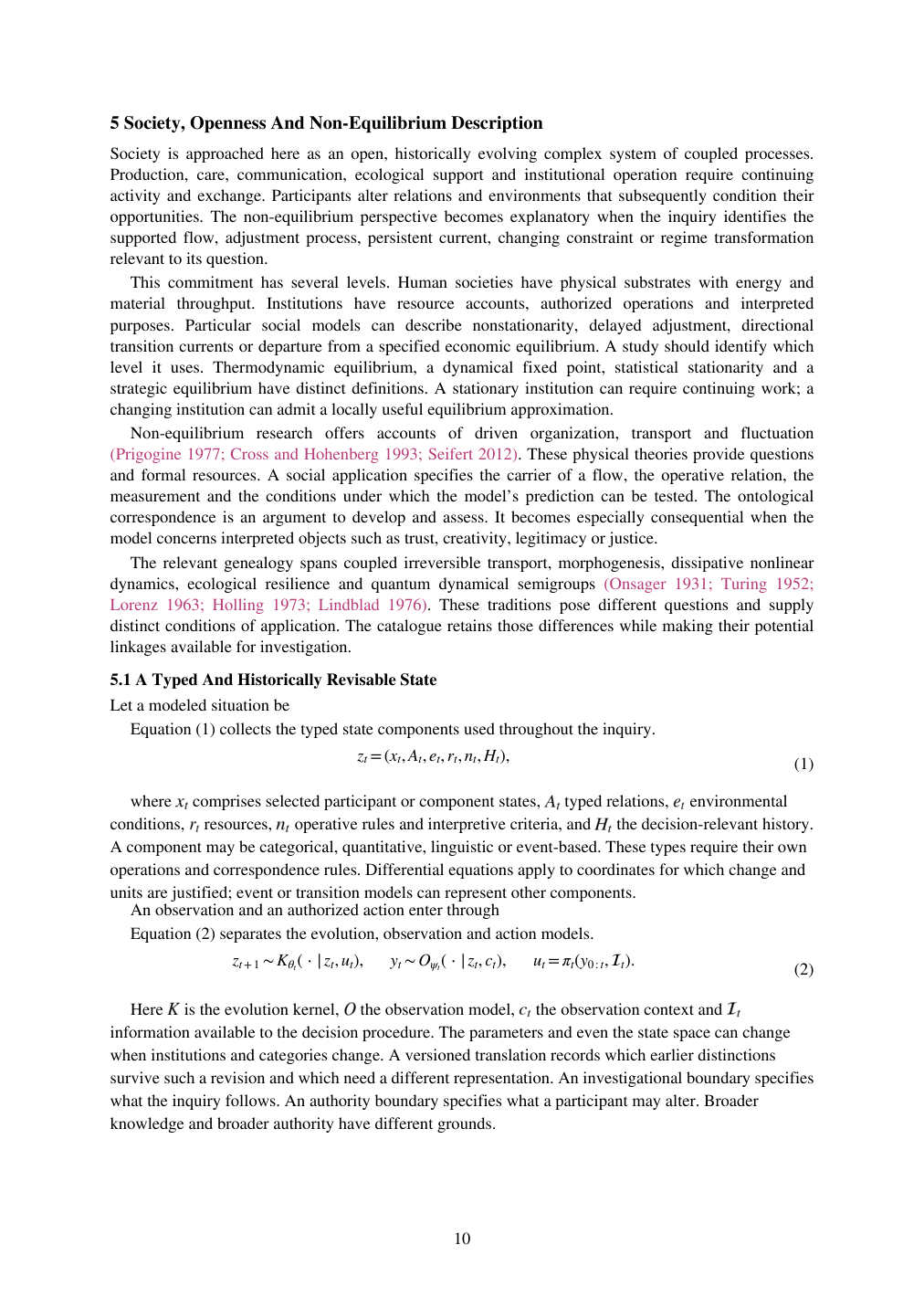
Equation (1) collects the typed state components used throughout the inquiry.
where comprises selected participant or component states, operative rules and interpretive criteria, and A component may be categorical, quantitative, linguistic or event-based. These types require their own operations and correspondence rules. Differential equations apply to coordinates for which change and units are justified; event or transition models can represent other components.
typed relations, environmental the decision-relevant history.
An observation and an authorized action enter through Equation (2) separates the evolution, observation and action models.
Here is the evolution kernel, the observation model, the observation context and information available to the decision procedure. The parameters and even the state space can change when institutions and categories change. A versioned translation records which earlier distinctions survive such a revision and which need a different representation. An investigational boundary specifies what the inquiry follows. An authority boundary specifies what a participant may alter. Broader knowledge and broader authority have different grounds.
Readable text
5.2 Manifestation, Operative Relations And Identification
The Generative Relational orientation used in this series distinguishes identification, operative relations and manifestation. Identification specifies what counts as the object through a declared criterion. Relational inquiry examines the histories, couplings and constraints through which the object has effects. Manifestational inquiry examines how it becomes perceptible, measurable, describable or institutionally legible. The registers organize an inquiry into one coupled reality; their use carries no assumption of three independent substances (Huang 2026c, 2026b).
A stable record can faithfully report an outcome while leaving its maintenance conditions unresolved. A classification can also enter the process it describes by changing access, attention or responsibility. These two possibilities connect an inverse problem to a reflexive problem: infer what generated the record and investigate what the record subsequently generates. An adequate representation preserves the distinctions needed for its particular inferential and practical use. Exhaustive representation is a different and generally much stronger demand.
5.3 Output, Capacity, Renewal And Justified Continuation
An output is a realized event or artifact. A capacity is a context-dependent ability to perform a specified operation under a stated range of conditions. Renewal occurs when an exercise contributes to replenishing a condition of later exercise. Historical transmission concerns a warranted connection between a prior contribution and a successor’s capacity. These relations can overlap, with each requiring its own evidence. Their bearer can be a relational subject, organization, practice or shared
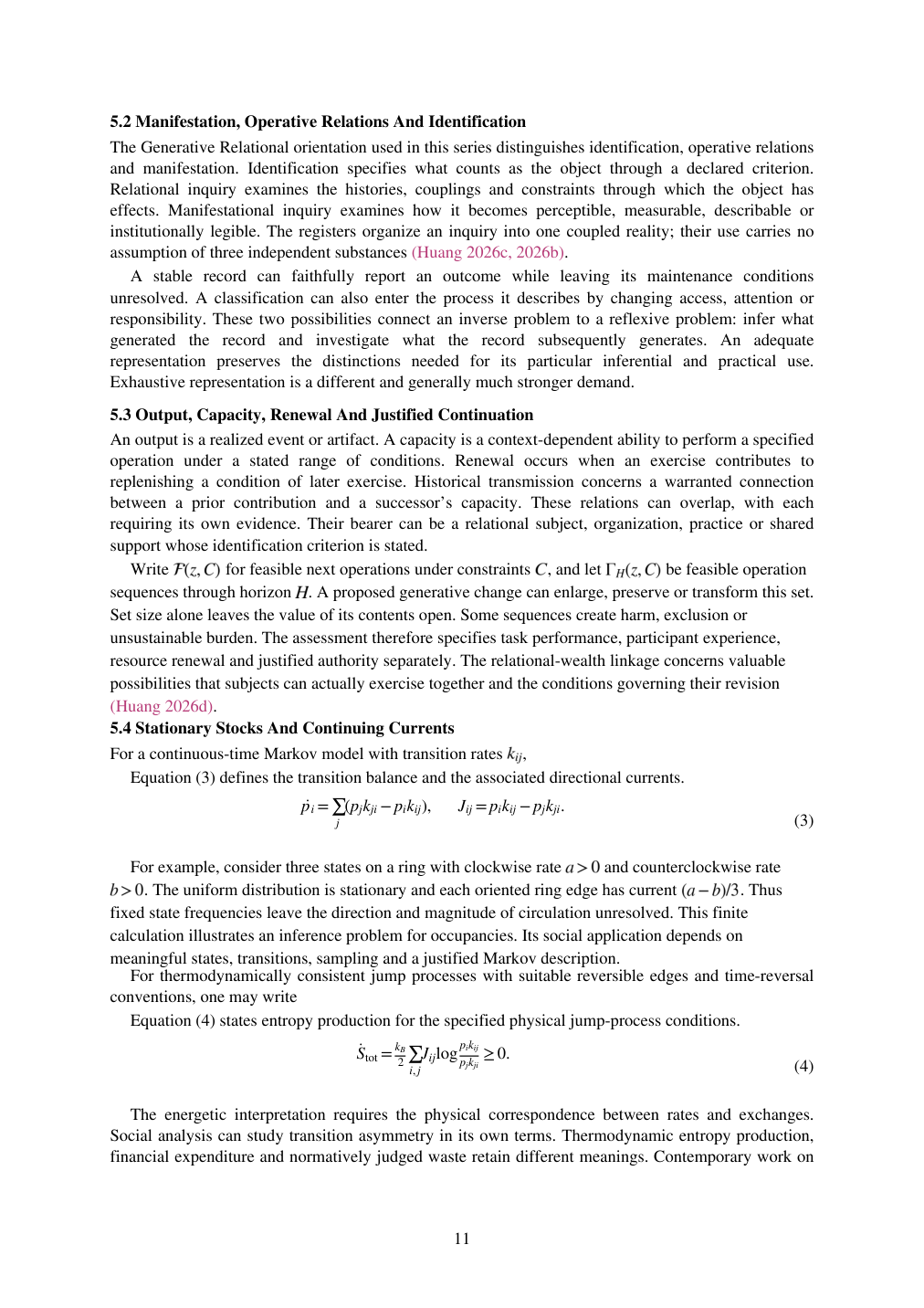
for feasible next operations under constraints , and let sequences through horizon . A proposed generative change can enlarge, preserve or transform this set. Set size alone leaves the value of its contents open. Some sequences create harm, exclusion or unsustainable burden. The assessment therefore specifies task performance, participant experience, resource renewal and justified authority separately. The relational-wealth linkage concerns valuable possibilities that subjects can actually exercise together and the conditions governing their revision
Write (Huang 2026d). 5.4 Stationary Stocks And Continuing Currents
For a continuous-time Markov model with transition rates Equation (3) defines the transition balance and the associated directional currents.
For example, consider three states on a ring with clockwise rate . The uniform distribution is stationary and each oriented ring edge has current fixed state frequencies leave the direction and magnitude of circulation unresolved. This finite calculation illustrates an inference problem for occupancies. Its social application depends on meaningful states, transitions, sampling and a justified Markov description.
For thermodynamically consistent jump processes with suitable reversible edges and time-reversal
Equation (4) states entropy production for the specified physical jump-process conditions.
The energetic interpretation requires the physical correspondence between rates and exchanges. Social analysis can study transition asymmetry in its own terms. Thermodynamic entropy production, financial expenditure and normatively judged waste retain different meanings. Contemporary work on
Readable text
hidden dissipation makes the cost of omitted degrees of freedom particularly relevant to model construction (Bebon, Robinson, and Speck 2025; Seifert 2025; Korbel et al. 2026).
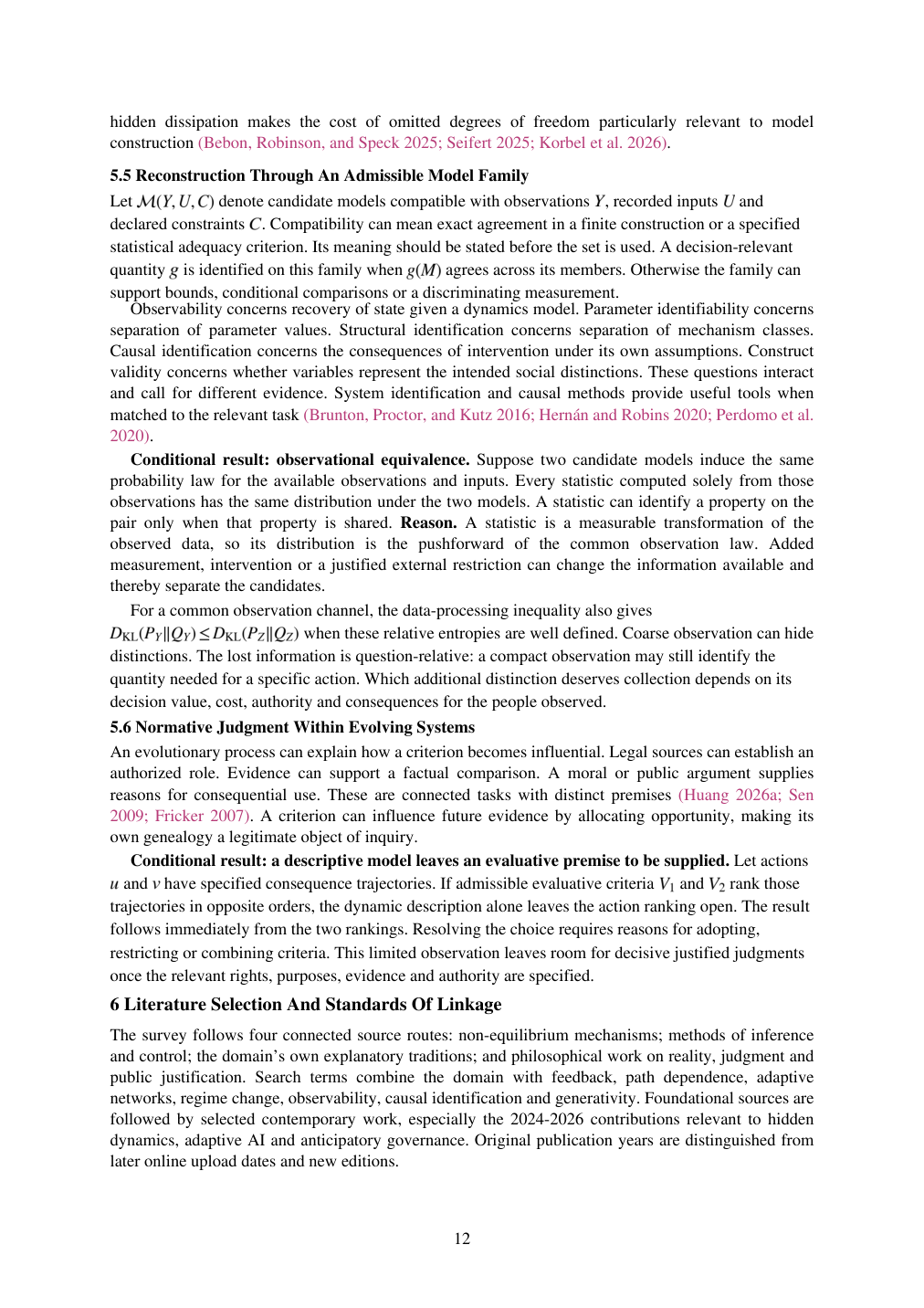
denote candidate models compatible with observations , recorded inputs and declared constraints . Compatibility can mean exact agreement in a finite construction or a specified statistical adequacy criterion. Its meaning should be stated before the set is used. A decision-relevant agrees across its members. Otherwise the family can support bounds, conditional comparisons or a discriminating measurement.
Observability concerns recovery of state given a dynamics model. Parameter identifiability concerns separation of parameter values. Structural identification concerns separation of mechanism classes. Causal identification concerns the consequences of intervention under its own assumptions. Construct validity concerns whether variables represent the intended social distinctions. These questions interact and call for different evidence. System identification and causal methods provide useful tools when matched to the relevant task (Brunton, Proctor, and Kutz 2016; Hernán and Robins 2020; Perdomo et al. Conditional result: observational equivalence. Suppose two candidate models induce the same probability law for the available observations and inputs. Every statistic computed solely from those observations has the same distribution under the two models. A statistic can identify a property on the pair only when that property is shared. Reason. A statistic is a measurable transformation of the observed data, so its distribution is the pushforward of the common observation law. Added measurement, intervention or a justified external restriction can change the information available and
For a common observation channel, the data-processing inequality also gives
when these relative entropies are well defined. Coarse observation can hide distinctions. The lost information is question-relative: a compact observation may still identify the quantity needed for a specific action. Which additional distinction deserves collection depends on its decision value, cost, authority and consequences for the people observed.
An evolutionary process can explain how a criterion becomes influential. Legal sources can establish an authorized role. Evidence can support a factual comparison. A moral or public argument supplies reasons for consequential use. These are connected tasks with distinct premises (Huang 2026a; Sen 2009; Fricker 2007). A criterion can influence future evidence by allocating opportunity, making its
Conditional result: a descriptive model leaves an evaluative premise to be supplied. Let actions and have specified consequence trajectories. If admissible evaluative criteria trajectories in opposite orders, the dynamic description alone leaves the action ranking open. The result follows immediately from the two rankings. Resolving the choice requires reasons for adopting, restricting or combining criteria. This limited observation leaves room for decisive justified judgments once the relevant rights, purposes, evidence and authority are specified.
The survey follows four connected source routes: non-equilibrium mechanisms; methods of inference and control; the domain’s own explanatory traditions; and philosophical work on reality, judgment and public justification. Search terms combine the domain with feedback, path dependence, adaptive networks, regime change, observability, causal identification and generativity. Foundational sources are followed by selected contemporary work, especially the 2024-2026 contributions relevant to hidden dynamics, adaptive AI and anticipatory governance. Original publication years are distinguished from
Readable text
Primary full text is used where retrieval permits. Abstracts and publisher records support narrower descriptions and metadata; claims requiring unavailable detail remain outside the manuscript’s attributed findings. Earlier author manuscripts supply the immediate GR context. The accompanying source record identifies these access levels. The review’s purpose is a reasoned map of relevant traditions and unresolved connections. It supplies neither a systematic-review flow count nor a
A linkage is strongest when it identifies shared operational objects, a corresponding mechanism and a discriminating test. Formal portability can be broader than empirical portability. A graph, differential equation or operator can represent several domains after different correspondence rules are supplied. A philosophical linkage identifies a shared problem or a tension between approaches, with its own argument. A practical proposal adds an actor with authority, a feasible operation, an evaluation design
The catalogue separates origins (8 classes), sustaining processes (8), mediators (16), manifestations (10) and regime trajectories (11). A single episode can occupy several classes across levels and several mechanisms within a level. The levels describe analytical roles in a coupled process; their sequence supplies a useful order of inquiry. Feedback, changing boundaries and historical transformation can run
Each terminal class below contains a mechanism and ontological specification, a formal representation, an epistemological discussion, and a domain-specific analysis connecting a phenomenon, problem, methods and possible practice. The physical or mathematical source supports the mechanism in its own setting. The domain passage develops a proposed application and states what evidence can support it. Reading the classes comparatively helps locate rival explanations of one
Mechanism and ontology. An imposed preparation places a system in a state that differs from the regime supported by its subsequent dynamics. Quenching, mixing, release and changed constraints belong here. The ontological commitments concern the prepared state, the preparation event and the environment that follows it; separating those objects makes a transient response interpretable. (Cross
Formal representation. Equation (5) states the local mathematical representation for this class.
Notation and conditions. The vector x is a selected state; lambda_1 labels the post-preparation setting; x-star is a fixed point of the displayed model when such a point exists. The initial condition is
Epistemology and methods. Compare histories sharing the later environment and differing in preparation. A single observation after a shock leaves the preparation effect entangled with continuing forcing. Estimate a response timescale and retain evidence from before the event.
Domain analysis and practice. A new prompt, initialization, corpus or tool configuration changes the starting point of a search episode. A surprising first output leaves sustained creative development open. Define the candidate artifact, context, model state and available evaluative tools. Compare matched search budgets across preparations and retain full revision histories. The practical question is which initial arrangement supports later verifiable discovery and useful revision when the first response
Phenomenon And Practical Problem. A generated starting artifact can carry advantages that disappear once revision begins. Consider an AI system developing a small scheduling algorithm. One initialization supplies polished pseudocode with hidden infeasibilities; another supplies a plain feasible construction with explicit tests. Ranking their first responses can favor the first while repeated development favors the second. The practical problem concerns the preparation of a useful inquiry: what must be present initially for later criticism, repair and recombination to remain possible? Initial fluency and subsequent developmental capacity require separate observations.
Mechanism And Ontological Commitments. Preparation comprises an event that establishes a candidate, a representation, accessible tools and an initial archive. Subsequent search rules then act on that prepared configuration. The relevant state includes executable dependencies and provenance because two identical code listings can have different capacities for further inquiry when only one has usable tests. This is a classical computational correspondence to prepared-state dynamics (Cross and Hohenberg 1993). The preparation event must remain distinct from continuing coaching; otherwise an apparent initial-condition advantage can actually depend on recurrent external intervention.
Epistemic Design And Discriminating Evidence. A discriminating experiment crosses initial artifact type with a fixed later mutation and evaluation procedure. Pair random streams across preparations and hold total executable-test calls constant. Record feasibility, revision depth, time until a verified improvement, and the number of successor operations that can be reproduced. Preserve failed trajectories alongside successful ones. A further intervention removes the initial test harness while retaining the initial code. If the advantage follows the harness, the causal support lies in preparation of verification capacity rather than in the surface form of the artifact.
Philosophical Reasoning And Practice. The philosophical issue is how a beginning becomes available for judgment. A prepared artifact already embodies choices about the problem, relevant properties and admissible moves. Reflective judgment can question those choices when development reveals an excluded possibility (Kant 2000). Practical design should therefore preserve a description of the initial framing and a route for revising it. Attribution can recognize whoever prepared a testable setting, since this contribution can make later achievement possible even when the final artifact contains little of the initial wording.
Worked Comparison And Research Proposition. Compare two hypothetical runs that receive the same generation budget after initialization. The polished start repeatedly fails hidden constraints, while the feasible start supports several independently reproduced improvements. The comparison supports a proposition about a specified preparation bundle, whose components should then be separated experimentally. A research program should estimate whether testable preparations improve the probability of a verified successor contribution under several task families. Its preregistered outcome should include retained explanations and reusable tests, thereby making the preparation’s generative effect observable beyond the first output.
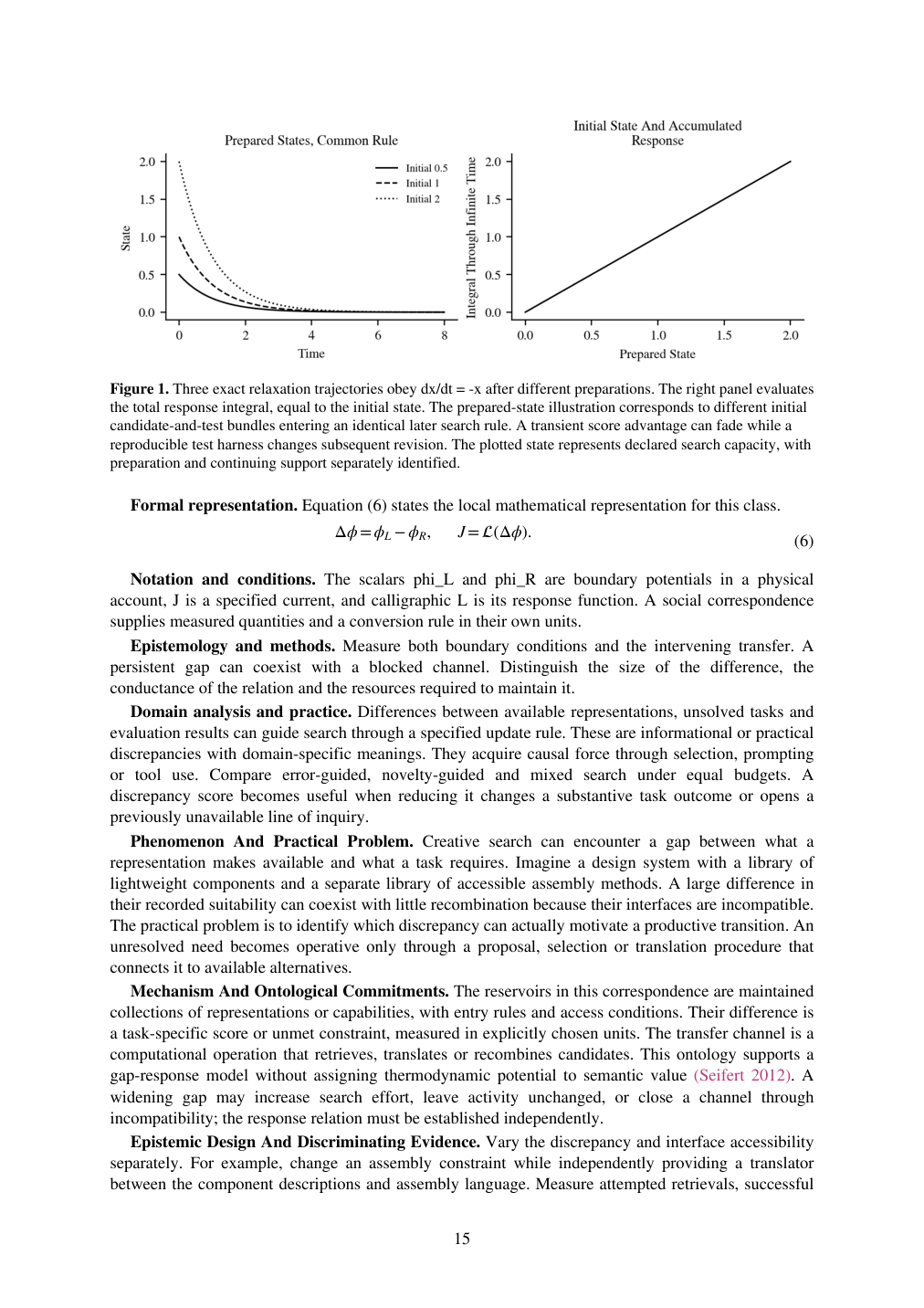
Reading the numerical illustration. Figure 1 illustrates the declared mechanism. A preparation changes the subsequent episode under an unchanged transition law. Here the decay rate remains one, while the initial condition changes both the visible transient and its cumulative magnitude. The construction separates an intervention on state from an intervention on the law. A comparison in a social domain would need to establish which conditions were prepared, whether later supports remained comparable, and which cumulative consequence matters.
8.2 A2. Differences Between Reservoirs
Mechanism and ontology. A sustained difference between reservoirs can maintain transport through an open system. Reservoirs, exchanged quantities and boundary conditions are part of the explanation. In physical applications, potential differences have units and conjugate fluxes. A socially meaningful difference in access or opportunity requires its own behavioral and institutional conversion mechanism. (Seifert 2012)
Readable text
Figure 1. Three exact relaxation trajectories obey dx/dt = -x after different preparations. The right panel evaluates the total response integral, equal to the initial state. The prepared-state illustration corresponds to different initial candidate-and-test bundles entering an identical later search rule. A transient score advantage can fade while a reproducible test harness changes subsequent revision. The plotted state represents declared search capacity, with
preparation and continuing support separately identified.
Formal representation. Equation (6) states the local mathematical representation for this class.
Notation and conditions. The scalars phi_L and phi_R are boundary potentials in a physical account, J is a specified current, and calligraphic L is its response function. A social correspondence supplies measured quantities and a conversion rule in their own units.
Epistemology and methods. Measure both boundary conditions and the intervening transfer. A persistent gap can coexist with a blocked channel. Distinguish the size of the difference, the conductance of the relation and the resources required to maintain it.
Domain analysis and practice. Differences between available representations, unsolved tasks and evaluation results can guide search through a specified update rule. These are informational or practical discrepancies with domain-specific meanings. They acquire causal force through selection, prompting or tool use. Compare error-guided, novelty-guided and mixed search under equal budgets. A discrepancy score becomes useful when reducing it changes a substantive task outcome or opens a
Phenomenon And Practical Problem. Creative search can encounter a gap between what a representation makes available and what a task requires. Imagine a design system with a library of lightweight components and a separate library of accessible assembly methods. A large difference in their recorded suitability can coexist with little recombination because their interfaces are incompatible. The practical problem is to identify which discrepancy can actually motivate a productive transition. An unresolved need becomes operative only through a proposal, selection or translation procedure that
Mechanism And Ontological Commitments. The reservoirs in this correspondence are maintained collections of representations or capabilities, with entry rules and access conditions. Their difference is a task-specific score or unmet constraint, measured in explicitly chosen units. The transfer channel is a computational operation that retrieves, translates or recombines candidates. This ontology supports a gap-response model without assigning thermodynamic potential to semantic value (Seifert 2012). A widening gap may increase search effort, leave activity unchanged, or close a channel through incompatibility; the response relation must be established independently.
Epistemic Design And Discriminating Evidence. Vary the discrepancy and interface accessibility separately. For example, change an assembly constraint while independently providing a translator between the component descriptions and assembly language. Measure attempted retrievals, successful
Readable text
compositions, independently verified feasibility and downstream repair costs. A gap-driven account predicts a systematic response to the changed constraint when the channel is available. A retrieval-bias account predicts sensitivity mainly to indexing and presentation. Comparing both interventions distinguishes motivation encoded by an update rule from mere co-occurrence between a difficult task
Philosophical Reasoning And Practice. The linkage to dispersed knowledge concerns how complementary contributions become mutually usable (Hayek 1945). Recombination requires a relation through which differently situated knowledge can enter a common task. A centralized discrepancy score may suppress what one library contributes if its features are poorly represented. Practice should permit contributors to explain an incompatibility and propose a translation, alongside quantitative matching. This gives an epistemic role to plural representations while retaining a public account of what counts as
Worked Comparison And Research Proposition. Consider two hypothetical systems facing the same unmet assembly requirement. One receives more samples from both libraries; the other receives an interface that exposes joint compatibility. Equalize their total scoring budget and compare verified compositions. If the interface arm succeeds with fewer proposals, the evidence favors channel conductance as the limiting mechanism. A useful research proposition is that discrepancy-guided search benefits from investment in translation when complementary representations are separately adequate. Test that proposition by varying compatibility and documenting the new operations made executable
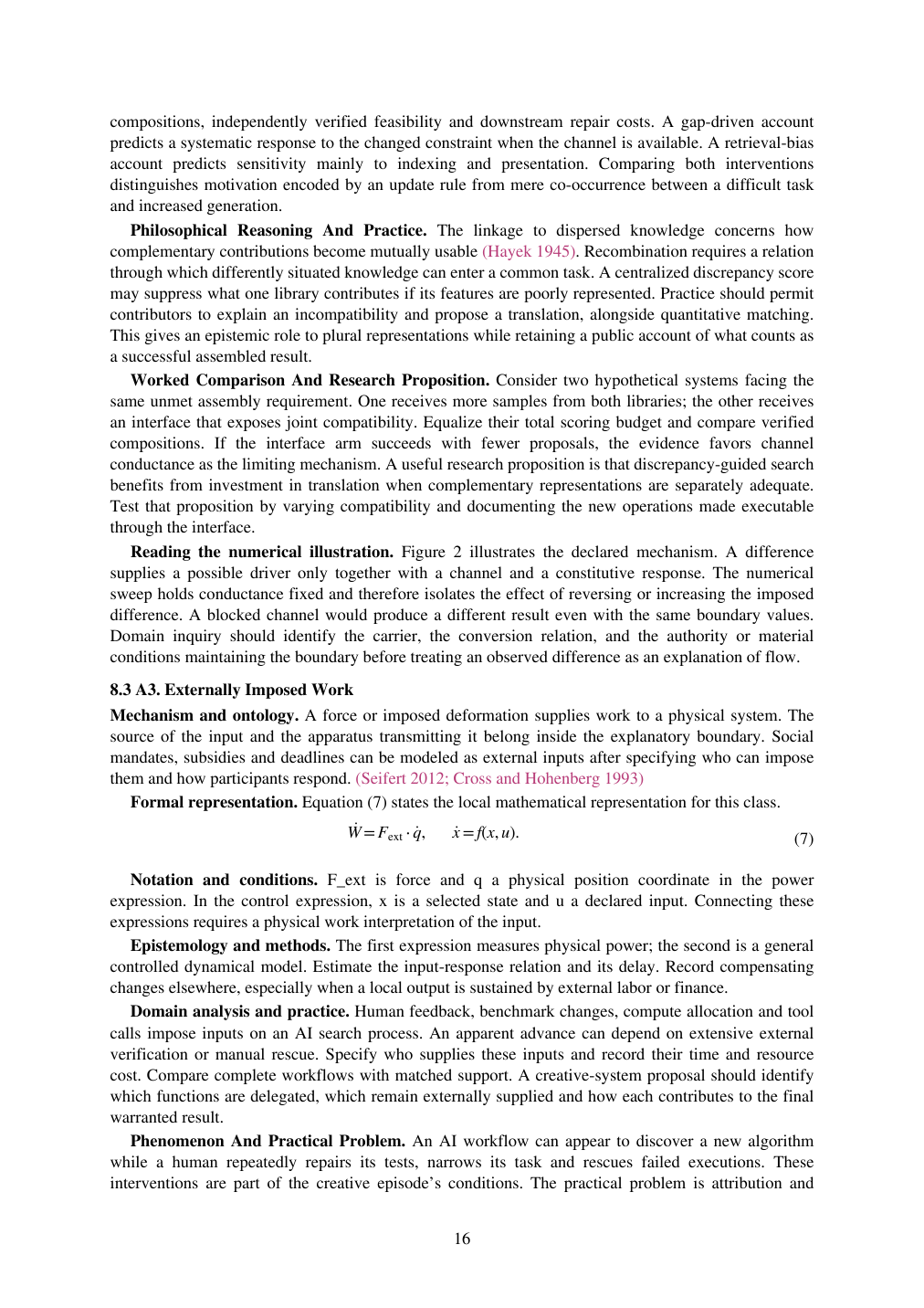
Reading the numerical illustration. Figure 2 illustrates the declared mechanism. A difference supplies a possible driver only together with a channel and a constitutive response. The numerical sweep holds conductance fixed and therefore isolates the effect of reversing or increasing the imposed difference. A blocked channel would produce a different result even with the same boundary values. Domain inquiry should identify the carrier, the conversion relation, and the authority or material conditions maintaining the boundary before treating an observed difference as an explanation of flow.
Mechanism and ontology. A force or imposed deformation supplies work to a physical system. The source of the input and the apparatus transmitting it belong inside the explanatory boundary. Social mandates, subsidies and deadlines can be modeled as external inputs after specifying who can impose them and how participants respond. (Seifert 2012; Cross and Hohenberg 1993)
Formal representation. Equation (7) states the local mathematical representation for this class.
Notation and conditions. F_ext is force and q a physical position coordinate in the power expression. In the control expression, x is a selected state and u a declared input. Connecting these expressions requires a physical work interpretation of the input.
Epistemology and methods. The first expression measures physical power; the second is a general controlled dynamical model. Estimate the input-response relation and its delay. Record compensating changes elsewhere, especially when a local output is sustained by external labor or finance.
Domain analysis and practice. Human feedback, benchmark changes, compute allocation and tool calls impose inputs on an AI search process. An apparent advance can depend on extensive external verification or manual rescue. Specify who supplies these inputs and record their time and resource cost. Compare complete workflows with matched support. A creative-system proposal should identify which functions are delegated, which remain externally supplied and how each contributes to the final
Phenomenon And Practical Problem. An AI workflow can appear to discover a new algorithm while a human repeatedly repairs its tests, narrows its task and rescues failed executions. These interventions are part of the creative episode’s conditions. The practical problem is attribution and
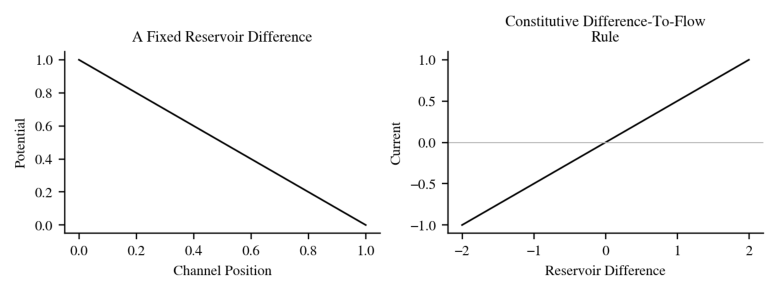
Figure 2. A unit channel has fixed end potentials one and zero. A declared conductance of 0.5 converts a boundary-potential difference into current; reversing the difference reverses the current. The reservoir illustration represents a declared suitability gap between two maintained candidate collections. Flow corresponds to successful retrieval or recombination through an interface. Its conductance is an experimentally varied computational rule; neither the gap nor the flow is assigned an unmeasured thermodynamic meaning.
comparison: a workflow receiving intensive external support should be compared with alternatives receiving comparable support. Otherwise a change in observed success can be attributed to the model when the decisive change concerns the frequency, quality or authority of externally imposed corrections.
Mechanism And Ontological Commitments. The imposed input is a dated instruction, compute grant, test result or intervention in the candidate state. Its supplier, transmission channel and scope of action belong to the model. Staff minutes, test calls and accelerator time require separate accounts unless a justified conversion is introduced. Physical energy consumed by hardware can be measured independently. The controlled-system representation concerns an input-response relation; identifying a prompt with mechanical work would require an additional physical account of force and displacement (Seifert 2012).
Epistemic Design And Discriminating Evidence. Construct an intervention ledger distinguishing task reformulation, direct artifact editing, diagnostic feedback and resource replenishment. Randomize access to each support where a harmless synthetic task permits it. Compare final verified quality and the marginal improvement following each intervention, conditioning on the information then available. A replay study can supply the same corrections to another model or a conventional optimizer. This tests whether the improvement depends on a distinctive response capacity, a superior external diagnosis, or their combination. Include unsuccessful rescues in the cost account.
Philosophical Reasoning And Practice. The philosophy of socially organized inquiry helps explain why external contribution can increase achievement without locating all agency in one component (Longino 1990). A reviewer who identifies a defective premise changes the field of possible inquiry. Responsible attribution should state that contribution in its operative form. The evaluative question also concerns whose labor becomes visible and compensated. A useful practice is to report supported workflow performance together with the contributions required to produce it, allowing readers to judge both accomplishment and transferability.
Worked Comparison And Research Proposition. Imagine two hypothetical code-search workflows achieving the same verified speedup. The first requires repeated expert corrections, while the second uses an explicit automated test suite constructed before the run. Their endpoint scores are equal, yet their prospects for transfer differ because their support requirements differ. The research proposition is that intervention-type accounting predicts deployment robustness better than a count of generated candidates. Test it by transferring both workflows to a related task with equal external assistance and tracing which previously supplied operations each can now perform.
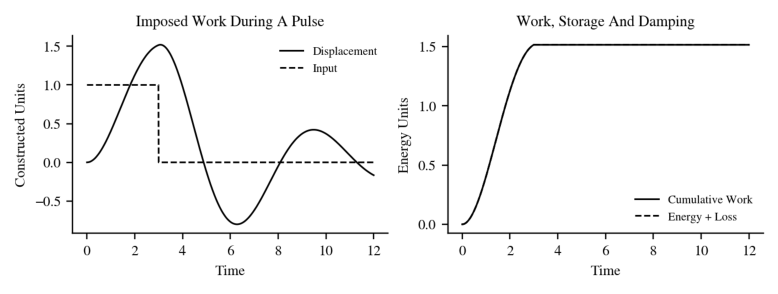
Figure 3. A unit-mass oscillator receives a unit force until time three and then evolves without that input. Damping is 0.4 and stiffness is one. Numerical work agrees with stored energy plus damping loss within 0.004. The externally driven illustration corresponds to a dated intervention entering a search process through a declared channel. Response amplitude and delay represent changes in verified candidate performance. The resource ledger keeps human correction, test calls and physical compute separate while tracing their contributions to the trajectory.
Reading the numerical illustration. Figure 3 illustrates the declared mechanism. The external operation is an event with a duration and a transmission pathway. Its consequences continue after the pulse ends because the system retains displacement and velocity. The balance panel identifies where the supplied work goes. A social input can be represented through an analogous controlled variable after its actual operation and participant responses are specified; its institutional cost and authority require an account in their own terms.
8.4 A4. Open Chemical And Material Exchange
Mechanism and ontology. Inflow, removal and reaction can sustain activity through continually renewed inputs. Stocks, channels, transformation processes and boundaries are the relevant objects. Open exchange makes the persistence of an organization conditional on replenishment and disposal, with different accounts needed for physical material, money, information and permissions. (Seifert 2012; Frey and Weyer 2026) Formal representation. Equation (8) states the local mathematical representation for this class.
n=Sv(n)+jin −jout. (8)
Notation and conditions. The vector n contains stocks, v transformation rates and S their stoichiometric coefficients. The j vectors are boundary inflow and outflow rates. Quantities combined in an account must share compatible units.
Epistemology and methods. Specify the stoichiometric matrix S when reactions are physical. In an institutional application, replace it with an independently justified conversion or accounting rule. Trace sources and sinks so that a maintained local stock can be distinguished from depletion outside the boundary.
Domain analysis and practice. New data, executable tests, collaborators and real-world feedback can continually renew a search. A closed stream of self-generated text has different evidential support from encounters with independently measured phenomena. Identify the origin and dependency of each input. Compare externally refreshed and internally recycled search while controlling compute and validation access. Practical design can preserve provenance and test whether an external encounter changes the problem, representation or admissible conclusion.
Phenomenon And Practical Problem. A self-revising agent can produce an expanding collection of mutually supportive explanations while encountering little independent resistance. In contrast, a design
agent connected to executable tests or measured material behavior receives information its own preferred narrative cannot freely determine. The practical problem is renewal of evidential input. Creative development needs a route through which an unsuccessful prediction changes the next proposal, alongside a record showing whether incoming information has an origin independent of the candidates being evaluated.
Mechanism And Ontological Commitments. The open system contains candidate stocks, data sources, transformation operations and a disposal or rejection channel. An incoming measurement, externally written test and recycled model judgment have different provenance. Their combination follows a typed computational rule rather than chemical stoichiometry. Counts of files can be balanced, while truth and semantic novelty receive separate judgments (Seifert 2012). The ontology should include dependencies among inputs, since many apparently distinct critiques can descend from one original assertion and therefore supply less independent resistance than their number suggests.
Epistemic Design And Discriminating Evidence. Compare a closed critique loop with an externally refreshed loop under equal generation and checking budgets. Use synthetic tasks with independently generated hidden cases, and reveal cases according to a schedule fixed before the run. Record which failures trigger a substantive revision, which merely produce a verbal accommodation, and whether repairs generalize to untouched cases. A provenance graph should identify shared source ancestry. The discriminating evidence concerns improvement against independent consequences, alongside the computational and human work needed to obtain the external encounters.
Philosophical Reasoning And Practice. A realist linkage emphasizes that an artifact’s consequences can exceed the account currently favored by its producer (Bhaskar 1975). External resistance gives that possibility an operational role without treating any one measurement as interpretation-free. Test construction, instrument calibration and the choice of relevant consequences remain criticizable. Practice should preserve the measurement procedure and the reasons for considering its result consequential. This supports a revisable inquiry in which encounter, interpretation and justified adoption are distinguishable stages, each open to appropriate scrutiny.
Worked Comparison And Research Proposition. Consider a hypothetical bridge-modeling exercise conducted entirely in simulation. One agent revises its design using its own explanations of stability; another receives outputs from an independently specified mechanical solver. Match total proposal budgets and compare held-out constraint violations. If the second improves only on exposed cases, the encounter has supported local fitting without demonstrating transferable repair. The research proposition is that independent input contributes to generativity when it changes a reusable operation or representation. Test subsequent performance on fresh structures and retain the failed predictions that motivated each change.
Reading the numerical illustration. Figure 4 illustrates the declared mechanism. An almost constant stock can be the result of continuing replacement. The two panels make the distinction between a stock level and the flows supporting it inspectable. In this exact construction, stopping the inflow would convert the maintained stock into a declining one. A domain application should close the appropriate resource account, identify boundary transfers and transformation, and investigate whether a stable visible quantity depends on continuing replenishment that its usual indicator omits.
8.5 A5. Internal Free-Energy Conversion
Mechanism and ontology. Active constituents convert fuel or stored free energy into motion or work. An operational account identifies the converter, the consumed resource and the work produced. In social inquiry, participants mobilize skills, time and authorized resources; their initiative and interpreted purposes call for a richer ontology than self-propelled particles. (Bebon, Robinson, and Speck 2025)
Formal representation. Equation (9) states the local mathematical representation for this class.
e=Pin −Puse −Ploss. (9)
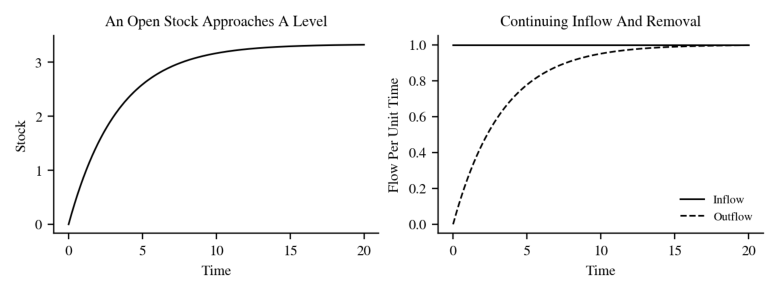
Figure 4. An open reactor-like stock follows dn/dt = 1 - 0.3n from zero. The stock approaches 10/3 while both inflow and removal remain active. The open-exchange illustration maps inflow to independently sourced tests or measurements and outflow to rejected candidates and discarded assumptions. Internal transformation means a documented revision operation. A provenance graph is needed to distinguish genuinely renewed evidence from multiple recirculations of the same generated claim.
Notation and conditions. The variable e is a resource or energy stock only where that unit is established. The P terms are rates of supply, use and loss in the same account. Their interpretation is local to the chosen system boundary.
Epistemology and methods. Use this balance for quantities with a defensible common unit. Track resource depletion alongside observable activity. Attribution to internal initiative requires evidence about the resources and constraints through which initiative becomes exercisable.
Domain analysis and practice. An agent spends compute, tool access and allotted time to propose, test and revise artifacts. These physical and organizational resources constrain which possibilities it can explore. Track budgets and the reusable capabilities acquired during an episode. Compare repeated performance with one-off output, including verification costs. A system becomes more capable of creative inquiry when it gains a demonstrable means of conducting further relevant operations, with the value of those operations separately assessed.
Phenomenon And Practical Problem. An AI agent can use a fixed compute allotment either to generate many variants or to build a reusable operation that makes later variants easier to verify. These uses have different temporal consequences. Consider an agent solving symbolic manipulation tasks: producing answers consumes its budget, while constructing a verified simplifier can alter what future answers it can obtain. The practical problem is how to recognize a change in exercisable research capacity without equating internal activity, self-description or increased output volume with creative development.
Mechanism And Ontological Commitments. The operative converter is a computational process using hardware time, memory, tool permissions and organizational support. Energy is measured in physical units at the hardware boundary; reusable capabilities are represented by tested procedures and their conditions of execution. The relationship between the two requires a task-specific account. Activematter theory directs attention to conversion and support costs (Bebon, Robinson, and Speck 2025), while the social-computational ontology additionally contains interpreted aims, permissions and reasons. An apparent internal initiative can depend on a resource or authority supplied outside the agent boundary.
Epistemic Design And Discriminating Evidence. Give matched agents equal initial budgets and compare allocations between direct search and construction of reusable tools. Audit every claimed tool by executing it on held-out inputs and recording failure conditions. After the initial episode, test new tasks with a fresh equal budget and access to the retained tool. The causal question is whether the acquired operation mediates improved performance. Remove or replace that operation in an ablation,
Readable text
and distinguish gains from memorized solutions, increased exposure and a genuine extension of the
Philosophical Reasoning And Practice. Capability-oriented reasoning distinguishes possession of an artifact from the practical opportunity to exercise it (Sen 2009). A generated tool is exercisable only with its dependencies, permissions and a comprehensible invocation route. Practice should therefore attach a capability description stating what the operation does, who can use it and what support its use requires. This also changes authorship assessment: a contribution can consist in equipping successors to investigate a problem, even when its immediate answer is less impressive than a competing one-off
Worked Comparison And Research Proposition. Compare two hypothetical agents that solve the same number of initial symbolic tasks. One retains only answer strings; the other retains a checked transformation rule and counterexamples delimiting its domain. On related later tasks, count independently verified solutions per total budget and inspect whether the rule is actually invoked. The research proposition is that verified reusable operations predict cross-episode creative continuation more strongly than initial output counts. Its test should include dependency failures and maintenance costs so that retained capacity is measured under realistic successor access conditions.
Reading the numerical illustration. Figure 5 illustrates the declared mechanism. Visible exercise can draw down an inherited support while a smaller inflow continues. The account distinguishes accumulated useful exercise from retained capacity and losses. Repetition of the same output over the displayed interval therefore leaves future feasibility unresolved. A social application can ask how skills, authorized resources or participant time support exercise, while preserving their distinct units and reasons. The relevant empirical task is to identify the support actually consumed and the route by which
Mechanism and ontology. A changing environment moves the conditions to which a system responds. A ramp, seasonal input, abrupt shock and intermittent forcing can produce distinct trajectories even when the initial and final environments coincide. Environmental paths and rates therefore enter the ontology alongside the present state. (Ashwin et al. 2012; Ritchie et al. 2023)
Formal representation. Equation (10) states the local mathematical representation for this class.
Notation and conditions. The path Lambda specifies the environmental schedule, r its rate parameter and F the response law. Comparing rates requires common initial conditions or an account of
Epistemology and methods. Compare changes at different rates while holding endpoints comparable. Distinguish a lost stable regime from failure to track a persisting regime. Infer rate effects using measurements of adjustment speed and competing accounts of the external change.
Domain analysis and practice. Tasks, environments and evaluators can change while an AI population learns. A candidate optimized for an earlier test may remain selected after its practical relevance declines. Define the environmental shift and whether the system can observe it. Compare response to slow drift and abrupt change under matched evaluation budgets. Adaptive design can retain diverse candidates and explicit criteria-revision procedures, with independent checks on whether
Phenomenon And Practical Problem. A system can improve rapidly on an evaluation target that is itself becoming obsolete. Imagine an interface-design agent optimizing a desktop workflow while the intended users gradually shift to a constrained mobile setting. An abrupt target replacement and a slow change between the same endpoints can produce different failures. The practical problem is adaptation to the path of change: how can inquiry recognize that a previously useful representation no longer
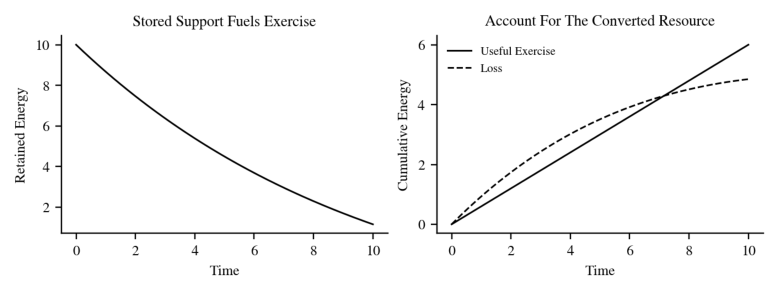
Figure 5. A converter begins with ten energy units, receives 0.2 per time, uses 0.6 and loses 0.1e. The displayed interval ends before exhaustion, and the integrated account closes exactly. The conversion illustration represents compute and permitted tools supporting proposal, testing and retained reusable operations. Physical energy can be accounted at the hardware boundary. The capacity state instead denotes demonstrated computational operations, whose future exercise depends on preserved dependencies and access conditions.
captures the relevant constraints, and preserve alternatives that remain developable during the transition?
Mechanism And Ontological Commitments. The environment comprises task requirements, available tools and the procedure by which evaluation recognizes success. Its trajectory is part of the state description relevant to explanation. A rate parameter changes how quickly constraints move, while the agent’s response rule defines its adjustment capacity. Rate-induced failure is a candidate mechanism distinct from disappearance of every feasible solution (Ashwin et al. 2012; Ritchie et al. 2023). A social interpretation also records who authorized the changed target and whether affected users can contest the representation of their needs.
Epistemic Design And Discriminating Evidence. Compare several change schedules sharing starting and ending tasks. Hold initial populations and total evaluation calls comparable, and specify what information about the change each agent receives. Track valid solutions to the current task, retention of formerly useful operations, and the time needed to recover after the endpoint is reached. Introduce a static agent with full endpoint information as a feasibility comparator. If endpoint solutions remain available yet rapid schedules cause persistent failure, the evidence supports a tracking limitation within the declared search architecture.
Philosophical Reasoning And Practice. The philosophical concern is continuity of purpose through changing criteria. A benchmark change can express a revised understanding of the same problem or a replacement of the intended function. Reflective judgment requires reasons for deciding which interpretation applies (Kant 2000). Practice should preserve criterion versions and the rationale for each transition. This allows later readers to distinguish a successful adaptation from a redefinition that merely makes the system appear successful, while supporting warranted changes when the original framing excludes relevant experience.
Worked Comparison And Research Proposition. Consider hypothetical portfolios with identical candidate counts. One continuously discards low current scorers; another preserves several distinct solution mechanisms. Under a slow transition both recover, while a rapid transition leaves the first without a viable lineage. The research proposition is that retained mechanistic diversity enlarges the range of environmental rates a workflow can track. Test it across controlled change schedules and descriptor ablations, including representations that are unrelated to the future task. Report the rate range and resource cost rather than inferring a universal advantage of diversity.
Reading the numerical illustration. Figure 6 illustrates the declared mechanism. Equal environmental endpoints leave the path of adjustment open. The construction holds the response law
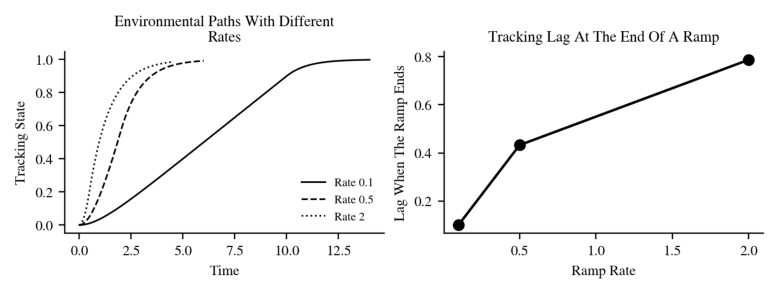
Figure 6. The environment ramps from zero to one at three rates; the state obeys dx/dt = lambda(t) - x. Faster ramps leave a larger tracking lag when the endpoint is reached. The moving-environment illustration corresponds to changing task constraints along several schedules with common endpoints. The candidate state tracks current verified performance. Divergence under rapid change can indicate limited adjustment speed even when a feasible endpoint solution remains available in the modeled search space.
fixed and changes only the speed of the driver. A comparison of final conditions can consequently omit a material lag inherited from the transition. This example concerns tracking error, with the equilibrium remaining stable throughout. A stronger rate-induced-tipping claim would require a basin or viability boundary that the lag crosses and evidence supporting that additional structure.
8.7 A7. Frustrated Or Kinetically Constrained Relaxation
Mechanism and ontology. Barriers, competing constraints and restricted transitions can make relaxation exceptionally slow. A long-lived configuration may inherit its persistence from difficult exit routes. The relevant objects include the transition landscape and the feasible moves, with observation duration determining what counts as persistent. (Ashwin et al. 2012)
Formal representation. Equation (11) states the local mathematical representation for this class.
τescape ∼τ0exp(ΔV/D). (11)
Notation and conditions. Delta V is a barrier and D a positive noise scale in the normalized potential model; tau_0 is a prefactor timescale. The exponential relation is an asymptotic approximation under suitable small-noise escape conditions.
Epistemology and methods. The displayed small-noise scaling requires a suitable metastable model. For institutions, investigate switching costs, vetoes and unavailable complements directly. Compare response over several horizons before interpreting a persistent arrangement as an attractive or preferred outcome.
Domain analysis and practice. A search can remain in a familiar region because its representations, prompts and evaluator reward mutually reinforce the same moves. Repeatedly fluent variation may then supply little substantive exploration. Define feasible artifact edits and the evaluator’s access to alternatives. Compare a changed selection score with a changed representation or tool. The resulting experiment can locate whether the constraint concerns proposal generation, recognized quality or the availability of a meaningful test.
Phenomenon And Practical Problem. A creative system can repeatedly produce familiar variants because every available edit preserves a restrictive representation. Consider a program synthesizer whose language lacks a data structure needed for a shorter solution. Increasing sampling temperature explores more expressions while leaving that missing construction unreachable. The practical problem is diagnosing persistent confinement: whether a search needs more trials, a different selection criterion,
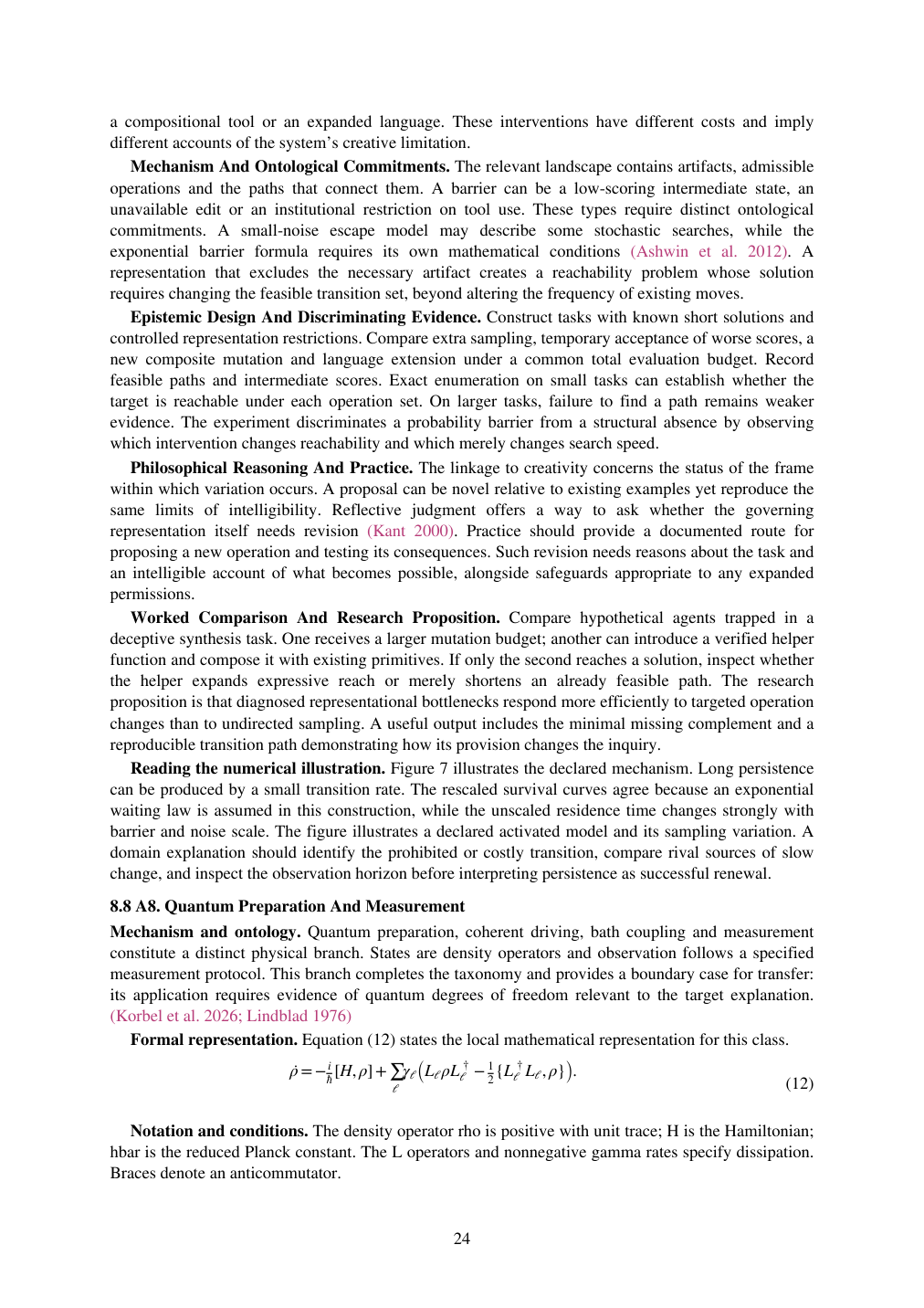
Readable text
a compositional tool or an expanded language. These interventions have different costs and imply
different accounts of the system’s creative limitation.
Mechanism And Ontological Commitments. The relevant landscape contains artifacts, admissible operations and the paths that connect them. A barrier can be a low-scoring intermediate state, an unavailable edit or an institutional restriction on tool use. These types require distinct ontological commitments. A small-noise escape model may describe some stochastic searches, while the exponential barrier formula requires its own mathematical conditions (Ashwin et al. 2012). A representation that excludes the necessary artifact creates a reachability problem whose solution requires changing the feasible transition set, beyond altering the frequency of existing moves.
Epistemic Design And Discriminating Evidence. Construct tasks with known short solutions and controlled representation restrictions. Compare extra sampling, temporary acceptance of worse scores, a new composite mutation and language extension under a common total evaluation budget. Record feasible paths and intermediate scores. Exact enumeration on small tasks can establish whether the target is reachable under each operation set. On larger tasks, failure to find a path remains weaker evidence. The experiment discriminates a probability barrier from a structural absence by observing which intervention changes reachability and which merely changes search speed.
Philosophical Reasoning And Practice. The linkage to creativity concerns the status of the frame within which variation occurs. A proposal can be novel relative to existing examples yet reproduce the same limits of intelligibility. Reflective judgment offers a way to ask whether the governing representation itself needs revision (Kant 2000). Practice should provide a documented route for proposing a new operation and testing its consequences. Such revision needs reasons about the task and an intelligible account of what becomes possible, alongside safeguards appropriate to any expanded
Worked Comparison And Research Proposition. Compare hypothetical agents trapped in a deceptive synthesis task. One receives a larger mutation budget; another can introduce a verified helper function and compose it with existing primitives. If only the second reaches a solution, inspect whether the helper expands expressive reach or merely shortens an already feasible path. The research proposition is that diagnosed representational bottlenecks respond more efficiently to targeted operation changes than to undirected sampling. A useful output includes the minimal missing complement and a reproducible transition path demonstrating how its provision changes the inquiry.
Reading the numerical illustration. Figure 7 illustrates the declared mechanism. Long persistence can be produced by a small transition rate. The rescaled survival curves agree because an exponential waiting law is assumed in this construction, while the unscaled residence time changes strongly with barrier and noise scale. The figure illustrates a declared activated model and its sampling variation. A domain explanation should identify the prohibited or costly transition, compare rival sources of slow change, and inspect the observation horizon before interpreting persistence as successful renewal.
Mechanism and ontology. Quantum preparation, coherent driving, bath coupling and measurement constitute a distinct physical branch. States are density operators and observation follows a specified measurement protocol. This branch completes the taxonomy and provides a boundary case for transfer: its application requires evidence of quantum degrees of freedom relevant to the target explanation.
Formal representation. Equation (12) states the local mathematical representation for this class.
Notation and conditions. The density operator rho is positive with unit trace; H is the Hamiltonian; hbar is the reduced Planck constant. The L operators and nonnegative gamma rates specify dissipation.
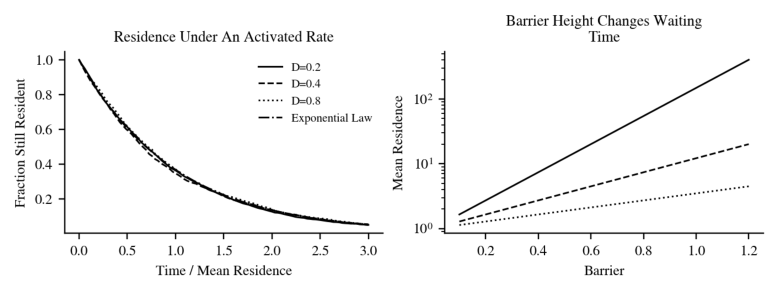
Figure 7. Two thousand waiting times per condition are drawn from the declared activated rate exp(-barrier/D), with unit barrier and unit prefactor. The second panel evaluates the same rate law over barrier heights. The constrained-relaxation illustration maps barriers to low-scoring intermediate artifacts or restricted edit operations. Long residence in one region can therefore reflect difficult paths or absent paths. The correspondence is established through reachability tests and explicit operations, with escape-rate claims reserved for suitable stochastic models.
Epistemology and methods. The displayed Lindblad form assumes an appropriate Markovian opensystem description with nonnegative rates. Ordinary uncertainty, contextual interpretation and order effects have classical representations too. Select between them through discriminating evidence and a justified measurement model.
Domain analysis and practice. AI hardware is a physical system, and a specifically quantum implementation warrants its corresponding state and measurement model. The creativity of ordinary language-model workflows can be investigated through classical computational histories and social evaluation. Context sensitivity or noncommuting edits alone leaves several representations available. A quantum model of the creative process would require operational predictions distinguishing it from those alternatives. Practical resource accounting can proceed at the hardware level without identifying semantic novelty with quantum indeterminacy.
Phenomenon And Practical Problem. Quantum hardware can be used to search for circuits, states or control sequences with properties relevant to a scientific task. This gives the quantum branch a concrete role in AI-assisted creativity when the candidate concerns a genuinely quantum object. A language-model workflow discussing artistic novelty presents a different explanatory target. The practical problem is to establish which degrees of freedom, interventions and observations require a quantum account, while giving a computationally and philosophically adequate account of the surrounding proposal and evaluation process.
Mechanism And Ontological Commitments. A quantum experiment specifies a density operator, a preparation map, controlled dynamics and a measurement instrument. Positivity, unit trace and the chosen measurement rule constrain its predictions. An open-system model additionally states bath coupling and the conditions supporting a Markovian generator (Lindblad 1976). The AI proposer, its classical archive and the institutional evaluation of a result remain separately modeled. Order-sensitive prompts, uncertainty about meaning and probabilistic outputs can be described classically; selecting a quantum semantic theory requires discriminating operational consequences beyond those ordinary features.
Epistemic Design And Discriminating Evidence. A defensible experiment asks an AI system to propose a quantum circuit under a declared gate and measurement budget. Verify proposed properties using an exact classical simulator for small instances, then specify which larger-instance observations would distinguish the quantum model from feasible classical alternatives. Separate shot noise, hardware drift and proposal randomness. Preserve circuit descriptions and measurement protocols so that
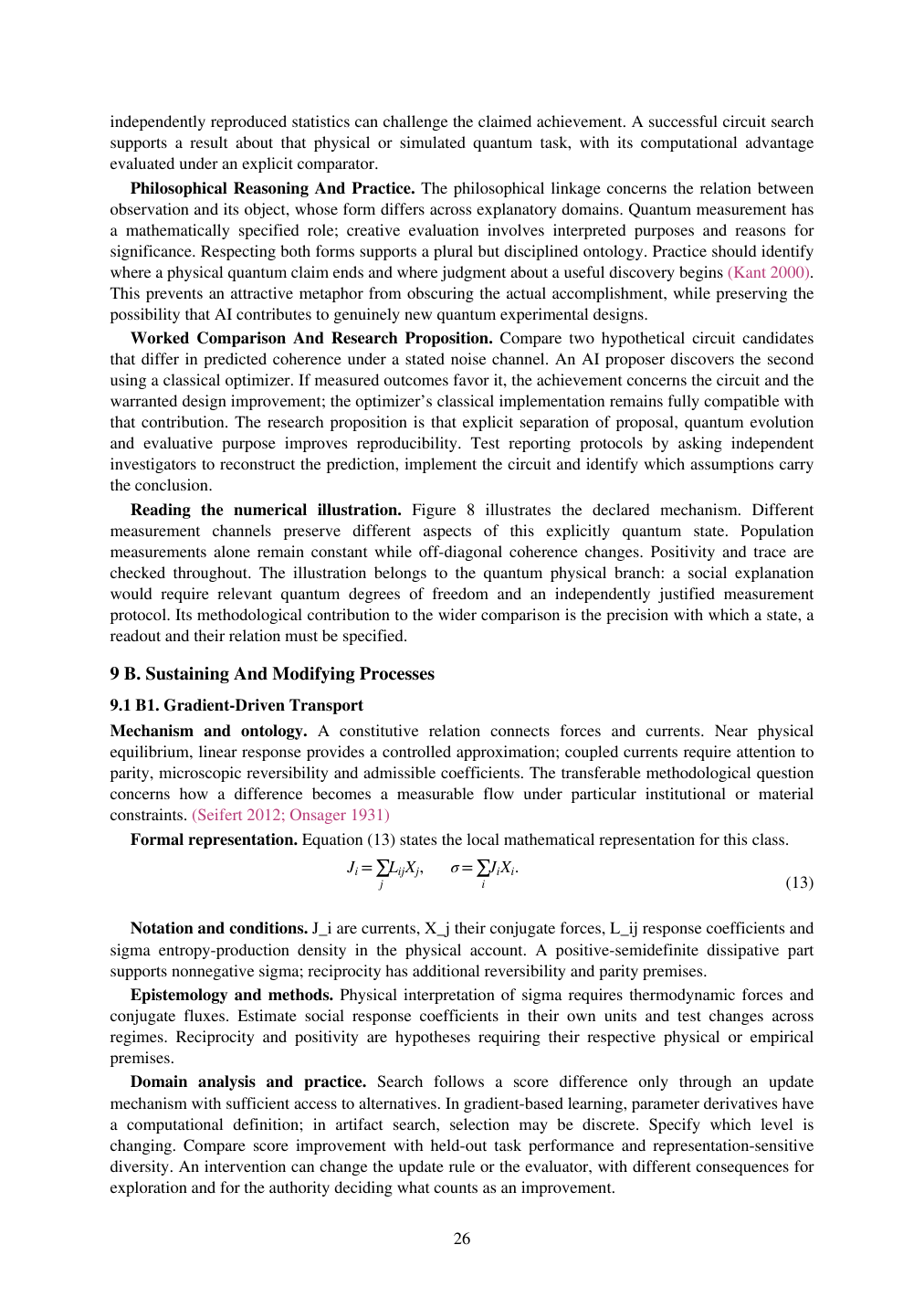
Readable text
independently reproduced statistics can challenge the claimed achievement. A successful circuit search supports a result about that physical or simulated quantum task, with its computational advantage
Philosophical Reasoning And Practice. The philosophical linkage concerns the relation between observation and its object, whose form differs across explanatory domains. Quantum measurement has a mathematically specified role; creative evaluation involves interpreted purposes and reasons for significance. Respecting both forms supports a plural but disciplined ontology. Practice should identify where a physical quantum claim ends and where judgment about a useful discovery begins (Kant 2000). This prevents an attractive metaphor from obscuring the actual accomplishment, while preserving the possibility that AI contributes to genuinely new quantum experimental designs.
Worked Comparison And Research Proposition. Compare two hypothetical circuit candidates that differ in predicted coherence under a stated noise channel. An AI proposer discovers the second using a classical optimizer. If measured outcomes favor it, the achievement concerns the circuit and the warranted design improvement; the optimizer’s classical implementation remains fully compatible with that contribution. The research proposition is that explicit separation of proposal, quantum evolution and evaluative purpose improves reproducibility. Test reporting protocols by asking independent investigators to reconstruct the prediction, implement the circuit and identify which assumptions carry
Reading the numerical illustration. Figure 8 illustrates the declared mechanism. Different measurement channels preserve different aspects of this explicitly quantum state. Population measurements alone remain constant while off-diagonal coherence changes. Positivity and trace are checked throughout. The illustration belongs to the quantum physical branch: a social explanation would require relevant quantum degrees of freedom and an independently justified measurement protocol. Its methodological contribution to the wider comparison is the precision with which a state, a
Mechanism and ontology. A constitutive relation connects forces and currents. Near physical equilibrium, linear response provides a controlled approximation; coupled currents require attention to parity, microscopic reversibility and admissible coefficients. The transferable methodological question concerns how a difference becomes a measurable flow under particular institutional or material
Formal representation. Equation (13) states the local mathematical representation for this class.
Notation and conditions. J_i are currents, X_j their conjugate forces, L_ij response coefficients and sigma entropy-production density in the physical account. A positive-semidefinite dissipative part supports nonnegative sigma; reciprocity has additional reversibility and parity premises.
Epistemology and methods. Physical interpretation of sigma requires thermodynamic forces and conjugate fluxes. Estimate social response coefficients in their own units and test changes across regimes. Reciprocity and positivity are hypotheses requiring their respective physical or empirical
Domain analysis and practice. Search follows a score difference only through an update mechanism with sufficient access to alternatives. In gradient-based learning, parameter derivatives have a computational definition; in artifact search, selection may be discrete. Specify which level is changing. Compare score improvement with held-out task performance and representation-sensitive diversity. An intervention can change the update rule or the evaluator, with different consequences for exploration and for the authority deciding what counts as an improvement.
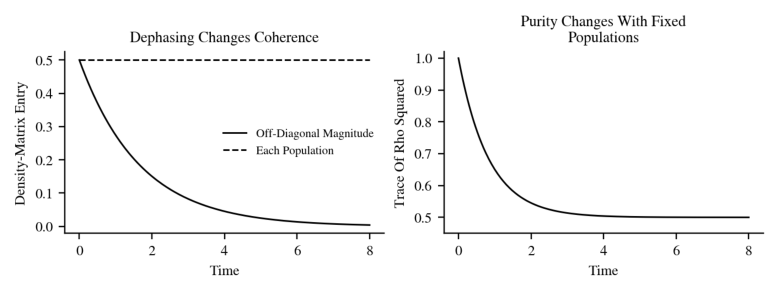
Figure 8. A two-level state begins in an equal coherent superposition and undergoes Lindblad dephasing with L = sigma_z and gamma = 0.3. Populations stay one-half, coherence decays, and purity approaches one-half. The quantum illustration concerns an actual or simulated quantum state undergoing specified preparation, evolution and measurement. Its domain correspondence is a circuit-design task proposed by an AI workflow. Quantum coherence belongs to the physical model; the significance of a discovery requires separately articulated computational and practical criteria.
Phenomenon And Practical Problem. An optimization system may reliably increase its internal score while producing artifacts whose practical usefulness changes little. Consider an image-generating workflow judged by an accessibility classifier. A direction that raises classifier confidence may alter superficial cues while leaving the depicted instructions difficult to follow. The practical problem is to determine how a scored discrepancy becomes a change in the artifact and whether that change carries the intended value. Search direction, proposal accessibility and evaluative warrant enter different stages of this account.
Mechanism And Ontological Commitments. At training level, a gradient is a derivative with respect to explicitly parameterized weights. At artifact level, a score difference may instead guide discrete selection or an estimated local edit direction. The coordinates, step size and response rule must be specified. Linear response offers a methodological comparison only within a regime where the approximation fits (Onsager 1931). Semantic usefulness has no automatic conjugate thermodynamic force. The relevant ontology contains parameter changes, candidate properties, evaluation observations and a task-specific relation connecting measured improvement to the intended function.
Epistemic Design And Discriminating Evidence. Estimate response to several small, randomized edit directions near a common candidate. Compare predicted score gains with held-out task outcomes and repeat at multiple step sizes. This tests whether the local direction remains informative beyond the neighborhood used to estimate it. Freeze the evaluator during one arm and refresh independent human or executable tests in another. An evaluator-exploitation explanation predicts growing divergence between internal score and external outcomes. A genuine local improvement account predicts a stable relation within a stated operating range, with uncertainty increasing beyond it.
Philosophical Reasoning And Practice. The philosophical issue concerns the authority encoded by a direction of improvement. A numerical derivative answers how a score changes, while reasons about the purpose explain why that score deserves weight. Capability-oriented judgment can ask whether the resulting artifact enlarges users’ practical opportunities (Sen 2009). Practice should preserve a route for challenging the score’s representation of those opportunities. A creative departure may require temporarily reducing the old score while demonstrating a feature that the existing coordinate system fails to recognize.
Worked Comparison And Research Proposition. Compare hypothetical optimization runs on assembly diagrams. One follows the classifier gradient; another follows a mixed rule using independently observed assembly errors. Equalize generation and checking costs, then test unseen users
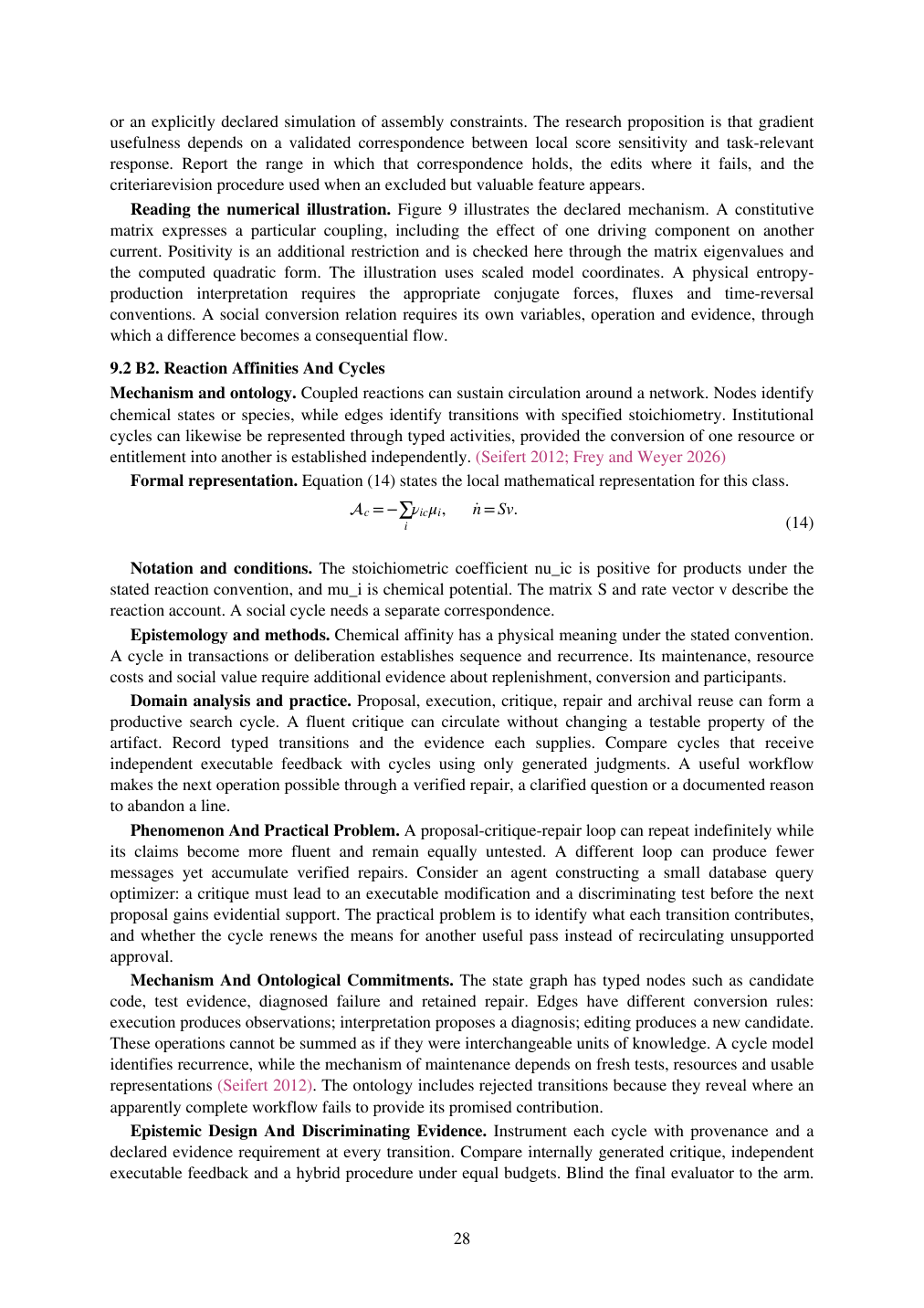
Readable text
or an explicitly declared simulation of assembly constraints. The research proposition is that gradient usefulness depends on a validated correspondence between local score sensitivity and task-relevant response. Report the range in which that correspondence holds, the edits where it fails, and the criteriarevision procedure used when an excluded but valuable feature appears.
Reading the numerical illustration. Figure 9 illustrates the declared mechanism. A constitutive matrix expresses a particular coupling, including the effect of one driving component on another current. Positivity is an additional restriction and is checked here through the matrix eigenvalues and the computed quadratic form. The illustration uses scaled model coordinates. A physical entropy- production interpretation requires the appropriate conjugate forces, fluxes and time-reversal conventions. A social conversion relation requires its own variables, operation and evidence, through
Mechanism and ontology. Coupled reactions can sustain circulation around a network. Nodes identify chemical states or species, while edges identify transitions with specified stoichiometry. Institutional cycles can likewise be represented through typed activities, provided the conversion of one resource or entitlement into another is established independently. (Seifert 2012; Frey and Weyer 2026)
Formal representation. Equation (14) states the local mathematical representation for this class.
Notation and conditions. The stoichiometric coefficient nu_ic is positive for products under the stated reaction convention, and mu_i is chemical potential. The matrix S and rate vector v describe the reaction account. A social cycle needs a separate correspondence.
Epistemology and methods. Chemical affinity has a physical meaning under the stated convention. A cycle in transactions or deliberation establishes sequence and recurrence. Its maintenance, resource costs and social value require additional evidence about replenishment, conversion and participants.
Domain analysis and practice. Proposal, execution, critique, repair and archival reuse can form a productive search cycle. A fluent critique can circulate without changing a testable property of the artifact. Record typed transitions and the evidence each supplies. Compare cycles that receive independent executable feedback with cycles using only generated judgments. A useful workflow makes the next operation possible through a verified repair, a clarified question or a documented reason
Phenomenon And Practical Problem. A proposal-critique-repair loop can repeat indefinitely while its claims become more fluent and remain equally untested. A different loop can produce fewer messages yet accumulate verified repairs. Consider an agent constructing a small database query optimizer: a critique must lead to an executable modification and a discriminating test before the next proposal gains evidential support. The practical problem is to identify what each transition contributes, and whether the cycle renews the means for another useful pass instead of recirculating unsupported
Mechanism And Ontological Commitments. The state graph has typed nodes such as candidate code, test evidence, diagnosed failure and retained repair. Edges have different conversion rules: execution produces observations; interpretation proposes a diagnosis; editing produces a new candidate. These operations cannot be summed as if they were interchangeable units of knowledge. A cycle model identifies recurrence, while the mechanism of maintenance depends on fresh tests, resources and usable representations (Seifert 2012). The ontology includes rejected transitions because they reveal where an apparently complete workflow fails to provide its promised contribution.
Epistemic Design And Discriminating Evidence. Instrument each cycle with provenance and a declared evidence requirement at every transition. Compare internally generated critique, independent executable feedback and a hybrid procedure under equal budgets. Blind the final evaluator to the arm.
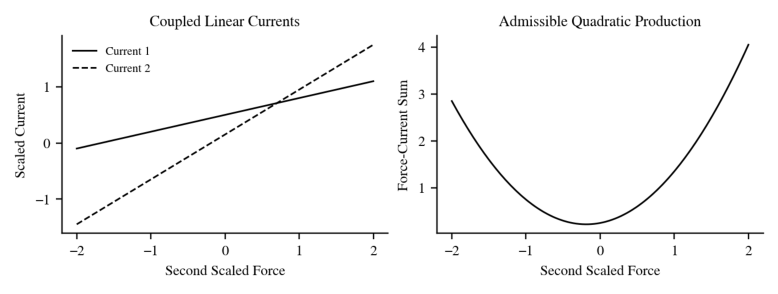
Figure 9. A symmetric positive-definite response matrix has entries 1, 0.3, 0.3 and 0.8. The first scaled force is 0.5; the second is varied. Cross-coupling changes both currents and the quadratic force-current sum stays nonnegative. The transport illustration corresponds to score differences driving parameter or artifact updates through a specified response rule. Flow is a measured rate of accepted edits. The relation is tested locally in computational coordinates; thermodynamic reciprocity and entropy production require separate physical premises.
Record valid improvements per completed cycle, error recurrence and the fraction of diagnoses that predict a successful repair. A loop that merely changes its wording should show low diagnostic specificity. An evidentially productive loop should improve outcomes on untouched cases and leave a reusable account of why the repair addresses the failure.
Philosophical Reasoning And Practice. Deweyan inquiry connects a problematic situation, investigation and the consequences of proposed responses (Dewey 1927). The linkage supports evaluating the cycle through what it resolves and makes investigable. A critique has epistemic standing when it gives a reason capable of guiding a discriminating operation. Practice should therefore allow a cycle to stop with a documented unresolved question, a negative result or a justified change of problem. Repetition becomes valuable through substantive transitions whose contribution can be examined by successors.
Worked Comparison And Research Proposition. Compare hypothetical optimizer agents with identical proposal budgets. One alternates generated criticism and rewriting; another must execute each proposed repair against a counterexample before archiving it. If the second yields fewer candidates but more transferable improvements, the relevant difference lies in the typed conversion from criticism to evidence. The research proposition is that requiring verified transition products increases developmental usefulness per supported cycle. Test the proposition across failures with different diagnosis costs, recording when a compulsory test becomes wasteful and a reasoned abandonment rule performs better.
Reading the numerical illustration. Figure 10 illustrates the declared mechanism. A cycle can be sustained after its state frequencies have settled. This finite transition construction separates evolving occupation from continuing directional exchange. The currents balance at every steady node, so circulation can coexist with zero net stock change. A chemical interpretation would additionally specify species, stoichiometry and reaction affinities. An institutional application would identify the distinct activities carried by the nodes and show how one operation enables the next, with its own resource and authority conditions.
9.3 B3. Mechanical Energy Injection
Mechanism and ontology. Sustained forces, shear and deformation can maintain organized motion. The input is an ongoing maintenance process, distinct from the initiating shock in A3. In social models, recurring implementation work may maintain an arrangement that would decay if its administrative or material support ceased. (Cross and Hohenberg 1993; Bebon, Robinson, and Speck 2025)
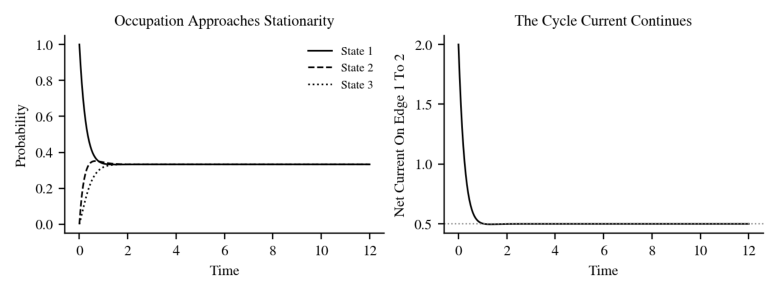
Figure 10. A three-state transition ring has clockwise rate 2 and reverse rate 0.5. From a concentrated initial state, probabilities approach one-third while each oriented steady edge carries net current 0.5. The cyclic illustration maps each directed transition to a different operation: proposing, executing, diagnosing, repairing or archiving. A completed loop counts as productive only under a declared evidential criterion. The recurring trajectory therefore needs a separate account of fresh tests and resource replenishment.
Formal representation. Equation (15) states the local mathematical representation for this class.
E =Pin −Pdiss −Pout. (15)
Notation and conditions. E is energy; P_in, P_diss and P_out are compatible rates within the declared boundary. Administrative accounts can instead use time or money, with conversion and external entries specified independently.
Epistemology and methods. Close an energy account where energy is the measured quantity. For administration, separate staff hours, budgets and outputs. A withdrawal or interruption study can identify maintenance dependence when its comparison and consequences are appropriate.
Domain analysis and practice. A continuing AI inquiry requires compute, orchestration, data maintenance and human supervision. A stable rate of generated artifacts can conceal increasing costs of verification. Account for both generation and checking at the workflow boundary. Compare outputs per unit of total supported effort, alongside their validity and downstream reuse. A design can allocate more resources to discriminating tests when additional generation produces mostly redundant candidates.
Phenomenon And Practical Problem. A stable stream of AI-generated research candidates can depend on a growing stream of orchestration work. Tool interfaces change, test environments fail and reviewers spend longer separating useful results from plausible errors. Consider a creative coding service that maintains constant submission volume while its human verification queue expands. The practical problem is whether observed output persistence represents a sustainable inquiry. Measuring generation alone can conceal the maintenance required to preserve even the same level of warranted achievement.
Mechanism And Ontological Commitments. The sustaining inputs include scheduled compute, environment repair, dependency updates and supervision. They are continuing operations, distinguished from a one-time launch. A physical energy account can measure hardware consumption; an organizational account records hours, monetary costs and review tasks separately. The aggregate output is a selected performance measure whose relation to those inputs must be specified (Cross and Hohenberg 1993). Boundary choices matter because moving verification to an uncounted contributor can make the visible agent appear more productive while increasing the total supported effort.
Epistemic Design And Discriminating Evidence. Follow complete workflow cohorts over repeated episodes. Record generation, execution failures, repair interventions and reviewer work needed to reach an auditable result. Compare maintenance schedules and a controlled interruption in a synthetic environment. A sustaining-input mechanism predicts a change in performance following withdrawal,
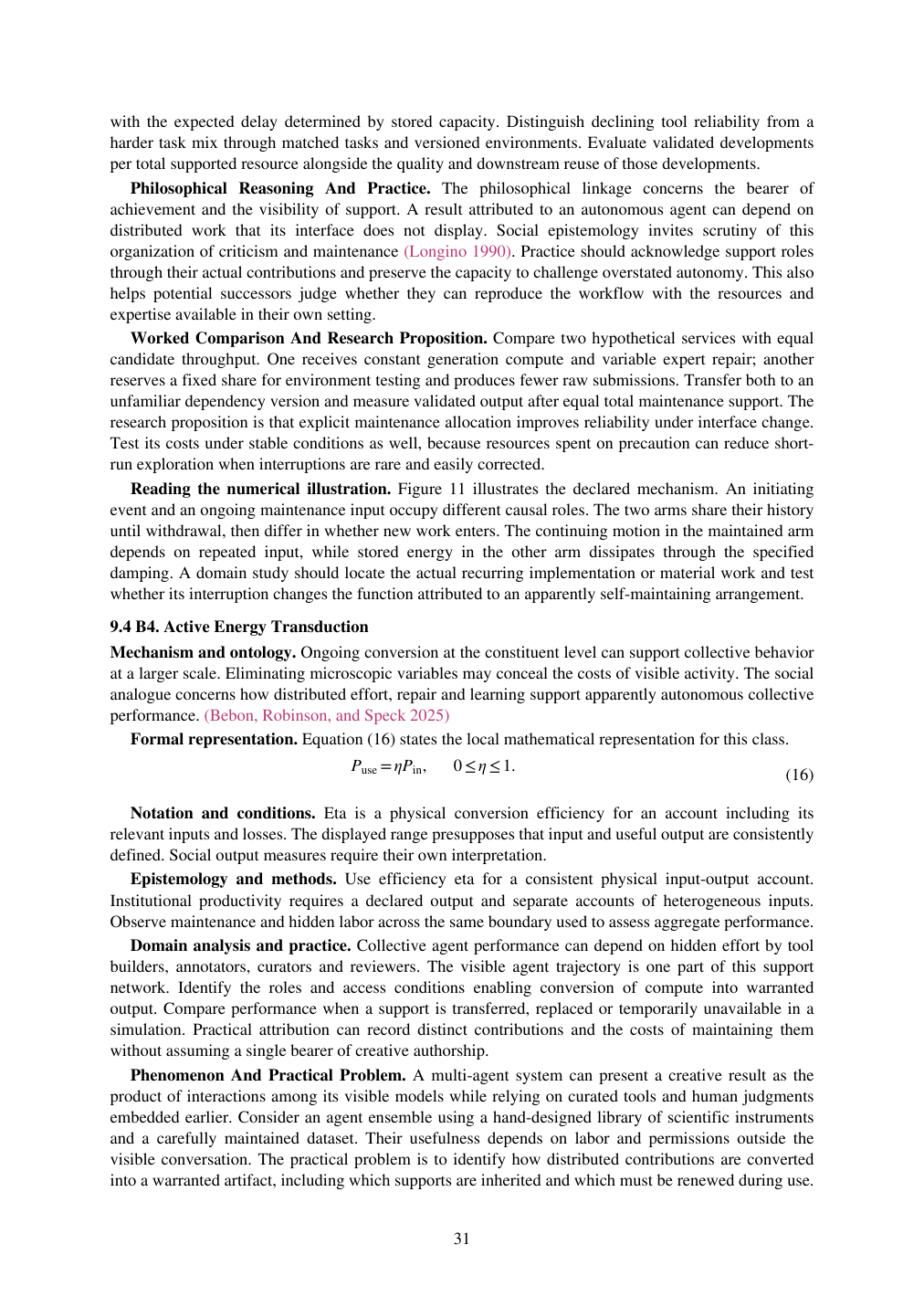
Readable text
with the expected delay determined by stored capacity. Distinguish declining tool reliability from a harder task mix through matched tasks and versioned environments. Evaluate validated developments per total supported resource alongside the quality and downstream reuse of those developments.
Philosophical Reasoning And Practice. The philosophical linkage concerns the bearer of achievement and the visibility of support. A result attributed to an autonomous agent can depend on distributed work that its interface does not display. Social epistemology invites scrutiny of this organization of criticism and maintenance (Longino 1990). Practice should acknowledge support roles through their actual contributions and preserve the capacity to challenge overstated autonomy. This also helps potential successors judge whether they can reproduce the workflow with the resources and
Worked Comparison And Research Proposition. Compare two hypothetical services with equal candidate throughput. One receives constant generation compute and variable expert repair; another reserves a fixed share for environment testing and produces fewer raw submissions. Transfer both to an unfamiliar dependency version and measure validated output after equal total maintenance support. The research proposition is that explicit maintenance allocation improves reliability under interface change. Test its costs under stable conditions as well, because resources spent on precaution can reduce short- run exploration when interruptions are rare and easily corrected.
Reading the numerical illustration. Figure 11 illustrates the declared mechanism. An initiating event and an ongoing maintenance input occupy different causal roles. The two arms share their history until withdrawal, then differ in whether new work enters. The continuing motion in the maintained arm depends on repeated input, while stored energy in the other arm dissipates through the specified damping. A domain study should locate the actual recurring implementation or material work and test whether its interruption changes the function attributed to an apparently self-maintaining arrangement.
Mechanism and ontology. Ongoing conversion at the constituent level can support collective behavior at a larger scale. Eliminating microscopic variables may conceal the costs of visible activity. The social analogue concerns how distributed effort, repair and learning support apparently autonomous collective
Formal representation. Equation (16) states the local mathematical representation for this class.
Notation and conditions. Eta is a physical conversion efficiency for an account including its relevant inputs and losses. The displayed range presupposes that input and useful output are consistently defined. Social output measures require their own interpretation.
Epistemology and methods. Use efficiency eta for a consistent physical input-output account. Institutional productivity requires a declared output and separate accounts of heterogeneous inputs. Observe maintenance and hidden labor across the same boundary used to assess aggregate performance.
Domain analysis and practice. Collective agent performance can depend on hidden effort by tool builders, annotators, curators and reviewers. The visible agent trajectory is one part of this support network. Identify the roles and access conditions enabling conversion of compute into warranted output. Compare performance when a support is transferred, replaced or temporarily unavailable in a simulation. Practical attribution can record distinct contributions and the costs of maintaining them without assuming a single bearer of creative authorship.
Phenomenon And Practical Problem. A multi-agent system can present a creative result as the product of interactions among its visible models while relying on curated tools and human judgments embedded earlier. Consider an agent ensemble using a hand-designed library of scientific instruments and a carefully maintained dataset. Their usefulness depends on labor and permissions outside the visible conversation. The practical problem is to identify how distributed contributions are converted into a warranted artifact, including which supports are inherited and which must be renewed during use.
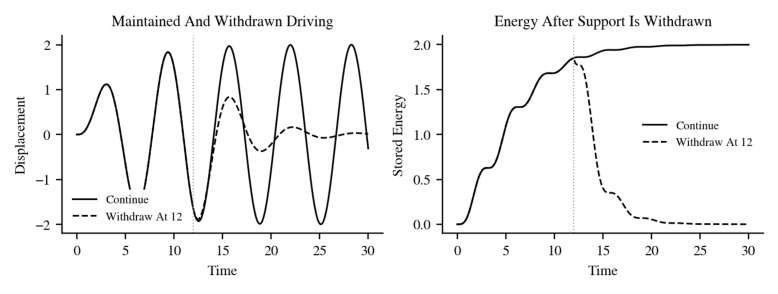
Figure 11. A unit oscillator with damping 0.5 receives sinusoidal forcing. The comparison either continues the drive or withdraws it at time twelve; the later paths reveal the work required to maintain motion. The sustained-injection illustration represents recurring compute, orchestration and verification inputs supporting an ongoing candidate workflow. Interruption and recovery show maintenance dependence over time. Output rate is interpreted alongside complete support accounts, which keep physical energy, staff work and validated contributions in their appropriate units.
Mechanism And Ontological Commitments. The constituent-level processes include model inference, tool construction, annotation, calibration and review. Each has its own input and output type. Physical conversion efficiency applies only to compatible energy quantities within a sufficiently complete boundary (Bebon, Robinson, and Speck 2025). A validated result per staff hour is an organizational productivity measure with a declared purpose. The ontology should include contribution relations and access conditions, because a tool can exist in an archive yet remain unusable to an agent lacking its invocation method, credentials or contextual knowledge.
Epistemic Design And Discriminating Evidence. Perform support ablations that replace a curated tool, remove a calibration note or transfer the workflow to a new operator. Preserve safe fallback access where necessary and use synthetic tasks when withdrawal would impose a burden. Measure diagnosis quality, verification cost and successful downstream use. A mediation analysis can then ask which support changes the conversion from proposals to valid artifacts. Separate unavailable support from degraded support, and inspect correlated failures where several agents share the same underlying tool or source.
Philosophical Reasoning And Practice. Relational attribution follows from the dependence of achievement on differentiated contributions. It can acknowledge a final proposer, a critic and an infrastructure contributor without forcing them into one undifferentiated authorship category. Epistemic justice supplies reasons to examine whose contribution is systematically omitted from the record (Fricker 2007). Practical reporting should explain who supplied each indispensable operation and what continuing responsibilities accompany it. The purpose is an intelligible account of accomplishment, compensation and successor access, grounded in observed contributions and explicit evaluative commitments.
Worked Comparison And Research Proposition. Compare hypothetical ensembles that attain equal benchmark scores. One depends on an expert-curated parser; another constructs and verifies its parser during the run. Removing the external parser may reveal a transferable difference in capability, while the additional construction cost changes the resource comparison. The research proposition is that contribution-sensitive ablation predicts portability better than counting visible agent messages. Test several transfer settings and record which support can be reproduced locally, which requires negotiation, and which remains inseparable from specialist judgment.
Reading the numerical illustration. Figure 12 illustrates the declared mechanism. The same visible amount of useful exercise can require different input when conversion differs. The illustration keeps the
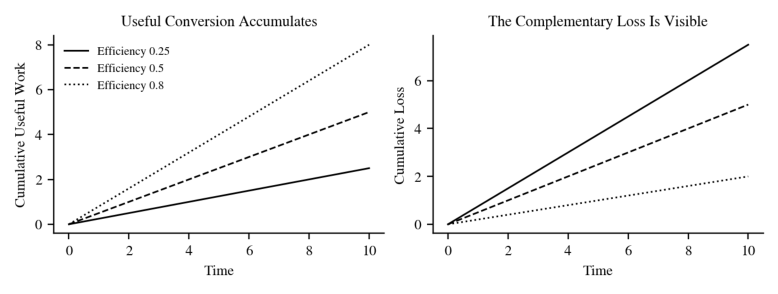
Figure 12. Three converters receive one energy unit per time and have constant efficiencies 0.25, 0.5 and 0.8. Useful work and loss sum to supplied energy in every condition. The transduction illustration corresponds to distributed supports converting proposal activity into warranted artifacts. Hidden tool-building and review can sustain visible collective performance. Each conversion requires typed input and output records; physical efficiency is reserved for an energy account with compatible quantities and a declared boundary.
input rate explicit and separates the unobserved complement from the useful channel. This supports an accounting question about apparent collective autonomy: which conversions and constituent work sustain it? For a social application, effort, skill, care and resources should retain their appropriate units, with a justified account of how they enable the operation and who bears their replenishment.
9.5 B5. Time-Dependent And Stochastic Forcing
Mechanism and ontology. A process may be maintained or reshaped by periodic, intermittent or random input. The forcing process is part of the model, with its correlations and temporal resolution. Similar-looking fluctuations can originate from external variability, endogenous dynamics or the observation procedure. (Ashwin et al. 2012; Korbel et al. 2026)
Formal representation. Equation (17) states the local mathematical representation for this class.
dx=f(x,t)dt+B(x,t)dWt. (17)
Notation and conditions. W_t is a standard Wiener process, B a noise-amplitude matrix and f a drift. The stochastic convention matters when B depends on x; jumps and temporally correlated forcing require suitable alternative models.
Epistemology and methods. State the stochastic convention and diffusion assumptions when using this form. Compare measured external inputs with residual variation; examine colored noise and jumps where relevant. A fitted noise term records unresolved variability, with causal interpretation requiring further investigation.
Domain analysis and practice. Sampling noise, task schedules and injected perturbations can diversify search. Their effect depends on which alternatives the representation makes reachable and what selection retains. Record seeds, decoding settings and environmental inputs. Compare perturbation scales under equal budgets using quality, diversity, validity and downstream reuse. A useful stochastic intervention enlarges relevant exploration while preserving a feasible route to evaluation; random variation alone supplies a proposal mechanism.
Phenomenon And Practical Problem. Randomness can help a creative workflow encounter alternatives and can also enlarge the checking burden without changing what it can meaningfully develop. Consider a molecular-shape toy search using a fixed validity checker: broader perturbations may discover distant feasible forms or merely generate invalid structures. The practical problem is to choose the scale, timing and location of stochastic variation. A single successful surprise gives little
Readable text
information about the frequency of wasted proposals or the support needed to recognize and develop a
Mechanism And Ontological Commitments. A stochastic mechanism specifies which state is perturbed, the distribution of increments and their temporal dependence. Decoding randomness, random tool failure and external task variation are different processes. White-noise diffusion is one approximation; heavy-tailed edits, correlated sampling and discrete jumps need their corresponding representations (Ashwin et al. 2012). Candidate diversity is an observable dependent on an artifact representation, while meaningful departure requires task interpretation. The model should retain the proposal distribution and the selection rule because the same perturbation process can have different
consequences under different retention procedures.
Epistemic Design And Discriminating Evidence. Cross perturbation scale with evaluation capacity under a fixed total resource budget. Use paired seeds and retain every proposal, including invalid ones. Measure discovery probability, distance between validated solution mechanisms, verification cost and continuation after discovery. Compare independent perturbations with bursts and temporally correlated changes. A proposal-diversification explanation predicts altered reachability or encounter rates; a recognition-bottleneck explanation predicts that additional variation helps only when enough checking capacity is supplied. Report uncertainty over seeds and tasks, keeping the two sources of variation
Philosophical Reasoning And Practice. The philosophical question concerns the relationship between chance and reasons. Chance can supply a candidate without supplying a reason to accept its significance. Reflective judgment examines what the departure reveals about the task and the criteria used to recognize it (Kant 2000). Practice can preserve a space for unexpected proposals while requiring proportionate evidence for consequential adoption. This supports exploratory openness together with accountable evaluation, and gives a reason to retain some rejected anomalies when they
Worked Comparison And Research Proposition. Compare hypothetical search runs using frequent small edits and rare composite edits. Equalize objective calls and evaluate both with strong and weak checking support. If composite edits improve outcomes only with strong validation, the mechanism involves an interaction between encounter and recognition. The research proposition is that useful stochasticity is jointly determined by perturbation reach and evaluative capacity. Test it across tasks with different invalidity rates, reporting the useful discoveries forgone when verification resources are diverted toward examining a larger stream of random candidates.
Reading the numerical illustration. Figure 13 illustrates the declared mechanism. Persistent fluctuations can arise from continuing external stochastic input even when deterministic relaxation is stable. The ensemble mean and variance answer different questions, and the latter is tested against the declared process. A single irregular record would provide less direct evidence about that source. Domain inference should compare external forcing, internal interaction and changing measurement as rival mechanisms, while matching temporal resolution and dependence assumptions to the data actually
Mechanism and ontology. Observation, memory and control change subsequent evolution through a feedback loop. A controller has information, an objective and an ability to act. In social settings these capacities are distributed across offices and participants, making sensing and intervention authority
Formal representation. Equation (18) states the local mathematical representation for this class.
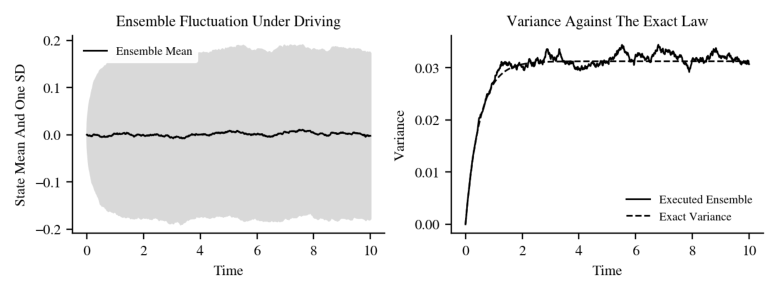
Figure 13. An Euler-Maruyama ensemble of 1,500 Ornstein-Uhlenbeck paths uses dt = 0.01, unit restoring rate and noise coefficient 0.25. The shaded region is one ensemble standard deviation; the second panel compares variance with the exact law. The stochastic-forcing illustration represents declared random perturbations of candidate states or inputs. Its noise amplitude and correlation structure map to controlled proposal settings. Spread in trajectories is evaluated through validity, discovery and checking cost, with randomness in generation distinguished from uncertainty in evaluative judgment.
Notation and conditions. The policy pi maps information available through time t to an input u_t. The observations y and state x are distinct objects. A causal implementation uses the information actually available when the decision is taken.
Epistemology and methods. Record the information available at each decision and the timing of response. Evaluate a policy together with its induced data distribution. Compare alternatives that separate better measurement from greater control over the measured population.
Domain analysis and practice. An AI evaluator can influence future candidates and then be updated on the candidates it helped select. This loop can improve task fit or entrench a narrow standard. Record evaluator versions, available evidence and consequential decisions. Compare a fixed independent evaluator, a co-evolving evaluator and a reviewable mixed procedure. Validation requires tests outside the feedback loop, while authority to alter evaluative standards requires an explicit institutional justification.
Phenomenon And Practical Problem. An evaluator trained on artifacts it previously selected can gradually narrow the population that later appears successful. Consider an AI design competition whose winning entries become examples for its scoring model. The next generation can then be rewarded for resembling features that the evaluator itself helped make prevalent. The practical problem is to distinguish improved recognition of valuable work from self-confirmation. This requires observing how selection changes both the candidate pool and the evidence through which the evaluation standard is subsequently updated.
Mechanism And Ontological Commitments. The loop contains an artifact population, a consequential evaluator, a selection policy and a rule for evaluator revision. Observations and the state judged are distinct variables. A performative account studies how deployment changes the distribution later encountered (Perdomo et al. 2020). The ontology also contains authority: the capacity to issue a score and the authorization to redefine a standard can belong to different participants. Keeping them separate makes it possible to explain adaptation while asking who may legitimately change the grounds of creative recognition.
Epistemic Design And Discriminating Evidence. Compare a frozen independent evaluator, a selfupdating evaluator trained only on selected artifacts, and an updater supplied with independently sampled artifacts. Keep candidate generation and human-review budgets comparable. Track held-out usefulness, representation diversity, disagreements and the probability that initially disfavored mechanisms receive further evaluation. A self-confirmation account predicts reduced disagreement
internally alongside widening error on external tasks. Improvement should survive tests whose construction and sampling remain outside the consequential feedback loop. Log evaluator versions and use only information available when each decision occurred.
Philosophical Reasoning And Practice. The norm-formation problem concerns why a practically influential standard deserves adoption (Huang 2026a). Repeated success can explain a criterion’s prevalence while leaving its substantive warrant open. Practice should require a reasoned change record identifying the defect addressed, the people affected and the evidence supporting revision. A challenge route matters because selection can otherwise remove the very alternatives that would reveal the standard’s blind spots. The aim is a revisable authority structure whose evidential basis remains accessible to criticism.
Worked Comparison And Research Proposition. Imagine hypothetical evaluators judging a repairable product. Early winners emphasize visual novelty, so subsequent training increasingly associates creativity with appearance. A separately sampled user-maintenance test reveals valuable designs that the updated evaluator rejects. The research proposition is that independent sampling stabilizes evaluative responsiveness when selected outputs train later standards. Test this by varying the fraction and type of independent evidence, then inspect which criteria change and whether the revised standard supports useful successor operations beyond the examples that motivated its adoption.
Reading the numerical illustration. Figure 14 illustrates the declared mechanism. Observation affects the process only through an operative response. Here changing gain changes the closed-loop multiplier while the uncontrolled transition remains fixed. Stronger correction can cross the discretetime stability boundary and amplify deviations. A domain account should identify the sensing channel, the information retained, the response rule and the ability to implement it. Evaluating the regulated target additionally requires reasons concerning the function and affected claims, beyond the sign of the feedback loop.
9.7 B7. Nonreciprocal Effective Coupling
Mechanism and ontology. A response of one component to another can differ from the reverse response. Directional influence can be sustained by asymmetric access, external support or different interaction rules. The object is the directional response relation; its existence alone leaves physical dissipation and political legitimacy to their respective evidence. (Gross and Blasius 2008; Korbel et al. 2026) Formal representation. Equation (19) states the local mathematical representation for this class.

Notation and conditions. The derivatives compare directional response in a declared coordinate system. Different units or variable normalizations change their numerical comparison; a causal interpretation needs an identified intervention or justified structural model.
Epistemology and methods. Define common coordinates before comparing derivatives. In social applications, estimate direction-specific effects and document the authority or resources enabling them. Unequal observed correlations require a separate identification argument before being interpreted as unequal causal influence.
Domain analysis and practice. A lead model, platform or evaluator can influence many agents while receiving little corrective input from them. Directionality concerns prompt control, resource allocation, access to tests and adoption authority. Estimate effects through controlled changes in those channels. Compare centralized scoring with several evaluators that have declared competencies and review routes. More evaluators add value when their evidence or criteria differ meaningfully and their errors are examined, rather than merely multiplying correlated scores.
Phenomenon And Practical Problem. In a creative ensemble, a coordinator may rewrite every agent’s instructions while receiving only compressed summaries of their discoveries. The reverse influence can be weak even when message counts are large. Consider a group searching alternative
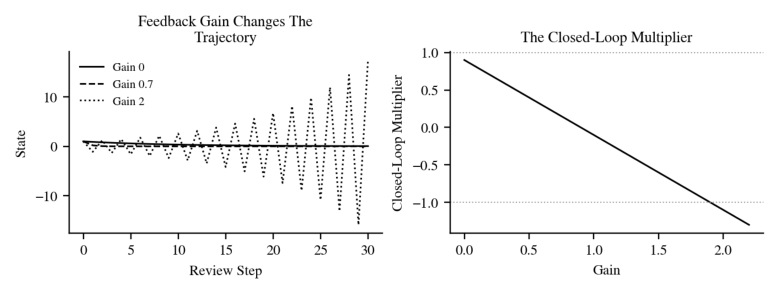
Figure 14. A scalar discrete process x_next = 0.9x + u uses observed-state feedback u = -Kx. The three trajectories share initial state one; gain two produces an alternating growing path. The feedback illustration maps observations to evaluator decisions that alter subsequent candidate distributions. A later evaluator update closes the loop. External held-out tests and versioned criteria provide a distinct observation channel through which improved recognition can be separated from self-confirming selection.
proof strategies: the coordinator’s preferred notation can shape all proposals, while an agent’s objection never reaches the adoption stage. The practical problem is to locate direction-specific influence and determine whether it supplies useful coordination, suppresses informative differences or simply reallocates control over the inquiry.
Mechanism And Ontological Commitments. The coupling is a causal response relation between specified coordinates, such as a changed coordinator criterion and the probability of retaining a candidate lineage. Comparing opposite directions requires normalization and compatible meanings; raw token counts offer a different measure. Asymmetric influence may be maintained by prompt hierarchy, tool access or resource control (Gross and Blasius 2008). It establishes a directional mechanism whose legitimacy requires further reasons. The ontology includes what can be transmitted, what can be acted upon and who controls the conversion from an objection into a consequential revision.
Epistemic Design And Discriminating Evidence. Randomize a small, clearly identified change in the coordinator’s criterion and in a peer agent’s submitted evidence. Estimate each change’s effect on selection and later verified performance. Compare centralized, distributed and reviewable-hub structures with equal total communication and evaluation budgets. Examine correlated model errors before interpreting agreement as corroboration. A useful coordinator should improve integration while retaining a route for decisive contrary evidence. The discriminating outcome is the fate of an independently valid objection, followed through receipt, interpretation, adoption and resource reallocation.
Philosophical Reasoning And Practice. Socially organized criticism supplies a philosophical reason to examine uptake as well as the mere availability of a speaking channel (Longino 1990). A participant can be allowed to send messages yet lack an effective route to influence judgment. Practice should specify the evidence that obliges reconsideration, the office that decides, and how reasons are recorded. This makes epistemic responsiveness assessable without assuming that every contribution deserves equal weight or that centralized expertise is inherently defective.
Worked Comparison And Research Proposition. Compare hypothetical proof-search groups facing a deliberately seeded counterexample to the coordinator’s favored conjecture. In one structure the hub may silently discard it; in another a reproducible counterexample triggers an independent check. If the second avoids prolonged false-lineage development, the improvement concerns a specific upward correction route. The research proposition is that asymmetric coordination performs more reliably when high-quality reverse evidence has an enforceable uptake mechanism. Test different objection costs and
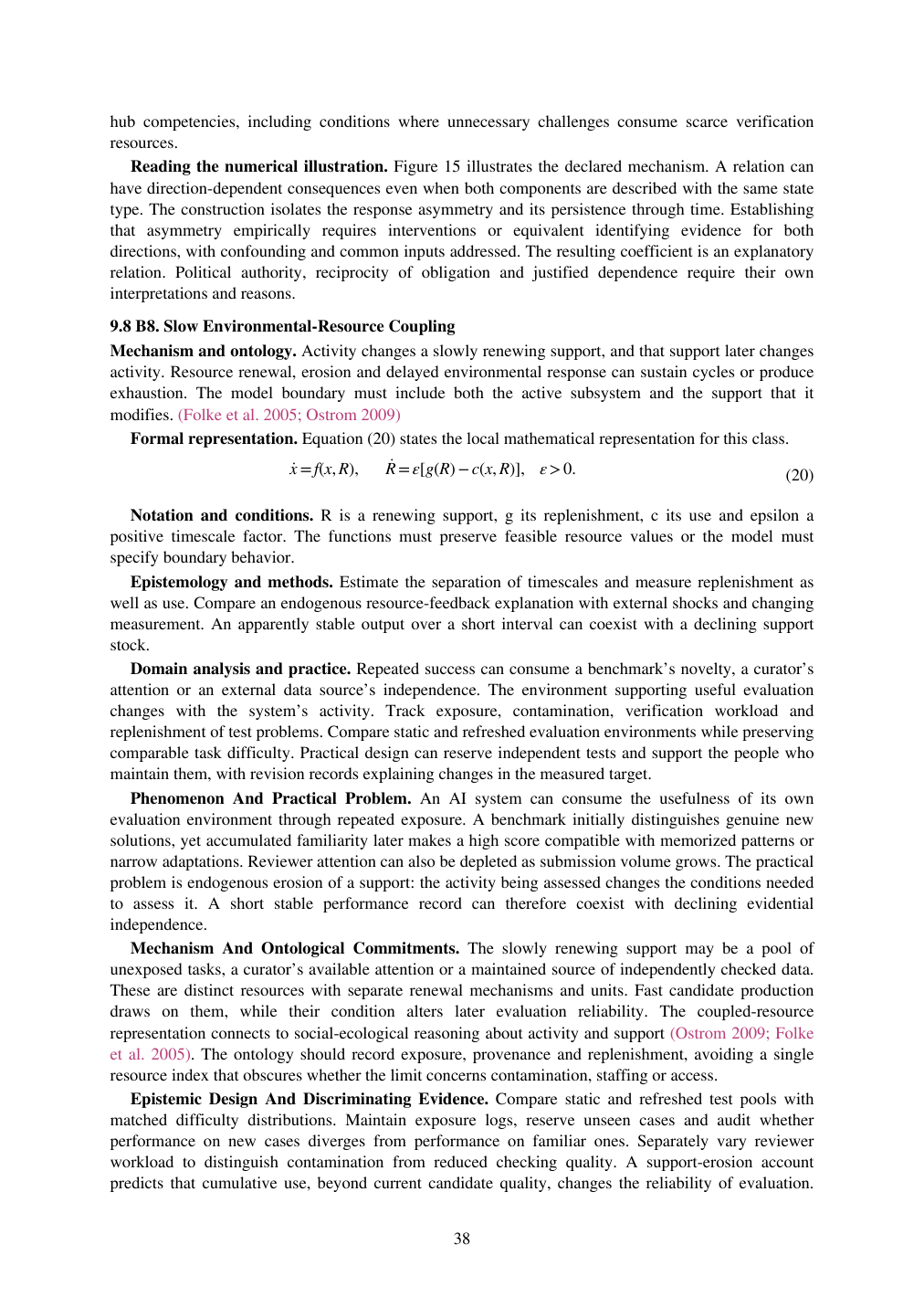
Readable text
hub competencies, including conditions where unnecessary challenges consume scarce verification
Reading the numerical illustration. Figure 15 illustrates the declared mechanism. A relation can have direction-dependent consequences even when both components are described with the same state type. The construction isolates the response asymmetry and its persistence through time. Establishing that asymmetry empirically requires interventions or equivalent identifying evidence for both directions, with confounding and common inputs addressed. The resulting coefficient is an explanatory relation. Political authority, reciprocity of obligation and justified dependence require their own
Mechanism and ontology. Activity changes a slowly renewing support, and that support later changes activity. Resource renewal, erosion and delayed environmental response can sustain cycles or produce exhaustion. The model boundary must include both the active subsystem and the support that it
Formal representation. Equation (20) states the local mathematical representation for this class.
Notation and conditions. R is a renewing support, g its replenishment, c its use and epsilon a positive timescale factor. The functions must preserve feasible resource values or the model must
Epistemology and methods. Estimate the separation of timescales and measure replenishment as well as use. Compare an endogenous resource-feedback explanation with external shocks and changing measurement. An apparently stable output over a short interval can coexist with a declining support
Domain analysis and practice. Repeated success can consume a benchmark’s novelty, a curator’s attention or an external data source’s independence. The environment supporting useful evaluation changes with the system’s activity. Track exposure, contamination, verification workload and replenishment of test problems. Compare static and refreshed evaluation environments while preserving comparable task difficulty. Practical design can reserve independent tests and support the people who maintain them, with revision records explaining changes in the measured target.
Phenomenon And Practical Problem. An AI system can consume the usefulness of its own evaluation environment through repeated exposure. A benchmark initially distinguishes genuine new solutions, yet accumulated familiarity later makes a high score compatible with memorized patterns or narrow adaptations. Reviewer attention can also be depleted as submission volume grows. The practical problem is endogenous erosion of a support: the activity being assessed changes the conditions needed to assess it. A short stable performance record can therefore coexist with declining evidential
Mechanism And Ontological Commitments. The slowly renewing support may be a pool of unexposed tasks, a curator’s available attention or a maintained source of independently checked data. These are distinct resources with separate renewal mechanisms and units. Fast candidate production draws on them, while their condition alters later evaluation reliability. The coupled-resource representation connects to social-ecological reasoning about activity and support (Ostrom 2009; Folke et al. 2005). The ontology should record exposure, provenance and replenishment, avoiding a single resource index that obscures whether the limit concerns contamination, staffing or access.
Epistemic Design And Discriminating Evidence. Compare static and refreshed test pools with matched difficulty distributions. Maintain exposure logs, reserve unseen cases and audit whether performance on new cases diverges from performance on familiar ones. Separately vary reviewer workload to distinguish contamination from reduced checking quality. A support-erosion account predicts that cumulative use, beyond current candidate quality, changes the reliability of evaluation.
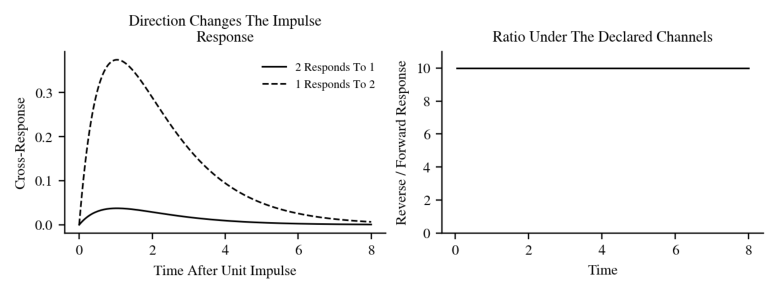
Figure 15. Two damped components have off-diagonal couplings 1 and 0.1. Unit impulses are applied in opposite directions; their cross-responses differ by a factor ten under the same stable matrix. The directional-coupling illustration represents unequal effects of coordinator instructions and participant evidence on subsequent selection. Edge direction denotes an identified response channel, with normalized variables. Institutional uptake rules explain how reverse criticism becomes consequential; message volume and causal influence remain separately measured.
Renewal should restore some discriminating capacity under its declared mechanism. Measure its monetary and human cost so that refreshment is evaluated as part of the sustained workflow.
Philosophical Reasoning And Practice. The philosophical linkage concerns trust in an evaluative institution whose own operation changes its evidence. Epistemic responsibility includes maintaining the conditions under which a score can support its claimed inference (Longino 1990). Practice should publish exposure and refresh policies, explain criterion continuity, and preserve criticism from people whose work becomes poorly represented by the replacement pool. Renewal can improve independence while altering the task. Its justification therefore includes a reasoned account of what remains comparable and what has changed.
Worked Comparison And Research Proposition. Consider hypothetical creative coding systems assessed on the same task bank for many episodes. One receives fresh hidden cases generated from the original specification; another continues with familiar cases. Their familiar scores remain similar while new-case success diverges. The research proposition is that controlled replenishment preserves the link between evaluation and transferable problem-solving capacity. Test it across refresh rates, verify the new cases independently, and inspect whether continual replacement introduces difficulty drift that could itself explain the apparent change in measured creativity.
Reading the numerical illustration. Figure 16 illustrates the declared mechanism. A short record of activity omits the support it is changing. The example couples growth, consumption and renewal, with the relative support rate altering the adjustment episode. A phase trace makes the reciprocal causal pathway visible. An empirical application should measure or bound both the exercise and its slowly changing complement, investigate their respective timescales, and compare rival environmental inputs. Which continuation deserves support depends on the function and distribution sustained by that coupled process.
10 C. Dynamical Mediators
10.1 C1. Linear Instability
Mechanism and ontology. A reference regime loses local stability when an eigenvalue of its linearized dynamics acquires positive real part. States, the reference solution and the perturbation operator are required objects. Local analysis explains initial amplification near that reference; subsequent behavior depends on nonlinear terms and constraints. (Cross and Hohenberg 1993)
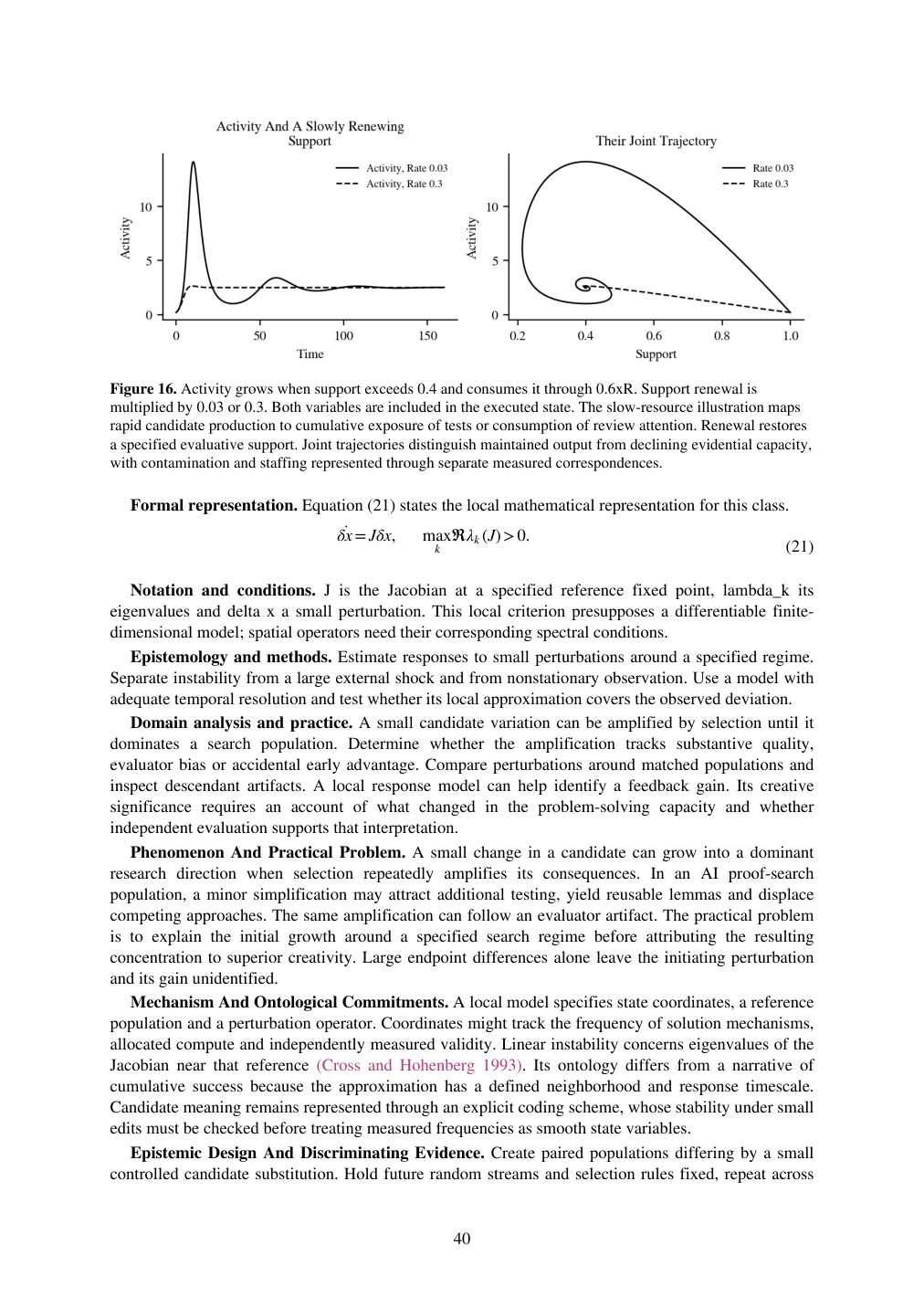
Readable text
Figure 16. Activity grows when support exceeds 0.4 and consumes it through 0.6xR. Support renewal is multiplied by 0.03 or 0.3. Both variables are included in the executed state. The slow-resource illustration maps rapid candidate production to cumulative exposure of tests or consumption of review attention. Renewal restores a specified evaluative support. Joint trajectories distinguish maintained output from declining evidential capacity, with contamination and staffing represented through separate measured correspondences.
Formal representation. Equation (21) states the local mathematical representation for this class.
Notation and conditions. J is the Jacobian at a specified reference fixed point, lambda_k its eigenvalues and delta x a small perturbation. This local criterion presupposes a differentiable finite- dimensional model; spatial operators need their corresponding spectral conditions.
Epistemology and methods. Estimate responses to small perturbations around a specified regime. Separate instability from a large external shock and from nonstationary observation. Use a model with adequate temporal resolution and test whether its local approximation covers the observed deviation.
Domain analysis and practice. A small candidate variation can be amplified by selection until it dominates a search population. Determine whether the amplification tracks substantive quality, evaluator bias or accidental early advantage. Compare perturbations around matched populations and inspect descendant artifacts. A local response model can help identify a feedback gain. Its creative significance requires an account of what changed in the problem-solving capacity and whether
independent evaluation supports that interpretation.
Phenomenon And Practical Problem. A small change in a candidate can grow into a dominant research direction when selection repeatedly amplifies its consequences. In an AI proof-search population, a minor simplification may attract additional testing, yield reusable lemmas and displace competing approaches. The same amplification can follow an evaluator artifact. The practical problem is to explain the initial growth around a specified search regime before attributing the resulting concentration to superior creativity. Large endpoint differences alone leave the initiating perturbation
Mechanism And Ontological Commitments. A local model specifies state coordinates, a reference population and a perturbation operator. Coordinates might track the frequency of solution mechanisms, allocated compute and independently measured validity. Linear instability concerns eigenvalues of the Jacobian near that reference (Cross and Hohenberg 1993). Its ontology differs from a narrative of cumulative success because the approximation has a defined neighborhood and response timescale. Candidate meaning remains represented through an explicit coding scheme, whose stability under small edits must be checked before treating measured frequencies as smooth state variables.
Epistemic Design And Discriminating Evidence. Create paired populations differing by a small controlled candidate substitution. Hold future random streams and selection rules fixed, repeat across
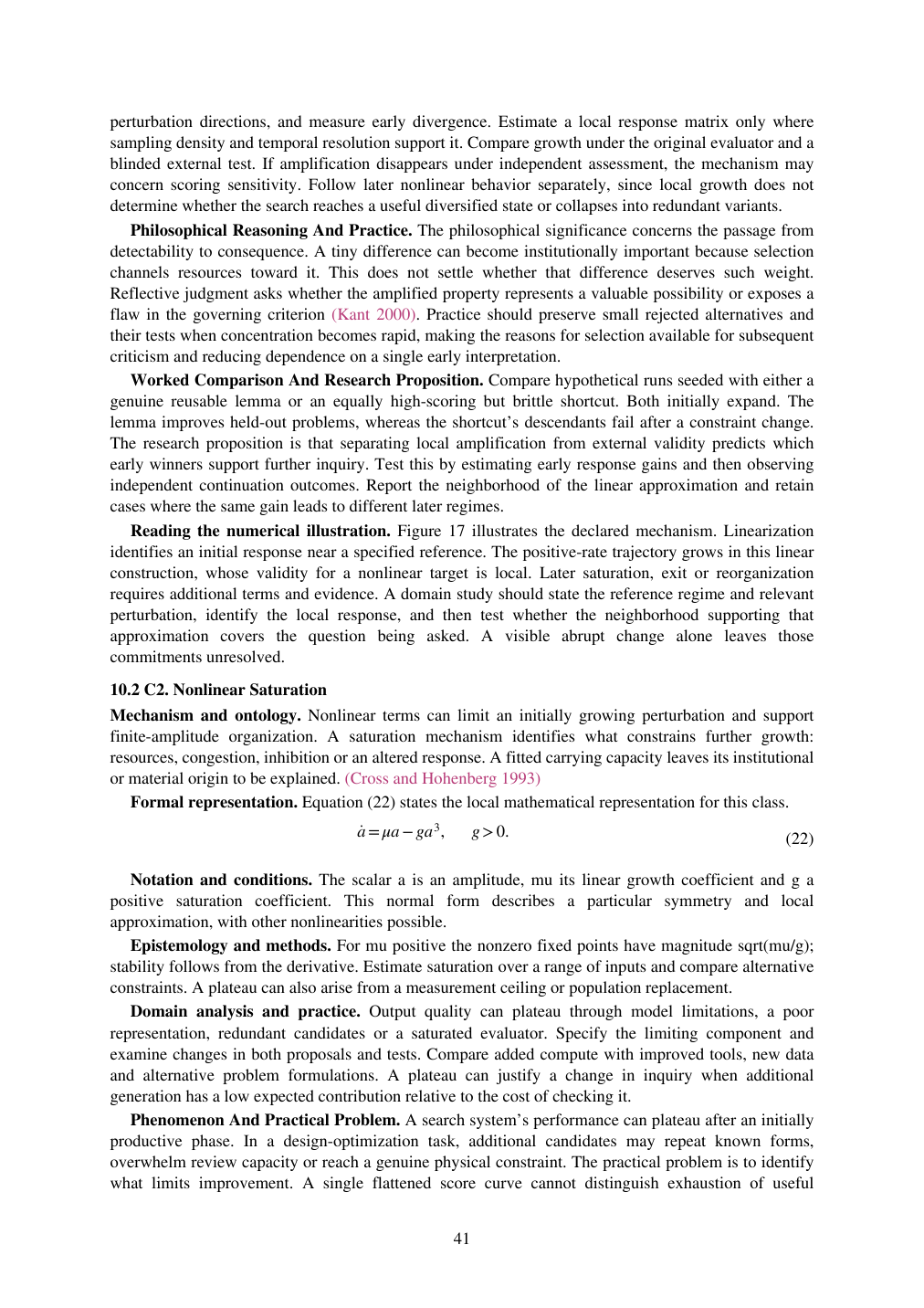
Readable text
perturbation directions, and measure early divergence. Estimate a local response matrix only where sampling density and temporal resolution support it. Compare growth under the original evaluator and a blinded external test. If amplification disappears under independent assessment, the mechanism may concern scoring sensitivity. Follow later nonlinear behavior separately, since local growth does not determine whether the search reaches a useful diversified state or collapses into redundant variants.
Philosophical Reasoning And Practice. The philosophical significance concerns the passage from detectability to consequence. A tiny difference can become institutionally important because selection channels resources toward it. This does not settle whether that difference deserves such weight. Reflective judgment asks whether the amplified property represents a valuable possibility or exposes a flaw in the governing criterion (Kant 2000). Practice should preserve small rejected alternatives and their tests when concentration becomes rapid, making the reasons for selection available for subsequent criticism and reducing dependence on a single early interpretation.
Worked Comparison And Research Proposition. Compare hypothetical runs seeded with either a genuine reusable lemma or an equally high-scoring but brittle shortcut. Both initially expand. The lemma improves held-out problems, whereas the shortcut’s descendants fail after a constraint change. The research proposition is that separating local amplification from external validity predicts which early winners support further inquiry. Test this by estimating early response gains and then observing independent continuation outcomes. Report the neighborhood of the linear approximation and retain cases where the same gain leads to different later regimes.
Reading the numerical illustration. Figure 17 illustrates the declared mechanism. Linearization identifies an initial response near a specified reference. The positive-rate trajectory grows in this linear construction, whose validity for a nonlinear target is local. Later saturation, exit or reorganization requires additional terms and evidence. A domain study should state the reference regime and relevant perturbation, identify the local response, and then test whether the neighborhood supporting that approximation covers the question being asked. A visible abrupt change alone leaves those
Mechanism and ontology. Nonlinear terms can limit an initially growing perturbation and support finite-amplitude organization. A saturation mechanism identifies what constrains further growth: resources, congestion, inhibition or an altered response. A fitted carrying capacity leaves its institutional or material origin to be explained. (Cross and Hohenberg 1993)
Formal representation. Equation (22) states the local mathematical representation for this class.
Notation and conditions. The scalar a is an amplitude, mu its linear growth coefficient and g a positive saturation coefficient. This normal form describes a particular symmetry and local
Epistemology and methods. For mu positive the nonzero fixed points have magnitude sqrt(mu/g); stability follows from the derivative. Estimate saturation over a range of inputs and compare alternative constraints. A plateau can also arise from a measurement ceiling or population replacement.
Domain analysis and practice. Output quality can plateau through model limitations, a poor representation, redundant candidates or a saturated evaluator. Specify the limiting component and examine changes in both proposals and tests. Compare added compute with improved tools, new data and alternative problem formulations. A plateau can justify a change in inquiry when additional generation has a low expected contribution relative to the cost of checking it.
Phenomenon And Practical Problem. A search system’s performance can plateau after an initially productive phase. In a design-optimization task, additional candidates may repeat known forms, overwhelm review capacity or reach a genuine physical constraint. The practical problem is to identify what limits improvement. A single flattened score curve cannot distinguish exhaustion of useful
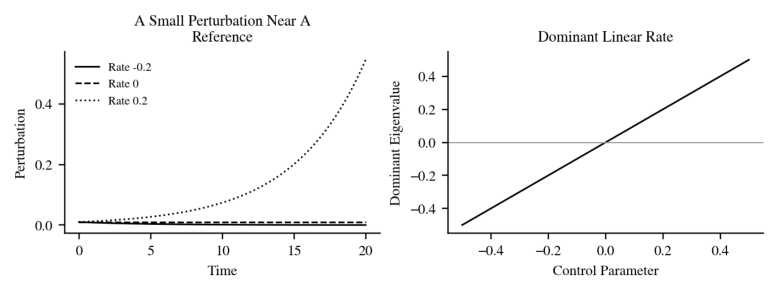
Figure 17. The two-mode diagonal linearization has rates mu and -1. A perturbation of 0.01 in the first mode decays, persists or grows as mu crosses zero. The instability illustration maps a small perturbation of a candidate population into early changes in lineage frequencies or resource allocation. Exponential growth is interpreted locally around a declared reference. External validity and later nonlinear outcomes provide additional tests of the amplified difference’s creative significance.
proposals from a test ceiling, an inadequate representation or the exclusion of harder cases from evaluation. Each explanation supports a different intervention and a different judgment about the scope of the claimed creative capacity.
Mechanism And Ontological Commitments. A saturation model states which growing quantity encounters which countervailing mechanism. A cubic amplitude term can provide a local mathematical form, with coefficients interpreted through the chosen search state (Cross and Hohenberg 1993). Its fit alone leaves the constraint’s origin open. The ontology may contain finite review slots, redundant candidate mechanisms, bounded task performance or inaccessible operations. These components should remain separately observable because reallocating review resources changes one limit, while extending the representation changes another and can alter the state space itself.
Epistemic Design And Discriminating Evidence. At the plateau, randomize extra generation, extra verification, a new proposal representation and a more discriminating evaluation set. Use a factorial design where budgets permit and a declared sequential design otherwise. Measure unique validated mechanisms, unresolved candidate backlog and performance on cases beyond the old score ceiling. A generation bottleneck predicts benefit from proposal changes; a verification bottleneck predicts benefit from additional testing. Retain the old task measure alongside the expanded one so that a changed evaluator is visible instead of being mistaken for improvement on an unchanged target.
Philosophical Reasoning And Practice. Capability reasoning asks what the workflow can actually accomplish under available supports (Sen 2009). A plateau can delimit a capability without showing that all valuable inquiry is exhausted. Practice should state the function whose performance has saturated and invite reasoned proposals for another function or representation. The stopping decision also requires opportunity-cost judgment: continuing a familiar line can consume the resources needed to investigate a better question. The evidence should make that tradeoff concrete, including the burdens imposed on reviewers and successor investigators.
Worked Comparison And Research Proposition. Compare hypothetical coding workflows that reach the same test score. One has many unreviewed diverse candidates; the other has exhausted its proposal language. Extra checking helps the first, while a new operation helps the second. The research proposition is that intervention-sensitive plateau diagnosis improves resource allocation relative to extending every run by a fixed number of samples. Test it on tasks with known bottlenecks, then evaluate whether the diagnosis generalizes to new tasks whose limiting mechanism is initially concealed from the system.
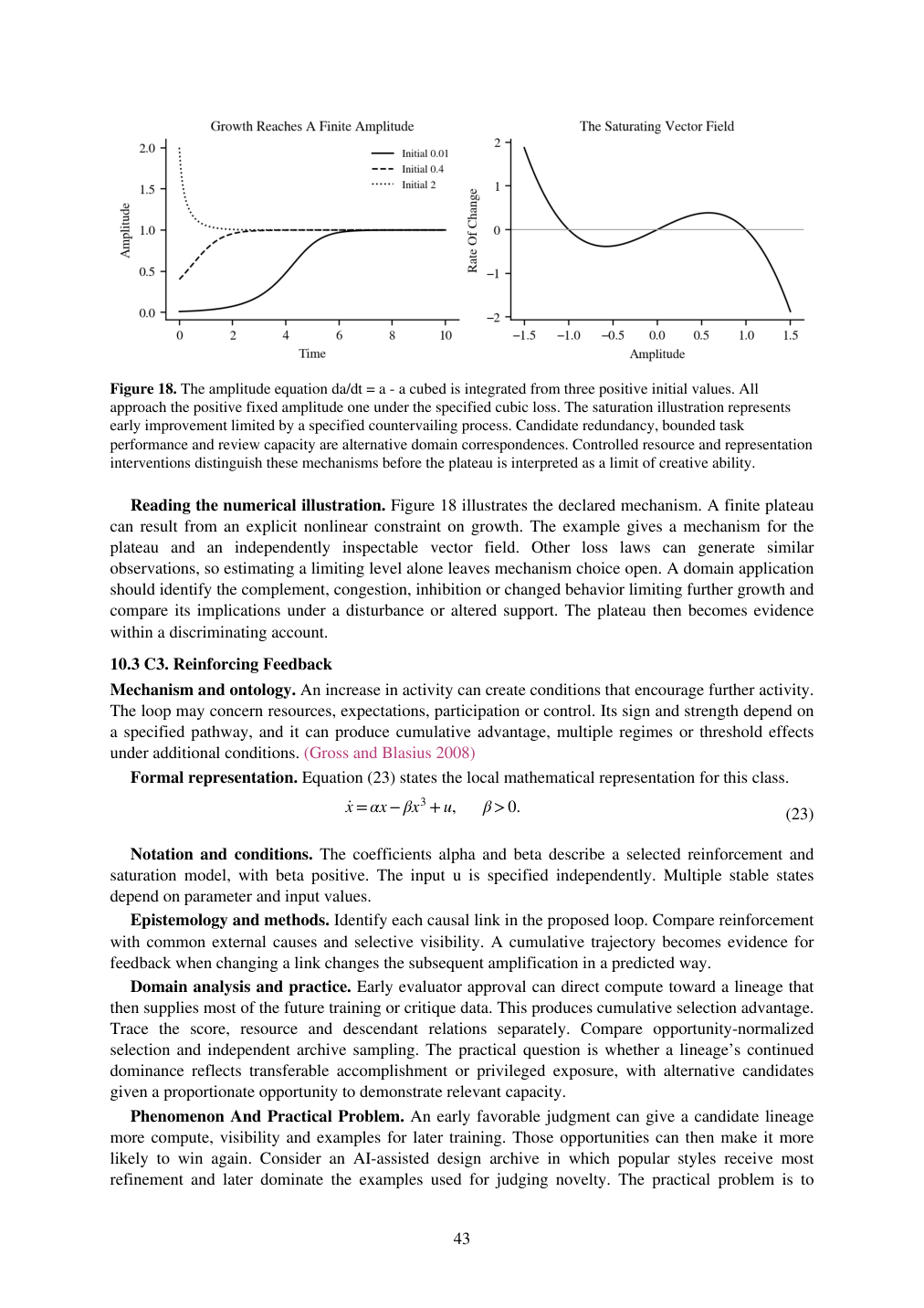
Readable text
Figure 18. The amplitude equation da/dt = a - a cubed is integrated from three positive initial values. All approach the positive fixed amplitude one under the specified cubic loss. The saturation illustration represents early improvement limited by a specified countervailing process. Candidate redundancy, bounded task performance and review capacity are alternative domain correspondences. Controlled resource and representation interventions distinguish these mechanisms before the plateau is interpreted as a limit of creative ability.
Reading the numerical illustration. Figure 18 illustrates the declared mechanism. A finite plateau can result from an explicit nonlinear constraint on growth. The example gives a mechanism for the plateau and an independently inspectable vector field. Other loss laws can generate similar observations, so estimating a limiting level alone leaves mechanism choice open. A domain application should identify the complement, congestion, inhibition or changed behavior limiting further growth and compare its implications under a disturbance or altered support. The plateau then becomes evidence
Mechanism and ontology. An increase in activity can create conditions that encourage further activity. The loop may concern resources, expectations, participation or control. Its sign and strength depend on a specified pathway, and it can produce cumulative advantage, multiple regimes or threshold effects
Formal representation. Equation (23) states the local mathematical representation for this class.
Notation and conditions. The coefficients alpha and beta describe a selected reinforcement and saturation model, with beta positive. The input u is specified independently. Multiple stable states
Epistemology and methods. Identify each causal link in the proposed loop. Compare reinforcement with common external causes and selective visibility. A cumulative trajectory becomes evidence for feedback when changing a link changes the subsequent amplification in a predicted way.
Domain analysis and practice. Early evaluator approval can direct compute toward a lineage that then supplies most of the future training or critique data. This produces cumulative selection advantage. Trace the score, resource and descendant relations separately. Compare opportunity-normalized selection and independent archive sampling. The practical question is whether a lineage’s continued dominance reflects transferable accomplishment or privileged exposure, with alternative candidates given a proportionate opportunity to demonstrate relevant capacity.
Phenomenon And Practical Problem. An early favorable judgment can give a candidate lineage more compute, visibility and examples for later training. Those opportunities can then make it more likely to win again. Consider an AI-assisted design archive in which popular styles receive most refinement and later dominate the examples used for judging novelty. The practical problem is to
Readable text
distinguish demonstrated transferable merit from opportunity accumulated through earlier selection. A lineage can improve in absolute terms while its relative dominance remains partly produced by unequal
Mechanism And Ontological Commitments. The reinforcing loop contains at least three links: judgment changes development resources, resources change observed achievement, and observed achievement changes later judgment. Each link has a distinct object and intervention. A positive-loop model can admit thresholds or multiple regimes when combined with suitable constraints (Gross and Blasius 2008). Such behavior requires the full response structure, beyond a rising trajectory. The ontology includes unselected candidates and their missing demonstrations, because evidence generated only after resource allocation can systematically favor the lineage that initially received support.
Epistemic Design And Discriminating Evidence. Randomize small development grants among candidates with comparable initial evidence. Compare ordinary score-based selection with opportunity- normalized selection and independent archival sampling. Track improvements per support unit and later external performance, while preserving the uncertainty around sparsely tested alternatives. A reinforcement account predicts that altered access changes subsequent dominance through the measured intermediate links. A common-quality account predicts persistence after equalized demonstration opportunities. The analysis should avoid controlling away post-allocation evidence when estimating the
Philosophical Reasoning And Practice. The norm-formation linkage concerns how successful examples become standards (Huang 2026a). Their repeated visibility can explain practical authority while leaving the reason for privileging their features open. Practice should distinguish a reason to develop a promising candidate from a reason to treat its descendants as the universal form of achievement. Epistemic justice gives grounds to inspect whose alternatives remain untested because the system has already concentrated resources (Fricker 2007). Appropriate correction depends on the inquiry’s purpose and the evidential opportunity being restored.
Worked Comparison And Research Proposition. Compare hypothetical lineages that begin with equal hidden task quality but receive unequal refinement budgets after a noisy first judgment. If the favored lineage later wins, run a counterfactual equal-support arm and inspect the mediating changes. The research proposition is that early support can create later score differences that selection then interprets as independent evidence of merit. Test the loop across noise levels and support rules, reporting both verified final achievement and the concentration of opportunities that produced the
Reading the numerical illustration. Figure 19 illustrates the declared mechanism. A reinforcing pathway can amplify an inherited difference and retain several attainable regimes. Saturation prevents unlimited growth in this declared construction. The root diagram shows that the bias and basin both matter for the observed endpoint. A domain account should trace the actual opportunity, resource or expectation loop and test its strength against rival pathways. Explaining the persistence of advantage through such a loop and justifying its allocation remain separate arguments with different premises.
Mechanism and ontology. A deviation elicits a response that reduces that deviation. The regulated variable, reference, sensor and corrective action specify the mechanism. Regulation can preserve a public function or maintain an unequal arrangement; the dynamic sign of feedback supplies a causal description while evaluation examines its object. (Folke et al. 2005)
Formal representation. Equation (24) states the local mathematical representation for this class.
Notation and conditions. The reference r is fixed in this elementary regulator and k is a positive response rate. A moving reference, imperfect sensor or delayed action needs an expanded model.
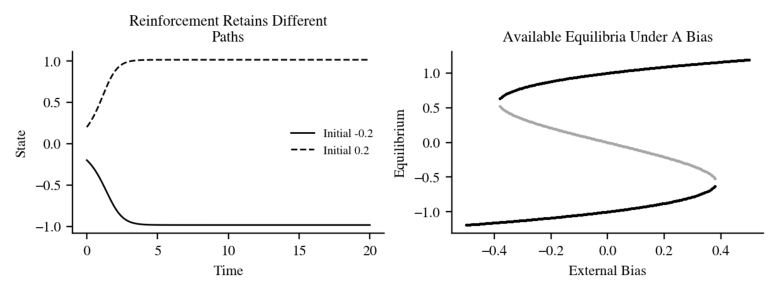
Figure 19. The reinforced state follows dx/dt = x - x cubed + 0.03. Distinct initial signs reach different stable equilibria. The equilibrium sweep uses black stable and gray unstable roots. The reinforcing-feedback illustration maps an initial score advantage through additional development resources into later observed performance. The loop is tested link by link. Equalized demonstration opportunities provide a comparison for separating transferable achievement from cumulative advantage created by earlier selection.
Epistemology and methods. Estimate the response rate and the accuracy of sensing. Inspect whose outcomes enter the target r and which burdens make correction possible. Changing a target, increasing gain and improving an observation channel are different interventions.
Domain analysis and practice. Validity checks, resource limits and critique can stabilize a creative workflow. The regulated variable might be factual correctness, executable behavior or conformity to a style. Specify the target and its scope. Compare a correction mechanism’s effect on error with its effect on exploration. A workflow can preserve reliable tests while providing a declared route for proposing a new representation or challenging an evaluator that rejects a substantively useful departure.
Phenomenon And Practical Problem. Creative exploration often needs a reliable boundary against errors that would make its outputs unusable. A code-generating agent may be free to invent an algorithm while tests enforce memory safety or a declared interface. The practical problem is to stabilize the required function without suppressing departures that could improve the task itself. A strong controller can prevent invalid artifacts and can also trap inquiry inside an outdated measure of acceptability. The regulated property and the opportunity to challenge its definition therefore need separate treatment.
Mechanism And Ontological Commitments. The regulator contains a reference, an observation channel, a corrective policy and an actuator able to change the candidate or its selection probability. A simple negative-gain rule describes response to a measured deviation under a fixed target. Moving criteria, noisy tests and delayed repairs require expanded dynamics (Folke et al. 2005). The ontology includes the difference between actual validity and observed test success. A workflow can stabilize the latter while leaving the former uncertain when its sensor has incomplete coverage or correlated blind spots.
Epistemic Design And Discriminating Evidence. Cross correction strength with test coverage in a controlled synthesis task. Measure error reduction, loss of distinct solution mechanisms and success after a held-out requirement changes. Introduce a review route through which a candidate can demonstrate that a rejected feature satisfies the underlying purpose by another means. A stabilizing mechanism predicts reduced deviations in the specified variable. Creative usefulness additionally requires retained capacity for a warranted departure. Compare these outcomes separately and record the support cost of stronger checking and of reviewing exceptional candidates.
Philosophical Reasoning And Practice. The philosophical issue is the justification of a stable standard. Correctness requirements can protect users and make criticism intelligible, while aesthetic or methodological conventions can deserve revision. Reflective judgment supplies a reason to examine the
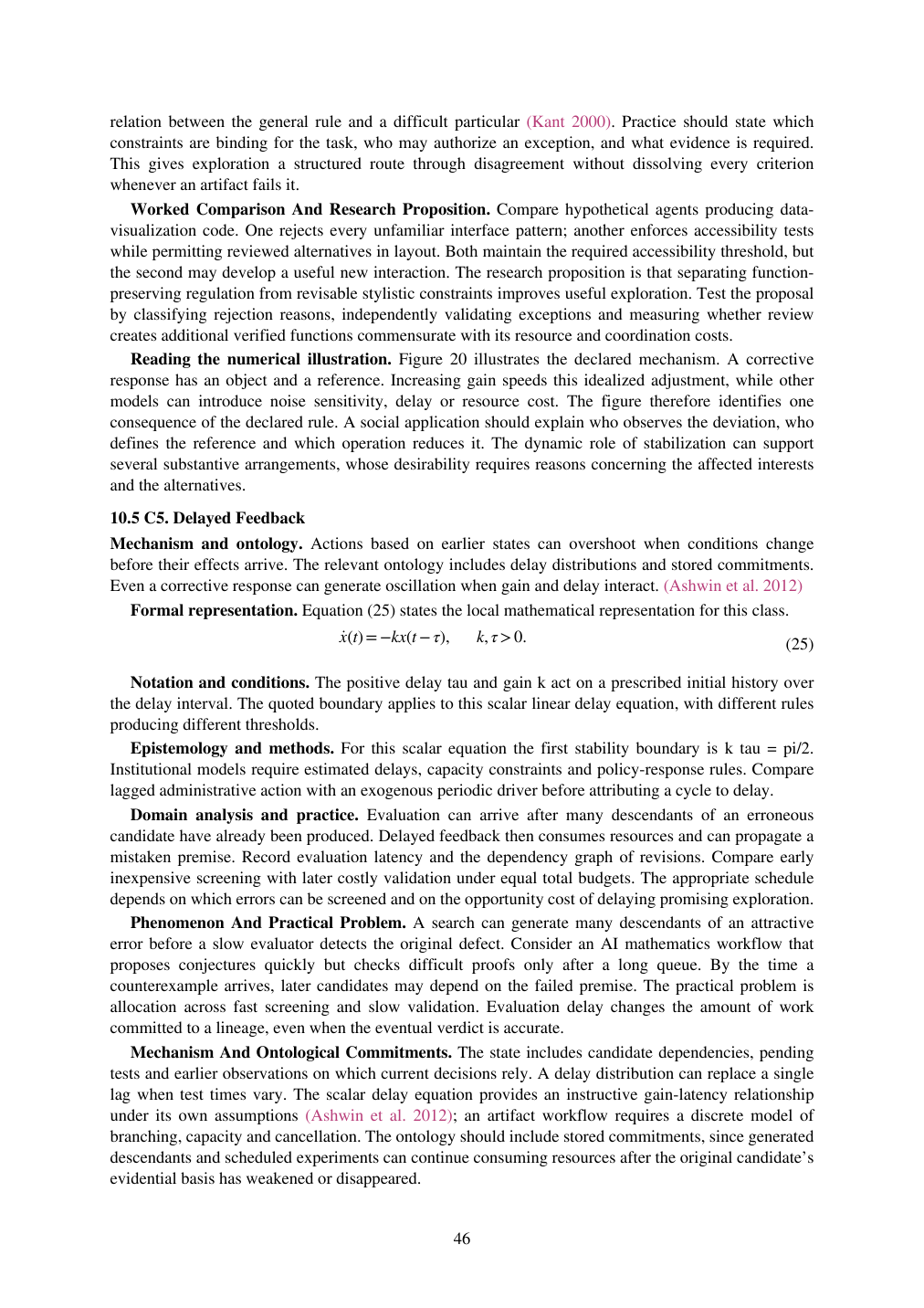
Readable text
relation between the general rule and a difficult particular (Kant 2000). Practice should state which constraints are binding for the task, who may authorize an exception, and what evidence is required. This gives exploration a structured route through disagreement without dissolving every criterion
Worked Comparison And Research Proposition. Compare hypothetical agents producing data- visualization code. One rejects every unfamiliar interface pattern; another enforces accessibility tests while permitting reviewed alternatives in layout. Both maintain the required accessibility threshold, but the second may develop a useful new interaction. The research proposition is that separating function- preserving regulation from revisable stylistic constraints improves useful exploration. Test the proposal by classifying rejection reasons, independently validating exceptions and measuring whether review creates additional verified functions commensurate with its resource and coordination costs.
Reading the numerical illustration. Figure 20 illustrates the declared mechanism. A corrective response has an object and a reference. Increasing gain speeds this idealized adjustment, while other models can introduce noise sensitivity, delay or resource cost. The figure therefore identifies one consequence of the declared rule. A social application should explain who observes the deviation, who defines the reference and which operation reduces it. The dynamic role of stabilization can support several substantive arrangements, whose desirability requires reasons concerning the affected interests
Mechanism and ontology. Actions based on earlier states can overshoot when conditions change before their effects arrive. The relevant ontology includes delay distributions and stored commitments. Even a corrective response can generate oscillation when gain and delay interact. (Ashwin et al. 2012)
Formal representation. Equation (25) states the local mathematical representation for this class.
Notation and conditions. The positive delay tau and gain k act on a prescribed initial history over the delay interval. The quoted boundary applies to this scalar linear delay equation, with different rules
Epistemology and methods. For this scalar equation the first stability boundary is k tau = pi/2. Institutional models require estimated delays, capacity constraints and policy-response rules. Compare lagged administrative action with an exogenous periodic driver before attributing a cycle to delay.
Domain analysis and practice. Evaluation can arrive after many descendants of an erroneous candidate have already been produced. Delayed feedback then consumes resources and can propagate a mistaken premise. Record evaluation latency and the dependency graph of revisions. Compare early inexpensive screening with later costly validation under equal total budgets. The appropriate schedule depends on which errors can be screened and on the opportunity cost of delaying promising exploration.
Phenomenon And Practical Problem. A search can generate many descendants of an attractive error before a slow evaluator detects the original defect. Consider an AI mathematics workflow that proposes conjectures quickly but checks difficult proofs only after a long queue. By the time a counterexample arrives, later candidates may depend on the failed premise. The practical problem is allocation across fast screening and slow validation. Evaluation delay changes the amount of work committed to a lineage, even when the eventual verdict is accurate.
Mechanism And Ontological Commitments. The state includes candidate dependencies, pending tests and earlier observations on which current decisions rely. A delay distribution can replace a single lag when test times vary. The scalar delay equation provides an instructive gain-latency relationship under its own assumptions (Ashwin et al. 2012); an artifact workflow requires a discrete model of branching, capacity and cancellation. The ontology should include stored commitments, since generated descendants and scheduled experiments can continue consuming resources after the original candidate’s
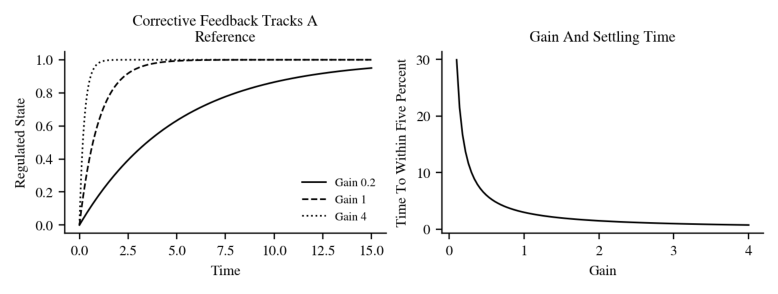
Figure 20. The response dx/dt = -k(x - 1) begins at zero. Its exact five-percent settling time is log(20)/k; the comparison excludes delay, noise, and actuator limits by construction. The stabilizing-feedback illustration represents a measured deviation triggering corrective action toward a declared functional requirement. Sensor quality and correction gain are varied separately. Maintained validity and retained exploratory capacity are distinct outcomes, with criterion revision handled through an explicit review procedure.
Epistemic Design And Discriminating Evidence. Randomize validation latency independently of candidate quality in a synthetic task with known hidden errors. Compare immediate cheap screening, delayed exact checking and a staged combination under equal total budgets. Record wasted descendant evaluations, time to validated progress and the cost of prematurely rejecting a useful candidate. Dependency tracking makes it possible to distinguish delay propagation from unrelated later failures. A causal delay account predicts that earlier detection reduces work on dependent invalid branches, with the benefit depending on branching rate and cancellation effectiveness.
Philosophical Reasoning And Practice. The linkage to practical judgment concerns when provisional acceptance is warranted. Exploration can reasonably proceed under uncertainty, provided its provisional status and dependency costs remain visible. A Deweyan account connects inquiry to the consequences of treating a proposal as a guide for action (Dewey 1927). Practice should mark unverified premises, limit commitments where reversal is expensive and preserve a route for withdrawing descendants. The appropriate policy follows the task’s consequences, including how a mistaken premise affects users and investigators who inherit the work.
Worked Comparison And Research Proposition. Compare hypothetical proof-search populations with the same final checker. In one arm all descendants receive equal priority; in another the system limits expansion of unvalidated high-dependency claims. If the second reaches fewer raw candidates but more verified results, inspect whether reduced waste mediates the gain. The research proposition is that dependency-aware scheduling improves supported discovery when validation is slower than proposal generation. Test thresholds across branching rates and error frequencies, retaining cases where early screening mistakenly prunes a productive but difficult-to-verify line.
Reading the numerical illustration. Figure 21 illustrates the declared mechanism. A corrective sign can coexist with an unstable delayed loop. The effect arrives after the state that triggered it, so correction can overshoot. The numerical traces are approximations to a declared delay equation; the analytic boundary provides a separate reference for their interpretation. A domain inquiry should reconstruct the distribution of reporting, decision and implementation delays, investigate their interaction with gain, and compare proportional adjustments with operations based on more current or better forecast information.
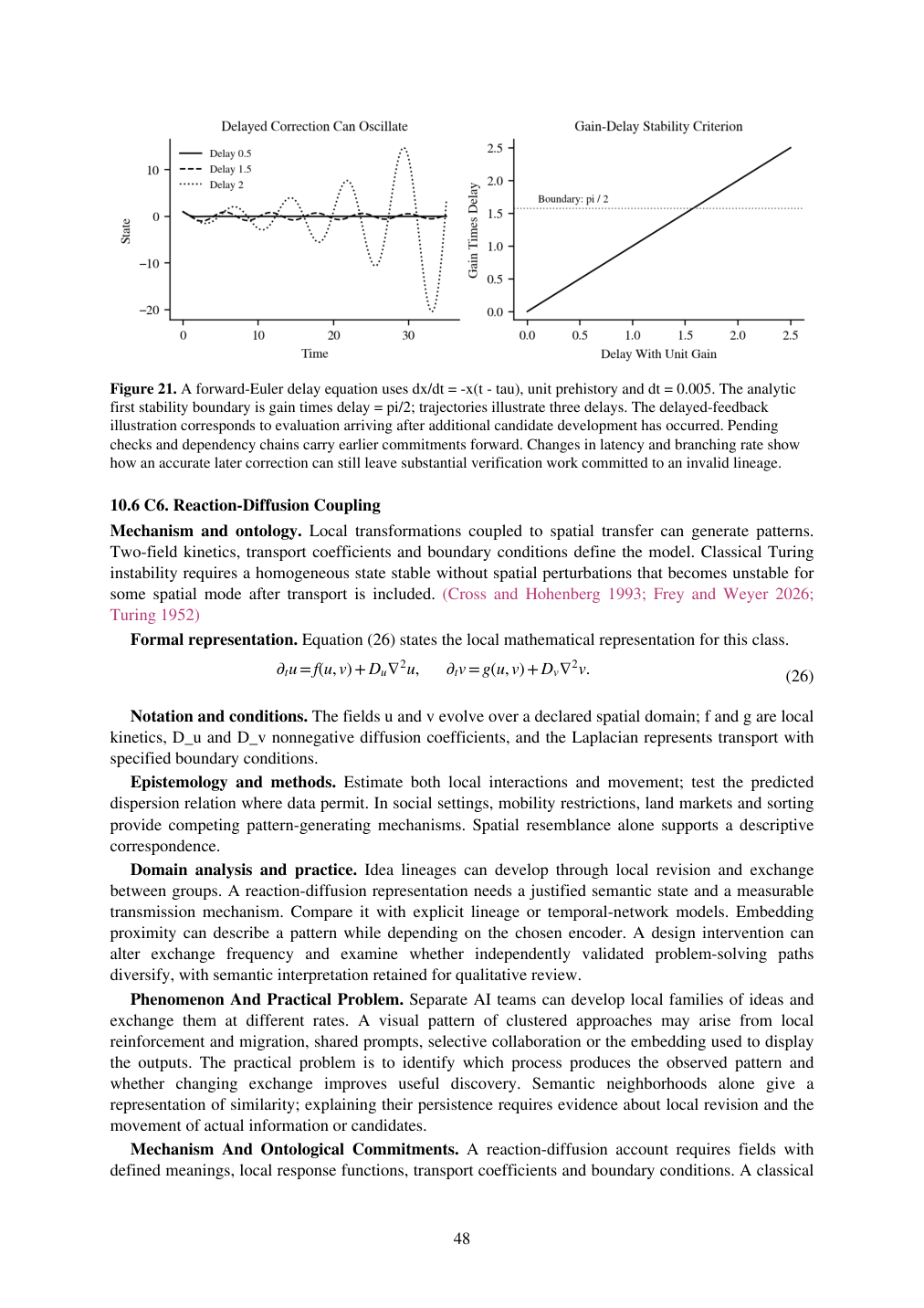
Readable text
Figure 21. A forward-Euler delay equation uses dx/dt = -x(t - tau), unit prehistory and dt = 0.005. The analytic first stability boundary is gain times delay = pi/2; trajectories illustrate three delays. The delayed-feedback illustration corresponds to evaluation arriving after additional candidate development has occurred. Pending checks and dependency chains carry earlier commitments forward. Changes in latency and branching rate show how an accurate later correction can still leave substantial verification work committed to an invalid lineage.
Mechanism and ontology. Local transformations coupled to spatial transfer can generate patterns. Two-field kinetics, transport coefficients and boundary conditions define the model. Classical Turing instability requires a homogeneous state stable without spatial perturbations that becomes unstable for some spatial mode after transport is included. (Cross and Hohenberg 1993; Frey and Weyer 2026;
Formal representation. Equation (26) states the local mathematical representation for this class.
Notation and conditions. The fields u and v evolve over a declared spatial domain; f and g are local kinetics, D_u and D_v nonnegative diffusion coefficients, and the Laplacian represents transport with
Epistemology and methods. Estimate both local interactions and movement; test the predicted dispersion relation where data permit. In social settings, mobility restrictions, land markets and sorting provide competing pattern-generating mechanisms. Spatial resemblance alone supports a descriptive
Domain analysis and practice. Idea lineages can develop through local revision and exchange between groups. A reaction-diffusion representation needs a justified semantic state and a measurable transmission mechanism. Compare it with explicit lineage or temporal-network models. Embedding proximity can describe a pattern while depending on the chosen encoder. A design intervention can alter exchange frequency and examine whether independently validated problem-solving paths diversify, with semantic interpretation retained for qualitative review.
Phenomenon And Practical Problem. Separate AI teams can develop local families of ideas and exchange them at different rates. A visual pattern of clustered approaches may arise from local reinforcement and migration, shared prompts, selective collaboration or the embedding used to display the outputs. The practical problem is to identify which process produces the observed pattern and whether changing exchange improves useful discovery. Semantic neighborhoods alone give a representation of similarity; explaining their persistence requires evidence about local revision and the
Mechanism And Ontological Commitments. A reaction-diffusion account requires fields with defined meanings, local response functions, transport coefficients and boundary conditions. A classical
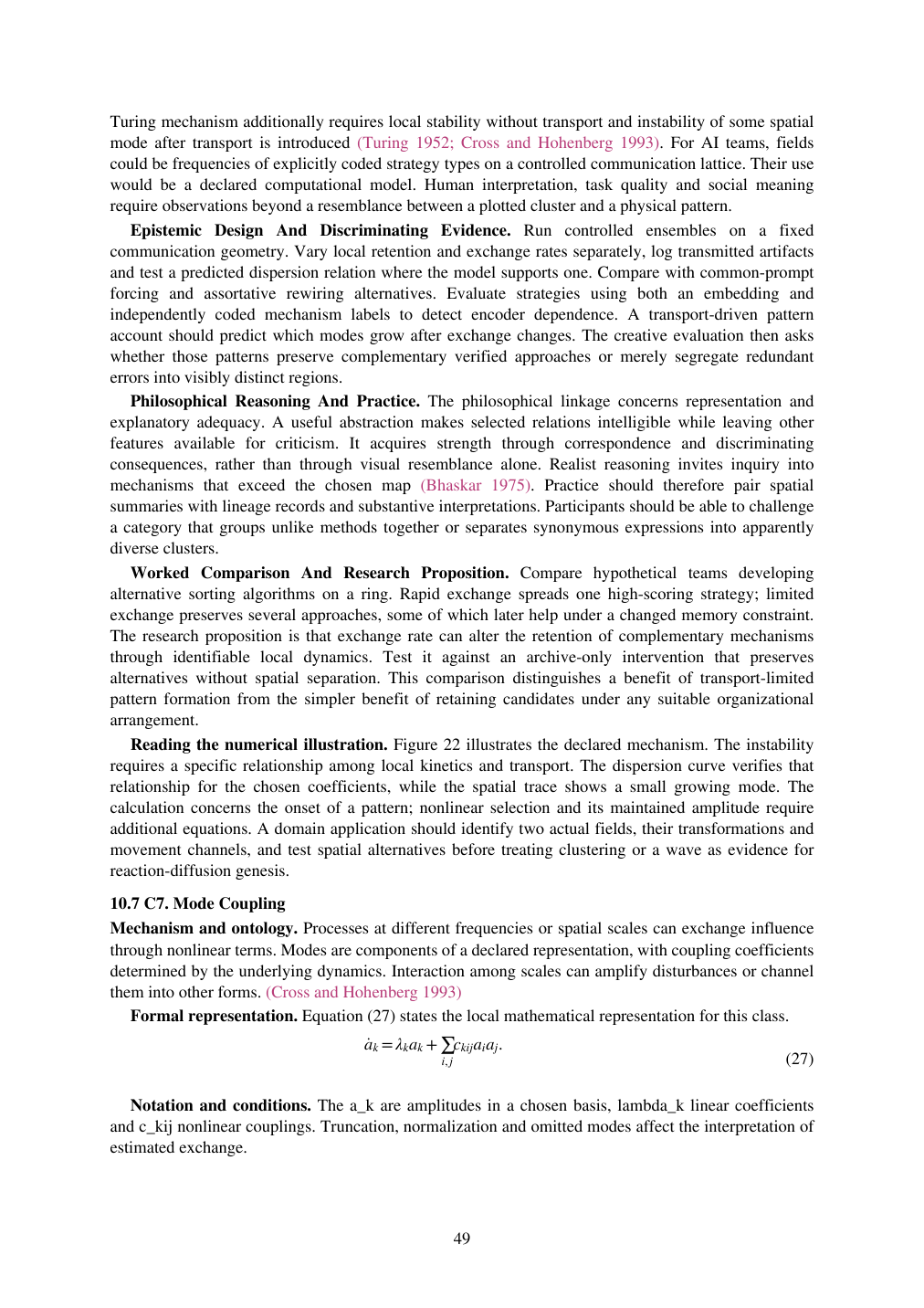
Readable text
Turing mechanism additionally requires local stability without transport and instability of some spatial mode after transport is introduced (Turing 1952; Cross and Hohenberg 1993). For AI teams, fields could be frequencies of explicitly coded strategy types on a controlled communication lattice. Their use would be a declared computational model. Human interpretation, task quality and social meaning require observations beyond a resemblance between a plotted cluster and a physical pattern.
Epistemic Design And Discriminating Evidence. Run controlled ensembles on a fixed communication geometry. Vary local retention and exchange rates separately, log transmitted artifacts and test a predicted dispersion relation where the model supports one. Compare with common-prompt forcing and assortative rewiring alternatives. Evaluate strategies using both an embedding and independently coded mechanism labels to detect encoder dependence. A transport-driven pattern account should predict which modes grow after exchange changes. The creative evaluation then asks whether those patterns preserve complementary verified approaches or merely segregate redundant
Philosophical Reasoning And Practice. The philosophical linkage concerns representation and explanatory adequacy. A useful abstraction makes selected relations intelligible while leaving other features available for criticism. It acquires strength through correspondence and discriminating consequences, rather than through visual resemblance alone. Realist reasoning invites inquiry into mechanisms that exceed the chosen map (Bhaskar 1975). Practice should therefore pair spatial summaries with lineage records and substantive interpretations. Participants should be able to challenge a category that groups unlike methods together or separates synonymous expressions into apparently
Worked Comparison And Research Proposition. Compare hypothetical teams developing alternative sorting algorithms on a ring. Rapid exchange spreads one high-scoring strategy; limited exchange preserves several approaches, some of which later help under a changed memory constraint. The research proposition is that exchange rate can alter the retention of complementary mechanisms through identifiable local dynamics. Test it against an archive-only intervention that preserves alternatives without spatial separation. This comparison distinguishes a benefit of transport-limited pattern formation from the simpler benefit of retaining candidates under any suitable organizational
Reading the numerical illustration. Figure 22 illustrates the declared mechanism. The instability requires a specific relationship among local kinetics and transport. The dispersion curve verifies that relationship for the chosen coefficients, while the spatial trace shows a small growing mode. The calculation concerns the onset of a pattern; nonlinear selection and its maintained amplitude require additional equations. A domain application should identify two actual fields, their transformations and movement channels, and test spatial alternatives before treating clustering or a wave as evidence for
Mechanism and ontology. Processes at different frequencies or spatial scales can exchange influence through nonlinear terms. Modes are components of a declared representation, with coupling coefficients determined by the underlying dynamics. Interaction among scales can amplify disturbances or channel
Formal representation. Equation (27) states the local mathematical representation for this class.
Notation and conditions. The a_k are amplitudes in a chosen basis, lambda_k linear coefficients and c_kij nonlinear couplings. Truncation, normalization and omitted modes affect the interpretation of
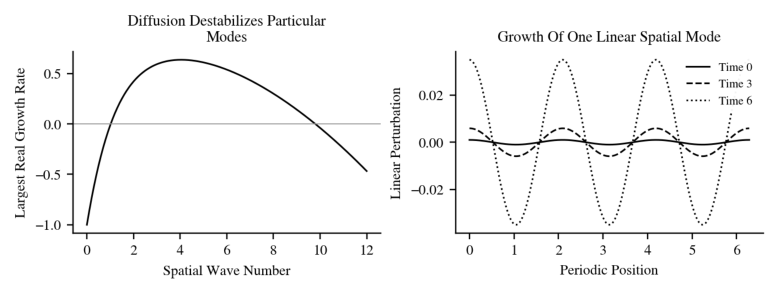
Figure 22. The local Jacobian is [[1,2],[-2,-3]], with diffusion 0.01 and 1. Homogeneous kinetics are stable; some nonzero spatial modes grow. The right panel propagates wave number three in the linearized periodic system. The reaction-diffusion illustration maps local strategy revision and controlled candidate exchange onto explicitly defined fields. Pattern growth requires a tested interaction-and-transport model. Semantic resemblance supplies an exploratory map; a Turing claim additionally needs the corresponding local-stability and spatial-mode evidence.
Epistemology and methods. Choose a basis and temporal window before estimating mode interactions. Common forcing can mimic cross-scale influence. In social inquiry, trace a mechanism linking organizational levels alongside any spectral or multiresolution analysis.
Domain analysis and practice. Token generation, artifact revision, population selection and research-program change operate at different scales. Improvement at one scale can suppress variation needed at another. Record the passage from local edits to evaluator decisions and retained research directions. Compare within-artifact optimization with changes in the problem portfolio. A practical system can allocate budgets across these scales and evaluate whether a local gain preserves the capacity to revise the larger question.
Phenomenon And Practical Problem. A creative workflow can optimize sentences while losing the argument that gave those sentences a purpose. At another scale, an agent can refine an entire artifact while neglecting a more promising research direction. The practical problem is interaction across levels of revision. Improvement measured at one scale can redistribute attention, evidence and candidate variety at another. An account of creative development should specify the passage through which a local edit affects an artifact, and how artifact selection changes the portfolio of questions that remains available.
Mechanism And Ontological Commitments. Modes are components of a declared representation, such as edit frequencies, strategy proportions or temporal components of activity. Their coupling coefficients describe interactions within that representation (Cross and Hohenberg 1993). Organizational levels are not automatically mathematical modes. A defensible correspondence explains the basis, normalization and mechanism linking scales. The ontology includes both artifact relations and allocation decisions: a small syntax repair changes executable behavior, whereas an adoption decision changes which larger program receives resources. Aggregation can hide these different operations when both appear as a rising score.
Epistemic Design And Discriminating Evidence. Instrument edits, artifact evaluations and program-level selection on their respective clocks. Compare within-artifact optimization with scheduled opportunities to revise the research portfolio. Use multiresolution analysis only after defining the basis and checking that common forcing does not explain the apparent cross-scale dependence. A causal coupling test intervenes at one level and predicts a measured consequence at another. Track costs and delayed effects, since a local quality improvement can consume the budget that would have exposed a superior approach at the portfolio level.
Philosophical Reasoning And Practice. The philosophical issue concerns what is taken as the unit of a creative contribution. A passage, an artifact and a changed problem formulation support different claims. Process-oriented reasoning allows their identities to develop through relations while requiring evidence of the relevant continuity (Whitehead 1978). Practice should state which unit is being evaluated and preserve the possibility that a local failure is informative for a larger inquiry. This makes it possible to value a negative result that redirects a research program without disguising it as a successful artifact.
Worked Comparison And Research Proposition. Compare hypothetical theorem-search workflows. One spends all remaining calls refining its best proof attempt; another periodically tests whether a different lemma decomposition offers a better route. Equalize total calls and measure final verified results plus reusable intermediate findings. The research proposition is that deliberate crossscale review improves inquiry when local optimization and problem reformulation have different response times. Test several review frequencies and inspect the actual transfer mechanism, including cases where frequent portfolio revision interrupts productive sustained development.
Reading the numerical illustration. Figure 23 illustrates the declared mechanism. An observed component can be generated through interaction with another mode even when its own isolated rate is decaying. The exact solution identifies the quadratic channel and compares it with the decoupled rule. Modes here are defined dynamical coordinates with a stated transformation. A domain use should justify its frequency, scale or representational decomposition and test the corresponding coupling operation. Mere association between levels leaves that operative relation to be established.
10.8 C8. Stochastic Escape
Mechanism and ontology. Random perturbations can move a system between long-lived regimes. A basin, transition path and noise model specify the account. Escape can occur while the local stability of the original regime persists, making it distinct from a bifurcation-induced transition. (Ashwin et al. 2012; Boettiger and Hastings 2012) Formal representation. Equation (28) states the local mathematical representation for this class.
dx=−V ′(x)dt+√2D dWt. (28)
Notation and conditions. V is a specified potential, D positive noise intensity and W standard Wiener noise. General non-gradient dynamics require another drift representation. The potential and noise conventions determine barrier and escape interpretations.
Epistemology and methods. Estimate residence times and compare escape-rate predictions across disturbance levels. Validate the assumed potential or use a more general non-gradient model. A selected historical transition leaves the frequency of comparable non-transitions essential to assessing a warning signal.
Domain analysis and practice. Occasional multi-step edits or outside encounters can move search out of a familiar region. A lucky output leaves open whether the workflow can recognize, validate and develop it. Retain unsuccessful perturbations and compare escape frequency with subsequent useful continuation. Vary perturbation size and validation access separately. Practical support for discovery includes a route for capturing a promising departure and resources for testing whether it survives further scrutiny.
Phenomenon And Practical Problem. An unexpected edit can move a search into a region that ordinary local improvements rarely reach. Yet a rare departure is useful only if the workflow can preserve, verify and develop it. Consider a synthesis task requiring two coordinated changes that individually lower the score. A lucky composite mutation can cross the intermediate valley, while the next selection step can immediately discard it. The practical problem is to distinguish the generation of an escape from the institutional or computational capacity to recognize a promising new line.
Mechanism And Ontological Commitments. A stochastic escape model specifies a basin, a drift, a noise process and a transition boundary. A potential representation is appropriate only when its
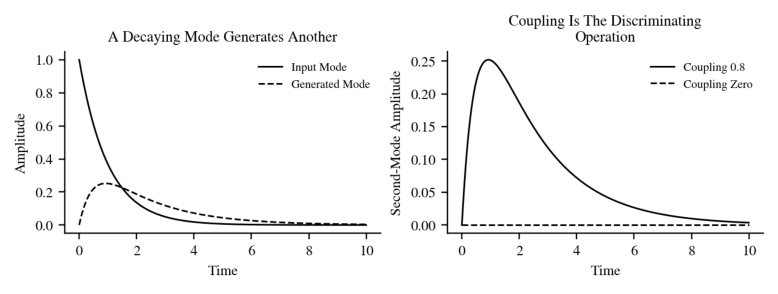
Figure 23. The input mode obeys db/dt = -b, while da/dt = -0.5a + 0.8b squared, with b(0)=1 and a(0)=0. The second panel removes only the coupling term. The mode-coupling illustration represents interactions among explicitly defined components of search activity. Local edits, artifact revision and portfolio allocation require a stated mapping to those components. Intervention across one level tests whether an apparent cross-scale relation reflects coupling or a shared external driver.
structural assumptions hold (Ashwin et al. 2012). In artifact search, a basin can be defined operationally through return probabilities under a stated edit-and-selection rule. The ontology includes transient candidates outside the basin and the retention mechanism that determines their survival. A selected success story supplies a path; estimating an escape mechanism also requires the many comparable trajectories that remain in the original region.
Epistemic Design And Discriminating Evidence. Vary perturbation size and retention duration independently. Record first exits, returns, validation outcomes and successful continuation, using fixed definitions chosen before examining successful examples. Compare a noise-induced escape account with a change in the evaluator or external task. Include non-transitions in residence-time estimates and test sensitivity to basin boundaries (Boettiger and Hastings 2012). If perturbations increase exits without increasing validated continuation, the bottleneck lies after escape. A temporary exploration archive can then be compared with further noise injection under equal resource budgets.
Philosophical Reasoning And Practice. The philosophical linkage concerns openness to anomalies without granting every anomaly equal significance. A departure becomes a reason for revising inquiry when it survives criticism or exposes an inadequacy in the current frame. Reflective judgment gives that appraisal a role (Kant 2000). Practice should preserve enough provenance to reconstruct an unusual candidate and explain why it merits further examination. It should also provide a stopping rule, since indefinite protection of every surprising output can exhaust the resources needed for a disciplined inquiry.
Worked Comparison And Research Proposition. Compare hypothetical search agents facing a deceptive binary task. One increases mutation intensity; another keeps intensity fixed and temporarily retains high-uncertainty departures for independent testing. If both escape equally often but the second develops more verified solutions, retention and recognition explain the difference. The research proposition is that post-escape support can be more effective than additional perturbation once encounter rates exceed checking capacity. Test the interaction across basin geometry, validation delay and archive cost, reporting both useful transitions and the unsuccessful departures they required.
Reading the numerical illustration. Figure 24 illustrates the declared mechanism. Noise-induced escape can occur while the deterministic equilibria remain locally stable. The finite-horizon fraction answers a specific passage question and includes paths that have yet to cross by the deadline. It therefore supplies a different object from an uncensored mean first-passage time. A domain inquiry should identify the basin, disturbance and exit criterion, compare changes in disturbance with changes in the deterministic law, and retain the relevant censoring and horizon in its report.
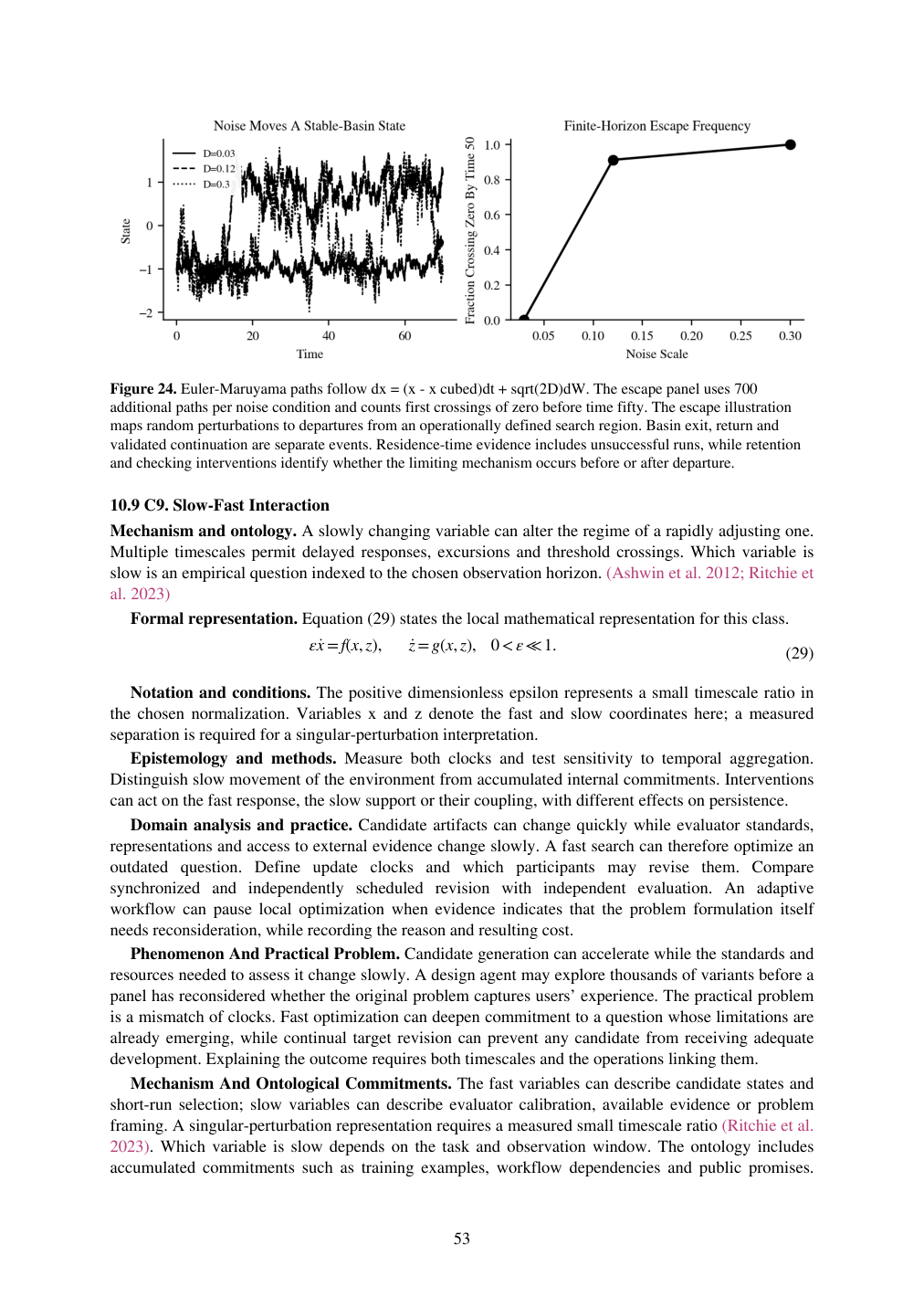
Readable text
Figure 24. Euler-Maruyama paths follow dx = (x - x cubed)dt + sqrt(2D)dW. The escape panel uses 700 additional paths per noise condition and counts first crossings of zero before time fifty. The escape illustration maps random perturbations to departures from an operationally defined search region. Basin exit, return and validated continuation are separate events. Residence-time evidence includes unsuccessful runs, while retention and checking interventions identify whether the limiting mechanism occurs before or after departure.
Mechanism and ontology. A slowly changing variable can alter the regime of a rapidly adjusting one. Multiple timescales permit delayed responses, excursions and threshold crossings. Which variable is slow is an empirical question indexed to the chosen observation horizon. (Ashwin et al. 2012; Ritchie et
Formal representation. Equation (29) states the local mathematical representation for this class.
Notation and conditions. The positive dimensionless epsilon represents a small timescale ratio in the chosen normalization. Variables x and z denote the fast and slow coordinates here; a measured separation is required for a singular-perturbation interpretation.
Epistemology and methods. Measure both clocks and test sensitivity to temporal aggregation. Distinguish slow movement of the environment from accumulated internal commitments. Interventions can act on the fast response, the slow support or their coupling, with different effects on persistence.
Domain analysis and practice. Candidate artifacts can change quickly while evaluator standards, representations and access to external evidence change slowly. A fast search can therefore optimize an outdated question. Define update clocks and which participants may revise them. Compare synchronized and independently scheduled revision with independent evaluation. An adaptive workflow can pause local optimization when evidence indicates that the problem formulation itself needs reconsideration, while recording the reason and resulting cost.
Phenomenon And Practical Problem. Candidate generation can accelerate while the standards and resources needed to assess it change slowly. A design agent may explore thousands of variants before a panel has reconsidered whether the original problem captures users’ experience. The practical problem is a mismatch of clocks. Fast optimization can deepen commitment to a question whose limitations are already emerging, while continual target revision can prevent any candidate from receiving adequate development. Explaining the outcome requires both timescales and the operations linking them.
Mechanism And Ontological Commitments. The fast variables can describe candidate states and short-run selection; slow variables can describe evaluator calibration, available evidence or problem framing. A singular-perturbation representation requires a measured small timescale ratio (Ritchie et al. 2023). Which variable is slow depends on the task and observation window. The ontology includes accumulated commitments such as training examples, workflow dependencies and public promises.
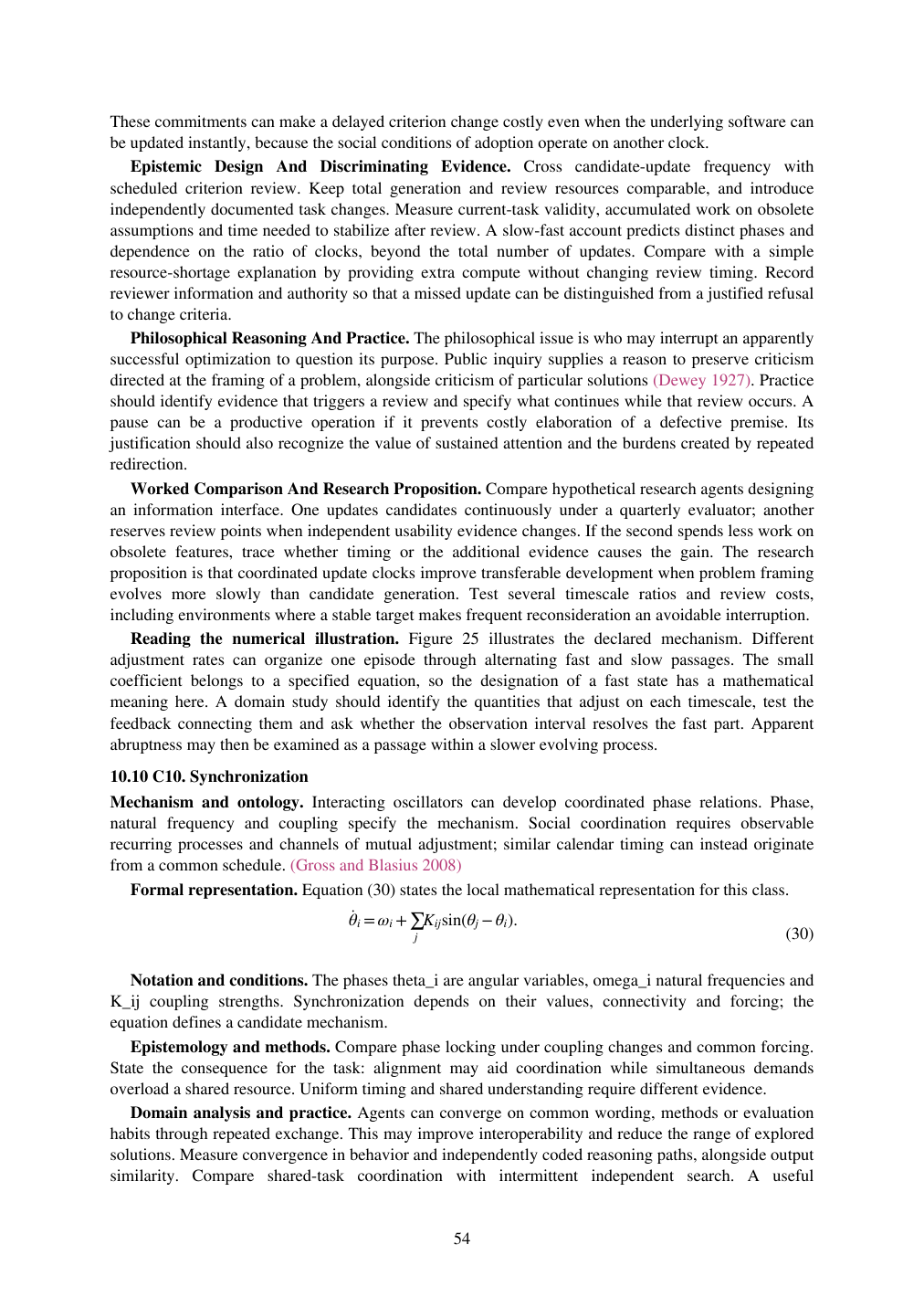
Readable text
These commitments can make a delayed criterion change costly even when the underlying software can be updated instantly, because the social conditions of adoption operate on another clock.
Epistemic Design And Discriminating Evidence. Cross candidate-update frequency with scheduled criterion review. Keep total generation and review resources comparable, and introduce independently documented task changes. Measure current-task validity, accumulated work on obsolete assumptions and time needed to stabilize after review. A slow-fast account predicts distinct phases and dependence on the ratio of clocks, beyond the total number of updates. Compare with a simple resource-shortage explanation by providing extra compute without changing review timing. Record reviewer information and authority so that a missed update can be distinguished from a justified refusal
Philosophical Reasoning And Practice. The philosophical issue is who may interrupt an apparently successful optimization to question its purpose. Public inquiry supplies a reason to preserve criticism directed at the framing of a problem, alongside criticism of particular solutions (Dewey 1927). Practice should identify evidence that triggers a review and specify what continues while that review occurs. A pause can be a productive operation if it prevents costly elaboration of a defective premise. Its justification should also recognize the value of sustained attention and the burdens created by repeated
Worked Comparison And Research Proposition. Compare hypothetical research agents designing an information interface. One updates candidates continuously under a quarterly evaluator; another reserves review points when independent usability evidence changes. If the second spends less work on obsolete features, trace whether timing or the additional evidence causes the gain. The research proposition is that coordinated update clocks improve transferable development when problem framing evolves more slowly than candidate generation. Test several timescale ratios and review costs, including environments where a stable target makes frequent reconsideration an avoidable interruption.
Reading the numerical illustration. Figure 25 illustrates the declared mechanism. Different adjustment rates can organize one episode through alternating fast and slow passages. The small coefficient belongs to a specified equation, so the designation of a fast state has a mathematical meaning here. A domain study should identify the quantities that adjust on each timescale, test the feedback connecting them and ask whether the observation interval resolves the fast part. Apparent abruptness may then be examined as a passage within a slower evolving process.
Mechanism and ontology. Interacting oscillators can develop coordinated phase relations. Phase, natural frequency and coupling specify the mechanism. Social coordination requires observable recurring processes and channels of mutual adjustment; similar calendar timing can instead originate
Formal representation. Equation (30) states the local mathematical representation for this class.
Notation and conditions. The phases theta_i are angular variables, omega_i natural frequencies and K_ij coupling strengths. Synchronization depends on their values, connectivity and forcing; the
Epistemology and methods. Compare phase locking under coupling changes and common forcing. State the consequence for the task: alignment may aid coordination while simultaneous demands overload a shared resource. Uniform timing and shared understanding require different evidence.
Domain analysis and practice. Agents can converge on common wording, methods or evaluation habits through repeated exchange. This may improve interoperability and reduce the range of explored solutions. Measure convergence in behavior and independently coded reasoning paths, alongside output similarity. Compare shared-task coordination with intermittent independent search. A useful
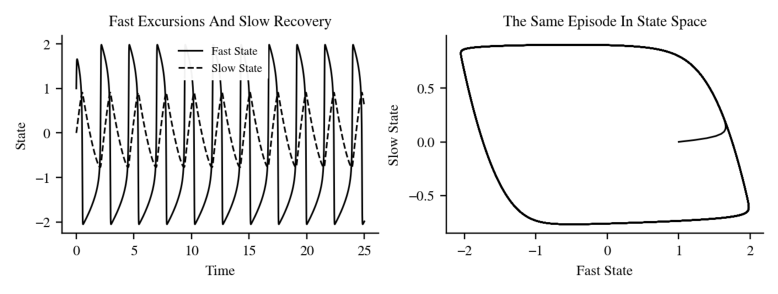
Figure 25. A relaxation oscillator follows 0.03 dx/dt = x - x cubed/3 - z and dz/dt = x + 0.5. The phase trace retains the coupled fast excursions and slow recovery. The slow-fast illustration maps rapid candidate revision onto a slowly changing evaluator or support variable. Their coupling creates delayed adjustments and accumulated commitments. The measured ratio of update clocks, rather than speed alone, determines which dynamical correspondence is justified for the workflow.
synchronization policy depends on which parts of the task require a common interface and which benefit from retaining divergent approaches.
Phenomenon And Practical Problem. Agents exchanging intermediate work can align their methods and vocabulary, making integration easier while reducing independent exploration. Consider a team developing alternative explanations for a synthetic dataset. Frequent synchronization can resolve interface incompatibilities, yet it can also cause every agent to inherit the same mistaken premise. The practical problem is to coordinate what must fit together while preserving differences that supply useful criticism. Shared timing, common wording and substantive agreement are separate outcomes and should receive evidence suited to their respective meanings.
Mechanism And Ontological Commitments. A synchronization model requires recurring processes with defined phases, natural timescales and coupling channels. Calendar-driven simultaneous updates can resemble interaction-driven phase locking. In an AI team, phase could refer to scheduled propose-test-revise cycles, while semantic agreement requires another representation (Gross and Blasius 2008). The ontology includes common external prompts and shared sources because these can align outputs without mutual adjustment. Alignment also has task-specific consequences: synchronized checks may aid integration or overload the same tool and reviewer, depending on resource capacity.
Epistemic Design And Discriminating Evidence. Compare continuous exchange, intermittent exchange and independent work followed by integration. Equalize total message and evaluation budgets. Measure phase relations, independently coded strategy diversity, correlated errors and the success of final integration. Change the coupling schedule while retaining a common task calendar to identify interaction effects. A synchronization account predicts changes in phase locking under altered communication; a common-forcing account predicts persistent alignment. Evaluate whether the particular aligned operation helps the task, instead of using output similarity as a general measure of collective intelligence.
Philosophical Reasoning And Practice. The linkage to social epistemology concerns the conditions under which agreement becomes informative (Longino 1990). Independent routes can make convergence more evidentially valuable, while coordinated work can supply capacities that isolated participants lack. Practice should preserve records of initial judgments, source dependence and subsequent reasons for revision. This supports an assessment of whether exchange corrected an error, integrated complementary contributions or merely propagated a favored answer. It also gives a basis for allocating authorship and responsibility according to the operation each participant actually supplied.
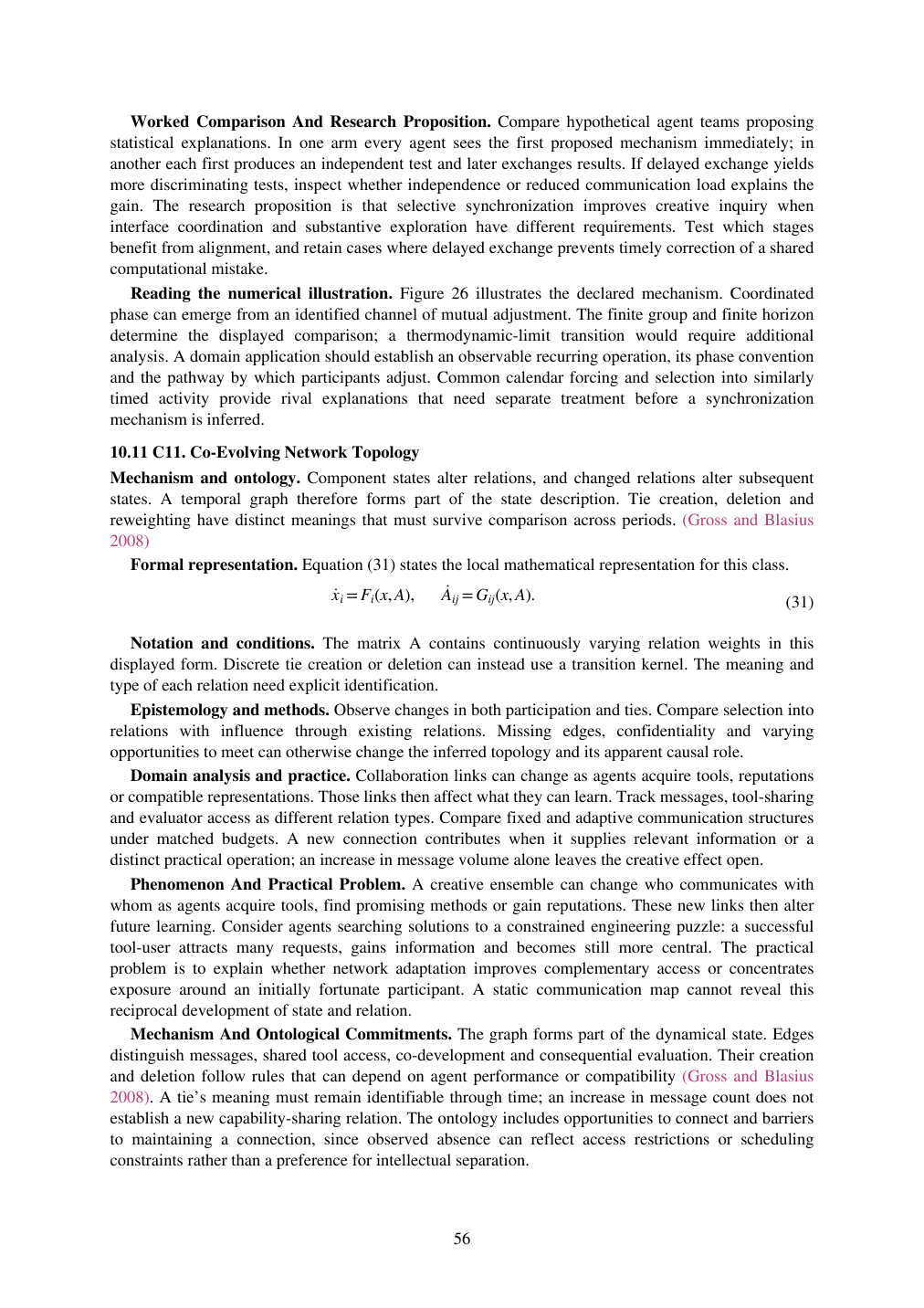
Readable text
Worked Comparison And Research Proposition. Compare hypothetical agent teams proposing statistical explanations. In one arm every agent sees the first proposed mechanism immediately; in another each first produces an independent test and later exchanges results. If delayed exchange yields more discriminating tests, inspect whether independence or reduced communication load explains the gain. The research proposition is that selective synchronization improves creative inquiry when interface coordination and substantive exploration have different requirements. Test which stages benefit from alignment, and retain cases where delayed exchange prevents timely correction of a shared
Reading the numerical illustration. Figure 26 illustrates the declared mechanism. Coordinated phase can emerge from an identified channel of mutual adjustment. The finite group and finite horizon determine the displayed comparison; a thermodynamic-limit transition would require additional analysis. A domain application should establish an observable recurring operation, its phase convention and the pathway by which participants adjust. Common calendar forcing and selection into similarly timed activity provide rival explanations that need separate treatment before a synchronization
Mechanism and ontology. Component states alter relations, and changed relations alter subsequent states. A temporal graph therefore forms part of the state description. Tie creation, deletion and reweighting have distinct meanings that must survive comparison across periods. (Gross and Blasius Formal representation. Equation (31) states the local mathematical representation for this class.
Notation and conditions. The matrix A contains continuously varying relation weights in this displayed form. Discrete tie creation or deletion can instead use a transition kernel. The meaning and
Epistemology and methods. Observe changes in both participation and ties. Compare selection into relations with influence through existing relations. Missing edges, confidentiality and varying opportunities to meet can otherwise change the inferred topology and its apparent causal role.
Domain analysis and practice. Collaboration links can change as agents acquire tools, reputations or compatible representations. Those links then affect what they can learn. Track messages, tool-sharing and evaluator access as different relation types. Compare fixed and adaptive communication structures under matched budgets. A new connection contributes when it supplies relevant information or a distinct practical operation; an increase in message volume alone leaves the creative effect open.
Phenomenon And Practical Problem. A creative ensemble can change who communicates with whom as agents acquire tools, find promising methods or gain reputations. These new links then alter future learning. Consider agents searching solutions to a constrained engineering puzzle: a successful tool-user attracts many requests, gains information and becomes still more central. The practical problem is to explain whether network adaptation improves complementary access or concentrates exposure around an initially fortunate participant. A static communication map cannot reveal this
Mechanism And Ontological Commitments. The graph forms part of the dynamical state. Edges distinguish messages, shared tool access, co-development and consequential evaluation. Their creation and deletion follow rules that can depend on agent performance or compatibility (Gross and Blasius 2008). A tie’s meaning must remain identifiable through time; an increase in message count does not establish a new capability-sharing relation. The ontology includes opportunities to connect and barriers to maintaining a connection, since observed absence can reflect access restrictions or scheduling constraints rather than a preference for intellectual separation.
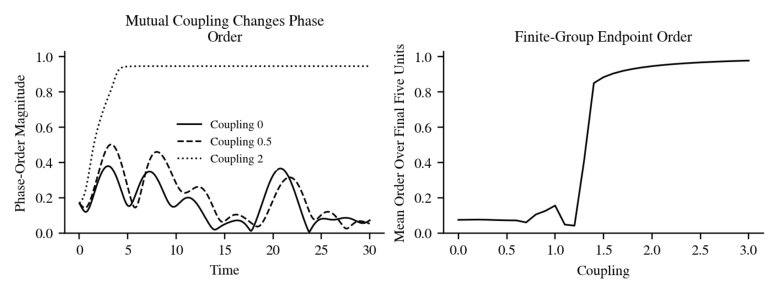
Figure 26. Twenty-four all-to-all phase oscillators have frequencies evenly spread from -1 to 1 and paired initial phases. Euler integration uses dt = 0.02; endpoint order is averaged over the last five time units. The synchronization illustration corresponds to phase relations among recurring proposal and testing cycles under controlled exchange. Semantic agreement is measured separately. Common scheduling and shared sources provide rival explanations, while task outcomes determine whether the observed alignment assists integration or suppresses informative variation.
Epistemic Design And Discriminating Evidence. Compare fixed networks, performance-based rewiring and compatibility-based rewiring under equal total communication and evaluation costs. Randomize selected connection opportunities to distinguish influence through a tie from selection into it. Track the information actually transmitted and subsequent changes in independently validated capability. A coevolution account predicts that state changes affect ties and those ties mediate further state changes. Missing-message and unavailable-tool audits are essential where the recorded network is incomplete. Report whether gains survive replacement of a highly central agent or a shared infrastructure dependency.
Philosophical Reasoning And Practice. The philosophical linkage concerns relational capability. An agent’s opportunity to contribute can depend on connections that supply translation, tests or uptake, beyond its stored content (Sen 2009). Practice should therefore assess access to consequential relations and the reasons governing their allocation. A central expert can improve inquiry when its contribution remains inspectable and alternatives have a route to evidence. Network decentralization also has costs; the normative question concerns which arrangement supports justified participation and the declared function under actual resource constraints.
Worked Comparison And Research Proposition. Compare hypothetical ensembles in which new links are awarded by public score or by demonstrated complementarity of operations. The first may produce a concentrated hub; the second may connect a proposer with an independent validator. Test final achievements and resilience after tool withdrawal, then trace the mediating exchanges. The research proposition is that typed compatibility-based rewiring supports more transferable development than unqualified popularity-based rewiring. Its evaluation should include coordination overhead and cases where concentration around a genuinely superior method provides an efficient, justified solution.
Reading the numerical illustration. Figure 27 illustrates the declared mechanism. The network is part of the evolving state. It mediates adjustment while the current differences also change future ties. The construction declares both directions of the loop and preserves the meaning of its weighted edges. A domain study should distinguish creation, removal and reweighting, record their timing and address shared causes and selection. A graph snapshot can describe structure while leaving this coevolutionary pathway unresolved.
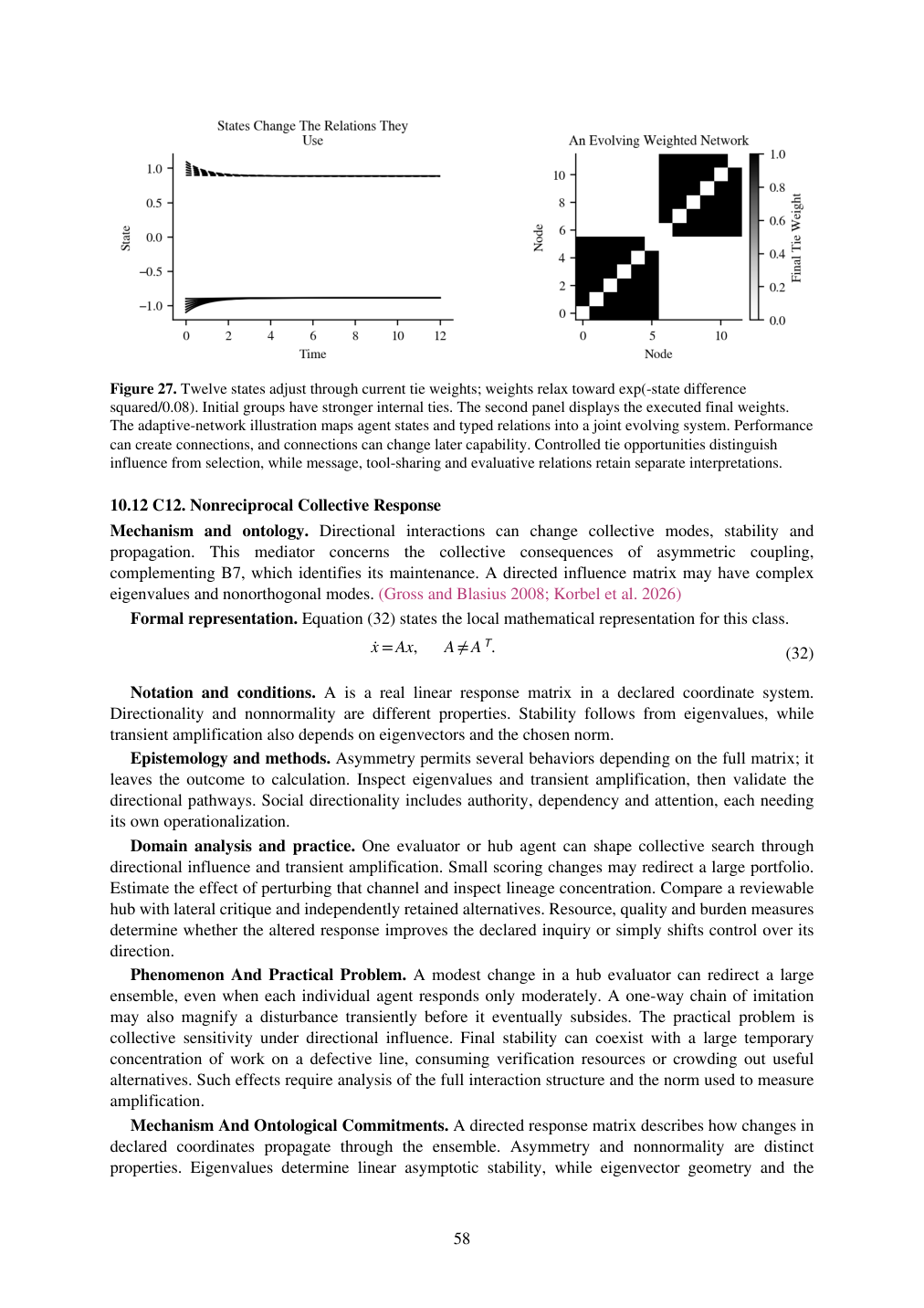
Readable text
Figure 27. Twelve states adjust through current tie weights; weights relax toward exp(-state difference squared/0.08). Initial groups have stronger internal ties. The second panel displays the executed final weights. The adaptive-network illustration maps agent states and typed relations into a joint evolving system. Performance can create connections, and connections can change later capability. Controlled tie opportunities distinguish influence from selection, while message, tool-sharing and evaluative relations retain separate interpretations.
Mechanism and ontology. Directional interactions can change collective modes, stability and propagation. This mediator concerns the collective consequences of asymmetric coupling, complementing B7, which identifies its maintenance. A directed influence matrix may have complex eigenvalues and nonorthogonal modes. (Gross and Blasius 2008; Korbel et al. 2026)
Formal representation. Equation (32) states the local mathematical representation for this class.
Notation and conditions. A is a real linear response matrix in a declared coordinate system. Directionality and nonnormality are different properties. Stability follows from eigenvalues, while transient amplification also depends on eigenvectors and the chosen norm.
Epistemology and methods. Asymmetry permits several behaviors depending on the full matrix; it leaves the outcome to calculation. Inspect eigenvalues and transient amplification, then validate the directional pathways. Social directionality includes authority, dependency and attention, each needing
Domain analysis and practice. One evaluator or hub agent can shape collective search through directional influence and transient amplification. Small scoring changes may redirect a large portfolio. Estimate the effect of perturbing that channel and inspect lineage concentration. Compare a reviewable hub with lateral critique and independently retained alternatives. Resource, quality and burden measures determine whether the altered response improves the declared inquiry or simply shifts control over its
Phenomenon And Practical Problem. A modest change in a hub evaluator can redirect a large ensemble, even when each individual agent responds only moderately. A one-way chain of imitation may also magnify a disturbance transiently before it eventually subsides. The practical problem is collective sensitivity under directional influence. Final stability can coexist with a large temporary concentration of work on a defective line, consuming verification resources or crowding out useful alternatives. Such effects require analysis of the full interaction structure and the norm used to measure
Mechanism And Ontological Commitments. A directed response matrix describes how changes in declared coordinates propagate through the ensemble. Asymmetry and nonnormality are distinct properties. Eigenvalues determine linear asymptotic stability, while eigenvector geometry and the
Readable text
chosen norm affect transient amplification (Gross and Blasius 2008). The ontology should therefore specify response variables, normalization and resource consequences. A matrix estimated from correlations requires additional causal assumptions. An evaluative hub’s broad influence also depends on authority and access, whose maintenance belongs to the institutional explanation rather than to the
Epistemic Design And Discriminating Evidence. Apply controlled perturbations to hub scores and selected lateral messages in a synthetic ensemble. Estimate direction-specific responses and compare observed amplification with predictions from the fitted matrix. Inspect both the largest temporary deviation and eventual recovery. Compare reviewable hubs, lateral critique and independently maintained archives under matched budgets. A nonnormal-response account predicts strong sensitivity to particular perturbation directions. Validate it out of sample and test nonlinear constraints, because a locally accurate matrix can fail once selection changes the communication structure or a finite archive
Philosophical Reasoning And Practice. The philosophical issue concerns consequential power over the field of alternatives. A hub can organize inquiry efficiently while making a small interpretive error collective. Epistemic responsibility gives a reason to preserve a usable correction route proportionate to that influence (Fricker 2007). Practice should document who can inspect the hub’s grounds, introduce contrary evidence and authorize reconsideration. This is a normative judgment about accountability attached to an identified mechanism; it does not follow from directional coupling alone or require every participant to exercise identical control.
Worked Comparison And Research Proposition. Compare hypothetical teams whose local response rules are individually stable. A scoring perturbation produces a large temporary wave in a directed chain, while a lateral-check structure limits that wave. Measure validated discoveries forgone during the episode and the costs of the extra checking channels. The research proposition is that transient amplification predicts workflow vulnerability beyond asymptotic stability. Test this with independently retained alternatives and with hub-expert replacement, distinguishing protection against a mistaken criterion from interference with a sound, efficiently coordinated search direction.
Reading the numerical illustration. Figure 28 illustrates the declared mechanism. Asymmetry can affect a collective response through more than the eigenvalue signs. The maximum singular value asks which unit perturbation is most amplified at a given time, while the first panel follows one specified state. The two quantities have different inferential roles. A domain analysis should justify the response coordinates and norm, compare directional channels and inspect whether an asymptotically stable arrangement can still generate consequential transient burdens within the relevant deadline.
Mechanism and ontology. A conserved stock constrains possible redistribution and couples local changes through a shared account. The conserved quantity and boundary must be explicit. Resource reallocation can change access and outcomes even when its aggregate quantity stays fixed. (Frey and
Formal representation. Equation (33) states the local mathematical representation for this class.
Notation and conditions. The m_i are account stocks, f_ij internal transfer rates and b_i net external entries or explicitly modeled changes. The identity conserves the total when summed external entries
Epistemology and methods. The cancellation assumes internal transfers are counted once at each end. Credit creation, external transfers and valuation changes belong in the relevant additional accounts. Economic value, meaning and justice need independent interpretations alongside monetary or material
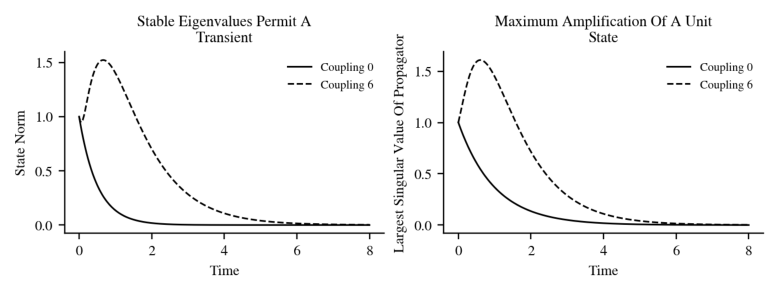
Figure 28. The triangular response matrix has diagonal rates -1 and -2 and off-diagonal coupling zero or six. Its eigenvalues are unchanged; the nonnormal propagator can transiently amplify a unit state. The nonreciprocal-response illustration corresponds to directional propagation across an ensemble. Stable eigenvalues can coexist with transient amplification when the response matrix is nonnormal. The relevant amplitude is measured in a declared norm and connected to temporary lineage concentration or verification burden.
Domain analysis and practice. A fixed compute or review budget constrains allocation among generation, testing and reuse. Ideas and meanings require separate accounts; they have no assumed conservation law. Record budget expenditure at each operation and inspect the downstream work it enables. Compare schedules with equal total resources and different sequencing. The optimal allocation depends on task structure, error costs and the evidence available about marginal contributions.
Phenomenon And Practical Problem. A fixed research budget must be divided among proposing, testing, interpreting and preserving artifacts. The order of allocation can change which operations become possible. Consider an agent with enough resources to generate many code candidates or to validate a smaller number and retain a reusable test. The practical problem is accounting for feasible continuation under scarcity. Ideas can be copied and recombined; compute slots, reviewer hours and access tokens follow different accounting rules, so their conservation should be established in their own units.
Mechanism And Ontological Commitments. An account specifies stocks, directed transfers and external entries. Total conservation holds only when the summed external entries vanish under the chosen convention. Generation can consume hardware time while creating multiple candidate copies, showing why semantic quantity requires a separate ontology. A budgeted workflow also contains permissions and release schedules: a resource can be available in aggregate yet unavailable at the step where it is needed. Stock-flow reasoning constrains feasible histories without defining creative value (Godley and Lavoie 2007). The substantive function of an expenditure remains an independently assessed relation.
Epistemic Design And Discriminating Evidence. Compare schedules with equal total resource endowments and identical task access. One schedule funds generation first; another alternates generation with validation; a third invests early in a reusable evaluator. Record every expenditure and verify budget closure. Measure independently validated developments, unfinished verification obligations and later reuse. A sequencing mechanism predicts different outcomes despite equal total spending. Add an external-replenishment arm to test whether the observed limit concerns ordering, total scarcity or the availability of a particular non-substitutable resource such as specialist review.
Philosophical Reasoning And Practice. The philosophical linkage concerns the distinction between a balance and a reason for allocation. An account can be internally consistent while distributing opportunities in a way that defeats the inquiry’s purpose. Capability-oriented reasoning examines which operations different participants can exercise and what support they require (Sen 2009). Practice should report access to testing and criterion revision, alongside aggregate compute. This makes it possible to
Readable text
scrutinize a workflow that allocates abundant proposal resources to one lineage while denying alternatives the modest checking needed to demonstrate their value.
Worked Comparison And Research Proposition. Compare hypothetical archives developed with the same total review hours. In one, reviews are spent after the generation budget is exhausted; in another, early reviews identify a reusable failure test that redirects later proposals. If the second yields more validated results, trace the changed feasible sequence. The research proposition is that accounting combined with operation-level timing predicts supported discovery better than total-budget reporting alone. Test it across task structures and include the opportunity costs of early verification when its
Reading the numerical illustration. Figure 29 illustrates the declared mechanism. Conservation couples possible local changes through a common account. Local access changes materially while the aggregate stays constant. The construction specifies one stock type and a closed boundary, making its balance check meaningful. A domain application should identify what is conserved, which transfers cross the chosen boundary and which operations consume or transform the stock. Productive consequences and fair allocation require further interpretation of the paths that redistribution enables.
Mechanism and ontology. Conflicting requirements or forbidden moves restrict reachable trajectories. The mediator is the constraint structure acting during evolution, complementing the initial persistence problem in A7. A process may remain trapped because every accessible local change requires a difficult
Formal representation. Equation (34) states the local mathematical representation for this class.
Notation and conditions. The set calligraphic F(x) contains feasible successors of state x within the selected state space. Its definition includes the declared resources, rules and permissible operations
Epistemology and methods. Reconstruct feasible moves from rules, resources and accounts of practice. A recorded failure to move leaves preference and constrained feasibility distinguishable only with further evidence. Compare interventions that change incentives with those that provide missing
Domain analysis and practice. A potentially valuable candidate can remain unreachable because the system lacks a representation, tool, permission or validation method required for its next step. Identify the feasible operation set and the missing complement. Compare prompt variation with providing the specific tool or evidence. A capability claim should state the environment under which the operation can be exercised and the support that must continue for it to remain available.
Phenomenon And Practical Problem. A candidate can be promising yet unable to proceed because a necessary complement is missing. An AI design may require an unavailable simulator, a proof technique outside its tool language or a dataset whose access conditions exclude the project. Rewording a prompt can leave that obstruction intact. The practical problem is to identify the blocked operation precisely enough to choose a useful intervention. A capability claim should state the environment in which the operation can be exercised, including dependencies that remain outside the candidate artifact.
Mechanism And Ontological Commitments. The feasible-successor set contains operations permitted by representation, resources, tools and institutional rules. An empty route to a target is a reachability constraint; low probability along an available route is a different mechanism. The ontology includes complements and permissions because a purely internal artifact state can misdescribe practical availability. A support-condition perspective asks which conjunction of conditions makes an intervention work in a new setting (Cartwright and Hardie 2012). Different constraints may require language extension, assistance, negotiated access or a revised task, each changing the explanation in a
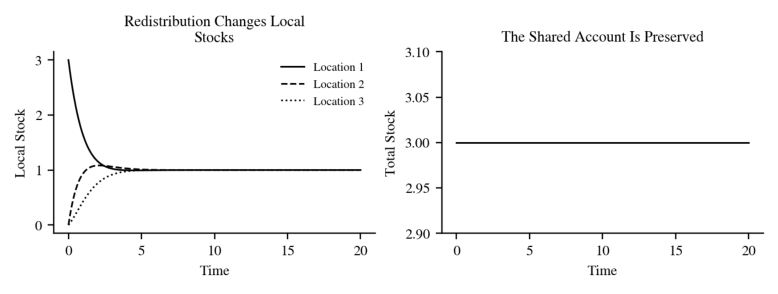
Figure 29. Three locations exchange a conserved stock through clockwise rate 0.6 and reverse rate 0.1. The initial stock is concentrated in one location; the total remains three. The conservation illustration maps stocks and transfers to explicitly budgeted resources such as compute calls or reviewer time. Candidate copies and meanings follow separate descriptions. Equal total endowments can support different feasible sequences, so timing and access are recorded alongside closure of the resource account.
Epistemic Design And Discriminating Evidence. Use a task with a known feasible solution and selectively remove one complement. Compare extra sampling, richer prompting and targeted provision of the missing resource. Record the first newly executable operation and the subsequent transition path. On small symbolic tasks, enumerate feasible successors to establish the constraint exactly. On larger tasks, triangulate logs, attempted operations and expert reconstruction. A bottleneck account predicts a sharp change after the relevant complement is supplied, while a broad competence deficit predicts continued failure despite removal of that specific obstruction.
Philosophical Reasoning And Practice. The philosophical issue concerns substantive opportunity as distinct from nominal possession (Sen 2009). A system that contains the text of a method may lack the means to use it responsibly. Practice should describe capabilities relationally and include the support that potential successors would need. This also directs attention to power: access rules can create an exclusion that appears in performance data as lack of ability. Evaluating a proposed change requires both evidence of its causal effect and reasons concerning legitimate permissions, costs and affected interests.
Worked Comparison And Research Proposition. Compare hypothetical synthesis agents with the same model and proposal budget. One lacks a symbolic algebra tool; another receives it with a checked invocation interface. If the latter solves a class of tasks, disable individual tool operations to identify the minimal complement. The research proposition is that targeted complement diagnosis produces more interpretable capability gains than undirected context expansion. Test transfer to a setting with different access conditions and report the operations that remain feasible, rather than generalizing the supported result to unrestricted creative competence.
Reading the numerical illustration. Figure 30 illustrates the declared mechanism. A missing complementary operation can block a path even when its destination is admissible. The finite construction states the feasible configurations and the proposal rule separately. A coordinated move changes reachability; it leaves the value of the destination for further judgment. A domain inquiry should identify the actual prerequisite relations, test whether the proposed complement removes the blockage, and include the authority, coordination cost and distribution of burdens required to perform it.
10.15 C15. Absorbing-State Dynamics
Mechanism and ontology. An absorbing state or set has no exit under the specified transition rule. The definition concerns the model and its boundary; an environmental intervention can alter that rule. Extinction, closure and inactivity require empirical criteria appropriate to the observed organization. (Gross and Blasius 2008)
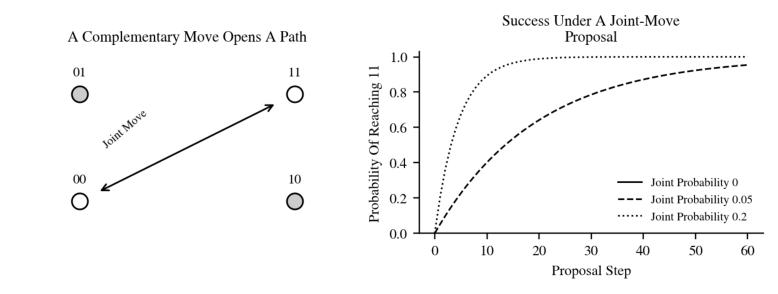
Figure 30. Only binary configurations 00 and 11 satisfy the declared compatibility constraint. Single-bit proposals cannot connect them; a simultaneous two-bit proposal succeeds with probability p per step. Gray states violate the constraint. The feasibility illustration maps possible successors to the operations allowed by tools, representations, resources and permissions. A blocked transition identifies a missing complement. Targeted provision is compared with additional sampling to distinguish absent reachability from an available path that is merely difficult to discover.
Formal representation. Equation (35) states the local mathematical representation for this class.
P(x,A)=1 for every x∈A. (35)
Notation and conditions. P is a one-step transition kernel and A a specified absorbing set. Every state in the set remains within it with probability one under that kernel. Changed outside inputs can change the kernel.
Epistemology and methods. Here P(x,A) is the one-step probability of remaining in the absorbing set. Establish which actions and outside supports the model includes. Treat evidence of dormancy, preservation and possible re-entry separately when interpreting an apparent endpoint.
Domain analysis and practice. Stopping rules, archive deletion and exhausted resources can make a lineage absorbing in a computational model. Define the permitted restart operations and retained state. Compare actual loss of a candidate with loss of the ability to validate or reproduce it. Practical archiving can preserve a compact candidate, provenance and required tests when its expected future use justifies the cost. Closure can also be a reasoned outcome of inquiry.
Phenomenon And Practical Problem. Search lineages can end through exhausted budgets, archive deletion or a stopping rule that permits no further proposals. Yet an ended session can leave an artifact that another investigator can revive. The practical problem is to state what has actually become absorbing: the running process, the recoverable computational state or the broader capacity for continued inquiry. These objects have different futures. A record that preserves only final prose can retain a claim while losing the environment and tests needed to evaluate it again.
Mechanism And Ontological Commitments. An absorbing set is defined relative to a transition kernel and the operations it permits. If a new grant, tool or operator can restart a lineage, that intervention changes the relevant dynamics. The ontology includes the archive, executable dependencies, provenance and restart authority. Computational absorption is therefore a model-relative property, with practical irreversibility requiring evidence about recoverability. A candidate’s dismissal by an evaluator is also distinguishable from deletion: it can remain available in an archive even when ordinary selection gives it zero future development probability.
Epistemic Design And Discriminating Evidence. Define stopping and restart operations before running the experiment. Compare irreversible deletion, compact archival preservation and full environment preservation under equal storage and checking budgets. Test restart using an independent operator and fresh task conditions. Measure reproducibility, validation cost and useful continuation,
Readable text
including preserved negative results. A genuinely absorbing model predicts no return under its unchanged kernel; observed revival identifies either a mistaken state classification or an external change. Keep those explanations separate from the value judgment about whether revival was worth its
Philosophical Reasoning And Practice. The philosophical issue concerns responsible closure. Inquiry can finish with a solved task, a justified rejection or an acknowledged unresolved question. A process account permits the contribution to persist through a usable inheritance even when the original session ends (Whitehead 1978). Practice should preserve reasons proportionate to the expected future use and consequences. Unlimited retention has costs, including duplicated uncertainty and maintenance obligations. A defensible archive policy therefore states what is retained, who may rely on it and what
Worked Comparison And Research Proposition. Compare hypothetical proof-search lineages stopped at a fixed budget. One retains its best conjecture; another retains a counterexample, test harness and explanation of the failed approach. A successor’s new tool may make either inheritance useful in different ways. The research proposition is that operation-sensitive preservation supports more reliable continuation than final-output preservation alone. Test it through blinded handovers, charging all restoration work to the successor budget and recording cases where a concise negative result is more generative than an elaborate but unreproducible candidate.
Reading the numerical illustration. Figure 31 illustrates the declared mechanism. Absorption is a property of the permitted transitions. Probability reaching the first state remains there under the declared matrix, so its occupancy equals the probability of passage by that deadline. A domain use should state the boundary and identify which internal operations have ceased to permit return. An external operation or a changed rule can create a different process, whose availability, cost and
Mechanism and ontology. Information changes which alternatives are retained, funded or enacted. The mechanism includes a candidate population, an observation channel, an evaluator and consequential selection. Criteria can themselves change through the actions they favor, producing a second-order
Formal representation. Equation (36) states the local mathematical representation for this class.
Notation and conditions. The scalar s_it is candidate i’s score and beta an inverse-score selectivity parameter. Scores and their scale must be specified. Softmax encodes one selection behavior with no
Epistemology and methods. This softmax is one stochastic selection rule, with beta describing selectivity. Identify the origin, meaning and accessibility of scores; retain rejected and unobserved alternatives where possible. Separate repeated selection, prediction quality and justified evaluative
Domain analysis and practice. Selection determines which artifacts, evaluators and problem formulations continue. The evaluation standard can be endogenous to the population selected. Record criteria provenance, evidence, revision authority and appeal. Compare fixed-target search with a procedure permitting justified changes of target. Creative quality, factual warrant, practical usefulness and fairness of participation remain distinct judgments; the method gains clarity by keeping their
Phenomenon And Practical Problem. A search procedure selects more than artifacts: it can select evaluators, representations and problem statements. A high-scoring candidate may reveal a useful solution or exploit an inadequate measure. The practical problem is to govern consequential selection
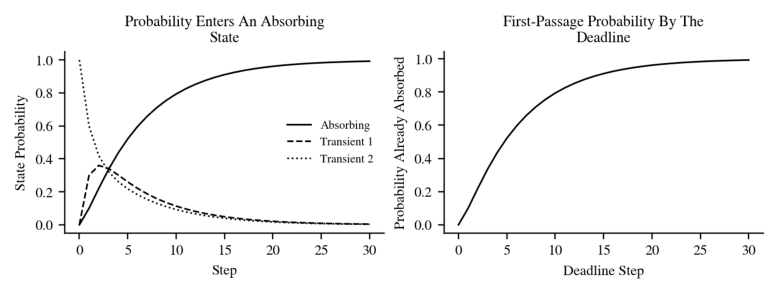
Figure 31. A three-state row-stochastic matrix has an absorbing first row [1,0,0]. Exact matrix powers give occupancy and the first-passage cumulative probability from transient state two. The absorbing-state illustration corresponds to a declared stopping rule and permitted restart operations. Session termination, archive loss and loss of reproducible capacity are different states. Return under a new input changes the transition account, while the value of preservation is assessed through actual successor use.
when the meaning of success can evolve. A workflow that permits no standard revision can reject valuable departures; unrestricted revision can make every favored candidate appear successful. The inquiry needs evidence about performance and explicit reasons about when changing the evaluative frame is warranted.
Mechanism And Ontological Commitments. The mechanism contains score construction, selectivity, retention and authority to revise criteria. A softmax rule is one specified behavior whose scale depends on score units; it supplies no independent ground for the score’s normative authority. Novelty search and quality-diversity methods offer alternative retention architectures with declared descriptors (Lehman and Stanley 2011; Mouret and Clune 2015). The ontology distinguishes candidate quality, descriptor difference and evaluator preference. Their relationship is an empirical and philosophical question, especially when selected artifacts become examples through which later evaluation learns what creativity should resemble.
Epistemic Design And Discriminating Evidence. Compare fixed-target selection, descriptor-based retention and a reviewable target-revision procedure. Equalize objective calls, preserve rejected candidates and use external tests established before the consequential selection. Record criterion changes, their stated reasons and which artifacts become newly visible. A valid revision should improve a declared function or expose an independently defensible new one. Test whether the result survives alternative evaluators and task populations. This separates a substantive change of inquiry from a post hoc adjustment that merely rewards the currently favored lineage.
Philosophical Reasoning And Practice. The philosophical linkage concerns formation, practical force and justified authority of a standard (Huang 2026a). An evaluator can become influential through infrastructure and repetition; its legitimacy requires reasons appropriate to the use. Practice should distinguish evidential warrant, usefulness, valued novelty and fairness of opportunity, then explain how they enter a decision. A candidate can deserve further investigation without deserving adoption. Giving those stages different thresholds allows exploration to remain open while consequential use receives the stronger scrutiny required by its effects.
Worked Comparison And Research Proposition. Compare hypothetical design archives under static and changing task needs. One retains only immediate top scorers; another preserves distinct mechanisms and permits a documented descriptor revision after independent failure evidence. Evaluate both on future tasks whose definitions were withheld during selection. The research proposition is that reasoned criterion revision can improve continuation when fixed descriptors omit consequential
distinctions. Test the claim against arbitrary descriptor changes and against simple archive enlargement, including the additional review cost and the possibility that revision discards a useful stable standard.
Reading the numerical illustration. Figure 32 illustrates the declared mechanism. A selection rule acts on the information available to it. Increased intensity concentrates choice under exact scores, while observation error changes the mean probability of selecting the candidate with the highest stipulated latent score. This separates a candidate property, its manifestation and consequential selection. A domain account should validate the score for its intended purpose, examine who controls observation and selection, and preserve the opportunity to revise a criterion when its omissions become consequential.
11 D. Observable And Recognizable Phenomena
11.1 D1. Transport And Circulation
Mechanism and ontology. Observable currents record movement across declared boundaries or between specified states. A current is a manifestation of activity whose generating mechanism can include gradients, active conversion and rule-governed transfer. Persistent circulation can coexist with stable aggregate stocks. (Seifert 2012)
Formal representation. Equation (37) states the local mathematical representation for this class.
Jij =pikij −pjkji. (37)
Notation and conditions. The p_i are probabilities and k_ij transition rates of the chosen continuous-time Markov account. J_ij is a net oriented current. The observation resolution and state partition determine which transitions it records.
Epistemology and methods. Estimate directional transitions at a resolution sufficient to detect recrossings and missing channels. The same aggregate throughput can conceal different paths, concentrations and replenishment requirements. Interpret a recorded transfer according to what changed hands and under which terms.
Domain analysis and practice. Messages, code, data and evaluative authority travel through different channels in an AI ecology. Frequent exchange can circulate the same unverified premise. Define the carrier and dependency of each transfer. Compare source-independent evidence with repeated transmission and track which operations become possible after receipt. A provenance-aware design can direct scarce checking effort toward claims whose apparent support rests on a single shared origin.
Phenomenon And Practical Problem. An AI-assisted design idea can pass from a private draft to a shared archive, a critique session, a revised prototype and a later project. Counting generated drafts misses the question of whether an idea reaches a setting where someone can interpret and develop it. A concrete practical problem is an archive with substantial traffic and little usable inheritance. Links, downloads and repeated prompts can all increase while collaborators repeatedly reconstruct the same discarded reasoning. The phenomenon therefore requires a defined transfer whose recipient has a consequential opportunity to act.
Mechanism And Ontological Commitments. The mechanism is circulation through typed transitions. A draft’s movement into an archive differs from its incorporation into an argument, and both differ from a credited transfer of a technique. States should encode these distinctions where the research question requires them. A probability current can summarize transitions after the state partition and observation interval have been fixed. The ontology contains artifacts, interpreters, permissions and resources supporting uptake. Textual resemblance provides evidence about transmitted material; establishing a productive relation additionally requires a trace of interpretation, modification or practical exercise.
Epistemic Design And Discriminating Evidence. Build an event-linked provenance record that follows sampled ideas through reception and use. Compare an interface supplying only final outputs
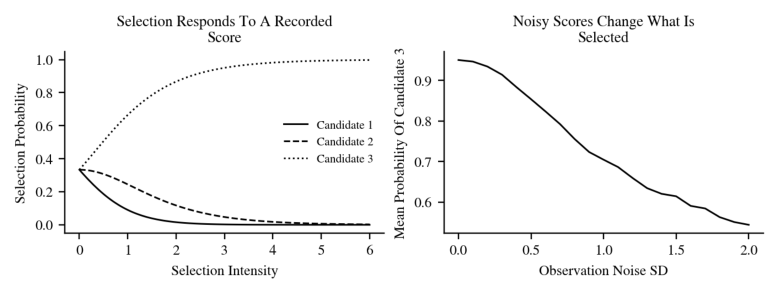
Figure 32. Softmax selection uses scores zero, one and two. The second panel adds independent Gaussian score noise, averages 10,000 readouts per noise level and fixes selection intensity at three. The selection illustration maps scored candidates into retention probabilities under a declared rule. Descriptor diversity, task quality and criterion authority remain distinct. A revised standard is tracked as a consequential operation, with independent tests and reasons explaining why the new distinctions should guide subsequent inquiry.
with one supplying the rejected alternatives, reasons and relevant permissions. Keep access time and search assistance comparable. Blind assessors can judge whether recipients complete a new task, while process records identify where the transferred material contributed. Downloads without later use form an informative comparison group. Missing private exchanges and reuse outside the platform should enter sensitivity analysis because the observed archive is a partial view of circulation (Hernán and Robins 2020).
Philosophical Reasoning And Practice. The philosophical issue concerns what a contribution becomes through relations. Process-oriented interpretation makes passage and transformation intelligible, while epistemic responsibility requires sources and reasons to survive consequential reuse (Whitehead 1978; Longino 1990). This supports a practice of preserving intelligible lineage without treating every predecessor as an owner of every later outcome. Credit, consent and public availability require distinct arguments. A circulation measure is useful for diagnosing blocked inheritance; evaluation asks whether the receiving relation expands worthwhile possibilities and whether contributors have a fair route to recognition.
Worked Comparison And Research Proposition. Consider two hypothetical studios receiving the same generated concepts. One stores polished images; the other stores editable structures and the reasons behind abandoned directions. Both may show equal retrieval counts. The research proposition is that reason-bearing transfers increase successful adaptation to a changed brief when recipients can inspect and challenge those reasons. Test this through paired downstream tasks, recording transformation time, source attribution and the range of viable outcomes. An observed advantage concentrated in familiar tasks would narrow the proposition to efficient transmission, leaving broader creative renewal for another comparison.
Reading the numerical illustration. Figure 33 illustrates the declared mechanism. Occupation and directional counts are different manifestations of the same process. Finite sampling introduces variation around both theoretical quantities. The current requires edge direction and elapsed time, while a stock record alone leaves that distinction unresolved. A domain study should identify the movement carrier, the event-counting convention, the boundary and the sampling coverage, then connect the measured circulation to the function or value claim through additional evidence and reasons.
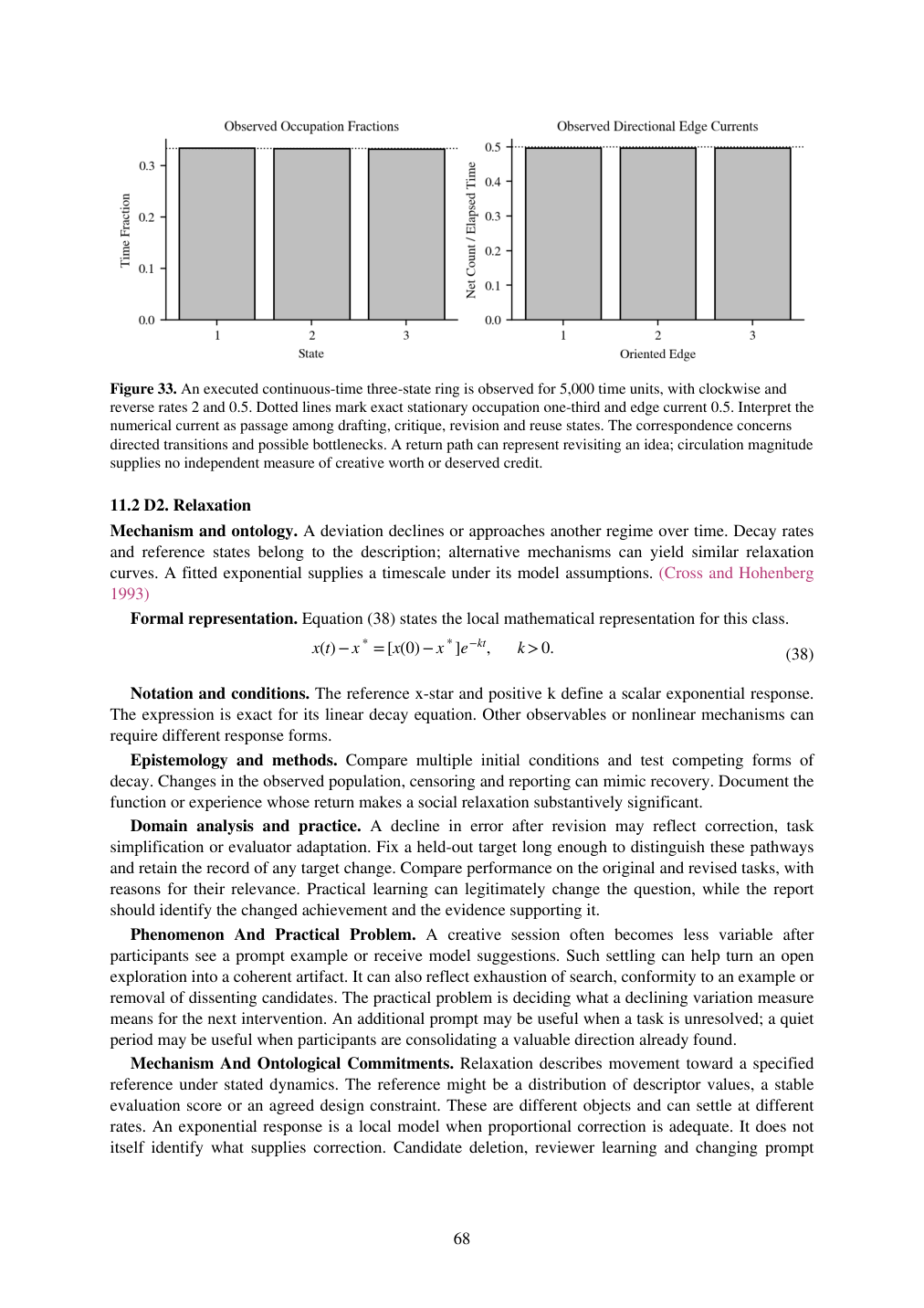
Readable text
Figure 33. An executed continuous-time three-state ring is observed for 5,000 time units, with clockwise and reverse rates 2 and 0.5. Dotted lines mark exact stationary occupation one-third and edge current 0.5. Interpret the numerical current as passage among drafting, critique, revision and reuse states. The correspondence concerns directed transitions and possible bottlenecks. A return path can represent revisiting an idea; circulation magnitude supplies no independent measure of creative worth or deserved credit.
Mechanism and ontology. A deviation declines or approaches another regime over time. Decay rates and reference states belong to the description; alternative mechanisms can yield similar relaxation curves. A fitted exponential supplies a timescale under its model assumptions. (Cross and Hohenberg Formal representation. Equation (38) states the local mathematical representation for this class.
Notation and conditions. The reference x-star and positive k define a scalar exponential response. The expression is exact for its linear decay equation. Other observables or nonlinear mechanisms can
Epistemology and methods. Compare multiple initial conditions and test competing forms of decay. Changes in the observed population, censoring and reporting can mimic recovery. Document the function or experience whose return makes a social relaxation substantively significant.
Domain analysis and practice. A decline in error after revision may reflect correction, task simplification or evaluator adaptation. Fix a held-out target long enough to distinguish these pathways and retain the record of any target change. Compare performance on the original and revised tasks, with reasons for their relevance. Practical learning can legitimately change the question, while the report should identify the changed achievement and the evidence supporting it.
Phenomenon And Practical Problem. A creative session often becomes less variable after participants see a prompt example or receive model suggestions. Such settling can help turn an open exploration into a coherent artifact. It can also reflect exhaustion of search, conformity to an example or removal of dissenting candidates. The practical problem is deciding what a declining variation measure means for the next intervention. An additional prompt may be useful when a task is unresolved; a quiet period may be useful when participants are consolidating a valuable direction already found.
Mechanism And Ontological Commitments. Relaxation describes movement toward a specified reference under stated dynamics. The reference might be a distribution of descriptor values, a stable evaluation score or an agreed design constraint. These are different objects and can settle at different rates. An exponential response is a local model when proportional correction is adequate. It does not itself identify what supplies correction. Candidate deletion, reviewer learning and changing prompt
interpretation can all produce a similar aggregate curve. The ontology must therefore retain the operation generating each change alongside the observed distance from the reference.
Epistemic Design And Discriminating Evidence. Measure several observables across the same session: task fit, semantic dispersion, disagreement about reasons and willingness to reopen a decision. Introduce a small, documented change in one design requirement after an initial settling period. Compare responses with a sham change and with an independently prepared session receiving the revised brief from the start. Estimate response time with uncertainty and inspect residual structure. This distinguishes productive consolidation from a dependence on an inherited exemplar. A fitted single decay constant should be compared with multi-stage or cohort-mixture explanations (Cross and Hohenberg 1993).
Philosophical Reasoning And Practice. Reflective judgment gives a reason to preserve the possibility of revising the categories through which an emerging work is understood (Kant 2000). Completion still has value: participants have finite attention, and downstream collaborators need a usable result. The philosophical task is to judge when closure answers the current problem and when it prematurely fixes the terms of judgment. Practice can preserve a brief record of unresolved alternatives and the grounds for selection. This makes later reopening intelligible while allowing a justified present commitment to proceed.
Worked Comparison And Research Proposition. Imagine two hypothetical writing teams whose semantic dispersion declines equally after AI assistance. One also improves its explanation of how the work satisfies the brief; the other merely converges on phrases resembling the supplied example. Introduce a changed audience requirement using the same remaining budget. The research proposition is that reason-based consolidation predicts faster appropriate revision than surface convergence alone. Evaluate the final works with assessors unaware of condition and compare the actual revision pathways. If both adapt equally, the proposed explanatory role of preserved reasons needs qualification.
Reading the numerical illustration. Figure 34 illustrates the declared mechanism. Early agreement in a relaxation record can leave later response unresolved. The two constructions share initial level and slope, then separate because one observation combines two decaying components. A domain inquiry should compare possible hidden mixtures, replacement and changing measurement before interpreting a fitted timescale as a unique causal mechanism. Additional observations are useful when they discriminate the component structure or identify the decision-relevant future quantity across the remaining alternatives.
11.3 D3. Oscillation
Mechanism and ontology. A recurring trajectory can be autonomous, externally forced or produced by delayed feedback. Period, phase and amplitude characterize the manifestation. Its explanation requires the mechanism that renews the cycle and the resources consumed during repetition. (Cross and Hohenberg 1993)
Formal representation. Equation (39) states the local mathematical representation for this class.
x(t)=̄x +acos(ωt+φ). (39)
Notation and conditions. The mean x-bar, amplitude a, angular frequency omega and phase phi describe a sinusoidal component. The formula characterizes a signal; autonomous, forced and feedback mechanisms need separate explanatory models.
Epistemology and methods. This expression describes a simple periodic signal. Examine phase response, changes in forcing and cycle-to-cycle resource accounts before selecting a mechanism. Irregular recurrence can call for renewal or event models with variable intervals.
Domain analysis and practice. A generate-critique-revise workflow can cycle productively or repeat a disagreement without new evidence. Record whether each pass changes a test, an assumption or a usable artifact. Compare the cycle with a simpler independent review. Stopping and escalation rules
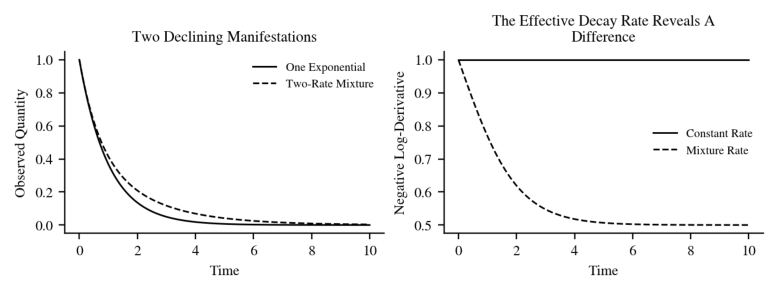
Figure 34. An exact unit-rate decay is compared with an equal mixture of rates 0.5 and 1.5. The mixture has the same initial value and initial derivative, while its later effective rate changes. Read relaxation as a decline in a declared distance from a working design reference. The numerical curve can illustrate a response timescale. Domain interpretation requires separate measurements of task fit, disagreement and revisability because similar settling trajectories can arise from different creative processes.
can respond to diminishing evidential gain. The meaningful outcome is a warranted development or clarified unresolved question, with the resource cost of recurrence included.
Phenomenon And Practical Problem. AI-supported creative work can alternate between generating candidates and imposing stronger evaluation. A team may deliberately schedule these phases, or its own decisions may repeatedly produce abundance followed by pruning. Both can yield an oscillating candidate count. The practical issue concerns coordination: frequent evaluation can interrupt incomplete ideas, while long generation phases can create a review burden that delays useful feedback. A visible rhythm becomes informative when its relation to work quality, participant attention and downstream constraints is established.
Mechanism And Ontological Commitments. The observed oscillation is a temporal property of a defined quantity. Its mechanism may be external scheduling, delayed corrective action or an autonomous interaction between candidate supply and reviewer capacity. These alternatives have different state requirements. A delayed-feedback account includes pending reviews and committed revisions; a forced account includes the calendar input. A sinusoidal summary can describe a component of the record while leaving those mechanisms open. Creative interpretation requires an account of what grows, what is removed and how a phase changes the available next operations.
Epistemic Design And Discriminating Evidence. Record candidate arrivals, review completions, revision starts and reviewer workload at compatible temporal resolution. Compare fixed schedules with state-triggered transitions based on queue length, holding total generation and review time constant. Alter schedule frequency in a designed computational or laboratory study and ask whether the observed rhythm follows the imposed period. A lagged feedback explanation predicts phase relations that should change with review delay. Assess the quality and lineage of retained work as well as rhythm regularity. Common deadlines and changing group membership provide important rival explanations (Ashwin et al. 2012).
Philosophical Reasoning And Practice. The philosophical linkage concerns an organized practice of inquiry. Deweyan experimentation supports movement between proposing possibilities and examining their consequences (Dewey 1927). A useful cycle gives reasons a chance to alter the proposal; mechanical recurrence can repeatedly confirm the same preferred style. Procedural design should therefore specify who can introduce an alternative and what kind of evidence can change selection. A regular schedule has instrumental value when it supports those passages. Participants’ opportunity to question the evaluative reference remains a further condition of worthwhile collaboration.
Worked Comparison And Research Proposition. Consider a hypothetical design workshop comparing rapid alternation with longer protected exploration, using equal total model queries and reviewer minutes. The research proposition is that the beneficial rhythm depends on the time needed to make an idea interpretable to others. Track whether critiques arrive before that threshold and whether later phases recover prematurely pruned directions. A computational queue model can generate candidate timing hypotheses; a domain study must test meaningful maturation and reception. Report tradeoffs in completion, diversity and review burden so that a preferred rhythm remains tied to an explicit task.
Reading the numerical illustration. Figure 35 illustrates the declared mechanism. The same recurring observation can be supported through different operations. Before withdrawal these two outputs coincide, yet the external input has a decisive causal role in one arm. The comparison identifies an intervention capable of separating the models under their assumptions. A domain account should locate what renews each cycle, compare autonomous interaction, common schedules and delayed correction, and investigate the resources and authority enabling the relevant discriminating change.
11.4 D4. Spatial Patterns
Mechanism and ontology. Clustering, segregation, waves, interfaces and domains are recognizable arrangements in a chosen space. The space can be geographic, organizational or representational, with its metric justified independently. Pattern description and pattern genesis are distinct analytical tasks. (Cross and Hohenberg 1993; Frey and Weyer 2026)
Formal representation. Equation (40) states the local mathematical representation for this class.
C(r)=[(u(s)−̄u)(u(s+r)−̄u)]. (40)
Notation and conditions. The field u, spatial location s and displacement r define the correlation under a chosen measure. The displayed expectation uses suitable averaging assumptions; changing boundaries or means require corresponding local definitions.
Epistemology and methods. Specify stationarity or use local alternatives when estimating a correlation function. Compare movement, local interaction, sorting and boundary effects. A pattern in an embedding also depends on the representation through which distances were constructed.
Domain analysis and practice. Clusters in an embedding can indicate vocabulary, training-source similarity or distinct problem-solving approaches. Define the representation and validate its distances against the intended construct. Compare clustering across encoders with expert-coded mechanisms and tests. A portfolio design can retain candidates from several clusters while checking whether they offer substantive alternatives. Embedding diversity then supports a screening purpose whose limitations are explicit.
Phenomenon And Practical Problem. Creative outputs can cluster by platform, language, professional community or collaborative workspace. A map of similar styles may suggest local exchange, shared training material or unequal access to tools. The practical problem is diagnosing what a cluster excludes and what sustains it. A visually diverse platform can still contain disconnected communities whose ideas rarely receive meaningful translation. Conversely, similar outputs may emerge independently under a shared brief. Spatial or network pattern becomes a starting point for inquiry when its units and distances carry a defensible meaning.
Mechanism And Ontological Commitments. The mechanism cannot be read directly from the pattern. Local imitation coupled with selective movement, a common generator, filtering by gatekeepers and shared resource constraints all create clustering. If diffusion terminology is used, specify what moves and how movement changes the receiving practice. Geographic distance, graph distance and embedding distance have different ontologies. A correlation length in one representation does not automatically describe social reach. An interpretable model connects artifact features with situated channels of access and the operations through which borrowing or differentiation occurs.
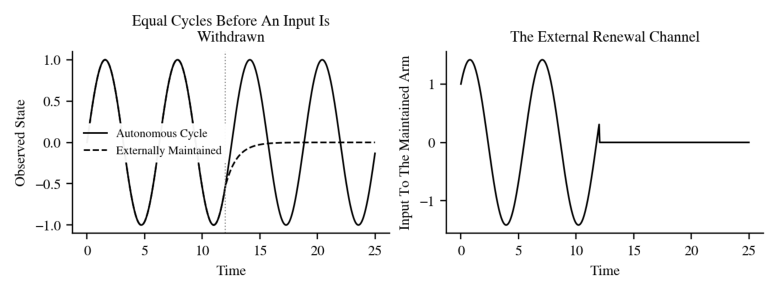
Figure 35. One observed sine is the projection of a unit autonomous rotation. Another follows dx/dt = -x + u with u = cos(t) + sin(t) until time twelve; input withdrawal separates the exact trajectories. Map the illustrated oscillation to alternating candidate production and review load. Peaks may represent abundant proposals, while delayed correction changes subsequent availability. A numerical rhythm identifies a temporal possibility; observing a similar rhythm in creative work requires evidence about scheduling, delay and interpretation.
Epistemic Design And Discriminating Evidence. Combine artifact comparisons with provenance, exposure and collaboration records. Compare communities exposed to the same model under different exchange opportunities, and communities with different models under comparable exchange. Randomized invitations to inspect another group’s editable work can help identify transmission when ethically and practically appropriate. Preserve language-specific evaluation because an embedding may compress meaningful differences unevenly. Test whether a proposed transport mechanism predicts the direction and timing of adoption beyond an observed similarity map. Shared deadlines and platform recommendation rules should enter the rival-model set (Gross and Blasius 2008).
Philosophical Reasoning And Practice. Epistemic pluralism gives a reason to preserve several competent descriptions of a creative field (Longino 1990). A dominant similarity metric can make a minority practice appear derivative by omitting the dimensions through which its participants understand difference. The practical response is a documented translation between quantitative descriptors and informed interpretation, including disagreement. This does not make every claimed distinction equally convincing. It makes the evidential route explicit and lets participants contest which distinctions matter for the task, recognition and future opportunities.
Worked Comparison And Research Proposition. Suppose a hypothetical multilingual illustration platform shows three stable style clusters. Compare a cross-community translation service with a change that merely increases cross-community viewing. The research proposition is that interpretable transfer requires access to the reasons and techniques behind a work, so viewing alone may increase similarity without expanding usable creative options. Measure adaptation to an unfamiliar brief, reciprocal attribution and the survival of distinctive local purposes. The result would distinguish a transport opportunity from an accomplished relationship of co-creation and would identify which support the platform should investigate next.
Reading the numerical illustration. Figure 36 illustrates the declared mechanism. An aggregate count can preserve a composition while losing the relations among locations. The correlation uses a declared circular metric, which makes its lag convention explicit. The construction generates one structured field and a permutation control; it leaves alternative pattern-generating mechanisms open. A domain study should justify its geographical, organizational or representational space and compare transport, selection, shared constraints and boundary effects before assigning a causal origin to a recognized pattern.
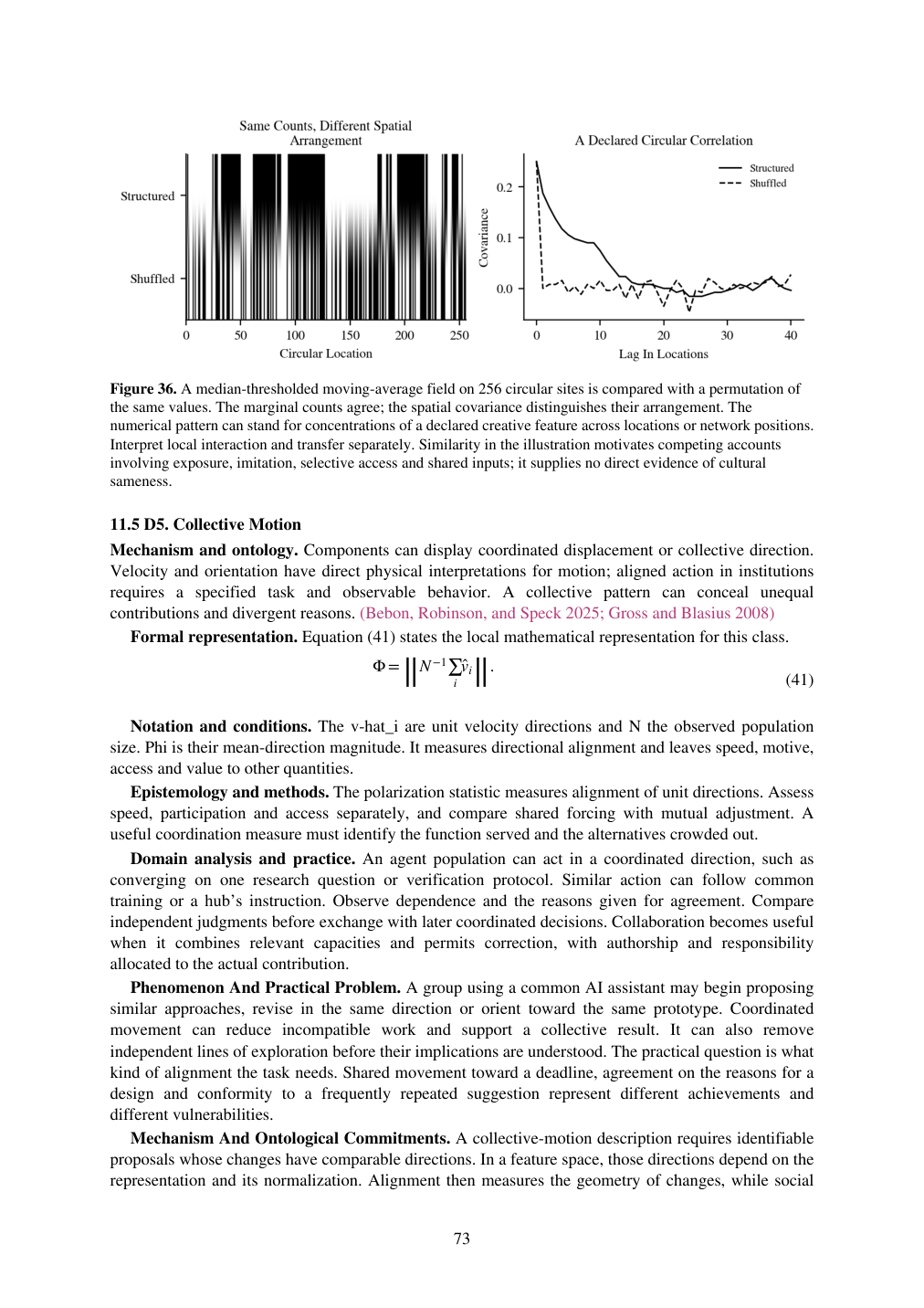
Readable text
Figure 36. A median-thresholded moving-average field on 256 circular sites is compared with a permutation of the same values. The marginal counts agree; the spatial covariance distinguishes their arrangement. The numerical pattern can stand for concentrations of a declared creative feature across locations or network positions. Interpret local interaction and transfer separately. Similarity in the illustration motivates competing accounts involving exposure, imitation, selective access and shared inputs; it supplies no direct evidence of cultural
Mechanism and ontology. Components can display coordinated displacement or collective direction. Velocity and orientation have direct physical interpretations for motion; aligned action in institutions requires a specified task and observable behavior. A collective pattern can conceal unequal contributions and divergent reasons. (Bebon, Robinson, and Speck 2025; Gross and Blasius 2008)
Formal representation. Equation (41) states the local mathematical representation for this class.
Notation and conditions. The v-hat_i are unit velocity directions and N the observed population size. Phi is their mean-direction magnitude. It measures directional alignment and leaves speed, motive,
Epistemology and methods. The polarization statistic measures alignment of unit directions. Assess speed, participation and access separately, and compare shared forcing with mutual adjustment. A useful coordination measure must identify the function served and the alternatives crowded out.
Domain analysis and practice. An agent population can act in a coordinated direction, such as converging on one research question or verification protocol. Similar action can follow common training or a hub’s instruction. Observe dependence and the reasons given for agreement. Compare independent judgments before exchange with later coordinated decisions. Collaboration becomes useful when it combines relevant capacities and permits correction, with authorship and responsibility
Phenomenon And Practical Problem. A group using a common AI assistant may begin proposing similar approaches, revise in the same direction or orient toward the same prototype. Coordinated movement can reduce incompatible work and support a collective result. It can also remove independent lines of exploration before their implications are understood. The practical question is what kind of alignment the task needs. Shared movement toward a deadline, agreement on the reasons for a design and conformity to a frequently repeated suggestion represent different achievements and
Mechanism And Ontological Commitments. A collective-motion description requires identifiable proposals whose changes have comparable directions. In a feature space, those directions depend on the representation and its normalization. Alignment then measures the geometry of changes, while social
coordination requires channels of interpretation and response. The model may include imitation, common prompts or deliberate role allocation. Each mechanism can create a high alignment score with different consequences for exploration. The ontology includes participants and artifact trajectories, with the shared assistant acting through particular suggestions and opportunities for uptake.
Epistemic Design And Discriminating Evidence. Compare groups with shared suggestions, independently sampled suggestions and a shared coordination brief without shared content. Keep model access and working time comparable. Track the sequence of adoption and participants’ accounts of why they changed direction. Evaluate the group outcome with an external task measure and inspect the contribution of minority trajectories. A common-input explanation predicts alignment even when participants cannot observe one another. An interaction explanation predicts additional adjustment after exposure to peers. Results should report how descriptor choice affects the alignment estimate (Woolley et al. 2010; Bernstein, Shore, and Lazer 2018).
Philosophical Reasoning And Practice. The philosophical issue is the relation between agreement and warranted collective judgment. Social epistemology values criticism and responsiveness to reasons, making room for productive disagreement within coordinated action (Longino 1990). An institution can therefore coordinate deadlines and interfaces while preserving independent proposal routes. The normative reason for a protected minority line concerns the possibility that the shared frame misses something consequential. Its practical form should remain proportionate to the task and costs, with clear occasions for reconvergence and explicit evaluation of the resulting alternatives.
Worked Comparison And Research Proposition. Consider a hypothetical architecture exercise where one shared assistant proposes a central circulation plan. Some teams immediately converge; others protect separate accessibility and maintenance analyses before combining proposals. The research proposition is that early directional alignment can improve assembly speed while reducing discovery of incompatible requirements. Compare total completion time, detected conflicts and the final accessibility assessment under equal resources. A numerical alignment trajectory can locate the proposed mechanism; the domain assessment determines whether the movement represented useful coordination, incomplete convergence or a defensible change in the creative problem itself.
Reading the numerical illustration. Figure 37 illustrates the declared mechanism. An order parameter compresses a distribution of directions. The velocity field restores some of the component information hidden by that scalar, while the update rule supplies the proposed alignment mechanism. Display positions here are independent plotting locations rather than a local-interaction geography. A domain use should identify actual coordinated operations and channels of adjustment, examine who contributes or bears the costs, and preserve the distinction between behavioral alignment and participants sharing purposes or reasons.
11.6 D6. Intermittency And Chaos
Mechanism and ontology. A time series can contain bursts, irregular switching or sensitive dependence. Deterministic chaos concerns specified deterministic dynamics; stochastic variation and changing observation can produce similar irregularity. Time resolution and state reconstruction constrain the interpretation. (Cross and Hohenberg 1993; Lorenz 1963)
Formal representation. Equation (42) states the local mathematical representation for this class.
‖δx(t)‖≈‖δx(0)‖eλt. (42)
Notation and conditions. Delta x is a small initial perturbation and lambda an appropriate sensitivity exponent under the model. Finite records and noise complicate its estimation. Irregularity alone leaves several generating processes admissible.
Epistemology and methods. A positive estimated Lyapunov exponent becomes evidence for chaos only with adequate assumptions and robustness tests. Compare stochastic and nonstationary alternatives. Prediction horizons and decision horizons can remain useful even where detailed long-term prediction is limited.
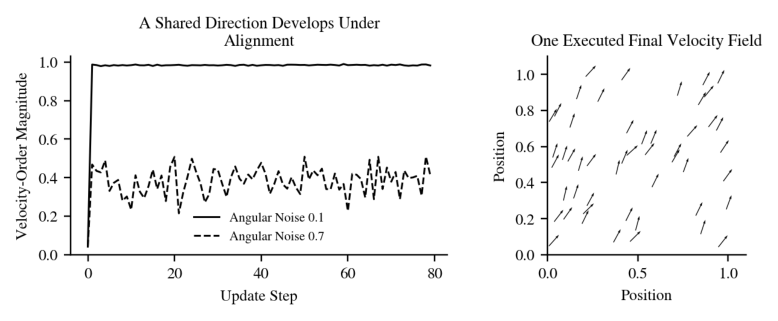
Figure 37. Fifty unit-velocity headings update toward their global mean direction plus uniform angular noise. The initial headings are shared. The quiver panel shows the lower-noise final headings at declared display positions. Interpret alignment in the numerical illustration as similarity of changes in a declared proposal space. Common direction can represent coordinated revision, imitation or shared input. The domain comparison must connect those directions to reasons and task consequences before treating collective movement as creative improvement.
Domain analysis and practice. Bursts of apparent discovery and irregular search trajectories can arise from stochastic proposals, changing tests or endogenous feedback. Compare these accounts before attributing chaos. Keep exact seeds, inputs and evaluator versions where feasible. A practical forecast can concern near-term verification workload or expected discovery under a specified workflow. Creative significance still requires substantive appraisal of the artifacts and the operations they make possible.
Phenomenon And Practical Problem. Creative work can contain long periods of modest revision interrupted by a substantial change in direction. AI sampling may add further irregularity through variable suggestions and evaluation. A project team can mistake these bursts for evidence of a deep creative mechanism, then design interventions around an unreliable signal. The practical problem is predicting when additional exploration will help and when it will consume scarce review time. Irregular traces should therefore be associated with identifiable changes in artifacts, constraints and available resources before being interpreted as productive discovery.
Mechanism And Ontological Commitments. Intermittency describes uneven activity, while deterministic chaos makes a stronger dynamical claim about sensitivity within a specified model. Stochastic sampling, hidden prompt changes, evaluator revisions and mixture of several ordinary processes can also generate irregular records. The ontology of a candidate chaotic account needs a state reconstruction that preserves the variables driving subsequent change. A semantic embedding alone may omit the evolving brief and social interpretation. The mechanism of a creative leap must therefore connect its trajectory representation to actual generation, selection and reconsideration operations.
Epistemic Design And Discriminating Evidence. Use repeated computational runs with controlled seeds and documented inputs to separate sampling variation from deterministic sensitivity. For human collaboration, preserve event records and compare models with stochastic forcing, delayed review and changing tasks. Hold the reconstruction rule fixed before examining sensitivity estimates, and test predictions on withheld trajectories. Distinguish a local descriptor jump from a valuable reorganization by examining the resulting work and its reasons. Finite records place strong limits on estimated exponents; several observationally similar models may remain admissible (Lorenz 1963; Takens 1981).
Philosophical Reasoning And Practice. Philosophically, an unexpected outcome can invite reflective inquiry without granting unpredictability an independent value. The relevant question is whether a new arrangement makes a previously obscure possibility intelligible and worthwhile (Kant
2000). Practice can preserve the intermediate traces that allow participants to explain a change of direction after it occurs. This supports learning from surprise while retaining ordinary standards of source support, task relevance and criticism. A dramatic trajectory receives the same demand for reasons as a gradual improvement, though the appropriate reasons may develop through further exploration.
Worked Comparison And Research Proposition. Imagine two hypothetical story-generation systems with equally bursty novelty traces. One uses independent high-variance sampling; the other revises a stable representation after contradictions accumulate. The research proposition is that bursts accompanied by a documented representation change predict transferable gains on a related task more reliably than novelty jumps alone. Compare matched generation budgets, later consistency and adaptation to a fresh constraint. If both systems transfer similarly, the proposed representation mechanism loses explanatory priority. A chaos label would require its own additional dynamical evidence beyond this comparison.
Reading the numerical illustration. Figure 38 illustrates the declared mechanism. The numerical comparison illustrates sensitivity in a specified deterministic system. Its log-distance trace is a finitetime diagnostic, with intervals affected by local stretching, contraction and eventual saturation. It supplies neither a Lyapunov-spectrum estimation procedure nor an identification of chaos from an arbitrary social time series. A domain investigation should compare noise, external change and observation artifacts, justify its reconstructed state, and report which prediction horizon remains useful under its actual evidence and error scale.
11.7 D7. Collective Phase Transitions
Mechanism and ontology. A collective order parameter can change regime as control conditions vary. A phase-transition account specifies the order parameter, control parameter, size dependence and limiting procedure. Abrupt social change can motivate this inquiry while several noncritical mechanisms remain admissible. (Cross and Hohenberg 1993; Boettiger and Hastings 2012)
Formal representation. Equation (43) states the local mathematical representation for this class.
χN =N([m2]−[m]2). (43)
Notation and conditions. The order parameter m is defined for a system of size N; chi_N is its scaled variance in the chosen ensemble. Interpretation as response susceptibility requires the relevant model and response relation.
Epistemology and methods. Treat susceptibility here as a fluctuation statistic under the chosen normalization. Test finite-size behavior and alternative explanations such as a common shock or administrative reclassification. A fitted power law alone leaves mechanism and universality unresolved.
Domain analysis and practice. A sudden population-wide change in output may follow a threshold, an evaluator replacement or a prompt broadcast. Record such discrete interventions alongside candidate-level trajectories. Test finite-population behavior and alternative models before a phasetransition claim. An operational design can monitor concentration, valid discoveries and evaluator disagreement even while the stronger collective-transition hypothesis remains under investigation.
Phenomenon And Practical Problem. A collaborative platform can move abruptly from varied proposals to a dominant approach as sharing or selection becomes stronger. A sudden increase in common vocabulary may help participants combine contributions, while also narrowing the field through which later proposals become recognizable. The practical problem concerns a threshold: a small interface or ranking change may alter the collective pattern more than expected. The research question is whether this reflects interaction among contributors, an imposed platform discontinuity or a measurement rule that recodes gradual change as an abrupt event.
Mechanism And Ontological Commitments. A phase-transition account requires a defined collective variable, system size and control parameter. For a creative network, the order variable could summarize concentration in a declared family of techniques, while coupling describes an actual
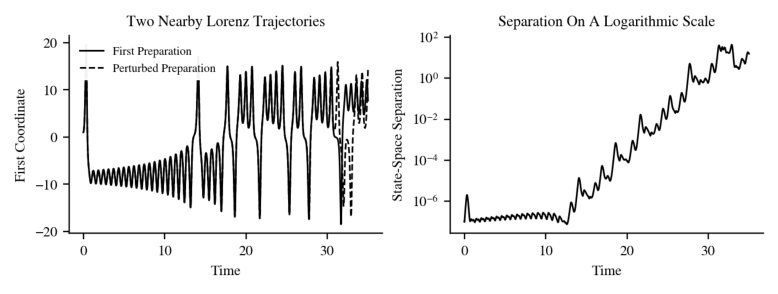
Figure 38. Two Lorenz trajectories use sigma = 10, rho = 28 and beta = 8/3, with an initial first-coordinate difference of 10 to the power -7. The finite-time separation grows and later saturates within the bounded sampled motion. The numerical irregularity illustrates a possible dynamical signature. In creative work, a plotted excursion could correspond to a substantial revision or merely a changed descriptor. Compare deterministic sensitivity, stochastic proposals and changing evaluation before assigning the trace a creative or causal interpretation.
exposure rule. These operational correspondences are essential because semantic similarity and social agreement have distinct meanings. Finite groups can show sharp crossovers without an infinite-system singularity. A numerical transition can guide mechanism comparison when the same observation procedure is applied consistently and the plausible scaling range is reported.
Epistemic Design And Discriminating Evidence. In constructed environments, vary sharing intensity across several group sizes while holding total candidate budgets per participant comparable. Record concentration, task achievement and the persistence of minority approaches. Compare smooth exposure changes with a ranking rule that directly switches visibility at a threshold. Replicate across task structures and descriptor systems, then examine whether predicted size dependence survives. A single platform intervention at one group size gives evidence about that intervention, while broader transition language requires the additional comparisons. Analyze adoption opportunities because inaccessible alternatives can artificially inflate an order measure (Cross and Hohenberg 1993; Centola and Baronchelli 2015).
Philosophical Reasoning And Practice. The philosophical linkage concerns collective intelligibility and plurality. A common frame can make ideas mutually usable; its success can also make alternative frames harder to articulate. Social epistemology supports institutions that allow criticism to enter consequential evaluation (Longino 1990). Design can therefore make convergence revisable by retaining alternative representations and a route for explaining their relevance. The normative claim concerns the quality of inquiry and distribution of recognition. It does not require maximizing variation regardless of the task’s need for shared commitments and completion.
Worked Comparison And Research Proposition. Suppose a hypothetical invention platform increases recommendation coupling until one prototype family dominates. Compare a version preserving a searchable minority archive with one pruning low-visibility families. The research proposition is that the same apparent transition in dominant share can produce different resilience to a later requirement change. Test recovery with equal additional budgets and trace whether reopened alternatives supply indispensable components. This links an aggregate transition to future creative exercise, and it makes the practical object the availability of usable alternatives alongside the immediate coordination benefits of a common direction.
Reading the numerical illustration. Figure 39 illustrates the declared mechanism. A collectivetransition account needs a declared order parameter and a size comparison. Exact enumeration displays
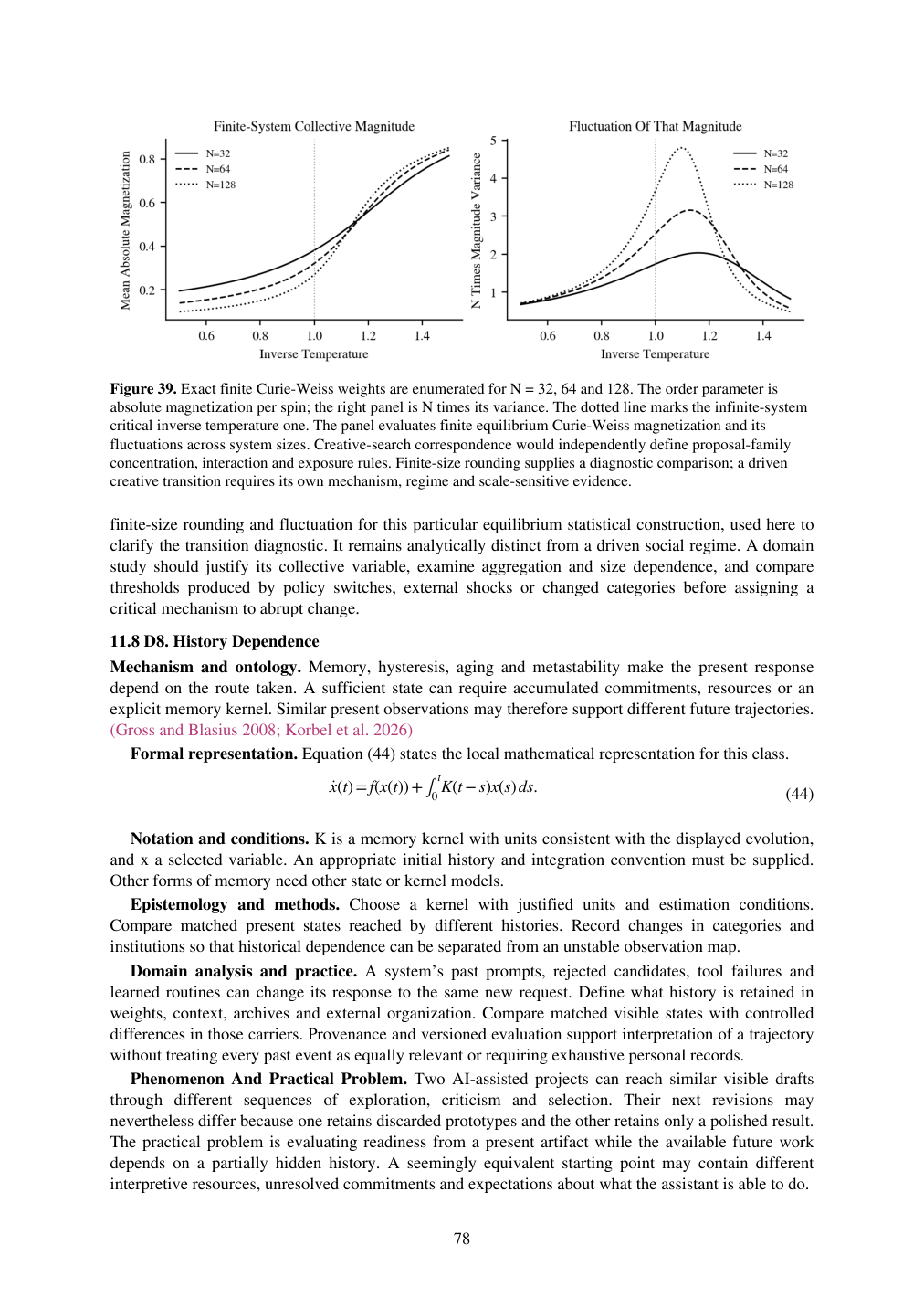
Readable text
Figure 39. Exact finite Curie-Weiss weights are enumerated for N = 32, 64 and 128. The order parameter is absolute magnetization per spin; the right panel is N times its variance. The dotted line marks the infinite-system critical inverse temperature one. The panel evaluates finite equilibrium Curie-Weiss magnetization and its fluctuations across system sizes. Creative-search correspondence would independently define proposal-family concentration, interaction and exposure rules. Finite-size rounding supplies a diagnostic comparison; a driven creative transition requires its own mechanism, regime and scale-sensitive evidence.
finite-size rounding and fluctuation for this particular equilibrium statistical construction, used here to clarify the transition diagnostic. It remains analytically distinct from a driven social regime. A domain study should justify its collective variable, examine aggregation and size dependence, and compare thresholds produced by policy switches, external shocks or changed categories before assigning a
Mechanism and ontology. Memory, hysteresis, aging and metastability make the present response depend on the route taken. A sufficient state can require accumulated commitments, resources or an explicit memory kernel. Similar present observations may therefore support different future trajectories.
Formal representation. Equation (44) states the local mathematical representation for this class.
Notation and conditions. K is a memory kernel with units consistent with the displayed evolution, and x a selected variable. An appropriate initial history and integration convention must be supplied. Other forms of memory need other state or kernel models.
Epistemology and methods. Choose a kernel with justified units and estimation conditions. Compare matched present states reached by different histories. Record changes in categories and institutions so that historical dependence can be separated from an unstable observation map.
Domain analysis and practice. A system’s past prompts, rejected candidates, tool failures and learned routines can change its response to the same new request. Define what history is retained in weights, context, archives and external organization. Compare matched visible states with controlled differences in those carriers. Provenance and versioned evaluation support interpretation of a trajectory without treating every past event as equally relevant or requiring exhaustive personal records.
Phenomenon And Practical Problem. Two AI-assisted projects can reach similar visible drafts through different sequences of exploration, criticism and selection. Their next revisions may nevertheless differ because one retains discarded prototypes and the other retains only a polished result. The practical problem is evaluating readiness from a present artifact while the available future work depends on a partially hidden history. A seemingly equivalent starting point may contain different interpretive resources, unresolved commitments and expectations about what the assistant is able to do.
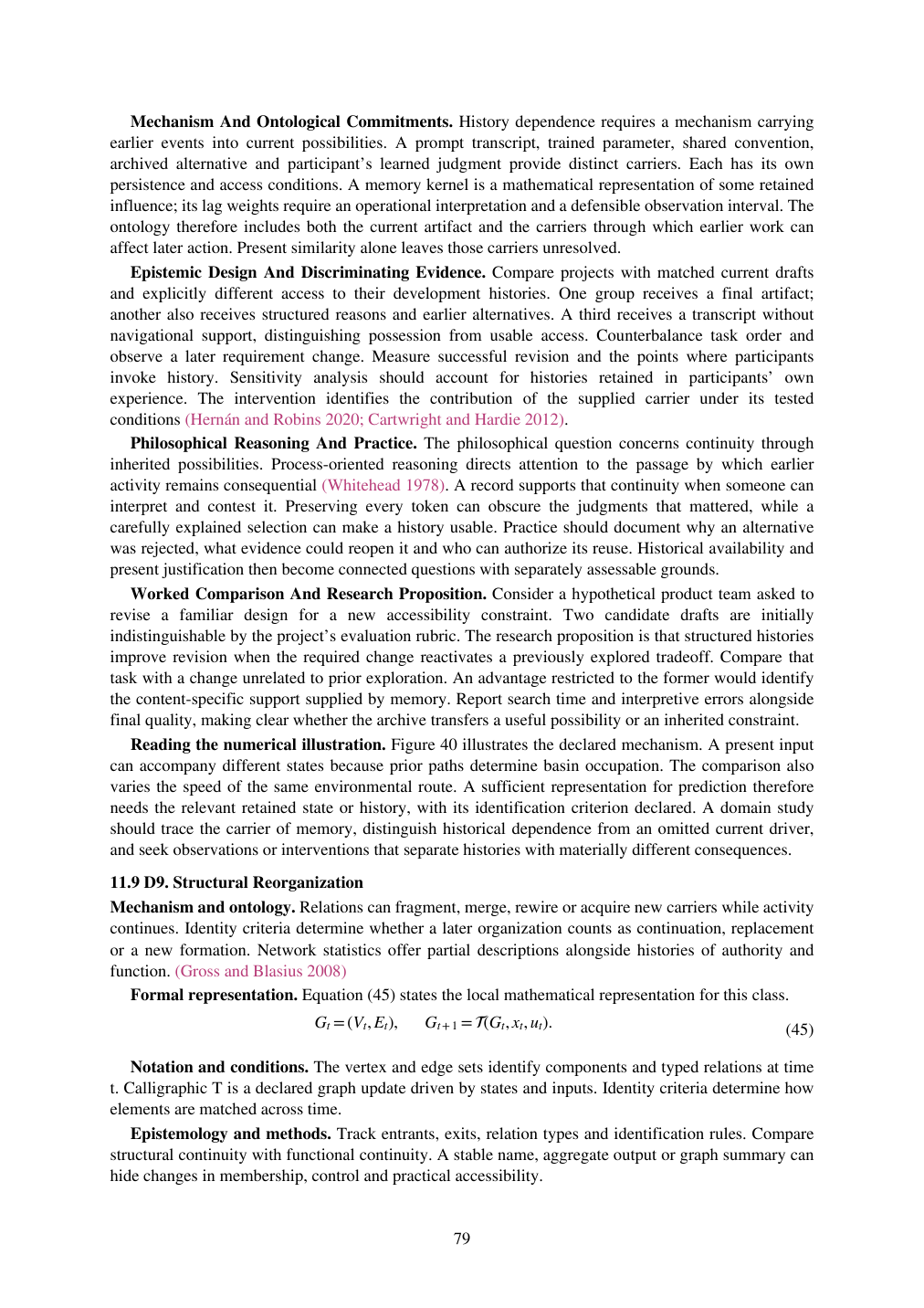
Readable text
Mechanism And Ontological Commitments. History dependence requires a mechanism carrying earlier events into current possibilities. A prompt transcript, trained parameter, shared convention, archived alternative and participant’s learned judgment provide distinct carriers. Each has its own persistence and access conditions. A memory kernel is a mathematical representation of some retained influence; its lag weights require an operational interpretation and a defensible observation interval. The ontology therefore includes both the current artifact and the carriers through which earlier work can affect later action. Present similarity alone leaves those carriers unresolved.
Epistemic Design And Discriminating Evidence. Compare projects with matched current drafts and explicitly different access to their development histories. One group receives a final artifact; another also receives structured reasons and earlier alternatives. A third receives a transcript without navigational support, distinguishing possession from usable access. Counterbalance task order and observe a later requirement change. Measure successful revision and the points where participants invoke history. Sensitivity analysis should account for histories retained in participants’ own experience. The intervention identifies the contribution of the supplied carrier under its tested conditions (Hernán and Robins 2020; Cartwright and Hardie 2012).
Philosophical Reasoning And Practice. The philosophical question concerns continuity through inherited possibilities. Process-oriented reasoning directs attention to the passage by which earlier activity remains consequential (Whitehead 1978). A record supports that continuity when someone can interpret and contest it. Preserving every token can obscure the judgments that mattered, while a carefully explained selection can make a history usable. Practice should document why an alternative was rejected, what evidence could reopen it and who can authorize its reuse. Historical availability and present justification then become connected questions with separately assessable grounds.
Worked Comparison And Research Proposition. Consider a hypothetical product team asked to revise a familiar design for a new accessibility constraint. Two candidate drafts are initially indistinguishable by the project’s evaluation rubric. The research proposition is that structured histories improve revision when the required change reactivates a previously explored tradeoff. Compare that task with a change unrelated to prior exploration. An advantage restricted to the former would identify the content-specific support supplied by memory. Report search time and interpretive errors alongside final quality, making clear whether the archive transfers a useful possibility or an inherited constraint.
Reading the numerical illustration. Figure 40 illustrates the declared mechanism. A present input can accompany different states because prior paths determine basin occupation. The comparison also varies the speed of the same environmental route. A sufficient representation for prediction therefore needs the relevant retained state or history, with its identification criterion declared. A domain study should trace the carrier of memory, distinguish historical dependence from an omitted current driver, and seek observations or interventions that separate histories with materially different consequences.
Mechanism and ontology. Relations can fragment, merge, rewire or acquire new carriers while activity continues. Identity criteria determine whether a later organization counts as continuation, replacement or a new formation. Network statistics offer partial descriptions alongside histories of authority and
Formal representation. Equation (45) states the local mathematical representation for this class.
Notation and conditions. The vertex and edge sets identify components and typed relations at time t. Calligraphic T is a declared graph update driven by states and inputs. Identity criteria determine how
Epistemology and methods. Track entrants, exits, relation types and identification rules. Compare structural continuity with functional continuity. A stable name, aggregate output or graph summary can hide changes in membership, control and practical accessibility.
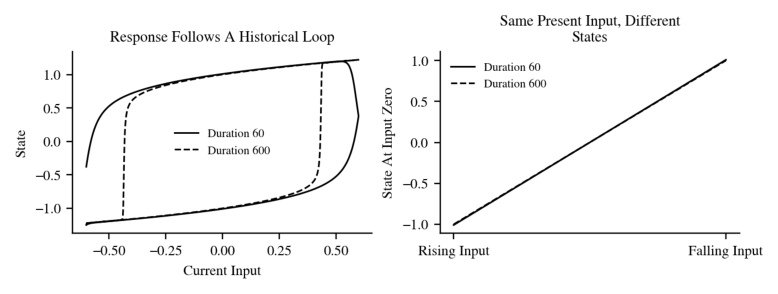
Figure 40. The cubic state law dx/dt = lambda + x - x cubed is driven from lambda = -0.6 to 0.6 and back. Durations sixty and six hundred show rate dependence and a historical loop; the right panel samples zero input on each leg. Interpret the numerical memory effect as influence carried by archived alternatives, learned conventions or earlier selection. Equal present observables may conceal different future responses. The domain correspondence requires identifying a memory carrier and testing whether access to it changes a subsequent creative operation.
Domain analysis and practice. A search ecology can split, merge or change evaluative roles while preserving a project name. Track candidate descent, tool access, evaluator versions and authority to adopt outputs. Compare structural change with the functions retained or lost. A redesign can improve access to critique while disrupting an established verification route. Its assessment requires evidence about both the new opportunities and the support needed to make them usable.
Phenomenon And Practical Problem. An AI-supported creative workflow can change who collaborates with whom, which tools receive particular tasks and where decisions are made. The resulting reorganization can preserve a project’s name while changing the relations through which ideas become possible. The practical problem concerns comparisons across a redesign. An improved output after adding a specialist critic might reflect additional expertise, altered authority or a different definition of what counts as a candidate. A meaningful evaluation must preserve the distinctions required to explain that change.
Mechanism And Ontological Commitments. Structural reorganization changes the organization of components and typed relations. In a multi-agent system, proposal, critique, selection and memory access are distinct edges; an increase in message count does not describe which of them changed. A graph update must identify retained, new and removed roles. Changes in representation can also alter the candidate state space, requiring a translation between descriptions. The ontology includes executable roles and their resources, alongside the artifacts produced. Organizational identity is a declared criterion that the empirical account should make inspectable.
Epistemic Design And Discriminating Evidence. Compare a fixed-role workflow with a reconfigurable workflow using equal total query, review and storage budgets. Log role assignments and interventions as well as final outputs. Include a control that changes agent names while preserving the operational graph, separating cosmetic relabeling from changed coordination. Test performance on tasks requiring cross-role correction and on tasks requiring a stable specialist sequence. Analyze whether the proposed new connection is actually used. A score advantage without that passage leaves resource allocation or altered evaluation as competing accounts (Gross and Blasius 2008; Boussioux et al. 2024).
Philosophical Reasoning And Practice. Philosophical reasoning can distinguish a bearer from the function it performs. The same named assistant can support different practical relations after a workflow change, while a replaced component can preserve a useful function. This connects institutional inquiry to the identification of continuity through process (Whitehead 1978). Practice
should therefore state whether the purpose is continuity of authorship, recoverability of reasons, reliable task completion or a changed range of possibilities. These criteria can conflict. Their explicit formulation helps participants evaluate the reorganization without allowing a convenient organizational label to settle the question.
Worked Comparison And Research Proposition. Imagine a hypothetical research-writing system that replaces a single drafting agent with linked proposer, source-checker and challenger roles. The research proposition is that cross-role revision improves supported originality when the task contains tensions that a single evaluation rubric overlooks. Compare this with a workflow receiving the same critique text through a single agent. Record which conflicts lead to representation changes and which merely add editing work. This comparison tests the contribution of organized relations, and it exposes whether the new structure creates usable critical capacity at a proportionate coordination cost.
Reading the numerical illustration. Figure 41 illustrates the declared mechanism. The same degree summary can accompany different relations and different paths. The numerical event sequence demonstrates one transformation with preserved node identities, while a fuller identity criterion could also follow membership, authority or function. A domain inquiry should record which edge operation occurred and what it means, retain consequential provenance, and compare the operations made feasible by each configuration. A structural statistic becomes useful through the distinctions it preserves for that question.
11.10 D10. Functional Non-Equilibrium Organization
Mechanism and ontology. Sensing, proofreading, adaptation and regulation use sustained activity to perform a specified function. A functional account identifies a task, success conditions and the operations supporting it. Social functions are plural and can be contested by the people affected. (Bebon, Robinson, and Speck 2025; Ostrom 2009)
Formal representation. Equation (46) states the local mathematical representation for this class.
QT =[l(xT,)]. (46)
Notation and conditions. The task is calligraphic T, ell a declared loss and Q_T its expected value at horizon T. A threshold or comparison requires a justified interpretation of the task, population and consequences.
Epistemology and methods. Here ell is a declared task-loss function, not a universal value measure. Compare function under perturbation and withdrawal of support. Record which constituencies selected the task and whether success transfers costs or loss of capacity outside the evaluation boundary.
Domain analysis and practice. Creative inquiry can involve problem finding, proposal generation, verification, interpretation and development. These functions have different success criteria and evidential demands. Evaluate them separately before judging the combined workflow. A system producing many candidates may contribute little to problem formation or independent checking. Institutional design can allocate support to the missing function and compare the resulting improvement with a simpler professional workflow.
Phenomenon And Practical Problem. A creative system may generate more unusual artifacts while becoming less useful for the people who must develop or judge them. Another system may produce a modest artifact that enables a substantial new line of work. The practical problem is specifying the function through which creative contribution is evaluated. Candidate production, development of a workable solution, learning a technique and opening a new evaluative category deserve different evidence. A functional account begins with the task and its affected participants before selecting a performance summary.
Mechanism And Ontological Commitments. Functional organization concerns relations maintained sufficiently well to accomplish a declared task. A loss function can encode one operational criterion, but the choice of task, population and horizon determines its meaning. An AI workflow’s useful capacity can depend on inference resources, human interpretation, source access and
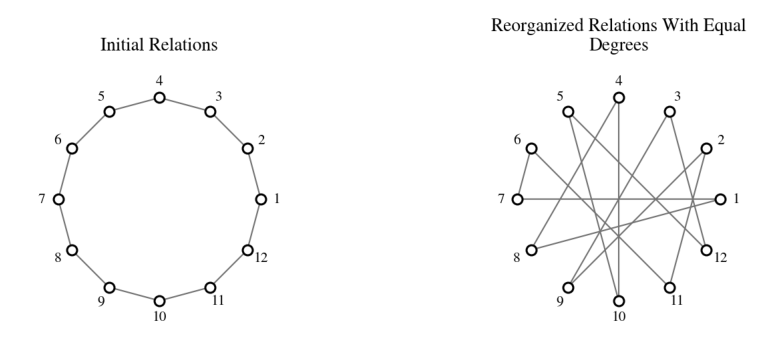
Figure 41. Forty accepted degree-preserving edge swaps transform a twelve-node cycle. The node identities and individual degrees are preserved; the actual pairwise relations change. The CSV records both full edge sets. Map the changing numerical graph to typed proposal, criticism, selection and memory relations in an AI workflow. Reorganization can alter possible paths without changing component labels. Domain assessment should trace the operative new connections and distinguish organizational continuity from continuity of creative function.
opportunities to revise the brief. Those supports belong in its ontology. A low expected loss under a fixed benchmark demonstrates a defined performance relation. Transfer to a changed social setting requires evidence that the relevant supports and evaluative commitments correspond.
Epistemic Design And Discriminating Evidence. Construct a task family that separates immediate artifact quality from downstream adaptability. Evaluate the same systems on a familiar brief, an unannounced constraint change and a recipient’s attempt to develop the result. Keep total resources visible, including time spent interpreting suggestions. Use assessors with relevant domain competence and report disagreements across evaluation dimensions. Analyze whether a system achieves its score by narrowing the observed population or dropping difficult requirements. Functional comparison becomes stronger when the proposed support mechanism predicts where performance transfers and where it fails (Cartwright and Hardie 2012; Sen 2009).
Philosophical Reasoning And Practice. Boden distinguishes generation within a conceptual space from transformations that change what can be generated (Boden 1997). This provides a philosophical resource for asking whether the chosen function itself remains adequate as a project develops. The present extension makes evaluative revision an explicit operation: participants can explain a new criterion and test what it reveals. A changed rubric deserves reasons connected to the work and affected purposes. Practice can preserve both the original task assessment and the new judgment so that transformation remains accountable to an interpretable history.
Worked Comparison And Research Proposition. Suppose a hypothetical materials-design assistant proposes candidates that score well on an initial sustainability rubric. A collaborator discovers that repairability requires a different representation of use over time. The research proposition is that workflows permitting justified criterion revision produce more adaptable designs than workflows optimizing the original score alone. Compare final artifacts, the evidence supporting the revised criterion and the costs imposed on downstream users. The point is a testable passage from a change in judgment to a changed practical possibility, with the value of that possibility examined through the intended application.
Reading the numerical illustration. Figure 42 illustrates the declared mechanism. A functional account identifies the task, success measure and supporting operation. The two declared integrals make one performance-cost comparison explicit, without supplying a public welfare ranking. Other tasks or cost accounts can yield a different comparison. A domain investigation should identify whose function
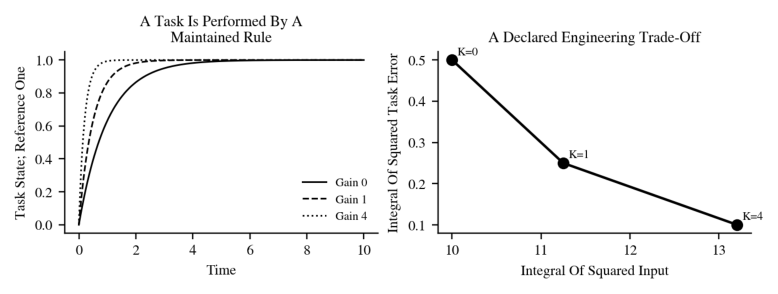
Figure 42. The plant dx/dt = -x + u uses u = 1 + K(1 - x) from x(0)=0. Higher gain reduces integrated squared error while changing a declared quadratic input-cost proxy over time zero to ten. Read the numerical task measure as one declared criterion for a creative operation. Its trajectory represents maintained or improved performance under the chosen conditions. The domain correspondence requires identifying the task, supporting relations, evaluation horizon and reasons for changing the criterion when the work exposes new purposes.
is being assessed, whether participants can actually exercise it, and how its supporting resources and authority are renewed. Successful output and justified continuation then receive their respective evidence and reasons.
12 E. Persistence, Transformation, And Dissolution
12.1 E1. Transient Relaxation
Mechanism and ontology. A regime can be an episode in a longer passage toward another configuration. A transient is defined relative to dynamics and observation horizon. Its duration can be practically consequential even when asymptotic analysis assigns it no permanent status. (Ashwin et al. 2012) Formal representation. Equation (47) states the local mathematical representation for this class.
τA =inf{t≥0:xt ∉A}. (47)
Notation and conditions. The set A identifies the regime and tau_A is its first-exit time. The definition can be applied to deterministic or stochastic paths. Censoring and the finite observation horizon affect estimation.
Epistemology and methods. Define the regime A and use appropriate censoring for unfinished episodes. Compare first-exit distributions and changing environments. Institutional assessment should state whether a temporary service, coalition or learning episode achieved its time-bounded purpose.
Domain analysis and practice. A bounded search episode can produce a verified artifact, a useful failure or a clarified question. State the stopping rule and what is retained for successor inquiry. Compare continuation with transfer to another method or investigator. A good endpoint can conserve resources and preserve the evidence needed for later revision. The generative contribution concerns the usable inheritance of the episode and requires a trace of its subsequent exercise.
Phenomenon And Practical Problem. An AI-generated direction can be valuable for a short stage of inquiry and then appropriately disappear. A provocative sketch may reveal a hidden constraint without becoming part of the final design. A temporary team configuration may make unfamiliar collaborators able to begin, then cease to serve the project. The practical problem is evaluating such transients. Survival of a candidate is a poor proxy when its contribution consists in redirecting another candidate, clarifying a question or preparing a more capable successor workflow.
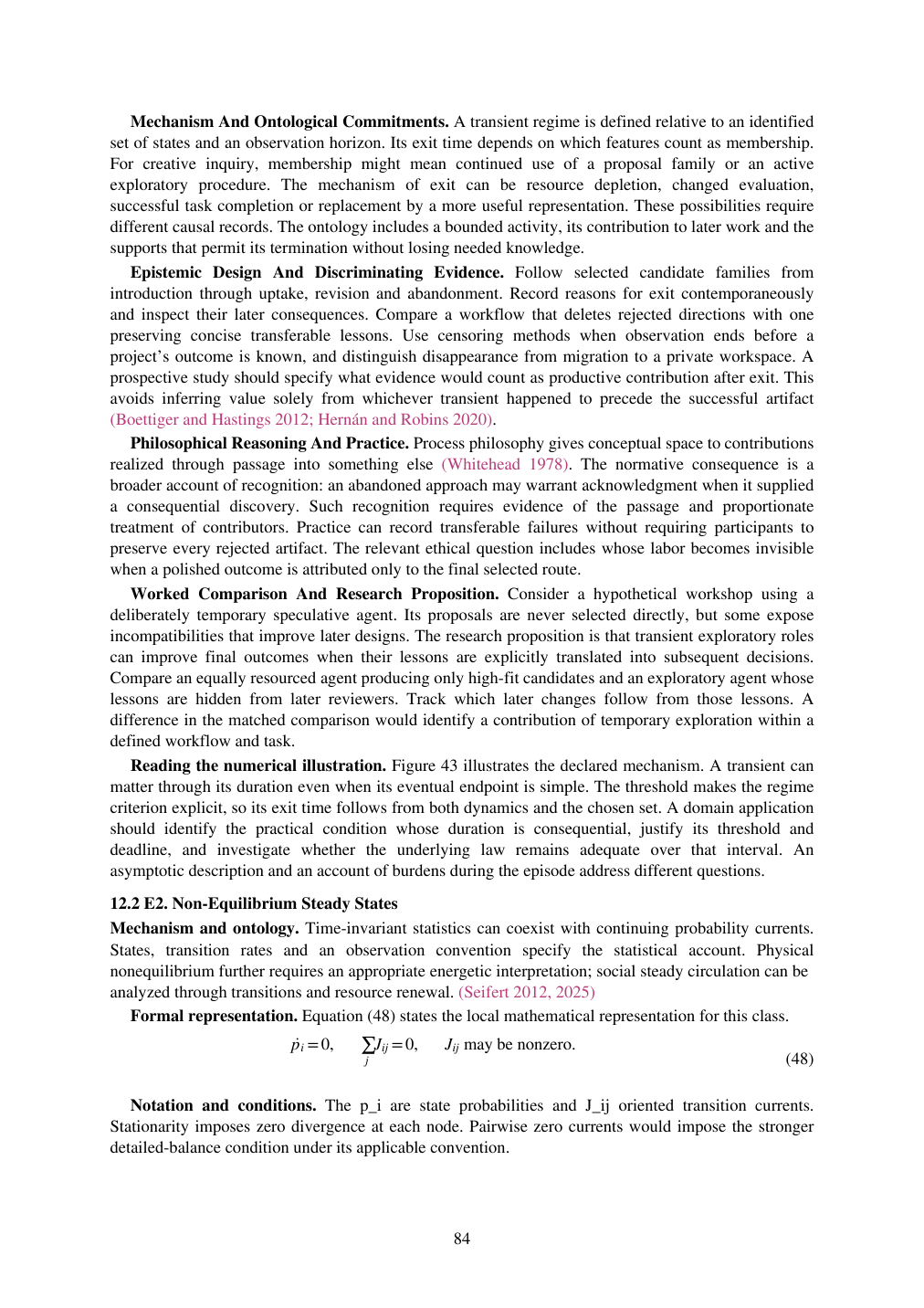
Readable text
Mechanism And Ontological Commitments. A transient regime is defined relative to an identified set of states and an observation horizon. Its exit time depends on which features count as membership. For creative inquiry, membership might mean continued use of a proposal family or an active exploratory procedure. The mechanism of exit can be resource depletion, changed evaluation, successful task completion or replacement by a more useful representation. These possibilities require different causal records. The ontology includes a bounded activity, its contribution to later work and the supports that permit its termination without losing needed knowledge.
Epistemic Design And Discriminating Evidence. Follow selected candidate families from introduction through uptake, revision and abandonment. Record reasons for exit contemporaneously and inspect their later consequences. Compare a workflow that deletes rejected directions with one preserving concise transferable lessons. Use censoring methods when observation ends before a project’s outcome is known, and distinguish disappearance from migration to a private workspace. A prospective study should specify what evidence would count as productive contribution after exit. This avoids inferring value solely from whichever transient happened to precede the successful artifact (Boettiger and Hastings 2012; Hernán and Robins 2020).
Philosophical Reasoning And Practice. Process philosophy gives conceptual space to contributions realized through passage into something else (Whitehead 1978). The normative consequence is a broader account of recognition: an abandoned approach may warrant acknowledgment when it supplied a consequential discovery. Such recognition requires evidence of the passage and proportionate treatment of contributors. Practice can record transferable failures without requiring participants to preserve every rejected artifact. The relevant ethical question includes whose labor becomes invisible when a polished outcome is attributed only to the final selected route.
Worked Comparison And Research Proposition. Consider a hypothetical workshop using a deliberately temporary speculative agent. Its proposals are never selected directly, but some expose incompatibilities that improve later designs. The research proposition is that transient exploratory roles can improve final outcomes when their lessons are explicitly translated into subsequent decisions. Compare an equally resourced agent producing only high-fit candidates and an exploratory agent whose lessons are hidden from later reviewers. Track which later changes follow from those lessons. A difference in the matched comparison would identify a contribution of temporary exploration within a
Reading the numerical illustration. Figure 43 illustrates the declared mechanism. A transient can matter through its duration even when its eventual endpoint is simple. The threshold makes the regime criterion explicit, so its exit time follows from both dynamics and the chosen set. A domain application should identify the practical condition whose duration is consequential, justify its threshold and deadline, and investigate whether the underlying law remains adequate over that interval. An asymptotic description and an account of burdens during the episode address different questions.
Mechanism and ontology. Time-invariant statistics can coexist with continuing probability currents. States, transition rates and an observation convention specify the statistical account. Physical nonequilibrium further requires an appropriate energetic interpretation; social steady circulation can be analyzed through transitions and resource renewal. (Seifert 2012, 2025)
Formal representation. Equation (48) states the local mathematical representation for this class.
Notation and conditions. The p_i are state probabilities and J_ij oriented transition currents. Stationarity imposes zero divergence at each node. Pairwise zero currents would impose the stronger detailed-balance condition under its applicable convention.
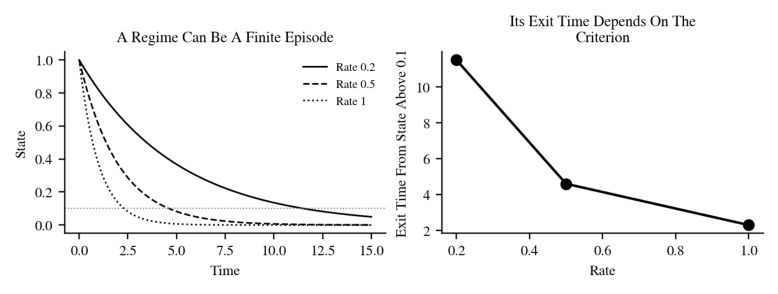
Figure 43. An exact decay begins at one; the transient regime is defined by x greater than 0.1. Its exit time is log(10)/k for each of the three positive rates. Interpret exit from the illustrated regime as leaving a temporary proposal family or exploratory role. The duration concerns a declared state criterion. A creative transient may contribute through later revisions after it disappears, so its domain assessment follows consequences and inheritance alongside survival time.
Epistemology and methods. Estimate both occupancies and directional transitions. Stable averages can hide directional movement, population turnover and depleting support. Test whether rates and observation rules remain stable over the claimed interval.
Domain analysis and practice. A stable rate of outputs can coexist with continual candidate turnover, compute use and evaluator activity. Record the currents among proposal, rejection, validation and reuse, alongside aggregate scores. Compare the rate of substantive verified developments with text production. A steady computational process can be useful while its evaluation environment is renewed; that renewal belongs in the account of what sustains the performance.
Phenomenon And Practical Problem. A creative platform can maintain stable average output quality and descriptor diversity while particular contributors, ideas and techniques continually enter and leave. The practical issue is what that stability conceals. A steady distribution may depend on continual human curation, uncompensated interpretation or repeated arrival of outside ideas. It may also reproduce unequal opportunities for particular kinds of contribution. Evaluating the maintained pattern requires tracing the flows that sustain it and the consequences of participation, alongside the aggregate quantities that appear stationary.
Mechanism And Ontological Commitments. A non-equilibrium steady-state representation distinguishes stable occupancy from ongoing transitions. For a creative archive, the states might denote stages of development or families of techniques; currents describe specified movement among them. Stationarity requires balanced net inflow at each state under the chosen accounting. Pairwise balanced currents would impose a stronger condition with a different interpretation. Neither statement supplies a measure of value. The ontology includes a population undergoing turnover, continuing resource inputs and rules of retention. Its identity depends on the partition used to recognize recurring states.
Epistemic Design And Discriminating Evidence. Estimate occupancies and transitions over several comparable windows, accounting for changes in task mix and entry conditions. Interrupt or vary one support in a constructed platform experiment, such as curator time or external idea access. Observe whether the stationary pattern persists and which pathways change. Compare entrant cohorts and excluded submissions so that a stable selected archive is distinguished from a stable opportunity process. Apparent stationarity caused by coarse categories should be checked with alternative partitions and event-level evidence. Resource accounts make hidden external support testable (Seifert 2012; Mouret and Clune 2015).
Philosophical Reasoning And Practice. The philosophical linkage concerns reproduction through continuing activity. A process account treats stable organization as an accomplishment requiring
Readable text
renewed relations (Whitehead 1978). In creative practice, this shifts attention toward the workers and communities who make apparent autonomy possible. Recognition and governance can then consider access to participation, credit for curation and the right to question selection rules. These judgments need their own reasons. The fact that a particular flow maintains a stable archive helps explain its operation while leaving the legitimacy of the arrangement open to public or organizational deliberation.
Worked Comparison And Research Proposition. Suppose a hypothetical design archive retains a constant number of strong candidates while continuously replacing them. Compare continued external submissions with a closed-input period under equal computational effort. The research proposition is that apparently stable creative performance depends on replenishment of interpretable alternatives when internal selection tends to reuse familiar structures. Measure downstream adaptation and trace the origin of useful novelty. If performance remains stable without new inputs, inspect whether stored diversity supplied the support over the tested horizon. That finding would locate the reservoir and its duration,
Reading the numerical illustration. Figure 44 illustrates the declared mechanism. Steady frequencies can coexist with ongoing directional activity, and the same frequencies can hide opposite currents. Exact stationarity is checked using the transition generator. The construction identifies a statistical non-equilibrium feature; its energetic interpretation would require physical correspondence. A domain study should follow actual transitions and resource renewal alongside stocks, inspect which readout discriminates the circulation relevant to its question, and evaluate the function or distribution sustained by that flow through additional substantive premises.
Mechanism and ontology. A system can persist through recurrent change rather than a fixed configuration. A stable periodic orbit is one possible regime; externally maintained cycles require a model of the driver. Its viability depends on the resources, participation and constraints renewed each
Formal representation. Equation (49) states the local mathematical representation for this class.
Notation and conditions. The trajectory x-star is periodic with positive period T. Its existence and its attraction are different properties. Stability analysis requires the particular evolution rule and
Epistemology and methods. A periodic solution alone leaves attraction to be assessed, for example through Floquet multipliers. Examine recovery after phase and amplitude perturbations. In institutional applications, compare calendar recurrence with successful renewal of the underlying function.
Domain analysis and practice. A repeated research cycle can maintain a useful inquiry if each pass receives relevant feedback and replenishes its supports. The same routine can become ceremonial when later stages rely on recycled judgments. Trace sources, tests and resources across cycles. Compare continuation under independent feedback with internal recurrence. Practical governance can revise the cycle when its evidential contribution declines or its maintenance burden exceeds its justified purpose.
Phenomenon And Practical Problem. A creative workflow may repeatedly return to recognizable phases of proposal, criticism, revision and presentation. Such recurrence can make collaboration predictable and let specialists prepare their contributions. The practical difficulty is whether the cycle renews the inquiry or simply replays a familiar repertoire. A recurring review meeting can maintain participation while leaving selection criteria untouched. The relevant phenomenon therefore includes both the periodic organization of activity and the degree to which each pass responds to new evidence,
Mechanism And Ontological Commitments. A periodic regime is a trajectory that returns after a declared period. Existence of recurrence and attraction back to that recurrence are distinct dynamical properties. In a workflow, phase coordinates need to correspond to actual operations and resource
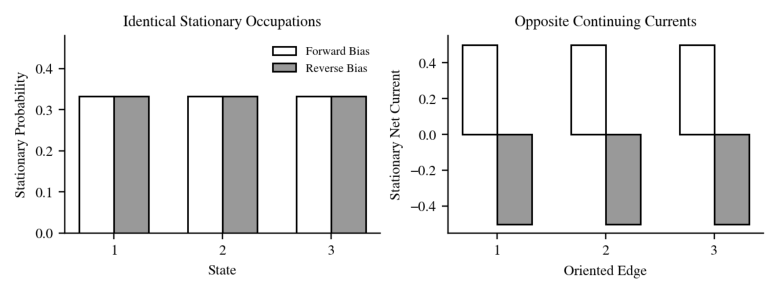
Figure 44. Uniform probabilities are stationary for both directions of bias in the three-state ring. Swapping clockwise rate 2 and reverse rate 0.5 preserves occupations and reverses each steady current from 0.5 to -0.5. Read stable numerical occupancies together with the illustrated currents as an archive maintained by entry, revision and replacement. The correspondence distinguishes an unchanged distribution from inactive contents. Assessing a creative steady regime also requires accounts of replenishment, curation, access and downstream usefulness.
commitments. An imposed calendar can generate periodic observations without an autonomous cycle. A stable cycle can coexist with changing artifacts, so its identity should specify what repeats. The ontology may concern a recurring organizational relation rather than literal repetition of the content produced during each pass.
Epistemic Design And Discriminating Evidence. Record phase-specific events and perturb the timing or content of one review in a controlled study. A genuinely attracting organizational cycle predicts recovery of a phase relation within an identifiable range of disturbances. Compare this with a calendar-driven workflow whose timing is maintained externally. Assess whether recovery restores useful inquiry, including the uptake of criticism and completion of revisions. Analyze cycle-to-cycle change in accepted reasons, task achievement and participant roles. Mere spectral regularity leaves a narrower descriptive conclusion than demonstrated return following perturbation (Cross and Hohenberg 1993; Bernstein, Shore, and Lazer 2018). Philosophical Reasoning And Practice. An account of inquiry grounded in consequences supports repeated opportunities to test and revise a proposal (Dewey 1927). The philosophical standard concerns what a cycle enables participants to learn and contest. A practice can preserve regular occasions for criticism while varying the methods and evaluative frame when warranted. This makes periodicity a support for revisability. It also distributes a burden: participants need adequate time and resources to prepare challenges, and the institution needs a consequential route for those challenges to alter later operations.
Worked Comparison And Research Proposition. Consider a hypothetical monthly AI-assisted design cycle. One version reviews the most highly ranked outputs each month; another also reopens a small set of previously rejected directions when requirements change. The research proposition is that a recurring cycle renews creative capacity when its memory and selection operations allow earlier judgments to be revised through relevant evidence. Compare recovery after a changed brief, the lineage of successful adaptations and the extra review cost. The cycle’s continued existence supplies one descriptive result; the quality of its renewed inquiry supplies the practical outcome.
Reading the numerical illustration. Figure 45 illustrates the declared mechanism. A persistent regime can involve continuing change. Stability here concerns return toward a periodic set, while phase continues to evolve. The exact radial solution makes the attracting direction explicit. A domain application should identify the operation repeated through the cycle, the supports and constraints renewed during recurrence and the distinction between an internally supported cycle and external
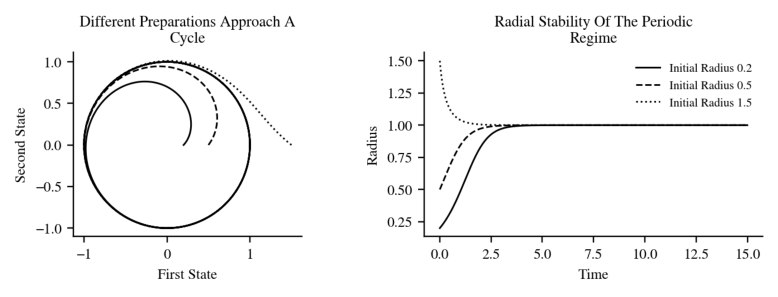
Figure 45. The autonomous radial law dr/dt = r(1 - r squared) with angular speed one has an attracting unit cycle. Exact positive-radius solutions show three preparations approaching its periodic orbit. Interpret the numerical periodic trajectory as a recurring organization of generation, criticism and revision. Its return can illustrate phase recovery after perturbation. The domain correspondence distinguishes externally imposed schedules, self-maintained cycles and the separate question of whether each pass renews meaningful creative inquiry.
scheduling. Assessing its continuation also requires a justified function, horizon and distribution of recurring burdens.
12.4 E4. Metastability
Mechanism and ontology. A regime can persist for a long interval while retaining a feasible escape route. Residence duration depends on barriers, disturbance and environmental change. The useful ontology includes both the continuing configuration and the pathways through which it could change. (Ashwin et al. 2012; Holling 1973)
Formal representation. Equation (50) states the local mathematical representation for this class.
Pr(τA >t)≈e−κt. (50)
Notation and conditions. Kappa is a positive constant-hazard approximation for exit from A. Its adequacy is an empirical or model-specific question. A changing hazard requires a corresponding survival function.
Epistemology and methods. An exponential survival model requires roughly constant hazard; test alternatives and account for censoring. Persistence can reflect capability, switching costs or unequal exit power. Compare these explanations with evidence about actual alternatives.
Domain analysis and practice. A workflow can be productive for a long period while depending on one benchmark, model provider or evaluator. Identify the alternative routes and switching costs. Compare performance after modeled loss or replacement of the dependency. Keeping a diverse archive can support adaptation in some tasks, with storage, checking and representation costs included. A robustness claim should identify the disturbance family under which the retained support is useful.
Phenomenon And Practical Problem. A creative community can remain attached to a style or evaluation convention for a long time while retaining feasible alternatives. Occasional departures may occur when an unusual collaboration or successful demonstration changes the perceived possibilities. The practical problem is interpreting endurance. A long-lived style can coordinate expertise and support valuable work; it can also persist because recognition systems make experiments costly. Observing stability over a project or publication cycle leaves the accessibility of alternative paths as an important explanatory question.
Mechanism And Ontological Commitments. Metastability concerns long residence in a regime with possible exit under specified dynamics. Its explanation can involve a barrier, network support or costly coordination, with a disturbance enabling transition. A constant exit hazard is one simplifying
approximation. Creative fields often contain changing resources, accumulated reputation and selective access, so the hazard may vary with the age and history of the arrangement. The ontology needs a recognizable regime, an exit criterion and a population of comparable opportunities to leave. Interpretive disagreement about regime membership should remain visible.
Epistemic Design And Discriminating Evidence. Construct an archive study or controlled platform experiment following both departures and non-departures. Compare changes in the cost of trying an alternative with changes in evidence about its usefulness. A costly-exit mechanism predicts response to support for experimentation even without changed evaluation. A merit-based update predicts a stronger response when relevant demonstrations become available. Use survival models with time-varying conditions where supported, and account for projects whose outcomes remain unobserved. An analysis selected only from famous breakthroughs would misrepresent the reference population (Ashwin et al. 2012; Boettiger and Hastings 2012). Philosophical Reasoning And Practice. The philosophical issue is whether inherited recognition should govern the terms on which alternatives receive a hearing. Epistemic justice makes access to credible participation a legitimate object of evaluation (Fricker 2007). Supporting a trial can therefore have a reason beyond increasing aggregate novelty: it can create an intelligible route to demonstrate an overlooked approach. A defensible practice states what counts as relevant evidence, what resources a trial needs and how the outcome affects later selection. Endurance and justified confidence then receive related yet distinct assessments.
Worked Comparison And Research Proposition. Imagine a hypothetical AI-art platform where a familiar style receives most commissions. Compare a temporary protected trial channel with ordinary ranking, keeping overall display time comparable. The research proposition is that some stable concentration is maintained by the cost of coordinated departure, so modest support for interpreting unfamiliar work can change uptake more than extra generation alone. Track exits, failed trials, recipient understanding and subsequent independent use. If protected display produces attention without durable uptake, the result narrows the mechanism to visibility and leaves meaningful transition to be explained through further supports.
Reading the numerical illustration. Figure 46 illustrates the declared mechanism. Long residence and permanent closure are different properties. The survival curve quantifies the declared escape opportunity, while the single path makes departure and return visible within a finite horizon. This is a constant-rate construction; changing environments, heterogeneous barriers or aging can alter its law. A domain inquiry should identify feasible exit routes, retain censored observations and compare disturbances and support changes before treating long survival as evidence of renewal or justified stability.
12.5 E5. Aging
Mechanism and ontology. Response properties can depend on the time elapsed since preparation or reorganization. Two-time measurements expose this dependence. In social systems, cohort change, institutional learning and accumulating obligations can generate temporal variation with different causal explanations. (Korbel et al. 2026)
Formal representation. Equation (51) states the local mathematical representation for this class.
C(tw +t,tw) depends on both t and tw. (51)
Notation and conditions. The two-time correlation C uses a waiting time t_w and later lag t. Aging in this operational description concerns dependence on waiting time after accounting for observation and cohort change.
Epistemology and methods. Keep waiting time, calendar time and cohort membership distinguishable. Compare observation drift, attrition and real changes in response. A model fitted to one institutional age needs evidence before its parameters are transferred to another.
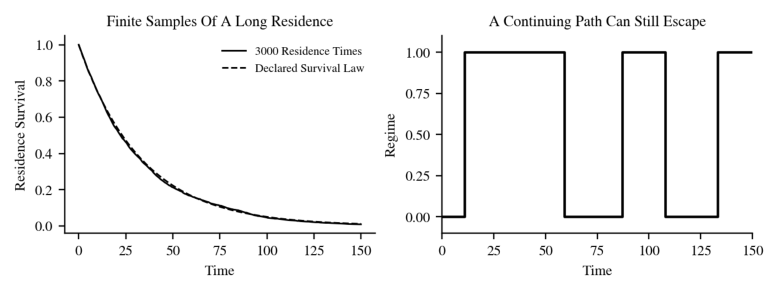
Figure 46. Three thousand residence times use an exponential escape rate 0.03. A separate two-regime path uses that rate for both transitions, so re-entry is possible after escape. Read long numerical residence and eventual exit as a creative convention with available yet costly alternatives. The illustration concerns regime persistence and transition opportunities. Domain analysis must identify the trial, coordination or recognition barrier and include comparable occasions on which a departure did not occur.
Domain analysis and practice. Repeated exposure can change benchmark familiarity, evaluator calibration and the meaning of novelty. An improving score can therefore mix learning and environmental aging. Record exposure history and evaluate on independently refreshed tasks. Compare the capacity to solve a new problem with adaptation to the existing test. A mature inquiry may require revised evidence and representation, with the continuity and change in its claims made explicit.
Phenomenon And Practical Problem. A creative archive can become less responsive as repeated selection concentrates familiar approaches, even when its size and nominal diversity remain stable. Human collaborators can also learn to anticipate the assistant and change how they use it. The practical problem is interpreting performance as a function of project age. A later decline may arise from exhausted opportunities, accumulated constraints, changed evaluators or a more demanding task mix. The age of the system is therefore an explanatory coordinate to investigate through its history and supports.
Mechanism And Ontological Commitments. Aging in the dynamical sense concerns dependence on waiting time after relevant observation and cohort changes have been addressed. For a creative system, a two-time correlation might compare candidate features across a lag at several stages of use. That statistic requires consistent representation and a defined reference population. The mechanism could be concentration of retained material, changing expectations or modification of the environment by earlier outputs. Each carries time dependence differently. The ontology contains accumulated organization and its use history, rather than chronological duration as an independent causal agent.
Epistemic Design And Discriminating Evidence. Compare freshly initialized and long-used archives on matched task sequences. Counterbalance the order of briefs and include a refreshed archive retaining the same current high-scoring candidates while restoring discarded alternatives. Record evaluator change separately. Analyze whether response to a new constraint depends on waiting time after controlling for current observables. A learning-progress measure can supplement score levels when the question concerns continuing discovery, with its evaluation target stated explicitly (Schmidhuber 2010). Distinguish genuine loss of adaptability from improvements that make the remaining tasks systematically harder.
Philosophical Reasoning And Practice. Philosophical reasoning concerns inherited possibilities and the responsibility to maintain conditions for further inquiry. A successful history can generate expertise and narrow the field through which subsequent alternatives are judged. Reflective judgment provides a resource for reconsidering the inherited frame when an unfamiliar case exposes its limits (Kant 2000). Practice can schedule reasoned reviews of archive categories and preserve the evidence
motivating revisions. Renewal then addresses a diagnosed constraint. It should respect the value of acquired expertise and the costs borne by participants who must learn another representational scheme.
Worked Comparison And Research Proposition. Consider a hypothetical design assistant used through many successive briefs. An older archive performs well on recurring requirements and poorly on an unfamiliar combination. Compare simple candidate replenishment, changed descriptors and an unchanged archive with more query budget. The research proposition is that age-dependent rigidity can arise from selection-induced loss of useful distinctions, making representation renewal more effective than additional sampling in the inherited frame. Evaluate recovery, preserved competence and interpretation costs. A result restricted to one task order would support an order-dependent mechanism and motivate replication across alternative histories.
Reading the numerical illustration. Figure 47 illustrates the declared mechanism. Two-time dependence can arise through the history of a surviving cohort. This exactly evaluated example is a conditional persistence function, whose aging appearance follows from a heavy-tailed waiting law and selection by survival. It provides one explicit mechanism for age-dependent response. A domain study should compare that pathway with learning, accumulating obligations, cohort replacement and changes in the environment, preserving the preparation event and the two observation times in its evidence.
12.6 E6. Critical Regimes
Mechanism and ontology. Criticality concerns specified scaling and correlation behavior near a transition under appropriate limits. It can motivate questions about responsiveness and collective organization. Its desirability depends on the task, costs and disturbance; a universal optimum for creativity or governance requires an additional argument. (Cross and Hohenberg 1993; Boettiger and Hastings 2012)
Formal representation. Equation (52) states the local mathematical representation for this class.
ξ∼|λ−λc|−ν. (52)
Notation and conditions. Xi is a defined correlation length, lambda a control parameter, lambda_c a candidate critical value and nu an exponent. The scaling is a model- and limit-dependent relation with finite-size qualifications.
Epistemology and methods. Define correlation length, control parameter and estimation range. Test finite-size effects and competing noncritical models. Increased variance or autocorrelation can be informative under particular mechanisms, with prospective false-positive evaluation determining operational usefulness.
Domain analysis and practice. A criticality hypothesis for AI creativity requires a specified state, control parameter and diagnostic. Sampling temperature alone changes a distribution and supplies no universal critical point. Compare several dynamical regimes through quality, diversity, verification cost and downstream usefulness. A proposal to operate near a transition remains a task-dependent hypothesis. The practical aim is an empirically supported balance of exploration, reliability and revision under declared constraints.
Phenomenon And Practical Problem. Designers sometimes seek a balance between repetitive output and uncontrolled variation, describing the desired condition as an edge of creativity. The practical appeal is understandable: a useful system must preserve enough structure to develop ideas and enough flexibility to discover alternatives. A critical-regime hypothesis is more specific. It concerns scale-dependent response and correlations near a defined transition. Treating every compromise between order and variation as criticality can conceal which mechanism actually improves work and which costs participants face near an unstable operating condition.
Mechanism And Ontological Commitments. The ontology requires a control parameter, an operational order variable, a system-size interpretation and a meaningful correlation measure. In a collaborative archive, exposure strength might be the controlled input and concentration among proposal families the order variable. Correlation length would need a defensible graph or
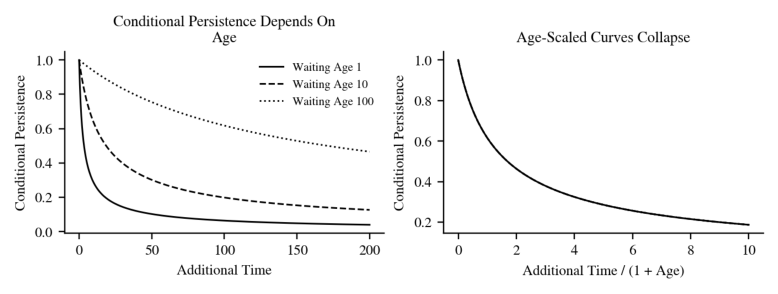
Figure 47. A waiting-time law has survival (1 + t) to the power -0.7. Conditional on having survived to age tw, further persistence is [(1 + tw)/(1 + tw + t)] to that power. The right panel uses the declared age scaling. The panel evaluates conditional persistence for survivors of a heavy-tailed waiting-time law. A creative-workflow application would compare this selection effect with accumulated learning, depletion and evaluator change. Task order, archive turnover and a defined memory carrier require independent evidence before attributing an age trend to organizational rigidity.
representational distance. Critical scaling depends on a model and limiting procedure; a small group may display only a broad crossover. Task quality and socially valuable creativity remain additional quantities that need their own evaluation and can peak away from the transition.
Epistemic Design And Discriminating Evidence. Use constructed search environments to vary coupling across several population sizes and task landscapes. Estimate response to a standardized requirement perturbation, correlations and recovery time alongside final performance and diversity. Compare a critical-regime model with ordinary resource saturation and changes in ranking rules. State which scaling range the data support, and assess descriptor sensitivity before reporting an exponent. Replication should include static and changing tasks because the cost of large response can depend on the environment. This design tests the proposed dynamical mechanism instead of inferring it from attractive language (Cross and Hohenberg 1993; Boettiger and Hastings 2012).
Philosophical Reasoning And Practice. The philosophical issue is an instrumental ideal becoming an unexamined norm. Greater responsiveness can help a group hear an unfamiliar proposal and can make commitments too fragile for reliable collaboration. Capability-oriented reasoning asks which practical opportunities the arrangement enables for differently situated participants (Sen 2009). A defensible operating regime can therefore depend on the task, available review resources and distribution of uncertainty. Practice should articulate those purposes and compare several regimes, preserving the possibility that a comparatively stable arrangement serves a particular creative function well.
Worked Comparison And Research Proposition. Suppose a hypothetical invention network shows its highest sensitivity to new suggestions near a concentration transition. The research proposition is that this region improves adaptation only when participants have enough capacity to interpret and consolidate the resulting changes. Compare review-rich and review-poor conditions under matched generation budgets. Measure useful adaptation, abandoned work and explanation time after a changed brief. If sensitivity increases in both conditions while quality improves only in one, interpret the result as a support-dependent benefit. The transition then supplies a causal setting whose value depends on the surrounding organization of inquiry.
Reading the numerical illustration. Figure 48 illustrates the declared mechanism. Critical scaling is a claim about a specified family and limit. Here the covariance and exponent are stipulated through an exactly defined Gaussian field, with finite positive distances plotted. The result gives an operational meaning to correlation length and its parameter dependence. A domain application should justify its
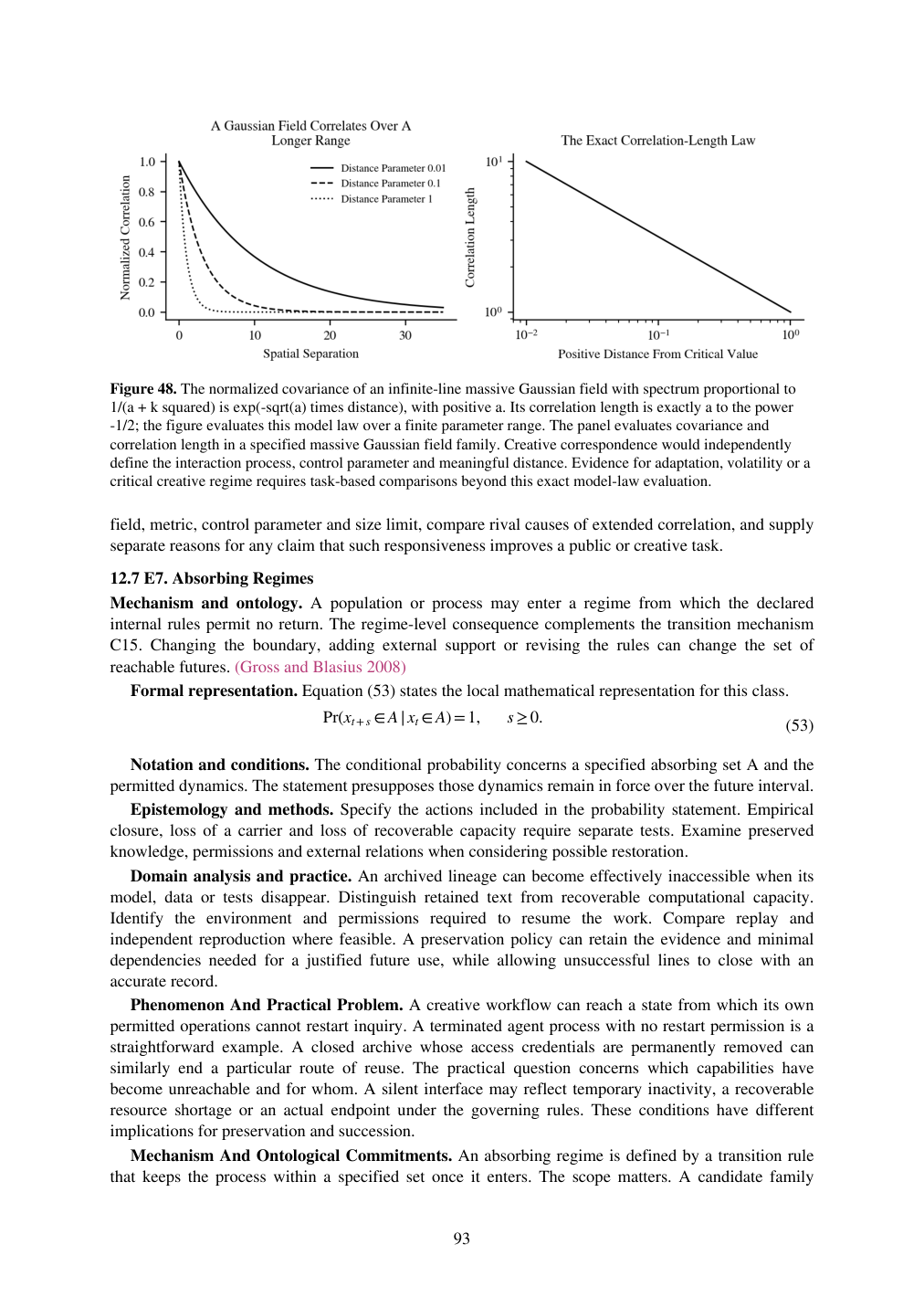
Readable text
Figure 48. The normalized covariance of an infinite-line massive Gaussian field with spectrum proportional to 1/(a + k squared) is exp(-sqrt(a) times distance), with positive a. Its correlation length is exactly a to the power -1/2; the figure evaluates this model law over a finite parameter range. The panel evaluates covariance and correlation length in a specified massive Gaussian field family. Creative correspondence would independently define the interaction process, control parameter and meaningful distance. Evidence for adaptation, volatility or a critical creative regime requires task-based comparisons beyond this exact model-law evaluation.
field, metric, control parameter and size limit, compare rival causes of extended correlation, and supply separate reasons for any claim that such responsiveness improves a public or creative task.
Mechanism and ontology. A population or process may enter a regime from which the declared internal rules permit no return. The regime-level consequence complements the transition mechanism C15. Changing the boundary, adding external support or revising the rules can change the set of
Formal representation. Equation (53) states the local mathematical representation for this class.
Notation and conditions. The conditional probability concerns a specified absorbing set A and the permitted dynamics. The statement presupposes those dynamics remain in force over the future interval.
Epistemology and methods. Specify the actions included in the probability statement. Empirical closure, loss of a carrier and loss of recoverable capacity require separate tests. Examine preserved knowledge, permissions and external relations when considering possible restoration.
Domain analysis and practice. An archived lineage can become effectively inaccessible when its model, data or tests disappear. Distinguish retained text from recoverable computational capacity. Identify the environment and permissions required to resume the work. Compare replay and independent reproduction where feasible. A preservation policy can retain the evidence and minimal dependencies needed for a justified future use, while allowing unsuccessful lines to close with an
Phenomenon And Practical Problem. A creative workflow can reach a state from which its own permitted operations cannot restart inquiry. A terminated agent process with no restart permission is a straightforward example. A closed archive whose access credentials are permanently removed can similarly end a particular route of reuse. The practical question concerns which capabilities have become unreachable and for whom. A silent interface may reflect temporary inactivity, a recoverable resource shortage or an actual endpoint under the governing rules. These conditions have different
Mechanism And Ontological Commitments. An absorbing regime is defined by a transition rule that keeps the process within a specified set once it enters. The scope matters. A candidate family
removed from an archive can reappear through mutation or new input if the rules permit those routes; its disappearance alone does not establish absorption. A terminated session may be absorbing within the session model while a broader institution can authorize another session. The ontology therefore includes the permitted transition kernel, access rights and boundary inputs that determine which returns are feasible.
Epistemic Design And Discriminating Evidence. Audit the workflow’s available operations and test recovery in a controlled copy before classifying endpoints. Compare automatic restart, humanauthorized restart and a protocol forbidding further computation. Record whether content, reasons and permissions survive each ending. Analyze task recovery separately from restoration of the same process identity. For archival studies, document changes in access rules that alter the transition system itself. An observed long period without activity provides evidence about dormancy and observation; absorption requires the additional rule-based reachability claim (Gross and Blasius 2008; Cartwright and Hardie 2012). Philosophical Reasoning And Practice. The philosophical linkage concerns limits and responsibility in an organized practice. Continuing generation can consume resources after its task has been completed, while premature termination can remove a participant’s remaining route to develop an overlooked idea. Public reasoning and capability analysis support evaluating these concrete consequences (Sen 2009). Practice can specify who may end a workflow, which reasons are recorded and which residual possibilities deserve preservation. A justified endpoint can coexist with obligations concerning attribution, access and the handover of knowledge needed by successors.
Worked Comparison And Research Proposition. Consider a hypothetical AI-assisted exhibition project ending at a fixed deadline. One protocol closes all sessions and deletes working context; another preserves interpretable records and grants a successor a limited restart route. The research proposition is that preserving a separately authorized successor route can maintain functional creative options after the original process reaches its absorbing endpoint. Test recovery of a selected unfinished task with equal successor resources. Compare explanation completeness and consent constraints alongside artifact quality. The finding would distinguish continuation of the original process from the availability of a new practical passage.
Reading the numerical illustration. Figure 49 illustrates the declared mechanism. Absorbing character depends on the rule and boundary. The internal retention process permits decline and extinction while supplying no route from zero. The displayed external operation changes that reachable set explicitly. A domain inquiry should state which internal operations have ended and which outside actor, resource or rule revision could reopen them. The availability and justification of reopening then depend on real capacities, costs, permissions and affected claims, beyond the mathematical observation that an added channel changes the process.
12.8 E8. Structural Transformation
Mechanism and ontology. An organization can change its relations, membership or authority while retaining some processes. Transformation requires an explicit identity criterion and a record of what changes. A representation that fixes categories forever can conceal precisely the transition under investigation. (Gross and Blasius 2008; Ostrom 2009)
Formal representation. Equation (54) states the local mathematical representation for this class.
t+1 =(t,ut,ηt). (54)
Notation and conditions. Calligraphic S is an organizational description and U its declared update, with eta representing unresolved variation. Changes of state space require an account of how old and new descriptions correspond.
Epistemology and methods. Here S denotes an organizational description, potentially with changing state space. Retain translations and unmatched categories across revisions. Compare effects on functions and participant capacities alongside topological or legal changes.
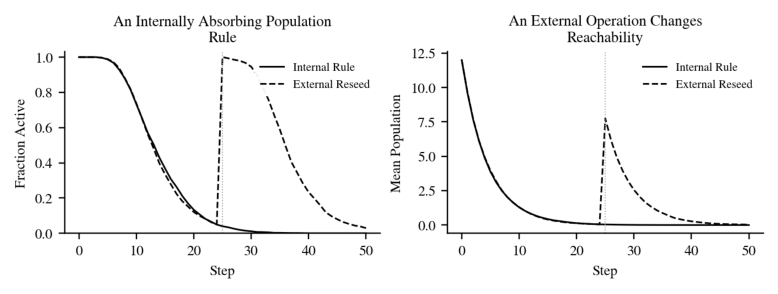
Figure 49. Each of 1,500 populations begins at twelve and independently retains each member with probability 0.8 per step. Zero is internally absorbing. The separate intervention arm inserts eight members into empty populations at step twenty-five. Interpret the numerical absorbing set as an endpoint under a specified workflow protocol. A return becomes possible only if allowed transitions or boundary inputs change. The domain illustration therefore concerns access and restart rules, while wider creative recurrence requires a separately identified successor process.
Domain analysis and practice. An AI ecology can change its representations, agent roles or evaluation standards. Such transformation can open new questions and impair comparability with earlier results. Preserve versioned criteria and translations, including distinctions that remain unmatched. Compare the functions before and after change with independent tests. The authority to adopt a new standard should be reviewable according to the consequences for participants and users of the resulting knowledge.
Phenomenon And Practical Problem. A creative project can change the kinds of artifact it is able to propose and the criteria by which participants can understand them. A system initially representing designs as fixed images might begin representing editable relations among components and users. This transformation can open useful possibilities and make earlier comparisons incomplete. The practical issue is evaluating change when the candidate space itself has changed. A higher score after transformation may reflect a more expressive representation, a relaxed requirement or an evaluative convention that favors the new description.
Mechanism And Ontological Commitments. Structural transformation alters the organizational or representational state space. The correspondence needs explicit translation rules between earlier and later descriptions, including distinctions that become newly expressible or disappear. A model that adds a variable has changed its explanatory resources; the domain claim requires showing what that variable makes practically possible. The ontology includes representation, generation operators, evaluative practice and authorized use. Changes in labels alone leave the possible operations unchanged. Changes in operation can be consequential even when participants continue using the same familiar category name.
Epistemic Design And Discriminating Evidence. Evaluate both representations on common anchor tasks and on tasks designed to require the newly expressible relation. Preserve the earlier artifact and its reasons so assessors can compare what each representation can explain. Include a control with additional generation budget in the old space, distinguishing expressive change from more extensive search. Analyze failures of translation and the learning burden imposed on collaborators. Source-based and process evidence should identify which earlier impossibility becomes feasible under the changed operations. Boden’s discussion supplies a conceptual precedent for this distinction (Boden 1997; Brunton, Proctor, and Kutz 2016).
Philosophical Reasoning And Practice. Reflective judgment concerns developing a fitting concept when the inherited category fails to capture a consequential feature of a case (Kant 2000). The
extension here treats that judgment as socially organized work. Participants need a route to articulate the new feature, demonstrate its relevance and criticize the transformed frame. A transformation deserves evaluation through what it enables and what it obscures. Practice can keep an explicit record of changed identity and evaluation criteria, allowing a successor to understand why continuity was claimed and where the comparison became partial.
Worked Comparison And Research Proposition. Imagine a hypothetical storytelling assistant that moves from selecting isolated scenes to representing obligations among characters across time. The research proposition is that transformation improves coherent originality on relational tasks when the new representation makes consequential dependencies manipulable. Compare familiar scene-level tasks with stories requiring a delayed commitment to affect later action. Measure supported interpretation, revision and transfer, using assessors unaware of the system label. A benefit confined to the new task family would identify an expanded expressive capacity, while any loss on earlier tasks would reveal a transition cost requiring deliberate organizational support.
Reading the numerical illustration. Figure 50 illustrates the declared mechanism. Structural transformation can preserve selected features while changing the operations supported by the arrangement. The event sequence retains membership and connectivity but alters reachability distance and the position of the former hub. Those are explicit identity and functional distinctions. A domain inquiry should state which memberships, roles or authority relations carry forward, trace how the transition affects real operations, and investigate whose capacities and obligations change despite continuity of a nominal institution or aggregate structural count.
12.9 E9. Functional Succession
Mechanism and ontology. A later arrangement can perform a function previously supported by another organization. Functional identity, organizational identity and historical transmission have different criteria. Succession may preserve a capacity through changed carriers while redistributing authority, effort and access. (Folke et al. 2005; Ostrom 2009)
Formal representation. Equation (55) states the local mathematical representation for this class.
Q(Gt+1,xt+1;)≥qmin. (55)
Notation and conditions. Q is a declared functional-performance measure, q_min a chosen threshold and calligraphic T the task. The inequality is a criterion to justify for the question and population being assessed.
Epistemology and methods. State the task, threshold, population and deadline. Compare pre- and post-transition performance under matched disturbances and resource accounts. Historical tracing is needed to establish which capacities were inherited and which were independently created.
Domain analysis and practice. A different model, team or tool can take over a research function. A successful handover requires usable artifacts, test environments, access rights and an intelligible record of unresolved assumptions. Compare performance under the successor’s actual conditions. Historical contribution can be acknowledged without requiring permanent control by the predecessor. Generative continuation concerns the successor’s exercisable capacity and the renewed support for further inquiry.
Phenomenon And Practical Problem. A creative tool can be replaced while the collaborative function it supported continues. A successor may inherit an archive, a prompt library, a review practice or a community’s expectations. The practical problem is deciding whether that inheritance is exercisable under the successor’s actual conditions. A successful demonstration using the predecessor’s expert operator may conceal dependence on tacit interpretation. A nominally complete transfer can leave the new group unable to explain sources, reopen judgments or adapt work when requirements change.
Mechanism And Ontological Commitments. Functional succession concerns a task carried across a change of bearer. Its criterion should state the task, participants, necessary supports and acceptable performance range. The successor’s identity differs from the predecessor’s, while relevant operations
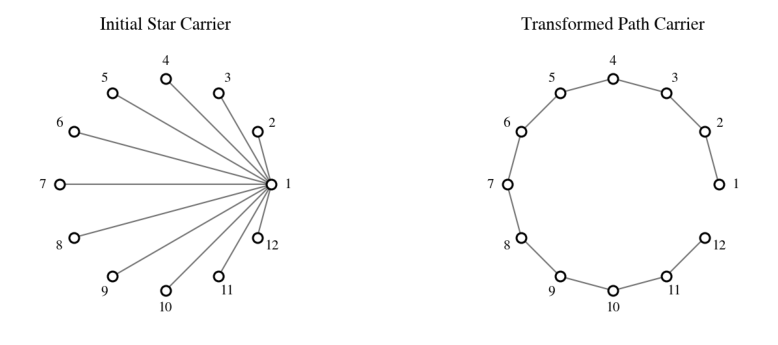
Figure 50. A twelve-node star is transformed into a path through ten edge replacements. Membership, connectivity and eleven undirected edges are preserved. Maximum distance from node one changes from one to eleven. Read the numerical transformation as a change in the variables or relations available to a creative process. The domain correspondence distinguishes a new label from a newly executable operation. Compare shared anchor tasks and newly expressible tasks to evaluate continuity, expanded capacity and translation costs.
can remain comparable. The ontology includes transferred artifacts and authority, local competence, permissions and access to complementary resources. Literal reproduction of earlier outputs provides one narrow test. A stronger claim concerns the capacity to perform a relevant range of operations under a changed environment, including reasoned revision and correction.
Epistemic Design And Discriminating Evidence. Run a handover test using a successor team that was absent during development. Compare artifact-only transfer, structured reasoning transfer and supervised apprenticeship with their resource costs reported. Include tasks requiring ordinary operation and tasks requiring recovery from an intentionally introduced gap. Assess task completion, source support, interpretation time and the recipient’s ability to challenge an inherited rule. Use an independently specified performance criterion and preserve cases where transfer fails. These comparisons identify the support conditions needed for succession beyond the predecessor’s original demonstration (Cartwright and Hardie 2012; Boussioux et al. 2024).
Philosophical Reasoning And Practice. The philosophical linkage concerns continuity as a practical and relational achievement. A capability-oriented perspective treats possession of a transferred object and a substantive opportunity to use it as different evaluative facts (Sen 2009). Succession can therefore call for training, accessible explanation and redistributed authority, alongside technical compatibility. Practice should ask whose contribution survives in the transferred record and whose access depends on the old bearer. A justified handover makes those consequences explicit and assigns responsibility for unresolved gaps rather than treating inherited performance as automatic.
Worked Comparison And Research Proposition. Consider a hypothetical museum replacing an AI-assisted cataloguing and exhibition-design workflow. The successor receives the same archive but a different model and staff group. The research proposition is that transferable creative capacity depends more on preserved task relations and reasons than on reproducing the predecessor’s interface. Compare equivalent handovers with and without documented exceptions and review routes. Evaluate adaptation to a new collection and accounts of provenance. The comparison can reveal whether continuity rests on a reusable practice, on exceptional founding expertise or on supports that the successor still needs to establish.
Reading the numerical illustration. Figure 51 illustrates the declared mechanism. Succession requires a usable operation through the later carrier. The model separates the timing of carrier replacement from the quality of the transmitted capacity and tests their sum against an explicit task
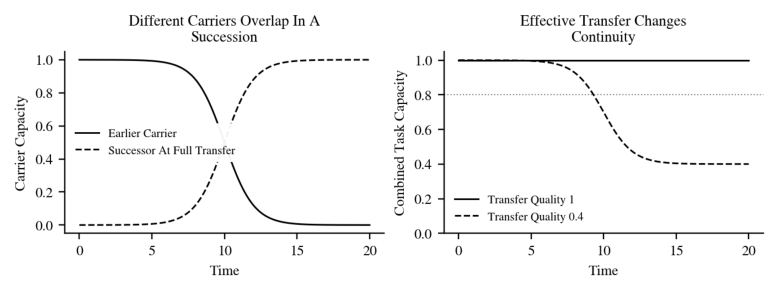
Figure 51. Carrier capacities are assumed additive. Complementary logistic profiles are combined using a stipulated effective conversion factor one or 0.4. The declared functional threshold is 0.8. Organizational handover can occur while the poorer transfer falls below that criterion. Interpret maintained task performance after the numerical bearer change as functional succession. The domain mapping requires an explicit task and successor conditions. Comparable output at handover is a starting point; adaptation, source access and usable review routes test whether creative capacity can continue.
criterion. A domain inquiry should establish what successors can actually perform, the complements and permissions they inherit, and the historical connection supporting a transmission claim. Choosing a function, threshold and transition burden additionally requires substantive reasons from the relevant public, legal or collaborative setting.
12.10 E10. Dissolution
Mechanism and ontology. A structure dissolves when it ceases to meet an explicit persistence criterion. Resource loss, instability, disturbance, rapid change, rewiring, substitution, self-limitation and cascades are distinct cross-cutting pathways. Dissolution can coexist with continuing participants, records and successor functions. (Ashwin et al. 2012; Gross and Blasius 2008)
Formal representation. Equation (56) states the local mathematical representation for this class.
τdiss =inf{t:P(t)<pmin}. (56)
Notation and conditions. P is a defined persistence measure and p_min its chosen threshold. The stopping time depends on those identification criteria. A different target, including function or authority, can have a different endpoint.
Epistemology and methods. Specify what P measures and distinguish it from welfare or justice. Observe residual capacity and the allocation of closure costs. A self-limiting institution deserves that description when its own operation changes a condition supporting its continued necessity.
Domain analysis and practice. A search lineage can end because its task is solved, its evidence fails, its support is withdrawn or a different method becomes preferable. Record the causal pathway and the residual artifact, test or negative result. Compare closure with preservation and transfer under their costs. A workflow whose success removes its own task offers one possible self-limiting mechanism. Its value depends on the solved problem and the consequences of the available successor uses.
Phenomenon And Practical Problem. A creative project can finish, lose its organizing resources or cease because its operations make its original task unnecessary. These endings have different meanings. A successful documentation project may reduce the need for a specialist intermediary; a workshop may dissolve after participants can collaborate independently. The practical issue is recognizing what has ended and what remains available. Continuing a named project can conceal exhausted capacity, while closing it can preserve a valuable practice through distribution to new bearers.
Mechanism And Ontological Commitments. Dissolution requires an identity criterion and a threshold of persistence. The relevant bearer might be an organization, workflow, candidate family or relation of dependence. A mechanism of self-limitation additionally requires a causal passage from the activity to a change in its own sustaining condition. Loss of funding after unrelated decisions supplies another explanation. The ontology includes the ending event, residual resources, remaining duties and possible successors. The disappearance of an interface leaves the persistence of functions, knowledge and authority to separately specified accounts.
Epistemic Design And Discriminating Evidence. Trace the conditions of continuation before and after the project, using records of access, competence, resources and decision rights. Compare a planned sunset with continued central provision and with abrupt withdrawal. Ask whether the project itself increased participants’ capacity to perform the function independently. Include failures to inherit the practice and people whose access remains dependent. A stopping-time measure can summarize when the declared bearer ceased, while process evidence supports the causal account of why it ceased and what its work changed (Cartwright and Hardie 2012; Hernán and Robins 2020).
Philosophical Reasoning And Practice. The philosophical question concerns generativity beyond self-preservation. Process-oriented reasoning permits an activity’s contribution to be realized through changed relations that outlive its original organization (Whitehead 1978). The normative judgment still depends on the consequences and responsibilities of ending. Practice can distinguish finishing a worthwhile task from abandoning affected participants. It can preserve interpretable records, transfer authority where appropriate and acknowledge inherited labor. Dissolution becomes reviewable when the reasons for closure and the routes through which useful capacities continue are available for scrutiny.
Worked Comparison And Research Proposition. Suppose a hypothetical AI-assisted local design laboratory aims to help community groups conduct their own planning workshops. Compare a version retaining all interpretive control with a version deliberately transferring facilitation and review practices. The research proposition is that successful capacity-building can reduce dependence on the original laboratory while preserving or expanding task exercise elsewhere. Evaluate successor workshops, uneven access and the resources still supplied externally. If closure occurs before independent exercise is feasible, the evidence supports withdrawal or failed transfer. A demonstrated causal passage to distributed competence would support the stronger self-limiting interpretation.
Reading the numerical illustration. Figure 52 illustrates the declared mechanism. A dissolution criterion identifies an endpoint relative to an object and a threshold. The pathways producing that endpoint can differ materially, and their similarly scaled indices carry their own substantive interpretations. The figure compares declared forms of departure rather than estimating one universal mechanism. A domain account should reconstruct the causal route, preserve residual duties and successor possibilities, and distinguish ending a particular carrier from losing every participant, record or useful function historically associated with it.
12.11 E11. Recurrence
Mechanism and ontology. An absent organization or function can reappear. Similarity of form, continuity of historical descent and restoration of a usable capacity give different meanings to return. Memory, retained supports and new environmental conditions can each contribute. (Gross and Blasius 2008; Folke et al. 2005) Formal representation. Equation (57) states the local mathematical representation for this class.
τ +
A =inf{t>texit :xt ∈A}. (57)
Notation and conditions. The time t_exit identifies the earlier departure from A; tau_A-plus is first re-entry afterward. The set A must express the intended identity criterion, with historical descent assessed through additional evidence.
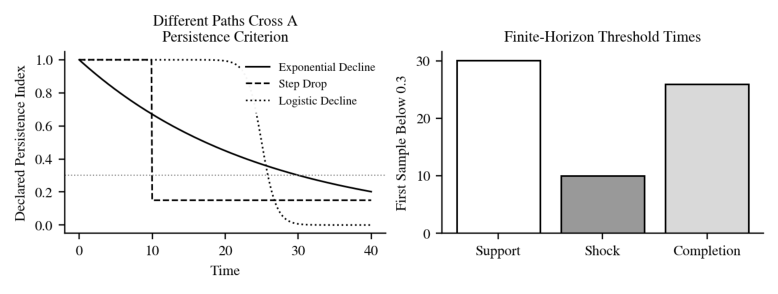
Figure 52. Three explicitly constructed normalized persistence paths cross the same declared threshold 0.3. The paths are prescribed by an exponential function, a step at time ten and a logistic decline centered at twenty-five; times are sampled at intervals 0.1. Causal interpretations require separate evidence. Map the numerical endpoint to loss of a declared creative bearer or dependency relation. Follow the conditions leading to closure and the resources remaining afterward. A self-limiting interpretation additionally requires evidence that the activity changed the condition sustaining its own continued necessity.
Epistemology and methods. Define the returning object and observe the intervening absence. Compare restoration from retained supports with independent re-creation. The assessment of return includes successor access, changed obligations and the grounds for retaining or revising the earlier arrangement.
Domain analysis and practice. An earlier candidate can become useful after new evidence, tools or questions appear. Similar wording leaves historical reuse distinguishable from independent rediscovery. Trace the archive link and the new complement making the candidate exercisable. Compare the revived line with fresh search under matched budgets. A return can support discovery while requiring a revised interpretation of the earlier result and acknowledgment of contributions at each stage.
Phenomenon And Practical Problem. A creative approach can return after disappearing from visible use. A revived image style, rediscovered prompt method or reconstructed collaborative practice may resemble an earlier arrangement while entering a different social setting. The practical problem is determining what kind of return occurred and how it should be evaluated. Historical continuity can matter for credit and interpretation; present usefulness depends on current purposes and supports. An old label or familiar appearance can identify a research lead without settling either question.
Mechanism And Ontological Commitments. Recurrence requires an identity criterion specifying what counts as re-entry into a recognizable set. Feature similarity, functional equivalence and historical descent identify different relations. A process can revisit a similar state through independent reinvention, stored memory or deliberate restoration. The ontology should distinguish the returning artifact, the carrier of any inheritance and the environment in which it becomes usable. A recurrence time measures an interval under that definition. It does not by itself show that the same meanings, rights or collaborative opportunities have returned.
Epistemic Design And Discriminating Evidence. Combine dated provenance with comparative task analysis. Trace archives, citations, prompts and acknowledged learning pathways when testing descent. Compare independently reconstructed approaches with historically informed revivals under matched resources. Ask whether knowledge of the earlier reasons improves adaptation to present constraints. Record cases that resemble the old style while operating through different techniques. For automated studies, test recurrence under multiple feature definitions and inspect whether coarse descriptors collapse meaningfully different works. Missing private histories should remain a stated uncertainty in attribution (Hernán and Robins 2020; Lehman and Stanley 2011).
Philosophical Reasoning And Practice. Historical interpretation and present justification have complementary roles. Process philosophy helps formulate continuity through a carrier of relations (Whitehead 1978). An ethical account of creative inheritance additionally asks whether contributors receive appropriate acknowledgment and whether inherited conventions deserve renewed authority. Practice can preserve lineage while inviting current participants to explain their own purposes and changes. A revived practice can be worthwhile because it answers a present problem; its antiquity supplies context and possible resources for reasoning, with its contemporary merits examined through the actual work.
Worked Comparison And Research Proposition. Imagine a hypothetical team reviving an early generative-art procedure using a modern assistant. Another team independently develops a visually similar procedure. The research proposition is that historical access changes the kinds of revision available when a new requirement exposes a limitation of the shared visual style. Compare both teams on that requirement and inspect the role of inherited explanations. Evaluate attribution separately from artifact performance. A similar final result with different pathways would demonstrate why recurrence in a feature space and the generative inheritance of a practice warrant distinct evidential tests.
Reading the numerical illustration. Figure 53 illustrates the declared mechanism. A visible return of support can have different consequences for a formerly available function. The full-input arm regains the declared threshold, while the lower-input arm approaches a capacity below it. A retained record follows a separate stipulated path. A domain inquiry should identify whether recurrence concerns form, historical continuity or exercisable function, trace the supports linking the episodes, and assess which new work and permissions are required for a consequential return.
13 An Integrated Inquiry And Intervention Method
13.1 The Question Determines The Object And Representation
Start with a concrete contrast: continuation versus interruption, one action sequence versus another, a visible pattern versus rival generating mechanisms. Specify the subject or object through its identification criterion. Record variables with their types and units, relations with their meanings, and the horizon on which the comparison matters. A current indicator and a historical event can enter the same inquiry while retaining their different evidential roles.
The mechanism catalogue then supplies candidate explanations. It does not assign a cause through resemblance. Select a manageable set of rivals whose implications differ on a material question. An apparently stable output might reflect adequate renewal, hidden depletion or replacement of the observed population. A useful inquiry identifies an observation, comparison or lawful intervention that could distinguish these accounts. Models can be revised when the present ontology cannot express a supported distinction.
13.2 Match The Method To The Inferential Task
Conservation and stock-flow accounts test balances and expose missing channels. Temporal networks and event models represent changing relations and sequences. State-space methods estimate latent trajectories under an observation model. Sparse equation discovery investigates a specified library of possible dynamics; its library, noise treatment and data coverage bound the inference (Brunton, Proctor, and Kutz 2016). Delay reconstruction has mathematical conditions concerning the system, observation and embedding; noisy, changing and strategically responsive social settings require an explicit justification of those conditions (Takens 1981).
Causal estimation requires a declared intervention contrast and assumptions addressing assignment, confounding, interference and temporal feedback (Hernán and Robins 2020). Process tracing, archives, observation and participant accounts investigate the operations and meanings behind a possible pathway. Simulation tests consequences of specified rules and supports model discrimination through distinct predictions. Its credibility for intervention depends on correspondence, calibration and out-ofregime validation. Different methods can answer complementary parts of the same question.
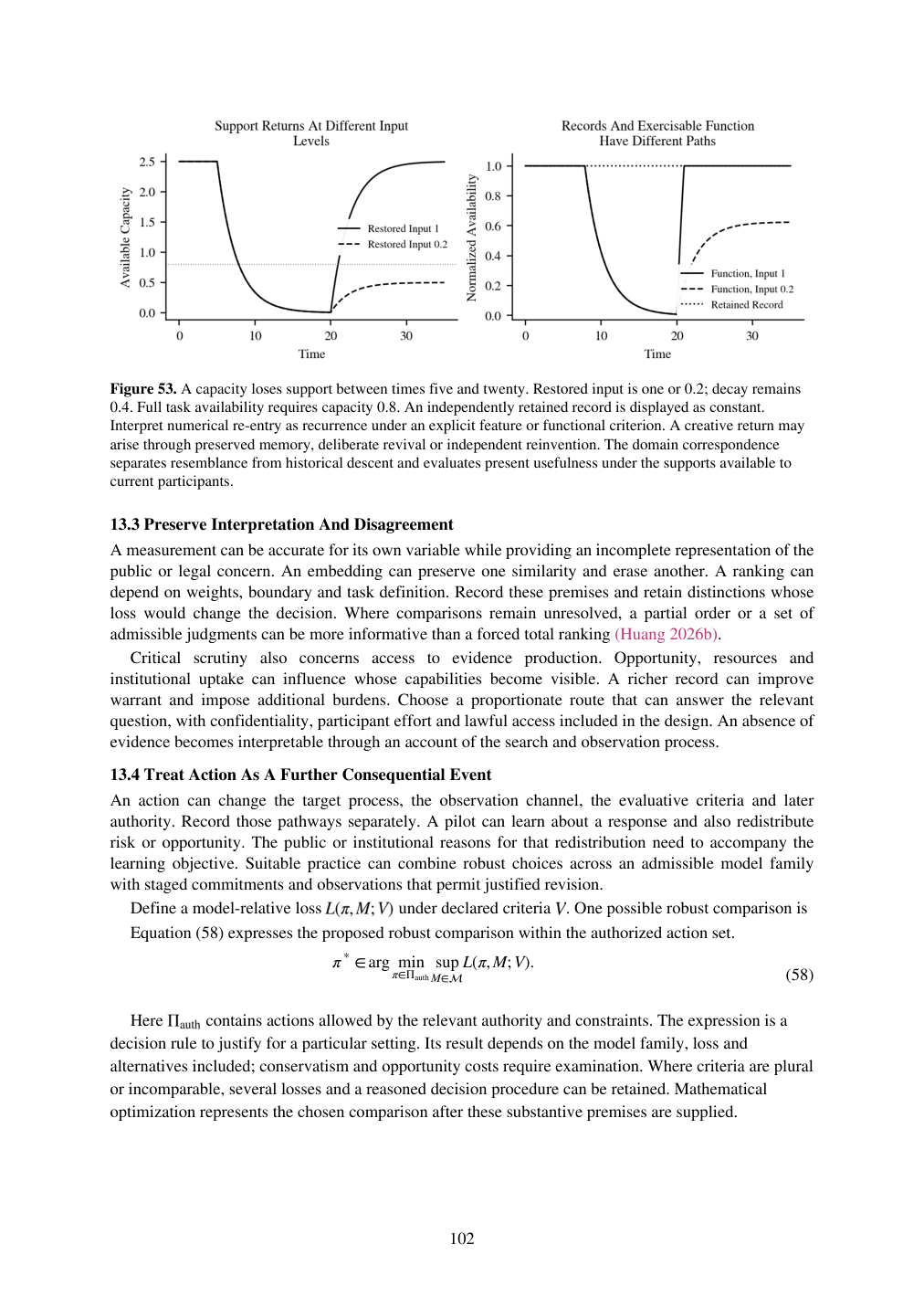
Readable text
Figure 53. A capacity loses support between times five and twenty. Restored input is one or 0.2; decay remains 0.4. Full task availability requires capacity 0.8. An independently retained record is displayed as constant. Interpret numerical re-entry as recurrence under an explicit feature or functional criterion. A creative return may arise through preserved memory, deliberate revival or independent reinvention. The domain correspondence separates resemblance from historical descent and evaluates present usefulness under the supports available to
A measurement can be accurate for its own variable while providing an incomplete representation of the public or legal concern. An embedding can preserve one similarity and erase another. A ranking can depend on weights, boundary and task definition. Record these premises and retain distinctions whose loss would change the decision. Where comparisons remain unresolved, a partial order or a set of admissible judgments can be more informative than a forced total ranking (Huang 2026b).
Critical scrutiny also concerns access to evidence production. Opportunity, resources and institutional uptake can influence whose capabilities become visible. A richer record can improve warrant and impose additional burdens. Choose a proportionate route that can answer the relevant question, with confidentiality, participant effort and lawful access included in the design. An absence of evidence becomes interpretable through an account of the search and observation process.
An action can change the target process, the observation channel, the evaluative criteria and later authority. Record those pathways separately. A pilot can learn about a response and also redistribute risk or opportunity. The public or institutional reasons for that redistribution need to accompany the learning objective. Suitable practice can combine robust choices across an admissible model family with staged commitments and observations that permit justified revision.
under declared criteria . One possible robust comparison is Equation (58) expresses the proposed robust comparison within the authorized action set.
contains actions allowed by the relevant authority and constraints. The expression is a decision rule to justify for a particular setting. Its result depends on the model family, loss and alternatives included; conservatism and opportunity costs require examination. Where criteria are plural or incomparable, several losses and a reasoned decision procedure can be retained. Mathematical optimization represents the chosen comparison after these substantive premises are supplied.
Readable text
The endpoint classes cross-cut eight useful pathway families: resource loss; instability; disturbance- driven departure; rate-dependent tracking failure; relational rewiring; functional substitution; self- limitation; and cascades. A case can combine them. Compare support removal with loss of attraction, loss of structure with loss of function, and nominal succession with successor capability. A self-limiting account needs a causal path from the organization’s operation to a changed condition of its continued necessity. This crosswalk develops E8-E11 without adding terminal nodes to the 53-class catalogue.
An endpoint assessment inventories continuing duties, residual resources, usable knowledge and successor authority. Some relations deserve preservation, some transformation and some a fitting end. The reasons depend on the task and affected claims. Continued activity, generative renewal and justice remain connected questions whose answers require their respective evidence and premises.
14 A Constructed Search Experiment With Environmental Change
Candidates are twelve-bit strings. Four consecutive three-bit blocks define a deceptive task. If a block scores and divide by twelve. The global target changes from all zeros to all ones at round 30. This change is supplied to both search procedures; detecting the change is outside this construction.
Each procedure retains 49 candidate slots and evaluates those candidates plus 24 new proposals each round. New proposals mutate a uniformly selected retained parent, flipping one distinct bit with probability 0.8 and two with probability 0.2. The elitist procedure retains the highest-scoring 49 pool members. The portfolio procedure first retains the best member in each occupied descriptor bin, then fills remaining slots by score. The descriptor counts ones in each six-bit half, making its relation to this
The two procedures use the same initial seed and proposal budget for each of forty replicates. Their later parents differ because retention differs. Both evaluate 73 candidates every round, including rescoring retained candidates, so the environmental switch adds no asymmetric evaluation budget. The reported measures are best task score and mean pairwise normalized Hamming distance. Figure 54 shows means and interquartile ranges across the constructed replicates.
The portfolio preserves a wider range of strings along a descriptor informative for the later task. Its advantage after the target change follows from this retention mechanism in the displayed search environment. The experiment illustrates how a present evaluation can change the alternatives available for adaptation. It evaluates the quality-diversity-inspired retention rule specified here, including its
The construction is deliberately favorable to retaining variation along this descriptor. A general comparison would vary the descriptor, problem family, mutation rule, memory budget, task-change rate and criterion for useful discovery. An irrelevant or costly descriptor can change the result. A human-AI creativity claim would additionally require substantive appraisal, source-independent validity and evidence of downstream use. The constructed task isolates a computational mechanism and leaves those
Let candidate state , evaluator state , representation through declared update rules. A useful experiment can vary which of these updates are permitted. Fixed evaluation isolates search under a standard. Evaluator revision examines learning about the standard. Representation revision examines which distinctions can be expressed. External encounter tests whether the ecology can respond to information outside its own generated record. The authority governing consequential updates is an additional institutional object.
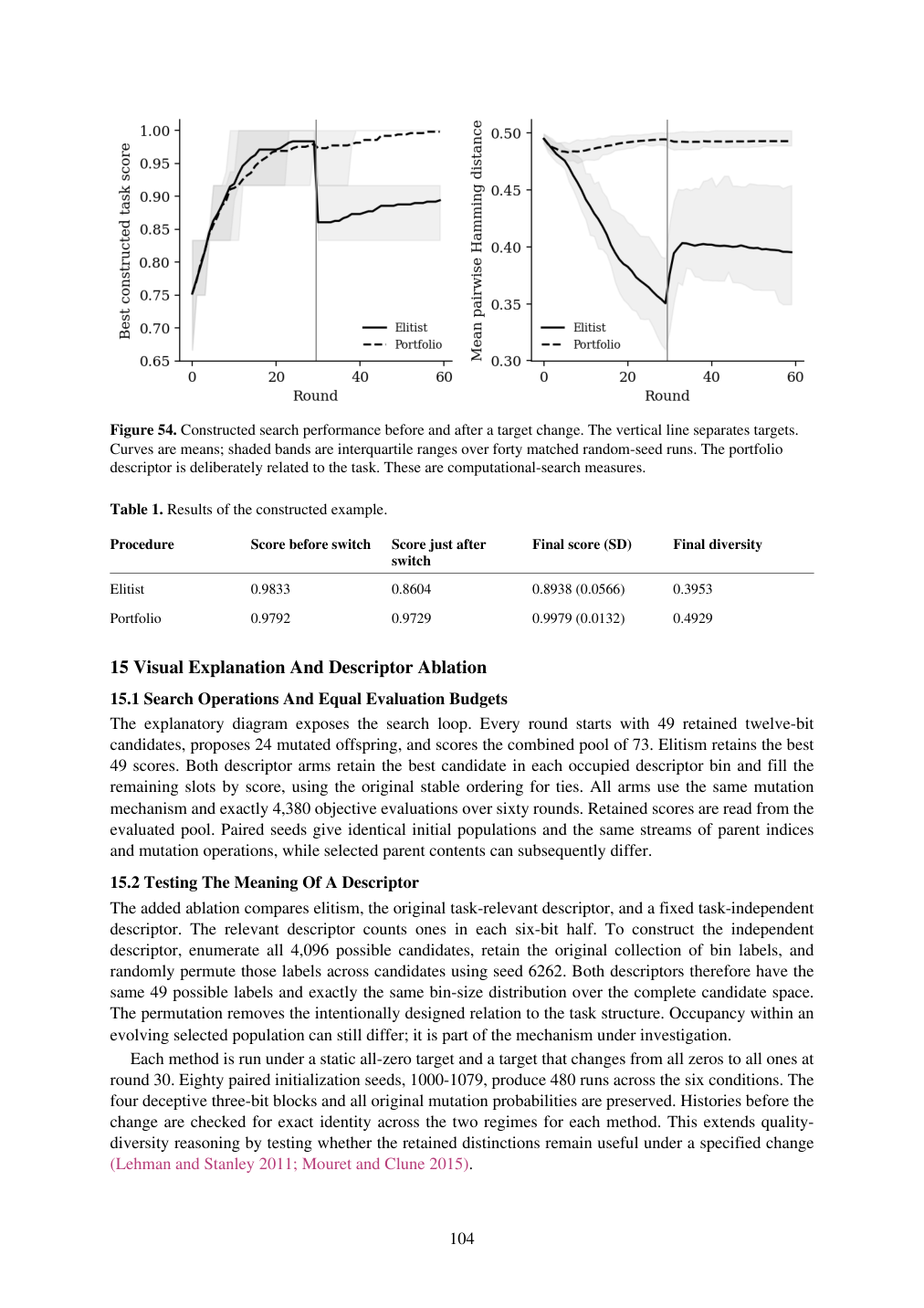
Readable text
Figure 54. Constructed search performance before and after a target change. The vertical line separates targets. Curves are means; shaded bands are interquartile ranges over forty matched random-seed runs. The portfolio descriptor is deliberately related to the task. These are computational-search measures.
The explanatory diagram exposes the search loop. Every round starts with 49 retained twelve-bit candidates, proposes 24 mutated offspring, and scores the combined pool of 73. Elitism retains the best 49 scores. Both descriptor arms retain the best candidate in each occupied descriptor bin and fill the remaining slots by score, using the original stable ordering for ties. All arms use the same mutation mechanism and exactly 4,380 objective evaluations over sixty rounds. Retained scores are read from the evaluated pool. Paired seeds give identical initial populations and the same streams of parent indices and mutation operations, while selected parent contents can subsequently differ.
The added ablation compares elitism, the original task-relevant descriptor, and a fixed task-independent descriptor. The relevant descriptor counts ones in each six-bit half. To construct the independent descriptor, enumerate all 4,096 possible candidates, retain the original collection of bin labels, and randomly permute those labels across candidates using seed 6262. Both descriptors therefore have the same 49 possible labels and exactly the same bin-size distribution over the complete candidate space. The permutation removes the intentionally designed relation to the task structure. Occupancy within an evolving selected population can still differ; it is part of the mechanism under investigation.
Each method is run under a static all-zero target and a target that changes from all zeros to all ones at round 30. Eighty paired initialization seeds, 1000-1079, produce 480 runs across the six conditions. The four deceptive three-bit blocks and all original mutation probabilities are preserved. Histories before the change are checked for exact identity across the two regimes for each method. This extends quality- diversity reasoning by testing whether the retained distinctions remain useful under a specified change
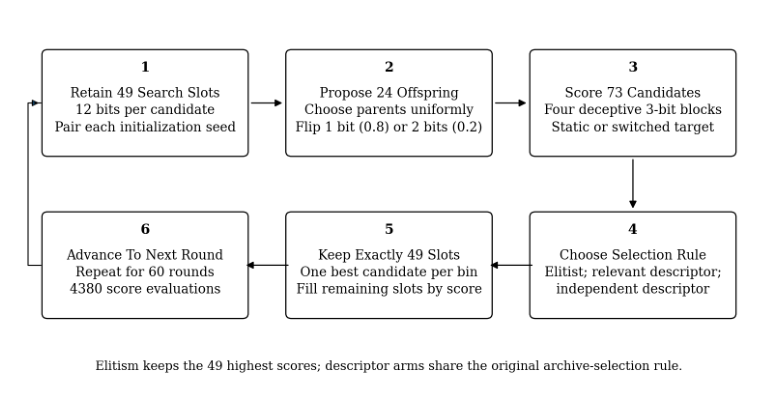
Figure 55. The executed candidate-search example. The target supplies the constructed score; selection determines which candidates remain available for later proposals. Descriptor comparisons use identical population size, mutation budget and objective-evaluation count. The best-per-bin operation applies to the descriptor arms; elitism keeps the 49 highest scores.
15.3 Numerical Comparison
Immediately after the change, mean best scores are 0.864583, 0.975000 and 0.925000 for elitism, relevant and independent descriptors. Under the changed target, the paired final-score difference between relevant and independent descriptors is 0.029167, with Monte Carlo standard error 0.005157. The relevant-minus-elitist difference is 0.095833 with standard error 0.006646. Under the static target, the relevant-minus-independent difference is -0.002083 with standard error 0.002557. This small static difference and the stronger changed-target contrast make the condition of evaluation consequential.
15.4 Interpretation, Ontology And Limits
The independent descriptor also improves changed-target recovery relative to elitism in this construction. The result therefore gives a more specific account than attributing every portfolio benefit to intentionally meaningful labels. Retaining differentiated candidates can preserve useful search material; the relevance of those distinctions additionally affects recovery here. Final normalized Hamming diversity under the changed task is 0.401252, 0.493769 and 0.464830 across the three respective arms. Diversity and task achievement remain separately measured properties.
The epistemic claim concerns an executed binary search, conditional on one independently permuted descriptor and two target regimes. Monte Carlo standard errors describe variation across paired initialization and proposal streams; they exclude uncertainty across alternative descriptor permutations and task families. The ontology includes candidate strings, a constructed evaluative rule and a retention procedure. It leaves human meaning, social recognition and valuable creative achievement for further evidence and normative reasoning. A broader AI-creativity study should vary tasks and descriptor constructions, specify who judges relevance, and measure how retained distinctions support later work in the intended setting.
16 Twelve Complementary Reconstruction Tasks
The following task taxonomy complements the mechanism catalogue. A study selects the tasks needed for its question and connects them through the domain-specific research design. Papers VI and VII develop separate juridical and policy versions.
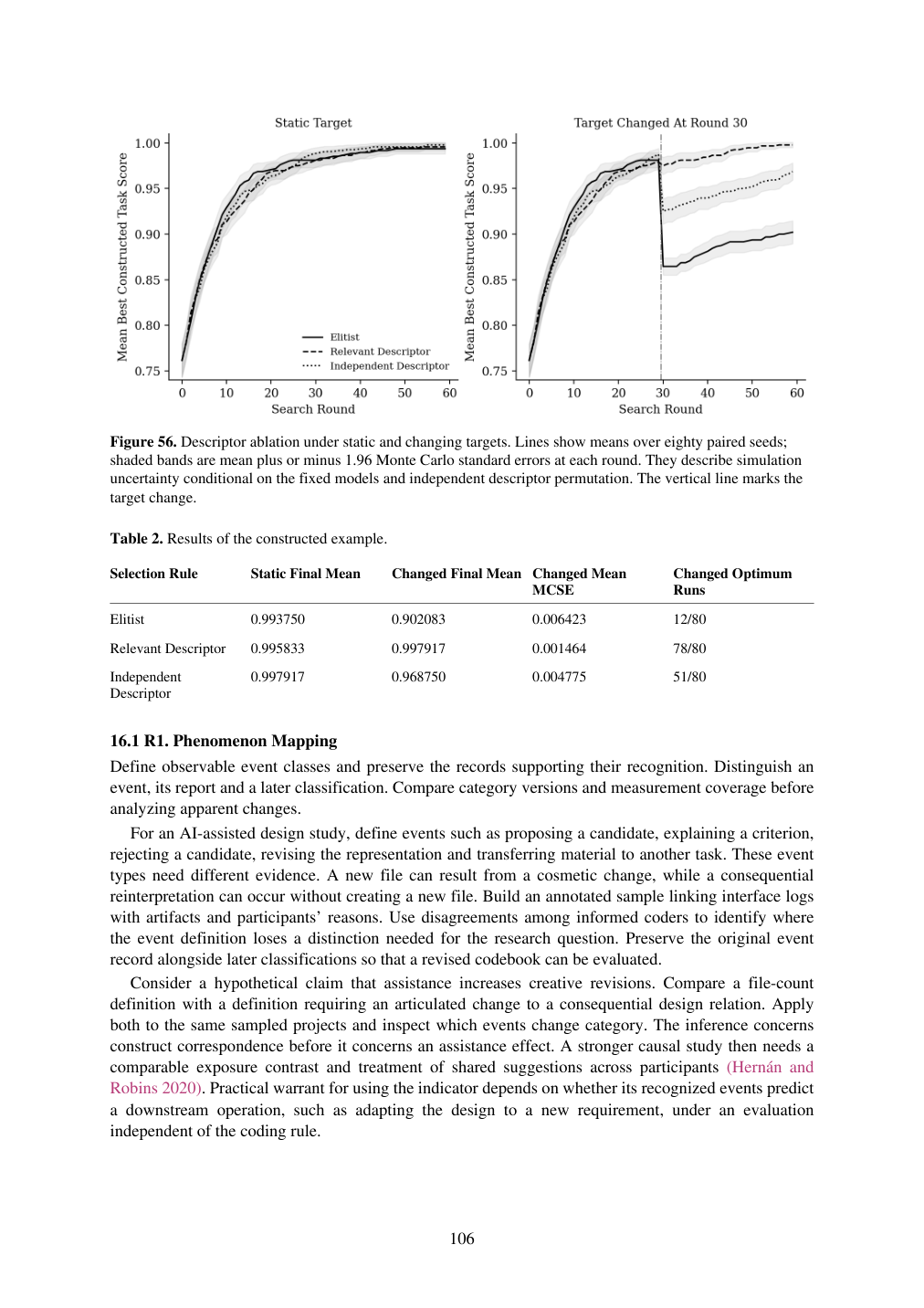
Readable text
Figure 56. Descriptor ablation under static and changing targets. Lines show means over eighty paired seeds; shaded bands are mean plus or minus 1.96 Monte Carlo standard errors at each round. They describe simulation uncertainty conditional on the fixed models and independent descriptor permutation. The vertical line marks the
Define observable event classes and preserve the records supporting their recognition. Distinguish an event, its report and a later classification. Compare category versions and measurement coverage before
For an AI-assisted design study, define events such as proposing a candidate, explaining a criterion, rejecting a candidate, revising the representation and transferring material to another task. These event types need different evidence. A new file can result from a cosmetic change, while a consequential reinterpretation can occur without creating a new file. Build an annotated sample linking interface logs with artifacts and participants’ reasons. Use disagreements among informed coders to identify where the event definition loses a distinction needed for the research question. Preserve the original event record alongside later classifications so that a revised codebook can be evaluated.
Consider a hypothetical claim that assistance increases creative revisions. Compare a file-count definition with a definition requiring an articulated change to a consequential design relation. Apply both to the same sampled projects and inspect which events change category. The inference concerns construct correspondence before it concerns an assistance effect. A stronger causal study then needs a comparable exposure contrast and treatment of shared suggestions across participants (Hernán and Robins 2020). Practical warrant for using the indicator depends on whether its recognized events predict a downstream operation, such as adapting the design to a new requirement, under an evaluation
16.2 R2. Latent-State Estimation
Specify a dynamics and observation model, then examine observability and uncertainty. Report distributions, sets or bounds where the state remains ambiguous. Validate predictions against observations outside the fitting interval.
A latent-state model of creative search might represent retained alternatives, unresolved constraints and the ability to interpret a candidate. These quantities should be distinguished from the observed artifact score. A high score can arise through a robust search repertoire, a fortunate sample or a narrow match to a familiar evaluator. Specify an observation model for each signal, including provenance and the opportunities participants had to display competence. Compare the model’s predictions after a changed task, where competing latent accounts can imply different recovery. Report uncertainty about the state when available observations support several explanations.
In a hypothetical archive, two systems have the same current best artifact. One retains several interpretable alternatives and another retains many duplicates. Observe a controlled requirement change and a separate retrieval task, with equal additional budgets. Successful retrieval can help identify retained structure, while adaptation tests whether that structure supplies useful options. A state estimate is warranted only to the extent that these measurements discriminate the proposed latent conditions. Out-of-sample validation should include changes outside the fitted task sequence (Brunton, Proctor, and Kutz 2016). The practical implication can be modest: preserve an additional candidate family or collect an interpretability measure before committing to a stronger account of creative capacity.
16.3 R3. Interaction Recovery
Define the meaning and time of each relation. Compare influence through ties with selection into them and shared external causes. Use independent measurements or justified interventions capable of separating those pathways.
Recovering a creative interaction means specifying what passes between participants or agents. A message may supply a candidate, evidence, a criticism, a selection command or permission to use a resource. These ties have different causal roles even when the communication interface records them identically. Start with a typed temporal graph and align its timestamps with artifact revisions. Observe when a recipient could have encountered an idea, whether it was understood and which subsequent operation changed. A shared assistant, common brief and selection into a team remain alternative sources of similarity that the network alone cannot remove.
Compare hypothetical workflows in which a critical observation is routed through a peer, supplied directly by the assistant or withheld until after an independent proposal. Keep its wording and timing as comparable as the design permits. The contrast can separate peer influence from content availability and common input. Evaluate uptake through changes in supported reasoning and the final task, including proposals abandoned because the criticism was misunderstood. Adaptive-network methods help represent changing ties, while causal inference addresses assignment and interference (Gross and Blasius 2008; Hernán and Robins 2020). Practical warrant concerns the identified channel: a benefit of interpretable critique supports improving that channel, with broader claims about collaboration requiring evidence from the additional relations it invokes.
16.4 R4. Dynamical-Law Discovery
Declare candidate functions, transition rules and constraints. Inspect parameter and structural identifiability before interpreting a fitted rule. Test changed regimes and retain rival models with materially different predictions.
A dynamical-law discovery exercise can investigate how a retained candidate population responds to score, novelty, crowding and external evidence. Declare the candidate rule library before fitting: proportional retention, threshold pruning, delayed review and descriptor-dependent selection produce different trajectories. The library expresses the mechanisms the procedure can discover. Include known budgets and archive limits as constraints, and inspect whether parameters can be distinguished under the
observed sequence. If evaluation criteria change during a project, represent that change explicitly instead of forcing one fixed law to explain incompatible regimes (Brunton, Proctor, and Kutz 2016).
For a hypothetical search archive, fit several retention rules on a static task and test them on a changed task and a temporary review bottleneck. A successful score forecast can coexist with incorrect predictions about which lineages survive. Evaluate both so that the discovery target remains linked to the claimed mechanism. Predictive equivalence over the observed inputs justifies retaining a family of rules. The next intervention should target an implication on which its members disagree, such as sensitivity to a changed descriptor. Practical use is warranted within the tested response range and observation scheme, with the authority to change a consequential evaluator established through the workflow’s own governance.
16.5 R5. Environment Reconstruction
Measure or bound unobserved inputs, resources and institutional conditions. Compare endogenous change with external driving. Record which environmental histories remain compatible with the observations.
The environment of an AI creativity task includes the brief, source materials, model version, interface, reviewer availability and the institution that allocates attention. Some inputs are visible to investigators and others are only partly recorded. Reconstruct a versioned environment history alongside the candidate history. A sudden change in output can arise from a prompt edit, a different retrieval corpus or a revised scoring policy, as well as from internal learning. Resource availability can also change the effective environment even when the textual brief remains identical. The relevant boundary follows the supports required for the proposed mechanism.
Imagine a hypothetical platform whose archive becomes less diverse. Compare explanations involving internal selection, a changed recommendation input and reduced time for human review. Replaying a preserved workflow against fixed inputs can isolate some external changes; a controlled review-time variation can examine another. Record what remains unobserved and test whether plausible environmental histories reverse the claimed effect. Policy-transfer reasoning makes these support conditions central to practical interpretation (Cartwright and Hardie 2012). A warranted recommendation might therefore concern logging or maintaining a particular input, rather than changing the generator. The aim is to identify which environmental distinction materially changes the explanation and the feasible intervention.
16.6 R6. Historical-Path Reconstruction
Identify the memory carrier and the horizon over which it matters. Use dated sources and sequence constraints. Compare present observations reached through different plausible paths and state which additional evidence discriminates them.
Historical reconstruction should follow a creative contribution through dated proposals, critiques, selections and later use. A prompt transcript records one part of that path; archived artifacts, external tests and participants’ learned interpretations can carry other parts. Establish provenance before attributing a later possibility to a particular earlier step. Compare competing sequences capable of producing the current artifact and identify the record that separates them. Unrecorded private work and shared training material create limits on claims of historical origin. Those limits can be expressed as plausible alternative paths rather than silently resolved by the most visible lineage.
In a hypothetical scientific-design project, a final candidate resembles an earlier rejected proposal. One account credits preserved memory; another credits independent rediscovery after new evidence. Compare access to the earlier reasons, dated retrieval events and the actual revision sequence. A controlled successor task can test what the preserved history enables, while it cannot by itself prove the original historical path. The philosophical distinction is between present functional similarity and warranted inheritance (Whitehead 1978). Practical claims about credit, archive value and transferable competence should use the evidence appropriate to each. This permits a useful history to support later inquiry while keeping attribution proportionate to what the lineage record establishes.
16.7 R7. Mechanism Discrimination
Formulate rival explanations with different observable or interventional implications. Choose a proportionate discriminating comparison. A successful prediction narrows the family within the conditions tested and leaves wider transfer to further evidence.
Mechanism discrimination begins with an observable contrast shared by several plausible accounts. Suppose repeated AI assistance yields more similar proposals. Shared exemplars, reward concentration, descriptor design and reduced independent exploration can each generate that outcome. State a prediction that differs across them before collecting another summary measure. A shared-input account predicts similarity even without peer contact; a social-uptake account predicts additional adjustment after participants inspect others’ work. A selection account predicts that variation exists in the proposal pool but disappears during retention. These distinctions direct observation toward different stages of the same workflow.
Use a hypothetical factorial study varying access to common examples and the retention rule under matched query budgets. Preserve rejected proposals and assess later adaptation, so the explanation connects distributional change with practical consequence. Estimate contrasts at the level where assignment occurred and report dependence created by shared material (Hernán and Robins 2020). An informative result narrows the model family in the tested environment. Practical warrant then follows the diagnosed passage: preserving independent proposal time addresses one mechanism, changing archive selection another. The choice among these responses additionally depends on the task’s need for coordination, available review capacity and reasons for protecting particular alternatives.
16.8 R8. Resource-Use Inference
Close the relevant physical, financial or labor account in its own units. Track missing channels and boundary transfers. Thermodynamic dissipation requires its physical correspondence; social costs and benefits require separate interpretation.
An equal-query experiment can still distribute other resources unevenly. One workflow may require more human interpretation, source checking or unsuccessful restarts. Construct separate accounts for scored candidates, model tokens, device energy where measured, reviewer time and storage. Keep their units explicit. A monetary conversion can support a declared budgeting question, while creative worth and fair compensation require additional evaluation. Record boundary inputs such as unpaid expert curation or pre-existing archives because a locally efficient process may rely on supports supplied elsewhere. Physical dissipation claims require a defensible physical measurement and system boundary (Seifert 2012).
Consider a hypothetical comparison between a highly selective generator and a broad portfolio search. Match objective evaluations, then measure the human work needed to make each selected artifact usable. Report the resulting resource vector together with task achievement and adaptation. A portfolio may improve later recovery while imposing a larger review burden; the practical judgment depends on whether the relevant institution can support that burden. Sensitivity analysis can vary opportunity costs without pretending that all inputs have one natural value scale. A warranted conclusion identifies which resource makes the operation feasible and which burden is redistributed, giving a successor enough information to judge transfer under its own actual conditions.
16.9 R9. Cross-Scale Correspondence
State what aggregation preserves and what it removes. Compare micro- and macro-level records under consistent definitions. Keep distinctions needed for attribution, intervention or evaluation when constructing the coarser account.
An assistant can improve each participant’s appraised output while making the collective portfolio more similar. Reconstructing this cross-scale relation requires linked records from suggestions to participant revisions and the group archive. State what aggregation preserves: mean quality, coverage of a descriptor space and availability of distinct executable techniques summarize different properties. A coarse statistic can conceal who benefits and which alternatives disappear. Preserve task-relevant
distinctions before combining observations, and account for dependence created by shared prompts, models and evaluators. Group size changes should be evaluated under a declared resource convention.
For a hypothetical ideation exercise, compare independent assistance with assistance drawn from a shared candidate pool. Evaluate participant-level outputs and the group’s response to several later requirement changes. Hierarchical analysis can separate within-group and between-group variation, while provenance identifies repeated dependence on a common source. Existing human-AI creativity studies motivate the distinction between appraised quality and collective diversity within their tested tasks (Doshi and Hauser 2024; Boussioux et al. 2024). The proposed extension asks which retained differences become usable under change. Practical warrant for a group workflow therefore requires evidence at the group horizon, even when participant-level benefits are clear, with the coordination and review costs included in the comparison.
16.10 R10. Functional Reconstruction
Specify the task, population, threshold and deadline. Investigate how operations produce the function under ordinary and disrupted conditions. Distinguish nominal assignment from actual exercisable capacity.
Reconstruct a creative function as a complete operation that a relevant recipient can perform. A generated lesson plan, design or program becomes practically useful through interpretation, testing and adaptation. Specify the task population, deadline, acceptable errors and supporting resources. Observe routine use and a perturbation that exposes missing complements, such as an unfamiliar audience or absent founding expert. A nominally available artifact may lack the explanations or permissions needed for a successor to use it. Functional evidence should therefore extend beyond a benchmark score or successful demonstration by its original operator.
Imagine a hypothetical handover of an AI-designed workshop to a new facilitator. Compare finalmaterial transfer with transfer of editable components, reasons and known limitations. Give successors the same time and assistance, then test ordinary delivery and a changed participant need. The inference concerns the causal support supplied by the handover package, while broader claims require additional settings and tasks. Capability and transfer reasoning connect the measured outcome to exercisable opportunity (Sen 2009; Cartwright and Hardie 2012). Practical warrant is strongest when the successor’s actual conditions sustain the complete function and its correction route. A failed step identifies what to renew or redesign instead of treating the handover as an indivisible success or failure.
16.11 R11. Semantic Reconstruction
Examine how an observation becomes intelligible to particular participants. Retain contextual interpretations, translation rules and disagreement. Test practical uptake separately from similarity in wording or numerical representation.
Semantic reconstruction asks how a candidate becomes intelligible within a particular practice. A suggestion can use familiar words while expressing an unfamiliar relation; it can also appear novel because a descriptor overlooks shared meaning. Gather artifact-based explanations, attempted use and disagreement from relevant interpreters. Identify which context makes a proposed analogy or transformation understandable. Compare interpretations across participants without assuming that one embedding distance supplies the common semantic scale. A translation should preserve the distinctions needed for the task and make its losses inspectable, especially when a minority practice uses different terms for a consequential idea.
In a hypothetical co-design study, two generated explanations receive similar semantic scores but lead recipients to build different prototypes. Ask recipients to predict the consequence of a changed condition and then explain their choices. This tests practical understanding alongside verbal resemblance. Blind domain review can evaluate whether the transferred relation is supported and useful. Reflective judgment and social criticism provide philosophical resources for revising an inadequate interpretive frame (Kant 2000; Longino 1990). The practical conclusion can concern improved explanation, a different representation or protected interpretive dialogue. Its warrant comes
from the observed route to understanding and exercise, with unresolved meanings retained as substantive findings.
16.12 R12. Normative Reconstruction
Trace how a criterion arises, stabilizes and acquires consequential force. Distinguish prevalence, practical commitment, authorized use and justified authority. Public or moral judgment identifies its substantive reasons and affected claims.
Reconstruct an evaluative criterion through the process by which it is proposed, adopted and made consequential. A benchmark may begin as a convenient technical proxy, become a ranking rule and later determine resources or recognition. Document that genealogy and identify who can revise the rule. Distinguish evidence that a criterion predicts a desired outcome from reasons that the outcome deserves priority. Participants can agree strategically with a dominant metric while retaining different judgments about valuable work. Their practical dependence and their substantive reasons therefore require separate observation.
Consider a hypothetical platform replacing a speed metric with a criterion incorporating repairability. Compare the evidence motivating the change, the authority to adopt it and the opportunities for affected creators to challenge its consequences. Evaluate candidates under both criteria and preserve incomparabilities when the dimensions support different judgments. The research proposition is that justified evaluative revision requires an intelligible connection among a revealed limitation, a proposed distinction and a consequential review procedure (Huang 2026a; Longino 1990). A dynamic model can predict how the new criterion redistributes selection. Practical authority for using it requires reasons suited to the institution, including the burdens placed on contributors whose earlier work was organized around the former standard.
17 A Prospective Design For Creative AI Inquiry
17.1 Separate Generation, Validation And Environmental Encounter
Choose a task family with independently assessable components and preserve the problem statement. Compare baseline professional inquiry, model assistance, access to independently collected task evidence and their combination. Match total supported resources or report their differences explicitly. Record candidate lineages and whether a revision changes wording, mechanism, evidence or the feasible next test. Evaluation can include verified discoveries, useful failures, problem reformulations and downstream exercise.
17.2 Test Evaluator And Representation Revision
Use held-out tasks and independent appraisals to compare fixed, periodically revised and jointly evolving evaluators. Predefine the allowed revision routes while retaining a procedure for proposing an unanticipated distinction. Descriptor ablations should include task-relevant, deliberately weak and independently chosen representations. A result can then be attributed to its actual information and selection advantage. Record the costs and powers involved in adopting a revised criterion.
17.3 Follow Authority And Renewal
Track who can generate, inspect, challenge, fund and deploy a candidate. These roles can overlap, with responsibilities attached to the actual arrangement. Study whether a useful output leaves a reusable test, tool, skill or publicly intelligible reason. External implementation requires the authority appropriate to its consequences. An iterative inquiry can remain decisive on specific questions while preserving the evidence needed for later correction.
18 Implications For AI Creativity
The non-equilibrium perspective directs attention to the conditions sustaining and transforming search. The taxonomy separates variation, feedback, constraint, selection, historical memory and environmental change. The worked example shows one way retention can alter later adaptation under equal proposal and evaluation budgets. Its scope is the declared computational task and descriptor.
The broader contribution concerns a research architecture in which candidates, evaluators, representations and external supports can change together. Creative appraisal asks which departures acquire warranted quality and useful continuation. Institutional appraisal asks who may select and revise the standards governing that process. Bringing these inquiries together makes AI creativity a problem of evidence, practical capability and evaluative authority as well as generation.
19 Research Materials And Authorial Review
The editable manuscript, shared mechanism catalogue, simulation programs, generated outputs and original figures accompany this paper. The source record identifies primary-source links and the access level used in the survey. Reported experimental summaries are generated by the accompanying programs. The prose also introduces hypothetical conceptual comparisons whose stipulated quantities serve an argumentative purpose. Exact equality claims receive the analytical argument given in the text. Reproduction uses Python with NumPy, SciPy and Matplotlib; the package records the versions used.
The remaining empirical research question is the correspondence between the proposed mechanisms and particular social settings. An application should specify its observation process, feasible alternatives, institutional authority and validation design. The manuscript supplies complete coverage of the declared catalogue and a concrete basis for that further inquiry. The author can revise substantive commitments, select empirical cases and assess the literature and arguments before any external scholarly submission.
19.1 AI Assistance Statement
This revised manuscript and its accompanying code were prepared with ChatGPT and Codex assistance in literature retrieval, conceptual organization, drafting, argumentative criticism, formal checking, programming and presentation. Wanhong HUANG supplied the research direction and the request for the eight-paper series. The manuscript is presented for the author’s substantive review and decision about further development and circulation. The statement records the assistance actually used in this preparation; responsibility and final approval require the author’s own assessment.
References
Ashwin, Peter, Sebastian Wieczorek, Renato Vitolo, and Peter Cox. 2012. “Tipping Points in Open Systems:
Bifurcation, Noise-Induced and Rate-Dependent Examples in the Climate System.” Philosophical Transactions of the Royal Society A 370: 1166–84. https://pubmed.ncbi.nlm.nih.gov/22291228/. Axtell, Robert L., and J. Doyne Farmer. 2025. “Agent-Based Modeling in Economics and Finance: Past, Present,
and Future.” Journal of Economic Literature 63 (1): 197–287. https://doi.org/10.1257/jel.20221319. Bebon, Robin, Joshua F. Robinson, and Thomas Speck. 2025. “Thermodynamics of Active Matter: Tracking
Dissipation Across Scales.” Physical Review X 15: 021050. https://doi.org/10.1103/PhysRevX.15.021050. Bernstein, Ethan, Jesse Shore, and David Lazer. 2018. “How Intermittent Breaks in Interaction Improve
Collective Intelligence.” Proceedings of the National Academy of Sciences 115 (35): 8734–39. https://doi.org/10.1073/pnas.1802407115. Bhaskar, Roy. 1975. A Realist Theory of Science. Leeds Books.
https://www.versobooks.com/products/1569-a-realist-theory-of-science. Boden, Margaret A. 1997. “Creativity and Artificial Intelligence.” In Proceedings of the Fifteenth International
Joint Conference on Artificial Intelligence, 1563–66. https://ijcai.org/proceedings/1997/0229.pdf. Boettiger, Carl, and Alan Hastings. 2012. “Early Warning Signals and the Prosecutor’s Fallacy.” Proceedings of
the Royal Society B. https://pmc.ncbi.nlm.nih.gov/articles/PMC3497104/.
Boussioux, Léonard, Jacqueline N. Lane, Miaomiao Zhang, Vladimir Jacimovic, and Karim R. Lakhani. 2024.
“The Crowdless Future? Generative AI and Creative Problem-Solving.” Organization Science 35 (5): 1589–1607. https://doi.org/10.1287/orsc.2023.18430. Brunton, Steven L., Joshua L. Proctor, and J. Nathan Kutz. 2016. “Discovering Governing Equations from Data
by Sparse Identification of Nonlinear Dynamical Systems.” Proceedings of the National Academy of Sciences 113 (15): 3932–37. https://doi.org/10.1073/pnas.1517384113. Cartwright, Nancy, and Jeremy Hardie. 2012. Evidence-Based Policy: A Practical Guide to Doing It Better.
Oxford University Press. https://academic.oup.com/book/11611. Centola, Damon, and Andrea Baronchelli. 2015. “The Spontaneous Emergence of Conventions: An Experimental
Study of Cultural Evolution.” Proceedings of the National Academy of Sciences 112 (7): 1989–94. https://doi.org/10.1073/pnas.1418838112. Cross, M. C., and P. C. Hohenberg. 1993. “Pattern Formation Outside of Equilibrium.” Reviews of Modern
Physics 65: 851–1112. https://doi.org/10.1103/RevModPhys.65.851. Dewey, John. 1927. The Public and Its Problems. Henry Holt. https://www.gutenberg.org/ebooks/71000. Doshi, Anil R., and Oliver P. Hauser. 2024. “Generative AI Enhances Individual Creativity but Reduces the
Collective Diversity of Novel Content.” Science Advances 10: eadn5290. https://doi.org/10.1126/sciadv.adn5290. Folke, Carl, Thomas Hahn, Per Olsson, and Jon Norberg. 2005. “Adaptive Governance of Social-Ecological
Systems.” Annual Review of Environment and Resources 30: 441–73. https://doi.org/10.1146/annurev.energy.30.050504.144511. Frey, Erwin, and Henrik Weyer. 2026. “Pattern Formation Beyond Turing: Physical Principles of
Mass-Conserving Reaction-Diffusion Systems.” Annual Review of Biophysics 55: 493–514. https://doi.org/10.1146/annurev-biophys-030822-031638. Fricker, Miranda. 2007. Epistemic Injustice: Power and the Ethics of Knowing. Oxford University Press.
https://doi.org/10.1093/acprof:oso/9780198237907.001.0001. Godley, Wynne, and Marc Lavoie. 2007. Monetary Economics: An Integrated Approach to Credit, Money,
Income, Production and Wealth. Palgrave Macmillan. https://doi.org/10.1057/9780230626546. Gross, Thilo, and Bernd Blasius. 2008. “Adaptive Coevolutionary Networks: A Review.” Journal of the Royal
Society Interface 5 (20): 259–71. https://doi.org/10.1098/rsif.2007.1229. Hayek, Friedrich A. 1945. “The Use of Knowledge in Society.” American Economic Review 35 (4): 519–30.
https://www.econlib.org/library/Essays/hykKnw.html. Hernán, Miguel A., and James M. Robins. 2020. Causal Inference: What If. Chapman & Hall/CRC.
https://miguelhernan.org/whatifbook. Holling, C. S. 1973. “Resilience and Stability of Ecological Systems.” Annual Review of Ecology and Systematics
4: 1–23. https://doi.org/10.1146/annurev.es.04.110173.000245. Huang, Wanhong. 2026a. “An Inquiry into Evaluative Norm Formation and Justice in Self-Evolving AI
Knowledge Systems.” Author manuscript, current supplied version 6. https://huang-wanhong.com/publication. Huang, Wanhong. 2026b. “An Inquiry into the Formation of Evidence-Based Partial Orders in the Governance of
Human–AI Evolutionary Production.” Author manuscript, current supplied version 6. https://huang-wanhong.com/publication. Huang, Wanhong. 2026c. “Evolutionary Project Ecologies in Economics: A Conceptual Framework and
Institutional Prospects.” Author manuscript, current supplied version 4. https://huang-wanhong.com/publication. Huang, Wanhong. 2026d. “Relational Wealth: Definition and Characteristics.”
https://doi.org/10.17613/nq7js-vz283. Hughes, Edward, Michael D. Dennis, Jack Parker-Holder, Feryal Behbahani, Aditi Mavalankar, Yuge Shi, Tom
Schaul, and Tim Rocktäschel. 2024. “Position: Open-Endedness Is Essential for Artificial Superhuman Intelligence.” In, 235:20597–616. Proceedings of Machine Learning Research. https://proceedings.mlr.press/v235/hughes24a.html. Kant, Immanuel. 2000. Critique of the Power of Judgment. Cambridge University Press. https://www.cambridge.
org/core/books/critique-of-the-power-of-judgment/3705CD4E7C5C7B1CE079AFA9B924122E. Korbel, Jan, Artemy Kolchinsky, Sarah A. M. Loos, Gonzalo Manzano, Rosalba Garcia-Millan, Olga Movilla
Miangolarra, and Édgar Roldán. 2026. “Quo Vadis, Stochastic Thermodynamics?” Journal of Non-Equilibrium Thermodynamics 51 (4): 577–94. https://doi.org/10.1515/jnet-2026-0051.
Lehman, Joel, and Kenneth O. Stanley. 2011. “Abandoning Objectives: Evolution Through the Search for
Novelty Alone.” Evolutionary Computation 19 (2): 189–223. https://doi.org/10.1162/EVCO\_a\_00025. Lindblad, Göran. 1976. “On the Generators of Quantum Dynamical Semigroups.” Communications in
Mathematical Physics 48: 119–30. https://doi.org/10.1007/BF01608499. Longino, Helen E. 1990. Science as Social Knowledge: Values and Objectivity in Scientific Inquiry. Princeton
University Press. https://press.princeton.edu/books/ebook/9780691209753/science-as-social-knowledge-0. Lorenz, Edward N. 1963. “Deterministic Nonperiodic Flow.” Journal of the Atmospheric Sciences 20: 130–41.
https://wind.mit.edu/~emanuel/Lorenz/EdLorenz/Deterministic\_63.pdf. Mouret, Jean-Baptiste, and Jeff Clune. 2015. “Illuminating Search Spaces by Mapping Elites.” Preprint,
arXiv:1504.04909. https://arxiv.org/abs/1504.04909. Novikov, Alexander, Ngân Vũ, Marvin Eisenberger, Emilien Dupont, Po-Sen Huang, Adam Zsolt Wagner,
Sergey Shirobokov, et al. 2025. “AlphaEvolve: A Coding Agent for Scientific and Algorithmic Discovery.” Technical white paper, arXiv:2506.13131. https://arxiv.org/abs/2506.13131. Onsager, Lars. 1931. “Reciprocal Relations in Irreversible Processes. I.” Physical Review 37: 405–26.
https://doi.org/10.1103/PhysRev.37.405. Ostrom, Elinor. 2009. “A General Framework for Analyzing Sustainability of Social-Ecological Systems.”
Science 325 (5939): 419–22. https://doi.org/10.1126/science.1172133. Perdomo, Juan, Tijana Zrnic, Celestine Mendler-Dünner, and Moritz Hardt. 2020. “Performative Prediction.” In,
119:7599–609. Proceedings of Machine Learning Research. https://proceedings.mlr.press/v119/perdomo20a.html. Prigogine, Ilya. 1977. “Time, Structure and Fluctuations.”
https://www.nobelprize.org/uploads/2018/06/prigogine-lecture.pdf. Ritchie, Paul D. L., Hassan Alkhayuon, Peter M. Cox, and Sebastian Wieczorek. 2023. “Rate-Induced Tipping in
Natural and Human Systems.” Earth System Dynamics 14. https://doi.org/10.5194/esd-14-669-2023. Schmidhuber, Jürgen. 2010. “Formal Theory of Creativity, Fun, and Intrinsic Motivation (1990-2010).” IEEE
Transactions on Autonomous Mental Development 2 (3): 230–47. https://doi.org/10.1109/TAMD.2010.2056368. Seifert, Udo. 2012. “Stochastic Thermodynamics, Fluctuation Theorems and Molecular Machines.” Reports on
Progress in Physics 75: 126001. https://doi.org/10.1088/0034-4885/75/12/126001. Seifert, Udo. 2025. “Universal Bounds on Entropy Production from Fluctuating Coarse-Grained Trajectories.”
Preprint, arXiv:2512.07772. https://arxiv.org/abs/2512.07772. Sen, Amartya. 2009. The Idea of Justice. Harvard University Press.
https://philosophy.fas.harvard.edu/publications/idea-justice. Takens, Floris. 1981. “Detecting Strange Attractors in Turbulence.” In, 366–81. Springer.
https://doi.org/10.1007/BFb0091924. Turing, Alan M. 1952. “The Chemical Basis of Morphogenesis.” Philosophical Transactions of the Royal Society
B 237: 37–72. https://doi.org/10.1098/rstb.1952.0012. Whitehead, Alfred North. 1978. Process and Reality: An Essay in Cosmology. Free Press.
https://www.simonandschuster.com/books/Process-and-Reality/Alfred-North-Whitehead/9780029345702. Woolley, Anita Williams, Christopher F. Chabris, Alex Pentland, Nada Hashmi, and Thomas W. Malone. 2010.
“Evidence for a Collective Intelligence Factor in the Performance of Human Groups.” Science 330: 686–88. https://doi.org/10.1126/science.1193147.