Economic Circulation And Generative Renewal - A Non-Equilibrium Inquiry
Full text from the PDF
Economic Circulation And Generative Renewal: A
Non-Equilibrium Inquiry
Wanhong HUANG
Abstract
Economic activity continually depends on production, settlement, maintenance, learning and institutional authority. Similar stocks and aggregate outputs can support different paths of circulation and different possibilities for renewal. This paper develops a non-equilibrium inquiry joining stock-flow accounting, evolutionary economics, production networks and Generative Relational questions about capability and value. It presents the complete 53-class mechanism taxonomy, with a dedicated economic analysis of every class. The argument distinguishes monetary balance, productive exercise, renewal of capability and justified allocation. A finite three-account construction shows how identical resources and payment opportunities can yield different realized circulation under different schedules. The result motivates a broader inquiry into working capital, complementary inputs, learning across organizational boundaries and the distribution of selection power. Philosophical linkages examine reproduction, dispersed knowledge, substantive opportunity and evaluative authority. The contribution is a framework for tracing which economic processes continue, what conditions they renew, who can use the resulting capabilities and how financing and governance affect those possibilities.
Keywords: economic circulation; productive capabilities; non-equilibrium dynamics; evolutionary economics; relational wealth.
Discussion Paper Note
This philosophical discussion paper shares an evolving inquiry and invites dialogue, criticism, revision, and independent development. Its definitions, distinctions, and constructions remain open to refinement. Circulation across scholarly and practical communities is part of the purpose of releasing the manuscript.
The author treats the viewpoints, concepts, and lines of reasoning presented here as contributions to a shared field of inquiry. Similar or related ideas may have appeared in other intellectual, cultural, and disciplinary traditions. The manuscript identifies known antecedents and distinguishes inherited positions, interpretive proposals, and arguments developed here. Historical priority remains open to further investigation.
The arguments are provisional and historically situated. Readers are encouraged to question, test, revise, extend, reinterpret, or independently develop the ideas presented here. Where appropriate, acknowledgment of this paper as one point of encounter in the development of a related idea is appreciated. Such acknowledgment records an intellectual route; the ideas remain available for criticism, revision, and independent development.
Definitions introduced here are paper-local analytical stipulations. Attributed definitions follow the cited works. The terminology specifies the scope of the present argument, while its intellectual history remains open to further investigation. Generative Relational theory is treated as an open research programme whose proposals receive critical examination alongside independent literature.
Responsible Use And Rights Reservation
This section records a request for responsible scholarly conduct and identifies the scope of retained rights. Legal permissions are governed by the licence on the following page.
The author encourages good-faith discussion, criticism, independent inquiry, and responsible use of the material. Separately from the licence’s terms, the author asks users to consider foreseeable harms when adapting the arguments, representations, or examples of this paper, particularly in economic circulation, productive capability, labor, and the distribution of benefits and burdens. The ethical request leaves the licence’s permissions and legally authorised uses unchanged.
The author retains the rights preserved under CC BY-NC 4.0 and may pursue remedies to which the author is legally entitled for breach of the licence or violation of independently applicable rights. Reuse remains independent from authorial endorsement. Third-party rights require authorisation from their respective holders where applicable. Copyright exceptions and limitations, including applicable forms of fair use or fair dealing, remain available.
Notices
This page consolidates the manuscript’s research status, licence, development disclosure, researchprogramme relation, and suggested citation.
Status. This philosophical discussion manuscript is prepared for the author’s substantive review and subsequent scholarly discussion. Finite formal constructions and executed numerical illustrations clarify conditional arguments under declared assumptions. Empirical applications require correspondence evidence. Internal checks assess the stated arguments and examples; independent scholarly assessment can further test their interpretation and adequacy. The source ledgers record the access level and claim scope of consulted works.
Licence. Except where otherwise indicated, copyright 2026 Wanhong Huang. This work is made available under the Creative Commons Attribution-NonCommercial 4.0 International License (CC BY- NC 4.0). Subject to its terms, the licence permits sharing and adaptation for noncommercial purposes with appropriate attribution, a link to the licence, and an indication of changes. Attribution should preserve the licensor’s independence from the reuse. Reuse is governed solely by the licence; the responsible-use request on the preceding page remains separate from its terms. The licence deed and legal code are available at https://creativecommons.org/licenses/by-nc/4.0/. The licence governs in case of conflict with this summary. Third-party material remains subject to its respective rights.
Statement on the use of language models. Preparation involved OpenAI’s ChatGPT and Codex. Language models supported exploratory dialogue, source discovery and checking, argumentative criticism, manuscript revision, LaTeX source preparation and mathematical typesetting, and the development of supporting code and figures. Verification used the sources and access levels recorded in the accompanying ledgers. The author initiated the research questions and directed the research programme; interpretation, acceptance of the arguments, and publication decisions remain subject to the author’s review. Authorship credit and responsibility for the released manuscript remain with the human author.
Code and data availability. The materials include editable manuscripts, a shared 53-class numerical mechanism atlas, domain-specific experiments, generated data, original figures, and reproducibility checks. The source package contains the editable manuscript, source ledgers, supporting scripts and outputs, and a reading guide. Numerical illustrations, where present, use the assumptions stated in their captions and text.
Related research programme. Eight companion inquiries concern urban governance, economics, AI creativity, legal generativity, diplomacy, juridical reconstruction, evidence-based policymaking, and cocreation. Each reproduces the shared 53-class catalogue and twelve reconstruction tasks for standalone use. The papers share a Generative Relational orientation while preserving their separate philosophical questions and justificatory tasks.
Suggested citation. Huang, Wanhong. “Economic Circulation And Generative Renewal: A Non- Equilibrium Inquiry.” Philosophical discussion paper, 2026.
1 Introduction
1.1 The Economic Problem Of Feasible Continuation
An economy continues through ordered operations. Materials arrive, workers coordinate, equipment is maintained, claims are settled and knowledge is interpreted and transmitted. These operations depend on resources and institutions that their exercise can renew, redistribute or erode. A current balance sheet records selected stocks and claims; it leaves the sequence through which productive possibilities become feasible to a further account. This paper asks how economic circulation supports continuing capability, which mechanisms maintain or change that relation and who gains access, control and exposure to loss through the resulting process.
Society is approached as an open, historically evolving complex system. Economic activity has physical substrates and institutionally constituted objects, including money, ownership, contracts and permissions. Their dynamics require different units and correspondence rules. Material conservation, a financial accounting identity and a judgment of economic value have distinct meanings. The nonequilibrium perspective follows continuing transport, conversion, adjustment and structural change while permitting local equilibrium approximations where their assumptions serve the question. Market clearing, strategic equilibrium and statistical stationarity remain model-relative concepts.
The practical problem concerns divergence among visible output, exercisable capacity and renewal. A producer can increase sales while losing repair knowledge; a transaction network can circulate claims while leaving production blocked; a firm can close while workers and suppliers carry its capability forward. Identifying what continues is therefore prior to evaluating whether continuation is desirable and which support a proposed intervention should provide.
1.2 Economic Traditions And The Research Gap
Evolutionary economics supplies an established account of routines and cumulative organizational change (Nelson and Winter 1982). Stock-flow consistency provides accounting constraints that connect financial stocks and transactions (Godley and Lavoie 2007). Production-network research investigates how dependence structure can affect aggregate fluctuations (Acemoglu et al. 2012). Increasing-returns and path-dependence approaches examine how earlier choices alter later possibilities (Arthur 1989; Pierson 2000). The present inquiry connects these traditions through the concrete conditions of an executable economic operation, preserving the differences among accounting, causal explanation and evaluation. Research on financial clearing and default provides another comparison class, while the Bank of England’s account of deposit creation through lending clarifies why fixed total cash is a specific model boundary (Eisenberg and Noe 2001; McLeay, Radia, and Thomas 2014).
Agent-based economic models provide resources for heterogeneous actors, institutions and changing interactions (Axtell and Farmer 2025). Their flexibility makes explicit rules, identification and validation especially important. Generative-justice and relational inquiries add questions about who contributes, who learns and who can exercise the resulting capabilities (Eglash 2016; Huang 2026c). A shared technique may remain valuable after its founding organization disappears, while its availability can depend on finance, permission, customers and practical interpretation. These supports belong in the account of transfer and renewal.
The research gap addressed here is a comprehensive mechanism crosswalk joined to an inquiry into economic exercise. A general description of complexity or circulation leaves many rival accounts open. The paper develops fifty-three classes covering origins, sustaining processes, mediators, observable patterns and persistence or transformation. Each leaf supplies a concrete phenomenon, problem, correspondence, discriminating method and research proposition. Completeness refers to the declared taxonomy; a particular episode can involve several mechanisms and require a representation tailored to its question.
1.3 Core Argument And Proposed Contributions
The argument connects four questions. Which transfers and transformations occur? Which resources, relations and permissions make them feasible? Does exercise renew a condition required for later exercise? Who can use, govern or contest the resulting capability? These questions can have different answers. A balanced transaction can satisfy an accounting identity while leaving a productive transition unavailable. A process can reproduce itself while imposing burdens whose justification remains contested. A defensible account therefore follows operations and supports while supplying explicit reasons for the valued continuation (Huang 2026d, 2026a).
The first proposed contribution is the complete mechanism-to-inquiry framework. It compares liquidity constraints, delayed investment, network rewiring, resource coupling, selective visibility and functional succession through their distinct observable implications. The second is an account of economic possibility as a relation among a state, a rule and an ordered path. The third connects renewal with ownership, learning and evaluative authority. An allocation procedure can shape who receives a chance to demonstrate capacity, changing the evidence used by later allocation. These are the paper’s extensions to the cited explanatory and philosophical traditions.
A finite three-account construction isolates the effect of sequence. Identical initial resources and directed obligations yield different realized transfers under different processing orders. Executed robustness comparisons vary initial liquidity, its distribution and declared settlement procedures. Queuing changes the duration of an opportunity, while cycle netting discharges offsetting obligations under an additional institutional rule. The comparisons distinguish gross cash movement from discharged claims. Productive value, welfare and justified allocation require an account of the real operations and interests those procedures serve.
1.4 Methods, Philosophical Linkages And The Route Through The Paper
The survey joins primary non-equilibrium theory, economic research, reconstruction methods and philosophical reasoning. Marx’s analysis of reproduction motivates attention to renewed production conditions; Hayek’s coordination problem directs attention to dispersed knowledge; capability-oriented judgment examines practical opportunity under actual constraints (Marx 1867; Hayek 1945; Sen 2009). The proposed linkage asks how knowledge becomes executable and how exercise changes its supports. Public or institutional evaluation can then compare learning, current output, ecological renewal and control without assuming that one summary resolves every relevant claim.
Methods are matched to inferential tasks. Stock-flow accounts constrain histories and expose missing entries. Temporal networks identify typed dependencies and the timing of possible transfers. Process evidence investigates interpretation and the complements required for exercise. Causal comparisons address intervention, assignment and selection, while simulation tests consequences of stated behavioral and institutional rules. Source access levels are recorded, hypothetical comparisons remain identifiable as research proposals and executed experiments have accompanying programs and data. Transfer to an actual economy requires correspondence and validation at the relevant scale.
The paper develops common foundations, the full taxonomy, economic and philosophical linkages, the circulation experiment and twelve reconstruction tasks. Its practical aim is to make proposed continuation, development, succession or closure concrete enough for review. The account identifies an actor, feasible operations, resource and authority constraints, affected positions and an evaluation horizon. It thereby connects economic dynamics to the question of which capabilities become available to successors and what reasons justify the allocation of support, control and transition burdens.
2 Economic Literature And Theoretical Connections
2.1 Evolutionary Capabilities And Organizational Change
Nelson and Winter place routines and cumulative change within evolutionary economics (Nelson and Winter 1982). The linkage here follows the bearer of a productive capacity as firms, workers and relations change. A retained routine can require equipment, authority and customers before it becomes exercisable. The proposed renewal account records those complements and asks whether use replenishes them. It also follows learning beyond the survival of the original firm.
2.2 Stock-Flow Consistency And Heterogeneous Interaction
Godley and Lavoie supply an accounting-centered framework linking financial stocks and flows (Godley and Lavoie 2007). The present paper uses accounting identities to constrain possible histories and expose missing entries. It then asks which real operations and capabilities the financial sequence enables. A balanced account can remain compatible with different productive and distributional consequences.
Axtell and Farmer review agent-based economic and financial models (Axtell and Farmer 2025). Such models can express heterogeneous constraints and changing relations. Their flexibility also makes assumptions and validation consequential. A mechanism should be stated through a behavioral or institutional rule whose implications can be tested. The finite construction below isolates one such rule: a payment requires current liquidity and cannot be completed retroactively after its opportunity passes.
2.3 Production Networks And Path Dependence
Acemoglu and colleagues show how production-network structure can affect aggregate fluctuations (Acemoglu et al. 2012). Arthur and Pierson provide accounts of increasing returns and path-dependent change in economic and political settings (Arthur 1989; Pierson 2000). The extension developed here combines dependence structure with the supports needed for an actual transition. A large network position can transmit disruption; a missing complement can block an apparently attractive alternative. Each claim needs data at its relevant scale.
2.4 Generative Justice And Relational Wealth
Eglash’s generative-justice agenda makes circulation and the conditions of generation a substantive distributive concern (Eglash 2016). Earlier GR work examines valuable relational possibilities and economic project continuation (Huang 2026d, 2026c). The proposed addition separates realized output, retained capacity and renewal through exercise. A process can reproduce itself while distributing control and burdens in ways requiring criticism. Public support is consequently judged through additionality, opportunity costs, affected claims and the available alternatives.
3 Reproduction, Knowledge And Economic Judgment
3.1 Reproduction Includes The Conditions Of Another Operation
Marx’s analysis of simple reproduction places renewed production within continuing social relations (Marx 1867). The linkage developed here asks which conditions of another productive operation are reproduced, by whom and under whose control. Reinvestment is one route. Shared knowledge, repair access, maintained infrastructure and successor permissions provide other possible routes. Their effectiveness requires evidence about actual exercise; their justice requires the relevant claims and purposes.
3.2 Dispersed Knowledge And Accessible Conversion
Hayek identifies the coordination problem posed by dispersed knowledge (Hayek 1945). The present inquiry adds the question of access to the means of acting on knowledge. A producer can recognize an opportunity while lacking working capital or permission. Information and feasible conversion therefore belong together in the explanatory model. A decentralized signal and a public coordination mechanism can each be assessed through the specific passage they make possible and the burdens they impose.
3.3 Capacity And Evaluative Plurality
Capability-oriented judgment supplies a reason to follow exercisable opportunities across changing carriers (Sen 2009). An inherited method has a different practical status when a successor can use it. Profit, learning, ecological renewal and worker authority can have different beneficiaries and time horizons. A common monetary valuation can support a declared calculation when its comparability is justified. Where such grounds remain inadequate, plural accounts and explicit reasons preserve a more informative comparison.
3.4 Selection Has A Political Economy
Who can obtain finance and demonstrate a capacity influences the record later used to allocate opportunity. An evaluator can therefore help produce the apparent evidence of merit it receives. The GR norm-formation and partial-order inquiries make these procedural powers available for scrutiny (Huang 2026a, 2026b). The economic extension asks how support, ownership, market access and review authority shape the feasible paths of learning. It leaves the eventual allocation to evidence and defended purposes.
4 Reproduction, Conversion, And Epistemic Economic Power
4.1 What An Economy Reproduces
An economic process can continue its transactions while changing the conditions under which people can participate in it. This raises a question prior to the choice of an efficiency measure: what exactly is being reproduced? The GR distinction among output, capacity, renewal and historical transmission supplies an analytical starting point. A delivered good is an output. A workable production relation is a capacity. Replacing a consumed support can contribute to renewal. Enabling a successor to exercise a learned practice supplies a distinct transmission claim (Huang 2026c, 2026d).
The argument has three premises. Production consumes and transforms supporting conditions. Some supports take time and cooperation to rebuild. Aggregate output can therefore remain stable while the future feasibility and distribution of production change. The inference is that an account of economic continuation should include the reproduction of relevant relations alongside realized quantities. Marx’s discussion of simple reproduction provides an explicit intellectual connection to the renewal of production conditions and social relations (Marx 1867). The extension here asks which relations become exercisable for successors, and how finance, governance and learning affect that possibility.
4.2 Value And The Identity Of A Continuing Activity
Calling an activity generative already requires identifying the valued continuation. A firm may preserve revenue through worker exhaustion; a craft may survive through unpaid teaching; a platform may increase exchange while eroding the shared resource that makes exchange possible. Each case supports several valid descriptions of persistence. Choosing among them requires a stated evaluative object and horizon.
Consider a workshop that improves current sales by canceling apprentice time. Its accounts may show improved profitability, while its capacity to transmit repair knowledge declines. To argue for retaining apprenticeship, one must establish the learning contribution, identify beneficiaries and opportunity costs, and defend the value of the successor capability. An inherited practice can also perpetuate exclusion. The inference from continuation to value therefore requires scrutiny of the reproduced relation. Eglash’s generative-justice agenda and the GR project-ecology inquiry provide settings for this question; the proposed comparison joins reproduction with access, authority and the possibility of revising the activity’s purposes (Eglash 2016; Huang 2026c).
4.3 Circulation As An Ordered Possibility
The three-account simulation offers a precise conceptual lesson. An economic state includes a distribution of settlement capacity, and each payment changes which later payments are feasible. The total cash stock alone leaves that sequence unresolved. With the same initial accounts and permitted transfers, alternative schedules generate different realized circulation. Economic possibility is consequently a property of a state, a rule and an ordered path.
This supports an ontological distinction between an aggregate resource and the relations through which it can operate. Two units of cash are identical within the model’s accounting type; access to them at a particular moment differs across accounts. The simulation thus gives a reason to examine working capital, settlement timing and coordination. Its completed-transfer count acquires welfare significance only after the transfers’ purposes and effects receive an interpretation. Stock-flow consistency supplies indispensable accounting discipline; a sequential account adds the temporal feasibility of realizing the specified flows (Godley and Lavoie 2007). The relation between the two perspectives is complementary: conservation constrains an admissible history, while a transition rule specifies which histories can actually occur.
4.4 Heterogeneous Conversion And The Meaning Of Finance
Outside the toy construction, money, legal permission, equipment, practical knowledge and ecological supports have different types. A payment can purchase some supports under particular institutions, yet successful conversion also requires compatible materials, time and cooperation. The first premise is heterogeneity of supports. The second is institution-dependent convertibility. The third is that conversion can change the supports and relations involved. It follows that a monetary total cannot by itself establish a feasible or valuable productive path.
Compare a short loan to an established producer and an equal loan to a new cooperative. The first may activate a functioning supply arrangement immediately; the second may require training, market access and an initial period without revenue. Equal finance can therefore encounter different conversion structures. The philosophical issue concerns what the financial claim represents: a liquid asset for its holder, an enforceable obligation for the borrower, and a conditional opportunity for productive exercise. These descriptions concern one relationship from different positions. An adequate account follows the conversion chain and asks how the resulting risks, learning benefits and control rights are distributed.
4.5 Dispersed Knowledge And The Means To Exercise It
Hayek’s account of dispersed knowledge makes the distribution of practical information central to economic coordination (Hayek 1945). The extension proposed here adds a conversion question: who can act on what they know? A supplier can recognize a useful process while lacking equipment, collateral or access to a buyer. A worker can know why a routine fails while lacking an effective route to revise it. Knowledge dispersion and authority dispersion therefore become related empirical questions.
The reasoning is affirmative. Practical discovery requires opportunities for exercise; opportunities depend partly on institutional relations; observed economic discovery consequently reflects the distribution of those relations. A system can contain useful knowledge that its selection procedures rarely encounter. This gives a reason to examine trial access, shared facilities, procurement criteria and the ability to combine complementary capacities. Evolutionary economics supplies an established setting for studying routines and change (Nelson and Winter 1982). The philosophical contribution is to ask how the ability to initiate a trial conditions what later appears as demonstrated economic merit.
4.6 The Epistemic Power Of Economic Selection
A financier chooses which projects can develop a record. That record can then justify subsequent finance. This feedback creates epistemic power: authority over opportunity affects the evidence through which productive capacity becomes recognizable. The claim follows from three premises. Some capacities appear only through supported exercise. Support is selectively allocated. Later evaluators use the resulting manifestations as evidence. A selection process can thus influence both the object evaluated and the evidence available about it.
A worked comparison clarifies the issue. Project A receives several funded iterations and survives early failures; Project B receives a single trial. A’s later reliability supplies genuine evidence of its developed capacity. Comparing that reliability with B’s abandoned prototype additionally requires attention to unequal development histories. The appropriate inference depends on the question: present procurement may legitimately prioritize demonstrated reliability, while research funding may ask which further support would reveal a valuable alternative. The GR accounts of evaluative norm formation and evidence-based partial orders help separate prevailing selection, practical force and justified authority (Huang 2026a, 2026b). The economic interpretation developed here locates those distinctions in finance and market access.
4.7 Objections About Price, Discipline, And Political Favor
One objection holds that prices already summarize the relevant scarcity and opportunity costs. Prices provide consequential information, and a proposal to override a price requires reasons. The present argument identifies an additional empirical question: which capacities, external effects and future learning possibilities enter that price under the operative institutions? The ordered-payment construction demonstrates one narrow case in which an aggregate resource total leaves realization unresolved. Broader claims about prices require broader evidence concerning conversion, information and institutional support.
A second objection is that attention to unrealized capacities can license indefinite subsidy and political favoritism. This concern gives the proposed approach a demand for comparative accountability. Support should specify the capacity expected to become exercisable, the evidence that would challenge that expectation, a review horizon appropriate to its development, and the opportunity costs borne by others. Rival proposals should face comparable evidential requirements. Review must also inspect whether the incumbent standard rewards access to support itself. Such arrangements permit discovery while giving public and private participants grounds to contest continued commitment.
4.8 Reproduction And Transformation Under Plural Purposes
A viable institution can reproduce unequal relations efficiently. A transition can interrupt current output while expanding later practical freedoms. Dynamic viability and justice therefore supply different questions about the same path. Sen’s capability-oriented inquiry offers a philosophical linkage for evaluating what participants can actually do, while the relational approach asks how those possibilities are enabled and renewed across time (Sen 2009; Huang 2026d). This paper proposes keeping both continuation and distribution visible within the same analysis.
A partial ordering can express justified agreement without pretending that all purposes share one unit. Alternatives may be ruled out by rights, dominated on several declared dimensions, or left incomparable because their benefits and burdens require further political judgment. Economic analysis then contributes conditional propositions: a payment arrangement enables this sequence; a training arrangement supports this successor capability; a financing rule exposes these participants to these risks. A justified decision connects those propositions to explicit social purposes. The resulting research agenda examines how an economy renews its valuable possibilities and how people can participate in recognizing, using and revising them.
Readable text
Society is approached here as an open, historically evolving complex system of coupled processes. Production, care, communication, ecological support and institutional operation require continuing activity and exchange. Participants alter relations and environments that subsequently condition their opportunities. The non-equilibrium perspective becomes explanatory when the inquiry identifies the supported flow, adjustment process, persistent current, changing constraint or regime transformation
This commitment has several levels. Human societies have physical substrates with energy and material throughput. Institutions have resource accounts, authorized operations and interpreted purposes. Particular social models can describe nonstationarity, delayed adjustment, directional transition currents or departure from a specified economic equilibrium. A study should identify which level it uses. Thermodynamic equilibrium, a dynamical fixed point, statistical stationarity and a strategic equilibrium have distinct definitions. A stationary institution can require continuing work; a changing institution can admit a locally useful equilibrium approximation.
Non-equilibrium research offers accounts of driven organization, transport and fluctuation (Prigogine 1977; Cross and Hohenberg 1993; Seifert 2012). These physical theories provide questions and formal resources. A social application specifies the carrier of a flow, the operative relation, the measurement and the conditions under which the model’s prediction can be tested. The ontological correspondence is an argument to develop and assess. It becomes especially consequential when the model concerns interpreted objects such as trust, creativity, legitimacy or justice.
The relevant genealogy spans coupled irreversible transport, morphogenesis, dissipative nonlinear dynamics, ecological resilience and quantum dynamical semigroups (Onsager 1931; Turing 1952; Lorenz 1963; Holling 1973; Lindblad 1976). These traditions pose different questions and supply distinct conditions of application. The catalogue retains those differences while making their potential
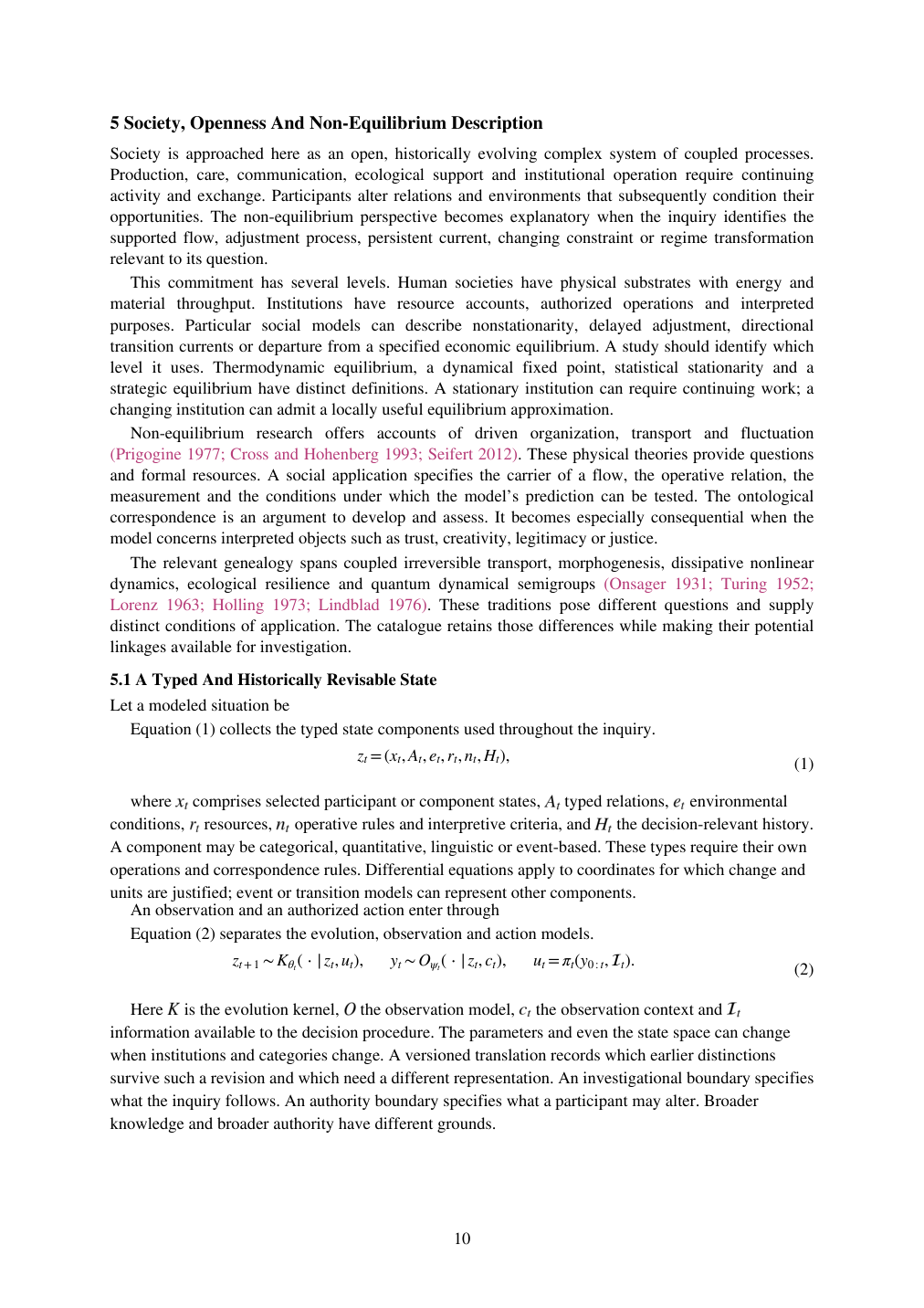
Equation (1) collects the typed state components used throughout the inquiry.
where comprises selected participant or component states, operative rules and interpretive criteria, and A component may be categorical, quantitative, linguistic or event-based. These types require their own operations and correspondence rules. Differential equations apply to coordinates for which change and units are justified; event or transition models can represent other components.
typed relations, environmental the decision-relevant history.
An observation and an authorized action enter through Equation (2) separates the evolution, observation and action models.
Here is the evolution kernel, the observation model, the observation context and information available to the decision procedure. The parameters and even the state space can change when institutions and categories change. A versioned translation records which earlier distinctions survive such a revision and which need a different representation. An investigational boundary specifies what the inquiry follows. An authority boundary specifies what a participant may alter. Broader knowledge and broader authority have different grounds.
Readable text
5.2 Manifestation, Operative Relations And Identification
The Generative Relational orientation used in this series distinguishes identification, operative relations and manifestation. Identification specifies what counts as the object through a declared criterion. Relational inquiry examines the histories, couplings and constraints through which the object has effects. Manifestational inquiry examines how it becomes perceptible, measurable, describable or institutionally legible. The registers organize an inquiry into one coupled reality; their use carries no assumption of three independent substances (Huang 2026c, 2026b).
A stable record can faithfully report an outcome while leaving its maintenance conditions unresolved. A classification can also enter the process it describes by changing access, attention or responsibility. These two possibilities connect an inverse problem to a reflexive problem: infer what generated the record and investigate what the record subsequently generates. An adequate representation preserves the distinctions needed for its particular inferential and practical use. Exhaustive representation is a different and generally much stronger demand.
5.3 Output, Capacity, Renewal And Justified Continuation
An output is a realized event or artifact. A capacity is a context-dependent ability to perform a specified operation under a stated range of conditions. Renewal occurs when an exercise contributes to replenishing a condition of later exercise. Historical transmission concerns a warranted connection between a prior contribution and a successor’s capacity. These relations can overlap, with each requiring its own evidence. Their bearer can be a relational subject, organization, practice or shared
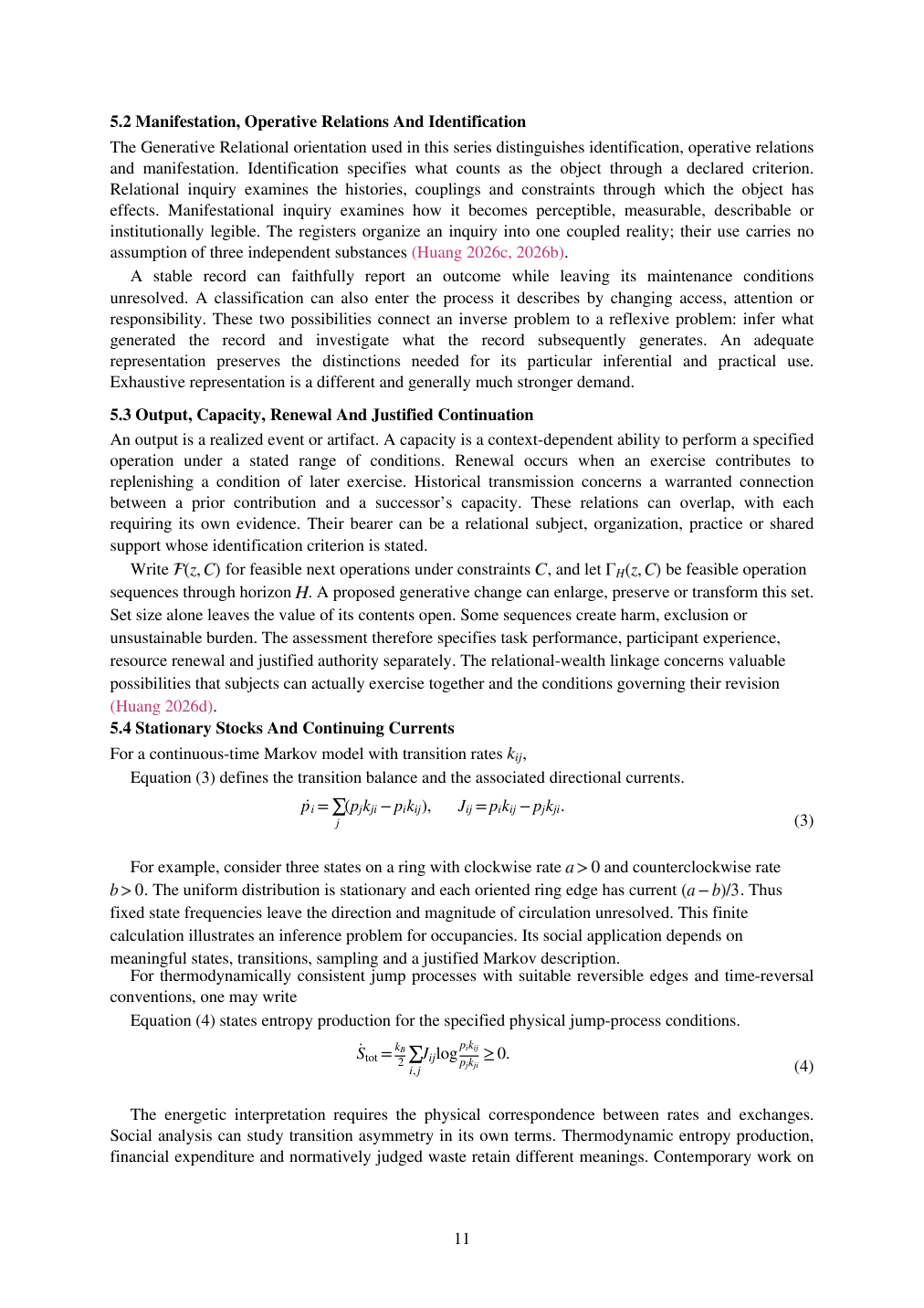
for feasible next operations under constraints , and let sequences through horizon . A proposed generative change can enlarge, preserve or transform this set. Set size alone leaves the value of its contents open. Some sequences create harm, exclusion or unsustainable burden. The assessment therefore specifies task performance, participant experience, resource renewal and justified authority separately. The relational-wealth linkage concerns valuable possibilities that subjects can actually exercise together and the conditions governing their revision
Write (Huang 2026d). 5.4 Stationary Stocks And Continuing Currents
For a continuous-time Markov model with transition rates Equation (3) defines the transition balance and the associated directional currents.
For example, consider three states on a ring with clockwise rate . The uniform distribution is stationary and each oriented ring edge has current fixed state frequencies leave the direction and magnitude of circulation unresolved. This finite calculation illustrates an inference problem for occupancies. Its social application depends on meaningful states, transitions, sampling and a justified Markov description.
For thermodynamically consistent jump processes with suitable reversible edges and time-reversal
Equation (4) states entropy production for the specified physical jump-process conditions.
The energetic interpretation requires the physical correspondence between rates and exchanges. Social analysis can study transition asymmetry in its own terms. Thermodynamic entropy production, financial expenditure and normatively judged waste retain different meanings. Contemporary work on

Readable text
hidden dissipation makes the cost of omitted degrees of freedom particularly relevant to model construction (Bebon, Robinson, and Speck 2025; Seifert 2025; Korbel et al. 2026).
denote candidate models compatible with observations , recorded inputs and declared constraints . Compatibility can mean exact agreement in a finite construction or a specified statistical adequacy criterion. Its meaning should be stated before the set is used. A decision-relevant agrees across its members. Otherwise the family can support bounds, conditional comparisons or a discriminating measurement.
Observability concerns recovery of state given a dynamics model. Parameter identifiability concerns separation of parameter values. Structural identification concerns separation of mechanism classes. Causal identification concerns the consequences of intervention under its own assumptions. Construct validity concerns whether variables represent the intended social distinctions. These questions interact and call for different evidence. System identification and causal methods provide useful tools when matched to the relevant task (Brunton, Proctor, and Kutz 2016; Hernán and Robins 2020; Perdomo et al. Conditional result: observational equivalence. Suppose two candidate models induce the same probability law for the available observations and inputs. Every statistic computed solely from those observations has the same distribution under the two models. A statistic can identify a property on the pair only when that property is shared. Reason. A statistic is a measurable transformation of the observed data, so its distribution is the pushforward of the common observation law. Added measurement, intervention or a justified external restriction can change the information available and
For a common observation channel, the data-processing inequality also gives
when these relative entropies are well defined. Coarse observation can hide distinctions. The lost information is question-relative: a compact observation may still identify the quantity needed for a specific action. Which additional distinction deserves collection depends on its decision value, cost, authority and consequences for the people observed.
An evolutionary process can explain how a criterion becomes influential. Legal sources can establish an authorized role. Evidence can support a factual comparison. A moral or public argument supplies reasons for consequential use. These are connected tasks with distinct premises (Huang 2026a; Sen 2009; Fricker 2007). A criterion can influence future evidence by allocating opportunity, making its
Conditional result: a descriptive model leaves an evaluative premise to be supplied. Let actions and have specified consequence trajectories. If admissible evaluative criteria trajectories in opposite orders, the dynamic description alone leaves the action ranking open. The result follows immediately from the two rankings. Resolving the choice requires reasons for adopting, restricting or combining criteria. This limited observation leaves room for decisive justified judgments once the relevant rights, purposes, evidence and authority are specified.
The survey follows four connected source routes: non-equilibrium mechanisms; methods of inference and control; the domain’s own explanatory traditions; and philosophical work on reality, judgment and public justification. Search terms combine the domain with feedback, path dependence, adaptive networks, regime change, observability, causal identification and generativity. Foundational sources are followed by selected contemporary work, especially the 2024-2026 contributions relevant to hidden dynamics, adaptive AI and anticipatory governance. Original publication years are distinguished from
Readable text
Primary full text is used where retrieval permits. Abstracts and publisher records support narrower descriptions and metadata; claims requiring unavailable detail remain outside the manuscript’s attributed findings. Earlier author manuscripts supply the immediate GR context. The accompanying source record identifies these access levels. The review’s purpose is a reasoned map of relevant traditions and unresolved connections. It supplies neither a systematic-review flow count nor a
A linkage is strongest when it identifies shared operational objects, a corresponding mechanism and a discriminating test. Formal portability can be broader than empirical portability. A graph, differential equation or operator can represent several domains after different correspondence rules are supplied. A philosophical linkage identifies a shared problem or a tension between approaches, with its own argument. A practical proposal adds an actor with authority, a feasible operation, an evaluation design
The catalogue separates origins (8 classes), sustaining processes (8), mediators (16), manifestations (10) and regime trajectories (11). A single episode can occupy several classes across levels and several mechanisms within a level. The levels describe analytical roles in a coupled process; their sequence supplies a useful order of inquiry. Feedback, changing boundaries and historical transformation can run
Each terminal class below contains a mechanism and ontological specification, a formal representation, an epistemological discussion, and a domain-specific analysis connecting a phenomenon, problem, methods and possible practice. The physical or mathematical source supports the mechanism in its own setting. The domain passage develops a proposed application and states what evidence can support it. Reading the classes comparatively helps locate rival explanations of one
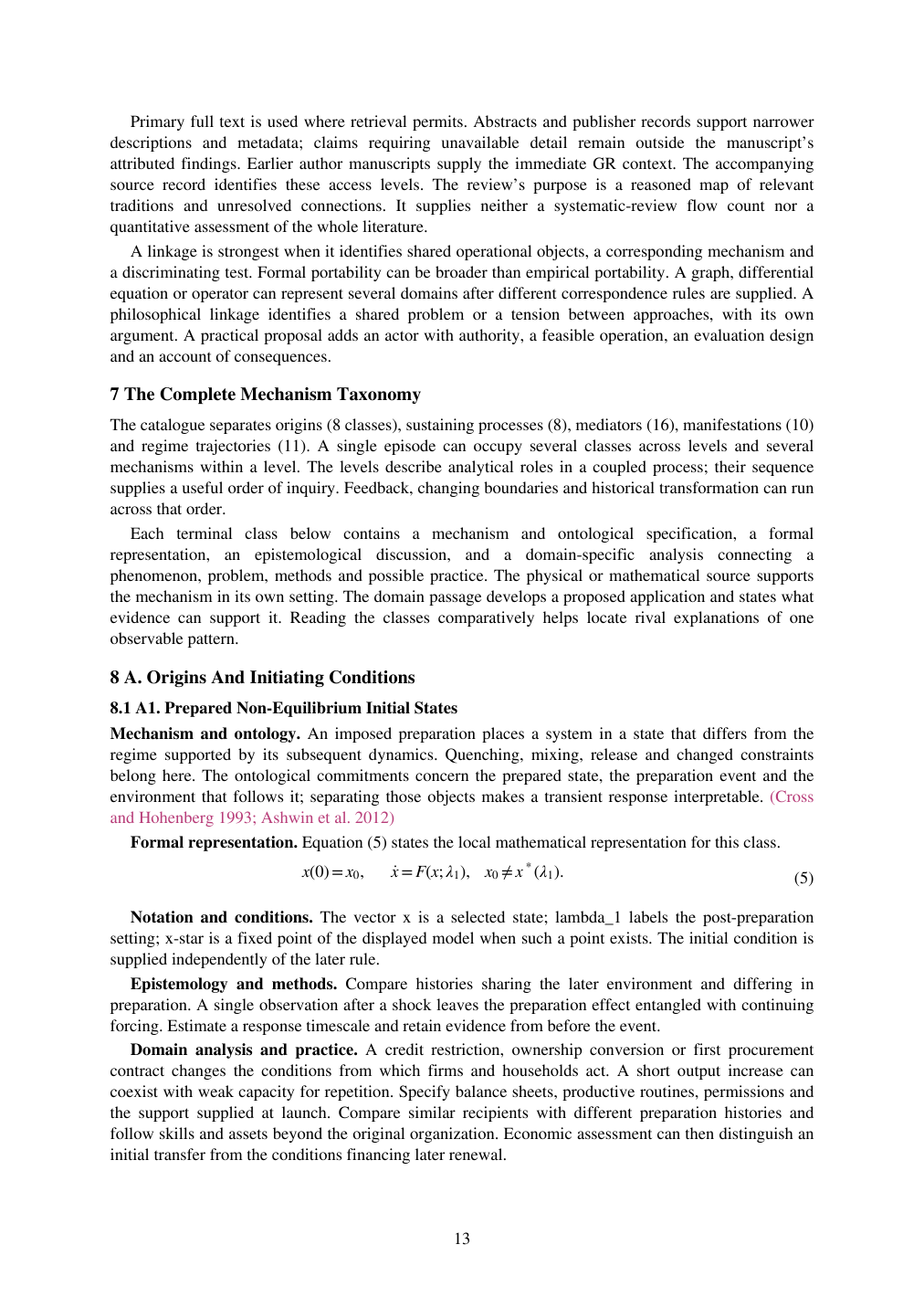
Mechanism and ontology. An imposed preparation places a system in a state that differs from the regime supported by its subsequent dynamics. Quenching, mixing, release and changed constraints belong here. The ontological commitments concern the prepared state, the preparation event and the environment that follows it; separating those objects makes a transient response interpretable. (Cross
Formal representation. Equation (5) states the local mathematical representation for this class.
Notation and conditions. The vector x is a selected state; lambda_1 labels the post-preparation setting; x-star is a fixed point of the displayed model when such a point exists. The initial condition is
Epistemology and methods. Compare histories sharing the later environment and differing in preparation. A single observation after a shock leaves the preparation effect entangled with continuing forcing. Estimate a response timescale and retain evidence from before the event.
Domain analysis and practice. A credit restriction, ownership conversion or first procurement contract changes the conditions from which firms and households act. A short output increase can coexist with weak capacity for repetition. Specify balance sheets, productive routines, permissions and the support supplied at launch. Compare similar recipients with different preparation histories and follow skills and assets beyond the original organization. Economic assessment can then distinguish an initial transfer from the conditions financing later renewal.
Phenomenon And Practical Problem. Two otherwise comparable workshops can begin trading with different inventories, customer knowledge and settlement balances. One receives an initial working-capital grant; another begins with an established supplier relationship. Compare their subsequent paths after both face the same ordinary financing terms. The economic problem is to identify what preparation changes and whether its effects survive the end of exceptional support. A strong launch can conceal a later replenishment problem, while a modest launch can establish durable productive relations.
Mechanism And Ontological Commitments. Preparation specifies an inherited state independently of the later operating rule. Cash, equipment condition, learned routines and enforceable commitments are different state components. An initial grant differs from a recurring subsidy, although both can occur together. Production begins through combinations of those supports, making equal monetary preparation compatible with different practical capacities. The state should preserve relevant histories where they alter access to suppliers or customers. A fixed-point comparison then concerns the stipulated model, leaving broader economic equilibrium and welfare questions distinct (Nelson and Winter 1982; Godley and Lavoie 2007).
Epistemic Design And Discriminating Evidence. Follow entry cohorts before and after exceptional support ends, retaining failed and withdrawn projects. Compare initial cash with complementary preparation such as shared equipment or market access, using assignment rules and baseline differences explicitly. Current revenue can reflect inherited customers, creating a need to identify the additional contribution of learning during operation. Event histories and balance accounts can trace which support enables the next productive episode. Test whether early advantages persist under comparable later terms, and examine whether ongoing external help was mistakenly counted as an effect of the original preparation.
Philosophical Reasoning And Practice. Preparation distributes opportunities to demonstrate productive merit. The premises are that some capacities appear only through exercise and that initial supports affect who can undertake that exercise. Later performance consequently provides genuine evidence of developed capacity while leaving the fairness of initial allocation open. The GR inquiry asks whether preparation creates usable relations and successor possibilities (Huang 2026c). Developmental support can be justified through learning, need or other defended purposes, with explicit opportunity costs and conditions for review. Its legitimacy cannot be inferred solely from the success of selected recipients.
Worked Comparison And Research Proposition. Imagine equal-cost support packages for new repair firms. One supplies unrestricted opening cash; another combines smaller cash support with shared tools and access to a procurement trial. Compare complete production episodes, settlement failures, learning and retained capacity after support ends. The proposition is that complement-matched preparation outperforms cash alone when access to exercise is the binding constraint. Cash can prevail where complements already exist. Evaluation should report participant burdens, effects on unsupported competitors and whether successors can exercise any developed capacity independently of the original award relationship.
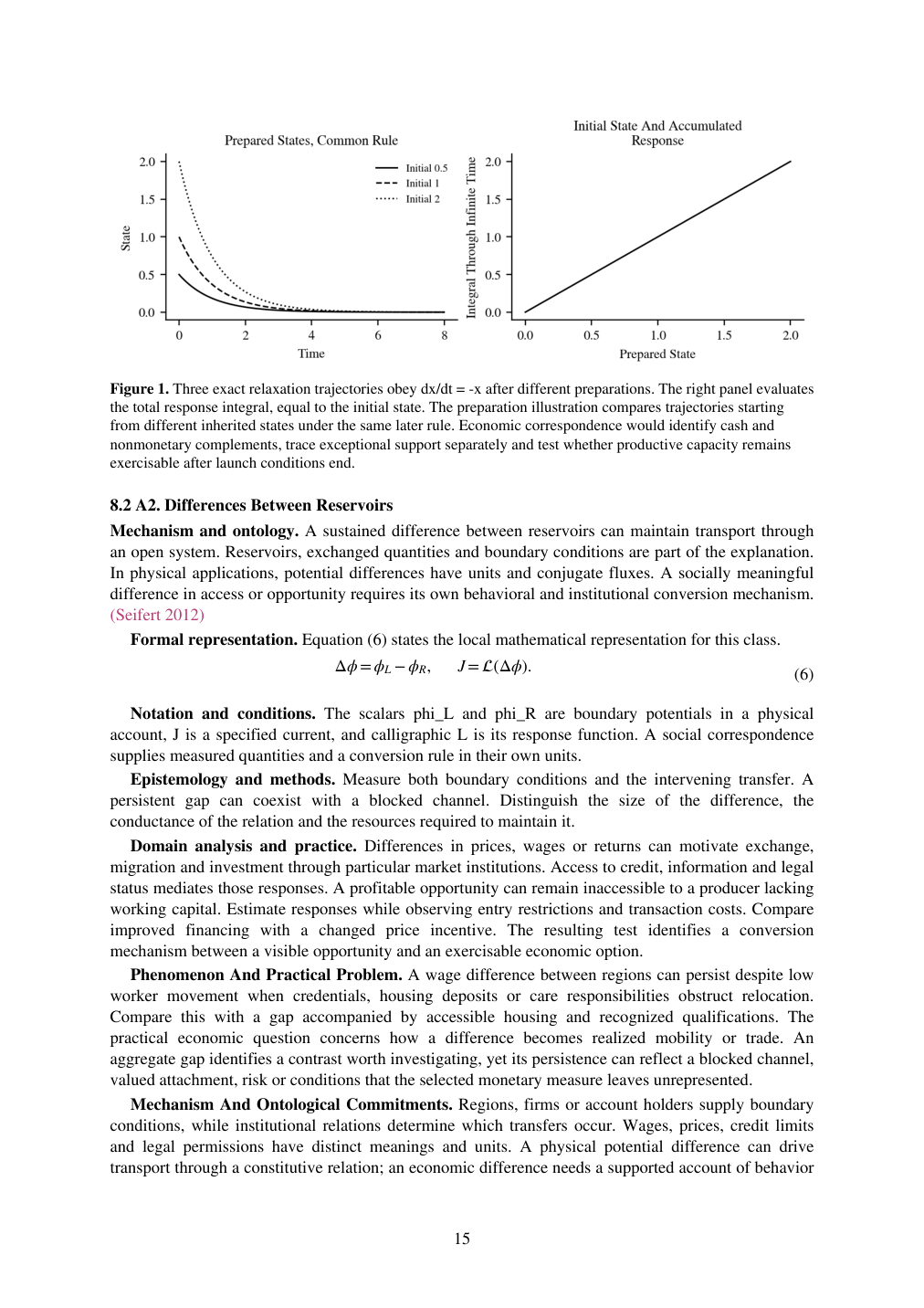
Reading the numerical illustration. Figure 1 illustrates the declared mechanism. A preparation changes the subsequent episode under an unchanged transition law. Here the decay rate remains one, while the initial condition changes both the visible transient and its cumulative magnitude. The construction separates an intervention on state from an intervention on the law. A comparison in a social domain would need to establish which conditions were prepared, whether later supports remained comparable, and which cumulative consequence matters.
Readable text
Figure 1. Three exact relaxation trajectories obey dx/dt = -x after different preparations. The right panel evaluates the total response integral, equal to the initial state. The preparation illustration compares trajectories starting from different inherited states under the same later rule. Economic correspondence would identify cash and nonmonetary complements, trace exceptional support separately and test whether productive capacity remains
Mechanism and ontology. A sustained difference between reservoirs can maintain transport through an open system. Reservoirs, exchanged quantities and boundary conditions are part of the explanation. In physical applications, potential differences have units and conjugate fluxes. A socially meaningful difference in access or opportunity requires its own behavioral and institutional conversion mechanism.
Formal representation. Equation (6) states the local mathematical representation for this class.
Notation and conditions. The scalars phi_L and phi_R are boundary potentials in a physical account, J is a specified current, and calligraphic L is its response function. A social correspondence supplies measured quantities and a conversion rule in their own units.
Epistemology and methods. Measure both boundary conditions and the intervening transfer. A persistent gap can coexist with a blocked channel. Distinguish the size of the difference, the conductance of the relation and the resources required to maintain it.
Domain analysis and practice. Differences in prices, wages or returns can motivate exchange, migration and investment through particular market institutions. Access to credit, information and legal status mediates those responses. A profitable opportunity can remain inaccessible to a producer lacking working capital. Estimate responses while observing entry restrictions and transaction costs. Compare improved financing with a changed price incentive. The resulting test identifies a conversion mechanism between a visible opportunity and an exercisable economic option.
Phenomenon And Practical Problem. A wage difference between regions can persist despite low worker movement when credentials, housing deposits or care responsibilities obstruct relocation. Compare this with a gap accompanied by accessible housing and recognized qualifications. The practical economic question concerns how a difference becomes realized mobility or trade. An aggregate gap identifies a contrast worth investigating, yet its persistence can reflect a blocked channel, valued attachment, risk or conditions that the selected monetary measure leaves unrepresented.
Mechanism And Ontological Commitments. Regions, firms or account holders supply boundary conditions, while institutional relations determine which transfers occur. Wages, prices, credit limits and legal permissions have distinct meanings and units. A physical potential difference can drive transport through a constitutive relation; an economic difference needs a supported account of behavior
Readable text
and conversion. The relevant state includes people able to move and those prevented before appearing in migration statistics. A persistent differential therefore belongs alongside housing, information, recognition and financing conditions in the explanation.
Epistemic Design And Discriminating Evidence. Compare mobility after credential recognition, deposit assistance or information provision, preserving the allocation and timing of each change. Follow applications and abandoned attempts as well as completed moves. Selection by expected gains and unobserved attachments can bias simple mover comparisons. Destination capacity and displacement also matter: improved access can redistribute a fixed opportunity, leaving its aggregate availability unchanged. Use linked histories and sensitivity analysis to discriminate which barrier mediates the response. A measured transfer should include its terms, duration and effects on the places supplying and receiving participants (Hayek 1945; Acemoglu et al. 2012).
Philosophical Reasoning And Practice. Economic opportunity becomes substantive through conversion conditions. The capability linkage supports evaluating what participants can actually undertake, including remaining in place on acceptable terms (Sen 2009). A policy encouraging movement should explain its purpose and burdens without treating mobility as an intrinsic good. The GR interpretation follows whether the transfer renews productive and social supports at both ends. A successful relocation can improve one person’s options while depleting a shared competence elsewhere. These consequences require public or organizational reasons appropriate to the decision’s authority and
Worked Comparison And Research Proposition. Imagine two programs responding to a skilled- worker shortage. One raises an advertised recruitment bonus; another funds portable qualification recognition and temporary housing access at equal expected cost. Compare completed placements, retention, debt and origin-region effects. The proposition is that channel-enabling support changes realized allocation more effectively than increasing the differential when conversion barriers dominate. A weak response could instead indicate job quality, attachment or information problems. A defensible conclusion would identify the measured barrier, report heterogeneous outcomes and preserve participants’ ability to decline the offered path without losing unrelated entitlements.
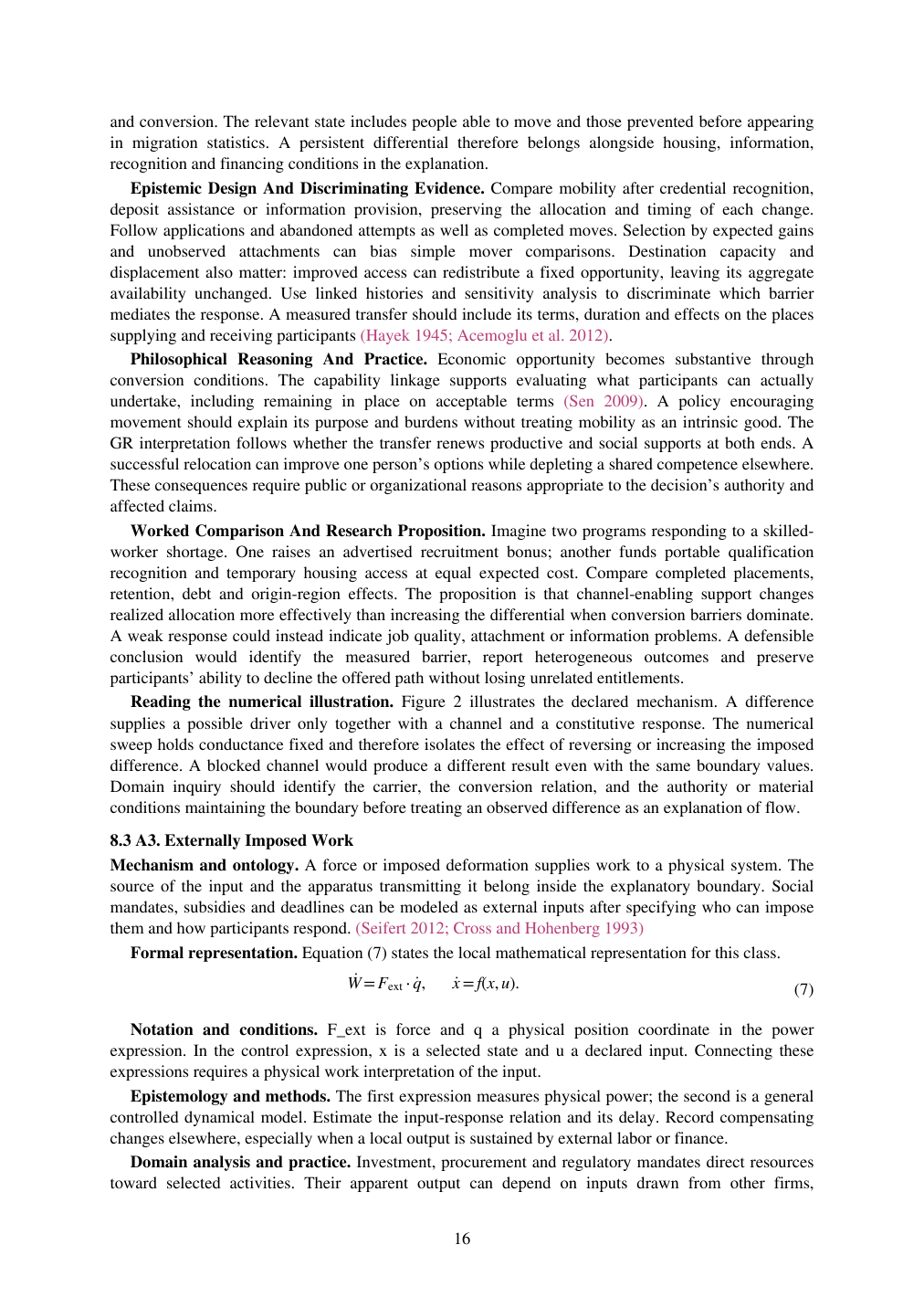
Reading the numerical illustration. Figure 2 illustrates the declared mechanism. A difference supplies a possible driver only together with a channel and a constitutive response. The numerical sweep holds conductance fixed and therefore isolates the effect of reversing or increasing the imposed difference. A blocked channel would produce a different result even with the same boundary values. Domain inquiry should identify the carrier, the conversion relation, and the authority or material conditions maintaining the boundary before treating an observed difference as an explanation of flow.
Mechanism and ontology. A force or imposed deformation supplies work to a physical system. The source of the input and the apparatus transmitting it belong inside the explanatory boundary. Social mandates, subsidies and deadlines can be modeled as external inputs after specifying who can impose them and how participants respond. (Seifert 2012; Cross and Hohenberg 1993)
Formal representation. Equation (7) states the local mathematical representation for this class.
Notation and conditions. F_ext is force and q a physical position coordinate in the power expression. In the control expression, x is a selected state and u a declared input. Connecting these expressions requires a physical work interpretation of the input.
Epistemology and methods. The first expression measures physical power; the second is a general controlled dynamical model. Estimate the input-response relation and its delay. Record compensating changes elsewhere, especially when a local output is sustained by external labor or finance.
Domain analysis and practice. Investment, procurement and regulatory mandates direct resources toward selected activities. Their apparent output can depend on inputs drawn from other firms,
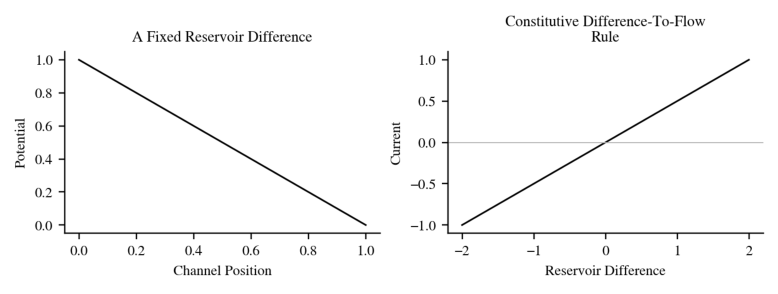
Figure 2. A unit channel has fixed end potentials one and zero. A declared conductance of 0.5 converts a boundary-potential difference into current; reversing the difference reverses the current. The reservoir illustration separates a difference from the channel converting it into flow. Economic correspondence would measure institutional barriers, completed transfers and their terms, testing whether a gap persists because conductance is limited or because participants value alternatives excluded from the chosen indicator.
households or ecosystems. Define the payer, implementer, beneficiaries and displaced uses. Trace contracts and supply chains while estimating a suitable counterfactual. A financing proposal should state who carries the initial cost, who receives learning benefits and which institution has authority to support their redistribution.
Phenomenon And Practical Problem. A public procurement surge can raise a supplier’s output while drawing skilled labor and working capital away from other producers. Compare this with output growth financed through the supplier’s ordinary customer relations. The practical problem is to trace an imposed input through the economic network, distinguishing additional capacity from redirected activity and determining which obligations remain when the exceptional order ends. A local revenue gain supplies incomplete evidence about aggregate development or distribution.
Mechanism And Ontological Commitments. An external input is external to a declared subsystem, with an identifiable source and transmission apparatus. A government mandate, grant or purchase operates through authority, contracts and participants’ responses. Physical work retains its own units; the control input in an economic model needs an independent institutional interpretation. Expanding the boundary brings taxes, borrowing, alternative expenditure and supplier constraints into view. Initial stimulus and continuing maintenance support should be separated, as should a cash transfer and the productive exercise it makes feasible (Godley and Lavoie 2007).
Epistemic Design And Discriminating Evidence. Trace contracts, payments, labor movement and input purchases alongside output. Compare timing and eligibility variations while documenting anticipation and spillovers to untreated firms. A supplier’s growth can reflect displaced demand from competitors, making network exposure consequential for the counterfactual. Examine capacity after the order ends, including debt and maintenance obligations accumulated during expansion. Model scenarios should respect stock-flow accounting and observed production complements. Their validation should test the channels actually supporting the policy claim, such as learning retention or additional output under constrained supply (Acemoglu et al. 2012; Cartwright and Hardie 2012).
Philosophical Reasoning And Practice. An authority allocating economic opportunities helps shape later evidence of capability. The premises of accountable selection support recording why the recipient, timing and contract terms serve a justified purpose. Developmental learning can provide a reason for procurement beyond immediate price, but its expected contribution requires evidence and comparative review. The GR approach follows whether the induced exercise renews valuable capabilities and who acquires control over them. A temporary output gain can merit support for an urgent purpose even when enduring renewal is neither promised nor demonstrated.
Worked Comparison And Research Proposition. Imagine equal-value procurement programs. One uses a single established contractor for immediate delivery; another includes staged orders and supported supplier development while meeting the same declared quality requirement. Compare complete delivery, network displacement, retained competence and future bidding access. The proposition is that appropriately structured exercise can create successor capacity when learningbydoing and market entry are binding supports. Coordination costs and delayed delivery can favor the first option. Public reasons should specify the value of broader capability, the evidence for additionality and the conditions under which exceptional support should end or change.
Reading the numerical illustration. Figure 3 illustrates the declared mechanism. The external operation is an event with a duration and a transmission pathway. Its consequences continue after the pulse ends because the system retains displacement and velocity. The balance panel identifies where the supplied work goes. A social input can be represented through an analogous controlled variable after its actual operation and participant responses are specified; its institutional cost and authority require an account in their own terms.
8.4 A4. Open Chemical And Material Exchange
Mechanism and ontology. Inflow, removal and reaction can sustain activity through continually renewed inputs. Stocks, channels, transformation processes and boundaries are the relevant objects. Open exchange makes the persistence of an organization conditional on replenishment and disposal, with different accounts needed for physical material, money, information and permissions. (Seifert 2012; Frey and Weyer 2026) Formal representation. Equation (8) states the local mathematical representation for this class.
n=Sv(n)+jin −jout. (8)
Notation and conditions. The vector n contains stocks, v transformation rates and S their stoichiometric coefficients. The j vectors are boundary inflow and outflow rates. Quantities combined in an account must share compatible units.
Epistemology and methods. Specify the stoichiometric matrix S when reactions are physical. In an institutional application, replace it with an independently justified conversion or accounting rule. Trace sources and sinks so that a maintained local stock can be distinguished from depletion outside the boundary.
Domain analysis and practice. Production depends on continuing access to materials, energy, labor, finance and usable knowledge. A firm’s accounts can close while important physical or social burdens fall outside its boundary. Link stock-flow monetary accounts with separately measured material and labor accounts. Compare a profitable production pathway with its replenishment requirements and external effects. The practical question concerns which inputs can be renewed, under whose control, and at whose expense.
Phenomenon And Practical Problem. A manufacturer can maintain finished output while relying on continuous imported components, supplier credit and waste removal. Compare a stable warehouse stock with the boundary flows required to keep it stable. The practical economic problem is to identify which replenishment relation sustains production and where local success transfers depletion or risk. A firm can appear self-contained in its output account while depending on contributions and burdens outside its contractual or reporting boundary.
Mechanism And Ontological Commitments. Open exchange links stocks through transformations with declared types and conversion conditions. Physical material accounts can use mass or composition-specific balances; financial accounts track payment claims and liabilities; permissions and knowledge require other descriptions. Their combination occurs through production practices and institutions, not an assumed universal substance. A component becomes useful only when compatible skills, equipment and authorization exist. A locally maintained stock can therefore coexist with
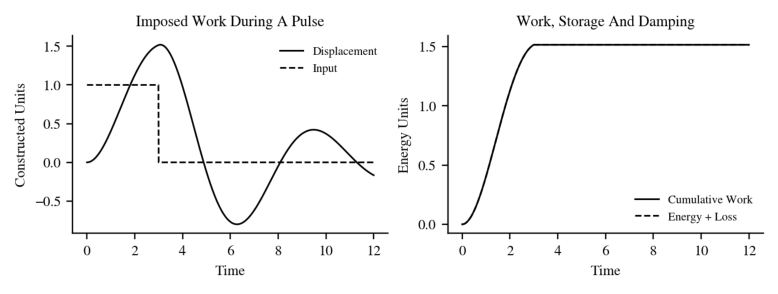
Figure 3. A unit-mass oscillator receives a unit force until time three and then evolves without that input. Damping is 0.4 and stiffness is one. Numerical work agrees with stored energy plus damping loss within 0.004. The imposed-input illustration makes the source, duration and timing of exceptional support visible. Economic correspondence would trace financing and production pathways, measure displacement and subsequent obligations, and test whether the induced activity leaves additional usable capacity after the input ceases.
upstream exhaustion, delayed settlement or declining supplier competence, making the chosen boundary central to explanation (Godley and Lavoie 2007; Acemoglu et al. 2012).
Epistemic Design And Discriminating Evidence. Join supplier histories, component flows, payment timing and disposal records through explicit links. Compare disruptions in material delivery with disruptions in credit to identify distinct limiting channels. Inventory summaries should be checked against quality, compatibility and usable stock. Where firms combine several products, allocation conventions and uncertainty need documentation. A network model should predict consequences of measured interruption or substitution and be tested on later episodes. Trace replenishment and residual obligations over the same horizon used to claim productive continuity, including external support that can conceal local depletion.
Philosophical Reasoning And Practice. Economic interdependence makes the conditions of generation a distributive question. The premises are reliance on external contributions and the possibility of imposing consequential burdens through procurement and disposal. These support investigating whose capacities and environments sustain the visible output. Generative-justice and GR approaches provide philosophical settings for following those relations (Eglash 2016). The proposed inference concerns accountable boundary choice: explain which dependencies matter to the decision and which offices or participants can act on them. Extending explanation need not assign every responsibility to one firm or public authority.
Worked Comparison And Research Proposition. Imagine two producers with equal current output and cost. One uses short contracts and disposable assemblies; another supports repairable components and a documented supplier-renewal arrangement. Compare output under disruption, material throughput, supplier viability and successor access to designs. The proposition is that compatibility and replenishment support improve retained productive capacity where repeated input renewal is a binding condition. Longer commitments can create lock-in or higher costs, requiring comparison with flexible alternatives. Evaluation should separate physical savings, monetary returns and justified distribution instead of aggregating them through an unexplained value-conservation claim.
Reading the numerical illustration. Figure 4 illustrates the declared mechanism. An almost constant stock can be the result of continuing replacement. The two panels make the distinction between a stock level and the flows supporting it inspectable. In this exact construction, stopping the inflow would convert the maintained stock into a declining one. A domain application should close the appropriate resource account, identify boundary transfers and transformation, and investigate whether a stable visible quantity depends on continuing replenishment that its usual indicator omits.
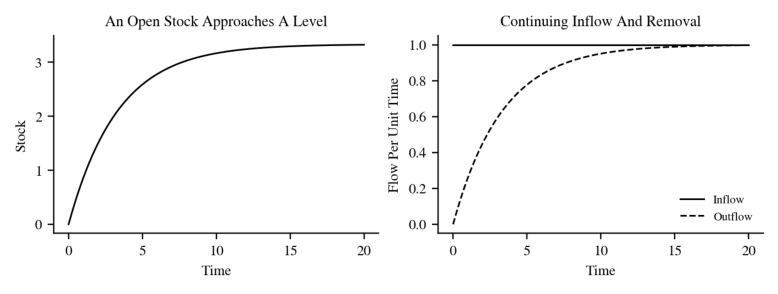
Figure 4. An open reactor-like stock follows dn/dt = 1 - 0.3n from zero. The stock approaches 10/3 while both inflow and removal remain active. The open-account illustration shows stable local stocks sustained by continuing boundary exchange. Economic correspondence would link material, financial and institutional accounts through verified conversions, then test replenishment dependencies, interruption effects and burdens shifted beyond the producer’s immediate reporting boundary.
8.5 A5. Internal Free-Energy Conversion
Mechanism and ontology. Active constituents convert fuel or stored free energy into motion or work. An operational account identifies the converter, the consumed resource and the work produced. In social inquiry, participants mobilize skills, time and authorized resources; their initiative and interpreted purposes call for a richer ontology than self-propelled particles. (Bebon, Robinson, and Speck 2025)
Formal representation. Equation (9) states the local mathematical representation for this class.
e=Pin −Puse −Ploss. (9)
Notation and conditions. The variable e is a resource or energy stock only where that unit is established. The P terms are rates of supply, use and loss in the same account. Their interpretation is local to the chosen system boundary.
Epistemology and methods. Use this balance for quantities with a defensible common unit. Track resource depletion alongside observable activity. Attribution to internal initiative requires evidence about the resources and constraints through which initiative becomes exercisable.
Domain analysis and practice. Workers and organizations turn time, skill and resources into products and new capabilities. A visible output can use up equipment or exhaust the people whose tacit knowledge makes it possible. Identify the bearer of each productive capacity and the complements needed for further exercise. Follow learning when workers move or firms close. Training, repair access and transferable permissions can support renewal when their contribution is evidenced and their financing is defensible.
Phenomenon And Practical Problem. Workers can create an effective repair method through initiative that receives no formal development budget, while an apparently similar workplace leaves such ideas unused. Compare their opportunities to access tools, coordinate time and change routines. The practical problem is to explain productive agency through its enabling relations, examining how these conditions interact with motivation. Initiative becomes economically consequential when people can exercise knowledge under conditions that support development and recognition.
Mechanism And Ontological Commitments. Participants mobilize skills, time, attention and authorized resources through interpreted purposes. These are heterogeneous supports, with physical energy conversion forming only one component of the production process. A fuel-use analogy can illuminate hidden costs when a compatible account exists, while motivation, obligation and bargaining require additional concepts. The firm should be modeled through relational subjects and task relations, including their powers to propose, refuse and revise work. Visible innovation can consume unrecorded
Readable text
overtime or build shared competence, with different consequences for subsequent exercise (Nelson and
Epistemic Design And Discriminating Evidence. Compare workplaces or teams receiving protected trial time, shared tools or an effective revision channel. Observe actual proposals, trials, adoption and abandoned ideas, retaining contributors’ accounts of constraints. Selection into experimentation and managerial support require explicit treatment. A productivity increase can depend on uncompensated effort, so task-level time and support records should accompany output. Follow competence and authority after the original innovator leaves to test whether a practice became collectively usable. Dispersed-knowledge reasoning motivates inquiry into useful information that lacks
Philosophical Reasoning And Practice. Crediting initiative without representing enabling relations can weaken contributors’ claims and reproduce unequal recognition. The premises support assessing both the creation and governance of productive possibility. A scheme can reward a successful suggestion while leaving others unable to test ideas. The GR account asks whether exercise renews capacity through shared learning, accessible methods and authority to continue (Huang 2026c). Compensation, ownership and participation require further justified choices. A productive gain alone leaves open who should control the method and which burdens its development can legitimately
Worked Comparison And Research Proposition. Imagine equal-cost innovation programs. One offers a large prize for implemented ideas; another provides bounded paid trial time and accessible equipment, followed by shared review. Compare useful methods, contributor diversity, retained competence and hidden labor. The proposition is that opportunity-enabling support reveals more valuable dispersed knowledge when lack of exercise is the binding barrier. Prizes can perform better where trials are already feasible and recognition is scarce. Practical adoption should evaluate opportunity costs, fair attribution and whether unsuccessful trials produce usable learning without exposing participants to disproportionate personal risk.
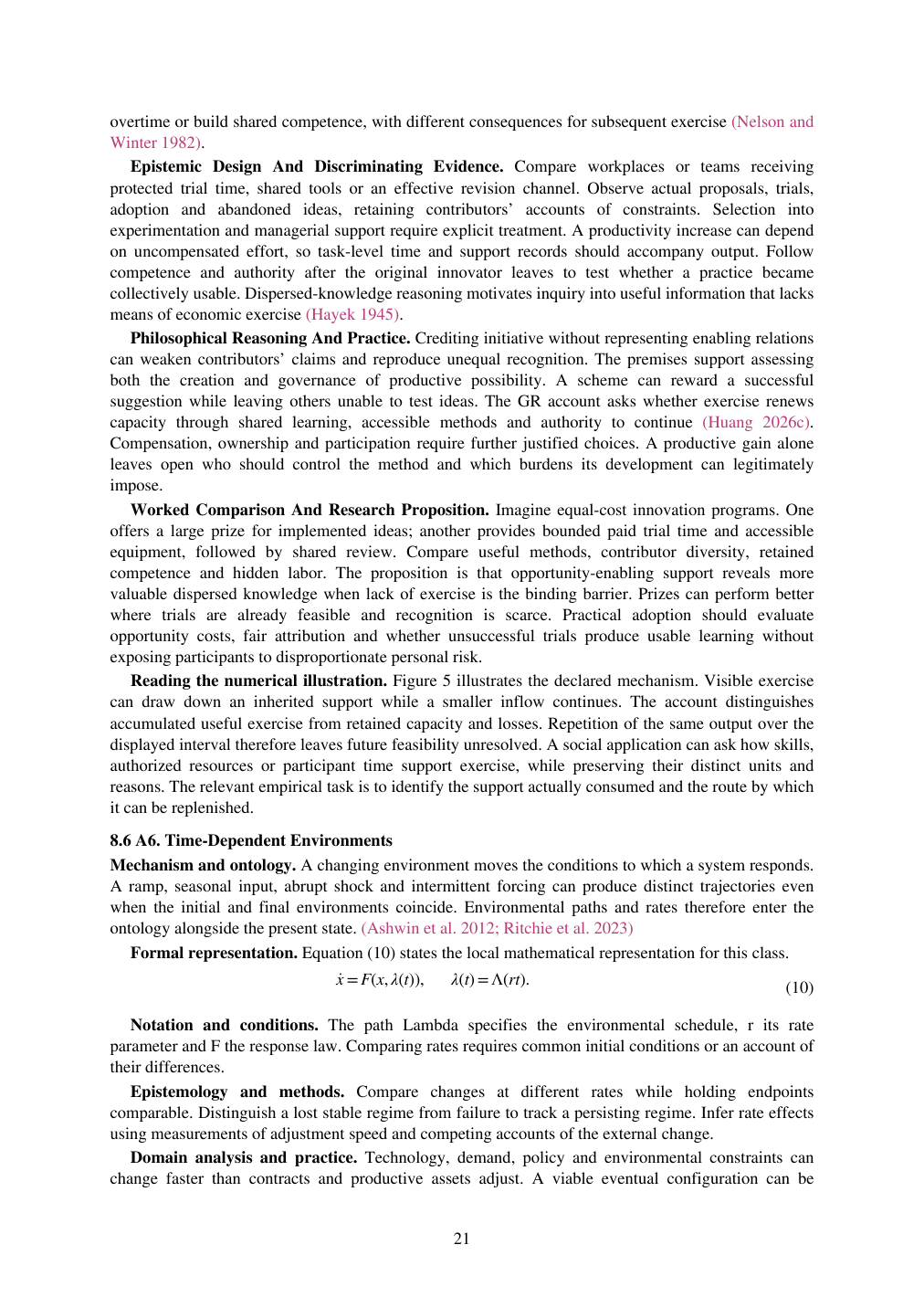
Reading the numerical illustration. Figure 5 illustrates the declared mechanism. Visible exercise can draw down an inherited support while a smaller inflow continues. The account distinguishes accumulated useful exercise from retained capacity and losses. Repetition of the same output over the displayed interval therefore leaves future feasibility unresolved. A social application can ask how skills, authorized resources or participant time support exercise, while preserving their distinct units and reasons. The relevant empirical task is to identify the support actually consumed and the route by which
Mechanism and ontology. A changing environment moves the conditions to which a system responds. A ramp, seasonal input, abrupt shock and intermittent forcing can produce distinct trajectories even when the initial and final environments coincide. Environmental paths and rates therefore enter the ontology alongside the present state. (Ashwin et al. 2012; Ritchie et al. 2023)
Formal representation. Equation (10) states the local mathematical representation for this class.
Notation and conditions. The path Lambda specifies the environmental schedule, r its rate parameter and F the response law. Comparing rates requires common initial conditions or an account of
Epistemology and methods. Compare changes at different rates while holding endpoints comparable. Distinguish a lost stable regime from failure to track a persisting regime. Infer rate effects using measurements of adjustment speed and competing accounts of the external change.
Domain analysis and practice. Technology, demand, policy and environmental constraints can change faster than contracts and productive assets adjust. A viable eventual configuration can be
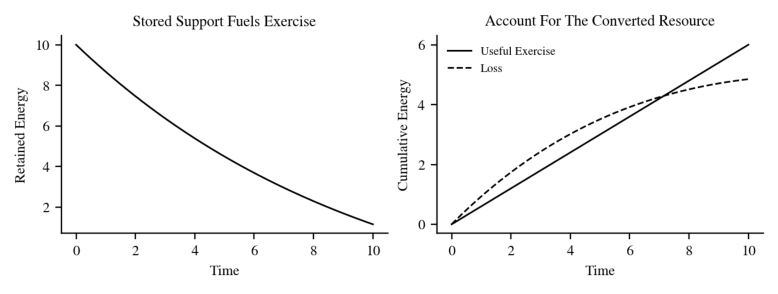
Figure 5. A converter begins with ten energy units, receives 0.2 per time, uses 0.6 and loses 0.1e. The displayed interval ends before exhaustion, and the integrated account closes exactly. The constituent-conversion illustration connects activity to consumed and replenished support. Economic correspondence would identify actual time, tools, knowledge and authority, then distinguish a productivity gain sustained by hidden effort from one renewing shared competence and opportunities for later exercise.
reached through severe transitional losses. Specify adjustment speeds and the obligations that persist during change. Compare paced investment, bridging finance and abrupt conversion in models with explicit stocks and liabilities. Assessment includes workers and households whose waiting costs remain invisible in an aggregate long-run output estimate.
Phenomenon And Practical Problem. A supplier can adapt to a new product standard when given eighteen months yet lose production during an abrupt conversion to the same final requirement. Compare identical endpoints with different change rates. The practical economic question concerns adjustment pathways, including equipment delivery, finance, training and customer coordination. Endstate profitability supplies incomplete evidence that a transition is feasible for firms, workers and complementary suppliers under the available timetable.
Mechanism And Ontological Commitments. The environment is represented by a path of prices, standards, demand or financing conditions. Productive capacities adjust on different clocks and may require intermediate states with temporarily lower output. A rate-induced account concerns failure to track an otherwise available operating regime; a final-state viability failure concerns a different mechanism. The state should include commitments already made and the resources available during transition. Changing the boundary can reveal that a firm’s apparent adjustment depends on accelerated depletion or risk transferred to suppliers (Ritchie et al. 2023; Ashwin et al. 2012).
Epistemic Design And Discriminating Evidence. Compare transitions with similar endpoints and documented differences in pace, accounting for initial competence and anticipation. Record equipment lead times, training, working capital and contract changes. Calibrated scenarios can vary the rate independently, but need validation against observed adjustment and failure patterns. Test whether temporary support or staged requirements alter the predicted loss. A model based only on eventual demand cannot identify transition-rate effects. Follow workers and capacities after firm exit, since productive knowledge can survive through migration or succession even when the original organization fails.
Philosophical Reasoning And Practice. Transition pace distributes the time and resources needed to preserve practical opportunity. The premises of fair adjustment support considering who can influence the schedule and who bears temporary losses. This provides a reason to investigate bridge finance, learning support or staged conversion when their purpose and opportunity costs are defended. The GR perspective treats the path to a future capability as part of its exercisability (Huang 2026c). It also leaves room for urgent change where delay imposes greater justified costs, making explicit the values and evidence governing the pace.
Worked Comparison And Research Proposition. Imagine equal-budget conversion programs. One subsidizes final equipment purchases at a fixed deadline; another combines staged adoption with temporary working capital and training. Compare cumulative output, retained competence, debt and supplier continuity. The proposition is that rate-matched support reduces capability loss when intermediate complements determine adjustment. It can prolong obsolete activity or reward weak preparation, requiring transparent eligibility and review. Public or contractual reasons should identify the transition burden being addressed and the evidence that support enables a credible path, while evaluating alternatives for workers and communities when continued production lacks a defensible prospect.
Reading the numerical illustration. Figure 6 illustrates the declared mechanism. Equal environmental endpoints leave the path of adjustment open. The construction holds the response law fixed and changes only the speed of the driver. A comparison of final conditions can consequently omit a material lag inherited from the transition. This example concerns tracking error, with the equilibrium remaining stable throughout. A stronger rate-induced-tipping claim would require a basin or viability boundary that the lag crosses and evidence supporting that additional structure.
8.7 A7. Frustrated Or Kinetically Constrained Relaxation
Mechanism and ontology. Barriers, competing constraints and restricted transitions can make relaxation exceptionally slow. A long-lived configuration may inherit its persistence from difficult exit routes. The relevant objects include the transition landscape and the feasible moves, with observation duration determining what counts as persistent. (Ashwin et al. 2012)
Formal representation. Equation (11) states the local mathematical representation for this class.
τescape ∼τ0exp(ΔV/D). (11)
Notation and conditions. Delta V is a barrier and D a positive noise scale in the normalized potential model; tau_0 is a prefactor timescale. The exponential relation is an asymptotic approximation under suitable small-noise escape conditions.
Epistemology and methods. The displayed small-noise scaling requires a suitable metastable model. For institutions, investigate switching costs, vetoes and unavailable complements directly. Compare response over several horizons before interpreting a persistent arrangement as an attractive or preferred outcome.
Domain analysis and practice. An industry can persist through sunk assets, standards, skills and contractual complementarities that make alternatives difficult to assemble. This persistence leaves technological superiority and constrained switching distinguishable. Map the investment sequence required for entry or conversion. Compare a changed incentive with coordinated access to the missing complements. A development strategy can examine whether support preserves a useful capability, entrenches control or opens a feasible transition for excluded producers.
Phenomenon And Practical Problem. A firm can retain an obsolete production arrangement because new machinery, trained operators and compatible supplier contracts must be established together. Compare this with continued use of the same arrangement because customers genuinely prefer its output. Persistence can have different causes. The practical problem is to reconstruct transition feasibility before interpreting a long-lived routine as efficient adaptation or allocating an incentive that leaves its missing complements unchanged.
Mechanism And Ontological Commitments. A transition barrier concerns the sequence of feasible moves between productive arrangements. Sunk investments, contractual obligations and unavailable complements can make each isolated change costly even when a coordinated package would be valuable. A physical escape scaling presupposes a suitable barrier and disturbance model; economic switching costs need direct evidence. The relevant state includes contingent agreements, transferable skills and the time available to coordinate them. Path dependence can shape future opportunity without implying that every persistent technology is socially inferior (Arthur 1989; Pierson 2000).
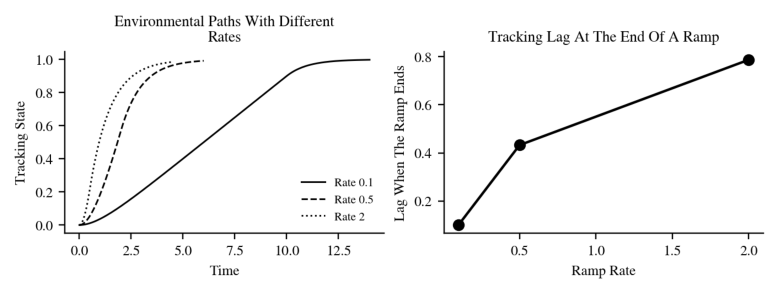
Figure 6. The environment ramps from zero to one at three rates; the state obeys dx/dt = lambda(t) - x. Faster ramps leave a larger tracking lag when the endpoint is reached. The rate illustration changes the speed of an environmental path while retaining comparable endpoints. Economic correspondence would measure adjustment clocks and intermediate finance, then compare paced conversion and bridge support through cumulative losses, successor capability and the distribution of transition burdens.
Epistemic Design And Discriminating Evidence. Trace attempted upgrades, rejected finance and conditional supplier offers. Compare a price subsidy with a complement-enabling package, documenting selection into each and baseline readiness. A response to shared equipment or coordinated training can discriminate a feasibility constraint from a simple return calculation. Demand uncertainty and managerial preferences remain plausible rivals. Interviews should include abandoned projects and affected workers, while accounting data test the claimed transition costs. Observe later operation to determine whether the package establishes usable capacity or merely postpones a still-binding constraint.
Philosophical Reasoning And Practice. Historical dependence affects judgments of responsibility and entitlement. A firm can face constraints partly created by earlier institutions, while other parties can hold legitimate reliance claims under the existing arrangement. The premises support evaluating a transition through current opportunities, past contributions and foreseeable burdens without deriving an allocation rule from persistence alone. The GR project-ecology perspective follows how supported exercise can establish successor possibilities (Huang 2026c). Assistance should specify the capacity expected, its beneficiaries and a review horizon, with comparative evidence and opportunity costs making the proposal contestable.
Worked Comparison And Research Proposition. Imagine equal-cost upgrade programs for small manufacturers. One provides a purchase rebate; another combines shared training, temporary access to compatible machinery and coordinated supplier standards. Compare complete adoption, debt, worker learning and productive use after support. The proposition is that coordination enables more durable change when complementary transitions form the binding barrier. A rebate can prevail where coordination already exists. Practical review should identify any safeguards or competition weakened by coordination and examine whether successor access broadens or becomes dependent on a new gatekeeper whose terms participants cannot meaningfully influence.
Reading the numerical illustration. Figure 7 illustrates the declared mechanism. Long persistence can be produced by a small transition rate. The rescaled survival curves agree because an exponential waiting law is assumed in this construction, while the unscaled residence time changes strongly with barrier and noise scale. The figure illustrates a declared activated model and its sampling variation. A domain explanation should identify the prohibited or costly transition, compare rival sources of slow change, and inspect the observation horizon before interpreting persistence as successful renewal.
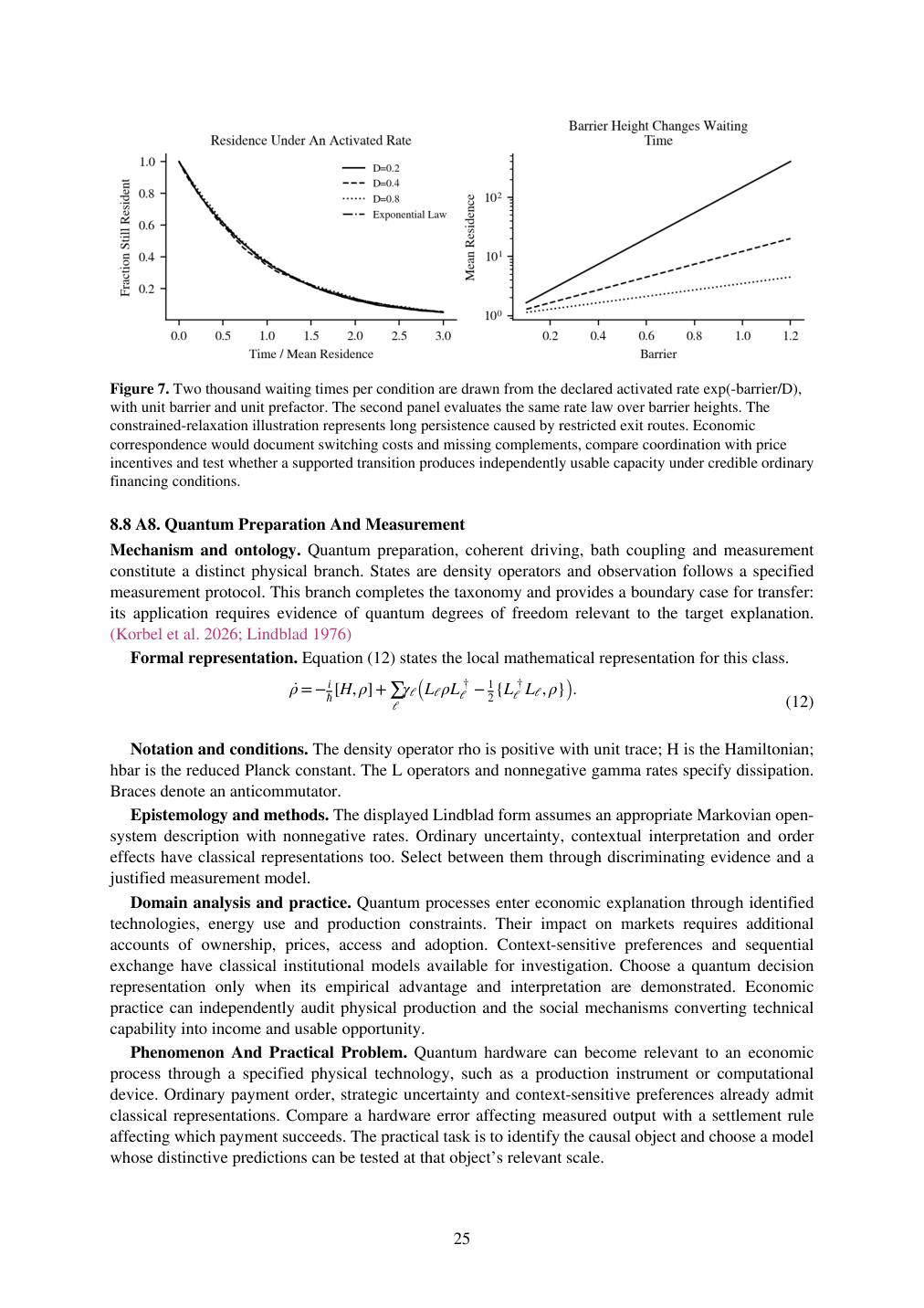
Readable text
Figure 7. Two thousand waiting times per condition are drawn from the declared activated rate exp(-barrier/D), with unit barrier and unit prefactor. The second panel evaluates the same rate law over barrier heights. The constrained-relaxation illustration represents long persistence caused by restricted exit routes. Economic correspondence would document switching costs and missing complements, compare coordination with price incentives and test whether a supported transition produces independently usable capacity under credible ordinary
Mechanism and ontology. Quantum preparation, coherent driving, bath coupling and measurement constitute a distinct physical branch. States are density operators and observation follows a specified measurement protocol. This branch completes the taxonomy and provides a boundary case for transfer: its application requires evidence of quantum degrees of freedom relevant to the target explanation.
Formal representation. Equation (12) states the local mathematical representation for this class.
Notation and conditions. The density operator rho is positive with unit trace; H is the Hamiltonian; hbar is the reduced Planck constant. The L operators and nonnegative gamma rates specify dissipation.
Epistemology and methods. The displayed Lindblad form assumes an appropriate Markovian open- system description with nonnegative rates. Ordinary uncertainty, contextual interpretation and order effects have classical representations too. Select between them through discriminating evidence and a
Domain analysis and practice. Quantum processes enter economic explanation through identified technologies, energy use and production constraints. Their impact on markets requires additional accounts of ownership, prices, access and adoption. Context-sensitive preferences and sequential exchange have classical institutional models available for investigation. Choose a quantum decision representation only when its empirical advantage and interpretation are demonstrated. Economic practice can independently audit physical production and the social mechanisms converting technical
Phenomenon And Practical Problem. Quantum hardware can become relevant to an economic process through a specified physical technology, such as a production instrument or computational device. Ordinary payment order, strategic uncertainty and context-sensitive preferences already admit classical representations. Compare a hardware error affecting measured output with a settlement rule affecting which payment succeeds. The practical task is to identify the causal object and choose a model whose distinctive predictions can be tested at that object’s relevant scale.
Readable text
Mechanism And Ontological Commitments. A quantum account uses physical degrees of freedom, a preparation and a measurement protocol. A Lindblad evolution further assumes a suitable Markovian open-system description. Firms and account balances require independently justified state representations; an order effect does not alone supply that justification. In the paper’s payment construction, classical transfer operators differ by sequence because available balances change. That mechanism is fully expressible through ordinary state transitions. A quantum technology’s economic consequences would additionally depend on cost, reliability, adoption and institutional use (Lindblad Epistemic Design And Discriminating Evidence. Validate device-level behavior against suitable physical alternatives and trace its contribution to the production task. Separately compare institutional rules using transaction histories and declared feasibility conditions. A quantum-probability model of reported choices would require distinctive predictive evidence relative to admissible classical contextual models, with its interpretation clearly specified. Improved fit alone can reflect flexibility or hidden variables. Economic validation should then test the bridge from model output to consequential decisions, including implementation costs and distributional effects. Each level needs evidence
Philosophical Reasoning And Practice. The constructive lesson is explanatory discipline across levels. A physical model can be correct while an economic interpretation of its result remains weak. The GR registers help identify the measured object, the operative relations connecting it to production and the manifestation used in valuation. Authority to allocate resources requires further reasons about purpose and affected interests. This permits technically sophisticated research without using physical vocabulary to lend unearned certainty to social judgment. The economic object becomes clearer when its material, informational and institutional dependencies retain their different warrants.
Worked Comparison And Research Proposition. Imagine two clearing arrangements using identical classical computing hardware and the same initial balances. One processes payments in a fixed order; another permits a declared netting operation. Compare completion and liquidity need through their explicit rules. The proposition is that differences arise from institutional feasibility unless evidence identifies an additional relevant physical mechanism. Conversely, a genuine hardware advantage needs task-level validation beyond its quantum description. Practical appraisal should separate the value of a technological capability from the fairness or efficiency of the settlement rule implemented with it, including who can access its benefits (Godley and Lavoie 2007).
Reading the numerical illustration. Figure 8 illustrates the declared mechanism. Different measurement channels preserve different aspects of this explicitly quantum state. Population measurements alone remain constant while off-diagonal coherence changes. Positivity and trace are checked throughout. The illustration belongs to the quantum physical branch: a social explanation would require relevant quantum degrees of freedom and an independently justified measurement protocol. Its methodological contribution to the wider comparison is the precision with which a state, a
Mechanism and ontology. A constitutive relation connects forces and currents. Near physical equilibrium, linear response provides a controlled approximation; coupled currents require attention to parity, microscopic reversibility and admissible coefficients. The transferable methodological question concerns how a difference becomes a measurable flow under particular institutional or material
Formal representation. Equation (13) states the local mathematical representation for this class.
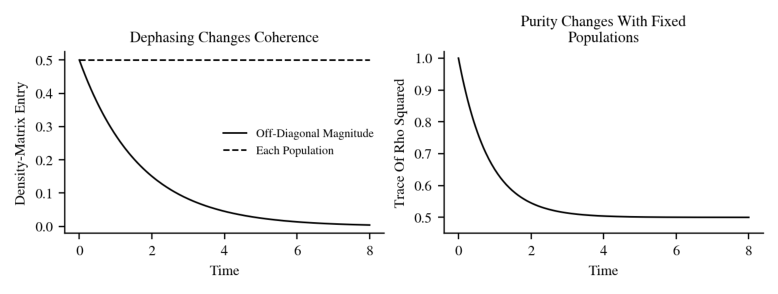
Figure 8. A two-level state begins in an equal coherent superposition and undergoes Lindblad dephasing with L = sigma_z and gamma = 0.3. Populations stay one-half, coherence decays, and purity approaches one-half. The quantum panel illustrates Lindblad dephasing of a two-level state. A physical economic application requires relevant quantum technology and a validated production or use pathway. Quantum-inspired prediction remains a separately assessed formal choice; payment sequence, allocation and welfare require their own institutional evidence.
Notation and conditions. J_i are currents, X_j their conjugate forces, L_ij response coefficients and sigma entropy-production density in the physical account. A positive-semidefinite dissipative part supports nonnegative sigma; reciprocity has additional reversibility and parity premises.
Epistemology and methods. Physical interpretation of sigma requires thermodynamic forces and conjugate fluxes. Estimate social response coefficients in their own units and test changes across regimes. Reciprocity and positivity are hypotheses requiring their respective physical or empirical premises.
Domain analysis and practice. A price or income difference becomes a flow only through a market relation with feasible entry and delivery. A transfer elasticity estimated in one credit regime may change when liquidity tightens. Define the exchanged good, financing terms and participants’ alternatives. Compare response across regimes and investigate blocked transactions. Economic policy can address a transport cost, a borrowing constraint or market power according to the pathway actually limiting exchange.
Phenomenon And Practical Problem. A modest increase in the price offered to suppliers can increase delivery on one market and leave another unchanged because transport or working capital is binding. Compare these local responses before extrapolating a general supply elasticity. The economic problem is to identify which difference becomes a flow, through which channel and within what operating range. A large measured incentive can coexist with little response when participants lack the means to undertake the required transition.
Mechanism And Ontological Commitments. Gradient-driven transport provides a physical model with conjugate forces, currents and appropriate response conditions. An economic response relation instead connects declared prices, quantities or financing terms through behavior and institutions. Its coefficients retain local units and population scope. Reciprocity requires additional premises; a price effect on supply need not mirror a supply effect on price. The model should include capacity, entry and timing where they alter response, preserving the distinction between an accounting constraint and a behavioral regularity (Onsager 1931; Seifert 2012).
Epistemic Design And Discriminating Evidence. Compare responses to price changes with responses to transport access or payment timing, using variation with a credible assignment account. Current sellers can differ from excluded potential entrants, making the observation population consequential. Measure orders, fulfilled deliveries and abandoned attempts to distinguish demand from realized supply. Test local coefficients outside the estimation range, especially when congestion or
Readable text
input scarcity appears. A structural response model should predict how relaxing the proposed constraint changes the curve, with sensitivity analysis for common demand shocks and simultaneous price
Philosophical Reasoning And Practice. Price responsiveness becomes evaluatively relevant through the goods, capabilities and burdens involved. The premises support asking whose knowledge and resources can become effective economic action under the observed terms. Hayek’s dispersed- knowledge inquiry motivates attention to information, while the GR extension asks whether participants can exercise what they know (Hayek 1945). Increasing a price can reveal scarcity while also excluding buyers with fewer resources. A justified decision therefore connects the local response to a defended purpose and a distributional account, with independent reasons for the objective selected.
Worked Comparison And Research Proposition. Imagine equal-cost programs addressing unreliable small-producer deliveries. One increases the purchase price; another shortens settlement delay and provides shared delivery access. Compare fulfilled orders, participant entry, debt and buyer cost. The proposition is that channel-enabling changes improve realized supply more effectively when liquidity and transport dominate the local response. A price increase can prevail where those complements already exist. Evaluation should report whether additional circulation reflects new productive exercise or displacement from other buyers, and whether any resulting capability remains usable after the program ends under ordinary commercial terms.
Reading the numerical illustration. Figure 9 illustrates the declared mechanism. A constitutive matrix expresses a particular coupling, including the effect of one driving component on another current. Positivity is an additional restriction and is checked here through the matrix eigenvalues and the computed quadratic form. The illustration uses scaled model coordinates. A physical entropy- production interpretation requires the appropriate conjugate forces, fluxes and time-reversal conventions. A social conversion relation requires its own variables, operation and evidence, through
Mechanism and ontology. Coupled reactions can sustain circulation around a network. Nodes identify chemical states or species, while edges identify transitions with specified stoichiometry. Institutional cycles can likewise be represented through typed activities, provided the conversion of one resource or entitlement into another is established independently. (Seifert 2012; Frey and Weyer 2026)
Formal representation. Equation (14) states the local mathematical representation for this class.
Notation and conditions. The stoichiometric coefficient nu_ic is positive for products under the stated reaction convention, and mu_i is chemical potential. The matrix S and rate vector v describe the reaction account. A social cycle needs a separate correspondence.
Epistemology and methods. Chemical affinity has a physical meaning under the stated convention. A cycle in transactions or deliberation establishes sequence and recurrence. Its maintenance, resource costs and social value require additional evidence about replenishment, conversion and participants.
Domain analysis and practice. Production, sale, payment, maintenance and renewed production form a sequence with distinct timing requirements. A firm may have customers and still fail because receipts arrive after bills fall due. Model contracts, inventories and payment dates as typed transitions. Compare transaction-level histories with a bottleneck account of interrupted cycles. Bridge finance or revised payment terms can be assessed through completed production and repayment, including who
Phenomenon And Practical Problem. A production network can require orders, input delivery, manufacturing, invoicing and settlement to recur in the correct sequence. Compare a cycle that closes on time with one repeatedly interrupted by a late payment. Both may contain the same firms, desired
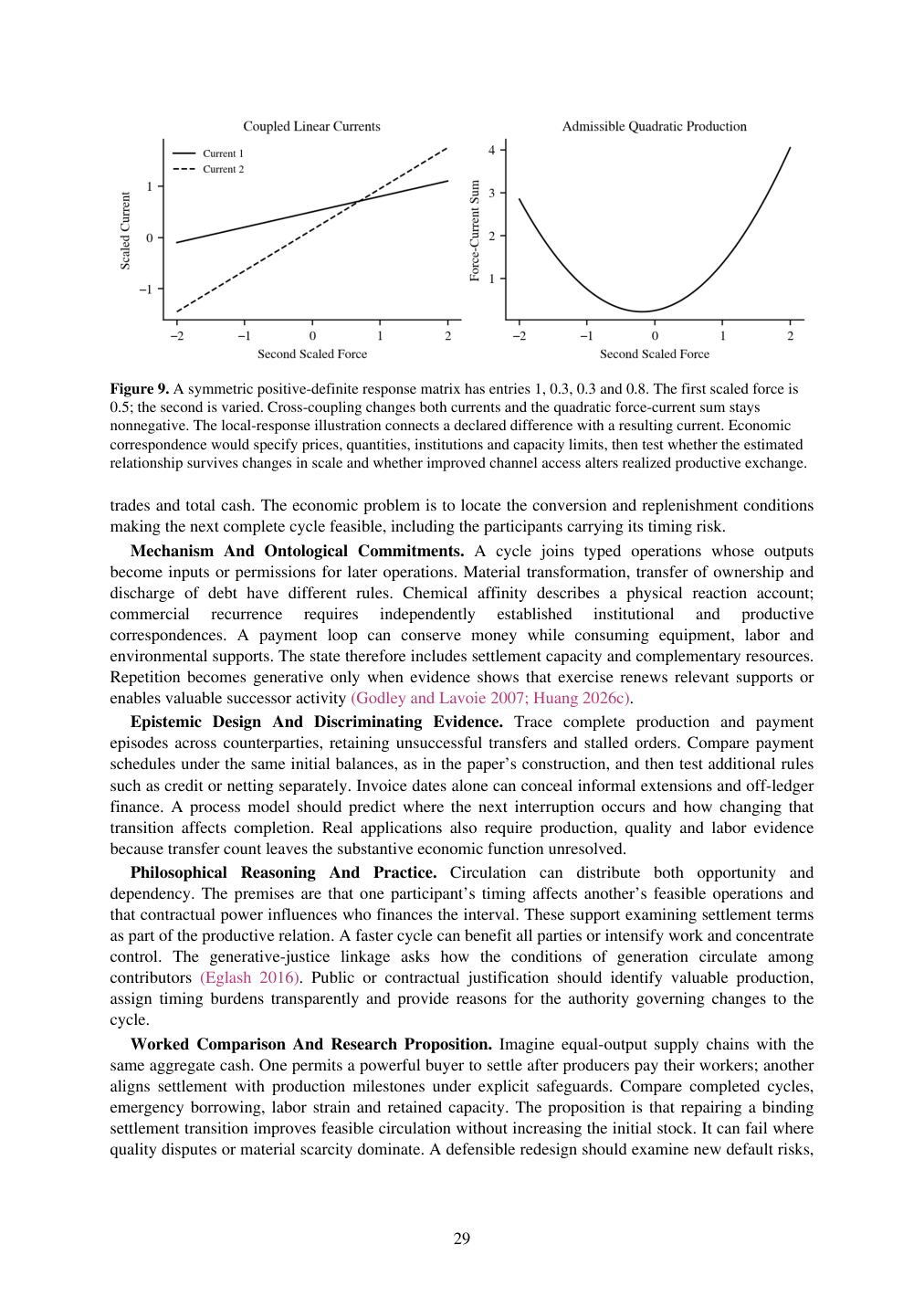
Readable text
Figure 9. A symmetric positive-definite response matrix has entries 1, 0.3, 0.3 and 0.8. The first scaled force is 0.5; the second is varied. Cross-coupling changes both currents and the quadratic force-current sum stays nonnegative. The local-response illustration connects a declared difference with a resulting current. Economic correspondence would specify prices, quantities, institutions and capacity limits, then test whether the estimated relationship survives changes in scale and whether improved channel access alters realized productive exchange.
trades and total cash. The economic problem is to locate the conversion and replenishment conditions making the next complete cycle feasible, including the participants carrying its timing risk.
Mechanism And Ontological Commitments. A cycle joins typed operations whose outputs become inputs or permissions for later operations. Material transformation, transfer of ownership and discharge of debt have different rules. Chemical affinity describes a physical reaction account; independently correspondences. A payment loop can conserve money while consuming equipment, labor and environmental supports. The state therefore includes settlement capacity and complementary resources. Repetition becomes generative only when evidence shows that exercise renews relevant supports or enables valuable successor activity (Godley and Lavoie 2007; Huang 2026c).
Epistemic Design And Discriminating Evidence. Trace complete production and payment episodes across counterparties, retaining unsuccessful transfers and stalled orders. Compare payment schedules under the same initial balances, as in the paper’s construction, and then test additional rules such as credit or netting separately. Invoice dates alone can conceal informal extensions and off-ledger finance. A process model should predict where the next interruption occurs and how changing that transition affects completion. Real applications also require production, quality and labor evidence because transfer count leaves the substantive economic function unresolved.
Philosophical Reasoning And Practice. Circulation can distribute both opportunity and dependency. The premises are that one participant’s timing affects another’s feasible operations and that contractual power influences who finances the interval. These support examining settlement terms as part of the productive relation. A faster cycle can benefit all parties or intensify work and concentrate control. The generative-justice linkage asks how the conditions of generation circulate among contributors (Eglash 2016). Public or contractual justification should identify valuable production, assign timing burdens transparently and provide reasons for the authority governing changes to the
Worked Comparison And Research Proposition. Imagine equal-output supply chains with the same aggregate cash. One permits a powerful buyer to settle after producers pay their workers; another aligns settlement with production milestones under explicit safeguards. Compare completed cycles, emergency borrowing, labor strain and retained capacity. The proposition is that repairing a binding settlement transition improves feasible circulation without increasing the initial stock. It can fail where quality disputes or material scarcity dominate. A defensible redesign should examine new default risks,
the cost of verification and effects on excluded suppliers, while avoiding an automatic welfare interpretation of faster payment alone.
Reading the numerical illustration. Figure 10 illustrates the declared mechanism. A cycle can be sustained after its state frequencies have settled. This finite transition construction separates evolving occupation from continuing directional exchange. The currents balance at every steady node, so circulation can coexist with zero net stock change. A chemical interpretation would additionally specify species, stoichiometry and reaction affinities. An institutional application would identify the distinct activities carried by the nodes and show how one operation enables the next, with its own resource and authority conditions.
9.3 B3. Mechanical Energy Injection
Mechanism and ontology. Sustained forces, shear and deformation can maintain organized motion. The input is an ongoing maintenance process, distinct from the initiating shock in A3. In social models, recurring implementation work may maintain an arrangement that would decay if its administrative or material support ceased. (Cross and Hohenberg 1993; Bebon, Robinson, and Speck 2025)
Formal representation. Equation (15) states the local mathematical representation for this class.
E =Pin −Pdiss −Pout. (15)
Notation and conditions. E is energy; P_in, P_diss and P_out are compatible rates within the declared boundary. Administrative accounts can instead use time or money, with conversion and external entries specified independently.
Epistemology and methods. Close an energy account where energy is the measured quantity. For administration, separate staff hours, budgets and outputs. A withdrawal or interruption study can identify maintenance dependence when its comparison and consequences are appropriate.
Domain analysis and practice. Operating routines require recurring management, inspection, repair and coordination. The maintenance effort supporting an apparently stable output can be lost during cost cutting. Define a productive task and account for its continuing support in hours, assets and money. Compare output and repair liabilities after an interruption or organizational change. A review can distinguish a temporary accounting saving from a sustainable change in the resources needed to provide the product.
Phenomenon And Practical Problem. A logistics operation can maintain reliable delivery only through recurring scheduling, inspection, equipment repair and reconciliation work. Compare its current output with a plan that cuts these activities while keeping visible delivery staffing unchanged. Short-run performance can remain stable as latent defects accumulate. The economic problem is to identify sustaining expenditure and distinguish a genuine productivity improvement from consumption of the capacity that future output requires.
Mechanism And Ontological Commitments. Ongoing input counters deterioration or loss of coordination under a specified operating process. Physical energy injection can be balanced in compatible units; administrative maintenance needs separate accounts of labor, money, information and material condition. These inputs interact through actual tasks. A dispatch system’s apparent automation can depend on people repairing exceptions outside its recorded workflow. The identification criterion for capacity should specify reliable delivery under a range of conditions, making the relevant object broader than installed machinery or software ownership (Nelson and Winter 1982).
Epistemic Design And Discriminating Evidence. Link maintenance tasks, condition, exception handling and service failure across several operating cycles. Compare scheduling or support changes with similar operations facing comparable demand, documenting anticipation and compensating overtime. Deliberately withdrawing essential maintenance can be inappropriate; existing interruptions and engineering evidence can provide discriminating contrasts. Follow future repair cost and restoration time, not just immediate output. A model claiming efficient maintenance reduction should predict
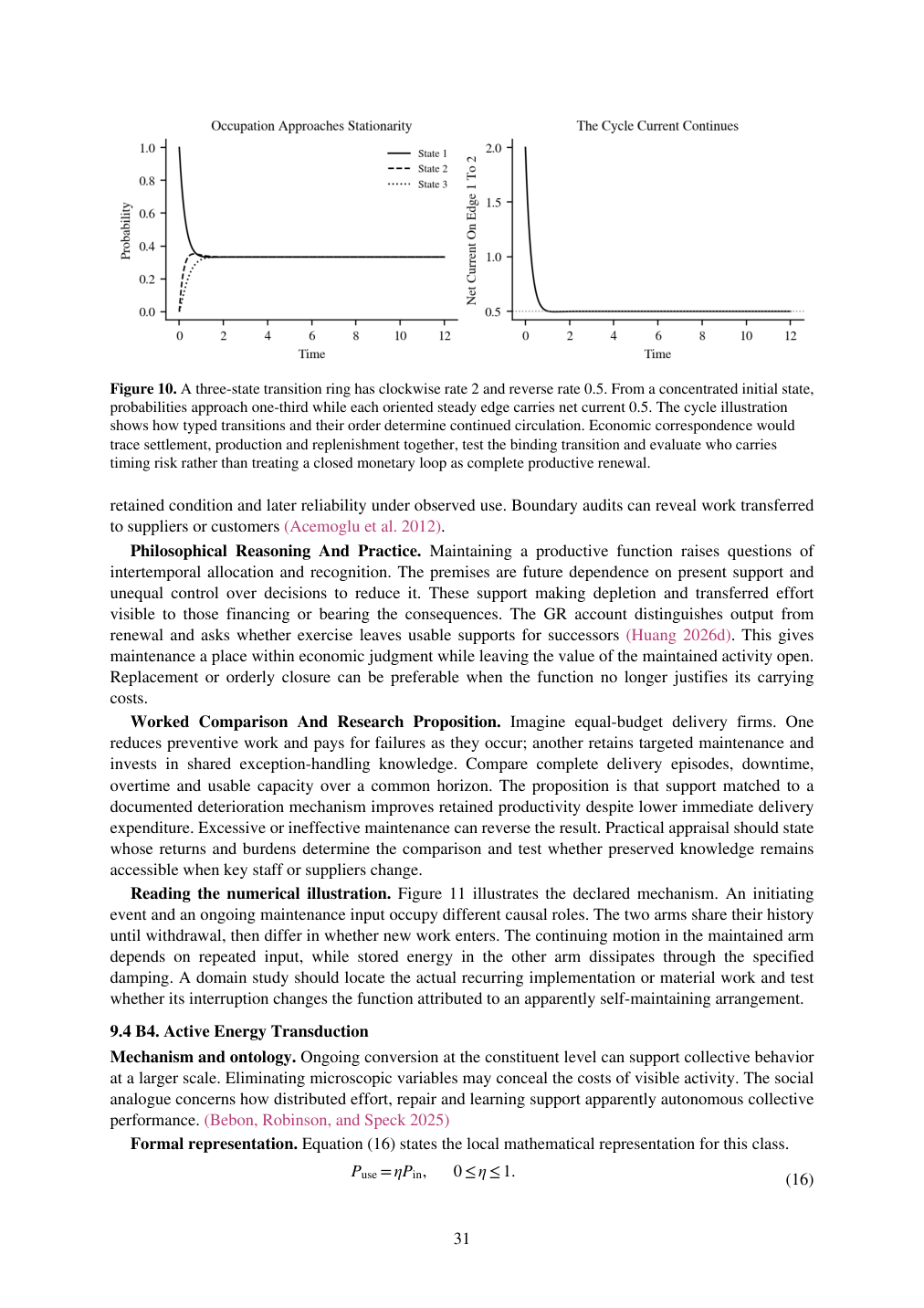
Readable text
Figure 10. A three-state transition ring has clockwise rate 2 and reverse rate 0.5. From a concentrated initial state, probabilities approach one-third while each oriented steady edge carries net current 0.5. The cycle illustration shows how typed transitions and their order determine continued circulation. Economic correspondence would trace settlement, production and replenishment together, test the binding transition and evaluate who carries timing risk rather than treating a closed monetary loop as complete productive renewal.
retained condition and later reliability under observed use. Boundary audits can reveal work transferred
Philosophical Reasoning And Practice. Maintaining a productive function raises questions of intertemporal allocation and recognition. The premises are future dependence on present support and unequal control over decisions to reduce it. These support making depletion and transferred effort visible to those financing or bearing the consequences. The GR account distinguishes output from renewal and asks whether exercise leaves usable supports for successors (Huang 2026d). This gives maintenance a place within economic judgment while leaving the value of the maintained activity open. Replacement or orderly closure can be preferable when the function no longer justifies its carrying
Worked Comparison And Research Proposition. Imagine equal-budget delivery firms. One reduces preventive work and pays for failures as they occur; another retains targeted maintenance and invests in shared exception-handling knowledge. Compare complete delivery episodes, downtime, overtime and usable capacity over a common horizon. The proposition is that support matched to a documented deterioration mechanism improves retained productivity despite lower immediate delivery expenditure. Excessive or ineffective maintenance can reverse the result. Practical appraisal should state whose returns and burdens determine the comparison and test whether preserved knowledge remains
Reading the numerical illustration. Figure 11 illustrates the declared mechanism. An initiating event and an ongoing maintenance input occupy different causal roles. The two arms share their history until withdrawal, then differ in whether new work enters. The continuing motion in the maintained arm depends on repeated input, while stored energy in the other arm dissipates through the specified damping. A domain study should locate the actual recurring implementation or material work and test whether its interruption changes the function attributed to an apparently self-maintaining arrangement.
Mechanism and ontology. Ongoing conversion at the constituent level can support collective behavior at a larger scale. Eliminating microscopic variables may conceal the costs of visible activity. The social analogue concerns how distributed effort, repair and learning support apparently autonomous collective
Formal representation. Equation (16) states the local mathematical representation for this class.
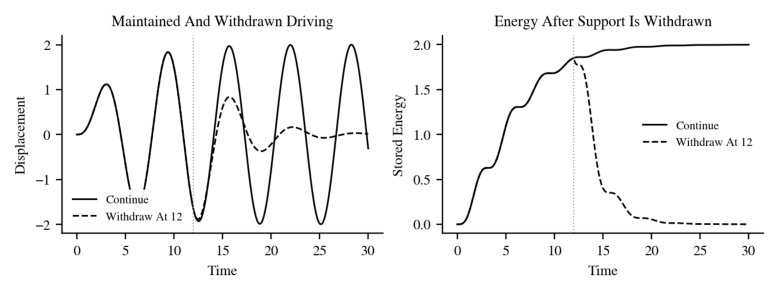
Figure 11. A unit oscillator with damping 0.5 receives sinusoidal forcing. The comparison either continues the drive or withdraws it at time twelve; the later paths reveal the work required to maintain motion. The sustaining-input illustration links continued output to recurring support and accumulated condition. Economic correspondence would trace maintenance, exception work and displaced costs, then test whether apparent efficiency gains preserve productive capability across later cycles and personnel changes.
Notation and conditions. Eta is a physical conversion efficiency for an account including its relevant inputs and losses. The displayed range presupposes that input and useful output are consistently defined. Social output measures require their own interpretation.
Epistemology and methods. Use efficiency eta for a consistent physical input-output account. Institutional productivity requires a declared output and separate accounts of heterogeneous inputs. Observe maintenance and hidden labor across the same boundary used to assess aggregate performance.
Domain analysis and practice. Aggregate production depends on distributed conversion of resources and knowledge across a supply network. An efficient lead firm can shift repair work, inventory risk or unpaid learning to others. Identify each conversion and retain separate input accounts. Compare local productivity with downstream and household effects. Procurement terms and shared technical support become candidates when they alter a documented dependence and distribute the costs of renewal on defensible terms.
Phenomenon And Practical Problem. A firm’s high measured productivity can depend on suppliers absorbing design changes, workers mentoring newcomers and customers performing troubleshooting. Compare this with an equally productive operation financing those tasks explicitly. Visible output can conceal distinct distributions of support and risk. The economic problem is to explain the collective result through constituent contributions, especially when a central technology or organization receives credit for capacity maintained through unrecorded work elsewhere.
Mechanism And Ontological Commitments. Distributed contributors convert available resources into operations that sustain a wider process. Physical energy transduction provides one precise constituent-level account; social production additionally involves competence, interpretation and authority. A physical efficiency bound applies to compatible energy quantities, while economic productivity requires a declared output and heterogeneous input accounts. A change in the boundary can move support labor between measured productivity and an externalized cost. The state should retain both local productive conditions and the relations connecting contributors to collective performance (Bebon, Robinson, and Speck 2025).
Epistemic Design And Discriminating Evidence. Observe tasks and resource commitments across organizations, including exception handling, training and care. Compare performance after a supportrole change while tracking substitution and compensating effort. A supplier’s unpaid redesign time can keep final output stable despite central staffing reductions. Contract records, time-use evidence and participant interviews help identify this displacement. Test whether a claimed technological improvement persists when all required support is accounted for. Output quality, contributor turnover
and later learning provide discriminating evidence about whether local gains represent genuine capability renewal or transferred depletion.
Philosophical Reasoning And Practice. Attribution structures economic power because it influences pay, ownership and future support. The premises are causal contribution and participants’ interests in fair recognition and workable terms. These support an accountable account of the work making collective performance possible. Recognition still leaves allocation open to additional reasons. The GR inquiry asks whether contributors gain usable successor capacities and authority through their exercise (Huang 2026c). The generative-justice linkage further invites scrutiny of how value and support circulate among those whose activities sustain the system, while preserving the distinct evidence needed for each claim (Eglash 2016).
Worked Comparison And Research Proposition. Imagine equal-cost automation projects. One funds installation only; another supports installation together with supplier coordination and shared worker training. Compare quality-adjusted output, hidden labor, turnover and retained troubleshooting competence. The proposition is that explicitly resourcing critical constituent work improves collective performance when the technology depends on complementary human and organizational tasks. The first option can prevail where the device genuinely eliminates the relevant tasks. A defensible assessment should examine how gains and costs are distributed and whether successors can exercise the resulting methods without dependence on unrecognized contributors who lack bargaining power.
Reading the numerical illustration. Figure 12 illustrates the declared mechanism. The same visible amount of useful exercise can require different input when conversion differs. The illustration keeps the input rate explicit and separates the unobserved complement from the useful channel. This supports an accounting question about apparent collective autonomy: which conversions and constituent work sustain it? For a social application, effort, skill, care and resources should retain their appropriate units, with a justified account of how they enable the operation and who bears their replenishment.
9.5 B5. Time-Dependent And Stochastic Forcing
Mechanism and ontology. A process may be maintained or reshaped by periodic, intermittent or random input. The forcing process is part of the model, with its correlations and temporal resolution. Similar-looking fluctuations can originate from external variability, endogenous dynamics or the observation procedure. (Ashwin et al. 2012; Korbel et al. 2026)
Formal representation. Equation (17) states the local mathematical representation for this class.
dx=f(x,t)dt+B(x,t)dWt. (17)
Notation and conditions. W_t is a standard Wiener process, B a noise-amplitude matrix and f a drift. The stochastic convention matters when B depends on x; jumps and temporally correlated forcing require suitable alternative models.
Epistemology and methods. State the stochastic convention and diffusion assumptions when using this form. Compare measured external inputs with residual variation; examine colored noise and jumps where relevant. A fitted noise term records unresolved variability, with causal interpretation requiring further investigation.
Domain analysis and practice. Commodity shocks, irregular orders and financial volatility provide external forcing that interacts with endogenous adjustment. A fluctuating output series leaves these pathways entangled. Record input prices, order timing and financing conditions alongside production. Compare externally forced and internally generated cycle models using held-out periods and disruptions. A buffer stock, a credit reserve and diversification address different sources of variability and should be evaluated against the disturbance each can absorb.
Phenomenon And Practical Problem. A producer can face seasonal demand, persistent input-price shocks and occasional supplier interruption. Compare equal output variance arising from each process. Their practical responses differ: seasonal scheduling, hedging or liquidity reserves, and alternative suppliers address different sources. The economic problem is to identify temporal structure and
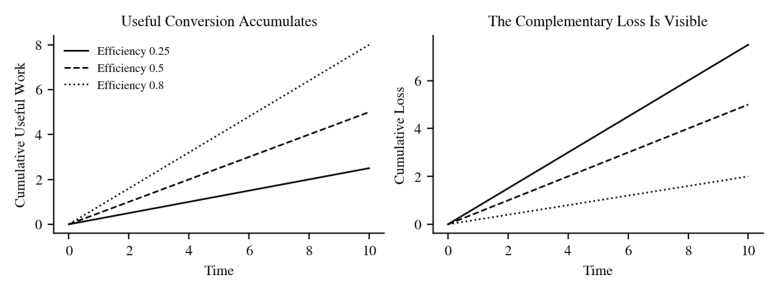
Figure 12. Three converters receive one energy unit per time and have constant efficiencies 0.25, 0.5 and 0.8. Useful work and loss sum to supplied energy in every condition. The constituent-level illustration shows collective output depending on distributed conversion and hidden expenditure. Economic correspondence would identify actual supporting tasks across boundaries, account for heterogeneous inputs and test whether a claimed productivity gain renews capacity or transfers work and risk to others.
controllable pathways before treating all unexplained variation as one stochastic disturbance. A reserve suited to short bursts can be inadequate for a persistent change in ordinary operating conditions.
Mechanism And Ontological Commitments. A forcing model specifies the timing, correlation and possible jumps of inputs affecting the selected subsystem. Noise can represent unresolved variability, while its causal origin remains open. A Wiener representation presupposes a particular diffusion approximation; contracts, discrete defaults and strategic timing may require event or jump processes. The economic state includes inventories, debt and committed production, which mediate the same disturbance differently. Expanding the boundary can turn an apparently external shock into a feedback involving market access or supplier finance (Ashwin et al. 2012; Axtell and Farmer 2025).
Epistemic Design And Discriminating Evidence. Record arrivals, prices, settlement and production at compatible resolution. Compare models using calendars, persistent shocks and jumps through temporally held-out predictions. A better fit to residual fluctuations does not alone establish the disturbance’s cause. Trace contracts and operational pathways to distinguish exogenous variation from strategic withholding or endogenous amplification. Evaluate reserve policies using completion, default exposure and restoration under several admissible processes. Sampling and survivor selection require attention because failed firms can disappear precisely during the disturbances whose economic effects the analysis seeks to estimate.
Philosophical Reasoning And Practice. Uncertainty is distributed through contractual and financial relations. A buyer can protect its own schedule by transferring variable demand to a supplier, whose workers then bear unstable hours. The premises support examining who can absorb, influence or refuse the resulting risk. Douglas’s discussion of inductive risk provides a philosophical linkage for choices whose errors have consequential costs (Douglas 2000). The GR interpretation asks whether protection renews valuable capabilities across the relevant ecology or stabilizes one node by depleting another. Practical reasons should make the protected function and accepted residual burdens explicit.
Worked Comparison And Research Proposition. Imagine equal-cost resilience plans. One maximizes finished inventory; another combines flexible finance, measured safety stock and a validated substitute supplier. Compare fulfilled useful orders, carrying costs, debt and labor volatility across heldout disturbance episodes. The proposition is that matching protection to identified persistence and interruption structure improves capability retention over a uniform buffer rule. Diversification can introduce incompatible components or coordination costs, making the conclusion conditional. Review should test assumptions about shock independence and record losses shifted to counterparties, including whether the arrangement remains workable when several contributors face the same disturbance.
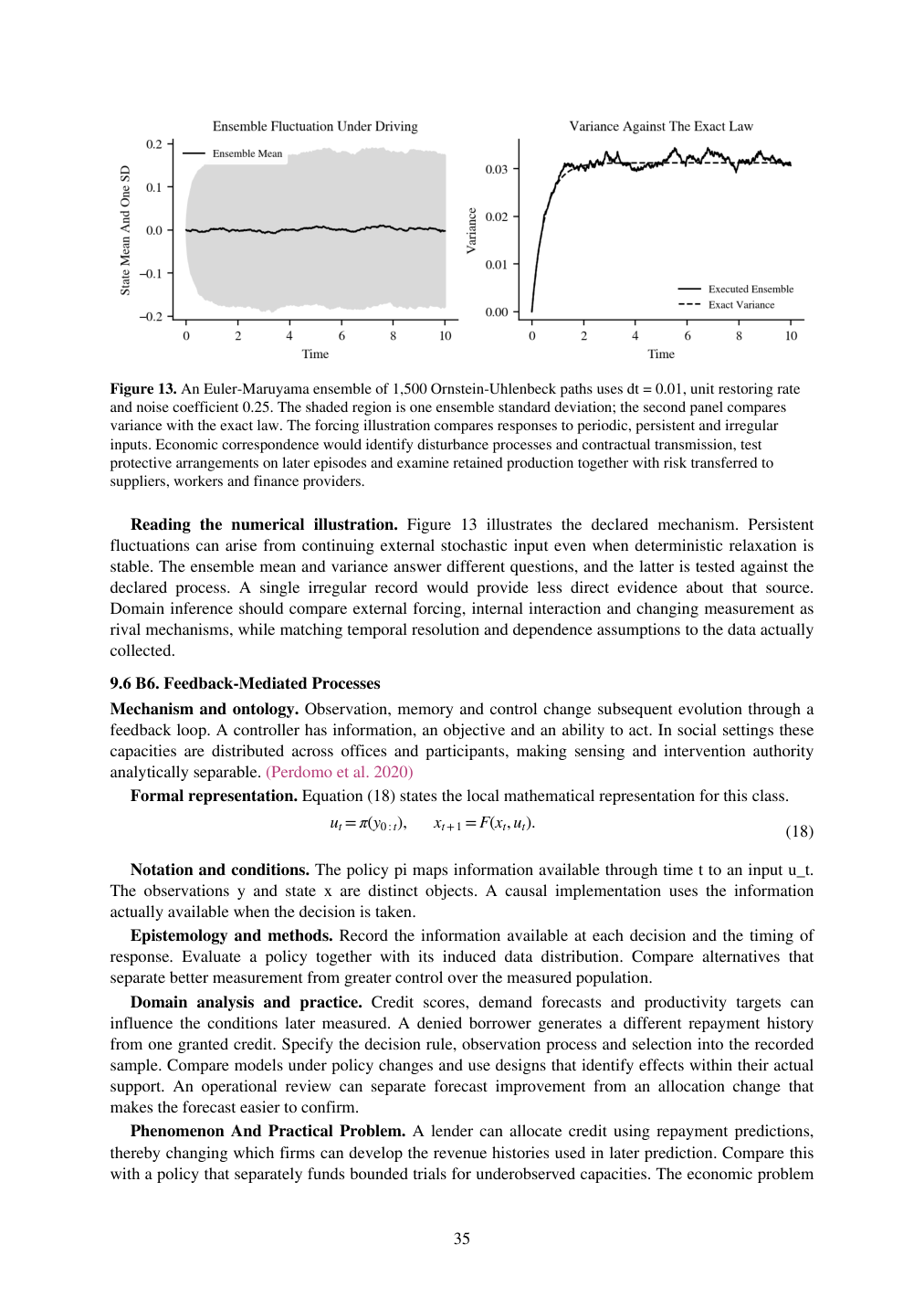
Readable text
Figure 13. An Euler-Maruyama ensemble of 1,500 Ornstein-Uhlenbeck paths uses dt = 0.01, unit restoring rate and noise coefficient 0.25. The shaded region is one ensemble standard deviation; the second panel compares variance with the exact law. The forcing illustration compares responses to periodic, persistent and irregular inputs. Economic correspondence would identify disturbance processes and contractual transmission, test protective arrangements on later episodes and examine retained production together with risk transferred to
Reading the numerical illustration. Figure 13 illustrates the declared mechanism. Persistent fluctuations can arise from continuing external stochastic input even when deterministic relaxation is stable. The ensemble mean and variance answer different questions, and the latter is tested against the declared process. A single irregular record would provide less direct evidence about that source. Domain inference should compare external forcing, internal interaction and changing measurement as rival mechanisms, while matching temporal resolution and dependence assumptions to the data actually
Mechanism and ontology. Observation, memory and control change subsequent evolution through a feedback loop. A controller has information, an objective and an ability to act. In social settings these capacities are distributed across offices and participants, making sensing and intervention authority
Formal representation. Equation (18) states the local mathematical representation for this class.
Notation and conditions. The policy pi maps information available through time t to an input u_t. The observations y and state x are distinct objects. A causal implementation uses the information
Epistemology and methods. Record the information available at each decision and the timing of response. Evaluate a policy together with its induced data distribution. Compare alternatives that separate better measurement from greater control over the measured population.
Domain analysis and practice. Credit scores, demand forecasts and productivity targets can influence the conditions later measured. A denied borrower generates a different repayment history from one granted credit. Specify the decision rule, observation process and selection into the recorded sample. Compare models under policy changes and use designs that identify effects within their actual support. An operational review can separate forecast improvement from an allocation change that
Phenomenon And Practical Problem. A lender can allocate credit using repayment predictions, thereby changing which firms can develop the revenue histories used in later prediction. Compare this with a policy that separately funds bounded trials for underobserved capacities. The economic problem
is to evaluate a feedback rule whose decisions alter both future productive possibilities and the evidence about them. Good prediction within the financed population can coexist with systematic ignorance about alternatives excluded before observation.
Mechanism And Ontological Commitments. The feedback loop contains information, memory, objectives and consequential authority. Scores influence support; support changes development; developed outcomes influence subsequent scores. Measurement and control are distinct powers even when one organization holds both. The state should include selection histories and changing access to exercise, while the observation model records whose outcomes become visible. A policy’s effects depend on the information actually available when decisions occurred. Evaluating it against later knowledge can obscure genuine implementation limits or conceal preventable omissions (Perdomo et al. 2020).
Epistemic Design And Discriminating Evidence. Preserve applications, terms, decisions and later outcomes, including rejected or withdrawn cases where lawful access and consent permit. Compare calibration with developmental effects through credible policy variation or a bounded randomized trial where appropriate. Selection and missing outcomes require explicit identification assumptions. Independent indicators of productive capacity can test whether finance changes only reporting or changes real exercise. Evaluate successive policy-induced populations and test changes in their data distributions explicitly. Audit error costs across groups and examine the opportunity to correct inaccurate records before they become entrenched.
Philosophical Reasoning And Practice. A feedback rule can acquire practical authority through repetition while its purposes and criteria remain contestable. The GR norm-formation inquiry distinguishes this force from justified authority (Huang 2026a). The premises support requiring reasons for the function being optimized, accessible correction and review of how prior support shapes apparent merit. Developmental finance can be justified through learning or opportunity under defended conditions, with transparent limits and opportunity costs. Epistemic power becomes visible when an allocator influences which capabilities can appear as evidence in the first place (Huang 2026b).
Worked Comparison And Research Proposition. Imagine equal-capital lending schemes. One ranks only past revenue; another combines current-readiness lending with a separately justified developmental portfolio and comparable monitoring. Compare productive completion, defaults, learning about previously excluded applicants and successor access. The proposition is that bounded exploration improves future allocation knowledge when support is necessary to reveal a capacity. It can create losses or politically favored exceptions, requiring common evidential standards and independent review. Practical assessment should distinguish the profitability of the selected portfolio from the broader authority of its criteria to organize economic opportunity.
Reading the numerical illustration. Figure 14 illustrates the declared mechanism. Observation affects the process only through an operative response. Here changing gain changes the closed-loop multiplier while the uncontrolled transition remains fixed. Stronger correction can cross the discretetime stability boundary and amplify deviations. A domain account should identify the sensing channel, the information retained, the response rule and the ability to implement it. Evaluating the regulated target additionally requires reasons concerning the function and affected claims, beyond the sign of the feedback loop.
9.7 B7. Nonreciprocal Effective Coupling
Mechanism and ontology. A response of one component to another can differ from the reverse response. Directional influence can be sustained by asymmetric access, external support or different interaction rules. The object is the directional response relation; its existence alone leaves physical dissipation and political legitimacy to their respective evidence. (Gross and Blasius 2008; Korbel et al. 2026) Formal representation. Equation (19) states the local mathematical representation for this class.

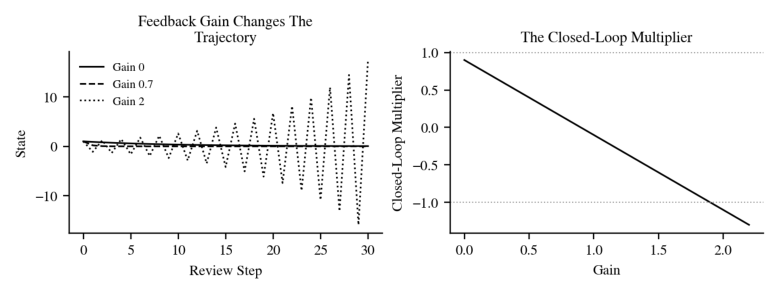
Figure 14. A scalar discrete process x_next = 0.9x + u uses observed-state feedback u = -Kx. The three trajectories share initial state one; gain two produces an alternating growing path. The feedback illustration shows allocation altering the outcomes later used for evaluation. Economic correspondence would preserve support histories and selection boundaries, distinguish prediction from development effects and test whether review or bounded exploration improves knowledge without concealing costs or discretionary favoritism.
Notation and conditions. The derivatives compare directional response in a declared coordinate system. Different units or variable normalizations change their numerical comparison; a causal interpretation needs an identified intervention or justified structural model.
Epistemology and methods. Define common coordinates before comparing derivatives. In social applications, estimate direction-specific effects and document the authority or resources enabling them. Unequal observed correlations require a separate identification argument before being interpreted as unequal causal influence.
Domain analysis and practice. Large buyers, lenders and platforms can alter the opportunities of suppliers whose reverse influence is limited. The relevant coupling concerns specific powers over prices, data, standards or access. Trace contracts and changes in feasible alternatives alongside estimated directional effects. Compare a substitute channel, bargaining support and revised governance rights. Economic evaluation should identify whether dependence shifts, whether productive capacity becomes portable and which parties finance the resulting transition.
Phenomenon And Practical Problem. A dominant buyer can alter delivery terms that strongly affect a small supplier, while that supplier has little influence over the buyer’s operations. Compare this with a relationship offering credible substitute customers or enforceable negotiation channels. Directional dependence can structure production and risk before any observed failure. The economic problem is to identify the pathway of influence and the practical alternatives available to each party, giving a causal account of power beyond descriptive size and correlation.
Mechanism And Ontological Commitments. Nonreciprocal coupling concerns unequal directionspecific responses under declared coordinates. Revenue, settlement delay and input allocation require meaningful normalization before numerical derivatives are compared. Causal influence can arise through contract authority, asset specificity, information or finance. The reverse response may operate on a slower horizon through reputation, collective action or exit. These channels should remain distinguishable. A directional relation does not alone establish physical dissipation or an unjust exercise of power; each judgment needs the appropriate additional premises and evidence (Gross and Blasius 2008). Epistemic Design And Discriminating Evidence. Compare supplier responses to buyer policy changes and buyer responses to supplier disruption, using timing, institutional detail and credible counterfactuals. Shared demand shocks can mimic a causal relationship. Document available substitutes, switching costs and the actual usability of dispute procedures. A contractual right can have little practical force when enforcement is prohibitively slow or costly. Outcomes should include
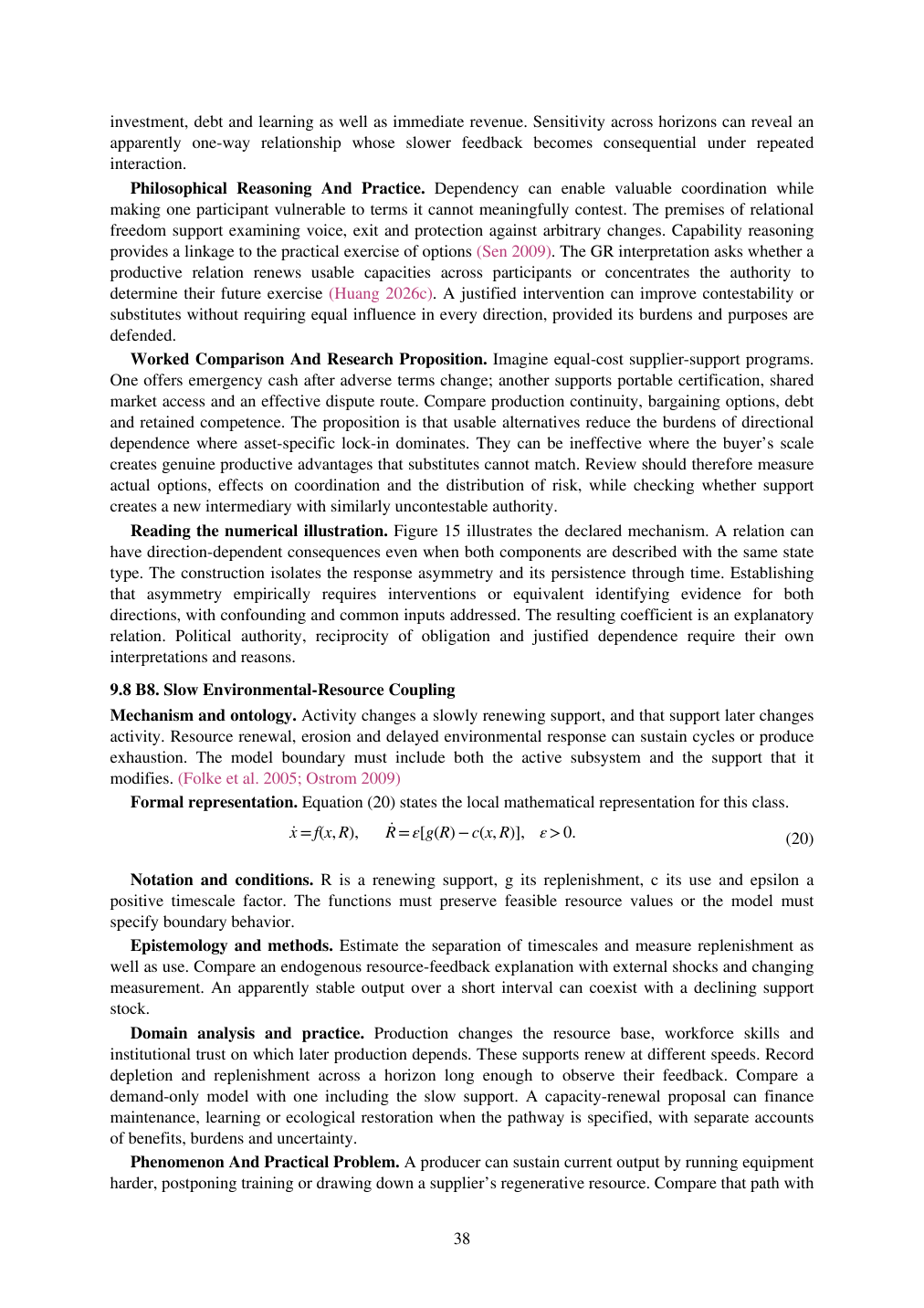
Readable text
investment, debt and learning as well as immediate revenue. Sensitivity across horizons can reveal an apparently one-way relationship whose slower feedback becomes consequential under repeated
Philosophical Reasoning And Practice. Dependency can enable valuable coordination while making one participant vulnerable to terms it cannot meaningfully contest. The premises of relational freedom support examining voice, exit and protection against arbitrary changes. Capability reasoning provides a linkage to the practical exercise of options (Sen 2009). The GR interpretation asks whether a productive relation renews usable capacities across participants or concentrates the authority to determine their future exercise (Huang 2026c). A justified intervention can improve contestability or substitutes without requiring equal influence in every direction, provided its burdens and purposes are
Worked Comparison And Research Proposition. Imagine equal-cost supplier-support programs. One offers emergency cash after adverse terms change; another supports portable certification, shared market access and an effective dispute route. Compare production continuity, bargaining options, debt and retained competence. The proposition is that usable alternatives reduce the burdens of directional dependence where asset-specific lock-in dominates. They can be ineffective where the buyer’s scale creates genuine productive advantages that substitutes cannot match. Review should therefore measure actual options, effects on coordination and the distribution of risk, while checking whether support creates a new intermediary with similarly uncontestable authority.
Reading the numerical illustration. Figure 15 illustrates the declared mechanism. A relation can have direction-dependent consequences even when both components are described with the same state type. The construction isolates the response asymmetry and its persistence through time. Establishing that asymmetry empirically requires interventions or equivalent identifying evidence for both directions, with confounding and common inputs addressed. The resulting coefficient is an explanatory relation. Political authority, reciprocity of obligation and justified dependence require their own
Mechanism and ontology. Activity changes a slowly renewing support, and that support later changes activity. Resource renewal, erosion and delayed environmental response can sustain cycles or produce exhaustion. The model boundary must include both the active subsystem and the support that it
Formal representation. Equation (20) states the local mathematical representation for this class.
Notation and conditions. R is a renewing support, g its replenishment, c its use and epsilon a positive timescale factor. The functions must preserve feasible resource values or the model must
Epistemology and methods. Estimate the separation of timescales and measure replenishment as well as use. Compare an endogenous resource-feedback explanation with external shocks and changing measurement. An apparently stable output over a short interval can coexist with a declining support
Domain analysis and practice. Production changes the resource base, workforce skills and institutional trust on which later production depends. These supports renew at different speeds. Record depletion and replenishment across a horizon long enough to observe their feedback. Compare a demand-only model with one including the slow support. A capacity-renewal proposal can finance maintenance, learning or ecological restoration when the pathway is specified, with separate accounts
Phenomenon And Practical Problem. A producer can sustain current output by running equipment harder, postponing training or drawing down a supplier’s regenerative resource. Compare that path with
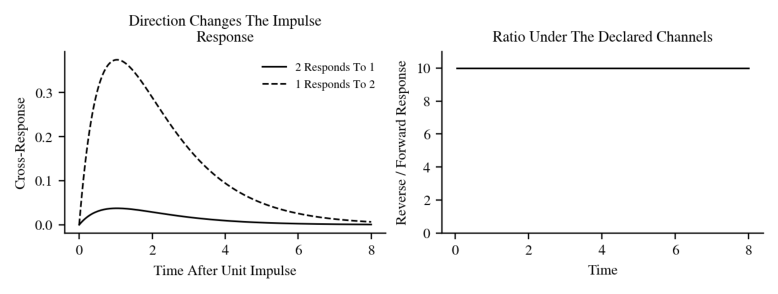
Figure 15. Two damped components have off-diagonal couplings 1 and 0.1. Unit impulses are applied in opposite directions; their cross-responses differ by a factor ten under the same stable matrix. The directional-response illustration separates influence from one component to another and the reverse pathway. Economic correspondence would identify contractual and resource channels, compare their horizons and test whether usable voice or substitutes reduce vulnerability while preserving valuable productive coordination.
one reserving resources for repair and replenishment. Short-run sales can be identical. The economic problem is to detect slow support depletion before it changes costs or feasible production, including dependencies whose deterioration is borne outside the producer’s accounts or beyond the current owner’s planning horizon.
Mechanism And Ontological Commitments. Activity changes a slowly renewing support, and that support subsequently changes activity. Material condition, soil quality, supplier competence and worker learning have different renewal laws and units. A useful model identifies each coupling and the relevant separation of timescales. The support can decline while output remains stable because reserves, compensating effort or external finance conceal the loss. The state boundary should therefore include consequential renewing conditions and specify feasible behavior near depletion, where a smooth approximation can otherwise predict impossible negative stocks (Ostrom 2009; Folke et al. 2005).
Epistemic Design And Discriminating Evidence. Measure support condition and replenishment alongside use over a sufficient horizon. Compare similarly exposed operations with different maintenance or renewal arrangements, accounting for initial reserves and input quality. A coupled model should predict responses after rest, repair or restored learning time more accurately than an output-only model. Independent condition evidence helps discriminate internal depletion from external demand shocks. Track displaced workload and extraction when one operation rests, since local recovery can depend on deterioration elsewhere. Validation should include later production and restoration cost, not just short-run fit.
Philosophical Reasoning And Practice. Present returns can be financed by future loss of practical possibility. The premises of stewardship and accountable investment support representing that transfer explicitly. The GR concept of renewal asks whether exercise contributes to the conditions of further exercise (Huang 2026d). Renewal remains evaluatively plural: preserving an obsolete process can consume resources better used for transformation. A justified decision identifies the valued capability, affected claims and alternatives, then explains why repair, rotation, substitution or closure addresses them. Ownership horizon and control over replenishment belong within that reasoning.
Worked Comparison And Research Proposition. Imagine equal-investment production plans. One expands utilization immediately; another combines lower peak use with repair, training and a verified replenishment contract. Compare cumulative useful output, condition, contributor burden and successor capability. The proposition is that coupled renewal improves retained production where slowsupport loss drives later failure. It can reduce total benefit if replenishment is ineffective or demand
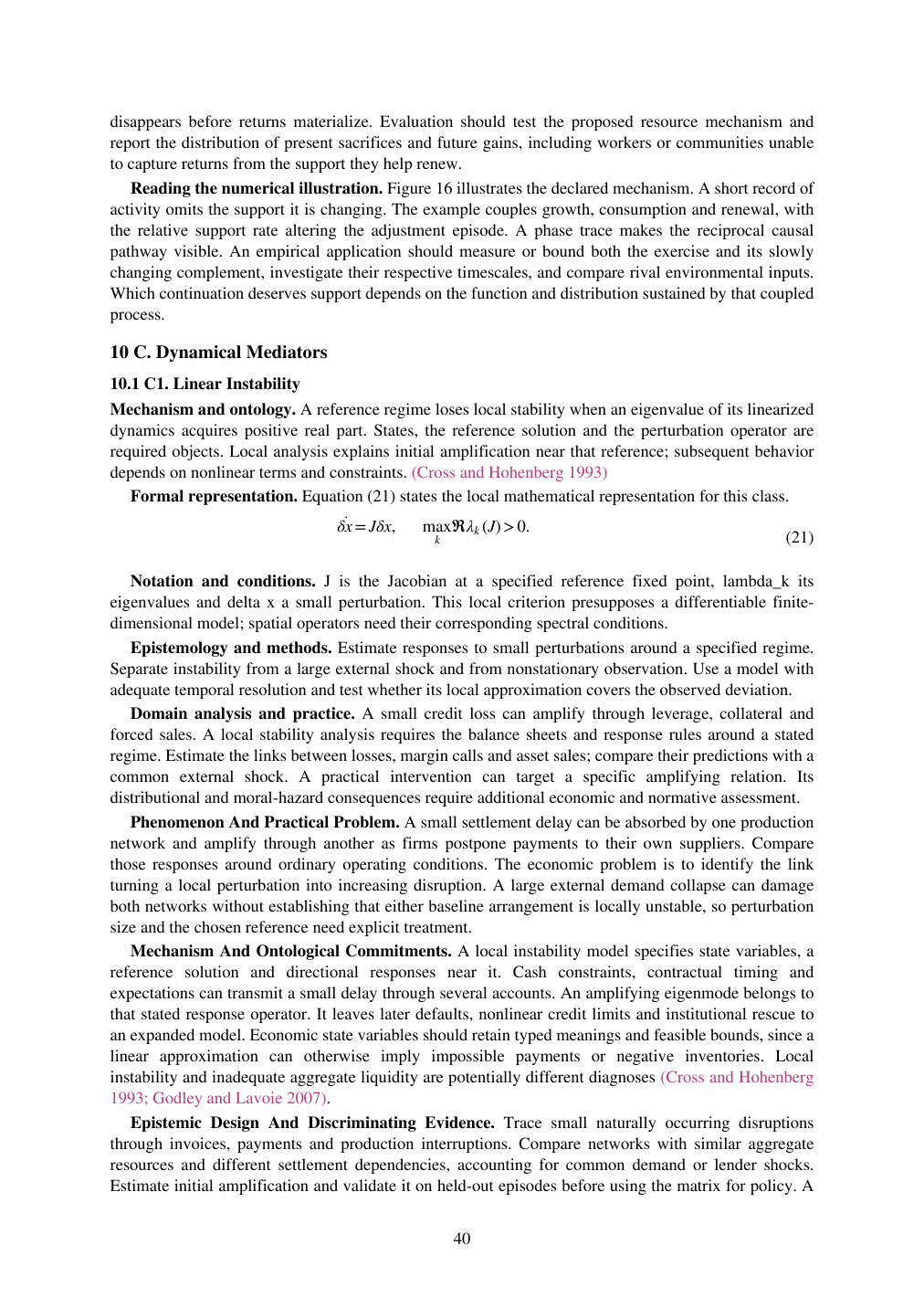
Readable text
disappears before returns materialize. Evaluation should test the proposed resource mechanism and report the distribution of present sacrifices and future gains, including workers or communities unable
Reading the numerical illustration. Figure 16 illustrates the declared mechanism. A short record of activity omits the support it is changing. The example couples growth, consumption and renewal, with the relative support rate altering the adjustment episode. A phase trace makes the reciprocal causal pathway visible. An empirical application should measure or bound both the exercise and its slowly changing complement, investigate their respective timescales, and compare rival environmental inputs. Which continuation deserves support depends on the function and distribution sustained by that coupled
Mechanism and ontology. A reference regime loses local stability when an eigenvalue of its linearized dynamics acquires positive real part. States, the reference solution and the perturbation operator are required objects. Local analysis explains initial amplification near that reference; subsequent behavior depends on nonlinear terms and constraints. (Cross and Hohenberg 1993)
Formal representation. Equation (21) states the local mathematical representation for this class.
Notation and conditions. J is the Jacobian at a specified reference fixed point, lambda_k its eigenvalues and delta x a small perturbation. This local criterion presupposes a differentiable finite- dimensional model; spatial operators need their corresponding spectral conditions.
Epistemology and methods. Estimate responses to small perturbations around a specified regime. Separate instability from a large external shock and from nonstationary observation. Use a model with adequate temporal resolution and test whether its local approximation covers the observed deviation.
Domain analysis and practice. A small credit loss can amplify through leverage, collateral and forced sales. A local stability analysis requires the balance sheets and response rules around a stated regime. Estimate the links between losses, margin calls and asset sales; compare their predictions with a common external shock. A practical intervention can target a specific amplifying relation. Its distributional and moral-hazard consequences require additional economic and normative assessment.
Phenomenon And Practical Problem. A small settlement delay can be absorbed by one production network and amplify through another as firms postpone payments to their own suppliers. Compare those responses around ordinary operating conditions. The economic problem is to identify the link turning a local perturbation into increasing disruption. A large external demand collapse can damage both networks without establishing that either baseline arrangement is locally unstable, so perturbation
size and the chosen reference need explicit treatment.
Mechanism And Ontological Commitments. A local instability model specifies state variables, a reference solution and directional responses near it. Cash constraints, contractual timing and expectations can transmit a small delay through several accounts. An amplifying eigenmode belongs to that stated response operator. It leaves later defaults, nonlinear credit limits and institutional rescue to an expanded model. Economic state variables should retain typed meanings and feasible bounds, since a linear approximation can otherwise imply impossible payments or negative inventories. Local instability and inadequate aggregate liquidity are potentially different diagnoses (Cross and Hohenberg Epistemic Design And Discriminating Evidence. Trace small naturally occurring disruptions through invoices, payments and production interruptions. Compare networks with similar aggregate resources and different settlement dependencies, accounting for common demand or lender shocks. Estimate initial amplification and validate it on held-out episodes before using the matrix for policy. A
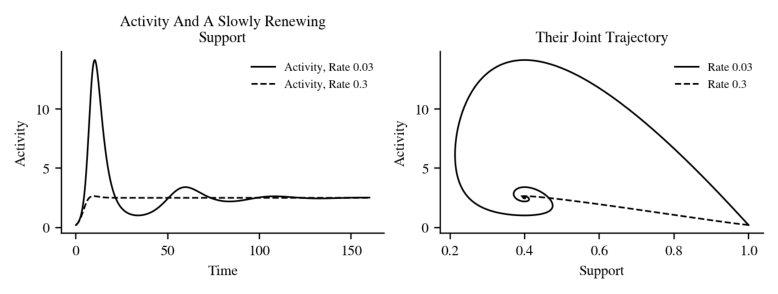
Figure 16. Activity grows when support exceeds 0.4 and consumes it through 0.6xR. Support renewal is multiplied by 0.03 or 0.3. Both variables are included in the executed state. The resource-coupling illustration shows current activity drawing on a slowly renewing support. Economic correspondence would measure use and replenishment, test output-only alternatives and compare repair or transformation through cumulative production, successor capability and burdens distributed across contributors and time.
targeted improvement in one transmission link should change propagation in a predicted way. Full default histories help identify where linearization ceases to apply. Outcomes should include productive completion and burdens on counterparties, because restoring payment speed can still transfer risk or postpone material failure (Acemoglu et al. 2012).
Philosophical Reasoning And Practice. Network fragility changes the relevant object of economic responsibility. A firm’s privately convenient timing can impose foreseeable losses through relations it helps constitute. The premises support making those external effects and decision powers visible within contract or public review. They do not automatically assign all loss to the initiating firm, since contribution, authority and available precautions differ. The GR perspective asks which supports preserve a justified productive function and whether recovery renews participant capacity or merely protects the most influential node’s balance sheet.
Worked Comparison And Research Proposition. Imagine equal-cost liquidity arrangements. One allocates reserves in proportion to firm size; another targets accounts predicted to amplify small timing disruptions while retaining safeguards against discretionary favoritism. Compare completed useful production, transient arrears, losses and restoration. The proposition is that validated structure-sensitive support reduces cascading interruption when local amplification drives fragility. It can fail when estimated pathways change or moral hazard alters behavior. Practical judgment should report ordinary costs, error distribution and credible alternatives, treating the local model as evidence about one mechanism within an accountable allocation decision.
Reading the numerical illustration. Figure 17 illustrates the declared mechanism. Linearization identifies an initial response near a specified reference. The positive-rate trajectory grows in this linear construction, whose validity for a nonlinear target is local. Later saturation, exit or reorganization requires additional terms and evidence. A domain study should state the reference regime and relevant perturbation, identify the local response, and then test whether the neighborhood supporting that approximation covers the question being asked. A visible abrupt change alone leaves those commitments unresolved.
10.2 C2. Nonlinear Saturation
Mechanism and ontology. Nonlinear terms can limit an initially growing perturbation and support finite-amplitude organization. A saturation mechanism identifies what constrains further growth: resources, congestion, inhibition or an altered response. A fitted carrying capacity leaves its institutional or material origin to be explained. (Cross and Hohenberg 1993)
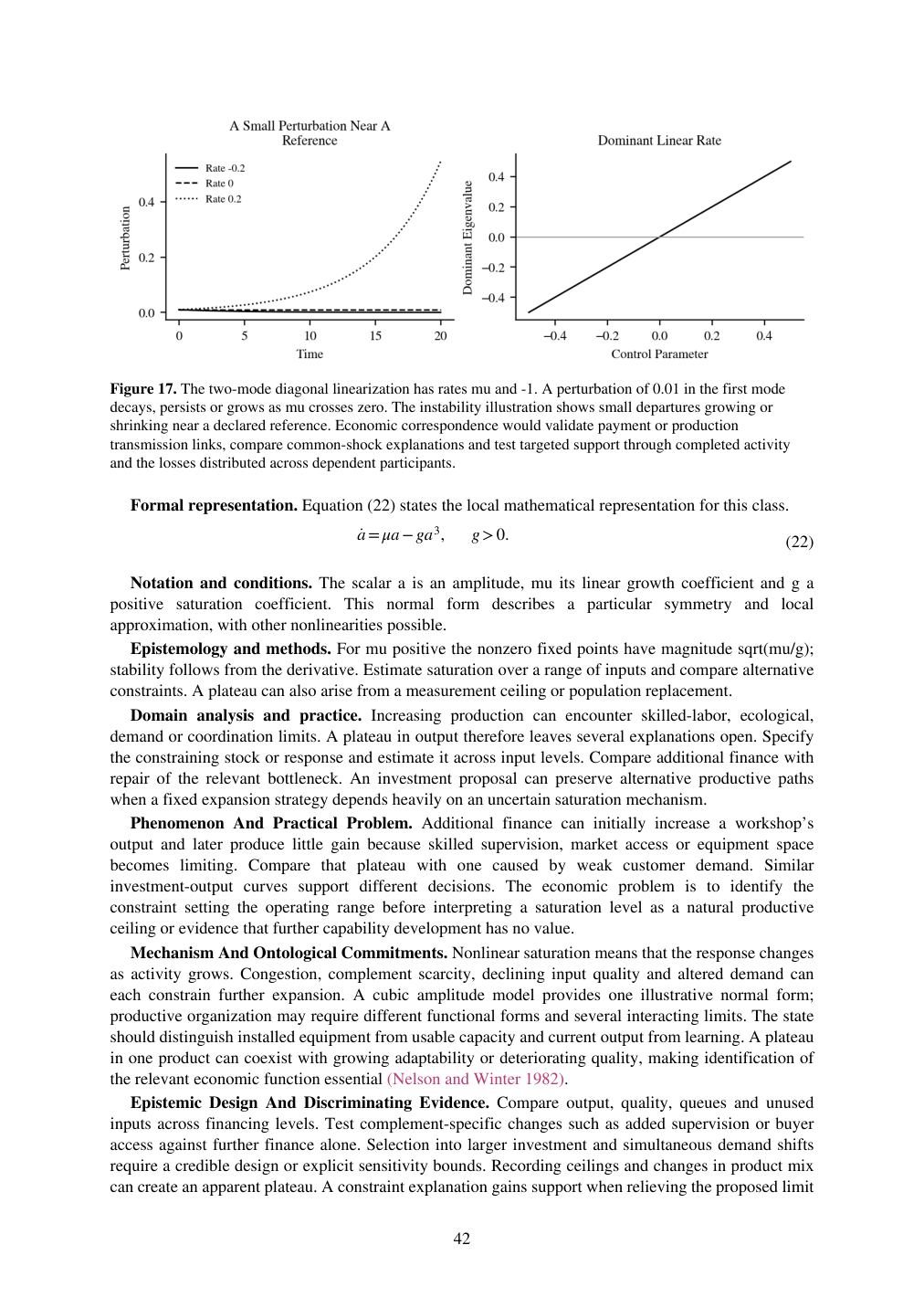
Readable text
Figure 17. The two-mode diagonal linearization has rates mu and -1. A perturbation of 0.01 in the first mode decays, persists or grows as mu crosses zero. The instability illustration shows small departures growing or shrinking near a declared reference. Economic correspondence would validate payment or production transmission links, compare common-shock explanations and test targeted support through completed activity
and the losses distributed across dependent participants.
Formal representation. Equation (22) states the local mathematical representation for this class.
Notation and conditions. The scalar a is an amplitude, mu its linear growth coefficient and g a positive saturation coefficient. This normal form describes a particular symmetry and local
Epistemology and methods. For mu positive the nonzero fixed points have magnitude sqrt(mu/g); stability follows from the derivative. Estimate saturation over a range of inputs and compare alternative constraints. A plateau can also arise from a measurement ceiling or population replacement.
Domain analysis and practice. Increasing production can encounter skilled-labor, ecological, demand or coordination limits. A plateau in output therefore leaves several explanations open. Specify the constraining stock or response and estimate it across input levels. Compare additional finance with repair of the relevant bottleneck. An investment proposal can preserve alternative productive paths when a fixed expansion strategy depends heavily on an uncertain saturation mechanism.
Phenomenon And Practical Problem. Additional finance can initially increase a workshop’s output and later produce little gain because skilled supervision, market access or equipment space becomes limiting. Compare that plateau with one caused by weak customer demand. Similar investment-output curves support different decisions. The economic problem is to identify the constraint setting the operating range before interpreting a saturation level as a natural productive ceiling or evidence that further capability development has no value.
Mechanism And Ontological Commitments. Nonlinear saturation means that the response changes as activity grows. Congestion, complement scarcity, declining input quality and altered demand can each constrain further expansion. A cubic amplitude model provides one illustrative normal form; productive organization may require different functional forms and several interacting limits. The state should distinguish installed equipment from usable capacity and current output from learning. A plateau in one product can coexist with growing adaptability or deteriorating quality, making identification of the relevant economic function essential (Nelson and Winter 1982).
Epistemic Design And Discriminating Evidence. Compare output, quality, queues and unused inputs across financing levels. Test complement-specific changes such as added supervision or buyer access against further finance alone. Selection into larger investment and simultaneous demand shifts require a credible design or explicit sensitivity bounds. Recording ceilings and changes in product mix can create an apparent plateau. A constraint explanation gains support when relieving the proposed limit
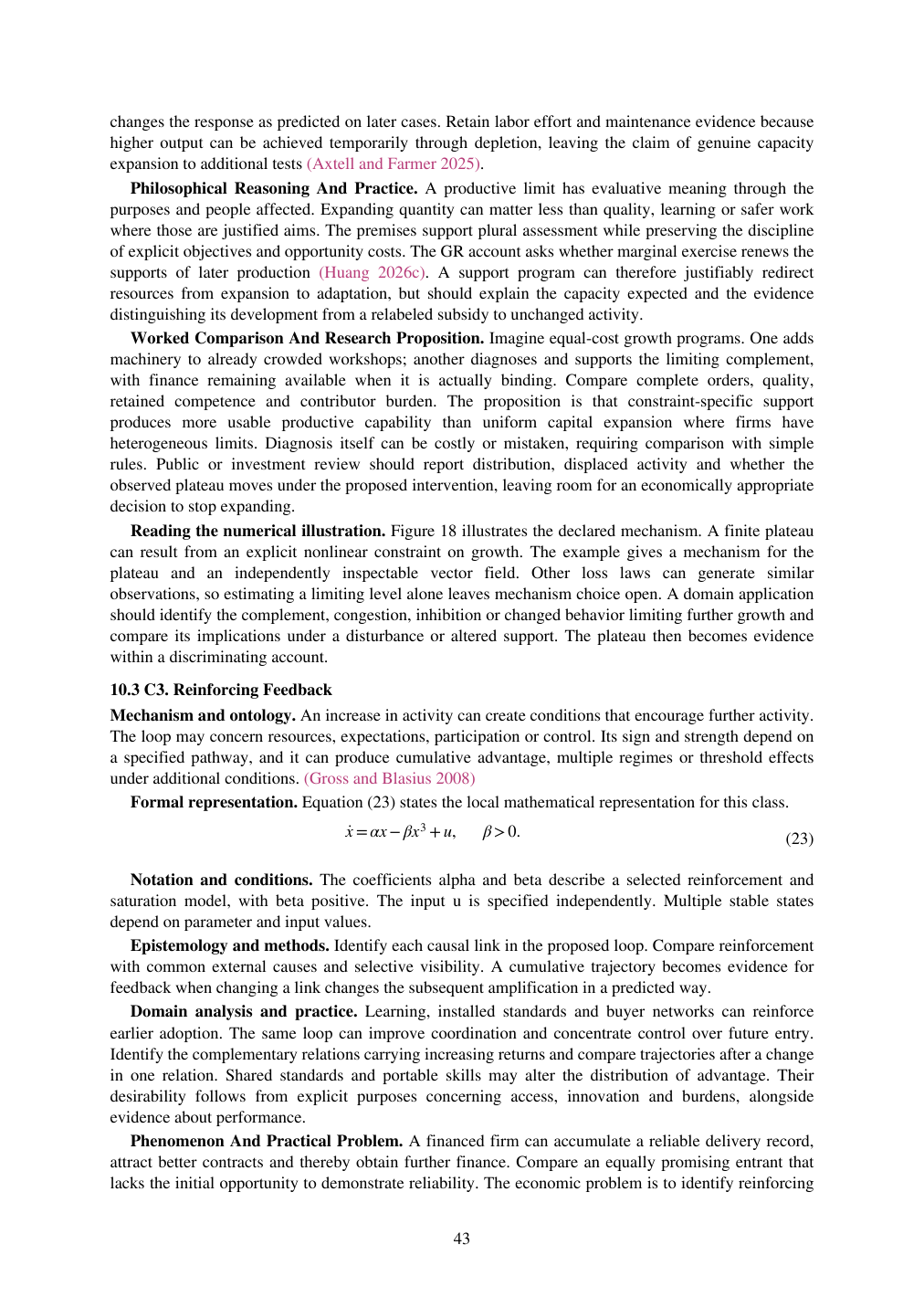
Readable text
changes the response as predicted on later cases. Retain labor effort and maintenance evidence because higher output can be achieved temporarily through depletion, leaving the claim of genuine capacity expansion to additional tests (Axtell and Farmer 2025).
Philosophical Reasoning And Practice. A productive limit has evaluative meaning through the purposes and people affected. Expanding quantity can matter less than quality, learning or safer work where those are justified aims. The premises support plural assessment while preserving the discipline of explicit objectives and opportunity costs. The GR account asks whether marginal exercise renews the supports of later production (Huang 2026c). A support program can therefore justifiably redirect resources from expansion to adaptation, but should explain the capacity expected and the evidence distinguishing its development from a relabeled subsidy to unchanged activity.
Worked Comparison And Research Proposition. Imagine equal-cost growth programs. One adds machinery to already crowded workshops; another diagnoses and supports the limiting complement, with finance remaining available when it is actually binding. Compare complete orders, quality, retained competence and contributor burden. The proposition is that constraint-specific support produces more usable productive capability than uniform capital expansion where firms have heterogeneous limits. Diagnosis itself can be costly or mistaken, requiring comparison with simple rules. Public or investment review should report distribution, displaced activity and whether the observed plateau moves under the proposed intervention, leaving room for an economically appropriate
Reading the numerical illustration. Figure 18 illustrates the declared mechanism. A finite plateau can result from an explicit nonlinear constraint on growth. The example gives a mechanism for the plateau and an independently inspectable vector field. Other loss laws can generate similar observations, so estimating a limiting level alone leaves mechanism choice open. A domain application should identify the complement, congestion, inhibition or changed behavior limiting further growth and compare its implications under a disturbance or altered support. The plateau then becomes evidence
Mechanism and ontology. An increase in activity can create conditions that encourage further activity. The loop may concern resources, expectations, participation or control. Its sign and strength depend on a specified pathway, and it can produce cumulative advantage, multiple regimes or threshold effects
Formal representation. Equation (23) states the local mathematical representation for this class.
Notation and conditions. The coefficients alpha and beta describe a selected reinforcement and saturation model, with beta positive. The input u is specified independently. Multiple stable states
Epistemology and methods. Identify each causal link in the proposed loop. Compare reinforcement with common external causes and selective visibility. A cumulative trajectory becomes evidence for feedback when changing a link changes the subsequent amplification in a predicted way.
Domain analysis and practice. Learning, installed standards and buyer networks can reinforce earlier adoption. The same loop can improve coordination and concentrate control over future entry. Identify the complementary relations carrying increasing returns and compare trajectories after a change in one relation. Shared standards and portable skills may alter the distribution of advantage. Their desirability follows from explicit purposes concerning access, innovation and burdens, alongside
Phenomenon And Practical Problem. A financed firm can accumulate a reliable delivery record, attract better contracts and thereby obtain further finance. Compare an equally promising entrant that lacks the initial opportunity to demonstrate reliability. The economic problem is to identify reinforcing
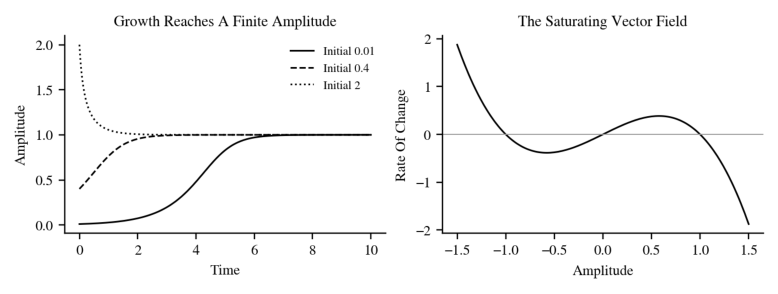
Figure 18. The amplitude equation da/dt = a - a cubed is integrated from three positive initial values. All approach the positive fixed amplitude one under the specified cubic loss. The saturation illustration shows activity reaching a limit through a specified nonlinear response. Economic correspondence would distinguish finance, skills, demand and recording constraints, then test whether targeted complement support changes usable capacity while accounting for quality, maintenance and opportunity costs.
pathways behind cumulative advantage and distinguish them from common demand or genuine initial quality. Present superiority can be real while its development history remains important to judgments of selection, fairness and further support.
Mechanism And Ontological Commitments. Reinforcement links an increase in activity to conditions encouraging its later increase. Learning, reputation, collateral and network access supply different loops. Congestion, competition and resource limits can weaken or reverse them. An economic account should specify each directional link and the support required to maintain it. Increasing returns and path dependence provide established settings for this inquiry (Arthur 1989; Pierson 2000). A loop can amplify an initially small difference in allocated opportunity, making the resulting record partly endogenous to the process used to recognize merit.
Epistemic Design And Discriminating Evidence. Trace financing, contracts, performance and subsequent support through time, including rejected entrants and failed incumbents. Compare changes to one link, such as procurement access or collateral requirements, with credible controls. Initial quality and shared shocks require explicit rival explanations. A reinforcement claim strengthens when changing a link alters later amplification as predicted. Measures should separate current readiness from potential under additional development, because the two questions require different comparisons. Network spillovers and displacement matter when one firm’s advantage comes at the expense of others’ opportunity to exercise similar capacities.
Philosophical Reasoning And Practice. Cumulative advantage gives selection institutions epistemic power. The premises are that support affects development and that developed manifestations influence later judgments. These support examining allocation history alongside present performance. The GR norm-formation inquiry helps distinguish successful selection, practical authority and justified criteria (Huang 2026a). An intervention opening opportunity can be defended through learning or fair participation, while established competence can legitimately matter for tasks requiring immediate reliability. Public reasons should state which purpose governs and why the evidence bears on that purpose, with accountable review of both inclusion and cost.
Worked Comparison And Research Proposition. Imagine equal-budget procurement schemes. One repeatedly selects firms with the longest track records; another reserves bounded trials for entrants meeting transparent readiness conditions. Compare delivery, new competence, future competition and the costs of unsuccessful trials. The proposition is that developmental access improves the future evidence base when reinforcement limits who can demonstrate capacity. It can reduce short-run reliability or create discretionary favor, requiring comparable monitoring and explicit limits. Practical
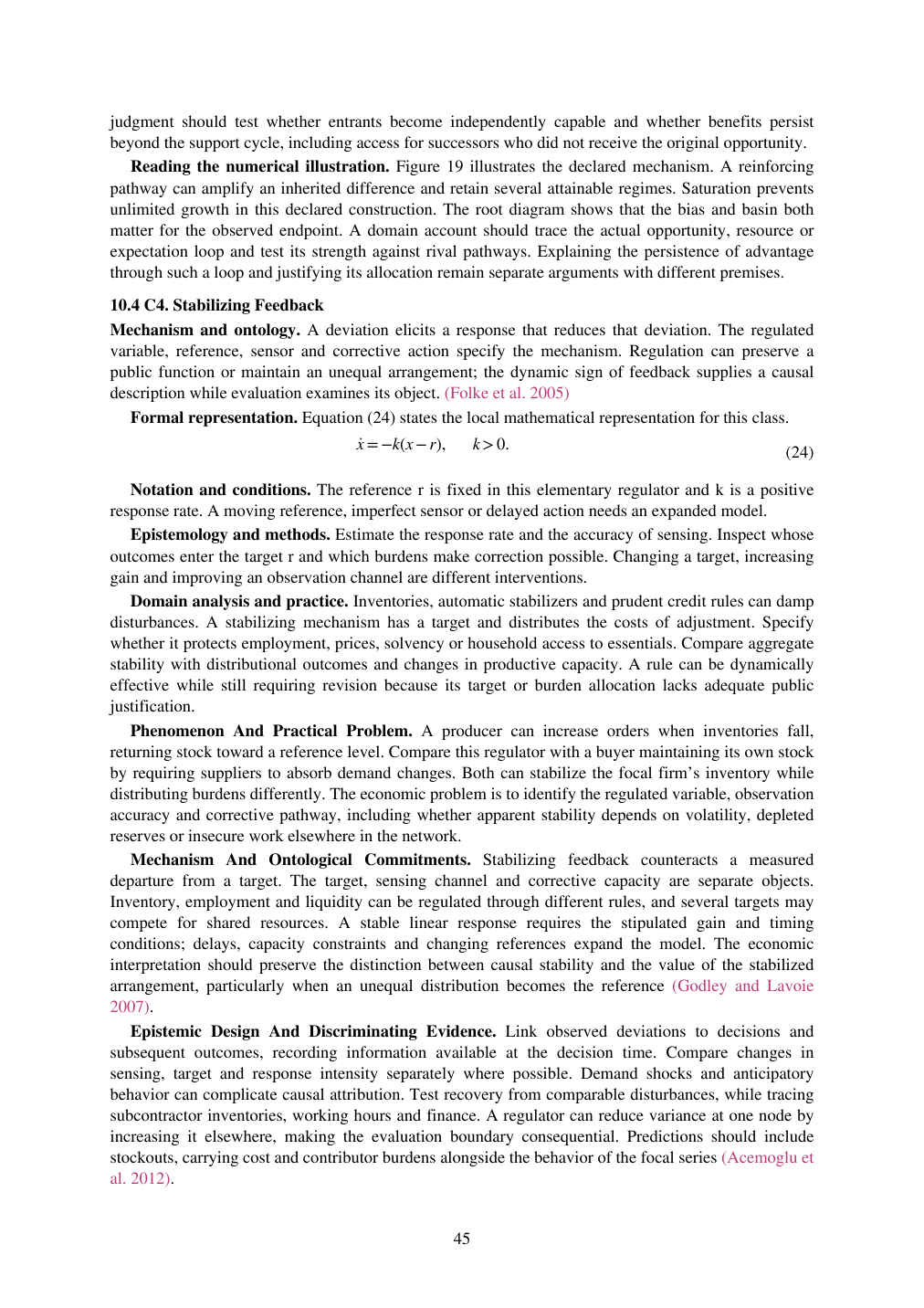
Readable text
judgment should test whether entrants become independently capable and whether benefits persist beyond the support cycle, including access for successors who did not receive the original opportunity.
Reading the numerical illustration. Figure 19 illustrates the declared mechanism. A reinforcing pathway can amplify an inherited difference and retain several attainable regimes. Saturation prevents unlimited growth in this declared construction. The root diagram shows that the bias and basin both matter for the observed endpoint. A domain account should trace the actual opportunity, resource or expectation loop and test its strength against rival pathways. Explaining the persistence of advantage through such a loop and justifying its allocation remain separate arguments with different premises.
Mechanism and ontology. A deviation elicits a response that reduces that deviation. The regulated variable, reference, sensor and corrective action specify the mechanism. Regulation can preserve a public function or maintain an unequal arrangement; the dynamic sign of feedback supplies a causal description while evaluation examines its object. (Folke et al. 2005)
Formal representation. Equation (24) states the local mathematical representation for this class.
Notation and conditions. The reference r is fixed in this elementary regulator and k is a positive response rate. A moving reference, imperfect sensor or delayed action needs an expanded model.
Epistemology and methods. Estimate the response rate and the accuracy of sensing. Inspect whose outcomes enter the target r and which burdens make correction possible. Changing a target, increasing gain and improving an observation channel are different interventions.
Domain analysis and practice. Inventories, automatic stabilizers and prudent credit rules can damp disturbances. A stabilizing mechanism has a target and distributes the costs of adjustment. Specify whether it protects employment, prices, solvency or household access to essentials. Compare aggregate stability with distributional outcomes and changes in productive capacity. A rule can be dynamically effective while still requiring revision because its target or burden allocation lacks adequate public
Phenomenon And Practical Problem. A producer can increase orders when inventories fall, returning stock toward a reference level. Compare this regulator with a buyer maintaining its own stock by requiring suppliers to absorb demand changes. Both can stabilize the focal firm’s inventory while distributing burdens differently. The economic problem is to identify the regulated variable, observation accuracy and corrective pathway, including whether apparent stability depends on volatility, depleted
Mechanism And Ontological Commitments. Stabilizing feedback counteracts a measured departure from a target. The target, sensing channel and corrective capacity are separate objects. Inventory, employment and liquidity can be regulated through different rules, and several targets may compete for shared resources. A stable linear response requires the stipulated gain and timing conditions; delays, capacity constraints and changing references expand the model. The economic interpretation should preserve the distinction between causal stability and the value of the stabilized arrangement, particularly when an unequal distribution becomes the reference (Godley and Lavoie Epistemic Design And Discriminating Evidence. Link observed deviations to decisions and subsequent outcomes, recording information available at the decision time. Compare changes in sensing, target and response intensity separately where possible. Demand shocks and anticipatory behavior can complicate causal attribution. Test recovery from comparable disturbances, while tracing subcontractor inventories, working hours and finance. A regulator can reduce variance at one node by increasing it elsewhere, making the evaluation boundary consequential. Predictions should include stockouts, carrying cost and contributor burdens alongside the behavior of the focal series (Acemoglu et
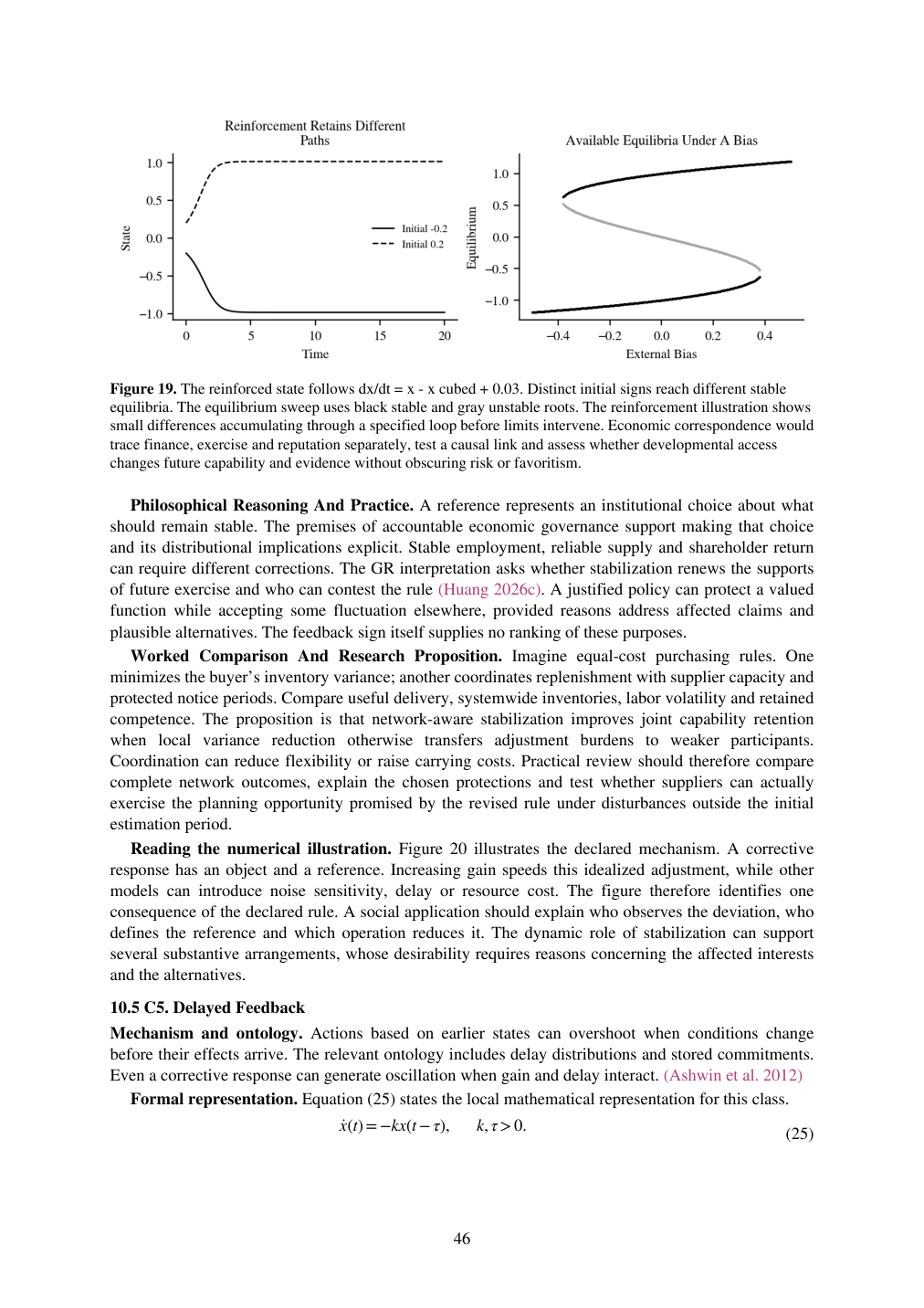
Readable text
Figure 19. The reinforced state follows dx/dt = x - x cubed + 0.03. Distinct initial signs reach different stable equilibria. The equilibrium sweep uses black stable and gray unstable roots. The reinforcement illustration shows small differences accumulating through a specified loop before limits intervene. Economic correspondence would trace finance, exercise and reputation separately, test a causal link and assess whether developmental access changes future capability and evidence without obscuring risk or favoritism.
Philosophical Reasoning And Practice. A reference represents an institutional choice about what should remain stable. The premises of accountable economic governance support making that choice and its distributional implications explicit. Stable employment, reliable supply and shareholder return can require different corrections. The GR interpretation asks whether stabilization renews the supports of future exercise and who can contest the rule (Huang 2026c). A justified policy can protect a valued function while accepting some fluctuation elsewhere, provided reasons address affected claims and plausible alternatives. The feedback sign itself supplies no ranking of these purposes.
Worked Comparison And Research Proposition. Imagine equal-cost purchasing rules. One minimizes the buyer’s inventory variance; another coordinates replenishment with supplier capacity and protected notice periods. Compare useful delivery, systemwide inventories, labor volatility and retained competence. The proposition is that network-aware stabilization improves joint capability retention when local variance reduction otherwise transfers adjustment burdens to weaker participants. Coordination can reduce flexibility or raise carrying costs. Practical review should therefore compare complete network outcomes, explain the chosen protections and test whether suppliers can actually exercise the planning opportunity promised by the revised rule under disturbances outside the initial
Reading the numerical illustration. Figure 20 illustrates the declared mechanism. A corrective response has an object and a reference. Increasing gain speeds this idealized adjustment, while other models can introduce noise sensitivity, delay or resource cost. The figure therefore identifies one consequence of the declared rule. A social application should explain who observes the deviation, who defines the reference and which operation reduces it. The dynamic role of stabilization can support several substantive arrangements, whose desirability requires reasons concerning the affected interests
Mechanism and ontology. Actions based on earlier states can overshoot when conditions change before their effects arrive. The relevant ontology includes delay distributions and stored commitments. Even a corrective response can generate oscillation when gain and delay interact. (Ashwin et al. 2012)
Formal representation. Equation (25) states the local mathematical representation for this class.
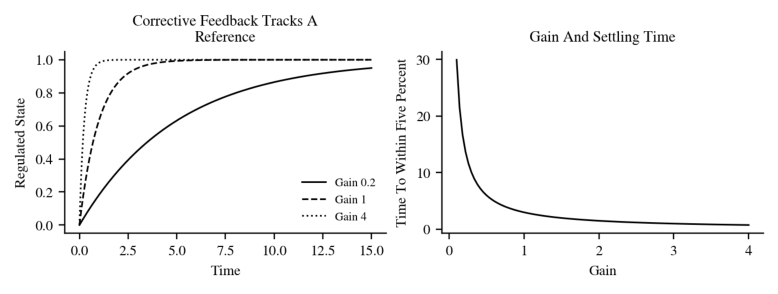
Figure 20. The response dx/dt = -k(x - 1) begins at zero. Its exact five-percent settling time is log(20)/k; the comparison excludes delay, noise, and actuator limits by construction. The stabilizing illustration shows return toward a declared reference under corrective action. Economic correspondence would identify the target and information channel, trace effects across counterparties and test whether local smoothness represents systemwide renewal or transferred variability and adjustment burdens.
Notation and conditions. The positive delay tau and gain k act on a prescribed initial history over the delay interval. The quoted boundary applies to this scalar linear delay equation, with different rules producing different thresholds.
Epistemology and methods. For this scalar equation the first stability boundary is k tau = pi/2. Institutional models require estimated delays, capacity constraints and policy-response rules. Compare lagged administrative action with an exogenous periodic driver before attributing a cycle to delay.
Domain analysis and practice. Investment, hiring and repayment respond with delays that can generate overshoot. Expected demand may induce capacity delivered after the demand has changed. Estimate the sequence from expectation to commitment to delivery. Compare an exogenous cycle with the endogenous effect of lagged responses. Staged commitments and financing contingencies can reduce exposure where the delay model supports that prediction, while excessive delay in commitment can carry costs of its own.
Phenomenon And Practical Problem. Producers can expand capacity in response to high prices, only for the additional supply to arrive after demand has fallen. Compare this delayed response with a recurring demand calendar known in advance. Similar output cycles support different interventions. The economic problem is to identify whether commitments based on older conditions generate overshoot and whether stronger incentives would speed adjustment or amplify an already delayed response through the production and financing network.
Mechanism And Ontological Commitments. Delays arise between observation, investment authorization, equipment delivery, training and sale. These clocks can differ across firms and interact with stored orders or debt. A scalar delay equation provides a conditional stability illustration; actual production can require distributed lags, irreversible commitments and bounded capacity. Once a plant is ordered, a later policy revision may leave its effects in the pipeline. The state should therefore include committed future capacity, separating changed intentions from operations already scheduled to alter supply (Ashwin et al. 2012; Nelson and Winter 1982).
Epistemic Design And Discriminating Evidence. Join decision dates, information sets, financing terms and effective capacity dates. Compare phase relationships with measured demand and test delayed-response models against external periodic forcing. Changes shortening lead time or improving knowledge of committed capacity can provide discriminating evidence. Forecasts should be evaluated on later cycles and include uncertainty in completion times. A contemporaneous price-output regression can miss the mechanism or reverse its apparent sign. Follow losses and retained skills after excess
Readable text
capacity appears, because organizational failure can transfer productive knowledge while imposing
Philosophical Reasoning And Practice. Delay distributes uncertainty through people whose commitments become difficult to reverse. The premises of accountable support require attention to who can foresee, influence or absorb that uncertainty. A public program can reasonably prefer staged or reversible commitments when evidence supports their value. The GR approach follows both the created capacity and the path through which participants can use it (Huang 2026c). Caution has opportunity costs when urgent productive needs remain unmet, so a defensible judgment should compare adjustment paths and explain the pace and tolerance for error justified by its purpose.
Worked Comparison And Research Proposition. Imagine equal-investment programs responding to a shortage. One gives a large one-time incentive based on current price; another stages commitments using validated lead times and transparent records of capacity already underway. Compare shortage duration, excess stock, defaults and retained competence. The proposition is that accounting for delayed commitments reduces overshoot where the response pipeline drives the cycle. It can miss a persistent demand shift or incur coordination costs. Practical appraisal should identify the information realistically available, the groups bearing forecast error and the evidence that would justify accelerating, pausing or
Reading the numerical illustration. Figure 21 illustrates the declared mechanism. A corrective sign can coexist with an unstable delayed loop. The effect arrives after the state that triggered it, so correction can overshoot. The numerical traces are approximations to a declared delay equation; the analytic boundary provides a separate reference for their interpretation. A domain inquiry should reconstruct the distribution of reporting, decision and implementation delays, investigate their interaction with gain, and compare proportional adjustments with operations based on more current or
Mechanism and ontology. Local transformations coupled to spatial transfer can generate patterns. Two-field kinetics, transport coefficients and boundary conditions define the model. Classical Turing instability requires a homogeneous state stable without spatial perturbations that becomes unstable for some spatial mode after transport is included. (Cross and Hohenberg 1993; Frey and Weyer 2026;
Formal representation. Equation (26) states the local mathematical representation for this class.
Notation and conditions. The fields u and v evolve over a declared spatial domain; f and g are local kinetics, D_u and D_v nonnegative diffusion coefficients, and the Laplacian represents transport with
Epistemology and methods. Estimate both local interactions and movement; test the predicted dispersion relation where data permit. In social settings, mobility restrictions, land markets and sorting provide competing pattern-generating mechanisms. Spatial resemblance alone supports a descriptive
Domain analysis and practice. Economic activity can cluster through local complementarity and movement of workers, goods and knowledge. A reaction-diffusion analogy needs operational local transformations and transfer rates. Compare its predictions with land-market sorting, agglomeration economies and directed supply chains. A changed transport connection or shared facility can test a specific pathway. Geographic clustering alone leaves the mechanism and the distribution of gains
Phenomenon And Practical Problem. Productive activity can cluster spatially through local learning and support services while costs, competition or resource pressure spread across a wider area. Compare this mechanism with clustering imposed by industrial zoning or a single large employer.
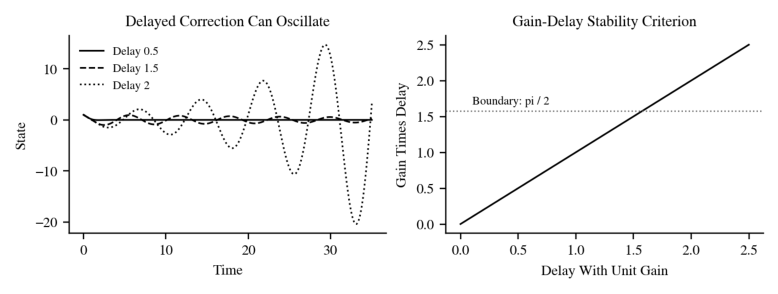
Figure 21. A forward-Euler delay equation uses dx/dt = -x(t - tau), unit prehistory and dt = 0.005. The analytic first stability boundary is gain times delay = pi/2; trajectories illustrate three delays. The delay illustration shows how a corrective response can overshoot when effects arrive after conditions change. Economic correspondence would measure investment pipelines and information timing, then compare staged commitments with stronger immediate response through shortages, excess capacity and distributed forecast-error costs.
Similar maps of firms leave their genesis unresolved. The economic problem is to specify local interaction and movement before using a reaction-diffusion model to explain an industrial district or prescribe a change in connectivity.
Mechanism And Ontological Commitments. A reaction-diffusion representation requires fields with meaningful local dynamics and a justified transport operator. Classical Turing instability further requires a homogeneous reference stable locally and destabilized for some spatial mode by transport. Knowledge, workers, capital and materials move through different channels, often directed and nonlocal. Treating them as ordinary diffusion needs evidence or a stated approximation. A candidate economic account should identify the mutually interacting quantities and the boundary conditions supporting the proposed pattern (Turing 1952; Frey and Weyer 2026).
Epistemic Design And Discriminating Evidence. Estimate local interactions separately from mobility, using firm histories, labor movement and supply relations. Compare predicted spatial responses after a measured connectivity or access change with zoning and common-shock alternatives. A match in cluster spacing provides weaker evidence than successful perturbation prediction. Regional boundaries, selected samples and heterogeneous firm sizes can change apparent wavelengths. Where the diffusion approximation is poor, compare a network transport model. Outcome validation should include productive performance and access to complements, because a visually convincing pattern can coexist with weak economic correspondence (Acemoglu et al. 2012).
Philosophical Reasoning And Practice. An emergent pattern remains dependent on its conditions and institutions. The premises support asking which couplings can be governed and whose capabilities a proposed spatial intervention serves. Cluster promotion can improve learning while increasing rents or excluding less-resourced entrants. The GR project-ecology interpretation follows whether proximity becomes usable relational support and whether that support can renew beyond established insiders. Public reasons should distinguish a causal hypothesis about pattern formation from a developmental justification for concentrating resources, with attention to alternatives for places outside the selected cluster.
Worked Comparison And Research Proposition. Imagine equal-budget regional programs. One funds physical proximity among firms; another supports measured labor, supplier and learning connections across existing locations. Compare productive trials, successor capability, local costs and network inclusion. The proposition is that mechanism-matched connectivity improves development more effectively than geometric clustering where actual transmission channels cross geographic boundaries. Proximity can prevail when tacit learning requires repeated local encounter. A strong
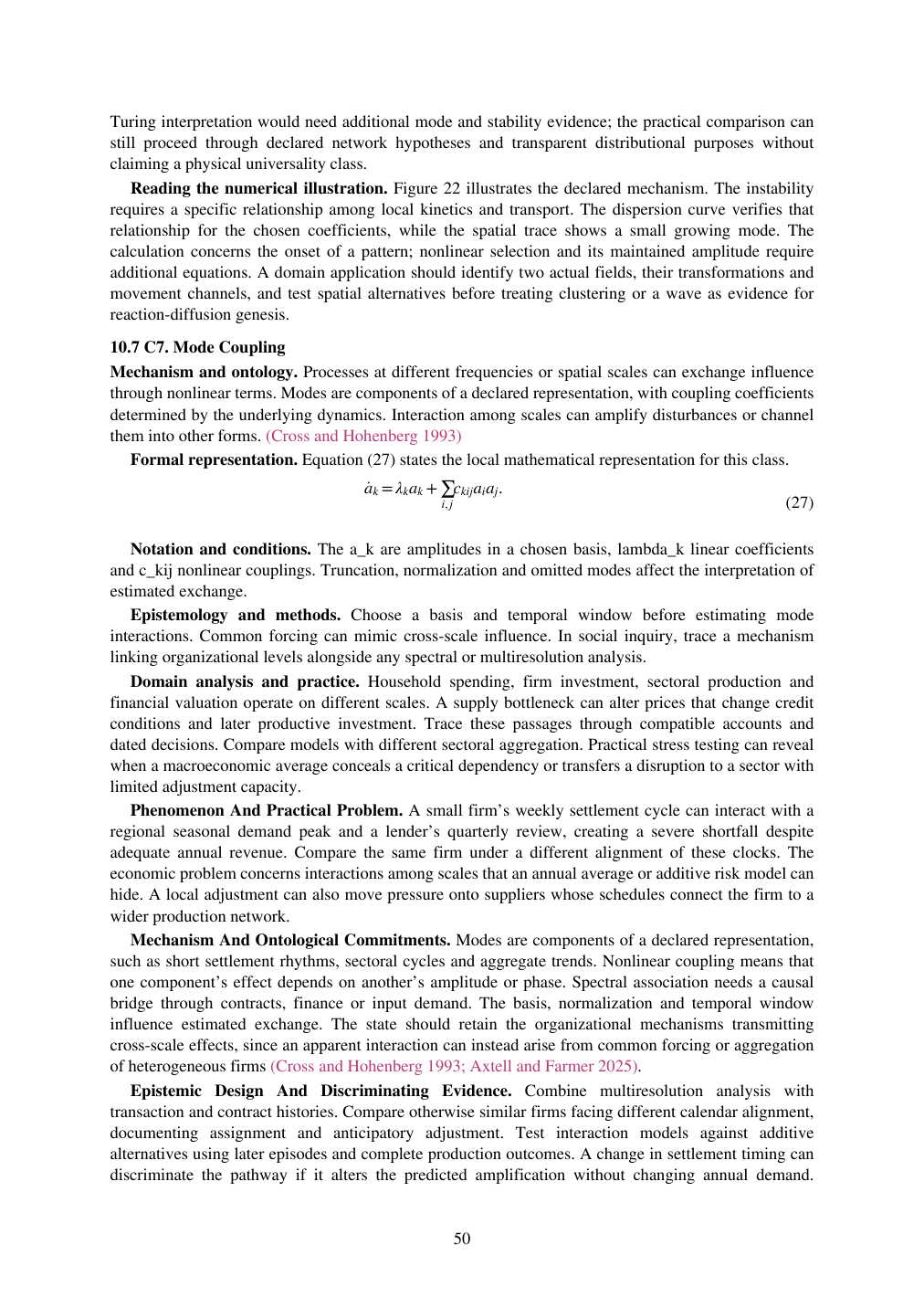
Readable text
Turing interpretation would need additional mode and stability evidence; the practical comparison can still proceed through declared network hypotheses and transparent distributional purposes without
Reading the numerical illustration. Figure 22 illustrates the declared mechanism. The instability requires a specific relationship among local kinetics and transport. The dispersion curve verifies that relationship for the chosen coefficients, while the spatial trace shows a small growing mode. The calculation concerns the onset of a pattern; nonlinear selection and its maintained amplitude require additional equations. A domain application should identify two actual fields, their transformations and movement channels, and test spatial alternatives before treating clustering or a wave as evidence for
Mechanism and ontology. Processes at different frequencies or spatial scales can exchange influence through nonlinear terms. Modes are components of a declared representation, with coupling coefficients determined by the underlying dynamics. Interaction among scales can amplify disturbances or channel
Formal representation. Equation (27) states the local mathematical representation for this class.
Notation and conditions. The a_k are amplitudes in a chosen basis, lambda_k linear coefficients and c_kij nonlinear couplings. Truncation, normalization and omitted modes affect the interpretation of
Epistemology and methods. Choose a basis and temporal window before estimating mode interactions. Common forcing can mimic cross-scale influence. In social inquiry, trace a mechanism linking organizational levels alongside any spectral or multiresolution analysis.
Domain analysis and practice. Household spending, firm investment, sectoral production and financial valuation operate on different scales. A supply bottleneck can alter prices that change credit conditions and later productive investment. Trace these passages through compatible accounts and dated decisions. Compare models with different sectoral aggregation. Practical stress testing can reveal when a macroeconomic average conceals a critical dependency or transfers a disruption to a sector with
Phenomenon And Practical Problem. A small firm’s weekly settlement cycle can interact with a regional seasonal demand peak and a lender’s quarterly review, creating a severe shortfall despite adequate annual revenue. Compare the same firm under a different alignment of these clocks. The economic problem concerns interactions among scales that an annual average or additive risk model can hide. A local adjustment can also move pressure onto suppliers whose schedules connect the firm to a
Mechanism And Ontological Commitments. Modes are components of a declared representation, such as short settlement rhythms, sectoral cycles and aggregate trends. Nonlinear coupling means that one component’s effect depends on another’s amplitude or phase. Spectral association needs a causal bridge through contracts, finance or input demand. The basis, normalization and temporal window influence estimated exchange. The state should retain the organizational mechanisms transmitting cross-scale effects, since an apparent interaction can instead arise from common forcing or aggregation of heterogeneous firms (Cross and Hohenberg 1993; Axtell and Farmer 2025).
Epistemic Design And Discriminating Evidence. Combine multiresolution analysis with transaction and contract histories. Compare otherwise similar firms facing different calendar alignment, documenting assignment and anticipatory adjustment. Test interaction models against additive alternatives using later episodes and complete production outcomes. A change in settlement timing can discriminate the pathway if it alters the predicted amplification without changing annual demand.
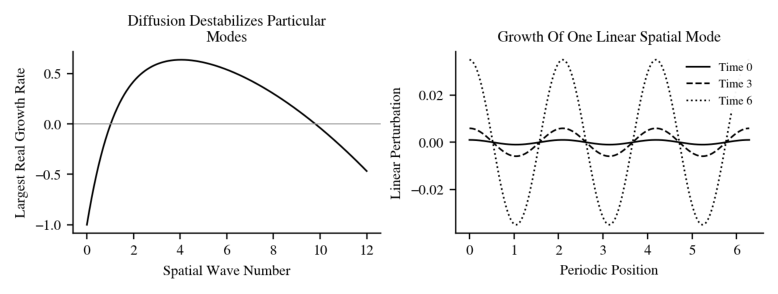
Figure 22. The local Jacobian is [[1,2],[-2,-3]], with diffusion 0.01 and 1. Homogeneous kinetics are stable; some nonzero spatial modes grow. The right panel propagates wave number three in the linearized periodic system. The spatial-pattern illustration shows one local-interaction and transport mechanism under explicit conditions. Economic correspondence would validate learning, cost and mobility channels, distinguish zoning and network alternatives, and test whether the intervention improves productive capability beyond reproducing a visually similar cluster.
Results should be robust to reasonable time windows and aggregation rules. Trace counterparties to detect shifted shortages, and report uncertainty arising from truncated modes and unobserved commitments instead of interpreting every cross-frequency feature as influence.
Philosophical Reasoning And Practice. Scale is an analytical choice with consequences for responsibility. A firm’s apparent liquidity weakness can depend partly on coordination rules set elsewhere. The premises support examining contribution and available authority across levels, while avoiding an automatic transfer of every obligation to a central institution. The GR inquiry asks whether an intervention preserves valuable productive relations throughout the relevant ecology (Huang 2026c). A local rescue can be justified for a bounded function, but public reasons should identify the wider dependencies and burdens it leaves unresolved, including those borne by actors outside the statistical sample.
Worked Comparison And Research Proposition. Imagine equal-cost working-capital arrangements. One gives a fixed annual reserve; another aligns a smaller reserve with validated settlement and seasonal interactions while preserving transparent access. Compare completed production, borrowing cost and losses propagated to counterparties. The proposition is that interactionaware timing improves retained capacity where cross-scale alignment drives shortfall. It can fail when forecasting errors or coordination overhead dominate. Assessment should compare against simple robust reserves and test whether the system remains workable when the historical calendar changes, with explicit reasons for the distribution of protection across firms and workers.
Reading the numerical illustration. Figure 23 illustrates the declared mechanism. An observed component can be generated through interaction with another mode even when its own isolated rate is decaying. The exact solution identifies the quadratic channel and compares it with the decoupled rule. Modes here are defined dynamical coordinates with a stated transformation. A domain use should justify its frequency, scale or representational decomposition and test the corresponding coupling operation. Mere association between levels leaves that operative relation to be established.
10.8 C8. Stochastic Escape
Mechanism and ontology. Random perturbations can move a system between long-lived regimes. A basin, transition path and noise model specify the account. Escape can occur while the local stability of the original regime persists, making it distinct from a bifurcation-induced transition. (Ashwin et al. 2012; Boettiger and Hastings 2012)
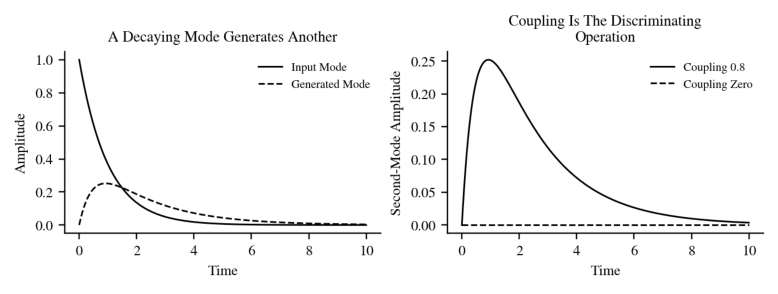
Figure 23. The input mode obeys db/dt = -b, while da/dt = -0.5a + 0.8b squared, with b(0)=1 and a(0)=0. The second panel removes only the coupling term. The mode panel generates one component through quadratic coupling to another decaying component. Economic correspondence would separately justify a scale or frequency decomposition, connect it to settlement and finance operations, and test the proposed coupling against additive models and common forcing under declared conditions.
Formal representation. Equation (28) states the local mathematical representation for this class.
dx=−V ′(x)dt+√2D dWt. (28)
Notation and conditions. V is a specified potential, D positive noise intensity and W standard Wiener noise. General non-gradient dynamics require another drift representation. The potential and noise conventions determine barrier and escape interpretations.
Epistemology and methods. Estimate residence times and compare escape-rate predictions across disturbance levels. Validate the assumed potential or use a more general non-gradient model. A selected historical transition leaves the frequency of comparable non-transitions essential to assessing a warning signal.
Domain analysis and practice. A disturbance can move an economy or firm between long-lived financing and production regimes. Similar disturbances can also be absorbed. Include surviving episodes when estimating transition risk. Compare a barrier-crossing model with a deteriorating balance-sheet mechanism and an external policy change. A reserve or diversification proposal should identify the modeled disruption family and its effects on recovery costs, credit access and the distribution of losses.
Phenomenon And Practical Problem. A productive partnership can survive ordinary variation yet break after an unexpected payment dispute, moving its members into a less cooperative arrangement. Compare that departure with a partnership whose underlying returns steadily deteriorate. The first concerns disturbance-driven escape from a still-viable regime; the second concerns changed viability. The economic problem is to identify which process occurred before choosing mediation, reserve support, restructuring or a justified end to the relation.
Mechanism And Ontological Commitments. A stochastic-escape account specifies persistent regimes, transition paths and a disturbance process. In a partnership, commitments, trust and outside options can define these objects only through an explicit behavioral and institutional model. A scalar potential is appropriate for some simplified constructions; strategic and directed interactions may require non-gradient dynamics. Local corrective responses can persist even when a perturbation crosses a transition boundary. The relevant ontology includes feasible alternative relations and the resources required to enter them alongside the observed continuing partnership (Ashwin et al. 2012).
Epistemic Design And Discriminating Evidence. Compare transitions with similar disturbances that did not cause departure, retaining the full exposure record. Estimate residence and restoration times
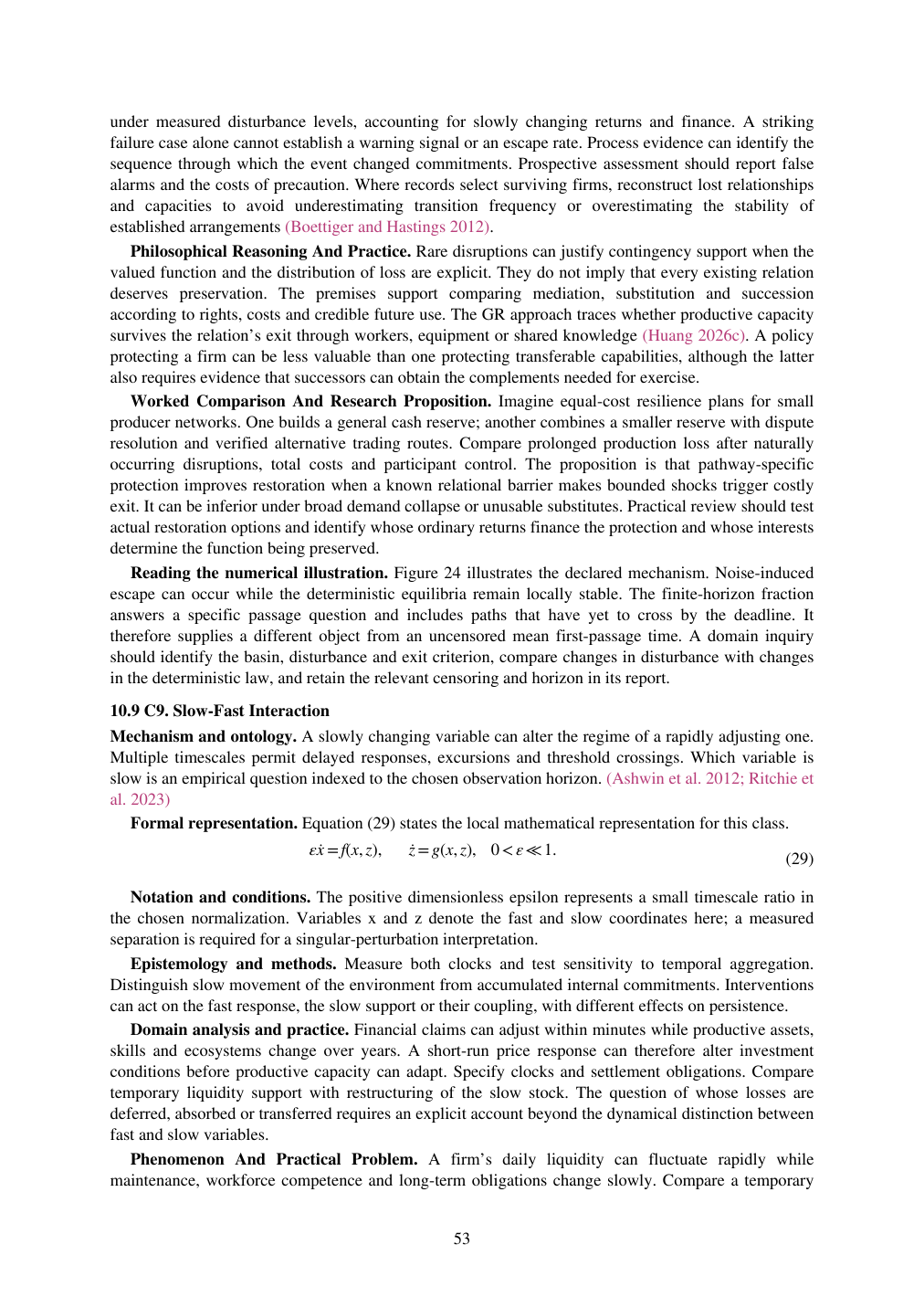
Readable text
under measured disturbance levels, accounting for slowly changing returns and finance. A striking failure case alone cannot establish a warning signal or an escape rate. Process evidence can identify the sequence through which the event changed commitments. Prospective assessment should report false alarms and the costs of precaution. Where records select surviving firms, reconstruct lost relationships and capacities to avoid underestimating transition frequency or overestimating the stability of established arrangements (Boettiger and Hastings 2012).
Philosophical Reasoning And Practice. Rare disruptions can justify contingency support when the valued function and the distribution of loss are explicit. They do not imply that every existing relation deserves preservation. The premises support comparing mediation, substitution and succession according to rights, costs and credible future use. The GR approach traces whether productive capacity survives the relation’s exit through workers, equipment or shared knowledge (Huang 2026c). A policy protecting a firm can be less valuable than one protecting transferable capabilities, although the latter also requires evidence that successors can obtain the complements needed for exercise.
Worked Comparison And Research Proposition. Imagine equal-cost resilience plans for small producer networks. One builds a general cash reserve; another combines a smaller reserve with dispute resolution and verified alternative trading routes. Compare prolonged production loss after naturally occurring disruptions, total costs and participant control. The proposition is that pathway-specific protection improves restoration when a known relational barrier makes bounded shocks trigger costly exit. It can be inferior under broad demand collapse or unusable substitutes. Practical review should test actual restoration options and identify whose ordinary returns finance the protection and whose interests
Reading the numerical illustration. Figure 24 illustrates the declared mechanism. Noise-induced escape can occur while the deterministic equilibria remain locally stable. The finite-horizon fraction answers a specific passage question and includes paths that have yet to cross by the deadline. It therefore supplies a different object from an uncensored mean first-passage time. A domain inquiry should identify the basin, disturbance and exit criterion, compare changes in disturbance with changes in the deterministic law, and retain the relevant censoring and horizon in its report.
Mechanism and ontology. A slowly changing variable can alter the regime of a rapidly adjusting one. Multiple timescales permit delayed responses, excursions and threshold crossings. Which variable is slow is an empirical question indexed to the chosen observation horizon. (Ashwin et al. 2012; Ritchie et
Formal representation. Equation (29) states the local mathematical representation for this class.
Notation and conditions. The positive dimensionless epsilon represents a small timescale ratio in the chosen normalization. Variables x and z denote the fast and slow coordinates here; a measured separation is required for a singular-perturbation interpretation.
Epistemology and methods. Measure both clocks and test sensitivity to temporal aggregation. Distinguish slow movement of the environment from accumulated internal commitments. Interventions can act on the fast response, the slow support or their coupling, with different effects on persistence.
Domain analysis and practice. Financial claims can adjust within minutes while productive assets, skills and ecosystems change over years. A short-run price response can therefore alter investment conditions before productive capacity can adapt. Specify clocks and settlement obligations. Compare temporary liquidity support with restructuring of the slow stock. The question of whose losses are deferred, absorbed or transferred requires an explicit account beyond the dynamical distinction between
Phenomenon And Practical Problem. A firm’s daily liquidity can fluctuate rapidly while maintenance, workforce competence and long-term obligations change slowly. Compare a temporary
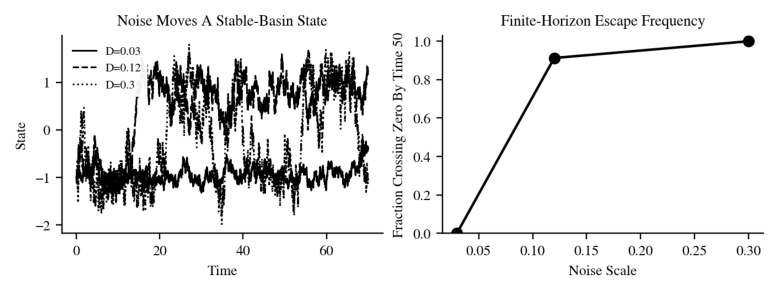
Figure 24. Euler-Maruyama paths follow dx = (x - x cubed)dt + sqrt(2D)dW. The escape panel uses 700 additional paths per noise condition and counts first crossings of zero before time fifty. The escape illustration shows a disturbance moving a system between long-lived regimes while local viability remains. Economic correspondence would identify relational transition paths, include comparable non-transitions and test whether contingency or substitute supports reduce prolonged productive loss at defensible cost.
cash interruption in a healthy operation with repeated interruptions generated by deteriorating productive support. Their immediate balances can coincide. The economic problem is to identify whether fast symptoms arise from slow internal change, external demand or their coupling, so that short-term relief does not repeatedly postpone a condition that requires renewal or restructuring.
Mechanism And Ontological Commitments. A slow-fast account assigns clocks to specified variables and tests their relative adjustment. Cash, orders and utilization can respond quickly; equipment condition, trust or training can move more slowly under the chosen horizon. A slow variable can shift the range of fast behavior, sometimes producing abrupt change after gradual accumulation. The model should preserve feasible bounds and distinguish stocks from flows. Several slow supports can have different renewal conditions, making a single aggregate capacity measure an approximation requiring justification (Ritchie et al. 2023; Nelson and Winter 1982).
Epistemic Design And Discriminating Evidence. Combine transaction-frequency observations with condition, competence and obligation histories. Compare similar demand exposure across firms with different slow trajectories. Test whether repair, retraining or restructuring changes the subsequent fast response as predicted. An immediate liquidity improvement supplies incomplete evidence of productive renewal. Temporal aggregation can hide threshold crossings or confuse cohort replacement with slow change. Model validation should separately assess short-horizon completion and longerhorizon support evolution, with attention to firms leaving the dataset and capacities transferring to successors after exit.
Philosophical Reasoning And Practice. A rescue distributes present relief and future obligations among different claimants. The premises support distinguishing temporary interruption from depletion of the capacity worth preserving. The GR inquiry asks what exercise can renew and who can later use the resulting support (Huang 2026c). This makes a bridge loan, a repair investment and a succession plan different interventions with different warrants. A justified decision should state the valued function, evidence of feasibility and opportunity costs, while considering workers and suppliers whose practical options can deteriorate during an extended diagnostic or adjustment period.
Worked Comparison And Research Proposition. Imagine equal-cost support packages for firms with recurring cash shortfalls. One offers repeated short loans; another diagnoses and addresses a measured slow constraint while providing bounded immediate protection. Compare useful production, debt, retained competence and restoration after shocks. The proposition is that slow-driver support reduces recurrent fast failure where the proposed coupling is empirically established. A loan can remain preferable for a healthy firm facing a genuinely temporary disturbance. Practical appraisal should
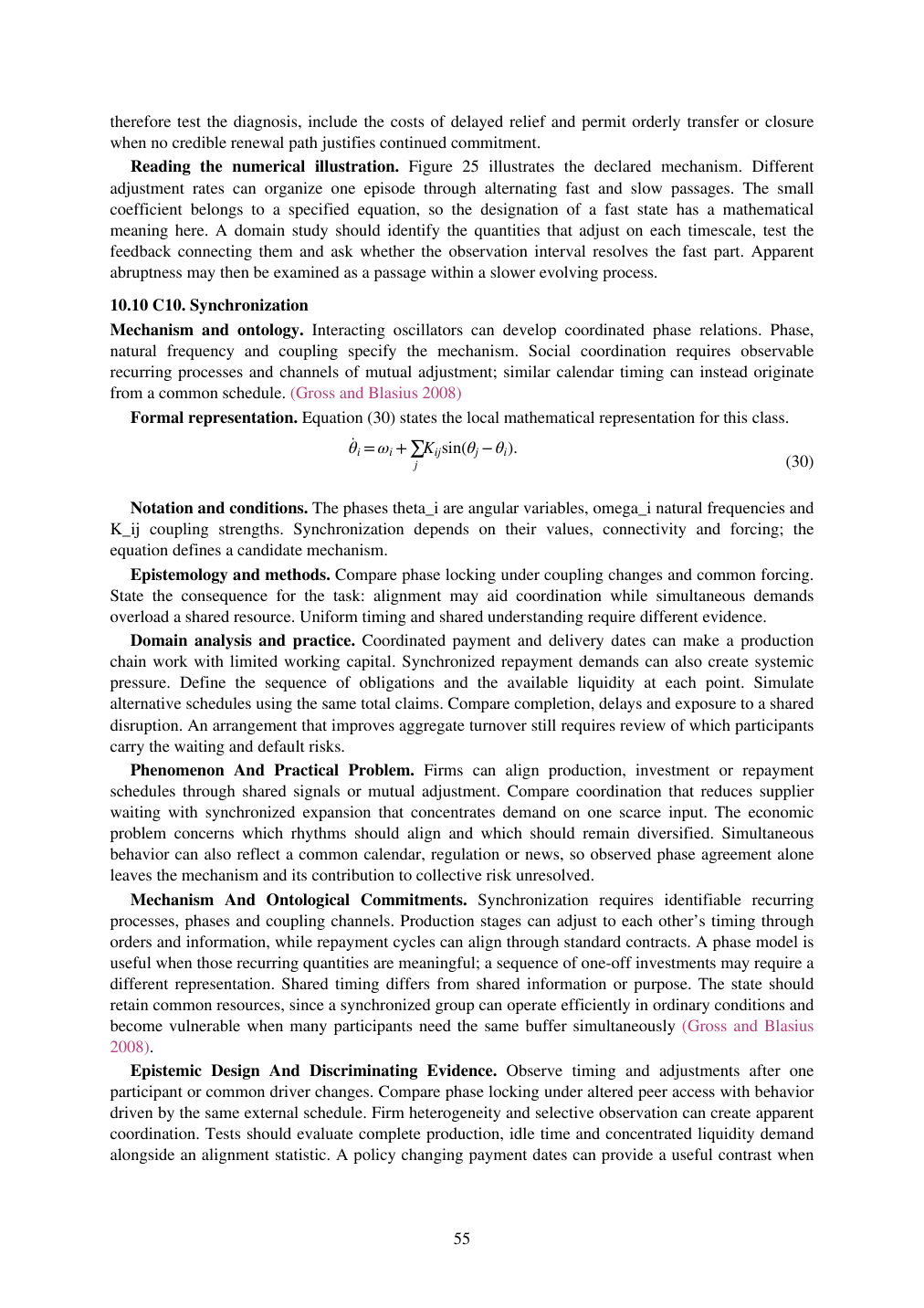
Readable text
therefore test the diagnosis, include the costs of delayed relief and permit orderly transfer or closure when no credible renewal path justifies continued commitment.
Reading the numerical illustration. Figure 25 illustrates the declared mechanism. Different adjustment rates can organize one episode through alternating fast and slow passages. The small coefficient belongs to a specified equation, so the designation of a fast state has a mathematical meaning here. A domain study should identify the quantities that adjust on each timescale, test the feedback connecting them and ask whether the observation interval resolves the fast part. Apparent abruptness may then be examined as a passage within a slower evolving process.
Mechanism and ontology. Interacting oscillators can develop coordinated phase relations. Phase, natural frequency and coupling specify the mechanism. Social coordination requires observable recurring processes and channels of mutual adjustment; similar calendar timing can instead originate
Formal representation. Equation (30) states the local mathematical representation for this class.
Notation and conditions. The phases theta_i are angular variables, omega_i natural frequencies and K_ij coupling strengths. Synchronization depends on their values, connectivity and forcing; the
Epistemology and methods. Compare phase locking under coupling changes and common forcing. State the consequence for the task: alignment may aid coordination while simultaneous demands overload a shared resource. Uniform timing and shared understanding require different evidence.
Domain analysis and practice. Coordinated payment and delivery dates can make a production chain work with limited working capital. Synchronized repayment demands can also create systemic pressure. Define the sequence of obligations and the available liquidity at each point. Simulate alternative schedules using the same total claims. Compare completion, delays and exposure to a shared disruption. An arrangement that improves aggregate turnover still requires review of which participants
Phenomenon And Practical Problem. Firms can align production, investment or repayment schedules through shared signals or mutual adjustment. Compare coordination that reduces supplier waiting with synchronized expansion that concentrates demand on one scarce input. The economic problem concerns which rhythms should align and which should remain diversified. Simultaneous behavior can also reflect a common calendar, regulation or news, so observed phase agreement alone leaves the mechanism and its contribution to collective risk unresolved.
Mechanism And Ontological Commitments. Synchronization requires identifiable recurring processes, phases and coupling channels. Production stages can adjust to each other’s timing through orders and information, while repayment cycles can align through standard contracts. A phase model is useful when those recurring quantities are meaningful; a sequence of one-off investments may require a different representation. Shared timing differs from shared information or purpose. The state should retain common resources, since a synchronized group can operate efficiently in ordinary conditions and become vulnerable when many participants need the same buffer simultaneously (Gross and Blasius Epistemic Design And Discriminating Evidence. Observe timing and adjustments after one participant or common driver changes. Compare phase locking under altered peer access with behavior driven by the same external schedule. Firm heterogeneity and selective observation can create apparent coordination. Tests should evaluate complete production, idle time and concentrated liquidity demand alongside an alignment statistic. A policy changing payment dates can provide a useful contrast when
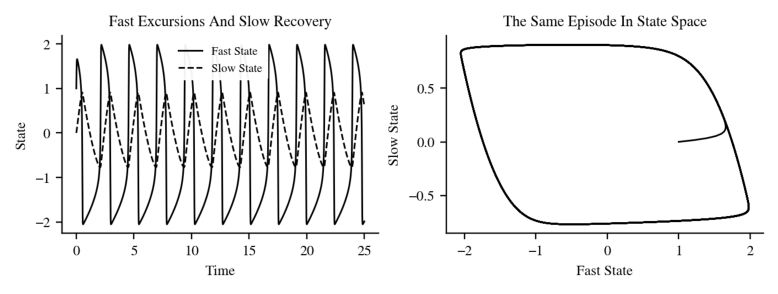
Figure 25. A relaxation oscillator follows 0.03 dx/dt = x - x cubed/3 - z and dz/dt = x + 0.5. The phase trace retains the coupled fast excursions and slow recovery. The slow-fast illustration shows gradual support change altering rapid activity and interruptions. Economic correspondence would measure both clocks, discriminate temporary shocks from internal depletion and compare liquidity relief with renewal or succession through complete production, debt and retained capabilities.
its assignment and other effects are documented. Validate the coupling model on later disturbances, including cases where synchrony breaks or a common input becomes scarce (Axtell and Farmer 2025).
Philosophical Reasoning And Practice. Coordination acquires value through the productive possibilities it enables and the risks it distributes. The premises support evaluating both reliable combination and participants’ capacity to adapt their own timing. A powerful buyer’s synchronization requirement can improve its efficiency while shifting inventory and work instability to suppliers. The GR perspective asks whether the arrangement renews shared supports and whether dependent participants can influence its terms (Huang 2026c). Practical reasons can favor selective coordination, combining aligned handovers with diversified reserves or adjustment windows instead of seeking a single universal level of synchronization.
Worked Comparison And Research Proposition. Imagine equal-cost purchasing systems. One requires all suppliers to deliver at one weekly peak; another coordinates necessary handovers while staggering tasks sharing constrained transport and finance. Compare fulfilled orders, working capital, idle capacity and labor burden. The proposition is that selective synchronization improves joint capability where coordination benefits coexist with shared-resource congestion. It can add scheduling complexity or reduce economies of scale. A defensible decision should report those costs, test participant understanding and examine whether smaller suppliers can exercise the promised flexibility. Benefits should persist beyond one favorable calendar period before supporting a general coordination claim.
Reading the numerical illustration. Figure 26 illustrates the declared mechanism. Coordinated phase can emerge from an identified channel of mutual adjustment. The finite group and finite horizon determine the displayed comparison; a thermodynamic-limit transition would require additional analysis. A domain application should establish an observable recurring operation, its phase convention and the pathway by which participants adjust. Common calendar forcing and selection into similarly timed activity provide rival explanations that need separate treatment before a synchronization mechanism is inferred.
10.11 C11. Co-Evolving Network Topology
Mechanism and ontology. Component states alter relations, and changed relations alter subsequent states. A temporal graph therefore forms part of the state description. Tie creation, deletion and reweighting have distinct meanings that must survive comparison across periods. (Gross and Blasius 2008)
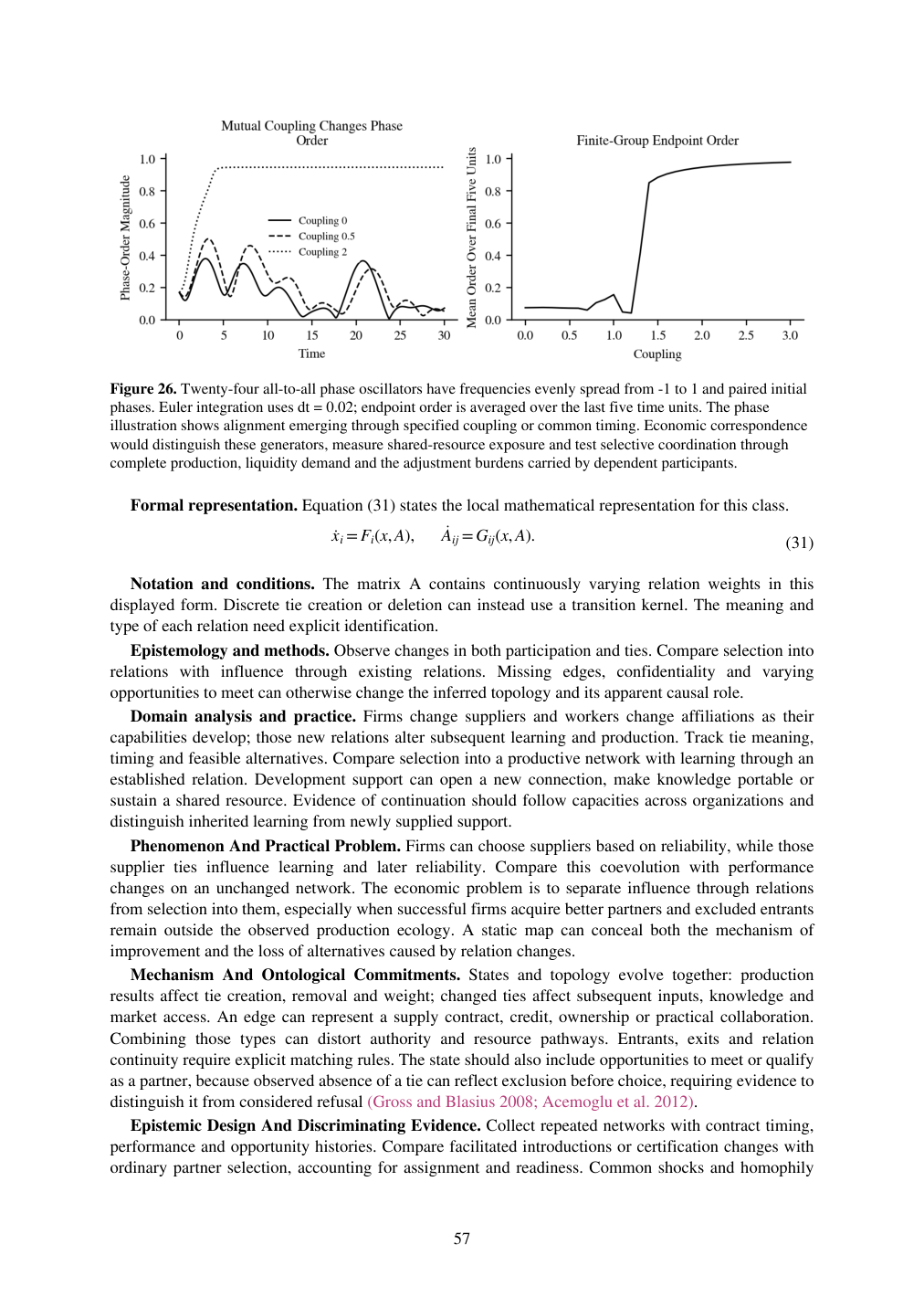
Readable text
Figure 26. Twenty-four all-to-all phase oscillators have frequencies evenly spread from -1 to 1 and paired initial phases. Euler integration uses dt = 0.02; endpoint order is averaged over the last five time units. The phase illustration shows alignment emerging through specified coupling or common timing. Economic correspondence would distinguish these generators, measure shared-resource exposure and test selective coordination through complete production, liquidity demand and the adjustment burdens carried by dependent participants.
Formal representation. Equation (31) states the local mathematical representation for this class.
Notation and conditions. The matrix A contains continuously varying relation weights in this displayed form. Discrete tie creation or deletion can instead use a transition kernel. The meaning and
Epistemology and methods. Observe changes in both participation and ties. Compare selection into relations with influence through existing relations. Missing edges, confidentiality and varying opportunities to meet can otherwise change the inferred topology and its apparent causal role.
Domain analysis and practice. Firms change suppliers and workers change affiliations as their capabilities develop; those new relations alter subsequent learning and production. Track tie meaning, timing and feasible alternatives. Compare selection into a productive network with learning through an established relation. Development support can open a new connection, make knowledge portable or sustain a shared resource. Evidence of continuation should follow capacities across organizations and distinguish inherited learning from newly supplied support.
Phenomenon And Practical Problem. Firms can choose suppliers based on reliability, while those supplier ties influence learning and later reliability. Compare this coevolution with performance changes on an unchanged network. The economic problem is to separate influence through relations from selection into them, especially when successful firms acquire better partners and excluded entrants remain outside the observed production ecology. A static map can conceal both the mechanism of improvement and the loss of alternatives caused by relation changes.
Mechanism And Ontological Commitments. States and topology evolve together: production results affect tie creation, removal and weight; changed ties affect subsequent inputs, knowledge and market access. An edge can represent a supply contract, credit, ownership or practical collaboration. Combining those types can distort authority and resource pathways. Entrants, exits and relation continuity require explicit matching rules. The state should also include opportunities to meet or qualify as a partner, because observed absence of a tie can reflect exclusion before choice, requiring evidence to distinguish it from considered refusal (Gross and Blasius 2008; Acemoglu et al. 2012).
Epistemic Design And Discriminating Evidence. Collect repeated networks with contract timing, performance and opportunity histories. Compare facilitated introductions or certification changes with ordinary partner selection, accounting for assignment and readiness. Common shocks and homophily
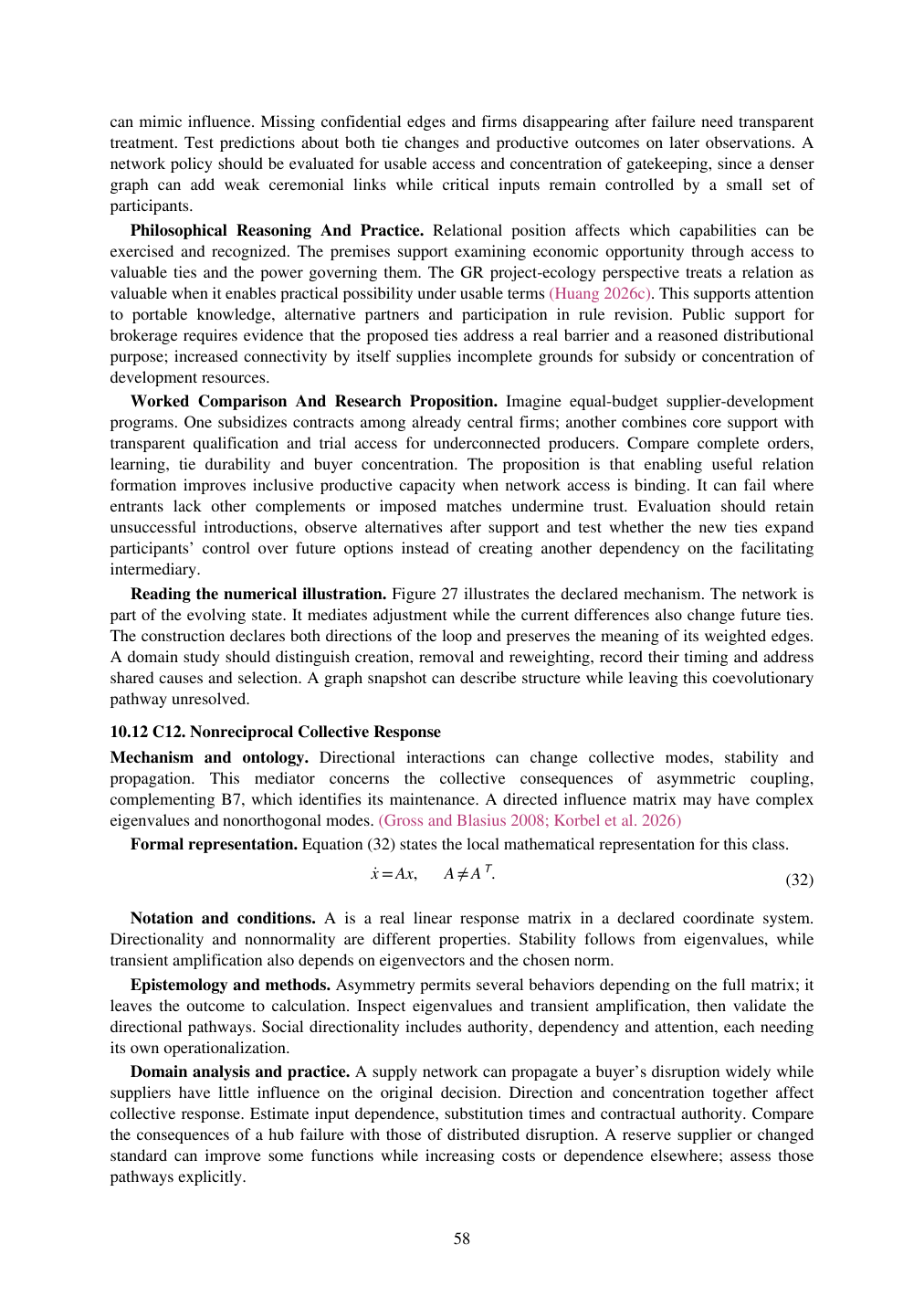
Readable text
can mimic influence. Missing confidential edges and firms disappearing after failure need transparent treatment. Test predictions about both tie changes and productive outcomes on later observations. A network policy should be evaluated for usable access and concentration of gatekeeping, since a denser graph can add weak ceremonial links while critical inputs remain controlled by a small set of
Philosophical Reasoning And Practice. Relational position affects which capabilities can be exercised and recognized. The premises support examining economic opportunity through access to valuable ties and the power governing them. The GR project-ecology perspective treats a relation as valuable when it enables practical possibility under usable terms (Huang 2026c). This supports attention to portable knowledge, alternative partners and participation in rule revision. Public support for brokerage requires evidence that the proposed ties address a real barrier and a reasoned distributional purpose; increased connectivity by itself supplies incomplete grounds for subsidy or concentration of
Worked Comparison And Research Proposition. Imagine equal-budget supplier-development programs. One subsidizes contracts among already central firms; another combines core support with transparent qualification and trial access for underconnected producers. Compare complete orders, learning, tie durability and buyer concentration. The proposition is that enabling useful relation formation improves inclusive productive capacity when network access is binding. It can fail where entrants lack other complements or imposed matches undermine trust. Evaluation should retain unsuccessful introductions, observe alternatives after support and test whether the new ties expand participants’ control over future options instead of creating another dependency on the facilitating
Reading the numerical illustration. Figure 27 illustrates the declared mechanism. The network is part of the evolving state. It mediates adjustment while the current differences also change future ties. The construction declares both directions of the loop and preserves the meaning of its weighted edges. A domain study should distinguish creation, removal and reweighting, record their timing and address shared causes and selection. A graph snapshot can describe structure while leaving this coevolutionary
Mechanism and ontology. Directional interactions can change collective modes, stability and propagation. This mediator concerns the collective consequences of asymmetric coupling, complementing B7, which identifies its maintenance. A directed influence matrix may have complex eigenvalues and nonorthogonal modes. (Gross and Blasius 2008; Korbel et al. 2026)
Formal representation. Equation (32) states the local mathematical representation for this class.
Notation and conditions. A is a real linear response matrix in a declared coordinate system. Directionality and nonnormality are different properties. Stability follows from eigenvalues, while transient amplification also depends on eigenvectors and the chosen norm.
Epistemology and methods. Asymmetry permits several behaviors depending on the full matrix; it leaves the outcome to calculation. Inspect eigenvalues and transient amplification, then validate the directional pathways. Social directionality includes authority, dependency and attention, each needing
Domain analysis and practice. A supply network can propagate a buyer’s disruption widely while suppliers have little influence on the original decision. Direction and concentration together affect collective response. Estimate input dependence, substitution times and contractual authority. Compare the consequences of a hub failure with those of distributed disruption. A reserve supplier or changed standard can improve some functions while increasing costs or dependence elsewhere; assess those
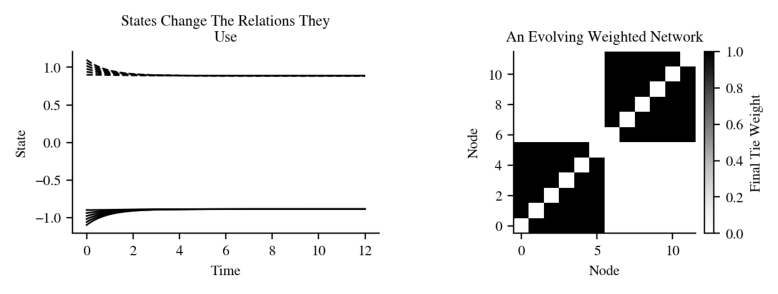
Figure 27. Twelve states adjust through current tie weights; weights relax toward exp(-state difference squared/0.08). Initial groups have stronger internal ties. The second panel displays the executed final weights. The adaptive-network illustration couples participant states with relation change. Economic correspondence would observe contract types and qualification opportunities, separate partner selection from influence and test whether new ties create usable productive options or concentrate gatekeeping and dependence.
Phenomenon And Practical Problem. A disruption at one supplier can propagate strongly through several downstream firms while an equally sized disruption in the reverse direction has little effect. Compare this with a more balanced dependency structure. Even a locally stable network can experience large temporary losses. The economic problem is to understand collective propagation, including the location and duration of burdens that aggregate annual output or eventual recovery can conceal.
Mechanism And Ontological Commitments. A directed response matrix represents specified input, finance or demand pathways in chosen coordinates. Asymmetry, nonnormality and instability are different properties. Eigenvalues concern local asymptotic behavior, while transient amplification additionally depends on modes, normalization and the measured norm. A production-network correspondence needs actual substitution and timing rules, not merely trade shares. The state should include buffers and feasible alternatives where they materially change response. Collective directionality can be maintained by contracts, authority or resource specificity, each requiring an empirical interpretation (Gross and Blasius 2008; Acemoglu et al. 2012).
Epistemic Design And Discriminating Evidence. Estimate directional responses from welldocumented disturbances, distinguishing common shocks from transmitted effects. Compare disruptions at different network positions while accounting for size, inventories and substitutes. Validate predicted transient peaks and restoration on later events. Uncertainty in the matrix should propagate into allocation comparisons. A stable linear model can fail when rationing, default or rewiring becomes important, requiring explicit limits to the operating range. Evaluate production completion, wage interruption and losses among dependent contributors alongside a systemwide aggregate to reveal the distribution of amplification.
Philosophical Reasoning And Practice. System recovery leaves a justice question about whose capabilities absorbed the disruption. The premises support investigating contribution, authority and available precautions before assigning responsibility. A central firm’s protection can preserve widespread activity or shield its owners while transferring losses to weaker nodes. The GR perspective follows the valuable function and successor supports, giving collective benefit an identification criterion beyond organizational survival (Huang 2026c). Public or contractual reasons should explain which losses determine the objective and why the chosen boundary includes some contributors and excludes others, with a route to contest consequential omissions.
Worked Comparison And Research Proposition. Imagine equal-cost contingency plans. One distributes reserves according to sales; another targets validated propagation pathways while preserving transparent eligibility and independent review. Compare useful output, transient losses, concentration
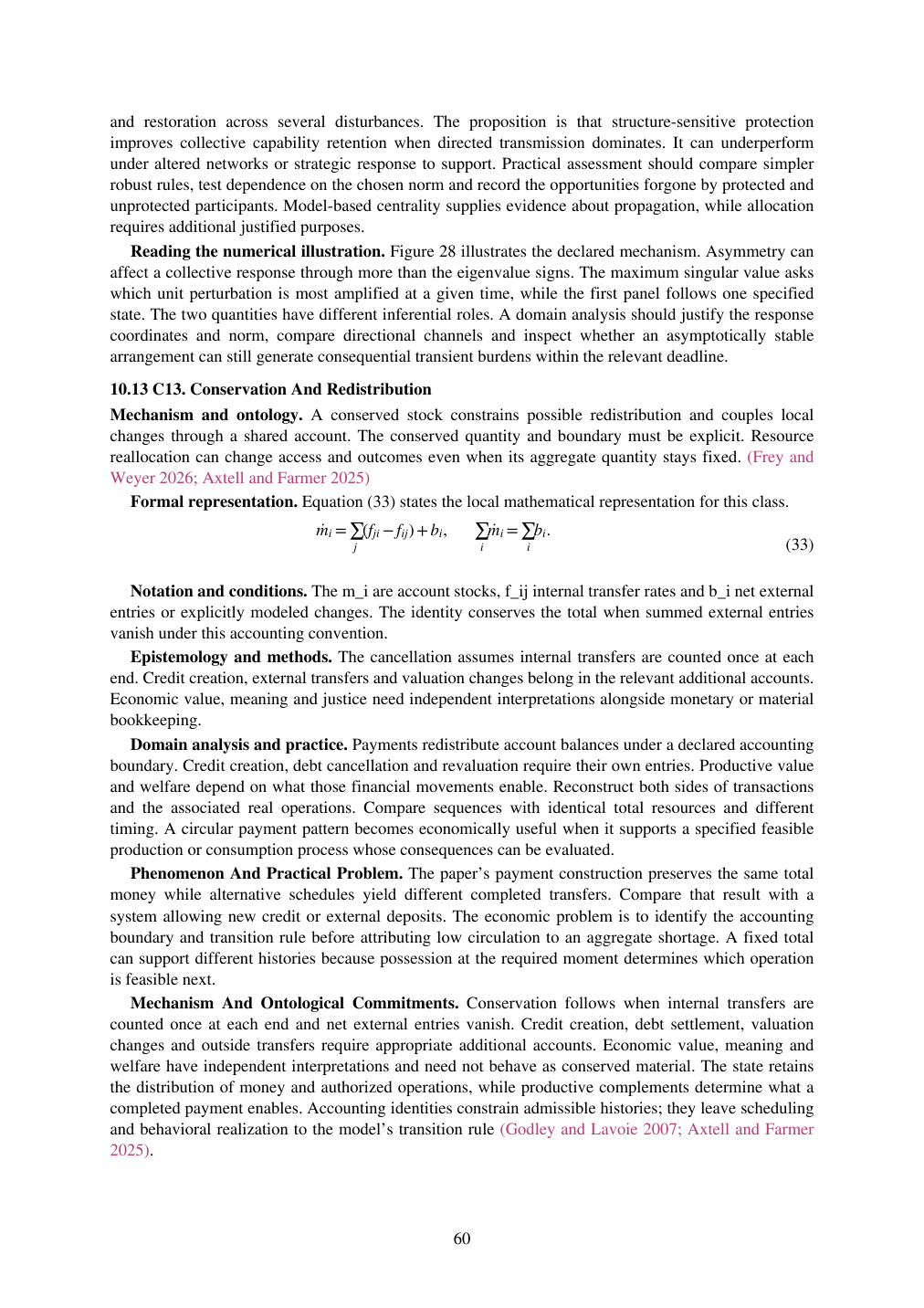
Readable text
and restoration across several disturbances. The proposition is that structure-sensitive protection improves collective capability retention when directed transmission dominates. It can underperform under altered networks or strategic response to support. Practical assessment should compare simpler robust rules, test dependence on the chosen norm and record the opportunities forgone by protected and unprotected participants. Model-based centrality supplies evidence about propagation, while allocation
Reading the numerical illustration. Figure 28 illustrates the declared mechanism. Asymmetry can affect a collective response through more than the eigenvalue signs. The maximum singular value asks which unit perturbation is most amplified at a given time, while the first panel follows one specified state. The two quantities have different inferential roles. A domain analysis should justify the response coordinates and norm, compare directional channels and inspect whether an asymptotically stable arrangement can still generate consequential transient burdens within the relevant deadline.
Mechanism and ontology. A conserved stock constrains possible redistribution and couples local changes through a shared account. The conserved quantity and boundary must be explicit. Resource reallocation can change access and outcomes even when its aggregate quantity stays fixed. (Frey and
Formal representation. Equation (33) states the local mathematical representation for this class.
Notation and conditions. The m_i are account stocks, f_ij internal transfer rates and b_i net external entries or explicitly modeled changes. The identity conserves the total when summed external entries
Epistemology and methods. The cancellation assumes internal transfers are counted once at each end. Credit creation, external transfers and valuation changes belong in the relevant additional accounts. Economic value, meaning and justice need independent interpretations alongside monetary or material
Domain analysis and practice. Payments redistribute account balances under a declared accounting boundary. Credit creation, debt cancellation and revaluation require their own entries. Productive value and welfare depend on what those financial movements enable. Reconstruct both sides of transactions and the associated real operations. Compare sequences with identical total resources and different timing. A circular payment pattern becomes economically useful when it supports a specified feasible production or consumption process whose consequences can be evaluated.
Phenomenon And Practical Problem. The paper’s payment construction preserves the same total money while alternative schedules yield different completed transfers. Compare that result with a system allowing new credit or external deposits. The economic problem is to identify the accounting boundary and transition rule before attributing low circulation to an aggregate shortage. A fixed total can support different histories because possession at the required moment determines which operation
Mechanism And Ontological Commitments. Conservation follows when internal transfers are counted once at each end and net external entries vanish. Credit creation, debt settlement, valuation changes and outside transfers require appropriate additional accounts. Economic value, meaning and welfare have independent interpretations and need not behave as conserved material. The state retains the distribution of money and authorized operations, while productive complements determine what a completed payment enables. Accounting identities constrain admissible histories; they leave scheduling and behavioral realization to the model’s transition rule (Godley and Lavoie 2007; Axtell and Farmer
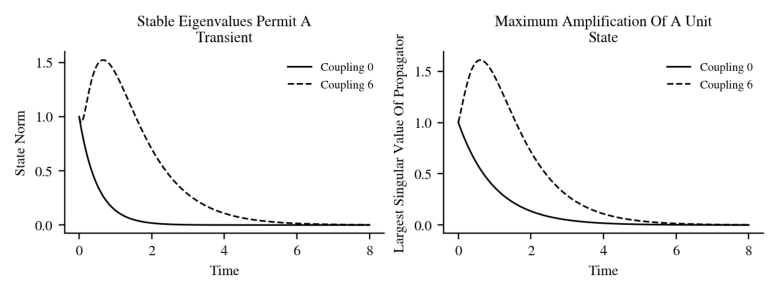
Figure 28. The triangular response matrix has diagonal rates -1 and -2 and off-diagonal coupling zero or six. Its eigenvalues are unchanged; the nonnormal propagator can transiently amplify a unit state. The directed-response illustration separates eventual stability from temporary collective amplification. Economic correspondence would validate supply or finance pathways, include buffers and substitutes, and compare protective arrangements through distributed production losses and successor capability rather than aggregate recovery alone.
Epistemic Design And Discriminating Evidence. Reconcile balances and flows before comparing schedules, including failed attempts, fees and off-ledger arrangements. Test conservation numerically within the declared construction and document changes when adding credit, queuing or netting. Real transaction data need sufficient temporal resolution because aggregation can hide recrossings and temporary shortfalls. Compare predicted completion under alternative orders using the same observed obligations, while checking whether participants would strategically change them. Productive outcomes require additional evidence about goods, labor and service received, preventing transfer count from substituting for economic benefit.
Philosophical Reasoning And Practice. A conserved aggregate does not settle distribution or the practical use of resources. The premises support examining who controls liquidity, who waits and who can authorize a transition changing access. The GR account distinguishes realized circulation from renewed capacity (Huang 2026c). Faster payments can reduce burdens and enable production, yet can also accelerate extraction or weakly justified activity. A practical decision should state the valued purpose, affected rights and opportunity costs. Equality of money stock provides a controlled comparison, while an allocation’s justice requires reasons beyond that equality.
Worked Comparison And Research Proposition. Imagine equal-balance payment systems with identical obligations. One executes attempted transfers immediately in a fixed order; another uses a declared queue that revisits temporarily unfunded payments. Compare completion, waiting, default exposure and operating cost. The proposition is that an order-sensitive feasibility rule can explain different circulation without a change in the initial stock. It leaves open whether credit or a different allocation would be superior. Evaluation should test each added operation separately and inspect who receives priority, who bears delay and whether completed transactions generate the useful activity the institutional design claims to serve.
Reading the numerical illustration. Figure 29 illustrates the declared mechanism. Conservation couples possible local changes through a common account. Local access changes materially while the aggregate stays constant. The construction specifies one stock type and a closed boundary, making its balance check meaningful. A domain application should identify what is conserved, which transfers cross the chosen boundary and which operations consume or transform the stock. Productive consequences and fair allocation require further interpretation of the paths that redistribution enables.
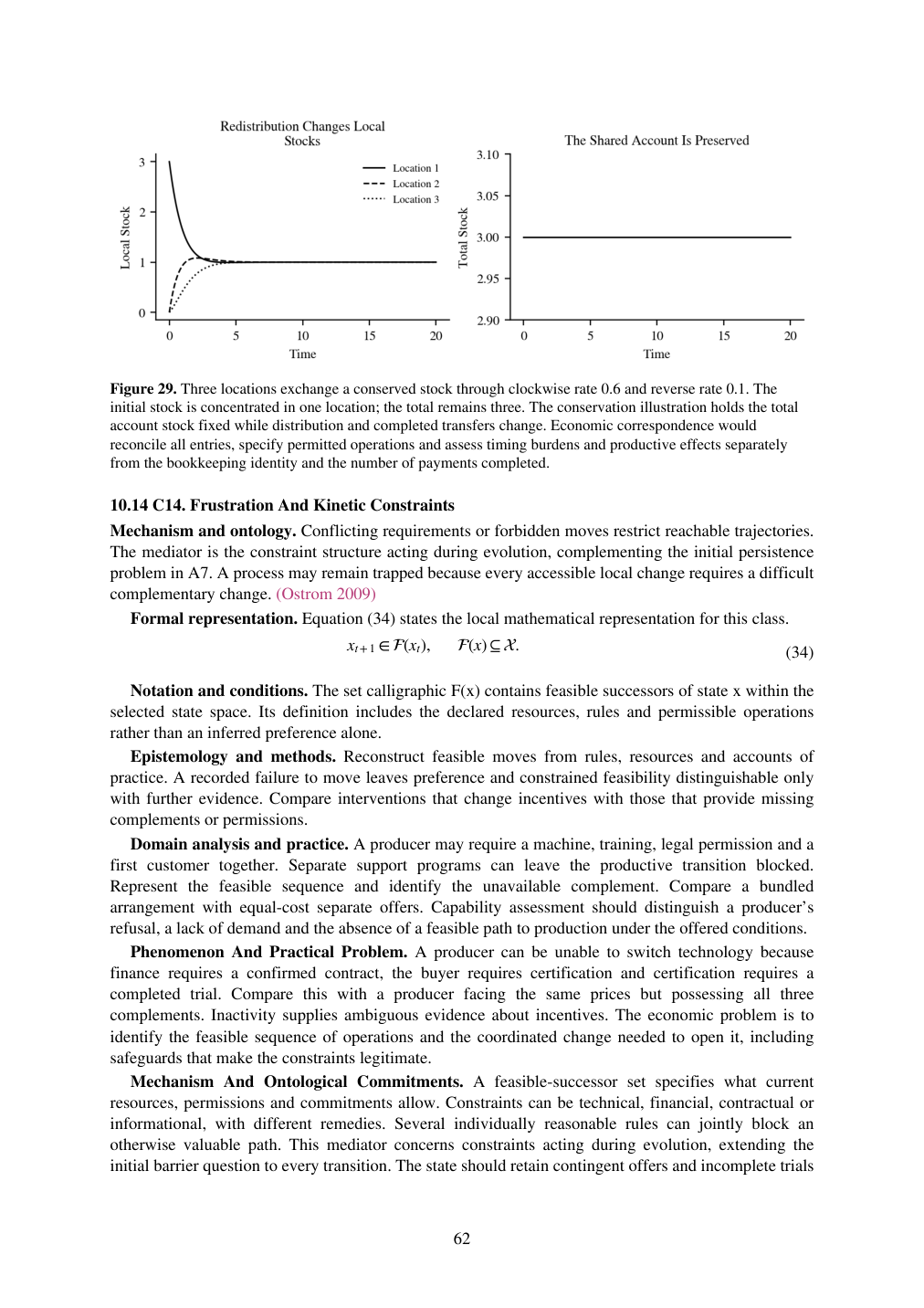
Readable text
Figure 29. Three locations exchange a conserved stock through clockwise rate 0.6 and reverse rate 0.1. The initial stock is concentrated in one location; the total remains three. The conservation illustration holds the total account stock fixed while distribution and completed transfers change. Economic correspondence would reconcile all entries, specify permitted operations and assess timing burdens and productive effects separately from the bookkeeping identity and the number of payments completed.
Mechanism and ontology. Conflicting requirements or forbidden moves restrict reachable trajectories. The mediator is the constraint structure acting during evolution, complementing the initial persistence problem in A7. A process may remain trapped because every accessible local change requires a difficult
Formal representation. Equation (34) states the local mathematical representation for this class.
Notation and conditions. The set calligraphic F(x) contains feasible successors of state x within the selected state space. Its definition includes the declared resources, rules and permissible operations
Epistemology and methods. Reconstruct feasible moves from rules, resources and accounts of practice. A recorded failure to move leaves preference and constrained feasibility distinguishable only with further evidence. Compare interventions that change incentives with those that provide missing
Domain analysis and practice. A producer may require a machine, training, legal permission and a first customer together. Separate support programs can leave the productive transition blocked. Represent the feasible sequence and identify the unavailable complement. Compare a bundled arrangement with equal-cost separate offers. Capability assessment should distinguish a producer’s refusal, a lack of demand and the absence of a feasible path to production under the offered conditions.
Phenomenon And Practical Problem. A producer can be unable to switch technology because finance requires a confirmed contract, the buyer requires certification and certification requires a completed trial. Compare this with a producer facing the same prices but possessing all three complements. Inactivity supplies ambiguous evidence about incentives. The economic problem is to identify the feasible sequence of operations and the coordinated change needed to open it, including
Mechanism And Ontological Commitments. A feasible-successor set specifies what current resources, permissions and commitments allow. Constraints can be technical, financial, contractual or informational, with different remedies. Several individually reasonable rules can jointly block an otherwise valuable path. This mediator concerns constraints acting during evolution, extending the initial barrier question to every transition. The state should retain contingent offers and incomplete trials
alongside completed contracts. Preference and feasibility remain distinct: an observed refusal can reflect an unavailable complement or a deliberate choice among accessible alternatives (Ostrom 2009).
Epistemic Design And Discriminating Evidence. Reconstruct attempted sequences through applications, conditional agreements and accounts from abandoned projects. Compare an isolated price incentive with a coordinated trial, certification and finance arrangement. Selection into assistance and expected project quality require explicit comparison. A valid process account predicts the next blocking condition and changes its prediction when that condition is removed. Track later operation to see whether one constraint simply moves elsewhere. Missing safeguards and transferred default risks need separate assessment, since opening a path can weaken protections whose purpose remains justified (Cartwright and Hardie 2012).
Philosophical Reasoning And Practice. Practical economic freedom includes the intermediate actions needed to reach a valued option. The premises support considering institutional responsibility for mutually blocking rules, especially when their coordination lies within available authority. Capability reasoning provides the philosophical linkage to exercisable opportunity (Sen 2009). The GR interpretation asks whether opening the path produces usable successor capacity and who governs access to it. A one-off discretionary waiver can help a project while preserving an exclusionary system. Accountable reform should therefore identify a generalizable route with transparent conditions and reasons for retaining necessary safeguards.
Worked Comparison And Research Proposition. Imagine equal-cost technology-adoption programs. One subsidizes successful purchases after completion; another provides staged trials with conditional finance and a documented certification pathway. Compare starts, completed useful production, debt and participation by resource-constrained firms. The proposition is that transition coordination reaches viable projects excluded by missing complements more effectively than a completion rebate. It can encourage weak projects or create administrative burdens, requiring bounded trials and comparative review. Practical judgment should test additionality and examine whether the resulting capability can be exercised under ordinary terms after exceptional coordination ends.
Reading the numerical illustration. Figure 30 illustrates the declared mechanism. A missing complementary operation can block a path even when its destination is admissible. The finite construction states the feasible configurations and the proposal rule separately. A coordinated move changes reachability; it leaves the value of the destination for further judgment. A domain inquiry should identify the actual prerequisite relations, test whether the proposed complement removes the blockage, and include the authority, coordination cost and distribution of burdens required to perform it.
10.15 C15. Absorbing-State Dynamics
Mechanism and ontology. An absorbing state or set has no exit under the specified transition rule. The definition concerns the model and its boundary; an environmental intervention can alter that rule. Extinction, closure and inactivity require empirical criteria appropriate to the observed organization. (Gross and Blasius 2008)
Formal representation. Equation (35) states the local mathematical representation for this class.
P(x,A)=1 for every x∈A. (35)
Notation and conditions. P is a one-step transition kernel and A a specified absorbing set. Every state in the set remains within it with probability one under that kernel. Changed outside inputs can change the kernel.
Epistemology and methods. Here P(x,A) is the one-step probability of remaining in the absorbing set. Establish which actions and outside supports the model includes. Treat evidence of dormancy, preservation and possible re-entry separately when interpreting an apparent endpoint.
Domain analysis and practice. Bankruptcy or exhausted liquidity can become absorbing under a model that omits refinancing and organizational succession. Define whether the target is a legal firm, a production routine or the workers’ continuing capability. Trace what remains transferable after closure.
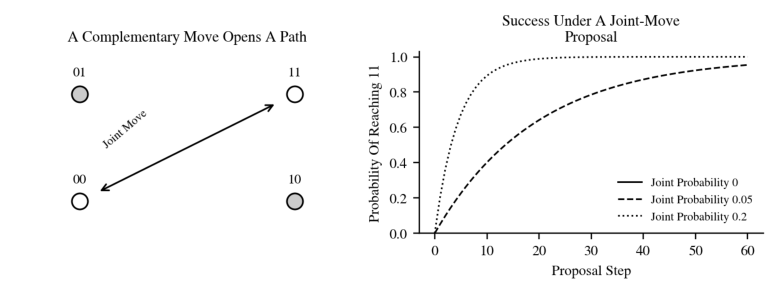
Figure 30. Only binary configurations 00 and 11 satisfy the declared compatibility constraint. Single-bit proposals cannot connect them; a simultaneous two-bit proposal succeeds with probability p per step. Gray states violate the constraint. The constrained-state illustration shows how a missing operation changes reachable futures. Economic correspondence would map finance, contract and certification sequences, compare coordination with incentives and test whether a newly feasible path creates useful capacity while preserving justified safeguards.
A restructuring proposal should state the authority, finance and complements required for re-entry. The merits of rescue, succession and liquidation depend on their consequences and the claims of affected parties.
Phenomenon And Practical Problem. A modeled firm can enter inactivity after losing finance and all permissions to trade, with no restart operation included in its rules. Compare that absorbing state with a temporarily idle firm retaining a funded order and usable equipment. Both record zero current output. The economic problem is to distinguish lack of exercise from loss of recoverable capacity and to identify which outside operation would change the process’s feasible futures.
Mechanism And Ontological Commitments. Absorption is defined by a transition kernel and a specified set. Under the declared rules, every future state remains in that set. A new owner, authorized restructuring or external support can change the kernel; its availability requires an institutional account appropriate to the actual case. The model should distinguish firm identity, productive function and the people carrying competence. Organizational exit can leave substantial capacity outside the absorbing boundary, while an intact legal shell can lack every support needed for production (Gross and Blasius 2008). Epistemic Design And Discriminating Evidence. Inventory equipment, knowledge, permissions, customer relations and unresolved obligations after exit. Compare dormant, closed and restarted organizations using explicit classification criteria. Nonreturn in a finite dataset leaves slow or unobserved re-entry routes unresolved. A restoration proposal should identify an authorized sequence and verify the complementary resources it requires. Follow failed restart attempts and capabilities carried by former workers to avoid equating observed firm survival with economic continuity. Hypothetical model absorption should be reported conditionally, with real legal and contractual possibilities examined through the relevant verified sources.
Philosophical Reasoning And Practice. The distinction changes the object of support. The premises are that valuable capability can outlive a firm and that preserving a carrier can consume resources without restoring exercise. These support comparing rescue, transfer and orderly closure through explicit purposes and claims. The GR project-ecology inquiry follows usable inheritance across changing carriers (Huang 2026c). Support for preservation requires a credible future user and a justified carrying cost. It also leaves obligations to creditors, workers and others for independent consideration; a potential productive benefit cannot automatically settle their rights or distributive claims (Sen 2009).
Worked Comparison And Research Proposition. Imagine equal-cost post-closure programs. One stores a former firm’s machinery; another preserves selected equipment, usable methods and a
Readable text
transparent successor-access arrangement while assigning outstanding responsibilities. Compare credible productive restart, successor learning and carrying costs. The proposition is that preserving enabling relations retains more valuable options than asset storage alone when knowledge and authority are decisive complements. The conclusion can reverse if demand is implausible or transfer is infeasible. Review should specify the function, horizon and conditions for releasing preserved resources to alternative uses, testing actual exercisability before describing a capacity as saved.
Reading the numerical illustration. Figure 31 illustrates the declared mechanism. Absorption is a property of the permitted transitions. Probability reaching the first state remains there under the declared matrix, so its occupancy equals the probability of passage by that deadline. A domain use should state the boundary and identify which internal operations have ceased to permit return. An external operation or a changed rule can create a different process, whose availability, cost and
Mechanism and ontology. Information changes which alternatives are retained, funded or enacted. The mechanism includes a candidate population, an observation channel, an evaluator and consequential selection. Criteria can themselves change through the actions they favor, producing a second-order
Formal representation. Equation (36) states the local mathematical representation for this class.
Notation and conditions. The scalar s_it is candidate i’s score and beta an inverse-score selectivity parameter. Scores and their scale must be specified. Softmax encodes one selection behavior with no
Epistemology and methods. This softmax is one stochastic selection rule, with beta describing selectivity. Identify the origin, meaning and accessibility of scores; retain rejected and unobserved alternatives where possible. Separate repeated selection, prediction quality and justified evaluative
Domain analysis and practice. Investment committees, markets, procurement offices and platforms select which projects receive a chance to develop. Selection changes the evidence available for later selection. Retain records of access, rejected proposals and opportunities to demonstrate capability. Compare the sponsor’s expected return with separately valued downstream benefits. Public support requires reasons concerning additionality, financing, fairness and risk; a forecast of generative renewal supplies a hypothesis to investigate within that decision.
Phenomenon And Practical Problem. An investment committee can select projects through a score emphasizing immediate revenue, causing longer-development capabilities to remain unobserved. Compare this with a committee using separate readiness and exploration criteria under the same total budget. The economic problem is to understand information as a consequential selection mechanism, including which proposals enter the candidate population and how support changes the evidence used to
Mechanism And Ontological Commitments. Selection joins candidates, observations, an evaluator and an allocation rule. A stochastic score-based rule represents a specified behavior; its selectivity and scaling need interpretation. Criteria can evolve through the projects they support, creating a second- order feedback between economic development and evaluative authority. Application requirements can also exclude unrecognized forms of capability before scoring occurs. The state should retain representations, support histories and powers to revise the rule, since these shape both feasible projects and the meaning of apparent success (Perdomo et al. 2020; Huang 2026a).
Epistemic Design And Discriminating Evidence. Preserve the candidate set, rejected alternatives, reasons and resources provided for development. Compare prediction of current performance with the
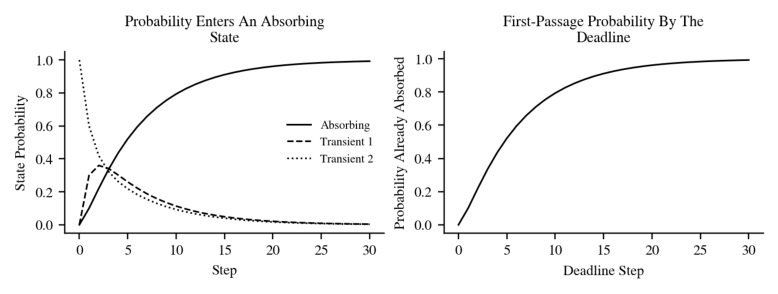
Figure 31. A three-state row-stochastic matrix has an absorbing first row [1,0,0]. Exact matrix powers give occupancy and the first-passage cumulative probability from transient state two. The absorbing-state illustration shows inactivity becoming inescapable under a declared rule. Economic correspondence would identify that boundary, trace transferable supports and test whether an authorized outside operation can restore useful production, separating firm survival from preservation of economically valuable capability.
causal effect of support on later capacity through a credible design. Equal final outcomes can conceal unequal development histories. Score ablations and independent review can reveal which criteria exclude promising alternatives or merely reproduce prior access. Evaluate costs, failures and learning from bounded exploration, with temporal validation under the population the policy itself induces. A ranking’s stability is evidence of repeated operation, while its construct validity and authority require additional inquiry.
Philosophical Reasoning And Practice. Economic evaluation has epistemic power because opportunity partly determines what can become visible as merit. The premises support distinguishing prevalence, practical force and justified use of a standard. The GR partial-order inquiry offers a framework for retaining justified comparisons without forcing every project into one complete ranking (Huang 2026b). This can make uncertainty and disagreement explicit. A decision still requires authorization, reasons and responsibility for costs. Exploratory support deserves review against a declared learning question, while familiar criteria deserve scrutiny for the capacities their routine application systematically leaves unseen.
Worked Comparison And Research Proposition. Imagine equal-budget investment portfolios. One maximizes a single current score; another reserves a bounded share for proposals that test documented gaps in the evaluator’s knowledge. Compare useful output, retained capability, opportunity costs and improvements in later selection. The proposition is that structured exploration renews economic evaluative knowledge where support is needed for capacities to manifest. It can produce weak projects or favoritism, making transparent criteria, independent challenge and limits essential. Practical assessment should ask whether revised standards gain warranted predictive and substantive relevance, not simply whether the exploratory portfolio generates reasons to continue itself.
Reading the numerical illustration. Figure 32 illustrates the declared mechanism. A selection rule acts on the information available to it. Increased intensity concentrates choice under exact scores, while observation error changes the mean probability of selecting the candidate with the highest stipulated latent score. This separates a candidate property, its manifestation and consequential selection. A domain account should validate the score for its intended purpose, examine who controls observation and selection, and preserve the opportunity to revise a criterion when its omissions become consequential.
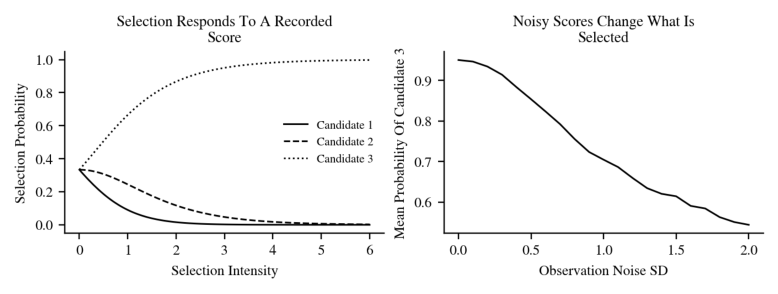
Figure 32. Softmax selection uses scores zero, one and two. The second panel adds independent Gaussian score noise, averages 10,000 readouts per noise level and fixes selection intensity at three. The selection illustration shows evaluative information redirecting support and changing future candidates. Economic correspondence would preserve development histories and excluded alternatives, distinguish predictive ranking from justified authority and test whether bounded exploration renews evaluative knowledge at an explicitly assessed cost.
11 D. Observable And Recognizable Phenomena
11.1 D1. Transport And Circulation
Mechanism and ontology. Observable currents record movement across declared boundaries or between specified states. A current is a manifestation of activity whose generating mechanism can include gradients, active conversion and rule-governed transfer. Persistent circulation can coexist with stable aggregate stocks. (Seifert 2012)
Formal representation. Equation (37) states the local mathematical representation for this class.
Jij =pikij −pjkji. (37)
Notation and conditions. The p_i are probabilities and k_ij transition rates of the chosen continuous-time Markov account. J_ij is a net oriented current. The observation resolution and state partition determine which transitions it records.
Epistemology and methods. Estimate directional transitions at a resolution sufficient to detect recrossings and missing channels. The same aggregate throughput can conceal different paths, concentrations and replenishment requirements. Interpret a recorded transfer according to what changed hands and under which terms.
Domain analysis and practice. Money, materials, claims and knowledge circulate through different relations. A high transaction count can accompany productive coordination, refinancing distress or repeated extraction. Define the object and terms of each transfer. Follow completed production episodes and changes in capabilities alongside turnover. Compare path dependence on particular intermediaries. Economic assessment can ask whether circulation renews exercisable opportunities and who controls the route through which the next contribution must pass.
Phenomenon And Practical Problem. Two payment networks can have equal total balances and transaction value while supporting different paths of production. One repeatedly transfers funds among financial accounts; another settles useful deliveries among constrained producers. Compare their gross circulation with the activities each enables. The economic problem is to identify what moves, under what terms and with which replenishment requirements before treating greater turnover as evidence of development, efficiency or valuable generativity.
Mechanism And Ontological Commitments. Circulation describes transitions across declared boundaries or between specified account states. Net and gross currents answer different questions, while recrossings and aggregation can hide important paths. Money, goods, ownership and information
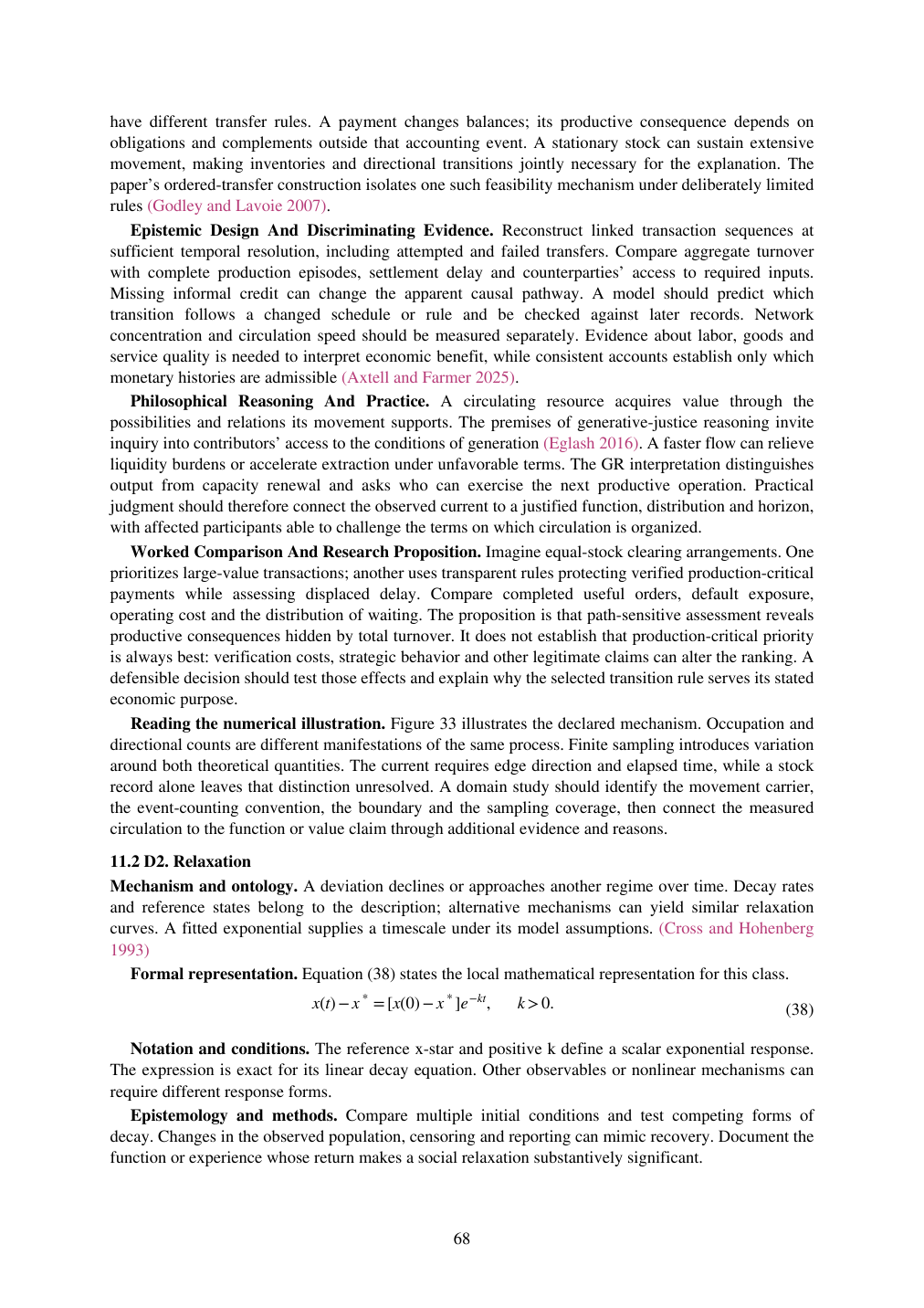
Readable text
have different transfer rules. A payment changes balances; its productive consequence depends on obligations and complements outside that accounting event. A stationary stock can sustain extensive movement, making inventories and directional transitions jointly necessary for the explanation. The paper’s ordered-transfer construction isolates one such feasibility mechanism under deliberately limited
Epistemic Design And Discriminating Evidence. Reconstruct linked transaction sequences at sufficient temporal resolution, including attempted and failed transfers. Compare aggregate turnover with complete production episodes, settlement delay and counterparties’ access to required inputs. Missing informal credit can change the apparent causal pathway. A model should predict which transition follows a changed schedule or rule and be checked against later records. Network concentration and circulation speed should be measured separately. Evidence about labor, goods and service quality is needed to interpret economic benefit, while consistent accounts establish only which monetary histories are admissible (Axtell and Farmer 2025).
Philosophical Reasoning And Practice. A circulating resource acquires value through the possibilities and relations its movement supports. The premises of generative-justice reasoning invite inquiry into contributors’ access to the conditions of generation (Eglash 2016). A faster flow can relieve liquidity burdens or accelerate extraction under unfavorable terms. The GR interpretation distinguishes output from capacity renewal and asks who can exercise the next productive operation. Practical judgment should therefore connect the observed current to a justified function, distribution and horizon, with affected participants able to challenge the terms on which circulation is organized.
Worked Comparison And Research Proposition. Imagine equal-stock clearing arrangements. One prioritizes large-value transactions; another uses transparent rules protecting verified production-critical payments while assessing displaced delay. Compare completed useful orders, default exposure, operating cost and the distribution of waiting. The proposition is that path-sensitive assessment reveals productive consequences hidden by total turnover. It does not establish that production-critical priority is always best: verification costs, strategic behavior and other legitimate claims can alter the ranking. A defensible decision should test those effects and explain why the selected transition rule serves its stated
Reading the numerical illustration. Figure 33 illustrates the declared mechanism. Occupation and directional counts are different manifestations of the same process. Finite sampling introduces variation around both theoretical quantities. The current requires edge direction and elapsed time, while a stock record alone leaves that distinction unresolved. A domain study should identify the movement carrier, the event-counting convention, the boundary and the sampling coverage, then connect the measured circulation to the function or value claim through additional evidence and reasons.
Mechanism and ontology. A deviation declines or approaches another regime over time. Decay rates and reference states belong to the description; alternative mechanisms can yield similar relaxation curves. A fitted exponential supplies a timescale under its model assumptions. (Cross and Hohenberg Formal representation. Equation (38) states the local mathematical representation for this class.
Notation and conditions. The reference x-star and positive k define a scalar exponential response. The expression is exact for its linear decay equation. Other observables or nonlinear mechanisms can
Epistemology and methods. Compare multiple initial conditions and test competing forms of decay. Changes in the observed population, censoring and reporting can mimic recovery. Document the function or experience whose return makes a social relaxation substantively significant.
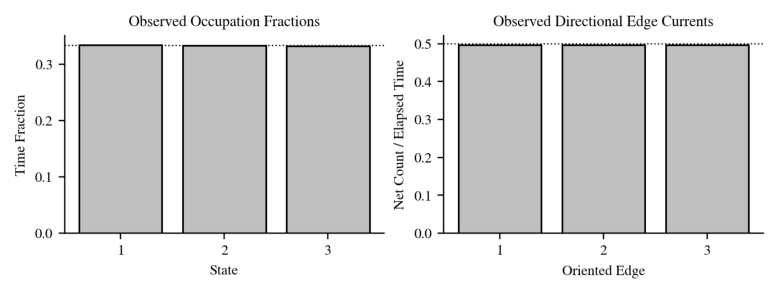
Figure 33. An executed continuous-time three-state ring is observed for 5,000 time units, with clockwise and reverse rates 2 and 0.5. Dotted lines mark exact stationary occupation one-third and edge current 0.5. The circulation illustration displays directional transitions despite unchanged aggregate stocks. Economic correspondence would trace complete payment and production paths, identify missing credit and recrossings, and assess the useful activities and timing burdens associated with a current separately from its recorded volume.
Domain analysis and practice. Recovery in output can follow repair, renewed demand, exit of weak firms or a reporting change. Define the reference function and population. Compare aggregate recovery with worker capabilities, debt burdens and lost options for entry. Longitudinal firm and household records can distinguish some pathways, with selection explicitly modeled. A practical recovery proposal should state which losses it repairs and which changes it treats as acceptable transformation.
Phenomenon And Practical Problem. A region’s recorded unemployment can fall after a factory closure because people obtain suitable work, leave the region or stop appearing in the selected register. Compare identical recovery curves under those histories. The economic problem is to identify the function and affected population whose restoration matters. A declining indicator can summarize genuine renewal or administrative disappearance, making cohort continuity and the meaning of exit essential to a defensible recovery claim.
Mechanism And Ontological Commitments. Relaxation describes movement toward a reference under specified dynamics. A simple exponential provides a conditional timescale, while heterogeneous adjustment, memory and changing opportunity can yield different forms. Employment counts, productive competence and household security have distinct references. The state should retain those losing observation and the supports enabling their next activity. An aggregate return can occur through replacement populations while opportunity remains restricted for the original cohort. Consequently, the observed curve and the operative process require separate identification (Cross and Hohenberg 1993).
Epistemic Design And Discriminating Evidence. Follow affected workers and productive capabilities across employment, retraining, migration and unresolved inactivity. Compare places with credible differences in support while documenting demand, initial skills and preexisting trends. Attrition and survivor selection require explicit bounds or sensitivity analysis. Fit competing recovery models across several initial shocks and test later outcomes. A short-run job count can hide unstable hours, debt or loss of useful competence. Evaluate whether exceptional support renews capacities that remain usable after it ends, while distinguishing inherited capability from newly acquired work that serves a different function (Nelson and Winter 1982).
Philosophical Reasoning And Practice. Recovery is a judgment about what should be restored or transformed. The premises of capability reasoning support attention to practical options and the distribution of burdens beyond an aggregate count (Sen 2009). Restoring an old production pattern may be less valuable than enabling credible alternatives, while a new job can fail to replace an important lost capability. The GR interpretation traces current exercise and successor possibilities separately. Public
reasons should state the relevant population, acceptable conditions and horizon, making migration, replacement and unresolved loss visible instead of allowing them to disappear into an improving mean.
Worked Comparison And Research Proposition. Imagine equal-cost post-closure programs. One rewards rapid placement; another combines placement with portable competence and follow-up on retained opportunity. Compare stable useful work, debt, participant control and regional support networks. The proposition is that cohort-based capability assessment discriminates substantive recovery from statistical return more effectively than the headline rate alone. Added follow-up and training can delay immediate placement or incur costs. A defensible conclusion should test those trade-offs, retain unsuccessful participants and explain which losses remain even where the aggregate series has returned to its preclosure level.
Reading the numerical illustration. Figure 34 illustrates the declared mechanism. Early agreement in a relaxation record can leave later response unresolved. The two constructions share initial level and slope, then separate because one observation combines two decaying components. A domain inquiry should compare possible hidden mixtures, replacement and changing measurement before interpreting a fitted timescale as a unique causal mechanism. Additional observations are useful when they discriminate the component structure or identify the decision-relevant future quantity across the remaining alternatives.
11.3 D3. Oscillation
Mechanism and ontology. A recurring trajectory can be autonomous, externally forced or produced by delayed feedback. Period, phase and amplitude characterize the manifestation. Its explanation requires the mechanism that renews the cycle and the resources consumed during repetition. (Cross and Hohenberg 1993)
Formal representation. Equation (39) states the local mathematical representation for this class.
x(t)=̄x +acos(ωt+φ). (39)
Notation and conditions. The mean x-bar, amplitude a, angular frequency omega and phase phi describe a sinusoidal component. The formula characterizes a signal; autonomous, forced and feedback mechanisms need separate explanatory models.
Epistemology and methods. This expression describes a simple periodic signal. Examine phase response, changes in forcing and cycle-to-cycle resource accounts before selecting a mechanism. Irregular recurrence can call for renewal or event models with variable intervals.
Domain analysis and practice. Repeated economic cycles can arise from investment lags, leverage feedback or external demand. A periodic curve supplies a descriptive starting point. Record financing, inventories and productive commitments over multiple cycles. Compare models through their response to changes in the proposed driver. Stabilization policy should address the identified passage and retain an account of how repeated adjustment burdens fall on households, workers and firms.
Phenomenon And Practical Problem. Inventories, employment and investment can rise and fall repeatedly, yet the source may be seasonal demand, delayed response or coupled resource renewal. Compare similar periodic records under these different mechanisms. The economic problem is to identify what renews the cycle and who bears its recurring costs. A regular aggregate rhythm can coexist with unstable work, concentrated default exposure or slow depletion that makes successive repetitions progressively less feasible.
Mechanism And Ontological Commitments. Period, phase and amplitude characterize the manifestation, while an explanatory model specifies the source of recurrence. A sinusoidal description can be useful without implying an autonomous business cycle. Irregular episodes may require event or renewal models. The state should include commitments carried between cycles: debt, inventories, equipment condition and learned routines. Their evolution can change the meaning of a repeated output level. Several sectoral rhythms can also combine into an apparent aggregate cycle whose components require separate economic interpretation (Cross and Hohenberg 1993; Axtell and Farmer 2025).
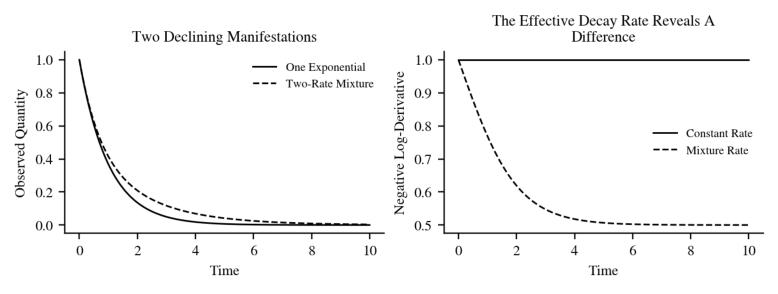
Figure 34. An exact unit-rate decay is compared with an equal mixture of rates 0.5 and 1.5. The mixture has the same initial value and initial derivative, while its later effective rate changes. The relaxation illustration shows approach toward a selected reference under a declared response law. Economic correspondence would retain affected cohorts and exit categories, test alternative recovery mechanisms and assess whether improved aggregates represent restored or newly usable capabilities under acceptable conditions.
Epistemic Design And Discriminating Evidence. Observe demand, production, finance and replenishment across several cycles at compatible resolution. Compare phase responses after measured driver changes and after interventions altering internal delay. Seasonal adjustment should be checked for instability and category changes. Spectral features generate candidate explanations; contract and decision histories test the causal links. Validate predictions of peaks, troughs and accumulated obligations in later periods. Include firms and workers leaving during downturns, since surviving panels can overstate cycle recovery and miss capacities transferred or lost between apparent repetitions.
Philosophical Reasoning And Practice. Repetition can normalize a recurring burden without justifying it. The premises support evaluating periodic instability through whose options, security and learning it affects. A viable productive cycle can merit protection while its allocation of adjustment costs warrants redesign. The GR concept of renewal asks what each exercise leaves for later productive participation (Huang 2026c). This can distinguish a cycle financing repair and competence from one repeatedly restoring output through depletion. Practical reasons should make the defended function and the opportunity cost of buffering explicit, with review when observed cycles cease matching the assumed generator.
Worked Comparison And Research Proposition. Imagine equal-cost production arrangements. One expands and contracts labor closely with each demand peak; another combines a verified buffer with paid learning and maintenance during lower-demand intervals. Compare cumulative useful output, retained competence, employment volatility and financing cost. The proposition is that cycle-aware renewal improves future capability where idle intervals can productively rebuild supports. It can underperform when demand decline is persistent or the proposed learning lacks value. Evaluation should therefore compare several plausible cycle mechanisms and examine whether apparent stability depends on transferring variability to suppliers, households or public support systems outside the firm’s accounts.
Reading the numerical illustration. Figure 35 illustrates the declared mechanism. The same recurring observation can be supported through different operations. Before withdrawal these two outputs coincide, yet the external input has a decisive causal role in one arm. The comparison identifies an intervention capable of separating the models under their assumptions. A domain account should locate what renews each cycle, compare autonomous interaction, common schedules and delayed correction, and investigate the resources and authority enabling the relevant discriminating change.
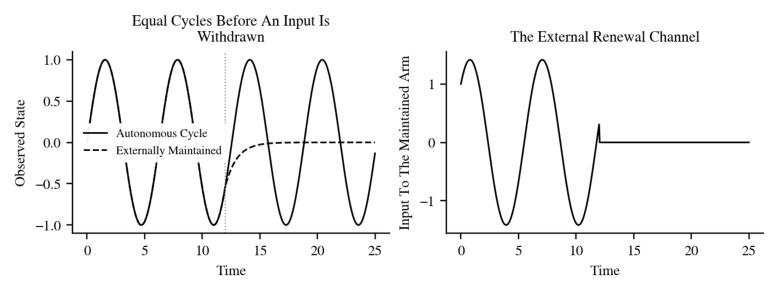
Figure 35. One observed sine is the projection of a unit autonomous rotation. Another follows dx/dt = -x + u with u = cos(t) + sin(t) until time twelve; input withdrawal separates the exact trajectories. The oscillation illustration summarizes recurring change without uniquely identifying its source. Economic correspondence would test external, delayed and resource-coupled generators, then examine complete-cycle production, replenishment and the distribution of recurring adjustment burdens among firms, workers and supporting institutions.
11.4 D4. Spatial Patterns
Mechanism and ontology. Clustering, segregation, waves, interfaces and domains are recognizable arrangements in a chosen space. The space can be geographic, organizational or representational, with its metric justified independently. Pattern description and pattern genesis are distinct analytical tasks. (Cross and Hohenberg 1993; Frey and Weyer 2026)
Formal representation. Equation (40) states the local mathematical representation for this class.
C(r)=[(u(s)−̄u)(u(s+r)−̄u)]. (40)
Notation and conditions. The field u, spatial location s and displacement r define the correlation under a chosen measure. The displayed expectation uses suitable averaging assumptions; changing boundaries or means require corresponding local definitions.
Epistemology and methods. Specify stationarity or use local alternatives when estimating a correlation function. Compare movement, local interaction, sorting and boundary effects. A pattern in an embedding also depends on the representation through which distances were constructed.
Domain analysis and practice. Industrial clusters and concentrated wealth are different patterned phenomena whose mechanisms can overlap. Define the spatial or network representation and retain ownership and access records. Compare complementarity, inherited advantage, exclusion and shared infrastructure. A policy supporting a cluster should examine who can enter, who learns and whether capacities survive outside the dominant firms. Local growth leaves the wider distribution of opportunity open to investigation.
Phenomenon And Practical Problem. Firms can cluster by industry, financial access or shared ownership, while an embedding can place companies near one another because their reports use similar language. Compare these different spaces before inferring an economic cluster. The practical problem is to specify the metric and mechanism through which proximity matters. A visible arrangement can reflect learning, sorting, licensing, common inputs or representational choices, each implying different interventions and limits to transfer.
Mechanism And Ontological Commitments. A pattern concerns identified units distributed in geographic, organizational or representational space. Geographic distance differs from travel time, supply dependence and ownership proximity. A correlation statistic describes an arrangement under averaging assumptions; its genesis requires movement and interaction rules. The state should preserve participant and relation types, especially where a cluster contains large firms with many sites or shared
Readable text
control. Changing a category or boundary can alter the apparent pattern without any change in productive capacity or participants’ practical options (Acemoglu et al. 2012).
Epistemic Design And Discriminating Evidence. Compare maps across defensible scales and metrics, linking them to entry, exit, labor movement and supplier histories. Test whether a change in a proposed interaction channel produces the predicted spatial or network response. Common policy, historical placement and selection into location provide rival accounts. An embedding should be audited for sensitivity to representation and data coverage. Predictive validity for productive tasks matters more than a visually clear cluster. Track displacement and rents after concentration-focused support, including firms whose exclusion removes them from the measured pattern (Axtell and Farmer 2025).
Philosophical Reasoning And Practice. Representation shapes which economic relations become recognizable. The premises support making the chosen space and category meanings contestable when they influence consequential development decisions. The GR framework distinguishes the manifestation from operative support and the identity criterion of the economic object (Huang 2026c). A cluster can have public value through learning and capability renewal, but concentration can also narrow participation or strengthen gatekeeping. Public reasons should therefore connect a pattern-based intervention to a validated pathway and a defended distribution of opportunity, specifying the valuable
activities that spatial density is expected to support.
Worked Comparison And Research Proposition. Imagine equal-budget regional support plans. One targets visually dense firms; another targets validated complement and learning relations, including geographically dispersed participants. Compare useful trials, successor capability, entry barriers and carrying costs. The proposition is that relation-sensitive targeting improves development where productive proximity differs from geometric proximity. Physical concentration can prevail when repeated local encounter is essential. Evaluation should retain rival metrics, test the mechanism on later outcomes and examine whether benefits accrue to the participants expected to gain access. A successful map-based forecast alone leaves the fairness and additionality of resource concentration open.
Reading the numerical illustration. Figure 36 illustrates the declared mechanism. An aggregate count can preserve a composition while losing the relations among locations. The correlation uses a declared circular metric, which makes its lag convention explicit. The construction generates one structured field and a permutation control; it leaves alternative pattern-generating mechanisms open. A domain study should justify its geographical, organizational or representational space and compare transport, selection, shared constraints and boundary effects before assigning a causal origin to a
Mechanism and ontology. Components can display coordinated displacement or collective direction. Velocity and orientation have direct physical interpretations for motion; aligned action in institutions requires a specified task and observable behavior. A collective pattern can conceal unequal contributions and divergent reasons. (Bebon, Robinson, and Speck 2025; Gross and Blasius 2008)
Formal representation. Equation (41) states the local mathematical representation for this class.
Notation and conditions. The v-hat_i are unit velocity directions and N the observed population size. Phi is their mean-direction magnitude. It measures directional alignment and leaves speed, motive,
Epistemology and methods. The polarization statistic measures alignment of unit directions. Assess speed, participation and access separately, and compare shared forcing with mutual adjustment. A useful coordination measure must identify the function served and the alternatives crowded out.
Domain analysis and practice. Coordinated investment, a run on a bank and a joint production effort are collective behaviors with different purposes and information conditions. Similar action can
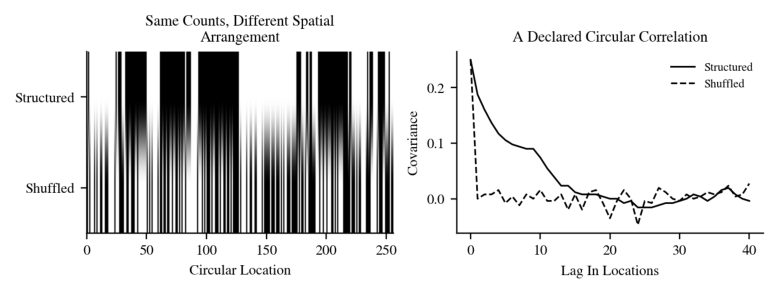
Figure 36. A median-thresholded moving-average field on 256 circular sites is compared with a permutation of the same values. The marginal counts agree; the spatial covariance distinguishes their arrangement. The pattern illustration displays structure in a declared space with explicit boundaries. Economic correspondence would validate the metric against actual production and learning relations, distinguish sorting and placement, and test interventions through capability, entry and displacement rather than visual clustering alone.
result from shared evidence, imitation or contractual compulsion. Specify the action and available alternatives. Compare public information changes with changes in peer access. A coordination intervention should identify the function it serves and assess the concentration of risk created by common action.
Phenomenon And Practical Problem. Many firms can simultaneously adopt a production method, reduce lending or purchase one input. Compare common movement caused by shared information with movement imposed by a dominant platform’s standard. The economic problem is to identify what aligned action means and whether it supports useful coordination or concentrates vulnerability. A common direction in an action representation differs from physical motion and requires a declared task, population and coding rule.
Mechanism And Ontological Commitments. Collective motion has a direct physical meaning for moving workers or goods. Applied to investment or adoption, direction is a constructed vector of economically meaningful changes. Alignment leaves magnitude, motive and access to alternatives unresolved. Similar behavior can arise through imitation, mutual adjustment, common forcing or coercive dependence. The state should include participants unable to act and those moving differently, since a highly aligned observed subset can conceal exclusion. A useful model specifies the transmission channel and the productive function served by coordinated action (Gross and Blasius 2008).
Epistemic Design And Discriminating Evidence. Observe action timing, information exposure and feasible alternatives. Compare responses to peer access changes with responses to common announcements or mandatory rules. Survey and contract evidence can distinguish understanding, anticipation and constraint. Test whether alignment predicts complete useful production, interoperability or concentrated shortage, accounting for scale and participation. A polarization-like statistic should be accompanied by the magnitude and distribution of actions. Follow independent adopters and nonadopters to identify lost alternatives and learning opportunities that a central trajectory can hide (Axtell and Farmer 2025).
Philosophical Reasoning And Practice. Coordinated economic action can widen practical possibility by making complementary investments compatible. It can also weaken autonomy when one actor defines the only usable standard. The premises support assessing both the collective function and participants’ capacity to understand, influence or leave the arrangement. The GR perspective asks whether alignment renews valuable supports across the ecology or narrows the range of future exercise (Huang 2026c). A justified standard can remain directional, but its authority requires reasons about purpose, access and revision, beyond the fact that many participants conform.
Worked Comparison And Research Proposition. Imagine equal-cost technology programs. One promotes a single proprietary interface; another supports a validated common interface with transparent access and a workable route for revision. Compare interoperability, useful adoption, switching costs and successor innovation. The proposition is that accountable coordination preserves more future capability where common standards are necessary but concentrated control restricts adaptation. A proprietary system can provide stronger immediate performance, making that advantage relevant. Practical review should compare actual tasks and transition costs, retain evidence from excluded participants and test whether the promised alternatives are technically and institutionally usable under ordinary conditions.
Reading the numerical illustration. Figure 37 illustrates the declared mechanism. An order parameter compresses a distribution of directions. The velocity field restores some of the component information hidden by that scalar, while the update rule supplies the proposed alignment mechanism. Display positions here are independent plotting locations rather than a local-interaction geography. A domain use should identify actual coordinated operations and channels of adjustment, examine who contributes or bears the costs, and preserve the distinction between behavioral alignment and participants sharing purposes or reasons.
11.6 D6. Intermittency And Chaos
Mechanism and ontology. A time series can contain bursts, irregular switching or sensitive dependence. Deterministic chaos concerns specified deterministic dynamics; stochastic variation and changing observation can produce similar irregularity. Time resolution and state reconstruction constrain the interpretation. (Cross and Hohenberg 1993; Lorenz 1963)
Formal representation. Equation (42) states the local mathematical representation for this class.
‖δx(t)‖≈‖δx(0)‖eλt. (42)
Notation and conditions. Delta x is a small initial perturbation and lambda an appropriate sensitivity exponent under the model. Finite records and noise complicate its estimation. Irregularity alone leaves several generating processes admissible.
Epistemology and methods. A positive estimated Lyapunov exponent becomes evidence for chaos only with adequate assumptions and robustness tests. Compare stochastic and nonstationary alternatives. Prediction horizons and decision horizons can remain useful even where detailed long-term prediction is limited.
Domain analysis and practice. Volatility and bursts in trade can arise from news, feedback, strategic behavior or changing market access. Compare stochastic and endogenous accounts using data and institutional detail at suitable resolution. A complex-looking price series alone leaves mechanism ambiguous. Economic practice can stress test a portfolio or service against several admissible processes and report the horizon over which the chosen decision remains robust.
Phenomenon And Practical Problem. Trade and production records can show irregular bursts and abrupt reversals that look difficult to forecast. Compare a signal driven by discrete news with one generated by endogenous feedback or a changed observation system. The economic problem is to discriminate mechanisms and identify useful decision horizons. Visual irregularity alone leaves deterministic chaos, stochastic variation and nonstationary institutions available as alternatives, while limited long-range prediction can coexist with informative short-horizon risk bounds.
Mechanism And Ontological Commitments. A chaos account requires a specified deterministic evolution and appropriate evidence of sensitive dependence. Intermittency can arise through several generators, including switching rules and slow-fast interactions. The observed series is a projection through a sampling and aggregation procedure. Changing market access or transaction classification can alter that projection. A sufficient economic state may require commitments and network relations absent from prices or output alone. Reconstruction assumptions should therefore be explicit, including their stability over the period in which an inferred attractor or sensitivity measure is interpreted (Lorenz 1963; Takens 1981).
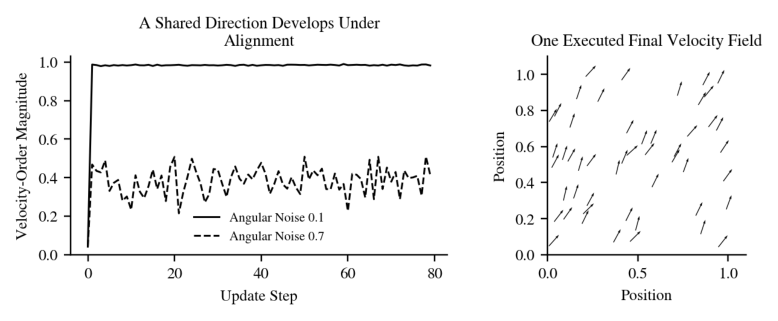
Figure 37. Fifty unit-velocity headings update toward their global mean direction plus uniform angular noise. The initial headings are shared. The quiver panel shows the lower-noise final headings at declared display positions. The alignment illustration summarizes common direction among observed components. Economic correspondence would define action vectors and transmission channels, add magnitude and participation measures, and test whether coordination improves productive compatibility while preserving workable alternatives and accountable control over shared standards.
Epistemic Design And Discriminating Evidence. Compare state-space, event-driven and deterministic reconstruction models using temporally separated validation. Test sensitivity to noise, sampling and institutional breaks, retaining rival models after rejection of a simple null. A positive estimated exponent can be an artifact under unsuitable data conditions. Operational evaluation should specify the forecast horizon and loss relevant to the decision, such as production interruption or inability to meet obligations. Stress scenarios should include unobserved but plausible processes. Historical forecasting success must be distinguished from a stronger causal explanation of the economic mechanism generating the signal.
Philosophical Reasoning And Practice. Predictive uncertainty gives a reason to make decisions robust and revisable. The premises support acknowledging consequential error costs and explaining how residual risk is distributed (Douglas 2000). They leave room for action when several admissible models support the same precaution. The GR distinction between operative relations and manifestation helps avoid equating an unpredictable record with an unknowable reality. Mechanism investigation can continue while practical choices use bounded evidence. Public or organizational reasons should identify protected capacities and accepted costs, with updating procedures that use failure to revise assumptions and practical commitments.
Worked Comparison And Research Proposition. Imagine equal-cost production-finance plans. One relies on a single detailed long-horizon forecast; another combines short-horizon updating with buffers tested across admissible disturbance and feedback models. Compare useful completion, missed obligations, unused reserves and contributor burdens. The proposition is that model-robust protection improves retained capability when mechanism uncertainty exceeds the value of fine long-run forecasts. It can be costly or overly conservative, requiring comparison with simpler alternatives. A favorable result supports the decision procedure within its tested range and should remain separate from any stillunresolved claim that the underlying economy exhibits deterministic chaos.
Reading the numerical illustration. Figure 38 illustrates the declared mechanism. The numerical comparison illustrates sensitivity in a specified deterministic system. Its log-distance trace is a finitetime diagnostic, with intervals affected by local stretching, contraction and eventual saturation. It supplies neither a Lyapunov-spectrum estimation procedure nor an identification of chaos from an arbitrary social time series. A domain investigation should compare noise, external change and
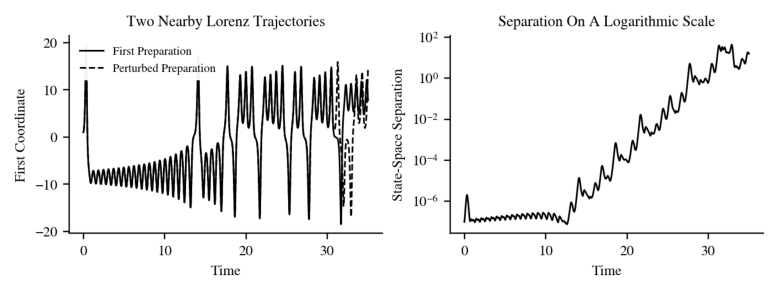
Figure 38. Two Lorenz trajectories use sigma = 10, rho = 28 and beta = 8/3, with an initial first-coordinate difference of 10 to the power -7. The finite-time separation grows and later saturates within the bounded sampled motion. The irregular illustration represents one declared generator of bursts or sensitivity. Economic correspondence would test stochastic, event and institutional alternatives, then evaluate prediction horizons and robust buffers through actual decision losses, preserving the distinction between useful protection and a stronger dynamical diagnosis.
observation artifacts, justify its reconstructed state, and report which prediction horizon remains useful under its actual evidence and error scale.
11.7 D7. Collective Phase Transitions
Mechanism and ontology. A collective order parameter can change regime as control conditions vary. A phase-transition account specifies the order parameter, control parameter, size dependence and limiting procedure. Abrupt social change can motivate this inquiry while several noncritical mechanisms remain admissible. (Cross and Hohenberg 1993; Boettiger and Hastings 2012)
Formal representation. Equation (43) states the local mathematical representation for this class.
χN =N([m2]−[m]2). (43)
Notation and conditions. The order parameter m is defined for a system of size N; chi_N is its scaled variance in the chosen ensemble. Interpretation as response susceptibility requires the relevant model and response relation.
Epistemology and methods. Treat susceptibility here as a fluctuation statistic under the chosen normalization. Test finite-size behavior and alternative explanations such as a common shock or administrative reclassification. A fitted power law alone leaves mechanism and universality unresolved.
Domain analysis and practice. A sudden shift in participation, technology adoption or market activity may indicate a collective transition or a discrete institutional change. Define the order parameter and record the rule change separately. Compare size effects and variation across networks before invoking a universality class. Policy triggers can rely on documented liquidity or capacity constraints even where the stronger phase-transition interpretation remains unsettled.
Phenomenon And Practical Problem. Technology adoption or market participation can change abruptly after a compatibility threshold, coordinated announcement or new rule. Compare these histories despite an identical jump in aggregate adoption. The economic problem is to identify the collective variable and the conditions driving change before interpreting an abrupt event as a critical phase transition. Its practical consequences also depend on who adopts, who exits and which alternatives disappear during the shift.
Mechanism And Ontological Commitments. A phase-transition account specifies an order parameter, control parameter, size convention and limiting behavior. Adoption share can provide a meaningful order parameter when categories remain stable. A mandate can create discontinuity without
Readable text
the scaling properties of a critical collective mechanism. Heterogeneous firm size, common shocks and changing observation can also generate apparent thresholds. The state should retain compatibility, financing and authority relations through which one participant’s adoption changes another’s opportunities, giving the aggregate pattern a potentially testable mechanism (Cross and Hohenberg Epistemic Design And Discriminating Evidence. Compare networks and sizes, testing fluctuation and response predictions against common-shock and institutional alternatives. Preserve rule-change dates and category translations. A power-law fit alone supplies weak discrimination, especially over a short range. Prospective warning rules need false-positive and missed-transition assessment. Follow entry and exit to distinguish widespread learning from replacement of participants unable to adapt. A calibrated threshold model should predict responses to measured compatibility or support changes on later cases, while uncertainty about omitted channels should carry into any intervention scenario
Philosophical Reasoning And Practice. A transition can create valuable coordination and narrow future choice simultaneously. The premises support evaluating the content and governance of the new possibility set, including rights and adjustment burdens. The GR account asks whether exercise renews capacities accessible to successors or establishes a new dependency on a dominant evaluator or platform. Dynamic sensitivity can inform timing, but a public or investment decision requires reasons for crossing the proposed threshold. Reversibility, credible alternatives and the distribution of irreversible losses are relevant to that justification even when the mechanism is well supported.
Worked Comparison And Research Proposition. Imagine equal-cost adoption programs. One concentrates support among mutually dependent firms; another distributes it broadly with interoperability assistance. Compare complete productive use, successor access, concentration and transition costs. The proposition is that targeted support generates a distinct collective shift only when validated complementarity creates the predicted threshold. Broad support can perform better under heterogeneous independent barriers. Evaluation should test both mechanisms and retain affected nonadopters. A practical success can justify a bounded program without establishing a universality class, while a strong transition claim would require additional evidence across size and control
Reading the numerical illustration. Figure 39 illustrates the declared mechanism. A collective- transition account needs a declared order parameter and a size comparison. Exact enumeration displays finite-size rounding and fluctuation for this particular equilibrium statistical construction, used here to clarify the transition diagnostic. It remains analytically distinct from a driven social regime. A domain study should justify its collective variable, examine aggregation and size dependence, and compare thresholds produced by policy switches, external shocks or changed categories before assigning a
Mechanism and ontology. Memory, hysteresis, aging and metastability make the present response depend on the route taken. A sufficient state can require accumulated commitments, resources or an explicit memory kernel. Similar present observations may therefore support different future trajectories.
Formal representation. Equation (44) states the local mathematical representation for this class.
Notation and conditions. K is a memory kernel with units consistent with the displayed evolution, and x a selected variable. An appropriate initial history and integration convention must be supplied. Other forms of memory need other state or kernel models.
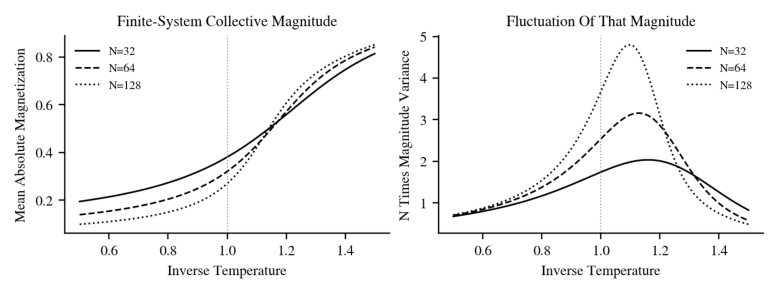
Figure 39. Exact finite Curie-Weiss weights are enumerated for N = 32, 64 and 128. The order parameter is absolute magnetization per spin; the right panel is N times its variance. The dotted line marks the infinite-system critical inverse temperature one. The transition illustration shows an aggregate order parameter changing under declared conditions. Economic correspondence would test complementarity, institutional and common-shock accounts across sizes, then assess useful adoption, excluded participants and the governance of the possibilities created by the shift.
Epistemology and methods. Choose a kernel with justified units and estimation conditions. Compare matched present states reached by different histories. Record changes in categories and institutions so that historical dependence can be separated from an unstable observation map.
Domain analysis and practice. Past learning, ownership, debt and exclusion alter what a present endowment makes possible. Two firms with equal current cash can have different customers, permissions and repair knowledge. Compare matched present accounts with documented histories and future responses. A capability-oriented evaluation records these complements and their bearers. Compensation and developmental support require separate public reasons concerning past responsibility, current need and feasible renewal.
Phenomenon And Practical Problem. Two firms with the same cash and current orders can have different futures because one retains repair knowledge, customer trust and portable certifications while another carries unresolved debt and contested ownership. Compare their response to the same new opportunity. The economic problem is to identify which historical relations make present resources usable, instead of treating current balances as a sufficient state or attributing divergent performance to an unexplained firm-specific trait.
Mechanism And Ontological Commitments. Memory can reside in routines, equipment, enforceable commitments, expectations or explicit records. A kernel representation captures one structured influence of the past, while discrete events and changing legal relations can require an expanded state. Hysteresis concerns different responses reached through different paths under comparable current controls. Historical dependence becomes causal when a retained relation changes present feasibility or interpretation. The model should distinguish actual inherited support from a narrative label, and historical descent from independently created present capability (Pierson 2000).
Epistemic Design And Discriminating Evidence. Compare matched current accounts reached through different documented histories. Use archives, contracts, skill tests and participant accounts to identify mechanisms and predict later responses. Selection into survival and selective memory require triangulation. A targeted repair or permission change can test whether the proposed historical dependency matters. Preserve changes in categories and observation systems, since a drifting measurement map can mimic hysteresis. Follow capacities after organizational exit and examine whether relevant knowledge or relations transfer to a successor, giving the continuity of productive contribution its own evidence.
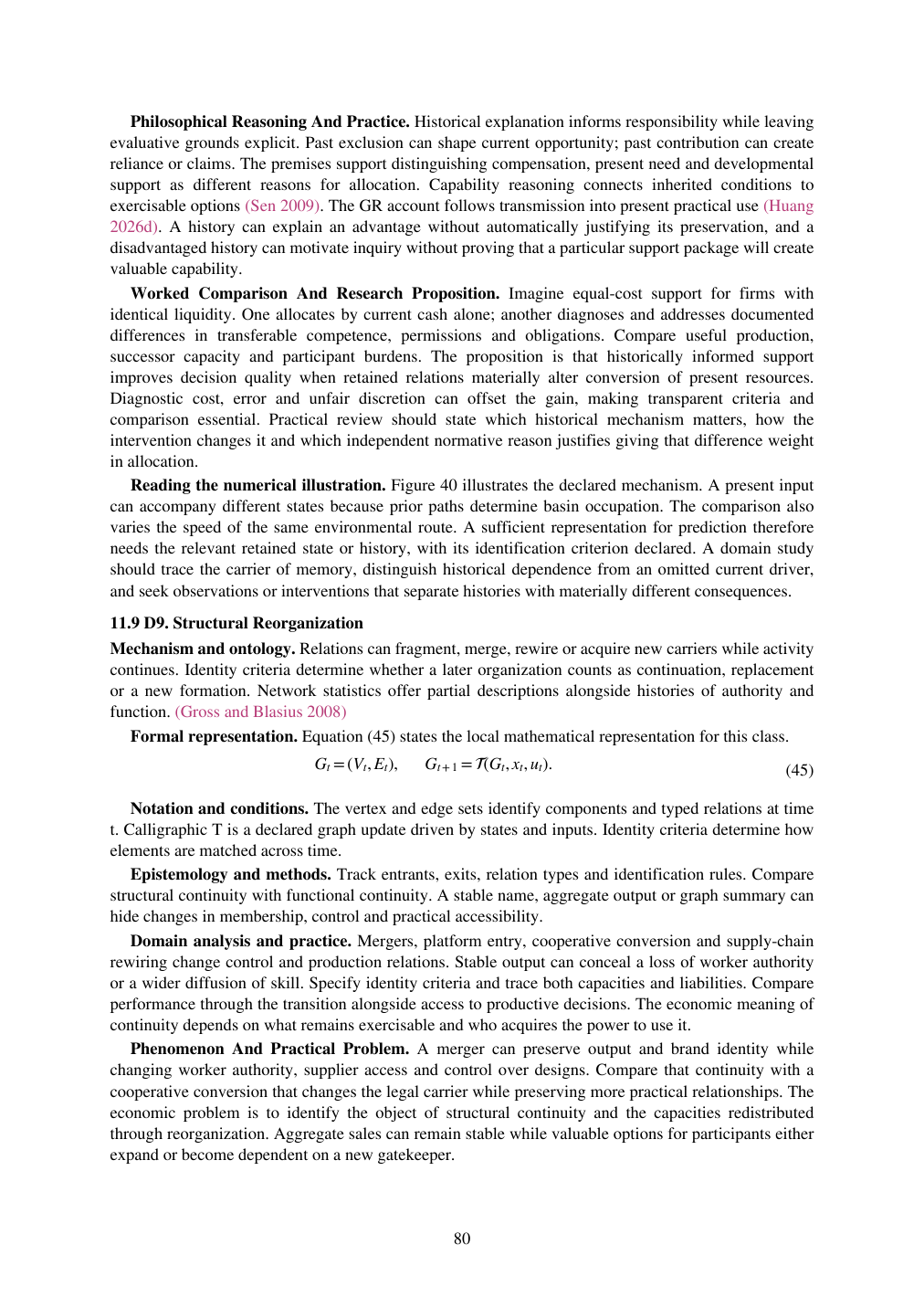
Readable text
Philosophical Reasoning And Practice. Historical explanation informs responsibility while leaving evaluative grounds explicit. Past exclusion can shape current opportunity; past contribution can create reliance or claims. The premises support distinguishing compensation, present need and developmental support as different reasons for allocation. Capability reasoning connects inherited conditions to exercisable options (Sen 2009). The GR account follows transmission into present practical use (Huang 2026d). A history can explain an advantage without automatically justifying its preservation, and a disadvantaged history can motivate inquiry without proving that a particular support package will create
Worked Comparison And Research Proposition. Imagine equal-cost support for firms with identical liquidity. One allocates by current cash alone; another diagnoses and addresses documented differences in transferable competence, permissions and obligations. Compare useful production, successor capacity and participant burdens. The proposition is that historically informed support improves decision quality when retained relations materially alter conversion of present resources. Diagnostic cost, error and unfair discretion can offset the gain, making transparent criteria and comparison essential. Practical review should state which historical mechanism matters, how the intervention changes it and which independent normative reason justifies giving that difference weight
Reading the numerical illustration. Figure 40 illustrates the declared mechanism. A present input can accompany different states because prior paths determine basin occupation. The comparison also varies the speed of the same environmental route. A sufficient representation for prediction therefore needs the relevant retained state or history, with its identification criterion declared. A domain study should trace the carrier of memory, distinguish historical dependence from an omitted current driver, and seek observations or interventions that separate histories with materially different consequences.
Mechanism and ontology. Relations can fragment, merge, rewire or acquire new carriers while activity continues. Identity criteria determine whether a later organization counts as continuation, replacement or a new formation. Network statistics offer partial descriptions alongside histories of authority and
Formal representation. Equation (45) states the local mathematical representation for this class.
Notation and conditions. The vertex and edge sets identify components and typed relations at time t. Calligraphic T is a declared graph update driven by states and inputs. Identity criteria determine how
Epistemology and methods. Track entrants, exits, relation types and identification rules. Compare structural continuity with functional continuity. A stable name, aggregate output or graph summary can hide changes in membership, control and practical accessibility.
Domain analysis and practice. Mergers, platform entry, cooperative conversion and supply-chain rewiring change control and production relations. Stable output can conceal a loss of worker authority or a wider diffusion of skill. Specify identity criteria and trace both capacities and liabilities. Compare performance through the transition alongside access to productive decisions. The economic meaning of continuity depends on what remains exercisable and who acquires the power to use it.
Phenomenon And Practical Problem. A merger can preserve output and brand identity while changing worker authority, supplier access and control over designs. Compare that continuity with a cooperative conversion that changes the legal carrier while preserving more practical relationships. The economic problem is to identify the object of structural continuity and the capacities redistributed through reorganization. Aggregate sales can remain stable while valuable options for participants either
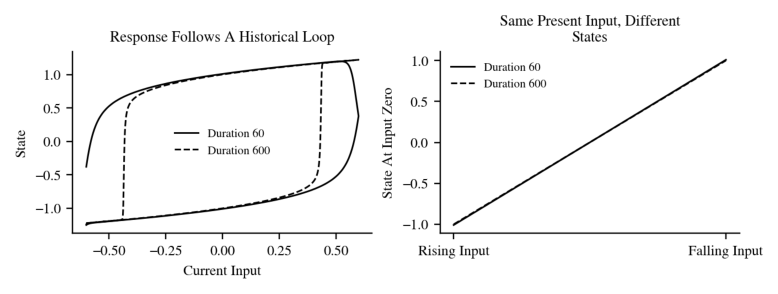
Figure 40. The cubic state law dx/dt = lambda + x - x cubed is driven from lambda = -0.6 to 0.6 and back. Durations sixty and six hundred show rate dependence and a historical loop; the right panel samples zero input on each leg. The history illustration compares responses from similar present observations reached along different paths. Economic correspondence would identify retained knowledge, commitments and constraints, test their effects on future exercise and distinguish historical explanation from the separate reasons supporting compensation, renewal or redistribution.
Mechanism And Ontological Commitments. Reorganization changes membership, relation types and control. A graph can represent ownership, credit, production or learning, with different meanings for creation and deletion. Identity across time can follow the firm, a function or historical transmission. Entrants and exits should remain visible, as should unmatched categories after restructuring. A stable network statistic can conceal a transfer from local reciprocal relations to centralized direction. The state should therefore preserve both the topology and the institutional rights through which participants can exercise productive capacity (Gross and Blasius 2008; Acemoglu et al. 2012).
Epistemic Design And Discriminating Evidence. Follow assets, knowledge, liabilities and decision rights through the transition. Compare complete productive tasks and adaptation under matched disturbances, retaining workers and suppliers displaced from the reporting organization. Legal documents describe authority, while observations and participant accounts test its practical exercise. A successor’s similar output can rely on newly created supports, requiring historical tracing to establish any contribution of inherited competence. Examine temporary transition finance and later ordinary operation separately. Changes in denominator, product mix or reporting boundary should be translated before comparing productivity or participation measures across the reorganization.
Philosophical Reasoning And Practice. Continuity has several possible bearers, each raising different reasons for protection. The premises of responsible transformation support stating whether the aim concerns output, livelihoods, useful competence or accountable control. The GR project-ecology perspective traces valuable possibilities through changed carriers (Huang 2026c). A merger can create genuine learning and still raise concerns about concentrated power. A cooperative can broaden authority and still fail to preserve required complements. Practical judgment should therefore connect each asserted benefit to evidence and each distributional priority to a defended purpose, with affected participants able to challenge omissions.
Worked Comparison And Research Proposition. Imagine equal-cost restructuring plans for a struggling producer. One centralizes design and procurement in a buyer; another transfers selected assets and authority to a supported successor network. Compare useful output, adaptability, participant control and unresolved obligations. The proposition is that relation-sensitive evaluation reveals gains and losses concealed by firm-level continuity measures. Either plan can prevail under particular compatibility, financing and governance conditions. Review should test successor exercisability, report transition burdens and distinguish independent new development from inherited capability, while assigning liabilities through the appropriate legal and contractual processes with their independent sources and grounds.
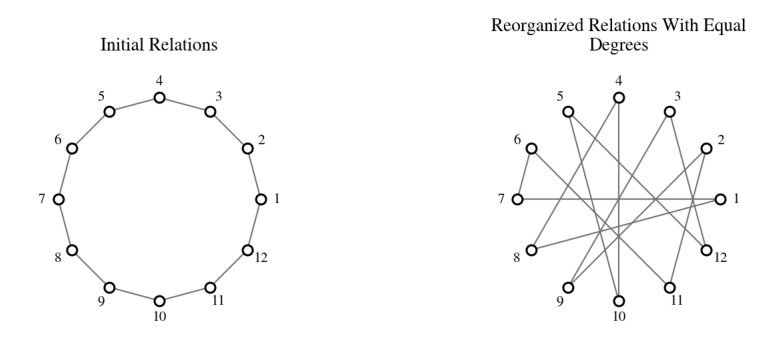
Figure 41. Forty accepted degree-preserving edge swaps transform a twelve-node cycle. The node identities and individual degrees are preserved; the actual pairwise relations change. The CSV records both full edge sets. The structural illustration shows changing membership, ties and control alongside continued activity. Economic correspondence would trace assets, rights and knowledge through reorganization, test successor performance and compare the distribution of usable capacities rather than treating stable output or branding as sufficient continuity.
Reading the numerical illustration. Figure 41 illustrates the declared mechanism. The same degree summary can accompany different relations and different paths. The numerical event sequence demonstrates one transformation with preserved node identities, while a fuller identity criterion could also follow membership, authority or function. A domain inquiry should record which edge operation occurred and what it means, retain consequential provenance, and compare the operations made feasible by each configuration. A structural statistic becomes useful through the distinctions it preserves for that question.
11.10 D10. Functional Non-Equilibrium Organization
Mechanism and ontology. Sensing, proofreading, adaptation and regulation use sustained activity to perform a specified function. A functional account identifies a task, success conditions and the operations supporting it. Social functions are plural and can be contested by the people affected. (Bebon, Robinson, and Speck 2025; Ostrom 2009)
Formal representation. Equation (46) states the local mathematical representation for this class.
QT =[l(xT,)]. (46)
Notation and conditions. The task is calligraphic T, ell a declared loss and Q_T its expected value at horizon T. A threshold or comparison requires a justified interpretation of the task, population and consequences.
Epistemology and methods. Here ell is a declared task-loss function, not a universal value measure. Compare function under perturbation and withdrawal of support. Record which constituencies selected the task and whether success transfers costs or loss of capacity outside the evaluation boundary.
Domain analysis and practice. An economic arrangement can supply goods, employment, learning and financial security through different operations. A single profit measure can be suitable for one question and insufficient for the others. State the function and evaluate it under ordinary and disrupted conditions. Compare immediate output with renewal of the relevant capacities. Public decisions require reasons for the weight assigned to each function and for burdens borne outside the sponsoring organization.
Phenomenon And Practical Problem. A productive arrangement can supply goods, employment, learning, income security and local repair capability through different operations. Compare a profitable
firm abandoning training with one accepting lower current returns while developing transferable competence. The practical economic problem is to identify which function a decision is assessing and how its success relates to other legitimate purposes. A suitable profit measure for one question can leave important public or contributor interests outside its scope.
Mechanism And Ontological Commitments. A functional account specifies a task, users, conditions and success criteria, then identifies the operations sustaining performance. Profit, delivery reliability and learning each have different measures. Several functions can share supports or compete for time and finance. A task-loss function is an analytical choice requiring a substantive interpretation. The state should include contributors and external dependencies where they affect success. Adaptation and regulation can improve the declared score while consuming the capacities needed for another function or transferring costs beyond the evaluation boundary (Nelson and Winter 1982; Godley and Lavoie 2007).
Epistemic Design And Discriminating Evidence. Compare function under ordinary conditions, relevant disturbances and observed support changes. Use complete production episodes, task tests and successor demonstrations alongside accounts. Independent evidence can reveal whether a profitable output depends on unpaid training or delayed maintenance. Retain plural outcomes and explain the construction and purpose of any composite index used in the comparison. A comparison should specify the population and horizon for each function and preserve disagreement where evidence supports no common ranking. Model validation needs to test the operation responsible for the claimed function, not merely its correlation with a convenient financial indicator.
Philosophical Reasoning And Practice. The plurality of economic functions requires explicit justification of priorities. Capability reasoning provides a linkage for evaluating practical opportunities, while the GR account asks how valuable possibilities are renewed through exercise (Sen 2009). This can support a partial ordering: some alternatives are dominated under declared purposes, while others remain incomparable without further judgment. A public sponsor or organization should explain its authority, purposes and accepted burdens. Dynamic viability informs what can continue; justice and value inform what deserves support and on what terms, with neither question exhausted by a single performance statistic.
Worked Comparison And Research Proposition. Imagine equal-cost development programs. One rewards current revenue growth; another compares delivery, transferable competence and access under explicit public priorities. Follow useful production, successor exercise, financial viability and burdens on unsupported participants. The proposition is that function-specific evaluation detects renewal and trade-offs omitted by a single current-output measure. Complexity and measurement cost can weaken the approach, requiring a limited set of decision-relevant functions and transparent evidence. Practical review should test whether the selected measures change conclusions for good reasons and preserve a route to revise priorities when participants identify a consequential function the original assessment overlooked.
Reading the numerical illustration. Figure 42 illustrates the declared mechanism. A functional account identifies the task, success measure and supporting operation. The two declared integrals make one performance-cost comparison explicit, without supplying a public welfare ranking. Other tasks or cost accounts can yield a different comparison. A domain investigation should identify whose function is being assessed, whether participants can actually exercise it, and how its supporting resources and authority are renewed. Successful output and justified continuation then receive their respective evidence and reasons.
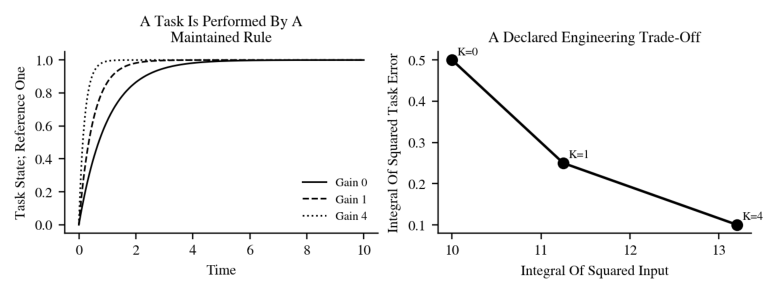
Figure 42. The plant dx/dt = -x + u uses u = 1 + K(1 - x) from x(0)=0. Higher gain reduces integrated squared error while changing a declared quadratic input-cost proxy over time zero to ten. The functional illustration relates sustained operations to a declared task measure. Economic correspondence would specify goods, learning or security functions, test their supporting mechanisms and compare current performance with retained capacity, distribution and the justified priorities governing trade-offs among purposes.
12 E. Persistence, Transformation, And Dissolution
12.1 E1. Transient Relaxation
Mechanism and ontology. A regime can be an episode in a longer passage toward another configuration. A transient is defined relative to dynamics and observation horizon. Its duration can be practically consequential even when asymptotic analysis assigns it no permanent status. (Ashwin et al. 2012) Formal representation. Equation (47) states the local mathematical representation for this class.
τA =inf{t≥0:xt ∉A}. (47)
Notation and conditions. The set A identifies the regime and tau_A is its first-exit time. The definition can be applied to deterministic or stochastic paths. Censoring and the finite observation horizon affect estimation.
Epistemology and methods. Define the regime A and use appropriate censoring for unfinished episodes. Compare first-exit distributions and changing environments. Institutional assessment should state whether a temporary service, coalition or learning episode achieved its time-bounded purpose.
Domain analysis and practice. A temporary contract or pilot can generate a useful output and transferable learning during a bounded episode. Define its intended endpoint and record the resources left for continuation. Compare extension, transfer and closure under actual financing constraints. The productive inheritance may reside in workers, suppliers or a shared design. Each claim of renewal requires evidence that a successor can exercise the inherited capability with available complements.
Phenomenon And Practical Problem. A temporary first-purchase contract can help a producer learn a new process and complete useful output before the contract ends. Its economic significance includes the duration of the launch episode and the capabilities left afterward. The practical question is whether bridging finance, a longer contract or an orderly handover best supports the next feasible operation. A short-term sales increase can reflect inherited reserves, exceptional assistance or learning that another producer will later exercise.
Mechanism And Ontological Commitments. A transient is defined relative to entry, exit or settling into a regime over an observation horizon. First-exit times and response paths concern different aspects of its duration. Censoring, varying starting conditions and continuing forcing affect whether a shortlived observation identifies a temporary adjustment or the beginning of a persistent process. The transient state can contain unfilled orders, usable equipment and available working capital, each
Readable text
measured separately. Contract initiation prepares that state, while later payment and input conditions govern its evolution. A financial threshold and a physical completion threshold describe different
Epistemic Design And Discriminating Evidence. Align observation on a justified event and follow a declared risk set through a common horizon. Report censored cases and distinguish first departure from sustained transition. Compare competing duration models and examine whether a repeated preparation produces a similar transient under the later rule. Follow the original production cohort, payment dates, learning and outside assistance through contract completion. Compare financing schedules under a common real-input plan. Record unsold inventory and obligations still outstanding
Philosophical Reasoning And Practice. The normative premise evaluates support through a valuable productive possibility and the claims of those financing or carrying it. A bounded episode can deserve support because it develops usable competence, while continuation requires a fresh account of opportunity cost and feasible alternatives. Relational wealth directs attention to which later operations workers, suppliers or successors can exercise. Its bearer can outlast the original contract, making launch success, firm survival and transferable inheritance separate evaluative objects. (Huang 2026d).
Worked Comparison And Research Proposition. Imagine a hypothetical procurement pilot comparing an extended purchase guarantee with an equal-cost package of prompt payment and transferable training. Observe completed orders, retained skills and the next independently financed production episode. The proposition is that payment timing and preparation alter the transient and its inheritance through distinct pathways. A follow-up with workers who move to another producer tests whether learning remains usable beyond the original firm. Report the support withdrawn, the resources consumed and the liabilities carried into the next episode.
Reading the numerical illustration. Figure 43 illustrates the declared mechanism. A transient can matter through its duration even when its eventual endpoint is simple. The threshold makes the regime criterion explicit, so its exit time follows from both dynamics and the chosen set. A domain application should identify the practical condition whose duration is consequential, justify its threshold and deadline, and investigate whether the underlying law remains adequate over that interval. An asymptotic description and an account of burdens during the episode address different questions.
Mechanism and ontology. Time-invariant statistics can coexist with continuing probability currents. States, transition rates and an observation convention specify the statistical account. Physical nonequilibrium further requires an appropriate energetic interpretation; social steady circulation can be analyzed through transitions and resource renewal. (Seifert 2012, 2025)
Formal representation. Equation (48) states the local mathematical representation for this class.
Notation and conditions. The p_i are state probabilities and J_ij oriented transition currents. Stationarity imposes zero divergence at each node. Pairwise zero currents would impose the stronger detailed-balance condition under its applicable convention.
Epistemology and methods. Estimate both occupancies and directional transitions. Stable averages can hide directional movement, population turnover and depleting support. Test whether rates and observation rules remain stable over the claimed interval.
Domain analysis and practice. Stable aggregate balances can support continuing payments and production. Occupancy statistics and gross domestic output leave the paths of renewal partly hidden. Record directional transactions, maintenance, entry and exit alongside stocks. Compare the support requirements across observation windows. An arrangement can be statistically steady while
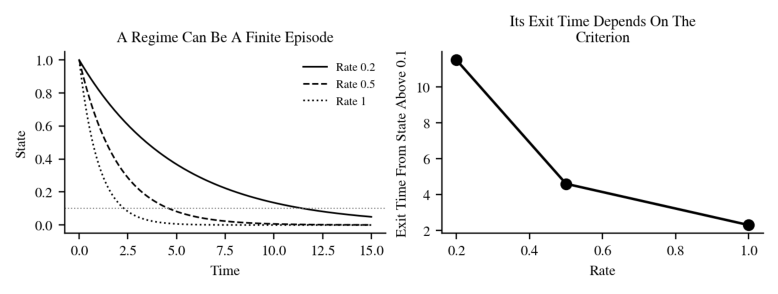
Figure 43. An exact decay begins at one; the transient regime is defined by x greater than 0.1. Its exit time is log(10)/k for each of the three positive rates. The transient illustration defines departure by an explicit threshold under a known decay rule. An economic correspondence would specify the launch condition, productive task and financing horizon, then examine both transition burdens and the capability retained after the episode ends.
concentrating control or depleting a slow resource; economic evaluation needs the relevant distributional and replenishment accounts.
Phenomenon And Practical Problem. A trading network can maintain stable average balances while payments continually finance production, distribute income and settle earlier claims. Similar stocks can conceal opposite directions of dependence or transfers that mainly refinance distress. The practical problem is to reconstruct what the currents enable and which supports they renew. A stable monetary picture can coexist with changing inventories, depleted equipment or concentrated control over market access, requiring accounts that follow those changes on their own terms.
Mechanism And Ontological Commitments. A non-equilibrium steady state combines timeinvariant distributions with continuing probability currents in the specified process. Stationarity imposes local flow balance, while detailed balance imposes the stronger pairwise cancellation condition. An institutional steady-state analogy requires observed turnover and replenishment with stable meanings and system boundaries. The economic objects include monetary balances, dated claims and realized transactions. A stationary probability distribution over workflow states is a different account from conserved money. Credit creation, cancellation and valuation changes require explicit entries in the financial ledger, while material and labor renewal are measured separately. (Seifert 2012).
Epistemic Design And Discriminating Evidence. Estimate occupancies and directed transitions together, checking stationarity over several windows. Reconcile divergence-free currents with the chosen boundary account. Stable averages alone leave changing composition and compensating flows admissible, so repeated individual or case-level records are central to the interpretation. Reconcile both sides of payments and link them to delivery, maintenance and subsequent production. Compare current direction and recurrence under similar aggregate balances. Stock-flow consistency constrains admissible financial histories, while evidence about conversion identifies the productive operations those histories support (Godley and Lavoie 2007).
Philosophical Reasoning And Practice. A reproduction premise asks what conditions of another operation are maintained and which social relations are reproduced through them. Stable turnover can support useful cooperation while concentrating dependence or shifting renewal costs to workers and suppliers. Economic appraisal therefore needs reasons concerning control, opportunity and burdens in addition to an explanatory account of circulation. This makes continuity a concrete question about the supports reproduced through actual exercise and the people able to influence their terms. (Marx 1867).
Worked Comparison And Research Proposition. Consider hypothetical supply networks with similar average cash positions. One uses prompt settlement that enables suppliers to replenish inputs; another sustains the same positions through repeated refinancing and deferred maintenance. Compare
Readable text
gross payments, complete production episodes, repair liabilities and future usable capacity. The proposition is that similar stationary stocks can accompany materially different renewal paths. A change in settlement terms provides a discriminating intervention, with financing costs and risk transferred to other parties included. The resulting comparison preserves the distinction between a steady account and
Reading the numerical illustration. Figure 44 illustrates the declared mechanism. Steady frequencies can coexist with ongoing directional activity, and the same frequencies can hide opposite currents. Exact stationarity is checked using the transition generator. The construction identifies a statistical non-equilibrium feature; its energetic interpretation would require physical correspondence. A domain study should follow actual transitions and resource renewal alongside stocks, inspect which readout discriminates the circulation relevant to its question, and evaluate the function or distribution sustained by that flow through additional substantive premises.
Mechanism and ontology. A system can persist through recurrent change rather than a fixed configuration. A stable periodic orbit is one possible regime; externally maintained cycles require a model of the driver. Its viability depends on the resources, participation and constraints renewed each
Formal representation. Equation (49) states the local mathematical representation for this class.
Notation and conditions. The trajectory x-star is periodic with positive period T. Its existence and its attraction are different properties. Stability analysis requires the particular evolution rule and
Epistemology and methods. A periodic solution alone leaves attraction to be assessed, for example through Floquet multipliers. Examine recovery after phase and amplitude perturbations. In institutional applications, compare calendar recurrence with successful renewal of the underlying function.
Domain analysis and practice. A recurring production and reinvestment cycle can persist through changing stocks. Its renewal depends on settlement timing, maintenance and access to inputs. Trace complete cycles and compare the conditions of later repetition. A payment loop that closes arithmetically can still leave a producer without a required skill or legal permission. Assess whether the arrangement creates usable capacity and whether participants can revise its terms.
Phenomenon And Practical Problem. A producer can operate through repeated rounds of buying inputs, producing, selling, settling claims and maintaining equipment. The sequence can become a durable regime even while inventories and liquidity vary through each round. The practical question is what restores the capacity for another cycle after a disturbance. A payment loop can close arithmetically while a required skill, material or permission remains unavailable, so monetary recurrence and
Mechanism And Ontological Commitments. An oscillatory regime has recurring trajectories supported by the ongoing evolution rule. Existence of a periodic solution and attraction toward it are different properties. In an institution, a repeated calendar schedule, an autonomous cycle and feedback- maintained oscillation require different causal accounts even when their observed periods match. The recurring trajectory contains financial settlement and real production states with a justified correspondence between them. Its restoring operations include replenishment, repair and renewal of working capital. An annual contract schedule is a possible external driver whose role must be distinguished from internally sustained cycle dynamics. (Cross and Hohenberg 1993).
Epistemic Design And Discriminating Evidence. Perturb phase or amplitude within appropriate limits and observe whether the process returns to a characteristic orbit. Compare maintained cycles with external pacing and damping. Stability estimates require enough repeated cycles and an observation model preserving the relevant coordinates through each passage. Track several complete rounds,
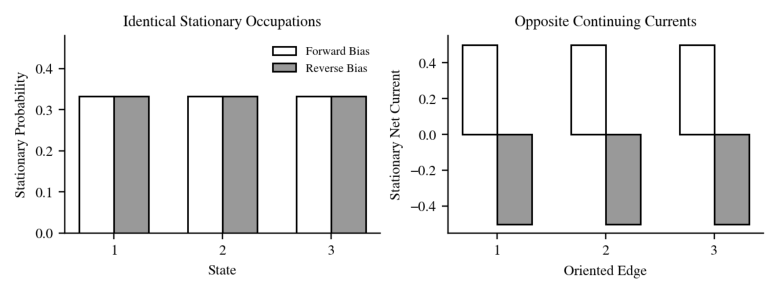
Figure 44. Uniform probabilities are stationary for both directions of bias in the three-state ring. Swapping clockwise rate 2 and reverse rate 0.5 preserves occupations and reverses each steady current from 0.5 to -0.5. The steady-current panel holds occupancy constant while reversing directional currents. Economic correspondence would reconstruct actual payments and the separate real operations they enable, examining whether similar balance statistics conceal different renewal, dependence and burden distributions.
including shortfalls, later repair and altered delivery dates. Compare response after bounded disruptions under alternative settlement schedules with matched claims. Observe whether the firm returns toward a characteristic productive path or requires a new outside input each time.
Philosophical Reasoning And Practice. A reproduction-oriented appraisal asks which material and social conditions make recurrence possible. This includes workers’ maintained competence, suppliers’ viable payment terms and access to the next productive opportunity. The normative premise requires reasons for the arrangement’s continuation and the allocation of recurrent burdens. A well-restored cycle can reproduce unequal control efficiently, so explanatory attraction supplies one property while justice remains a question about purposes, claims and feasible alternatives. (Marx 1867).
Worked Comparison And Research Proposition. Imagine a hypothetical comparison of ordinary late settlement and an equal-total-value contingent schedule paying when a verified input is needed. Reconcile both financial ledgers, then measure completed production, maintenance and the next cycle’s working-capital requirement. The proposition is that a specified timing change strengthens a restoring pathway. A common disruption in a later round tests whether the productive cycle remains usable after the initial assistance. Report the lender’s and buyer’s changing exposure, and distinguish an attracting productive regime from activity paced entirely by an external purchase guarantee.
Reading the numerical illustration. Figure 45 illustrates the declared mechanism. A persistent regime can involve continuing change. Stability here concerns return toward a periodic set, while phase continues to evolve. The exact radial solution makes the attracting direction explicit. A domain application should identify the operation repeated through the cycle, the supports and constraints renewed during recurrence and the distinction between an internally supported cycle and external scheduling. Assessing its continuation also requires a justified function, horizon and distribution of recurring burdens.
12.4 E4. Metastability
Mechanism and ontology. A regime can persist for a long interval while retaining a feasible escape route. Residence duration depends on barriers, disturbance and environmental change. The useful ontology includes both the continuing configuration and the pathways through which it could change. (Ashwin et al. 2012; Holling 1973)
Formal representation. Equation (50) states the local mathematical representation for this class.
Pr(τA >t)≈e−κt. (50)
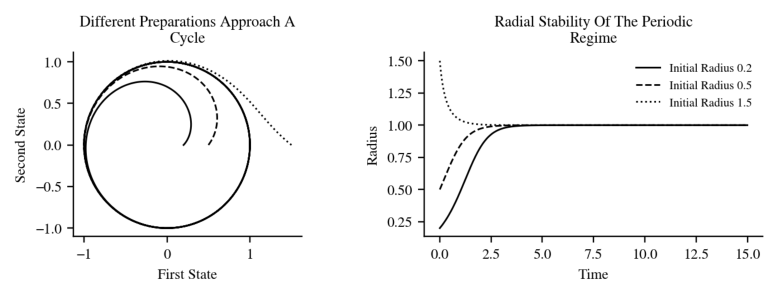
Figure 45. The autonomous radial law dr/dt = r(1 - r squared) with angular speed one has an attracting unit cycle. Exact positive-radius solutions show three preparations approaching its periodic orbit. The attracting-cycle illustration separates recurring movement from return toward a periodic set. An economic correspondence would identify production, settlement and replenishment operations, then test recovery after disruption and distinguish internal renewal from a shared external contract schedule.
Notation and conditions. Kappa is a positive constant-hazard approximation for exit from A. Its adequacy is an empirical or model-specific question. A changing hazard requires a corresponding survival function.
Epistemology and methods. An exponential survival model requires roughly constant hazard; test alternatives and account for censoring. Persistence can reflect capability, switching costs or unequal exit power. Compare these explanations with evidence about actual alternatives.
Domain analysis and practice. A production system can remain active while depending on a single lender, buyer or specialist. Its long duration leaves exposure to that dependency open. Estimate alternative routes and the time and cost of switching. Compare reserves, diversification and transferability under specified disruptions. A financing judgment should include the option value and opportunity cost of these supports together with the distribution of ordinary returns.
Phenomenon And Practical Problem. A manufacturer can remain profitable for years while depending on one buyer, lender or specialist whose withdrawal would be difficult to replace. Long survival records local continuity, while alternative routes determine its exposure and ability to adapt. The practical problem is to estimate switching time, resources and authority before a disruption selects the observation of failure. Reserves, diversification and portable competence address different dependencies and carry different opportunity costs during ordinary operation.
Mechanism And Ontological Commitments. Metastability concerns a long residence within a regime that retains feasible exit routes. A constant hazard is a simplifying approximation whose adequacy depends on history and environment. Duration relative to the observer’s horizon makes a regime appear durable even when rare exits matter greatly to long-run function. The regime is a functioning production arrangement with defined exits and feasible re-entry. Relevant barriers include qualification of a replacement supplier, credit approval and a buyer’s acceptance of a changed specification. The identity criterion can concern the legal firm, its routine or the productive network. (Ashwin et al. 2012).
Epistemic Design And Discriminating Evidence. Estimate survival and exit hazards with a defined risk set, allowing for censoring and changing exposure. Compare attempted exits, successful exits and altered barriers. A long record of persistence and a closed transition rule are distinct hypotheses whose consequences can be tested through carefully bounded changes. Follow comparable dependencies through disturbances and periods without failure, retaining attempted substitutions. Compare targeted reserves with support for an alternative route. Production-network evidence motivates tracking the actual transmission and substitution channels behind aggregate exposure (Acemoglu et al. 2012).
Philosophical Reasoning And Practice. The normative premise recognizes usable alternatives as economically relevant when they affect participants’ practical freedom and bargaining position. A reserve can protect a valuable function while tying up resources that have other uses. A justified recommendation therefore states whose exposure is reduced and who finances the option. Persistence becomes one input to judgment, with the distribution of control and the quality of feasible transition routes examined as distinct consequences. (Sen 2009).
Worked Comparison And Research Proposition. Consider hypothetical producers receiving either a liquidity reserve or equal-cost support to qualify a second buyer. Test the predicted pathways using a declared disruption family and later observed episodes. The proposition is that support changes exit risk or recovery through an identified dependency. A constant-hazard model can summarize one comparison, while changing contracts and accumulated learning require a richer survival account. Follow workers and transferable routines after any firm exit so that loss of a carrier and destruction of every productive capacity remain distinguishable.
Reading the numerical illustration. Figure 46 illustrates the declared mechanism. Long residence and permanent closure are different properties. The survival curve quantifies the declared escape opportunity, while the single path makes departure and return visible within a finite horizon. This is a constant-rate construction; changing environments, heterogeneous barriers or aging can alter its law. A domain inquiry should identify feasible exit routes, retain censored observations and compare disturbances and support changes before treating long survival as evidence of renewal or justified stability.
12.5 E5. Aging
Mechanism and ontology. Response properties can depend on the time elapsed since preparation or reorganization. Two-time measurements expose this dependence. In social systems, cohort change, institutional learning and accumulating obligations can generate temporal variation with different causal explanations. (Korbel et al. 2026)
Formal representation. Equation (51) states the local mathematical representation for this class.
C(tw +t,tw) depends on both t and tw. (51)
Notation and conditions. The two-time correlation C uses a waiting time t_w and later lag t. Aging in this operational description concerns dependence on waiting time after accounting for observation and cohort change.
Epistemology and methods. Keep waiting time, calendar time and cohort membership distinguishable. Compare observation drift, attrition and real changes in response. A model fitted to one institutional age needs evidence before its parameters are transferred to another.
Domain analysis and practice. Productivity and adjustment rates can change with organizational age through learning, obsolete assets or accumulating liabilities. Cohort composition can produce similar aggregate patterns. Compare entry cohorts and observe the proposed mechanism directly. A renewal program can finance retraining, repair or debt restructuring according to the constraint identified. Its assessment should follow outcomes beyond the surviving original firms to avoid treating exit as automatic loss of every productive capacity.
Phenomenon And Practical Problem. Older firms can display higher average productivity because they have learned, accumulated reliable customers or survived conditions that eliminated less productive entrants. Obsolete equipment and layered obligations can generate another age pattern. The practical problem is to identify the history producing the observation before recommending training, replacement investment or restructuring. A mature-survivor average gives limited direct evidence about what a newly entering producer would achieve after the same calendar time and support.
Mechanism And Ontological Commitments. Aging makes a system’s response or two-time correlation depend on how long it has occupied its current condition. Waiting time is therefore part of the state description. Institutional duration, participant experience and calendar change can mimic one
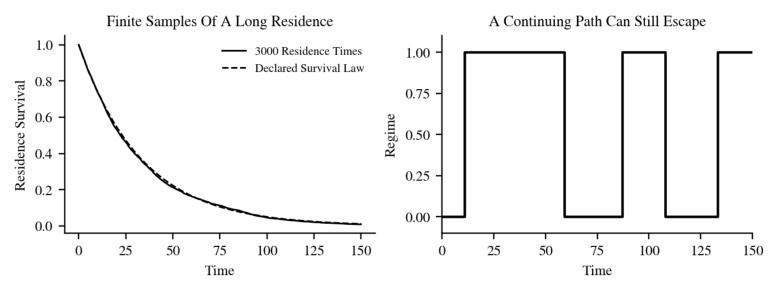
Figure 46. Three thousand residence times use an exponential escape rate 0.03. A separate two-regime path uses that rate for both transitions, so re-entry is possible after escape. The metastable panel depicts long residence with positive escape and possible return. Economic correspondence would identify the dependency, switching route and relevant carrier, then assess reserves or diversification through survival, recovery costs and the distribution of option value.
another, so the relevant ontology distinguishes accumulated history from changing membership and environment. Institutional age needs a bearer: retained routines, worker experience, assets or obligations. The atlas supplies a specific alternative in which conditional persistence changes through survival selection under a heavy-tailed waiting law. An economic interpretation would compare that explicit selection mechanism with measured learning and obsolescence in the firms being studied. (Korbel et al. 2026).
Epistemic Design And Discriminating Evidence. Cross waiting times with a common later probe, then compare responses at equal lags. Address survivor selection and cohort differences explicitly. A convincing aging account predicts a duration-dependent change after accounting for current resources, population composition and the calendar conditions surrounding the measurement. Link entry cohorts, worker movement, investment and exit records. Compare common task responses at different ages while addressing survivor selection and calendar shocks. Evolutionary accounts of routines motivate observing the proposed learning process directly and following its carriers across firm boundaries (Nelson and Winter 1982).
Philosophical Reasoning And Practice. The normative premise gives renewal and usable opportunity a role alongside survivor performance. Supporting an established producer can preserve valuable competence, while entry support may reveal capacities that have lacked a development path. A reasoned allocation states the expected operation, evidence for its support and opportunity costs borne elsewhere. An exit can be costly without ending every associated capability, making workers’ and successors’ options relevant to the appraisal of organizational aging. (Sen 2009).
Worked Comparison And Research Proposition. Imagine hypothetical firms receiving equal supported budgets for equipment repair, transferable training or debt review according to a predeclared comparison. Track current output, later adjustment and usable capabilities after worker moves or organizational exit. The proposition is that an identified accumulated constraint mediates age-dependent response. A cohort-selection model predicts a different pattern from within-firm learning, so include continuing low performers and exited firms where records permit. Report how missing exits and changing measurement affect the inferred age profile and the practical recommendation.
Reading the numerical illustration. Figure 47 illustrates the declared mechanism. Two-time dependence can arise through the history of a surviving cohort. This exactly evaluated example is a conditional persistence function, whose aging appearance follows from a heavy-tailed waiting law and selection by survival. It provides one explicit mechanism for age-dependent response. A domain study
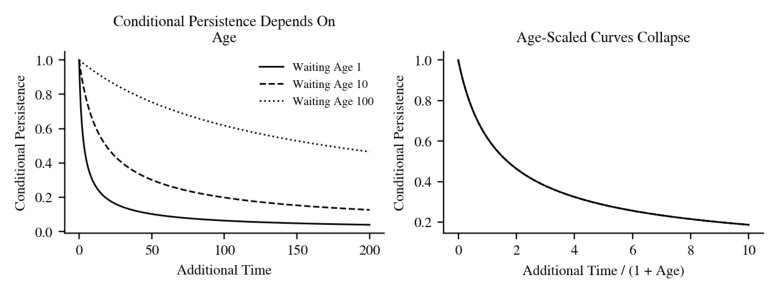
Figure 47. A waiting-time law has survival (1 + t) to the power -0.7. Conditional on having survived to age tw, further persistence is [(1 + tw)/(1 + tw + t)] to that power. The right panel uses the declared age scaling. The aging illustration derives conditional persistence from an explicit heavy-tailed cohort law. Economic use would compare survival selection with learning, obsolete assets and accumulated liabilities, preserving entry cohorts, calendar conditions and the capacities that may move beyond the original firm.
should compare that pathway with learning, accumulating obligations, cohort replacement and changes in the environment, preserving the preparation event and the two observation times in its evidence.
12.6 E6. Critical Regimes
Mechanism and ontology. Criticality concerns specified scaling and correlation behavior near a transition under appropriate limits. It can motivate questions about responsiveness and collective organization. Its desirability depends on the task, costs and disturbance; a universal optimum for creativity or governance requires an additional argument. (Cross and Hohenberg 1993; Boettiger and Hastings 2012)
Formal representation. Equation (52) states the local mathematical representation for this class.
ξ∼|λ−λc|−ν. (52)
Notation and conditions. Xi is a defined correlation length, lambda a control parameter, lambda_c a candidate critical value and nu an exponent. The scaling is a model- and limit-dependent relation with finite-size qualifications.
Epistemology and methods. Define correlation length, control parameter and estimation range. Test finite-size effects and competing noncritical models. Increased variance or autocorrelation can be informative under particular mechanisms, with prospective false-positive evaluation determining operational usefulness.
Domain analysis and practice. Highly connected or highly responsive economic arrangements can transmit innovation and amplify disturbances. A criticality hypothesis needs defined observables and scale-sensitive tests. Compare any apparent scaling with shocks, heterogeneous firm sizes and changing institutions. A practical portfolio of capabilities can be assessed through task-specific resilience and learning measures. A universal optimum at criticality would require evidence beyond the existence of complex economic fluctuations.
Phenomenon And Practical Problem. An economy with tightly connected suppliers and responsive finance can spread useful innovations while transmitting a common disruption widely. Extended correlation in output or credit conditions may suggest a critical regime, but common shocks, heterogeneous firm sizes and changing reporting can produce similar observations. The practical task is to identify a model distinction that improves a specified investment or public coordination decision. A general preference for maximum responsiveness leaves both the relevant function and the distribution of amplified losses to further reasoning.
Readable text
Mechanism And Ontological Commitments. A critical regime involves particular scaling, response and correlation properties near a candidate transition under a specified model and limit. Correlation length and susceptibility require operational definitions. Social volatility or popular claims of being at a tipping point provide questions for investigation, with critical behavior contingent on additional evidence. The field, distance and control parameter require economic definitions, such as linked production deviations under measured dependence. The atlas’s Gaussian covariance has a stipulated scaling exponent in a specified limit. That result supplies a mathematical comparison whose connection to a production or financial network needs independent evidence. (Boettiger and Hastings Epistemic Design And Discriminating Evidence. Test several predicted quantities across control values and system sizes, accounting for finite records and dependence. Compare scaling with mixtures, trends and common forcing. Assess warnings out of sample against observed transitions and non- transitions, including the costs of false alarms and delayed action. Compare observed correlations across network partitions, system sizes and credit regimes. Test common-shock and heterogeneous- sector alternatives, retaining non-transition periods. Reconstructed production links can support a specific account of propagation when their timing and substitution possibilities match the proposed
Philosophical Reasoning And Practice. The normative premise assesses responsiveness through the tasks and claims affected by it. A sensitive arrangement can improve discovery while exposing workers, households or suppliers to concentrated adjustment burdens. Douglas’s attention to error consequences motivates explicit treatment of false warnings, missed disruptions and the costs of protective action. A justified decision can use a robust operational threshold without requiring a universal critical-point interpretation or an asserted optimum at criticality. (Douglas 2000).
Worked Comparison And Research Proposition. Consider hypothetical production portfolios with equal supported investment and alternative degrees of supplier overlap. Evaluate completed output, adaptation to a new opportunity and losses under declared disruption families. The proposition is that particular dependence channels explain the joint learning and exposure pattern. Compare it with a common-demand model and validate the most consequential predictions outside the fitting interval. Report model uncertainty and the distribution of recovery support. Any critical-scaling claim should state the field, metric and finite-size evidence establishing its stronger scope.
Reading the numerical illustration. Figure 48 illustrates the declared mechanism. Critical scaling is a claim about a specified family and limit. Here the covariance and exponent are stipulated through an exactly defined Gaussian field, with finite positive distances plotted. The result gives an operational meaning to correlation length and its parameter dependence. A domain application should justify its field, metric, control parameter and size limit, compare rival causes of extended correlation, and supply separate reasons for any claim that such responsiveness improves a public or creative task.
Mechanism and ontology. A population or process may enter a regime from which the declared internal rules permit no return. The regime-level consequence complements the transition mechanism C15. Changing the boundary, adding external support or revising the rules can change the set of
Formal representation. Equation (53) states the local mathematical representation for this class.
Notation and conditions. The conditional probability concerns a specified absorbing set A and the permitted dynamics. The statement presupposes those dynamics remain in force over the future interval.
Epistemology and methods. Specify the actions included in the probability statement. Empirical closure, loss of a carrier and loss of recoverable capacity require separate tests. Examine preserved knowledge, permissions and external relations when considering possible restoration.
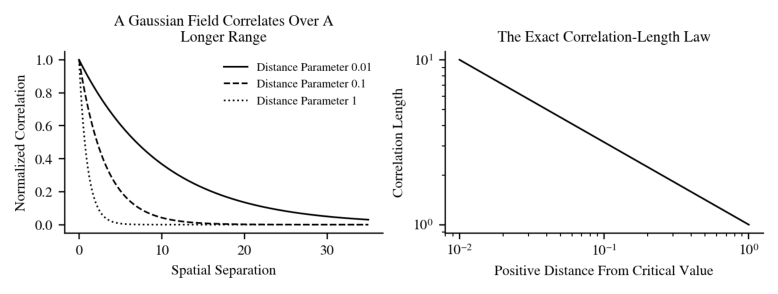
Figure 48. The normalized covariance of an infinite-line massive Gaussian field with spectrum proportional to 1/(a + k squared) is exp(-sqrt(a) times distance), with positive a. Its correlation length is exactly a to the power -1/2; the figure evaluates this model law over a finite parameter range. The Gaussian scaling panel evaluates its declared covariance and correlation length. Economic correspondence would justify the production or financial field, distance and control parameter, then compare common shocks and network dependence while appraising responsiveness through a specified task and loss distribution.
Domain analysis and practice. Closure of a firm or market relation can end an observed process while leaving knowledge, equipment and possible successor uses. Define the absorbing boundary and inspect lawful re-entry routes. Compare complete destruction of capacity with loss of finance or authority to exercise it. A policy response can preserve transferable supports where their expected use and costs justify doing so, while honoring claims arising from closure.
Phenomenon And Practical Problem. A firm with exhausted working capital may have no feasible continuation under its current contracts, even while workers retain skills and the equipment can support another producer. Calling the state absorbing requires a boundary that specifies permitted refinancing, asset transfer and organizational succession. The practical problem is to identify which operation has ended and whether a justified outside action can reopen a valuable capability. The answer can differ for a legal entity, a production routine and the opportunities available to its participants.
Mechanism And Ontological Commitments. An absorbing regime describes a closed set maintained under the permitted dynamics over the stated future horizon. The kernel and its boundary inputs define the closure. Reintroduction, renewed exploration or changed eligibility can establish different dynamics, with the intervention identified as a change in the conditions sustaining closure. The internal kernel contains stated payment, production and exit rules. A new lender, ownership arrangement or permission changes the feasible transitions. Any credit expansion requires corresponding financial assets and liabilities, with physical resources and inherited competence accounted for separately (Godley and Lavoie 2007). (Gross and Blasius 2008).
Epistemic Design And Discriminating Evidence. Audit feasible successor operations and the conditions that could reopen them. In empirical records, distinguish zero permitted exit from a small unobserved exit probability. Compare targeted reopening with continued operation under the original rule, retaining the changed boundary assumptions in every forecast. Audit actual and feasible departure routes from the closed state, including transfer conditions and needed complements. Compare a targeted re-entry package with succession through another carrier. Observe usable production and ongoing support requirements after the outside input. Establish financial restart and functional recovery through their respective criteria and tests.
Philosophical Reasoning And Practice. The normative premise gives affected workers, creditors and other participants relevant claims in choosing among rescue, transfer and closure. A productive possibility deserves appraisal through its expected use and costs, with a transparent authority for changing obligations or allocating support. Preserving a legal firm and preserving exercisable capability
can serve different purposes. A justified comparison makes those purposes and the burdens of each route explicit, including what participants can influence about the future terms. (Sen 2009).
Worked Comparison And Research Proposition. Imagine a hypothetical closed workshop whose equipment and trained team remain available. Compare bridge finance for the original firm with an equal-supported-cost transfer of equipment access and working capital to a successor. Reconcile claims, permission requirements and real-input needs before forecasting output. The proposition is that a named external operation changes the absorbing boundary through a specific complement. Follow repayment, maintenance and independent repeat production so that a one-time restart and renewed economic viability receive separate evidence.
Reading the numerical illustration. Figure 49 illustrates the declared mechanism. Absorbing character depends on the rule and boundary. The internal retention process permits decline and extinction while supplying no route from zero. The displayed external operation changes that reachable set explicitly. A domain inquiry should state which internal operations have ended and which outside actor, resource or rule revision could reopen them. The availability and justification of reopening then depend on real capacities, costs, permissions and affected claims, beyond the mathematical observation that an added channel changes the process.
12.8 E8. Structural Transformation
Mechanism and ontology. An organization can change its relations, membership or authority while retaining some processes. Transformation requires an explicit identity criterion and a record of what changes. A representation that fixes categories forever can conceal precisely the transition under investigation. (Gross and Blasius 2008; Ostrom 2009)
Formal representation. Equation (54) states the local mathematical representation for this class.
t+1 =(t,ut,ηt). (54)
Notation and conditions. Calligraphic S is an organizational description and U its declared update, with eta representing unresolved variation. Changes of state space require an account of how old and new descriptions correspond.
Epistemology and methods. Here S denotes an organizational description, potentially with changing state space. Retain translations and unmatched categories across revisions. Compare effects on functions and participant capacities alongside topological or legal changes.
Domain analysis and practice. Economic transformation changes production, ownership, finance or participation together. Fixing the original categories can hide the capabilities created or lost. Preserve translation records across the transition and trace authority over resources. Compare immediate disruption with later exercise of successor capacities. A developmental judgment should identify the relevant population, time horizon and distribution of transition costs before combining the outcomes.
Phenomenon And Practical Problem. A conversion from a single lead-firm arrangement to a producer cooperative can preserve machines and customers while changing decision authority, financing and access to knowledge. It can also interrupt output during the transition. The practical problem is to reconstruct what remains comparable and which new operations become possible. Membership or aggregate asset value can stay similar while bargaining routes, responsibility and the distribution of maintenance work change substantially, making a fixed set of old performance categories incomplete.
Mechanism And Ontological Commitments. Structural transformation changes the organizational description itself, including roles, relations, decision procedures or admissible states. A correspondence between old and new descriptions preserves what remains comparable. The process can maintain a function while altering its carrier, or change both organization and the purposes through which performance is appraised. The organization contains typed ownership, finance, supply and approval relations. Its transformation requires correspondence between old and new roles and accounts. The atlas
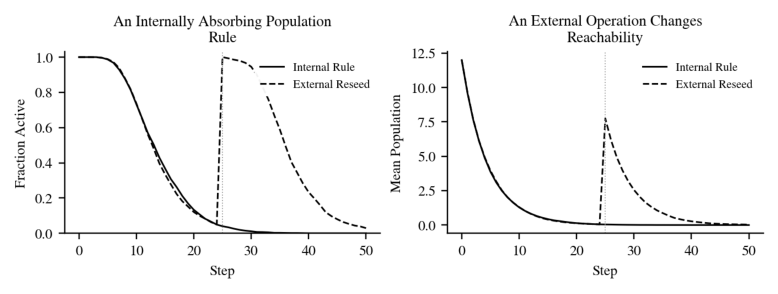
Figure 49. Each of 1,500 populations begins at twelve and independently retains each member with probability 0.8 per step. Zero is internally absorbing. The separate intervention arm inserts eight members into empty populations at step twenty-five. The absorbing-regime panel shows internal extinction and an expressly external reseeding operation. Economic correspondence would define the closed carrier and permitted refinancing or succession routes, then test which resources and permissions make renewed productive exercise feasible under the revised conditions.
preserves membership and edge count while altering paths, illustrating why structural continuity on selected dimensions can coexist with consequential changes in reachability. (Ostrom 2009).
Epistemic Design And Discriminating Evidence. Trace realized transfers of authority, resources and responsibility across the transition, using versioned definitions. Compare common tasks before and after transformation and investigate newly possible operations separately. Participation and failed handoffs provide evidence about implementation that formal announcements alone leave unresolved. Version role and asset definitions, trace actual authority transfers and compare common production tasks through the transition. Record failed handoffs and new feasible operations. Evolutionary capability analysis supports following routines and learning through altered carriers, with organizational identity assessed separately (Nelson and Winter 1982).
Philosophical Reasoning And Practice. The normative premise evaluates transformation through practical freedoms, obligations and the purposes of production. Expanded voice can be valuable while its implementation and opportunity costs require evidence. A dynamically viable ownership form can still distribute burdens unjustly; a justified comparison therefore states which claims and constraints govern appraisal. Translation records preserve what is lost or gained when a new arrangement makes different aspects of competence, participation and control visible. (Sen 2009).
Worked Comparison And Research Proposition. Consider hypothetical conversion plans using the same available equipment and reported transition budget. One prioritizes rapid ownership transfer; another combines the transfer with documented operating roles and shared financial competence. Compare disruption, subsequent task performance and participants’ usable decision authority. The proposition is that complementary governance supports change the feasibility of transformation. Follow later renewal and responsibility for liabilities, and report any outside advice or credit conditions on which apparent success continues to depend.
Reading the numerical illustration. Figure 50 illustrates the declared mechanism. Structural transformation can preserve selected features while changing the operations supported by the arrangement. The event sequence retains membership and connectivity but alters reachability distance and the position of the former hub. Those are explicit identity and functional distinctions. A domain inquiry should state which memberships, roles or authority relations carry forward, trace how the transition affects real operations, and investigate whose capacities and obligations change despite continuity of a nominal institution or aggregate structural count.
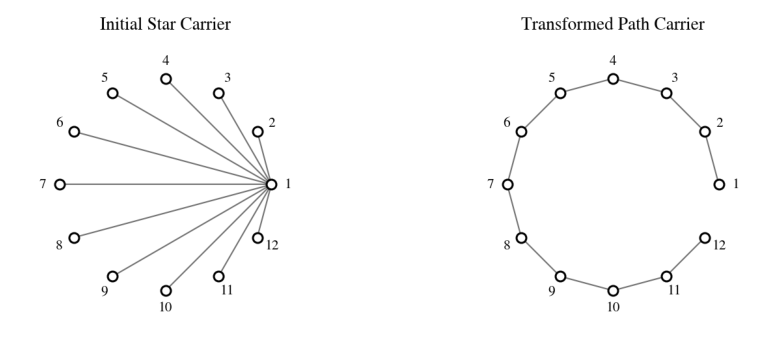
Figure 50. A twelve-node star is transformed into a path through ten edge replacements. Membership, connectivity and eleven undirected edges are preserved. Maximum distance from node one changes from one to eleven. The structural-transformation illustration preserves selected graph features while changing path relations. An economic correspondence would type ownership, supply and approval ties, then trace how changed authority and reachability affect production, participation and transition burdens despite continuity of assets or membership.
12.9 E9. Functional Succession
Mechanism and ontology. A later arrangement can perform a function previously supported by another organization. Functional identity, organizational identity and historical transmission have different criteria. Succession may preserve a capacity through changed carriers while redistributing authority, effort and access. (Folke et al. 2005; Ostrom 2009)
Formal representation. Equation (55) states the local mathematical representation for this class.
Q(Gt+1,xt+1;)≥qmin. (55)
Notation and conditions. Q is a declared functional-performance measure, q_min a chosen threshold and calligraphic T the task. The inequality is a criterion to justify for the question and population being assessed.
Epistemology and methods. State the task, threshold, population and deadline. Compare pre- and post-transition performance under matched disturbances and resource accounts. Historical tracing is needed to establish which capacities were inherited and which were independently created.
Domain analysis and practice. A cooperative, supplier or departing worker can carry a productive capacity after the original organization ends. Historical transfer and functional equivalence need separate evidence. Record access to designs, customers, equipment, permission and working capital. Test whether the successor can produce or adapt under relevant conditions. Support for succession can then address a documented missing complement, with claims about justice grounded in the affected parties’ rights and interests.
Phenomenon And Practical Problem. A supplier’s closure can be followed by a cooperative, a new contractor or workers carrying the routine into other firms. Similar output establishes one comparison, while actual transmission of designs, skills and relationships establishes another. The practical question is whether a successor can exercise the inherited capacity under its own feasible conditions. Possession of equipment or a familiar brand can leave working capital, customers, permissions and repair competence still to be established.
Mechanism And Ontological Commitments. Functional succession occurs when another carrier exercises a specified operation after the earlier arrangement changes or ends. Historical influence,
possession of an artifact and usable successor capability are distinguishable claims. Continuity requires task-relevant resources, skills, permissions and maintenance, with identity defined at the level of the function being assessed. The function is a defined productive operation with a declared quality and horizon. Its carrier combines people, materials, relations and authority. Replacement timing and transfer quality are separate variables in the atlas; economic succession likewise requires a task test in addition to an organizational handover record. (Folke et al. 2005).
Epistemic Design And Discriminating Evidence. Test successor exercise under declared support conditions and compare dependence on the original carrier. Follow transfers, training, failures and adaptations. The strongest evidence demonstrates the relevant task at the needed quality while documenting which parts are inherited and which require additional successor work. Compare successor performance on a common order and an adaptation task, reporting assistance and verification costs. Trace which routine elements are inherited and which are newly supplied. Follow worker movement and supplier relations to establish the historical pathway of capability transmission (Nelson and Winter 1982).
Philosophical Reasoning And Practice. The normative premise appraises inheritance through valuable possibilities that people can actually exercise. Founders’ contributions and successors’ additional work deserve distinct attribution, while control over later development needs appropriate authority and commitments. A transfer can preserve production while redistributing risks and unpaid maintenance. Relational wealth therefore directs inquiry toward the supports renewed through successor use and the practical terms on which affected people can participate in that continuation. (Huang 2026d).
Worked Comparison And Research Proposition. Imagine hypothetical support packages for a departing producer’s team. One transfers equipment and documentation; another allocates the same total support across equipment access, supervised exercise, customer qualification and working capital. Test valid delivery after the original firm withdraws and track a second independent production round. The proposition is that an identified missing complement determines functional succession. Preserve the financial and material ledgers, account for residual claims and distinguish inherited capability from new competence the successor creates in making the operation usable.
Reading the numerical illustration. Figure 51 illustrates the declared mechanism. Succession requires a usable operation through the later carrier. The model separates the timing of carrier replacement from the quality of the transmitted capacity and tests their sum against an explicit task criterion. A domain inquiry should establish what successors can actually perform, the complements and permissions they inherit, and the historical connection supporting a transmission claim. Choosing a function, threshold and transition burden additionally requires substantive reasons from the relevant public, legal or collaborative setting.
12.10 E10. Dissolution
Mechanism and ontology. A structure dissolves when it ceases to meet an explicit persistence criterion. Resource loss, instability, disturbance, rapid change, rewiring, substitution, self-limitation and cascades are distinct cross-cutting pathways. Dissolution can coexist with continuing participants, records and successor functions. (Ashwin et al. 2012; Gross and Blasius 2008)
Formal representation. Equation (56) states the local mathematical representation for this class.
τdiss =inf{t:P(t)<pmin}. (56)
Notation and conditions. P is a defined persistence measure and p_min its chosen threshold. The stopping time depends on those identification criteria. A different target, including function or authority, can have a different endpoint.
Epistemology and methods. Specify what P measures and distinguish it from welfare or justice. Observe residual capacity and the allocation of closure costs. A self-limiting institution deserves that description when its own operation changes a condition supporting its continued necessity.
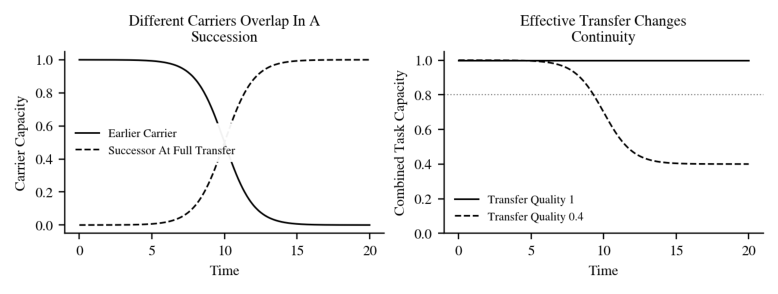
Figure 51. Carrier capacities are assumed additive. Complementary logistic profiles are combined using a stipulated effective conversion factor one or 0.4. The declared functional threshold is 0.8. Organizational handover can occur while the poorer transfer falls below that criterion. The succession panel separates carrier replacement from transmitted functional quality. Economic correspondence would test actual production or adaptation by a successor, identifying inherited and newly supplied skills, customer relations, working capital and permissions alongside the terms governing their continued exercise.
Domain analysis and practice. An economic organization can become unnecessary because its work changes the problem it addresses, or it can lose activity through depletion, instability or replacement. Trace the specific pathway and residual claims. Closure planning can transfer knowledge and equipment while assigning liabilities and supporting affected workers. The generativity of a predecessor concerns a possible inheritance; the justification for dissolution also depends on current needs, obligations and alternatives.
Phenomenon And Practical Problem. An economic organization can close after completing a bounded project, losing a necessary resource or being replaced by a more useful arrangement. These paths can produce a similar observed endpoint with different responsibilities and productive inheritance. The practical problem is to identify what ends and what remains usable or owed. Extending the original organization can preserve valuable competence, yet it can also absorb resources needed for a justified transition, so the endpoint requires a comparison of feasible alternatives.
Mechanism And Ontological Commitments. Dissolution is an endpoint defined by persistence criteria for a particular organization, relation or function. Different criteria can place the endpoint at different times. Closure can preserve duties and historical effects while ending the original arrangement, making residual commitments and the conditions of an orderly exit part of the explanation. The persistence criterion can concern a legal carrier, an operating relation or a productive function. Residual equipment, knowledge and obligations follow separate histories. The atlas’s differently generated paths share a threshold by construction, illustrating an endpoint criterion whose causal route must still be reconstructed in the economic setting. (Gross and Blasius 2008).
Epistemic Design And Discriminating Evidence. Specify stopping criteria prospectively, then trace the operational endpoint and unresolved obligations. Compare planned closure, abrupt interruption and partial continuation through event histories. A post-closure task probe can distinguish a surviving function from continued existence of the original organization under its identity criterion. Compare planned closure, resource depletion and replacement through transaction, employment and production histories. Observe handover and residual correction work after the declared endpoint. Test any surviving function in its later carrier, distinguishing organizational continuity from a capability inherited by workers or suppliers.
Philosophical Reasoning And Practice. The normative premise recognizes a fitting end while preserving claims created through earlier cooperation. Workers, financiers, customers and affected communities can have different interests in the timing and terms of closure. Capability-oriented
appraisal asks which usable opportunities survive and how transition burdens are distributed (Sen 2009). A justified decision connects those consequences to obligations, feasible alternatives and opportunity costs, with the authority to settle or transfer commitments stated explicitly. (Huang 2026d).
Worked Comparison And Research Proposition. Consider hypothetical closure plans with equal reported support. One concentrates on final output and asset disposal; another reserves resources for transferable records, worker transition and liability handover. Compare later repair, successor exercise and unresolved burdens. The proposition is that a particular endpoint procedure changes the inheritance and residual costs. Report output forgone by preparing the transition. Evidence that a function survives can support succession, while the reasons for ending the original organization remain answerable to present needs and the claims of affected parties.
Reading the numerical illustration. Figure 52 illustrates the declared mechanism. A dissolution criterion identifies an endpoint relative to an object and a threshold. The pathways producing that endpoint can differ materially, and their similarly scaled indices carry their own substantive interpretations. The figure compares declared forms of departure rather than estimating one universal mechanism. A domain account should reconstruct the causal route, preserve residual duties and successor possibilities, and distinguish ending a particular carrier from losing every participant, record or useful function historically associated with it.
12.11 E11. Recurrence
Mechanism and ontology. An absent organization or function can reappear. Similarity of form, continuity of historical descent and restoration of a usable capacity give different meanings to return. Memory, retained supports and new environmental conditions can each contribute. (Gross and Blasius 2008; Folke et al. 2005) Formal representation. Equation (57) states the local mathematical representation for this class.
τ +
A =inf{t>texit :xt ∈A}. (57)
Notation and conditions. The time t_exit identifies the earlier departure from A; tau_A-plus is first re-entry afterward. The set A must express the intended identity criterion, with historical descent assessed through additional evidence.
Epistemology and methods. Define the returning object and observe the intervening absence. Compare restoration from retained supports with independent re-creation. The assessment of return includes successor access, changed obligations and the grounds for retaining or revising the earlier arrangement.
Domain analysis and practice. A productive practice can return through retained skill, revived demand or a new ownership arrangement. Similar products leave historical continuity open. Trace the supports linking earlier and later production, and distinguish them from independent learning. Assess whether the revived capability is usable on terms participants can influence. A return can have economic value while a changed structure better serves the people carrying its costs and responsibilities.
Phenomenon And Practical Problem. A productive practice can return after renewed demand, restored credit or a different ownership arrangement. A recognizable product and retained records can survive the interruption while the capacity to deliver it has declined. The practical question is what has recurred: a label, a historical lineage or a usable operation. Revival should therefore be compared with alternative ways of meeting the current need, including a newly assembled arrangement whose capacities and responsibilities differ from the earlier carrier.
Mechanism And Ontological Commitments. Recurrence is re-entry into a defined regime after a recorded departure. Its meaning depends on whether the identity criterion concerns observable performance, organization or historical descent. Similar outputs can be newly generated, while inherited capacities can reappear through altered carriers and environmental conditions. The returning regime has an explicit identity criterion and a record of departure. Supports linking the episodes can include skill, equipment, buyer contacts and permissions. The atlas retains a record separately from driven capacity,
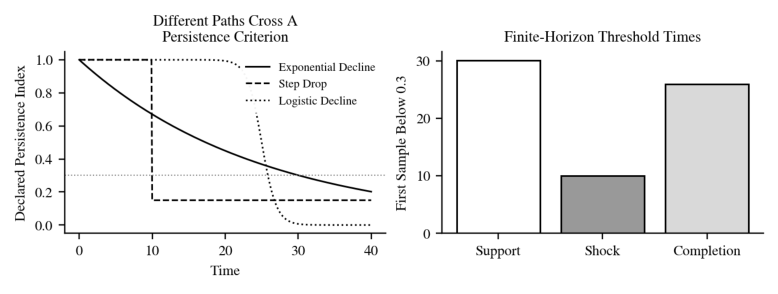
Figure 52. Three explicitly constructed normalized persistence paths cross the same declared threshold 0.3. The paths are prescribed by an exponential function, a step at time ten and a logistic decline centered at twenty-five; times are sampled at intervals 0.1. Causal interpretations require separate evidence. The dissolution panel reaches a shared threshold through different declared pathways. Economic correspondence would distinguish completed purpose, depleted support and replacement, then trace residual claims, transition burdens and successor capabilities beyond the endpoint of the original organization.
illustrating how restored input can leave actual performance above or below a declared task criterion. (Folke et al. 2005).
Epistemic Design And Discriminating Evidence. Establish an exit and later risk set before measuring return times. Compare recurrent trajectories with renewed external forcing, preserved dormant resources and independent reinvention. Provenance and common task tests jointly clarify which aspect has returned and which causal supports changed during the interval. Trace dormant supports and newly supplied complements, including cases that attempt revival but remain inactive. Compare common production and adaptation tasks with a new-entry alternative. Evolutionary routine analysis supports investigating the carriers of inherited know-how alongside the work required to make it usable under changed conditions (Nelson and Winter 1982).
Philosophical Reasoning And Practice. The normative premise gives historical inheritance evidentiary and attributional relevance while preserving present participants’ authority over their work. A revival can create valuable opportunities on terms that need revision. Project-ecology inquiry asks who learns, who finances the return and who carries the risk of another interruption. A justified recommendation therefore evaluates the current function, distribution of control and renewal burden, with historical similarity defining a correspondence question and present continuation assessed through its own practical reasons. (Huang 2026c).
Worked Comparison And Research Proposition. Imagine hypothetical dormant workshops receiving either restored purchase support or equal-supported-cost assistance rebuilding customer qualification, repair access and working capital. Compare valid delivery, adaptation and a later independent round after temporary aid ends. The proposition is that particular retained supports reduce the cost of renewed exercise only where they remain compatible with the new environment. Include failed restarts and compare independent reconstruction. Document what was inherited, what successors newly created and which conditions make the revived capability economically usable on justified terms.
Reading the numerical illustration. Figure 53 illustrates the declared mechanism. A visible return of support can have different consequences for a formerly available function. The full-input arm regains the declared threshold, while the lower-input arm approaches a capacity below it. A retained record follows a separate stipulated path. A domain inquiry should identify whether recurrence concerns form, historical continuity or exercisable function, trace the supports linking the episodes, and assess which new work and permissions are required for a consequential return.
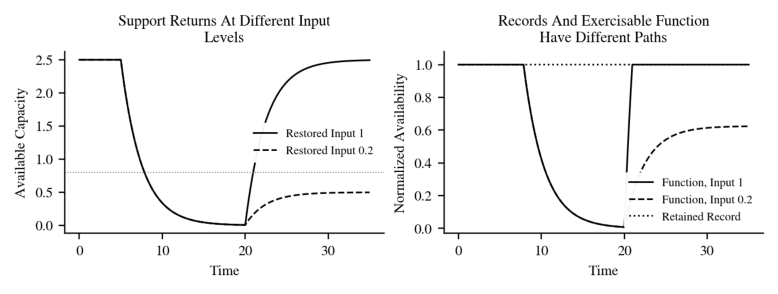
Figure 53. A capacity loses support between times five and twenty. Restored input is one or 0.2; decay remains 0.4. Full task availability requires capacity 0.8. An independently retained record is displayed as constant. The recurrence panel distinguishes a retained record from capacity under restored support. Economic correspondence would identify the returning function and inherited supports, then test valid delivery and renewed exercise against changed demand, credit conditions and the resources needed for independent reconstruction.
13 An Integrated Inquiry And Intervention Method
13.1 The Question Determines The Object And Representation
Start with a concrete contrast: continuation versus interruption, one action sequence versus another, a visible pattern versus rival generating mechanisms. Specify the subject or object through its identification criterion. Record variables with their types and units, relations with their meanings, and the horizon on which the comparison matters. A current indicator and a historical event can enter the same inquiry while retaining their different evidential roles.
The mechanism catalogue then supplies candidate explanations. It does not assign a cause through resemblance. Select a manageable set of rivals whose implications differ on a material question. An apparently stable output might reflect adequate renewal, hidden depletion or replacement of the observed population. A useful inquiry identifies an observation, comparison or lawful intervention that could distinguish these accounts. Models can be revised when the present ontology cannot express a supported distinction.
13.2 Match The Method To The Inferential Task
Conservation and stock-flow accounts test balances and expose missing channels. Temporal networks and event models represent changing relations and sequences. State-space methods estimate latent trajectories under an observation model. Sparse equation discovery investigates a specified library of possible dynamics; its library, noise treatment and data coverage bound the inference (Brunton, Proctor, and Kutz 2016). Delay reconstruction has mathematical conditions concerning the system, observation and embedding; noisy, changing and strategically responsive social settings require an explicit justification of those conditions (Takens 1981).
Causal estimation requires a declared intervention contrast and assumptions addressing assignment, confounding, interference and temporal feedback (Hernán and Robins 2020). Process tracing, archives, observation and participant accounts investigate the operations and meanings behind a possible pathway. Simulation tests consequences of specified rules and supports model discrimination through distinct predictions. Its credibility for intervention depends on correspondence, calibration and out-ofregime validation. Different methods can answer complementary parts of the same question.
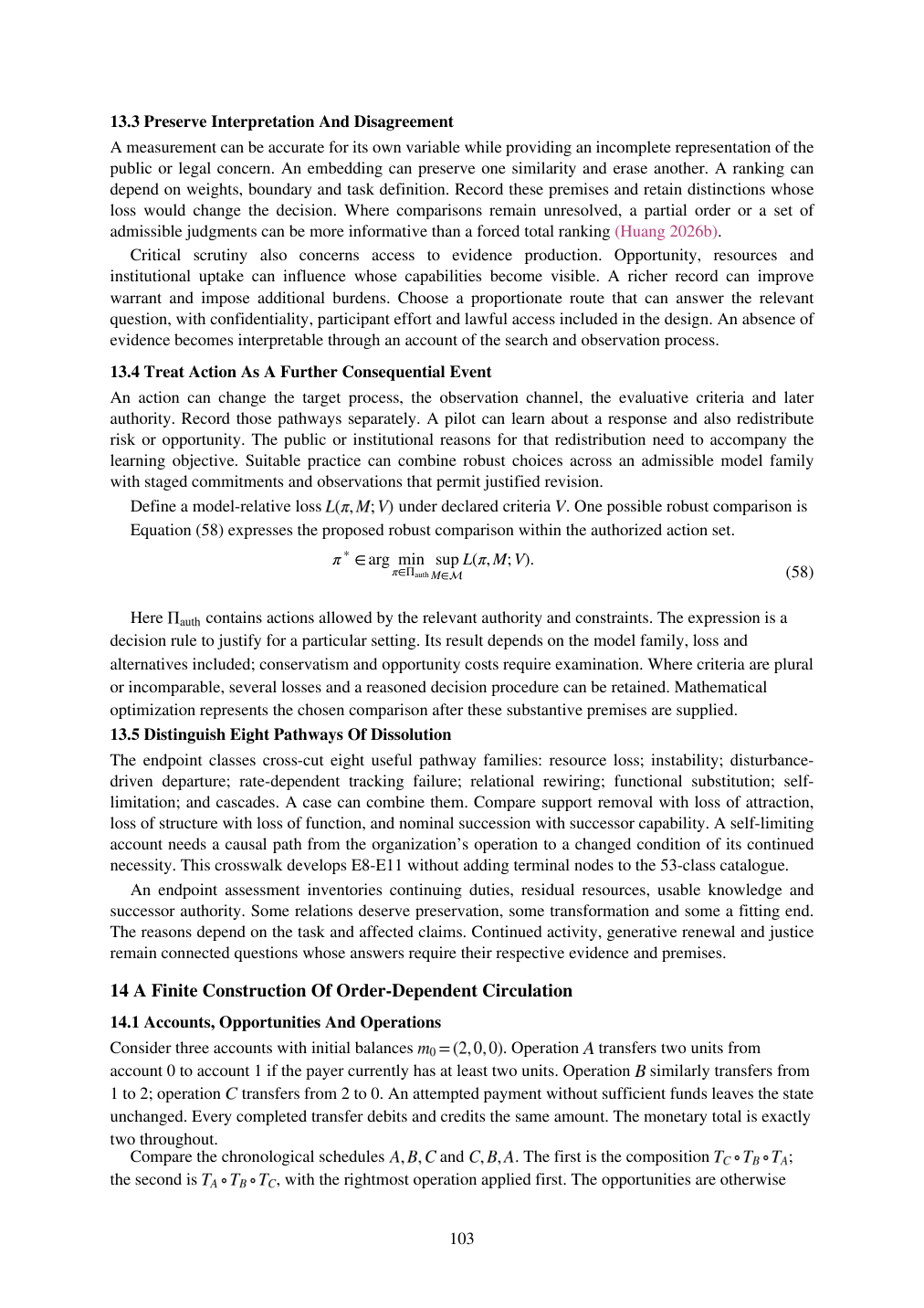
Readable text
A measurement can be accurate for its own variable while providing an incomplete representation of the public or legal concern. An embedding can preserve one similarity and erase another. A ranking can depend on weights, boundary and task definition. Record these premises and retain distinctions whose loss would change the decision. Where comparisons remain unresolved, a partial order or a set of admissible judgments can be more informative than a forced total ranking (Huang 2026b).
Critical scrutiny also concerns access to evidence production. Opportunity, resources and institutional uptake can influence whose capabilities become visible. A richer record can improve warrant and impose additional burdens. Choose a proportionate route that can answer the relevant question, with confidentiality, participant effort and lawful access included in the design. An absence of evidence becomes interpretable through an account of the search and observation process.
An action can change the target process, the observation channel, the evaluative criteria and later authority. Record those pathways separately. A pilot can learn about a response and also redistribute risk or opportunity. The public or institutional reasons for that redistribution need to accompany the learning objective. Suitable practice can combine robust choices across an admissible model family with staged commitments and observations that permit justified revision.
under declared criteria . One possible robust comparison is Equation (58) expresses the proposed robust comparison within the authorized action set.
contains actions allowed by the relevant authority and constraints. The expression is a decision rule to justify for a particular setting. Its result depends on the model family, loss and alternatives included; conservatism and opportunity costs require examination. Where criteria are plural or incomparable, several losses and a reasoned decision procedure can be retained. Mathematical optimization represents the chosen comparison after these substantive premises are supplied.
The endpoint classes cross-cut eight useful pathway families: resource loss; instability; disturbance- driven departure; rate-dependent tracking failure; relational rewiring; functional substitution; self- limitation; and cascades. A case can combine them. Compare support removal with loss of attraction, loss of structure with loss of function, and nominal succession with successor capability. A self-limiting account needs a causal path from the organization’s operation to a changed condition of its continued necessity. This crosswalk develops E8-E11 without adding terminal nodes to the 53-class catalogue.
An endpoint assessment inventories continuing duties, residual resources, usable knowledge and successor authority. Some relations deserve preservation, some transformation and some a fitting end. The reasons depend on the task and affected claims. Continued activity, generative renewal and justice remain connected questions whose answers require their respective evidence and premises.
14 A Finite Construction Of Order-Dependent Circulation
Consider three accounts with initial balances two throughout.
account 0 to account 1 if the payer currently has at least two units. Operation similarly transfers from 1 to 2; operation transfers from 2 to 0. An attempted payment without sufficient funds leaves the state unchanged. Every completed transfer debits and credits the same amount. The monetary total is exactly
Compare the chronological schedules and the second is
, with the rightmost operation applied first. The opportunities are otherwise
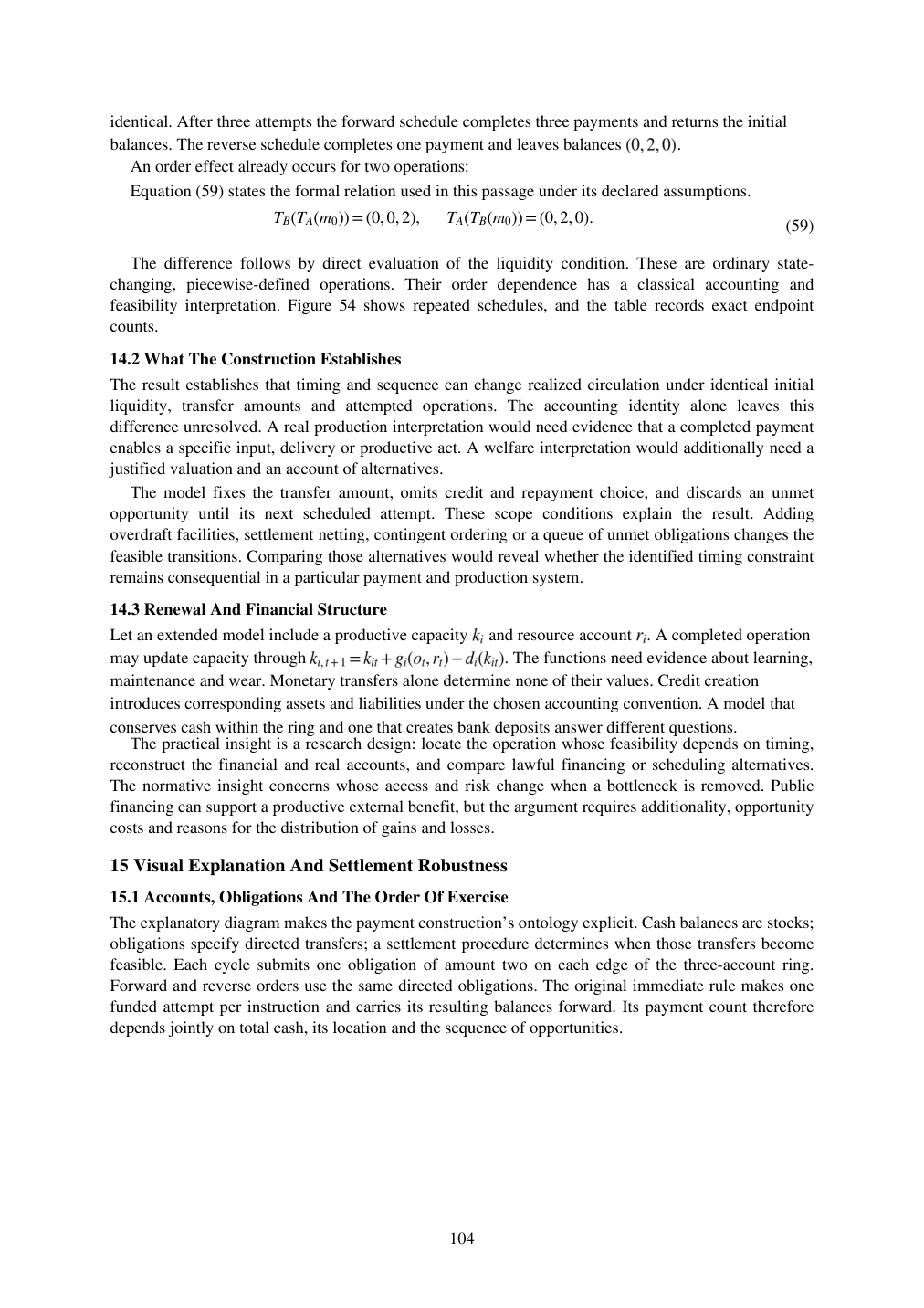
Readable text
identical. After three attempts the forward schedule completes three payments and returns the initial balances. The reverse schedule completes one payment and leaves balances Equation (59) states the formal relation used in this passage under its declared assumptions.
The difference follows by direct evaluation of the liquidity condition. These are ordinary state- changing, piecewise-defined operations. Their order dependence has a classical accounting and feasibility interpretation. Figure 54 shows repeated schedules, and the table records exact endpoint
The result establishes that timing and sequence can change realized circulation under identical initial liquidity, transfer amounts and attempted operations. The accounting identity alone leaves this difference unresolved. A real production interpretation would need evidence that a completed payment enables a specific input, delivery or productive act. A welfare interpretation would additionally need a
The model fixes the transfer amount, omits credit and repayment choice, and discards an unmet opportunity until its next scheduled attempt. These scope conditions explain the result. Adding overdraft facilities, settlement netting, contingent ordering or a queue of unmet obligations changes the feasible transitions. Comparing those alternatives would reveal whether the identified timing constraint remains consequential in a particular payment and production system.
Let an extended model include a productive capacity and resource account . A completed operation maintenance and wear. Monetary transfers alone determine none of their values. Credit creation introduces corresponding assets and liabilities under the chosen accounting convention. A model that conserves cash within the ring and one that creates bank deposits answer different questions.
The practical insight is a research design: locate the operation whose feasibility depends on timing, reconstruct the financial and real accounts, and compare lawful financing or scheduling alternatives. The normative insight concerns whose access and risk change when a bottleneck is removed. Public financing can support a productive external benefit, but the argument requires additionality, opportunity costs and reasons for the distribution of gains and losses.
The explanatory diagram makes the payment construction’s ontology explicit. Cash balances are stocks; obligations specify directed transfers; a settlement procedure determines when those transfers become feasible. Each cycle submits one obligation of amount two on each edge of the three-account ring. Forward and reverse orders use the same directed obligations. The original immediate rule makes one funded attempt per instruction and carries its resulting balances forward. Its payment count therefore depends jointly on total cash, its location and the sequence of opportunities.

Readable text
Figure 54. Order-sensitive payment realization with conserved total balances. The left panel repeats the two three-operation schedules for 120 attempts. The right panel isolates their first cycle. A completed payment records a transfer under the declared liquidity rule; it carries no assumed welfare value.
The robustness experiment crosses 61 cash totals, from 0 to 6 in increments of 0.1, with two initial distributions, two processing orders and three settlement rules: 732 runs. Cash either starts entirely in account 0 or is split equally. Each run submits forty three-instruction cycles, making 120 obligations. Immediate settlement preserves the original rule. Queued gross settlement keeps unfunded instructions within the current cycle, rescans them in submission order, and stops after a complete pass makes no payment. Any unresolved instruction expires at the cycle boundary. Every completed gross transfer
Cycle netting is a different institutional construction. The three equal obligations are legally assumed to offset and discharge simultaneously. Each account’s net position is zero, so the cycle discharges three obligations with zero gross cash movement. This rule assumes the authority and finality required for offsetting, with no default, dispute, unequal obligations or intracycle deadline. Those are substantive additions to the original institution. They make a controlled comparison of feasible operations possible while retaining the accounting distinction central to stock-flow reasoning (Godley and Lavoie 2007).
With cash 2 concentrated in account 0, immediate forward settlement completes 120 obligations and immediate reverse settlement completes 59. Queued gross settlement completes 120 under either order and returns cash to its initial distribution. Netting discharges 120 obligations with zero gross transfers. Raising concentrated cash to 4 increases immediate reverse completions to 117; cash 6 also yields 117. The three missed instructions occur during the initial funding sequence. Forward immediate settlement
Location changes the result. Equal division of cash 2 gives each account two-thirds of a unit, and both gross procedures discharge zero obligations under either order. Equal division of cash 4 also yields zero. Equal division of cash 6 funds every account at the threshold and all procedures discharge 120

Figure 55. The three-account example with explicit cash, obligations and processing order. The experiment compares the original immediate rule with declared queued-gross and cycle-netting alternatives. All routes conserve total cash; netting records discharged obligations separately from gross cash transfers.
obligations. Under zero initial cash, netting still discharges the balanced cycle’s 120 obligations, with zero cash transfers. Every run checks nonnegative balances and exact total-cash conservation within numerical tolerance. Queued and netted cycles also preserve their initial end-of-cycle balances; both alternatives give identical results across the two orders in the tested construction.
15.4 What The Comparison Explains
The result identifies a support relation between a stock and an executable sequence. The same aggregate balance can support different operations because access and institutional timing differ. Queuing restores some missed opportunities by changing their duration; netting changes the object being discharged. Discharged-obligation counts and gross turnover describe settlement operations. Judgments about production, welfare and fair access require their own objects and reasons.
This gives a philosophical linkage to exercisable opportunity: a nominal claim and the resources required to use it enter different parts of the explanation (Sen 2009). It also gives an epistemic instruction. To explain stalled circulation, observe where balances sit, when obligations arise and which settlement alternatives are authorized. A wider empirical application would additionally represent credit, defaults, legal enforceability, heterogeneous obligations, transaction costs and the productive operations that settlement is intended to enable.
16 Twelve Complementary Reconstruction Tasks
The following task taxonomy complements the mechanism catalogue. A study selects the tasks needed for its question and connects them through the domain-specific research design. Papers VI and VII develop separate juridical and policy versions.
16.1 R1. Phenomenon Mapping
Define observable event classes and preserve the records supporting their recognition. Distinguish an event, its report and a later classification. Compare category versions and measurement coverage before analyzing apparent changes.
Economic phenomenon mapping should distinguish an order, invoice, payment, delivery, productive use and later renewal of a capacity. These events can occur at different times and require different records. A rise in transactions can reflect greater production, shorter settlement paths or repeated
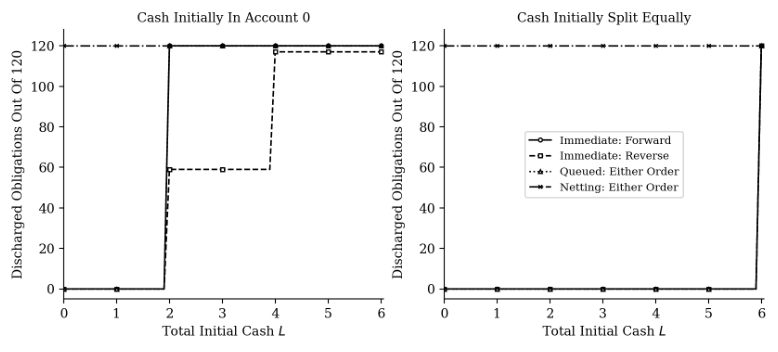
Figure 56. Discharged obligations across cash totals under three settlement procedures. Coincident curves indicate equal results. In the left panel cash begins in account 0; in the right it begins equally distributed. Netting discharges offsetting obligations without gross transfers, so its count has a different operational meaning from the gross-settlement counts.
refinancing of the same obligation. Define the object transferred and the boundary within which it is counted. Preserve revisions to product and transaction categories so that nominal growth can be compared with a change in recognition. Provenance linking financial and real operations makes the interpretation of circulation testable.
Consider a hypothetical supplier network reporting higher turnover after a new platform. Compare gross payment events with completed production episodes and the resources retained for another cycle. An accounting audit can identify duplicates and offsets, while process evidence investigates what the payments enabled (Godley and Lavoie 2007). A causal claim about the platform requires an exposure contrast and attention to entry and selection. Practical warrant for treating turnover as improvement depends on the economic function and population concerned. The reconstruction therefore adds observations about productive exercise, access and burdens before using a convenient financial indicator to support a broader developmental or public judgment.
16.2 R2. Latent-State Estimation
Specify a dynamics and observation model, then examine observability and uncertainty. Report distributions, sets or bounds where the state remains ambiguous. Validate predictions against observations outside the fitting interval.
A firm’s productive capacity is partly latent and context-dependent. Current output can be supported by retained expertise, a temporary specialist, excess working hours or a favorable demand match. Specify the intended operation and its complements before estimating a capacity state. An observation model can connect output, repair ability, staffing, liquidity and input access, with uncertainty about which support generated the record. Some states remain indistinguishable during ordinary operation. A disruption or changed task may reveal a missing complement, though its interpretation still requires an account of the intervention and observation process.
Imagine hypothetical workshops with the same recent production record. One can repair and adapt equipment locally; another depends on an external expert who is leaving. Compare performance on a changed specification and a documented repair task, recording temporary assistance. Evolutionary and transfer perspectives motivate following routines together with the supports needed to exercise them (Nelson and Winter 1982; Cartwright and Hardie 2012). Practical warrant for financing or succession should state what the evidence identifies and which conditions remain uncertain. A forecast of capacity
can support a conditional plan while a range of plausible states guides further observation, reserves or staged commitment under an explicitly justified decision rule.
16.3 R3. Interaction Recovery
Define the meaning and time of each relation. Compare influence through ties with selection into them and shared external causes. Use independent measurements or justified interventions capable of separating those pathways.
Recover economic interactions as typed relations: input dependence, ownership, credit, knowledge exchange, employment and authority over standards. A transaction edge can conceal several of these at once. Identify timing, substitution possibilities and the resources required to alter each relation. A buyer’s disruption can propagate through suppliers, while their reverse influence follows a different channel. Correlation between connected firms leaves selection, shared demand and influence through the tie as rival explanations. Connect the temporal network to contracts and actual operations so that a proposed dependence has an interpretable economic meaning.
Compare hypothetical producers receiving the same market information through different access to working capital and a coordinating buyer. Information can reveal an opportunity without making its conversion feasible. This extends the coordination question posed by dispersed knowledge toward the practical means of acting on it (Hayek 1945; Acemoglu et al. 2012). A research design can vary one support in a constructed network and test substitution and delay against process records. Practical warrant then concerns the identified relation: a missing financing bridge and a missing technical connection call for different responses. The assessment includes who controls the channel, who carries risk and whether a successor can exercise the opportunity without exceptional temporary support.
16.4 R4. Dynamical-Law Discovery
Declare candidate functions, transition rules and constraints. Inspect parameter and structural identifiability before interpreting a fitted rule. Test changed regimes and retain rival models with materially different predictions.
Dynamical-law discovery in economics should make its behavioral and institutional library explicit. Candidate mechanisms might include liquidity thresholds, delayed investment, inventory adjustment, reinforcement and resource depletion. Accounting constraints restrict admissible histories while leaving these response rules open. Check parameter and structural identifiability before treating a fitted coefficient as a stable feature of the economy. A short period with one financing regime can make several mechanisms observationally similar. Preserve known institutional changes as inputs and test whether the rule continues to describe response after those conditions change (Brunton, Proctor, and Kutz 2016; Axtell and Farmer 2025).
In a hypothetical production chain, compare models explaining delayed deliveries through physical capacity and models explaining them through settlement timing. Fit both to the same normal period, then test a demand surge and a changed payment schedule. Observe actual input availability so that the models’ predictions can be discriminated. A successful aggregate forecast may still imply the wrong intervention if the support pathway is mistaken. Practical warrant should therefore identify the mechanism and response range established, the accounting boundary and the remaining rival. A modeldependent simulation can sharpen a policy comparison while empirical correspondence and the reasons for allocating support remain additional parts of the decision.
16.5 R5. Environment Reconstruction
Measure or bound unobserved inputs, resources and institutional conditions. Compare endogenous change with external driving. Record which environmental histories remain compatible with the observations.
Reconstruct the economic environment through demand, energy and material supply, standards, permissions, finance and neighboring production. Some conditions change with the process itself, while others are treated as external over the chosen horizon. State that boundary and record histories,
including temporary grants and exceptional buyers. A project can appear to renew itself while relying on continued outside support. Environmental reconstruction identifies that dependence and asks whether it is available to a successor. It also records burdens displaced to households, public infrastructure or ecological supports outside the sponsor’s immediate account.
Compare hypothetical enterprise pilots with similar sales but different support arrangements. One retains a temporary procurement commitment; another faces ordinary market access. Observe the transition after support changes, accounting for demand and input conditions. A prospective comparison can test which complementary relation carries performance, while sensitivity analysis examines plausible missing environmental histories (Cartwright and Hardie 2012; Ostrom 2009). Practical warrant for replication should include the required support or a credible substitute, together with costs and authority. Continued external provision can be justified for stated public purposes; the evidential task is to make it visible and distinguish subsidized exercise, renewal of local capability and a claim of independent continuation.
16.6 R6. Historical-Path Reconstruction
Identify the memory carrier and the horizon over which it matters. Use dated sources and sequence constraints. Compare present observations reached through different plausible paths and state which additional evidence discriminates them.
Historical reconstruction follows how current assets, skills, obligations and market relations became available. Equal cash balances can coexist with different debt commitments, repair knowledge and customer access. Identify which carrier of history matters for the economic comparison, and preserve dated records linking earlier contributions to present operations. Separate historical inheritance from independently supplied new support. A current successful demonstration can establish exercise without proving its lineage, while a documented transfer can establish descent without showing present usability. Both claims require evidence matched to their distinct objects.
Imagine a hypothetical cooperative inheriting equipment from a closing firm. Compare a history of worker participation in design and repair with a history limited to routine operation. Test a new production requirement under the successor’s actual permissions and financing. Path dependence and evolutionary routines motivate examining the sequence and its retained supports (Arthur 1989; Nelson and Winter 1982). Practical warrant for succession support should identify the missing complement and the beneficiaries and burdens of providing it. Claims concerning responsibility for earlier exclusion require additional reasons. The reconstruction contributes an explicit account of what was transmitted, what must still be established and which alternative histories remain compatible with the available record.
16.7 R7. Mechanism Discrimination
Formulate rival explanations with different observable or interventional implications. Choose a proportionate discriminating comparison. A successful prediction narrows the family within the conditions tested and leaves wider transfer to further evidence.
Discriminate economic mechanisms through contrasts that change their implications. A stalled production chain can arise from insufficient total liquidity, unfavorable distribution, a missed payment opportunity, a missing physical input or weak demand. Aggregate balances alone leave several accounts open. The three-account construction makes this precise for a specified ring of equal obligations: processing order changes gross completion under the immediate rule. The added alternatives show how queuing changes opportunity duration and netting changes the institution of discharge. Each comparison preserves or changes a declared feature of the transition system. Financial clearing and default models provide a further comparison when obligations and failure conditions become the explanatory target (Eisenberg and Noe 2001).
For a hypothetical empirical inquiry, link payment timing with delivery, inventory and the opportunity to retry. Compare a schedule change with additional cash and with a controlled change in settlement procedure, using authorized and source-correct institutional definitions. Observe whether the
proposed intermediate operation actually occurs. Accounting and causal methods constrain the comparison (Godley and Lavoie 2007; Hernán and Robins 2020). Practical warrant follows the mechanism identified and the real function served. More discharged claims can ease production or have little productive consequence in another arrangement. The preferred response therefore needs evidence about completed real operations, costs, enforceability and the allocation of waiting or default risk among affected participants.
16.8 R8. Resource-Use Inference
Close the relevant physical, financial or labor account in its own units. Track missing channels and boundary transfers. Thermodynamic dissipation requires its physical correspondence; social costs and benefits require separate interpretation.
Resource-use inference combines several compatible accounts while preserving their types. Financial transfers require entries for both sides; credit creation, debt cancellation and revaluation require the appropriate additional entries. The Bank of England’s account identifies lending as a source of newly created deposits, underscoring the declared scope of the toy model’s fixed-cash account (McLeay, Radia, and Thomas 2014). Physical materials and energy follow their own balances. Labor time, learning and unpaid maintenance identify further supports whose economic interpretation needs separate evidence. A balanced monetary account constrains possibilities without establishing productive value or justice. Reproduction reasoning asks which conditions of another operation are restored and who performs the work through which that restoration occurs (Godley and Lavoie 2007; Marx 1867).
Compare hypothetical firms reporting the same profit while one cancels apprentice time and another maintains it. Record current output, paid and unpaid teaching, equipment wear and the successor’s ability to perform a repair. A longitudinal or constructed comparison can investigate the learning contribution, accounting for selection and external assistance. Practical warrant for supporting apprenticeship requires a defensible account of beneficiaries, opportunity costs and actual later exercise. A common monetary calculation can answer a specified budget question when its conversions are justified. Where it obscures a material difference in capability or burden, report plural accounts and provide explicit reasons for the consequential choice.
16.9 R9. Cross-Scale Correspondence
State what aggregation preserves and what it removes. Compare micro- and macro-level records under consistent definitions. Keep distinctions needed for attribution, intervention or evaluation when constructing the coarser account.
Economic aggregates can conceal which network paths and productive supports generate them. Link firm-level operations, household conditions and sectoral summaries under consistent accounting definitions. An increase in total turnover can arise from more completed production or more repeated transfer of claims. A stable aggregate output can coexist with concentration, lost entry routes or displaced maintenance burdens. State what the aggregation preserves and test whether omitted distinctions change the intervention or evaluation. Production-network structure provides a reason to inspect how local dependence can become an aggregate response (Acemoglu et al. 2012).
In a hypothetical supply network, compare total output before and after consolidation with substitution time, working-capital access and skill transfer among smaller producers. Constructed disruption tests can identify which local losses matter for the declared system function. Empirical validation should preserve ownership and entry information so that wider performance is connected to the people able to exercise it. Capability-oriented reasoning adds substantive opportunity to the comparison (Sen 2009). Practical warrant for a developmental judgment requires attention to the distribution and horizon of gains and losses. A coarse measure can remain useful for its defined purpose while a more detailed account answers the decision concerning access, control or successor capability.
16.10 R10. Functional Reconstruction
Specify the task, population, threshold and deadline. Investigate how operations produce the function under ordinary and disrupted conditions. Distinguish nominal assignment from actual exercisable capacity.
Functional reconstruction defines an economic task through a complete executable sequence. Producing a repairable good can require designs, skills, equipment, inputs, permission, working capital and a customer able to use it. A certificate or transferred machine records only part of that capacity. Specify ordinary and disrupted conditions, the relevant deadline and whose performance matters. Observe actual exercise after founding experts and temporary grants withdraw. A successful transfer claim should identify both the inherited contribution and the complements the successor supplies independently (Cartwright and Hardie 2012).
Consider a hypothetical workshop succession in which workers receive equipment but lose a preferred supplier and advance-payment arrangement. Compare asset-only transfer with a handover preserving the missing operational relations, with the additional costs visible. Test routine production and a changed order under the successor’s actual conditions. The inference concerns a support pathway, not an intrinsic trait of the new organization. Practical warrant for targeted support follows evidence that the complement enables valuable exercise and that the intervention is feasible and justified for the affected parties (Sen 2009). A failure at one step can direct repair or redesign while preserving evidence of capacities already transferred, making succession more precisely reviewable.
16.11 R11. Semantic Reconstruction
Examine how an observation becomes intelligible to particular participants. Retain contextual interpretations, translation rules and disagreement. Test practical uptake separately from similarity in wording or numerical representation.
Economic meaning enters through purposes, expectations and interpretations of exchange. A contract term, skill label or product-quality measure can be understood differently by workers, buyers and financiers. Similar numerical scores can conceal distinct uses and risks. Reconstruct these meanings through concrete tasks, explanations and attempted transactions, preserving the context in which each interpretation becomes consequential. A semantic model can organize descriptions while practical uptake tests whether participants can coordinate the intended operation. Translation between settings should identify which distinctions survive and which require a new agreement or supporting practice.
Imagine a hypothetical training program certifying maintenance competence. Compare the written qualification with the tasks that receiving employers and workers believe it authorizes and enables. Use matched repair scenarios and explanation interviews to test the correspondence. Dispersed-knowledge and capability perspectives motivate connecting local understanding with feasible exercise (Hayek 1945; Sen 2009). Practical warrant may support clearer explanation, a revised assessment or access to missing tools, depending on the diagnosed gap. The value of a portable label depends on how it coordinates action under actual conditions. Its authority and fairness also require reasons concerning who sets the standard and how a participant can challenge a consequential misunderstanding.
16.12 R12. Normative Reconstruction
Trace how a criterion arises, stabilizes and acquires consequential force. Distinguish prevalence, practical commitment, authorized use and justified authority. Public or moral judgment identifies its substantive reasons and affected claims.
Normative reconstruction follows an economic criterion from proposal through selection power and consequential use. A private return forecast, procurement score and public development measure serve different purposes and operate through different authorities. Document who defines success, who can demonstrate capacity and how the resulting allocation produces later evidence. A standard can stabilize through dependence as well as persuasion. Its prevalence and predictive usefulness remain distinct from reasons for adopting it. The reconstruction should therefore preserve competing purposes, affected claims and the procedure through which a criterion can be revised (Huang 2026a).
Compare hypothetical project portfolios assessed by immediate return and by an explicitly defended combination of learning, access and renewal. Keep forecast uncertainty, public additionality and opportunity costs visible, and test which differences persist under plausible alternative weights. Generative-justice and relational-wealth perspectives supply resources for asking who contributes and who can exercise the resulting possibilities (Eglash 2016; Huang 2026d). Practical warrant for support requires more than a forecast of future activity. It needs reasons for the valued continuation, competent adoption, feasible financing and an intelligible allocation of risk and control. A dynamic model can clarify those consequences while the normative reconstruction makes the grounds for choosing among them available for scrutiny.
17 A Prospective Inquiry Into Economic Renewal
17.1 Follow A Capacity Across Boundaries
Select a production or service episode and identify the people, knowledge, assets and permissions needed to repeat or adapt it. Trace where those supports go when a worker moves, a contract ends or a firm closes. Compare organizational survival with continued productive exercise. Use accounts and transaction histories for financial passages, process evidence for operations and interviews or observation for tacit complements. Each evidence source supports its particular claim.
17.2 Compare Financing And Support Institutions
Identify the payer of a trial and the recipients of its potential benefits. Model liquidity, timing and uncertainty explicitly. Compare an ordinary contract, staged finance, a shared technical resource or a coordination institution according to the constraint identified. An evaluation can separate immediate returns, transferable learning, total supported effort and later exercise. Ownership and authority over those capabilities enter the assessment alongside aggregate outcomes.
17.3 Include The Selection Environment
Record opportunities to apply, demonstrate and challenge a decision. A rejected proposal and an unexamined proposal have different evidential statuses. Compare AI-supported idea generation with compensated access to situated knowledge and their combination, using a design that separates these inputs. Outcomes should include verification cost, substantive alternatives, use of learning and burdens shifted outside the sponsoring organization. The proposal extends inquiry into economic capability while preserving the public reasons required for consequential allocation.
18 Economic Implications
The economy’s continued activity depends on more than a balance or an output. Sequence, complementary inputs, learning and the maintenance of resources shape what can happen next. The full taxonomy supplies rival explanations of persistence, fluctuation and transformation. The finite construction isolates an exact case in which conserved resources support different realized circulation through different schedules.
The proposed generative-renewal inquiry follows the bearers of capability and the powers governing its exercise. It examines finance, production, interpretation and selection within one connected account while retaining their different units and grounds of evaluation. This supports concrete research on where circulation is blocked, how support can be renewed and which continuation or transformation deserves public or institutional backing.
19 Research Materials And Authorial Review
The editable manuscript, shared mechanism catalogue, simulation programs, generated outputs and original figures accompany this paper. The source record identifies primary-source links and the access level used in the survey. Reported experimental summaries are generated by the accompanying programs. The prose also introduces hypothetical conceptual comparisons whose stipulated quantities serve an argumentative purpose. Exact equality claims receive the analytical argument given in the text. Reproduction uses Python with NumPy, SciPy and Matplotlib; the package records the versions used.
The remaining empirical research question is the correspondence between the proposed mechanisms and particular social settings. An application should specify its observation process, feasible alternatives, institutional authority and validation design. The manuscript supplies complete coverage of the declared catalogue and a concrete basis for that further inquiry. The author can revise substantive commitments, select empirical cases and assess the literature and arguments before any external scholarly submission.
19.1 AI Assistance Statement
This revised manuscript and its accompanying code were prepared with ChatGPT and Codex assistance in literature retrieval, conceptual organization, drafting, argumentative criticism, formal checking, programming and presentation. Wanhong HUANG supplied the research direction and the request for the eight-paper series. The manuscript is presented for the author’s substantive review and decision about further development and circulation. The statement records the assistance actually used in this preparation; responsibility and final approval require the author’s own assessment.
References
Acemoglu, Daron, Vasco M. Carvalho, Asuman Ozdaglar, and Alireza Tahbaz-Salehi. 2012. “The Network
Origins of Aggregate Fluctuations.” Econometrica 80 (5): 1977–2016. https://doi.org/10.3982/ECTA9623. Arthur, W. Brian. 1989. “Competing Technologies, Increasing Returns, and Lock-In by Historical Events.” The
Economic Journal 99 (394): 116–31. https://doi.org/10.2307/2234208. Ashwin, Peter, Sebastian Wieczorek, Renato Vitolo, and Peter Cox. 2012. “Tipping Points in Open Systems:
Bifurcation, Noise-Induced and Rate-Dependent Examples in the Climate System.” Philosophical Transactions of the Royal Society A 370: 1166–84. https://pubmed.ncbi.nlm.nih.gov/22291228/. Axtell, Robert L., and J. Doyne Farmer. 2025. “Agent-Based Modeling in Economics and Finance: Past, Present,
and Future.” Journal of Economic Literature 63 (1): 197–287. https://doi.org/10.1257/jel.20221319. Bebon, Robin, Joshua F. Robinson, and Thomas Speck. 2025. “Thermodynamics of Active Matter: Tracking
Dissipation Across Scales.” Physical Review X 15: 021050. https://doi.org/10.1103/PhysRevX.15.021050. Boettiger, Carl, and Alan Hastings. 2012. “Early Warning Signals and the Prosecutor’s Fallacy.” Proceedings of
the Royal Society B. https://pmc.ncbi.nlm.nih.gov/articles/PMC3497104/. Brunton, Steven L., Joshua L. Proctor, and J. Nathan Kutz. 2016. “Discovering Governing Equations from Data
by Sparse Identification of Nonlinear Dynamical Systems.” Proceedings of the National Academy of Sciences 113 (15): 3932–37. https://doi.org/10.1073/pnas.1517384113. Cartwright, Nancy, and Jeremy Hardie. 2012. Evidence-Based Policy: A Practical Guide to Doing It Better.
Oxford University Press. https://academic.oup.com/book/11611. Cross, M. C., and P. C. Hohenberg. 1993. “Pattern Formation Outside of Equilibrium.” Reviews of Modern
Physics 65: 851–1112. https://doi.org/10.1103/RevModPhys.65.851. Douglas, Heather. 2000. “Inductive Risk and Values in Science.” Philosophy of Science 67 (4): 559–79. https://w
ww.cambridge.org/core/journals/philosophy-of-science/article/abs/inductive-risk-and-values-in-science/D637 9A8CA7FB22DA3F2A8727462866C0. Eglash, Ron. 2016. “An Introduction to Generative Justice.” Teknokultura.
https://revistas.ucm.es/index.php/TEKN/en/article/view/52847. Eisenberg, Larry, and Thomas H. Noe. 2001. “Systemic Risk in Financial Systems.” Management Science 47 (2):
236–49. https://doi.org/10.1287/mnsc.47.2.236.9835. Folke, Carl, Thomas Hahn, Per Olsson, and Jon Norberg. 2005. “Adaptive Governance of Social-Ecological
Systems.” Annual Review of Environment and Resources 30: 441–73.
https://doi.org/10.1146/annurev.energy.30.050504.144511. Frey, Erwin, and Henrik Weyer. 2026. “Pattern Formation Beyond Turing: Physical Principles of
Mass-Conserving Reaction-Diffusion Systems.” Annual Review of Biophysics 55: 493–514. https://doi.org/10.1146/annurev-biophys-030822-031638. Fricker, Miranda. 2007. Epistemic Injustice: Power and the Ethics of Knowing. Oxford University Press.
https://doi.org/10.1093/acprof:oso/9780198237907.001.0001. Godley, Wynne, and Marc Lavoie. 2007. Monetary Economics: An Integrated Approach to Credit, Money,
Income, Production and Wealth. Palgrave Macmillan. https://doi.org/10.1057/9780230626546. Gross, Thilo, and Bernd Blasius. 2008. “Adaptive Coevolutionary Networks: A Review.” Journal of the Royal
Society Interface 5 (20): 259–71. https://doi.org/10.1098/rsif.2007.1229. Hayek, Friedrich A. 1945. “The Use of Knowledge in Society.” American Economic Review 35 (4): 519–30.
https://www.econlib.org/library/Essays/hykKnw.html. Hernán, Miguel A., and James M. Robins. 2020. Causal Inference: What If. Chapman & Hall/CRC.
https://miguelhernan.org/whatifbook. Holling, C. S. 1973. “Resilience and Stability of Ecological Systems.” Annual Review of Ecology and Systematics
4: 1–23. https://doi.org/10.1146/annurev.es.04.110173.000245. Huang, Wanhong. 2026a. “An Inquiry into Evaluative Norm Formation and Justice in Self-Evolving AI
Knowledge Systems.” Author manuscript, current supplied version 6. https://huang-wanhong.com/publication. Huang, Wanhong. 2026b. “An Inquiry into the Formation of Evidence-Based Partial Orders in the Governance of
Human–AI Evolutionary Production.” Author manuscript, current supplied version 6. https://huang-wanhong.com/publication. Huang, Wanhong. 2026c. “Evolutionary Project Ecologies in Economics: A Conceptual Framework and
Institutional Prospects.” Author manuscript, current supplied version 4. https://huang-wanhong.com/publication. Huang, Wanhong. 2026d. “Relational Wealth: Definition and Characteristics.”
https://doi.org/10.17613/nq7js-vz283. Hughes, Edward, Michael D. Dennis, Jack Parker-Holder, Feryal Behbahani, Aditi Mavalankar, Yuge Shi, Tom
Schaul, and Tim Rocktäschel. 2024. “Position: Open-Endedness Is Essential for Artificial Superhuman Intelligence.” In, 235:20597–616. Proceedings of Machine Learning Research. https://proceedings.mlr.press/v235/hughes24a.html. Korbel, Jan, Artemy Kolchinsky, Sarah A. M. Loos, Gonzalo Manzano, Rosalba Garcia-Millan, Olga Movilla
Miangolarra, and Édgar Roldán. 2026. “Quo Vadis, Stochastic Thermodynamics?” Journal of Non-Equilibrium Thermodynamics 51 (4): 577–94. https://doi.org/10.1515/jnet-2026-0051. Lindblad, Göran. 1976. “On the Generators of Quantum Dynamical Semigroups.” Communications in
Mathematical Physics 48: 119–30. https://doi.org/10.1007/BF01608499. Lorenz, Edward N. 1963. “Deterministic Nonperiodic Flow.” Journal of the Atmospheric Sciences 20: 130–41.
https://wind.mit.edu/~emanuel/Lorenz/EdLorenz/Deterministic\_63.pdf. Marx, Karl. 1867. “Capital, Volume I: Chapter 23, Simple Reproduction.” In.
https://www.marxists.org/archive/marx/works/1867-c1/ch23.htm. McLeay, Michael, Amar Radia, and Ryland Thomas. 2014. “Money Creation in the Modern Economy.” Bank of
England Quarterly Bulletin, March. https://www.bankofengland.co.uk/quarterly-bulletin/2014/q1/money-creation-in-the-modern-economy. Nelson, Richard R., and Sidney G. Winter. 1982. An Evolutionary Theory of Economic Change. Harvard
University Press. https://www.hup.harvard.edu/books/9780674272286. Onsager, Lars. 1931. “Reciprocal Relations in Irreversible Processes. I.” Physical Review 37: 405–26.
https://doi.org/10.1103/PhysRev.37.405. Ostrom, Elinor. 2009. “A General Framework for Analyzing Sustainability of Social-Ecological Systems.”
Science 325 (5939): 419–22. https://doi.org/10.1126/science.1172133. Perdomo, Juan, Tijana Zrnic, Celestine Mendler-Dünner, and Moritz Hardt. 2020. “Performative Prediction.” In,
119:7599–609. Proceedings of Machine Learning Research. https://proceedings.mlr.press/v119/perdomo20a.html. Pierson, Paul. 2000. “Increasing Returns, Path Dependence, and the Study of Politics.” American Political
Science Review 94 (2): 251–67. https://doi.org/10.2307/2586011.
Prigogine, Ilya. 1977. “Time, Structure and Fluctuations.”
https://www.nobelprize.org/uploads/2018/06/prigogine-lecture.pdf. Ritchie, Paul D. L., Hassan Alkhayuon, Peter M. Cox, and Sebastian Wieczorek. 2023. “Rate-Induced Tipping in
Natural and Human Systems.” Earth System Dynamics 14. https://doi.org/10.5194/esd-14-669-2023. Seifert, Udo. 2012. “Stochastic Thermodynamics, Fluctuation Theorems and Molecular Machines.” Reports on
Progress in Physics 75: 126001. https://doi.org/10.1088/0034-4885/75/12/126001. Seifert, Udo. 2025. “Universal Bounds on Entropy Production from Fluctuating Coarse-Grained Trajectories.”
Preprint, arXiv:2512.07772. https://arxiv.org/abs/2512.07772. Sen, Amartya. 2009. The Idea of Justice. Harvard University Press.
https://philosophy.fas.harvard.edu/publications/idea-justice. Takens, Floris. 1981. “Detecting Strange Attractors in Turbulence.” In, 366–81. Springer.
https://doi.org/10.1007/BFb0091924. Turing, Alan M. 1952. “The Chemical Basis of Morphogenesis.” Philosophical Transactions of the Royal Society
B 237: 37–72. https://doi.org/10.1098/rstb.1952.0012.