Epistemic Contracts For Scientific Model Execution And Reconstruction
Full text from the PDF
Epistemic Contracts For Scientific Model Execution And
Reconstruction
Wanhong HUANG
Abstract
Scientific reuse requires a precise relation between returned values, admissible worlds, available operations, and the query being answered. This report develops a finite epistemic contract linking those objects to evidence direction and certificate revision. Established program contracts, abstract interpretation, partial identification, certifying computation, and provenance provide its foundations. A query-image characterization shows that retaining universal query properties can require less than world-set refinement, provided query meaning and exactness remain fixed. The publication-stage case compiles an unmodified pinned kinesis kernel header with a report-owned external adapter. Among 900 same-query transitions, 560 satisfy query-image inclusion and 260 satisfy world inclusion. In 2,700 changed-query mutations, native numeric disposition retains 180 singleton values under deliberately violated same-feature premises; the external semantic check rejects automatic retention. It also rejects 157 unsound asserted singleton payloads by exact finite image comparison. These cases document caller obligations alongside the kernel’s intended structural behavior. Earlier exhaustive and sensitivity studies evaluate incomplete candidate promotion, relational enclosure precision, and dependency capture. The proposed contribution is the scientific lifecycle schema, the source-grounded enforcement boundary, and reproducible reference checks. Its set-theoretic ingredients remain inherited, and the checker implementation and finite semantics remain trusted. Scalable production integration, empirical workflow efficiency, and researcher comprehension require additional evaluation.
Keywords: epistemic contracts; scientific computation; partial identification; capabilities; provenance
Technical Report Note
This technical report shares an evolving inquiry and invites dialogue, criticism, revision, and independent development. Its definitions, distinctions, and constructions remain open to refinement. Circulation across scholarly and practical communities is part of the purpose of releasing the manuscript.
The author treats the viewpoints, concepts, and lines of reasoning presented here as contributions to a shared field of inquiry. Similar or related ideas may have appeared in other intellectual, cultural, and disciplinary traditions. The manuscript identifies known antecedents and distinguishes inherited positions, interpretive proposals, and arguments developed here. Historical priority remains open to further investigation.
The constructions and arguments are presented with their stated assumptions and evidential scope. Readers are encouraged to question, test, revise, extend, reinterpret, or independently develop the ideas presented here. Where appropriate, acknowledgment of this paper as one point of encounter in the development of a related idea is appreciated. Such acknowledgment records an intellectual route; the ideas remain available for criticism, revision, and independent development.
Definitions introduced by the paper are local analytical stipulations unless attributed to another source. Their use identifies the scope of the present argument; terminological and historical priority remain subjects for independent investigation. Generative Relational theory is treated as an open research programme whose proposals receive critical examination alongside independent literature.
Responsible Use and Rights Reservation
This section records a request for responsible scholarly conduct and identifies the scope of retained rights. Legal permissions are governed by the licence on the following page.
The author encourages good-faith discussion, criticism, independent inquiry, and responsible use of the material. Separately from the licence’s terms, the author asks users to consider foreseeable harms when adapting the arguments, representations, or examples of this paper, particularly in scientific inquiry, institutional decisions, and computational knowledge infrastructures. The ethical request leaves the licence’s permissions and legally authorised uses unchanged.
The author retains the rights preserved under CC BY-NC 4.0 and may pursue remedies to which the author is legally entitled for breach of the licence or violation of independently applicable rights. Reuse remains independent from authorial endorsement. Third-party rights require authorisation from their respective holders where applicable. Copyright exceptions and limitations, including applicable forms of fair use or fair dealing, remain available.
Notices
This page consolidates the manuscript’s research status, licence, development disclosure, researchprogramme relation, and suggested citation.
Status. This technical report is prepared for the author’s substantive review and subsequent scholarly discussion. The report combines attributed contract and sound-approximation foundations with queryrelative retention, exact finite studies, and a compiled standalone pinned-kernel conformance case. Internal checks assess the stated arguments and examples; independent scholarly assessment can further test their interpretation and adequacy. The source ledgers record the access level and claim scope of consulted works.
Licence. Except where otherwise indicated, copyright 2026 Wanhong Huang. This work is made available under the Creative Commons Attribution-NonCommercial 4.0 International License (CC BY-NC 4.0). Subject to its terms, the licence permits sharing and adaptation for noncommercial purposes with appropriate attribution, a link to the licence, and an indication of changes. Attribution should preserve the licensor’s independence from the reuse. Reuse is governed solely by the licence; the responsible-use request on the preceding page remains separate from its terms. The licence deed and legal code are available at https://creativecommons.org/licenses/by-nc/4.0/. The licence governs in case of conflict with this summary. Third-party material remains subject to its respective rights.
Statement on the use of language models. Preparation involved OpenAI’s ChatGPT and Codex. Language models supported exploratory dialogue, source discovery and checking, argumentative criticism, manuscript revision, LATEX typesetting, and the development of supporting code and figures. Verification used the sources and access levels recorded in the accompanying ledgers. The author initiated the research questions and directed the research programme; interpretation, acceptance of the arguments, and publication decisions remain subject to the author’s review. Authorship credit and responsibility for the released manuscript remain with the human author.
Code and data availability. reproduce.py regenerates Python studies and compiles the standalone kernel harness using a C++17 compiler. The unmodified header, MIT attribution, external adapter, verified references, and publication review accompany the report. The source package contains the editable manuscript, source ledgers, supporting scripts and outputs, and a reading guide. Numerical illustrations, where present, use the assumptions stated in their captions and text.
Related research programme. This report belongs to the Noetarium technical report series. Companion reports study inference, computation, evaluation, governance, and cross-disciplinary knowledge formation. The reports develop distinct technical questions within an open Generative Relational research programme.
Suggested citation. Huang, Wanhong. “Epistemic Contracts For Scientific Model Execution And Reconstruction.” Technical report, 2026.
1 Introduction
A scientific computation can be numerically well formed while answering a stronger question than its inputs support. An inferred trajectory may be one history compatible with a record. A fitted model may be one law among several indistinguishable alternatives. A symbolic declaration may admit a mathematical meaning while the available engine implements only some operations on it. These distinctions become more consequential when humans and AI compose tools across disciplines, because the assumptions attached to one tool’s output can disappear at the next interface.
An infrastructure can address this problem by treating evidential scope as executable data. The user should be able to ask which operations an artifact supports, what the output approximates, whether the search was complete, and which versions of evidence and assumptions the result depends on. An answer then carries conditions under which it may be used downstream. This is the role assigned here to an epistemic contract.
The term is used locally for a technical construction. The underlying ideas have established lineages in abstract interpretation, proof-carrying code, design-by-contract traditions, partial identification, and provenance systems. The present report develops a bounded synthesis for scientific model execution and reconstruction. It specifies the difference between an inner collection of found candidates and an outer enclosure of admissible values, connects this distinction to capability requirements, and defines when certificates can be retained or withdrawn.
Noetarium’s kinesis kernel already contains access declarations, identified sets, completeness flags, and certificate dispositions. These are concrete implementation assets. The inspected access enum is an ordered record–oracle–presentation hierarchy. This report proposes an operation-specific capability structure together with semantic obligations clarifying identified-set results. Its evaluated object is an independently implemented finite Python construction.
The motivating difficulty is a handoff between questions. A reconstruction tool answers which histories it found. A downstream model may consume that output as if it were the uniquely supported history. A symbolic editor records an equation, while an execution service may assume that a numerical transition function is available. A provenance archive records that a transformation occurred, while a scientific reader may infer that the transformation preserved the queried quantity. Each handoff can be individually plausible and still strengthen the conclusion beyond its warrant.
Three research questions organize the report. What semantic direction does a returned collection have: examples inside the admissible set, or a bound containing it? Which operation capabilities and preconditions authorize the next method? Which relations between evidence versions justify retaining, transporting, or withdrawing a certificate? These questions concern a lifecycle of scientific knowledge, beginning with an incomplete computation and continuing through reuse and correction. The finite model makes that lifecycle explicit enough for complete checking in constructed examples.
The proposed contribution is a contract schema and an admission-and-revision protocol tying these obligations together. Its proofs use established set inclusion, sound approximation, and dependency reachability. Its reference artifact evaluates exhaustive finite queries, transport, dependency omissions, and relational enclosure precision, then compiles the pinned C++ kernel with an external semantic adapter. The repository contribution is a mapping to existing types and proposed extensions. A production checker, an expressive scientific constraint language, and empirical evidence of improved research efficiency remain further work.
This scope is particularly relevant to collaboration among disciplines. A law, a measurement record, an interpretation rule, and a computational solver can each contribute different constraints on a scientific question. Their relation produces additional knowledge when the handoff preserves a specified query or carries a justified error bound. A shared contract makes that relation inspectable. It also preserves the unresolved cases in which a promising connection needs more evidence or a stronger implementation.
2 Foundations And Related Research
2.1 Program Reasoning And Checkable Outputs
Axiomatic program reasoning provides a historical foundation for relating operations to preconditions and consequences (Hoare, 1969). Design by contract develops reusable component obligations in a softwareengineering setting (Meyer, 1992). The present terminology retains that lineage. Its additional object is a scientific claim whose meaning depends on evidence, assumptions, query, and versions, with the program operation serving as one step in the evidential chain.
Abstract interpretation supplies the central direction of sound approximation: an abstract computation can safely summarize concrete possibilities while retaining extra ones (Cousot and Cousot, 1977). This is already a mature way of thinking about incomplete information. Cousot and Cousot connect abstract evaluation to consistency and fixed-point approximation, including widening constructions. The report uses finite images to expose the inherited inclusion direction; its adapter performs exhaustive checks using its own exhaustive checking procedure.
Proof-carrying code separates a producer from a consumer that checks an accompanying justification (Necula, 1997). Certifying algorithms similarly produce output witnesses for independent checking (Mc- Connell et al., 2011). These antecedents motivate a division of labour suited to AI-assisted scientific search: a complex producer can propose models or bounds, while a smaller checker evaluates a narrowly specified obligation. Necula makes a safety policy and its trusted validation procedure explicit. The report likewise exposes a consumer boundary, with its compiled adapter trusted as an implementation and its finite checks independently interpretable. Formal verification of that adapter remains a prospective task.
2.2 Partial Information And Admissible Answers
Manski and Tamer study identification regions for regressions with interval-valued data under specified assumptions (Manski and Tamer, 2002). Their work illustrates how data and structural restrictions can support a set of parameter values. Walter and Piet-Lahanier review set-membership estimation with bounded errors, seeking parameter vectors consistent with model structure, observations, and error bounds (Walter and Piet-Lahanier, 1990). These uncertainty models have different interpretations, yet both support the need to preserve a set-valued conclusion when a point is insufficiently identified.
Database semantics offers a closely related antecedent. Fagin and colleagues study data exchange with multiple target instances and certain-answer query semantics (Fagin et al., 2005). A query can have a conclusion supported across all admissible instances even when the full instance remains undetermined. The universal-property certificate below has the same general logical motivation. Its scope is a finite scientific workflow with operation capabilities and revision histories.
These foundations suggest a productive distinction between search and enclosure. A found world establishes that one possibility satisfies the constraints. An outer approximation limits all possibilities represented by the declared semantics. Both are useful, and their roles can coexist. A workflow becomes unreliable when the interface erases their direction and a consumer assigns the stronger interpretation to an inner sample.
2.3 Scientific Composition And Representation Transport
ModelingToolkit describes composable transformations of equation-based models and generated implementations (Ma et al., 2022). Libkind and colleagues develop hierarchical composition of dynamical systems using operadic structure and implemented software (Libkind et al., 2022). These contributions establish scientific composition as an existing mathematical and computational research programme. The additional question here is how a result’s evidential scope travels through a composition whose components have different access modes or approximation strengths.
Schultz and Wisnesky develop algebraic data integration with schemas, instances, data migration, and a query language (Schultz and Wisnesky, 2017). Their work makes representation relations computationally explicit. The finite query-transport condition used here is elementary by comparison: it asks whether a declared abstraction preserves a particular query on the admissible world set. Its infrastructural value is
Readable text
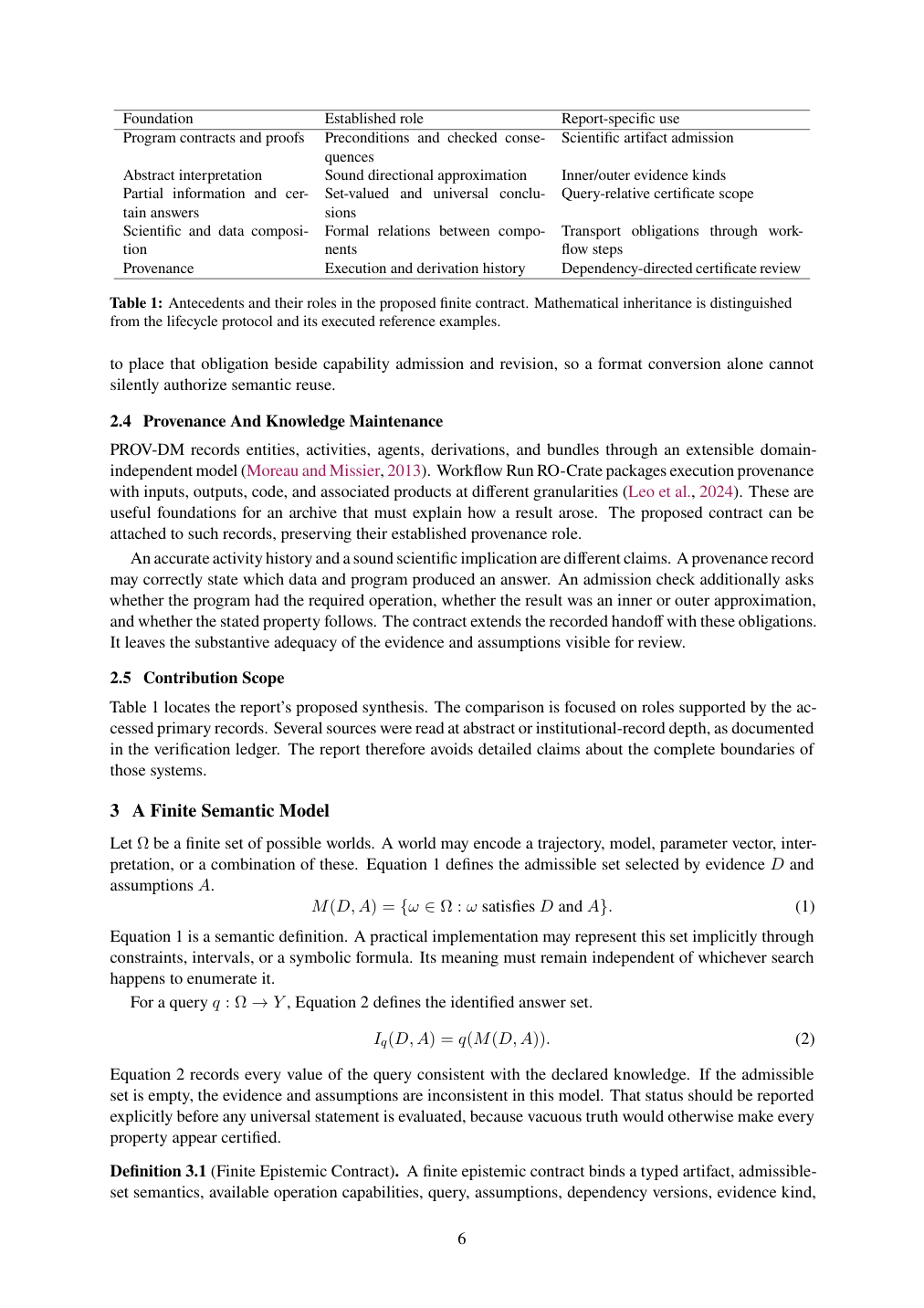
Foundation Established role Program contracts and proofs quences
Abstract interpretation Partial information and cer- tain answers
Transport obligations through work- flow steps Dependency-directed certificate review
Table 1: Antecedents and their roles in the proposed finite contract. Mathematical inheritance is distinguished from the lifecycle protocol and its executed reference examples.
to place that obligation beside capability admission and revision, so a format conversion alone cannot
PROV-DM records entities, activities, agents, derivations, and bundles through an extensible domain- independent model (Moreau and Missier, 2013). Workflow Run RO-Crate packages execution provenance with inputs, outputs, code, and associated products at different granularities (Leo et al., 2024). These are useful foundations for an archive that must explain how a result arose. The proposed contract can be attached to such records, preserving their established provenance role.
An accurate activity history and a sound scientific implication are different claims. A provenance record may correctly state which data and program produced an answer. An admission check additionally asks whether the program had the required operation, whether the result was an inner or outer approximation, and whether the stated property follows. The contract extends the recorded handoff with these obligations. It leaves the substantive adequacy of the evidence and assumptions visible for review.
Table 1 locates the report’s proposed synthesis. The comparison is focused on roles supported by the ac- cessed primary records. Several sources were read at abstract or institutional-record depth, as documented in the verification ledger. The report therefore avoids detailed claims about the complete boundaries of
Let Ωbe a finite set of possible worlds. A world may encode a trajectory, model, parameter vector, inter-
Equation 1 is a semantic definition. A practical implementation may represent this set implicitly through constraints, intervals, or a symbolic formula. Its meaning must remain independent of whichever search
Equation 2 records every value of the query consistent with the declared knowledge. If the admissible set is empty, the evidence and assumptions are inconsistent in this model. That status should be reported explicitly before any universal statement is evaluated, because vacuous truth would otherwise make every
Definition 3.1 (Finite Epistemic Contract). A finite epistemic contract binds a typed artifact, admissible- set semantics, available operation capabilities, query, assumptions, dependency versions, evidence kind,
and a checker obligation. A certificate records which obligation was checked and the precise conclusion authorized by it.
Definition 3.1 uses a finite restriction that permits complete verification of the examples below. It also makes the open extension problem visible: infinite model classes require sound symbolic procedures, analytic bounds, or probabilistic qualifications. Finite enumeration cannot silently be replaced by an arbitrary finite sample of an infinite space.
3.1 Worlds, Constraints, And Questions
A possible world is a modeling device for the distinctions relevant to a question. Its scope follows the scientific target and the declared model. In a trajectory reconstruction, a world can specify positions at the modeled times. In a parameter problem, it can specify a parameter vector and nuisance quantities. In an interpretation problem, it can specify a reading together with a compatible empirical state. The contract names that modeled universe so a consumer can assess what alternatives are included.
Evidence and assumptions play different roles even when both become constraints. A recorded observation may restrict a coordinate to an interval. A modeling assumption may restrict the allowed trajectories or measurement relation. Preserving their labels allows a challenge to target the appropriate obligation. A corrected observation, a relaxed speed bound, and a revised query can each change the answer set for different reasons. The finite semantics gives a common language for those changes without collapsing their scientific meaning.
A query has a type and interpretation. A scalar value, a Boolean property, and a set of feasible paths require different result representations. The same world set can uniquely determine one query and leave another highly ambiguous. A projection onto observed coordinates can therefore be adequate for a summary question and inadequate for a historical reconstruction. Query-relative adequacy is a central design choice: the contract names the conclusion being authorized and the evidence supporting it.
3.2 Consistency And Witnesses
The nonemptiness check can itself require work. For finite enumeration it is established by finding one admissible world. A symbolic system can supply a satisfiability witness, a validated feasible point, or a separate existence proof. An outer enclosure alone can be nonempty while the true admissible set is empty. Certification of a singleton value therefore needs both an enclosure and evidence that the semantic model has at least one admissible realization.
An inconsistent contract should retain diagnostic information about the conflicting constraints. A minimal conflict set can help a researcher locate the source of inconsistency, although computing one is a separate task from detecting emptiness. The archive can preserve the original constraints and the diagnosis, then link a revised contract that changes the evidence or assumptions. This supports scientific correction while keeping earlier reasoning reconstructible.
3.3 Representation Granularity And Counting Measures
A world representation can distinguish descriptions that are equivalent for a particular query. If two worlds have the same query value, merging them in a query-relative quotient preserves the identified answer set. Duplicating either world also preserves that set. Universal-property certificates depend on which query values remain possible, so they are insensitive to such purely representational multiplicity when the query and constraint interpretation are preserved. This gives a useful invariant for checking adapters between finite representations.
Counting-based summaries can behave differently. Assigning equal probability to every serialized world gives a duplicated description additional mass. Expected query costs, prevalence summaries, and uncertainty measures based on those probabilities can therefore change even though the identified answer set stays fixed. Such a measure can be a legitimate designed benchmark, but its unit and weighting rule should travel with the contract. A representation change that preserves logical possibilities need not preserve the chosen probability model.
This distinction is useful for interdisciplinary knowledge exchange. One team may enumerate several detailed mechanism variants that another treats as a single model. A query about an invariant outcome can survive that change, while an average over model descriptions can shift. The adapter should state whether it preserves query values, constraints, weights, or some combination. These are separate obligations, and the checker can certify the ones that hold.
The finite framework consequently supports both a logical identified set and an optional measure record. The former states which values are admissible. The latter states how a particular analysis weights them and why. A downstream planner can use the measure to prioritize investigation while retaining a universal stopping condition over the full admitted set. The current exhaustive studies concern logical certification, and the generated graph study uses its stated random construction solely to summarize sensitivity within that designed family.
4 Evidence Direction And Certification


Equation 3 is the central interface distinction. A found candidate witnesses possibility. An enclosure constrains every admissible possibility. The same printed list can have either meaning, so the evidence kind must travel with the values.


Proposition 4.1 explains why a completeness flag matters. Complete enumeration can make the inner and outer sets coincide. An incomplete search can nevertheless support identification if an independent bound proves a singleton enclosure. A rigid rule that accepts only complete enumeration is sound but can discard useful symbolic information. The finite study below measures this difference in a class with exact inexpensive enclosures.

4.1 Evidence Kinds And Permitted Promotions
The interface can admit several useful evidence kinds. A witness identifies a concrete admissible world or query value. An inner collection records found possibilities with a search budget and completeness status. An outer enclosure records a covering argument. An exact image combines the two directions, while a property certificate records a checked inclusion in a declared property. These kinds can share a serialized collection type, but their checker obligations remain distinct.
A promotion rule should state which stronger conclusion is being requested. Promoting a witness to possibility requires checking its constraints. Promoting an exact image to identification requires checking that it is a singleton and that the admissible model is nonempty. Promoting an enclosure to a universal property requires checking its inclusion in the property. A search budget explains how an inner collection arose; universal promotion additionally requires a covering argument.
The distinction also handles negative findings constructively. A found counterexample can refute a universal property within the declared model. A failure to find a counterexample leaves that property unresolved unless the search is complete or a separate enclosure proves it. This asymmetry is elementary, yet it is easy for a conversational tool to obscure when it summarizes a long search in a short sentence. The structured evidence kind gives the consumer a precise basis for wording the answer.
4.2 Relational Precision

This example is inherited sound-approximation reasoning, included to guide the contract’s evidence representation. An archive should state whether an enclosure preserves relations among variables or merely their separate ranges. A consumer can then select an appropriate method or request a more precise bound. The added finite study measures this precision difference for cardinality and pair-equality constraints, with exact enumeration providing an independent semantic check.
5 Capabilities And Method Admission
A presentation, oracle, and record describe broad access modes; operation-specific capabilities refine their computational meaning. A symbolic expression may support differentiation but lack an implemented numerical solver. A simulator may support samples and interventions with symbolic differentiation left as a separate capability. A static record may support empirical summaries and reconstruction under bounds tied to its observation process.

Equation 4 is an operation-set inclusion check. Capabilities should be typed and parameterized. A sampler for one model version, a derivative on one domain, and a bounded-horizon simulator are different from unrestricted operations bearing the same short name.
An admission check also has semantic preconditions. A method requiring independent samples needs a certificate for that property alongside a callable sampling function. A finite-difference operation can supply an approximate derivative with an error bound; its capability retains that approximation status. Thus a capability can itself be a certificate-bearing operation whose postcondition defines the strength of its result.
Capability composition is conservative. A transformation may preserve some operations and derive others under verified conditions. The retained capability set contains the operations with justified transport rules. Transporting a simulator through an invertible representation conversion requires explicit rules for its implementation, tolerances, and random-number semantics. Declaring these separate obligations prevents a general mathematical relation from becoming an unwarranted software capability.
5.1 Parameterized Capabilities And Admission
A capability record can include an operation name, input and output types, model version, domain, horizon, precision, and evidence status. For example, a simulator may advance a specified model over a bounded time interval with a numerical error enclosure. A derivative provider may return an exact symbolic derivative on one domain or an approximation with a verified bound on another. The method requirement should compare these qualifiers alongside the operation’s name.
Admission can therefore proceed in two stages. A structural stage checks that required operation signatures are available and their qualifiers cover the requested inputs. A semantic stage checks preconditions such as independence, domain membership, admissible step size, or an error budget. The first stage is
Readable text
often a finite lookup. The second may require a certificate, an analytic calculation, or human scientific review. Recording the stages separately helps explain why an artifact with a callable function can still
The operation structure is naturally partial. A numerical oracle can support repeated simulation without symbolic manipulation. A symbolic presentation can support algebraic transformations while lacking an implemented numerical flow. A static record can support empirical queries under its observation model. Some pairs of artifacts offer incomparable capabilities. An ordinal access label remains a useful summary, but a method’s actual admission depends on the required operation set and qualifiers.
An adapter can derive a capability when it supplies a checked relation between input and output operations. A finite-difference adapter can turn function evaluation into approximate differentiation under a smooth- ness and step-size contract. A compiler can turn a symbolic equation into an executable right-hand side if its supported language and numerical semantics cover the expression. A reconstruction adapter can turn records into an enclosure under a declared observation and dynamical model. Each adapter contributes premises that become dependencies of the resulting capability.
Capability derivation should preserve the strength of its conclusion. An approximate derivative carries its approximation bound. A simulator valid only on a bounded domain retains that restriction. A sample generator with dependent outputs cannot satisfy an independent-sample requirement merely because it returns several values. These distinctions permit useful automation while keeping the operation’s meaning
A compact admission result can return admitted, unresolved, or refused together with obligations. Ad- mitted means the requested method’s declared requirements were checked. Unresolved means a poten- tially satisfiable obligation lacks sufficient evidence or computation. Refused means a specific incompat- ibility or unsatisfied precondition blocks the requested operation. These are API outcomes with concrete explanations, supporting a human or AI planner in choosing a valid next step.
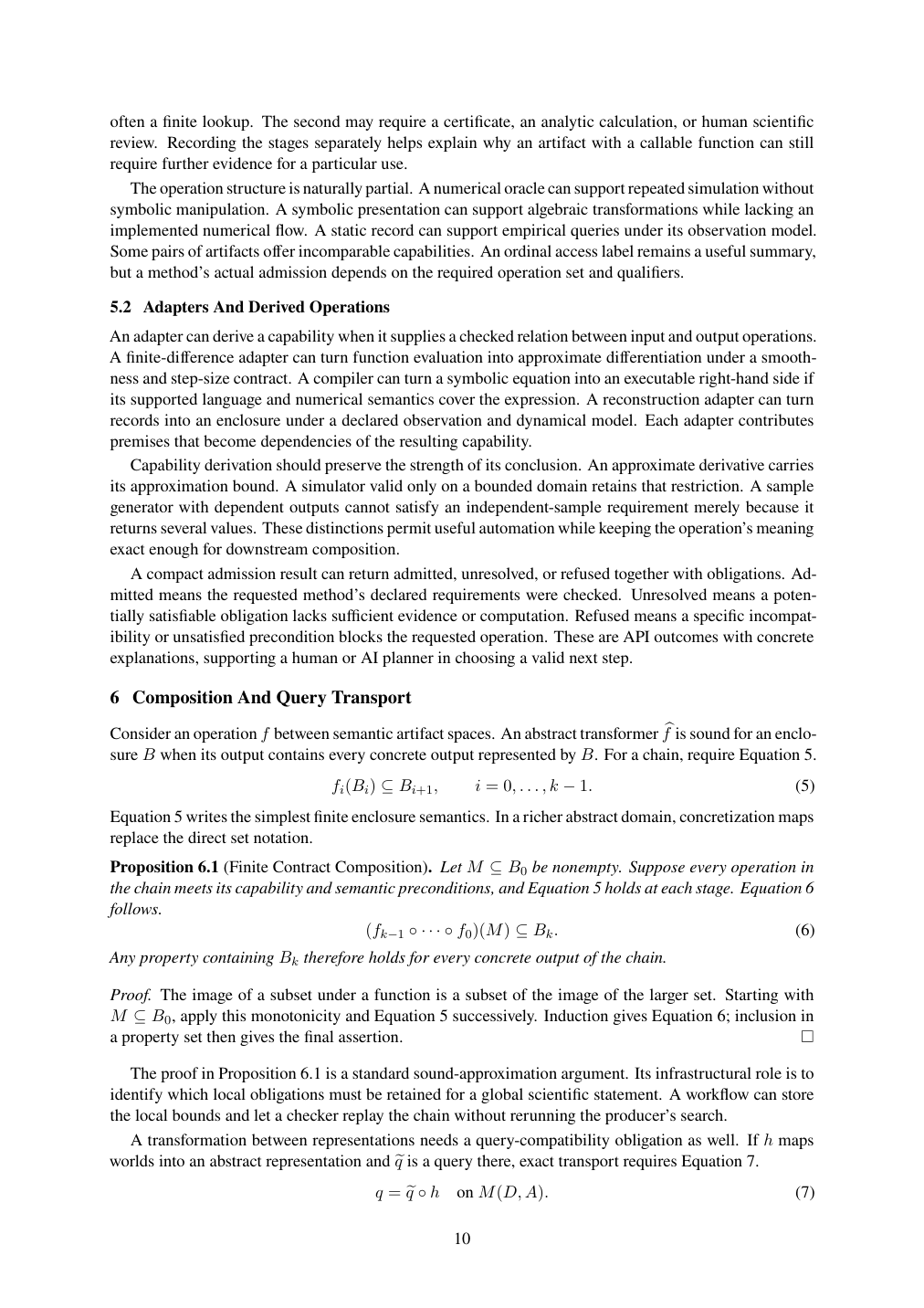
Equation 5 writes the simplest finite enclosure semantics. In a richer abstract domain, concretization maps
the chain meets its capability and semantic preconditions, and Equation 5 holds at each stage. Equation 6
Proof. The image of a subset under a function is a subset of the image of the larger set. Starting with
The proof in Proposition 6.1 is a standard sound-approximation argument. Its infrastructural role is to identify which local obligations must be retained for a global scientific statement. A workflow can store the local bounds and let a checker replay the chain without rerunning the producer’s search.
Readable text
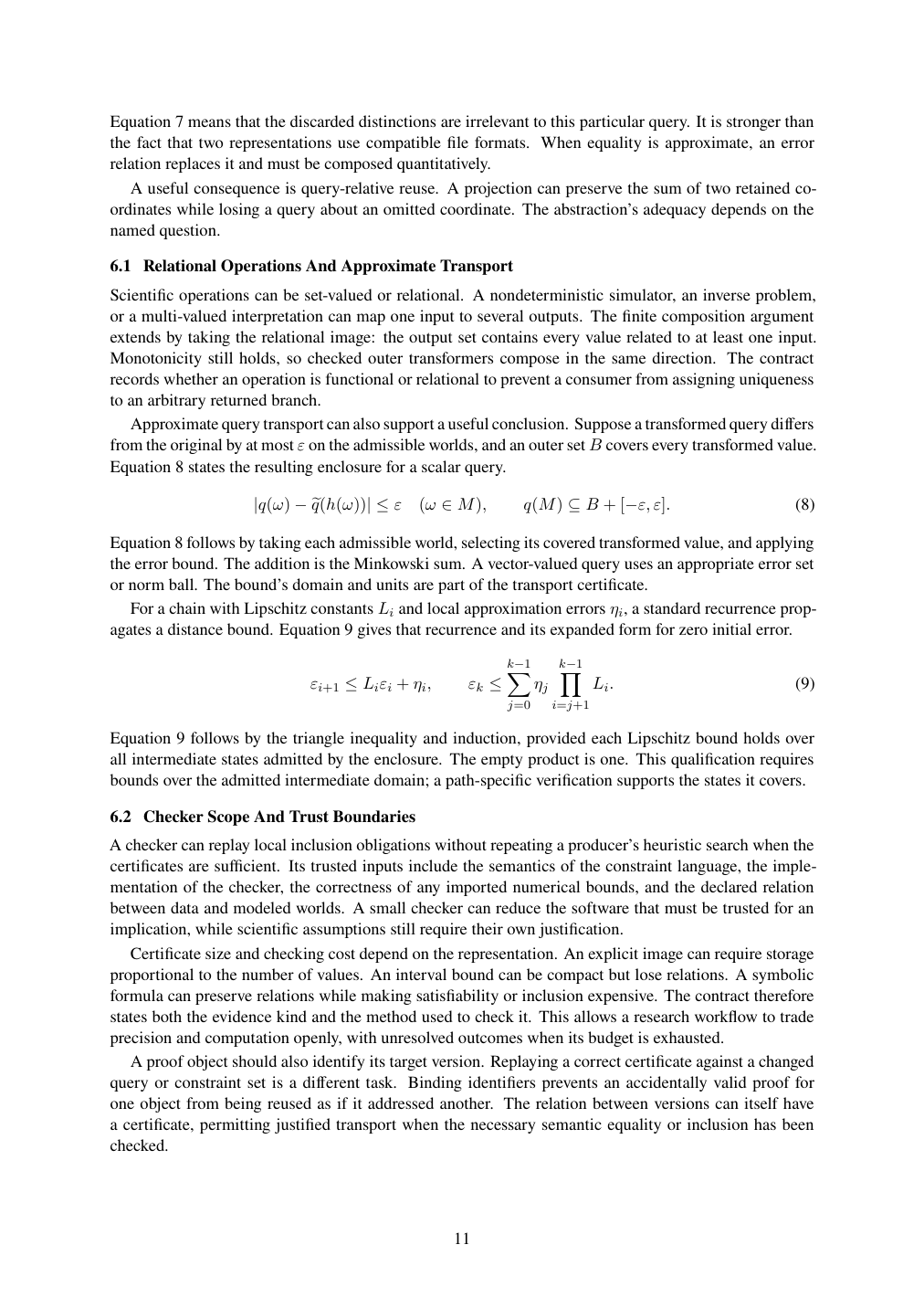
Equation 7 means that the discarded distinctions are irrelevant to this particular query. It is stronger than the fact that two representations use compatible file formats. When equality is approximate, an error relation replaces it and must be composed quantitatively.
A useful consequence is query-relative reuse. A projection can preserve the sum of two retained co- ordinates while losing a query about an omitted coordinate. The abstraction’s adequacy depends on the
Scientific operations can be set-valued or relational. A nondeterministic simulator, an inverse problem, or a multi-valued interpretation can map one input to several outputs. The finite composition argument extends by taking the relational image: the output set contains every value related to at least one input. Monotonicity still holds, so checked outer transformers compose in the same direction. The contract records whether an operation is functional or relational to prevent a consumer from assigning uniqueness
Approximate query transport can also support a useful conclusion. Suppose a transformed query differs Equation 8 states the resulting enclosure for a scalar query.
Equation 8 follows by taking each admissible world, selecting its covered transformed value, and applying the error bound. The addition is the Minkowski sum. A vector-valued query uses an appropriate error set or norm ball. The bound’s domain and units are part of the transport certificate.
agates a distance bound. Equation 9 gives that recurrence and its expanded form for zero initial error.
Equation 9 follows by the triangle inequality and induction, provided each Lipschitz bound holds over all intermediate states admitted by the enclosure. The empty product is one. This qualification requires bounds over the admitted intermediate domain; a path-specific verification supports the states it covers.
A checker can replay local inclusion obligations without repeating a producer’s heuristic search when the certificates are sufficient. Its trusted inputs include the semantics of the constraint language, the imple- mentation of the checker, the correctness of any imported numerical bounds, and the declared relation between data and modeled worlds. A small checker can reduce the software that must be trusted for an implication, while scientific assumptions still require their own justification.
Certificate size and checking cost depend on the representation. An explicit image can require storage proportional to the number of values. An interval bound can be compact but lose relations. A symbolic formula can preserve relations while making satisfiability or inclusion expensive. The contract therefore states both the evidence kind and the method used to check it. This allows a research workflow to trade precision and computation openly, with unresolved outcomes when its budget is exhausted.
A proof object should also identify its target version. Replaying a correct certificate against a changed query or constraint set is a different task. Binding identifiers prevents an accidentally valid proof for one object from being reused as if it addressed another. The relation between versions can itself have a certificate, permitting justified transport when the necessary semantic equality or inclusion has been
7 Refinement, Revision, And Withdrawal


may contain worlds previously excluded, and set inclusion can fail. Consider a binary coordinate whose old record fixes it to zero and whose corrected record fixes it to one. The changed dependency requires reconsideration of the old certificate even though the number of observations is unchanged.

Proof. Apply Equation 10 and transitivity of set inclusion. The final sentence identifies the assumptions used by that proof; without them the implication is unavailable, as the corrected binary-coordinate example demonstrates.
Certificate dispositions therefore need more structure than a comparison of printed values. Equal values can result from different assumptions; changed values can arise from a corrected query; an incomplete search can appear more decisive only because it returned fewer candidates. Retained, transported, withdrawn, and reissued should be consequences of checked relations between contracts.
A semantic change may preserve a numerical result accidentally. Recording it as a new certificate still matters because future reuse depends on the new meaning. A taxonomic recode, measurement redefinition, or legal interpretation can leave a scalar unchanged while changing the proposition it expresses. The contract binds both value and meaning through a query identifier and versioned assumptions.
7.1 Revision Relations And Certificate Dispositions
A revision service can ask for the relation between old and new admissible sets. A consistent contraction supports retention of universal properties with unchanged query semantics. An expansion preserves previously found witnesses only if those witnesses remain admissible, while universal certificates generally need renewed checking. A replacement can be contractive, expansive, or incomparable. A query change requires an explicit transport argument even when the admissible worlds stay fixed.
These rules suggest a precise disposition vocabulary. Retained means a checked relation preserves the original certificate’s conclusion. Transported means an explicit map or error relation authorizes a successor conclusion. Withdrawn means current reuse requires a successor check under the recorded dependencies. Reissued means a new check produced a successor certificate. Superseded can record that a later object is preferred while leaving the earlier result available for its original scope. The archive preserves these reasons alongside each update’s timestamp.
An unchanged numerical answer can accompany any of these dispositions. A corrected observation may leave the final total fixed while changing the admissible trajectories. A revised interpretation may preserve a score while changing its institutional meaning. Conversely, a retained qualitative property can remain valid when a narrower set changes the possible numerical values. Comparing printed outputs therefore gives limited evidence about whether a warrant survives revision.
A practical revision algorithm first marks potentially affected certificates through dependencies, then attempts the strongest justified relation available. It can discharge simple version-equivalence checks cheaply, apply a verified refinement relation, or schedule a full recomputation. A budget limit leaves the
Readable text
certificate stale or unresolved for current use. This preserves useful earlier work while keeping the reason
8 Query-Relative Retention And Semantic Preconditions
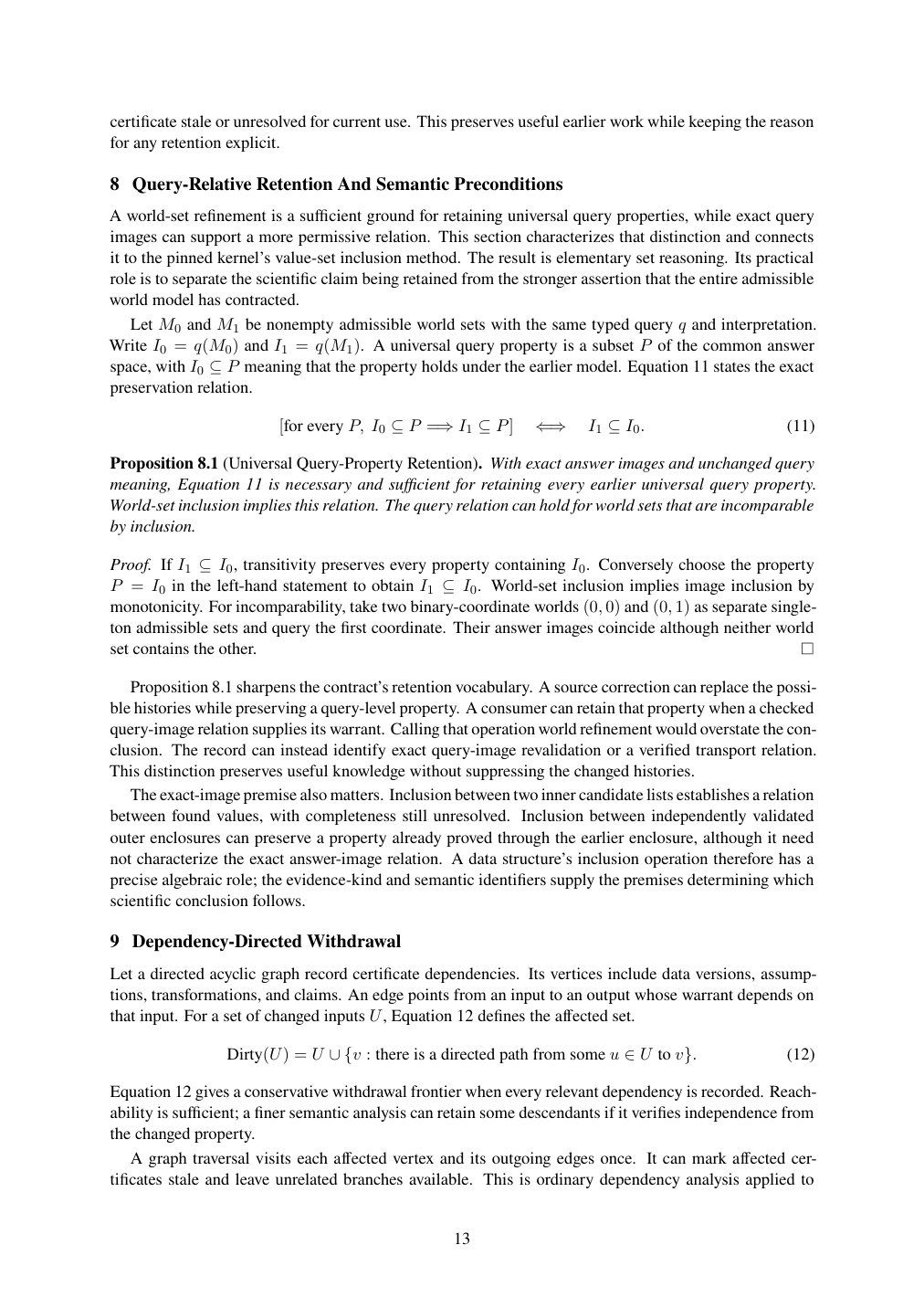
A world-set refinement is a sufficient ground for retaining universal query properties, while exact query images can support a more permissive relation. This section characterizes that distinction and connects it to the pinned kernel’s value-set inclusion method. The result is elementary set reasoning. Its practical role is to separate the scientific claim being retained from the stronger assertion that the entire admissible
Proposition 8.1 (Universal Query-Property Retention). With exact answer images and unchanged query meaning, Equation 11 is necessary and sufficient for retaining every earlier universal query property. World-set inclusion implies this relation. The query relation can hold for world sets that are incomparable
ton admissible sets and query the first coordinate. Their answer images coincide although neither world
Proposition 8.1 sharpens the contract’s retention vocabulary. A source correction can replace the possi- ble histories while preserving a query-level property. A consumer can retain that property when a checked query-image relation supplies its warrant. Calling that operation world refinement would overstate the con- clusion. The record can instead identify exact query-image revalidation or a verified transport relation. This distinction preserves useful knowledge without suppressing the changed histories.
The exact-image premise also matters. Inclusion between two inner candidate lists establishes a relation between found values, with completeness still unresolved. Inclusion between independently validated outer enclosures can preserve a property already proved through the earlier enclosure, although it need not characterize the exact answer-image relation. A data structure’s inclusion operation therefore has a precise algebraic role; the evidence-kind and semantic identifiers supply the premises determining which
Let a directed acyclic graph record certificate dependencies. Its vertices include data versions, assump- tions, transformations, and claims. An edge points from an input to an output whose warrant depends on
Equation 12 gives a conservative withdrawal frontier when every relevant dependency is recorded. Reach- ability is sufficient; a finer semantic analysis can retain some descendants if it verifies independence from
A graph traversal visits each affected vertex and its outgoing edges once. It can mark affected cer- tificates stale and leave unrelated branches available. This is ordinary dependency analysis applied to
evidential validity. Its benefit depends on the quality of the dependency graph. Missing edges cause unsound retention; overly broad edges cause unnecessary review.
The record should distinguish withdrawal from deletion. A withdrawn certificate remains part of the history, with its earlier assumptions and the reason it ceased to authorize current use. A reissued certificate can link to it and state what was changed. This allows a researcher to reconstruct the path of correction without treating earlier states as current evidence.
Version hashes establish identity of bytes or structured records; source adequacy receives separate scientific review. A correction can preserve a chain of custody while changing the admissible world set. The contract system consequently treats source authenticity, semantic interpretation, and inferential validity as different obligations that can depend on one another.
9.1 Recorded Graphs And Completeness


Equation 13 follows because every path in a smaller edge set is also a path in the larger one. It explains both error directions in dependency maintenance. Missing edges can retain certificates whose warrant requires review. Coarse extra edges can withdraw additional certificates unnecessarily. The latter is conservative for current admission, while its review cost can be substantial.
The word stale identifies a warrant requiring review. An affected certificate may remain numerically correct after revalidation. Its earlier justification nevertheless depends on an input that changed. The graph signals a review obligation. Finer semantic checks can discharge that obligation when the changed aspect is irrelevant to the property. This distinction prevents an invalidation count from being misreported as a count of false scientific conclusions.
Dependency completeness also has several granularities. A coarse record can link every output to an entire dataset version. A finer record can link a claim to specific variables, rows, transformations, or assumptions. Fine records can reduce over-withdrawal when a correction is local, while increasing capture and checking costs. Their usefulness depends on whether the recorded granularity corresponds to the actual semantic dependency, including shared defaults and external resources.
9.2 Incremental Review And Audit
A forward traversal can compute the affected set in time linear in the visited vertices and outgoing edges. A topological ordering supports batch propagation through an acyclic graph. The artifact checks both formulations on generated examples. Cyclic scientific dependencies require a different representation, such as strongly connected components or a fixed-point analysis, and remain outside the present acyclic implementation.
An audit can compare recorded dependencies with instrumented execution and declared semantic requirements. Execution tracing reveals which files or functions were used, while semantic dependencies can include assumptions whose role becomes visible through scientific model review. An omission study should therefore state what relation counts as ground truth. The added experiment uses a generated graph as its complete reference and then deliberately removes or adds edges. Its measured errors concern that constructed relation.
The archive can preserve a withdrawal journal containing the changed inputs, affected vertices, attempted transport checks, and reissued certificates. This journal makes correction reproducible and allows later evaluation of review burden. It also supports responsibility: a producer can inspect which dependency was omitted, a maintainer can repair the capture mechanism, and a consumer can identify which current claims require reconsideration.
Readable text
10 Statistical Uncertainty And A Worked Reconstruction Contract
Scientific inputs can supply confidence regions with probabilistic coverage or deterministic bounds under distinct assumptions. The finite semantic model can accommodate this by distinguishing the event that a
guarantee inherits the coverage probability supplied by the statistical procedure.
For several statistically justified enclosure stages, a joint guarantee can be obtained through a union
needs to account for data-dependent selection of stages and models; an interval chosen after examining many alternatives requires a selection-aware coverage argument.
This division of work keeps three claims separate. A statistical procedure supplies an error-qualified region. A logical checker propagates that region through certified operations. A reporting rule decides which properties are sufficiently strong to state. An interface that labels the final result simply verified would hide the first stage’s statistical uncertainty. Recording the inherited error budget makes the result interpretable and permits later replacement by a sharper region without changing the logical checker.
Consider a body moving on a finite graph observed at two times. Worlds enumerate admissible intermedi- ate paths under a speed bound. The query asks whether every path enters a designated region. A heuristic search finding one path outside the region witnesses that the universal entry claim fails. Finding several paths inside supplies only inner evidence, unless the search exhausts the admissible family or a separate
An outer enclosure can be computed from reachability sets at each time. If the whole reachable set at a required time lies inside the region, a scoped property follows even when the algorithm never enu- merates every complete path. If paths share timing constraints, independent time-slice reachability can be conservative: it may admit combinations beyond the complete-trajectory image. That conservatism is acceptable for sound certification but can reduce the number of conclusions retained.
A stronger reconstruction algorithm can refine the enclosure by propagating constraints forward and backward. Its improvement is epistemic contraction supported by a proof obligation. If a new speed bound enlarges the admissible paths, earlier certificates need review. If a new observation contracts them consistently under the same query, Proposition 7.1 justifies retention.
The example connects the finite contract directly to kinesis’s trajectory and identified-set vocabulary. It also shows why a certificate should identify its level of abstraction: whole-path feasibility, time-slice en- closures, and one interpolated path answer different questions. A human or AI consumer can then choose an operation suited to the actual evidence instead of treating every returned trajectory as the uniquely
A confidence enclosure and a posterior credible set carry different probability interpretations. The current coverage statement is frequentist and depends on the procedure’s data-generating assumptions. A Bayesian construction would require an explicit prior and a conditional probability statement. A bounded-error set requires a justified deterministic error bound. All can be represented as sets, but their evidential annotations should remain distinct when the logical checker propagates them.
A downstream universal property inherits the uncertainty of the enclosure event. If several independently developed components contribute regions, a union-bound budget can be conservative but transparent. If the components share data, their dependence may allow sharper joint methods, yet a naive product of coverages would require additional justification. The contract can record the supplied joint guarantee and keep the deterministic implication separate. This makes it possible to improve the statistical stage later without rewriting the logical meaning of every downstream operation.
The trajectory example also exposes the difference between a path and a statement about paths. An interpolator can return one plausible route for visualization. An enclosure can state which locations remain possible at a time. A universal property can state that every admissible route meets a region. These outputs serve different scientific purposes. An interface can offer all three while preventing the visualization’s selected path from being silently promoted to the reconstructed history.
A future reconstruction study can compare how often additional measurements contract the answer set for different queries. Some observations may leave the full path ambiguous while resolving a decisionrelevant property. Others may greatly reduce candidate count without changing that property’s status. Measuring query-specific contraction would connect observation design to the contract’s actual scientific purpose, providing a more useful outcome than reconstruction distance alone.
11 Admission And Revision Execution
11.1 Contract Registration And Checking
A registration service accepts the semantic model, artifact type, capability declarations, query, evidence kind, and dependency identifiers. It assigns a content identifier after canonical serialization. The service verifies structural well-formedness immediately: query output type, model and data versions, units, required capability qualifiers, and the presence of checker obligations. Scientific review can separately approve the connection between observed records and the modeled constraints. The two approvals address different questions and remain separately visible.
A checker invocation receives the registered object and a proposed conclusion. It first establishes consistency or a nonempty witness where required. It then verifies capability admission, the relevant inner or outer relation, and the final property inclusion or singleton condition. Success returns a certificate naming the obligations checked. An exhausted budget returns the unresolved obligations with completed partial work. A failed obligation returns a concrete reason and, where available, a counterexample. This output supports useful repair instead of a single undifferentiated validation flag.

11.2 Refusal Explanations And Planning
A method request can fail because an operation is unavailable, a semantic precondition is false, an evidence kind is too weak, or a required proof remains unfinished. These cases imply different next actions. An unavailable operation may require an adapter or another engine. A false precondition may require a different method. An inner sample may require a covering argument. An unfinished proof may benefit from more computation. A structured explanation allows a human or AI planner to choose among those actions without strengthening the result’s meaning.
An explanation should identify the exact requested promotion. For example, the request may be to convert four found trajectories into a unique reconstructed trajectory. The checker can report the incomplete list and request an outer singleton bound. A different request to visualize one admissible trajectory can succeed using the same artifact after its witness is checked. Admission is relative to the requested operation and conclusion.
The planning interface can expose certified alternatives. If exact identification remains unresolved but a threshold property follows from the outer enclosure, it can offer that scoped conclusion. If an operation is available only on a shorter horizon or smaller domain, it can offer a correspondingly qualified execution. Such alternatives preserve the original query in the archive and record any successor query explicitly. This supports exploratory progress while keeping semantic changes reviewable.
11.3 Revision Transactions And Reproducibility
A revision transaction begins with changed inputs and their proposed replacements. The service computes the affected dependency set, marks current-use warrants stale, and attempts applicable equivalence, refinement, or transport checks. Successful checks create retention or transport records. Recomputations create successor certificates. Unresolved checks leave a visible frontier for later work. The transaction journal preserves the old objects, so a reader can reconstruct both the earlier and current knowledge states.
Concurrent updates require identity checks. Committing a certificate requires alignment with the dependency version addressed by its check. A simple implementation can compare dependency identifiers before committing the result and restart or revalidate if they changed. This is a software consistency measure supporting the semantic version discipline. Scientific review separately addresses the substantive adequacy of each version.
Reproduction records include checker version, constraint-language version, input identifiers, seeds for authorized randomized procedures, numerical tolerances, and the disposition journal. The supplied artifact uses deterministic finite checks and fixed-seed generated graphs. A later repository implementation should preserve these fixtures while adding tests for serialization, qualifier comparison, stale-commit detection, and dependency capture. Empirical studies can then assess whether researchers understand the explanations and whether the contract reduces unsupported downstream promotions.
12 Exact Constructed Evaluation
12.1 Worlds, Constraints, And Queries
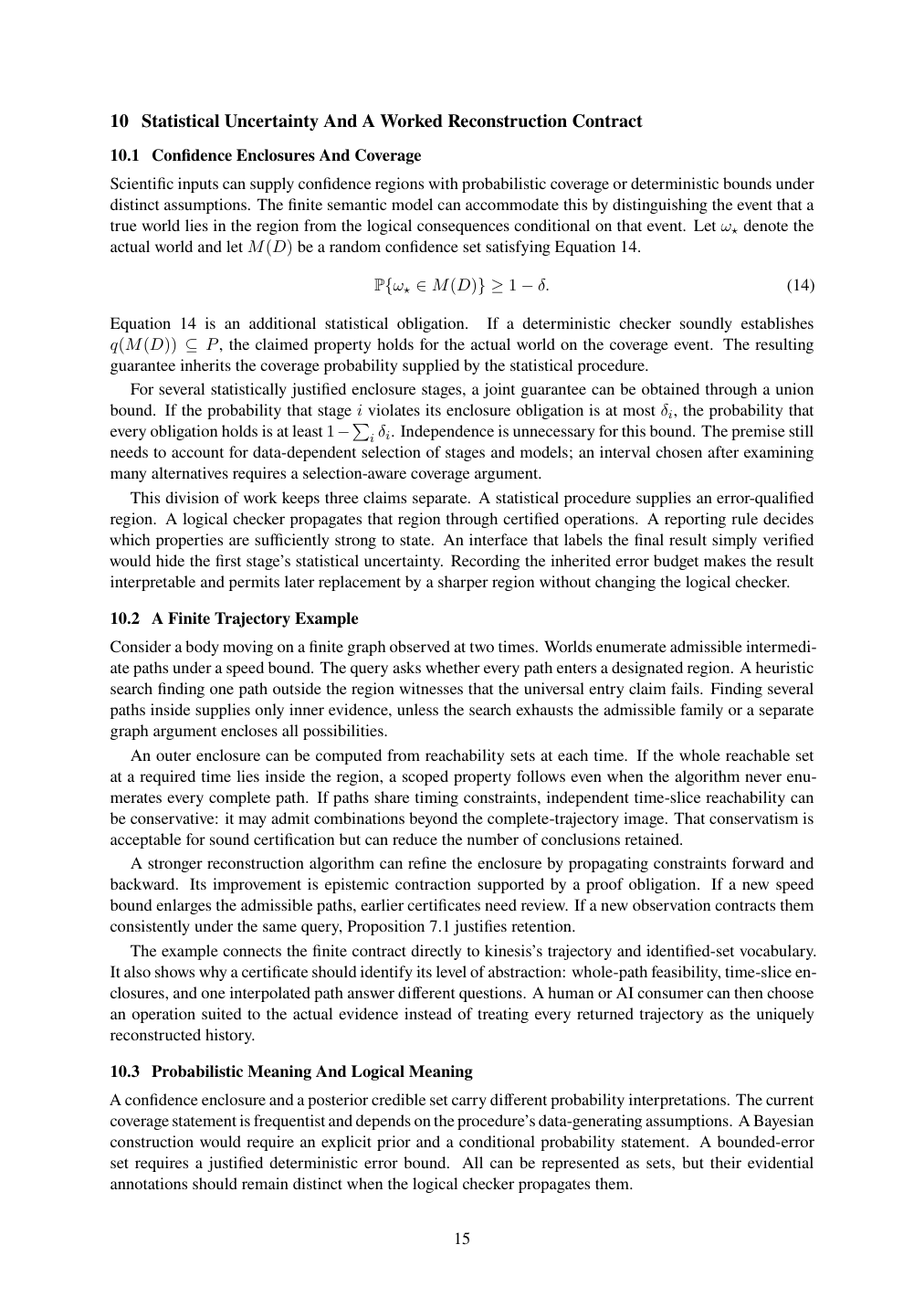
The accompanying Python program enumerates all 64 six-bit worlds. A constraint pattern assigns each coordinate one of three states: fixed to zero, fixed to one, or unrestricted. All 36 = 729 patterns have nonempty admissible sets. Eight queries ask for each of the six coordinates, the total number of ones, and its parity. The resulting 5,832 query cases provide an exhaustive evaluation within this declared class.
A search examines at most the first four lexicographically ordered admissible worlds. Four reporting rules are compared. A point rule promotes the first result. Sample unanimity promotes a unique value among the inspected worlds. A complete-only rule promotes such unanimity only when the enumeration covered the full admissible set. The symbolic-enclosure rule computes query bounds directly from the constraint pattern and promotes a singleton bound.

Figure 1 reports 3,044 genuinely singleton cases. The point rule accepts every case and produces 2,788 false certificates. Sample unanimity accepts 3,364 cases and produces 320 false certificates. The complete-only rule accepts 2,432, all valid. Symbolic enclosures retain all 3,044 valid singletons with zero false certificates in this finite class. The additional 612 retained cases show that a completeness-only rule can be improved by an independently justified enclosure.
These counts are exact for the chosen worlds, patterns, queries, and enumeration order. Empirical prevalence requires an independently sampled substantive study. The deliberately incomplete lexicographic search illustrates one possible selection bias. Randomized search could change how often sample unanimity fails while leaving its logical insufficiency unchanged.
Readable text
Figure 1: Exact certification outcomes over 5,832 constructed finite queries. The hatched segment counts claims promoted as identified whose exact query image contains several values. The symbolic enclosure is computed directly from constraints, and its soundness is independently checked by exhaustive enumeration.
The program also checks 729 compositions of the total-count query followed by parity. For every con- straint pattern, taking the image through both stages equals direct evaluation of parity on the admissible worlds. A further 729 checks verify that projecting onto the first two coordinates preserves their sum. The same projection need not preserve a query about the other coordinates.
These are small conformance checks for Equation 6 and Equation 7. The proofs establish their general finite statements; the executable cases verify that the accompanying implementation realizes the specified examples. Arbitrary transformations in the full infrastructure require their own verification.
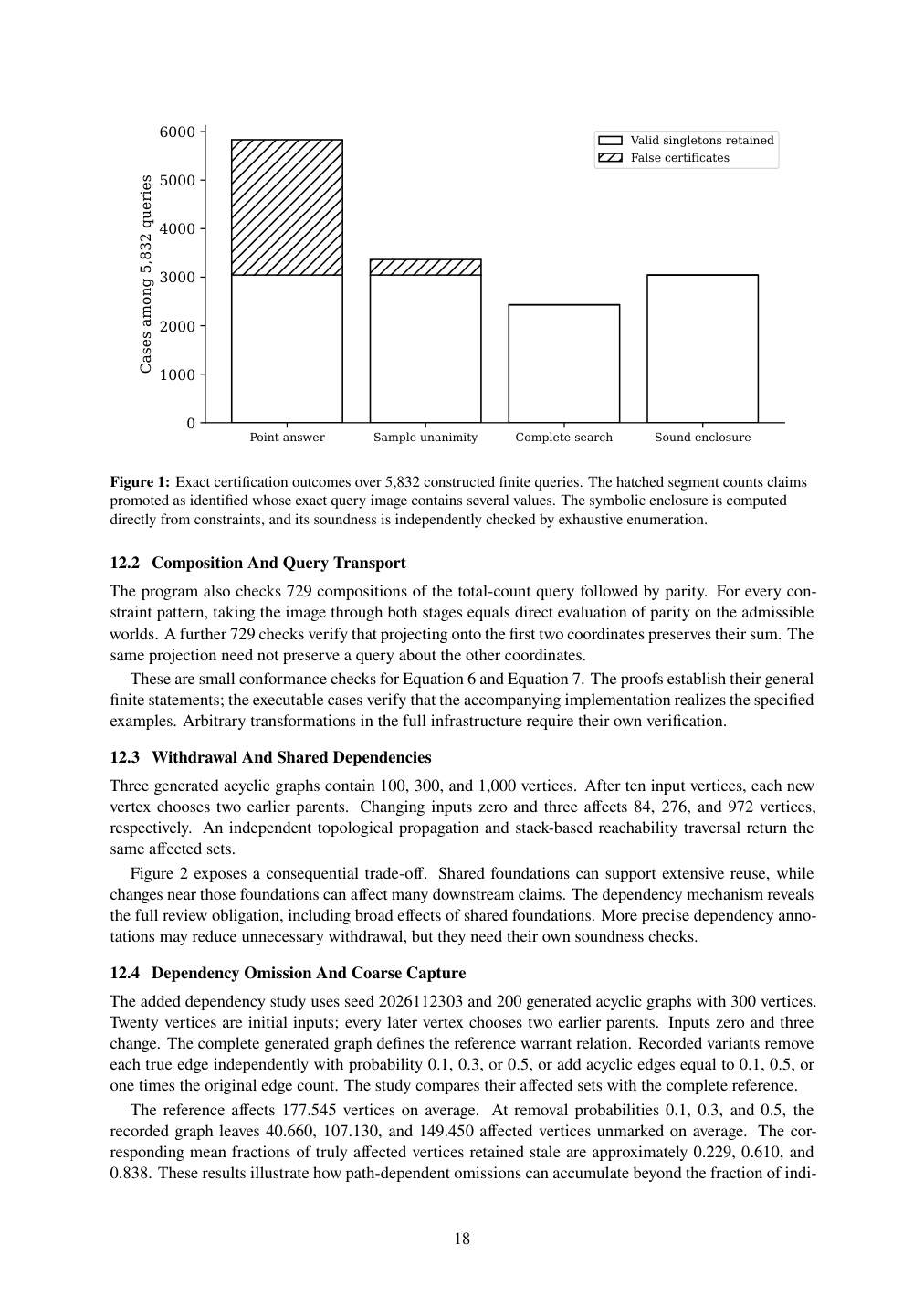
Three generated acyclic graphs contain 100, 300, and 1,000 vertices. After ten input vertices, each new vertex chooses two earlier parents. Changing inputs zero and three affects 84, 276, and 972 vertices, respectively. An independent topological propagation and stack-based reachability traversal return the
Figure 2 exposes a consequential trade-off. Shared foundations can support extensive reuse, while changes near those foundations can affect many downstream claims. The dependency mechanism reveals the full review obligation, including broad effects of shared foundations. More precise dependency anno- tations may reduce unnecessary withdrawal, but they need their own soundness checks.
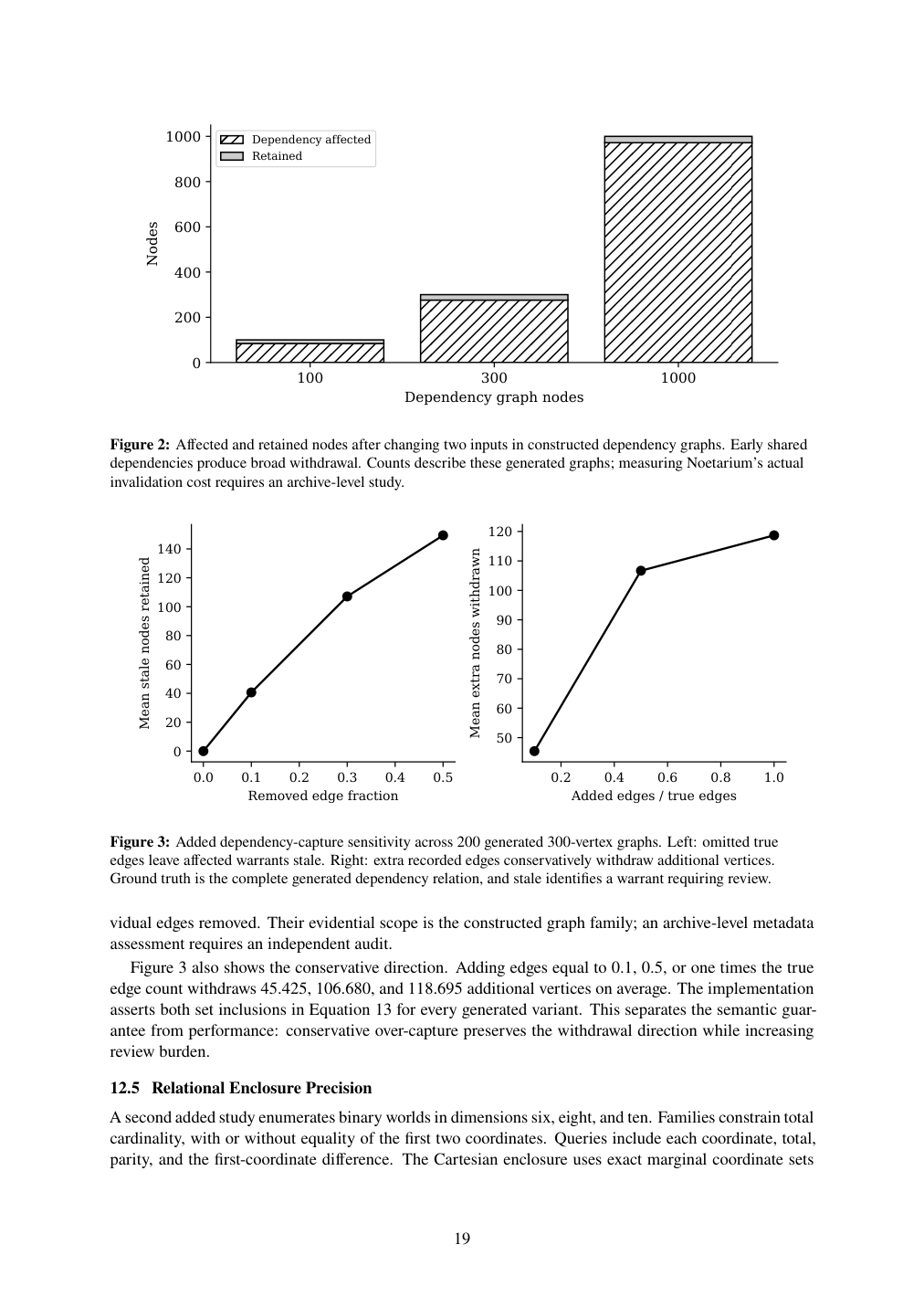
The added dependency study uses seed 2026112303 and 200 generated acyclic graphs with 300 vertices. Twenty vertices are initial inputs; every later vertex chooses two earlier parents. Inputs zero and three change. The complete generated graph defines the reference warrant relation. Recorded variants remove each true edge independently with probability 0.1, 0.3, or 0.5, or add acyclic edges equal to 0.1, 0.5, or one times the original edge count. The study compares their affected sets with the complete reference.
The reference affects 177.545 vertices on average. At removal probabilities 0.1, 0.3, and 0.5, the recorded graph leaves 40.660, 107.130, and 149.450 affected vertices unmarked on average. The cor- responding mean fractions of truly affected vertices retained stale are approximately 0.229, 0.610, and 0.838. These results illustrate how path-dependent omissions can accumulate beyond the fraction of indi-
Readable text
Figure 2: Affected and retained nodes after changing two inputs in constructed dependency graphs. Early shared dependencies produce broad withdrawal. Counts describe these generated graphs; measuring Noetarium’s actual
Figure 3: Added dependency-capture sensitivity across 200 generated 300-vertex graphs. Left: omitted true edges leave affected warrants stale. Right: extra recorded edges conservatively withdraw additional vertices. Ground truth is the complete generated dependency relation, and stale identifies a warrant requiring review.
vidual edges removed. Their evidential scope is the constructed graph family; an archive-level metadata
Figure 3 also shows the conservative direction. Adding edges equal to 0.1, 0.5, or one times the true edge count withdraws 45.425, 106.680, and 118.695 additional vertices on average. The implementation asserts both set inclusions in Equation 13 for every generated variant. This separates the semantic guar- antee from performance: conservative over-capture preserves the withdrawal direction while increasing
A second added study enumerates binary worlds in dimensions six, eight, and ten. Families constrain total cardinality, with or without equality of the first two coordinates. Queries include each coordinate, total, parity, and the first-coordinate difference. The Cartesian enclosure uses exact marginal coordinate sets
but discards their relations. A relational enclosure retains the known cardinality and pair equality. Every result is independently checked against full enumeration.
Across 610 query cases, 249 exact query images are singletons. Cartesian marginal boxes certify 150 of those, while the relational enclosure certifies all 249. Both enclosure policies produce zero false certificates within this class. For example, six binary coordinates with total two admit fifteen worlds, while their marginal box admits sixty-four. The total and parity remain exactly known even though the marginal box loses that information. The result demonstrates a precision cost of discarding relations, using a deliberately simple class in which the required relations are inexpensive to retain.
The comparison concerns a restricted relational class with inexpensive exact constraints. In larger constrained systems, preserving useful relations can require expensive solving or specialized bounds. Its contract-level implication is more modest: enclosure type and retained relations should be visible to the consumer. A wide valid enclosure and a narrow unsupported inner sample call for different interpretations and different next actions.
13 Compiled Kernel Conformance And External Admission
The publication-stage case executes the unmodified pinned answer.hpp header from kinesis, compiled with a report-owned C++17 harness. The case examines its documented access, identified-set, and disposition behavior and implements a small external finite contract adapter. The source is copied with its MIT license and attribution; its SHA-256 digest is checked before compilation. The standalone source-kernel case compiles independently of the other C++ repository components.
13.1 Kernel Behavior And Caller Obligations
The header’s access check compares the ordered record, oracle, and presentation levels. Its identifiedset type certifies a complete singleton and marks a complete empty set inconsistent. Its refines method checks inclusion between stored value vectors. Its disposition function is documented for the same feature and representation. Those are explicit API conditions, with scientific identity and enclosure truth left to the caller (Kinesis Project, 2026).
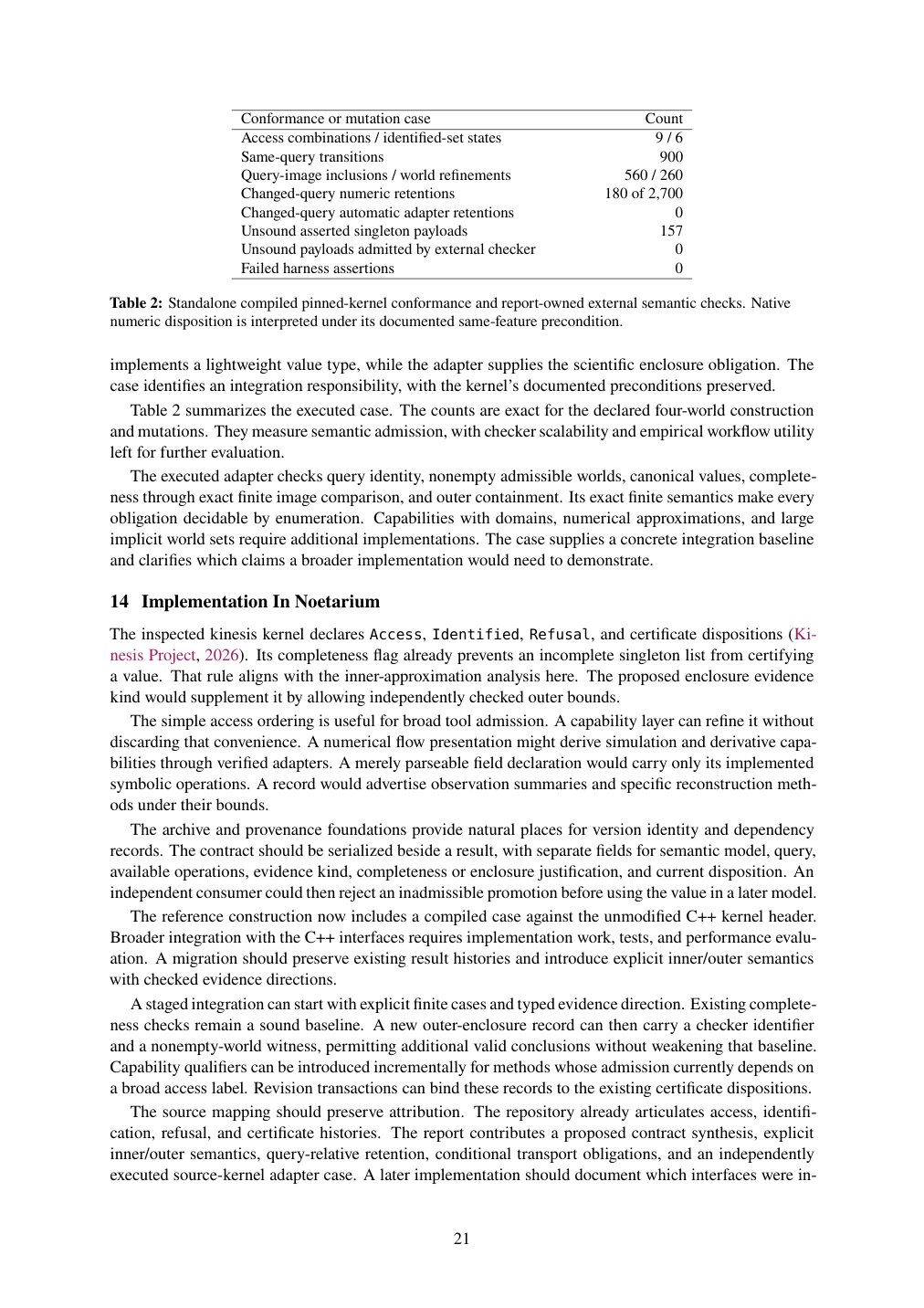
The harness checks nine access-level combinations, six combinations of completeness and set size, value-access refusal, and sorted distinct insertion through add. All assertions pass. These checks confirm the intended local behavior. They also make the trust boundary concrete: the public completeness flag describes a producer assertion, while a semantic checker must supply its justification before an external consumer treats the values as an exact answer set or outer enclosure.
The finite transition case uses all fifteen nonempty subsets of four two-bit worlds and four queries: the first coordinate, second coordinate, total, and parity. It evaluates 900 same-query transitions. Queryimage inclusion holds in 560 cases; world-set inclusion holds in 260. The additional 300 cases satisfy the query relation without world refinement. Their existence supports the distinction in Proposition 8.1: value inclusion is useful and can be sufficient for query-property retention under its exactness and identity premises.
13.2 Semantic Mutation Cases
A changed-query mutation evaluates the same 225 world-set pairs with each ordered pair of distinct queries, giving 2,700 cases. Numeric kernel disposition reports retained in 180 cases because both stored answers are the same complete singleton. The source function assumes the same feature; the mutation deliberately removes that premise. An external adapter storing a query identifier rejects automatic retention in every changed-query case. A legitimate query change can still be admitted through an additional transport certificate, which lies outside this minimal adapter.
A second mutation replaces computed answer images by asserted singleton payloads. Among 157 payloads that fail containment of the true finite query image, the native type remains structurally certified because its completeness flag is true and its vector has length one. The external checker rejects all 157 through an exhaustive outer-containment check. This is expected behavior at different layers: the header
Readable text
Conformance or mutation case Same-query transitions Changed-query numeric retentions Unsound asserted singleton payloads Failed harness assertions
Access combinations / identified-set states Query-image inclusions / world refinements Changed-query automatic adapter retentions Unsound payloads admitted by external checker
Table 2: Standalone compiled pinned-kernel conformance and report-owned external semantic checks. Native numeric disposition is interpreted under its documented same-feature precondition.
implements a lightweight value type, while the adapter supplies the scientific enclosure obligation. The case identifies an integration responsibility, with the kernel’s documented preconditions preserved.
Table 2 summarizes the executed case. The counts are exact for the declared four-world construction and mutations. They measure semantic admission, with checker scalability and empirical workflow utility
The executed adapter checks query identity, nonempty admissible worlds, canonical values, complete- ness through exact finite image comparison, and outer containment. Its exact finite semantics make every obligation decidable by enumeration. Capabilities with domains, numerical approximations, and large implicit world sets require additional implementations. The case supplies a concrete integration baseline and clarifies which claims a broader implementation would need to demonstrate.
The inspected kinesis kernel declares Access, Identified, Refusal, and certificate dispositions (Ki- nesis Project, 2026). Its completeness flag already prevents an incomplete singleton list from certifying a value. That rule aligns with the inner-approximation analysis here. The proposed enclosure evidence kind would supplement it by allowing independently checked outer bounds.
The simple access ordering is useful for broad tool admission. A capability layer can refine it without discarding that convenience. A numerical flow presentation might derive simulation and derivative capa- bilities through verified adapters. A merely parseable field declaration would carry only its implemented symbolic operations. A record would advertise observation summaries and specific reconstruction meth-
The archive and provenance foundations provide natural places for version identity and dependency records. The contract should be serialized beside a result, with separate fields for semantic model, query, available operations, evidence kind, completeness or enclosure justification, and current disposition. An independent consumer could then reject an inadmissible promotion before using the value in a later model.
The reference construction now includes a compiled case against the unmodified C++ kernel header. Broader integration with the C++ interfaces requires implementation work, tests, and performance evalu- ation. A migration should preserve existing result histories and introduce explicit inner/outer semantics
A staged integration can start with explicit finite cases and typed evidence direction. Existing complete- ness checks remain a sound baseline. A new outer-enclosure record can then carry a checker identifier and a nonempty-world witness, permitting additional valid conclusions without weakening that baseline. Capability qualifiers can be introduced incrementally for methods whose admission currently depends on a broad access label. Revision transactions can bind these records to the existing certificate dispositions.
The source mapping should preserve attribution. The repository already articulates access, identifi- cation, refusal, and certificate histories. The report contributes a proposed contract synthesis, explicit inner/outer semantics, query-relative retention, conditional transport obligations, and an independently executed source-kernel adapter case. A later implementation should document which interfaces were in-
Readable text
Claim or artifact Evidence supplied Inner/outer certification direct proof
Composition and transport Conditional derivations Retention and withdrawal ity law
Unchanged query meaning; complete or conservative dependencies
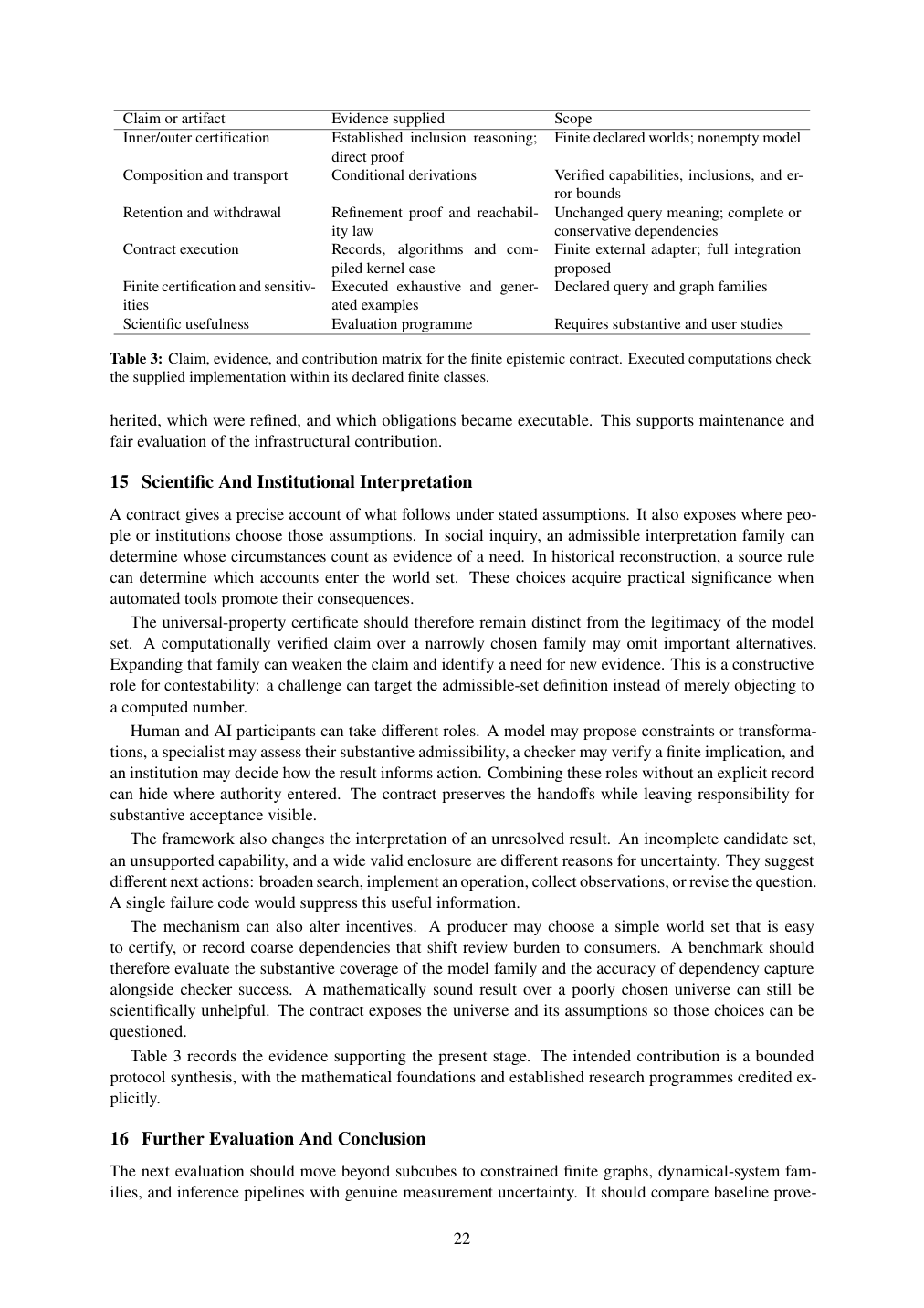
Table 3: Claim, evidence, and contribution matrix for the finite epistemic contract. Executed computations check the supplied implementation within its declared finite classes.
herited, which were refined, and which obligations became executable. This supports maintenance and
fair evaluation of the infrastructural contribution.
A contract gives a precise account of what follows under stated assumptions. It also exposes where peo- ple or institutions choose those assumptions. In social inquiry, an admissible interpretation family can determine whose circumstances count as evidence of a need. In historical reconstruction, a source rule can determine which accounts enter the world set. These choices acquire practical significance when
The universal-property certificate should therefore remain distinct from the legitimacy of the model set. A computationally verified claim over a narrowly chosen family may omit important alternatives. Expanding that family can weaken the claim and identify a need for new evidence. This is a constructive role for contestability: a challenge can target the admissible-set definition instead of merely objecting to
Human and AI participants can take different roles. A model may propose constraints or transforma- tions, a specialist may assess their substantive admissibility, a checker may verify a finite implication, and an institution may decide how the result informs action. Combining these roles without an explicit record can hide where authority entered. The contract preserves the handoffs while leaving responsibility for
The framework also changes the interpretation of an unresolved result. An incomplete candidate set, an unsupported capability, and a wide valid enclosure are different reasons for uncertainty. They suggest different next actions: broaden search, implement an operation, collect observations, or revise the question. A single failure code would suppress this useful information.
The mechanism can also alter incentives. A producer may choose a simple world set that is easy to certify, or record coarse dependencies that shift review burden to consumers. A benchmark should therefore evaluate the substantive coverage of the model family and the accuracy of dependency capture alongside checker success. A mathematically sound result over a poorly chosen universe can still be scientifically unhelpful. The contract exposes the universe and its assumptions so those choices can be
Table 3 records the evidence supporting the present stage. The intended contribution is a bounded protocol synthesis, with the mathematical foundations and established research programmes credited ex-
The next evaluation should move beyond subcubes to constrained finite graphs, dynamical-system fam- ilies, and inference pipelines with genuine measurement uncertainty. It should compare baseline prove-
nance, completeness-only reporting, and enclosure-bearing contracts using the same tasks. Performance measures should include unsupported promotions detected, valid claims retained, checker cost, certificate size, and review burden after corrections.
The added study examines incomplete and coarse dependency metadata in generated graphs. Real workflow studies can assess the same trade-off with instrumented and reviewed dependency records. User studies can ask whether the resulting explanations help researchers locate an unsupported step and choose an effective remedy. Such evidence would support claims about practical research efficiency that the current finite construction leaves open.
16.1 Benchmark Structure And Research Questions
A broader benchmark should vary semantic complexity, query type, capability requirements, approximation precision, and revision location separately. Small instances with exact answers can establish conformance. Larger instances with independently checked certificates can evaluate scalability. Cases with intentionally unresolved obligations can assess whether the system preserves uncertainty usefully. Reporting only successful singleton certifications would omit the workflow’s principal role in guiding incomplete research.
Comparisons can use the same tasks with provenance-only records, completeness-only admission, and enclosure-bearing contracts. Outcomes include unsupported promotions prevented, valid properties retained, computational cost, proof size, and time to recover after a correction. The added enclosure study suggests one specific hypothesis: retaining inexpensive relations can improve useful certification even when complete enumeration is unavailable. The dependency study suggests another: metadata capture quality can dominate the cost and reliability of revision. Both hypotheses require evaluation on realistic scientific workflows.
A user study can present researchers with matched handoffs: one found trajectory, a wide enclosure, a capability mismatch, and a revised dependency. Participants can explain which conclusions follow and choose the next observation or computation. Comparing explanations with and without structured contracts would assess comprehension and repair quality. Such a study should include domain specialists and interdisciplinary consumers, since the latter are more likely to encounter unfamiliar assumptions during reuse.
The resulting programme connects technical correctness with practical knowledge evolution. A good contract should preserve useful partial information, make an unsupported promotion recognizable, and show how new evidence can strengthen a conclusion. The finite reference construction establishes the semantics for these tasks. Production implementation and empirical evaluation can then examine whether the same discipline remains usable as model spaces, teams, and disciplinary relations become substantially larger.
16.2 Concluding Perspective
The finite epistemic contract connects candidate and enclosure direction, operation admission, query meaning, and certificate revision. Query-image inclusion supplies an exact retention characterization under fixed semantics and can preserve properties through changes that replace possible histories. The compiled source-kernel case makes the corresponding caller obligations concrete: structural singleton status, same-feature disposition, and scientific enclosure support belong to distinct checked premises.
The executed adapter and mutation cases supply an integration baseline with an explicit trust boundary. Earlier exhaustive and sensitivity studies demonstrate incomplete-search promotion, relational precision, and dependency-capture effects within declared finite classes. The contribution is this scientific lifecycle and its checkable reference implementation, with its logical foundations credited to established research. Scalable symbolic checking, production integration, and workflow/user studies remain the next requirements for broader practical claims.
References
Cousot, Patrick, Cousot, Radhia (1977). Abstract interpretation: A unified lattice model for static analysis of programs by construction or approximation of fixpoints. Proceedings of POPL, 238–252. doi:10.1145/512950.512973. Necula, George C. (1997). Proof-carrying code. Proceedings of POPL, 106–119. doi:10.1145/263699.263712. Manski, Charles F., Tamer, Elie (2002). Inference on regressions with interval data on a regressor or outcome.
Econometrica, 70(2), 519–546. doi:10.1111/1468-0262.00294. Moreau, Luc, Missier, Paolo (2013). PROV-DM: The PROV data model. W3C Recommendation, editors. Primary
source. Ma, Yingbo, Gowda, Shashi, Anantharaman, Ranjan, Laughman, Chris, Shah, Viral, Rackauckas, Chris (2022).
ModelingToolkit: A composable graph transformation system for equation-based modeling. arXiv:2103.05244, version 3. Primary source. Libkind, Sophie, Baas, Andrew, Patterson, Evan, Fairbanks, James (2022). Operadic modeling of dynamical sys-
tems: Mathematics and computation. Electronic Proceedings in Theoretical Computer Science, 372, 192–206. doi:10.4204/EPTCS.372.14. Kinesis Project (2026). Kernel answer types and scientific access declarations. Pinned source 02245ba. Primary
source. Meyer, Bertrand (1992). Applying design by contract. Computer, 25(10), 40–51. doi:10.1109/2.161279. Hoare, C. A. R. (1969). An axiomatic basis for computer programming. Communications of the ACM, 12(10), 576–
580, 583. doi:10.1145/363235.363259. McConnell, R. M., Mehlhorn, K., Näher, S., Schweitzer, P. (2011). Certifying algorithms. Computer Science Review,
5(2), 119–161. doi:10.1016/j.cosrev.2010.09.009. Walter, Eric, Piet-Lahanier, Hélène (1990). Estimation of parameter bounds from bounded-error data: A survey.
Mathematics and Computers in Simulation, 32(5–6), 449–468. doi:10.1016/0378-4754(90)90002-Z. Fagin, Ronald, Kolaitis, Phokion G., Miller, Renée J., Popa, Lucian (2005). Data exchange: Semantics and query
answering. Theoretical Computer Science, 336(1), 89–124. doi:10.1016/j.tcs.2004.10.033. Schultz, Patrick, Wisnesky, Ryan (2017). Algebraic data integration. Journal of Functional Programming, 27, e24.
doi:10.1017/S0956796817000168. Leo, Simone, Crusoe, Michael R., Rodríguez-Navas, Laura, Sirvent, Raül, Kanitz, Alexander, De Geest, Paul,
Wittner, Rudolf, Pireddu, Luca, Garijo, Daniel, Fernandez, José M., Colonnelli, Iacopo, Gallo, Matej, Ohta, Tazro, Suetake, Hirotaka, Capella-Gutierrez, Salvador, de Wit, Renske, Kinoshita, Bruno P., Soiland- Reyes, Stian (2024). Recording provenance of workflow runs with RO-Crate. PLOS ONE, 19(9), e0309210. doi:10.1371/journal.pone.0309210.