Adaptive Discovery Of Social Needs Under Interpretive Uncertainty
Full text from the PDF
Adaptive Discovery Of Social Needs Under Interpretive
Uncertainty
Wanhong HUANG
Abstract
Adaptive needs discovery joins empirical gaps to evaluative standards whose terms admit several readings. This report specifies a versioned confirmation object binding those readings, sampling assumptions, information access, and revision history. Established intersection–union and onlinetesting results supply its inferential foundation. The report distinguishes a preselected stream reusing confirmation data from a history-adapted stream receiving fresh clusters. A conditional handoff theorem permits bounded sequential acquisition when component evidence is valid relative to the actual joint filtration. A two-state counterexample yields stopped evidence expectation 1.5 when another reading exposes future information, locating a precise failure of own-history validity. Constructed studies compare fixed-sample, sequential, and adaptive procedures. In a four-reading false conjunction, repeated fixed-sample checking gives error 0.190, compared with 0.025 for a valid fixed-stake process under the declared model. Matched adaptive streams also reveal a substantial efficiency cost: at gap 0.5, minimum-mixture e-value power is 0.084 while a predictable robust-p baseline reaches 0.355 using its stronger fresh-data assumption. An exact finite-path check and a source-grounded self-reference screen supplement the simulations. The proposed contribution is the semantic and acquisition protocol, its checkable boundaries, and its reference implementation; the mathematical ingredients retain their established attribution. Production integration and substantive needs studies require further implementation, sampling justification, and review of the admitted standards.
Keywords: social needs; interpretive uncertainty; adaptive inference; e-values; confirmation
Technical Report Note
This technical report shares an evolving inquiry and invites dialogue, criticism, revision, and independent development. Its definitions, distinctions, and constructions remain open to refinement. Circulation across scholarly and practical communities is part of the purpose of releasing the manuscript.
The author treats the viewpoints, concepts, and lines of reasoning presented here as contributions to a shared field of inquiry. Similar or related ideas may have appeared in other intellectual, cultural, and disciplinary traditions. The manuscript identifies known antecedents and distinguishes inherited positions, interpretive proposals, and arguments developed here. Historical priority remains open to further investigation.
The constructions and arguments are presented with their stated assumptions and evidential scope. Readers are encouraged to question, test, revise, extend, reinterpret, or independently develop the ideas presented here. Where appropriate, acknowledgment of this paper as one point of encounter in the development of a related idea is appreciated. Such acknowledgment records an intellectual route; the ideas remain available for criticism, revision, and independent development.
Definitions introduced by the paper are local analytical stipulations unless attributed to another source. Their use identifies the scope of the present argument; terminological and historical priority remain subjects for independent investigation. Generative Relational theory is treated as an open research programme whose proposals receive critical examination alongside independent literature.
Responsible Use and Rights Reservation
This section records a request for responsible scholarly conduct and identifies the scope of retained rights. Legal permissions are governed by the licence on the following page.
The author encourages good-faith discussion, criticism, independent inquiry, and responsible use of the material. Separately from the licence’s terms, the author asks users to consider foreseeable harms when adapting the arguments, representations, or examples of this paper, particularly in scientific inquiry, institutional decisions, and computational knowledge infrastructures. The ethical request leaves the licence’s permissions and legally authorised uses unchanged.
The author retains the rights preserved under CC BY-NC 4.0 and may pursue remedies to which the author is legally entitled for breach of the licence or violation of independently applicable rights. Reuse remains independent from authorial endorsement. Third-party rights require authorisation from their respective holders where applicable. Copyright exceptions and limitations, including applicable forms of fair use or fair dealing, remain available.
Notices
This page consolidates the manuscript’s research status, licence, development disclosure, researchprogramme relation, and suggested citation.
Status. This technical report is prepared for the author’s substantive review and subsequent scholarly discussion. The report combines attributed statistical foundations with two explicit acquisition regimes, a joint-filtration counterexample, bounded-acquisition proofs, and competitive sequential and adaptive experiments. Internal checks assess the stated arguments and examples; independent scholarly assessment can further test their interpretation and adequacy. The source ledgers record the access level and claim scope of consulted works.
Licence. Except where otherwise indicated, copyright 2026 Wanhong Huang. This work is made available under the Creative Commons Attribution-NonCommercial 4.0 International License (CC BY-NC 4.0). Subject to its terms, the licence permits sharing and adaptation for noncommercial purposes with appropriate attribution, a link to the licence, and an indication of changes. Attribution should preserve the licensor’s independence from the reuse. Reuse is governed solely by the licence; the responsible-use request on the preceding page remains separate from its terms. The licence deed and legal code are available at https://creativecommons.org/licenses/by-nc/4.0/. The licence governs in case of conflict with this summary. Third-party material remains subject to its respective rights.
Statement on the use of language models. Preparation involved OpenAI’s ChatGPT and Codex. Language models supported exploratory dialogue, source discovery and checking, argumentative criticism, manuscript revision, LATEX typesetting, and the development of supporting code and figures. Verification used the sources and access levels recorded in the accompanying ledgers. The author initiated the research questions and directed the research programme; interpretation, acceptance of the arguments, and publication decisions remain subject to the author’s review. Authorship credit and responsibility for the released manuscript remain with the human author.
Code and data availability. reproduce.py regenerates the original, sensitivity, sequential, adaptive, finite-path, and source-feasibility outputs. Editable sections, verified references, scripts, figures, results, and a publication review accompany the report. The source package contains the editable manuscript, source ledgers, supporting scripts and outputs, and a reading guide. Numerical illustrations, where present, use the assumptions stated in their captions and text.
Related research programme. This report belongs to the Noetarium technical report series. Companion reports study inference, computation, evaluation, governance, and cross-disciplinary knowledge formation. The reports develop distinct technical questions within an open Generative Relational research programme.
Suggested citation. Huang, Wanhong. “Adaptive Discovery Of Social Needs Under Interpretive Uncertainty.” Technical report, 2026.
1 Introduction
A public institution may ask which groups require additional care, which households face an income shortfall, or where access to services falls below an acceptable level. Each question joins empirical descriptions to an evaluative standard. A statistical pattern becomes a statement of need only through that relation. Its interpretation depends on choices about the population, the indicator, the comparison, and the authority of the standard. These choices can remain open even when the underlying records are precisely measured.
Computational search expands the number of candidate statements that can be examined. A tree, an evolutionary population, or a language model may propose combinations that an analyst would rarely enumerate manually. This creates two coupled demands. The procedure must distinguish reproducible patterns from search-induced fluctuations, and it must identify the exact substantive statement to which confirmation attaches. A small p-value for one income definition supports that definition’s claim. A report that the need persists across several definitions has a different target.
Noetarium already offers an unusually explicit setting for this problem. Its needs domain represents statements, standards, alternative readings, and rivals; its search separates discovery, validation, and confirmation. The inspected implementation sends interpretation diagnostics the discovery partition and confirms admitted statements through an online procedure. This report studies a prospective extension in which the family of admissible interpretations becomes part of the confirmation object. The repository status and proposed extension are distinguished throughout.
The technical ingredients have substantial antecedents. Intersection–union testing addresses a null formed by a union of component nulls. E-values provide expectation-bounded evidence, and e-LOND controls online false discoveries under arbitrary dependence (Berger and Hsu, 1996; Vovk and Wang, 2021; Xu and Ramdas, 2024). The contribution developed here is a scoped protocol synthesis: a versioned semantic target, a data-access rule, a robust evidence interface, and a revision rule are specified together. Conditional results make the interface checkable. Computed examples show why an apparently careful search can still confirm the wrong substantive target.
The operational question is particularly sharp when an AI system participates in discovery. Its proposals may combine a geographical predicate, a population category, an indicator, a reference group, and a standard. Even a modest menu at each position produces many syntactically possible statements. Several of these statements can concern the same substantive deprivation, while one apparently simple sentence can conceal several substantively different estimands. An infrastructure that merely increases proposal throughput can therefore increase the burden of interpretation faster than it increases warranted knowledge. The research problem is to make the unit of warranted discovery explicit enough that automation and human revision can share it.
Three research questions guide the report. First, which proposition receives confirmation when several admissible readings remain available? Second, which data-access and sampling obligations allow evidence for that proposition to enter a continuing stream of discoveries? Third, how should computational reductions and later revisions alter the certificate? These questions connect semantic design, statistical validity, and knowledge maintenance. Their answers are expressed as conditional specifications, so an implementation can expose which obligation has been discharged and which still requires work.
The report treats need discovery as a scientific and institutional activity. A measured shortfall can motivate investigation, comparison, participation, or intervention. The inference developed here concerns a declared statistical gap relative to declared standards. Decisions about provision require additional knowledge about feasibility, consequences, rights, and priorities. Keeping these relations explicit allows the same evidence object to inform several deliberative settings while preserving the difference between an empirical claim and a collective decision.
The proposed contribution has three evidence levels and two explicit acquisition regimes. The mathematical results assemble inherited statistical constructions around a versioned semantic object and supply direct proofs of the resulting interface conditions. The implemented artifact includes matched fixed, sequential, and adaptive Python experiments, an exhaustive joint-filtration check, and a source-grounded feasibility screen. The repository contribution is a design mapping to inspected source. A complete C++
integration and a participatory study of real needs remain prospective. This distinction is part of the research design: each conclusion is attached to the strongest evidence actually supplied.
2 Foundations And Related Research
2.1 Standards, Experience, And Observable Demand
Bradshaw’s taxonomy distinguishes normative, felt, expressed, and comparative need (Bradshaw, 1972). Its value here is the recognition that several relations can organize a statement of need. An articulated professional standard, a reported experience, observable demand, and a comparison between populations draw on different evidential routes. Their overlap can be informative, while their disagreement can reveal barriers of access or differences in evaluative authority. The taxonomy supplies a domain antecedent, with the present report adding a computational representation for a declared family of readings.
A family can preserve the distinct institutional standing of each standard. A statutory entitlement, a professional convention, a locally negotiated expectation, and an analyst’s suggested threshold can enter a record with different authority annotations. The statistical conjunction concerns whichever members the research design admits. Its guarantee is conditional on that decision. The design therefore preserves the source, rationale, and role of each reading alongside its numerical realization. That record supports later criticism of the family itself.
2.2 Pattern Search And Adaptive Analysis
Statistically sound pattern discovery has long recognized that a large search space creates many opportunities for apparently interesting patterns (Webb, 2007). This antecedent matters because AI-generated candidates inherit an established inferential problem. Increasing the number of linguistic or structured proposals changes the search process, while a valid reporting rule still needs to account for selection. The present architecture uses discovery and validation to select a stream before confirmation, making the selection boundary an explicit object of inspection.
Adaptive data analysis studies the further difficulty that later analyses can depend on earlier observations of the same data. Dwork and colleagues demonstrate a reusable-holdout approach using privacyrelated ideas (Dwork et al., 2015). That work establishes an alternative route for controlling adaptive reuse. The simple access arrangement analyzed here conditions on a preselected stream and prevents confirmation feedback from influencing it. These two arrangements have different assumptions and engineering costs. An implementation should choose and justify one before the confirmatory archive becomes a source of new candidate selection.
2.3 Analytical Multiplicity And Joint Inference
Multiverse analysis exposes how reasonable processing choices generate different analyzed datasets and different conclusions (Steegen et al., 2016). Specification curve analysis identifies justified specifications and evaluates median effects, significant-result shares, and average standardized effects against a globalzero resampling benchmark (Simonsohn et al., 2020). That target differs from rejecting the union null containing a configuration with one null reading. These contributions already address more than descriptive sensitivity. Their existence rules out a broad claim that the conjunction of analytical plurality and inference is new.
The narrower opportunity in Noetarium concerns the lifecycle of a substantive object. A family can include different standards and population interpretations, carry authority records, be proposed by several agents, undergo verified computational reductions, and later be revised. The report specifies how a particular all-readings target moves through that lifecycle. Its conservative conjunction is one target among several established ways of summarizing specifications. The intended scientific wording determines which target is appropriate. A median effect across specifications, an effect in a named specification, and an effect under every admitted reading remain different assertions even when calculated from the same table.
Readable text
Intersection–union testing provides the central logical ingredient. A conjunction of positive component claims has a null containing every configuration in which at least one component fails. Berger and Hsu develop intersection–union reasoning in the established context of equivalence testing (Berger and Hsu, 1996). The maximum component p-value used below follows that logic. Its validity requires component validity and a fixed declared family, and the report provides the elementary argument directly.
Vovk and Wang develop e-value calibration and combination, including averaging evidence for re- peated tests of a common hypothesis (Vovk and Wang, 2021). This qualification is consequential. Com- ponents that each test a different reading can have different null hypotheses. Under a false all-readings claim, some components may legitimately accumulate large evidence because their own claims are true. Averaging those components can overwhelm the one component that makes the conjunction false. The minimum-e interface handles that logical structure through a pointwise bound by any null component. The report’s novelty claim concerns its use in the registered semantic protocol, with the underlying ex- pectation argument fully inherited from elementary e-value reasoning.
False discovery rate measures the expected proportion of false claims among reported discoveries, with the conventional zero-discovery convention. Benjamini and Hochberg establish this reporting objective and a classical procedure under their stated assumptions (Benjamini and Hochberg, 1995). A continu- ing discovery infrastructure also needs a rule for a stream whose eventual length may be open. Xu and Ramdas supply e-LOND with arbitrary-dependence control (Xu and Ramdas, 2024). Xu, Fischer, and Ramdas subsequently develop online e-closure and compound-e-value improvements (Xu et al., 2026). The present report uses the elementary e-LOND construction to make the required interface transparent. Its executed comparators assess the registered evidence interface; comparisons with the newer online
A separate axis is the amount of evidence collected for one claim. Time-uniform confidence sequences provide coverage across an unbounded sequence of observation times under declared conditions (Howard et al., 2021). Universal inference develops split likelihood-ratio methods with finite-sample guarantees in specified statistical models (Wasserman et al., 2020). Both are relevant candidates for component evidence. They address different layers from a stream-level discovery controller. A component method, an interpretation aggregator, and an online reporting rule can be composed only after their conditional
Cluster-robust inference emphasizes that within-cluster correlation can invalidate default precision cal- culations and that few independent clusters pose additional complications (Cameron and Miller, 2015). These issues precede semantic aggregation. The exact Gaussian experiments in this report deliberately use known variances so that errors from the interpretation interface can be isolated. They demonstrate a mechanism under controlled assumptions. Applying the protocol to surveys, administrative records, or
spatial data requires its own sampling justification.
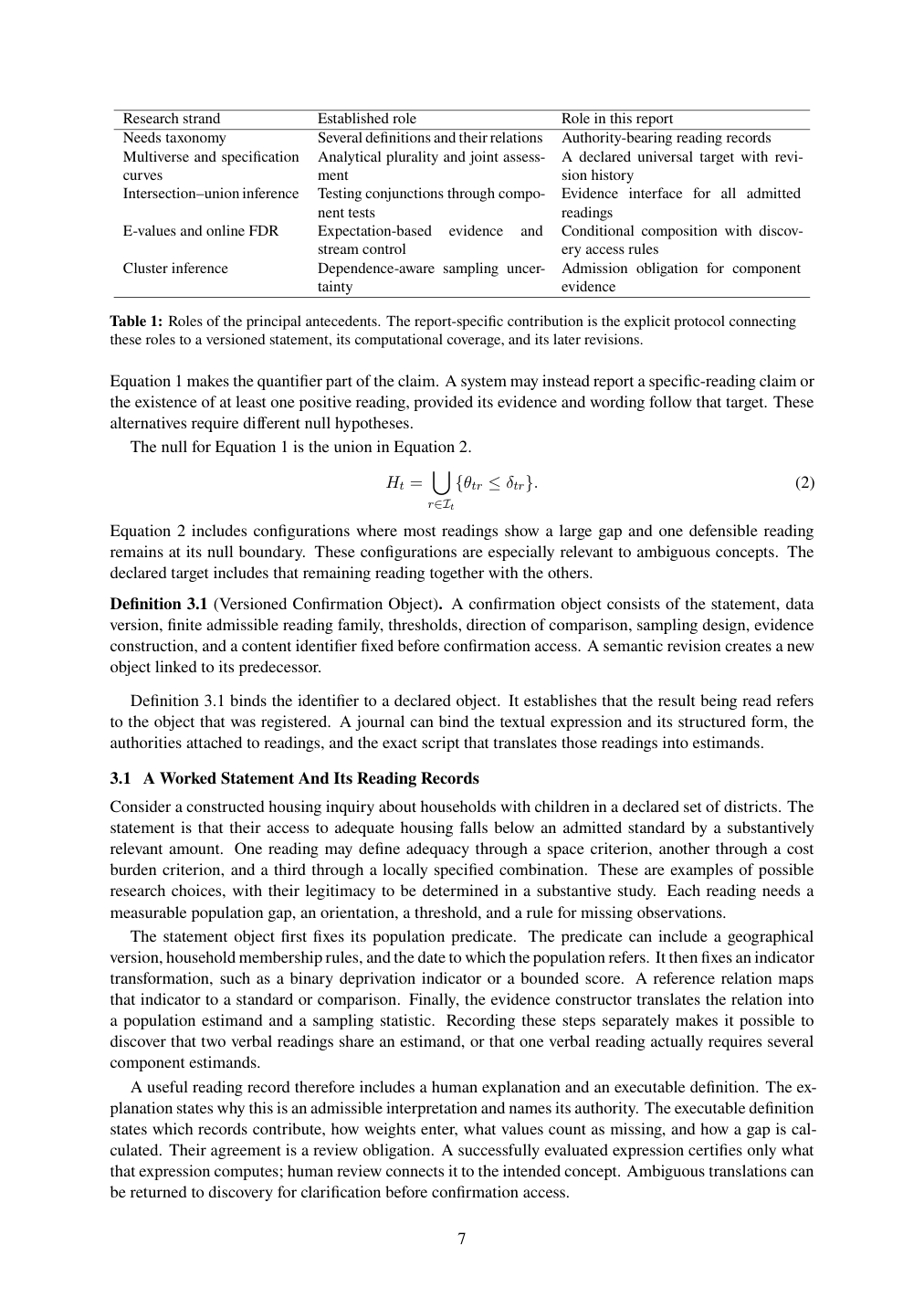
Table 1 locates the report among these foundations. The comparison concerns roles explicitly sup- ported by the accessed primary records. Its scope is the documented role of each foundation in this
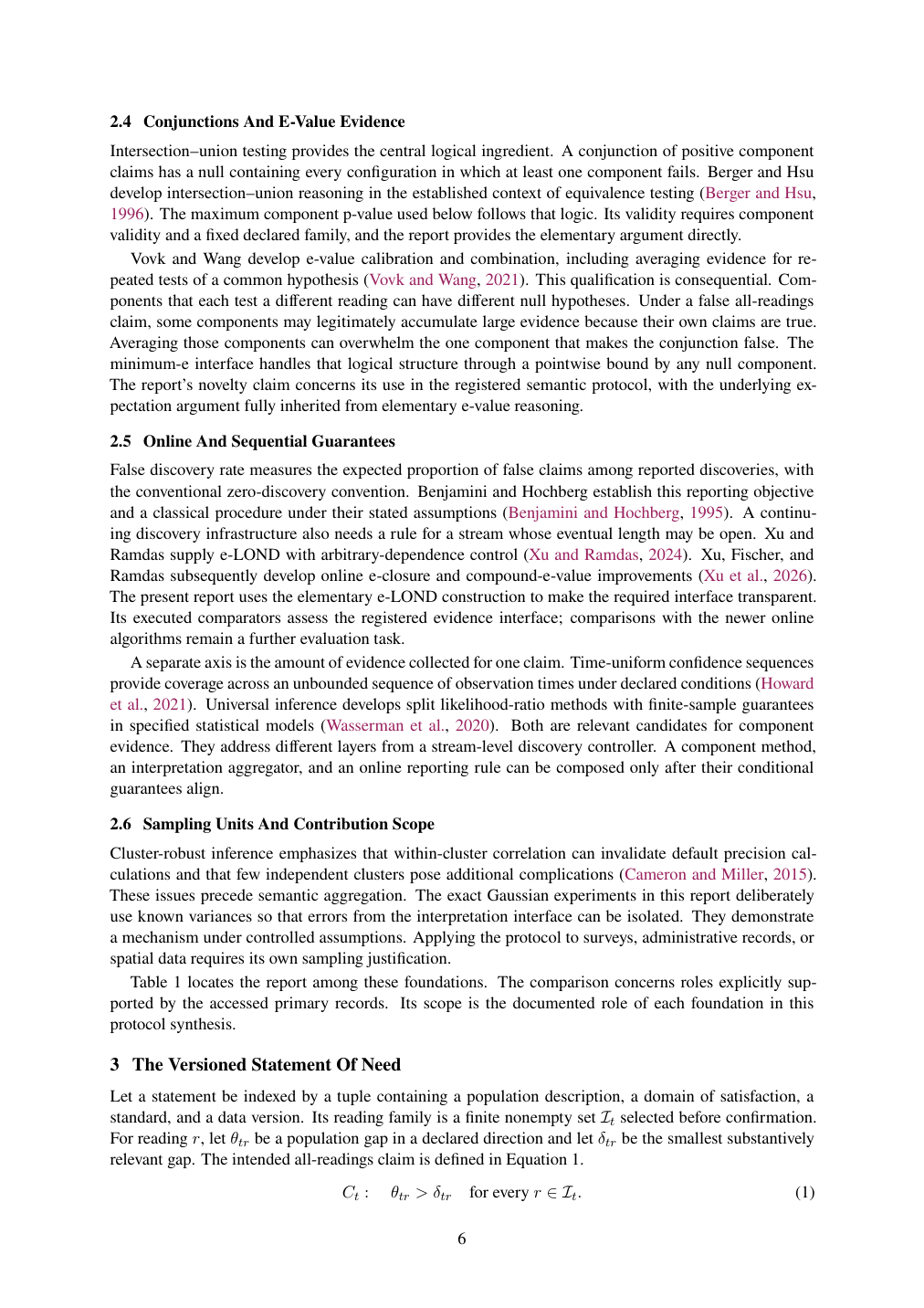
Let a statement be indexed by a tuple containing a population description, a domain of satisfaction, a relevant gap. The intended all-readings claim is defined in Equation 1.
Readable text
Research strand Established role Needs taxonomy Multiverse and specification curves
E-values and online FDR Expectation-based evidence stream control
Role in this report Authority-bearing reading records
Conditional composition with discov- ery access rules
Table 1: Roles of the principal antecedents. The report-specific contribution is the explicit protocol connecting these roles to a versioned statement, its computational coverage, and its later revisions.
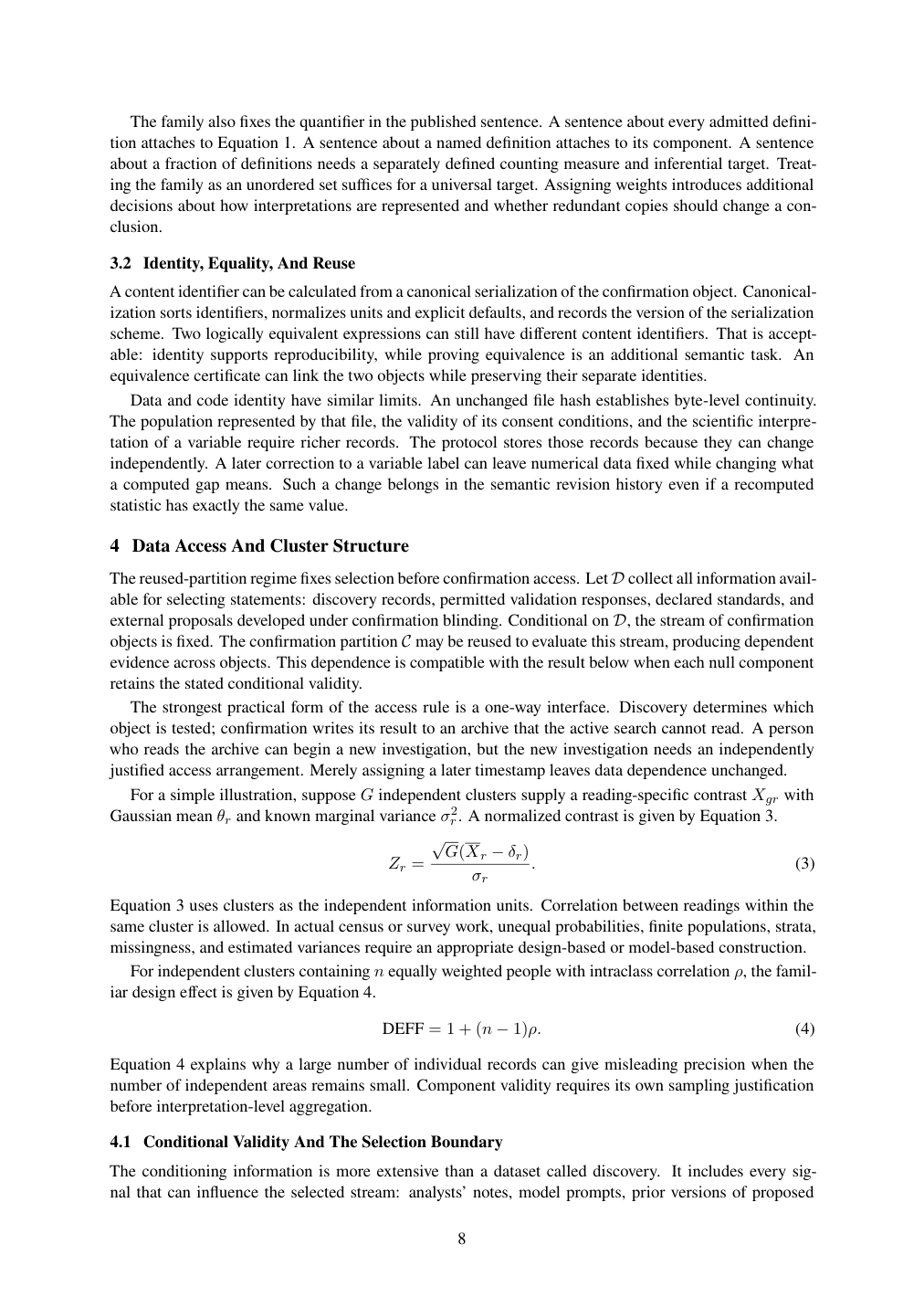
Equation 1 makes the quantifier part of the claim. A system may instead report a specific-reading claim or the existence of at least one positive reading, provided its evidence and wording follow that target. These
Equation 2 includes configurations where most readings show a large gap and one defensible reading remains at its null boundary. These configurations are especially relevant to ambiguous concepts. The declared target includes that remaining reading together with the others.
Definition 3.1 (Versioned Confirmation Object). A confirmation object consists of the statement, data version, finite admissible reading family, thresholds, direction of comparison, sampling design, evidence construction, and a content identifier fixed before confirmation access. A semantic revision creates a new
Definition 3.1 binds the identifier to a declared object. It establishes that the result being read refers to the object that was registered. A journal can bind the textual expression and its structured form, the authorities attached to readings, and the exact script that translates those readings into estimands.
Consider a constructed housing inquiry about households with children in a declared set of districts. The statement is that their access to adequate housing falls below an admitted standard by a substantively relevant amount. One reading may define adequacy through a space criterion, another through a cost burden criterion, and a third through a locally specified combination. These are examples of possible research choices, with their legitimacy to be determined in a substantive study. Each reading needs a measurable population gap, an orientation, a threshold, and a rule for missing observations.
The statement object first fixes its population predicate. The predicate can include a geographical version, household membership rules, and the date to which the population refers. It then fixes an indicator transformation, such as a binary deprivation indicator or a bounded score. A reference relation maps that indicator to a standard or comparison. Finally, the evidence constructor translates the relation into a population estimand and a sampling statistic. Recording these steps separately makes it possible to discover that two verbal readings share an estimand, or that one verbal reading actually requires several
A useful reading record therefore includes a human explanation and an executable definition. The ex- planation states why this is an admissible interpretation and names its authority. The executable definition states which records contribute, how weights enter, what values count as missing, and how a gap is cal- culated. Their agreement is a review obligation. A successfully evaluated expression certifies only what that expression computes; human review connects it to the intended concept. Ambiguous translations can be returned to discovery for clarification before confirmation access.
Readable text
The family also fixes the quantifier in the published sentence. A sentence about every admitted defini- tion attaches to Equation 1. A sentence about a named definition attaches to its component. A sentence about a fraction of definitions needs a separately defined counting measure and inferential target. Treat- ing the family as an unordered set suffices for a universal target. Assigning weights introduces additional decisions about how interpretations are represented and whether redundant copies should change a con-
A content identifier can be calculated from a canonical serialization of the confirmation object. Canonical- ization sorts identifiers, normalizes units and explicit defaults, and records the version of the serialization scheme. Two logically equivalent expressions can still have different content identifiers. That is accept- able: identity supports reproducibility, while proving equivalence is an additional semantic task. An equivalence certificate can link the two objects while preserving their separate identities.
Data and code identity have similar limits. An unchanged file hash establishes byte-level continuity. The population represented by that file, the validity of its consent conditions, and the scientific interpre- tation of a variable require richer records. The protocol stores those records because they can change independently. A later correction to a variable label can leave numerical data fixed while changing what a computed gap means. Such a change belongs in the semantic revision history even if a recomputed
able for selecting statements: discovery records, permitted validation responses, declared standards, and evidence across objects. This dependence is compatible with the result below when each null component
The strongest practical form of the access rule is a one-way interface. Discovery determines which object is tested; confirmation writes its result to an archive that the active search cannot read. A person who reads the archive can begin a new investigation, but the new investigation needs an independently justified access arrangement. Merely assigning a later timestamp leaves data dependence unchanged.
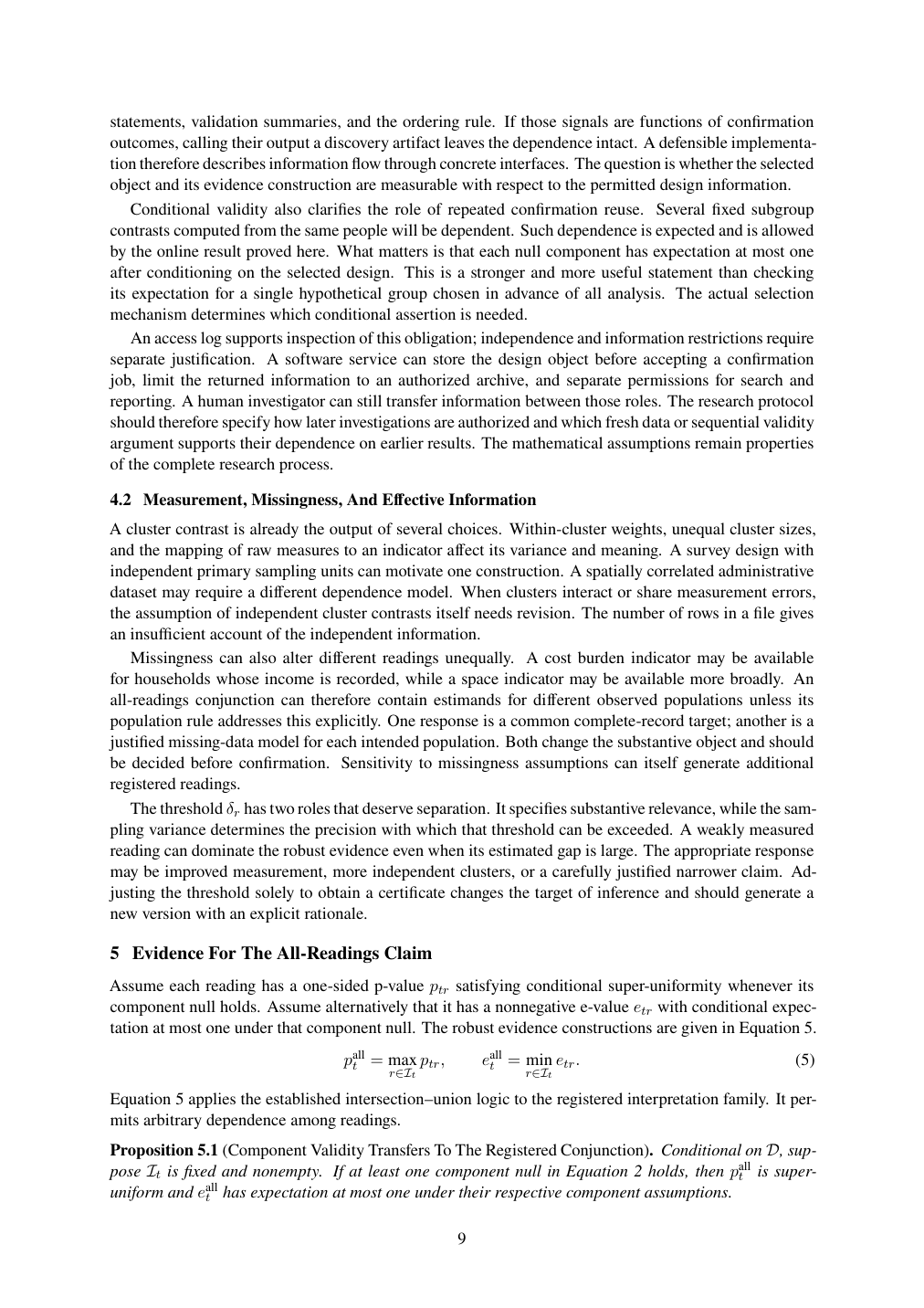
Equation 3 uses clusters as the independent information units. Correlation between readings within the same cluster is allowed. In actual census or survey work, unequal probabilities, finite populations, strata, missingness, and estimated variances require an appropriate design-based or model-based construction.
Equation 4 explains why a large number of individual records can give misleading precision when the number of independent areas remains small. Component validity requires its own sampling justification
The conditioning information is more extensive than a dataset called discovery. It includes every sig- nal that can influence the selected stream: analysts’ notes, model prompts, prior versions of proposed
Readable text
statements, validation summaries, and the ordering rule. If those signals are functions of confirmation outcomes, calling their output a discovery artifact leaves the dependence intact. A defensible implementa- tion therefore describes information flow through concrete interfaces. The question is whether the selected object and its evidence construction are measurable with respect to the permitted design information.
Conditional validity also clarifies the role of repeated confirmation reuse. Several fixed subgroup contrasts computed from the same people will be dependent. Such dependence is expected and is allowed by the online result proved here. What matters is that each null component has expectation at most one after conditioning on the selected design. This is a stronger and more useful statement than checking its expectation for a single hypothetical group chosen in advance of all analysis. The actual selection mechanism determines which conditional assertion is needed.
An access log supports inspection of this obligation; independence and information restrictions require separate justification. A software service can store the design object before accepting a confirmation job, limit the returned information to an authorized archive, and separate permissions for search and reporting. A human investigator can still transfer information between those roles. The research protocol should therefore specify how later investigations are authorized and which fresh data or sequential validity argument supports their dependence on earlier results. The mathematical assumptions remain properties
4.2 Measurement, Missingness, And Effective Information
A cluster contrast is already the output of several choices. Within-cluster weights, unequal cluster sizes, and the mapping of raw measures to an indicator affect its variance and meaning. A survey design with independent primary sampling units can motivate one construction. A spatially correlated administrative dataset may require a different dependence model. When clusters interact or share measurement errors, the assumption of independent cluster contrasts itself needs revision. The number of rows in a file gives an insufficient account of the independent information.
Missingness can also alter different readings unequally. A cost burden indicator may be available for households whose income is recorded, while a space indicator may be available more broadly. An all-readings conjunction can therefore contain estimands for different observed populations unless its population rule addresses this explicitly. One response is a common complete-record target; another is a justified missing-data model for each intended population. Both change the substantive object and should be decided before confirmation. Sensitivity to missingness assumptions can itself generate additional
pling variance determines the precision with which that threshold can be exceeded. A weakly measured reading can dominate the robust evidence even when its estimated gap is large. The appropriate response may be improved measurement, more independent clusters, or a carefully justified narrower claim. Ad- justing the threshold solely to obtain a certificate changes the target of inference and should generate a
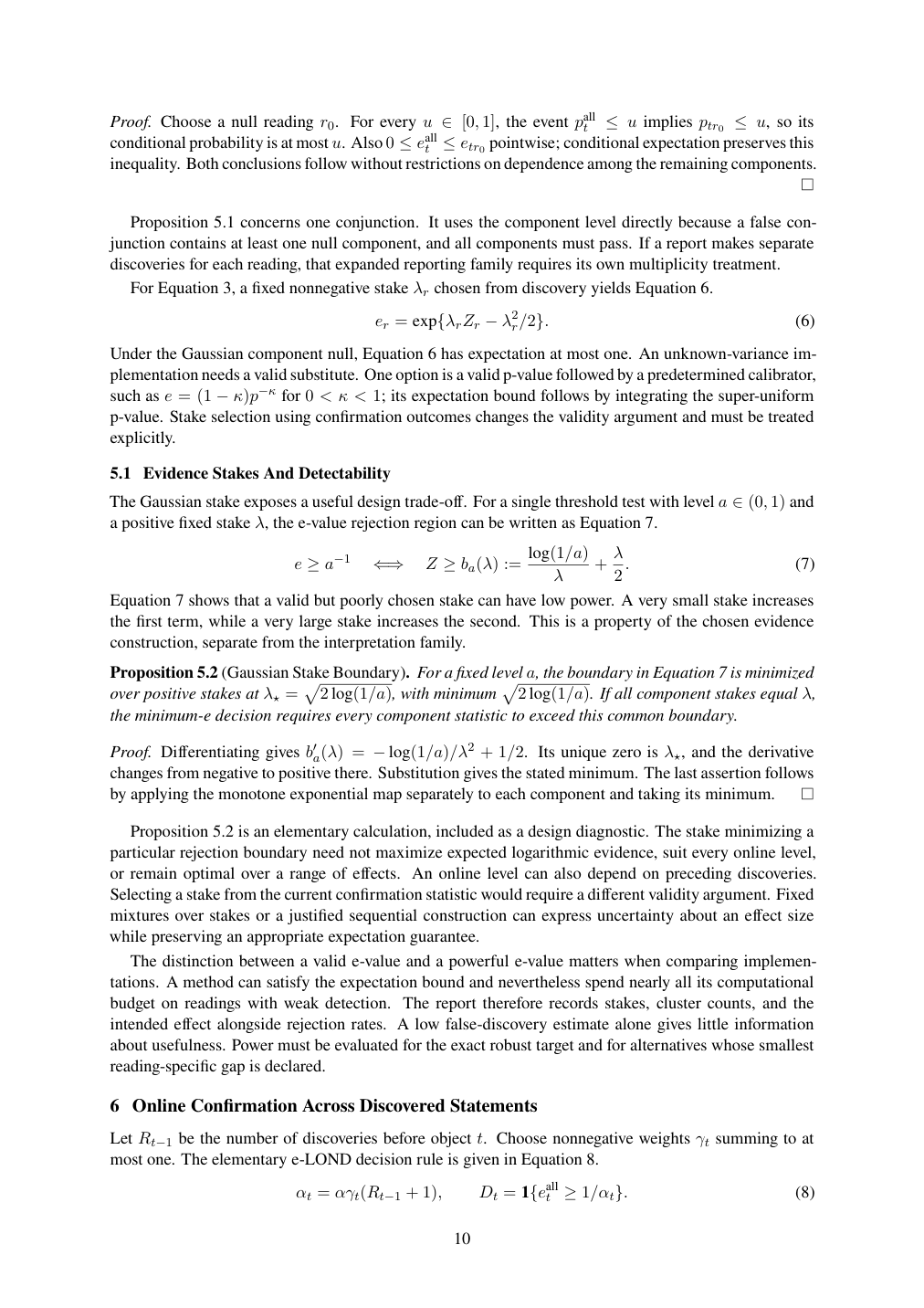
tation at most one under that component null. The robust evidence constructions are given in Equation 5.
Equation 5 applies the established intersection–union logic to the registered interpretation family. It per-
Readable text
inequality. Both conclusions follow without restrictions on dependence among the remaining components.
Proposition 5.1 concerns one conjunction. It uses the component level directly because a false con- junction contains at least one null component, and all components must pass. If a report makes separate discoveries for each reading, that expanded reporting family requires its own multiplicity treatment.
Under the Gaussian component null, Equation 6 has expectation at most one. An unknown-variance im- plementation needs a valid substitute. One option is a valid p-value followed by a predetermined calibrator, p-value. Stake selection using confirmation outcomes changes the validity argument and must be treated
Equation 7 shows that a valid but poorly chosen stake can have low power. A very small stake increases the first term, while a very large stake increases the second. This is a property of the chosen evidence
construction, separate from the interpretation family.
the minimum-e decision requires every component statistic to exceed this common boundary.
changes from negative to positive there. Substitution gives the stated minimum. The last assertion follows by applying the monotone exponential map separately to each component and taking its minimum.
Proposition 5.2 is an elementary calculation, included as a design diagnostic. The stake minimizing a particular rejection boundary need not maximize expected logarithmic evidence, suit every online level, or remain optimal over a range of effects. An online level can also depend on preceding discoveries. Selecting a stake from the current confirmation statistic would require a different validity argument. Fixed mixtures over stakes or a justified sequential construction can express uncertainty about an effect size while preserving an appropriate expectation guarantee.
The distinction between a valid e-value and a powerful e-value matters when comparing implemen- tations. A method can satisfy the expectation bound and nevertheless spend nearly all its computational budget on readings with weak detection. The report therefore records stakes, cluster counts, and the intended effect alongside rejection rates. A low false-discovery estimate alone gives little information about usefulness. Power must be evaluated for the exact robust target and for alternatives whose smallest
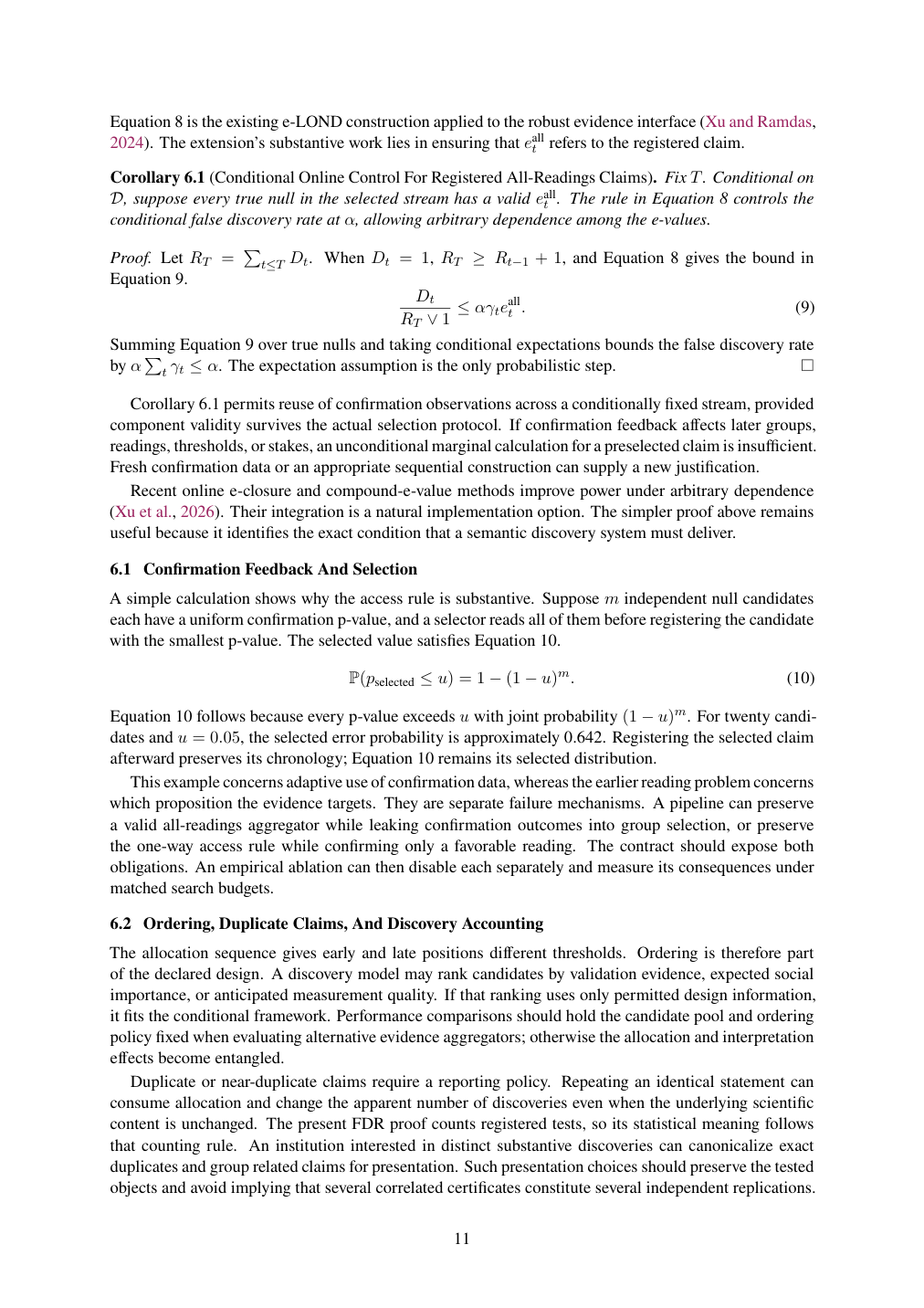
most one. The elementary e-LOND decision rule is given in Equation 8.
Readable text
Equation 8 is the existing e-LOND construction applied to the robust evidence interface (Xu and Ramdas,
Summing Equation 9 over true nulls and taking conditional expectations bounds the false discovery rate
Corollary 6.1 permits reuse of confirmation observations across a conditionally fixed stream, provided component validity survives the actual selection protocol. If confirmation feedback affects later groups, readings, thresholds, or stakes, an unconditional marginal calculation for a preselected claim is insufficient. Fresh confirmation data or an appropriate sequential construction can supply a new justification.
Recent online e-closure and compound-e-value methods improve power under arbitrary dependence (Xu et al., 2026). Their integration is a natural implementation option. The simpler proof above remains useful because it identifies the exact condition that a semantic discovery system must deliver.
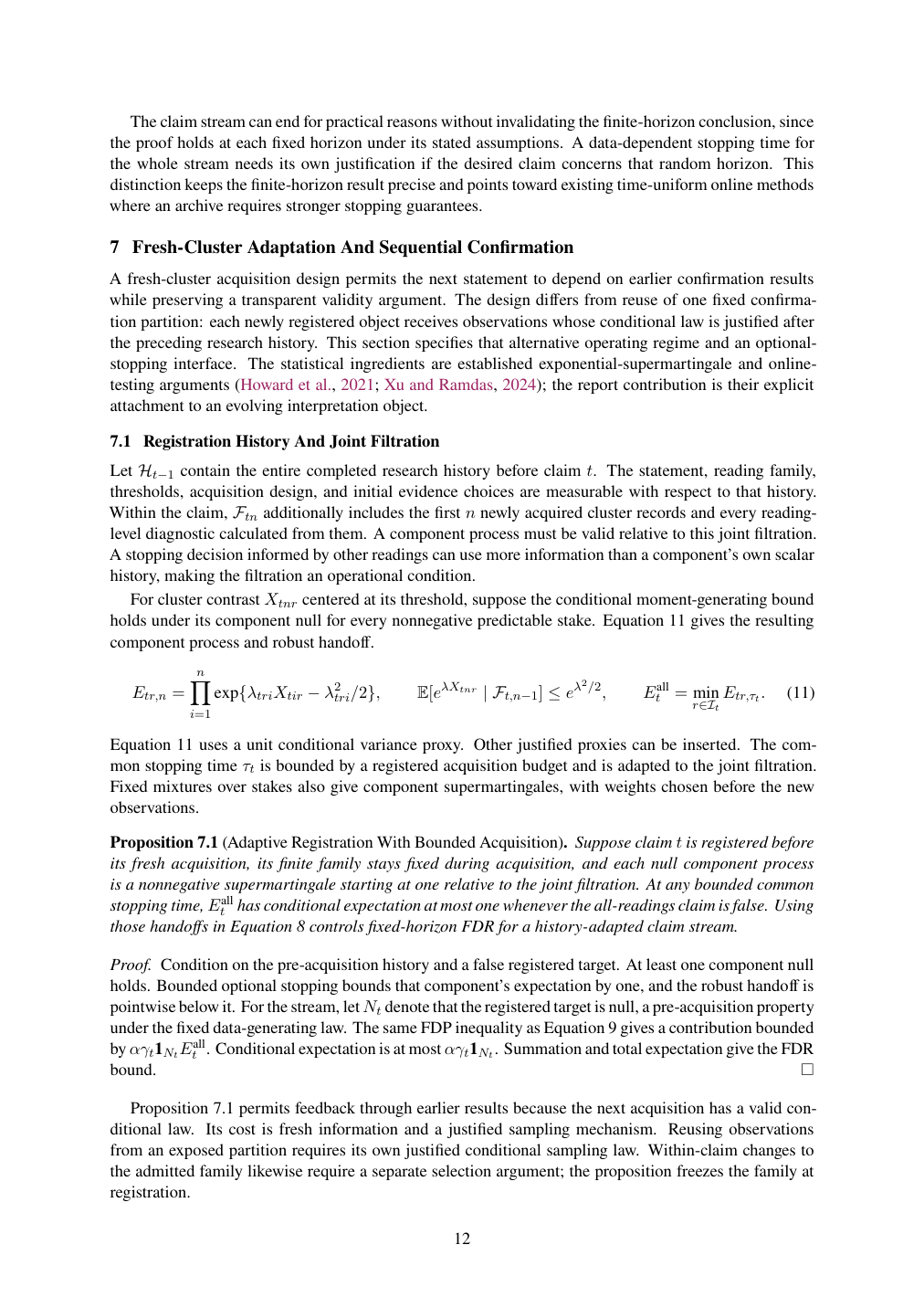
each have a uniform confirmation p-value, and a selector reads all of them before registering the candidate with the smallest p-value. The selected value satisfies Equation 10.
afterward preserves its chronology; Equation 10 remains its selected distribution.
This example concerns adaptive use of confirmation data, whereas the earlier reading problem concerns which proposition the evidence targets. They are separate failure mechanisms. A pipeline can preserve a valid all-readings aggregator while leaking confirmation outcomes into group selection, or preserve the one-way access rule while confirming only a favorable reading. The contract should expose both obligations. An empirical ablation can then disable each separately and measure its consequences under
6.2 Ordering, Duplicate Claims, And Discovery Accounting
The allocation sequence gives early and late positions different thresholds. Ordering is therefore part of the declared design. A discovery model may rank candidates by validation evidence, expected social importance, or anticipated measurement quality. If that ranking uses only permitted design information, it fits the conditional framework. Performance comparisons should hold the candidate pool and ordering policy fixed when evaluating alternative evidence aggregators; otherwise the allocation and interpretation
Duplicate or near-duplicate claims require a reporting policy. Repeating an identical statement can consume allocation and change the apparent number of discoveries even when the underlying scientific content is unchanged. The present FDR proof counts registered tests, so its statistical meaning follows that counting rule. An institution interested in distinct substantive discoveries can canonicalize exact duplicates and group related claims for presentation. Such presentation choices should preserve the tested objects and avoid implying that several correlated certificates constitute several independent replications.
Readable text
The claim stream can end for practical reasons without invalidating the finite-horizon conclusion, since the proof holds at each fixed horizon under its stated assumptions. A data-dependent stopping time for the whole stream needs its own justification if the desired claim concerns that random horizon. This distinction keeps the finite-horizon result precise and points toward existing time-uniform online methods where an archive requires stronger stopping guarantees.
7 Fresh-Cluster Adaptation And Sequential Confirmation
A fresh-cluster acquisition design permits the next statement to depend on earlier confirmation results while preserving a transparent validity argument. The design differs from reuse of one fixed confirma- tion partition: each newly registered object receives observations whose conditional law is justified after the preceding research history. This section specifies that alternative operating regime and an optional- stopping interface. The statistical ingredients are established exponential-supermartingale and online- testing arguments (Howard et al., 2021; Xu and Ramdas, 2024); the report contribution is their explicit
thresholds, acquisition design, and initial evidence choices are measurable with respect to that history.
level diagnostic calculated from them. A component process must be valid relative to this joint filtration. A stopping decision informed by other readings can use more information than a component’s own scalar
history, making the filtration an operational condition.
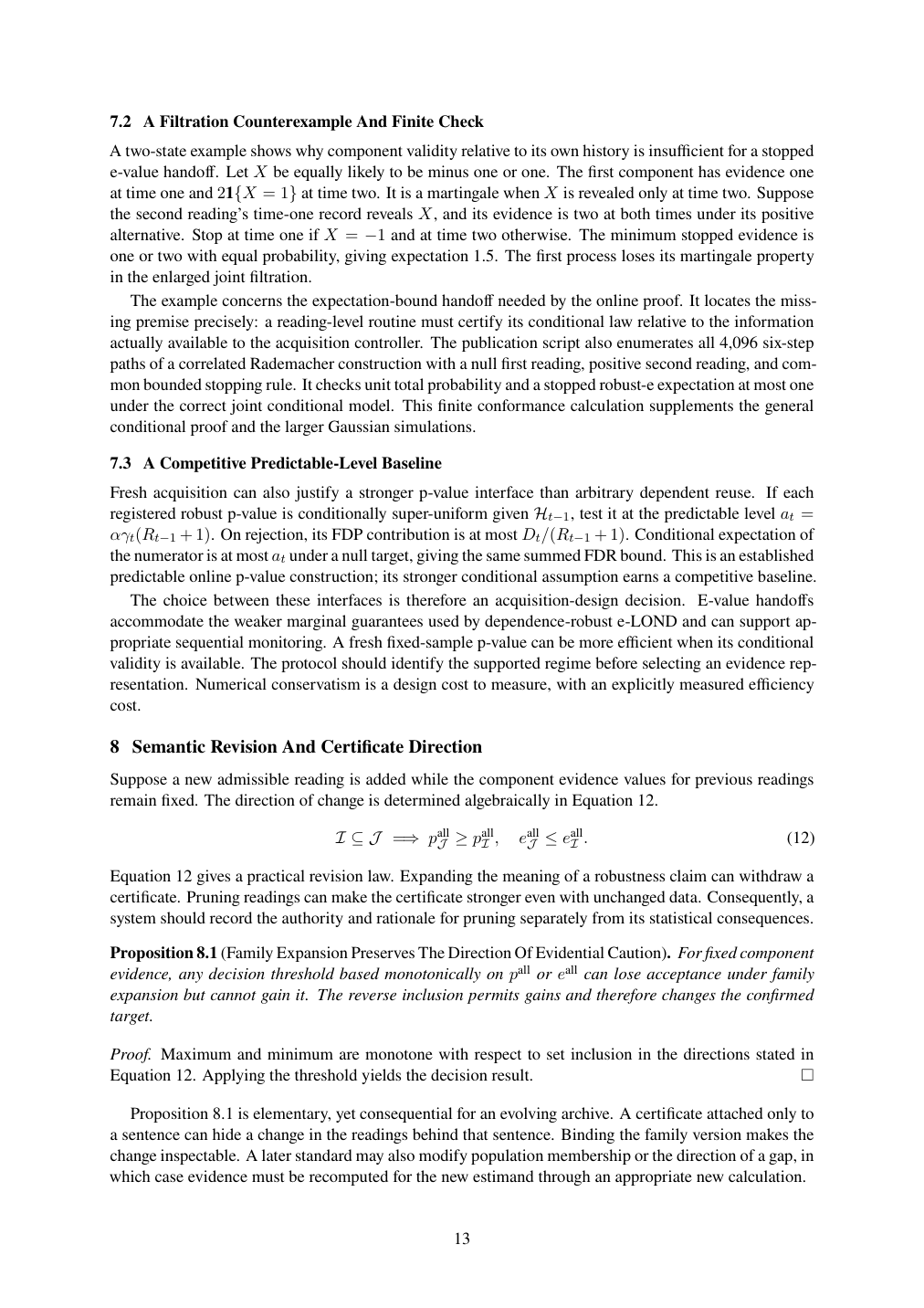
holds under its component null for every nonnegative predictable stake. Equation 11 gives the resulting
Equation 11 uses a unit conditional variance proxy. Other justified proxies can be inserted. The com- Fixed mixtures over stakes also give component supermartingales, with weights chosen before the new
its fresh acquisition, its finite family stays fixed during acquisition, and each null component process is a nonnegative supermartingale starting at one relative to the joint filtration. At any bounded common
those handoffs in Equation 8 controls fixed-horizon FDR for a history-adapted claim stream.
Proof. Condition on the pre-acquisition history and a false registered target. At least one component null holds. Bounded optional stopping bounds that component’s expectation by one, and the robust handoff is under the fixed data-generating law. The same FDP inequality as Equation 9 gives a contribution bounded
Proposition 7.1 permits feedback through earlier results because the next acquisition has a valid con- ditional law. Its cost is fresh information and a justified sampling mechanism. Reusing observations from an exposed partition requires its own justified conditional sampling law. Within-claim changes to the admitted family likewise require a separate selection argument; the proposition freezes the family at
Readable text
A two-state example shows why component validity relative to its own history is insufficient for a stopped one or two with equal probability, giving expectation 1.5. The first process loses its martingale property
The example concerns the expectation-bound handoff needed by the online proof. It locates the miss- ing premise precisely: a reading-level routine must certify its conditional law relative to the information actually available to the acquisition controller. The publication script also enumerates all 4,096 six-step paths of a correlated Rademacher construction with a null first reading, positive second reading, and com- mon bounded stopping rule. It checks unit total probability and a stopped robust-e expectation at most one under the correct joint conditional model. This finite conformance calculation supplements the general
conditional proof and the larger Gaussian simulations.
Fresh acquisition can also justify a stronger p-value interface than arbitrary dependent reuse. If each predictable online p-value construction; its stronger conditional assumption earns a competitive baseline.
The choice between these interfaces is therefore an acquisition-design decision. E-value handoffs accommodate the weaker marginal guarantees used by dependence-robust e-LOND and can support ap- propriate sequential monitoring. A fresh fixed-sample p-value can be more efficient when its conditional validity is available. The protocol should identify the supported regime before selecting an evidence rep- resentation. Numerical conservatism is a design cost to measure, with an explicitly measured efficiency
Suppose a new admissible reading is added while the component evidence values for previous readings remain fixed. The direction of change is determined algebraically in Equation 12.
Equation 12 gives a practical revision law. Expanding the meaning of a robustness claim can withdraw a certificate. Pruning readings can make the certificate stronger even with unchanged data. Consequently, a system should record the authority and rationale for pruning separately from its statistical consequences.
Proposition 8.1 (Family Expansion Preserves The Direction Of Evidential Caution). For fixed component expansion but cannot gain it. The reverse inclusion permits gains and therefore changes the confirmed
Proof. Maximum and minimum are monotone with respect to set inclusion in the directions stated in Equation 12. Applying the threshold yields the decision result.
Proposition 8.1 is elementary, yet consequential for an evolving archive. A certificate attached only to a sentence can hide a change in the readings behind that sentence. Binding the family version makes the change inspectable. A later standard may also modify population membership or the direction of a gap, in which case evidence must be recomputed for the new estimand through an appropriate new calculation.
Readable text
A practical archive can distinguish four revision operations. An expansion adds admitted readings while retaining earlier component definitions. A restriction removes readings and records the substantive reason. A replacement changes a reading’s indicator, group, or standard. A data correction changes the observa- tions or their mapping to variables. Expansion alone admits the pointwise direction law already proved. Restriction narrows the target. Replacement and data correction generally require recomputation to align
Each operation creates an immutable successor linked to its predecessor. The archive can mark the predecessor retained for its original scope, superseded for current use, or withdrawn because a supporting assumption was found incorrect. These statuses carry different meanings. Supersession expresses a pref- erence for a later formulation while preserving the truth conditions of the earlier one. Withdrawal records that the earlier certificate’s stated support has failed. A reader should be able to recover the exact reasons
A family expansion after confirmation is informative even when its inferential use is limited. It can reveal a previously unexamined interpretation under which the claim weakens. Reporting that sensitivity is valuable. Reissuing a stronger or differently scoped confirmatory result requires an appropriate selection argument. The archive can therefore store both exploratory recomputations and admitted confirmations, with their evidence status in structured fields. This permits scientific learning without confusing the status
The revision law also suggests a computational optimization. When a family expands and earlier com- ponent evidence remains valid for its original object, the aggregator can update its maximum or minimum using the new members. This saves numerical work. The admission decision still checks whether data access, component definitions, and the online reporting policy permit that reuse. Efficient computation and warranted inference are separate obligations that the same revision event must satisfy.
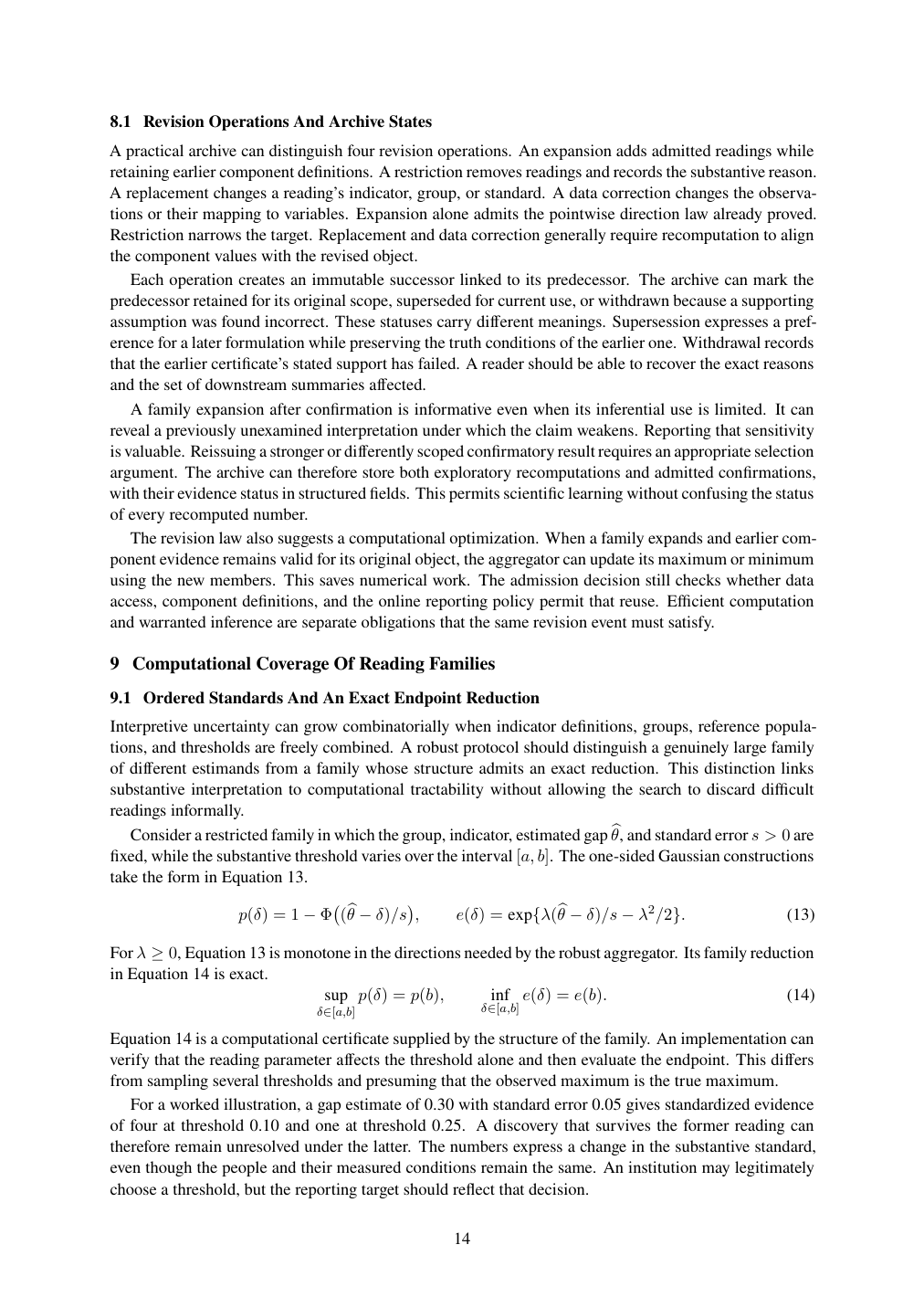
Interpretive uncertainty can grow combinatorially when indicator definitions, groups, reference popula- tions, and thresholds are freely combined. A robust protocol should distinguish a genuinely large family of different estimands from a family whose structure admits an exact reduction. This distinction links substantive interpretation to computational tractability without allowing the search to discard difficult
Equation 14 is a computational certificate supplied by the structure of the family. An implementation can verify that the reading parameter affects the threshold alone and then evaluate the endpoint. This differs from sampling several thresholds and presuming that the observed maximum is the true maximum.
For a worked illustration, a gap estimate of 0.30 with standard error 0.05 gives standardized evidence of four at threshold 0.10 and one at threshold 0.25. A discovery that survives the former reading can therefore remain unresolved under the latter. The numbers express a change in the substantive standard, even though the people and their measured conditions remain the same. An institution may legitimately choose a threshold, but the reporting target should reflect that decision.
If a reading also changes the reference group, missing-data treatment, or measurement scale, the monotonicity argument must be re-established. An apparently more demanding verbal standard may yield a smaller standardized statistic because it changes both numerator and uncertainty. A typed interpretation interface can distinguish these situations: threshold-only transformations admit the endpoint certificate; general transformations return separate estimands requiring their own component evidence.
9.2 Branch Certificates For Large Finite Families

This approach changes the computational burden from the number of nominal combinations to the number of branches that need refinement. Its computational benefit depends on substantive structure: ordered standards, nested populations with valid bounds, or algebraic constraints linking several readings. Bounds learned from the confirmation sample need a validity argument that incorporates their learning; deterministic semantic bounds and discovery-fixed bounds are easier to audit.
A system can report the evaluated leaves, discharged branches, and unresolved branches together. This record explains whether the family was fully checked by enumeration, fully checked through certificates, or checked only in part. The distinction is valuable when a language model proposes many alternative readings. A model can suggest a promising branch decomposition, while the checker verifies each bounding obligation.
9.3 Separation Of Normative And Statistical Decisions
The interpretation family is itself a consequential design object. Admitting a reading changes the substantive conjunction and can increase the data required for confirmation. Excluding a reading can release a statistical bottleneck while reducing the meaning of robustness. An efficient search should therefore record two decisions separately: whether a reading belongs in the admissible family and whether the resulting claim receives sufficient evidence.
This separation permits constructive revision. A domain panel can reject a proposed interpretation because it conflicts with the governing concept, because it relies on an inappropriate population, or because its source lacks the required authority. A data analyst can identify a reading with insufficient measurement precision. These reasons lead to different actions. Conceptual exclusion revises the target; insufficient precision motivates additional observations or a more limited conclusion. Treating them as one numerical fitness value would obscure the difference.
The family certificate consequently carries a small governance history: who proposed each reading, the reason for admission, the method used to verify computational reductions, and any later withdrawal. The statistical procedures remain conventional in their respective domains, while this record ties their outputs to an evolving interpretive object. That is the specific infrastructural insight of the present protocol.
10 Operational Design And Computational Obligations
10.1 Registration And Evidence Execution
The proposed service has a registration boundary and an evidence boundary. Registration accepts a structured statement and its reading family, verifies required fields, checks the data-access declaration, and produces a content identifier. Evidence execution accepts that identifier and evaluates only the registered functions against the authorized confirmation partition. Keeping the interfaces separate allows a reviewer to inspect the object before its confirmatory result exists.
A registration validator checks population and indicator types, units, comparison directions, threshold values, sampling-design identifiers, and family coverage. It can reject a dimensional mismatch mechanically. It can also return a request for substantive review where two readings use incompatible meanings
of a variable. A language model may help draft the human explanation or suggest missing alternatives. Admission of those suggestions remains a recorded decision, with the model output treated as a proposal whose provenance and review status are visible.
Execution returns component evidence with diagnostics sufficient to assess its assumptions. In the Gaussian illustration these diagnostics include the number of clusters, marginal variances, stakes, and the direction of the gap. A real sampling design can require survey weights, strata, cluster identifiers, effective sample counts, and the method used to estimate uncertainty. The robust aggregator consumes valid component evidence whose design information is supplied explicitly.
The online controller then records its allocation weight, prior discovery count, local decision threshold, aggregate evidence, and reporting decision. A claim that fails admission is distinct from a claim with valid but insufficient evidence. A computation that exhausts its budget while checking the family is distinct from either. These statuses support useful remedies: repair an invalid specification, collect more information for an unresolved claim, or improve the computational coverage certificate.
10.2 Enumeration, Bounds, And Complexity

A factorized family with several choices per interpretation axis can have a product number of leaves. The endpoint reduction discussed earlier collapses a restricted threshold axis exactly. A branch-bound scheme can reduce enumeration when certified bounds are strong. Its worst case still visits every leaf. A benchmark should therefore report both nominal family size and realized work: evaluated leaves, checked bounds, remaining branches, and elapsed computation. Reporting only the fastest successful example would obscure the cases in which the semantic conjunction is genuinely expensive.
Coverage certificates have their own computational assumptions. A branch is identified by a partial interpretation assignment and an exact description of the leaves it represents. The checker verifies the bound’s premises and the union of discharged branches. Overlap between branches is harmless for a universal claim, but missing leaves are consequential. A compact proof object can list endpoint identities, validated monotonicity obligations, and branch inclusions. The numerical script used here explores finite families; implementing such a general proof checker remains a separate engineering contribution.
10.3 Failure Recovery And Reproducibility
An execution interruption should preserve a checkpoint containing the registered object, completed components, open branches, software version, and random seeds for authorized simulation methods. Resuming the job then continues the same object. Changing a threshold or reading definition during recovery creates a successor object. This rule avoids a common ambiguity in computational research: whether a long-running job resumed an analysis or silently became a new one.
Deterministic recomputation is desirable but has a limited epistemic role. Identical code, data, and seeds can reproduce an invalid calculation exactly. The archive consequently separates a reproducibility record from an assumption record and a claim record. The first concerns computational continuity, the second the conditions supporting validity, and the third the proposition being asserted. Their identifiers link the records so a correction can propagate to the right downstream conclusions.
A minimal implementation can be useful before every proposed optimization exists. It can enumerate a small declared family, use a verified component test, and store a complete record. This provides a concrete baseline against which more ambitious search or branch-reduction systems can be assessed. The scientific value of an advanced implementation should be measured by additional warranted discoveries, reduced
Readable text
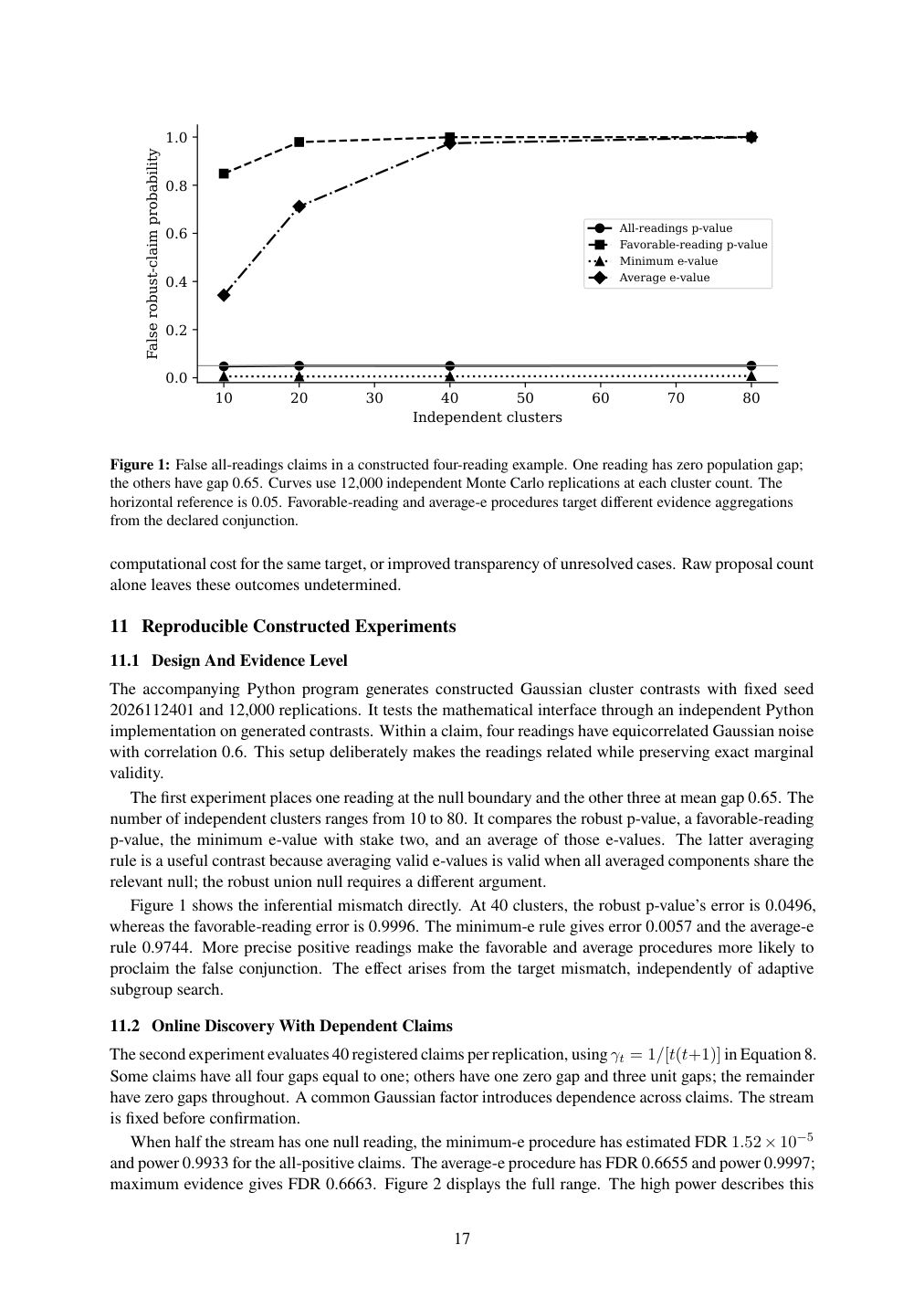
All-readings p-value Favorable-reading p-value Minimum e-value Average e-value
Figure 1: False all-readings claims in a constructed four-reading example. One reading has zero population gap; the others have gap 0.65. Curves use 12,000 independent Monte Carlo replications at each cluster count. The horizontal reference is 0.05. Favorable-reading and average-e procedures target different evidence aggregations
computational cost for the same target, or improved transparency of unresolved cases. Raw proposal count
The accompanying Python program generates constructed Gaussian cluster contrasts with fixed seed 2026112401 and 12,000 replications. It tests the mathematical interface through an independent Python implementation on generated contrasts. Within a claim, four readings have equicorrelated Gaussian noise with correlation 0.6. This setup deliberately makes the readings related while preserving exact marginal
The first experiment places one reading at the null boundary and the other three at mean gap 0.65. The number of independent clusters ranges from 10 to 80. It compares the robust p-value, a favorable-reading p-value, the minimum e-value with stake two, and an average of those e-values. The latter averaging rule is a useful contrast because averaging valid e-values is valid when all averaged components share the relevant null; the robust union null requires a different argument.
Figure 1 shows the inferential mismatch directly. At 40 clusters, the robust p-value’s error is 0.0496, whereas the favorable-reading error is 0.9996. The minimum-e rule gives error 0.0057 and the average-e rule 0.9744. More precise positive readings make the favorable and average procedures more likely to proclaim the false conjunction. The effect arises from the target mismatch, independently of adaptive
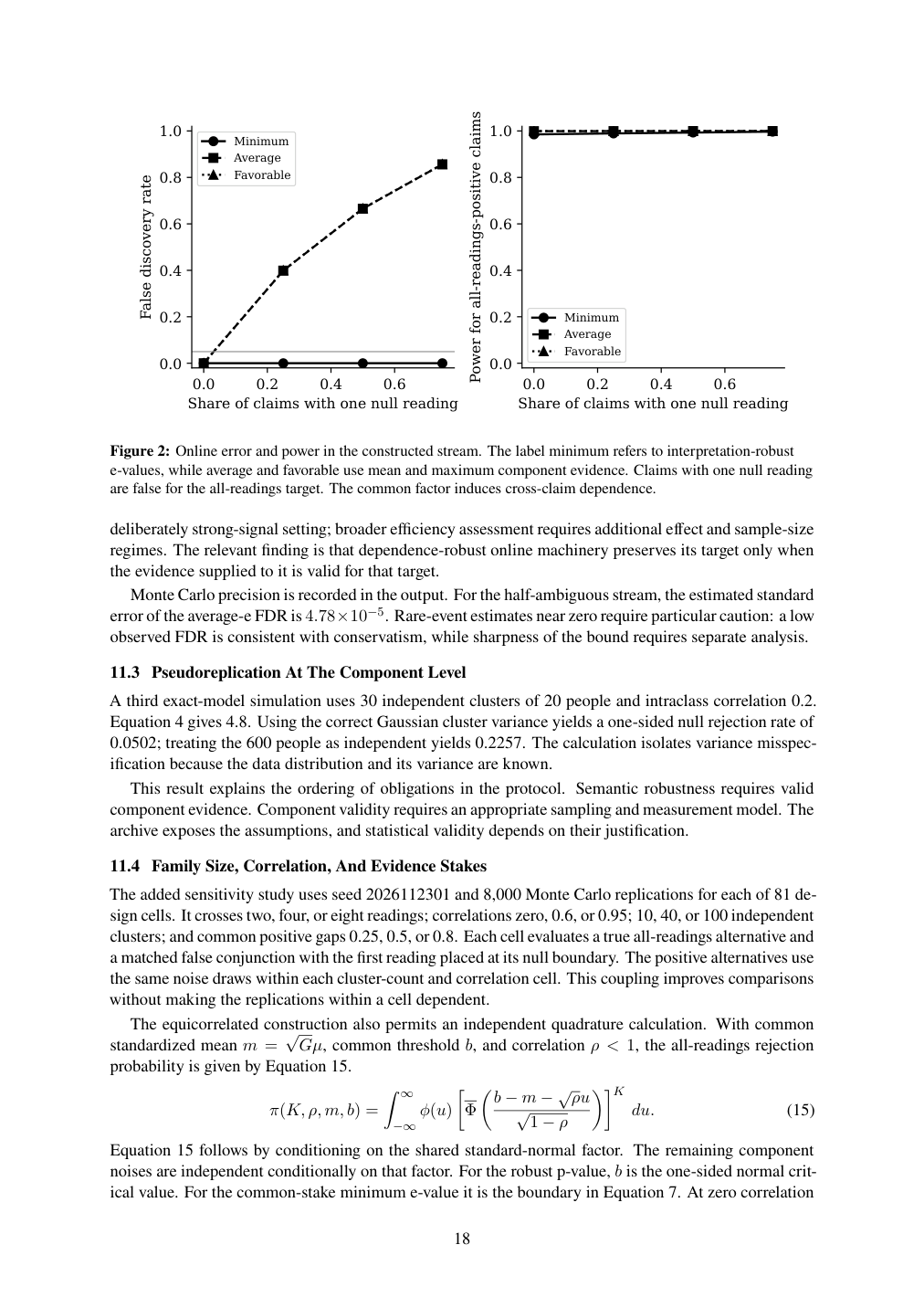
Some claims have all four gaps equal to one; others have one zero gap and three unit gaps; the remainder have zero gaps throughout. A common Gaussian factor introduces dependence across claims. The stream
and power 0.9933 for the all-positive claims. The average-e procedure has FDR 0.6655 and power 0.9997; maximum evidence gives FDR 0.6663. Figure 2 displays the full range. The high power describes this
Readable text
Figure 2: Online error and power in the constructed stream. The label minimum refers to interpretation-robust e-values, while average and favorable use mean and maximum component evidence. Claims with one null reading are false for the all-readings target. The common factor induces cross-claim dependence.
deliberately strong-signal setting; broader efficiency assessment requires additional effect and sample-size regimes. The relevant finding is that dependence-robust online machinery preserves its target only when
Monte Carlo precision is recorded in the output. For the half-ambiguous stream, the estimated standard observed FDR is consistent with conservatism, while sharpness of the bound requires separate analysis.
A third exact-model simulation uses 30 independent clusters of 20 people and intraclass correlation 0.2. Equation 4 gives 4.8. Using the correct Gaussian cluster variance yields a one-sided null rejection rate of 0.0502; treating the 600 people as independent yields 0.2257. The calculation isolates variance misspec- ification because the data distribution and its variance are known.
This result explains the ordering of obligations in the protocol. Semantic robustness requires valid component evidence. Component validity requires an appropriate sampling and measurement model. The archive exposes the assumptions, and statistical validity depends on their justification.
The added sensitivity study uses seed 2026112301 and 8,000 Monte Carlo replications for each of 81 de- sign cells. It crosses two, four, or eight readings; correlations zero, 0.6, or 0.95; 10, 40, or 100 independent clusters; and common positive gaps 0.25, 0.5, or 0.8. Each cell evaluates a true all-readings alternative and a matched false conjunction with the first reading placed at its null boundary. The positive alternatives use the same noise draws within each cluster-count and correlation cell. This coupling improves comparisons without making the replications within a cell dependent.
The equicorrelated construction also permits an independent quadrature calculation. With common
Equation 15 follows by conditioning on the shared standard-normal factor. The remaining component ical value. For the common-stake minimum e-value it is the boundary in Equation 7. At zero correlation
Readable text
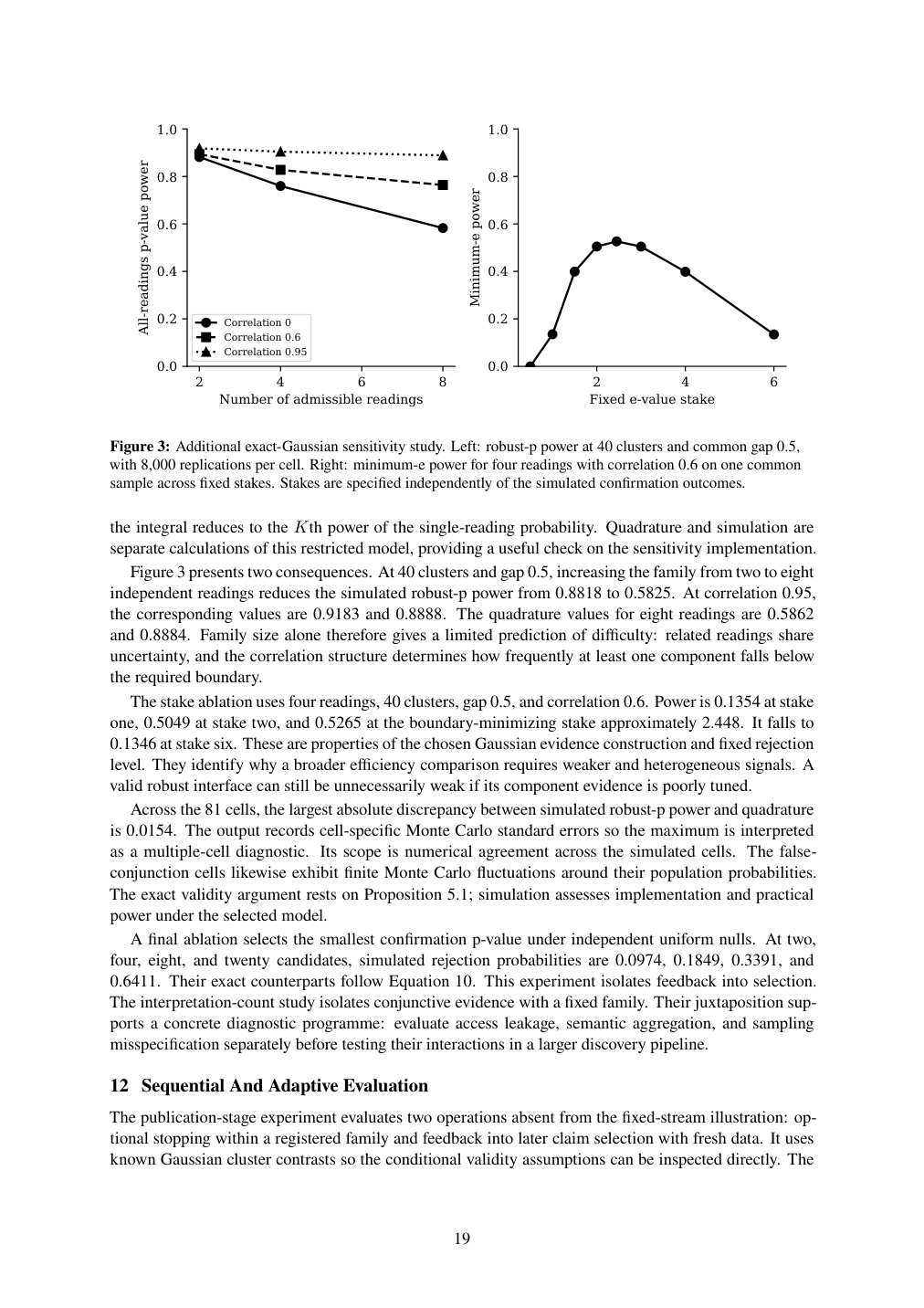
Figure 3: Additional exact-Gaussian sensitivity study. Left: robust-p power at 40 clusters and common gap 0.5, with 8,000 replications per cell. Right: minimum-e power for four readings with correlation 0.6 on one common sample across fixed stakes. Stakes are specified independently of the simulated confirmation outcomes.
separate calculations of this restricted model, providing a useful check on the sensitivity implementation.
Figure 3 presents two consequences. At 40 clusters and gap 0.5, increasing the family from two to eight independent readings reduces the simulated robust-p power from 0.8818 to 0.5825. At correlation 0.95, the corresponding values are 0.9183 and 0.8888. The quadrature values for eight readings are 0.5862 and 0.8884. Family size alone therefore gives a limited prediction of difficulty: related readings share uncertainty, and the correlation structure determines how frequently at least one component falls below
The stake ablation uses four readings, 40 clusters, gap 0.5, and correlation 0.6. Power is 0.1354 at stake one, 0.5049 at stake two, and 0.5265 at the boundary-minimizing stake approximately 2.448. It falls to 0.1346 at stake six. These are properties of the chosen Gaussian evidence construction and fixed rejection level. They identify why a broader efficiency comparison requires weaker and heterogeneous signals. A valid robust interface can still be unnecessarily weak if its component evidence is poorly tuned.
Across the 81 cells, the largest absolute discrepancy between simulated robust-p power and quadrature is 0.0154. The output records cell-specific Monte Carlo standard errors so the maximum is interpreted as a multiple-cell diagnostic. Its scope is numerical agreement across the simulated cells. The false- conjunction cells likewise exhibit finite Monte Carlo fluctuations around their population probabilities. The exact validity argument rests on Proposition 5.1; simulation assesses implementation and practical
A final ablation selects the smallest confirmation p-value under independent uniform nulls. At two, four, eight, and twenty candidates, simulated rejection probabilities are 0.0974, 0.1849, 0.3391, and 0.6411. Their exact counterparts follow Equation 10. This experiment isolates feedback into selection. The interpretation-count study isolates conjunctive evidence with a fixed family. Their juxtaposition sup- ports a concrete diagnostic programme: evaluate access leakage, semantic aggregation, and sampling misspecification separately before testing their interactions in a larger discovery pipeline.
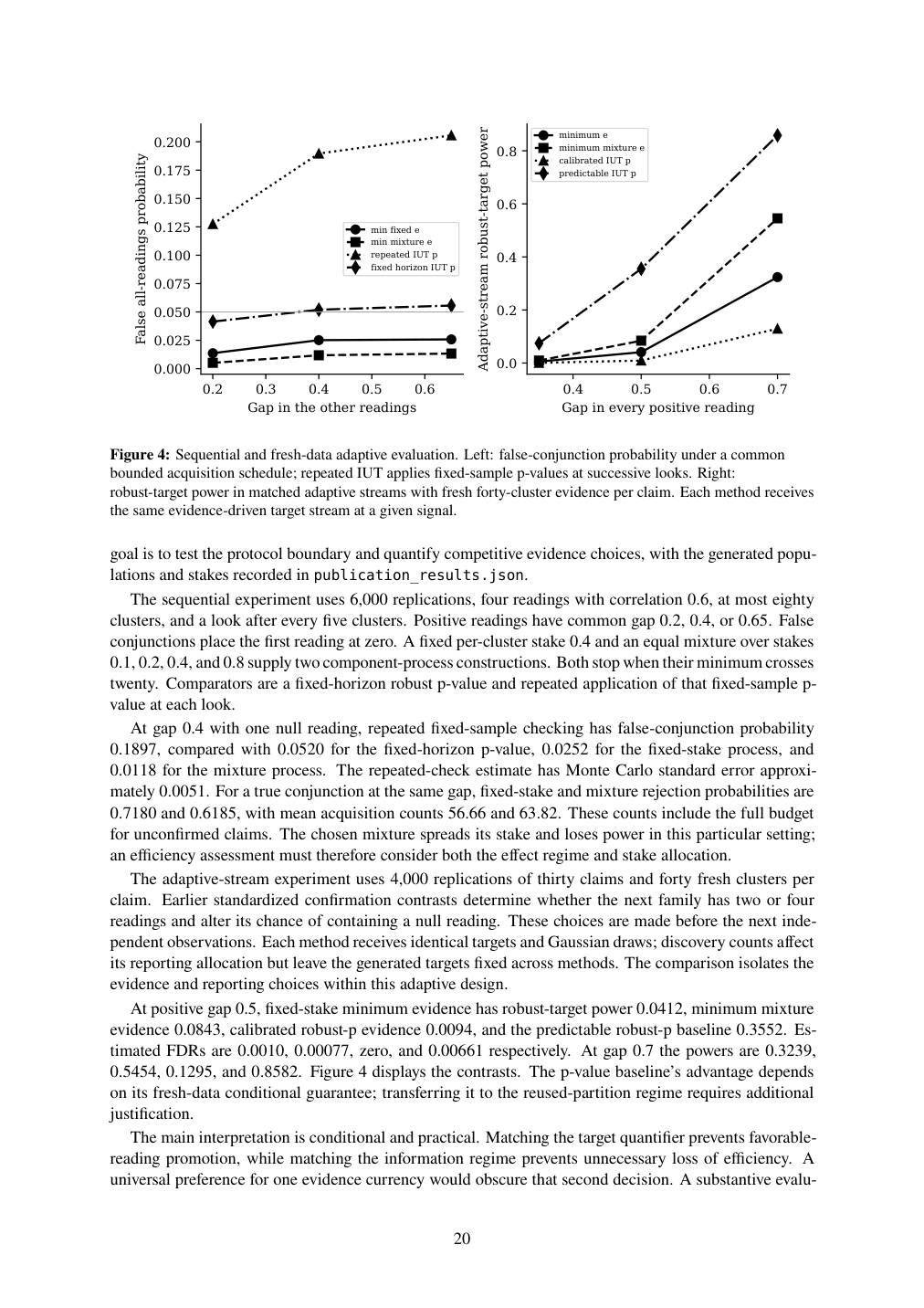
The publication-stage experiment evaluates two operations absent from the fixed-stream illustration: op- tional stopping within a registered family and feedback into later claim selection with fresh data. It uses known Gaussian cluster contrasts so the conditional validity assumptions can be inspected directly. The
Readable text
min fixed e min mixture e repeated IUT p fixed horizon IUT p
minimum e minimum mixture e calibrated IUT p predictable IUT p
Figure 4: Sequential and fresh-data adaptive evaluation. Left: false-conjunction probability under a common bounded acquisition schedule; repeated IUT applies fixed-sample p-values at successive looks. Right: robust-target power in matched adaptive streams with fresh forty-cluster evidence per claim. Each method receives
the same evidence-driven target stream at a given signal.
goal is to test the protocol boundary and quantify competitive evidence choices, with the generated popu- lations and stakes recorded in publication_results.json.
The sequential experiment uses 6,000 replications, four readings with correlation 0.6, at most eighty clusters, and a look after every five clusters. Positive readings have common gap 0.2, 0.4, or 0.65. False conjunctions place the first reading at zero. A fixed per-cluster stake 0.4 and an equal mixture over stakes 0.1, 0.2, 0.4, and 0.8 supply two component-process constructions. Both stop when their minimum crosses twenty. Comparators are a fixed-horizon robust p-value and repeated application of that fixed-sample p-
At gap 0.4 with one null reading, repeated fixed-sample checking has false-conjunction probability 0.1897, compared with 0.0520 for the fixed-horizon p-value, 0.0252 for the fixed-stake process, and 0.0118 for the mixture process. The repeated-check estimate has Monte Carlo standard error approxi- mately 0.0051. For a true conjunction at the same gap, fixed-stake and mixture rejection probabilities are 0.7180 and 0.6185, with mean acquisition counts 56.66 and 63.82. These counts include the full budget for unconfirmed claims. The chosen mixture spreads its stake and loses power in this particular setting; an efficiency assessment must therefore consider both the effect regime and stake allocation.
The adaptive-stream experiment uses 4,000 replications of thirty claims and forty fresh clusters per claim. Earlier standardized confirmation contrasts determine whether the next family has two or four readings and alter its chance of containing a null reading. These choices are made before the next inde- pendent observations. Each method receives identical targets and Gaussian draws; discovery counts affect its reporting allocation but leave the generated targets fixed across methods. The comparison isolates the evidence and reporting choices within this adaptive design.
At positive gap 0.5, fixed-stake minimum evidence has robust-target power 0.0412, minimum mixture evidence 0.0843, calibrated robust-p evidence 0.0094, and the predictable robust-p baseline 0.3552. Es- timated FDRs are 0.0010, 0.00077, zero, and 0.00661 respectively. At gap 0.7 the powers are 0.3239, 0.5454, 0.1295, and 0.8582. Figure 4 displays the contrasts. The p-value baseline’s advantage depends on its fresh-data conditional guarantee; transferring it to the reused-partition regime requires additional
The main interpretation is conditional and practical. Matching the target quantifier prevents favorable- reading promotion, while matching the information regime prevents unnecessary loss of efficiency. A universal preference for one evidence currency would obscure that second decision. A substantive evalu-
ation should compare acquisition costs and valid discoveries jointly, including the cost of obtaining fresh independent clusters and the consequences of a wide family dominated by weak measurement.
13 Integration With The Existing Infrastructure
The inspected repository snapshot is commit 869fe38, and the relevant implementation paths are the needs search, evidence, and language modules (Noetarium Project, 2026). The source explicitly says that interpretation and rival checks receive discovery alone. That is a useful separation to preserve. A robust confirmation extension can reuse the existing structured readings while changing what is registered and evaluated.
The minimal new record contains the family identifier, each reading’s estimand and threshold, its authority record, the sampling-design identifier, component evidence, the robust aggregator, and the online reporting decision. The current plain statement and its lineage remain valuable. The extension binds the confirmation result to the same family used in the substantive robustness statement.
An incomplete enumeration of readings requires a special status. Passing every reading found so far establishes a claim over that enumerated subset. It can support the full-family claim only with an independent coverage or enclosure argument. A hard enumeration limit should therefore appear in the certificate, together with whether the intended family was exhausted. This connection to epistemic contracts is developed in companion report P03.
The program supplied here demonstrates the statistical rule under known Gaussian assumptions. A complete needs-discovery integration remains an implementation milestone. A repository integration should add unit checks for family hashing, conditional independence of search outputs from confirmation permutations, interpretation completeness, and correct withdrawal after family expansion. These checks test implementation obligations; empirical validity additionally needs substantive data.
13.1 Source-Level Integration Tasks
The pinned source provides three natural integration points. The structured language supplies the statement and interpretation descriptions. The search layer governs discovery, validation, and the arrival order of candidates. The evidence layer computes and reports confirmation. A family contract belongs at their boundary: language exports the admissible readings, search freezes their identity and ordering, and evidence returns component and aggregate results for that identity. This design keeps the statistical routine reusable across different proposal generators.
A first integration milestone would implement only finite enumerated families with a strict size budget. The registration object can expose a required field stating that enumeration is complete for its declared family. A later milestone can admit certified endpoint reductions and branch bounds. Each new reduction should preserve a checkable coverage obligation. The Python artifact demonstrates the direct aggregation baseline and supplies numerical fixtures for a later C++ conformance study.
The repository mapping also identifies useful interfaces for independent evaluation. A test harness can replace the discovery generator with a fixed candidate list, replace the evidence constructor with an exact Gaussian simulator, and replace the archive with a local immutable journal. Those substitutions isolate each obligation. The complete application can then be evaluated with the same fixtures plus domainspecific datasets. Layered validation makes a failure interpretable: an altered family hash, a leaked result, a misoriented gap, and an incorrect variance calculation each call for a different repair.
13.2 A Source-Grounded Feasibility Screen
The pinned evidence test fixture supplies a concrete interpretation family: older renters are compared with the rest of the frame, everyone, or the same older-renter group. The interpretation test records the self-comparison gap as zero and the resulting statement as arguable. The fixture then crosses reference readings with two indicators. These source cases make the target distinction operational (Noetarium Project, 2026).
For a strict positive comparative gap, an admitted self-reference is structurally null whenever the threshold is nonnegative. The group mean and its identical reference cancel under every dataset and weighting scheme using that same group definition. Additional observations cannot make that conjunction true. A registration preflight can return the identity of this reading and request substantive family review before spending confirmation data. The publication script checks the cancellation on 1,000 independently generated weighted datasets; the universal argument is the identity of the two estimands.
The screen concerns target feasibility. A panel may retain the reading to document disagreement, narrow the reported claim, or reject it through a recorded conceptual argument. A numerical optimizer should preserve that rationale separately from its statistical consequence. The source fixture is an existing synthetic test, and the new preflight is an independent reference calculation. Executing the needs C++ test suite and integrating the screen into registration remain implementation tasks.
14 Institutional Interpretation And Further Evaluation
A statistically robust claim can still encode a narrow set of standards. A family assembled entirely by one institution may omit relevant experiences or competing understandings. The protocol therefore improves inspectability of its declared scope. Participation, authority, and justification govern how the family should be formed. These questions connect to the separate reports on evaluative power and evaluative norms.
For a substantive study, the first priority is to preregister the target and sampling design across several domains of satisfaction. Care, housing, and income can expose different interpretation structures. Independent domain reviewers should assess whether the family is substantively defensible and whether the thresholds have legitimate grounds. Their judgments should be preserved alongside statistical outcomes with their separate rationales preserved.
A second priority is robustness to component-test misspecification. Cluster bootstrap, design-based variance estimation, finite-sample randomization, and distributional sensitivity should be compared where their assumptions apply. A third is search efficiency: different generators should face matched budgets and the same confirmation interface. This allows investigators to ask whether evolutionary or model-assisted exploration discovers more genuinely robust claims without changing the evidential standard.
Finally, the cost of an extensive interpretation family deserves explicit analysis. Robust conjunctions can be conservative when one weakly measured reading dominates. That observation may motivate collecting better data for that reading, revising an unjustified family through substantive deliberation, or reporting a narrower claim with transparent wording. Each response has different epistemic and political consequences.
14.1 Evaluation Criteria And Responsible Interpretation
A substantive evaluation should measure the quality of discovered claims alongside their number. Independent reviewers can assess population relevance, clarity of the standard, coverage of important readings, and usefulness for follow-up inquiry. The statistical analysis can report robust-target FDR, power for preregistered effect configurations, computation per admitted claim, and the fraction of jobs left unresolved through incomplete family coverage. These outcomes are complementary. A system producing many narrow certificates can appear efficient while omitting the interpretations that matter most to affected groups.
Participation affects the interpretation family at several stages. People whose experiences motivate the inquiry can propose readings that administrative measures miss, challenge whether observable demand reflects access barriers, and identify consequences of using a certificate in provision decisions. Such involvement can improve the substantive target, while its design requires care about representation, compensation, accessibility, and the burden of repeatedly explaining unmet needs. The current study evaluates generated cluster contrasts; empirical assessment of participation requires a separate substantive study.
An archive can also change incentives. Researchers may prefer readings that are easier to measure or families that are easier to certify. Institutions may prefer a small family that supports an existing policy. The protocol makes those choices visible through authority and revision records, but transparency has
Readable text
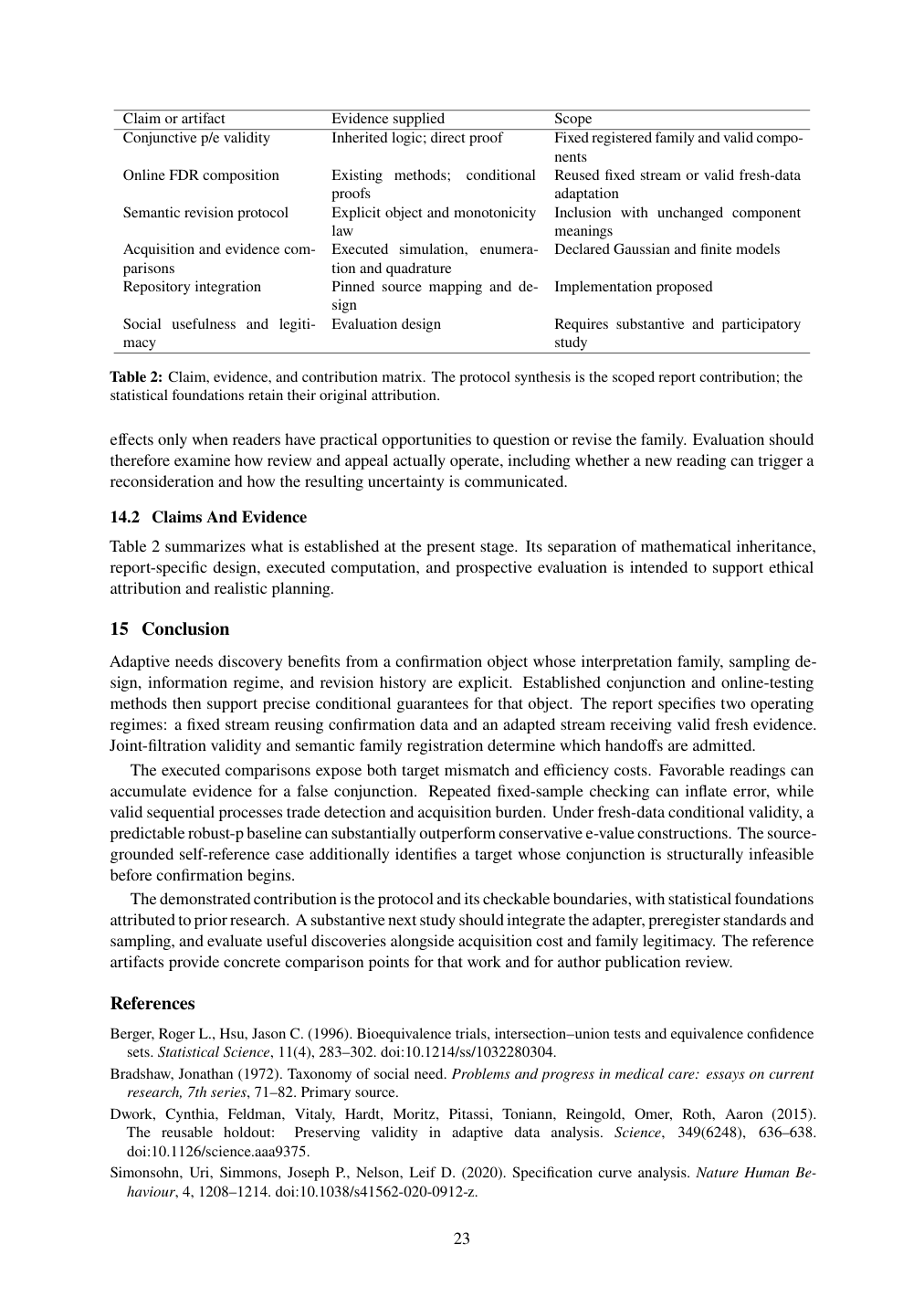
Claim or artifact Evidence supplied Conjunctive p/e validity Online FDR composition Existing methods; proofs
Scope Fixed registered family and valid compo- nents conditional
Table 2: Claim, evidence, and contribution matrix. The protocol synthesis is the scoped report contribution; the
statistical foundations retain their original attribution.
effects only when readers have practical opportunities to question or revise the family. Evaluation should therefore examine how review and appeal actually operate, including whether a new reading can trigger a reconsideration and how the resulting uncertainty is communicated.
Table 2 summarizes what is established at the present stage. Its separation of mathematical inheritance, report-specific design, executed computation, and prospective evaluation is intended to support ethical
Adaptive needs discovery benefits from a confirmation object whose interpretation family, sampling de- sign, information regime, and revision history are explicit. Established conjunction and online-testing methods then support precise conditional guarantees for that object. The report specifies two operating regimes: a fixed stream reusing confirmation data and an adapted stream receiving valid fresh evidence. Joint-filtration validity and semantic family registration determine which handoffs are admitted.
The executed comparisons expose both target mismatch and efficiency costs. Favorable readings can accumulate evidence for a false conjunction. Repeated fixed-sample checking can inflate error, while valid sequential processes trade detection and acquisition burden. Under fresh-data conditional validity, a predictable robust-p baseline can substantially outperform conservative e-value constructions. The source- grounded self-reference case additionally identifies a target whose conjunction is structurally infeasible
The demonstrated contribution is the protocol and its checkable boundaries, with statistical foundations attributed to prior research. A substantive next study should integrate the adapter, preregister standards and sampling, and evaluate useful discoveries alongside acquisition cost and family legitimacy. The reference artifacts provide concrete comparison points for that work and for author publication review.
Berger, Roger L., Hsu, Jason C. (1996). Bioequivalence trials, intersection–union tests and equivalence confidence
sets. Statistical Science, 11(4), 283–302. doi:10.1214/ss/1032280304. Bradshaw, Jonathan (1972). Taxonomy of social need. Problems and progress in medical care: essays on current
Dwork, Cynthia, Feldman, Vitaly, Hardt, Moritz, Pitassi, Toniann, Reingold, Omer, Roth, Aaron (2015).
Preserving validity in adaptive data analysis. Science, Simonsohn, Uri, Simmons, Joseph P., Nelson, Leif D. (2020). Specification curve analysis. Nature Human Be-
Steegen, Sara, Tuerlinckx, Francis, Gelman, Andrew, Vanpaemel, Wolf (2016). Increasing transparency through a
multiverse analysis. Perspectives on Psychological Science, 11(5), 702–712. doi:10.1177/1745691616658637. Vovk, Vladimir, Wang, Ruodu (2021). E-values: Calibration, combination, and applications. Annals of Statistics,
49(3), 1736–1754. doi:10.1214/20-AOS2020. Xu, Ziyu, Ramdas, Aaditya (2024). Online multiple testing with e-values. Proceedings of AISTATS, PMLR, 238,
3997–4005. Primary source. Xu, Ziyu, Fischer, Lasse, Ramdas, Aaditya (2026). Improving online FDR procedures via online analogs of e-closure
and compound e-values. Proceedings of UAI, PMLR, 337, 7552–7561. Primary source. Howard, Steven R., Ramdas, Aaditya, McAuliffe, Jon, Sekhon, Jasjeet (2021). Time-uniform, nonparametric,
nonasymptotic confidence sequences. Annals of Statistics, 49(2), 1055–1080. doi:10.1214/20-AOS1991. Wasserman, Larry, Ramdas, Aaditya, Balakrishnan, Sivaraman (2020). Universal inference. Proceedings of the
National Academy of Sciences, 117(29), 16880–16890. doi:10.1073/pnas.1922664117. Cameron, A. Colin, Miller, Douglas L. (2015). A practitioner’s guide to cluster-robust inference. Journal of Human
Resources, 50(2), 317–372. doi:10.3368/jhr.50.2.317. Webb, Geoffrey I. (2007). Discovering significant patterns. Machine Learning, 68, 1–33. doi:10.1007/s10994-007-
5006-x. Benjamini, Yoav, Hochberg, Yosef (1995). Controlling the false discovery rate: A practical and powerful ap-
proach to multiple testing. Journal of the Royal Statistical Society, Series B, 57(1), 289–300. doi:10.1111/j.2517- 6161.1995.tb02031.x. Noetarium Project (2026). Needs: Their exploration and validation. Pinned repository source. Primary source.