Noetarium - Relational Infrastructure For Human And AI Inquiry Across Disciplines
Full text from the PDF
Noetarium: Relational Infrastructure For Human And AI Inquiry
Across Disciplines
Wanhong HUANG
Abstract
Noetarium organizes scientific and humanistic resources through shared foundations, domain libraries, evidence interfaces, and purpose-oriented applications. This report studies how those relations can support human and AI inquiry while preserving the distinctions required by particular questions. It separates nominal combinations, prepared resources, executed tasks, and warranted conclusions. An immutable source audit finds 45 accessible domain manifests, 55 declared domain dependencies, and 130 data-registry declarations. Seed sets of up to four domains yield 164,220 selections and 99,353 distinct preparation closures. The formal analysis connects shared preparation, task-relative information preservation, and revision dependencies using established mathematical ingredients. Initial constructed experiments examine complementary resource selection. A stronger 216-workload comparison separates preparation from positive execution effort, immediately exposes loaded prerequisites, and compares resource policies with task-aware selection and a standard mixedinteger reference. Task-aware selection has lower mean regret in every evaluated cell, with individual reversals retained. A narrow workflow uses a eight-file unmodified source API subset and an authored task-contract adapter on thirteen scenarios. It distinguishes declared compatibility checks from the independent evidence required to justify measurement tags and source claims. Research Objects, workflow provenance, compositional systems, and current scientific-agent tools provide explicit antecedents. The report-specific contribution combines the source audit, reference artifacts, planning comparison, and revisable record design. A matched-task protocol specifies the evidence required for broader claims about scientific productivity, repair, participation, and continued inquiry.
Keywords: scientific infrastructure; interdisciplinary inquiry; human–AI cooperation; knowledge evolution; reproducibility
Technical Report Note
This technical report shares an evolving inquiry and invites dialogue, criticism, revision, and independent development. Its definitions, distinctions, and constructions remain open to refinement. Circulation across scholarly and practical communities is part of the purpose of releasing the manuscript.
The author treats the viewpoints, concepts, and lines of reasoning presented here as contributions to a shared field of inquiry. Similar or related ideas may have appeared in other intellectual, cultural, and disciplinary traditions. The manuscript identifies known antecedents and distinguishes inherited positions, interpretive proposals, and arguments developed here. Historical priority remains open to further investigation.
The constructions and arguments are presented with their stated assumptions and evidential scope. Readers are encouraged to question, test, revise, extend, reinterpret, or independently develop the ideas presented here. Where appropriate, acknowledgment of this paper as one point of encounter in the development of a related idea is appreciated. Such acknowledgment records an intellectual route; the ideas remain available for criticism, revision, and independent development.
Definitions introduced by the paper are local analytical stipulations unless attributed to another source. Their use identifies the scope of the present argument; terminological and historical priority remain subjects for independent investigation. Generative Relational theory is treated as an open research programme whose proposals receive critical examination alongside independent literature.
Responsible Use and Rights Reservation
This section records a request for responsible scholarly conduct and identifies the scope of retained rights. Legal permissions are governed by the licence on the following page.
The author encourages good-faith discussion, criticism, independent inquiry, and responsible use of the material. Separately from the licence’s terms, the author asks users to consider foreseeable harms when adapting the arguments, representations, or examples of this paper, particularly in scientific inquiry, institutional decisions, and computational knowledge infrastructures. The ethical request leaves the licence’s permissions and legally authorised uses unchanged.
The author retains the rights preserved under CC BY-NC 4.0 and may pursue remedies to which the author is legally entitled for breach of the licence or violation of independently applicable rights. Reuse remains independent from authorial endorsement. Third-party rights require authorisation from their respective holders where applicable. Copyright exceptions and limitations, including applicable forms of fair use or fair dealing, remain available.
Notices
This page consolidates the manuscript’s research status, licence, development disclosure, researchprogramme relation, and suggested citation.
Status. This technical report is prepared for the author’s substantive review and subsequent scholarly discussion. The report distinguishes established antecedents, conditional results developed here, inspected source artifacts, and numerical illustrations under declared assumptions. Internal checks assess the stated arguments and examples; independent scholarly assessment can further test their interpretation and adequacy. The source ledgers record the access level and claim scope of consulted works.
Licence. Except where otherwise indicated, copyright 2026 Wanhong Huang. This work is made available under the Creative Commons Attribution-NonCommercial 4.0 International License (CC BY-NC 4.0). Subject to its terms, the licence permits sharing and adaptation for noncommercial purposes with appropriate attribution, a link to the licence, and an indication of changes. Attribution should preserve the licensor’s independence from the reuse. Reuse is governed solely by the licence; the responsible-use request on the preceding page remains separate from its terms. The licence deed and legal code are available at https://creativecommons.org/licenses/by-nc/4.0/. The licence governs in case of conflict with this summary. Third-party material remains subject to its respective rights.
Statement on the use of language models. Preparation involved OpenAI’s ChatGPT and Codex. Language models supported exploratory dialogue, source discovery and checking, argumentative criticism, manuscript revision, LATEX typesetting, and the development of supporting code and figures. Verification used the sources and access levels recorded in the accompanying ledgers. The author initiated the research questions and directed the research programme; interpretation, acceptance of the arguments, and publication decisions remain subject to the author’s review. Authorship credit and responsibility for the released manuscript remain with the human author.
Code and data availability. Supporting scripts, generated outputs, source records, and editable manuscript files accompany this report. The computational illustrations are reproducible from the provided scripts. The source package contains the editable manuscript, source ledgers, supporting scripts and outputs, and a reading guide. Numerical illustrations, where present, use the assumptions stated in their captions and text.
Related research programme. This report belongs to the Noetarium technical report series. Companion reports study inference, computation, evaluation, governance, and cross-disciplinary knowledge formation. The reports develop distinct technical questions within an open Generative Relational research programme.
Suggested citation. Huang, Wanhong. “Noetarium: Relational Infrastructure For Human And AI Inquiry Across Disciplines.” Technical report, 2026.
1 Introduction
This report examines the relational organization of cross-disciplinary inquiry through architectural inspection, finite formal analysis, and constructed computational studies. A scientific problem can involve objects and standards cultivated in several disciplines. A flood interrupts access to care, changes household expenditure, exposes weaknesses in a transport network, and raises questions of allocation and institutional responsibility. Its investigation can involve hydrology, engineering, public health, economics, law, and the accounts given by affected people. Connecting these contributions requires their objects, measurements, assumptions, computational operations, and standards of adequacy to become usable within one inquiry.
Noetarium is being developed as an infrastructure for this relational work. Its architecture places shared mathematical and computational methods in foundations, the objects and models of particular sciences in domain libraries, and practical compositions in applications and studies (Huang and Contributors, 2026). Data acquisition, observation, visualization, and external interfaces support these layers. The same field can participate in several investigations, and the same method can serve several fields. The scientific resource includes both stored components and inspectable relations through which they can be combined.
This report examines the resulting space for human and AI inquiry. As more disciplinary resources become available, potential connections can grow combinatorially. The growth depends on the object counted: labels, pairs, bounded-arity subsets, typed workflows, questions, or answers. An unrestricted subset count grows exponentially, whereas a fixed interaction arity gives polynomial growth. The number of worthwhile inquiries additionally depends on substantive questions and support. Compatibility, evidence, interpretation, preparation cost, and correction determine which possibilities become productive research.
The report develops four connected contributions. First, an immutable audit describes declared domains, data-registry bindings, and preparation closures. Second, a task-indexed analysis separates nominal combinations, loaded resources, executed work, preserved distinctions, and evidential warrant. Third, reproducible planning experiments compare resource-oriented policies with a task-aware baseline and a standard finite optimization reference. Fourth, an executed source API fixture and authored contract adapter make the relation between computational behavior, declared measurement obligations, and revision routing inspectable. Established mathematical and infrastructural ingredients receive explicit attribution.
The stronger planning comparison changes the practical emphasis of the initial resource-lookahead illustration. When complete task requirements and execution costs are supplied, selecting complete tasks can outperform increasing local resource lookahead. The comparison measures how policies use the same information; the benefit and cost of eliciting that information require a separate study. The resulting architecture proposal places explicit joint requirements and their scientific obligations at the centre of reuse.
The scope is tied to a stated source commit. The audit reports accessible declarations. The numerical studies use declared constructed costs and rewards on that dependency order. The API fixture executes a narrow source subset on constructed observations. These results establish concrete artifacts and mechanisms for examination. Broader claims about research productivity or discovery require the comparative evaluations specified below. Twenty companion technical reports develop distinct questions within this programme. Section 3 positions the analysis in the literature; Sections 5, 10, and 12 develop the proposed interface and revision design; Sections 16 and 18 give the strengthened planning and executed workflow studies; Section 19 specifies the comparative research protocol. Appendix A records reproduction responsibilities.
2 The Relational Organization Of Inquiry
2.1 Disciplines, Resources, And Research Objects
A discipline supplies cultivated ways of posing questions, recognizing objects, producing observations, and evaluating explanations. Its boundaries are historical and variable. A software domain is an engineering partition within that wider landscape. The distinction matters because a manifest count measures declared software units, while intellectual traditions have overlapping memberships and changing relations. An audit should keep its unit of analysis explicit.
Relations among resources can themselves become research objects. A population measure can be connected to a model of accessibility; the model can expose an allocation question; a disputed definition of access can change the reading of the population measure. A connection generates inquiry when one contribution makes another’s assumptions visible. The infrastructure can preserve how they meet: which quantity was used, which transformation was applied, which distinctions survived, and which evidence supports the resulting inference.
Reciprocal learning is also possible. A method developed for a physical model can reveal an implementation need in a social model. A legal inquiry can expose that a schema erased a distinction concerning authority. Revising that schema can improve later studies. Value can therefore move from foundations into applications and from failed applications back into foundations. The relational account locates part of the capacity for further inquiry in these continuing connections.
2.2 Infrastructure Through Use And Maintenance
Star and Ruhleder (1996) connects infrastructure to situated practices of use, access, and membership. This motivates an empirical distinction between a component’s availability and its successful use. A person needs understandable interfaces, examples, dependencies, and correction pathways. An agent needs executable access, enough context, and a way to distinguish an unsupported operation from a failed scientific hypothesis.
Boundary objects provide a further antecedent (Star and Griesemer, 1989). Communities can coordinate around a record while retaining different interpretations. A common identifier or evidence package can support that coordination without imposing a single theory of meaning. This is particularly relevant to needs, legal facts, and policy outcomes. An interface can carry alternative readings, their sources, and the consequences of each reading.
The objective is plural and operational. A connection specifies what participants share and what remains local to their inquiries. Maintenance includes revisiting that specification as data, questions, and methods change. A well-described connection can reduce repeated interpretive and engineering work while retaining evidence needed to assess reuse. This is one route through which relations among disciplines can reproduce scientific value.
3 Research Antecedents And Contribution Boundaries
The literature review positions the proposed infrastructure against work on recombination, knowledge infrastructures, scientific composition, evidence records, and scientific agents. It is a targeted narrative synthesis organized around the report’s mechanisms. Primary articles, author manuscripts, official specifications, and project descriptions were checked online before the revised cited passages were drafted. The accompanying ledger records access depth and the precise claim supported by each source. Coverage emphasizes direct comparators and conceptual antecedents through November 2026.
3.1 Recombination And The Organization Of Expertise
Recombinant accounts of innovation provide an established reason to study connections among resources. Fleming (2001) examines unfamiliar components and combinations in technological search, finding variation in outcomes within a patent-based design. Uzzi et al. (2013) studies conventionality and atypical
combinations in historical citation records. These works motivate an investigation of combinations while keeping their empirical measures distinct from a general definition of scientific novelty.
Knowledge accumulation also changes the demands on expertise. Jones (2009) develops a burden-ofknowledge mechanism and examines specialization, age at first invention, and teamwork in inventor data. The mechanism suggests an infrastructural hypothesis: reusable preparation and explicit interfaces may reduce some coordination burdens. Testing that hypothesis requires observing actual work, including the expertise needed to assess whether an interface is appropriate. A reduction in repeated coding and an improvement in scientific interpretation are separate measurable effects.
Interdisciplinarity has several possible units of analysis. Porter and Ràfols (2009) studies six research fields between 1975 and 2005, finding relatively modest increases in integration across a widening range of cited fields. Fontana et al. (2020) examines combination-based novelty measures and their sensitivity to bibliometric units and validation criteria. Together these antecedents support careful measurement. Counts of labels, citations, software modules, workflow types, and supported findings describe different objects.
The present report uses combinatorics to describe a candidate convention and a potential search burden. Scientific contribution is assessed through the question answered, the result supported, and the distinction from prior work. A familiar mathematical ingredient can make a useful contribution when it resolves a previously unexamined application problem, provided the application and its evidence are substantive. Renaming that ingredient supplies a weaker scholarly basis than demonstrating its consequence under a well-specified task.
3.2 Knowledge Infrastructures And Heterogeneous Participation
The relational understanding of infrastructure has substantial precedent. Star and Ruhleder (1996) studies infrastructure through use, access, and membership. Star and Griesemer (1989) examines coordination among heterogeneous actors through standardization and boundary objects. Edwards et al. (2013) develops a research agenda covering technical systems, institutions, authority, and changing practices of knowledge production. These sources support treating maintenance and participation as part of the object of study.
For Noetarium, the corresponding design question concerns which relations become inspectable and revisable in a computational project. A shared record can coordinate a numerical modeler, an archival researcher, and a legal interpreter while preserving the different judgments each contributes. The record should identify the point at which one participant’s classification becomes another’s input. That point is a candidate site of error, insight, and power over subsequent inquiry.
An infrastructure study therefore needs observations of use alongside software architecture. A source audit can show declared dependencies. A workflow study can show how participants interpret and repair those dependencies. A governance study can show who obtains access and whose objections affect accepted results. Their evidence can complement one another while retaining their distinct methods and units of analysis.
3.3 Compositional Models And Data Integration
Catlab and SemanticModels develop categorical tools for reusable scientific computation (Halter et al., 2020). Operadic modeling supplies hierarchical composition for several dynamical-system classes (Libkind et al., 2022). ModelingToolkit describes composable transformations of equation-based models (Ma et al., 2022). Algebraic data integration develops category-theoretic schema and instance methods, including data migration and integration operations (Schultz and Wisnesky, 2017). Composition and structured translation are established research programmes with implemented tools.
These antecedents set a demanding comparison for a new infrastructure. A scientific-computing contribution should state which operation, interface obligation, or validated workflow it improves. A common mathematical carrier can facilitate software reuse. The scientific interpretation of a transferred model re-
Readable text
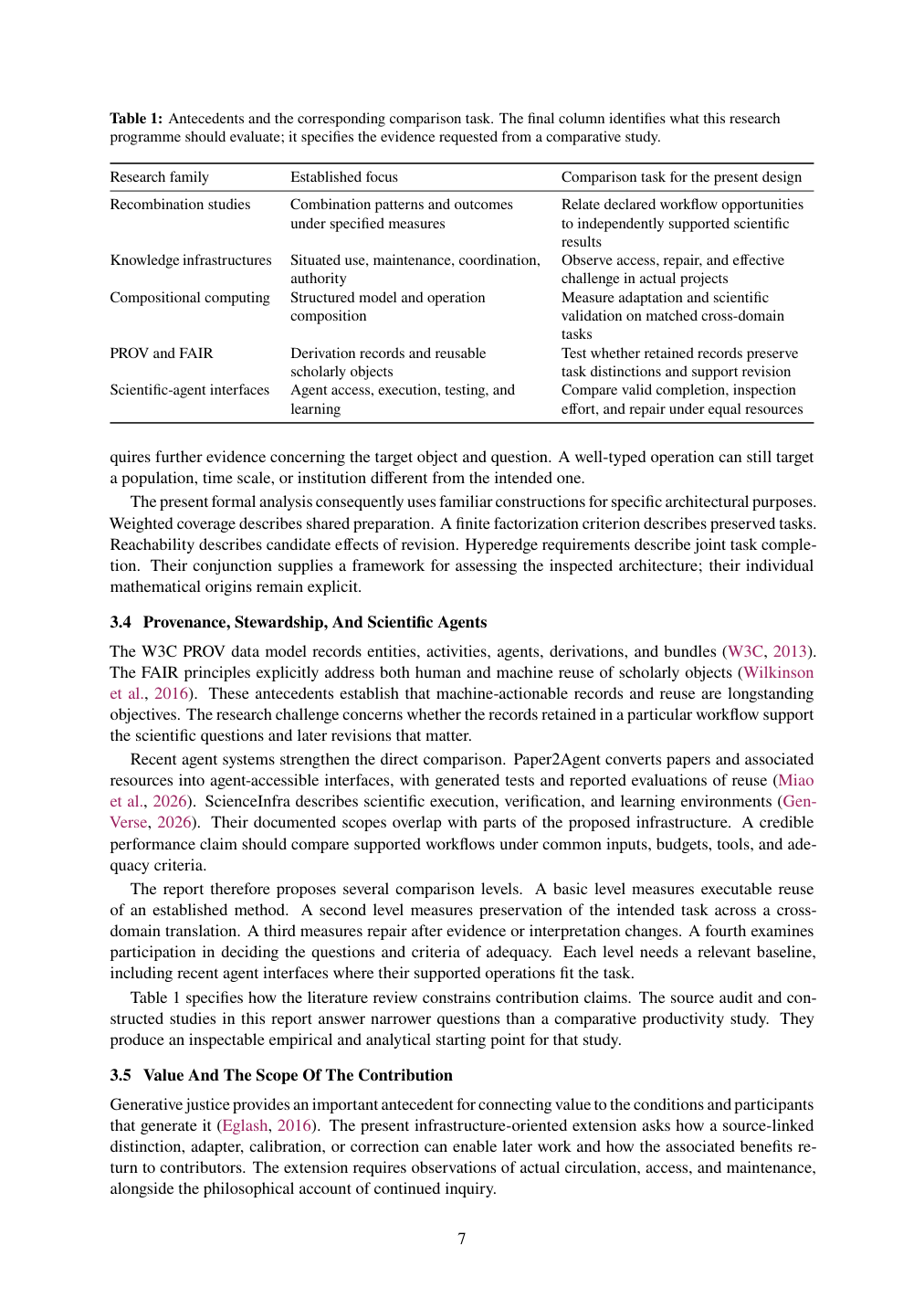
Table 1: Antecedents and the corresponding comparison task. The final column identifies what this research programme should evaluate; it specifies the evidence requested from a comparative study.
Relate declared workflow opportunities to independently supported scientific results
Observe access, repair, and effective challenge in actual projects
Measure adaptation and scientific validation on matched cross-domain tasks
Test whether retained records preserve task distinctions and support revision
Compare valid completion, inspection effort, and repair under equal resources
quires further evidence concerning the target object and question. A well-typed operation can still target a population, time scale, or institution different from the intended one.
The present formal analysis consequently uses familiar constructions for specific architectural purposes. Weighted coverage describes shared preparation. A finite factorization criterion describes preserved tasks.
Reachability describes candidate effects of revision. Hyperedge requirements describe joint task comple- tion. Their conjunction supplies a framework for assessing the inspected architecture; their individual
The W3C PROV data model records entities, activities, agents, derivations, and bundles (W3C, 2013). The FAIR principles explicitly address both human and machine reuse of scholarly objects (Wilkinson et al., 2016). These antecedents establish that machine-actionable records and reuse are longstanding objectives. The research challenge concerns whether the records retained in a particular workflow support
the scientific questions and later revisions that matter.
Recent agent systems strengthen the direct comparison. Paper2Agent converts papers and associated resources into agent-accessible interfaces, with generated tests and reported evaluations of reuse (Miao et al., 2026). ScienceInfra describes scientific execution, verification, and learning environments (Gen- Verse, 2026). Their documented scopes overlap with parts of the proposed infrastructure. A credible performance claim should compare supported workflows under common inputs, budgets, tools, and ade-
The report therefore proposes several comparison levels. A basic level measures executable reuse of an established method. A second level measures preservation of the intended task across a cross- domain translation. A third measures repair after evidence or interpretation changes. A fourth examines participation in deciding the questions and criteria of adequacy. Each level needs a relevant baseline, including recent agent interfaces where their supported operations fit the task.
Table 1 specifies how the literature review constrains contribution claims. The source audit and con- structed studies in this report answer narrower questions than a comparative productivity study. They produce an inspectable empirical and analytical starting point for that study.
Generative justice provides an important antecedent for connecting value to the conditions and participants that generate it (Eglash, 2016). The present infrastructure-oriented extension asks how a source-linked distinction, adapter, calibration, or correction can enable later work and how the associated benefits re- turn to contributors. The extension requires observations of actual circulation, access, and maintenance, alongside the philosophical account of continued inquiry.
Readable text
Shared foundations mathematics, computation, inference
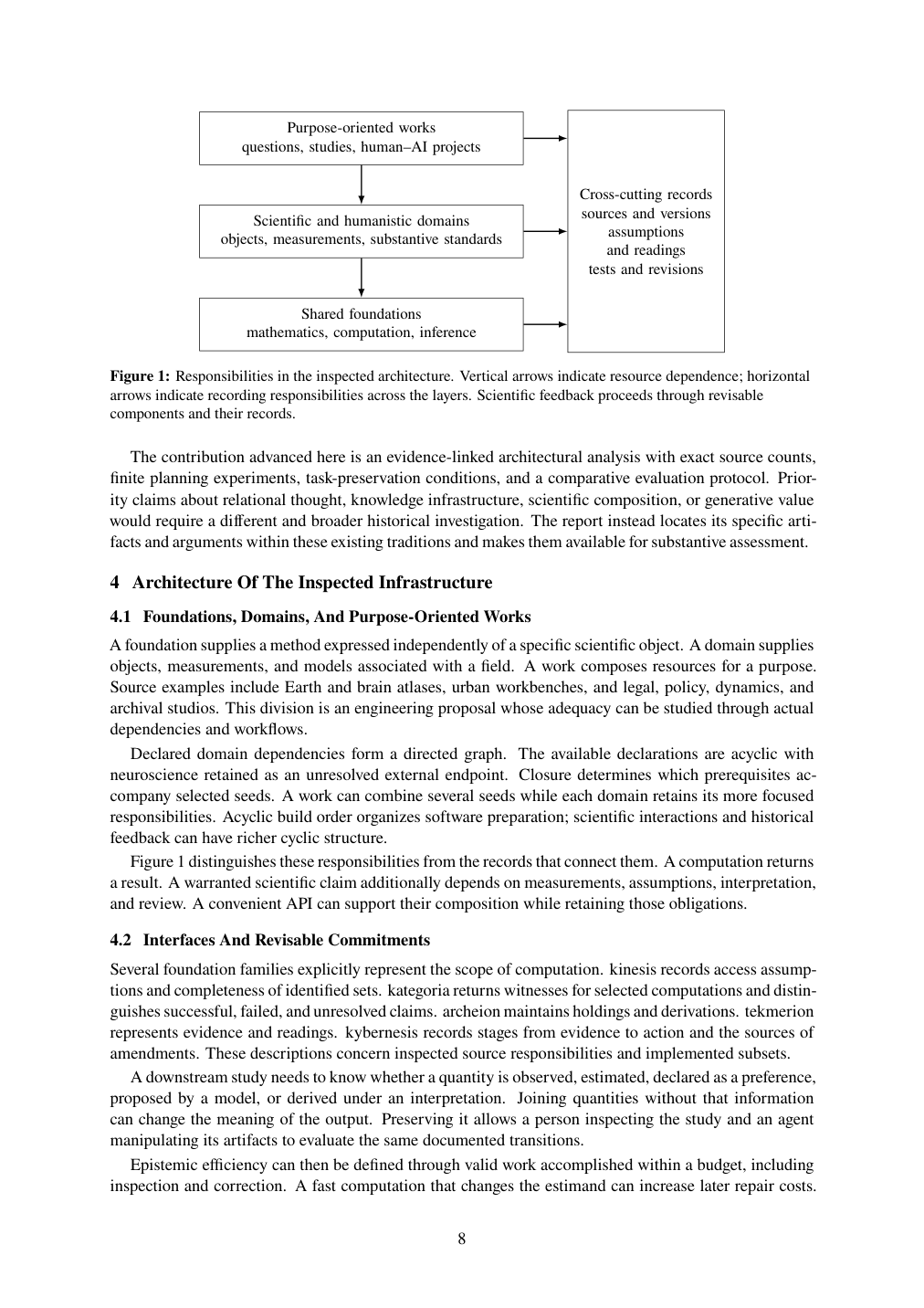
Figure 1: Responsibilities in the inspected architecture. Vertical arrows indicate resource dependence; horizontal arrows indicate recording responsibilities across the layers. Scientific feedback proceeds through revisable
The contribution advanced here is an evidence-linked architectural analysis with exact source counts, finite planning experiments, task-preservation conditions, and a comparative evaluation protocol. Prior- ity claims about relational thought, knowledge infrastructure, scientific composition, or generative value would require a different and broader historical investigation. The report instead locates its specific arti- facts and arguments within these existing traditions and makes them available for substantive assessment.
A foundation supplies a method expressed independently of a specific scientific object. A domain supplies objects, measurements, and models associated with a field. A work composes resources for a purpose. Source examples include Earth and brain atlases, urban workbenches, and legal, policy, dynamics, and archival studios. This division is an engineering proposal whose adequacy can be studied through actual
Declared domain dependencies form a directed graph. The available declarations are acyclic with neuroscience retained as an unresolved external endpoint. Closure determines which prerequisites ac- company selected seeds. A work can combine several seeds while each domain retains its more focused responsibilities. Acyclic build order organizes software preparation; scientific interactions and historical
Figure 1 distinguishes these responsibilities from the records that connect them. A computation returns a result. A warranted scientific claim additionally depends on measurements, assumptions, interpretation, and review. A convenient API can support their composition while retaining those obligations.
Several foundation families explicitly represent the scope of computation. kinesis records access assump- tions and completeness of identified sets. kategoria returns witnesses for selected computations and distin- guishes successful, failed, and unresolved claims. archeion maintains holdings and derivations. tekmerion represents evidence and readings. kybernesis records stages from evidence to action and the sources of amendments. These descriptions concern inspected source responsibilities and implemented subsets.
A downstream study needs to know whether a quantity is observed, estimated, declared as a preference, proposed by a model, or derived under an interpretation. Joining quantities without that information can change the meaning of the output. Preserving it allows a person inspecting the study and an agent manipulating its artifacts to evaluate the same documented transitions.
Epistemic efficiency can then be defined through valid work accomplished within a budget, including inspection and correction. A fast computation that changes the estimand can increase later repair costs.
Readable text
An explicit refusal can save effort by locating the missing prerequisite. Both the benefit and the burden of such interfaces should be measured in comparative studies.
The contract design in this section specifies the information required to examine a cross-disciplinary con- nection. Its purpose is to turn the architectural distinction between an available operation and a warranted inquiry into reviewable records. The design supports incremental implementation. The source audit estab- lishes relevant components, and Section 18 executes a narrow reference adapter. Broader application-level
contracts require their own integration and evaluation.
A resource record needs an identifier, version, provenance, declared input and output types, scientific interpretation, operational access conditions, and evidence of its tested behavior. These fields perform different functions. A type can reject adding a distance to a population count. A version identifies the implementation that produced an output. An interpretation states whether a population figure concerns residents, visitors, workers, or another counted group. A source record permits examination of how that figure was obtained. Keeping these functions explicit makes a technically valid join available for substan-
A task record supplies a question, target object or estimand, population and temporal scope, admissible interpretations, requested output, and an acceptance procedure. For example, a travel-time task might ask whether a subgroup reaches a specified service within thirty minutes under an explicitly selected transport mode. The service definition and subgroup membership enter the target. The routing implementation enters computation. A reliability requirement enters acceptance. A result can therefore be traced to the
An operation can return a value together with assumptions and obligations. A model fit may require an observation mechanism; a category-theoretic computation may return a finite witness; an archival in- terpretation may retain several plausible readings. Representing each output through the same numerical confidence field would obscure their different evidential roles. The proposed interface uses status-specific records whose contents can be inspected directly. Common transport of these records supports coordina- tion, while local disciplines retain their requirements for adequacy.
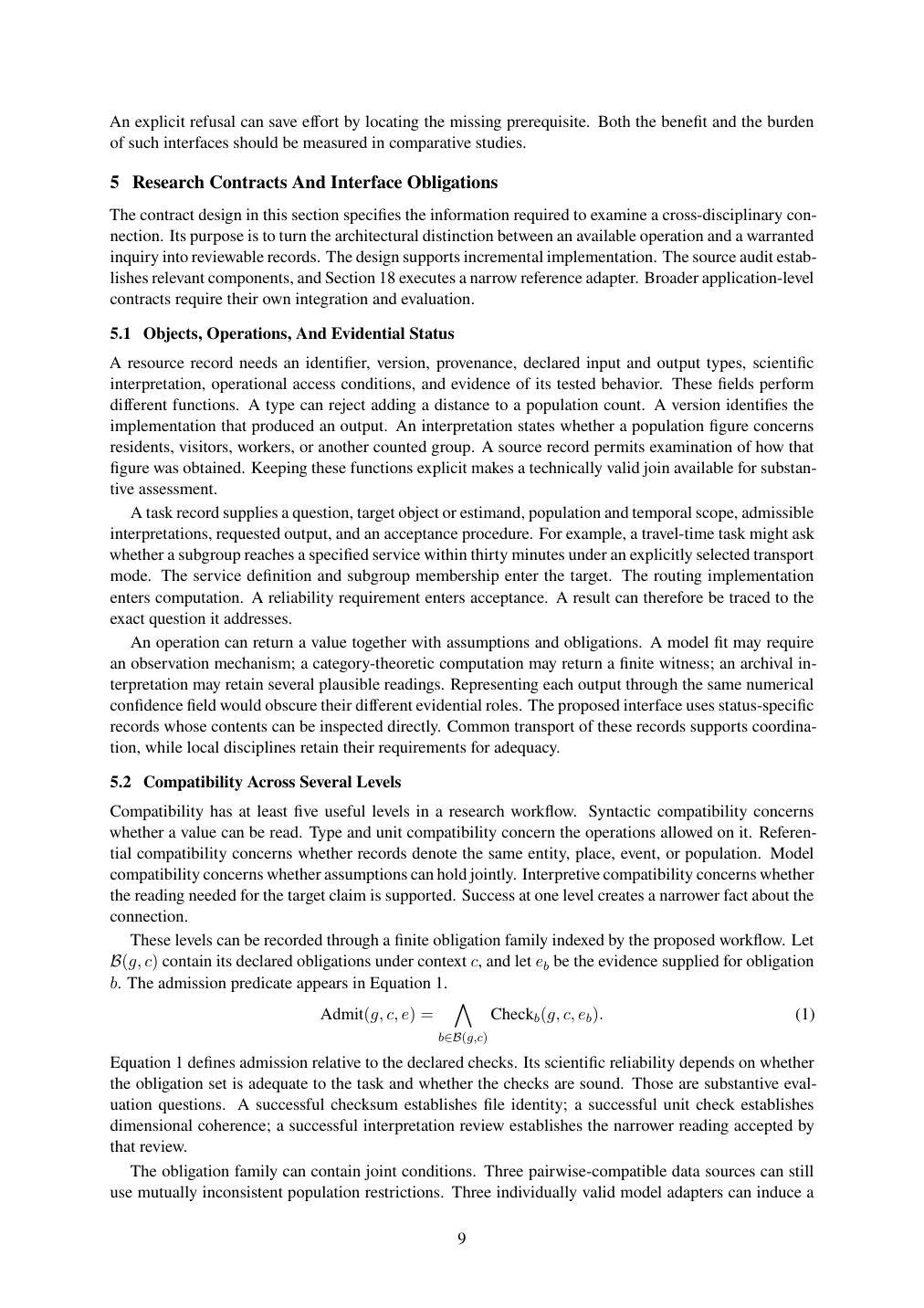
Compatibility has at least five useful levels in a research workflow. Syntactic compatibility concerns whether a value can be read. Type and unit compatibility concern the operations allowed on it. Referen- tial compatibility concerns whether records denote the same entity, place, event, or population. Model compatibility concerns whether assumptions can hold jointly. Interpretive compatibility concerns whether the reading needed for the target claim is supported. Success at one level creates a narrower fact about the
These levels can be recorded through a finite obligation family indexed by the proposed workflow. Let
Equation 1 defines admission relative to the declared checks. Its scientific reliability depends on whether the obligation set is adequate to the task and whether the checks are sound. Those are substantive eval- uation questions. A successful checksum establishes file identity; a successful unit check establishes dimensional coherence; a successful interpretation review establishes the narrower reading accepted by
The obligation family can contain joint conditions. Three pairwise-compatible data sources can still use mutually inconsistent population restrictions. Three individually valid model adapters can induce a
cycle of conversions whose composition changes the target. Such cases justify retaining obligations over several resources when the scientific task requires them. Higher-order network descriptions already have a substantial literature (Battiston et al., 2020). Here the higher-order object is a declared compatibility or evidential requirement in a workflow, with its scientific meaning stated locally.
5.3 Translations And Retained Remainders
A translation record should state its domain of application and the distinctions it preserves. A geographic aggregation can preserve totals while losing within-area heterogeneity. A legal classification can preserve one forum’s rule-relevant distinctions while leaving historical interpretation open. A language-model summary can preserve selected assertions while omitting the sequence of sources and qualifications that supported them. These translations can each be useful for a particular task.
The retained remainder is the part of the source record needed to examine a later question that the working translation leaves unresolved. In a practical implementation, the remainder can be an original holding, a link to an immutable dataset, a coding decision, or an unresolved interpretation. Its retention is a design choice with cost, privacy, and rights implications. A task-preservation test can expose whether a planned compression loses a distinction required by a specified future task. The broader philosophical adequacy of the classification remains available for criticism.
A useful interface therefore combines a compact working representation with recoverable contextual records. This combination allows present execution and later reinterpretation to coexist. The corresponding empirical question concerns whether the extra records reduce repair and explanation cost sufficiently to justify their maintenance. The answer can vary by task, source stability, and the frequency of reuse.
5.4 Implemented Components And Integration Work
The inspected foundations provide several parts of this design. kinesis represents aspects of computational access and candidate-set completeness. kategoria supplies evidence for selected finite structural computations. archeion provides archival organization. The domain and work layers demonstrate places where these responsibilities meet. A full research contract requires a stable mapping between those implementation-specific records, a declared lifecycle, and consumer behavior when an obligation changes.
An application-level integration can choose one narrowly specified task and implement its whole evidential route. A needs analysis could record an input table, an indicator definition, several readings of a threshold, an adaptive exploration history, and an independent confirmation result. The contract would state which readings support the final conclusion and which changes would require recomputation. This end-to-end exercise supplies a stronger test of the architecture than an inventory of available method names.
Integration effort should be measured directly. Developers can record adapter code, schema changes, additional evidence fields, and the time required for a second team to reproduce a claim. These measurements reveal whether a proposed common interface moves work into an opaque adapter or makes the work easier to inspect. The design contribution concerns the organization of those obligations; demonstrated efficiency awaits the comparative study.
6 Research Objects And Executable Interoperability
The interoperability analysis places the proposed research contracts within established systems for packaging, executing, and inspecting scientific work. Its objective is to identify a concrete extension that can be evaluated without claiming priority for research objects, workflow provenance, or agent-accessible tools. The comparison uses the inspected source architecture and the supported scope of primary publications.
6.1 Packaging, Execution, And Task Adequacy
Research Objects already bring data, methods, provenance, and contextual information together for sharing and reuse (Bechhofer et al., 2013). Workflow Run RO-Crate develops interoperable execution records at process, workflow, and internal-step granularities (Leo et al., 2024). Their antecedent matters directly:
Readable text
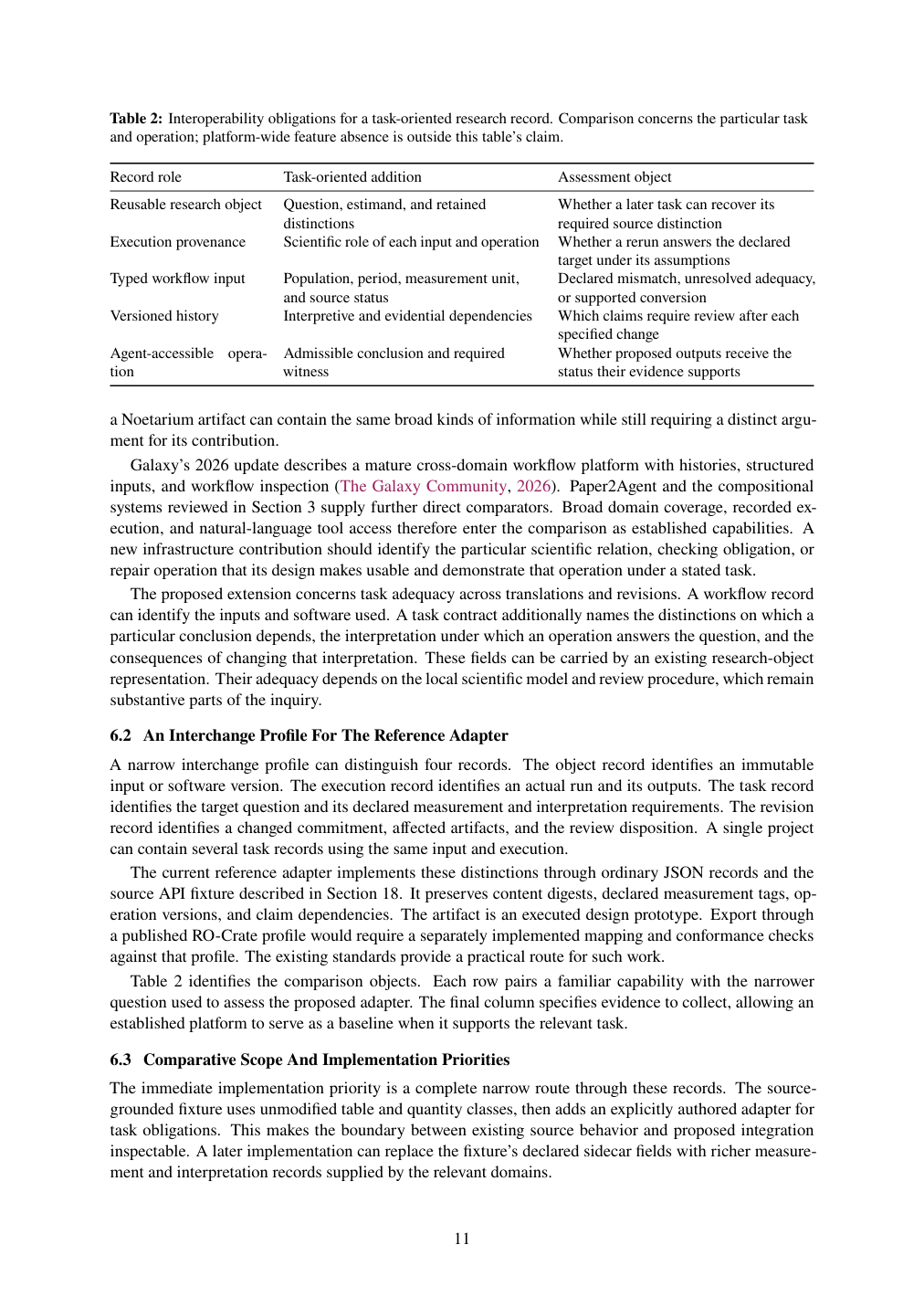
Table 2: Interoperability obligations for a task-oriented research record. Comparison concerns the particular task and operation; platform-wide feature absence is outside this table’s claim.
Whether a later task can recover its required source distinction Whether a rerun answers the declared target under its assumptions
Scientific role of each input and operation Population, period, measurement unit,
Execution provenance Typed workflow input and source status
Declared mismatch, unresolved adequacy, or supported conversion Which claims require review after each specified change
Whether proposed outputs receive the status their evidence supports
a Noetarium artifact can contain the same broad kinds of information while still requiring a distinct argu-
Galaxy’s 2026 update describes a mature cross-domain workflow platform with histories, structured inputs, and workflow inspection (The Galaxy Community, 2026). Paper2Agent and the compositional systems reviewed in Section 3 supply further direct comparators. Broad domain coverage, recorded ex- ecution, and natural-language tool access therefore enter the comparison as established capabilities. A new infrastructure contribution should identify the particular scientific relation, checking obligation, or repair operation that its design makes usable and demonstrate that operation under a stated task.
The proposed extension concerns task adequacy across translations and revisions. A workflow record can identify the inputs and software used. A task contract additionally names the distinctions on which a particular conclusion depends, the interpretation under which an operation answers the question, and the consequences of changing that interpretation. These fields can be carried by an existing research-object representation. Their adequacy depends on the local scientific model and review procedure, which remain
A narrow interchange profile can distinguish four records. The object record identifies an immutable input or software version. The execution record identifies an actual run and its outputs. The task record identifies the target question and its declared measurement and interpretation requirements. The revision record identifies a changed commitment, affected artifacts, and the review disposition. A single project can contain several task records using the same input and execution.
The current reference adapter implements these distinctions through ordinary JSON records and the source API fixture described in Section 18. It preserves content digests, declared measurement tags, op- eration versions, and claim dependencies. The artifact is an executed design prototype. Export through a published RO-Crate profile would require a separately implemented mapping and conformance checks against that profile. The existing standards provide a practical route for such work.
Table 2 identifies the comparison objects. Each row pairs a familiar capability with the narrower question used to assess the proposed adapter. The final column specifies evidence to collect, allowing an established platform to serve as a baseline when it supports the relevant task.
The immediate implementation priority is a complete narrow route through these records. The source- grounded fixture uses unmodified table and quantity classes, then adds an explicitly authored adapter for task obligations. This makes the boundary between existing source behavior and proposed integration inspectable. A later implementation can replace the fixture’s declared sidecar fields with richer measure- ment and interpretation records supplied by the relevant domains.
Readable text
All non-singleton subsets Pairs Up to triples Up to four-way subsets
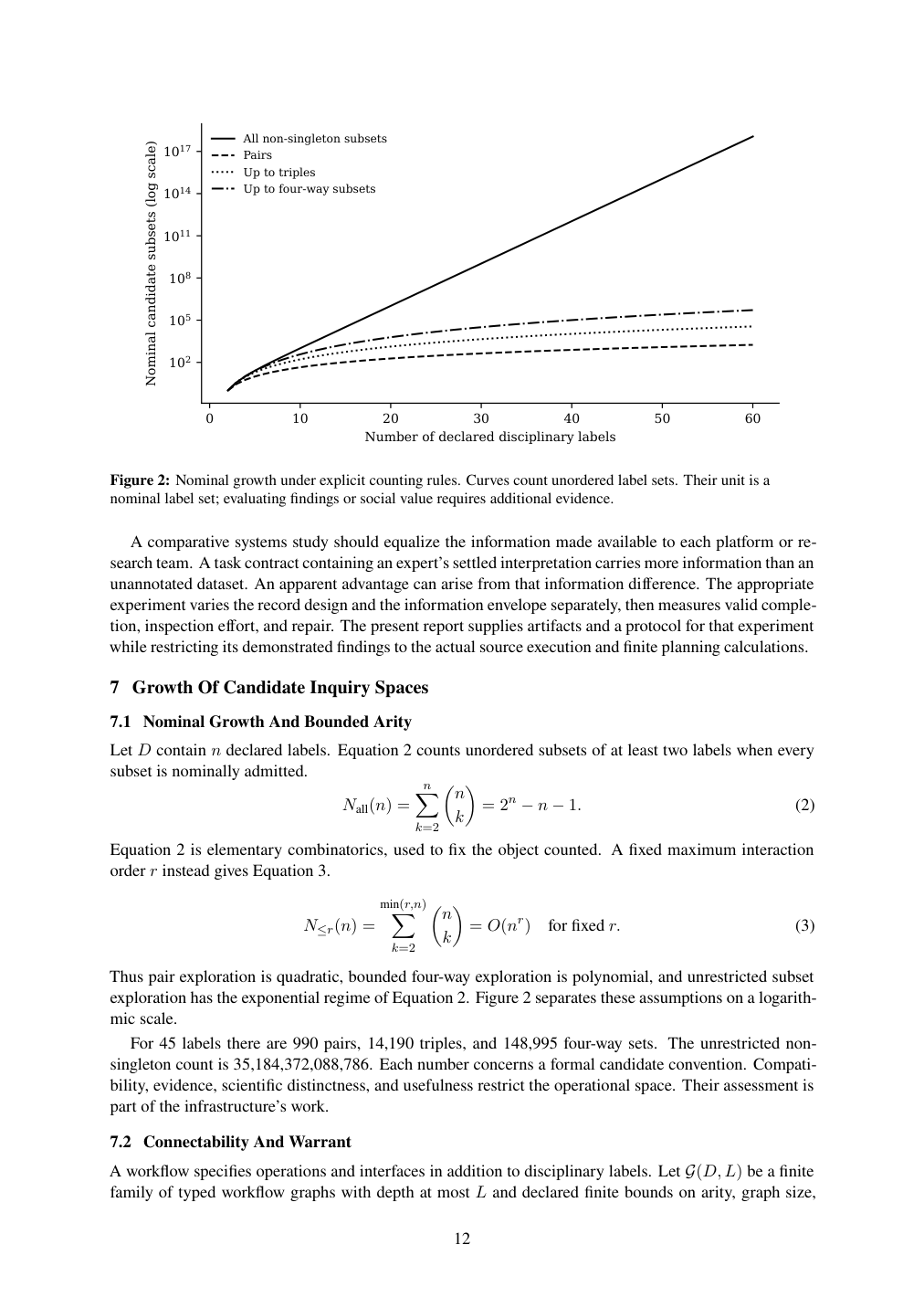
Figure 2: Nominal growth under explicit counting rules. Curves count unordered label sets. Their unit is a nominal label set; evaluating findings or social value requires additional evidence.
A comparative systems study should equalize the information made available to each platform or re- search team. A task contract containing an expert’s settled interpretation carries more information than an unannotated dataset. An apparent advantage can arise from that information difference. The appropriate experiment varies the record design and the information envelope separately, then measures valid comple- tion, inspection effort, and repair. The present report supplies artifacts and a protocol for that experiment while restricting its demonstrated findings to the actual source execution and finite planning calculations.
Equation 2 is elementary combinatorics, used to fix the object counted. A fixed maximum interaction
Thus pair exploration is quadratic, bounded four-way exploration is polynomial, and unrestricted subset exploration has the exponential regime of Equation 2. Figure 2 separates these assumptions on a logarith-
For 45 labels there are 990 pairs, 14,190 triples, and 148,995 four-way sets. The unrestricted non- singleton count is 35,184,372,088,786. Each number concerns a formal candidate convention. Compati- bility, evidence, scientific distinctness, and usefulness restrict the operational space. Their assessment is
Readable text
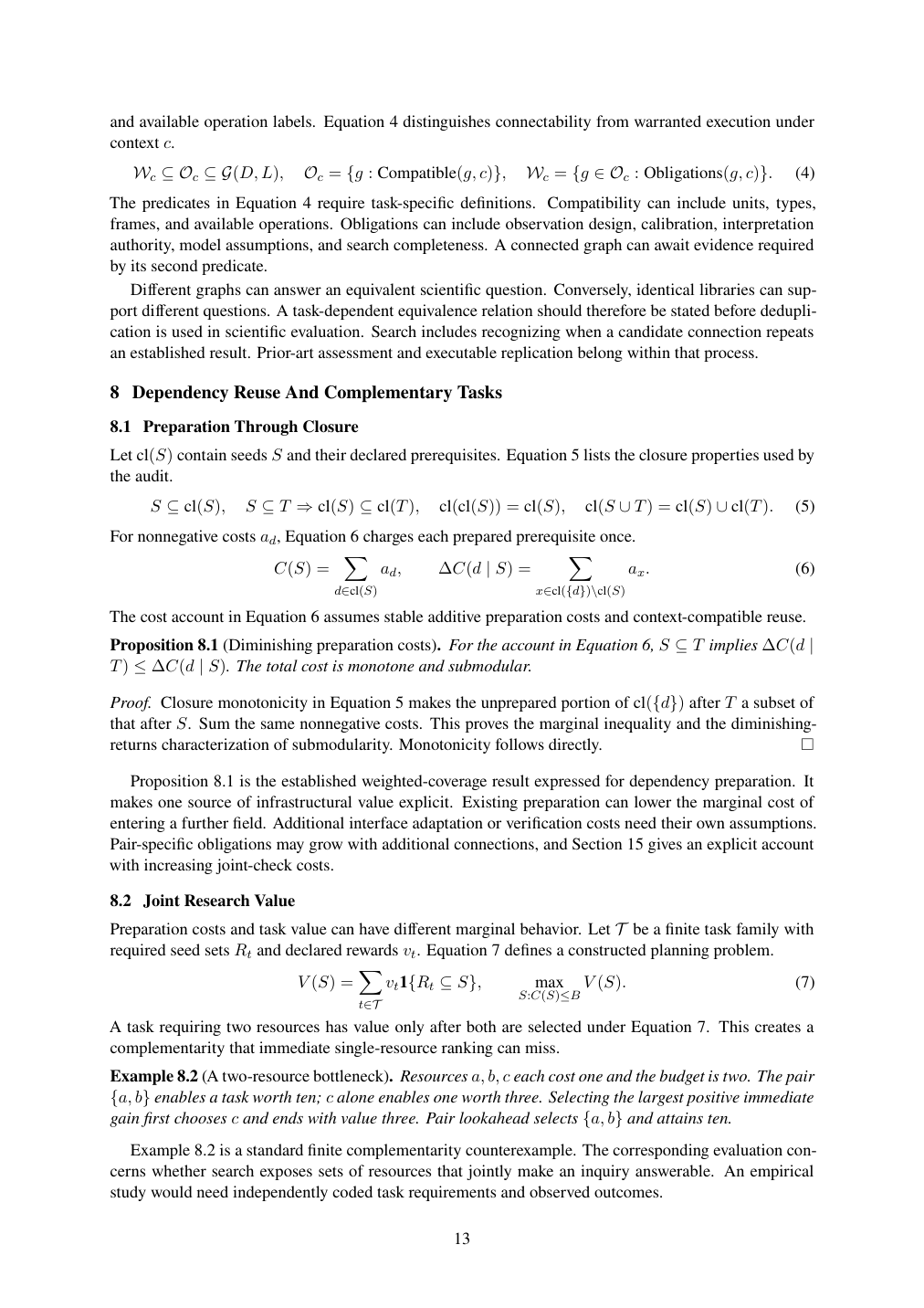
and available operation labels. Equation 4 distinguishes connectability from warranted execution under
The predicates in Equation 4 require task-specific definitions. Compatibility can include units, types, frames, and available operations. Obligations can include observation design, calibration, interpretation authority, model assumptions, and search completeness. A connected graph can await evidence required
Different graphs can answer an equivalent scientific question. Conversely, identical libraries can sup- port different questions. A task-dependent equivalence relation should therefore be stated before dedupli- cation is used in scientific evaluation. Search includes recognizing when a candidate connection repeats an established result. Prior-art assessment and executable replication belong within that process.
The cost account in Equation 6 assumes stable additive preparation costs and context-compatible reuse.
returns characterization of submodularity. Monotonicity follows directly.
Proposition 8.1 is the established weighted-coverage result expressed for dependency preparation. It makes one source of infrastructural value explicit. Existing preparation can lower the marginal cost of entering a further field. Additional interface adaptation or verification costs need their own assumptions. Pair-specific obligations may grow with additional connections, and Section 15 gives an explicit account
A task requiring two resources has value only after both are selected under Equation 7. This creates a complementarity that immediate single-resource ranking can miss.
Example 8.2 is a standard finite complementarity counterexample. The corresponding evaluation con- cerns whether search exposes sets of resources that jointly make an inquiry answerable. An empirical study would need independently coded task requirements and observed outcomes.
Readable text
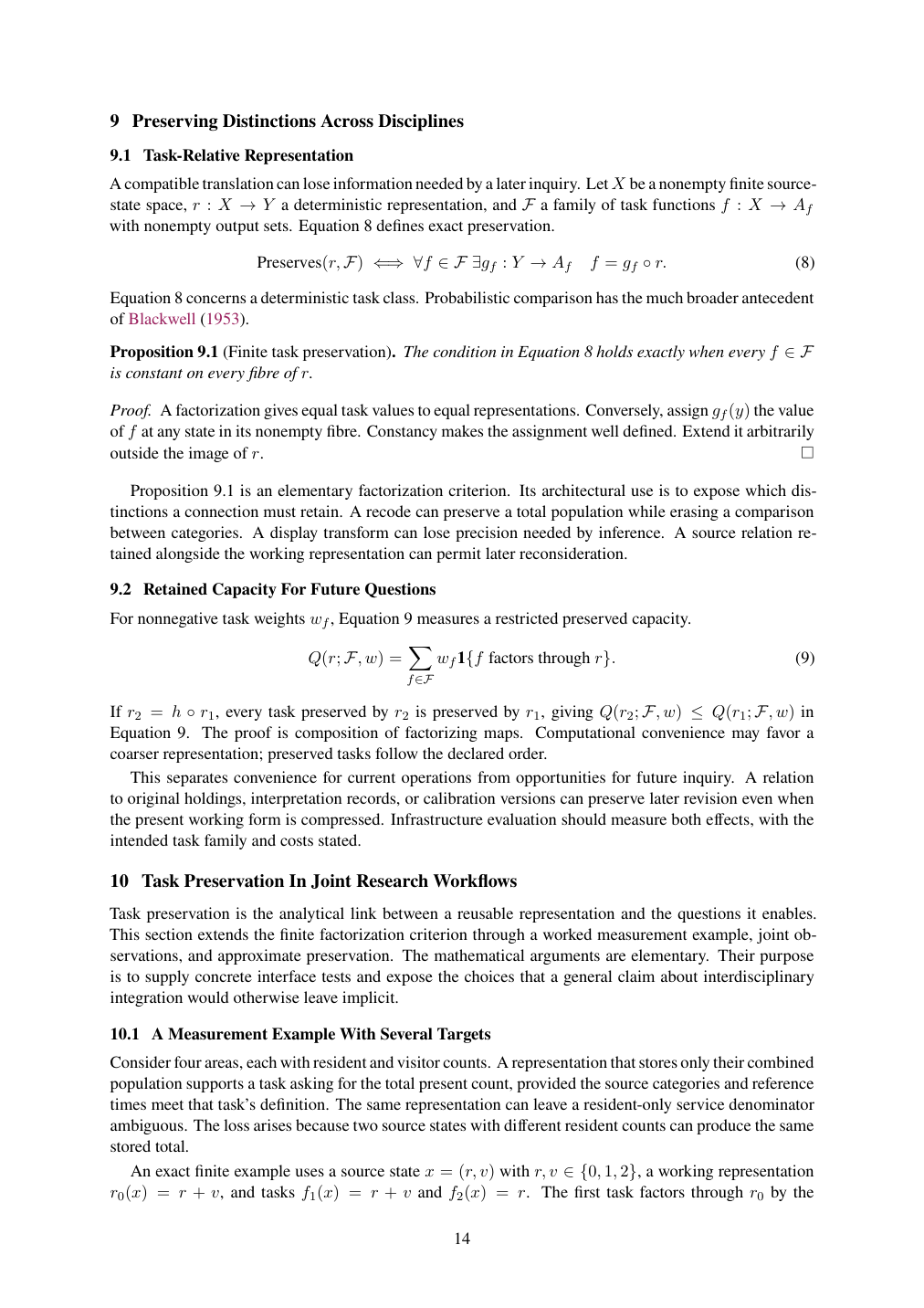
with nonempty output sets. Equation 8 defines exact preservation.
Equation 8 concerns a deterministic task class. Probabilistic comparison has the much broader antecedent
Proposition 9.1 is an elementary factorization criterion. Its architectural use is to expose which dis- tinctions a connection must retain. A recode can preserve a total population while erasing a comparison between categories. A display transform can lose precision needed by inference. A source relation re- tained alongside the working representation can permit later reconsideration.
Equation 9. The proof is composition of factorizing maps. Computational convenience may favor a coarser representation; preserved tasks follow the declared order.
This separates convenience for current operations from opportunities for future inquiry. A relation to original holdings, interpretation records, or calibration versions can preserve later revision even when the present working form is compressed. Infrastructure evaluation should measure both effects, with the
Task preservation is the analytical link between a reusable representation and the questions it enables. This section extends the finite factorization criterion through a worked measurement example, joint ob- servations, and approximate preservation. The mathematical arguments are elementary. Their purpose is to supply concrete interface tests and expose the choices that a general claim about interdisciplinary
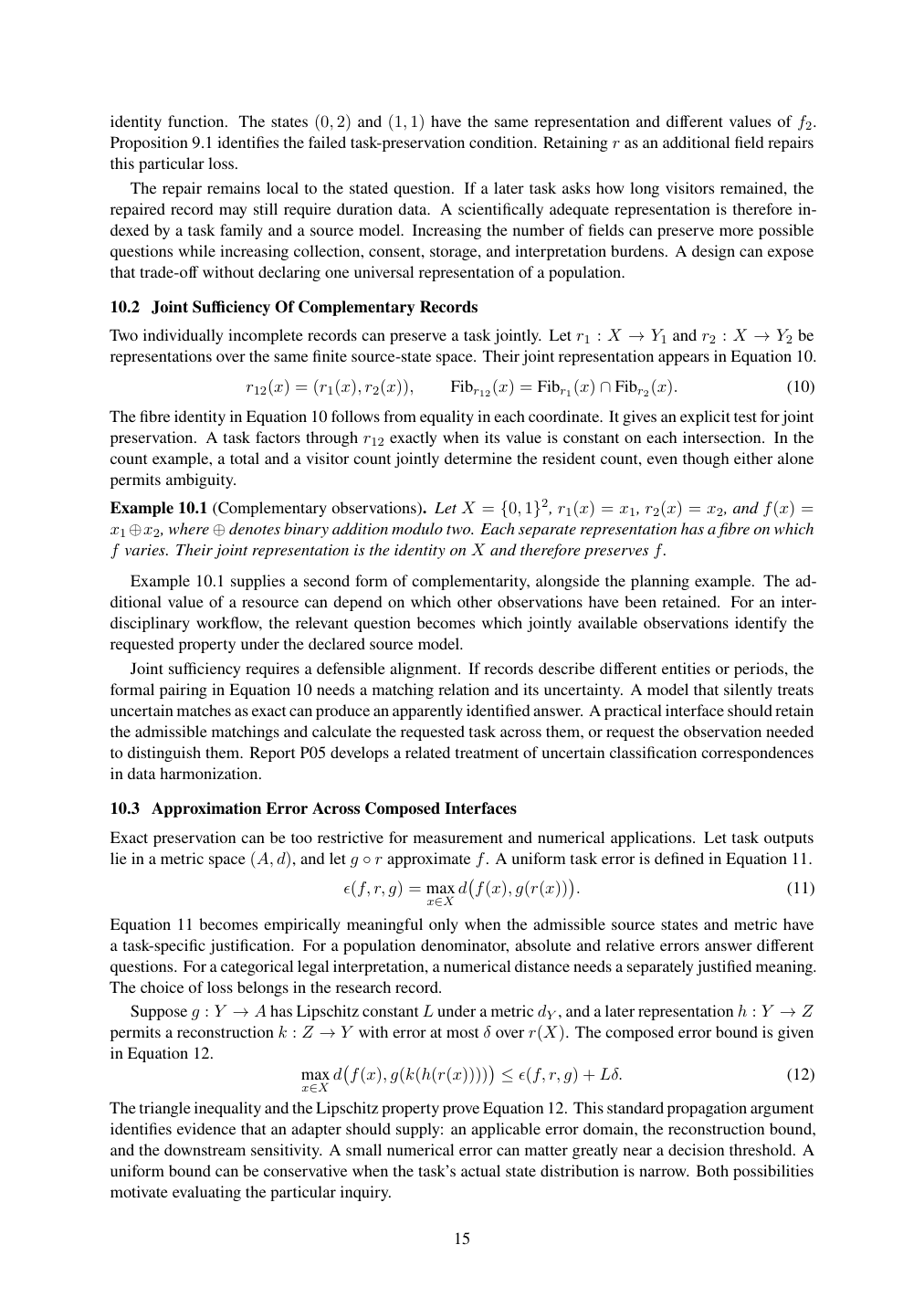
Consider four areas, each with resident and visitor counts. A representation that stores only their combined population supports a task asking for the total present count, provided the source categories and reference times meet that task’s definition. The same representation can leave a resident-only service denominator ambiguous. The loss arises because two source states with different resident counts can produce the same
Readable text
The repair remains local to the stated question. If a later task asks how long visitors remained, the repaired record may still require duration data. A scientifically adequate representation is therefore in- dexed by a task family and a source model. Increasing the number of fields can preserve more possible questions while increasing collection, consent, storage, and interpretation burdens. A design can expose that trade-off without declaring one universal representation of a population.
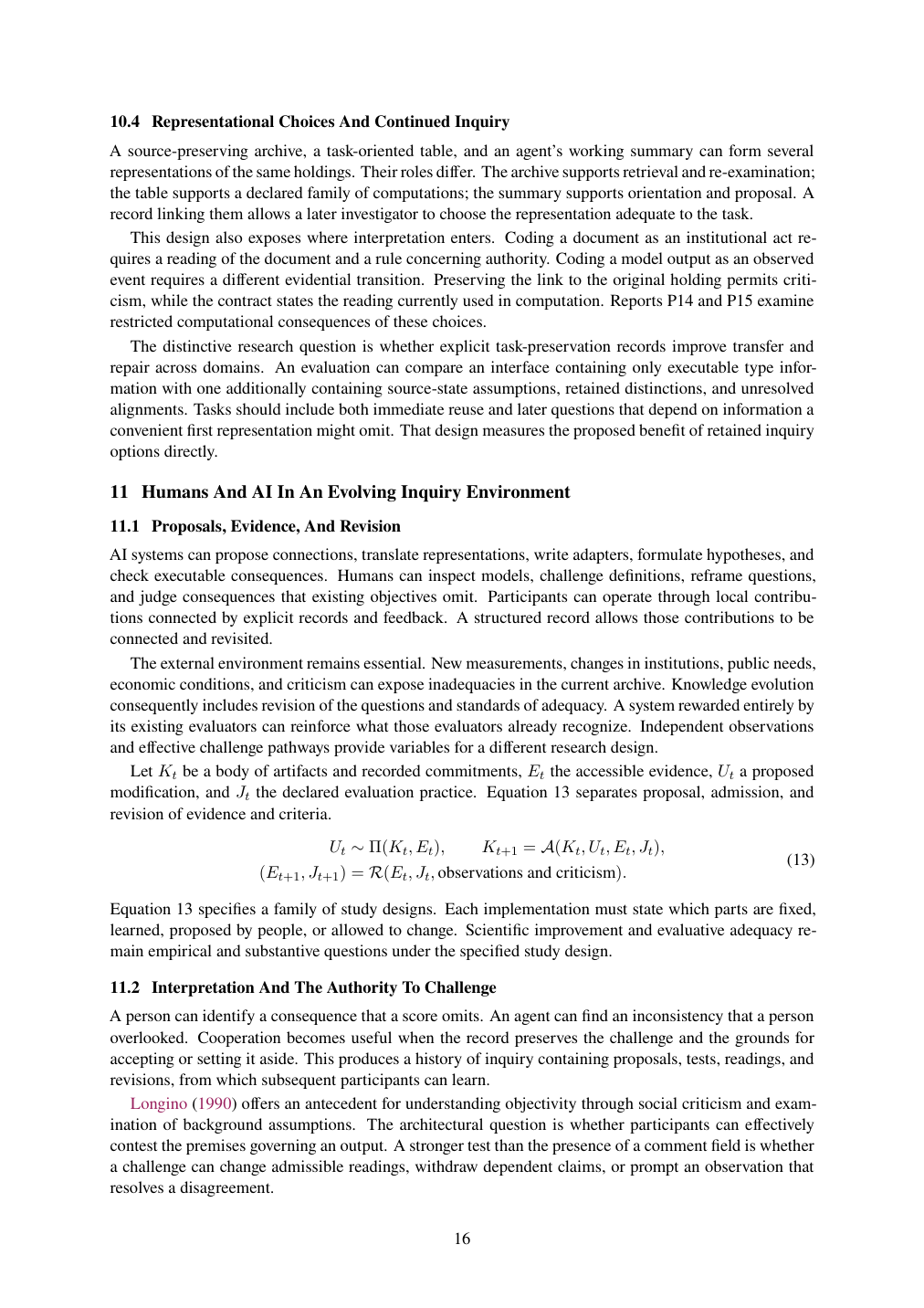
representations over the same finite source-state space. Their joint representation appears in Equation 10.
The fibre identity in Equation 10 follows from equality in each coordinate. It gives an explicit test for joint count example, a total and a visitor count jointly determine the resident count, even though either alone
Example 10.1 supplies a second form of complementarity, alongside the planning example. The ad- ditional value of a resource can depend on which other observations have been retained. For an inter- disciplinary workflow, the relevant question becomes which jointly available observations identify the
Joint sufficiency requires a defensible alignment. If records describe different entities or periods, the formal pairing in Equation 10 needs a matching relation and its uncertainty. A model that silently treats uncertain matches as exact can produce an apparently identified answer. A practical interface should retain the admissible matchings and calculate the requested task across them, or request the observation needed to distinguish them. Report P05 develops a related treatment of uncertain classification correspondences
Exact preservation can be too restrictive for measurement and numerical applications. Let task outputs
Equation 11 becomes empirically meaningful only when the admissible source states and metric have a task-specific justification. For a population denominator, absolute and relative errors answer different questions. For a categorical legal interpretation, a numerical distance needs a separately justified meaning.
The triangle inequality and the Lipschitz property prove Equation 12. This standard propagation argument identifies evidence that an adapter should supply: an applicable error domain, the reconstruction bound, and the downstream sensitivity. A small numerical error can matter greatly near a decision threshold. A uniform bound can be conservative when the task’s actual state distribution is narrow. Both possibilities
Readable text
A source-preserving archive, a task-oriented table, and an agent’s working summary can form several representations of the same holdings. Their roles differ. The archive supports retrieval and re-examination; the table supports a declared family of computations; the summary supports orientation and proposal. A record linking them allows a later investigator to choose the representation adequate to the task.
This design also exposes where interpretation enters. Coding a document as an institutional act re- quires a reading of the document and a rule concerning authority. Coding a model output as an observed event requires a different evidential transition. Preserving the link to the original holding permits criti- cism, while the contract states the reading currently used in computation. Reports P14 and P15 examine restricted computational consequences of these choices.
The distinctive research question is whether explicit task-preservation records improve transfer and repair across domains. An evaluation can compare an interface containing only executable type infor- mation with one additionally containing source-state assumptions, retained distinctions, and unresolved alignments. Tasks should include both immediate reuse and later questions that depend on information a convenient first representation might omit. That design measures the proposed benefit of retained inquiry
AI systems can propose connections, translate representations, write adapters, formulate hypotheses, and check executable consequences. Humans can inspect models, challenge definitions, reframe questions, and judge consequences that existing objectives omit. Participants can operate through local contribu- tions connected by explicit records and feedback. A structured record allows those contributions to be
The external environment remains essential. New measurements, changes in institutions, public needs, economic conditions, and criticism can expose inadequacies in the current archive. Knowledge evolution consequently includes revision of the questions and standards of adequacy. A system rewarded entirely by its existing evaluators can reinforce what those evaluators already recognize. Independent observations and effective challenge pathways provide variables for a different research design.
Equation 13 specifies a family of study designs. Each implementation must state which parts are fixed, learned, proposed by people, or allowed to change. Scientific improvement and evaluative adequacy re- main empirical and substantive questions under the specified study design.
A person can identify a consequence that a score omits. An agent can find an inconsistency that a person overlooked. Cooperation becomes useful when the record preserves the challenge and the grounds for accepting or setting it aside. This produces a history of inquiry containing proposals, tests, readings, and revisions, from which subsequent participants can learn.
Longino (1990) offers an antecedent for understanding objectivity through social criticism and exam- ination of background assumptions. The architectural question is whether participants can effectively contest the premises governing an output. A stronger test than the presence of a comment field is whether a challenge can change admissible readings, withdraw dependent claims, or prompt an observation that
Practical authority affects which challenges enter. Compute, source access, expertise, reputation, and institutional position can concentrate influence. Companion reports distinguish evaluative power from formation of evaluative norms. This distinction follows naturally from the relational account: who participates in judgment and which standards acquire force jointly shape the explored space, while remaining different research questions.
12 Revision Dependencies And External Feedback
A continuing research infrastructure needs a method for locating the consequences of changed evidence, assumptions, and interpretations. This section gives a restricted dependency model for that purpose, distinguishes recomputation from renewed warrant, and specifies a proposed revision protocol. The analysis concerns recorded research artifacts. Its application depends on the completeness and meaning of the dependency records.
12.1 Versioned Artifacts And Context
A research artifact can be a dataset, code version, transformation, model, interpretation, checker result, or scientific claim. A dependency edge records that the status or content of one artifact relies on another. An input file and an interpretation are different dependencies, even when both are required to reproduce a conclusion. Recording both makes it possible to identify the kind of repair a later change requires.
A practical record can distinguish computational use, interpretive use, evidential support, and institutional authority. Re-running code responds to one class of change. Reassessing whether an administrative document constitutes an authoritative act responds to another. A changed target population can require redesigning a study even when its numerical pipeline still runs. Explicit edge types help route a change to the appropriate form of assessment.
Immutable artifact versions support reproducibility, while active status records support revision. An old version can remain available for examination after its scientific use has been superseded. The archive should preserve the grounds for the change, the affected claims, and the disposition of each claim. Those records create an opportunity to study whether later investigators can understand and repair the earlier inquiry.
12.2 A Restricted Change-Impact Result


Equation 14 is standard graph reachability. Its usefulness depends on the recorded graph containing the relevant context, including model assumptions and interpretation versions where they affect the derived artifact.


Proposition 12.1 gives a conditional containment result. Affected artifacts can remain numerically equal after recomputation. A missing dependency can place an actually affected claim outside the com-
Readable text
puted set. The research question is therefore how accurately real records support the complete-dependency assumption, and what form of review is triggered when that assumption is uncertain.
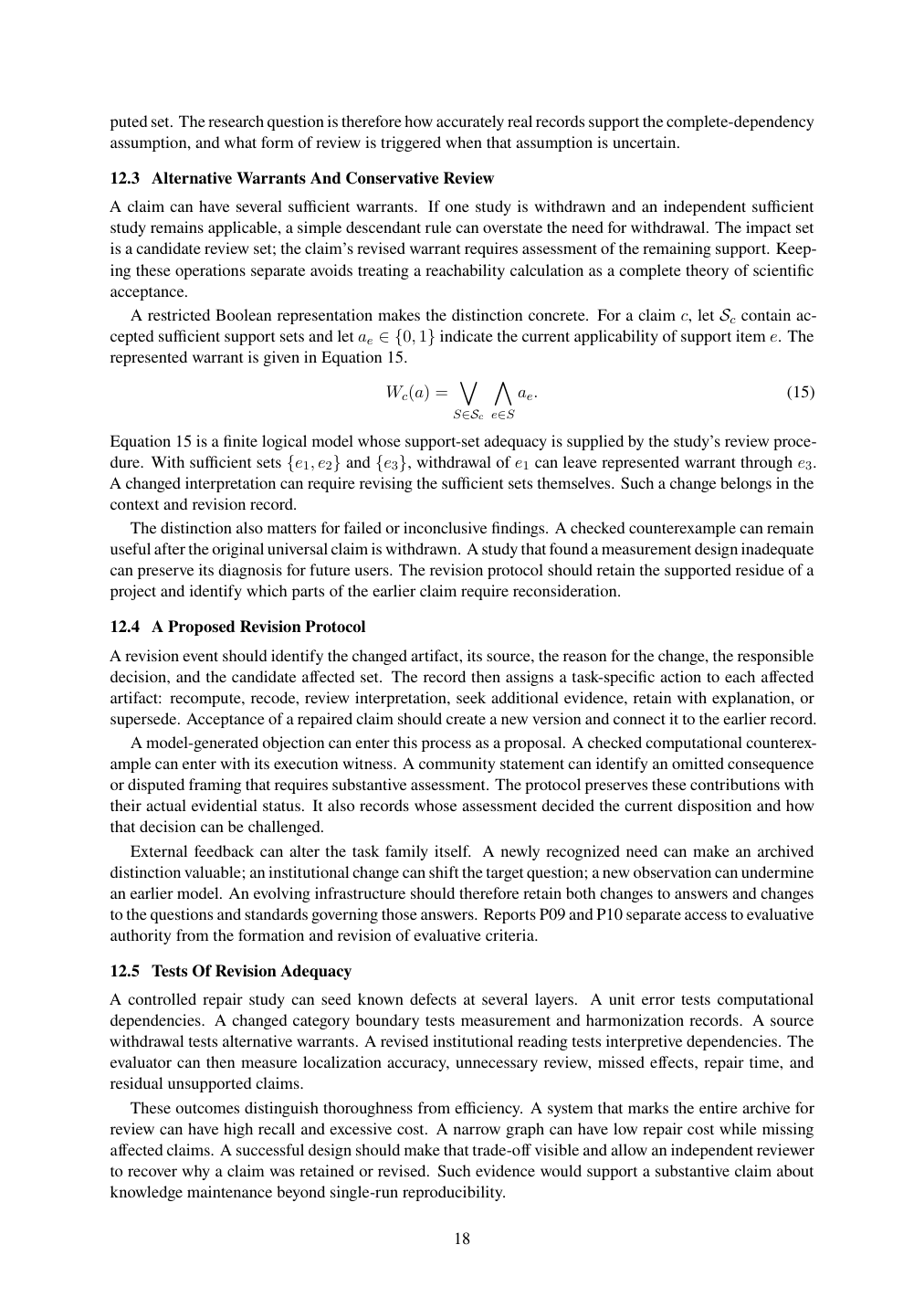
A claim can have several sufficient warrants. If one study is withdrawn and an independent sufficient study remains applicable, a simple descendant rule can overstate the need for withdrawal. The impact set is a candidate review set; the claim’s revised warrant requires assessment of the remaining support. Keep- ing these operations separate avoids treating a reachability calculation as a complete theory of scientific
Equation 15 is a finite logical model whose support-set adequacy is supplied by the study’s review proce- A changed interpretation can require revising the sufficient sets themselves. Such a change belongs in the
The distinction also matters for failed or inconclusive findings. A checked counterexample can remain useful after the original universal claim is withdrawn. A study that found a measurement design inadequate can preserve its diagnosis for future users. The revision protocol should retain the supported residue of a project and identify which parts of the earlier claim require reconsideration.
A revision event should identify the changed artifact, its source, the reason for the change, the responsible decision, and the candidate affected set. The record then assigns a task-specific action to each affected artifact: recompute, recode, review interpretation, seek additional evidence, retain with explanation, or supersede. Acceptance of a repaired claim should create a new version and connect it to the earlier record.
A model-generated objection can enter this process as a proposal. A checked computational counterex- ample can enter with its execution witness. A community statement can identify an omitted consequence or disputed framing that requires substantive assessment. The protocol preserves these contributions with their actual evidential status. It also records whose assessment decided the current disposition and how
External feedback can alter the task family itself. A newly recognized need can make an archived distinction valuable; an institutional change can shift the target question; a new observation can undermine an earlier model. An evolving infrastructure should therefore retain both changes to answers and changes to the questions and standards governing those answers. Reports P09 and P10 separate access to evaluative authority from the formation and revision of evaluative criteria.
A controlled repair study can seed known defects at several layers. A unit error tests computational dependencies. A changed category boundary tests measurement and harmonization records. A source withdrawal tests alternative warrants. A revised institutional reading tests interpretive dependencies. The evaluator can then measure localization accuracy, unnecessary review, missed effects, repair time, and
These outcomes distinguish thoroughness from efficiency. A system that marks the entire archive for review can have high recall and excessive cost. A narrow graph can have low repair cost while missing affected claims. A successful design should make that trade-off visible and allow an independent reviewer to recover why a claim was retained or revised. Such evidence would support a substantive claim about knowledge maintenance beyond single-run reproducibility.
Readable text
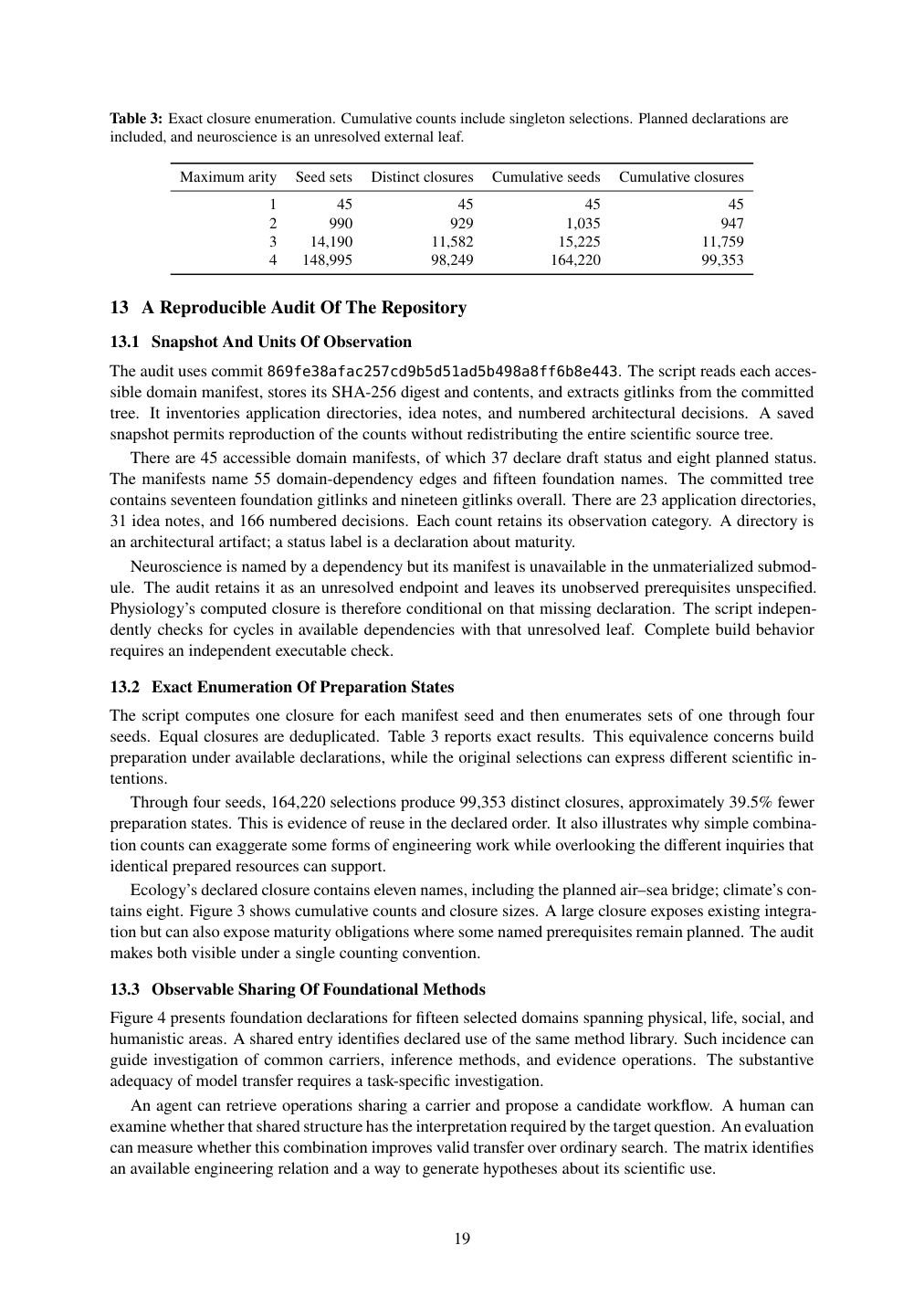
Table 3: Exact closure enumeration. Cumulative counts include singleton selections. Planned declarations are
included, and neuroscience is an unresolved external leaf.
The audit uses commit 869fe38afac257cd9b5d51ad5b498a8ff6b8e443. The script reads each acces- sible domain manifest, stores its SHA-256 digest and contents, and extracts gitlinks from the committed tree. It inventories application directories, idea notes, and numbered architectural decisions. A saved snapshot permits reproduction of the counts without redistributing the entire scientific source tree.
There are 45 accessible domain manifests, of which 37 declare draft status and eight planned status. The manifests name 55 domain-dependency edges and fifteen foundation names. The committed tree contains seventeen foundation gitlinks and nineteen gitlinks overall. There are 23 application directories, 31 idea notes, and 166 numbered decisions. Each count retains its observation category. A directory is an architectural artifact; a status label is a declaration about maturity.
Neuroscience is named by a dependency but its manifest is unavailable in the unmaterialized submod- ule. The audit retains it as an unresolved endpoint and leaves its unobserved prerequisites unspecified. Physiology’s computed closure is therefore conditional on that missing declaration. The script indepen- dently checks for cycles in available dependencies with that unresolved leaf. Complete build behavior
The script computes one closure for each manifest seed and then enumerates sets of one through four seeds. Equal closures are deduplicated. Table 3 reports exact results. This equivalence concerns build preparation under available declarations, while the original selections can express different scientific in-
Through four seeds, 164,220 selections produce 99,353 distinct closures, approximately 39.5% fewer preparation states. This is evidence of reuse in the declared order. It also illustrates why simple combina- tion counts can exaggerate some forms of engineering work while overlooking the different inquiries that
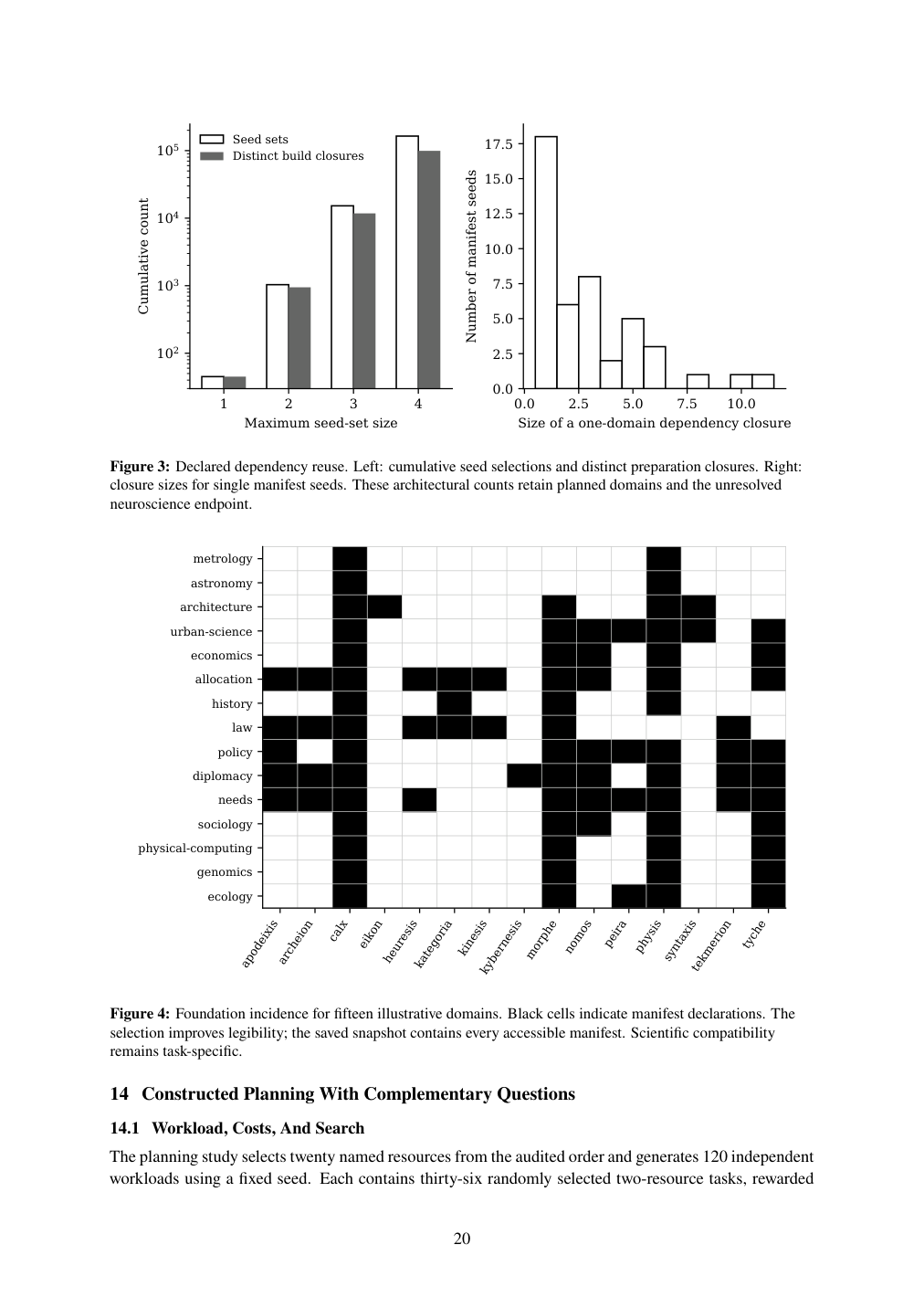
Ecology’s declared closure contains eleven names, including the planned air–sea bridge; climate’s con- tains eight. Figure 3 shows cumulative counts and closure sizes. A large closure exposes existing integra- tion but can also expose maturity obligations where some named prerequisites remain planned. The audit makes both visible under a single counting convention.
Figure 4 presents foundation declarations for fifteen selected domains spanning physical, life, social, and humanistic areas. A shared entry identifies declared use of the same method library. Such incidence can guide investigation of common carriers, inference methods, and evidence operations. The substantive adequacy of model transfer requires a task-specific investigation.
An agent can retrieve operations sharing a carrier and propose a candidate workflow. A human can examine whether that shared structure has the interpretation required by the target question. An evaluation can measure whether this combination improves valid transfer over ordinary search. The matrix identifies an available engineering relation and a way to generate hypotheses about its scientific use.
Readable text
Figure 3: Declared dependency reuse. Left: cumulative seed selections and distinct preparation closures. Right: closure sizes for single manifest seeds. These architectural counts retain planned domains and the unresolved
Figure 4: Foundation incidence for fifteen illustrative domains. Black cells indicate manifest declarations. The selection improves legibility; the saved snapshot contains every accessible manifest. Scientific compatibility
14 Constructed Planning With Complementary Questions
The planning study selects twenty named resources from the audited order and generates 120 independent workloads using a fixed seed. Each contains thirty-six randomly selected two-resource tasks, rewarded
Readable text
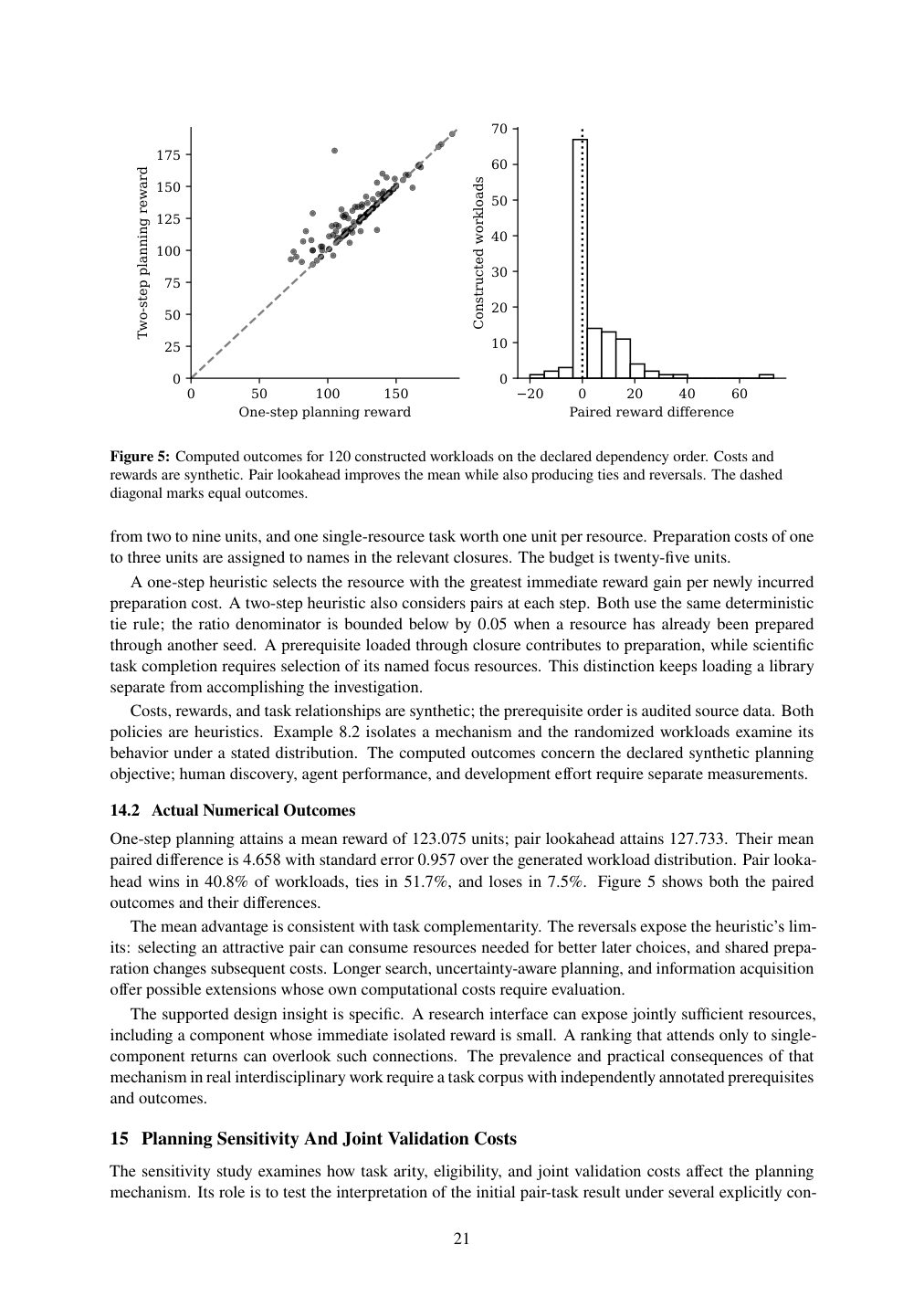
Figure 5: Computed outcomes for 120 constructed workloads on the declared dependency order. Costs and rewards are synthetic. Pair lookahead improves the mean while also producing ties and reversals. The dashed
from two to nine units, and one single-resource task worth one unit per resource. Preparation costs of one to three units are assigned to names in the relevant closures. The budget is twenty-five units.
A one-step heuristic selects the resource with the greatest immediate reward gain per newly incurred preparation cost. A two-step heuristic also considers pairs at each step. Both use the same deterministic tie rule; the ratio denominator is bounded below by 0.05 when a resource has already been prepared through another seed. A prerequisite loaded through closure contributes to preparation, while scientific task completion requires selection of its named focus resources. This distinction keeps loading a library
Costs, rewards, and task relationships are synthetic; the prerequisite order is audited source data. Both policies are heuristics. Example 8.2 isolates a mechanism and the randomized workloads examine its behavior under a stated distribution. The computed outcomes concern the declared synthetic planning objective; human discovery, agent performance, and development effort require separate measurements.
One-step planning attains a mean reward of 123.075 units; pair lookahead attains 127.733. Their mean paired difference is 4.658 with standard error 0.957 over the generated workload distribution. Pair looka- head wins in 40.8% of workloads, ties in 51.7%, and loses in 7.5%. Figure 5 shows both the paired
The mean advantage is consistent with task complementarity. The reversals expose the heuristic’s lim- its: selecting an attractive pair can consume resources needed for better later choices, and shared prepa- ration changes subsequent costs. Longer search, uncertainty-aware planning, and information acquisition offer possible extensions whose own computational costs require evaluation.
The supported design insight is specific. A research interface can expose jointly sufficient resources, including a component whose immediate isolated reward is small. A ranking that attends only to single- component returns can overlook such connections. The prevalence and practical consequences of that mechanism in real interdisciplinary work require a task corpus with independently annotated prerequisites
The sensitivity study examines how task arity, eligibility, and joint validation costs affect the planning mechanism. Its role is to test the interpretation of the initial pair-task result under several explicitly con-
Readable text
structed workload regimes. Exact enumeration of every candidate bundle supplies an optimal reference within each regime. The comparison concerns finite planning behavior under the stated objective.
Shared preparation can reduce the marginal cost of loading another resource. A research bundle can also require additional checks among selected resources. The extended account in Equation 16 introduces one
Equation 16 is a deliberately simple workload model. A real study would record which interfaces need joint checks and their actual costs. Here the complete pair family makes the consequence of increasing validation burden transparent. It charges selected research resources, whereas dependency closure charges
Example 15.1 establishes why Proposition 8.1 applies specifically to the additive preparation account. A workflow planner can benefit from shared preparation while facing an increasing obligation to check joint coherence. The combined cost needs its own analysis. This distinction is relevant when an infras- tructure’s reuse claims are evaluated through total research effort.
The study selects twelve audited domain names and enumerates their 4,096 possible bundles. For each arity in one, two, and three, forty generated base workloads contain twenty-four rewarded tasks. Task rewards are integers from two through nine. Repetition of requirements is allowed for singleton tasks be- cause there are twelve available singleton requirement sets. Each selected resource also earns one baseline unit, representing a declared independent task. The rewards remain synthetic throughout.
Each base workload receives two eligibility settings. Uniform random task marks are compared with thresholds 0.5 and 1.0; eligible tasks contribute their reward when their required seeds are selected. Eli- gibility is known to both policies and the exact reference. It represents a constructed admissibility filter whose empirical prevalence requires a separate study of scientific tasks.
Preparation weights are integers from one through three on the domain names in the relevant closures. The budget is twenty-five. Validation rates are zero, 0.5, and two. These settings yield eighteen cells and 720 policy comparisons. Common generated tasks, marks, and preparation weights within a base workload make changes across eligibility and validation settings interpretable. Replications within a cell
The exact reference evaluates the objective at every feasible bundle and takes its maximum. The one- step and pair-lookahead policies use the same marginal gain-per-cost rule and tie convention as the initial experiment. Both observe the full task and cost specification. This removes information acquisition from the comparison and isolates the effect of the heuristic search rule. Table 4 reports representative full-
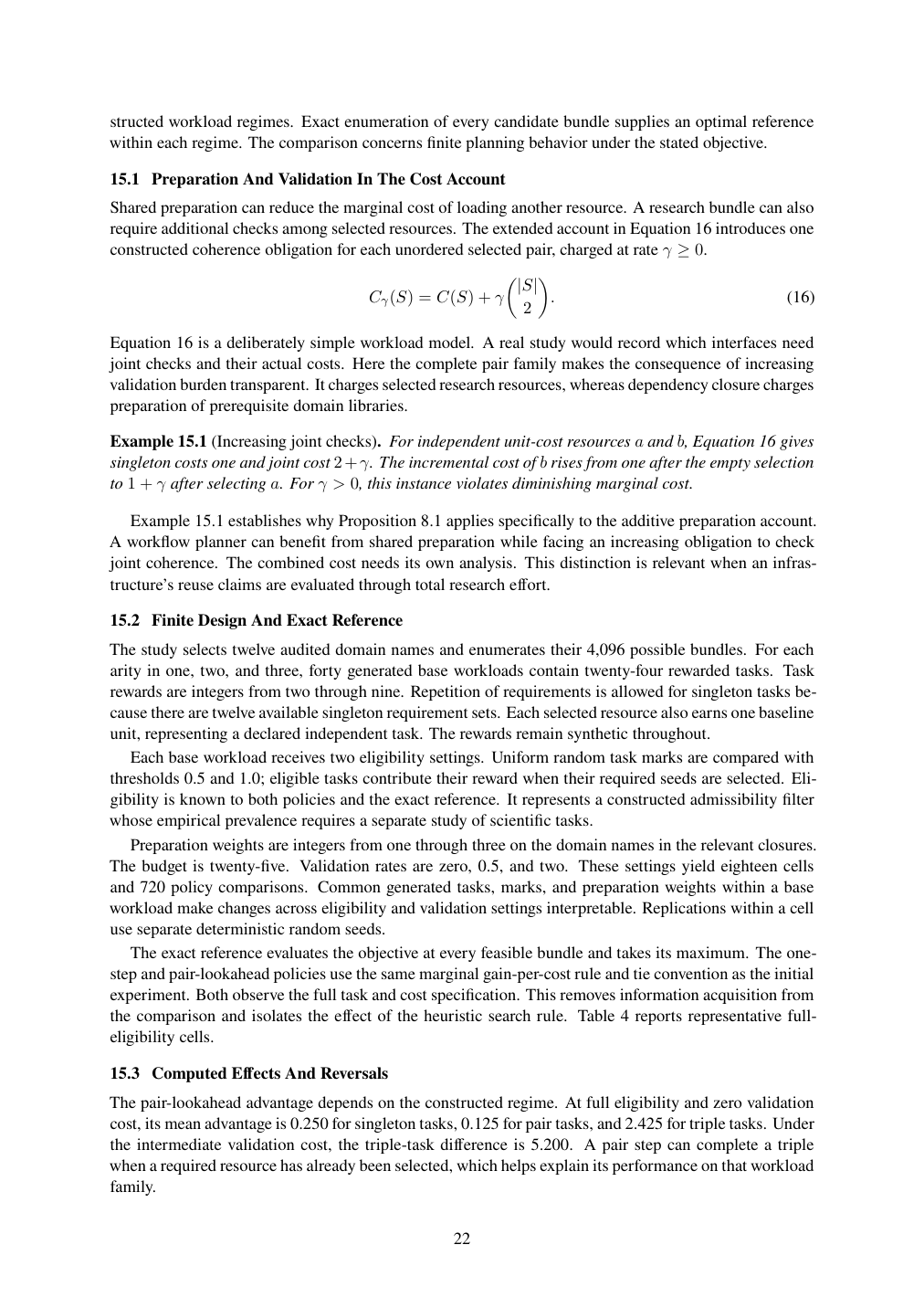
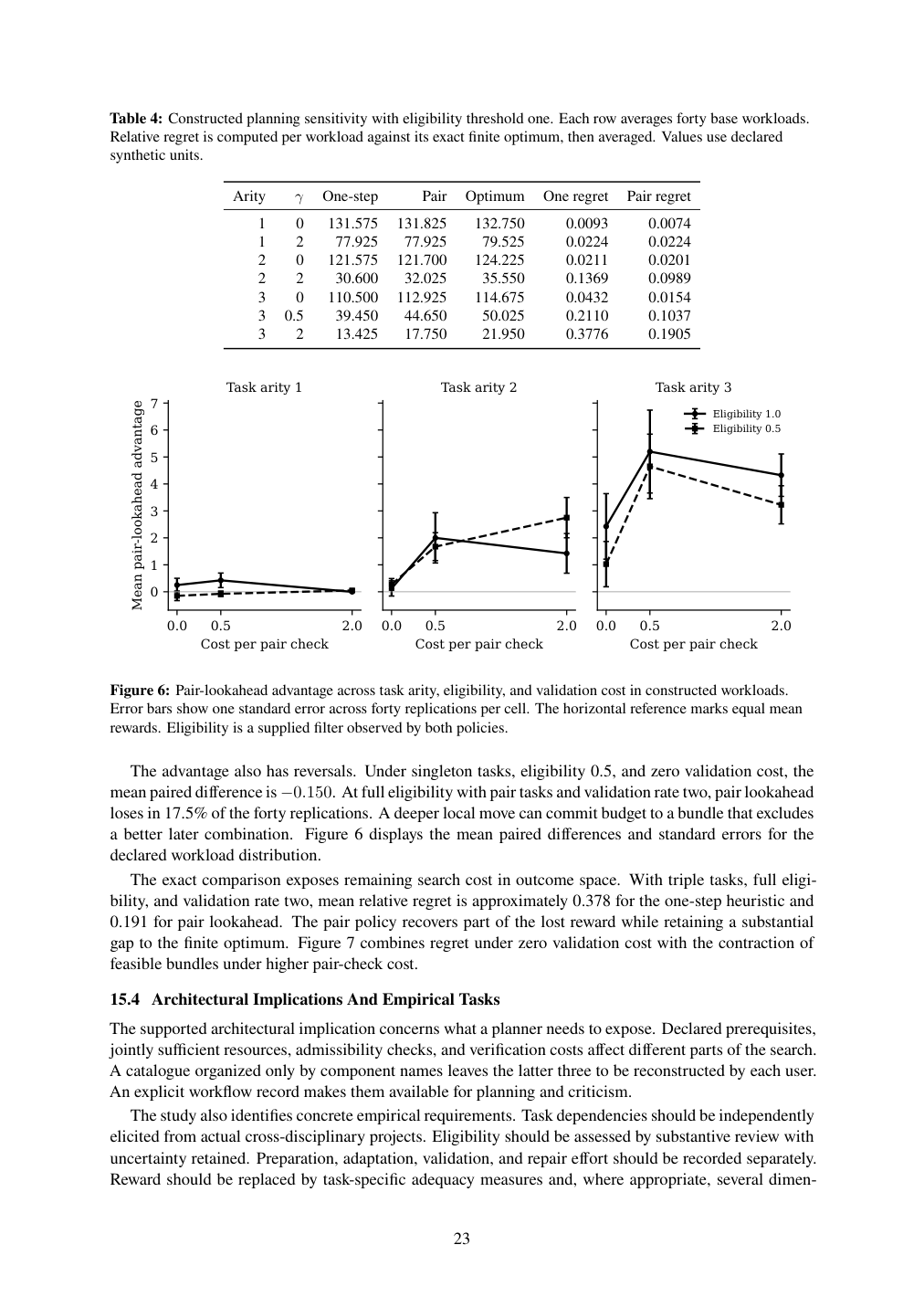
The pair-lookahead advantage depends on the constructed regime. At full eligibility and zero validation cost, its mean advantage is 0.250 for singleton tasks, 0.125 for pair tasks, and 2.425 for triple tasks. Under the intermediate validation cost, the triple-task difference is 5.200. A pair step can complete a triple when a required resource has already been selected, which helps explain its performance on that workload
Readable text
Table 4: Constructed planning sensitivity with eligibility threshold one. Each row averages forty base workloads. Relative regret is computed per workload against its exact finite optimum, then averaged. Values use declared
Figure 6: Pair-lookahead advantage across task arity, eligibility, and validation cost in constructed workloads. Error bars show one standard error across forty replications per cell. The horizontal reference marks equal mean rewards. Eligibility is a supplied filter observed by both policies.
The advantage also has reversals. Under singleton tasks, eligibility 0.5, and zero validation cost, the loses in 17.5% of the forty replications. A deeper local move can commit budget to a bundle that excludes a better later combination. Figure 6 displays the mean paired differences and standard errors for the
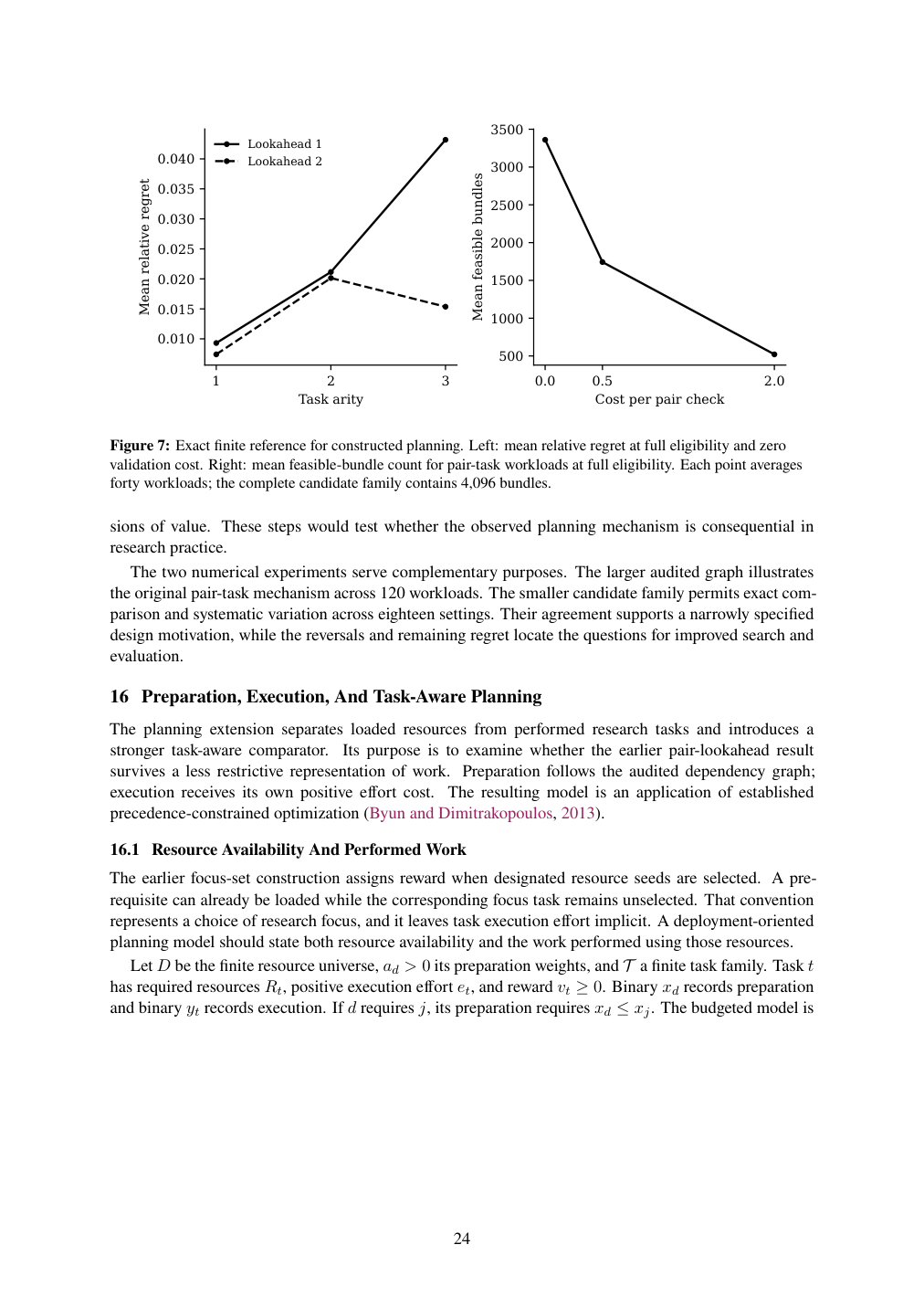
The exact comparison exposes remaining search cost in outcome space. With triple tasks, full eligi- bility, and validation rate two, mean relative regret is approximately 0.378 for the one-step heuristic and 0.191 for pair lookahead. The pair policy recovers part of the lost reward while retaining a substantial gap to the finite optimum. Figure 7 combines regret under zero validation cost with the contraction of
The supported architectural implication concerns what a planner needs to expose. Declared prerequisites, jointly sufficient resources, admissibility checks, and verification costs affect different parts of the search. A catalogue organized only by component names leaves the latter three to be reconstructed by each user. An explicit workflow record makes them available for planning and criticism.
The study also identifies concrete empirical requirements. Task dependencies should be independently elicited from actual cross-disciplinary projects. Eligibility should be assessed by substantive review with uncertainty retained. Preparation, adaptation, validation, and repair effort should be recorded separately. Reward should be replaced by task-specific adequacy measures and, where appropriate, several dimen-
Readable text
Figure 7: Exact finite reference for constructed planning. Left: mean relative regret at full eligibility and zero validation cost. Right: mean feasible-bundle count for pair-task workloads at full eligibility. Each point averages forty workloads; the complete candidate family contains 4,096 bundles.
sions of value. These steps would test whether the observed planning mechanism is consequential in
The two numerical experiments serve complementary purposes. The larger audited graph illustrates the original pair-task mechanism across 120 workloads. The smaller candidate family permits exact com- parison and systematic variation across eighteen settings. Their agreement supports a narrowly specified design motivation, while the reversals and remaining regret locate the questions for improved search and
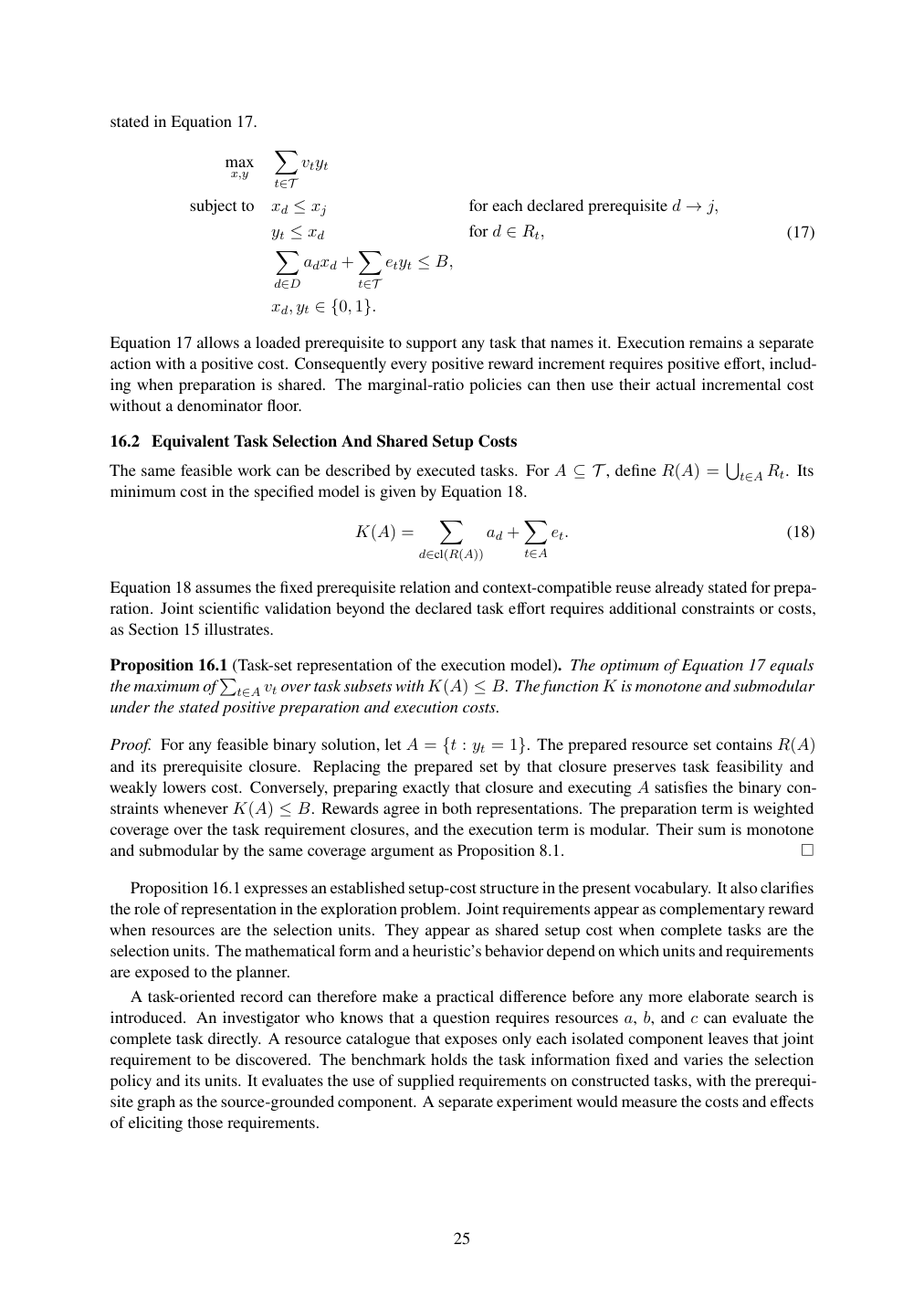
The planning extension separates loaded resources from performed research tasks and introduces a Its purpose is to examine whether the earlier pair-lookahead result survives a less restrictive representation of work. Preparation follows the audited dependency graph; execution receives its own positive effort cost. The resulting model is an application of established precedence-constrained optimization (Byun and Dimitrakopoulos, 2013).
The earlier focus-set construction assigns reward when designated resource seeds are selected. A pre- requisite can already be loaded while the corresponding focus task remains unselected. That convention represents a choice of research focus, and it leaves task execution effort implicit. A deployment-oriented planning model should state both resource availability and the work performed using those resources.
Readable text
Equation 17 allows a loaded prerequisite to support any task that names it. Execution remains a separate action with a positive cost. Consequently every positive reward increment requires positive effort, includ- ing when preparation is shared. The marginal-ratio policies can then use their actual incremental cost
minimum cost in the specified model is given by Equation 18.
Equation 18 assumes the fixed prerequisite relation and context-compatible reuse already stated for prepa- ration. Joint scientific validation beyond the declared task effort requires additional constraints or costs,
Proposition 16.1 (Task-set representation of the execution model). The optimum of Equation 17 equals
under the stated positive preparation and execution costs.
and its prerequisite closure. Replacing the prepared set by that closure preserves task feasibility and coverage over the task requirement closures, and the execution term is modular. Their sum is monotone and submodular by the same coverage argument as Proposition 8.1.
Proposition 16.1 expresses an established setup-cost structure in the present vocabulary. It also clarifies the role of representation in the exploration problem. Joint requirements appear as complementary reward when resources are the selection units. They appear as shared setup cost when complete tasks are the selection units. The mathematical form and a heuristic’s behavior depend on which units and requirements
A task-oriented record can therefore make a practical difference before any more elaborate search is complete task directly. A resource catalogue that exposes only each isolated component leaves that joint requirement to be discovered. The benchmark holds the task information fixed and varies the selection policy and its units. It evaluates the use of supplied requirements on constructed tasks, with the prerequi- site graph as the source-grounded component. A separate experiment would measure the costs and effects
Readable text
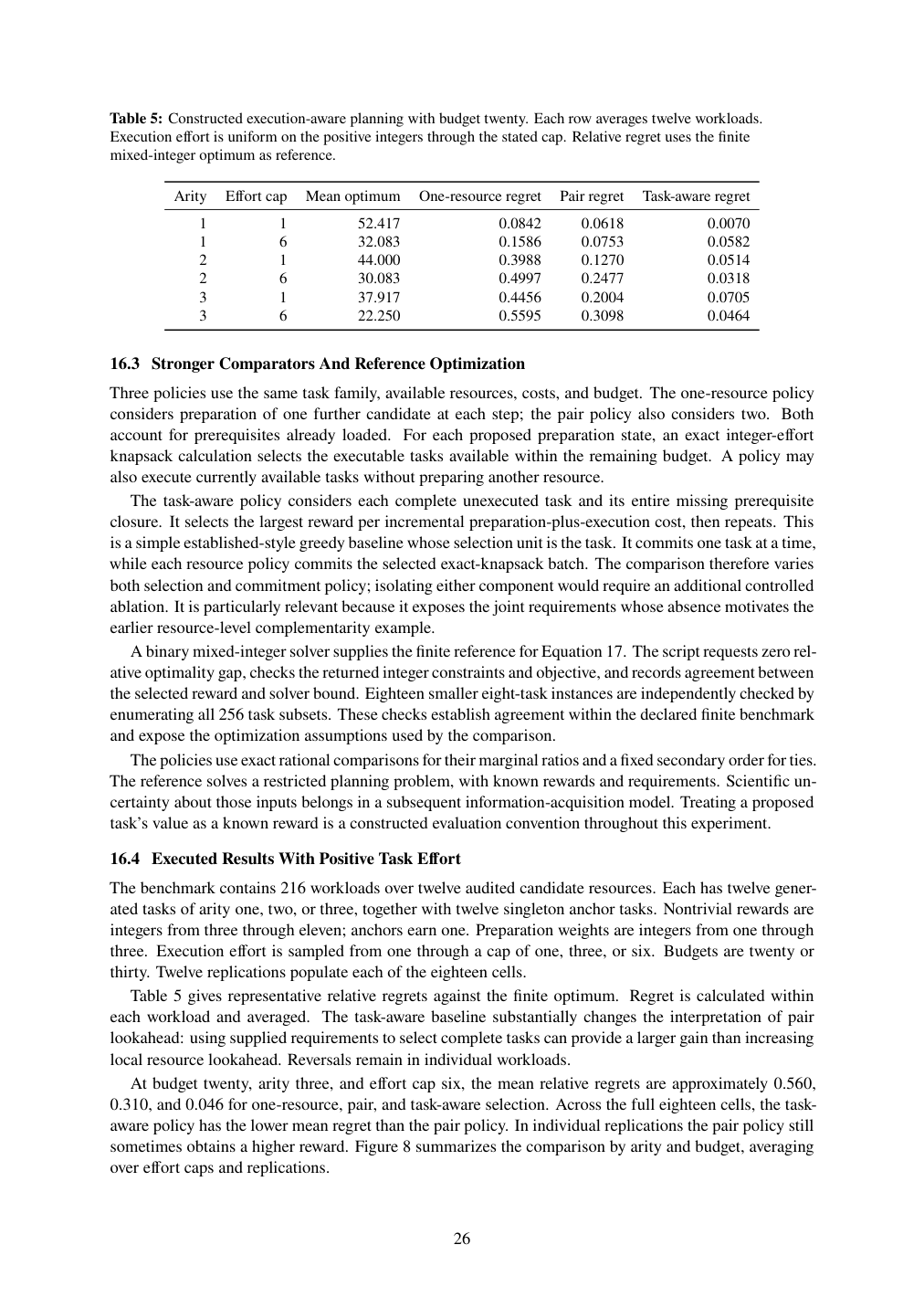
Table 5: Constructed execution-aware planning with budget twenty. Each row averages twelve workloads. Execution effort is uniform on the positive integers through the stated cap. Relative regret uses the finite
Three policies use the same task family, available resources, costs, and budget. The one-resource policy considers preparation of one further candidate at each step; the pair policy also considers two. Both account for prerequisites already loaded. For each proposed preparation state, an exact integer-effort knapsack calculation selects the executable tasks available within the remaining budget. A policy may also execute currently available tasks without preparing another resource.
The task-aware policy considers each complete unexecuted task and its entire missing prerequisite closure. It selects the largest reward per incremental preparation-plus-execution cost, then repeats. This is a simple established-style greedy baseline whose selection unit is the task. It commits one task at a time, while each resource policy commits the selected exact-knapsack batch. The comparison therefore varies both selection and commitment policy; isolating either component would require an additional controlled ablation. It is particularly relevant because it exposes the joint requirements whose absence motivates the
A binary mixed-integer solver supplies the finite reference for Equation 17. The script requests zero rel- ative optimality gap, checks the returned integer constraints and objective, and records agreement between the selected reward and solver bound. Eighteen smaller eight-task instances are independently checked by enumerating all 256 task subsets. These checks establish agreement within the declared finite benchmark and expose the optimization assumptions used by the comparison.
The policies use exact rational comparisons for their marginal ratios and a fixed secondary order for ties. The reference solves a restricted planning problem, with known rewards and requirements. Scientific un- certainty about those inputs belongs in a subsequent information-acquisition model. Treating a proposed task’s value as a known reward is a constructed evaluation convention throughout this experiment.
The benchmark contains 216 workloads over twelve audited candidate resources. Each has twelve gener- ated tasks of arity one, two, or three, together with twelve singleton anchor tasks. Nontrivial rewards are integers from three through eleven; anchors earn one. Preparation weights are integers from one through three. Execution effort is sampled from one through a cap of one, three, or six. Budgets are twenty or thirty. Twelve replications populate each of the eighteen cells.
Table 5 gives representative relative regrets against the finite optimum. Regret is calculated within each workload and averaged. The task-aware baseline substantially changes the interpretation of pair lookahead: using supplied requirements to select complete tasks can provide a larger gain than increasing local resource lookahead. Reversals remain in individual workloads.
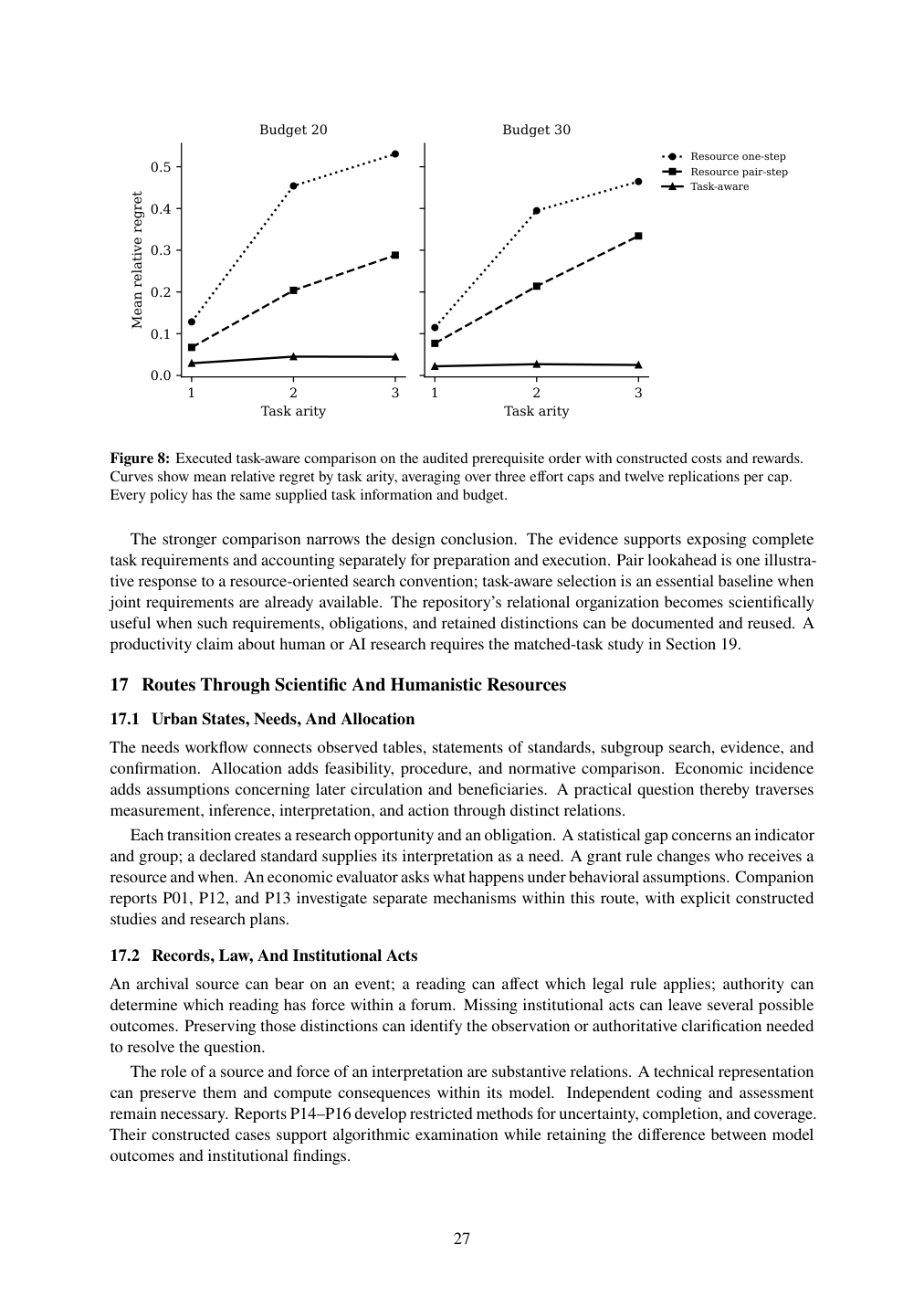
At budget twenty, arity three, and effort cap six, the mean relative regrets are approximately 0.560, 0.310, and 0.046 for one-resource, pair, and task-aware selection. Across the full eighteen cells, the task- aware policy has the lower mean regret than the pair policy. In individual replications the pair policy still sometimes obtains a higher reward. Figure 8 summarizes the comparison by arity and budget, averaging
Readable text
Figure 8: Executed task-aware comparison on the audited prerequisite order with constructed costs and rewards. Curves show mean relative regret by task arity, averaging over three effort caps and twelve replications per cap. Every policy has the same supplied task information and budget.
The stronger comparison narrows the design conclusion. The evidence supports exposing complete task requirements and accounting separately for preparation and execution. Pair lookahead is one illustra- tive response to a resource-oriented search convention; task-aware selection is an essential baseline when joint requirements are already available. The repository’s relational organization becomes scientifically useful when such requirements, obligations, and retained distinctions can be documented and reused. A productivity claim about human or AI research requires the matched-task study in Section 19.
17 Routes Through Scientific And Humanistic Resources
The needs workflow connects observed tables, statements of standards, subgroup search, evidence, and confirmation. Allocation adds feasibility, procedure, and normative comparison. Economic incidence adds assumptions concerning later circulation and beneficiaries. A practical question thereby traverses measurement, inference, interpretation, and action through distinct relations.
Each transition creates a research opportunity and an obligation. A statistical gap concerns an indicator and group; a declared standard supplies its interpretation as a need. A grant rule changes who receives a resource and when. An economic evaluator asks what happens under behavioral assumptions. Companion reports P01, P12, and P13 investigate separate mechanisms within this route, with explicit constructed
An archival source can bear on an event; a reading can affect which legal rule applies; authority can determine which reading has force within a forum. Missing institutional acts can leave several possible outcomes. Preserving those distinctions can identify the observation or authoritative clarification needed
The role of a source and force of an interpretation are substantive relations. A technical representation can preserve them and compute consequences within its model. Independent coding and assessment remain necessary. Reports P14–P16 develop restricted methods for uncertainty, completion, and coverage. Their constructed cases support algorithmic examination while retaining the difference between model
17.3 Dynamics And Cross-Disciplinary Analogy
The dynamics language and mathematical foundations support comparison of flows, constraints, stochastic changes, and coupled systems. Shared syntax can facilitate controlled translation across forms. Applying a physical mechanism in another field introduces an additional interpretation, whose adequacy must be investigated.
An analogy can suggest a model; a formal transformation can establish a specific correspondence; observations can test target adequacy. A project record can preserve all three stages with different evidential statuses. Structured-state warnings, epistemic contracts, and cycle-space history inference illustrate distinct questions developed from such shared structures.
18 Source-Grounded Workflow And Revision
The workflow study executes a narrow route through an existing Noetarium API and an explicitly authored task-contract adapter. Its objective is to make the architectural proposal concrete while retaining the boundary between source behavior, added design, and scientific adequacy. The input counts, thresholds, and allocation rule are constructed. The API files are unmodified source at the pinned commit.
18.1 Executed Source Boundary And Input Records
The study includes eight API source files needed to import the board, table, and quantity classes and their support modules. The copy of board.py was fetched independently from the public pinned source URL and matched byte for byte by SHA-256. The package records each local source digest and preserves the source licence. The original board test fixture also executes successfully: thirty-six assertions and one numerical check cover table access, declared quantities, result formatting, local file handling, and hosted module execution. The saved output retains stable check identities and verdicts. Execution of the authored workflow uses the original classes with ordinary Python array arithmetic. The tested scope is this API subset and the new adapter.

The source table class exposes columns, labels, and numeric arrays; the quantity class exposes a range, midpoint, and unit. The adapter adds task requirements for population, period, unit, semantic version, source identity, admissible count values, and optional input binding. These requirements are explicit declarations in the fixture. A check compares the supplied record with those declarations and returns a hold disposition for the downstream claim when a required obligation remains unsatisfied.
18.2 Source Conformance And Declared Semantic Obligations
The original API refuses a table whose columns have different lengths. It also returns numerical columns through its declared access method. The adapter then checks the task-specific sidecar fields. Changing a population tag from resident to visitor, or changing the reference period while retaining a task for 2023, leaves the numerical column access executable and changes the adapter disposition. This is an example of the distinct responsibilities described in Section 5.
The adapter’s admission label denotes record conformance under its stated metadata and count checks. Raw numerical outputs remain available as execution diagnostics. An explicit reference consumer emits a hold record without numerical claims for held cases, and a record-conforming projection for admitted cases; it thereby implements the chosen disposition at that output boundary. Scientific warrant additionally requires independently justified measurement and source evidence for the task. Thirteen input scenarios are executed. Nine receive a hold: five declared metadata mismatches, a negative count, a numerator above its denominator, a missing count, and a stale input-binding digest. The aligned input, a legitimate count
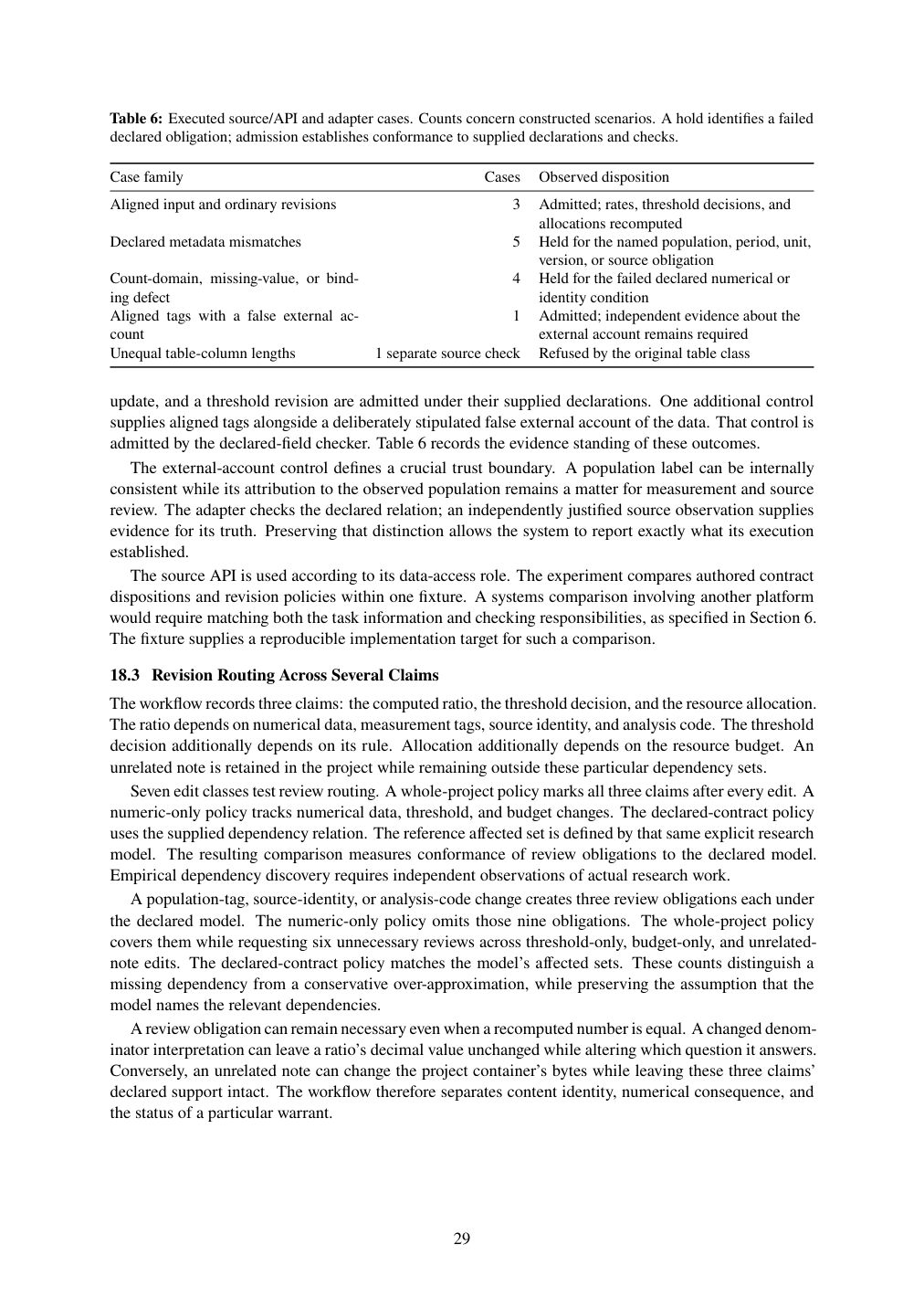
Readable text
Table 6: Executed source/API and adapter cases. Counts concern constructed scenarios. A hold identifies a failed declared obligation; admission establishes conformance to supplied declarations and checks.
Aligned input and ordinary revisions Declared metadata mismatches Count-domain, missing-value, or bind- ing defect
3 Admitted; rates, threshold decisions, and allocations recomputed 5 Held for the named population, period, unit, version, or source obligation
4 Held for the failed declared numerical or identity condition
1 Admitted; independent evidence about the external account remains required Refused by the original table class
update, and a threshold revision are admitted under their supplied declarations. One additional control supplies aligned tags alongside a deliberately stipulated false external account of the data. That control is admitted by the declared-field checker. Table 6 records the evidence standing of these outcomes.
The external-account control defines a crucial trust boundary. A population label can be internally consistent while its attribution to the observed population remains a matter for measurement and source review. The adapter checks the declared relation; an independently justified source observation supplies evidence for its truth. Preserving that distinction allows the system to report exactly what its execution
The source API is used according to its data-access role. The experiment compares authored contract dispositions and revision policies within one fixture. A systems comparison involving another platform would require matching both the task information and checking responsibilities, as specified in Section 6. The fixture supplies a reproducible implementation target for such a comparison.
The workflow records three claims: the computed ratio, the threshold decision, and the resource allocation. The ratio depends on numerical data, measurement tags, source identity, and analysis code. The threshold decision additionally depends on its rule. Allocation additionally depends on the resource budget. An unrelated note is retained in the project while remaining outside these particular dependency sets.
Seven edit classes test review routing. A whole-project policy marks all three claims after every edit. A numeric-only policy tracks numerical data, threshold, and budget changes. The declared-contract policy uses the supplied dependency relation. The reference affected set is defined by that same explicit research model. The resulting comparison measures conformance of review obligations to the declared model. Empirical dependency discovery requires independent observations of actual research work.
A population-tag, source-identity, or analysis-code change creates three review obligations each under the declared model. The numeric-only policy omits those nine obligations. The whole-project policy covers them while requesting six unnecessary reviews across threshold-only, budget-only, and unrelated- note edits. The declared-contract policy matches the model’s affected sets. These counts distinguish a missing dependency from a conservative over-approximation, while preserving the assumption that the
A review obligation can remain necessary even when a recomputed number is equal. A changed denom- inator interpretation can leave a ratio’s decimal value unchanged while altering which question it answers. Conversely, an unrelated note can change the project container’s bytes while leaving these three claims’ declared support intact. The workflow therefore separates content identity, numerical consequence, and
18.4 Data Registry Audit And Reuse Opportunities
A complementary audit reads 130 data-registry declarations at the same source commit. They contain 225 declared used_by strings. Fifty-five declarations contain request lists, and forty-two contain parameter declarations. The saved snapshot retains each JSON object and digest. These are original declaration-level counts; their units are registry records and strings, with duplicate uses retained according to the source representation.
The metadata supports concrete integration questions. A parameterized population or environmental product can participate in several tasks, each requiring a period, spatial frame, unit, and interpretation. A changed query parameter can affect a downstream task even while its software implementation stays fixed. A registry binding therefore supplies a useful starting point for a task contract, and the task adds the scientific obligations needed for that particular use.
Registry presence, a provider name, and free-text licence information remain declarations that receive their appropriate review. The audit establishes what the inspected system records. The source-grounded fixture establishes execution of a narrow API route under constructed inputs. Together with the planning experiment, these artifacts make the proposed relational infrastructure more concrete while preserving the independent evidence required to assess discovery, productivity, and institutional benefit.
19 Comparative Evaluation Protocol
The comparative protocol specifies the evidence required for claims about research efficiency, epistemic quality, and continued inquiry. It separates task construction, experimental conditions, outcome assessment, and longitudinal repair. The protocol is a prospective design. The evidence currently available comprises the source audit and constructed planning tasks described in Sections 13 and 15.
19.1 Task Corpus And Sampling Units
An evaluation corpus should contain complete research tasks with independently prepared source packets and target judgments. Useful strata include measurement transfer, model composition, interpretive uncertainty, incomplete observation, and response to changed evidence. Each task should specify the intended population, setting, time horizon, permissible resources, and conditions under which an unresolved result is appropriate. This allows adequacy to be evaluated even when a task has several defensible answers.
Task authors and assessors should include relevant disciplinary expertise. For a legal or policy task, the target can be an explicitly scoped argument under supplied authorities. For a numerical task, the target can include a reference computation and applicability conditions. For a historical task, assessors can distinguish an archival holding, an attributed reading, and an inference from several sources. The corpus should preserve disagreement where it is material to the question.
The sampling unit needs particular care. Several paraphrases of one source problem share difficulty and can share hidden assumptions. Treating them as independent research tasks exaggerates the evidence base. A study can sample projects or source packets first, then analyze within-project tasks with the dependence retained. Report P16 studies an analogous issue when doctrinal descriptions and semantic classes form different audit populations.
19.2 Intervention Conditions And Matched Resources
A useful comparison includes ordinary research tools, a recent agent interface appropriate to the task, the inspected infrastructure with basic executable access, and an extended interface containing explicit task and evidence contracts. The last two conditions help isolate the proposed record design from the benefit of having a prepared codebase. Human-only, agent-only, and combined participation can be evaluated in separate, clearly defined comparisons.
Tool availability, model version, compute budget, source access, and time should be matched or explicitly varied. A preconfigured system can appear faster because its preparation was completed before the timed phase. The study should report both marginal use time and the preparation or maintenance effort amortized over a declared number of uses. This distinction directly follows the preparation-cost analysis.
Readable text
Randomization should occur at a level compatible with learning and contamination. Participants who learn a solution in one condition may carry that knowledge into another. A crossover design needs different matched source packets and an ordering plan; a between-group design needs sufficient independent groups. Agent runs should retain seeds, tool logs, model identifiers, and resource limits. Repeated generations from one packet should remain visibly nested within that packet.
The primary outcome can be independently assessed valid task completion under the stated budget. Com- pletion should require the requested result and the evidence needed for its stated scope. Secondary out- comes can include inspection effort, supported transfer, unsupported-claim frequency, calibration, source- traceability accuracy, and repair cost. These measures describe different aspects of epistemic efficiency.
execution, review, and repair effort in a common reported unit or in separate parallel accounts.
Equation 19 supports transparent accounting when the chosen units are commensurable. Human time, compute expenditure, community burden, and environmental costs may require separate reporting. A single aggregate should be accompanied by its conversion assumptions and disaggregated components.
Assessors should receive de-identified outputs where practical and use a rubric prepared before in- specting the comparison results. The rubric can distinguish a correct numerical answer, a supported interpretation, an appropriate unresolved finding, and an unsupported assertion. Assessors should record reasons for disagreements. A consensus score can be useful for a study endpoint while the individual judgments remain available to examine evaluative variation.
A longitudinal phase should introduce a controlled revision after initial completion. The revision can change an input unit, reveal a source conflict, alter an admissible classification, or withdraw a previously accepted assumption. Participants then identify affected outputs and revise the supported findings. The design tests the practical value of the dependencies analyzed in Section 12.
Repair assessment should distinguish missed consequences, unnecessary review, successful recompu- tation, successful interpretive revision, and preserved supported results. A system that rapidly recomputes the wrong target has completed an operational step while leaving the scientific task unresolved. A system that locates a missing observation can provide a useful result even before an answer is identified. The
rubric should recognize both circumstances explicitly.
Retained inquiry options can be tested through a new question presented after the first task. For ex- ample, a stored aggregate may suffice for the original total while a later subgroup question requires the retained source classification. The outcome is whether the record permits the later question to be an- swered or precisely locates the additional observation required. This turns the philosophical concern for
The analysis should report effects with uncertainty at the independent sampling level. Project-level resam- pling or an appropriate hierarchical model can account for repeated tasks and runs. Primary endpoints and planned contrasts should be stated before outcome inspection. Subgroup analyses can examine domain, task type, source quality, and repair type, with their exploratory status retained where relevant.
Failure review should inspect mechanisms. A failed transfer can arise from missing software, missing data, erased distinctions, an inadequate model, a disputed interpretation, or an inappropriate evaluation criterion. These causes imply different engineering and research responses. Their coding can be checked across assessors and linked to concrete artifacts, creating a corpus of reusable failure cases.
Generalization should proceed through task families and replications. An advantage on one well- prepared codebase supports a claim about that evaluated setting. Replication across independent source
packets and disciplinary interfaces can support a broader claim. Public release of tasks, permissible source records, code, rubrics, and anonymized outcomes would allow other groups to test the proposed mechanisms and identify further antecedents or counterexamples.
20 Participation, Credit, And Value Circulation
The governance analysis concerns how the infrastructure distributes opportunities to pose questions, contribute evidence, evaluate work, and benefit from later reuse. Its method is a design analysis informed by knowledge-infrastructure and generative-justice antecedents. The proposed records supply observable objects for future evaluation; decisions about legitimate authority and fair distribution require participation by the affected communities.
20.1 Contribution Histories And Later Benefits
A research project can depend on data collection, curation, software maintenance, translation, conceptual criticism, and institutional access. A citation to the final output can leave several of those contributions difficult to recover. A contribution record can identify the artifact supplied, the role performed, the conditions of access, and the later projects that used it. Such a record can support credit while preserving the difference between use of an artifact and endorsement of a conclusion.
The benefits of reuse can return through several routes: acknowledgment, maintenance funding, improved tools, access to derived results, training, or authority in subsequent project decisions. These routes involve heterogeneous values. A numerical credit score would introduce conversion assumptions that need independent justification. The infrastructure can first preserve the relevant relations and permit several legitimate forms of assessment.
Eglash’s generative-justice work provides an antecedent for attending to value generators and the circulation of benefits (Eglash, 2016). The operational extension proposed here is to trace whether a reused source, method, or criticism contributes to conditions for further inquiry, and whether its contributors retain access to those conditions. A graph of citations alone provides only one observable part of that inquiry.
20.2 Access To Evaluation And Revision
Participation in evaluation depends on resources, language, expertise, time, and institutional position. A technically open challenge interface can remain costly to use. A governance study should therefore measure who can submit a challenge, whose challenge receives review, and which supported challenges change accepted artifacts. These observations distinguish formal availability from practical influence.
An agent ecology adds a further layer. Agents can acquire more compute or selection opportunities through prior scores; evaluators can be selected by the system they assess; popular criteria can receive more evidence because they govern what is explored. Reports P09 and P10 treat these mechanisms separately. The overview’s proposed response is an inspectable record of evaluator assignment, criteria versions, appeals, and externally introduced evidence.
A valid governance mechanism depends on context. A medical model, an archival interpretation, and a mathematical computation involve different responsibilities. The infrastructure should expose the authority attached to a decision and the grounds for its scope. A common record can make these differences visible while each domain retains the review practice appropriate to its consequences.
20.3 Rights, Consent, And Controlled Disclosure
Scientific openness interacts with rights over data, confidential records, ecological sensitivity, and community-held knowledge. The UNESCO framework recognizes both openness and legitimate restrictions (UNESCO, 2021). A research record can state why access is controlled, who is permitted to inspect which materials, and what evidence can be shared to support a derived claim.
Retention of inquiry options should be evaluated together with these responsibilities. Preserving a raw source may enable future questions while creating privacy or misuse risks. A limited-access archive, a
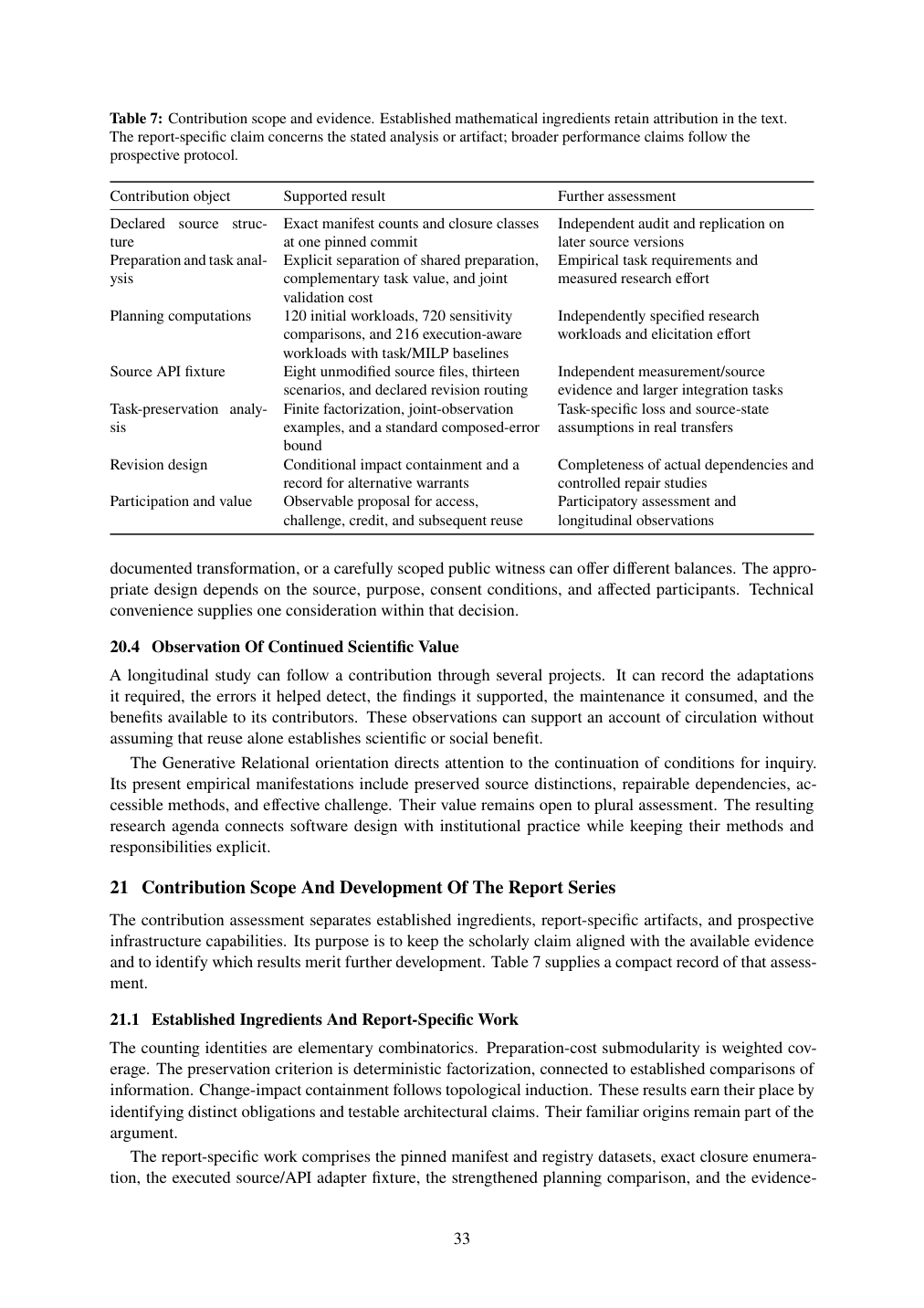
Readable text
Table 7: Contribution scope and evidence. Established mathematical ingredients retain attribution in the text. The report-specific claim concerns the stated analysis or artifact; broader performance claims follow the
Independent audit and replication on later source versions
Explicit separation of shared preparation, complementary task value, and joint
Empirical task requirements and measured research effort
120 initial workloads, 720 sensitivity comparisons, and 216 execution-aware workloads with task/MILP baselines
Independently specified research workloads and elicitation effort
Eight unmodified source files, thirteen scenarios, and declared revision routing
Independent measurement/source evidence and larger integration tasks
Finite factorization, joint-observation examples, and a standard composed-error
Task-specific loss and source-state assumptions in real transfers
Completeness of actual dependencies and controlled repair studies
Observable proposal for access, challenge, credit, and subsequent reuse
Participatory assessment and longitudinal observations
documented transformation, or a carefully scoped public witness can offer different balances. The appro- priate design depends on the source, purpose, consent conditions, and affected participants. Technical convenience supplies one consideration within that decision.
A longitudinal study can follow a contribution through several projects. It can record the adaptations it required, the errors it helped detect, the findings it supported, the maintenance it consumed, and the benefits available to its contributors. These observations can support an account of circulation without assuming that reuse alone establishes scientific or social benefit.
The Generative Relational orientation directs attention to the continuation of conditions for inquiry. Its present empirical manifestations include preserved source distinctions, repairable dependencies, ac- cessible methods, and effective challenge. Their value remains open to plural assessment. The resulting research agenda connects software design with institutional practice while keeping their methods and
21 Contribution Scope And Development Of The Report Series
The contribution assessment separates established ingredients, report-specific artifacts, and prospective infrastructure capabilities. Its purpose is to keep the scholarly claim aligned with the available evidence and to identify which results merit further development. Table 7 supplies a compact record of that assess-
The counting identities are elementary combinatorics. Preparation-cost submodularity is weighted cov- erage. The preservation criterion is deterministic factorization, connected to established comparisons of information. Change-impact containment follows topological induction. These results earn their place by identifying distinct obligations and testable architectural claims. Their familiar origins remain part of the
The report-specific work comprises the pinned manifest and registry datasets, exact closure enumera- tion, the executed source/API adapter fixture, the strengthened planning comparison, and the evidence-
linked organization of preparation, task preservation, verification, revision, and participation. The conjunction asks a precise infrastructure question: whether reusable preparation can make a growing relational inquiry space accessible while preserving the distinctions and evidence required by the questions pursued within it.
The source audit covers available declarations. Foundation gitlinks identify separate sources; planned units retain that status; a missing neuroscience manifest bounds one closure calculation. The Python planning studies use the declared domain order with constructed costs, rewards, eligibility, and execution effort. The source fixture executes a narrow API subset. A full software build, user study, or discovery evaluation is a separate research stage with a specified protocol and independent evidence.
21.2 Relation Among The Companion Reports
The companion reports investigate narrower mechanisms within the same programme. Inference reports address interpretation, observation, and candidate-set guarantees. Software and verification reports examine reproducibility, witnesses, claim traceability, and incentives. Governance reports separate evaluative authority from evolving norms. Domain studies examine allocation, law, institutions, urban events, economic circulation, visitor pressure, and relational history.
Several reports deliberately share an established ingredient. A finite-population audit can appear in allocation search and doctrinal search; the substantive question concerns the population sampled and the consequence of missed cases. A graph invariant can appear in urban or historical analysis; its observation model and interpretation require separate justification. Cross-references should make those relations explicit and help readers assess whether two reports contain distinct scholarly substance.
Development should prioritize results with a clear failure case, a precise remedy or characterization, and an evaluation that distinguishes the result from its closest antecedent. Reports centered on the same result can be integrated where that improves their scholarly contribution. The current technical-report form supports substantive review of the analytical and computational artifacts before subsequent venuespecific development.
22 Conclusion
Relations among disciplines expand both the questions that can be posed and the resources with which they can be investigated. That growth can create a substantial combinatorial search burden. Noetarium addresses it through shared foundations, declared dependencies, purpose-oriented works, and records that preserve sources and assumptions. The inspected snapshot provides a concrete architecture on which to develop and test these capacities.
Nominal combinations, operational workflows, and warranted inquiries remain distinct. Dependency closure makes one form of reuse measurable. Task-relative preservation identifies what an interface must retain. Complementary tasks explain why useful exploration can require examining joint requirements. The execution-aware experiment identifies a stronger task-aware baseline and narrows the role of resource lookahead. The source API fixture makes declared compatibility and revision obligations concrete, while its external-account control exposes the additional evidence required for measurement adequacy. Comparative protocols define the evidence required for broader productivity and discovery claims.
The infrastructure’s scientific meaning lies in making connections available for examination, use, criticism, and revision. Humans and AI systems contribute different capabilities to that process. Continuing value depends on whether those relations support valid knowledge, retain future inquiry options, and permit responsible participation in choosing what to explore next.
A Reproduction And Source Responsibilities
Run python reproduce.py in this report directory to regenerate counts, tables, constructed results, and figures from the saved manifest snapshot. Pass –repo with a local source path to refresh the snapshot at the declared commit. The script checks the commit, records manifest digests, and verifies the accessible dependency graph is acyclic. Source repositories remain separate from this manuscript package.
The workload generator uses seed 20261124, 120 replications, twenty candidate resources, thirty-six pair tasks per workload, single-resource tasks, and budget twenty-five. Numerical results are saved in results.json; individual runs appear in data/planning_runs.csv. The saved snapshot distinguishes missing-manifest endpoints. Domain names are sorted before random preparation costs are assigned, keeping the saved seed stable across interpreter hash ordering. Source ledgers state access depth and claim scope. Run python planning_sensitivity.py to regenerate the eighteen-cell exact-reference extension separately. It writes sensitivity_results.json, the detailed workload CSV, and two additional figures. The main reproduction script invokes both studies. The human author is invited to review the arguments, interpretations, and experiments before external circulation.
The main script also invokes execution_planning.py and source_contracts.py. They write execution_results.json and source_contract_results.json. The first uses standard mixedinteger optimization and independently enumerated small references; the second executes the copied source API subset offline, checks its byte digests, and evaluates the authored contract adapter. Registry declarations are retained in data/registry_snapshot.json. The source subset retains its MIT licence and a pinned source manifest.
References
Blackwell, D. (1953). Equivalent comparisons of experiments. Annals of Mathematical Statistics, 24(2), 265–272.
https://doi.org/10.1214/aoms/1177729032. Fleming, L. (2001). Recombinant uncertainty in technological search. Management Science, 47(1), 117–132. http
s://doi.org/10.1287/mnsc.47.1.117.10671. Fontana, M., Iori, M., Montobbio, F., and Sinatra, R. (2020). New and atypical combinations: An assessment of
novelty and interdisciplinarity. Research Policy, 49(7), 104063. https://doi.org/10.1016/j.respol.202 0.104063. Gen-Verse (2026). ScienceInfra: infrastructure for scientific agent learning. Official project repository. https:
//github.com/Gen-Verse/ScienceInfra. Project description consulted 24 November 2026. Halter, M., Patterson, E., Baas, A., and Fairbanks, J. (2020). Compositional scientific computing with Catlab and
SemanticModels. Applied Category Theory conference contribution. https://arxiv.org/abs/2005.04831. Huang, W., and Noetarium Contributors (2026). Noetarium: The Science and Humanity Infrastructure. Software
repository, commit 869fe38afac257cd9b5d51ad5b498a8ff6b8e443. https://github.com/huangwanhon g-maker/Noetarium-The-Science-and-Humanity-Infrastructure. Source paths and manifest digests accompany this report. Jones, B. F. (2009). The burden of knowledge and the “death of the Renaissance man”: Is innovation getting harder?
Review of Economic Studies, 76(1), 283–317. https://doi.org/10.1111/j.1467-937X.2008.00531.x. Author working-paper record: https://www.nber.org/papers/w11360. Libkind, S., Baas, A., Patterson, E., and Fairbanks, J. (2022). Operadic modeling of dynamical systems: Mathemat-
ics and computation. EPTCS, 372, 192–206. https://arxiv.org/abs/2105.12282. Longino, H. E. (1990). Science as Social Knowledge: Values and Objectivity in Scientific Inquiry. Princeton Uni-
versity Press. https://press.princeton.edu/books/paperback/9780691020518/science-as-socia l-knowledge. Ma, Y., Gowda, S., Anantharaman, R., Laughman, C., Shah, V., and Rackauckas, C. (2022). ModelingToolkit: A
composable graph transformation system for equation-based modeling. Author manuscript, version 3. https: //arxiv.org/abs/2103.05244. Porter, A. L., and Ràfols, I. (2009). Is science becoming more interdisciplinary? Measuring and mapping six re-
search fields over time. Scientometrics, 81, 719–745. https://doi.org/10.1007/s11192-008-2197-2. Schultz, P., and Wisnesky, R. (2017). Algebraic data integration. Journal of Functional Programming, 27, e24.
https://doi.org/10.1017/S0956796817000168. Star, S. L., and Griesemer, J. R. (1989). Institutional ecology, “translations” and boundary objects: Amateurs and
professionals in Berkeley’s Museum of Vertebrate Zoology, 1907–39. Social Studies of Science, 19(3), 387–420. https://doi.org/10.1177/030631289019003001. Star, S. L., and Ruhleder, K. (1996). Steps toward an ecology of infrastructure: Design and access for large infor-
mation spaces. Information Systems Research, 7(1), 111–134. https://doi.org/10.1287/isre.7.1.111. UNESCO (2021). Recommendation on Open Science. Adopted at the 41st session of the General Conference. Offi-
cial explanatory resources: https://www.unesco.org/en/open-science/about.
Uzzi, B., Mukherjee, S., Stringer, M., and Jones, B. (2013). Atypical combinations and scientific impact. Science,
342(6157), 468–472. https://doi.org/10.1126/science.1240474. World Wide Web Consortium (2013). PROV-DM: The PROV Data Model. W3C Recommendation. https://www.
w3.org/TR/prov-dm/. Wilkinson, M. D., and collaborators (2016). The FAIR Guiding Principles for scientific data management and
stewardship. Scientific Data, 3, 160018. https://doi.org/10.1038/sdata.2016.18. Battiston, F., Cencetti, G., Iacopini, I., Latora, V., Lucas, M., Patania, A., Young, J.-G., and Petri, G. (2020). Net-
works beyond pairwise interactions: Structure and dynamics. Physics Reports, 874, 1–92. https://doi.org/ 10.1016/j.physrep.2020.05.004. Edwards, P. N., Jackson, S. J., Chalmers, M. K., Bowker, G. C., Borgman, C. L., Ribes, D., Burton, M., and
Calvert, S. (2013). Knowledge Infrastructures: Intellectual Frameworks and Research Challenges. University of Michigan workshop report. https://knowledgeinfrastructures.org/wp-content/uploads/2020/06 /Edwards-et-al.-2013-Knowledge-Infrastructures-Intellectual-Frameworks.pdf. Eglash, R. (2016). An introduction to generative justice. Teknokultura, 13(2), 369–404. https://doi.org/10.5
209/rev_TEKN.2016.v13.n2.52847. Miao, J., Davis, J. R., Zhang, Y., Pritchard, J. K., and Zou, J. (2026). Reimagining research papers as interactive
and reliable AI agents. Nature, 658, 1272–1280. https://doi.org/10.1038/s41586-026-11044-y. Bechhofer, S., and collaborators (2013). Why linked data is not enough for scientists. Future Generation Computer
Systems, 29(2), 599–611. https://doi.org/10.1016/j.future.2011.08.004. Leo, S., and collaborators (2024). Recording provenance of workflow runs with RO-Crate. PLOS ONE, 19(9),
e0309210. https://doi.org/10.1371/journal.pone.0309210. The Galaxy Community (2026). Galaxy for accessible, reproducible, and collaborative data analyses: 2026 update.
Nucleic Acids Research, 54(W1), W105–W116. https://doi.org/10.1093/nar/gkag469. Byun, J., and Dimitrakopoulos, R. (2013). An Efficient Algorithm for the LP Relaxation of the Maximal Closure
Problem with a Capacity Constraint. GERAD technical report, (G-2013-60). https://www.gerad.ca/en/pa pers/G-2013-60.pdf.