Evidence-Carrying Equality Computation For Presented Categories
Full text from the PDF
Evidence-Carrying Equality Computation For Presented
Categories
Wanhong HUANG
Abstract
Scientific infrastructures reuse categorical equalities across schemas, software and disciplinary interpretations. A reusable answer needs a typed derivation, immutable formal inputs and revision dependencies. This report specifies a portable path-equation certificate and analyzes support-relative transport and typed replay footprints for finitely presented categories. Certifying algorithms, equational reasoning and categorical integration supply established foundations. The report-specific contribution connects recorded derivations with the generator and relation obligations governing their continued use. A zero-step counterexample shows that equation-only support can miss a changed typed conclusion. Reproducible studies generate 96 commuting-grid proofs, reject 384 targeted corruptions and evaluate 95 used-versus-unused equation revisions. A separately compiled pinned C++ presentation kernel agrees with the Python checker on 575 semantic fixtures under explicit preflight conditions. An additional 29 schema and raw-JSON boundary cases are rejected. A producer-budget sweep separates discovery coverage from acceptance, and exhaustive revision patterns quantify retention of alternative recorded proofs under a declared edit model. The artifact includes source hashes, parser/resource profiles, fixture protocols and service transactions. Restricted soundness arguments, finite implementation comparisons and operational proposals retain distinct standing. The result is a technical basis for reviewing how categorical evidence remains usable through revision; broader workload reliability and formally verified implementation correctness require further study.
Keywords: categorical computation; proof certificates; equation replay; provenance; revision
Technical Report Note
This technical report shares an evolving inquiry and invites dialogue, criticism, revision, and independent development. Its definitions, distinctions, and constructions remain open to refinement. Circulation across scholarly and practical communities is part of the purpose of releasing the manuscript.
The author treats the viewpoints, concepts, and lines of reasoning presented here as contributions to a shared field of inquiry. Similar or related ideas may have appeared in other intellectual, cultural, and disciplinary traditions. The manuscript identifies known antecedents and distinguishes inherited positions, interpretive proposals, and arguments developed here. Historical priority remains open to further investigation.
The constructions and arguments are presented with their stated assumptions and evidential scope. Readers are encouraged to question, test, revise, extend, reinterpret, or independently develop the ideas presented here. Where appropriate, acknowledgment of this paper as one point of encounter in the development of a related idea is appreciated. Such acknowledgment records an intellectual route; the ideas remain available for criticism, revision, and independent development.
Definitions introduced by the paper are local analytical stipulations unless attributed to another source. Their use identifies the scope of the present argument; terminological and historical priority remain subjects for independent investigation. Generative Relational theory is treated as an open research programme whose proposals receive critical examination alongside independent literature.
Responsible Use and Rights Reservation
This section records a request for responsible scholarly conduct and identifies the scope of retained rights. Legal permissions are governed by the licence on the following page.
The author encourages good-faith discussion, criticism, independent inquiry, and responsible use of the material. Separately from the licence’s terms, the author asks users to consider foreseeable harms when adapting the arguments, representations, or examples of this paper, particularly in scientific inquiry, institutional decisions, and computational knowledge infrastructures. The ethical request leaves the licence’s permissions and legally authorised uses unchanged.
The author retains the rights preserved under CC BY-NC 4.0 and may pursue remedies to which the author is legally entitled for breach of the licence or violation of independently applicable rights. Reuse remains independent from authorial endorsement. Third-party rights require authorisation from their respective holders where applicable. Copyright exceptions and limitations, including applicable forms of fair use or fair dealing, remain available.
Notices
This page consolidates the manuscript’s research status, licence, development disclosure, researchprogramme relation, and suggested citation.
Status. This technical report is prepared for the author’s substantive review and subsequent scholarly discussion. The report distinguishes established antecedents, conditional results developed here, inspected source artifacts, and numerical illustrations under declared assumptions. Internal checks assess the stated arguments and examples; independent scholarly assessment can further test their interpretation and adequacy. The source ledgers record the access level and claim scope of consulted works.
Licence. Except where otherwise indicated, copyright 2026 Wanhong Huang. This work is made available under the Creative Commons Attribution-NonCommercial 4.0 International License (CC BY-NC 4.0). Subject to its terms, the licence permits sharing and adaptation for noncommercial purposes with appropriate attribution, a link to the licence, and an indication of changes. Attribution should preserve the licensor’s independence from the reuse. Reuse is governed solely by the licence; the responsible-use request on the preceding page remains separate from its terms. The licence deed and legal code are available at https://creativecommons.org/licenses/by-nc/4.0/. The licence governs in case of conflict with this summary. Third-party material remains subject to its respective rights.
Statement on the use of language models. Preparation involved OpenAI’s ChatGPT and Codex. Language models supported exploratory dialogue, source discovery and checking, argumentative criticism, manuscript revision, LATEX typesetting, and the development of supporting code and figures. Verification used the sources and access levels recorded in the accompanying ledgers. The author initiated the research questions and directed the research programme; interpretation, acceptance of the arguments, and publication decisions remain subject to the author’s review. Authorship credit and responsibility for the released manuscript remain with the human author.
Code and data availability. The artifact includes Python producer and replay routines, bounded input-profile checks, constructed certificates and revision studies, and a separately compiled pinned C++ presentation-kernel comparison with explicit preflight conditions. The source package contains the editable manuscript, source ledgers, supporting scripts and outputs, and a reading guide. Numerical illustrations, where present, use the assumptions stated in their captions and text.
Related research programme. This report belongs to the Noetarium technical report series. Companion reports study inference, computation, evaluation, governance, and cross-disciplinary knowledge formation. The reports develop distinct technical questions within an open Generative Relational research programme.
Suggested citation. Huang, Wanhong. “Evidence-Carrying Equality Computation For Presented Categories.” Technical report, 2026.
1 Research Context And Certificate Objectives
A scientific infrastructure carries more than numerical routines. A variable belongs to a schema, a model transforms a state, an observation constrains an inference, and a translation relates representations. Category theory gives a precise language for many such relations. Computational category theory then offers a practical question: when software answers that two composites agree, what can another program inspect to establish the particular answer? The question becomes especially relevant when a language model proposes a diagram, when an application changes its schema, or when a scientific workflow is transferred to another environment.
Noetarium supplies a concrete setting. Its foundation kategoria computes finite categorical structures, categories presented by generators and equations, functors, and related constructions. The Category Studio displays claims beside their outcomes and evidence. The inspected presentation module already separates equality search from replay of original equations. This report develops that separation into a scoped design for portable certificates and revision-sensitive reuse. The aim is to make the dependency of a particular equality inspectable, while preserving the distinction between a local result and a general claim about a transformation.
The report contributes three connected pieces. First, it specifies a small path-equation certificate language with typed contextual replacement and an immutable presentation reference. Second, it derives conditions under which one certificate may be transported or revalidated using only its declared support. Third, it supplies reproducible reference studies of derivation size, corruption, revision, and paired conformance with a separately compiled pinned C++ presentation kernel. A typed-footprint result and a zero-step endpoint counterexample sharpen the dependencies needed for typed reuse. Each piece has antecedents in established verification and rewriting theory. The research value lies in their application to a revisable categorical infrastructure and the specific boundaries made explicit.
The scope is finite input descriptions and finite derivations. A finite presentation can describe an infinite category. Equality search can exhaust its computational budget while the mathematical question remains open. The checker therefore validates submitted evidence; a searcher’s failure to find evidence receives a separate status. The numerical study concerns commuting grids chosen for exact control of the derivations. It demonstrates mechanisms and supplies reference artifacts for later comparison with larger systems.
1.1 Research Questions And Units Of Assessment
A reusable categorical answer has several distinct units of assessment. The mathematical unit is the judgement that two typed paths represent the same arrow under specified equations. The computational unit is a particular serialized derivation offered for that judgement. The operational unit is a service response produced under parsing rules, software versions, and resource budgets. The scientific unit is the interpretation of the paths in a disciplinary model. The report treats these units separately so that evidence obtained for one unit can be used at its appropriate scope.
Three research questions organize the development. The first concerns interchange: which information permits a consumer to reconstruct an equality through original defining relations? The second concerns revision: which obligations control the continued use of a recorded derivation after a presentation or interpretation changes? The third concerns evaluation: which executed checks reveal the behavior of the interface, and which further evidence would establish its usefulness within a scientific workflow? These questions lead to a small replay language, support-relative transport, and constructed maintenance experiments. Their answers concern evidence management within categorical computation.
The dependency structure is relevant to interdisciplinary inquiry because a relation can have several simultaneous readings. A commuting square might identify two routes through a database schema, two changes of coordinates, or two compositions of a model interface. The equality calculus uses typed arrows and equations. A domain specialist supplies the reading of those arrows and the warrants for the defining relations. A useful infrastructure stores both layers and makes their connection inspectable. Revising a
substantive warrant may then trigger review of the formal equation that uses it, which in turn identifies recorded results requiring attention.
The resulting research objective is modest and operational: make a small class of formal relational results portable through a revisable infrastructure. Portability means that a consumer can determine whether the submitted steps establish the submitted formal conclusion using the supplied input. It leaves a further choice about whether the consumer accepts the input presentation for a particular scientific purpose. Keeping the choice explicit is useful when different disciplines share a formal structure while applying different empirical assumptions.
1.2 Evaluation Objects And Evidence Standing
The present evidence consists of a formal specification, elementary propositions with proofs, source inspection, and executed finite constructions. The propositions establish conditional mathematical statements about the specified calculus. Source inspection establishes that the pinned foundation contains related mechanisms and identifies concrete interfaces for development. The scripts establish acceptance and rejection behavior for the generated cases on the supplied Python implementation. The manuscript develops a service design using those mechanisms. Field reliability, user comprehension, and performance across broad categorical workloads remain empirical research questions.
A finite presentation deserves particular care as an evaluation object. Its finite description contains finitely many generators and equations; its quotient category may contain infinitely many arrows. The replay language applies to finite presentations, while the commuting-grid experiments also have finite arrow sets. This distinction influences resource reporting. Parsing a finite input terminates under finite resource allowances, replay of a finite submitted proof has a finite bound, and general equality discovery can require a separate search policy. The consumer benefits from seeing these policies as individually documented components.
An appropriate success criterion therefore has two parts. The correctness criterion concerns whether an accepted witness satisfies the specified replay relation. The usefulness criterion concerns how efficiently relevant witnesses can be discovered, communicated, revalidated, and understood in context. The first can eventually be connected to machine-checked implementation correctness. The second requires workload design, maintenance records, and human evaluation. The studies below supply a reproducible starting point for both criteria while preserving their different evidential requirements.
2 Computational Evidence And Categorical Software
2.1 Certifying Algorithms And Proof-Carrying Artifacts
The producer–checker separation belongs to the established tradition of certifying algorithms. A producer returns an answer together with an instance-specific witness, and a checker validates that witness against a stated specification (McConnell et al., 2011). The distinction is useful even when both components use the same programming language: their algorithms and responsibilities can differ. Independent implementations and machine-checked soundness provide additional assurance beyond that architectural separation.
Proof-carrying code likewise established the importance of attaching evidence to artifacts delivered by a producer outside the consumer’s trusted computational base (Necula, 1997). Here the delivered artifact is a categorical equality derivation. The relevant policy is the equational presentation, and the consumer’s check consists of typed equation applications. A digest binds a certificate to bytes; the mathematical replay binds its conclusion to the equations those bytes describe. Those functions should receive separate engineering treatment.
2.2 Rewriting And Categorical Presentations
A category presented by a quiver and path equations is a quotient of its free category. Equality is generated by replacement in contexts, reflexivity, symmetry, and transitivity. Rewriting orients equations to search for normal forms. Completion can produce useful canonical systems under suitable termination
and confluence conditions (Knuth and Bendix, 1970). The equality proof produced during such a search can be expressed through the original equations, leaving the consumer independent of the search strategy.
The distinction between validating an equality and validating inequality matters. A finite derivation establishes a positive equality by local steps. Different current normal forms establish inequality only when the normal-form procedure has the required global properties. A bounded completion run therefore has two different outputs: valid derivations found so far, and an unresolved remainder. This report emphasizes positive equality certificates because they permit a particularly small and transparent replay calculus.
2.3 Existing Categorical Software
Catlab describes an applied and computational category theory framework, including categorical structures formalizable through generalized algebraic theories (Catlab Contributors, 2026). CQL brings categorical methods and automated theorem proving to data migration and integration (Schultz and Wisnesky, 2017). These systems show that categorical computation and equational reasoning are substantial existing research and engineering programmes.
The proposed interface therefore seeks a narrower contribution: a portable derivation format whose support and revision behavior are explicit, together with an independently executable reference checker. The present experiments compare a producer with a separate replay routine inside the supplied Python artifact. A direct performance or feature comparison with Catlab and CQL remains a specified next study. Their published capabilities position the problem and define the criteria for that future comparison.
2.4 Equality Procedures And Evidence Granularity
Congruence closure provides another relevant comparison. Nelson and Oppen (1980) study represented ground terms and algorithms for equality with uninterpreted function symbols. The finite term graph is central to that problem. A categorical presentation permits arbitrarily long composable paths, so the represented ground-term universe and the presentation’s full path universe require different completeness arguments. Within a bounded collection of path expressions, congruence techniques may provide efficient discovery and compact explanations. Exporting an explanation through original equations would allow the same downstream replay interface to serve several producers.
The comparison clarifies the interface’s intended granularity. A producer might orient relations, perform completion, maintain congruence classes, invoke an SMT solver, or search a bounded graph of paths. A consumer can receive the same positive equality judgement from these different mechanisms when the producer supplies a derivation in the agreed calculus. A procedure whose internal explanation uses additional lemmas must expand those lemmas or attach independently checked derivations of them. The interface thereby makes lemma dependencies explicit while leaving search strategy open.
Rewriting has two particularly useful roles. It can reduce discovery cost by directing exploration, and it can compress many recurring proof fragments through derived rules. Those roles create different maintenance requirements. A change to a defining equation can invalidate some derived rules even when their left and right strings remain unchanged. A certificate containing expanded original-equation steps exposes the full dependency at the price of length. A certificate containing references to derived lemmas can reduce transmission size if the lemma artifacts carry their own immutable dependency manifests. The present flat format chooses the first option for transparency.
2.5 Proof Exchange And Assurance Levels
SMTCoq offers a stronger assurance reference point. Its checker is implemented and proved correct inside Coq, and its modular architecture checks proof witnesses supplied by external SAT and SMT solvers (Ekici et al., 2017). The comparison identifies a concrete development path: formalize the typed path datatype, the replay function, and the acceptance theorem, then connect serialized parsing to that formal core. The current mathematical proof concerns the specified calculus; an implementation proof would relate executable behavior to it.
Proof interchange also has a substantial engineering literature. Alethe describes a proof format developed through the needs of solver producers and consumers, including difficulties that arise as additional solvers adopt it (Schurr et al., 2021). Its relevance is the practical role of a shared evidence language. Versioned syntax, stable rule meanings, explicit premises, and consumer conformance become part of the infrastructure. A new categorical exchange format should be evaluated against these engineering lessons before being treated as a durable standard.
These comparisons suggest three useful assurance levels for deployment. A tested replay implementation supplies evidence about executed cases. A separately implemented checker adds diversity of failure mechanisms. A proved checker adds a formal connection between program semantics and the mathematical acceptance relation, conditional on its trusted execution and extraction assumptions. The levels can coexist. A deployment manifest can state exactly which checker and which validation procedure produced an acceptance record, allowing a downstream application to choose its required level.
2.6 Categorical Data Integration And Provenance
Functorial data migration establishes the categorical database setting in which schemas are categories, instances are set-valued functors, and schema mappings induce data transformations (Spivak, 2012). Algebraic data integration develops migration-based queries and a pushout integration pattern (Schultz and Wisnesky, 2017). These constructions supply mathematical operations whose use can depend on verified
equations. They also establish that categorical integration itself is an inherited foundation of the present report.
The CQL project’s documentation describes querying, combining, migrating, and evolving data through categorical methods, with equations and embedded automated reasoning (CQL Project, 2026). Catlab’s documentation describes a general framework for applied and computational category theory (Catlab Contributors, 2026). Their published descriptions support comparisons of purpose and representation. A comparative certificate study would additionally require fixed versions, concrete overlapping tasks, exported evidence, and documented consumer checks. The present manuscript develops those comparison criteria without assigning unmeasured capabilities or costs to either tool.
Relational provenance addresses a complementary question about the dependencies of data outputs. Provenance semirings attach annotations to relational computations and combine them algebraically, making query lineage more expressive than a set of input identifiers (Green et al., 2007). A path-equation proof records the relations used in one formal derivation. A data lineage annotation records the data supporting a query output under a chosen algebra. A workflow may benefit from both, since correct migration equations and traceable source records address different parts of its justification.
PROV-DM supplies a broader vocabulary for entities, activities, agents, derivations, and bundles (Moreau and Missier, 2013). A presentation, derivation file, checker execution, and acceptance record fit naturally into such a provenance account. The replay semantics still requires the typed rule language specified here. Representing a derivation activity in a provenance graph records its occurrence and responsibility; reproducing its formal conclusion requires checking its steps. This division of responsibilities provides an integration interface with established provenance standards.
2.7 Synthesis Of The Closest Comparators
The reviewed traditions jointly delimit the report’s contribution. Certifying algorithms and proof-carrying artifacts establish the producer–consumer architecture. Rewriting and congruence reasoning establish equality discovery methods. SMTCoq and Alethe establish demanding examples of checked proof exchange and format evolution. Functorial migration, CQL, and Catlab establish the categorical computation setting. Semiring provenance and PROV establish complementary dependency and activity representations.
The report combines these ingredients around a specific maintenance question: the transport and revalidation of one categorical equality in a changing scientific infrastructure. The support-relative construction is a small mathematical consequence of contextual equality, and its value here is the precise operational scope it supplies. The executable study then tests that scope using independently replayed paths, targeted
Readable text
corruptions, bounded discovery, and alternative derivations. A contribution assessment can consequently be made by examining the format, obligations, and demonstrated behavior, with historical priority re-
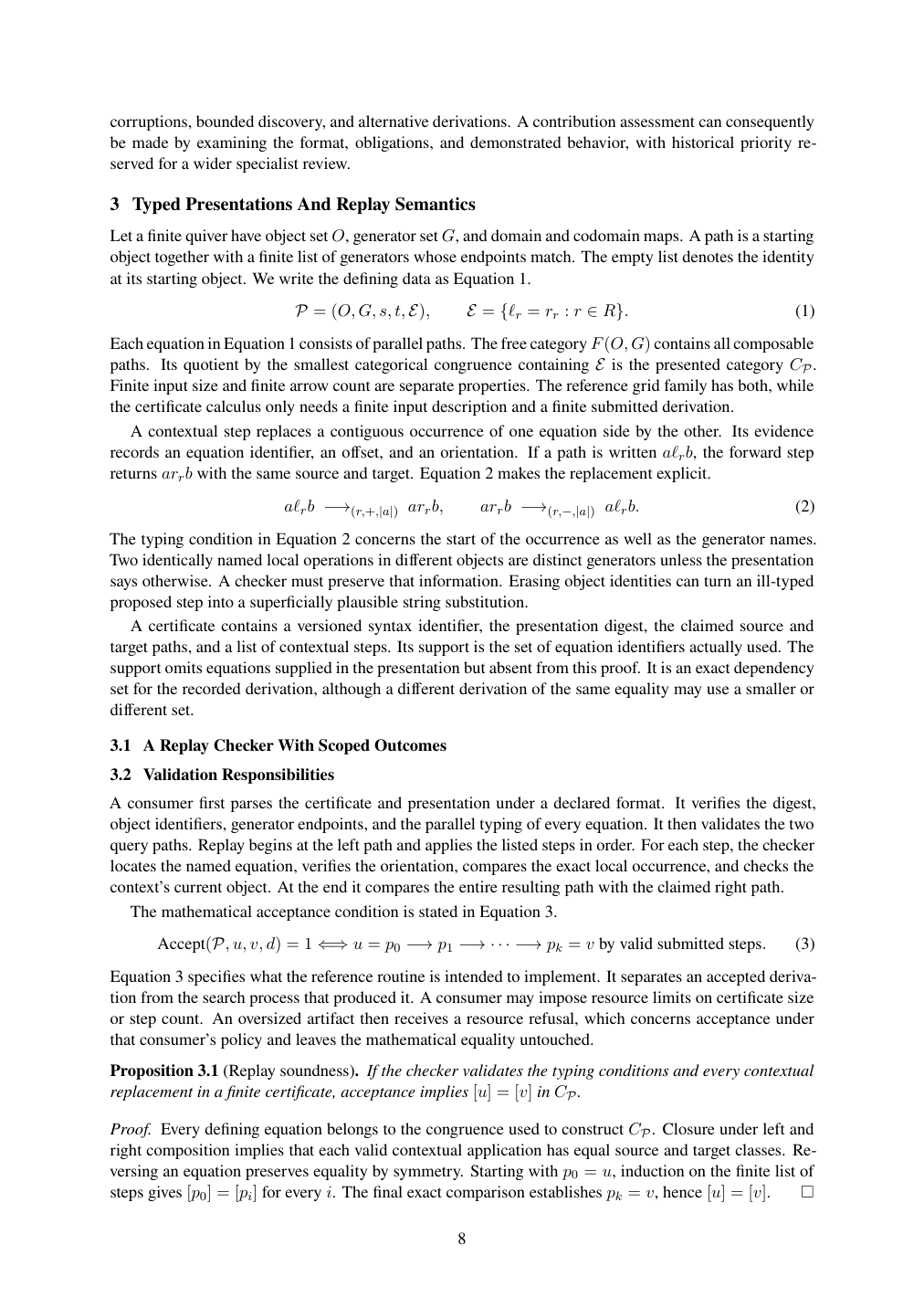
object together with a finite list of generators whose endpoints match. The empty list denotes the identity at its starting object. We write the defining data as Equation 1.
Finite input size and finite arrow count are separate properties. The reference grid family has both, while the certificate calculus only needs a finite input description and a finite submitted derivation.
A contextual step replaces a contiguous occurrence of one equation side by the other. Its evidence
The typing condition in Equation 2 concerns the start of the occurrence as well as the generator names. Two identically named local operations in different objects are distinct generators unless the presentation says otherwise. A checker must preserve that information. Erasing object identities can turn an ill-typed proposed step into a superficially plausible string substitution.
A certificate contains a versioned syntax identifier, the presentation digest, the claimed source and target paths, and a list of contextual steps. Its support is the set of equation identifiers actually used. The support omits equations supplied in the presentation but absent from this proof. It is an exact dependency set for the recorded derivation, although a different derivation of the same equality may use a smaller or
A consumer first parses the certificate and presentation under a declared format. It verifies the digest, object identifiers, generator endpoints, and the parallel typing of every equation. It then validates the two query paths. Replay begins at the left path and applies the listed steps in order. For each step, the checker locates the named equation, verifies the orientation, compares the exact local occurrence, and checks the context’s current object. At the end it compares the entire resulting path with the claimed right path.
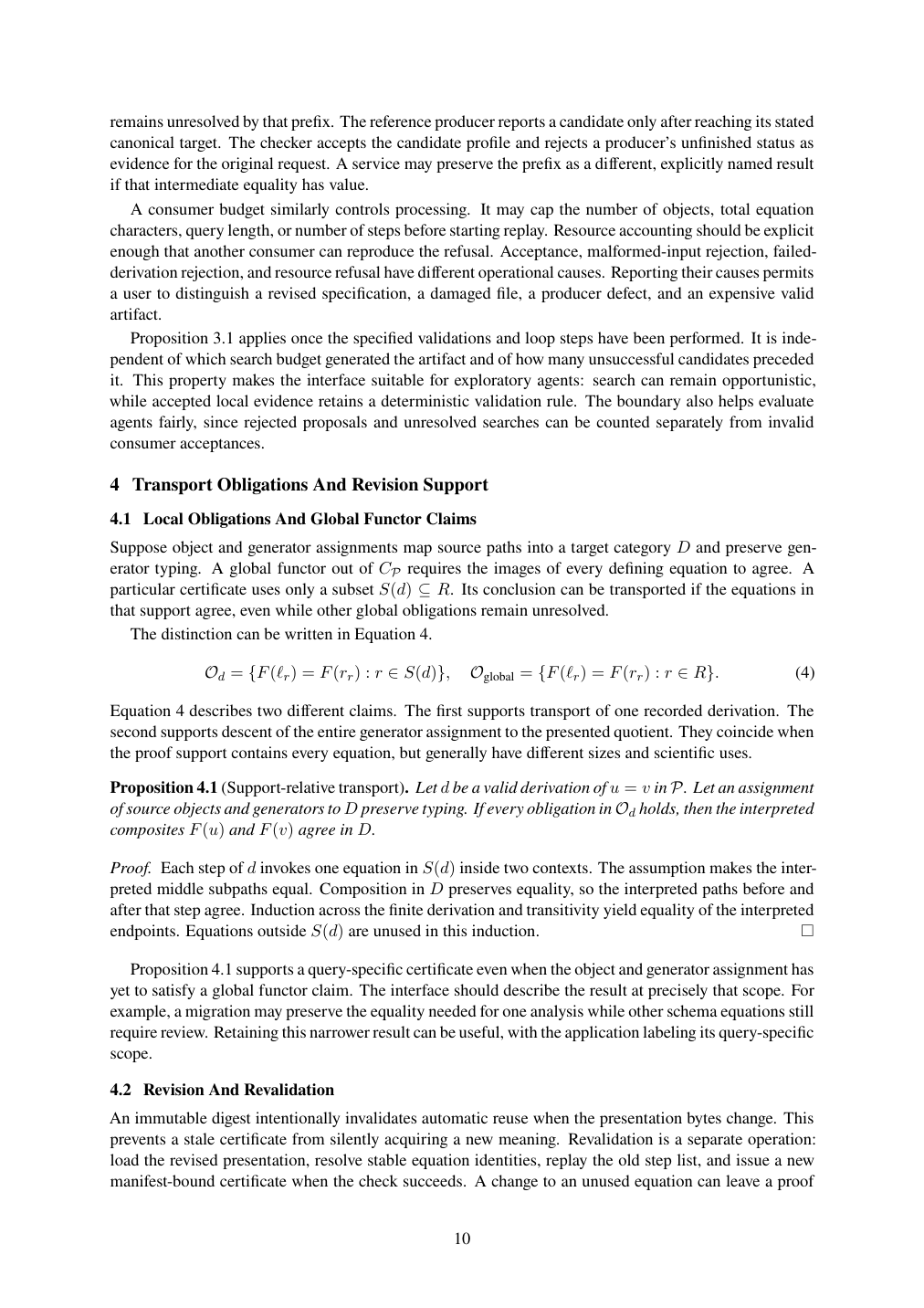
The mathematical acceptance condition is stated in Equation 3.
Equation 3 specifies what the reference routine is intended to implement. It separates an accepted deriva- tion from the search process that produced it. A consumer may impose resource limits on certificate size or step count. An oversized artifact then receives a resource refusal, which concerns acceptance under that consumer’s policy and leaves the mathematical equality untouched.
Proposition 3.1 (Replay soundness). If the checker validates the typing conditions and every contextual
right composition implies that each valid contextual application has equal source and target classes. Re-
Proposition 3.1 is an elementary consequence of presented-category semantics. Its role is to define the trusted mathematical boundary of the proposed interface. The current artifacts supply a mathematical specification and a tested Python implementation. Proof-assistant verification would connect the executable routine to that specification across its admitted input domain.
3.3 Answer Status And Search Status
An equality search may return a candidate derivation, a semantic countermodel, or an unresolved answer. A candidate becomes established for the submitted presentation after replay. A countermodel requires its own checking obligations: it must interpret all relevant generators and equations while distinguishing the two paths. An unresolved answer records bounds and attempted search behavior. These statuses concern different evidence types and should remain distinct in the serialized answer.
This separation is especially useful for an AI-facing interface. A language model can propose equalities, candidate maps, or proof fragments. Its proposal becomes an input to a checker. Repeated attempts can improve coverage while each accepted derivation retains an instance-specific basis. Aggregate success rates then measure the searcher; replay establishes the particular accepted equalities. A well-designed application displays both the local verdict and the search context.
3.4 Input Profiles And Boundary Validation
A portable implementation needs an input profile in addition to the mathematical calculus. The reference profile represents objects by coordinate pairs or string identifiers, generators by unique strings, and paths by generator lists together with a source object. Defining equation sides contain at least one generator. That restriction lets the implementation recover an equation’s source from its first left-side generator. The general calculus permits an empty side, whose identity object must be supplied explicitly. A future profile can add source metadata to every equation and use the same mathematical soundness argument.
The validation order matters. An unknown object, a generator with an absent endpoint, and a path with incompatible consecutive endpoints are malformed inputs. A typed path computation therefore returns either a verified terminal object or an error. Equality of two terminal objects is consulted after both computations succeed. A programming convention that maps errors to a common null value can otherwise make two malformed paths appear to share an endpoint. The supplied checker explicitly tests for both errors before comparing endpoints, and the study includes a case that exercises this boundary.
A certificate’s source also remains significant when both query lists are empty. The identity at one object is a different typed input from the identity at another object. A shared empty list alone loses that distinction. The reference representation stores the source outside the list, allowing an empty query path when the source is a valid object. For nonempty defining sides, the existing profile checks source and target compatibility independently before replay. These choices illustrate how relatively small serialization decisions determine whether formal typing survives interchange.
The replay stage checks an exact occurrence under a valid offset. A signed integer position, a rule orientation in the admitted set, and an existing equation identifier are simple fields with distinct validation responsibilities. The current source is recovered through the path prefix, and the selected side must match the stored subsequence. The replacement side has matching endpoints because the presentation’s equations were checked beforehand. Consequently the suffix stays composable. This reasoning supplies the local invariant maintained by the loop.
3.5 Replay Invariants And Resource Outcomes
The loop invariant is that the current path is typed with the original query endpoints and belongs to the same congruence class as the initial left path. Before the loop, the property follows by reflexivity. A checked equation application preserves it by contextual closure. After the final step, exact equality with the submitted right path identifies the claimed endpoint of the derivation. This expanded invariant explains which validations are mathematical obligations and which fields serve artifact management.

Readable text
remains unresolved by that prefix. The reference producer reports a candidate only after reaching its stated canonical target. The checker accepts the candidate profile and rejects a producer’s unfinished status as evidence for the original request. A service may preserve the prefix as a different, explicitly named result
A consumer budget similarly controls processing. It may cap the number of objects, total equation characters, query length, or number of steps before starting replay. Resource accounting should be explicit enough that another consumer can reproduce the refusal. Acceptance, malformed-input rejection, failed- derivation rejection, and resource refusal have different operational causes. Reporting their causes permits a user to distinguish a revised specification, a damaged file, a producer defect, and an expensive valid
Proposition 3.1 applies once the specified validations and loop steps have been performed. It is inde- pendent of which search budget generated the artifact and of how many unsuccessful candidates preceded it. This property makes the interface suitable for exploratory agents: search can remain opportunistic, while accepted local evidence retains a deterministic validation rule. The boundary also helps evaluate agents fairly, since rejected proposals and unresolved searches can be counted separately from invalid
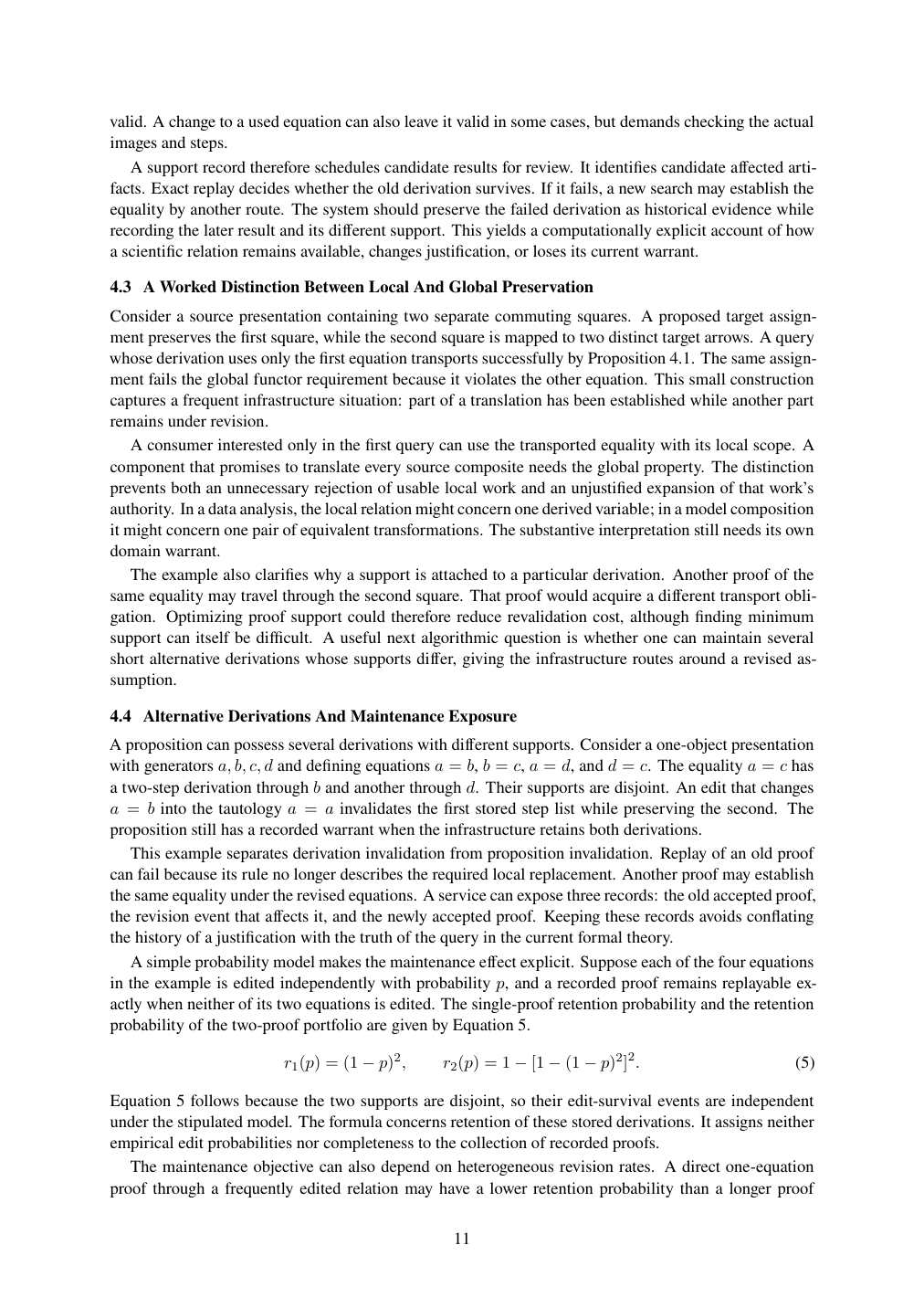
that support agree, even while other global obligations remain unresolved.
Equation 4 describes two different claims. The first supports transport of one recorded derivation. The second supports descent of the entire generator assignment to the presented quotient. They coincide when the proof support contains every equation, but generally have different sizes and scientific uses.
after that step agree. Induction across the finite derivation and transitivity yield equality of the interpreted
Proposition 4.1 supports a query-specific certificate even when the object and generator assignment has yet to satisfy a global functor claim. The interface should describe the result at precisely that scope. For example, a migration may preserve the equality needed for one analysis while other schema equations still require review. Retaining this narrower result can be useful, with the application labeling its query-specific
An immutable digest intentionally invalidates automatic reuse when the presentation bytes change. This prevents a stale certificate from silently acquiring a new meaning. Revalidation is a separate operation: load the revised presentation, resolve stable equation identities, replay the old step list, and issue a new manifest-bound certificate when the check succeeds. A change to an unused equation can leave a proof
Readable text
valid. A change to a used equation can also leave it valid in some cases, but demands checking the actual
A support record therefore schedules candidate results for review. It identifies candidate affected arti- facts. Exact replay decides whether the old derivation survives. If it fails, a new search may establish the equality by another route. The system should preserve the failed derivation as historical evidence while recording the later result and its different support. This yields a computationally explicit account of how a scientific relation remains available, changes justification, or loses its current warrant.
4.3 A Worked Distinction Between Local And Global Preservation
Consider a source presentation containing two separate commuting squares. A proposed target assign- ment preserves the first square, while the second square is mapped to two distinct target arrows. A query whose derivation uses only the first equation transports successfully by Proposition 4.1. The same assign- ment fails the global functor requirement because it violates the other equation. This small construction captures a frequent infrastructure situation: part of a translation has been established while another part
A consumer interested only in the first query can use the transported equality with its local scope. A component that promises to translate every source composite needs the global property. The distinction prevents both an unnecessary rejection of usable local work and an unjustified expansion of that work’s authority. In a data analysis, the local relation might concern one derived variable; in a model composition it might concern one pair of equivalent transformations. The substantive interpretation still needs its own
The example also clarifies why a support is attached to a particular derivation. Another proof of the same equality may travel through the second square. That proof would acquire a different transport obli- gation. Optimizing proof support could therefore reduce revalidation cost, although finding minimum support can itself be difficult. A useful next algorithmic question is whether one can maintain several short alternative derivations whose supports differ, giving the infrastructure routes around a revised as-
A proposition can possess several derivations with different supports. Consider a one-object presentation proposition still has a recorded warrant when the infrastructure retains both derivations.
This example separates derivation invalidation from proposition invalidation. Replay of an old proof can fail because its rule no longer describes the required local replacement. Another proof may establish the same equality under the revised equations. A service can expose three records: the old accepted proof, the revision event that affects it, and the newly accepted proof. Keeping these records avoids conflating the history of a justification with the truth of the query in the current formal theory.
A simple probability model makes the maintenance effect explicit. Suppose each of the four equations actly when neither of its two equations is edited. The single-proof retention probability and the retention probability of the two-proof portfolio are given by Equation 5.
Equation 5 follows because the two supports are disjoint, so their edit-survival events are independent under the stipulated model. The formula concerns retention of these stored derivations. It assigns neither empirical edit probabilities nor completeness to the collection of recorded proofs.
The maintenance objective can also depend on heterogeneous revision rates. A direct one-equation proof through a frequently edited relation may have a lower retention probability than a longer proof
through stable relations. Minimizing proof length and minimizing expected revalidation work are consequently different engineering objectives under a declared revision model. A system can display both length and support metadata, allowing a project to select a policy suited to its workload.
The support set remains an over-approximation of the assumptions necessary for the proposition itself. It is exact for the relation identifiers invoked by the stored derivation, and it may contain removable detours. Computing a globally minimal sufficient set would require comparing alternative derivations or reasoning about the presentation more broadly. The present design treats support extraction as a transparent operation on an existing proof. The portfolio study evaluates the resulting practical option of retaining several short, diverse supports.
4.5 Typed Replay Footprints Across Generator Revision
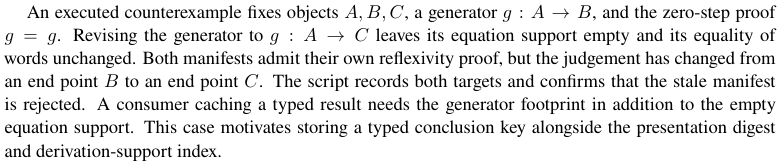
Equation support is one part of a typed proof’s revision footprint. A derivation also depends on the generator definitions that make its paths composable and determine the claimed source and target. The distinction matters for a proof with zero steps: reflexivity has empty equation support, while its typed judgement depends on the path’s endpoints. A revision policy based solely on relation identifiers would overlook that dependency.



Proposition 4.2 is a sufficient incremental maintenance criterion. It permits a service to classify a candidate as unaffected before an exact replay, while the acceptance interface continues to bind the result to a freshly checked manifest. The criterion is conservative: some changed generators or equations can preserve a particular proof. Conversely, an unused malformed equation can cause the complete presentation validation to fail, even while the local word transformations remain interpretable. Local proof dependency and global input acceptance therefore have separate operational roles.
5 Certificate Services And Implementation Interfaces
The inspected kategoria snapshot is commit 7a8644bfa05b6f5dd850cb2f64e0e2a643255bd0. Its presentation header defines typed paths, equations, contextual steps, derivation replay, completion, and certification of rewriting systems. Its kernel contains explicit verdict states and evidence fields. The larger
Noetarium snapshot, commit 869fe38afac257cd9b5d51ad5b498a8ff6b8e443, integrates it through a pinned foundation and the Category Studio (Noetarium Project, 2026).
The report’s scripts implement a reference construction independently of that C++ code. Running python reproduce.py in this report’s directory produces results.json, an example certificate, and the plotted PDFs. The portable study uses the Python standard library and Matplotlib; the source-kernel comparison additionally requires a C++20 compiler (tested with g++ 14.2). It compiles entirely from bundled pinned headers and local fixtures. Its timings can change between runs, while counts and deterministic artifact contents follow the fixed seed and algorithm. The supplied JSON presentation uses stable string identifiers for equations, which simplifies the revalidation demonstration. Its reference profile restricts defining equations to nonempty paths; the formal calculus also permits identity equations, whose source metadata a more general portable format must encode explicitly. The checker rejects any defining equation when either side is ill-typed, including the case in which both endpoint computations fail.
A production interface would need explicit schema versions, maximum lengths, parser behavior, canonical serialization, and error messages distinguishing malformed input, resource refusal, and failed proof. A digest requires a canonical representation if semantically identical presentations should share an identifier. Alternatively, byte identity can be intentional, with a separate semantic mapping between versions. The latter approach makes revision history more explicit but requires careful version management.
5.1 Cost And The Scope Of A Revalidation Decision

Selective revalidation has two possible meanings. One is to skip unchanged results because their checked dependency manifests remain identical. The other is to accept a changed manifest after replay confirms the derivation in the new context. The first relies on the integrity of the dependency record and the chosen cache policy. The second performs a new mathematical validation. Keeping both acts in a journal makes the system’s retained knowledge auditable: a reader can tell whether a result was reused from a stable artifact or reissued after a substantive change.
The grid experiment suggests a useful measure for subsequent studies: the fraction of a presentation used by a retained derivation. This fraction is about one half in the chosen random family, but the general value depends on the scientific questions and proof strategy. A proof producer may trade shorter derivations against smaller supports. A short proof through a frequently revised equation may be more expensive to maintain than a longer proof through stable assumptions. An infrastructure can expose that trade-off without treating maintenance convenience as a criterion of mathematical truth.
5.2 Service Transactions And Artifact Identity
A certificate service can be organized around five immutable artifact types. A presentation artifact specifies the quiver, equations, format, and interpretation metadata. A query artifact names the two paths and source object. A candidate artifact contains the submitted derivation and producer metadata. A validation artifact records the checker version, limits, input digests, outcome, and diagnostic. A revision artifact relates two presentation versions and states which identifiers have been preserved, replaced, or retired. The distinction lets a project retain expensive discovery products while independently updating its consumer policy.
A typical transaction begins by resolving a presentation digest. The service validates the presentation once and stores a checked representation with its format identifier. It next resolves the query paths and producer request. The producer returns a candidate or an unresolved-search record. A consumer validates a candidate against the exact presentation and records its own outcome. A downstream analysis depends on
the validation artifact, which in turn depends on the query, candidate, and presentation. Each dependency is recoverable without rerunning the producer.
Stable equation identifiers support revision, but they require an explicit identity convention. A project might preserve an identifier when the mathematical relation is unchanged and issue a new identifier when its meaning changes. Another project might preserve a conceptual identifier while storing successive versions. Either convention can work if certificates bind the exact relation content. The present digest binds the whole presentation. A more granular design can bind each relation’s content hash and compose those hashes into a presentation manifest.
Serialization also requires decisions about ordering and encoding. Two JSON objects can describe the same mathematical presentation while differing in object order, white space, or number representation. The supplied digest sorts dictionary keys and removes optional separators, which provides deterministic output for its admitted Python values. Interoperable canonicalization across languages needs a documented treatment of Unicode, numeric values, duplicate keys, and identifier comparison. A parser should reject duplicate logical identifiers before a later dictionary construction can silently overwrite them.
5.3 Complexity And Caching Policies

The mathematical specification permits a more efficient service implementation. Presentation validation can be cached by content digest. Generator endpoint tables and equation metadata can be pre-indexed. A rope or persistent sequence can reduce repeated copying for long substitutions, although exact occurrence checking still requires reading relevant symbols or trusting a separately justified representation. The appropriate optimization depends on whether proofs contain short local rewrites, large derived lemmas, or extensive path-length changes. Complexity claims should therefore identify the data structure and workload.
Caching creates a second verification problem: the connection between a cached object and the bytes claimed in the request. A valid cached presentation must be associated with an immutable digest and a declared parser/profile. Changing the parser’s interpretation of an existing byte string can invalidate the cache’s semantics even when the digest remains stable. A robust cache key consequently includes the format version and relevant checker configuration. The service can journal cache reuse as a distinct action from a new replay.
An affected-artifact index can map equation versions to candidate supports and downstream validations. For a changed relation, the index returns a set of results for review. A complete index gives a conservative maintenance schedule; a damaged or incomplete index can omit relevant work. Replaying selected candidates checks their mathematical validity, while auditing the index checks whether the maintenance procedure covered its declared dependency domain. These are complementary properties. A service aiming at reliable revision should expose both the accepted replay records and the dependencyindex construction.
5.4 Source Mapping And Integration Sequence
The pinned presentation header separates a complete flag for a rewriting system from the derivations used to support particular answers. Its comments and implementation explicitly connect positive equality to replay through original equations, and negative normal-form comparison to certification of rewriting properties (Noetarium Project, 2026). This source design supplies the closest local antecedent of the present format. The report makes that inherited separation visible and extends its operational treatment to export and revision.
Readable text
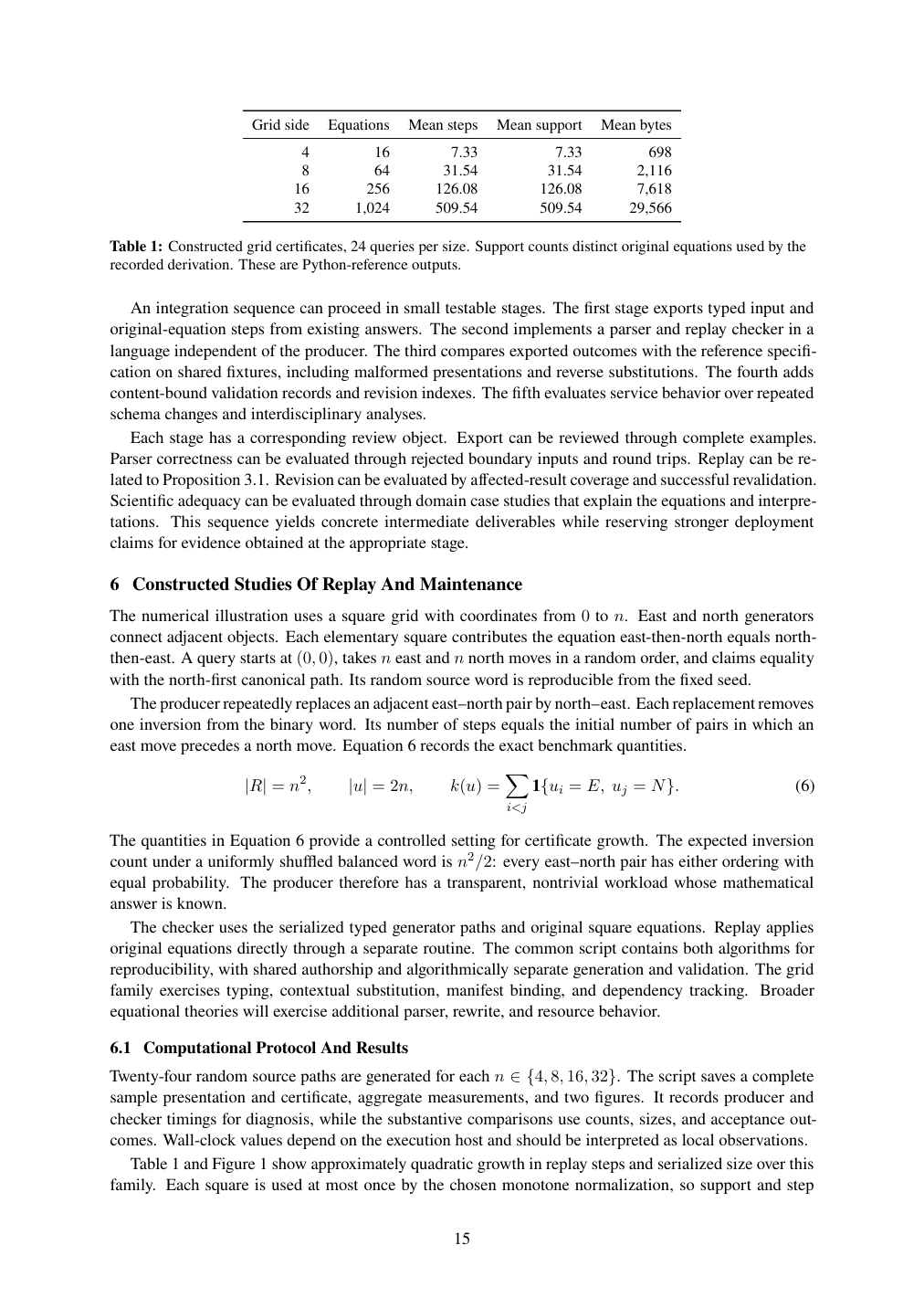
Table 1: Constructed grid certificates, 24 queries per size. Support counts distinct original equations used by the
recorded derivation. These are Python-reference outputs.
An integration sequence can proceed in small testable stages. The first stage exports typed input and original-equation steps from existing answers. The second implements a parser and replay checker in a language independent of the producer. The third compares exported outcomes with the reference specifi- cation on shared fixtures, including malformed presentations and reverse substitutions. The fourth adds content-bound validation records and revision indexes. The fifth evaluates service behavior over repeated
Each stage has a corresponding review object. Export can be reviewed through complete examples. Parser correctness can be evaluated through rejected boundary inputs and round trips. Replay can be re- lated to Proposition 3.1. Revision can be evaluated by affected-result coverage and successful revalidation. Scientific adequacy can be evaluated through domain case studies that explain the equations and interpre- tations. This sequence yields concrete intermediate deliverables while reserving stronger deployment
claims for evidence obtained at the appropriate stage.
connect adjacent objects. Each elementary square contributes the equation east-then-north equals north- with the north-first canonical path. Its random source word is reproducible from the fixed seed.
The producer repeatedly replaces an adjacent east–north pair by north–east. Each replacement removes one inversion from the binary word. Its number of steps equals the initial number of pairs in which an east move precedes a north move. Equation 6 records the exact benchmark quantities.
The quantities in Equation 6 provide a controlled setting for certificate growth. The expected inversion equal probability. The producer therefore has a transparent, nontrivial workload whose mathematical
The checker uses the serialized typed generator paths and original square equations. Replay applies original equations directly through a separate routine. The common script contains both algorithms for reproducibility, with shared authorship and algorithmically separate generation and validation. The grid family exercises typing, contextual substitution, manifest binding, and dependency tracking. Broader equational theories will exercise additional parser, rewrite, and resource behavior.
sample presentation and certificate, aggregate measurements, and two figures. It records producer and checker timings for diagnosis, while the substantive comparisons use counts, sizes, and acceptance out- comes. Wall-clock values depend on the execution host and should be interpreted as local observations.
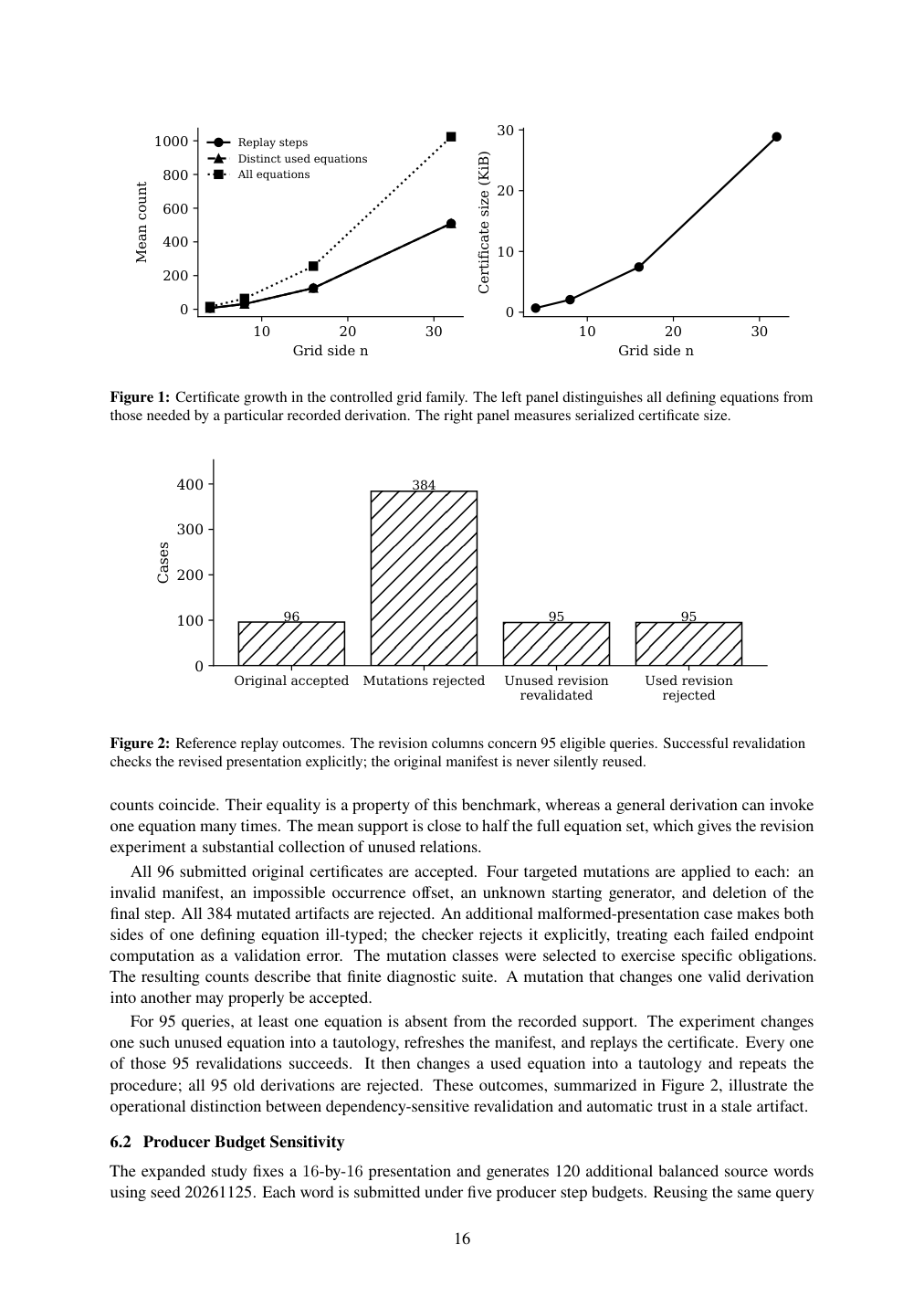
Table 1 and Figure 1 show approximately quadratic growth in replay steps and serialized size over this family. Each square is used at most once by the chosen monotone normalization, so support and step
Readable text
Figure 1: Certificate growth in the controlled grid family. The left panel distinguishes all defining equations from those needed by a particular recorded derivation. The right panel measures serialized certificate size.
Figure 2: Reference replay outcomes. The revision columns concern 95 eligible queries. Successful revalidation checks the revised presentation explicitly; the original manifest is never silently reused.
counts coincide. Their equality is a property of this benchmark, whereas a general derivation can invoke one equation many times. The mean support is close to half the full equation set, which gives the revision experiment a substantial collection of unused relations.
All 96 submitted original certificates are accepted. Four targeted mutations are applied to each: an invalid manifest, an impossible occurrence offset, an unknown starting generator, and deletion of the final step. All 384 mutated artifacts are rejected. An additional malformed-presentation case makes both sides of one defining equation ill-typed; the checker rejects it explicitly, treating each failed endpoint computation as a validation error. The mutation classes were selected to exercise specific obligations. The resulting counts describe that finite diagnostic suite. A mutation that changes one valid derivation
For 95 queries, at least one equation is absent from the recorded support. The experiment changes one such unused equation into a tautology, refreshes the manifest, and replays the certificate. Every one of those 95 revalidations succeeds. It then changes a used equation into a tautology and repeats the procedure; all 95 old derivations are rejected. These outcomes, summarized in Figure 2, illustrate the operational distinction between dependency-sensitive revalidation and automatic trust in a stale artifact.
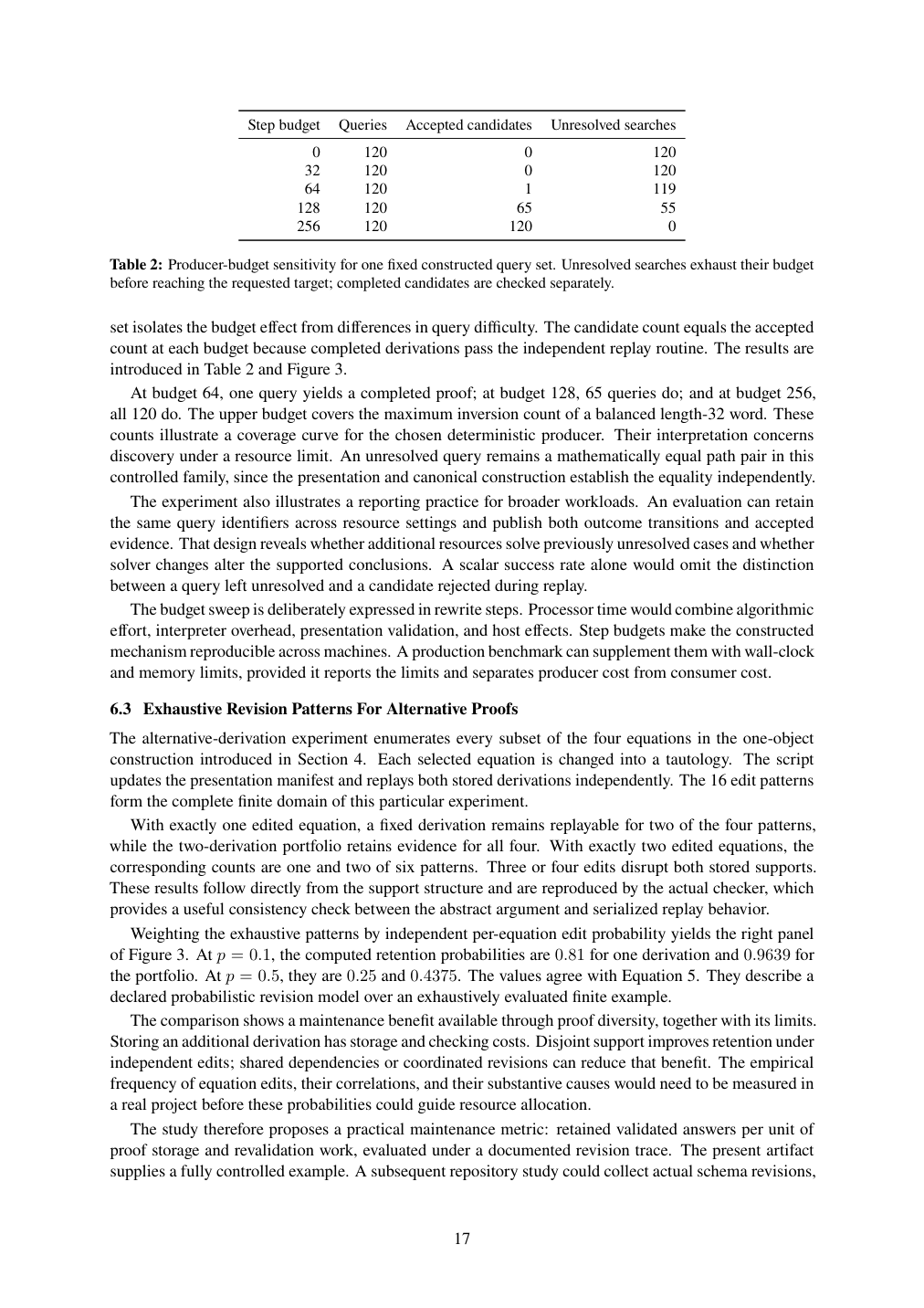
The expanded study fixes a 16-by-16 presentation and generates 120 additional balanced source words using seed 20261125. Each word is submitted under five producer step budgets. Reusing the same query
Readable text
Table 2: Producer-budget sensitivity for one fixed constructed query set. Unresolved searches exhaust their budget before reaching the requested target; completed candidates are checked separately.
set isolates the budget effect from differences in query difficulty. The candidate count equals the accepted count at each budget because completed derivations pass the independent replay routine. The results are
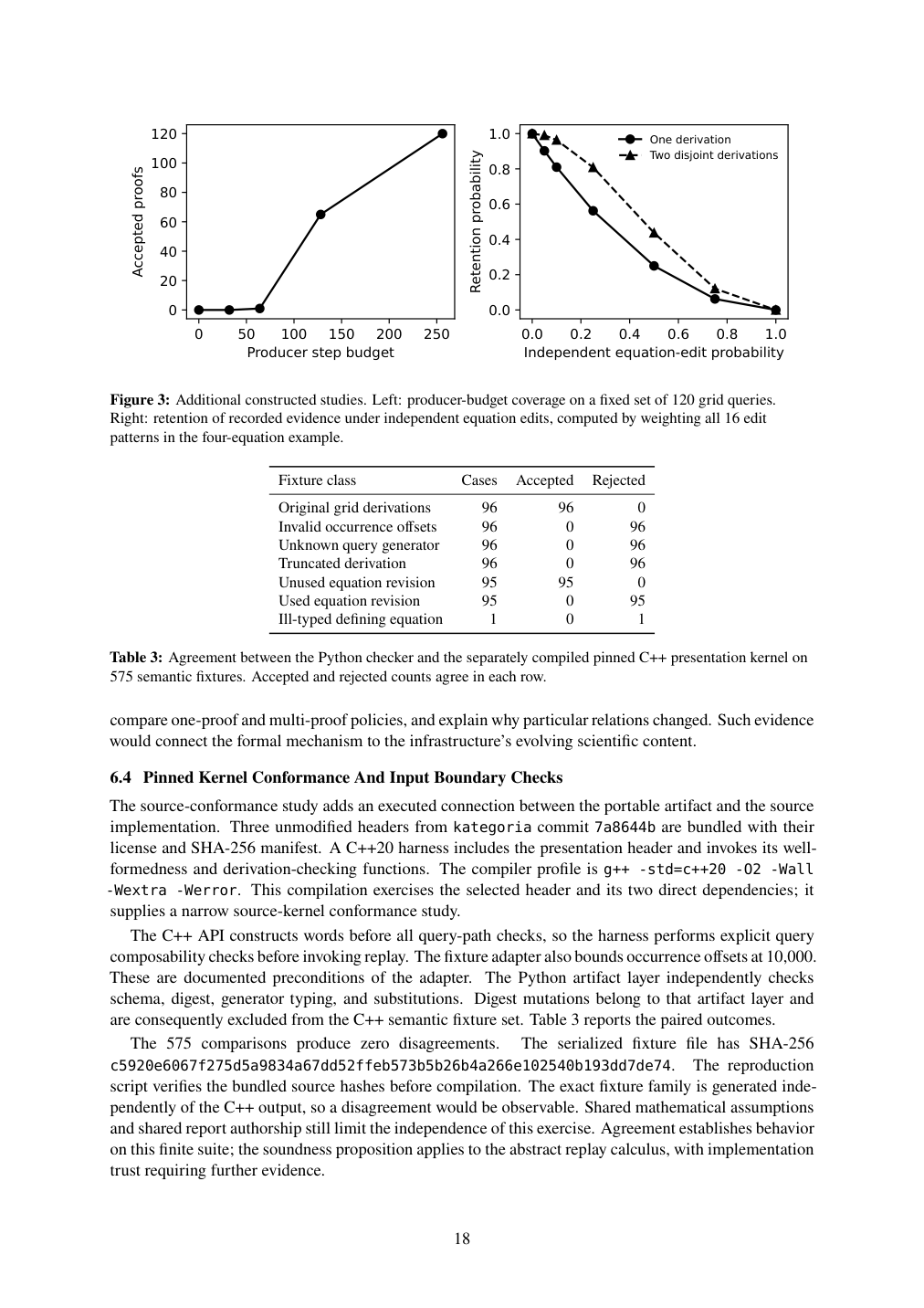
At budget 64, one query yields a completed proof; at budget 128, 65 queries do; and at budget 256, all 120 do. The upper budget covers the maximum inversion count of a balanced length-32 word. These counts illustrate a coverage curve for the chosen deterministic producer. Their interpretation concerns discovery under a resource limit. An unresolved query remains a mathematically equal path pair in this controlled family, since the presentation and canonical construction establish the equality independently.
The experiment also illustrates a reporting practice for broader workloads. An evaluation can retain the same query identifiers across resource settings and publish both outcome transitions and accepted evidence. That design reveals whether additional resources solve previously unresolved cases and whether solver changes alter the supported conclusions. A scalar success rate alone would omit the distinction between a query left unresolved and a candidate rejected during replay.
The budget sweep is deliberately expressed in rewrite steps. Processor time would combine algorithmic effort, interpreter overhead, presentation validation, and host effects. Step budgets make the constructed mechanism reproducible across machines. A production benchmark can supplement them with wall-clock and memory limits, provided it reports the limits and separates producer cost from consumer cost.
6.3 Exhaustive Revision Patterns For Alternative Proofs
The alternative-derivation experiment enumerates every subset of the four equations in the one-object construction introduced in Section 4. Each selected equation is changed into a tautology. The script updates the presentation manifest and replays both stored derivations independently. The 16 edit patterns form the complete finite domain of this particular experiment.
With exactly one edited equation, a fixed derivation remains replayable for two of the four patterns, while the two-derivation portfolio retains evidence for all four. With exactly two edited equations, the corresponding counts are one and two of six patterns. Three or four edits disrupt both stored supports. These results follow directly from the support structure and are reproduced by the actual checker, which provides a useful consistency check between the abstract argument and serialized replay behavior.
Weighting the exhaustive patterns by independent per-equation edit probability yields the right panel declared probabilistic revision model over an exhaustively evaluated finite example.
The comparison shows a maintenance benefit available through proof diversity, together with its limits. Storing an additional derivation has storage and checking costs. Disjoint support improves retention under independent edits; shared dependencies or coordinated revisions can reduce that benefit. The empirical frequency of equation edits, their correlations, and their substantive causes would need to be measured in a real project before these probabilities could guide resource allocation.
The study therefore proposes a practical maintenance metric: retained validated answers per unit of proof storage and revalidation work, evaluated under a documented revision trace. The present artifact supplies a fully controlled example. A subsequent repository study could collect actual schema revisions,
Readable text
Figure 3: Additional constructed studies. Left: producer-budget coverage on a fixed set of 120 grid queries. Right: retention of recorded evidence under independent equation edits, computed by weighting all 16 edit
Original grid derivations Invalid occurrence offsets Unknown query generator Truncated derivation Unused equation revision Used equation revision Ill-typed defining equation
Table 3: Agreement between the Python checker and the separately compiled pinned C++ presentation kernel on 575 semantic fixtures. Accepted and rejected counts agree in each row.
compare one-proof and multi-proof policies, and explain why particular relations changed. Such evidence would connect the formal mechanism to the infrastructure’s evolving scientific content.
6.4 Pinned Kernel Conformance And Input Boundary Checks
The source-conformance study adds an executed connection between the portable artifact and the source implementation. Three unmodified headers from kategoria commit 7a8644b are bundled with their license and SHA-256 manifest. A C++20 harness includes the presentation header and invokes its well- formedness and derivation-checking functions. The compiler profile is g++ -std=c++20 -O2 -Wall -Wextra -Werror. This compilation exercises the selected header and its two direct dependencies; it
The C++ API constructs words before all query-path checks, so the harness performs explicit query composability checks before invoking replay. The fixture adapter also bounds occurrence offsets at 10,000. These are documented preconditions of the adapter. The Python artifact layer independently checks schema, digest, generator typing, and substitutions. Digest mutations belong to that artifact layer and are consequently excluded from the C++ semantic fixture set. Table 3 reports the paired outcomes.
The 575 comparisons produce zero disagreements. c5920e6067f275d5a9834a67dd52ffeb573b5b26b4a266e102540b193dd7de74. script verifies the bundled source hashes before compilation. The exact fixture family is generated inde- pendently of the C++ output, so a disagreement would be observable. Shared mathematical assumptions and shared report authorship still limit the independence of this exercise. Agreement establishes behavior on this finite suite; the soundness proposition applies to the abstract replay calculus, with implementation
The serialized fixture file has SHA-256 The reproduction
The Python input boundary accepts a restricted parsed-JSON profile. It checks required fields and types, unique object identifiers, integer occurrence offsets and directions, and finite resource bounds before mathematical replay. Boolean values are rejected in integer fields. A separate JSON loader rejects repeated object keys and nonfinite numeric constants. The executed boundary suite contains 25 malformed parsed artifacts and four malformed raw-JSON examples; each is rejected. The raw loader and parsed-object checker have different contracts, and an application receiving bytes should use both in that order. Serialized query and equation paths are limited to 10,000 entries, step lists to 100,000 entries, and each presentation item collection to 50,000 entries. These finite limits describe the tested reference profile and permit an application to fail early on oversized requests.
The conformance and boundary studies address different reviewer concerns. The former checks contact with the actual source semantics. The latter makes the accepted artifact language and its parser obligations concrete. McConnell et al.’s treatment of input integrity and pragmatic checker correctness provides the relevant architectural precedent (McConnell et al., 2011). Formal verification of a parser, memory safety, and conformance for arbitrary presented categories remain separate engineering obligations. The publication package now exposes the precise kernel, preflight conditions, source hashes, fixture protocol, and failure classes needed to pursue those obligations.
7 Finite Interpretations And Distinguishing Evidence


This construction remains a worked extension of the certificate design; the supplied automated experiment exercises positive replay and revision. A future portable format can admit both kinds of evidence while retaining separate validators. The relation between them is logical: a checked derivation establishes equality in every model of the presentation, and a checked countermodel establishes that the proposed equality fails in at least one such model. Resource-bounded failure to obtain either artifact remains an unresolved search outcome. This three-way interface is especially useful when an AI explorer generates claims faster than a human can inspect the internal search histories.
7.1 Finite-Model Validation Obligations

Proposition 7.1 states the corresponding mathematical guarantee. Its proof uses the universal interpretation property of a presented category and gives the precise role of checking the entire equation set.


The contrast between support-relative transport and a countermodel is analytically significant. A recorded equality needs the equations used in its proof for that particular transport. A distinguishing interpretation needs admissibility for the presentation whose inequality it claims. Checking only relations found convenient by the proposed countermodel producer would weaken the conclusion. Proposition 7.1 explicitly quantifies over the source theory’s defining relations.

7.2 Evidence Diversity And Search Coverage
A finite distinguishing model proves a particular inequality when one is found and validated. The availability of finite models for arbitrary presented-category inequalities is a separate mathematical property. The proposed service consequently treats finite-model search as one producer strategy with a bounded search domain. A limit on carrier size specifies the models attempted. An unresolved result at that limit records the explored domain and leaves the original equality judgement open.
The different evidence types can also be used to test consumers against one another. A checked equality and a checked admissible countermodel for the same query and presentation would be inconsistent by Propositions 3.1 and 7.1. Such a conflict would direct attention to implementation, parsing, identity binding, or the mathematical specification. This consistency relation provides a useful integration test when multiple evidence producers operate over shared artifacts.
Scientific interpretations add a further distinction. A set-valued countermodel is a formal interpretation of the equations. Its role is logical separation within the stated formal theory. Empirical plausibility requires a further disciplinary assessment. A domain argument might additionally rule out some formal interpretations through substantive constraints; those constraints would then belong in an enriched presentation or a separately stated model class. Retaining the model class alongside the verdict makes the logical scope visible to interdisciplinary users.
8 Contribution Assessment And Research Programme
The central trust boundary includes the checker, parser, presentation, and underlying execution environment. A small checker reduces the amount of code whose correctness matters, while assurance about its behavior requires a proof or an appropriate evaluation. Tests should cover empty paths, identity equations, reverse substitutions, repeated equations, malformed endpoints, large offsets, and adversarial resource consumption. A verified implementation in a proof assistant could connect the executable checker to Proposition 3.1.
The benchmark deliberately uses a family with easy positive proofs. It therefore evaluates the interface more directly than the search algorithm. Further experiments should include presentations where completion stops early, finite categories represented by full composition tables, equalities with repeated support, and countermodels for inequality. A valid comparison would specify overlapping tasks across tools and count both solved and unresolved cases under matched resource budgets. User-facing explanations should also be assessed for whether readers understand the scope of each verdict.
Transport creates a second source of failure. A generator assignment may change domains, units, or substantive meaning while preserving a syntactic equality. Proposition 4.1 establishes an algebraic state-
Readable text
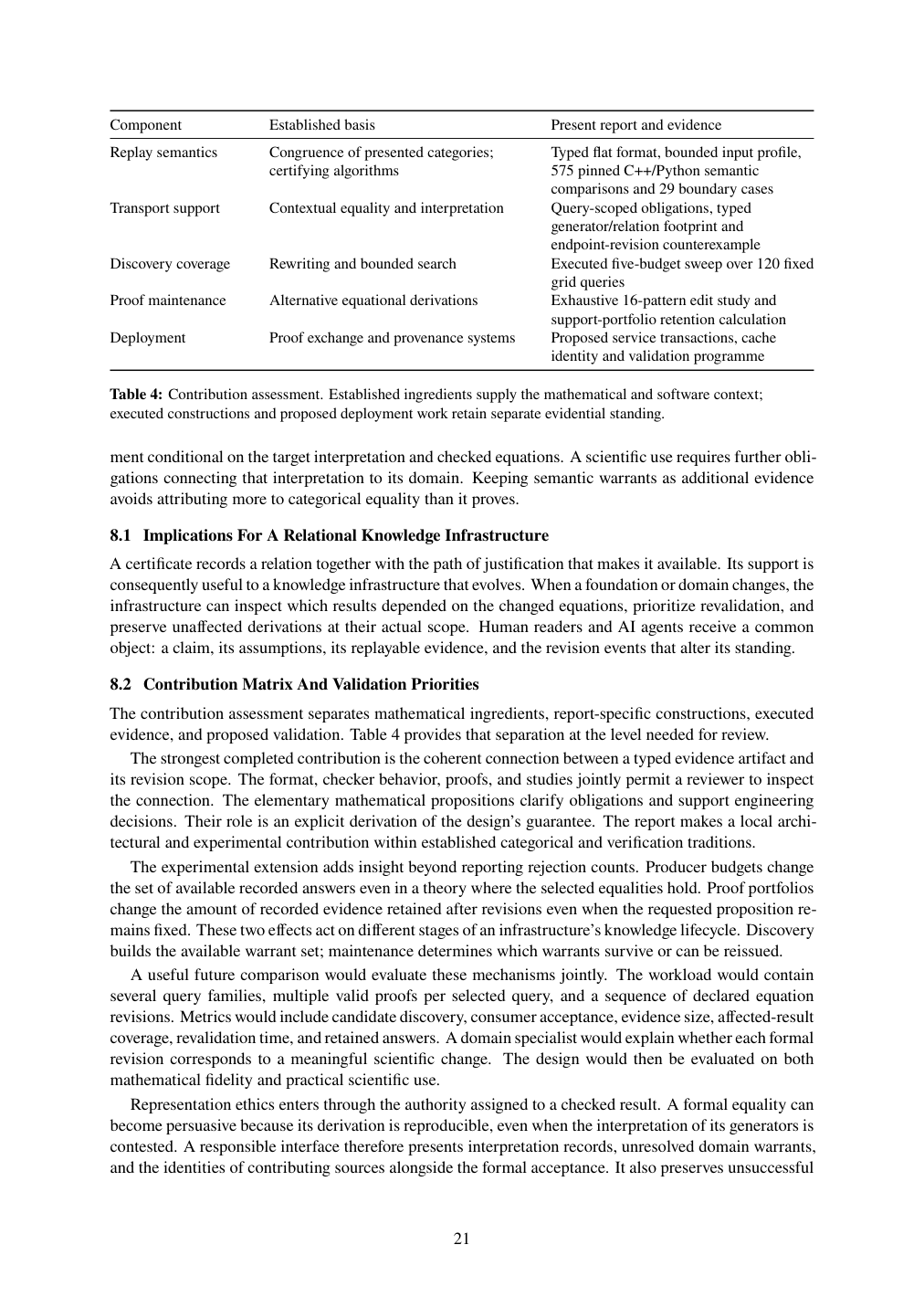
Typed flat format, bounded input profile, 575 pinned C++/Python semantic comparisons and 29 boundary cases Query-scoped obligations, typed generator/relation footprint and endpoint-revision counterexample Executed five-budget sweep over 120 fixed grid queries Exhaustive 16-pattern edit study and support-portfolio retention calculation Proposed service transactions, cache identity and validation programme
Contextual equality and interpretation Alternative equational derivations Proof exchange and provenance systems
Transport support Discovery coverage Rewriting and bounded search Proof maintenance Deployment
Table 4: Contribution assessment. Established ingredients supply the mathematical and software context; executed constructions and proposed deployment work retain separate evidential standing.
ment conditional on the target interpretation and checked equations. A scientific use requires further obli- gations connecting that interpretation to its domain. Keeping semantic warrants as additional evidence avoids attributing more to categorical equality than it proves.
8.1 Implications For A Relational Knowledge Infrastructure
A certificate records a relation together with the path of justification that makes it available. Its support is consequently useful to a knowledge infrastructure that evolves. When a foundation or domain changes, the infrastructure can inspect which results depended on the changed equations, prioritize revalidation, and preserve unaffected derivations at their actual scope. Human readers and AI agents receive a common object: a claim, its assumptions, its replayable evidence, and the revision events that alter its standing.
The contribution assessment separates mathematical ingredients, report-specific constructions, executed evidence, and proposed validation. Table 4 provides that separation at the level needed for review.
The strongest completed contribution is the coherent connection between a typed evidence artifact and its revision scope. The format, checker behavior, proofs, and studies jointly permit a reviewer to inspect the connection. The elementary mathematical propositions clarify obligations and support engineering decisions. Their role is an explicit derivation of the design’s guarantee. The report makes a local archi- tectural and experimental contribution within established categorical and verification traditions.
The experimental extension adds insight beyond reporting rejection counts. Producer budgets change the set of available recorded answers even in a theory where the selected equalities hold. Proof portfolios change the amount of recorded evidence retained after revisions even when the requested proposition re- mains fixed. These two effects act on different stages of an infrastructure’s knowledge lifecycle. Discovery builds the available warrant set; maintenance determines which warrants survive or can be reissued.
A useful future comparison would evaluate these mechanisms jointly. The workload would contain several query families, multiple valid proofs per selected query, and a sequence of declared equation revisions. Metrics would include candidate discovery, consumer acceptance, evidence size, affected-result coverage, revalidation time, and retained answers. A domain specialist would explain whether each formal revision corresponds to a meaningful scientific change. The design would then be evaluated on both
mathematical fidelity and practical scientific use.
Representation ethics enters through the authority assigned to a checked result. A formal equality can become persuasive because its derivation is reproducible, even when the interpretation of its generators is contested. A responsible interface therefore presents interpretation records, unresolved domain warrants, and the identities of contributing sources alongside the formal acceptance. It also preserves unsuccessful
translations and revised assumptions as part of the research history. These records let human and AI users inspect the reasons a relation is available.
8.3 Conclusion
Finite derivations offer a precise boundary between proposing a categorical equality and validating it. This report specifies that boundary through typed equation replay, gives a support-relative transport result, and demonstrates revision behavior in a reproducible grid construction. The typed-footprint criterion, endpoint counterexample, pinned kernel comparisons and parser boundary suite make the artifact’s maintenance and acceptance contracts reviewable. The broader insight is that a reusable categorical result should retain the relations that justify it. In a changing scientific infrastructure, those relations permit selective revalidation and clarify when a local conclusion remains available while a global claim awaits further evidence.
References
McConnell, Ross M.; Mehlhorn, Kurt; Näher, Stefan; Schweitzer, Pascal. 2011. Certifying algorithms. Computer
Science Review 5(2):119–161. https://doi.org/10.1016/j.cosrev.2010.09.009. Necula, George C.. 1997. Proof-carrying code. Proceedings of POPL:106–119. https://doi.org/10.1145/26
3699.263712. Knuth, Donald E.; Bendix, Peter B.. 1970. Simple word problems in universal algebras. Computational Problems
in Abstract Algebra:263–297. https://doi.org/10.1016/B978-0-08-012975-4.50028-X. Catlab Contributors. 2026. Catlab.jl: A framework for applied category theory in Julia. Official project documenta-
tion. https://github.com/AlgebraicJulia/Catlab.jl. CQL Project. 2026. Categorical databases: CQL. Official project documentation. https://categoricaldata.
net/. Spivak, David I.. 2012. Functorial data migration. Information and Computation 217:31–51. https://doi.org/
10.1016/j.ic.2012.05.001. Schultz, Patrick; Wisnesky, Ryan. 2017. Algebraic data integration. Journal of Functional Programming 27:e24.
https://doi.org/10.1017/S0956796817000168. Ekici, Burak; Mebsout, Alain; Tinelli, Cesare; Keller, Chantal; Katz, Guy; Reynolds, Andrew; Barrett, Clark.
- SMTCoq: A plug-in for integrating SMT solvers into Coq. Computer Aided Verification 10427:126–133. https://doi.org/10.1007/978-3-319-63390-9\_7. Nelson, Greg; Oppen, Derek C.. 1980. Fast decision procedures based on congruence closure. Journal of the ACM
27(2):356–364. https://doi.org/10.1145/322186.322198. Green, Todd J.; Karvounarakis, Grigoris; Tannen, Val. 2007. Provenance semirings. Proceedings of PODS:31–40.
https://doi.org/10.1145/1265530.1265535. Moreau, Luc; Missier, Paolo. 2013. PROV-DM: The PROV data model. W3C Recommendation. https://www.w3
.org/TR/prov-dm/. Schurr, Hans-Jörg; Fleury, Mathias; Barbosa, Haniel; Fontaine, Pascal. 2021. Alethe: Towards a generic SMT proof
format (extended abstract). EPTCS 336:49–54. https://doi.org/10.4204/EPTCS.336.6. Noetarium Project. 2026. Noetarium and kategoria: Source snapshots. Pinned source snapshot. https://raw.gi
thubusercontent.com/huangwanhong-maker/kategoria/7a8644bfa05b6f5dd850cb2f64e0e2a6432 55bd0/presentations/include/kategoria/presentations/presentation.hpp.