Estimand Stability Under Uncertain Data Harmonisation
Full text from the PDF
Estimand Stability Under Uncertain Data Harmonisation
Wanhong HUANG
Abstract
Cross-disciplinary harmonisation can admit several defensible correspondences between source categories and a target concept. This report represents them as a bounded polyhedral score family and evaluates sharp bounds for a linear estimand. Partial identification, linear optimization, information preservation and minimax elicitation provide established foundations. The report-specific design binds semantic warrants, extremal witnesses and downstream audit objectives to versioned harmonisation results. Paired-polytope programs compute worst residual width and worst post-response minimax regret for two pure threshold actions under exact or bounded-error coordinate audits. A rational score-polytope counterexample strictly reverses width and decision audit rankings; executed rational primal and dual certificates verify both optima. A 200-case constructed comparison also exposes decision differences among width-tied audits, while precision and bundle studies isolate the role of coupled semantic constraints. A separately compiled pinned common-target kernel agrees with an independent reference on all 4,096 correspondence graphs between three and four source codes. That deterministic quotient remains distinct from the proposed uncertainty optimizer. The report supplies formal conditions, matched audit baselines, numerical witnesses and an operational integration contract. Its conclusions concern declared semantic families and task utilities; real survey application requires independent constraint provenance, review accuracy and utility calibration.
Keywords: data harmonisation; partial identification; semantic audits; information loss; robust decisions
Technical Report Note
This technical report shares an evolving inquiry and invites dialogue, criticism, revision, and independent development. Its definitions, distinctions, and constructions remain open to refinement. Circulation across scholarly and practical communities is part of the purpose of releasing the manuscript.
The author treats the viewpoints, concepts, and lines of reasoning presented here as contributions to a shared field of inquiry. Similar or related ideas may have appeared in other intellectual, cultural, and disciplinary traditions. The manuscript identifies known antecedents and distinguishes inherited positions, interpretive proposals, and arguments developed here. Historical priority remains open to further investigation.
The constructions and arguments are presented with their stated assumptions and evidential scope. Readers are encouraged to question, test, revise, extend, reinterpret, or independently develop the ideas presented here. Where appropriate, acknowledgment of this paper as one point of encounter in the development of a related idea is appreciated. Such acknowledgment records an intellectual route; the ideas remain available for criticism, revision, and independent development.
Definitions introduced by the paper are local analytical stipulations unless attributed to another source. Their use identifies the scope of the present argument; terminological and historical priority remain subjects for independent investigation. Generative Relational theory is treated as an open research programme whose proposals receive critical examination alongside independent literature.
Responsible Use and Rights Reservation
This section records a request for responsible scholarly conduct and identifies the scope of retained rights. Legal permissions are governed by the licence on the following page.
The author encourages good-faith discussion, criticism, independent inquiry, and responsible use of the material. Separately from the licence’s terms, the author asks users to consider foreseeable harms when adapting the arguments, representations, or examples of this paper, particularly in scientific inquiry, institutional decisions, and computational knowledge infrastructures. The ethical request leaves the licence’s permissions and legally authorised uses unchanged.
The author retains the rights preserved under CC BY-NC 4.0 and may pursue remedies to which the author is legally entitled for breach of the licence or violation of independently applicable rights. Reuse remains independent from authorial endorsement. Third-party rights require authorisation from their respective holders where applicable. Copyright exceptions and limitations, including applicable forms of fair use or fair dealing, remain available.
Notices
This page consolidates the manuscript’s research status, licence, development disclosure, researchprogramme relation, and suggested citation.
Status. This technical report is prepared for the author’s substantive review and subsequent scholarly discussion. The report distinguishes established antecedents, conditional results developed here, inspected source artifacts, and numerical illustrations under declared assumptions. Internal checks assess the stated arguments and examples; independent scholarly assessment can further test their interpretation and adequacy. The source ledgers record the access level and claim scope of consulted works.
Licence. Except where otherwise indicated, copyright 2026 Wanhong Huang. This work is made available under the Creative Commons Attribution-NonCommercial 4.0 International License (CC BY-NC 4.0). Subject to its terms, the licence permits sharing and adaptation for noncommercial purposes with appropriate attribution, a link to the licence, and an indication of changes. Attribution should preserve the licensor’s independence from the reuse. Reuse is governed solely by the licence; the responsible-use request on the preceding page remains separate from its terms. The licence deed and legal code are available at https://creativecommons.org/licenses/by-nc/4.0/. The licence governs in case of conflict with this summary. Third-party material remains subject to its respective rights.
Statement on the use of language models. Preparation involved OpenAI’s ChatGPT and Codex. Language models supported exploratory dialogue, source discovery and checking, argumentative criticism, manuscript revision, LATEX typesetting, and the development of supporting code and figures. Verification used the sources and access levels recorded in the accompanying ledgers. The author initiated the research questions and directed the research programme; interpretation, acceptance of the arguments, and publication decisions remain subject to the author’s review. Authorship credit and responsibility for the released manuscript remain with the human author.
Code and data availability. The supporting Python linear programs, extremal translations, primal and dual records, precision-audit studies, and computed figures accompany the manuscript. The category proportions are constructed inputs. The source package contains the editable manuscript, source ledgers, supporting scripts and outputs, and a reading guide. Numerical illustrations, where present, use the assumptions stated in their captions and text.
Related research programme. This report belongs to the Noetarium technical report series. Companion reports study inference, computation, evaluation, governance, and cross-disciplinary knowledge formation. The reports develop distinct technical questions within an open Generative Relational research programme.
Suggested citation. Huang, Wanhong. “Estimand Stability Under Uncertain Data Harmonisation.” Technical report, 2026.
1 Harmonisation Objectives And Estimand Scope
Cross-disciplinary inquiry depends on comparisons among records produced for different purposes. One study distinguishes several forms of care, another records a single assistance category, and a third uses an institutional eligibility rule. Bringing these records together requires a substantive account of their meanings. Software can check whether a recode covers every source code and whether it reaches valid target categories. The resulting structural consistency is valuable, while the interpretation of those categories remains an additional part of the inquiry.

This report develops that question for linear comparisons of bounded target scores. It connects three tasks: determining whether a specified estimand survives coarsening, bounding its value across uncertain alignments, and choosing a semantic audit that reduces the relevant uncertainty. Each task has substantial antecedents. The contribution is a restricted and executable synthesis for a revisable data infrastructure, with a concrete demonstration that relational constraints can reverse a simple audit-priority heuristic.
The construction serves a technical-report purpose. It gives definitions, proofs, complete small computations, and an implementation route. Its examples use declared category proportions and score constraints. They are constructed populations, chosen to expose identification structure. A later empirical study should replace those declarations with documented codebooks, independently assessed correspondences, and validation observations whose sampling design is known.
1.1 Research Questions And Objects Of Comparison
The central object of this report is a descriptive estimand evaluated over a family of admissible translations. A translation family represents the information supplied by codebooks, anchor meanings, validation exercises, and declared correspondence restrictions. The estimand supplies the research question. Their combination determines which conclusions are stable and which depend on unresolved semantic choices. This orientation supports interdisciplinary work because different analyses can use the same source records while requiring different distinctions.
Three research questions guide the analysis. The first concerns identification: which target contrasts follow from a specified translation family and observed category proportions? The second concerns preservation: which source-level functionals remain recoverable after deterministic recoding? The third concerns acquisition: which additional semantic audit most reduces the range of admissible conclusions? Linear scores and polyhedral constraints provide a tractable setting in which these questions can be answered exactly and their assumptions inspected.
The analysis treats harmonisation as a sequence of accountable acts. A project identifies a target concept, records the source classifications, states candidate correspondences, adopts restrictions, and evaluates a question. Each act can be revised. An expert’s judgement about two labels can change the translation family, while a newly measured population distribution can change the estimand coefficients. Those two revisions can produce different outputs through the same optimization procedure. Distinguishing their provenance helps a researcher interpret what caused the result to move.
The examples use bounded target scores. A score can be a conditional probability for a binary concept when a measurement model supports that interpretation, or a normalized index adopted for descriptive comparison. The distinction determines the meaning of an interval. A prevalence difference has a probability interpretation; a normalized index difference inherits the conventions used to define its scale. The same linear program can calculate both, while the scientific interpretation remains attached to the declared target.
1.2 Evidence Layers And Design Scope
The completed evidence has four layers. First, verified literature establishes the surrounding research traditions and identifies close methodological predecessors. Second, elementary propositions give sharp bounds, preservation conditions, and audit formulations under explicit assumptions. Third, executed constructed studies show the behavior of those formulations for controlled category systems. Fourth, a service design relates the calculations to the pinned harmonisation implementation and proposes inspectable interfaces.
The report’s local contribution concerns the connection among these layers. It specifies how uncertain correspondences can be retained as a feasible family, how their consequences can be stated for a chosen estimand, and how an audit can be evaluated through the coupled family. The mathematical tools are inherited from linear information, convex optimization, partial identification, and minimax elicitation. The executed audit-priority reversal and precision study provide controlled evidence about their combined use in this infrastructure setting.
A scientific application would require additional work before interpreting a feasible family as an adequate representation of a population. Domain expertise is needed to explain category meanings and population boundaries. Validation data are needed to calibrate discrepancy restrictions and measurement error. Statistical design is needed to characterize sampling uncertainty in the observed proportions. The present constructed studies isolate semantic uncertainty so that its effect can be analyzed without conflating these other sources of uncertainty.
This separation also helps compare candidate infrastructure designs. A common-code service can be evaluated on deterministic recoding accuracy. A translation-family service can be evaluated on retention of supported alternatives, witness feasibility, interval stability, and audit efficiency. A research programme benefits from both interfaces because a chosen common representation and an unresolved correspondence family support different stages of inquiry. The question-specific preservation test provides an explicit link between them.
The central audit result is a paired-polytope formulation for worst post-response two-action regret. A rational counterexample with exact primal/dual certificates separates its ranking from interval-width ranking. The deterministic repository mapping is exercised through all 4,096 three-by-four correspondence graphs, while the uncertain semantic optimizer retains a separate prototype status. These comparisons ground the interface in both inherited decision theory and executed source behavior.
2 Verified Research On Translation And Information
2.1 Integration Under Uncertain Mappings
Uncertain schema mappings are an established data-integration problem. Dong et al. (2007) distinguish uncertainty about a mapping that applies to a table from uncertainty that may vary across tuples. This distinction is relevant here: a set of alternative category-level score assignments and genuine within-category heterogeneity have different interpretations. A software interface should identify which one it represents before computing a range.
Categorical data integration also provides established methods for schema translation, migration, and universal constructions (Schultz and Wisnesky, 2017). The common-target operation inspected in archeion constructs a quotient of the disjoint union of two code sets under declared correspondences. The present report preserves that useful deterministic operation while placing possible semantic alignments in a separate uncertainty layer. A universal property states what follows from imposed identifications. It leaves the empirical and interpretive warrant for imposing them as a distinct question.
2.2 Substantive Consequences And Partial Identification
Harmonisation choices can affect the findings reported from combined data. Heizmann (2025) directly investigates such consequences for alternative procedures applied to life-satisfaction data. The question of conclusion stability therefore already has empirical precedents. A useful extension should specify
its admissible alternatives, the exact target quantity, and the evidence that would reduce consequential ambiguity.
Partial identification supplies a mathematical precedent for conclusions represented by sets under explicit observational restrictions. For example, Manski and Tamer (2002) studies identification regions with interval-valued information. The present bounded-score model is deliberately simpler than a general statistical identification problem. Its proportions are treated as given, and its uncertainty concerns translations. Sampling variation can subsequently be added, while retaining the distinction between uncertainty in observations and uncertainty in the meanings assigned to them.
2.3 Choosing Information To Collect
Optimal elicitation under set uncertainty is also established. Ben Abdallah et al. (2017) studies minimax and Bayesian query selection for reducing uncertainty in an output. The audit formulation developed below follows that general orientation. Its specific object is a coupled harmonisation polytope, and its audit supplies the exact value of one coordinate. The duplicated-polytope calculation gives an executable way to evaluate the worst remaining width for this query type.
Linear programming and its duality are standard optimization tools (Boyd and Vandenberghe, 2004). The report claims neither their invention nor a general first treatment of semantic uncertainty. It contributes a precisely scoped representation, an estimand-recoverability argument, and an auditable computation showing how cross-code relations change the value of a validation act. These results can guide a substantive study without substituting formal convenience for semantic justification.
2.4 Harmonisation Practice And Question Specification
The Maelstrom guidelines place research questions, objectives, and protocol at the beginning of a retrospective harmonisation process. They then organize study selection, target-variable definition, harmonisation potential, data processing, quality assessment, and preservation (Fortier et al., 2017). This sequence supplies a practical context for the present formal objects. A feasible family belongs to the stage at which target meanings and harmonisation potential are assessed. Extremal translations and audit records can become part of the preserved harmonisation products.
The lifecycle view also clarifies an important implementation choice. A harmonisation result should retain the source definitions and the reasons for a transformation, because future research questions can require distinctions absent from an earlier target. The report’s proposed service treats a common codebook as a versioned analytical view. Source distributions and correspondence warrants remain separate artifacts. This design follows the literature’s concern with documented process while making the consequences of unresolved correspondences computationally explicit.
Heizmann’s empirical comparison offers a useful counterweight to purely formal worst-case reasoning. Its real-data findings concern German life-satisfaction scales and the evaluated regression designs (Heizmann, 2025). The present constructed analysis asks a different question: which conclusions follow uniformly across a declared family before selecting one harmonisation? Empirical stability under several plausible procedures and mathematical sharpness under a feasible family provide complementary evidence. The former evaluates observed consequences of chosen methods; the latter describes what follows from specified restrictions.
2.5 Partial Identification And Assumption Menus
Partial identification studies the information about a target that data and assumptions jointly provide. Tamer emphasizes a menu of assumptions and the resulting spectrum of conclusions, together with the additional statistical issues created by finite samples (Tamer, 2010). The translation polytope in this report gives a concrete assumption-indexed family: anchors, discrepancy limits, and order restrictions can be added or relaxed separately. Every interval is consequently associated with an inspectable set of restrictions.
Manski and Tamer’s interval-data analysis is a substantive predecessor in treating latent values as constrained by observed intervals and explicit assumptions (Manski and Tamer, 2002). Their regression
identification problem differs from the report’s finite translation scores. The methodological relation is the preservation of an identified region when the data and assumptions support a range. The present sharpness proposition uses compactness and linearity to make that region particularly transparent.
An identified interval at known population proportions has a different meaning from a statistical confidence interval. The translation bounds condition on supplied proportions and restrictions. Sampling uncertainty concerns the estimation of those proportions or restrictions from data. A deployment can construct an outer region that combines both sources, provided it states the population uncertainty set and its coverage basis. The formal population perturbation bound developed below supplies a conservative interface for that extension.
2.6 Information Preservation And Robust Optimization
Blackwell’s comparison of experiments locates informativeness in the decision risks attainable from available information (Blackwell, 1951). This decision-relative perspective motivates asking what a recode preserves for a chosen estimand. The report’s deterministic aggregation proposition is a restricted finite linear result. It checks constancy of coefficients within merged fibers and supplies a direct counterexample when that condition fails. A source classification can therefore be adequate for one analysis and insufficient for another.
Robust convex optimization likewise evaluates decisions against a declared uncertainty set. Ben-Tal and Nemirovski develop tractable robust formulations for important convex classes (Ben-Tal and Nemirovski, 1998). Bertsimas and Sim study the trade-off between robust protection and conservatism, including tractable linear formulations (Bertsimas and Sim, 2004). These works establish a mature optimization context. They also underscore that computational tractability and uncertainty-set adequacy are different questions. A convenient polytope acquires scientific authority through the warrants for its restrictions.
The translation calculation uses two linear programs whose optimum values delimit a descriptive target. A decision problem can then apply a declared loss or utility to that interval. These steps should remain visible. Narrower bounds are useful when precision is the objective; a decision can already be stable across a wider interval. Audit design therefore depends on whether a project seeks numerical precision, action stability, or a calibrated measure of expected benefit.
2.7 Uncertain Mappings And Categorical Integration
Dong and colleagues introduce probabilistic schema mappings and distinguish uncertainty about a mapping shared by a table from tuple-specific mapping variation (Dong et al., 2007). The distinction is relevant even when a project represents uncertainty through sets. A single score parameter for a source category assumes a shared conditional interpretation within the declared study. Heterogeneity across subgroups can require additional score coordinates and restrictions. The feasible set should make that modeling choice recoverable.
Functorial migration and algebraic integration provide established deterministic structures for transforming and combining categorical data representations (Spivak, 2012; Schultz and Wisnesky, 2017). They explain why a common quotient or pushout is a useful operation after identifications have been adopted. An uncertainty family addresses an earlier or parallel stage: several correspondences remain admissible, and their consequences are evaluated jointly. The report connects these stages through an explicit act that adopts a relation and an estimand-specific assessment of its information consequences.
2.8 Elicitation And The Local Advance
Minimax selection of expert queries to reduce output set uncertainty is already developed by Ben Abdallah and colleagues, alongside Bayesian alternatives and specific query formats (Ben Abdallah et al., 2017). The present report uses that established objective in a restricted polyhedral harmonisation setting. Its duplicated-polytope formula computes the worst residual width for an exact coordinate audit. The finiteprecision extension below adds a pairwise compatibility constraint for bounded-error responses.
Readable text
The closest-method comparison consequently places the local advance in the formulation and inter- pretation of coupled semantic audits, the explicit loss distinctions, and the executed sensitivity examples. Broad minimax elicitation, partial identification, robust optimization, and categorical integration remain acknowledged foundations. Their synthesis supports a research interface in which the consequences of a correspondence assumption can be examined before that assumption is promoted into a common repre-
Minimax regret and query selection under polyhedral uncertainty have a direct predecessor in Boutilier et al. (2006). Their framework optimizes a decision with partially specified utilities and selects questions to improve decision quality. The distinction between reducing uncertainty and improving a decision is therefore established. The present audit formulation specializes that principle to a linear harmonisation estimand, two threshold actions, and exact or bounded-error coordinate responses. Its report-specific result is an exact paired-translation linear program and an auditable example separating width and decision rankings. It requires neither a prior over semantic translations nor a general elicitation-policy optimality
tion assigns a bounded target score. A score may be a declared severity or standardization weight. When supported by an appropriate measurement model, it may instead be a conditional probability of member- ship in a binary target concept. Those readings must remain explicit because the same numerical range
other declared restrictions form a nonempty compact polytope, given in Equation 1.
The set in Equation 1 represents admissible translations. Its constraints are evidence-bearing assumptions. An equality between two scores expresses a stronger relationship than similar labels; an inequality bound- ing their discrepancy is itself a substantive restriction. The infrastructure should record who supplied each constraint and the document, convention, or validation sample on which it rests.
For a difference between two translated means, concatenate the study proportions with opposite signs.
The comparison in Equation 2 has a common scale only under the declared target interpretation. If the studies refer to different populations or periods, a causal or welfare comparison requires further substantive assumptions. The quantity is a standardized descriptive contrast, with any stronger interpretation requiring
The admissible range is obtained by two linear programs. Equation 3 defines its endpoints.
Compactness ensures attainment in Equation 3. Convexity and linearity imply that every intermediate value is attained. A solver can return the minimizing and maximizing assignments as explicit witnesses. A consumer can check their feasibility and objective values separately from trusting the optimization


Proposition 3.1 is conditional on the model family. Its conclusion concerns exactly the translations admitted by the declared assumptions. Empirical membership and correspondence adequacy require separate validation. This distinction is useful for an infrastructure: an interval can be mathematically sharp while the assumptions generating it remain open to substantive revision.

3.2 Constraint Semantics And Feasibility
The translation polytope is a modeling artifact whose rows need explicit meanings. An anchor fixes a category’s score using a declared interpretation. An order restriction states that one category’s target score is at least another’s. A discrepancy restriction bounds the numerical separation between two scores. A pooled validation sample can supply an interval for a conditional score. These restrictions have different evidence sources and should be stored with distinct identifiers, even when they share a linear algebra representation.
The bounded-score setting supplies convenient compactness. Equalities and weak inequalities define a closed subset of the bounded cube, so feasibility implies attainment of the extrema. An empty polytope has an operational interpretation: the supplied restrictions conflict. The system should return a feasibility diagnostic and the conflicting assumptions where available. Assigning an interval to an empty model would conceal the conflict. A source-level explanation can help determine whether the disagreement concerns coding, population scope, or incompatible expert judgements.
Constraints may also be redundant. Two codebook statements can imply the same restriction, or a broad discrepancy limit may be implied by the bounded cube and stronger anchors. Redundancy affects computational size and provenance interpretation. Removing a redundant row can accelerate optimization while losing the record that several sources independently supported it. A service can retain the original evidence rows and use a reduced numerical representation linked back to them.
Zero-proportion categories require a related distinction. Their scores contribute zero directly to the current mean, but their constraints can couple scores of positive-proportion categories. Omitting such coordinates solely because their current coefficient is zero can therefore change the feasible interval. A safe simplification projects them out while retaining their implied restrictions. Their codebook meanings may also matter for a later population or research question. The example of relational audit priority illustrates the same general mechanism: information can act through constraints as well as direct coefficients.
3.3 Assumption Refinement And Result Revision


Readable text
Equation 4 follows directly by minimizing and maximizing over nested domains. It describes the numer- ical effect of adding restrictions. Whether the restriction is substantively warranted remains a matter of
Revision can also replace an existing restriction with a different one. Changing a target definition or correcting a crosswalk can produce feasible sets that overlap without being nested. The interval may then move, narrow, widen, or change sign. A revision record should state which type of operation occurred. This distinction helps explain why a later result differs from an earlier one even when both computations
Extremal witnesses make revisions interpretable. A previously minimizing assignment can become infeasible because a new anchor excludes it. A newly admitted assignment can widen the upper bound. Publishing these witnesses lets a reviewer identify which semantic combinations drive the changed con- clusion. For a scientific audience, such an explanation is often more useful than the solver’s internal iteration history. The infrastructure can expose both as separate technical and substantive records.
one entry equal to one, identifying the target category receiving a source category. The observed coarse
Equation 5 says that the score must be constant on each merged fiber. The property belongs to the estimand and recode together. A quotient can preserve one comparison perfectly while losing another. It is therefore useful to attach a question-specific preservation check to a harmonisation act.
linear functional is recoverable for every source distribution exactly when its coefficients are constant
Proof. If the coefficients are constant in each fiber, use that common value as the corresponding target coefficient; summing within fibers proves the identity. Conversely, if two categories in one fiber have dis- tinct coefficients, concentrate the source distribution first on one category and then on the other. The two distributions have the same pushforward, while their source functional values differ. Hence no function of the pushforward alone can recover the functional for every distribution.
Proposition 4.1 is a familiar linear-information argument, included to make the preservation obli- gation explicit. In the supplied counterexample, merging the second and third categories maps both
reconstructing its value requires additional information or assumptions.
A possible correspondence and an asserted equality generate different feasible objects. Suppose a source code for occasional assistance may align with either a target code for moderate assistance or one for frequent assistance. The correspondence graph can record both candidate links. Taking its connected components imposes transitive equality between all connected codes. This is appropriate only when every link is intended to identify those meanings in the final analysis. A statement of possibility instead permits alternative assignments, with different consequences for an estimand.
The distinction matters even when an algorithm calls its input a relation. The finite-set pushout uses the relation through equations identifying its two projections. Its universal property concerns all maps sat- isfying those equations. Its semantic use therefore depends on the warrants for the adopted identifications. An interface can keep both constructions: a deterministic common target under accepted identifications,
Readable text
and a family of candidate targets or bounded score relations under unresolved correspondences. The user should be able to inspect the act that promotes a candidate correspondence into an equality.
A hierarchy adds another opportunity for confusion. Two codes can share a broad parent while re- taining different meanings beneath it. A comparison defined at the parent level may be preserved by aggregation. A comparison whose weights distinguish the children may be bounded only with retained child proportions. The recoverability test in Proposition 4.1 makes the issue explicit. It can also identify a useful intermediate target: preserve the distinctions required by a declared family of estimands, and allow other distinctions to merge. If several estimands have coefficient vectors, the target partition must refine the joint equivalence relation of having equal coefficients for every one of them.
This last criterion depends on the current research questions. A future question can make a previously irrelevant distinction important. The infrastructure should consequently preserve source codebooks and original distributions whenever its retention and access rules permit. A convenient target schema is a view over those records. Its construction can be revised without pretending that a previously merged distinction was always absent from the source. This supports an evolving body of inquiry whose representational
The recoverability criterion identifies the zero-loss case for a specified linear functional. A fixed observed while allowing the unknown within-fiber allocations to vary over nonnegative probabilities summing to
Equation 6 describes information loss from deterministic aggregation under a known score vector. It addresses a different uncertainty source from ambiguity in the score vector itself.
Proposition 4.2 gives the exact width and its attainment.
Proposition 4.2 (Within-fiber allocation width). For a deterministic recode with nonempty fibers
Proof. Within each fiber, the weighted score lies between its minimum and maximum multiplied by that fiber’s total probability. Summing gives the stated bounds. Place the entire fiber probability on a min- imizing category to attain the lower bound, independently in each fiber. The analogous allocation to maximizing categories attains the upper bound. Both allocations satisfy the coarse distribution and non-
The proposition gives a question-specific audit of an aggregation act. A large merged category creates little loss for a score nearly constant within that fiber. A small merged category can matter when the score range is wide and the research question depends on a narrow margin. Preserving additional subgroup totals introduces linear constraints and can reduce the range. The same optimization framework can therefore quantify how much source detail a proposed release or storage view preserves.
complete identified range avoids presenting one counterexample as an extremal calculation.
A project may wish to preserve several linear estimands simultaneously.
Readable text
Grouping categories by those tuples gives the coarsest partition that preserves this finite family exactly. A finer partition also preserves it and may retain useful distinctions for later inquiry.
The criterion is operationally valuable because it exposes the relationship between compression and research purpose. It permits a project to state which declared analyses remain exactly reproducible after aggregation. A later estimand with different coefficient tuples can require access to the retained source data or incur a calculable range. The preservation record thus belongs alongside the common classification’s
Semantic ambiguity and coarsening loss can also occur together. A project can optimize over both translation scores and compatible within-fiber allocations. The resulting objective is generally bilinear if both factors vary freely. A linear formulation requires additional structure, suitable joint variables, or an outer relaxation. The tractable linear score model used in the main study conditions on source proportions; extending it should state which new uncertainty is introduced and which mathematical relaxation is used.
largest possible residual estimand width over all audit outcomes is defined in Equation 7.
The criterion in Equation 7 is a minimax choice: prefer a coordinate with smaller worst residual width, subject to audit costs and admissible query types. It differs from choosing the largest marginal uncertainty or the largest absolute coefficient. Coupling constraints mean that learning one coordinate may also restrict
Proposition 5.1 (Duplicated-polytope audit calculation). For the exact-coordinate audit, the worst resid- ual width equals the linear-program value in Equation 8.
feasible pair for the duplicated problem, so its value is at least that slice’s width. Conversely, every feasible is bounded by that slice’s width. Taking maxima across the feasible pairs and slices proves equality.
Equation 8 requires twice the translation variables and one additional equality, preserving a linear- programming formulation. The construction applies minimax elicitation to the exact-coordinate response model. The following extensions specify bounded-error and multi-coordinate response contracts before
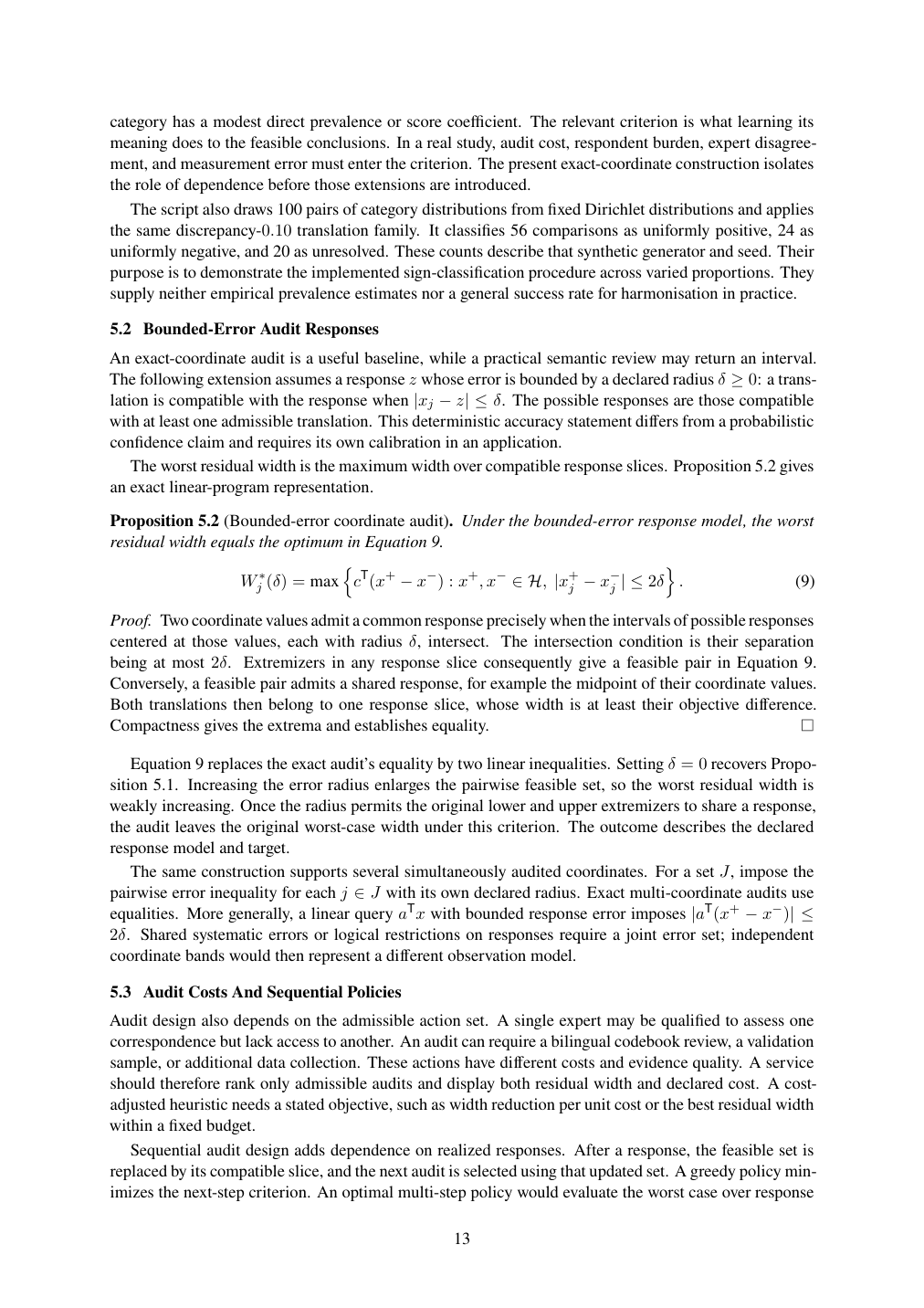
This reverses a simple ranking by absolute estimand coefficient. The A intermediate coefficient is case reduction under the declared coupled constraints. The result is particularly clear for the B category coordinates. A heuristic based only on its direct weight misses that contribution.
The example provides a bounded technical insight for cross-disciplinary validation. The most conse- quential question to ask an expert may concern a relational junction among classifications, even when that
Readable text
category has a modest direct prevalence or score coefficient. The relevant criterion is what learning its meaning does to the feasible conclusions. In a real study, audit cost, respondent burden, expert disagree- ment, and measurement error must enter the criterion. The present exact-coordinate construction isolates the role of dependence before those extensions are introduced.
The script also draws 100 pairs of category distributions from fixed Dirichlet distributions and applies uniformly negative, and 20 as unresolved. These counts describe that synthetic generator and seed. Their purpose is to demonstrate the implemented sign-classification procedure across varied proportions. They supply neither empirical prevalence estimates nor a general success rate for harmonisation in practice.
An exact-coordinate audit is a useful baseline, while a practical semantic review may return an interval. with at least one admissible translation. This deterministic accuracy statement differs from a probabilistic confidence claim and requires its own calibration in an application.
The worst residual width is the maximum width over compatible response slices. Proposition 5.2 gives
Proposition 5.2 (Bounded-error coordinate audit). Under the bounded-error response model, the worst
Proof. Two coordinate values admit a common response precisely when the intervals of possible responses Conversely, a feasible pair admits a shared response, for example the midpoint of their coordinate values. Both translations then belong to one response slice, whose width is at least their objective difference. Compactness gives the extrema and establishes equality.
sition 5.1. Increasing the error radius enlarges the pairwise feasible set, so the worst residual width is weakly increasing. Once the radius permits the original lower and upper extremizers to share a response, the audit leaves the original worst-case width under this criterion. The outcome describes the declared
coordinate bands would then represent a different observation model.
Audit design also depends on the admissible action set. A single expert may be qualified to assess one correspondence but lack access to another. An audit can require a bilingual codebook review, a validation sample, or additional data collection. These actions have different costs and evidence quality. A service should therefore rank only admissible audits and display both residual width and declared cost. A cost- adjusted heuristic needs a stated objective, such as width reduction per unit cost or the best residual width
Sequential audit design adds dependence on realized responses. After a response, the feasible set is replaced by its compatible slice, and the next audit is selected using that updated set. A greedy policy min- imizes the next-step criterion. An optimal multi-step policy would evaluate the worst case over response
Readable text
branches and future choices. The duplicated-polytope calculation supplies one-step values; a claim about multi-step optimality would require analyzing the policy tree.
Audit disagreement deserves explicit treatment. Two independent reviewers can give incompatible bounded-error statements, producing an empty updated feasible set. That outcome is informative about the adopted error bounds, target meaning, or reviewer interpretation. A responsible workflow preserves the conflicting responses and requests adjudication or a revised error model. Silently enlarging one interval until feasibility returns would alter the evidence model without a visible warrant.
The executed precision study evaluates a small set of single- and two-coordinate actions under common error radii. It isolates the effect of audit accuracy from cost and expert variation. Its conclusions there- fore concern the geometry of a declared feasible family. A later application should estimate achievable accuracy and cost before using the ranking to allocate substantial review effort.
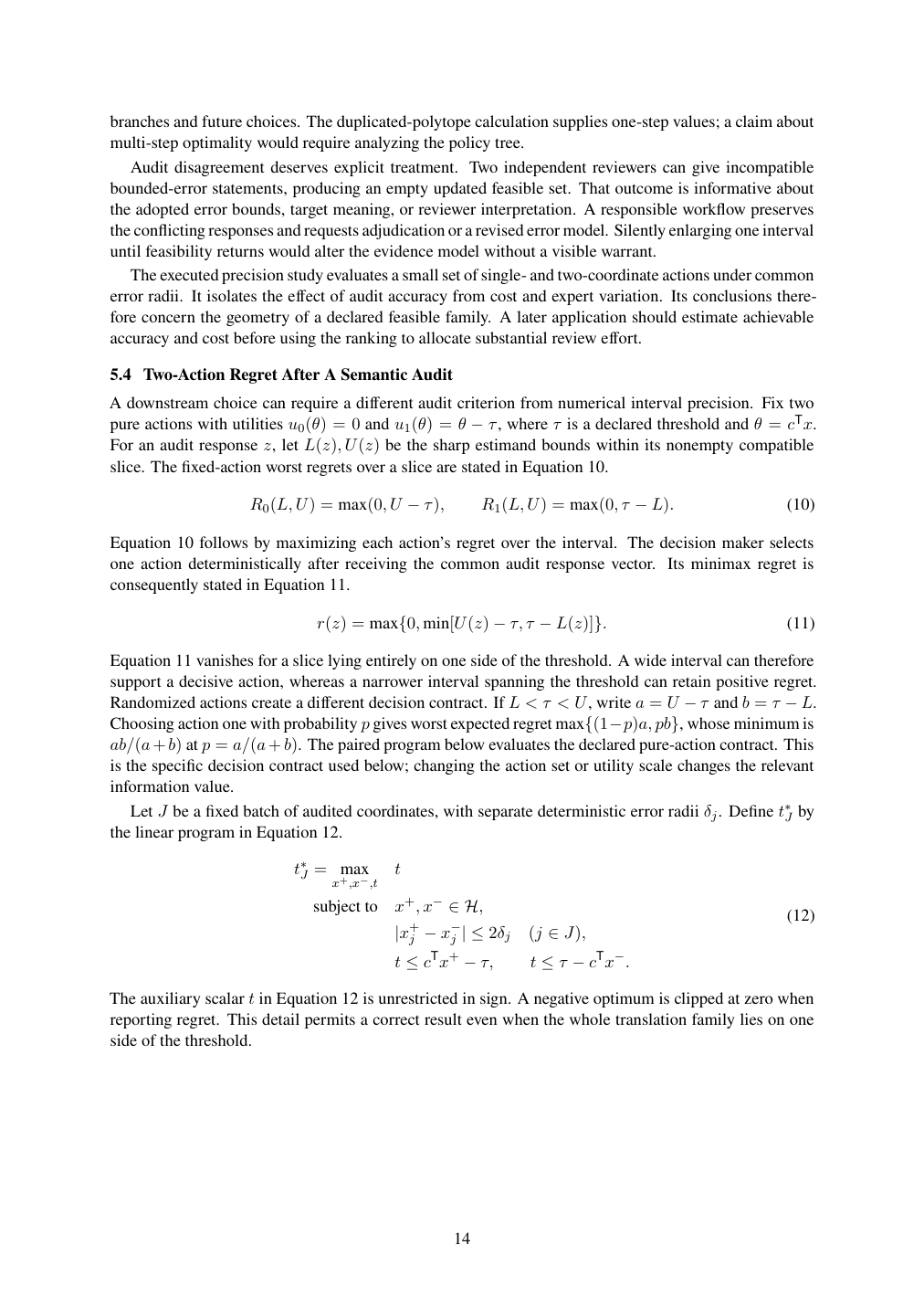
A downstream choice can require a different audit criterion from numerical interval precision. Fix two slice. The fixed-action worst regrets over a slice are stated in Equation 10.
Equation 10 follows by maximizing each action’s regret over the interval. The decision maker selects one action deterministically after receiving the common audit response vector. Its minimax regret is
Equation 11 vanishes for a slice lying entirely on one side of the threshold. A wide interval can therefore support a decisive action, whereas a narrower interval spanning the threshold can retain positive regret. is the specific decision contract used below; changing the action set or utility scale changes the relevant
reporting regret. This detail permits a correct result even when the whole translation family lies on one
Readable text
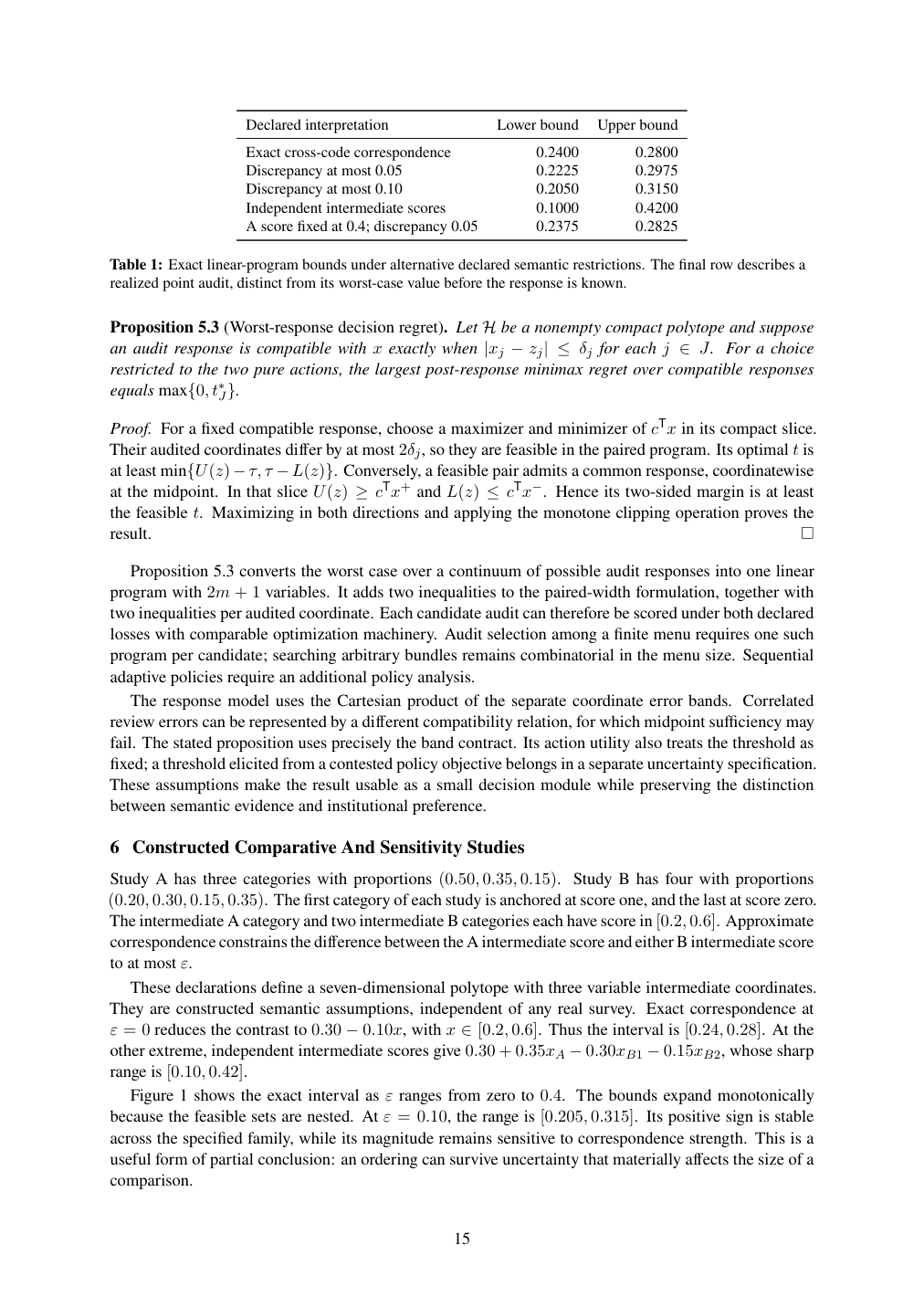
Exact cross-code correspondence Discrepancy at most 0.05 Discrepancy at most 0.10 Independent intermediate scores
Table 1: Exact linear-program bounds under alternative declared semantic restrictions. The final row describes a realized point audit, distinct from its worst-case value before the response is known.
restricted to the two pure actions, the largest post-response minimax regret over compatible responses
Proposition 5.3 converts the worst case over a continuum of possible audit responses into one linear two inequalities per audited coordinate. Each candidate audit can therefore be scored under both declared losses with comparable optimization machinery. Audit selection among a finite menu requires one such program per candidate; searching arbitrary bundles remains combinatorial in the menu size. Sequential
adaptive policies require an additional policy analysis.
The response model uses the Cartesian product of the separate coordinate error bands. Correlated review errors can be represented by a different compatibility relation, for which midpoint sufficiency may fail. The stated proposition uses precisely the band contract. Its action utility also treats the threshold as fixed; a threshold elicited from a contested policy objective belongs in a separate uncertainty specification. These assumptions make the result usable as a small decision module while preserving the distinction between semantic evidence and institutional preference.
correspondence constrains the difference between the A intermediate score and either B intermediate score
These declarations define a seven-dimensional polytope with three variable intermediate coordinates. They are constructed semantic assumptions, independent of any real survey. Exact correspondence at
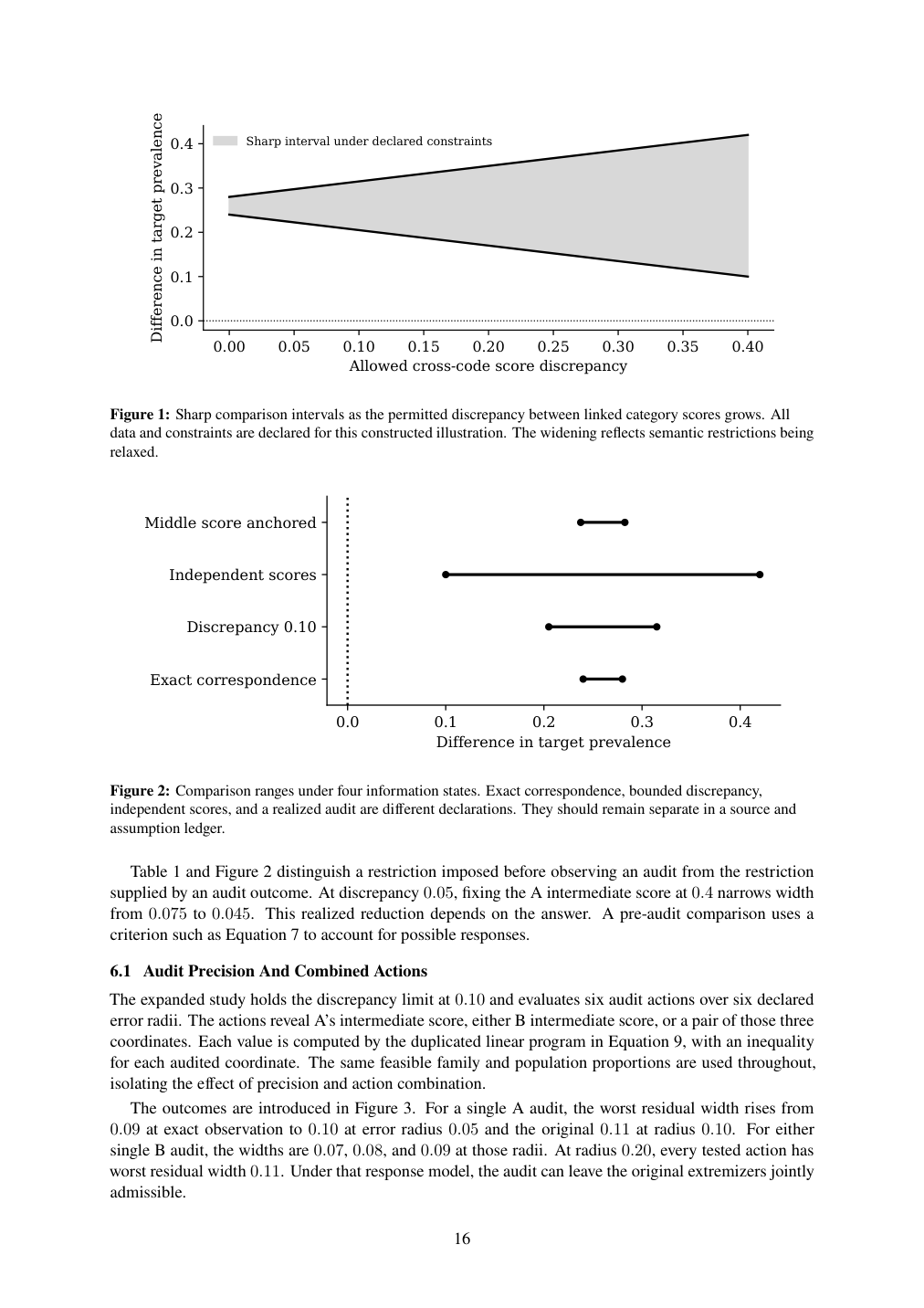
across the specified family, while its magnitude remains sensitive to correspondence strength. This is a useful form of partial conclusion: an ordering can survive uncertainty that materially affects the size of a
Readable text
Figure 1: Sharp comparison intervals as the permitted discrepancy between linked category scores grows. All data and constraints are declared for this constructed illustration. The widening reflects semantic restrictions being
Figure 2: Comparison ranges under four information states. Exact correspondence, bounded discrepancy, independent scores, and a realized audit are different declarations. They should remain separate in a source and
Table 1 and Figure 2 distinguish a restriction imposed before observing an audit from the restriction criterion such as Equation 7 to account for possible responses.
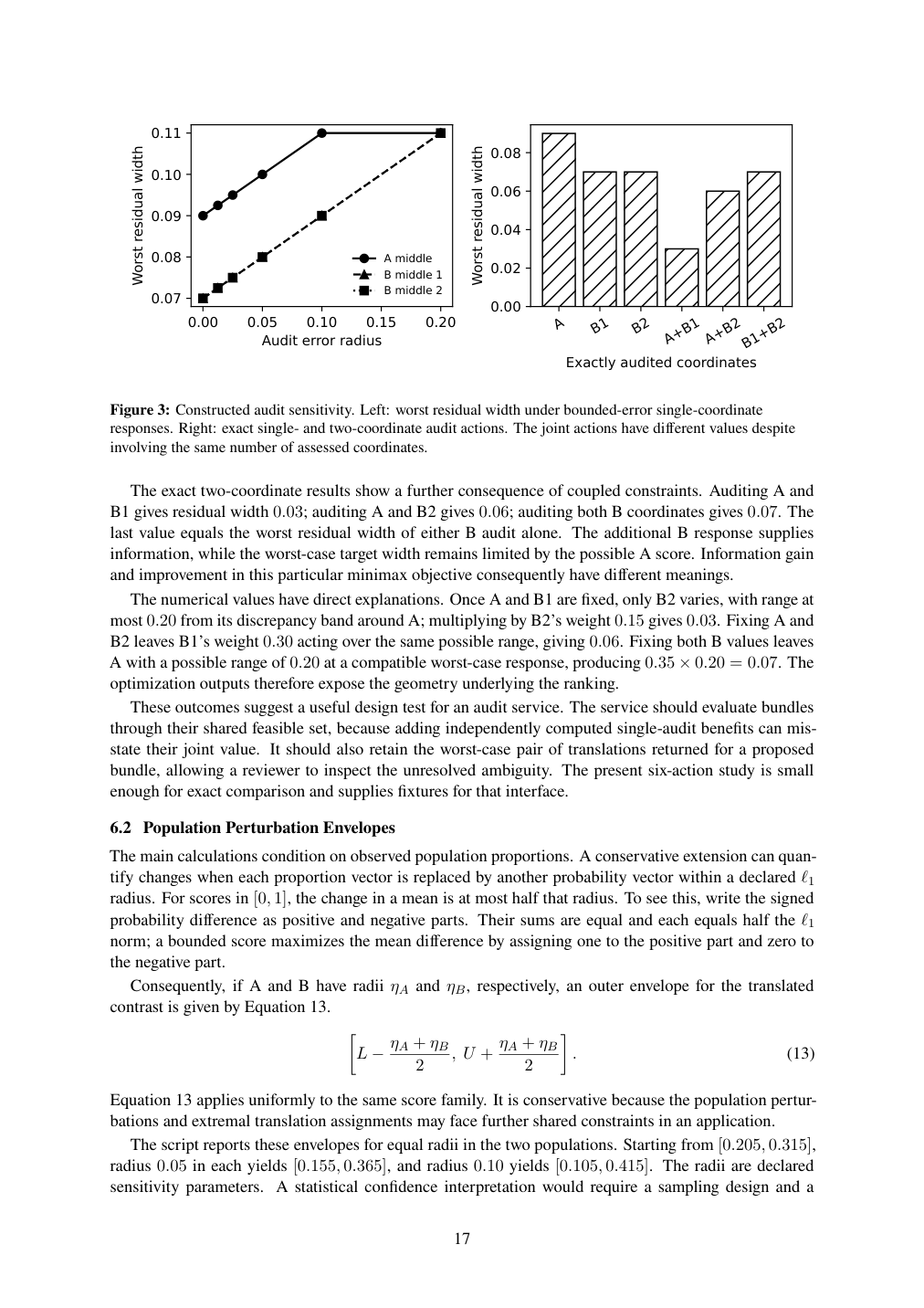
error radii. The actions reveal A’s intermediate score, either B intermediate score, or a pair of those three coordinates. Each value is computed by the duplicated linear program in Equation 9, with an inequality for each audited coordinate. The same feasible family and population proportions are used throughout, isolating the effect of precision and action combination.
The outcomes are introduced in Figure 3. For a single A audit, the worst residual width rises from
Readable text
Figure 3: Constructed audit sensitivity. Left: worst residual width under bounded-error single-coordinate responses. Right: exact single- and two-coordinate audit actions. The joint actions have different values despite
The exact two-coordinate results show a further consequence of coupled constraints. Auditing A and last value equals the worst residual width of either B audit alone. The additional B response supplies information, while the worst-case target width remains limited by the possible A score. Information gain and improvement in this particular minimax objective consequently have different meanings.
The numerical values have direct explanations. Once A and B1 are fixed, only B2 varies, with range at optimization outputs therefore expose the geometry underlying the ranking.
These outcomes suggest a useful design test for an audit service. The service should evaluate bundles through their shared feasible set, because adding independently computed single-audit benefits can mis- state their joint value. It should also retain the worst-case pair of translations returned for a proposed bundle, allowing a reviewer to inspect the unresolved ambiguity. The present six-action study is small enough for exact comparison and supplies fixtures for that interface.
The main calculations condition on observed population proportions. A conservative extension can quan- norm; a bounded score maximizes the mean difference by assigning one to the positive part and zero to
Equation 13 applies uniformly to the same score family. It is conservative because the population pertur- bations and extremal translation assignments may face further shared constraints in an application.
sensitivity parameters. A statistical confidence interpretation would require a sampling design and a
Readable text
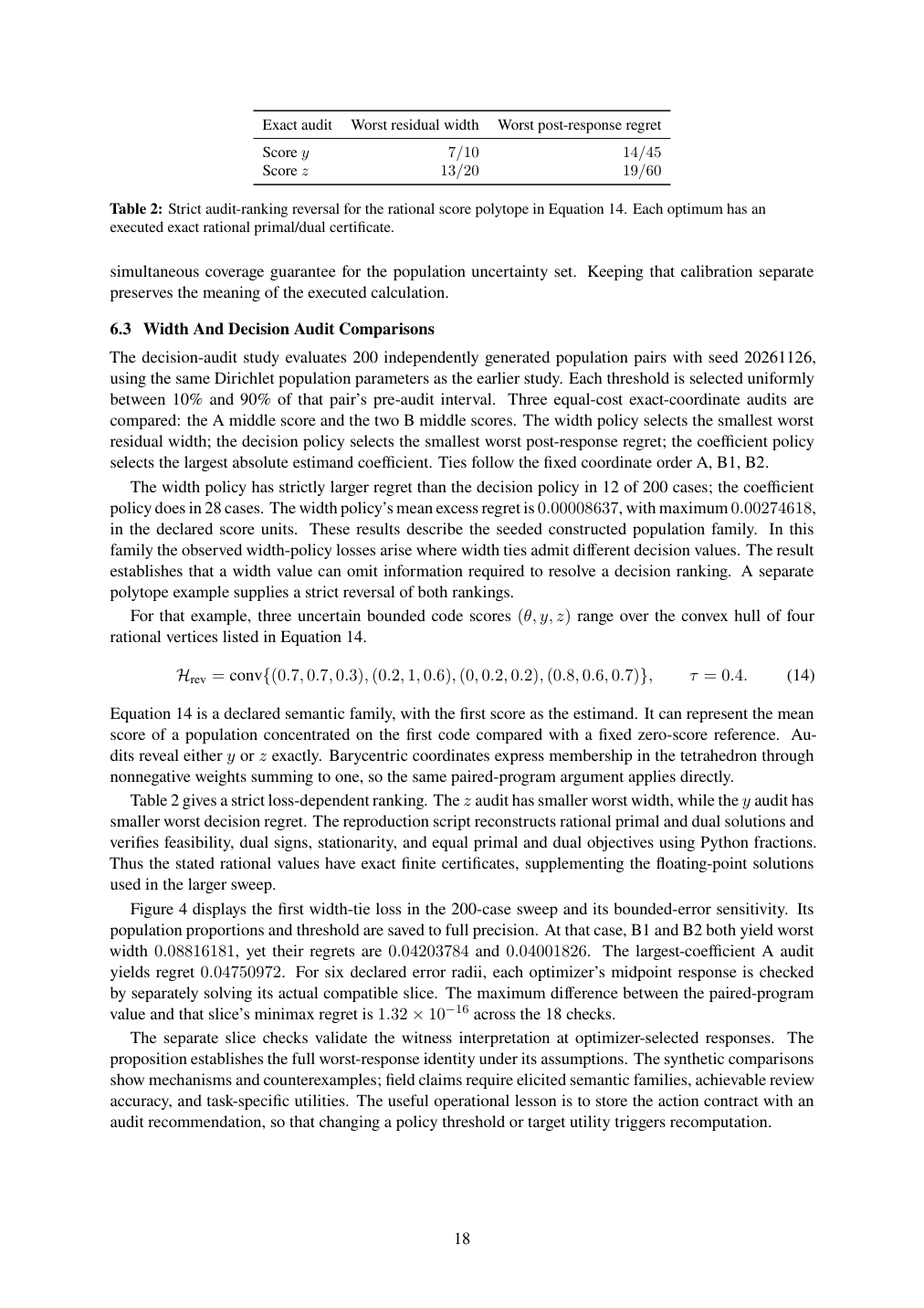
Table 2: Strict audit-ranking reversal for the rational score polytope in Equation 14. Each optimum has an
simultaneous coverage guarantee for the population uncertainty set. Keeping that calibration separate
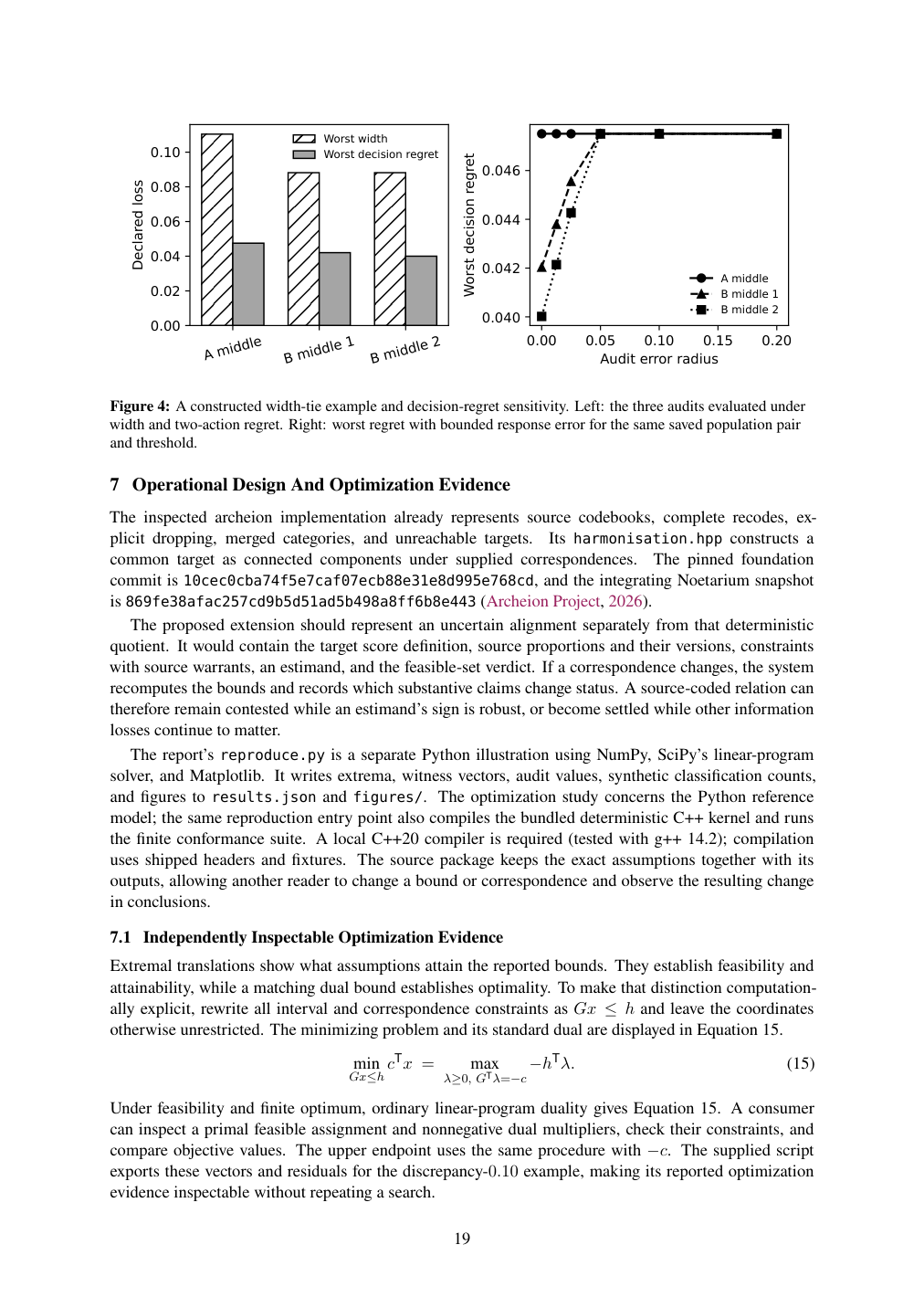
The decision-audit study evaluates 200 independently generated population pairs with seed 20261126, using the same Dirichlet population parameters as the earlier study. Each threshold is selected uniformly between 10% and 90% of that pair’s pre-audit interval. Three equal-cost exact-coordinate audits are compared: the A middle score and the two B middle scores. The width policy selects the smallest worst residual width; the decision policy selects the smallest worst post-response regret; the coefficient policy selects the largest absolute estimand coefficient. Ties follow the fixed coordinate order A, B1, B2.
The width policy has strictly larger regret than the decision policy in 12 of 200 cases; the coefficient in the declared score units. These results describe the seeded constructed population family. In this family the observed width-policy losses arise where width ties admit different decision values. The result establishes that a width value can omit information required to resolve a decision ranking. A separate polytope example supplies a strict reversal of both rankings.
Equation 14 is a declared semantic family, with the first score as the estimand. It can represent the mean score of a population concentrated on the first code compared with a fixed zero-score reference. Au- nonnegative weights summing to one, so the same paired-program argument applies directly.
smaller worst decision regret. The reproduction script reconstructs rational primal and dual solutions and verifies feasibility, dual signs, stationarity, and equal primal and dual objectives using Python fractions. Thus the stated rational values have exact finite certificates, supplementing the floating-point solutions
Figure 4 displays the first width-tie loss in the 200-case sweep and its bounded-error sensitivity. Its population proportions and threshold are saved to full precision. At that case, B1 and B2 both yield worst by separately solving its actual compatible slice. The maximum difference between the paired-program
The separate slice checks validate the witness interpretation at optimizer-selected responses. The proposition establishes the full worst-response identity under its assumptions. The synthetic comparisons show mechanisms and counterexamples; field claims require elicited semantic families, achievable review accuracy, and task-specific utilities. The useful operational lesson is to store the action contract with an audit recommendation, so that changing a policy threshold or target utility triggers recomputation.
Readable text
Figure 4: A constructed width-tie example and decision-regret sensitivity. Left: the three audits evaluated under width and two-action regret. Right: worst regret with bounded response error for the same saved population pair
The inspected archeion implementation already represents source codebooks, complete recodes, ex- plicit dropping, merged categories, and unreachable targets. common target as connected components under supplied correspondences. commit is 10cec0cba74f5e7caf07ecb88e31e8d995e768cd, and the integrating Noetarium snapshot is 869fe38afac257cd9b5d51ad5b498a8ff6b8e443 (Archeion Project, 2026).
Its harmonisation.hpp constructs a The pinned foundation
The proposed extension should represent an uncertain alignment separately from that deterministic quotient. It would contain the target score definition, source proportions and their versions, constraints with source warrants, an estimand, and the feasible-set verdict. If a correspondence changes, the system recomputes the bounds and records which substantive claims change status. A source-coded relation can therefore remain contested while an estimand’s sign is robust, or become settled while other information
The report’s reproduce.py is a separate Python illustration using NumPy, SciPy’s linear-program solver, and Matplotlib. It writes extrema, witness vectors, audit values, synthetic classification counts, and figures to results.json and figures/. The optimization study concerns the Python reference model; the same reproduction entry point also compiles the bundled deterministic C++ kernel and runs the finite conformance suite. A local C++20 compiler is required (tested with g++ 14.2); compilation uses shipped headers and fixtures. The source package keeps the exact assumptions together with its outputs, allowing another reader to change a bound or correspondence and observe the resulting change
Extremal translations show what assumptions attain the reported bounds. They establish feasibility and attainability, while a matching dual bound establishes optimality. To make that distinction computation- otherwise unrestricted. The minimizing problem and its standard dual are displayed in Equation 15.
Under feasibility and finite optimum, ordinary linear-program duality gives Equation 15. A consumer can inspect a primal feasible assignment and nonnegative dual multipliers, check their constraints, and
For numerical use, the checker should report primal infeasibility, multiplier sign violations, stationarity residuals, and primal–dual gaps with the chosen tolerance. A residual near machine precision is evidence of a successful floating-point computation, while a proof with rational inputs requires rational or otherwise rigorous bounds. The report’s duplicated audit formulation can be treated in the same way. This makes semantic assumptions, numerical optimization, and certificate validity three distinct components of the inference.

The duplicated construction also explains why audit costs should be compared after specifying the query. A question that can only resolve an unimportant score direction has little value for one estimand and substantial value for another. A general-purpose data curator may choose a portfolio of questions supporting several anticipated analyses, while a particular project can prioritize the uncertainty affecting its own decision threshold. The difference is a practical division of purposes, and the interface should record which purpose determined the audit.
7.2 Versioned Interfaces For Translation Families
A translation-family service needs explicit identities for its mathematical and substantive inputs. A sourceschema record names the study, population, period, codebook, and category ordering. A distribution record binds the category proportions to that schema. A target record defines the score and intended descriptive interpretation. A constraint record supplies one row or group of rows with its source and warrant. An estimand record specifies the coefficient construction. A result record binds the computed bounds, witnesses, solver configuration, and verification residuals to those inputs.
This separation supports several common revisions. Correcting a proportion vector changes the coefficient record while preserving the target and translation restrictions. Revising a codebook correspondence changes the feasible family. Redefining the target changes the interpretation and can require new restrictions. Adding a study extends the source domain and can introduce additional coupling. A result journal should identify the revision type and preserve the previous calculation as a historical analytical product.
The pinned archeion harmonisation header supplies deterministic category correspondences and harmonisation constructions (Archeion Project, 2026). The proposed family interface can coexist with those operations by treating an adopted deterministic map as one explicitly accepted transformation. A family of unresolved correspondences remains a separate analytical object. The transition from the family to a fixed map records a decision and its evidence. This design preserves the existing operation’s mathematical purpose while adding a stage for uncertainty assessment.
Category ordering is an especially important numerical interface. The coefficient vector, constraint columns, and witness assignments must use the same stable category identities. Position-only arrays are convenient internally, but an exported result should include an identifier-to-index map and verify it on input. A silent permutation can produce a feasible numerical solution for the wrong semantic problem. Canonical identifiers and round-trip checks help expose that failure.
7.3 Solver Evidence And Numerical Adequacy
A feasible extremizer demonstrates that its objective value is attainable. An optimality certificate requires a matching bound. The supplied linear-program study stores primal solutions and dual multipliers for the baseline endpoints, together with stationarity and primal–dual residuals. This information permits independent numerical inspection. The baseline endpoint evidence retains this numerical scope. The separate strict audit-ranking example supplies rational inputs and executed exact primal/dual checks.
Scale and conditioning influence residual interpretation. If constraint coefficients vary greatly in magnitude, a small absolute residual in one row may represent a different substantive discrepancy from the
same residual in another. A service should record row scales, tolerances, and original units. Bounded normalized scores simplify the present examples. General harmonisation models involving monetary, temporal, or physical quantities need a more explicit unit convention before their constraints are combined.

A reusable service should distinguish infeasibility, numerical failure, resource exhaustion, and a successfully bounded estimand. A failed numerical solve leaves an operational task unresolved. An infeasible family identifies conflicting restrictions. A completed solve supplies witnesses and bound evidence under the admitted tolerances. These outcomes deserve separate result types because they lead to different scientific actions.
7.4 Evidence Workflows And Review Responsibilities
Domain review and numerical review have complementary responsibilities. A domain reviewer checks target meaning, category scope, correspondence warrants, and the appropriateness of discrepancy limits. A numerical reviewer checks column binding, feasibility, duality evidence, and the treatment of uncertainty. An infrastructure can present each reviewer’s object directly: codebook statements and extremal translations for the first, constraint matrices and verification residuals for the second.
An audit request should similarly state the information required. Asking an expert to supply an exact normalized score can impose a stronger judgment than the underlying evidence supports. A bounded interval, ordering comparison, or documented unresolved correspondence may be a more faithful response. The audit model should follow the attainable evidence format. The finite-precision formulation provides one tractable option when a deterministic error bound is defensible.
The resulting workflow remains revisable. A response updates the family, a new interval is computed, and a reviewer inspects the changed extremizers. The record can show whether the new evidence narrowed uncertainty, changed the sign, stabilized a decision, or exposed a conflict. These outcomes make the service useful for iterative interdisciplinary inquiry, where the value of a relation often emerges through successive clarification of its meaning.
7.5 Pinned Deterministic Harmonisation Kernel
The accompanying artifact compiles the pinned archeion common-target header and four dependent headers from archeion, morphe, and apodeixis. Source commits and SHA-256 hashes accompany unmodified copies and their licenses. The C++ harness enumerates every one of the 212 = 4096 correspondence graphs between three A codes and four B codes. It emits the number of quotient classes and each source code’s target class. An independent Python disjoint-set procedure computes the same connected-component partition and canonical first-member numbering. Every emitted mapping agrees.
The class-count histogram is 1,795 graphs with one class, 1,345 with two, 639 with three, 238 with four, 66 with five, 12 with six, and one with seven. Two boundary checks confirm that a declared missing category is dropped and an unknown correspondence code is refused. The compilation profile uses C++20 with optimization and warnings treated as errors. The source manifest is checked before each reproduction. This study establishes finite conformance for the deterministic quotient kernel and explicit codebook cases.
The uncertain score-family optimizer remains a separate proposed extension. The common-target kernel computes the quotient of an asserted correspondence relation. The uncertainty semantics and downstream regret objective belong to the separate prototype. Its executed role is therefore the deterministic endpoint of the proposed interface. Keeping that distinction visible gives a source-grounded integration test without attributing the new optimizer to existing repository functionality. A deployment can retain
the deterministic mapping and the uncertainty-family object side by side, each with its own version, provenance, and acceptance checks.
8 Contribution Assessment And Research Development
Mathematical sharpness and numerical certification are different. The linear programs in the example are solved in floating-point arithmetic and checked by ordinary feasibility conditions. A production system making tight consequential distinctions can use dual certificates, rational arithmetic for rational inputs, or interval bounds around numerical residuals. A computed lower bound extremely close to zero should be assessed against solver tolerance before a sign verdict is issued.
Sampling error introduces another layer. If category proportions are estimated, treating them as fixed understates observational uncertainty. One approach is to construct a confidence region for proportions and optimize jointly over that region and the translation family. The resulting problem may be bilinear because proportions and scores multiply. A rectangular relaxation gives an outer range, whose conservativeness should be identified. Bootstrap or design-based approaches also require a principled rule for combining sampling uncertainty with semantic ambiguity.

8.1 Decision Contract And Calibration

A robust action can remain contested because its objective, target score or stakeholder weights are disputed. Harmonisation software can expose those assumptions and compute their consequences. Legitimate acceptance of the utility contract remains a substantive institutional task. An application should retain both interval precision and task regret, together with achievable audit cost and accuracy, so readers can assess the reason for an information request.
8.2 Contribution Matrix
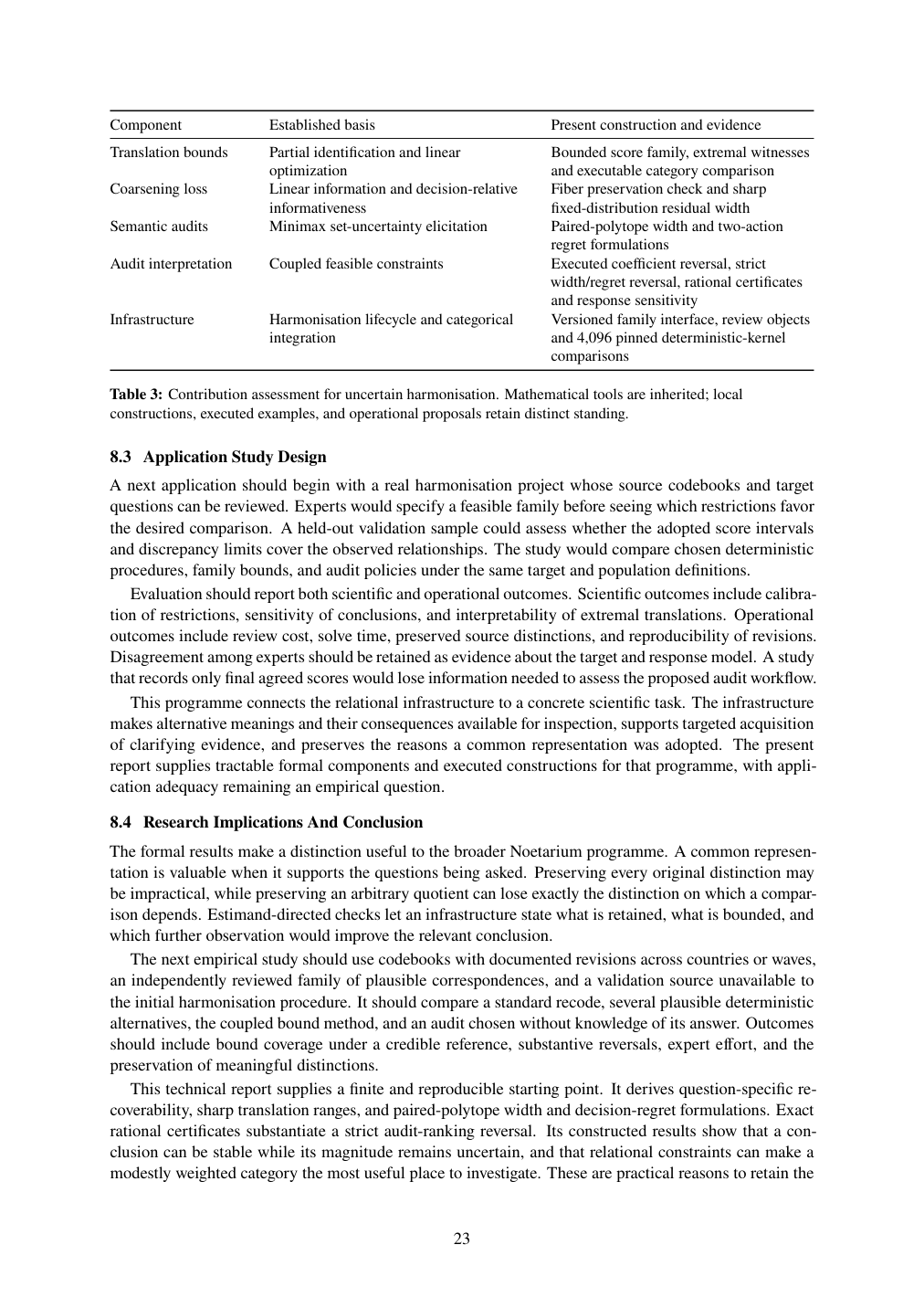
Table 3 places the report-specific constructions alongside their established foundations and validation requirements.
The completed local insight is the importance of relational dependence in deciding which semantic information to acquire. In the constructed example, a smaller direct coefficient can identify a more useful audit because the assessed coordinate constrains other uncertain scores. The precision study shows how that advantage changes with bounded response accuracy, and the bundle study shows that joint audit benefits depend on shared constraints. These are controlled results about the declared model, suitable for further validation across richer harmonisation settings.
The report also sharpens the interpretation of information loss. Ambiguous translation scores, deterministic category aggregation, uncertain population proportions, and decision loss are different analytical objects. Each can be represented explicitly and connected through a documented interface. Their separation supports a more informative result than a single harmonisation quality score, because a reader can identify which uncertainty source affects a chosen conclusion.
Readable text
Translation bounds Partial identification and linear optimization
Bounded score family, extremal witnesses and executable category comparison
Fiber preservation check and sharp fixed-distribution residual width Paired-polytope width and two-action regret formulations Executed coefficient reversal, strict width/regret reversal, rational certificates and response sensitivity
Minimax set-uncertainty elicitation Harmonisation lifecycle and categorical
Semantic audits Audit interpretation Coupled feasible constraints Infrastructure integration
Versioned family interface, review objects and 4,096 pinned deterministic-kernel comparisons
Table 3: Contribution assessment for uncertain harmonisation. Mathematical tools are inherited; local constructions, executed examples, and operational proposals retain distinct standing.
A next application should begin with a real harmonisation project whose source codebooks and target questions can be reviewed. Experts would specify a feasible family before seeing which restrictions favor the desired comparison. A held-out validation sample could assess whether the adopted score intervals and discrepancy limits cover the observed relationships. The study would compare chosen deterministic procedures, family bounds, and audit policies under the same target and population definitions.
Evaluation should report both scientific and operational outcomes. Scientific outcomes include calibra- tion of restrictions, sensitivity of conclusions, and interpretability of extremal translations. Operational outcomes include review cost, solve time, preserved source distinctions, and reproducibility of revisions. Disagreement among experts should be retained as evidence about the target and response model. A study that records only final agreed scores would lose information needed to assess the proposed audit workflow.
This programme connects the relational infrastructure to a concrete scientific task. The infrastructure makes alternative meanings and their consequences available for inspection, supports targeted acquisition of clarifying evidence, and preserves the reasons a common representation was adopted. The present report supplies tractable formal components and executed constructions for that programme, with appli-
The formal results make a distinction useful to the broader Noetarium programme. A common represen- tation is valuable when it supports the questions being asked. Preserving every original distinction may be impractical, while preserving an arbitrary quotient can lose exactly the distinction on which a compar- ison depends. Estimand-directed checks let an infrastructure state what is retained, what is bounded, and which further observation would improve the relevant conclusion.
The next empirical study should use codebooks with documented revisions across countries or waves, an independently reviewed family of plausible correspondences, and a validation source unavailable to the initial harmonisation procedure. It should compare a standard recode, several plausible deterministic alternatives, the coupled bound method, and an audit chosen without knowledge of its answer. Outcomes should include bound coverage under a credible reference, substantive reversals, expert effort, and the
This technical report supplies a finite and reproducible starting point. It derives question-specific re- coverability, sharp translation ranges, and paired-polytope width and decision-regret formulations. Exact rational certificates substantiate a strict audit-ranking reversal. Its constructed results show that a con- clusion can be stable while its magnitude remains uncertain, and that relational constraints can make a modestly weighted category the most useful place to investigate. These are practical reasons to retain the
structure of alternative meanings throughout an analysis and to let the scientific question guide the next act of harmonisation.
References
Dong, Xin; Halevy, Alon Y.; Yu, Cong. 2007. Data integration with uncertainty. Proceedings of VLDB:687–698.
https://dbgroup.eecs.umich.edu/files/p687-dong.pdf. Heizmann, Boris. 2025. Good enough? A comparison of different harmonization procedures and their substantive
consequences using the example of life satisfaction. Quality and Quantity 59(Suppl 2):1369–1392. https://do i.org/10.1007/s11135-025-02060-7. Boyd, Stephen; Vandenberghe, Lieven. 2004. Convex optimization. Cambridge University Press. https://web.
stanford.edu/~boyd/cvxbook/bv_cvxbook.pdf. Manski, Charles F.; Tamer, Elie. 2002. Inference on regressions with interval data on a regressor or outcome. Econo-
metrica 70(2):519–546. https://doi.org/10.1111/1468-0262.00294. Ben Abdallah, Nadia; Destercke, Sébastien; Sallak, Mohamed. 2017. Easy and optimal queries to reduce set uncer-
tainty. European Journal of Operational Research 256(2):592–604. https://doi.org/10.1016/j.ejor.2 016.06.038. Fortier, Isabel; Raina, Parminder; Van den Heuvel, Edwin R.; Griffith, Lauren E.; Craig, Camille; Saliba, Matilda;
Doiron, Dany; Stolk, Ronald P.; Knoppers, Bartha M.; Ferretti, Vincent; Granda, Peter; Burton, Paul. 2017. Maelstrom Research guidelines for rigorous retrospective data harmonization. International Journal of Epidemiology 46(1):103–115. https://doi.org/10.1093/ije/dyw075. Tamer, Elie. 2010. Partial identification in econometrics. Annual Review of Economics 2:167–195. https://doi.
org/10.1146/annurev.economics.050708.143401. Blackwell, David. 1951. Comparison of experiments. Proceedings of the Second Berkeley Symposium on Mathe-
matical Statistics and Probability:93–102. https://doi.org/10.1525/9780520411586-009. Ben-Tal, Aharon; Nemirovski, Arkadi. 1998. Robust convex optimization. Mathematics of Operations Research
23(4):769–805. https://doi.org/10.1287/moor.23.4.769. Bertsimas, Dimitris; Sim, Melvyn. 2004. The price of robustness. Operations Research 52(1):35–53. https://do
i.org/10.1287/opre.1030.0065. Spivak, David I.. 2012. Functorial data migration. Information and Computation 217:31–51. https://doi.org/
10.1016/j.ic.2012.05.001. Schultz, Patrick; Wisnesky, Ryan. 2017. Algebraic data integration. Journal of Functional Programming 27:e24.
https://doi.org/10.1017/S0956796817000168. Archeion Project. 2026. Datasets and harmonisation. Pinned source snapshot. https://raw.githubuserconten
t.com/huangwanhong-maker/archeion/10cec0cba74f5e7caf07ecb88e31e8d995e768cd/datasets/ include/archeion/datasets/harmonisation.hpp. Boutilier, Craig; Patrascu, Relu; Poupart, Pascal; Schuurmans, Dale. 2006. Constraint-based optimization and utility
elicitation using the minimax decision criterion. Artificial Intelligence 170(8–9):686–713. https://doi.org/ 10.1016/j.artint.2006.02.003.