Convention Retention Across Repeated Specification-Based Software Regeneration
Full text from the PDF
Convention Retention Across Repeated Specification-Based
Software Regeneration
Wanhong HUANG
Abstract
Keywords: scientific software; shared specification; candidate dependence; audit allocation; convention transmission
Technical Report Note
This technical report shares an evolving inquiry and invites dialogue, criticism, revision, and independent development. Its definitions, distinctions, and constructions remain open to refinement. Circulation across scholarly and practical communities is part of the purpose of releasing the manuscript.
The author treats the viewpoints, concepts, and lines of reasoning presented here as contributions to a shared field of inquiry. Similar or related ideas may have appeared in other intellectual, cultural, and disciplinary traditions. The manuscript identifies known antecedents and distinguishes inherited positions, interpretive proposals, and arguments developed here. Historical priority remains open to further investigation.
The constructions and arguments are presented with their stated assumptions and evidential scope. Readers are encouraged to question, test, revise, extend, reinterpret, or independently develop the ideas presented here. Where appropriate, acknowledgment of this paper as one point of encounter in the development of a related idea is appreciated. Such acknowledgment records an intellectual route; the ideas remain available for criticism, revision, and independent development.
Definitions introduced by the paper are local analytical stipulations unless attributed to another source. Their use identifies the scope of the present argument; terminological and historical priority remain subjects for independent investigation. Generative Relational theory is treated as an open research programme whose proposals receive critical examination alongside independent literature.
Responsible Use and Rights Reservation
This section records a request for responsible scholarly conduct and identifies the scope of retained rights. Legal permissions are governed by the licence on the following page.
The author encourages good-faith discussion, criticism, independent inquiry, and responsible use of the material. Separately from the licence’s terms, the author asks users to consider foreseeable harms when adapting the arguments, representations, or examples of this paper, particularly in scientific inquiry, institutional decisions, and computational knowledge infrastructures. The ethical request leaves the licence’s permissions and legally authorised uses unchanged.
The author retains the rights preserved under CC BY-NC 4.0 and may pursue remedies to which the author is legally entitled for breach of the licence or violation of independently applicable rights. Reuse remains independent from authorial endorsement. Third-party rights require authorisation from their respective holders where applicable. Copyright exceptions and limitations, including applicable forms of fair use or fair dealing, remain available.
Notices
This page consolidates the manuscript’s research status, licence, development disclosure, researchprogramme relation, and suggested citation.
Status. This technical report is prepared for the author’s substantive review and subsequent scholarly discussion. The report inherits the repository transmission programme and established round-trip, mixture and optimization methods. It develops a scoped shared-specification decision model, identification conditions, and exact executed policy comparisons. Internal checks assess the stated arguments and examples; independent scholarly assessment can further test their interpretation and adequacy. The source ledgers record the access level and claim scope of consulted works.
Licence. Except where otherwise indicated, copyright 2026 Wanhong Huang. This work is made available under the Creative Commons Attribution-NonCommercial 4.0 International License (CC BY-NC 4.0). Subject to its terms, the licence permits sharing and adaptation for noncommercial purposes with appropriate attribution, a link to the licence, and an indication of changes. Attribution should preserve the licensor’s independence from the reuse. Reuse is governed solely by the licence; the responsible-use request on the preceding page remains separate from its terms. The licence deed and legal code are available at https://creativecommons.org/licenses/by-nc/4.0/. The licence governs in case of conflict with this summary. Third-party material remains subject to its respective rights.
Statement on the use of language models. Preparation involved OpenAI’s ChatGPT and Codex. Language models supported exploratory dialogue, source discovery and checking, argumentative criticism, manuscript revision, LATEX typesetting, and the development of supporting code and figures. Verification used the sources and access levels recorded in the accompanying ledgers. The author initiated the research questions and directed the research programme; interpretation, acceptance of the arguments, and publication decisions remain subject to the author’s review. Authorship credit and responsibility for the released manuscript remain with the human author.
Code and data availability. Supporting scripts reproduce corrected historical summaries, baseline retention and intervention sensitivity, exact shared-specification probabilities, rational audit/candidate optimization, independent exhaustive checks, and seeded mixture-assay sensitivity. The source package contains the editable manuscript, source ledgers, supporting scripts and outputs, and a reading guide. Numerical illustrations, where present, use the assumptions stated in their captions and text.
Related research programme. This report belongs to the Noetarium technical report series. Companion reports study inference, computation, evaluation, governance, and cross-disciplinary knowledge formation. The reports develop distinct technical questions within an open Generative Relational research programme.
Suggested citation. Huang, Wanhong. “Convention Retention Across Repeated Specification-Based Software Regeneration.” Technical report, 2026.
1 Research Scope And Scientific Software Stewardship
Specification-mediated regeneration describes an implementation, reconstructs candidate implementations, assesses them, and accepts a continuation of a project. Scientific software carries local obligations through that process: an astronomical routine chooses an azimuth origin, a climate classifier chooses boundary and label conventions, and a geometric transformation commits to units and reference frames. These choices acquire consequence through datasets, interfaces, and dependent disciplinary work. The evaluative problem is to preserve their identity and to determine which part of a regeneration process carries or changes them.
This report focuses on a resource decision at the intermediate-specification boundary. Several candidate implementations can share one specification and therefore share its omitted obligations. Increasing candidate count and repairing the specification intervene on different stages. A scoped two-component model quantifies their difference, a replicated-candidate assay states its identification conditions, and exact finite allocation compares their use under a budget. A broader convention record connects those analyses to longitudinal maintenance and intentional revision.
The Noetarium repository motivates the study and already proposes compact generative materials, a homogeneous loss-and-return model, and check-anchored selection (Noetarium Project, 2026). Roundtrip and specification-mediated software research supply direct external antecedents. The report inherits those ideas. Its independent work is the explicit shared-channel specialization and decision comparison, source-grounded reanalysis of archived assessments, and a reproducible evaluation configuration joining convention identity, measurement, interventions, and resource use. Classical mixture identification, dynamic programming, and elementary probability remain established ingredients.
Evidence has three levels. Archived JavaScript studies describe three units under three information conditions and several short saved chains. Their retained summaries support descriptive check agreement, with limited source detail. Constructed computations use fully declared parameters, exact rational comparisons where feasible, and seeded sampling for an assay sensitivity study. A prospective protocol specifies the retained specifications, candidate groups, annotations, and held-out evaluations needed to assess actual policy effectiveness. Each level carries its own conclusions.
Agreement can result from faithful transmission or background reconstruction. A lost convention can later return, making terminal agreement differ from uninterrupted recorded agreement. An accepted migration introduces another history: a project can preserve accountable continuity while changing an earlier convention. The report measures fixed-version agreement and represents intentional revisions as contract transitions. A founding implementation is therefore a reference artifact with a declared scientific scope, whose contract can itself be revised through evidence.
The manuscript synthesizes the closest literature, defines versioned obligations, develops transmission and intervention models, analyzes shared specifications and allocation, and then examines historical and constructed evidence. Observation and prospective evaluation sections state what can be identified and what data a practical study needs. The contribution assessment gives explicit originality and validation boundaries for author review.
2 Literature On Specification Transmission And Assessment
The relevant literature supplies three complementary perspectives: specification-mediated development, software assessment, and reproducible scientific practice. This section organizes the verified sources around those roles and locates the report’s analytical question within them. Architectural descriptions, empirical findings, and normative recommendations retain their respective standing. The comparison concerns the mechanism each source makes available for the present design, with performance claims confined to the inspected source material.
2.1 Round-Trip Evaluation And Specification-Mediated Maintenance
Allamanis et al. (2024) formulate round-trip correctness as evaluation through a forward transformation and a reconstruction. Their code instantiations use an intermediate description and assess the recon-
structed artifact through a chosen similarity measure or execution oracle. Their forward-lift comparison also distinguishes useful information in the intermediate description from information available to the reconstruction model through context and prior capability. These ideas directly inform the present separation between retained transmission and recovery. The unit introduced here is a versioned convention followed across several generations, with intervention and assessment records attached to the lineage.
Grynets et al. (2026) develop a Code–Text–Code architecture combining context extraction, neutral specifications, reconstruction, iterative verification, retrieval, and transformation-loss estimation. The inspected full method organizes representations from code elements through technical and business descriptions to requirements, with AST and graph-derived context. That representation and verification architecture is a close antecedent. The present report studies a narrower decision: candidate replication versus correction of one intermediate specification under a declared obligation loss. Its explicit candidate grouping, channel assay, and budget calculation can be instantiated alongside such a system; comparative engineering performance remains a separate study.
PROOF, introduced by Zhang et al. (2026), is another direct comparator. Its hierarchical specification layer supports indirect codebase maintenance and reconstruction-based verification. The inspected zeroedit procedure distinguishes universal behavioral equality from its operational assessment: preservation of tests that the original implementation passes. Its fidelity statistic measures that preservation, accommodating pre-existing defects and test failures. This concrete method strengthens the present distinction between a declared semantic target and an available assessment domain. The present convention model extends the evaluative object to a transmission history with named scientific obligations, intervention errors, and assessment calibration. A comparative implementation study would need a common oracle and cost envelope.
Agarwal et al. (2026) examine specification-driven development through practitioner discourse, interviews, and repository evidence. The inspected version reports that practitioners combine intent and implementation detail, use specifications selectively, and encounter planning and review costs alongside perceived benefits. The study also emphasizes maintenance and the timing of consistency checks. These observations motivate treating a specification as an evolving artifact with its own version history. They suggest empirical variables for a longitudinal study: the detail retained in a specification, the occasion on which it is revised, the actors who read it, and the cost of resolving divergence.
The four sources address different evaluative objects. Round-trip correctness evaluates a transformation using a selected oracle. Reengineering frameworks organize a controlled transformation architecture. Specification-mediated maintenance places a representation between requests and code changes. Practice research examines the work through which those artifacts are produced and sustained. The present report connects these objects through a convention inventory and an intervention record. That connection is an analytical proposal whose usefulness depends on the cost and reliability of maintaining the inventory in realistic projects.
2.2 Iterated Learning And The Repository’s Transmission Model
Griffiths and Kalish (2007) analyze iterated learning under specified Bayesian learning rules. Posterior sampling yields a stationary distribution determined by the learner’s prior, while maximum-posterior choice has a different dependence on transmitted information. These conditional results provide a conceptual antecedent for studying inherited information and background tendencies separately. A coding agent follows a different mechanism, so a transfer requires an explicit model or measured transition process.
The Noetarium framework already develops a two-state loss-and-return account in its Section 4.4, alongside a discussion of check-anchored selection and saved prototype chains (Noetarium Project, 2026). The homogeneous recurrence below is inherited from that source and standard Markov analysis. The present report adds a shared-specification specialization, a classical mixture-assay interpretation, and an exact budget comparison of specification audits with candidate generation. It also analyzes imperfect review, task-agreement dependence, planning objectives, and assessment calibration. These additions supply further analytical and empirical obligations for the existing programme.
2.3 Contracts, Executable Properties, And Scientific Oracles
Meyer (1992) establish explicit component obligations as an important approach to reusable software. Their contract perspective motivates a disciplined distinction between an obligation and the implementation currently offered to satisfy it. In the present setting, a project convention adds a scientific domain, a version, and a downstream-use relation to that general idea. A natural-language convention can be supported by executable predicates, formal statements, sampled witnesses, or documented judgments, with each form carrying its own scope.
Claessen and Hughes (2000) provide a primary example of property-oriented testing through executable properties, generated inputs, and custom input generators. Those mechanisms are useful when a scientific convention admits a computational witness. A generator can emphasize boundary cases, coordinate singularities, or documented approximation regimes. The assessment then records the tested distribution and its parameters. Repeated testing supplies evidence within that design; a universal property requires additional justification through exhaustive finite coverage, proof, or a suitable restricted program class.
The oracle problem is central in scientific software. Kanewala and Bieman (2014) organize the literature around challenges arising from scientific programs and from the practices of the communities that develop them. Their review identifies oracle difficulties and the relation between code and the scientific model as important issues. The report therefore gives the accepted implementation, the declared contract, and the external scientific target separate identities. A unit can preserve a project convention while a new scientific validation later revises that convention. The archive should represent both developments.
Segura et al. (2016) review metamorphic testing as an assessment of relations among transformed inputs and corresponding outputs. A convention can expose such a relation even when an absolute expected output is difficult to calculate. Rotational consistency, unit conversion, inverse transformations, and conservation relations provide candidate tests when their assumptions fit the scientific model. The present proposal attaches the relation and its domain to a convention record. This enables later inspection of whether the relation tests the intended choice or a weaker consequence shared by several competing choices.
Jia and Harman (2011) synthesize mutation testing as a fault-based approach to assessing tests. The historical record includes mutant rejection results, which are interpreted here relative to the selected mutation operators and assessment inputs. A high rejection share concerns that particular fault population. Convention inventories can guide the construction of more informative mutations: a mutation can deliberately reverse orientation, move a threshold, or alter a returned label. Those mutations connect test adequacy to named obligations and reveal where a test suite leaves several conventions observationally compatible.
2.4 Dependence, Diversity, And Reproducible Practice
The experiment of Knight and Leveson (1986) established the importance of dependent failures among independently developed program versions. Their primary manuscript reports more coincident failures than an independence account would predict in the studied task. Contemporary coding-agent research returns to that issue. Ron et al. (2026) inspect agent, model, and language variation and report common-mode failures alongside benefits from redundancy in their specified campaign. These studies motivate explicit dependence analysis. Provider diversity, separate generation, and different surface implementations are candidate causes of diversity whose behavioral consequences require observation.
The homogeneous retention baseline uses marginal convention probabilities. Cross-convention dependence matters when several obligations form a whole-task requirement; within-specification candidate dependence enters the later selection model. This separation permits a useful sensitivity analysis: the same marginal agreement values can support widely different joint agreement probabilities. A convention-level archive can preserve both marginal outcomes and shared failure causes, allowing subsequent models to represent common shocks, ambiguous specification regions, and repairs that affect several obligations together.
Readable text
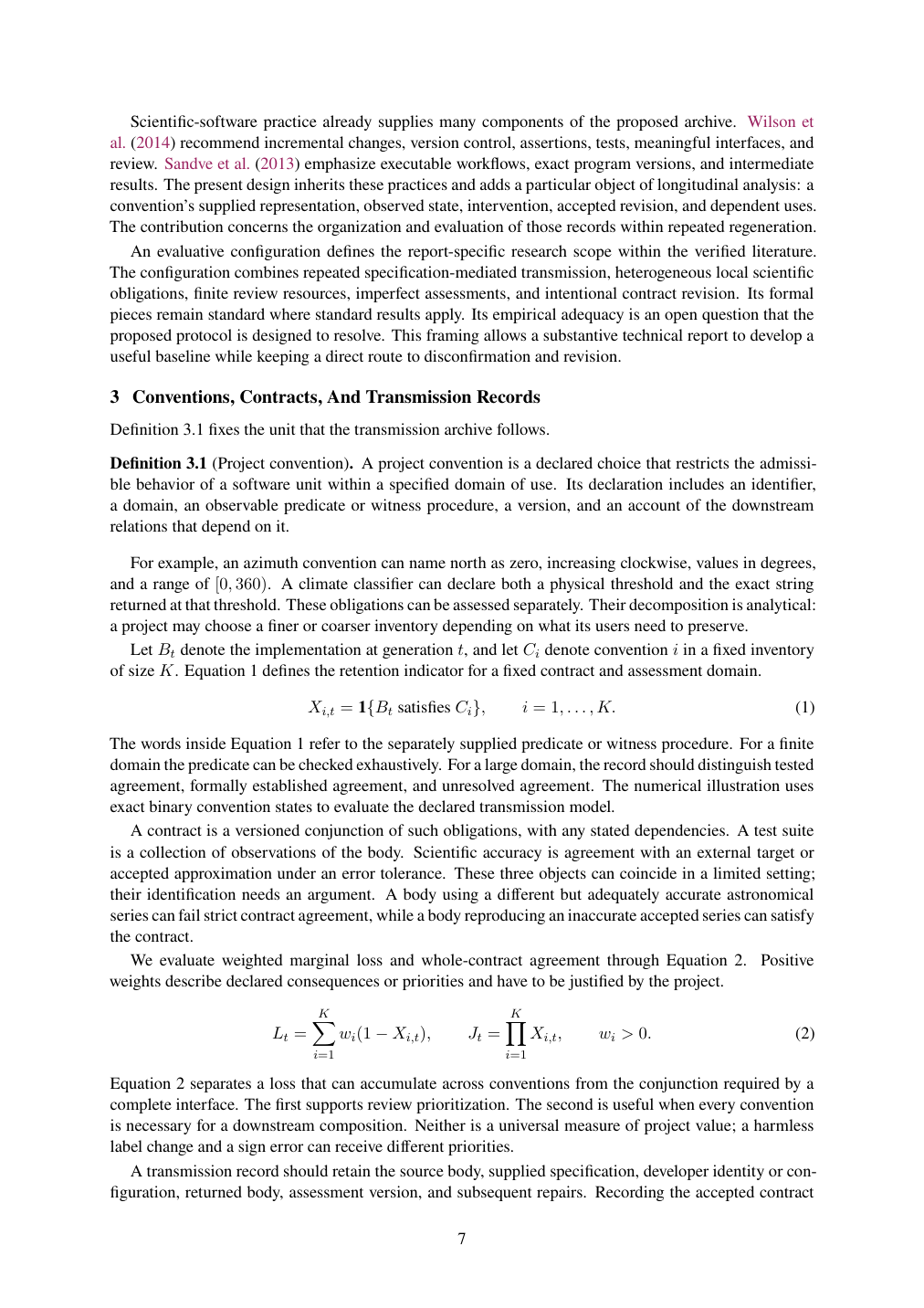
Scientific-software practice already supplies many components of the proposed archive. Wilson et al. (2014) recommend incremental changes, version control, assertions, tests, meaningful interfaces, and review. Sandve et al. (2013) emphasize executable workflows, exact program versions, and intermediate results. The present design inherits these practices and adds a particular object of longitudinal analysis: a convention’s supplied representation, observed state, intervention, accepted revision, and dependent uses. The contribution concerns the organization and evaluation of those records within repeated regeneration.
An evaluative configuration defines the report-specific research scope within the verified literature. The configuration combines repeated specification-mediated transmission, heterogeneous local scientific obligations, finite review resources, imperfect assessments, and intentional contract revision. Its formal pieces remain standard where standard results apply. Its empirical adequacy is an open question that the proposed protocol is designed to resolve. This framing allows a substantive technical report to develop a useful baseline while keeping a direct route to disconfirmation and revision.
Definition 3.1 fixes the unit that the transmission archive follows.
Definition 3.1 (Project convention). A project convention is a declared choice that restricts the admissi- ble behavior of a software unit within a specified domain of use. Its declaration includes an identifier, a domain, an observable predicate or witness procedure, a version, and an account of the downstream
For example, an azimuth convention can name north as zero, increasing clockwise, values in degrees, returned at that threshold. These obligations can be assessed separately. Their decomposition is analytical: a project may choose a finer or coarser inventory depending on what its users need to preserve.
The words inside Equation 1 refer to the separately supplied predicate or witness procedure. For a finite domain the predicate can be checked exhaustively. For a large domain, the record should distinguish tested agreement, formally established agreement, and unresolved agreement. The numerical illustration uses exact binary convention states to evaluate the declared transmission model.
A contract is a versioned conjunction of such obligations, with any stated dependencies. A test suite is a collection of observations of the body. Scientific accuracy is agreement with an external target or accepted approximation under an error tolerance. These three objects can coincide in a limited setting; their identification needs an argument. A body using a different but adequately accurate astronomical series can fail strict contract agreement, while a body reproducing an inaccurate accepted series can satisfy
We evaluate weighted marginal loss and whole-contract agreement through Equation 2. weights describe declared consequences or priorities and have to be justified by the project.
Equation 2 separates a loss that can accumulate across conventions from the conjunction required by a complete interface. The first supports review prioritization. The second is useful when every convention is necessary for a downstream composition. Neither is a universal measure of project value; a harmless label change and a sign error can receive different priorities.
A transmission record should retain the source body, supplied specification, developer identity or con- figuration, returned body, assessment version, and subsequent repairs. Recording the accepted contract
version is essential. A later correction of an assessment tolerance changes the meaning of earlier soundness counts, so both analyses should remain available. These requirements are practical components of a trajectory archive: one can inspect how a claim about fidelity was generated and which decisions it depends on.
3.1 Obligation Granularity And Domain Design
A convention inventory is a design decision with consequences for evaluation. An inventory containing one obligation for a whole library produces a simple conjunction and offers little diagnostic resolution. An inventory containing thousands of closely related predicates can create a large maintenance burden and overrepresent one scientific choice. The useful granularity follows the downstream decisions that the project needs to support. Orientation, units, boundary policy, output vocabulary, and approximation regime are often separable because different consumers depend on them differently.
The record should distinguish logical implication from convenient grouping. A returned coordinate might satisfy a range requirement while violating an orientation requirement. A successful round trip between representations can establish an inverse relation while leaving the physical interpretation of the coordinates unresolved. A composite convention can name both requirements, but its component witnesses should remain accessible. This makes partial success reusable and gives a repairer enough information to avoid changing an already satisfactory component.
Assessment domains also need versioned identities. A finite input set, a probability distribution over inputs, a closed interval with a formal property, and an intended scientific-use domain are different objects. An assessment result can carry several of these identities at once. For example, a test campaign may sample from a declared distribution within a scientific domain, while the convention itself quantifies over that domain. The archive records the sample-based result and the broader unresolved obligation separately. This design permits future assessments to extend coverage without rewriting the meaning of earlier evidence.
A useful inventory includes accepted counterexamples. A counterexample identifies an implementation, an input or relation, the expected obligation, the observed result, and the relevant numerical tolerance. Its role is especially clear at boundaries. A climate threshold can require an exact inequality convention, while an astronomical approximation can permit a declared error interval. Combining these under one generic pass threshold can hide which relation failed. Named witnesses preserve the distinction and provide seeds for regression tests after repair.
3.2 Consequence Weights And Relational Use
The weights in Equation 2 represent a local evaluation policy. A dependency graph can inform them by recording which research tasks consume each convention and which consequences follow a mismatch. Such a graph supplies evidence for deliberation under a declared value policy. A convention used by many projects may deserve attention because of its reach, while a rare use may deserve attention because its consequences are severe. The archive should preserve the rationale and version of the adopted weights.
Two weight systems can legitimately rank interventions differently. One can prioritize public reproducibility, another maintenance effort, and another a particular scientific application. A comparative study should publish results under several declared systems where those readings matter. The underlying convention outcomes remain common evidence. This arrangement allows disciplines to share computational artifacts while retaining different judgments about which losses are consequential.
Contract revision introduces a further relation. If a project changes an output convention intentionally, a migration record should identify affected consumers and the evidence for their compatibility. A successor contract can inherit unchanged obligations and replace selected ones. Fidelity is then evaluated within a contract version, while continuity is evaluated through accepted transitions and migration evidence. The distinction makes development assessable through fixed-version fidelity and accepted migration together.
Readable text
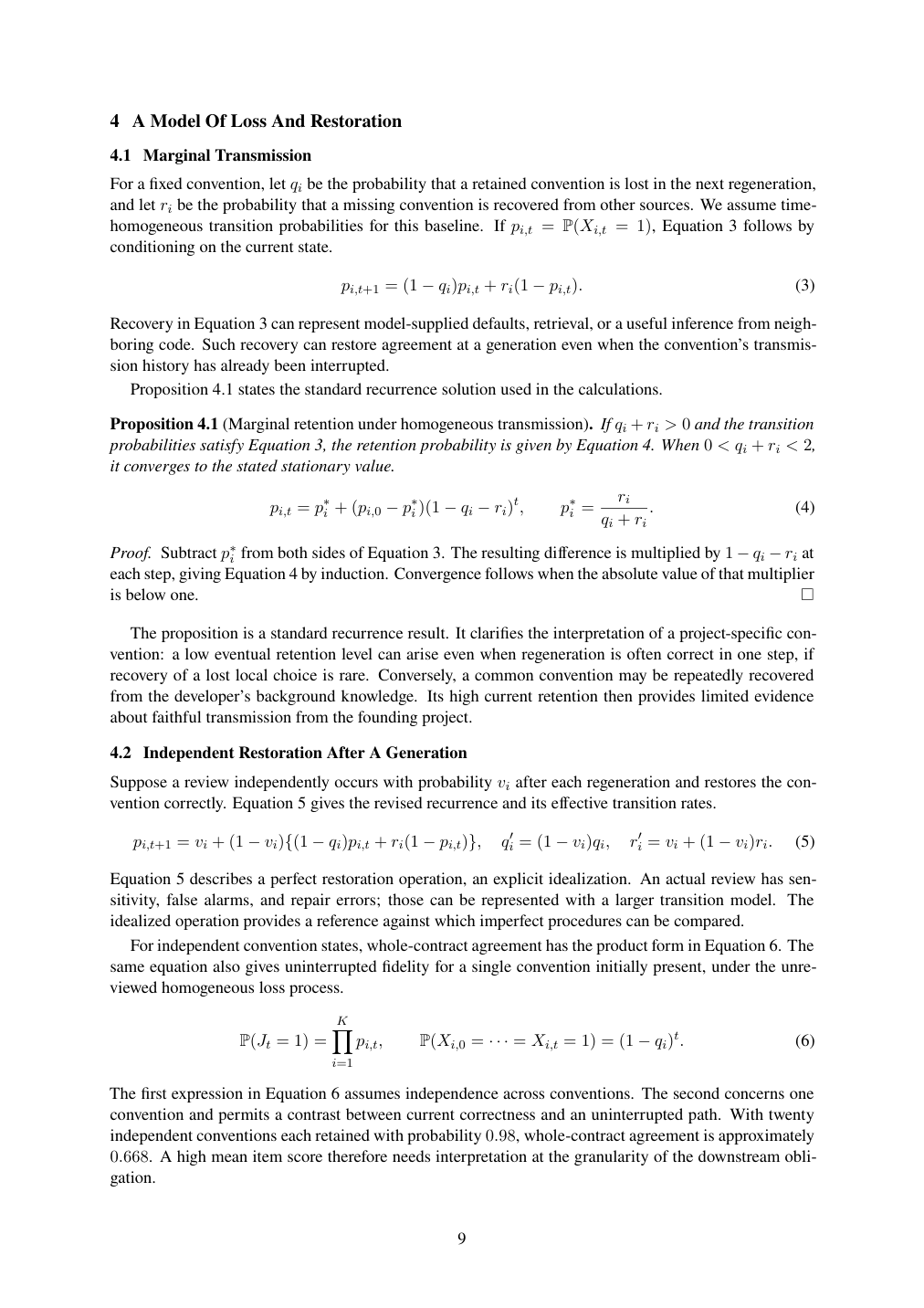
Recovery in Equation 3 can represent model-supplied defaults, retrieval, or a useful inference from neigh- boring code. Such recovery can restore agreement at a generation even when the convention’s transmis-
Proposition 4.1 states the standard recurrence solution used in the calculations.
each step, giving Equation 4 by induction. Convergence follows when the absolute value of that multiplier
The proposition is a standard recurrence result. It clarifies the interpretation of a project-specific con- vention: a low eventual retention level can arise even when regeneration is often correct in one step, if recovery of a lost local choice is rare. Conversely, a common convention may be repeatedly recovered from the developer’s background knowledge. Its high current retention then provides limited evidence
about faithful transmission from the founding project.
vention correctly. Equation 5 gives the revised recurrence and its effective transition rates.
Equation 5 describes a perfect restoration operation, an explicit idealization. An actual review has sen- sitivity, false alarms, and repair errors; those can be represented with a larger transition model. The idealized operation provides a reference against which imperfect procedures can be compared.
For independent convention states, whole-contract agreement has the product form in Equation 6. The same equation also gives uninterrupted fidelity for a single convention initially present, under the unre-
The first expression in Equation 6 assumes independence across conventions. The second concerns one convention and permits a contrast between current correctness and an uninterrupted path. With twenty
Readable text
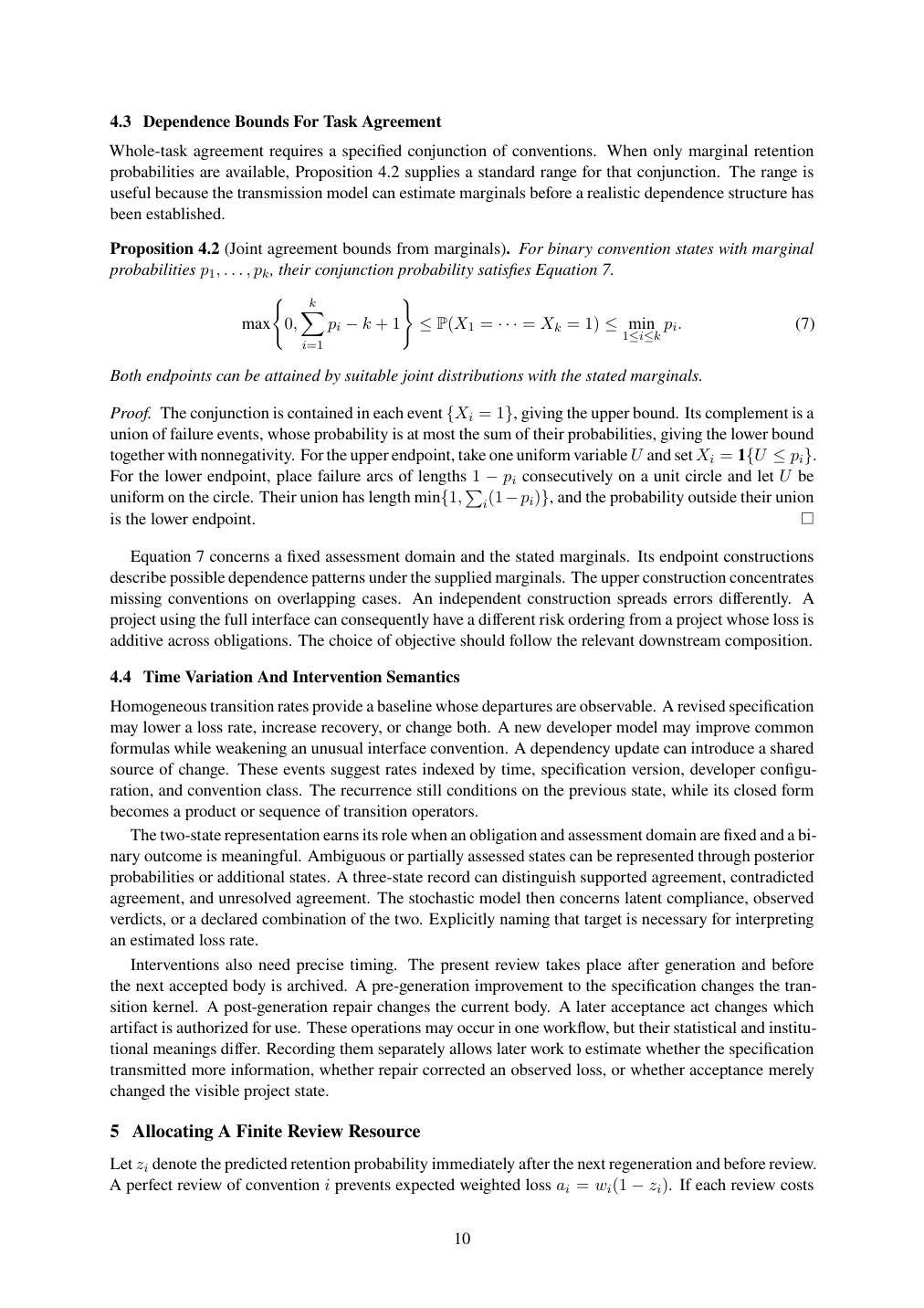
Whole-task agreement requires a specified conjunction of conventions. When only marginal retention
probabilities are available, Proposition 4.2 supplies a standard range for that conjunction. The range is useful because the transmission model can estimate marginals before a realistic dependence structure has
Proposition 4.2 (Joint agreement bounds from marginals). For binary convention states with marginal
Both endpoints can be attained by suitable joint distributions with the stated marginals.
union of failure events, whose probability is at most the sum of their probabilities, giving the lower bound
Equation 7 concerns a fixed assessment domain and the stated marginals. Its endpoint constructions describe possible dependence patterns under the supplied marginals. The upper construction concentrates missing conventions on overlapping cases. An independent construction spreads errors differently. A project using the full interface can consequently have a different risk ordering from a project whose loss is additive across obligations. The choice of objective should follow the relevant downstream composition.
Homogeneous transition rates provide a baseline whose departures are observable. A revised specification may lower a loss rate, increase recovery, or change both. A new developer model may improve common formulas while weakening an unusual interface convention. A dependency update can introduce a shared source of change. These events suggest rates indexed by time, specification version, developer configu- ration, and convention class. The recurrence still conditions on the previous state, while its closed form becomes a product or sequence of transition operators.
The two-state representation earns its role when an obligation and assessment domain are fixed and a bi- nary outcome is meaningful. Ambiguous or partially assessed states can be represented through posterior probabilities or additional states. A three-state record can distinguish supported agreement, contradicted agreement, and unresolved agreement. The stochastic model then concerns latent compliance, observed verdicts, or a declared combination of the two. Explicitly naming that target is necessary for interpreting
Interventions also need precise timing. The present review takes place after generation and before the next accepted body is archived. A pre-generation improvement to the specification changes the tran- sition kernel. A post-generation repair changes the current body. A later acceptance act changes which artifact is authorized for use. These operations may occur in one workflow, but their statistical and institu- tional meanings differ. Recording them separately allows later work to estimate whether the specification transmitted more information, whether repair corrected an observed loss, or whether acceptance merely
Readable text
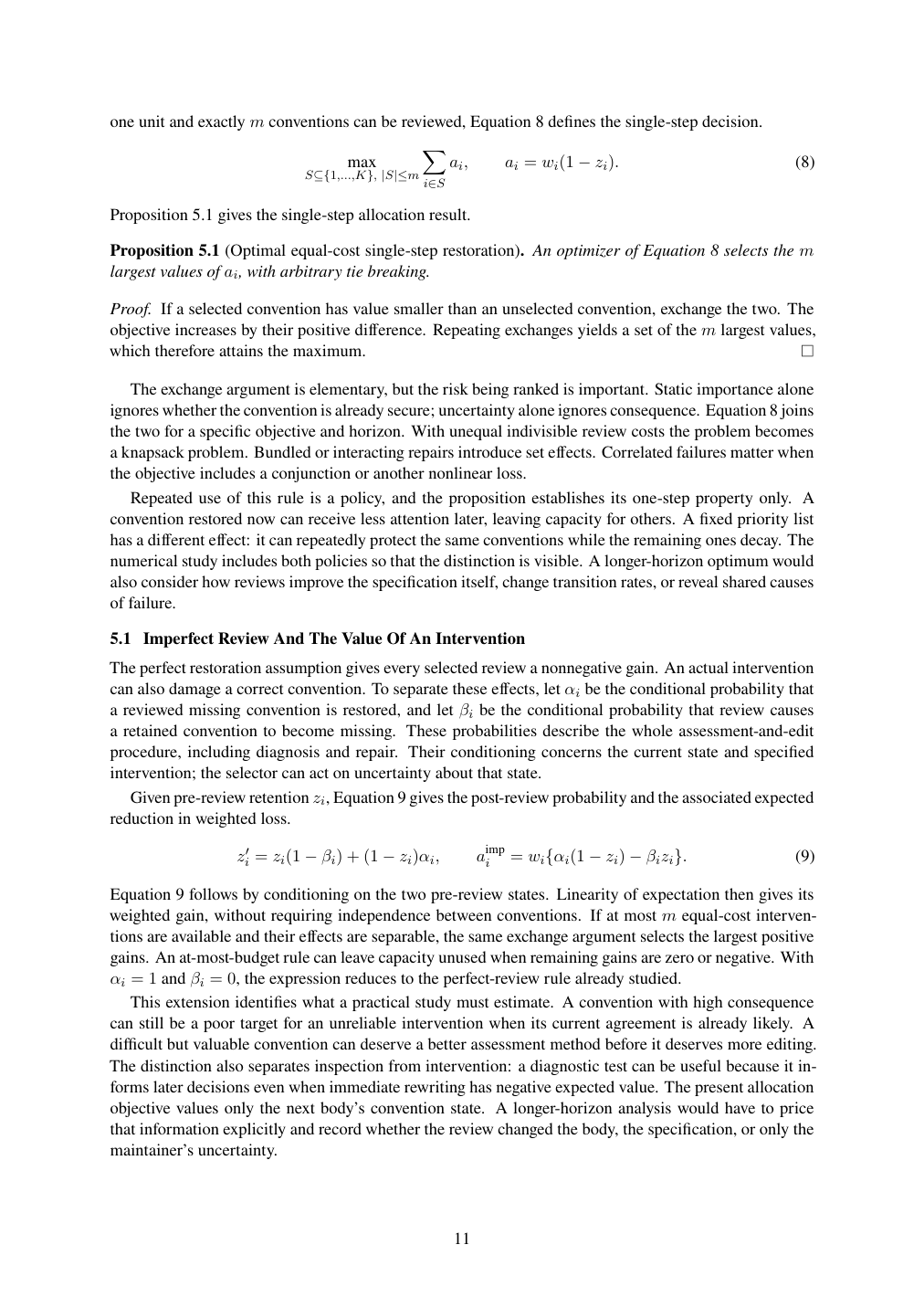
Proposition 5.1 gives the single-step allocation result.
Proof. If a selected convention has value smaller than an unselected convention, exchange the two. The
The exchange argument is elementary, but the risk being ranked is important. Static importance alone ignores whether the convention is already secure; uncertainty alone ignores consequence. Equation 8 joins the two for a specific objective and horizon. With unequal indivisible review costs the problem becomes a knapsack problem. Bundled or interacting repairs introduce set effects. Correlated failures matter when the objective includes a conjunction or another nonlinear loss.
Repeated use of this rule is a policy, and the proposition establishes its one-step property only. A convention restored now can receive less attention later, leaving capacity for others. A fixed priority list has a different effect: it can repeatedly protect the same conventions while the remaining ones decay. The numerical study includes both policies so that the distinction is visible. A longer-horizon optimum would also consider how reviews improve the specification itself, change transition rates, or reveal shared causes
The perfect restoration assumption gives every selected review a nonnegative gain. An actual intervention a retained convention to become missing. These probabilities describe the whole assessment-and-edit procedure, including diagnosis and repair. Their conditioning concerns the current state and specified intervention; the selector can act on uncertainty about that state.
Equation 9 follows by conditioning on the two pre-review states. Linearity of expectation then gives its tions are available and their effects are separable, the same exchange argument selects the largest positive gains. An at-most-budget rule can leave capacity unused when remaining gains are zero or negative. With
This extension identifies what a practical study must estimate. A convention with high consequence can still be a poor target for an unreliable intervention when its current agreement is already likely. A difficult but valuable convention can deserve a better assessment method before it deserves more editing. The distinction also separates inspection from intervention: a diagnostic test can be useful because it in- forms later decisions even when immediate rewriting has negative expected value. The present allocation objective values only the next body’s convention state. A longer-horizon analysis would have to price that information explicitly and record whether the review changed the body, the specification, or only the
Readable text
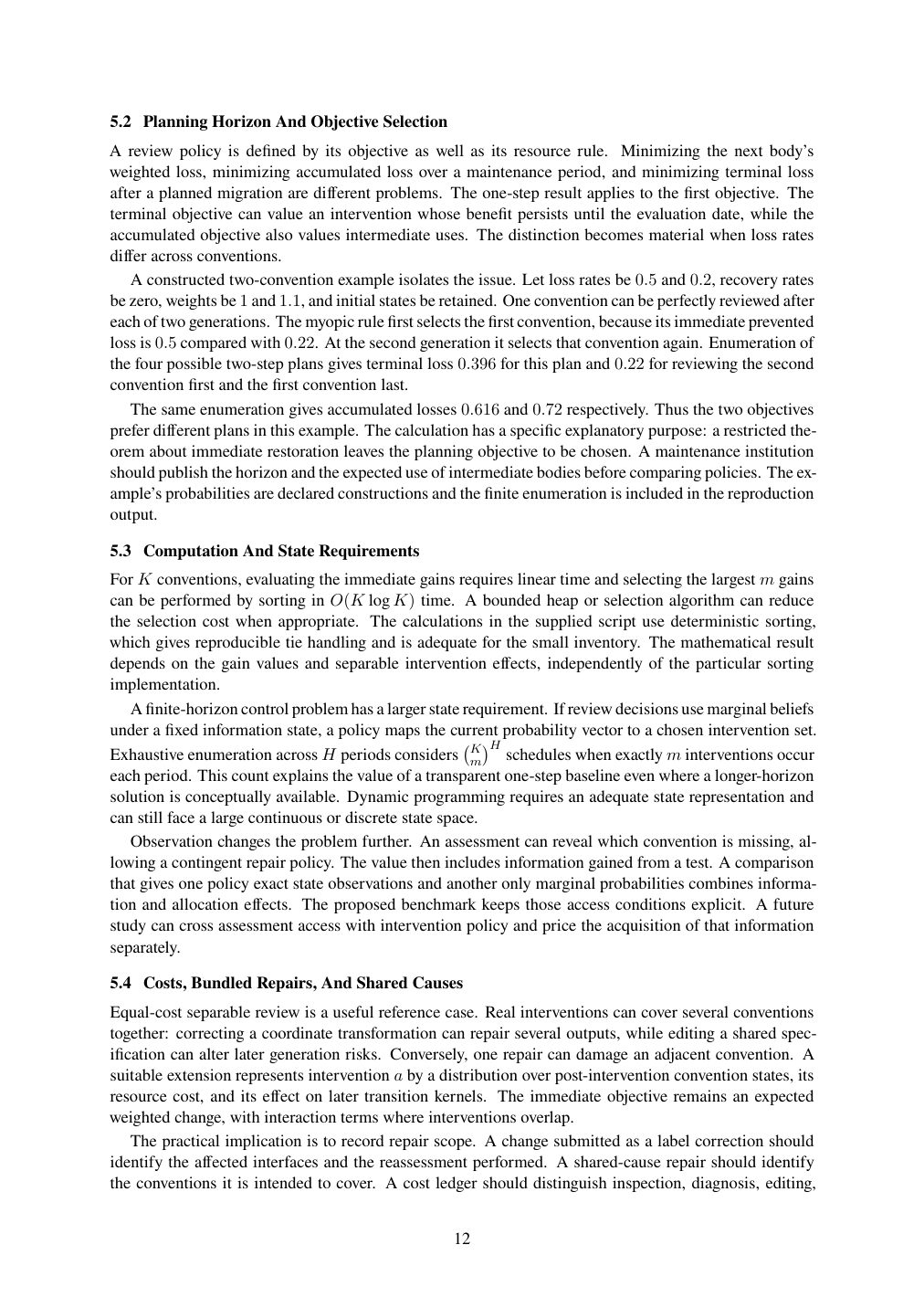
A review policy is defined by its objective as well as its resource rule. Minimizing the next body’s weighted loss, minimizing accumulated loss over a maintenance period, and minimizing terminal loss after a planned migration are different problems. The one-step result applies to the first objective. The terminal objective can value an intervention whose benefit persists until the evaluation date, while the accumulated objective also values intermediate uses. The distinction becomes material when loss rates
each of two generations. The myopic rule first selects the first convention, because its immediate prevented
prefer different plans in this example. The calculation has a specific explanatory purpose: a restricted the- orem about immediate restoration leaves the planning objective to be chosen. A maintenance institution should publish the horizon and the expected use of intermediate bodies before comparing policies. The ex- ample’s probabilities are declared constructions and the finite enumeration is included in the reproduction
the selection cost when appropriate. The calculations in the supplied script use deterministic sorting, which gives reproducible tie handling and is adequate for the small inventory. The mathematical result depends on the gain values and separable intervention effects, independently of the particular sorting
A finite-horizon control problem has a larger state requirement. If review decisions use marginal beliefs under a fixed information state, a policy maps the current probability vector to a chosen intervention set.
each period. This count explains the value of a transparent one-step baseline even where a longer-horizon solution is conceptually available. Dynamic programming requires an adequate state representation and can still face a large continuous or discrete state space.
Observation changes the problem further. An assessment can reveal which convention is missing, al- lowing a contingent repair policy. The value then includes information gained from a test. A comparison that gives one policy exact state observations and another only marginal probabilities combines informa- tion and allocation effects. The proposed benchmark keeps those access conditions explicit. A future study can cross assessment access with intervention policy and price the acquisition of that information
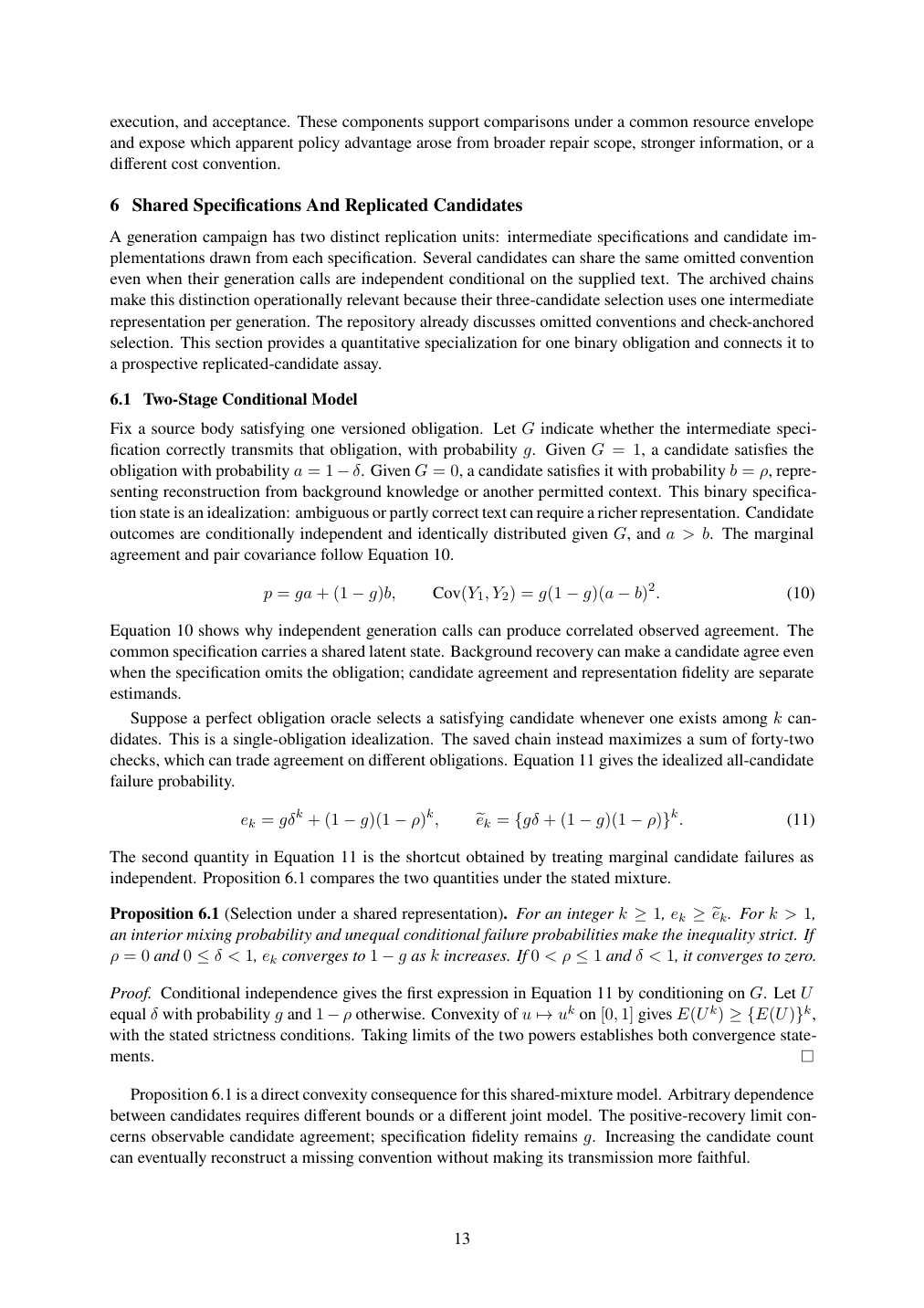
Equal-cost separable review is a useful reference case. Real interventions can cover several conventions together: correcting a coordinate transformation can repair several outputs, while editing a shared spec- ification can alter later generation risks. Conversely, one repair can damage an adjacent convention. A resource cost, and its effect on later transition kernels. The immediate objective remains an expected weighted change, with interaction terms where interventions overlap.
The practical implication is to record repair scope. A change submitted as a label correction should identify the affected interfaces and the reassessment performed. A shared-cause repair should identify the conventions it is intended to cover. A cost ledger should distinguish inspection, diagnosis, editing,
Readable text
execution, and acceptance. These components support comparisons under a common resource envelope and expose which apparent policy advantage arose from broader repair scope, stronger information, or a
A generation campaign has two distinct replication units: intermediate specifications and candidate im- plementations drawn from each specification. Several candidates can share the same omitted convention even when their generation calls are independent conditional on the supplied text. The archived chains make this distinction operationally relevant because their three-candidate selection uses one intermediate representation per generation. The repository already discusses omitted conventions and check-anchored selection. This section provides a quantitative specialization for one binary obligation and connects it to
senting reconstruction from background knowledge or another permitted context. This binary specifica- tion state is an idealization: ambiguous or partly correct text can require a richer representation. Candidate
Equation 10 shows why independent generation calls can produce correlated observed agreement. The common specification carries a shared latent state. Background recovery can make a candidate agree even when the specification omits the obligation; candidate agreement and representation fidelity are separate
didates. This is a single-obligation idealization. The saved chain instead maximizes a sum of forty-two checks, which can trade agreement on different obligations. Equation 11 gives the idealized all-candidate
The second quantity in Equation 11 is the shortcut obtained by treating marginal candidate failures as independent. Proposition 6.1 compares the two quantities under the stated mixture.
an interior mixing probability and unequal conditional failure probabilities make the inequality strict. If
with the stated strictness conditions. Taking limits of the two powers establishes both convergence state-
Proposition 6.1 is a direct convexity consequence for this shared-mixture model. Arbitrary dependence between candidates requires different bounds or a different joint model. The positive-recovery limit con- can eventually reconstruct a missing convention without making its transmission more faithful.
Readable text
The body-to-body transition estimated in Section 11 is a composite channel. Even exact marginal body agreement in Equation 10 supplies one constraint on three parameters. Recording only the selected best candidate discards additional information about the within-specification distribution. The archived check counts therefore supply descriptive trajectory evidence, while the specification and developer mechanisms
Round-trip correctness already uses nested forward and backward sampling, and forward lift distin- guishes assistance from the forward representation from background reconstruction (Allamanis et al., 2024). The present distinction between replication levels follows that architecture. A repeated-candidate assay adds a particular inferential use: within-specification factorial moments describe a latent two- component channel. Identifiability and moment estimation for binomial mixtures are classical; Blischke (1964) establish the general antecedent. The following elementary specialization is supplied explicitly to state the assumptions and degeneracies relevant to the proposed study.
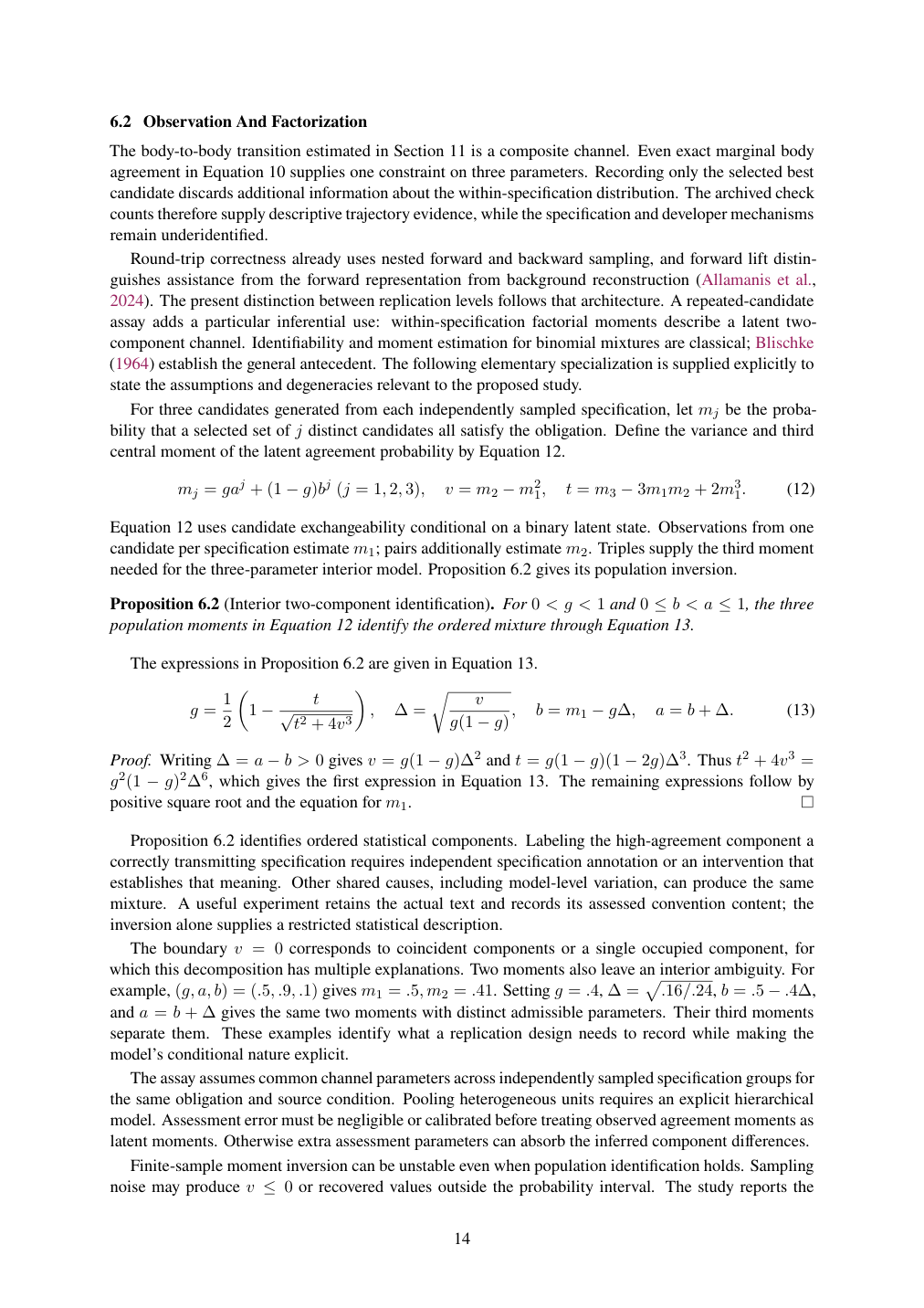
central moment of the latent agreement probability by Equation 12.
Equation 12 uses candidate exchangeability conditional on a binary latent state. Observations from one needed for the three-parameter interior model. Proposition 6.2 gives its population inversion.
population moments in Equation 12 identify the ordered mixture through Equation 13.
The expressions in Proposition 6.2 are given in Equation 13.
Proposition 6.2 identifies ordered statistical components. Labeling the high-agreement component a correctly transmitting specification requires independent specification annotation or an intervention that establishes that meaning. Other shared causes, including model-level variation, can produce the same mixture. A useful experiment retains the actual text and records its assessed convention content; the inversion alone supplies a restricted statistical description.
which this decomposition has multiple explanations. Two moments also leave an interior ambiguity. For
separate them. These examples identify what a replication design needs to record while making the
The assay assumes common channel parameters across independently sampled specification groups for the same obligation and source condition. Pooling heterogeneous units requires an explicit hierarchical model. Assessment error must be negligible or calibrated before treating observed agreement moments as latent moments. Otherwise extra assessment parameters can absorb the inferred component differences.
Finite-sample moment inversion can be unstable even when population identification holds. Sampling
Readable text
frequency of admissible inversions alongside conditional errors and accounts for every generated repli- cation in its admissibility counts. Projected or likelihood estimators are reasonable alternatives whose regularization and boundary behavior need independent comparison. The simple inversion is used here to expose the experimental-design problem, including settings in which a large number of independent specifications is needed to separate similar components.
7 Allocation Between Specification Audits And Candidates
The shared channel changes a concrete resource decision. A project can spend effort generating another implementation of the same specification, or it can inspect and repair the intermediate specification before generating implementations. Their effects differ when omissions are shared. This section formulates a finite allocation problem and computes its solution exactly. Dynamic programming is an established optimization method (Bellman, 1954); the report contributes the explicit channel-dependent objective, its comparison with an independence surrogate, and an executed allocation illustration.
while leaving the declared developer error probability fixed. Equation 14 gives the residual loss and total-
selection uses the exact single-obligation oracle specified there. Additivity makes expected loss separa- ble across units; dependence between units leaves this expectation unchanged when decisions and costs remain separable. Shared audits, multi-obligation selection tradeoffs, and joint success objectives require
This problem treats the declared parameters as known inputs. The archived record supplies neither those parameters nor audit costs for real projects. A future deployment can estimate them from retained specifications and candidate groups, then assess allocation on independent held-out lineages. Uncertainty- aware decisions are an additional task, especially near mixture degeneracies. The exact known-parameter problem isolates the cost of using the wrong dependence structure before estimation error is added.
Proposition 7.1 (Finite channel-allocation optimum). For the separable finite problem in Equation 14
Readable text
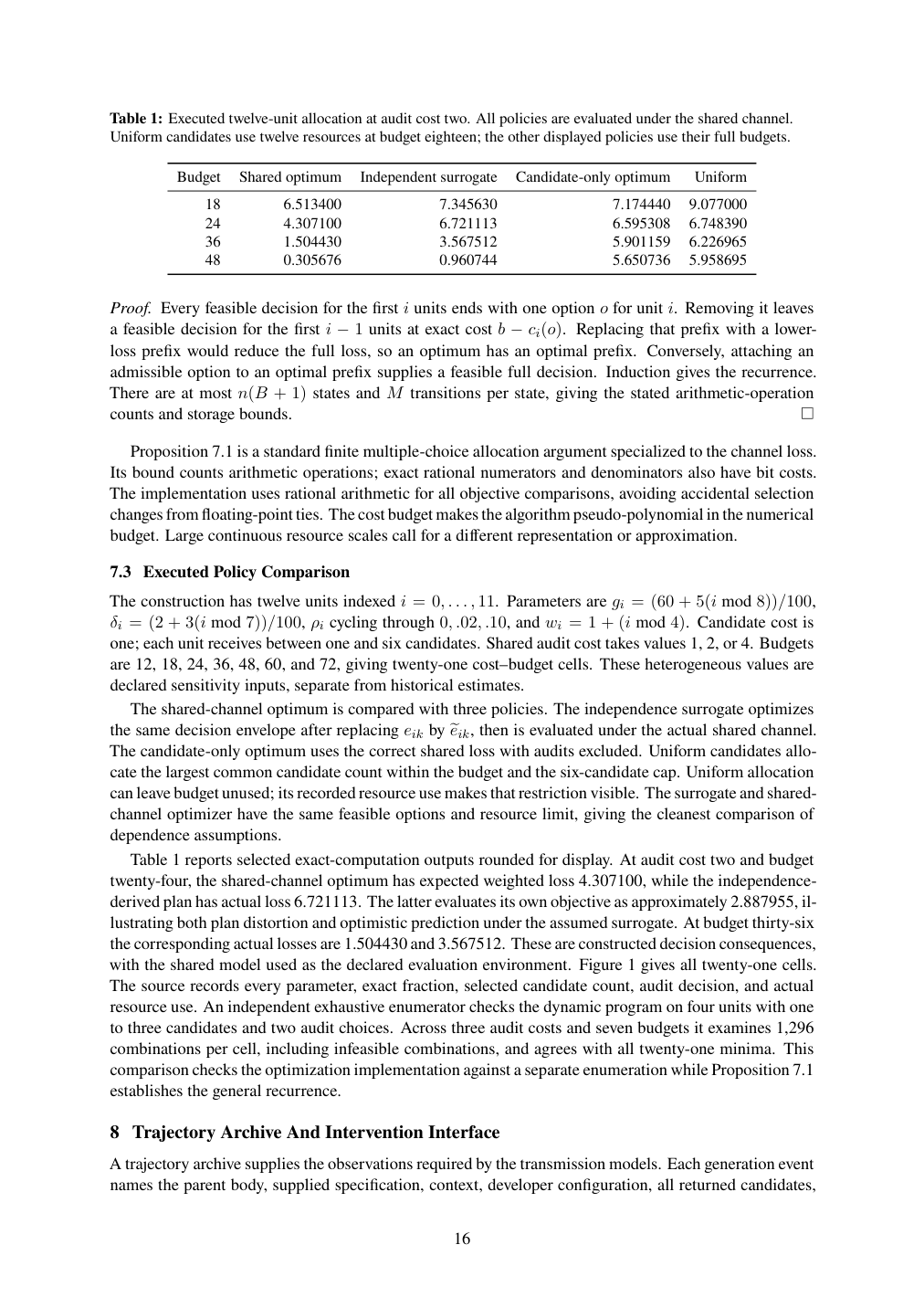
Table 1: Executed twelve-unit allocation at audit cost two. All policies are evaluated under the shared channel. Uniform candidates use twelve resources at budget eighteen; the other displayed policies use their full budgets.
loss prefix would reduce the full loss, so an optimum has an optimal prefix. Conversely, attaching an admissible option to an optimal prefix supplies a feasible full decision. Induction gives the recurrence.
Proposition 7.1 is a standard finite multiple-choice allocation argument specialized to the channel loss. Its bound counts arithmetic operations; exact rational numerators and denominators also have bit costs. The implementation uses rational arithmetic for all objective comparisons, avoiding accidental selection changes from floating-point ties. The cost budget makes the algorithm pseudo-polynomial in the numerical budget. Large continuous resource scales call for a different representation or approximation.
one; each unit receives between one and six candidates. Shared audit cost takes values 1, 2, or 4. Budgets are 12, 18, 24, 36, 48, 60, and 72, giving twenty-one cost–budget cells. These heterogeneous values are declared sensitivity inputs, separate from historical estimates.
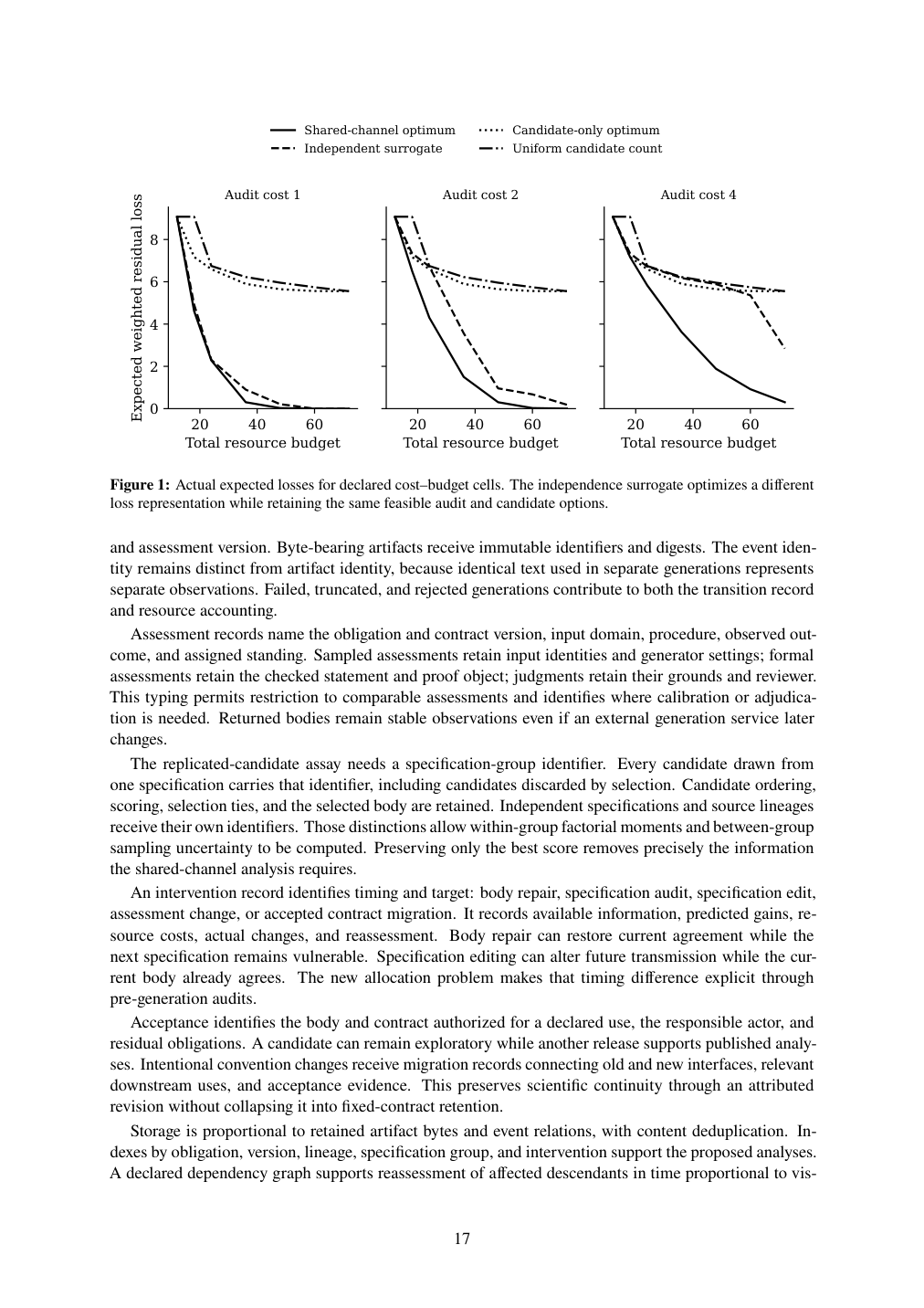
The shared-channel optimum is compared with three policies. The independence surrogate optimizes The candidate-only optimum uses the correct shared loss with audits excluded. Uniform candidates allo- cate the largest common candidate count within the budget and the six-candidate cap. Uniform allocation can leave budget unused; its recorded resource use makes that restriction visible. The surrogate and shared- channel optimizer have the same feasible options and resource limit, giving the cleanest comparison of
Table 1 reports selected exact-computation outputs rounded for display. At audit cost two and budget twenty-four, the shared-channel optimum has expected weighted loss 4.307100, while the independence- derived plan has actual loss 6.721113. The latter evaluates its own objective as approximately 2.887955, il- lustrating both plan distortion and optimistic prediction under the assumed surrogate. At budget thirty-six the corresponding actual losses are 1.504430 and 3.567512. These are constructed decision consequences, with the shared model used as the declared evaluation environment. Figure 1 gives all twenty-one cells. The source records every parameter, exact fraction, selected candidate count, audit decision, and actual resource use. An independent exhaustive enumerator checks the dynamic program on four units with one to three candidates and two audit choices. Across three audit costs and seven budgets it examines 1,296 combinations per cell, including infeasible combinations, and agrees with all twenty-one minima. This comparison checks the optimization implementation against a separate enumeration while Proposition 7.1
A trajectory archive supplies the observations required by the transmission models. Each generation event names the parent body, supplied specification, context, developer configuration, all returned candidates,
Readable text
Figure 1: Actual expected losses for declared cost–budget cells. The independence surrogate optimizes a different loss representation while retaining the same feasible audit and candidate options.
and assessment version. Byte-bearing artifacts receive immutable identifiers and digests. The event iden- tity remains distinct from artifact identity, because identical text used in separate generations represents separate observations. Failed, truncated, and rejected generations contribute to both the transition record
Assessment records name the obligation and contract version, input domain, procedure, observed out- come, and assigned standing. Sampled assessments retain input identities and generator settings; formal assessments retain the checked statement and proof object; judgments retain their grounds and reviewer. This typing permits restriction to comparable assessments and identifies where calibration or adjudica- tion is needed. Returned bodies remain stable observations even if an external generation service later
The replicated-candidate assay needs a specification-group identifier. Every candidate drawn from one specification carries that identifier, including candidates discarded by selection. Candidate ordering, scoring, selection ties, and the selected body are retained. Independent specifications and source lineages receive their own identifiers. Those distinctions allow within-group factorial moments and between-group sampling uncertainty to be computed. Preserving only the best score removes precisely the information
An intervention record identifies timing and target: body repair, specification audit, specification edit, assessment change, or accepted contract migration. It records available information, predicted gains, re- source costs, actual changes, and reassessment. Body repair can restore current agreement while the next specification remains vulnerable. Specification editing can alter future transmission while the cur- rent body already agrees. The new allocation problem makes that timing difference explicit through
Acceptance identifies the body and contract authorized for a declared use, the responsible actor, and residual obligations. A candidate can remain exploratory while another release supports published analy- ses. Intentional convention changes receive migration records connecting old and new interfaces, relevant downstream uses, and acceptance evidence. This preserves scientific continuity through an attributed revision without collapsing it into fixed-contract retention.
Storage is proportional to retained artifact bytes and event relations, with content deduplication. In- dexes by obligation, version, lineage, specification group, and intervention support the proposed analyses. A declared dependency graph supports reassessment of affected descendants in time proportional to vis-
Readable text
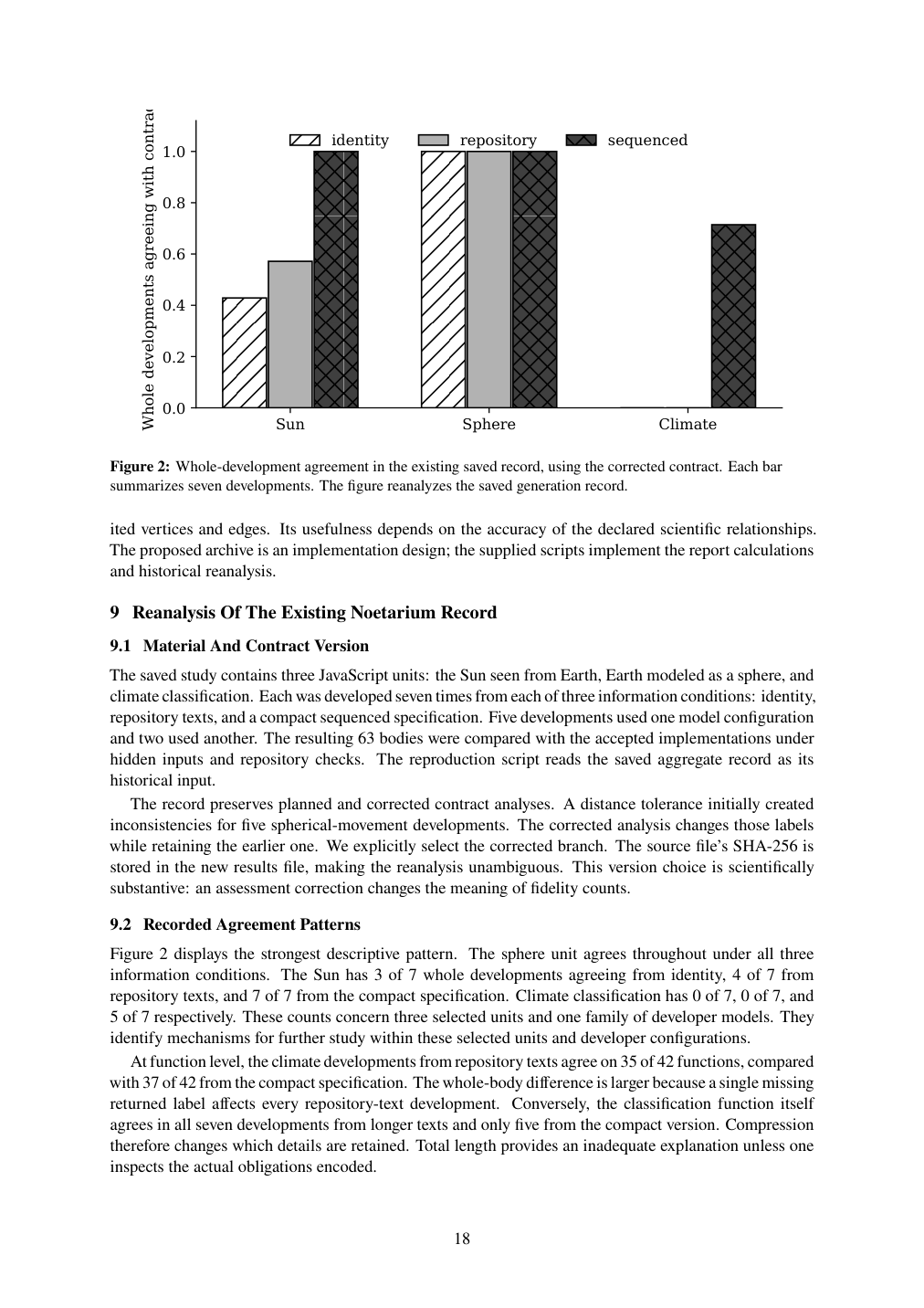
Figure 2: Whole-development agreement in the existing saved record, using the corrected contract. Each bar summarizes seven developments. The figure reanalyzes the saved generation record.
ited vertices and edges. Its usefulness depends on the accuracy of the declared scientific relationships. The proposed archive is an implementation design; the supplied scripts implement the report calculations
The saved study contains three JavaScript units: the Sun seen from Earth, Earth modeled as a sphere, and climate classification. Each was developed seven times from each of three information conditions: identity, repository texts, and a compact sequenced specification. Five developments used one model configuration and two used another. The resulting 63 bodies were compared with the accepted implementations under hidden inputs and repository checks. The reproduction script reads the saved aggregate record as its
The record preserves planned and corrected contract analyses. A distance tolerance initially created inconsistencies for five spherical-movement developments. The corrected analysis changes those labels while retaining the earlier one. We explicitly select the corrected branch. The source file’s SHA-256 is stored in the new results file, making the reanalysis unambiguous. This version choice is scientifically substantive: an assessment correction changes the meaning of fidelity counts.
Figure 2 displays the strongest descriptive pattern. The sphere unit agrees throughout under all three information conditions. The Sun has 3 of 7 whole developments agreeing from identity, 4 of 7 from repository texts, and 7 of 7 from the compact specification. Climate classification has 0 of 7, 0 of 7, and 5 of 7 respectively. These counts concern three selected units and one family of developer models. They identify mechanisms for further study within these selected units and developer configurations.
At function level, the climate developments from repository texts agree on 35 of 42 functions, compared with 37 of 42 from the compact specification. The whole-body difference is larger because a single missing returned label affects every repository-text development. Conversely, the classification function itself agrees in all seven developments from longer texts and only five from the compact version. Compression therefore changes which details are retained. Total length provides an inadequate explanation unless one
Readable text
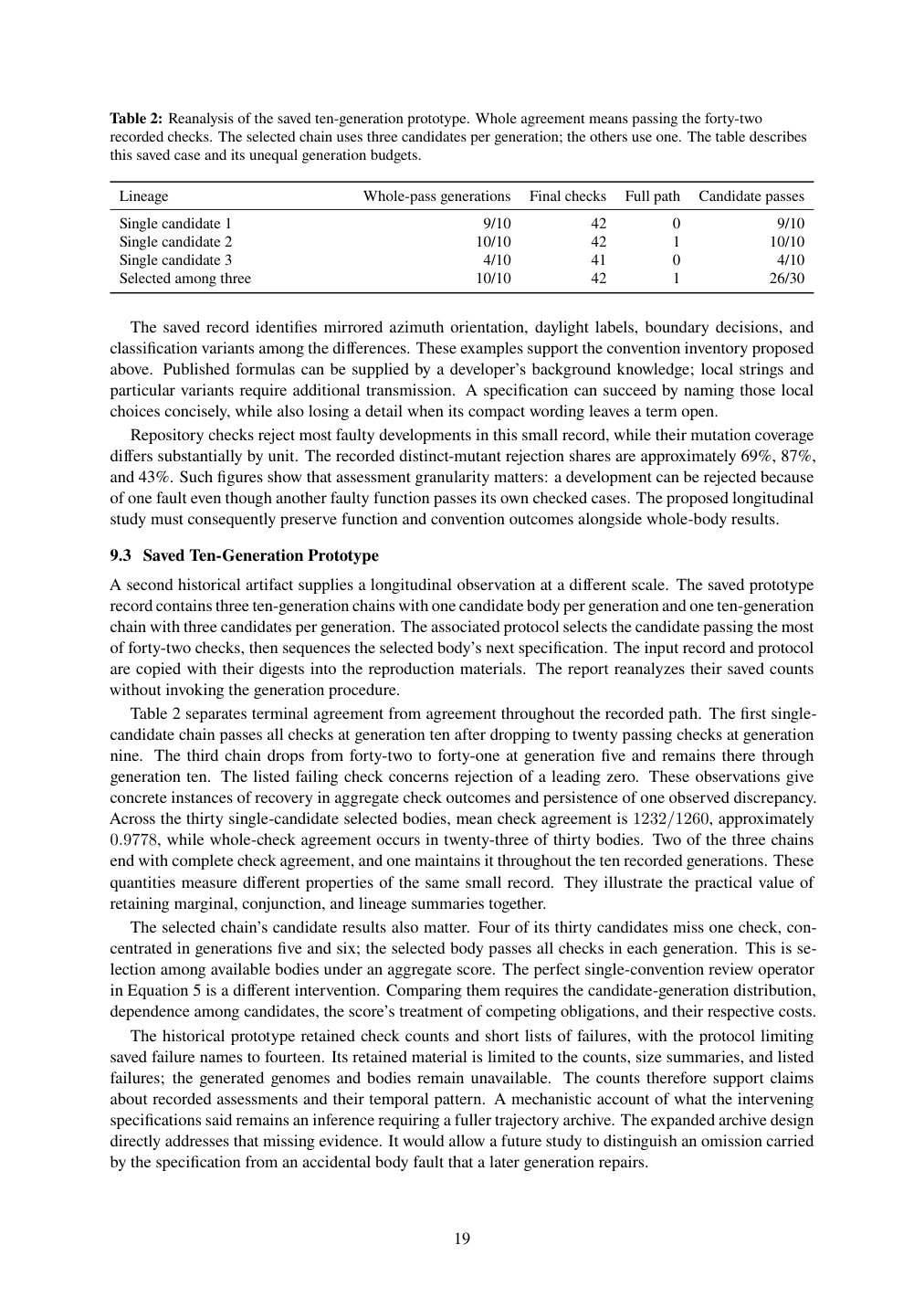
Table 2: Reanalysis of the saved ten-generation prototype. Whole agreement means passing the forty-two recorded checks. The selected chain uses three candidates per generation; the others use one. The table describes
Single candidate 1 Single candidate 2 Single candidate 3 Selected among three
The saved record identifies mirrored azimuth orientation, daylight labels, boundary decisions, and classification variants among the differences. These examples support the convention inventory proposed above. Published formulas can be supplied by a developer’s background knowledge; local strings and particular variants require additional transmission. A specification can succeed by naming those local choices concisely, while also losing a detail when its compact wording leaves a term open.
Repository checks reject most faulty developments in this small record, while their mutation coverage differs substantially by unit. The recorded distinct-mutant rejection shares are approximately 69%, 87%, and 43%. Such figures show that assessment granularity matters: a development can be rejected because of one fault even though another faulty function passes its own checked cases. The proposed longitudinal study must consequently preserve function and convention outcomes alongside whole-body results.
A second historical artifact supplies a longitudinal observation at a different scale. The saved prototype record contains three ten-generation chains with one candidate body per generation and one ten-generation chain with three candidates per generation. The associated protocol selects the candidate passing the most of forty-two checks, then sequences the selected body’s next specification. The input record and protocol are copied with their digests into the reproduction materials. The report reanalyzes their saved counts
Table 2 separates terminal agreement from agreement throughout the recorded path. The first single- candidate chain passes all checks at generation ten after dropping to twenty passing checks at generation nine. The third chain drops from forty-two to forty-one at generation five and remains there through generation ten. The listed failing check concerns rejection of a leading zero. These observations give concrete instances of recovery in aggregate check outcomes and persistence of one observed discrepancy. Across the thirty single-candidate selected bodies, mean check agreement is 1232/1260, approximately end with complete check agreement, and one maintains it throughout the ten recorded generations. These quantities measure different properties of the same small record. They illustrate the practical value of retaining marginal, conjunction, and lineage summaries together.
The selected chain’s candidate results also matter. Four of its thirty candidates miss one check, con- centrated in generations five and six; the selected body passes all checks in each generation. This is se- lection among available bodies under an aggregate score. The perfect single-convention review operator in Equation 5 is a different intervention. Comparing them requires the candidate-generation distribution, dependence among candidates, the score’s treatment of competing obligations, and their respective costs.
The historical prototype retained check counts and short lists of failures, with the protocol limiting saved failure names to fourteen. Its retained material is limited to the counts, size summaries, and listed failures; the generated genomes and bodies remain unavailable. The counts therefore support claims about recorded assessments and their temporal pattern. A mechanistic account of what the intervening specifications said remains an inference requiring a fuller trajectory archive. The expanded archive design directly addresses that missing evidence. It would allow a future study to distinguish an omission carried by the specification from an accidental body fault that a later generation repairs.
Readable text
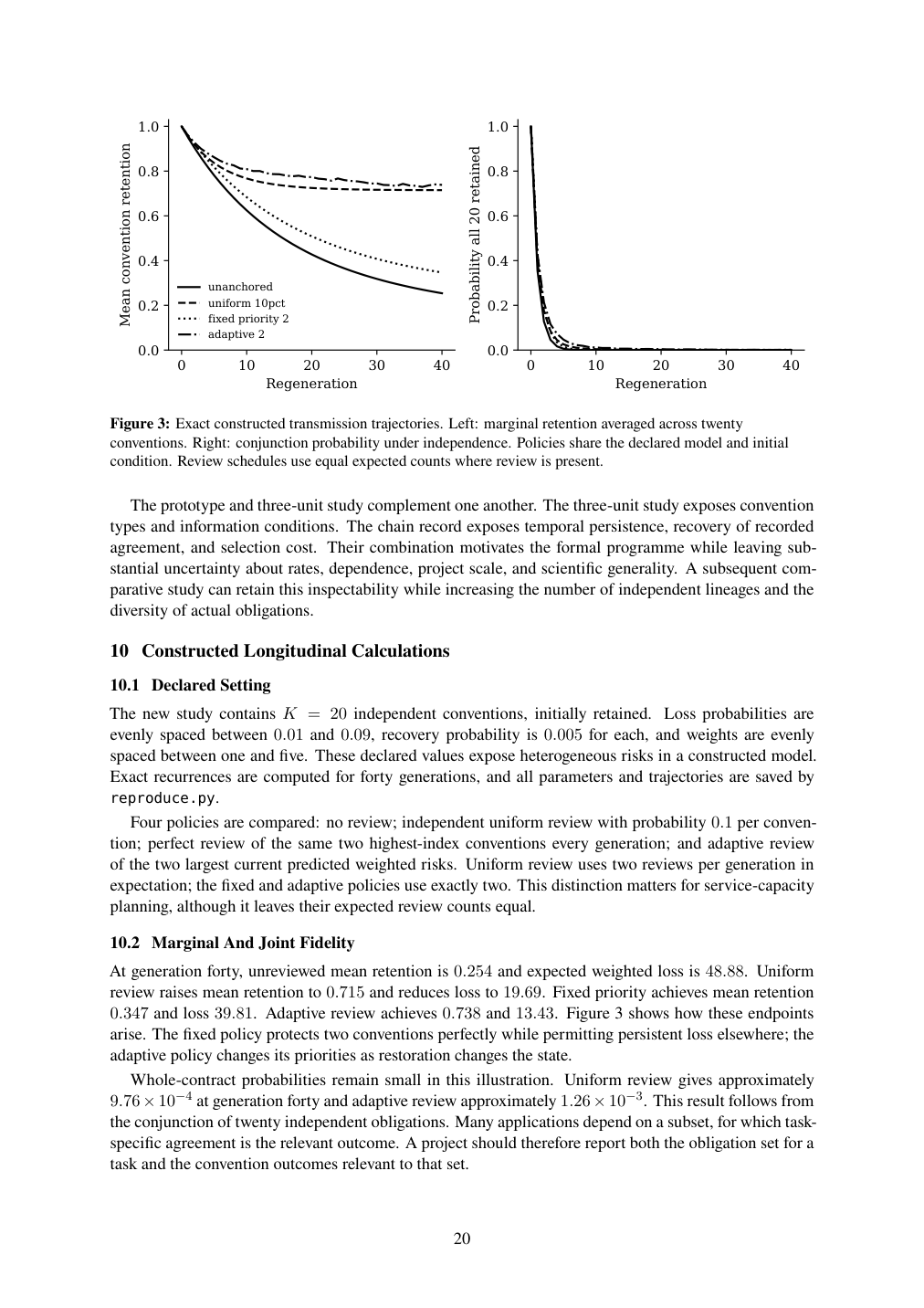
Figure 3: Exact constructed transmission trajectories. Left: marginal retention averaged across twenty conventions. Right: conjunction probability under independence. Policies share the declared model and initial condition. Review schedules use equal expected counts where review is present.
The prototype and three-unit study complement one another. The three-unit study exposes convention types and information conditions. The chain record exposes temporal persistence, recovery of recorded agreement, and selection cost. Their combination motivates the formal programme while leaving sub- stantial uncertainty about rates, dependence, project scale, and scientific generality. A subsequent com- parative study can retain this inspectability while increasing the number of independent lineages and the
spaced between one and five. These declared values expose heterogeneous risks in a constructed model. Exact recurrences are computed for forty generations, and all parameters and trajectories are saved by
tion; perfect review of the same two highest-index conventions every generation; and adaptive review of the two largest current predicted weighted risks. Uniform review uses two reviews per generation in expectation; the fixed and adaptive policies use exactly two. This distinction matters for service-capacity planning, although it leaves their expected review counts equal.
arise. The fixed policy protects two conventions perfectly while permitting persistent loss elsewhere; the adaptive policy changes its priorities as restoration changes the state.
Whole-contract probabilities remain small in this illustration. Uniform review gives approximately the conjunction of twenty independent obligations. Many applications depend on a subset, for which task- specific agreement is the relevant outcome. A project should therefore report both the obligation set for a
task and the convention outcomes relevant to that set.
Readable text
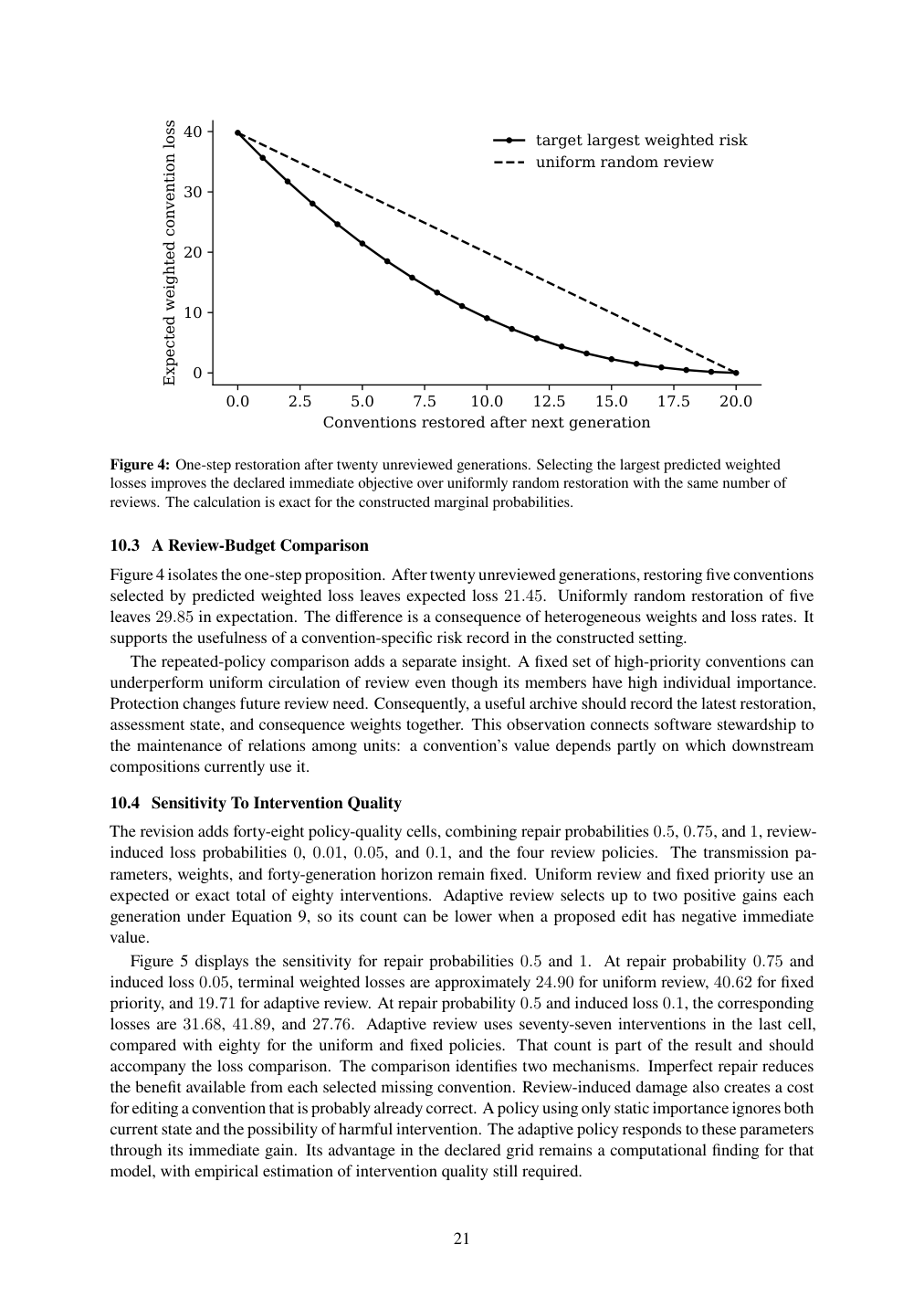
Figure 4: One-step restoration after twenty unreviewed generations. Selecting the largest predicted weighted losses improves the declared immediate objective over uniformly random restoration with the same number of reviews. The calculation is exact for the constructed marginal probabilities.
Figure 4 isolates the one-step proposition. After twenty unreviewed generations, restoring five conventions supports the usefulness of a convention-specific risk record in the constructed setting.
The repeated-policy comparison adds a separate insight. A fixed set of high-priority conventions can underperform uniform circulation of review even though its members have high individual importance. Protection changes future review need. Consequently, a useful archive should record the latest restoration, assessment state, and consequence weights together. This observation connects software stewardship to the maintenance of relations among units: a convention’s value depends partly on which downstream
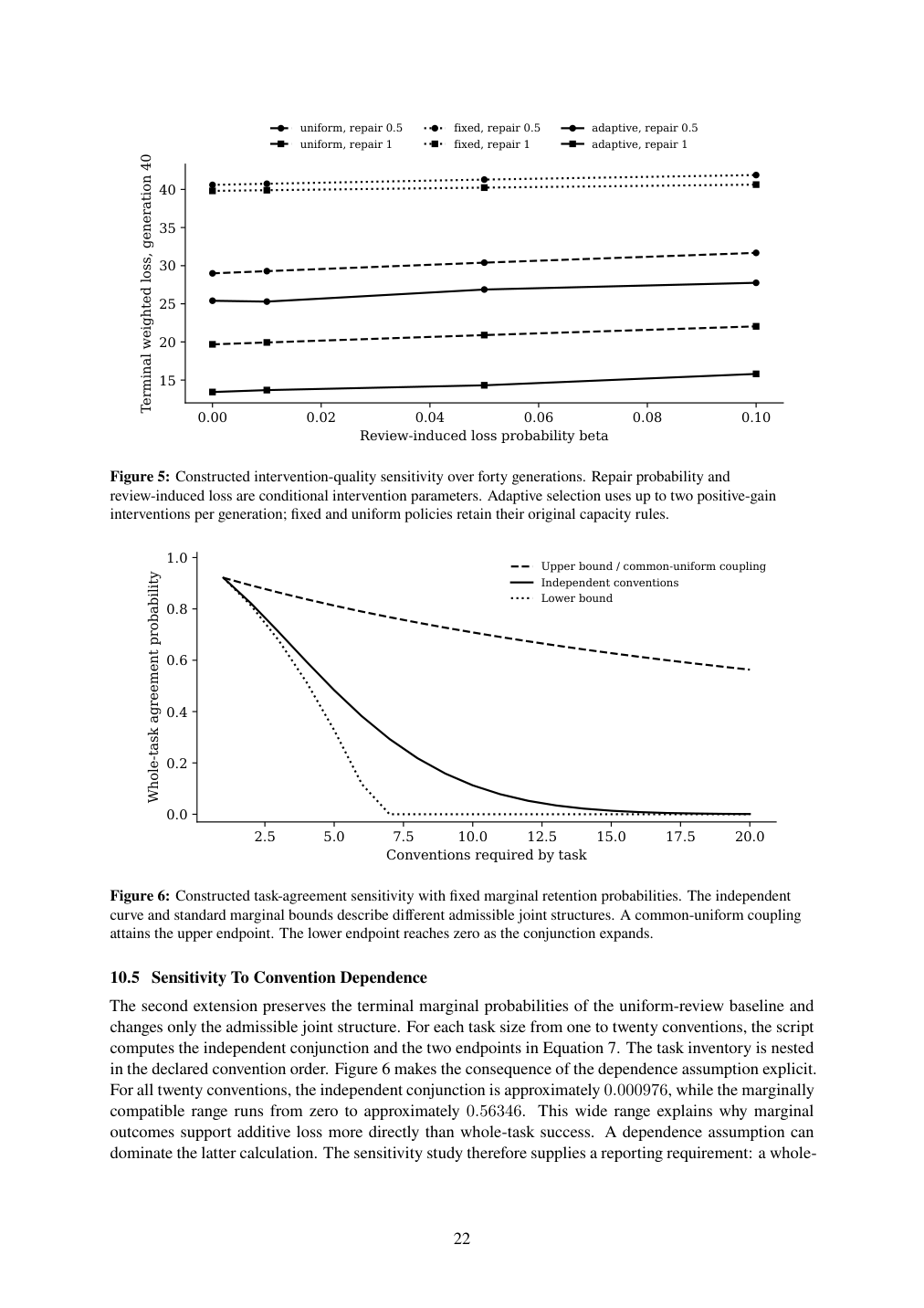
rameters, weights, and forty-generation horizon remain fixed. Uniform review and fixed priority use an expected or exact total of eighty interventions. Adaptive review selects up to two positive gains each generation under Equation 9, so its count can be lower when a proposed edit has negative immediate
compared with eighty for the uniform and fixed policies. That count is part of the result and should accompany the loss comparison. The comparison identifies two mechanisms. Imperfect repair reduces the benefit available from each selected missing convention. Review-induced damage also creates a cost for editing a convention that is probably already correct. A policy using only static importance ignores both current state and the possibility of harmful intervention. The adaptive policy responds to these parameters through its immediate gain. Its advantage in the declared grid remains a computational finding for that model, with empirical estimation of intervention quality still required.
Readable text
Figure 5: Constructed intervention-quality sensitivity over forty generations. Repair probability and review-induced loss are conditional intervention parameters. Adaptive selection uses up to two positive-gain interventions per generation; fixed and uniform policies retain their original capacity rules.
Upper bound / common-uniform coupling Independent conventions Lower bound
Figure 6: Constructed task-agreement sensitivity with fixed marginal retention probabilities. The independent curve and standard marginal bounds describe different admissible joint structures. A common-uniform coupling attains the upper endpoint. The lower endpoint reaches zero as the conjunction expands.
The second extension preserves the terminal marginal probabilities of the uniform-review baseline and changes only the admissible joint structure. For each task size from one to twenty conventions, the script computes the independent conjunction and the two endpoints in Equation 7. The task inventory is nested in the declared convention order. Figure 6 makes the consequence of the dependence assumption explicit. outcomes support additive loss more directly than whole-task success. A dependence assumption can dominate the latter calculation. The sensitivity study therefore supplies a reporting requirement: a whole-
Readable text
Shared genome, recovery 0 Shared genome, recovery 0.02 Shared genome, recovery 0.1 Independent shortcut, recovery .02
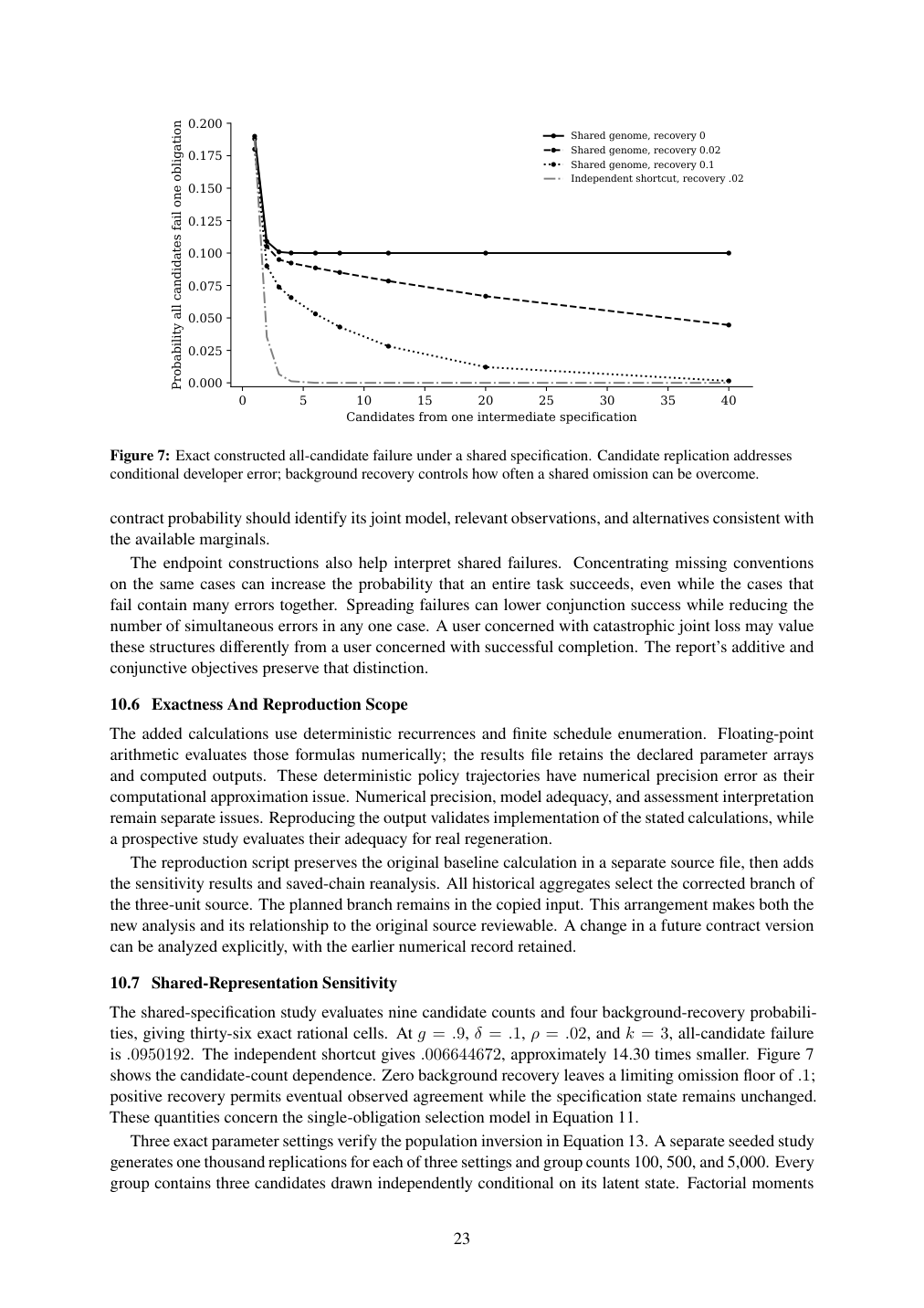
Figure 7: Exact constructed all-candidate failure under a shared specification. Candidate replication addresses conditional developer error; background recovery controls how often a shared omission can be overcome.
contract probability should identify its joint model, relevant observations, and alternatives consistent with
The endpoint constructions also help interpret shared failures. Concentrating missing conventions on the same cases can increase the probability that an entire task succeeds, even while the cases that fail contain many errors together. Spreading failures can lower conjunction success while reducing the number of simultaneous errors in any one case. A user concerned with catastrophic joint loss may value these structures differently from a user concerned with successful completion. The report’s additive and
The added calculations use deterministic recurrences and finite schedule enumeration. Floating-point arithmetic evaluates those formulas numerically; the results file retains the declared parameter arrays and computed outputs. These deterministic policy trajectories have numerical precision error as their computational approximation issue. Numerical precision, model adequacy, and assessment interpretation remain separate issues. Reproducing the output validates implementation of the stated calculations, while a prospective study evaluates their adequacy for real regeneration.
The reproduction script preserves the original baseline calculation in a separate source file, then adds the sensitivity results and saved-chain reanalysis. All historical aggregates select the corrected branch of the three-unit source. The planned branch remains in the copied input. This arrangement makes both the new analysis and its relationship to the original source reviewable. A change in a future contract version can be analyzed explicitly, with the earlier numerical record retained.
The shared-specification study evaluates nine candidate counts and four background-recovery probabili- positive recovery permits eventual observed agreement while the specification state remains unchanged. These quantities concern the single-obligation selection model in Equation 11.
Three exact parameter settings verify the population inversion in Equation 13. A separate seeded study generates one thousand replications for each of three settings and group counts 100, 500, and 5,000. Every group contains three candidates drawn independently conditional on its latent state. Factorial moments
Readable text
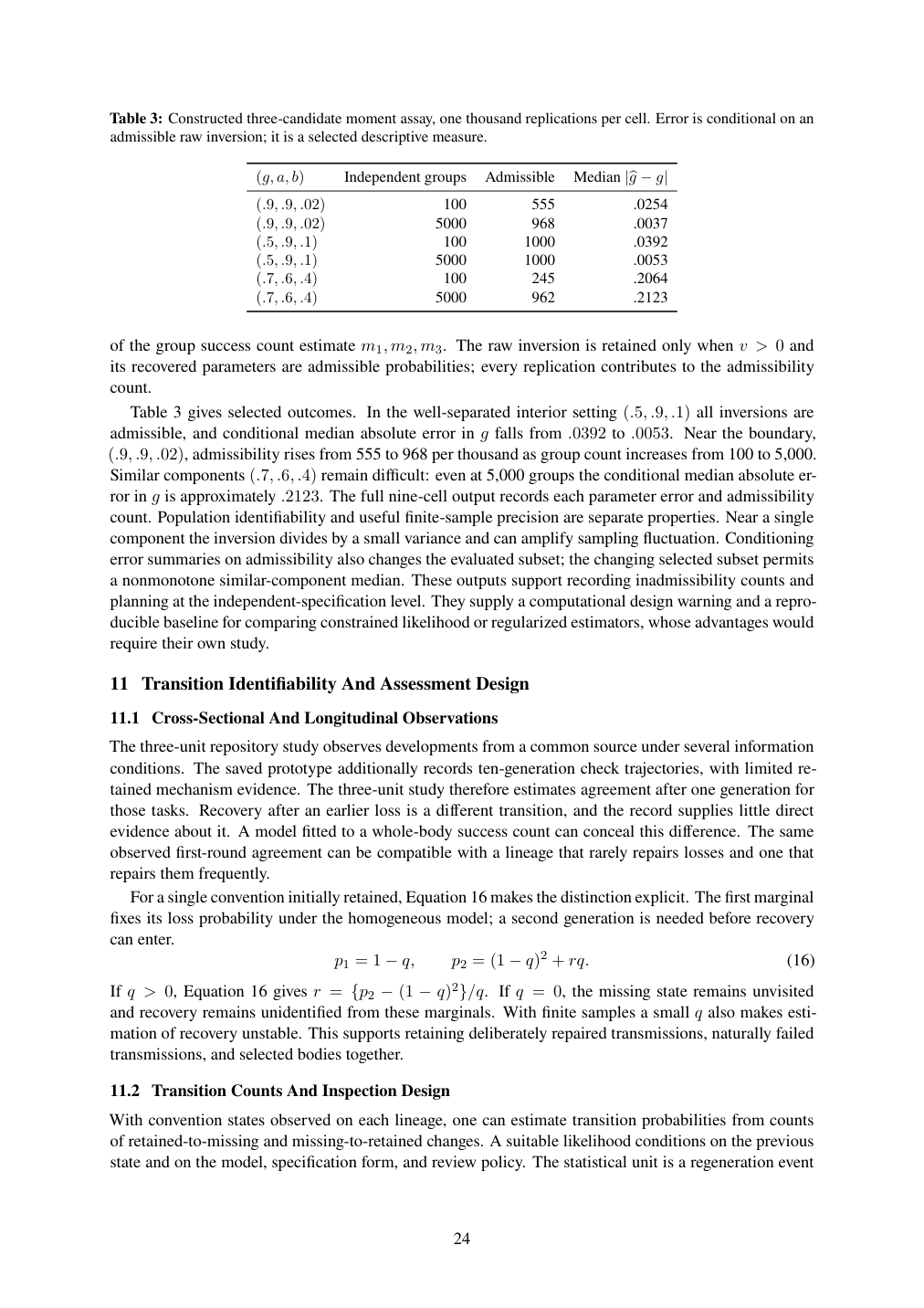
Table 3: Constructed three-candidate moment assay, one thousand replications per cell. Error is conditional on an admissible raw inversion; it is a selected descriptive measure.
its recovered parameters are admissible probabilities; every replication contributes to the admissibility
count. Population identifiability and useful finite-sample precision are separate properties. Near a single component the inversion divides by a small variance and can amplify sampling fluctuation. Conditioning error summaries on admissibility also changes the evaluated subset; the changing selected subset permits a nonmonotone similar-component median. These outputs support recording inadmissibility counts and planning at the independent-specification level. They supply a computational design warning and a repro- ducible baseline for comparing constrained likelihood or regularized estimators, whose advantages would
The three-unit repository study observes developments from a common source under several information conditions. The saved prototype additionally records ten-generation check trajectories, with limited re- tained mechanism evidence. The three-unit study therefore estimates agreement after one generation for those tasks. Recovery after an earlier loss is a different transition, and the record supplies little direct evidence about it. A model fitted to a whole-body success count can conceal this difference. The same observed first-round agreement can be compatible with a lineage that rarely repairs losses and one that
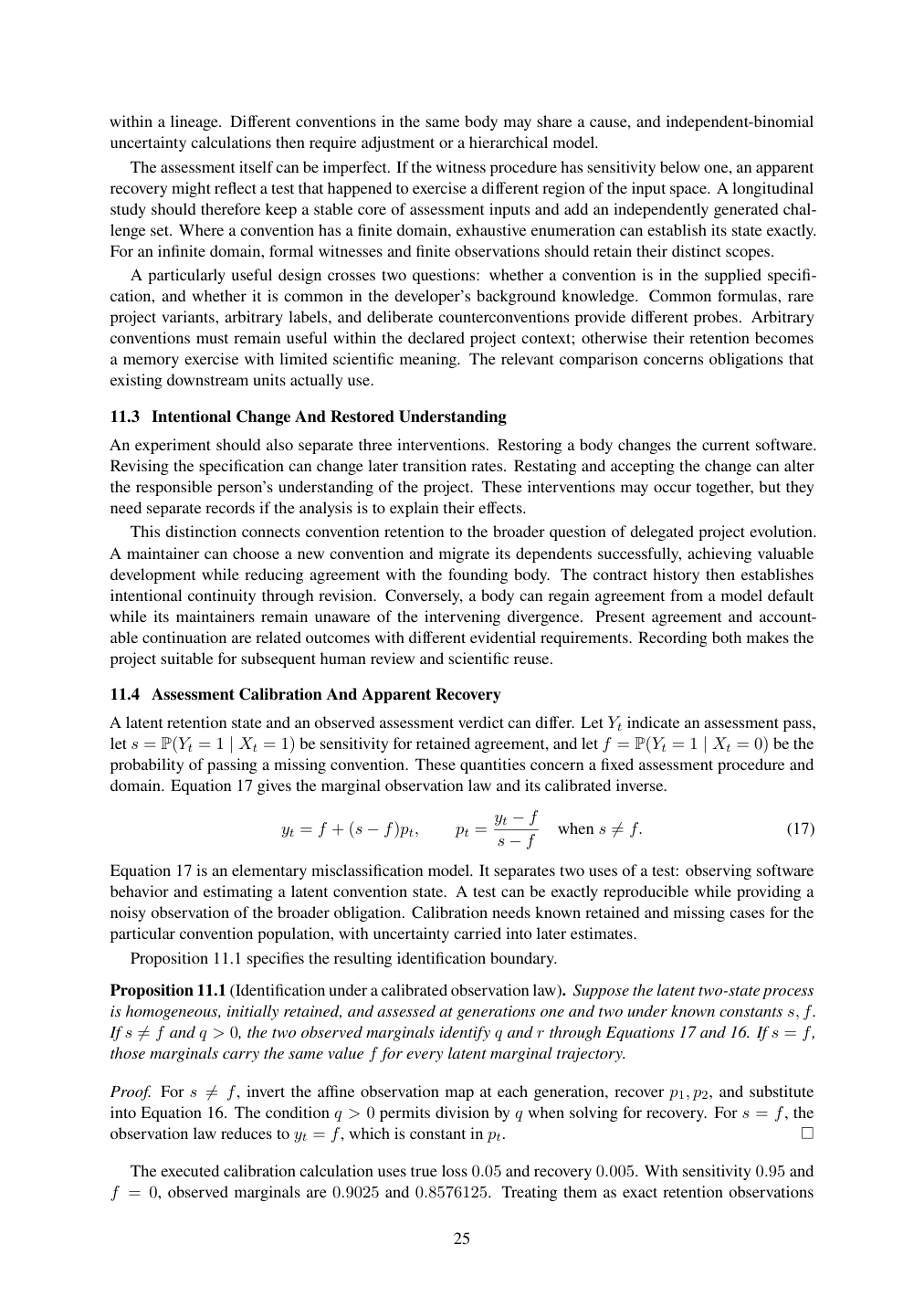
For a single convention initially retained, Equation 16 makes the distinction explicit. The first marginal fixes its loss probability under the homogeneous model; a second generation is needed before recovery
mation of recovery unstable. This supports retaining deliberately repaired transmissions, naturally failed
With convention states observed on each lineage, one can estimate transition probabilities from counts
of retained-to-missing and missing-to-retained changes. A suitable likelihood conditions on the previous state and on the model, specification form, and review policy. The statistical unit is a regeneration event
Readable text
within a lineage. Different conventions in the same body may share a cause, and independent-binomial uncertainty calculations then require adjustment or a hierarchical model.
The assessment itself can be imperfect. If the witness procedure has sensitivity below one, an apparent recovery might reflect a test that happened to exercise a different region of the input space. A longitudinal study should therefore keep a stable core of assessment inputs and add an independently generated chal- lenge set. Where a convention has a finite domain, exhaustive enumeration can establish its state exactly. For an infinite domain, formal witnesses and finite observations should retain their distinct scopes.
A particularly useful design crosses two questions: whether a convention is in the supplied specifi- cation, and whether it is common in the developer’s background knowledge. Common formulas, rare project variants, arbitrary labels, and deliberate counterconventions provide different probes. Arbitrary conventions must remain useful within the declared project context; otherwise their retention becomes a memory exercise with limited scientific meaning. The relevant comparison concerns obligations that
An experiment should also separate three interventions. Restoring a body changes the current software. Revising the specification can change later transition rates. Restating and accepting the change can alter the responsible person’s understanding of the project. These interventions may occur together, but they need separate records if the analysis is to explain their effects.
This distinction connects convention retention to the broader question of delegated project evolution. A maintainer can choose a new convention and migrate its dependents successfully, achieving valuable development while reducing agreement with the founding body. The contract history then establishes intentional continuity through revision. Conversely, a body can regain agreement from a model default while its maintainers remain unaware of the intervening divergence. Present agreement and account- able continuation are related outcomes with different evidential requirements. Recording both makes the project suitable for subsequent human review and scientific reuse.
probability of passing a missing convention. These quantities concern a fixed assessment procedure and domain. Equation 17 gives the marginal observation law and its calibrated inverse.
Equation 17 is an elementary misclassification model. It separates two uses of a test: observing software behavior and estimating a latent convention state. A test can be exactly reproducible while providing a noisy observation of the broader obligation. Calibration needs known retained and missing cases for the particular convention population, with uncertainty carried into later estimates.
Proposition 11.1 specifies the resulting identification boundary.
Proposition 11.1 (Identification under a calibrated observation law). Suppose the latent two-state process

These observations identify an important empirical task. A study that sees apparent recovery should inspect whether the convention actually returned, whether the tested inputs changed, whether the assessment was corrected, or whether the accepted contract changed. The saved sphere-tolerance correction provides a concrete reason to retain assessment versions. A calibrated model can make those possibilities explicit, while qualitative examination of selected transmissions can identify mechanisms that a two-state likelihood compresses.
12 Prospective Evaluation And Decision Validation
An empirical evaluation should test the model at the replication levels it distinguishes. Select scientific units with explicit versioned obligations and external relevance, including conventions that differ from familiar defaults. Independently sample source lineages and produce several specifications per source. Draw at least three candidates per specification when the two-component moment assay is used. Preserve each specification, candidate body, assessment, and selection decision. This crossed structure permits within-specification dependence to be separated from between-specification variation under the declared sampling model.
Independent annotation should determine whether each supplied specification contains, contradicts, or leaves ambiguous the focal obligation. Retain annotation grounds and disagreements. The binary model is appropriate for a sufficiently settled subset; ambiguous texts can be analyzed separately or motivate a richer latent state. Compare empirical candidate agreement conditional on those annotations with the assumed two-component probabilities. Higher-order moments, residual within-group dependence, and contextdependent rates provide model-adequacy checks. Three moments identify the idealized population model; successful identification of the actual mechanism depends on these semantic and design conditions.
A source-free or uninformative-specification arm measures background reconstruction in the spirit of forward lift. A paired specification-correction arm can estimate the effect of repairing a documented omission. Randomized assignment at the specification or lineage level should respect shared contexts and avoid leakage among candidates. Hold the developer configuration fixed within the primary comparison, then vary it in a separate declared sensitivity study. Surface diversity and model diversity can be measured alongside behavioral dependence, preserving their distinct estimands.
Allocation evaluation has two stages. A training sample estimates channel parameters, intervention quality, and costs. A held-out sample executes policies under equal declared resource envelopes. Compare the shared-channel plan, an independence-derived plan, candidate-only allocation, and a simple uniform baseline. Measure actual obligation agreement, source fidelity, audit effects, total generation and review cost, and unresolved assessments. Parameter estimation and policy evaluation should use distinct groups so that an optimistic fitted model cannot certify its own decision quality.
The perfect audit and exact selection oracle in the constructed allocation study are idealized controls. A realistic study should measure audit repair probability, induced damage, and candidate-scoring sensitivity. Several obligations per unit create tradeoffs when one candidate maximizes an aggregate score. Retain the complete per-obligation outcome vector to assess those tradeoffs. Bundled repairs and shared costs can be compared with the separable baseline; the relevant complexity then follows the declared option and interaction structure.
Longitudinal follow-up should report terminal agreement, uninterrupted recorded agreement, recovery events, and accepted contract migrations separately. Assessment changes receive their own versions and calibration data. Independent lineages are the primary replication units for population inference; repeated generations within a lineage remain dependent observations. Prospective sample-size planning can simulate the proposed hierarchical design, including boundary mixtures and the full frequency of inadmissible or unresolved estimates.
Readable text
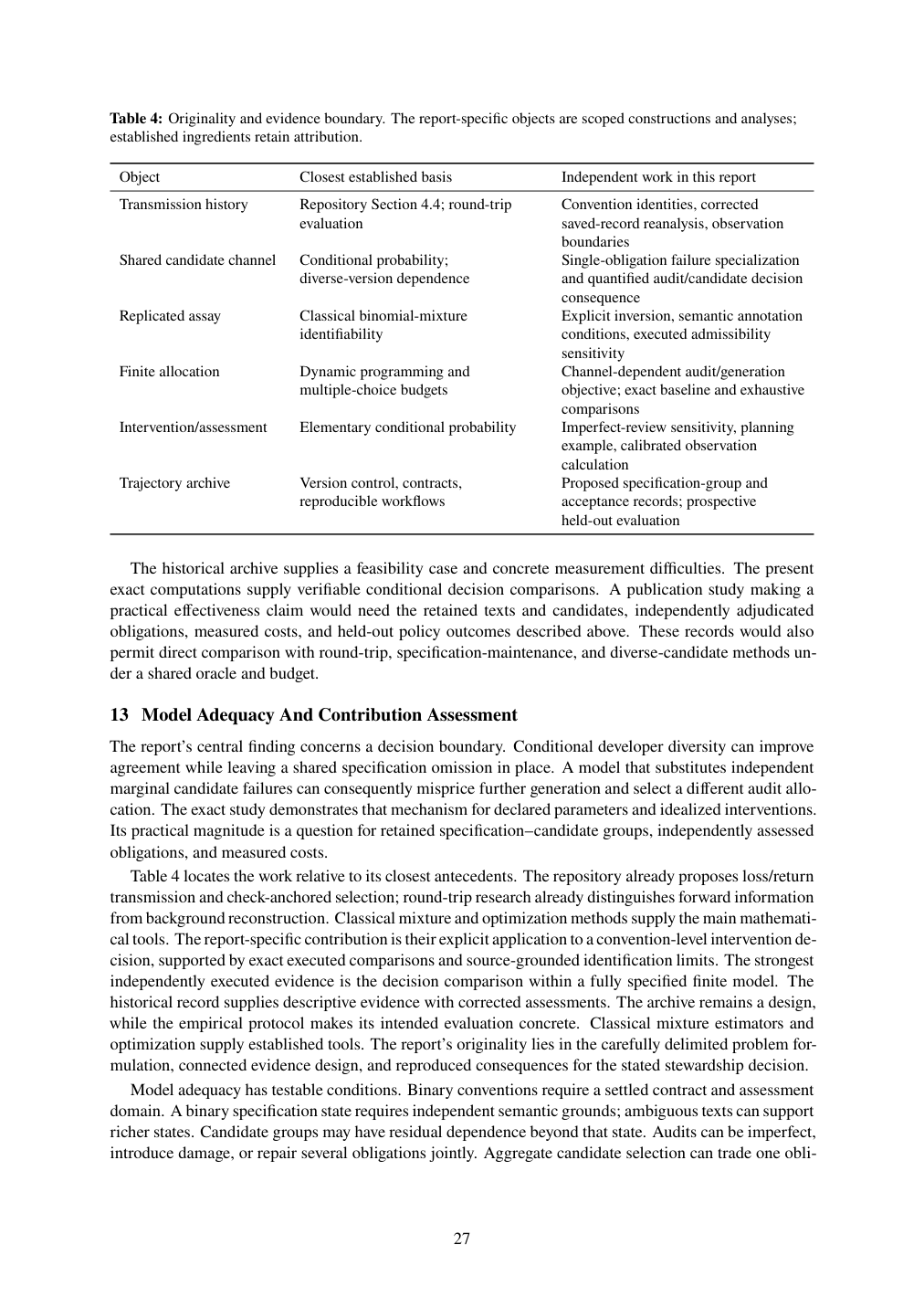
Table 4: Originality and evidence boundary. The report-specific objects are scoped constructions and analyses;
Shared candidate channel Conditional probability; diverse-version dependence
Replicated assay Classical binomial-mixture identifiability
Finite allocation Dynamic programming and multiple-choice budgets
Intervention/assessment Trajectory archive Version control, contracts, reproducible workflows
Convention identities, corrected saved-record reanalysis, observation boundaries
Single-obligation failure specialization and quantified audit/candidate decision consequence
Explicit inversion, semantic annotation conditions, executed admissibility sensitivity
Channel-dependent audit/generation objective; exact baseline and exhaustive comparisons Imperfect-review sensitivity, planning example, calibrated observation calculation
Proposed specification-group and acceptance records; prospective held-out evaluation
The historical archive supplies a feasibility case and concrete measurement difficulties. The present exact computations supply verifiable conditional decision comparisons. A publication study making a practical effectiveness claim would need the retained texts and candidates, independently adjudicated obligations, measured costs, and held-out policy outcomes described above. These records would also permit direct comparison with round-trip, specification-maintenance, and diverse-candidate methods un-
The report’s central finding concerns a decision boundary. Conditional developer diversity can improve agreement while leaving a shared specification omission in place. A model that substitutes independent marginal candidate failures can consequently misprice further generation and select a different audit allo- cation. The exact study demonstrates that mechanism for declared parameters and idealized interventions. Its practical magnitude is a question for retained specification–candidate groups, independently assessed
Table 4 locates the work relative to its closest antecedents. The repository already proposes loss/return transmission and check-anchored selection; round-trip research already distinguishes forward information from background reconstruction. Classical mixture and optimization methods supply the main mathemati- cal tools. The report-specific contribution is their explicit application to a convention-level intervention de- cision, supported by exact executed comparisons and source-grounded identification limits. The strongest independently executed evidence is the decision comparison within a fully specified finite model. The historical record supplies descriptive evidence with corrected assessments. The archive remains a design, while the empirical protocol makes its intended evaluation concrete. Classical mixture estimators and optimization supply established tools. The report’s originality lies in the carefully delimited problem for- mulation, connected evidence design, and reproduced consequences for the stated stewardship decision.
Model adequacy has testable conditions. Binary conventions require a settled contract and assessment domain. A binary specification state requires independent semantic grounds; ambiguous texts can support richer states. Candidate groups may have residual dependence beyond that state. Audits can be imperfect, introduce damage, or repair several obligations jointly. Aggregate candidate selection can trade one obli-
gation against another. Each deviation changes a specified assumption and provides a concrete reason to enrich the baseline.
The finite-sample assay adds a practical caution: component separation and boundary location strongly affect precision. A population inversion can be exact while a feasible study yields unstable estimates. Parameter uncertainty should therefore enter a later deployment study’s planning and policy evaluation. The present known-parameter optimizer isolates a mechanism and supplies a reference decision, with experimental validation of its realized benefit remaining external work.
Scientific continuation also includes intentional revision. Background reconstruction can correct a poor founding implementation, and disciplinary evidence can motivate a new contract. Those developments acquire their own migration and acceptance records. A useful infrastructure preserves what changed, the evidence supporting it, and the dependent uses affected. This connects convention transmission to responsible evolution of scientific knowledge through explicit, revisable relations.
14 Conclusion
A specification-mediated project has distinct replication units: specifications and the candidate implementations drawn from them. The report makes that distinction operational for versioned scientific obligations. Its shared-channel model gives exact candidate-selection failure, its classical moment specialization states what replicated groups can identify, and its finite optimizer compares specification audit with additional generation under a declared budget.
Executed rational calculations show a substantial dependence effect in the constructed setting and a changed allocation under the independence shortcut. Seeded assay calculations show that population identification can coexist with weak finite-sample precision. Corrected historical records motivate these questions while retaining their descriptive scope and missing-artifact limits. Longitudinal and assessment sensitivities supply complementary requirements for interpreting continuation.
A practical next study should retain specifications and every candidate, annotate convention content, calibrate assessments, measure intervention costs, and evaluate allocation on independent held-out lineages. Those observations would test the mechanism and its usefulness directly. The Technical Report supplies a reproducible analytical baseline and a concrete route to author-led empirical publication review.
References
Miltiadis Allamanis, Sheena Panthaplackel, Pengcheng Yin (2024). Unsupervised Evaluation of Code LLMs with
Round-Trip Correctness. ICML 2024. https://doi.org/10.48550/arXiv.2402.08699. Oleg Grynets, Vasyl Lyashkevych, Arsen Dolichnyi, Roman Piznak, Taras Zelenyy, Volodymyr Morozov (2026).
Specification-Based Code-Text-Code Reengineering for LLM-Mediated Software Evolution. arXiv preprint. ht tps://doi.org/10.48550/arXiv.2605.25232. Shyam Agarwal, Anmol Singhal, Andrew Macvean, Bogdan Vasilescu, Travis Breaux (2026). Spec-Driven Devel-
opment as Prescribed and as Practiced. arXiv preprint v5. https://doi.org/10.48550/arXiv.2608.25202. Xinhao Zhang, Jingjie Lu, Kunpeng Liu, Fei Xie (2026). From Reading Code to Reading Spec: A Verified Layer
for LLM-Driven Codebase Maintenance. arXiv preprint. https://doi.org/10.48550/arXiv.2609.06383. Yue Jia, Mark Harman (2011). An Analysis and Survey of the Development of Mutation Testing. IEEE Transactions
on Software Engineering 37(5). 649–678. https://doi.org/10.1109/TSE.2010.62. John C. Knight, Nancy G. Leveson (1986). An Experimental Evaluation of the Assumption of Independence in
Multiversion Programming. IEEE Transactions on Software Engineering SE-12(1). 96–109. https://doi.or g/10.1109/TSE.1986.6312924. Javier Ron, Benoit Baudry, Martin Monperrus (2026). N-Version Programming with Coding Agents. arXiv preprint.
https://doi.org/10.48550/arXiv.2606.20158. Bertrand Meyer (1992). Applying Design by Contract. Computer 25(10). 40–51. https://doi.org/10.1109/2.
161279. Koen Claessen, John Hughes (2000). QuickCheck: A Lightweight Tool for Random Testing of Haskell Programs.
Proceedings of ICFP 2000. 268–279. https://doi.org/10.1145/351240.351266.
Sergio Segura, Gordon Fraser, Ana Belen Sanchez, Antonio Ruiz-Cortes (2016). A Survey on Metamorphic Testing.
IEEE Transactions on Software Engineering 42(9). 805–824. https://doi.org/10.1109/TSE.2016.25328 75. Upulee Kanewala, James M. Bieman (2014). Testing Scientific Software: A Systematic Literature Review. Infor-
mation and Software Technology 56(10). 1219–1232. https://doi.org/10.1016/j.infsof.2014.05.006. Greg Wilson, D. A. Aruliah, C. Titus Brown, Neil P. Chue Hong, Matt Davis, Richard T. Guy, Steven H. D. Haddock,
Kathryn D. Huff, Ian M. Mitchell, Mark D. Plumbley, Ben Waugh, Ethan P. White, Paul Wilson (2014). Best Practices for Scientific Computing. PLOS Biology 12(1). e1001745. https://doi.org/10.1371/journal. pbio.1001745. Geir Kjetil Sandve, Anton Nekrutenko, James Taylor, Eivind Hovig (2013). Ten Simple Rules for Reproducible
Computational Research. PLOS Computational Biology 9(10). e1003285. https://doi.org/10.1371/jour nal.pcbi.1003285. Thomas L. Griffiths, Michael L. Kalish (2007). Language Evolution by Iterated Learning With Bayesian Agents.
Cognitive Science 31(3). 441–480. https://doi.org/10.1080/15326900701326576. Noetarium Project (2026). An Ecology That Improves the Infrastructure; A Generative Ecology of Projects; Case
Studies. . https://github.com/huangwanhong-maker/The-Science-Infrastructures/tree/869fe3 8afac257cd9b5d51ad5b498a8ff6b8e443. W. R. Blischke (1964). Estimating the Parameters of Mixtures of Binomial Distributions. Journal of the American
Statistical Association 59(306). 510–528. https://doi.org/10.1080/01621459.1964.10482176. Richard Bellman (1954). The Theory of Dynamic Programming. Bulletin of the American Mathematical Society
60(6). 503–515. https://doi.org/10.1090/S0002-9904-1954-09848-8.