Claim Traceability And Measurement Validity In Agent-Generated Research
Full text from the PDF
Claim Traceability And Measurement Validity In
Agent-Generated Research
Wanhong HUANG
Abstract
A scientific claim connects source identities, computations, measurement interpretations, and inferential scope. This Technical Report develops a typed warrant design and a restricted source-derived conformance adapter. The adapter parses Python integer-expression kernels, computes exact sparse polynomial forms, and returns equal, different, or unresolved under an explicit grammar, arithmetic model, and resource envelope. A conditional soundness proof links canonical forms to universal integer behavior. A deterministic 312-pair study includes 280 supported pairs and 32 outside the grammar. Source normalization correctly decides every supported pair and abstains on the remainder; finite-probe promotion and unauthenticated coefficient declarations produce 60 and 40 false universalequality promotions. Independent SymPy normalization agrees on 560 operands. A pinned repository census covers 657 single-return definitions from 536 Python files and admits one kernel. The extracted month-index function receives 132 native Python executions, rewrite checks, and algebraic increment certificates. These results establish a narrow source-connected capability with measured applicability. The report also retains an 80-record trusted mechanism corpus, exact evidence-availability enumeration, correlated-null selection sensitivity, and dependency-aware reassessment design. Construct validity, provenance, translation validation, computer algebra, and statistical control remain established antecedents. The contribution is a concrete evidence interface and reproducible restricted implementation within a broader claim-record proposal. Independently curated scientific kernels and controlled reviewer studies are needed to evaluate practical effectiveness and field validity.
Keywords: claim traceability; source-derived conformance; scientific software; measurement validity; evidence scope
Technical Report Note
This technical report shares an evolving inquiry and invites dialogue, criticism, revision, and independent development. Its definitions, distinctions, and constructions remain open to refinement. Circulation across scholarly and practical communities is part of the purpose of releasing the manuscript.
The author treats the viewpoints, concepts, and lines of reasoning presented here as contributions to a shared field of inquiry. Similar or related ideas may have appeared in other intellectual, cultural, and disciplinary traditions. The manuscript identifies known antecedents and distinguishes inherited positions, interpretive proposals, and arguments developed here. Historical priority remains open to further investigation.
The constructions and arguments are presented with their stated assumptions and evidential scope. Readers are encouraged to question, test, revise, extend, reinterpret, or independently develop the ideas presented here. Where appropriate, acknowledgment of this paper as one point of encounter in the development of a related idea is appreciated. Such acknowledgment records an intellectual route; the ideas remain available for criticism, revision, and independent development.
Definitions introduced by the paper are local analytical stipulations unless attributed to another source. Their use identifies the scope of the present argument; terminological and historical priority remain subjects for independent investigation. Generative Relational theory is treated as an open research programme whose proposals receive critical examination alongside independent literature.
Responsible Use and Rights Reservation
This section records a request for responsible scholarly conduct and identifies the scope of retained rights. Legal permissions are governed by the licence on the following page.
The author encourages good-faith discussion, criticism, independent inquiry, and responsible use of the material. Separately from the licence’s terms, the author asks users to consider foreseeable harms when adapting the arguments, representations, or examples of this paper, particularly in scientific inquiry, institutional decisions, and computational knowledge infrastructures. The ethical request leaves the licence’s permissions and legally authorised uses unchanged.
The author retains the rights preserved under CC BY-NC 4.0 and may pursue remedies to which the author is legally entitled for breach of the licence or violation of independently applicable rights. Reuse remains independent from authorial endorsement. Third-party rights require authorisation from their respective holders where applicable. Copyright exceptions and limitations, including applicable forms of fair use or fair dealing, remain available.
Notices
This page consolidates the manuscript’s research status, licence, development disclosure, researchprogramme relation, and suggested citation.
Status. This technical report is prepared for the author’s substantive review and subsequent scholarly discussion. The report inherits construct-validity, provenance, translation-validation and symbolic-algebra methods. Its implemented contribution is a restricted source-derived conformance adapter with a conditional soundness argument, adversarial baselines, and explicit measured applicability. Internal checks assess the stated arguments and examples; independent scholarly assessment can further test their interpretation and adequacy. The source ledgers record the access level and claim scope of consulted works.
Licence. Except where otherwise indicated, copyright 2026 Wanhong Huang. This work is made available under the Creative Commons Attribution-NonCommercial 4.0 International License (CC BY-NC 4.0). Subject to its terms, the licence permits sharing and adaptation for noncommercial purposes with appropriate attribution, a link to the licence, and an indication of changes. Attribution should preserve the licensor’s independence from the reuse. Reuse is governed solely by the licence; the responsible-use request on the preceding page remains separate from its terms. The licence deed and legal code are available at https://creativecommons.org/licenses/by-nc/4.0/. The licence governs in case of conflict with this summary. Third-party material remains subject to its respective rights.
Statement on the use of language models. Preparation involved OpenAI’s ChatGPT and Codex. Language models supported exploratory dialogue, source discovery and checking, argumentative criticism, manuscript revision, LATEX typesetting, and the development of supporting code and figures. Verification used the sources and access levels recorded in the accompanying ledgers. The author initiated the research questions and directed the research programme; interpretation, acceptance of the arguments, and publication decisions remain subject to the author’s review. Authorship credit and responsibility for the released manuscript remain with the human author.
Code and data availability. Supporting scripts regenerate the trusted eighty-record corpus, availability and selection studies,312 source-pair comparisons,560 SymPy checks, a shipped pinned-source census,132 native extracted-kernel executions, and normalization-work illustrations. The source package contains the editable manuscript, source ledgers, supporting scripts and outputs, and a reading guide. Numerical illustrations, where present, use the assumptions stated in their captions and text.
Related research programme. This report belongs to the Noetarium technical report series. Companion reports study inference, computation, evaluation, governance, and cross-disciplinary knowledge formation. The reports develop distinct technical questions within an open Generative Relational research programme.
Suggested citation. Huang, Wanhong. “Claim Traceability And Measurement Validity In Agent- Generated Research.” Technical report, 2026.
1 Research Scope And Evidential Relations
A scientific claim links observations, source identities, operations, outputs, measurement interpretations, and inferential scope. Computational reproducibility checks one part of that relation: a supplied operation on supplied inputs gives a reported value. Measurement evidence supports interpreting that value as an indicator of a property, while inference supports an extension to a target domain. Agent-assisted research makes these distinctions consequential because a system can automate calculation and interpretation in one workflow. A useful infrastructure preserves the standing of each relation and the evidence needed to revise it.
This report develops a typed warrant record and a practical semantic evidence adapter. Its central algorithmic result is restricted source-derived conformance: for a declared language of Python integer expressions, a checker reads the actual program, computes an exact canonical polynomial, and returns a scoped equal, different, or unresolved verdict. An adversarial construction compares this policy with byte identity, finite-probe promotion, and supplied coefficient declarations. A pinned repository census and native execution of an extracted kernel measure its applicability and source connection.
The distinction matters because a semantic witness can itself be an unsupported assertion. The initial eighty-record mechanism corpus uses trusted construction witnesses and evaluates protocol conformance. The source adapter addresses one substantive additional obligation: deriving the semantic representation from the source whose behavior is claimed. Established translation validation and computer algebra supply its method antecedents. Its independent contribution is the explicit evidence interface, bounded implementation, adversarial comparison, and documented coverage within a scientific claim-record design.
The Noetarium repository supplies a motivating development case in which a linked numerical textchange measure received a corrected interpretation (Noetarium Project, 2026). Its record illustrates the value of preserving both computations and revisions. The report’s generated studies are separately executed research prototypes. Their outcomes concern declared constructions, a restricted integer semantics, and the pinned syntactic census. Reviewer behavior and field measurement validity require independent empirical studies.
The wider design separates numerical, source-binding, measurement, and inferential obligations. Elementary information-separation and finite-witness arguments explain their different access requirements. Exact evidence-availability enumeration and seeded null simulations investigate missing packets and selection histories. Dependency-aware reassessment preserves useful numerical results when an interpretation changes. The manuscript develops these components, presents the source adapter and executed comparisons, and concludes with a precise contribution boundary and practical evaluation protocol.
2 Literature On Measurement, Provenance, And Inference
The literature relevant to claim infrastructure addresses several evidential objects. Measurement research examines the relation between an operation and its interpretation. Reproducibility research examines the availability and execution of computational work. Provenance and documentation organize the materials and responsibility attached to artifacts. Statistical inference addresses selection and extension of evidence. This section synthesizes those roles and identifies which parts of the present design they already establish.
2.1 Construct Validity And Operational Meaning
Cronbach and Meehl (1955) develop construct validation through a measure’s relations to theoretical interpretation and relevant evidence. Their distinction among forms of validation gives measurement a role extending beyond repeatable operation. The present report inherits that point and applies it to computational claim records. A reproduced output supports a particular execution assertion. Its use as a measure of creativity, behavioral change, need, or scientific progress introduces an additional interpretation whose grounds belong in the record.
Jacobs and Wallach (2021) connect measurement modeling to computational fairness. Their framework makes assumptions about unobservable constructs and their operationalization explicit, including
mismatches that can have substantive consequences. The inspected primary material also distinguishes reliability, interpretation, and application. The present proposal uses that lineage to organize a measurement field and its validation dependencies. It keeps plural interpretations available where the construct is reasonably contested and evaluates robust conclusions only over a declared family of readings.
These sources establish an important prior for the report’s main distinction. A technical archive can improve scientific work by exposing how an operation acquires meaning. Its fields provide a representation of the validation task; the task itself can require conceptual analysis, domain observation, or a new study. The finite examples developed here concern deliberately formalized interpretations for which an exact witness is available. Their purpose is to establish the architecture’s behavior before expanding to open scientific constructs.
2.2 Reproducibility And Computational Records
Peng (2011) presents computational reproducibility as an attainable evidential standard when independent replication is difficult. This supports retaining the inputs and procedures needed to inspect a numerical result. Goodman et al. (2016) emphasize variation in reproducibility terminology across scientific communities. The present report therefore defines its own local layers explicitly and uses numerical reproduction for the execution relation. Broader scientific agreement, successful replication in a new setting, and warrant under an interpretation retain their separately declared conditions.
Sandve et al. (2013) recommend preserving analysis workflows, program versions, scripts, and intermediate results. Those records make it possible to reconstruct the route from material inputs to reported output. The present architecture inherits that workflow discipline and attaches additional interpretation and scope objects. A later interpretation correction can then leave an already reproducible numerical component available for reuse. Conversely, a source correction can trigger a new execution without silently rewriting the provenance of the earlier result.
The distinction concerns the evidential role of a replay. Running an operation again can expose arithmetic or implementation discrepancies and establish consistency with archived inputs. A second independent observation can support a different kind of scientific check. A construct validation can test whether an indicator carries the intended meaning. A claim record should identify which of these acts occurred, what it established, and which obligations remain. This approach makes heterogeneous research methods complementary within a shared archive.
2.3 Provenance, Documentation, And Testing
PROV-DM supplies domain-independent entities, activities, derivation relations, responsible agents, and provenance bundles (Moreau and Missier, 2013). These structures provide a mature substrate for the numerical and binding layers. The proposed warrant record adds domain-specific relations between an operation, its interpretation, and the proposition being promoted. That extension concerns the scientific use of a provenance trace. A faithful trace and an adequate interpretation are compatible achievements with different verification procedures.
Mitchell et al. (2019) propose model cards describing intended uses, evaluation conditions, and performance characteristics. Gebru et al. (2021) propose datasheets documenting dataset motivation, composition, collection, and recommended use. These documentation designs make context a first-class research artifact. The present claim record can link to such documents when a numerical result depends on a model or dataset. Its additional function is to name the particular obligation that a claim draws from the document and the grounds on which that obligation was accepted.
Scientific software often lacks an absolute expected output for an arbitrary case. Lin et al. (2020) develop exploratory metamorphic testing through related simulation runs and potentially competing relations among their outputs. Their experience demonstrates a productive role for relation-based assessment in scientific modeling. The present finite examples use executable semantic witnesses where their scope is exact. Open scientific interpretations can instead retain rival relations, their grounds, and the consequences of choosing each. This allows a reviewer to distinguish a violated computational relation from a disputed reading of what that relation measures.
Readable text
Simmons et al. (2011) show how flexibility in data collection, analysis, and reporting can increase false- positive findings and propose disclosure requirements. The report inherits the importance of the opportu- nity history. A faithfully reproduced selected result contains only part of the evidence needed to interpret its significance. A claim infrastructure should retain the family of analyses, stopping decisions, metric changes, and reporting choices relevant to the asserted error control.
Benjamini and Hochberg (1995) introduce false-discovery-rate control as a distinct multiple-testing objective and provide a step-up procedure under independent test statistics. The computational extension uses that established procedure as a reference alongside unadjusted selection and Bonferroni control. The all-null construction makes the probability of any rejection equal to the false-discovery rate for that con- struction. Results under the declared correlated Gaussian cases are observed simulation outcomes, with any broader dependence theorem left to its appropriate assumptions.
Howard et al. (2021) develop confidence sequences with time-uniform coverage under specified condi- tions. Their work provides a comparator for repeated inspection over an unbounded horizon. The report’s fixed-family calculations concern a different opportunity design. A scientific agent that adaptively con- tinues searching after inspecting results requires an inference method matched to that temporal protocol, alongside a record of the protocol itself. Listing a nominal threshold supplies less information than spec- ifying the error criterion, opportunity set, and validity conditions.
Ding et al. (2026) survey autonomous scientific research systems and distinguish code release from stronger claim-verification materials. Their primary abstract describes audit dimensions including nov- elty verification and result-selection disclosure. This places the present architecture within an existing research concern. The report contributes a narrower object: an executable collection of mechanisms with controlled audit access and explicit promotion scope. It offers a seed for a benchmark whose realistic cases and adjudication will require independent curation.
The verified sources together establish that measurement validity, provenance, reproducibility, statisti- cal selection, and contextual documentation already have substantial literatures. The report’s contribution is their organization into typed claim obligations and a reproducible capability study. Its separation ar- gument is elementary; its finite witnesses are explicit; its audit success rates belong to the constructed corpus. The proposed scientific value is a more informative infrastructure for preserving partial evidence, directing review effort, and revising conclusions when their relational support changes.
Definition 3.1 identifies the local record that the archive stores.
Definition 3.1 (Claim record). A claim record is a versioned tuple comprising a proposition, its domain of assertion, source identities, an executable operation, a reported output, a measurement interpretation, and a set of inferential assumptions or certificates. Each component is attributed to the act that supplied
For a finite computational setting, Equation 1 writes the relevant components compactly.
record. The equality in Equation 1 is a requirement to check; an arithmetic defect can violate it. Further


A contradicted obligation in this setting rejects promotion of the particular warrant. It can identify a false numerical statement, a contradicted interpretation, or an unsupported extension of scope. These are different diagnoses. For example, a mean computed correctly on a particular sample can remain valid as a descriptive statement while a claim about all future populations remains unresolved. Preserving the descriptive result avoids discarding useful evidence when a larger inference fails.
3.1 A Graph Of Dependencies
In realistic work, one claim depends on other claims. A measurement interpretation may rely on a calibration study, and an inferential assertion may rely on a missingness assumption or causal model. The tuple in Equation 1 therefore names a local record within a larger dependency graph. Nodes should retain their type: data identity, numerical result, measurement claim, interpretive assumption, or substantive conclusion.
This graph makes revision selective. If an input file changes, numerical descendants require reassessment. If a measurement interpretation is withdrawn while the file and computation remain intact, the numerical output can remain established within its narrower scope. A later reader can then reuse the reliable component with a different justified interpretation. The infrastructure supports knowledge evolution through typed revision, with the historical route preserved.
3.2 Local Truth Conditions And Promotion Scope
The predicates in Equation 2 are interpreted relative to a declared protocol. A numerical predicate can require exact integer agreement, floating-point agreement within tolerance, or a distributional comparison. A binding predicate can identify a byte sequence or a scientifically meaningful dataset version. A measurement predicate can concern dimensions, finite behavioral difference, a calibrated instrument, or an unresolved construct argument. The record should name that type and the evidence required for its local status.
Promotion is an act that gives a statement a specified standing for use. In the finite benchmark, promotion means satisfying the stated executable predicates. In a scientific project, promotion can mean acceptance into a report, a release, or a downstream analysis, with named responsible participants. These meanings should be distinguished in the archive. A protocol can establish a conditional result while leaving a substantive assumption open. A later reviewer can then accept the assumption, propose a rival interpretation, or restrict the scope without changing the computation’s history.
A useful status vocabulary includes supported, contradicted, and unresolved. Supported means that the declared obligation has adequate evidence within its stated domain. Contradicted means that a supplied witness violates the obligation. Unresolved means that the available record leaves the obligation open. These statuses describe the evidence relation and can be versioned independently of the asserted proposition’s truth. An unsupported generalization can happen to be true; a promotion protocol evaluates whether its present grounds justify the intended use.
3.3 Source Identity And Scientific Equivalence
Byte identity is a precise binding target, but scientific data identity can be more complicated. Two files can contain the same observations in a different order or unit system. A transformation record can establish the relation between them. Conversely, two files can share a name while containing different observations.
Readable text
The archive should represent the file digest, the dataset version, and the declared transformation separately. A digest check establishes its own identity obligation under the selected representation.
The same point applies to operations. Two source strings can compute the same function, and iden- tical source can behave differently under changed dependencies or environment. A claim about source identity therefore differs from a claim about numerical agreement or semantics. The program-rewrite ex- ample below fixes a finite domain and uses algebraic structure to make these relations inspectable. Larger software requires an assessment whose domain, environment, and supported equivalence are stated with
The restriction in Equation 3 describes a real design choice: a reproduction service may receive code and data while excluding the intended interpretation or domain of assertion.
Proposition 4.1 characterizes a restricted audit capability.
differ. At least one of the two equal outputs must differ from its required label.
The proposition is an elementary information-separation result. Its practical consequence is specific: adding more precision to a numerical trace cannot resolve a distinction that the trace omits. A randomized auditor likewise has the same output distribution on both records. Under equal prior probability and binary labels its expected accuracy on the pair is at most one half. Additional access to the interpretation or a relevant semantic witness changes the available information and can resolve the pair.
Consider two strings implementing the same affine function: lambda x: 3*x+2 and lambda item: 2+item*3. Their normalized edit distance is computed exactly by dynamic programming. The finite-
A claim reporting the text distance in Equation 4 is supported by the computation. A claim identifying the same number as the measured behavioral difference contradicts the supplied semantic witness. Both can carry the same accurate numerical trace for edit distance. What changes is the interpretation and the
Figure 1 provides an inspectable instance of the separation proposition. For these affine expressions, equality also follows algebraically for all integer inputs. The benchmark uses the finite witness to keep the audit’s computational domain explicit. More complicated scientific programs would require richer semantic evidence, and text distance might still be informative about maintainability or structural change
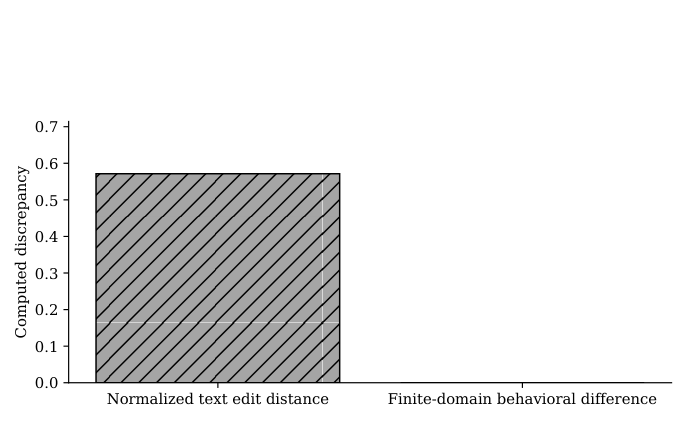
Figure 1: Constructed semantics-preserving rewrite. The computed text distance is 0.5714, while behavioral discrepancy on the declared eleven-point domain is zero. The figure compares two different measurements of the same artifact pair; their meanings are carried by their operational definitions.
4.2 Prior Information And Selective Decisions

An audit can also return unresolved. That option changes the relationship between error and coverage. A trace-only auditor can preserve a numerical result for both records while withholding the broader warrant distinction. Its coverage of fully promoted warrants can fall, while its coverage of useful partial results remains positive. Evaluating those two kinds of coverage separately prevents an abstention policy from being assessed solely by a binary accuracy measure.
The available information can be enlarged in several ways. A measurement declaration can state the intended property. A source document can justify the operation’s relation to that property. A finite semantic witness can settle a restricted behavioral question. An opportunity manifest can disclose how a selected statistic was chosen. Each addition should be tested for the distinction it actually resolves. More artifacts are useful when they supply relevant evidence in an inspectable relation to the claim.
4.3 Capability Evaluation And Reviewer Skill
Capability and skill are different experimental variables. An audit protocol can omit the claim’s intended domain, making one distinction unavailable in principle. A reviewer with that domain can still misunderstand it, overlook a witness, or apply an inappropriate inferential rule. The constructed benchmark fixes the available predicates and executes them exactly. A later human or model study can vary access and measure skill within each access condition.
A useful evaluation includes matched claims sharing the same numerical artifact but varying their intended use. One can assert a text difference, a finite behavioral difference, or an unbounded behavioral difference for the same program pair. The scoring standard then records which evidence supports each assertion. Such pairs test whether a reviewer interprets the claim itself and preserves a narrower valid statement when a broader one remains unresolved. They also make overrejection visible: rejecting every use of an artifact would discard some correct claims in these pairs.
Readable text
Behavioral assessment relates a program pair to an input domain and a class of admissible programs. This section derives a simple counterexample and a complementary finite certificate. Their role is to show why the scope and structural assumptions of a semantic witness belong in the claim record. The added computation evaluates exact integer polynomials, giving examples whose discrepancies can be reproduced
Proof. Take the first polynomial to be zero and the second to be the product in Equation 5. It vanishes
changes the conclusion. If the record certifies a degree bound, a suitable finite set can establish equality for that class. The structural certificate supplies information beyond the observed values.
The script constructs domains of three, five, and eleven consecutive integers centered at zero. On each assessment domain the maximum discrepancy is zero. At the next positive integer, the discrepancies scribe intentionally constructed witnesses with exact assessment behavior. They establish a reproducible difference between tested agreement and equality over a larger domain.
For the affine pair in Equation 4, the known degree-one structure makes algebraic equality available. Two distinct evaluation points would also suffice within that certified class. The benchmark retains eleven points to make its finite behavioral target explicit. An audit claiming universal program equality would need to inspect the structural certificate or provide another adequate proof. The same observed sample can therefore support different conclusions depending on the admitted program class and its grounds.
This analysis suggests a practical record design. A semantic assessment should name its domain, any structural class, the evidence for that class, and the scope of the resulting verdict. A checker can then return finite agreement, class-conditional equality, or an unresolved broader relation. These statuses give downstream users a precise account of the evidence they inherit. They also provide adversarial benchmark cases: a reviewer can be shown identical observed outputs with different supplied class certificates and tested on whether it adjusts the promoted scope appropriately.
A semantic certificate becomes more useful when a checker derives its operands from the source whose behavior is asserted. The affine coefficients in the initial mechanism corpus are trusted construction wit- nesses. Their equality demonstrates the declared audit protocol. A deployed reviewer also needs evidence that the coefficient representation describes the supplied program. This section implements that link for a restricted, explicit language of Python integer kernels. Its practical result is a source-reading checker, an adversarial comparison, and a repository-derived example with a measured coverage boundary.
Readable text
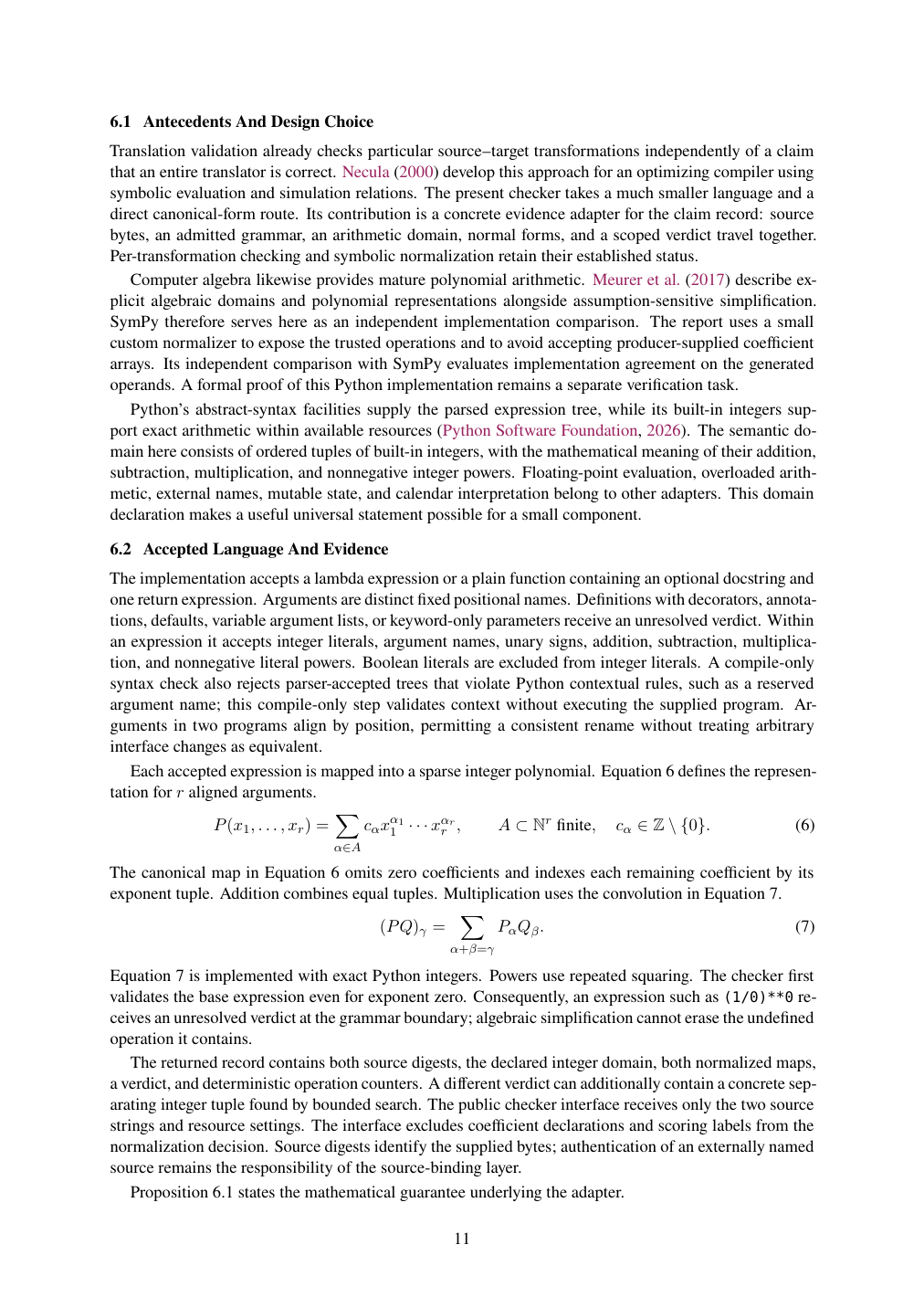
Translation validation already checks particular source–target transformations independently of a claim that an entire translator is correct. Necula (2000) develop this approach for an optimizing compiler using symbolic evaluation and simulation relations. The present checker takes a much smaller language and a direct canonical-form route. Its contribution is a concrete evidence adapter for the claim record: source bytes, an admitted grammar, an arithmetic domain, normal forms, and a scoped verdict travel together. Per-transformation checking and symbolic normalization retain their established status.
Computer algebra likewise provides mature polynomial arithmetic. Meurer et al. (2017) describe ex- plicit algebraic domains and polynomial representations alongside assumption-sensitive simplification. SymPy therefore serves here as an independent implementation comparison. The report uses a small custom normalizer to expose the trusted operations and to avoid accepting producer-supplied coefficient arrays. Its independent comparison with SymPy evaluates implementation agreement on the generated operands. A formal proof of this Python implementation remains a separate verification task.
Python’s abstract-syntax facilities supply the parsed expression tree, while its built-in integers sup- port exact arithmetic within available resources (Python Software Foundation, 2026). The semantic do- main here consists of ordered tuples of built-in integers, with the mathematical meaning of their addition, subtraction, multiplication, and nonnegative integer powers. Floating-point evaluation, overloaded arith- metic, external names, mutable state, and calendar interpretation belong to other adapters. This domain declaration makes a useful universal statement possible for a small component.
The implementation accepts a lambda expression or a plain function containing an optional docstring and one return expression. Arguments are distinct fixed positional names. Definitions with decorators, annota- tions, defaults, variable argument lists, or keyword-only parameters receive an unresolved verdict. Within an expression it accepts integer literals, argument names, unary signs, addition, subtraction, multiplica- tion, and nonnegative literal powers. Boolean literals are excluded from integer literals. A compile-only syntax check also rejects parser-accepted trees that violate Python contextual rules, such as a reserved argument name; this compile-only step validates context without executing the supplied program. Ar- guments in two programs align by position, permitting a consistent rename without treating arbitrary
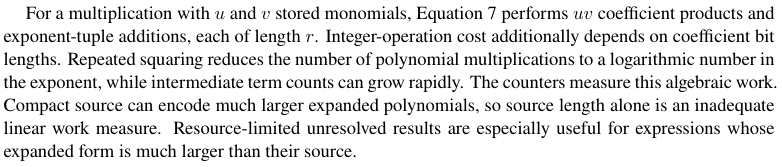
Each accepted expression is mapped into a sparse integer polynomial. Equation 6 defines the represen-
The canonical map in Equation 6 omits zero coefficients and indexes each remaining coefficient by its exponent tuple. Addition combines equal tuples. Multiplication uses the convolution in Equation 7.
Equation 7 is implemented with exact Python integers. Powers use repeated squaring. The checker first validates the base expression even for exponent zero. Consequently, an expression such as (1/0)**0 re- ceives an unresolved verdict at the grammar boundary; algebraic simplification cannot erase the undefined
The returned record contains both source digests, the declared integer domain, both normalized maps, a verdict, and deterministic operation counters. A different verdict can additionally contain a concrete sep- arating integer tuple found by bounded search. The public checker interface receives only the two source strings and resource settings. The interface excludes coefficient declarations and scoring labels from the normalization decision. Source digests identify the supplied bytes; authentication of an externally named source remains the responsibility of the source-binding layer.
Proposition 6.1 states the mathematical guarantee underlying the adapter.
Proposition 6.1 (Canonical-form conformance). Suppose two source expressions satisfy the accepted grammar, have aligned arity, and complete normalization within the declared resource bounds. Under exact built-in integer semantics with sufficient execution resources, equal canonical maps imply equal return values on every integer tuple. Different canonical maps imply that some integer tuple separates their return values.
Proof. Structural induction establishes that normalization preserves each expression’s value. The literal and argument cases are immediate. Unary signs and addition use the corresponding integer-ring operations; multiplication follows Equation 7; repeated squaring preserves nonnegative powers. Equal maps therefore give equal values. For the converse, a nonzero integer polynomial has a nonzero value on some integer tuple. In one variable this follows from the finite root bound. For several variables, view the polynomial as a polynomial in its last variable. Some coefficient is a nonzero polynomial in the remaining variables; induction selects an integer tuple where it is nonzero. The resulting nonzero univariate polynomial then has an integer outside its finite root set. Applying this argument to the difference completes the proof.
Proposition 6.1 concerns the admitted integer semantics, while the program implements the stated normalization algorithm. Its proof supplies a transparent argument to inspect alongside code review and differential execution. It supports the restricted semantic adapter within the larger warrant record; evidence for a scientific construct or an external source identity still enters through its own relation.
6.3 Resource Envelope And Complexity
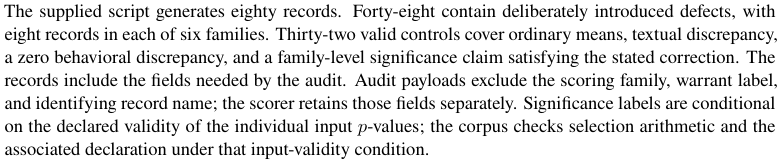
The checker bounds source length at 32,768 bytes before parsing and bounds the parsed tree at 2,048 nodes. The default envelope also permits at most eight arguments, degree 64, 4,096 terms, 4,096 coefficient bits, and 200,000 coefficient-pair products per normalization. Crossing a limit returns unresolved. A failed limit can therefore reduce coverage while preserving the scope of accepted results. The parser, runtime, implementation, and declared arithmetic model remain part of the trusted computing base.

7 An Executable Mechanism Benchmark
7.1 Corpus Construction
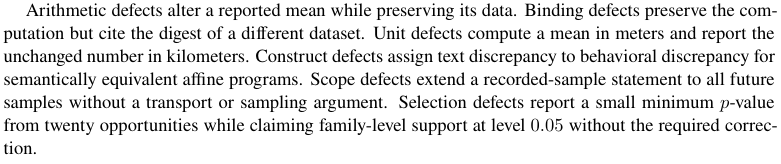
Each family isolates a mechanism. Real reports often combine them, and a broader benchmark should include mixtures. The present construction deliberately favors clarity: an auditor can exhibit a concrete violated obligation, and another program can verify that witness. The valid controls guard against a simple strategy of rejecting every transformed program or every selected statistic. They are still a limited set, so the observed false-alarm count is a property of this corpus within the declared corpus.
7.2 Audit Capabilities
Four cumulative audit settings are implemented. The numerical audit reruns the declared operation and checks the reported value. The binding extension also checks the digest of actual data against declared data. The measurement extension checks dimensional agreement and, for the affine-program cases, evaluates the explicitly declared semantic target. The inference extension checks scope agreement and a family-level significance certificate.
The settings vary the access and obligations available to the audit. A numerical auditor can use unlimited time to compute edit distance exactly and still lack the semantic predicate needed for the behavioral claim. Conversely, a measurement auditor may identify a semantic mismatch with a small witness. The experiment therefore evaluates capability boundaries, with computation made deterministic to expose those boundaries.
The unit check evaluates means under the declared operation, which preserves the input unit. A legitimate conversion would require a different operation and corresponding witness. The scope check is similarly explicit: the benchmark permits descriptive claims on the recorded sample. A generalization becomes admissible only when an appropriate certificate is supplied. The implemented version rejects promotion when the claim and evidence scopes differ.
7.3 Record Generation And Label Separation
The generator creates matched records through explicit transformations of a valid base. The arithmetic transformation changes the reported value. The binding transformation changes the declared identity. The unit transformation changes the claimed output unit. The construct transformation changes the intended target while retaining the text operation. The scope transformation changes the asserted domain. The selection transformation changes the significance claim’s relation to its opportunity family. These operations isolate where the warrant relation changes.
Ground-truth labels are used by the scoring code after an audit has returned a verdict. The executable audit functions receive payloads stripped of the family, invalid-warrant label, and identifying record name. They inspect the remaining data, declarations, operations, and finite witnesses. This separation is an implementation safeguard against a trivial label lookup. It still leaves the benchmark deliberately simple: its data schema makes the relevant obligations explicit and its predicates cover the generated mechanisms exactly. A realistic benchmark would need to test extraction of those obligations from less structured material as an additional capability.
The valid controls are important to interpretation. A text-change record can be valid even when its programs behave identically. A behavioral record can be valid when its declared behavioral discrepancy is zero. A selected minimum can support a family-level statement when the stipulated individual validity and correction conditions hold. The correct verdict depends on the target and grounds, with surface features alone providing an incomplete decision rule. Matched controls make that relation inspectable.
Readable text
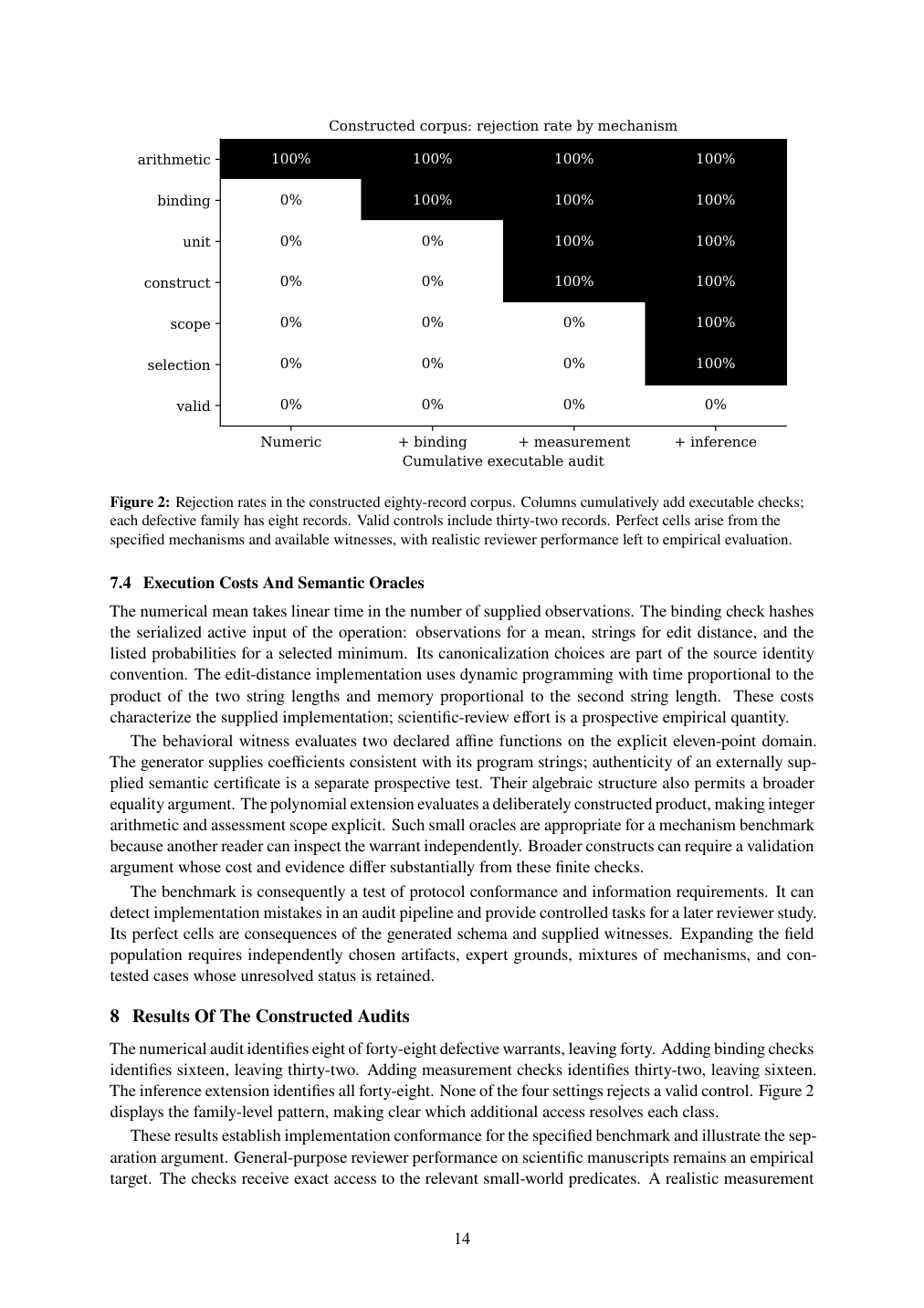
Figure 2: Rejection rates in the constructed eighty-record corpus. Columns cumulatively add executable checks; each defective family has eight records. Valid controls include thirty-two records. Perfect cells arise from the specified mechanisms and available witnesses, with realistic reviewer performance left to empirical evaluation.
The numerical mean takes linear time in the number of supplied observations. The binding check hashes the serialized active input of the operation: observations for a mean, strings for edit distance, and the listed probabilities for a selected minimum. Its canonicalization choices are part of the source identity convention. The edit-distance implementation uses dynamic programming with time proportional to the product of the two string lengths and memory proportional to the second string length. These costs characterize the supplied implementation; scientific-review effort is a prospective empirical quantity.
The behavioral witness evaluates two declared affine functions on the explicit eleven-point domain. The generator supplies coefficients consistent with its program strings; authenticity of an externally sup- plied semantic certificate is a separate prospective test. Their algebraic structure also permits a broader equality argument. The polynomial extension evaluates a deliberately constructed product, making integer arithmetic and assessment scope explicit. Such small oracles are appropriate for a mechanism benchmark because another reader can inspect the warrant independently. Broader constructs can require a validation argument whose cost and evidence differ substantially from these finite checks.
The benchmark is consequently a test of protocol conformance and information requirements. It can detect implementation mistakes in an audit pipeline and provide controlled tasks for a later reviewer study. Its perfect cells are consequences of the generated schema and supplied witnesses. Expanding the field population requires independently chosen artifacts, expert grounds, mixtures of mechanisms, and con-
The numerical audit identifies eight of forty-eight defective warrants, leaving forty. Adding binding checks identifies sixteen, leaving thirty-two. Adding measurement checks identifies thirty-two, leaving sixteen. The inference extension identifies all forty-eight. None of the four settings rejects a valid control. Figure 2 displays the family-level pattern, making clear which additional access resolves each class.
These results establish implementation conformance for the specified benchmark and illustrate the sep- aration argument. General-purpose reviewer performance on scientific manuscripts remains an empirical target. The checks receive exact access to the relevant small-world predicates. A realistic measurement
question, such as whether an index measures social deprivation, may lack a decisive finite semantic oracle. Its audit can instead identify assumptions, rival interpretations, and required validation evidence, returning an unresolved result where appropriate.
The distinction between a defect label and the truth of a substantive proposition is especially important for scope. An unsupported claim about future samples could happen to be true. The benchmark labels its warrant defective because the record lacks the evidence that the declared promotion protocol requires. The audit therefore assesses the relation between evidence and claim. Its inference concerns the adequacy of the present record for the declared promotion.
8.1 Partial Evidence And Alternative Summaries
The cumulative audit matrix answers a particular question: how many defective warrants become detectable as the required checks are supplied in the stated order. Each column contains the preceding checks, so a later column’s gain describes the additional mechanisms that its access resolves. The numerical column is useful even though it leaves many warrant defects open. It establishes a narrower execution result for records whose measurement or scope is still being examined.
A family-level matrix is more informative than one aggregate accuracy score. Arithmetic and binding faults concern execution and identity, while construct and scope defects concern the relation of a number to a proposition. The same overall rejection count could arise from very different capabilities. A deployment choosing an audit service should therefore identify the mechanism coverage relevant to its claim population and record the error costs and resource use of each check.
The corpus also supports an affirmative interpretation of a narrower result. A rejected behavioral interpretation can leave an established text distance available. An unresolved future-sample inference can leave a descriptive sample mean supported. A source mismatch can leave a correct calculation on the actual supplied file established while the intended dataset remains to be obtained. A useful archive stores those component outcomes and the relationship between them, allowing later work to reuse established evidence with an appropriate target.
9 Executed Source Checks And Repository Coverage
Source-derived conformance is evaluated through a deterministic adversarial construction and a pinned repository snapshot. The construction isolates failure modes of finite probes and unauthenticated semantic declarations. The repository census measures how often the present grammar applies in a real codebase. These studies supply distinct evidence: controlled mechanism comparisons and an observed syntactic coverage boundary. All inputs needed for their reproduction accompany the report.
9.1 Adversarial Source-Pair Comparison
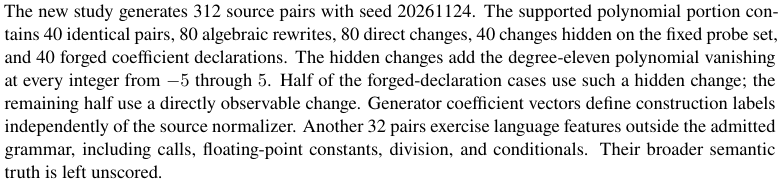
Four executable policies receive the relevant source or declaration fields. Source identity accepts byteidentical sources and otherwise returns unresolved. Finite-probe promotion evaluates the eleven fixed integers and promotes matching results to a universal equality claim. Coefficient attestation compares supplied arrays without establishing their source derivation. Source-derived checking parses and normalizes both actual source strings. The deliberately permissive policies are diagnostic baselines for two specific evidential shortcuts; they are compared by their accepted claims, and have access to the same generated program pairs.
Readable text
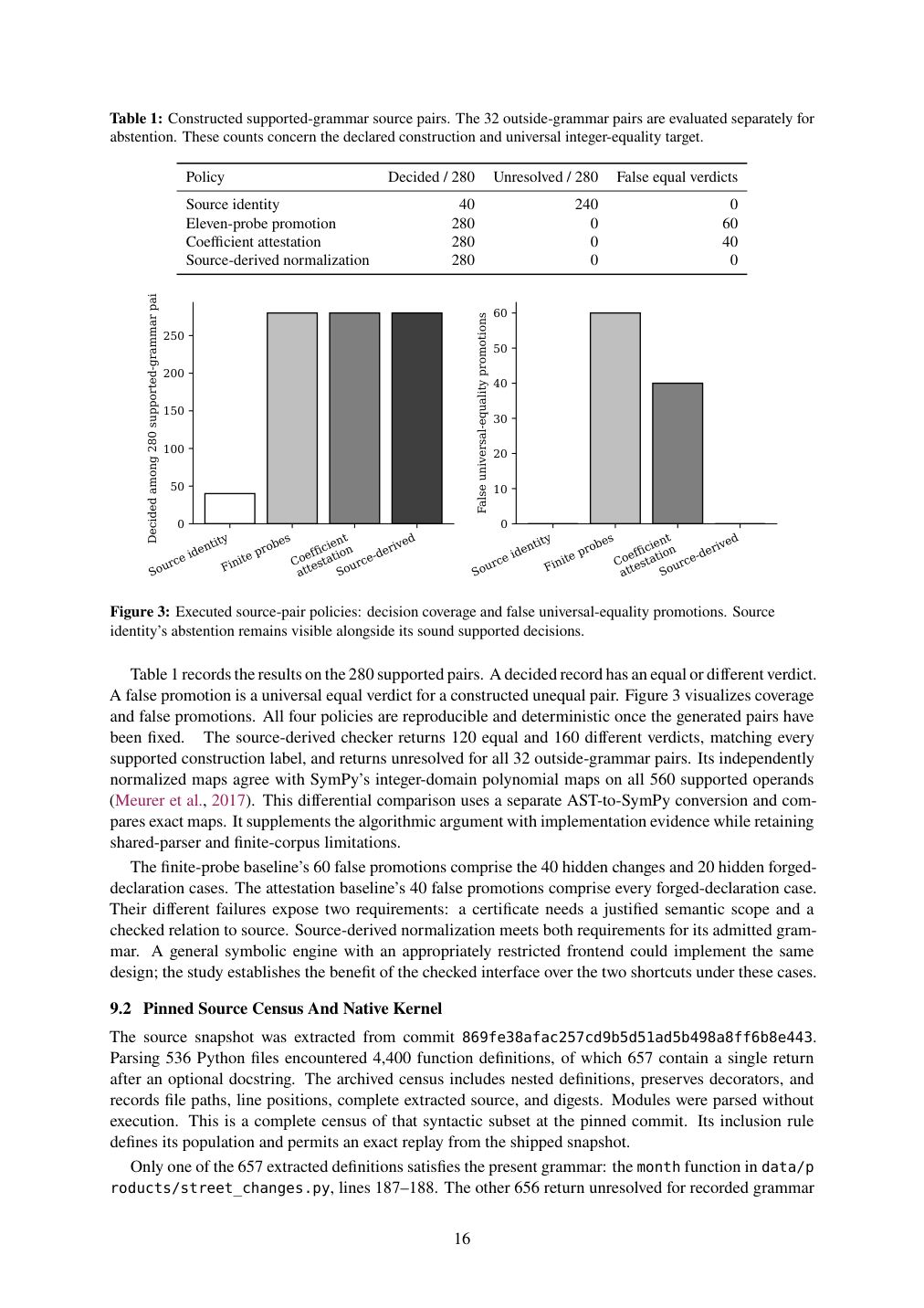
Table 1: Constructed supported-grammar source pairs. The 32 outside-grammar pairs are evaluated separately for abstention. These counts concern the declared construction and universal integer-equality target.
Source identity 40 Eleven-probe promotion 280 Coefficient attestation 280 Source-derived normalization 280
Figure 3: Executed source-pair policies: decision coverage and false universal-equality promotions. Source identity’s abstention remains visible alongside its sound supported decisions.
Table 1 records the results on the 280 supported pairs. A decided record has an equal or different verdict. A false promotion is a universal equal verdict for a constructed unequal pair. Figure 3 visualizes coverage and false promotions. All four policies are reproducible and deterministic once the generated pairs have The source-derived checker returns 120 equal and 160 different verdicts, matching every supported construction label, and returns unresolved for all 32 outside-grammar pairs. Its independently normalized maps agree with SymPy’s integer-domain polynomial maps on all 560 supported operands (Meurer et al., 2017). This differential comparison uses a separate AST-to-SymPy conversion and com- pares exact maps. It supplements the algorithmic argument with implementation evidence while retaining
been fixed. shared-parser and finite-corpus limitations.
The finite-probe baseline’s 60 false promotions comprise the 40 hidden changes and 20 hidden forged- declaration cases. The attestation baseline’s 40 false promotions comprise every forged-declaration case. Their different failures expose two requirements: a certificate needs a justified semantic scope and a checked relation to source. Source-derived normalization meets both requirements for its admitted gram- mar. A general symbolic engine with an appropriately restricted frontend could implement the same design; the study establishes the benefit of the checked interface over the two shortcuts under these cases.
The source snapshot was extracted from commit 869fe38afac257cd9b5d51ad5b498a8ff6b8e443. Parsing 536 Python files encountered 4,400 function definitions, of which 657 contain a single return after an optional docstring. The archived census includes nested definitions, preserves decorators, and records file paths, line positions, complete extracted source, and digests. Modules were parsed without execution. This is a complete census of that syntactic subset at the pinned commit. Its inclusion rule defines its population and permits an exact replay from the shipped snapshot.
Only one of the 657 extracted definitions satisfies the present grammar: the month function in data/p roducts/street_changes.py, lines 187–188. The other 656 return unresolved for recorded grammar
Readable text
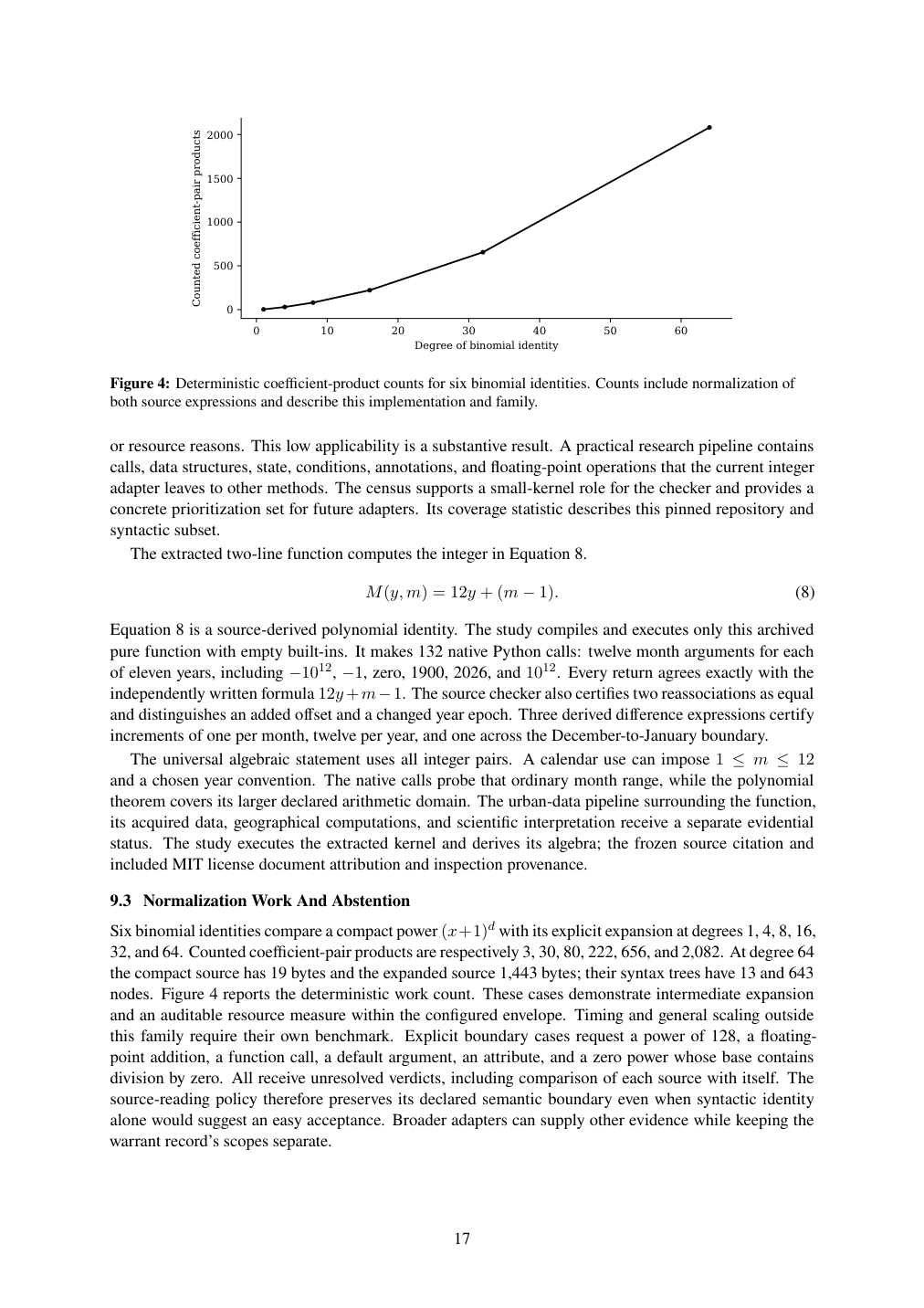
Figure 4: Deterministic coefficient-product counts for six binomial identities. Counts include normalization of both source expressions and describe this implementation and family.
or resource reasons. This low applicability is a substantive result. A practical research pipeline contains calls, data structures, state, conditions, annotations, and floating-point operations that the current integer adapter leaves to other methods. The census supports a small-kernel role for the checker and provides a concrete prioritization set for future adapters. Its coverage statistic describes this pinned repository and
The extracted two-line function computes the integer in Equation 8.
Equation 8 is a source-derived polynomial identity. The study compiles and executes only this archived pure function with empty built-ins. It makes 132 native Python calls: twelve month arguments for each and distinguishes an added offset and a changed year epoch. Three derived difference expressions certify increments of one per month, twelve per year, and one across the December-to-January boundary.
and a chosen year convention. The native calls probe that ordinary month range, while the polynomial theorem covers its larger declared arithmetic domain. The urban-data pipeline surrounding the function, its acquired data, geographical computations, and scientific interpretation receive a separate evidential status. The study executes the extracted kernel and derives its algebra; the frozen source citation and included MIT license document attribution and inspection provenance.
32, and 64. Counted coefficient-pair products are respectively 3, 30, 80, 222, 656, and 2,082. At degree 64 the compact source has 19 bytes and the expanded source 1,443 bytes; their syntax trees have 13 and 643 nodes. Figure 4 reports the deterministic work count. These cases demonstrate intermediate expansion and an auditable resource measure within the configured envelope. Timing and general scaling outside this family require their own benchmark. Explicit boundary cases request a power of 128, a floating- point addition, a function call, a default argument, an attribute, and a zero power whose base contains division by zero. All receive unresolved verdicts, including comparison of each source with itself. The source-reading policy therefore preserves its declared semantic boundary even when syntactic identity alone would suggest an easy acceptance. Broader adapters can supply other evidence while keeping the
Readable text
Invalid warrants rejected Invalid warrants unresolved Invalid warrants promoted by fail-open rule
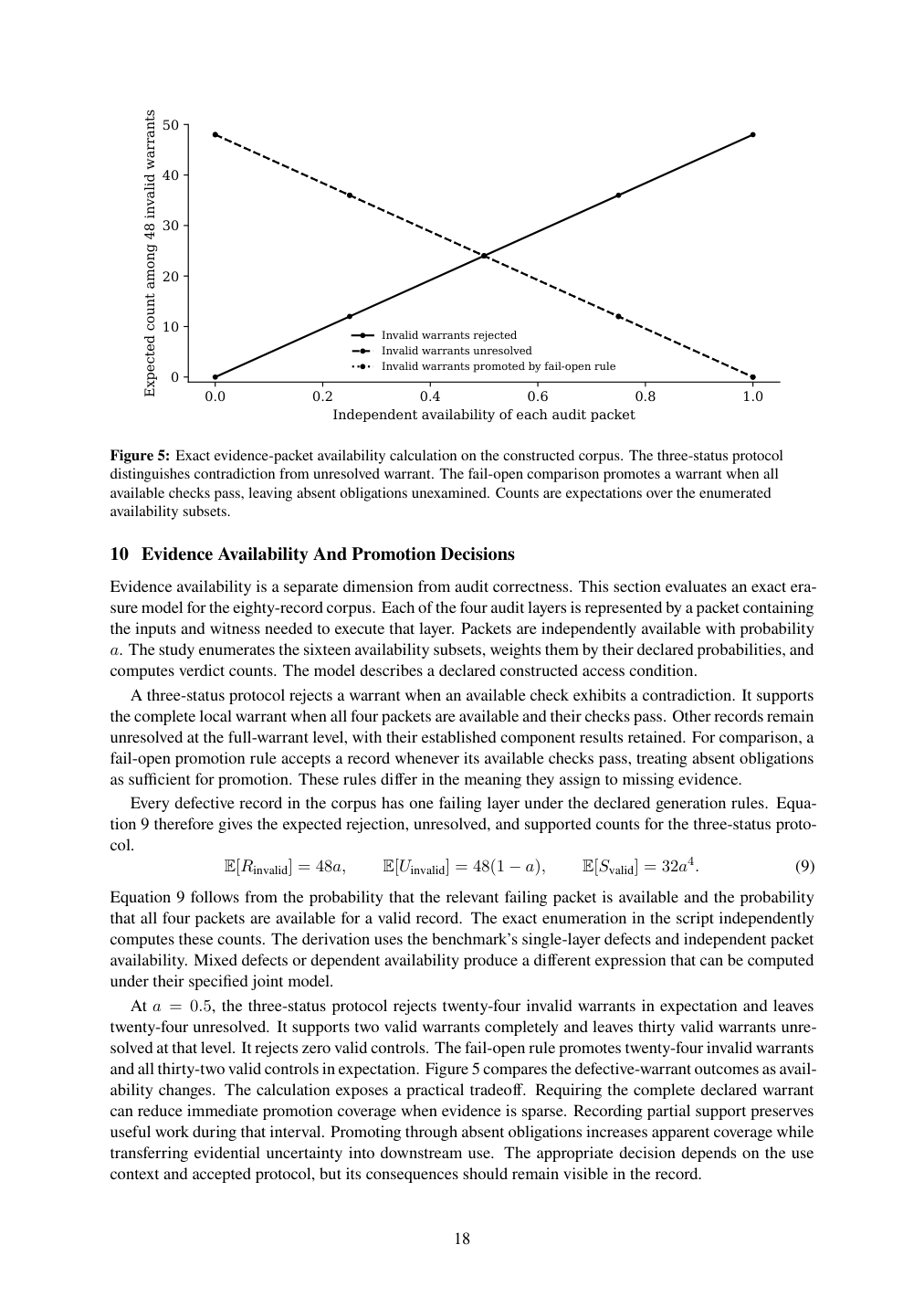
Figure 5: Exact evidence-packet availability calculation on the constructed corpus. The three-status protocol distinguishes contradiction from unresolved warrant. The fail-open comparison promotes a warrant when all available checks pass, leaving absent obligations unexamined. Counts are expectations over the enumerated
Evidence availability is a separate dimension from audit correctness. This section evaluates an exact era- sure model for the eighty-record corpus. Each of the four audit layers is represented by a packet containing the inputs and witness needed to execute that layer. Packets are independently available with probability computes verdict counts. The model describes a declared constructed access condition.
A three-status protocol rejects a warrant when an available check exhibits a contradiction. It supports the complete local warrant when all four packets are available and their checks pass. Other records remain unresolved at the full-warrant level, with their established component results retained. For comparison, a fail-open promotion rule accepts a record whenever its available checks pass, treating absent obligations as sufficient for promotion. These rules differ in the meaning they assign to missing evidence.
Every defective record in the corpus has one failing layer under the declared generation rules. Equa- tion 9 therefore gives the expected rejection, unresolved, and supported counts for the three-status proto-
Equation 9 follows from the probability that the relevant failing packet is available and the probability that all four packets are available for a valid record. The exact enumeration in the script independently computes these counts. The derivation uses the benchmark’s single-layer defects and independent packet availability. Mixed defects or dependent availability produce a different expression that can be computed
twenty-four unresolved. It supports two valid warrants completely and leaves thirty valid warrants unre- solved at that level. It rejects zero valid controls. The fail-open rule promotes twenty-four invalid warrants and all thirty-two valid controls in expectation. Figure 5 compares the defective-warrant outcomes as avail- ability changes. The calculation exposes a practical tradeoff. Requiring the complete declared warrant can reduce immediate promotion coverage when evidence is sparse. Recording partial support preserves useful work during that interval. Promoting through absent obligations increases apparent coverage while transferring evidential uncertainty into downstream use. The appropriate decision depends on the use context and accepted protocol, but its consequences should remain visible in the record.
Readable text
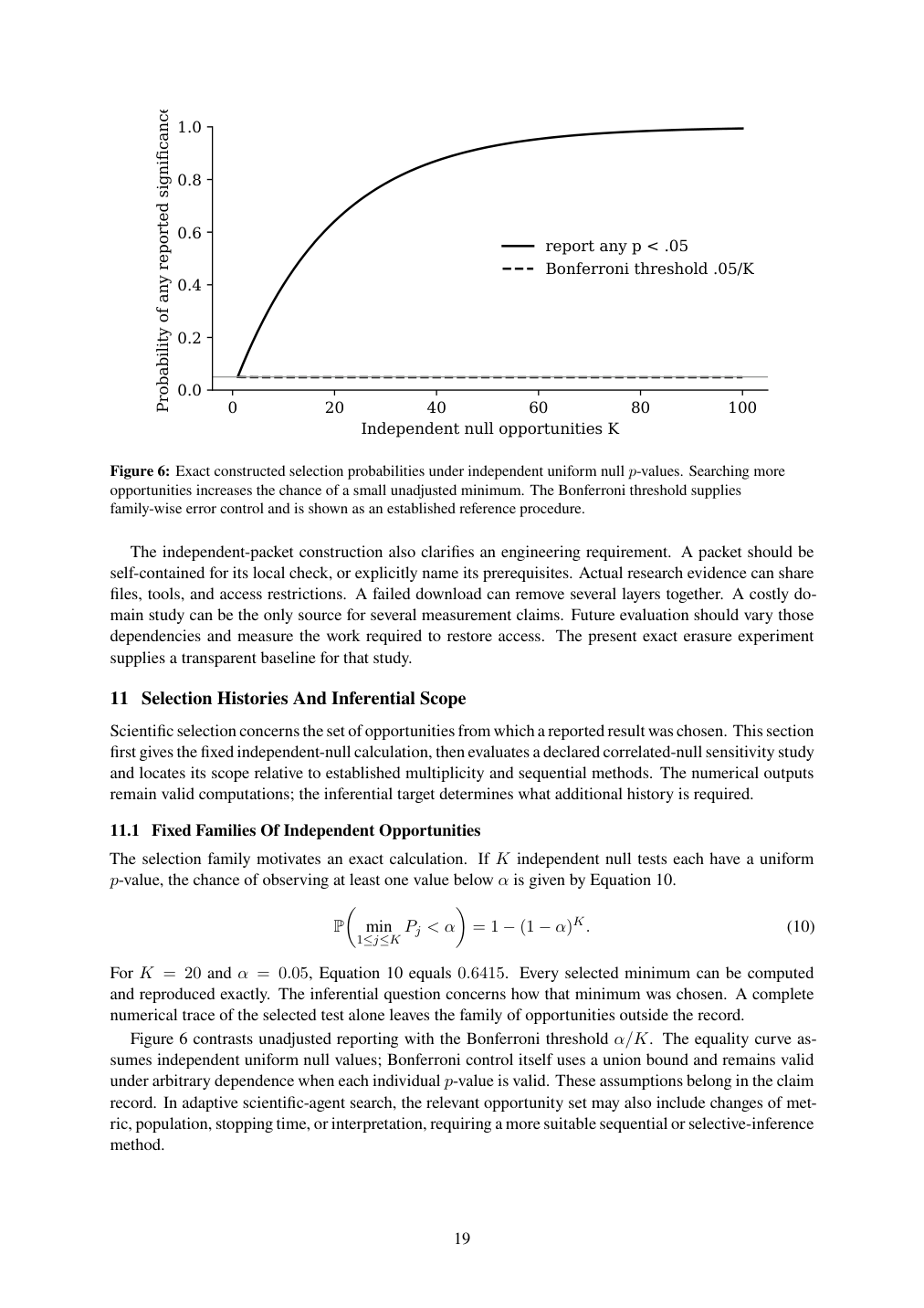
opportunities increases the chance of a small unadjusted minimum. The Bonferroni threshold supplies family-wise error control and is shown as an established reference procedure.
The independent-packet construction also clarifies an engineering requirement. A packet should be self-contained for its local check, or explicitly name its prerequisites. Actual research evidence can share files, tools, and access restrictions. A failed download can remove several layers together. A costly do- main study can be the only source for several measurement claims. Future evaluation should vary those dependencies and measure the work required to restore access. The present exact erasure experiment
Scientific selection concerns the set of opportunities from which a reported result was chosen. This section first gives the fixed independent-null calculation, then evaluates a declared correlated-null sensitivity study and locates its scope relative to established multiplicity and sequential methods. The numerical outputs remain valid computations; the inferential target determines what additional history is required.
and reproduced exactly. The inferential question concerns how that minimum was chosen. A complete numerical trace of the selected test alone leaves the family of opportunities outside the record.
sumes independent uniform null values; Bonferroni control itself uses a union bound and remains valid record. In adaptive scientific-agent search, the relevant opportunity set may also include changes of met- ric, population, stopping time, or interpretation, requiring a more suitable sequential or selective-inference
Readable text
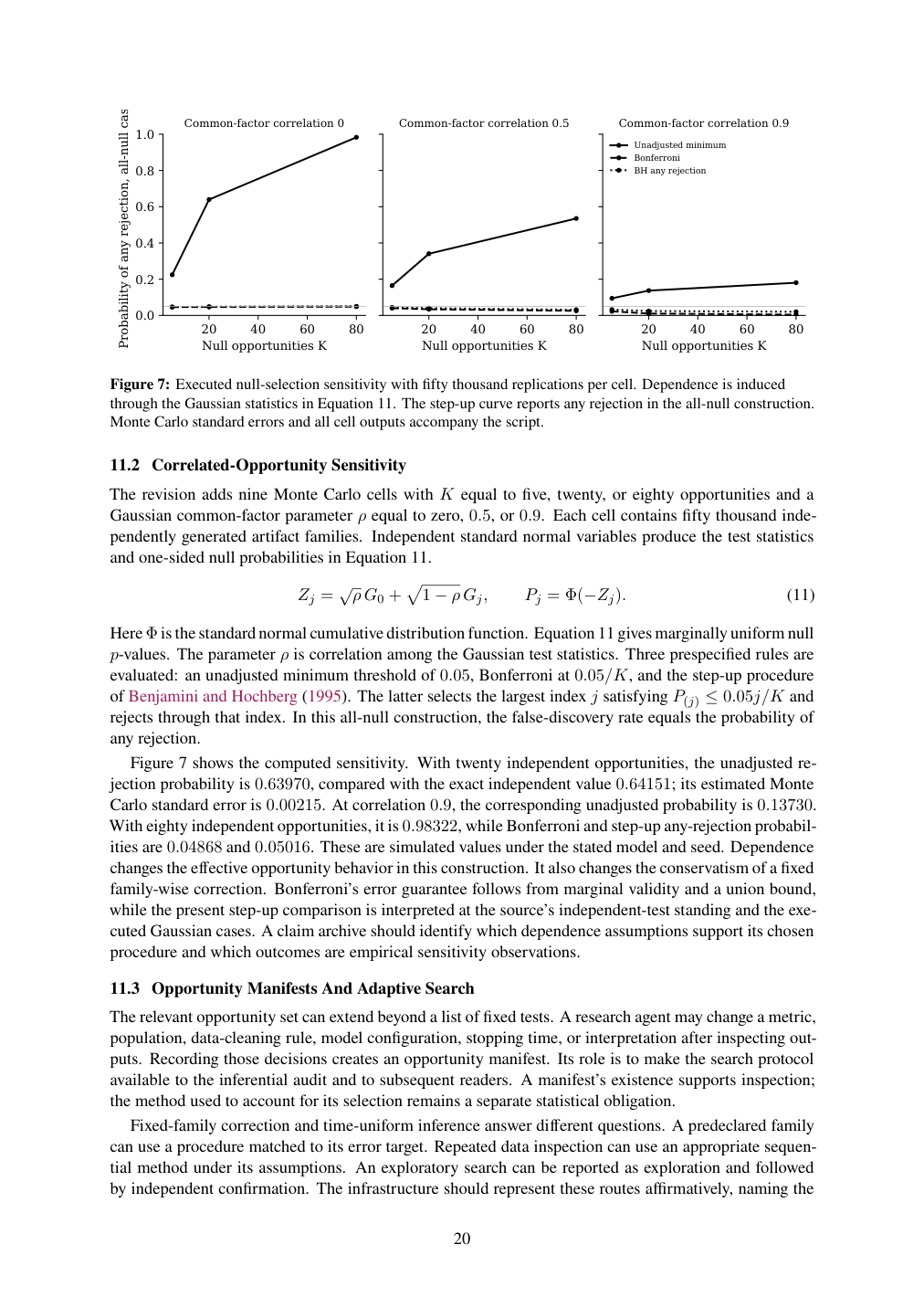
Figure 7: Executed null-selection sensitivity with fifty thousand replications per cell. Dependence is induced through the Gaussian statistics in Equation 11. The step-up curve reports any rejection in the all-null construction. Monte Carlo standard errors and all cell outputs accompany the script.
pendently generated artifact families. Independent standard normal variables produce the test statistics
Here Φ is the standard normal cumulative distribution function. Equation 11 gives marginally uniform null rejects through that index. In this all-null construction, the false-discovery rate equals the probability of
Figure 7 shows the computed sensitivity. With twenty independent opportunities, the unadjusted re-
changes the effective opportunity behavior in this construction. It also changes the conservatism of a fixed family-wise correction. Bonferroni’s error guarantee follows from marginal validity and a union bound, while the present step-up comparison is interpreted at the source’s independent-test standing and the exe- cuted Gaussian cases. A claim archive should identify which dependence assumptions support its chosen procedure and which outcomes are empirical sensitivity observations.
The relevant opportunity set can extend beyond a list of fixed tests. A research agent may change a metric, population, data-cleaning rule, model configuration, stopping time, or interpretation after inspecting out- puts. Recording those decisions creates an opportunity manifest. Its role is to make the search protocol available to the inferential audit and to subsequent readers. A manifest’s existence supports inspection; the method used to account for its selection remains a separate statistical obligation.
Fixed-family correction and time-uniform inference answer different questions. A predeclared family can use a procedure matched to its error target. Repeated data inspection can use an appropriate sequen- tial method under its assumptions. An exploratory search can be reported as exploration and followed by independent confirmation. The infrastructure should represent these routes affirmatively, naming the
standing each route achieves and the evidence still needed for the intended use. This supports productive exploration while preserving the distinction between a selected observation and a validated inferential conclusion.
12 Promotion And Revision Workflow
12.1 Promotion With Explicit Residual Questions
A practical promotion protocol starts by identifying the claim and its target. It then checks the integrity of inputs and numerical operations, inspects the measurement relation, and evaluates the inferential extension. Each result receives a version and a witness. If a required layer is unresolved, the claim retains its established components while its promotion scope is reduced or left pending.
The protocol should support several outcomes. A contradiction has a witness, such as a unit mismatch or an input yielding a different behavior. A supported statement has evidence adequate for the specified finite or formal scope. An unresolved statement has named obligations that available artifacts cannot settle. This three-way distinction avoids conflating missing evidence with falsity and gives a reviewer a precise next step.
An amendment can change a proposition, a scope, an input, or an interpretation. Those acts have different consequences. Correcting a typo in a label may require only a text revision. Changing the data source requires recomputation. Revising a construct may require new validation even if every prior number remains the same. The archive should preserve the earlier claim and mark how its successor differs.
12.2 Dependency-Aware Withdrawal
Suppose a conclusion depends on several evidence nodes. A changed node should trigger review of the descendant obligations that use it. Numerical dependencies and interpretive dependencies should be separately typed. If a text-change measure is withdrawn as an indicator of behavioral change, the edit-distance computation remains available as a text result. A dependency graph that treats all edges identically can either withdraw too much or retain an interpretation whose support has changed.
The required operation is therefore selective invalidation. A claim carries a set of requirements, and a revision changes the status of specific requirements. Descendants can be reevaluated against their actual obligations. In a finite graph this is straightforward graph traversal; its scientific significance comes from accurate edge typing and human acceptance of the requirement scheme. The method relies on the completeness of declared dependencies.
12.3 Requirement Versions And Reassessment Closure
A dependency-aware workflow represents each evidential requirement by a versioned node. Directed edges state that a downstream warrant depends on an upstream requirement retaining its accepted standing. A source-byte change, operation change, or interpretation change can then initiate different reassessment sets. Field-level records are useful because several claims may reuse one numerical artifact under different interpretations. The archive can preserve that common computation while revisiting only the requirements whose grounds changed.
Proposition 12.1 states the elementary graph operation used by the workflow.


The operation in Proposition 12.1 marks requirements for review; its output is a reassessment marker. A correctly declared graph makes the reassessment scope inspectable. An omitted dependency can leave a consequential claim outside the closure. A coarse dependency can trigger unnecessary recomputation. Evaluating edge accuracy and record granularity is consequently part of evaluating the archive, alongside the correctness of its traversal implementation.
Revalidation follows the marked closure. In a directed acyclic graph, upstream requirements can be checked before downstream promotions. Cycles require explicit treatment, such as a joint obligation or a strongly connected component whose acceptance conditions are stated together. A generic feedback loop among claims supplies insufficient grounds for accepting the component. The workflow should expose the external evidence and assumptions on which its joint standing rests.
12.4 Acceptance, Responsibility, And Reusable Results
Acceptance records which statement, scope, evidence versions, and unresolved conditions are authorized for a declared use. The responsible actor can be an individual, a group, or an institution under its policy. An automated checker can provide an assessment, while the acceptance act identifies how that assessment enters scientific work. This distinction makes it possible to reuse a computational component without silently inheriting every interpretation previously attached to it.
A revision can narrow a claim constructively. A behavioral-change assertion can become a text-change result. A future-population assertion can become a descriptive statement about the observed sample. A selected result can become an exploratory observation with a plan for confirmation. Each successor should name the earlier proposition and the evidence motivating its changed scope. Such revisions preserve scientific value in the reliable component and give subsequent work a clear starting point.
The architecture also records dissent and rival grounds. If two disciplinary reviewers admit different measurement models, their claims can remain separate while sharing data and computation. A comparison can identify which conclusions survive both models and which depend on the selected reading. The workflow therefore supports knowledge evolution through attributed, revisable relations, with computational checks supplying precise local evidence within that wider process.
13 Repository Mapping And Evidential Scope
The motivating material lies in Noetarium’s project-ecology case studies at commit 869fe38 (full identifier in the source ledger). The records document both numerical bindings and later conceptual corrections. The source file accompanying this report preserves the corrected and planned branches of a saved summary, and its digest is recorded. The current report reads that artifact as a record of development and review, with descriptive standing for the development and review record.
The eighty-record benchmark and its figures are newly generated by the supplied Python script. They are independent of the C++ foundations and implement a separate research prototype of the proposed claim obligations. Existing archive, evidence, and proof foundations supply relevant components; integrating the proposed typed warrant record requires explicit engineering and acceptance tests.
A useful implementation route would connect each manuscript claim to an immutable artifact identifier, a result field, and a measurement declaration. Executable checks could then answer numerical and binding questions automatically. Measurement and inference declarations would identify which additional evidence is available and who accepted the interpretation. Such an interface supports human judgment by making its object inspectable, while preserving the distinction between generated suggestions and accepted claims.
13.1 Implementation Interface And Artifact Lifecycle
A minimal implementation can provide separate registries for artifacts, operations, claims, interpretations, and assessments. An artifact registry stores immutable identities and access locations. An operation registry stores code and environment versions. A claim registry stores the asserted proposition and domain. Interpretation objects name measurement models and their evidence. Assessments record a checker, avail-
Readable text
able access, result, witness, and residual questions. Acceptance records connect these objects to a declared
The lifecycle begins with a proposed claim and a manifest of its dependencies. Automated execu- tion establishes the numerical result at its declared tolerance. Binding checks connect the used inputs to the named sources. Measurement and inference review examine the appropriate additional grounds. A promotion record then states the supported scope or preserves an unresolved requirement. Later source, operation, interpretation, or opportunity-history revisions trigger the reassessment closure.
The current Python artifact implements the small mechanism corpus and its extension studies. A production service would also require access control, artifact retrieval, environment reconstruction, ver- sion migration, and an interface for review disagreements. Those are proposed engineering tasks. The pinned repository supplies relevant archive, evidence, and proof-oriented foundations as source compo- nents, while the present scripts remain separately identifiable research calculations.
An acceptance test for the implementation can give a reader one published number and require recon- struction of its claim record, input, operation, measurement reading, and inferential scope. Another test can revise one measurement assumption and ask which claims require review and which numerical out- puts remain reusable. These tasks directly measure the archive’s intended function and can be evaluated with exact artificial cases before realistic scientific workflows are introduced.
14 Validity Under Several Admissible Interpretations
A scientific claim can depend on an interpretation that is both explicit and reasonably disputed. In that situation a record should preserve the family of admitted interpretations and ask a scoped question. A statement may hold under one reading, several readings, or every reading retained. Each outcome car- ries information. An infrastructure that forces one reading into a single score can conceal the source of disagreement even when all numerical operations are correct.
Equation 12 concerns a declared interpretation family. Its credibility depends on how that family was assembled and which readings were omitted. Robustness over an arbitrary list remains a property of that list. A report should therefore include the sources, authority, or stakeholder judgment that admitted each
For this affine example, evaluating the two endpoints suffices to establish whether the difference stays nonnegative throughout the interval. This follows because an affine function attains its minimum on a closed interval at an endpoint. The computational certificate is small: it names the interval, the linear ex- pression, and the endpoint values. The substantive question is whether this index and its admitted weights represent the intended evaluative construct. A mathematical certificate can establish the conditional rank-
This example also distinguishes measurement disputes from numerical faults. A challenger who pro- suitable archive preserves the two readings, their grounds, and the consequences of adopting each. This is useful in interdisciplinary inquiry, where identical observations may enter different disciplinary measure- ment models. It permits exact common computations while retaining the interpretive conditions under
14.1 Interpretation Families And Admission Grounds

The affine index example gives a small certificate whose verification is inexpensive. More complicated measurement models can require numerical optimization, interval methods, or sampled sensitivity analysis. The record should state which kind of coverage was achieved. An exact minimum over a certified finite family differs from the smallest value observed in a sampled family. Both can contribute evidence when their scope is clear. A later family expansion can then trigger reassessment without invalidating the earlier conditional computation.
Plurality also affects how disagreement is represented. Two reviewers can share observations and operations while disagreeing about which construct or valuation should guide a decision. Their separate records identify the relationship at issue and the consequences of each reading. A synthesis can preserve a conclusion that holds under both, or identify a decision that remains reading-dependent. This is especially useful when disciplinary categories organize the same artifact differently. The infrastructure can support comparison and translation without assigning a single measurement model authority over all uses.
The present report supplies the representation and finite examples for that practice. It leaves admission of substantive interpretations to evidence and responsible inquiry in the relevant domain. A prospective evaluation can test whether explicit families help reviewers locate disagreements, preserve useful common results, and choose a suitable next study. Those outcomes concern practical epistemic work, with their quality assessed through independently specified tasks and grounds.
15 Evaluation Beyond The Executed Prototypes
The report’s two corpora have different evidence roles. The eighty records exercise a trusted constructed protocol for four warrant layers. The source-pair study checks a specific semantic relation directly from source and includes forged coefficient declarations. Neither construction measures human or model reviewer sensitivity to naturally occurring scientific errors. A practical evaluation should preserve these roles while testing generalization with independently curated material.
15.1 Independent Curation And Scoring
Domain reviewers independent of the checker implementation should curate sound and defective claims from scientific code, reports, and figures. They should specify the evidence required for each proposed scope, preserve disagreements, and retain unresolved cases. Multiple claims can share one artifact: a solver can support a bounded numerical claim, a descriptive comparison, and a broader assertion requiring new validation. Scoring these together evaluates useful scope selection and overrejection alongside defect detection.
Artifact, claim, and review arrangement are distinct evaluation units. Several claims sharing source acquisition or one review need grouped assignment or explicit shared-access conditions. Record component verdicts, promoted scope, witnesses, unresolved requirements, and cost. A finite arithmetic contradiction can have an exact replayable label. A contested measurement relation can retain several justified adjudications. Missing required evidence concerns the warrant’s current standing and leaves the proposition’s truth separately represented.
15.2 Checked Evidence And Accepted Assumptions

a supplied assumption, a responsible attestation, and a checked certificate. Each carries issuer, scope, version, and dependencies. Their promotion policies can differ.
The source checker now provides an executed example of a checked certificate: it derives polynomial maps from the source it receives and resists forged coefficient arrays in the constructed cases. Its grammar, arithmetic model, implementation, and source-authentication boundary remain explicit. A measurement declaration has a different evidential task. Attaching a word such as “valid” to a record supplies an assertion whose grounds still need review. Matched declarations with different independently supplied evidence would provide a useful next benchmark for that distinction.
15.3 Practical Comparisons And External Studies
Human-only, model-only, tool-assisted, and mixed review can be compared under fixed resource envelopes and specified access to sources, raw data, operations, opportunity histories, and domain knowledge. Cost includes acquisition, execution, interpretation, and dispute resolution. Coverage and cost should be reported together: resolving a narrow obligation cheaply and initiating a broader validation study are different useful outcomes. The present scripts report local computation and abstention, while actual reviewer effort remains an empirical quantity.
For the semantic adapter, the immediate external study is an independently selected scientific-kernel corpus, stratified by arithmetic type and control structure. Compare source identity, finite tests, a mature symbolic tool with a checked frontend, and the present normalizer under matched semantics. Include malformed inputs, adversarial algebraic expansion, code-generator outputs, and changing source identities. Measure supported coverage, incorrect certificates, unresolved reasons, and computational resources. The repository census identifies a particularly small current applicability region and concrete unsupported features to prioritize.
The broader claim infrastructure needs naturally occurring measurement and scope errors whose adjudication is independent of the templates. Surface variations and novel mechanisms should be held out. Restricted or licensed evidence requires explicit access conditions and accurate unresolved standing. Interpretive disciplines can supply different evidential forms from finite numerical programs. These extensions would test whether typed records help people locate disagreements, preserve reliable partial results, and choose the next informative study.
16 Contribution Assessment And Scientific Use
The practical contribution is an evidence adapter with a checked source relation and an explicit abstention boundary. Its canonical-polynomial method is established mathematics. Translation validation already checks particular transformations; computer algebra already normalizes polynomials. The report supplies a transparent restricted frontend, an executable source-to-certificate interface, deliberately adversarial comparisons, and a pinned scientific-repository applicability study. These objects make the proposed warrant architecture concrete enough to inspect and challenge.
Table 2 distinguishes established ingredients and independent work. The source-derived results are stronger evidence than the initial trusted corpus for the specific semantic relation they check. The low census applicability is equally relevant: the present adapter has a small-kernel role, with other scientific operations requiring different evidence mechanisms. The claim-record synthesis remains an architectural proposal. The report establishes conditional mathematical statements and executes the named prototypes. Field reviewer performance and scientific construct validity remain external evaluation targets. That effectiveness question requires independently selected claims, adjudicated grounds, matched access, and measured review costs. The proposed protocol specifies those tasks while the current artifacts supply reproducible local baselines.
The originality boundary is therefore concrete. A universal program-equivalence method or a general theory of scientific validity would exceed the work presented. The substantive result is the sourceconnected adapter and its scoped evidence, situated within a relational record that can preserve computations, interpretations, acceptance, and revisions separately. Human or institutional decisions determine
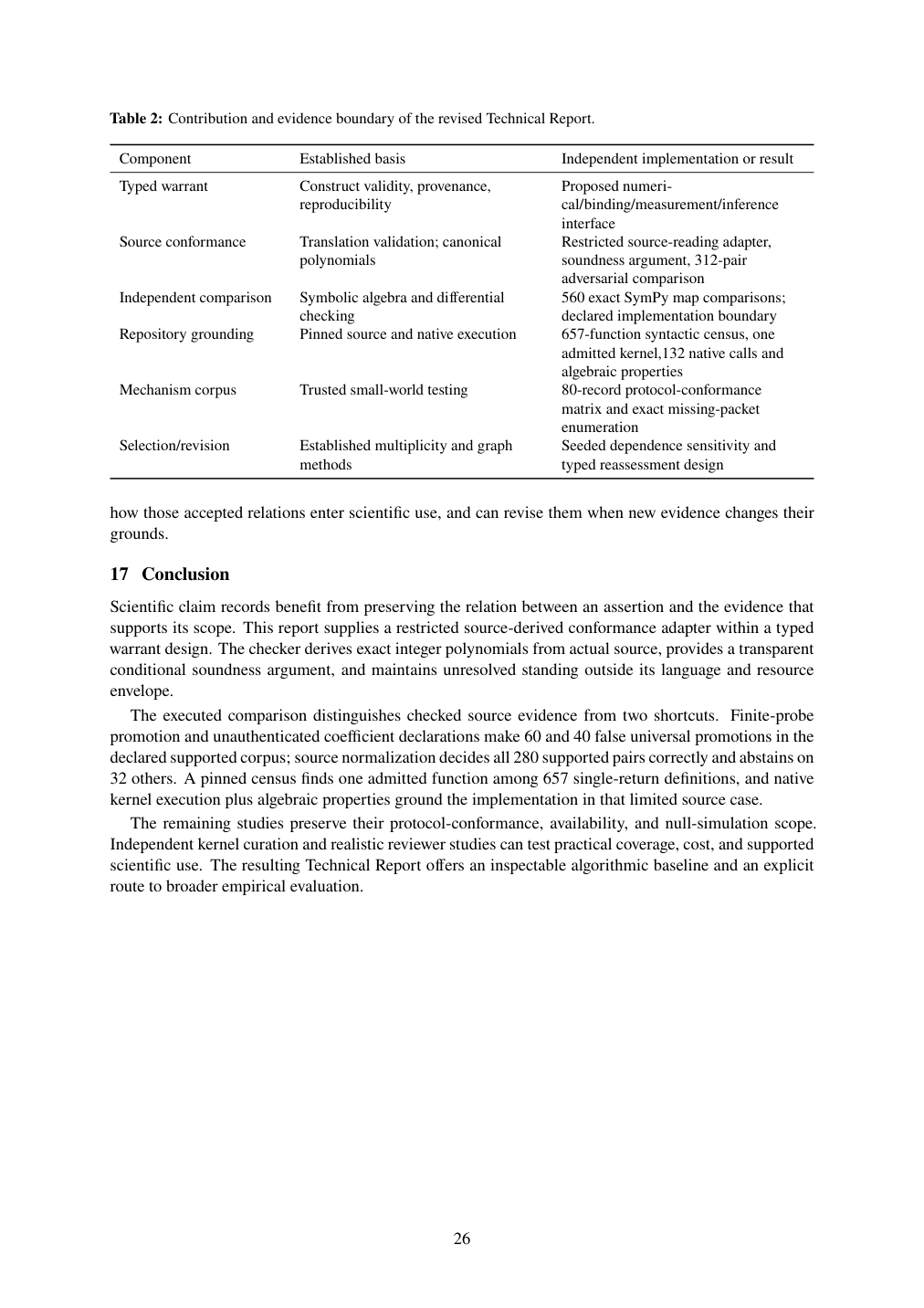
Readable text
Table 2: Contribution and evidence boundary of the revised Technical Report.
Proposed numeri- cal/binding/measurement/inference interface
Restricted source-reading adapter, soundness argument, 312-pair adversarial comparison
560 exact SymPy map comparisons; declared implementation boundary 657-function syntactic census, one admitted kernel,132 native calls and algebraic properties 80-record protocol-conformance matrix and exact missing-packet enumeration
Pinned source and native execution Established multiplicity and graph
Repository grounding Mechanism corpus Trusted small-world testing Selection/revision methods
Seeded dependence sensitivity and typed reassessment design
how those accepted relations enter scientific use, and can revise them when new evidence changes their
Scientific claim records benefit from preserving the relation between an assertion and the evidence that supports its scope. This report supplies a restricted source-derived conformance adapter within a typed warrant design. The checker derives exact integer polynomials from actual source, provides a transparent conditional soundness argument, and maintains unresolved standing outside its language and resource
The executed comparison distinguishes checked source evidence from two shortcuts. Finite-probe promotion and unauthenticated coefficient declarations make 60 and 40 false universal promotions in the declared supported corpus; source normalization decides all 280 supported pairs correctly and abstains on 32 others. A pinned census finds one admitted function among 657 single-return definitions, and native kernel execution plus algebraic properties ground the implementation in that limited source case.
The remaining studies preserve their protocol-conformance, availability, and null-simulation scope. Independent kernel curation and realistic reviewer studies can test practical coverage, cost, and supported scientific use. The resulting Technical Report offers an inspectable algorithmic baseline and an explicit
References
Lee J. Cronbach, Paul E. Meehl (1955). Construct Validity in Psychological Tests. Psychological Bulletin 52(4).
281–302. https://doi.org/10.1037/h0040957. Abigail Z. Jacobs, Hanna Wallach (2021). Measurement and Fairness. Proceedings of FAccT 2021. https://doi.
org/10.1145/3442188.3445901. Luc Moreau, Paolo Missier (2013). PROV-DM: The PROV Data Model. W3C Recommendation, editors. https:
//www.w3.org/TR/2013/REC-prov-dm-20130430/. Xuanyi Lin, Michelle Simon, Nan Niu (2020). Exploratory Metamorphic Testing for Scientific Software. Computing
in Science and Engineering 22(2). 78–87. https://doi.org/10.1109/MCSE.2018.2880577. Tianyu Ding, Aditya Nannapaneni, Bingfan Liu, Ling Zhang (2026). Autonomous Research Agents: A Survey of
AI Scientists and the Verification Gap. arXiv preprint. https://doi.org/10.48550/arXiv.2608.05179. Roger D. Peng (2011). Reproducible Research in Computational Science. Science 334(6060). 1226–1227. https:
//doi.org/10.1126/science.1213847. Steven N. Goodman, Daniele Fanelli, John P. A. Ioannidis (2016). What Does Research Reproducibility Mean?.
Science Translational Medicine 8(341). 341ps12. https://doi.org/10.1126/scitranslmed.aaf5027. Joseph P. Simmons, Leif D. Nelson, Uri Simonsohn (2011). False-Positive Psychology: Undisclosed Flexibility in
Data Collection and Analysis Allows Presenting Anything as Significant. Psychological Science 22(11). 1359– 1366. https://doi.org/10.1177/0956797611417632. Yoav Benjamini, Yosef Hochberg (1995). Controlling the False Discovery Rate: A Practical and Powerful Approach
to Multiple Testing. Journal of the Royal Statistical Society Series B 57(1). 289–300. https://doi.org/10.1 111/j.2517-6161.1995.tb02031.x. Steven R. Howard, Aaditya Ramdas, Jon McAuliffe, Jasjeet Sekhon (2021). Time-Uniform, Nonparametric,
Nonasymptotic Confidence Sequences. Annals of Statistics 49(2). 1055–1080. https://doi.org/10.121 4/20-AOS1991. Margaret Mitchell, Simone Wu, Andrew Zaldivar, Parker Barnes, Lucy Vasserman, Ben Hutchinson, Elena Spitzer,
Inioluwa Deborah Raji, Timnit Gebru (2019). Model Cards for Model Reporting. Proceedings of FAT* 2019. https://doi.org/10.1145/3287560.3287596. Timnit Gebru, Jamie Morgenstern, Briana Vecchione, Jennifer Wortman Vaughan, Hanna Wallach, Hal Daume III,
Kate Crawford (2021). Datasheets for Datasets. Communications of the ACM; primary arXiv version 8. https: //doi.org/10.48550/arXiv.1803.09010. Geir Kjetil Sandve, Anton Nekrutenko, James Taylor, Eivind Hovig (2013). Ten Simple Rules for Reproducible
Computational Research. PLOS Computational Biology 9(10). e1003285. https://doi.org/10.1371/jour nal.pcbi.1003285. Noetarium Project (2026). An Ecology That Improves the Infrastructure; A Generative Ecology of Projects; Case
Studies. . https://github.com/huangwanhong-maker/The-Science-Infrastructures/tree/869fe3 8afac257cd9b5d51ad5b498a8ff6b8e443. George C. Necula (2000). Translation Validation for an Optimizing Compiler. Proceedings of PLDI 2000. 83–94.
https://doi.org/10.1145/349299.349314. Aaron Meurer, Christopher P. Smith, Mateusz Paprocki, et al. (2017). SymPy: Symbolic Computing in Python.
PeerJ Computer Science 3. e103. https://doi.org/10.7717/peerj-cs.103. Python Software Foundation (2026). Python 3.12 Documentation: Abstract Syntax Trees and Built-in Types. Offi-
cial language documentation, accessed 24 November 2026 JST. . https://docs.python.org/3.12/libra ry/ast.html.