Decision Certification And Witness Design With Uncertain Source Origins
Full text from the PDF
Decision Certification And Witness Design With Uncertain
Source Origins
Wanhong HUANG
Abstract
Decision certification depends on both observed values and the source channels through which they can arise. This Technical Report studies finite witness acquisition when a bounded number of origin groups may substitute reports and the actual grouping may be hidden. A decoder supplied with the partition uses decision-specific error-correcting distance. A common decoder for a hidden family instead requires disjoint unions of admissible outputs across conflicting decisions. An executed four-bit counterexample demonstrates the distinction. The main construction reduces hidden-origin acquisition to a finite weighted covering program, with explicit ambiguity witnesses and a conservative common-coarsening alternative. In a ten-coordinate binary fixture, exhaustive enumeration and an integer program find an optimum cost of eight; an analytic lower bound establishes that optimum. A supplied-partition baseline costs seven and fails the hidden task, while common-coarsening certification costs eleven. Greedy covering matches the optimum across the reported cost sweep. Further exact studies cover erasures, uncertain grouping, regret, and correlated evidence. The mathematical ingredients are inherited coding and optimization principles; the contribution is their explicit uncertain-origin acquisition contract, proofs, and reproducible baseline comparison. A proposed attributed-witness service preserves the decision, origin assumptions, costs, certificates, and amendments needed to connect these finite guarantees to scientific inquiry. Scientific deployment requires separate validation of the state, source, and loss models.
Keywords: witness acquisition; source dependence; zero-error decisions; uncertain origins; epistemic infrastructure
Technical Report Note
This technical report shares an evolving inquiry and invites dialogue, criticism, revision, and independent development. Its definitions, distinctions, and constructions remain open to refinement. Circulation across scholarly and practical communities is part of the purpose of releasing the manuscript.
The author treats the viewpoints, concepts, and lines of reasoning presented here as contributions to a shared field of inquiry. Similar or related ideas may have appeared in other intellectual, cultural, and disciplinary traditions. The manuscript identifies known antecedents and distinguishes inherited positions, interpretive proposals, and arguments developed here. Historical priority remains open to further investigation.
The constructions and arguments are presented with their stated assumptions and evidential scope. Readers are encouraged to question, test, revise, extend, reinterpret, or independently develop the ideas presented here. Where appropriate, acknowledgment of this paper as one point of encounter in the development of a related idea is appreciated. Such acknowledgment records an intellectual route; the ideas remain available for criticism, revision, and independent development.
Definitions introduced by the paper are local analytical stipulations unless attributed to another source. Their use identifies the scope of the present argument; terminological and historical priority remain subjects for independent investigation. Generative Relational theory is treated as an open research programme whose proposals receive critical examination alongside independent literature.
Responsible Use and Rights Reservation
This section records a request for responsible scholarly conduct and identifies the scope of retained rights. Legal permissions are governed by the licence on the following page.
The author encourages good-faith discussion, criticism, independent inquiry, and responsible use of the material. Separately from the licence’s terms, the author asks users to consider foreseeable harms when adapting the arguments, representations, or examples of this paper, particularly in scientific inquiry, institutional decisions, and computational knowledge infrastructures. The ethical request leaves the licence’s permissions and legally authorised uses unchanged.
The author retains the rights preserved under CC BY-NC 4.0 and may pursue remedies to which the author is legally entitled for breach of the licence or violation of independently applicable rights. Reuse remains independent from authorial endorsement. Third-party rights require authorisation from their respective holders where applicable. Copyright exceptions and limitations, including applicable forms of fair use or fair dealing, remain available.
Notices
This page consolidates the manuscript’s research status, licence, development disclosure, researchprogramme relation, and suggested citation.
Status. This technical report is prepared for the author’s substantive review and subsequent scholarly discussion. The report distinguishes established antecedents, conditional results developed here, inspected source artifacts, and numerical illustrations under declared assumptions. Internal checks assess the stated arguments and examples; independent scholarly assessment can further test their interpretation and adequacy. The source ledgers record the access level and claim scope of consulted works.
Licence. Except where otherwise indicated, copyright 2026 Wanhong Huang. This work is made available under the Creative Commons Attribution-NonCommercial 4.0 International License (CC BY-NC 4.0). Subject to its terms, the licence permits sharing and adaptation for noncommercial purposes with appropriate attribution, a link to the licence, and an indication of changes. Attribution should preserve the licensor’s independence from the reuse. Reuse is governed solely by the licence; the responsible-use request on the preceding page remains separate from its terms. The licence deed and legal code are available at https://creativecommons.org/licenses/by-nc/4.0/. The licence governs in case of conflict with this summary. Third-party material remains subject to its respective rights.
Statement on the use of language models. Preparation involved OpenAI’s ChatGPT and Codex. Language models supported exploratory dialogue, source discovery and checking, argumentative criticism, manuscript revision, LATEX typesetting, and the development of supporting code and figures. Verification used the sources and access levels recorded in the accompanying ledgers. The author initiated the research questions and directed the research programme; interpretation, acceptance of the arguments, and publication decisions remain subject to the author’s review. Authorship credit and responsibility for the released manuscript remain with the human author.
Code and data availability. Supporting scripts rebuild the original finite study and the expanded sensitivity computations. Generated results, source-verification ledgers, sectioned manuscripts, and figures accompany this report. The source package contains the editable manuscript, source ledgers, supporting scripts and outputs, and a reading guide. Numerical illustrations, where present, use the assumptions stated in their captions and text.
Related research programme. This report belongs to the Noetarium technical report series. Companion reports study inference, computation, evaluation, governance, and cross-disciplinary knowledge formation. The reports develop distinct technical questions within an open Generative Relational research programme.
Suggested citation. Huang, Wanhong. “Decision Certification And Witness Design With Uncertain Source Origins.” Technical report, 2026.
1 Introduction
Scientific infrastructures receive observations through records whose origins and transformations can affect their evidential meaning. A measurement, a literature summary, and a derived model output can disclose complementary distinctions or repeat a common source. An agent using those records needs to know whether the available observations distinguish circumstances requiring different decisions. The question concerns both the values observed and the channel through which they became available.
Noetarium’s ecology design proposes an attributed evidential chain connecting collection, estimation, representation, interpretation, and presentation (Noetarium Project, 2026). Its existing witnesscomplementarity argument motivates the present task but already supplies the general insight that situated observations can jointly recover distinctions. The technical question developed here is narrower: which observations should an infrastructure acquire to certify a specified decision when report origins are uncertain and a bounded number of origin groups can substitute their values?
The report distinguishes two information conditions. A decoder supplied with the actual origin partition can use its corresponding source-group distance. A decoder receiving only a family of possible partitions must also compare histories generated under different partitions. An explicit four-bit construction shows that every supplied partition can permit correction while the hidden family remains ambiguous. The exact criterion is disjointness of admissible report unions across conflicting decision classes. This uses established zero-error distinguishability, with the source assumptions and recovery target carried explicitly in the certificate.
The central technical contribution is an exact acquisition formulation for that hidden-family task. A finite covering program requires an observed distinction outside every pair of admissible attack supports. The report supplies its equivalence proof, an ambiguity witness when a design fails, a conservative common-coarsening alternative, and an executed ten-coordinate comparison. The exact design costs eight units in the declared fixture. A supplied-partition baseline costing seven fails the hidden task; a conservative coarsening certificate costs eleven. Enumeration, an integer program, independent report-ball checks, and an analytic lower bound support the result.
Supporting analyses cover visible erasures, regret certificates, decision granularity, source mergers, and stochastic dependence. Their role is to expose the assumptions a practical certificate must retain. The constructed computations establish finite mechanisms and optimization outcomes; scientific deployment additionally requires an adequate state model, justified source hypotheses, meaningful acquisition costs, and a decision context accepted for the intended use. The proposed service lifecycle connects those requirements to provenance, amendment, and continued inquiry across disciplinary settings.
2 Antecedents And The Contribution Boundary
2.1 Decision-Relative Information
Blackwell’s comparison of experiments relates information structures to the decision problems they support (Blackwell, 1953). The comparison makes the decision problem part of the meaning of an information structure. A particular scientific engagement usually asks a narrower question. It may need to distinguish whether a further measurement is worthwhile, whether a component should be repaired, or whether two proposed reconstructions require different interventions. Full identification of the underlying state can be unnecessary for that task.
The construction below therefore begins with a declared decision signature. The signature can change when the loss, available actions, or affected parties change. It orders the states of a specified decision problem. This relativity matters for cross-disciplinary work: a representation adequate for one laboratory’s prediction may suppress distinctions relevant to a public decision. The signature records the question instead of attributing decision sufficiency to a dataset in general.
2.2 Diversity, Dependence, And Strategic Channels
Functional diversity has established advantages under specified collective problem-solving models (Hong et al., 2004). The benefit depends on the assumptions and recovery target of the collective task. The relevant distinction here is which pairs of possible worlds a source separates. Social influence can also alter the independence of reports, as experimentally studied by Lorenz et al. (2011). The present construction abstracts from those experiments and makes dependence explicit through a common-origin group. Six renderings of one sensor remain one potentially compromised source group.
Error-correcting codes provide the central robust-decoding result (Hamming, 1950). The customary problem reconstructs a transmitted symbol or codeword after a bounded number of errors. Here the recovery target is a decision class; different world states with the same decision may share outputs. The resulting distance condition is a direct specialization of coding theory. Its value lies in exposing what an evidential architecture must preserve when it combines inherited observations, source metadata, and an operational decision.
2.3 Agent Ecologies And Existing Noetarium Arguments
Recent systems already develop agent improvement, generated evaluations, and resource-constrained artificial populations. Red Queen Gödel Machine evolves evaluators under independently anchored replacement procedures (Iacob et al., 2026); EvalResearchBench evaluates agent-designed feedback against separate targets (Zhang et al., 2026); TerraLingua examines persistent artifacts and institutions in an artificial ecology (Paolo et al., 2026). These systems establish that agent populations and evaluators can change. The present question concerns a different interface: the relation between the environment and the records from which the population judges what has changed.
Noetarium’s existing ecology note already states that differently situated witnesses may jointly recover distinctions that one representation merges. Repeating that observation would add little. The additional work here introduces source-group adversaries, a decision-specific separation criterion, a finite witnessbudget optimization, and exact enumeration of its feasible designs. These results can serve as a bounded test fixture for a future evidential-chain implementation.
3 Witness Design In The Research Literature
The literature relevant to witness design contains several different recovery targets. A communication code protects an intended message, a state estimator reconstructs a dynamical system, an active learner identifies a hypothesis or decision region, and an epistemic community distributes inquiry among investigators. These targets share mathematical structures while giving different meanings to success. An infrastructure that combines them benefits from specifying which target a particular certificate serves. The following comparisons place the finite witness construction within that existing work and identify the additional records required by its intended application.
Hamming’s coding formulation supplies the geometry of separated output profiles (Hamming, 1950). The distance proof used here inherits that geometry directly. Its adaptation replaces message identity by agreement on a selected action. Consequently, profiles of distinct states may coincide whenever those states receive the same signature. This restricted recovery problem permits a report to certify a repair decision while leaving several causal explanations open. The mathematical relaxation has a practical consequence: acquisition should be evaluated against the distinction a user requires, and an acquisition certificate should retain that distinction in its metadata.
Secure estimation offers a closer engineering comparison than a general appeal to diversity. Fawzi et al. (2014) study linear systems with adversarially corrupted sensors or actuators and connect resilient estimation to error correction and compressed sensing. Their dynamical and real-valued setting has a richer temporal structure than the finite channels studied here. The present calculation supplies a small decision-level fixture in which source origins, allowed substitutions, and action conflicts can all be enumerated. A future implementation could place such fixtures beside dynamical estimators, using their
Readable text
different assumptions as separate contracts. A certificate for a finite diagnostic decision would then be distinguishable from a guarantee about reconstructing a continuously evolving state.
Bayesian active learning already studies the acquisition of costly observations under dependence. Golovin et al. (2010) develop a method for noisy observations whose guarantees include correlated noise and nonuniform test costs. Chen et al. (2017) focus on conditionally dependent tests and use a dependency-aware surrogate in their ECED method. These precedents make correlation-aware test selection an established research topic. The report’s narrower design problem gives an explicit worst-case corruption budget to source groups and requires separation only across decision classes. expected loss and adversarial separation answer complementary questions: the former uses a probability model for likely outcomes, while the latter asks which admissible substitutions can still leave the decision
The distinction matters when choosing an acquisition heuristic. The corrected version of the adaptive- submodularity work states conditions under which adaptive greedy methods obtain guarantees and records a correction to an earlier theorem (Golovin et al., 2011). Those conditions should be checked for the ob- jective an infrastructure actually optimizes. The parity construction in this report has increasing marginal value for target-risk reduction. It therefore supplies a direct counterexample to assuming diminishing returns for that objective merely because an acquisition problem contains observations. A surrogate ob- jective may recover a useful guarantee, but its relationship to the desired decision certificate becomes a
Social epistemology provides a further comparison. In Zollman’s models, communication structure and prior beliefs can preserve a useful division of inquiry, while excessive persistence of disagreement can prevent convergence (Zollman, 2010). The relevant design question concerns the trajectory of investi- gation: which alternatives remain available long enough to receive an adequate test. In the witness model, by contrast, a map is fixed and its distinguishing power is inspectable. Combining the two perspectives suggests an additional layer for future work. An agent ecology must support both the current separations available in its records and the processes that generate new observation positions when current separations
A useful synthesis therefore distinguishes three objects: coverage of possible decisions, dependence among observations, and the future production of evidence. The finite multicover addresses the first object under an explicit model of the second. The third requires institutions that finance measurements, preserve minority accounts, and permit amendments to the state model. A report count measures none of these objects by itself. A collection can grow through copies, through genuinely independent confirmation, or through observations that introduce a previously absent distinction. Each route can be valuable, and each
This perspective also narrows the contribution claim. The report contributes an auditable combination of decision-specific separation, source-group accounting, and a reproducible enumeration. Its additional erasure and grouping analyses expose assumptions that a witness service would need to publish. The established literature supplies the underlying coding, learning, and social-epistemic ingredients. The re- port’s research opportunity lies in connecting those ingredients to the actual lifecycle of scientific records: attribution, transformation, challenge, acquisition, certification, and withdrawal. That lifecycle is a con- crete interface at which an infrastructure can make its claims assessable across disciplinary settings.
rule can supply a selected action when appropriate. Equation 1 defines the resulting decision signature.
Readable text
historical, causal, or ethical differences available for other inquiries. An application that requires all
may be a vector of reports, provided the source-level dependence remains declared. For selected groups
A group can represent a sensor family, a common data-producing institution, or several transformations derived from one original record. Assigning reports to groups is a substantive assumption about the route
Definition 4.1 is deliberately strong within a group and restrictive in the number of compromised groups. It covers coordinated misreporting across copies of a source, while assigning separate origins separate corruption costs. It leaves ordinary measurement noise for a later extension. A stochastic chan- nel model could be used instead when its probabilities are substantively warranted.
The source-group Hamming distance and its decision-specific minimum are defined in Equation 3.
when the decision signature is constant; the constant decision already settles the declared action. In a monitoring problem this can reduce the redundancy needed to settle the declared action, compared with
The decoder returns a certified decision when this set is nonempty and its signatures agree. It returns an unresolved decision when several signatures remain, and an inconsistency when the set is empty. These outcomes refer to the declared finite model, source grouping, and radius; their assumptions travel with the
Proposition 5.1 (Decision-specific robust separation). Every admissible report permits correct certifica-
the condition. The true state is retained by admissibility, so the shared decision is correct.

Readable text
Proposition 5.1 makes the source assumption operational. It also separates a certificate from a vote. A majority of repeated reports can be highly confident while the retained set still contains states requiring different actions. The criterion checks possible histories of the reports, in place of counting manifestations
Corollary 5.2 (Source-Level Separation Under Copies). Appending any deterministic number of copies
Proof. Appending deterministic functions of an existing output changes neither equality nor inequality of that group’s output between two states. Every summand in Equation 3 is therefore unchanged.
The retention condition in Corollary 5.2 matters. Replacing an original output by a lossy summary can merge previously distinct profiles. A data pipeline can preserve its original holding and append an interpretation, allowing the earlier distinctions to remain inspectable. This is one reason provenance and access to underlying material have a direct mathematical role in the proposed decoder.
A correct decision certificate establishes a conditional implication from a finite record model to an action signature. Its strength depends on four separate matters: coverage of the state space, adequacy of the witness maps, correctness of source grouping, and the corruption budget. A real environmental state outside Ωcan produce an apparently consistent profile. The model therefore needs a procedure for revising its state space and observation maps when external evidence contradicts their predictions.
The criterion also leaves decision legitimacy to the declared loss and action set. A planner’s optimal action and an affected party’s preferred action can differ while both use the same observations. Preserving witness diversity can improve factual discrimination without settling that normative disagreement. A useful system should attach the signature’s decision context to its certificate so a later user can assess
A witness service must handle both an altered record and an unavailable record. The distinction is op- erationally useful. An erasure identifies where information is missing; a corruption leaves the receiver uncertain about which supplied value deserves scrutiny. Source withdrawal, expired access, a failed in- strument, and a deliberate refusal can all produce missing values, although their causes and institutional meanings differ. This section extends the finite certificate to a bounded erasure model and then examines
the visible report and the stated corruption radius. Equation 5 defines this retained set.
Equation 5 treats the location of the erasure as known. It consequently gives an erased observation a different logical role from an arbitrary replacement. The attribution record can make that difference explicit even when the underlying cause remains contested.
Proposition 6.1 (Joint Corruption And Erasure Separation). For finite alphabets and arbitrary source
Readable text
receiver then encounters the same report under two admissible histories requiring different decisions. The constant-signature convention makes the statement immediate when the conflicting-pair set is empty.
Proposition 6.1 is the classical errors-and-erasures geometry specialized to a decision signature. Its role is to price availability explicitly. Protecting against one missing origin requires one extra separating group, while protecting against one unlocated substitution requires two. An acquisition service can display both requirements beside its ordinary report count. The resulting budget expresses a model capability; it acquires empirical relevance through a justified account of which failure modes the selected groups
The source partition is another assumption with direct consequences. Suppose a set of report coordi- attack on that group can replace the whole vector. Equation 6 states the corresponding distance.
Equation 6 counts origins that distinguish a pair, regardless of the number of distinguishing reports inside each origin. Two distinct mechanisms can share a data source and still improve truthful identification, yet provide only one corruption boundary when that source can alter both outputs.
Proof. For any state pair, several unequal blocks of the finer partition can become a single unequal block after merging; equal blocks cannot create additional blocks. Its distance weakly decreases. Taking the minimum over conflicting pairs proves the first assertion. For the second assertion, apply Proposition 5.1 separately to the decoder supplied with each partition. The resulting statement is pointwise: every sup-
Proposition 6.2 supports a collection of explicitly conditional certificates. An origin audit can justify one partition and permit its corresponding decoder. If the actual partition remains hidden, the receiver in- stead has to consider reports that could arise under different partitions in the same family. This introduces an additional identification requirement. Distinguishing these two information conditions makes the role of source metadata precise: it can identify the channel through which an observation is interpreted, as
here concerns substitutions; the preceding error-and-erasure result uses a supplied partition and visible erased blocks. A corrupted block may replace its coordinate vector by any tuple in the corresponding
Readable text
Equation 7 represents uncertainty about which partition generated the report. The unknown-family de- coder retains all compatible states, as stated in Equation 8.
Equation 8 certifies a decision only when the retained set is nonempty and every retained state has the same signature. It therefore applies one decision rule without receiving the actual partition.
Proposition 6.3 (Hidden-Partition Decision Separation). A single decoder correctly identifies the decision
Proof. Under Equation 9, an admissible report retains the true state and can retain only states with that same decision. Equation 8 therefore defines a correct common decoder. Conversely, a report in an in- tersection belongs to two admissible state-partition histories requiring different decisions. One decoder receives the same input under both histories and cannot return both required decisions. Distributing inter- section over the unions proves the equivalent cross-partition formulation.
Proposition 6.3 specializes the established disjoint-channel-output principle to uncertain source group- ing. It supplies an exact finite test whose quantifiers differ from those of Proposition 6.2. A pointwise distance test compares two histories using the same supplied partition. The hidden-family test also com- pares histories using different partitions. The latter comparison can reveal ambiguity even when every
A useful equivalent combinatorial test follows from the full block-substitution assumption. Necessity follows because every differing coordinate must be altered relative to at least one profile. For common value. This constructs the ambiguous report and provides an inspectable witness for a failed
The coarsening can admit substitutions beyond those in the original union, so failure of its distance test leaves the exact union test as the appropriate next calculation.
The service should publish its information condition alongside its result. One certificate names a supplied, justified partition. A second names a hidden family and checks the union-channel criterion. A third uses a known common coarsening as a conservative certificate. An imported dataset with incomplete upstream lineage can then receive an unresolved family verdict while preserving the conditional results under particular source hypotheses. A provenance audit that identifies the actual partition can resolve that
A partition family also has computational costs. Arbitrary partitions grow rapidly with the number of coordinates. An implementation can restrict the uncertainty family through named hypotheses, such as a shared laboratory, a common survey frame, or a common preprocessing service. Enlarging a hidden family enlarges its admissible report unions and can only weaken certifiability. A precise small family, an explicit ambiguity witness, and a declared decoding condition give a more informative account of uncertainty than a report count accompanied by an implicit assertion of independence.
Readable text
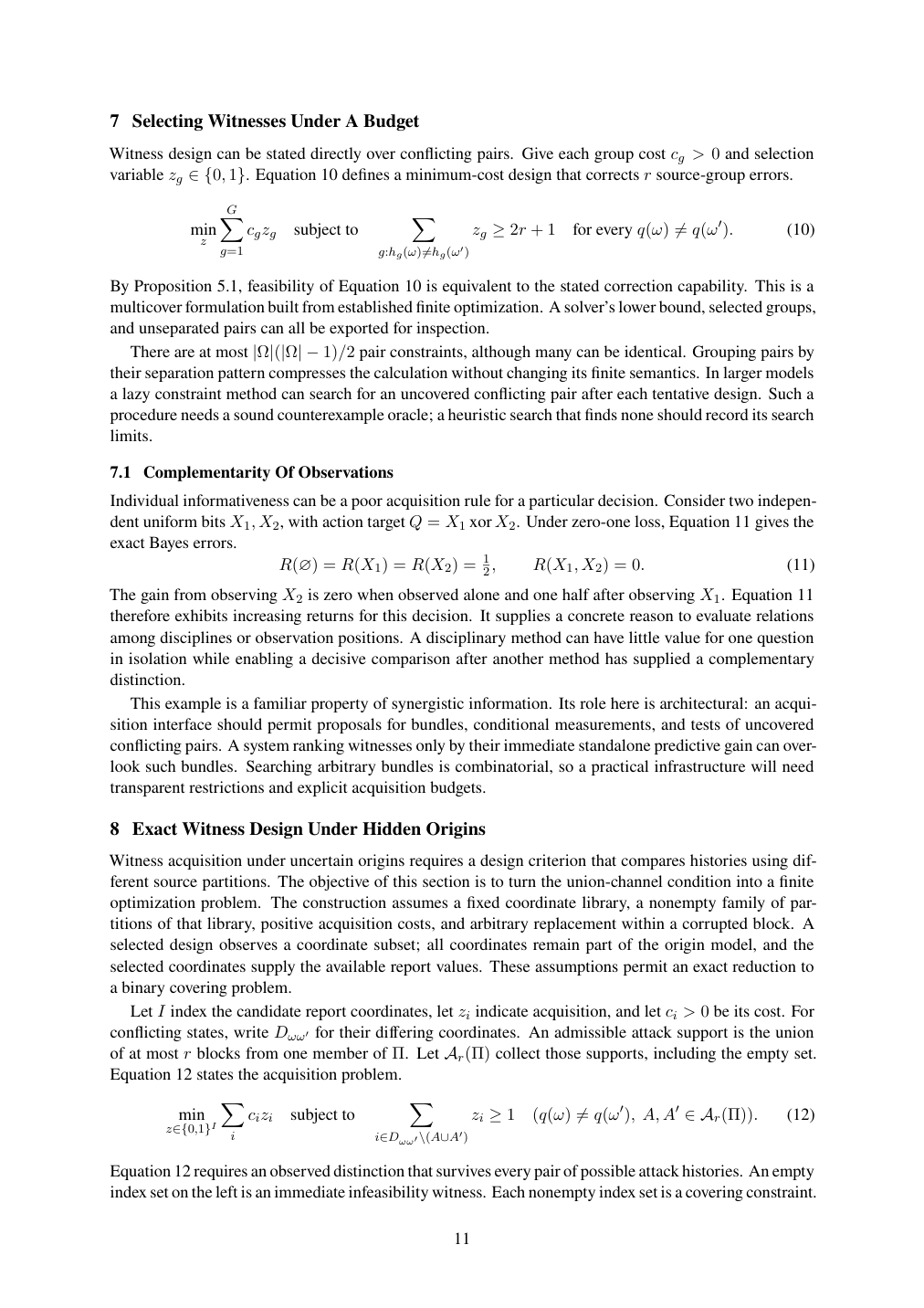
By Proposition 5.1, feasibility of Equation 10 is equivalent to the stated correction capability. This is a multicover formulation built from established finite optimization. A solver’s lower bound, selected groups, and unseparated pairs can all be exported for inspection.
their separation pattern compresses the calculation without changing its finite semantics. In larger models a lazy constraint method can search for an uncovered conflicting pair after each tentative design. Such a procedure needs a sound counterexample oracle; a heuristic search that finds none should record its search
Individual informativeness can be a poor acquisition rule for a particular decision. Consider two indepen-
therefore exhibits increasing returns for this decision. It supplies a concrete reason to evaluate relations among disciplines or observation positions. A disciplinary method can have little value for one question in isolation while enabling a decisive comparison after another method has supplied a complementary
This example is a familiar property of synergistic information. Its role here is architectural: an acqui- sition interface should permit proposals for bundles, conditional measurements, and tests of uncovered conflicting pairs. A system ranking witnesses only by their immediate standalone predictive gain can over- look such bundles. Searching arbitrary bundles is combinatorial, so a practical infrastructure will need transparent restrictions and explicit acquisition budgets.
Witness acquisition under uncertain origins requires a design criterion that compares histories using dif-
ferent source partitions. The objective of this section is to turn the union-channel condition into a finite optimization problem. The construction assumes a fixed coordinate library, a nonempty family of par- titions of that library, positive acquisition costs, and arbitrary replacement within a corrupted block. A selected design observes a coordinate subset; all coordinates remain part of the origin model, and the selected coordinates supply the available report values. These assumptions permit an exact reduction to
Equation 12 requires an observed distinction that survives every pair of possible attack histories. An empty index set on the left is an immediate infeasibility witness. Each nonempty index set is a covering constraint.
Repeated constraints can be merged, and a constraint whose index set contains another constraint’s index set can be removed, since satisfying the smaller set also satisfies the larger one.
Proposition 8.1 (Hidden-Origin Acquisition Criterion). Under the stated coordinate and substitution model, a selected design satisfies Equation 12 exactly when its observed reports admit a single correct decision decoder for every partition in the hidden family.
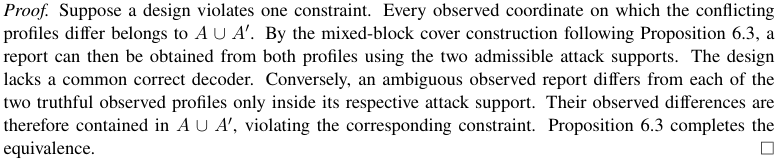
Proposition 8.1 gives an optimization certificate with two complementary witnesses. A feasible binary selection supplies a sufficient acquisition design. A conflicting state pair and two attack supports explain why a proposed selection fails. An integer optimizer can provide an optimum under the declared finite model, while exhaustive enumeration can check small libraries independently. The mathematical optimization is an established weighted covering form. The report-specific contribution is the derivation of its constraints from uncertain origin channels and decision conflicts, together with an executed comparison showing the consequence of using different information conditions.
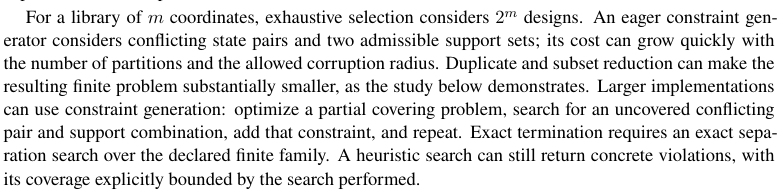
The reference study also uses a greedy baseline. It repeatedly selects the coordinate covering the largest number of remaining constraints per unit cost, resolves ties by coordinate order, and then removes redundant selected coordinates in descending cost order. This is a familiar covering heuristic. Its performance is reported for the fixture, with the exact optimum retained as the comparison target. A baseline based only on truthful decision sufficiency and a baseline based on supplied-partition distances answer different questions; they are included because an infrastructure can mistakenly use those simpler criteria for a hidden-origin task.
9 Decision Loss, Intervention Value, And Acquisition
A decision signature expresses the purpose of an evidential inquiry. That purpose can concern prediction, diagnosis, intervention, or the opportunity to acquire further information. Distinguishing these purposes prevents a mathematical certificate from absorbing questions its model leaves open. A common state description may support several losses and several possible interventions. The witness service should
Readable text
consequently attach the decision context to every request and permit a user to replace that context while
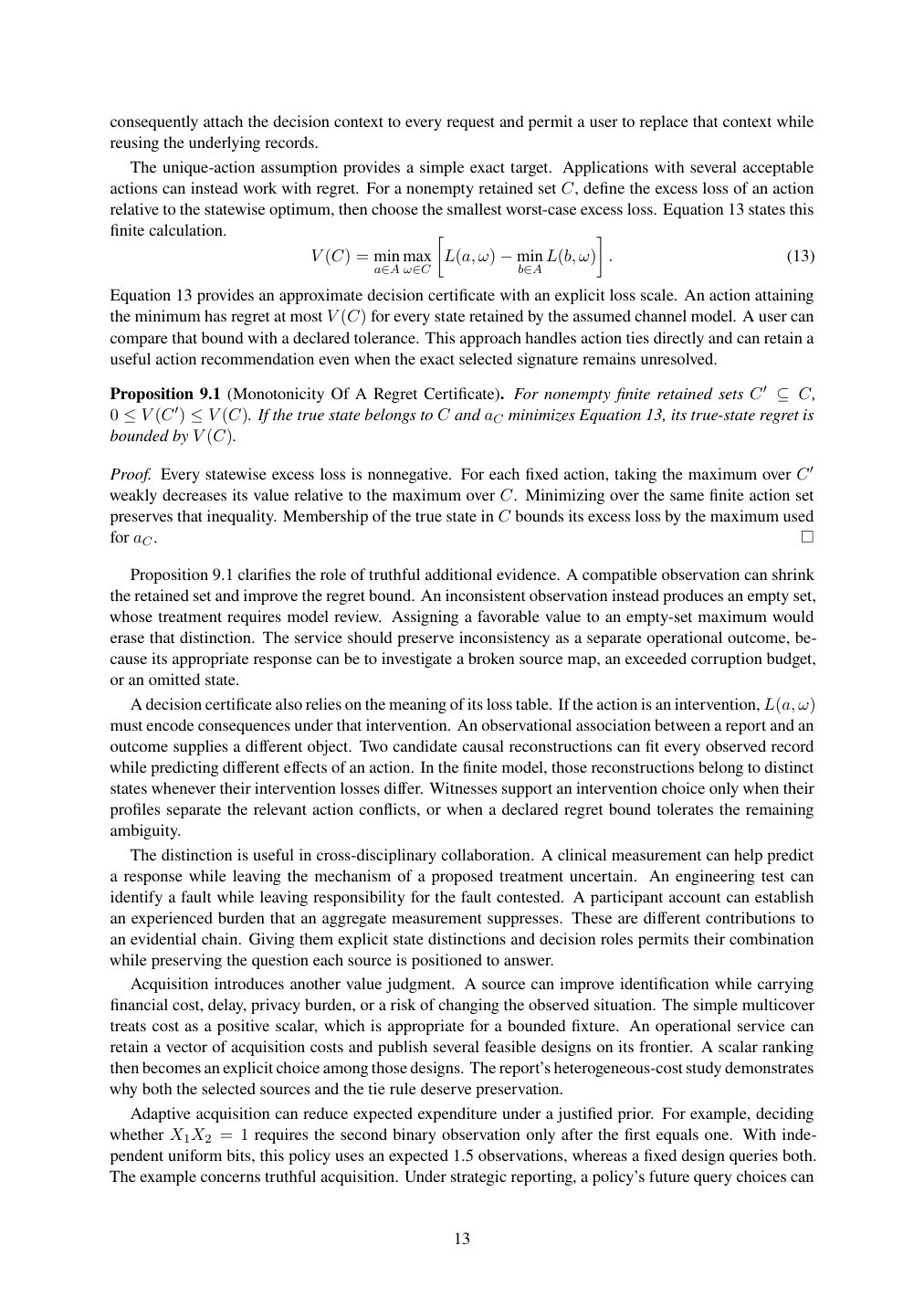
The unique-action assumption provides a simple exact target. Applications with several acceptable relative to the statewise optimum, then choose the smallest worst-case excess loss. Equation 13 states this
Equation 13 provides an approximate decision certificate with an explicit loss scale. An action attaining compare that bound with a declared tolerance. This approach handles action ties directly and can retain a useful action recommendation even when the exact selected signature remains unresolved.
Proposition 9.1 clarifies the role of truthful additional evidence. A compatible observation can shrink the retained set and improve the regret bound. An inconsistent observation instead produces an empty set, whose treatment requires model review. Assigning a favorable value to an empty-set maximum would erase that distinction. The service should preserve inconsistency as a separate operational outcome, be- cause its appropriate response can be to investigate a broken source map, an exceeded corruption budget,
must encode consequences under that intervention. An observational association between a report and an outcome supplies a different object. Two candidate causal reconstructions can fit every observed record while predicting different effects of an action. In the finite model, those reconstructions belong to distinct states whenever their intervention losses differ. Witnesses support an intervention choice only when their profiles separate the relevant action conflicts, or when a declared regret bound tolerates the remaining
The distinction is useful in cross-disciplinary collaboration. A clinical measurement can help predict a response while leaving the mechanism of a proposed treatment uncertain. An engineering test can identify a fault while leaving responsibility for the fault contested. A participant account can establish an experienced burden that an aggregate measurement suppresses. These are different contributions to an evidential chain. Giving them explicit state distinctions and decision roles permits their combination while preserving the question each source is positioned to answer.
Acquisition introduces another value judgment. A source can improve identification while carrying financial cost, delay, privacy burden, or a risk of changing the observed situation. The simple multicover treats cost as a positive scalar, which is appropriate for a bounded fixture. An operational service can retain a vector of acquisition costs and publish several feasible designs on its frontier. A scalar ranking then becomes an explicit choice among those designs. The report’s heterogeneous-cost study demonstrates why both the selected sources and the tie rule deserve preservation.
Adaptive acquisition can reduce expected expenditure under a justified prior. For example, deciding pendent uniform bits, this policy uses an expected 1.5 observations, whereas a fixed design queries both. The example concerns truthful acquisition. Under strategic reporting, a policy’s future query choices can
Readable text
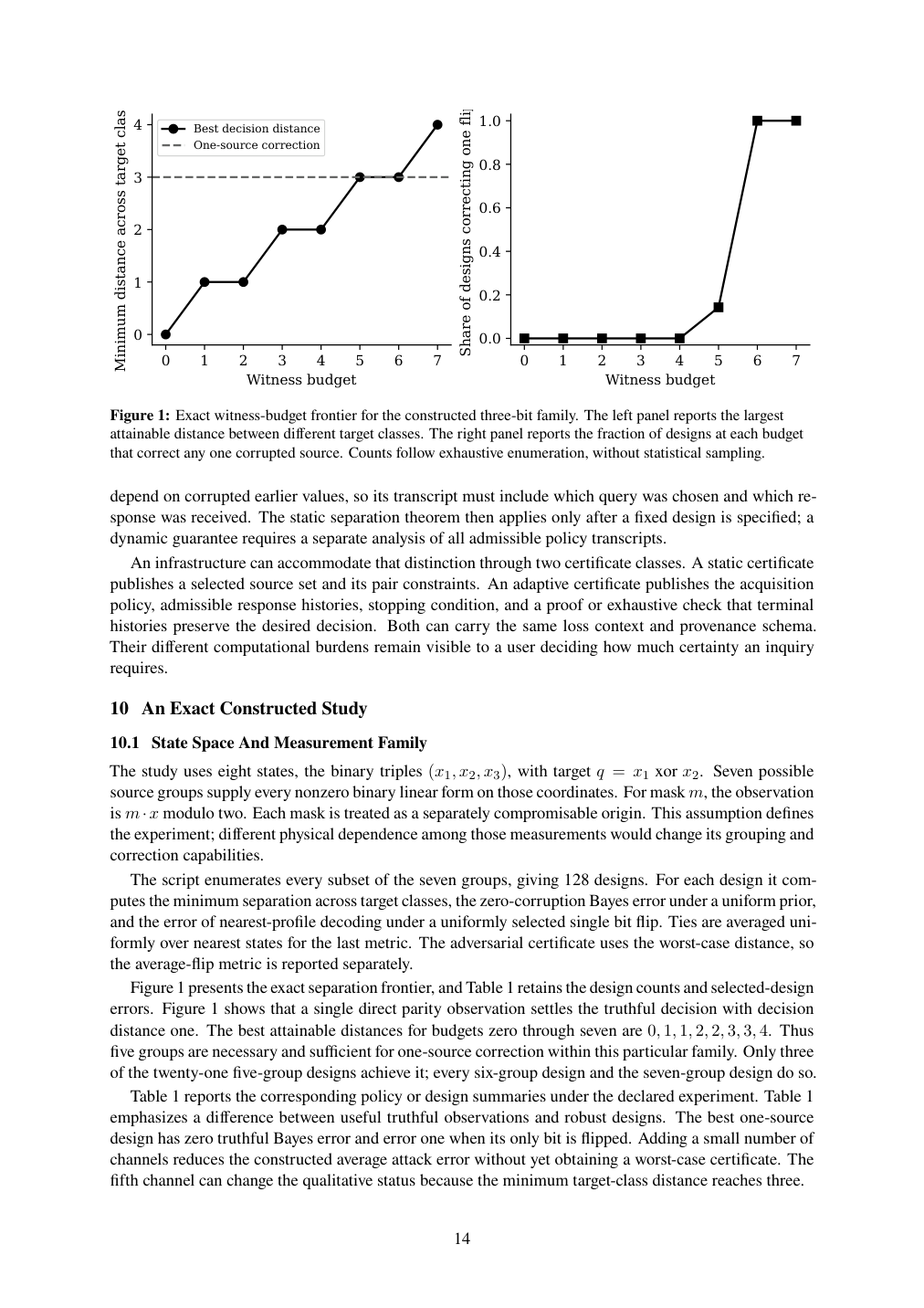
Figure 1: Exact witness-budget frontier for the constructed three-bit family. The left panel reports the largest attainable distance between different target classes. The right panel reports the fraction of designs at each budget that correct any one corrupted source. Counts follow exhaustive enumeration, without statistical sampling.
depend on corrupted earlier values, so its transcript must include which query was chosen and which re- sponse was received. The static separation theorem then applies only after a fixed design is specified; a dynamic guarantee requires a separate analysis of all admissible policy transcripts.
An infrastructure can accommodate that distinction through two certificate classes. A static certificate publishes a selected source set and its pair constraints. An adaptive certificate publishes the acquisition policy, admissible response histories, stopping condition, and a proof or exhaustive check that terminal histories preserve the desired decision. Both can carry the same loss context and provenance schema. Their different computational burdens remain visible to a user deciding how much certainty an inquiry
the experiment; different physical dependence among those measurements would change its grouping and
The script enumerates every subset of the seven groups, giving 128 designs. For each design it com- putes the minimum separation across target classes, the zero-corruption Bayes error under a uniform prior, and the error of nearest-profile decoding under a uniformly selected single bit flip. Ties are averaged uni- formly over nearest states for the last metric. The adversarial certificate uses the worst-case distance, so
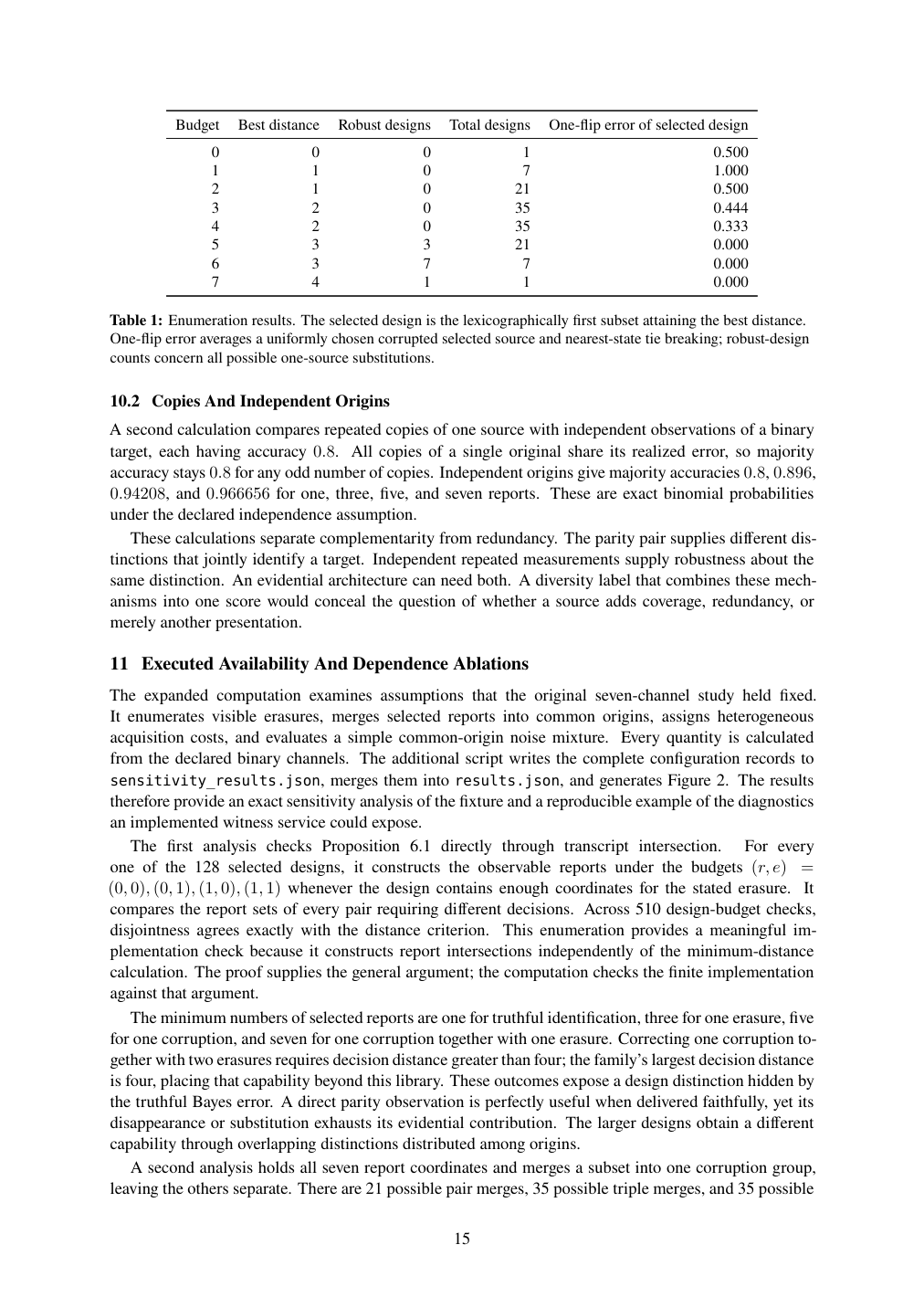
Figure 1 presents the exact separation frontier, and Table 1 retains the design counts and selected-design errors. Figure 1 shows that a single direct parity observation settles the truthful decision with decision five groups are necessary and sufficient for one-source correction within this particular family. Only three of the twenty-one five-group designs achieve it; every six-group design and the seven-group design do so.
Table 1 reports the corresponding policy or design summaries under the declared experiment. Table 1 emphasizes a difference between useful truthful observations and robust designs. The best one-source design has zero truthful Bayes error and error one when its only bit is flipped. Adding a small number of channels reduces the constructed average attack error without yet obtaining a worst-case certificate. The fifth channel can change the qualitative status because the minimum target-class distance reaches three.
Readable text
Table 1: Enumeration results. The selected design is the lexicographically first subset attaining the best distance. One-flip error averages a uniformly chosen corrupted selected source and nearest-state tie breaking; robust-design
counts concern all possible one-source substitutions.
A second calculation compares repeated copies of one source with independent observations of a binary
These calculations separate complementarity from redundancy. The parity pair supplies different dis- tinctions that jointly identify a target. Independent repeated measurements supply robustness about the same distinction. An evidential architecture can need both. A diversity label that combines these mech- anisms into one score would conceal the question of whether a source adds coverage, redundancy, or
The expanded computation examines assumptions that the original seven-channel study held fixed. It enumerates visible erasures, merges selected reports into common origins, assigns heterogeneous acquisition costs, and evaluates a simple common-origin noise mixture. Every quantity is calculated from the declared binary channels. The additional script writes the complete configuration records to sensitivity_results.json, merges them into results.json, and generates Figure 2. The results therefore provide an exact sensitivity analysis of the fixture and a reproducible example of the diagnostics
The first analysis checks Proposition 6.1 directly through transcript intersection.
compares the report sets of every pair requiring different decisions. Across 510 design-budget checks, disjointness agrees exactly with the distance criterion. This enumeration provides a meaningful im- plementation check because it constructs report intersections independently of the minimum-distance calculation. The proof supplies the general argument; the computation checks the finite implementation
The minimum numbers of selected reports are one for truthful identification, three for one erasure, five for one corruption, and seven for one corruption together with one erasure. Correcting one corruption to- gether with two erasures requires decision distance greater than four; the family’s largest decision distance is four, placing that capability beyond this library. These outcomes expose a design distinction hidden by the truthful Bayes error. A direct parity observation is perfectly useful when delivered faithfully, yet its disappearance or substitution exhausts its evidential contribution. The larger designs obtain a different capability through overlapping distinctions distributed among origins.
A second analysis holds all seven report coordinates and merges a subset into one corruption group, leaving the others separate. There are 21 possible pair merges, 35 possible triple merges, and 35 possible
Readable text
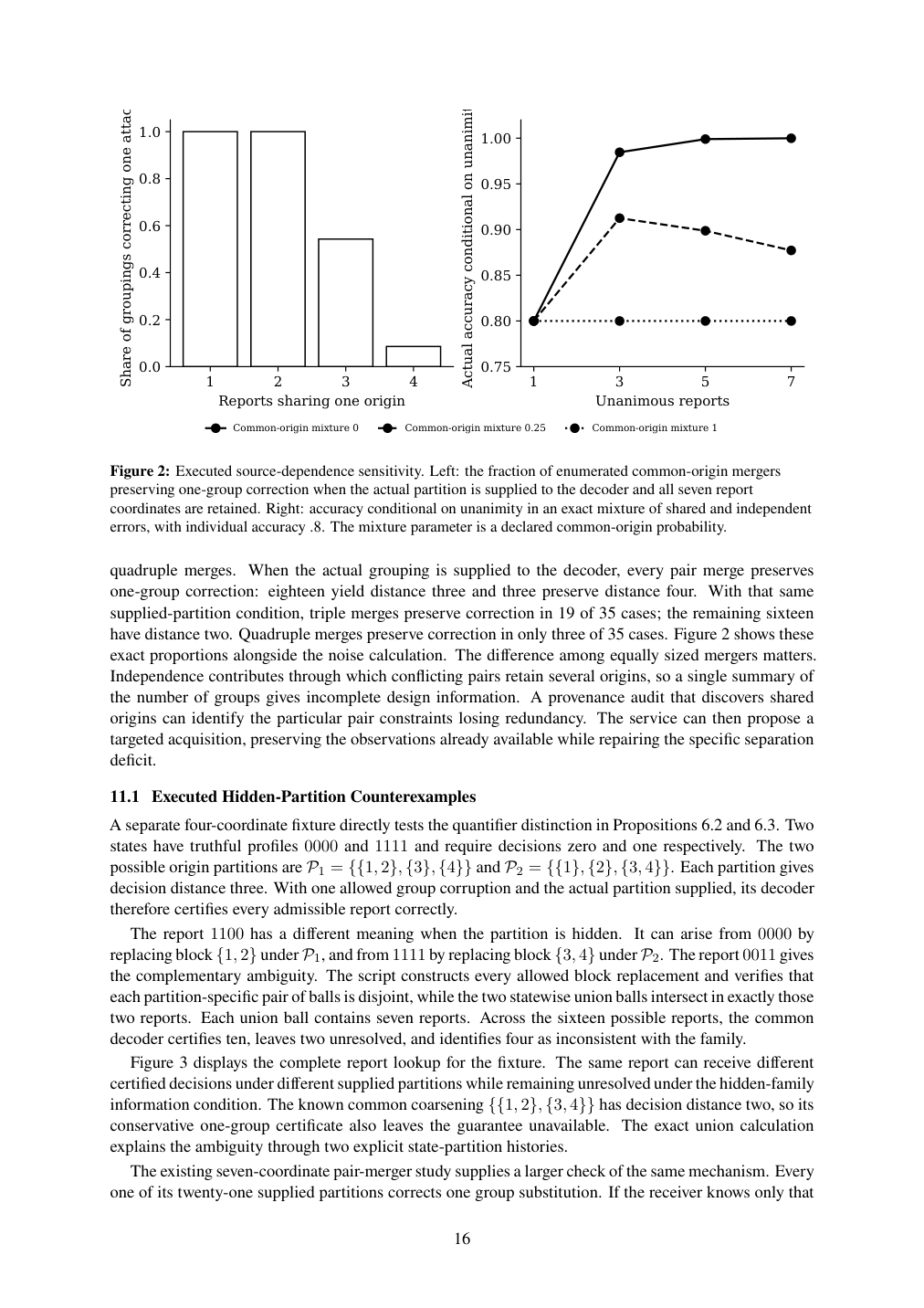
Figure 2: Executed source-dependence sensitivity. Left: the fraction of enumerated common-origin mergers preserving one-group correction when the actual partition is supplied to the decoder and all seven report coordinates are retained. Right: accuracy conditional on unanimity in an exact mixture of shared and independent errors, with individual accuracy .8. The mixture parameter is a declared common-origin probability.
quadruple merges. When the actual grouping is supplied to the decoder, every pair merge preserves one-group correction: eighteen yield distance three and three preserve distance four. With that same supplied-partition condition, triple merges preserve correction in 19 of 35 cases; the remaining sixteen have distance two. Quadruple merges preserve correction in only three of 35 cases. Figure 2 shows these exact proportions alongside the noise calculation. The difference among equally sized mergers matters. Independence contributes through which conflicting pairs retain several origins, so a single summary of the number of groups gives incomplete design information. A provenance audit that discovers shared origins can identify the particular pair constraints losing redundancy. The service can then propose a targeted acquisition, preserving the observations already available while repairing the specific separation
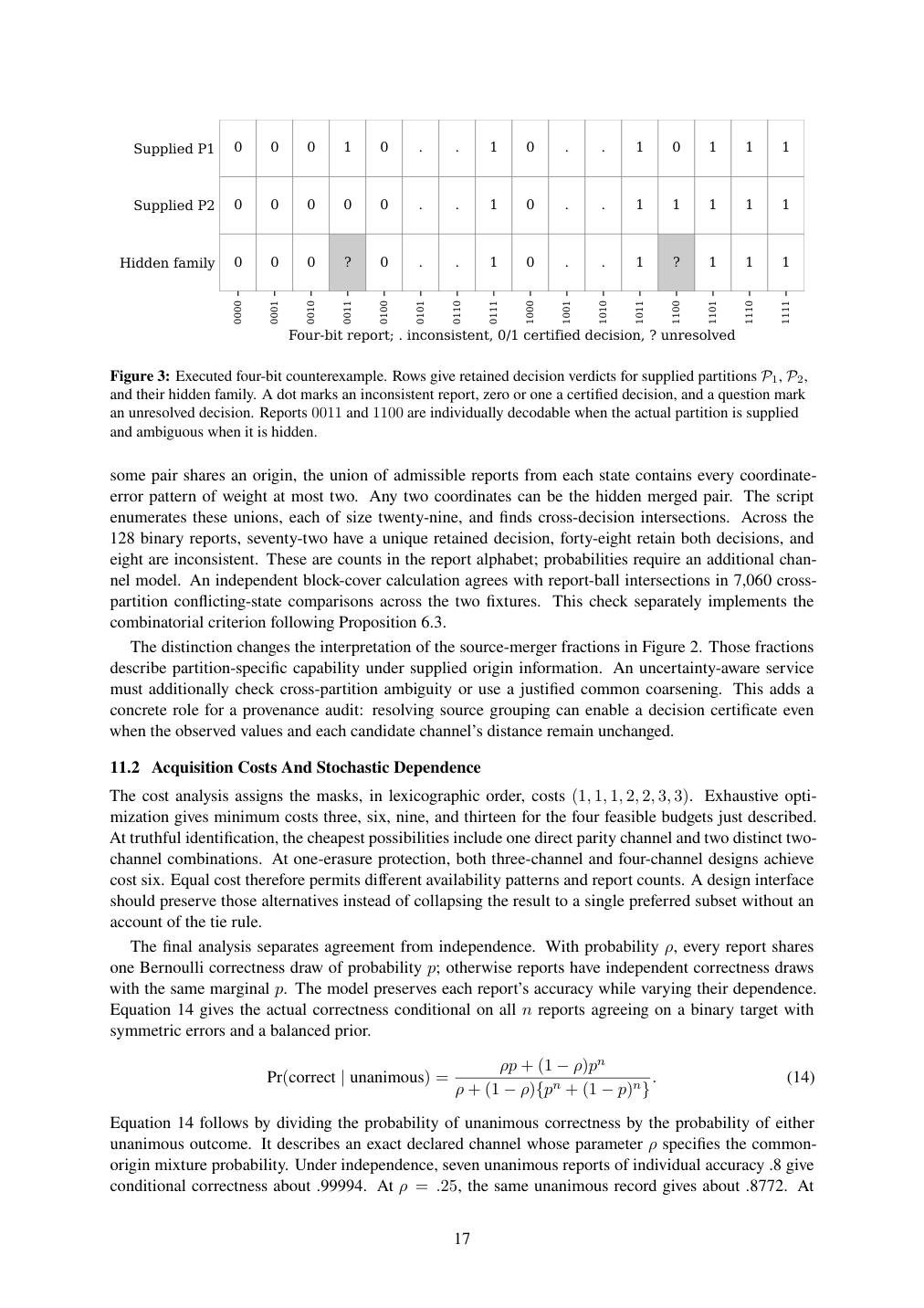
A separate four-coordinate fixture directly tests the quantifier distinction in Propositions 6.2 and 6.3. Two states have truthful profiles 0000 and 1111 and require decisions zero and one respectively. The two decision distance three. With one allowed group corruption and the actual partition supplied, its decoder
therefore certifies every admissible report correctly.
The report 1100 has a different meaning when the partition is hidden. It can arise from 0000 by the complementary ambiguity. The script constructs every allowed block replacement and verifies that each partition-specific pair of balls is disjoint, while the two statewise union balls intersect in exactly those two reports. Each union ball contains seven reports. Across the sixteen possible reports, the common decoder certifies ten, leaves two unresolved, and identifies four as inconsistent with the family.
Figure 3 displays the complete report lookup for the fixture. The same report can receive different certified decisions under different supplied partitions while remaining unresolved under the hidden-family conservative one-group certificate also leaves the guarantee unavailable. The exact union calculation explains the ambiguity through two explicit state-partition histories.
The existing seven-coordinate pair-merger study supplies a larger check of the same mechanism. Every one of its twenty-one supplied partitions corrects one group substitution. If the receiver knows only that
Readable text
Four-bit report; . inconsistent, 0/1 certified decision, ? unresolved
and their hidden family. A dot marks an inconsistent report, zero or one a certified decision, and a question mark an unresolved decision. Reports 0011 and 1100 are individually decodable when the actual partition is supplied
some pair shares an origin, the union of admissible reports from each state contains every coordinate- error pattern of weight at most two. Any two coordinates can be the hidden merged pair. The script enumerates these unions, each of size twenty-nine, and finds cross-decision intersections. Across the 128 binary reports, seventy-two have a unique retained decision, forty-eight retain both decisions, and eight are inconsistent. These are counts in the report alphabet; probabilities require an additional chan- nel model. An independent block-cover calculation agrees with report-ball intersections in 7,060 cross- partition conflicting-state comparisons across the two fixtures. This check separately implements the
The distinction changes the interpretation of the source-merger fractions in Figure 2. Those fractions describe partition-specific capability under supplied origin information. An uncertainty-aware service must additionally check cross-partition ambiguity or use a justified common coarsening. This adds a concrete role for a provenance audit: resolving source grouping can enable a decision certificate even when the observed values and each candidate channel’s distance remain unchanged.
mization gives minimum costs three, six, nine, and thirteen for the four feasible budgets just described. At truthful identification, the cheapest possibilities include one direct parity channel and two distinct two- channel combinations. At one-erasure protection, both three-channel and four-channel designs achieve cost six. Equal cost therefore permits different availability patterns and report counts. A design interface should preserve those alternatives instead of collapsing the result to a single preferred subset without an
Equation 14 follows by dividing the probability of unanimous correctness by the probability of either origin mixture probability. Under independence, seven unanimous reports of individual accuracy .8 give
Readable text
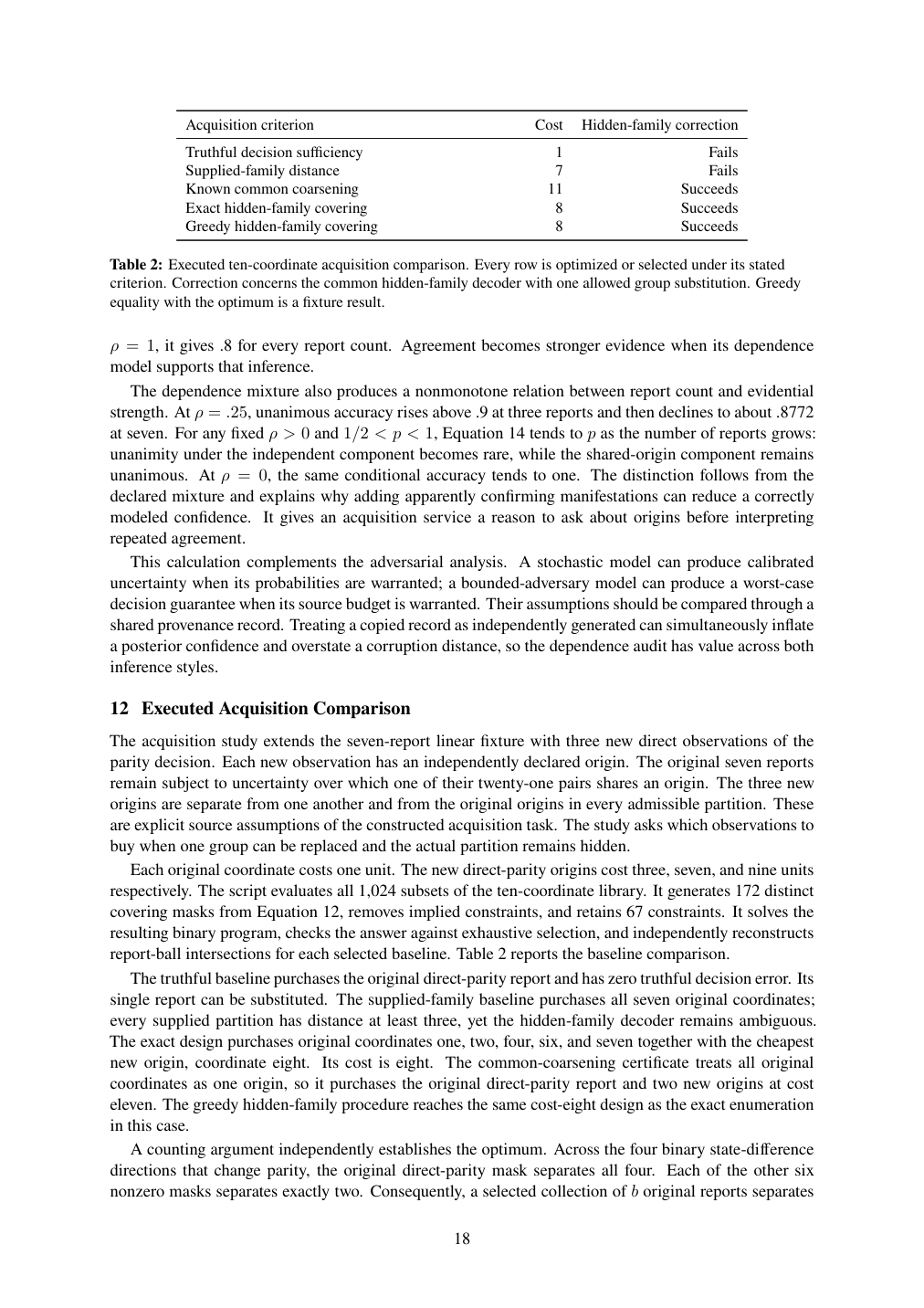
Truthful decision sufficiency Supplied-family distance Known common coarsening Exact hidden-family covering Greedy hidden-family covering
Table 2: Executed ten-coordinate acquisition comparison. Every row is optimized or selected under its stated criterion. Correction concerns the common hidden-family decoder with one allowed group substitution. Greedy
The dependence mixture also produces a nonmonotone relation between report count and evidential unanimity under the independent component becomes rare, while the shared-origin component remains declared mixture and explains why adding apparently confirming manifestations can reduce a correctly modeled confidence. It gives an acquisition service a reason to ask about origins before interpreting
This calculation complements the adversarial analysis. A stochastic model can produce calibrated uncertainty when its probabilities are warranted; a bounded-adversary model can produce a worst-case decision guarantee when its source budget is warranted. Their assumptions should be compared through a shared provenance record. Treating a copied record as independently generated can simultaneously inflate a posterior confidence and overstate a corruption distance, so the dependence audit has value across both
The acquisition study extends the seven-report linear fixture with three new direct observations of the parity decision. Each new observation has an independently declared origin. The original seven reports remain subject to uncertainty over which one of their twenty-one pairs shares an origin. The three new origins are separate from one another and from the original origins in every admissible partition. These are explicit source assumptions of the constructed acquisition task. The study asks which observations to buy when one group can be replaced and the actual partition remains hidden.
Each original coordinate costs one unit. The new direct-parity origins cost three, seven, and nine units respectively. The script evaluates all 1,024 subsets of the ten-coordinate library. It generates 172 distinct covering masks from Equation 12, removes implied constraints, and retains 67 constraints. It solves the resulting binary program, checks the answer against exhaustive selection, and independently reconstructs report-ball intersections for each selected baseline. Table 2 reports the baseline comparison.
The truthful baseline purchases the original direct-parity report and has zero truthful decision error. Its single report can be substituted. The supplied-family baseline purchases all seven original coordinates; every supplied partition has distance at least three, yet the hidden-family decoder remains ambiguous. The exact design purchases original coordinates one, two, four, six, and seven together with the cheapest new origin, coordinate eight. Its cost is eight. The common-coarsening certificate treats all original coordinates as one origin, so it purchases the original direct-parity report and two new origins at cost eleven. The greedy hidden-family procedure reaches the same cost-eight design as the exact enumeration
A counting argument independently establishes the optimum. Across the four binary state-difference directions that change parity, the original direct-parity mask separates all four. Each of the other six
Readable text
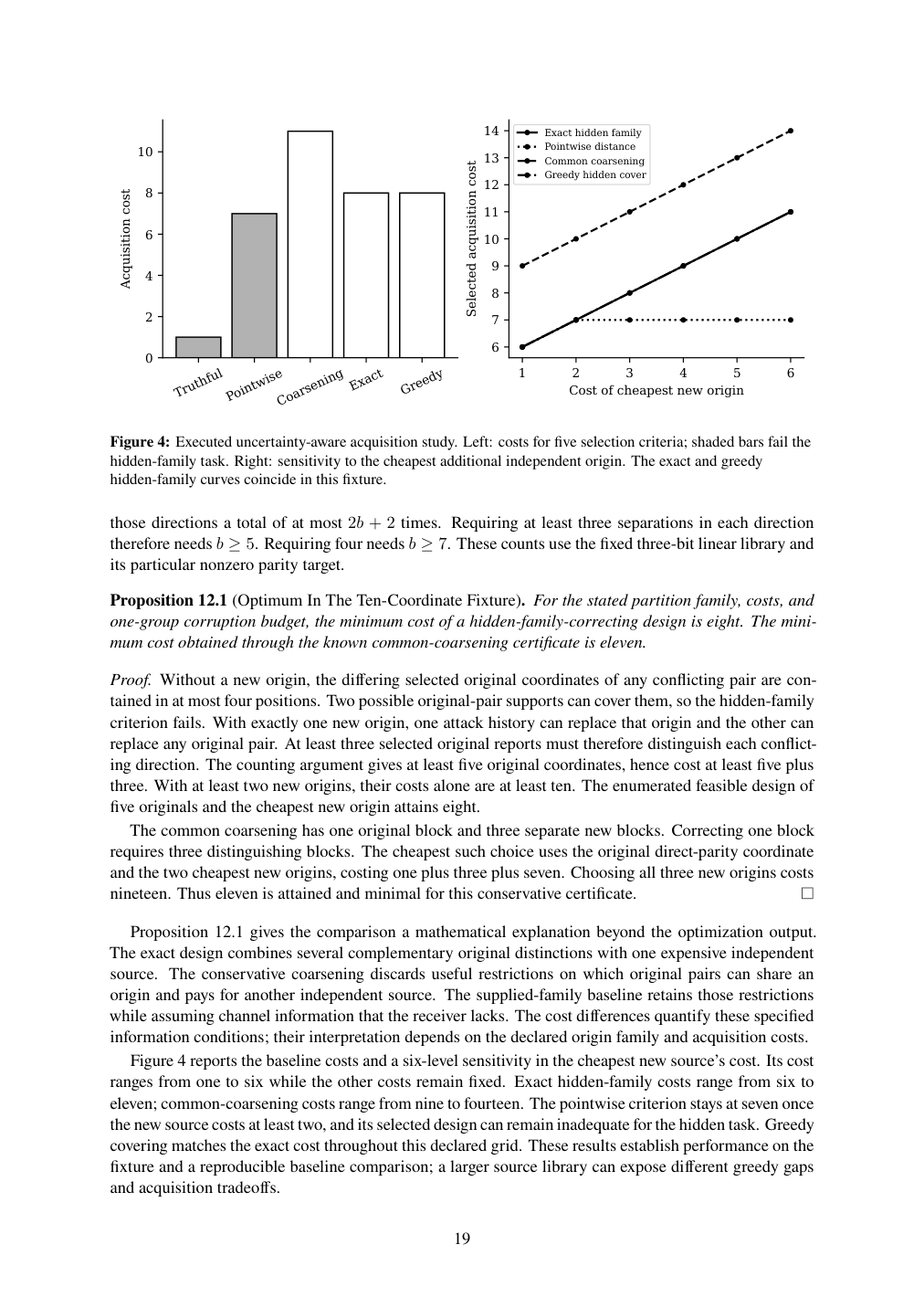
Exact hidden family Pointwise distance Common coarsening Greedy hidden cover
Figure 4: Executed uncertainty-aware acquisition study. Left: costs for five selection criteria; shaded bars fail the hidden-family task. Right: sensitivity to the cheapest additional independent origin. The exact and greedy
Proposition 12.1 (Optimum In The Ten-Coordinate Fixture). For the stated partition family, costs, and one-group corruption budget, the minimum cost of a hidden-family-correcting design is eight. The mini- mum cost obtained through the known common-coarsening certificate is eleven.
Proof. Without a new origin, the differing selected original coordinates of any conflicting pair are con- tained in at most four positions. Two possible original-pair supports can cover them, so the hidden-family criterion fails. With exactly one new origin, one attack history can replace that origin and the other can replace any original pair. At least three selected original reports must therefore distinguish each conflict- ing direction. The counting argument gives at least five original coordinates, hence cost at least five plus three. With at least two new origins, their costs alone are at least ten. The enumerated feasible design of five originals and the cheapest new origin attains eight.
The common coarsening has one original block and three separate new blocks. Correcting one block requires three distinguishing blocks. The cheapest such choice uses the original direct-parity coordinate and the two cheapest new origins, costing one plus three plus seven. Choosing all three new origins costs nineteen. Thus eleven is attained and minimal for this conservative certificate.
Proposition 12.1 gives the comparison a mathematical explanation beyond the optimization output. The exact design combines several complementary original distinctions with one expensive independent source. The conservative coarsening discards useful restrictions on which original pairs can share an origin and pays for another independent source. The supplied-family baseline retains those restrictions while assuming channel information that the receiver lacks. The cost differences quantify these specified information conditions; their interpretation depends on the declared origin family and acquisition costs.
Figure 4 reports the baseline costs and a six-level sensitivity in the cheapest new source’s cost. Its cost ranges from one to six while the other costs remain fixed. Exact hidden-family costs range from six to eleven; common-coarsening costs range from nine to fourteen. The pointwise criterion stays at seven once the new source costs at least two, and its selected design can remain inadequate for the hidden task. Greedy covering matches the exact cost throughout this declared grid. These results establish performance on the fixture and a reproducible baseline comparison; a larger source library can expose different greedy gaps
The acquisition result gives a concrete implementation target for Noetarium. A request can name a decision, a coordinate library, candidate origin partitions, source costs, and an allowed substitution budget. The response can return a minimum-cost design, a common-coarsening fallback, or a state-pair ambiguity witness. Scientific deployment still requires evidence for the state model, costs, and origin hypotheses. Preserving those inputs makes the boundary between the combinatorial guarantee and its empirical adequacy inspectable.
13 Operational Design Of An Attributed Witness Service
The finite mathematics becomes useful to Noetarium through a service that preserves the connection between a reported value and the circumstances of its production. Such a service has a lifecycle: receiving a claim, registering an origin, recording transformations, constructing a model, requesting a decision, checking assumptions, and responding to later amendments. The inspected ecology note supplies the evidential-chain motivation (Noetarium Project, 2026). The design developed here translates that motivation into an explicit reference interface whose elements can be implemented and tested independently.
An incoming record should identify a source artifact, a producing actor or instrument, a collection event, an observation scope, a time interval, and a transformation lineage. These fields serve different purposes. An artifact hash supports byte-level comparison; an origin identifier supports dependence accounting; a scope describes which circumstances the record addresses; a time interval limits when its content may apply. A fluent natural-language summary can accompany the record while the original material remains addressable. This preserves the distinction between access to a source and an interpretation of that source.
An origin claim should itself have provenance. A collector may declare that two measurements use independent instruments, while a later audit discovers a shared calibration service. The source graph can preserve both claims, the supporting evidence, their dates, and the party responsible for accepting a current partition. A certificate then identifies its decoding condition: a supplied partition version, an explicitly tested hidden family, or a known common coarsening. Hidden-family certification uses the cross-partition criterion in Proposition 6.3; a collection of partition-specific distance checks supports the supplied-partition condition. This lets subsequent dependence discoveries trigger a precise recalculation instead of silently changing the meaning of an earlier conclusion.
The state model requires an equally explicit version. A model package contains the finite state enumeration, the action set, the loss table, the selected tie convention, the source alphabets, and each source map. A scientific application can generate that package through human modeling, symbolic extraction, or a discretization of a richer model. Its certificate should name which route was used. A model-building process can be exploratory while the finite decoder remains exact for the package it receives. This distinction allows experimental modeling and reproducible inference to coexist within one research workflow.
A decision request includes the model version, a set of available sources, the assumed corruption and erasure budgets, and the requested certificate type. The service first checks structural validity: all named states and actions exist, source maps are total on the declared state set, and costs and budgets have valid domains. It then constructs the retained set and returns one of the semantic outcomes already defined. A successful response includes the supporting report identifiers, the retained signatures or regret bound, and the assumptions used. An unresolved response identifies the surviving action conflicts. An inconsistent response identifies the empty retained set and offers the source-model checks that could explain it.
The pair-conflict representation gives acquisition requests a concrete shape. For each unresolved pair, the service records which available or proposed witnesses separate it. A multicover solver can choose a minimum-cost feasible bundle or expose a lower bound on the required expenditure. A user can inspect the uncovered pairs when the budget is insufficient. Those pairs provide a scientific prompt: which experiment, interview, archive, measurement, or theoretical distinction could discriminate the surviving possibilities? The infrastructure’s contribution is partly to make that prompt precise enough for different disciplines to address it collaboratively.
A later amendment should propagate through dependency records. If a source retracts an observation, the service can mark it erased and recompute affected certificates. If a source map changes, the service
can preserve the former model package and issue a successor calculation. If a grouping audit merges origins, Proposition 6.2 indicates which supplied-partition robustness claims may weaken. If it changes the hidden family, the service rebuilds the report unions and rechecks Proposition 6.3. An earlier verdict remains a historical record of a calculation under earlier assumptions. Its current use requires the updated standing of those assumptions, so an application should display both the historical result and the latest amendment state.
Access constraints introduce another design decision. The original artifact may contain confidential material while a public report exposes only an attributed claim or a verification result. The finite model can represent the public observation actually available to the decoder. A private audit can add an attestation with its own origin and scope, but the audit then creates another dependence relation to record. Keeping the access boundary explicit helps a recipient understand whether a distinction was directly observed, inferred by an authorized intermediary, or asserted under a limited disclosure arrangement.
Several implementation checks follow immediately. A fixture can append deterministic summaries and verify unchanged source distance; erase a source and check the predicted retained-set enlargement; merge origin blocks and check monotonicity; change a loss table and check that decision conflicts are rebuilt; and retract a record and verify that dependent certificates receive an amendment event. These checks test the service’s semantics independently of any language model used to interpret documents. They also provide a route for integration with the repository’s broader artifact and provenance infrastructure while keeping this report’s finite calculations independently reproducible.
14 Strategic Reporting And Model Revision
Strategic witnesses may adapt their reports to the actions taken from them. The bounded-substitution model covers an adversary choosing values after seeing the truthful profile, and treats incentives to become corrupt and costs of concealing dependence as further modeling questions. Those questions belong to a game between observation, reliance, scrutiny, and correction. The present construction makes the relevant state variables explicit enough to support that game in later work.
One important distinction is between inaccurate reporting and a disputed interpretation. An accurately observed condition expressed through another substantive vocabulary calls for interpretation and model review. If several interpretations are admissible, the hypothesis space can include them, and the decision may remain unresolved across them. The corruption model is appropriate only for specified deviations from the declared reporting map. Conflating disagreement with error would convert an engineering assumption into an unwarranted authority over meaning.
Another issue concerns endogenous selection. A source can report only favorable cases while remaining truthful about every reported value. Selection must therefore enter the witness map or the admissible model family. If its mechanism is unknown, the retained set can include alternative selection processes. Finite source correction protects a stated observation model; it cannot recover distinctions that collection never made and the hypothesis representation never admitted.
External checking is consequently essential. Observed consequences can test predictive implications of retained states, while affected parties can propose missing states or challenge the grouping of sources. Both acts change the admissible reconstruction. These activities are distinct from proving a decoder correct relative to its present inputs. They place computational guarantees inside a continuing inquiry instead of treating them as a final account of the world.
15 Decision Granularity And Adaptive Collection
15.1 Decision Granularity And Acquisition Cost



Proposition 15.1 gives an operational meaning to the choice of epistemic resolution. A classification sufficient to decide whether to collect further data may be cheaper than a classification that identifies the exact underlying mechanism. A request to explain that mechanism should trigger renewed witness design. Recording the question with the certificate prevents an apparently strong result from silently acquiring a finer interpretation.
This distinction can also support restrained data collection. If two personal circumstances require the same permitted institutional action, the present guarantee can operate while leaving them unresolved. That mathematical possibility is compatible with privacy-preserving design, although lawful and legitimate data use requires its own substantive assessment. The decision’s coarseness should remain explicit, while records retain the finer distinctions needed by those whose circumstances it concerns.
16 Model Adequacy And Selective Availability
The retained-state decoder gives exact answers for its declared channels. Its use in inquiry also requires an adequacy argument connecting those channels to the records actually available. Several ordinary features of research can change that connection: selective publication, variable access, strategic withdrawal, timevarying instruments, and interpretation of source statements. These features deserve explicit treatment because they affect what a source output means before any decoding begins.
Availability can itself be informative. A source may publish only when an experiment succeeds, or an institution may release records only for a particular class of cases. In that setting, the event of receiving a report has a state-dependent meaning. The erasure model treats the location of a missing value as visible while requiring a guarantee over all allowed erased locations. This is appropriate for a worst-case availability claim. A probabilistic inference that uses the probability of release needs an additional map describing that selection process. Keeping the two semantics distinct prevents a guarantee about bounded erasures from being mistaken for an estimate corrected for selective publication.
An adversary can also manipulate the route by which evidence is requested. A compromised early report may change which instrument an adaptive policy queries next. A withheld report may induce a fallback source sharing the same upstream dataset. Such behavior changes the relevant transcript space and can create dependence across acquisition stages. A static certificate remains valid for its explicitly selected groups, while the acquisition policy needs its own adversarial analysis. This gives a practical reason to preserve unsuccessful queries, timeouts, and fallback choices in the event ledger, alongside the reports that eventually appear in a summary.
Time matters in a similar way. Two instruments can provide compatible observations of different environmental states when the underlying process changes between measurements. A finite model can include the measurement times and an allowed transition relation. Alternatively, it can restrict a certificate to a window within which the relevant state distinctions are treated as stable. The choice should be justified by the domain. Increasing the number of reports across a long interval may improve historical reconstruction while weakening the interpretation of their joint profile as a contemporaneous state.
Semantic interpretation introduces another layer. A participant’s statement can admit several plausible readings, and forcing one reading into a single channel output can suppress a consequential ambiguity. A finite service can represent the interpretations as an observation set and retain every compatible state.
Element Contribution standing and scope
Distance decoding Inherited coding argument specialized to selected decision classes and sourcegroup outputs. Erasure and grouping analysis
Supplied-partition and hidden-family conditions, errors and erasures, and conservative common-coarsening remedy; proofs given here. Acquisition formulation Exact hidden-family covering criterion and ambiguity witnesses; analytic optimum, integer-program and enumeration agreement in the ten-coordinate fixture. Executed studies Exhaustive designs, 510 transcript checks, 7,060 mixed-partition checks, exact acquisition baselines, cost sensitivity, and dependence mixture. Operational service Proposed record, certificate, amendment, and acquisition lifecycle; integration remains prospective. Scientific validation Proposed studies of measured sources, semantic modeling, and real acquisition costs.
Table 3: Contribution assessment. Mathematical and computational results concern declared finite models; service integration and scientific validation are proposed subsequent work.
This enlarges uncertainty transparently. A later clarification can narrow the set while preserving the earlier ambiguity and its provenance. The same approach can support cross-disciplinary terms whose meanings differ across methods or institutions.
These extensions point toward an adequacy workflow with three distinct reviews. A structural review checks that the finite package is well formed. A channel review checks how observations, origins, timing, and availability correspond to the domain. A decision review checks whether the action and loss context captures the question participants intend to answer. The exact decoder contributes to the first review and supplies diagnostic counterexamples for the others. The broader scientific achievement depends on their continuing interaction, which the infrastructure can support through attributed revisions and preserved alternatives.
17 Contribution Assessment And Validation Programme
The central technical contribution is an exact acquisition problem for a specified decision under hidden origin uncertainty. The derivation connects decision conflicts to mixed-partition attack supports, and the executed fixture compares the resulting optimum with truthful, pointwise, conservative, and greedy baselines. Its mathematical ingredients are established coding and covering principles. The report makes their information conditions and implementation witnesses explicit, supporting a reproducible audit of when a source-aware decision can be certified.
Table 3 records the standing of the principal elements. The separation of standing is part of the substantive design: an infrastructure can preserve an argument, a computed result, and an implementation proposal as related artifacts without assigning them the same evidential force.
The finite studies produce several useful insights within their scope. Truthful identification can require much less evidence than robust decision certification. Availability and corruption consume different amounts of separation. Equally large origin groups can have different effects because they erase different pairwise redundancies. Several individually decodable source hypotheses can jointly create ambiguity when the actual partition is hidden, giving source-identification evidence an additional decision value. Heterogeneous costs can produce several optimal designs with different report counts. Finally, agreement can have sharply different evidential value under different dependence models while individual source accuracies remain fixed. Each observation points to a concrete field in a certificate or design interface, connecting the formal calculation to an operational requirement.
Validation should begin with domains where the state model can be checked independently. Fault diagnosis in a small instrument assembly is a plausible first setting: interventions can create known faults, measurements can be repeated, and shared calibration can be varied deliberately. The study would estimate source maps or stochastic channels from a training phase, freeze a model package, and assess certificates
on held-out interventions. It should record misses caused by an omitted state separately from errors under the declared model. This would test both the mathematics-to-software path and the adequacy of the model boundary.
A second stage can examine semantic witnesses in research artifacts. Human annotators or languagemodel agents can produce attributed observations of a bounded document collection. The study would retain the original text spans, transformation prompts, source documents, and grouping hypotheses. A decision task should have an independently assessable outcome, such as detecting a contradiction between specified experimental protocols. The primary outcomes would include decision coverage, false certification, unresolved cases, acquisition cost, and the effect of discovered shared origins. These measurements would address the practical question left open by the present fixture: whether provenance-aware representations improve decisions after their modeling and acquisition costs are included.
Cross-disciplinary evaluation requires an additional adequacy study. Different participants may propose different state distinctions or losses for the same collection. Their disagreement can be recorded as alternative model packages and compared on common evidence. A useful infrastructure should make it easy to trace which change in assumptions alters the decision. This gives human criticism a concrete role in expanding the exploration space. A new disciplinary contribution can introduce an observation, a causal possibility, an action, or a value criterion; each change induces a different revision of the finite problem.
The Generative Relational orientation motivates preserving those possibilities as relations that can be revisited. A source acquires epistemic value through its connection to a question, to other witnesses, and to the consequences of acting. The parity example gives a small mathematical realization of that relational value, while the grouping ablations show how the same relational structure can transmit vulnerability. The infrastructure therefore needs facilities for creating complementary relations and for inspecting their dependence. Both functions contribute to the evolution of knowledge, with different computational and institutional requirements.
The report leaves historical priority claims deliberately narrow. Its proofs adapt familiar finite arguments, and its empirical content consists of newly executed constructed calculations. A stronger research contribution would arise through an implemented service evaluated on a domain where origin dependence and changing decision contexts materially affect scientific practice. The present report prepares that work by specifying the objects, invariants, failure modes, and measurements through which such a claim could be assessed.
18 Conclusion
Witness acquisition requires a distinction between knowing an origin partition and knowing only the
family to which it belongs. A supplied-partition distance condition supports partition-specific decoding. A hidden family requires cross-partition separation of possible reports. The exact covering formulation carries that distinction into acquisition, and its ambiguity witnesses explain failed designs.
The ten-coordinate fixture gives a complete bounded result: optimum cost eight, a cheaper pointwise baseline that fails the intended task, and a conservative coarsening certificate costing eleven. A counting proof, integer program, exhaustive designs, and independent report balls support that comparison. The broader coding and optimization principles are inherited; the contribution is the explicit uncertain-origin decision contract and its executed design consequences. Noetarium can preserve that contract with the provenance, costs, scope, and amendments required for later scientific validation.
References
Iacob, Alex et al.. (2026). The Red Queen G”odel Machine: Co-Evolving Agents and Their Evaluators. Preprint,
arXiv:2606.26294v3. https://arxiv.org/html/2606.26294v3. Zhang, Yaolun; Xu, Tianyi; Zhao, Yujie; Zhao, Jishen; Wu, Qingyun; Wang, Huazheng. (2026). EvalResearchBench:
Can AI Agents Build Their Own Feedback for Recursive Self-Improvement?. Preprint, arXiv:2610.04184v2. https://arxiv.org/html/2610.04184v2.
Paolo, Giuseppe; Warner, Jamieson; Shahrzad, Hormoz; Hodjat, Babak; Miikkulainen, Risto; Meyerson,
Elliot. (2026). TerraLingua: Emergence and Analysis of Open-Endedness in LLM Ecologies. Preprint, arXiv:2603.16910. https://arxiv.org/abs/2603.16910. Noetarium Project. (2026). An ecology that improves the infrastructure: evolution without an appointed evaluator.
Repository design note, commit 869fe38afac257cd9b5d51ad5b498a8ff6b8e443. https://github.com/huang wanhong-maker/Noetarium-The-Science-and-Humanity-Infrastructure/blob/869fe38afac257c d9b5d51ad5b498a8ff6b8e443/development/ideas/2026-11-19-an-ecology-that-improves-the-i nfrastructure.md. Blackwell, David. (1953). Equivalent Comparisons of Experiments. Annals of Mathematical Statistics 24(2):265–
- https://doi.org/10.1214/aoms/1177729032. Hamming, Richard W.. (1950). Error Detecting and Error Correcting Codes. Bell System Technical Journal
29(2):147–160. https://doi.org/10.1002/j.1538-7305.1950.tb00463.x. Hong, Lu; Page, Scott E.. (2004). Groups of Diverse Problem Solvers Can Outperform Groups of High-Ability
Problem Solvers. PNAS 101(46):16385–16389. https://doi.org/10.1073/pnas.0403723101. Lorenz, Jan; Rauhut, Heiko; Schweitzer, Frank; Helbing, Dirk. (2011). How Social Influence Can Undermine the
Wisdom of Crowd Effect. PNAS 108(22):9020–9025. https://www.sg.ethz.ch/publications/2011/lor enz2011how-social-influence/PNAS-2011-Lorenz-9020-5.pdf. Chen, Yuxin; Hassani, Hamed; Krause, Andreas. (2017). Near-optimal Bayesian Active Learning with Correlated
and Noisy Tests. AISTATS, PMLR 54:223–231. https://proceedings.mlr.press/v54/chen17b.html. Fawzi, Hamza; Tabuada, Paulo; Diggavi, Suhas. (2014). Secure Estimation and Control for Cyber-Physical Systems
under Adversarial Attacks. IEEE Transactions on Automatic Control 59(6):1454–1467. https://arxiv.org/ abs/1205.5073. Golovin, Daniel; Krause, Andreas. (2011). Adaptive Submodularity: Theory and Applications in Active Learning
and Stochastic Optimization. Journal of Artificial Intelligence Research 42:427–486; corrected arXiv v5, 2017. https://arxiv.org/abs/1003.3967. Golovin, Daniel; Krause, Andreas; Ray, Debajyoti. (2010). Near-Optimal Bayesian Active Learning with Noisy
Observations. Advances in Neural Information Processing Systems 23. https://proceedings.neurips.cc /paper_files/paper/2010/hash/1e6e0a04d20f50967c64dac2d639a577-Abstract.html. Zollman, Kevin J. S.. (2010). The Epistemic Benefit of Transient Diversity. Erkenntnis 72(1):17–35. https://do
i.org/10.1007/s10670-009-9194-6. Shannon, Claude E.. (1956). The Zero Error Capacity of a Noisy Channel. IRE Transactions on Information Theory
2(3):8–19. https://doi.org/10.1109/TIT.1956.1056798.