Audit Allocation And Evaluative Power In Evolving Agent Ecologies
Full text from the PDF
Audit Allocation And Evaluative Power In Evolving Agent
Ecologies
Wanhong HUANG
Abstract
Keywords: audit allocation; evaluative power; evidence access; cumulative advantage; institutional renewal
Technical Report Note
This technical report shares an evolving inquiry and invites dialogue, criticism, revision, and independent development. Its definitions, distinctions, and constructions remain open to refinement. Circulation across scholarly and practical communities is part of the purpose of releasing the manuscript.
The author treats the viewpoints, concepts, and lines of reasoning presented here as contributions to a shared field of inquiry. Similar or related ideas may have appeared in other intellectual, cultural, and disciplinary traditions. The manuscript identifies known antecedents and distinguishes inherited positions, interpretive proposals, and arguments developed here. Historical priority remains open to further investigation.
The constructions and arguments are presented with their stated assumptions and evidential scope. Readers are encouraged to question, test, revise, extend, reinterpret, or independently develop the ideas presented here. Where appropriate, acknowledgment of this paper as one point of encounter in the development of a related idea is appreciated. Such acknowledgment records an intellectual route; the ideas remain available for criticism, revision, and independent development.
Definitions introduced by the paper are local analytical stipulations unless attributed to another source. Their use identifies the scope of the present argument; terminological and historical priority remain subjects for independent investigation. Generative Relational theory is treated as an open research programme whose proposals receive critical examination alongside independent literature.
Responsible Use and Rights Reservation
This section records a request for responsible scholarly conduct and identifies the scope of retained rights. Legal permissions are governed by the licence on the following page.
The author encourages good-faith discussion, criticism, independent inquiry, and responsible use of the material. Separately from the licence’s terms, the author asks users to consider foreseeable harms when adapting the arguments, representations, or examples of this paper, particularly in scientific inquiry, institutional decisions, and computational knowledge infrastructures. The ethical request leaves the licence’s permissions and legally authorised uses unchanged.
The author retains the rights preserved under CC BY-NC 4.0 and may pursue remedies to which the author is legally entitled for breach of the licence or violation of independently applicable rights. Reuse remains independent from authorial endorsement. Third-party rights require authorisation from their respective holders where applicable. Copyright exceptions and limitations, including applicable forms of fair use or fair dealing, remain available.
Notices
This page consolidates the manuscript’s research status, licence, development disclosure, researchprogramme relation, and suggested citation.
Status. This technical report is prepared for the author’s substantive review and subsequent scholarly discussion. The report distinguishes established antecedents, conditional results developed here, inspected source artifacts, and numerical illustrations under declared assumptions. Internal checks assess the stated arguments and examples; independent scholarly assessment can further test their interpretation and adequacy. The source ledgers record the access level and claim scope of consulted works.
Licence. Except where otherwise indicated, copyright 2026 Wanhong Huang. This work is made available under the Creative Commons Attribution-NonCommercial 4.0 International License (CC BY-NC 4.0). Subject to its terms, the licence permits sharing and adaptation for noncommercial purposes with appropriate attribution, a link to the licence, and an indication of changes. Attribution should preserve the licensor’s independence from the reuse. Reuse is governed solely by the licence; the responsible-use request on the preceding page remains separate from its terms. The licence deed and legal code are available at https://creativecommons.org/licenses/by-nc/4.0/. The licence governs in case of conflict with this summary. Third-party material remains subject to its respective rights.
Statement on the use of language models. Preparation involved OpenAI’s ChatGPT and Codex. Language models supported exploratory dialogue, source discovery and checking, argumentative criticism, manuscript revision, LATEX typesetting, and the development of supporting code and figures. Verification used the sources and access levels recorded in the accompanying ledgers. The author initiated the research questions and directed the research programme; interpretation, acceptance of the arguments, and publication decisions remain subject to the author’s review. Authorship credit and responsibility for the released manuscript remain with the human author.
Code and data availability. Supporting scripts rebuild the original finite study and the expanded sensitivity computations. Generated results, source-verification ledgers, sectioned manuscripts, and figures accompany this report. The source package contains the editable manuscript, source ledgers, supporting scripts and outputs, and a reading guide. Numerical illustrations, where present, use the assumptions stated in their captions and text.
Related research programme. This report belongs to the Noetarium technical report series. Companion reports study inference, computation, evaluation, governance, and cross-disciplinary knowledge formation. The reports develop distinct technical questions within an open Generative Relational research programme.
Suggested citation. Huang, Wanhong. “Audit Allocation And Evaluative Power In Evolving Agent Ecologies.” Technical report, 2026.
1 Introduction
An evaluator can receive influence through competence, accumulated resources, relational position, or an institution’s authorization. These routes can reinforce one another while remaining different objects of assessment. In a research ecology, improving evaluation therefore includes a question about evidence access: which evaluators obtain tasks whose outcomes can be checked, and whether those observations can change a resource-supported allocation after performance changes.
Noetarium’s ecology design proposes influence-linked scrutiny, finite terms, upkeep, and renewed evaluator choice (Noetarium Project, 2026). The present report develops a finite mechanism for investigating those proposals. It separates actual task competence, the score inferred from audited outcomes, resource support, positional advantage, assignment exposure, and the broader institutional meaning of authority. The numerical process represents exposure directly; the proposed event ledgers specify the additional records needed to study appointments and recognized decision rights.
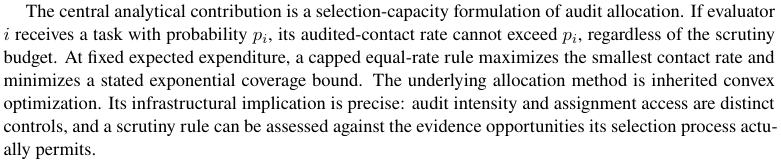

under influence weighting, all at expected expenditure .2 per task. A matched dynamic comparison then shows that improved contact can coexist with persistent resource-supported concentration. At the lowest access floor, even the optimized contact rule produces limited correction after the incumbent’s declared competence decline.
The report retains the reinforced-resource model, local stability calculation, renewal ablations, labelnoise study, and counterfactual decomposition that explain this separation. These are constructed mechanism results with fixed correctness standards. Their contribution is a checkable audit-allocation baseline and a trajectory-based design for investigating evaluative power. Empirical claims about institutions require meaningful task distributions, independently assessed competence, and explicit authority and resource records; successful contact or uptake alone supplies a narrower kind of evidence.
2 Cumulative Advantage, Learning, And Institutional Design
Evaluative power joins an epistemic problem to a distribution problem. A community needs judgments that are useful for its tasks, and its allocation of opportunities changes which judgments become visible. The literature treats these relations through several different objects: recognition, increasing returns, network influence, sequential learning, feedback in observed data, and institutional rules. Placing these objects beside the current agent-improvement literature clarifies why improving an evaluator and revising its authority require separate measurements.
Merton’s account of the Matthew effect supplies a sociological motivation for examining unequal recognition (Merton, 1968). The model here makes a related feedback explicit through resource-dependent invitations. Its analyst-chosen coefficients set the scale of the mechanism illustration; measuring recognition inequality requires empirical observations. An important implication for evaluation design follows nonetheless: recognition is a state variable whose history can affect later access to tasks. A current score can therefore carry the effects of earlier opportunities even when its immediate calculation uses only recorded outcomes.
Arthur’s model of competing technologies shows how increasing returns can amplify early events and lead to different eventual adoption paths (Arthur, 1989). That result belongs to a specified model of technological competition. Its structural relevance here concerns the resource map: selection creates resource
flow, and resource flow changes later selection. The report’s two-evaluator calculation uses this feedback to expose a local stability threshold. Historical dependence is consequently an inherited modeling concern; the additional question is which parts of an evaluator’s institutional trajectory should be represented and subjected to intervention.
The network-learning tradition supplies a second comparison. DeGroot’s consensus model uses repeated weighted averaging (DeGroot, 1974), while Golub and Jackson study how long-run network influence affects information aggregation (Golub et al., 2010). Their work demonstrates why an actor’s relational position can matter to collective judgment. The present model uses a fixed positional covariate alongside changing resources and competence estimates. This simplification separates several causal channels but leaves network formation prospective. A richer ecology model would represent the creation and dissolution of reliance relations, the ownership of evidence routes, and the persistence of institutional appointments.
Sequential-learning work clarifies the role of access. Joseph and colleagues study a particular performance-based fairness definition for bandits under uncertainty and identify exploration costs associated with satisfying it (Joseph et al., 2016). Their definition deserves its own name and scope; an equal exposure floor in the present experiment serves a different modeling purpose. It ensures a lower bound on the opportunity to obtain audited evidence about an evaluator. The resulting bound concerns information access and can coexist with many possible institutional views about fair office allocation, compensation, or participation.
Selective observation can itself produce a feedback problem. Ensign and colleagues model predictivepolicing allocation and show how discovered observations can reinforce the allocation that generated them (Ensign et al., 2018). Their domain-specific intervention results carry their own assumptions. The general comparison relevant here is that data collection depends on prior allocation. An evaluator receiving few assignments produces few outcomes available for audit, which can preserve uncertainty about its competence. A service that publishes only a ranking conceals this path from opportunity to evidence. Publishing exposure, audit selection, and missingness makes the path assessable.
Temporal consequences also matter. Liu and colleagues show that the delayed effects of static fairness criteria depend on the dynamics and measurement assumptions of their model (Liu et al., 2018). This reinforces the need to distinguish an immediate distribution of invitations from the future distribution of evidence and resources. A policy can reduce concentration at the next task while changing long-run correction capacity in a different direction. The experiments below therefore retain accuracy, concentration, audit cost, incumbent share, and correction frequency as separate outcomes.
Institutional research broadens the object further. Ostrom’s analysis emphasizes heterogeneous participants, contextual variables, and rules governing collective provision and allocation (Ostrom, 2000). That perspective motivates treating audit access and office renewal as parts of a rule-governed process. The present finite mechanism supplies an explicit set of such rules, suitable for reproducible intervention. Its institutional interpretation remains conditional on how those rules correspond to actual rights, duties, and resource dependencies in an implementation.
Recent agent systems already explore evaluator change. Red Queen Gödel Machine uses evaluator coevolution with independent anchors and epoch-based replacement (Iacob et al., 2026); EvalResearch- Bench assesses agent-designed feedback against independent targets (Zhang et al., 2026); TerraLingua studies an ecology with persistent artifacts and resource constraints (Paolo et al., 2026). The report therefore locates its contribution in a different relation: the joint trajectory of competence evidence, resource support, invitations, and authorized influence. These systems supply close comparators for implementation, while the additional ledger proposed here would permit evaluation of how an evaluator acquired and retained its position.
3 Objects, Trajectories, And Evaluative Power

Readable text
different interpretations. The success probability belongs to the constructed environment. The estimate is an internal state updated from audited outcomes. The resource share summarizes access to reproducible support for continued activity. The positional covariate represents a declared relational advantage.
occasions on which that role’s judgment is used by the procedure.
Definition 3.1 specifies a domain-specific capacity. Its scope concerns invitations within a specified procedure. An evaluator can also affect agendas, admissible evidence, and future rules; those capacities require further variables. The present model is useful precisely because it gives a narrow observable
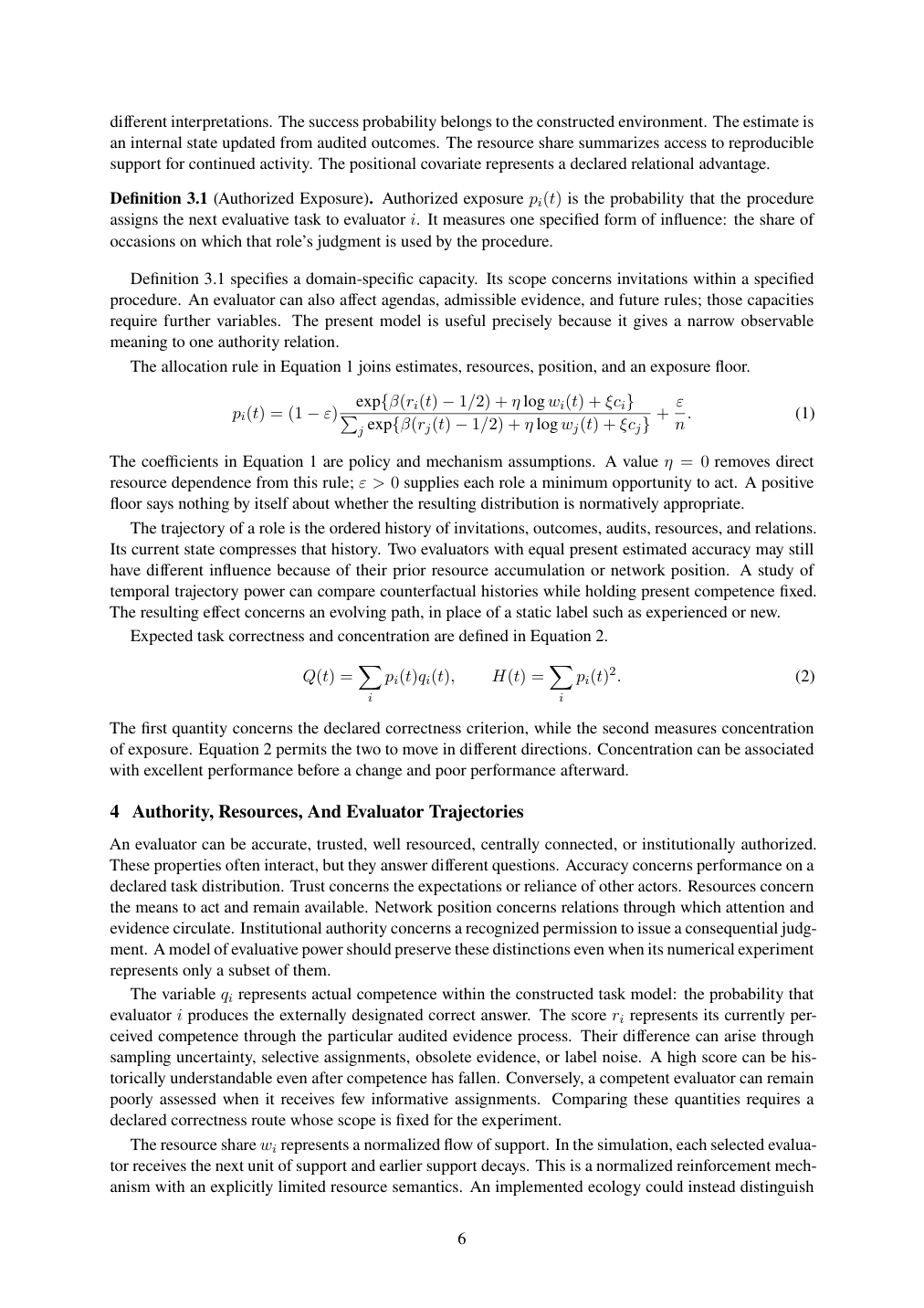
The allocation rule in Equation 1 joins estimates, resources, position, and an exposure floor.
floor says nothing by itself about whether the resulting distribution is normatively appropriate.
The trajectory of a role is the ordered history of invitations, outcomes, audits, resources, and relations. Its current state compresses that history. Two evaluators with equal present estimated accuracy may still have different influence because of their prior resource accumulation or network position. A study of temporal trajectory power can compare counterfactual histories while holding present competence fixed. The resulting effect concerns an evolving path, in place of a static label such as experienced or new.
Expected task correctness and concentration are defined in Equation 2.
The first quantity concerns the declared correctness criterion, while the second measures concentration of exposure. Equation 2 permits the two to move in different directions. Concentration can be associated with excellent performance before a change and poor performance afterward.
An evaluator can be accurate, trusted, well resourced, centrally connected, or institutionally authorized. These properties often interact, but they answer different questions. Accuracy concerns performance on a declared task distribution. Trust concerns the expectations or reliance of other actors. Resources concern the means to act and remain available. Network position concerns relations through which attention and evidence circulate. Institutional authority concerns a recognized permission to issue a consequential judg- ment. A model of evaluative power should preserve these distinctions even when its numerical experiment
ceived competence through the particular audited evidence process. Their difference can arise through sampling uncertainty, selective assignments, obsolete evidence, or label noise. A high score can be his- torically understandable even after competence has fallen. Conversely, a competent evaluator can remain poorly assessed when it receives few informative assignments. Comparing these quantities requires a declared correctness route whose scope is fixed for the experiment.
tor receives the next unit of support and earlier support decays. This is a normalized reinforcement mech- anism with an explicitly limited resource semantics. An implemented ecology could instead distinguish
compute credits, archival access, attention, contractual income, and the resources needed to assemble an appeal. Those resources can have different conversion rates and different transfer rules. Publishing them separately would permit an inquiry into whether apparent competence reflects improved reasoning, improved evidence access, or a resource advantage in presenting and defending a judgment.
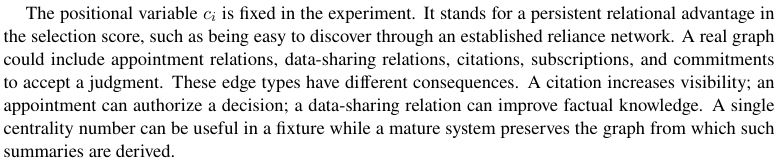
Institutional authority should be represented through a separate authorization state. A proposed service can record an evaluator’s remit, appointing body, term, available sanctions, appeal route, and the classes of decisions it may certify. Authorized exposure can then depend on eligibility as well as on the selection score. The current experiment assumes all six evaluators are eligible and uses selection probability as a bounded proxy for exercised influence. Its reported concentration consequently measures concentration of invitations in that constructed process. The stronger claim that institutional authority itself has been concentrated would require the authorization records just described.
A trajectory is the ordered history through which these states are produced. It includes invitations, accepted tasks, observed answers, audit choices, labels, payments, appointments, reliance relations, and challenges. Two evaluators with equal present scores and resources can have different trajectories: one may have acquired them through independent audits, another through a series of mutually reinforcing appointments. Those histories can support different institutional assessments even when a memoryless selection formula treats them identically. Retaining the trajectory permits a later model to ask such questions without reconstructing the history from a final ranking.
An explicit event ledger can express that history. Each event names an actor, a task or artifact, a time, a rule version, its immediate inputs, and its resulting state changes. Selection events preserve the probabilities assigned to all eligible evaluators. Audit events preserve why an outcome entered the evidence stream. Resource events preserve both the transferred amount and the obligation it supports. Appointment events preserve recognized authority and its scope. The ledger thereby distinguishes an actor’s capacity to produce a judgment from the institution’s permission to make that judgment consequential.
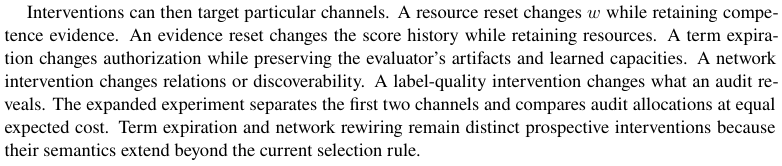

This design has a relational philosophical implication. Evaluative capacity is partly realized through the relations that let an actor receive a task, consult evidence, issue a judgment, and have that judgment recognized. A single scalar competence remains useful for a specified task model, while the surrounding ledger records the conditions under which that competence can matter. Noetarium’s proposed ecological setting supplies an opportunity to study both levels together. The contribution lies in preserving the distinction and specifying observable mechanisms through which they interact.
Readable text
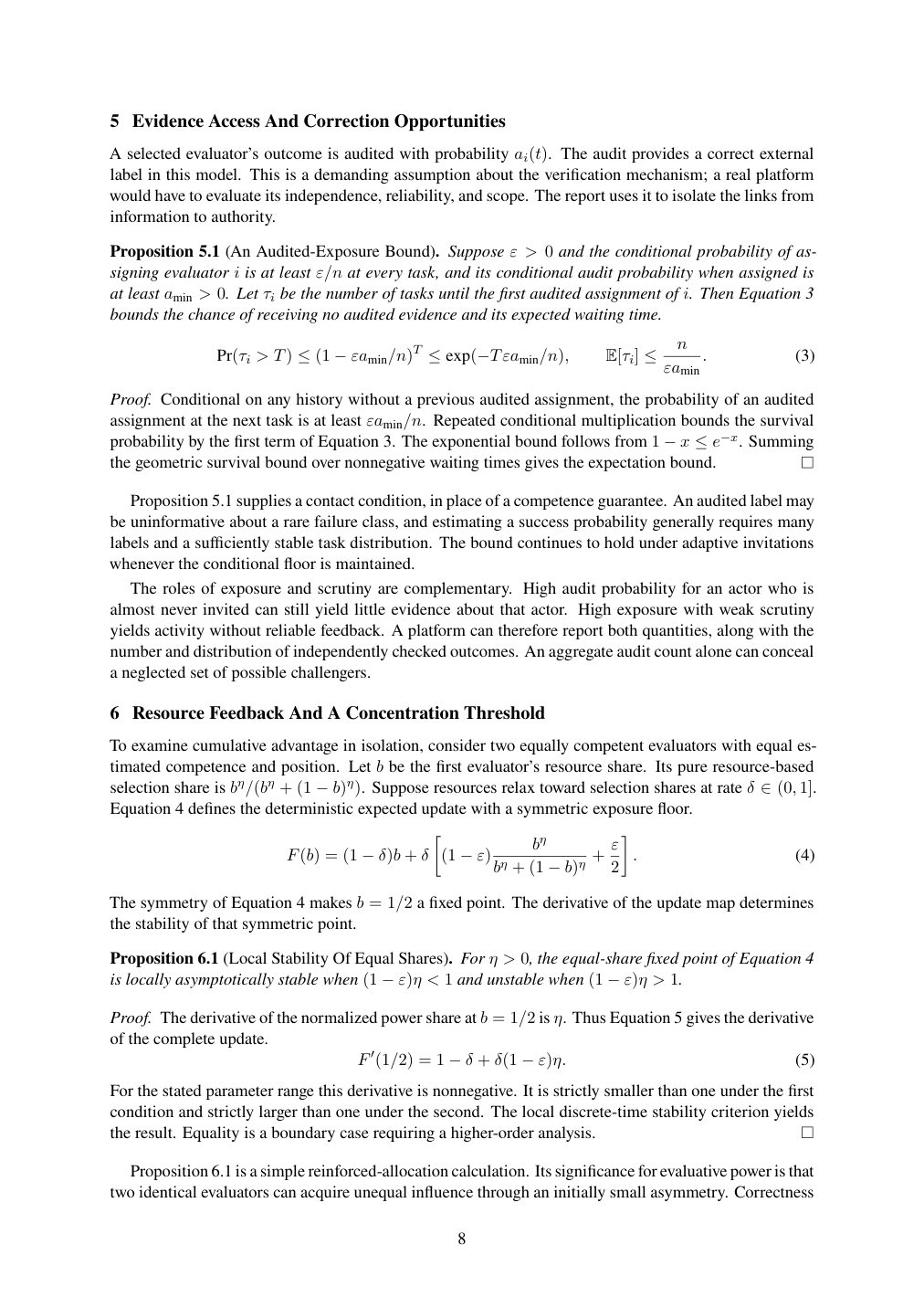
label in this model. This is a demanding assumption about the verification mechanism; a real platform would have to evaluate its independence, reliability, and scope. The report uses it to isolate the links from
bounds the chance of receiving no audited evidence and its expected waiting time.
Proof. Conditional on any history without a previous audited assignment, the probability of an audited the geometric survival bound over nonnegative waiting times gives the expectation bound.
Proposition 5.1 supplies a contact condition, in place of a competence guarantee. An audited label may be uninformative about a rare failure class, and estimating a success probability generally requires many labels and a sufficiently stable task distribution. The bound continues to hold under adaptive invitations
The roles of exposure and scrutiny are complementary. High audit probability for an actor who is almost never invited can still yield little evidence about that actor. High exposure with weak scrutiny yields activity without reliable feedback. A platform can therefore report both quantities, along with the number and distribution of independently checked outcomes. An aggregate audit count alone can conceal
To examine cumulative advantage in isolation, consider two equally competent evaluators with equal es- Equation 4 defines the deterministic expected update with a symmetric exposure floor.
For the stated parameter range this derivative is nonnegative. It is strictly smaller than one under the first condition and strictly larger than one under the second. The local discrete-time stability criterion yields the result. Equality is a boundary case requiring a higher-order analysis.
Proposition 6.1 is a simple reinforced-allocation calculation. Its significance for evaluative power is that two identical evaluators can acquire unequal influence through an initially small asymmetry. Correctness
Readable text
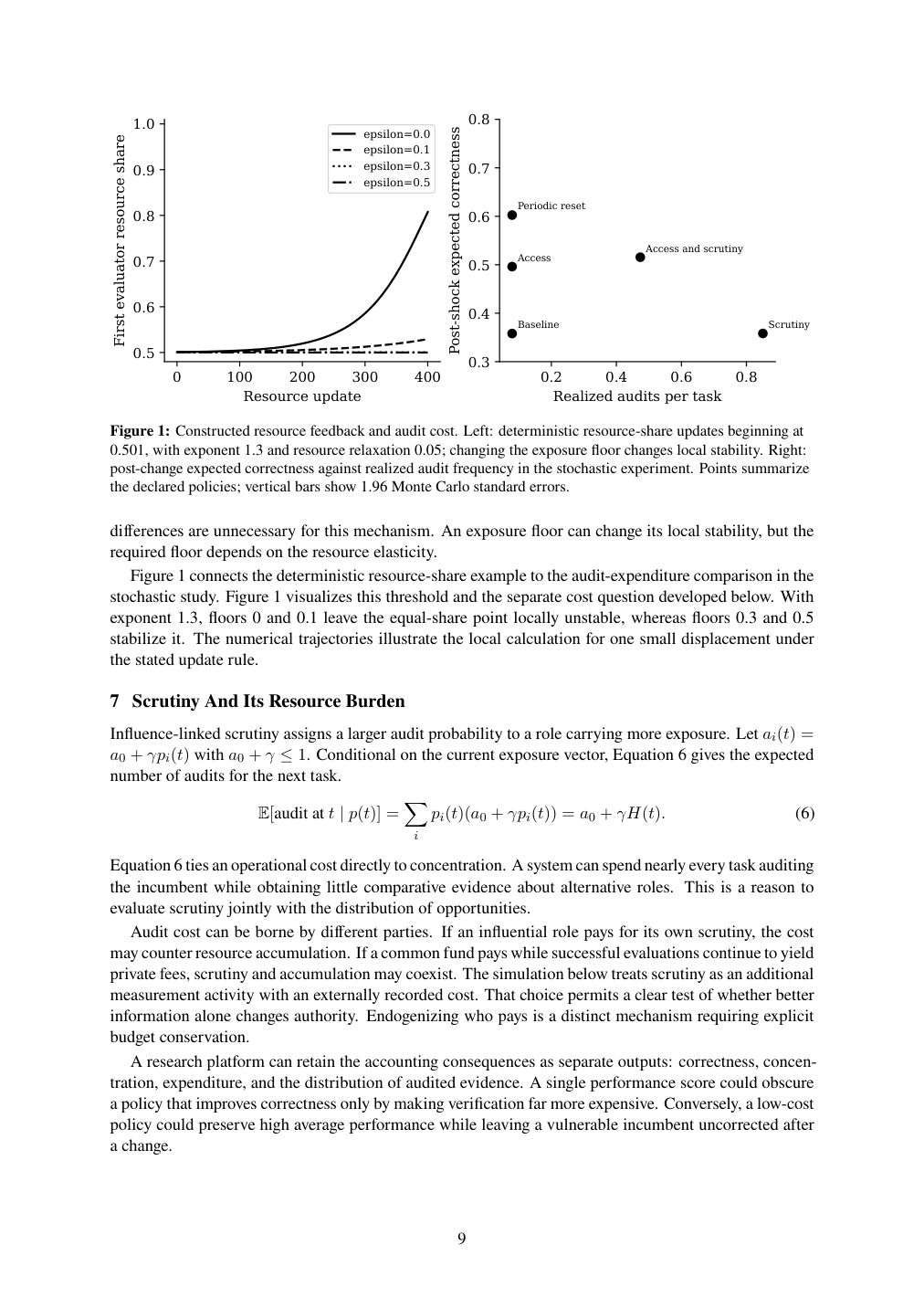
Figure 1: Constructed resource feedback and audit cost. Left: deterministic resource-share updates beginning at 0.501, with exponent 1.3 and resource relaxation 0.05; changing the exposure floor changes local stability. Right: post-change expected correctness against realized audit frequency in the stochastic experiment. Points summarize the declared policies; vertical bars show 1.96 Monte Carlo standard errors.
differences are unnecessary for this mechanism. An exposure floor can change its local stability, but the
Figure 1 connects the deterministic resource-share example to the audit-expenditure comparison in the stochastic study. Figure 1 visualizes this threshold and the separate cost question developed below. With exponent 1.3, floors 0 and 0.1 leave the equal-share point locally unstable, whereas floors 0.3 and 0.5 stabilize it. The numerical trajectories illustrate the local calculation for one small displacement under
Equation 6 ties an operational cost directly to concentration. A system can spend nearly every task auditing the incumbent while obtaining little comparative evidence about alternative roles. This is a reason to evaluate scrutiny jointly with the distribution of opportunities.
Audit cost can be borne by different parties. If an influential role pays for its own scrutiny, the cost may counter resource accumulation. If a common fund pays while successful evaluations continue to yield private fees, scrutiny and accumulation may coexist. The simulation below treats scrutiny as an additional measurement activity with an externally recorded cost. That choice permits a clear test of whether better information alone changes authority. Endogenizing who pays is a distinct mechanism requiring explicit
A research platform can retain the accounting consequences as separate outputs: correctness, concen- tration, expenditure, and the distribution of audited evidence. A single performance score could obscure a policy that improves correctness only by making verification far more expensive. Conversely, a low-cost policy could preserve high average performance while leaving a vulnerable incumbent uncorrected after
Readable text
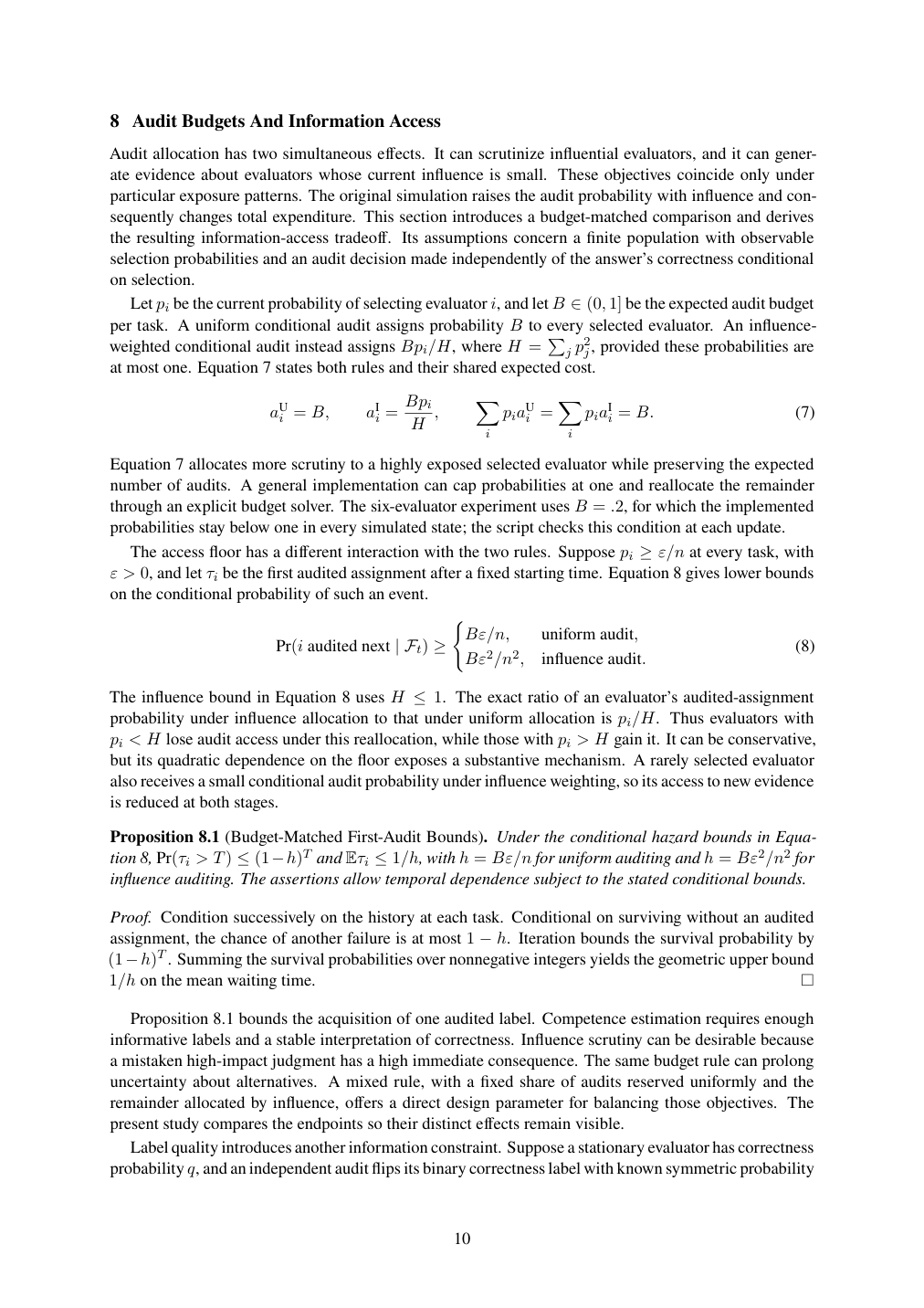
Audit allocation has two simultaneous effects. It can scrutinize influential evaluators, and it can gener- ate evidence about evaluators whose current influence is small. These objectives coincide only under particular exposure patterns. The original simulation raises the audit probability with influence and con- sequently changes total expenditure. This section introduces a budget-matched comparison and derives the resulting information-access tradeoff. Its assumptions concern a finite population with observable selection probabilities and an audit decision made independently of the answer’s correctness conditional
at most one. Equation 7 states both rules and their shared expected cost.
Equation 7 allocates more scrutiny to a highly exposed selected evaluator while preserving the expected number of audits. A general implementation can cap probabilities at one and reallocate the remainder probabilities stay below one in every simulated state; the script checks this condition at each update.
but its quadratic dependence on the floor exposes a substantive mechanism. A rarely selected evaluator also receives a small conditional audit probability under influence weighting, so its access to new evidence
Proposition 8.1 (Budget-Matched First-Audit Bounds). Under the conditional hazard bounds in Equa- influence auditing. The assertions allow temporal dependence subject to the stated conditional bounds.
Proof. Condition successively on the history at each task. Conditional on surviving without an audited
Proposition 8.1 bounds the acquisition of one audited label. Competence estimation requires enough informative labels and a stable interpretation of correctness. Influence scrutiny can be desirable because a mistaken high-impact judgment has a high immediate consequence. The same budget rule can prolong uncertainty about alternatives. A mixed rule, with a fixed share of audits reserved uniformly and the remainder allocated by influence, offers a direct design parameter for balancing those objectives. The present study compares the endpoints so their distinct effects remain visible.
Label quality introduces another information constraint. Suppose a stationary evaluator has correctness
Readable text
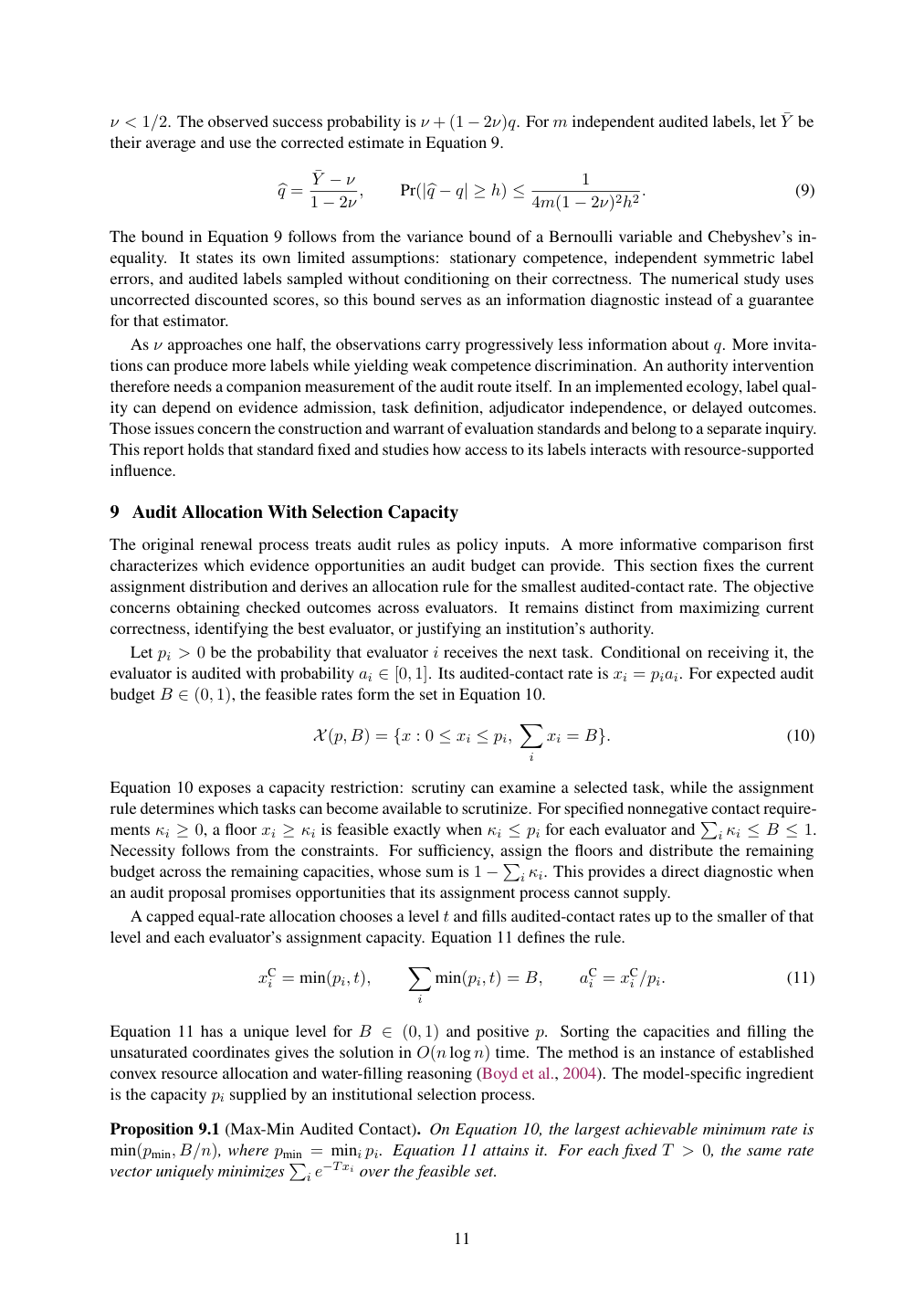
their average and use the corrected estimate in Equation 9.
The bound in Equation 9 follows from the variance bound of a Bernoulli variable and Chebyshev’s in- equality. It states its own limited assumptions: stationary competence, independent symmetric label errors, and audited labels sampled without conditioning on their correctness. The numerical study uses uncorrected discounted scores, so this bound serves as an information diagnostic instead of a guarantee
tions can produce more labels while yielding weak competence discrimination. An authority intervention therefore needs a companion measurement of the audit route itself. In an implemented ecology, label qual- ity can depend on evidence admission, task definition, adjudicator independence, or delayed outcomes. Those issues concern the construction and warrant of evaluation standards and belong to a separate inquiry. This report holds that standard fixed and studies how access to its labels interacts with resource-supported
The original renewal process treats audit rules as policy inputs. A more informative comparison first characterizes which evidence opportunities an audit budget can provide. This section fixes the current assignment distribution and derives an allocation rule for the smallest audited-contact rate. The objective concerns obtaining checked outcomes across evaluators. It remains distinct from maximizing current correctness, identifying the best evaluator, or justifying an institution’s authority.
Equation 10 exposes a capacity restriction: scrutiny can examine a selected task, while the assignment rule determines which tasks can become available to scrutinize. For specified nonnegative contact require-
Necessity follows from the constraints. For sufficiency, assign the floors and distribute the remaining
an audit proposal promises opportunities that its assignment process cannot supply.
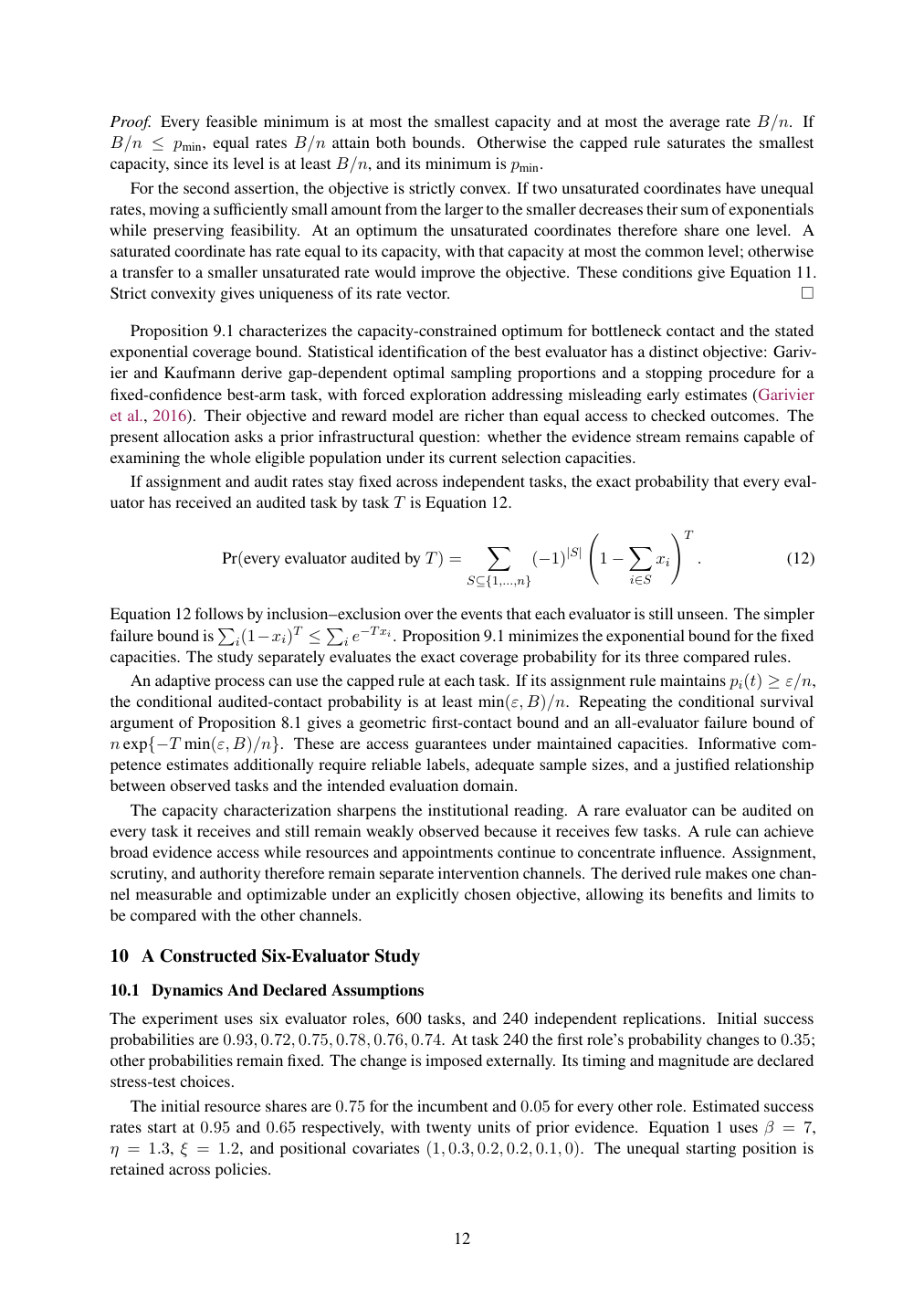
level and each evaluator’s assignment capacity. Equation 11 defines the rule.
convex resource allocation and water-filling reasoning (Boyd et al., 2004). The model-specific ingredient
Proposition 9.1 (Max-Min Audited Contact). On Equation 10, the largest achievable minimum rate is
Readable text
For the second assertion, the objective is strictly convex. If two unsaturated coordinates have unequal rates, moving a sufficiently small amount from the larger to the smaller decreases their sum of exponentials while preserving feasibility. At an optimum the unsaturated coordinates therefore share one level. A saturated coordinate has rate equal to its capacity, with that capacity at most the common level; otherwise a transfer to a smaller unsaturated rate would improve the objective. These conditions give Equation 11.
Strict convexity gives uniqueness of its rate vector.
Proposition 9.1 characterizes the capacity-constrained optimum for bottleneck contact and the stated exponential coverage bound. Statistical identification of the best evaluator has a distinct objective: Gariv- ier and Kaufmann derive gap-dependent optimal sampling proportions and a stopping procedure for a fixed-confidence best-arm task, with forced exploration addressing misleading early estimates (Garivier et al., 2016). Their objective and reward model are richer than equal access to checked outcomes. The present allocation asks a prior infrastructural question: whether the evidence stream remains capable of examining the whole eligible population under its current selection capacities.
If assignment and audit rates stay fixed across independent tasks, the exact probability that every eval-
Equation 12 follows by inclusion–exclusion over the events that each evaluator is still unseen. The simpler
capacities. The study separately evaluates the exact coverage probability for its three compared rules.
argument of Proposition 8.1 gives a geometric first-contact bound and an all-evaluator failure bound of petence estimates additionally require reliable labels, adequate sample sizes, and a justified relationship between observed tasks and the intended evaluation domain.
The capacity characterization sharpens the institutional reading. A rare evaluator can be audited on every task it receives and still remain weakly observed because it receives few tasks. A rule can achieve broad evidence access while resources and appointments continue to concentrate influence. Assignment, scrutiny, and authority therefore remain separate intervention channels. The derived rule makes one chan- nel measurable and optimizable under an explicitly chosen objective, allowing its benefits and limits to
The experiment uses six evaluator roles, 600 tasks, and 240 independent replications. Initial success other probabilities remain fixed. The change is imposed externally. Its timing and magnitude are declared
Readable text
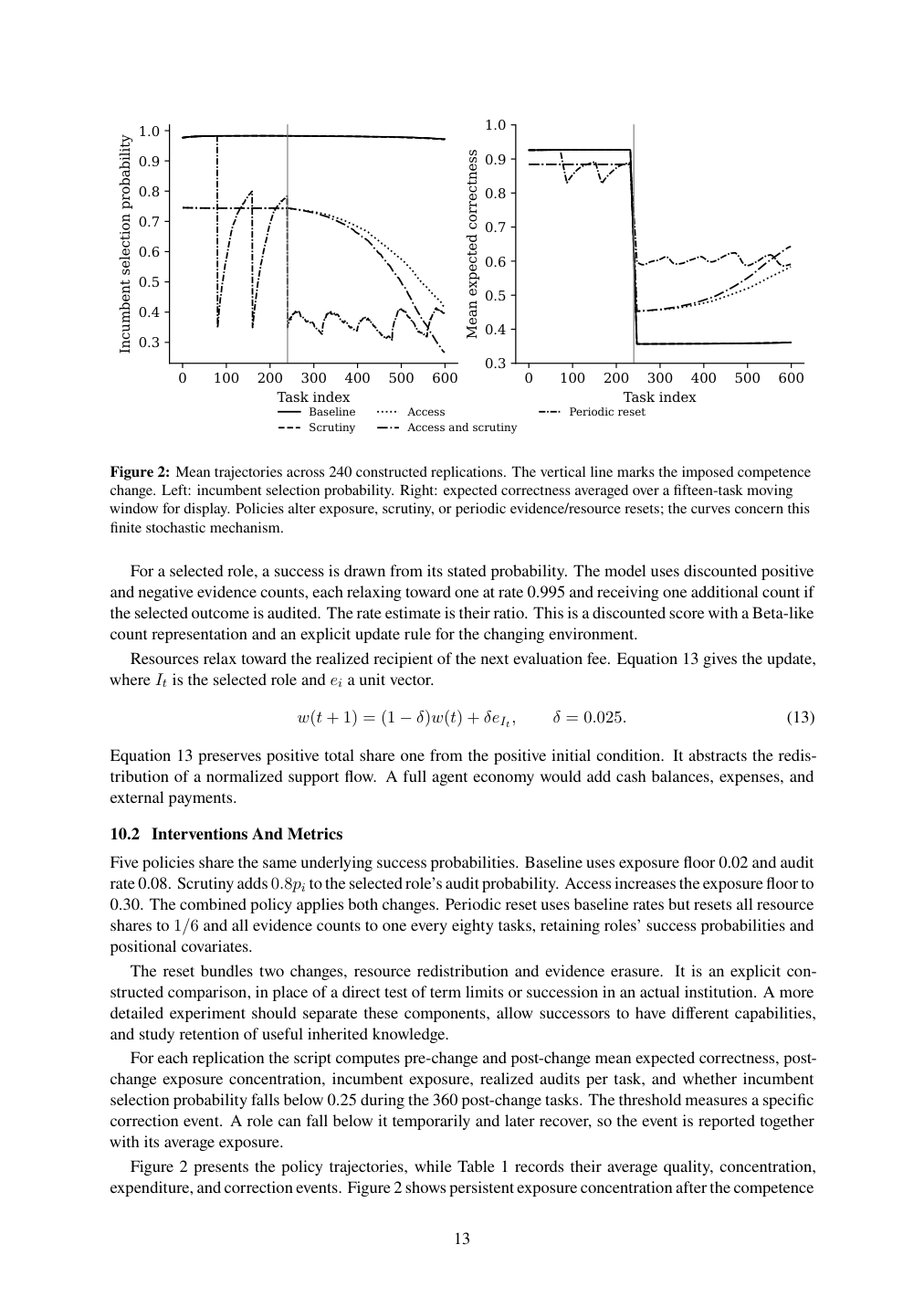
Figure 2: Mean trajectories across 240 constructed replications. The vertical line marks the imposed competence change. Left: incumbent selection probability. Right: expected correctness averaged over a fifteen-task moving window for display. Policies alter exposure, scrutiny, or periodic evidence/resource resets; the curves concern this
For a selected role, a success is drawn from its stated probability. The model uses discounted positive and negative evidence counts, each relaxing toward one at rate 0.995 and receiving one additional count if the selected outcome is audited. The rate estimate is their ratio. This is a discounted score with a Beta-like count representation and an explicit update rule for the changing environment.
Resources relax toward the realized recipient of the next evaluation fee. Equation 13 gives the update,
Equation 13 preserves positive total share one from the positive initial condition. It abstracts the redis- tribution of a normalized support flow. A full agent economy would add cash balances, expenses, and
Five policies share the same underlying success probabilities. Baseline uses exposure floor 0.02 and audit 0.30. The combined policy applies both changes. Periodic reset uses baseline rates but resets all resource shares to 1/6 and all evidence counts to one every eighty tasks, retaining roles’ success probabilities and
The reset bundles two changes, resource redistribution and evidence erasure. It is an explicit con- structed comparison, in place of a direct test of term limits or succession in an actual institution. A more detailed experiment should separate these components, allow successors to have different capabilities,
For each replication the script computes pre-change and post-change mean expected correctness, post- change exposure concentration, incumbent exposure, realized audits per task, and whether incumbent selection probability falls below 0.25 during the 360 post-change tasks. The threshold measures a specific correction event. A role can fall below it temporarily and later recover, so the event is reported together
Figure 2 presents the policy trajectories, while Table 1 records their average quality, concentration, expenditure, and correction events. Figure 2 shows persistent exposure concentration after the competence
Readable text
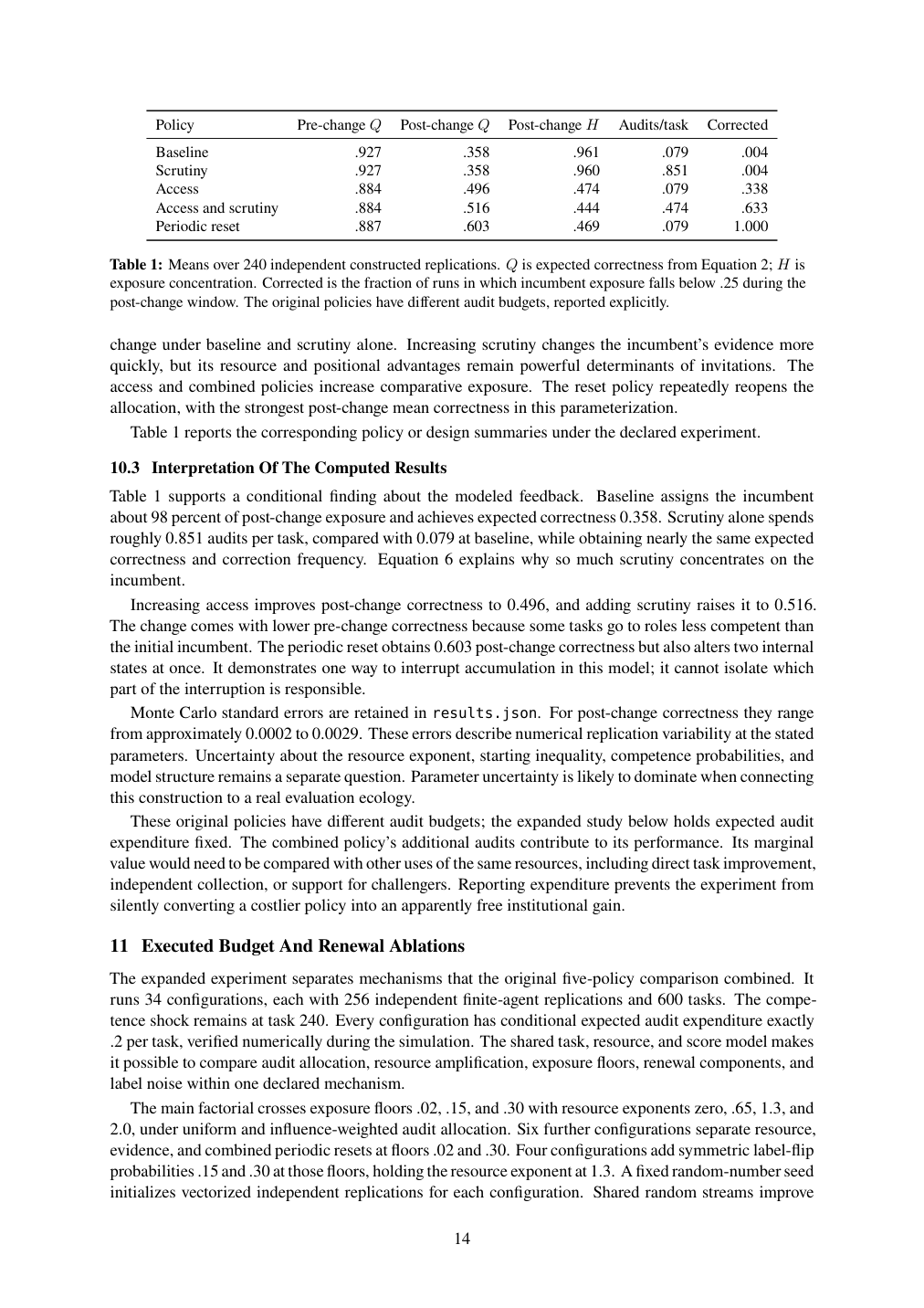
Baseline .927 Scrutiny .927 Access .884 Access and scrutiny .884 Periodic reset .887
exposure concentration. Corrected is the fraction of runs in which incumbent exposure falls below .25 during the post-change window. The original policies have different audit budgets, reported explicitly.
change under baseline and scrutiny alone. Increasing scrutiny changes the incumbent’s evidence more quickly, but its resource and positional advantages remain powerful determinants of invitations. The access and combined policies increase comparative exposure. The reset policy repeatedly reopens the allocation, with the strongest post-change mean correctness in this parameterization.
Table 1 reports the corresponding policy or design summaries under the declared experiment.
Table 1 supports a conditional finding about the modeled feedback. Baseline assigns the incumbent about 98 percent of post-change exposure and achieves expected correctness 0.358. Scrutiny alone spends roughly 0.851 audits per task, compared with 0.079 at baseline, while obtaining nearly the same expected correctness and correction frequency. Equation 6 explains why so much scrutiny concentrates on the
Increasing access improves post-change correctness to 0.496, and adding scrutiny raises it to 0.516. The change comes with lower pre-change correctness because some tasks go to roles less competent than the initial incumbent. The periodic reset obtains 0.603 post-change correctness but also alters two internal states at once. It demonstrates one way to interrupt accumulation in this model; it cannot isolate which
Monte Carlo standard errors are retained in results.json. For post-change correctness they range from approximately 0.0002 to 0.0029. These errors describe numerical replication variability at the stated parameters. Uncertainty about the resource exponent, starting inequality, competence probabilities, and model structure remains a separate question. Parameter uncertainty is likely to dominate when connecting
These original policies have different audit budgets; the expanded study below holds expected audit expenditure fixed. The combined policy’s additional audits contribute to its performance. Its marginal value would need to be compared with other uses of the same resources, including direct task improvement, independent collection, or support for challengers. Reporting expenditure prevents the experiment from silently converting a costlier policy into an apparently free institutional gain.
The expanded experiment separates mechanisms that the original five-policy comparison combined. It runs 34 configurations, each with 256 independent finite-agent replications and 600 tasks. The compe- tence shock remains at task 240. Every configuration has conditional expected audit expenditure exactly .2 per task, verified numerically during the simulation. The shared task, resource, and score model makes it possible to compare audit allocation, resource amplification, exposure floors, renewal components, and
The main factorial crosses exposure floors .02, .15, and .30 with resource exponents zero, .65, 1.3, and 2.0, under uniform and influence-weighted audit allocation. Six further configurations separate resource, evidence, and combined periodic resets at floors .02 and .30. Four configurations add symmetric label-flip probabilities .15 and .30 at those floors, holding the resource exponent at 1.3. A fixed random-number seed initializes vectorized independent replications for each configuration. Shared random streams improve
Readable text
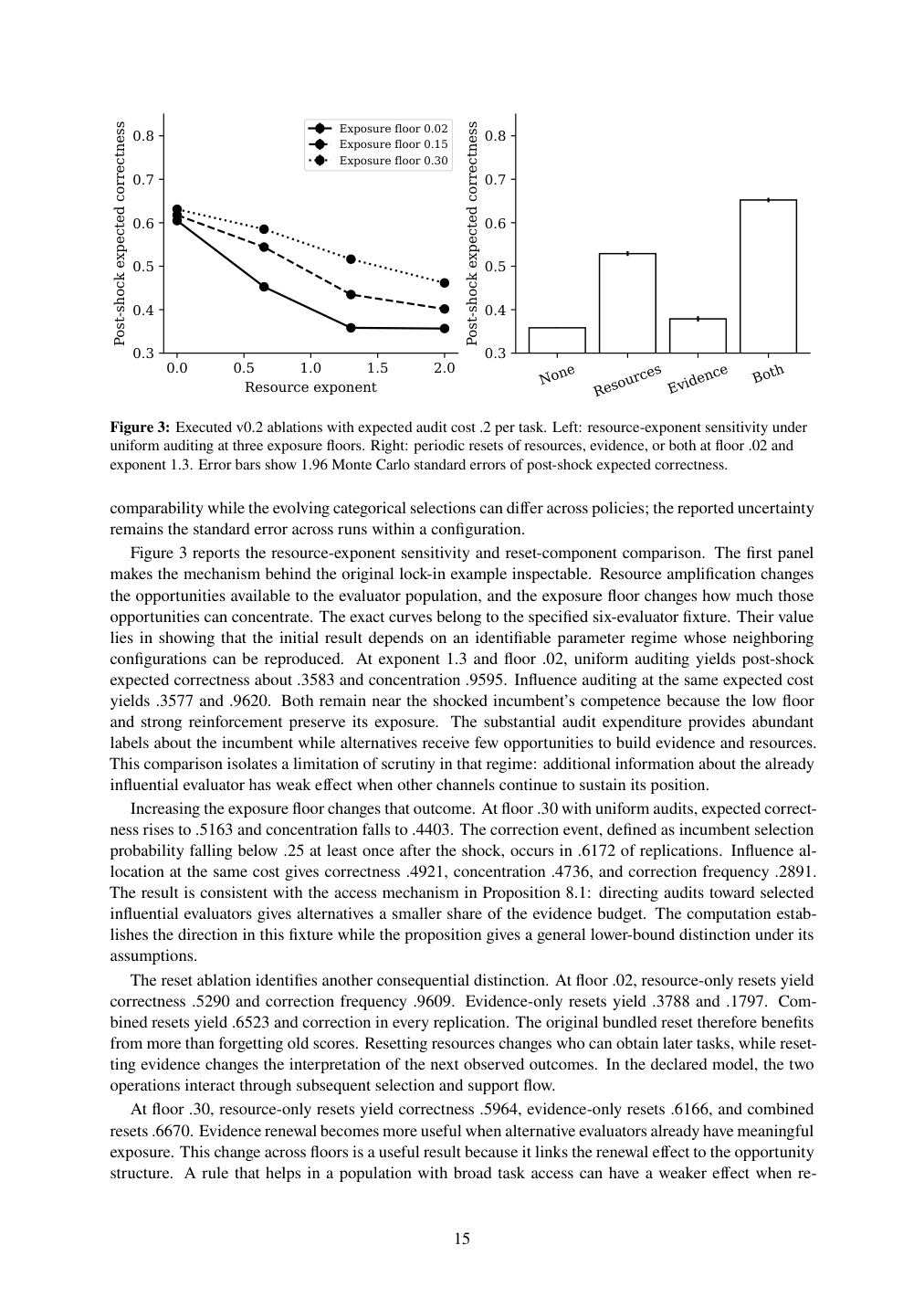
Figure 3: Executed v0.2 ablations with expected audit cost .2 per task. Left: resource-exponent sensitivity under uniform auditing at three exposure floors. Right: periodic resets of resources, evidence, or both at floor .02 and exponent 1.3. Error bars show 1.96 Monte Carlo standard errors of post-shock expected correctness.
comparability while the evolving categorical selections can differ across policies; the reported uncertainty remains the standard error across runs within a configuration.
Figure 3 reports the resource-exponent sensitivity and reset-component comparison. The first panel makes the mechanism behind the original lock-in example inspectable. Resource amplification changes the opportunities available to the evaluator population, and the exposure floor changes how much those opportunities can concentrate. The exact curves belong to the specified six-evaluator fixture. Their value lies in showing that the initial result depends on an identifiable parameter regime whose neighboring configurations can be reproduced. At exponent 1.3 and floor .02, uniform auditing yields post-shock expected correctness about .3583 and concentration .9595. Influence auditing at the same expected cost yields .3577 and .9620. Both remain near the shocked incumbent’s competence because the low floor and strong reinforcement preserve its exposure. The substantial audit expenditure provides abundant labels about the incumbent while alternatives receive few opportunities to build evidence and resources. This comparison isolates a limitation of scrutiny in that regime: additional information about the already influential evaluator has weak effect when other channels continue to sustain its position.
Increasing the exposure floor changes that outcome. At floor .30 with uniform audits, expected correct- ness rises to .5163 and concentration falls to .4403. The correction event, defined as incumbent selection probability falling below .25 at least once after the shock, occurs in .6172 of replications. Influence al- location at the same cost gives correctness .4921, concentration .4736, and correction frequency .2891. The result is consistent with the access mechanism in Proposition 8.1: directing audits toward selected influential evaluators gives alternatives a smaller share of the evidence budget. The computation estab- lishes the direction in this fixture while the proposition gives a general lower-bound distinction under its
The reset ablation identifies another consequential distinction. At floor .02, resource-only resets yield correctness .5290 and correction frequency .9609. Evidence-only resets yield .3788 and .1797. Com- bined resets yield .6523 and correction in every replication. The original bundled reset therefore benefits from more than forgetting old scores. Resetting resources changes who can obtain later tasks, while reset- ting evidence changes the interpretation of the next observed outcomes. In the declared model, the two operations interact through subsequent selection and support flow.
At floor .30, resource-only resets yield correctness .5964, evidence-only resets .6166, and combined resets .6670. Evidence renewal becomes more useful when alternative evaluators already have meaningful exposure. This change across floors is a useful result because it links the renewal effect to the opportunity structure. A rule that helps in a population with broad task access can have a weaker effect when re-
source reinforcement concentrates nearly every task. Policy assessment therefore needs both the renewal operation and the selection environment in its experimental description.
The label-noise configurations preserve this channel distinction. At floor .30, increasing the symmetric label-flip probability from zero to .15 and .30 lowers correction frequencies from .6172 to .3984 and .2734. Expected correctness changes more modestly, from .5163 to .5080 and .5041, partly because the exposure floor itself distributes some assignments away from the incumbent. At floor .02, all three label conditions remain near .358 correctness. Better labels have limited opportunity to improve allocation when the resource-supported selection path provides little access to alternatives.
The complete results retain realized audit rates, conditional expected rates, concentration, incumbent share, correction frequency, and censored delay. A correction event is a threshold crossing, so a run can count as corrected even if its later allocation changes again. The post-shock average measures the entire period and therefore includes correction delay. Both quantities are useful, and their difference prevents a favorable final event from concealing poor performance over most of the trajectory.
12 Executed Audit-Allocation Comparison
The audit-allocation comparison evaluates the derived audit rule in both a fixed exposure environment and the original evolving-resource process. The fixed environment supplies exact operating characteristics. The dynamic environment tests whether improved access to checked outcomes changes competence correction when selection still depends on inherited resources and position. Uniform auditing, influenceweighted auditing, and capped equal-rate auditing share expected expenditure .2 per task in both comparisons.


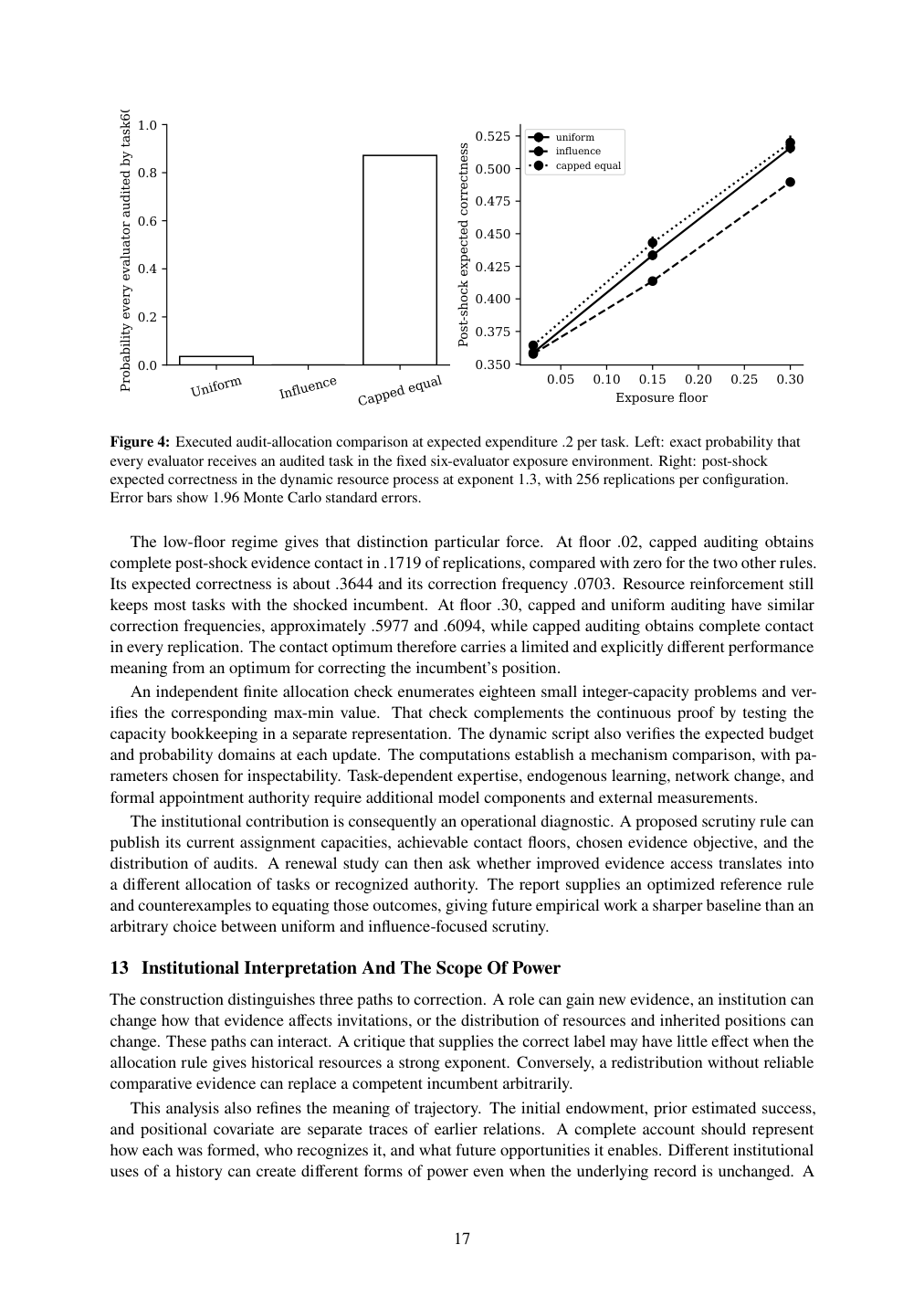
Figure 4 presents that exact comparison beside the dynamic study. The contrast makes a concrete consequence of audit allocation visible at equal expected cost. A rule concentrated on influence can inspect the incumbent frequently while leaving much of the evaluator population without even one checked outcome.
The dynamic comparison crosses the three audit rules with exposure floors .02, .15, and .30 and resource exponents zero and1.3, giving eighteen configurations. Each configuration uses 256 replications, 600 tasks, the same competence shock at task 240, and the same initial resources and discounted score update as the earlier study. A fixed seed supplies common random streams. Selection paths can diverge after policy-specific observations, so the experiment records each policy’s full consequences under the declared process. It reports correctness, concentration, correction events, contact rates, evidence counts, and realized expenditure.
At exponent 1.3 and floor .15, capped auditing gives post-shock expected correctness about .4431, compared with .4335 for uniform auditing and .4137 for influence weighting. The fractions with a correction event are .3398,.2344, and .0273. Every capped-audit replication obtains at least one post-shock label for each evaluator, compared with .5039 under uniform auditing and zero under influence weighting. These results connect the opportunity theorem to a measured property of the evolving evidence stream while preserving the distinction between acquiring labels and changing selection.
Readable text
Figure 4: Executed audit-allocation comparison at expected expenditure .2 per task. Left: exact probability that every evaluator receives an audited task in the fixed six-evaluator exposure environment. Right: post-shock expected correctness in the dynamic resource process at exponent 1.3, with 256 replications per configuration.
The low-floor regime gives that distinction particular force. At floor .02, capped auditing obtains complete post-shock evidence contact in .1719 of replications, compared with zero for the two other rules. Its expected correctness is about .3644 and its correction frequency .0703. Resource reinforcement still keeps most tasks with the shocked incumbent. At floor .30, capped and uniform auditing have similar correction frequencies, approximately .5977 and .6094, while capped auditing obtains complete contact in every replication. The contact optimum therefore carries a limited and explicitly different performance meaning from an optimum for correcting the incumbent’s position.
An independent finite allocation check enumerates eighteen small integer-capacity problems and ver- ifies the corresponding max-min value. That check complements the continuous proof by testing the capacity bookkeeping in a separate representation. The dynamic script also verifies the expected budget and probability domains at each update. The computations establish a mechanism comparison, with pa- rameters chosen for inspectability. Task-dependent expertise, endogenous learning, network change, and formal appointment authority require additional model components and external measurements.
The institutional contribution is consequently an operational diagnostic. A proposed scrutiny rule can publish its current assignment capacities, achievable contact floors, chosen evidence objective, and the distribution of audits. A renewal study can then ask whether improved evidence access translates into a different allocation of tasks or recognized authority. The report supplies an optimized reference rule and counterexamples to equating those outcomes, giving future empirical work a sharper baseline than an arbitrary choice between uniform and influence-focused scrutiny.
13 Institutional Interpretation And The Scope Of Power
The construction distinguishes three paths to correction. A role can gain new evidence, an institution can change how that evidence affects invitations, or the distribution of resources and inherited positions can change. These paths can interact. A critique that supplies the correct label may have little effect when the allocation rule gives historical resources a strong exponent. Conversely, a redistribution without reliable comparative evidence can replace a competent incumbent arbitrarily.
This analysis also refines the meaning of trajectory. The initial endowment, prior estimated success, and positional covariate are separate traces of earlier relations. A complete account should represent how each was formed, who recognizes it, and what future opportunities it enables. Different institutional uses of a history can create different forms of power even when the underlying record is unchanged. A
credential, a funded dependency, and a promise of future access are different mechanisms, with different possibilities for challenge.
Political-economic power enters through resource dependence and funding rules. Relational power enters through the topology of reliance and invitations. Epistemic authority enters through who may establish the labels used for updating competence. The present simulation fixes that last component to make the others identifiable. An ecology in which the incumbent controls both the scoring labels and invitations could have stronger feedback. Evaluating such a model requires explicit separation of criterion construction, evidence collection, and the formal right to settle a dispute.
None of these components identifies a universal objective for institutional design. Concentration may preserve specialized expertise and accountability; plural exposure may support correction and entry; repeated resets may disrupt accumulated understanding. An assessment should state whose interests and which forms of capability are being protected. The report supplies mechanisms and measurements that can make those judgments better informed.
14 Operational Design For Evaluator Renewal
An implementable evaluator institution needs to represent both the production of judgments and the rules governing their consequences. The proposed design uses four linked ledgers: eligibility and appointments, task exposure, audited evidence, and resource support. Each ledger has an independent version history, while event identifiers connect their updates. This structure permits a review to distinguish a change in perceived competence from a change in office, a change in access, or a change in the material support needed to continue evaluating.
The appointment ledger records an evaluator’s remit, term, appointing procedure, accountable parties, and appeal route. A remit can be limited to an artifact type, a discipline, or a class of consequential decisions. The ledger also records whether a role is advisory, certifying, or binding. An evaluator can retain its reasoning artifacts after a term expires while its permission to issue a binding verdict changes. This is the operational distinction between preserving knowledge and renewing authority. The original bundled reset is therefore a model intervention whose components must be disentangled before an institutional implementation can be assessed.
The exposure ledger records all eligible evaluators and their probabilities at each allocation event. It preserves the task context and the selection rule version. This allows an auditor to reconstruct who could have received the task, which scores and resources affected the choice, and whether a declared floor was respected. Saving only the selected actor would lose information about excluded alternatives. For large populations, a system can preserve the eligibility set and a reproducible policy snapshot in place of materializing every probability, provided the snapshot reconstructs the actual allocation distribution.
The evidence ledger records audit invitations, acceptance, outcomes, label provenance, and amendments. An audit route should name the standard under which an answer was labeled correct and the source of that standard’s authority. This report treats the standard as fixed for each experiment. A companion analysis can study how it changes. Keeping the standard identifier in the evidence record allows later studies to distinguish score changes caused by new performance observations from score changes caused by revised evaluative criteria.
Resource support requires a ledger with its own semantics. A support transfer may pay for completed work, finance future availability, reimburse evidence collection, or maintain a shared service. These purposes create different incentives and obligations. A periodic support review can reallocate future resources while preserving the record of previously completed work. The finite wealth-reset operation abstracts across these possibilities. An implementation should choose the particular transfer rule before evaluating its effect, because confiscating an accumulated holding and changing the next period’s support allocation are different institutional acts.
An audit scheduler can combine the two allocation principles in Equation 7. One component scrutinizes influence, another reserves evidence access across the eligible population. The scheduler publishes expected and realized expenditure, the distribution of audited labels, and the reasons for any additional
Readable text
investigation. When influence changes quickly, the audit rule can use the current probability, a rolling exposure measure, or the consequence of a pending decision. These choices affect which risks the insti- tution prioritizes. A reusable scheduler interface should expose that choice as a rule parameter with a
Renewal can likewise use a sequence of bounded operations. A review event can expire a role, pre- serve its artifacts, re-open eligibility, allocate a temporary comparison budget, and specify the evidence required for the next appointment. Such a sequence allows continuity of knowledge while creating op- portunities for alternatives. The simulation’s resource-only and evidence-only ablations suggest which channels deserve separate experimental treatment. They leave the choice of a legitimate appointment procedure to a declared institutional process that affected participants can inspect and challenge.
A trajectory review should examine outcomes over time. Useful diagnostics include the age of an evaluator’s latest independent evidence, the fraction of its exposure supported by current audits, the share of support inherited through established relations, and the delay between a detected performance change and a change in authorized exposure. These diagnostics can accompany aggregate competence estimates. They help distinguish a stable expert community supported by current evidence from a stable allocation
supported mainly by persistent resource advantages.
The repository’s design note proposes influence-linked scrutiny, finite terms, upkeep, and limits on the inheritance of reliance or contracts (Noetarium Project, 2026). The ledgers here provide a concrete way to investigate those proposals. They preserve the difference between an agent inheriting a useful disposition and an institution inheriting a commitment to accept that agent’s verdict. The first concerns transmitted capability; the second concerns reproduced authority. A Noetarium implementation can make both visible through separate event types, then assess how their interaction affects inquiry under explicitly
A concentration measure describes an outcome whose causes require further analysis. The selection rule normalized exponential component before the exposure floor. For two roles, subtracting their log scores
Equation 14 separates an estimated-competence advantage from resource and positional advantages. An audit can change the first term while leaving the other two intact. This makes the persistence of authority intelligible even after the institution learns the relevant competence difference.
symmetric exposure floor preserves the ordering of their selection probabilities.
For a numerical illustration take true probabilities 0.35 and 0.78, resource ratio 100, positional dif- ference 0.8, and the experiment’s coefficients. The log-odds advantage of the less competent role is approximately 3.94 even with exact competence estimates. Its exponential selection share in this two-role comparison is about 0.981. The calculation explains the possibility studied in the simulation using a
Proposition 15.1 suggests a transparent counterfactual audit. Hold all estimated competences fixed and neutralize the resource term; then hold resources fixed and equalize positional advantages; finally replace
estimates by an external competence assessment. Each counterfactual identifies a pathway through the declared rule. Because resources and estimates were jointly produced by prior invitations, these comparisons have the standing of mechanistic interventions on a declared model; observational causal estimation would require an additional identification argument.
A real causal study would need to specify what could be changed without simultaneously changing task access, motivation, or the availability of evidence. An entry subsidy might purchase observations as well as increase resources. A reassignment of institutional office might change the meaning of a judgment in addition to its selection probability. Recording such consequences is part of the institutional analysis, especially where the outcome concerns a person’s livelihood or the standing of a research community.
The counterfactual decomposition also provides a practical test for the claim that an institution is competence responsive. A procedure can report how much a specified improvement in externally assessed competence would alter exposure at the current resource distribution. If that sensitivity is nearly zero, additional information about competence may be useful for the record while having little immediate effect on the allocation of authority. This is a question an infrastructure can expose explicitly before choosing an expensive program of further auditing.
16 Task Context And Specialized Competence
The scalar competence variable makes the finite mechanism easy to inspect. Cross-disciplinary inquiry usually presents a more structured task distribution. An evaluator may be excellent at checking a proof, competent at reading a measurement protocol, and poorly positioned to interpret an affected participant’s account. A service that reports only aggregate correctness can hide this specialization. It can also mistake a change in assigned tasks for a change in the evaluator’s underlying ability.
A simple example illustrates the distinction. Consider two equally frequent task types and two evaluators. The first has correctness probabilities .95 and .55 across the types, and the second has .55 and .95. Both have aggregate competence .75 under the balanced task distribution. Randomly assigning tasks without observing their type therefore achieves .75 expected correctness regardless of which evaluator receives greater overall share. Routing each task to its matching specialist achieves .95. Concentration of total invitations and competence of the task-specific route are consequently different objects even in this small example.
If the task mix changes to favor the first type, the first evaluator’s aggregate correctness rises while both evaluators’ task-specific capabilities remain constant. An observed score change could then reflect distribution shift, learning, forgetting, or selective exposure. The present shock changes one declared scalar probability so its source is known. An external experiment should preserve task features and estimate competence conditionally where the sample supports it. It should also report which regions remain weakly measured instead of projecting a global ranking into them.
Resources can affect specialization as well. An evaluator with access to an archive or instrument may acquire evidence useful for one task family. A support intervention can therefore change future taskspecific competence, while the current simulation lets resources affect only selection. A richer model can introduce a competence matrix and an explicit investment rule. It would then measure whether supporting a broad set of specialists improves the coverage of the research space, even when aggregate exposure remains unequal.
Institutional authority should have a matching scope. A recognized role can authorize an evaluator to certify one class of claims while permitting advisory participation elsewhere. The appointment ledger can record these scopes, and the exposure policy can enforce eligibility per task. Renewal would then concern a particular remit instead of an actor’s universal standing. This gives a practical institutional interpretation to specialization: an evaluator can lose authority in one domain while retaining well-supported authority in another.
The consequence for measurement is straightforward. Future studies should retain task-conditioned quality, task coverage, support by task family, and the age of relevant evidence beside aggregate accuracy and concentration. They can test routing interventions separately from resource renewal and role renewal.
Element Contribution standing and scope
Cumulative advantage Established antecedent in recognition, increasing-return, and feedback models. Finite mechanism Report-specific synthesis separating competence evidence, resource reinforcement, position, and exposure. Conditional analysis Contact feasibility and capped equal-rate characterization, first-audit bounds, and local resource stability under stated assumptions. Executed computation Five-policy reference, 34 matched-budget sensitivity cases, exact static contact, and 18 dynamic allocation comparisons. Institutional design Proposed appointment, exposure, evidence, and resource ledgers; authority implementation remains prospective. External validation Proposed measured task streams, evaluator cohorts, audit routes, and institutional trajectory studies.
Table 2: Contribution assessment for evaluative power. The finite simulations concern declared stochastic evaluators and fixed correctness standards.
This extension preserves the central separation of the report while making its relevance to a combinatorially expanding interdisciplinary space more concrete. The challenge is to support the relations through which specialized capacities become available to the questions that need them.
17 Contribution Assessment And Research Questions
The report contributes a finite mechanism for studying how evaluative influence changes through evidence, resources, and access. Its conceptual contribution is the separation of actual competence, perceived competence, resource support, relational position, and institutional authorization. Its technical contribution is a selection-capacity formulation, a max-min audited-contact reference rule, and executed comparisons separating contact from correction of resource-supported exposure. Table 2 records the evidential standing of these elements.
The most useful computed insight is a channel distinction. Scrutiny changes what the system learns about an influential evaluator. Access changes who can produce outcomes from which evidence can be obtained. Resource renewal changes the reinforcement conditions under which those opportunities accumulate. Evidence renewal changes how current observations compete with inherited scores. The budget-matched study shows that these operations can produce substantially different outcomes even when total expected audit expenditure is held fixed. Their interaction gives a concrete research object beyond an aggregate measure of evaluator quality.
A first external study can use a bounded task stream with independently assessable answers and evaluator models whose performance changes in a controlled way. The experiment would freeze a correctness standard, vary access and audit rules, and preserve every selection probability. It would measure the accuracy of judgments, the quality of competence estimates, resource concentration, correction delay, and evidence coverage across evaluators. Controlled performance shifts permit an assessment of adaptation while preserving a known reference. Multiple task families would be needed to examine whether the observed mechanism survives variation in difficulty and specialization.
A second study can introduce endogenous evaluator learning. In the present experiment, a selected evaluator receives resources but its competence is exogenous. A richer mechanism could let support improve future competence through training, evidence acquisition, or collaboration. Resource concentration could then carry a benefit as well as a risk: a strong incumbent may improve rapidly when supported, while excluded alternatives remain underdeveloped. Evaluating renewal in that setting requires measuring the opportunity cost of redistributing support and the future information gained by sustaining alternatives. The existing fixture provides a baseline against which that additional channel can be isolated.
A third study concerns networks and authority. Reliance relations can change after successful tasks, appointments can expire, and an appeal can redirect future decisions. A graph model should specify the meaning and update rule of each edge type. It can then distinguish an influential actor’s network
position from its formal remit. The resulting interventions could compare role rotation, open task access, independent appeals, and resource support for challengers. Each intervention would be an explicit rule in the simulation before it became a candidate institutional practice.
The philosophical significance concerns the conditions under which a judgment acquires force. In a relational infrastructure, evaluative power is reproduced through interactions among actors, artifacts, rules, and resources. The report’s ledgers make those interactions available for historical reconstruction. They allow a community to ask whether authority follows current performance, earlier success, control of the evidence route, or a recognized institutional decision. Several mechanisms can operate together, so the answer requires a trajectory account in place of a single final score.
The present results support conditional design insights. Under the chosen reinforcement regime, influence-focused scrutiny alone produces weak correction; a broad access floor changes the available evidence path; resource and evidence resets act through different channels; and label noise reduces correction capacity even when opportunities broaden. These statements can be checked by rerunning the supplied scripts. Claims about durable institutional improvement require additional modeling, implementation, and participation by the people whose decisions the institution would govern. The report prepares that work through a precise distinction between the mechanism already executed and the authority relations a future study must represent.
18 Conclusion
An audit budget operates through the task opportunities supplied by selection. The capacity formulation makes that restriction explicit and gives a capped equal-rate reference optimum for the smallest auditedcontact rate and an exponential coverage bound. Exact static calculations and matched dynamic comparisons show that audit allocation materially changes which evaluators receive checked evidence at the same expected expenditure.
Improved contact has a narrower meaning than correction of evaluative power. Resource reinforcement, positional advantage, and appointment authority can continue to shape consequential exposure after evidence becomes available. The report’s decomposed mechanism and proposed event ledgers make those channels separately assessable. Their contribution is a rigorous reference for institutional investigation, with external competence, resource, and authority evidence needed to establish effects beyond the constructed process.
References
Iacob, Alex et al.. (2026). The Red Queen G”odel Machine: Co-Evolving Agents and Their Evaluators. Preprint,
arXiv:2606.26294v3. https://arxiv.org/html/2606.26294v3. Zhang, Yaolun; Xu, Tianyi; Zhao, Yujie; Zhao, Jishen; Wu, Qingyun; Wang, Huazheng. (2026). EvalResearchBench:
Can AI Agents Build Their Own Feedback for Recursive Self-Improvement?. Preprint, arXiv:2610.04184v2. https://arxiv.org/html/2610.04184v2. Paolo, Giuseppe; Warner, Jamieson; Shahrzad, Hormoz; Hodjat, Babak; Miikkulainen, Risto; Meyerson,
Elliot. (2026). TerraLingua: Emergence and Analysis of Open-Endedness in LLM Ecologies. Preprint, arXiv:2603.16910. https://arxiv.org/abs/2603.16910. Noetarium Project. (2026). An ecology that improves the infrastructure: evolution without an appointed evaluator.
Repository design note, commit 869fe38afac257cd9b5d51ad5b498a8ff6b8e443. https://github.com/huang wanhong-maker/Noetarium-The-Science-and-Humanity-Infrastructure/blob/869fe38afac257c d9b5d51ad5b498a8ff6b8e443/development/ideas/2026-11-19-an-ecology-that-improves-the-i nfrastructure.md. Merton, Robert K.. (1968). The Matthew Effect in Science. Science 159(3810):56–63. https://doi.org/10.1
126/science.159.3810.56. DeGroot, Morris H.. (1974). Reaching a Consensus. Journal of the American Statistical Association 69(345):118–
- https://doi.org/10.1080/01621459.1974.10480137. Golub, Benjamin; Jackson, Matthew O.. (2010). Naive Learning in Social Networks and the Wisdom of Crowds.
American Economic Journal: Microeconomics 2(1):112–149. https://web.stanford.edu/~jacksonm/na ivelearning.pdf.
Arthur, W. Brian. (1989). Competing Technologies, Increasing Returns, and Lock-In by Historical Events. Economic
Journal 99(394):116–131. https://doi.org/10.2307/2234208. Joseph, Matthew; Kearns, Michael; Morgenstern, Jamie; Roth, Aaron. (2016). Fairness in Learning: Classic and
Contextual Bandits. Advances in Neural Information Processing Systems 29. https://arxiv.org/abs/1605 .07139. Ensign, Danielle; Friedler, Sorelle A.; Neville, Scott; Scheidegger, Carlos; Venkatasubramanian, Suresh. (2018).
Runaway Feedback Loops in Predictive Policing. FAT*, PMLR 81:160–171. https://proceedings.mlr.pr ess/v81/ensign18a.html. Liu, Lydia T.; Dean, Sarah; Rolf, Esther; Simchowitz, Max; Hardt, Moritz. (2018). Delayed Impact of Fair Machine
Learning. ICML, PMLR 80:3150–3158. https://proceedings.mlr.press/v80/liu18c.html. Ostrom, Elinor. (2000). Collective Action and the Evolution of Social Norms. Journal of Economic Perspectives
14(3):137–158. https://www.aeaweb.org/articles?id=10.1257/jep.14.3.137. Garivier, Aurelien; Kaufmann, Emilie. (2016). Optimal Best Arm Identification with Fixed Confidence. COLT,
PMLR 49:998–1027. https://proceedings.mlr.press/v49/garivier16a.html. Boyd, Stephen; Vandenberghe, Lieven. (2004). Convex Optimization. Cambridge University Press. https://web.
stanford.edu/~boyd/cvxbook/bv_cvxbook.pdf.