Evidence Production And Revision Of Evaluative Norms In Agent Ecologies
Full text from the PDF
Evidence Production And Revision Of Evaluative Norms In Agent
Ecologies
Wanhong HUANG
Abstract
Evaluative norms shape both judgment and the evidence through which their revision becomes possible. This Technical Report separates norm uptake, recognized authority, and criterion-relative warrant, then compares exogenous assessment signals with an explicit evidence-production process. A dominance argument identifies which adverse comparisons group reweighting alone can support. In the coupled model, paired evaluations become eligible through use of the alternative norm or an independent access route. A protected share yields a calculable bound on evidence opportunities and can change both information and coordination. Seventy-two constructed configurations vary coordination, protection, access, attempted evaluations, and score memory. At a declared strong-coordination setting, cumulative-history revision frequency is .531 without an independent route and .164 with it; discounting raises the latter to .637. Memory ablations expose how pre-change evidence can alter the effect of subsequent access. These are finite-mechanism observations, with actual completed evaluations and protection effort retained separately. Supporting analysis includes revision thresholds, evidence latency, plural criteria, and a versioned norm lifecycle. The contribution is a reproducible characterization of coupled evidence and norm-use dynamics, building on established convention and action-dependent learning research. Reasons, appeal, and authorization remain distinct records; successful diffusion supplies descriptive evidence while justification and empirical institutional validity require further inquiry.
Keywords: evaluative norms; evidence production; norm revision; institutional memory; epistemic authority
Technical Report Note
This technical report shares an evolving inquiry and invites dialogue, criticism, revision, and independent development. Its definitions, distinctions, and constructions remain open to refinement. Circulation across scholarly and practical communities is part of the purpose of releasing the manuscript.
The author treats the viewpoints, concepts, and lines of reasoning presented here as contributions to a shared field of inquiry. Similar or related ideas may have appeared in other intellectual, cultural, and disciplinary traditions. The manuscript identifies known antecedents and distinguishes inherited positions, interpretive proposals, and arguments developed here. Historical priority remains open to further investigation.
The constructions and arguments are presented with their stated assumptions and evidential scope. Readers are encouraged to question, test, revise, extend, reinterpret, or independently develop the ideas presented here. Where appropriate, acknowledgment of this paper as one point of encounter in the development of a related idea is appreciated. Such acknowledgment records an intellectual route; the ideas remain available for criticism, revision, and independent development.
Definitions introduced by the paper are local analytical stipulations unless attributed to another source. Their use identifies the scope of the present argument; terminological and historical priority remain subjects for independent investigation. Generative Relational theory is treated as an open research programme whose proposals receive critical examination alongside independent literature.
Responsible Use and Rights Reservation
This section records a request for responsible scholarly conduct and identifies the scope of retained rights. Legal permissions are governed by the licence on the following page.
The author encourages good-faith discussion, criticism, independent inquiry, and responsible use of the material. Separately from the licence’s terms, the author asks users to consider foreseeable harms when adapting the arguments, representations, or examples of this paper, particularly in scientific inquiry, institutional decisions, and computational knowledge infrastructures. The ethical request leaves the licence’s permissions and legally authorised uses unchanged.
The author retains the rights preserved under CC BY-NC 4.0 and may pursue remedies to which the author is legally entitled for breach of the licence or violation of independently applicable rights. Reuse remains independent from authorial endorsement. Third-party rights require authorisation from their respective holders where applicable. Copyright exceptions and limitations, including applicable forms of fair use or fair dealing, remain available.
Notices
This page consolidates the manuscript’s research status, licence, development disclosure, researchprogramme relation, and suggested citation.
Status. This technical report is prepared for the author’s substantive review and subsequent scholarly discussion. The report distinguishes established antecedents, conditional results developed here, inspected source artifacts, and numerical illustrations under declared assumptions. Internal checks assess the stated arguments and examples; independent scholarly assessment can further test their interpretation and adequacy. The source ledgers record the access level and claim scope of consulted works.
Licence. Except where otherwise indicated, copyright 2026 Wanhong Huang. This work is made available under the Creative Commons Attribution-NonCommercial 4.0 International License (CC BY-NC 4.0). Subject to its terms, the licence permits sharing and adaptation for noncommercial purposes with appropriate attribution, a link to the licence, and an indication of changes. Attribution should preserve the licensor’s independence from the reuse. Reuse is governed solely by the licence; the responsible-use request on the preceding page remains separate from its terms. The licence deed and legal code are available at https://creativecommons.org/licenses/by-nc/4.0/. The licence governs in case of conflict with this summary. Third-party material remains subject to its respective rights.
Statement on the use of language models. Preparation involved OpenAI’s ChatGPT and Codex. Language models supported exploratory dialogue, source discovery and checking, argumentative criticism, manuscript revision, LATEX typesetting, and the development of supporting code and figures. Verification used the sources and access levels recorded in the accompanying ledgers. The author initiated the research questions and directed the research programme; interpretation, acceptance of the arguments, and publication decisions remain subject to the author’s review. Authorship credit and responsibility for the released manuscript remain with the human author.
Code and data availability. Supporting scripts rebuild the original finite study and the expanded sensitivity computations. Generated results, source-verification ledgers, sectioned manuscripts, and figures accompany this report. The source package contains the editable manuscript, source ledgers, supporting scripts and outputs, and a reading guide. Numerical illustrations, where present, use the assumptions stated in their captions and text.
Related research programme. This report belongs to the Noetarium technical report series. Companion reports study inference, computation, evaluation, governance, and cross-disciplinary knowledge formation. The reports develop distinct technical questions within an open Generative Relational research programme.
Suggested citation. Huang, Wanhong. “Evidence Production And Revision Of Evaluative Norms In Agent Ecologies.” Technical report, 2026.
1 Introduction
Evaluative norms govern evidence admission, standards of judgment, and the procedures through which those standards can change. Their uptake, recognized authority, and justification answer different questions. An evolving research ecology can change its evaluators while preserving the same criteria, or revise the criteria themselves. This report studies the latter process through an explicit norm record and finite mechanisms linking evidence, coordination, and protected use.
Noetarium’s ecology design proposes inherited dispositions, arbitration, precedents, and revisable norms (Noetarium Project, 2026). Recent convention and generative-agent research already establishes a substantial literature on norm emergence. The report’s narrower task is to make the evidence conditions of revision inspectable. It preserves the standard’s scope, admitted observations, evaluation rule, revision procedure, reasons, and dissent, then asks how the production and historical retention of evidence affect a candidate rule’s chance to obtain sustained use.
A mean-signal reference model separates evidence access from coordination and gives an explicit revision threshold. The model comparison tests the boundary of that separation. Under the declared postchange loss vectors, the alternative improves every recorded group’s expected loss by more than its common cost. Group reweighting alone therefore cannot generate the reference model’s adverse assessment signal. That observation motivates a coupled model in which finite paired evaluations become eligible through actual use or an independent evidence route, and their outcomes update recorded scores.
The central technical contribution is this coupled comparison and its diagnostic characterization. A protected population supplies a calculable lower bound on evidence opportunities. The trial can consequently change both coordination and what can be learned. Historical evidence creates another channel: expanded access can accumulate pre-change observations that slow subsequent score revision. Seventytwo constructed configurations vary opportunity budgets, protected shares, coordination, access, and evidence memory. Discounting and a diagnostic reset distinguish historical inertia from the opportunity effect. The results identify conditions to measure and compare; they establish behavior of the declared mechanisms.
Normative plurality remains explicit throughout. A comparison under supplied loss weights has criterion-relative standing. Legitimacy requires independent justification, and a protected trial requires an authorization process in an actual institution. The proposed lifecycle preserves articulation, trial, recognition, precedent, appeal, revision, and the reasons connecting them. It supplies a concrete basis for author review and later empirical work on how AI and human research communities can evolve standards while retaining the capacity to examine their evidence and authority.
2 Conventions, Epistemic Norms, And Evaluative Authority
Evaluative norms govern what a community treats as adequate evidence, a successful contribution, a legitimate objection, or a sufficient reason to revise a judgment. Their emergence has several dimensions. A practice can become common, a rule can gain recognized authority, and a criterion can acquire supporting reasons. These dimensions interact while remaining conceptually distinct. The literature reviewed here supplies established models of norm dynamics and recent demonstrations in artificial societies, then clarifies which additional questions arise when the norms govern inquiry itself.
Axelrod’s evolutionary norms game studies the emergence and stability of behavioral rules and introduces metanorm enforcement as a mechanism supporting them (Axelrod, 1986). Young’s work studies repeated coordination with limited information and mistakes, including stochastic stability of conventions (Young, 1993). These are direct antecedents for analyzing norm persistence through strategic or evolutionary dynamics. The report therefore uses a familiar two-strategy coordination structure as an analytical fixture. Its contribution concerns the coupling between that structure, evidence admission, plural outcome criteria, and a recorded revision procedure.
Bicchieri’s framework distinguishes empirical expectations about behavior from normative expectations about what others think ought to be done (Bicchieri, 2017). That distinction helps interpret an adoption statistic. A high share of agents using a rule can reflect convenience, incentives, expectations,
or recognized obligation. A population-level frequency alone supplies limited evidence about which of these relations sustains the rule. The finite simulation measures uptake directly and stipulates its payoff mechanism. Claims about normative expectations in a language-model population would require an additional observation design.
Human convention experiments provide a useful empirical comparator. Centola and colleagues observe a tipping process involving committed minorities in a particular coordination setting (Centola et al., 2018). Their threshold is setting-dependent. The report’s threshold is instead derived from its declared payoff parameters, and its finite-population study examines how fluctuations and trial duration modify outcomes around that threshold. The comparison motivates studying coordination barriers while keeping a distinction between a human experimental result and the constructed process executed here.
Recent artificial-agent research already demonstrates convention and norm emergence. Ashery and colleagues study conventions and collective bias in LLM populations, including effects of committed minorities (Ashery et al., 2025). The CRSEC architecture explicitly includes norm creation, representation, spreading, evaluation, and compliance in generative-agent societies (Ren et al., 2024). These works occupy a close part of the novelty landscape. A report that only shows artificial agents converging to a common practice would repeat an established research direction. The additional target here is the standing of evaluative rules: how evidence reaches them, how they acquire authority, and how an institution preserves a route for revising them.
Constitutional AI supplies a different reference point. It uses human-provided principles to guide AI critique, revision, and feedback during assistant training (Bai et al., 2022). The origin of the principles remains an explicit human input in that design. This helps separate two operations in an evolving ecology: improving behavior under an existing standard and changing the standard that governs improvement. A self-improving system can perform the first operation while relying on a stable external criterion. Studying the second requires records of proposed standards, their evidence, the authority to adopt them, and the scope of permitted revision.
The same distinction applies to evaluator coevolution. Red Queen Gödel Machine evolves agents and evaluators through an independently anchored procedure (Iacob et al., 2026); EvalResearchBench studies feedback construction assessed against separate targets (Zhang et al., 2026). Those systems establish close precedents for changing evaluation machinery. The current report asks how a society of inquiry might treat its evaluation criteria as revisable institutional artifacts. This changes the object of study from the capability of a reward-producing mechanism to the relationship among criteria, reasons, uptake, and recognized authority.
Longino’s philosophical work places values and the social organization of criticism within the analysis of scientific objectivity (Longino, 1990). Ostrom’s account of collective action emphasizes heterogeneous participants, contextual variables, and rules for provision and allocation (Ostrom, 2000). Together these sources motivate examining the institutional conditions that make criticism and revision possible. Their role here is philosophical and institutional framing; the finite experiment supplies its own explicit rules and outcome definitions.
The resulting research boundary is precise. The report studies an independently specified performance signal, a coordination mechanism, a protected trial, and alternative ways of aggregating group outcomes. It proposes a norm record that preserves reasons and appeal procedures alongside adoption. It leaves the semantic invention of new criteria and their ultimate justification open to further inquiry. This boundary supports a substantive contribution: connecting revisability of standards to the evidential and organizational relations through which those standards become consequential in a research infrastructure.
3 A Structured Record Of An Evaluative Norm


Definition 3.1 (Evaluative Norm Uptake). Uptake is the proportion of a declared population using a specified version of a norm for a specified class of evaluations. A norm has institutional authority when a declared procedure recognizes its outputs as grounds for consequential decisions.
The relations in Definition 3.1 can diverge. Many agents might use a private score outside the recognized process for admitting a claim. A small committee’s criterion may have a binding institutional effect despite little direct use elsewhere. A simulation should identify which relation it measures before treating a change as norm emergence.
Definition 3.2 (Criterion-Relative Warrant). A norm’s warrant is its support under stated criteria of assessment, together with the evidence and reasons bearing on those criteria. The criteria can include several parties’ losses, predictive validity, verification cost, and opportunities for challenge.
Definition 3.2 leaves criteria open to criticism. It provides a place to record their use while preventing a dominant norm’s own score from becoming the only evidence of its adequacy. In a relational account, a norm’s continued existence is sustained by practices, expectations, and institutions. The quality of that continuation remains a further evaluative question.
3.1 Revision Events And Their Provenance

This representation supports comparisons across disciplinary methods. Two fields can share a numerical test while using different admissibility rules or interpretations of its result. Their norms therefore differ even if a software component is reused. A common infrastructure can expose those differences without forcing every discipline into a single standard of worthwhile knowledge.
4 The Lifecycle Of An Evaluative Standard
An evaluative standard enters a research community through a history of proposals, interpretations, applications, objections, and revisions. Treating that history as an artifact makes norm emergence more precise than measuring convergence alone. A proposal can be semantically new while remaining institutionally marginal. A widely used practice can receive an explicit authorization later. A formally authorized criterion can continue to face well-supported criticism. This section specifies the lifecycle that an infrastructure would need to preserve in order to study those different trajectories.
The first stage is articulation. A candidate standard identifies the activity it governs, the evidence it admits, the judgment it produces, and the reasons offered for using it. A replication requirement, for example, needs a meaning of replication, a scope of applicability, a treatment of resource constraints, and a procedure for handling disagreement about a failed replication. The proposal’s text alone can leave these elements ambiguous. A useful norm record therefore pairs the text with representative cases, expected decisions, and named uncertainties in interpretation.
The next stage is trial. A candidate can be applied to a bounded collection of artifacts while the incumbent standard continues elsewhere. The trial records the decisions produced by both rules and the outcomes available under external criteria. It also records the cost of applying each rule and the cases it left unresolved. This design distinguishes the opportunity to test a criterion from a commitment to adopt it. The protected-share variable in the finite experiment abstracts the availability of such an opportunity, while its actual institutional meaning requires a defined scope, authorization, and exit procedure.
Evidence collection follows an admission rule. Some outcomes may become visible only after a long delay; some may be known chiefly to affected participants; others may require access to an archive or instrument. The incumbent standard can shape which of these outcomes count as relevant. An evolving ecology therefore needs a record of evidence that a current rule excludes and the reasons for exclusion. Preserving that record permits later assessment of whether a failed proposal lacked merit, lacked adequate testing, or lacked a recognized route through which its evidence could enter judgment.
Recognition is another stage. An institution can grant a standard authority to govern a class of decisions through a declared procedure. That procedure may involve a vote, appointment, consent process, contract, or an inherited charter. These mechanisms have different legitimacy conditions. The infrastructure can record which mechanism operated and which parties had standing within it. Authority becomes an attributable relation between a rule, an institution, and a decision domain. A population adoption share can then accompany that record without substituting for it.
Routine application creates precedents. A precedent connects a rule version to a case, an interpretation, admitted evidence, and an outcome. Later users can cite the precedent while preserving its original scope. A pattern of precedents may reveal that a rule’s practical meaning has shifted even when its text remains unchanged. Such shifts are important for research because they alter the behavior of an evaluator without appearing as an explicit criterion update. Comparing case decisions across versions can expose these changes more reliably than string-level comparison alone.
Challenge and appeal create further events. A challenge can dispute a case’s evidence, the interpretation of a rule, the outcome criterion, the authority applying it, or the revision procedure itself. These objections require different responses. A factual correction can change the input record; an interpretive appeal can change how a rule applies; a normative challenge can argue that the criterion should be replaced. Recording the objection’s target permits a later review to reconstruct what changed and why. It also prevents an improvement in factual accuracy from being counted automatically as agreement on values.
Revision produces a successor rule and a dependency question. Earlier judgments may remain historically valid applications of the former standard while requiring reconsideration for current purposes. An infrastructure can retain both the old judgment and the new rule’s assessment of the same case. This makes the cost of revision visible: which decisions need review, which artifacts require new evidence, and which affected parties should receive notice. A norm lineage thereby connects conceptual change to the practical work needed to update an institution’s knowledge.
The lifecycle can also end through suspension or retirement. A rule may lose its authorized scope, remain archived as a historically important alternative, or continue in a limited domain. Retirement differs from erasing its record. A discarded criterion can contain distinctions useful in another discipline or under a later environmental change. Preserving its cases and reasons allows the infrastructure to recover that potential value without granting it current authority. This is a direct application of the relational view: the meaning and usefulness of a standard depend on the setting and relations in which it operates.
A finite proposal menu can model parts of this lifecycle while leaving semantic invention external. The expanded study supplies four explicit rule proposals and compares their selection under declared weights and a group-loss constraint. The proposals and their consequences are analyst inputs. The computation shows how different recognition criteria select among the supplied proposals. This distinction gives the experiment a clear role within the broader research programme: it checks the selection and accountability interfaces before asking a generative system to produce the candidate content.
5 Evidence Gates And Self-Confirming Assessment
A norm can influence the record on which its own performance is judged. Suppose two environmental states generate the same admitted evidence under an incumbent’s gate, while a broader evidence route reveals different losses for affected parties. An evaluator using only the incumbent’s record cannot distinguish those states. This is an instance of ordinary observational equivalence, here applied to norm revision.
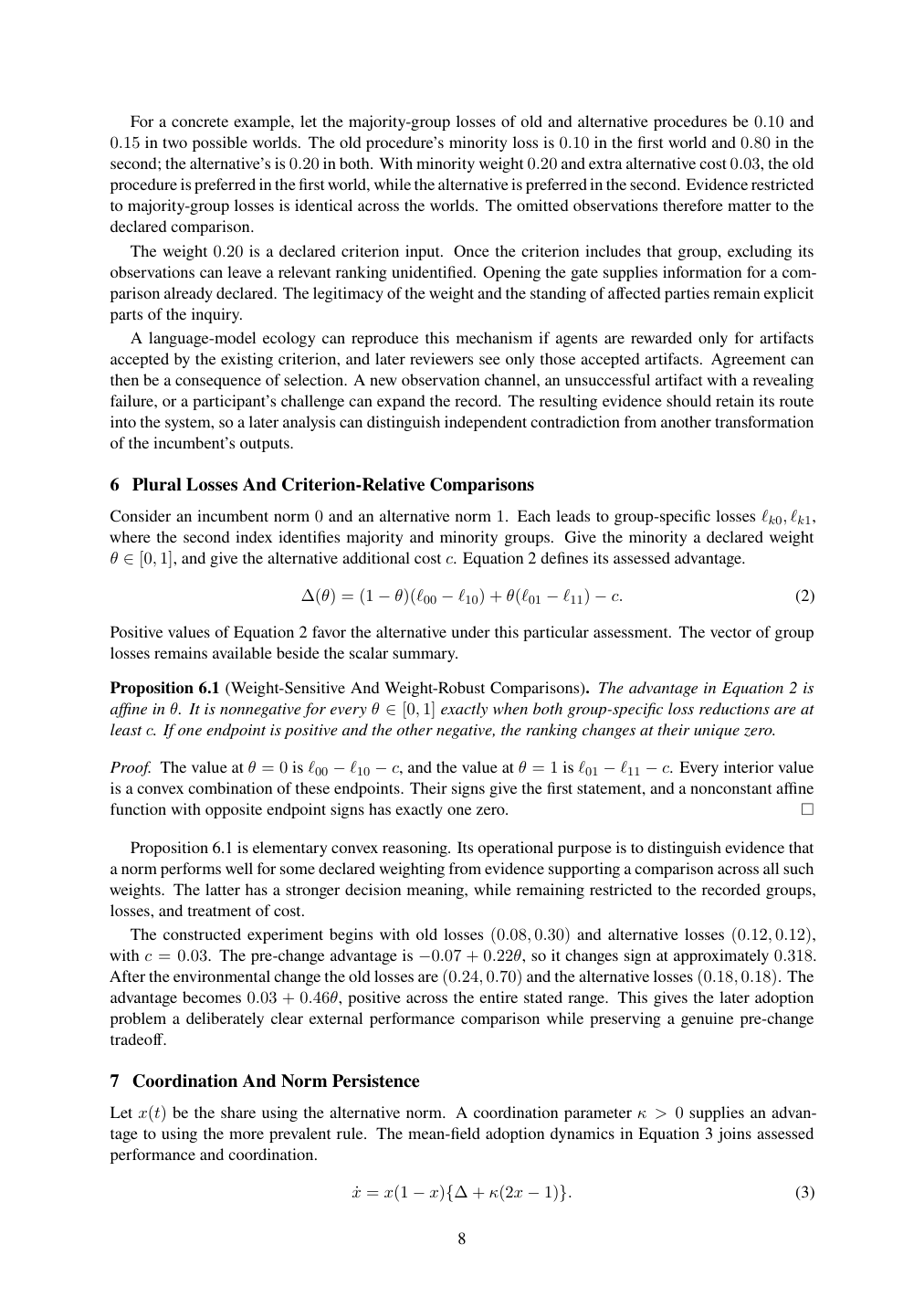
Readable text
procedure is preferred in the first world, while the alternative is preferred in the second. Evidence restricted to majority-group losses is identical across the worlds. The omitted observations therefore matter to the
observations can leave a relevant ranking unidentified. Opening the gate supplies information for a com- parison already declared. The legitimacy of the weight and the standing of affected parties remain explicit
A language-model ecology can reproduce this mechanism if agents are rewarded only for artifacts accepted by the existing criterion, and later reviewers see only those accepted artifacts. Agreement can then be a consequence of selection. A new observation channel, an unsuccessful artifact with a revealing failure, or a participant’s challenge can expand the record. The resulting evidence should retain its route into the system, so a later analysis can distinguish independent contradiction from another transformation
where the second index identifies majority and minority groups. Give the minority a declared weight
Positive values of Equation 2 favor the alternative under this particular assessment. The vector of group
Proposition 6.1 (Weight-Sensitive And Weight-Robust Comparisons). The advantage in Equation 2 is
is a convex combination of these endpoints. Their signs give the first statement, and a nonconstant affine function with opposite endpoint signs has exactly one zero.
Proposition 6.1 is elementary convex reasoning. Its operational purpose is to distinguish evidence that a norm performs well for some declared weighting from evidence supporting a comparison across all such weights. The latter has a stronger decision meaning, while remaining restricted to the recorded groups,
problem a deliberately clear external performance comparison while preserving a genuine pre-change
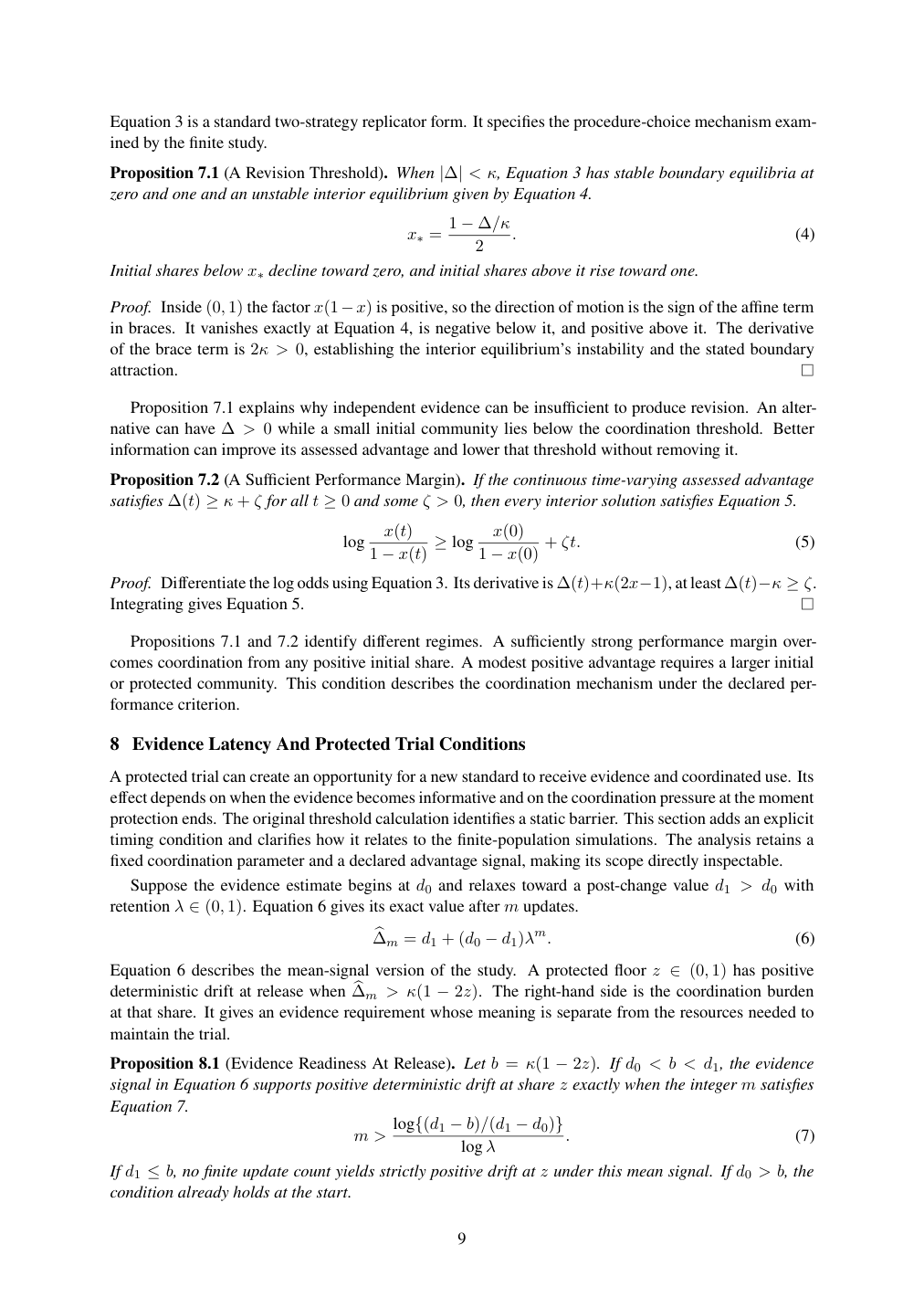
tage to using the more prevalent rule. The mean-field adoption dynamics in Equation 3 joins assessed
Readable text
Equation 3 is a standard two-strategy replicator form. It specifies the procedure-choice mechanism exam-
zero and one and an unstable interior equilibrium given by Equation 4.
in braces. It vanishes exactly at Equation 4, is negative below it, and positive above it. The derivative
Proposition 7.1 explains why independent evidence can be insufficient to produce revision. An alter- information can improve its assessed advantage and lower that threshold without removing it.
Proposition 7.2 (A Sufficient Performance Margin). If the continuous time-varying assessed advantage
Propositions 7.1 and 7.2 identify different regimes. A sufficiently strong performance margin over- comes coordination from any positive initial share. A modest positive advantage requires a larger initial or protected community. This condition describes the coordination mechanism under the declared per-
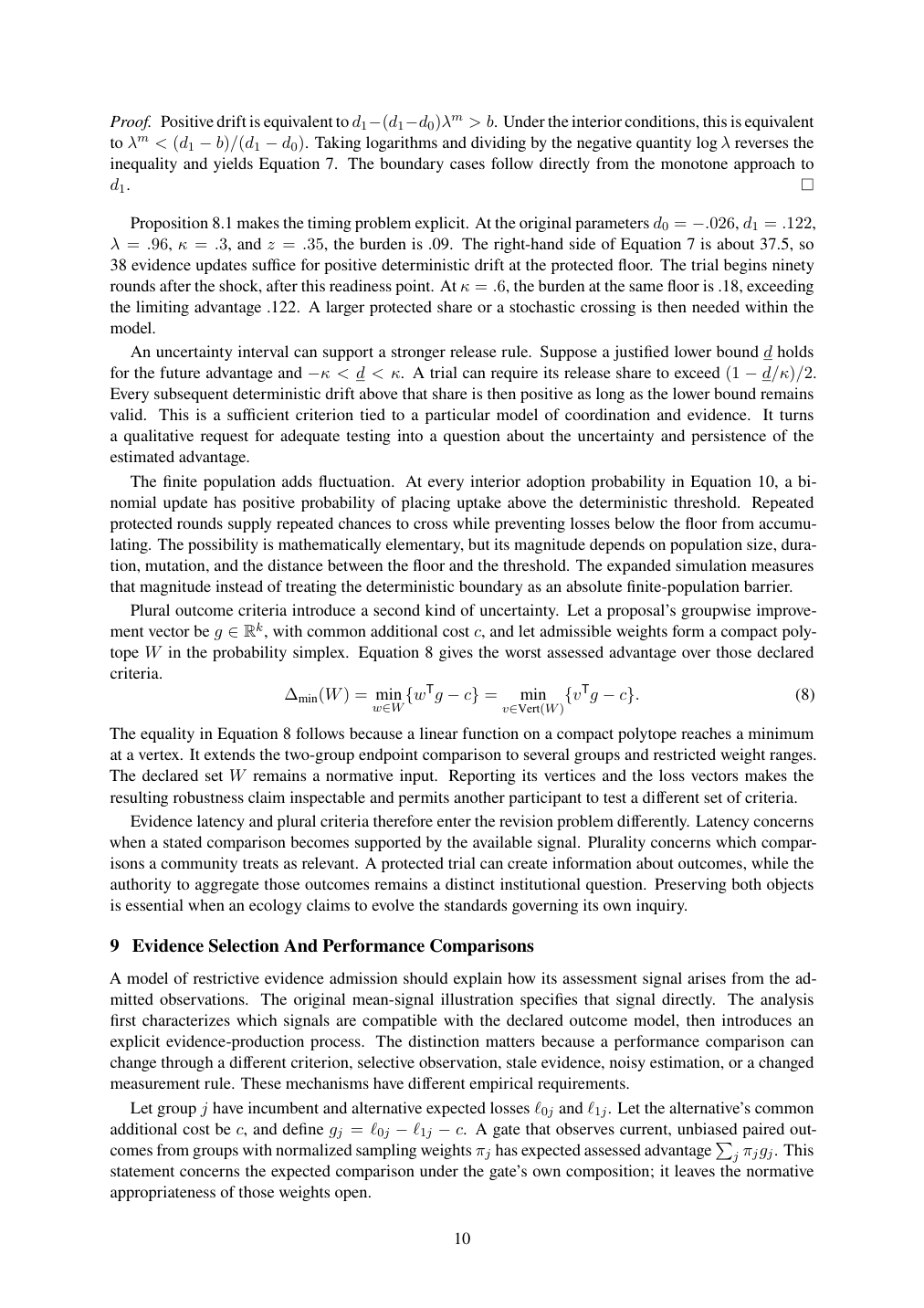
A protected trial can create an opportunity for a new standard to receive evidence and coordinated use. Its effect depends on when the evidence becomes informative and on the coordination pressure at the moment protection ends. The original threshold calculation identifies a static barrier. This section adds an explicit timing condition and clarifies how it relates to the finite-population simulations. The analysis retains a fixed coordination parameter and a declared advantage signal, making its scope directly inspectable.
at that share. It gives an evidence requirement whose meaning is separate from the resources needed to
Readable text
inequality and yields Equation 7. The boundary cases follow directly from the monotone approach to
38 evidence updates suffice for positive deterministic drift at the protected floor. The trial begins ninety the limiting advantage .122. A larger protected share or a stochastic crossing is then needed within the
Every subsequent deterministic drift above that share is then positive as long as the lower bound remains valid. This is a sufficient criterion tied to a particular model of coordination and evidence. It turns a qualitative request for adequate testing into a question about the uncertainty and persistence of the
The finite population adds fluctuation. At every interior adoption probability in Equation 10, a bi- nomial update has positive probability of placing uptake above the deterministic threshold. Repeated protected rounds supply repeated chances to cross while preventing losses below the floor from accumu- lating. The possibility is mathematically elementary, but its magnitude depends on population size, dura- tion, mutation, and the distance between the floor and the threshold. The expanded simulation measures that magnitude instead of treating the deterministic boundary as an absolute finite-population barrier.
Plural outcome criteria introduce a second kind of uncertainty. Let a proposal’s groupwise improve-
The equality in Equation 8 follows because a linear function on a compact polytope reaches a minimum at a vertex. It extends the two-group endpoint comparison to several groups and restricted weight ranges. resulting robustness claim inspectable and permits another participant to test a different set of criteria.
Evidence latency and plural criteria therefore enter the revision problem differently. Latency concerns when a stated comparison becomes supported by the available signal. Plurality concerns which compar- isons a community treats as relevant. A protected trial can create information about outcomes, while the authority to aggregate those outcomes remains a distinct institutional question. Preserving both objects is essential when an ecology claims to evolve the standards governing its own inquiry.
A model of restrictive evidence admission should explain how its assessment signal arises from the ad- mitted observations. The original mean-signal illustration specifies that signal directly. The analysis first characterizes which signals are compatible with the declared outcome model, then introduces an explicit evidence-production process. The distinction matters because a performance comparison can change through a different criterion, selective observation, stale evidence, noisy estimation, or a changed measurement rule. These mechanisms have different empirical requirements.
statement concerns the expected comparison under the gate’s own composition; it leaves the normative


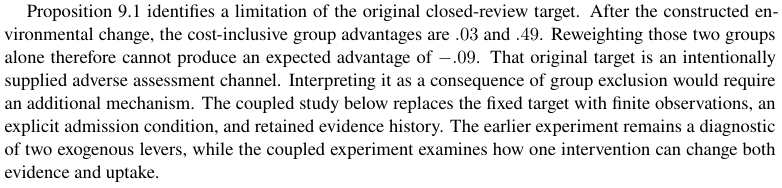
The issue has established theoretical antecedents. Esponda and Pouzo make the observations disciplining beliefs depend on agents’ strategy, with their weighted divergence placing weight on consequences reached under that strategy (Esponda et al., 2016). Their equilibrium and learning results supply a prior framework for action-dependent information. The present process specifies finite matching and score updates as an explicit stochastic mechanism. Its additional contribution is a reproducible norm-revision comparison with recorded evidence eligibility, protected use, historical memory, and plural outcome criteria.


Equation 9 follows by linearity of the group score differences under fixed sample weights. It applies to this frozen-composition diagnostic. Adaptive finite sample counts in the simulation can depend on previous outcomes. The formula describes the fixed-composition diagnostic; the simulation’s conditional expectations require tracking its outcome-dependent counts.

The interpretation remains criterion-relative. The loss comparison can favor an alternative while other procedural or ethical criteria remain disputed. Recognized authority to run a trial, adopt a standard, or change an appeal procedure requires a separately recorded institutional process. The model comparison below measures uptake, observed outcomes, and evidence access under declared rules. Those measurements make several routes to norm revision inspectable while preserving normative justification as a distinct scholarly and institutional task.
10 A Reproducible Finite-Population Illustration
10.1 Experiment Design
The numerical study uses a population of 500 agents, 600 revision rounds, and 300 independent replications. Agents implement finite stochastic adoption transitions. Initial alternative uptake is 0.05. The
Readable text
Closed review Independent evidence Protected trial
Evidence and trial Evidence and trial, strong coordination
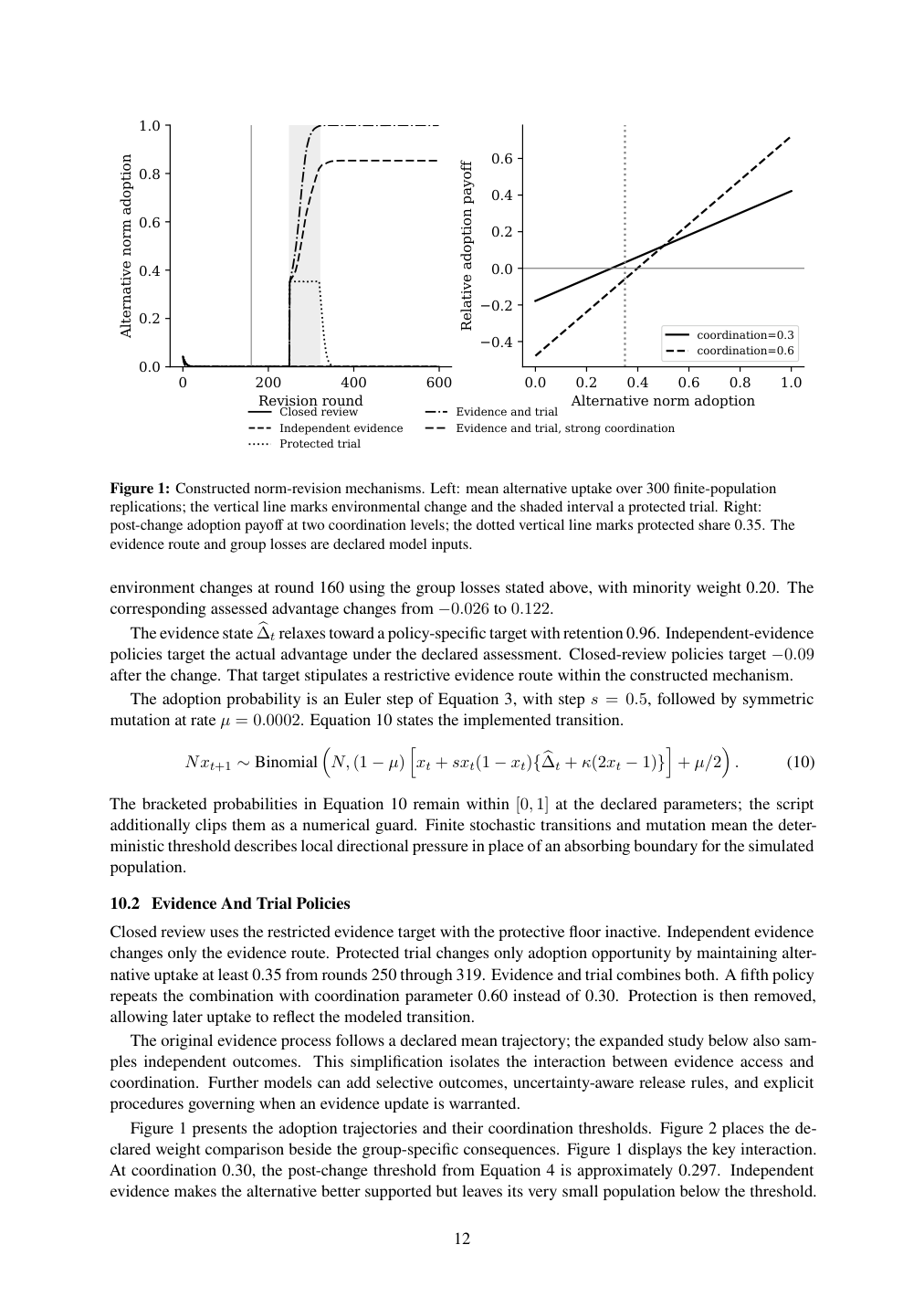
Figure 1: Constructed norm-revision mechanisms. Left: mean alternative uptake over 300 finite-population replications; the vertical line marks environmental change and the shaded interval a protected trial. Right: post-change adoption payoff at two coordination levels; the dotted vertical line marks protected share 0.35. The
evidence route and group losses are declared model inputs.
environment changes at round 160 using the group losses stated above, with minority weight 0.20. The
after the change. That target stipulates a restrictive evidence route within the constructed mechanism.
additionally clips them as a numerical guard. Finite stochastic transitions and mutation mean the deter- ministic threshold describes local directional pressure in place of an absorbing boundary for the simulated
Closed review uses the restricted evidence target with the protective floor inactive. Independent evidence changes only the evidence route. Protected trial changes only adoption opportunity by maintaining alter- native uptake at least 0.35 from rounds 250 through 319. Evidence and trial combines both. A fifth policy repeats the combination with coordination parameter 0.60 instead of 0.30. Protection is then removed,
allowing later uptake to reflect the modeled transition.
The original evidence process follows a declared mean trajectory; the expanded study below also sam- ples independent outcomes. This simplification isolates the interaction between evidence access and coordination. Further models can add selective outcomes, uncertainty-aware release rules, and explicit procedures governing when an evidence update is warranted.
Figure 1 presents the adoption trajectories and their coordination thresholds. Figure 2 places the de- clared weight comparison beside the group-specific consequences. Figure 1 displays the key interaction. At coordination 0.30, the post-change threshold from Equation 4 is approximately 0.297. Independent evidence makes the alternative better supported but leaves its very small population below the threshold.
Readable text
Closed review .0006 Independent evidence .0010 Protected trial .0004 Evidence and trial .9995 Combined, stronger coordination .8532
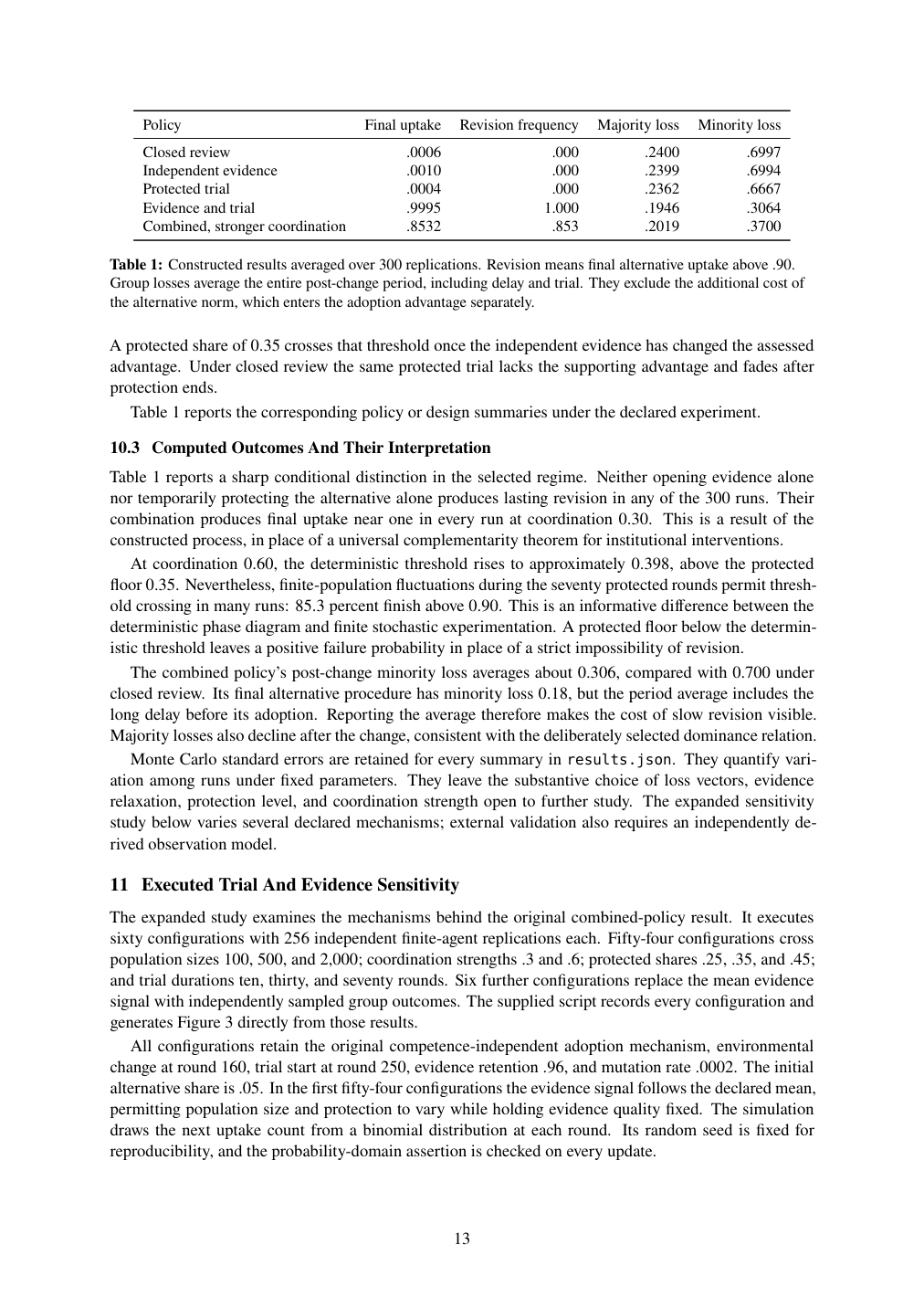
Table 1: Constructed results averaged over 300 replications. Revision means final alternative uptake above .90. Group losses average the entire post-change period, including delay and trial. They exclude the additional cost of the alternative norm, which enters the adoption advantage separately.
A protected share of 0.35 crosses that threshold once the independent evidence has changed the assessed advantage. Under closed review the same protected trial lacks the supporting advantage and fades after
Table 1 reports the corresponding policy or design summaries under the declared experiment.
Table 1 reports a sharp conditional distinction in the selected regime. Neither opening evidence alone nor temporarily protecting the alternative alone produces lasting revision in any of the 300 runs. Their combination produces final uptake near one in every run at coordination 0.30. This is a result of the constructed process, in place of a universal complementarity theorem for institutional interventions.
At coordination 0.60, the deterministic threshold rises to approximately 0.398, above the protected floor 0.35. Nevertheless, finite-population fluctuations during the seventy protected rounds permit thresh- old crossing in many runs: 85.3 percent finish above 0.90. This is an informative difference between the deterministic phase diagram and finite stochastic experimentation. A protected floor below the determin- istic threshold leaves a positive failure probability in place of a strict impossibility of revision.
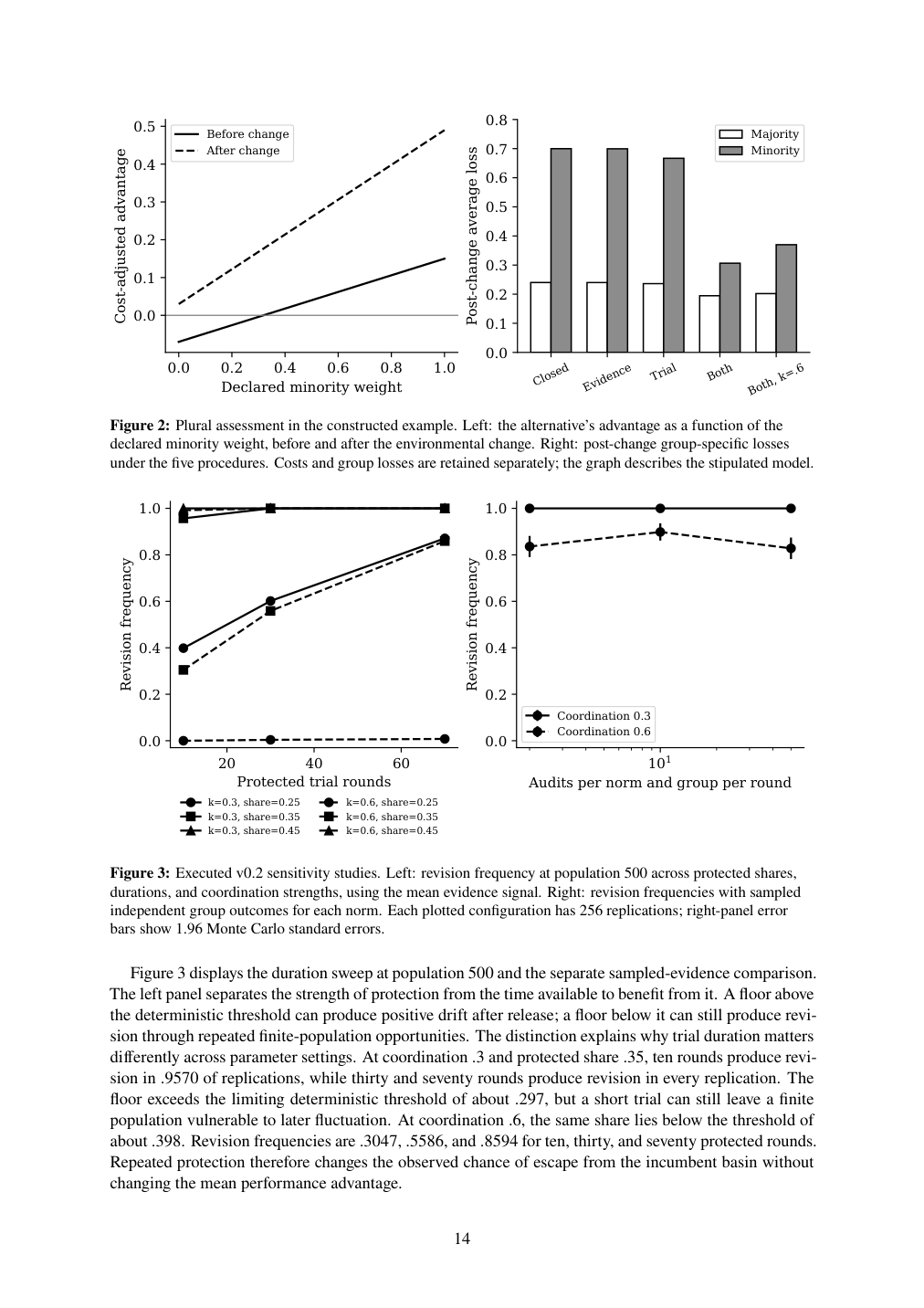
The combined policy’s post-change minority loss averages about 0.306, compared with 0.700 under closed review. Its final alternative procedure has minority loss 0.18, but the period average includes the long delay before its adoption. Reporting the average therefore makes the cost of slow revision visible. Majority losses also decline after the change, consistent with the deliberately selected dominance relation.
Monte Carlo standard errors are retained for every summary in results.json. They quantify vari- ation among runs under fixed parameters. They leave the substantive choice of loss vectors, evidence relaxation, protection level, and coordination strength open to further study. The expanded sensitivity study below varies several declared mechanisms; external validation also requires an independently de-
The expanded study examines the mechanisms behind the original combined-policy result. It executes sixty configurations with 256 independent finite-agent replications each. Fifty-four configurations cross population sizes 100, 500, and 2,000; coordination strengths .3 and .6; protected shares .25, .35, and .45; and trial durations ten, thirty, and seventy rounds. Six further configurations replace the mean evidence signal with independently sampled group outcomes. The supplied script records every configuration and
All configurations retain the original competence-independent adoption mechanism, environmental change at round 160, trial start at round 250, evidence retention .96, and mutation rate .0002. The initial alternative share is .05. In the first fifty-four configurations the evidence signal follows the declared mean, permitting population size and protection to vary while holding evidence quality fixed. The simulation draws the next uptake count from a binomial distribution at each round. Its random seed is fixed for reproducibility, and the probability-domain assertion is checked on every update.
Readable text
Figure 2: Plural assessment in the constructed example. Left: the alternative’s advantage as a function of the declared minority weight, before and after the environmental change. Right: post-change group-specific losses under the five procedures. Costs and group losses are retained separately; the graph describes the stipulated model.
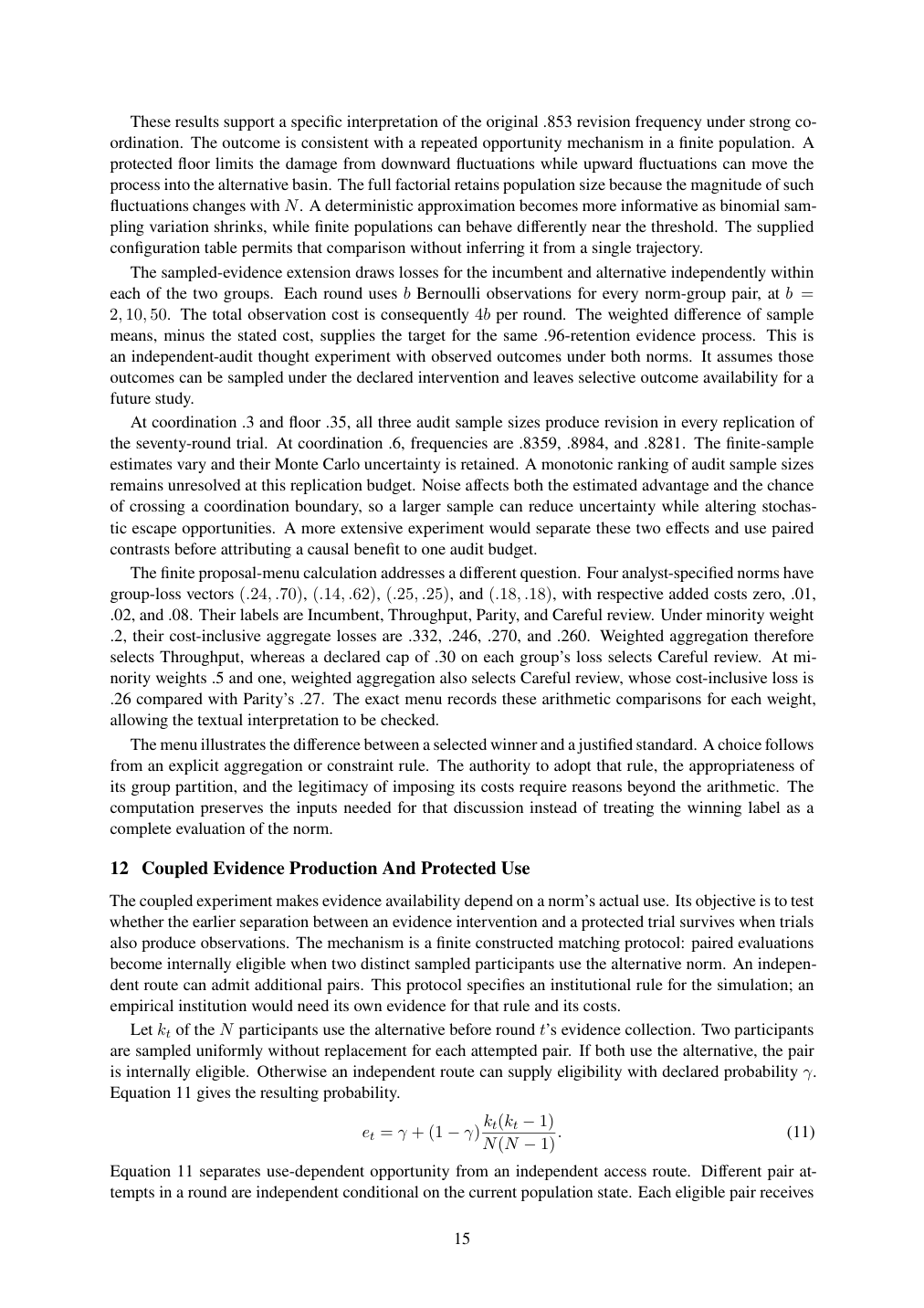
Figure 3: Executed v0.2 sensitivity studies. Left: revision frequency at population 500 across protected shares, durations, and coordination strengths, using the mean evidence signal. Right: revision frequencies with sampled independent group outcomes for each norm. Each plotted configuration has 256 replications; right-panel error
Figure 3 displays the duration sweep at population 500 and the separate sampled-evidence comparison. The left panel separates the strength of protection from the time available to benefit from it. A floor above the deterministic threshold can produce positive drift after release; a floor below it can still produce revi- sion through repeated finite-population opportunities. The distinction explains why trial duration matters differently across parameter settings. At coordination .3 and protected share .35, ten rounds produce revi- sion in .9570 of replications, while thirty and seventy rounds produce revision in every replication. The floor exceeds the limiting deterministic threshold of about .297, but a short trial can still leave a finite population vulnerable to later fluctuation. At coordination .6, the same share lies below the threshold of about .398. Revision frequencies are .3047, .5586, and .8594 for ten, thirty, and seventy protected rounds. Repeated protection therefore changes the observed chance of escape from the incumbent basin without
Readable text
These results support a specific interpretation of the original .853 revision frequency under strong co- ordination. The outcome is consistent with a repeated opportunity mechanism in a finite population. A protected floor limits the damage from downward fluctuations while upward fluctuations can move the process into the alternative basin. The full factorial retains population size because the magnitude of such pling variation shrinks, while finite populations can behave differently near the threshold. The supplied configuration table permits that comparison without inferring it from a single trajectory.
The sampled-evidence extension draws losses for the incumbent and alternative independently within means, minus the stated cost, supplies the target for the same .96-retention evidence process. This is an independent-audit thought experiment with observed outcomes under both norms. It assumes those outcomes can be sampled under the declared intervention and leaves selective outcome availability for a
At coordination .3 and floor .35, all three audit sample sizes produce revision in every replication of the seventy-round trial. At coordination .6, frequencies are .8359, .8984, and .8281. The finite-sample estimates vary and their Monte Carlo uncertainty is retained. A monotonic ranking of audit sample sizes remains unresolved at this replication budget. Noise affects both the estimated advantage and the chance of crossing a coordination boundary, so a larger sample can reduce uncertainty while altering stochas- tic escape opportunities. A more extensive experiment would separate these two effects and use paired contrasts before attributing a causal benefit to one audit budget.
The finite proposal-menu calculation addresses a different question. Four analyst-specified norms have .02, and .08. Their labels are Incumbent, Throughput, Parity, and Careful review. Under minority weight .2, their cost-inclusive aggregate losses are .332, .246, .270, and .260. Weighted aggregation therefore selects Throughput, whereas a declared cap of .30 on each group’s loss selects Careful review. At mi- nority weights .5 and one, weighted aggregation also selects Careful review, whose cost-inclusive loss is .26 compared with Parity’s .27. The exact menu records these arithmetic comparisons for each weight,
The menu illustrates the difference between a selected winner and a justified standard. A choice follows from an explicit aggregation or constraint rule. The authority to adopt that rule, the appropriateness of its group partition, and the legitimacy of imposing its costs require reasons beyond the arithmetic. The computation preserves the inputs needed for that discussion instead of treating the winning label as a
The coupled experiment makes evidence availability depend on a norm’s actual use. Its objective is to test whether the earlier separation between an evidence intervention and a protected trial survives when trials also produce observations. The mechanism is a finite constructed matching protocol: paired evaluations become internally eligible when two distinct sampled participants use the alternative norm. An indepen- dent route can admit additional pairs. This protocol specifies an institutional rule for the simulation; an empirical institution would need its own evidence for that rule and its costs.
are sampled uniformly without replacement for each attempted pair. If both use the alternative, the pair
Equation 11 separates use-dependent opportunity from an independent access route. Different pair at- tempts in a round are independent conditional on the current population state. Each eligible pair receives




The simulation retains the original population size 500, six hundred rounds, environmental change at 160, step size .5, mutation rate .0002, and initial alternative share .05. The protected-use intervention maintains share at least .35 or .45 after each adoption update from rounds 250 through 319. Evidence collection uses the population entering the round, so its guaranteed floor applies to the following seventy evidence rounds,251 through 320. This timing is retained in the parameters and gives the eligibility bound a precise implemented meaning.
Loss estimates use five initial pseudo-observations per norm and group at the pre-change loss rates. A completed pair adds one binary loss observation to each norm’s group-specific score. The weighted score difference minus cost drives the same binomial uptake update as in the earlier experiment. Cumulative scores preserve their full history. A discounting ablation retains .98 of departures from the initial pseudocounts per round. An oracle-reset ablation restarts those counts at the known change time. The reset uses information supplied by the experimenter and serves as a diagnostic of historical inertia.
The factorial crosses two coordination strengths, two independent-route probabilities, three protected shares including zero, two pair-attempt budgets, and three memory rules, yielding seventy-two configurations. Each uses 256 independent replications and a fixed seed. The attempt budget is matched within the relevant comparisons; completed pairs and protected participant-rounds are separately recorded. Eligibility changes actual observation expenditure, so a comparison of complete institutional cost would need to price both activities and the independent route.
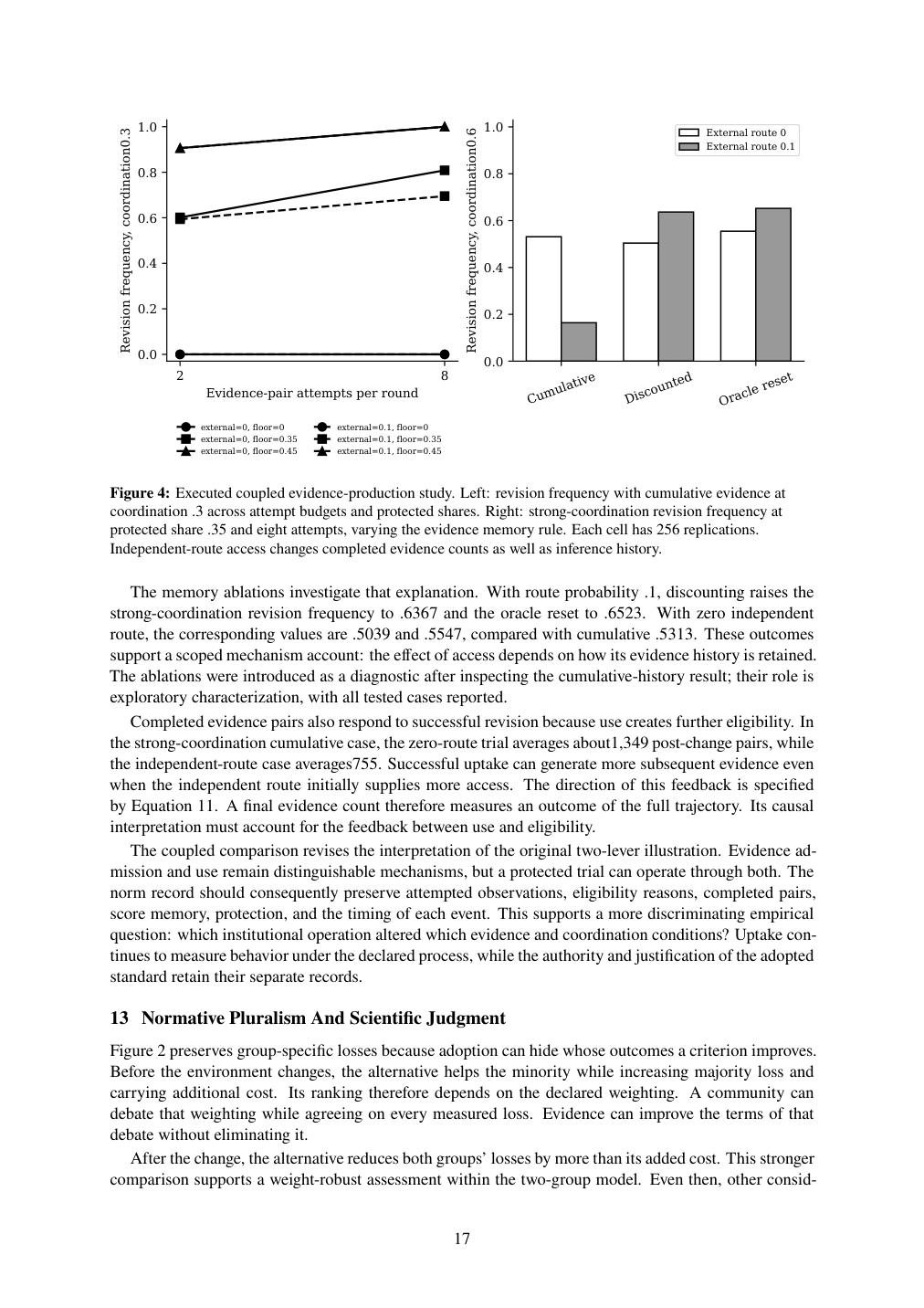
Figure 4 presents the cumulative-memory comparison and the memory ablation. With coordination .3, zero independent route, eight attempts, and protected share .35, revision occurs in .8086 of replications. With protected share .45 it occurs in every replication. The protected trial supplies the observations that
update the assessment as well as the population needed for coordination. In contrast, the zero-protection cases have zero observed revisions even when the independent route generates many current observations. This is a conditional finding about the coupled mechanism. Interventions consequently require an operational description of their effects on the evidence and adoption channels.
The cumulative-memory case also exposes an informative reversal. At coordination .6, protected share .35, and eight attempts, revision frequency is .5313 without an independent route and .1641 with route probability .1. The independent route has already produced pre-change evidence, which remains in the cumulative score after the environment changes. The observed advantage and stochastic escape path consequently differ from a trial whose evidence is gathered mainly after the change. Additional current information and additional historical information enter the same estimator in this mechanism.
Readable text
Figure 4: Executed coupled evidence-production study. Left: revision frequency with cumulative evidence at coordination .3 across attempt budgets and protected shares. Right: strong-coordination revision frequency at protected share .35 and eight attempts, varying the evidence memory rule. Each cell has 256 replications. Independent-route access changes completed evidence counts as well as inference history.
The memory ablations investigate that explanation. With route probability .1, discounting raises the strong-coordination revision frequency to .6367 and the oracle reset to .6523. With zero independent route, the corresponding values are .5039 and .5547, compared with cumulative .5313. These outcomes support a scoped mechanism account: the effect of access depends on how its evidence history is retained. The ablations were introduced as a diagnostic after inspecting the cumulative-history result; their role is exploratory characterization, with all tested cases reported.
Completed evidence pairs also respond to successful revision because use creates further eligibility. In the strong-coordination cumulative case, the zero-route trial averages about1,349 post-change pairs, while the independent-route case averages755. Successful uptake can generate more subsequent evidence even when the independent route initially supplies more access. The direction of this feedback is specified by Equation 11. A final evidence count therefore measures an outcome of the full trajectory. Its causal interpretation must account for the feedback between use and eligibility.
The coupled comparison revises the interpretation of the original two-lever illustration. Evidence ad- mission and use remain distinguishable mechanisms, but a protected trial can operate through both. The norm record should consequently preserve attempted observations, eligibility reasons, completed pairs, score memory, protection, and the timing of each event. This supports a more discriminating empirical question: which institutional operation altered which evidence and coordination conditions? Uptake con- tinues to measure behavior under the declared process, while the authority and justification of the adopted
Figure 2 preserves group-specific losses because adoption can hide whose outcomes a criterion improves. Before the environment changes, the alternative helps the minority while increasing majority loss and carrying additional cost. Its ranking therefore depends on the declared weighting. A community can debate that weighting while agreeing on every measured loss. Evidence can improve the terms of that
After the change, the alternative reduces both groups’ losses by more than its added cost. This stronger comparison supports a weight-robust assessment within the two-group model. Even then, other consid-
erations can remain relevant: the distribution within each group, the procedures by which losses were measured, and the legitimacy of the institution’s powers. The model’s clear dominance case isolates coordination barriers within this limited outcome comparison.
This distinction also matters for emergent normativity. An agent may inherit a disposition to value independent replication, imitate a successful verification practice, or invoke an authorized precedent. These are different relations to a norm. Endorsement of reasons, understanding of scope, and capacity for challenge require observations beyond compliance. A mature research ecology needs observations of those capacities if its claims concern evaluative understanding.
The Generative Relational orientation motivates attention to how norms are sustained by continuing relations among subjects, artifacts, and institutions. Their reproduction can create value by making inquiry coordinated and accountable. The same reproduction can restrict which alternatives receive attention. The present analysis makes that tension explicit through separate evidence and coordination mechanisms. It supplies a technical object for philosophical criticism while leaving the ultimate evaluation historically situated and open to affected parties.
14 Appeal, Plural Criteria, And Recorded Reasons
A standard’s revision procedure is part of its institutional meaning. A community can endorse independent replication while making the cost of requesting one prohibitive. It can permit an appeal in principle while giving affected parties little access to the evidence needed to formulate it. A research infrastructure should therefore record the practical route from a challenge to a possible change in judgment. This route joins epistemic and political questions: what can be established, who can introduce it, and which institution can act on it.
A challenge begins with standing. The norm record can specify whether a challenge may be initiated by the evaluated actor, an affected participant, an appointed reviewer, an automated monitor, or any contributor with relevant evidence. Standing creates access to a procedure whose subsequent review addresses the merits of the challenge. The procedure can require a bounded statement identifying a disputed case, rule component, or consequence. This makes it possible to organize a review while preserving unconventional objections that reveal a limitation in the original classification.
Evidence admission should identify both available and excluded materials. A field’s usual instruments may measure one outcome well while missing another group’s experience. A technically reproducible result can still have a restricted domain. A challenger can therefore dispute the completeness of the outcome model even when every recorded measurement is accurate. An infrastructure that stores excluded evidence and its reason for exclusion gives later investigators a way to examine that dispute. It also makes disciplinary boundaries visible as revisable methodological choices.
Plural criteria can be represented as a family of assessments. The two-group model uses a weight interval, and Equation 8 extends the calculation to a compact polytope. In an operational setting, some criteria will be constraints or qualitative judgments whose meaning resists a shared numerical scale. The record can preserve those assessments alongside the computable loss vectors. A numerical comparison then has an explicit scope: it evaluates the encoded criteria while the accompanying reasons explain what the encoding omits or simplifies.
An appeal panel or process requires an authorization record. The institution should identify who can revise a verdict, who can revise the rule, and who can revise the appeal procedure. These permissions can differ. A reviewer may correct a mistaken application without being authorized to replace the criterion. A broader body may amend the criterion after considering several cases. Keeping those operations distinct helps explain how a norm changes through practice. It also permits an investigation of whether the appeal route has become dependent on the very actors or standards it is supposed to examine.
A decision on appeal should preserve reasons and dissent. The record can identify which evidence changed the assessment, which interpretation was adopted, which value judgment remained contested, and which future observation could reopen the issue. A dissenter’s account can retain epistemic value alongside the prevailing rule. It can specify a circumstance in which the current standard is expected to
fail. That account becomes a candidate for future testing, connecting institutional disagreement to the generation of new research questions.
Resource access is another component of appeal. A trial requires time, computational capacity, documentation, and sometimes access to physical or social settings. A proposal’s lack of uptake may reflect these constraints. The protected-share intervention abstracts the provision of an opportunity while omitting its detailed costs. An implemented study should measure the resources used to sustain the trial, the opportunity costs imposed on other work, and the conditions under which protection ends. These measurements help distinguish an unpromising proposal from one that has received an inadequate test.
The appeal process itself can be revised. A community might discover that the required evidence is available only to incumbent institutions or that a threshold systematically excludes an important class of cases. A recursive norm record can preserve the amendment to the procedure, its reasons, and the boundary within which the amendment was authorized. Each experiment still needs a fixed constitutional scope so its outcomes have a determinate meaning. A subsequent experiment can examine a different scope or a changed revision mechanism.
The Generative Relational perspective gives this structure a philosophical purpose. Norms obtain meaning through their use among subjects, artifacts, and institutions, and those relations create possibilities for criticism as well as coordination. Preserving a rule’s lineage, cases, and appeal history allows its meaning to evolve through inquiry. The infrastructure’s role is to maintain the conditions under which those relations can generate further knowledge, while the justification of a particular standard remains attributable to the participants and reasons that support it.
15 Semantic Stability And Norm Interpretation
An evaluative norm has a text, an interpretation, and a pattern of decisions. These objects can evolve at different rates. A community may retain the same wording while changing the cases it treats as equivalent. Another community may paraphrase a rule while preserving its practical effect. A study of norm emergence should therefore measure semantic stability alongside textual change and uptake. This is particularly important when language-model agents generate, summarize, and apply criteria across disciplinary vocabularies.
A bounded implementation can begin with case-based tests. Each norm version carries a set of representative artifacts, admitted evidence, and expected verdicts under a documented interpretation. A revised version is applied to the same cases and to cases designed to expose its new distinction. The record then identifies which judgments change and which reasons explain the change. This approach gives a proposal a behavioral footprint without claiming that a finite test suite exhausts its meaning.
Metamorphic comparisons can examine invariances a rule claims to respect. Changing an artifact identifier should leave a verdict stable under a declared identifier invariance. Converting units should preserve a measurement judgment after the threshold is converted consistently. Rephrasing an equivalent objection should preserve its eligibility for review. A failed comparison can reveal an interpretation problem, a hidden dependence on irrelevant features, or an incomplete statement of the rule’s scope. Each possibility creates a different revision task.
Some differences are relevant precisely because the norm is situated. A standard for a laboratory experiment can legitimately require evidence unavailable in an archival inquiry, while an account of participant experience can demand an admission route absent from an instrument-based protocol. Cross-disciplinary transfer should therefore record the translation of scope and evidence requirements. A rule that coordinates one domain can become a source of exclusion when imported with its assumptions left implicit. The infrastructure can preserve that transfer as a norm-lineage event with its own supporting reasons and contested cases.
Reason records also require interpretation. An agent can reproduce a familiar justification without applying it consistently, and a concise verdict can rely on a stable practice whose reasons are poorly documented. A validation study can compare stated reasons with responses to deliberately varied cases. It can also ask whether a challenger can use the recorded reason to identify a condition under which the
Element Contribution standing and scope
Norm emergence Established antecedent in evolutionary games, social conventions, and generative-agent architectures. Norm record Report-specific design separating scope, evidence admission, rule, uptake, revision, and reasons. Conditional analysis Coordination and readiness calculations, dominance under group selection, and protected-use evidence-opportunity bounds. Executed studies Mean-signal and trial reference studies, exact proposal menu, and 72 coupled evidence-production/memory configurations. Institutional design Proposed norm lifecycle, authorization, appeal, lineage, and reason records. External validation Prospective semantic proposal generation, human interpretation, and implemented norm-review studies.
Table 2: Contribution assessment for evaluative norms. Adoption results describe declared finite agents, while authority and justification require separately recorded procedures and reasons.
verdict should change. This makes reasons useful for future criticism instead of treating their presence as sufficient evidence of understanding.
The finite simulations prepare the data and accountability structure in which those capacities can later be examined. Norm texts, case behavior, authority records, appeal histories, and outcome evidence can be linked while retaining their different meanings. This design supports the larger research goal: allowing evaluative standards to evolve through interaction among AI systems and human participants while preserving an inspectable account of what the standards require and why a community grants them force.
16 Contribution Assessment And Validation Design
The report’s principal contribution is a structured account of evaluative-norm revision that keeps uptake, authority, and criterion-relative warrant distinct. Its finite analysis connects evidence admission to coordination, while the coupled comparison makes evidence production depend on use and historical score memory. The resulting model comparison sharpens the interpretation of exogenous evidence and protected-trial interventions. Table 2 gives the standing of each element. This assessment narrows the research claim to what the report actually constructs and executes.
The strongest technical insight is a timing and opportunity relation. A useful alternative can have adequate external support while coordination keeps its population below a threshold. A protected trial can supply repeated opportunities, yet its release condition depends on the evidence available at that time. The readiness calculation and duration sweep make these relations explicit. They give an implementation a set of measurable quantities: evidence latency, protected uptake, coordination cost, release conditions, and subsequent revision frequency.
The plural-criterion calculation adds a different insight. A proposal can win under one aggregation rule and lose under another while all participants agree on the outcome estimates. The proposal menu demonstrates this distinction with exact arithmetic. Consequently, a study of norm emergence should preserve the choice of criterion as an input or an event in the norm lineage. Otherwise a successful adoption can be misread as evidence of a normative conclusion that the experiment assumed at the outset.
External validation can proceed through three stages. The first implements the finite norm record and checks that an amendment preserves previous cases, authority scopes, evidence sources, and dissent. The second introduces language-model agents that interpret and apply a fixed set of norm texts to common artifacts. Their decisions can be compared across paraphrases and cases to measure semantic stability. The third permits agents to propose revisions while an independent process records the reasons, consequences, and authority under which those proposals receive a trial. Each stage adds a distinct uncertainty and should retain the measurements established at the earlier stages.
A semantic-generation study requires particular care in defining novelty. A new criterion string can repeat an existing rule, while a small change in evidence admission can alter a large class of decisions.
Behavioral comparison on shared cases can complement textual lineage. A proposal’s contribution can be assessed through the previously excluded distinctions it makes available, the failures it corrects, and the resources its use requires. This aligns the norm study with the repository’s broader interest in generating new relations among disciplinary practices.
Human participation becomes essential where a criterion governs consequential research judgments. A bounded study can invite participants to inspect candidate rules, identify missing outcomes, and challenge the model’s group partition or authority assumptions. Such participation supplies evidence about interpretation and standing that the finite simulation omits by construction. It also permits a direct study of whether the infrastructure helps participants articulate disagreements and trace how a revision changes decisions.
Future experiments should preserve several outcome families. Uptake measures coordination; case accuracy measures performance under an external standard; group-specific consequences reveal distribution; appeal access measures the practical possibility of challenge; and reason quality concerns whether a change can be explained and criticized. These measurements may disagree. Their disagreement is informative because an evaluative norm has several institutional and epistemic roles. A single success score would discard the relation among those roles that motivates the report.
The contribution remains deliberately scoped. The proofs establish conditional properties of a declared mean-field process and finite loss comparisons. The numerical results establish behavior of the supplied stochastic mechanisms. The operational design specifies records and procedures through which an implemented ecology could study the emergence and revision of its standards. Together these elements provide a technical foundation for a larger inquiry into how AI and human communities can evolve evaluative practices while preserving the capacity to examine their evidence, consequences, and authority.
17 Conclusion
Evaluative-norm revision depends on how evidence is produced, retained, and used within a coordination process. The reference threshold model separates evidence and use; the coupled model shows that a protected trial can change both. A dominance diagnostic constrains the interpretation of adverse assessment signals, and an explicit matching protocol gives a bound on the evidence opportunities created by protected use.
The seventy-two-case comparison further shows why access and historical memory belong in the same trajectory record. An independent route can accumulate pre-change evidence that delays later revision, while discounting and a diagnostic reset alter that effect. These are observations of the declared finite mechanism. Norm uptake, criterion-relative performance, institutional authority, and normative reasons retain distinct standing. The proposed lifecycle preserves their relations so that an evolving research community can examine both its standards and the grounds on which it grants them force.
References
Iacob, Alex et al.. (2026). The Red Queen G”odel Machine: Co-Evolving Agents and Their Evaluators. Preprint,
arXiv:2606.26294v3. https://arxiv.org/html/2606.26294v3. Zhang, Yaolun; Xu, Tianyi; Zhao, Yujie; Zhao, Jishen; Wu, Qingyun; Wang, Huazheng. (2026). EvalResearchBench:
Can AI Agents Build Their Own Feedback for Recursive Self-Improvement?. Preprint, arXiv:2610.04184v2. https://arxiv.org/html/2610.04184v2. Noetarium Project. (2026). An ecology that improves the infrastructure: evolution without an appointed evaluator.
Repository design note, commit 869fe38afac257cd9b5d51ad5b498a8ff6b8e443. https://github.com/huang wanhong-maker/Noetarium-The-Science-and-Humanity-Infrastructure/blob/869fe38afac257c d9b5d51ad5b498a8ff6b8e443/development/ideas/2026-11-19-an-ecology-that-improves-the-i nfrastructure.md. Bicchieri, Cristina. (2017). Norms in the Wild: How to Diagnose, Measure, and Change Social Norms. Oxford
University Press. https://doi.org/10.1093/acprof:oso/9780190622046.001.0001.
Centola, Damon; Becker, Joshua; Brackbill, Devon; Baronchelli, Andrea. (2018). Experimental Evidence for Tip-
ping Points in Social Convention. Science 360:1116–1119. https://ndg.asc.upenn.edu/wp-content/upl oads/2018/09/Experimental-evidence-for-tipping.pdf. Longino, Helen E.. (1990). Science as Social Knowledge: Values and Objectivity in Scientific Inquiry. Princeton
University Press. https://doi.org/10.1515/9780691209753. Young, H. Peyton. (1993). The Evolution of Conventions. Econometrica 61(1):57–84. https://doi.org/10.2
307/2951778. Ren, Siyue; Cui, Zhiyao; Song, Ruiqi; Wang, Zhen; Hu, Shuyue. (2024). Emergence of Social Norms in Generative
Agent Societies: Principles and Architecture. Proceedings of IJCAI 2024; arXiv:2403.08251v4. https://arxi v.org/html/2403.08251v4. Axelrod, Robert. (1986). An Evolutionary Approach to Norms. American Political Science Review 80(4):1095–
- https://doi.org/10.2307/1960858. Ostrom, Elinor. (2000). Collective Action and the Evolution of Social Norms. Journal of Economic Perspectives
14(3):137–158. https://www.aeaweb.org/articles?id=10.1257/jep.14.3.137. Ashery, Ariel Flint; Aiello, Luca Maria; Baronchelli, Andrea. (2025). Emergent Social Conventions and Collective
Bias in LLM Populations. Science Advances 11(20):eadu9368. https://pmc.ncbi.nlm.nih.gov/article s/PMC12077490/. Bai, Yuntao et al.. (2022). Constitutional AI: Harmlessness from AI Feedback. Preprint, arXiv:2212.08073. https:
//arxiv.org/abs/2212.08073. Esponda, Ignacio; Pouzo, Demian. (2016). Berk–Nash Equilibrium: A Framework for Modeling Agents with Mis-
specified Models. Econometrica 84(3):1093–1130; accessed arXiv revision2019. https://doi.org/10.398 2/ECTA12609.