The Economics Of Verification In Agent Challenge Markets
Full text from the PDF
The Economics Of Verification In Agent Challenge Markets
Wanhong HUANG
Abstract
Verification challenge markets reward fault discovery, while successful correction can reduce later opportunities sustaining search. This report studies continuity through established bounty and monitoring theory, restricted entry games, correction feedback and assigned-audit observation models. The report-specific contribution connects participation, heterogeneous coverage and reliability observation within a revisable scientific infrastructure. A homogeneous example has zero voluntary entry at prevalence 0.05 while three invited searches reduce declared social cost from 10 to 4.25. A 6,080-cell grid shows both under-entry and excess entry. A heterogeneous uniform-share game admits an exact harmonic potential, and an explicit recurrence gives a correction-participation two-cycle. Assigned audit counts identify visible prevalence and detection capability under stated assumptions; common blind regions preserve ambiguity about total prevalence. A robust invitation extension selects heterogeneous subsets meeting a residual-risk target across prevalence, detection and blindness bounds. When prevalence includes zero and effort is enforceable, known agent costs give the weakparticipation funding infimum. Exhaustive enumeration of 256 subsets across 90 targets improves on two fixed-order procurement baselines in the constructed pool. Forty-five stress cases expose sensitivity to coverage bounds. The report supplies reproducible calculations and contract designs while attributing paid experts and incentive mechanisms to their predecessors. Empirical cost, effort and coverage validation remains necessary for a field market.
Keywords: verification markets; challenge incentives; retained audits; fault detection; scientific infrastructure
Technical Report Note
This technical report shares an evolving inquiry and invites dialogue, criticism, revision, and independent development. Its definitions, distinctions, and constructions remain open to refinement. Circulation across scholarly and practical communities is part of the purpose of releasing the manuscript.
The author treats the viewpoints, concepts, and lines of reasoning presented here as contributions to a shared field of inquiry. Similar or related ideas may have appeared in other intellectual, cultural, and disciplinary traditions. The manuscript identifies known antecedents and distinguishes inherited positions, interpretive proposals, and arguments developed here. Historical priority remains open to further investigation.
The constructions and arguments are presented with their stated assumptions and evidential scope. Readers are encouraged to question, test, revise, extend, reinterpret, or independently develop the ideas presented here. Where appropriate, acknowledgment of this paper as one point of encounter in the development of a related idea is appreciated. Such acknowledgment records an intellectual route; the ideas remain available for criticism, revision, and independent development.
Definitions introduced by the paper are local analytical stipulations unless attributed to another source. Their use identifies the scope of the present argument; terminological and historical priority remain subjects for independent investigation. Generative Relational theory is treated as an open research programme whose proposals receive critical examination alongside independent literature.
Responsible Use and Rights Reservation
This section records a request for responsible scholarly conduct and identifies the scope of retained rights. Legal permissions are governed by the licence on the following page.
The author encourages good-faith discussion, criticism, independent inquiry, and responsible use of the material. Separately from the licence’s terms, the author asks users to consider foreseeable harms when adapting the arguments, representations, or examples of this paper, particularly in scientific inquiry, institutional decisions, and computational knowledge infrastructures. The ethical request leaves the licence’s permissions and legally authorised uses unchanged.
The author retains the rights preserved under CC BY-NC 4.0 and may pursue remedies to which the author is legally entitled for breach of the licence or violation of independently applicable rights. Reuse remains independent from authorial endorsement. Third-party rights require authorisation from their respective holders where applicable. Copyright exceptions and limitations, including applicable forms of fair use or fair dealing, remain available.
Notices
This page consolidates the manuscript’s research status, licence, development disclosure, researchprogramme relation, and suggested citation.
Status. This technical report is prepared for the author’s substantive review and subsequent scholarly discussion. The report distinguishes established antecedents, conditional results developed here, inspected source artifacts, and numerical illustrations under declared assumptions. Internal checks assess the stated arguments and examples; independent scholarly assessment can further test their interpretation and adequacy. The source ledgers record the access level and claim scope of consulted works.
Licence. Except where otherwise indicated, copyright 2026 Wanhong Huang. This work is made available under the Creative Commons Attribution-NonCommercial 4.0 International License (CC BY-NC 4.0). Subject to its terms, the licence permits sharing and adaptation for noncommercial purposes with appropriate attribution, a link to the licence, and an indication of changes. Attribution should preserve the licensor’s independence from the reuse. Reuse is governed solely by the licence; the responsible-use request on the preceding page remains separate from its terms. The licence deed and legal code are available at https://creativecommons.org/licenses/by-nc/4.0/. The licence governs in case of conflict with this summary. Third-party material remains subject to its respective rights.
Statement on the use of language models. Preparation involved OpenAI’s ChatGPT and Codex. Language models supported exploratory dialogue, source discovery and checking, argumentative criticism, manuscript revision, LATEX typesetting, and the development of supporting code and figures. Verification used the sources and access levels recorded in the accompanying ledgers. The author initiated the research questions and directed the research programme; interpretation, acceptance of the arguments, and publication decisions remain subject to the author’s review. Authorship credit and responsibility for the released manuscript remain with the human author.
Code and data availability. The supporting Python entry games, correction recurrence, heterogeneous subset enumeration, assigned-audit simulations, source records, and computed figures accompany the manuscript. The historical corrected record and constructed studies retain separate provenance. The source package contains the editable manuscript, source ledgers, supporting scripts and outputs, and a reading guide. Numerical illustrations, where present, use the assumptions stated in their captions and text.
Related research programme. This report belongs to the Noetarium technical report series. Companion reports study inference, computation, evaluation, governance, and cross-disciplinary knowledge formation. The reports develop distinct technical questions within an open Generative Relational research programme.
Suggested citation. Huang, Wanhong. “The Economics Of Verification In Agent Challenge Markets.” Technical report, 2026.
1 Verification Objectives And Economic Scope
An evolving scientific infrastructure needs agents that create work and agents that test it. A challenge market offers one way to connect those activities: a producer makes a claim, a challenger searches for a counterexample, and a reproducible adjudication transfers a stake when the challenge succeeds. The arrangement converts some errors into opportunities for productive scrutiny. Its continuation depends on the economics of finding the next error.
The central difficulty is dynamic. Successful verification can lower fault prevalence. That improvement reduces the expected reward from another search, even when an undiscovered fault would impose substantial downstream costs. New work, dependency updates, and changing environments can later create faults again. Verification organized entirely around successful discoveries may therefore become intermittent. A quiet challenge record can indicate reliable work, weak participation, common blind spots, or some combination of these.
Noetarium’s project-ecology records motivate this question concretely. In a small saved study, challengers lost resources on units with few faults and gained on a unit with more faults. The record also separates attempts, refutations, and conserved resources. These are useful observations of a mechanism, with substantial limits on scale and generality. The present report develops a formal baseline and exact constructed examples that clarify what would need to be measured in a larger agent ecology.
Three distinctions organize the analysis. Private reward differs from social loss prevented. A successful challenge differs from maintained checking capacity. Independent searches differ from independent access to the evidence needed to find a fault. Each distinction affects the design of a verification institution. The report derives conditions under which voluntary checking becomes unattractive, characterizes a restricted retained-audit remedy, and connects the mechanism to a correction-and-drift process with an explicit two-cycle.
1.1 Research Questions And Units Of Assessment
The analytical object is a verification service operating on an evolving collection of research artifacts. An artifact can be a function, dataset transformation, model interface, or other claim with a declared fault class. A searcher supplies effort toward finding a fault in that class. An adjudicator applies an acceptance procedure. A funding arrangement transfers resources for discoveries or for inspectable verification work. The report treats these as separate components because each can change while the others remain fixed.
Three research questions organize the development. The first concerns allocation: how do private entry incentives compare with a declared benchmark for prevented downstream loss? The second concerns continuity: how can successful correction alter the incentives sustaining later verification? The third concerns observation: what can discovery records reveal about prevalence and detection capability when participation itself responds to opportunities? Restricted games, an affine feedback construction, and assigned-audit calculations make these questions explicit.
The scientific-infrastructure setting gives downstream dependencies a central role. A fault in a shared convention, unit conversion, or data adapter can affect many later analyses. Its immediate producer may have a small reward budget, while its consequences are distributed across users. Verification can consequently have several beneficiaries and several parties capable of contributing resources. The model represents one aspect of that relation through a downstream-loss parameter; allocation of responsibility and access remains an institutional choice.
The report also distinguishes the unit being counted. A discovery is an accepted fault report. An attempt is an executed search with a specified target and method. A corrected artifact is a version whose earlier fault has been repaired under a declared assessment. Retained capacity is an arrangement supporting future inspectable work. Each has value for a different reason. A market that publishes only successful discoveries gives a partial account of these activities.
1.2 Evidence Layers And Contribution Scope
The completed analysis combines verified primary literature, source records, restricted proofs, and executed constructed studies. The literature establishes that costly search, bounty design, paid experts, and incentive crowding are existing research topics. The source records motivate an infrastructure-specific question about resources earned and lost through challenge. The proofs state the assumptions under which the game and observation calculations apply. The numerical studies evaluate those calculations over declared finite domains.
The local contribution is a connected account of entry, correction feedback, coverage, and observation continuity. Its value lies in making their interfaces testable. A private participation equilibrium can be compared with a downstream-loss benchmark. A correction rule can feed its result into the next round’s opportunities. An audit assignment can preserve information about detection when voluntary activity becomes sparse. The report specifies each connection and examines where its scope changes.
The executed extensions deepen the original illustration in three directions. A homogeneous grid varies bounty and prevalence to show both under-entry and excess entry relative to the chosen social objective. A heterogeneous finite game separates the composition of search effort from its count. A repeated-sample audit study examines algebraic identification and the instability of ratio estimators at low discovery rates. These constructions supply reproducible mechanisms for later evaluation.
An application study would need estimates or bounds for fault classes, search costs, detection capabilities, consequences, and available evidence. It would also need a defensible account of what the adjudicator can settle. The present report uses exact adjudication for a declared computational fault class and observable or enforceable search effort. Those assumptions permit clear calculations. Their empirical adequacy is part of the proposed comparative programme.
The retained-capacity analysis also computes a heterogeneous invitation frontier for a declared residualrisk target across prevalence, detection and common-blind bounds. Including zero prevalence makes the required continuity funding explicit under enforceable effort. Exact subset enumeration is compared with two procurement heuristics. This local result connects continuity funding to coverage assumptions while preserving the prior literature on paid experts and incentive crowding.
2 Verified Research On Search Incentives And Monitoring
2.1 Bug-Bounty Contests
Bug-bounty schemes already have a substantial theoretical literature. Gersbach et al. (2023) studies costly decentralized search, heterogeneous private costs, participation, paid experts, artificial bugs, and prize design. Their results directly establish that a large invited populations can retain residual discovery risk. The finite homogeneous entry model used below is a deliberately simpler reference case within that research tradition.
Empirical evidence also shows that incentives can change discovery behavior. Wang et al. (2025) analyzes a major reward change in Google’s vulnerability-reward programme and distinguishes responses by existing and newly attracted researchers. The study motivates examining incentive sensitivity in scientificagent verification. Its empirical setting and the present constructed parameters retain their separate scopes.
The report’s prospective contribution concerns the connection between entry incentives, quality changed by earlier checking, and verification continuity within a shared scientific dependency structure. The individual contest formulas are established ingredients. The exact feedback construction and its observability implications provide a scoped mechanism study that can be tested and extended.
2.2 Common Failures And Scientific Claims
A common model, specification, or test oracle can create a shared blind region. The classic multiversion study by Knight and Leveson (1986) supplies an important antecedent for examining dependent failures. In an agent setting, effective evidence diversity requires assessment beyond model names. Agents can
inherit the same data omissions or interpretation, so additional searches should be assessed for complementary coverage.
Scientific claims also vary in adjudicability. A finite input-output claim may admit a decisive counterexample. A causal interpretation or claim of social value may require new observations and deliberation. The verification market below assumes an exact adjudicator for a declared fault class. This assumption is appropriate for a bounded computational prototype. An institutional application must specify which claims the adjudicator can actually decide and retain unresolved cases explicitly.
2.3 Repository Evidence And New Analysis
The existing Noetarium design places verification among the interactions by which agents can acquire and lose resources (Noetarium Project, 2026). Its saved studies contain stakes, attempts, refutations, and corrected assessment records. The present report reuses only clearly identified aggregate observations. Every new numerical result comes from the supplied finite-game calculation or declared recurrence. The distinction preserves the scientific value of the small historical record without treating it as a calibrated market model.
2.4 Bounty Design And Incentive Crowding
The closest theoretical predecessor explicitly includes several mechanisms relevant to retained verification. Gersbach and colleagues analyze costly search with heterogeneous private costs and allow a designer to invite participants, add a paid expert, introduce an artificial bug, and change prize structure (Gersbach et al., 2023). Their paid-expert extension shows why coverage supplied directly by an expert and displaced voluntary effort need joint assessment. Retained checking therefore has a clear antecedent in this literature.
The present invitation contract differs in its local purpose. It asks what payment supports a specified finite capacity under a known search model, and how that capacity changes correction feedback and the observation channel. Its formula is a participation accounting identity under exact effort and enforceable compensation. A broader mechanism would need to account for the reactions of uninvited searchers and hidden effort. The distinction gives the retained-capacity calculation a precise reviewable role.
Artificial bugs provide a further established route for sustaining search incentives. Gersbach, Pitsuwan, and Blieske analyze inserting artificial bugs to stimulate search for organic faults (Gersbach et al., 2024). This mechanism changes the opportunity offered to a searcher. A retained contract pays for specified work. An application can compare them under common cost, coverage, and integrity requirements. Using either in scientific infrastructure also requires distinguishing seeded evaluation faults from the active research record.
2.5 Empirical Programmes And Opportunity Dynamics
Finifter, Akhawe, and Wagner examine Chrome and Firefox vulnerability reward programmes and distinguish programme expenditure, discovered vulnerabilities, and researcher earnings (Finifter et al., 2013). Their observations show why an economically useful programme can coexist with limited or irregular income for participants. Those quantities correspond to different perspectives on a verification institution. The report consequently records search costs, transfers, and residual loss separately.
Wang and colleagues examine a major reward change and report changes in high-value bug submissions and participation by existing and new researchers (Wang et al., 2025). The study supplies evidence that rewards can influence search allocation in a mature security setting. The present agent-market parameters remain constructed. A scientific application would need its own assessment of participation and useful findings, particularly where model interpretation and access to domain evidence shape detection.
Maillart and colleagues study opportunity dynamics within and across bounty programmes, including decreasing prospects for additional discoveries by a researcher and incentives for mobility (Maillart et al., 2017). This is a close empirical antecedent to the report’s concern with declining search opportunities. Its observed discovery process and the present recurrence’s latent fault prevalence are different objects. The recurrence supplies one explicit mechanism connecting correction to later opportunities; comparative data would be needed to determine its relevance.
2.6 Contest Objectives And The Cost Of Losing Effort
Crowdsourcing contest theory makes the designer’s objective central. Chawla, Hartline, and Sivan model up-front effort and compare a contest’s best submission with conventional procurement (Chawla et al., 2012). Their framework highlights that effort can be privately expended even when only one submitted output is ultimately useful. Verification has a related duplication issue: several searchers can incur costs while one bounty is paid for a shared fault.
Prize allocation also depends on effort-cost structure. Moldovanu and Sela show that optimal allocation across prizes varies with cost curvature under their expected-effort objective (Moldovanu and Sela, 2001). The present model instead evaluates expected downstream loss plus real search costs. Its bounty is shared among successful searchers. These differences explain why a general prize-design conclusion should be rederived for the stated verification objective before adoption.
The social benchmark here is deliberately narrower than an institution’s full objectives. A verification programme may also value participation, learning, access, timeliness, or resilience. Those values can justify retaining several outcome measures or loss readings. The constructed cost comparison isolates the fault-prevention mechanism so that subsequent institutional arguments can identify which additional considerations alter the ranking.
2.7 Monitoring, Shared Benefits, And Informative Records
Samuelson’s treatment of collective consumption supplies a classical antecedent for discussing benefits shared across users (Samuelson, 1954). Verification of a common dependency can have such distributed benefits, while its search cost is incurred locally. The report uses that observation to motivate explicit funding responsibilities. A pooled scheme requires its own account of beneficiaries, contribution rules, and access for projects with limited resources.
Holmstrom separates effort incentives, performance information, and monitoring within team settings (Holmstrom, 1982). That distinction directly qualifies the retainer calculation. Paying for entry supports an intended activity only when the contract makes effort observable or otherwise enforceable. A test plan, externally selected sample, coverage increment, or independently checkable witness can supply a work product. Designing that product is part of the verification institution.
A record of those activities can use the established PROV-DM vocabulary of entities, activities, agents, and derivations (Moreau and Missier, 2013). An artifact version, a search execution, an adjudication, and a repair become linked records with separate responsibilities. Provenance permits inspection of what happened and which inputs were used. The scientific warrant of a conclusion still depends on the validity and coverage of the recorded procedures.
2.8 Rational Computation And Belief Elicitation
Rational proofs study an incentive setting in which a verifier rewards a prover through the interaction transcript for computing a formally defined function (Azar and Micali, 2012). The source supplies a precise predecessor for aligning rewards with verified computation. Open scientific challenges often have a broader adjudication domain, so a practical market should state which claims admit a similarly exact acceptance rule and which need further evidence or review.
Proper scoring rules provide an established method for eliciting probabilistic beliefs when outcomes are observed under an appropriate design (Gneiting and Raftery, 2007). They could help distinguish a challenger’s belief about prevalence from its detection capability. Their use requires an observation channel with a valid realized outcome and attention to selection. Scoring only voluntarily submitted successful challenges would evaluate a different random object from fault prevalence in a target population.
The reviewed strands jointly locate the report’s contribution. Bounty and contest mechanisms, paid experts, collective benefits, monitoring, dependent failures, and belief elicitation are established ingredients. The report combines them around a revisable scientific artifact, an explicit correction loop, and an audit design that separates visible prevalence from capability. The resulting claims are restricted mathematical and computational results, with institutional performance reserved for an application study.
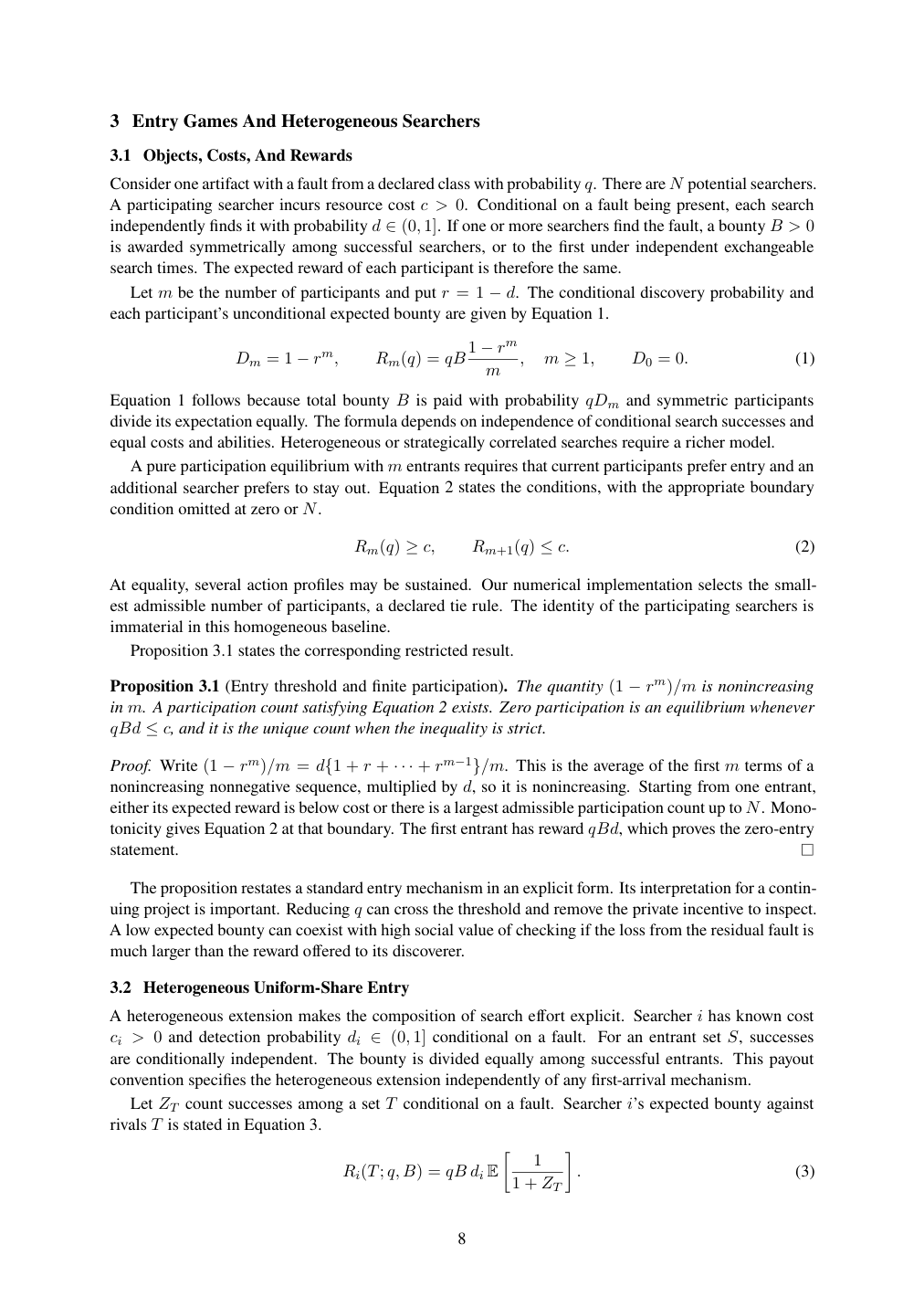
Readable text
is awarded symmetrically among successful searchers, or to the first under independent exchangeable search times. The expected reward of each participant is therefore the same.
each participant’s unconditional expected bounty are given by Equation 1.
divide its expectation equally. The formula depends on independence of conditional search successes and equal costs and abilities. Heterogeneous or strategically correlated searches require a richer model.
additional searcher prefers to stay out. Equation 2 states the conditions, with the appropriate boundary
At equality, several action profiles may be sustained. Our numerical implementation selects the small- est admissible number of participants, a declared tie rule. The identity of the participating searchers is
Proposition 3.1 states the corresponding restricted result.
The proposition restates a standard entry mechanism in an explicit form. Its interpretation for a contin- A low expected bounty can coexist with high social value of checking if the loss from the residual fault is
much larger than the reward offered to its discoverer.
are conditionally independent. The bounty is divided equally among successful entrants. This payout convention specifies the heterogeneous extension independently of any first-arrival mechanism.
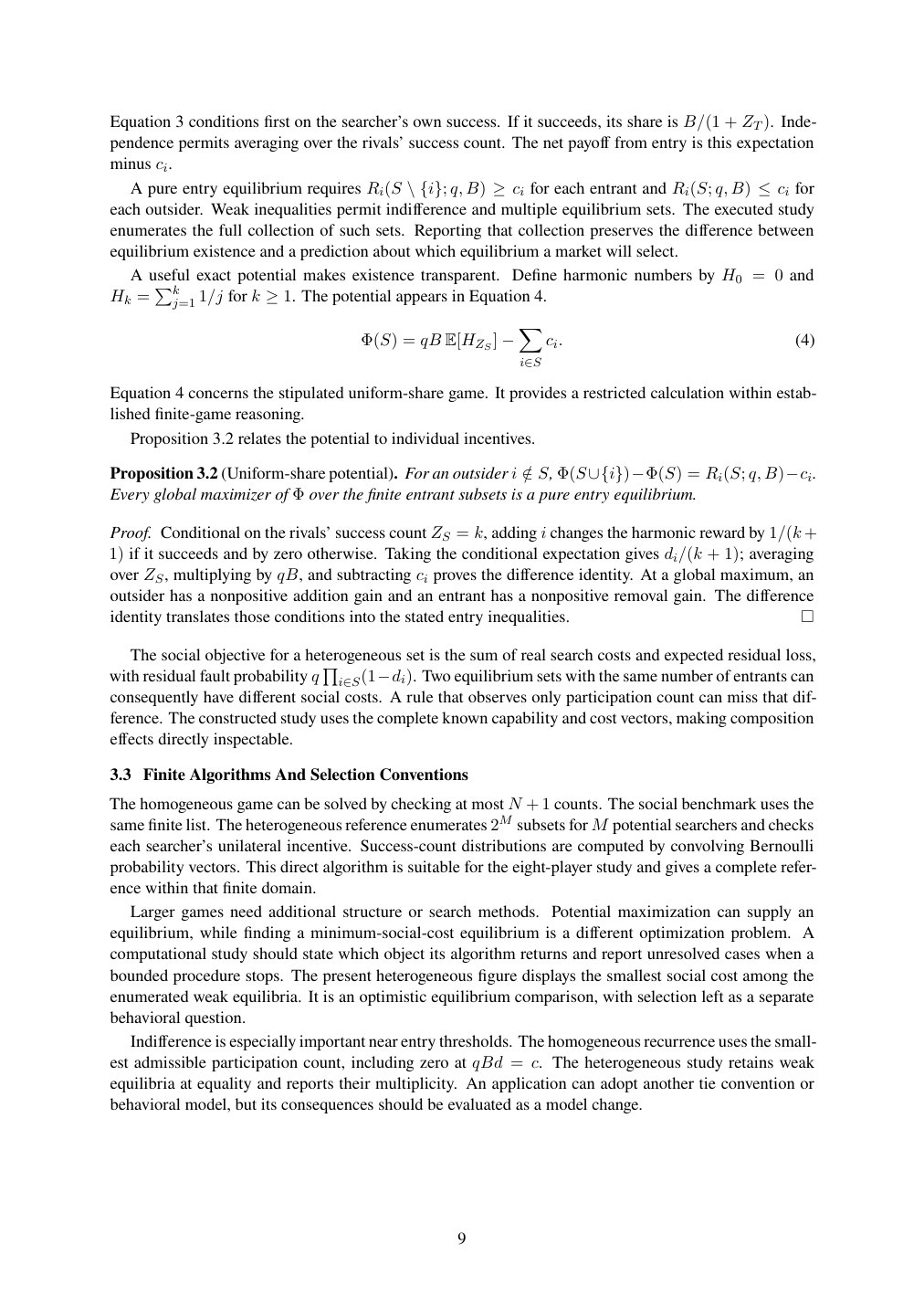
Readable text
pendence permits averaging over the rivals’ success count. The net payoff from entry is this expectation
each outsider. Weak inequalities permit indifference and multiple equilibrium sets. The executed study enumerates the full collection of such sets. Reporting that collection preserves the difference between equilibrium existence and a prediction about which equilibrium a market will select.
Equation 4 concerns the stipulated uniform-share game. It provides a restricted calculation within estab-
Proposition 3.2 relates the potential to individual incentives.
Every global maximizer of Φ over the finite entrant subsets is a pure entry equilibrium.
outsider has a nonpositive addition gain and an entrant has a nonpositive removal gain. The difference identity translates those conditions into the stated entry inequalities.
The social objective for a heterogeneous set is the sum of real search costs and expected residual loss,
consequently have different social costs. A rule that observes only participation count can miss that dif- ference. The constructed study uses the complete known capability and cost vectors, making composition
each searcher’s unilateral incentive. Success-count distributions are computed by convolving Bernoulli probability vectors. This direct algorithm is suitable for the eight-player study and gives a complete refer-
Larger games need additional structure or search methods. Potential maximization can supply an equilibrium, while finding a minimum-social-cost equilibrium is a different optimization problem. A computational study should state which object its algorithm returns and report unresolved cases when a bounded procedure stops. The present heterogeneous figure displays the smallest social cost among the enumerated weak equilibria. It is an optimistic equilibrium comparison, with selection left as a separate
Indifference is especially important near entry thresholds. The homogeneous recurrence uses the small- equilibria at equality and reports their multiplicity. An application can adopt another tie convention or behavioral model, but its consequences should be evaluated as a model change.
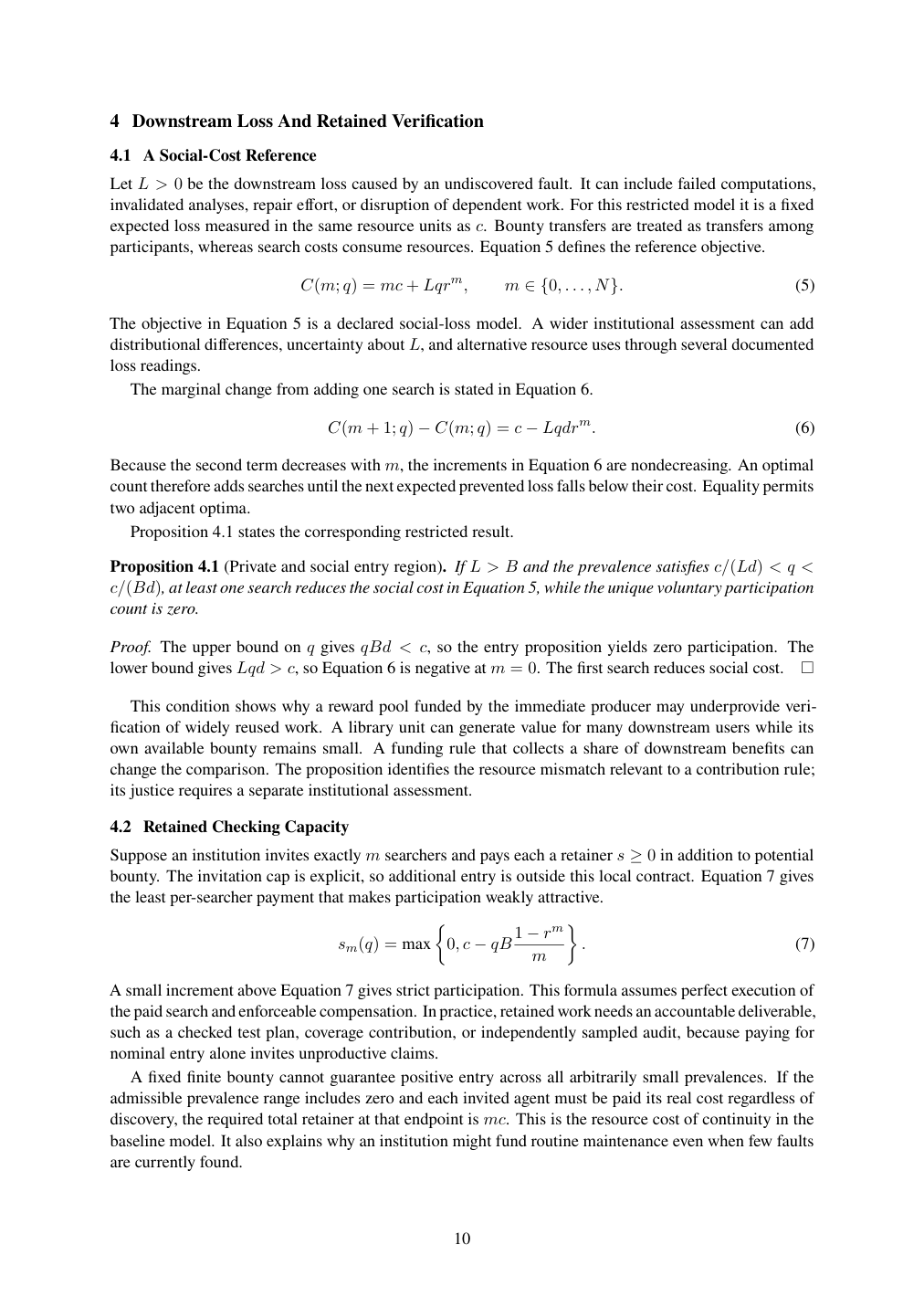
Readable text
invalidated analyses, repair effort, or disruption of dependent work. For this restricted model it is a fixed participants, whereas search costs consume resources. Equation 5 defines the reference objective.
The objective in Equation 5 is a declared social-loss model. A wider institutional assessment can add
The marginal change from adding one search is stated in Equation 6.
count therefore adds searches until the next expected prevented loss falls below their cost. Equality permits
Proposition 4.1 states the corresponding restricted result.
This condition shows why a reward pool funded by the immediate producer may underprovide veri- fication of widely reused work. A library unit can generate value for many downstream users while its own available bounty remains small. A funding rule that collects a share of downstream benefits can change the comparison. The proposition identifies the resource mismatch relevant to a contribution rule;
its justice requires a separate institutional assessment.
bounty. The invitation cap is explicit, so additional entry is outside this local contract. Equation 7 gives the least per-searcher payment that makes participation weakly attractive.
A small increment above Equation 7 gives strict participation. This formula assumes perfect execution of the paid search and enforceable compensation. In practice, retained work needs an accountable deliverable, such as a checked test plan, coverage contribution, or independently sampled audit, because paying for
A fixed finite bounty cannot guarantee positive entry across all arbitrarily small prevalences. If the admissible prevalence range includes zero and each invited agent must be paid its real cost regardless of baseline model. It also explains why an institution might fund routine maintenance even when few faults
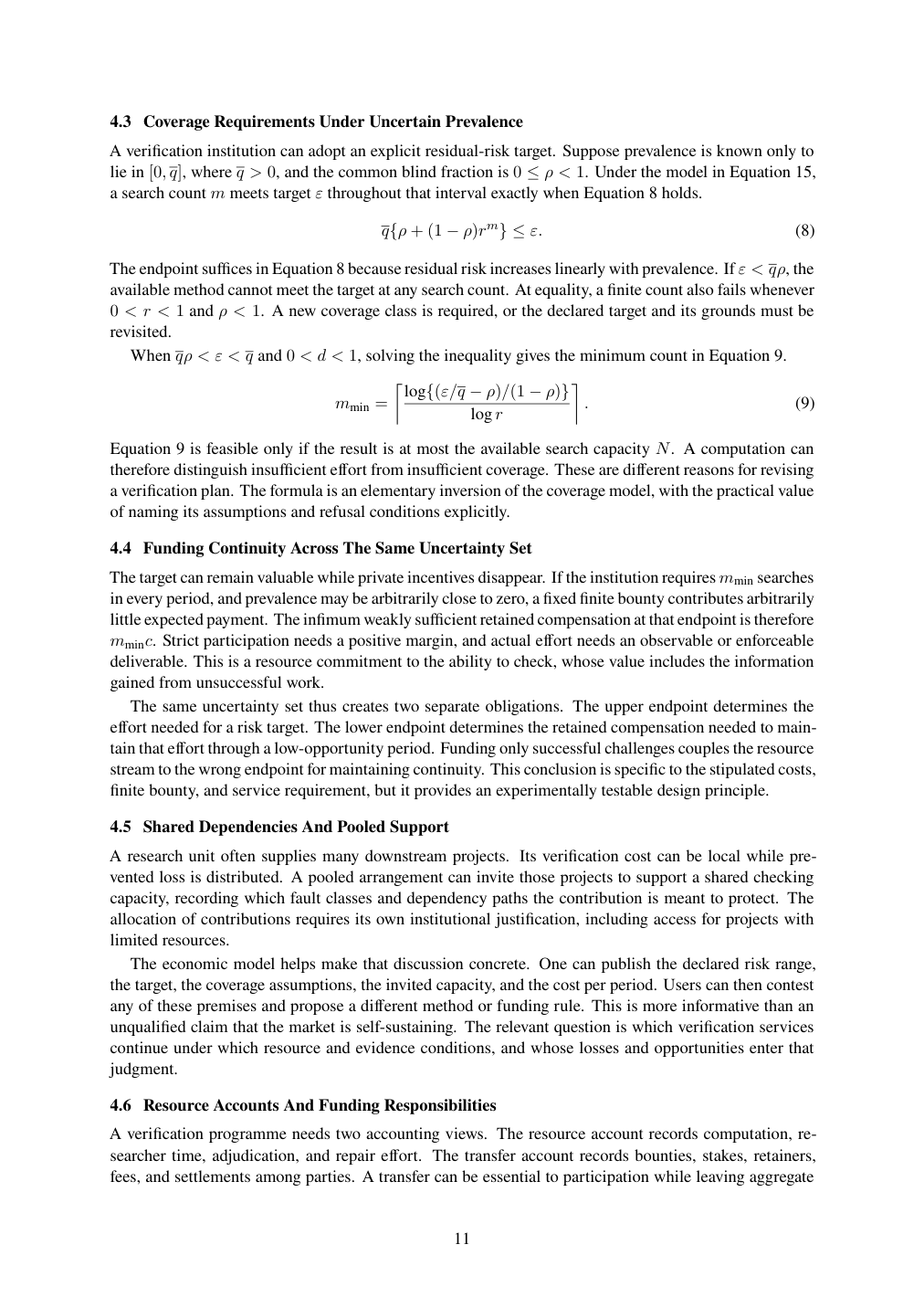
Readable text
A verification institution can adopt an explicit residual-risk target. Suppose prevalence is known only to
available method cannot meet the target at any search count. At equality, a finite count also fails whenever
therefore distinguish insufficient effort from insufficient coverage. These are different reasons for revising a verification plan. The formula is an elementary inversion of the coverage model, with the practical value of naming its assumptions and refusal conditions explicitly.
in every period, and prevalence may be arbitrarily close to zero, a fixed finite bounty contributes arbitrarily little expected payment. The infimum weakly sufficient retained compensation at that endpoint is therefore deliverable. This is a resource commitment to the ability to check, whose value includes the information
The same uncertainty set thus creates two separate obligations. The upper endpoint determines the effort needed for a risk target. The lower endpoint determines the retained compensation needed to main- tain that effort through a low-opportunity period. Funding only successful challenges couples the resource stream to the wrong endpoint for maintaining continuity. This conclusion is specific to the stipulated costs, finite bounty, and service requirement, but it provides an experimentally testable design principle.
A research unit often supplies many downstream projects. Its verification cost can be local while pre- vented loss is distributed. A pooled arrangement can invite those projects to support a shared checking capacity, recording which fault classes and dependency paths the contribution is meant to protect. The allocation of contributions requires its own institutional justification, including access for projects with
The economic model helps make that discussion concrete. One can publish the declared risk range, the target, the coverage assumptions, the invited capacity, and the cost per period. Users can then contest any of these premises and propose a different method or funding rule. This is more informative than an unqualified claim that the market is self-sustaining. The relevant question is which verification services continue under which resource and evidence conditions, and whose losses and opportunities enter that
A verification programme needs two accounting views. The resource account records computation, re- searcher time, adjudication, and repair effort. The transfer account records bounties, stakes, retainers, fees, and settlements among parties. A transfer can be essential to participation while leaving aggregate
Readable text
real-resource cost unchanged in the stipulated benchmark. Administrative costs of making that transfer belong in the resource account when they are material.
on the same unit, and their losses may overlap. Summing separately reported consequences can double- count a shared outage or omit burdens that remain outside the reporting institutions. A deployment should document the consequence model and preserve alternative readings where they affect the comparison. The report uses one scalar expected loss to isolate the participation mechanism.
Funding responsibility is a separate design choice. The immediate producer, downstream users, a common institution, or a mixed pool can support verification. Each arrangement changes who bears transfers and who can initiate work. A policy can also reserve some capacity for projects with limited funding or for fault classes that are important to underserved users. Such choices need explicit governance
criteria alongside the restricted cost calculation.
The retainer contract caps invitations and assumes the specified work is delivered. An open market may additionally contain voluntary challengers whose incentives respond to that retained capacity. A paid searcher can contribute direct detection while reducing the reward opportunity for others. This interac- tion is already analyzed in the paid-expert bounty literature (Gersbach et al., 2023). Evaluating a mixed programme therefore requires the total coverage and cost after those responses.
A practical comparison can separate three policies. One policy offers only discovery rewards. A second procures a fixed invited search set. A third combines retained work and open rewards while modeling their interaction. The constructed social optimum and retainer calculations concern the second policy relative to the first baseline. The third is a further game requiring an explicit rule for shared discoveries, eligibility,
Coverage requirements make the comparison more informative. A retained agent with the same blind region as existing participants may add repeated effort, while a source-specific auditor can change the reachable fault class. A useful contract states both the work product and the coverage assumption it is intended to strengthen. Its cost can then be compared with the prevented loss and the information gained
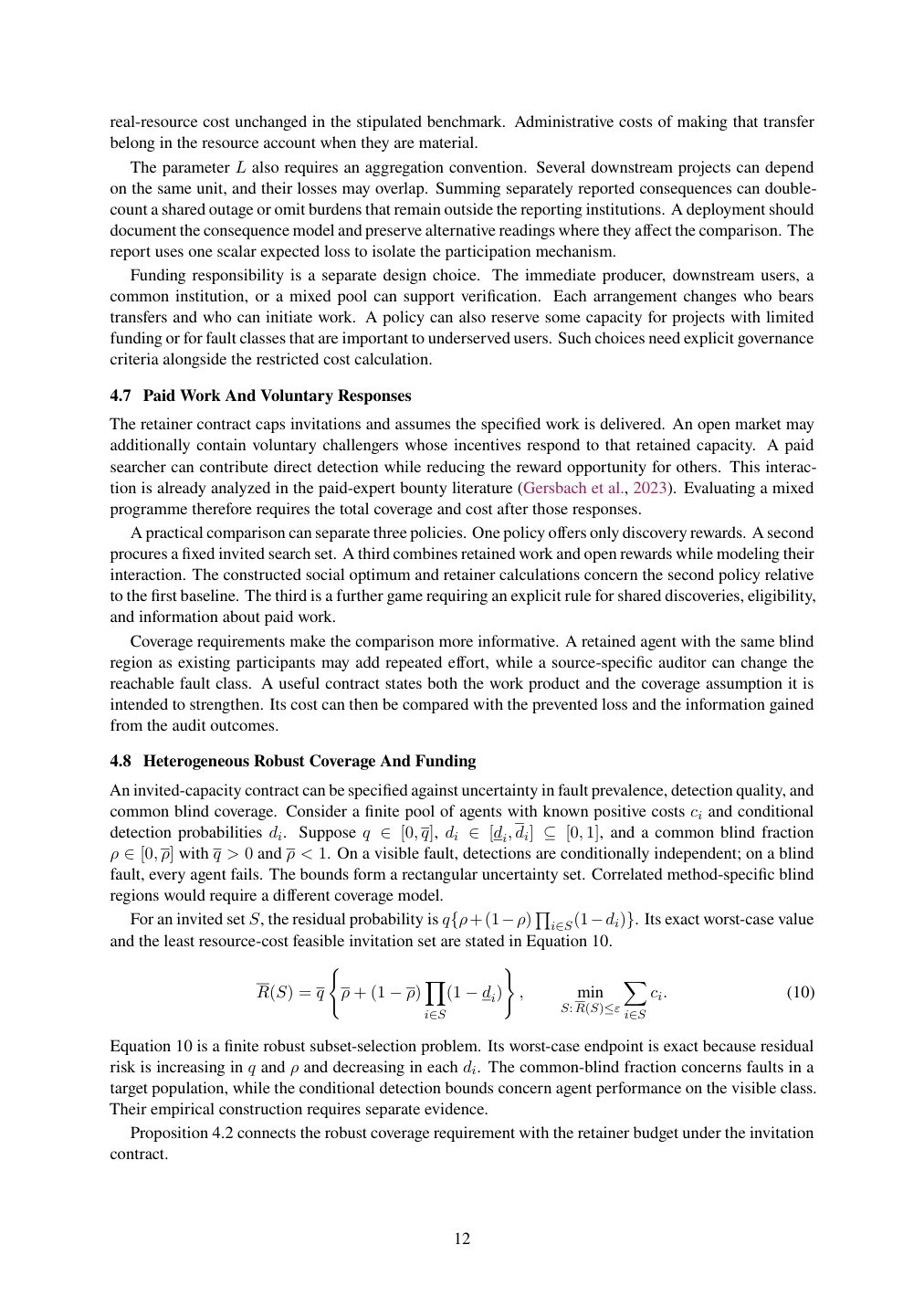
An invited-capacity contract can be specified against uncertainty in fault prevalence, detection quality, and fault, every agent fails. The bounds form a rectangular uncertainty set. Correlated method-specific blind
and the least resource-cost feasible invitation set are stated in Equation 10.
Equation 10 is a finite robust subset-selection problem. Its worst-case endpoint is exact because residual target population, while the conditional detection bounds concern agent performance on the visible class. Their empirical construction requires separate evidence.
Proposition 4.2 connects the robust coverage requirement with the retainer budget under the invitation
Readable text
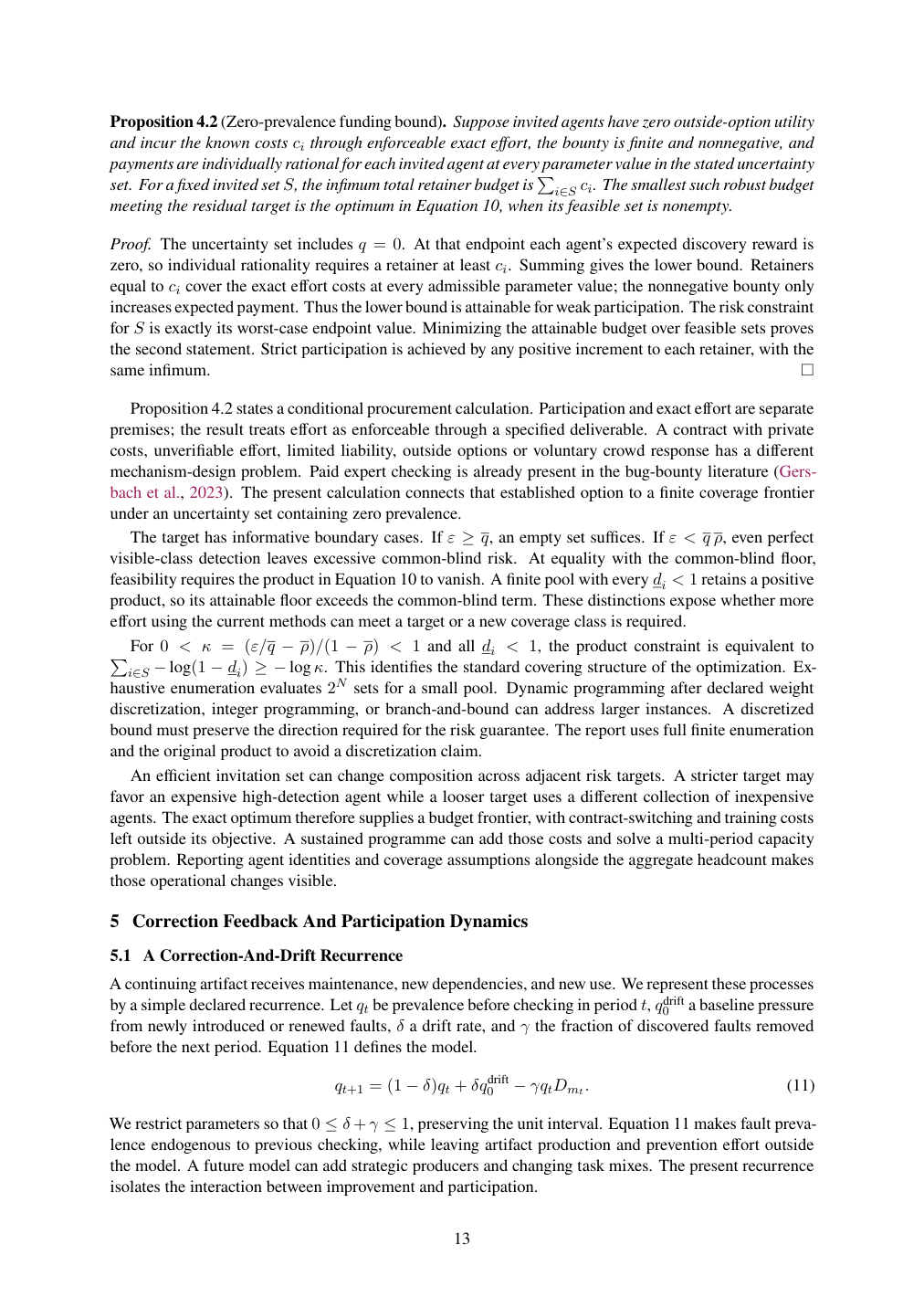
Proposition 4.2 (Zero-prevalence funding bound). Suppose invited agents have zero outside-option utility payments are individually rational for each invited agent at every parameter value in the stated uncertainty
meeting the residual target is the optimum in Equation 10, when its feasible set is nonempty.
increases expected payment. Thus the lower bound is attainable for weak participation. The risk constraint the second statement. Strict participation is achieved by any positive increment to each retainer, with the
Proposition 4.2 states a conditional procurement calculation. Participation and exact effort are separate premises; the result treats effort as enforceable through a specified deliverable. A contract with private costs, unverifiable effort, limited liability, outside options or voluntary crowd response has a different mechanism-design problem. Paid expert checking is already present in the bug-bounty literature (Gers- bach et al., 2023). The present calculation connects that established option to a finite coverage frontier
under an uncertainty set containing zero prevalence.
visible-class detection leaves excessive common-blind risk. At equality with the common-blind floor, product, so its attainable floor exceeds the common-blind term. These distinctions expose whether more effort using the current methods can meet a target or a new coverage class is required.
discretization, integer programming, or branch-and-bound can address larger instances. A discretized bound must preserve the direction required for the risk guarantee. The report uses full finite enumeration and the original product to avoid a discretization claim.
An efficient invitation set can change composition across adjacent risk targets. A stricter target may favor an expensive high-detection agent while a looser target uses a different collection of inexpensive agents. The exact optimum therefore supplies a budget frontier, with contract-switching and training costs left outside its objective. A sustained programme can add those costs and solve a multi-period capacity problem. Reporting agent identities and coverage assumptions alongside the aggregate headcount makes
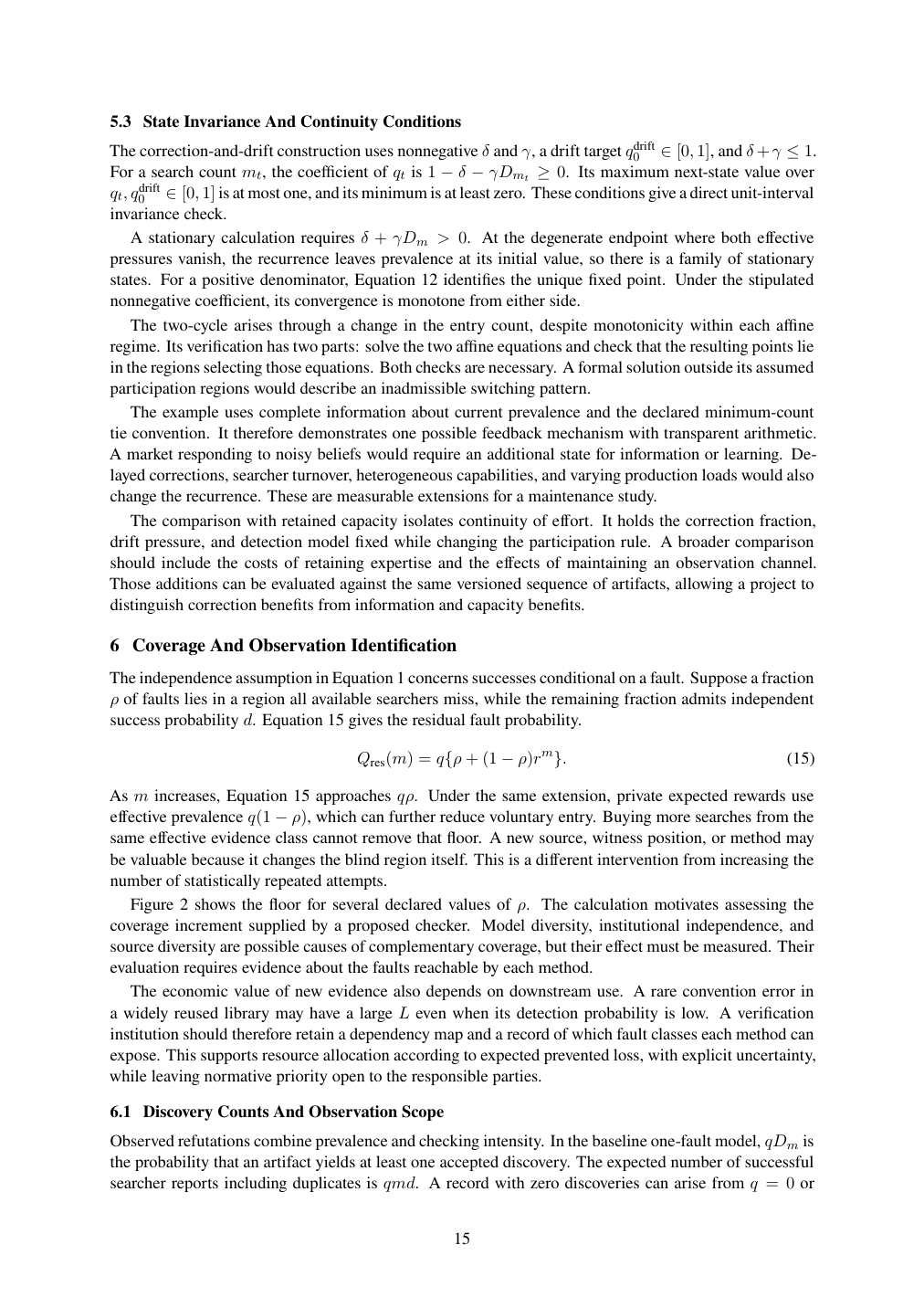
A continuing artifact receives maintenance, new dependencies, and new use. We represent these processes
lence endogenous to previous checking, while leaving artifact production and prevention effort outside the model. A future model can add strategic producers and changing task mixes. The present recurrence isolates the interaction between improvement and participation.

Readable text
Figure 1: Constructed correction-and-drift process starting from prevalence 0.4. Bounty-only participation approaches the admissible two-cycle around the entry threshold. Two retained searches converge to the stationary value 0.03846. The maintenance rates are declared construction parameters.
Under the stronger unit-interval restriction above, the process approaches the fixed point without sign oscillation. Equation 12 supplies a useful reference for retained audits.
The high value in Equation 14 lies in the one-entrant region, and the low value lies below the entry exact admissible two-cycle in the specified piecewise-affine model. The result is a property of the declared construction; other parameters can yield other regimes.
The comparison reveals a mechanism that static bounty results leave implicit. Successful checking can itself move the artifact below the participation threshold. Drift then raises prevalence until checking becomes privately attractive again. Retained verification changes the feedback by separating some capacity from current discoveries. Its usefulness in a real ecology depends on the cost, coverage, reliability, and
Readable text
pressures vanish, the recurrence leaves prevalence at its initial value, so there is a family of stationary states. For a positive denominator, Equation 12 identifies the unique fixed point. Under the stipulated nonnegative coefficient, its convergence is monotone from either side.
The two-cycle arises through a change in the entry count, despite monotonicity within each affine regime. Its verification has two parts: solve the two affine equations and check that the resulting points lie in the regions selecting those equations. Both checks are necessary. A formal solution outside its assumed participation regions would describe an inadmissible switching pattern.
The example uses complete information about current prevalence and the declared minimum-count tie convention. It therefore demonstrates one possible feedback mechanism with transparent arithmetic. A market responding to noisy beliefs would require an additional state for information or learning. De- layed corrections, searcher turnover, heterogeneous capabilities, and varying production loads would also change the recurrence. These are measurable extensions for a maintenance study.
The comparison with retained capacity isolates continuity of effort. It holds the correction fraction, drift pressure, and detection model fixed while changing the participation rule. A broader comparison should include the costs of retaining expertise and the effects of maintaining an observation channel. Those additions can be evaluated against the same versioned sequence of artifacts, allowing a project to distinguish correction benefits from information and capacity benefits.
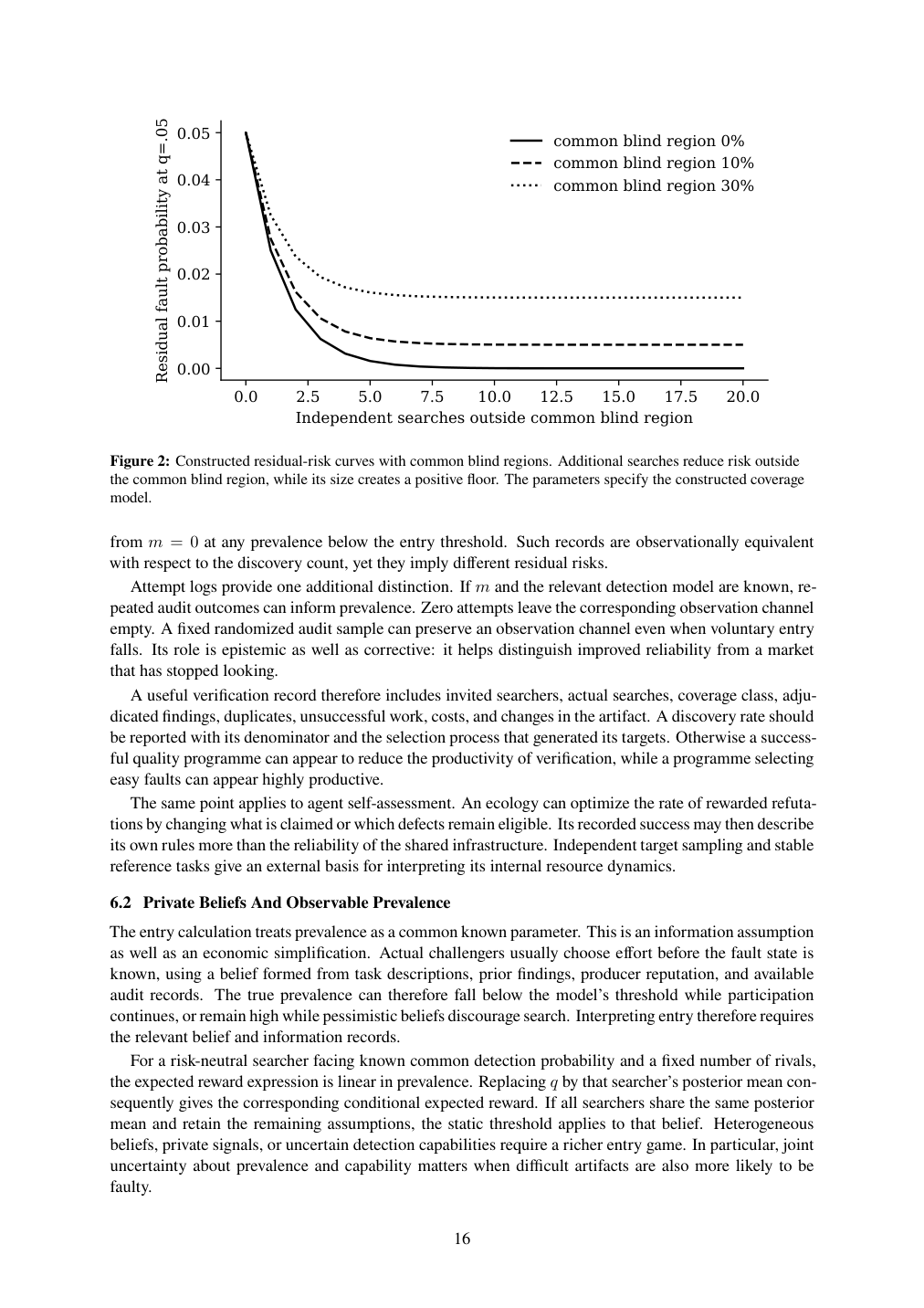
The independence assumption in Equation 1 concerns successes conditional on a fault. Suppose a fraction
same effective evidence class cannot remove that floor. A new source, witness position, or method may be valuable because it changes the blind region itself. This is a different intervention from increasing the
coverage increment supplied by a proposed checker. Model diversity, institutional independence, and source diversity are possible causes of complementary coverage, but their effect must be measured. Their evaluation requires evidence about the faults reachable by each method.
The economic value of new evidence also depends on downstream use. A rare convention error in institution should therefore retain a dependency map and a record of which fault classes each method can expose. This supports resource allocation according to expected prevented loss, with explicit uncertainty, while leaving normative priority open to the responsible parties.
the probability that an artifact yields at least one accepted discovery. The expected number of successful
Readable text
common blind region 0% common blind region 10% common blind region 30%
Figure 2: Constructed residual-risk curves with common blind regions. Additional searches reduce risk outside the common blind region, while its size creates a positive floor. The parameters specify the constructed coverage
with respect to the discovery count, yet they imply different residual risks.
peated audit outcomes can inform prevalence. Zero attempts leave the corresponding observation channel empty. A fixed randomized audit sample can preserve an observation channel even when voluntary entry falls. Its role is epistemic as well as corrective: it helps distinguish improved reliability from a market
A useful verification record therefore includes invited searchers, actual searches, coverage class, adju- dicated findings, duplicates, unsuccessful work, costs, and changes in the artifact. A discovery rate should be reported with its denominator and the selection process that generated its targets. Otherwise a success- ful quality programme can appear to reduce the productivity of verification, while a programme selecting
The same point applies to agent self-assessment. An ecology can optimize the rate of rewarded refuta- tions by changing what is claimed or which defects remain eligible. Its recorded success may then describe its own rules more than the reliability of the shared infrastructure. Independent target sampling and stable reference tasks give an external basis for interpreting its internal resource dynamics.
The entry calculation treats prevalence as a common known parameter. This is an information assumption as well as an economic simplification. Actual challengers usually choose effort before the fault state is known, using a belief formed from task descriptions, prior findings, producer reputation, and available audit records. The true prevalence can therefore fall below the model’s threshold while participation continues, or remain high while pessimistic beliefs discourage search. Interpreting entry therefore requires
For a risk-neutral searcher facing known common detection probability and a fixed number of rivals, sequently gives the corresponding conditional expected reward. If all searchers share the same posterior mean and retain the remaining assumptions, the static threshold applies to that belief. Heterogeneous beliefs, private signals, or uncertain detection capabilities require a richer entry game. In particular, joint uncertainty about prevalence and capability matters when difficult artifacts are also more likely to be
Readable text
The two-cycle illustration uses the simpler complete-information convention: participation responds to the current state of the declared recurrence. It demonstrates a possible feedback mechanism under that convention. Applying the trajectory to a market requires a validated observation model for its current prevalence. A prospective study should therefore record the information shown to challengers, elicit beliefs where feasible, and compare entry with independent audit estimates. Retained random sampling can help keep those estimates informative, but its diagnostic performance must itself be calibrated.
This distinction gives unsuccessful-search records an additional role. Public evidence about a well- defined search updates beliefs differently from a bare absence of reported findings. A funding mechanism that preserves informative attempts can support better later allocation even before considering the faults those attempts repair. Valuing this information requires an explicit learning model and a declared down- stream decision; the present social-cost calculation includes correction and resource costs only. Keeping those boundaries visible makes subsequent extensions testable.
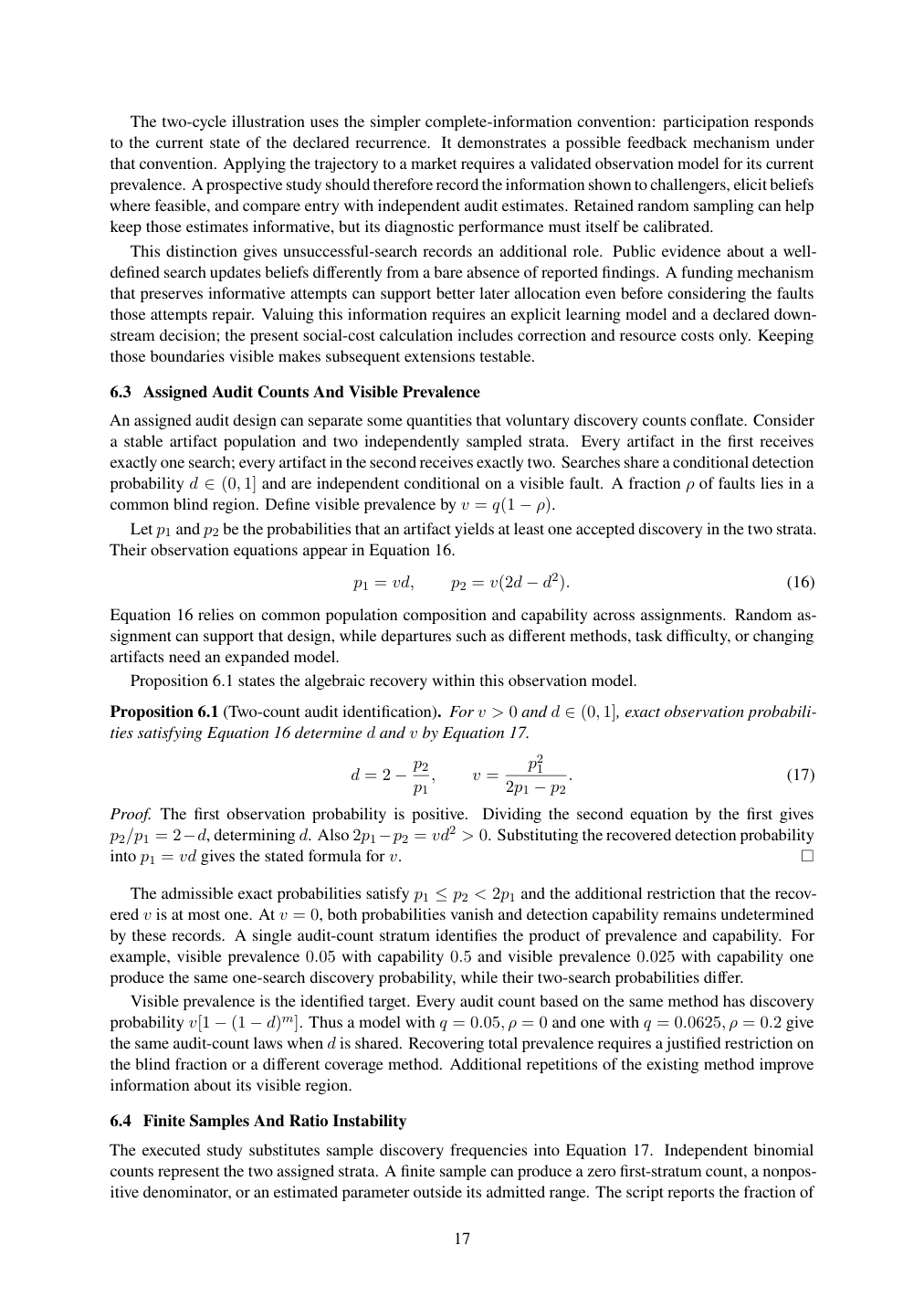
An assigned audit design can separate some quantities that voluntary discovery counts conflate. Consider a stable artifact population and two independently sampled strata. Every artifact in the first receives exactly one search; every artifact in the second receives exactly two. Searches share a conditional detection
Equation 16 relies on common population composition and capability across assignments. Random as- signment can support that design, while departures such as different methods, task difficulty, or changing
Proposition 6.1 states the algebraic recovery within this observation model.
Proof. The first observation probability is positive.
by these records. A single audit-count stratum identifies the product of prevalence and capability. For produce the same one-search discovery probability, while their two-search probabilities differ.
Visible prevalence is the identified target. Every audit count based on the same method has discovery the blind fraction or a different coverage method. Additional repetitions of the existing method improve
The executed study substitutes sample discovery frequencies into Equation 17. Independent binomial counts represent the two assigned strata. A finite sample can produce a zero first-stratum count, a nonpos- itive denominator, or an estimated parameter outside its admitted range. The script reports the fraction of
Readable text
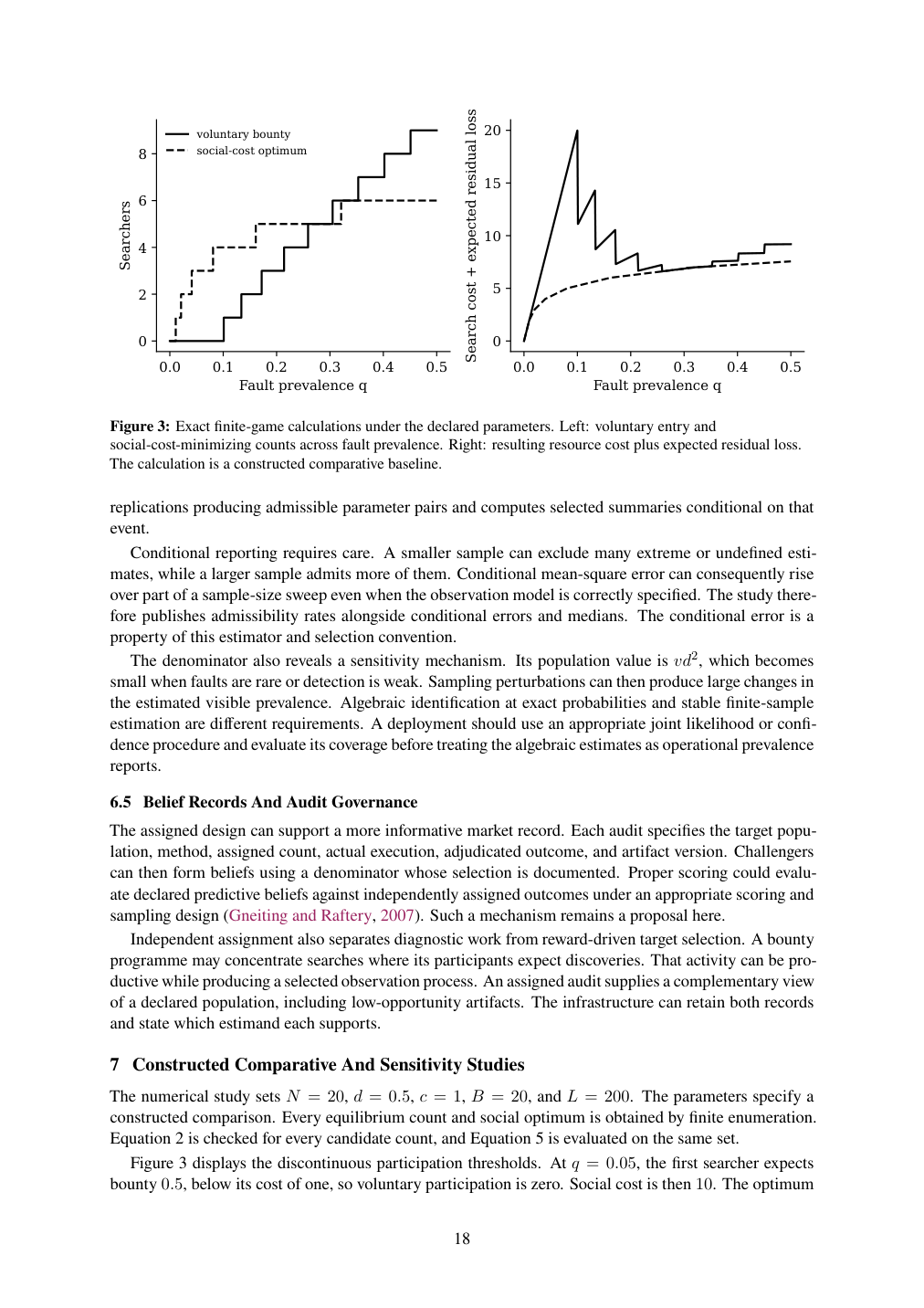
Figure 3: Exact finite-game calculations under the declared parameters. Left: voluntary entry and social-cost-minimizing counts across fault prevalence. Right: resulting resource cost plus expected residual loss.
The calculation is a constructed comparative baseline.
replications producing admissible parameter pairs and computes selected summaries conditional on that
Conditional reporting requires care. A smaller sample can exclude many extreme or undefined esti- mates, while a larger sample admits more of them. Conditional mean-square error can consequently rise over part of a sample-size sweep even when the observation model is correctly specified. The study there- fore publishes admissibility rates alongside conditional errors and medians. The conditional error is a
property of this estimator and selection convention.
small when faults are rare or detection is weak. Sampling perturbations can then produce large changes in the estimated visible prevalence. Algebraic identification at exact probabilities and stable finite-sample estimation are different requirements. A deployment should use an appropriate joint likelihood or confi- dence procedure and evaluate its coverage before treating the algebraic estimates as operational prevalence
The assigned design can support a more informative market record. Each audit specifies the target popu- lation, method, assigned count, actual execution, adjudicated outcome, and artifact version. Challengers can then form beliefs using a denominator whose selection is documented. Proper scoring could evalu- ate declared predictive beliefs against independently assigned outcomes under an appropriate scoring and sampling design (Gneiting and Raftery, 2007). Such a mechanism remains a proposal here.
Independent assignment also separates diagnostic work from reward-driven target selection. A bounty programme may concentrate searches where its participants expect discoveries. That activity can be pro- ductive while producing a selected observation process. An assigned audit supplies a complementary view of a declared population, including low-opportunity artifacts. The infrastructure can retain both records
constructed comparison. Every equilibrium count and social optimum is obtained by finite enumeration. Equation 2 is checked for every candidate count, and Equation 5 is evaluated on the same set.
Readable text
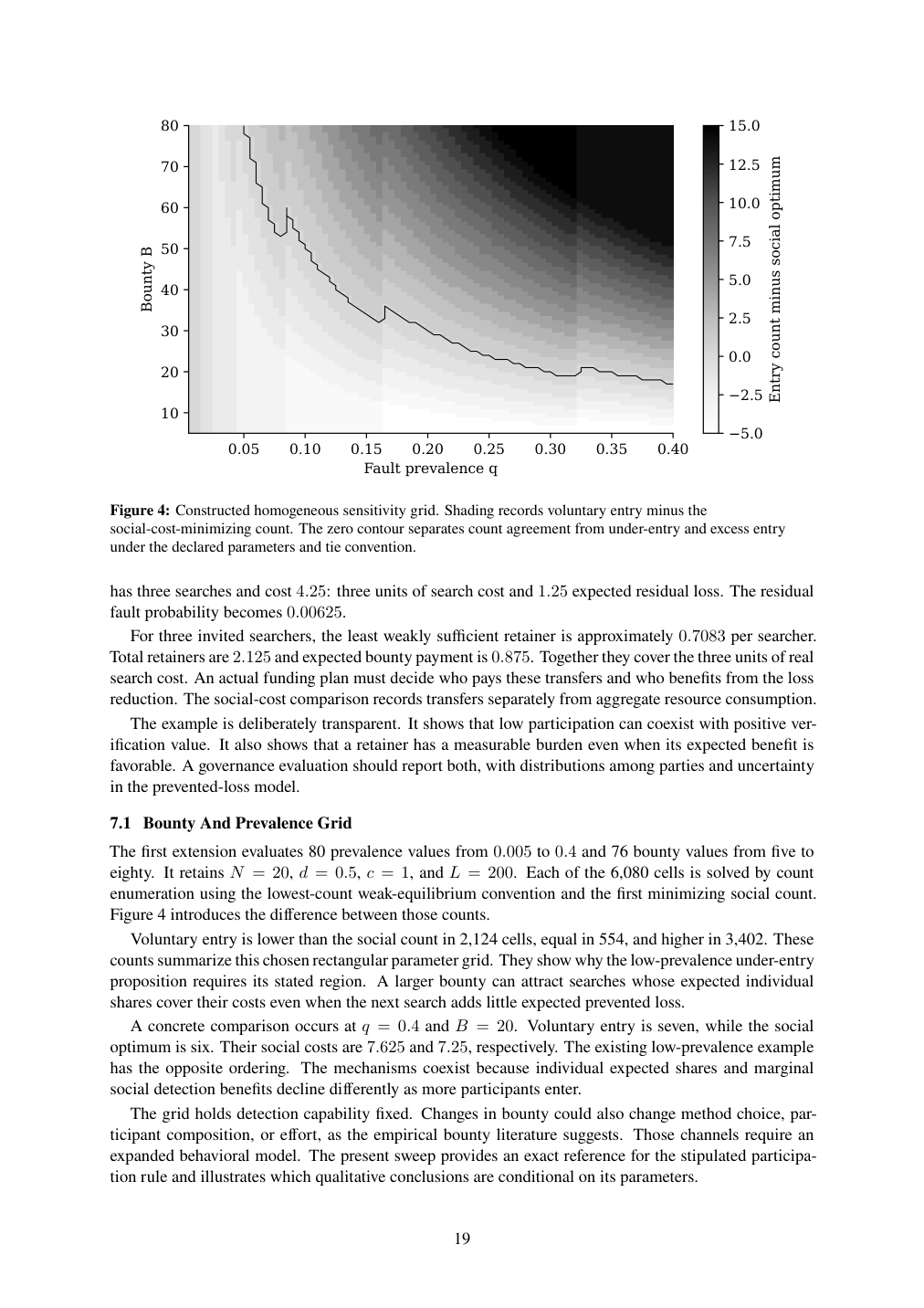
Figure 4: Constructed homogeneous sensitivity grid. Shading records voluntary entry minus the social-cost-minimizing count. The zero contour separates count agreement from under-entry and excess entry
search cost. An actual funding plan must decide who pays these transfers and who benefits from the loss reduction. The social-cost comparison records transfers separately from aggregate resource consumption.
The example is deliberately transparent. It shows that low participation can coexist with positive ver- ification value. It also shows that a retainer has a measurable burden even when its expected benefit is favorable. A governance evaluation should report both, with distributions among parties and uncertainty
enumeration using the lowest-count weak-equilibrium convention and the first minimizing social count. Figure 4 introduces the difference between those counts.
Voluntary entry is lower than the social count in 2,124 cells, equal in 554, and higher in 3,402. These counts summarize this chosen rectangular parameter grid. They show why the low-prevalence under-entry proposition requires its stated region. A larger bounty can attract searches whose expected individual shares cover their costs even when the next search adds little expected prevented loss.
has the opposite ordering. The mechanisms coexist because individual expected shares and marginal social detection benefits decline differently as more participants enter.
The grid holds detection capability fixed. Changes in bounty could also change method choice, par- ticipant composition, or effort, as the empirical bounty literature suggests. Those channels require an expanded behavioral model. The present sweep provides an exact reference for the stipulated participa- tion rule and illustrates which qualitative conclusions are conditional on its parameters.
Readable text
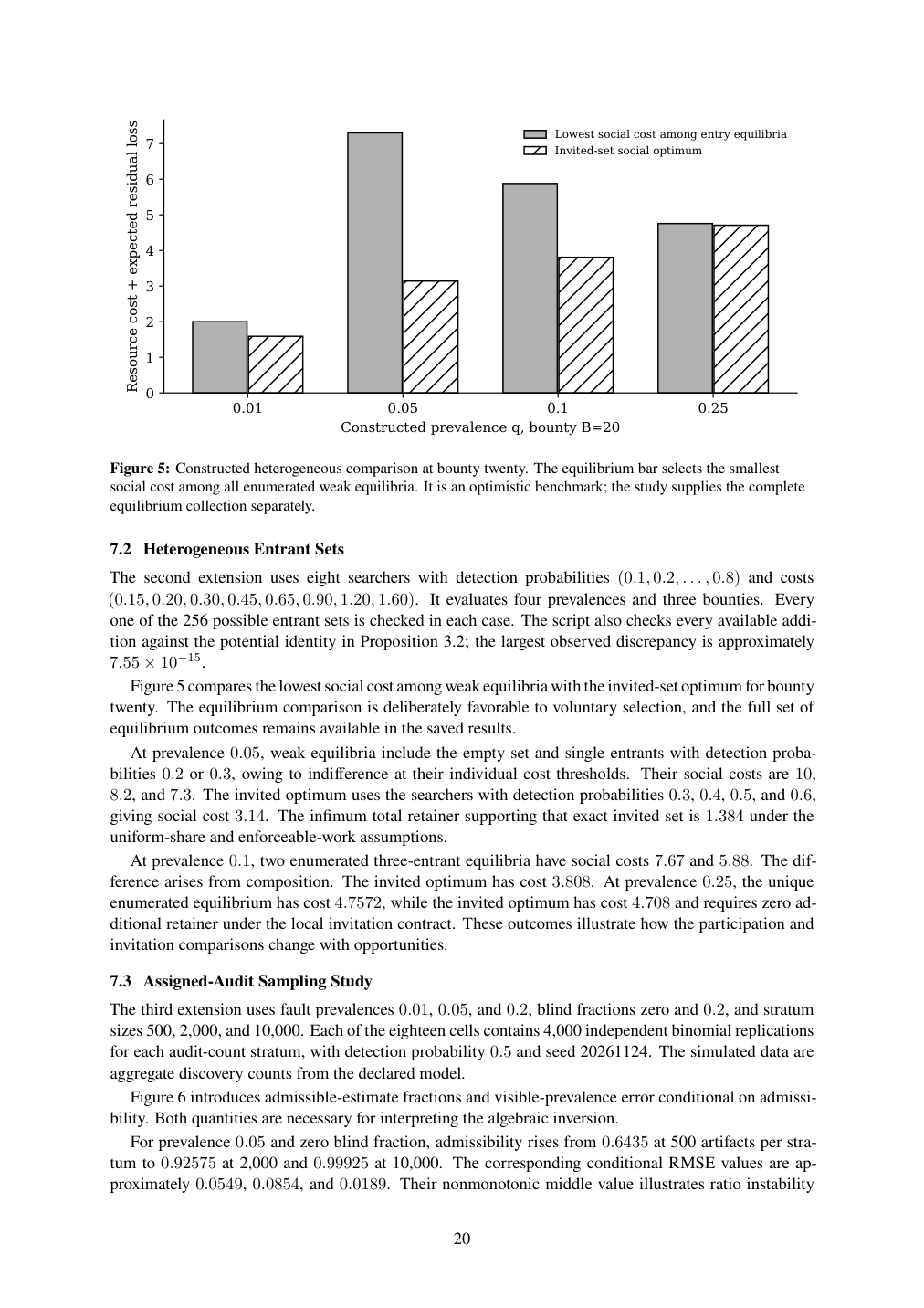
Lowest social cost among entry equilibria Invited-set social optimum
Figure 5: Constructed heterogeneous comparison at bounty twenty. The equilibrium bar selects the smallest social cost among all enumerated weak equilibria. It is an optimistic benchmark; the study supplies the complete
one of the 256 possible entrant sets is checked in each case. The script also checks every available addi- tion against the potential identity in Proposition 3.2; the largest observed discrepancy is approximately Figure 5 compares the lowest social cost among weak equilibria with the invited-set optimum for bounty twenty. The equilibrium comparison is deliberately favorable to voluntary selection, and the full set of equilibrium outcomes remains available in the saved results.
ditional retainer under the local invitation contract. These outcomes illustrate how the participation and
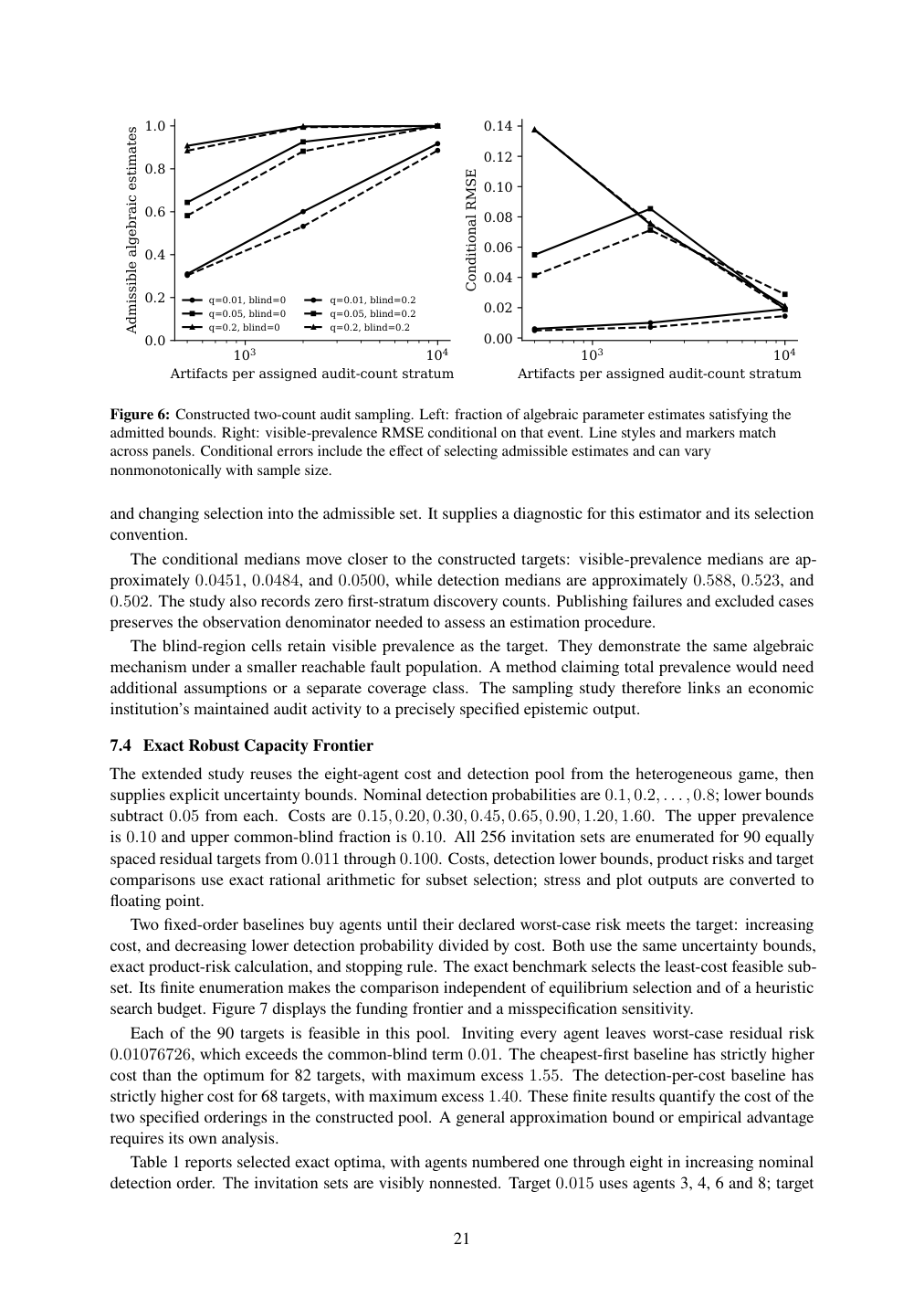
sizes 500, 2,000, and 10,000. Each of the eighteen cells contains 4,000 independent binomial replications
Figure 6 introduces admissible-estimate fractions and visible-prevalence error conditional on admissi- bility. Both quantities are necessary for interpreting the algebraic inversion.
Readable text
Figure 6: Constructed two-count audit sampling. Left: fraction of algebraic parameter estimates satisfying the admitted bounds. Right: visible-prevalence RMSE conditional on that event. Line styles and markers match across panels. Conditional errors include the effect of selecting admissible estimates and can vary
and changing selection into the admissible set. It supplies a diagnostic for this estimator and its selection
The conditional medians move closer to the constructed targets: visible-prevalence medians are ap- preserves the observation denominator needed to assess an estimation procedure.
The blind-region cells retain visible prevalence as the target. They demonstrate the same algebraic mechanism under a smaller reachable fault population. A method claiming total prevalence would need additional assumptions or a separate coverage class. The sampling study therefore links an economic institution’s maintained audit activity to a precisely specified epistemic output.
The extended study reuses the eight-agent cost and detection pool from the heterogeneous game, then comparisons use exact rational arithmetic for subset selection; stress and plot outputs are converted to
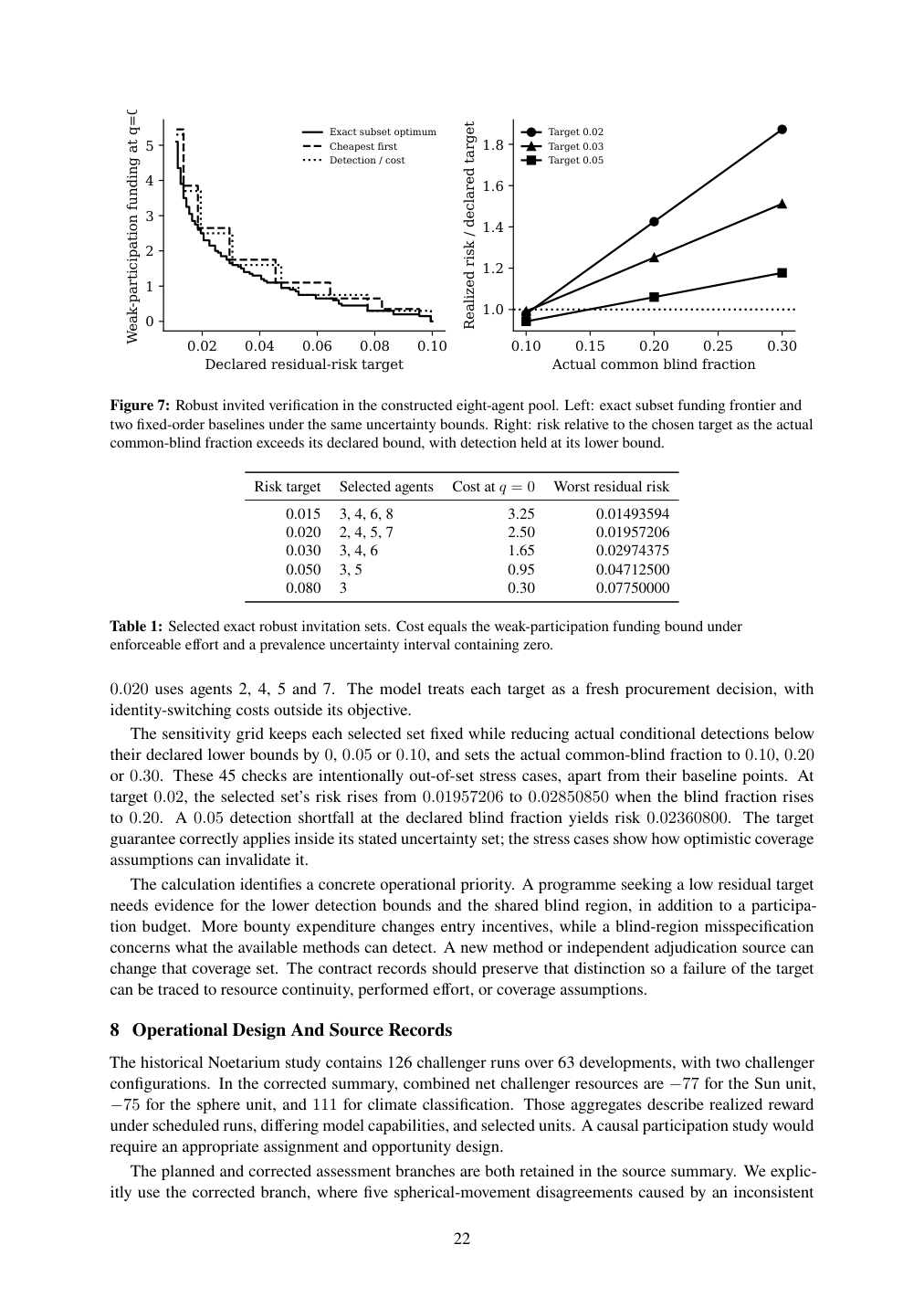
Two fixed-order baselines buy agents until their declared worst-case risk meets the target: increasing cost, and decreasing lower detection probability divided by cost. Both use the same uncertainty bounds, exact product-risk calculation, and stopping rule. The exact benchmark selects the least-cost feasible sub- set. Its finite enumeration makes the comparison independent of equilibrium selection and of a heuristic search budget. Figure 7 displays the funding frontier and a misspecification sensitivity.
Each of the 90 targets is feasible in this pool. Inviting every agent leaves worst-case residual risk two specified orderings in the constructed pool. A general approximation bound or empirical advantage
Table 1 reports selected exact optima, with agents numbered one through eight in increasing nominal
Readable text
Figure 7: Robust invited verification in the constructed eight-agent pool. Left: exact subset funding frontier and two fixed-order baselines under the same uncertainty bounds. Right: risk relative to the chosen target as the actual common-blind fraction exceeds its declared bound, with detection held at its lower bound.
Table 1: Selected exact robust invitation sets. Cost equals the weak-participation funding bound under enforceable effort and a prevalence uncertainty interval containing zero.
The sensitivity grid keeps each selected set fixed while reducing actual conditional detections below guarantee correctly applies inside its stated uncertainty set; the stress cases show how optimistic coverage
The calculation identifies a concrete operational priority. A programme seeking a low residual target needs evidence for the lower detection bounds and the shared blind region, in addition to a participa- tion budget. More bounty expenditure changes entry incentives, while a blind-region misspecification concerns what the available methods can detect. A new method or independent adjudication source can change that coverage set. The contract records should preserve that distinction so a failure of the target can be traced to resource continuity, performed effort, or coverage assumptions.
The historical Noetarium study contains 126 challenger runs over 63 developments, with two challenger under scheduled runs, differing model capabilities, and selected units. A causal participation study would require an appropriate assignment and opportunity design.
The planned and corrected assessment branches are both retained in the source summary. We explic- itly use the corrected branch, where five spherical-movement disagreements caused by an inconsistent
tolerance are reclassified. This illustrates another economic issue: adjudication rules determine which events earn rewards. A correction to those rules must preserve earlier settlements and explain how later claims will be treated.
The current report’s script reads that saved summary and separately enumerates the finite entry model and deterministic recurrence. Its execution consists of the saved-record reanalysis and new Python constructions with synthetic resource units. The proposed persistent market, institutional funding arrangements, and tests of strategic behavior remain implementation and empirical tasks.
8.1 Verification Transactions And Inspectable Work
A verification transaction should identify the artifact version, the fault class, the search contract, the evidence supplied, the adjudication procedure, and the resource account. The artifact version fixes the object under examination. The fault class states which defects are eligible. The search contract specifies the method, budget, access conditions, and work product. The evidence and adjudication records explain why a report was accepted, rejected, or left unresolved.
Distinct report types help preserve this information. A validated counterexample can identify an input and reproducible discrepancy. A completed audit can identify its assigned sample and outcomes, including unsuccessful attempts. A coverage contribution can identify which fault classes or source regions it makes reachable. A refusal can identify unavailable evidence or an incompatible specification. Payments can depend on these typed deliverables under a declared contract.
A correction creates a new artifact version. Earlier findings retain their original target version and settlement history. A revised adjudication rule creates a new rule version and a stated policy for pending or historical cases. The saved tolerance correction motivates this requirement concretely: a disagreement caused by an inconsistent assessment threshold changes the classification of earlier events. A useful infrastructure preserves the reason for that change and its effects on subsequent comparisons.
8.2 Capacity, Access, And Governance
Retained capacity is useful when it corresponds to work that remains possible. A nominal invitation can fail to produce coverage if the searcher lacks source access, execution resources, or authority to inspect the relevant record. The contract should therefore include an access and capability profile. A completed deliverable can then be assessed against the stated scope.
Funding also affects participation diversity. A discovery-only arrangement can favor agents able to absorb long periods of unrewarded search. A retained arrangement can improve continuity while concentrating authority in whoever assigns paid work. A pooled arrangement can distribute costs while creating disputes about beneficiaries and voting rights. These are distinct institutional effects that should accompany the numerical comparison.
Adjudication authority requires separate evaluation. Exact computational faults can be settled through a reproducible checker for the declared specification. Broader scientific claims may depend on measurement, causal assumptions, or competing interpretations. The verification service should preserve the admissible scope of each adjudicator and provide a route for reviewing its specification. Increasing reward size can intensify activity within that scope; improving the scope requires substantive methodological work.
8.3 Reproduction Interface And Validation Order
The report’s executable entry point first regenerates the original finite game, recurrence, and historical aggregate reanalysis, then runs the grid, heterogeneous, and audit-identification extensions. All results are written to the same structured output with separate components. Historical data enter through the immutable corrected summary. New numerical arrays follow declared parameters and deterministic random seeds.
A validation sequence can begin with mathematical identities, proceed to complete finite enumeration, and then evaluate sampled estimators. The potential identity is checked across possible additions. Equi-
librium and social comparisons enumerate their admitted sets. The audit simulation reports its invalid and selected cases as well as successful inversions. These tests address different failure mechanisms and should retain separate outcomes.
An implementation comparison would additionally test the service interface. A second consumer should reproduce a selected equilibrium, verify a stored counterexample, reconstruct a correction history, and recover an audit denominator using the exported records. Such tasks measure whether the infrastructure preserves the evidential route behind its market summaries. They turn an economic proposal into reviewable operational behavior.
9 Contribution Assessment And Comparative Evaluation
9.1 Artifacts And Controlled Faults
A larger study should draw artifacts from several scientific domains and classify fault mechanisms independently of the challenge agents. Include known faults, independently audited sound artifacts, and unresolved cases. Faults should differ in consequence, difficulty, and dependence structure. A held-out corpus prevents a market from appearing successful by specializing on familiar seeded mutations.
The comparison should vary bounty size, retained capacity, invitation policy, verification costs, and pooled funding. Budgets must include producer tests, challenger execution, adjudication, duplicates, and human review. A useful primary outcome is residual defect burden weighted by independently assessed consequence, accompanied by unweighted counts and uncertainty. Participation, concentration, coverage, and repair latency provide separate institutional outcomes.
9.2 Dynamic And Strategic Conditions
Static rounds should be followed by repeated maintenance. Introduce new tasks or dependencies on a declared schedule, preserve artifacts across rounds, and let previous corrections alter later opportunities. This tests the feedback mechanism directly. Compare a bounty-only policy with an audit baseline that preserves a minimum observation channel. A matched-budget design can reveal whether continuity improves reliability or mainly shifts costs.
Strategic tests should include collusive producer-challenger pairs, duplicate discoveries, ambiguous adjudication, low-cost report flooding, and checker withdrawal. These conditions require controls in an actual deployment, but they can first be studied in a confined research environment with synthetic resource units. A fair evaluation records losses and refused claims alongside successes, so that the market’s own selection process remains inspectable.
9.3 Plural Loss Readings

This connects verification markets to evaluative power. Agents that control adjudication, source access, or funding can influence which faults count and which challengers survive. A separate institutional study can examine these authority relations. The present model isolates a resource mechanism within that larger problem and supplies outcomes that such a study can measure.
9.4 Interpreting An Unsuccessful Search
An unsuccessful search can create value when it establishes which region was examined and with what capability. An informative log records the target, method, scope, and executed effort. A reproducible test campaign, a checked coverage argument, or a source-specific challenge can support a narrower claim about the search performed. Paying for that documented work is different from paying for a favorable verdict.
Readable text
Search incentives Bounty games and contest design Retained work Heterogeneous entry Dynamic maintenance Observation identification
Restricted homogeneous benchmark and 6,080-cell entry/social comparison Explicit compensation, robust subset coverage/funding frontier and two matched procurement baselines Harmonic potential proof, complete eight-player enumeration and composition comparison Exact admissible threshold two-cycle under declared information
Paid-expert and monitoring antecedents Finite-game and uniform-share reasoning Correction feedback and affine stability Independent detection and statistical
Two-count visible-prevalence inversion and 72,000 sampled replications Versioned work contracts, source mapping and proposed comparative protocol
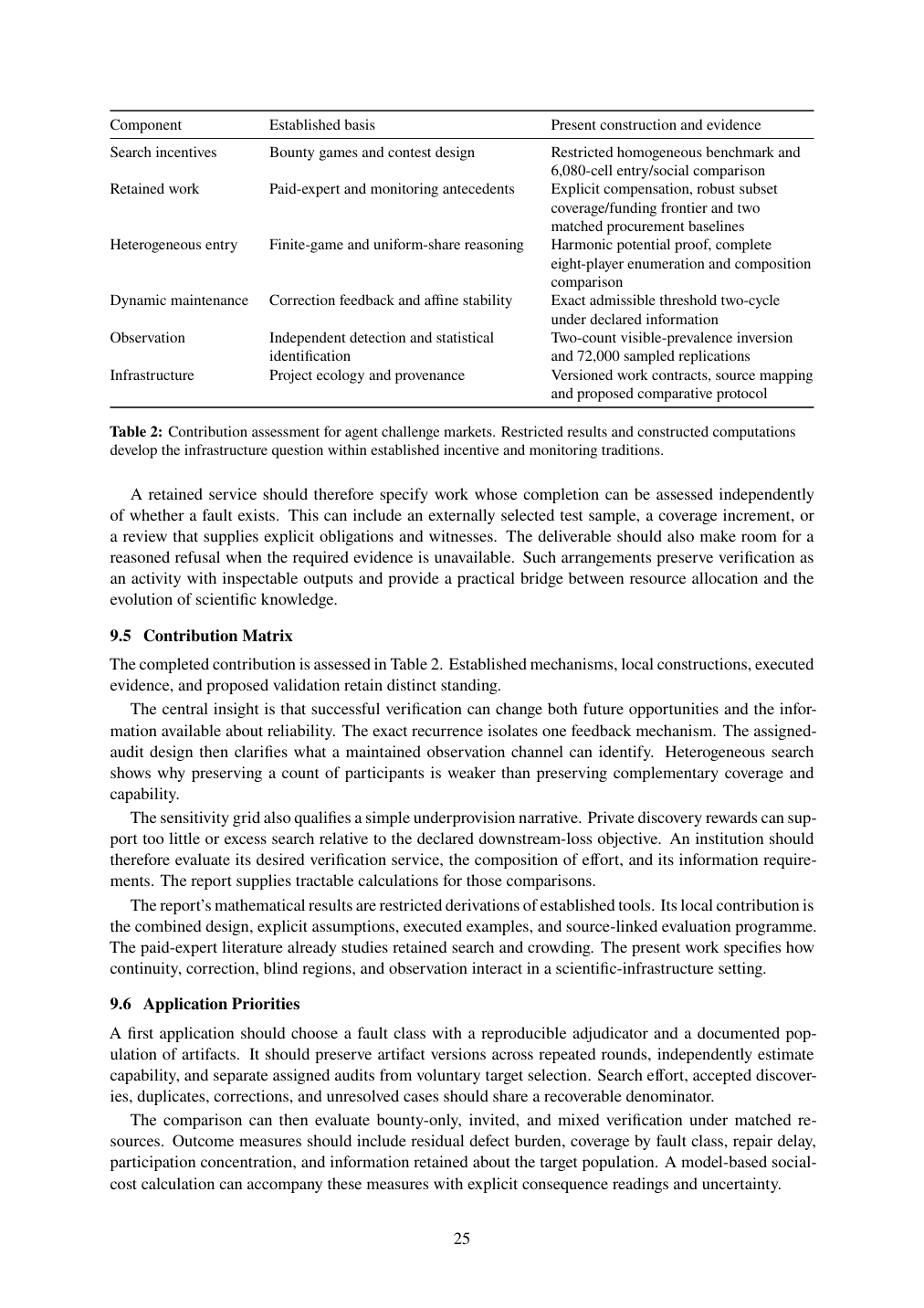
Table 2: Contribution assessment for agent challenge markets. Restricted results and constructed computations develop the infrastructure question within established incentive and monitoring traditions.
A retained service should therefore specify work whose completion can be assessed independently of whether a fault exists. This can include an externally selected test sample, a coverage increment, or a review that supplies explicit obligations and witnesses. The deliverable should also make room for a reasoned refusal when the required evidence is unavailable. Such arrangements preserve verification as an activity with inspectable outputs and provide a practical bridge between resource allocation and the
The completed contribution is assessed in Table 2. Established mechanisms, local constructions, executed evidence, and proposed validation retain distinct standing.
The central insight is that successful verification can change both future opportunities and the infor- mation available about reliability. The exact recurrence isolates one feedback mechanism. The assigned- audit design then clarifies what a maintained observation channel can identify. Heterogeneous search shows why preserving a count of participants is weaker than preserving complementary coverage and
The sensitivity grid also qualifies a simple underprovision narrative. Private discovery rewards can sup- port too little or excess search relative to the declared downstream-loss objective. An institution should therefore evaluate its desired verification service, the composition of effort, and its information require- ments. The report supplies tractable calculations for those comparisons.
The report’s mathematical results are restricted derivations of established tools. Its local contribution is the combined design, explicit assumptions, executed examples, and source-linked evaluation programme. The paid-expert literature already studies retained search and crowding. The present work specifies how continuity, correction, blind regions, and observation interact in a scientific-infrastructure setting.
A first application should choose a fault class with a reproducible adjudicator and a documented pop- ulation of artifacts. It should preserve artifact versions across repeated rounds, independently estimate capability, and separate assigned audits from voluntary target selection. Search effort, accepted discover- ies, duplicates, corrections, and unresolved cases should share a recoverable denominator.
The comparison can then evaluate bounty-only, invited, and mixed verification under matched re- sources. Outcome measures should include residual defect burden, coverage by fault class, repair delay, participation concentration, and information retained about the target population. A model-based social- cost calculation can accompany these measures with explicit consequence readings and uncertainty.
Such a study would test the report’s proposed institutional mechanism. A persistent verification ecology acquires value through the relations it maintains among artifacts, challengers, evidence, and downstream users. Preserving those relations makes it possible to examine how the institution learns, which work remains supported during quiet periods, and which assumptions explain the apparent reliability of its shared knowledge.
9.7 Conclusion
A challenge market can improve an artifact while weakening the immediate incentive to continue checking it. The report makes this feedback explicit through an established entry-game baseline, a social-loss comparison, a retained-capacity calculation, and an exact constructed two-cycle. It also distinguishes repeated searches from complementary coverage and discovery counts from maintained observation. These results motivate verification institutions that record their denominators, preserve an audit channel, and connect funding to downstream consequences. Comparative experiments on real scientific artifacts can now test whether those mechanisms improve reliability and accountable participation under finite resources.
References
Hans Gersbach, Akaki Mamageishvili, Fikri Pitsuwan (2023). Decentralized Attack Search and the Design of Bug
Bounty Schemes. arXiv preprint v2. https://doi.org/10.48550/arXiv.2304.00077. Serena Wang, Martino Banchio, Krzysztof Kotowicz, Katrina Ligett, R. Preston McAfee, Eduardo Vela Nava (2025).
Incentives and Outcomes in Bug Bounties. arXiv preprint; revision 2026. https://doi.org/10.48550/arX iv.2509.16655. Matthew Finifter, Devdatta Akhawe, David Wagner (2013). An Empirical Study of Vulnerability Rewards Programs.
22nd USENIX Security Symposium. 273–288. https://www.usenix.org/conference/usenixsecurity 13/technical-sessions/presentation/finifter. Hans Gersbach, Fikri Pitsuwan, Pio Blieske (2024). Artificial Bugs for Crowdsearch. arXiv preprint. https://do
i.org/10.48550/arXiv.2403.09484. Thomas Maillart, Mingyi Zhao, Jens Grossklags, John Chuang (2017). Given Enough Eyeballs, All Bugs Are Shal-
low? Revisiting Eric Raymond With Bug Bounty Programs. Journal of Cybersecurity 3(2). 81–90. https: //doi.org/10.1093/cybsec/tyx008. Shuchi Chawla, Jason D. Hartline, Balasubramanian Sivan (2012). Optimal Crowdsourcing Contests. Proceedings
of SODA 2012. https://doi.org/10.48550/arXiv.1111.2893. Benny Moldovanu, Aner Sela (2001). The Optimal Allocation of Prizes in Contests. American Economic Review
91(3). 542–558. https://doi.org/10.1257/aer.91.3.542. Pablo Daniel Azar, Silvio Micali (2012). Rational Proofs. Proceedings of STOC 2012. 1017–1028. https://doi.
org/10.1145/2213977.2214069. Tilmann Gneiting, Adrian E. Raftery (2007). Strictly Proper Scoring Rules, Prediction, and Estimation. Journal of
the American Statistical Association 102(477). 359–378. https://doi.org/10.1198/0162145060000014 37. Paul A. Samuelson (1954). The Pure Theory of Public Expenditure. Review of Economics and Statistics 36(4).
387–389. https://doi.org/10.2307/1925895. Bengt Holmstrom (1982). Moral Hazard in Teams. Bell Journal of Economics 13(2). 324–340. https://doi.or
g/10.2307/3003457. John C. Knight, Nancy G. Leveson (1986). An Experimental Evaluation of the Assumption of Independence in
Multiversion Programming. IEEE Transactions on Software Engineering SE-12(1). 96–109. https://doi.or g/10.1109/TSE.1986.6312924. Luc Moreau, Paolo Missier (2013). PROV-DM: The PROV Data Model. W3C Recommendation, editors. https:
//www.w3.org/TR/2013/REC-prov-dm-20130430/. Noetarium Project (2026). An Ecology That Improves the Infrastructure; A Generative Ecology of Projects; Case
Studies. . https://github.com/huangwanhong-maker/The-Science-Infrastructures/tree/869fe3 8afac257cd9b5d51ad5b498a8ff6b8e443.