Sequential Allocation Under Plural Principles And Economic Spillovers
Full text from the PDF
Sequential Allocation Under Plural Principles And Economic
Spillovers
Wanhong HUANG
Abstract
Delivery order can change the capacities enabled by an allocation and the incidence of its later effects. This Technical Report develops an incidence- and resource-indexed certificate for reusing allocation assessments. An adjacent-swap identity explains a specified order reversal. A continuation closure then identifies exactly which state differences remain invisible under a declared family of future stages and linear readings. Its finite-resource extension handles exhausted grants and terminal observations, using established weighted-automaton invariant-space machinery with an explicit allocation contract. Exact computation compares the certificate with full-state equality and present-reading equality on 2,000 paired states. In an uncoupled eight-coordinate fixture, the certificate identifies 1,200 safe reuses versus 600 for state equality, while present-reading reuse makes 400 errors. An allowed coupling of 1/1000 exposes the latent coordinates and raises those errors to 1,000. All 64 remaining-resource contexts of the original six-grant model are checked against exhaustive legal completions. The retained 720-schedule and 651-case sensitivity studies connect this certificate to order, economic propagation, and plural evaluation. The contribution is a closed comparison and checking protocol with distinguishing continuation witnesses, dependency invalidation, matched baselines, and precise feasibility scope. The mathematical closure is attributed to its established antecedents. Empirical transition adequacy and the standing of an evaluation principle retain separate evidence requirements within the author’s procedural-allocation programme.
Keywords: sequential allocation; continuation equivalence; observable quotient; economic incidence; plural evaluation
Technical Report Note
This technical report shares an evolving inquiry and invites dialogue, criticism, revision, and independent development. Its definitions, distinctions, and constructions remain open to refinement. Circulation across scholarly and practical communities is part of the purpose of releasing the manuscript.
The author treats the viewpoints, concepts, and lines of reasoning presented here as contributions to a shared field of inquiry. Similar or related ideas may have appeared in other intellectual, cultural, and disciplinary traditions. The manuscript identifies known antecedents and distinguishes inherited positions, interpretive proposals, and arguments developed here. Historical priority remains open to further investigation.
The constructions and arguments are presented with their stated assumptions and evidential scope. Readers are encouraged to question, test, revise, extend, reinterpret, or independently develop the ideas presented here. Where appropriate, acknowledgment of this paper as one point of encounter in the development of a related idea is appreciated. Such acknowledgment records an intellectual route; the ideas remain available for criticism, revision, and independent development.
Definitions introduced by the paper are local analytical stipulations unless attributed to another source. Their use identifies the scope of the present argument; terminological and historical priority remain subjects for independent investigation. Generative Relational theory is treated as an open research programme whose proposals receive critical examination alongside independent literature.
Responsible Use and Rights Reservation
This section records a request for responsible scholarly conduct and identifies the scope of retained rights. Legal permissions are governed by the licence on the following page.
The author encourages good-faith discussion, criticism, independent inquiry, and responsible use of the material. Separately from the licence’s terms, the author asks users to consider foreseeable harms when adapting the arguments, representations, or examples of this paper, particularly in scientific inquiry, institutional decisions, and computational knowledge infrastructures. The ethical request leaves the licence’s permissions and legally authorised uses unchanged.
The author retains the rights preserved under CC BY-NC 4.0 and may pursue remedies to which the author is legally entitled for breach of the licence or violation of independently applicable rights. Reuse remains independent from authorial endorsement. Third-party rights require authorisation from their respective holders where applicable. Copyright exceptions and limitations, including applicable forms of fair use or fair dealing, remain available.
Notices
This page consolidates the manuscript’s research status, licence, development disclosure, researchprogramme relation, and suggested citation.
Status. This technical report is prepared for the author’s substantive review and subsequent scholarly discussion. The report distinguishes established antecedents, conditional results developed here, inspected source artifacts, and numerical illustrations under declared assumptions. Internal checks assess the stated arguments and examples; independent scholarly assessment can further test their interpretation and adequacy. The source ledgers record the access level and claim scope of consulted works.
Licence. Except where otherwise indicated, copyright 2026 Wanhong Huang. This work is made available under the Creative Commons Attribution-NonCommercial 4.0 International License (CC BY-NC 4.0). Subject to its terms, the licence permits sharing and adaptation for noncommercial purposes with appropriate attribution, a link to the licence, and an indication of changes. Attribution should preserve the licensor’s independence from the reuse. Reuse is governed solely by the licence; the responsible-use request on the preceding page remains separate from its terms. The licence deed and legal code are available at https://creativecommons.org/licenses/by-nc/4.0/. The licence governs in case of conflict with this summary. Third-party material remains subject to its respective rights.
Statement on the use of language models. Preparation involved OpenAI’s ChatGPT and Codex. Language models supported exploratory dialogue, source discovery and checking, argumentative criticism, manuscript revision, LATEX typesetting, and the development of supporting code and figures. Verification used the sources and access levels recorded in the accompanying ledgers. The author initiated the research questions and directed the research programme; interpretation, acceptance of the arguments, and publication decisions remain subject to the author’s review. Authorship credit and responsibility for the released manuscript remain with the human author.
Code and data availability. Supporting scripts, generated baseline, sensitivity and publication-method outputs, verified source records, and a publication-review ledger accompany this report. A single reproduction entry point regenerates the declared computations and figures. The source package contains the editable manuscript, source ledgers, supporting scripts and outputs, and a reading guide. Numerical illustrations, where present, use the assumptions stated in their captions and text.
Related research programme. This report belongs to the Noetarium technical report series. Companion reports study inference, computation, evaluation, governance, and cross-disciplinary knowledge formation. The reports develop distinct technical questions within an open Generative Relational research programme.
Suggested citation. Huang, Wanhong. “Sequential Allocation Under Plural Principles And Economic Spillovers.” Technical report, 2026.
1 Introduction
An authorised allocation specifies resources and recipients, while its delivery order can change the capacities those resources enable. A laboratory can receive equipment before trained staff, a service can acquire a route before the intended population gains access, and a grant can activate capacity created by an earlier grant. These interactions make the trace of delivery a substantive research object alongside the selected project set.
The report connects stage composition, downstream incidence, and plural evaluation. A direct grant, the capacity it enables, and the distribution of later effects have different units and evidential roles. The evaluation principle adds another reading of that distribution. Keeping these objects explicit permits a precise comparison of two delivery histories and identifies which model or evaluative revision changes the comparison. Noetarium’s existing allocation programme already supplies typed resource systems, grant order, and economic evaluators (Noetarium Project, 2026); the present work develops a checked analytical interface within that programme.
A local order identity gives the first component. It propagates an adjacent reversal through the actual common suffix, incidence map, and evaluator. A present equality can nevertheless disappear under another future grant. The main computational development is therefore a continuation certificate: an invariant observation space identifies exactly which state differences remain invisible under a declared continuation language. A resource-context extension handles exhausted grants and terminal observations. Established weighted-automaton algebra supplies the closure machinery, while the allocation contribution is the incidence- and resource-indexed reuse contract and its independent checker.
The argument is evaluated through three complementary computations. The original six-stage model enumerates all 720 schedules and shows different total- and floor-oriented selections despite equal direct grants. A 651-case parameter study separates complementarity and propagation sensitivity. A new exact cache study compares full-state equality, current-reading equality, and continuation closure on 2,000 paired states, then checks all 64 remaining-resource contexts of the original allocation model against exhaustive completions. These studies establish the method’s internal behaviour under declared mechanisms.
The resulting claims concern the specified transition, feasibility, and observation models. Numerical reuse preserves selected readings and a shared context; the broader questions of standing, commitments, and the adequacy of a justice principle retain their own substantive arguments. Source-supported transition evidence and measured cache performance can strengthen an empirical application through the interfaces defined here.
2 Budgeting, Incidence, And Evaluative Antecedents
2.1 Resource Selection And Proportional Representation
Participatory budgeting studies the selection of projects under a common budget and voters’ expressed valuations. Peters et al. (2021) develops proportionality axioms and the Method of Equal Shares for additive utilities and arbitrary project costs. That research supplies a precise account of representation for its stated voting setting. The present report treats the funded set as fixed in its main illustration and varies delivery order. Thus a proportional selection rule can precede the analysis developed here: the question becomes how an authorised selection is implemented when stages modify one another’s effects.
Faliszewski et al. (2023) provides Pabulib and associated analysis tools for comparing participatorybudgeting rules on recorded elections. Such data offer a useful future substrate for testing selection and implementation together. Their existence also disciplines the present proposal. A comparison based on a small example or two aggregate scores should be presented through those scores. An axiom of proportional representation requires its own proof or direct verification on the specified preference profile.
2.2 Economic Propagation And Social Evaluation
Input–output analysis represents interdependencies through which an initial change has further effects (Timmer et al., 2015; Acemoglu et al., 2012). This report uses a nonnegative linear propagation map for that limited purpose. Propagated activity, capabilities, and socially valued consequences require separate measurements and an explicit interpretation of monetary expenditure. A quantity may travel through a network without generating an equal amount of benefit at every step. The interpretation of each propagated coordinate is therefore part of the model specification.
Social-choice and capability approaches motivate explicit plurality in evaluation. Sen (1992) examines the informational bases through which inequalities are judged. Here a total, a minimum, and a weighted sum are available evaluators with different informational commitments. They are analytical instruments for displaying disagreement. The report derives conditional comparisons under those instruments and leaves the choice among them open to substantive justification.
2.3 Relation To The Existing Research Programme
Noetarium’s recent allocation records already recognise that the order of grants can matter and that different principles can judge the same trace (Noetarium Project, 2026). The author’s wider noncommutative procedural-justice inquiry supplies a philosophical motivation. The narrower development offered here concerns the composition of order effects with downstream incidence and the identification of evaluatorinvisible distinctions. This boundary is essential: describing an operator composition is a representation; showing how a particular order effect reaches an evaluator adds a specific analytical result.
3 Sequential Allocation And Interference Literature
The literature relevant to delivery order spans project selection, sequential choice, resource complementarity, and interference. The purpose of the present synthesis is to locate the precise interface studied by the report: a fixed authorised collection of stages, an explicitly evolving state, a transmission model, and several evaluative readings. Comparing those interfaces makes the contribution assessable. A result for selecting a project set, a theorem about picking sequences, and an estimator of network exposure can each supply an ingredient while answering a distinct substantive question.
3.1 Selection, Picking, And Complementarity
Participatory budgeting gives a principled starting point for selecting projects. The additive-utility formulation of Peters et al. (2021) attaches an interpretable proportionality question to a constrained funded set. The data and tools described by Faliszewski et al. (2023) support comparisons across actual voting records. Together these works suggest a useful experimental decomposition: preserve the recorded electorate, preference expression, project costs, and selection rule; then add a separately justified account of implementation. A reported change in subsequent service incidence can then be traced to delivery assumptions while the original selection property retains its own domain. This decomposition is an analytical proposal in the present report.
Sequential picking already gives order a central role. Bouveret and Lang (2011) study an elicitationfree protocol in which agents choose indivisible goods successively, with additive preferences. Their analysis relates the desirability of a picking sequence to the preference structure and the welfare criterion. Kalinowski et al. (2013) establish expected utilitarian optimality of alternation under their specified independent-preference assumptions. These results are close comparators because both the actor sequence and the evaluative objective matter. The state in the present report, however, contains capacities changed by previous deliveries. A stage can increase the productivity of a later grant even when the identity and direct amount of every recipient are fixed. Transferring a picking-sequence theorem to that setting would require proving that its utility and independence assumptions survive the added dynamics.
Resource complementarities also have a substantial computational history. Boutilier et al. (1999) formulate sequential auctions in which the value of acquiring a resource depends on resources obtained elsewhere in the sequence, and use dynamic programming to construct bidding policies under estimated
price distributions. Their analysis establishes that sequential resource interaction is an existing research object. The present incidence construction adds a different reporting object: the effect of a local reversal after later capability transformations and a declared observation map. It supplies a conditional explanation of a completed schedule comparison. A bidding policy, a public allocation principle, and a downstream account can therefore coexist in one infrastructure while retaining their separate interpretations.
3.2 Adaptive Search And Structural Assumptions
Adaptive optimisation often gains tractability through structural restrictions on marginal returns. Golovin and Krause (2011) introduce adaptive submodularity and derive greedy guarantees under specified conditions. The current author version records a correction involving stronger conditions for one result. The relevant lesson for the present design is methodological: an algorithmic guarantee belongs to a particular objective, information pattern, and structural property. Positive cross-stage gains in the constructed allocation model express complementarity, and their presence alone supplies a different pattern of marginal returns. The exact enumeration used here evaluates that declared pattern directly.
An extension could search for restricted transition families with a useful diminishing-return property. Such an extension would have to identify whether the property concerns direct grants, reachable capacity, propagated activity, or the final evaluator. A concave social evaluator can reduce a marginal gain even when the underlying state transition is complementary. Conversely, a changing active minimum can make the scheduling objective nonsmooth. The composition of these mechanisms deserves a separate theorem. The report’s swap identity supplies a diagnostic for discovering promising restrictions: one can inspect the sign and magnitude of marginal order effects before proposing an approximation guarantee.
3.3 Network Transmission And Causal Interpretation
Economic interdependence supplies another established ingredient. Acemoglu et al. (2012) relate aggregate transmission of idiosyncratic shocks to the structure of an input–output network. Timmer et al. (2015) describe the construction and prudent use of the World Input–Output Database, including its annual tables and value-added applications. Their settings differ from the three-group constructed state used here. Their relevance is the need to specify what travels along an edge and what an aggregate means. A capacity-enabled service, a transaction value, and a welfare effect can require different coefficients and different accounting rules.
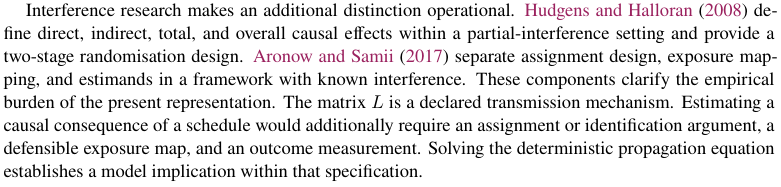
The report accordingly treats network data as evidence that can discipline a mechanism, and experimental assignment as evidence that can identify specified effects. A transaction table might identify where money was recorded while interviews explain access restrictions that determine whether a later service reaches its intended population. Administrative event histories might establish delivery timing while an independent survey measures capability. The combination can support a richer model through explicit interfaces among evidence types. Each interface should retain the population, period, and uncertainty relevant to the claim it supports.
3.4 Evaluation And Mathematical Machinery
Sen (1992) places the evaluative space and human diversity at the centre of comparisons of equality. The present report uses that motivation to preserve several readings of the same declared outcome. Its total and minimum are deliberately elementary examples. A substantive capability assessment would require further justification of which opportunities count, whose conversion conditions matter, and what
Readable text
measurement allows. The elementary algebra helps expose these choices by making the evaluator a visible
The optimisation machinery is likewise established. Weighted objectives, least-squares representa- tions, vector optimisation, and sensitivity analysis belong to the framework presented by Boyd and Van- denberghe (2004). The report-specific object is the composition of these ingredients into a trace expla- nation and a dependency-bearing schedule certificate. Its value can be tested through accuracy of expla- nations, search savings on matched instances, and the stability of conclusions across declared modelling choices. Those tests give a more precise research programme than a broad claim that order, networks, or plural evaluation has newly entered allocation research.
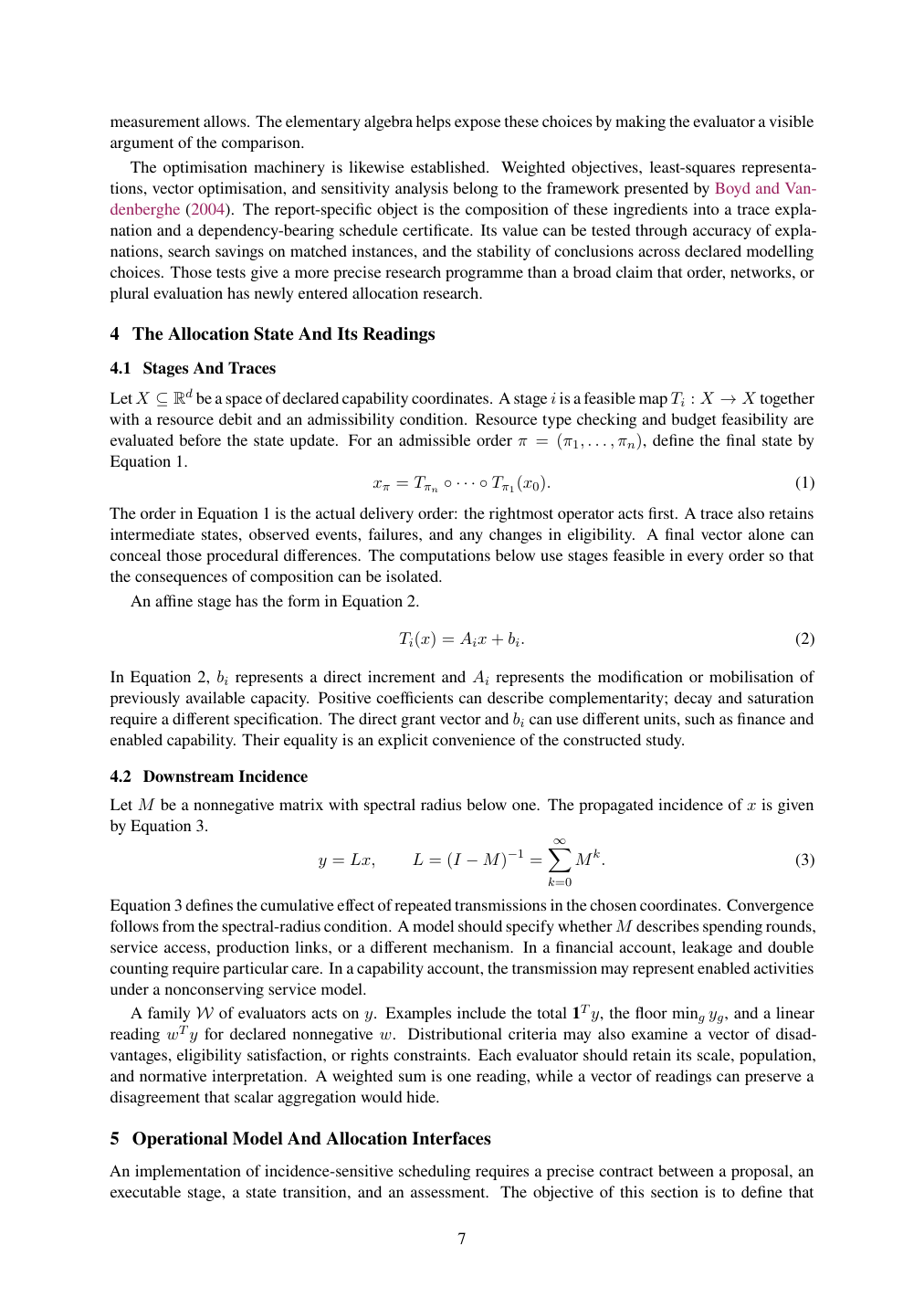
with a resource debit and an admissibility condition. Resource type checking and budget feasibility are
The order in Equation 1 is the actual delivery order: the rightmost operator acts first. A trace also retains intermediate states, observed events, failures, and any changes in eligibility. A final vector alone can conceal those procedural differences. The computations below use stages feasible in every order so that
previously available capacity. Positive coefficients can describe complementarity; decay and saturation enabled capability. Their equality is an explicit convenience of the constructed study.
Equation 3 defines the cumulative effect of repeated transmissions in the chosen coordinates. Convergence service access, production links, or a different mechanism. In a financial account, leakage and double counting require particular care. In a capability account, the transmission may represent enabled activities
vantages, eligibility satisfaction, or rights constraints. Each evaluator should retain its scale, population, and normative interpretation. A weighted sum is one reading, while a vector of readings can preserve a
An implementation of incidence-sensitive scheduling requires a precise contract between a proposal, an executable stage, a state transition, and an assessment. The objective of this section is to define that
contract closely enough for an independent implementation. The contract also identifies the assumptions that the constructed affine illustration holds fixed. A system can then replace an illustrative component with an empirically grounded component while preserving the meaning of the surrounding records.
5.1 State Schema And Resource Semantics

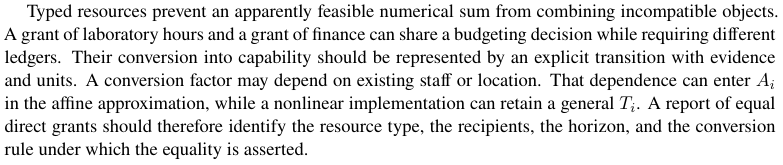
Eligibility requires an equally precise time convention. A stage may need a prerequisite at its start, throughout execution, or at completion. A permit can expire during a delay. A training stage can enable a subsequent equipment grant while equipment delivered first remains unusable. The admissibility interface should evaluate these conditions at the declared event time and record the reason for acceptance or rejection. Two sequences that pass different prerequisite checks constitute a feasibility comparison; the affine swap proof applies to a pair with a common feasible execution context.
5.2 Stage And Incidence Contracts

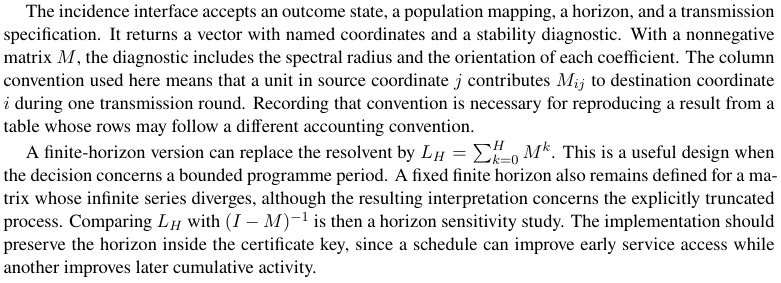
5.3 Assessment Records And Plural Archives
An evaluator interface takes a named incidence vector and returns an assessment with an evaluator identifier, scale, direction of preference, population, and any threshold used. A total records an additive reading. A minimum records the least outcome among the chosen coordinates. A rights or eligibility assessment can return a vector of satisfied conditions and reasons. Combining these outputs requires an explicit de-
cision procedure. Their coexistence in an archive provides visibility into different reasons for retaining a schedule.
Pareto retention has a narrow operational meaning in this design. A schedule is retained if another feasible schedule fails to weakly improve every selected numerical criterion and strictly improve one. The selected criterion list is part of the archive version. Adding a new affected population, replacing an activity measure with an access measure, or changing the horizon can change the retained schedules. The archive should preserve the old version for historical interpretation and issue a new comparison under the revised specification.
The comparison record should also retain qualitative reasons that lack a common numerical scale. A community may regard an early delivery as a recognition of standing or as fulfilment of a prior commitment. That reason can attach to a schedule even where the final numerical state agrees with another schedule. The mathematical observable-commutativity criterion concerns the explicit evaluator family. A richer institutional judgement can examine the event history through additional evaluators or deliberative procedures. The data architecture supports such extension when it keeps the trace accessible.
5.4 Certificate Content And Independent Checking

The certificate’s dependency record determines its lifetime. A revision to an unrelated descriptive field leaves its arithmetic intact. A revision to a stage gain, a population mapping, a prerequisite, or a transmission coefficient can require recomputation. A useful invalidation procedure traverses the dependency graph, marks the affected certificates as historical, and queues their checks under the new versions. This design extends the repository’s separation of proposals, runs, and assessments into the specific scheduling problem. It is a proposed implementation interface supported by the report’s mathematics and constructed reference code.
6 Affine Stage Composition





Proposition 6.1 identifies three possible sources of materiality. The local stages can create a difference; later stages can amplify or attenuate it; and the incidence and evaluation process can retain or remove the
distinction. An optimisation procedure that scores only the local commutator can therefore misallocate effort. A large local effect can lie outside the relevant reading, while a small effect can enter a highly amplified downstream direction.
Any permutation can be transformed into another through adjacent swaps. Summing their signed evaluator differences along a chosen path yields the exact difference between the endpoints. This statement follows by telescoping successive final outcomes. The sum depends on the intermediate prefixes used to compute local differences, while the endpoint result is fixed. It offers a traceable explanation of why a better schedule differs from a reference schedule.
7 Observable Commutativity And Normative Plurality





For nonlinear criteria such as the minimum, evaluator equality can be checked directly on the two propagated vectors. A useful sufficient condition is zero difference in every coordinate on which the evaluator depends. For a minimum, a difference outside the active minimum coordinate may still matter after a larger perturbation changes which coordinate is active. Local gradients can guide a search, but a retained candidate should be assessed using the actual criterion.
8 Continuation Equivalence And Resource Contexts
An equality of present assessments has a limited lifetime when a later grant can mobilise a currently unobserved capacity. The objective of this section is to determine the exact lifetime of such an equality within a declared affine continuation model. The resulting certificate answers a concrete implementation question: whether two prefix states can share a cached continuation assessment while the same resource and eligibility context is retained. The argument first treats an unrestricted continuation alphabet, then records the restrictions imposed by remaining resources.
8.1 Present Readings And Future Distinctions

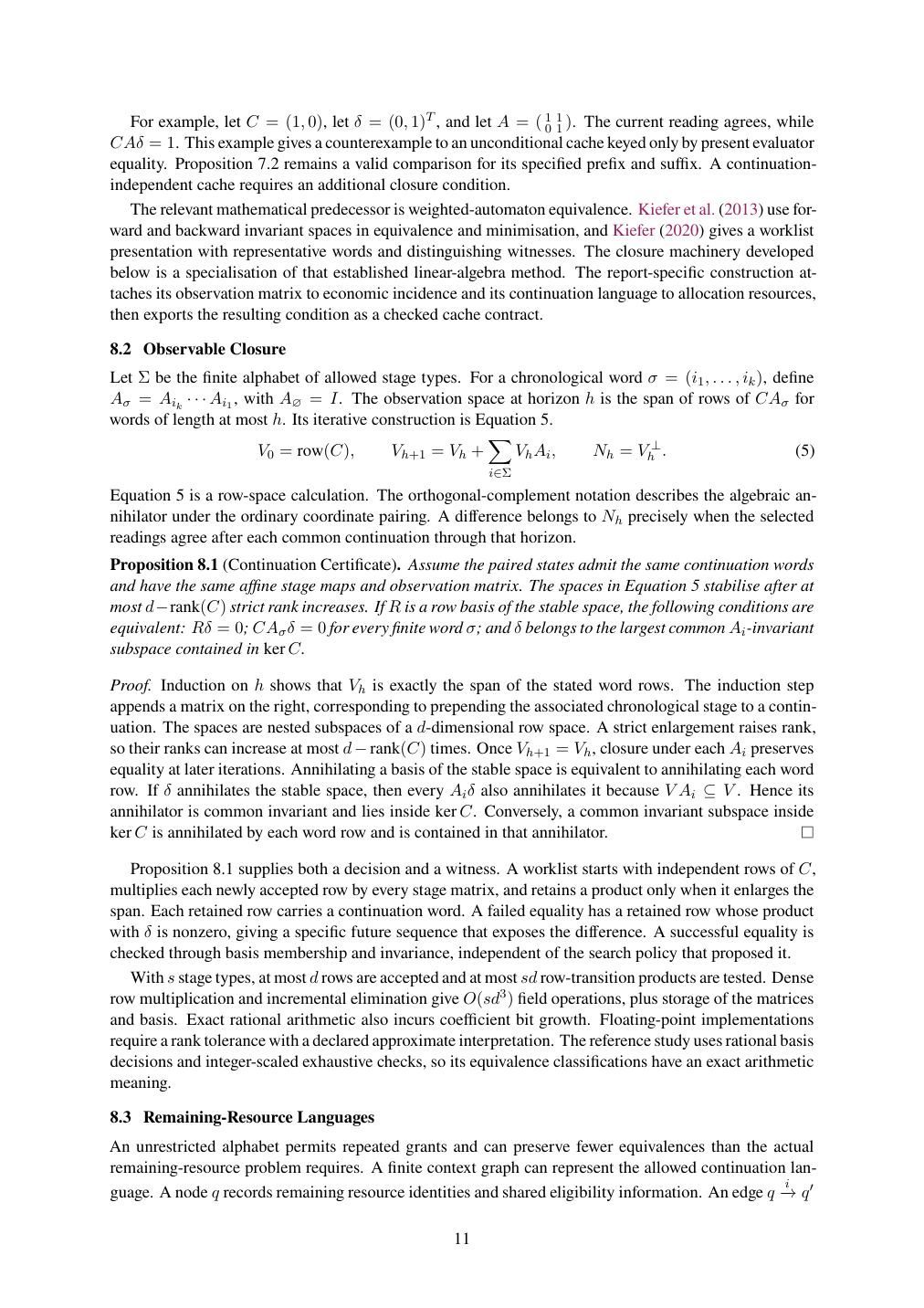
Readable text
equality. Proposition 7.2 remains a valid comparison for its specified prefix and suffix. A continuation- independent cache requires an additional closure condition.
The relevant mathematical predecessor is weighted-automaton equivalence. Kiefer et al. (2013) use for- ward and backward invariant spaces in equivalence and minimisation, and Kiefer (2020) gives a worklist presentation with representative words and distinguishing witnesses. The closure machinery developed below is a specialisation of that established linear-algebra method. The report-specific construction at- taches its observation matrix to economic incidence and its continuation language to allocation resources, then exports the resulting condition as a checked cache contract.
Equation 5 is a row-space calculation. The orthogonal-complement notation describes the algebraic an- readings agree after each common continuation through that horizon.
Proposition 8.1 (Continuation Certificate). Assume the paired states admit the same continuation words and have the same affine stage maps and observation matrix. The spaces in Equation 5 stabilise after at
appends a matrix on the right, corresponding to prepending the associated chronological stage to a contin- equality at later iterations. Annihilating a basis of the stable space is equivalent to annihilating each word
multiplies each newly accepted row by every stage matrix, and retains a product only when it enlarges the span. Each retained row carries a continuation word. A failed equality has a retained row whose product checked through basis membership and invariance, independent of the search policy that proposed it.
and basis. Exact rational arithmetic also incurs coefficient bit growth. Floating-point implementations require a rank tolerance with a declared approximate interpretation. The reference study uses rational basis decisions and integer-scaled exhaustive checks, so its equivalence classifications have an exact arithmetic
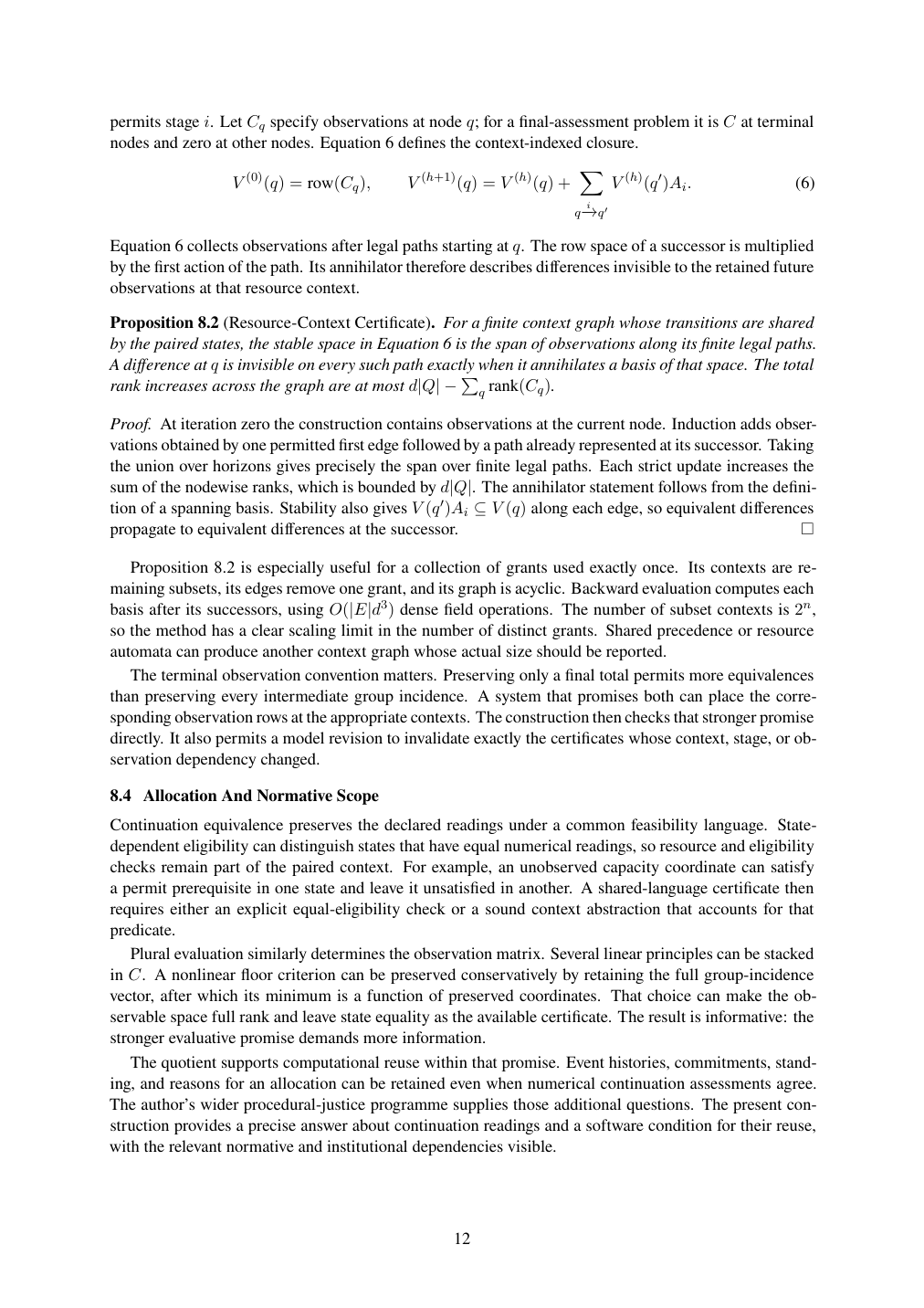
An unrestricted alphabet permits repeated grants and can preserve fewer equivalences than the actual remaining-resource problem requires. A finite context graph can represent the allowed continuation lan-
Readable text
nodes and zero at other nodes. Equation 6 defines the context-indexed closure.
by the first action of the path. Its annihilator therefore describes differences invisible to the retained future
Proposition 8.2 (Resource-Context Certificate). For a finite context graph whose transitions are shared by the paired states, the stable space in Equation 6 is the span of observations along its finite legal paths.
Proof. At iteration zero the construction contains observations at the current node. Induction adds obser- vations obtained by one permitted first edge followed by a path already represented at its successor. Taking the union over horizons gives precisely the span over finite legal paths. Each strict update increases the
propagate to equivalent differences at the successor.
Proposition 8.2 is especially useful for a collection of grants used exactly once. Its contexts are re- maining subsets, its edges remove one grant, and its graph is acyclic. Backward evaluation computes each so the method has a clear scaling limit in the number of distinct grants. Shared precedence or resource automata can produce another context graph whose actual size should be reported.
The terminal observation convention matters. Preserving only a final total permits more equivalences than preserving every intermediate group incidence. A system that promises both can place the corre- sponding observation rows at the appropriate contexts. The construction then checks that stronger promise directly. It also permits a model revision to invalidate exactly the certificates whose context, stage, or ob-
Continuation equivalence preserves the declared readings under a common feasibility language. State- dependent eligibility can distinguish states that have equal numerical readings, so resource and eligibility checks remain part of the paired context. For example, an unobserved capacity coordinate can satisfy a permit prerequisite in one state and leave it unsatisfied in another. A shared-language certificate then requires either an explicit equal-eligibility check or a sound context abstraction that accounts for that
Plural evaluation similarly determines the observation matrix. Several linear principles can be stacked vector, after which its minimum is a function of preserved coordinates. That choice can make the ob- servable space full rank and leave state equality as the available certificate. The result is informative: the stronger evaluative promise demands more information.
The quotient supports computational reuse within that promise. Event histories, commitments, stand- ing, and reasons for an allocation can be retained even when numerical continuation assessments agree. The author’s wider procedural-justice programme supplies those additional questions. The present con- struction provides a precise answer about continuation readings and a software condition for their reuse, with the relevant normative and institutional dependencies visible.
Readable text
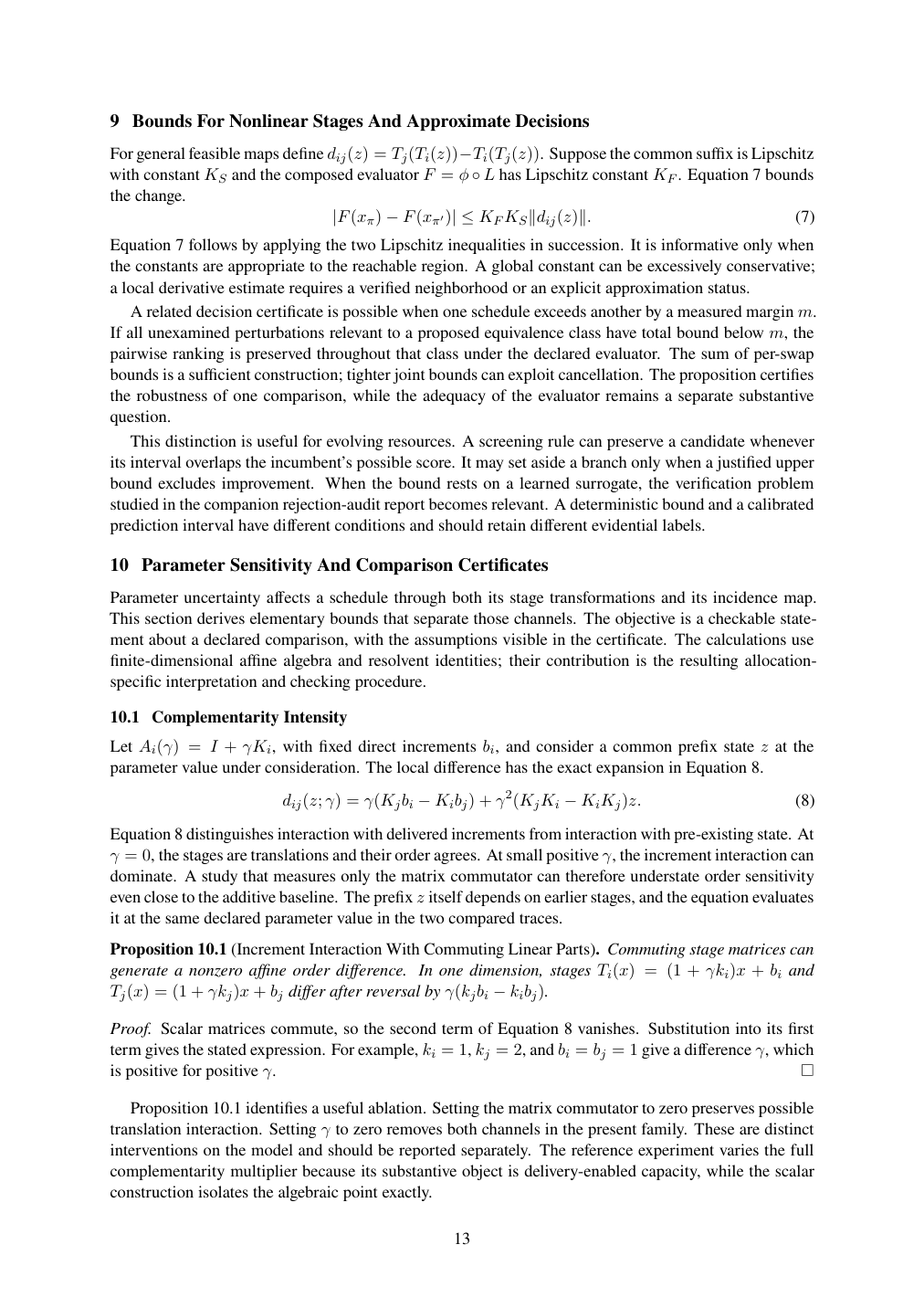
9 Bounds For Nonlinear Stages And Approximate Decisions
Equation 7 follows by applying the two Lipschitz inequalities in succession. It is informative only when the constants are appropriate to the reachable region. A global constant can be excessively conservative; a local derivative estimate requires a verified neighborhood or an explicit approximation status.
pairwise ranking is preserved throughout that class under the declared evaluator. The sum of per-swap bounds is a sufficient construction; tighter joint bounds can exploit cancellation. The proposition certifies the robustness of one comparison, while the adequacy of the evaluator remains a separate substantive
This distinction is useful for evolving resources. A screening rule can preserve a candidate whenever its interval overlaps the incumbent’s possible score. It may set aside a branch only when a justified upper bound excludes improvement. When the bound rests on a learned surrogate, the verification problem studied in the companion rejection-audit report becomes relevant. A deterministic bound and a calibrated prediction interval have different conditions and should retain different evidential labels.
10 Parameter Sensitivity And Comparison Certificates
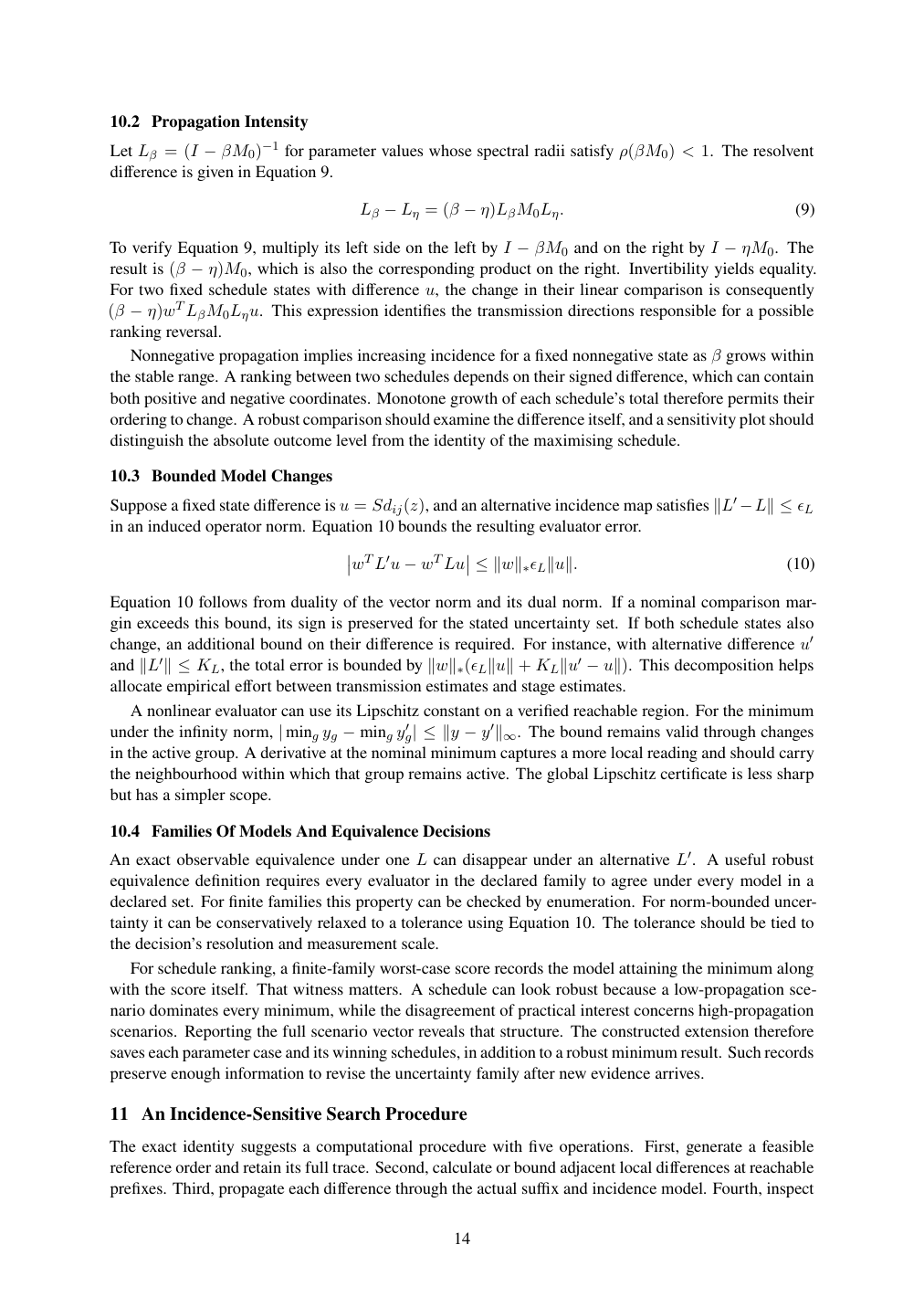
Parameter uncertainty affects a schedule through both its stage transformations and its incidence map. This section derives elementary bounds that separate those channels. The objective is a checkable state- ment about a declared comparison, with the assumptions visible in the certificate. The calculations use finite-dimensional affine algebra and resolvent identities; their contribution is the resulting allocation-
parameter value under consideration. The local difference has the exact expansion in Equation 8.
Equation 8 distinguishes interaction with delivered increments from interaction with pre-existing state. At dominate. A study that measures only the matrix commutator can therefore understate order sensitivity it at the same declared parameter value in the two compared traces.
Proposition 10.1 (Increment Interaction With Commuting Linear Parts). Commuting stage matrices can
Proof. Scalar matrices commute, so the second term of Equation 8 vanishes. Substitution into its first
Proposition 10.1 identifies a useful ablation. Setting the matrix commutator to zero preserves possible interventions on the model and should be reported separately. The reference experiment varies the full complementarity multiplier because its substantive object is delivery-enabled capacity, while the scalar
Readable text
the stable range. A ranking between two schedules depends on their signed difference, which can contain both positive and negative coordinates. Monotone growth of each schedule’s total therefore permits their ordering to change. A robust comparison should examine the difference itself, and a sensitivity plot should distinguish the absolute outcome level from the identity of the maximising schedule.
in an induced operator norm. Equation 10 bounds the resulting evaluator error.
Equation 10 follows from duality of the vector norm and its dual norm. If a nominal comparison mar- gin exceeds this bound, its sign is preserved for the stated uncertainty set. If both schedule states also
allocate empirical effort between transmission estimates and stage estimates.
A nonlinear evaluator can use its Lipschitz constant on a verified reachable region. For the minimum
in the active group. A derivative at the nominal minimum captures a more local reading and should carry the neighbourhood within which that group remains active. The global Lipschitz certificate is less sharp
equivalence definition requires every evaluator in the declared family to agree under every model in a declared set. For finite families this property can be checked by enumeration. For norm-bounded uncer- tainty it can be conservatively relaxed to a tolerance using Equation 10. The tolerance should be tied to
For schedule ranking, a finite-family worst-case score records the model attaining the minimum along with the score itself. That witness matters. A schedule can look robust because a low-propagation sce- nario dominates every minimum, while the disagreement of practical interest concerns high-propagation scenarios. Reporting the full scenario vector reveals that structure. The constructed extension therefore saves each parameter case and its winning schedules, in addition to a robust minimum result. Such records preserve enough information to revise the uncertainty family after new evidence arrives.
The exact identity suggests a computational procedure with five operations. First, generate a feasible reference order and retain its full trace. Second, calculate or bound adjacent local differences at reachable prefixes. Third, propagate each difference through the actual suffix and incidence model. Fourth, inspect
the resulting vector under each declared principle. Fifth, evaluate promising schedules in the full simulator and archive the comparison with its assumptions.

For a large problem, explanation and pruning can supply computational savings through targeted schedule exploration. A nearest-neighbor schedule search explores adjacent swaps, while evolutionary search explores larger reorderings. The local certificate can prioritize mutations that affect presently discriminating directions. A plural archive retains schedules that improve different principles. It should also retain important procedural constraints, with institutional requirements recorded alongside the numerical Pareto frontier.
12 Search Mechanisms And Computational Cost
The scheduling method has two computational roles: evaluating feasible orders and explaining local changes. This section specifies a reference search design and the cost of its components. Exact enumeration remains the standard for the six-stage experiment. Larger instances can use the same checker with heuristic proposal mechanisms, which allows an experiment to separate proposal quality from certificate correctness.
12.1 Reference Evaluation Algorithm

12.2 Adjacent Mutation And Cache Reuse

The checker should compare its incremental result with a full replay on a declared fraction of proposals during development. This cross-check detects stale cache keys, an incorrectly oriented suffix, or a feasibility dependency omitted from the state. It is a meaningful implementation test because the two paths compute the same declared final outcome through different mechanisms. Once the implementation is stable, the fraction can be reduced while preserving exact checks on newly introduced stage types.
An observable-commutativity cache can group proposals with the same assessment vector, within a specified tolerance. The group key includes the prefix, suffix, incidence version, and evaluator family. A cache hit can save a repeated expensive evaluation only when those dependencies match. In a changing
Readable text
population or under a revised evaluative objective, the system recomputes the assessment. The mathemat- ical equality supplies a sufficient condition for reuse within its context, and the dependency key gives the
A plural search maintains a frontier over declared assessments and a separate collection of procedurally required schedules. An adjacent proposal enters the frontier if it is undominated; it can also enter the procedural collection when a declared institutional reason calls for inspection. A scalarising proposal policy may cycle through evaluator weights to explore different portions of the frontier. The archive still saves the complete assessment vector, so later comparison can recover the disagreement behind the scalar
Termination requires a precise status. Exhaustive enumeration proves optimality over the enumerated feasible orders under the declared arithmetic and criteria. A local search with every adjacent move in- spected proves local optimality in that neighbourhood. A time-limited evolutionary search reports its best found schedules and evaluation budget. A bound-based pruning procedure can report the certified gap when its upper bounds cover the remaining branches. These statuses are different outputs of the same architecture, each useful for a different computational budget.
The factorial number of possible orders is the principal scaling challenge. Even with inexpensive state dence constraints, repeated-stage symmetries, dynamic programming under a sufficient state description, and branch bounds from the local identities. Each remedy requires a specific proof of what information it preserves. The report proposes evaluating these mechanisms against exact small cases before transferring
The accompanying script constructs six affine stages over three groups. Each group receives two grants, with direct increments one and one half, so every complete order delivers 1.5 units directly to each group.
The propagation matrix in Equation 11 is chosen to be transparent and stable.
The spectral radius of Equation 11 is approximately 0.3710. Each result is a calculation under these declared coefficients. Its evidential standing is a constructed mechanism study; city spending behaviour and causal programme effects require empirical estimation.
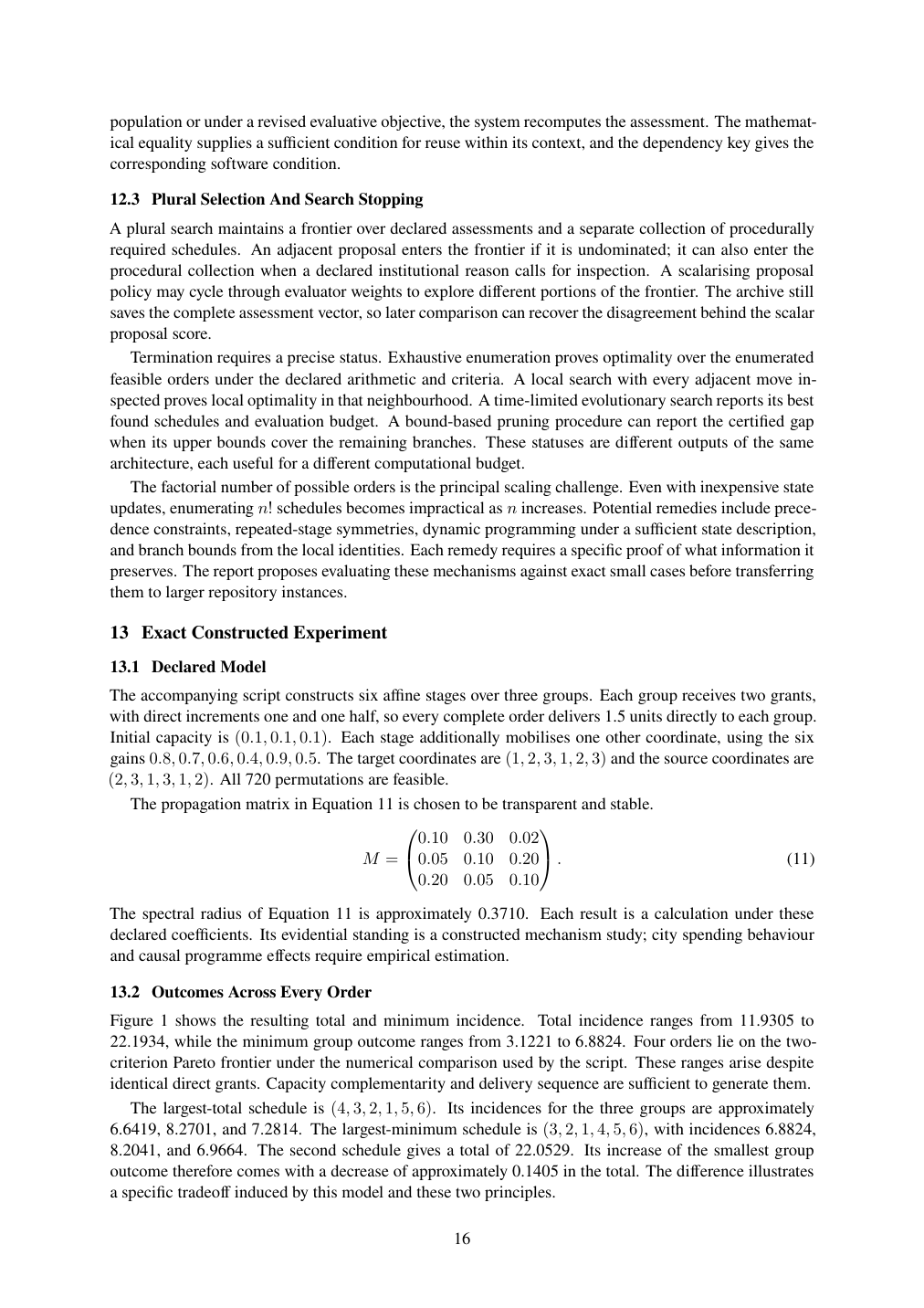
Figure 1 shows the resulting total and minimum incidence. Total incidence ranges from 11.9305 to 22.1934, while the minimum group outcome ranges from 3.1221 to 6.8824. Four orders lie on the two- criterion Pareto frontier under the numerical comparison used by the script. These ranges arise despite identical direct grants. Capacity complementarity and delivery sequence are sufficient to generate them.
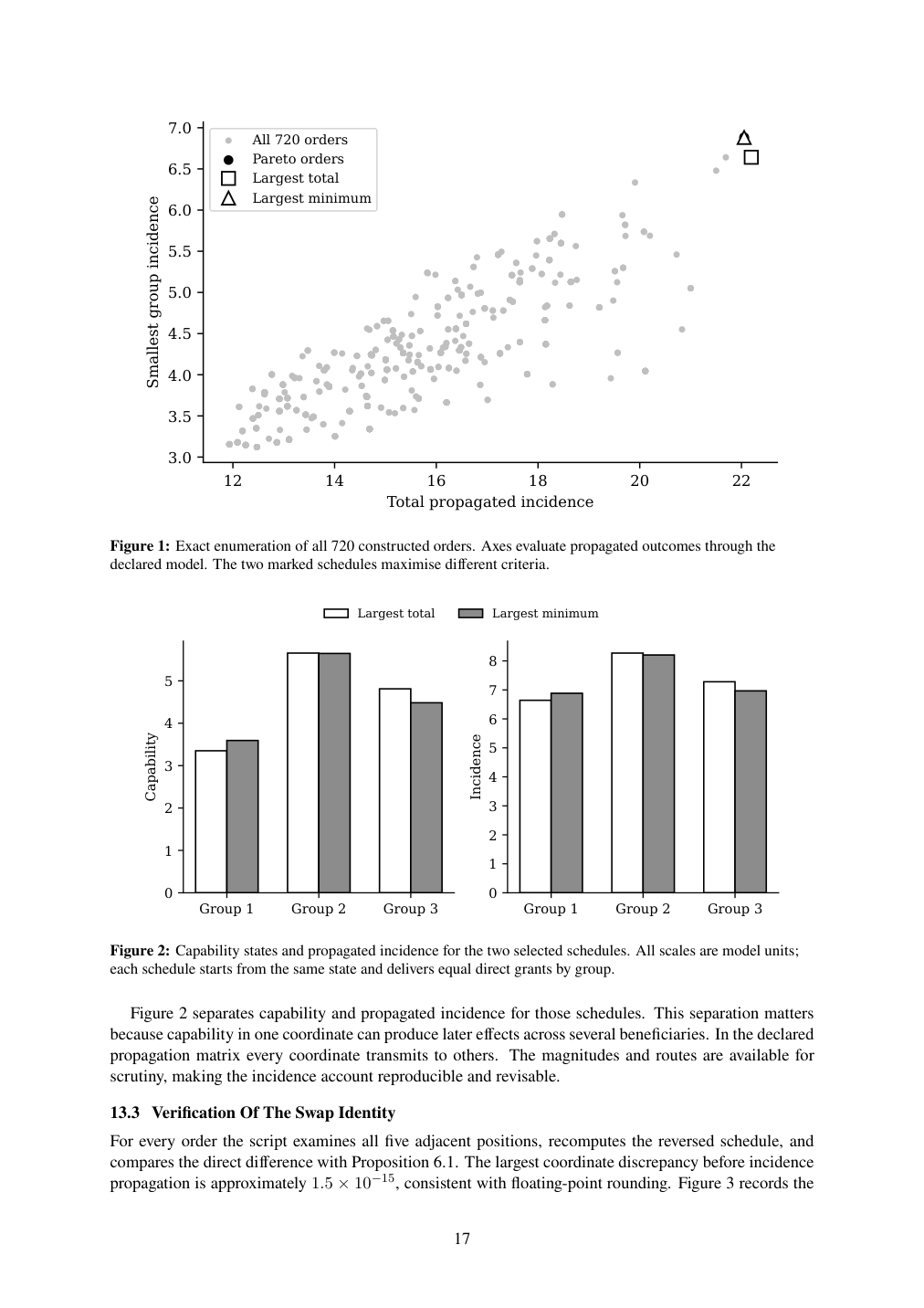
8.2041, and 6.9664. The second schedule gives a total of 22.0529. Its increase of the smallest group outcome therefore comes with a decrease of approximately 0.1405 in the total. The difference illustrates a specific tradeoff induced by this model and these two principles.
Readable text
All 720 orders Pareto orders Largest total Largest minimum
Figure 1: Exact enumeration of all 720 constructed orders. Axes evaluate propagated outcomes through the declared model. The two marked schedules maximise different criteria.
Figure 2: Capability states and propagated incidence for the two selected schedules. All scales are model units; each schedule starts from the same state and delivers equal direct grants by group.
Figure 2 separates capability and propagated incidence for those schedules. This separation matters because capability in one coordinate can produce later effects across several beneficiaries. In the declared propagation matrix every coordinate transmits to others. The magnitudes and routes are available for scrutiny, making the incidence account reproducible and revisable.
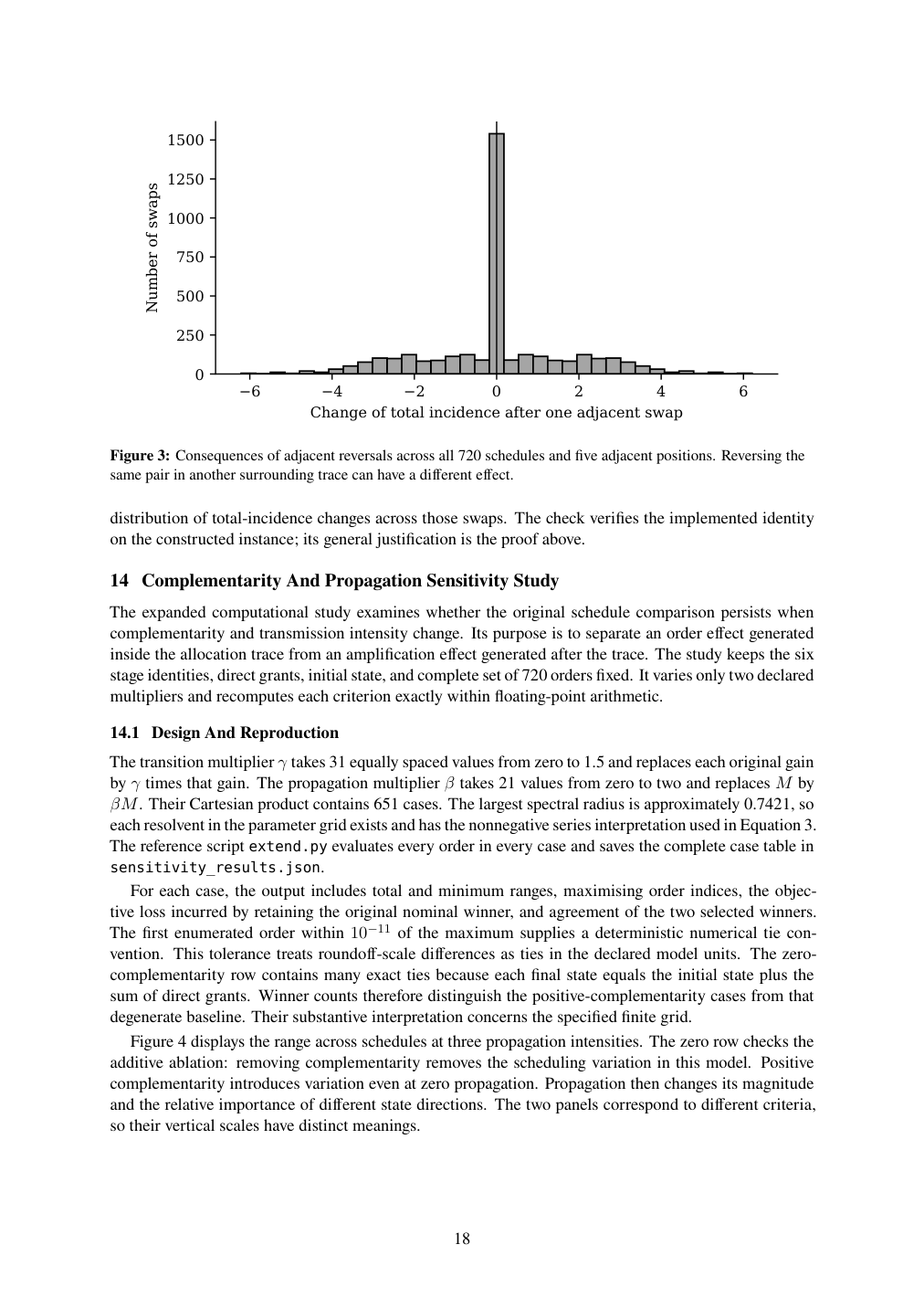
For every order the script examines all five adjacent positions, recomputes the reversed schedule, and compares the direct difference with Proposition 6.1. The largest coordinate discrepancy before incidence
Readable text
Figure 3: Consequences of adjacent reversals across all 720 schedules and five adjacent positions. Reversing the same pair in another surrounding trace can have a different effect.
distribution of total-incidence changes across those swaps. The check verifies the implemented identity on the constructed instance; its general justification is the proof above.
14 Complementarity And Propagation Sensitivity Study
The expanded computational study examines whether the original schedule comparison persists when complementarity and transmission intensity change. Its purpose is to separate an order effect generated inside the allocation trace from an amplification effect generated after the trace. The study keeps the six stage identities, direct grants, initial state, and complete set of 720 orders fixed. It varies only two declared multipliers and recomputes each criterion exactly within floating-point arithmetic.
each resolvent in the parameter grid exists and has the nonnegative series interpretation used in Equation 3. The reference script extend.py evaluates every order in every case and saves the complete case table in
For each case, the output includes total and minimum ranges, maximising order indices, the objec- tive loss incurred by retaining the original nominal winner, and agreement of the two selected winners. vention. This tolerance treats roundoff-scale differences as ties in the declared model units. The zero- complementarity row contains many exact ties because each final state equals the initial state plus the sum of direct grants. Winner counts therefore distinguish the positive-complementarity cases from that degenerate baseline. Their substantive interpretation concerns the specified finite grid.
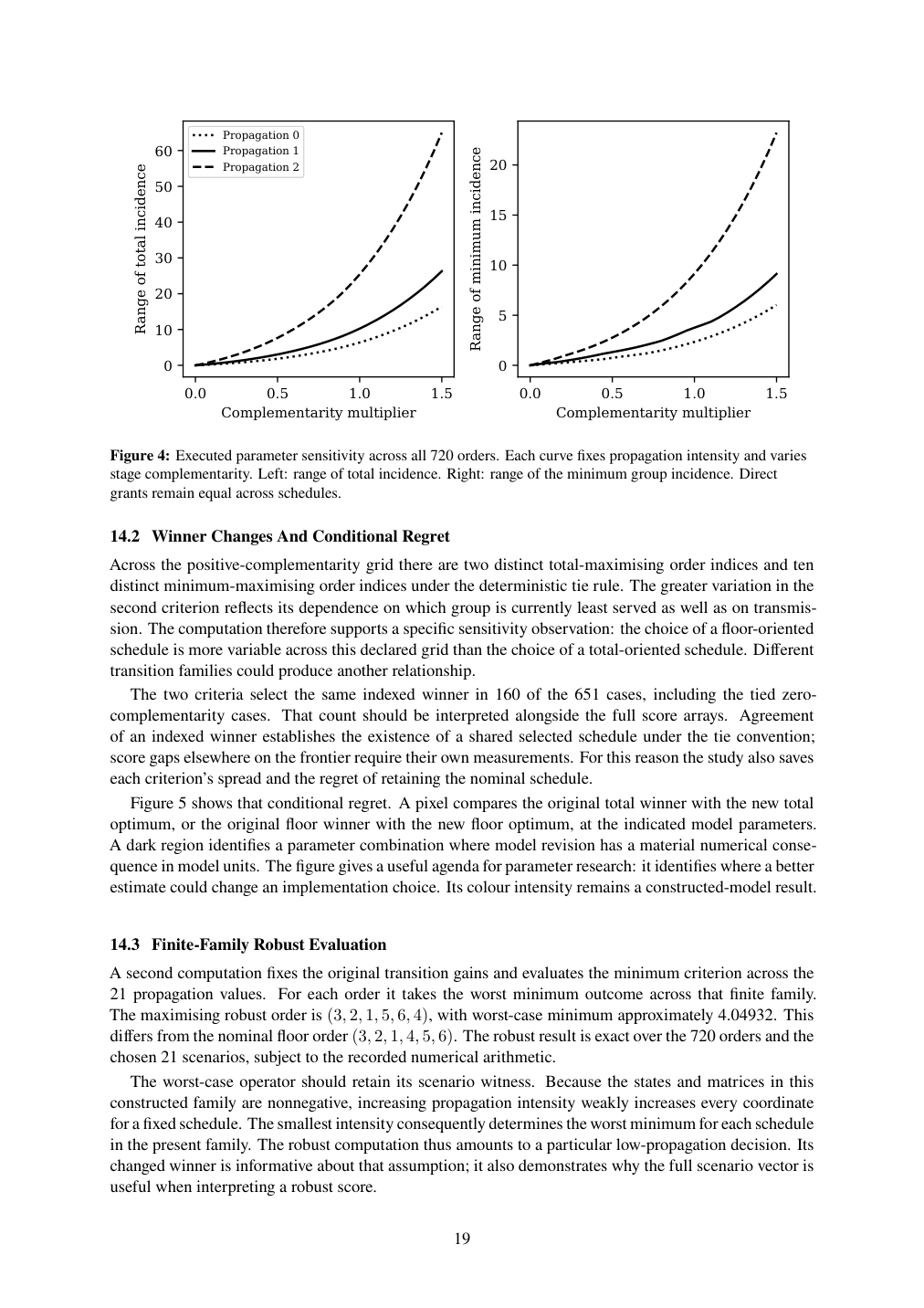
Figure 4 displays the range across schedules at three propagation intensities. The zero row checks the additive ablation: removing complementarity removes the scheduling variation in this model. Positive complementarity introduces variation even at zero propagation. Propagation then changes its magnitude and the relative importance of different state directions. The two panels correspond to different criteria,
Readable text
Figure 4: Executed parameter sensitivity across all 720 orders. Each curve fixes propagation intensity and varies stage complementarity. Left: range of total incidence. Right: range of the minimum group incidence. Direct
Across the positive-complementarity grid there are two distinct total-maximising order indices and ten distinct minimum-maximising order indices under the deterministic tie rule. The greater variation in the second criterion reflects its dependence on which group is currently least served as well as on transmis- sion. The computation therefore supports a specific sensitivity observation: the choice of a floor-oriented schedule is more variable across this declared grid than the choice of a total-oriented schedule. Different
transition families could produce another relationship.
The two criteria select the same indexed winner in 160 of the 651 cases, including the tied zero- complementarity cases. That count should be interpreted alongside the full score arrays. Agreement of an indexed winner establishes the existence of a shared selected schedule under the tie convention; score gaps elsewhere on the frontier require their own measurements. For this reason the study also saves each criterion’s spread and the regret of retaining the nominal schedule.
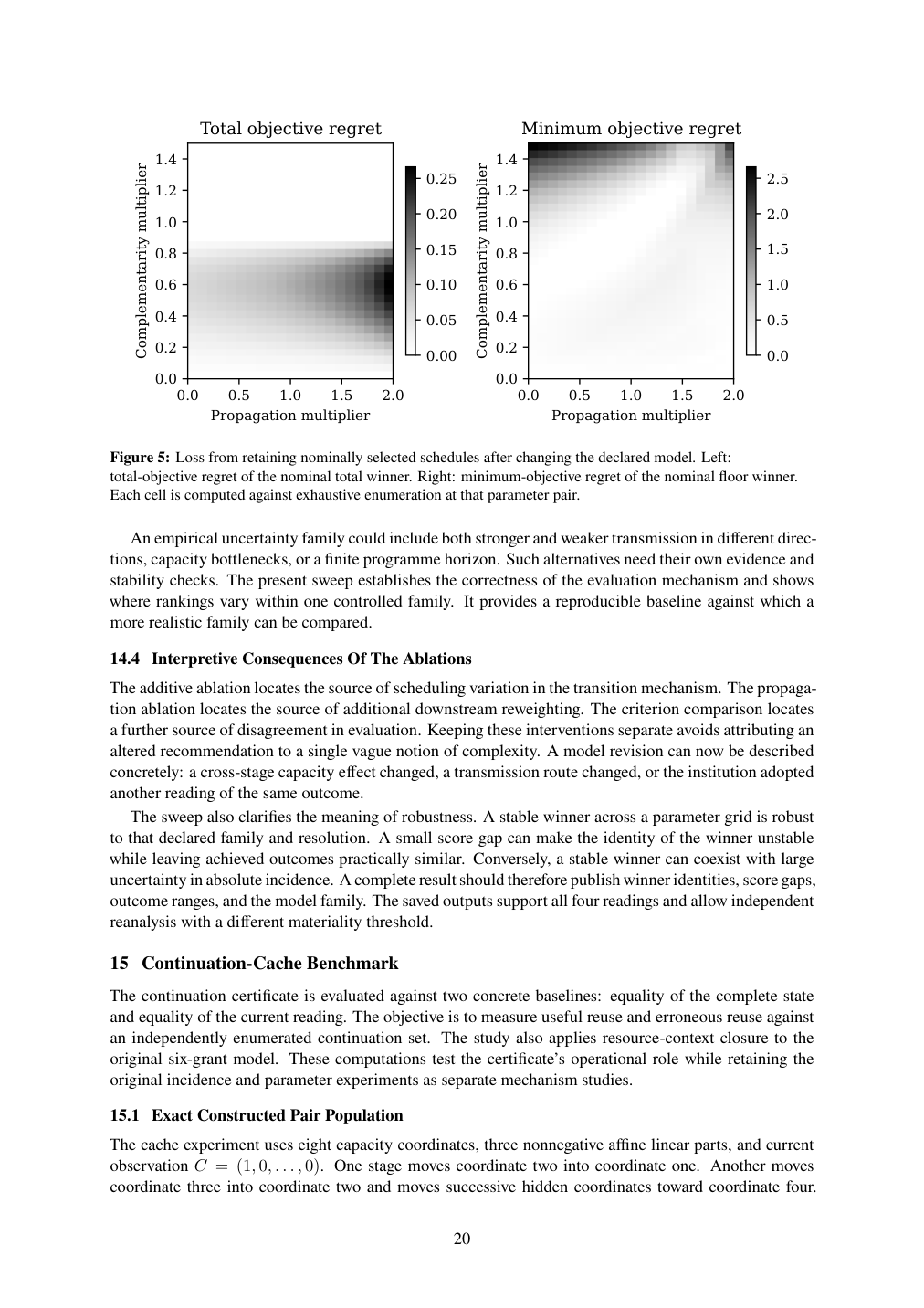
Figure 5 shows that conditional regret. A pixel compares the original total winner with the new total optimum, or the original floor winner with the new floor optimum, at the indicated model parameters. A dark region identifies a parameter combination where model revision has a material numerical conse- quence in model units. The figure gives a useful agenda for parameter research: it identifies where a better estimate could change an implementation choice. Its colour intensity remains a constructed-model result.
A second computation fixes the original transition gains and evaluates the minimum criterion across the 21 propagation values. For each order it takes the worst minimum outcome across that finite family. chosen 21 scenarios, subject to the recorded numerical arithmetic.
The worst-case operator should retain its scenario witness. Because the states and matrices in this constructed family are nonnegative, increasing propagation intensity weakly increases every coordinate for a fixed schedule. The smallest intensity consequently determines the worst minimum for each schedule in the present family. The robust computation thus amounts to a particular low-propagation decision. Its changed winner is informative about that assumption; it also demonstrates why the full scenario vector is
Readable text
Figure 5: Loss from retaining nominally selected schedules after changing the declared model. Left: total-objective regret of the nominal total winner. Right: minimum-objective regret of the nominal floor winner. Each cell is computed against exhaustive enumeration at that parameter pair.
An empirical uncertainty family could include both stronger and weaker transmission in different direc- tions, capacity bottlenecks, or a finite programme horizon. Such alternatives need their own evidence and stability checks. The present sweep establishes the correctness of the evaluation mechanism and shows where rankings vary within one controlled family. It provides a reproducible baseline against which a
The additive ablation locates the source of scheduling variation in the transition mechanism. The propaga- tion ablation locates the source of additional downstream reweighting. The criterion comparison locates a further source of disagreement in evaluation. Keeping these interventions separate avoids attributing an altered recommendation to a single vague notion of complexity. A model revision can now be described concretely: a cross-stage capacity effect changed, a transmission route changed, or the institution adopted
The sweep also clarifies the meaning of robustness. A stable winner across a parameter grid is robust to that declared family and resolution. A small score gap can make the identity of the winner unstable while leaving achieved outcomes practically similar. Conversely, a stable winner can coexist with large uncertainty in absolute incidence. A complete result should therefore publish winner identities, score gaps, outcome ranges, and the model family. The saved outputs support all four readings and allow independent
The continuation certificate is evaluated against two concrete baselines: equality of the complete state and equality of the current reading. The objective is to measure useful reuse and erroneous reuse against an independently enumerated continuation set. The study also applies resource-context closure to the original six-grant model. These computations test the certificate’s operational role while retaining the original incidence and parameter experiments as separate mechanism studies.
The cache experiment uses eight capacity coordinates, three nonnegative affine linear parts, and current coordinate three into coordinate two and moves successive hidden coordinates toward coordinate four.
Readable text
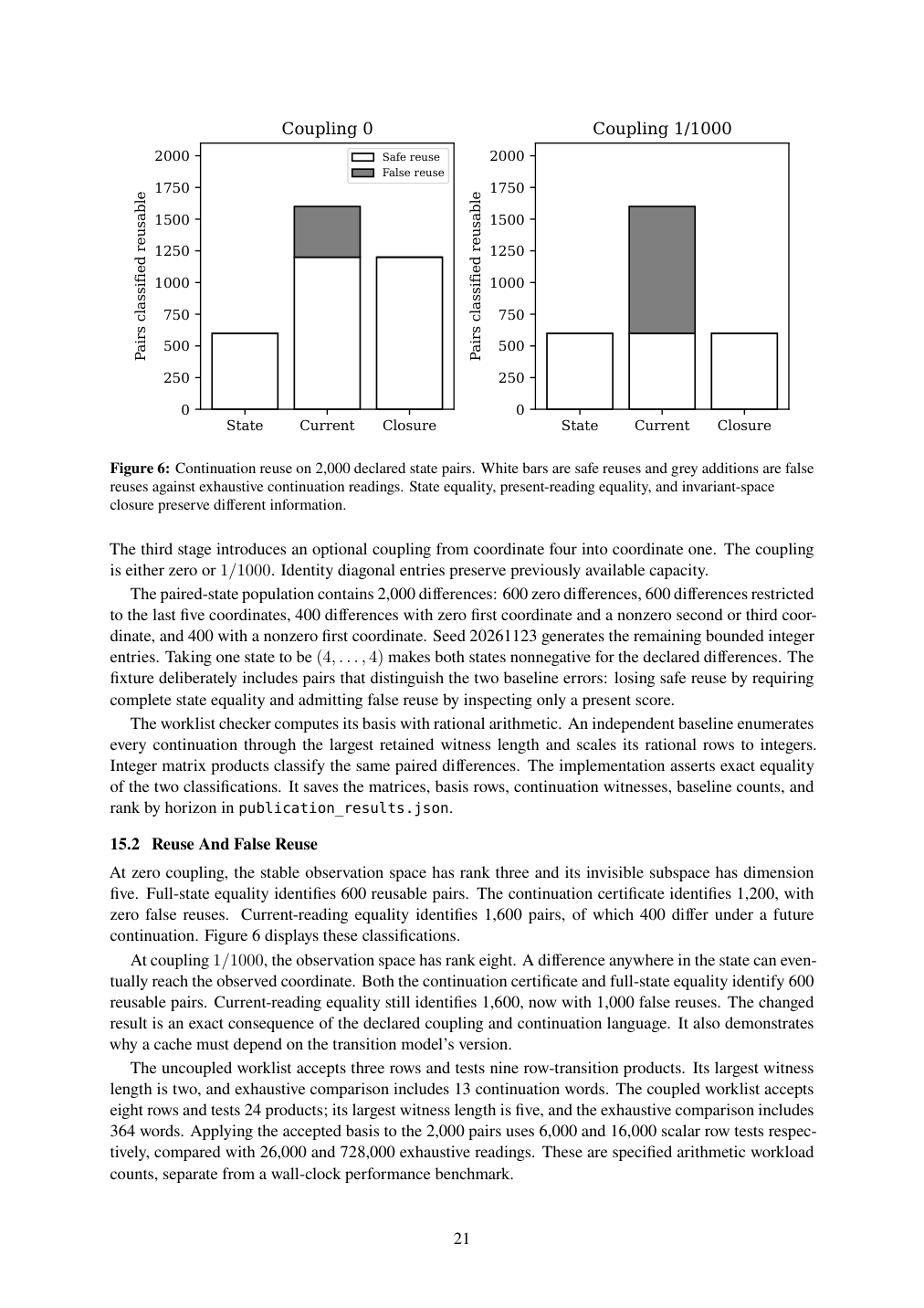
Figure 6: Continuation reuse on 2,000 declared state pairs. White bars are safe reuses and grey additions are false reuses against exhaustive continuation readings. State equality, present-reading equality, and invariant-space
The third stage introduces an optional coupling from coordinate four into coordinate one. The coupling is either zero or 1/1000. Identity diagonal entries preserve previously available capacity.
The paired-state population contains 2,000 differences: 600 zero differences, 600 differences restricted to the last five coordinates, 400 differences with zero first coordinate and a nonzero second or third coor- dinate, and 400 with a nonzero first coordinate. Seed 20261123 generates the remaining bounded integer fixture deliberately includes pairs that distinguish the two baseline errors: losing safe reuse by requiring complete state equality and admitting false reuse by inspecting only a present score.
The worklist checker computes its basis with rational arithmetic. An independent baseline enumerates every continuation through the largest retained witness length and scales its rational rows to integers. Integer matrix products classify the same paired differences. The implementation asserts exact equality of the two classifications. It saves the matrices, basis rows, continuation witnesses, baseline counts, and
At zero coupling, the stable observation space has rank three and its invisible subspace has dimension five. Full-state equality identifies 600 reusable pairs. The continuation certificate identifies 1,200, with zero false reuses. Current-reading equality identifies 1,600 pairs, of which 400 differ under a future
continuation. Figure 6 displays these classifications.
At coupling 1/1000, the observation space has rank eight. A difference anywhere in the state can even- tually reach the observed coordinate. Both the continuation certificate and full-state equality identify 600 reusable pairs. Current-reading equality still identifies 1,600, now with 1,000 false reuses. The changed result is an exact consequence of the declared coupling and continuation language. It also demonstrates why a cache must depend on the transition model’s version.
The uncoupled worklist accepts three rows and tests nine row-transition products. Its largest witness length is two, and exhaustive comparison includes 13 continuation words. The coupled worklist accepts eight rows and tests 24 products; its largest witness length is five, and the exhaustive comparison includes 364 words. Applying the accepted basis to the 2,000 pairs uses 6,000 and 16,000 scalar row tests respec- tively, compared with 26,000 and 728,000 exhaustive readings. These are specified arithmetic workload counts, separate from a wall-clock performance benchmark.
Readable text
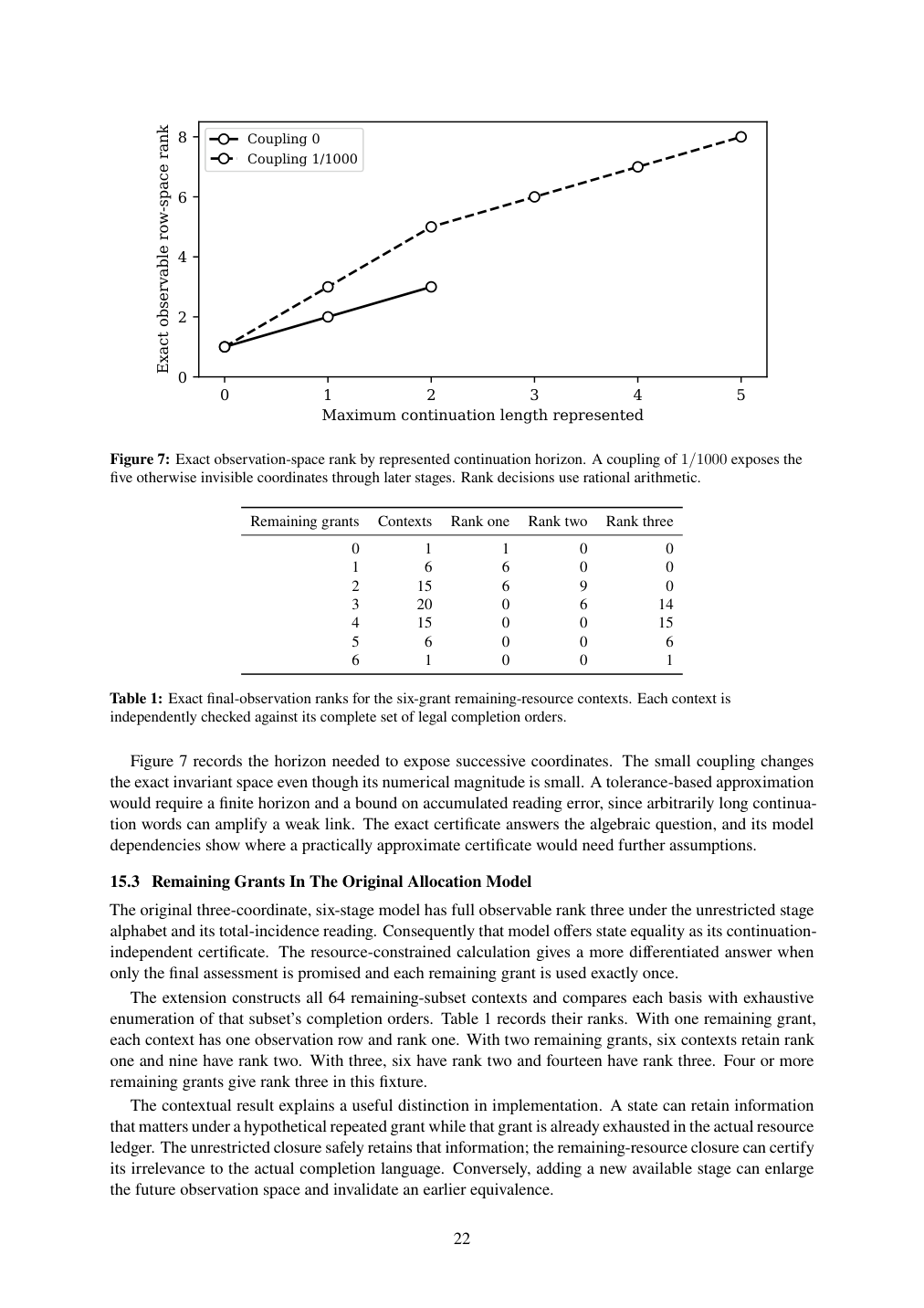
Figure 7: Exact observation-space rank by represented continuation horizon. A coupling of 1/1000 exposes the five otherwise invisible coordinates through later stages. Rank decisions use rational arithmetic.
Table 1: Exact final-observation ranks for the six-grant remaining-resource contexts. Each context is independently checked against its complete set of legal completion orders.
Figure 7 records the horizon needed to expose successive coordinates. The small coupling changes the exact invariant space even though its numerical magnitude is small. A tolerance-based approximation would require a finite horizon and a bound on accumulated reading error, since arbitrarily long continua- tion words can amplify a weak link. The exact certificate answers the algebraic question, and its model dependencies show where a practically approximate certificate would need further assumptions.
The original three-coordinate, six-stage model has full observable rank three under the unrestricted stage alphabet and its total-incidence reading. Consequently that model offers state equality as its continuation- independent certificate. The resource-constrained calculation gives a more differentiated answer when only the final assessment is promised and each remaining grant is used exactly once.
The extension constructs all 64 remaining-subset contexts and compares each basis with exhaustive enumeration of that subset’s completion orders. Table 1 records their ranks. With one remaining grant, each context has one observation row and rank one. With two remaining grants, six contexts retain rank one and nine have rank two. With three, six have rank two and fourteen have rank three. Four or more
The contextual result explains a useful distinction in implementation. A state can retain information that matters under a hypothetical repeated grant while that grant is already exhausted in the actual resource ledger. The unrestricted closure safely retains that information; the remaining-resource closure can certify its irrelevance to the actual completion language. Conversely, adding a new available stage can enlarge the future observation space and invalidate an earlier equivalence.
The study closes the method’s internal argument: the certificate has a precise target, a finite construction, an independent exact baseline, a counterexample to a weaker cache, and a resource-context application in the original allocation mechanism. Its external value depends on how often genuine allocation states share such equivalences and whether checking them saves expensive evaluations. Those measurements can be added to the existing repository interfaces using the same preserved dependencies and error definitions.
16 Implementation And Reproduction
The report is linked to the allocation domain at repository commit 869fe38. Its rounds and evolution modules represent grant systems, feasible search spaces, and policies. Its economy evaluator follows recipient-specific consequences, while the API records assessments separately from proposals. These source-level assets motivate the present construction. Their presence is distinct from independent execution of their C++ suites.
The accompanying reproduce.py is a self-contained Python reference illustration. It enumerates all permutations, writes matrices, states, scores, and selected orders to results.json, and generates the figures directly from those values. NumPy and Matplotlib suffice. Changing the transition coefficients or propagation matrix produces a new declared problem. For each revision, feasibility and stability should be checked before interpreting the resulting comparisons.
A subsequent infrastructure implementation should export each swap certificate with its prefix state, suffix, resource preconditions, propagation version, evaluator, and numerical tolerance. This record would allow an independent checker to recompute the order explanation. It would also connect the allocation analysis to the infrastructure’s broader epistemic-contract programme: a changed dependency can withdraw a certificate while preserving its historical record.
17 Transition Evidence And Normative Standing
The continuation certificate establishes a property of a declared allocation mechanism. Its empirical application requires evidence that the stage maps, continuation language, incidence account, and evaluator family represent the decision being considered. The most direct validation case is a programme with documented delivery order, observable capacity before each delivery, identifiable prerequisites, and a bounded outcome horizon. Intermediate states are important because an accurate final total can conceal offsetting transition errors across groups.
A source-supported application can compare an additive transition baseline, the fitted interacting stages, and the same stages with the incidence map varied separately. Held-out delivery histories then test which component improves the intended prediction. A causal interpretation additionally requires an assignment or identification design. Administrative timing and transaction records can establish different parts of the mechanism, while participant accounts can identify access conditions or omitted prerequisites. The certificate retains those dependencies so that an empirical correction changes a specific comparison.
Computational validation concerns a separate question: whether continuation equivalence occurs often enough to save meaningful evaluations. Small cases permit exhaustive continuation checks. Larger cases can report cache hits, basis dimensions, checker cost, avoided full evaluations, and the frequency of model revisions that invalidate a certificate. The present exact fixture supplies a checker baseline and a counterexample to current-score reuse. The unrestricted rank-three result in the original allocation model also provides a useful limiting case in which the stronger certificate yields state equality.
Normative standing remains attached to the observation contract. Equal direct finance, enabled capability, realised access, and recognition of a prior commitment are different readings of an allocation. A group-level state can conceal within-group disparities, and a numerical frontier can coexist with institutional disagreement about whose reasons count. A continuation quotient preserves exactly the selected observations and common feasibility context. It supports a transparent calculation inside the author’s procedural-justice programme while leaving those wider evaluative questions available for substantive argument and revision.
Readable text
Project selection, sequential choice, composition, and vector assessment
Established ingredients network transmission, affine
Verified literature; each result retains its original assumptions.
Incidence, continuation equivalence, and resource-language cache contract
Increment interaction, propagation perturbation, and comparison tolerance
Schedules, parameter grid, exact reuse baselines, and 64 resource contexts
Further validation schedule effects, scaling, and institutional explanation
Python outputs, model inputs, figures, and independently replayed adjacent swaps.
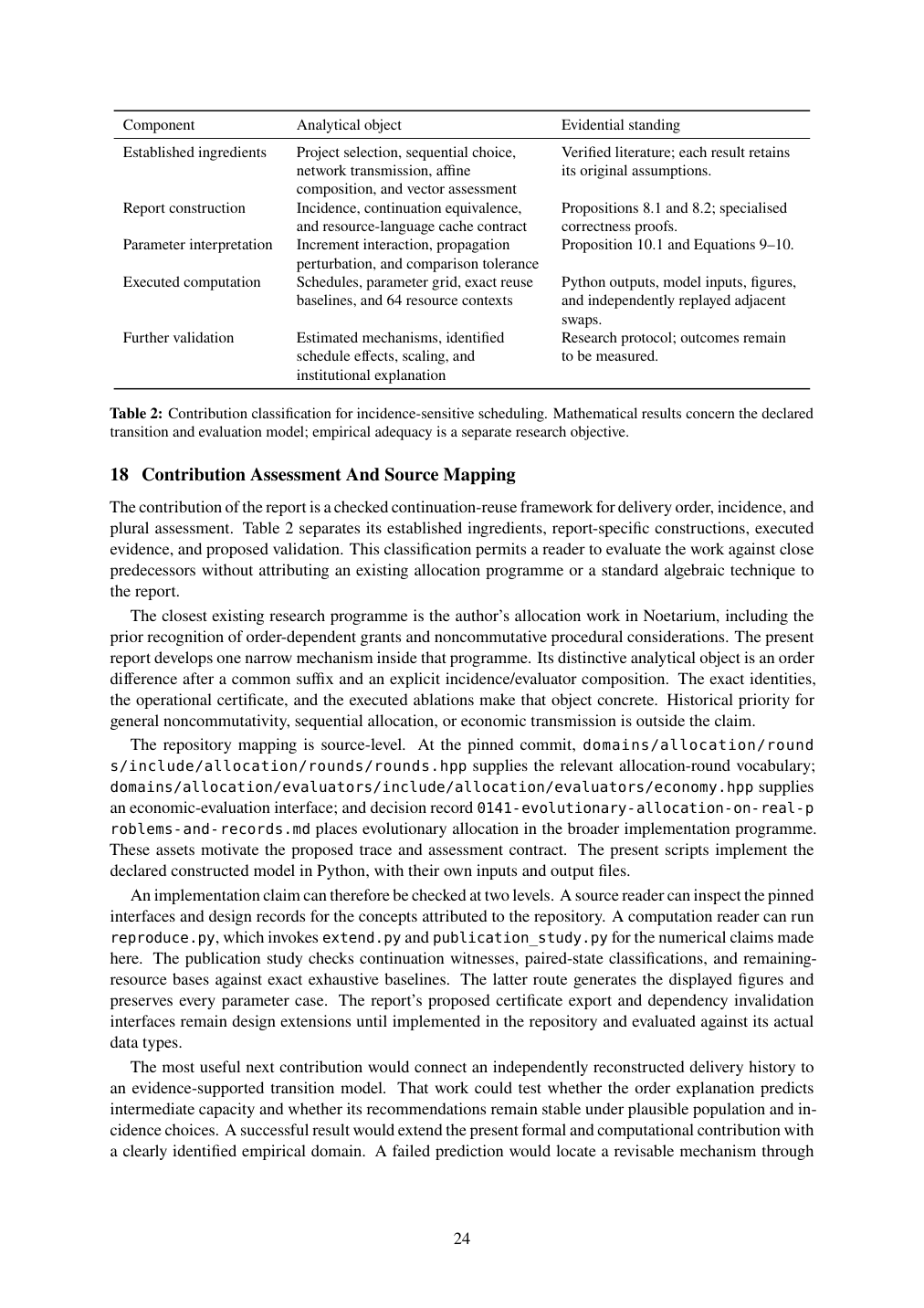
Table 2: Contribution classification for incidence-sensitive scheduling. Mathematical results concern the declared transition and evaluation model; empirical adequacy is a separate research objective.
The contribution of the report is a checked continuation-reuse framework for delivery order, incidence, and plural assessment. Table 2 separates its established ingredients, report-specific constructions, executed evidence, and proposed validation. This classification permits a reader to evaluate the work against close predecessors without attributing an existing allocation programme or a standard algebraic technique to
The closest existing research programme is the author’s allocation work in Noetarium, including the prior recognition of order-dependent grants and noncommutative procedural considerations. The present report develops one narrow mechanism inside that programme. Its distinctive analytical object is an order difference after a common suffix and an explicit incidence/evaluator composition. The exact identities, the operational certificate, and the executed ablations make that object concrete. Historical priority for general noncommutativity, sequential allocation, or economic transmission is outside the claim.
The repository mapping is source-level. At the pinned commit, domains/allocation/round s/include/allocation/rounds/rounds.hpp supplies the relevant allocation-round vocabulary; domains/allocation/evaluators/include/allocation/evaluators/economy.hpp supplies an economic-evaluation interface; and decision record 0141-evolutionary-allocation-on-real-p roblems-and-records.md places evolutionary allocation in the broader implementation programme. These assets motivate the proposed trace and assessment contract. The present scripts implement the declared constructed model in Python, with their own inputs and output files.
An implementation claim can therefore be checked at two levels. A source reader can inspect the pinned interfaces and design records for the concepts attributed to the repository. A computation reader can run reproduce.py, which invokes extend.py and publication_study.py for the numerical claims made here. The publication study checks continuation witnesses, paired-state classifications, and remaining- resource bases against exact exhaustive baselines. The latter route generates the displayed figures and preserves every parameter case. The report’s proposed certificate export and dependency invalidation interfaces remain design extensions until implemented in the repository and evaluated against its actual
The most useful next contribution would connect an independently reconstructed delivery history to an evidence-supported transition model. That work could test whether the order explanation predicts intermediate capacity and whether its recommendations remain stable under plausible population and in- cidence choices. A successful result would extend the present formal and computational contribution with a clearly identified empirical domain. A failed prediction would locate a revisable mechanism through
Readable text
the same dependency record. In either case, the report supplies a concrete object around which cross-
disciplinary criticism and improvement can proceed.
Allocation order has a continuation-dependent observation structure. The local incidence identity explains a specified reversal, while observable closure determines whether a prefix difference remains invisible under a declared future language. Resource contexts make that language operational and permit exact completion checks. The executed baselines show both useful quotient reuse and the failure of current- score reuse, together with cases where full observable rank leaves state equality as the available certificate. The resulting contract preserves the transition, feasibility, incidence, and evaluative dependencies needed
Dominik Peters; Grzegorz Pierczyński; Piotr Skowron (2021). Proportional Participatory Budgeting with Additive
Utilities. Advances in Neural Information Processing Systems 34. https://proceedings.neurips.cc/pap er/2021/file/69f8ea31de0c00502b2ae571fbab1f95-Paper.pdf. Piotr Faliszewski; Jarosław Flis; Dominik Peters; Grzegorz Pierczyński; Piotr Skowron; Dariusz Stolicki; Stanisław
Szufa; Nimrod Talmon (2023). Participatory Budgeting: Data, Tools and Analysis. Proceedings of IJCAI, 2667– Amartya Sen (1992). Inequality Reexamined. Clarendon Press. https://academic.oup.com/book/4918. Sylvain Bouveret; Jérôme Lang (2011). A General Elicitation-Free Protocol for Allocating Indivisible Goods. Pro-
ceedings of IJCAI, 73–77. https://ijcai.org/proceedings/2011/24. Thomas Kalinowski; Nina Narodytska; Toby Walsh (2013). A Social Welfare Optimal Sequential Allocation Pro-
cedure. Proceedings of IJCAI, 227–232. https://ijcai.org/proceedings/2013/43. Craig Boutilier; Moisés Goldszmidt; Bikash Sabata (1999). Sequential Auctions for the Allocation of Resources
with Complementarities. Proceedings of IJCAI, 527–534. https://www.cs.toronto.edu/~cebly/Papers/ Daniel Golovin; Andreas Krause (2011). Adaptive Submodularity: Theory and Applications in Active Learning
and Stochastic Optimization. Journal of Artificial Intelligence Research 42, 427–486. https://arxiv.org/ab Marcel P. Timmer; Erik Dietzenbacher; Bart Los; Robert Stehrer; Gaaitzen J. de Vries (2015). An Illustrated User
Guide to the World Input–Output Database: the Case of Global Automotive Production. Review of International Economics 23(3), 575–605. https://onlinelibrary.wiley.com/doi/10.1111/roie.12178. Michael G. Hudgens; M. Elizabeth Halloran (2008). Toward Causal Inference With Interference. Journal of the
American Statistical Association 103(482), 832–842. https://www.treatment-effects.com/Hudgens-H Peter M. Aronow; Cyrus Samii (2017). Estimating Average Causal Effects Under General Interference, with Appli-
cation to a Social Network Experiment. Annals of Applied Statistics 11(4), 1912–1947. https://arxiv.org/ Daron Acemoglu; Vasco M. Carvalho; Asuman Ozdaglar; Alireza Tahbaz-Salehi (2012). The Network Origins of
Aggregate Fluctuations. Econometrica 80(5), 1977–2016. https://dspace.mit.edu/entities/publicat Stephen Boyd; Lieven Vandenberghe (2004). Convex Optimization. Cambridge University Press. https://web.
stanford.edu/~boyd/cvxbook/bv_cvxbook.pdf. Noetarium Project (2026). Noetarium: The
Science 869fe38afac257cd9b5d51ad5b498a8ff6b8e443. https://github.com/huangwanhong-maker/Noeta rium-The-Science-and-Humanity-Infrastructure. Stefan Kiefer; Andrzej S. Murawski; Joël Ouaknine; Björn Wachter; James Worrell (2013). On the Complexity of
Equivalence and Minimisation for Q-Weighted Automata. Logical Methods in Computer Science 9(1:08), 1–22. https://people.mpi-sws.org/~joel/publications/Q\_weighted\_automata13.pdf. Stefan Kiefer (2020). Notes on Equivalence and Minimization of Weighted Automata. Author manuscript,