Auditing Rejection Risk In Surrogate-Assisted Allocation Search
Full text from the PDF
Auditing Rejection Risk In Surrogate-Assisted Allocation Search
Wanhong HUANG
Abstract

Keywords: rejection audit; minimax design; hard budgets; finite populations; surrogate search
Technical Report Note
This technical report shares an evolving inquiry and invites dialogue, criticism, revision, and independent development. Its definitions, distinctions, and constructions remain open to refinement. Circulation across scholarly and practical communities is part of the purpose of releasing the manuscript.
The author treats the viewpoints, concepts, and lines of reasoning presented here as contributions to a shared field of inquiry. Similar or related ideas may have appeared in other intellectual, cultural, and disciplinary traditions. The manuscript identifies known antecedents and distinguishes inherited positions, interpretive proposals, and arguments developed here. Historical priority remains open to further investigation.
The constructions and arguments are presented with their stated assumptions and evidential scope. Readers are encouraged to question, test, revise, extend, reinterpret, or independently develop the ideas presented here. Where appropriate, acknowledgment of this paper as one point of encounter in the development of a related idea is appreciated. Such acknowledgment records an intellectual route; the ideas remain available for criticism, revision, and independent development.
Definitions introduced by the paper are local analytical stipulations unless attributed to another source. Their use identifies the scope of the present argument; terminological and historical priority remain subjects for independent investigation. Generative Relational theory is treated as an open research programme whose proposals receive critical examination alongside independent literature.
Responsible Use and Rights Reservation
This section records a request for responsible scholarly conduct and identifies the scope of retained rights. Legal permissions are governed by the licence on the following page.
The author encourages good-faith discussion, criticism, independent inquiry, and responsible use of the material. Separately from the licence’s terms, the author asks users to consider foreseeable harms when adapting the arguments, representations, or examples of this paper, particularly in scientific inquiry, institutional decisions, and computational knowledge infrastructures. The ethical request leaves the licence’s permissions and legally authorised uses unchanged.
The author retains the rights preserved under CC BY-NC 4.0 and may pursue remedies to which the author is legally entitled for breach of the licence or violation of independently applicable rights. Reuse remains independent from authorial endorsement. Third-party rights require authorisation from their respective holders where applicable. Copyright exceptions and limitations, including applicable forms of fair use or fair dealing, remain available.
Notices
This page consolidates the manuscript’s research status, licence, development disclosure, researchprogramme relation, and suggested citation.
Status. This technical report is prepared for the author’s substantive review and subsequent scholarly discussion. The report distinguishes established antecedents, conditional results developed here, inspected source artifacts, and numerical illustrations under declared assumptions. Internal checks assess the stated arguments and examples; independent scholarly assessment can further test their interpretation and adequacy. The source ledgers record the access level and claim scope of consulted works.
Licence. Except where otherwise indicated, copyright 2026 Wanhong Huang. This work is made available under the Creative Commons Attribution-NonCommercial 4.0 International License (CC BY-NC 4.0). Subject to its terms, the licence permits sharing and adaptation for noncommercial purposes with appropriate attribution, a link to the licence, and an indication of changes. Attribution should preserve the licensor’s independence from the reuse. Reuse is governed solely by the licence; the responsible-use request on the preceding page remains separate from its terms. The licence deed and legal code are available at https://creativecommons.org/licenses/by-nc/4.0/. The licence governs in case of conflict with this summary. Third-party material remains subject to its respective rights.
Statement on the use of language models. Preparation involved OpenAI’s ChatGPT and Codex. Language models supported exploratory dialogue, source discovery and checking, argumentative criticism, manuscript revision, LATEX typesetting, and the development of supporting code and figures. Verification used the sources and access levels recorded in the accompanying ledgers. The author initiated the research questions and directed the research programme; interpretation, acceptance of the arguments, and publication decisions remain subject to the author’s review. Authorship credit and responsibility for the released manuscript remain with the human author.
Code and data availability. Supporting scripts, generated baseline, sensitivity and publication-method outputs, verified source records, and a publication-review ledger accompany this report. A single reproduction entry point regenerates the declared computations and figures. The source package contains the editable manuscript, source ledgers, supporting scripts and outputs, and a reading guide. Numerical illustrations, where present, use the assumptions stated in their captions and text.
Related research programme. This report belongs to the Noetarium technical report series. Companion reports study inference, computation, evaluation, governance, and cross-disciplinary knowledge formation. The reports develop distinct technical questions within an open Generative Relational research programme.
Suggested citation. Huang, Wanhong. “Auditing Rejection Risk In Surrogate-Assisted Allocation Search.” Technical report, 2026.
1 Introduction
A surrogate-assisted search observes expensive outcomes selectively. The screen’s admitted candidates can exhibit accurate predictions while an excluded region contains useful alternatives. A rejection audit adds a controlled observation channel: it fixes a completed trace, declares the incumbent and materiality threshold, and samples recorded rejections through a known design. The audit can then measure missedimprovement prevalence and magnitude under that finite-population target.
The report develops both measurement and observation design. Exact hypergeometric inversion gives a count bound after a uniform sample, design-based estimation measures rejected gain, and a specified spending rule supports continued inspection. The distinction between prediction coverage, rejection error, and attained-score regret is illustrated through an executed hidden-peak screen and sensitivity family. The sampling ingredients are established; their composition around a versioned rejection manifest makes a search’s exclusions independently inspectable.
A concrete budget decision remains. Candidate evaluations can have different known charges, and the locations of useful exclusions are uncertain. The main design result formulates one-hit detection under a hard cost budget and a minimum threat count. An all-failure trajectory reduction covers a stated binaryfeedback adaptive policy class. Within-stratum symmetry then reduces the design to a finite game over sample quotas and allocations of improving candidates. The producer returns an affordable quota mixture, and an exact rational checker brackets its minimax guarantee.
This construction is situated beside existing maxmin auditing games and stratified inference. Its contribution is a closed finite-population calibration protocol for the rejection setting, including its assumptions, strategy class, numerical certificate, and matched-cost controls. In a two-cost construction, the mixture raises guaranteed detection from about 0.52413 for the best fixed quotas to about 0.54749 at the same hard budget. A complete unit-level game and exact probability calculations provide independent checks.
Noetarium’s surrogate evaluator and recent decision records provide the implementation context (Noetarium Project, 2026). The scripts here are explicit reference mechanisms with preserved population and evaluator versions. A deployment can complete a sampled quota for estimation, stop at first detection for the one-hit task, or use a matched sequential inference rule. Keeping those operations explicit allows evidence about exclusion risk to accompany the search while retaining the meaning of each guarantee.
2 Related Methods And Their Distinct Questions
2.1 Surrogate Uncertainty And Distribution Shift
Surrogate-assisted evolutionary methods combine inexpensive prediction with costly evaluation. The survey by Jin (2011) places surrogate fitness models within expensive evolutionary optimization. The present construction studies a separate observable: the quality of candidates excluded from expensive evaluation.
Weighted conformal prediction supplies guarantees under specified covariate-shift assumptions and likelihood-ratio information (Tibshirani et al., 2019). Such results make the target distribution and weighting mechanism explicit. In a search, the candidate distribution changes with previous outcomes, and admission can further change the distribution of observed labels. A theoretical statement about one of those distributions requires the corresponding assumptions. The rejection audit conditions on a fixed trace and randomises its own observation step.
2.2 Design-Based Estimation And Sequential Monitoring
Finite-population sampling provides a long-established way to estimate totals when observation probabilities are known. The Horvitz–Thompson construction weights each observed unit by its inclusion probability (Horvitz and Thompson, 1952). Exact inference for a binary characteristic under simple random sampling uses the hypergeometric distribution. Those ingredients are classical. Here they are applied to rejected optimisation candidates, with the incumbent and material-improvement definition retained as part of the audit record.
Sequential inference provides a complementary framework for continued inspection. Confidence sequences maintain a coverage statement through a sequence of observations under stated stochastic conditions (Howard et al., 2021). A simple alpha-spending construction below supplies a conservative simultaneous finite-population audit. More efficient modern sequences can replace it after their conditions are matched to the chosen sampling design. The distinction between a fixed-budget audit and a continuously inspected sequence should remain visible in the report of results.
2.3 Prediction, Selection, And Opportunity Loss
Prediction error concerns differences between predicted and observed objective values. False rejection concerns candidates withheld by the screen that meet a declared quality condition. Regret concerns the quality of the final selected candidate relative to a comparator. Relating the numerical values of these interacting quantities requires additional restrictions. For instance, many missed candidates can have negligible improvements, while one missed candidate can determine nearly all final regret. An audit should therefore state the target directly.
3 Prediction, Search, And Sampling Literature
Rejected-candidate auditing sits at the interface between optimisation and statistical observation. The purpose of this literature synthesis is to separate the decisions that generate candidates, the prediction guarantees that describe a fitted model, and the sampling guarantees that describe an audit. A search can use several of these methods simultaneously. Each method supplies a statement about its own target and randomisation, which the infrastructure should preserve.
3.1 Surrogates And Acquisition Decisions
Jones et al. (1998) develop efficient global optimisation for expensive black-box functions using response surfaces and a balance between exploiting the fitted surface and exploring uncertainty. Frazier (2018) gives a modern account of Bayesian optimisation through Gaussian-process surrogates and acquisition functions. The survey by Jin (2011) places surrogate fitness approximation within expensive evolutionary computation. These works establish a broad existing programme in which expensive evaluations are allocated selectively. An audit of excluded candidates addresses a complementary measurement problem inside that programme.
An acquisition function and a rejection audit have different computational roles. An acquisition function chooses where an evaluation is expected to be useful under its model. A frozen audit uses a known sampling design to measure a characteristic of a recorded rejected population. A candidate selected by the audit can subsequently improve the search, but the audit’s validity derives from its observation design. Keeping that distinction explicit permits an adaptive optimiser to use a sophisticated acquisition policy while an independent checker evaluates its exclusions.
The relevant loss also requires care. Simple regret compares the attained best score with a reference optimum. Rejected-improvement prevalence measures how often recorded exclusions beat a fixed incumbent. Mean rejected gain measures their average magnitude above a declared threshold. An optimiser can attain small regret while excluding numerous nearly equivalent candidates, or large regret while excluding only a narrow high-value region. The constructed hidden-peak family below exhibits the latter configuration. Its purpose is to identify which measurement answers the decision maker’s concern.
3.2 Predictive Coverage And Selection
Lei et al. (2017) describe conformal regression procedures with finite-sample marginal coverage and tradeoffs between full and split constructions. The relevant coverage statement is marginal under the corresponding sampling assumptions. Tibshirani et al. (2019) extend predictive inference to a covariate-shift setting using weighted exchangeability and likelihood-ratio information. Their work makes the target distribution and weighting assumptions explicit. A search-generated rejected population supplies a further selection mechanism whose implications should be examined against those assumptions.
Distribution shift has additional treatments. Gibbs and Candès (2021) propose adaptive conformal inference targeting long-run coverage frequency under changing distributions. Barber et al. (2023) develop weighted quantiles and randomisation techniques that accommodate drift and nonsymmetric algorithms, with guarantees tied to quantified departures from exchangeability. These results motivate better predictors and better interval monitoring. They also reinforce the need to name the guarantee: time-averaged coverage, weighted target coverage, and coverage conditional on rejection are distinct statistical objects.
The counterexample in Proposition 4.1 concerns information available from admitted outcomes alone. It leaves the rejected labels free within the declared score range. A structural model can add information linking those labels to observed regions. A conformal construction can add a theorem under a sampling model. An audit adds actual labels through controlled randomisation. These are complementary routes to evidence. The proposed infrastructure records which route supports each claim so that a revision to one assumption has a clear effect on the conclusion.
3.3 Observation Probabilities And Design-Based Estimation
Horvitz and Thompson (1952) provide the classical inverse-inclusion-probability construction for estimating finite-population totals. The proof rests on the probability that a unit enters the observed sample. The present uniform audit is its elementary equal-probability case. An unequal-probability extension should retain positive inclusion probabilities and the design needed for its uncertainty calculation. Merely attaching an importance weight to a conveniently observed candidate leaves that design unspecified.
Active learning supplies a close computational comparator. Beygelzimer et al. (2009) use importance weighting and variance control to correct selection bias in learning binary classifiers. Their setting concerns a learning process and label complexity, while the present frozen audit concerns a fixed rejected population after a search. The shared principle is operational: controlled observation probabilities can support inference despite selective expensive labelling. The report-specific contribution is to define the rejection targets and bind them to the search trace, incumbent, and audit record.
Sampling without replacement also has a developed concentration theory. Bardenet and Maillard (2015) restate Hoeffding’s transfer result and develop finite-population improvements through Hoeffding– Serfling and Bernstein-type inequalities. The exact binary inversion used here avoids a normal approximation for improvement counts. Bounded-gain concentration remains useful for magnitude, especially when the improvement indicator discards too much information about substantive loss. The report uses the simple bound to make the protocol easy to check and treats sharper alternatives as established methods available for a matched design.
3.4 Sequential Inspection And The Contribution Boundary
Howard et al. (2021) develop time-uniform confidence sequences, and Waudby-Smith and Ramdas (2020) specialise sequential inference to sampling without replacement. These works are direct predecessors for an audit that is inspected continuously. The alpha-spending construction in the report is an elementary conservative method for simultaneous validity. Its purpose is transparency and a baseline implementation; a dedicated confidence sequence can improve efficiency under its own conditions.
The expanded exact recursion below quantifies the consequence of using a fixed-time endpoint repeatedly in a finite population. It also evaluates the conservative spending rule on the same population. This is an executed operating-characteristic comparison of the specified finite-population procedures. The original contribution lies in the combined audit object: a frozen adaptive rejection trace, a declared opportunityloss label, a sampling record, a finite-population inference procedure, and an independent reproduction path. The mathematical ingredients remain attributed to their established literatures, while the constructed screen and sensitivity study demonstrate the need and operation of that object.
4 The Frozen Rejected Population

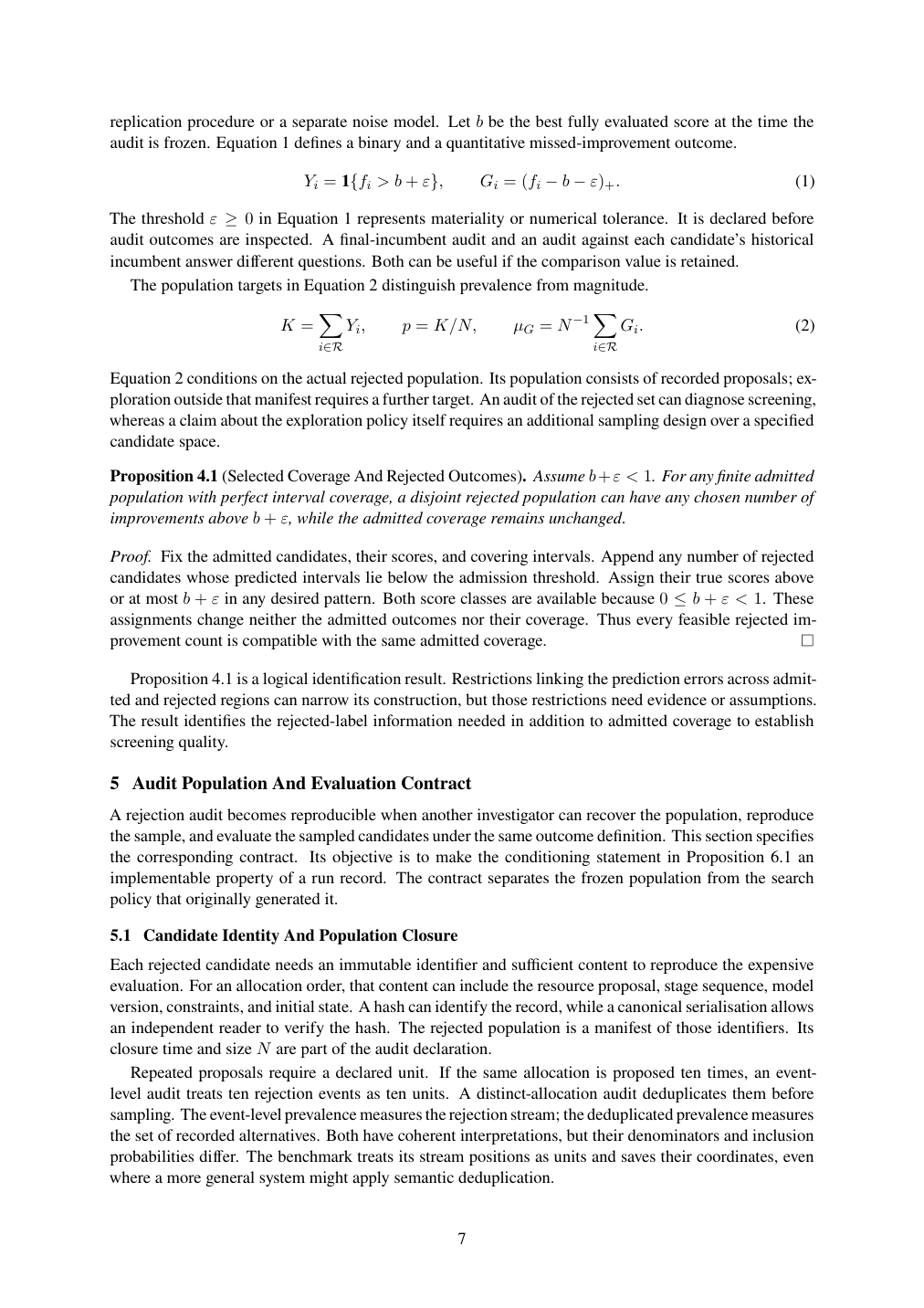
Readable text
audit is frozen. Equation 1 defines a binary and a quantitative missed-improvement outcome.
audit outcomes are inspected. A final-incumbent audit and an audit against each candidate’s historical incumbent answer different questions. Both can be useful if the comparison value is retained.
The population targets in Equation 2 distinguish prevalence from magnitude.
Equation 2 conditions on the actual rejected population. Its population consists of recorded proposals; ex- ploration outside that manifest requires a further target. An audit of the rejected set can diagnose screening, whereas a claim about the exploration policy itself requires an additional sampling design over a specified
population with perfect interval coverage, a disjoint rejected population can have any chosen number of
Proof. Fix the admitted candidates, their scores, and covering intervals. Append any number of rejected candidates whose predicted intervals lie below the admission threshold. Assign their true scores above assignments change neither the admitted outcomes nor their coverage. Thus every feasible rejected im- provement count is compatible with the same admitted coverage.
Proposition 4.1 is a logical identification result. Restrictions linking the prediction errors across admit- ted and rejected regions can narrow its construction, but those restrictions need evidence or assumptions. The result identifies the rejected-label information needed in addition to admitted coverage to establish
A rejection audit becomes reproducible when another investigator can recover the population, reproduce the sample, and evaluate the sampled candidates under the same outcome definition. This section specifies the corresponding contract. Its objective is to make the conditioning statement in Proposition 6.1 an implementable property of a run record. The contract separates the frozen population from the search
Each rejected candidate needs an immutable identifier and sufficient content to reproduce the expensive evaluation. For an allocation order, that content can include the resource proposal, stage sequence, model version, constraints, and initial state. A hash can identify the record, while a canonical serialisation allows an independent reader to verify the hash. The rejected population is a manifest of those identifiers. Its
Repeated proposals require a declared unit. If the same allocation is proposed ten times, an event- level audit treats ten rejection events as ten units. A distinct-allocation audit deduplicates them before sampling. The event-level prevalence measures the rejection stream; the deduplicated prevalence measures the set of recorded alternatives. Both have coherent interpretations, but their denominators and inclusion probabilities differ. The benchmark treats its stream positions as units and saves their coordinates, even where a more general system might apply semantic deduplication.
Population closure also resolves late-arriving records. A candidate written after the manifest is frozen belongs to a later episode or triggers a new version. A failed expensive evaluation remains an unresolved sampled unit and requires a documented completion or missingness rule. Quietly dropping it can select the observable sample according to computational convenience. A robust implementation therefore keeps sampled identifiers in the ledger until their outcomes or resolution status are recorded.
5.2 Incumbents, Thresholds, And Score Versions


The expensive evaluator also needs a version. A changed simulator, population mapping, or scoring rule changes the potential labels of rejected candidates. The historical audit remains an inference about its original evaluator. Re-evaluating the same sample under a new version can support a paired diagnostic, while a new prevalence statement should specify whether the target population, evaluator, or both changed. The infrastructure gains value when it can show these differences precisely.
5.3 Sampling And Outcome Acquisition

Audit labels are acquired through the expensive evaluator after selection. Their storage should distinguish a numerical score, an uncertainty estimate, a feasibility result, and an execution failure. A failed candidate that is infeasible under a fixed deterministic rule can receive a prespecified score or a separate feasibility label. A hardware or software failure can leave the score unknown. Resolving the latter may require another run and should preserve the original sample position.
For stochastic simulators, the protocol can target a fixed-seed evaluation, an expected score, or a probability of material improvement. A fixed-seed target is a finite deterministic population once the seeds are declared. An expected-score target requires replication and a noise model, because the observed average only estimates each candidate’s label. The present exact hypergeometric theorem applies directly to known binary labels. An implementation can retain intervals of possible labels until additional replication resolves them.
5.4 Audit Output And Recovery Feedback

After the audit has produced its diagnostic record, a recovery step can make audited improvements available to the optimiser. The best recovered score then measures the performance of the search plus audit intervention. Updating the incumbent during sampling would change labels defined relative to the
Readable text
start from the improved result and issue a new manifest. This episode design gives both learning and
The same contract can serve different domains with domain-specific labels. A legal-research system might label exclusions by a relevance and authority criterion, while an allocation simulator might label them by a welfare score. Those applications share the classical observation design but require distinct substantive validation of their labels. The present report supplies the general rejected-population protocol. A domain instantiation earns an additional contribution through its target definition, constraints, and
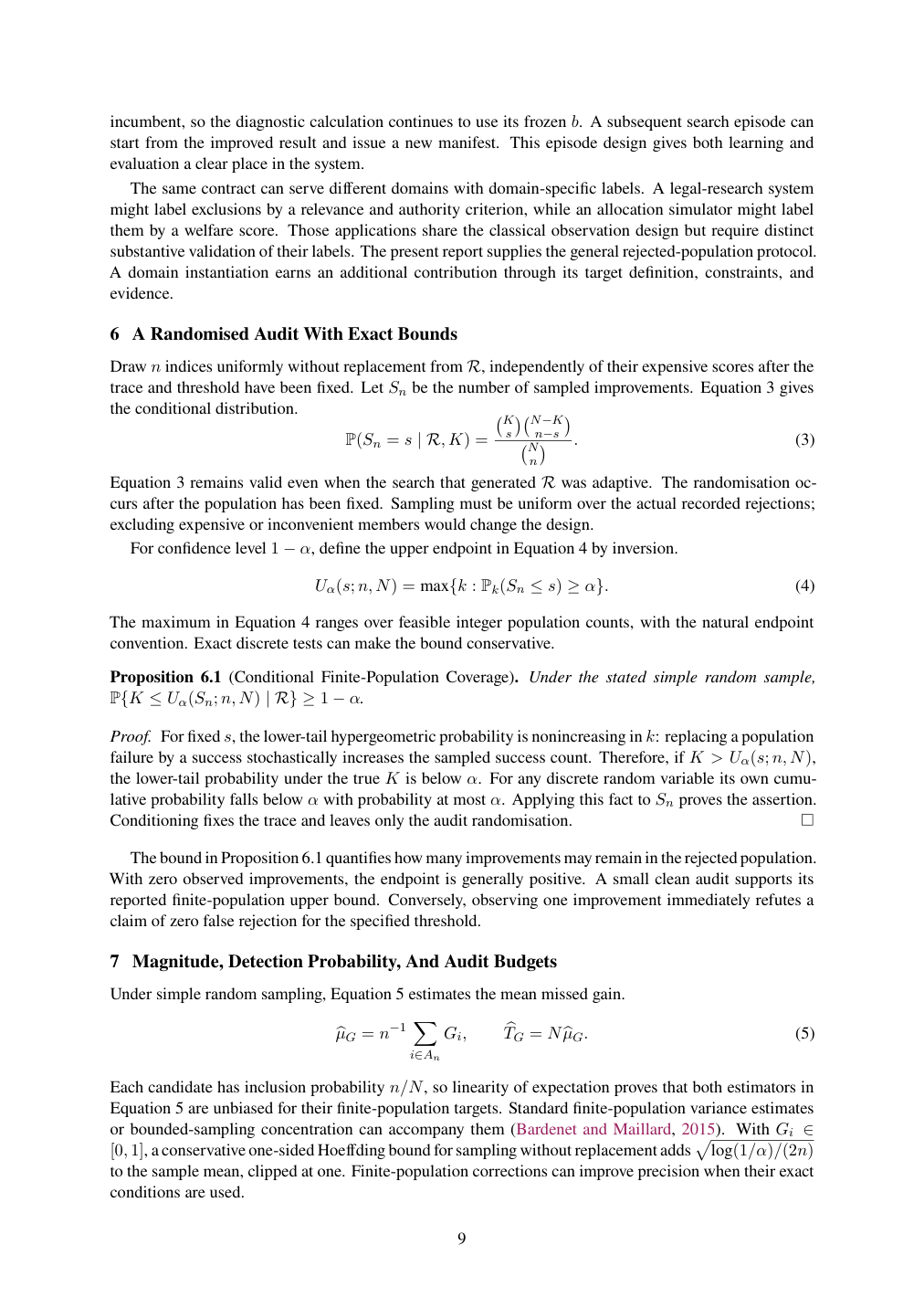
curs after the population has been fixed. Sampling must be uniform over the actual recorded rejections; excluding expensive or inconvenient members would change the design.
The maximum in Equation 4 ranges over feasible integer population counts, with the natural endpoint convention. Exact discrete tests can make the bound conservative.
Proposition 6.1 (Conditional Finite-Population Coverage). Under the stated simple random sample,
Conditioning fixes the trace and leaves only the audit randomisation.
The bound in Proposition 6.1 quantifies how many improvements may remain in the rejected population. With zero observed improvements, the endpoint is generally positive. A small clean audit supports its
reported finite-population upper bound. Conversely, observing one improvement immediately refutes a claim of zero false rejection for the specified threshold.
Under simple random sampling, Equation 5 estimates the mean missed gain.
Equation 5 are unbiased for their finite-population targets. Standard finite-population variance estimates
to the sample mean, clipped at one. Finite-population corrections can improve precision when their exact
Readable text
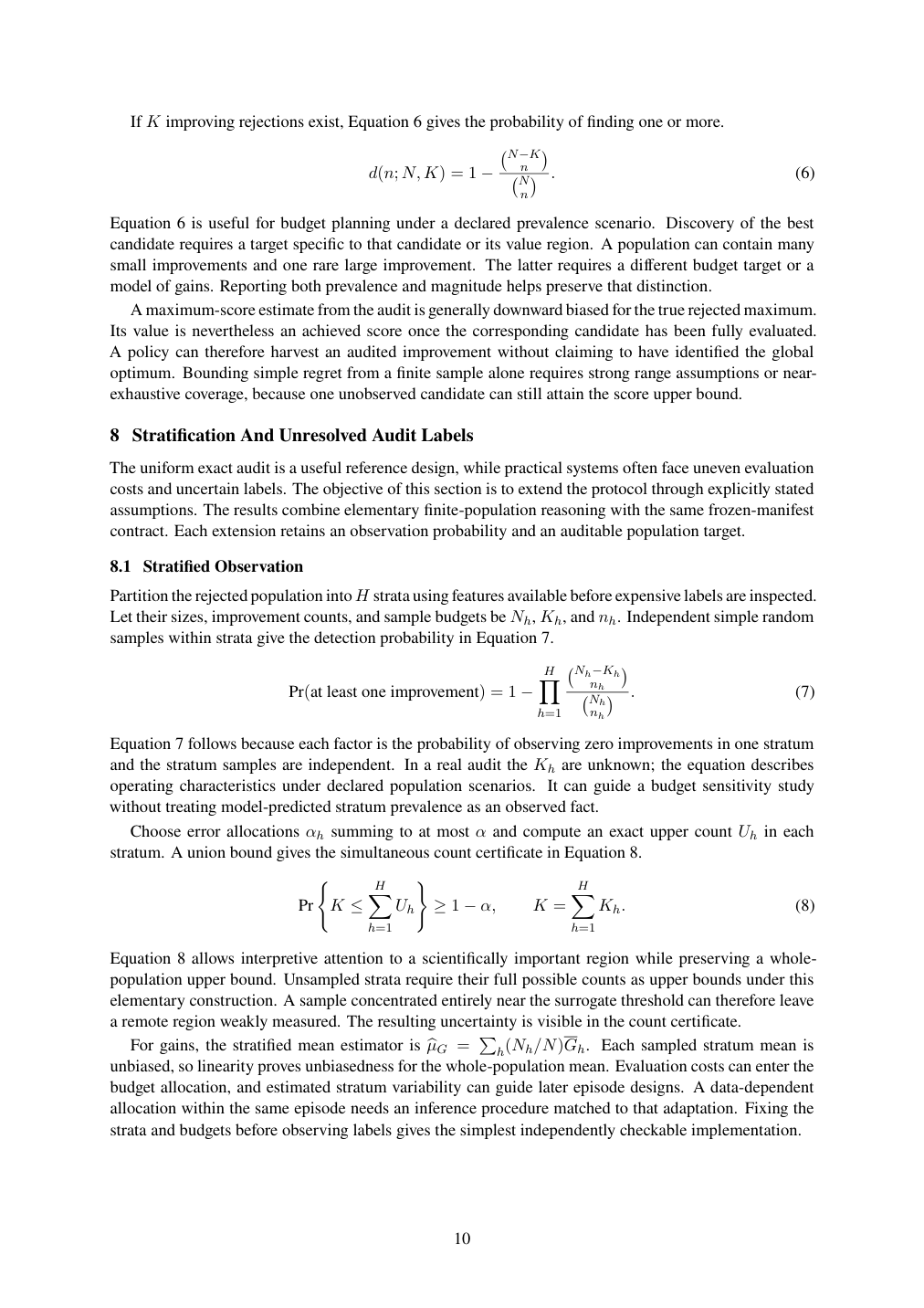
Equation 6 is useful for budget planning under a declared prevalence scenario. Discovery of the best candidate requires a target specific to that candidate or its value region. A population can contain many small improvements and one rare large improvement. The latter requires a different budget target or a model of gains. Reporting both prevalence and magnitude helps preserve that distinction.
A maximum-score estimate from the audit is generally downward biased for the true rejected maximum. Its value is nevertheless an achieved score once the corresponding candidate has been fully evaluated. A policy can therefore harvest an audited improvement without claiming to have identified the global optimum. Bounding simple regret from a finite sample alone requires strong range assumptions or near- exhaustive coverage, because one unobserved candidate can still attain the score upper bound.
The uniform exact audit is a useful reference design, while practical systems often face uneven evaluation costs and uncertain labels. The objective of this section is to extend the protocol through explicitly stated assumptions. The results combine elementary finite-population reasoning with the same frozen-manifest contract. Each extension retains an observation probability and an auditable population target.
samples within strata give the detection probability in Equation 7.
Equation 7 follows because each factor is the probability of observing zero improvements in one stratum operating characteristics under declared population scenarios. It can guide a budget sensitivity study without treating model-predicted stratum prevalence as an observed fact.
stratum. A union bound gives the simultaneous count certificate in Equation 8.
Equation 8 allows interpretive attention to a scientifically important region while preserving a whole- population upper bound. Unsampled strata require their full possible counts as upper bounds under this elementary construction. A sample concentrated entirely near the surrogate threshold can therefore leave a remote region weakly measured. The resulting uncertainty is visible in the count certificate.
unbiased, so linearity proves unbiasedness for the whole-population mean. Evaluation costs can enter the budget allocation, and estimated stratum variability can guide later episode designs. A data-dependent allocation within the same episode needs an inference procedure matched to that adaptation. Fixing the strata and budgets before observing labels gives the simplest independently checkable implementation.
Readable text
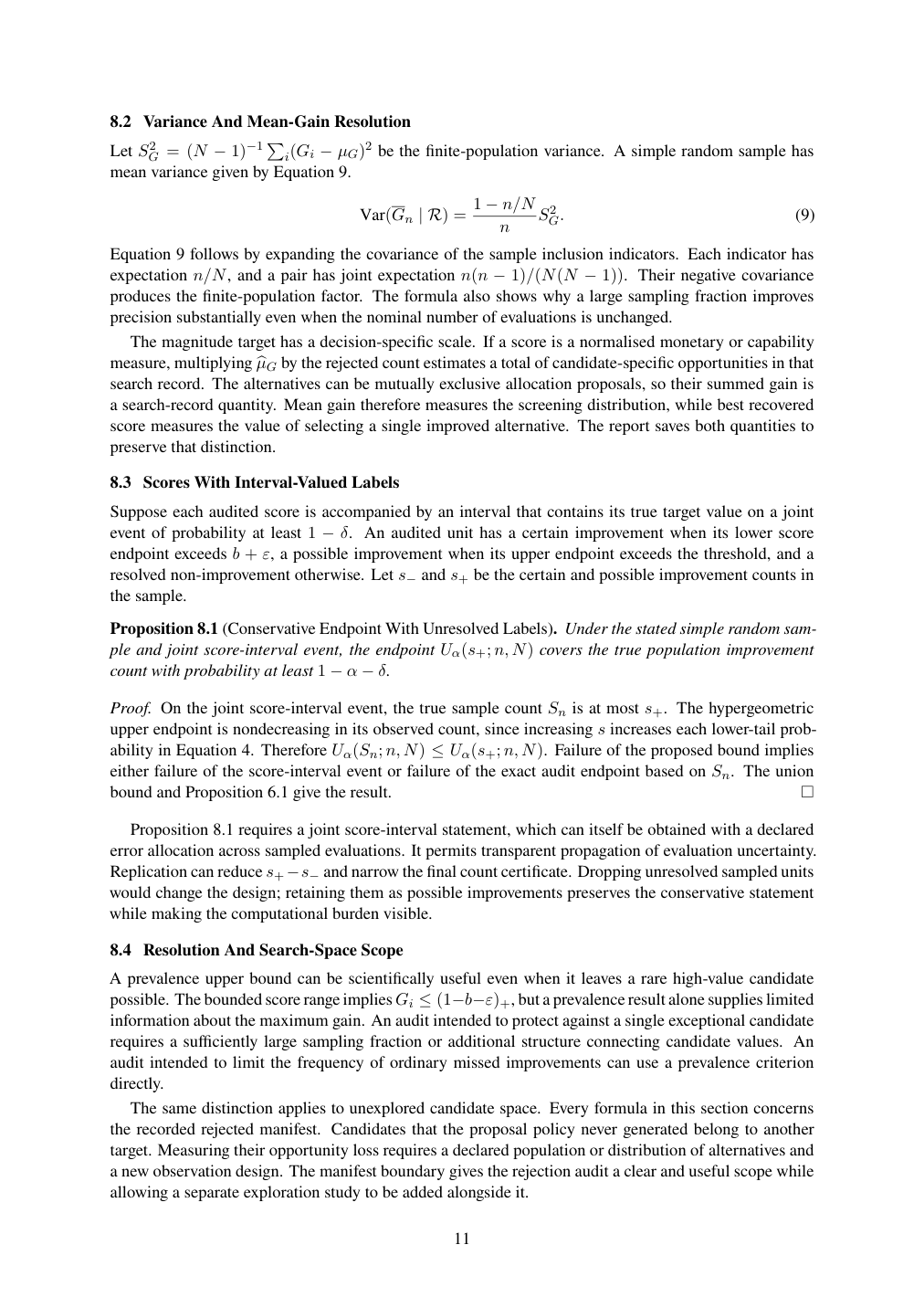
Equation 9 follows by expanding the covariance of the sample inclusion indicators. Each indicator has produces the finite-population factor. The formula also shows why a large sampling fraction improves precision substantially even when the nominal number of evaluations is unchanged.
The magnitude target has a decision-specific scale. If a score is a normalised monetary or capability search record. The alternatives can be mutually exclusive allocation proposals, so their summed gain is a search-record quantity. Mean gain therefore measures the screening distribution, while best recovered score measures the value of selecting a single improved alternative. The report saves both quantities to
Suppose each audited score is accompanied by an interval that contains its true target value on a joint
Proposition 8.1 (Conservative Endpoint With Unresolved Labels). Under the stated simple random sam-
Proposition 8.1 requires a joint score-interval statement, which can itself be obtained with a declared error allocation across sampled evaluations. It permits transparent propagation of evaluation uncertainty. would change the design; retaining them as possible improvements preserves the conservative statement
A prevalence upper bound can be scientifically useful even when it leaves a rare high-value candidate information about the maximum gain. An audit intended to protect against a single exceptional candidate requires a sufficiently large sampling fraction or additional structure connecting candidate values. An audit intended to limit the frequency of ordinary missed improvements can use a prevalence criterion
The same distinction applies to unexplored candidate space. Every formula in this section concerns the recorded rejected manifest. Candidates that the proposal policy never generated belong to another target. Measuring their opportunity loss requires a declared population or distribution of alternatives and a new observation design. The manifest boundary gives the rejection audit a clear and useful scope while allowing a separate exploration study to be added alongside it.
Readable text
An audit budget can protect against a missed region only when the observation design gives that region an appropriate chance of inspection. The objective of this section is to construct a cost-constrained design for a declared threat size. The target is the probability of finding at least one material improvement in a hard evaluation costs, arbitrary placement of the improvements, and a checkable sampling strategy.
Adversarial audit design has an established security-game literature. maxmin probability guarantees in an auditing game and give an approximation method; their practical discussion identifies unequal audit costs and imperfect detection as further modelling issues. Stratified inference also has a close predecessor in SUITE: Ottoboni et al. (2018) maximises a combined test quantity over allocations of outcome-changing error among strata. The present problem fixes a binary rejection label and designs observations before the audit, using exact finite-population miss probabilities and a hard unit-cost budget. Its game and linear-programming ingredients are inherited methods; the specialised reduction, calibration protocol, and independently checked strategy are the contribution
unrestricted inside this declared population. The designer knows the costs and stratum membership and
The detection target has a specific informational scope. The adaptive-policy reduction below permits policies to use candidate identities, fixed covariates, and binary audit feedback. A full numerical score can convey additional structure under a model relating scores across candidates. Such a model supplies another design problem. The present minimax guarantee concerns the unrestricted binary-label population.
Proposition 9.1 (All-Failure Trajectory Reduction). For a randomised binary-feedback inspection pol- icy with known costs, a hard budget, and detection defined as the first observed improvement, there is an outcome-independent random inspection set with the same detection probability for each fixed label
Proof. Fix the policy’s complete random seed and run its hypothetical trajectory when each inspected and misses. If the intersection is nonempty, the real and hypothetical trajectories agree until the first member of that intersection is inspected, at which point detection occurs. Thus detection is equivalent
Proposition 9.1 closes a potential gap between a static allocation calculation and binary-feedback adap- tive auditing. It applies to the one-hit event and the stated feedback alphabet. An estimation policy, a policy using structured negative score information, or an intervention that changes future candidates re- tains a separate target. The reduction makes the proposed optimisation complete for its declared binary
Relabelling units uniformly within each cost stratum preserves the budget and threat class. Symmetrising
Readable text
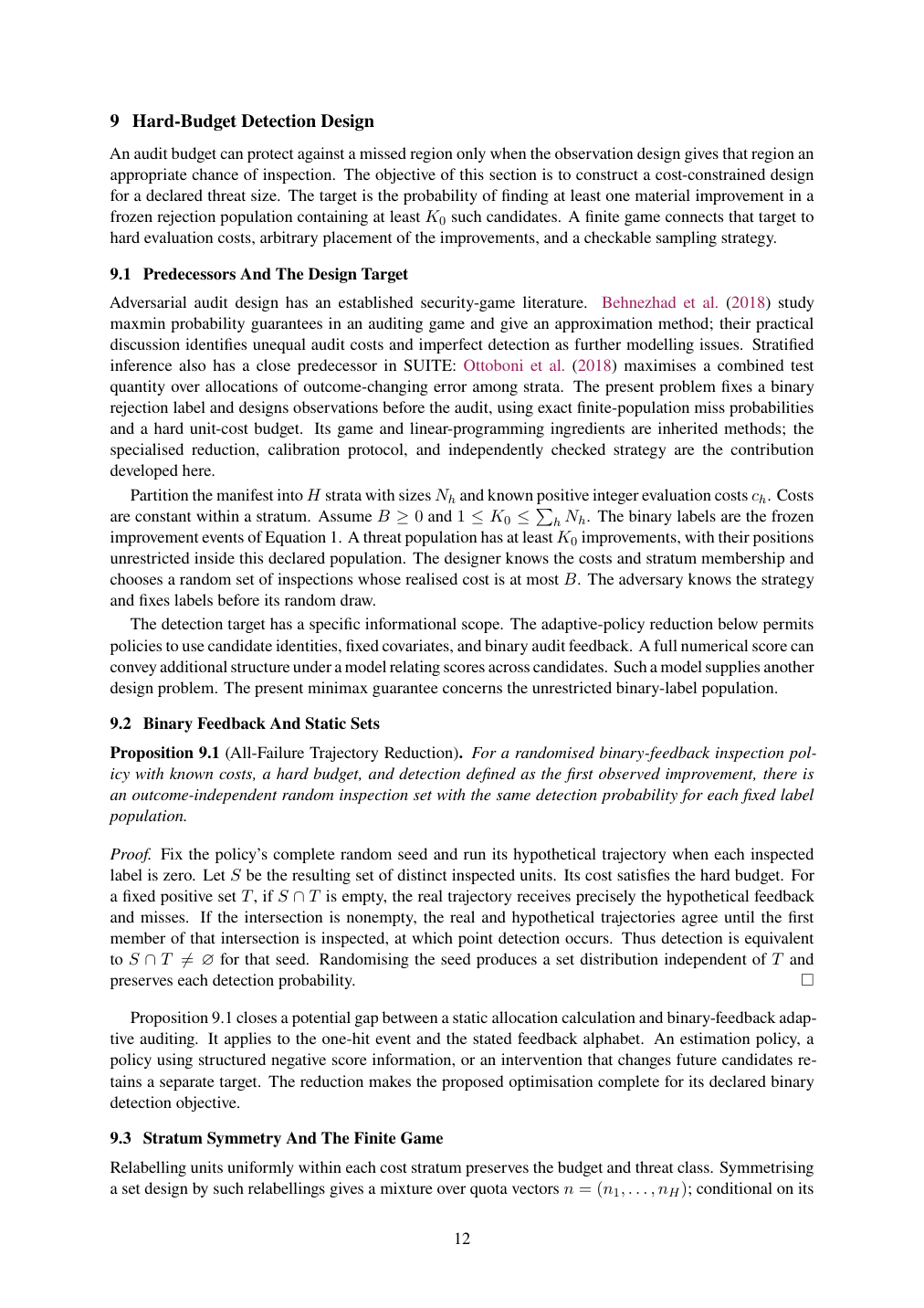
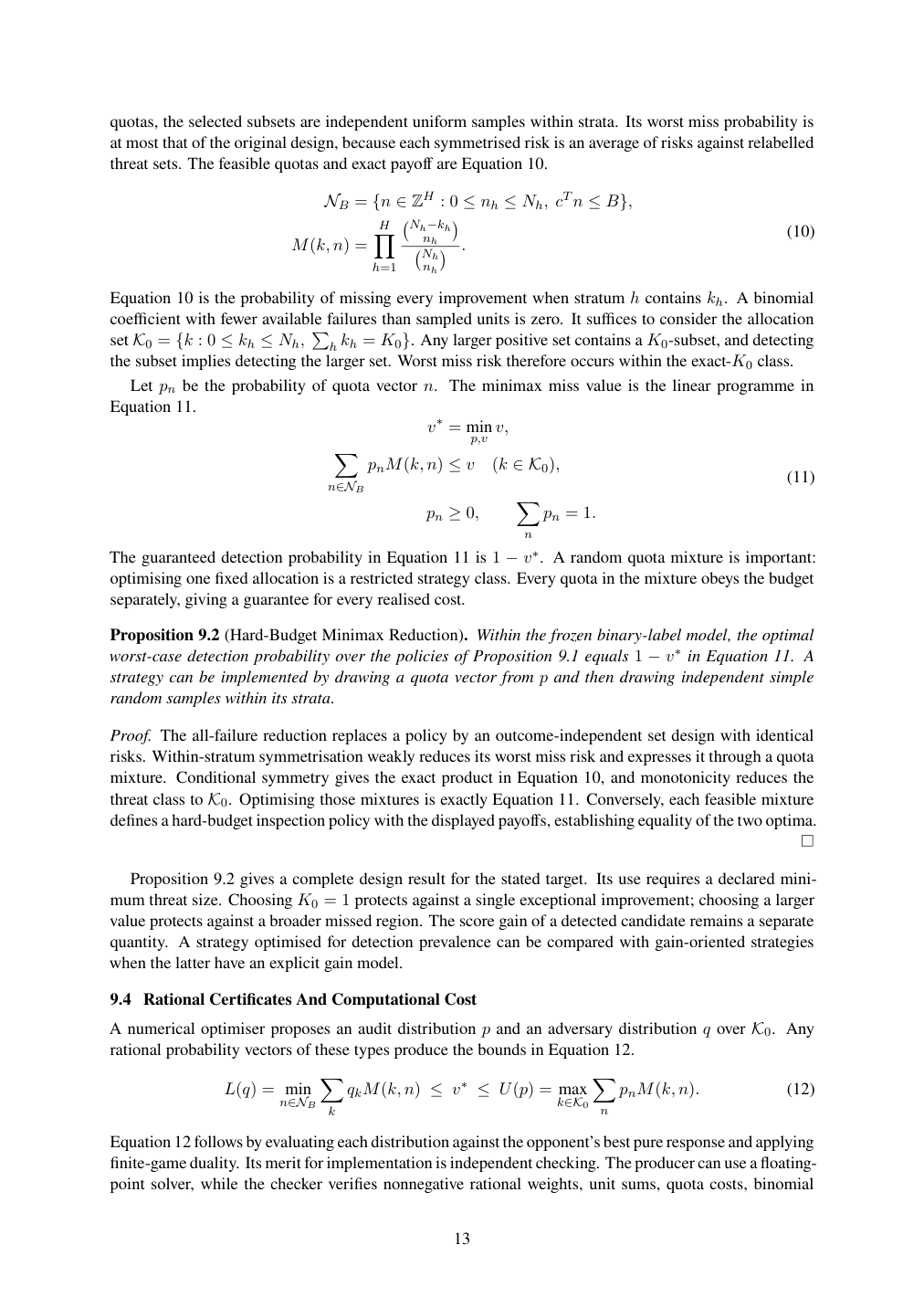
quotas, the selected subsets are independent uniform samples within strata. Its worst miss probability is at most that of the original design, because each symmetrised risk is an average of risks against relabelled threat sets. The feasible quotas and exact payoff are Equation 10.
coefficient with fewer available failures than sampled units is zero. It suffices to consider the allocation
optimising one fixed allocation is a restricted strategy class. Every quota in the mixture obeys the budget
separately, giving a guarantee for every realised cost.
Proposition 9.2 (Hard-Budget Minimax Reduction). Within the frozen binary-label model, the optimal
Proof. The all-failure reduction replaces a policy by an outcome-independent set design with identical risks. Within-stratum symmetrisation weakly reduces its worst miss risk and expresses it through a quota mixture. Conditional symmetry gives the exact product in Equation 10, and monotonicity reduces the defines a hard-budget inspection policy with the displayed payoffs, establishing equality of the two optima.
Proposition 9.2 gives a complete design result for the stated target. Its use requires a declared mini- value protects against a broader missed region. The score gain of a detected candidate remains a separate quantity. A strategy optimised for detection prevalence can be compared with gain-oriented strategies
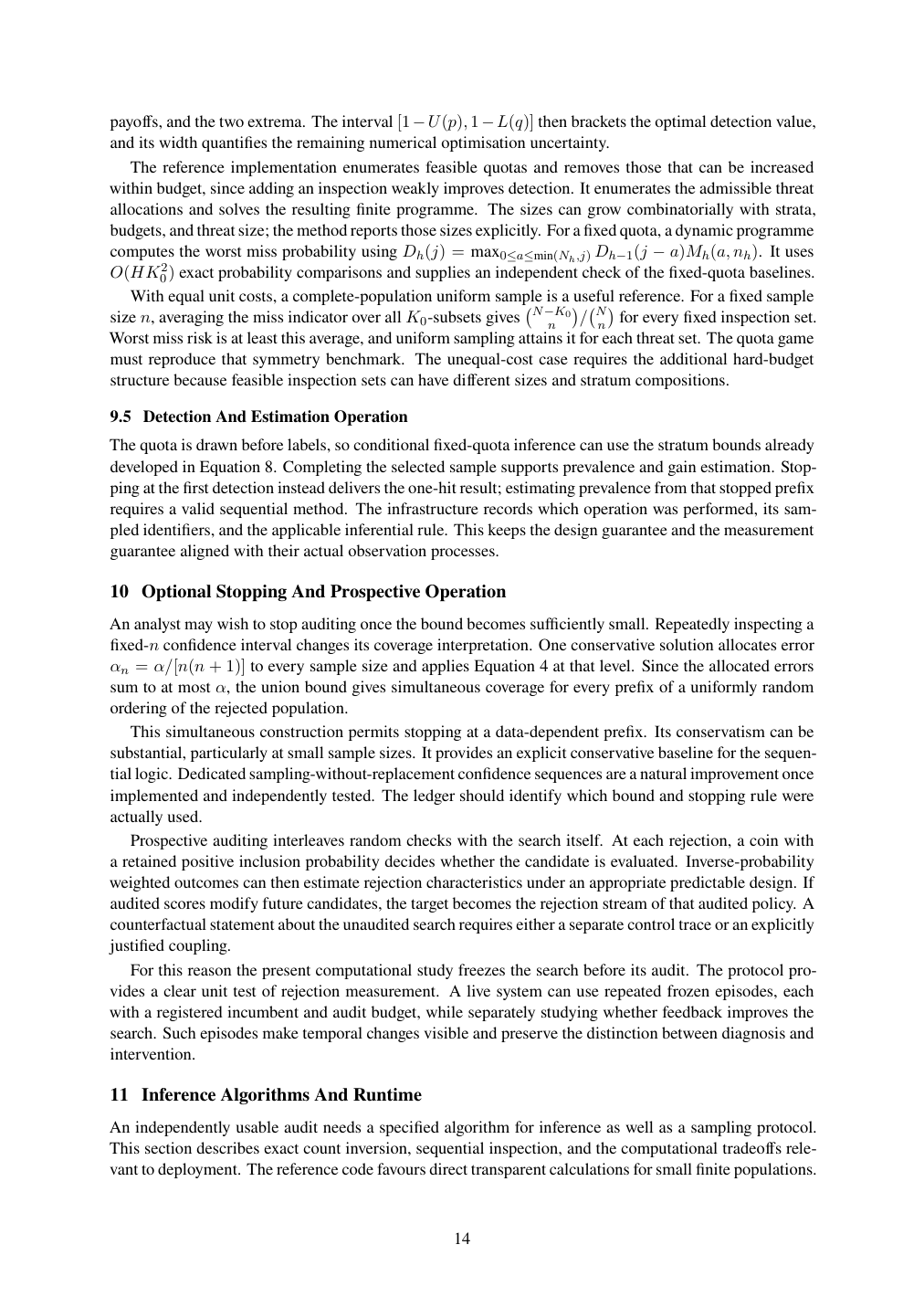
rational probability vectors of these types produce the bounds in Equation 12.
Equation 12 follows by evaluating each distribution against the opponent’s best pure response and applying finite-game duality. Its merit for implementation is independent checking. The producer can use a floating- point solver, while the checker verifies nonnegative rational weights, unit sums, quota costs, binomial
Readable text
and its width quantifies the remaining numerical optimisation uncertainty.
The reference implementation enumerates feasible quotas and removes those that can be increased within budget, since adding an inspection weakly improves detection. It enumerates the admissible threat allocations and solves the resulting finite programme. The sizes can grow combinatorially with strata, budgets, and threat size; the method reports those sizes explicitly. For a fixed quota, a dynamic programme
- exact probability comparisons and supplies an independent check of the fixed-quota baselines. With equal unit costs, a complete-population uniform sample is a useful reference. For a fixed sample
Worst miss risk is at least this average, and uniform sampling attains it for each threat set. The quota game
must reproduce that symmetry benchmark. The unequal-cost case requires the additional hard-budget structure because feasible inspection sets can have different sizes and stratum compositions.
The quota is drawn before labels, so conditional fixed-quota inference can use the stratum bounds already developed in Equation 8. Completing the selected sample supports prevalence and gain estimation. Stop- ping at the first detection instead delivers the one-hit result; estimating prevalence from that stopped prefix requires a valid sequential method. The infrastructure records which operation was performed, its sam- pled identifiers, and the applicable inferential rule. This keeps the design guarantee and the measurement guarantee aligned with their actual observation processes.
An analyst may wish to stop auditing once the bound becomes sufficiently small. Repeatedly inspecting a
This simultaneous construction permits stopping at a data-dependent prefix. Its conservatism can be substantial, particularly at small sample sizes. It provides an explicit conservative baseline for the sequen- tial logic. Dedicated sampling-without-replacement confidence sequences are a natural improvement once implemented and independently tested. The ledger should identify which bound and stopping rule were
Prospective auditing interleaves random checks with the search itself. At each rejection, a coin with a retained positive inclusion probability decides whether the candidate is evaluated. Inverse-probability weighted outcomes can then estimate rejection characteristics under an appropriate predictable design. If audited scores modify future candidates, the target becomes the rejection stream of that audited policy. A counterfactual statement about the unaudited search requires either a separate control trace or an explicitly
For this reason the present computational study freezes the search before its audit. The protocol pro- vides a clear unit test of rejection measurement. A live system can use repeated frozen episodes, each with a registered incumbent and audit budget, while separately studying whether feedback improves the search. Such episodes make temporal changes visible and preserve the distinction between diagnosis and
An independently usable audit needs a specified algorithm for inference as well as a sampling protocol. This section describes exact count inversion, sequential inspection, and the computational tradeoffs rele- vant to deployment. The reference code favours direct transparent calculations for small finite populations.
A production implementation can change the numerical mechanism while preserving the same distributional definition and test cases.
11.1 Exact Count Inversion



11.2 Sequential Error Spending

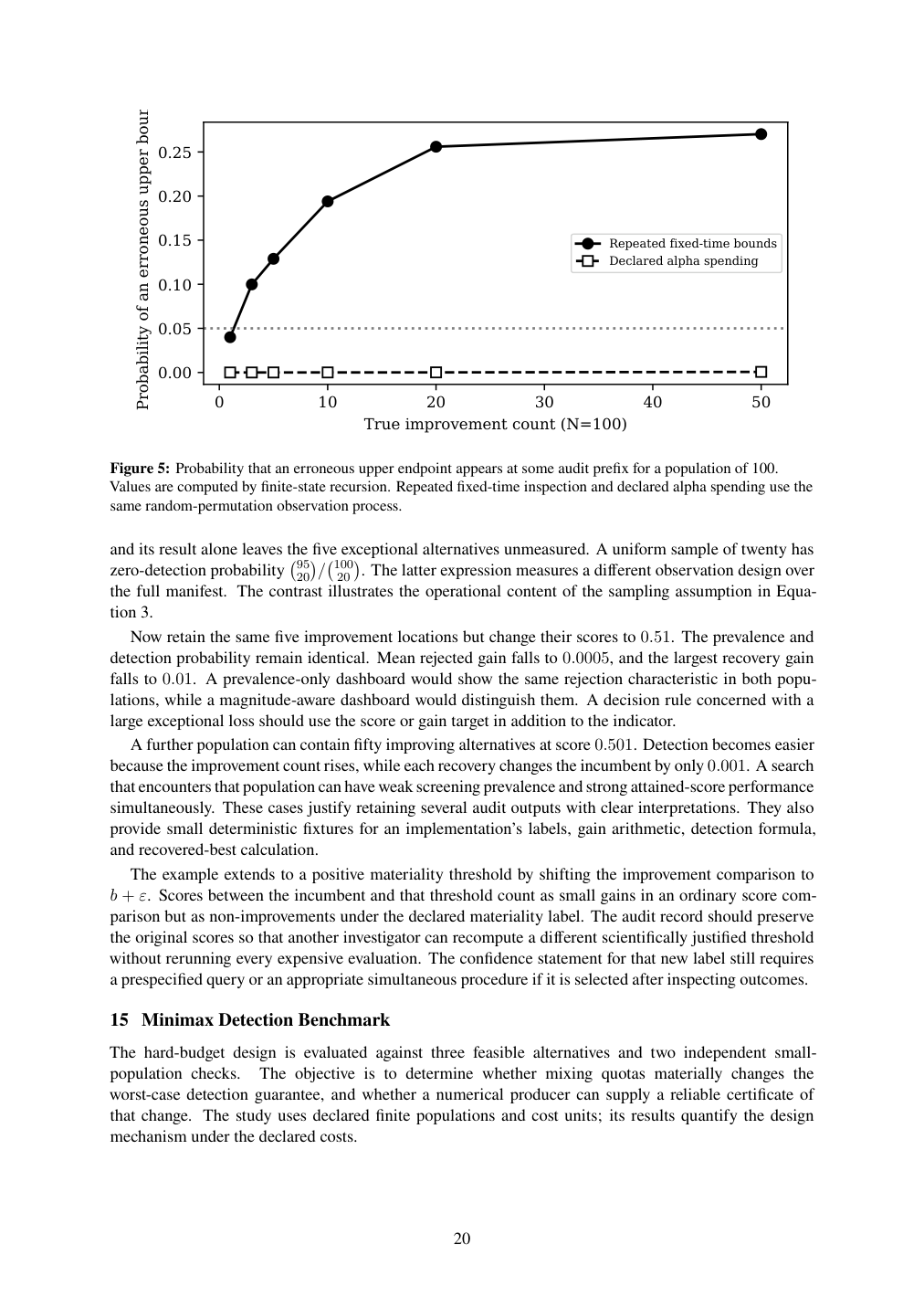
The spending rule is intentionally conservative and places a small error budget at late prefixes. A dedicated finite-population confidence sequence can offer a more efficient precision path. Comparing methods requires the same random ordering, target, and stopping criterion, together with a check of each method’s assumptions. The exact recursion in the sensitivity study measures the elementary spending baseline and a repeatedly inspected fixed-time baseline under identical population scenarios.

11.3 Evaluation Cost And Episode Design
Expensive labels usually dominate the inference cost. The relevant budget should therefore include simulator repetitions, failed evaluations, and audit bookkeeping, in addition to the number of distinct candidates. An audit can be inexpensive in arithmetic while costly in domain computation. A matched search comparison charges those evaluations to the search-plus-audit policy and compares it with an unaudited policy under the same total expensive-evaluation budget.
Repeated frozen episodes provide a simple deployment design. Each episode closes a manifest, freezes its threshold, draws an audit, publishes the diagnostic, and passes improvements to the next episode. The sequence creates several populations and several inferential statements. If the institution requires a joint error guarantee across episodes, it can allocate a total error budget across them in advance. If it reports episode-specific statements, the scope remains per episode. Either convention can be coherent when retained in the ledger.
Readable text
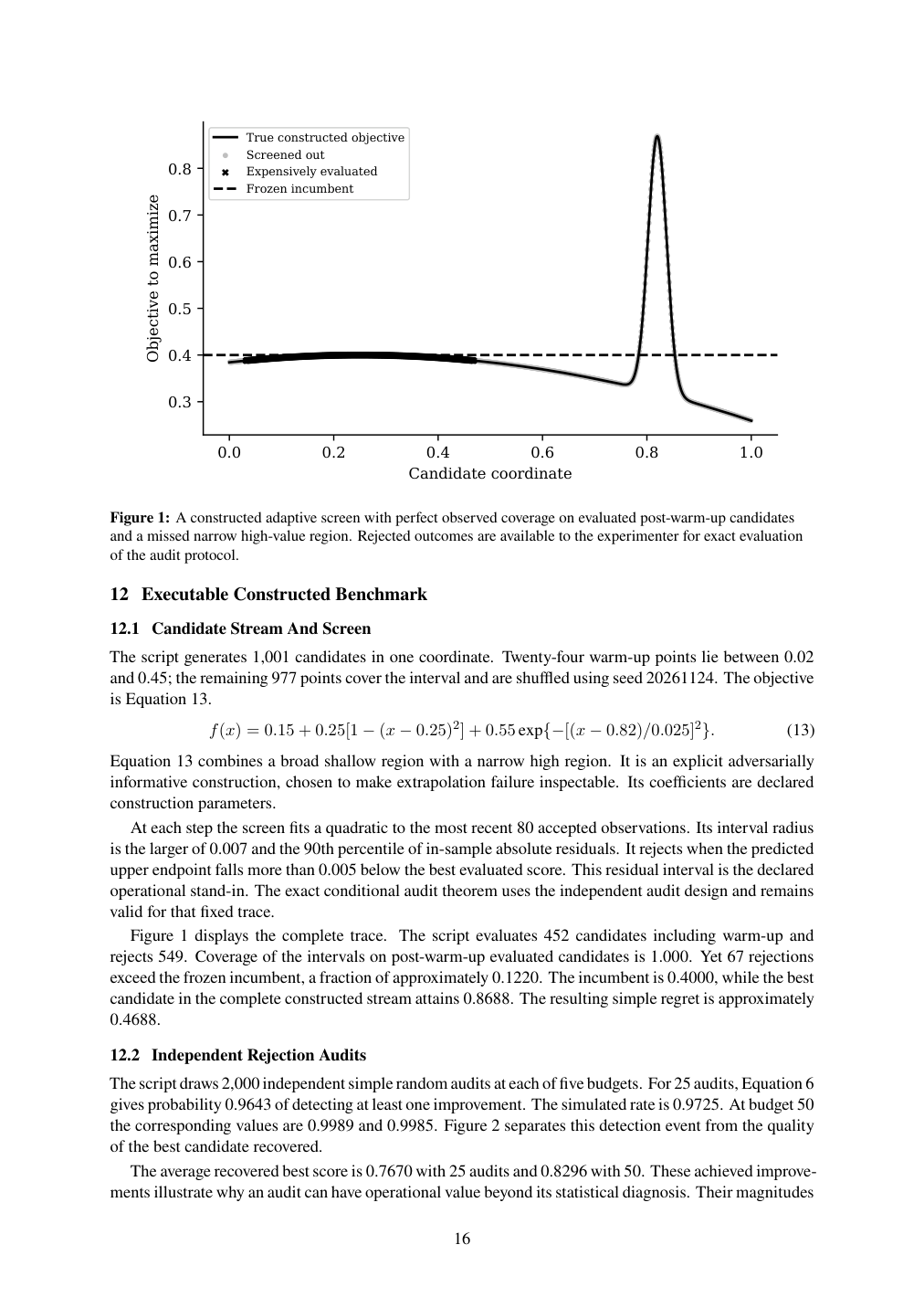
True constructed objective Screened out Expensively evaluated Frozen incumbent
Figure 1: A constructed adaptive screen with perfect observed coverage on evaluated post-warm-up candidates and a missed narrow high-value region. Rejected outcomes are available to the experimenter for exact evaluation
The script generates 1,001 candidates in one coordinate. Twenty-four warm-up points lie between 0.02 and 0.45; the remaining 977 points cover the interval and are shuffled using seed 20261124. The objective
Equation 13 combines a broad shallow region with a narrow high region. It is an explicit adversarially informative construction, chosen to make extrapolation failure inspectable. Its coefficients are declared
At each step the screen fits a quadratic to the most recent 80 accepted observations. Its interval radius is the larger of 0.007 and the 90th percentile of in-sample absolute residuals. It rejects when the predicted upper endpoint falls more than 0.005 below the best evaluated score. This residual interval is the declared operational stand-in. The exact conditional audit theorem uses the independent audit design and remains
Figure 1 displays the complete trace. The script evaluates 452 candidates including warm-up and rejects 549. Coverage of the intervals on post-warm-up evaluated candidates is 1.000. Yet 67 rejections exceed the frozen incumbent, a fraction of approximately 0.1220. The incumbent is 0.4000, while the best candidate in the complete constructed stream attains 0.8688. The resulting simple regret is approximately
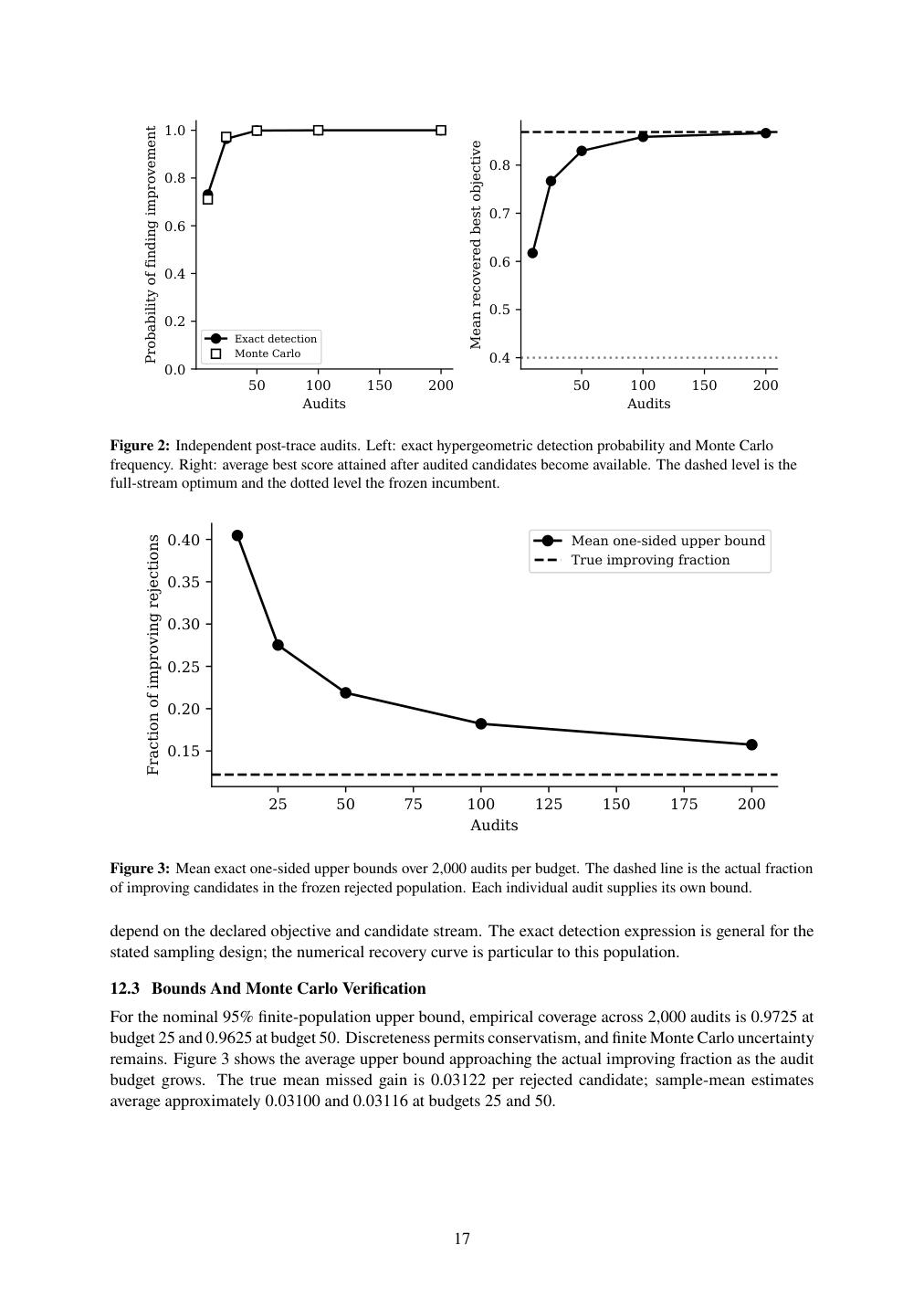
The script draws 2,000 independent simple random audits at each of five budgets. For 25 audits, Equation 6 gives probability 0.9643 of detecting at least one improvement. The simulated rate is 0.9725. At budget 50 the corresponding values are 0.9989 and 0.9985. Figure 2 separates this detection event from the quality
The average recovered best score is 0.7670 with 25 audits and 0.8296 with 50. These achieved improve- ments illustrate why an audit can have operational value beyond its statistical diagnosis. Their magnitudes
Readable text
Figure 2: Independent post-trace audits. Left: exact hypergeometric detection probability and Monte Carlo frequency. Right: average best score attained after audited candidates become available. The dashed level is the full-stream optimum and the dotted level the frozen incumbent.
Figure 3: Mean exact one-sided upper bounds over 2,000 audits per budget. The dashed line is the actual fraction of improving candidates in the frozen rejected population. Each individual audit supplies its own bound.
depend on the declared objective and candidate stream. The exact detection expression is general for the stated sampling design; the numerical recovery curve is particular to this population.
For the nominal 95% finite-population upper bound, empirical coverage across 2,000 audits is 0.9725 at budget 25 and 0.9625 at budget 50. Discreteness permits conservatism, and finite Monte Carlo uncertainty remains. Figure 3 shows the average upper bound approaching the actual improving fraction as the audit budget grows. The true mean missed gain is 0.03122 per rejected candidate; sample-mean estimates average approximately 0.03100 and 0.03116 at budgets 25 and 50.
Readable text
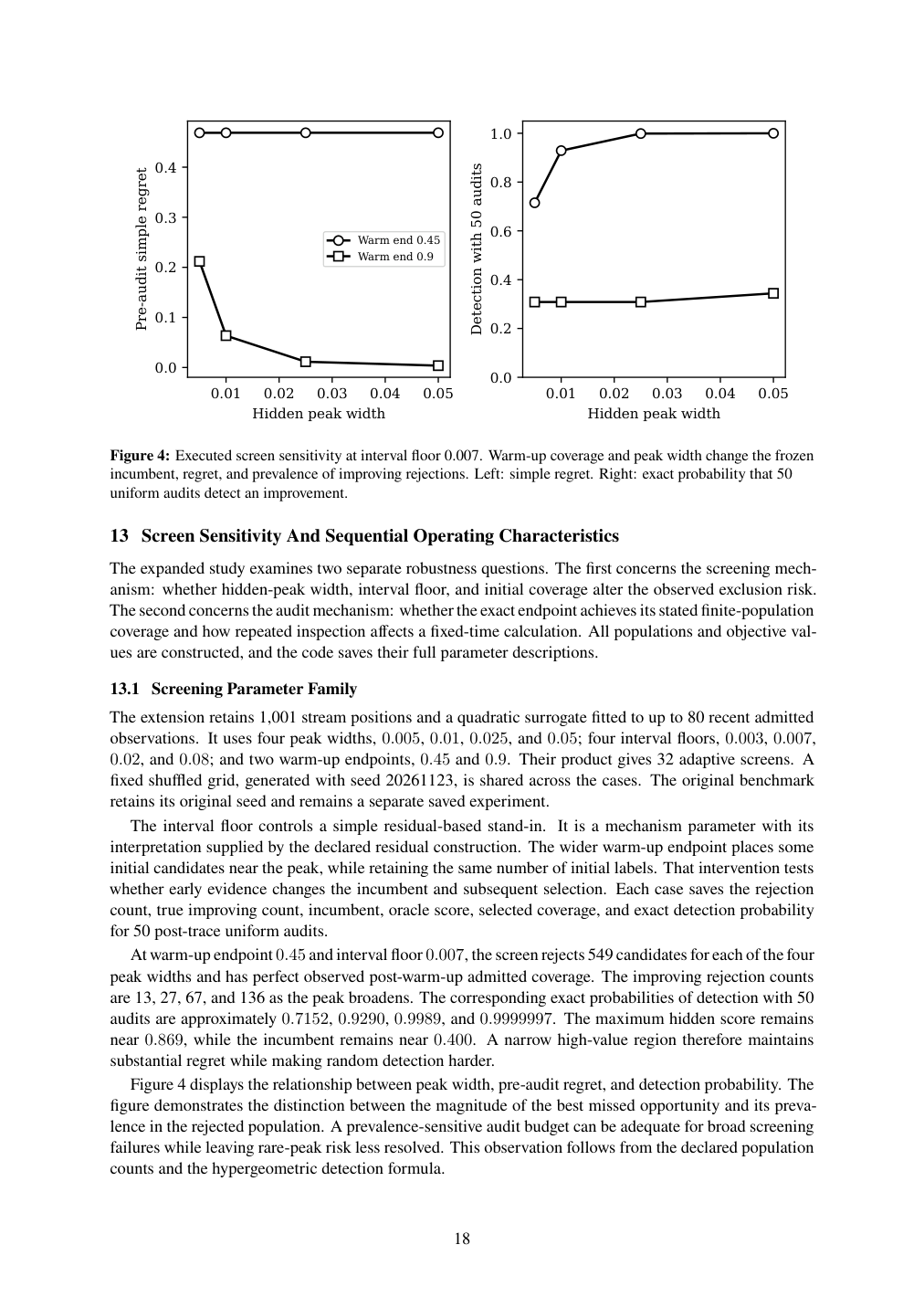
Figure 4: Executed screen sensitivity at interval floor 0.007. Warm-up coverage and peak width change the frozen incumbent, regret, and prevalence of improving rejections. Left: simple regret. Right: exact probability that 50
13 Screen Sensitivity And Sequential Operating Characteristics
The expanded study examines two separate robustness questions. The first concerns the screening mech- anism: whether hidden-peak width, interval floor, and initial coverage alter the observed exclusion risk. The second concerns the audit mechanism: whether the exact endpoint achieves its stated finite-population coverage and how repeated inspection affects a fixed-time calculation. All populations and objective val- ues are constructed, and the code saves their full parameter descriptions.
The extension retains 1,001 stream positions and a quadratic surrogate fitted to up to 80 recent admitted fixed shuffled grid, generated with seed 20261123, is shared across the cases. The original benchmark retains its original seed and remains a separate saved experiment.
The interval floor controls a simple residual-based stand-in. It is a mechanism parameter with its interpretation supplied by the declared residual construction. The wider warm-up endpoint places some initial candidates near the peak, while retaining the same number of initial labels. That intervention tests whether early evidence changes the incumbent and subsequent selection. Each case saves the rejection count, true improving count, incumbent, oracle score, selected coverage, and exact detection probability
peak widths and has perfect observed post-warm-up admitted coverage. The improving rejection counts are 13, 27, 67, and 136 as the peak broadens. The corresponding exact probabilities of detection with 50 substantial regret while making random detection harder.
Figure 4 displays the relationship between peak width, pre-audit regret, and detection probability. The figure demonstrates the distinction between the magnitude of the best missed opportunity and its preva- lence in the rejected population. A prevalence-sensitive audit budget can be adequate for broad screening failures while leaving rare-peak risk less resolved. This observation follows from the declared population
13.2 Warm-Up Coverage And Empty Selected Samples

The post-warm-up admitted coverage measure is undefined in these all-rejected cases. The output records a null value and an admitted count of zero. Treating an empty selected sample as perfect coverage would manufacture a favourable diagnostic from an absence of observed labels. The explicit count resolves the interpretation and gives an operational check for real monitoring dashboards.
The interval-floor sweep changes admission behaviour in other cases and is available in the saved table for independent inspection. Its role is an ablation of the screen’s uncertainty mechanism. A larger floor can preserve additional candidates, with an expensive-evaluation cost that must enter a matched budget comparison. The present report reports the full family and avoids selecting a single floor as a general recommendation. A domain deployment would choose a policy through separate training or pilot episodes and assess it on held-out episodes.
13.3 Exact Fixed-Budget Coverage Check
The endpoint calculation is checked for population sizes 20, 60, and 100, at three budgets for each population, and across every possible true improvement count. The resulting 549 parameter cases use the exact hypergeometric probability mass to sum the coverage event. The minimum one-sided coverage is approximately 0.95007 at nominal level 0.95. This exhaustive finite grid supports the implemented inversion and its endpoint conventions. Proposition 6.1 supplies the general proof for arbitrary valid finite populations.
This check differs from the original repeated-sampling audit experiment. Monte Carlo averages provide an empirical approximation to operating characteristics in the original constructed trace. Exact summation evaluates those characteristics without simulation error for the selected finite-population grid. Both routes are saved, and the exact route provides a particularly useful regression test for future numerical implementations.
13.4 Repeated Inspection And Error Spending
14 Worked Comparison Of Audit Targets

A convenience sample drawn entirely from the ninety-five ordinary alternatives observes zero improvements with certainty under that selection rule. It therefore supplies information about its chosen region,
Readable text
Figure 5: Probability that an erroneous upper endpoint appears at some audit prefix for a population of 100. Values are computed by finite-state recursion. Repeated fixed-time inspection and declared alpha spending use the
and its result alone leaves the five exceptional alternatives unmeasured. A uniform sample of twenty has
. The latter expression measures a different observation design over the full manifest. The contrast illustrates the operational content of the sampling assumption in Equa-
lations, while a magnitude-aware dashboard would distinguish them. A decision rule concerned with a large exceptional loss should use the score or gain target in addition to the indicator.
that encounters that population can have weak screening prevalence and strong attained-score performance simultaneously. These cases justify retaining several audit outputs with clear interpretations. They also provide small deterministic fixtures for an implementation’s labels, gain arithmetic, detection formula,
The example extends to a positive materiality threshold by shifting the improvement comparison to parison but as non-improvements under the declared materiality label. The audit record should preserve the original scores so that another investigator can recompute a different scientifically justified threshold without rerunning every expensive evaluation. The confidence statement for that new label still requires a prespecified query or an appropriate simultaneous procedure if it is selected after inspecting outcomes.
The hard-budget design is evaluated against three feasible alternatives and two independent small- The objective is to determine whether mixing quotas materially changes the worst-case detection guarantee, and whether a numerical producer can supply a reliable certificate of that change. The study uses declared finite populations and cost units; its results quantify the design
population checks. mechanism under the declared costs.
Readable text
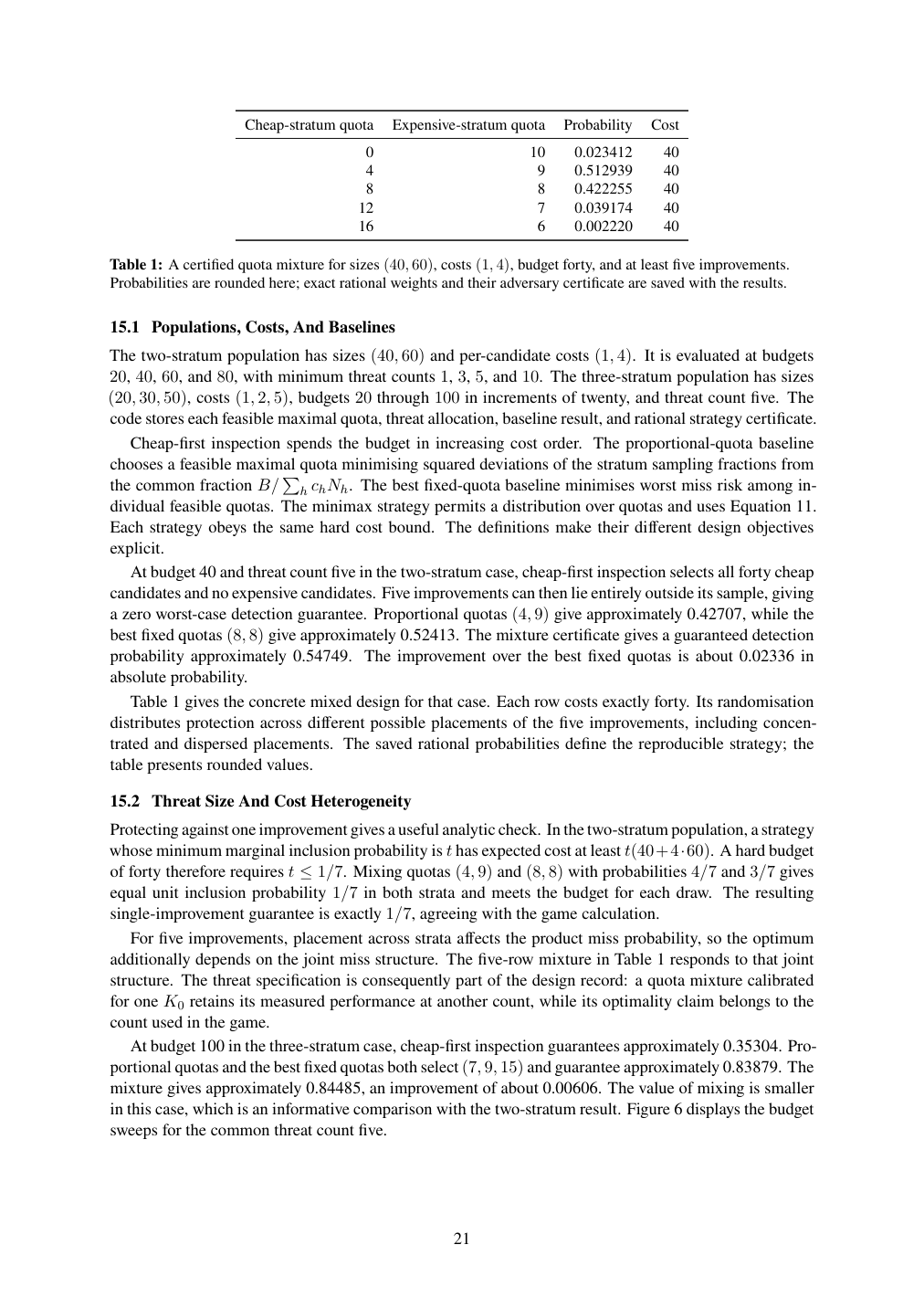
Probabilities are rounded here; exact rational weights and their adversary certificate are saved with the results.
20, 40, 60, and 80, with minimum threat counts 1, 3, 5, and 10. The three-stratum population has sizes
code stores each feasible maximal quota, threat allocation, baseline result, and rational strategy certificate.
Cheap-first inspection spends the budget in increasing cost order. The proportional-quota baseline chooses a feasible maximal quota minimising squared deviations of the stratum sampling fractions from
dividual feasible quotas. The minimax strategy permits a distribution over quotas and uses Equation 11. Each strategy obeys the same hard cost bound. The definitions make their different design objectives
At budget 40 and threat count five in the two-stratum case, cheap-first inspection selects all forty cheap candidates and no expensive candidates. Five improvements can then lie entirely outside its sample, giving probability approximately 0.54749. The improvement over the best fixed quotas is about 0.02336 in
Table 1 gives the concrete mixed design for that case. Each row costs exactly forty. Its randomisation distributes protection across different possible placements of the five improvements, including concen- trated and dispersed placements. The saved rational probabilities define the reproducible strategy; the
Protecting against one improvement gives a useful analytic check. In the two-stratum population, a strategy equal unit inclusion probability 1/7 in both strata and meets the budget for each draw. The resulting single-improvement guarantee is exactly 1/7, agreeing with the game calculation.
For five improvements, placement across strata affects the product miss probability, so the optimum additionally depends on the joint miss structure. The five-row mixture in Table 1 responds to that joint structure. The threat specification is consequently part of the design record: a quota mixture calibrated
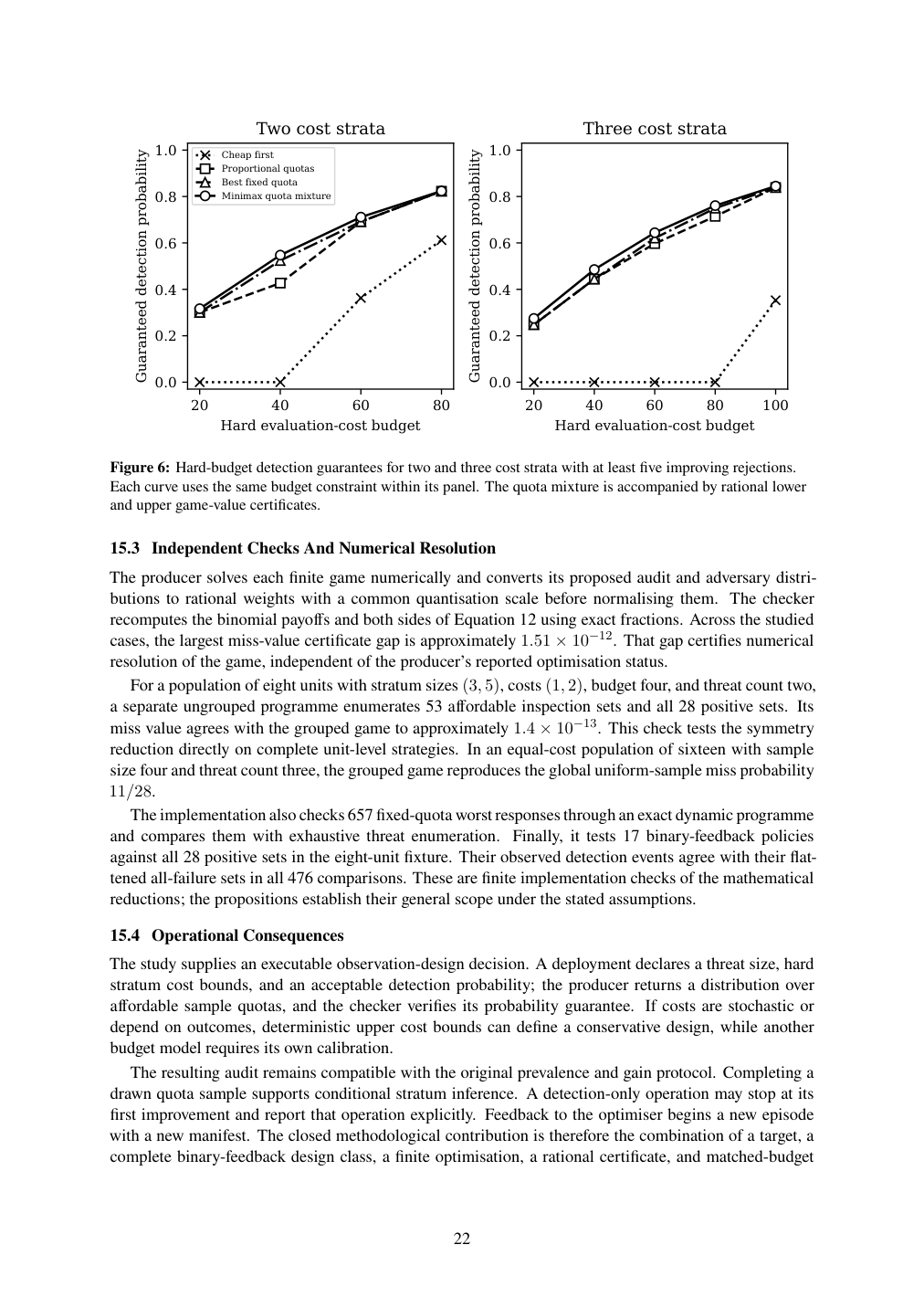
At budget 100 in the three-stratum case, cheap-first inspection guarantees approximately 0.35304. Pro- mixture gives approximately 0.84485, an improvement of about 0.00606. The value of mixing is smaller in this case, which is an informative comparison with the two-stratum result. Figure 6 displays the budget
Readable text
Cheap first Proportional quotas Best fixed quota Minimax quota mixture
Figure 6: Hard-budget detection guarantees for two and three cost strata with at least five improving rejections. Each curve uses the same budget constraint within its panel. The quota mixture is accompanied by rational lower
The producer solves each finite game numerically and converts its proposed audit and adversary distri- butions to rational weights with a common quantisation scale before normalising them. The checker recomputes the binomial payoffs and both sides of Equation 12 using exact fractions. Across the studied resolution of the game, independent of the producer’s reported optimisation status.
a separate ungrouped programme enumerates 53 affordable inspection sets and all 28 positive sets. Its reduction directly on complete unit-level strategies. In an equal-cost population of sixteen with sample size four and threat count three, the grouped game reproduces the global uniform-sample miss probability The implementation also checks 657 fixed-quota worst responses through an exact dynamic programme and compares them with exhaustive threat enumeration. Finally, it tests 17 binary-feedback policies against all 28 positive sets in the eight-unit fixture. Their observed detection events agree with their flat- tened all-failure sets in all 476 comparisons. These are finite implementation checks of the mathematical reductions; the propositions establish their general scope under the stated assumptions.
The study supplies an executable observation-design decision. A deployment declares a threat size, hard stratum cost bounds, and an acceptable detection probability; the producer returns a distribution over affordable sample quotas, and the checker verifies its probability guarantee. If costs are stochastic or depend on outcomes, deterministic upper cost bounds can define a conservative design, while another
The resulting audit remains compatible with the original prevalence and gain protocol. Completing a drawn quota sample supports conditional stratum inference. A detection-only operation may stop at its first improvement and report that operation explicitly. Feedback to the optimiser begins a new episode with a new manifest. The closed methodological contribution is therefore the combination of a target, a complete binary-feedback design class, a finite optimisation, a rational certificate, and matched-budget
baselines. Empirical search benefits can subsequently be measured without changing the guarantee’s meaning.
16 Integration With Allocation Infrastructure
The inspected Noetarium design uses a Gaussian-process stand-in and split calibration on recent expensive runs. It measures interval coverage on candidates that pass the screen and restricts the wrapper to a single selecting metric (Noetarium Project, 2026). These design choices already acknowledge the difference between search candidates and an exchangeable calibration sample. A rejection audit would add an independent observation channel without requiring the predictor to be replaced.
Each rejected candidate should receive a stable identity, feature record, proposed assessment, screen decision, and contemporaneous incumbent. A frozen audit additionally records the threshold, population digest, random seed, inclusion mechanism, full expensive assessment, and inferential method. Changes to the simulator or objective require versioning: each audit certificate retains the evaluator version that defines its labels. Results should remain attached to the actual population that was sampled.
For multiple objectives a useful rejected-candidate event could be improvement on one declared scalarisation or failure of a dominance-screening certificate. Auditing the union of such events measures a specific error criterion. Pareto coverage and final frontier loss require a reference frontier and greater computational work. The same sampling principle remains useful, but its labels and interpretations must be rebuilt for the actual decision rule.
17 Planning An Audit For A Declared Error Scale


This calculation makes a clean audit interpretable. Ten clean inspections can have meaningful evidential value for a common error mechanism while leaving a rare failure mechanism largely unresolved. The chosen prevalence scale should follow the application. For an expensive scientific search, a single omitted high-value candidate may matter more than a large count of minor improvements. Budget planning can therefore combine a prevalence target with a declared tail-gain target and preserve which one the audit was powered to address.
The construction also exposes a benefit of recording the whole rejected population. Its finite size permits exact planning, verified random selection, and eventual exhaustive assessment when the population is small. Those options disappear when candidates are discarded without stable identities. Retention is thus a substantive part of the audit design: the archive makes the statistical target available for later independent scrutiny.
18 Evaluation Costs And Deployment Evidence
The audit game requires a cost measure whose hard bound is operationally meaningful. A count of deterministic simulation steps or a declared upper evaluation charge can satisfy that role. A mean wall-clock duration has another interpretation because a realised run can exceed it. An implementation should state which resource is budgeted and retain the charge for every selected evaluation, including retries and failures. Cost strata can then be checked against actual execution records.
Readable text
Inverse-probability estimation, finite-population concentration, exact test inversion, confidence sequences
Verified sampling and sequential-inference literature.
Frozen rejection manifest, incumbent, threshold, prevalence and gain labels
Audit certificate Exact count endpoint, stratum propagation
Operational definition and identification counterexample.
Hidden-peak screens, exact inference, feedback reduction, and fixed/mixed audit
Validation programme validity, and episode feedback
Reproducible constructed experiments and probability calculations.
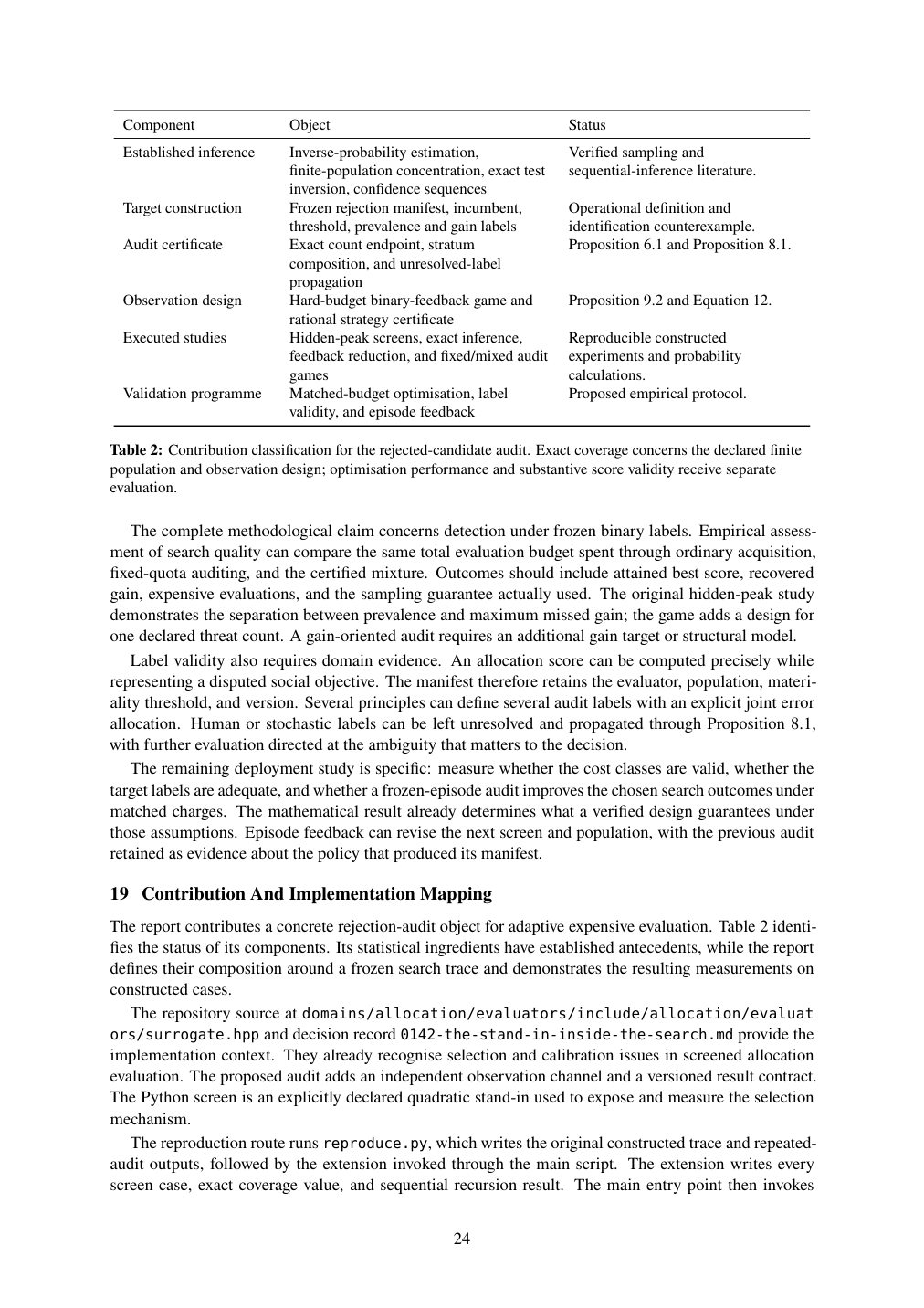
Table 2: Contribution classification for the rejected-candidate audit. Exact coverage concerns the declared finite population and observation design; optimisation performance and substantive score validity receive separate
The complete methodological claim concerns detection under frozen binary labels. Empirical assess- ment of search quality can compare the same total evaluation budget spent through ordinary acquisition, fixed-quota auditing, and the certified mixture. Outcomes should include attained best score, recovered gain, expensive evaluations, and the sampling guarantee actually used. The original hidden-peak study demonstrates the separation between prevalence and maximum missed gain; the game adds a design for one declared threat count. A gain-oriented audit requires an additional gain target or structural model.
Label validity also requires domain evidence. An allocation score can be computed precisely while representing a disputed social objective. The manifest therefore retains the evaluator, population, materi- ality threshold, and version. Several principles can define several audit labels with an explicit joint error allocation. Human or stochastic labels can be left unresolved and propagated through Proposition 8.1, with further evaluation directed at the ambiguity that matters to the decision.
The remaining deployment study is specific: measure whether the cost classes are valid, whether the target labels are adequate, and whether a frozen-episode audit improves the chosen search outcomes under matched charges. The mathematical result already determines what a verified design guarantees under those assumptions. Episode feedback can revise the next screen and population, with the previous audit retained as evidence about the policy that produced its manifest.
The report contributes a concrete rejection-audit object for adaptive expensive evaluation. Table 2 identi- fies the status of its components. Its statistical ingredients have established antecedents, while the report defines their composition around a frozen search trace and demonstrates the resulting measurements on
The repository source at domains/allocation/evaluators/include/allocation/evaluat ors/surrogate.hpp and decision record 0142-the-stand-in-inside-the-search.md provide the implementation context. They already recognise selection and calibration issues in screened allocation evaluation. The proposed audit adds an independent observation channel and a versioned result contract. The Python screen is an explicitly declared quadratic stand-in used to expose and measure the selection
The reproduction route runs reproduce.py, which writes the original constructed trace and repeated- audit outputs, followed by the extension invoked through the main script. The extension writes every screen case, exact coverage value, and sequential recursion result. The main entry point then invokes
publication_study.py, which saves the cost-stratum games, rational strategy certificates, dynamicprogramming comparisons, and feedback-reduction checks. Figures are generated directly from those files. The script’s null coverage value for empty admitted samples and its exact endpoint conventions are part of the reproducible specification.
A broader infrastructure can reuse the audit mechanism across domains, while each domain supplies its candidate identity, materiality criterion, evaluation procedure, and validation evidence. A companion domain report should therefore attribute the common sampling method and identify its own additional substantive contribution. This division supports cumulative work: one independently checked observation design can serve several applications, and each application can improve the definition and measurement of the opportunities whose exclusion matters.
20 Conclusion
A rejection audit connects a finite-population measurement with a controlled observation policy. Exact count inference and gain estimation describe a frozen manifest, while the hard-budget game supplies a verified one-hit design for a declared threat size and binary-feedback scope. Rational strategy certificates and complete small-population checks make the design result independently assessable. The constructed screen and cost studies preserve the distinction between accurate selected predictions, measured exclusions, and search performance, giving an implementation a concrete account of what its audit guarantees.
References
D. G. Horvitz; D. J. Thompson (1952). A Generalization of Sampling Without Replacement From a Finite Universe.
Journal of the American Statistical Association 47(260), 663–685. https://ww2.arb.ca.gov/sites/defau lt/files/2025-09/Horvitz-GeneralizationSamplingWithout-1952.pdf. Rémi Bardenet; Odalric-Ambrym Maillard (2015). Concentration Inequalities for Sampling Without Replacement.
Bernoulli 21(3), 1361–1385. https://arxiv.org/pdf/1309.4029. Steven R. Howard; Aaditya Ramdas; Jon McAuliffe; Jasjeet Sekhon (2021). Time-Uniform, Nonparametric,
Nonasymptotic Confidence Sequences. Annals of Statistics 49(2), 1055–1080. https://arxiv.org/abs/ 1810.08240. Ian Waudby-Smith; Aaditya Ramdas (2020). Confidence Sequences for Sampling Without Replacement. Advances
in Neural Information Processing Systems 33. https://arxiv.org/abs/2006.04347. Isaac Gibbs; Emmanuel Candès (2021). Adaptive Conformal Inference Under Distribution Shift. Advances in Neural
Information Processing Systems 34. https://arxiv.org/abs/2106.00170. Ryan J. Tibshirani; Rina Foygel Barber; Emmanuel J. Candès; Aaditya Ramdas (2019). Conformal Prediction Under
Covariate Shift. Advances in Neural Information Processing Systems 32. https://arxiv.org/abs/1904.060 19. Peter I. Frazier (2018). A Tutorial on Bayesian Optimization. Author manuscript, arXiv:1807.02811. https://ar
xiv.org/abs/1807.02811. Donald R. Jones; Matthias Schonlau; William J. Welch (1998). Efficient Global Optimization of Expensive Black-
Box Functions. Journal of Global Optimization 13, 455–492. https://www.stat.ubc.ca/~will/docs/Jon SchWel1998_global_optimization.pdf. Yaochu Jin (2011). Surrogate-Assisted Evolutionary Computation: Recent Advances and Future Challenges. Swarm
and Evolutionary Computation 1(2), 61–70. https://www.sciencedirect.com/science/article/pii/ S2210650211000198. Alina Beygelzimer; Sanjoy Dasgupta; John Langford (2009). Importance Weighted Active Learning. Proceedings
of ICML; author manuscript arXiv:0812.4952. https://arxiv.org/abs/0812.4952. Rina Foygel Barber; Emmanuel J. Candès; Aaditya Ramdas; Ryan J. Tibshirani (2023). Conformal Prediction Be-
yond Exchangeability. Annals of Statistics 51(2). https://arxiv.org/abs/2202.13415. Jing Lei; Max G’Sell; Alessandro Rinaldo; Ryan J. Tibshirani; Larry Wasserman (2017). Distribution-Free Predic-
tive Inference for Regression. Author manuscript, arXiv:1604.04173v2. https://arxiv.org/abs/1604.041 73.

Readable text
Science 869fe38afac257cd9b5d51ad5b498a8ff6b8e443. https://github.com/huangwanhong-maker/Noeta rium-The-Science-and-Humanity-Infrastructure. Kellie Ottoboni; Philip B. Stark; Mark Lindeman; Neal McBurnett (2018). Risk-Limiting Audits by Stratified Union-
Intersection Tests of Elections (SUITE). Electronic Voting, 174–188. https://arxiv.org/pdf/1809.04235. Soheil Behnezhad; Avrim Blum; Mahsa Derakhshan; MohammadTaghi HajiAghayi; Mohammad Mahdian; Chris-
tos H. Papadimitriou; Ronald L. Rivest; Saeed Seddighin; Philip B. Stark (2018). From Battlefields to Elections: Winning Strategies of Blotto and Auditing Games. Proceedings of SODA, 2291–2310. https://www.stat.b erkeley.edu/~stark/Preprints/behnezhadEtal18.pdf.