Interpretation-Robust Certification Of Multilateral Decisions
Full text from the PDF
Interpretation-Robust Certification Of Multilateral Decisions
Wanhong HUANG
Abstract
Institutional decisions can depend jointly on procedural readings and incomplete records of participants’ acts. This Technical Report studies finite admissible completion models that preserve both uncertainties and their source-linked dependencies. Outcome certificates identify coordinate values sufficient to exclude contrary completions; their hitting-set characterization and exact search inherit established abductive-explanation methods. The report develops explicit refinement, expansion, cost, and investigation-policy contracts. A source-extracted C++ evaluator agrees with the independent predicate on all 512 ambient completions of an invented eight-member procedure, whose joint constraint retains 384 worlds. Exact implicit hitting sets and exhaustive minimum cost agree in 1,536 reference/cost settings. Deletion procedures depend on order and costs, with an observed certificatecost ratio up to sixteen. A separate policy study shows that admissibility restrictions can affect expected cost while leaving the tested worst-case optima unchanged. The results ground the certificate interface in a concrete evaluator and distinguish logical sufficiency, algorithmic optimality, and institutional authority. Source manifests, exact constructed outputs, primary-literature verification, and a documentary validation protocol accompany the report.
Keywords: institutional decisions; interpretation; certificates; partial observation; multilateral governance
Technical Report Note
This technical report shares an evolving inquiry and invites dialogue, criticism, revision, and independent development. Its definitions, distinctions, and constructions remain open to refinement. Circulation across scholarly and practical communities is part of the purpose of releasing the manuscript.
The author treats the viewpoints, concepts, and lines of reasoning presented here as contributions to a shared field of inquiry. Similar or related ideas may have appeared in other intellectual, cultural, and disciplinary traditions. The manuscript identifies known antecedents and distinguishes inherited positions, interpretive proposals, and arguments developed here. Historical priority remains open to further investigation.
The constructions and arguments are presented with their stated assumptions and evidential scope. Readers are encouraged to question, test, revise, extend, reinterpret, or independently develop the ideas presented here. Where appropriate, acknowledgment of this paper as one point of encounter in the development of a related idea is appreciated. Such acknowledgment records an intellectual route; the ideas remain available for criticism, revision, and independent development.
Definitions introduced by the paper are local analytical stipulations unless attributed to another source. Their use identifies the scope of the present argument; terminological and historical priority remain subjects for independent investigation. Generative Relational theory is treated as an open research programme whose proposals receive critical examination alongside independent literature.
Responsible Use and Rights Reservation
This section records a request for responsible scholarly conduct and identifies the scope of retained rights. Legal permissions are governed by the licence on the following page.
The author encourages good-faith discussion, criticism, independent inquiry, and responsible use of the material. Separately from the licence’s terms, the author asks users to consider foreseeable harms when adapting the arguments, representations, or examples of this paper, particularly in scientific inquiry, institutional decisions, and computational knowledge infrastructures. The ethical request leaves the licence’s permissions and legally authorised uses unchanged.
The author retains the rights preserved under CC BY-NC 4.0 and may pursue remedies to which the author is legally entitled for breach of the licence or violation of independently applicable rights. Reuse remains independent from authorial endorsement. Third-party rights require authorisation from their respective holders where applicable. Copyright exceptions and limitations, including applicable forms of fair use or fair dealing, remain available.
Notices
This page consolidates the manuscript’s research status, licence, development disclosure, researchprogramme relation, and suggested citation.
Status. This technical report is prepared for the author’s substantive review and subsequent scholarly discussion. Finite mixed-reading certification, weighted oracle contracts, and model-revision results have explicit assumptions. Python completion studies and a source-extracted C++ evaluator probe provide constructed computational evidence. Institutional authority remains source-dependent. Internal checks assess the stated arguments and examples; independent scholarly assessment can further test their interpretation and adequacy. The source ledgers record the access level and claim scope of consulted works.
Licence. Except where otherwise indicated, copyright 2026 Wanhong Huang. This work is made available under the Creative Commons Attribution-NonCommercial 4.0 International License (CC BY-NC 4.0). Subject to its terms, the licence permits sharing and adaptation for noncommercial purposes with appropriate attribution, a link to the licence, and an indication of changes. Attribution should preserve the licensor’s independence from the reuse. Reuse is governed solely by the licence; the responsible-use request on the preceding page remains separate from its terms. The licence deed and legal code are available at https://creativecommons.org/licenses/by-nc/4.0/. The licence governs in case of conflict with this summary. Third-party material remains subject to its respective rights.
Statement on the use of language models. Preparation involved OpenAI’s ChatGPT and Codex. Language models supported exploratory dialogue, source discovery and checking, argumentative criticism, manuscript revision, LATEX typesetting, and the development of supporting code and figures. Verification used the sources and access levels recorded in the accompanying ledgers. The author initiated the research questions and directed the research programme; interpretation, acceptance of the arguments, and publication decisions remain subject to the author’s review. Authorship credit and responsibility for the released manuscript remain with the human author.
Code and data availability. Supporting scripts, generated outputs, source records, and editable manuscript files accompany this report. The computational illustrations are reproducible from the provided scripts. The source package contains the editable manuscript, source ledgers, supporting scripts and outputs, and a reading guide. Numerical illustrations, where present, use the assumptions stated in their captions and text.
Related research programme. This report belongs to the Noetarium technical report series. Companion reports study inference, computation, evaluation, governance, and cross-disciplinary knowledge formation. The reports develop distinct technical questions within an open Generative Relational research programme.
Suggested citation. Huang, Wanhong. “Interpretation-Robust Certification Of Multilateral Decisions.” Technical report, 2026.
1 Introduction
Institutional decisions are reconstructed from two kinds of material: a procedural instrument and a record of what participants did. Both can remain incomplete. A term such as concurrence can admit several readings, while a record may omit whether a participant voted, abstained, remained absent, or entered a reservation. A computational account should preserve both sources of uncertainty long enough to establish which conclusions they support. The relevant output is consequently richer than a tally. It includes the admissible outcomes, the assumptions responsible for their variation, and the additional evidence sufficient to resolve that variation.
This report develops a finite, constraint-based account of that task. It treats interpretations and missing acts as coordinates of a common completion space, while allowing authoritative constraints to restrict their joint admissibility. The central construction is a certificate for a particular outcome. Relative to a specified completed record, a certificate identifies a set of coordinates whose values exclude every contrary completion. Its minimal forms are exactly the minimal hitting sets of disagreement sets. This characterization connects interpretation-sensitive institutional analysis to established decision certificates and provides a practical route to targeted observation.
The contribution is a scoped integration and worked analysis. Possible and necessary outcomes, logical certificates, and hitting sets have substantial antecedents. The report brings them together for mixed uncertainty in procedural readings and acts, adds explicit consistency checks, and examines the distinction between an influential reading and information sufficient to settle a decision. An exact Python study enumerates an eight-member constructed body. The design contains 384 admissible completions; resolving all procedural readings still leaves both adoption and rejection possible, while two particular act observations settle the illustrated outcome.
A source-grounded comparison compiles the pinned decision evaluator in a minimal adapter and matches all 512 ambient completions against the Python predicate. Established deletion and exact implicithitting-set procedures are then compared in 1,536 reference/cost settings. Exact search agrees with exhaustive minimum cost throughout; one deletion order retains a certificate costing sixteen times the optimum. The result identifies an operational consequence of distinguishing inclusion minimality from investigation cost.
Noetarium supplies the implementation context. Its diplomacy domain already represents procedural clauses, open terms, authoritative readings, incomplete acts, and outcome sensitivity. The proposed certificates extend that substrate through an independently reproducible reference construction. The report’s evidence consists of proofs for finite declared models, source-kernel execution, direct inspection, and constructed enumeration. Historical institutional application requires a separately curated interpretation of instruments, proceedings, and authority.
2 Related Work And Certification Targets
The comparative object in this section is the interface between institutionally grounded admissibility and finite computational explanation. The comparison distinguishes the objects each literature already supplies, the additional coordination required by a procedural reconstruction, and the evidence needed to justify that coordination. A completion algorithm becomes useful only after the analyst identifies which differences between worlds represent plausible readings, disputed records, or deliberately constructed possibilities. The purpose of the comparison is consequently methodological: it locates the work performed by the proposed interface and preserves the disciplinary questions that remain with interpreters.
Possible and necessary winner analysis supplies a precise quantifier discipline. A possible outcome has an admissible witness; a necessary outcome survives every admissible completion. The partial preference orders considered by Xia et al. (2011) encode a particular source of incompleteness. A procedural reconstruction can involve several sources simultaneously: uncertainty about the membership boundary, the act attributed to a member, the interpretation of an act, and the logical composition of procedural clauses. Moving those objects into one finite representation preserves the established quantifiers while changing the substantive meaning of a completion. Complexity classifications for particular voting rules
consequently remain tied to their original input models. A collection of mixed institutional clauses needs its own encoding and complexity analysis before those classifications can guide engineering decisions.
The institutional grammar of Crawford et al. (1995) treats rules, norms, and shared strategies as analytically structured institutional material. Its relevance concerns the disciplined extraction of statements and their consequences. A textual statement can refer to who acts, which act is expected, under which conditions, and with what normative force. The Boolean constraints used here occupy a later analytical stage: they encode selected consequences of a completed interpretation. A responsible implementation retains the interpreted statement, its source, and the reason for its computational treatment. That retention permits the same textual material to support alternative encodings when interpreters disagree about its scope. Institutional grammar therefore helps identify the interpretive work entering the model; it supplies neither a universal Boolean translation nor automatic authority rankings.
LegalRuleML provides a closer representational comparator. Its treatment of coexisting interpretations and their selection already addresses the need to preserve multiple legal readings (Athan et al., 2014). The operational target of the present report is a certificate relative to a particular constrained decision space. A representation can display two interpretations even when they are outcome-equivalent for the decision under investigation. Conversely, two independently harmless distinctions can interact with missing acts and become jointly consequential. Certification identifies combinations sufficient for a stated outcome after such interactions are taken into account. An interoperability study should therefore compare the information preserved through translation: interpretation identity, applicability conditions, source provenance, selection grounds, and the remaining contrary witnesses.
Minimal explanations have equally substantial antecedents. Ignatiev et al. (2019) develops abductionbased explanations through constraint reasoning, including subset-minimal and cardinality-minimal forms. The correspondence is direct at the level of sufficiency: fixing selected facts excludes predictions incompatible with the target. The institutional adaptation changes the admissible coordinates, their provenance, and the meaning of obtaining a value. A witness may establish a recorded act, whereas a competent interpretive decision may establish a binding reading. Both can shrink a finite space, yet they enter the institutional record through different practices. A certificate should preserve those practices in typed metadata. Their shared logical effect warrants a reusable checker; their different grounds warrant distinct explanations to a reviewer.
Hitting-set methods also precede the proposed application. Reiter’s diagnosis framework links conflicting assumptions to minimal hitting sets (Reiter, 1987). Here the sets contain coordinates that distinguish a reference completion from contrary completions. The correspondence supports algorithmic inheritance and supplies a warning about terminology. A diagnosis may identify components whose abnormality restores consistency. An outcome certificate fixes coordinate values sufficient to exclude contrary outcomes. The mathematical duality can be shared while the explanatory target differs. An implementation should name the target explicitly, because an institutionally meaningful explanation depends on whether the question concerns inconsistency, sufficiency, responsibility, or the burden of further investigation.
Adaptive investigation draws on another established literature. Deshpande et al. (2014) studies stochastic Boolean function evaluation with observation costs and specified distributional assumptions. Golovin et al. (2011) provides conditional approximation theory for adaptive submodular objectives. Those results motivate separating a completed-world certificate from a policy chosen before answers are available. Their assumptions also guide a careful comparison. The impurity, stopping, and constraint structure of an institutional model may differ from the classes analyzed in either source. The exact dynamic program introduced below supplies a benchmark for the finite illustration. Approximation guarantees for a scalable implementation would require a separate verification of the relevant structural assumptions, including the corrected conditions recorded in the adaptive-submodularity source.
Finally, provenance standards and accountability analysis locate two distinct interpretive obligations. PROV-DM offers entities, activities, agents, and bundles for recording derivation (Moreau et al., 2013). Bovens’s conceptual framework concerns an actor’s relation to a forum through explanation, judgment, and consequences (Bovens, 2007). A source-linked certificate can contribute material to that relation
by making grounds inspectable. Its existence alone establishes a computational dependency, while the forum’s competence, procedural fairness, and power to respond require institutional investigation. The proposed infrastructure supports that investigation by preserving the premises and their history. This literature comparison identifies a narrow, assessable contribution: coordination among established computational ingredients around an explicit mixed institutional completion model.
2.1 Consensus Practice And Local Interpretation
Consensus is particularly instructive because procedural language and institutional practice interact. Rietig et al. (2023) documents ambiguity and competing understandings in UNFCCC consensus practice. That substantive literature motivates keeping readings explicit. The constructed rule below has its own explicitly invented institutional scope. Different institutions attach different consequences to objections, reservations, abstentions, and silence. Each deployment therefore requires its own declared domain of acts and source record.
3 Authority And Completion Models
Institutional source assessments and finite completion models serve complementary roles. Their interface records which alternatives are admitted, the grounds for each restriction, and the outcomes supported after those restrictions are applied.
3.1 Authority, Evidence, And Admissibility Design
An admissibility specification is an analytical artifact with institutional consequences. This section develops a proposed design for constructing that artifact, emphasizing the distinction between a source’s existence, an interpretation’s applicability, and a constraint’s computational effect. The design is intended for a bounded reconstruction in which competent reviewers can identify the relevant body, issue, period, instruments, and evidence. It organizes interpretive work before enumeration begins and establishes the records needed when an excluded possibility is challenged.
A source record should identify a stable source object and the proposition extracted from it. The object may be an adopted procedural instrument, an official transcript, a chair’s ruling, a subsequent correction, or a commentary. The extracted proposition has a scope: a named body, a procedural question, a temporal interval, and possibly a class of circumstances. A reading is a proposed interpretation of one or more propositions. An authority assessment then states why that reading constrains the present issue. Keeping these stages distinct prevents an accessible document from acquiring computational authority merely because it can be parsed. It also permits two analysts to agree on the text while disagreeing about the text’s applicability.
A practical constraint record can contain a coordinate identifier, a finite allowed relation among coordinates, a source identifier, a scope predicate, an authority assessment, and a reviewer identifier. Each field supports a different review operation. The coordinate identifier establishes what the restriction changes. The finite relation specifies its formal effect. The source identifier makes its documentary ground inspectable. The scope predicate states when the restriction applies. The authority assessment supplies the interpretive argument. The reviewer identifier permits subsequent questions about the coding decision. The record is a proposal for an application schema; the current Python program implements the finite relations and records the constructed example, while a full documentary workflow remains a research deliverable.
Some restrictions are observational. A transcript may establish that a member was absent, subject to the transcript’s reliability and the relevant period. Other restrictions are constitutive or interpretive. A binding rule may establish that a reservation belongs to a particular denominator, subject to its applicability. Still others describe the analytical scope, such as restricting attention to an enumerated family of readings. Their Boolean intersection can be computed uniformly, but their revision rules differ. Correcting a transcription error replaces evidence about an act. Reconsidering an interpretation changes the authority assessment. Expanding an analyst’s family admits additional possibilities. A useful audit log
Readable text
records these changes using their own grounds and avoids treating their common computational effect as
Joint constraints deserve particular attention. Suppose two open terms share a cross-reference to the same instrument. Enumerating their readings independently can admit a combination whose parts each appear in the literature but whose conjunction lacks support. The relation among their readings then this role. A competent reviewer would ask whether the restriction follows from the instrument, from a declared convention of the invented procedure, or from an analyst’s convenience. The example supplies the convention explicitly. An application must supply the corresponding argument and preserve alternatives
Authority conflicts can produce an empty completion space. A source-precedence rule may resolve the conflict, or reviewers may preserve several authority assessments as separate model branches. Both ap- proaches require a stated scope. A precedence relation should account for applicability and period before ranking sources. A later source may govern a subsequent decision while leaving an earlier reconstruction unchanged. A source outside the issuing body’s competence may provide evidence of practice without set- tling a procedural reading. The finite framework can represent such alternatives by introducing authority- assessment coordinates. Their interpretation remains local, and their combinatorial consequences can
The design also needs a discovery boundary. A finite grammar of readings is useful because it per- mits complete checking, yet the documentary world may supply additional readings later. A certificate should state the admitted interpretation family and its version. Reviewers can then assess two claims sep- arately: whether the algorithm correctly certifies the declared family, and whether the family adequately represents the institutional question. A transparent boundary supports challenge by identifying where a newly proposed reading enters. The correct computational response to an accepted addition is to extend the admissible set, rerun the contrary-outcome query, and retain the former certificate with its original
Representational adequacy can be examined through a source-to-coordinate matrix. Rows contain source propositions; columns contain coordinates or constraints; cells explain the asserted relation. Un- mapped source propositions may reveal missing dimensions. Unsupported restrictions may reveal hidden modeling decisions. Several sources mapping to one coordinate can expose conflicting grounds. One source mapping to several coordinates can reveal dependencies that deserve joint coding. Such a matrix offers a concrete object for interdisciplinary review: a legal or institutional specialist can inspect the in- terpretation, while a computational specialist can inspect its formal consequence. Their contributions remain distinct and jointly necessary for an adequate reconstruction.
The resulting workflow places interpretation, coding, and computation in a revisable sequence. Re- viewers first define the question and source boundary, then record alternatives and authority assessments, then construct the constrained space, and finally compute supported outcomes and certificates. Each stage emits an inspectable artifact. That organization provides a practical interpretation of relational infrastruc- ture: the scientific value lies in the maintained relations among source statements, admitted readings, recorded acts, computational constraints, and resulting claims. Improvements in one relation can change the questions answerable through the others without requiring a universal theory of institutional meaning.
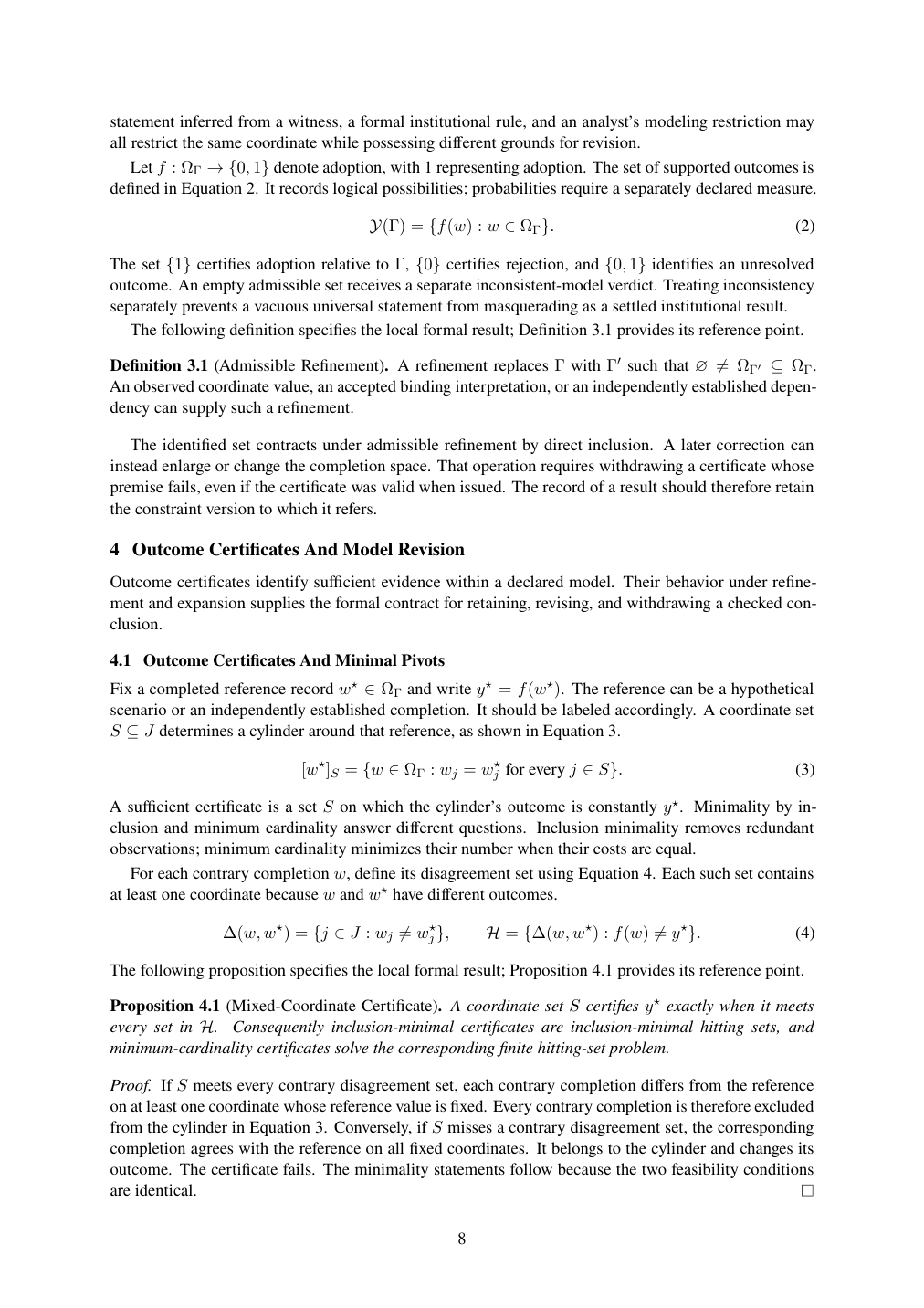
completions, and a conjunction of constraints Γ selects the admissible set in Equation 1.
A constraint may encode a binding interpretation, a dependency between terms, a fixed record, or an authorized range of acts. Its provenance should be retained separately from its Boolean evaluation. A
Readable text
statement inferred from a witness, a formal institutional rule, and an analyst’s modeling restriction may all restrict the same coordinate while possessing different grounds for revision.
defined in Equation 2. It records logical possibilities; probabilities require a separately declared measure.
outcome. An empty admissible set receives a separate inconsistent-model verdict. Treating inconsistency separately prevents a vacuous universal statement from masquerading as a settled institutional result.
The following definition specifies the local formal result; Definition 3.1 provides its reference point.
An observed coordinate value, an accepted binding interpretation, or an independently established depen-
The identified set contracts under admissible refinement by direct inclusion. A later correction can instead enlarge or change the completion space. That operation requires withdrawing a certificate whose premise fails, even if the certificate was valid when issued. The record of a result should therefore retain
Outcome certificates identify sufficient evidence within a declared model. Their behavior under refine- ment and expansion supplies the formal contract for retaining, revising, and withdrawing a checked con-
scenario or an independently established completion. It should be labeled accordingly. A coordinate set
clusion and minimum cardinality answer different questions. Inclusion minimality removes redundant observations; minimum cardinality minimizes their number when their costs are equal.
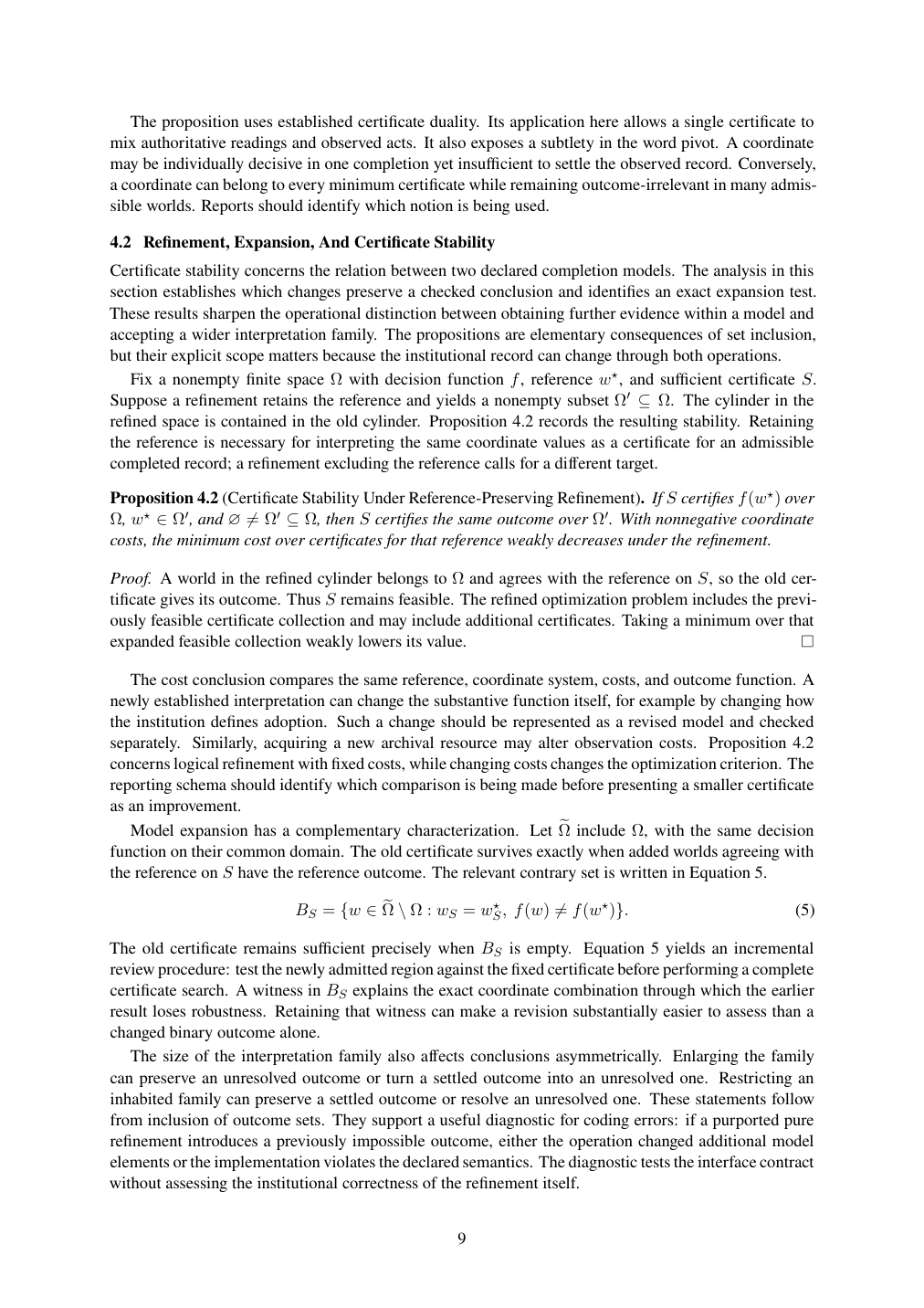
The following proposition specifies the local formal result; Proposition 4.1 provides its reference point.
Consequently inclusion-minimal certificates are inclusion-minimal hitting sets, and minimum-cardinality certificates solve the corresponding finite hitting-set problem.
on at least one coordinate whose reference value is fixed. Every contrary completion is therefore excluded completion agrees with the reference on all fixed coordinates. It belongs to the cylinder and changes its outcome. The certificate fails. The minimality statements follow because the two feasibility conditions
Readable text
The proposition uses established certificate duality. Its application here allows a single certificate to mix authoritative readings and observed acts. It also exposes a subtlety in the word pivot. A coordinate may be individually decisive in one completion yet insufficient to settle the observed record. Conversely, a coordinate can belong to every minimum certificate while remaining outcome-irrelevant in many admis- sible worlds. Reports should identify which notion is being used.
Certificate stability concerns the relation between two declared completion models. The analysis in this section establishes which changes preserve a checked conclusion and identifies an exact expansion test. These results sharpen the operational distinction between obtaining further evidence within a model and accepting a wider interpretation family. The propositions are elementary consequences of set inclusion, but their explicit scope matters because the institutional record can change through both operations.
refined space is contained in the old cylinder. Proposition 4.2 records the resulting stability. Retaining the reference is necessary for interpreting the same coordinate values as a certificate for an admissible completed record; a refinement excluding the reference calls for a different target.
costs, the minimum cost over certificates for that reference weakly decreases under the refinement.
ously feasible certificate collection and may include additional certificates. Taking a minimum over that
expanded feasible collection weakly lowers its value.
The cost conclusion compares the same reference, coordinate system, costs, and outcome function. A newly established interpretation can change the substantive function itself, for example by changing how the institution defines adoption. Such a change should be represented as a revised model and checked separately. Similarly, acquiring a new archival resource may alter observation costs. Proposition 4.2 concerns logical refinement with fixed costs, while changing costs changes the optimization criterion. The reporting schema should identify which comparison is being made before presenting a smaller certificate
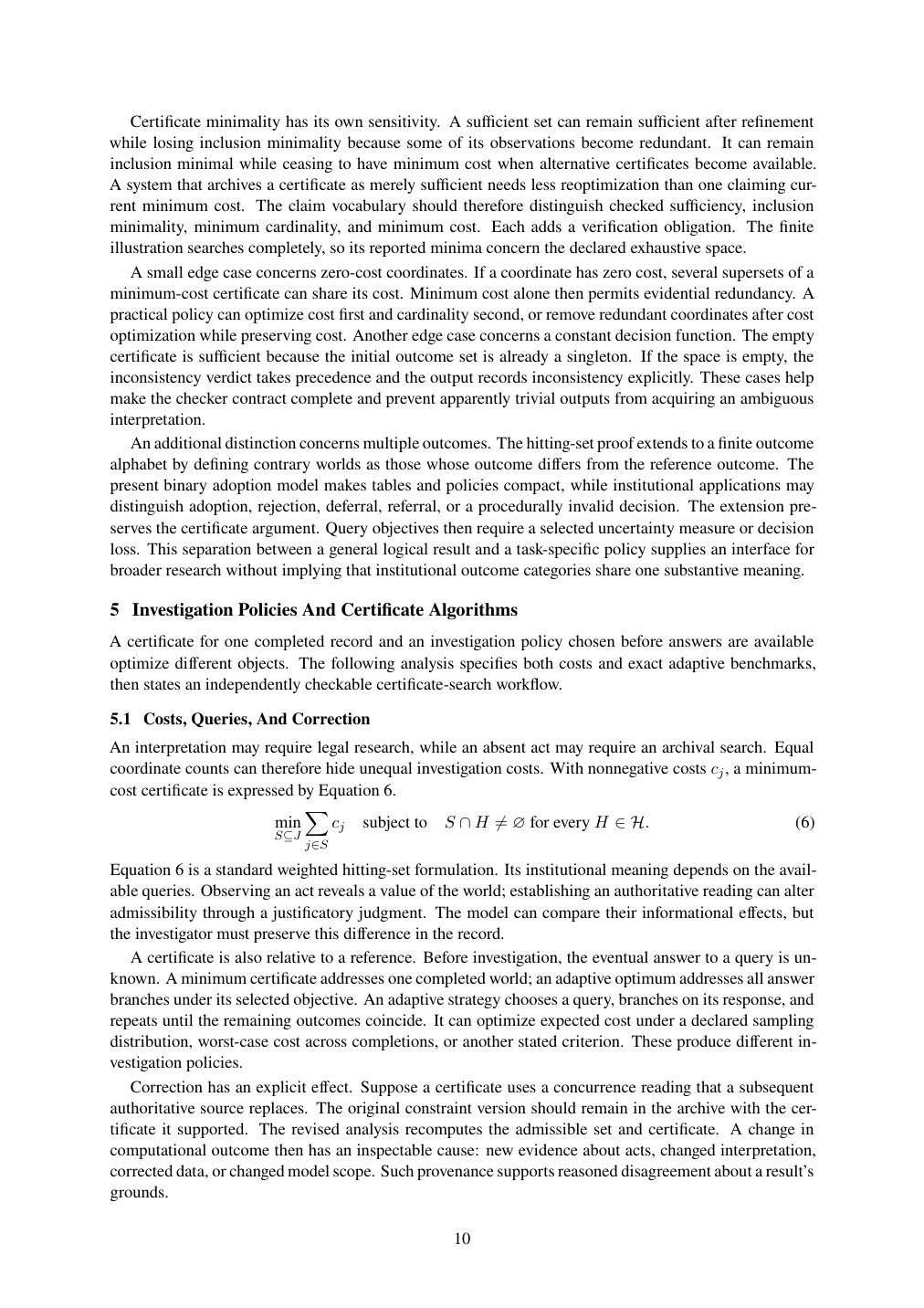
function on their common domain. The old certificate survives exactly when added worlds agreeing with
review procedure: test the newly admitted region against the fixed certificate before performing a complete result loses robustness. Retaining that witness can make a revision substantially easier to assess than a
The size of the interpretation family also affects conclusions asymmetrically. Enlarging the family can preserve an unresolved outcome or turn a settled outcome into an unresolved one. Restricting an inhabited family can preserve a settled outcome or resolve an unresolved one. These statements follow from inclusion of outcome sets. They support a useful diagnostic for coding errors: if a purported pure refinement introduces a previously impossible outcome, either the operation changed additional model elements or the implementation violates the declared semantics. The diagnostic tests the interface contract without assessing the institutional correctness of the refinement itself.
Readable text
Certificate minimality has its own sensitivity. A sufficient set can remain sufficient after refinement while losing inclusion minimality because some of its observations become redundant. It can remain inclusion minimal while ceasing to have minimum cost when alternative certificates become available. A system that archives a certificate as merely sufficient needs less reoptimization than one claiming cur- rent minimum cost. The claim vocabulary should therefore distinguish checked sufficiency, inclusion minimality, minimum cardinality, and minimum cost. Each adds a verification obligation. The finite illustration searches completely, so its reported minima concern the declared exhaustive space.
A small edge case concerns zero-cost coordinates. If a coordinate has zero cost, several supersets of a minimum-cost certificate can share its cost. Minimum cost alone then permits evidential redundancy. A practical policy can optimize cost first and cardinality second, or remove redundant coordinates after cost optimization while preserving cost. Another edge case concerns a constant decision function. The empty certificate is sufficient because the initial outcome set is already a singleton. If the space is empty, the inconsistency verdict takes precedence and the output records inconsistency explicitly. These cases help make the checker contract complete and prevent apparently trivial outputs from acquiring an ambiguous
An additional distinction concerns multiple outcomes. The hitting-set proof extends to a finite outcome alphabet by defining contrary worlds as those whose outcome differs from the reference outcome. The present binary adoption model makes tables and policies compact, while institutional applications may distinguish adoption, rejection, deferral, referral, or a procedurally invalid decision. The extension pre- serves the certificate argument. Query objectives then require a selected uncertainty measure or decision loss. This separation between a general logical result and a task-specific policy supplies an interface for broader research without implying that institutional outcome categories share one substantive meaning.
5 Investigation Policies And Certificate Algorithms
A certificate for one completed record and an investigation policy chosen before answers are available optimize different objects. The following analysis specifies both costs and exact adaptive benchmarks, then states an independently checkable certificate-search workflow.
An interpretation may require legal research, while an absent act may require an archival search. Equal
Equation 6 is a standard weighted hitting-set formulation. Its institutional meaning depends on the avail- able queries. Observing an act reveals a value of the world; establishing an authoritative reading can alter admissibility through a justificatory judgment. The model can compare their informational effects, but the investigator must preserve this difference in the record.
A certificate is also relative to a reference. Before investigation, the eventual answer to a query is un- known. A minimum certificate addresses one completed world; an adaptive optimum addresses all answer branches under its selected objective. An adaptive strategy chooses a query, branches on its response, and repeats until the remaining outcomes coincide. It can optimize expected cost under a declared sampling distribution, worst-case cost across completions, or another stated criterion. These produce different in-
Correction has an explicit effect. Suppose a certificate uses a concurrence reading that a subsequent authoritative source replaces. The original constraint version should remain in the archive with the cer- tificate it supported. The revised analysis recomputes the admissible set and certificate. A change in computational outcome then has an inspectable cause: new evidence about acts, changed interpretation, corrected data, or changed model scope. Such provenance supports reasoned disagreement about a result’s
Readable text
5.2 Adaptive Investigation And Exact Policy Benchmarks
An investigation policy acts before the unresolved coordinate values are known. Its object is a decision tree whose internal nodes choose an observation and whose leaves support a single outcome. The formal design in this section supplies exact expected-cost and worst-case benchmarks for the finite example. It also explains the institutional assumptions required to interpret those benchmarks, including the avail- ability of reliable answers and the difference between discovering an act and establishing an applicable
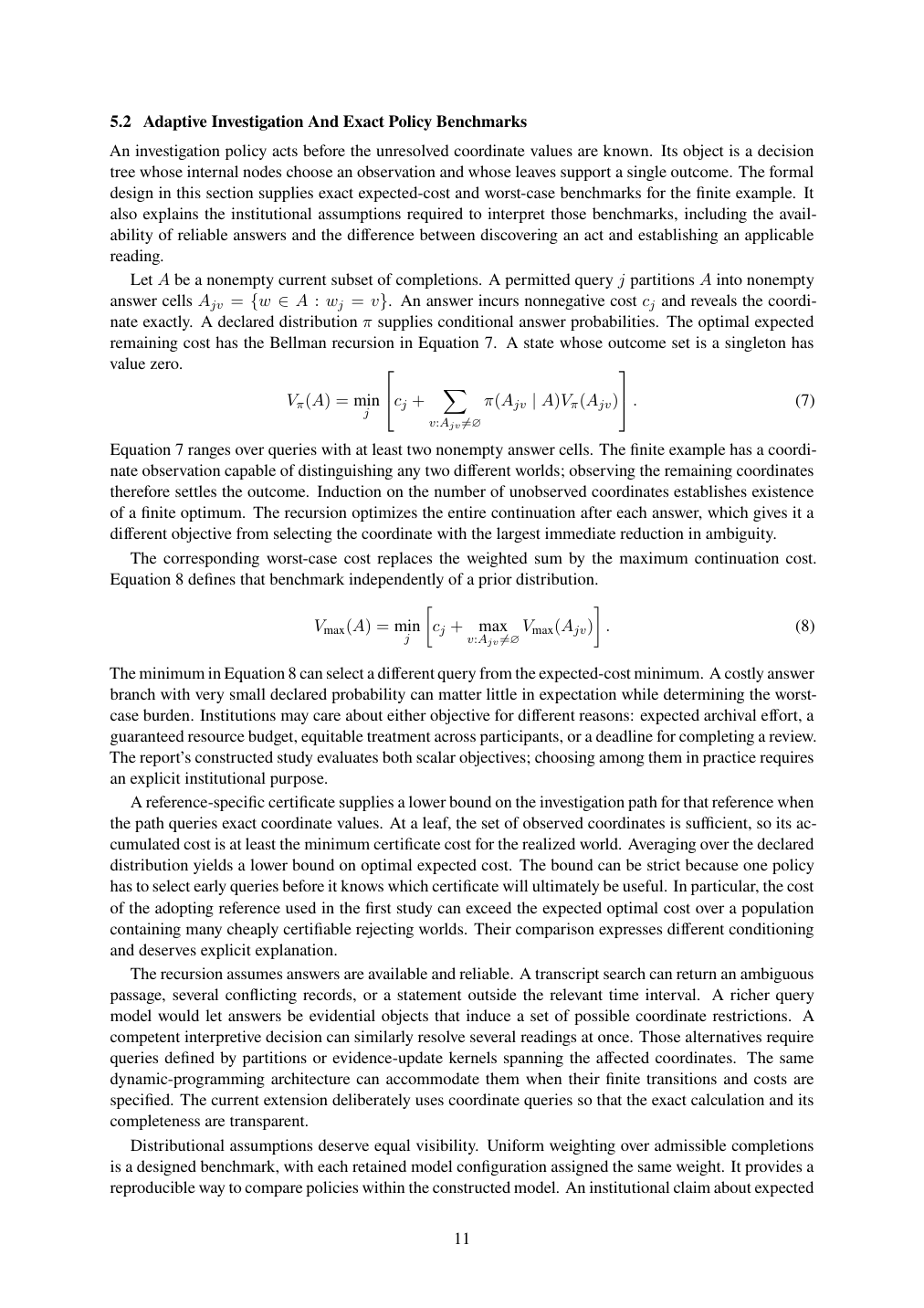
remaining cost has the Bellman recursion in Equation 7. A state whose outcome set is a singleton has
Equation 7 ranges over queries with at least two nonempty answer cells. The finite example has a coordi- nate observation capable of distinguishing any two different worlds; observing the remaining coordinates therefore settles the outcome. Induction on the number of unobserved coordinates establishes existence of a finite optimum. The recursion optimizes the entire continuation after each answer, which gives it a different objective from selecting the coordinate with the largest immediate reduction in ambiguity.
The corresponding worst-case cost replaces the weighted sum by the maximum continuation cost. Equation 8 defines that benchmark independently of a prior distribution.
The minimum in Equation 8 can select a different query from the expected-cost minimum. A costly answer branch with very small declared probability can matter little in expectation while determining the worst- case burden. Institutions may care about either objective for different reasons: expected archival effort, a guaranteed resource budget, equitable treatment across participants, or a deadline for completing a review. The report’s constructed study evaluates both scalar objectives; choosing among them in practice requires
A reference-specific certificate supplies a lower bound on the investigation path for that reference when the path queries exact coordinate values. At a leaf, the set of observed coordinates is sufficient, so its ac- cumulated cost is at least the minimum certificate cost for the realized world. Averaging over the declared distribution yields a lower bound on optimal expected cost. The bound can be strict because one policy has to select early queries before it knows which certificate will ultimately be useful. In particular, the cost of the adopting reference used in the first study can exceed the expected optimal cost over a population containing many cheaply certifiable rejecting worlds. Their comparison expresses different conditioning
The recursion assumes answers are available and reliable. A transcript search can return an ambiguous passage, several conflicting records, or a statement outside the relevant time interval. A richer query model would let answers be evidential objects that induce a set of possible coordinate restrictions. A competent interpretive decision can similarly resolve several readings at once. Those alternatives require queries defined by partitions or evidence-update kernels spanning the affected coordinates. The same dynamic-programming architecture can accommodate them when their finite transitions and costs are specified. The current extension deliberately uses coordinate queries so that the exact calculation and its
Distributional assumptions deserve equal visibility. Uniform weighting over admissible completions is a designed benchmark, with each retained model configuration assigned the same weight. It provides a reproducible way to compare policies within the constructed model. An institutional claim about expected
effort would need a defensible distribution over possible answers, potentially estimated from a relevant completed corpus. If the corpus is selected by documentation quality, its answer distribution can favor easily resolved cases. Sensitivity over distributions and a parallel worst-case analysis can expose this dependence, although a broader interpretation of representational adequacy remains necessary.
Adaptive-submodularity and stochastic Boolean-evaluation theory offer routes toward scalable policies (Golovin et al., 2011; Deshpande et al., 2014). Their value here is twofold. They show that costed observation is an established algorithmic problem, and they make structural assumptions explicit. An institutional constraint can couple coordinate answers, changing conditional probabilities after observation. An outcome function built from quorum, concurrence, and fallback clauses can exhibit complementarities. A proposed approximation theorem would have to address those dependencies and function classes. The exact benchmark avoids relying on an unverified transfer of a guarantee and provides a target against which a future heuristic can be measured.
The computed policy is thus a research instrument as well as a possible design component. It identifies whether a heuristic’s additional burden arises from local query selection, misspecified costs, or the admitted interpretation family. It can also generate inspectable branches for human review: each query, answer, remaining outcome set, and stopping ground can be logged. An implementation that exposes those branches supports discussion of whether the selected evidence is obtainable and legitimate. The numerical optimum then informs a grounded investigation design while preserving the institutional assessment of the questions it proposes to ask.
5.3 An Inspectable Certification Algorithm
The reference procedure has five stages. It first validates domains and constraints, including the existence of an admissible completion. It then evaluates the decision function on every admissible completion. If outcomes disagree, it retains contrary witnesses. For a specified reference, it constructs disagreement sets and removes duplicate or dominated sets. Finally, it searches hitting sets and verifies each proposed certificate by reevaluating its cylinder.
The verification step can remain independent of the search. A producer can supply a coordinate set and an exhaustive contrary-witness list or a solver refutation for the contrary query. A checker then verifies outcome agreement across every completion satisfying the fixed coordinates. Portable solver certificates would improve scaling while retaining a small trust boundary. This report’s implementation uses explicit enumeration so its completeness condition is directly inspectable.
Constraint solving can replace enumeration when the rules admit a suitable encoding. The adoption and contrary-outcome questions become satisfiability queries. Counterexample-guided certificate construction alternates candidate coordinate sets with contrary completions, adding each disagreement set until the candidate blocks every contrary world. Termination follows for a finite completion space, though worst-case complexity remains substantial. A bounded search should report found certificates together with the completeness of the search that produced them.
6 Constructed Decisions And Cost Sensitivity
The invented eight-member procedure supplies a complete finite evaluation of mixed readings and acts. Its enumeration and cost sensitivity test the stated logical and policy contracts under explicit designed assumptions.
6.1 Exact Constructed Study
6.1.1 Procedure And Completion Space
The reproducible study models an invented eight-member body. Its fixed acts are abstention, yes, yes, no, and reservation. Three additional acts range over yes, no, abstention, and absence. Three binary readings concern the denominator of a two-thirds threshold, whether the first member’s abstention satisfies concurrence, and whether a reservation counts affirmatively. The example is a pedagogical composite with explicitly invented procedural semantics.
Readable text
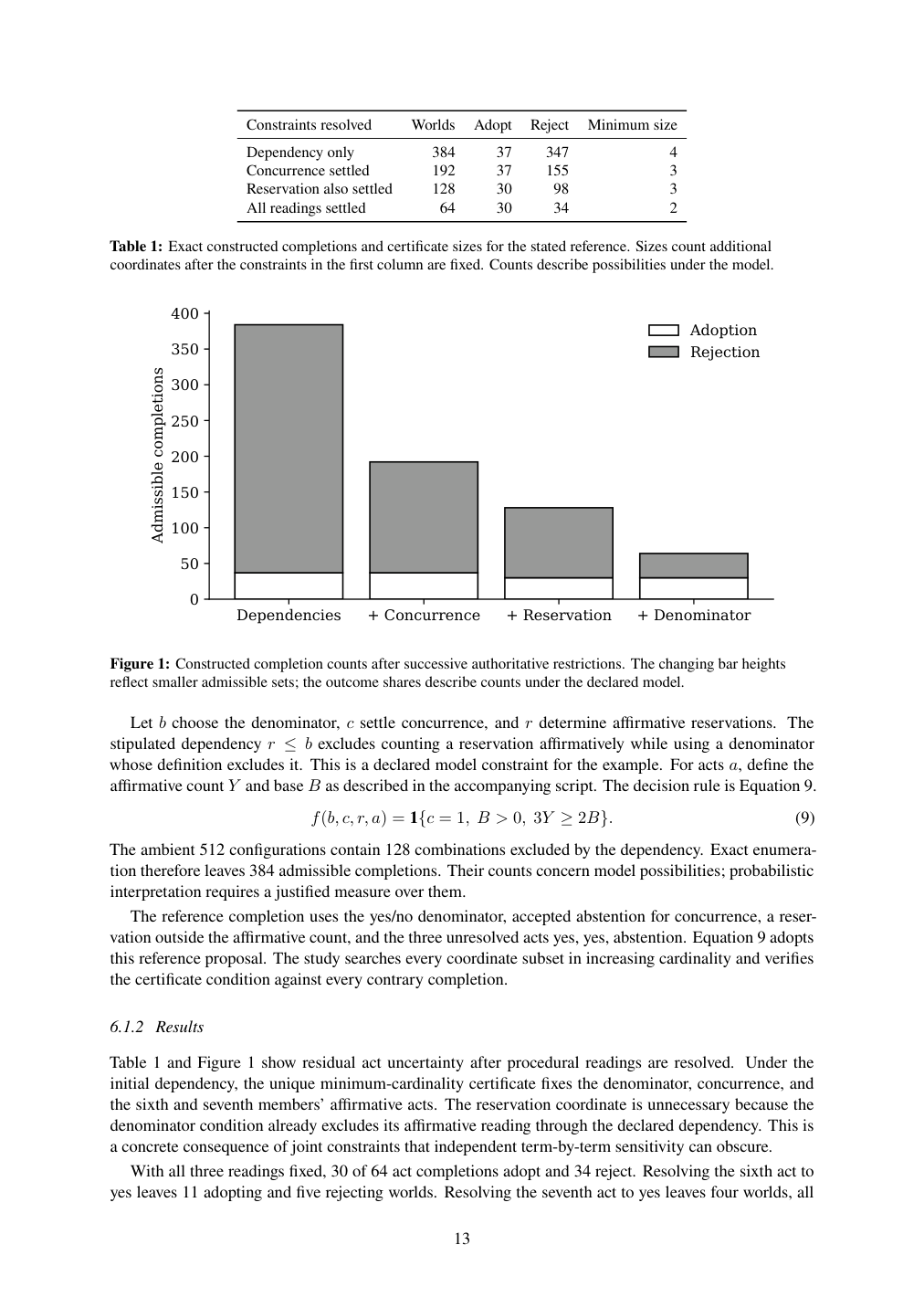
Dependency only 384 Concurrence settled 192 Reservation also settled 128 All readings settled 64
Table 1: Exact constructed completions and certificate sizes for the stated reference. Sizes count additional coordinates after the constraints in the first column are fixed. Counts describe possibilities under the model.
Figure 1: Constructed completion counts after successive authoritative restrictions. The changing bar heights reflect smaller admissible sets; the outcome shares describe counts under the declared model.
The ambient 512 configurations contain 128 combinations excluded by the dependency. Exact enumera- tion therefore leaves 384 admissible completions. Their counts concern model possibilities; probabilistic
interpretation requires a justified measure over them.
The reference completion uses the yes/no denominator, accepted abstention for concurrence, a reser- vation outside the affirmative count, and the three unresolved acts yes, yes, abstention. Equation 9 adopts this reference proposal. The study searches every coordinate subset in increasing cardinality and verifies the certificate condition against every contrary completion.
Table 1 and Figure 1 show residual act uncertainty after procedural readings are resolved. Under the initial dependency, the unique minimum-cardinality certificate fixes the denominator, concurrence, and the sixth and seventh members’ affirmative acts. The reservation coordinate is unnecessary because the denominator condition already excludes its affirmative reading through the declared dependency. This is a concrete consequence of joint constraints that independent term-by-term sensitivity can obscure.
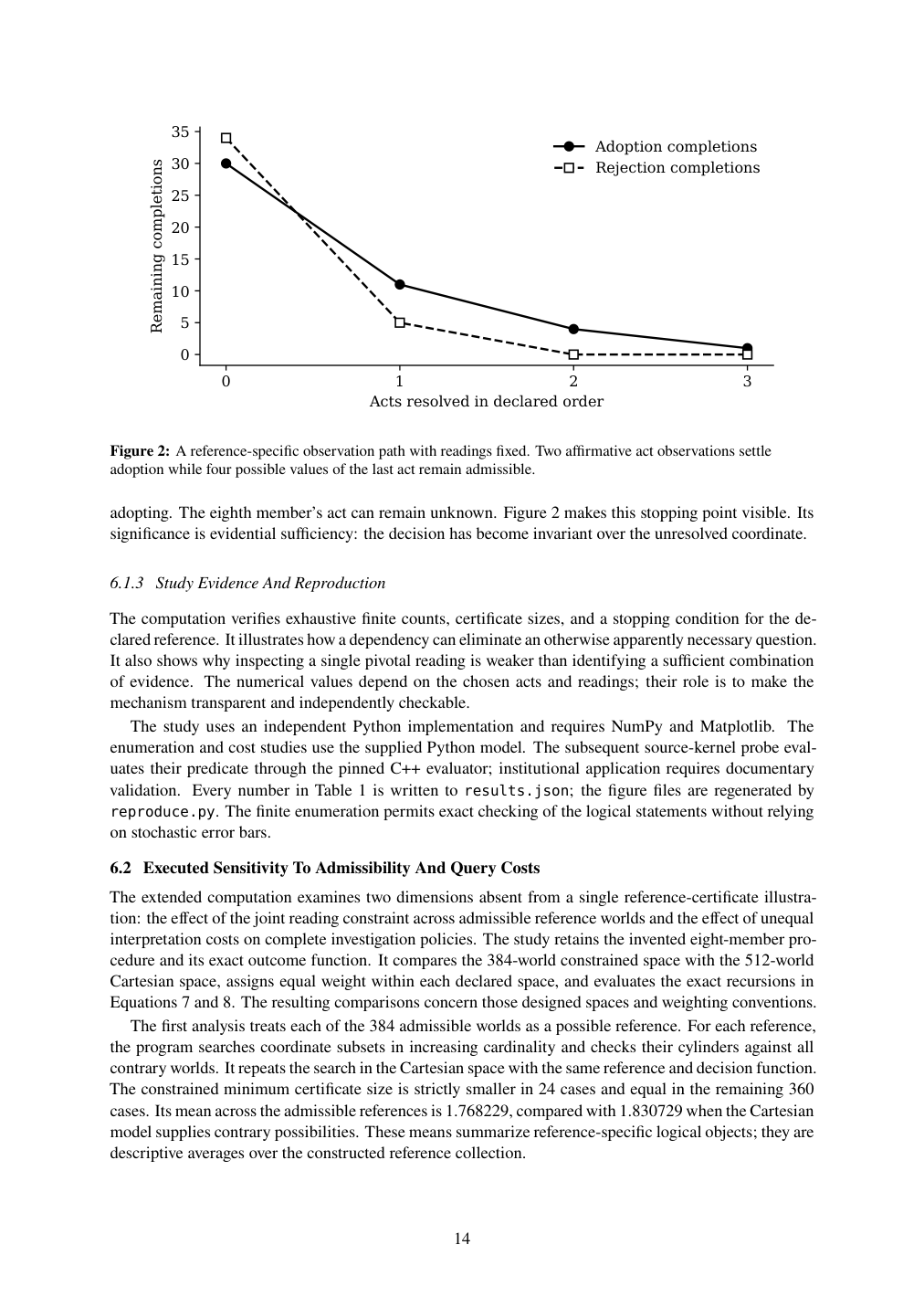
With all three readings fixed, 30 of 64 act completions adopt and 34 reject. Resolving the sixth act to yes leaves 11 adopting and five rejecting worlds. Resolving the seventh act to yes leaves four worlds, all
Readable text
Figure 2: A reference-specific observation path with readings fixed. Two affirmative act observations settle adoption while four possible values of the last act remain admissible.
adopting. The eighth member’s act can remain unknown. Figure 2 makes this stopping point visible. Its significance is evidential sufficiency: the decision has become invariant over the unresolved coordinate.
The computation verifies exhaustive finite counts, certificate sizes, and a stopping condition for the de- clared reference. It illustrates how a dependency can eliminate an otherwise apparently necessary question. It also shows why inspecting a single pivotal reading is weaker than identifying a sufficient combination of evidence. The numerical values depend on the chosen acts and readings; their role is to make the
mechanism transparent and independently checkable.
The study uses an independent Python implementation and requires NumPy and Matplotlib. The enumeration and cost studies use the supplied Python model. The subsequent source-kernel probe eval- uates their predicate through the pinned C++ evaluator; institutional application requires documentary validation. Every number in Table 1 is written to results.json; the figure files are regenerated by reproduce.py. The finite enumeration permits exact checking of the logical statements without relying
6.2 Executed Sensitivity To Admissibility And Query Costs
The extended computation examines two dimensions absent from a single reference-certificate illustra- tion: the effect of the joint reading constraint across admissible reference worlds and the effect of unequal interpretation costs on complete investigation policies. The study retains the invented eight-member pro- cedure and its exact outcome function. It compares the 384-world constrained space with the 512-world Cartesian space, assigns equal weight within each declared space, and evaluates the exact recursions in Equations 7 and 8. The resulting comparisons concern those designed spaces and weighting conventions.
The first analysis treats each of the 384 admissible worlds as a possible reference. For each reference, the program searches coordinate subsets in increasing cardinality and checks their cylinders against all contrary worlds. It repeats the search in the Cartesian space with the same reference and decision function. The constrained minimum certificate size is strictly smaller in 24 cases and equal in the remaining 360 cases. Its mean across the admissible references is 1.768229, compared with 1.830729 when the Cartesian model supplies contrary possibilities. These means summarize reference-specific logical objects; they are descriptive averages over the constructed reference collection.
Readable text
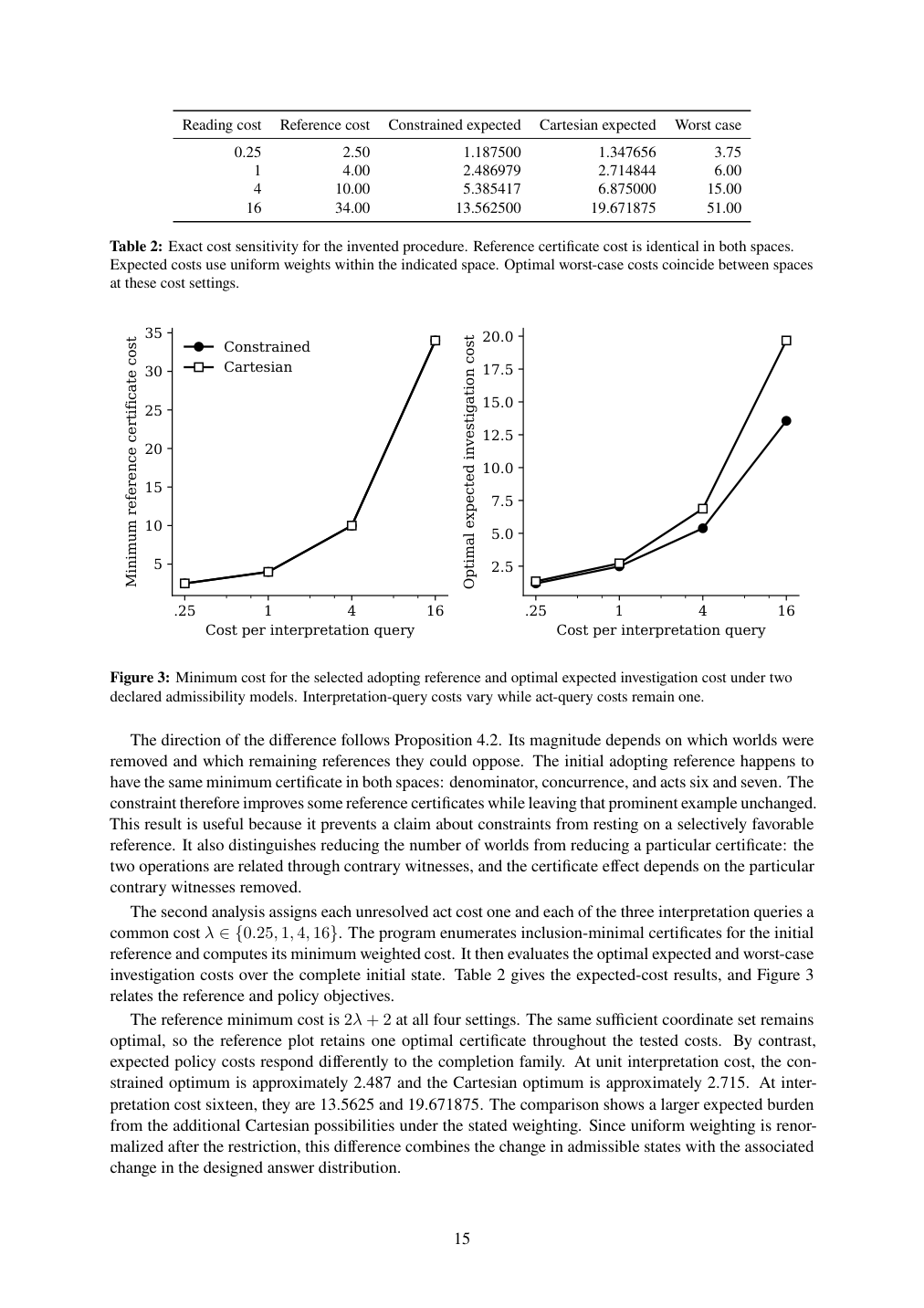
Table 2: Exact cost sensitivity for the invented procedure. Reference certificate cost is identical in both spaces. Expected costs use uniform weights within the indicated space. Optimal worst-case costs coincide between spaces
Figure 3: Minimum cost for the selected adopting reference and optimal expected investigation cost under two declared admissibility models. Interpretation-query costs vary while act-query costs remain one.
The direction of the difference follows Proposition 4.2. Its magnitude depends on which worlds were removed and which remaining references they could oppose. The initial adopting reference happens to have the same minimum certificate in both spaces: denominator, concurrence, and acts six and seven. The constraint therefore improves some reference certificates while leaving that prominent example unchanged. This result is useful because it prevents a claim about constraints from resting on a selectively favorable reference. It also distinguishes reducing the number of worlds from reducing a particular certificate: the two operations are related through contrary witnesses, and the certificate effect depends on the particular
The second analysis assigns each unresolved act cost one and each of the three interpretation queries a reference and computes its minimum weighted cost. It then evaluates the optimal expected and worst-case investigation costs over the complete initial state. Table 2 gives the expected-cost results, and Figure 3
optimal, so the reference plot retains one optimal certificate throughout the tested costs. By contrast, expected policy costs respond differently to the completion family. At unit interpretation cost, the con- strained optimum is approximately 2.487 and the Cartesian optimum is approximately 2.715. At inter- pretation cost sixteen, they are 13.5625 and 19.671875. The comparison shows a larger expected burden from the additional Cartesian possibilities under the stated weighting. Since uniform weighting is renor- malized after the restriction, this difference combines the change in admissible states with the associated
Worst-case optimal costs are identical between the two spaces at each tested setting. A retained branch still requires the maximal burden even after the dependency removes other branches. The example therefore gives three distinct sensitivity patterns within one model: strict improvement for a minority of reference certificate sizes, improvement in optimal expected policy costs, and equality in optimal worst-case policy costs. Reporting these together helps identify which operational purpose receives a benefit. An expected-cost improvement can justify further policy research while leaving a guaranteed resource budget unchanged.
The implementation memoizes current completion subsets and computes each child state exactly. It visits 1,504 cached states in the constrained model and 2,632 in the Cartesian model for each cost setting. Those counts describe this particular state representation and recursion. They supply an execution record and a simple check on reproducibility, while a scaling study would need systematically larger coordinate systems, alternative encodings, memory measurements, and a fixed computational environment. The extension is a new independent Python illustration, separate from the repository’s original C++ execution.
Several ablations remain informative. Removing concurrence would change the Boolean function and therefore test a different procedural object. Permuting coordinate names should leave exact optimum values unchanged, although it could change heuristic tie-breaking. Adding a source dependency that retains the same admissible set should leave every result unchanged. Splitting one interpretation into several synonymous coordinate values can change uniform policy expectations while preserving possible outcomes. These observations suggest useful implementation checks and expose how a designed probability measure can depend on representational granularity. The present execution evaluates admissibility and cost sensitivity; the additional ablations define a concrete continuation of the research design.
7 Source Conformance And Explanation Comparators
A publication-level assessment of mixed institutional certificates needs a direct comparison with established explanation methods and evidence that the constructed predicate faithfully represents a stated implementation kernel. The study in this section addresses those two requirements separately. It compiles a source-extracted evaluator for the invented procedure, then compares subset deletion and exact implicit hitting sets across the complete admissible reference collection. The resulting evidence concerns semantic conformance and optimization quality within a declared finite model.
7.1 Primary Comparator And Algorithmic Inheritance
The full-text formulation in Ignatiev et al. (2019) is a close computational antecedent. Its Algorithm 1 deletes hypotheses while preserving entailment; Algorithm 2 alternates minimum hitting sets with counterexample assignments. The present certificate problem has the same finite sufficiency structure after the institutional readings, acts, and joint admissibility restrictions have been specified. The comparative study therefore implements inherited algorithms with an explicit institutional adapter. Its research object is the relation among interpretation provenance, admissibility, and investigation costs, supported by complete checks on a source-grounded predicate.
For a completed reference, an entailment oracle asks whether a proposed coordinate set excludes every contrary admissible world. A deletion procedure begins with all coordinates and attempts to remove them in a chosen order. It returns an inclusion-minimal certificate after one pass: a coordinate whose removal failed remains necessary after further removals because those removals enlarge its counterexample cylinder. Different deletion orders can retain different certificates. Weighted cost adds another distinction: inclusion minimality addresses redundancy, while weighted optimization compares alternative evidential burdens.
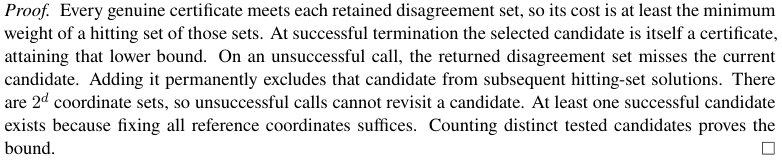
The exact comparator maintains a collection of contrary disagreement sets. At each iteration it selects a minimum-weight hitting set of the currently retained sets. If the contrary oracle finds a completion agreeing with that candidate, its disagreement set is added. If the oracle establishes agreement throughout the candidate cylinder, the algorithm stops. Proposition 7.1 states the finite correctness guarantee used in
the experiment. The procedure specializes the established implicit-hitting-set method; the proof specifies the weighted finite contract needed by this application.

7.2 Evaluator Kernel And Conformance Scope
The native probe uses the pinned diplomacy/rules/rules.hpp source. Its evaluate, covers, and fraction function bodies are copied verbatim, together with their act, clause, and tally declarations. A minimal rule adapter supplies the member and weight fields consumed by that evaluator. The extracted regions, source line ranges, and SHA-256 digests appear in source_kernel/MANIFEST.json; license notices accompany them. The harness compiles with C++20 and instantiates a conjunction of the twothirds threshold and concurrence clause used by the Python example.
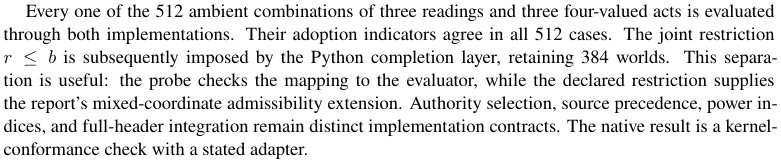
The source grounding also makes the invented procedure more inspectable. A reservation counts affirmatively only when the supplied counted-act set includes it; the denominator is another supplied act set. Concurrence tests the named member against its own supplied set. The native tally exposes those roles explicitly. Thus the comparison connects each Python Boolean coordinate to a concrete evaluator input. Institutional application would additionally require documentary justification for those supplied sets and their joint restrictions.
7.3 Complete Reference And Cost Comparison
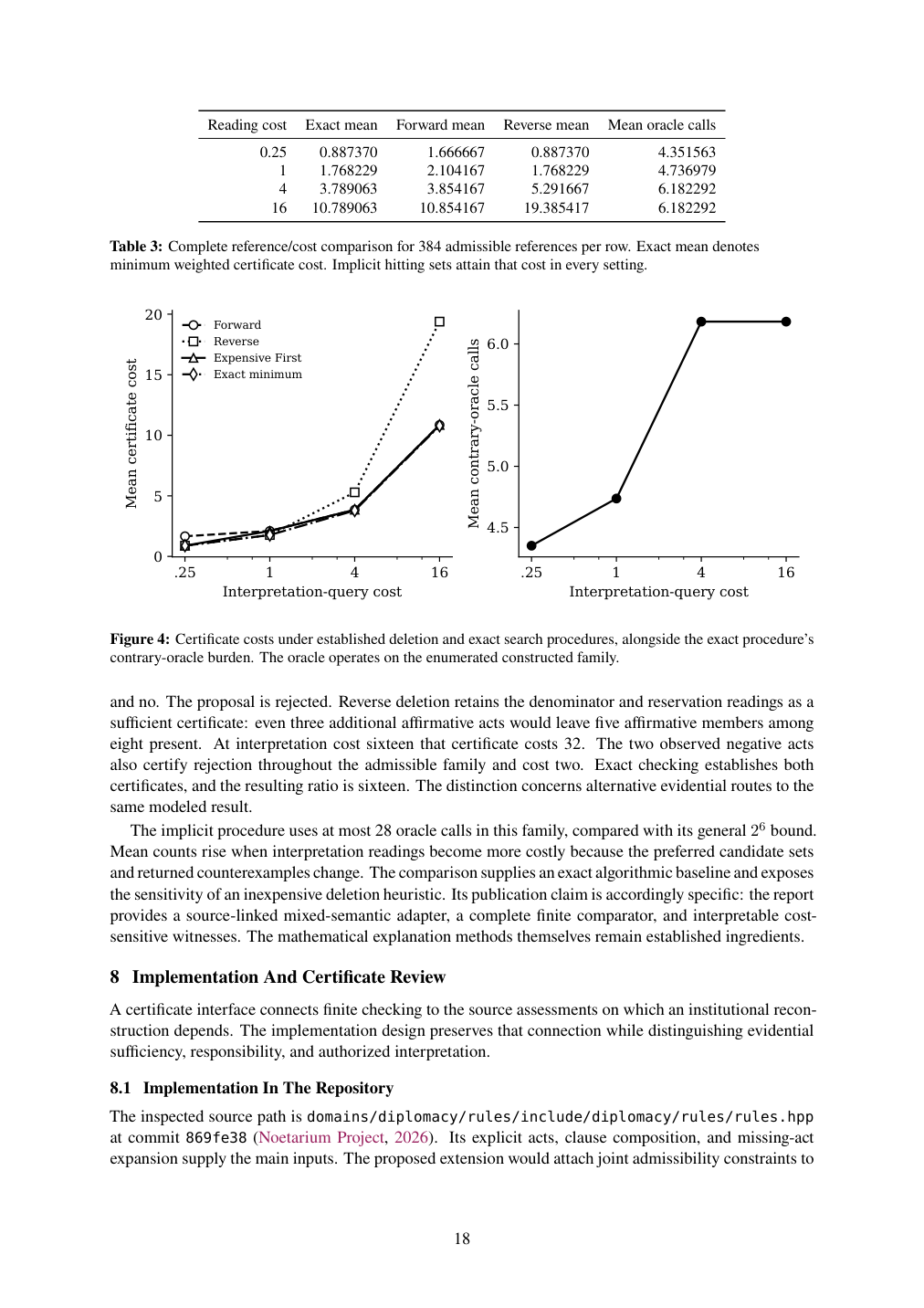
The publication experiment uses each of the 384 admissible worlds as a reference and four interpretationquery costs, producing 1,536 settings. Act-query costs remain one. It compares forward deletion, reverse deletion, deletion ordered by decreasing cost, exhaustive minimum cost, and the exact implicit-hitting-set procedure. The latter two agree in every setting. Oracle calls count checks against the already enumerated finite family; they provide an algorithmic trace, while solver runtime and larger institutional families require additional experiments.
Table 3 reports mean costs and oracle counts. Figure 4 shows the cost dependence. Forward deletion is suboptimal in 216, 126, 23, and 23 references as the interpretation cost increases through the four settings. Reverse deletion is optimal for every reference at costs 0.25 and one, then becomes suboptimal in 193 references at costs four and sixteen. The cost-aware deletion order also remains suboptimal in 23 references at the higher costs. Local deletion and cost ordering therefore address different aspects of the optimization problem.
One reference makes the cost difference concrete. Its readings use the present-member denominator, accept abstention for concurrence, and exclude affirmative reservation; the unresolved acts are yes, no,
Readable text
Table 3: Complete reference/cost comparison for 384 admissible references per row. Exact mean denotes minimum weighted certificate cost. Implicit hitting sets attain that cost in every setting.
Figure 4: Certificate costs under established deletion and exact search procedures, alongside the exact procedure’s contrary-oracle burden. The oracle operates on the enumerated constructed family.
and no. The proposal is rejected. Reverse deletion retains the denominator and reservation readings as a sufficient certificate: even three additional affirmative acts would leave five affirmative members among eight present. At interpretation cost sixteen that certificate costs 32. The two observed negative acts also certify rejection throughout the admissible family and cost two. Exact checking establishes both certificates, and the resulting ratio is sixteen. The distinction concerns alternative evidential routes to the
The implicit procedure uses at most 28 oracle calls in this family, compared with its general 26 bound. Mean counts rise when interpretation readings become more costly because the preferred candidate sets and returned counterexamples change. The comparison supplies an exact algorithmic baseline and exposes the sensitivity of an inexpensive deletion heuristic. Its publication claim is accordingly specific: the report provides a source-linked mixed-semantic adapter, a complete finite comparator, and interpretable cost- sensitive witnesses. The mathematical explanation methods themselves remain established ingredients.
A certificate interface connects finite checking to the source assessments on which an institutional recon- struction depends. The implementation design preserves that connection while distinguishing evidential sufficiency, responsibility, and authorized interpretation.
The inspected source path is domains/diplomacy/rules/include/diplomacy/rules/rules.hpp at commit 869fe38 (Noetarium Project, 2026). Its explicit acts, clause composition, and missing-act expansion supply the main inputs. The proposed extension would attach joint admissibility constraints to
readings, expose a completion iterator or solver encoding, and return a structured certificate containing fixed coordinates, source references, constraint digest, and outcome.
A minimal integration can proceed without changing the domain’s substantive vocabulary. The domain should continue to determine which clauses name institutional acts. A general finite certificate module can live beneath the domain and accept only a finite space, a predicate, and a query interface. The application can then explain the certificate in institutional terms. This placement preserves reuse across procedural rules, legal interpretations, and other finite decisions.
The computational interface should distinguish successful checking from an institution’s acceptance of a reading. A person can amend a source assessment, reject a proposed interpretation, or accept an authoritative restriction. Each operation alters the completion model through a recorded act. The certification layer reports its consequences. This division makes the trajectory from evidence to outcome available for scrutiny without substituting computation for jurisdictional judgment.
8.2 Certificate Semantics And Independent Review
8.2.1 Sufficiency, Necessity, And Responsibility
A minimum certificate can be read in several ways, and each reading supports a different institutional use. It establishes that particular coordinate values suffice for the outcome under the retained constraints. Causal influence, participant responsibility, and historical availability of evidence require their own premises and evidence. Structural responsibility and blame have their own formal models and epistemic assumptions (Chockler et al., 2004). The certificate here addresses evidential sufficiency in a reconstruction.
This distinction can be checked within the example. The concurrence reading belongs to the initial minimum certificate because fixing it excludes a large set of contrary worlds. Its inclusion describes a dependency of the computational conclusion. A participant who abstained under an established institutional practice might regard that reading as settled. The analyst’s unresolved reconstruction and the participant’s situated knowledge can consequently differ. Archiving who held which information helps prevent their conflation.
Necessity also has several meanings. A coordinate can appear in every minimum-cardinality certificate yet disappear from a larger inclusion-minimal certificate. It can be necessary for one reference completion while irrelevant for another. A report should therefore specify whether it concerns all certificates, all minimum certificates, or an investigator-selected sufficient set. The complete list can be large, so a practical interface may summarize mandatory coordinates, alternative groups, and representative minimum-cost solutions.
8.2.2 A Consistency And Withdrawal Protocol
A robust workflow begins by asking whether the admissible space is inhabited. If a fixed act contradicts another accepted record, or two binding interpretations impose incompatible values, an outcome calculation should return the conflicting premises. A minimal inconsistent subset can help the reviewer determine which source assessment requires revision. That operation has a different target from an outcome certificate: it identifies the conflict making the completion space empty.
When an accepted correction arrives, the system can distinguish three cases. If it merely restricts the old space while retaining a completion, a previously robust outcome survives. If it changes a coordinate already used by a certificate, the certificate must be checked against the revised model. If it expands the space through a newly admitted reading or act, contrary completions may reappear. The archive should retain the old result together with the correction that changed its scope, allowing a reader to reconstruct why a conclusion was once warranted and why it later changed.
A portable certificate should consequently include the rule version, the source-assessment version, the admitted act domains, the constraint formula, the coordinate values fixed, and the checker outcome. Source references attach directly to individual premises. This structure permits an independent reviewer
to accept the combinatorial proof while contesting a particular institutional premise. Such partial disagreement is often more productive than treating the complete analysis as one indivisible claim.
9 Validation And Institutional Representation
Validation of interpretation-sensitive certification has several objects: documentary adequacy, formal fidelity, algorithmic correctness, and practical usefulness. This section specifies a proposed study that evaluates those objects separately and examines the ethical choices embedded in their coordination. The exact constructed computations already establish finite mathematical behavior. The proposed institutional study would determine whether the representation and investigation procedures preserve distinctions that matter to competent participants and reviewers.
A corpus design should begin with a bounded procedural family. Suitable boundaries include one body, a defined instrument version, a finite period, and decisions for which both proceedings and interpretive material are available. Each corpus item should include a source inventory, a procedural question, the body membership at the relevant time, a clause representation, and a list of unresolved readings and acts. Annotation should preserve the difference between a documentary omission and an interpreter’s uncertainty. An absent record of an objection can leave the act unknown; a clear record of silence can establish an act whose procedural meaning remains disputed. Those two cases enter different coordinates and can lead to different investigation priorities.
Independent annotation provides evidence about representational stability. At least two qualified reviewers can code the source material independently before a reconciliation stage. Agreement measures are useful for finite labels such as recorded act types, while interpretive disagreement also requires qualitative reasons. A structured record should therefore retain the competing source passages and grounds for each reading. Reconciliation can yield a shared model, several accepted model variants, or an unresolved authority question. Each outcome supplies useful evidence. A benchmark that retains only reconciled labels would hide the very ambiguity that motivates the completion framework.
Formal fidelity can be tested through jointly constructed witnesses. An institutional reviewer specifies a plausible completed scenario and its expected procedural result. A computational reviewer checks whether the encoded function produces that result and whether the scenario belongs to the admissible space. Disagreement identifies a possible error in clause interpretation, act coding, authority restriction, or program implementation. Boundary scenarios deserve particular attention: empty denominators, equality at a threshold, absence of a required concurring participant, a reservation under competing readings, and contradictory fixed records. These cases test the model’s operational semantics more effectively than checking typical tallies alone.
The computational comparison can use four declared baselines: a single selected reading, independent mixed enumeration, constrained mixed enumeration, and constrained enumeration with certificates. Evaluation should report outcome-set agreement with the reviewed model, false settlement under omitted alternatives, number and cost of observations, runtime, and the completeness of reported minima. A retrospective masking study can hide known acts or accepted interpretive grounds and evaluate query policies against their archived answers. The hiding mechanism should be varied because random masking and selective documentary loss can create different investigation problems. A prospective study would add participant usability and actual acquisition burden, with an appropriate study protocol.
Explanation quality requires direct institutional assessment. Reviewers can inspect whether a certificate identifies understandable propositions, whether its source links permit independent checking, and whether an excluded alternative receives an intelligible reason. A small certificate can still be difficult to interpret if it compresses several meanings into one opaque coordinate. Conversely, a larger certificate may provide a more recognizable institutional narrative. The quantitative objectives therefore belong beside measures of interpretability, challengeability, and source adequacy. Their relations are an empirical question. Optimizing coordinate count alone establishes a formal minimum under a selected vocabulary.
Ethical evaluation concerns who becomes visible through that vocabulary. Official transcripts may preserve the acts of powerful participants more fully than those of smaller delegations. Archival access
Contribution layer Content and evidential standing
Established ingredients
Possible and necessary outcomes; minimal sufficient explanations; hitting-set duality; costed decision trees; provenance records. Report construction One admissibility model for readings and acts, reference-specific mixed certificates, and explicit refinement and expansion checks. Executed evidence Exact eight-member enumeration; policy sensitivity; 512 evaluator-kernel cases and 1,536 weighted explanation comparisons. Proposed validation Independent documentary annotation, institutional witness tests, solver scaling, and investigation studies.
Table 4: Contribution layers for interpretation-sensitive certification. The separation identifies which claims are mathematical, computational, and prospective.
costs can privilege well-indexed institutions. A cost-minimizing policy can consequently concentrate attention on accessible sources while leaving uneven documentation unexamined. A reviewer should be able to inspect cost assumptions and impose additional procedural requirements, such as examining a disputed participant’s account regardless of whether it shortens the certificate. Such requirements alter the policy’s feasible set and should be recorded as explicit governance choices.
Privacy and reputational effects also depend on the claim vocabulary. A coordinate’s appearance in a minimum certificate identifies evidential sufficiency within the reconstruction. Assigning blame to the associated participant requires additional causal and normative premises, as the structural responsibility literature makes clear (Chockler et al., 2004). Public interfaces should preserve the relevant distinction in their explanations. An archival investigation may discover sensitive personal material with little bearing on the procedural result. Query design can restrict acquisition to the information needed for the declared question and maintain access controls on supporting documents. The formal cost model can register acquisition burdens, while their legitimacy requires human assessment.
The final validation artifact should be a versioned dossier linking the source boundary, annotation alternatives, encoded models, counterexamples, certificates, and review decisions. Such a dossier gives subsequent researchers several ways to improve the work. They can propose a missing reading, revise a source assessment, improve a solver encoding, or test a policy under different costs. The infrastructure supports cumulative inquiry by preserving the relations among those contributions. Its adequacy is therefore partly measured by the precision with which a disagreement can be located and revised, alongside the accuracy and efficiency of the resulting computation.
10 Contribution Assessment And Research Boundaries
The contribution assessment concerns the relation between established ingredients, the report’s specific construction, executed evidence, and proposed institutional validation. Table 4 provides a compact classification. The purpose is to make the report’s research claim assessable at the level of its actual evidence. The principal result is a disciplined coordination of mixed uncertainty and source-linked certification, supported by a complete finite illustration and an exact policy sensitivity extension.
The mixed-coordinate representation provides a useful local research object because institutional uncertainty often crosses the boundary between a rule and its record. A reading can change whether an act enters a denominator, while an unknown act can change whether a disputed reading matters. The joint model makes their interaction explicit. Its certificate summarizes sufficient evidence after that interaction has been computed. The value of this representation lies in the questions it makes testable: whether dependencies reduce investigation burden, which reference outcomes remain fragile, and which source assessments support a settled result. Historical priority for each mathematical component is outside the claim; the antecedent literature establishes substantial prior foundations.
The formal results supply correctness conditional on the model. The hitting-set proof characterizes sufficient coordinate sets. The refinement proposition establishes preservation of sufficiency and weak decrease of minimum cost under its stated assumptions. The expansion test identifies the additional contrary
worlds relevant to withdrawing an old certificate. These results earn their place by supporting concrete operations in a source-linked workflow. They explain what a checker validates, which revisions preserve a result, and what a reviewer needs to inspect when a result changes. Their scope is finite and explicit, so extensions to richer languages should preserve or restate the relevant assumptions.
The executed extension adds an insight about evaluation design. A single dependency can affect reference certificates, expected policies, and worst-case policies differently. In the constructed family, some reference sizes improve, expected optimum costs improve under the chosen weighting, and worst-case optimum costs coincide. A claim that constraints generally improve investigation would conceal those objective-specific patterns. A better research programme compares several objectives and reports the measure under which improvement occurs. The extension also reveals the importance of distributional granularity: assigning equal weight to descriptions can change expectation when the description language changes, even if logical possibilities remain equivalent.
The repository connection is source-level and architectural. The inspected diplomacy implementation supplies clause composition, readings, incomplete acts, and sensitivity concepts. The report proposes a certificate interface and demonstrates it independently in Python. A production integration would require typed source records, a stable constraint representation, a checker contract, and tests against the actual C++ semantics. The suggested generic module should expose only the finite predicate and observation interface, while the diplomacy application retains the institutional vocabulary and interpretive judgments. Such a division supports reuse without making the computational layer responsible for determining institutional authority.
Several research questions remain open within this bounded programme. Large interpretation spaces may require solver-backed search and proof certificates. Query responses may be uncertain or reveal several coordinates jointly. Authority assessments may have temporal scope and competing jurisdictions. Human reviewers may prefer explanations that preserve an institutional narrative over those minimizing coordinate cost. Each extension changes an identifiable part of the model and can be evaluated through the dossier and benchmark structure described above. The current report provides a reference point from which those changes can be made explicit and their effects compared.
The broader infrastructural meaning concerns the maintenance of relations between disciplinary contributions. Institutional interpretation establishes defensible possibilities and authority assessments. Logic and combinatorics establish consequences within that space. Software engineering makes the computation reproducible and independently checkable. Provenance design records how a claim depends on its sources. Ethical and governance analysis evaluates the acquisition and use of evidence. The report’s proposed interface allows those activities to inform one another while retaining their distinct standards. That is the substantive sense in which relational structure can enlarge the space of inquiry: a preserved connection creates new, answerable questions about the dependence and revision of knowledge.
11 Conclusion
The report develops a finite account of institutional decisions whose procedural readings and recorded acts remain partly unresolved. Joint constraints define admissible completions, outcome sets express what those completions support, and reference-specific certificates identify sufficient combinations of evidence. The hitting-set characterization is an established mathematical mechanism adapted to this mixed institutional setting. Its usefulness lies in producing inspectable grounds and precise observation targets.
The exact example shows that interpretive resolution and act resolution contribute differently. It also demonstrates that a joint dependency can remove an apparently relevant query and that a decision can become certified while part of its record remains unknown. Further work can test these ideas on curated institutional material, scalable encodings, and actual archival investigation. The present contribution supplies a reproducible technical foundation for that research.
References
Xia, Lirong; Conitzer, Vincent. (2011). Determining Possible and Necessary Winners under Common Voting Rules
Given Partial Orders. Journal of Artificial Intelligence Research 41, 25–67. https://doi.org/10.1613/jair .3186. Athan, Tara; Governatori, Guido; Palmirani, Monica; Paschke, Adrian; Wyner, Adam. (2014). Legal Interpretations
in LegalRuleML. CEUR Workshop Proceedings. https://cris.unibo.it/handle/11585/469366. Rietig, Katharina; Peringer, Christine; Theys, Sarina; Censoro, Jecel. (2023). Unanimity or standing aside? Rein-
terpreting consensus in United Nations Framework Convention on Climate Change negotiations. International Environmental Agreements 23, 221–234. https://doi.org/10.1007/s10784-023-09593-y. Chockler, Hana; Halpern, Joseph Y.. (2004). Responsibility and Blame: A Structural-Model Approach. Journal of
Artificial Intelligence Research 22, 93–115. https://doi.org/10.1613/jair.1391. Reiter, Raymond. (1987). A Theory of Diagnosis from First Principles. Artificial Intelligence 32, 57–95. https:
//doi.org/10.1016/0004-3702(87)90062-2. Ignatiev, Alexey; Narodytska, Nina; Marques-Silva, Joao. (2019). Abduction-Based Explanations for Machine
Learning Models. Proceedings of AAAI 33, 1511–1519. https://doi.org/10.1609/aaai.v33i01.33 011511. Crawford, Sue E. S.; Ostrom, Elinor. (1995). A Grammar of Institutions. American Political Science Review 89,
582–600. https://doi.org/10.2307/2082975. Golovin, Daniel; Krause, Andreas. (2011). Adaptive Submodularity: Theory and Applications in Active Learning
and Stochastic Optimization. Journal of Artificial Intelligence Research 42, 427–486. https://doi.org/10.1 613/jair.3278. Deshpande, Amol; Hellerstein, Lisa; Kletenik, Devorah. (2014). Approximation Algorithms for Stochastic Boolean
Function Evaluation and Stochastic Submodular Set Cover. Proceedings of SODA, 1453–1466. https://doi. org/10.1137/1.9781611973402.107. Moreau, Luc; Missier, Paolo. (2013). PROV-DM: The PROV Data Model. W3C Recommendation. https://www.
w3.org/TR/prov-dm/. Bovens, Mark. (2007). Analysing and Assessing Accountability: A Conceptual Framework. European Law Journal
13, 447–468. https://doi.org/10.1111/j.1468-0386.2007.00378.x. Noetarium Project. (2026). Noetarium: The Science and Humanity Infrastructure. Repository commit 869fe38afac257cd9b5d51ad5b498a8ff6b8e443. https://github.com/huangwanhong-maker/Noetari um-The-Science-and-Humanity-Infrastructure.