Governance Diagnostics Under Incomplete Relational Observation
Full text from the PDF
Governance Diagnostics Under Incomplete Relational
Observation
Wanhong HUANG
Abstract
Governance diagnostics depend on institutional relations and the source-resolution procedures through which those relations become observable. This Technical Report specifies finite directed completion models and exact reachability bounds under independent edge admission. It distinguishes graph monotonicity from source-priority revision and preserves a correction in which deleting presence evidence reveals retained absence. The complete original relations header agrees with an independent resolver on 1,536 temporal, directional, and typed status cases. Constructed observation studies compare local gain with exact expected-cost policies, including an unequal-cost ratio up to 1.484. A new 64-network constrained study settles 38 of 320 interior quota cases that unrestricted endpoint graphs leave unresolved. A separately executed typed-route example distinguishes a contact path from a qualifying review procedure. Conditional proofs, path/cut witnesses, capacity extensions, and reproducible traces specify which assumptions support each result. The contribution coordinates source semantics, admissibility, and acquisition evidence around a bounded infrastructural diagnostic; accountability assessment additionally requires the forum’s mandate, practices, and consequences.
Keywords: governance; missing networks; accountability; partial identification; observation design
Technical Report Note
This technical report shares an evolving inquiry and invites dialogue, criticism, revision, and independent development. Its definitions, distinctions, and constructions remain open to refinement. Circulation across scholarly and practical communities is part of the purpose of releasing the manuscript.
The author treats the viewpoints, concepts, and lines of reasoning presented here as contributions to a shared field of inquiry. Similar or related ideas may have appeared in other intellectual, cultural, and disciplinary traditions. The manuscript identifies known antecedents and distinguishes inherited positions, interpretive proposals, and arguments developed here. Historical priority remains open to further investigation.
The constructions and arguments are presented with their stated assumptions and evidential scope. Readers are encouraged to question, test, revise, extend, reinterpret, or independently develop the ideas presented here. Where appropriate, acknowledgment of this paper as one point of encounter in the development of a related idea is appreciated. Such acknowledgment records an intellectual route; the ideas remain available for criticism, revision, and independent development.
Definitions introduced by the paper are local analytical stipulations unless attributed to another source. Their use identifies the scope of the present argument; terminological and historical priority remain subjects for independent investigation. Generative Relational theory is treated as an open research programme whose proposals receive critical examination alongside independent literature.
Responsible Use and Rights Reservation
This section records a request for responsible scholarly conduct and identifies the scope of retained rights. Legal permissions are governed by the licence on the following page.
The author encourages good-faith discussion, criticism, independent inquiry, and responsible use of the material. Separately from the licence’s terms, the author asks users to consider foreseeable harms when adapting the arguments, representations, or examples of this paper, particularly in scientific inquiry, institutional decisions, and computational knowledge infrastructures. The ethical request leaves the licence’s permissions and legally authorised uses unchanged.
The author retains the rights preserved under CC BY-NC 4.0 and may pursue remedies to which the author is legally entitled for breach of the licence or violation of independently applicable rights. Reuse remains independent from authorial endorsement. Third-party rights require authorisation from their respective holders where applicable. Copyright exceptions and limitations, including applicable forms of fair use or fair dealing, remain available.
Notices
This page consolidates the manuscript’s research status, licence, development disclosure, researchprogramme relation, and suggested citation.
Status. This technical report is prepared for the author’s substantive review and subsequent scholarly discussion. Completion and acquisition results concern declared directed predicates and finite families. A complete original-header probe checks source statuses; constructed constrained and typed examples test diagnostic interfaces. Broader accountability assessment requires institutional evidence. Internal checks assess the stated arguments and examples; independent scholarly assessment can further test their interpretation and adequacy. The source ledgers record the access level and claim scope of consulted works.
Licence. Except where otherwise indicated, copyright 2026 Wanhong Huang. This work is made available under the Creative Commons Attribution-NonCommercial 4.0 International License (CC BY-NC 4.0). Subject to its terms, the licence permits sharing and adaptation for noncommercial purposes with appropriate attribution, a link to the licence, and an indication of changes. Attribution should preserve the licensor’s independence from the reuse. Reuse is governed solely by the licence; the responsible-use request on the preceding page remains separate from its terms. The licence deed and legal code are available at https://creativecommons.org/licenses/by-nc/4.0/. The licence governs in case of conflict with this summary. Third-party material remains subject to its respective rights.
Statement on the use of language models. Preparation involved OpenAI’s ChatGPT and Codex. Language models supported exploratory dialogue, source discovery and checking, argumentative criticism, manuscript revision, LATEX typesetting, and the development of supporting code and figures. Verification used the sources and access levels recorded in the accompanying ledgers. The author initiated the research questions and directed the research programme; interpretation, acceptance of the arguments, and publication decisions remain subject to the author’s review. Authorship credit and responsibility for the released manuscript remain with the human author.
Code and data availability. Supporting scripts, generated outputs, source records, and editable manuscript files accompany this report. The computational illustrations are reproducible from the provided scripts. The source package contains the editable manuscript, source ledgers, supporting scripts and outputs, and a reading guide. Numerical illustrations, where present, use the assumptions stated in their captions and text.
Related research programme. This report belongs to the Noetarium technical report series. Companion reports study inference, computation, evaluation, governance, and cross-disciplinary knowledge formation. The reports develop distinct technical questions within an open Generative Relational research programme.
Suggested citation. Huang, Wanhong. “Governance Diagnostics Under Incomplete Relational Observation.” Technical report, 2026.
1 Introduction
A governance record describes some of the relations through which participants authorize, review, contest, or continue an undertaking. The record can be incomplete even when every reported relation is accurate. An unrecorded challenge channel may exist outside the material collected, a successor may hold an uncoded delegated competence, or the observation design may exclude an entire class of relationships. A network diagnostic therefore depends on both the institutional arrangement and the way that arrangement becomes observable.
This technical report studies a bounded version of that problem. It asks what a partially observed directed relation can establish about access to a reviewer. The method retains a family of admissible completions and reports whether reachability holds throughout that family, fails throughout it, or varies across it. When unknown edges vary independently, lower and upper graphs give exact bounds for this monotone property. When observations or institutional constraints couple edges, explicit completion analysis supplies a more general reference method.
The report develops two related insights. First, observation priority and institutional absence belong to different levels of representation. A source rule that prefers recorded presence over recorded absence can change its reported category when a presence record is removed. That change corrects an overbroad monotonicity statement in the current repository theory note. Second, the value of observing an edge depends on how it separates competing institutional completions. A one-step observation policy can therefore resolve a diagnosis with fewer queries than a fixed edge order, under an explicitly declared distribution over completions.
An exhaustive constructed study uses 24 directed seven-node networks, each with ten unknown edges and 1,024 possible completions. Every selected instance initially has both reachable and unreachable completions. Their mean reachable share is 0.576. A zero-filled record declares reachability absent in all instances, while completion analysis correctly retains the ambiguity. Under the study’s uniform completion distribution, a one-step impurity policy needs an average of 1.748 edge observations, compared with 6.065 for a fixed order. These findings concern the constructed ensemble and the declared query model. The implementation connection is tested through 1,536 status, date, type, and direction cases evaluated by the complete original relations header and an independent resolver. A further 64-network study evaluates shared present-edge quotas, settling 38 of 320 interior quota cases that ordinary endpoints leave unresolved. A typed-route example isolates the difference between a contact path and a declared review procedure. These results locate the diagnosis at the interface among source resolution, admissibility, and institutional meaning.
2 Related Work And Diagnostic Targets
The object of comparison in this section is the diagnostic estimand: the precisely defined network property that an observation procedure seeks to establish. The literature on missing relational data, institutional accountability, and adaptive observation addresses related objects with different evidential requirements. A focused synthesis clarifies which ingredients the present report inherits and why a typed, source-linked completion model remains useful. The comparison also establishes a disciplined basis for interpreting the additional computations introduced below.
Missingness in networks can affect both the reconstructed structure and the population to which a conclusion refers. Kossinets (2006) examines boundary specification, nonresponse, and censoring in relational data. These mechanisms motivate distinguishing a declared potential-edge universe from the subset currently observed. A missing intermediary affects the vertex boundary; an unanswered relation question affects an edge status; an instrument recording only some relation types affects the measurement codebook. The current completion theorem concerns a fixed vertex set and fixed relation meanings. A study involving an incomplete roster should explicitly enlarge that object or report a conditional result for the declared roster.
Centrality robustness supplies an instructive comparator. Borgatti et al. (2006) studies centrality measures under imperfect data. A centrality ranking, a path-existence claim, and a guarantee of institutional
access respond differently to missing edges. The lower and upper graphs here exactly characterize one monotone binary property when endpoint completions are admissible. A ranking can change through the relative movement of several vertices and requires another analysis. The efficiency of two reachability searches therefore belongs to the estimand and observation assumptions. It offers a useful exact result for that question, while a broad claim about robustness of governance networks would require additional predicates and observation mechanisms.
Rubin’s analysis of missing data explains why treating a missingness process as ignorable requires conditions tied to the inferential target (Rubin, 1976). The present logical completion set can be specified without a probability model. Its bounds quantify over admitted possibilities. Expected query costs, by contrast, require a distribution over possible answers. A product Bernoulli distribution used in the extension is a designed benchmark distribution; it supplies transparent weights for an exact policy comparison. Empirical interpretation of those weights would require evidence about how relations and their records are generated. Separating the two uses permits a logical guarantee to remain valid when a probabilistic model changes.
Accountability supplies the substantive target against which the graph representation should be assessed. Bovens (2007) describes an actor-forum relationship involving explanation, questioning, judgment, and consequences. A directed reporting or challenge path can support access to that forum. Its existence leaves further questions about the forum’s competence, independence, resources, and procedural accessibility. The graph predicate therefore identifies an infrastructural condition selected for examination. A larger diagnostic can combine several typed layers, but its meaning should follow a declared institutional standard. This order of construction preserves the interpretive work required to determine whether a path constitutes an effective opportunity to obtain an account.
Institutional grammar and partnership practice provide complementary context. Crawford et al. (1995) supplies a structured account of institutional statements through rules, norms, and shared strategies. The partnership guidebook offers practical material on organizing and reviewing partnerships (United Nations Department of Economic et al., 2020). Both support attention to declared responsibilities and coordination arrangements. The computational model takes a further step by assigning particular operational meanings to relations and evaluating a selected diagnostic over their completions. Those assignments need a local codebook. A contact relation, a delegation relation, and a forum’s authority to impose consequences can connect the same organizations while supporting different conclusions.
The possible/necessary distinction in social choice provides a useful logical analogy (Xia et al., 2011). A diagnostic is possible when one admitted completion supports it and necessary when every admitted completion does. The present endpoint theorem exploits additional monotonicity and product-set structure, so it can establish the binary identified set without enumerating completions. More complex predicates, such as exactly one independent review route or a fixed centrality rank, may lose that property. The analogy helps specify quantifiers; a proof for the selected graph property supplies the computational consequence.
Adaptive observation has established algorithmic foundations. Stochastic Boolean function evaluation studies the cost of revealing variables until a Boolean outcome is determined (Deshpande et al., 2014). Adaptive-submodularity theory establishes guarantees under selected diminishing-return conditions (Golovin et al., 2011). Reviewer reachability is a Boolean function of unresolved edges, making the first connection direct at the level of problem formulation. An impurity-based policy introduces a particular local objective. The finite extension evaluates its entire expected cost against an exact optimum, including heterogeneous query costs. The comparison contributes evidence about the chosen heuristic on the constructed instances while leaving general approximation claims to a separate structural analysis.
Provenance completes the interface among those literatures. PROV-DM offers a vocabulary for recording entities, activities, agents, and bundles (Moreau et al., 2013). A governance application can use such records to connect an edge status to the documents and review activities that produced it. The graph algorithm then operates on an adjudicated semantic layer, and the evidence layer preserves grounds for revising that layer. This arrangement supports a precise division of labor: institutional analysis deter-

Readable text
mines relation meanings and source assessments, logical inference establishes completion bounds, and observation design selects inquiries under declared objectives. Their coordination constitutes the report’s
A governance diagnostic begins with a declared relation type, potential universe, and institutional target. The finite graph model supports exact endpoint bounds under independent edge admission, with path, cut, capacity, and procedural extensions stated through their own assumptions.
Under independent edge uncertainty, the admissible graphs have the form in Equation 1. Every unre- solved edge may be present or absent, and an observed absent edge remains excluded.
The word independent here concerns admissible combinations; stochastic assumptions are specified sep- arately. It states that every subset is allowed. A substantive constraint such as exclusive delegation, a completion set, for which lower and upper graphs may remain conservative while losing sharpness.
a guaranteed absence of that channel, and unresolved reachability. The qualification modeled remains substantive: the question concerns the declared relation type, vertices, and procedural interpretation.
under the addition of edges with the same meaning, because an existing path remains available. Equation 3
The following proposition specifies the local formal result; Proposition 3.1 provides its reference point.
Proposition 3.1 (Sharp Bounds For Independent Unresolved Edges). For the completion family in Equa- tion 1, the lower and upper values in Equation 3 are attained. Reachability is guaranteed when the lower value is one, absence is guaranteed when the upper value is zero, and the diagnosis is unresolved when
Since the diagnostic is binary, distinct endpoint values imply that both outcomes occur.
The proposition identifies an efficient exact method for one property and one observation model. Two graph searches establish the identified set. This efficiency should be distinguished from the size of the full completion family, which is exponential in the number of unresolved edges. The favorable result derives
Readable text
Constraints can destroy endpoint attainability. Suppose two unknown edges are alternatives and exactly one must exist. The graph omitting both violates the constraint, so its negative diagnostic can be too pessimistic. A general interface should therefore state whether endpoint graphs are admissible, whether the result is exact or conservative, and which constraint causes a difference. Explicit enumeration below
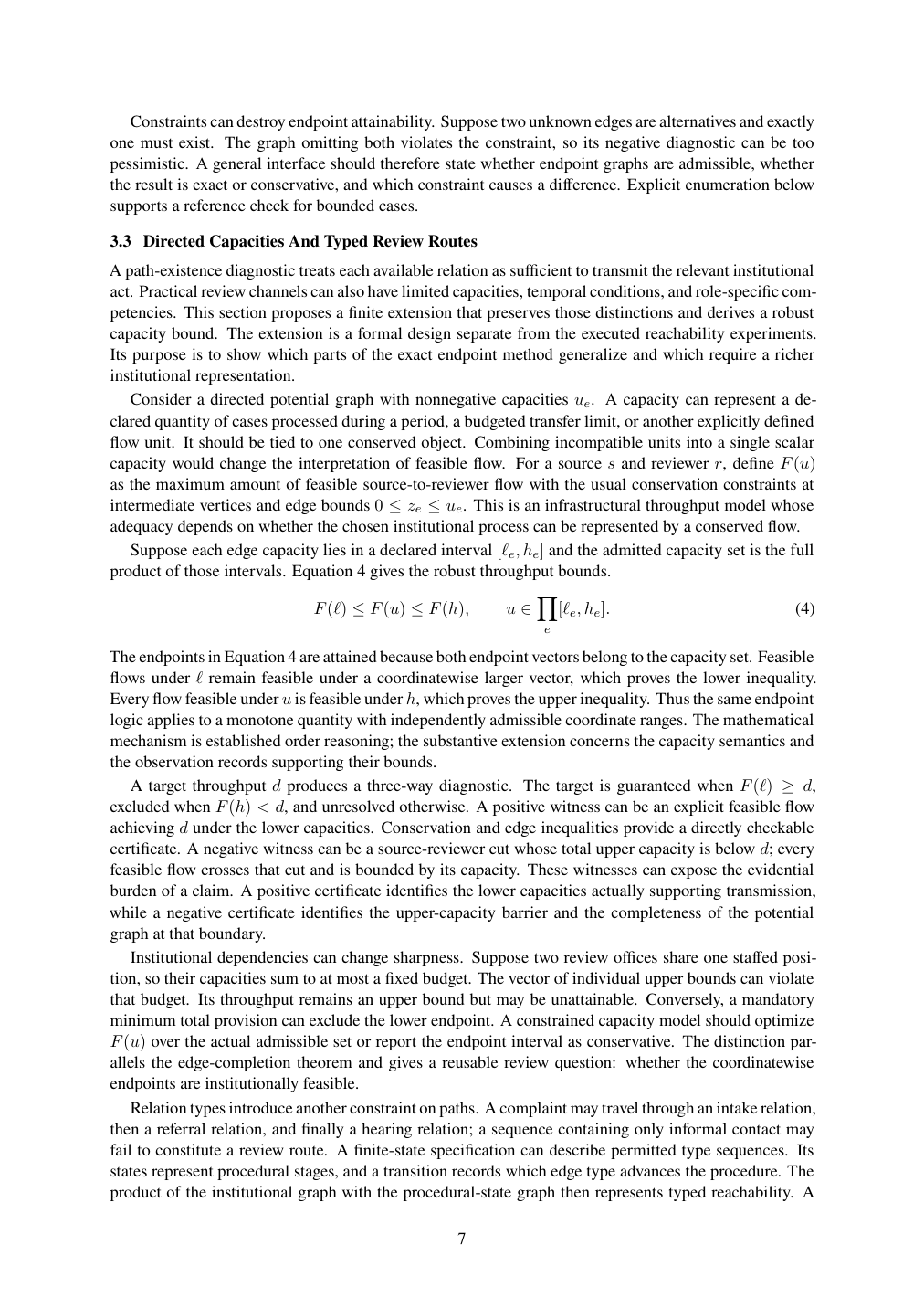
A path-existence diagnostic treats each available relation as sufficient to transmit the relevant institutional act. Practical review channels can also have limited capacities, temporal conditions, and role-specific com- petencies. This section proposes a finite extension that preserves those distinctions and derives a robust capacity bound. The extension is a formal design separate from the executed reachability experiments. Its purpose is to show which parts of the exact endpoint method generalize and which require a richer
clared quantity of cases processed during a period, a budgeted transfer limit, or another explicitly defined flow unit. It should be tied to one conserved object. Combining incompatible units into a single scalar as the maximum amount of feasible source-to-reviewer flow with the usual conservation constraints at adequacy depends on whether the chosen institutional process can be represented by a conserved flow.
product of those intervals. Equation 4 gives the robust throughput bounds.
The endpoints in Equation 4 are attained because both endpoint vectors belong to the capacity set. Feasible logic applies to a monotone quantity with independently admissible coordinate ranges. The mathematical mechanism is established order reasoning; the substantive extension concerns the capacity semantics and
feasible flow crosses that cut and is bounded by its capacity. These witnesses can expose the evidential burden of a claim. A positive certificate identifies the lower capacities actually supporting transmission, while a negative certificate identifies the upper-capacity barrier and the completeness of the potential
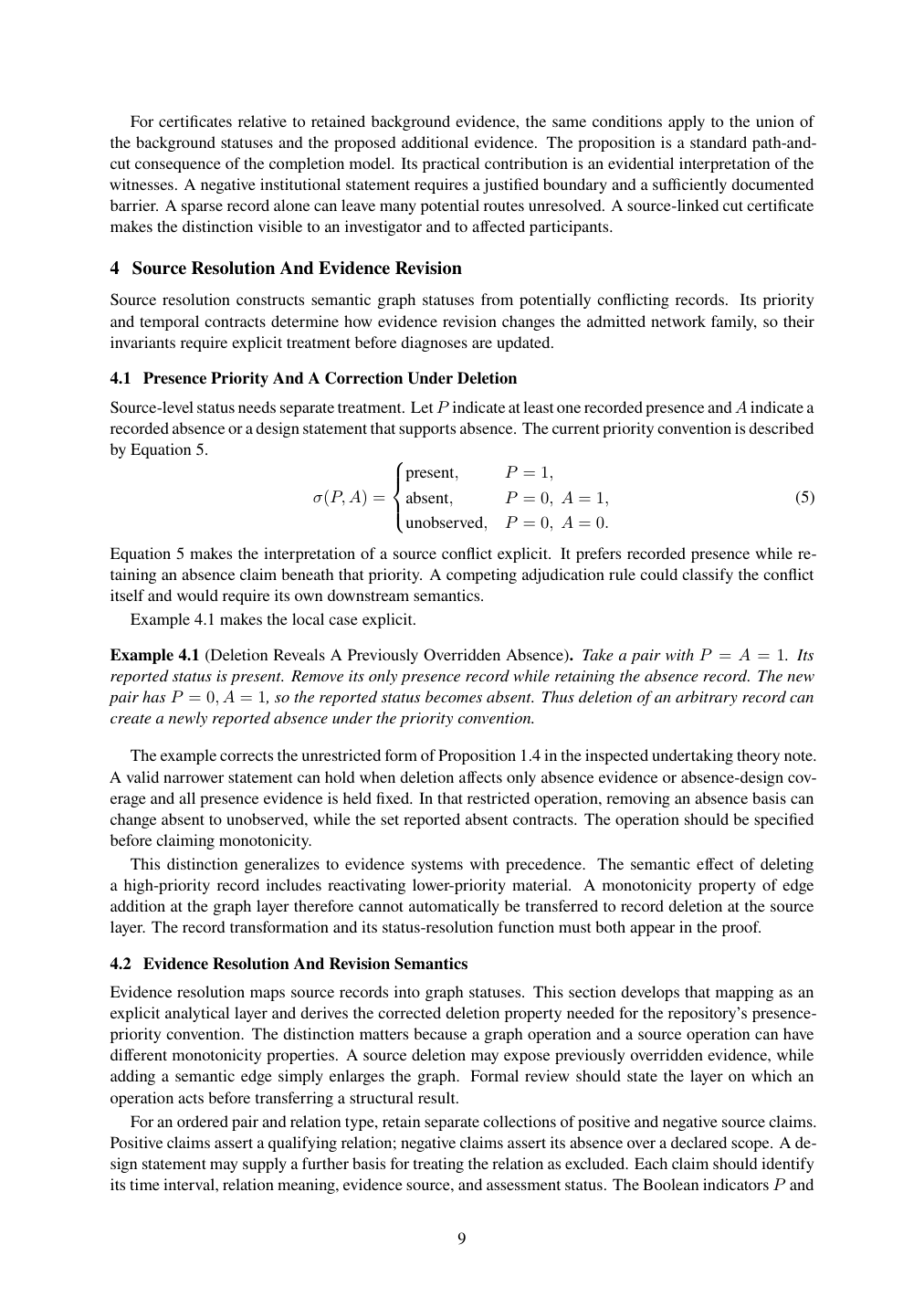
Institutional dependencies can change sharpness. Suppose two review offices share one staffed posi- tion, so their capacities sum to at most a fixed budget. The vector of individual upper bounds can violate that budget. Its throughput remains an upper bound but may be unattainable. Conversely, a mandatory minimum total provision can exclude the lower endpoint. A constrained capacity model should optimize allels the edge-completion theorem and gives a reusable review question: whether the coordinatewise
Relation types introduce another constraint on paths. A complaint may travel through an intake relation, then a referral relation, and finally a hearing relation; a sequence containing only informal contact may fail to constitute a review route. A finite-state specification can describe permitted type sequences. Its states represent procedural stages, and a transition records which edge type advances the procedure. The product of the institutional graph with the procedural-state graph then represents typed reachability. A
vertex in the product combines an institutional role with a stage. A directed product edge exists only when both the institutional relation and the procedural transition exist. Reachability between the appropriate initial and final product vertices establishes a route satisfying that codebook.
The product construction makes a useful boundary explicit. A relation’s existence and its procedural applicability are distinct premises. One document can establish that two offices communicate while another establishes whether that communication can transmit an appeal. The source layer should attach evidence to both premises. If applicability is uncertain, product edges become unresolved even when the underlying contact is observed. Their dependencies may share a common rule interpretation, so treating them as independently uncertain can add inadmissible combinations. A solver-backed completion model could retain those dependencies through shared applicability variables.
Capacity and typed-path extensions also clarify succession. Removing one role can leave an undirected contact graph connected while interrupting the only permitted procedural sequence or eliminating a required competency. A succession diagnostic should therefore specify the services or competencies to be preserved. It can evaluate typed reachability for each service, throughput targets for capacity-bearing tasks, and source-linked authority for substitute roles. The resulting collection of diagnostics may remain only partially ordered, with some services preserved and others unresolved. That richer output is often more institutionally informative than a single connectivity score.
The formal extension identifies a tractable family of research questions. Interval capacities with feasible endpoints retain sharp monotone bounds. Typed paths can be evaluated by an explicit finite-state product under a fixed codebook. Shared budgets, temporal coordination, and uncertain authority require additional constraints. Each complication changes an identifiable assumption, allowing the infrastructure to report exactly which diagnostic is established and which premises require further inquiry. This approach supports cross-disciplinary reuse through explicit interfaces while preserving the local meaning of the institutional process being modeled.
3.4 Witnesses, Cuts, And Institutional Observation Design
3.4.1 Positive And Negative Certificates
The sharp endpoint result admits compact witnesses. A guaranteed positive reachability claim has a directed path in the observed-present graph. Every edge of that path is fixed present, so every completion retains it. Removing unrelated observations leaves the guarantee intact. A path is therefore an explicit sufficient certificate, while finding a minimum-cost path supplies a standard way to reduce the evidential cost of documenting that particular channel.
A guaranteed negative claim has a complementary cut interpretation. Consider the declared potentialedge graph before absences are imposed. Any directed source-to-reviewer path must cross from the set of vertices reachable in the upper graph to its complement. All potential crossing edges of that direction are recorded absent or excluded by the declared universe. Their status forms a barrier to every admissible path. This exposes a frequent modeling dependency: an edge omitted from the potential universe is treated as unavailable as firmly as an observed absence, although its evidential basis can differ.
The following proposition specifies the local formal result; Proposition 3.2 provides its reference point.
Proposition 3.2 (Certificates Under An Unrestricted Potential Universe). Consider standalone evidence certificates: statuses outside the proposed certificate are released to independent uncertainty within a fixed potential universe. A set of fixed present edges certifies reachability exactly when it contains a directed path. A set of fixed absent edges certifies absence exactly when deleting those edges from the potential universe disconnects the source from the reviewer.
Proof. For a positive certificate, the completion omitting every other unresolved edge is admissible. The fixed edges must therefore contain a path; such a path also suffices in every completion. For a negative certificate, the completion including every edge not fixed absent is admissible. It must have no path, which is precisely the stated disconnection condition. The converse follows because further edge deletion cannot create a path.
Readable text
For certificates relative to retained background evidence, the same conditions apply to the union of the background statuses and the proposed additional evidence. The proposition is a standard path-and- cut consequence of the completion model. Its practical contribution is an evidential interpretation of the witnesses. A negative institutional statement requires a justified boundary and a sufficiently documented barrier. A sparse record alone can leave many potential routes unresolved. A source-linked cut certificate makes the distinction visible to an investigator and to affected participants.
Source resolution constructs semantic graph statuses from potentially conflicting records. Its priority and temporal contracts determine how evidence revision changes the admitted network family, so their invariants require explicit treatment before diagnoses are updated.
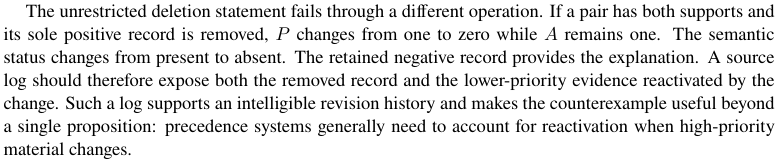
recorded absence or a design statement that supports absence. The current priority convention is described
Equation 5 makes the interpretation of a source conflict explicit. It prefers recorded presence while re- taining an absence claim beneath that priority. A competing adjudication rule could classify the conflict itself and would require its own downstream semantics.
reported status is present. Remove its only presence record while retaining the absence record. The new create a newly reported absence under the priority convention.
The example corrects the unrestricted form of Proposition 1.4 in the inspected undertaking theory note. A valid narrower statement can hold when deletion affects only absence evidence or absence-design cov- erage and all presence evidence is held fixed. In that restricted operation, removing an absence basis can change absent to unobserved, while the set reported absent contracts. The operation should be specified
This distinction generalizes to evidence systems with precedence. The semantic effect of deleting a high-priority record includes reactivating lower-priority material. A monotonicity property of edge addition at the graph layer therefore cannot automatically be transferred to record deletion at the source layer. The record transformation and its status-resolution function must both appear in the proof.
Evidence resolution maps source records into graph statuses. This section develops that mapping as an explicit analytical layer and derives the corrected deletion property needed for the repository’s presence- priority convention. The distinction matters because a graph operation and a source operation can have different monotonicity properties. A source deletion may expose previously overridden evidence, while adding a semantic edge simply enlarges the graph. Formal review should state the layer on which an
operation acts before transferring a structural result.
For an ordered pair and relation type, retain separate collections of positive and negative source claims. Positive claims assert a qualifying relation; negative claims assert its absence over a declared scope. A de- sign statement may supply a further basis for treating the relation as excluded. Each claim should identify

A useful source-state vocabulary has four cases: positive support only, negative support only, support of both signs, and support of neither sign. The existing priority rule maps the third case to semantic presence. A conflict-preserving alternative would retain that case as disputed. The choice changes the completion family. Presence priority treats every completion as containing the edge; a disputed treatment may admit either status until review. Neither policy receives a universal institutional justification from graph theory. Its suitability depends on the evidence regime, the distinction between formal and practical ties, and the intended cost of false positive and false negative diagnoses.
Proposition 4.2 states the narrower monotonicity result supported by presence priority. It fixes positive support and allows only removal of negative support. The result can guide an implementation test and a correction to the inspected theory note.


Graph-level bounds should be recomputed after evidence resolution. Removing a positive record can leave an edge present if another positive record remains; it can make the edge absent if retained negative support controls; or it can make the edge unresolved if absence support is exhausted. These alternatives affect the lower and upper graphs differently. A source operation therefore needs a status-resolution step before it can be described as edge addition, deletion, or expansion of uncertainty. The computational interface can enforce that sequence by returning a semantic status delta alongside the source-log delta.
Temporal scope supplies further edge cases. A record asserting absence during one period can coexist with a presence record for another period without a conflict. A formal delegation can remain valid while its practical exercise is uncertain. A design statement may exclude a role pair in the formal organization while evidence documents an informal route. These cases should be represented through time-indexed or typed relations before priority is applied. Combining them into one undifferentiated pair can create an artificial contradiction and a misleading diagnosis. A codebook that identifies the relation and interval attached to each record is consequently part of the formal input.
A provenance record can express the derivation through entities and activities: the source document, the extracted claim, the review activity, and the semantic graph snapshot (Moreau et al., 2013). An authority assessment is an application-specific relation whose grounds remain attached to the activity. The resulting graph snapshot should carry a digest identifying the source assessment and codebook versions. A certificate can then be checked against that exact snapshot. When a challenge changes a source assessment, the system can identify affected edges and rerun only dependent diagnostics where an incremental implementation supports that operation.
The research contribution here is a precise revision contract. The source layer preserves conflicting support and its scope. The resolution layer declares how statuses are produced. The graph layer evaluates completion bounds and certificates. The observation layer proposes evidence collection under an objective.
Readable text
Each layer has its own operations and invariants. Keeping them explicit permits both formal correction and institutional disagreement to be localized. The restricted deletion proposition resolves the source- level error, while the broader architecture makes similar errors easier to detect when the infrastructure is
Observation policies choose which unresolved relation to inspect until a diagnostic becomes constant over the remaining family. The local information-gain criterion and exact expected-cost optimum supply
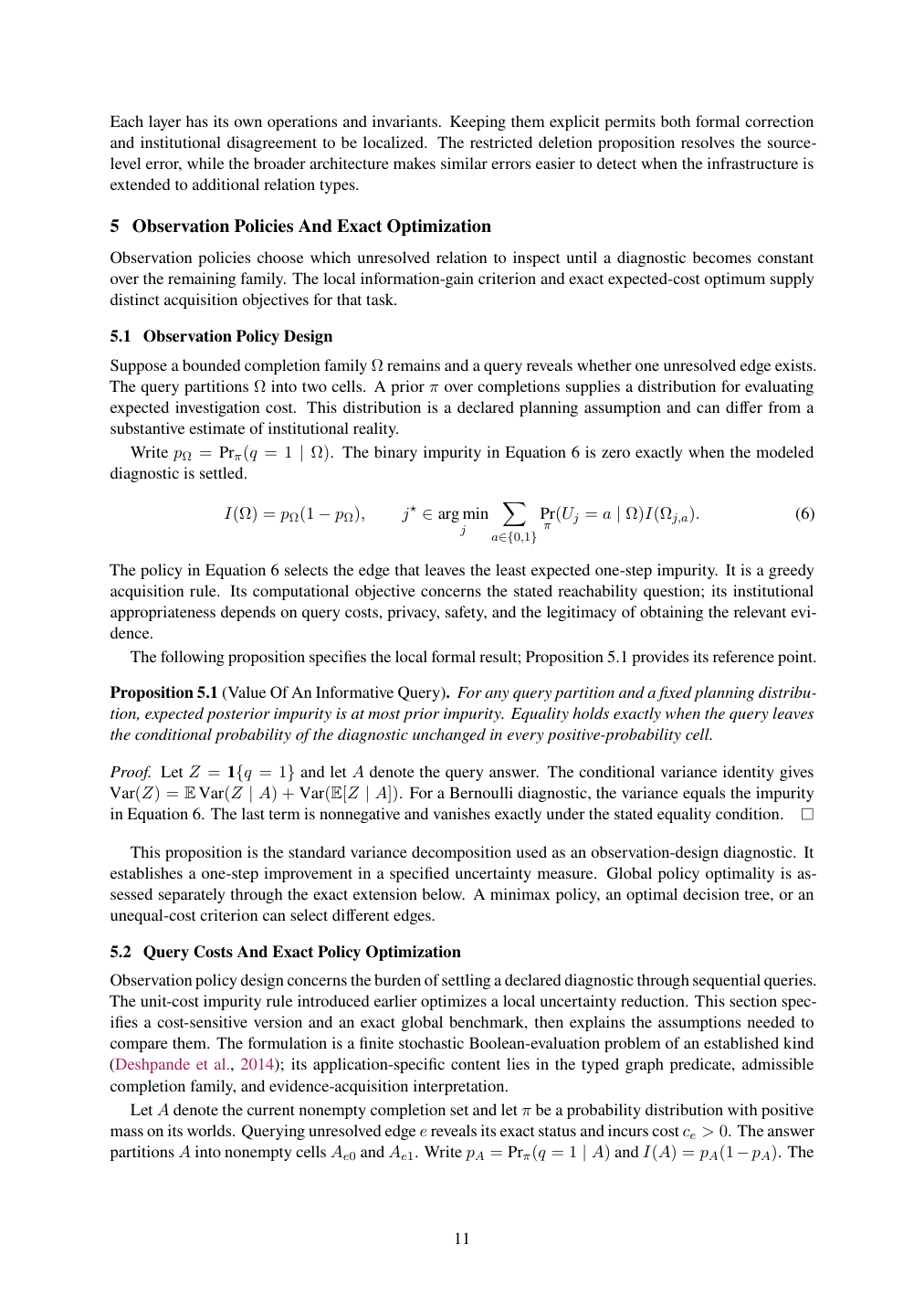
Suppose a bounded completion family Ωremains and a query reveals whether one unresolved edge exists. expected investigation cost. This distribution is a declared planning assumption and can differ from a
The policy in Equation 6 selects the edge that leaves the least expected one-step impurity. It is a greedy acquisition rule. Its computational objective concerns the stated reachability question; its institutional appropriateness depends on query costs, privacy, safety, and the legitimacy of obtaining the relevant evi-
The following proposition specifies the local formal result; Proposition 5.1 provides its reference point.
Proposition 5.1 (Value Of An Informative Query). For any query partition and a fixed planning distribu- tion, expected posterior impurity is at most prior impurity. Equality holds exactly when the query leaves the conditional probability of the diagnostic unchanged in every positive-probability cell.
in Equation 6. The last term is nonnegative and vanishes exactly under the stated equality condition.
This proposition is the standard variance decomposition used as an observation-design diagnostic. It establishes a one-step improvement in a specified uncertainty measure. Global policy optimality is as- sessed separately through the exact extension below. A minimax policy, an optimal decision tree, or an
Observation policy design concerns the burden of settling a declared diagnostic through sequential queries. The unit-cost impurity rule introduced earlier optimizes a local uncertainty reduction. This section spec- ifies a cost-sensitive version and an exact global benchmark, then explains the assumptions needed to compare them. The formulation is a finite stochastic Boolean-evaluation problem of an established kind (Deshpande et al., 2014); its application-specific content lies in the typed graph predicate, admissible completion family, and evidence-acquisition interpretation.

Readable text
Empty cells in Equation 7 contribute zero. The variance identity previously proved makes the gain non- negative. Positive gain means that the answer changes the posterior diagnostic probability across branches. The rule selects the greatest immediate reduction per unit cost, with a fixed edge-index tie-break in the exe- cuted extension. That tie-break is part of reproducibility because several irrelevant or equally informative
The exact optimal expected remaining cost has the recursion in Equation 8. A state with constant
The minimum in Equation 8 ranges over edges that split the current set into two nonempty answer cells. It considers the full continuation after both answers. A finite induction on unobserved edges proves that the recursion yields the minimum expected cost among exact coordinate-query policies. At each nonterminal state, the first action of a feasible policy is some edge query; its continuation costs are bounded below by the optimal values for the child states. Selecting an edge attaining the displayed minimum and optimal child continuations attains the bound. The proof assumes reliable answers, fixed costs, and a complete finite family whose remaining coordinates eventually determine the diagnostic.
Local and global objectives can differ through future complementarities. A cheap query may cause a large immediate change in diagnostic probability while leaving an expensive ambiguous branch. Another query may have smaller immediate gain but create inexpensive certificates in both branches. Dividing gain by cost accounts for the first acquisition cost without optimizing those continuation structures. Adaptive- submodularity theory offers guarantees for particular objectives and assumptions (Golovin et al., 2011); an application must verify those assumptions before adopting a guarantee. The exact recursion provides a finite comparison even when such a structural proof is unavailable.
A prior distribution serves a specific design role. The extension assigns unresolved edges independent answer probabilities exactly. These product weights are convenient for a transparent sensitivity study. They describe the benchmark and are distinct from the logical admission of every edge subset. A world with low prior probability still belongs to the logical family and remains relevant to exact stopping. The policy stops only when every remaining admitted world has the same outcome. Probabilities guide query selection, while outcome agreement over the admitted family determines stopping.
Costs also have several possible meanings. An equal cost of one counts observations. Alternating costs of one and four create a controlled resource asymmetry. An institutional study could estimate staff time, archival fees, or burden on interviewees. Combining those quantities into one scalar requires a declared conversion rule. Some burdens are better represented as constraints: a confidentiality rule can prohibit a query, a participation protocol can require consent, and an equal-treatment rule can require inspecting selected relations. The dynamic program can accommodate a restricted action set, but the mathematical optimum then belongs to that governance specification.
tic states. Some states are unreachable or collapse to the same completion subset. Memoization avoids recomputing identical subsets but preserves exponential worst-case growth. Eight unresolved edges make exhaustive comparison practical in the extension. Larger tasks motivate heuristics, symbolic representa- tions, or decomposition. A scaling study should report memory and state counts along with wall time, because a fast result on a highly reducible graph can hide the behavior of denser or more coupled families.
The policy interface should return an explanation of its next query and stopping rule. For a greedy rule, the explanation can report current impurity, expected gain, cost, and alternative gains. For an exact optimum, it can report expected continuation costs and the selected action. At termination, a path or cut certificate supplies a structural reason for the diagnosis. Those artifacts allow an investigator to challenge cost assumptions or query availability while retaining the same graph model. They also separate an algorithm’s informational recommendation from the institution’s judgment about whether collecting the proposed evidence is legitimate and useful.
6 Constructed Network And Cost Studies
The constructed network studies evaluate completion diagnostics and sequential observation burdens. Their complete decision-tree expectations permit comparison of prior and cost settings while retaining an exact logical stopping condition.
6.1 Constructed Exhaustive Study
6.1.1 Design
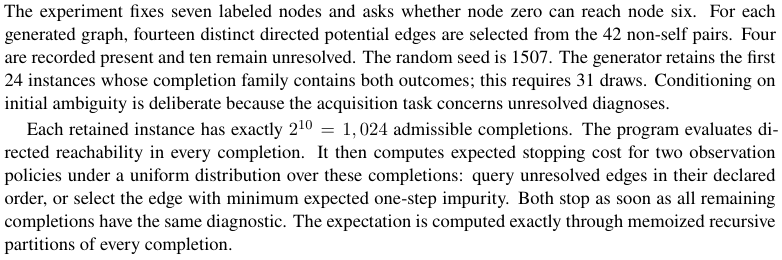
6.1.2 Diagnostic Consequences
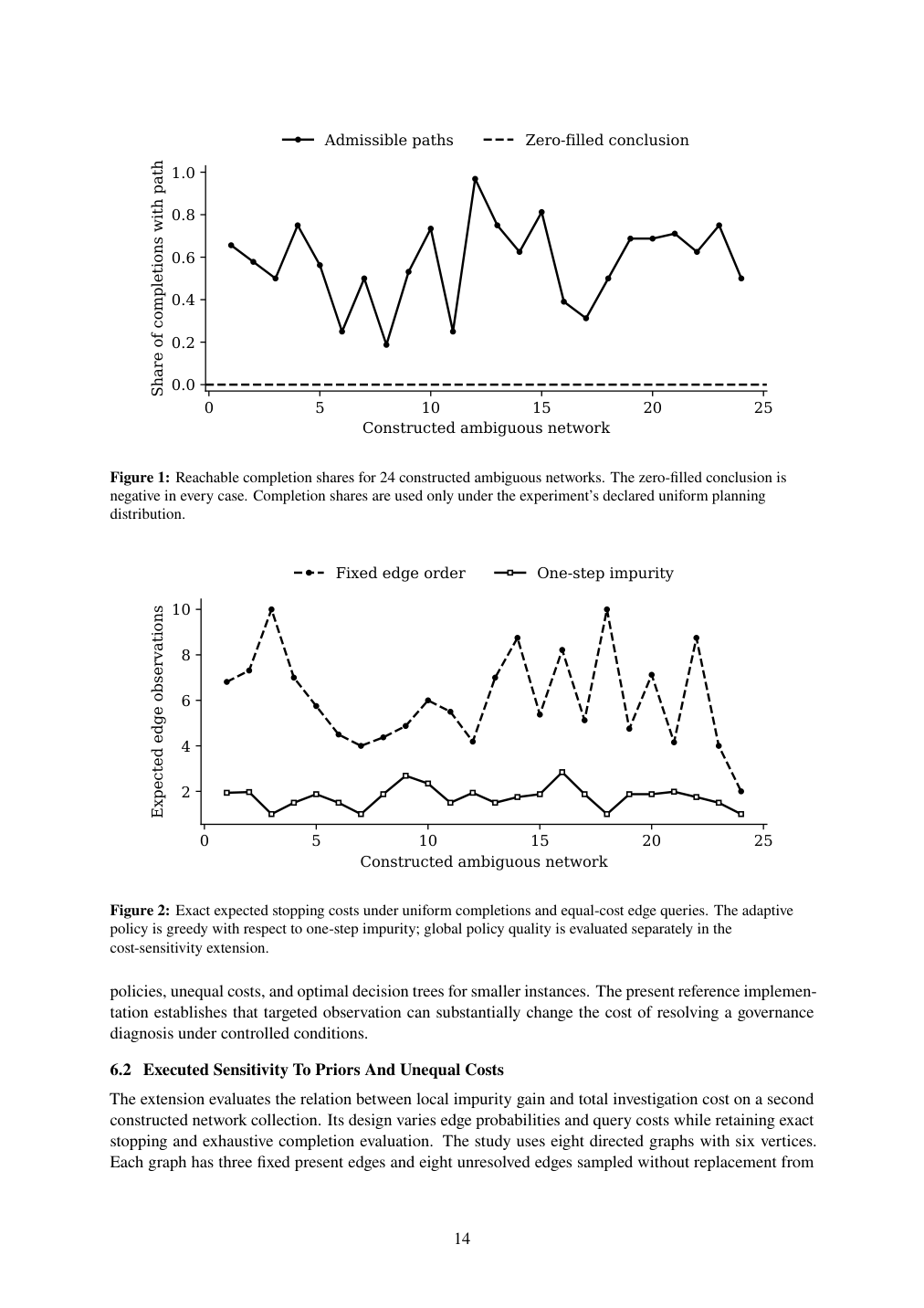
Figure 1 displays the share of reachable completions for each selected network. The mean is 0.575846. Because every retained network is ambiguous, its lower graph has no path and its upper graph has a path. A zero-filled point reading therefore declares absence throughout the ensemble. Across the equally weighted completion possibilities, that reading would falsely exclude a path in 57.6 percent of cases. This percentage describes the chosen constructed distribution; an institutional error-rate estimate requires a separately sampled corpus.
Completion bounds issue an unresolved diagnosis for all 24 initial records and every issued guarantee agrees with its explicitly enumerated completion set. This is a logical property of the reference calculation. It should be evaluated alongside its abstention rate: a method that always leaves a question open can avoid false certification while providing little guidance. The acquisition analysis addresses how the uncertainty can be reduced by gathering evidence.
6.1.3 Acquisition Results
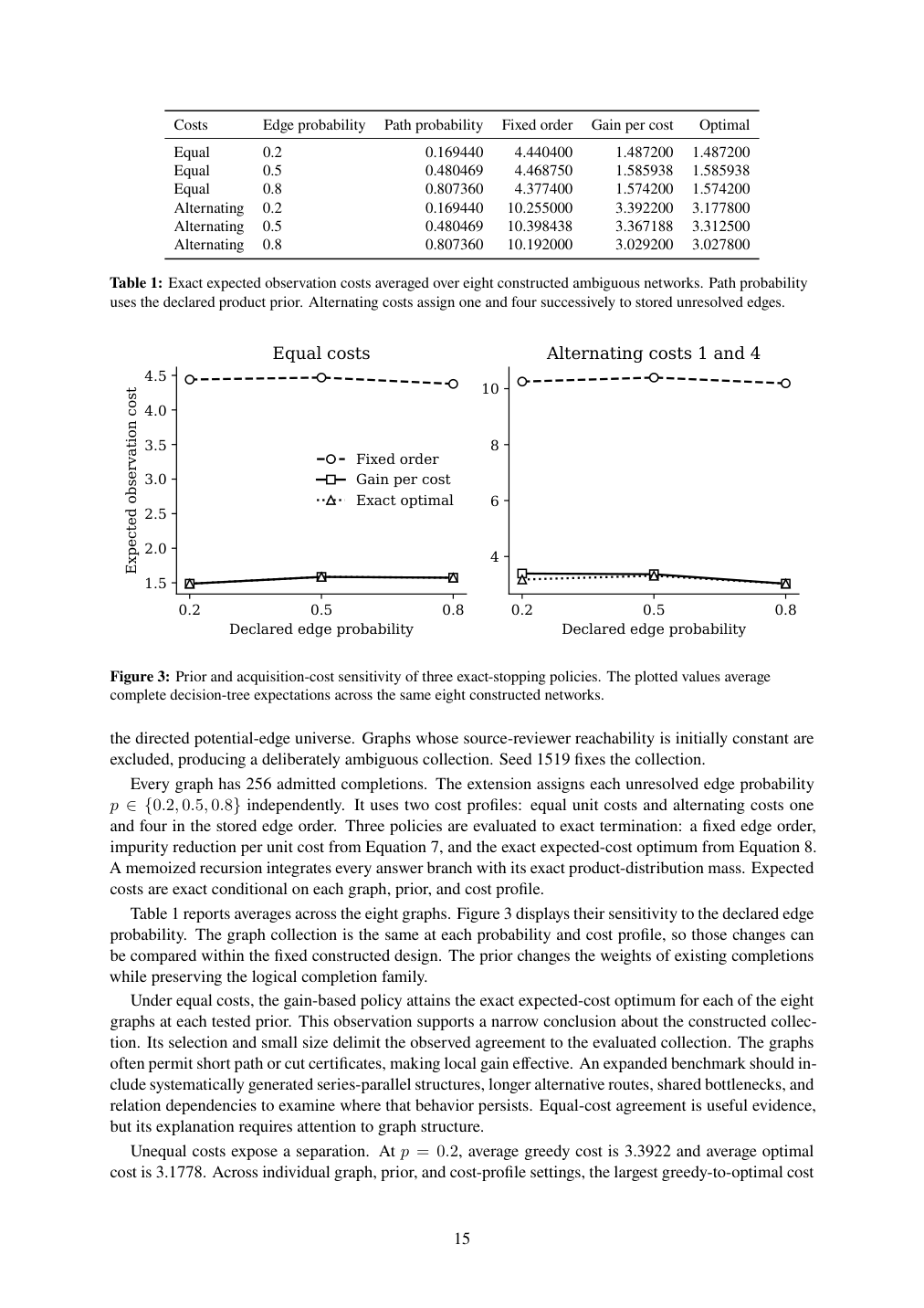
Figure 2 compares the expected number of edge observations. The fixed-order policy averages 6.065104 observations. The impurity policy averages 1.748047, a reduction of about 71.2 percent for this ensemble. Some queries are irrelevant to the path property until other relations are known; other queries separate a large reachable cell from an unreachable one. The improvement therefore reflects the structure of the question and its admissible completions.
The comparison uses one fixed ordering as the baseline, and its size of advantage should be interpreted accordingly. A stronger study would include randomized orders, path-focused heuristics, min-cut-based
Readable text
Figure 1: Reachable completion shares for 24 constructed ambiguous networks. The zero-filled conclusion is negative in every case. Completion shares are used only under the experiment’s declared uniform planning
Figure 2: Exact expected stopping costs under uniform completions and equal-cost edge queries. The adaptive policy is greedy with respect to one-step impurity; global policy quality is evaluated separately in the
policies, unequal costs, and optimal decision trees for smaller instances. The present reference implemen- tation establishes that targeted observation can substantially change the cost of resolving a governance
The extension evaluates the relation between local impurity gain and total investigation cost on a second constructed network collection. Its design varies edge probabilities and query costs while retaining exact stopping and exhaustive completion evaluation. The study uses eight directed graphs with six vertices. Each graph has three fixed present edges and eight unresolved edges sampled without replacement from
Readable text
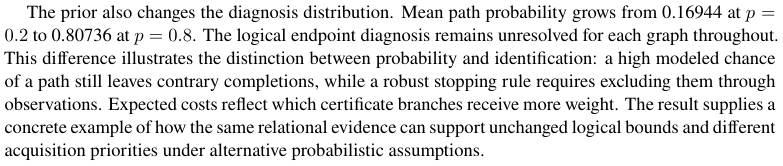
Equal 0.2 Equal 0.5 Equal 0.8 Alternating 0.2 Alternating 0.5 Alternating 0.8
Table 1: Exact expected observation costs averaged over eight constructed ambiguous networks. Path probability uses the declared product prior. Alternating costs assign one and four successively to stored unresolved edges.
Figure 3: Prior and acquisition-cost sensitivity of three exact-stopping policies. The plotted values average complete decision-tree expectations across the same eight constructed networks.
the directed potential-edge universe. Graphs whose source-reviewer reachability is initially constant are excluded, producing a deliberately ambiguous collection. Seed 1519 fixes the collection.
Every graph has 256 admitted completions. The extension assigns each unresolved edge probability and four in the stored edge order. Three policies are evaluated to exact termination: a fixed edge order, impurity reduction per unit cost from Equation 7, and the exact expected-cost optimum from Equation 8. A memoized recursion integrates every answer branch with its exact product-distribution mass. Expected costs are exact conditional on each graph, prior, and cost profile.
Table 1 reports averages across the eight graphs. Figure 3 displays their sensitivity to the declared edge probability. The graph collection is the same at each probability and cost profile, so those changes can be compared within the fixed constructed design. The prior changes the weights of existing completions
Under equal costs, the gain-based policy attains the exact expected-cost optimum for each of the eight graphs at each tested prior. This observation supports a narrow conclusion about the constructed collec- tion. Its selection and small size delimit the observed agreement to the evaluated collection. The graphs often permit short path or cut certificates, making local gain effective. An expanded benchmark should in- clude systematically generated series-parallel structures, longer alternative routes, shared bottlenecks, and relation dependencies to examine where that behavior persists. Equal-cost agreement is useful evidence, but its explanation requires attention to graph structure.
cost is 3.1778. Across individual graph, prior, and cost-profile settings, the largest greedy-to-optimal cost
ratio is approximately 1.48419. This is a computed counterexample to a general claim that gain per cost minimizes total expected investigation burden. The maximum individual ratio and the mean cost difference describe different summaries. The program retains every setting in extension_results.json, permitting inspection of the graph and prior responsible for the larger ratio.
The fixed-order baseline incurs substantially greater average cost in this collection. Its disadvantage reflects both wasted observations and the placement of expensive queries in the stored order. The baseline supplies a simple reproducible comparator, while a stronger operational comparison would include shortest-path or cut-focused policies and policies chosen from expert investigation practice. The current extension compares the proposed gain rule with an exact optimum, which identifies the remaining possible improvement within the specified action model. Savings relative to institutional work require a comparison against observed investigation practice.
Selection of ambiguous graphs is deliberate and should remain visible. It removes instances already settled by the lower or upper graph, concentrating the benchmark on investigation policies. An applicationwide evaluation would include such easy cases and report their frequency, because they can require zero queries. The benchmark also fixes all unresolved edges to the same prior within a setting. Heterogeneous priors, correlations, selective missingness, and imperfect answers are useful extensions, each requiring its own evidence or designed sensitivity grid. Their inclusion would test additional mechanisms with separately stated assumptions.
The executed files provide a checkable boundary around the evidence. extension.py records graph generation, completion weights, costs, tie-breaking, recursion, and figure generation. The resulting JSON preserves graphs and all 48 graph-prior-cost settings. The original 24-network unit-cost study remains intact in results.json, alongside the extension. Both are independent Python reference calculations. Their role is to establish finite behavior and generate discriminating examples for subsequent implementation and institutional studies.
7 Source Resolution And Constrained Diagnostic Evaluation
A structural governance diagnostic depends on the path by which source claims become typed edge statuses and those statuses become an admitted graph family. This section tests both interfaces. A native header probe checks temporal, directional, and source-priority semantics. A separate finite experiment evaluates how shared constraints and procedural edge types change reachability conclusions. The two tests strengthen the implementation connection while keeping the institutional meaning of accountability and authority within its stated interpretive scope.
7.1 Primary Comparison And Target Selection
The full-text method in Kossinets (2006), including its simulation algorithms and network-level statistics, compares properties after controlled removal from a completed graph or graph ensemble. The present target is conditional on a particular partial record: the set of reachability outcomes over its admitted completions. A masking study can evaluate that target, while the target itself is a logical identified set. Source-resolution conformance supplies an additional test of how the partial record is constructed. This distinction makes the comparator operational without transferring a graph-statistic error estimate to the present diagnostic.
Readable text
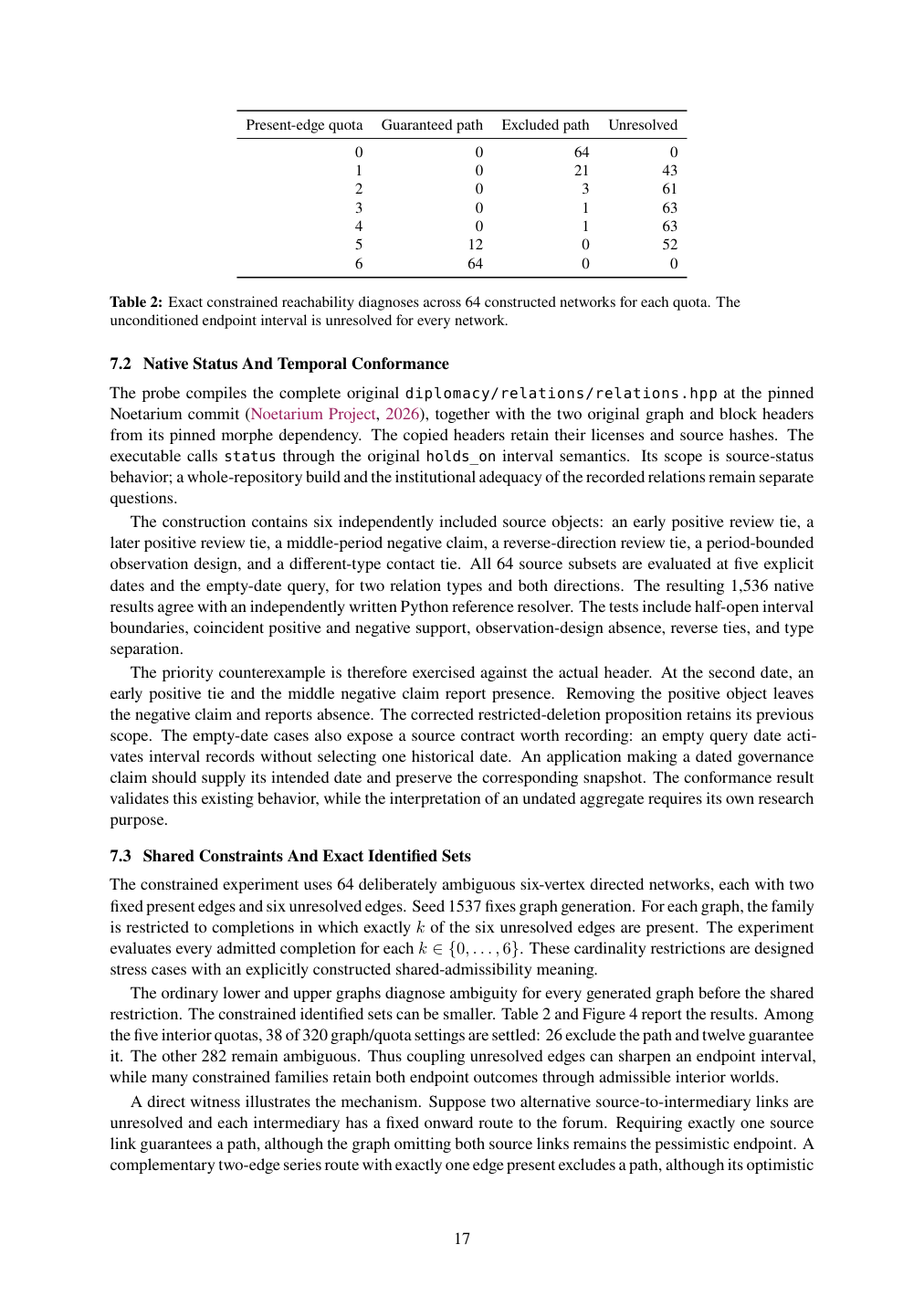
Table 2: Exact constrained reachability diagnoses across 64 constructed networks for each quota. The unconditioned endpoint interval is unresolved for every network.
The probe compiles the complete original diplomacy/relations/relations.hpp at the pinned Noetarium commit (Noetarium Project, 2026), together with the two original graph and block headers from its pinned morphe dependency. The copied headers retain their licenses and source hashes. The executable calls status through the original holds_on interval semantics. Its scope is source-status behavior; a whole-repository build and the institutional adequacy of the recorded relations remain separate
The construction contains six independently included source objects: an early positive review tie, a later positive review tie, a middle-period negative claim, a reverse-direction review tie, a period-bounded observation design, and a different-type contact tie. All 64 source subsets are evaluated at five explicit dates and the empty-date query, for two relation types and both directions. The resulting 1,536 native results agree with an independently written Python reference resolver. The tests include half-open interval boundaries, coincident positive and negative support, observation-design absence, reverse ties, and type
The priority counterexample is therefore exercised against the actual header. At the second date, an early positive tie and the middle negative claim report presence. Removing the positive object leaves the negative claim and reports absence. The corrected restricted-deletion proposition retains its previous scope. The empty-date cases also expose a source contract worth recording: an empty query date acti- vates interval records without selecting one historical date. An application making a dated governance claim should supply its intended date and preserve the corresponding snapshot. The conformance result validates this existing behavior, while the interpretation of an undated aggregate requires its own research
The constrained experiment uses 64 deliberately ambiguous six-vertex directed networks, each with two fixed present edges and six unresolved edges. Seed 1537 fixes graph generation. For each graph, the family stress cases with an explicitly constructed shared-admissibility meaning.
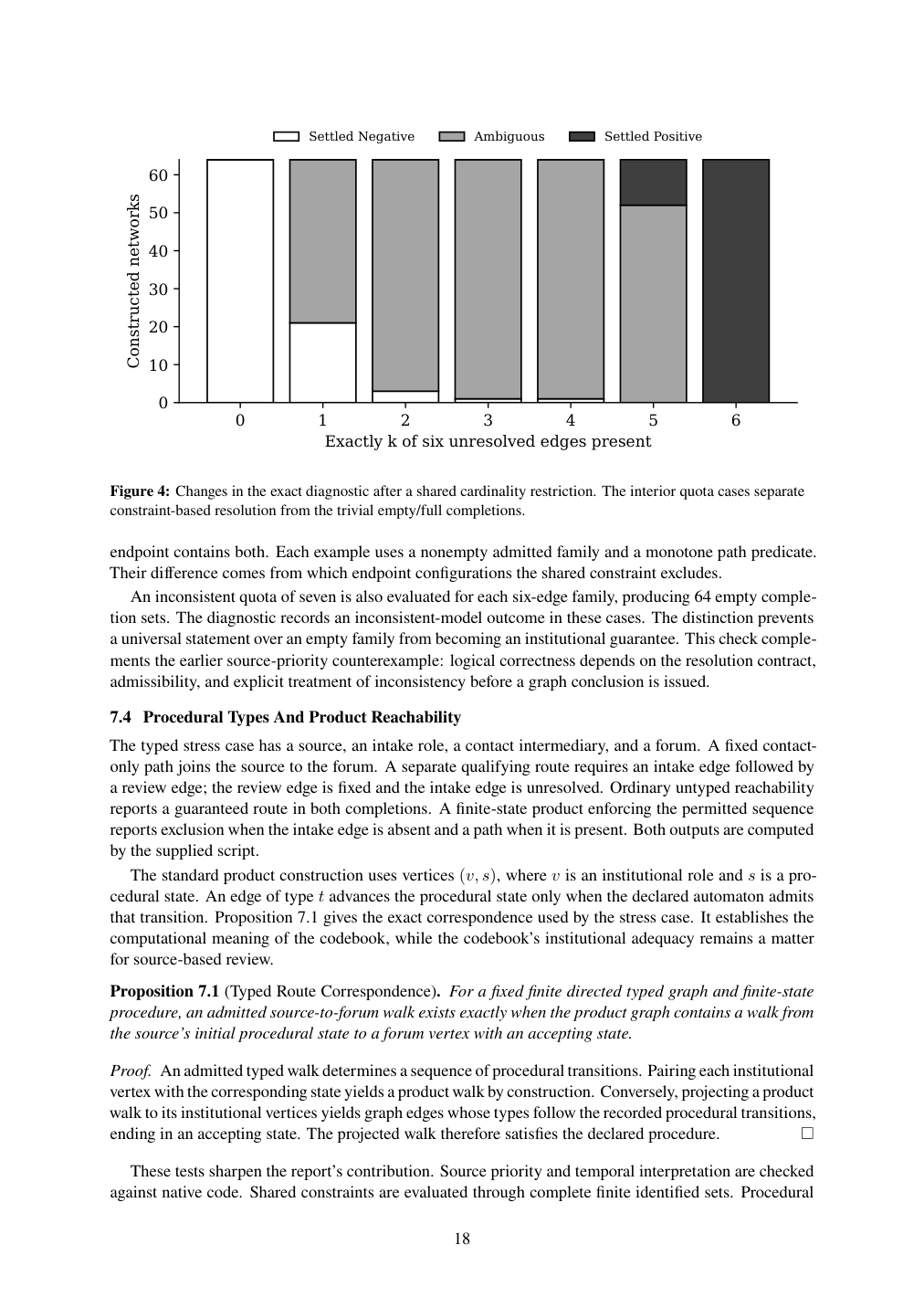
The ordinary lower and upper graphs diagnose ambiguity for every generated graph before the shared restriction. The constrained identified sets can be smaller. Table 2 and Figure 4 report the results. Among the five interior quotas, 38 of 320 graph/quota settings are settled: 26 exclude the path and twelve guarantee it. The other 282 remain ambiguous. Thus coupling unresolved edges can sharpen an endpoint interval, while many constrained families retain both endpoint outcomes through admissible interior worlds.
A direct witness illustrates the mechanism. Suppose two alternative source-to-intermediary links are unresolved and each intermediary has a fixed onward route to the forum. Requiring exactly one source link guarantees a path, although the graph omitting both source links remains the pessimistic endpoint. A complementary two-edge series route with exactly one edge present excludes a path, although its optimistic
Readable text
Figure 4: Changes in the exact diagnostic after a shared cardinality restriction. The interior quota cases separate constraint-based resolution from the trivial empty/full completions.
endpoint contains both. Each example uses a nonempty admitted family and a monotone path predicate. Their difference comes from which endpoint configurations the shared constraint excludes.
An inconsistent quota of seven is also evaluated for each six-edge family, producing 64 empty comple- tion sets. The diagnostic records an inconsistent-model outcome in these cases. The distinction prevents a universal statement over an empty family from becoming an institutional guarantee. This check comple- ments the earlier source-priority counterexample: logical correctness depends on the resolution contract, admissibility, and explicit treatment of inconsistency before a graph conclusion is issued.
The typed stress case has a source, an intake role, a contact intermediary, and a forum. A fixed contact- only path joins the source to the forum. A separate qualifying route requires an intake edge followed by a review edge; the review edge is fixed and the intake edge is unresolved. Ordinary untyped reachability reports a guaranteed route in both completions. A finite-state product enforcing the permitted sequence reports exclusion when the intake edge is absent and a path when it is present. Both outputs are computed
that transition. Proposition 7.1 gives the exact correspondence used by the stress case. It establishes the computational meaning of the codebook, while the codebook’s institutional adequacy remains a matter
Proposition 7.1 (Typed Route Correspondence). For a fixed finite directed typed graph and finite-state procedure, an admitted source-to-forum walk exists exactly when the product graph contains a walk from the source’s initial procedural state to a forum vertex with an accepting state.
Proof. An admitted typed walk determines a sequence of procedural transitions. Pairing each institutional vertex with the corresponding state yields a product walk by construction. Conversely, projecting a product walk to its institutional vertices yields graph edges whose types follow the recorded procedural transitions, ending in an accepting state. The projected walk therefore satisfies the declared procedure.
These tests sharpen the report’s contribution. Source priority and temporal interpretation are checked against native code. Shared constraints are evaluated through complete finite identified sets. Procedural
typing is evaluated through its actual product predicate. The techniques are established; their coordination identifies where a governance diagnosis can change through source resolution, admission, or relation meaning. A substantive accountability assessment can then inspect the forum’s mandate, questioning and judgment practices, and consequences alongside the verified route condition. The model certificate supplies a bounded infrastructural claim with an explicit evidential lineage.
8 Implementation And Institutional Functions
Implementation choices acquire meaning through the institutional function being diagnosed. Directed access, substitute competencies, source-linked snapshots, and explicit query contracts together define the boundary of a usable governance diagnostic.
8.1 Interpreting Direction, Substitution, And Succession
A path to a reviewer and a succession arrangement have different semantics. A reviewer path composes permissions to escalate a specified request. Succession can require a collection of competencies, continuity of resources, and authorized substitution after a role disappears. An undirected articulation vertex identifies a potential connectivity bottleneck, while a capability-aware succession condition asks whether the required functions remain executable through permitted replacements.
A useful extension represents competencies as labels on roles and authorization relations as typed directed edges. After removing a role, the model can ask whether each required competency remains covered and whether authority to act can reach a suitable replacement. These properties can still be assessed across graph completions, though monotonicity requires care. Adding an edge that provides a capability can improve feasibility, while adding an exclusive-control constraint or a conflict-of-interest relation can change the condition in another direction.
The main methodological lesson is to state the institutional predicate before applying a network statistic. Centrality, articulation, reachability, and capacity each preserve a different feature of the represented relation. Their institutional interpretation depends on the semantics assigned to edges and vertices. A diagnosis becomes stronger when its formal property and its substantive warrant remain inspectable together.
8.2 Implementation And Evidence Requirements
The proposed completion layer can extend domains/diplomacy/relations/include/diplomacy/re lations/relations.hpp without changing the source archive’s preservation of conflicting reports. An observation design would state its vertex boundary, potential edge universe, observed present and absent sets, unresolved set, and joint constraints. A diagnostic request would specify a typed property and return its bounds, witnesses, and completeness status.
The application should retain a positive path witness for a guaranteed channel and a cut or solver certificate for a guaranteed absence. Where the diagnosis varies, it should display at least one completion of each kind. A witness is explanatory evidence relative to the model. Its rendering should identify which edges are observed, constrained, or hypothetical. That distinction prevents a counterfactual completion from becoming an apparent report of actual institutional ties.
The Python code accompanying this report is a separate reference illustration. The completion studies use independent Python code. The source-status probe separately compiles the original relations header; larger integration and institutional evaluation remain specified research tasks. It records exact completion totals and expected query costs in results.json. A production study should compare two independently implemented graph predicates and retain source-level evidence for the institutional coding that created each edge.
9 Observation Design And Institutional Validation
An observation design determines which relations, actors, periods, and source types can enter a governance diagnosis. This section specifies a research protocol for assessing the adequacy of that design.
The protocol combines documentary and interpretive inquiry with controlled computational evaluation. Its objective is to distinguish a correctly computed diagnostic from a substantively useful institutional assessment, and to identify how missingness, burden, and participation affect the relation between them.
A substantive study should first define the institutional function of interest. Examples include transmitting an explanation request, obtaining a reasoned response, reviewing a delegated decision, or preserving a service during succession. A codebook can then identify roles, relation types, direction, temporal scope, and evidence standards. The function determines the predicate. A reporting path may suffice for one preliminary question; a composite of access, competence, and consequence-bearing authority may be required for a broader accountability question. The research design should expose each layer so a participant can recognize what the diagnosis actually asserts.
Source collection can combine formal instruments, organizational records, interviews, and observations of practice. Their epistemic roles differ. A formal instrument may establish authorized delegation. An interview may identify an informal route or a practical barrier. A case record may establish whether a route was exercised during a particular period. These materials can complement or conflict with one another. The source-resolution schema should retain the distinctions and apply status rules only after type and scope have been assessed. Qualitative disagreement can then be recorded as competing model variants, giving the computational analysis a principled family of alternatives.
Boundary validation requires attention to omitted actors and relation types. A roster derived only from formal membership can exclude intermediaries who make an appeal usable. A roster derived only from interviews can exclude legally relevant roles that participants rarely encounter. Researchers can compare source-specific rosters and document how additions affect paths, cuts, and competency coverage. A bounded set of candidate vertices can be included in a sensitivity analysis. The resulting conclusions remain conditional on that candidate boundary, but the exercise reveals whether the diagnosis depends on a particular omission. This is a more informative adequacy test than varying only the density of edges within a fixed roster.
Missingness mechanisms should be varied explicitly in controlled evaluation. Random edge masking supplies a convenient baseline. Actor-based nonresponse masks many incident relations together. Typebased censoring removes particular kinds of institutional interaction. Boundary masking omits selected intermediaries. Documentation-based masking can assign lower observation rates to less formal relations. These designs connect the computational experiment to the distinctions studied in the missing-network literature (Kossinets, 2006). Their probabilities are experimental controls; empirical application would require evidence that the chosen mechanism approximates the actual record-generation process.
A completed or independently reviewed network can support retrospective masking. For each mask, the system computes endpoint diagnoses, recommends queries, and stops with a path or cut certificate. Researchers measure false settlement against the reviewed complete object, abstention, acquisition cost, and sensitivity to roster changes. The logical method should avoid false settlement when the true graph belongs to the admitted family and the checker is correct. Observed false settlement therefore identifies a violation of model inclusion, source coding, or implementation. Recording the category of failure turns an accuracy statistic into evidence about the infrastructure’s weakest interface.
Human evaluation should examine explanations and acquisition burdens. Investigators can compare whether a recommended query is understandable, obtainable, and proportionate. A participant may identify a practical constraint absent from the graph, such as a requirement to disclose identity before reaching a forum. That constraint can change the codebook or the meaning of availability. Reviewers can also assess whether a negative cut certificate adequately documents every potential crossing relation. Their judgment concerns the evidential boundary of absence. The graph proof establishes disconnection under the supplied statuses; the human review assesses whether those statuses and the potential universe are defensible.
Ethical analysis should consider asymmetric visibility. Informal support networks can be crucial precisely because formal records omit them. Publishing their edges may expose participants to surveillance, retaliation, or unwanted organizational intervention. A minimal certificate can reduce disclosure by limit-
Layer Content and standing
Established ingredients Directed reachability, monotone endpoint bounds, path/cut witnesses, variance decomposition, and sequential Boolean evaluation. Specific construction Source-resolution contract, corrected deletion scope, typed diagnostic interface, and explicit distinction among logical bounds and policy priors. Executed computations Unit/prior/cost network studies; 1,536 native status cases; constrained and typed completion comparisons. Formal extension Directed interval capacities and typed procedural routes, with scope-dependent sharpness conditions. Proposed validation Documentary coding, boundary checks, structured missingness, and human assessment of explanation and acquisition burden.
Table 3: Contribution layers for governance diagnostics under partial relational observation. Formal extensions and proposed validation are distinguished from executed studies.
ing the relations needed for a particular claim, yet the choice of claim and certificate remains consequential. Access controls, aggregate publication, participant review, and restricted source retention may be appropriate components of a study. These choices can be represented as constraints on permissible observation and publication with their own institutional meanings.
The resulting evaluation package should retain a source-linked codebook, alternative reviewed models, masking specifications, query policies, certificates, and participant assessments. Each artifact addresses a different adequacy question. Together they permit a grounded interpretation of performance: whether the method settled the chosen predicate efficiently, whether its premises represented the institution adequately, and whether its use supported legitimate inquiry. Relational infrastructure is useful here because it maintains the connections among those artifacts, allowing a discovered weakness in one layer to trigger a focused revision in the others.
10 Contribution Assessment And Research Design
The report’s contribution concerns a source-aware interface between partial institutional observation and precisely scoped graph diagnostics. Established ingredients include reachability, monotonicity, paths and cuts, finite completion semantics, and costed Boolean evaluation. The report-specific construction coordinates those ingredients with typed institutional relations, a source-priority correction, and exact observation-policy comparisons. Table 3 separates the evidential layers and identifies the validation still required for practical governance use.
The source-priority correction is a concrete insight tied to the inspected repository. Deleting a presence record can reactivate retained absence evidence, so monotonicity of arbitrary source deletion fails under the current priority rule. The restricted result in Proposition 4.2 states a valid operation and proof. This correction matters beyond notation because an incremental implementation may otherwise reuse a stale assumption about how diagnoses evolve after evidence removal. An explicit status delta gives the system a checkable way to update its lower and upper graphs.
The two experimental collections serve different purposes. The initial 24 networks illustrate the consequences of zero filling and the query burden under equal costs. The extension introduces a small exactoptimal benchmark and varies prior and costs. Its unequal-cost counterexample demonstrates that immediate gain per cost can differ from globally optimal expected acquisition cost. The reported equal-cost agreement is a property of the selected graphs. Joint reporting of agreement and separation provides a more informative account of the heuristic than a single average improvement over fixed order. It also identifies a clear next research step: characterize graph structures and cost regimes under which local gain performs well.
A comparative implementation study can evaluate four classes of method. A completed-graph method treats unresolved edges as absent. A logical endpoint method reports guaranteed, excluded, or unresolved reachability. A source-aware method additionally preserves evidence conflicts and revision semantics.
A policy method adds sequential acquisition and certificates. Each comparison should use the same substantive predicate and potential universe. Otherwise an apparent computational improvement may result from changing the meaning of the target. Accuracy, abstention, acquisition burden, and explanatory adequacy should be reported separately because they answer different research questions.
The interval-capacity extension provides another testable interface. When coordinatewise endpoints are feasible, sharp bounds follow through monotonicity. Shared budgets or correlated commitments can make those endpoints infeasible. A benchmark can generate capacity families with and without those constraints and compare endpoint intervals with exact constrained optima. Such an experiment would assess the cost of ignoring institutional dependencies. It would also create examples in which additional source information changes sharpness without changing the graph’s vertex or edge count. These are proposed experiments; the executed extension remains binary reachability with independent unresolved-edge admission.
The repository implementation offers a suitable architectural starting point through its roles, relations, coverage, and source-aware statuses. A production diagnostic module should accept a typed graph snapshot, a declared potential universe, and a query predicate. It should return the identified set, the assumptions making bounds sharp, and a source-linked witness. The observation-policy interface can then accept permitted queries, costs, and a declared distribution. Keeping that policy layer explicit allows the same logical evidence to support several investigation objectives without silently changing the diagnostic’s meaning.
The research boundary follows the institutionally chosen estimand. A path can establish the existence of a modeled channel, a feasible flow can establish throughput under capacity assumptions, and a competency layer can establish a declared succession condition. Broader judgments about accountability, legitimacy, or organizational resilience require further interpretation and evidence. The infrastructure contributes by preserving the relations among those judgments and their premises. A reviewer can examine a formal certificate while contesting the relation codebook, accept the codebook while challenging a source assessment, or revise a query policy while retaining the same diagnostic target.
That capacity for localized revision supplies a substantive interpretation of the repository’s interdisciplinary purpose. Network methods contribute exact structural consequences. Institutional theory specifies the meanings and standards at stake. Documentary and qualitative inquiry establish the relations visible in practice. Decision theory evaluates the burden of additional observation. Governance and ethics assess whose information is acquired and how the results are used. Maintaining interfaces among these contributions creates a cumulative research space in which an improvement in one relation can support a more precise question in another. The present report supplies a bounded, reproducible technical foundation for investigating that possibility.
11 Conclusion
This report supplies a bounded foundation. It proves sharp completion bounds for independently unresolved directed edges, specifies the effect of source-priority deletion, and demonstrates exact observation planning on constructed networks. The findings support a general research practice: preserve the route from institutional relations through their observation to a diagnosis, then state precisely what further evidence would change the conclusion.
References
Kossinets, Gueorgi. (2006). Effects of Missing Data in Social Networks. Social Networks 28, 247–268. https:
//doi.org/10.1016/j.socnet.2005.07.002. Borgatti, Stephen P.; Carley, Kathleen M.; Krackhardt, David. (2006). On the Robustness of Centrality Measures
under Conditions of Imperfect Data. Social Networks 28, 124–136. https://doi.org/10.1016/j.socnet.2 005.05.001. Rubin, Donald B.. (1976). Inference and Missing Data. Biometrika 63, 581–592. https://doi.org/10.1093/
biomet/63.3.581.
United Nations Department of Economic; Social Affairs; The Partnering Initiative. (2020). The SDG Partnership
Guidebook. UN DESA and The Partnering Initiative. https://sdgs.un.org/publications/sdg-partner ship-guidebook-24566. Bovens, Mark. (2007). Analysing and Assessing Accountability: A Conceptual Framework. European Law Journal
13, 447–468. https://doi.org/10.1111/j.1468-0386.2007.00378.x. Crawford, Sue E. S.; Ostrom, Elinor. (1995). A Grammar of Institutions. American Political Science Review 89,
582–600. https://doi.org/10.2307/2082975. Golovin, Daniel; Krause, Andreas. (2011). Adaptive Submodularity: Theory and Applications in Active Learning
and Stochastic Optimization. Journal of Artificial Intelligence Research 42, 427–486. https://doi.org/10.1 613/jair.3278. Deshpande, Amol; Hellerstein, Lisa; Kletenik, Devorah. (2014). Approximation Algorithms for Stochastic Boolean
Function Evaluation and Stochastic Submodular Set Cover. Proceedings of SODA, 1453–1466. https://doi. org/10.1137/1.9781611973402.107. Moreau, Luc; Missier, Paolo. (2013). PROV-DM: The PROV Data Model. W3C Recommendation. https://www.
w3.org/TR/prov-dm/. Xia, Lirong; Conitzer, Vincent. (2011). Determining Possible and Necessary Winners under Common Voting Rules
Given Partial Orders. Journal of Artificial Intelligence Research 41, 25–67. https://doi.org/10.1613/jair .3186. Noetarium Project. (2026). Noetarium: The Science and Humanity Infrastructure. Repository commit 869fe38afac257cd9b5d51ad5b498a8ff6b8e443. https://github.com/huangwanhong-maker/Noetari um-The-Science-and-Humanity-Infrastructure.