Coverage-Calibrated Search For Competing Legal Doctrines
Full text from the PDF
Coverage-Calibrated Search For Competing Legal Doctrines
Wanhong HUANG
Abstract
Computational doctrine search can find excellent fit while leaving material alternatives unseen. This Technical Report calibrates evidence around an established outcome-indexed archive design, already represented in Noetarium. It separates syntax descriptions, finite-domain semantic classes, material query classes, and fixed-population audit targets. A constructed grammar has 1,152 descriptions, 577 semantic classes, 197 eligible descriptions, and 93 eligible semantic classes occupying twelve material outcome classes. A matched descriptor ablation yields mean material recall 0.6375 for a syntax archive and 0.79375 for an outcome archive at 128 evaluations, with zero mean best loss in both. The source descriptor projection is separately checked on 729 three-valued native inputs. Exact integer finite-population calculations distinguish expected recall from complete class discovery: uniform draws first reach 95 percent probability of finding every material class at 971 evaluations. A representation-alias experiment preserves semantic alternatives while changing description shares and demonstrates the consequence of relabeling a description-count bound as semantic coverage. Conditional audit, descriptor-refinement, and class-completion results have explicit sampling and authority scopes. Reproducible computations and a source-linked legal validation design support author review of the resulting Technical Report.
Keywords: legal doctrines; quality diversity; coverage; statistical audit; interpretation
Technical Report Note
This technical report shares an evolving inquiry and invites dialogue, criticism, revision, and independent development. Its definitions, distinctions, and constructions remain open to refinement. Circulation across scholarly and practical communities is part of the purpose of releasing the manuscript.
The author treats the viewpoints, concepts, and lines of reasoning presented here as contributions to a shared field of inquiry. Similar or related ideas may have appeared in other intellectual, cultural, and disciplinary traditions. The manuscript identifies known antecedents and distinguishes inherited positions, interpretive proposals, and arguments developed here. Historical priority remains open to further investigation.
The constructions and arguments are presented with their stated assumptions and evidential scope. Readers are encouraged to question, test, revise, extend, reinterpret, or independently develop the ideas presented here. Where appropriate, acknowledgment of this paper as one point of encounter in the development of a related idea is appreciated. Such acknowledgment records an intellectual route; the ideas remain available for criticism, revision, and independent development.
Definitions introduced by the paper are local analytical stipulations unless attributed to another source. Their use identifies the scope of the present argument; terminological and historical priority remain subjects for independent investigation. Generative Relational theory is treated as an open research programme whose proposals receive critical examination alongside independent literature.
Responsible Use and Rights Reservation
This section records a request for responsible scholarly conduct and identifies the scope of retained rights. Legal permissions are governed by the licence on the following page.
The author encourages good-faith discussion, criticism, independent inquiry, and responsible use of the material. Separately from the licence’s terms, the author asks users to consider foreseeable harms when adapting the arguments, representations, or examples of this paper, particularly in scientific inquiry, institutional decisions, and computational knowledge infrastructures. The ethical request leaves the licence’s permissions and legally authorised uses unchanged.
The author retains the rights preserved under CC BY-NC 4.0 and may pursue remedies to which the author is legally entitled for breach of the licence or violation of independently applicable rights. Reuse remains independent from authorial endorsement. Third-party rights require authorisation from their respective holders where applicable. Copyright exceptions and limitations, including applicable forms of fair use or fair dealing, remain available.
Notices
This page consolidates the manuscript’s research status, licence, development disclosure, researchprogramme relation, and suggested citation.
Status. This technical report is prepared for the author’s substantive review and subsequent scholarly discussion. The report distinguishes existing archive mechanisms from its coverage and semantic-unit analysis. Exact integer audit calculations and synthetic search ablations accompany a source descriptorkernel probe. Jurisdiction-specific legal adequacy requires the proposed source review. Internal checks assess the stated arguments and examples; independent scholarly assessment can further test their interpretation and adequacy. The source ledgers record the access level and claim scope of consulted works.
Licence. Except where otherwise indicated, copyright 2026 Wanhong Huang. This work is made available under the Creative Commons Attribution-NonCommercial 4.0 International License (CC BY-NC 4.0). Subject to its terms, the licence permits sharing and adaptation for noncommercial purposes with appropriate attribution, a link to the licence, and an indication of changes. Attribution should preserve the licensor’s independence from the reuse. Reuse is governed solely by the licence; the responsible-use request on the preceding page remains separate from its terms. The licence deed and legal code are available at https://creativecommons.org/licenses/by-nc/4.0/. The licence governs in case of conflict with this summary. Third-party material remains subject to its respective rights.
Statement on the use of language models. Preparation involved OpenAI’s ChatGPT and Codex. Language models supported exploratory dialogue, source discovery and checking, argumentative criticism, manuscript revision, LATEX typesetting, and the development of supporting code and figures. Verification used the sources and access levels recorded in the accompanying ledgers. The author initiated the research questions and directed the research programme; interpretation, acceptance of the arguments, and publication decisions remain subject to the author’s review. Authorship credit and responsibility for the released manuscript remain with the human author.
Code and data availability. Supporting scripts, generated outputs, source records, and editable manuscript files accompany this report. The computational illustrations are reproducible from the provided scripts. The source package contains the editable manuscript, source ledgers, supporting scripts and outputs, and a reading guide. Numerical illustrations, where present, use the assumptions stated in their captions and text.
Related research programme. This report belongs to the Noetarium technical report series. Companion reports study inference, computation, evaluation, governance, and cross-disciplinary knowledge formation. The reports develop distinct technical questions within an open Generative Relational research programme.
Suggested citation. Huang, Wanhong. “Coverage-Calibrated Search For Competing Legal Doctrines.” Technical report, 2026.
1 Introduction
A legal-theory search can find several plausible readings of a case and still miss an alternative that changes its practical conclusion. The quality of the best doctrine found therefore differs from the coverage of the space explored. An archive can retain diverse examples and improve interpretive scrutiny, while a statement about every admissible doctrine requires an additional completeness argument. This report develops a finite framework that keeps these evidential tasks distinct.
The setting is a declared grammar of doctrines. Its coordinates can encode readings of open terms, attributed ratios of precedents, and permissible priorities among rules. Authority constraints determine which combinations enter the admissible universe. A fit threshold then defines a candidate set relative to coded cases and their declared weights. Each doctrine produces outcomes on questions of interest. Search seeks useful candidates; an audit assesses what contrary candidates may remain unseen.
The report’s additional object is the calibration of evidence around outcome-based search, an established quality-diversity design already present in the repository. Uniform sampling without replacement from a fixed unseen population yields finite hypergeometric bounds after adaptive discovery when the target and subsequent sampling rule are frozen. The interpretation of those bounds depends on whether their units are syntax descriptions, finite-domain semantic classes, or material outcome classes. The report specifies those alternatives and tests the consequence of changing units.
An independently implemented constructed benchmark has 1,152 admissible binary doctrines. Among the doctrines within two weighted errors of optimum, 197 remain and occupy twelve outcome classes on four declared queries. Under a budget of 128 evaluations, all three compared strategies find a zero-loss doctrine in every run. Their mean recall of eligible outcome classes differs: 0.635 for uniform exploration, 0.640 for local search, and 0.840 for a diversity archive. The experiment makes the distinction between best fit and alternative coverage concrete.
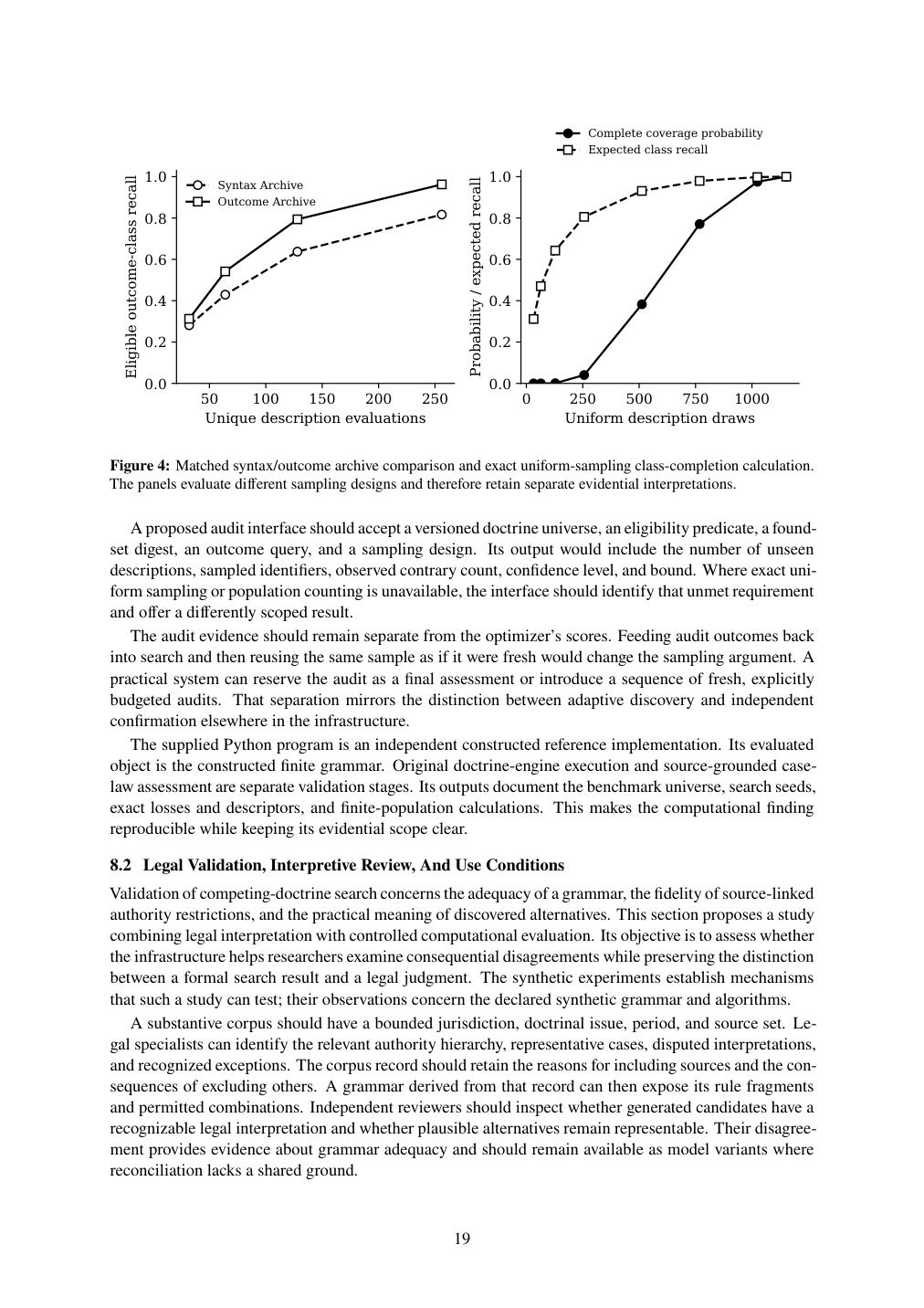
A matched archive ablation compares syntax and outcome descriptors under the same variation and replacement mechanism. At 128 evaluations their mean material-class recalls are 0.6375 and 0.79375, with zero mean best loss in both. Complete enumeration distinguishes 577 finite-domain semantic classes, including 93 eligible classes, from the twelve material query classes. Exact integer calculations show that 95 percent probability of discovering all material classes by uniform description draws first requires 971 of the 1,152 descriptions.
The framework extends Noetarium’s doctrine-search design through a separate audit target. Its finite propositions and numerical calculations concern declared synthetic models. A historical or jurisdictional use requires an independently coded source corpus, defensible authority relations, and a review of which doctrinal differences matter to the question.
2 Related Work And Evidential Targets
The comparative object in this section is the evidence produced by a search over competing legal descriptions. A system can discover a well-fitting doctrine, display several outcome classes, estimate the prevalence of contrary descriptions, or establish agreement throughout a declared finite universe. These targets require different computational and interpretive support. The literature already provides substantial foundations for theory construction, alternative interpretation, quality-diversity search, and statistical auditing. The present report coordinates those foundations around a legally material coverage question and preserves the distinction between its formal target and substantive legal judgment.
Legal theory construction is an established computational topic. Bench-Capon et al. (2003) develops a model of legal reasoning with cases that incorporates theories and values. The source establishes an important baseline: constructing, comparing, and applying legal theories predates the proposed search interface. The research question here concerns the evidential meaning of a search result when competing theories remain available. A low training loss shows agreement with the selected coded cases under the chosen loss. It leaves questions about admitted theories that predict different outcomes on legally significant queries. Coverage analysis adds an explicit object for examining those alternatives while retaining the interpretive importance of the case and value representations.
Alternative legal interpretations also have established representational support. LegalRuleML represents coexisting interpretations and their selection (Athan et al., 2014). That facility helps separate the description of an interpretation from a decision to privilege it. The finite grammar used here can be understood as a bounded family of candidate descriptions with declared authority restrictions. Its outcome descriptor then groups candidates according to selected queries. A translation to a richer legal representation would need to preserve applicability, authority, temporal scope, and source grounds. Search performance in a compact binary grammar gives evidence about the algorithmic mechanism; a legal application would require a separately justified translation and an examination of what the compact description omits.
Quality-diversity search supplies the closest algorithmic antecedent. MAP-Elites maintains highquality candidates across descriptor-defined regions (Mouret et al., 2015). The benchmark’s outcomeindexed archive inherits that central idea. The report-specific design concerns which differences count as legally material: two descriptions belong to different cells when they produce different answers to selected legal queries, subject to authority and fit restrictions. A standard quality-diversity method can implement that design. Its value therefore lies in aligning descriptor choice, admissibility, and evidential interpretation with the legal task, together with an audit of what search may have missed. Descriptor archives and mutation-based exploration are established ingredients inherited by the design.
Abductive explanation provides a neighboring logical target. Constraint-based methods can find subsetminimal or cardinality-minimal explanations for predictions (Ignatiev et al., 2019). Such explanations concern sufficient grounds within a specified model. Doctrine coverage concerns alternatives across a specified model family. A future system could combine them by showing a representative doctrine for each material outcome class and a sufficient explanation for its answer. Their correctness obligations remain distinct. Coverage asks whether a class has been found or might remain unseen; explanation asks whether the selected grounds suffice under a doctrine or constrained family. Preserving both targets would help users inspect disagreements without treating a concise explanation as evidence of exhaustive legal search.
Statistical auditing supplies an established language for bounded claims about unseen material. Conservative post-election audit work emphasizes explicit error control for a specified audit procedure (Stark, 2008). The present upper bound is a classical finite-population inversion. Companion Technical Report P13 applies the same mathematical ingredient to rejected allocation candidates (Huang, 2026). The distinctive legal issue concerns the audit population, the meaning of a contrary result, authority eligibility, and the relation between descriptions and semantic doctrines. These choices determine what the count bound measures. Reusing the mathematical ingredient is appropriate when the sampling contract is actually satisfied and the resulting claim preserves those units.
Adaptive data analysis provides another relevant boundary. Dwork et al. (2015) studies validity under adaptive reuse of holdout information. The lesson for the present design concerns the dependence between discovery and evaluation. Search can adaptively select queries, eligibility tolerances, and archive descriptors. A fresh audit conditional on a frozen discovery history can retain the finite-population argument because its subsequent sample is uniform within the fixed target. Reusing an audit after changing the target requires a new inferential design. Confidence sequences and e-values provide resources for sequential alternatives (Howard et al., 2021; Vovk et al., 2021); their application would need assumptions and construction suited to sampling without replacement and the selected legal target.
Scenario-based Bayesian evidence models address a related legal concern through a different object. Dahlman et al. (2026) studies scenario-based Bayesian networks for legal evidence. Such models can organize hypotheses about what happened and their evidential relations. A doctrine-search model concerns how a legal description maps facts to outcomes. The two can interact when uncertain scenarios supply fact inputs to several doctrines, but the distinction between factual uncertainty and doctrinal alternatives should remain explicit. A cross-product analysis would need an evidence model, an interpretation family, and a statement of how their dependencies are represented. The current synthetic grammar isolates the doctrinal mapping mechanism.
Finally, multiverse analysis emphasizes the transparency of conclusions across reasonable analytical choices (Steegen et al., 2016). The descriptor, loss weights, eligibility tolerance, and grammar restrictions in a doctrine search are such choices, although their legal acceptability requires substantive review. The executed extension varies several of them and reports how coverage changes. This comparison turns a general concern about flexibility into a checkable research design. The resulting contribution is a scoped framework for interpreting search evidence, with explicit units and conditional guarantees, supported by explicitly constructed computations and a proposed legal-validation protocol.
3 Authority And Finite Doctrine Universes
Authority, fit, and materiality specify different parts of a competing-doctrine analysis. A source-linked admission design supplies the substantive boundary, while the finite universe and loss definitions supply the objects used by search and audit.
3.1 Authority Restrictions And Material Diversity
A legal search grammar defines which candidate descriptions can be generated, while an authority specification determines which candidates qualify for a particular analysis. This section develops a proposed design for connecting those two objects to legally material diversity. The design preserves source grounds and distinguishes mandatory restrictions from discovery heuristics. Its purpose is to make the admissible universe reviewable before an algorithm’s coverage is interpreted.
A candidate description should carry a lineage: the source statements, coded cases, rule fragments, interpretive choices, and transformations used to construct it. The finite binary grammar in the benchmark has explicit syntactic restrictions and an exact prediction function. A substantive legal grammar would need richer objects, including rule applicability, exceptions, hierarchy, temporal scope, and jurisdiction. Those features can share a computational representation while retaining distinct legal meanings. The grammar should therefore expose its production rules and the source interpretation associated with each one. A change to a production rule changes the family over which any coverage claim is made.
Authority restrictions require a separate record. A candidate may be syntactically well formed and fit coded outcomes yet conflict with an applicable binding rule. Another candidate may depend on a contested interpretation of that rule. A third may be a deliberate reform proposal. These standings support different research questions. A study of current doctrinal alternatives can require a specified authority predicate. A study of possible legal reform can admit candidates under a different predicate. Mixing those families would make a count difficult to interpret. A source-linked restriction can identify the legal proposition, applicability conditions, interpretive ground, and reviewer decision supporting its inclusion or exclusion.
Material diversity concerns the selected queries. An outcome descriptor can represent remedies, liability, admissibility of evidence, a procedural entitlement, or another stated legal issue. Several binary queries provide a compact outcome vector, but their selection determines which disagreements the archive can expose. A description that agrees on the selected queries can still differ on other cases or legal reasons. The descriptor is therefore a task-specific quotient of the grammar. A report should identify the questions used to form that quotient and preserve the underlying descriptions so later queries can reclassify them.
Query selection can involve experts and affected participants. Experts can identify doctrinal distinctions and boundary cases. Affected participants can identify consequences that a narrow benchmark overlooks, such as differential procedural burdens or access to a remedy. Their input can generate addi-
Readable text
tional queries or stratification criteria. Search then becomes part of an iterative research process: propose material questions, discover alternatives, inspect their grounds, and revise the question set. Audit claims attach to a frozen stage of that process. The iteration itself is valuable, while inferential statements need
A materiality codebook can record each query’s fact pattern, legal issue, outcome vocabulary, source rationale, and scope. It should distinguish invented stress tests from actual cases. The present report uses explicitly invented feature patterns and an artificial threshold grammar. Its query vectors are computa- tional probes within that artificial grammar. In a substantive application, a query might be an anonymized actual case, a doctrinal hypothetical, or a systematically varied fact pattern. Each has a different eviden- tial role. An actual case can connect to a documented decision; a hypothetical can isolate a doctrinal distinction; a systematic variation can test sensitivity under the chosen fact representation.
The archive’s quality criterion should also remain visible. The benchmark keeps the lowest-loss ob- served description within each outcome cell. That choice provides a compact representative collection. It can hide differences in legal reasoning among equally predictive descriptions within a cell. A richer archive could retain several representatives selected by source lineage, reasoning structure, or value com- mitments. Such a design would require additional descriptors or within-cell diversity rules. Its evaluation should measure whether the additional representatives help reviewers understand disagreements, along-
The relation between authority, fit, and materiality supplies the report’s specific design problem. Au- thority specifies which descriptions are admitted for a question. Fit measures their relation to a coded corpus. Materiality specifies which consequences deserve distinct representation. Search explores their intersection and audit assesses a stated unseen population. These roles can inform one another without becoming interchangeable. Maintaining their source-linked interfaces allows a reviewer to revise one component and inspect the resulting changes in alternatives, coverage, and contrary-count claims. That revisability is central to a useful legal research infrastructure.
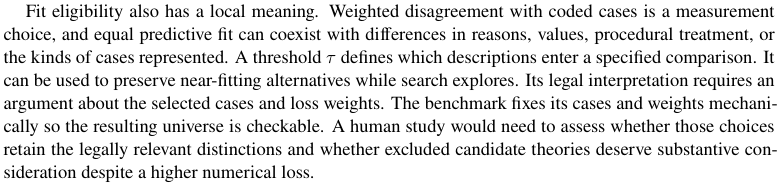
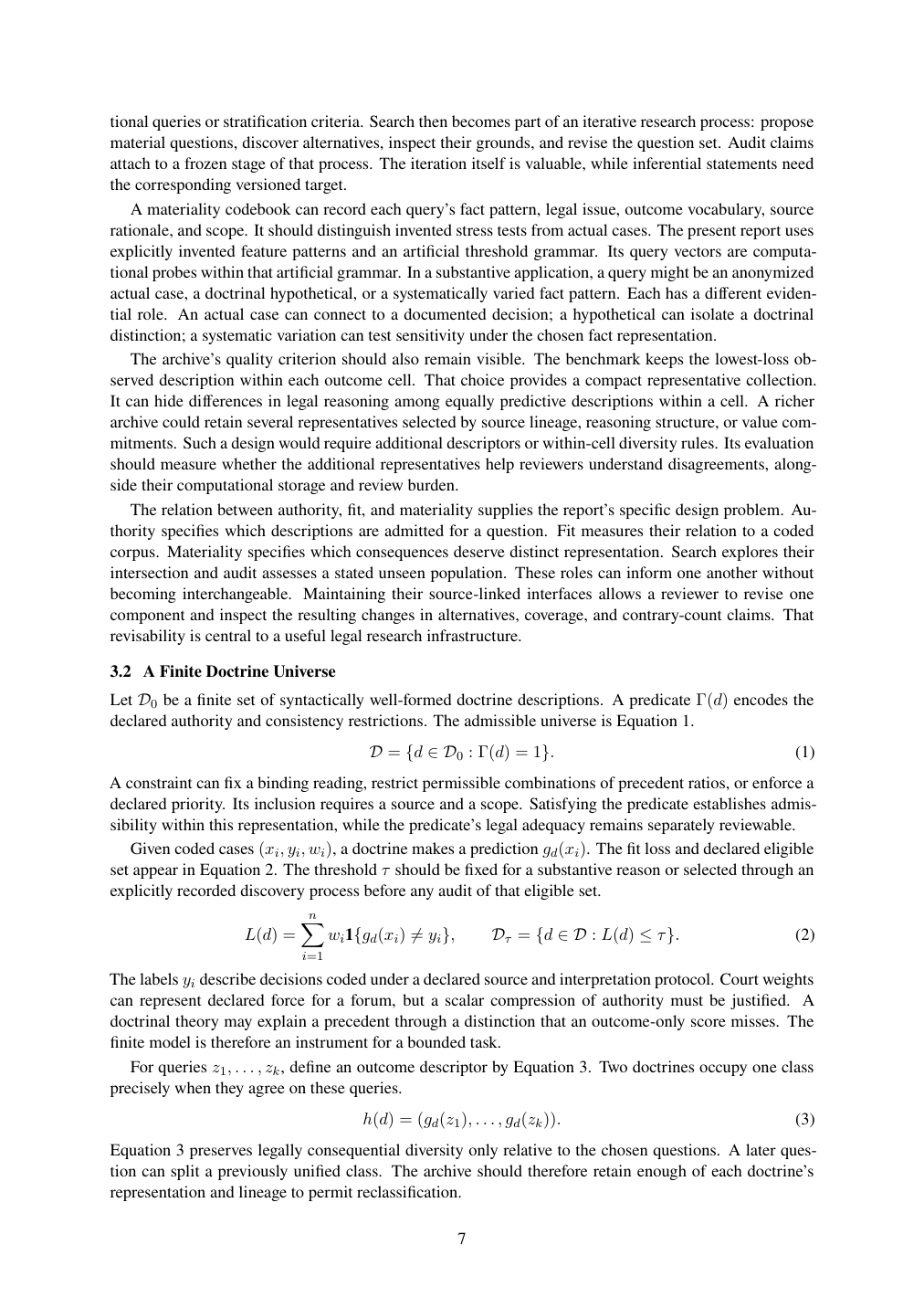
declared authority and consistency restrictions. The admissible universe is Equation 1.
A constraint can fix a binding reading, restrict permissible combinations of precedent ratios, or enforce a declared priority. Its inclusion requires a source and a scope. Satisfying the predicate establishes admis- sibility within this representation, while the predicate’s legal adequacy remains separately reviewable.
explicitly recorded discovery process before any audit of that eligible set.
can represent declared force for a forum, but a scalar compression of authority must be justified. A doctrinal theory may explain a precedent through a distinction that an outcome-only score misses. The finite model is therefore an instrument for a bounded task.
Equation 3 preserves legally consequential diversity only relative to the chosen questions. A later ques- tion can split a previously unified class. The archive should therefore retain enough of each doctrine’s
representation and lineage to permit reclassification.
4 Material Descriptors And Representation Units
Material descriptors partition a doctrine family by selected consequences. Refinement, stratification, and scenario interfaces clarify the units preserved by that partition and the additional distinctions that a legal inquiry may require.
4.1 Descriptor Refinement And Coverage Denominators
Descriptor refinement changes the equivalence classes used to summarize a doctrine family. This section establishes how refinement affects class counts and explains why a reported recall percentage can fall even when the set of found descriptions is unchanged. The result gives a formal interpretation to the executed two-, four-, and six-query sensitivity study. It also identifies which denominator an evaluation must report to make coverage comparisons meaningful.



Proof. For each coarse eligible class, choose an eligible description in that class. Its refined class projects to the selected coarse class, proving surjectivity. The same argument with a found eligible description proves the second statement. A surjection between finite sets implies the stated cardinality inequalities. Their ratio can move in either direction because numerator and denominator can grow by different factors. For a decrease, take one coarse class split into ten refined classes with only one found. For an increase, take two coarse classes with only one found, and let the found class split into ten found refined classes while the other remains one.
Proposition 4.1 explains a common interpretive difficulty in coverage plots. A method can discover exactly the same descriptions and obtain lower class recall after analysts ask additional questions. The decline then reflects a more discriminating target with an unchanged evaluated-description set. When the archive itself uses the refined descriptor, the search trajectory can also change because parents and elites are selected from different cells. The executed extension varies both the descriptor used by the archive and the descriptor used for evaluation. It therefore studies the complete descriptor-dependent method; a further ablation could freeze trajectories and evaluate them under several descriptors to isolate measurement effects alone.

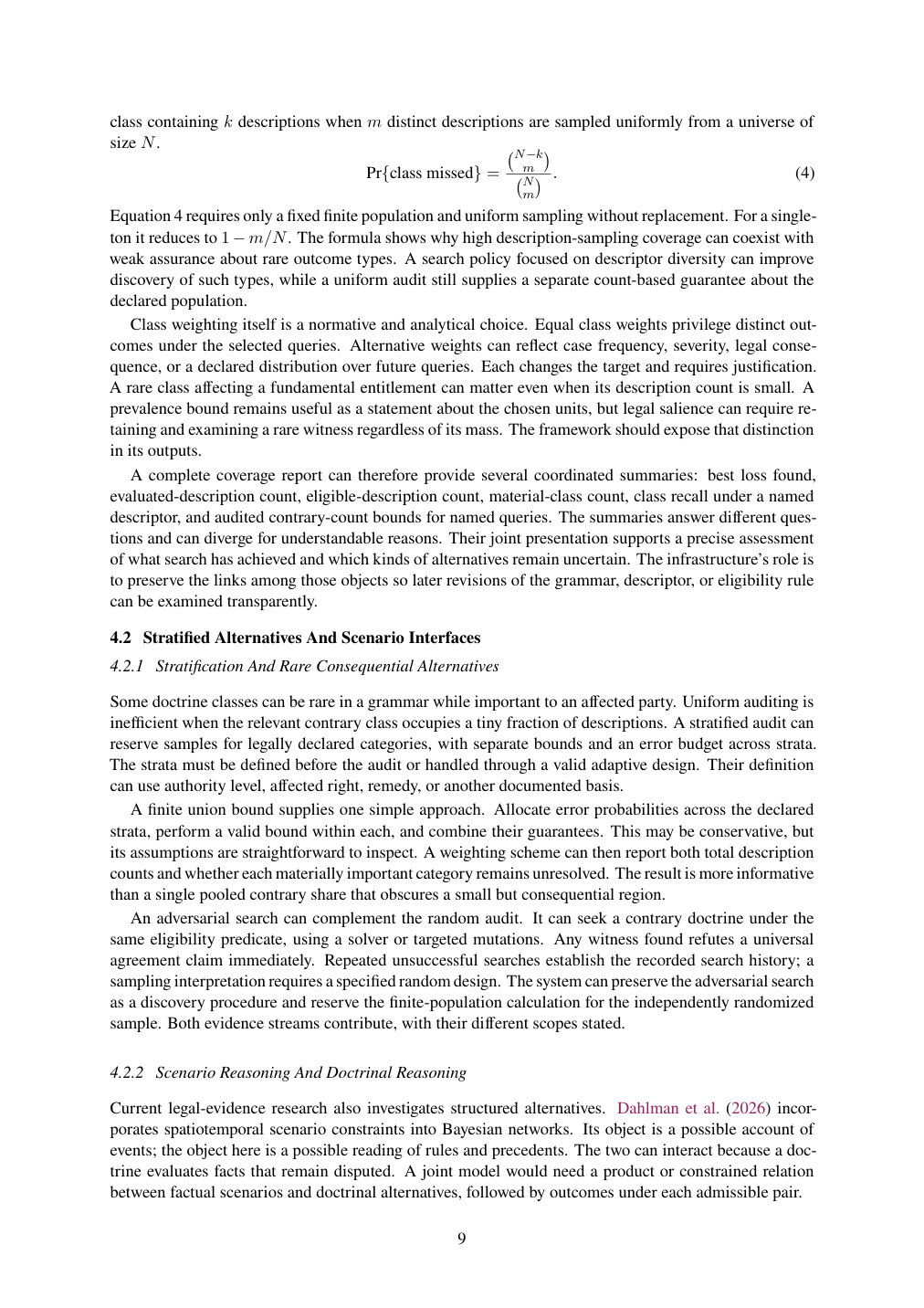
Rarity matters differently for class recall and prevalence audits. A class realized by one description receives the same class-recall weight as a class realized by a hundred descriptions. Uniform description sampling is much less likely to detect the singleton. Equation 4 gives the exact probability of missing a
Readable text
Equation 4 requires only a fixed finite population and uniform sampling without replacement. For a single- weak assurance about rare outcome types. A search policy focused on descriptor diversity can improve discovery of such types, while a uniform audit still supplies a separate count-based guarantee about the
Class weighting itself is a normative and analytical choice. Equal class weights privilege distinct out- comes under the selected queries. Alternative weights can reflect case frequency, severity, legal conse- quence, or a declared distribution over future queries. Each changes the target and requires justification. A rare class affecting a fundamental entitlement can matter even when its description count is small. A prevalence bound remains useful as a statement about the chosen units, but legal salience can require re- taining and examining a rare witness regardless of its mass. The framework should expose that distinction
A complete coverage report can therefore provide several coordinated summaries: best loss found, evaluated-description count, eligible-description count, material-class count, class recall under a named descriptor, and audited contrary-count bounds for named queries. The summaries answer different ques- tions and can diverge for understandable reasons. Their joint presentation supports a precise assessment of what search has achieved and which kinds of alternatives remain uncertain. The infrastructure’s role is to preserve the links among those objects so later revisions of the grammar, descriptor, or eligibility rule
4.2.1 Stratification And Rare Consequential Alternatives
Some doctrine classes can be rare in a grammar while important to an affected party. Uniform auditing is inefficient when the relevant contrary class occupies a tiny fraction of descriptions. A stratified audit can reserve samples for legally declared categories, with separate bounds and an error budget across strata. The strata must be defined before the audit or handled through a valid adaptive design. Their definition can use authority level, affected right, remedy, or another documented basis.
A finite union bound supplies one simple approach. Allocate error probabilities across the declared strata, perform a valid bound within each, and combine their guarantees. This may be conservative, but its assumptions are straightforward to inspect. A weighting scheme can then report both total description counts and whether each materially important category remains unresolved. The result is more informative than a single pooled contrary share that obscures a small but consequential region.
An adversarial search can complement the random audit. It can seek a contrary doctrine under the same eligibility predicate, using a solver or targeted mutations. Any witness found refutes a universal agreement claim immediately. Repeated unsuccessful searches establish the recorded search history; a sampling interpretation requires a specified random design. The system can preserve the adversarial search as a discovery procedure and reserve the finite-population calculation for the independently randomized sample. Both evidence streams contribute, with their different scopes stated.
Current legal-evidence research also investigates structured alternatives. Dahlman et al. (2026) incor- porates spatiotemporal scenario constraints into Bayesian networks. Its object is a possible account of events; the object here is a possible reading of rules and precedents. The two can interact because a doc- trine evaluates facts that remain disputed. A joint model would need a product or constrained relation between factual scenarios and doctrinal alternatives, followed by outcomes under each admissible pair.
Readable text
That extension creates a useful distinction between interpretive and factual robustness. A decision can be constant across doctrines for one factual scenario yet vary across factual scenarios under every doctrine. It can also vary across doctrines even when the facts are fixed. A report should show which source of variation drives its uncertainty. A mixed archive can retain separate identifiers and provenance for both coordinates so that later evidence updates the relevant part of the analysis.
An audit of the joint space would require a declared population or sampling measure over pairs. Multi- plying independent uniform measures can inadvertently overcount a doctrine with many syntactic variants or a scenario with many equivalent descriptions. The representation-multiplicity issue therefore becomes more consequential in heterogeneous legal reasoning. A technical extension should begin with a precisely bounded equivalence relation and a sampling mechanism whose induced target can be explained.
An audit statement concerns a fixed population, target predicate, and randomized sampling contract. The finite inversion and its conditional interpretation specify what discovery history, eligibility, authority, and
evaluations, fit, descriptor novelty, or external proposals to choose its next candidate. The archive provides
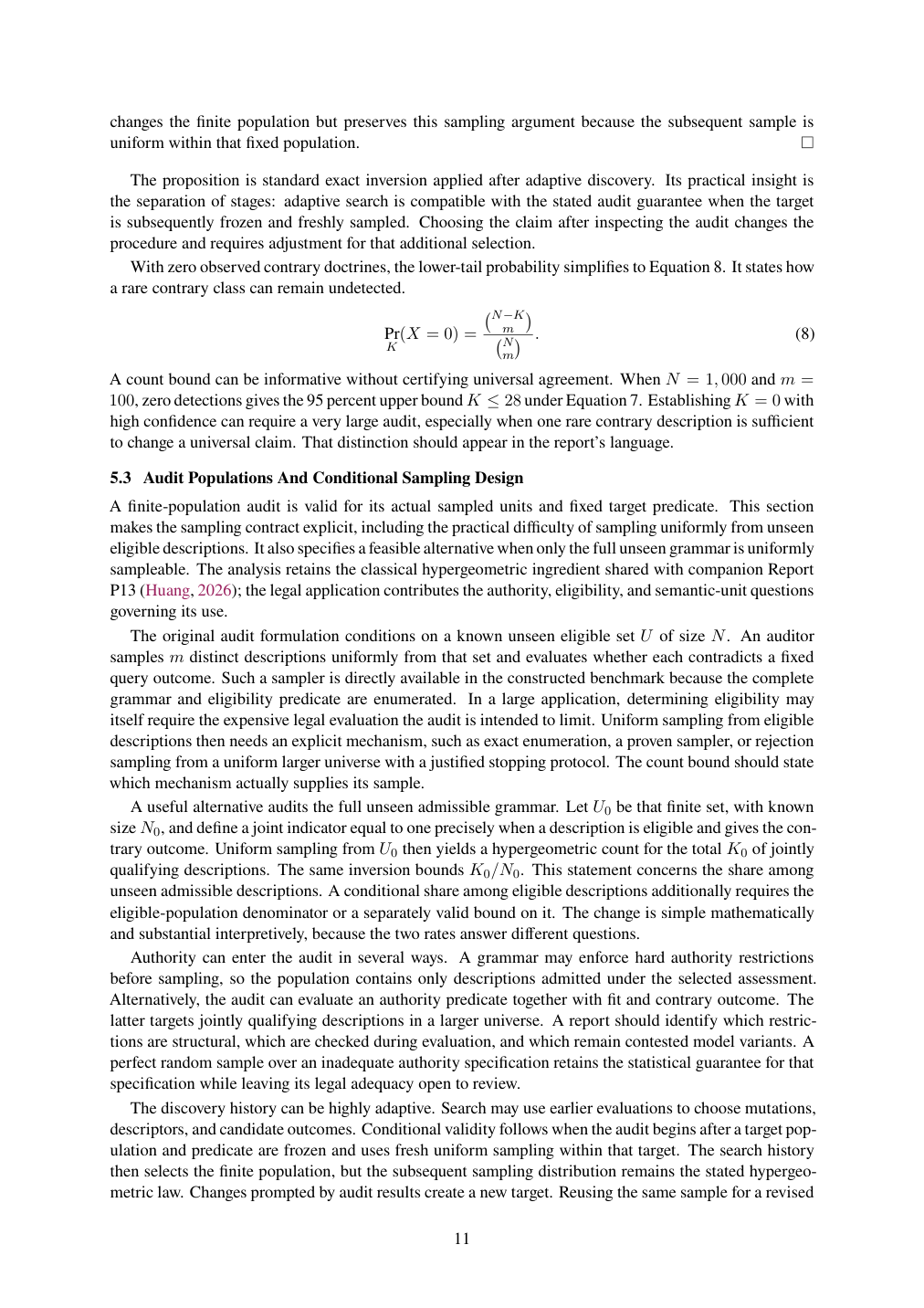
population, the number of observed contrary doctrines has the law in Equation 6.
The count model in Equation 6 requires an actual uniform sampler from the target population. Uniform sampling of syntax descriptions can induce a different distribution over semantic doctrines when multiple descriptions denote the same theory. The study fixes a finite description universe, so its count statement concerns descriptions. A semantic quotient would need its own enumeration or sampling method.
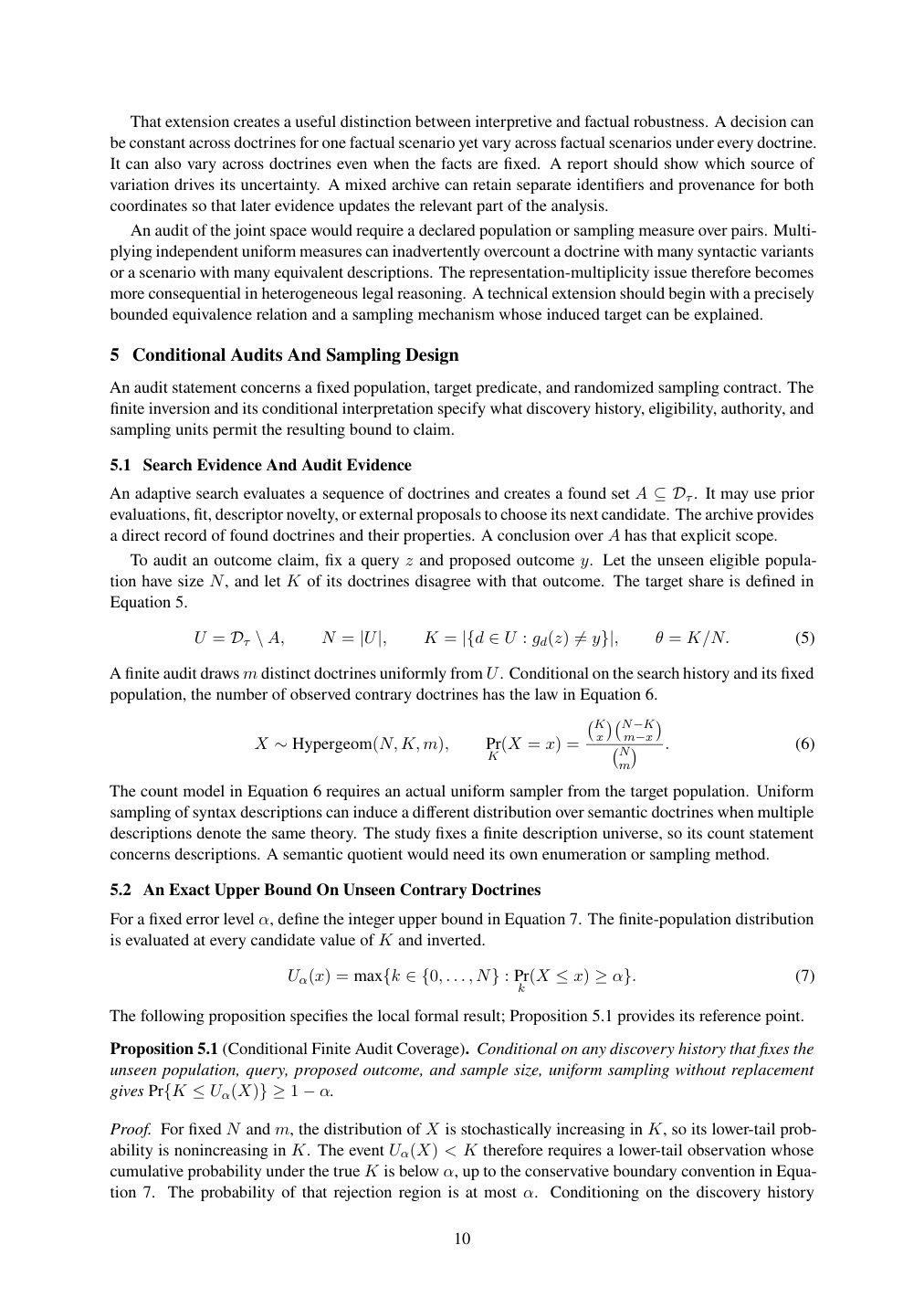
The following proposition specifies the local formal result; Proposition 5.1 provides its reference point.
Proposition 5.1 (Conditional Finite Audit Coverage). Conditional on any discovery history that fixes the unseen population, query, proposed outcome, and sample size, uniform sampling without replacement
Readable text
changes the finite population but preserves this sampling argument because the subsequent sample is
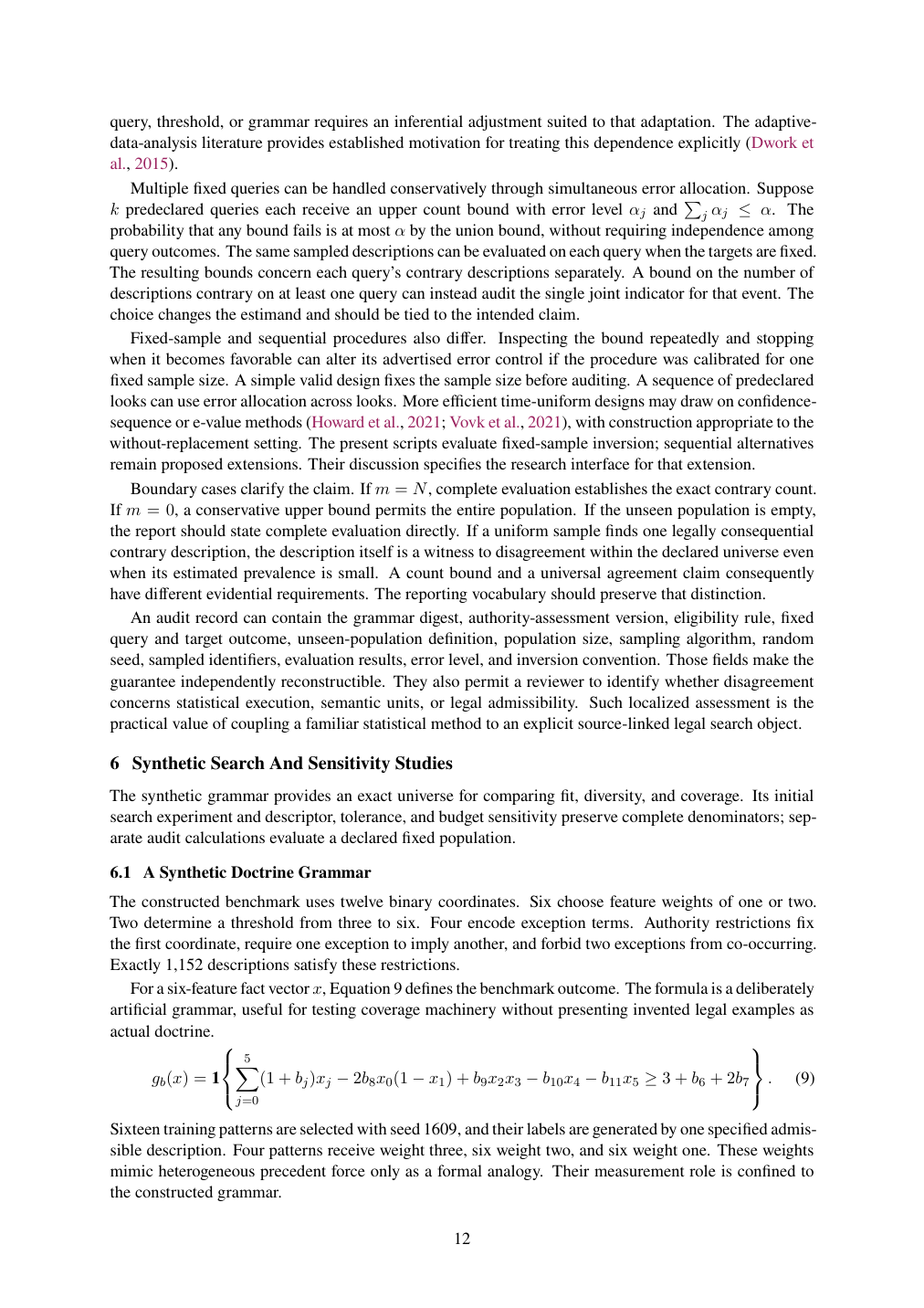
The proposition is standard exact inversion applied after adaptive discovery. Its practical insight is the separation of stages: adaptive search is compatible with the stated audit guarantee when the target is subsequently frozen and freshly sampled. Choosing the claim after inspecting the audit changes the procedure and requires adjustment for that additional selection.
With zero observed contrary doctrines, the lower-tail probability simplifies to Equation 8. It states how
high confidence can require a very large audit, especially when one rare contrary description is sufficient to change a universal claim. That distinction should appear in the report’s language.
A finite-population audit is valid for its actual sampled units and fixed target predicate. This section makes the sampling contract explicit, including the practical difficulty of sampling uniformly from unseen eligible descriptions. It also specifies a feasible alternative when only the full unseen grammar is uniformly sampleable. The analysis retains the classical hypergeometric ingredient shared with companion Report P13 (Huang, 2026); the legal application contributes the authority, eligibility, and semantic-unit questions
query outcome. Such a sampler is directly available in the constructed benchmark because the complete grammar and eligibility predicate are enumerated. In a large application, determining eligibility may itself require the expensive legal evaluation the audit is intended to limit. Uniform sampling from eligible descriptions then needs an explicit mechanism, such as exact enumeration, a proven sampler, or rejection sampling from a uniform larger universe with a justified stopping protocol. The count bound should state
unseen admissible descriptions. A conditional share among eligible descriptions additionally requires the eligible-population denominator or a separately valid bound on it. The change is simple mathematically and substantial interpretively, because the two rates answer different questions.
Authority can enter the audit in several ways. A grammar may enforce hard authority restrictions before sampling, so the population contains only descriptions admitted under the selected assessment. Alternatively, the audit can evaluate an authority predicate together with fit and contrary outcome. The latter targets jointly qualifying descriptions in a larger universe. A report should identify which restric- tions are structural, which are checked during evaluation, and which remain contested model variants. A perfect random sample over an inadequate authority specification retains the statistical guarantee for that specification while leaving its legal adequacy open to review.
The discovery history can be highly adaptive. Search may use earlier evaluations to choose mutations, descriptors, and candidate outcomes. Conditional validity follows when the audit begins after a target pop- ulation and predicate are frozen and uses fresh uniform sampling within that target. The search history then selects the finite population, but the subsequent sampling distribution remains the stated hypergeo- metric law. Changes prompted by audit results create a new target. Reusing the same sample for a revised
Readable text
query, threshold, or grammar requires an inferential adjustment suited to that adaptation. The adaptive- data-analysis literature provides established motivation for treating this dependence explicitly (Dwork et
Multiple fixed queries can be handled conservatively through simultaneous error allocation. Suppose
query outcomes. The same sampled descriptions can be evaluated on each query when the targets are fixed. The resulting bounds concern each query’s contrary descriptions separately. A bound on the number of descriptions contrary on at least one query can instead audit the single joint indicator for that event. The choice changes the estimand and should be tied to the intended claim.
Fixed-sample and sequential procedures also differ. Inspecting the bound repeatedly and stopping when it becomes favorable can alter its advertised error control if the procedure was calibrated for one fixed sample size. A simple valid design fixes the sample size before auditing. A sequence of predeclared looks can use error allocation across looks. More efficient time-uniform designs may draw on confidence- sequence or e-value methods (Howard et al., 2021; Vovk et al., 2021), with construction appropriate to the without-replacement setting. The present scripts evaluate fixed-sample inversion; sequential alternatives remain proposed extensions. Their discussion specifies the research interface for that extension.
the report should state complete evaluation directly. If a uniform sample finds one legally consequential contrary description, the description itself is a witness to disagreement within the declared universe even when its estimated prevalence is small. A count bound and a universal agreement claim consequently have different evidential requirements. The reporting vocabulary should preserve that distinction.
An audit record can contain the grammar digest, authority-assessment version, eligibility rule, fixed query and target outcome, unseen-population definition, population size, sampling algorithm, random seed, sampled identifiers, evaluation results, error level, and inversion convention. Those fields make the guarantee independently reconstructible. They also permit a reviewer to identify whether disagreement concerns statistical execution, semantic units, or legal admissibility. Such localized assessment is the practical value of coupling a familiar statistical method to an explicit source-linked legal search object.
The synthetic grammar provides an exact universe for comparing fit, diversity, and coverage. Its initial search experiment and descriptor, tolerance, and budget sensitivity preserve complete denominators; sep- arate audit calculations evaluate a declared fixed population.
The constructed benchmark uses twelve binary coordinates. Six choose feature weights of one or two. Two determine a threshold from three to six. Four encode exception terms. Authority restrictions fix the first coordinate, require one exception to imply another, and forbid two exceptions from co-occurring.
artificial grammar, useful for testing coverage machinery without presenting invented legal examples as
Sixteen training patterns are selected with seed 1609, and their labels are generated by one specified admis- sible description. Four patterns receive weight three, six weight two, and six weight one. These weights mimic heterogeneous precedent force only as a formal analogy. Their measurement role is confined to
Readable text
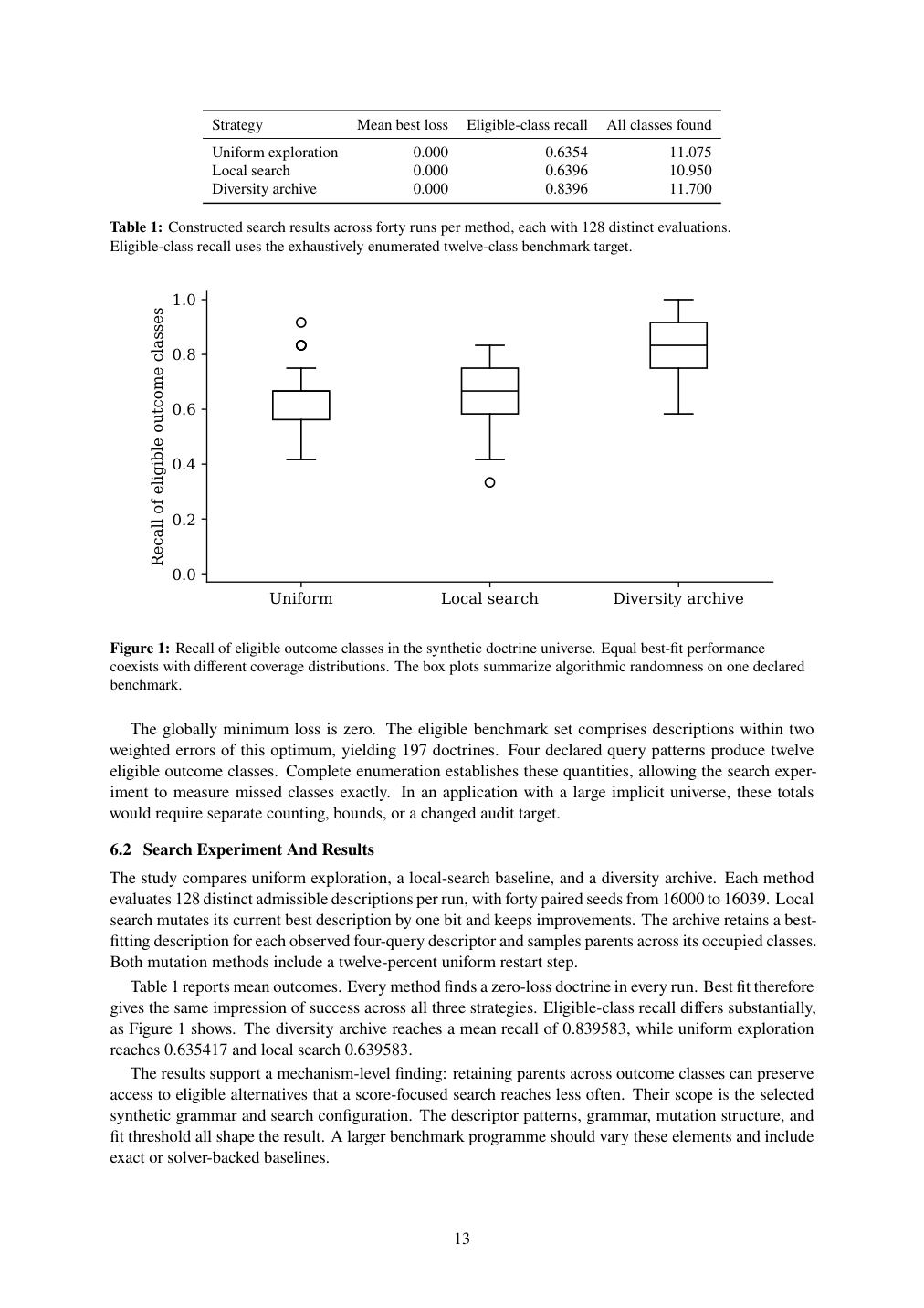
Uniform exploration 0.000 Local search 0.000 Diversity archive 0.000
Table 1: Constructed search results across forty runs per method, each with 128 distinct evaluations. Eligible-class recall uses the exhaustively enumerated twelve-class benchmark target.
Figure 1: Recall of eligible outcome classes in the synthetic doctrine universe. Equal best-fit performance coexists with different coverage distributions. The box plots summarize algorithmic randomness on one declared
The globally minimum loss is zero. The eligible benchmark set comprises descriptions within two weighted errors of this optimum, yielding 197 doctrines. Four declared query patterns produce twelve eligible outcome classes. Complete enumeration establishes these quantities, allowing the search exper- iment to measure missed classes exactly. In an application with a large implicit universe, these totals would require separate counting, bounds, or a changed audit target.
The study compares uniform exploration, a local-search baseline, and a diversity archive. Each method evaluates 128 distinct admissible descriptions per run, with forty paired seeds from 16000 to 16039. Local search mutates its current best description by one bit and keeps improvements. The archive retains a best- fitting description for each observed four-query descriptor and samples parents across its occupied classes. Both mutation methods include a twelve-percent uniform restart step.
Table 1 reports mean outcomes. Every method finds a zero-loss doctrine in every run. Best fit therefore gives the same impression of success across all three strategies. Eligible-class recall differs substantially, as Figure 1 shows. The diversity archive reaches a mean recall of 0.839583, while uniform exploration
The results support a mechanism-level finding: retaining parents across outcome classes can preserve access to eligible alternatives that a score-focused search reaches less often. Their scope is the selected synthetic grammar and search configuration. The descriptor patterns, grammar, mutation structure, and fit threshold all shape the result. A larger benchmark programme should vary these elements and include
Readable text
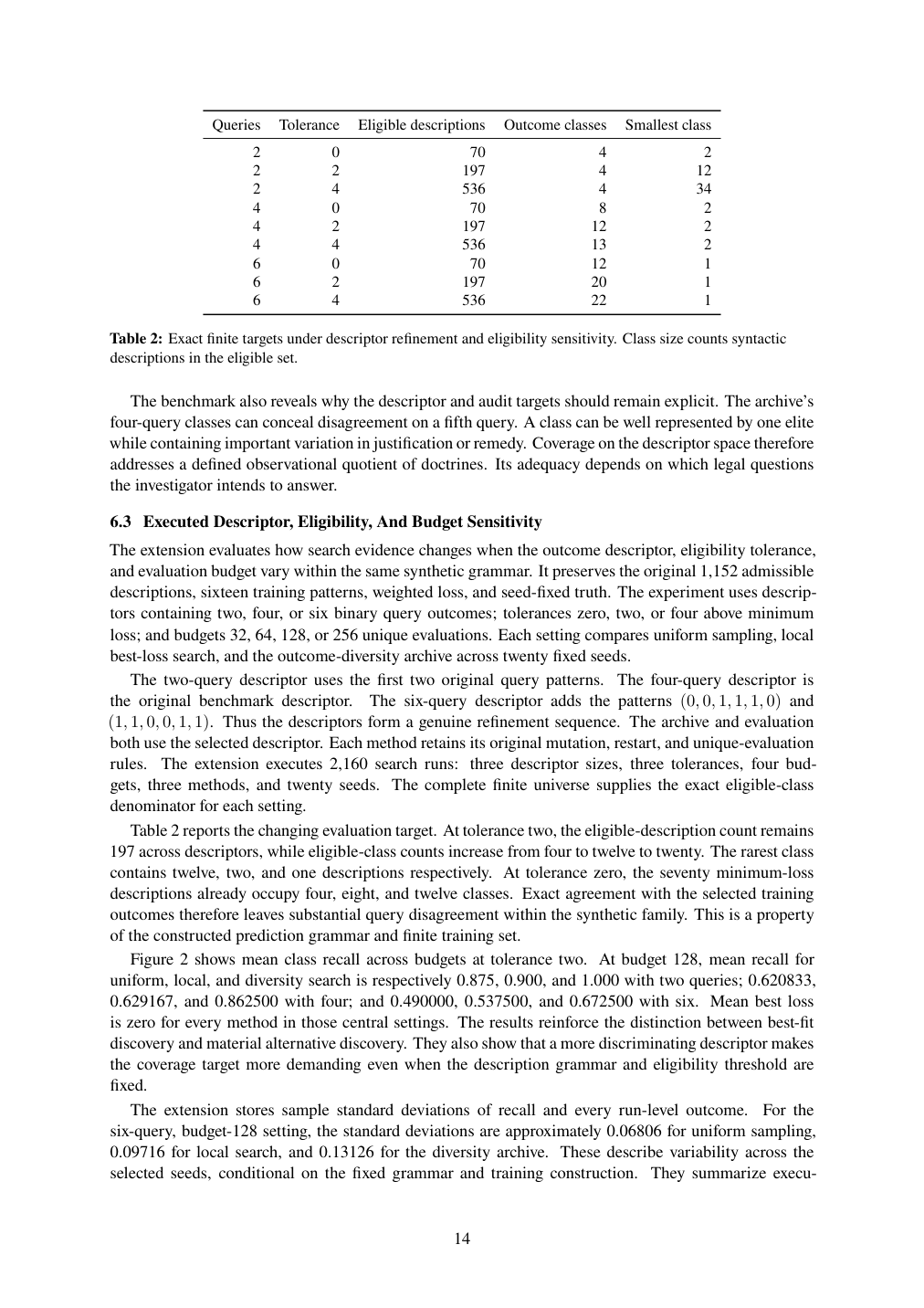
Table 2: Exact finite targets under descriptor refinement and eligibility sensitivity. Class size counts syntactic
The benchmark also reveals why the descriptor and audit targets should remain explicit. The archive’s four-query classes can conceal disagreement on a fifth query. A class can be well represented by one elite while containing important variation in justification or remedy. Coverage on the descriptor space therefore addresses a defined observational quotient of doctrines. Its adequacy depends on which legal questions
6.3 Executed Descriptor, Eligibility, And Budget Sensitivity
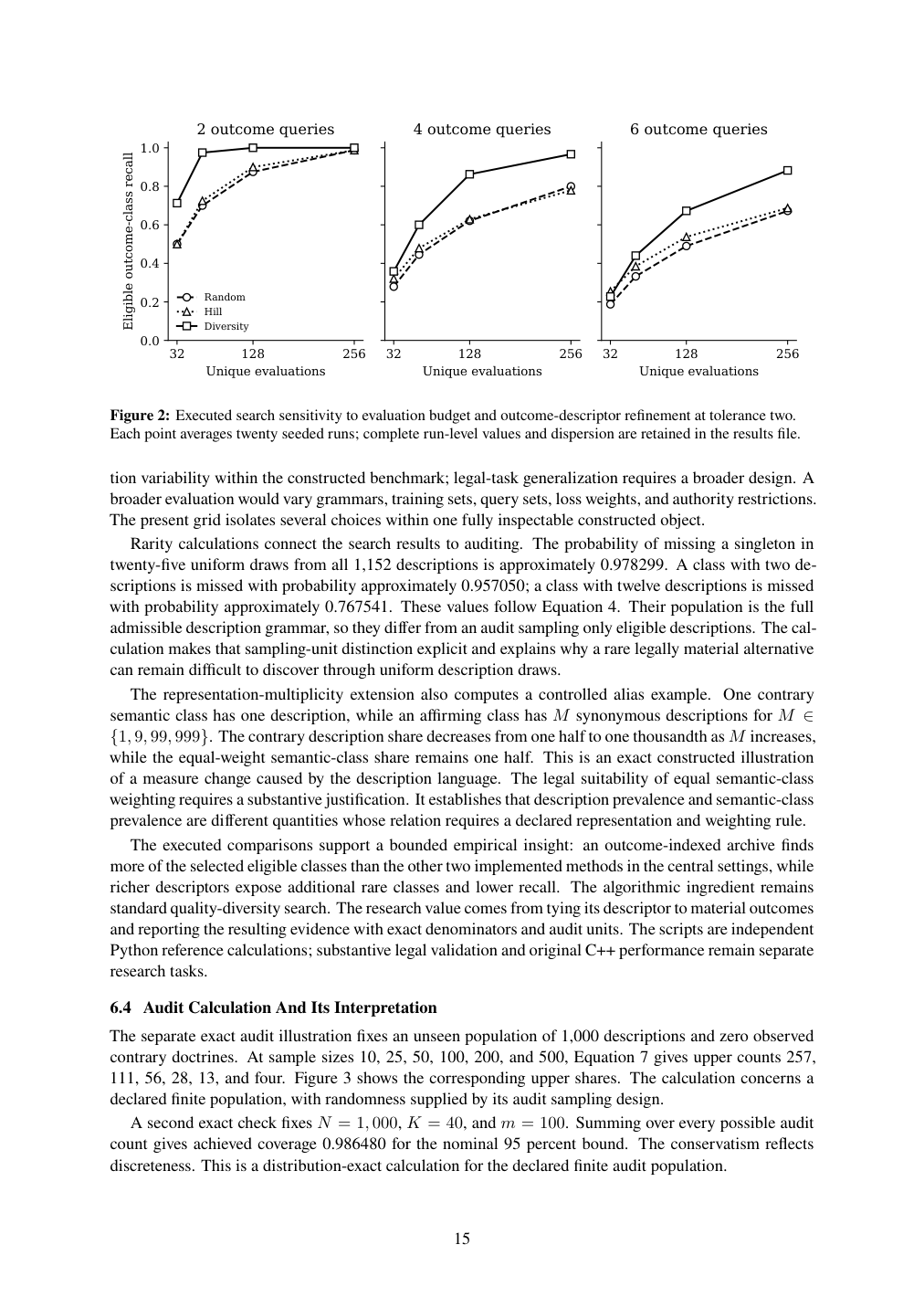
The extension evaluates how search evidence changes when the outcome descriptor, eligibility tolerance, and evaluation budget vary within the same synthetic grammar. It preserves the original 1,152 admissible descriptions, sixteen training patterns, weighted loss, and seed-fixed truth. The experiment uses descrip- tors containing two, four, or six binary query outcomes; tolerances zero, two, or four above minimum loss; and budgets 32, 64, 128, or 256 unique evaluations. Each setting compares uniform sampling, local best-loss search, and the outcome-diversity archive across twenty fixed seeds.
The two-query descriptor uses the first two original query patterns. The four-query descriptor is
both use the selected descriptor. Each method retains its original mutation, restart, and unique-evaluation The extension executes 2,160 search runs: three descriptor sizes, three tolerances, four bud- gets, three methods, and twenty seeds. The complete finite universe supplies the exact eligible-class
Table 2 reports the changing evaluation target. At tolerance two, the eligible-description count remains 197 across descriptors, while eligible-class counts increase from four to twelve to twenty. The rarest class contains twelve, two, and one descriptions respectively. At tolerance zero, the seventy minimum-loss descriptions already occupy four, eight, and twelve classes. Exact agreement with the selected training outcomes therefore leaves substantial query disagreement within the synthetic family. This is a property of the constructed prediction grammar and finite training set.
Figure 2 shows mean class recall across budgets at tolerance two. At budget 128, mean recall for uniform, local, and diversity search is respectively 0.875, 0.900, and 1.000 with two queries; 0.620833, 0.629167, and 0.862500 with four; and 0.490000, 0.537500, and 0.672500 with six. Mean best loss is zero for every method in those central settings. The results reinforce the distinction between best-fit discovery and material alternative discovery. They also show that a more discriminating descriptor makes the coverage target more demanding even when the description grammar and eligibility threshold are
The extension stores sample standard deviations of recall and every run-level outcome. six-query, budget-128 setting, the standard deviations are approximately 0.06806 for uniform sampling, 0.09716 for local search, and 0.13126 for the diversity archive. These describe variability across the selected seeds, conditional on the fixed grammar and training construction. They summarize execu-
Readable text
Figure 2: Executed search sensitivity to evaluation budget and outcome-descriptor refinement at tolerance two. Each point averages twenty seeded runs; complete run-level values and dispersion are retained in the results file.
tion variability within the constructed benchmark; legal-task generalization requires a broader design. A broader evaluation would vary grammars, training sets, query sets, loss weights, and authority restrictions. The present grid isolates several choices within one fully inspectable constructed object.
Rarity calculations connect the search results to auditing. The probability of missing a singleton in twenty-five uniform draws from all 1,152 descriptions is approximately 0.978299. A class with two de- scriptions is missed with probability approximately 0.957050; a class with twelve descriptions is missed with probability approximately 0.767541. These values follow Equation 4. Their population is the full admissible description grammar, so they differ from an audit sampling only eligible descriptions. The cal- culation makes that sampling-unit distinction explicit and explains why a rare legally material alternative can remain difficult to discover through uniform description draws.
The representation-multiplicity extension also computes a controlled alias example. One contrary while the equal-weight semantic-class share remains one half. This is an exact constructed illustration of a measure change caused by the description language. The legal suitability of equal semantic-class weighting requires a substantive justification. It establishes that description prevalence and semantic-class prevalence are different quantities whose relation requires a declared representation and weighting rule.
The executed comparisons support a bounded empirical insight: an outcome-indexed archive finds more of the selected eligible classes than the other two implemented methods in the central settings, while richer descriptors expose additional rare classes and lower recall. The algorithmic ingredient remains standard quality-diversity search. The research value comes from tying its descriptor to material outcomes and reporting the resulting evidence with exact denominators and audit units. The scripts are independent Python reference calculations; substantive legal validation and original C++ performance remain separate
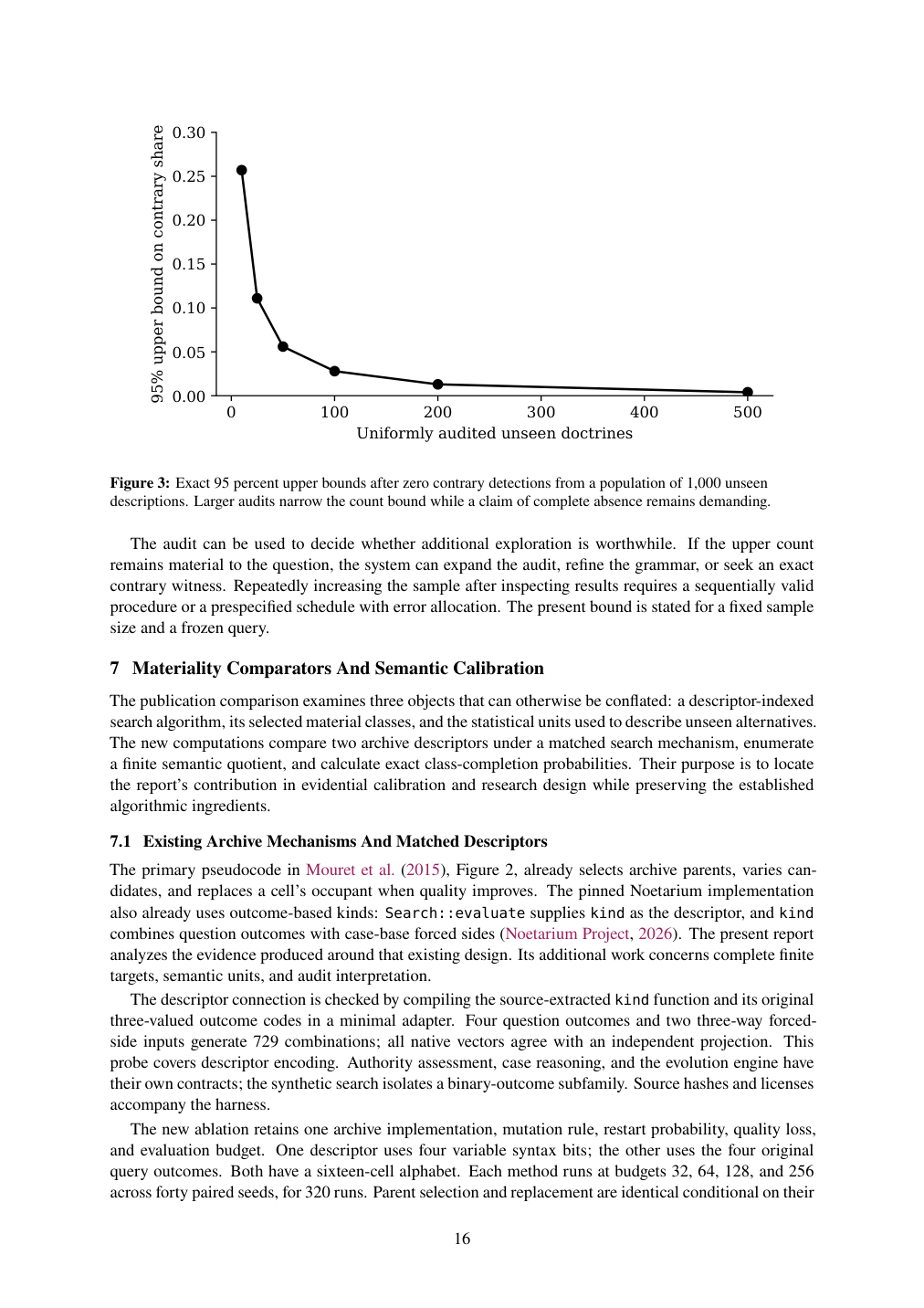
The separate exact audit illustration fixes an unseen population of 1,000 descriptions and zero observed contrary doctrines. At sample sizes 10, 25, 50, 100, 200, and 500, Equation 7 gives upper counts 257, 111, 56, 28, 13, and four. Figure 3 shows the corresponding upper shares. The calculation concerns a declared finite population, with randomness supplied by its audit sampling design.
count gives achieved coverage 0.986480 for the nominal 95 percent bound. The conservatism reflects discreteness. This is a distribution-exact calculation for the declared finite audit population.
Readable text
Figure 3: Exact 95 percent upper bounds after zero contrary detections from a population of 1,000 unseen descriptions. Larger audits narrow the count bound while a claim of complete absence remains demanding.
The audit can be used to decide whether additional exploration is worthwhile. If the upper count remains material to the question, the system can expand the audit, refine the grammar, or seek an exact contrary witness. Repeatedly increasing the sample after inspecting results requires a sequentially valid procedure or a prespecified schedule with error allocation. The present bound is stated for a fixed sample
The publication comparison examines three objects that can otherwise be conflated: a descriptor-indexed search algorithm, its selected material classes, and the statistical units used to describe unseen alternatives. The new computations compare two archive descriptors under a matched search mechanism, enumerate a finite semantic quotient, and calculate exact class-completion probabilities. Their purpose is to locate the report’s contribution in evidential calibration and research design while preserving the established
7.1 Existing Archive Mechanisms And Matched Descriptors
The primary pseudocode in Mouret et al. (2015), Figure 2, already selects archive parents, varies can- didates, and replaces a cell’s occupant when quality improves. The pinned Noetarium implementation also already uses outcome-based kinds: Search::evaluate supplies kind as the descriptor, and kind combines question outcomes with case-base forced sides (Noetarium Project, 2026). The present report analyzes the evidence produced around that existing design. Its additional work concerns complete finite
The descriptor connection is checked by compiling the source-extracted kind function and its original three-valued outcome codes in a minimal adapter. Four question outcomes and two three-way forced- side inputs generate 729 combinations; all native vectors agree with an independent projection. This probe covers descriptor encoding. Authority assessment, case reasoning, and the evolution engine have their own contracts; the synthetic search isolates a binary-outcome subfamily. Source hashes and licenses
The new ablation retains one archive implementation, mutation rule, restart probability, quality loss, and evaluation budget. One descriptor uses four variable syntax bits; the other uses the four original query outcomes. Both have a sixteen-cell alphabet. Each method runs at budgets 32, 64, 128, and 256 across forty paired seeds, for 320 runs. Parent selection and replacement are identical conditional on their
Readable text
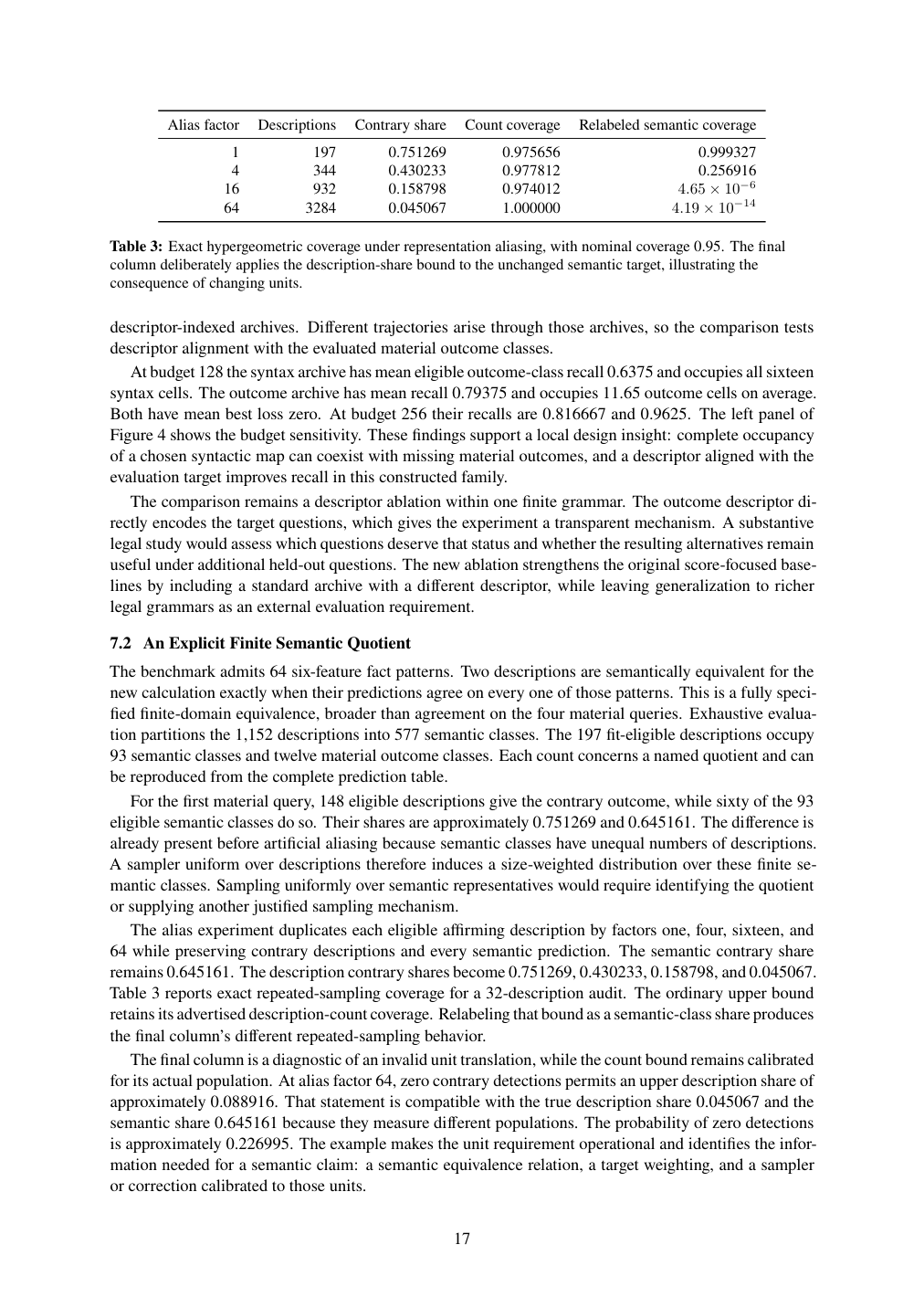
Table 3: Exact hypergeometric coverage under representation aliasing, with nominal coverage 0.95. The final column deliberately applies the description-share bound to the unchanged semantic target, illustrating the
descriptor-indexed archives. Different trajectories arise through those archives, so the comparison tests descriptor alignment with the evaluated material outcome classes.
At budget 128 the syntax archive has mean eligible outcome-class recall 0.6375 and occupies all sixteen syntax cells. The outcome archive has mean recall 0.79375 and occupies 11.65 outcome cells on average. Both have mean best loss zero. At budget 256 their recalls are 0.816667 and 0.9625. The left panel of Figure 4 shows the budget sensitivity. These findings support a local design insight: complete occupancy of a chosen syntactic map can coexist with missing material outcomes, and a descriptor aligned with the evaluation target improves recall in this constructed family.
The comparison remains a descriptor ablation within one finite grammar. The outcome descriptor di- rectly encodes the target questions, which gives the experiment a transparent mechanism. A substantive legal study would assess which questions deserve that status and whether the resulting alternatives remain useful under additional held-out questions. The new ablation strengthens the original score-focused base- lines by including a standard archive with a different descriptor, while leaving generalization to richer
legal grammars as an external evaluation requirement.
The benchmark admits 64 six-feature fact patterns. Two descriptions are semantically equivalent for the new calculation exactly when their predictions agree on every one of those patterns. This is a fully speci- fied finite-domain equivalence, broader than agreement on the four material queries. Exhaustive evalua- tion partitions the 1,152 descriptions into 577 semantic classes. The 197 fit-eligible descriptions occupy 93 semantic classes and twelve material outcome classes. Each count concerns a named quotient and can
For the first material query, 148 eligible descriptions give the contrary outcome, while sixty of the 93 eligible semantic classes do so. Their shares are approximately 0.751269 and 0.645161. The difference is already present before artificial aliasing because semantic classes have unequal numbers of descriptions. A sampler uniform over descriptions therefore induces a size-weighted distribution over these finite se- mantic classes. Sampling uniformly over semantic representatives would require identifying the quotient
The alias experiment duplicates each eligible affirming description by factors one, four, sixteen, and 64 while preserving contrary descriptions and every semantic prediction. The semantic contrary share remains 0.645161. The description contrary shares become 0.751269, 0.430233, 0.158798, and 0.045067. Table 3 reports exact repeated-sampling coverage for a 32-description audit. The ordinary upper bound retains its advertised description-count coverage. Relabeling that bound as a semantic-class share produces the final column’s different repeated-sampling behavior.
The final column is a diagnostic of an invalid unit translation, while the count bound remains calibrated for its actual population. At alias factor 64, zero contrary detections permits an upper description share of approximately 0.088916. That statement is compatible with the true description share 0.045067 and the semantic share 0.645161 because they measure different populations. The probability of zero detections is approximately 0.226995. The example makes the unit requirement operational and identifies the infor- mation needed for a semantic claim: a semantic equivalence relation, a target weighting, and a sampler
Readable text
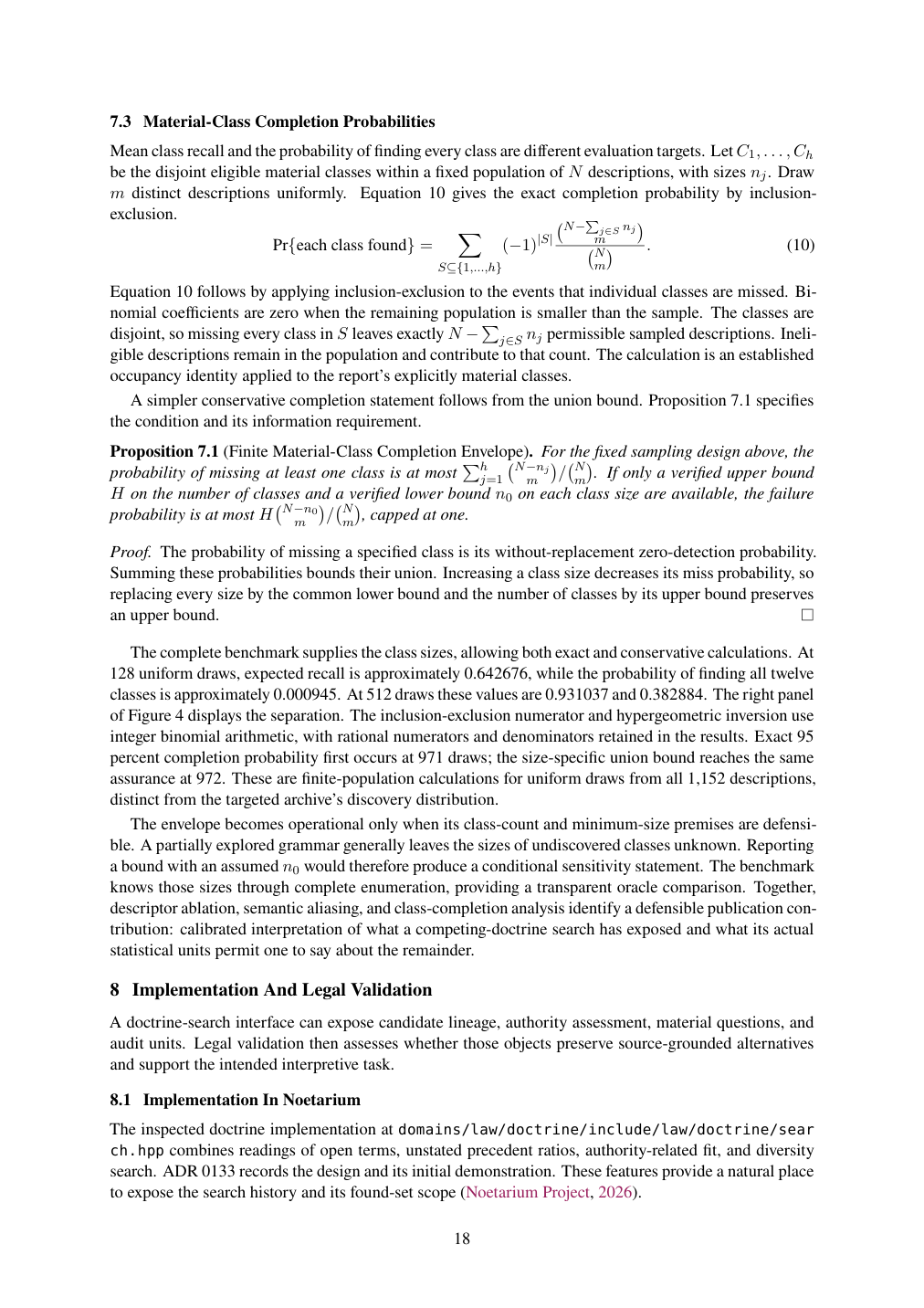
Equation 10 follows by applying inclusion-exclusion to the events that individual classes are missed. Bi- nomial coefficients are zero when the remaining population is smaller than the sample. The classes are
gible descriptions remain in the population and contribute to that count. The calculation is an established occupancy identity applied to the report’s explicitly material classes.
A simpler conservative completion statement follows from the union bound. Proposition 7.1 specifies
Proposition 7.1 (Finite Material-Class Completion Envelope). For the fixed sampling design above, the
Proof. The probability of missing a specified class is its without-replacement zero-detection probability. Summing these probabilities bounds their union. Increasing a class size decreases its miss probability, so replacing every size by the common lower bound and the number of classes by its upper bound preserves
The complete benchmark supplies the class sizes, allowing both exact and conservative calculations. At 128 uniform draws, expected recall is approximately 0.642676, while the probability of finding all twelve classes is approximately 0.000945. At 512 draws these values are 0.931037 and 0.382884. The right panel of Figure 4 displays the separation. The inclusion-exclusion numerator and hypergeometric inversion use integer binomial arithmetic, with rational numerators and denominators retained in the results. Exact 95 percent completion probability first occurs at 971 draws; the size-specific union bound reaches the same assurance at 972. These are finite-population calculations for uniform draws from all 1,152 descriptions, distinct from the targeted archive’s discovery distribution.
The envelope becomes operational only when its class-count and minimum-size premises are defensi- ble. A partially explored grammar generally leaves the sizes of undiscovered classes unknown. Reporting knows those sizes through complete enumeration, providing a transparent oracle comparison. Together, descriptor ablation, semantic aliasing, and class-completion analysis identify a defensible publication con- tribution: calibrated interpretation of what a competing-doctrine search has exposed and what its actual
statistical units permit one to say about the remainder.
A doctrine-search interface can expose candidate lineage, authority assessment, material questions, and audit units. Legal validation then assesses whether those objects preserve source-grounded alternatives
The inspected doctrine implementation at domains/law/doctrine/include/law/doctrine/sear ch.hpp combines readings of open terms, unstated precedent ratios, authority-related fit, and diversity search. ADR 0133 records the design and its initial demonstration. These features provide a natural place to expose the search history and its found-set scope (Noetarium Project, 2026).
Readable text
Complete coverage probability Expected class recall
Figure 4: Matched syntax/outcome archive comparison and exact uniform-sampling class-completion calculation. The panels evaluate different sampling designs and therefore retain separate evidential interpretations.
A proposed audit interface should accept a versioned doctrine universe, an eligibility predicate, a found- set digest, an outcome query, and a sampling design. Its output would include the number of unseen descriptions, sampled identifiers, observed contrary count, confidence level, and bound. Where exact uni- form sampling or population counting is unavailable, the interface should identify that unmet requirement
The audit evidence should remain separate from the optimizer’s scores. Feeding audit outcomes back into search and then reusing the same sample as if it were fresh would change the sampling argument. A practical system can reserve the audit as a final assessment or introduce a sequence of fresh, explicitly budgeted audits. That separation mirrors the distinction between adaptive discovery and independent
The supplied Python program is an independent constructed reference implementation. Its evaluated object is the constructed finite grammar. Original doctrine-engine execution and source-grounded case- law assessment are separate validation stages. Its outputs document the benchmark universe, search seeds, exact losses and descriptors, and finite-population calculations. This makes the computational finding
reproducible while keeping its evidential scope clear.
8.2 Legal Validation, Interpretive Review, And Use Conditions
Validation of competing-doctrine search concerns the adequacy of a grammar, the fidelity of source-linked authority restrictions, and the practical meaning of discovered alternatives. This section proposes a study combining legal interpretation with controlled computational evaluation. Its objective is to assess whether the infrastructure helps researchers examine consequential disagreements while preserving the distinction between a formal search result and a legal judgment. The synthetic experiments establish mechanisms that such a study can test; their observations concern the declared synthetic grammar and algorithms.
A substantive corpus should have a bounded jurisdiction, doctrinal issue, period, and source set. Le- gal specialists can identify the relevant authority hierarchy, representative cases, disputed interpretations, and recognized exceptions. The corpus record should retain the reasons for including sources and the con- sequences of excluding others. A grammar derived from that record can then expose its rule fragments and permitted combinations. Independent reviewers should inspect whether generated candidates have a recognizable legal interpretation and whether plausible alternatives remain representable. Their disagree- ment provides evidence about grammar adequacy and should remain available as model variants where
Case coding needs its own protocol. Features should correspond to legally meaningful facts or arguments, with source passages and coding grounds. Outcomes can be multidimensional, including procedural disposition, remedy, or the applicability of a rule. Loss weights should state which disagreements receive greater numerical importance and why. A candidate’s low loss then has a precise meaning within the selected corpus. Reviewers can compare that meaning with their assessment of doctrinal plausibility. A finding that predictive fit and legal adequacy diverge would identify a measurement limitation and suggest additional constraints, features, or evaluation criteria.
Material queries should be selected before the final comparative evaluation, with a documented discovery stage if necessary. Experts can propose doctrinal boundary cases; affected participants can identify consequences absent from the initial descriptor; systematic perturbations can test the representation’s sensitivity. A held-out query collection can assess whether an archive organized around one descriptor preserves diversity on another. This evaluation would test whether descriptor-specific exploration produces useful transfer across legally related questions. It would also reveal where a compact archive loses alternatives that matter outside its original query set.
The computational comparison should include several baselines with matched evaluation budgets. Suitable candidates include uniform sampling, best-loss local search, a standard quality-diversity archive with generic syntactic descriptors, and the proposed outcome-based archive. A complete finite subset can provide an oracle denominator where feasible. Larger grammars can support carefully specified fresh audits and witness-based evaluation. Reported measures should include best fit, material-class discovery, authority violations, rare contrary witness discovery, computational burden, and review burden. A single aggregate score could conceal trade-offs among those objectives, so their individual values should remain available.
Interpretive review can examine representative descriptions and contrary witnesses. Reviewers can assess source fidelity, coherence, applicability, and the legal significance of the predicted difference. They should be able to challenge an authority exclusion or identify a missing exception. The system can then update the grammar or constraint record and report which previous coverage claims require revision. That process treats disagreement as information for improving the research object. A fully automated ranking would have difficulty substituting for the interpretive judgments involved in deciding whether a generated description represents a serious legal alternative.
Ethical use depends on the claim presented to users. A high class-recall value in a constructed benchmark describes coverage of that benchmark’s classes. An audit bound describes a fixed finite population under a sampling contract. A legal conclusion about a person’s rights or obligations requires jurisdictional competence, source assessment, procedural safeguards, and facts adequate to the case. The infrastructure can support research and review by exposing alternatives and their grounds. Interfaces intended for consequential use should make the population, authority scope, and unresolved alternatives visible in language matched to the user’s legal task.
Representation also distributes attention. A source corpus can overrepresent published decisions, formal arguments, and well-resourced parties. A descriptor can prioritize easily coded outcomes while omitting burdens experienced during procedure. An equal-weight class measure can give a rare alternative attention, but the grammar determines which alternatives can become classes in the first place. Participatory query selection and source-boundary review can help examine those choices. Their value should be assessed through concrete changes in the represented legal questions and the alternatives found.
A mature validation package would contain source-linked grammars, coding instructions, reviewed alternatives, authority assessments, frozen evaluation targets, run histories, audit records, and interpretive assessments. Such a package supports several independent forms of scrutiny. Computational researchers can reproduce search behavior. Legal researchers can contest authority or interpretation. Affected participants can identify missing consequences. Statistical reviewers can examine the sampling contract. Maintaining those relations is the infrastructural contribution: it gives each form of inquiry a precise object and preserves how revisions in one object change claims supported by the others.
Layer Content and evidential standing
Established ingredients Legal theory construction, alternative-interpretation representation, MAP- Elites-style archives, and hypergeometric inversion. Specific design Coverage analysis around existing outcome archives, with authority, description, finite semantic, and material-query units explicit. Formal analysis Conditional fixed-population coverage, descriptor-refinement counts, and rareclass miss probabilities under stated sampling. Executed evidence Synthetic search and descriptor ablations; native descriptor projection; integer semantic-unit and class-completion calculations. Proposed validation Source-linked legal grammars, reviewed material queries, held-out descriptors, and jurisdiction-specific interpretive assessment.
Table 4: Contribution layers for coverage-calibrated doctrine search. The audit shares its classical mathematical ingredient with companion Report P13.
9 Interpretive Authority And Contribution Assessment
The meaning of a computational legal result depends on its forum, sources, representation, and use. The contribution assessment locates the report within those conditions and identifies the distinction between established methods, constructed findings, and proposed legal evaluation.
9.1 Interpretive Authority And Normative Significance
A coverage procedure depends on who defines the grammar and its admissibility constraints. A narrowly designed universe can exclude a marginalized interpretation before the optimizer begins. A generous universe can include descriptions that lack a plausible legal basis. The technical guarantee quantifies over the encoded population, so its institutional value depends on a transparent process for admitting, challenging, and revising that population.
Outcome diversity also compresses reasons. Two doctrines can yield the same result through incompatible principles, and those reasons can matter for future cases, remedies, or institutional legitimacy. A fuller descriptor can therefore include justificatory features, authority relationships, or counterfactual responses. Increasing descriptor richness expands the space the search must cover. The computational cost of interpretive plurality is consequently itself a research question.
From a Generative Relational perspective, a doctrine is sustained by relations among texts, cases, institutions, values, and interpretive practices. Its manifestation as a prediction or score preserves selected consequences of that structure. The report’s architecture asks that this selection remain explicit. A highperforming doctrine and an extensive archive can each be useful while supporting different conclusions about the underlying interpretive field.
9.2 Contribution Assessment And Research Boundaries
The report contributes a coverage-oriented interpretation of finite competing-doctrine search, supported by precise population semantics and executed synthetic comparisons. Its central design aligns a standard quality-diversity archive with selected legal outcomes, authority restrictions, and fit eligibility. Classical finite-population inference supplies a separate audit of contrary descriptions. Table 4 identifies the established ingredients and the specific work performed by their coordination in this report.
The formal insight about units has practical consequences. Duplicating synonymous descriptions can alter a prevalence statement while preserving the semantic alternatives. A class-recall measure can expose rare outcome types, while a uniform description audit is naturally sensitive to their syntactic multiplicities. Neither summary is sufficient by itself for a broad legal claim. Their coordinated reporting gives researchers a more precise language: which descriptions were evaluated, which material outcome types were found, and what bounded statement follows about the unseen population. That language is a substantive contribution to research design even though its component algorithms and probability laws are established.
The descriptor-refinement proposition adds a similarly useful interpretation. Increasing the number of legal questions can increase both found and total class counts while reducing their ratio. The executed extension demonstrates this pattern in a fully enumerated grammar. A comparative study should therefore match descriptors or report their different denominators. Otherwise a method evaluated on a coarser materiality scheme can appear more complete merely because its target identifies fewer distinctions. Preserving query identity and descriptor versions makes that comparison inspectable and supports later reclassification.
The evidence boundary remains explicit. The synthetic grammar contains artificial features, restrictions, losses, and queries. Its complete enumeration supplies exact denominators and allows the algorithmic distinctions to be studied without inventing actual law. The results establish behavior of the implemented methods under the chosen grid. Generalization across legal fields and candidate soundness require independent legal validation. A substantive study would need the corpus, source-linked grammar, expert review, and query design described in the validation protocol. Those tasks constitute the next evidential stage of the programme.
The connection to Noetarium is architectural and source-based. The inspected doctrine implementation represents candidate theories, loss-guided search, and related legal structures. The report proposes an explicit coverage and audit interface around such search. A production integration should retain candidate lineage, authority-assessment versions, descriptor definitions, and evaluated identifiers. An audit module should accept a fixed population and sampling contract, returning count bounds with their units and error convention. A legal application should interpret those outputs within its source and jurisdictional scope. This division supports reuse of the statistical component without assigning it responsibility for determining legal authority.
Several extensions can test the design’s usefulness. Multiobjective archives can retain reasoning diversity within one outcome cell. Solver-backed methods can search for a contrary witness directly. Semantic canonicalization can reduce alias dependence where a defensible equivalence relation is available. Sequential audits can reduce evaluation burden under a properly calibrated stopping design. Fact-scenario models can combine with doctrine alternatives through an explicitly defined joint object. Each extension changes a specific interface and requires its own correctness and adequacy assessment. The present report establishes a finite reference against which those changes can be compared.
The relational infrastructural significance lies in preserving connections among legal sources, candidate descriptions, coded cases, material queries, search histories, and warranted claims. A revised authority assessment can change eligibility; a new query can split outcome classes; an added candidate can supply a contrary witness; an audit can quantify a remaining description population. These changes can inform further legal inquiry when their lineage remains visible. The report’s contribution is to make that process technically explicit and reproducible while retaining the interpretive work through which legal alternatives acquire their meaning.
10 Conclusion
This report provides a finite framework for that programme. It separates the best doctrine found, the outcome classes found, and the contrary doctrines that may remain unseen. The synthetic experiment shows equal best-fit performance alongside materially different alternative coverage. Exact audit bounds then supply a disciplined statement about a frozen unseen population. Together, these mechanisms make the evidential limits of computational doctrine search available for inspection and revision.
References
Athan, Tara; Governatori, Guido; Palmirani, Monica; Paschke, Adrian; Wyner, Adam. (2014). Legal Interpretations
in LegalRuleML. CEUR Workshop Proceedings. https://cris.unibo.it/handle/11585/469366. Bench-Capon, Trevor; Sartor, Giovanni. (2003). A Model of Legal Reasoning with Cases Incorporating Theories
and Values. Artificial Intelligence 150, 97–143. https://doi.org/10.1016/S0004-3702(03)00108-5.
Mouret, Jean-Baptiste; Clune, Jeff. (2015). Illuminating Search Spaces by Mapping Elites. arXiv:1504.04909. ht
tps://arxiv.org/abs/1504.04909. Stark, Philip B.. (2008). Conservative Statistical Post-Election Audits. Annals of Applied Statistics 2, 550–581.
https://doi.org/10.1214/08-AOAS161. Dahlman, Christian; Jellema, Hylke. (2026). Scenario-Based Bayesian Networks for Legal Evidence. Artificial In-
telligence and Law. https://doi.org/10.1007/s10506-026-09522-9. Ignatiev, Alexey; Narodytska, Nina; Marques-Silva, Joao. (2019). Abduction-Based Explanations for Machine
Learning Models. Proceedings of AAAI 33, 1511–1519. https://doi.org/10.1609/aaai.v33i01.33 011511. Vovk, Vladimir; Wang, Ruodu. (2021). E-values: Calibration, Combination and Applications. Annals of Statistics
49, 1736–1754. https://doi.org/10.1214/20-AOS2020. Howard, Steven R.; Ramdas, Aaditya; McAuliffe, Jon; Sekhon, Jasjeet. (2021). Time-Uniform, Nonparametric,
Nonasymptotic Confidence Sequences. Annals of Statistics 49, 1055–1080. https://doi.org/10.1214/20 -AOS1991. Dwork, Cynthia; Feldman, Vitaly; Hardt, Moritz; Pitassi, Toniann; Reingold, Omer; Roth, Aaron. (2015). The
Reusable Holdout: Preserving Validity in Adaptive Data Analysis. Science 349, 636–638. https://doi.org/ 10.1126/science.aaa9375. Steegen, Sara; Tuerlinckx, Francis; Gelman, Andrew; Vanpaemel, Wolf. (2016). Increasing Transparency Through
a Multiverse Analysis. Perspectives on Psychological Science 11, 702–712. https://doi.org/10.1177/17 45691616658637. Noetarium Project. (2026). Noetarium: The Science and Humanity Infrastructure. Repository commit 869fe38afac257cd9b5d51ad5b498a8ff6b8e443. https://github.com/huangwanhong-maker/Noetari um-The-Science-and-Humanity-Infrastructure. Huang, Wanhong. (2026). Auditing Rejection Risk in Surrogate-Assisted Allocation Search. Noetarium Technical
Report P13, companion manuscript.