Refinement-Invariant Inference On Urban Event Complexes
Full text from the PDF
Refinement-Invariant Inference On Urban Event Complexes
Wanhong HUANG
Abstract
Urban event records combine persistent identities, temporal labels and relations among changing entities. Their inferential use requires a contract connecting record edits, dynamics and retained observations. This report applies established continuous-time Markov semigroups, marked-count moments and lumpability to that interface. Neutral subdivisions preserve likelihood under marginalization, unchanged operators and preserved original-event order. Silent event channels and projected observations demonstrate limits on latent activity recovery. The report-specific analysis connects those limits to numerical tolerances, source-record acceptance and observation acquisition. A compiled pinned record header exercises validation, calendar conversion and stable tied-event ordering. A noncommuting-kernel example gives likelihood 0.8 under source order and 0.2 under reversed order, while identity insertion preserves 0.8. Constructed four-state studies compare neutral cuts, copiedstate conditioning, marked counts, uniformization and regime order. A local Fisher-information extension exhausts costed full and projected observation allocations at seven lags and three budgets. At lag 0.1 and budget 48, a mixed allocation improves the weakest information eigenvalue by approximately 16.3 percent over all-full observations under the stipulated costs. Exact restricted-family recovery remains distinct from weak finite-sample information at long lags. The report provides a reproducible inferential contract; urban data calibration, linkage errors and substantive channel validation remain application requirements.
Keywords: urban event models; Markov processes; temporal refinement; latent events; identifiability
Technical Report Note
This technical report shares an evolving inquiry and invites dialogue, criticism, revision, and independent development. Its definitions, distinctions, and constructions remain open to refinement. Circulation across scholarly and practical communities is part of the purpose of releasing the manuscript.
The author treats the viewpoints, concepts, and lines of reasoning presented here as contributions to a shared field of inquiry. Similar or related ideas may have appeared in other intellectual, cultural, and disciplinary traditions. The manuscript identifies known antecedents and distinguishes inherited positions, interpretive proposals, and arguments developed here. Historical priority remains open to further investigation.
The constructions and arguments are presented with their stated assumptions and evidential scope. Readers are encouraged to question, test, revise, extend, reinterpret, or independently develop the ideas presented here. Where appropriate, acknowledgment of this paper as one point of encounter in the development of a related idea is appreciated. Such acknowledgment records an intellectual route; the ideas remain available for criticism, revision, and independent development.
Definitions introduced by the paper are local analytical stipulations unless attributed to another source. Their use identifies the scope of the present argument; terminological and historical priority remain subjects for independent investigation. Generative Relational theory is treated as an open research programme whose proposals receive critical examination alongside independent literature.
Responsible Use and Rights Reservation
This section records a request for responsible scholarly conduct and identifies the scope of retained rights. Legal permissions are governed by the licence on the following page.
The author encourages good-faith discussion, criticism, independent inquiry, and responsible use of the material. Separately from the licence’s terms, the author asks users to consider foreseeable harms when adapting the arguments, representations, or examples of this paper, particularly in scientific inquiry, institutional decisions, and computational knowledge infrastructures. The ethical request leaves the licence’s permissions and legally authorised uses unchanged.
The author retains the rights preserved under CC BY-NC 4.0 and may pursue remedies to which the author is legally entitled for breach of the licence or violation of independently applicable rights. Reuse remains independent from authorial endorsement. Third-party rights require authorisation from their respective holders where applicable. Copyright exceptions and limitations, including applicable forms of fair use or fair dealing, remain available.
Notices
This page consolidates the manuscript’s research status, licence, development disclosure, researchprogramme relation, and suggested citation.
Status. This technical report is prepared for the author’s substantive review and subsequent scholarly discussion. The report distinguishes established antecedents, conditional results developed here, inspected source artifacts, and numerical illustrations under declared assumptions. Internal checks assess the stated arguments and examples; independent scholarly assessment can further test their interpretation and adequacy. The source ledgers record the access level and claim scope of consulted works.
Licence. Except where otherwise indicated, copyright 2026 Wanhong Huang. This work is made available under the Creative Commons Attribution-NonCommercial 4.0 International License (CC BY-NC 4.0). Subject to its terms, the licence permits sharing and adaptation for noncommercial purposes with appropriate attribution, a link to the licence, and an indication of changes. Attribution should preserve the licensor’s independence from the reuse. Reuse is governed solely by the licence; the responsible-use request on the preceding page remains separate from its terms. The licence deed and legal code are available at https://creativecommons.org/licenses/by-nc/4.0/. The licence governs in case of conflict with this summary. Third-party material remains subject to its respective rights.
Statement on the use of language models. Preparation involved OpenAI’s ChatGPT and Codex. Language models supported exploratory dialogue, source discovery and checking, argumentative criticism, manuscript revision, LATEX typesetting, and the development of supporting code and figures. Verification used the sources and access levels recorded in the accompanying ledgers. The author initiated the research questions and directed the research programme; interpretation, acceptance of the arguments, and publication decisions remain subject to the author’s review. Authorship credit and responsibility for the released manuscript remain with the human author.
Code and data availability. The supporting Python finite-state models, generators, channel counts, numerical sensitivity results, and computed figures accompany the manuscript. The urban interpretations are constructed analogies. The source package contains the editable manuscript, source ledgers, supporting scripts and outputs, and a reading guide. Numerical illustrations, where present, use the assumptions stated in their captions and text.
Related research programme. This report belongs to the Noetarium technical report series. Companion reports study inference, computation, evaluation, governance, and cross-disciplinary knowledge formation. The reports develop distinct technical questions within an open Generative Relational research programme.
Suggested citation. Huang, Wanhong. “Refinement-Invariant Inference On Urban Event Complexes.” Technical report, 2026.
1 Urban Event Records And Inference Objectives
An urban record combines events whose meanings and observation conditions differ. A building permit records an administrative act. A census records a state at a date. A road closure changes the available network. A clock tick may simply divide an interval for visualization. Bringing these objects onto one spacetime representation is useful, provided the computational model distinguishes what each object contributes to the evidence and dynamics.
The distinction becomes consequential when the representation is refined. A user may request a finer animation, add intermediate clock cuts, or split a long interval into shorter segments. Those operations can change the number of vertices drawn without adding observations. If the inference changes merely because the rendering becomes finer, a representational choice has entered the scientific conclusion. Conversely, a genuine intermediate observation should change a likelihood because it supplies information. A system needs an explicit contract separating these cases.
Noetarium’s event-spacetime design already represents events as vertices, persistent couplings as worldline edges, and interfaces as faces. It also derives a likelihood factorization for an event-coupled Markov model and states invariance under neutral subdivision. This report uses that existing design as a starting point. Its contribution is an operational treatment of evidence-neutral refinement, approximate numerical stability, and the limits on what event activity can be reconstructed from retained state observations.
The numerical study is deliberately small. Two binary components form a four-state process with individual and joint transition channels. Exact matrix calculations expose three mechanisms: neutral cuts preserve likelihood, copied states alter the evidence, and silent events remain invisible to endpoint state records. The results are constructed illustrations of the declared finite model. Their value is to make the interpretation and testing obligations precise before a larger urban case is undertaken.
1.1 Research Questions And Inferential Objects
The report studies a precise interface between urban event representations and finite continuous-time inference. The representation layer supplies identities, incidences, interval boundaries, and records of changes. The statistical layer supplies retained state variables, transition mechanisms, observation likelihoods, and requested summaries. A refinement act operates on both layers. The central question is which edits preserve the statistical calculation and which introduce additional evidence or a different model.
Three research questions organize the analysis. The first concerns representation: under what operator conditions can an event record be subdivided while retaining its likelihood? The second concerns recovery: which event quantities are determined by a retained observation law, and which depend on additional assumptions about event types or hidden variables? The third concerns computation: how can finite calculations test refinement, expose approximation error, and diagnose weak parameter information? The manuscript answers these questions within a controlled finite-state setting.
Urban records make the distinction practically relevant. A building may have persistent identity while its occupancy, permitted use, physical condition, or relation to a street changes at different times. A dated administrative record may describe one of those variables while leaving the others latent. A geometric subdivision can make the record easier to display without supplying observations of the latent variables. The statistical interface needs to record exactly which of those changes occurred.
The event-complex language helps expose relations among recorded entities and interactions. A frontage relation can connect a building’s history to a street’s history, while a network interface can provide a broader context. The probabilistic model still requires explicit state spaces and operators for the aspects used in inference. The report therefore treats the complex as an organized representation with an inferential interface. Its geometric or relational form supplies neither automatic parameter identification nor a complete event ontology.
1.2 Evidence Standing And Scope
The completed evidence combines verified literature, elementary operator proofs, source inspection, and executed constructed models. The refinement identity is inherited from semigroup composition and is
already present in the repository’s event-spacetime design. The report makes its observation conditions explicit, derives a numerical tolerance statement, and contrasts it with distinct limits on latent-event recovery. The formal results are conditional on finite state spaces and the declared operators.
The computational studies use a four-state model with three event channels, plus a two-state piecewise model for a separate order-sensitivity experiment. Their rates are selected for analytic clarity. The calculations establish values and discrepancies for those constructed inputs. A fitted urban model would additionally require temporal data, observation-error assessment, structural justification, and external validation. Those application requirements guide the evaluation programme proposed at the end of the report.
The intended infrastructural insight concerns the relation between a representation and the questions it permits a user to answer. More temporal detail can preserve a likelihood through neutral marginalization. More observation detail can change the identifiable model class. More event types can change an activity count while leaving the retained state law fixed. The examples isolate these three effects, which can otherwise become conflated in a visually detailed reconstruction.
A useful result record should consequently identify the representation version, observation contract, event ontology, model parameters, numerical method, and requested estimand. A reviewer can then ask whether a revision changed the data, the model, the computational approximation, or only the representational subdivision. That distinction supplies a concrete basis for reproducible interdisciplinary work involving urban geometry, administrative records, and stochastic dynamics.
2 Verified Research On Temporal Models And Computation
2.1 Changing Urban Representations
CityGML 3.0 includes facilities for version histories, transitions, and dynamizers. Its user guide explains how changing objects and time-dependent properties enter the model (Open Geospatial Consortium, 2021). These precedents mean that events, versions, and persistent identifiers already have substantial representation frameworks. A new event-GIS paper should establish the computational or inferential value of its chosen structure.
The 2-complex in Noetarium emphasizes the histories of relations among persistent components. Its faces can represent interfaces over time, while a cut recovers the components and relations present at an instant. This is useful bookkeeping for a heterogeneous record. The present report focuses on the consistency of likelihood computations performed on such a representation. It leaves geometric reconstruction accuracy and interaction-design benefits to separate empirical studies.
2.2 Continuous-Time Models And Partially Observed Paths
Continuous-time Bayesian networks already describe structured stochastic dynamics through local variables and parent-dependent intensities (Nodelman et al., 2002). Markov bridge methods reconstruct latent paths conditional on partial observations. Uniformization introduces auxiliary times and virtual transitions while preserving the represented process; Rao and Teh (2013) gives an exact sampling approach in that tradition. These are direct precedents for separating a latent path from the discrete structure used to compute with it.
The semigroup identity underlying neutral refinement is classical. Existing Noetarium design notes already use it. The contribution developed here is a specified testing and interpretation contract: which inserted factors are neutral, which observations alter the record, how approximate contractions can be bounded, and which reported activity statistics remain conditional on a chosen event ontology. This scope permits precise results without treating the representation as a new stochastic-process theory.
2.3 Reconstruction And Observation Scope
A retained state is an observation map applied to a richer process. Different processes can induce the same observed law. Persistent identifiers resolve some ambiguities, such as confusing exchanged uses with unchanged anonymous multisets. They still leave events invisible whenever those events preserve
every retained variable. The number or character of such events therefore requires additional observations or assumptions.
This point connects the technical report to the broader Noetarium inquiry into reconstructing underlying dynamics from recognizable phenomena. An attractive historical drawing can display one modelconsistent path, while the evidence may admit a family of paths and even a family of event definitions. A rigorous interface should preserve that family where it affects conclusions, distinguish its assumptions, and identify observations that would reduce it.
2.4 Urban Semantics And Temporal Exchange
The normative CityGML 3.0 conceptual model defines an urban semantic representation with geometrical, topological, and temporal concepts (Open Geospatial Consortium, 2021). Its accompanying guide explains version histories and dynamizers, and explicitly identifies its own status as non-normative guidance (Open Geospatial Consortium, 2021). These sources establish a substantial predecessor for representing changing urban objects. The present report’s question concerns the additional statistical contract needed to interpret a subdivision or observation within a likelihood calculation.
That contract is compatible with a standards-based exchange layer. Persistent identifiers and temporal metadata can identify the objects and periods referred to by model variables. Observation records can refer back to the exchanged attributes and provenance. A generator or intervention kernel can then be attached through a versioned modeling artifact. The statistical meaning resides in that attachment and its declared observation assumptions, which permits the same urban representation to support several models.
The comparison also clarifies the role of the repository’s event-complex proposal. Its relational histories and coupling structures organize recorded interactions beyond a collection of object snapshots. ADR 0067 already states a semigroup-based neutrality result (Noetarium Project, 2026). The report inherits that result and develops its operator-level requirements, numerical evaluation, and relation to recovery limits. The local contribution is a focused inferential analysis of an existing architectural direction.
2.5 Continuous-Time Observation Models
Continuous-time Bayesian networks describe structured finite-state processes whose local transition intensities depend on parent variables (Nodelman et al., 2002). Their contribution is an established language for structured continuous-time dynamics. A direct joint transition affecting several local variables, such as the joint-flip channel in the present example, should be specified as part of the global generator or through a suitable extended model. Its semantics should remain explicit when comparing it with standard local-change constructions.
Panel-observed multi-state models supply another close comparator. Jackson describes continuoustime Markov and hidden Markov models implemented in the msm package, including misclassification and time-dependent covariates (Jackson, 2011). This literature establishes that irregular observations, noisy markers, and hidden states are mature modeling issues. The present finite product of propagation and observation operators uses those established ingredients to analyze representation edits.
Generator inference from discrete observations also has intrinsic identification and estimation questions. Bladt and Sørensen study likelihood inference, existence and uniqueness, and the relation to the embedding problem, with EM and MCMC approaches (Bladt and Sørensen, 2005). The report consequently distinguishes its specially identifiable three-rate family from a general claim that a transition matrix determines a unique generator. The parametric restriction is essential to the recovery statement.
Rao and Teh use uniformization in an auxiliary-variable sampler for Markov jump process paths under partial and noisy observations (Rao and Teh, 2013). Their algorithm operates in continuous time without time-discretization error. The present study uses finite matrix calculations and a truncated uniformization series for numerical diagnostics. These are different computational uses of a shared established representation of continuous-time dynamics.
2.6 Marginalization And Matrix Computation
Factor graphs and the sum-product algorithm organize marginalization of factored functions through local computational relations (Kschischang et al., 2001). An inserted neutral state in a chain is a simple instance of summing an internal variable from a product of factors. This perspective explains why a new latent variable can leave a calculation unchanged when the composed operator is preserved. Graphical detail and additional observed information then have distinct mathematical effects.
Van Loan’s block-triangular exponential construction evaluates integrals involving matrix exponentials (Van Loan, 1978). It supplies the numerical method used here for conditional marked-event counts. The derivative integral is an established computational object. The report checks its finite implementation through a separate centered finite-difference calculation and uses it to interpret the event ontology of a constructed urban analogy.
Large state spaces require additional computational choices. Expokit develops matrix-free Krylov methods for the action of a sparse matrix exponential (Sidje, 1998). Al-Mohy and Higham develop an action-based algorithm using scaling and truncated Taylor approximation with error analysis (Al-Mohy and Higham, 2011). These methods indicate how a service can propagate messages without forming a dense transition matrix. The present four-state calculations use dense exponentials for transparency, with performance at larger scales reserved for a comparative workload study.
2.7 Aggregation, Counting, And Observation Scope
Lumpability has an established theory for aggregating finite Markov chains while preserving specified transient and stationary quantities (Buchholz, 1994). The report uses a generator intertwining relation as a sufficient observation contract. It then constructs different underlying parameter vectors with the same projected process. The resulting ambiguity is structural within the stated family, even if the projected process is observed frequently.
Minin and Suchard study labeled transition counts and their moments for continuous-time Markov models (Minin and Suchard, 2008). Their work supplies a direct predecessor for the marked-channel calculation. A count is defined by the chosen transition labels. The present silent-event example extends the interpretation to events that leave retained state unchanged: such events can change an activity total while remaining invisible to state-only observations.
The synthesis places the report’s local contribution in the conjunction of three requirements. A representation edit needs a preservation condition for its operators. A reported event summary needs a declared event ontology and observation contract. A numerical implementation needs a tolerance and a reproducible diagnostic. These requirements draw on established standards, stochastic processes, inference, and numerical analysis. Their combined application to the repository’s event representation supplies a focused research design and executed reference examples.
2.8 Marked Counts And Observation Design
The conditional marked-count integral used in this report is directly grounded in the restricted factorialmoment development of Minin and Suchard (2008). Their Equation (35) gives the integral of transition matrices around a labelled rate matrix; conditioning divides its relevant entry by the endpoint probability. The present block-exponential computation is an implementation of that established quantity. The reportspecific use is to connect the event vocabulary of a source record with recoverability and an explicit observation-design calculation. Semigroup refinement, marked moments, and local Fisher information retain their established mathematical standing.
3 Record Semantics And Likelihood Interfaces
An event complex contains a finite record of persistent couplings, interfaces, and occasions at which the record changes or is observed. In the inspected urban implementation, couplings include buildings, street spaces, and junction spaces. Primitives include party walls, frontages, and cross-sections. Event labels
Readable text
retain times, touched components, births and endings, and provenance such as recorded, inferred, modeled,
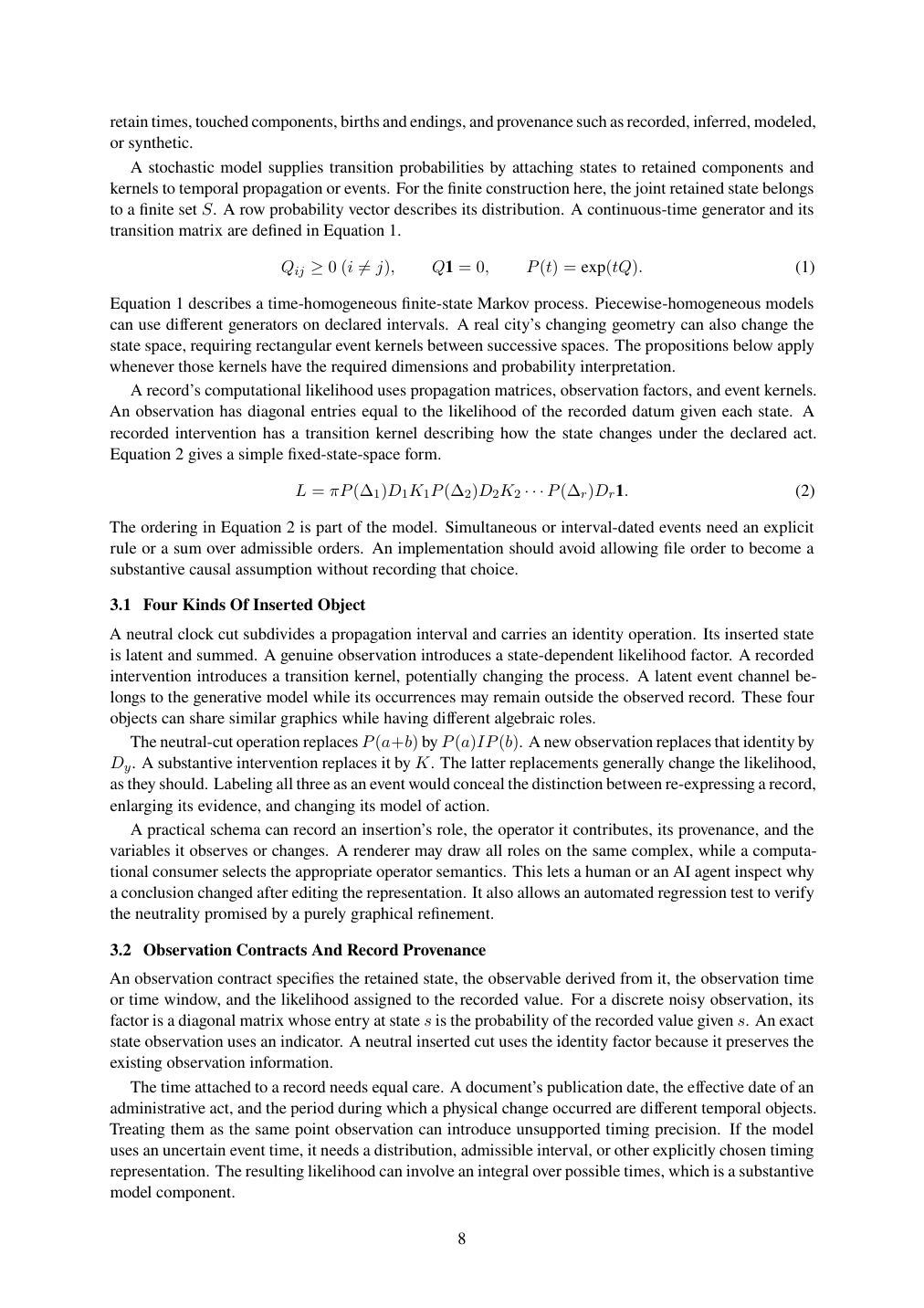
A stochastic model supplies transition probabilities by attaching states to retained components and kernels to temporal propagation or events. For the finite construction here, the joint retained state belongs
Equation 1 describes a time-homogeneous finite-state Markov process. Piecewise-homogeneous models can use different generators on declared intervals. A real city’s changing geometry can also change the state space, requiring rectangular event kernels between successive spaces. The propositions below apply whenever those kernels have the required dimensions and probability interpretation.
A record’s computational likelihood uses propagation matrices, observation factors, and event kernels. An observation has diagonal entries equal to the likelihood of the recorded datum given each state. A recorded intervention has a transition kernel describing how the state changes under the declared act.
The ordering in Equation 2 is part of the model. Simultaneous or interval-dated events need an explicit rule or a sum over admissible orders. An implementation should avoid allowing file order to become a substantive causal assumption without recording that choice.
A neutral clock cut subdivides a propagation interval and carries an identity operation. Its inserted state is latent and summed. A genuine observation introduces a state-dependent likelihood factor. A recorded intervention introduces a transition kernel, potentially changing the process. A latent event channel be- longs to the generative model while its occurrences may remain outside the observed record. These four objects can share similar graphics while having different algebraic roles.
as they should. Labeling all three as an event would conceal the distinction between re-expressing a record, enlarging its evidence, and changing its model of action.
A practical schema can record an insertion’s role, the operator it contributes, its provenance, and the variables it observes or changes. A renderer may draw all roles on the same complex, while a computa- tional consumer selects the appropriate operator semantics. This lets a human or an AI agent inspect why a conclusion changed after editing the representation. It also allows an automated regression test to verify the neutrality promised by a purely graphical refinement.
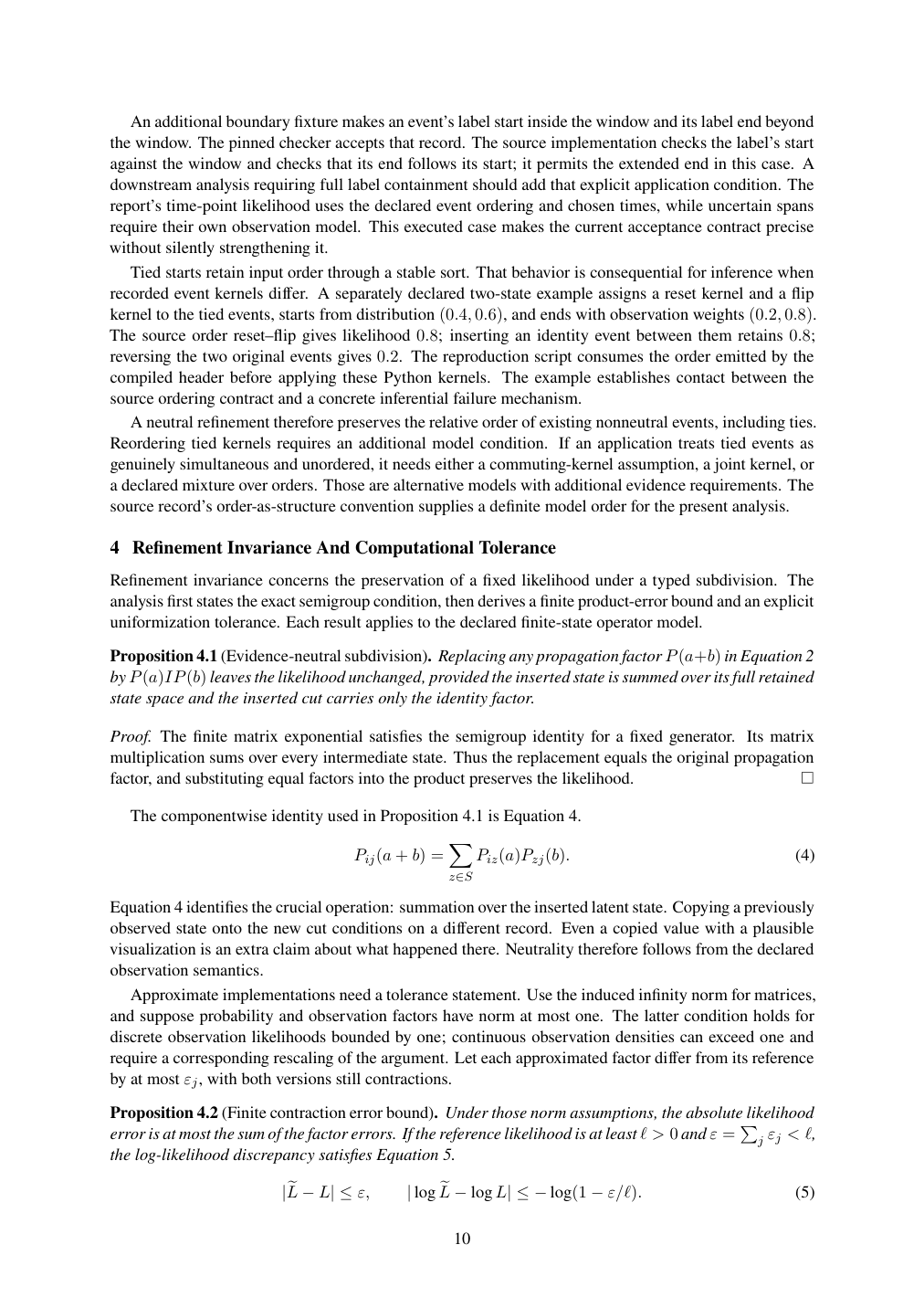
An observation contract specifies the retained state, the observable derived from it, the observation time or time window, and the likelihood assigned to the recorded value. For a discrete noisy observation, its state observation uses an indicator. A neutral inserted cut uses the identity factor because it preserves the
The time attached to a record needs equal care. A document’s publication date, the effective date of an administrative act, and the period during which a physical change occurred are different temporal objects. Treating them as the same point observation can introduce unsupported timing precision. If the model uses an uncertain event time, it needs a distribution, admissible interval, or other explicitly chosen timing representation. The resulting likelihood can involve an integral over possible times, which is a substantive

Provenance helps maintain these distinctions. A record can name the issuing source, source field, transcription method, confidence assessment, and affected state variables. An observation kernel can cite the validation basis for measurement error. A model operator can cite the substantive mechanism or convention it represents. A refinement record then states which of these inputs are preserved and which are revised. The resulting chain of artifacts makes a likelihood discrepancy traceable to a meaningful change.
3.3 Boundary Order And Piecewise Dynamics
The order of operators at a common time must be explicit. An observation immediately before an intervention and one immediately after it have different likelihood factors. A service can adopt a convention such as propagation to the boundary, pre-event observation, intervention, and post-event observation, with absent factors represented by identities. The convention belongs in the model profile and in the serialized event record.

Equation 3 uses the row-vector convention of the main likelihood. Subdivision within either regime preserves its exponential factor. Reversing the regimes changes the model unless the relevant propagators commute.

These conventions support an operationally meaningful event complex. Its temporal boundaries can carry typed operator lists and provenance references. Refinement can split intervals while preserving the ordered list. A recorded event can add a kernel. New evidence can add an observation factor. A model revision can replace a generator. Each operation has a distinct mathematical effect that the consumer can compute and document.
3.4 Executed Record-Kernel Contract
The accompanying artifact bundles the unmodified urban/events/record.hpp header from main repository commit 869fe38, its license, and a SHA-256 manifest. A C++20 harness compiles that header with the standard library alone. Its starting fixture is adapted from the repository’s documented hinge: two buildings A and B share a wall and each fronts a street S. The record window extends from the start of 2002 to the start of 2025, with three couplings and three pairwise primitives. The harness exercises calendar conversion, record-problem detection, and stable event ordering.
Three intended-valid cases pass: the event-free hinge, a tied pair of recorded events, and a tied pair with a neutral event inserted between them. Eight deliberately faulty classes produce at least one reported problem: a loop primitive, an unknown primitive endpoint, an event starting outside the window, an event touching nothing, a reversed label span, an unknown touched cell, an event after a coupling’s end, and a repeated coupling birth. The record checker returns a list of problems; the harness interprets a nonempty list as refusal. Its compiled scope covers the selected record, calendar and ordering kernel; the topology, geometry, serialization and application modules require separate evaluation.
Readable text
An additional boundary fixture makes an event’s label start inside the window and its label end beyond the window. The pinned checker accepts that record. The source implementation checks the label’s start against the window and checks that its end follows its start; it permits the extended end in this case. A downstream analysis requiring full label containment should add that explicit application condition. The report’s time-point likelihood uses the declared event ordering and chosen times, while uncertain spans require their own observation model. This executed case makes the current acceptance contract precise
Tied starts retain input order through a stable sort. That behavior is consequential for inference when recorded event kernels differ. A separately declared two-state example assigns a reset kernel and a flip compiled header before applying these Python kernels. The example establishes contact between the source ordering contract and a concrete inferential failure mechanism.
A neutral refinement therefore preserves the relative order of existing nonneutral events, including ties. Reordering tied kernels requires an additional model condition. If an application treats tied events as genuinely simultaneous and unordered, it needs either a commuting-kernel assumption, a joint kernel, or a declared mixture over orders. Those are alternative models with additional evidence requirements. The source record’s order-as-structure convention supplies a definite model order for the present analysis.
4 Refinement Invariance And Computational Tolerance
Refinement invariance concerns the preservation of a fixed likelihood under a typed subdivision. The analysis first states the exact semigroup condition, then derives a finite product-error bound and an explicit uniformization tolerance. Each result applies to the declared finite-state operator model.
state space and the inserted cut carries only the identity factor.
Proof. The finite matrix exponential satisfies the semigroup identity for a fixed generator. Its matrix multiplication sums over every intermediate state. Thus the replacement equals the original propagation factor, and substituting equal factors into the product preserves the likelihood.
The componentwise identity used in Proposition 4.1 is Equation 4.
Equation 4 identifies the crucial operation: summation over the inserted latent state. Copying a previously observed state onto the new cut conditions on a different record. Even a copied value with a plausible visualization is an extra claim about what happened there. Neutrality therefore follows from the declared
Approximate implementations need a tolerance statement. Use the induced infinity norm for matrices, and suppose probability and observation factors have norm at most one. The latter condition holds for discrete observation likelihoods bounded by one; continuous observation densities can exceed one and require a corresponding rescaling of the argument. Let each approximated factor differ from its reference
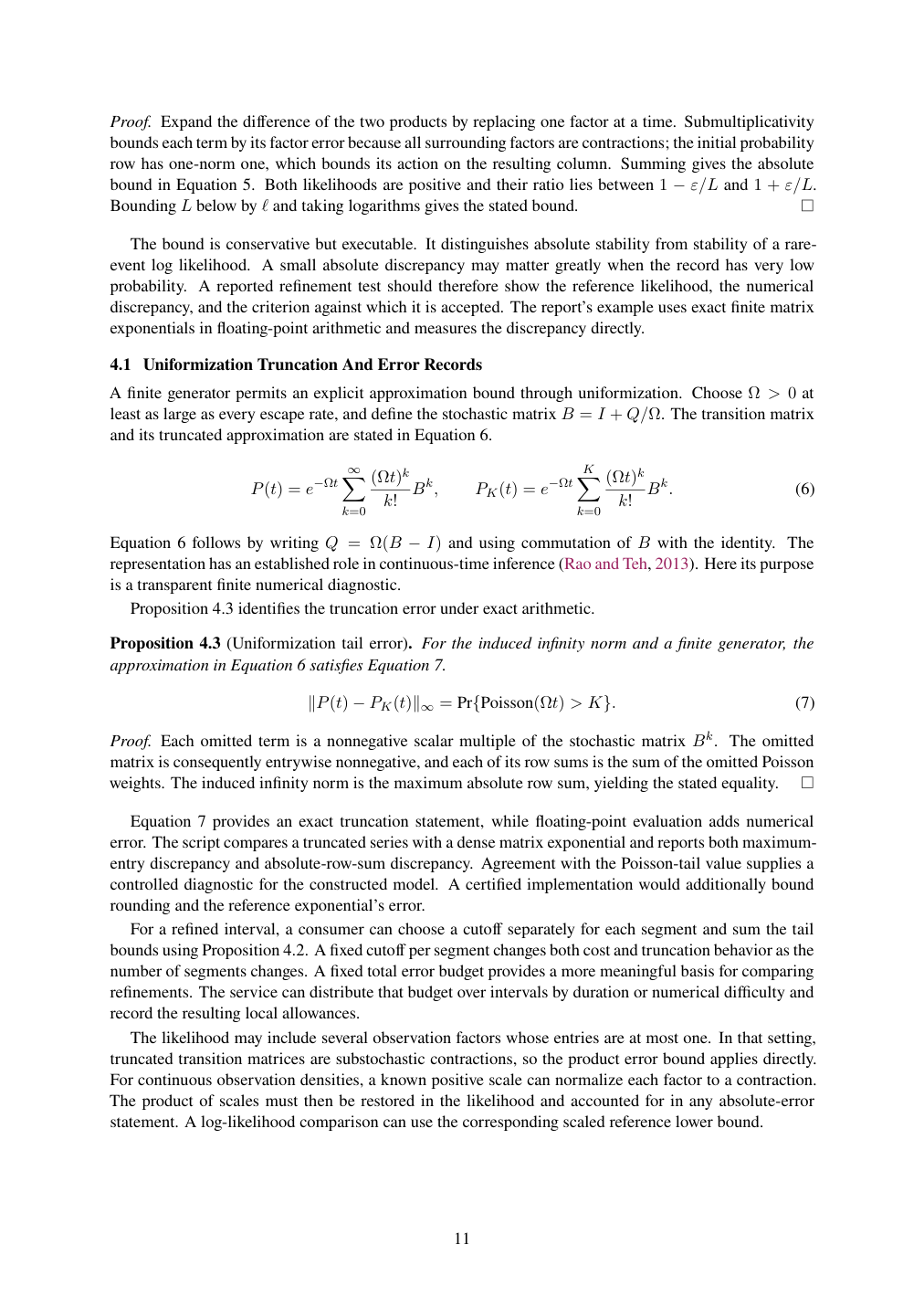
Proposition 4.2 (Finite contraction error bound). Under those norm assumptions, the absolute likelihood
Readable text
Proof. Expand the difference of the two products by replacing one factor at a time. Submultiplicativity bounds each term by its factor error because all surrounding factors are contractions; the initial probability row has one-norm one, which bounds its action on the resulting column. Summing gives the absolute
The bound is conservative but executable. It distinguishes absolute stability from stability of a rare- event log likelihood. A small absolute discrepancy may matter greatly when the record has very low probability. A reported refinement test should therefore show the reference likelihood, the numerical discrepancy, and the criterion against which it is accepted. The report’s example uses exact finite matrix exponentials in floating-point arithmetic and measures the discrepancy directly.
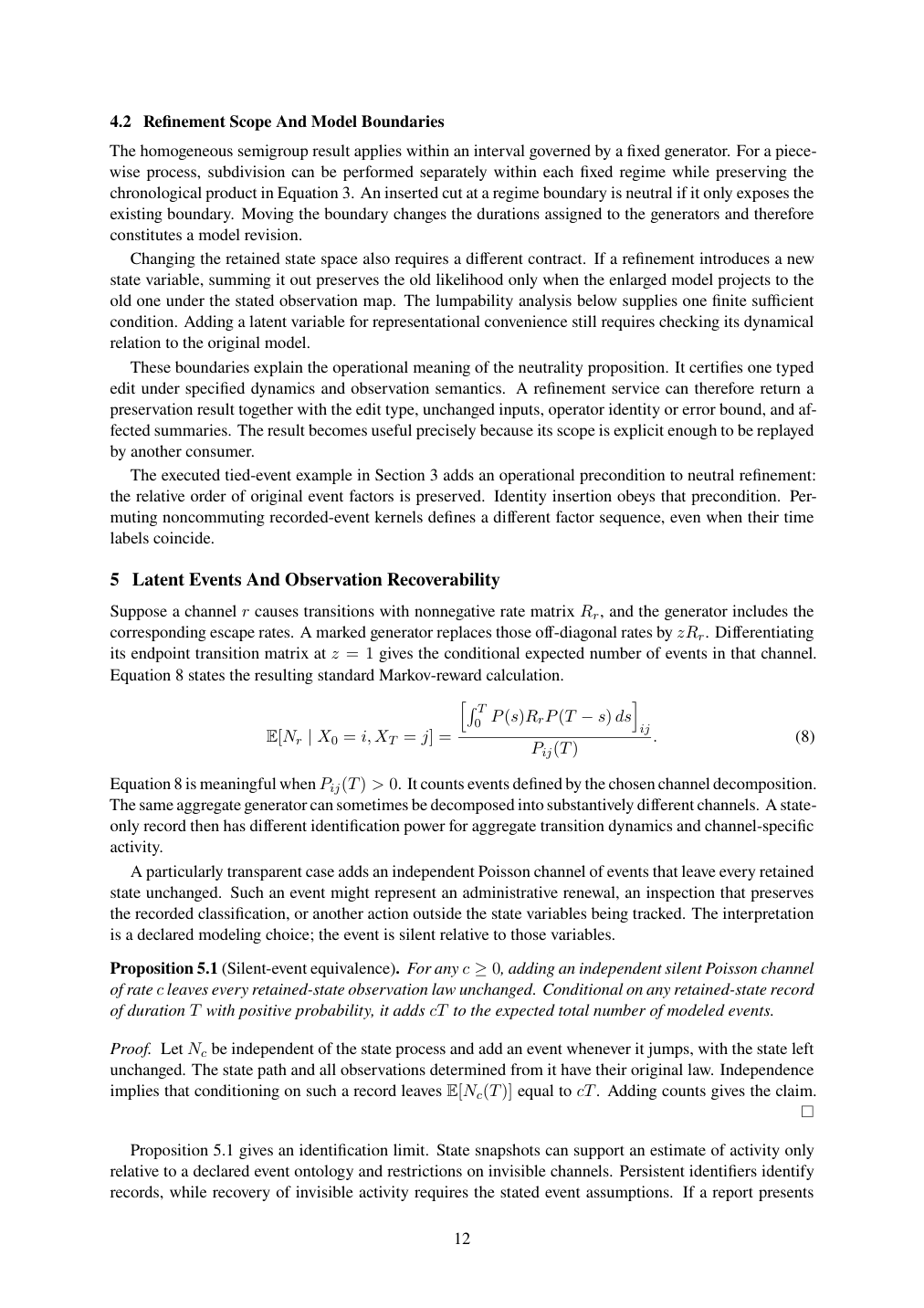
and its truncated approximation are stated in Equation 6.
representation has an established role in continuous-time inference (Rao and Teh, 2013). Here its purpose
Proposition 4.3 identifies the truncation error under exact arithmetic.
Proposition 4.3 (Uniformization tail error). For the induced infinity norm and a finite generator, the
matrix is consequently entrywise nonnegative, and each of its row sums is the sum of the omitted Poisson weights. The induced infinity norm is the maximum absolute row sum, yielding the stated equality.
Equation 7 provides an exact truncation statement, while floating-point evaluation adds numerical error. The script compares a truncated series with a dense matrix exponential and reports both maximum- entry discrepancy and absolute-row-sum discrepancy. Agreement with the Poisson-tail value supplies a controlled diagnostic for the constructed model. A certified implementation would additionally bound
For a refined interval, a consumer can choose a cutoff separately for each segment and sum the tail bounds using Proposition 4.2. A fixed cutoff per segment changes both cost and truncation behavior as the number of segments changes. A fixed total error budget provides a more meaningful basis for comparing refinements. The service can distribute that budget over intervals by duration or numerical difficulty and
The likelihood may include several observation factors whose entries are at most one. In that setting, truncated transition matrices are substochastic contractions, so the product error bound applies directly. For continuous observation densities, a known positive scale can normalize each factor to a contraction. The product of scales must then be restored in the likelihood and accounted for in any absolute-error statement. A log-likelihood comparison can use the corresponding scaled reference lower bound.
Readable text
The homogeneous semigroup result applies within an interval governed by a fixed generator. For a piece- wise process, subdivision can be performed separately within each fixed regime while preserving the chronological product in Equation 3. An inserted cut at a regime boundary is neutral if it only exposes the existing boundary. Moving the boundary changes the durations assigned to the generators and therefore
Changing the retained state space also requires a different contract. If a refinement introduces a new state variable, summing it out preserves the old likelihood only when the enlarged model projects to the old one under the stated observation map. The lumpability analysis below supplies one finite sufficient condition. Adding a latent variable for representational convenience still requires checking its dynamical
These boundaries explain the operational meaning of the neutrality proposition. It certifies one typed edit under specified dynamics and observation semantics. A refinement service can therefore return a preservation result together with the edit type, unchanged inputs, operator identity or error bound, and af- fected summaries. The result becomes useful precisely because its scope is explicit enough to be replayed
The executed tied-event example in Section 3 adds an operational precondition to neutral refinement: the relative order of original event factors is preserved. Identity insertion obeys that precondition. Per- muting noncommuting recorded-event kernels defines a different factor sequence, even when their time
Equation 8 states the resulting standard Markov-reward calculation.
The same aggregate generator can sometimes be decomposed into substantively different channels. A state- only record then has different identification power for aggregate transition dynamics and channel-specific
A particularly transparent case adds an independent Poisson channel of events that leave every retained state unchanged. Such an event might represent an administrative renewal, an inspection that preserves the recorded classification, or another action outside the state variables being tracked. The interpretation is a declared modeling choice; the event is silent relative to those variables.
unchanged. The state path and all observations determined from it have their original law. Independence
Proposition 5.1 gives an identification limit. State snapshots can support an estimate of activity only relative to a declared event ontology and restrictions on invisible channels. Persistent identifiers identify records, while recovery of invisible activity requires the stated event assumptions. If a report presents
Readable text
a single reconstructed event count, it should identify the event types counted, the observations that can
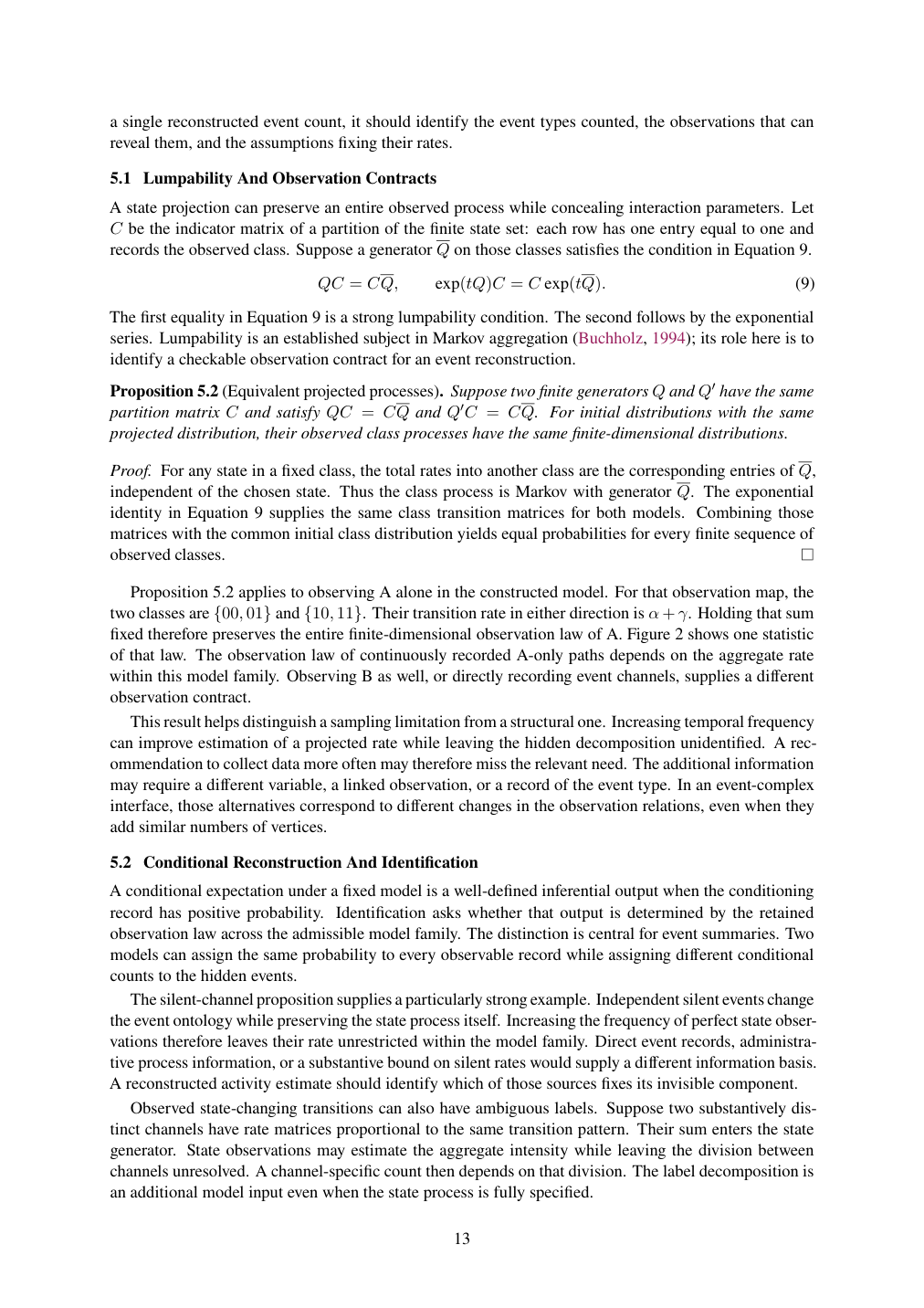
A state projection can preserve an entire observed process while concealing interaction parameters. Let
The first equality in Equation 9 is a strong lumpability condition. The second follows by the exponential series. Lumpability is an established subject in Markov aggregation (Buchholz, 1994); its role here is to identify a checkable observation contract for an event reconstruction.
projected distribution, their observed class processes have the same finite-dimensional distributions.
identity in Equation 9 supplies the same class transition matrices for both models. Combining those matrices with the common initial class distribution yields equal probabilities for every finite sequence of
Proposition 5.2 applies to observing A alone in the constructed model. For that observation map, the fixed therefore preserves the entire finite-dimensional observation law of A. Figure 2 shows one statistic of that law. The observation law of continuously recorded A-only paths depends on the aggregate rate within this model family. Observing B as well, or directly recording event channels, supplies a different
This result helps distinguish a sampling limitation from a structural one. Increasing temporal frequency can improve estimation of a projected rate while leaving the hidden decomposition unidentified. A rec- ommendation to collect data more often may therefore miss the relevant need. The additional information may require a different variable, a linked observation, or a record of the event type. In an event-complex interface, those alternatives correspond to different changes in the observation relations, even when they
A conditional expectation under a fixed model is a well-defined inferential output when the conditioning record has positive probability. Identification asks whether that output is determined by the retained observation law across the admissible model family. The distinction is central for event summaries. Two models can assign the same probability to every observable record while assigning different conditional
The silent-channel proposition supplies a particularly strong example. Independent silent events change the event ontology while preserving the state process itself. Increasing the frequency of perfect state obser- vations therefore leaves their rate unrestricted within the model family. Direct event records, administra- tive process information, or a substantive bound on silent rates would supply a different information basis. A reconstructed activity estimate should identify which of those sources fixes its invisible component.
Observed state-changing transitions can also have ambiguous labels. Suppose two substantively dis- tinct channels have rate matrices proportional to the same transition pattern. Their sum enters the state generator. State observations may estimate the aggregate intensity while leaving the division between channels unresolved. A channel-specific count then depends on that division. The label decomposition is an additional model input even when the state process is fully specified.
Readable text
This observation motivates an equivalence-class result interface. A model family can be partitioned by its induced retained observation law. A requested event summary can be evaluated within the resulting class. A constant summary is recoverable from that observation law within the family; a varying summary requires a range, additional assumptions, or additional observations. The finite examples provide exact witnesses of variation without claiming a general algorithm for computing these equivalence classes.
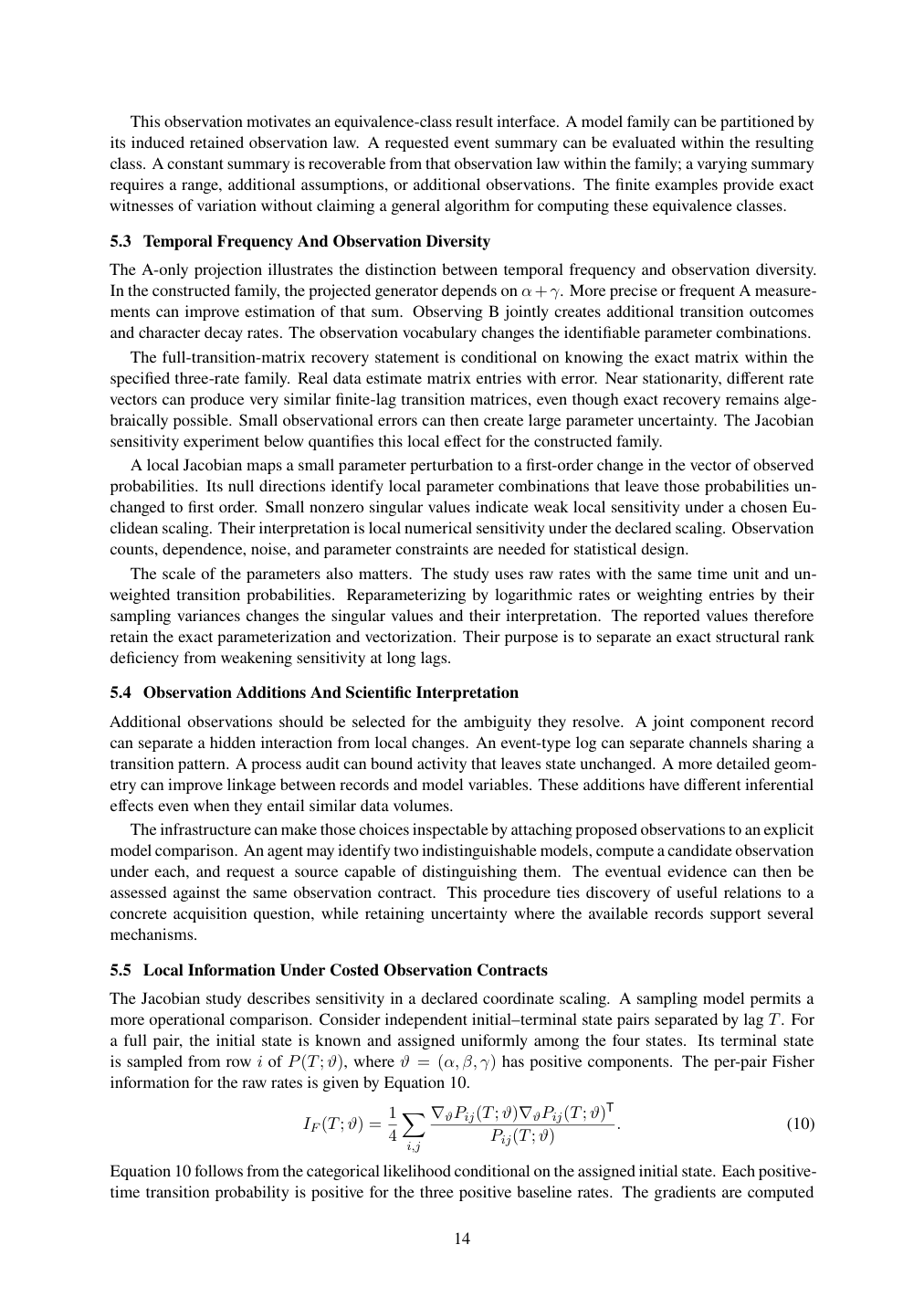
The A-only projection illustrates the distinction between temporal frequency and observation diversity. ments can improve estimation of that sum. Observing B jointly creates additional transition outcomes and character decay rates. The observation vocabulary changes the identifiable parameter combinations.
The full-transition-matrix recovery statement is conditional on knowing the exact matrix within the specified three-rate family. Real data estimate matrix entries with error. Near stationarity, different rate vectors can produce very similar finite-lag transition matrices, even though exact recovery remains alge- braically possible. Small observational errors can then create large parameter uncertainty. The Jacobian sensitivity experiment below quantifies this local effect for the constructed family.
A local Jacobian maps a small parameter perturbation to a first-order change in the vector of observed probabilities. Its null directions identify local parameter combinations that leave those probabilities un- changed to first order. Small nonzero singular values indicate weak local sensitivity under a chosen Eu- clidean scaling. Their interpretation is local numerical sensitivity under the declared scaling. Observation counts, dependence, noise, and parameter constraints are needed for statistical design.
The scale of the parameters also matters. The study uses raw rates with the same time unit and un- weighted transition probabilities. Reparameterizing by logarithmic rates or weighting entries by their sampling variances changes the singular values and their interpretation. The reported values therefore retain the exact parameterization and vectorization. Their purpose is to separate an exact structural rank
5.4 Observation Additions And Scientific Interpretation
Additional observations should be selected for the ambiguity they resolve. A joint component record can separate a hidden interaction from local changes. An event-type log can separate channels sharing a transition pattern. A process audit can bound activity that leaves state unchanged. A more detailed geom- etry can improve linkage between records and model variables. These additions have different inferential
The infrastructure can make those choices inspectable by attaching proposed observations to an explicit model comparison. An agent may identify two indistinguishable models, compute a candidate observation under each, and request a source capable of distinguishing them. The eventual evidence can then be assessed against the same observation contract. This procedure ties discovery of useful relations to a concrete acquisition question, while retaining uncertainty where the available records support several
5.5 Local Information Under Costed Observation Contracts
The Jacobian study describes sensitivity in a declared coordinate scaling. A sampling model permits a a full pair, the initial state is known and assigned uniformly among the four states. Its terminal state
Equation 10 follows from the categorical likelihood conditional on the assigned initial state. Each positive- time transition probability is positive for the three positive baseline rates. The gradients are computed
Readable text
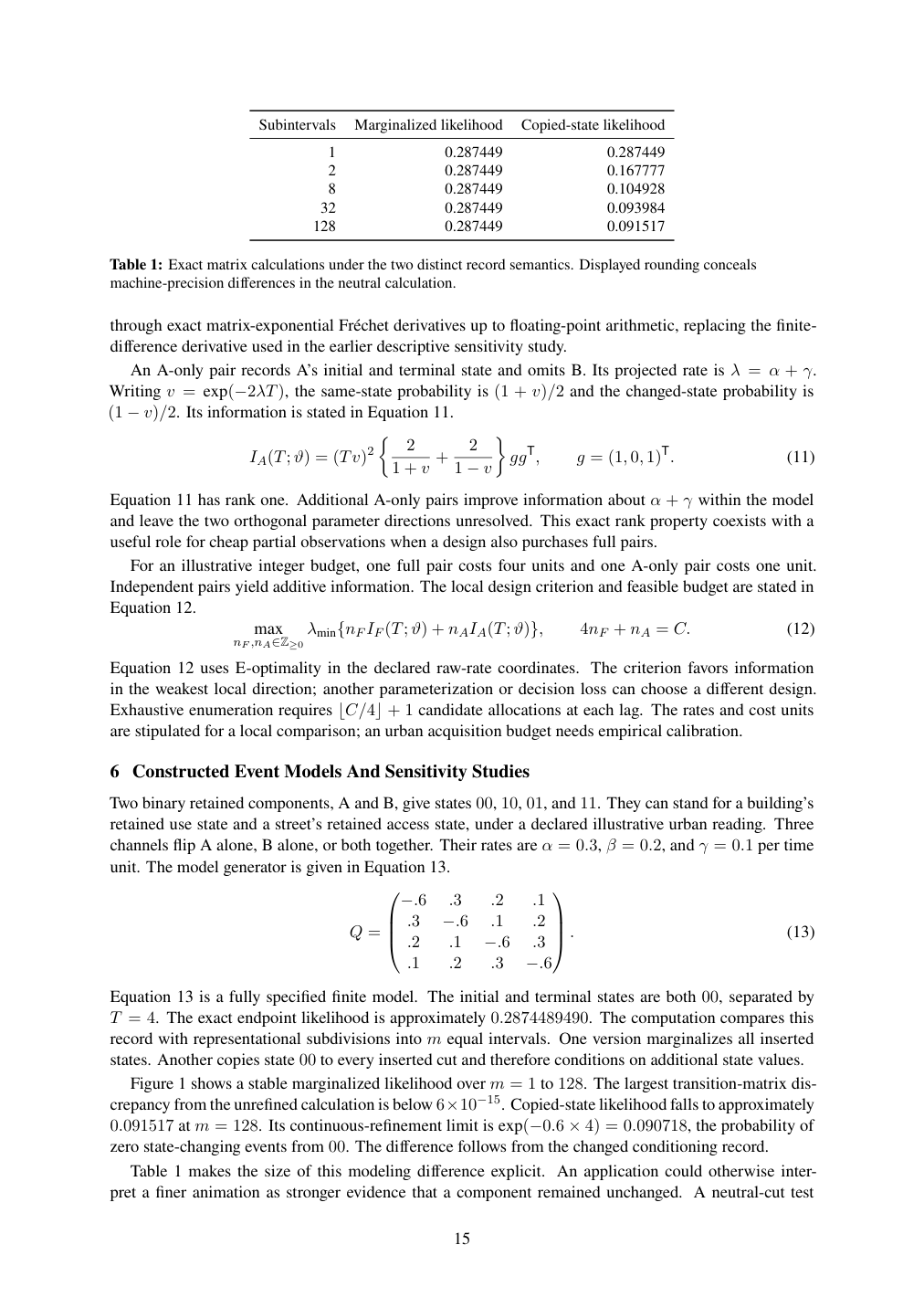
Table 1: Exact matrix calculations under the two distinct record semantics. Displayed rounding conceals
machine-precision differences in the neutral calculation.
through exact matrix-exponential Fréchet derivatives up to floating-point arithmetic, replacing the finite- difference derivative used in the earlier descriptive sensitivity study.
and leave the two orthogonal parameter directions unresolved. This exact rank property coexists with a useful role for cheap partial observations when a design also purchases full pairs.
For an illustrative integer budget, one full pair costs four units and one A-only pair costs one unit. Independent pairs yield additive information. The local design criterion and feasible budget are stated in
Equation 12 uses E-optimality in the declared raw-rate coordinates. The criterion favors information in the weakest local direction; another parameterization or decision loss can choose a different design. are stipulated for a local comparison; an urban acquisition budget needs empirical calibration.
Two binary retained components, A and B, give states 00, 10, 01, and 11. They can stand for a building’s retained use state and a street’s retained access state, under a declared illustrative urban reading. Three
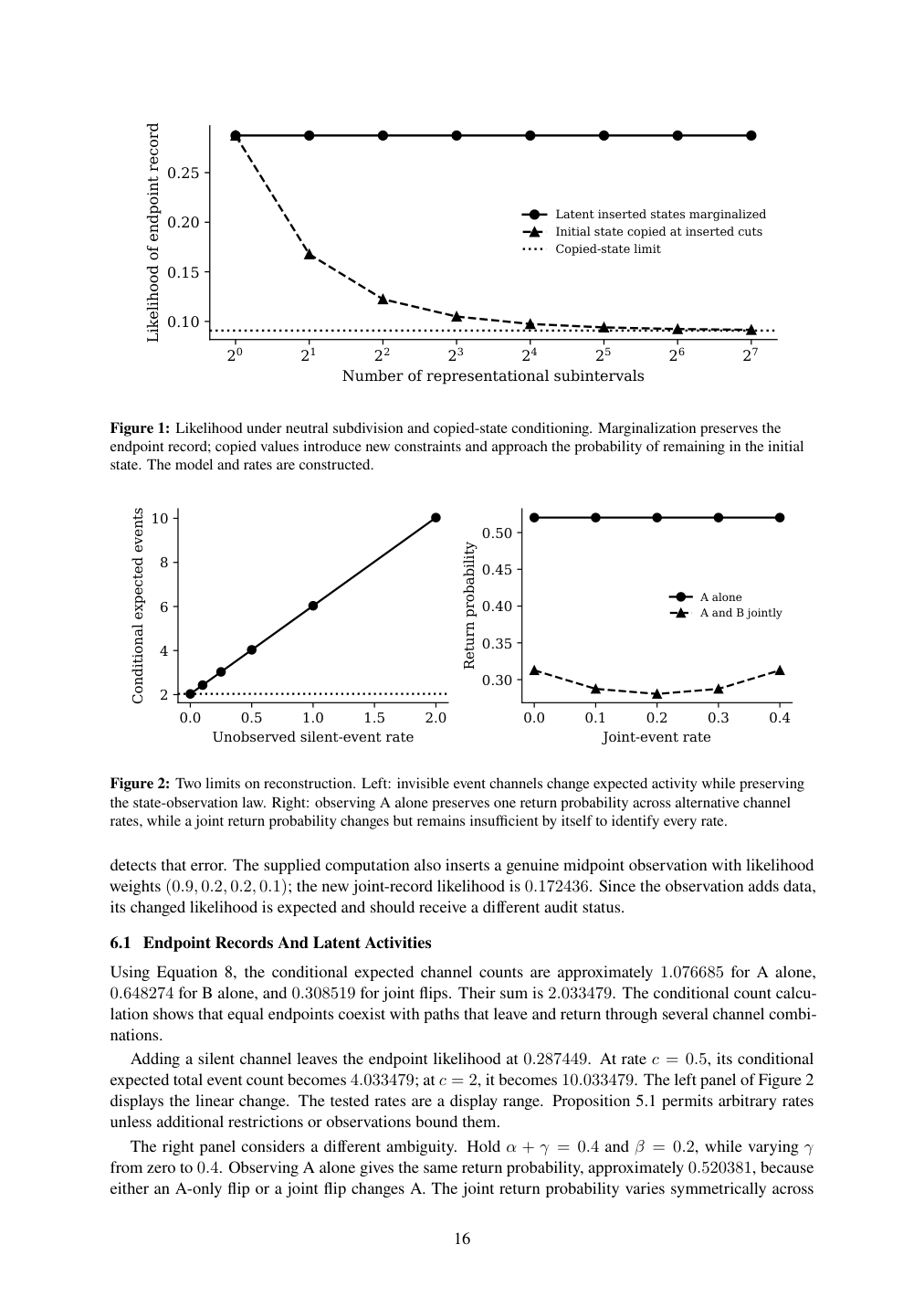
Equation 13 is a fully specified finite model. The initial and terminal states are both 00, separated by states. Another copies state 00 to every inserted cut and therefore conditions on additional state values.
zero state-changing events from 00. The difference follows from the changed conditioning record.
Table 1 makes the size of this modeling difference explicit. An application could otherwise inter- pret a finer animation as stronger evidence that a component remained unchanged. A neutral-cut test
Readable text
Latent inserted states marginalized Initial state copied at inserted cuts Copied-state limit
Figure 1: Likelihood under neutral subdivision and copied-state conditioning. Marginalization preserves the endpoint record; copied values introduce new constraints and approach the probability of remaining in the initial
Figure 2: Two limits on reconstruction. Left: invisible event channels change expected activity while preserving the state-observation law. Right: observing A alone preserves one return probability across alternative channel rates, while a joint return probability changes but remains insufficient by itself to identify every rate.
detects that error. The supplied computation also inserts a genuine midpoint observation with likelihood its changed likelihood is expected and should receive a different audit status.
lation shows that equal endpoints coexist with paths that leave and return through several channel combi-
displays the linear change. The tested rates are a display range. Proposition 5.1 permits arbitrary rates unless additional restrictions or observations bound them.
either an A-only flip or a joint flip changes A. The joint return probability varies symmetrically across
Readable text
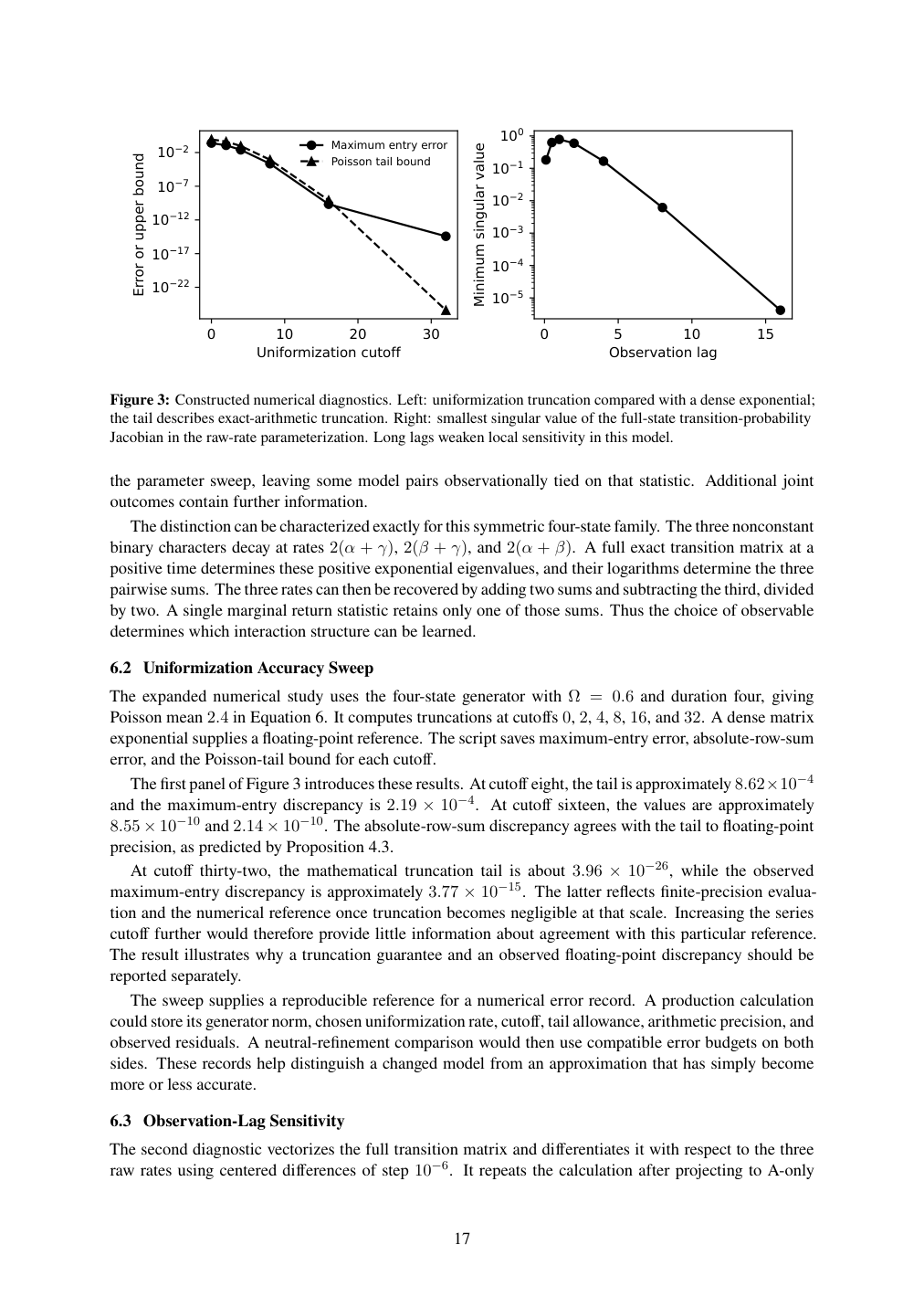
Figure 3: Constructed numerical diagnostics. Left: uniformization truncation compared with a dense exponential; the tail describes exact-arithmetic truncation. Right: smallest singular value of the full-state transition-probability Jacobian in the raw-rate parameterization. Long lags weaken local sensitivity in this model.
the parameter sweep, leaving some model pairs observationally tied on that statistic. Additional joint
The distinction can be characterized exactly for this symmetric four-state family. The three nonconstant positive time determines these positive exponential eigenvalues, and their logarithms determine the three pairwise sums. The three rates can then be recovered by adding two sums and subtracting the third, divided by two. A single marginal return statistic retains only one of those sums. Thus the choice of observable
determines which interaction structure can be learned.
exponential supplies a floating-point reference. The script saves maximum-entry error, absolute-row-sum
tion and the numerical reference once truncation becomes negligible at that scale. Increasing the series cutoff further would therefore provide little information about agreement with this particular reference. The result illustrates why a truncation guarantee and an observed floating-point discrepancy should be
The sweep supplies a reproducible reference for a numerical error record. A production calculation could store its generator norm, chosen uniformization rate, cutoff, tail allowance, arithmetic precision, and observed residuals. A neutral-refinement comparison would then use compatible error budgets on both sides. These records help distinguish a changed model from an approximation that has simply become
The second diagnostic vectorizes the full transition matrix and differentiates it with respect to the three

Readable text
Table 2: Constructed piecewise model. Neutral subdivision preserves the ordered reference; regime reversal and
under this stated parameterization and unweighted Euclidean norm.
The curve demonstrates weak sensitivity at long lags as the process approaches its common stationary distribution. Exact positive-lag recovery within the three-rate family coexists with large differences in
finite differences provide a numerical diagnostic with finite precision. Treating these tiny numerical values as additional identifiable directions would overinterpret the calculation.
The study holds the transition-probability vectorization fixed while varying lag. It supplies neither a sampling model nor an optimized observation schedule. A statistical design study would incorporate the number of trajectories, starting-state distribution, measurement error, and cost of temporal and joint observations. The present calculation identifies a mechanism worth including in such a design: observing a fully expressive state vocabulary after a very long lag can still provide weak information about rates.
propagator is the chronological product in Equation 3. Subdividing each regime into up to 32 equal pieces
Changing the order or averaging the generators has a much larger effect. Table 2 records the probability of returning to state zero from state zero under the three alternatives.
The comparison gives a simple operational failure mechanism. A service that reorders event records or averages dynamics across a boundary can change inference while preserving the same total elapsed time and graphical endpoints. A refinement audit should therefore preserve the chronological operator list and validate any proposed operator replacement. The geometry of a subdivision alone supplies insufficient
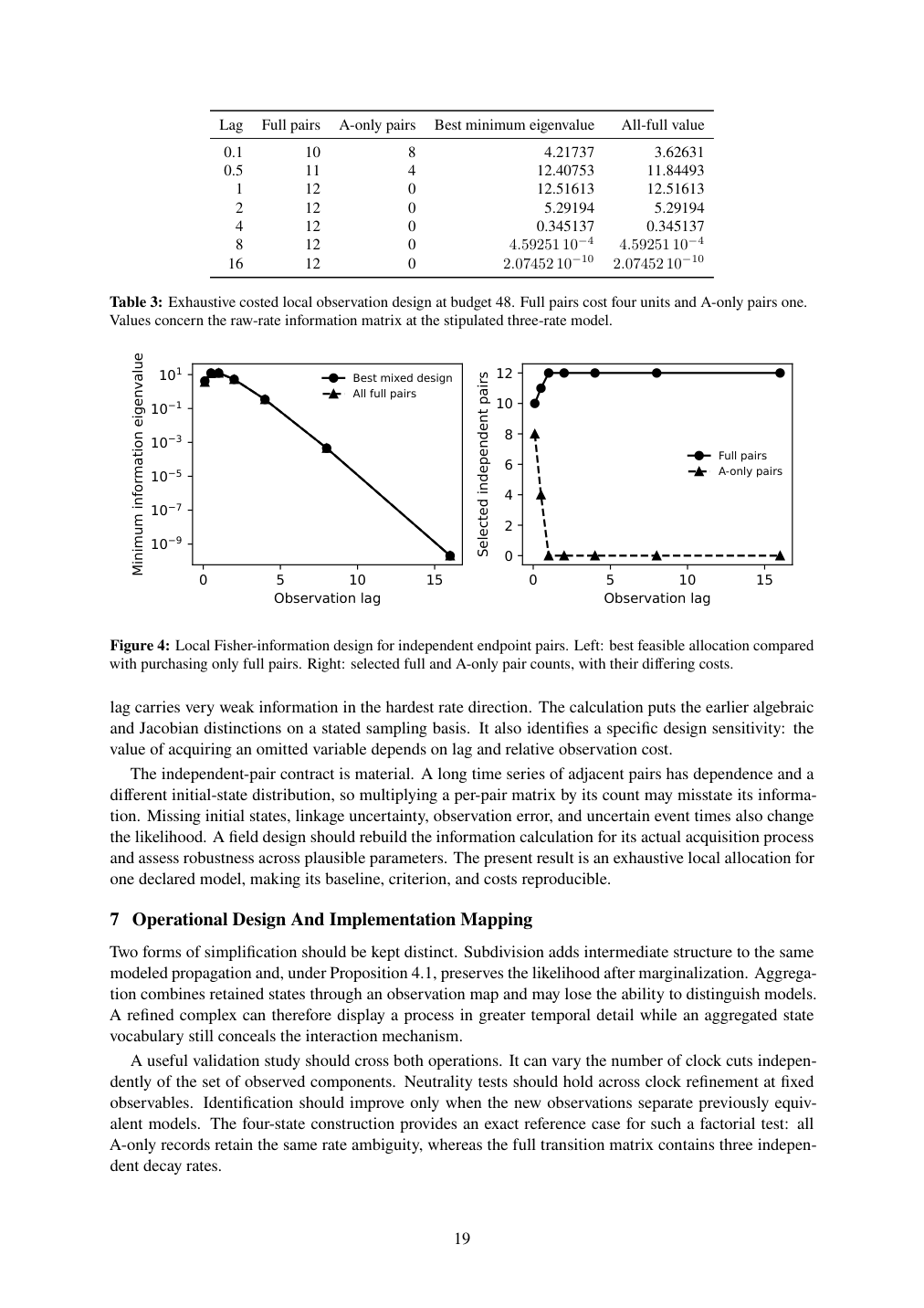
24, 48, and 96. Each feasible integer allocation is scored, yielding 21 exhaustive local design comparisons. Table 3 reports the budget-48 slice; Figure 4 displays its information and allocation curves.
At lag 0.1, ten full pairs and eight A-only pairs increase the minimum information eigenvalue by about 16.3% relative to twelve full pairs. At lag 0.5 the gain is about 4.75%. For the five larger tested lags, the criterion selects only full pairs. An A-only allocation has zero minimum eigenvalue throughout, since its information remains rank one. Partial observations can therefore complement full observations at a finite budget while remaining structurally insufficient by themselves.
restricted family still holds for the complete transition matrix, but independent endpoint sampling at that
Readable text
Table 3: Exhaustive costed local observation design at budget 48. Full pairs cost four units and A-only pairs one. Values concern the raw-rate information matrix at the stipulated three-rate model.
Figure 4: Local Fisher-information design for independent endpoint pairs. Left: best feasible allocation compared with purchasing only full pairs. Right: selected full and A-only pair counts, with their differing costs.
lag carries very weak information in the hardest rate direction. The calculation puts the earlier algebraic and Jacobian distinctions on a stated sampling basis. It also identifies a specific design sensitivity: the value of acquiring an omitted variable depends on lag and relative observation cost.
The independent-pair contract is material. A long time series of adjacent pairs has dependence and a different initial-state distribution, so multiplying a per-pair matrix by its count may misstate its informa- tion. Missing initial states, linkage uncertainty, observation error, and uncertain event times also change the likelihood. A field design should rebuild the information calculation for its actual acquisition process and assess robustness across plausible parameters. The present result is an exhaustive local allocation for one declared model, making its baseline, criterion, and costs reproducible.
Two forms of simplification should be kept distinct. Subdivision adds intermediate structure to the same modeled propagation and, under Proposition 4.1, preserves the likelihood after marginalization. Aggrega- tion combines retained states through an observation map and may lose the ability to distinguish models. A refined complex can therefore display a process in greater temporal detail while an aggregated state
vocabulary still conceals the interaction mechanism.
A useful validation study should cross both operations. It can vary the number of clock cuts indepen- dently of the set of observed components. Neutrality tests should hold across clock refinement at fixed observables. Identification should improve only when the new observations separate previously equiv- alent models. The four-state construction provides an exact reference case for such a factorial test: all A-only records retain the same rate ambiguity, whereas the full transition matrix contains three indepen-
The geometry of the complex supplies a third source of structure. A frontage face records a particular relation between a building and a street. Replacing it with an aggregate relation among districts changes the retained system and requires an aggregation model. Dynamical equivalence requires an additional model-level preservation argument. A representation mapping should state which state variables, event channels, and observation kernels it carries, and which distinctions it merges. Its algebraic or topological validity and its inferential adequacy are related but separately assessed properties.
These distinctions suggest an interoperable contract between the GIS and the dynamics engine. The GIS supplies persistent identities, incidences, dates or date intervals, and provenance. The model supplies state spaces, rates, event kernels, and observation maps. A refinement or aggregation act specifies a transformation of both parts. The consumer checks the relevant equality or bound, records unresolved obligations, and reports the scientific summaries at the level justified by that act. Such a contract supports cross-disciplinary reuse because it exposes exactly which aspects of an urban representation enter the inferred dynamics.
7.1 An Operational Refinement Audit
A useful audit starts with a record, its generator and event operators, and an explicit declaration of what an edit changes. For a neutral edit, the consumer computes both likelihoods under identical data and checks their discrepancy against a tolerance such as Proposition 4.2. It also compares the requested posterior summaries. For an evidence edit, it verifies the new observation factor and records how the posterior changes. For a model edit, it identifies the changed rates, channels, or state space.
The audit must retain event definitions. Splitting one recorded event into two substantive kernels generally changes the model unless their composition equals the original kernel. Introducing two half-strength interactions can also change the order in which they meet other dynamics. A valid refinement claim therefore identifies an algebraic equality of operators or an error bound for the approximation. The operator equality is a separate obligation alongside topological subdivision.
An AI explorer can use this distinction when proposing a richer reconstruction. It may generate additional latent events, new observables, or alternative interaction channels. Each proposal receives a different test: likelihood fit under a changed model, observational equivalence under the retained record, and sensitivity of the decision or statistic being reported. The infrastructure can retain several observationally equivalent reconstructions and display the assumptions supporting each.
7.2 Implementation Mapping And Reproduction
Noetarium’s inspected snapshot is commit 869fe38afac257cd9b5d51ad5b498a8ff6b8e443. ADR 0067 records the event-spacetime design. The urban events module contains record validation, worldlinecomplex construction, cuts, network interfaces, and memory calculations. Its record header stores provenance and interval labels, while its complex header constructs both refined and collapsed event complexes (Noetarium Project, 2026).
The design already distinguishes unrecorded single-cell changes summed by a semigroup from latent multi-cell interactions requiring an extension. The global four-state reference model in this report includes a joint channel directly in its generator; it is a finite illustration of the interaction issue. The current C++ mapping and the proposed global reference model retain their separate implementation scopes. The calculations use Python, NumPy, SciPy matrix exponentials, and Matplotlib, with all rates and operators saved in results.json.
Running python reproduce.py recreates the three figures, likelihood tables, channel counts, silentevent variants, and partial-observation comparisons. The reference code evaluates the derivative integral through a block matrix exponential. The reference study checks the semigroup discrepancy and compares the block-exponential event counts with a separate centered finite-difference derivative. It also computes the generator lumpability residual for each A-only alias. These numerical checks evaluate the declared finite model.
7.3 Typed Refinement Transactions
A refinement transaction should bind five inputs: the original record, the proposed edited record, the model, the observation contract, and the requested summaries. It should also declare its edit class. A neutral clock subdivision preserves the operator product. An evidence addition changes observation factors. A recorded intervention inserts a kernel. A model revision changes rates, state variables, or event channels. These types give the consumer a determinate validation task.
For a neutral transaction, the service can compare likelihoods, filtered endpoint distributions, and selected posterior summaries under matched numerical tolerances. Preservation of one scalar likelihood for a single record is a useful test case, while an operator identity establishes a broader result over initial and terminal conditions. The transaction should state which level was checked. Numerical agreement on one input and a proved equality of operators have different evidential strength.
A record validator should also inspect temporal order, persistent identities, interval consistency, and operator dimensions. An event that changes the state vocabulary requires a kernel with compatible domain and codomain. Observation factors must refer to the state vocabulary active at their time. An incidence record linking two urban entities needs identifiers resolvable in the retained model. These checks precede likelihood evaluation because a numerically well-formed matrix product can still refer to the wrong entities.
The output can contain the two record digests, model and observation digests, edit type, numerical method, tolerance budget, comparison results, and unresolved obligations. A later consumer can reconstruct the exact calculation or choose a stricter tolerance. A changed model version triggers a new validation transaction, preserving the earlier result as evidence about its original inputs.
7.4 Source Components And Proposed Extensions
The pinned record.hpp supplies event-record structures and validation, while complex.hpp constructs relational event complexes and cuts. The memory.hpp component provides the inspected memory and dynamics interface. ADR 0067 supplies the event-spacetime rationale and the existing neutrality argument (Noetarium Project, 2026). These components form the implementation mapping for the report. The Python inference script is a separate finite reference study. The reproduction entry point additionally compiles the bundled record header with a local C++20 compiler (tested with g++ 14.2), checks its source hash and runs the record/order fixtures. Both studies use shipped local inputs.
An integration can add an observation-contract layer that binds recorded fields to state variables and likelihood factors. A refinement audit can then export the typed transaction and numerical evidence. A model registry can distinguish single-cell latent changes handled by semigroup propagation from multicell interaction models requiring additional machinery. The reference joint-flip example illustrates one finite global model and should retain that scope in its integration record.
Several implementation choices require evaluation. A dense global generator is simple for small systems but grows exponentially with the number of retained binary components. Local factorization can reduce representation and some computation, while exact marginalization may still be expensive when interactions create large separators. Sparse action methods can avoid forming a dense exponential. Approximate inference needs its own convergence, error, or diagnostic record. The event-complex data structure organizes the problem without determining which numerical strategy is adequate.
7.5 Failure Mechanisms And Review Objects
The constructed studies identify four concrete failure mechanisms. Copying observed state onto neutral cuts changes the evidence. Reordering noncommuting regime operators changes propagation. Reporting an event count without specifying invisible channels changes its meaning. Interpreting weak long-lag sensitivity as strong recovery confuses algebraic identifiability with practical information. Each mechanism can be checked through an explicit artifact.
A reviewer assessing a neutral edit needs the original and edited operator products. A reviewer assessing a count needs the channel matrices and event definitions. A reviewer assessing parameter information
Readable text
Markov semigroups; repository ADR Lumpability and restricted parametric
Neutral refinement 0067 Event summaries Marked transition counting Observation recovery identification
Typed observation conditions, operator audit and finite error account Silent-channel interpretation and explicit channel-dependent reconstruction
A-only equivalence family, full-state recovery and exhaustive costed local information design Executed tail sweep, derivative check and noncommuting regime example
Uniformization and block exponentials Temporal urban models and event
Executed pinned record/order fixtures and versioned observation/refinement transaction
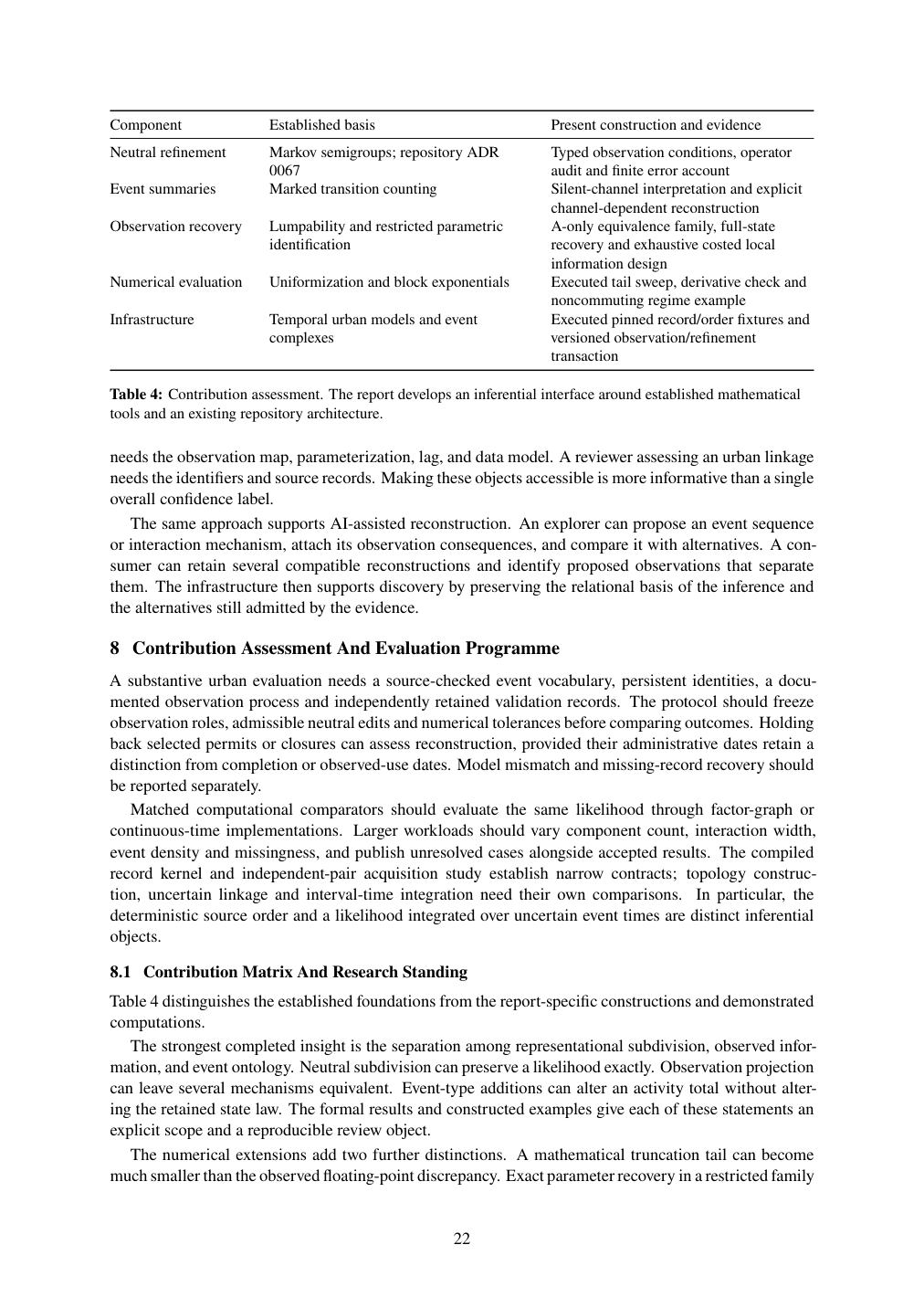
Table 4: Contribution assessment. The report develops an inferential interface around established mathematical
needs the observation map, parameterization, lag, and data model. A reviewer assessing an urban linkage needs the identifiers and source records. Making these objects accessible is more informative than a single
The same approach supports AI-assisted reconstruction. An explorer can propose an event sequence or interaction mechanism, attach its observation consequences, and compare it with alternatives. A con- sumer can retain several compatible reconstructions and identify proposed observations that separate them. The infrastructure then supports discovery by preserving the relational basis of the inference and
A substantive urban evaluation needs a source-checked event vocabulary, persistent identities, a docu- mented observation process and independently retained validation records. The protocol should freeze observation roles, admissible neutral edits and numerical tolerances before comparing outcomes. Holding back selected permits or closures can assess reconstruction, provided their administrative dates retain a distinction from completion or observed-use dates. Model mismatch and missing-record recovery should
Matched computational comparators should evaluate the same likelihood through factor-graph or continuous-time implementations. Larger workloads should vary component count, interaction width, event density and missingness, and publish unresolved cases alongside accepted results. The compiled record kernel and independent-pair acquisition study establish narrow contracts; topology construc- tion, uncertain linkage and interval-time integration need their own comparisons. deterministic source order and a likelihood integrated over uncertain event times are distinct inferential
Table 4 distinguishes the established foundations from the report-specific constructions and demonstrated
The strongest completed insight is the separation among representational subdivision, observed infor- mation, and event ontology. Neutral subdivision can preserve a likelihood exactly. Observation projection can leave several mechanisms equivalent. Event-type additions can alter an activity total without alter- ing the retained state law. The formal results and constructed examples give each of these statements an
The numerical extensions add two further distinctions. A mathematical truncation tail can become much smaller than the observed floating-point discrepancy. Exact parameter recovery in a restricted family
can coexist with weak local sensitivity at long lags. Both distinctions affect an implementation’s reporting obligations. They prevent a numerical parameter or a detailed reconstruction from acquiring stronger authority than its evidence supports.
The report’s contribution is architectural and analytical within the reviewed traditions. Semigroup composition, uniformization, marked counts, lumpability, and action-based exponential computation are established ingredients. The source repository already contains the event-spacetime direction and its basic neutrality principle. The present work connects those ingredients to observation contracts, operational edit types, and executed sensitivity examples. A broad claim of historical priority would require a more extensive specialist review.
8.2 Evaluation Design And Representation Adequacy
An application study should select an urban process with linked temporal records and an independently reviewable event vocabulary. It should document which variables are observed, their timing accuracy, the event types known to leave those variables unchanged, and the relations used to link records across entities. A validation subset could contain richer event logs, allowing the study to assess reconstructed summaries against information omitted from the primary observation contract.
The study should vary representation and observation separately. Neutral subdivisions test computational invariance. Additional state measurements test the benefit of temporal frequency. Joint measurements test observation diversity. Direct event logs test channel recovery. Alternative event ontologies test sensitivity to silent and ambiguously labeled activity. This factorial structure would make clear which improvement arises from a representation change and which requires additional data.
Model comparison should also include substantive alternatives. An administrative renewal, physical renovation, and change of occupancy can have different timing and observability even when each is called an event. Domain specialists should determine which distinctions the research question requires. A retained event vocabulary is a scientific modeling choice whose adequacy depends on the process, sources, and intended summaries.
The broader infrastructural value lies in maintaining these choices as revisable relations. A result can identify its source records, observation map, event channels, numerical evidence, and alternative compatible models. Human researchers and AI explorers can then reuse the calculation at its stated scope, request observations that resolve a meaningful ambiguity, and revise a reconstruction without losing its evidential history.
8.3 Conclusion
A refined event representation can preserve the same record, add observations, or change a model. These operations deserve separate computational meanings. This report expresses neutral refinement as a semigroup contract, derives a finite approximation bound, and demonstrates how added state constraints alter likelihoods. Its silent-event construction further shows that retained state records can leave total modeled activity unbounded without additional assumptions. Together, the results identify what an event-based GIS should preserve and what its reconstructions should declare. The source-kernel ordering fixture and costed local information study connect those contracts to a concrete event-record interface and an observation acquisition choice. The resulting infrastructure can support more detailed inquiry while retaining the relation between a visual history, its observations, and the dynamics used to infer it.
References
Open Geospatial Consortium. 2021. CityGML 3.0 conceptual model users guide. OGC 20-066, version 1.0. https:
//docs.ogc.org/guides/20-066.html. Open Geospatial Consortium. 2021. OGC City Geography Markup Language (CityGML) Part 1: Conceptual model
standard. OGC 20-010, version 3.0.0. https://docs.ogc.org/is/20-010/20-010.html. Nodelman, Uri; Shelton, Christian R.; Koller, Daphne. 2002. Continuous time Bayesian networks. Proceedings of
UAI:378–387. https://ai.stanford.edu/~nodelman/papers/ctbn.html.
Rao, Vinayak; Teh, Yee Whye. 2013. Fast MCMC sampling for Markov jump processes and extensions. Journal of
Machine Learning Research 14:3295–3320. https://www.jmlr.org/papers/v14/rao13a.html. Buchholz, Peter. 1994. Exact and ordinary lumpability in finite Markov chains. Journal of Applied Probability
31(1):59–75. https://doi.org/10.2307/3215235. Minin, Vladimir N.; Suchard, Marc A.. 2008. Counting labeled transitions in continuous-time Markov models of
evolution. Journal of Mathematical Biology 56(3):391–412. https://doi.org/10.1007/s00285-007-012 0-8. Bladt, Mogens; Sørensen, Michael. 2005. Statistical inference for discretely observed Markov jump processes. Jour-
nal of the Royal Statistical Society Series B 67(3):395–410. https://doi.org/10.1111/j.1467-9868.20 05.00508.x. Jackson, Christopher. 2011. Multi-state models for panel data: The msm package for R. Journal of Statistical
Software 38(8). https://doi.org/10.18637/jss.v038.i08. Van Loan, Charles F.. 1978. Computing integrals involving the matrix exponential. IEEE Transactions on Automatic
Control 23(3):395–404. https://doi.org/10.1109/TAC.1978.1101743. Kschischang, Frank R.; Frey, Brendan J.; Loeliger, Hans-Andrea. 2001. Factor graphs and the sum-product algo-
rithm. IEEE Transactions on Information Theory 47(2):498–519. https://doi.org/10.1109/18.910572. Sidje, Roger B.. 1998. Expokit: A software package for computing matrix exponentials. ACM Transactions on
Mathematical Software 24(1):130–156. https://doi.org/10.1145/285861.285868. Al-Mohy, Awad H.; Higham, Nicholas J.. 2011. Computing the action of the matrix exponential, with an application
to exponential integrators. SIAM Journal on Scientific Computing 33(2):488–511. https://doi.org/10.113 7/100788860. Noetarium Project. 2026. Event spacetime and urban event models. Pinned source snapshot. https://raw.gith
ubusercontent.com/huangwanhong-maker/The-Science-Infrastructures/869fe38afac257cd9b5 d51ad5b498a8ff6b8e443/development/decisions/0067-event-spacetime.md.